
Theory · C1 Licence - Light Truck · Module 18 of 18
Preventive and efficient driving
Learn to observe, anticipate and maintain space in your C1 light lorry, avoiding unnecessary acceleration and braking. Master gear selection and engine speed, the effect of tyre pressure, load and aerodynamics, and exam criteria on environmental labels, low-emission zones (ZBEs) and noise.
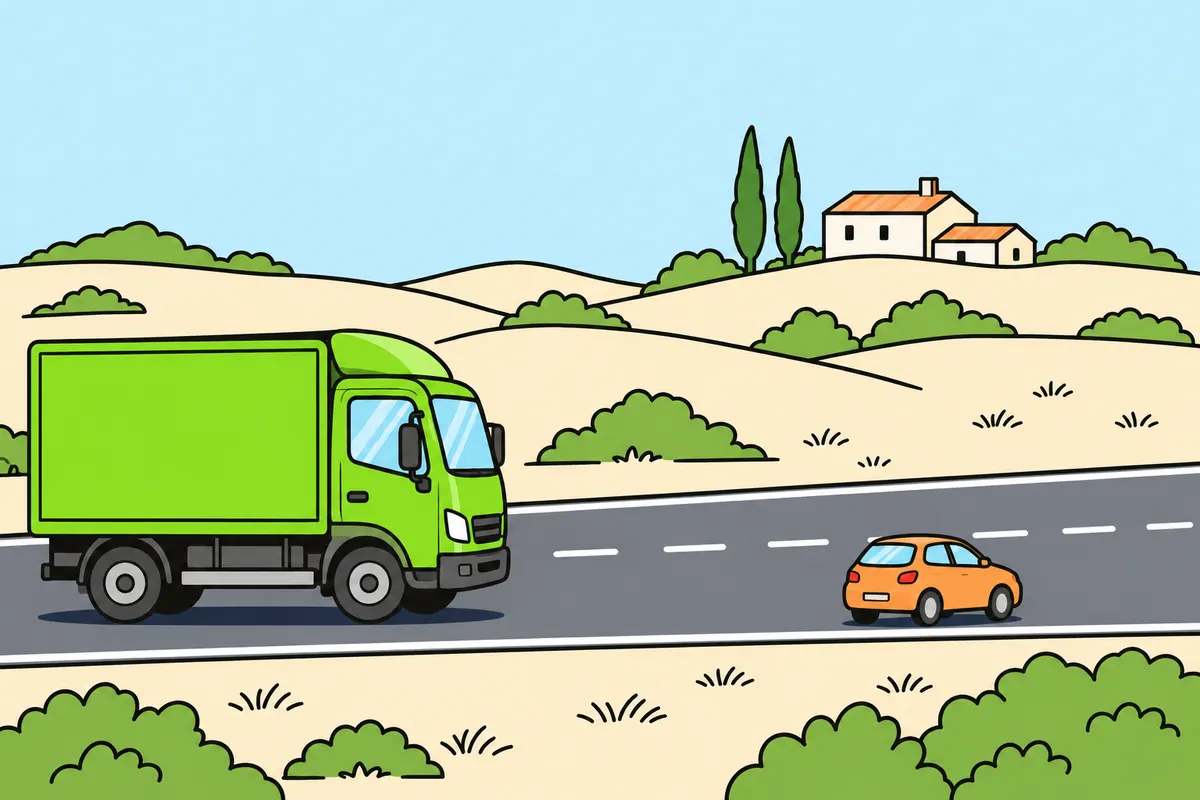
1Preventing risks and saving fuel in your lorry
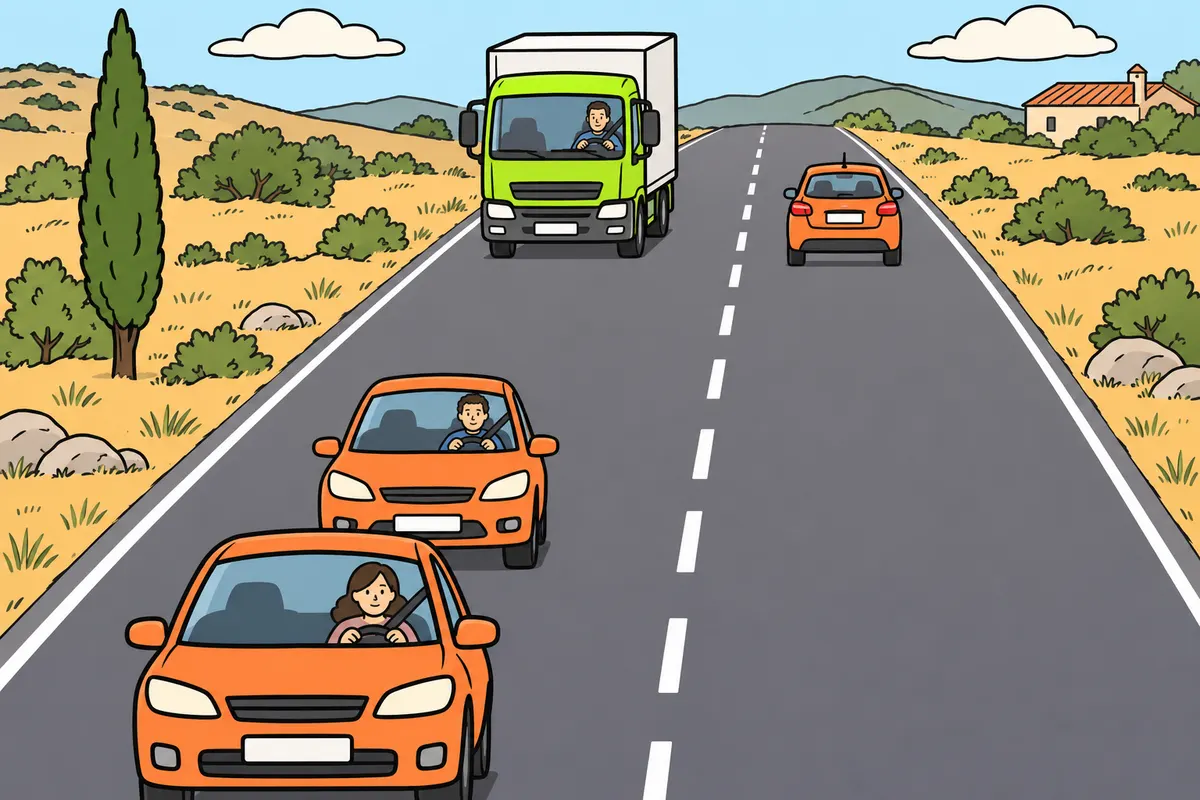
Observe, anticipate hazards and leave space to drive safely and save fuel.
Remember
- Look, anticipate and leave space throughout the journey.
- Adapt your driving to the lorry’s mass and load.
- Ease off early when you see a queue.
- Save fuel without losing control or delaying a needed response.
Exam trap: Wrong: save fuel even if you lose control. Right: use economical driving only while you stay safe.
Read the full explanation
- You must base your preventive driving on observation, anticipation and space. You observe to gather information, anticipate how the situation may develop and keep room to respond. These principles apply throughout the journey, even when you know the road and cannot see any immediate danger.
- Driving efficiently means using the energy needed for transport while avoiding unnecessary losses. If you spot traffic congestion early, you can ease off the accelerator and slow down progressively. Reaching it quickly and braking hard turns into heat energy that you have paid for with fuel.
- You must adapt your technique to the mass, load and response of your light lorry. The goods vehicle covered by the C1 licence has an MMA (maximum authorised mass) of more than 3,500 kg and up to 7,500 kg: its smaller size compared with other lorries does not eliminate its momentum or blind spots. [RGCond, art. 4](https://www.boe.es/buscar/act.php?id=BOE-A-2009-9481#a4).
- Your aim is to complete the job safely, smoothly and with reasonable fuel consumption. A supposed fuel-saving measure that reduces your control, compromises stability or delays a necessary reaction is a poor choice. You must use fuel-efficient techniques within the actual traffic conditions.
2Planning a practical route
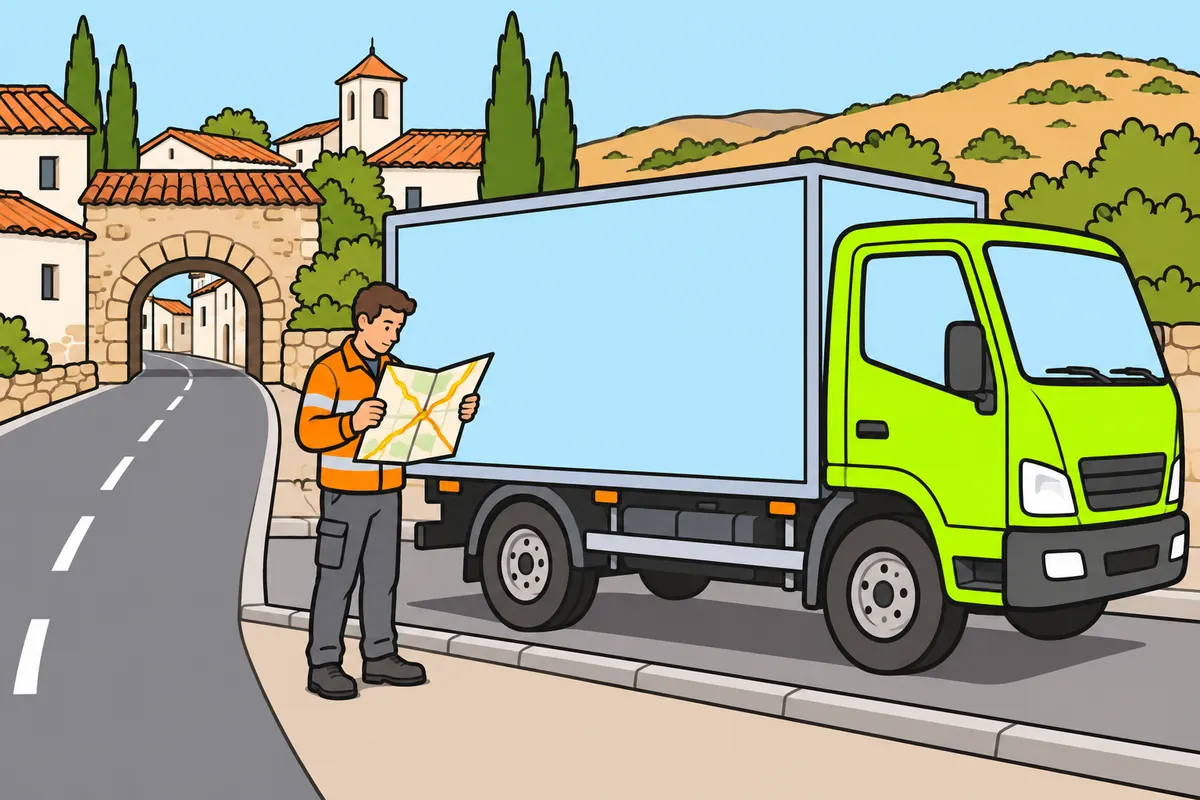
Plan a route that suits your lorry, load and deliveries.
Remember
- Check access, restrictions and room to manoeuvre.
- Check traffic, roadworks and weather.
- Group deliveries only if you meet goods storage and delivery conditions.
- Allow breaks and enough time to arrive without rushing.
Exam trap: Wrong: always choose the shortest route. Right: compare the whole journey and its difficulties.
Read the full explanation
- Before setting off, choose a route that suits the lorry’s dimensions and characteristics and the goods you are carrying. Check access to the destination, environmental restrictions and space to manoeuvre. The shortest route may require detours, stops or manoeuvres that make it less suitable for your vehicle.
- Check traffic, roadworks and the weather so you can anticipate congestion or difficulties. You can consider a smoother route even if it is longer, comparing the whole journey. Do not assume that every diversion saves fuel: gradients, road surface, restrictions and the type of transport also matter.
- Organise deliveries and collections to reduce unnecessary kilometres and repeated journeys. Check access times and conditions for delivery areas in advance. Practical planning prevents you from reaching a restricted entrance and having to improvise with a loaded lorry. On an urban delivery round, grouping deliveries by area can reduce cold starts and repeated journeys, provided you comply with the conditions for storing and delivering the goods.
- Schedule breaks and allow time to arrive without letting business hours pressure you into rushing. Efficient driving requires attention and calm decisions. The statutory driving and rest periods are covered in “Driving, breaks and rest periods”; you must include them in your work planning.
3Looking ahead and scanning your surroundings
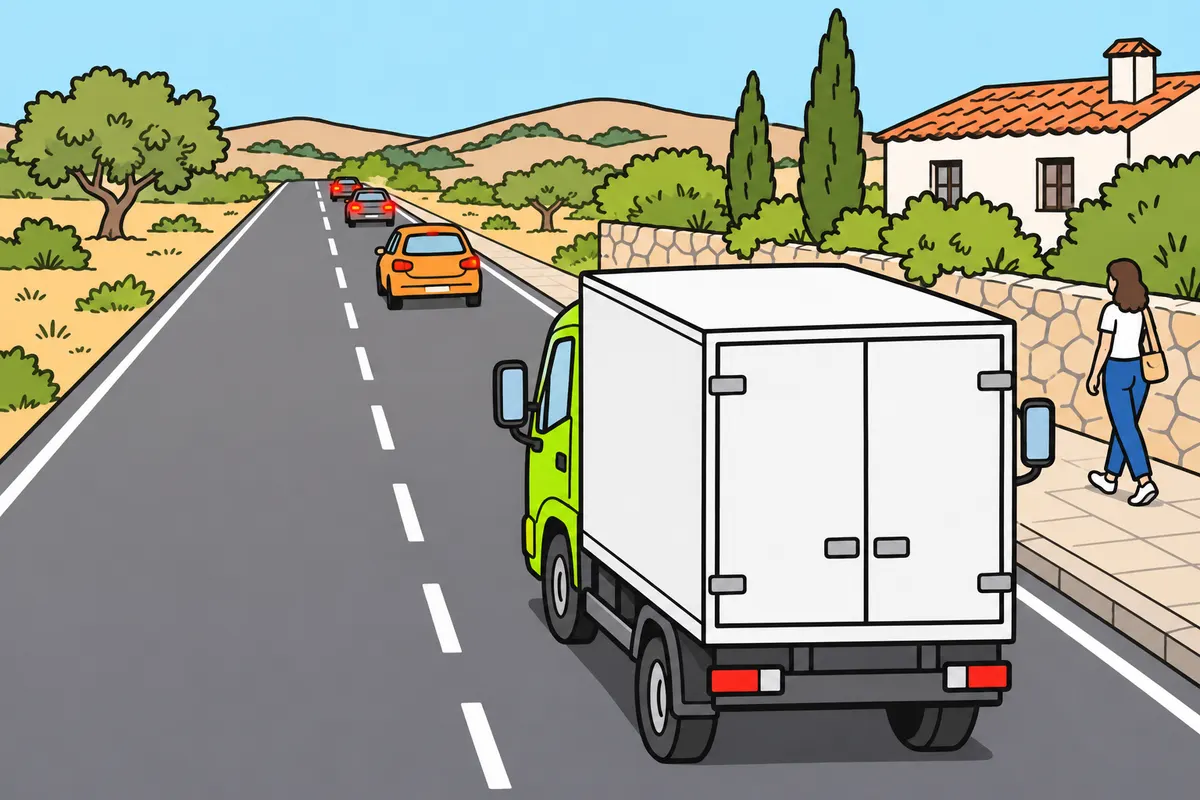
Look ahead and also check the sides, mirrors and nearby areas.
Remember
- Look beyond the vehicle in front.
- Use about 20 seconds of travel as a guide for looking ahead.
- Also check the sides, mirrors and nearby areas.
- Look further ahead as your speed rises.
- Slow down if you cannot see enough clear space.
- Before slowing considerably, check behind unless danger is imminent.
Exam trap: Wrong: treat 20 seconds as a legal following distance. Right: it is a guide for looking ahead.
Read the full explanation
- You must look beyond the vehicle ahead and gather information about the area towards which you are travelling. As a guide for observation, the DGT (Spain’s Directorate-General for Traffic) recommends looking as far ahead as you will travel in about 20 seconds. This is a visual guide, not a legal following distance. [DGT, preventive driving](https://sede-org.dgt.gob.es/export/sites/dgt/.galleries/permisos-de-conducir/autoescuelas/TeoricaAbreviada_LecturaFacil_2023-12_Interactivo.pdf).
- Alternate looking well ahead with checks of nearby areas, the sides and your mirrors. Scanning visually helps you detect both the end of a traffic queue and a pedestrian beside the cab. Before slowing down considerably, check the traffic behind so you can do so safely and progressively, unless there is imminent danger; the warning is explained in “Anticipating mistakes and signalling intentions”. [RGC, art. 53.1](https://www.boe.es/buscar/act.php?id=BOE-A-2003-23514#a53).
- The faster you travel, the more distance you cover while detecting, deciding and acting, so you must look further ahead. If visibility is limited, adapt your speed to the space available. You cannot make up for an area you cannot see by assuming it will be clear.
- Look for signs of change: successive brake lights, vehicles changing lanes or people near a crossing. This lets you prepare a response before a conflict develops. Keep observing to check whether your prediction is confirmed.
4Mirrors, blind spots and aids
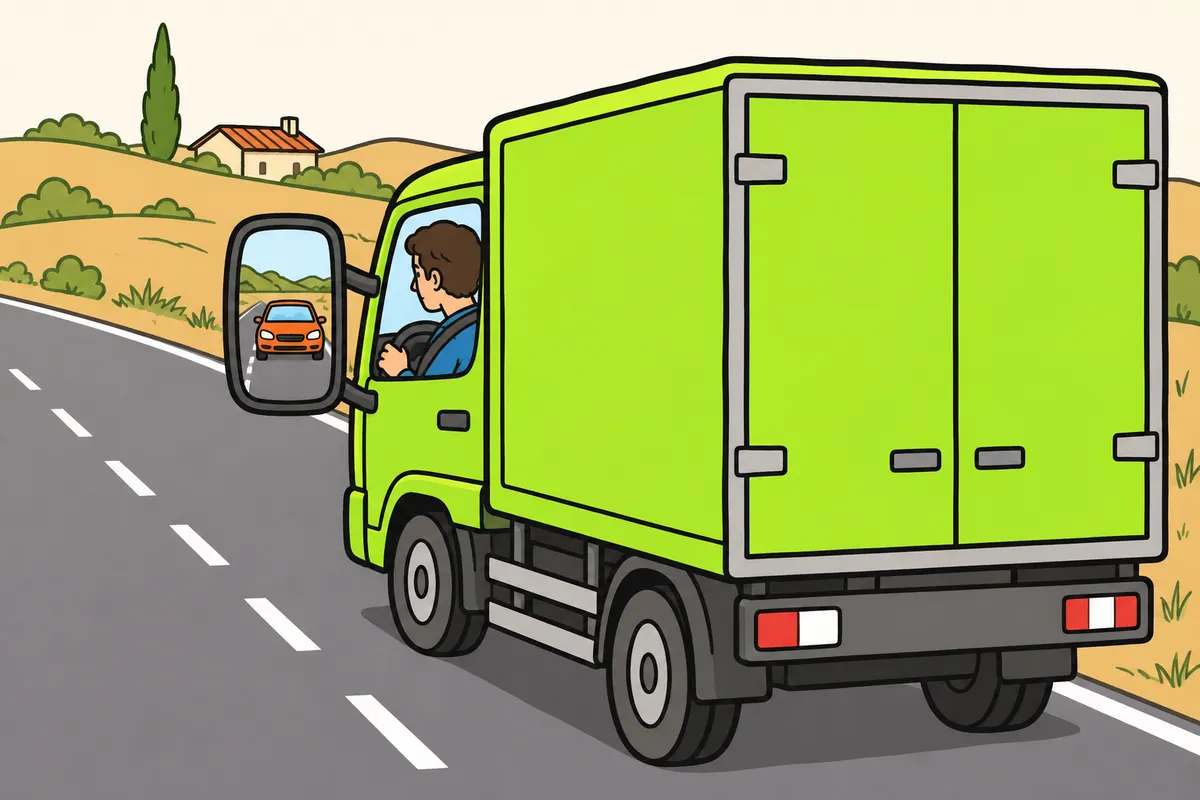
Use mirrors and vision aids to anticipate traffic around you.
Remember
- If someone disappears beside the cab, leave space until you locate them.
- Use cameras and sensors to help you observe.
- No warning does not mean the space is clear.
- Do not watch a screen so long that you stop watching your path.
Exam trap: Wrong: assume no sensor warning removes blind spots. Right: keep checking your surroundings.
Read the full explanation
- If a road user disappears from your field of vision beside the cab, leave enough room until you locate them. On a delivery round, a cyclist you saw approaching may still be beside the lorry even after disappearing from your mirror. You must allow for this uncertainty when deciding whether you can continue with your planned manoeuvre.
- A camera or sensor provides additional information; the absence of a warning does not prove that the space is clear. Use these aids to resolve a specific doubt about your surroundings, then return your attention to your path. Looking at a screen for too long may prevent you from noticing a change in traffic ahead of the lorry.
- Mirror adjustment, mirror types and blind spots are covered in “Lorry driving techniques”, in the sections “What each mirror class shows” and “Blind spots and vulnerable road users”. To anticipate risks during deliveries, relate what you see through each means: if a pedestrian disappears from an image, look for where they may reappear before assuming the risk has passed.
5Anticipating mistakes and signalling intentions
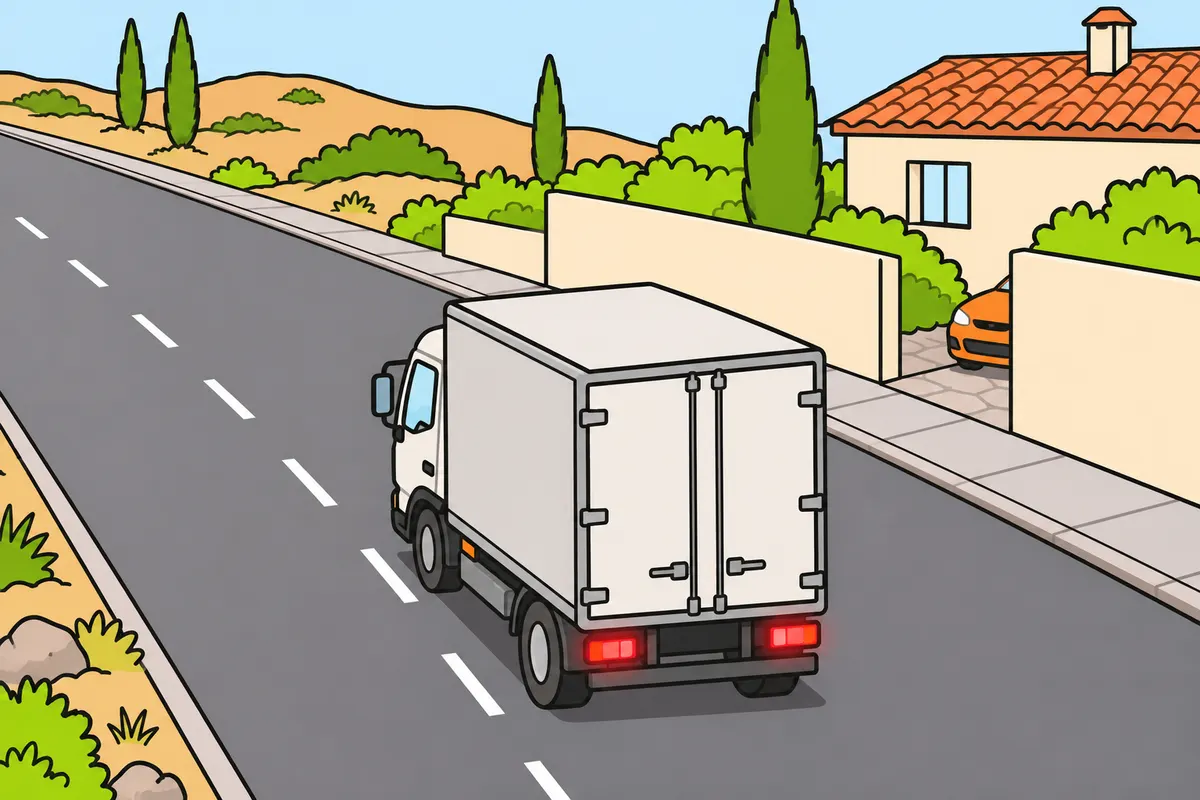
Expect others to make mistakes and signal your manoeuvres in good time.
Remember
- Be ready to brake even when you have priority.
- Watch for pedestrians and cyclists who may move into your path.
- Signal your manoeuvres and check you can carry them out.
- An indicator does not prove others have seen you.
- Drive so you can stop within the clear space you can see.
Exam trap: Wrong: rely on priority to prevent a collision. Right: slow or stop if the risk requires it.
Read the full explanation
- You must anticipate that another road user may make a mistake or may not have seen you. As you approach an exit with limited visibility, consider whether a vehicle might join the road. Having priority does not physically prevent a collision: prepare to slow down or stop if the developing risk requires it.
- Near pedestrians and cyclists, look for possible movements into the lorry’s path and avoid startling them with sudden approaches. A person beside a parked vehicle may be hidden from view. The height of your driving position does not remove visual obstructions or ensure that you will detect everyone in time.
- You must signal your manoeuvres in good time and check that you can carry them out. Your indicator communicates your intention but does not ensure that others have seen you. Smooth, predictable driving helps those behind you adjust their speed without having to react at the last moment. [RGC, art. 109](https://www.boe.es/buscar/act.php?id=BOE-A-2003-23514#a109).
- Adapt your speed to the load, visibility and surroundings so that you can stop within the space you can see and that is clear. The permitted speed may be too high for a particular situation. [RGC, art. 45](https://www.boe.es/buscar/act.php?id=BOE-A-2003-23514#a45).
6Keeping space to respond
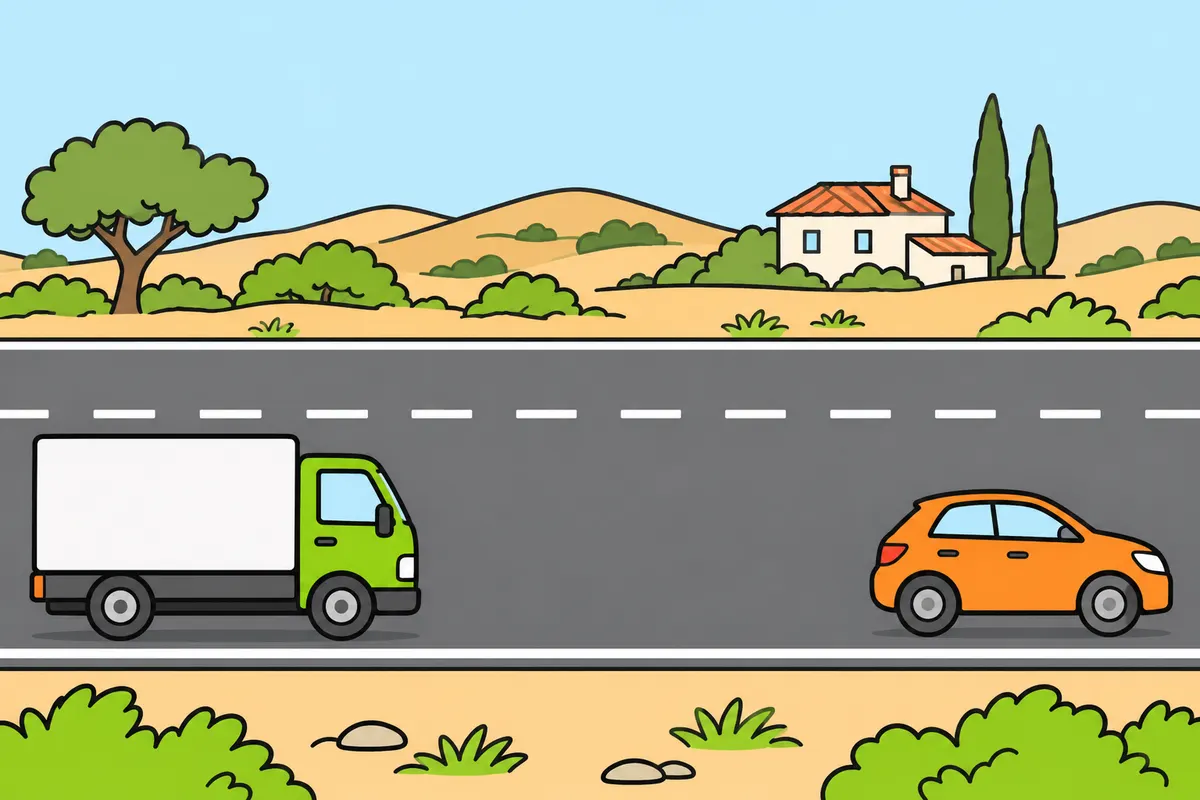
Leave space ahead and at the sides so you can respond smoothly.
Remember
- Leave room to stop if the vehicle ahead brakes hard.
- Consider grip, speed and your brakes.
- Increase your gap ahead if someone follows too closely.
- Do not brake sharply to teach another driver a lesson.
- Leave room to manoeuvre when stopped in a queue.
- On deliveries, watch doors, garages and people between cars.
Exam trap: Wrong: follow another lorry closely to save fuel. Right: keep a safe following distance.
Read the full explanation
- You must leave enough space to stop without hitting the vehicle ahead if it brakes suddenly. Consider the grip, speed and braking ability of the lorry. Specific figures and situations for following distances are covered in “Speed and safe following distances”. [RGC, art. 54](https://www.boe.es/buscar/act.php?id=BOE-A-2003-23514#a54).
- Keeping your distance also saves fuel: with enough room, you can absorb small changes in traffic without constantly alternating between the accelerator and brake. If you drive too close to the vehicle ahead, each change it makes forces you to react. You must leave space for safety even when you cannot see an immediate fuel-saving benefit.
- If another vehicle follows too closely, increase your space ahead and prepare to slow down earlier. This lets you brake progressively and gives the driver behind more time to react. Do not try to correct the other driver with sudden braking or acceleration: this would increase the conflict and undermine your preventive control of the lorry.
- When stopping in a queue, leave room in case you need to manoeuvre and watch how vehicles approach from behind. While moving, also leave space at the sides and avoid staying unnecessarily in other drivers’ blind spots. A gap ahead does not by itself resolve every risk in your surroundings.
- On delivery streets, watch for the doors of parked vehicles, garage exits and people between cars. Leave room at the side and slow down if there is not enough space to pass safely. Do not use the cab’s extra height as a reason to get closer, or follow another lorry closely in search of supposed aerodynamic protection.
7Starting without wasting fuel
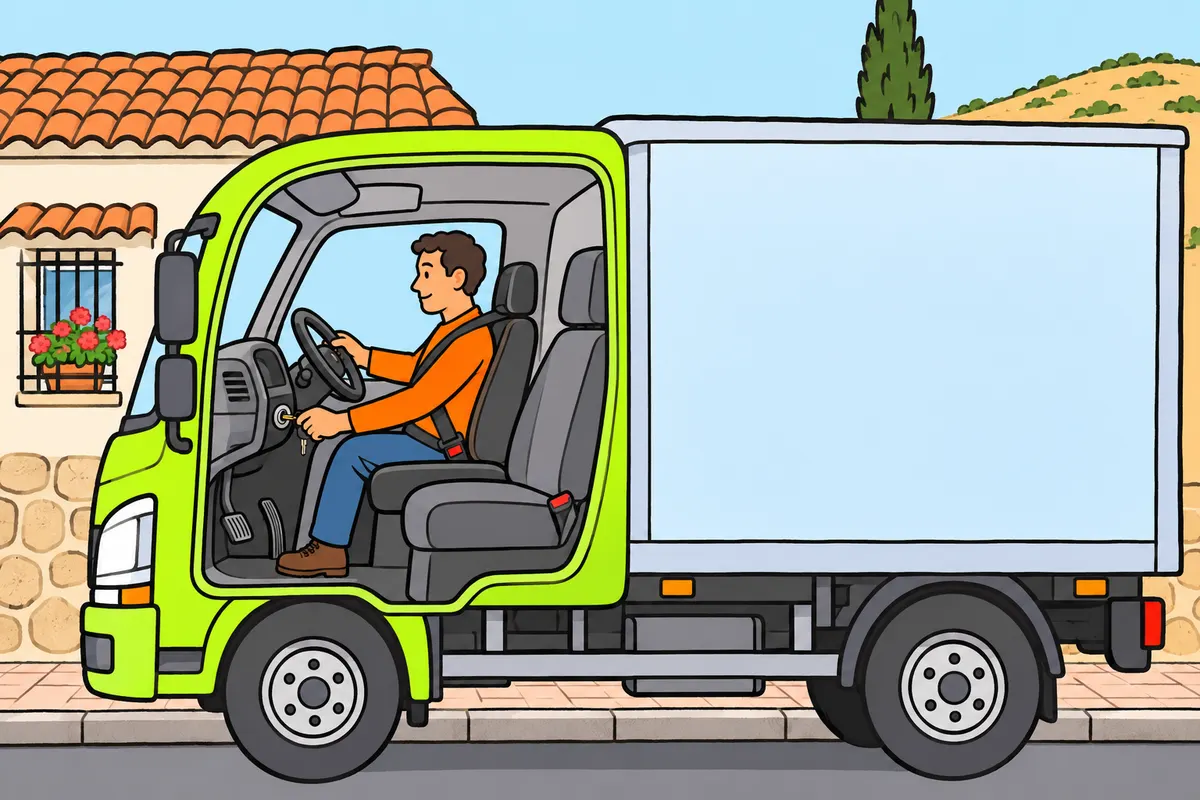
Start and prepare your lorry as its manual directs.
Remember
- Start without accelerating if your lorry allows it.
- Check the brakes are ready before moving off.
- If you have air brakes, check they have enough pressure.
- Choose a starting gear for the load, gradient and transmission.
- Build power gradually while the engine warms.
- Never switch off the engine while moving to save fuel.
Exam trap: Wrong: always wait for a fixed time at idle. Right: follow the maker’s preparation instructions.
Read the full explanation
- If the electronic management system in your lorry allows you to start without accelerating, follow the manual and do not rev the engine while stationary. You should also avoid unnecessary revving before switching off the engine, as this uses fuel without doing useful work for the transport operation.
- Before moving off, check that the vehicle is ready for the road, including the availability of the braking system if it is air-operated. Efficiency does not justify setting off with outstanding warnings or insufficient pressure. This preparation is different from keeping the engine idling until everything reaches its operating temperature.
- Select a starting gear suited to the load, gradient and transmission design. Do not turn a first-and-second-gear guideline for a car into a universal sequence for a lorry. You must be able to move off without putting unnecessary strain on the clutch or demanding an unsuitable effort from the engine.
- As the engine warms up, apply power progressively and follow the manufacturer's instructions. Do not impose a fixed idling wait for every engine or turbocharger. If the vehicle requires a particular preparation or shutdown procedure, follow it instead of applying generic advice. Do not switch off the engine while the lorry is moving to save fuel: this may compromise the operation of its assistance and control systems.
8Understanding economical engine speeds
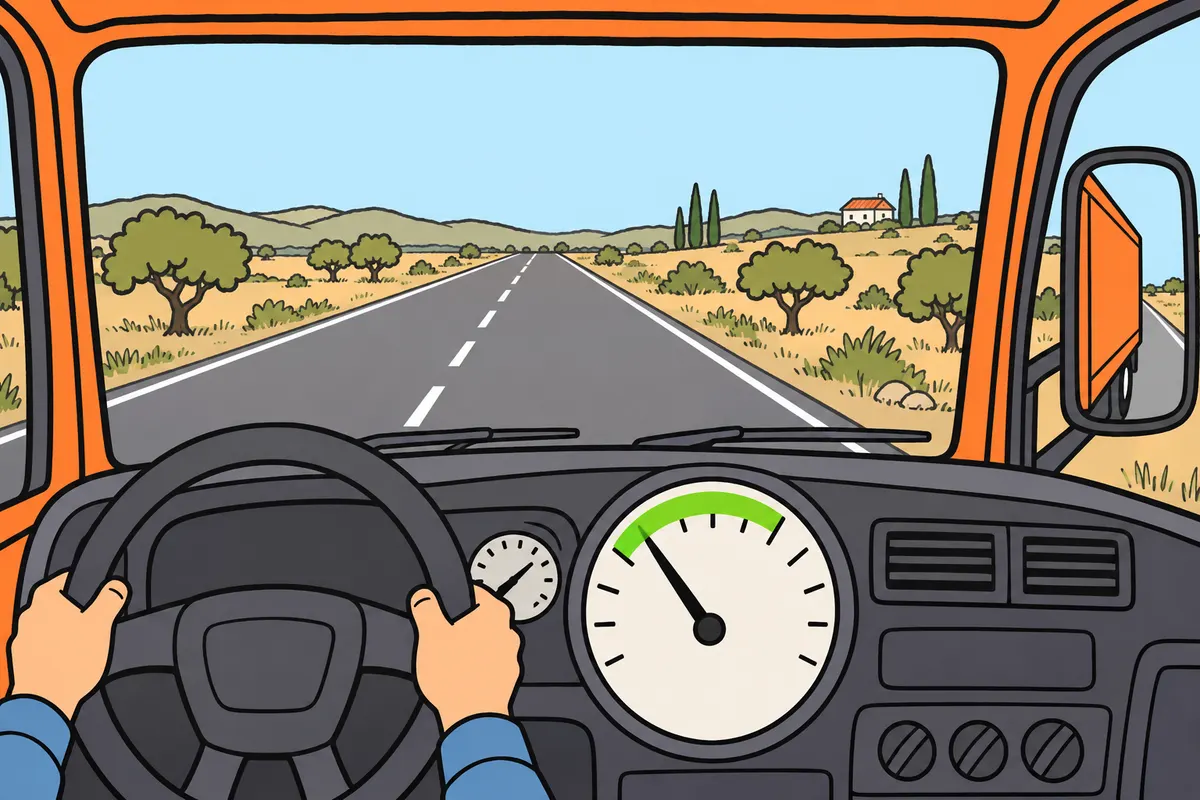
Use the rev counter and adapt engine speed to the effort needed.
| What you check | What it tells you |
|---|---|
| Lorry speed | Kilometres per hour |
| Rev counter | Revolutions per minute |
Remember
- Use the rev counter to read engine speed.
- If fitted, use the green zone for the load, gradient and manual.
- When changing up, keep enough engine response.
- You can raise engine speed when needed, within the maker’s limit.
Exam trap: Wrong: treat the green zone as a fixed speed. Right: it shows an engine speed range.
Read the full explanation
- The lorry's speed is expressed in kilometres per hour and the engine speed in revolutions per minute. Check the rev counter to find the engine speed: at the same road speed, it changes with the gear engaged.
- If your rev counter has a green economical zone, use it as a guide to the engine's favourable operating range, taking account of the load, gradient and manufacturer's instructions. [IDAE, Efficient Driving Manual, sections 5.6 and 9](https://www.idae.es/uploads/documentos/documentos_Manual_de_conduccion_eficiente_488980a3.pdf).
- In favourable conditions, change up so that the engine speed is close to the start of the economical zone and the engine retains enough response to move the lorry. [IDAE, Efficient Driving Manual, sections 5.6 and 9](https://www.idae.es/uploads/documentos/documentos_Manual_de_conduccion_eficiente_488980a3.pdf).
- If you need more response, you can use an engine speed higher than the economical cruising speed, within the range allowed by the manufacturer.
9Choosing high gears without straining the engine
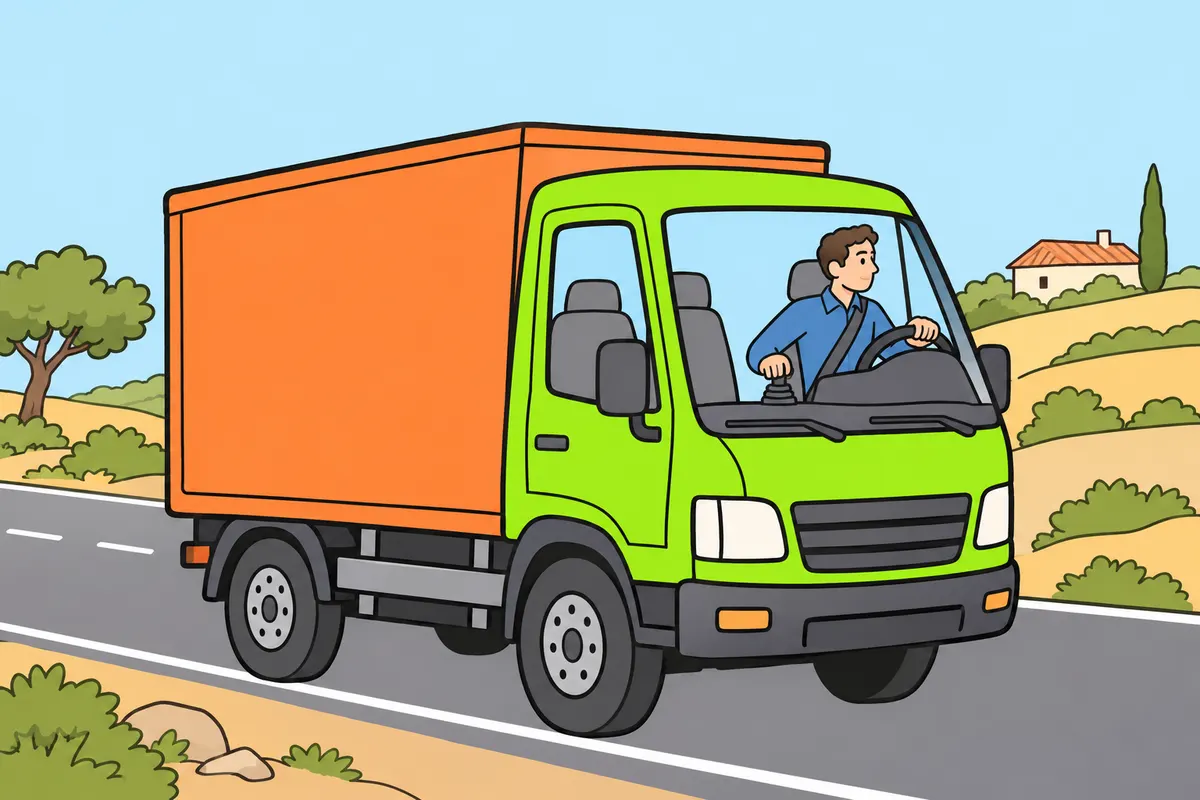
Choose a high gear that lets the engine respond without strain.
Remember
- Change smoothly without keeping high revs unnecessarily.
- You can skip gears when changing up if the transmission allows it.
- Keep enough pulling power and engine speed for the load and gradient.
- Change down in time if the engine loses speed and response.
Exam trap: Wrong: always choose the highest gear. Right: use it only if the engine responds and you stay in control.
Read the full explanation
- Use the highest gear that lets the engine work properly while maintaining control. A high gear reduces engine speed at a given road speed, but may be unsuitable if the engine does not respond sufficiently.
- When accelerating, change gear promptly and smoothly so that you do not keep the engine at high speeds unnecessarily. Coordinate the accelerator, clutch and gear change according to the transmission. Carrying out the operation precisely avoids unnecessary loss of speed and wear; it does not mean forcing the gear lever or engaging the gear hastily.
- You can skip an intermediate gear when changing up if the transmission allows it and the resulting engine speed provides enough pulling power for the load and gradient. This can reduce the number of gear changes while accelerating. [IDAE, Efficient Driving Manual, sections 5.6 and 9](https://www.idae.es/uploads/documentos/documentos_Manual_de_conduccion_eficiente_488980a3.pdf).
- If a gear that is too high causes the engine speed to fall and the engine to stop responding, change down in time to regain pulling power and avoid repeated gear changes.
10Using the clutch and automatic systems correctly
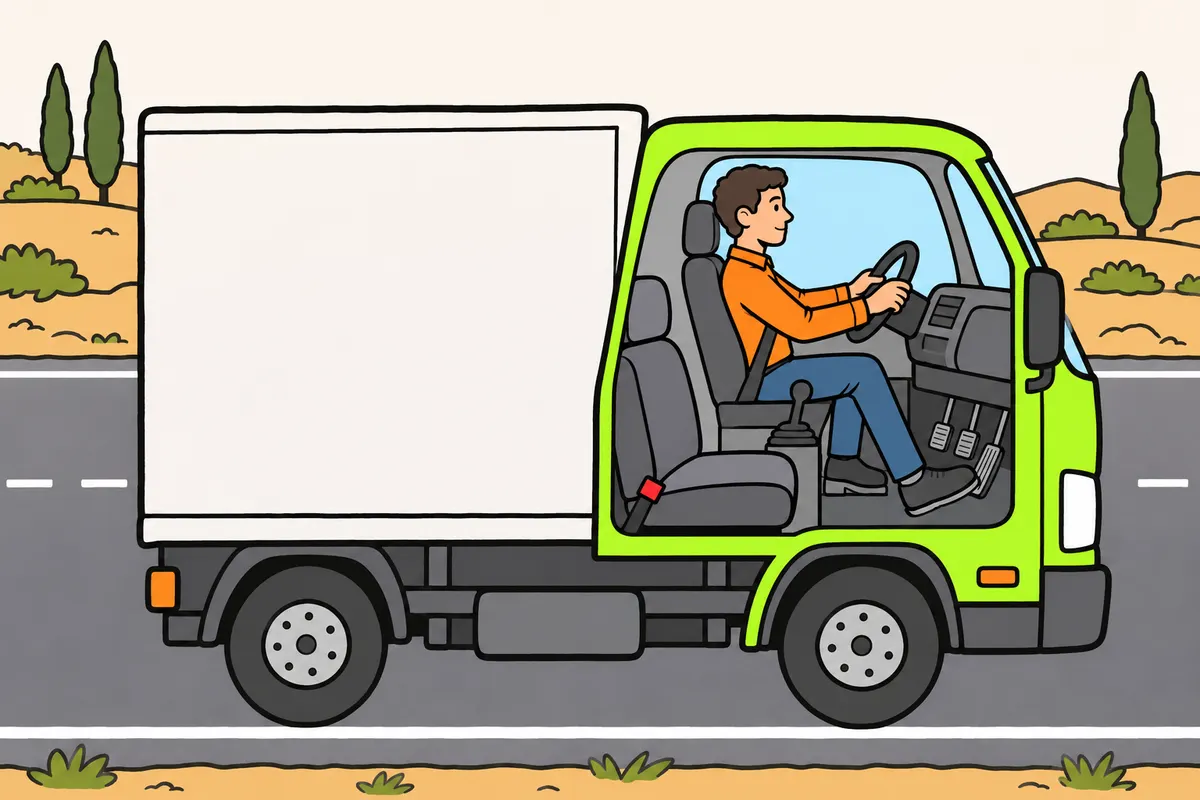
Use the clutch and automatic systems as intended and follow the manual.
| Lorry system | What you should know |
|---|---|
| Eco mode | May adjust accelerator, gears or equipment use, depending on model |
| Start-Stop | Stops and restarts the engine when its conditions are met |
Remember
- Avoid needless double-declutching with a synchronised manual gearbox.
- For an unsynchronised gearbox, follow the maker’s procedure.
- Take your foot off the clutch when you finish using it.
- Use the proper braking system to hold the lorry on a slope.
- Keep observing even when the gearbox is automatic.
Exam trap: Wrong: always trust the automatic gear choice. Right: intervene for the conditions and follow the manual.
Read the full explanation
- With a synchronised manual gearbox, change gear without unnecessary double-declutching: taking longer over the operation causes you to lose speed, which you then have to regain using fuel. Follow the manufacturer's procedure if you use a non-synchronised gearbox. [IDAE, Efficient Driving Manual, sections 5.6 and 9](https://www.idae.es/uploads/documentos/documentos_Manual_de_conduccion_eficiente_488980a3.pdf).
- Take your foot off the clutch when you have finished using it, and do not use it to hold the lorry on a slope. Clutch slip turns energy into heat and increases wear. Holding the vehicle with the appropriate braking system avoids asking the clutch to do a job it is not designed for. Also avoid habitually resting your hand on the gear lever: use each control for its intended purpose and keep a posture that lets you control the vehicle.
- With an automated or automatic gearbox, let its programme operate when appropriate and learn how you can intervene. Do not assume that every automatic gear selection will be optimal in a situation the system does not anticipate. You still need to observe the road.
- Depending on the model, Eco mode can change the accelerator response, gear selection or management of auxiliary equipment. Start-Stop controls stopping and restarting the engine when its conditions are met. Use each system according to its functions and the conditions described in the lorry manual.
11Maintaining a steady speed
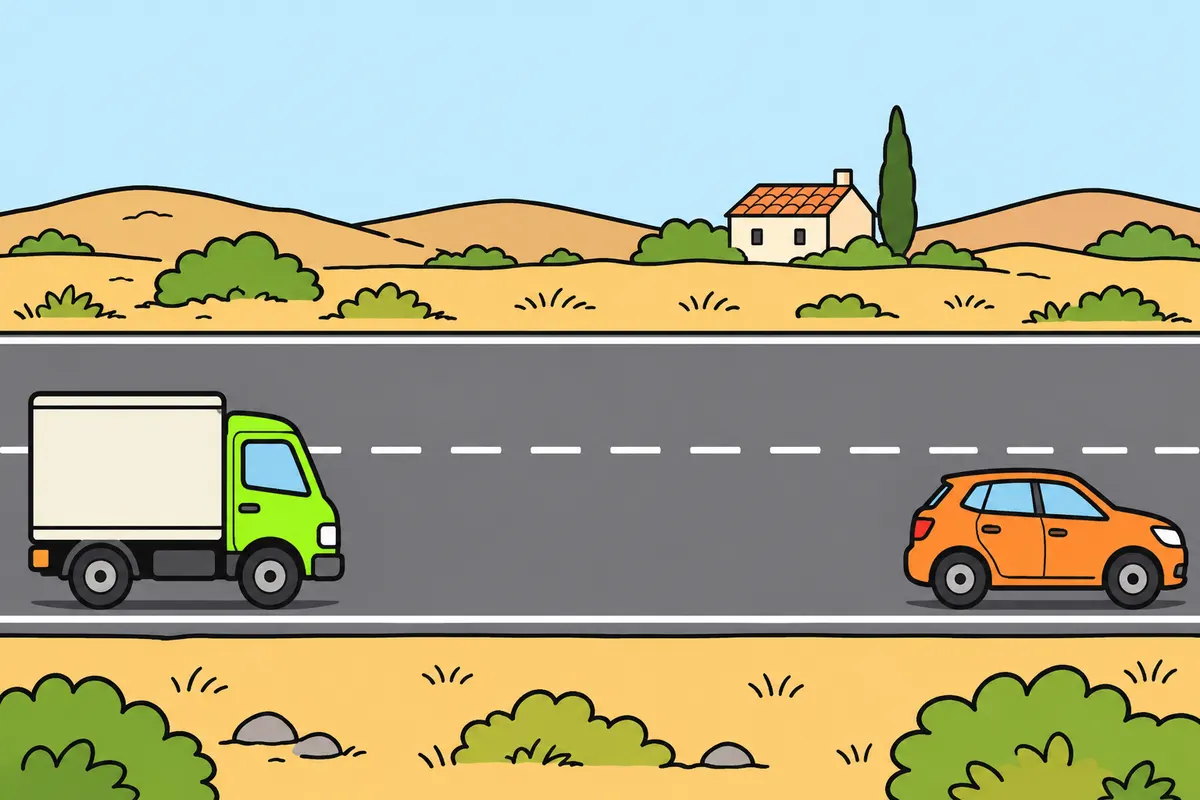
Keep a suitable, steady speed, but slow when conditions change.
Remember
- Avoid accelerating and braking to close small gaps.
- Slow before bends, queues or places with poor visibility.
- Use cruise control only when you can keep a steady pace.
- Intervene or switch it off as conditions and the manual require.
- Keep within limits on descents too.
- Leave space in slow queues.
Exam trap: Wrong: always aim for the limiter ceiling. Right: adapt your speed to the conditions.
Read the full explanation
- Once you have reached a suitable speed, try to maintain it without unnecessary fluctuations. Accelerating to close a small gap and braking immediately afterwards usually wastes energy. Keep pace with the traffic while leaving a margin, so that every change in the vehicle ahead does not prompt a sharp correction in your lorry.
- If you are approaching a bend, a traffic queue or an area with reduced visibility, you must slow down beforehand even if this interrupts your steady speed. Anticipating lets you choose when to stop accelerating and prevents the need to brake from taking you by surprise.
- Cruise control can reduce fluctuations and help save fuel when traffic, road conditions and grip allow you to maintain a steady speed. You must intervene or switch it off according to the conditions and the vehicle manual, while continuing to pay attention to your driving.
- When required, the speed limiter on your N2 is set so that it does not exceed 90 km/h; this ceiling is not a speed you should aim to reach. On undulating ground, you can save fuel by anticipating the terrain and allowing a slight increase in speed downhill, always within the limits and while keeping control, instead of holding the accelerator against the limiter. Its scope, exemptions and operation are covered in “Dimensions and masses of the light lorry”, “Speed limiter: vehicles that must have one” and “Speed limiter exemptions and operation”. [RD 1417/2005, art. 4](https://www.boe.es/buscar/act.php?id=BOE-A-2005-19990#a4).
- Do not apply a supposed universal economical speed for a car to a lorry or try to save fuel by exceeding speed limits. Fuel consumption also depends on the load, aerodynamics, gradient and transmission. Maximum speeds for each type of road and special cases are covered in “Speed and safe following distances”.
- In town, you may use more fuel per distance travelled even when driving slowly: repeated stops and increases in speed require energy. In slow-moving traffic, leave a gap and move at the pace traffic allows, without accelerating to close every small gap. Maintaining a suitable gear and anticipating traffic lights helps keep traffic moving smoothly.
12Using momentum when slowing down
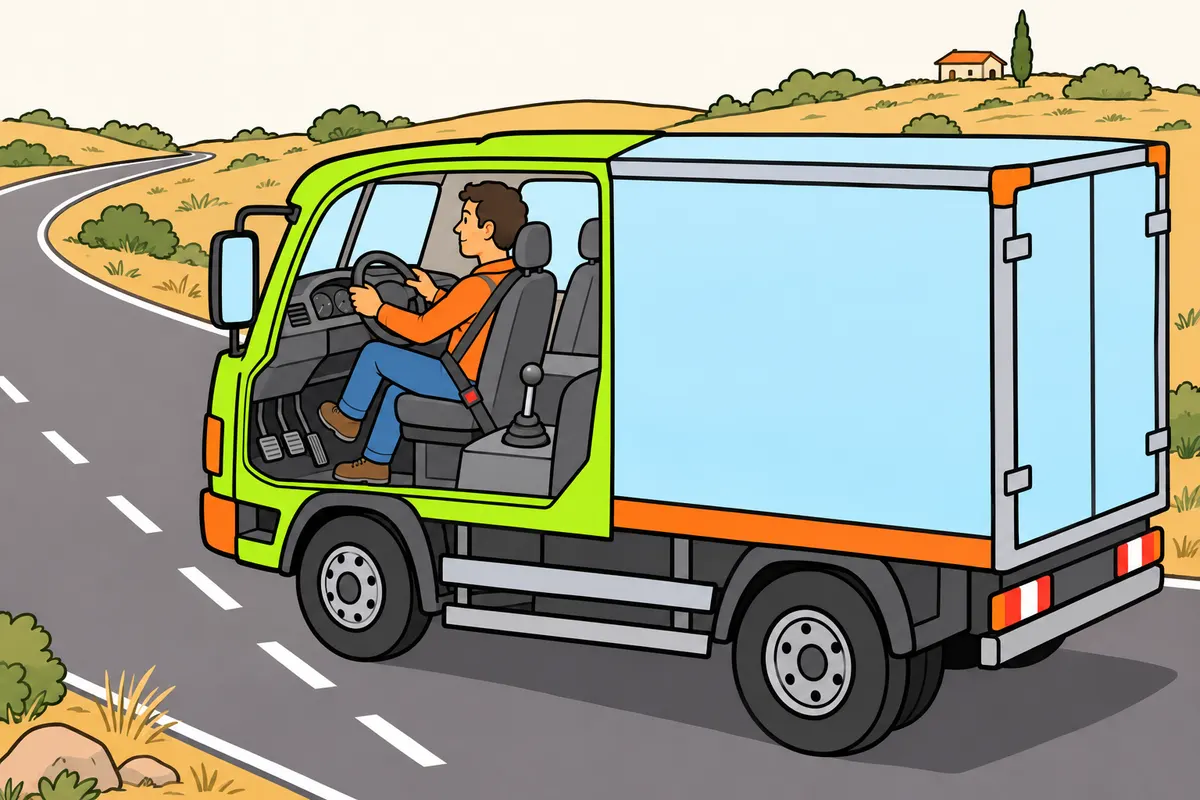
Ease off in good time and keep a suitable gear as you slow.
Remember
- Use the lorry’s momentum when you need to slow.
- Keep a gear engaged that suits your speed.
- Brake whenever necessary.
- Do not suddenly select a gear that is too low.
- Do not prolong slowing if you obstruct traffic or lose stopping space.
Exam trap: Wrong: assume fuel always stops when you release the accelerator. Right: it depends on the system and its conditions.
Read the full explanation
- When you see that you need to slow down, stop accelerating in good time and keep a suitable gear engaged. This lets you use the lorry's momentum without continuing to use fuel unnecessarily. You must brake when necessary: anticipation helps you slow down smoothly, but does not replace braking when it is needed.
- In fuel-injection systems that cut fuel delivery during overrun, you can travel without fuel being injected while the relevant conditions are met. The cut-off depends on engine speed, temperature and the vehicle's management system.
- Avoid changing down sharply to a gear that is too low to get more engine braking. The gear must be compatible with your speed and the engine's permitted speed range. You must also avoid extending the overrun in a way that obstructs traffic or leaves you without enough room when you need to stop.
- Use the combination of braking systems that maintains speed and control safely. Detailed techniques for retarders and braking a heavy vehicle are covered in “Brakes and retarders on light lorries” and “Lorry driving techniques”.
13Planning for climbs and descents
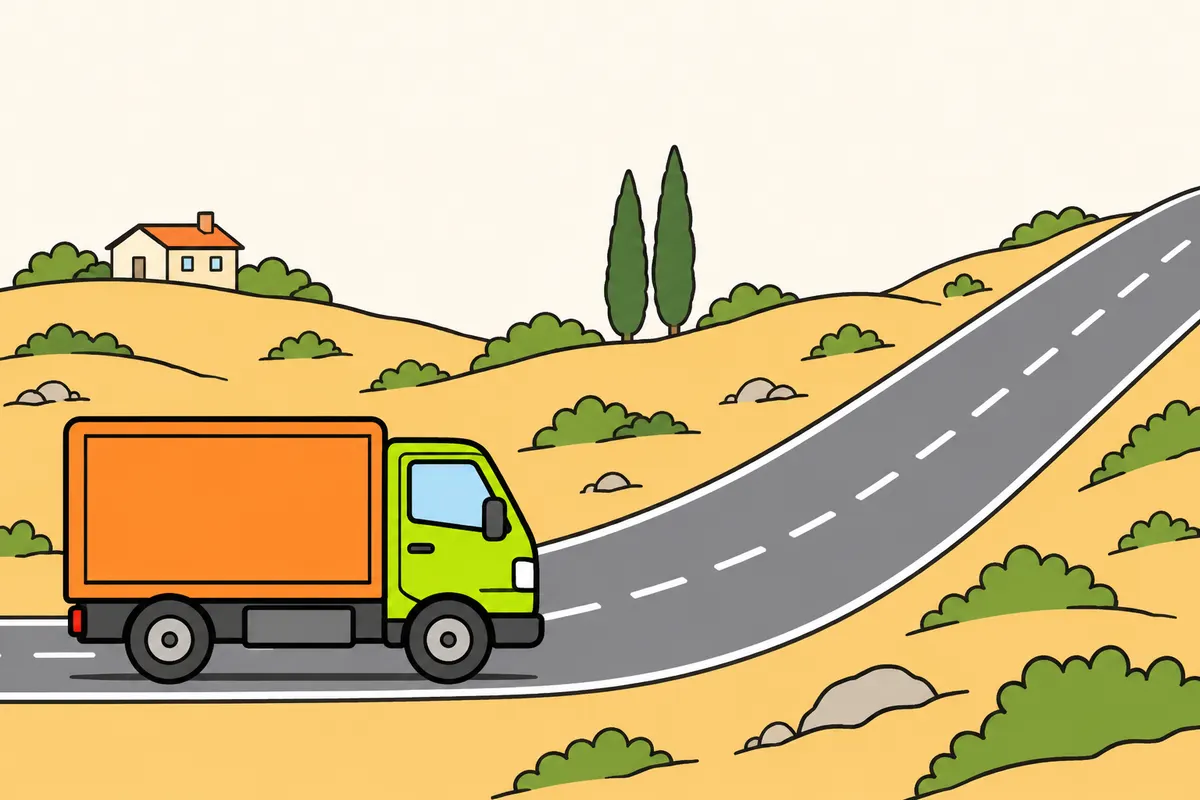
Choose gears early and adapt your driving to each gradient.
| Gradient | How to prepare |
|---|---|
| Climb | Anticipate the effort and choose a suitable gear |
| Descent | Prepare before entering and keep a controllable speed |
Remember
- Look at the climb before you reach it.
- Choose a gear for the load and effort needed.
- You may need a lower gear even if fuel use rises.
- Prepare for a descent before entering to avoid late braking.
Exam trap: Wrong: keep a high gear when the engine lacks power. Right: adapt the gear to the climb.
Read the full explanation
- Before a climb, assess how it develops and anticipate the effort the loaded lorry will need, so you can select a suitable gear before reaching it.
- On an incline, you may need a lower gear to maintain a suitable speed. Adapt your choice to the load and the sustained effort of the climb, even if fuel consumption rises compared with level ground.
- Prepare for the descent before entering it so you can maintain a controllable speed without braking late. Gear use and retarder systems are covered in “Lorry driving techniques”, section “Control a long descent”, and “Brakes and retarders on light lorries”, section “Brake fade and long descents”.
14Stops and idling
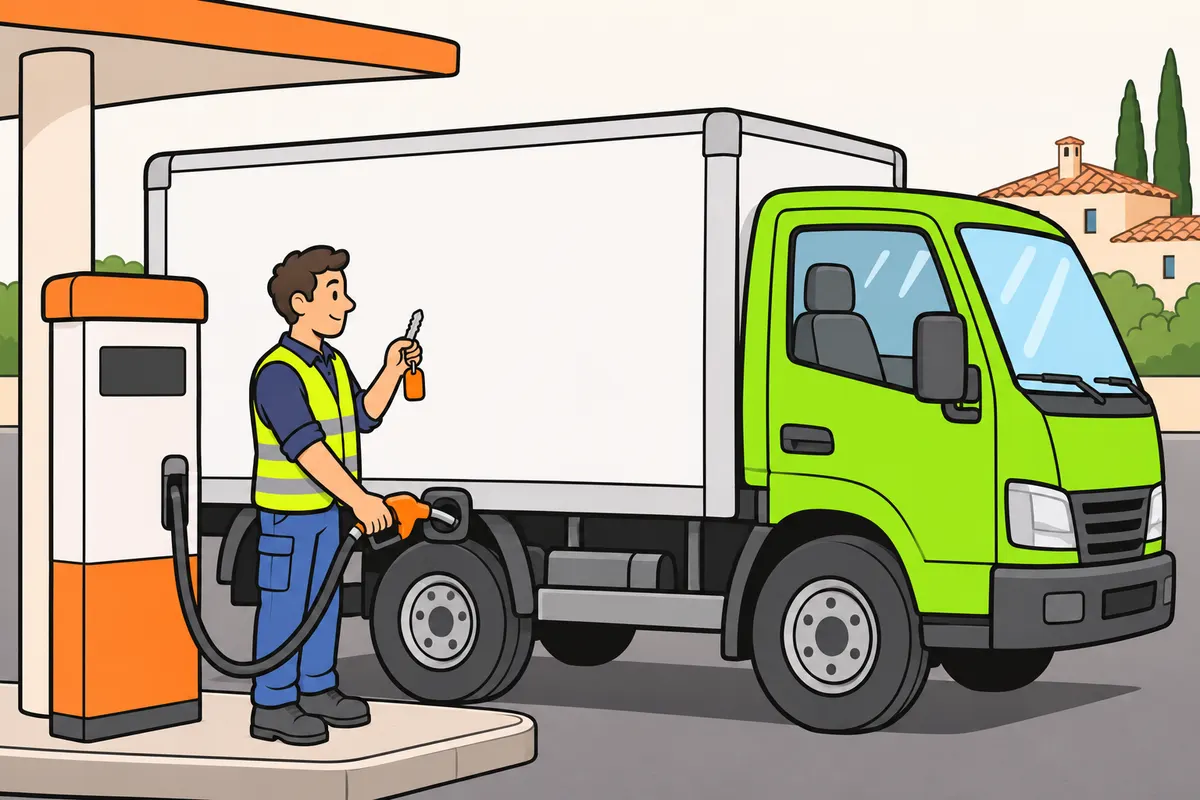
Avoid running the engine when unnecessary and follow rules for each stop.
| Term | What it means |
|---|---|
| Idling | Engine runs without pressing the accelerator |
| Neutral | A transmission position |
Remember
- An idling engine uses fuel while the lorry is stopped.
- Switch it off during waits when safe and the manual allows.
- Consider equipment you need and local restrictions.
- Switch off the engine when refuelling.
- During delivery waits, run the engine only when the work needs it.
Exam trap: Wrong: confuse idling with neutral. Right: distinguish engine operation from the transmission.
Read the full explanation
- Idling is when the engine runs without you pressing the accelerator; neutral is a transmission position. When the lorry is stationary, an idling engine continues to use fuel.
- Avoid leaving the engine running unnecessarily while waiting if you can switch it off safely and in accordance with the manual. Do not set a single time limit for every lorry or task. Consider the actual needs of its equipment and the restrictions at the place where you are stopped.
- You must switch off the engine while refuelling. The requirements for stopping in tunnels or enclosed places, including the provision in art. 115.2 of the RGC, are explained in “Accidents, breakdowns and first aid”, section “Breakdowns, fires and traffic queues in tunnels”. [RGC, art. 115.1–4](https://www.boe.es/buscar/act.php?id=BOE-A-2003-23514#a115).
- When waiting during deliveries, organise the use of auxiliary equipment so that the engine runs only when the operation requires it. Automatic stop-start is explained in “Using the clutch and automatic systems correctly”.
15Correct tyre pressures
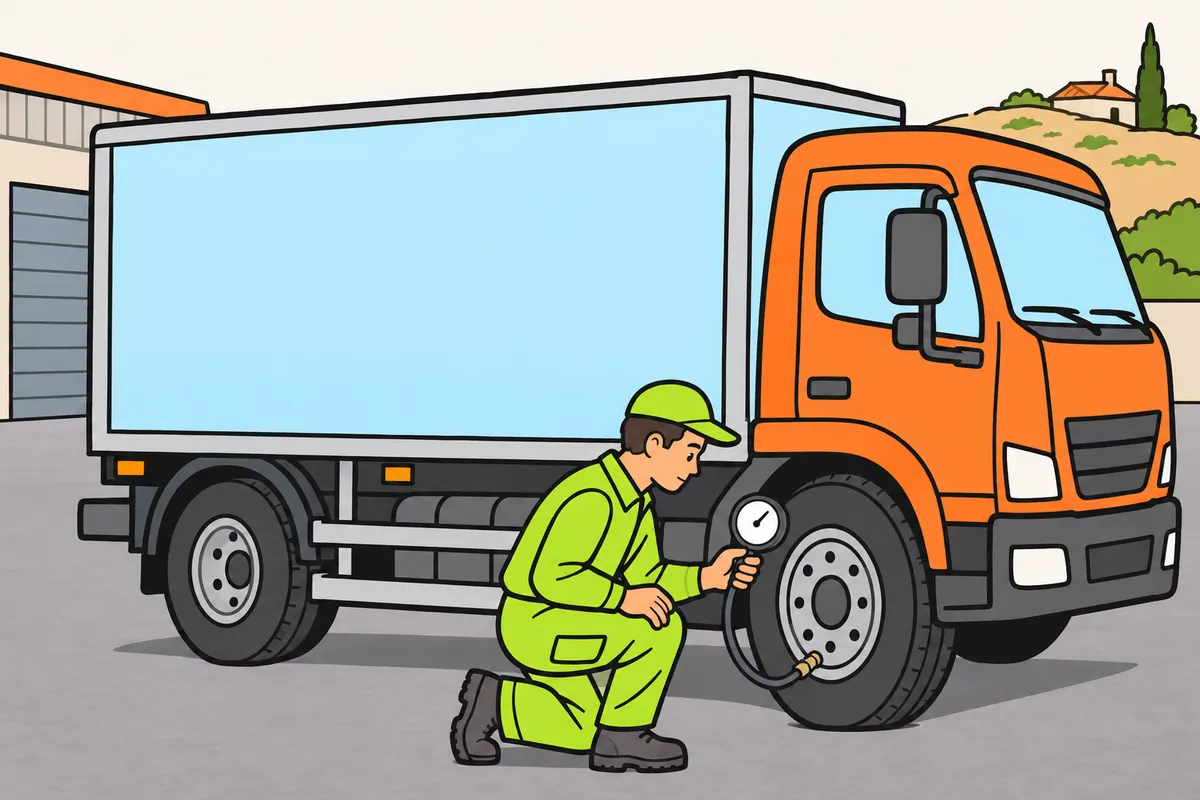
Check cold tyres and use the pressure set for your lorry, wheels and load.
Remember
- Use the maker’s pressure for each axle, wheel fitment and load.
- Check tyre pressure when cold.
- Do not raise pressure yourself to try to save fuel.
- Plan checks for the loads expected before a delivery round.
- Do not copy another lorry’s pressure.
Exam trap: Wrong: lower pressure because you carry more load. Right: use the specified pressure for that load.
Read the full explanation
- The prescribed pressure allows the tyre to carry the load in the intended conditions and roll without excessive deformation. To save fuel, keep to that reference: increasing the pressure on your own initiative does not guarantee lower consumption or safe handling.
- Use the pressure specified for the lorry, axle, wheel fitment and load, measured when cold. The procedure, how to interpret hot readings and twin wheels are covered in “C1 lorry maintenance and checks”, sections “Cold tyre pressures and wear” and “Twin wheels and fastenings”. [DGT, tyre inspection](https://revista.dgt.es/es/motor/noticias/2017/0727Desgaste-neumaticos.shtml).
- For deliveries involving several unloading stops, match the inflation plan to the load conditions anticipated by the manufacturer. You can arrange the checks before the operation to avoid making rushed decisions at each delivery. A figure taken from another lorry does not describe what your axles need.
16Rolling resistance, wear and tyre labels
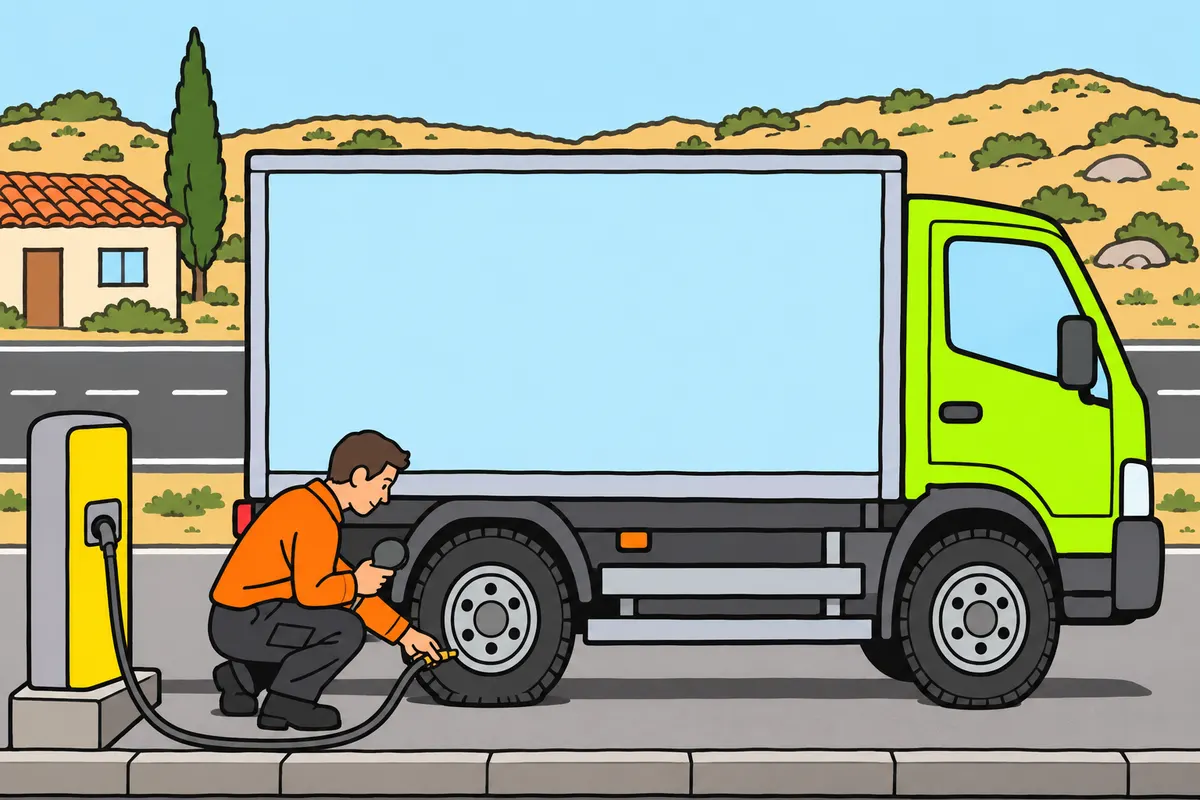
Keep the specified pressure and compare the features on the tyre label.
Remember
- Low pressure increases tyre deformation and fuel use.
- Compare fuel efficiency, wet grip and outside noise on the label.
- Check the tyre suits your lorry.
- Check it suits the axle, load and work.
- Do not confuse rolling resistance with wear resistance.
- Do not use the label to choose tyre pressure.
Exam trap: Wrong: treat the label’s outside noise as cab noise. Right: they are different.
Read the full explanation
- Rolling resistance is the opposition to forward motion associated with a tyre deforming as it rolls. When it increases, the engine needs to provide more energy to maintain the same movement. In otherwise equivalent conditions, insufficient pressure increases this loss and fuel consumption; you can address its cause by following the vehicle’s inflation references.
- The European tyre label gives information about efficiency linked to rolling resistance, wet grip and external noise. Compare these characteristics and check that the tyre is suitable for the lorry. The label may include snow or ice information where applicable. [Regulation (EU) 2020/740, Annexes I and II](https://www.boe.es/buscar/doc.php?id=DOUE-L-2020-80878).
- Do not confuse rolling resistance with resistance to abrasive wear. Nor should you interpret the label’s external noise rating as a measure of the noise you hear in the cab. This information does not set inflation pressure or promise an exact tyre life.
- When choosing tyres for a C1 lorry, consider fuel consumption and wet grip together: a good energy rating does not replace compatibility with the axle, load and operation. Markings, damage and inspection criteria are covered in “C1 lorry maintenance and checks”, sections “Read the tyre markings” and “Tyres: tread and damage”.
17Carrying your load efficiently
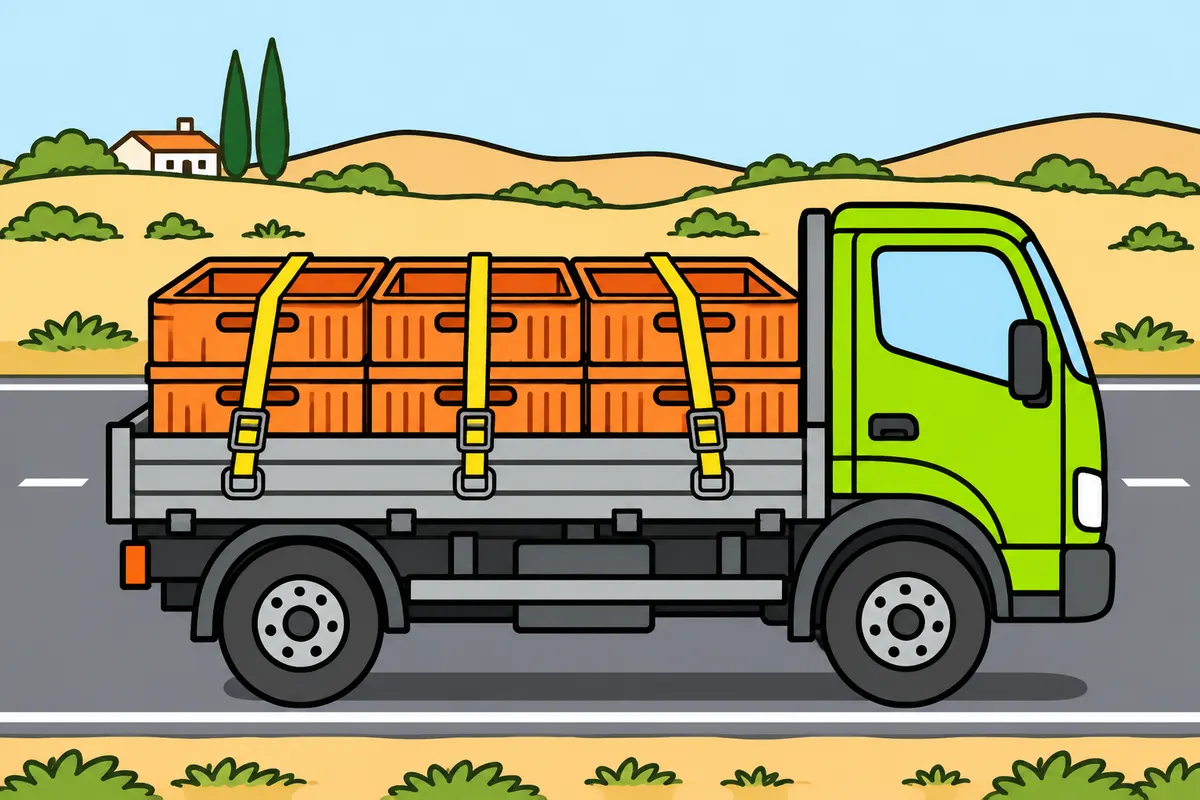
Organise, distribute and secure goods safely, avoiding unnecessary journeys.
Remember
- Remove unnecessary materials but keep equipment the job needs.
- Avoid empty journeys when you can plan the work better.
- Stay within the vehicle limits.
- Distribute and secure goods to keep the lorry stable.
- After partial unloading, check the remaining load and tyre conditions.
Exam trap: Wrong: assume unloading always improves weight distribution. Right: check how the remaining load is arranged.
Read the full explanation
- You need more energy to set a more heavily loaded lorry in motion or drive it uphill than you do in equivalent conditions with a lower mass. Remove equipment or materials that are unnecessary for the operation, while always keeping the equipment you need. Staying within the authorised mass does not remove the effect of weight on fuel consumption.
- Plan transport efficiently to avoid empty journeys or repeated movements where possible. Organise the load to suit the operation and the vehicle’s limits. The efficiency of a delivery is not measured only by how much fuel the engine uses at a particular moment.
- Distribute and secure the goods to maintain stability and prevent movement that would force you to correct your course or speed. The procedures are covered in “Load securing and safety”. [RGC, art. 14](https://www.boe.es/buscar/act.php?id=BOE-A-2003-23514#a14).
- After partial unloading, assess the remaining load distribution and the conditions in which the tyres are used. Do not assume that removing goods automatically improves every distribution of mass. Efficient transport requires the lorry to handle appropriately at every stage of the journey.
18Air resistance and the Cx coefficient
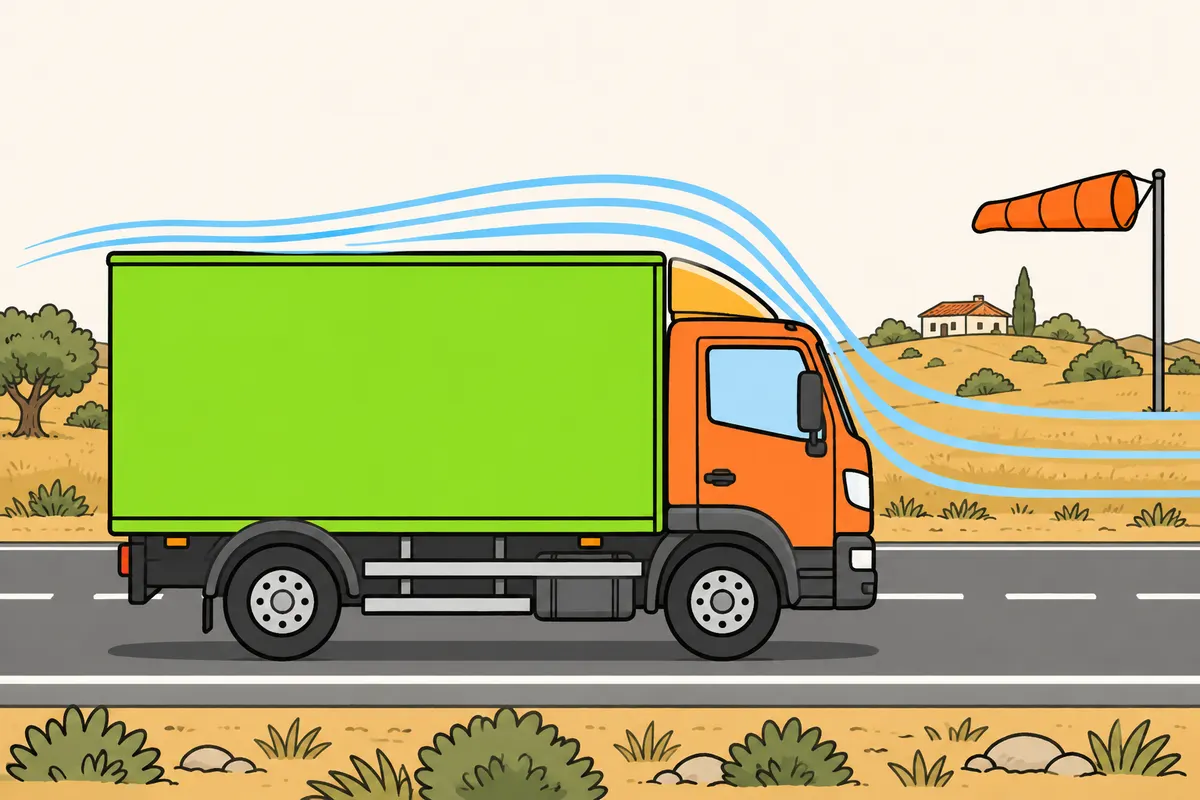
Consider shape, frontal area and wind when assessing fuel use.
| Wind along the road | Effect at the same ground speed |
|---|---|
| Headwind | Raises relative air speed and may increase fuel use |
| Moderate tailwind | May reduce air resistance |
Remember
- You can use much fuel even when driving empty.
- Cx describes how shape affects air resistance.
- Do not compare vehicles by Cx alone.
- A lower Cx reduces resistance when other conditions match.
- Slow down for safety if the wind requires it.
Exam trap: Wrong: assume a lower Cx guarantees sideways stability. Right: it does not guarantee less sideways movement.
Read the full explanation
- The engine must provide energy to overcome air resistance as you keep moving. On a lorry, its frontal area, body shape and the air’s relative speed all matter. Do not attribute fuel consumption solely to weight: you can also use a lot of fuel when driving empty.
- Cx is an aerodynamic coefficient that characterises resistance associated with shape; it is not the resistance force itself. If frontal area, speed and air conditions are the same, a lower Cx reduces resistance to forward motion. Do not compare vehicles using that number alone.
- Longitudinal resistance to forward motion and sideways deflection by crosswinds are different effects. A favourable Cx does not by itself guarantee greater stability or less sideways deflection. For safety, the wind may require you to reduce speed even if your bodywork has features designed to improve fuel consumption.
- At the same speed over the ground, a headwind increases the air’s relative speed and may increase fuel consumption. A moderate longitudinal wind from behind may reduce that resistance.
19Deflectors, bodywork and windows
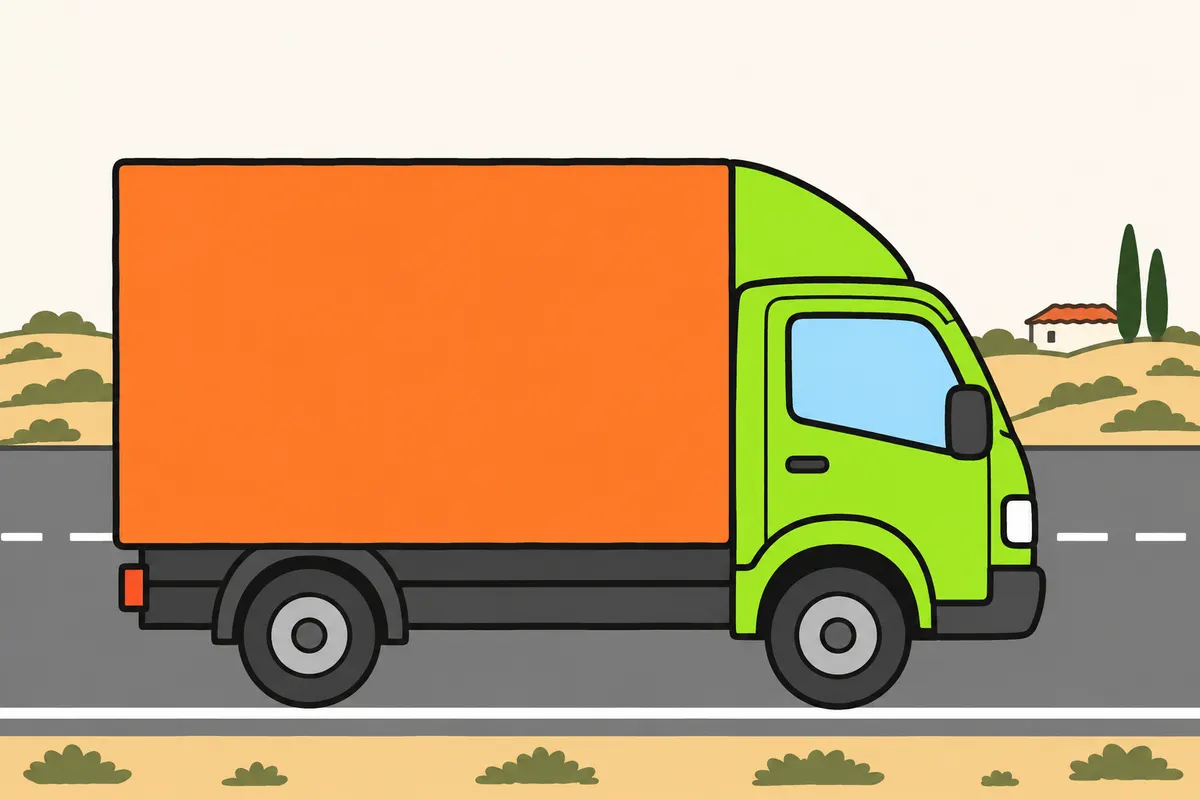
Adjust deflectors and secure covers to reduce air resistance.
Remember
- Set deflectors for the lorry’s actual height and configuration.
- Keep aerodynamic parts in good condition.
- Fit and secure covers so they do not flap loose.
- Keep goods protected and secured.
- Use ventilation and air conditioning without harming visibility or attention.
Exam trap: Wrong: expect a fixed saving from any deflector. Right: its effect depends on the setting and configuration.
Read the full explanation
- Suitable, correctly adjusted deflectors direct the airflow and can reduce drag and fuel consumption. You must match their adjustment to the actual height and configuration of the bodywork or vehicle combination.
- Check that aerodynamic components are in good condition and in their intended position. A deflector adjusted for a different configuration may be less effective. Follow the fitting and adjustment instructions; do not modify components haphazardly in the hope of reducing fuel consumption.
- Tarpaulins and protective covers must be correctly positioned and secured. Avoid loose surfaces that flap or protrude unnecessarily. As well as causing nuisance and risks, they can worsen airflow. When improving aerodynamics, you must preserve their functions of protecting and securing the load.
- Driving with the windows open can increase drag. At road speeds, it is usually advisable to use the ventilation and climate-control systems provided in a sensible way. Do not assign a fixed fuel-consumption percentage to every open window, or compromise demisting or your attention just to switch off every auxiliary system.
20Maintenance and auxiliary equipment
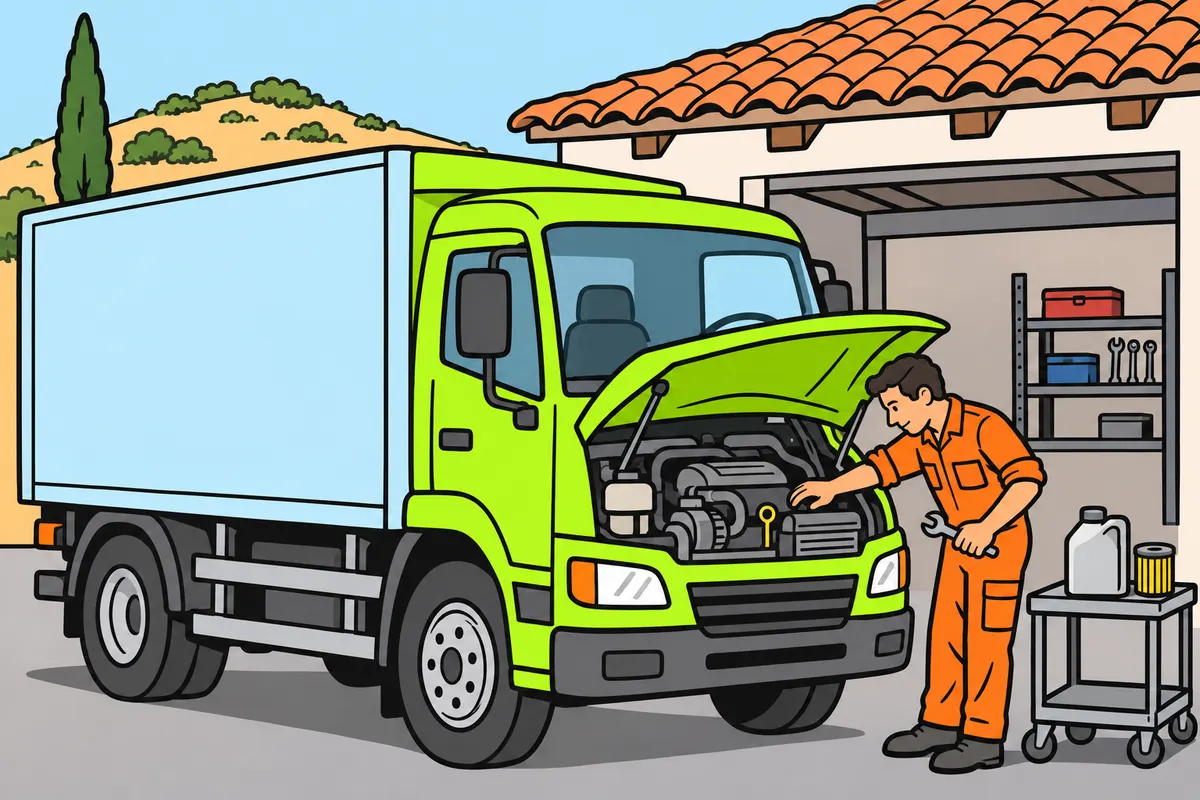
Maintain your lorry and use its equipment for the needs of the job.
Remember
- Follow the maker’s maintenance schedule.
- Use approved fuels and lubricants.
- Get a diagnosis if you notice unusual smoke or loss of power.
- Do not alter emissions control equipment.
- Use air conditioning sensibly without losing visibility.
- Keep equipment running when the goods need it.
Exam trap: Wrong: switch off every system to save fuel. Right: keep systems needed for safety and the load.
Read the full explanation
- Maintain the engine and its fuel, air intake, lubrication and cooling systems in accordance with the manufacturer's instructions. A fault can increase fuel consumption, smoke and wear. Delaying necessary work is not a fuel-saving technique: it can increase your costs and affect the lorry's availability.
- In your diesel lorry, do not automatically apply advice about spark plugs in petrol engines. Attend to the filters, injection system and equipment that it actually has. If you notice abnormal smoke or a loss of performance, arrange a diagnosis without assuming with certainty that one particular part is to blame.
- Use fuel and lubricants approved by the manufacturer. A different fuel or oil chosen only because it is cheaper does not guarantee savings and may damage the system. Do not alter emissions-control equipment to try to improve fuel consumption or avoid its maintenance either.
- Air conditioning and auxiliary equipment require energy. Use them sensibly while maintaining visibility and suitable driving conditions; do not switch off a system needed for the load or safety. For refrigerated transport, keeping the goods in the required condition is part of the service.
21Emissions and reading fuel consumption
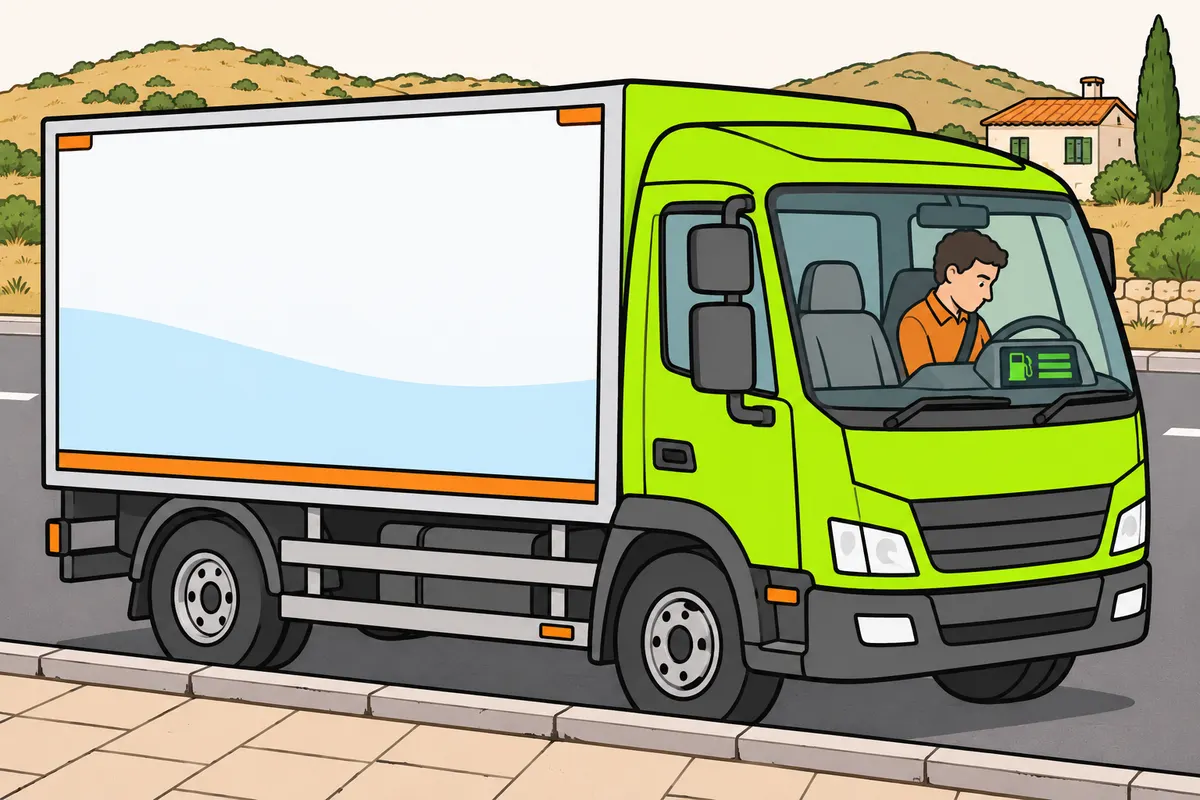
Compare fuel use in similar conditions and distinguish it from exhaust pollution.
| Fuel reading | What it shows |
|---|---|
| Instant | Fuel use in a particular situation |
| Average | Fuel use summarised over a period |
Remember
- Using less fuel usually reduces CO₂.
- Do not infer every emission from fuel use alone.
- Do not drive if emissions exceed limits or harmful smoke is emitted.
- Do not drive if your smoke blocks others’ vision.
- Compare trips with similar loads, traffic, gradients and wind.
- Check the display without distraction or unsafe efforts to improve figures.
Exam trap: Wrong: treat CO₂ as a measure of all pollution. Right: distinguish the different exhaust pollutants.
Read the full explanation
- Carbon dioxide, CO₂, is linked to the consumption of carbon-based fuels; nitrogen oxides and particulates are pollutants that affect air quality. Using less fuel usually reduces CO₂, but this alone does not let you determine every exhaust emission. CO₂ contributes to the greenhouse effect; the Euro classification refers to type-approval limits for other pollutants.
- You must not drive if your lorry exceeds the limits for gases or smoke, or if it emits smoke that obstructs other drivers' vision or is harmful. You must cooperate with checks for possible defects. [RGC, art. 7](https://www.boe.es/buscar/act.php?id=BOE-A-2003-23514#a7).
- Fuel consumption in litres per 100 kilometres expresses the amount of fuel used over a distance. You can use it to assess transport efficiency and distinguish it from the engine speed shown by the rev counter.
- To assess your improvement, compare similar journeys and conditions: load, traffic, gradients and wind can all change the result. Instantaneous consumption gives an indication for a particular situation, while the average covers a period. Do not distract yourself by watching the display continuously or pursue a figure at the expense of safety.
22Your lorry's environmental classification
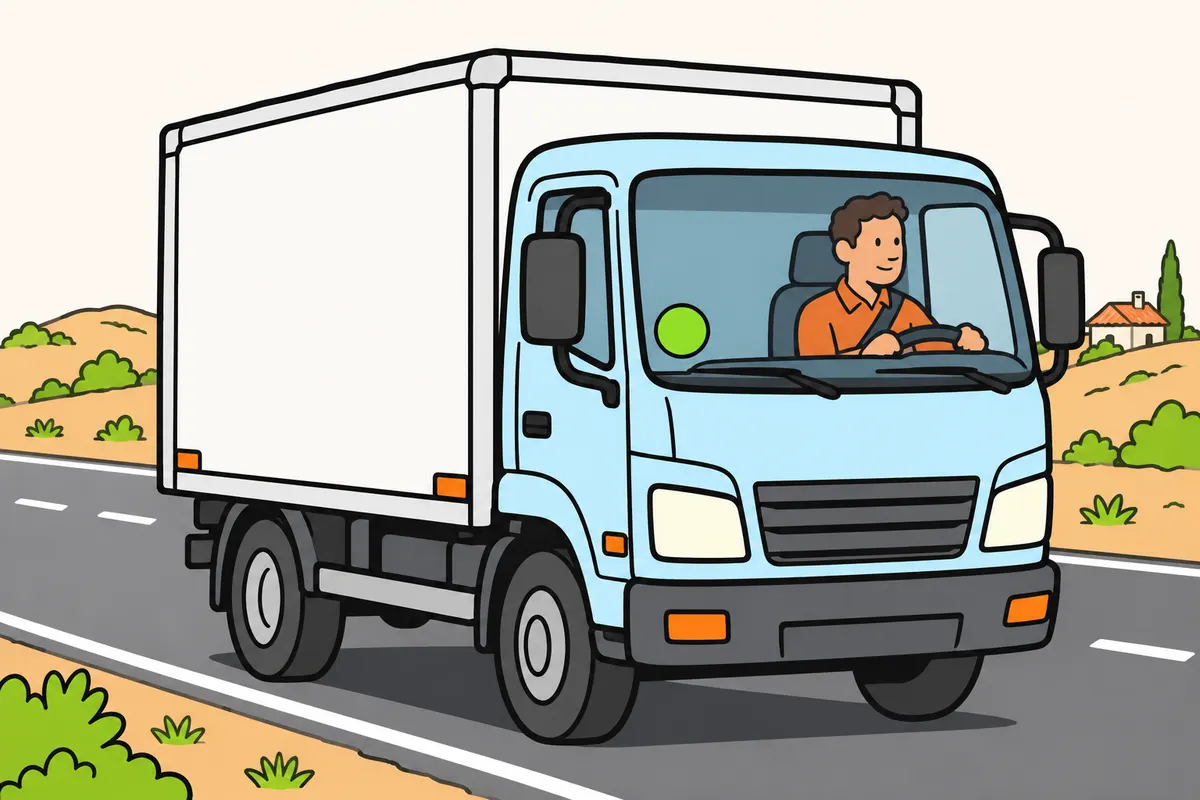
Check your lorry’s environmental class from its features and registration.
| Class for N2 lorries | Criteria to distinguish | Colour |
|---|---|---|
| 0 emissions | Battery, extended range, hydrogen, fuel cell; plug-in hybrids from 40 km electric NEDC | Blue |
| ECO | Plug-in hybrids under 40 km electric, non-plug-in hybrids, CNG, LNG or LPG; also C criteria | Blue and green |
| C | Euro VI/6 petrol or diesel | Green |
| B | Euro IV/4 or Euro V/5 petrol or diesel | Yellow |
| A | Does not meet the earlier class criteria | No sticker |
Remember
- Recognise environmental sticker V-25.
- Use N2 lorry criteria, including for petrol lorries.
- For ECO, the vehicle must also meet C criteria.
- For plug-in hybrids, check electric range, not total range.
- Do not confuse class C with your driving licence.
Exam trap: Wrong: give every gas lorry ECO class. Right: check that it also meets C criteria.
Read the full explanation
- The V-25 environmental badge identifies the classification recorded in the National Vehicle Register. The classifications with badges are 0 emissions, ECO, C and B; category A applies to vehicles that do not meet the requirements for the other classifications and has no badge. [RGV, Annex II.E and Annex XI, V-25](https://www.boe.es/buscar/act.php?id=BOE-A-1999-1826).
- For your C1 goods lorry in category N2, classification C applies to petrol or diesel Euro VI/6 vehicles; B applies to petrol or diesel Euro IV/4 or Euro V/5 vehicles. Apply the criteria for this category, including to petrol lorries, rather than the criteria for N1 cars and vans. [RGV, Annex II.E](https://www.boe.es/buscar/act.php?id=BOE-A-1999-1826#ie).
- For a lorry, ECO includes plug-in hybrids with an electric range of less than 40 km, non-plug-in hybrids and vehicles powered by CNG, LNG or LPG, provided they also meet the criteria for classification C. [RGV, Annex II.E](https://www.boe.es/buscar/act.php?id=BOE-A-1999-1826#ie).
- The 0 emissions classification includes battery electric vehicles, extended-range electric vehicles, hydrogen vehicles, fuel-cell vehicles and plug-in hybrids with a minimum electric range of 40 km on the NEDC cycle, as set out in the annex. To apply this threshold, check the vehicle's approved electric range. [RGV, Annex II.E](https://www.boe.es/buscar/act.php?id=BOE-A-1999-1826#ie).
- You can identify the 0 badge by its blue background, ECO by its blue and green colours, C by green and B by yellow. The letter C on a badge describes an environmental classification; it does not identify your driving licence. Your C1 lorry may have any classification that matches its characteristics and its registration in the Register. [RGV, Annex XI, V-25](https://www.boe.es/buscar/act.php?id=BOE-A-1999-1826#v2).
23Checking and displaying the badge
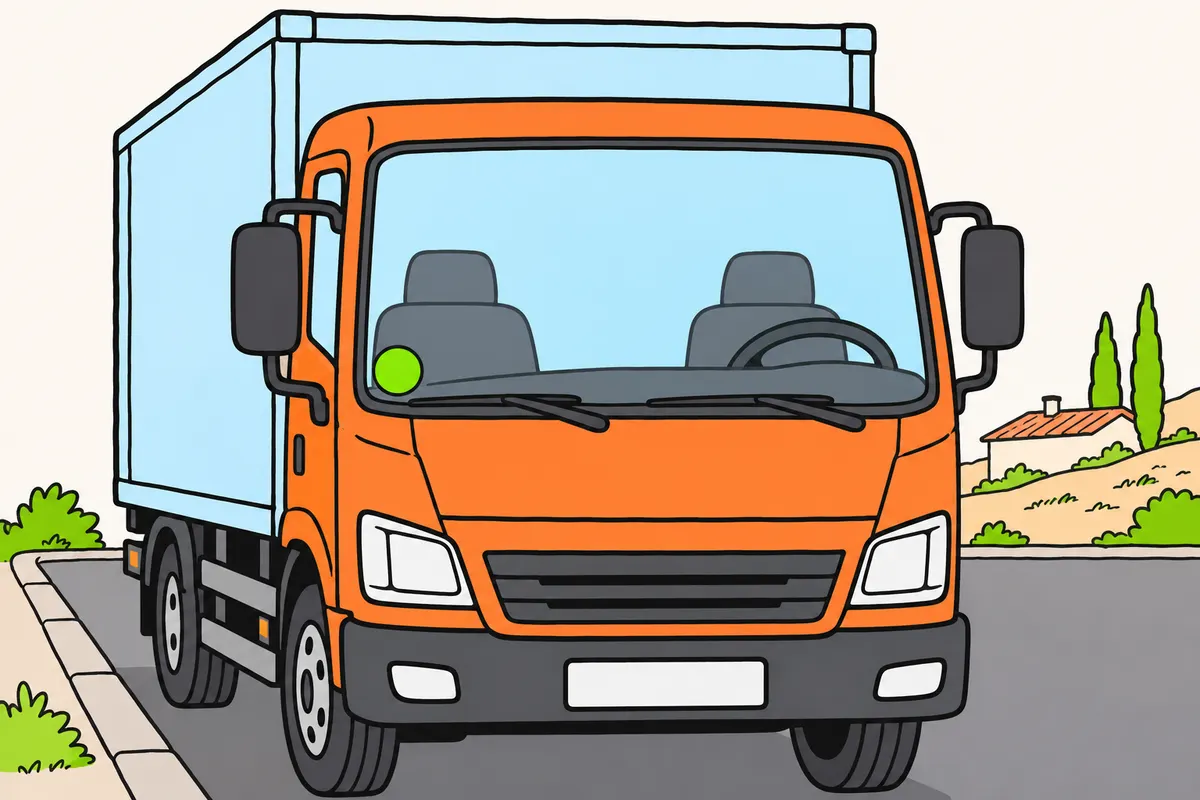
Check the official class and whether your destination requires the sticker.
Remember
- Check your registration number through official DGT services.
- Do not assign a class by appearance, fuel or registration year alone.
- Check whether the local authority requires you to display it.
- If displayed, stick it inside the lower right corner of the front windscreen.
- Check delivery permits separately.
Exam trap: Wrong: assume displaying the sticker is always optional. Right: the competent authority may require it.
Read the full explanation
- Check your lorry's classification by registration number using the DGT's official services. Base it on the recorded data and its type-approval characteristics; do not assign a badge based only on its appearance, advertised fuel type or the year you remember it being registered.
- Displaying the badge is generally voluntary, but the competent authority may expressly require it in its regulations. Check the conditions in the place you are travelling to. Being entitled to a classification and being required to display its sticker are separate matters. [RGV, Annex XI, V-25](https://www.boe.es/buscar/act.php?id=BOE-A-1999-1826#v2).
- If you display the badge on your lorry, you must stick it on the inside of the windscreen, in the lower right-hand corner. [RGV, Annex XI, V-25](https://www.boe.es/buscar/act.php?id=BOE-A-1999-1826#v2).
- Do not confuse the environmental badge with a delivery authorisation, a special access permit or a car-sharing badge. The badge shows a classification and may be used as a criterion for a restriction. Check separately which authorisation the specific journey requires.
24Entering a low-emission zone with goods
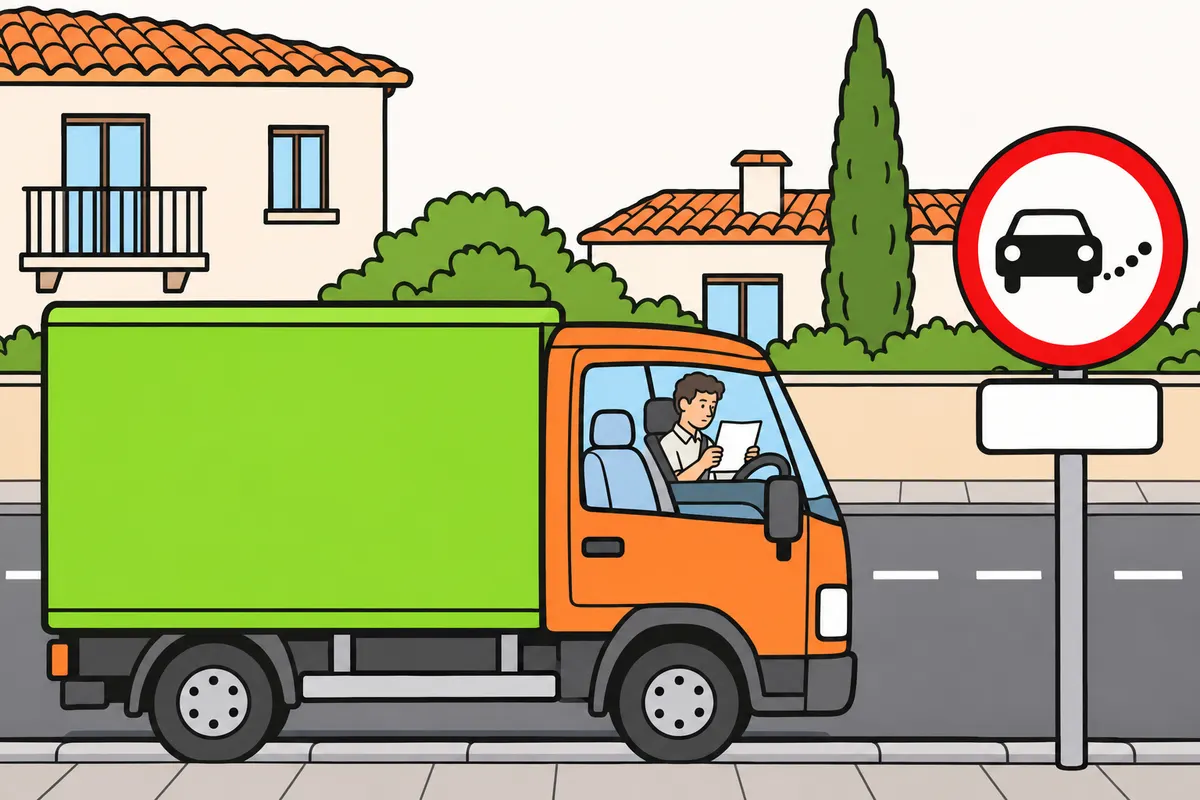
Before entering a ZBE, check its restrictions and your delivery conditions.
Remember
- Check the rules for the destination municipality and zone.
- At sign R-120, also read its panel or accompanying notice.
- Check classes, times, permits and loading conditions.
- Also check limits on your lorry’s size and mass.
- If you do not qualify, plan an authorised alternative before arrival.
Exam trap: Wrong: assume a delivery lets you enter. Right: check expressly whether an exemption applies.
Read the full explanation
- Access, driving and parking in a low-emission zone may be restricted according to the vehicle's pollution potential. Check the specific regulations for the municipality and destination area. The environmental classification is a criterion for restrictions, not a national entry permit. [RD 1052/2022, art. 5](https://www.boe.es/buscar/act.php?id=BOE-A-2022-22689#a5).
- Sign R-120 prohibits entry according to the environmental badge or other environmental criteria. Read the conditions on the supplementary plate or sign accompanying it. Its meaning is not limited to cars because of the picture it shows. [RD 465/2025, catalogue, R-120](https://www.boe.es/buscar/doc.php?id=BOE-A-2025-12199).
- Before making a delivery, check which categories may enter, the times, the authorisations and any applicable loading and unloading conditions. Carrying goods or having a delivery address inside the zone does not in itself give you an environmental exemption. You must check explicitly whether one applies.
- Entry allowed on the basis of an environmental classification may still be subject to other route restrictions. You must also check that the lorry can reach the destination given its size, mass and the conditions of the service. Similarly, authorisation to use a loading and unloading area does not automatically resolve access to the low-emission zone.
- If you do not meet the entry conditions, reorganise the route or delivery using an authorised alternative before reaching the access point. Planning avoids sudden braking, turns and improvised waiting beside the sign.
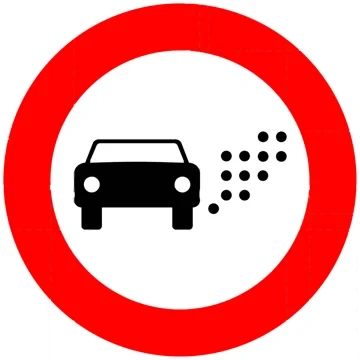 R-120
25Reducing transport noise
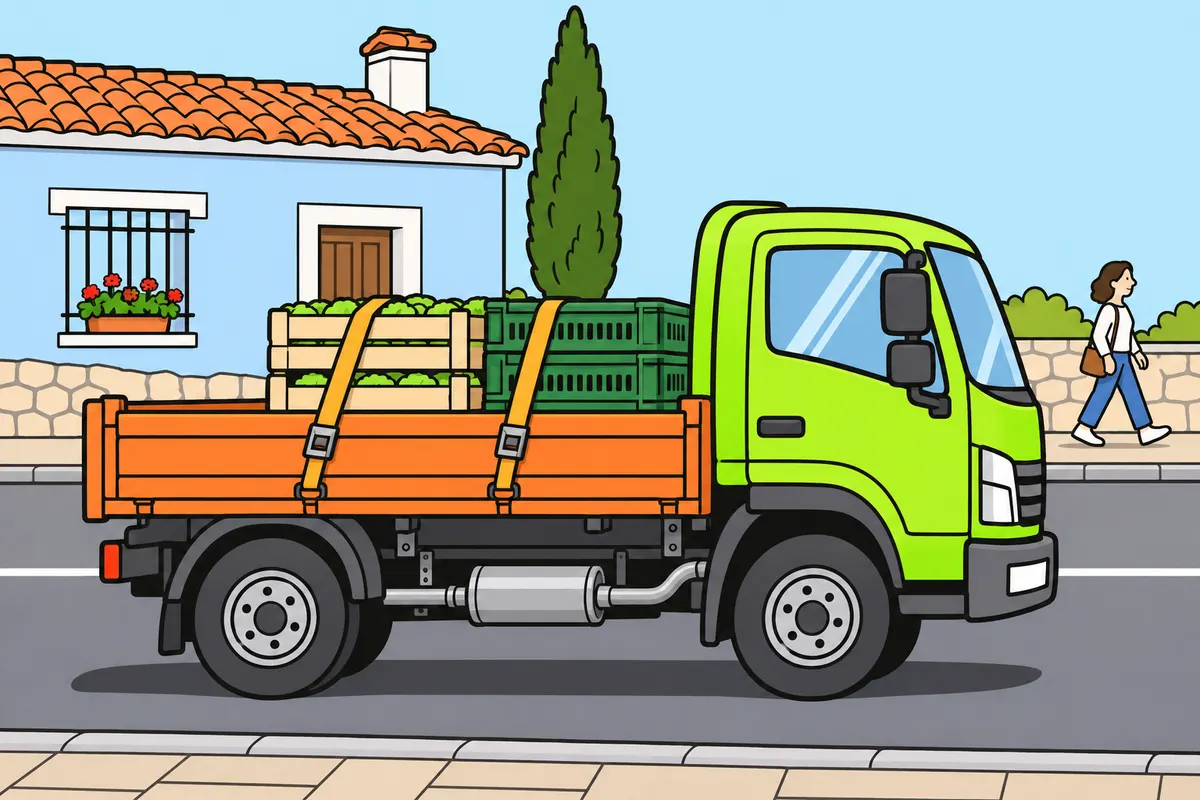
Drive smoothly and avoid needless noise on the road and during deliveries.
Remember
- Keep the transmission, bodywork and load fittings in good condition.
- Do not drive with an unsilenced exhaust or damaged, incomplete or unsuitable silencer.
- You may sound the horn to prevent a possible accident.
- Outside built-up areas, you may warn others that you are overtaking.
- Use it for exceptional urgent services only under the legal conditions.
- Where loading is allowed, avoid unnecessary bangs and disturbance.
Exam trap: Wrong: sound the horn to hurry others. Right: use it only in authorised cases, without overdoing it.
Read the full explanation
- Reduce lorry noise by driving smoothly and keeping the transmission, bodywork and load equipment in good condition.
- Driving with an open exhaust or with an incomplete, unsuitable or deteriorated silencer is prohibited, both on urban and interurban roads. You must maintain an effective exhaust system and comply with the regulatory noise limits. [RGC, art. 7.2](https://www.boe.es/buscar/act.php?id=BOE-A-2003-23514#a7).
- You may use non-strident audible warnings only to avoid a possible accident, to warn of your intention to overtake outside a built-up area, or to make your presence known in the exceptional case under article 70 involving non-priority vehicles responding to an emergency. [RGC, art. 110.1–2](https://www.boe.es/buscar/act.php?id=BOE-A-2003-23514#a110) and [art. 70](https://www.boe.es/buscar/act.php?id=BOE-A-2003-23514#a70).
- When loading or unloading on the road in permitted cases, you must avoid unnecessary noise and disturbance: organise the equipment so that you can work carefully and avoid unnecessary impacts. [RGC, art. 16](https://www.boe.es/buscar/act.php?id=BOE-A-2003-23514#a16).
Planning an efficient delivery route
Check that the route and lorry allow you to complete the operation without improvising.
- Check the destination, access routes, low-emission zone (ZBE) restrictions and delivery conditions.
- Choose a route suitable for the lorry and check traffic, roadworks and weather.
- Organise deliveries and breaks to reduce unnecessary journeys.
- Check the load distribution, prescribed tyre pressure and deflector settings.
- Set off when the vehicle is ready and adapt the plan if conditions change.
Selecting an economical gear
Match the required effort to the engine speed after changing gear.
- Observe traffic and the gradient, and assess the lorry’s load.
- Check the engine speed and its economical range as specified by the manufacturer.
- Choose a gear ratio that provides sufficient response after the change.
- Change gear smoothly; skip a gear only if the transmission and conditions allow it.
- Check the response and change down if the gear is too high.
Slowing for congestion
Use observation and space to avoid late braking.
- Spot changes in traffic early and check behind you too.
- Take your foot off the accelerator while keeping a suitable gear engaged.
- Use the retarder systems and brake as required by the distance and grip.
- Slow progressively without forcing the engine speed or losing control.
- Stop with a safety margin and watch for approaching vehicles.
Checking environmental access
Check whether your lorry is authorised before entering the restricted zone.
- Check the lorry’s registered environmental classification using its number plate.
- Check the local regulations and delivery conditions in the destination area.
- Check whether you need to display a label or have specific authorisation.
- Read sign R-120 and the conditions on its supplementary plate or notice.
- Enter only if you meet the conditions; otherwise, use an authorised alternative.
Finished this module?
Mark it as read and you will see your progress on the theory list.