
Theory · D1 Licence - Minibus · Module 18 of 18
Preventive and efficient minibus driving
You learn to observe, anticipate hazards and keep space to drive a minibus safely and smoothly while using less fuel. You relate gears, engine speed, tyres, load and aerodynamics to efficiency, and distinguish environmental labels and access conditions for ZBE (low-emission zones) that may come up in your D1 test.
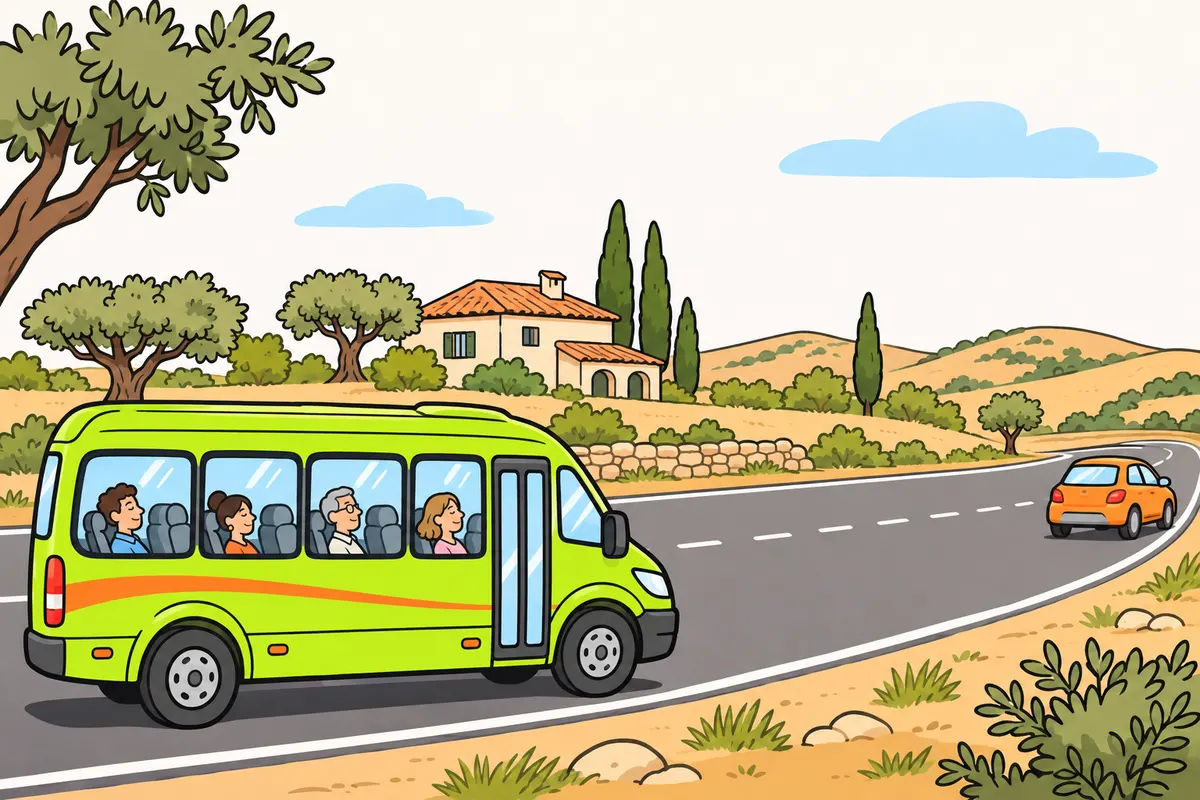
1Prevent risks through vision, anticipation and space
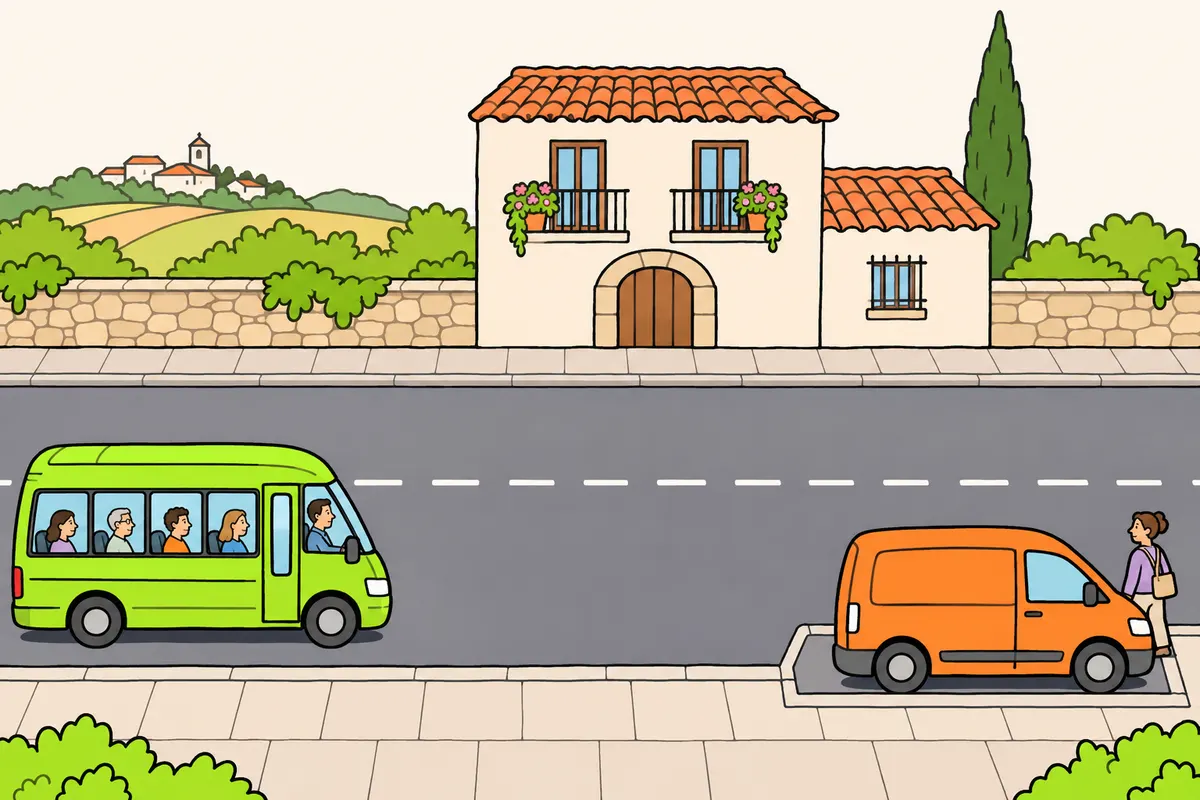
Observe, anticipate danger and keep space to react.
Remember
- Stay alert, even on familiar routes.
- Expect someone to appear from behind an obstacle.
- Spot problems early so you can brake smoothly.
- Avoid danger even when another road user makes a mistake.
Exam trap: Wrong: priority means you are safe. Right: keep watching and avoid conflict, even when others make mistakes.
Read the full explanation
- You must apply three complementary principles: vision to gather information, anticipation to prepare your response and space to carry it out. In a minibus, spotting a problem early allows you to deal with it through gradual movements and reduces the need for braking that throws passengers off balance. [DGT, preventive driving](https://sede.dgt.gob.es/export/sites/dgt/.galleries/permisos-de-conducir/autoescuelas/TeoricaAbreviada_LecturaFacil_2023-12_Interactivo.pdf).
- You must maintain a preventive approach throughout the service, even on a familiar route with little traffic. Knowing a stop does not guarantee that its access routes are clear: there may be roadworks, a stationary vehicle or someone approaching through an area you cannot see.
- Anticipating means recognising what may happen and keeping your options open. If a van blocks your view of the pavement near a junction, anticipate that someone may emerge in front of it; waiting until you see the pedestrian in the carriageway may leave you without enough room for a smooth response.
- Having priority, driving a large vehicle or having electronic assistance systems does not eliminate risk. Your aim is to avoid conflict, including when another road user acts incorrectly; having priority does not guarantee that others have noticed you.
2Plan a route suitable for the bus
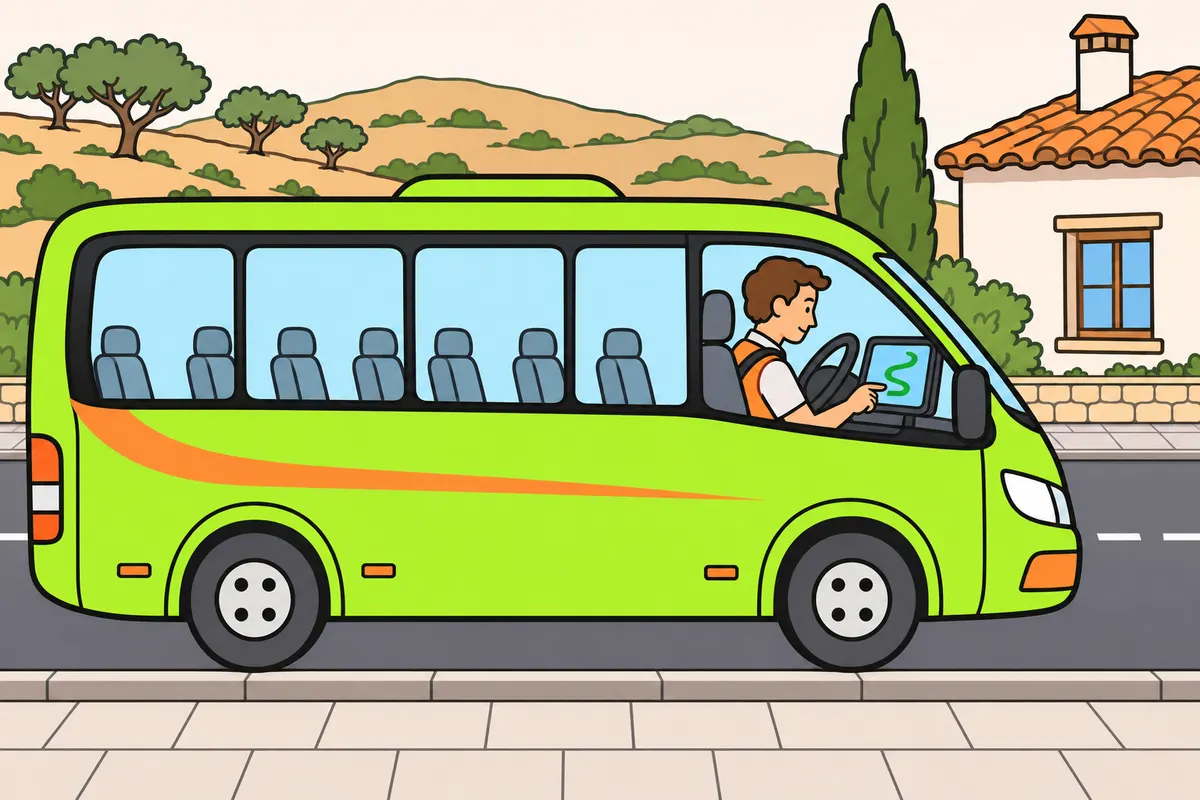
Plan a suitable route for your minibus before setting off.
Remember
- Check the minibus’s dimensions and route restrictions.
- Check traffic, weather, gradients and stops.
- Check environmental restrictions at your destination.
- Set the navigation before moving.
- Do not operate the navigation while driving.
- Allow time for delays; do not accelerate hard to catch up.
Exam trap: Wrong: any navigation route will do. Right: check that it suits your minibus.
Read the full explanation
- Before setting off, choose a route compatible with the minibus, its stops and traffic restrictions. Consider traffic, weather, gradients and narrow sections: a slightly longer route may avoid stops and manoeuvres that increase fuel consumption. The D1 licence allows you to drive vehicles designed for a maximum of 16 passengers in addition to the driver and up to 8 metres in length; check the specifications of your assigned vehicle. [RGCond, art. 4](https://www.boe.es/buscar/act.php?id=BOE-A-2009-9481#a4).
- Before the service, check the environmental restrictions on streets along the route and at your destination, and where you can stop to serve passengers.
- Plan the service timings with enough allowance for foreseeable conditions. If you encounter a traffic queue, report the disruption through the appropriate means when you can do so safely; trying to make up time through bursts of acceleration puts the safety of your passengers at risk. Professional driving time rules are covered in the module «Driving and rest times».
- Set your satnav before moving off and check that the route is suitable for your vehicle. You must keep your attention on the traffic: the duty to remain attentive at all times means you must not operate a satnav or similar system while driving. [RGC, art. 18](https://www.boe.es/buscar/act.php?id=BOE-A-2003-23514#a18).
3Look ahead and scan your surroundings
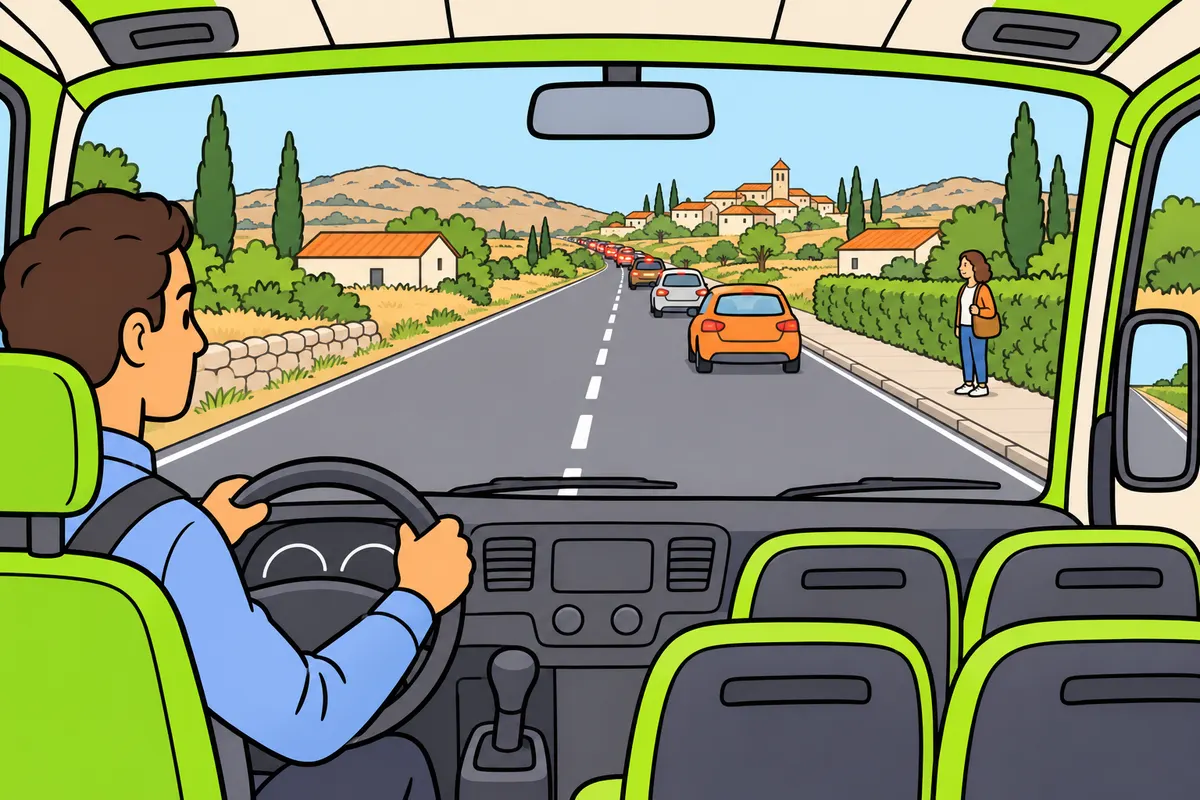
Look ahead and also check what happens nearby.
Remember
- Look towards where you will be in about 20 seconds, if visible.
- Alternate this view with checks of mirrors, sides and nearby areas.
- Look beyond the vehicle ahead.
- Do not stare at one place for too long.
- Remember that obstacles can hide people.
Exam trap: Wrong: the 20-second view is your legal gap from the vehicle ahead. Right: it is a guide for looking ahead.
Read the full explanation
- As a preventive driving technique, look towards the area you cover in approximately the next 20 seconds, as far as visibility allows. This is a guide for observing your surroundings, not a legally required gap from the vehicle ahead. You must combine this view ahead with monitoring the area close to you. [DGT, observation techniques](https://sede.dgt.gob.es/export/sites/dgt/.galleries/permisos-de-conducir/autoescuelas/TeoricaAbreviada_LecturaFacil_2023-12_Interactivo.pdf).
- Do not limit your observation to the brake lights of the vehicle immediately ahead. Also watch how the line of traffic develops, junctions and signs further ahead; this allows you to ease off the accelerator before a queue reaches you and avoid wasting energy accelerating towards it.
- Alternate looking into the distance with brief checks to the sides, in the mirrors and of the area close to you. You must spot bicycles moving alongside the minibus, vehicles approaching from behind and people waiting near the kerb, without staring at any one thing for too long.
- Adapt how far you look ahead to your speed, the light and road conditions. Your elevated driving position may help you see over some vehicles, but it does not let you see through obstacles. A corner, a hedge or a parked vehicle may conceal an immediate hazard.
4Mirrors, hidden areas and assistance systems
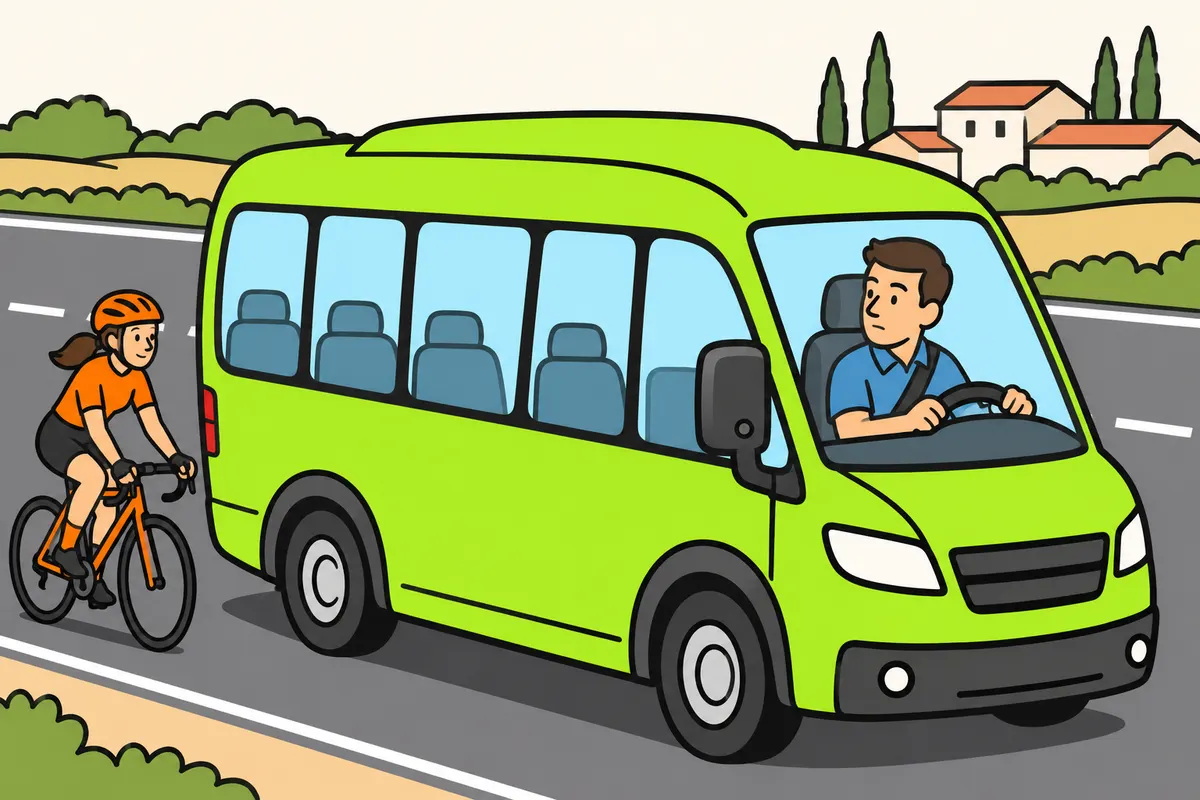
Check your mirrors and know the limits of driving aids.
Remember
- Check your mirrors briefly and often.
- Use assistance systems within their limits.
- Check hidden areas before moving.
Exam trap: Wrong: no warning means the side is clear. Right: check mirrors and hidden areas yourself.
Read the full explanation
- Make brief, frequent checks of your mirrors and use assistance systems with their limitations in mind; the absence of a warning does not guarantee that the area alongside you is clear. Mirror adjustment and checking hidden areas are covered in «Safe minibus driving».
5Recognise clues and anticipate mistakes
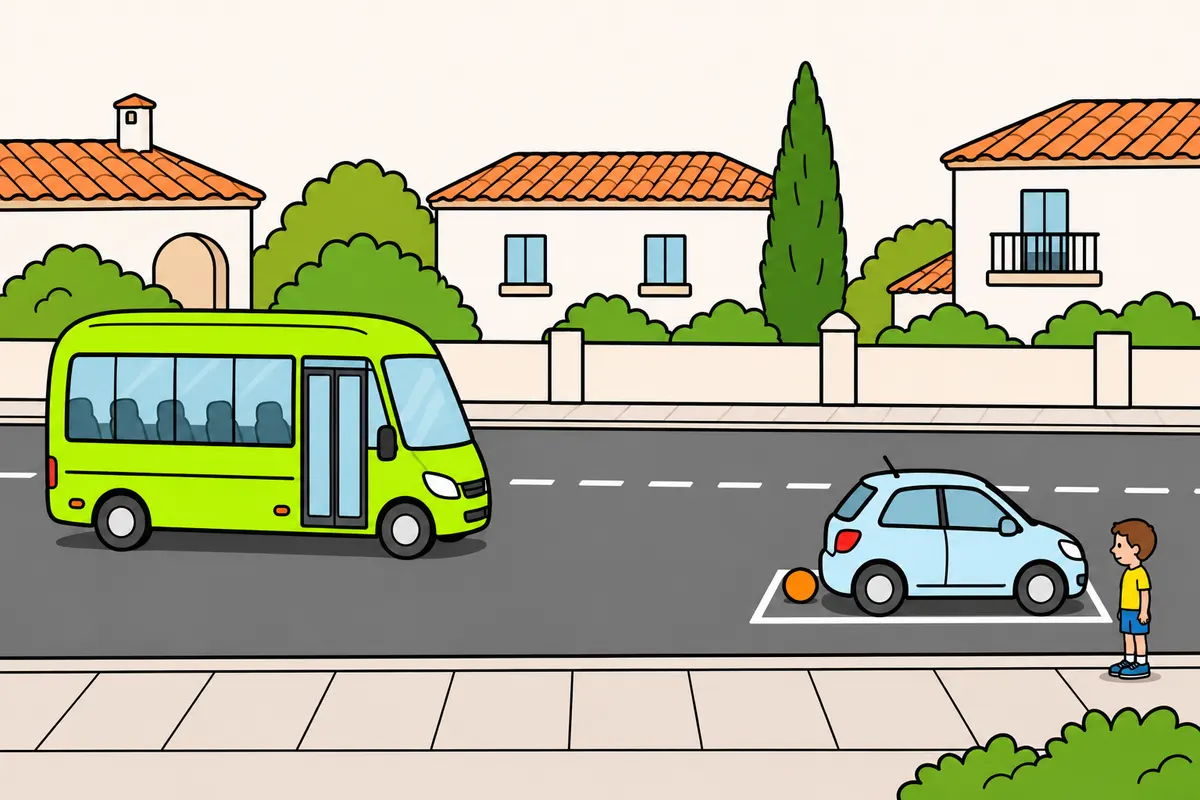
Recognise signs of danger and prepare your response.
Remember
- Slow down smoothly when a door starts opening.
- Be ready to brake if another driver has not seen you.
- You can hold your foot ready over the brake without pressing unnecessarily.
- Preparing your foot does not replace slowing down.
- Signal in good time and check how others respond.
Exam trap: Wrong: using your indicator means you can begin the manoeuvre. Right: check that you can do it safely first.
Read the full explanation
- Interpret clues in your surroundings: a ball beside parked vehicles, a door starting to open or a driver looking the other way indicate what may happen. You must prepare to slow down progressively before uncertainty becomes a hazard requiring hard braking.
- At a junction where another driver appears not to have seen you, do not base your safety solely on having priority. Make the situation less demanding and prepare to brake. If you need to avoid a collision, you must act even if the risk arises from someone else breaking the rules.
- When you can foresee the need to brake, you can take your foot off the accelerator and position it ready over the brake, without pressing it unnecessarily. This preparation reduces the movement you need to make; it does not replace slowing down or guarantee that you can stop a minibus within whatever space is available.
- Make your intentions clear well in advance. You must signal manoeuvres as required and check how those around you respond: using an indicator communicates what you intend to do, but does not confirm that others have seen you or that you can start the manoeuvre. [RGC, art. 108](https://www.boe.es/buscar/act.php?id=BOE-A-2003-23514#a108).
6Maintain space around the vehicle
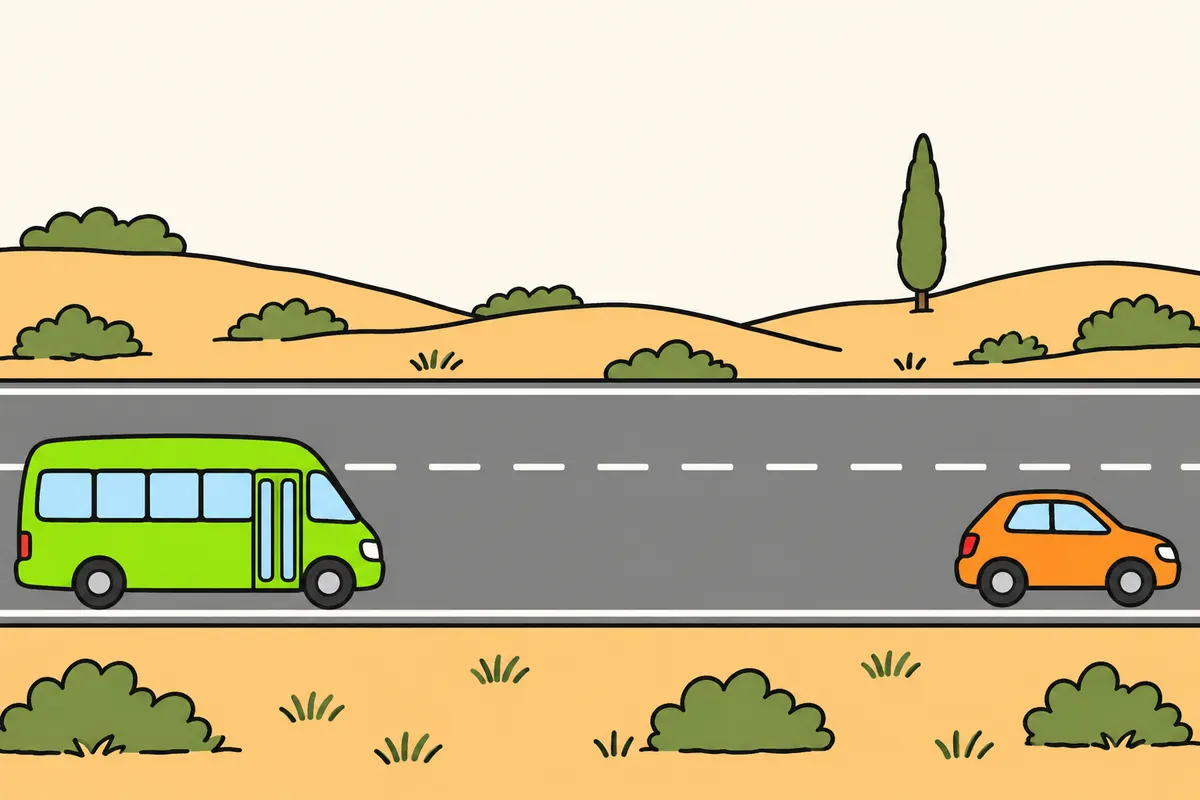
Leave space ahead and beside you so you can react.
Remember
- Leave enough room to stop if the vehicle ahead brakes.
- Increase your gap when grip or visibility gets worse.
- If followed too closely, leave more room ahead.
- Do not brake sharply to warn the driver behind.
- Keep out of other drivers’ hidden areas.
- When stopping in a queue, keep space and watch behind.
Exam trap: Wrong: seeing the wheels ahead guarantees enough space. Right: assess your minibus, the gradient and the situation.
Read the full explanation
- You must leave enough space ahead to stop without hitting the vehicle in front if it brakes suddenly, taking account of speed, grip and braking capability. Adapt the gap to the minibus's actual circumstances; you cannot apply a guideline intended for a car without assessing its suitability. [RGC, art. 54.1](https://www.boe.es/buscar/act.php?id=BOE-A-2003-23514#a54).
- Increase your safety margin when visibility or grip deteriorates, or when the vehicle ahead moves erratically. This space allows you to respond progressively. The specific numerical distances for long vehicles and tunnels are covered in «Minibus speed and distances»; a fuel-saving technique does not allow you to disregard them.
- If someone follows you too closely, leave more space ahead so that you can slow down gently. Do not try to correct the other driver's behaviour by braking sharply as a warning. Watch their approach and communicate your decisions in good time; this reduces the need for a sudden response that the driver behind cannot match.
- Maintain space to the sides and avoid spending unnecessary time in areas where other drivers cannot see you. If a large vehicle starts to turn, consider the space it may need and do not interpret an initial swing out as an invitation to move alongside it. Specific turning techniques are covered in «Safe minibus driving».
- When you stop in a line of traffic, leave a useful gap from the vehicle ahead and watch those approaching from behind. The space you need depends on the minibus, the gradient and the situation: being able to see the wheels of the vehicle ahead is neither a legal measure nor a guarantee that you can pull out without manoeuvring.
7Choose a speed that allows you to anticipate
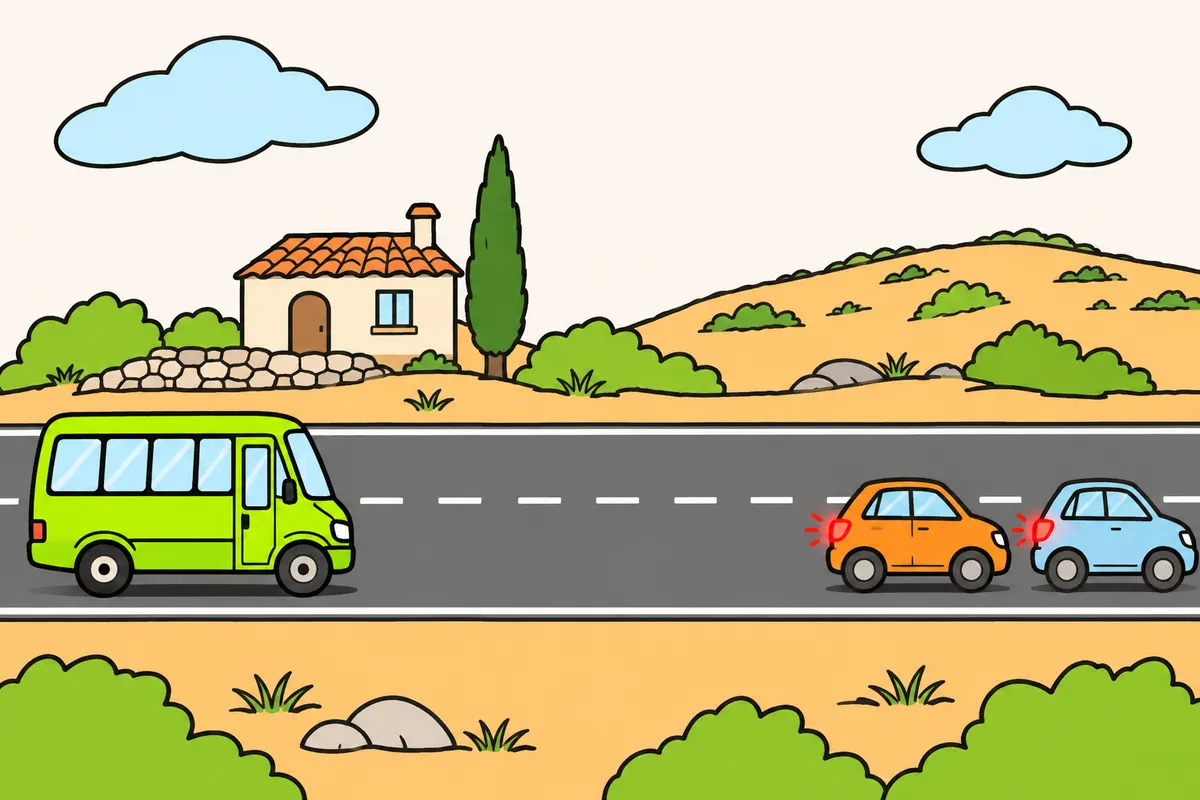
Adjust your speed so you can stop for foreseeable dangers.
Remember
- Respect the limits and adapt your speed to conditions.
- Drive so you can stop within the space you can see.
- Avoid unnecessary speed changes.
- Release the accelerator early when approaching a stationary queue.
- Do not speed up just to use a higher gear.
Exam trap: Wrong: always drive at the maximum permitted speed. Right: choose a safe speed for the road, traffic, weather, load and your condition.
Read the full explanation
- You must adjust your speed so that you can stop within your field of vision for foreseeable obstacles, while also observing the applicable limits. To decide, consider the road, traffic, weather, vehicle, its load and your own condition. The maximum permitted speed is not a speed you must maintain. [RGC, art. 45](https://www.boe.es/buscar/act.php?id=BOE-A-2003-23514#a45).
- Drive at a moderate speed and keep it as steady as conditions allow. Keeping a steady speed means avoiding unnecessary changes, not rigidly maintaining a particular figure. If the stop is occupied, you are approaching a bend or a pedestrian crossing with limited visibility comes into view, you must adjust your driving in advance.
- Do not accelerate towards a stationary queue and then brake when you reach it. If you spot the queue stopping early, you can stop supplying power sooner and approach in a controlled manner. Even if the queue starts moving again, keep a sufficient gap and avoid repeated hard acceleration followed immediately by braking.
- Do not increase your speed just to engage a high gear. You must choose the gear that suits the safe and permitted speed. Any saving achieved by changing gear is pointless if it makes you approach a stop or an area with vulnerable road users too fast.
8Smooth driving and passenger protection
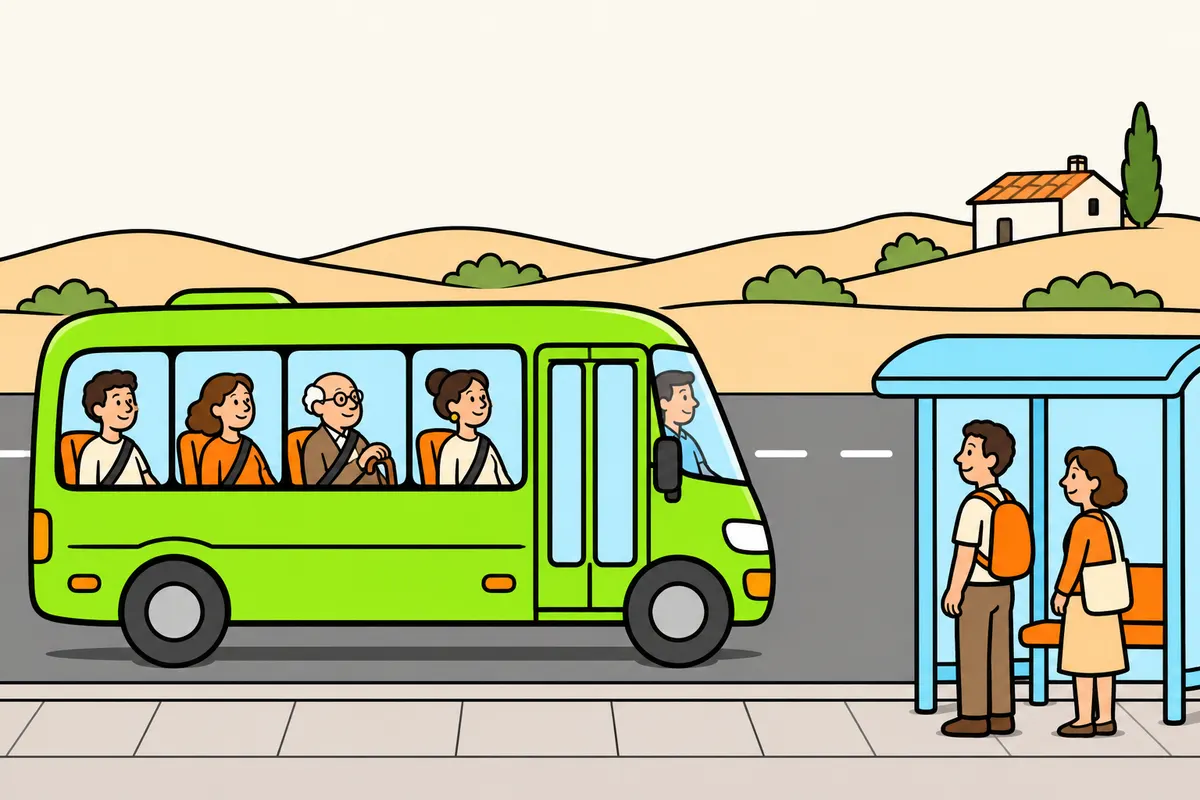
Drive smoothly to protect your passengers.
Remember
- Accelerate and brake gradually when possible.
- Take special care of older people and authorised standing passengers.
- Prepare stops to avoid a final jolt.
- Use the gear and power you need to join traffic.
- Brake as firmly as needed in immediate danger.
Exam trap: Wrong: smooth driving means avoiding firm braking in danger. Right: brake as firmly as needed to protect people.
Read the full explanation
- In a minibus, your acceleration and braking affect your passengers' balance. Drive progressively, especially when you carry authorised standing passengers, older people or passengers who need support. Smooth driving makes the journey more comfortable and reduces unnecessary strain on the vehicle, without removing your obligation to brake when faced with danger. [RGC, art. 11.1](https://www.boe.es/buscar/act.php?id=BOE-A-2003-23514#a11).
- Anticipate stops by observing the approach, the queue and nearby traffic. You must regulate your approach so that you do not need a final bout of heavy braking to bring the whole vehicle to a halt. The transition as you come to a standstill also matters: abruptly releasing or suddenly applying the brake can cause jolts.
- When you pick up speed again, increase the demand for driving force gradually and in keeping with traffic conditions. Do not confuse smooth driving with joining traffic without sufficient power; you must have the response you need, using the appropriate gear and applying the accelerator according to the minibus's conditions.
- When faced with immediate danger, brake as hard as necessary to protect your passengers and other road users.
9Relate energy, consumption and resistance
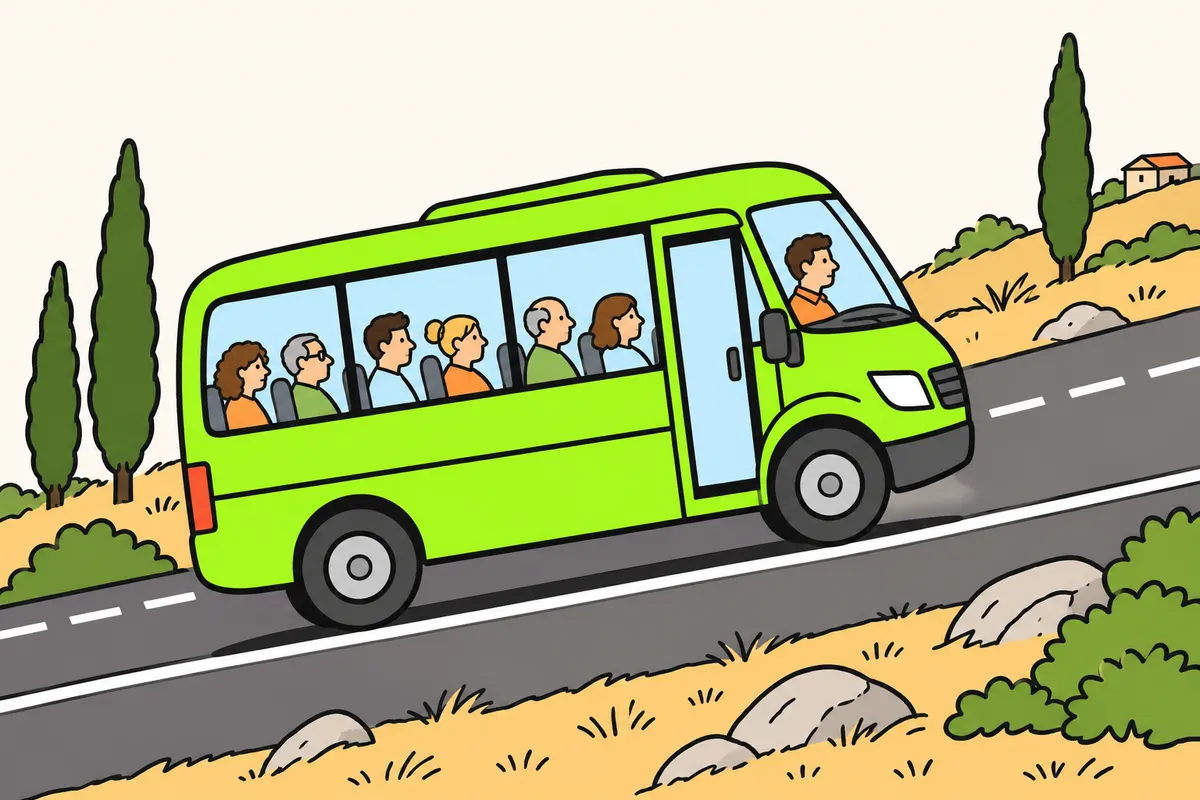
Avoid unnecessary acceleration and braking to save energy.
| Measure | What it tells you |
|---|---|
| Instant fuel use | Fuel used at that moment |
| Fuel per distance | Fuel used to cover a distance |
| Total fuel | Fuel used for the whole service |
Remember
- Each time you regain speed, you need energy.
- To move off, overcome the forces that resist movement.
- Uphill, part of the minibus’s weight also resists movement.
- With a load uphill, choose a gear that gives enough response.
- Compare routes by distance, load, hills, traffic and time.
Exam trap: Wrong: kilometres per hour measures fuel use. Right: it measures speed.
Read the full explanation
- Accelerating the mass of the minibus requires energy, as does keeping it moving against resistance. Each time you regain speed after braking, you need energy; this is why looking ahead in good time and avoiding unnecessary fluctuations is especially useful on services with frequent stops.
- To move off and accelerate forwards, the driving force at the wheels must overcome the resistance to forward movement. On level ground, you do not have to overcome the weight directly as though it were a horizontal force; weight affects rolling resistance, and mass determines the energy needed to accelerate.
- On an uphill gradient, a component of the vehicle's weight also acts against forward movement. With a laden minibus, adapt your choice of gear to the force needed to climb the gradient with sufficient response.
- Instantaneous fuel consumption, fuel consumption per unit of distance and total fuel use for the service are different measurements. You may see average fuel consumption expressed in litres per 100 kilometres; a speed in kilometres per hour does not measure fuel. When comparing journeys, you also need to consider distance, gradients, load, traffic and operating time.
10Start and warm up without unnecessary consumption
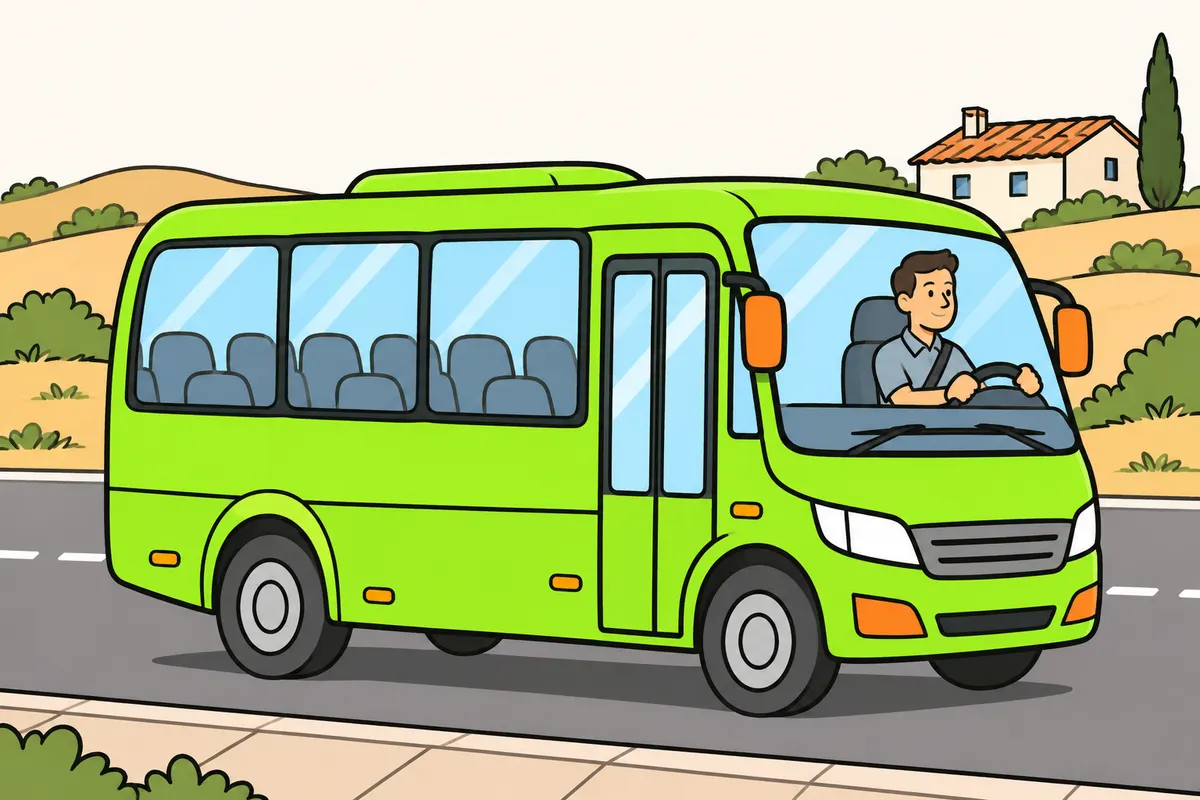
Follow the starting instructions and drive gently while the engine warms up.
Remember
- Before moving, check that the vehicle systems are ready.
- Do not rev the engine to warm it without load.
- Do not demand heavy power from a cold engine.
- Choose the starting gear for the minibus, load and gradient.
- With a manual gearbox, do not hold the minibus by slipping the clutch.
- If poor response persists, report it and ask for a check.
Exam trap: Wrong: every minibus moves off in the same gear. Right: follow the manual and assess conditions.
Read the full explanation
- Start the engine following the manufacturer's instructions, without unnecessary revving. In a minibus, you must also check the indicators and ensure its systems are ready before moving off. Saving idling time does not justify starting the service before the vehicle is fit to drive safely.
- Once you can move off, drive gently while the engine reaches its operating temperature. Avoid warming it up by revving it with no load, and do not put a heavy load on a cold engine. Follow the manufacturer's instructions for preparing its systems before setting off.
- Select the gear specified for moving off in that minibus under those load and gradient conditions. Do not memorise a universal starting gear based on a car: the gearboxes and operating strategies of manual, automatic and automated minibus transmissions may differ. You must avoid moving off in a way that causes jolts or excessive strain.
- If you operate a manual clutch, do not keep it slipping to compensate for an unsuitable gear or to hold the vehicle on a slope. Slipping generates heat and wear. If you lack driving force, reconsider your gear selection; if the problem persists, report it and ask for it to be checked.
11Choose gears according to force and engine speed
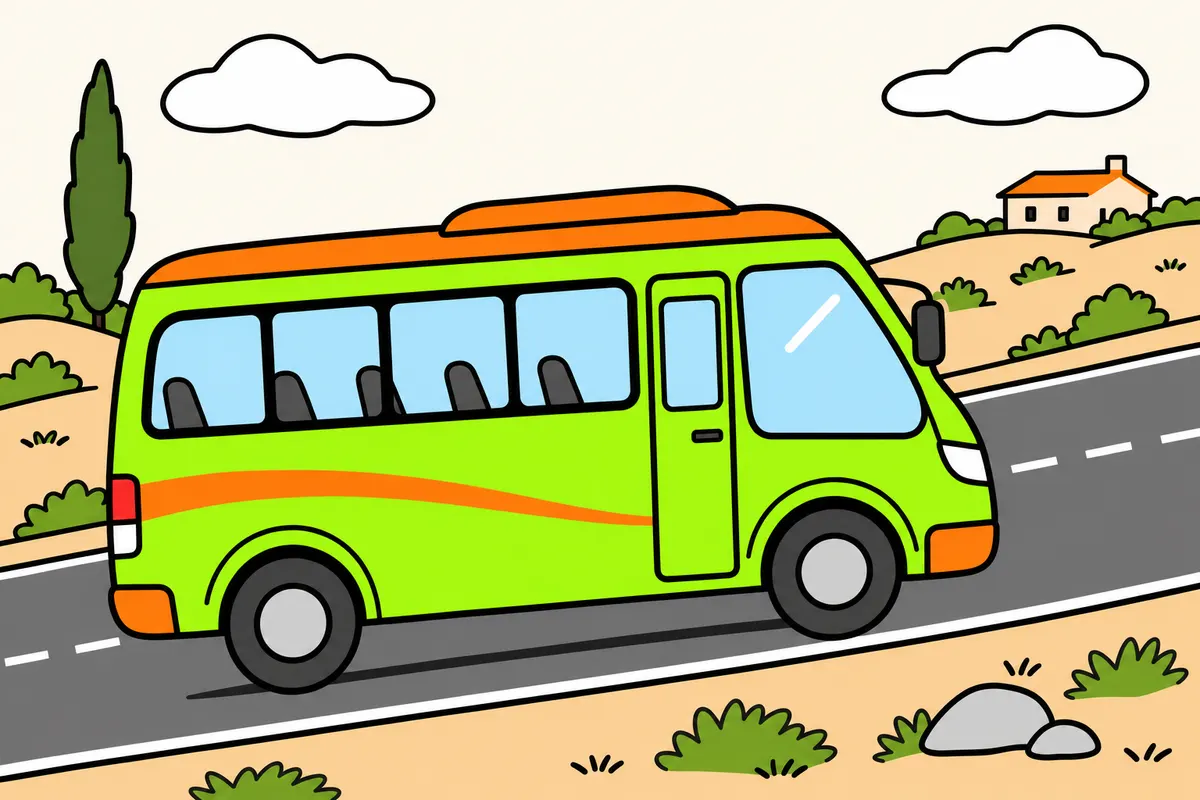
Choose a gear that lets the engine respond without excessive strain.
| Gear | When you may need it |
|---|---|
| High | When the engine responds adequately without vibration |
| Low | To move off or climb when you need more driving force |
Remember
- Use a high gear only when you have enough driving force.
- Do not stay in low gears unnecessarily.
- Adapt gear changes to the engine, load and gradient.
- Change down if the engine cannot respond on a hill.
- Do not copy gear-change engine speeds from a car.
Exam trap: Wrong: the highest gear always saves fuel. Right: choose one that allows response without engine strain.
Read the full explanation
- Use a high gear when it allows the engine to respond adequately without vibration or undue strain. At the same minibus speed, a higher gear usually reduces engine speed. You must not confuse a high gear with a high road speed or conclude that the highest gear is always the best.
- You must understand the relationship between power, torque and transmission: the gearbox changes the ratio between engine rotation and wheel rotation, and the force available at the wheels. You may need a low gear to move off or climb a gradient; this does not mean that the engine acquires a different maximum power output.
- As you gain speed in favourable conditions, change up without staying in low gears unnecessarily. The timing depends on the engine's response, the spacing of the gear ratios and the situation. Do not apply engine speed figures from a petrol or diesel car to the minibus as though they were mandatory.
- On an uphill gradient, change down if the engine's response is insufficient in your chosen gear. Select the lower gear you need, without assuming it must always be the lowest. Keeping the vehicle in too high a gear with the accelerator pressed hard and the engine failing to respond is not an efficient technique.
12Interpret the green zone on the rev counter
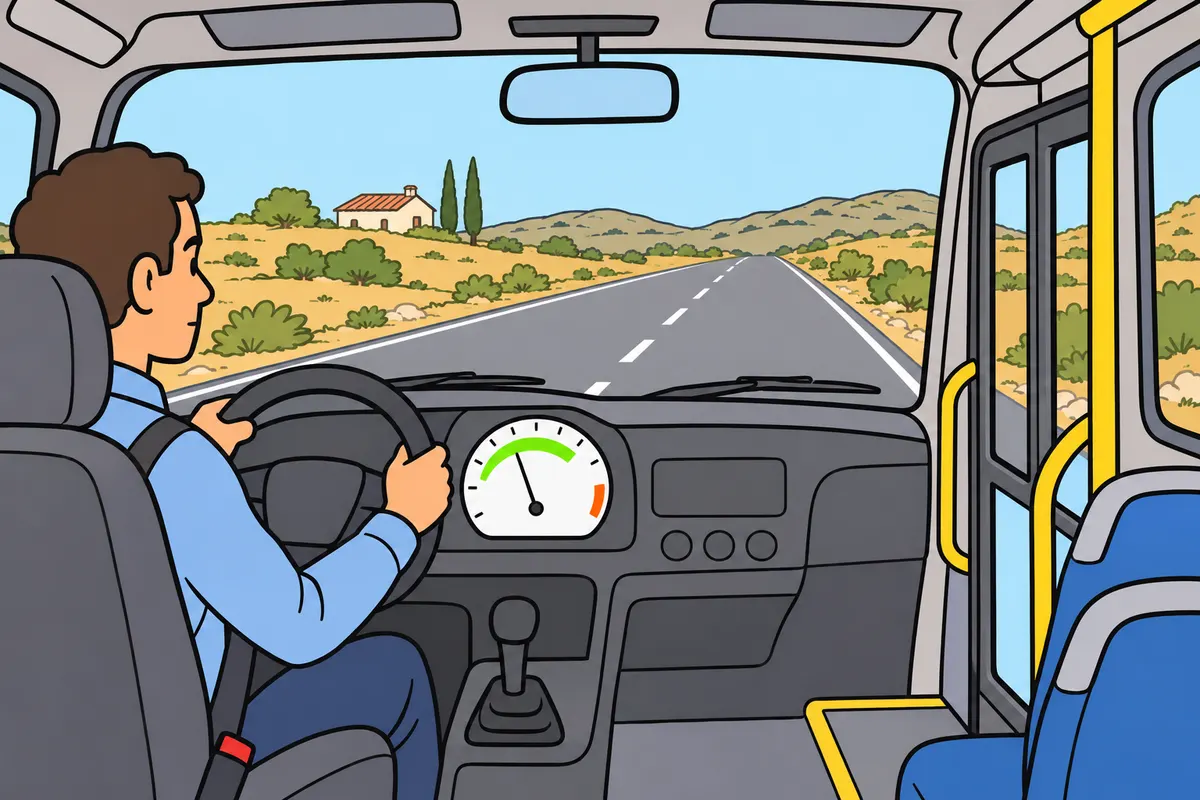
Use the green zone as a guide without straining the engine.
| Instrument | What it shows you |
|---|---|
| Rev counter | Engine speed |
| Speedometer | Vehicle speed |
Remember
- If you have a green zone, follow the manufacturer’s guidance.
- Change gear to keep enough driving force for the load and gradient.
- Change gear if the engine vibrates or responds poorly.
- Do not try to save fuel by using the red zone.
- There is no one gear-change figure for every minibus.
Exam trap: Wrong: the green zone means you should use that gear in every situation. Right: adapt to the load, gradient and engine response.
Read the full explanation
- If the rev counter shows a green economy zone, use it as a reference for the efficient engine speed range indicated for that engine. The rev counter shows engine speed; the speedometer shows vehicle speed. No colour on the instrument replaces your assessment of the road and traffic.
- In favourable conditions, time your upshifts so that the resulting engine speed falls within the economy zone indicated by the manufacturer. If your engine manual recommends using the start of that green zone, adapt your gear changes to retain sufficient driving force when you reach it. Your chosen gear must allow you to respond to the actual gradient and load.
- Do not take this reasoning so far that you strain the engine by running it below its appropriate speed range. If, after changing gear, you notice vibration, a lack of response or a loss of speed that requires correction, you must adjust your gear selection. The load and gradient may prevent you from making the same gear change that worked with an empty minibus.
- You must avoid associating fuel savings with the red zone or maximum engine speed. Nor is there a single gear-change engine speed for all minibuses. Consult the manufacturer's guidance and distinguish the economical engine speed range for driving from the operating conditions for auxiliary braking systems, covered in «Minibus brakes and retarders».
13Use automatic transmission and driving aids
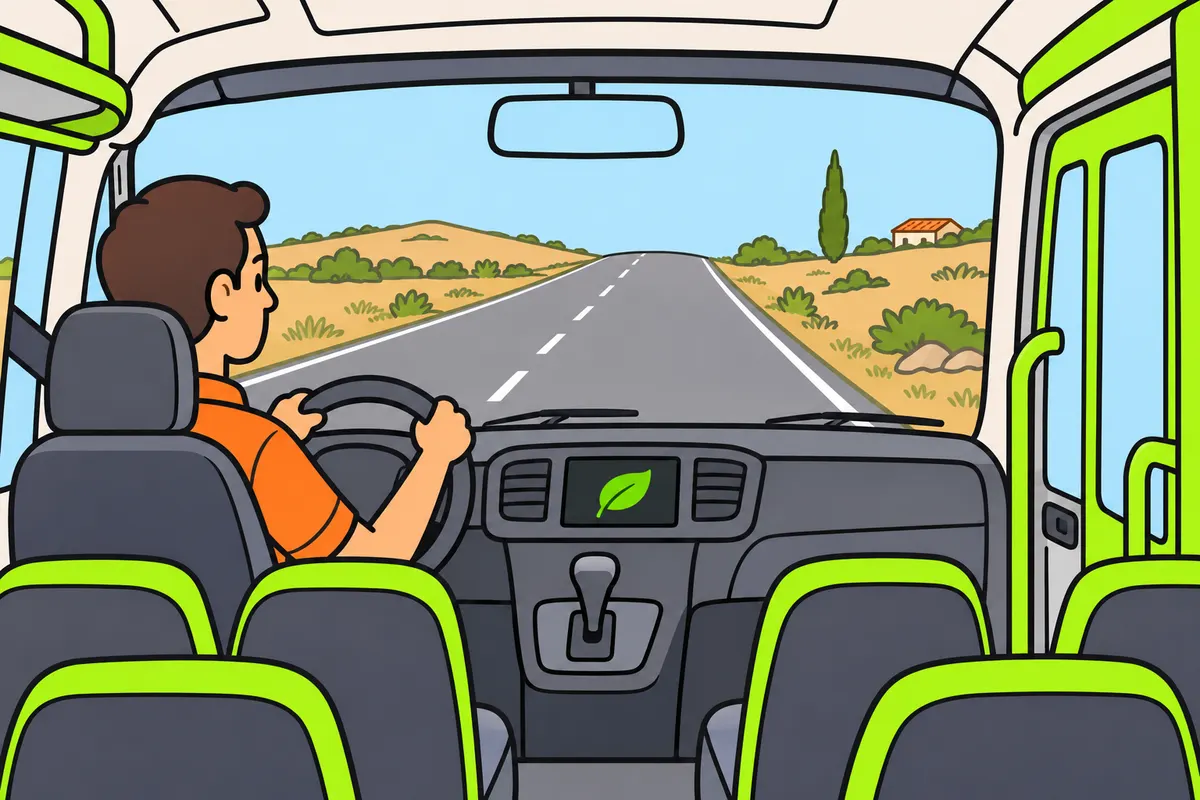
Use driving aids while continuing to adapt your driving.
| System | What it does in your minibus |
|---|---|
| Start-Stop | Stops and restarts the engine when its conditions are met |
| Eco mode | Changes response or energy management |
| Limiter | Sets a maximum speed |
Remember
- Know the gearbox programmes and monitor their response.
- Keep accelerator use steady when traffic allows.
- Use cruise control according to the manual and conditions.
- Allow slight downhill speed increases only with control, safety and respect for limits.
- Watch traffic, not an efficiency score.
- A limiter sets a maximum, not a target.
Exam trap: Wrong: the economy programme decides for you. Right: adapt your driving to load, gradient and traffic.
Read the full explanation
- If you drive a minibus with an automatic or automated transmission, familiarise yourself with the available programmes and the conditions in which you must use them. An economy programme can encourage appropriate gear changes, but you need to monitor its response when the gradient, load or acceleration needs change; you remain responsible for deciding how to drive safely.
- Keep your accelerator input steady when traffic conditions allow. Frequent, abrupt changes in input can cause unnecessary changes in gear ratio and fuel consumption. Do not force sharp downshifts to regain a small amount of speed that you are about to lose again at the next stop.
- If you have cruise control, use it according to the manual when it allows safe, steady driving: it can help you avoid unnecessary fluctuations in fuel consumption. On undulating roads, anticipate gradients and adjust the demand on the engine; you can let your speed increase slightly downhill only if you retain control and comply with speed limits and safety conditions. [DGT, efficient driving](https://www.dgt.es/muevete-con-seguridad/conviertete-en-un-buen-conductor/consejos-generales/conduccion-eficiente/).
- The speed limiter sets a ceiling, not a target speed: anticipating the terrain and traffic allows you to reduce the demand on the engine instead of keeping the accelerator pressed against that ceiling. On M2/M3 minibuses subject to the requirement, it is set to prevent speeds above 100 km/h; its scope, exceptions and road speed limits are covered in «Minibus dimensions and masses» and «Minibus speed and distances». [RD 1417/2005, art. 3](https://www.boe.es/buscar/act.php?id=BOE-A-2005-19990#a3).
- You can use economy driving indicators to review your habits when it is safe. You must not focus on a score or instantaneous fuel consumption in a complex situation. Necessary braking can worsen an efficiency record while still being the correct action.
- If your minibus has Start-Stop, follow the operating conditions in its manual: the system manages stopping and restarting the engine when appropriate. Do not confuse it with Eco mode, which changes the vehicle's response or energy management. The battery, temperature or equipment requirements can prevent an automatic engine stop.
14Decelerate using the vehicle’s momentum
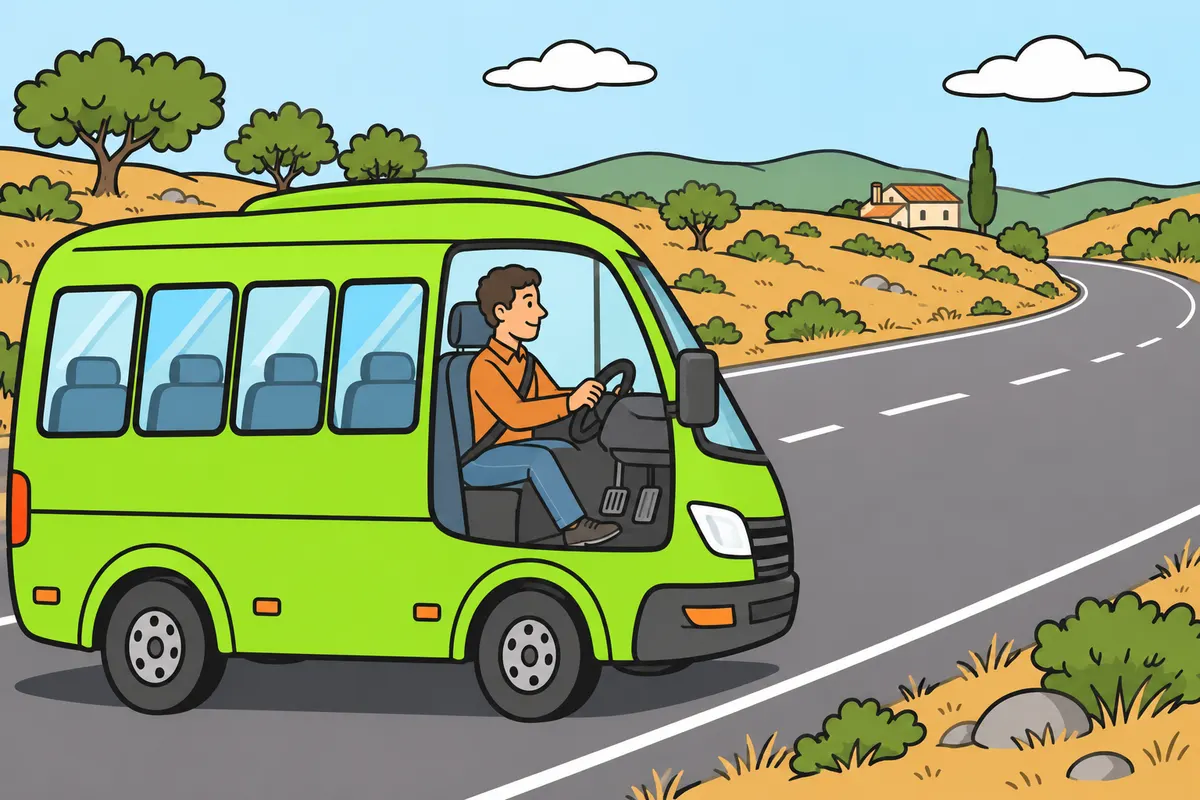
Release the accelerator early and use your momentum under control.
Remember
- Before slowing, check traffic behind and the space available.
- Keep a suitable gear engaged as you use your momentum.
- Do not assume releasing the accelerator always stops fuel use.
- You may still need to brake after releasing the accelerator.
Exam trap: Wrong: save fuel downhill by switching off or using neutral. Right: keep a suitable gear engaged and stay in control.
Read the full explanation
- When you anticipate a need to slow down, release the accelerator in good time and use the minibus's momentum in a controlled way, keeping an appropriate gear engaged. You must check traffic behind you and the space available. This technique avoids supplying energy that you then have to dissipate immediately through the brakes.
- In many fuel-injected engines, the engine management system can cut off the fuel supply during certain phases of engine braking. Do not assume that fuel consumption is always zero when you release the accelerator: it depends on the engine, engine speed and operating conditions. Nor does it guarantee that the vehicle comes to a stop without braking.
- To choose the gear and means of controlling speed on descents, apply the techniques in «Minibus brakes and retarders» and «Safe minibus driving».
15Stops, idling and climate control
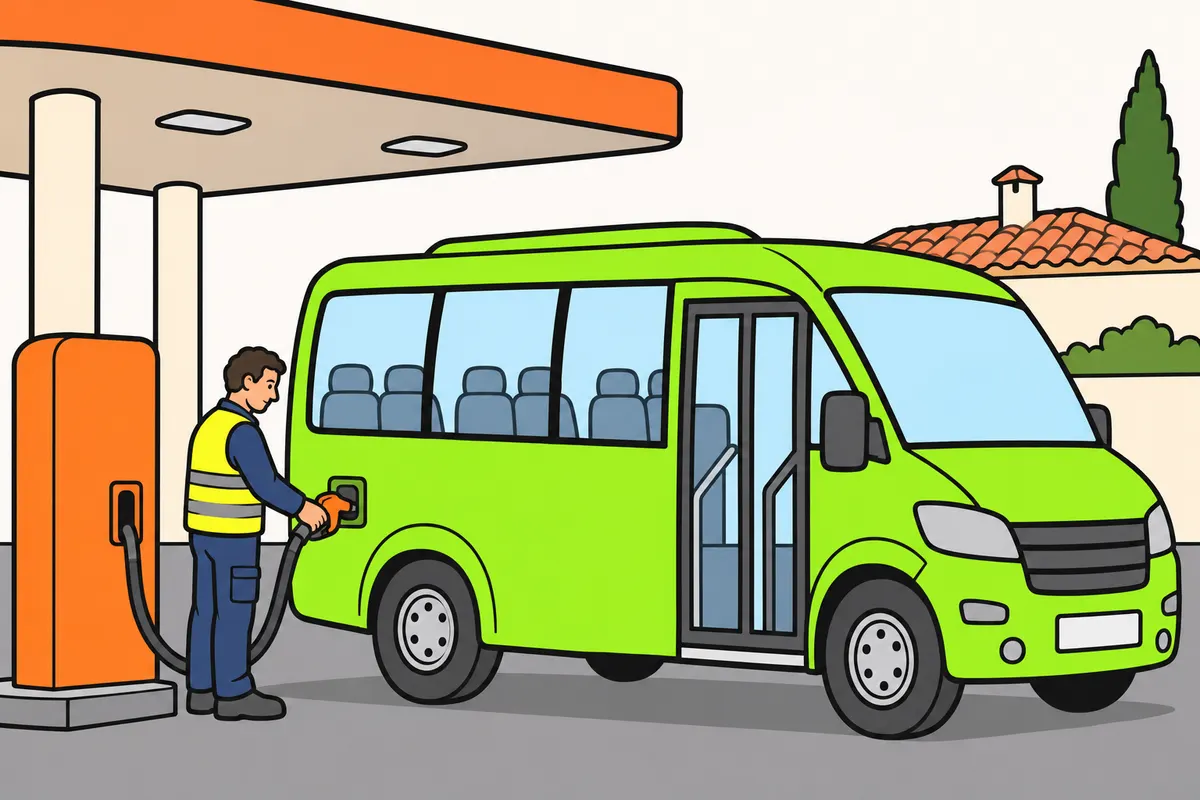
Avoid unnecessary idling while meeting your safety duties.
| Term | What it means |
|---|---|
| Idling | Engine running without acceleration demand |
| Neutral | Gear position; it does not mean the engine is off |
Remember
- Avoid unnecessary idling during long waits, following the manual and local rules.
- See “Switching off the engine and refuelling” in “Minibus mechanics”.
- Keep the ventilation and demisting you need.
- At the end of service, follow the maker’s shutdown procedure.
- Avoid revving the engine without load at the end of service.
Exam trap: Wrong: putting the gearbox in neutral switches off the engine. Right: gear position and engine operation are different things.
Read the full explanation
- An idling combustion engine uses fuel even when the minibus covers no distance. Idling describes the engine running without any demand for acceleration; neutral describes a transmission position. These are different concepts, and neither in itself means that the engine is switched off.
- Avoid unnecessary idling during long waits, following the manual and local rules. The requirements to switch off the engine are explained in «Minibus mechanics», in the section «Switching off the engine and refuelling». [RGC, art. 115](https://www.boe.es/buscar/act.php?id=BOE-A-2003-23514#a115).
- The conditions for refuelling are explained in «Minibus mechanics», in the section «Switching off the engine and refuelling». [RGC, art. 115.3 and 4](https://www.boe.es/buscar/act.php?id=BOE-A-2003-23514#a115).
- Use climate control sensibly, maintaining the ventilation, demisting and comfort needed for the service. Do not switch off functions needed for your visibility or passenger safety to save fuel. The appropriate temperature depends on the system and conditions, with no universal efficient temperature for all minibuses.
- At the end of the service, follow the manufacturer's shutdown procedure and avoid revving the engine with no load. Do not assume that every engine needs the same period of idling to cool down. If the equipment requires a specific sequence because of its design or use, you must follow it without improvising based on advice for another vehicle.
16Adjust tyre pressures
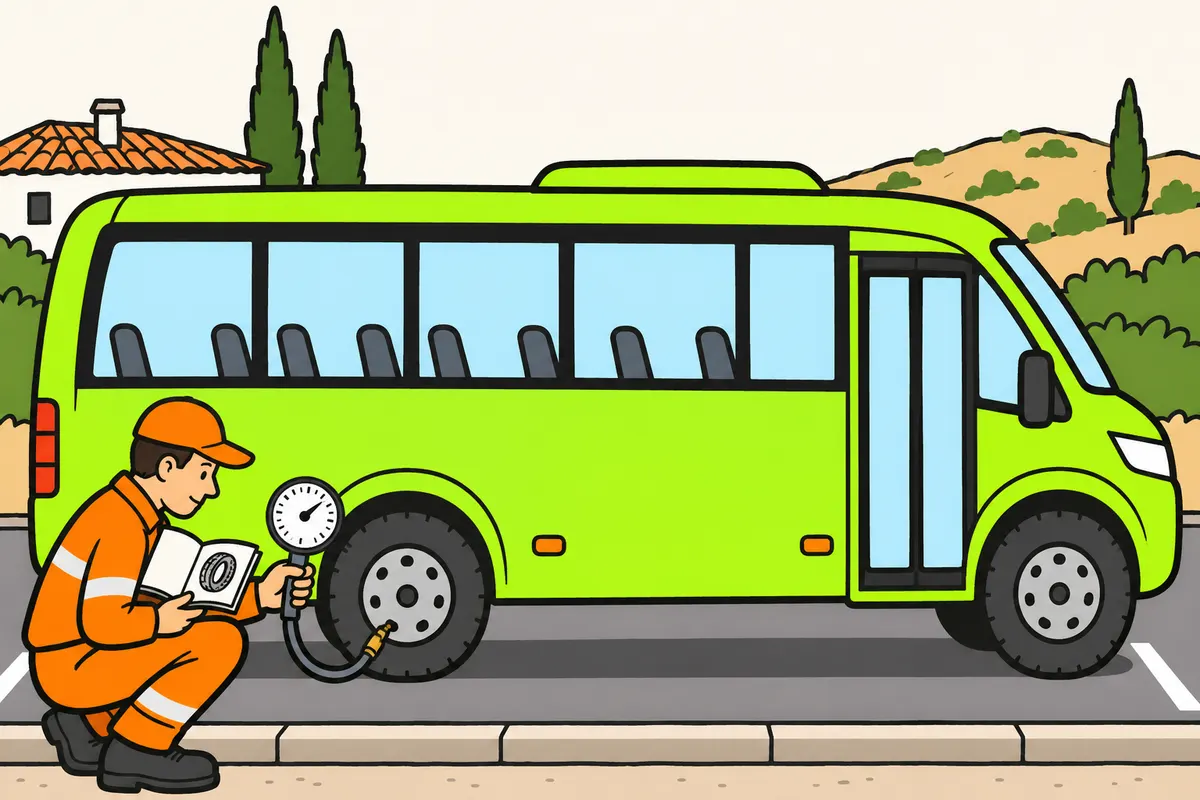
Keep the pressure specified for your tyres and load.
| Pressure | What may happen |
|---|---|
| Too low | More deformation, heat, fuel use and wear at the edges |
| Too high | Altered road contact and wear in the centre |
Remember
- Check tyre pressure regularly with a suitable gauge.
- Compare cold tyres with the stated cold values.
- Do not let air out of a hot tyre to match the cold value.
- Do not add extra pressure to save fuel.
- On twin wheels, check both inner and outer tyres.
- Investigate any pressure loss or warning.
Exam trap: Wrong: deflating a hot tyre corrects its pressure. Right: follow the manufacturer’s procedure.
Read the full explanation
- Check pressures regularly and use the manufacturer's values applicable to the vehicle, its tyres and the load. The regulations require regular checks with suitable pressure gauges. There is no single pressure you can memorise for all minibuses. [RGV, Annex VII](https://www.boe.es/buscar/act.php?id=BOE-A-1999-1826).
- Compare the reading with the cold pressure specification when the tyres are cold. Their temperature and usually their pressure increase as you drive; do not release air from a hot tyre to bring it down to the specified cold pressure. You must follow the manufacturer's procedure if you need to check it during the service. [DGT, pressure and temperature](https://revista.dgt.es/es/motor/noticias/2019/07JULIO/0701-Neumaticos.shtml).
- With insufficient pressure, the tyre deforms more, rolling resistance increases, and more heat and fuel consumption result. You can also find pronounced wear on the shoulders of the tread. Do not wait until you can see that a tyre is underinflated before deciding to check it.
- Excessive pressure is not a way to save fuel either: it can alter contact with the road and encourage wear in the centre of the tread. You must maintain the specified pressure, which helps stability and even wear. You do not achieve safety and durability by adding or releasing air without considering the conditions of use.
- If you have twin wheels, include both the inner and outer tyres in your checks, following the specified procedure. Do not assume that the visible wheel tells you the condition of the hidden one. Tyre pressure monitoring warnings help you detect problems, but you must address any pressure loss or abnormality and check its cause.
17Read the European tyre label
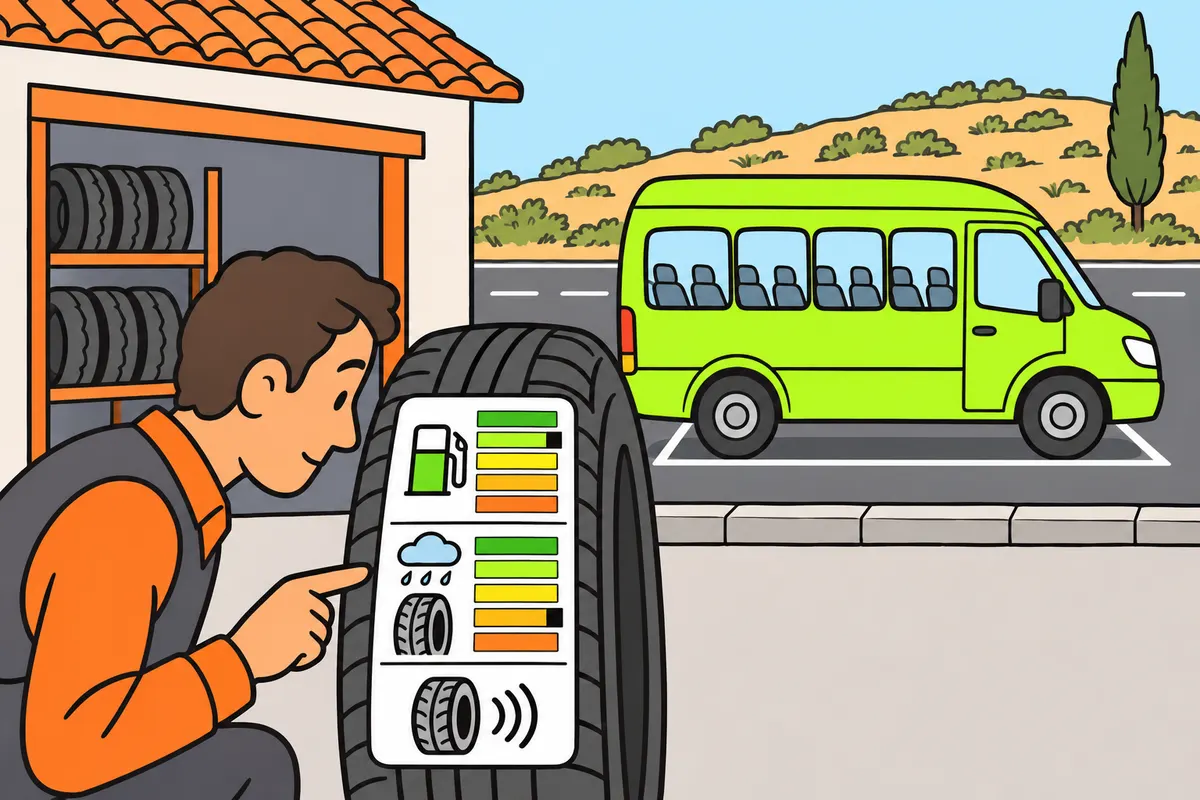
Read each part of the tyre label separately.
| Part | What it tells you |
|---|---|
| Efficiency | Rolling resistance linked to fuel use |
| Wet grip | Grip class on wet roads |
| Noise | External noise decibels and class, not interior noise |
Remember
- This label is different from your minibus’s environmental sticker.
- Read fuel efficiency, wet grip and external noise separately.
- For efficiency and grip, A is best and E is worst.
- External noise classes run from A to C.
- Choose tyres that fit your minibus.
- Rolling resistance is not the same as wear resistance.
Exam trap: Wrong: the label guarantees an exact braking distance. Right: it compares classes without guaranteeing that distance.
Read the full explanation
- The European tyre label gives you information about that product and is different from the minibus's environmental sticker. The label compares fuel efficiency linked to rolling resistance, wet grip and external rolling noise; it does not summarise all safety or durability characteristics. [Regulation (EU) 2020/740, Annexes I and II](https://www.boe.es/buscar/doc.php?id=DOUE-L-2020-80878).
- On the efficiency and wet-grip scales, A indicates the best class and E the worst of the classes shown. You must read each category separately: a good fuel efficiency class does not in itself demonstrate the same rating for wet braking. [Regulation (EU) 2020/740, Annexes I and II](https://www.boe.es/buscar/doc.php?id=DOUE-L-2020-80878).
- The noise category shows external noise in decibels and its class, from A to C. It does not measure the noise passengers hear inside the minibus. The information can help you choose between compatible tyres, but it does not authorise you to fit a size or load capacity unsuitable for the vehicle. [Regulation (EU) 2020/740, Annex I.C](https://www.boe.es/buscar/doc.php?id=DOUE-L-2020-80878).
- You can find tyre identification and specific snow or ice performance pictograms where applicable. Do not interpret these symbols as a guarantee of grip in every situation. The label does not provide a universal pressure, an exact braking distance or a guaranteed service life in extreme environments.
- Rolling resistance and abrasion resistance describe different phenomena: the former relates to energy lost as the tyre rolls; the latter relates to wear.
18Load, luggage and moving mass
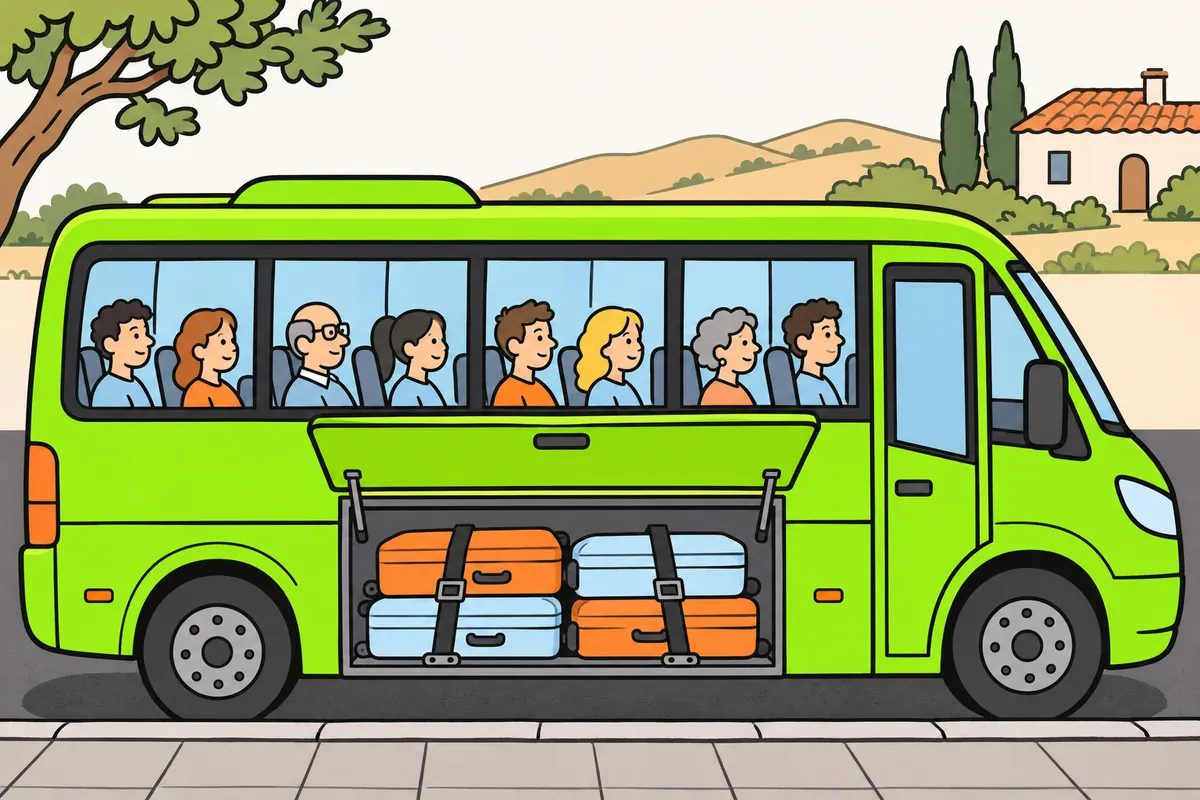
Distribute and secure luggage within your minibus’s limits.
Remember
- More mass needs more energy to accelerate and climb.
- Remove only unnecessary weight; keep required equipment.
- Secure luggage, even on short journeys.
- Respect total mass, axle limits and tyre load limits.
- Adapt pressure and gear use to the load.
Exam trap: Wrong: spare space means you cannot overload your minibus. Right: respect each axle’s limits too.
Read the full explanation
- The more mass you carry, the more energy you need to accelerate under comparable conditions and to climb gradients. In passenger transport, you must manage the actual service, without treating savings as a reason to leave out passengers or compulsory equipment. Remove only unnecessary weight and organise the necessary luggage properly.
- Distribute and secure luggage to prevent movement, impacts and noise. The load must not compromise stability or cause avoidable nuisance. You must comply with the rules for arranging and securing loads even when the journey is short and you think you are unlikely to brake hard. [RGC, art. 14](https://www.boe.es/buscar/act.php?id=BOE-A-2003-23514#a14).
- You must comply with total mass and axle load limits and tyre load capacities. Uneven distribution can overload one area even if there appears to be free space in another. The numerical values and checking methods are covered in «Minibus dimensions and masses» and «Minibus maintenance and checks».
- Consider the load in relation to tyre pressure and gear use: adapt your decisions to the minibus's response when you carry passengers and luggage.
19Aerodynamics and wind
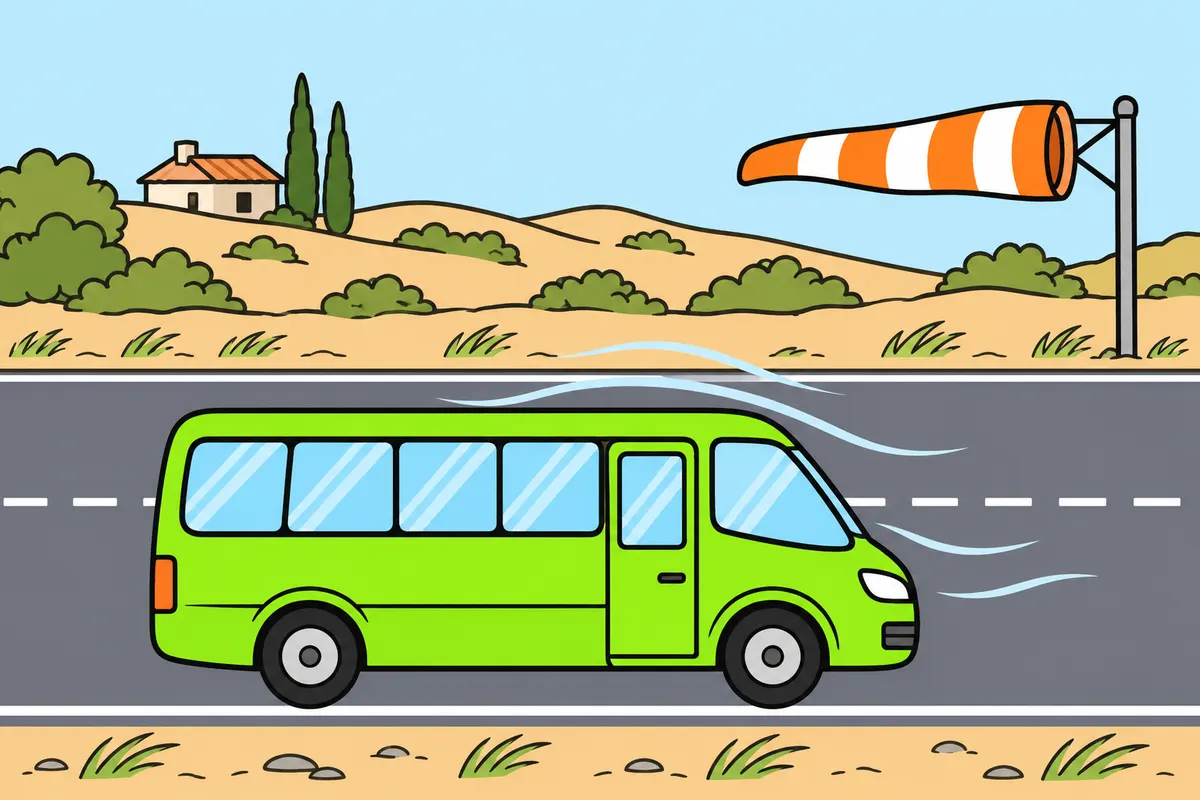
Adapt your driving to the wind and avoid unnecessary external accessories.
| Wind | Effect to consider |
|---|---|
| Headwind | May increase fuel use at the same road speed |
| Moderate tailwind, slower than minibus | Usually reduces air resistance |
| Gusty crosswind | May affect stability |
Remember
- A larger front area means more air resistance at the same air speed.
- Air resistance rises with the square of speed through the air.
- Do not assume this gives a fixed share of total fuel use.
- Keep the body as designed and use the service ventilation.
- In gusty crosswinds, adapt your driving and leave space.
- Do not follow closely to shelter from the wind.
Exam trap: Wrong: a larger vehicle always has a worse drag coefficient. Right: distinguish frontal size from shape.
Read the full explanation
- Frontal area is the area your vehicle presents to the air; the aerodynamic coefficient describes the influence of its shape. At the same relative speed and with other conditions unchanged, a larger frontal area increases resistance. A larger vehicle does not necessarily have a worse coefficient. [DGT, Manual II, air resistance](https://sede.dgt.gob.es/.galleries/permisos-de-conducir/certificacion-aptitud-profesores-formacion-vial/2025/Manual-II-Cuestiones-de-Seguridad-Vial-2025.pdf).
- Aerodynamic resistance increases with the square of speed relative to the air, with all other factors unchanged. You must understand why increasing speed requires substantial additional effort; this does not mean that total minibus fuel consumption follows a fixed ratio, because other forms of resistance and engine efficiency also play a part. [DGT, aerodynamic resistance](https://sede.dgt.gob.es/.galleries/permisos-de-conducir/certificacion-aptitud-profesores-formacion-vial/2025/Manual-II-Cuestiones-de-Seguridad-Vial-2025.pdf).
- If you maintain the same speed over the ground and the headwind increases, relative air speed increases and fuel consumption may rise. A moderate tailwind travelling more slowly than the minibus usually reduces this resistance. You must distinguish this energy effect from the danger caused by crosswind gusts.
- Keep the bodywork in its intended configuration and avoid unnecessary external accessories that disrupt airflow. If your vehicle has opening windows, opening them may alter its aerodynamics; use the ventilation provided for the service. Do not apply fuel consumption percentages published for car windows to a minibus.
- Because of its side area, your minibus requires particular anticipation in crosswinds, especially gusts. Adjust your driving and the space around you without slipstreaming another vehicle to save fuel. The technique for maintaining stability in wind is covered in «Safe minibus driving».
20Maintenance and abnormal emissions
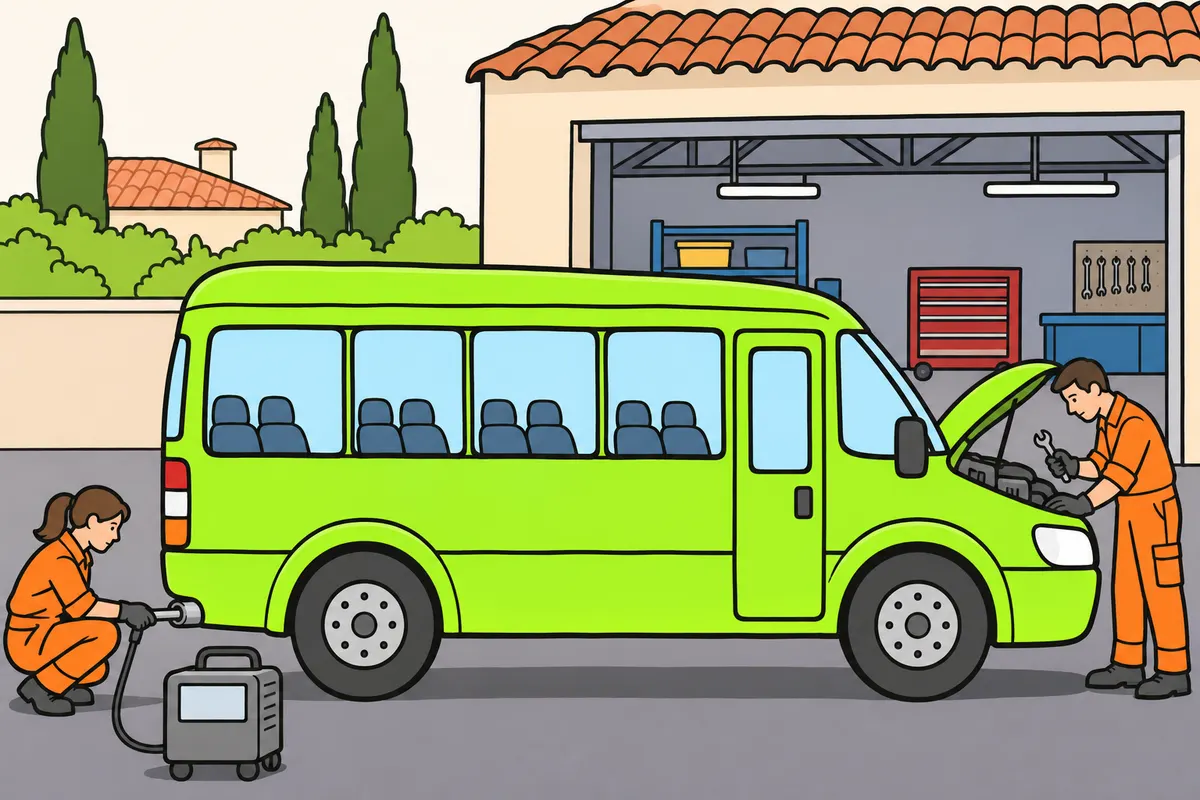
Maintain your minibus and request checks for abnormal emissions.
| Part | Purpose |
|---|---|
| Silencer | Reduces noise |
| Exhaust treatment | Reduces pollutants |
Remember
- Follow the service schedule and use the specified products.
- Ask for a check if a diesel produces black smoke.
- Do not try to stop the smoke by accelerating harder.
- Keep systems that reduce exhaust pollution working.
- Do not drive with harmful smoke or smoke that blocks others’ view.
- Do not confuse exhaust treatment fluid with a fuel additive.
Exam trap: Wrong: black smoke identifies the exact fault. Right: it is a clue that needs checking.
Read the full explanation
- Follow the servicing schedule and maintenance instructions applicable to the engine, fuel system, filters and lubricants. A poorly maintained vehicle may need more fuel for the same service. Do not assume a replacement interval common to all minibuses or change specifications to try to reduce consumption.
- If you see black smoke from a diesel, consider that incomplete combustion producing soot may be occurring, for example through insufficient air or incorrect fuel metering. The colour is a clue, not a definitive diagnosis. You must request a check instead of trying to correct it by accelerating harder or increasing the fuel supply.
- You must keep the installed exhaust treatment systems operational and respond to their warnings according to the manual. Do not confuse the silencer, whose purpose is to reduce noise, with components intended to reduce pollutants. A fault may affect one of these aspects without the other appearing to change.
- You must comply with the regulatory limits for gases, smoke and noise and cooperate with detection tests. You must not drive while emitting smoke that impairs other drivers’ visibility or is harmful. [RGC, art. 7.1-2](https://www.boe.es/buscar/act.php?id=BOE-A-2003-23514#a7).
- CO₂ associated with the use of carbon-containing fuels differs from pollutants such as nitrogen oxides and particulates. Saving fuel and reducing local emissions are related objectives, but a consumption figure does not describe the entire environmental impact. In an electric minibus, you must also drive efficiently and look after the tyres.
- Use the fuel and service products specified for the engine. Unsuitable fuel or skipping maintenance may cause faults instead of reducing service costs. If your minibus uses a reagent to treat exhaust gases, follow the system instructions and respond to its warnings; do not confuse it with an additive for the fuel tank.
21Recognising the bus’s environmental classification
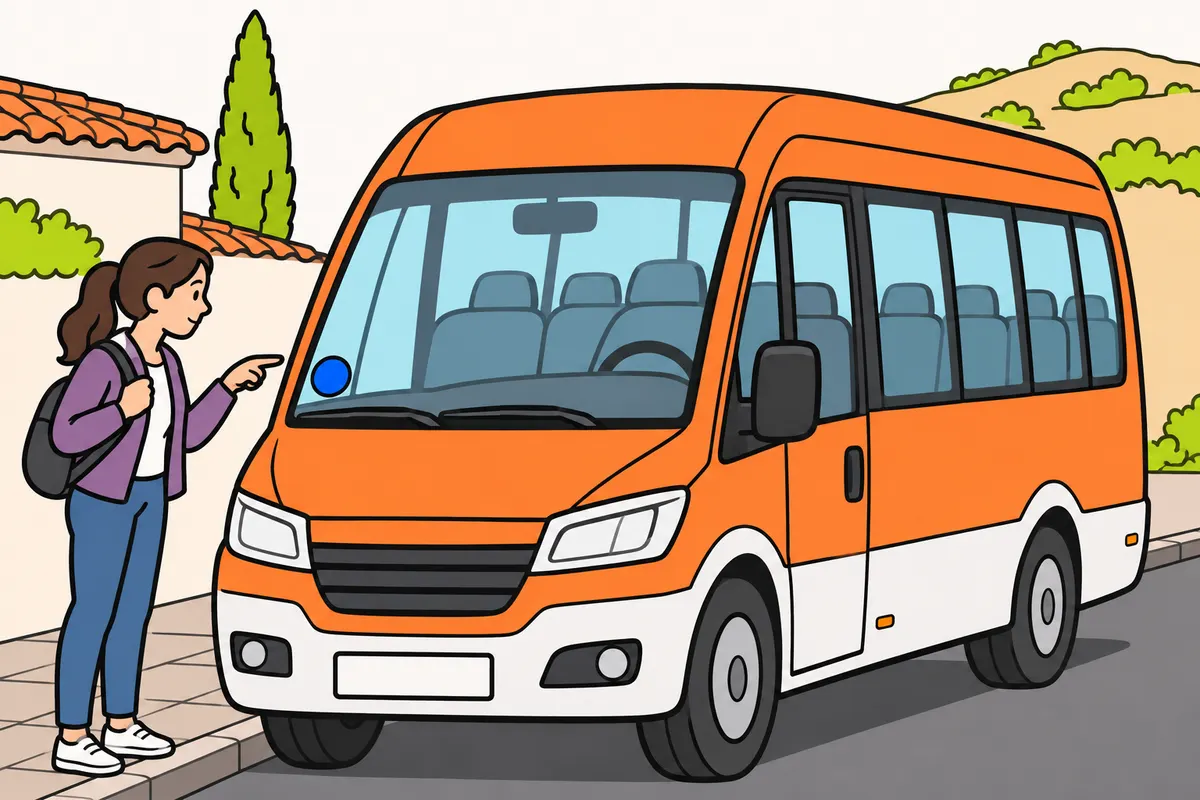
Check your minibus’s official environmental class and apply its own criteria.
| Sticker for M2/M3 minibuses | Requirements | Colour |
|---|---|---|
| 0 emisiones (zero emissions) | Battery electric, range-extended, hydrogen, fuel cell; plug-in hybrid from 40 km NEDC | Blue |
| ECO | Non-plug-in hybrid, plug-in hybrid below 40 km, CNG, LNG or LPG (GNC, GNL, GLP); must meet C criteria | Blue and green |
| C | Petrol or diesel Euro VI/6 | Green |
| B | Petrol or diesel Euro IV/4 or V/5 | Yellow |
| A | No sticker | No label |
Remember
- Check the class by registration number; do not use car criteria.
- Your D1 licence does not make the minibus a passenger car.
- ECO vehicles must also meet C criteria.
- A plug-in hybrid with 40 km NEDC range meets the zero-emissions threshold.
- Colour does not give universal permission to drive.
Exam trap: Wrong: every gas-powered minibus gets ECO. Right: it must also meet the C criteria.
Read the full explanation
- Check the classification recorded against your minibus’s registration number. These passenger vehicles fall within M2 or M3 according to their type-approval category; a D1 licence does not turn the vehicle into an M1 passenger car. The V-25 sign identifies 0 emisiones (zero emissions), ECO, C and B; category A has no badge. [RGV, annex II.E and annex XI, V-25](https://www.boe.es/buscar/act.php?id=BOE-A-1999-1826).
- For M2 and M3 minibuses, C corresponds to Euro VI/6 petrol or diesel vehicles; B corresponds to Euro IV/4 or V/5 petrol or diesel vehicles. You must apply the vehicle’s recorded level, not the criteria for passenger cars. [RGV, annex II.E](https://www.boe.es/buscar/act.php?id=BOE-A-1999-1826#ie).
- For M2/M3, ECO includes non-plug-in hybrids, plug-in hybrids with a range below 40 km and CNG, LNG or LPG vehicles, provided they meet the C criteria. Being a gas-powered minibus is not sufficient in itself. [RGV, annex II.E](https://www.boe.es/buscar/act.php?id=BOE-A-1999-1826#ie).
- 0 emisiones includes battery electric, range-extended electric, hydrogen and fuel-cell vehicles, and plug-in hybrids with a minimum range of 40 km, which the regulation refers to the NEDC cycle. Exactly 40 km meets this threshold. [RGV, annex II.E](https://www.boe.es/buscar/act.php?id=BOE-A-1999-1826#ie).
- You can identify the badges by their colours: 0 emisiones, blue; ECO, blue and green; C, green; B, yellow. The colour identifies the class; it does not imply universal permission to drive. Check the official registration-number record if you have doubts about a particular vehicle. [DGT, environmental badge](https://www.dgt.es/nuestros-servicios/tu-vehiculo/tus-vehiculos/distintivo-ambiental/).
22Displaying the badge and distinguishing its effects
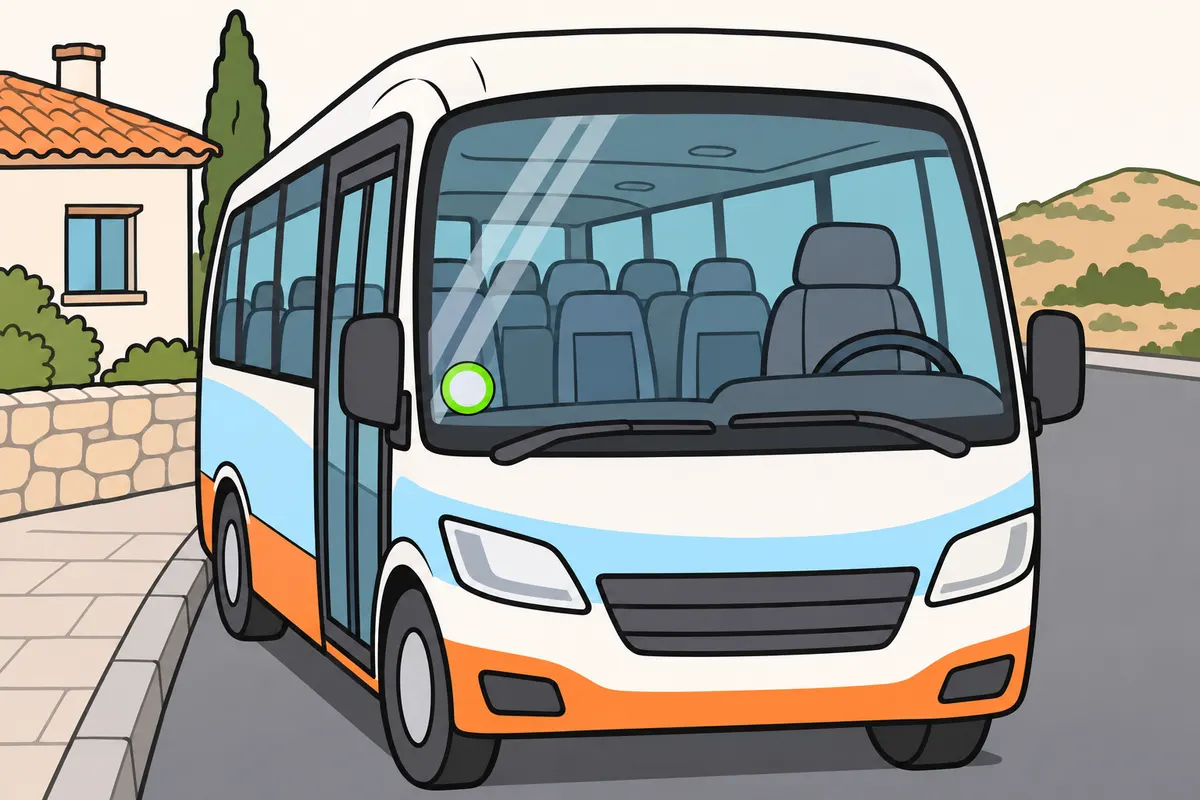
Check whether you must display the sticker and what local rules allow.
| Term | What to check |
|---|---|
| Classification | Recorded environmental category |
| Display | Whether rules require the sticker |
| Access | Conditions for this place and service |
Remember
- National rules generally make displaying the sticker voluntary.
- Display it if the authority requires it.
- Put it inside, at the lower right of the front windscreen.
- Driving style and passenger numbers do not change the class.
- Check local rules for access, parking and reserved lanes.
Exam trap: Wrong: your sticker guarantees access and free parking. Right: check the specific rules.
Read the full explanation
- Displaying it is voluntary under the general national rule, but the competent authority may expressly require it in its regulations. If you display it on your minibus, it must be on the inside, in the bottom right-hand corner of the front windscreen. [RGV, annex XI, V-25](https://www.boe.es/buscar/act.php?id=BOE-A-1999-1826#v2).
- Environmental classification, displaying the badge and permission to enter are separate conditions. For example, a minibus with C may meet its classification requirements yet encounter a zone requiring another condition.
- You cannot choose a badge according to your driving style or obtain another class by carrying fewer passengers or using less fuel on that journey. The classification belongs to the registered vehicle. Your decisions can improve actual consumption without themselves changing its environmental category.
- Do not assume that a badge gives general benefits such as free parking or automatic access to any reserved lane. You must check the specific regulations for the location and service. In a minibus, access conditions linked to the type of transport may apply alongside environmental conditions.
23Understanding ZBE and their access signs
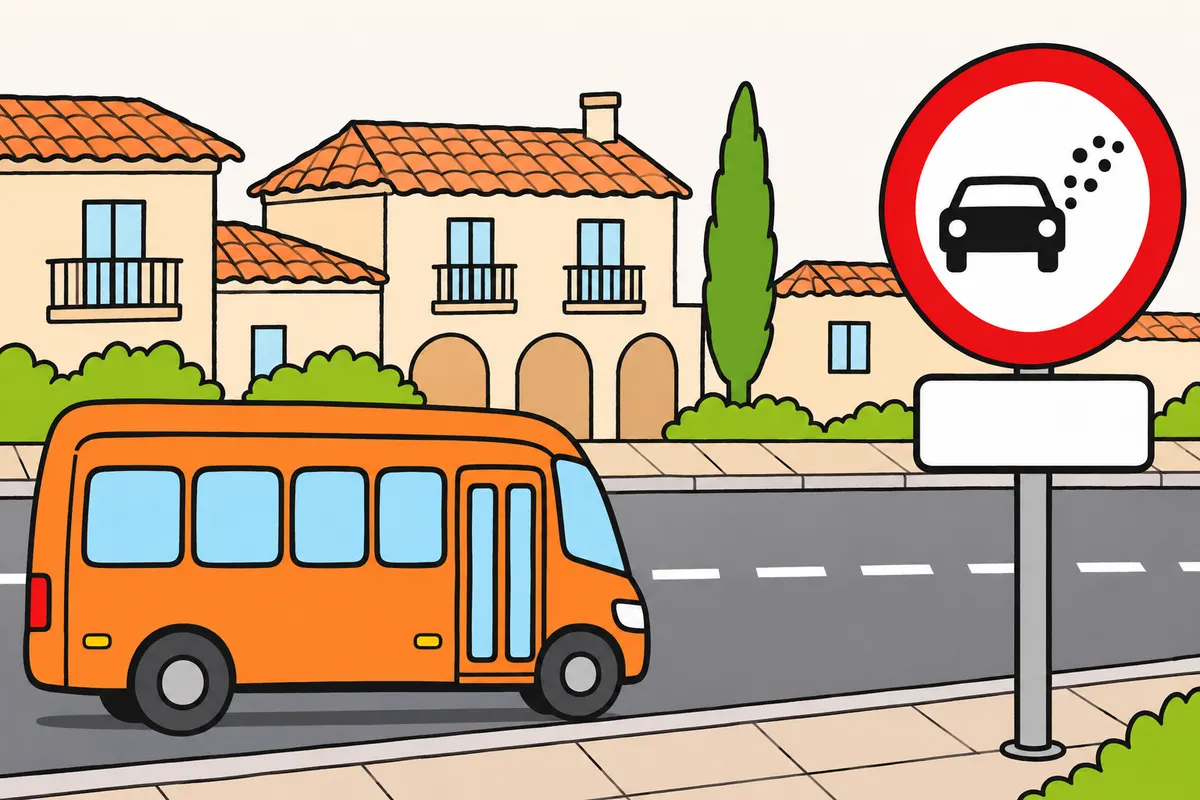
Before entering a ZBE, check its restrictions and permissions.
Remember
- Check local rules before your service.
- Read R-120 with its S-860 panel or the board containing it.
- Check the boundary, times and vehicles affected.
- Check whether your service has special conditions.
- Arrange required permission and another route before arrival.
- Do not stop at the sign to sort out permission.
Exam trap: Wrong: carrying passengers automatically exempts you from restrictions. Right: check local conditions for your service.
Read the full explanation
- A ZBE (low-emission zone) is a defined area with restrictions on access, driving and parking to improve air quality and mitigate emissions, based on polluting potential. You must check its local regulations before the service. [Act 7/2021, art. 14.3](https://www.boe.es/buscar/act.php?id=BOE-A-2021-8447#a14).
- Recognise R-120: entry prohibited to vehicles according to their environmental badge or other environmental criteria. The conditions are specified on an S-860 supplementary plate or on the board incorporating the sign. You must read them together. [RD 465/2025, catalogue R-120](https://www.boe.es/buscar/doc.php?id=BOE-A-2025-12199).
- Check the boundary, operating times, vehicles affected and any possible authorisations. Apply the conditions for your regular, occasional or tourist service when local rules treat them differently; collective transport does not automatically qualify for a national exemption. [RD 1052/2022, art. 5](https://www.boe.es/buscar/act.php?id=BOE-A-2022-22689#a5).
- If you need authorisation, check its conditions before arriving and prepare an alternative suitable for your minibus. An accommodation booking or a customer’s instruction does not in itself prove that you may enter. Do not stop unexpectedly at the sign to deal with unfinished arrangements.
- Breaching ZBE driving restrictions or protocols for pollution episodes constitutes a serious offence; the general fine is 200 euros. [Traffic Act, arts. 76.z3 and 80.1](https://www.boe.es/buscar/act.php?id=BOE-A-2015-11722).
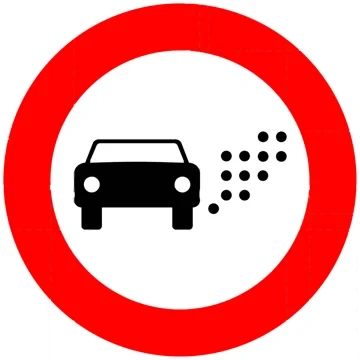 R-120
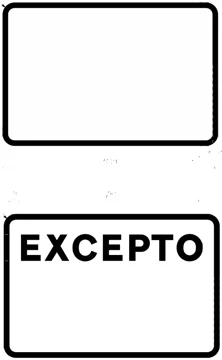 S-860
24Reducing noise during the service
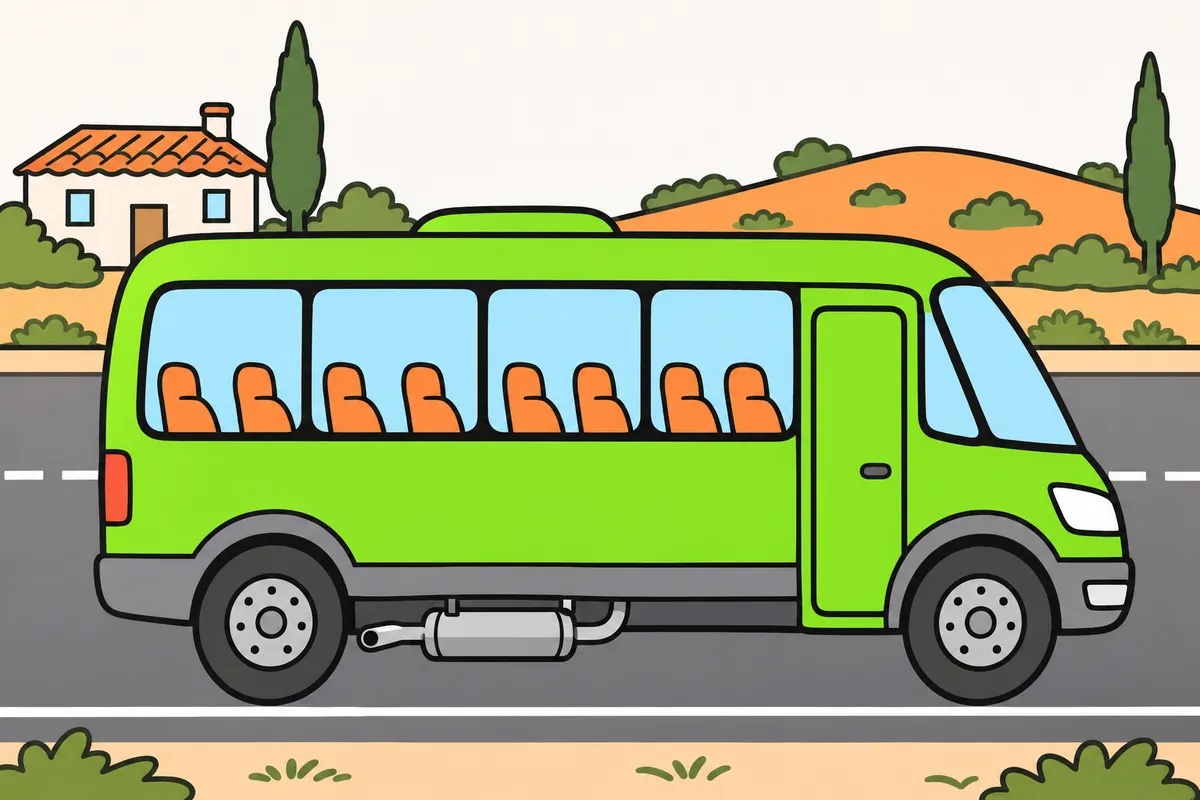
Reduce noise and use your horn only when allowed.
| Situation | When you may use the horn |
|---|---|
| Possible accident | To help avoid it, including in built-up areas |
| Warning before overtaking | Outside built-up areas |
| Exceptional urgent service by a non-priority vehicle | To warn of your presence during that service |
Remember
- Avoid revving without load and secure luggage to prevent knocks.
- Keep the silencer effective on every road.
- Do not use the horn to call passengers or demand way.
- Before moving, check that nobody is in a dangerous area.
- Report unusual noise or vibration for checking.
- Use a non-shrill horn only when justified and proportionate.
Exam trap: Wrong: outside built-up areas, you can drive with an open exhaust. Right: keep your silencer effective there too.
Read the full explanation
- You must avoid revving the engine without load, unnecessarily high engine speeds and banging luggage or loose items. Noise has both technical and operational causes: looking after your vehicle and driving smoothly address different aspects. A minibus that is quiet at idle can still produce rolling noise when moving.
- You must keep the silencer effective: open exhausts and incomplete, unsuitable or damaged silencers are prohibited. The prohibition applies on both urban and interurban roads; being outside a residential area does not justify the noise. [RGC, art. 7.2](https://www.boe.es/buscar/act.php?id=BOE-A-2003-23514#a7).
- You may use the horn to prevent a possible accident, to announce your intention to overtake outside built-up areas or to warn of your presence during the exceptional urgent service by a non-priority vehicle provided for in article 70. Its sound must not be strident, and its use must be justified and proportionate. [RGC, art. 110](https://www.boe.es/buscar/act.php?id=BOE-A-2003-23514#a110).
- The horn does not replace your observation or guarantee that someone leaves a dangerous area. If a person remains close to your minibus, you must check the space and adjust or postpone the movement. Repeating an audible warning unnecessarily increases disturbance and does not give you priority.
- If abnormal noises or vibrations occur, report the issue and check its cause following the vehicle’s procedure. Do not always attribute them to the road surface or wait for them to disappear without assessment. The aim is to detect an abnormality in time that may affect safety, consumption or emissions.
Handle a situation through anticipation
Gather information, keep a safety margin and act progressively.
- Scan the road far ahead, the area nearby, the sides and your mirrors with brief glances.
- Identify a clue: a queue braking, a hidden pedestrian, an obstructed entrance or uncertain behaviour.
- Decide what may happen and keep space to stop or adjust your driving.
- Ease off the accelerator in good time and prepare your response; signal when appropriate.
- Brake as much as necessary and reassess your surroundings before building up speed again.
Select an efficient gear
Choose a useful engine speed according to the load and the situation.
- Set a speed that suits the limits, visibility, passengers and traffic.
- Assess the load, gradient and power needed before choosing a gear.
- Change up when you can retain sufficient response, using the economy band if one is marked.
- Check the engine speed after changing gear: avoid vibration, insufficient power and unnecessary revs.
- Change down if the situation requires it and keep appropriate braking aids engaged when slowing down.
Check tyre pressures for the service
Compare the reading with the correct reference pressure and the expected load.
- Check the prescribed pressures for the minibus, tyres, axles and intended use.
- Check the tyres when cold with a suitable pressure gauge, including the inner tyres if twin wheels are fitted.
- Adjust pressures following the manufacturer’s procedure; do not let air out of hot tyres to match a cold-pressure reference.
- Investigate leaks or abnormal differences and confirm that the vehicle can carry out the service safely.
Prepare to enter a ZBE
Combine the minibus classification with the local access conditions.
- Check the official environmental classification using the registration number of your assigned minibus.
- Check the municipal rules: boundaries, operating hours, service category and authorisation conditions.
- Obtain any required authorisation and prepare an alternative suitable for the vehicle’s characteristics.
- As you approach, interpret R-120 together with its supplementary plate or signboard and the other signs.
- Enter only if you meet the conditions; the label alone does not guarantee access.
Finished this module?
Mark it as read and you will see your progress on the theory list.