
Theory · B+E Licence - Car with Trailer · Module 1 of 13
The B+E licence: limits, tests and validity
You learn to decide whether a combination requires category B, code 96 or B+E using the MMA (maximum authorised mass) of each vehicle. You learn the eligibility requirements, the theory, closed-course and on-road tests, and the validity and renewal periods so you can answer exam questions without confusing their limits.
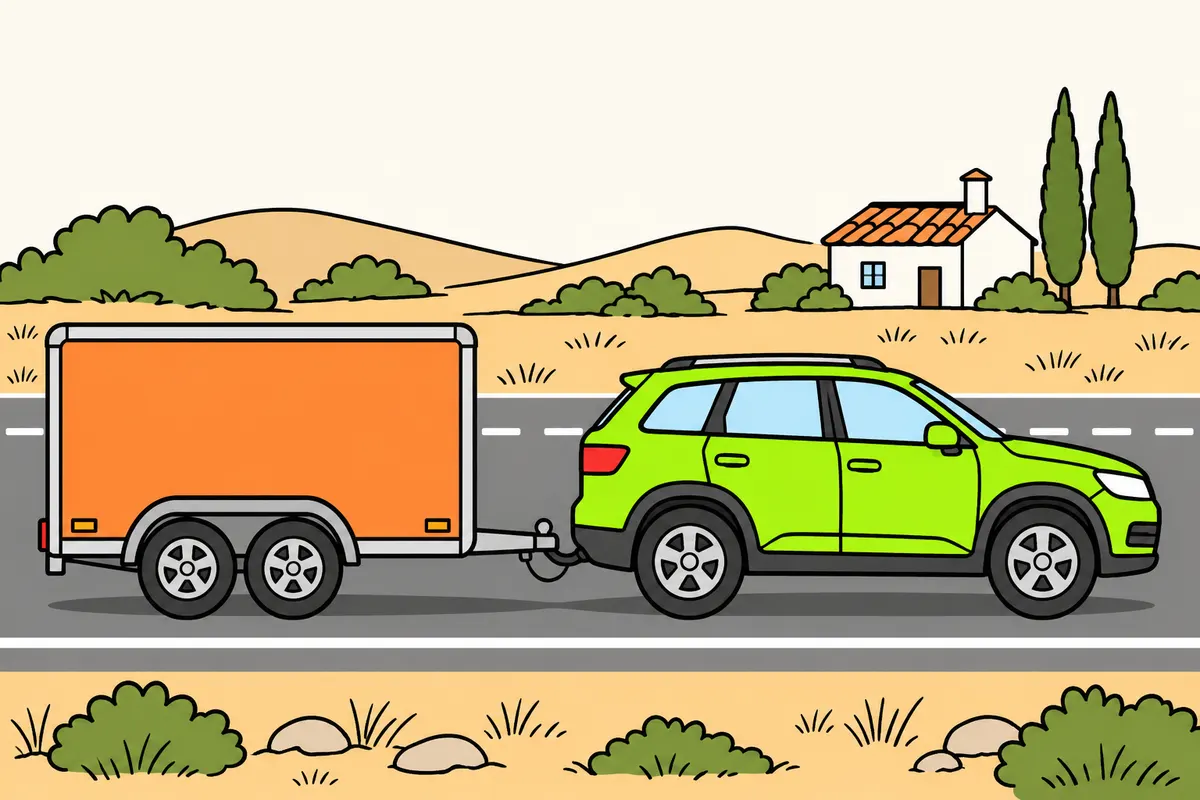
1What B+E authorises and which licence you must hold
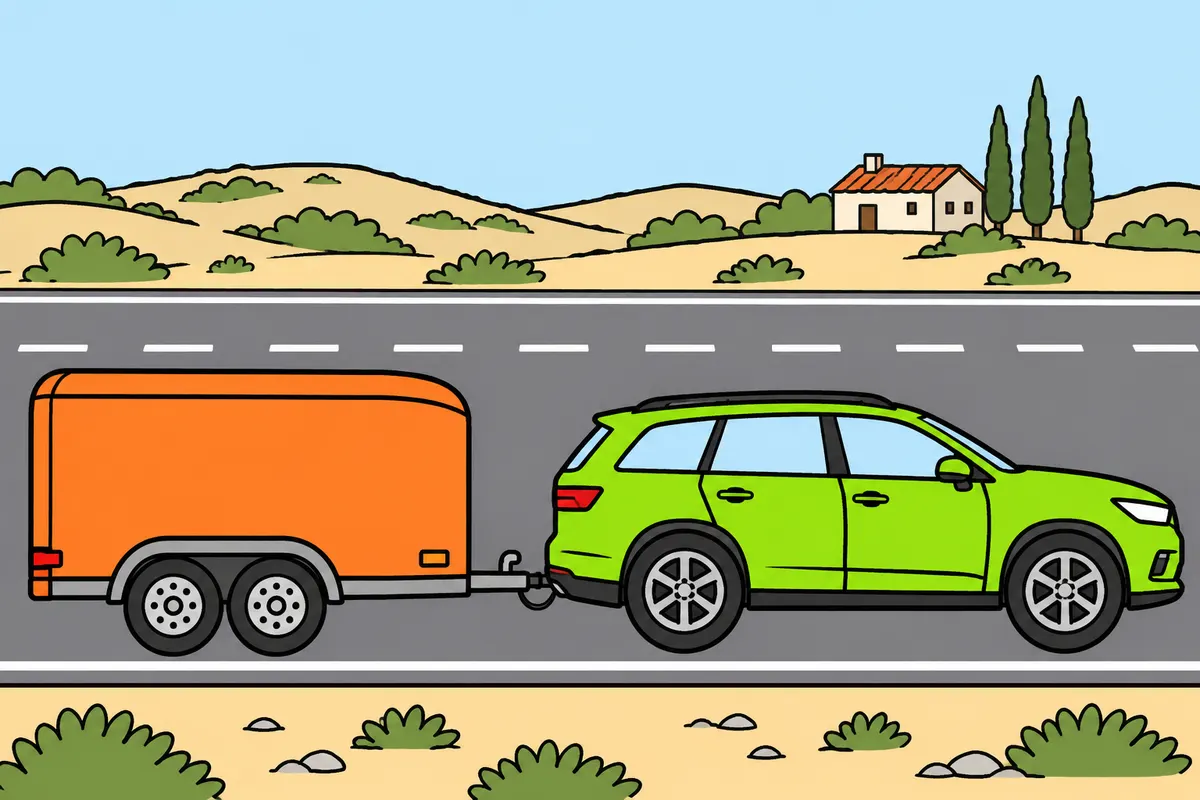
With B+E, you can drive a category B vehicle with a trailer of a higher MMA.
Remember
- You need a valid B licence.
- You do not need to have held B for a minimum period.
- The trailer limit also applies to semi-trailers.
- Category B: MMA up to 3,500 kg.
- It carries up to eight passengers besides the driver.
- If you obtain C1+E, C+E, D1+E or D+E, you also receive B+E.
Exam trap: Wrong: the 3,500 kg limit applies to the whole combination. Right: it applies to the trailer or semi-trailer.
Read the full explanation
- With B+E, you can drive a towing vehicle authorised by category B with a trailer or semi-trailer with an MMA (maximum authorised mass) of up to 3,500 kg. This limit applies to the trailer or semi-trailer. [RGCond, art. 4.2](https://www.boe.es/buscar/act.php?id=BOE-A-2009-9481#a4)
- A category B towing vehicle is a motor vehicle with an MMA of no more than 3,500 kg, designed for no more than eight passengers in addition to you as the driver. [RGCond, art. 4.2](https://www.boe.es/buscar/act.php?id=BOE-A-2009-9481#a4)
- To be issued with B+E, you must hold a valid category B licence. You do not need to have held B for any specific minimum period for this extension. [RGCond, art. 5.1.c](https://www.boe.es/buscar/act.php?id=BOE-A-2009-9481#a5)
- If you obtain C1+E, C+E, D1+E or D+E, you are also granted B+E. [RGCond, art. 5.2.d](https://www.boe.es/buscar/act.php?id=BOE-A-2009-9481#a5)
2When category B is enough and when you need an extension
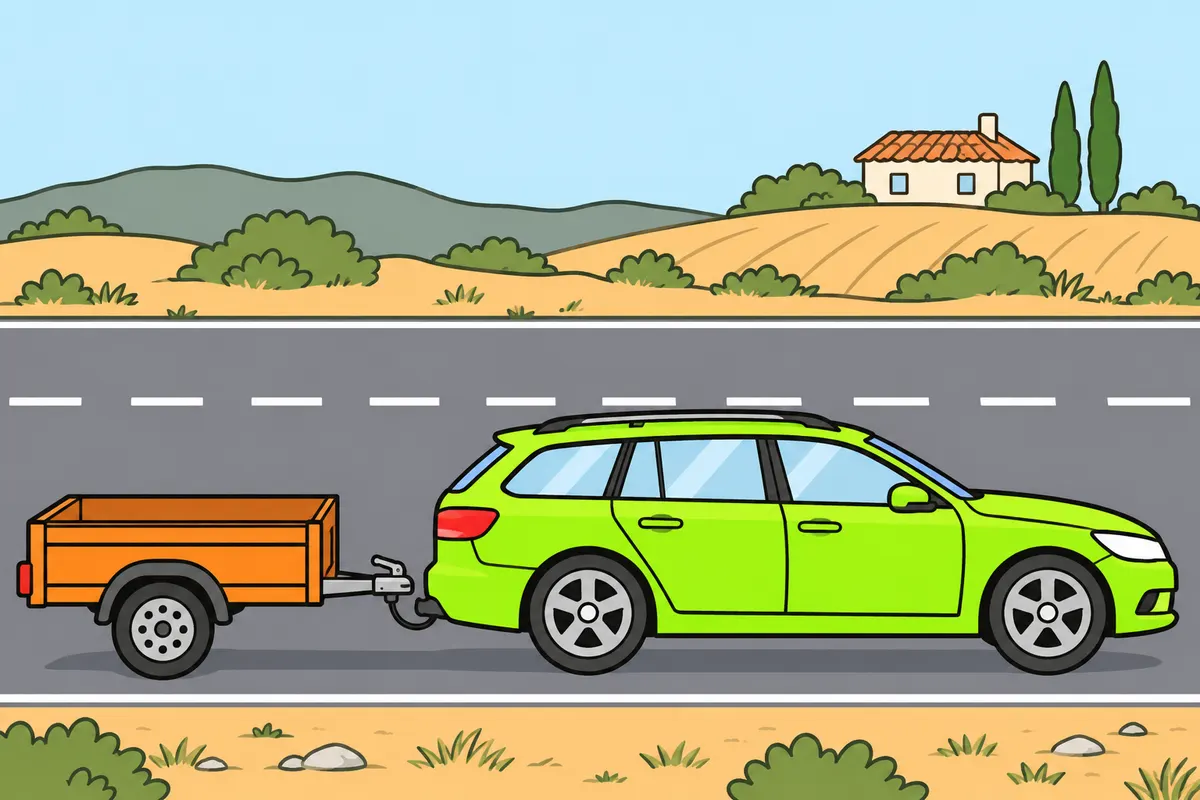
Check the trailer MMA and the total MMA to choose your licence.
| Trailer with category B towing vehicle | Combination MMA | Licence sufficient by category |
|---|---|---|
| Up to 750 kg | Up to 4,250 kg | B |
| Over 750 kg | Up to 3,500 kg | B |
| Over 750 kg | Over 3,500 and up to 4,250 kg | B with code 96 or B+E |
Remember
- Use the MMAs, even if the trailer is empty.
- Also check that the towing vehicle can tow that trailer.
Exam trap: Wrong: with a 3,500 kg towing vehicle and a 750 kg trailer, you need code 96. Right: B is enough by category, if the combination is technically compatible.
Read the full explanation
- With category B, you can drive a towing vehicle in that category with a trailer with an MMA of up to 750 kg, including exactly 750 kg. With a towing vehicle with an MMA of 3,500 kg, the total reaches 4,250 kg and category B is sufficient, subject to technical compatibility. [RGCond, art. 4.2](https://www.boe.es/buscar/act.php?id=BOE-A-2009-9481#a4)
- If the trailer has an MMA of more than 750 kg, the combination's MMA must not exceed 3,500 kg with a category B licence without code 96. For a combination of more than 3,500 kg and up to 4,250 kg with a trailer of more than 750 kg, you need the additional category B entitlement shown by code 96, or a sufficient entitlement such as B+E. [RGCond, art. 5](https://www.boe.es/buscar/act.php?id=BOE-A-2009-9481#a5)
- If the trailer has an MMA of 751 kg, you must apply the rule for trailers over 750 kg, even if its actual mass is lower. [RGCond, art. 4.2](https://www.boe.es/buscar/act.php?id=BOE-A-2009-9481#a4)
3MMA determines which licence you need
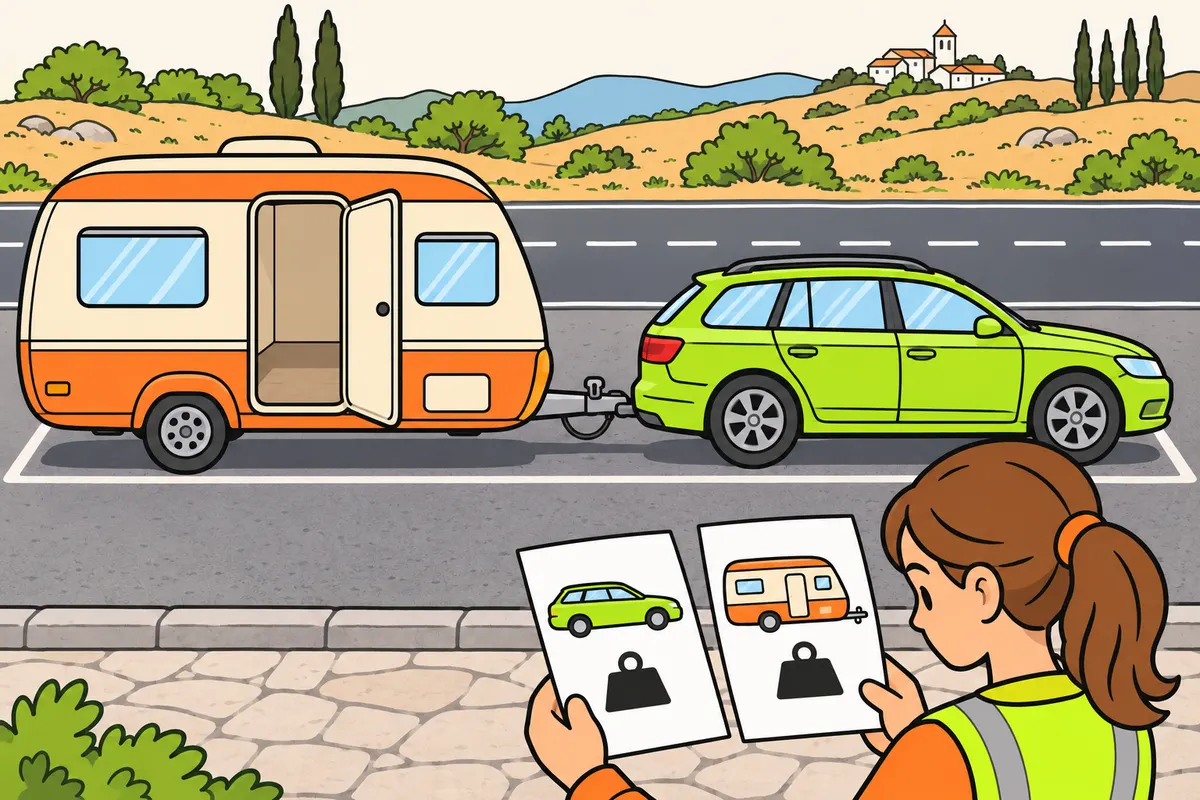
Choose your licence using the MMA, even when you travel without a load.
Remember
- Read the towing vehicle and trailer MMA in their documents.
- MMA is the maximum laden mass allowed on the road.
- Do not confuse it with tare or the load on this journey.
- In ordinary examples, add the car and trailer MMAs.
Exam trap: Wrong: an empty caravan lets you drive with B. Right: it keeps its MMA; unloading does not lower the licence required.
Read the full explanation
- To answer a question about your licence entitlement, you must read the maximum authorised mass, or MMA, of the towing vehicle and the trailer. MMA is the maximum laden mass permitted for road use; it is not the tare mass or the weight of the vehicle on that journey. [RGV, annex IX.1.6](https://www.boe.es/buscar/act.php?id=BOE-A-1999-1826#anix) [RGCond, art. 4](https://www.boe.es/buscar/act.php?id=BOE-A-2009-9481#a4)
- In standard car-and-trailer examples, you must add together the MMA of both vehicles and compare the result with the licence thresholds. An empty caravan retains the MMA stated in its documents: unloading it does not turn a combination that requires B+E into one authorised by category B. [RGCond, art. 4](https://www.boe.es/buscar/act.php?id=BOE-A-2009-9481#a4)
4Examples of choosing between category B and code 96
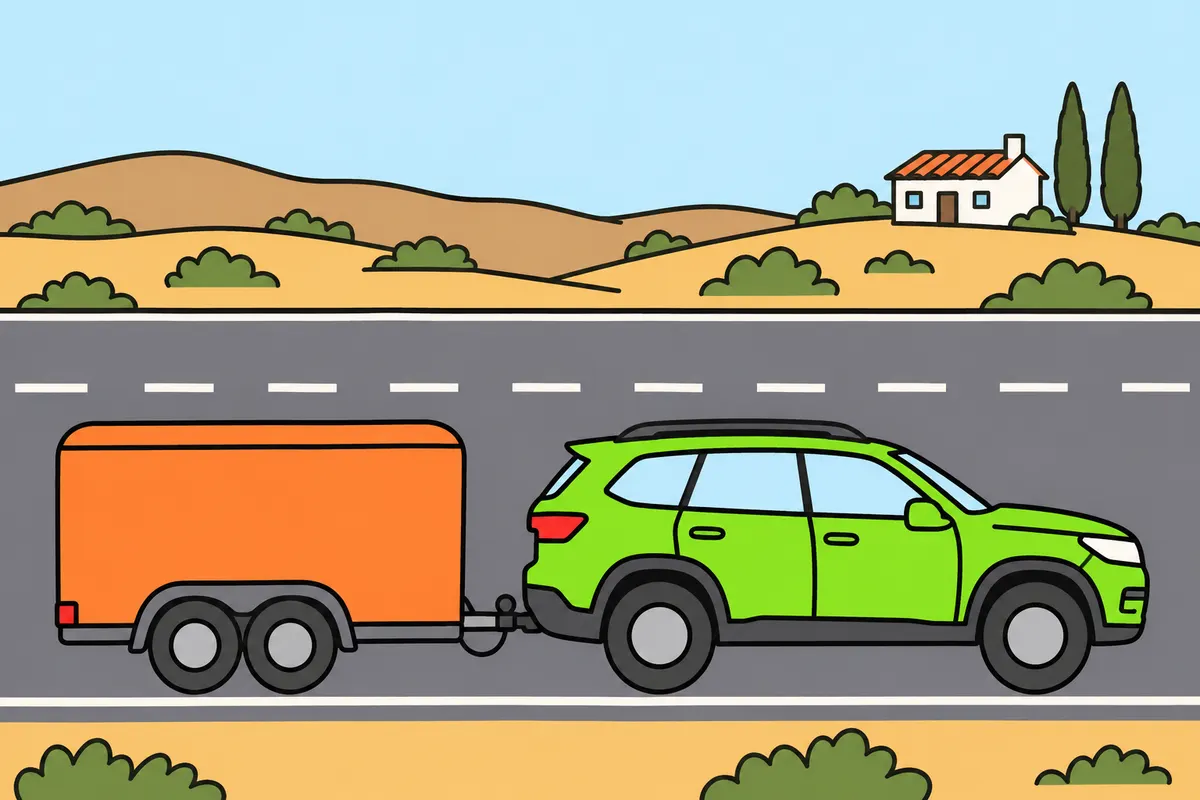
Add the MMAs to see whether B is enough or you need an extension.
| Category B towing vehicle MMA | Trailer MMA | Total MMA | Licence sufficient |
|---|---|---|---|
| 2,200 kg | 1,300 kg | 3,500 kg | B |
| 2,500 kg | 1,200 kg | 3,700 kg | B with code 96 or B+E |
Remember
- Add the towing vehicle and trailer MMAs.
- Check technical conditions before driving.
Exam trap: Wrong: every trailer over 750 kg requires B+E. Right: add the MMAs to choose the licence.
Read the full explanation
- With a towing vehicle with an MMA of 2,200 kg and a trailer with an MMA of 1,300 kg, your total is 3,500 kg and category B is sufficient in terms of licence category. [RGCond, arts. 4.2 and 5.5](https://www.boe.es/buscar/act.php?id=BOE-A-2009-9481#a5)
- If the towing vehicle is 2,500 kg and the trailer is 1,200 kg, the total is 3,700 kg. As the trailer exceeds 750 kg and the combination exceeds 3,500 kg, category B without additional entitlement is insufficient; you can use category B with code 96 or B+E if the technical conditions allow it. [RGCond, art. 5](https://www.boe.es/buscar/act.php?id=BOE-A-2009-9481#a5)
5What code 96 means
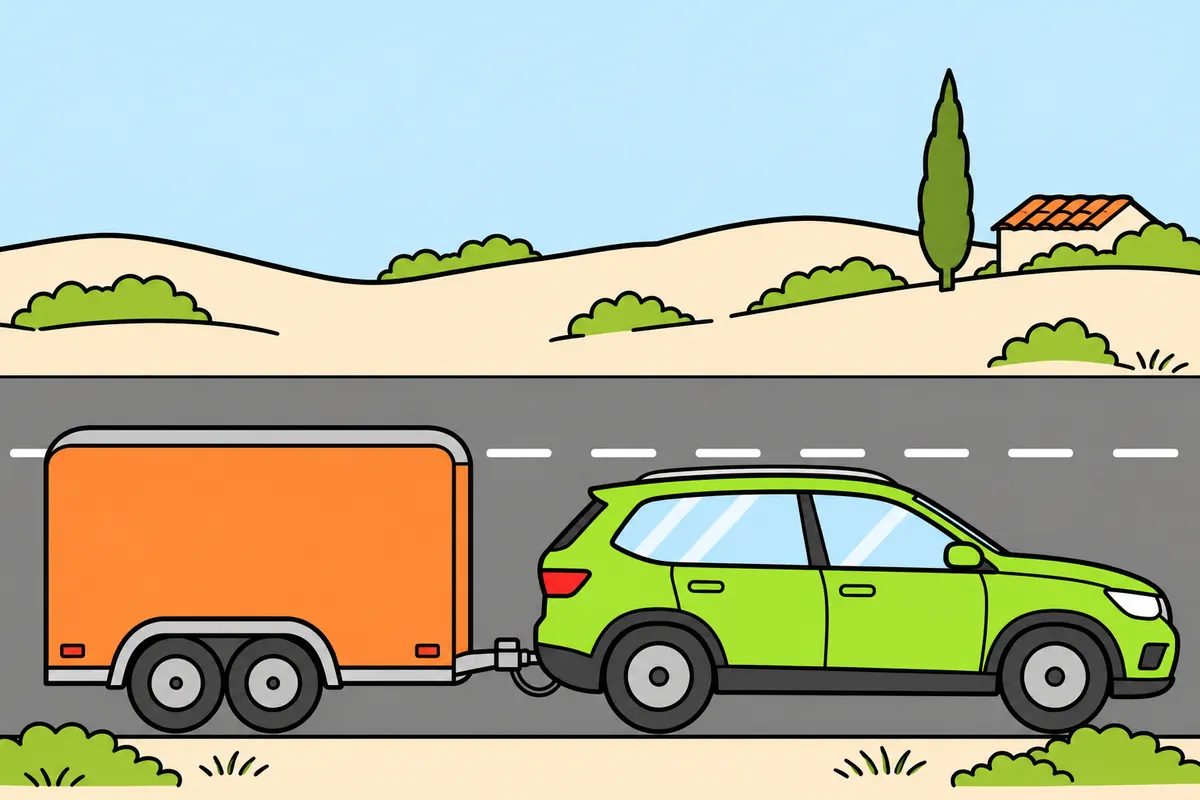
Code 96 extends your B entitlement and requires you to pass the prescribed tests.
| Category B towing vehicle MMA | Trailer MMA | Combination | Is code 96 enough by mass? |
|---|---|---|---|
| 2,500 kg | 1,750 kg | 4,250 kg | Yes, if other requirements are met |
| 2,500 kg | 1,800 kg | 4,300 kg | No |
Remember
- Code 96 is recorded on your B licence; it is separate from B+E.
- You must pass the practical tests set for this entitlement.
- Practise I: parking and moving off.
- Practise M: coupling and uncoupling.
- You must also do the prescribed on-road exercises.
- A course does not automatically give you this entitlement.
Exam trap: Wrong: any course replaces the tests. Right: training can replace them only under terms set by ministerial order.
Read the full explanation
- Harmonised code 96 is an entitlement recorded on your category B licence for the combinations defined in the previous section, separate from category B+E. [RGCond, annex I, code 96](https://www.boe.es/buscar/act.php?id=BOE-A-2009-9481#ani)
- Exactly 4,250 kg is covered by code 96 if you meet the other requirements. A towing vehicle of 2,500 kg and a trailer of 1,750 kg total 4,250 kg; if the trailer is 1,800 kg, the total is 4,300 kg and code 96 is insufficient. [RGCond, annex I, code 96; art. 5.5 and annex V.B.3-4](https://www.boe.es/buscar/act.php?id=BOE-A-2009-9481#ani)
- To obtain this entitlement, you must pass the practical tests specified for it. The regulations provide for replacing the test with training under the terms established by ministerial order: this provision does not mean that any course automatically grants you the entitlement. [RGCond, annex I, code 96; art. 5.5 and annex V.B.3-4](https://www.boe.es/buscar/act.php?id=BOE-A-2009-9481#ani)
- For code 96, you must complete manoeuvre I, parking and moving off, and manoeuvre M, coupling and uncoupling, as well as the on-road exercises specified for this entitlement. [RGCond, annex V.B.3.3 and 4.2](https://www.boe.es/buscar/act.php?id=BOE-A-2009-9481#anv)
6The scope of B+E
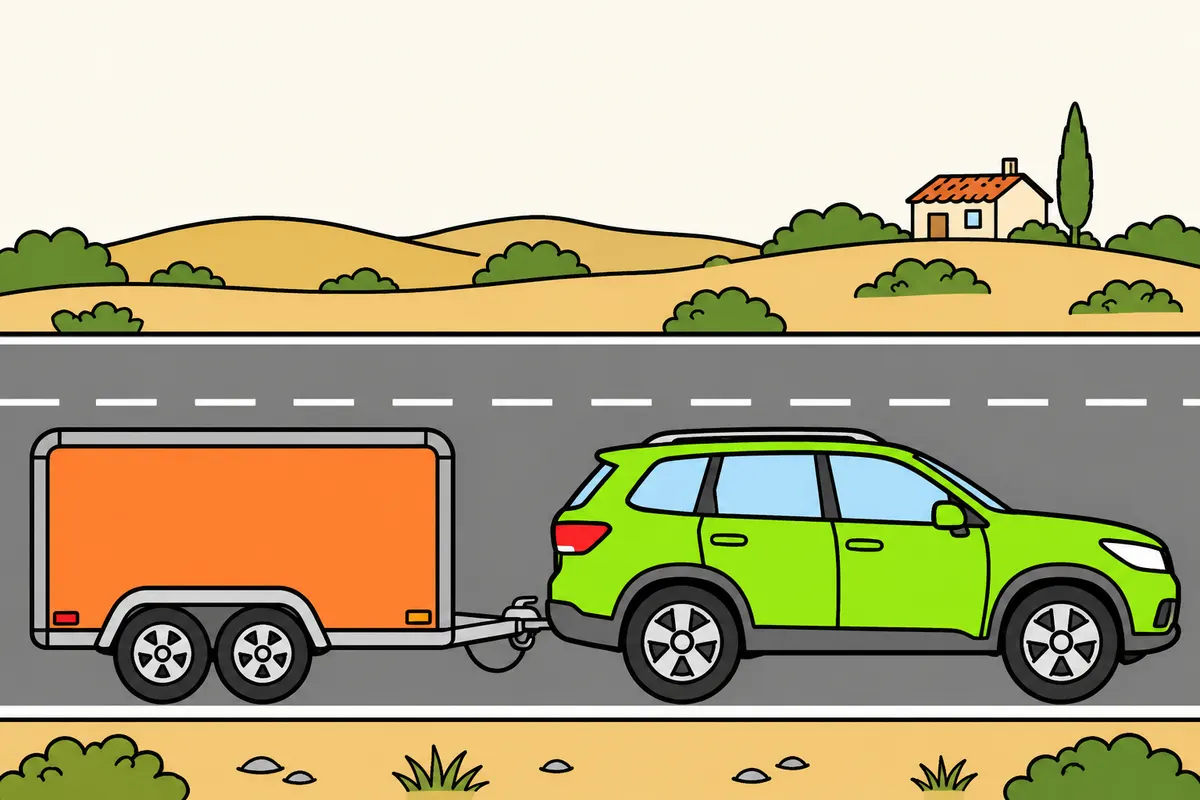
B+E has limits for both the towing vehicle and the trailer.
| Trailer case with B towing vehicle | Entitlement |
|---|---|
| Up to 3,500 kg MMA | Within ordinary B+E scope |
| Over 3,500 kg MMA | Outside ordinary B+E; some combinations require C1+E, up to 12,000 kg |
Remember
- A 3,500 kg towing vehicle and a 3,500 kg trailer total 7,000 kg.
- That total does not guarantee your car can tow that trailer.
- A vehicle over 3,500 kg is not an ordinary B+E towing vehicle.
- The alternative-fuel B exception requires you to drive without a trailer.
Exam trap: Wrong: with B+E, you can always load up to 7,000 kg. Right: follow the car and combination’s technical limits.
Read the full explanation
- With a towing vehicle of 3,500 kg and a trailer of 3,500 kg, the total MMA reaches 7,000 kg. This is the sum of the maximum values in this standard car-and-trailer example; it does not mean that you can tow 3,500 kg with any car or that you can always load the combination up to that figure. [RGCond, art. 4](https://www.boe.es/buscar/act.php?id=BOE-A-2009-9481#a4)
- If your trailer has an MMA of more than 3,500 kg, it falls outside the ordinary scope of B+E defined in article 4. The same article includes certain combinations with a category B towing vehicle and a trailer of more than 3,500 kg within C1+E, up to a combination mass of 12,000 kg; you need the corresponding entitlement to use this option. [RGCond, art. 4](https://www.boe.es/buscar/act.php?id=BOE-A-2009-9481#a4)
- You cannot turn a motor vehicle with an MMA of more than 3,500 kg into an ordinary B+E towing vehicle by adding a small trailer. The national category B exception for certain alternatively fuelled goods vehicles requires you to drive without a trailer: you must not apply it to the towing vehicle in this combination. [RGCond, art. 4](https://www.boe.es/buscar/act.php?id=BOE-A-2009-9481#a4)
7Sufficient licence and compatible combination
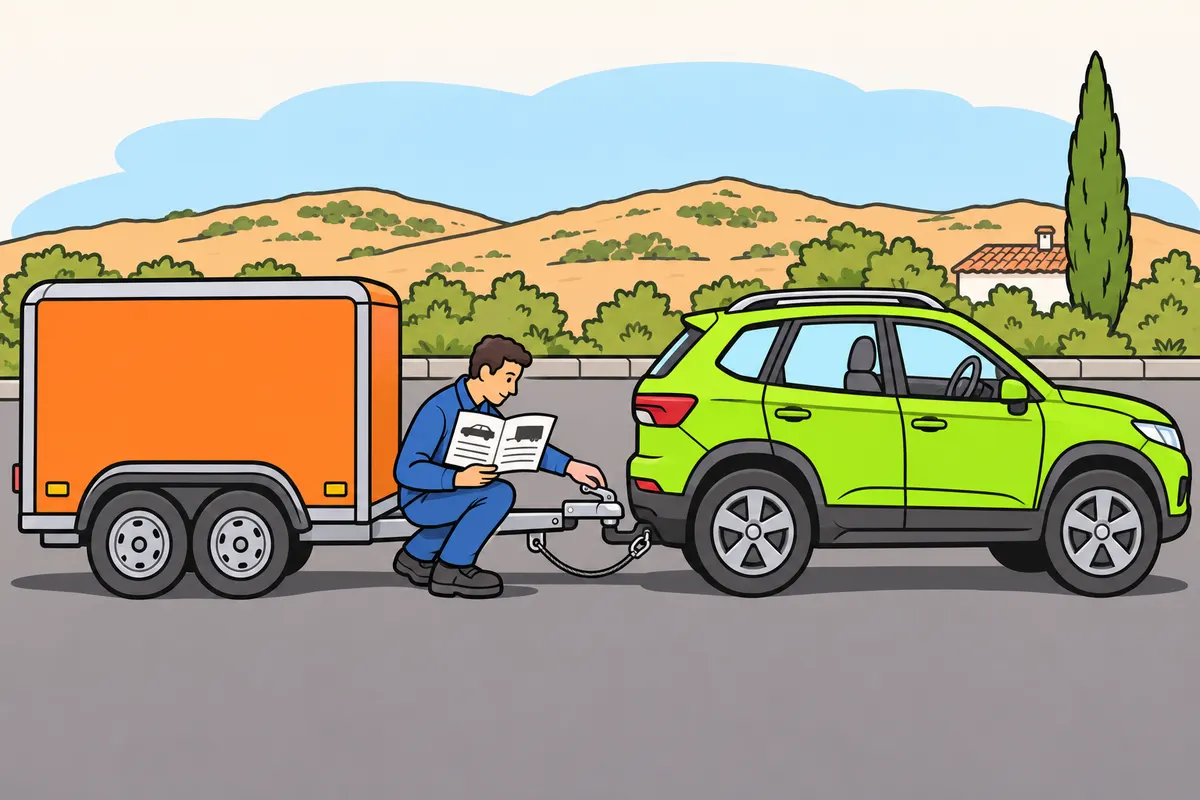
As well as the right licence, check that your combination is technically compatible.
Remember
- Check how much your towing vehicle can tow.
- Follow the limits for the combination and coupling.
- Your licence does not increase your car’s towing capacity.
- Mass calculations and technical compatibility are covered in Maximum dimensions and masses.
Exam trap: Wrong: B+E lets you tow any trailer. Right: you must also follow the technical limits of the vehicle and coupling.
Read the full explanation
- Even if B+E authorises you to tow the trailer category, you must check the towing vehicle's towing capacity and the limits of the combination and coupling. Your driving entitlement does not increase the towable mass permitted for the vehicle. [RGV, Annex IX.4](https://www.boe.es/buscar/act.php?id=BOE-A-1999-1826#anix) [RGCond, art. 4](https://www.boe.es/buscar/act.php?id=BOE-A-2009-9481#a4)
- Mass calculations, towing capacity and technical compatibility are covered in Maximum dimensions and masses.
8Licence age and validity
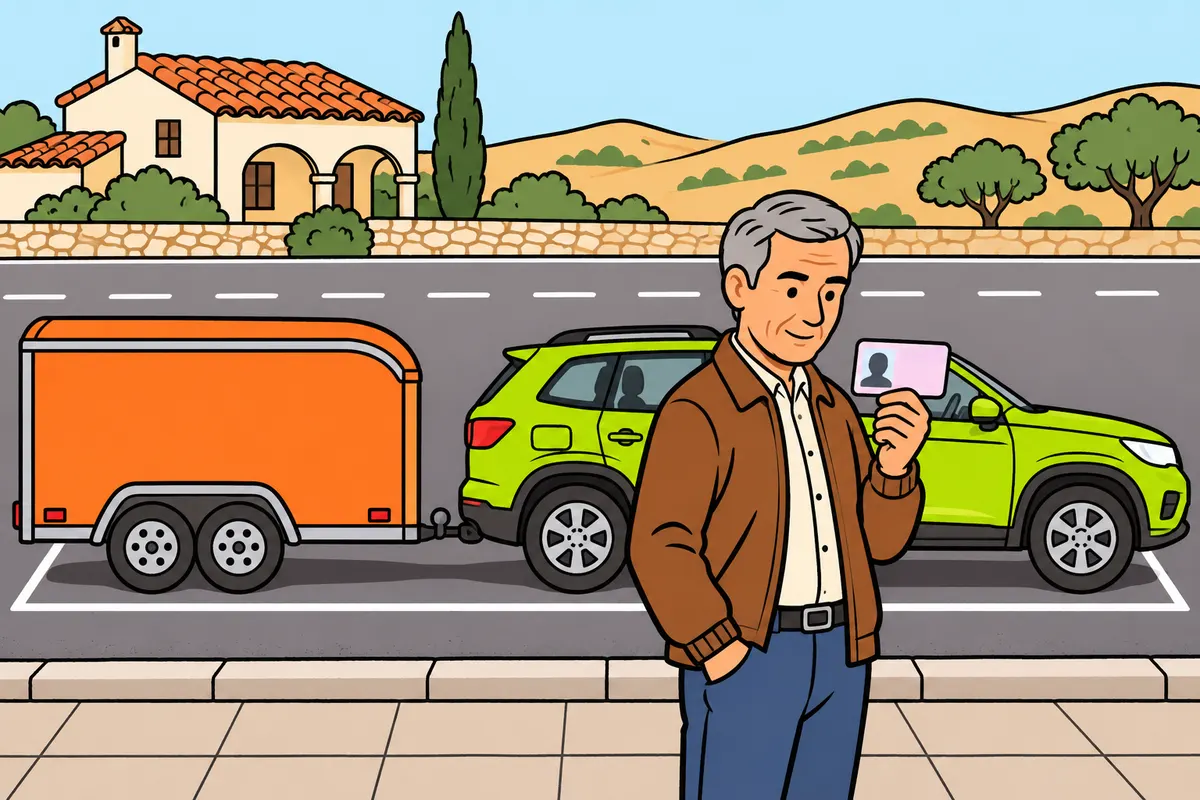
You can obtain B+E from age 18 and must renew it while it remains valid.
| Your age | Ordinary B+E validity |
|---|---|
| Under 65 years | ten years |
| From age 65 | five years |
Remember
- You must be 18 by your first practical test.
- You may take theory early if otherwise eligible; practical tests keep their age limit.
- You need a valid B licence for B+E to be issued.
- An illness or impairment that may worsen can shorten validity.
- When renewing, show that you still meet the fitness requirements.
- For early renewal, the new period starts when the licence expires.
Exam trap: Wrong: you can drive with an expired licence while renewing it. Right: you can renew it after expiry, but cannot drive with it.
Read the full explanation
- You can obtain B+E from the age of 18. [RGCond, art. 4.2](https://www.boe.es/buscar/act.php?id=BOE-A-2009-9481#a4) You must reach that age by the date of your first practical test appointment. [RGCond, Annex VI.A.2](https://www.boe.es/buscar/act.php?id=BOE-A-2009-9481#anvi)
- You can take your first theory test no more than three months before you reach the minimum age, provided you meet all the other applicable requirements. This does not lower the age for the practical tests or remove the requirement to hold a valid category B licence for B+E to be issued. [RGCond, art. 51](https://www.boe.es/buscar/act.php?id=BOE-A-2009-9481#a51)
- Your B+E licence normally remains valid for ten years while you are under 65 and for five years from that age. [RGCond, art. 12.2](https://www.boe.es/buscar/act.php?id=BOE-A-2009-9481#a12)
- Your licence's validity period may be shortened because of an illness or impairment that may worsen, even if it does not currently prevent you from obtaining or renewing the licence. You must continue to meet the requirements throughout its validity. [RGCond, art. 12.3 and 6](https://www.boe.es/buscar/act.php?id=BOE-A-2009-9481#a12)
- You can apply to renew it during the three months before expiry; the new validity period runs from the expiry date. You must provide evidence that you retain the required physical and psychological fitness. You can renew an expired licence, but you cannot drive with it. The procedure is covered in ‘Driver and vehicle combination documents’. [RGCond, arts. 12.4 and 13](https://www.boe.es/buscar/act.php?id=BOE-A-2009-9481#a13)
9Driver factors when towing a trailer
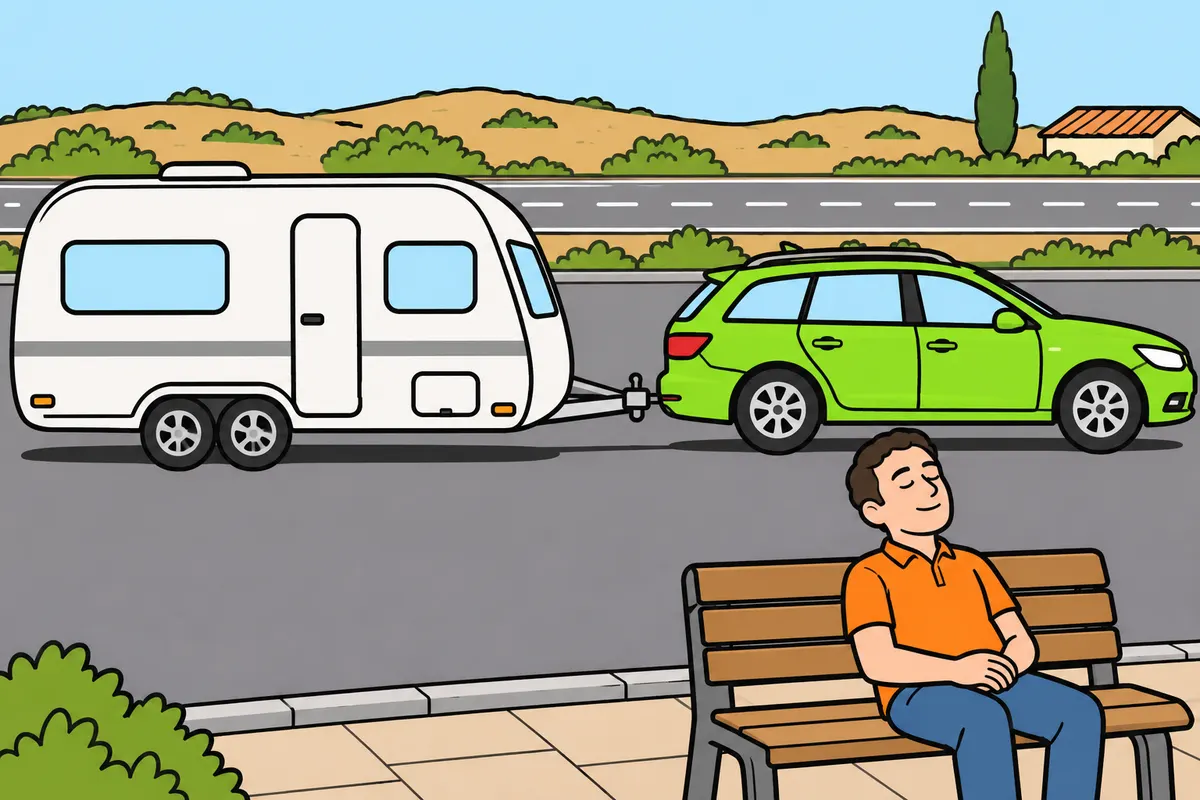
To control the trailer, rest, avoid alcohol and stay alert.
| Your case: private car and caravan | Blood alcohol | Breath alcohol |
|---|---|---|
| General limit | 0.5 g/l | 0.25 mg/l |
| During the two years after gaining the driving licence or permit that entitles you | 0.3 g/l | 0.15 mg/l |
| Getting B+E | You do not restart the reduced-limit period | You do not restart the reduced-limit period |
Remember
- Plan breaks and set off after enough sleep.
- If tired or sleepy, stop somewhere safe.
- The safe choice is not to drink alcohol.
- Read the leaflet; ask a healthcare professional about medicines that cause sleepiness.
- Do not drive if medicine makes driving unsafe.
- Set your satnav beforehand; make distracting adjustments while parked and watch through your mirrors.
Exam trap: Wrong: a private caravan always means the reduced alcohol limit. Right: the general limit applies unless you are in a reduced-limit case.
Read the full explanation
- On long journeys with a caravan, plan your stages and rest breaks, and get enough sleep before setting off. Fatigue and drowsiness make it harder to maintain the attention you need to control the combination; if you experience them, stop somewhere safe to rest. [DGT, journey planning](https://www.dgt.es/muevete-con-seguridad/viaja-seguro/como-planificar-un-viaje-seguro-por-carretera) [RGCond, Annex V.B.2.6.º.a](https://www.boe.es/buscar/act.php?id=BOE-A-2009-9481#anv)
- With a passenger car and caravan for private use, your general alcohol limit is 0.5 g/l in blood or 0.25 mg/l in exhaled breath. During the two years after you obtain the ‘driving licence or permit that entitles you to drive’, article 20 sets a maximum of 0.3 g/l or 0.15 mg/l. Obtaining B+E does not restart that period. When preparing for your journey, the safe option is to drink no alcohol. [RGC, art. 20](https://www.boe.es/buscar/act.php?id=BOE-A-2003-23514#a20)
- You must not drive if a medicine affects your physical or mental condition and prevents you from driving safely. Before a journey with a trailer, read the patient information leaflet and consult a healthcare professional about its effects, especially drowsiness. [RGC, art. 27.1](https://www.boe.es/buscar/act.php?id=BOE-A-2003-23514#a27) [DGT, journey planning](https://www.dgt.es/muevete-con-seguridad/viaja-seguro/como-planificar-un-viaje-seguro-por-carretera)
- You must pay constant attention to the combination and traffic. Prepare your route and satnav before setting off, and make any adjustments that distract you with the combination parked somewhere safe; checking the trailer in your mirrors must form part of your observation of the road. [RGC, art. 18.1](https://www.boe.es/buscar/act.php?id=BOE-A-2003-23514#a18)
10The specific theory test
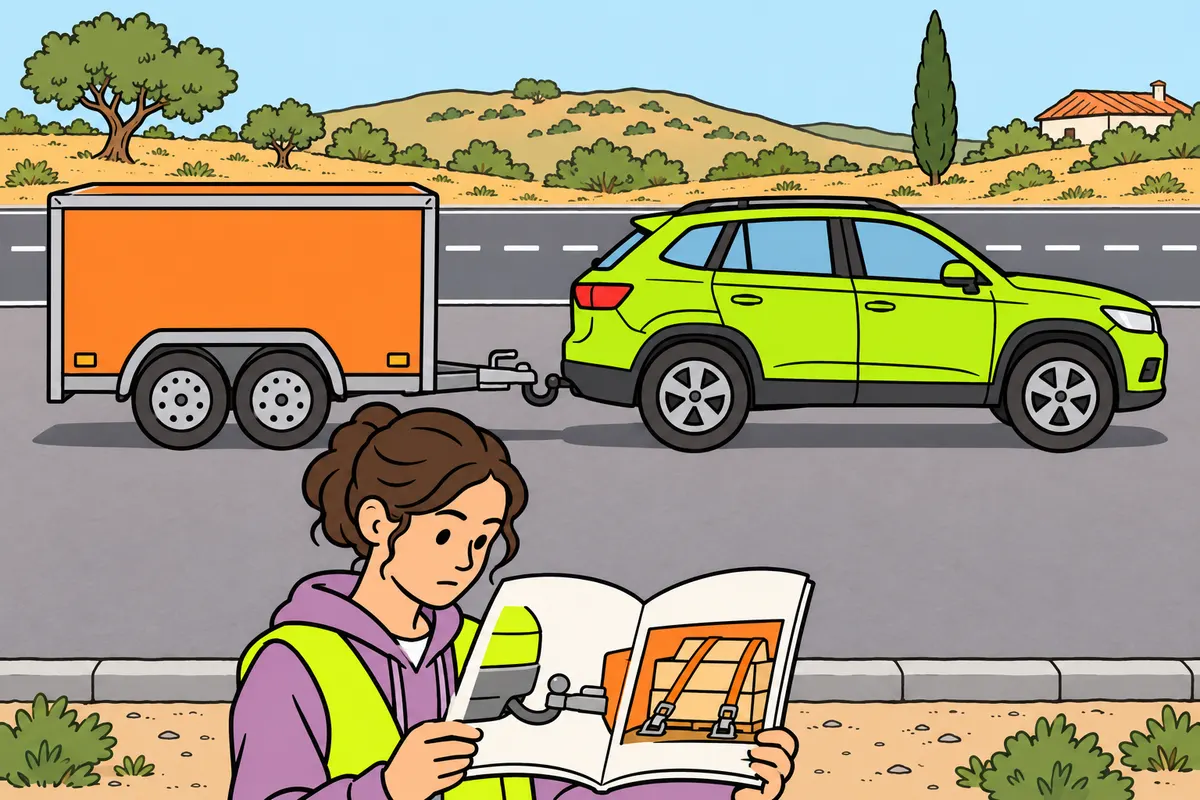
To obtain B+E by the ordinary route, you must pass the specific theory test.
Remember
- With a valid B licence, you do not repeat the common theory test.
- Study driver safety, the combination, its load, coupling and driving.
- Follow the instructions: there may be one to four correct answers.
- You normally have one minute per question.
- Time may be extended for videos or justified special needs.
- Apply the 10% error limit and round decimals up.
Exam trap: Wrong: B or code 96 means you have passed B+E theory. Right: by the ordinary route, you must pass the specific theory test.
Read the full explanation
- As the holder of a valid category B licence, you are exempt from repeating the common theory test. To obtain B+E through the standard route, you must pass the specific theory test on vehicle combinations: holding category B or code 96 does not mean you have passed that test. [RGCond, art. 54](https://www.boe.es/buscar/act.php?id=BOE-A-2009-9481#a54)
- Your B+E specific theory covers rules and safety factors relating to you as the driver, the combination and its load, load security, coupling systems and techniques for driving the combination. [RGCond, Annex V.B.2.6.º](https://www.boe.es/buscar/act.php?id=BOE-A-2009-9481#anv)
- The regulations allow between 16 and 30 questions in your specific theory test. In this course, you work with 20-question papers; your time allowance and maximum number of errors are calculated using the following criteria. [RGCond, Annex VI.B.1](https://www.boe.es/buscar/act.php?id=BOE-A-2009-9481#anvi)
- Annex VI.B.1 provides for between one and four correct answers per question; you must follow the instructions for your test format. [RGCond, Annex VI.B.1](https://www.boe.es/buscar/act.php?id=BOE-A-2009-9481#anvi)
- Your normal time allowance is one minute per question: with a 20-question paper, you have 20 minutes. This may be extended in proportion to the length of any videos included in the test and to accommodate any duly justified special needs you have. [RGCond, Annex VI](https://www.boe.es/buscar/act.php?id=BOE-A-2009-9481#anvi)
- To pass, your errors must not exceed 10 % of the questions, applying the rounding rule in the regulations. If the calculation gives a decimal, you round up to the next whole number: with 20 questions, you can make a maximum of two errors; with 25, 10 % is 2.5 and the maximum is three. The latter is an arithmetic example, not the compulsory number of questions. [RGCond, Annex VI](https://www.boe.es/buscar/act.php?id=BOE-A-2009-9481#anvi)
11Order of the B+E tests
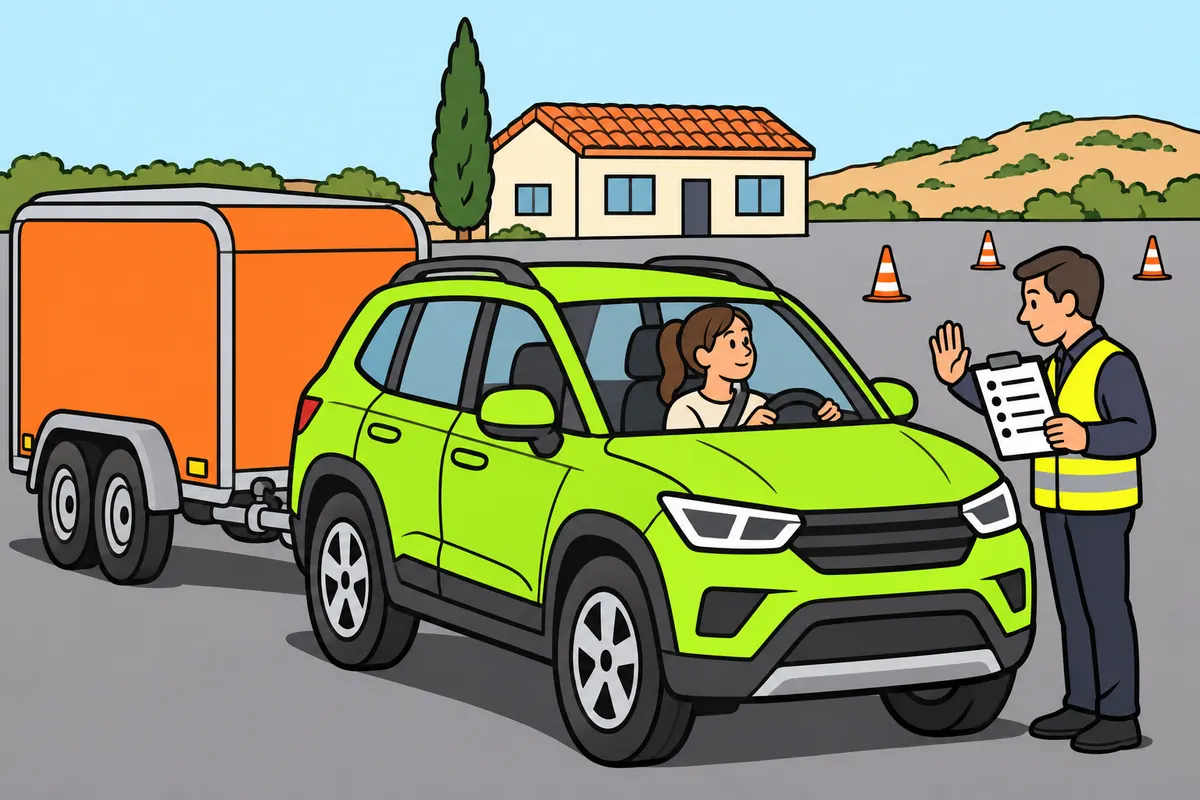
You must pass each test before you can take the next.
Remember
- First pass the specific theory test.
- Then pass the closed-course manoeuvres.
- Finally take the test on open roads.
- Each test is marked pass or fail.
- Normally, tests take place on different dates.
Exam trap: Wrong: taking tests on the same day removes their order. Right: even with justified exceptional permission, you must pass them in order.
Read the full explanation
- Through the standard route, you must pass the specific theory test, the test of skills and behaviour on a closed course, and the driving test on roads open to general traffic. [RGCond, art. 53](https://www.boe.es/buscar/act.php?id=BOE-A-2009-9481#a53)
- You must pass each test before progressing: you must pass the theory test to take the closed-course test, and pass that test to take the on-road test. You receive a pass or fail for each test. [RGCond, art. 53](https://www.boe.es/buscar/act.php?id=BOE-A-2009-9481#a53)
- As a general rule, you take the theory, closed-course and on-road tests on different dates. The Jefatura de Tráfico (provincial traffic office) may authorise you to take all or some of them on the same date in duly justified exceptional cases; taking them on the same date does not remove any test or change the order in which you must pass them. [RGCond, art. 51.3](https://www.boe.es/buscar/act.php?id=BOE-A-2009-9481#a51) [RGCond, art. 53](https://www.boe.es/buscar/act.php?id=BOE-A-2009-9481#a53)
12How long a pass remains valid
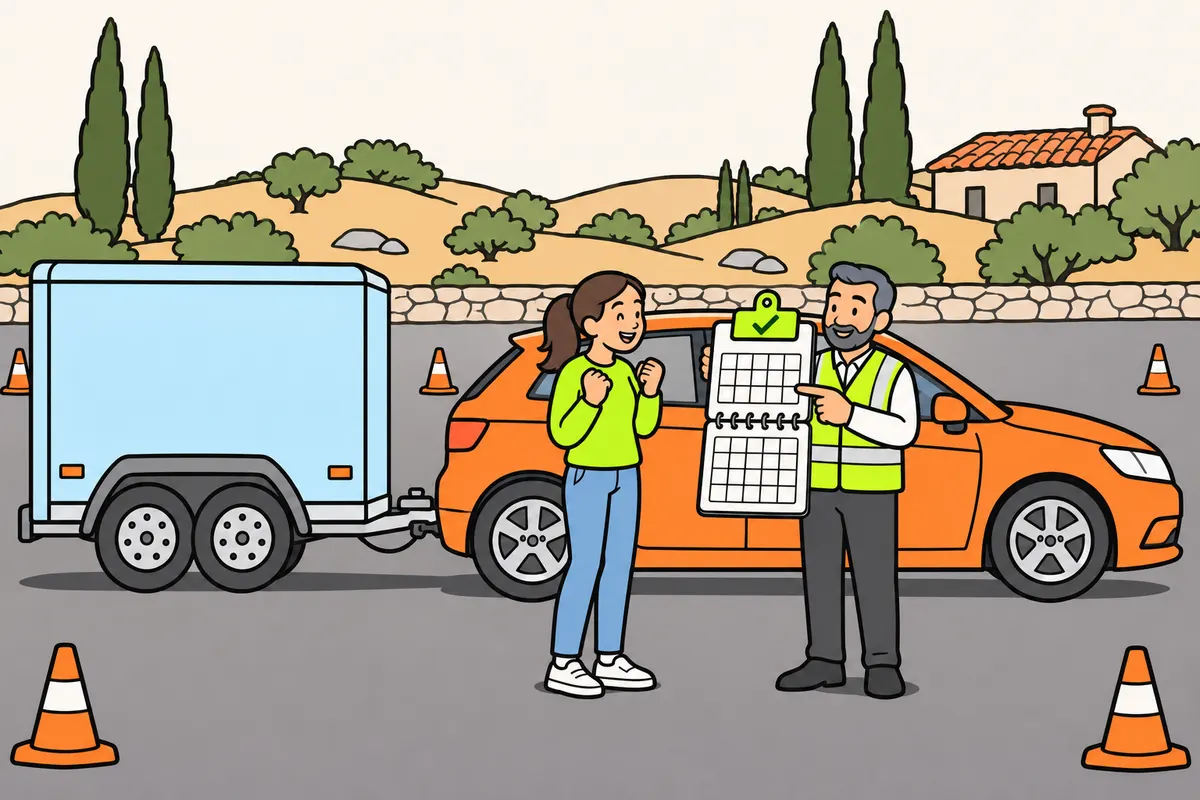
Your pass lasts two years and the period restarts when you pass the next test.
Remember
- Count from the day after you are declared to have passed.
- Passing the next test within the period starts it again.
Exam trap: Wrong: the period starts on the day you pass. Right: count from the day after you are declared to have passed.
Read the full explanation
- Your pass in a test remains valid for two years, counted from the day after you are declared to have passed. [RGCond, art. 53](https://www.boe.es/buscar/act.php?id=BOE-A-2009-9481#a53)
- If you pass the next test within that period, your validity period starts again. [RGCond, art. 53.1](https://www.boe.es/buscar/act.php?id=BOE-A-2009-9481#a53)
13Applications, attempts and time limits
Each application gives you two attempts; follow the time limits between tests.
| Situation | Interval between attempts |
|---|---|
| You fail a test twice | At least ten days between second and third |
| Later attempts after the third | At least fifteen days |
Remember
- Count minimum intervals from the failed test date.
- Traffic sets the exact date of your test.
- The general maximum allows justified exceptional cases, including illness.
- Minimum intervals can exceptionally be shortened for justified urgency.
Exam trap: Wrong: missing the test never uses an attempt. Right: you lose it, except in duly justified exceptional cases.
Read the full explanation
- Each application entitles you to two attempts at the tests. [RGCond, art. 51.2](https://www.boe.es/buscar/act.php?id=BOE-A-2009-9481#a51)
- As a general rule, no more than six months must pass between attempts under the same application. Article 51.2 allows exceptions for illness or other duly justified exceptional circumstances. [RGCond, art. 51](https://www.boe.es/buscar/act.php?id=BOE-A-2009-9481#a51)
- If you fail a test on two attempts, at least ten days must pass between your second and third attempts; between subsequent attempts, fifteen days must pass. These periods run from the date you take the test you fail. [RGCond, Annex VI.A.2](https://www.boe.es/buscar/act.php?id=BOE-A-2009-9481#anvi)
- The minimum periods between attempts may exceptionally be reduced in cases of recognised, duly justified urgency. The Jefatura de Tráfico (provincial traffic office) sets your specific test date. [RGCond, Annex VI.A.2](https://www.boe.es/buscar/act.php?id=BOE-A-2009-9481#anvi) [RGCond, art. 51.1](https://www.boe.es/buscar/act.php?id=BOE-A-2009-9481#a51)
- If you do not attend on the set date, you lose that attempt, except in duly justified exceptional circumstances. [RGCond, art. 51](https://www.boe.es/buscar/act.php?id=BOE-A-2009-9481#a51)
14Test centre, identification and devices during the test
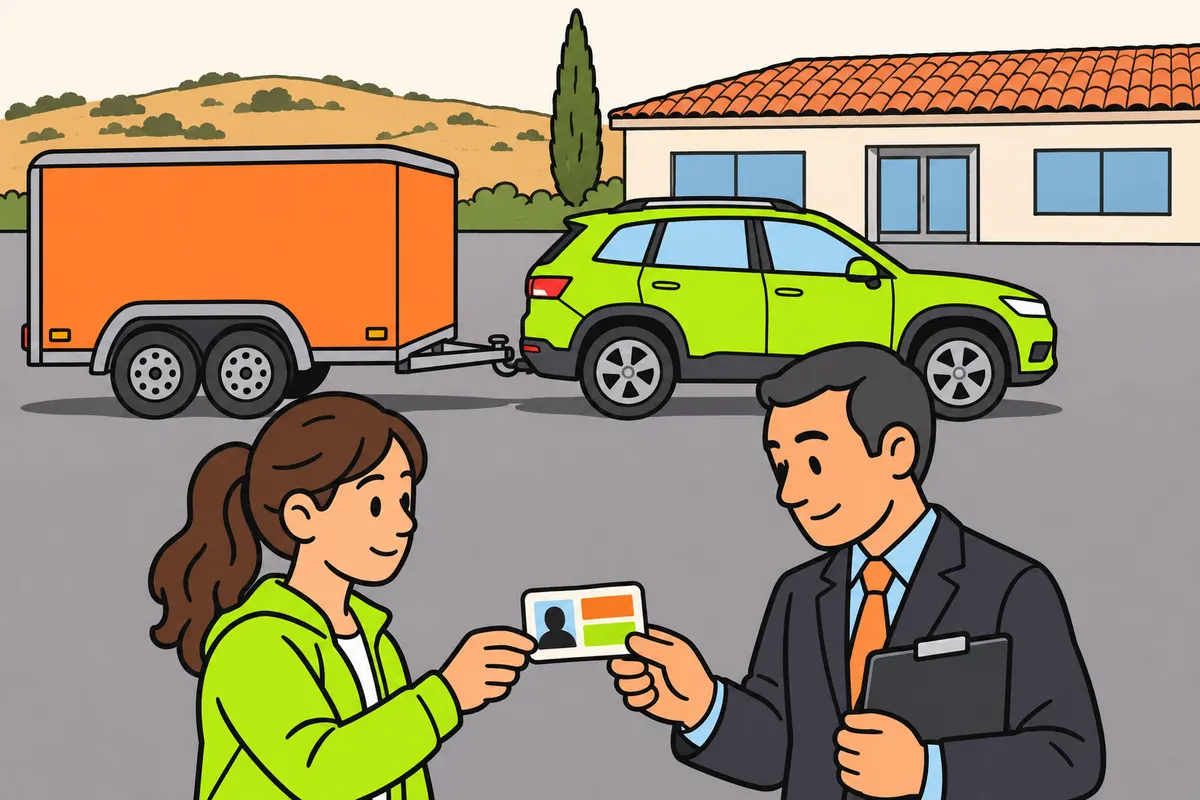
Identify yourself and follow the rules on devices during the test.
| Test situation | Effect on your attempt |
|---|---|
| Required practical-test ID missing | Test does not start; you keep it |
| Vehicle equipment fails requirements in practical test | Test does not start or is interrupted; you keep it |
| Instructor uses banned devices in practical test | Test does not start or is interrupted; you keep it |
| You use those systems in theory | You are excluded and lose it |
Remember
- You take the test in your province, at the centre chosen by Traffic.
- If a centre is unsuitable, you may be moved within that province.
- For practical tests, bring the required identity document.
- The examiner may check the vehicle and its documents.
- During practical tests, do not use phones or recording or transmitting systems.
- Only regulatory exceptions for running and recording the tests are allowed.
Exam trap: Wrong: no ID at a practical test means you lose the attempt. Right: the test does not start and you keep it.
Read the full explanation
- You take your tests in the province where you apply and at the centre designated by the Jefatura de Tráfico (provincial traffic office). If a centre outside the provincial capital does not meet the required conditions, your tests are moved to the centre in the provincial capital or another suitable centre in the same province. [RGCond, art. 50 and Annex VI.A.1](https://www.boe.es/buscar/act.php?id=BOE-A-2009-9481#a50)
- For your practical tests, you must identify yourself with your DNI (Spanish national identity card), passport, residence card or driving licence, as applicable. If you do not present the required identification, your test does not start and you retain your attempt. The examiner may also check the vehicle and its documents; if the equipment does not meet the requirements, the examiner does not start the test or interrupts it, without you losing an attempt. [RGCond, Annexes VI.A.3 and VI.C.1](https://www.boe.es/buscar/act.php?id=BOE-A-2009-9481#anvi)
- During your practical tests, you must not use phones or systems for capturing, recording or transmitting information, except where the regulations allow them for conducting and recording the tests. If your instructor breaches this prohibition, your practical test does not start or is interrupted, and you retain your attempt. If you use these systems in your theory test, you are disqualified and lose that attempt. [RGCond, Annex VI.A.4](https://www.boe.es/buscar/act.php?id=BOE-A-2009-9481#anvi)
15What you are assessed on in the closed-course test
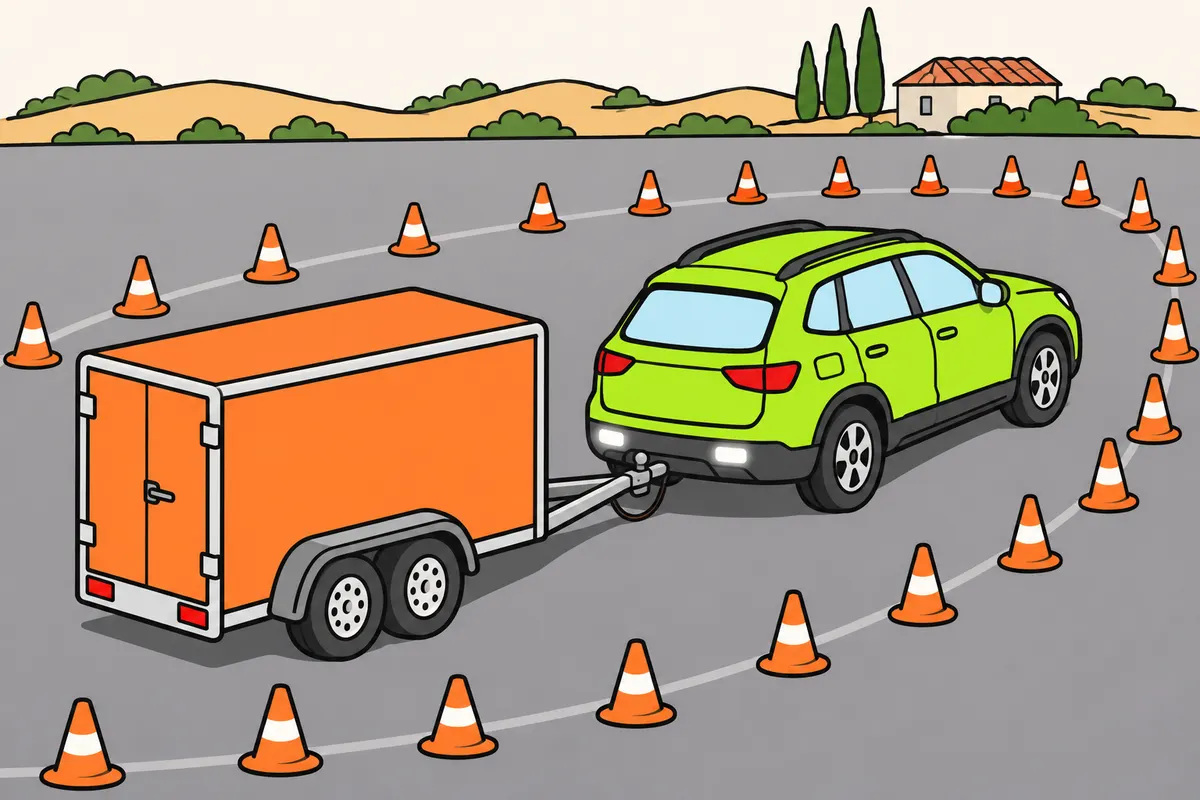
In the B+E test, show reversing, coupling and parking for loading.
| B+E manoeuvre | What you must do |
|---|---|
| G | Reverse straight and around a bend |
| M | Couple and uncouple the trailer |
| N | Park safely for loading or unloading |
Remember
- Prepare manoeuvres G, M and N.
- The duration depends on the manoeuvres, their difficulty and the vehicle.
Exam trap: Wrong: prepare I and M as B+E manoeuvres. Right: prepare G, M and N for B+E.
Read the full explanation
- You must prepare three specific B+E manoeuvres: G, reversing in a straight line and around a bend; M, coupling and uncoupling the trailer; and N, parking safely for loading or unloading. [RGCond, Annex V.B.3.7](https://www.boe.es/buscar/act.php?id=BOE-A-2009-9481#anv)
- The duration of your closed-course test depends on the characteristics and difficulty of the manoeuvres and the vehicle you use. [RGCond, Annex VI.C.2](https://www.boe.es/buscar/act.php?id=BOE-A-2009-9481#anvi)
- How you carry out G, M and N is covered in «Safe driving with a trailer», and coupling and uncoupling are covered in «Safe coupling and uncoupling».
16Checks you must demonstrate
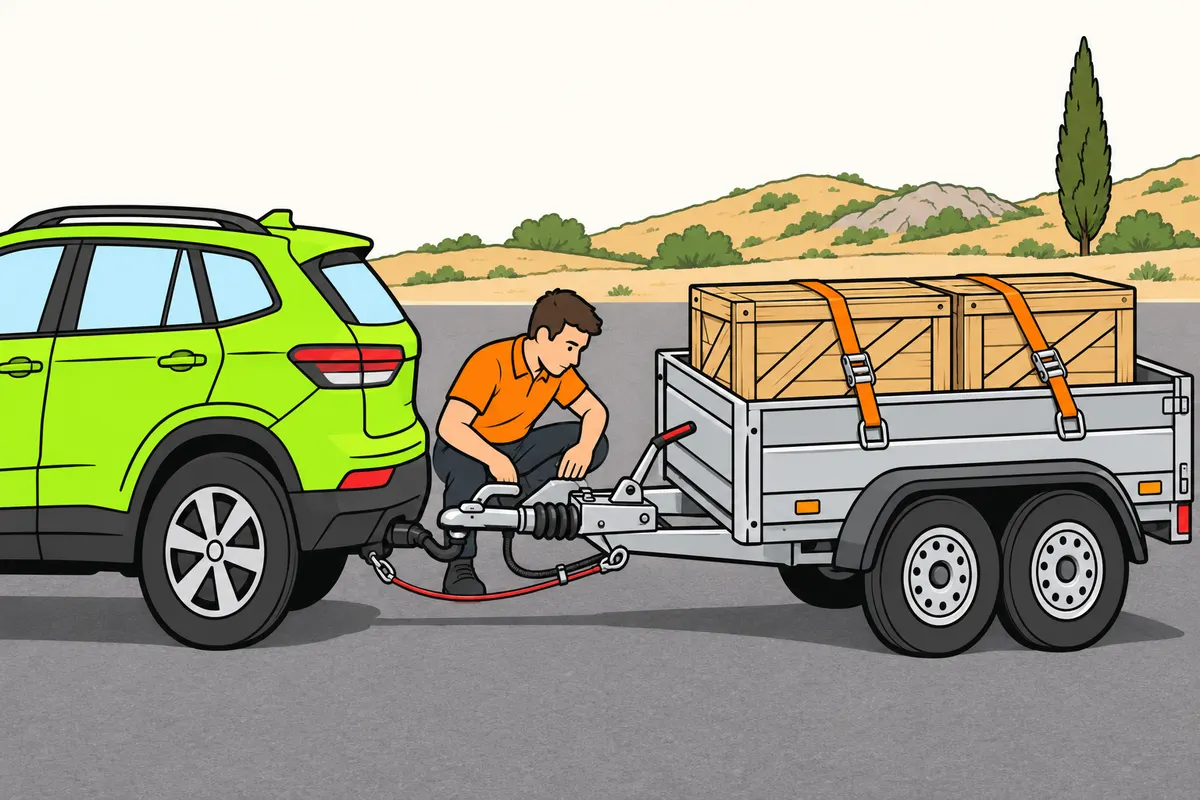
Before manoeuvring, adjust your seat and check the vehicle, load and coupling.
Remember
- Adjust the seat, mirrors, belt and head restraints; check the doors.
- Be ready to check tyres, steering, brakes and fluids.
- Check headlights, reflectors, indicators and horn.
- Check the trailer load position and security.
- Check relevant closures and parts.
- Check the coupling, brake and electrical connections.
Exam trap: Wrong: you only check the car. Right: also check the trailer load, closures, coupling, brake and connections.
Read the full explanation
- Before your B+E manoeuvres, you must adjust your seat, mirrors, seat belt and head restraint, and check that the doors are closed. [RGCond, Annex V.B.3.3 and 3.7](https://www.boe.es/buscar/act.php?id=BOE-A-2009-9481#anv)
- You must be able to carry out the randomly selected checks of tyres, steering, brakes, fluids, headlights, reflectors, indicators and horn required for category B. [RGCond, Annex V.B.3.3 and 3.7](https://www.boe.es/buscar/act.php?id=BOE-A-2009-9481#anv)
- You must check that the trailer's load is safe, correctly positioned and secured, and check the relevant load compartment closures or components. You must also check the coupling mechanism, brake and electrical connections. [RGCond, Annex V.B.3.3 and 3.7](https://www.boe.es/buscar/act.php?id=BOE-A-2009-9481#anv)
17What you must demonstrate on the road with B+E
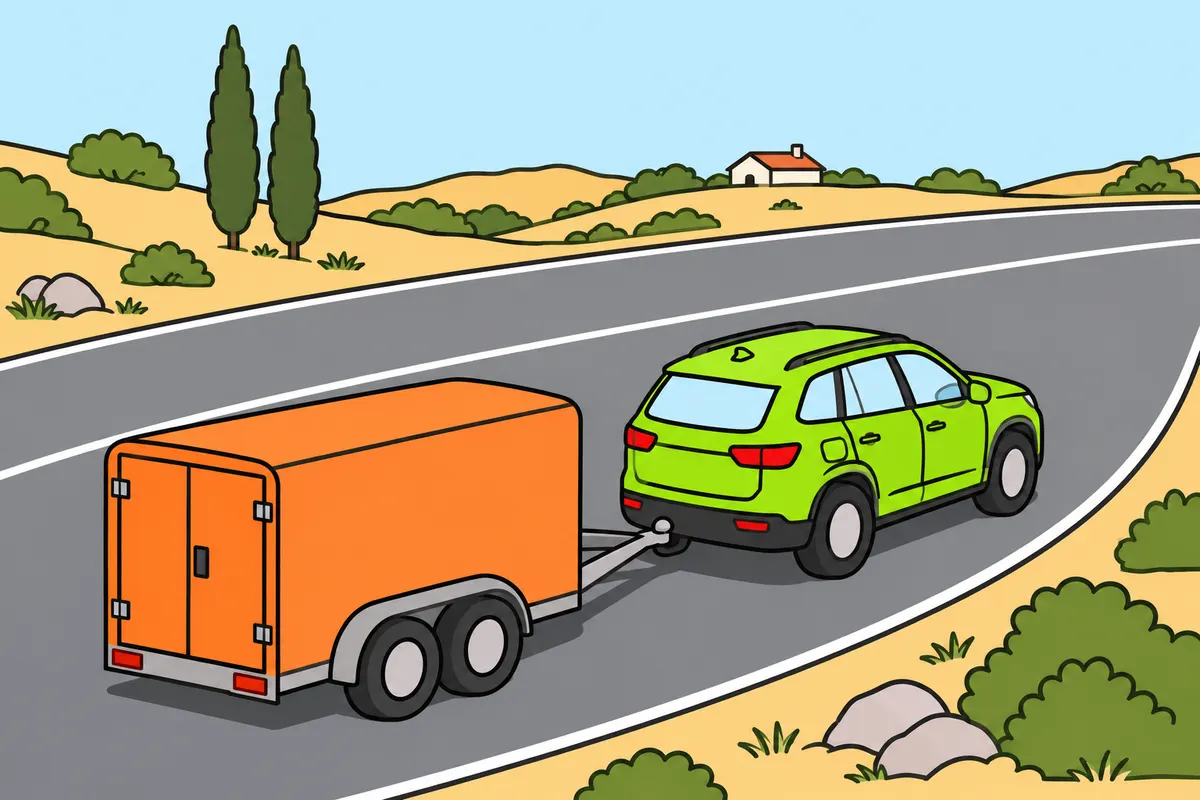
On the road, control the whole combination safely and smoothly.
Remember
- Observe, signal and manoeuvre safely; see Manoeuvres with a car and trailer.
- Adapt speed, distance and lane; see Speed and distances with a trailer.
- Check brake and steering assistance; use available braking systems.
- Adapt bends to the combination’s length and overhangs.
- Check wheels, bolts, mudguards, windows, wipers and fluids.
- Reduce fuel use and emissions; use a tachograph only where required.
Exam trap: Wrong: preparation and the result count towards the 25 minutes. Right: only driving on the road counts, except if the test is interrupted and failed; reception, technical checks and applicable special manoeuvres do not count.
Read the full explanation
- On roads open to traffic, you must demonstrate observation, signalling and safe execution when joining traffic, changing lanes, overtaking, negotiating junctions, turning, stopping briefly and parking. You are assessed on appropriate speed, distances and the lane you use; the rules are covered in «Speed and distances with a trailer» and «Manoeuvres with a car and trailer». [RGCond, Annex V.B.4.1](https://www.boe.es/buscar/act.php?id=BOE-A-2009-9481#anv)
- You must check the brake and steering assistance and use the braking systems and any speed reduction systems other than the service brake fitted to your combination. [RGCond, Annex V.B.4.4](https://www.boe.es/buscar/act.php?id=BOE-A-2009-9481#anv)
- You must adapt your path through bends to the length and overhangs of your combination, and move off, change gear, come to a halt and stop briefly smoothly and safely. [RGCond, Annex V.B.4.4](https://www.boe.es/buscar/act.php?id=BOE-A-2009-9481#anv)
- You must check the wheels and their securing bolts, mudguards, windscreen, windows, windscreen wipers and vehicle fluids. You must also use the tachograph where applicable; holding B+E does not mean that every combination must have one fitted. [RGCond, Annex V.B.4.4](https://www.boe.es/buscar/act.php?id=BOE-A-2009-9481#anv)
- You must reduce fuel consumption and emissions while driving safely; the required actions are specified in «The vehicle you present for the test». [RGCond, Annex V.B.4.4](https://www.boe.es/buscar/act.php?id=BOE-A-2009-9481#anv)
- Your minimum B+E driving time on the road is 25 minutes, unless the test is interrupted and suspended. This does not include your initial reception, preparation, technical safety check, special manoeuvres where applicable or being told your result. [RGCond, Annex VI.C.2](https://www.boe.es/buscar/act.php?id=BOE-A-2009-9481#anvi) [RGCond, Annex V.B.4](https://www.boe.es/buscar/act.php?id=BOE-A-2009-9481#anv)
18Faults and practical test results
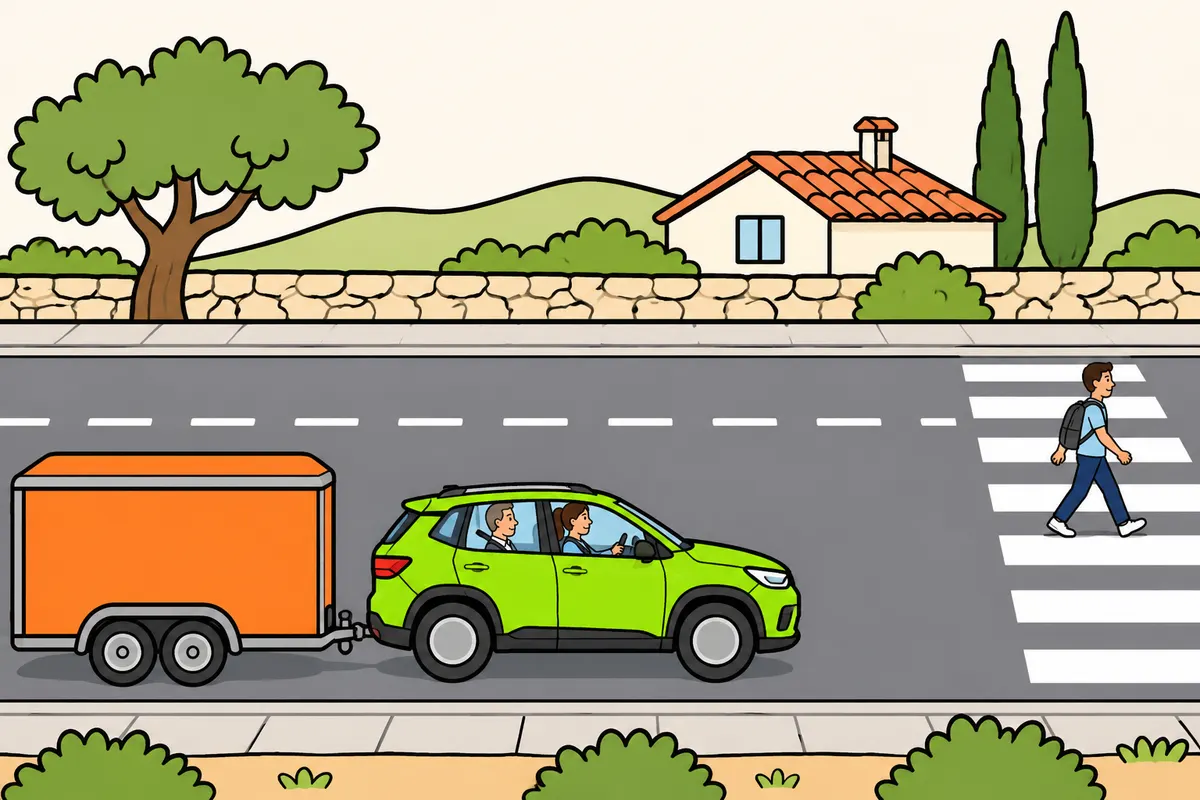
You can fail through serious faults or by accumulating other faults.
| Faults that mean you fail | B+E closed-course test | B+E on-road test |
|---|---|---|
| Immediate-fail | one | one |
| Serious | two | two |
| Serious together with minor | one serious and two minor | one serious and five minor |
| Minor only | four | ten |
Remember
- Faults can be immediate-fail, serious or minor.
- Master the manoeuvres and drive without putting anyone in danger.
Exam trap: Wrong: the two errors allowed in twenty theory questions decide the practical result. Right: use the fault combinations for each practical test.
Read the full explanation
- Your practical test faults are classified as eliminatory, serious or minor according to their severity. [RGCond, Annex VI.C.3](https://www.boe.es/buscar/act.php?id=BOE-A-2009-9481#anvi)
- In the closed-course test, you fail with one eliminatory fault, two serious faults, one serious fault and two minor faults, or four minor faults. [RGCond, Annex VI.C.3](https://www.boe.es/buscar/act.php?id=BOE-A-2009-9481#anvi)
- In the on-road test, you fail with one eliminatory fault, two serious faults, one serious fault and five minor faults, or ten minor faults. [RGCond, Annex VI.C.3](https://www.boe.es/buscar/act.php?id=BOE-A-2009-9481#anvi)
- In the closed-course test, an eliminatory fault may show that you cannot carry out the manoeuvre or clearly lack the necessary skill. In the on-road test, danger to your safety or that of other road users is particularly significant; you must focus your preparation on controlling your combination safely, as well as knowing the marking system. [RGCond, Annex VI.C.3](https://www.boe.es/buscar/act.php?id=BOE-A-2009-9481#anvi)
19The vehicle you present for the test
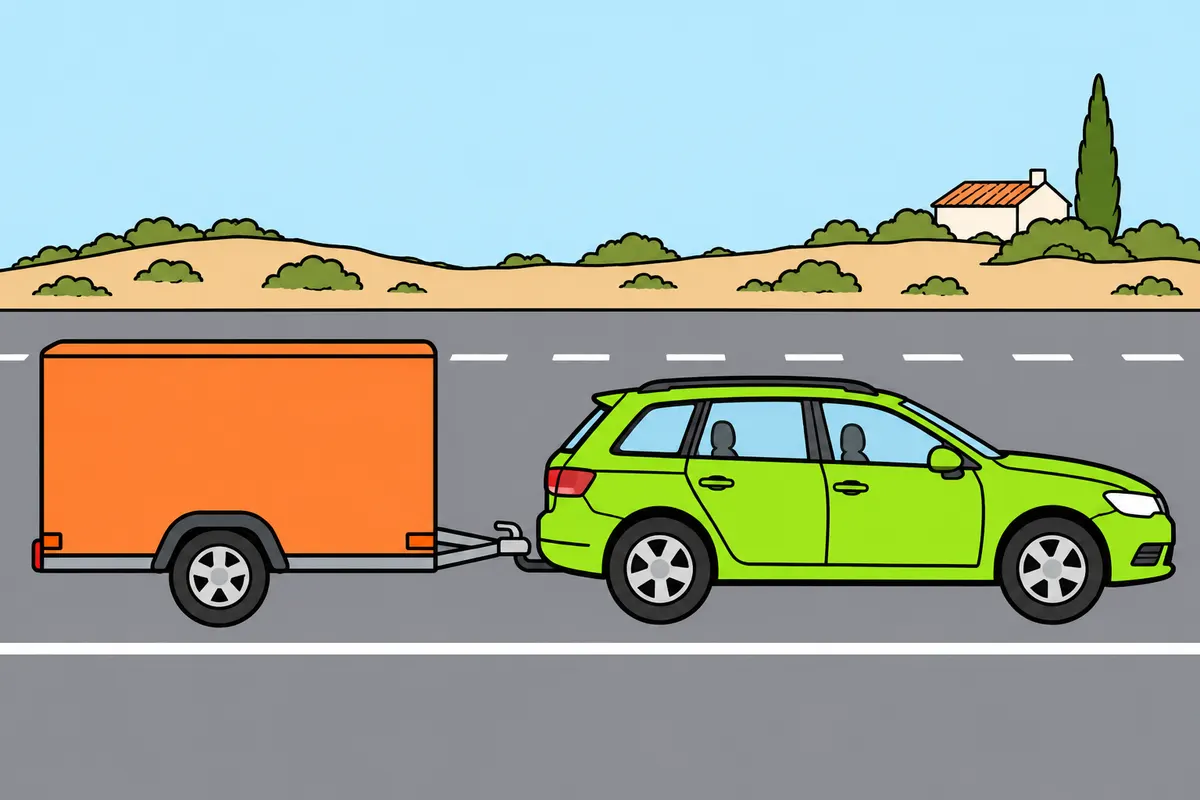
Your test vehicle must meet requirements for size, mass and equipment.
| Test trailer detail | Requirement |
|---|---|
| MMA | At least 1,000 kg |
| Actual total weight | At least 800 kg |
| Length without drawbar or coupling | At least 2.50 m |
| Box slightly narrower than towing vehicle | Allowed if you can see behind only through exterior mirrors |
Remember
- Use a car, mixed-use vehicle or lorry; towing MMA is at most 3,500 kg.
- A car needs a closed body, two doors on each side and four wheels.
- The passenger car must have front and rear head restraints.
- Your combination must fall outside category B and reach at least 100 km/h.
- Being capable of 100 km/h does not let you exceed your combination’s speed limit.
- A single central axle trailer is allowed, but not required.
Exam trap: Wrong: taking the test in an automatic vehicle always avoids code 78. Right: code 78 is not recorded only if you already hold a licence obtained in a manual vehicle in category B, B+E, C1, C1+E, C, C+E, D1, D1+E, D or D+E, and during the on-road test you carry out the safe and efficient driving operations in annex V.B.4.4 (accelerating, decelerating, climbing and descending slopes while selecting gears manually where appropriate). Otherwise, your entitlement is limited to vehicles with automatic transmission.
Read the full explanation
- The towing vehicle you use for the test may be a passenger car, a mixed-use vehicle or a lorry. In each case, it must be at least 3.50 m long and have an MMA (maximum authorised mass) of no more than 3,500 kg. If you use a passenger car, it must have enclosed bodywork, two doors on each side, four wheels and front and rear head restraints. [RGCond, annex VII.B.5 and 7](https://www.boe.es/buscar/act.php?id=BOE-A-2009-9481#anvii)
- The trailer must have an MMA of at least 1,000 kg and an actual total weight of at least 800 kg. The first is an authorised value, while the second requires a minimum actual mass for you to take the test under the prescribed conditions, even if its MMA is higher. [RGCond, annex VII.B.7](https://www.boe.es/buscar/act.php?id=BOE-A-2009-9481#anvii)
- The trailer must be at least 2.50 m long, excluding the drawbar or coupling. The combination must be capable of reaching at least 100 km/h and fall outside category B; this technical capability does not authorise you to drive at 100 km/h where the speed limit for the combination is lower. [RGCond, annex VII.B.7](https://www.boe.es/buscar/act.php?id=BOE-A-2009-9481#anvii)
- The trailer’s load compartment must be an enclosed box, at least as wide and as high as the towing vehicle’s cab. It may be slightly narrower than the towing vehicle if the rear view is only possible through the exterior mirrors. You may use a trailer with a single central axle for the B+E test. [RGCond, annex VII.A.7 and B.7](https://www.boe.es/buscar/act.php?id=BOE-A-2009-9481#anvii)
- If you take the B+E test with an automatic towing vehicle, the automatic transmission restriction, code 78, is not entered on your licence if you already hold a licence obtained with manual transmission in any of these categories: B, B+E, C1, C1+E, C, C+E, D1, D1+E, D or D+E, and during the test on roads open to traffic you carry out the safe and efficient driving operations in annex V.B.4.4 (accelerating, decelerating, driving uphill and downhill, selecting gears manually where appropriate). If you do not meet these conditions, taking the test with automatic transmission limits your entitlement to vehicles with that transmission. [RGCond, annex VII.A.4 and annex I, code 78](https://www.boe.es/buscar/act.php?id=BOE-A-2009-9481#anvii)
Choose the authorisation for your combination
Use the MMA figures, then check the technical limits.
- Identify the category B towing vehicle and check the MMA of both vehicles.
- If the trailer has an MMA of up to 750 kg, category B is sufficient even if the total reaches 4,250 kg.
- If it exceeds 750 kg, add the MMA figures: up to 3,500 kg, category B is sufficient; above 3,500 and up to 4,250 kg, you need code 96 or a sufficient licence category.
- If the total exceeds 4,250 kg, check B+E: a category B towing vehicle and a trailer or semi-trailer with an MMA of up to 3,500 kg.
- If the trailer exceeds 3,500 kg, check another sufficient licence category.
- Also check the technical limits of the vehicles, coupling and combination.
Complete the B+E tests
Pass each stage to progress to the next.
- Check that you hold a valid category B licence and meet the minimum age and other requirements.
- Pass the specific theory test.
- Demonstrate the pre-drive checks and pass G, M and N on the closed course.
- Pass the on-road test on roads open to traffic with the test combination.
- Keep track of how long your passes remain valid and the time limits between attempts until you obtain your licence.
Plan your renewal
Keep the authorisation you need for your combination valid.
- Check the expiry date and conditions of your B+E licence.
- During the three months before expiry, you can apply to renew it and provide proof of physical and psychological fitness.
- Complete the renewal process and check the validity of the authorisation you receive.
- If your licence has expired, wait until you have a valid authorisation before driving.
Check what you know
Real questions from the bank on this topic. Pick an answer to see the explanation.
Finished this module?
Mark it as read and you will see your progress on the theory list.