
Theory · C1+E Licence - Light Truck with Trailer · Module 1 of 13
C1+E licence: requirements, tests and validity
You learn which combinations you can drive with C1+E, their mass limits and when the base licence is sufficient. You distinguish this category from C+E, B+E and B with code 96, and master the age, test and renewal requirements to answer exam questions.
1What you can drive with C1+E
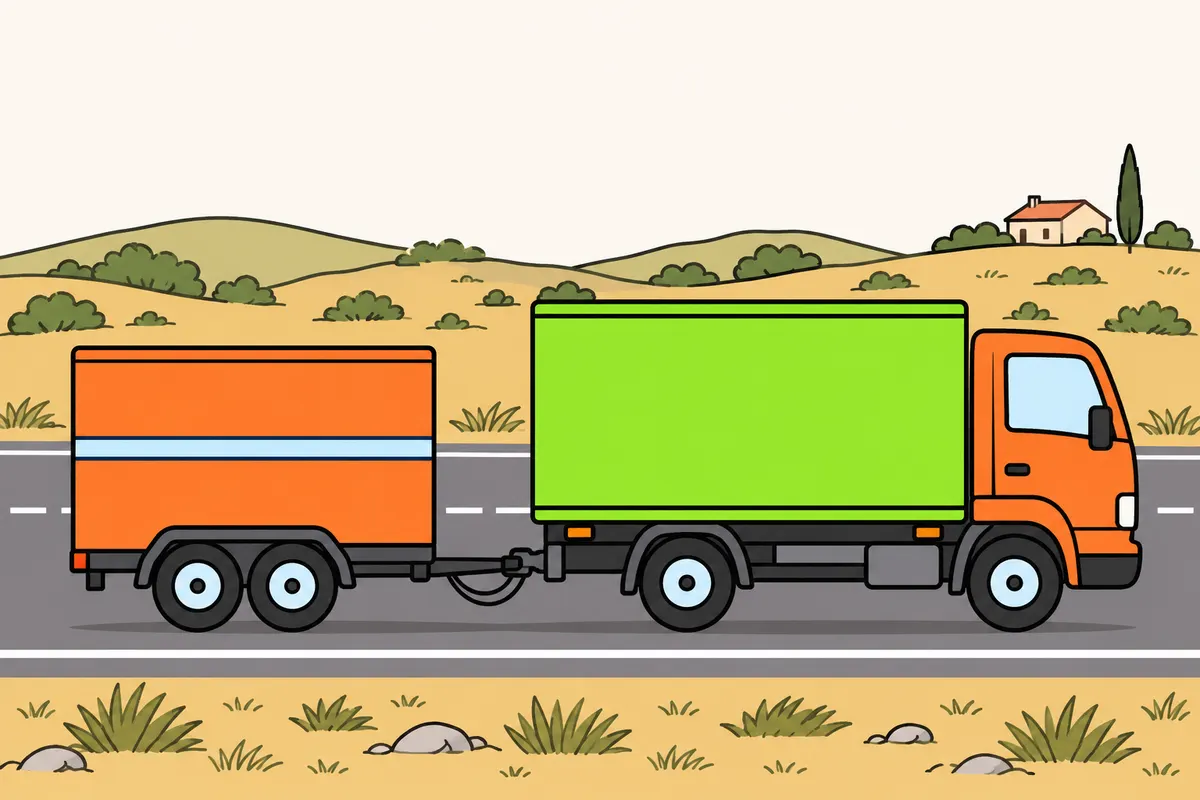
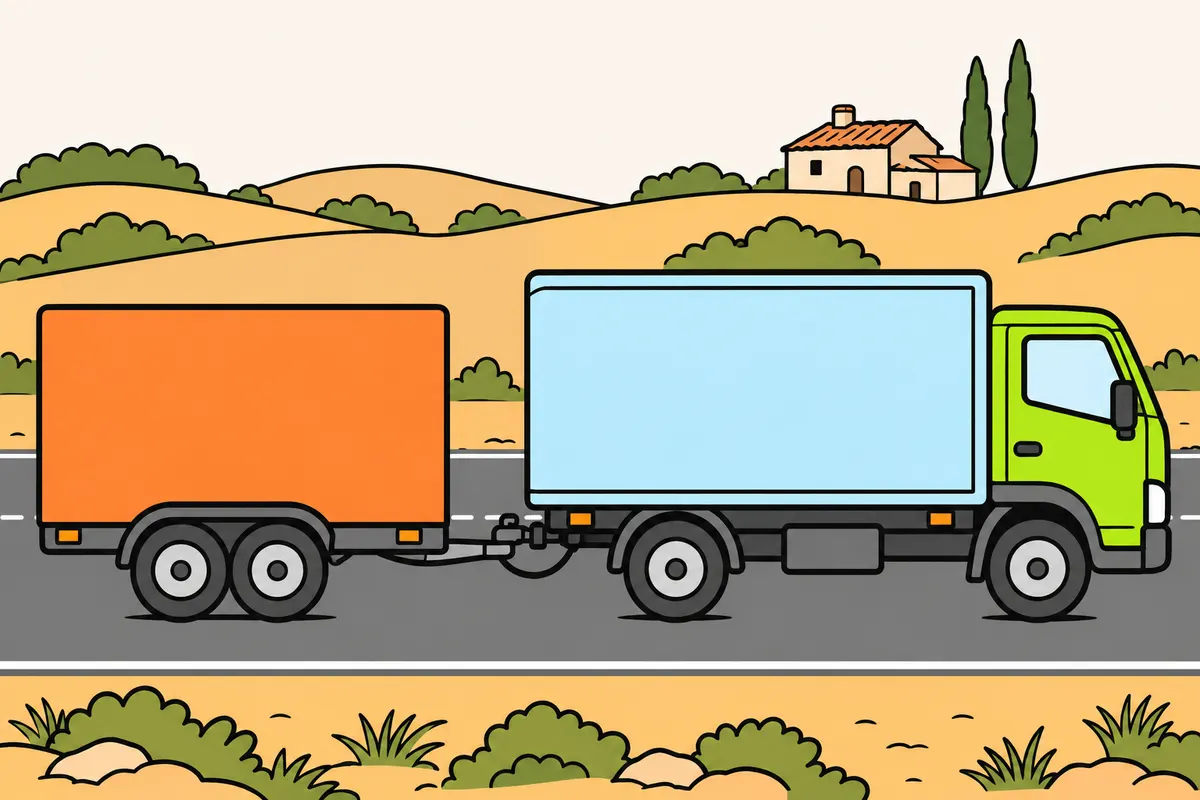
With C1+E, you can drive approved combinations with an MMA up to 12,000 kg.
| Towing vehicle | Towed vehicle MMA with C1+E | Maximum combination MMA |
|---|---|---|
| C1 | Over 750 kg | 12,000 kg |
| B | Over 3,500 kg | 12,000 kg |
Remember
- MMA means maximum authorised mass.
- Check the towing vehicle, towed vehicle and whole combination separately.
- Also respect technical limits and coupling conditions.
Exam trap: Wrong: any C1 lorry can tow enough to reach 12,000 kg. Right: check its technical limits.
Read the full explanation
- With C1+E, you can drive a combination consisting of a category C1 towing vehicle and a trailer or semi-trailer with an MMA (maximum authorised mass) over 750 kg, provided the combination's MMA does not exceed 12,000 kg. [RGCond, art. 4](https://www.boe.es/buscar/act.php?id=BOE-A-2009-9481#a4).
- The C1 towing vehicle is a motor vehicle with an MMA over 3,500 kg and no more than 7,500 kg, other than those authorised under D1 or D, designed and built to carry no more than eight passengers in addition to you. [RGCond, art. 4](https://www.boe.es/buscar/act.php?id=BOE-A-2009-9481#a4).
- C1+E also allows you to drive a towing vehicle authorised under B with a trailer or semi-trailer with an MMA over 3,500 kg, provided the combination's MMA does not exceed 12,000 kg. [RGCond, art. 4](https://www.boe.es/buscar/act.php?id=BOE-A-2009-9481#a4).
- You must comply with the type-approval conditions, towing mass limits and technical limits of the combination. The licence limit of 12,000 kg does not mean that any C1 towing vehicle can tow enough to reach that figure: the vehicles and their coupling must allow the specific combination. [RGCond, art. 4](https://www.boe.es/buscar/act.php?id=BOE-A-2009-9481#a4).
2Trailers, semi-trailers and combinations
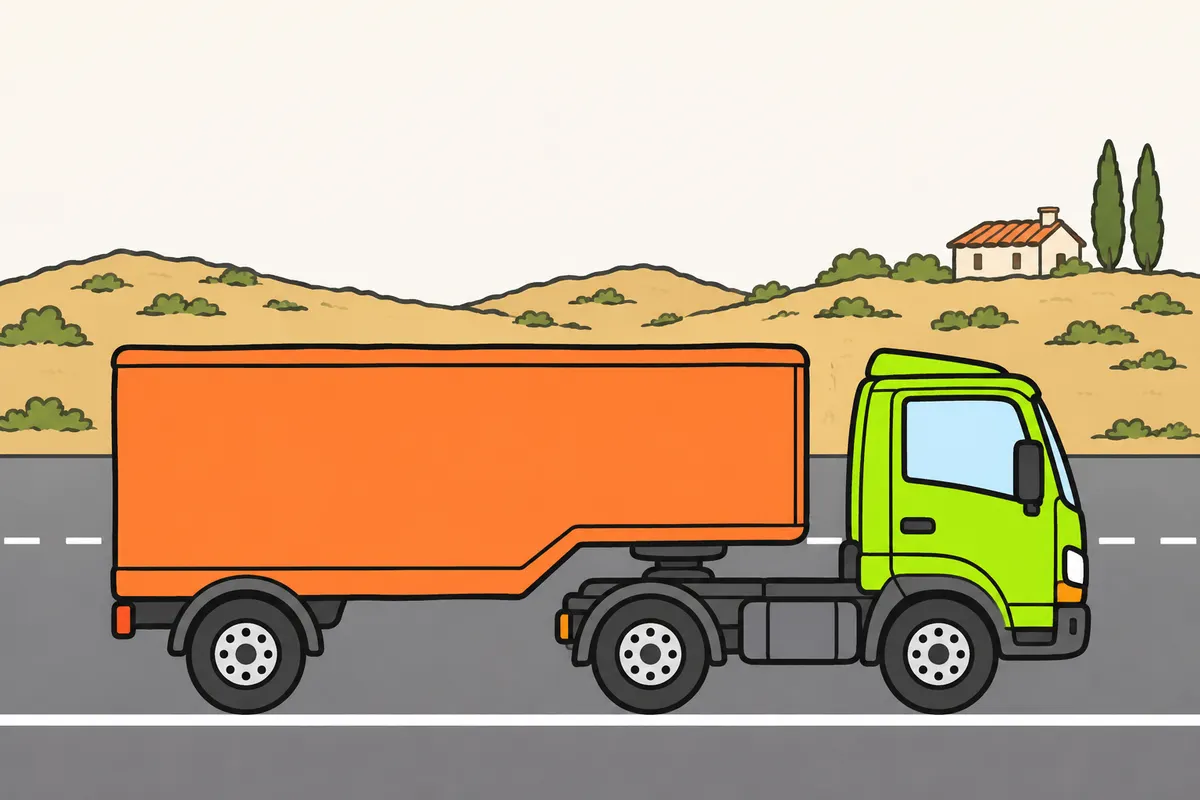
Distinguish trailers from semi-trailers and check their MMA.
| Combination | Made up of |
|---|---|
| Road train | Motor vehicle and trailer |
| Articulated vehicle | Motor vehicle and semi-trailer |
Remember
- A semi-trailer rests partly on the towing vehicle and transfers weight to it.
- You can tow trailers and semi-trailers with C1+E within its limits.
Exam trap: Wrong: a towed vehicle with an MMA of 750 kg is non-light. Right: it is still light.
Read the full explanation
- When interpreting a question, distinguish between a road train, consisting of a motor vehicle and a trailer, and an articulated vehicle, consisting of a motor vehicle and a semi-trailer. Both are vehicle combinations. [RGV, Annex II](https://www.boe.es/buscar/act.php?id=BOE-A-1999-1826#anii). [RGCond, art. 4](https://www.boe.es/buscar/act.php?id=BOE-A-2009-9481#a4).
- A semi-trailer is designed to be coupled to a motor vehicle on which it partly rests and to which it transfers a substantial part of its mass. [RGV, Annex II](https://www.boe.es/buscar/act.php?id=BOE-A-1999-1826#anii). [RGCond, art. 4](https://www.boe.es/buscar/act.php?id=BOE-A-2009-9481#a4).
- A light trailer or semi-trailer has an MMA no greater than 750 kg. Exactly 750 kg is still within the light category; you must exceed that value for the towed vehicle to be classed as non-light and for the corresponding licence extension to be required. [RGV, Annex II](https://www.boe.es/buscar/act.php?id=BOE-A-1999-1826#anii). [RGCond, art. 4](https://www.boe.es/buscar/act.php?id=BOE-A-2009-9481#a4).
3MMA determines the category
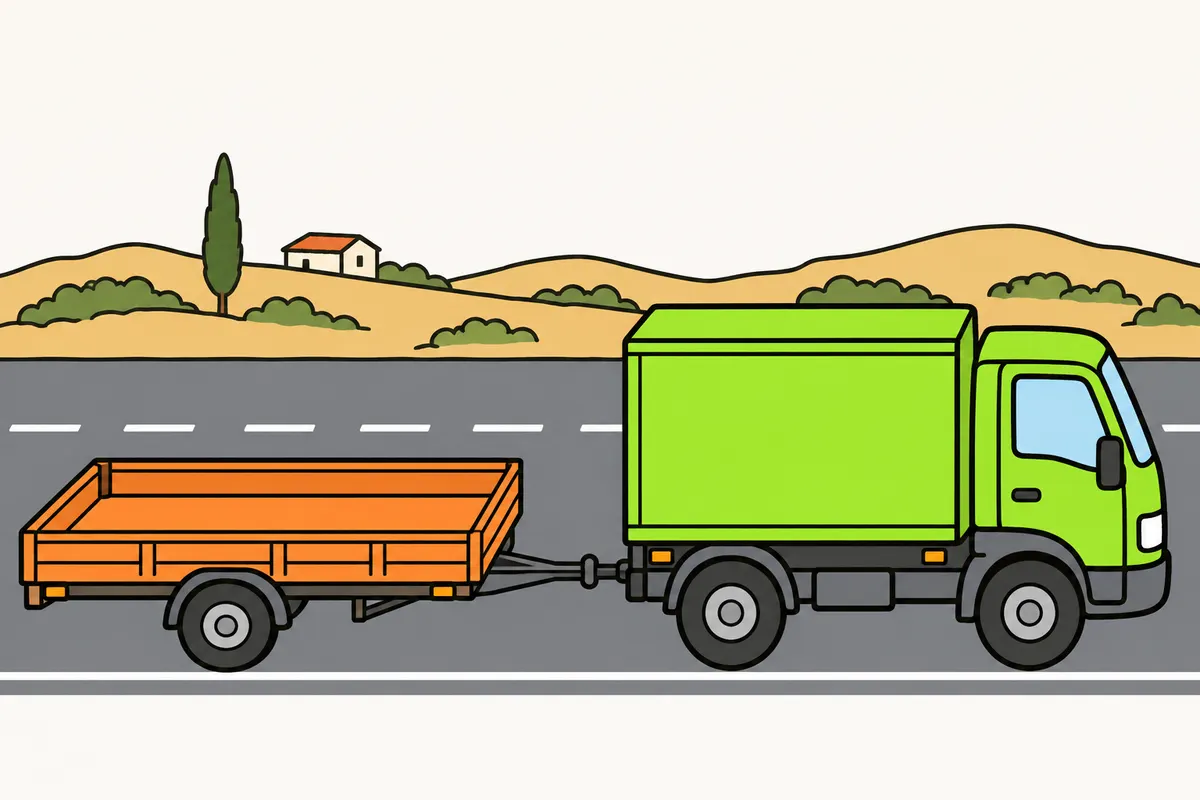
Choose your licence using MMA, even when you travel without a load.
| Term | Meaning |
|---|---|
| MMA | Maximum authorised mass when loaded |
| Actual mass | What it weighs on that journey |
| Payload | Different from MMA |
Remember
- MMA is the maximum authorised mass of the loaded vehicle.
- Unloading your trailer does not change its MMA.
- Check the MMA of the towing vehicle, towed vehicle and combination.
- Also check whether technical limits allow you to use the combination.
Exam trap: Wrong: emptying your trailer extends what C1 allows. Right: its MMA stays the same.
Read the full explanation
- MMA is the maximum mass authorised for using the laden vehicle on the road. It is neither the payload nor the mass shown on a weighbridge on a particular journey; you must distinguish these concepts when reading the figures in a licence question. [RGV, Annex IX, 1.6](https://www.boe.es/buscar/act.php?id=BOE-A-1999-1826#anix). [RGCond, art. 4](https://www.boe.es/buscar/act.php?id=BOE-A-2009-9481#a4).
- If your trailer has an MMA of 1,000 kg, it still exceeds the 750 kg threshold even when it travels empty and its actual mass is lower. With a category C1 towing vehicle, you need C1+E if the combination's MMA does not exceed 12,000 kg: unloading it does not change its MMA or, by itself, extend what your C1 licence authorises. [RGCond, art. 4](https://www.boe.es/buscar/act.php?id=BOE-A-2009-9481#a4).
- To determine the licence category, use the maximum authorised masses given in the question and check the towing vehicle, the towed vehicle and the combination separately. [RGCond, art. 4](https://www.boe.es/buscar/act.php?id=BOE-A-2009-9481#a4).
- The combination's maximum authorised mass and its technically permissible maximum mass are different concepts. Determining which licence you need is one check, and checking whether you can use that specific combination on the road is another; masses, axles and dimensions are covered in the module «Maximum dimensions and masses». [RGV, Annex IX, 1.12 and 1.13](https://www.boe.es/buscar/act.php?id=BOE-A-1999-1826#anix). [RGCond, art. 4](https://www.boe.es/buscar/act.php?id=BOE-A-2009-9481#a4).
4When a C1 licence is sufficient
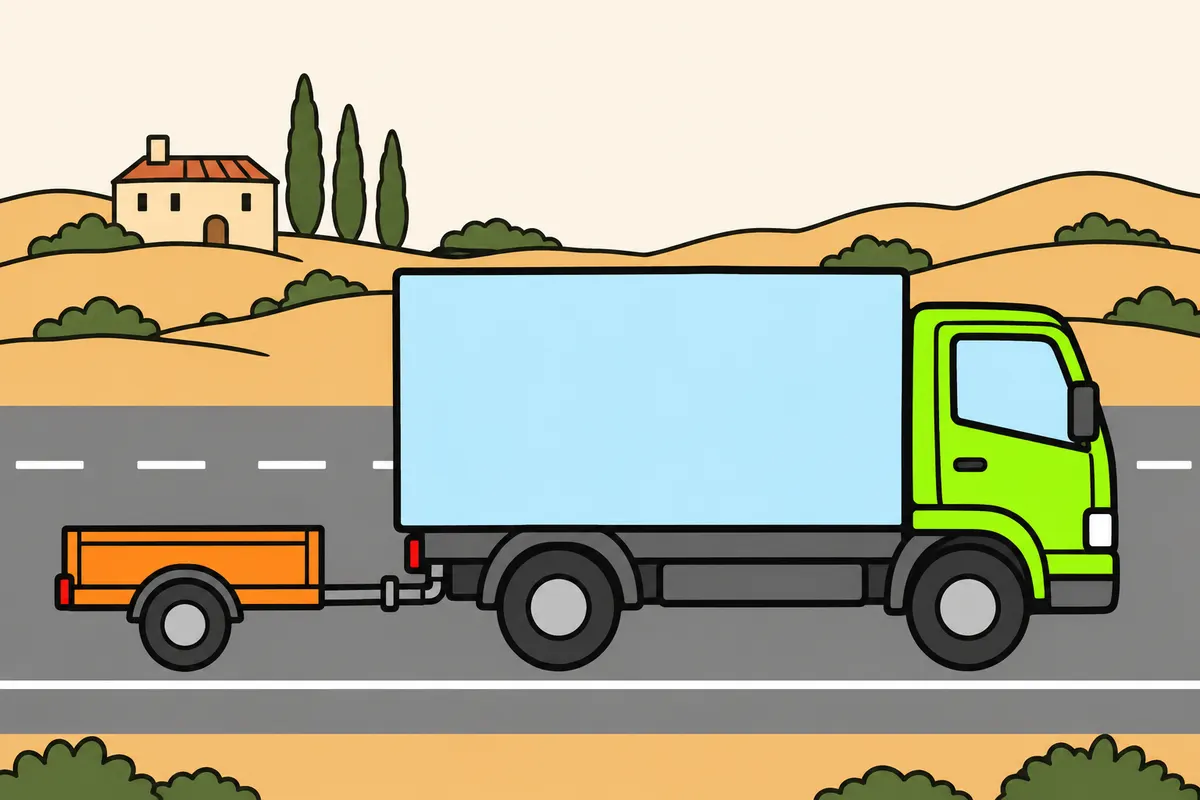
With C1, you can tow a light trailer if your vehicle technically allows it.
| C1 lorry: 7,500 kg MMA | Trailer MMA | Licence needed |
|---|---|---|
| Same lorry | 750 kg | C1 |
| Same lorry | 751 kg | C1+E |
Remember
- You do not need C1+E for every trailer.
- Check that your lorry can technically tow the trailer.
Exam trap: Wrong: every trailer needs C1+E. Right: with a C1 towing vehicle, C1 covers trailers up to 750 kg MMA if towing is technically allowed.
Read the full explanation
- With C1, you can drive a motor vehicle in that category and tow a trailer whose MMA does not exceed 750 kg. You must check that the vehicle's technical limits allow it to tow that trailer; having a trailer attached does not in itself require you to obtain C1+E. [RGCond, art. 4](https://www.boe.es/buscar/act.php?id=BOE-A-2009-9481#a4).
- With a C1 lorry with an MMA of 7,500 kg and a trailer with an MMA of 750 kg, C1 is sufficient in terms of licence category. If you replace the trailer with one with an MMA of 751 kg, you need C1+E. [RGCond, art. 4](https://www.boe.es/buscar/act.php?id=BOE-A-2009-9481#a4).
5How C1+E differs from C+E
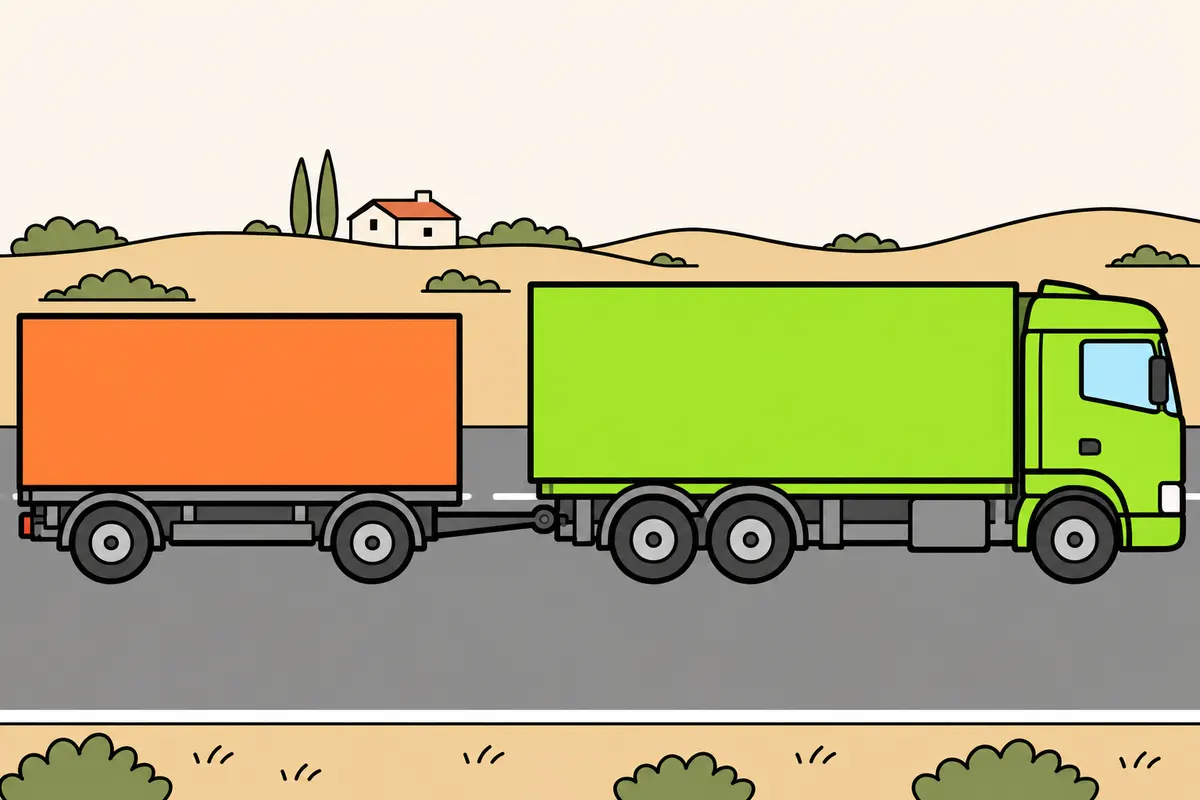
You need C+E when your lorry or combination exceeds the C1+E limits.
| C1 towing vehicle MMA | Trailer MMA | Combination MMA | Licence if technically allowed |
|---|---|---|---|
| 7,500 kg | 4,500 kg | 12,000 kg | C1+E |
| 7,500 kg | 5,000 kg | 12,500 kg | C+E |
Remember
- You need C+E for a lorry over 7,500 kg MMA with a non-light trailer.
- Respect technical conditions even when your licence covers the masses.
Exam trap: Wrong: C1+E covers every combination with a C1 towing vehicle. Right: combination MMA cannot exceed 12,000 kg.
Read the full explanation
- With a lorry with an MMA over 7,500 kg and a non-light trailer, you need C+E, not C1+E. [RGCond, art. 4.2](https://www.boe.es/buscar/act.php?id=BOE-A-2009-9481#a4).
- For example, a C1 towing vehicle of 7,500 kg and a trailer of 4,500 kg can fall within C1+E if the combination's MMA is 12,000 kg and they meet the technical conditions. With the same towing vehicle and a trailer of 5,000 kg forming a combination with an MMA of 12,500 kg, C1+E is insufficient; you need C+E for that goods vehicle combination. [RGCond, art. 4](https://www.boe.es/buscar/act.php?id=BOE-A-2009-9481#a4).
6B and code 96: a useful comparison
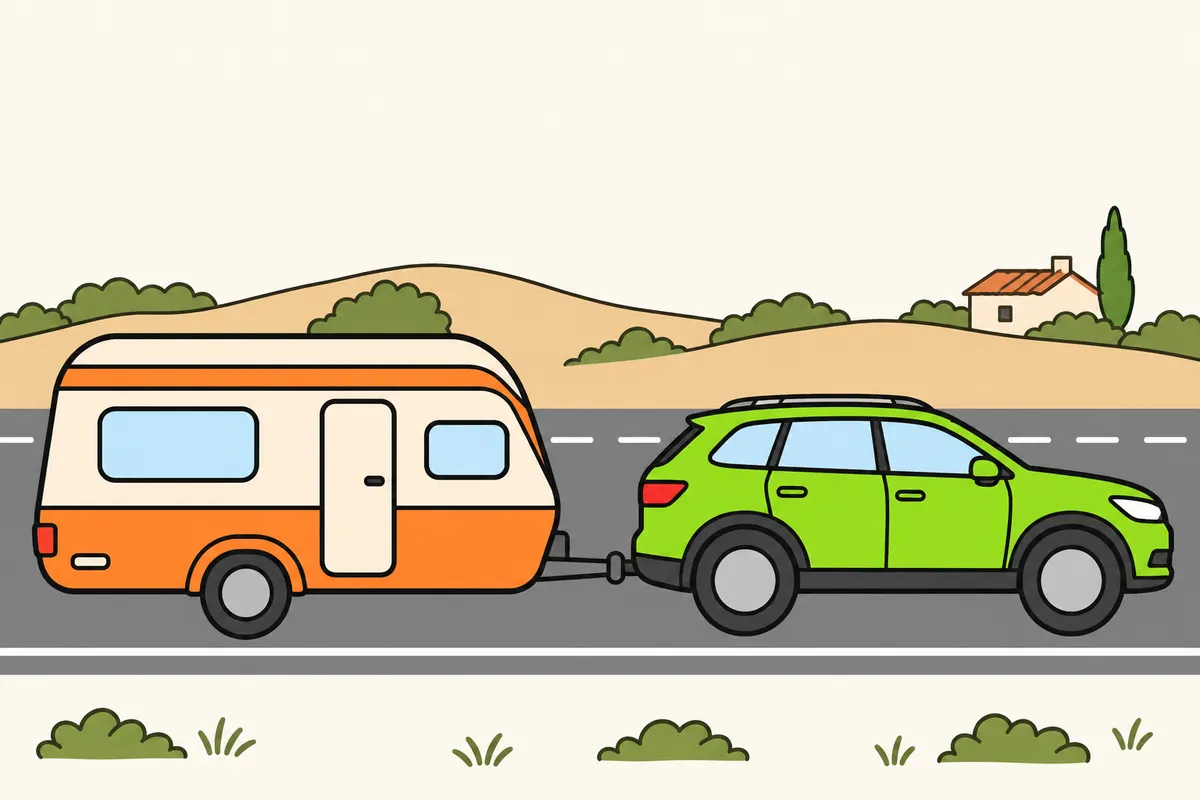
With a B towing vehicle, check trailer and combination MMA before choosing your licence.
| B towing vehicle: trailer MMA | Combination MMA | What you need |
|---|---|---|
| Up to 750 kg | Can reach 4,250 kg | B |
| Over 750 kg | Up to 3,500 kg | B |
| Over 750 kg | Over 3,500 kg, up to 4,250 kg | B with code 96 |
Remember
- Code 96 applies to combinations with a B towing vehicle.
- You cannot use it for a C1 lorry.
- You must pass the required tests to obtain it.
- Always respect the technical limits of your combination.
Exam trap: Wrong: every 4,250 kg combination needs code 96. Right: B covers a B towing vehicle with a trailer up to 750 kg MMA, if technically allowed.
Read the full explanation
- With a B licence, you can drive a towing vehicle in that category and tow a trailer with an MMA no greater than 750 kg. In this case, a towing vehicle of 3,500 kg and a trailer of 750 kg can total 4,250 kg without that total requiring code 96, provided the combination is technically permissible. [RGCond, art. 4](https://www.boe.es/buscar/act.php?id=BOE-A-2009-9481#a4).
- If the trailer's MMA exceeds 750 kg and the combination's MMA does not exceed 3,500 kg, you can drive it with B without the code 96 extension. For example, a category B towing vehicle of 2,000 kg and a trailer of 1,000 kg form a combination of 3,000 kg that falls within that entitlement. [RGCond, art. 4](https://www.boe.es/buscar/act.php?id=BOE-A-2009-9481#a4).
- For a category B towing vehicle with a trailer over 750 kg and a combination exceeding 3,500 kg but no more than 4,250 kg, you must obtain the entitlement shown by code 96. You must pass the prescribed tests of skills and behaviour. [RGCond, art. 5.5 and Annex I, code 96](https://www.boe.es/buscar/act.php?id=BOE-A-2009-9481#ani). [RGCond, art. 4](https://www.boe.es/buscar/act.php?id=BOE-A-2009-9481#a4).
- The code 96 entitlement is entered on your licence alongside category B. When choosing a combination, you must read the category and that code together to understand the extension you are authorised to use. [RGCond, Annex I, code 96](https://www.boe.es/buscar/act.php?id=BOE-A-2009-9481#ani).
7B+E and the categories granted
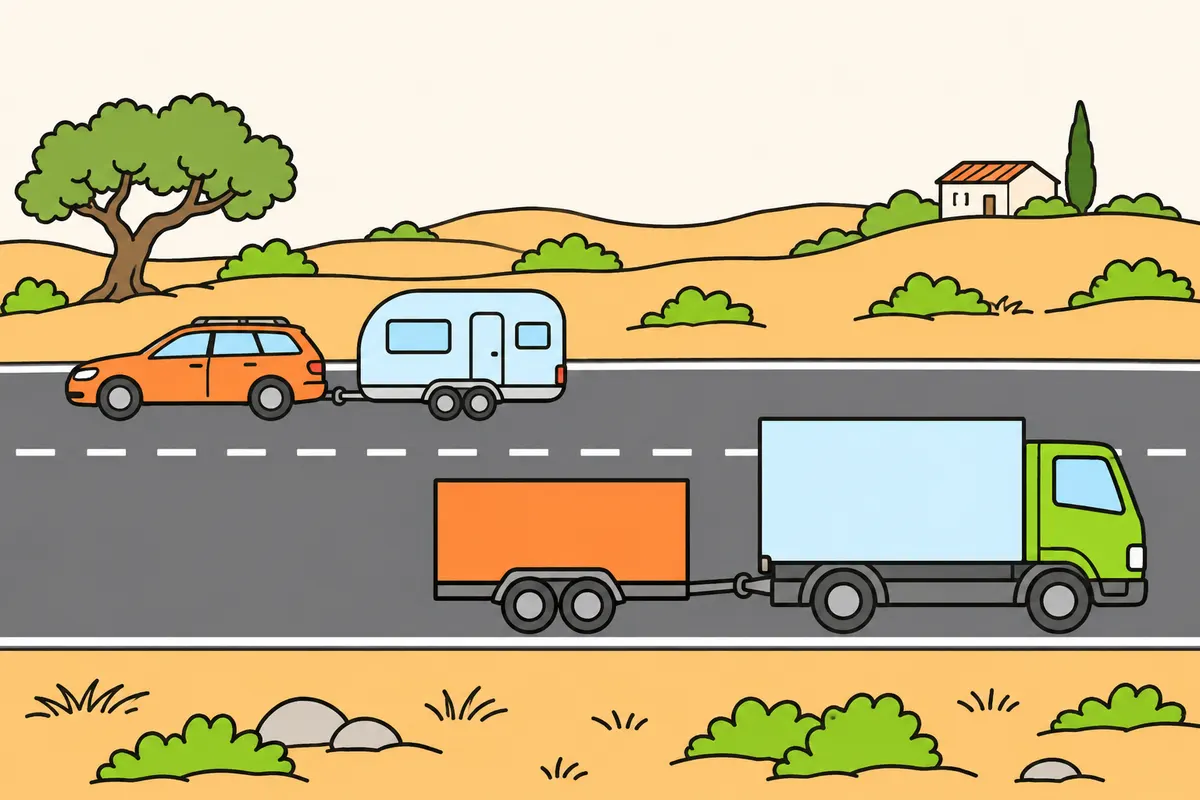
When you obtain C1+E, you also receive B+E, but not every trailer category.
| Licence you obtain | Categories you also receive |
|---|---|
| C1+E | B+E |
| C+E | C1+E; also D+E if you hold D |
Remember
- With B+E, your towing vehicle must be in category B.
- Respect the technical conditions of your vehicles.
- Receiving a licence category differs from being exempt from a test.
Exam trap: Wrong: C1+E automatically grants C+E. Right: it grants B+E, but not C+E, D1+E or D+E.
Read the full explanation
- With B+E, you may drive combinations consisting of a category B towing vehicle and a trailer or semi-trailer with an MMA (maximum authorised mass) not exceeding 3,500 kg, subject to the type-approval conditions. [RGCond, art. 4](https://www.boe.es/buscar/act.php?id=BOE-A-2009-9481#a4).
- When you obtain C1+E, you are also granted B+E. [RGCond, art. 5](https://www.boe.es/buscar/act.php?id=BOE-A-2009-9481#a5).
- Obtaining C1+E does not in itself grant you C+E, D1+E or D+E. When you obtain C+E, you are also granted C1+E and, if you also hold D, D+E. [RGCond, art. 5](https://www.boe.es/buscar/act.php?id=BOE-A-2009-9481#a5).
- Distinguish between being granted a category and being exempt from a test. You may be exempt from another category's specific knowledge test without being granted that category automatically. [RGCond, art. 5](https://www.boe.es/buscar/act.php?id=BOE-A-2009-9481#a5). [RGCond, art. 54](https://www.boe.es/buscar/act.php?id=BOE-A-2009-9481#a54).
8The licence you need first
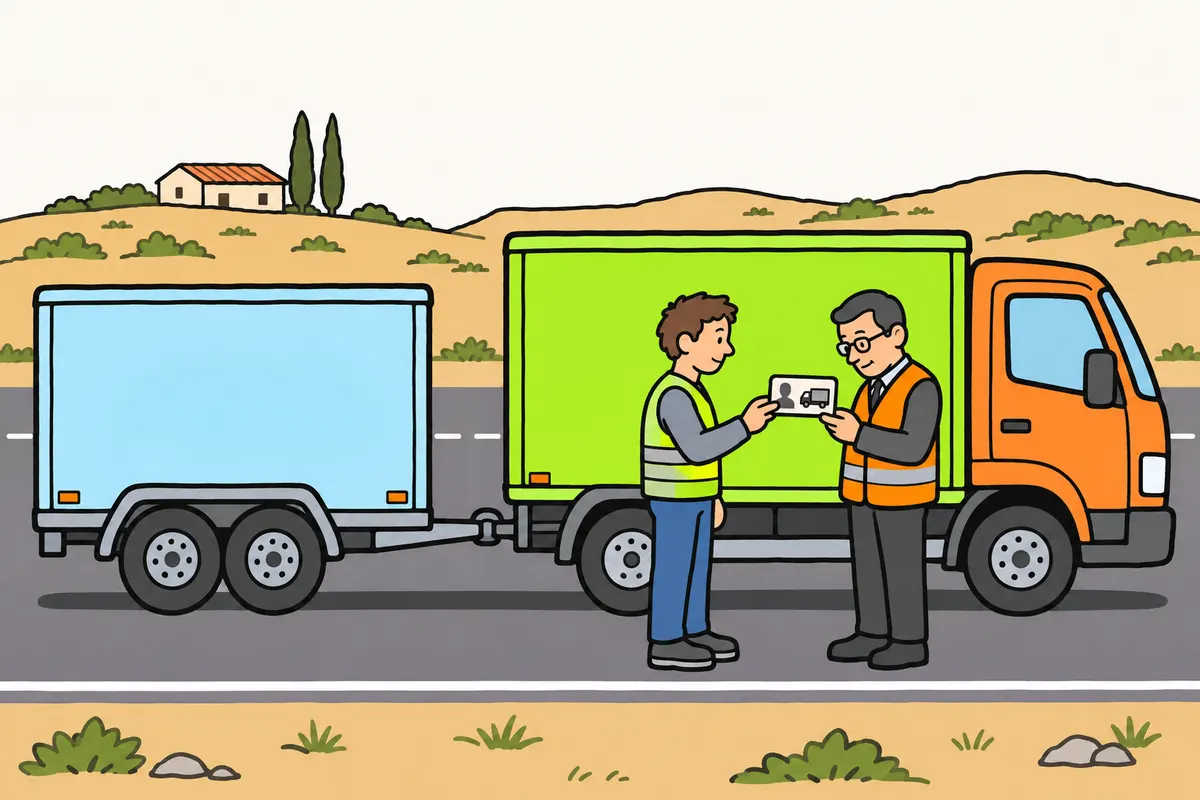
To obtain C1+E, you need a valid C1 licence and must meet the other requirements.
Remember
- First, you need a valid B licence to obtain C1.
- Then, you need a valid C1 licence to obtain C1+E.
- You do not need to hold C1 for a minimum period.
- You must prove physical and mental fitness and pass the required tests.
Exam trap: Wrong: B+E replaces the base licence. Right: you need a valid C1 licence to obtain C1+E.
Read the full explanation
- To be issued with C1+E, you must hold a valid C1 licence. B, AM and licences for agricultural vehicles or vehicles for people with reduced mobility do not replace that underlying licence; B+E is not sufficient either, even if you have experience driving with trailers. [RGCond, art. 5](https://www.boe.es/buscar/act.php?id=BOE-A-2009-9481#a5).
- To obtain C1, you need a valid B licence. You obtain the entitlements in the order B, C1 and C1+E; if you only hold B, completing a trailer test alone does not allow you to be issued with C1+E without the required underlying category. [RGCond, art. 5](https://www.boe.es/buscar/act.php?id=BOE-A-2009-9481#a5).
- Article 5 requires your C1 licence to be valid, but does not require you to have held it for a minimum of one or two years to obtain C1+E. [RGCond, art. 5](https://www.boe.es/buscar/act.php?id=BOE-A-2009-9481#a5).
- As well as holding a valid C1 licence, you must meet the general requirements for obtaining a licence, including physical and psychological fitness and success in the required tests. [RGCond, art. 7](https://www.boe.es/buscar/act.php?id=BOE-A-2009-9481#a7). [RGCond, art. 5](https://www.boe.es/buscar/act.php?id=BOE-A-2009-9481#a5).
9Minimum age
You can obtain C1+E from age 18.
| Licence or case | Minimum age |
|---|---|
| C1+E | 18 years |
| C+E: general rule or accelerated CAP | 21 years |
| C+E with standard initial CAP | 18 years |
Remember
- Keep the minimum ages for C1+E and C+E separate.
- For C+E at 18, you need standard initial CAP.
Exam trap: Wrong: accelerated CAP allows C+E at 18. Right: at that age, you need standard initial CAP.
Read the full explanation
- You may obtain C1+E from your 18th birthday. [RGCond, art. 4.2](https://www.boe.es/buscar/act.php?id=BOE-A-2009-9481#a4).
- If you upgrade to C+E, the minimum age is 21, or 18 with the standard initial CAP (professional driver qualification). With accelerated CAP, the minimum age for C+E is 21. [RGCond, art. 4.2](https://www.boe.es/buscar/act.php?id=BOE-A-2009-9481#a4).
10CAP for professional driving

For transport work covered by CAP, you need that qualification as well as your licence.
| Case | CAP rule |
|---|---|
| C1, C1+E, C, C+E or recognised equivalent that was issued before 11 September 2009 | Initial qualification exempt; periodic training required |
| Practical lessons or licence or CAP examinations | Exempt if you carry out no transport during them |
| Private transport for personal use | Exempt |
| Ancillary private transport exclusively of materials, equipment or machinery you use professionally | Exempt if driving is less than 30 % of your monthly work |
| Ancillary private transport distributing goods within 100 km of the operating centre | Exempt if driving is less than 30 % of your monthly work |
Remember
- Obtain initial CAP through a course and examination, unless exempt.
- With C1+E and standard or accelerated CAP, you can work from age 18.
- CAP has no fixed expiry; keep your periodic training up to date.
- Carry your valid qualification card or the accepted document proving its validity.
- After leaving work without a valid card, complete periodic training before returning.
Exam trap: Wrong: exemption from initial CAP removes every course. Right: you need periodic training if your activity is covered by CAP and is not exempt.
Read the full explanation
- To carry out professional transport with C1+E within the scope of CAP, you must hold that qualification as well as your licence. The initial qualification requires a course and an examination, through either the standard or accelerated route. For C1+E, both standard and accelerated CAP allow you to drive professionally from the age of 18. [RD 284/2021, arts. 1 and 4-6](https://www.boe.es/buscar/act.php?id=BOE-A-2021-6624#a4); [RGCond, art. 4.2](https://www.boe.es/buscar/act.php?id=BOE-A-2009-9481#a4).
- CAP has no fixed validity period; to keep it valid, you must complete 35 hours of periodic training every five years. [RD 284/2021, arts. 3 and 7](https://www.boe.es/buscar/act.php?id=BOE-A-2021-6624#a7). Your driver qualification card is valid for five years. You must carry it on board when driving, or carry the document proving its validity in accordance with article 20. You may prove your qualification with this card; an EU driving licence bearing code 95 is also valid in the recognition cases provided for drivers from other Member States. [RD 284/2021, art. 20](https://www.boe.es/buscar/act.php?id=BOE-A-2021-6624#a2-2).
- If your C1, C1+E, C or C+E licence, or a recognised equivalent, was issued before 11 September 2009, you are exempt from the initial qualification, but you must undertake periodic training. If you do not have a valid card, you must complete that course before obtaining one. [RD 284/2021, art. 3.2](https://www.boe.es/buscar/act.php?id=BOE-A-2021-6624#a3).
- Your practical lessons and driving licence or CAP tests are exempt if no transport is carried out during those activities. Your private transport for personal use is also exempt. [RD 284/2021, art. 2.1.f-g](https://www.boe.es/buscar/act.php?id=BOE-A-2021-6624#a2). Your own-account transport exclusively of materials, equipment or machinery that you use professionally is exempt if driving is not your main activity. Your own-account transport for distributing goods within 100 km of the operating centre is also exempt if driving is not your main activity. In these two cases, driving must account for less than 30 % of your monthly work. [RD 284/2021, art. 2.1.h and l and 2.2](https://www.boe.es/buscar/act.php?id=BOE-A-2021-6624#a2).
- If you have stopped working and do not hold a valid driver qualification card, you must complete a periodic training course before resuming activities subject to CAP. [RD 284/2021, art. 7.6](https://www.boe.es/buscar/act.php?id=BOE-A-2021-6624#a7).
11Alcohol, fatigue and driver checks
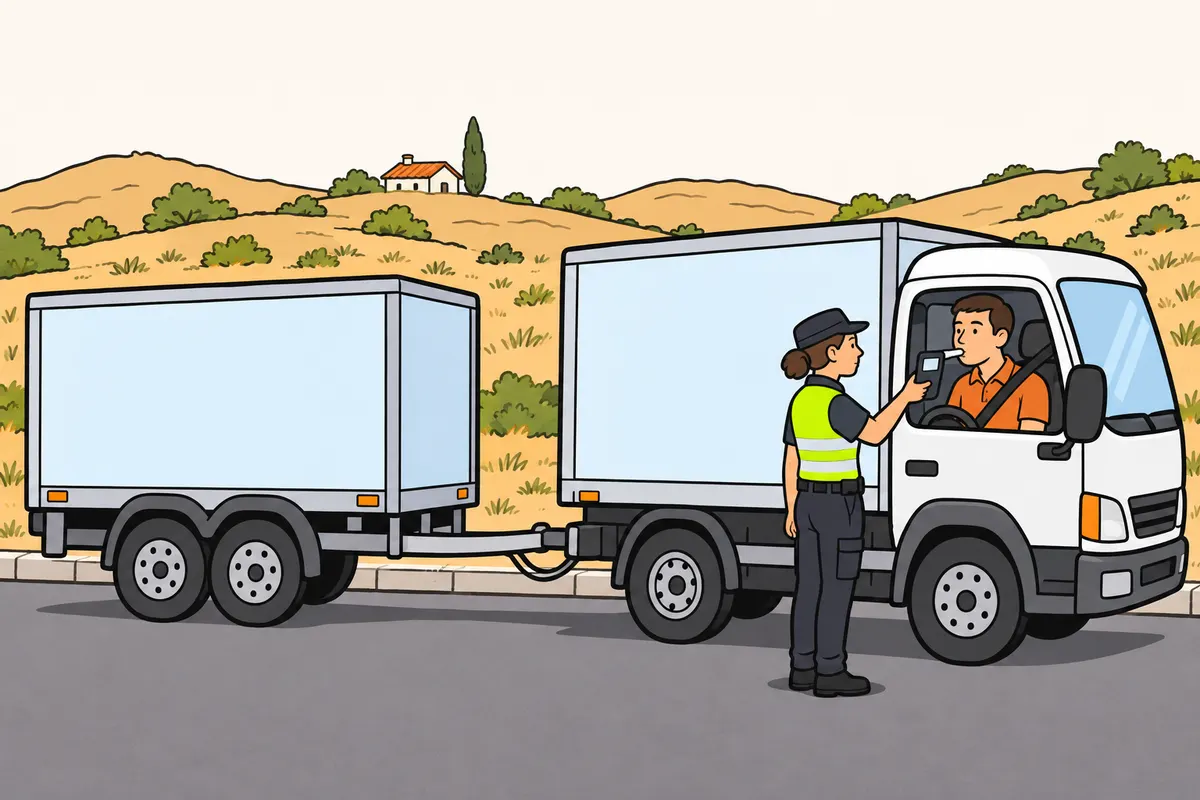
Control alcohol, rest and wear your seat belt correctly when driving your combination.
| C1+E goods combination | Driving time, rest and tachograph |
|---|---|
| Combination MMA over 3.5 t | Rules apply unless an exemption applies |
| Non-commercial goods transport, combination MMA up to 7.5 t | Exempt |
Remember
- If you drive goods vehicles over 3,500 kg MMA, respect these alcohol limits.
- These limits also apply when your journey is not professional.
- If sleepy or unable to hold your course, stop somewhere safe and rest.
- Wear your seat belt during delivery rounds with repeated stops too.
- Exemptions only cover reversing, parking or holding a medical exemption certificate.
- Use the tachograph when your transport is subject to its rules.
Exam trap: Wrong: any breach of driving times allows this immobilisation. Right: officers can immobilise you if you exceed driving times by more than 50 % or reduce statutory rest by more than 50 %, unless another driver takes over. They can also do so if there are reasonable grounds to suspect tampering with monitoring instruments.
Read the full explanation
- If you drive vehicles intended for goods transport with a maximum authorised mass exceeding 3,500 kilograms, you must not exceed 0.3 g/l of alcohol in your blood or 0.15 mg/l in exhaled breath, even if the journey is not professional. [RGC, art. 20](https://www.boe.es/buscar/act.php?id=BOE-A-2003-23514#a20).
- Fatigue and sleepiness reduce your attention and delay your responses to trailer sway or braking. If you become drowsy or find it difficult to maintain your course, stop somewhere safe and rest; you must remain attentive and in control of the combination. [RGC, arts. 17-18](https://www.boe.es/buscar/act.php?id=BOE-A-2003-23514#a18).
- Officers may immobilise your combination if you exceed driving time limits by more than 50 % or reduce statutory rest periods by more than 50 %, unless another driver takes over from you. They may also immobilise it if there are reasonable grounds to suspect tampering with the recording equipment. [Traffic Act, art. 104.1.f and i](https://www.boe.es/buscar/act.php?id=BOE-A-2015-11722#a104).
- You must wear your seat belt when driving the combination, including on delivery rounds with successive stops; you are exempt only when reversing or parking, or if you hold a medical exemption certificate. If you do not use it, or use it incorrectly, you lose 4 points. [RGC, art. 117.1](https://www.boe.es/buscar/act.php?id=BOE-A-2003-23514#a117). [RGC, art. 119.1](https://www.boe.es/buscar/act.php?id=BOE-A-2003-23514#a119). [Traffic Act, annex II.15](https://www.boe.es/buscar/act.php?id=BOE-A-2015-11722#anii).
- Your C1+E goods combination has an MMA exceeding 3.5 t and is subject to driving time, rest and tachograph rules unless an exemption applies, such as non-commercial goods transport with a combination MMA not exceeding 7.5 t; see the section ‘Driving time, tachograph and transport documents’ in this module for the rules and transport documents. [Regulation (EC) 561/2006, arts. 2.1.a and 3.h](https://www.boe.es/buscar/doc.php?id=DOUE-L-2006-80632); [RD 640/2007, art. 2](https://www.boe.es/buscar/act.php?id=BOE-A-2007-10557#a2); [Regulation (EU) 165/2014, art. 3](https://www.boe.es/buscar/doc.php?id=DOUE-L-2014-80362).
12Your age when taking the tests
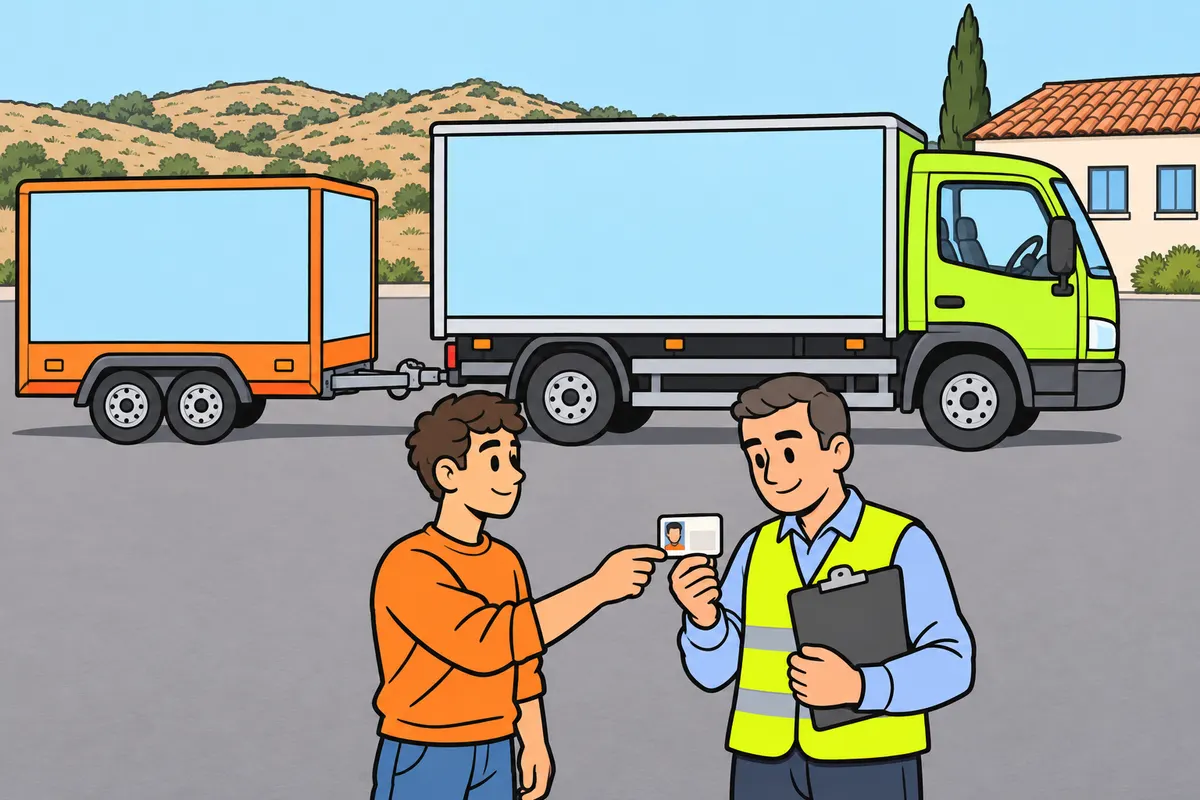
You can take theory early, but must meet the age requirement for your first practical test.
| First attempt | Age condition |
|---|---|
| Knowledge test | Up to three months before the minimum age |
| Practical test | Already 18 |
Remember
- You can take your first theory attempt before reaching the minimum age.
- You must be 18 on the date of your first practical attempt.
- Passing theory early does not authorise you to drive.
Exam trap: Wrong: you can also take practical tests early. Right: you must be 18 by your first practical attempt.
Read the full explanation
- You may take your first knowledge test up to three months before reaching the minimum age required to obtain the category. This option applies to the theory test; it does not authorise you to drive a C1+E combination before you meet the requirements for the licence to be issued. [RGCond, art. 51.2](https://www.boe.es/buscar/act.php?id=BOE-A-2009-9481#a51). [RGCond, annex VI.A.2](https://www.boe.es/buscar/act.php?id=BOE-A-2009-9481#anvi).
- You must be at least 18 on the date scheduled for your first practical test attempt. Turning 18 after the test or having family permission is not sufficient; the early entry allowed for knowledge tests does not extend to tests of skills and behaviour. [RGCond, annex VI.A.2](https://www.boe.es/buscar/act.php?id=BOE-A-2009-9481#anvi).
13Which tests you must pass
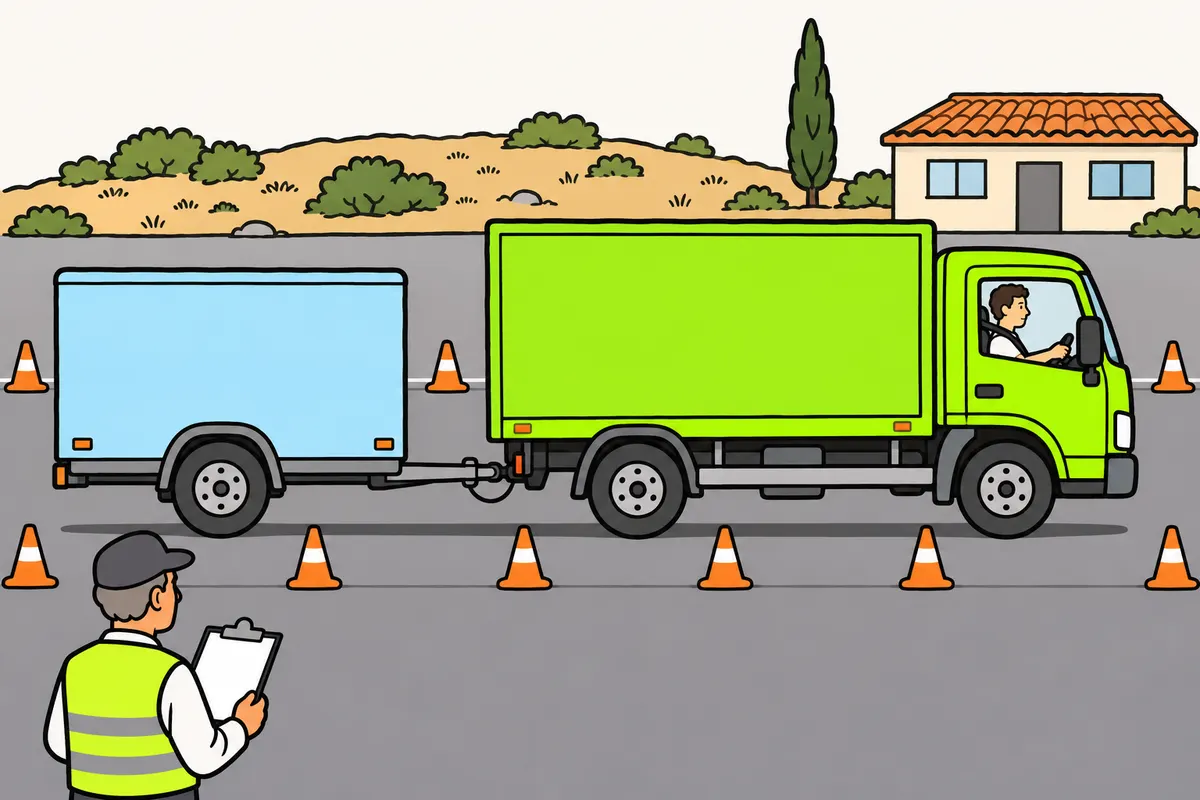
You must pass specific theory, closed-circuit and on-road tests, in that order.
Remember
- You must also prove physical and mental fitness.
- Your C1 theory test does not replace the specific combination test.
- This extension does not add a common theory test.
- You normally take each test on a different date.
- The traffic office may allow shared dates in justified exceptional cases.
Exam trap: Wrong: shared test dates let you skip tests. Right: each test remains compulsory, and you must pass each stage.
Read the full explanation
- The C1+E test schedule includes a specific knowledge test, a closed-circuit test and an on-road test, as well as an assessment of your physical and mental fitness; it does not add a separate common theory test for this licence extension. Your C1 theory test and your experience with a lorry do not replace the specific test for vehicle combinations. [RGCond, annex V](https://www.boe.es/buscar/act.php?id=BOE-A-2009-9481#anv). [RGCond, art. 54](https://www.boe.es/buscar/act.php?id=BOE-A-2009-9481#a54).
- The tests are qualifying stages: you must pass the knowledge test before the closed-circuit test, and the closed-circuit test before the on-road test. [RGCond, art. 53.1](https://www.boe.es/buscar/act.php?id=BOE-A-2009-9481#a53). [RGCond, annex V](https://www.boe.es/buscar/act.php?id=BOE-A-2009-9481#anv).
- As a general rule, you take the knowledge, closed-circuit and on-road tests on different dates. The Jefatura de Tráfico (provincial traffic office) may authorise all or some of them to take place on the same date in justified exceptional cases, but this does not remove any test or change the requirement to qualify at each stage. [RGCond, art. 51.3](https://www.boe.es/buscar/act.php?id=BOE-A-2009-9481#a51). [RGCond, annex V](https://www.boe.es/buscar/act.php?id=BOE-A-2009-9481#anv).
14Exemptions from the specific theory test
Theory exemptions depend on the category you apply for and your circumstances.
| Category you apply for | Valid licence you hold | Specific theory exemption |
|---|---|---|
| C1+E | B+E or D1+E | Not for this reason |
| C+E | C1+E | Yes |
| D1+E or D+E | C1+E | Yes |
Remember
- B+E or D1+E does not exempt you from specific theory when applying for C1+E.
- A valid C1+E gives specific theory exemptions for the categories shown.
- You still need the relevant base licence and must meet the other requirements.
- A qualifying specific theory pass also counts while it remains valid.
Exam trap: Wrong: an exemption automatically grants another category. Right: it only removes the relevant specific theory test.
Read the full explanation
- Article 54.2 does not provide a specific exemption for you as a C1+E applicant on the basis that you hold B+E or D1+E. You must prepare for the specific test for this category. [RGCond, art. 54](https://www.boe.es/buscar/act.php?id=BOE-A-2009-9481#a54).
- If you subsequently apply for C+E and hold a valid C1+E licence, you are exempt from its specific knowledge test under the terms of article 54.2.d. That provision also covers D1+E licence holders; it concerns obtaining C+E, rather than granting it to you automatically. [RGCond, art. 54](https://www.boe.es/buscar/act.php?id=BOE-A-2009-9481#a54).
- If you apply for D1+E or D+E and hold a valid C1+E licence, article 54.2.e provides an exemption from the specific knowledge test. You still need the corresponding base licence and must meet the other requirements of the bus category you apply for. [RGCond, art. 54](https://www.boe.es/buscar/act.php?id=BOE-A-2009-9481#a54). [RGCond, art. 5](https://www.boe.es/buscar/act.php?id=BOE-A-2009-9481#a5).
- The exemption under article 54.2 can also apply if you have passed the specific test to obtain the category that entitles you to the exemption, while that qualifying result remains valid. [RGCond, art. 53](https://www.boe.es/buscar/act.php?id=BOE-A-2009-9481#a53). [RGCond, art. 54](https://www.boe.es/buscar/act.php?id=BOE-A-2009-9481#a54).
15Theory test content and format
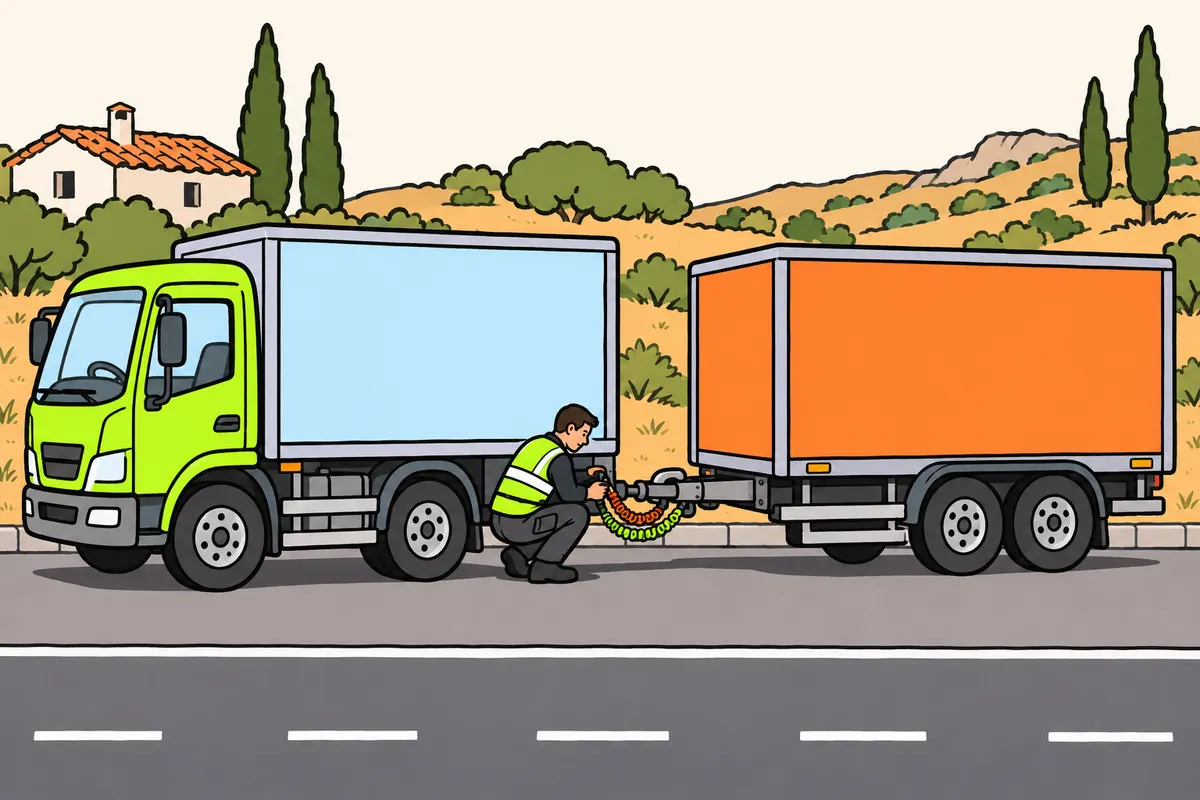
Prepare driver, combination and load safety for your specific theory test.
Remember
- Study coupling, uncoupling and how to drive your combination.
- You must know the full course syllabus.
- As a C1+E applicant outside tachograph rules, you are exempt from certain subjects.
- These subjects cover driving time, tachographs, goods rules and transport documents.
- Code 97 separately bars you from driving C1 lorries subject to tachograph rules.
Exam trap: Wrong: code 97 only exempts you from some test subjects. Right: if it appears on your licence, you cannot drive C1 lorries subject to tachograph rules.
Read the full explanation
- The specific test for vehicle combinations assesses the rules and safety relating to you as the driver, the combination and its load, coupling and uncoupling systems, and driving technique. You must know the full course syllabus; this module covers your entitlement to drive and the examination process. [RGCond, annex V.B.2.6.º](https://www.boe.es/buscar/act.php?id=BOE-A-2009-9481#anv). [RGCond, annex VI.B](https://www.boe.es/buscar/act.php?id=BOE-A-2009-9481#anvi).
- The specific test has 20 questions. Its duration and marking are explained in the next section. [DGT, Manual IV, topic 4](https://sede-org.dgt.gob.es/export/sites/dgt/.galleries/permisos-de-conducir/certificacion-aptitud-profesores-formacion-vial/2023/Manual-IV-Normativa-Permisos-Conduccion-2023.pdf).
- Annex VI.B.1 sets a range of 16 to 30 questions for specific tests. This range sets the regulatory limits within which the DGT configures specific tests; this section specifies the format you prepare for. [RGCond, annex VI.B](https://www.boe.es/buscar/act.php?id=BOE-A-2009-9481#anvi).
- If you apply for C1+E and are not within the scope of Reg. (CEE) 3821/1985 (tachograph), you are exempt from subjects a), b) and c) of point 2.4.º of annex V: driving time and tachographs, specific goods transport rules and transport documents. [RGCond, annex V.B.2.6.º, reference to 2.4.º.a-c](https://www.boe.es/buscar/act.php?id=BOE-A-2009-9481#anv). Code 97 is a separate matter: if it appears on your licence, you cannot drive C1 lorries subject to tachograph requirements. [RGCond, annex I, code 97](https://www.boe.es/buscar/act.php?id=BOE-A-2009-9481#ani).
16Theory test time and errors
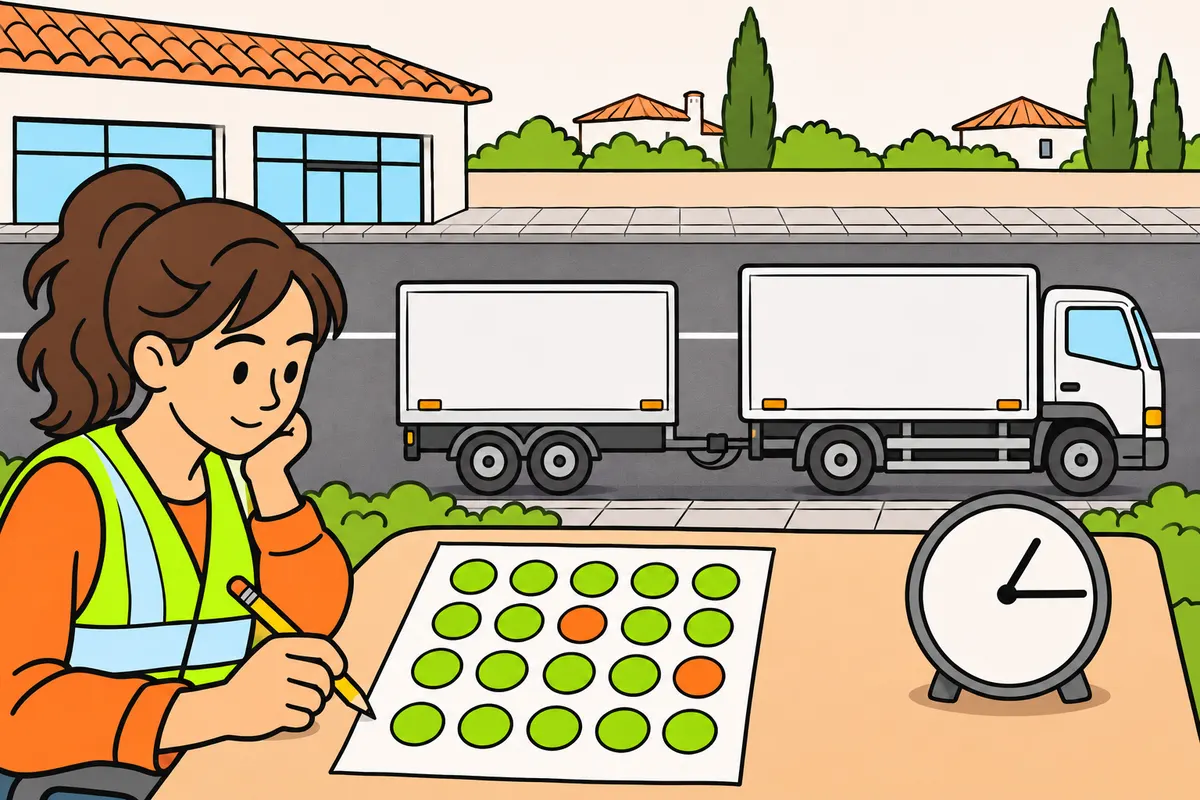
In the standard theory test, you have 20 minutes and can make at most two errors.
Remember
- You can divide the time between questions.
- You do not have to spend exactly one minute on each question.
- With three errors, you fail.
- Videos can extend the time in proportion to their duration.
- Duly justified special needs can also allow extra time.
Exam trap: Wrong: you must move to the next question after one minute. Right: you can divide the total time yourself.
Read the full explanation
- The time allowance is one minute per question: for 20 questions, you have 20 minutes in the standard format. You can divide this time between the questions; the rule does not require you to answer each one in exactly one minute or move to the next when that minute is up. [RGCond, annex VI.B.1-3](https://www.boe.es/buscar/act.php?id=BOE-A-2009-9481#anvi).
- Your time allowance may be extended in proportion to the length of any videos preceding the questions and for duly justified special needs. [RGCond, annex VI.B.1-3](https://www.boe.es/buscar/act.php?id=BOE-A-2009-9481#anvi).
- Your errors must not exceed 10 % of the total number of questions for you to qualify. In a 20-question test, the maximum is two: with three errors, you are marked unsuccessful. [RGCond, annex VI.B.1-3](https://www.boe.es/buscar/act.php?id=BOE-A-2009-9481#anvi).
17Test attempts and resit intervals
Each application normally gives you two attempts, and you must respect the resit intervals.
| After failing | Normal minimum wait |
|---|---|
| Second attempt, before the third | ten days |
| Later attempts | fifteen days from the failed test |
Remember
- The traffic office sets your exact test date.
- If absent, you lose the attempt unless exceptional circumstances are duly justified.
- The maximum interval allows justified exceptions, such as illness.
- Minimum waits may exceptionally be reduced for recognised and justified urgency.
Exam trap: Wrong: an application’s attempts last two years. Right: the normal maximum between its two attempts is six months.
Read the full explanation
- As a general rule, each application entitles you to two attempts at the tests. [RGCond, annex VI.A.2](https://www.boe.es/buscar/act.php?id=BOE-A-2009-9481#anvi).
- As a general rule, no more than six months may elapse between the two attempts under the same application, except in cases of illness or other justified exceptional circumstances. This is the maximum interval between attempts under your application, rather than the duration of your licence or the general validity period of a successful test result. [RGCond, art. 51.2](https://www.boe.es/buscar/act.php?id=BOE-A-2009-9481#a51). [RGCond, annex VI.A.2](https://www.boe.es/buscar/act.php?id=BOE-A-2009-9481#anvi).
- If you do not succeed in a test in two attempts, at least ten days must elapse between your second and third attempts. For subsequent attempts, the minimum is fifteen days, counted from the unsuccessful test; these periods may exceptionally be reduced for recognised and justified urgency. The Jefatura de Tráfico sets your actual date. [RGCond, annex VI.A.2](https://www.boe.es/buscar/act.php?id=BOE-A-2009-9481#anvi).
- If you do not attend on the scheduled date, you lose that attempt, except in duly justified exceptional cases. [RGCond, art. 51.2](https://www.boe.es/buscar/act.php?id=BOE-A-2009-9481#a51). [RGCond, annex VI.A.2](https://www.boe.es/buscar/act.php?id=BOE-A-2009-9481#anvi).
18How long a pass remains valid
Your pass lasts two years, and passing the next test restarts the period.
Remember
- Count from the day after you are declared to have passed.
- Complete your remaining tests within the relevant validity period.
- Passing the next test within that period starts a new period.
- Use your result dates, rather than the date you started lessons.
Exam trap: Wrong: the period starts when you begin lessons. Right: count from the day after you are declared to have passed.
Read the full explanation
- Your successful test result is valid for two years, counted from the day after you are declared successful. You must complete the remaining stages within the applicable validity period; this period belongs to the process of obtaining your licence and must not be confused with the standard five-year validity of the C1+E licence. [RGCond, art. 53](https://www.boe.es/buscar/act.php?id=BOE-A-2009-9481#a53).
- If you pass the next test within that period, the validity period starts again. For example, passing the closed-circuit test while your knowledge test result remains valid starts a new period for you to proceed to the on-road test; you must use the dates of your results, rather than the day you started lessons. [RGCond, art. 53](https://www.boe.es/buscar/act.php?id=BOE-A-2009-9481#a53).
19Identification and examination arrangements
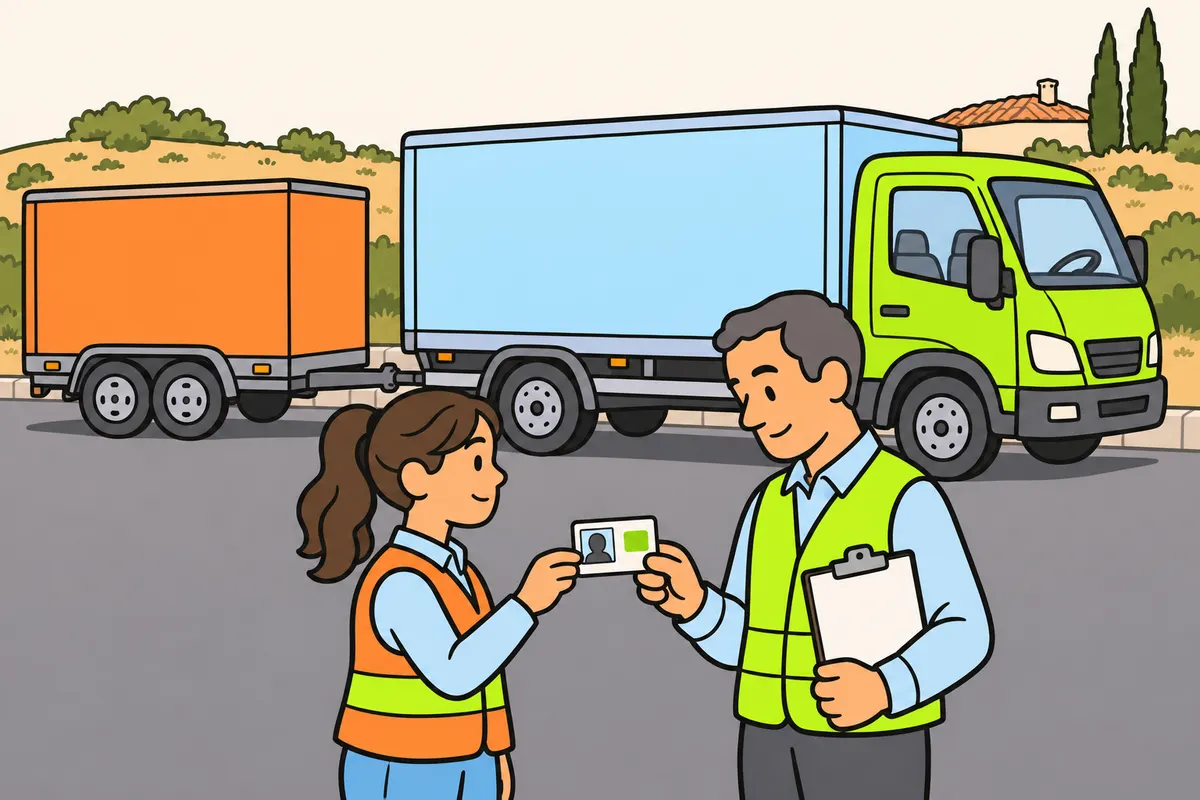
Show the identification requested for your practical tests.
Remember
- Show your DNI, passport, residence card or driving licence, as appropriate.
- Without the required identification, your test does not start.
- You do not lose an attempt in this case.
Exam trap: Wrong: forgetting required identification always uses an attempt. Right: your test does not start without losing an attempt.
Read the full explanation
- In practical tests, you must present your DNI (Spanish national identity card), passport, residence card or driving licence, as appropriate, when requested; if you do not have the required identification, the test does not start, and you do not lose the attempt. [RGCond, Annex VI.A.3](https://www.boe.es/buscar/act.php?id=BOE-A-2009-9481#anvi).
20Cheating in tests
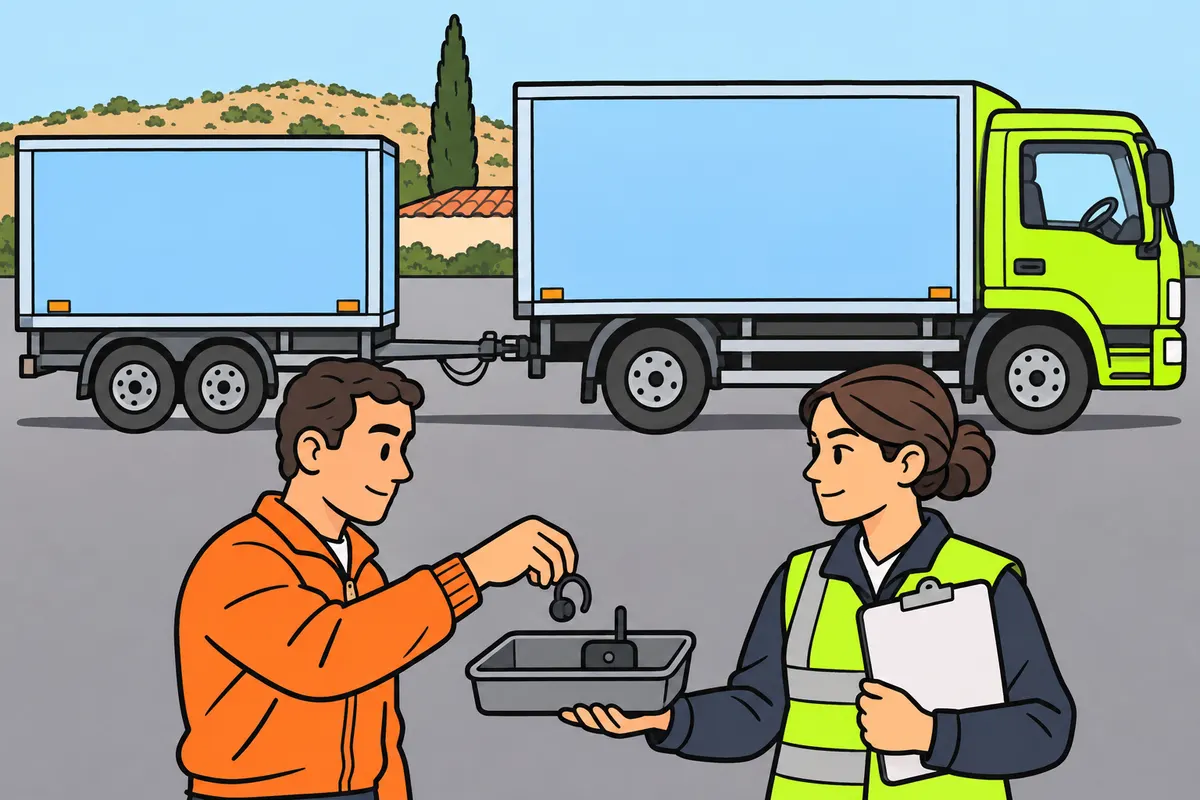
Using banned communication devices or trying to cheat has serious consequences in your test.
Remember
- Do not use unauthorised communication devices.
- Do not cooperate or help others through these devices.
- As an applicant, this offence bars you from tests for six months.
- Cheating, attempted cheating or disorder can stop your test and cause failure.
Exam trap: Wrong: trying to cheat does not count unless you receive an answer. Right: the attempt can also stop your test and cause failure.
Read the full explanation
- If you use intercommunication devices that are not authorised under the regulations during tests, or help or assist using them, you commit a very serious offence. As a candidate, you are also barred for six months from taking tests to obtain or regain driving permits, licences or other authorisations to drive. [Traffic Act, arts. 77.u and 80.4](https://www.boe.es/buscar/act.php?id=BOE-A-2015-11722#a80). [RGCond, Annex VI.A.4](https://www.boe.es/buscar/act.php?id=BOE-A-2009-9481#anvi).
- If you disrupt order, cheat or attempt to cheat, your test may be interrupted and suspended and you may be marked as having failed. You do not need to actually obtain an answer through the fraudulent means for the attempt to have consequences for your test. [RGCond, art. 57.1](https://www.boe.es/buscar/act.php?id=BOE-A-2009-9481#a57). [RGCond, Annex VI.A.4](https://www.boe.es/buscar/act.php?id=BOE-A-2009-9481#anvi).
21Closed circuit: the three C1+E manoeuvres
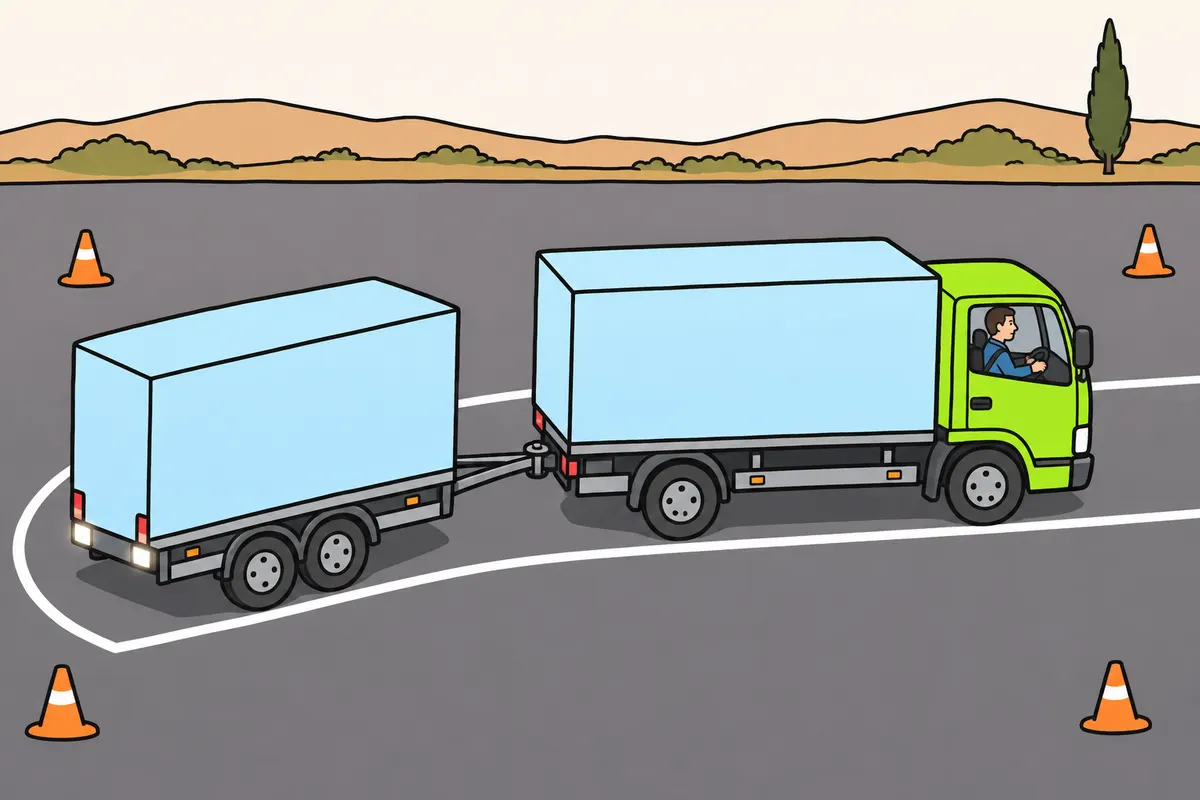
On the closed circuit, show you can reverse, park and couple your combination.
| C1+E and C+E manoeuvre | What you must do |
|---|---|
| G | Reverse in a straight line and around a bend |
| K | Park safely for loading or unloading at a ramp, platform or similar facility |
| M | Couple and uncouple a trailer or semi-trailer |
Remember
- Prepare and check your combination for safe driving before the manoeuvres.
- Manoeuvre letters identify test exercises, rather than traffic signs.
- You must show coupling and uncoupling, beyond moving off with everything ready.
Exam trap: Wrong: G means turning round. Right: it means reversing in a straight line and around a bend.
Read the full explanation
- For C1+E and C+E, you must pass the specific closed-circuit test involving manoeuvres G, K and M. These identify test exercises; they are not traffic sign codes. [RGCond, Annex V.B.3.8](https://www.boe.es/buscar/act.php?id=BOE-A-2009-9481#anv).
- Manoeuvre G involves reversing in a straight line and around a bend. You must demonstrate that you control the combination when reversing, keeping its path within the designated space. [RGCond, Annex V.B.3.8](https://www.boe.es/buscar/act.php?id=BOE-A-2009-9481#anv).
- Manoeuvre K involves parking safely for loading or unloading at a ramp, platform or similar facility. Manoeuvre M involves coupling and uncoupling the trailer or semi-trailer. [RGCond, Annex V.B.3.8](https://www.boe.es/buscar/act.php?id=BOE-A-2009-9481#anv).
- Before the manoeuvres, you must demonstrate your preparation for safe driving and carry out the required checks on the combination’s systems and components. You study the detailed techniques for carrying out the manoeuvres in «Driving techniques for vehicle combinations» and «Safe coupling and uncoupling». [RGCond, Annex V.B.3.8](https://www.boe.es/buscar/act.php?id=BOE-A-2009-9481#anv).
22How the closed-circuit test is marked
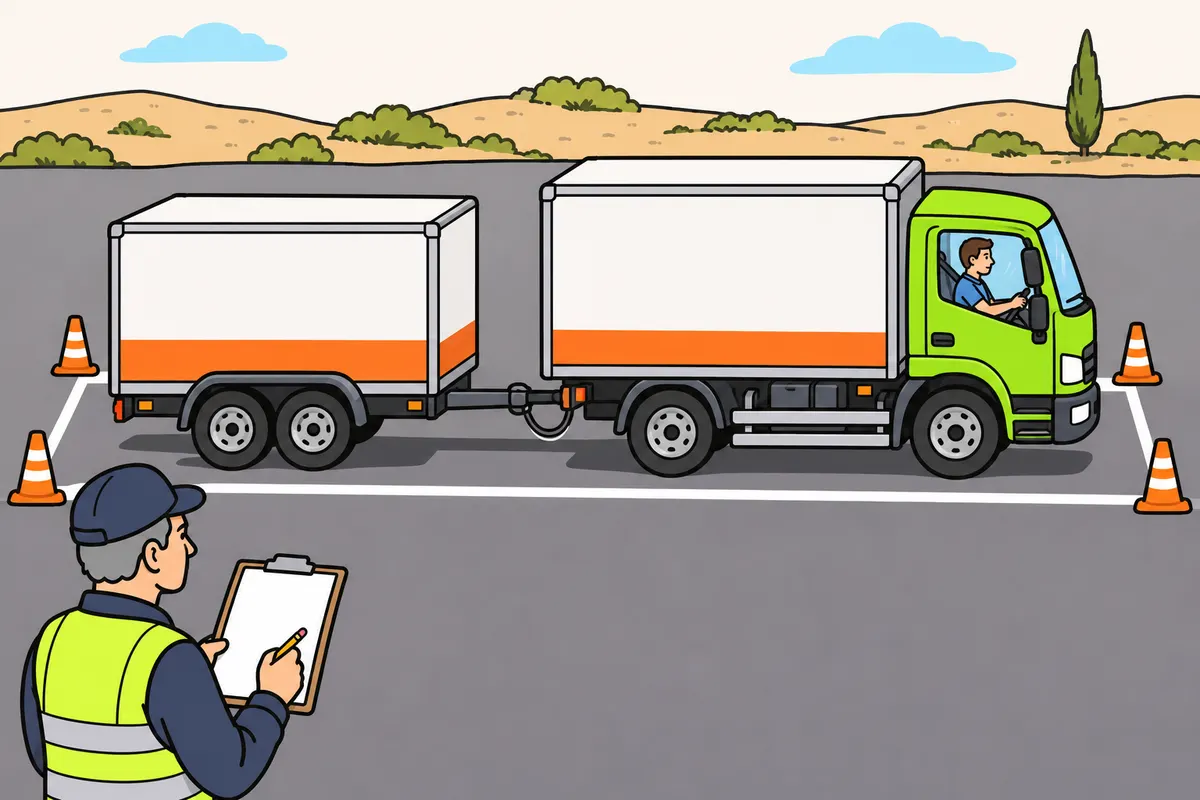
Closed-circuit failure depends on the seriousness and combination of your faults.
| Closed-circuit fault combination | Result |
|---|---|
| One disqualifying fault | Fail |
| Two serious faults | Fail |
| One serious and two minor faults | Fail |
| Four minor faults | Fail |
Remember
- One disqualifying fault is enough to fail.
- Test time depends on the manoeuvres and vehicle.
- Keep control of the combination throughout the manoeuvre.
Exam trap: Wrong: all manoeuvres have the same time limit. Right: time depends on the manoeuvres and the vehicle used.
Read the full explanation
- In the closed-circuit test, your faults are classified as elimination, serious or minor faults according to their severity. An disqualifying fault shows a lack of control that prevents you from carrying out the manoeuvre under the required conditions, or a clear lack of skill; a serious fault indicates significantly inappropriate use of the controls without reaching that level of inability. [RGCond, Annex VI.C.2 and C.3.1.º](https://www.boe.es/buscar/act.php?id=BOE-A-2009-9481#anvi).
- You fail the closed-circuit test if you commit one disqualifying fault, two serious faults, one serious fault and two minor faults, or four minor faults. [RGCond, Annex VI.C.2 and C.3.1.º](https://www.boe.es/buscar/act.php?id=BOE-A-2009-9481#anvi).
- The time allowed for the closed-circuit test depends on the characteristics and difficulty of the manoeuvres and the vehicle you use. For the C1+E exercises, you must follow the conditions for carrying out each manoeuvre and maintain control of the combination throughout the course. [RGCond, Annex VI.C.2.1.º](https://www.boe.es/buscar/act.php?id=BOE-A-2009-9481#anvi).
23On-road test: assessment and duration
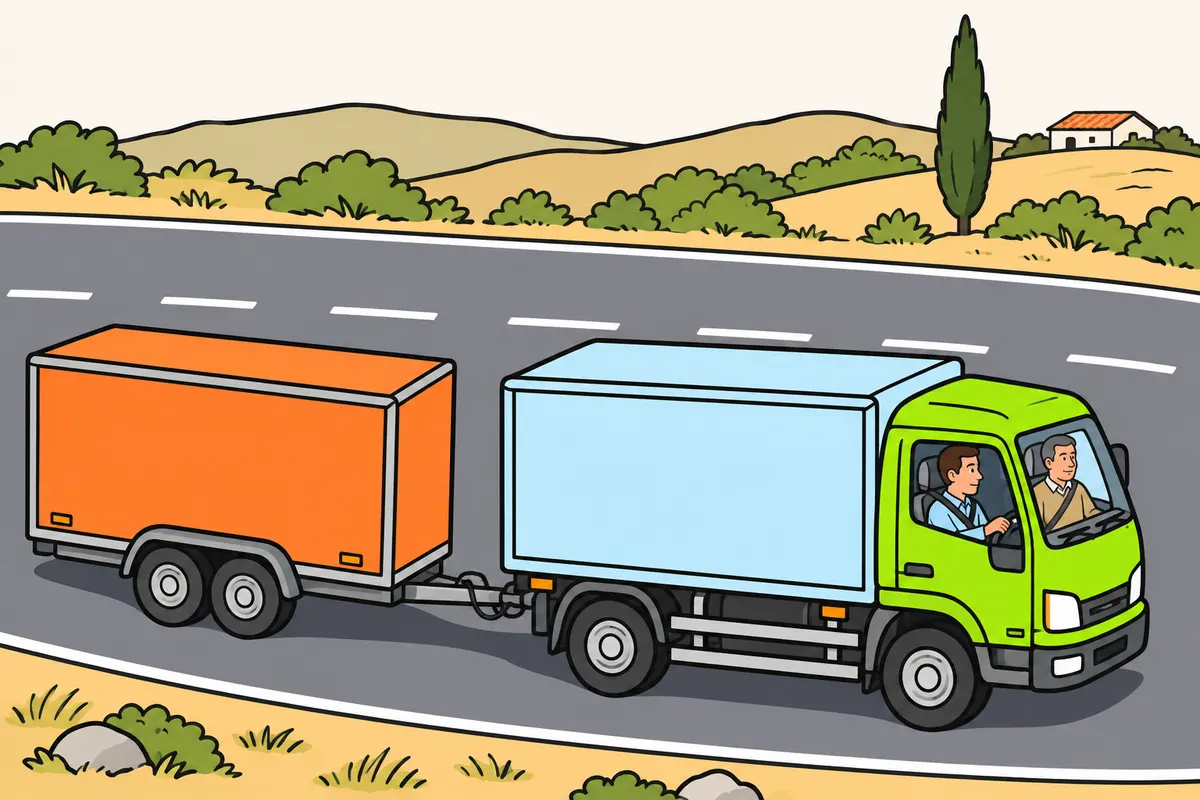
On the road, control your whole combination and drive safely in real situations.
| On-road fault combination | Result |
|---|---|
| One disqualifying fault | Fail |
| Two serious faults | Fail |
| One serious and five minor faults | Fail |
| Ten minor faults | Fail |
Remember
- Check your vehicle and observe before acting.
- Control your path, allowing for the combination’s length and overhangs.
- The minimum excludes reception, preparation, checks, special manoeuvres and receiving your result.
- Your test can be stopped and failed earlier.
- Your authorised instructor or trainer must sit at the dual controls.
- Only people allowed by the regulations can accompany you.
Exam trap: Wrong: a dangerous fault counts like any other error. Right: it can be disqualifying and enough to fail.
Read the full explanation
- On public roads, you must demonstrate safe driving in real situations: preliminary checks, driving position on the road, observation, use of the controls, joining traffic, lane use, junctions and the other operations in the syllabus. In C1+E, you are assessed on your control of the whole combination, including its path as affected by its length and overhangs. [RGCond, Annex V.B.4](https://www.boe.es/buscar/act.php?id=BOE-A-2009-9481#anv). [RGCond, Annex VI.C.2.2.º and C.3.2.º](https://www.boe.es/buscar/act.php?id=BOE-A-2009-9481#anvi).
- For C1+E, you must drive on the road for a minimum of 45 minutes, unless the tests are interrupted and suspended. [RGCond, Annex VI.C.2.2.º and C.3.2.º](https://www.boe.es/buscar/act.php?id=BOE-A-2009-9481#anvi).
- The 45 minutes do not include reception, vehicle preparation, technical safety checks, special manoeuvres where applicable or notification of the result. Your appointment may therefore take longer overall: the minimum refers to the driving time on the road specified in the regulations. [RGCond, Annex VI.C.2.2.º and C.3.2.º](https://www.boe.es/buscar/act.php?id=BOE-A-2009-9481#anvi).
- You fail the on-road test with one disqualifying fault, two serious faults, one serious fault and five minor faults, or ten minor faults. A fault that creates danger may be an disqualifying fault on its own. [RGCond, Annex VI.C.2.2.º and C.3.2.º](https://www.boe.es/buscar/act.php?id=BOE-A-2009-9481#anvi).
- An instructor, or the person who provided your training under the terms of the regulations, sits at the dual controls. Only candidates, examiners and instructors or authorised accompanying persons may travel in the test vehicle. [RGCond, art. 55.1](https://www.boe.es/buscar/act.php?id=BOE-A-2009-9481#a55). [RGCond, Annex VI.C.2.2.º and C.3.2.º](https://www.boe.es/buscar/act.php?id=BOE-A-2009-9481#anvi).
24Test vehicle and scope of the licence
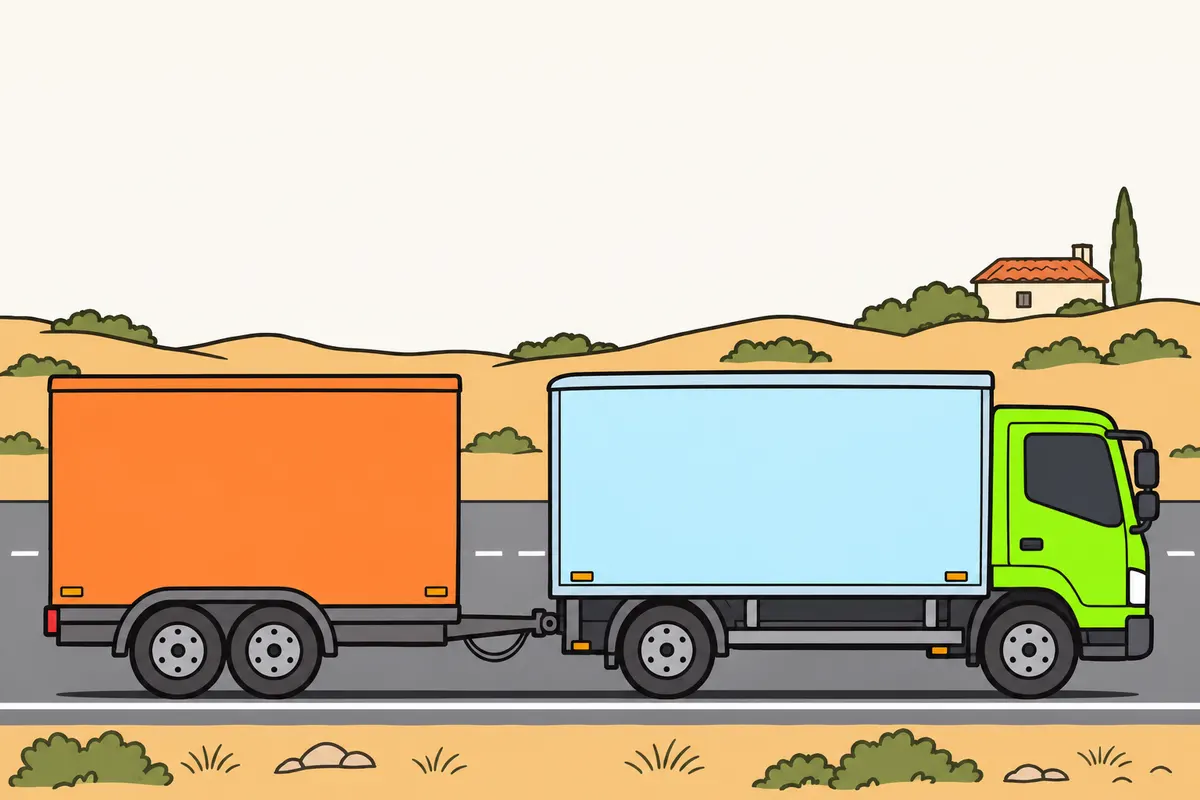
Your test combination must meet specific requirements for mass, size and gearbox.
| C1+E test vehicle | MMA | Length | Minimum actual mass |
|---|---|---|---|
| Lorry | 5,500 kg to 7,500 kg | Over 5 metres and under 7 metres | 4,500 kg |
| Trailer | At least 2,500 kg | At least 4 metres, excluding drawbar or coupling | 800 kg |
Remember
- Your test combination must not exceed 12,000 kg MMA.
- Your trailer needs an enclosed body at least as high as the cab.
- It may be slightly narrower if only exterior mirrors let you see behind.
- The general test rule requires a manual gearbox.
- An automatic means a licence restriction unless the regulatory exception applies.
Exam trap: Wrong: passing limits you to that lorry model. Right: test vehicle requirements do not restrict your licence that way. With an automatic, you avoid the restriction only if you hold a listed category obtained with a manual gearbox and perform the required on-road operations.
Read the full explanation
- To take the C1+E test, you must use a combination consisting of a lorry meeting the requirements for the C1 test and a trailer meeting the specific conditions in Annex VII. [RGCond, Annex VII.B.8-9](https://www.boe.es/buscar/act.php?id=BOE-A-2009-9481#anvii).
- The test lorry must have an MMA (maximum authorised mass) of at least 5,500 kg and no more than 7,500 kg, and a length greater than 5 metres and less than 7 metres. Its minimum actual total weight is 4,500 kg. [RGCond, Annex VII.B.8-9](https://www.boe.es/buscar/act.php?id=BOE-A-2009-9481#anvii).
- The test trailer must have an MMA of at least 2,500 kg and a length of at least 4 metres, excluding the drawbar or hitch or coupling system. Its minimum actual total weight is 800 kg, and the combination’s MMA must not exceed 12,000 kg. [RGCond, Annex VII.B.8-9](https://www.boe.es/buscar/act.php?id=BOE-A-2009-9481#anvii).
- The trailer body may be slightly narrower than the towing vehicle if you can only see to the rear using the cab’s exterior mirrors. These requirements define the representative test vehicle; they do not restrict your licence to the make, body type or specific mass of the vehicle in which you pass. [RGCond, Annex VII.B.8-9](https://www.boe.es/buscar/act.php?id=BOE-A-2009-9481#anvii).
- The general manual-transmission rule applies to the test vehicle. If you take your test with an automatic transmission, the corresponding restriction is recorded, unless you hold one of the categories listed in the regulations obtained with a manual transmission and carry out the required operations during the on-road test. The trailer must have an enclosed body at least as high as the cab; the width exception is the one stated in the previous point. [RGCond, Annex VII.A.4 and 7](https://www.boe.es/buscar/act.php?id=BOE-A-2009-9481#anvii).
25Standard validity periods and conditions
Check your C1+E expiry date and keep meeting the requirements to drive.
| Your age: C1, C1+E, C and C+E licences | Standard validity |
|---|---|
| Under 65 | five years |
| From 65 | three years |
Remember
- Check the expiry date for the category you use.
- An illness or impairment that could worsen may shorten your validity period.
- Follow any restrictions shown on your licence.
- You must keep meeting the requirements and must not lose all your points.
Exam trap: Wrong: an expiry date still in the future is enough. Right: you must also retain validity under the other requirements.
Read the full explanation
- Your C1 and C1+E licences, like C and C+E, normally remain valid for five years while you are under 65 and for three years from that age. You must check the specific expiry date shown for the category you use to drive the combination. [RGCond, art. 12](https://www.boe.es/buscar/act.php?id=BOE-A-2009-9481#a12).
- The period may be shortened if you have an illness or impairment that may worsen, even if it allows your licence to be granted or renewed. The five-year and three-year periods are the standard periods: you must observe your individual expiry date and any applicable restrictions. [RGCond, art. 3.1](https://www.boe.es/buscar/act.php?id=BOE-A-2009-9481#a3). [RGCond, art. 12](https://www.boe.es/buscar/act.php?id=BOE-A-2009-9481#a12).
- Validity also depends on you continuing to meet the requirements for the licence to be granted and not losing all your points. A printed expiry date that has not yet arrived is not enough to allow you to drive if your licence has lost its validity; you must distinguish expiry through the passage of time from other grounds affecting your entitlement to drive. [RGCond, art. 12](https://www.boe.es/buscar/act.php?id=BOE-A-2009-9481#a12).
26How to renew C1+E
Renew C1+E with the appropriate medical assessment and drive only while your licence is valid.
Remember
- Apply for renewal and prove your physical and mental fitness for group 2.
- You can arrange renewal at an authorised driver medical assessment centre.
- Standard renewal does not require you to repeat driving tests.
- Within the early renewal window, your new period starts at expiry.
- You can renew an expired licence, but cannot drive while it remains expired.
- Renewing group 2 also renews your group 1 licences for their respective periods.
Exam trap: Wrong: you can drive for three months after expiry. Right: these months allow early renewal; you cannot drive with an expired licence.
Read the full explanation
- To renew your licence, you must apply and show that you still meet the physical and mental fitness requirements for the category. C1+E belongs to driver group 2, so your medical assessment must be for that group. [RGCond, art. 45](https://www.boe.es/buscar/act.php?id=BOE-A-2009-9481#a45). [RGCond, art. 13](https://www.boe.es/buscar/act.php?id=BOE-A-2009-9481#a13).
- You can submit your application during the three months before expiry. Within that window, the new period runs from the expiry date, so applying early within the normal application period does not cost you any days of validity. [RGCond, art. 13](https://www.boe.es/buscar/act.php?id=BOE-A-2009-9481#a13).
- Normal renewal does not require you to retake the theory, manoeuvres or on-road tests: you must meet the medical assessment requirements and complete the procedure. You can arrange this at an authorised Centro de Reconocimiento de Conductores (driver medical assessment centre). The documents and administrative channels are explained in «Driver and vehicle combination documentation». [DGT, licence renewal](https://www.dgt.es/nuestros-servicios/permisos-de-conducir/ha-caducado-o-necesitas-una-copia-de-tu-permiso/renovar-un-permiso-proximo-a-caducar/). [RGCond, art. 13](https://www.boe.es/buscar/act.php?id=BOE-A-2009-9481#a13).
- You can apply for renewal if your licence has expired, but you cannot drive with it while it remains expired. [RGCond, art. 12.4](https://www.boe.es/buscar/act.php?id=BOE-A-2009-9481#a12). [RGCond, art. 13](https://www.boe.es/buscar/act.php?id=BOE-A-2009-9481#a13).
- Renewing a group 2 driving entitlement also renews any group 1 entitlements you hold, for their applicable validity periods. [RGCond, art. 13](https://www.boe.es/buscar/act.php?id=BOE-A-2009-9481#a13).
27Driving time, tachograph and transport documents
Follow driving and rest limits, and carry the required records and transport documents.
| Case subject to these rules | What you must do |
|---|---|
| Daily driving | Up to 9 hours; up to 10 hours no more than twice a week |
| Break after 4 hours 30 minutes driving | At least 45 minutes, unless you begin a rest period |
| Split break | At least 15 minutes, then at least 30 minutes, in that order; both within the driving period |
| Daily rest when driving alone | Complete it within 24 hours after your previous daily or weekly rest ends |
| Regular daily rest | At least 11 hours |
| Reduced daily rest | At least 9 hours; no more than three between weekly rests |
| Regular weekly rest | At least 45 hours |
| Reduced weekly rest | At least 24 hours |
| Start of weekly rest | Start no later than the end of six consecutive 24-hour periods after the previous weekly rest ends. |
| Two consecutive weeks: general rule | Two regular weekly rests, or one regular and one reduced rest |
| Make-up for reduced weekly rest | Make up all the reduction by the end of the third following week; add it to another rest of at least 9 hours |
| Your working time as a mobile worker | Includes driving and tasks involving your vehicle or load |
| Actual work with irregular hours agreed collectively or with worker representatives | Do not exceed an average of 48 hours weekly over four months, or 60 hours in any week |
| Extending the period used to calculate this average | A national sectoral collective agreement can extend it to six months for objective, technical or organisational reasons |
| Records for a check | Current day and previous 56 days; also analogue sheets if you used them during that period |
| Goods transport for hire or reward requiring a control document | Carry it on board with the consignment; it must be digital |
| Control document details | Contracting consignor, actual carrier, origin, destination, goods, weight, date and registration numbers; special movement authorisation where required |
| Consignment note as control document | It is enough if it contains all required details |
| If you must document the consignment | Keep a copy for at least one year, available to the Inspectorate |
| International road transport | Carry the CMR consignment note with the goods; it records the contract |
| CMR consignment note details | Identify the sender, carrier, consignee, collection and delivery locations, and goods; include all other required details |
Remember
- If your combination is subject to these rules, follow the limits and rest periods.
- Insert your valid personal card when you take charge; use only your own.
- Record work, availability, breaks and rest; add activities away from the vehicle manually.
- Show your card, manual entries, printouts and applicable analogue sheets covering the required period.
- For international transport or cabotage, carry the Community licence or an authentic copy.
- Carry the control document when required for your goods transport for hire or reward.
Exam trap: Wrong: you drive for 4 h 30 min, then take 15 minutes followed by 30 minutes. Right: if you split the break, take at least 15 minutes first, then at least 30 minutes, both within the 4 h 30 min driving period. Without splitting, take 45 minutes together when you reach 4 h 30 min.
Read the full explanation
- If you drive a combination subject to these rules, you can drive for up to 9 hours a day, extended to 10 hours no more than twice a week. [Regulation (EC) 561/2006, art. 6.1](https://www.boe.es/buscar/doc.php?id=DOUE-L-2006-80632).
- You can drive for a maximum of 56 hours in a week and a total of 90 hours in two consecutive weeks. [Regulation (EC) 561/2006, art. 6.2-3](https://www.boe.es/buscar/doc.php?id=DOUE-L-2006-80632).
- After 4 hours and 30 minutes of driving, you must take a break of at least 45 minutes, unless you start a rest period. You can split it into a break of at least 15 minutes followed by another of at least 30 minutes, in that order, taken during the driving period, so that you do not drive for more than 4 h 30 min without completing the 45 minutes. [Regulation (EC) 561/2006, art. 7](https://www.boe.es/buscar/doc.php?id=DOUE-L-2006-80632).
- When driving alone, you must complete your daily rest within the 24 hours following the end of your previous daily or weekly rest: a regular daily rest lasts at least 11 hours and a reduced daily rest at least 9 hours. You can take no more than three reduced daily rest periods between two weekly rest periods. [Regulation (EC) 561/2006, arts. 4.g and 8.2-4](https://www.boe.es/buscar/doc.php?id=DOUE-L-2006-80632).
- A regular weekly rest lasts at least 45 hours and a reduced weekly rest at least 24 hours. You must start your weekly rest no later than the end of six consecutive 24-hour periods counted from the end of your previous weekly rest. As a general rule, in two consecutive weeks you must take two regular weekly rests or one regular and one reduced weekly rest; you must compensate for the reduction with an equivalent rest period before the end of the third following week, attached to another rest period of at least 9 hours. [Regulation (EC) 561/2006, arts. 4.h and 8.6-7](https://www.boe.es/buscar/doc.php?id=DOUE-L-2006-80632); [Regulation (EU) 2020/1054, art. 1.6](https://www.boe.es/buscar/doc.php?id=DOUE-L-2020-81223).
- Your driving time regulated by Regulation (EC) 561/2006 is only part of your working time. If you are a mobile road transport worker, RD 1561/1995 limits your working time and also counts tasks relating to the vehicle or load as actual working time. If an irregular distribution of working time is agreed through a collective agreement or an agreement with workers' representatives, your actual working time must not exceed an average of 48 hours a week over four months or 60 hours in any one week; a national sectoral collective agreement may extend the reference period to six months for objective, technical or organisational reasons. [RD 1561/1995, arts. 8, 10 and 10 bis](https://www.boe.es/buscar/act.php?id=BOE-A-1995-21346#a10bis); [Regulation (EC) 561/2006, art. 6](https://www.boe.es/buscar/doc.php?id=DOUE-L-2006-80632).
- To use a digital tachograph, you must have your own valid personal driver card and insert it when you take charge of the vehicle. Select other work, availability, breaks and rest correctly, and complete manual entries for activities carried out away from the vehicle. Use only your own card. [Regulation (EU) 165/2014, arts. 26-27 and 34](https://www.boe.es/buscar/doc.php?id=DOUE-L-2014-80362).
- You must keep your records and be able to produce your card, manual entries and printouts for the current day and the previous 56 days at a check and, if you drove with an analogue tachograph during that period, its record sheets. [Regulation (EU) 165/2014, arts. 33 and 36, consolidated text](https://eur-lex.europa.eu/legal-content/ES/TXT/PDF/?qid=1788890977576&uri=CELEX%3A02014R0165-20241231).
- For international transport or cabotage, carry the Community licence or a certified true copy on board. [ROTT, art. 197.2](https://www.boe.es/buscar/act.php?id=BOE-A-1990-24442#a197).
- When carrying goods for hire or reward where a control document is required, you must carry it on board with the consignment. Identify the contracting shipper, the actual carrier, the origin, destination, goods and weight, date and registration numbers; include the special movement authorisation where applicable. A consignment note can serve this purpose if it contains the required information. [Order FOM/2861/2012, arts. 1-2 and 6](https://www.boe.es/buscar/act.php?id=BOE-A-2013-154).
- The administrative control document must be digital. If you are required to document the consignment, you must keep an original or a copy for at least one year, accessible to the transport inspectorate. [Act 9/2025, eighth transitional provision](https://www.boe.es/buscar/act.php?id=BOE-A-2025-24545#dt-8); [Order FOM/2861/2012, art. 9](https://www.boe.es/buscar/act.php?id=BOE-A-2013-154#a9).
- In international road transport, you document the contract with the CMR consignment note, which accompanies the goods. You must include the sender, carrier and consignee, the collection and delivery locations and the goods carried, among the information required by the Convention. [CMR Convention, arts. 4-6](https://www.boe.es/buscar/act.php?id=BOE-A-1974-753#a4).
Choose the entitlement for the combination
Classify the towing and towed vehicles by their authorised masses. Apply article 4 of the RGCond (General Regulations for Drivers).
- Identify the category and MMA (maximum authorised mass) of the towing and towed vehicles; distinguish these figures from actual mass.
- With a C1 towing vehicle and a trailer with an MMA up to 750 kg, C1 is sufficient in terms of licence category.
- With a C1 towing vehicle and a towed vehicle over 750 kg, check that the combination’s MMA does not exceed 12,000 kg: C1+E applies.
- With a category B towing vehicle and a towed vehicle over 3,500 kg, also check the 12,000 kg maximum for C1+E; for other category B combinations, distinguish B, code 96 and B+E.
- If the lorry exceeds 7,500 kg or the goods vehicle combination exceeds 12,000 kg, check C+E when the towed vehicle exceeds 750 kg; also check the technical limits and that your licence is valid.
Complete the C1+E tests
Progress through the stages under articles 53 and 54 of the RGCond, qualifying at each stage before proceeding.
- Check that you hold a valid C1 licence, are at least 18 years old and meet the physical and mental fitness requirements.
- Distinguish the specific C1+E test from exemptions when obtaining other categories: B+E does not replace this test.
- Pass the specific knowledge test for combinations.
- Pass manoeuvres G, K and M on a closed circuit.
- Pass the driving test on roads open to traffic; keep track of the two-year validity of your test results and the attempts available under your application.
Renew without interrupting your driving
Use the standard advance renewal period under article 13 of the RGCond.
- Check the individual expiry date of your C1+E licence and any applicable restrictions.
- During the three months before expiry, apply for renewal and provide evidence of group 2 physical and mental fitness.
- Complete the process at an authorised centre or through the appropriate DGT procedure.
- Check that you have valid authorisation to drive; if your licence has expired, wait until you hold a valid entitlement.
- Check the date assigned on renewal, which may be earlier than the standard period for medical reasons.
Check what you know
Real questions from the bank on this topic. Pick an answer to see the explanation.
Finished this module?
Mark it as read and you will see your progress on the theory list.