
Theory · D1+E Licence - Minibus with Trailer · Module 1 of 13
D1+E licence: requirements, tests and validity
You learn which minibuses with trailers you can drive with D1+E, when D1 is sufficient and how it differs from D+E and B with code 96. You learn about the minimum age, tests, exemptions and renewal so you can answer exam questions without confusing the licence category with the characteristics of the vehicle used in the tests. You also study the CAP (certificate of professional competence) and driver factors relevant to passenger transport with a trailer.
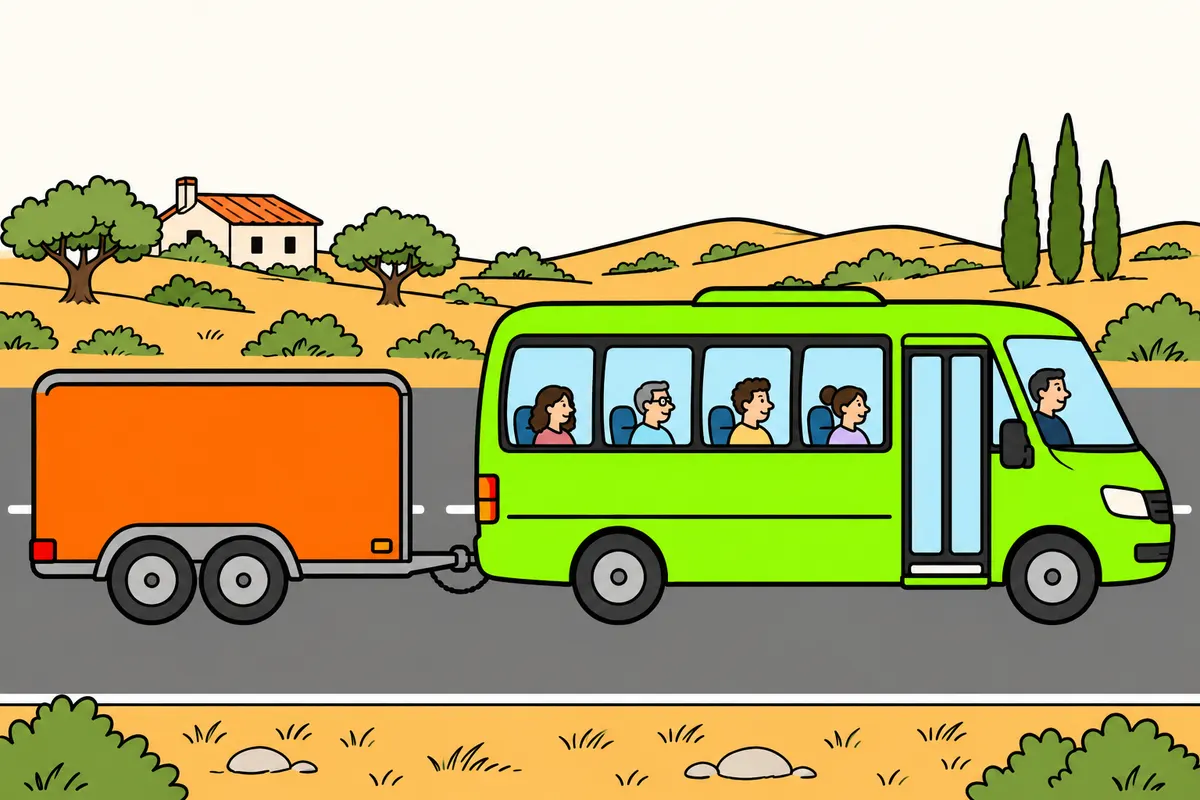
1What you can drive with D1+E
With D1+E, you can drive a D1 minibus with a heavy trailer.
Remember
- Check the minibus first, then the trailer’s maximum authorised mass (MMA).
- Keep within the technical limits of your minibus and trailer.
- Your minibus keeps its category even without passengers.
Exam trap: Wrong: the whole combination must fit within 8 metres. Right: this limit covers only the minibus.
Read the full explanation
- With D1+E you can drive a coupled combination consisting of a towing vehicle authorised by D1 and a trailer whose maximum authorised mass exceeds 750 kg. To determine the category, first identify the minibus and then the trailer’s MMA (maximum authorised mass): the combination’s commercial name does not determine the licence. [RGCond, art. 4](https://www.boe.es/buscar/act.php?id=BOE-A-2009-9481#a4).
- The D1 vehicle is designed and built to carry no more than 16 passengers in addition to you and has a maximum length of 8 metres. The E extension allows you to add a heavy trailer, but retains these limits for the towing vehicle; the 8 metres refer to the minibus, rather than the overall length of the combination. [RGCond, art. 4](https://www.boe.es/buscar/act.php?id=BOE-A-2009-9481#a4).
- The D1+E licence does not set its own maximum of 3,500 kg for the trailer, or 7,500 or 12,000 kg for the combination. You must comply with type-approval provisions and technical and road-use limits; your driving entitlement does not authorise every mass or every coupling arrangement. [RGCond, art. 4](https://www.boe.es/buscar/act.php?id=BOE-A-2009-9481#a4).
- The category depends on the vehicle designed and built to carry the passengers. An empty D1 minibus retains its category; carrying only a few suitcases and no passengers does not turn it into a category C lorry or allow you to justify driving it with a goods vehicle category. [RGCond, art. 4](https://www.boe.es/buscar/act.php?id=BOE-A-2009-9481#a4).
2Trailer, semi-trailer and combination
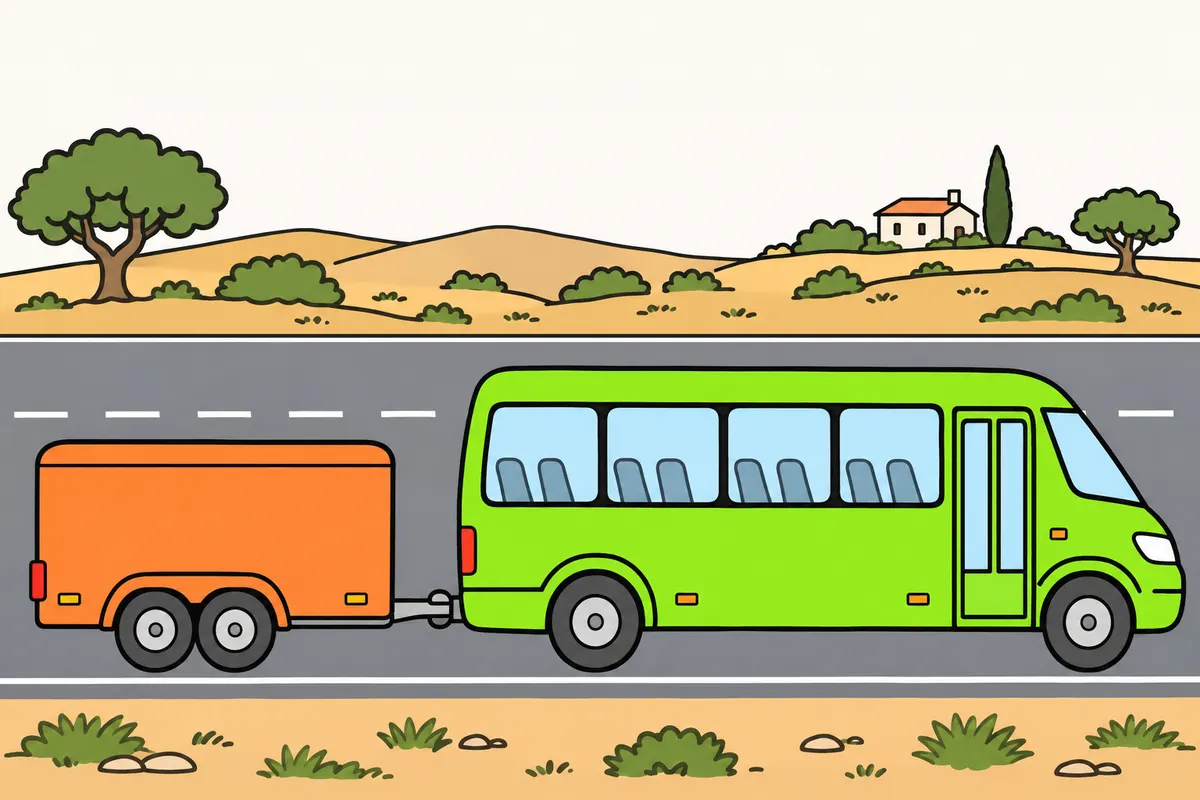
Tell trailers and semi-trailers apart by how they connect to the towing vehicle.
| Combination | Parts |
|---|---|
| Road train | Motor vehicle and trailer |
| Articulated vehicle | Motor vehicle and semi-trailer; the semi-trailer rests partly on the motor vehicle |
Remember
- Your minibus and trailer form a road train.
- Check MMA, rather than size or number of axles.
Exam trap: Wrong: a trailer with exactly 750 kg MMA is heavy. Right: it is light.
Read the full explanation
- A road train consists of a motor vehicle and a trailer; an articulated vehicle consists of a motor vehicle and a semi-trailer. The D1 minibus with a trailer that you study is a road train. These terms describe the composition of the combination. [RGV, Annex II](https://www.boe.es/buscar/act.php?id=BOE-A-1999-1826#anii).
- A semi-trailer rests partly on the motor vehicle to which it is coupled and transfers a substantial part of its mass to it. The definition of D1+E mentions a trailer: for your test, identify the minibus with a trailer, without requiring the tractor unit and semi-trailer configuration used in other combinations. [RGV, Annex II](https://www.boe.es/buscar/act.php?id=BOE-A-1999-1826#anii). The scope of the category is set by its regulatory definition. [RGCond, art. 4](https://www.boe.es/buscar/act.php?id=BOE-A-2009-9481#a4).
- A light trailer has an MMA of no more than 750 kg; exactly 750 kg falls within the light trailer category. The number of axles, the volume of the body and its outward appearance do not replace MMA when you decide whether you need to extend your licence. [RGV, Annex II](https://www.boe.es/buscar/act.php?id=BOE-A-1999-1826#anii).
3MMA determines the category
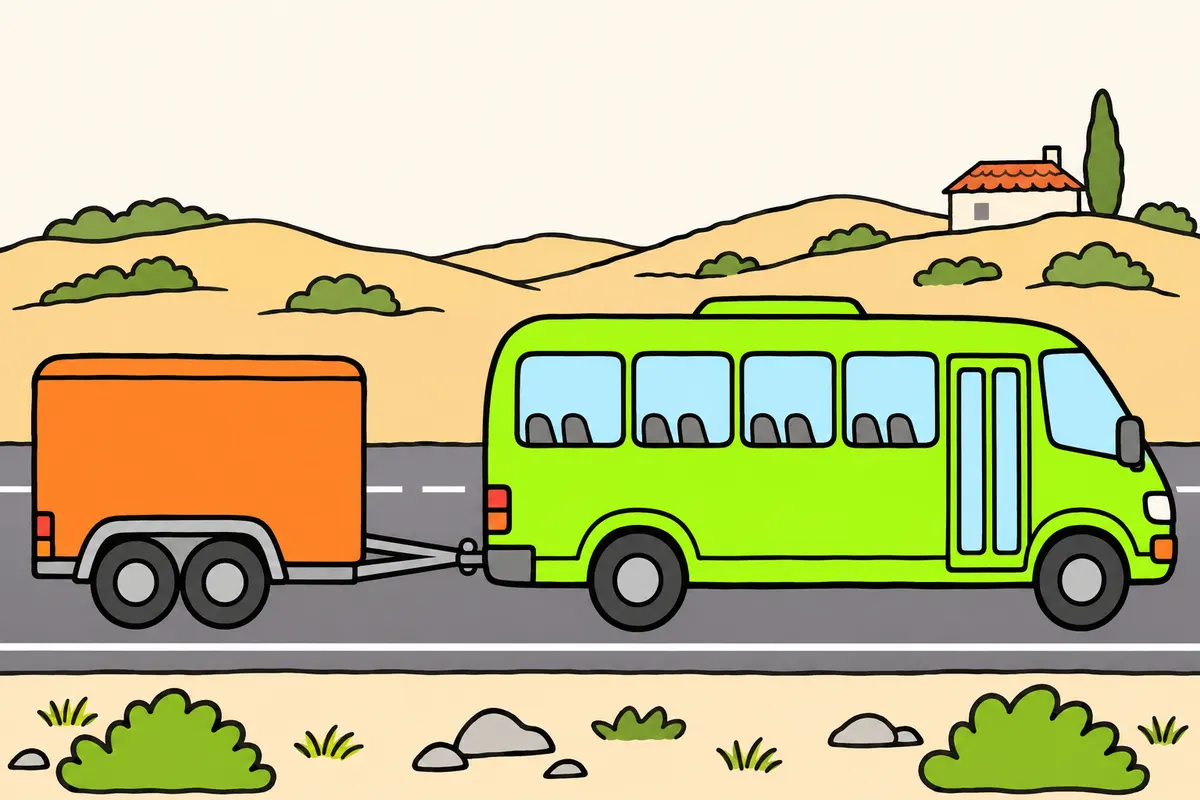
Choose your licence by maximum authorised mass, even when your trailer is empty.
Remember
- MMA means maximum authorised mass: the maximum allowed when travelling fully loaded.
- Do not confuse MMA with what your vehicle weighs today.
- Unloading luggage does not change MMA.
- Check that your combination also meets its technical limits.
Exam trap: Wrong: you use D1 because your trailer is empty. Right: with 1,000 kg MMA, you need D1+E.
Read the full explanation
- MMA is the maximum mass authorised for using the laden vehicle on the road. It is neither the payload nor the mass shown by a weighbridge on a particular journey; you must distinguish these concepts when reading the figures in a question about licences. [RGV, Annex IX, 1.6](https://www.boe.es/buscar/act.php?id=BOE-A-1999-1826#anix). [RGCond, art. 4](https://www.boe.es/buscar/act.php?id=BOE-A-2009-9481#a4).
- If the trailer has an MMA of 1,000 kg, you need D1+E to tow it with the D1 minibus even when it is empty and its actual mass is below 750 kg. Unloading luggage changes the actual mass, but does not change the maximum authorised mass that determines the category you need. [RGCond, art. 4](https://www.boe.es/buscar/act.php?id=BOE-A-2009-9481#a4).
- To identify the licence category, use the maximum authorised masses given in the question and check the towing vehicle, the towed vehicle and, where applicable, the combination separately. An actual mass figure does not allow you to answer an MMA question if the authorised figure is missing. [RGCond, art. 4](https://www.boe.es/buscar/act.php?id=BOE-A-2009-9481#a4).
- The maximum authorised mass of the combination and the maximum technically permissible mass are different concepts. Determining which licence you need is one check, and checking whether you can use that particular combination on the road is another; masses, axles and dimensions are covered in the Maximum dimensions and masses module. [RGV, Annex IX, 1.12 and 1.13](https://www.boe.es/buscar/act.php?id=BOE-A-1999-1826#anix). [RGCond, art. 4](https://www.boe.es/buscar/act.php?id=BOE-A-2009-9481#a4).
4When D1 is sufficient
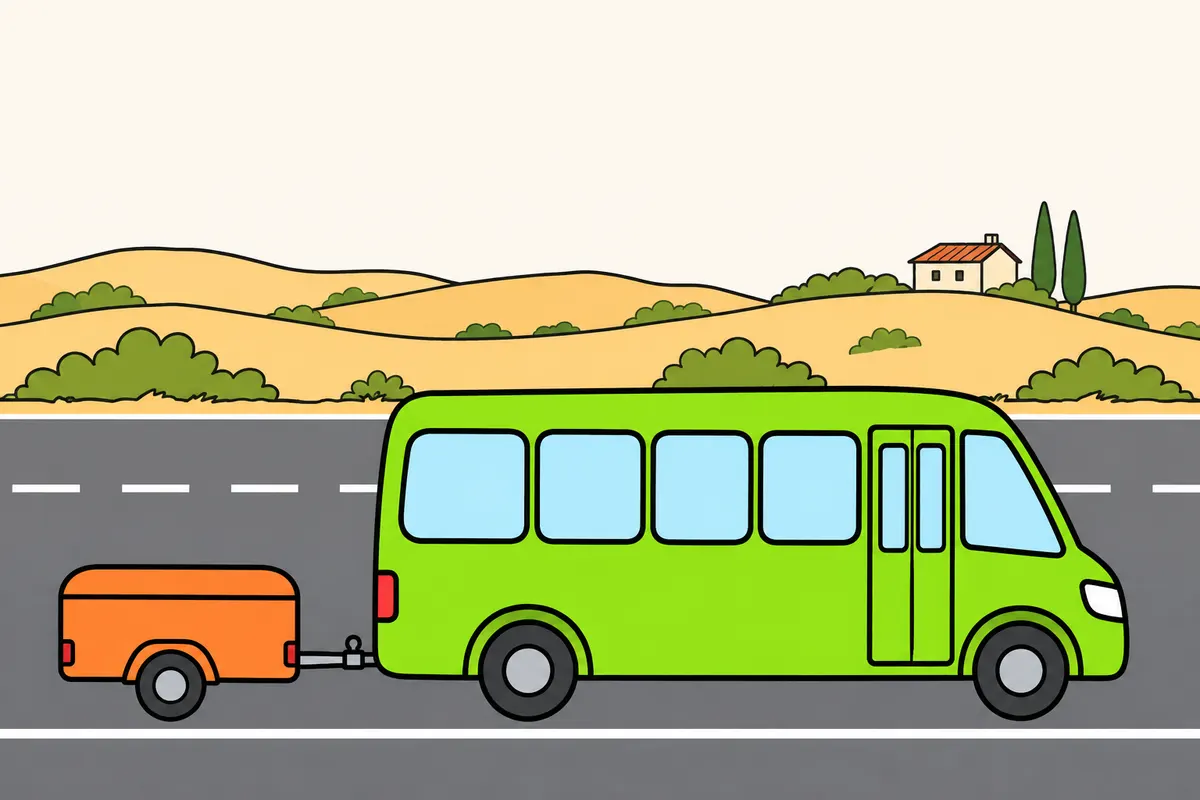
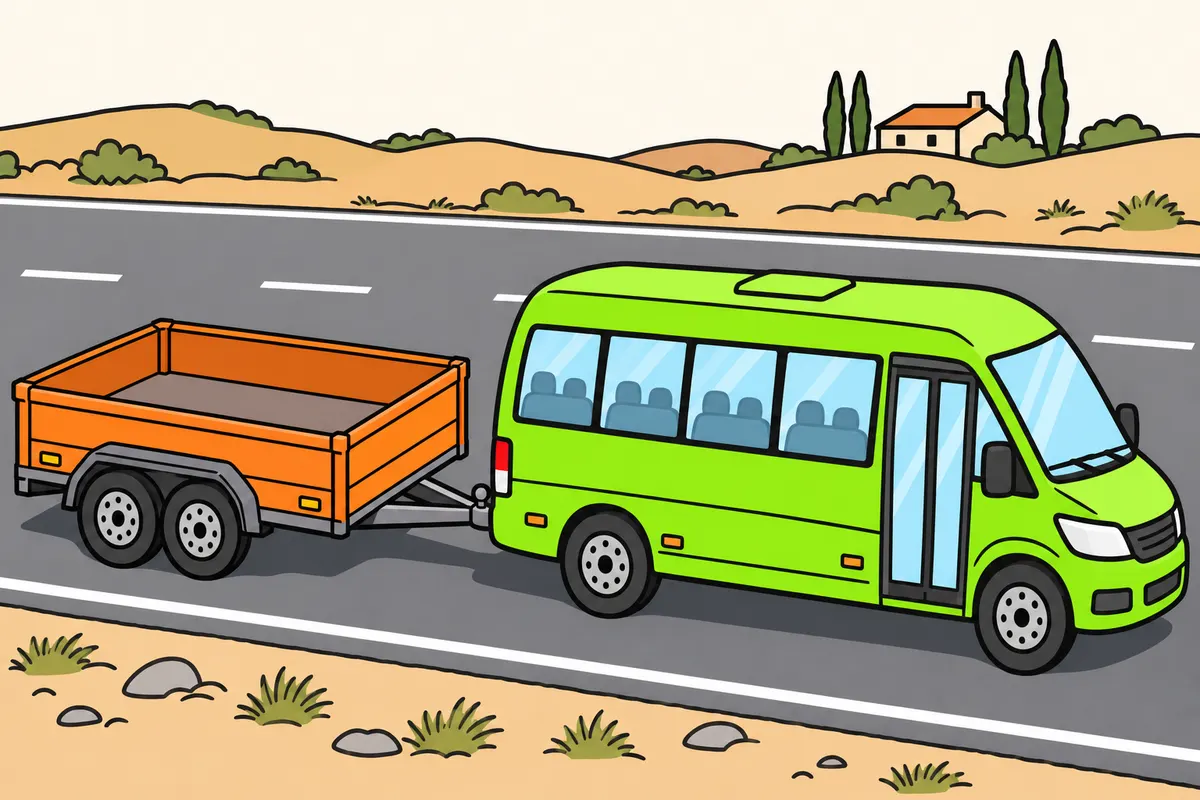
D1 covers a light trailer if your minibus is technically allowed to tow it.
| Trailer with D1 minibus: MMA | Licence needed |
|---|---|
| Up to 750 kg | D1 |
| 751 kg | D1+E |
Remember
- Check that your minibus is technically allowed to tow the trailer.
- D also needs the appropriate extension for a heavy trailer.
Exam trap: Wrong: every trailer requires D1+E. Right: D1 covers up to 750 kg MMA, if your minibus can technically tow it.
Read the full explanation
- With D1 you can drive a vehicle in that category and tow a trailer with an MMA of no more than 750 kg. The presence of a trailer does not in itself require you to obtain D1+E; as well as checking your entitlement, you must ensure that the vehicle is technically capable of towing it. [RGCond, art. 4](https://www.boe.es/buscar/act.php?id=BOE-A-2009-9481#a4).
- A D1 minibus with an MMA of 6,000 kg and a trailer with an MMA of 750 kg is authorised by D1 as far as the licence is concerned. With the same minibus and a trailer with an MMA of 751 kg, you need D1+E. The mass of the towing vehicle does not raise the trailer threshold allowed by D1. [RGCond, art. 4](https://www.boe.es/buscar/act.php?id=BOE-A-2009-9481#a4).
- When you drive the minibus without a trailer, you must hold the category that authorises that motor vehicle. When you attach a trailer that is not light, you must hold the entitlement for the combination. [RGCond, art. 4](https://www.boe.es/buscar/act.php?id=BOE-A-2009-9481#a4).
- D also allows a trailer with an MMA of no more than 750 kg; with a trailer exceeding that mass, you need the corresponding combination category. Holding D alone does not authorise you to drive the minibus with a heavy trailer: the towing vehicle’s greater passenger capacity does not increase the towing limit of the base licence. [RGCond, art. 4](https://www.boe.es/buscar/act.php?id=BOE-A-2009-9481#a4).
5How D+E differs from D1+E
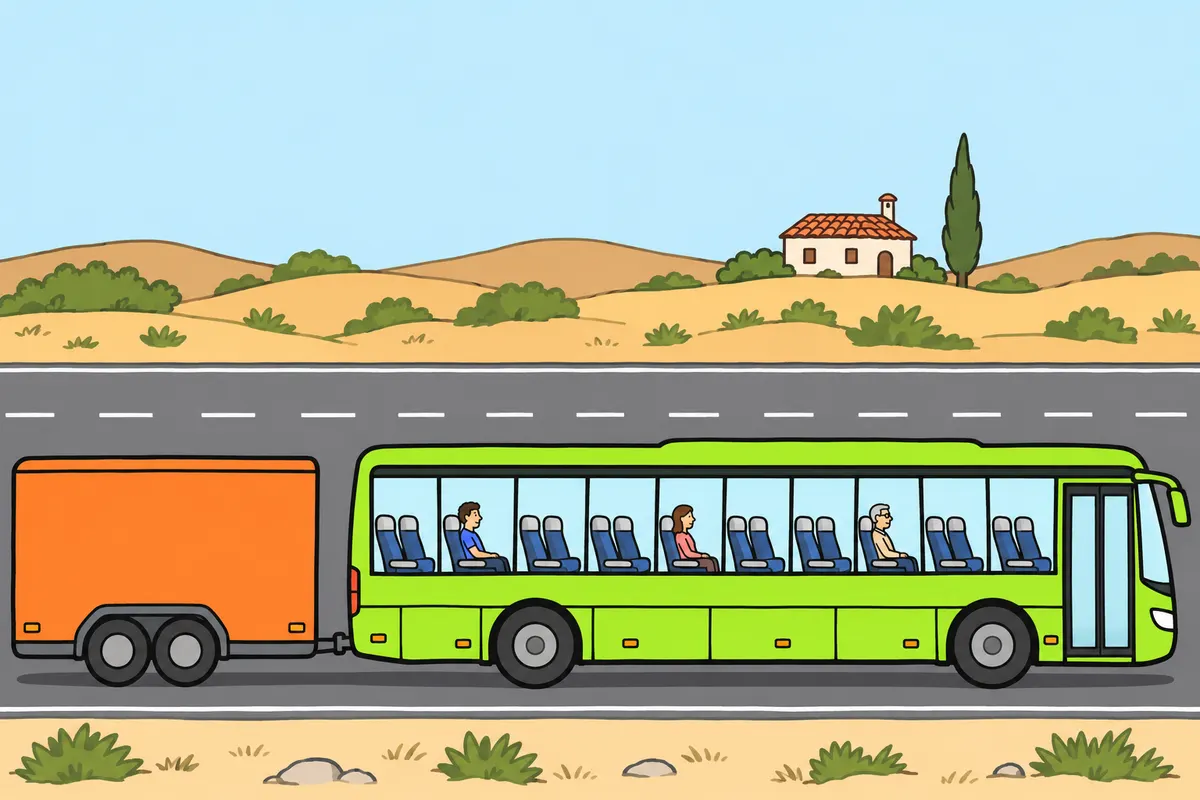
D1+E keeps the seating and length limits of your D1 minibus.
| Towing vehicle with heavy trailer | Category |
|---|---|
| D1: up to 16 passengers besides you; up to 8 metres | D1+E |
| D: more than eight passengers besides you; without those D1 maximum limits | D+E |
Remember
- Check how many passengers your bus was built to carry.
- Do not choose your licence by how many seats are occupied today.
- With D1, you must meet both the seating and length limits.
Exam trap: Wrong: D1+E covers a bus built for 20 passengers when few travel. Right: with a heavy trailer, you need D+E.
Read the full explanation
- D+E authorises a towing vehicle that D allows you to drive and a trailer with an MMA exceeding 750 kg. The category D motor vehicle is designed and built to carry more than eight passengers in addition to you; its definition does not include the maximum limits of 16 passengers and 8 metres that apply to D1. [RGCond, art. 4](https://www.boe.es/buscar/act.php?id=BOE-A-2009-9481#a4).
- A bus designed for 20 passengers in addition to the driver, with a heavy trailer, requires D+E. Carrying only ten people on that journey does not bring it within D1+E: the towing vehicle’s design and construction characteristics determine its category, rather than the seats occupied that day. [RGCond, art. 4](https://www.boe.es/buscar/act.php?id=BOE-A-2009-9481#a4).
- If the minibus exceeds 8 metres in length, D1+E does not cover it under that category even if it accommodates no more than 16 passengers in addition to the driver. You must meet both the seating and length limits for D1; meeting one does not compensate for exceeding the other. [RGCond, art. 4](https://www.boe.es/buscar/act.php?id=BOE-A-2009-9481#a4).
6B and code 96: a useful comparison
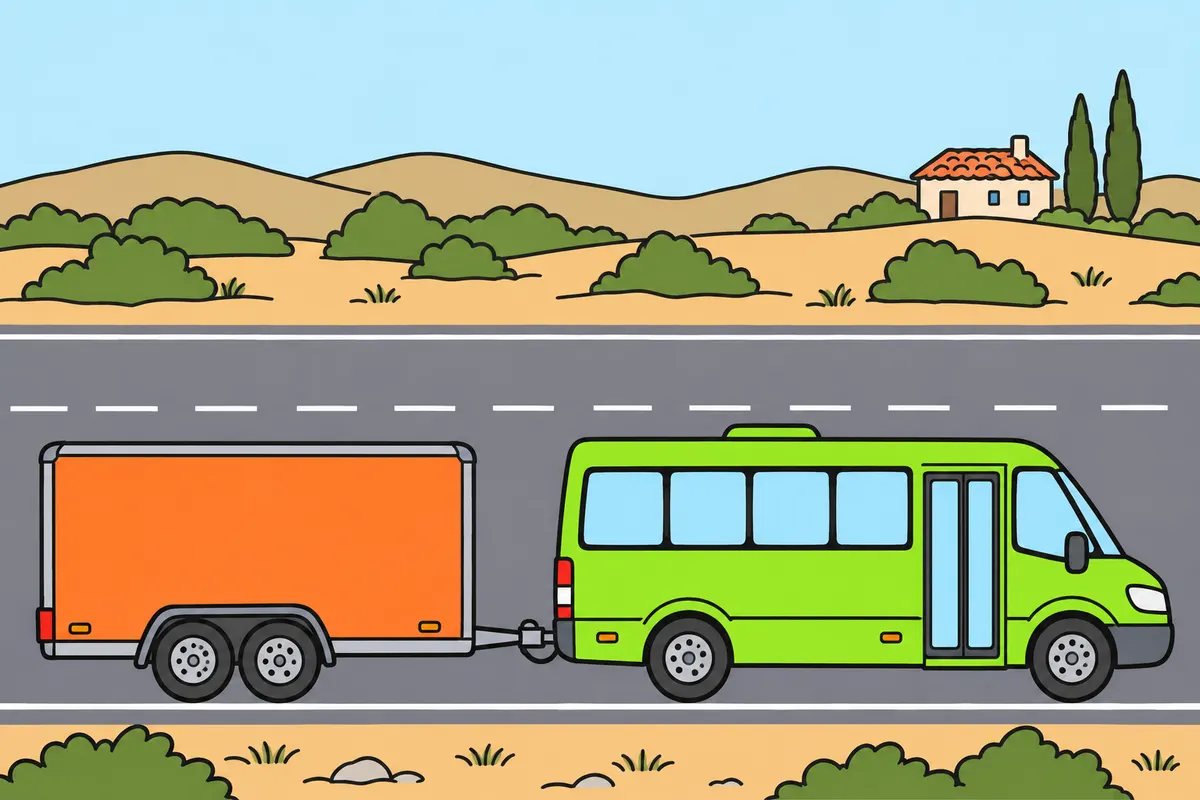
Code 96 extends certain B combinations, but does not cover your D1 minibus.
| Trailer with B towing vehicle: MMA | Combination MMA | Entitlement |
|---|---|---|
| Up to 750 kg | Can reach 4,250 kg | B |
| Over 750 kg | Up to 3,500 kg | B |
| Over 750 kg | Over 3,500 kg, up to 4,250 kg | B with code 96 |
Remember
- Use this comparison only with a category B towing vehicle.
- Always check that your combination is technically allowed.
- You must pass the required tests to obtain code 96.
Exam trap: Wrong: every 4,250 kg combination needs code 96. Right: B can cover a B towing vehicle with a light trailer, if technically allowed.
Read the full explanation
- With a category B licence you can drive a towing vehicle in that category and a trailer with an MMA of no more than 750 kg. In this case, a towing vehicle of 3,500 kg and a trailer of 750 kg can total 4,250 kg without that total requiring code 96, provided that the combination is technically permissible. [RGCond, art. 4](https://www.boe.es/buscar/act.php?id=BOE-A-2009-9481#a4).
- If the trailer exceeds 750 kg MMA and the combination’s MMA does not exceed 3,500 kg, you can drive it with B without the code 96 extension. For example, a category B towing vehicle of 2,000 kg and a trailer of 1,000 kg form a 3,000 kg combination within that entitlement. [RGCond, art. 4](https://www.boe.es/buscar/act.php?id=BOE-A-2009-9481#a4).
- For a category B towing vehicle with a trailer over 750 kg and a combination exceeding 3,500 kg but not exceeding 4,250 kg, you must obtain the entitlement recorded by code 96. You must pass the prescribed skills and behaviour tests; the code does not turn the towing vehicle into a D1 vehicle. [RGCond, art. 5.5 and Annex I, code 96](https://www.boe.es/buscar/act.php?id=BOE-A-2009-9481#ani). [RGCond, art. 4](https://www.boe.es/buscar/act.php?id=BOE-A-2009-9481#a4).
- Code 96 refers to that category B combination, rather than to the D1 licence. It does not authorise you to drive a D1 minibus with a heavy trailer, even if you know its manoeuvres or have passed the tests for B with code 96; you must hold D1+E where required. [RGCond, art. 4](https://www.boe.es/buscar/act.php?id=BOE-A-2009-9481#a4).
7B+E and categories granted
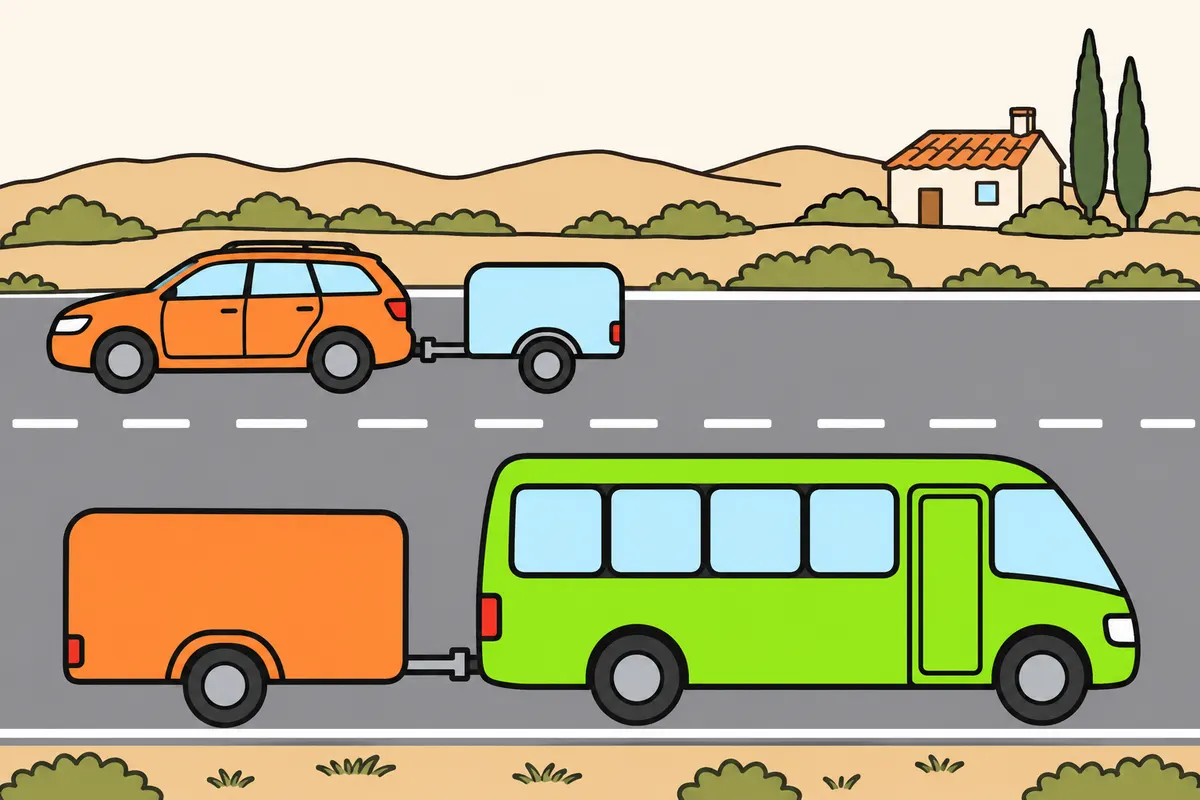
Obtaining D1+E also grants you B+E, but does not grant goods vehicle categories.
| What you obtain or hold | Categories granted |
|---|---|
| Obtain D1+E | B+E; neither C1+E nor C+E |
| Obtain D+E | D1+E and B+E |
| Hold D and obtain C+E | D+E |
Remember
- B+E covers a B towing vehicle with a trailer or semi-trailer within its limits.
- Keep within your combination’s technical approval.
- Being granted a category differs from being excused a test.
Exam trap: Wrong: C+E alone grants you D+E. Right: you must also hold D for that entitlement.
Read the full explanation
- B+E authorises you to drive combinations consisting of a category B towing vehicle and a trailer or semi-trailer with an MMA (maximum authorised mass) not exceeding 3,500 kg, subject to type approval. [RGCond, art. 4](https://www.boe.es/buscar/act.php?id=BOE-A-2009-9481#a4).
- When you obtain D1+E, you are also granted B+E. This extension for passenger vehicles does not grant you C1+E or C+E: those categories cover other towing vehicles and have their own requirements. Use only the entitlements expressly provided for the category you obtain. [RGCond, art. 5](https://www.boe.es/buscar/act.php?id=BOE-A-2009-9481#a5).
- When you obtain D+E, you are also granted D1+E and B+E. In addition, if you hold D and obtain C+E, you are granted D+E. This route requires you to hold D: C+E alone does not grant you the base licence for buses and coaches. [RGCond, art. 5](https://www.boe.es/buscar/act.php?id=BOE-A-2009-9481#a5).
- Being granted another category determines which vehicles you can drive; a theory test exemption only exempts you from one test in the process. If you hold C1+E and apply for D1+E, you must meet the prior licence and age requirements and pass the practical tests, even if you qualify for exemption from the specific theory test. [RGCond, art. 54](https://www.boe.es/buscar/act.php?id=BOE-A-2009-9481#a54).
8The prior licence you need
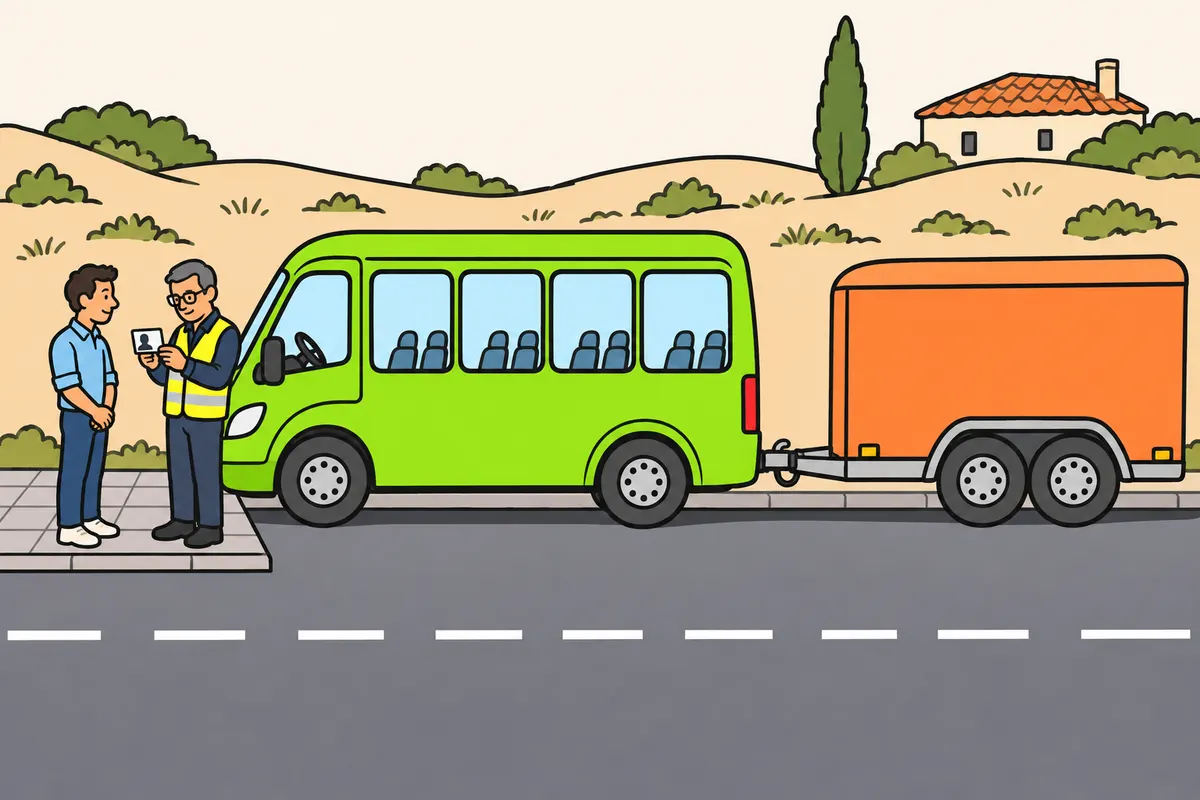
To obtain D1+E, you must hold a valid D1 licence.
| Licence you apply for | Valid prior licence |
|---|---|
| D1 | B |
| D1+E | D1 |
| D+E | D |
Remember
- B+E and CAP cannot replace your valid D1 licence.
- You need no minimum period holding D1 for this extension.
- You must meet medical requirements and pass the required tests.
Exam trap: Wrong: holding D1 makes the extension automatic. Right: you must meet the requirements and pass the required tests.
Read the full explanation
- To be issued D1+E, you must hold a valid D1 licence. B, B+E, AM, A1 or a licence for agricultural vehicles or vehicles for people with reduced mobility cannot replace this base licence: you need the entitlement for the towing vehicle to which you add the heavy trailer. [RGCond, art. 5](https://www.boe.es/buscar/act.php?id=BOE-A-2009-9481#a5).
- To obtain D1, you need a valid B licence; to obtain D+E, you need a valid D licence. Your route to obtaining the category must meet its base licence requirement. A category B trailer entitlement does not allow you to skip directly to being issued a licence for passenger vehicles with a trailer. [RGCond, art. 5](https://www.boe.es/buscar/act.php?id=BOE-A-2009-9481#a5).
- Article 5 requires you to hold a valid D1 licence and does not set a minimum period of one or two years holding D1 before you can be issued D1+E. [RGCond, art. 5](https://www.boe.es/buscar/act.php?id=BOE-A-2009-9481#a5).
- You must also meet the general requirements for obtaining a licence, including physical and mental fitness and passing the required tests. Holding D1 does not make the extension automatic or exempt you from the specific test when no exemption applies. [RGCond, art. 7](https://www.boe.es/buscar/act.php?id=BOE-A-2009-9481#a7).
9General age and access with CAP
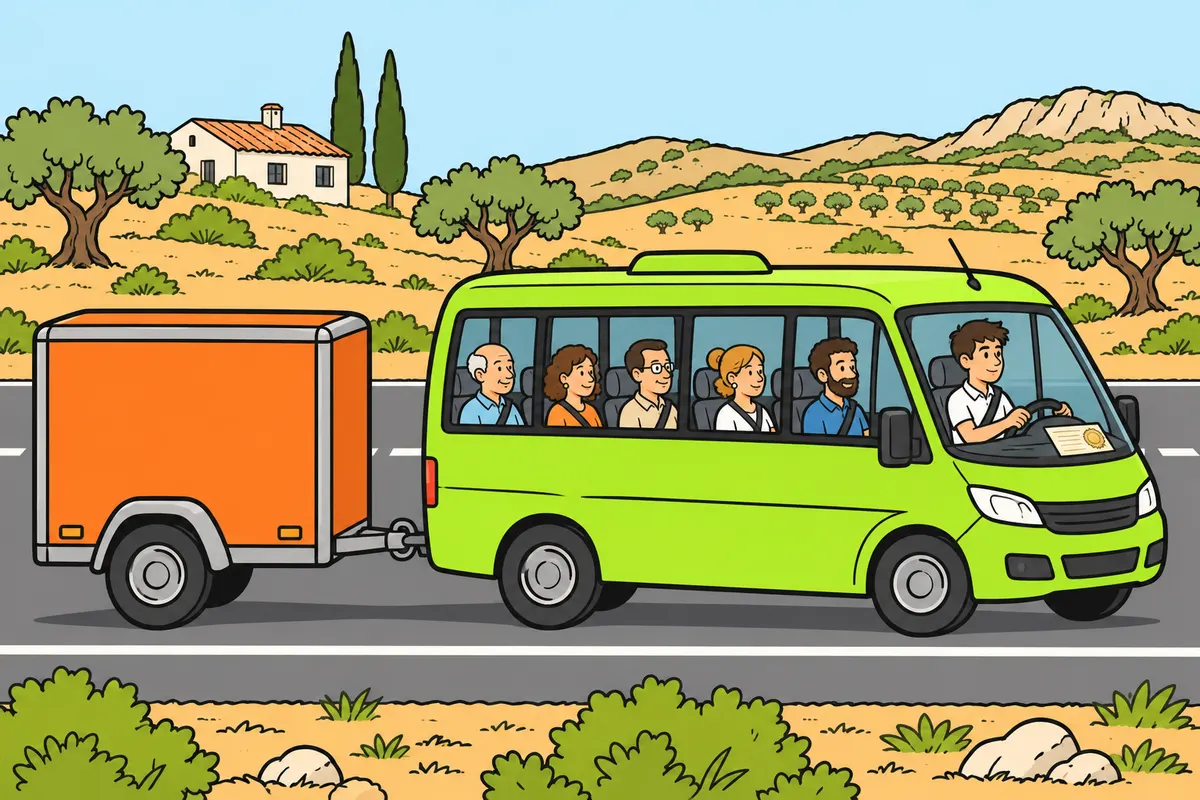
You can obtain D1+E at 18 with standard initial CAP, with a territorial restriction.
| Category and age | Initial CAP required for exception | Access conditions |
|---|---|---|
| D1+E: 21 years | No CAP age exception | General minimum age |
| D1+E: 18 years | Standard | Spain only until 21; no passenger or route restriction |
| D+E: 24 years | No CAP age exception | General minimum age |
| D+E: 21 years | Standard | No special service restriction |
| D+E: 23 years | Accelerated | No special service restriction |
| D+E: 21 years | Accelerated | Passenger transport on regular services with routes up to 50 km |
| D+E: 18 years | Standard | Spain: without passengers, or regular passenger services with routes up to 50 km |
| D+E: 20 years | Standard | Spain only until 21; without that service restriction |
Remember
- Until you turn 21, you can drive these D1+E vehicles only within Spain.
- At 18, you need standard initial CAP certification; enrolment alone is insufficient.
- Accelerated CAP and periodic training cannot replace that certificate.
Exam trap: Wrong: D+E’s passenger restrictions at 18 also apply to D1+E. Right: for D1+E at 18 with standard initial CAP, the restriction is Spain only until 21.
Read the full explanation
- The general minimum age for D1+E is 21. You can obtain it from age 18 if you hold the CAP (professional competence certificate) obtained through the standard initial qualification; until you turn 21, you can only drive these vehicles within Spain. [RGCond, art. 4](https://www.boe.es/buscar/act.php?id=BOE-A-2009-9481#a4).
- The exception allowing you to obtain D1+E at 18 requires the standard initial CAP qualification and does not require you to drive without passengers or restrict you to regular services on routes not exceeding 50 km. An accelerated CAP qualification, periodic training or enrolment on a course does not replace the standard certificate required for this exception. [RGCond, art. 4](https://www.boe.es/buscar/act.php?id=BOE-A-2009-9481#a4).
- The general minimum age for D+E is 24. With the standard initial CAP qualification, you can obtain it at 21; with the accelerated initial CAP qualification, at 23. At age 21 with an accelerated CAP qualification, the exception is limited to passenger transport on regular services whose routes do not exceed 50 km. [RGCond, art. 4](https://www.boe.es/buscar/act.php?id=BOE-A-2009-9481#a4).
- For D+E, at age 18 with the standard initial CAP qualification, you can drive within Spain without passengers or on regular passenger services whose routes do not exceed 50 km. At age 20 with the standard initial CAP qualification, you can drive within Spain without that service restriction; the territorial restriction remains until you turn 21. These conditions do not apply to the separate D1+E exception. [RGCond, art. 4](https://www.boe.es/buscar/act.php?id=BOE-A-2009-9481#a4).
10CAP for professional passenger transport
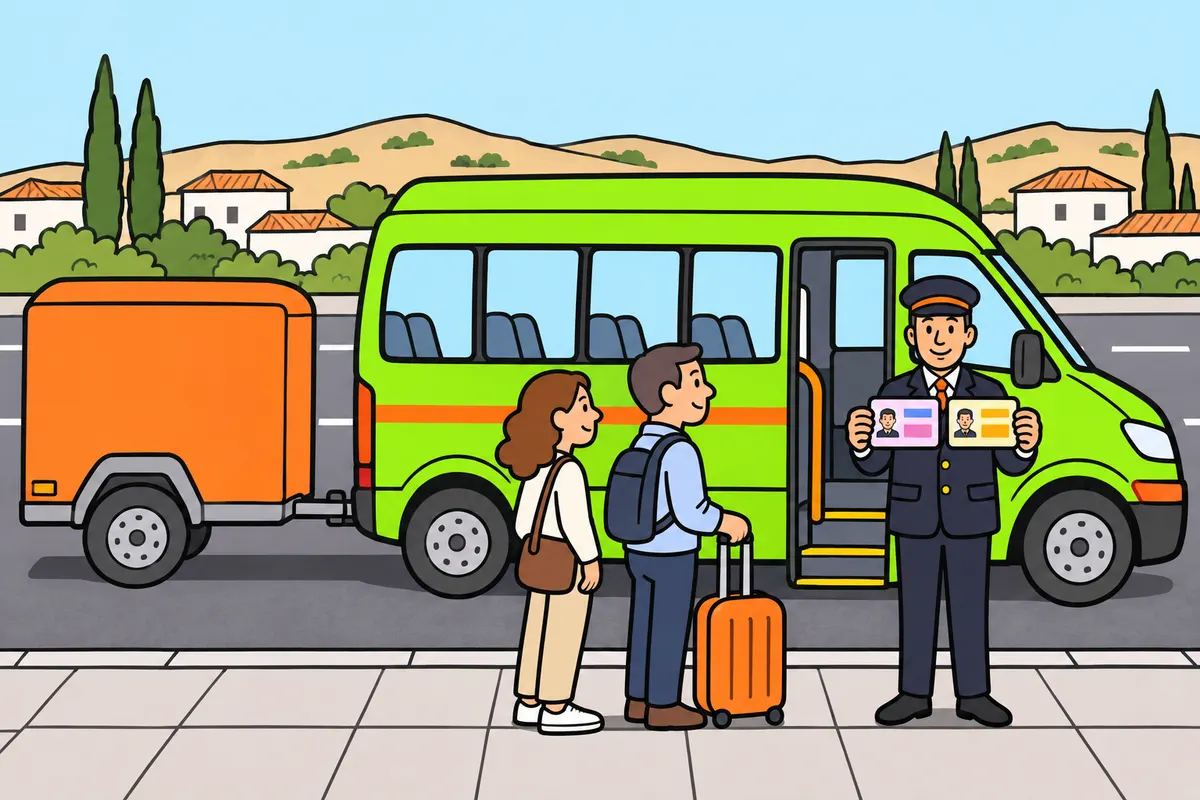
For professional transport covered by CAP rules, you need CAP as well as your licence.
| Activity or case | CAP or proof required |
|---|---|
| Professional transport covered by CAP rules | CAP as well as your licence |
| Private non-commercial passenger transport | Exempt from CAP |
| Practical lessons or licence or CAP tests, with no transport carried out | Exempt from CAP |
| Coming from another European Union Member State | Code 95 on your EU licence or a qualification card |
Remember
- Obtain initial CAP through a course and exam.
- Keep CAP valid through periodic training, although the certificate has no fixed expiry.
- Carry your valid qualification card or a recognised document proving your qualification.
- Without a valid card, complete periodic training to obtain one.
Exam trap: Wrong: an old licence removes every CAP requirement. Right: D1, D1+E, D, D+E or a recognised equivalent issued before 11 September 2008 exempts you only from initial qualification; periodic training remains required.
Read the full explanation
- To drive a minibus with a trailer professionally in a transport activity covered by RD 284/2021, you must hold CAP as well as the driving licence. The initial qualification requires a course and an examination, through either the standard or accelerated route; the accelerated CAP qualification allows you to obtain D1+E at age 21. [RD 284/2021, arts. 1 and 4](https://www.boe.es/buscar/act.php?id=BOE-A-2021-6624#a4). [RGCond, art. 4.2](https://www.boe.es/buscar/act.php?id=BOE-A-2009-9481#a4).
- The CAP certificate has no fixed expiry date, but you must keep it valid by completing 35 hours of periodic training every five years. If you stop working as a professional driver and do not hold a valid driver qualification card, you must complete periodic training before returning to the profession. [RD 284/2021, arts. 3.1 and 7.2, 4 and 6](https://www.boe.es/buscar/act.php?id=BOE-A-2021-6624#a7).
- The driver qualification card is valid for five years; you must carry a valid card on board or carry a recognised document proving your qualification. If you come from another European Union Member State, you can prove it with code 95 on your EU driving licence or with the driver qualification card. [RD 284/2021, art. 20.1, 3 and 5](https://www.boe.es/buscar/act.php?id=BOE-A-2021-6624#a2-2).
- If you hold a D1, D1+E, D or D+E licence, or a recognised equivalent, issued before 11 September 2008, you are exempt from the initial qualification. You must meet the periodic training requirement; if you do not have a valid card, you must complete that course to obtain one. [RD 284/2021, art. 3.2.a](https://www.boe.es/buscar/act.php?id=BOE-A-2021-6624#a3).
- You are exempt from CAP when carrying passengers privately for personal purposes. You are also exempt during practical lessons and tests for the driving licence or CAP when no transport activity takes place during them. These exemptions relate to the activity you carry out. [RD 284/2021, art. 2.1.f-g](https://www.boe.es/buscar/act.php?id=BOE-A-2021-6624#a2).
11Alcohol, fatigue and driving controls
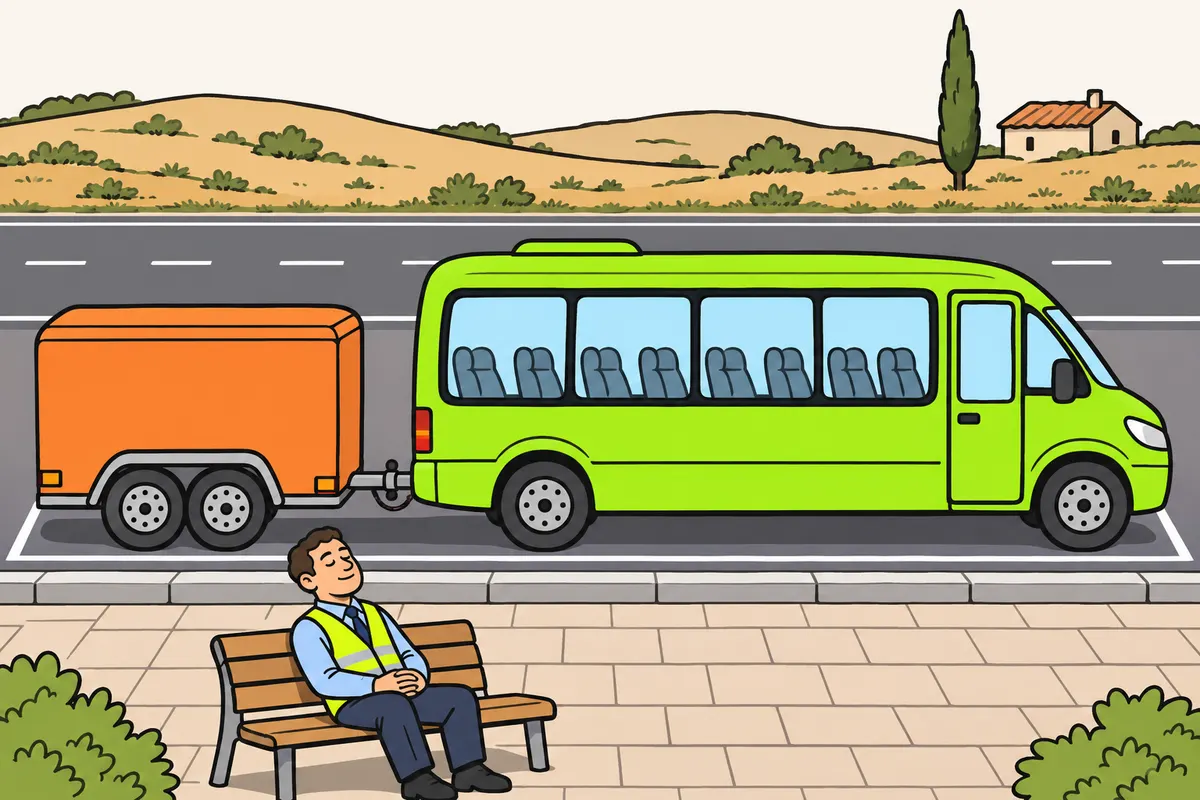
Keep within the alcohol limit and rest so you can stay alert while driving.
| Seat belt when driving your minibus with trailer | What you must do |
|---|---|
| Driving, including successive stops | Keep it fastened |
| When reversing or parking | You are exempt |
| With a medical exemption certificate | You are exempt; show officers the certificate when asked |
Remember
- These alcohol limits apply when you drive a minibus with more than nine seats.
- They also apply when you tow your trailer.
- Plan rest breaks; stop somewhere safe if you feel sleepy.
- Remember that alcohol, food and medicines affect your fitness to drive.
- Reasonable signs of tampering with recording instruments can also lead to immobilisation.
- Fasten your seat belt even on services with successive stops.
Exam trap: Wrong: any time breach triggers this immobilisation rule. Right: on services subject to statutory driving and rest times, officers can immobilise you for exceeding driving time or reducing rest by more than 50 %, unless another driver replaces you.
Read the full explanation
- When driving your minibus with more than nine seats, you must not exceed 0.3 g/l of alcohol in your blood or 0.15 mg/l in your breath. This limit applies because the vehicle is intended for passenger transport, including when you tow the luggage trailer. [RGC, art. 20](https://www.boe.es/buscar/act.php?id=BOE-A-2003-23514#a20).
- Fatigue and drowsiness impair your attention as you manage the minibus, passengers and trailer. Plan your rest and stop in a safe place if you notice symptoms; food, alcohol and medication also affect your physical and mental fitness. [RD 284/2021, Annex I, objective 3.4](https://www.boe.es/buscar/act.php?id=BOE-A-2021-6624#ani).
- When your service is subject to statutory driving and rest times, officers can immobilise the combination if you exceed the driving time or reduce the rest time by more than 50 % of the prescribed amount, unless another driver takes over from you. They can also immobilise it if there are reasonable grounds to suspect tampering with the recording equipment. [Traffic Act, art. 104.1.f and i](https://www.boe.es/buscar/act.php?id=BOE-A-2015-11722#a104).
- You must drive the minibus with a trailer with your seat belt fastened, including on services with successive stops for passengers or their luggage; you are exempt only when reversing or parking, or if you hold a medical exemption certificate, which you must show to officers when asked. If you do not wear it, you lose 4 points. [RGC, art. 117.1](https://www.boe.es/buscar/act.php?id=BOE-A-2003-23514#a117). [RGC, art. 119.1](https://www.boe.es/buscar/act.php?id=BOE-A-2003-23514#a119). [Traffic Act, Annex II.15](https://www.boe.es/buscar/act.php?id=BOE-A-2015-11722#anii).
12Age when taking the tests
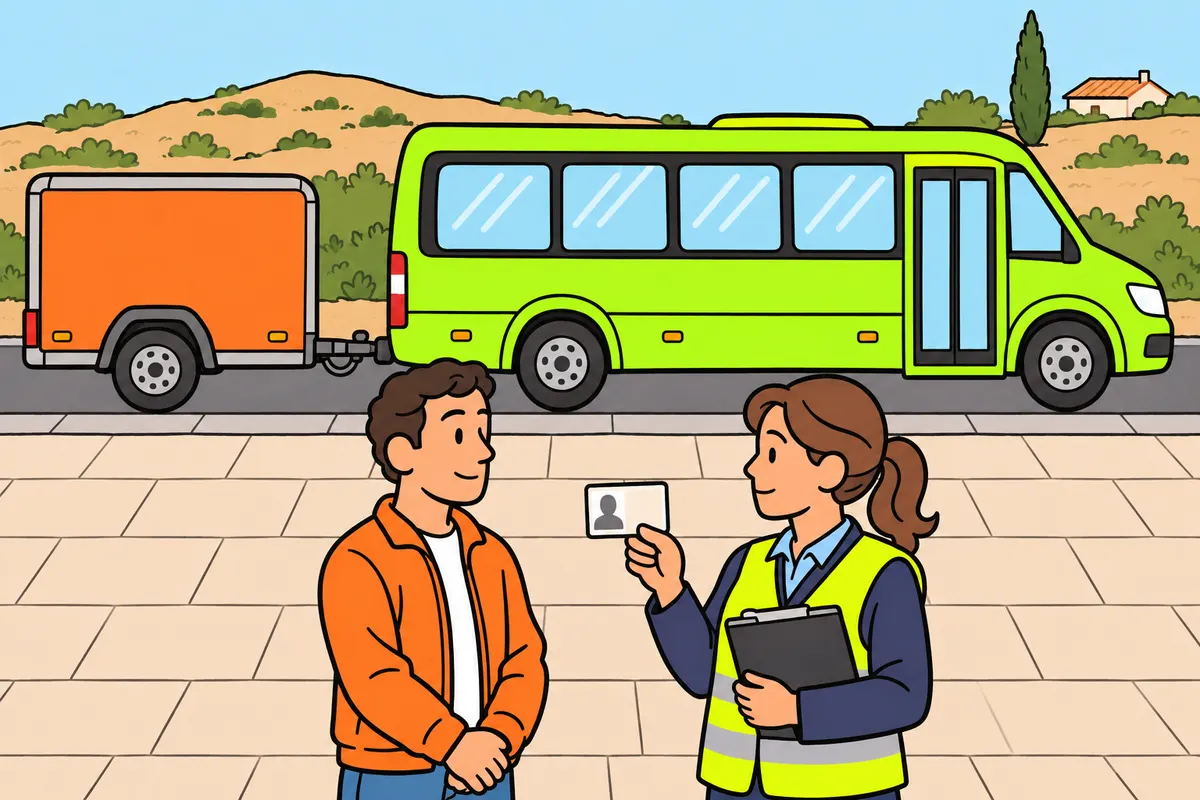
You can take theory early, but must reach the required age before practical tests.
| First test appointment | Age requirement |
|---|---|
| Knowledge | Up to three months before your minimum age |
| Practical | You must already have reached your applicable minimum age |
Remember
- Check the minimum age for your access route.
- Taking theory early does not let you drive before meeting the requirements.
Exam trap: Wrong: you reach the required age after your first practical appointment. Right: you must have reached it on the appointment date.
Read the full explanation
- You can take your first theory test up to three months before reaching the minimum age required to obtain the category. This option applies to the theory test; it does not authorise you to drive a D1+E combination before you meet the requirements for the licence to be issued. [RGCond, art. 51.2](https://www.boe.es/buscar/act.php?id=BOE-A-2009-9481#a51). [RGCond, Annex VI.A.2](https://www.boe.es/buscar/act.php?id=BOE-A-2009-9481#anvi).
- On the date scheduled for your first practical test appointment, you must have reached the minimum age that applies to you. You must be 21 under the general route or 18 if you prove that you qualify for the standard initial CAP exception; reaching that age after the test is not enough. [RGCond, Annex VI.A.2](https://www.boe.es/buscar/act.php?id=BOE-A-2009-9481#anvi).
13Which tests you must pass
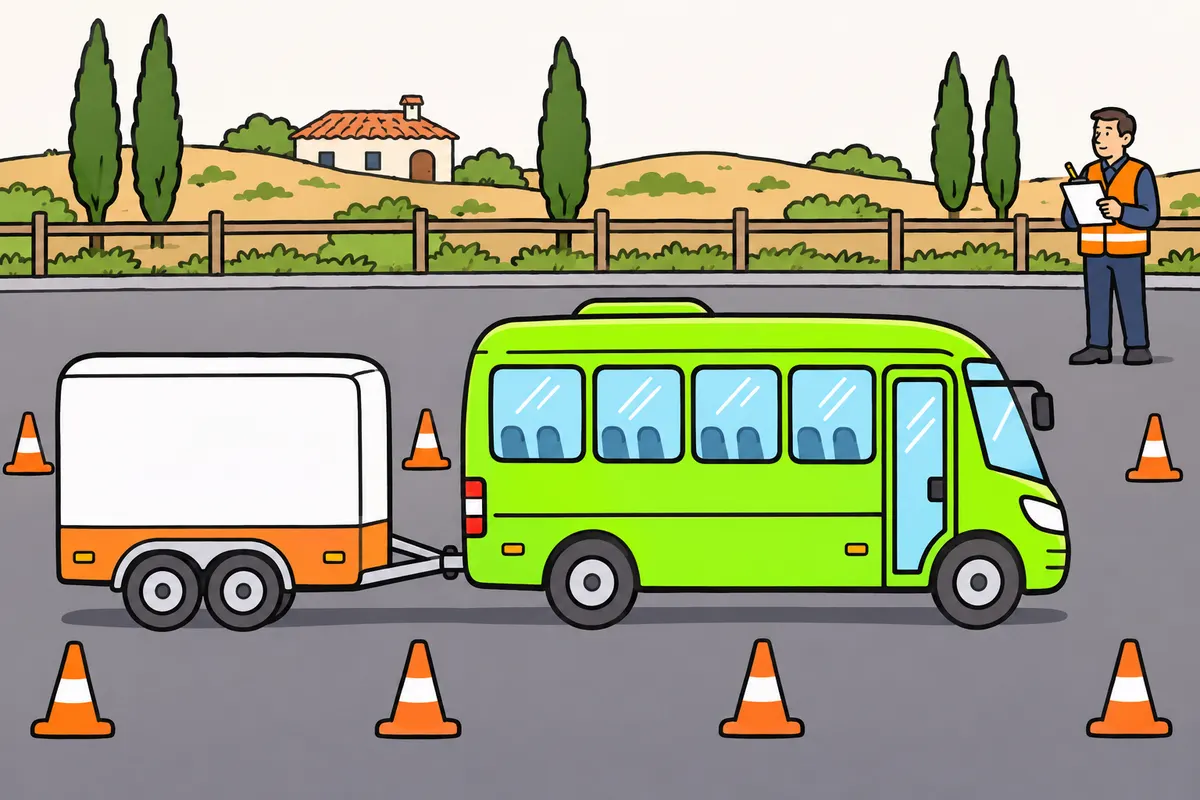
Pass the required tests in order: theory, closed circuit, then road.
Remember
- You must prove your physical and mental fitness.
- Prepare specific theory unless you qualify for an exemption.
- Passing D1 theory does not replace D1+E specific theory.
- You normally take the tests on different dates.
- The traffic office can exceptionally authorise the same date for justified reasons.
Exam trap: Wrong: good road driving offsets a failed closed-circuit test. Right: pass each required stage before moving to the next.
Read the full explanation
- To obtain D1+E, you undergo a physical and psychological fitness assessment and, unless an exemption applies, a specific knowledge test, a test of skills and behaviour on a closed circuit, and a driving test on roads open to general traffic. Upgrading from D1 involves more than submitting documents or making a declaración responsable (formal declaration of compliance). [RGCond, Annex V](https://www.boe.es/buscar/act.php?id=BOE-A-2009-9481#anv).
- You do not have to repeat the common theory test simply because you upgrade from D1 to D1+E, provided you meet the exemption conditions. You must prepare for the specific knowledge test on vehicle combinations unless you qualify for an exemption from that test; passing the D1 theory test does not count as passing the specific D1+E test. [RGCond, art. 54](https://www.boe.es/buscar/act.php?id=BOE-A-2009-9481#a54). [RGCond, Annex V](https://www.boe.es/buscar/act.php?id=BOE-A-2009-9481#anv).
- You must pass each test before progressing: you must pass the knowledge test before the closed-circuit test, and the closed-circuit test before the road test. A good performance on the road cannot make up for an earlier fail, because you cannot reach that stage without passing the preceding test required of you. [RGCond, art. 53.1](https://www.boe.es/buscar/act.php?id=BOE-A-2009-9481#a53). [RGCond, Annex V](https://www.boe.es/buscar/act.php?id=BOE-A-2009-9481#anv).
- As a general rule, you take the knowledge, closed-circuit and road tests on different dates. In justified exceptional cases, the Jefatura (traffic office) may authorise all or some of them to take place on the same date. [RGCond, art. 51.3](https://www.boe.es/buscar/act.php?id=BOE-A-2009-9481#a51). [RGCond, Annex V](https://www.boe.es/buscar/act.php?id=BOE-A-2009-9481#anv).
14Specific theory test exemptions
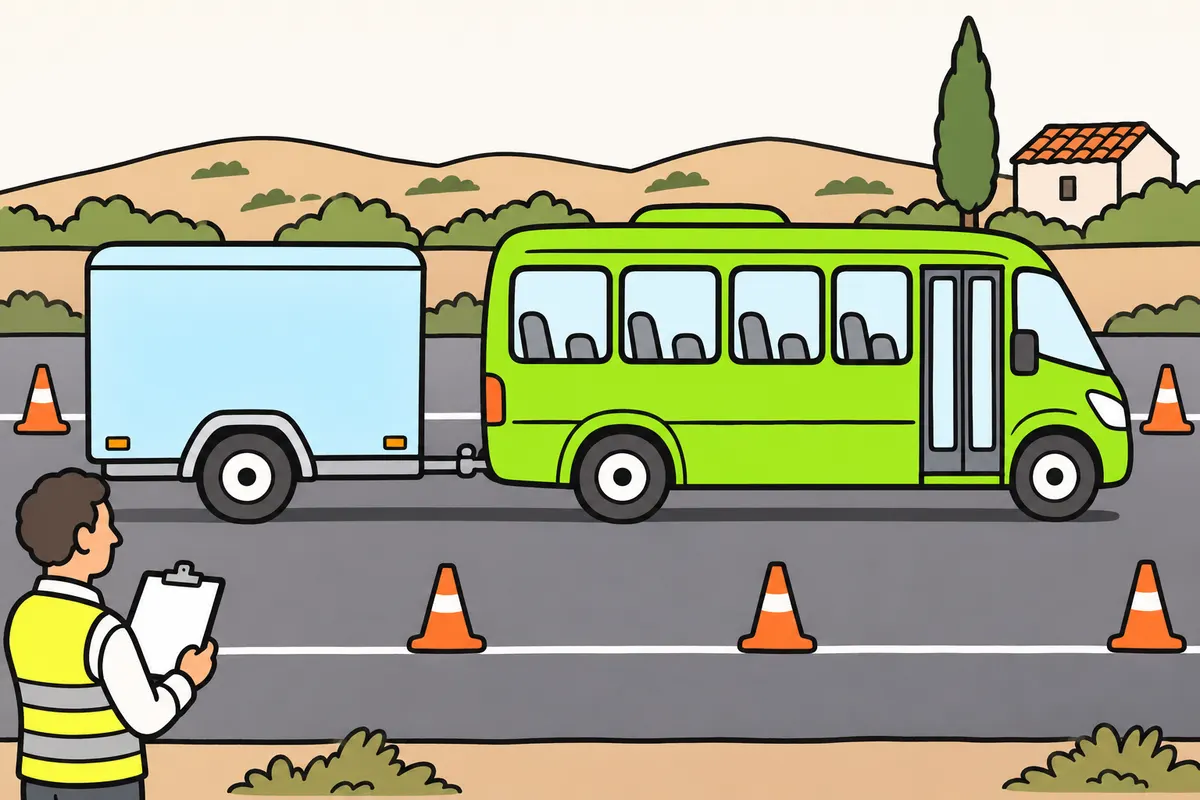
Holding valid C1+E exempts you from D1+E specific theory.
| Category you hold | D1+E specific theory exemption |
|---|---|
| Valid C1+E | Yes |
| C+E | You are granted C1+E and can qualify through it |
| Only C1, D1 or B+E | These categories do not provide it |
Remember
- Theory exemption does not remove practical tests or the need for prior D1.
- If you rely on a test pass, check that it remains valid.
- You must also meet the age and other requirements.
Exam trap: Wrong: theory exemption grants you D1+E. Right: it only excuses you from the specific theory test.
Read the full explanation
- If you apply for D1+E and hold a valid C1+E licence, you are exempt from the corresponding specific knowledge test. The full category, including E, is decisive: holding only C1 or D1 does not give you this exemption from the specific test on combinations. [RGCond, art. 54](https://www.boe.es/buscar/act.php?id=BOE-A-2009-9481#a54).
- The regulations also provide for an exemption if you have passed the test to obtain the specified categories. In that case, you must check that your pass remains valid under article 53; you cannot rely indefinitely on an individual test pass to justify an exemption. [RGCond, art. 53.1](https://www.boe.es/buscar/act.php?id=BOE-A-2009-9481#a53). [RGCond, art. 54](https://www.boe.es/buscar/act.php?id=BOE-A-2009-9481#a54).
- B+E is not among the categories that give you this exemption for D1+E. If you hold C+E, you are also granted C1+E and may qualify for the exemption through that category; this does not automatically give you a passenger vehicle licence or remove the requirement to hold D1 first and take the required practical tests. [RGCond, art. 54](https://www.boe.es/buscar/act.php?id=BOE-A-2009-9481#a54).
- An exemption from the knowledge test does not mean you can obtain D1+E without practical tests. You must still demonstrate control of the combination on a closed circuit and on the road, and meet all other applicable requirements. [RGCond, art. 54](https://www.boe.es/buscar/act.php?id=BOE-A-2009-9481#a54).
15Theory content and format
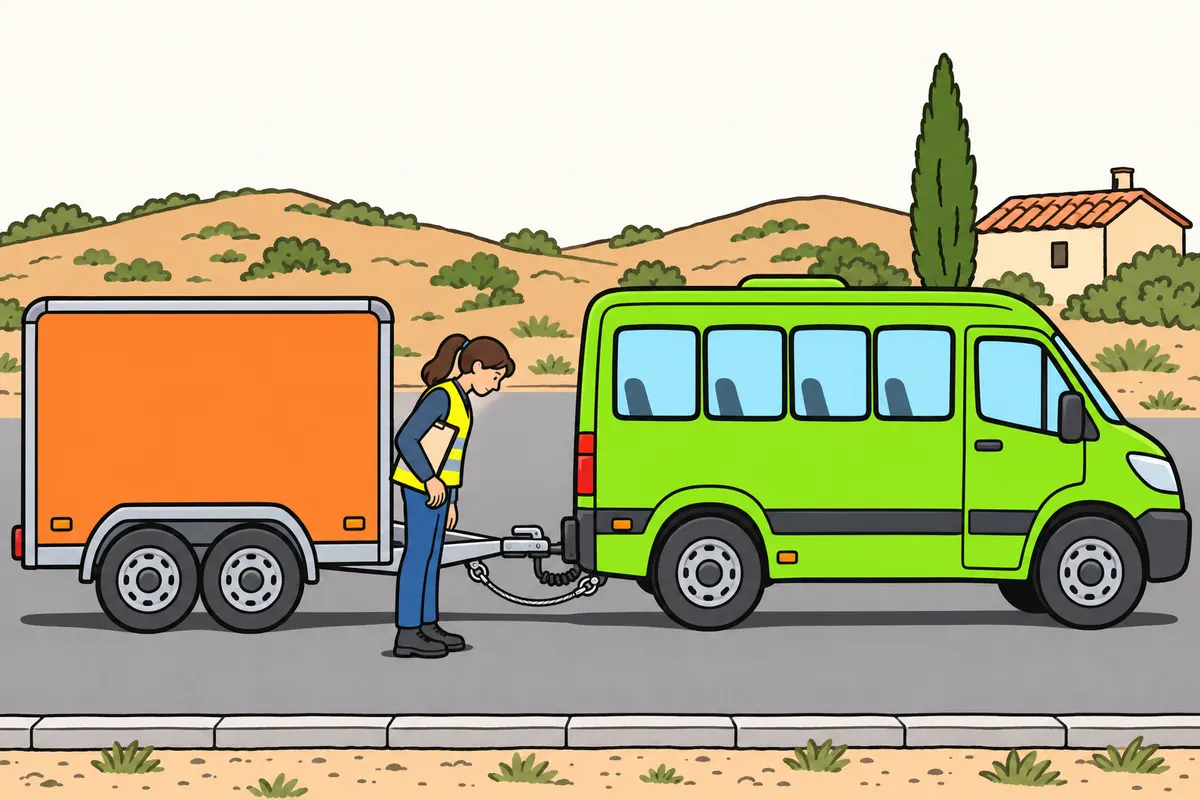
Study combination safety rules and follow your specific theory test instructions.
Remember
- Study the driver, combination, load, coupling and driving techniques.
- Distinguish the statutory question range from the exam format you prepare for.
Exam trap: Wrong: you must answer 30 questions. Right: you are preparing for a 20-question specific test.
Read the full explanation
- The specific test on combinations assesses regulations and safety relating to you as the driver, the combination and its load, coupling and uncoupling systems, and driving technique. You must know the full course syllabus; this module covers the licence entitlement and examination process. [RGCond, Annex V.B.2.6.º](https://www.boe.es/buscar/act.php?id=BOE-A-2009-9481#anv). [RGCond, Annex VI.B](https://www.boe.es/buscar/act.php?id=BOE-A-2009-9481#anvi).
- The specific D1+E test you are preparing for consists of 20 questions. The DGT specifies this number for specific knowledge tests; the questions concern driving combinations, so you must apply the characteristics of the minibus and its luggage trailer when answering the scenarios. [DGT, Manual IV, topic 4](https://sede-org.dgt.gob.es/export/sites/dgt/.galleries/permisos-de-conducir/certificacion-aptitud-profesores-formacion-vial/2023/Manual-IV-Normativa-Permisos-Conduccion-2023.pdf).
- Annex VI.B.1 sets a range of 16 to 30 questions for specific tests. You must distinguish this regulatory range from the 20-question format you are preparing for: it does not mean you have to answer 30 questions in the specific D1+E test or that its standard duration is the same as the common theory test. [RGCond, Annex VI.B](https://www.boe.es/buscar/act.php?id=BOE-A-2009-9481#anvi).
16Theory test time and errors
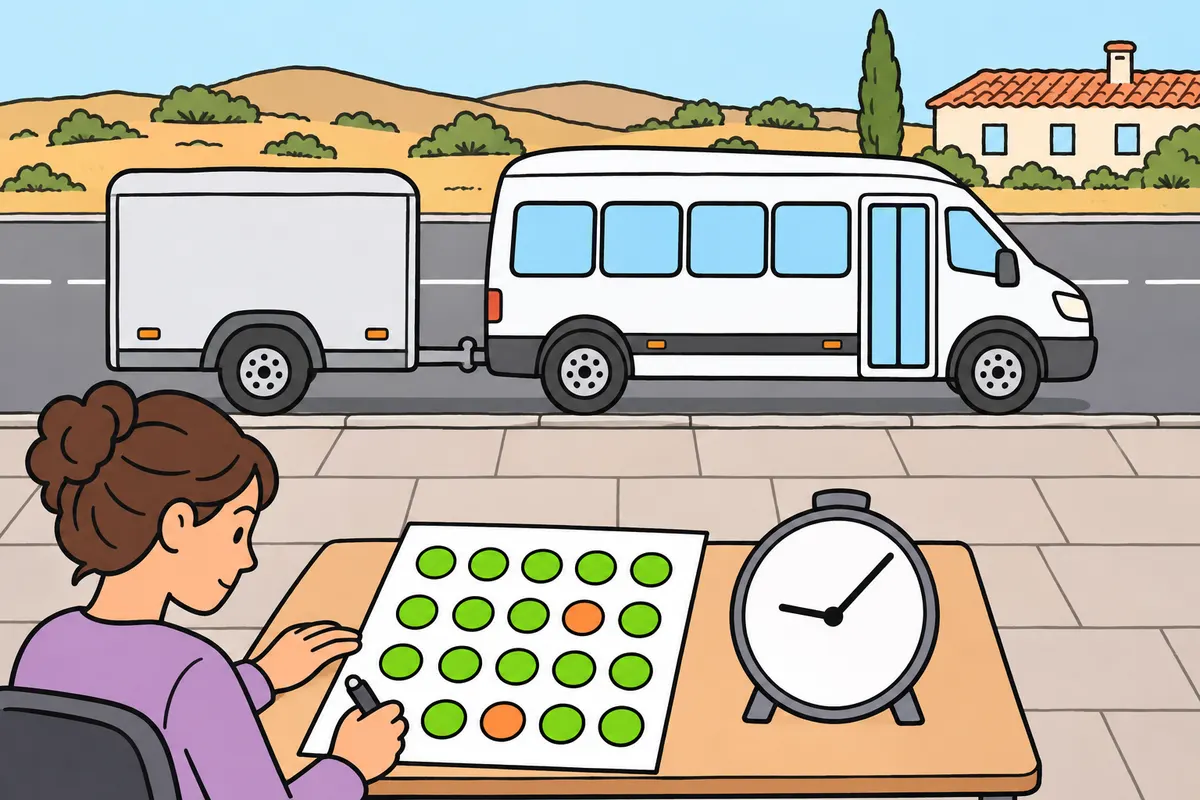
Share your theory time between questions and remember the error limit.
Remember
- You can spend more time on some questions than others.
- Videos can justify a proportional increase in test time.
- Extra time for special needs requires proper justification.
Exam trap: Wrong: you must move on after one minute. Right: you can freely divide the total test time.
Read the full explanation
- The duration rule is one minute per question: for 20 questions, you have 20 minutes in the standard format. You can divide that time between the questions; the regulations do not require you to answer each one in exactly one minute or move to the next when that minute is up. [RGCond, Annex VI.B.1-3](https://www.boe.es/buscar/act.php?id=BOE-A-2009-9481#anvi).
- You may be given extra time in proportion to the length of any videos preceding the questions, and for duly justified special needs. The extension must reflect the circumstances of the test or your documented needs as a candidate. [RGCond, Annex VI.B.1-3](https://www.boe.es/buscar/act.php?id=BOE-A-2009-9481#anvi).
- To pass, your errors must not exceed 10 % of the total number of questions. In a 20-question test, the maximum is two: with three errors, you fail. [RGCond, Annex VI.B.1-3](https://www.boe.es/buscar/act.php?id=BOE-A-2009-9481#anvi).
17Appointments and resit intervals
Your application gives limited appointments, and you must respect resit intervals.
Remember
- You do not get separate appointment allowances for each stage.
- Justified exceptions, such as illness, can extend the maximum interval.
- Recognised, justified urgency can exceptionally shorten minimum resit intervals.
- For later appointments, count from the failed test.
- The traffic office sets your exact date.
Exam trap: Wrong: missing a test never uses an appointment. Right: you lose it unless duly justified exceptional circumstances apply.
Read the full explanation
- As a general rule, each application entitles you to two test appointments. [RGCond, Annex VI.A.2](https://www.boe.es/buscar/act.php?id=BOE-A-2009-9481#anvi).
- As a general rule, no more than six months may pass between the two test appointments under the same application, except in cases of illness or other justified exceptional circumstances. This is the maximum interval between appointments under your application, not the validity period of your licence or the general validity period of a test pass. [RGCond, art. 51.2](https://www.boe.es/buscar/act.php?id=BOE-A-2009-9481#a51). [RGCond, Annex VI.A.2](https://www.boe.es/buscar/act.php?id=BOE-A-2009-9481#anvi).
- If you fail a test at two appointments, at least ten days must pass between the second and third appointments. For subsequent appointments, the minimum is fifteen days from the failed test; these intervals may exceptionally be reduced on recognised and justified grounds of urgency. The Jefatura sets the exact date. [RGCond, Annex VI.A.2](https://www.boe.es/buscar/act.php?id=BOE-A-2009-9481#anvi).
- If you do not attend on the scheduled date, you lose that appointment, except in duly justified exceptional cases. [RGCond, art. 51.2](https://www.boe.es/buscar/act.php?id=BOE-A-2009-9481#a51). [RGCond, Annex VI.A.2](https://www.boe.es/buscar/act.php?id=BOE-A-2009-9481#anvi).
18Test centre and validity of a pass
Your pass lasts two years; passing the next test within that period restarts it.
Remember
- Count from the day after you are declared to have passed.
- Pass the next test within that period to restart the validity period.
- Do not count from the start of your lessons.
- Attend the centre assigned by the traffic office in your application’s province.
Exam trap: Wrong: you can switch provinces yourself and keep your appointment. Right: you cannot make that change unilaterally.
Read the full explanation
- You take the tests in the province to which you submit your application, at the centre designated by the Jefatura Provincial de Tráfico (Provincial Traffic Office), according to the circumstances and the capacity of the service. [RGCond, art. 50](https://www.boe.es/buscar/act.php?id=BOE-A-2009-9481#a50).
- Your pass is valid for two years, counted from the day after you are declared to have passed. You must complete the remaining stages within the applicable validity period; this period relates to obtaining the licence and must not be confused with the standard five-year validity of the D1+E licence. [RGCond, art. 53](https://www.boe.es/buscar/act.php?id=BOE-A-2009-9481#a53).
- If you pass the next test within that period, the validity period starts again. For example, passing the closed-circuit test while your knowledge test pass remains valid starts a new period in which you can proceed to the road test; you must use the dates of your results, not the date you start lessons. [RGCond, art. 53](https://www.boe.es/buscar/act.php?id=BOE-A-2009-9481#a53).
19Identification and examination arrangements
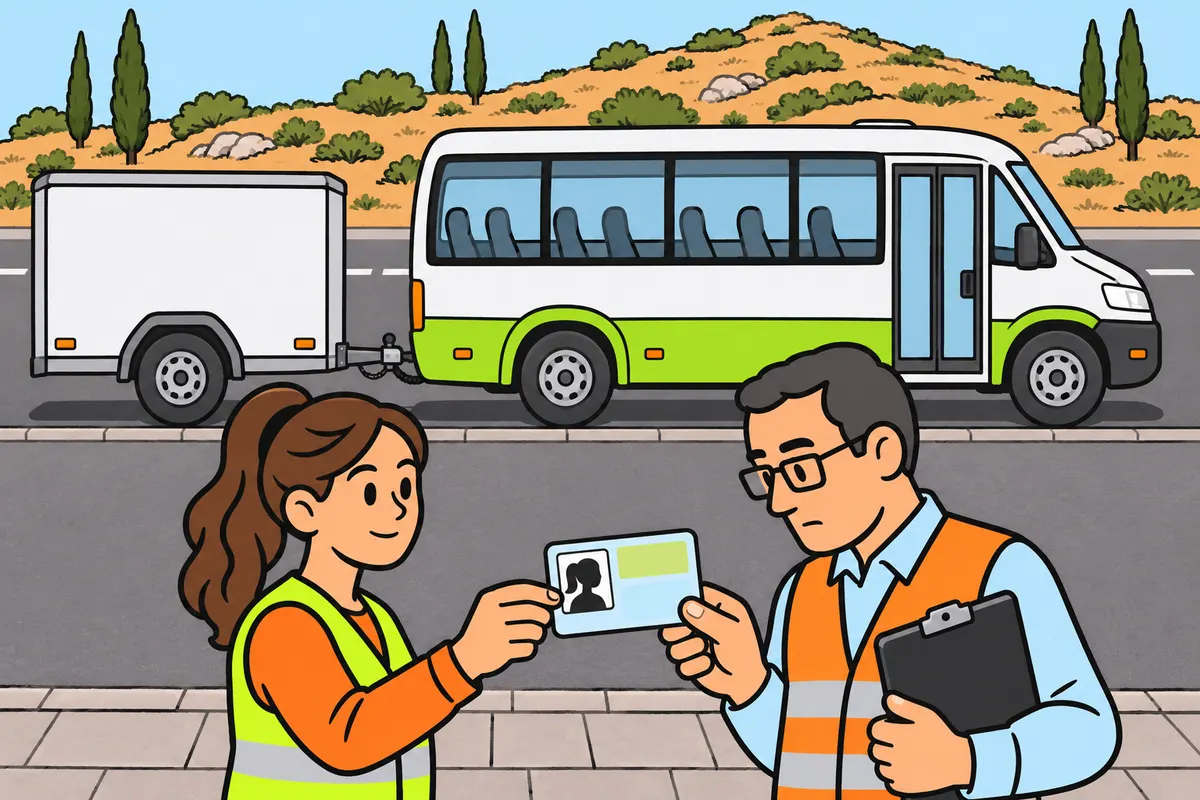
At practical tests, identify yourself with an accepted document when asked.
Remember
- Show your DNI, passport, residence card or driving licence, as applicable.
- Without required documents, your test cannot start or continue; you keep your appointment allowance.
Exam trap: Wrong: missing identification always costs you an appointment. Right: without the required documents before your practical test, it does not start and you keep the appointment allowance.
Read the full explanation
- In the practical tests, you must identify yourself when asked using your DNI (Spanish national identity card), passport, residence card or driving licence, as appropriate; if the required documentation is missing, the test does not start or is interrupted without using up one of your test attempts. [RGCond, Annex VI.A.3](https://www.boe.es/buscar/act.php?id=BOE-A-2009-9481#anvi). [RGCond, art. 57.2](https://www.boe.es/buscar/act.php?id=BOE-A-2009-9481#a57).
20Prohibited devices and fraud
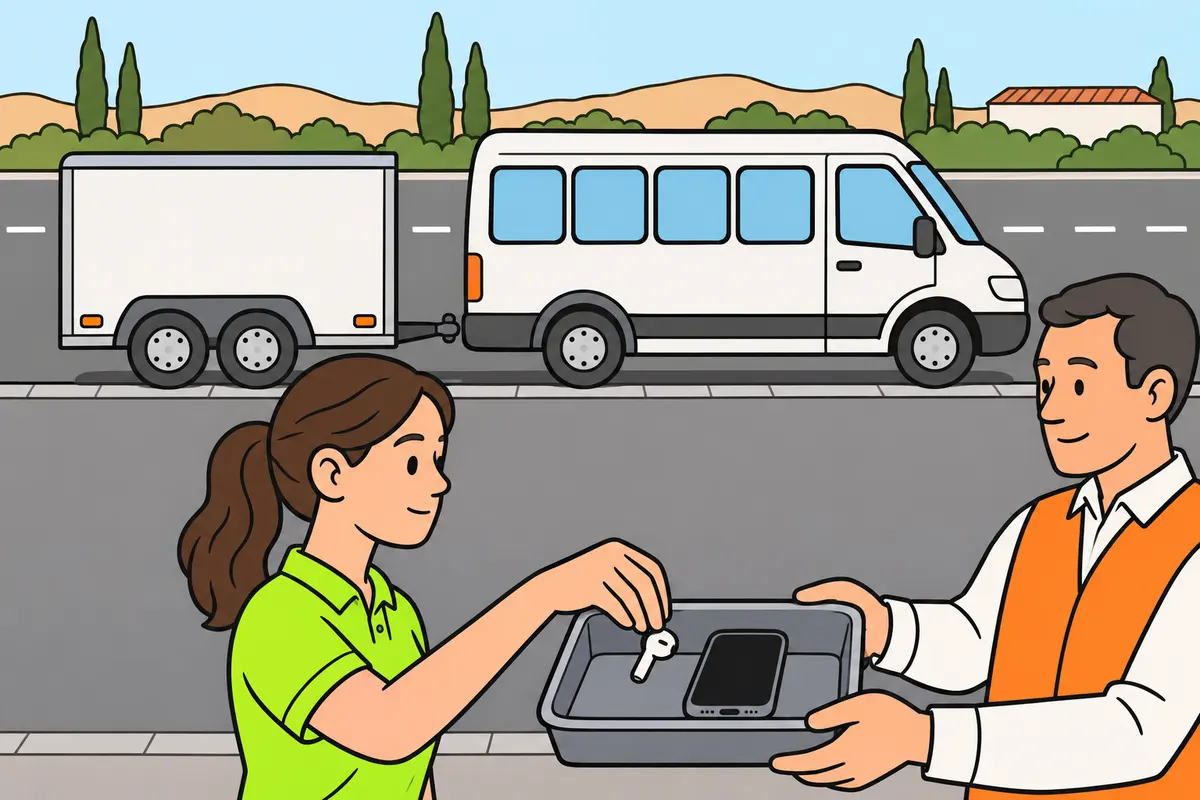
Using unauthorised communication devices during your exam has serious consequences.
Remember
- Do not use unauthorised communication devices during tests.
- Helping or collaborating with these devices is also a very serious offence.
- Fraud or attempted fraud can stop your test and result in failure.
- Disrupting order can also stop your test and result in failure.
Exam trap: Wrong: attempted cheating has no consequences unless you receive answers. Right: the attempt can stop your test and result in failure.
Read the full explanation
- If you use intercommunication devices that are not authorised by the regulations during the tests, or help or assist others using them, you commit a very serious offence. As a candidate, you are also barred for six months from taking tests to obtain or regain driving permits, licences or other driving authorisations. [Traffic Act, arts. 77.u and 80.4](https://www.boe.es/buscar/act.php?id=BOE-A-2015-11722#a80). [RGCond, Annex VI.A.4](https://www.boe.es/buscar/act.php?id=BOE-A-2009-9481#anvi).
- If you disrupt order, commit fraud or attempt to commit fraud, your test may be interrupted and suspended and you may be given a fail. You do not need to obtain an answer through fraudulent means for your attempt to have consequences in the test. [RGCond, art. 57.1](https://www.boe.es/buscar/act.php?id=BOE-A-2009-9481#a57). [RGCond, Annex VI.A.4](https://www.boe.es/buscar/act.php?id=BOE-A-2009-9481#anvi).
21Closed circuit: the three D1+E manoeuvres
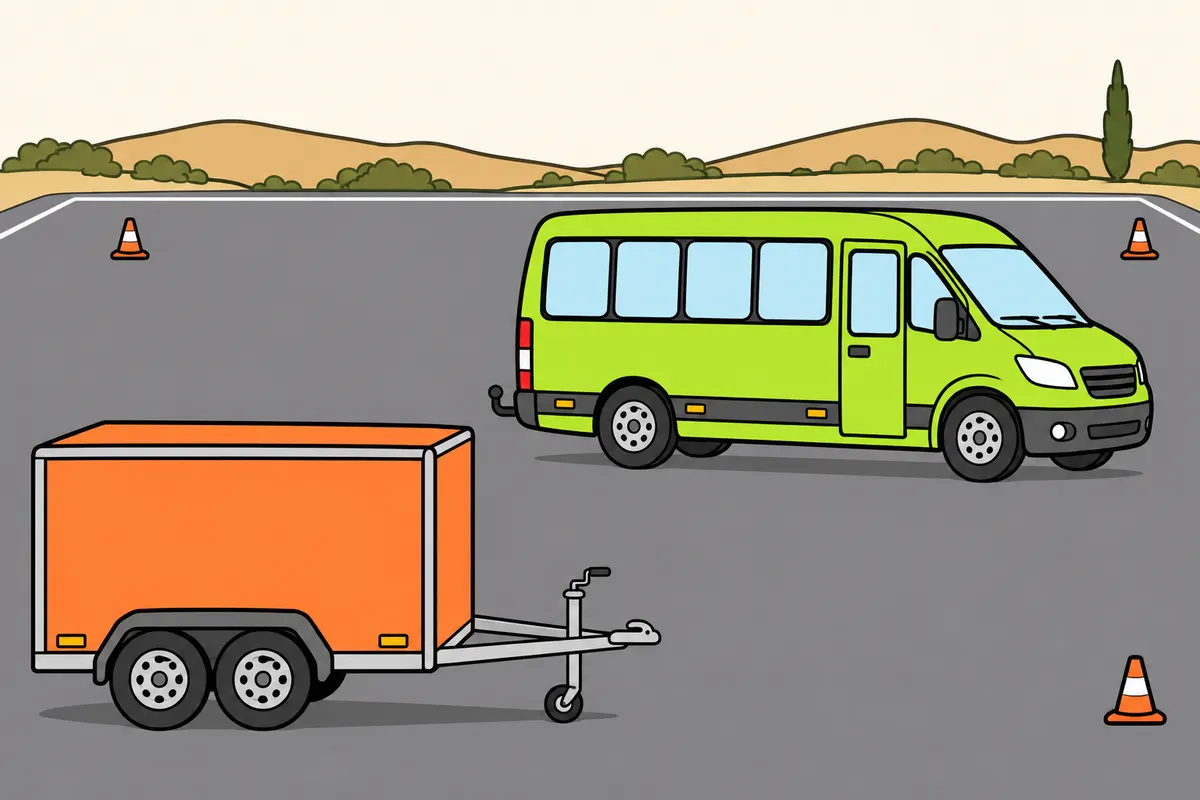
On the closed circuit, you must control reversing, parking and coupling your combination.
| Closed-circuit manoeuvre: D1+E and D+E | What you must do |
|---|---|
| G | Reverse in a straight line and around a corner |
| L | Park so passengers can enter and leave safely |
| M | Couple and uncouple the trailer |
Remember
- Before manoeuvres, show that you can prepare your combination safely.
- Check vehicle systems, passenger safety, load, coupling, brakes and electrical connections.
- Start coupling with your minibus and trailer alongside each other, without being aligned.
Exam trap: Wrong: G is a turn in the road. Right: you reverse in a straight line and around a corner.
Read the full explanation
- For D1+E and D+E, you perform manoeuvres G, L and M on a closed circuit. These letters identify test exercises. This test checks your control of the minibus and trailer and cannot be replaced by a theory test, a psychophysical fitness assessment or a technical interview. [RGCond, Annex V.B.3.8](https://www.boe.es/buscar/act.php?id=BOE-A-2009-9481#anv).
- In manoeuvre G, you reverse in a straight line and round a bend: you reverse while maintaining a straight course and use the specially laid-out roadway to turn right or left round a corner. You are assessed on your control of the combination’s path, rather than on turning around by moving forwards and backwards. [RGCond, Annex V.B.3.3 and 8](https://www.boe.es/buscar/act.php?id=BOE-A-2009-9481#anv).
- In manoeuvre L, you park to allow passengers to get on and off safely. In manoeuvre M, you couple and uncouple the trailer, starting with the towing vehicle and trailer side by side, without being aligned. You find the detailed technique in Driving techniques for a minibus with a trailer and Coupling and uncoupling the trailer. [RGCond, Annex V.B.3.5, 7 and 8](https://www.boe.es/buscar/act.php?id=BOE-A-2009-9481#anv).
- Before performing the manoeuvres, you must demonstrate safe preparation and the required checks: vehicle systems, passenger safety equipment, trailer load, coupling mechanism, brakes and electrical connections. [RGCond, Annex V.B.3.6-8](https://www.boe.es/buscar/act.php?id=BOE-A-2009-9481#anv).
22How the closed-circuit test is marked
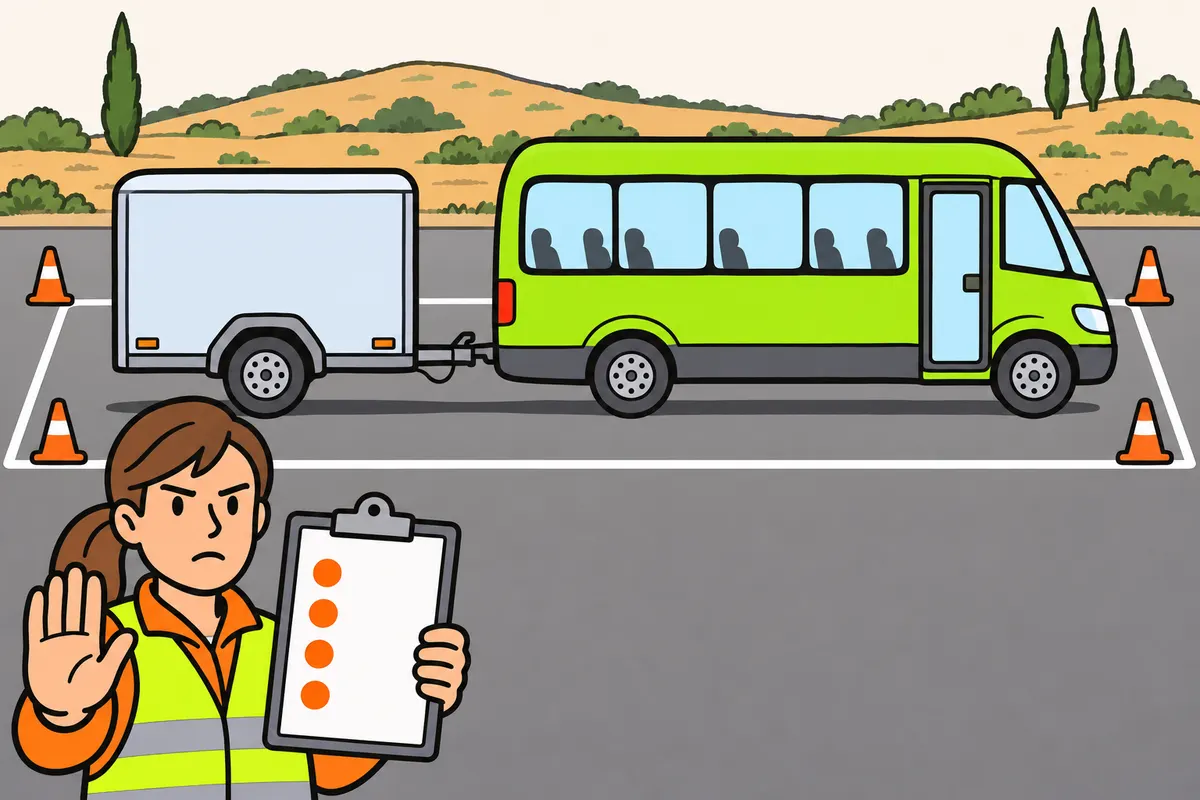
On the closed circuit, a severe fault or accumulated faults can make you fail.
| Faults on the closed circuit | Result |
|---|---|
| One disqualifying | Fail |
| Two serious | Fail |
| One serious and two minor | Fail |
| Four minor | Fail |
Remember
- Doing another manoeuvre well cannot cancel your faults.
- Test time depends on your manoeuvres and vehicle.
Exam trap: Wrong: you need ten minor faults to fail the closed circuit. Right: four minor faults are enough.
Read the full explanation
- On the closed circuit, your faults are classified as disqualifying, serious or minor according to their severity. A disqualifying fault shows a lack of control that prevents you from performing the manoeuvre under the required conditions, or an obvious lack of skill; a serious fault indicates that you use the controls in a markedly inappropriate way without reaching that level of inability. [RGCond, Annex VI.C.2 and C.3.1.º](https://www.boe.es/buscar/act.php?id=BOE-A-2009-9481#anvi).
- You fail the closed-circuit test if you commit one disqualifying fault, two serious faults, one serious fault and two minor faults, or four minor faults. [RGCond, Annex VI.C.2 and C.3.1.º](https://www.boe.es/buscar/act.php?id=BOE-A-2009-9481#anvi).
- A minor fault on the closed circuit concerns your use of the controls or your execution of the manoeuvre and is less significant than a serious fault. Your mark depends on what happens during the exercise: when you reverse with the minibus and its trailer, the examiner assesses the control you demonstrate over the combination. [RGCond, Annex VI.C.3.1.º](https://www.boe.es/buscar/act.php?id=BOE-A-2009-9481#anvi).
- The time allowed for your closed-circuit test depends on the characteristics and difficulty of the manoeuvres and the vehicle you use. [RGCond, Annex VI.C.2 and C.3.1.º](https://www.boe.es/buscar/act.php?id=BOE-A-2009-9481#anvi).
23Road test: assessment and duration
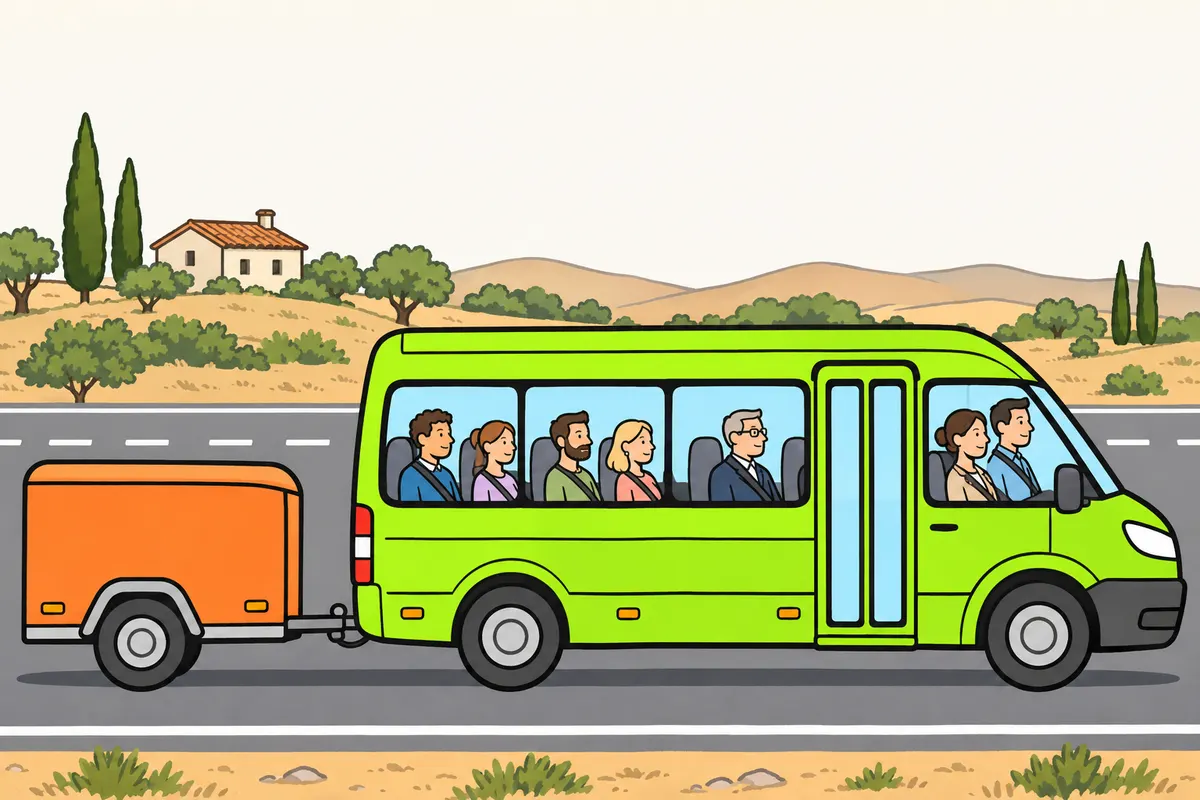
On the road, drive your combination safely and smoothly for your passengers.
| Faults in the D1+E road test | Result |
|---|---|
| One disqualifying | Fail |
| Two serious | Fail |
| One serious and five minor | Fail |
| Ten minor | Fail |
Remember
- Observe carefully, control your combination and avoid sudden acceleration or harsh braking.
- This minimum excludes reception, preparation, safety checks, special manoeuvres and giving your result.
- A dangerous fault alone can make you fail.
- Your instructor or legally permitted trainer sits at the dual controls.
- Only people authorised for the test may accompany you.
Exam trap: Wrong: your whole appointment lasts 45 minutes. Right: this minimum covers driving and road time, unless the test is interrupted and suspended.
Read the full explanation
- In the road test, you must demonstrate observation, use of the controls, joining traffic, road positioning, dealing with junctions and the other operations in the syllabus with the complete combination. For D1+E, you are also assessed on passenger comfort: smooth driving, without sudden acceleration or harsh braking, forms part of the assessment. [RGCond, Annex VI.C.7.4](https://www.boe.es/buscar/act.php?id=BOE-A-2009-9481#anvi).
- Your minimum driving time on the road for D1+E is 45 minutes, unless the tests are interrupted and suspended. [RGCond, Annex VI.C.2.2.º and C.3.2.º](https://www.boe.es/buscar/act.php?id=BOE-A-2009-9481#anvi).
- Your 45 minutes do not include reception, vehicle preparation, technical safety checks, special manoeuvres where applicable or notification of the result. Your total appointment may therefore last longer: the minimum refers to the driving time on the road specified in the regulations. [RGCond, Annex VI.C.2.2.º and C.3.2.º](https://www.boe.es/buscar/act.php?id=BOE-A-2009-9481#anvi).
- You fail the road test with one disqualifying fault, two serious faults, one serious fault and five minor faults, or ten minor faults. A fault that creates danger can be disqualifying on its own. [RGCond, Annex VI.C.2.2.º and C.3.2.º](https://www.boe.es/buscar/act.php?id=BOE-A-2009-9481#anvi).
- You are accompanied at the dual controls by an instructor or the person who provided your training under the regulatory conditions. Only candidates, examiners and instructors or authorised accompanying persons may travel in your test vehicle; this is not private practice with a freely chosen accompanying person. [RGCond, art. 55.1](https://www.boe.es/buscar/act.php?id=BOE-A-2009-9481#a55). [RGCond, Annex VI.C.7.1](https://www.boe.es/buscar/act.php?id=BOE-A-2009-9481#anvi).
24Test vehicle and scope of the licence
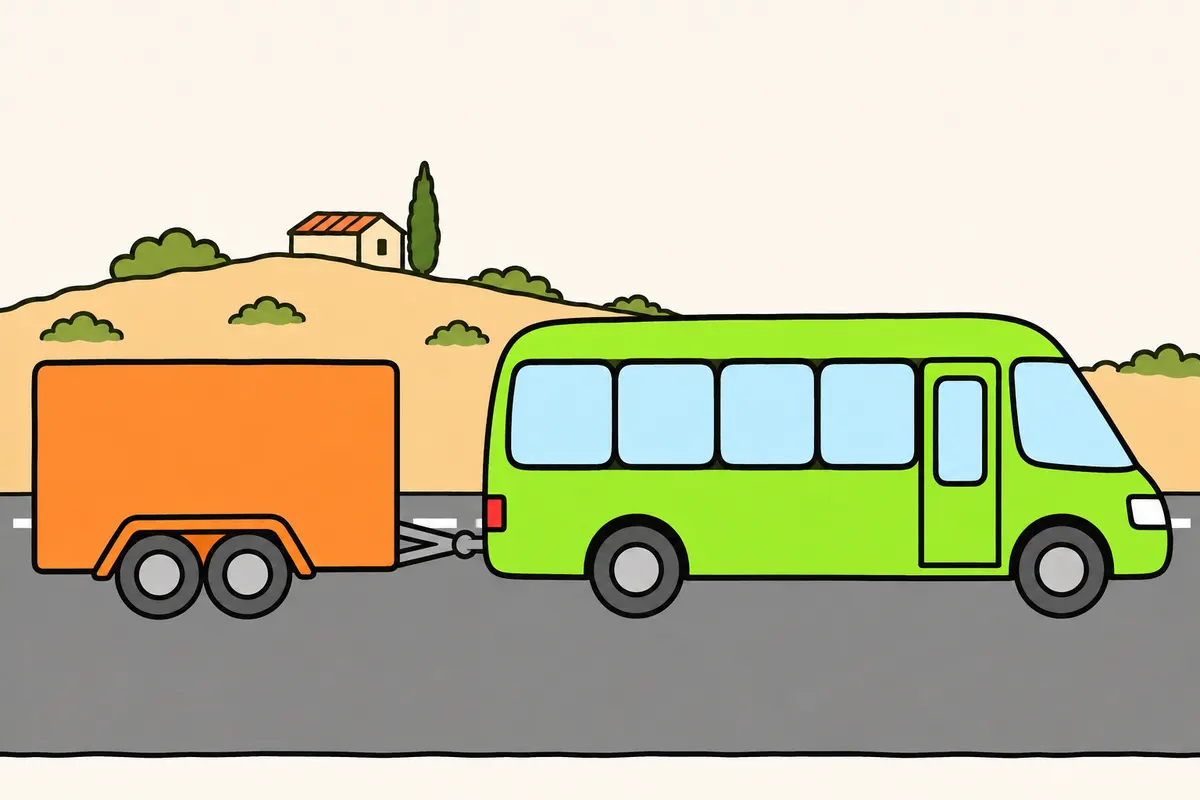
Your test combination has special requirements that do not limit your whole licence.
| D1+E test vehicle part | Requirements |
|---|---|
| D1 bus | MMA at least 4,000 kg; length at least 5.50 metres; maximum 17 seats including yours |
| Trailer | MMA at least 2,500 kg; actual mass at least 800 kg |
| Trailer dimensions | Width and height at least 2 metres; length at least 4 metres without coupling |
| Trailer load compartment | Width and height at least 2 metres |
| Test combination | MMA no more than 12,000 kg |
Remember
- Distinguish your trailer’s MMA from its actual mass.
- Measure trailer length without the drawbar or coupling system.
- You can use a fixed centre-axle trailer.
Exam trap: Wrong: D1+E limits every combination to 12,000 kg. Right: here, that limit applies to your test combination.
Read the full explanation
- In the D1+E test, you use a D1 bus and a trailer with the characteristics required by the regulations. Your bus must have an MMA (maximum authorised mass) of at least 4,000 kg, a length of at least 5.50 metres and no more than 17 seats including yours. [RGCond, Annex VII.B.12-13](https://www.boe.es/buscar/act.php?id=BOE-A-2009-9481#anvii).
- Your test trailer must have an MMA of at least 2,500 kg, a width and height of at least 2 metres and a length of at least 4 metres excluding the drawbar or coupling system. Its load compartment must also be at least 2 metres wide and 2 metres high. [RGCond, Annex VII.B.13](https://www.boe.es/buscar/act.php?id=BOE-A-2009-9481#anvii).
- Your D1+E test combination must have an MMA of no more than 12,000 kg, and your trailer must have an actual total weight of at least 800 kg. The first figure is a requirement for the authorised mass of the combination you present; the second is a minimum actual mass for the trailer you use to demonstrate your skills. [RGCond, Annex VII.B.13](https://www.boe.es/buscar/act.php?id=BOE-A-2009-9481#anvii).
- You may use trailers with fixed centre axles in the test. [RGCond, Annex VII.B.18](https://www.boe.es/buscar/act.php?id=BOE-A-2009-9481#anvii).
25Standard validity and conditions
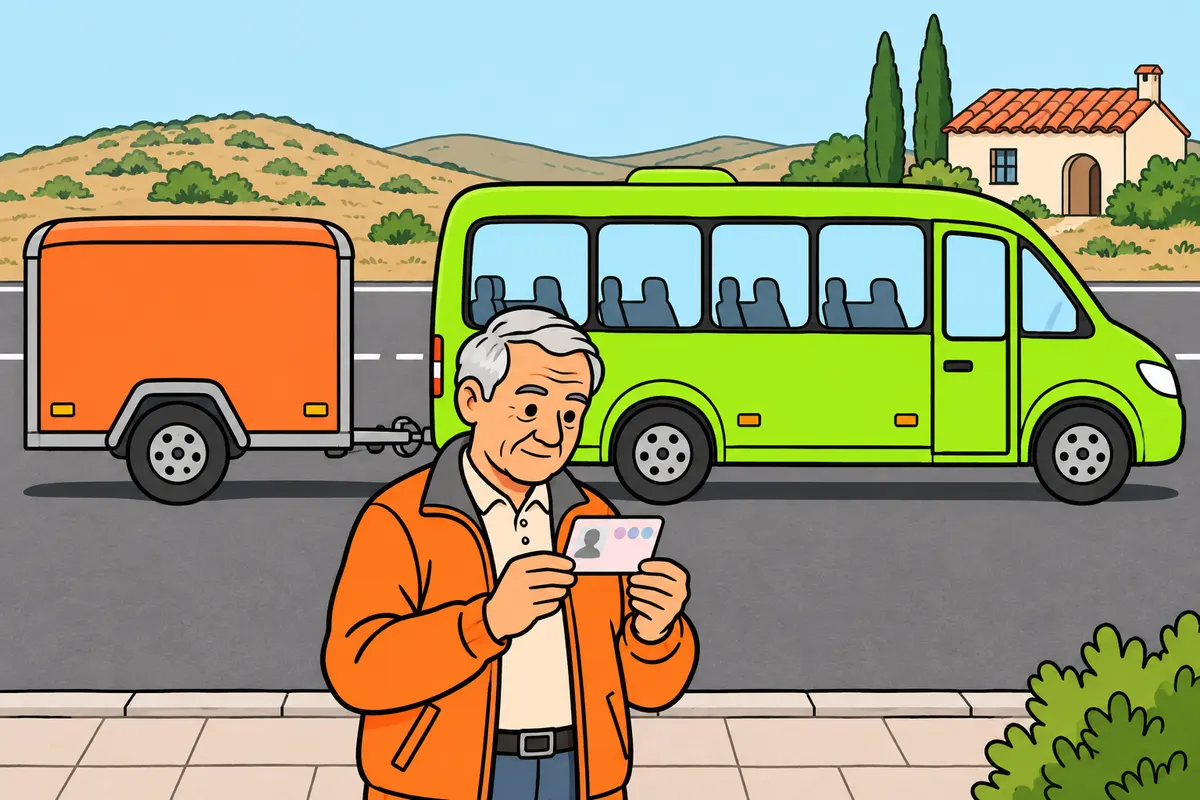
Check your D1+E expiry date and keep meeting the requirements to drive.
| Your age: D1 and D1+E categories | Standard validity |
|---|---|
| Under 65 years | Five years |
| From 65 years | Three years |
Remember
- Check the date for the category you need to drive.
- An illness that may worsen can shorten your validity period.
- Respect the individual restrictions on your licence.
- Keep meeting the requirements and do not lose all your points.
Exam trap: Wrong: a future printed expiry date always lets you drive. Right: you cannot drive if your entitlement has lost validity for another reason.
Read the full explanation
- Your D1 and D1+E licences normally remain valid for five years while you are under 65 and for three years from that age. You check the expiry date for the category you need to drive the combination; changing trailers does not start a new validity period. [RGCond, art. 12](https://www.boe.es/buscar/act.php?id=BOE-A-2009-9481#a12).
- The categories shown on your licence may have different validity periods: bus and coach categories follow the periods for the heavy vehicle group, while B and B+E follow the periods for the other categories. You must check the date for the category you intend to drive under, even if they all appear on a single document. [RGCond, arts. 4 and 12](https://www.boe.es/buscar/act.php?id=BOE-A-2009-9481#a12).
- Your validity period may be shortened if you have an illness or impairment that may worsen, even if it allows your licence to be issued or renewed. The five- and three-year periods are the standard periods: you must observe your individually assigned expiry date and any applicable restrictions. [RGCond, art. 3.1](https://www.boe.es/buscar/act.php?id=BOE-A-2009-9481#a3). [RGCond, art. 12](https://www.boe.es/buscar/act.php?id=BOE-A-2009-9481#a12).
- Your licence also remains valid only if you continue to meet the requirements for its issue and have not lost all your points. A printed expiry date that has not yet passed does not entitle you to drive if your licence has ceased to be valid. [RGCond, art. 12](https://www.boe.es/buscar/act.php?id=BOE-A-2009-9481#a12).
26How to renew D1+E
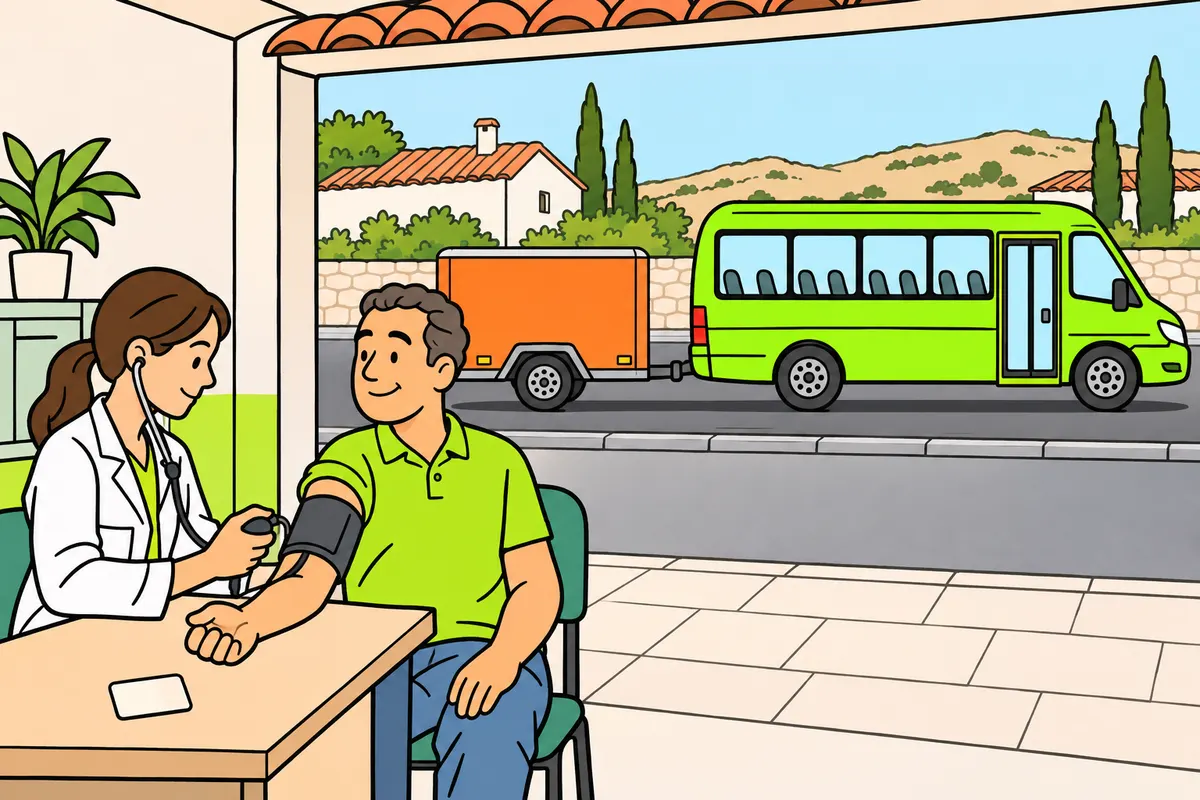
Renew D1+E with the correct medical assessment, and do not drive while it is expired.
Remember
- Apply for renewal and prove the physical and mental fitness for your group.
- You can arrange renewal through an authorised driver medical assessment centre.
- Standard renewal does not repeat theory, closed-circuit or road tests.
- Applying within three months before expiry does not shorten your validity.
- You can renew after expiry, but cannot drive while your licence remains expired.
Exam trap: Wrong: renewing only group 1 renews D1+E. Right: renewing group 2 also renews your group 1 authorisations for their corresponding periods; the reverse does not apply.
Read the full explanation
- To renew your licence, you must apply and demonstrate that you still meet the physical and mental fitness requirements for the category. D1+E belongs to driver group 2, so your medical examination must be for that group. [RGCond, art. 45](https://www.boe.es/buscar/act.php?id=BOE-A-2009-9481#a45). [RGCond, art. 13](https://www.boe.es/buscar/act.php?id=BOE-A-2009-9481#a13).
- You can submit your application during the three months before your licence expires. Within that window, your new validity period runs from the expiry date, so applying early within the standard renewal window does not cost you any days of validity. [RGCond, art. 13](https://www.boe.es/buscar/act.php?id=BOE-A-2009-9481#a13).
- For a standard renewal, you do not have to retake the theory test, manoeuvres test or road test: you must pass the medical examination and complete the renewal procedure. You can arrange this at an authorised Centro de Reconocimiento de Conductores (driver medical examination centre). You can find details of the documents and administrative channels in Driver and vehicle combination documentation. [DGT, licence renewal](https://www.dgt.es/nuestros-servicios/permisos-de-conducir/ha-caducado-o-necesitas-una-copia-de-tu-permiso/renovar-un-permiso-proximo-a-caducar/). [RGCond, art. 13](https://www.boe.es/buscar/act.php?id=BOE-A-2009-9481#a13).
- You can apply to renew an expired licence, but you cannot drive under it while it remains expired. Being able to renew it does not give you a grace period to finish routes; you must have a valid driving entitlement before you drive the combination again. [RGCond, art. 12.4](https://www.boe.es/buscar/act.php?id=BOE-A-2009-9481#a12). [RGCond, art. 13](https://www.boe.es/buscar/act.php?id=BOE-A-2009-9481#a13).
- When you renew a group 2 driving entitlement, you also renew any group 1 driving entitlements you hold, for their respective validity periods. [RGCond, art. 13](https://www.boe.es/buscar/act.php?id=BOE-A-2009-9481#a13).
Choosing the entitlement for the combination
Classify the towing vehicle and the trailer's MMA (maximum authorised mass) under article 4 of the Reglamento General de Conductores (General Driver Regulations, RGCond).
- Identify whether the towing vehicle falls within D1: up to 16 passengers in addition to the driver and up to 8 metres long.
- If the trailer's MMA does not exceed 750 kg, D1 is sufficient in terms of licence category.
- If the trailer's MMA exceeds 750 kg, you need D1+E or a category that includes it.
- If the bus falls outside D1 and within D, a heavy trailer requires D+E.
- Check that your entitlement is valid, along with your personal restrictions and the technical conditions of the combination.
Completing the D1+E tests
Work through the stages under articles 53 and 54 of the RGCond, passing each before moving on to the next.
- Check that you hold a valid D1 licence, meet the age and physical and mental fitness requirements, and hold an ordinary CAP if you use the age 18 exception; until you are 21, this exception limits your driving to Spain.
- Check whether you are exempt from the specific theory test because you hold a valid C1+E licence or have passed a test whose pass is still valid.
- Pass the specific knowledge test if it is required of you.
- Pass manoeuvres G, L and M on a closed circuit.
- Pass the driving test on roads open to traffic; keep track of the two-year validity of your passes and the test attempts available under your application.
Renewing without interrupting your driving
Use the standard advance renewal period under article 13 of the RGCond.
- Check the individual expiry date of your D1+E licence and the applicable restrictions.
- During the three months before expiry, apply for renewal and provide evidence that you meet the group 2 physical and mental fitness requirements.
- Complete the process at an authorised centre or through the appropriate DGT procedure.
- Check that you have valid authorisation to drive; if your licence has expired, wait until you have a valid entitlement.
- Check the expiry date assigned on renewal, as medical reasons may result in a shorter validity period than the standard one.
Check what you know
Real questions from the bank on this topic. Pick an answer to see the explanation.
Finished this module?
Mark it as read and you will see your progress on the theory list.