
Theory · B+E Licence - Car with Trailer · Module 13 of 13
Signs and priority when towing a trailer
You learn to interpret instructions from officers, temporary signs, traffic lights, upright signs and road markings, and to apply their order of precedence. You recognise restrictions that affect your B+E combination and apply each message to the towing vehicle and trailer, paying particular attention to priority, axles, masses and dimensions.
Sign library
All 620 signals of the official catalogue in force (Royal Decree 465/2025), each with its drawing and description, and a test to practise them.
1Read signs with your combination in mind
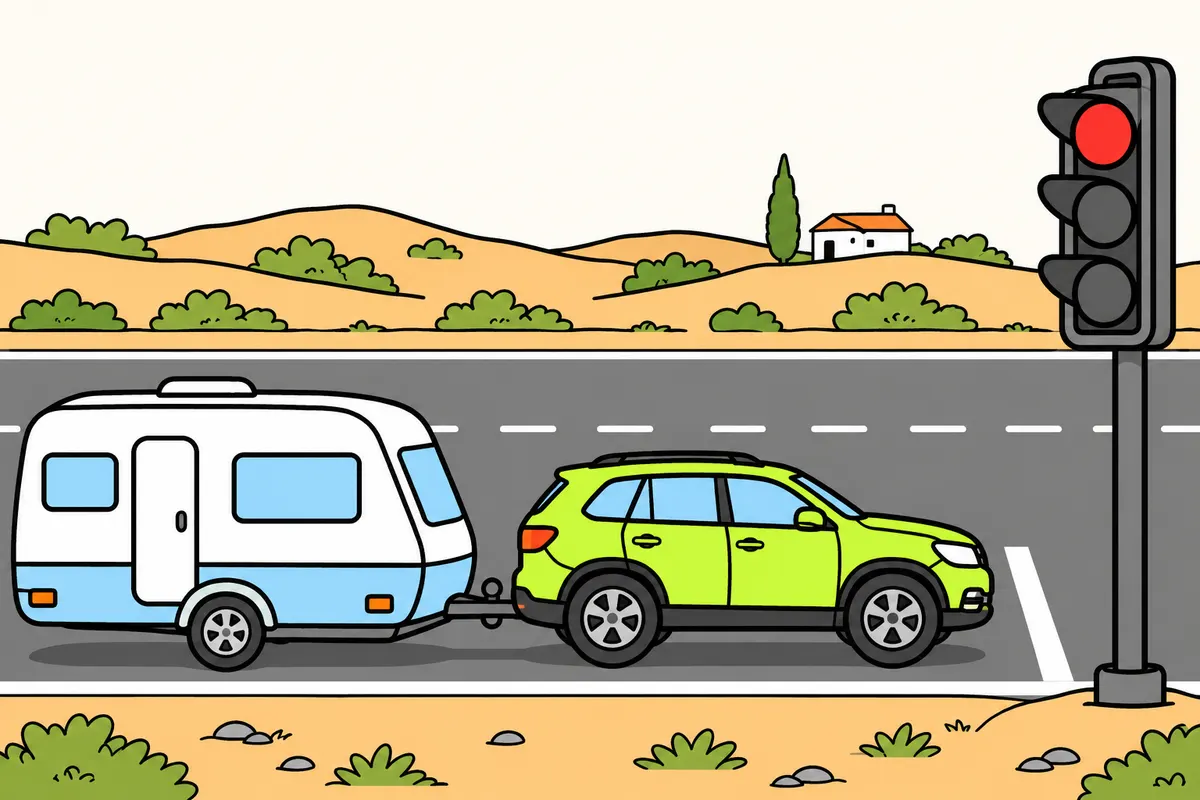
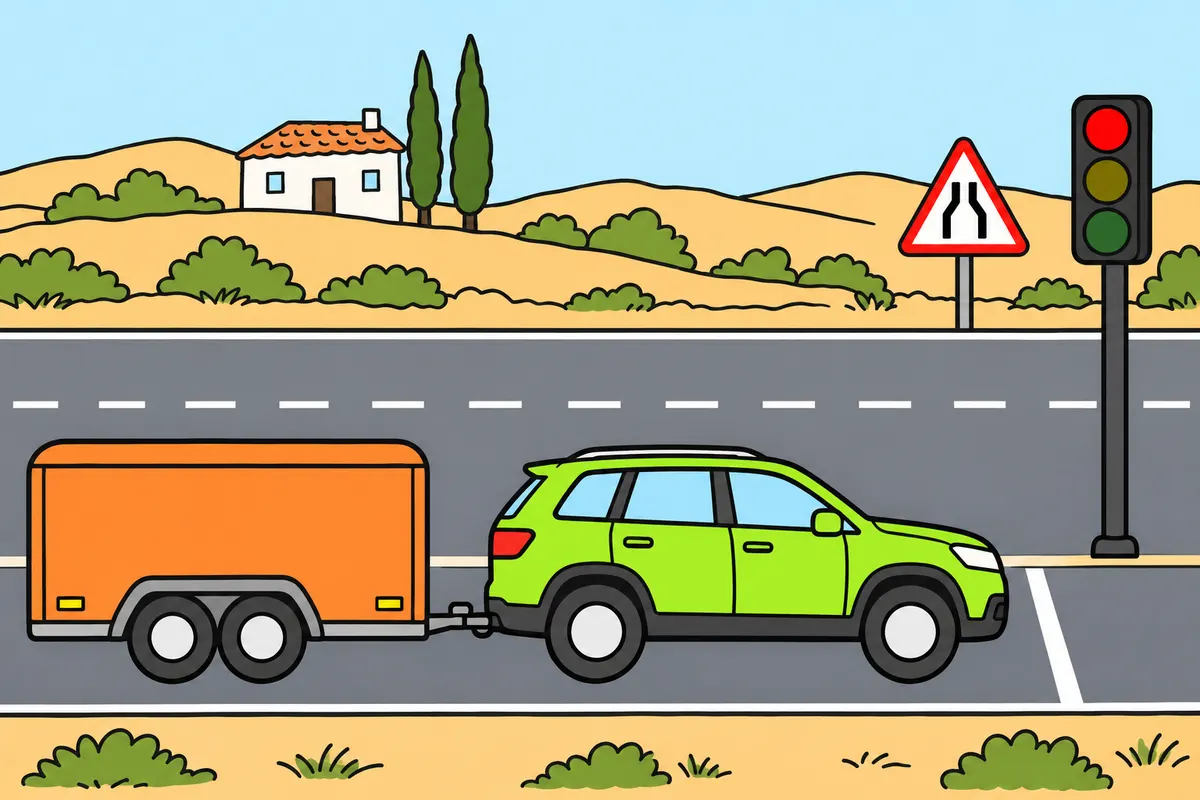
Obey the signs that apply to your route and vehicle combination.
| Message | What it tells you |
|---|---|
| Warning | Expect a hazard |
| Prohibition | You must not do something |
| Mandatory instruction | You must do something |
| Information | Find your way or learn about the road |
Remember
- Check what the sign tells you and whom it addresses.
- Look for signs immediately right, above the road or above your lane.
- If none are there, look immediately left when going straight ahead or left.
- If both sides differ, obey the left for those movements.
- Obey signs even when the road is empty.
Exam trap: Wrong: you follow a sign for another entrance. Right: check which sign controls your route.
Read the full explanation
- You must comply with the obligations and prohibitions shown by signs and adapt your behaviour to the message of other signs. An empty road, the absence of noise or your planned route does not allow you to ignore an applicable sign. Towing a caravan or a horse trailer does not exempt you from obeying it either. [RGC, art. 132](https://www.boe.es/buscar/act.php?id=BOE-A-2003-23514#a132).
- To interpret a situation, identify what the sign instructs you to do, who it applies to and where its effect begins. A warning announces a hazard; a prohibition restricts an action; a mandatory sign requires an action; an information sign guides or informs you. The symbol and supplementary plates specify the message. [RGC, art. 132](https://www.boe.es/buscar/act.php?id=BOE-A-2003-23514#a132).
- You must obey traffic lights and upright signs immediately to your right, above the carriageway or above your lane. If there are none in these positions and you are going straight ahead or turning left, obey those immediately to your left. [RGC, art. 132](https://www.boe.es/buscar/act.php?id=BOE-A-2003-23514#a132).
- If the indications on the right and left differ, you must obey those on the left to go straight ahead or turn left. First establish which lane and route your combination occupies in the situation: a sign intended for another approach does not automatically control yours. [RGC, art. 132](https://www.boe.es/buscar/act.php?id=BOE-A-2003-23514#a132).
2Order of precedence and compatible messages
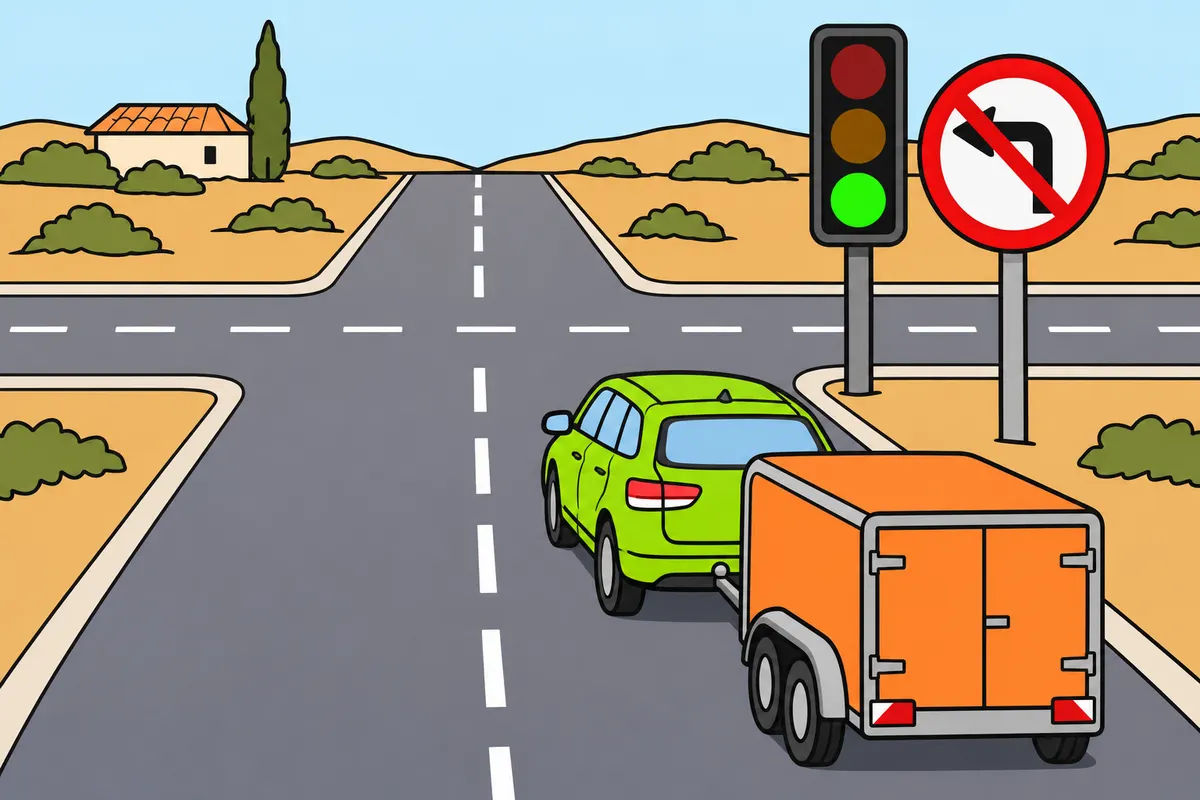
When signs conflict, obey the instruction with higher priority.
| Situation on your approach | What you must do |
|---|---|
| Officer contradicts traffic light | Obey the officer |
| Circular green and STOP on the same approach | Follow the green light |
| Traffic light off; STOP still applies | Stop at STOP |
Remember
- Obey officers first.
- Next come temporary signs, barriers and route markers.
- Then traffic lights, upright signs and road markings.
- For conflicting signs of the same type, obey the most restrictive.
- Obey compatible messages together.
Exam trap: Wrong: green lets you turn where turning is prohibited. Right: compatible prohibitions still apply.
Read the full explanation
- The order of precedence is: officers; temporary signs and markers that change the normal use of the road, devices that mark off areas and guidance markers; traffic lights; upright signs; road markings. The category of a sign determines its precedence when messages conflict. [RGC, art. 133](https://www.boe.es/buscar/act.php?id=BOE-A-2003-23514#a133).
- If instructions conflict, you must follow the one with higher precedence. If they are of the same type, the most restrictive takes precedence. A sign being closer, larger or more brightly coloured does not in itself change this order. [RGC, art. 133](https://www.boe.es/buscar/act.php?id=BOE-A-2003-23514#a133).
- An instruction from an officer controlling your passage takes precedence over a traffic light. A circular green traffic light controlling the same approach takes precedence over the STOP sign on that approach. If the traffic light is off, you must obey the STOP sign that still controls entry. [RGC, art. 133](https://www.boe.es/buscar/act.php?id=BOE-A-2003-23514#a133).
- You must comply with compatible messages together. A circular green traffic light allows you to proceed, but it can coexist with R-303, no left turn: you must obey both messages. Green does not permit every movement or remove an access restriction compatible with it. [RGC, art. 133](https://www.boe.es/buscar/act.php?id=BOE-A-2003-23514#a133).
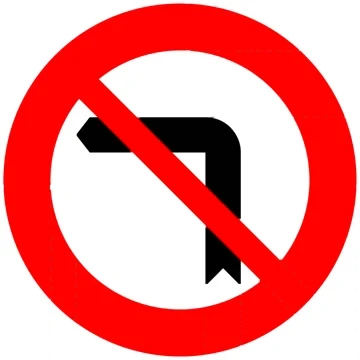 R-303
3Officers’ gestures and whistle signals
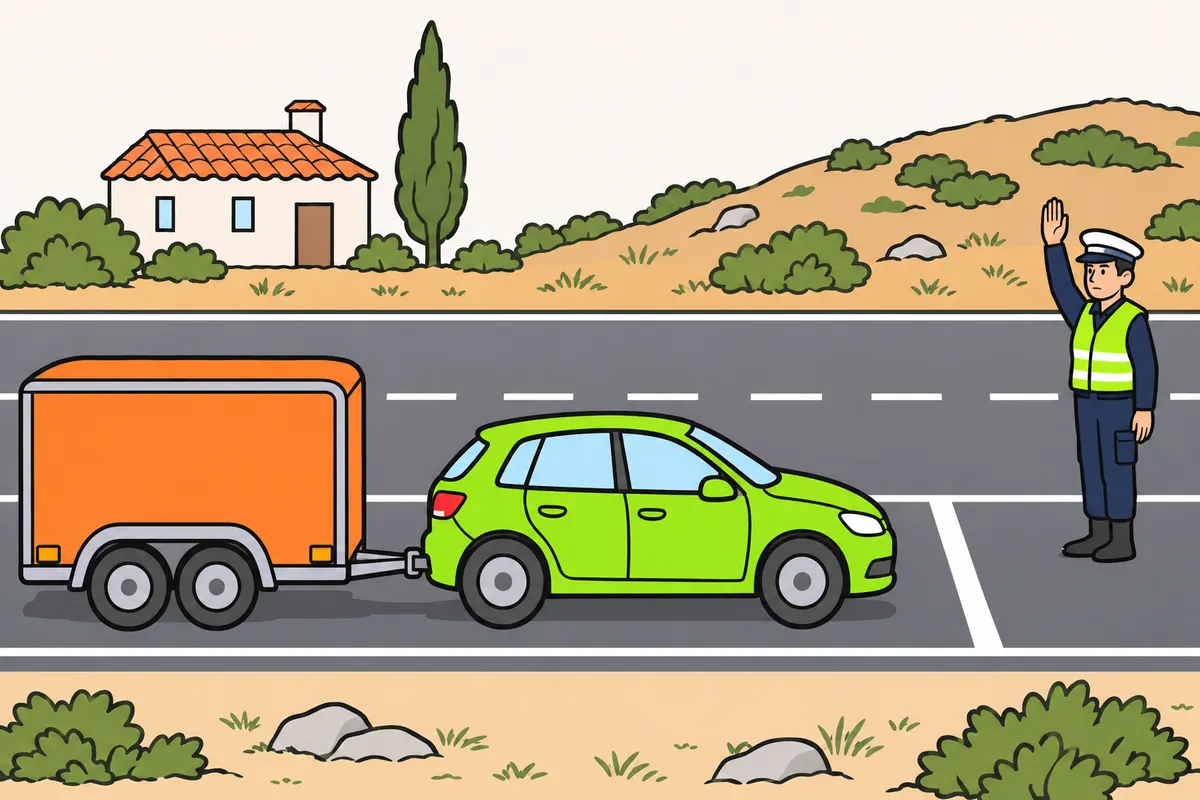
Obey an officer's gestures and whistle signals as soon as you notice them.
| Officer's signal | What you must do |
|---|---|
| Red or yellow light waved towards you | Stop |
| Outstretched arm moving up and down | Slow down when approaching at right angles from that arm’s side |
| Short, frequent whistle blasts | Stop |
| Long whistle blast | Move off again |
Remember
- With an arm raised vertically, stop unless you cannot stop safely enough.
- If already inside the junction, you may continue to clear it.
- Stop before the nearest line; without one, immediately before the officer.
- At junctions, stop before entering; follow any different stopping point the officer indicates.
- With horizontal arms, stop if your approach crosses the line of the arms.
- This still applies if arms lower without a position change or another signal.
Exam trap: Wrong: you confuse whistle signals. Right: short, frequent blasts mean stop; a long blast means move off.
Read the full explanation
- You must immediately obey any instructions from an officer that you can perceive. If the officer raises one arm vertically, you must stop as you approach, unless you cannot do so safely enough. If the gesture is made once you have entered the junction, you may continue to clear it. [RGC, Annex I, section 1](https://www.boe.es/buscar/act.php?id=BOE-A-2003-23514#A1).
- On receiving that instruction, you must stop before the nearest stop line; if there is none, immediately before the officer. At a junction, you must stop before entering. The officer may then indicate another stopping point: follow that specific instruction. [RGC, Annex I, section 1](https://www.boe.es/buscar/act.php?id=BOE-A-2003-23514#A1).
- With one or both arms extended horizontally, the officer requires you to stop if you approach from a direction that crosses the line indicated by the arms, whichever way you are travelling. The instruction remains in force if the officer lowers the arms without changing position or making another signal. [RGC, Annex I, section 1](https://www.boe.es/buscar/act.php?id=BOE-A-2003-23514#A1).
- If the officer waves a red or yellow light towards you, you must stop. If the officer repeatedly moves an outstretched arm up and down, you must slow down when you approach from the side of the signalling arm and at right angles to it. [RGC, Annex I, section 1](https://www.boe.es/buscar/act.php?id=BOE-A-2003-23514#A1).
- Short, frequent whistle blasts instruct you to stop your vehicle; one long blast instructs you to resume driving. Interpret all the officer’s signals together and identify who they apply to: the whistle does not mean the same as a warning sounded by another driver. [RGC, Annex I, section 1](https://www.boe.es/buscar/act.php?id=BOE-A-2003-23514#A1).
4Instructions from vehicles and authorised personnel
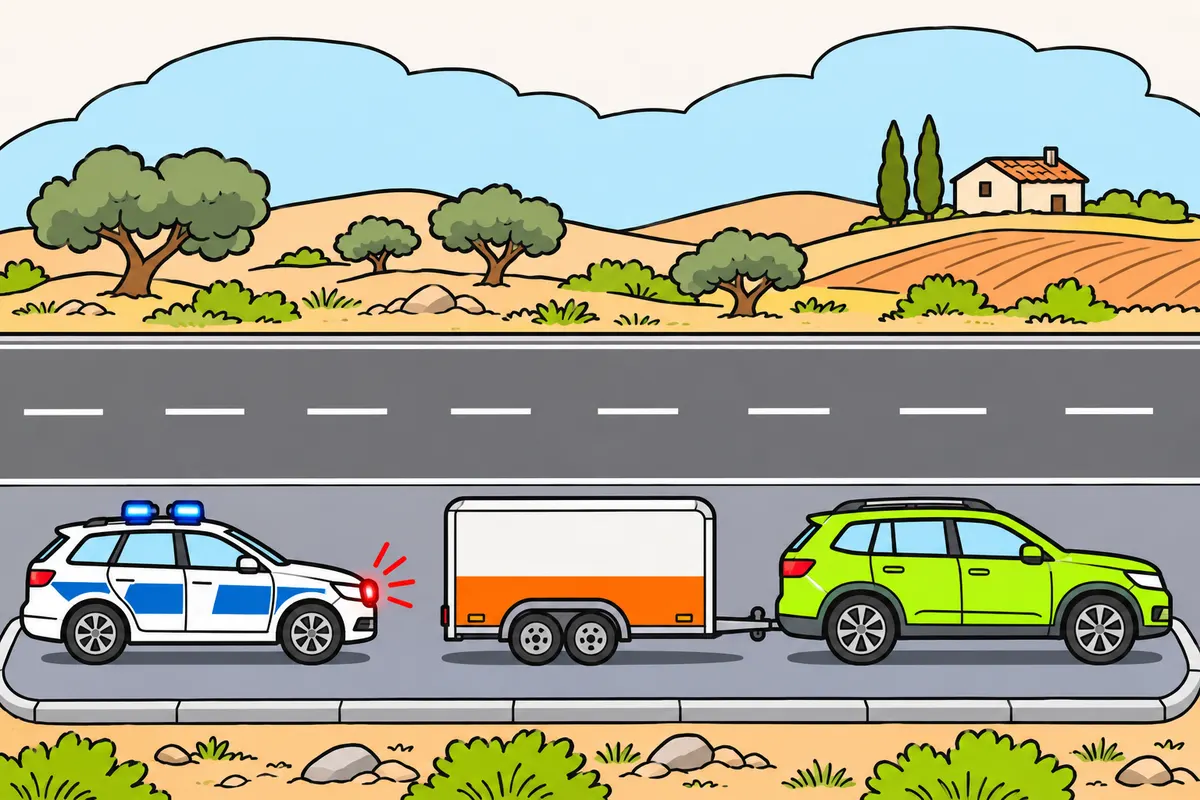
Follow police instructions from vehicles and instructions from authorised personnel.
| Flag on officer’s vehicle | What you must do |
|---|---|
| Red | Respect closure as it passes, except when accompanied or escorted |
| Green | Traffic may use the road again |
| Yellow | Take extreme care; expect danger |
Remember
- If an officer signals at you with a still, downward-angled arm, stop right.
- If driving ahead of police showing flashing red towards you, you must stop.
- Stop on the right, ahead of the police vehicle.
- Choose a place without greater risks or inconvenience for your whole combination.
- Follow loudspeaker instructions and authorised personnel controlling passage under the regulatory conditions.
Exam trap: Wrong: you must stop 150 m away. Right: personnel must be visible from that distance.
Read the full explanation
- A red flag carried by an officer’s vehicle indicates that the carriageway is temporarily closed as that vehicle passes, except to accompanied or escorted road users. A green flag indicates that it is open to traffic. A yellow flag requires you to take extra care or warns of a nearby hazard. [RGC, art. 141](https://www.boe.es/buscar/act.php?id=BOE-A-2003-23514#a141). [RGC, Annex I, section 1](https://www.boe.es/buscar/act.php?id=BOE-A-2003-23514#A1).
- An officer in a vehicle, holding an arm still and angled downwards, instructs you to stop on the right if the signal is directed at you. A forward-facing flashing or strobe red light instructs you to stop on the right, in front of the police vehicle, when you are driving ahead of it. [RGC, art. 141](https://www.boe.es/buscar/act.php?id=BOE-A-2003-23514#a141). [RGC, Annex I, section 1](https://www.boe.es/buscar/act.php?id=BOE-A-2003-23514#A1).
- You must choose a stopping place that does not create greater risks or inconvenience and follow instructions given over the loudspeaker. When looking for space, take the trailer into account: positioning the towing vehicle is not enough if you leave the rest of the combination across a lane. [RGC, art. 141](https://www.boe.es/buscar/act.php?id=BOE-A-2003-23514#a141). [RGC, Annex I, section 1](https://www.boe.es/buscar/act.php?id=BOE-A-2003-23514#A1).
- Under the conditions laid down in the regulations, roadworks personnel and special transport escorts may control traffic using signs from the official catalogue mounted on a handheld paddle. You must also recognise the role of the Policía Militar (Military Police) and personnel authorised to control traffic at approved events or activities. [RGC, art. 141](https://www.boe.es/buscar/act.php?id=BOE-A-2003-23514#a141). [RGC, Annex I, section 1](https://www.boe.es/buscar/act.php?id=BOE-A-2003-23514#A1).
- Officers and personnel controlling traffic must wear conspicuous clothing and retroreflective items that make them distinguishable from at least 150 metres away. This figure is a visibility requirement for the personnel, not the distance at which you must stop your combination. [RGC, art. 141](https://www.boe.es/buscar/act.php?id=BOE-A-2003-23514#a141). [RGC, Annex I, section 1](https://www.boe.es/buscar/act.php?id=BOE-A-2003-23514#A1).
5Roadworks and temporary signs
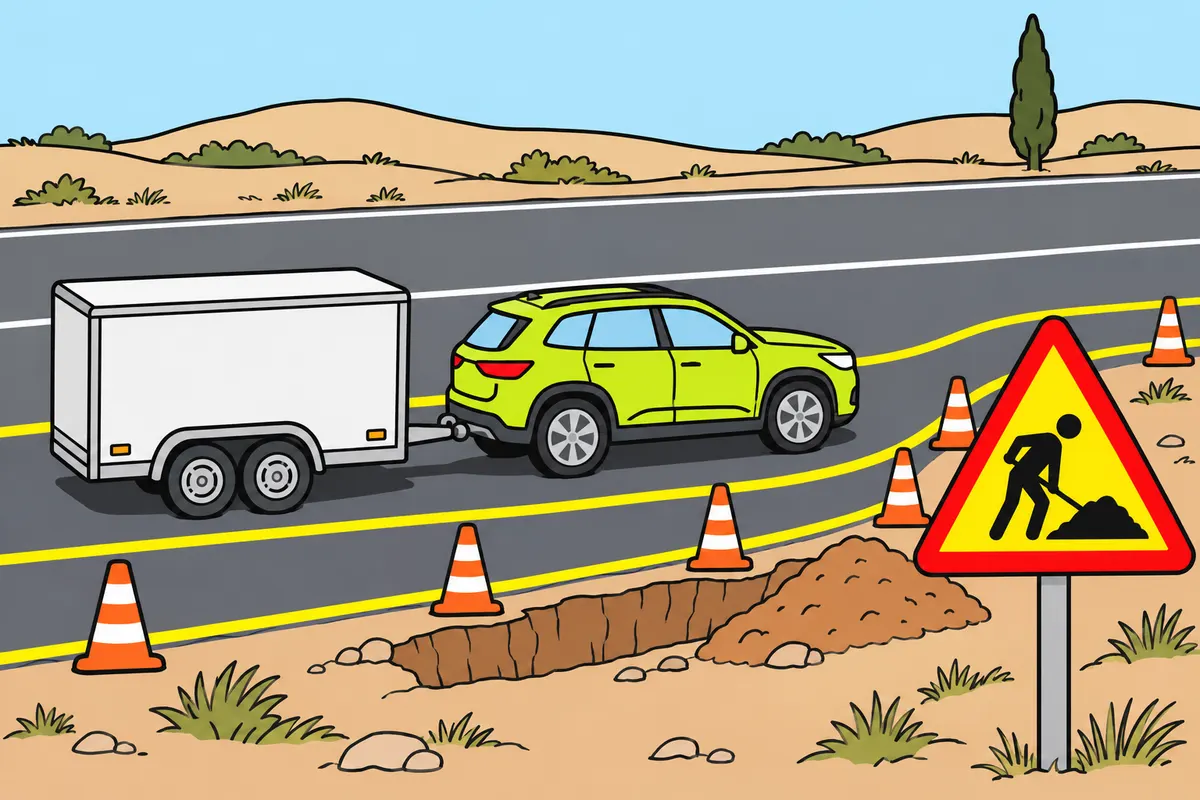
Follow temporary signs and check that your whole combination can pass.
| Roadworks markings | What you must remember |
|---|---|
| Added for the works | They are yellow |
| Existing white markings | They may remain if they still apply |
Remember
- Check whether a variable message sign gives an instruction or advice.
- Temporary arrangements end when indicated or when their cause disappears.
- Recognise the symbol even when roadworks change its background to yellow.
- Check height and length restrictions before taking a diversion.
- Keep your trailer within the permitted route too.
Exam trap: Wrong: all yellow paint marks roadworks. Right: yellow also controls stopping and parking.
Read the full explanation
- You must obey temporary signs that adapt traffic flow to an incident or changed conditions: a closure, alternating traffic, diversion, narrowing or temporary restriction. Variable message signs can convey recommendations and instructions; identify which type of message they display. [RGC, art. 142](https://www.boe.es/buscar/act.php?id=BOE-A-2003-23514#a142). [RGC, Annex I, section 5](https://www.boe.es/buscar/act.php?id=BOE-A-2003-23514#A5).
- Changes to the normal traffic arrangements end when the signs indicate this or the circumstances that caused them no longer exist. Do not follow permanent markings out of habit if the temporary layout expressly directs you along another route. [RGC, art. 142](https://www.boe.es/buscar/act.php?id=BOE-A-2003-23514#a142). [RGC, Annex I, section 5](https://www.boe.es/buscar/act.php?id=BOE-A-2003-23514#A5).
- P-18, roadworks, warns of a section with roadworks and has a yellow background. In these sections, warning and regulatory signs that normally have a white background use a yellow background in accordance with the catalogue. The symbol retains its meaning against the yellow background. [RGC, art. 142](https://www.boe.es/buscar/act.php?id=BOE-A-2003-23514#a142). [RGC, Annex I, section 5](https://www.boe.es/buscar/act.php?id=BOE-A-2003-23514#A5).
- Markings added for a section with roadworks are yellow. Existing markings may remain white if they still apply. Do not interpret all yellow paint as a temporary lane: yellow lines also regulate stopping and parking. [RGC, art. 142](https://www.boe.es/buscar/act.php?id=BOE-A-2003-23514#a142). [RGC, Annex I, section 5](https://www.boe.es/buscar/act.php?id=BOE-A-2003-23514#A5).
- At a diversion, you must check the restrictions affecting the alternative route before entering it. A B+E licence does not remove a temporary height or length restriction. You must assess the path of the whole combination through the marked passage, without treating areas marked off as lanes. [RGC, art. 142](https://www.boe.es/buscar/act.php?id=BOE-A-2003-23514#a142). [RGC, Annex I, section 5](https://www.boe.es/buscar/act.php?id=BOE-A-2003-23514#A5).
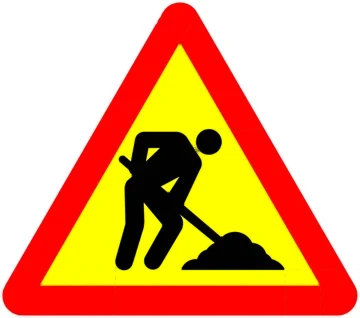 P-18
6Markers, barriers and route guidance
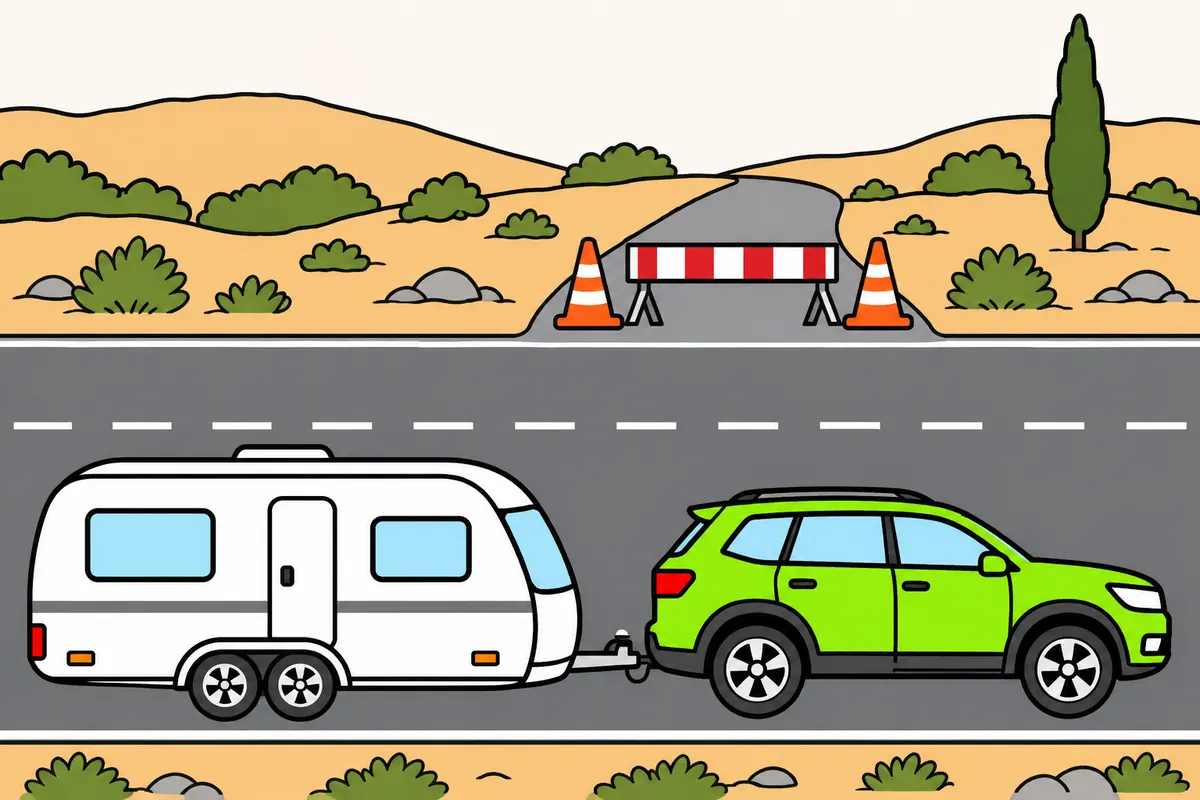
Respect closures and keep your trailer within the route shown.
Remember
- Do not pass barriers or cones closing the route.
- A temporary directional board prohibits passage and shows where you must go.
- Bend guidance boards guide you; they do not permit higher speed.
- You may cross illuminated horizontal markers only when they show green.
- A windsock shows wind direction and strength.
- Check the height of your trailer, roof equipment and load.
Exam trap: Wrong: you check only the car’s height. Right: consider the highest part of your combination.
Read the full explanation
- Devices that mark off areas prohibit you from entering the part of the road they enclose. You must respect fixed or movable barriers, cones and devices that close an entrance, even if there seems to be room for the car behind them. You must keep the trailer within the authorised route. [RGC, Annex I, section 3](https://www.boe.es/buscar/act.php?id=BOE-A-2003-23514#A3).
- A temporary direction panel prohibits passage and indicates the direction you must follow. You must distinguish it from a bend guidance panel: interpret its function from the device and its placement, not just the presence of arrows. [RGC, Annex I, section 3](https://www.boe.es/buscar/act.php?id=BOE-A-2003-23514#A3).
- Marker posts, road studs and guidance panels help you identify edges, bends and obstacles. They do not authorise you to increase your speed to a particular value. You must adapt your driving to the path indicated by the markers and the space available for your combination. [RGC, Annex I, section 3](https://www.boe.es/buscar/act.php?id=BOE-A-2003-23514#A3).
- Illuminated markers or road studs set into the road surface can guide diversions and restrict lane changes. They emit green, orange or red light; you may cross only green ones. A windsock supplements the crosswind warning by indicating the presence, direction and strength of the wind. [RGC, Annex I, section 3](https://www.boe.es/buscar/act.php?id=BOE-A-2003-23514#A3).
- A height clearance gantry warns you or prevents you from proceeding if your vehicle exceeds the height of the next structure. Do not check only the height of the towing vehicle: a caravan, its roof-mounted equipment or the trailer’s load may be the highest part. [RGC, Annex I, section 3](https://www.boe.es/buscar/act.php?id=BOE-A-2003-23514#A3).
7Circular traffic lights: red, amber and green
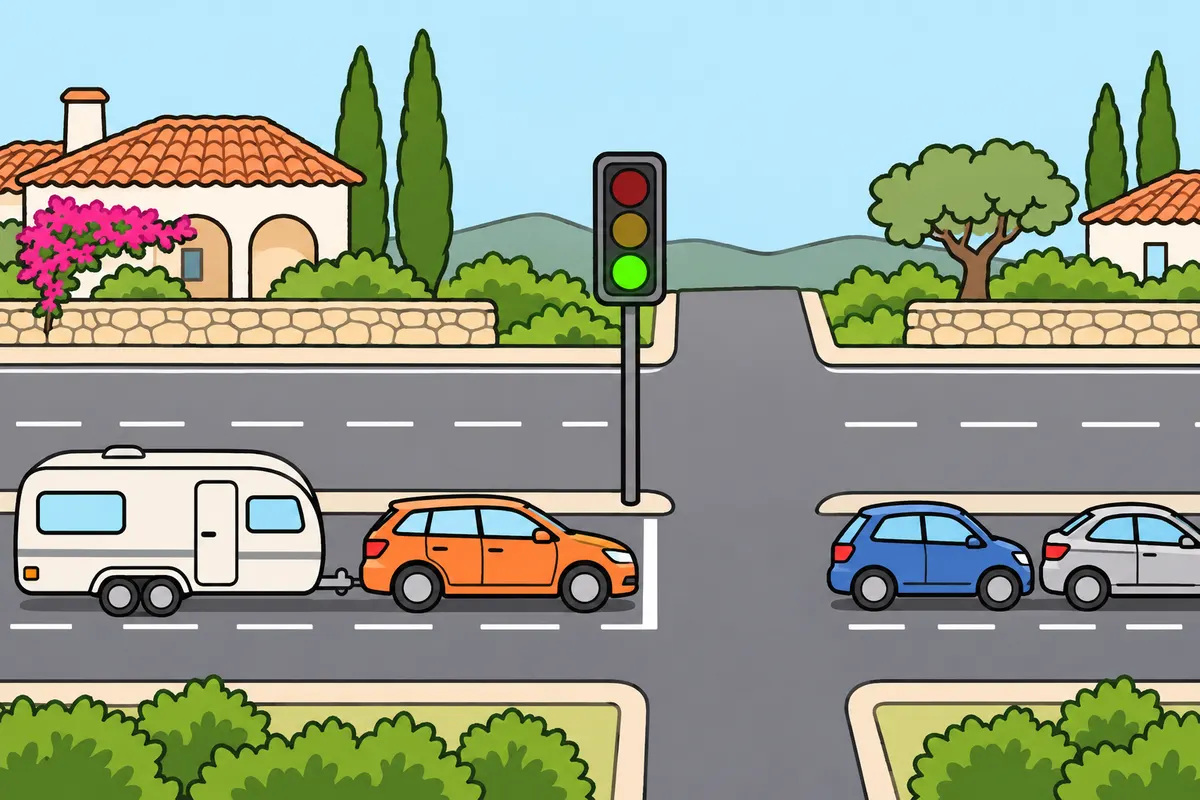
Read each light and leave enough space for your whole combination.
| Circular light | What you must do |
|---|---|
| Steady or flashing red | Do not pass |
| Steady amber | Stop unless too close to stop safely enough |
| Flashing amber | Take extreme care; give way where needed; obey STOP |
| Steady green | Proceed with priority if you can keep junctions and crossings clear |
Remember
- At red, stop before the nearest preceding stop line or the light.
- For lights within or beyond junctions, stop before entering or before the preceding line.
- Flashing red also prohibits passage.
- At steady amber, stop unless you are too close to stop safely enough.
- At green, wait if you would block the junction or pedestrian or cycle crossing.
Exam trap: Wrong: flashing amber cancels STOP. Right: stop if that STOP controls your approach.
Read the full explanation
- A steady red light prohibits you from proceeding. You must stop before the traffic light or the nearest stop line before it. If the light is within or on the far side of a junction, you must stop before entering the junction or before the stop line preceding it. [RGC, Annex I, section 4](https://www.boe.es/buscar/act.php?id=BOE-A-2003-23514#A4).
- A flashing red light, or two alternating red lights, also temporarily prohibits you from proceeding. You may encounter it at level crossings, opening bridges, ferry boarding points, fire station exits or where aircraft are flying nearby at low altitude; it does not simply mean caution. [RGC, Annex I, section 4](https://www.boe.es/buscar/act.php?id=BOE-A-2003-23514#A4).
- A steady amber light requires you to stop just as a red light does, unless it comes on when you are so close that you cannot stop safely enough. You must anticipate your approach so that you can brake in a controlled way with the trailer; the exception does not authorise you to accelerate to save time. [RGC, Annex I, section 4](https://www.boe.es/buscar/act.php?id=BOE-A-2003-23514#A4).
- A flashing amber light, or two alternating amber lights, requires you to take extra care and give way where necessary. You must also obey any sign requiring you to stop: if there is a STOP sign, you must stop. [RGC, Annex I, section 4](https://www.boe.es/buscar/act.php?id=BOE-A-2003-23514#A4).
- A steady green light allows you to proceed with priority, but you must wait if your combination is likely to come to a standstill blocking a junction or a pedestrian or cycle crossing. Check that there is room beyond it for the trailer as well as the towing vehicle. [RGC, Annex I, section 4](https://www.boe.es/buscar/act.php?id=BOE-A-2003-23514#A4). [RGC, art. 59](https://www.boe.es/buscar/act.php?id=BOE-A-2003-23514#a59).
8Arrows and special traffic lights
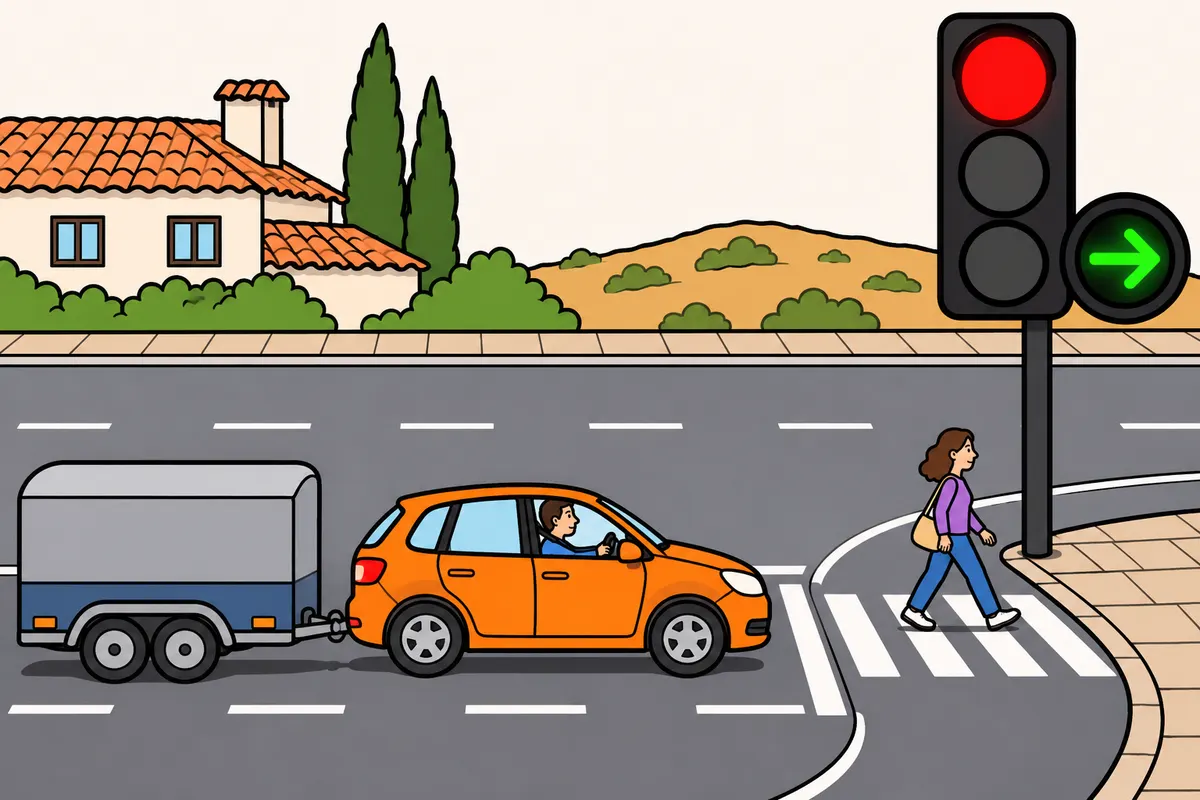
Check which movement and road users each traffic light controls.
| Special traffic light | Who it controls | Message |
|---|---|---|
| Cycle symbol | Cycles only | Follow the colour |
| Pedestrian symbol | Pedestrians | Red: do not start; green: cross; flashing green: little time remains |
| White bars on black | Trams and regular buses; special scope applies in reserved lanes | Horizontal: stop; vertical: straight ahead; diagonal: turn |
| Flashing vertical or diagonal white bar | Trams and regular buses; special scope applies in reserved lanes | Stop unless too close to stop safely enough |
Remember
- A black arrow limits the colour’s instruction to the movement shown.
- A green arrow on black allows its movement even with another light lit.
- When following it, let traffic in the lane you join pass.
- Do not endanger anyone crossing.
- Follow it from its exclusive lane or the lane that movement must use.
Exam trap: Wrong: a green arrow gives absolute priority. Right: proceed cautiously and let others pass.
Read the full explanation
- A black arrow on a steady red or amber light retains the meaning of that colour and limits it to the movement shown. If it points left, you must apply the instruction to that turn, without automatically extending it to movements controlled by another signal. [RGC, Annex I, section 4](https://www.boe.es/buscar/act.php?id=BOE-A-2003-23514#A4).
- A green arrow on a circular black background allows you to travel in its direction even if another light is illuminated on the same traffic light or an adjacent one. You must proceed with caution, give way to traffic in the lane you are joining and avoid endangering anyone crossing. [RGC, Annex I, section 4](https://www.boe.es/buscar/act.php?id=BOE-A-2003-23514#A4).
- If you occupy the lane reserved exclusively for the movement shown by the green arrow, or the lane that must be used for that movement even if it is not reserved, you must proceed in the direction indicated. You must do so while observing the precautions required by the meaning of the arrow itself. [RGC, Annex I, section 4](https://www.boe.es/buscar/act.php?id=BOE-A-2003-23514#A4).
- Traffic lights showing a cycle symbol apply exclusively to cycles. Those showing a pedestrian symbol control pedestrians crossing: red prohibits you from starting to cross and green allows you to do so; flashing green warns you that little time remains to finish crossing. [RGC, Annex I, section 4](https://www.boe.es/buscar/act.php?id=BOE-A-2003-23514#A4).
- White bars on a black background are intended for trams and buses on regular services, with the special scope provided for reserved lanes. A horizontal bar prohibits you from proceeding; a vertical bar allows you to continue straight ahead; a diagonal bar allows you to turn; a flashing vertical or diagonal bar requires you to stop under conditions equivalent to a steady amber light. [RGC, Annex I, section 4](https://www.boe.es/buscar/act.php?id=BOE-A-2003-23514#A4).
9Lane control signals
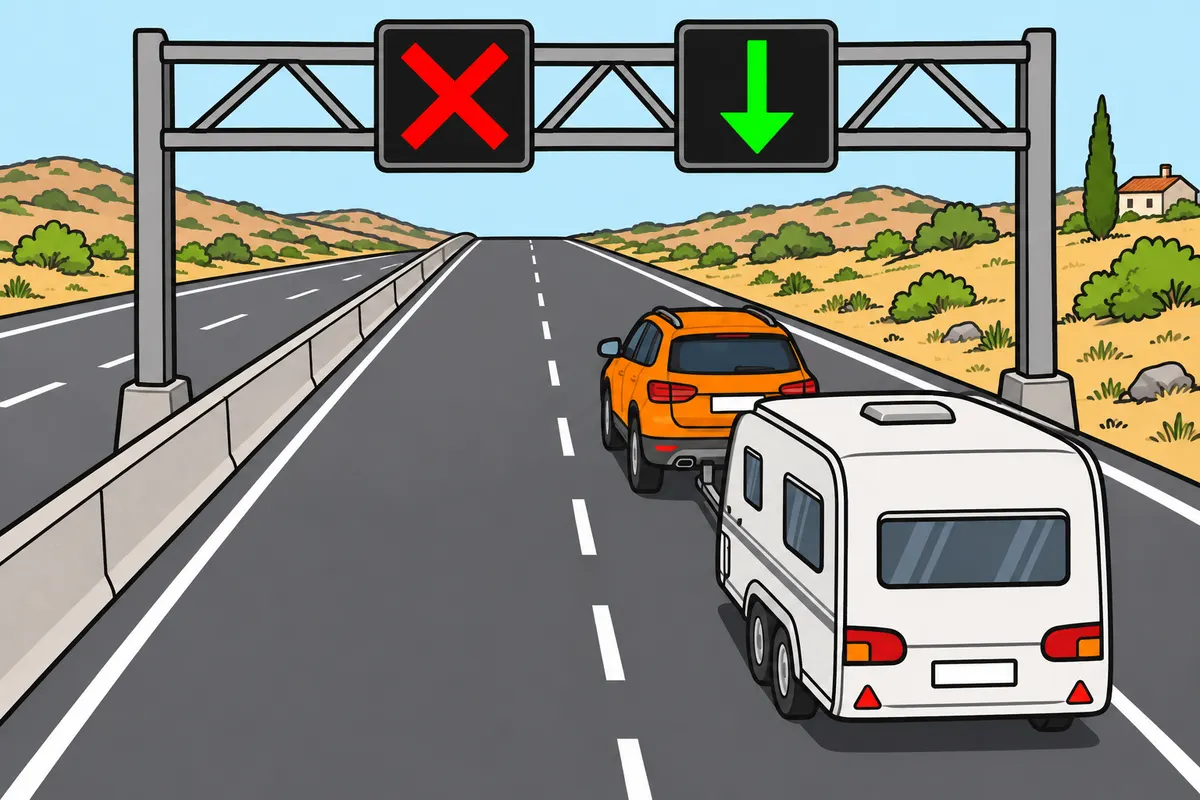
Lane signals tell you whether you may use a lane or must leave it.
| Signal over your lane | What you must do |
|---|---|
| Red cross | Do not use the lane |
| Downward green arrow | You may use the lane; obey other signs |
| Diagonal white or amber arrow | Move to the indicated lane; yours will close soon |
Remember
- Check which lane each signal controls.
- With a red cross, stay out; if already there, leave promptly and safely.
- With a diagonal white or amber arrow, move safely to the indicated lane.
- Give way to traffic already in the lane you join.
- Check the permitted direction before using a reversible lane.
Exam trap: Wrong: a green lane arrow cancels STOP. Right: lane permission still requires stopping or giving way.
Read the full explanation
- You must apply a lane control signal to the lane above which it is placed or the lane indicated on the variable message sign. A red cross prohibits you from using that lane. If you are driving in it, you must leave it as soon as possible, changing lanes safely. [RGC, Annex I, section 4](https://www.boe.es/buscar/act.php?id=BOE-A-2003-23514#A4). [RGC, Annex I, section 5](https://www.boe.es/buscar/act.php?id=BOE-A-2003-23514#A5).
- A green downward arrow allows you to drive in that lane. This permission concerns use of the lane: it does not override a red circular traffic light, a STOP sign, a give way sign or the general priority rules. [RGC, Annex I, section 4](https://www.boe.es/buscar/act.php?id=BOE-A-2003-23514#A4). [RGC, Annex I, section 5](https://www.boe.es/buscar/act.php?id=BOE-A-2003-23514#A5).
- A white or amber diagonal downward arrow, steady or flashing, warns you that you must safely move into the lane it points towards because your lane is about to close. You must prepare to move the whole combination and respect the priority of traffic already in the destination lane. [RGC, Annex I, section 4](https://www.boe.es/buscar/act.php?id=BOE-A-2003-23514#A4). [RGC, Annex I, section 5](https://www.boe.es/buscar/act.php?id=BOE-A-2003-23514#A5).
- Double broken longitudinal lines may mark the boundaries of a reversible lane whose direction is controlled by lane control signals or other means. You must check the status of the lane before using it; the appearance of the lines alone does not assign you a direction of travel. [RGC, Annex I, section 4](https://www.boe.es/buscar/act.php?id=BOE-A-2003-23514#A4). [RGC, Annex I, section 5](https://www.boe.es/buscar/act.php?id=BOE-A-2003-23514#A5).
10Upright signs and supplementary plates
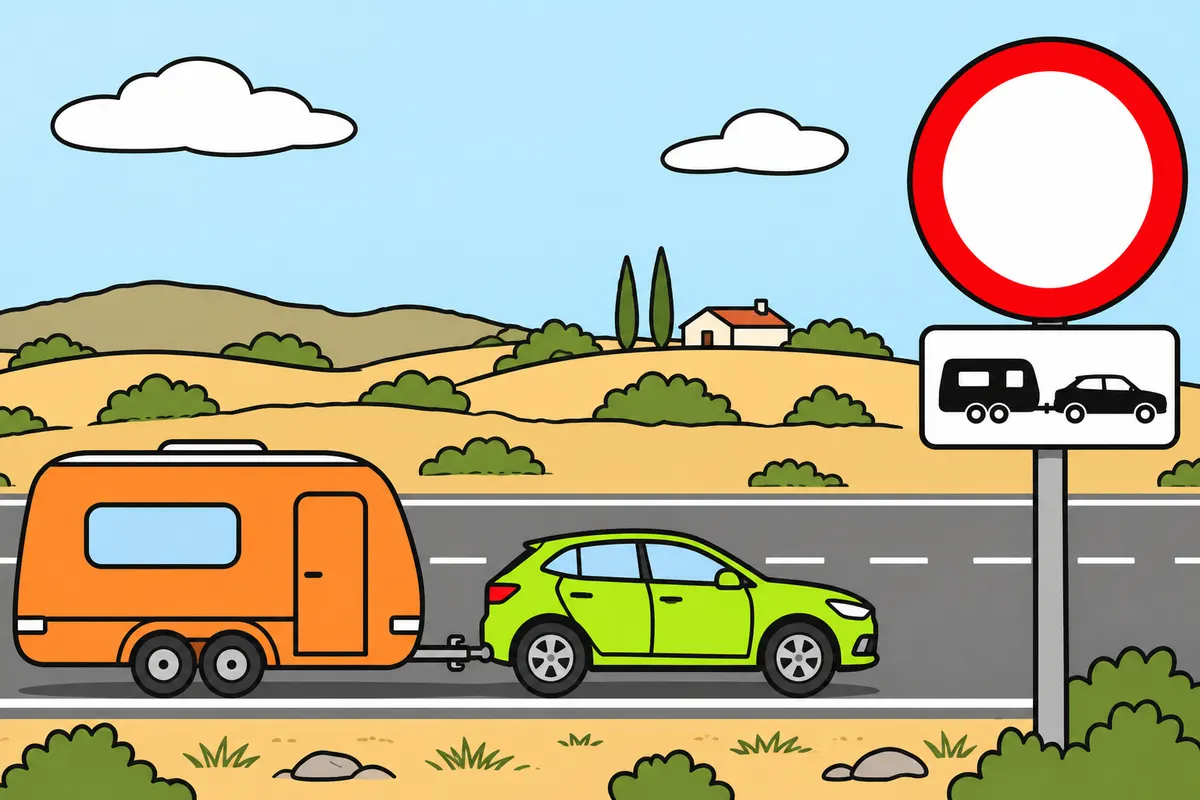
Read signs and their plates to find where and to whom they apply.
| Plate | How you must read it |
|---|---|
| S-860 | Clarifies or limits the message |
| S-880b | Applies to vehicles with trailers, except single-axle ones |
| S-880b with EXCEPTO | Excepts combinations with trailers of more than one axle |
Remember
- Shapes help, but you must recognise the actual message.
- Restrictions start at the sign unless a plate gives a distance to their start.
- Beside a town’s name, regulations apply throughout it unless other signs say otherwise.
- Read times, distances, section lengths and affected vehicles.
- Do not cover or alter signs.
Exam trap: Wrong: S-880b applies to every vehicle with a trailer. Right: single-axle trailers are excepted; with EXCEPTO, combinations with trailers of more than one axle are excepted.
Read the full explanation
- The shape gives you an indication of the type of message: danger warning signs are normally triangular; many prohibition signs are circular with a red border; many mandatory signs are blue circles. STOP and give way signs have distinctive shapes that you must identify accurately. [RGC, Annex I, section 5](https://www.boe.es/buscar/act.php?id=BOE-A-2003-23514#A5).
- Regulatory signs apply from the point where they are placed, unless a supplementary plate below indicates the distance to the point where they take effect. A no entry sign is not a warning that lets you decide after you have passed it. [RGC, art. 145](https://www.boe.es/buscar/act.php?id=BOE-A-2003-23514#a145).
- When a regulatory sign is placed beside or above the name of a built-up area, its rule applies throughout that area unless a different rule is signposted on certain stretches. Its placement beside the name determines that geographical scope; a separate sign has the scope of its own message. [RGC, art. 145](https://www.boe.es/buscar/act.php?id=BOE-A-2003-23514#a145).
- Read the supplementary plates showing distance, length of the stretch, times and vehicles affected. S-860 clarifies or limits the message of a sign or traffic light. S-880b limits the sign to vehicles towing trailers, except single-axle trailers (as with R-112). With EXCEPTO (EXCEPT) above that symbol, the sign applies to everyone except those combinations towing trailers with more than one axle. [RGC, Annex I, section 5](https://www.boe.es/buscar/act.php?id=BOE-A-2003-23514#A5). [RD 465/2025, catalogue, section 2.3 and S-880b](https://www.boe.es/buscar/doc.php?id=BOE-A-2025-12199).
- You must keep signs legible. You must not cover signs, alter their content or place objects that confuse their message or reduce their effectiveness. Your personal interpretation of the route does not replace the instructions of the authorities. [RGC, art. 140](https://www.boe.es/buscar/act.php?id=BOE-A-2003-23514#a140).
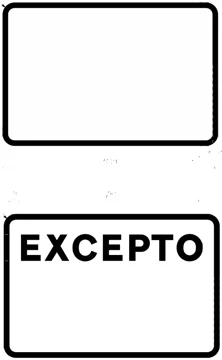 S-860
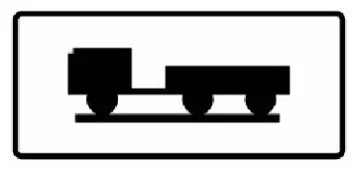 S-880b
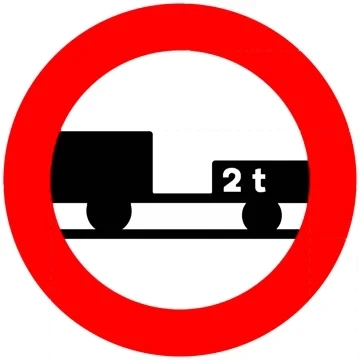 R-112
11R-2: compulsory stop
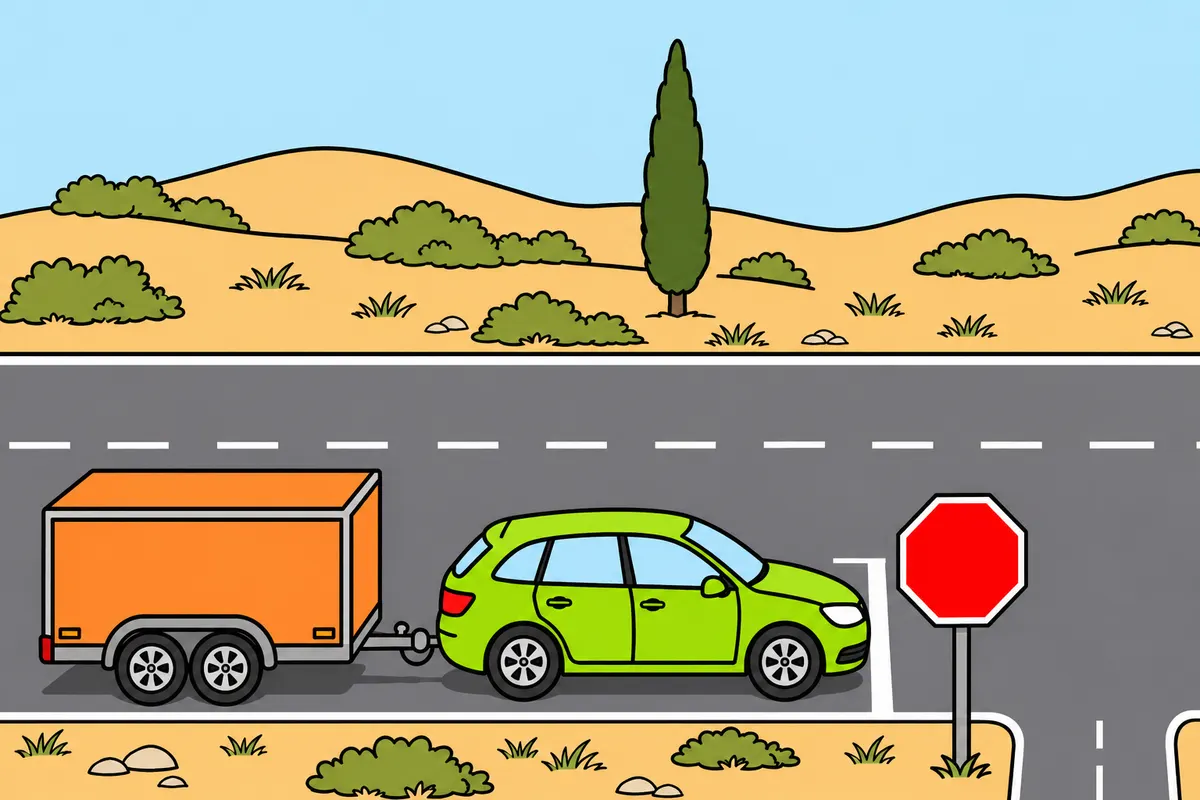
At STOP, stop your combination completely, then give way.
Remember
- Stop before the line or, without one, immediately before the junction.
- Do not stop at the signpost instead of a line further ahead.
- If you cannot see from there, move cautiously and stop again where you can.
- Make that further stop without endangering anyone.
- Give way to traffic on the priority road approaching from either side.
- Wait for enough space for your whole combination to cross.
Exam trap: Wrong: you almost stop at STOP. Right: you must stop your combination completely.
Read the full explanation
- R-2, compulsory stop or STOP, is octagonal, with a red background and the word STOP. You must bring the combination to a complete standstill even if the road appears clear. Slowing down to almost a stop, sounding the horn or hearing no engines does not fulfil the requirement. [RGC, art. 56](https://www.boe.es/buscar/act.php?id=BOE-A-2003-23514#a56). [RGC, Annex I, section 5](https://www.boe.es/buscar/act.php?id=BOE-A-2003-23514#A5).
- You must stop before the stop line or, if there is none, immediately before the junction. If the line is beyond the signpost, you must reach the marked stopping point without crossing it. [RGC, art. 56](https://www.boe.es/buscar/act.php?id=BOE-A-2003-23514#a56). [RGC, Annex I, section 5](https://www.boe.es/buscar/act.php?id=BOE-A-2003-23514#A5).
- If, exceptionally, you do not have sufficient visibility from your first stopping point, you must move forward cautiously and stop again where you can see, without endangering anyone. The second stop due to poor visibility does not replace the first stop required by the sign. [RGC, art. 56](https://www.boe.es/buscar/act.php?id=BOE-A-2003-23514#a56). [RGC, Annex I, section 5](https://www.boe.es/buscar/act.php?id=BOE-A-2003-23514#A5).
- After stopping, you must give way to vehicles on the priority road, whichever side they approach from. Wait for a gap large enough for the whole combination to pass: its length or difficulty in moving off does not oblige others to give up their priority. [RGC, art. 56](https://www.boe.es/buscar/act.php?id=BOE-A-2003-23514#a56). [RGC, Annex I, section 5](https://www.boe.es/buscar/act.php?id=BOE-A-2003-23514#A5).
 R-2
12R-1 and priority at junctions
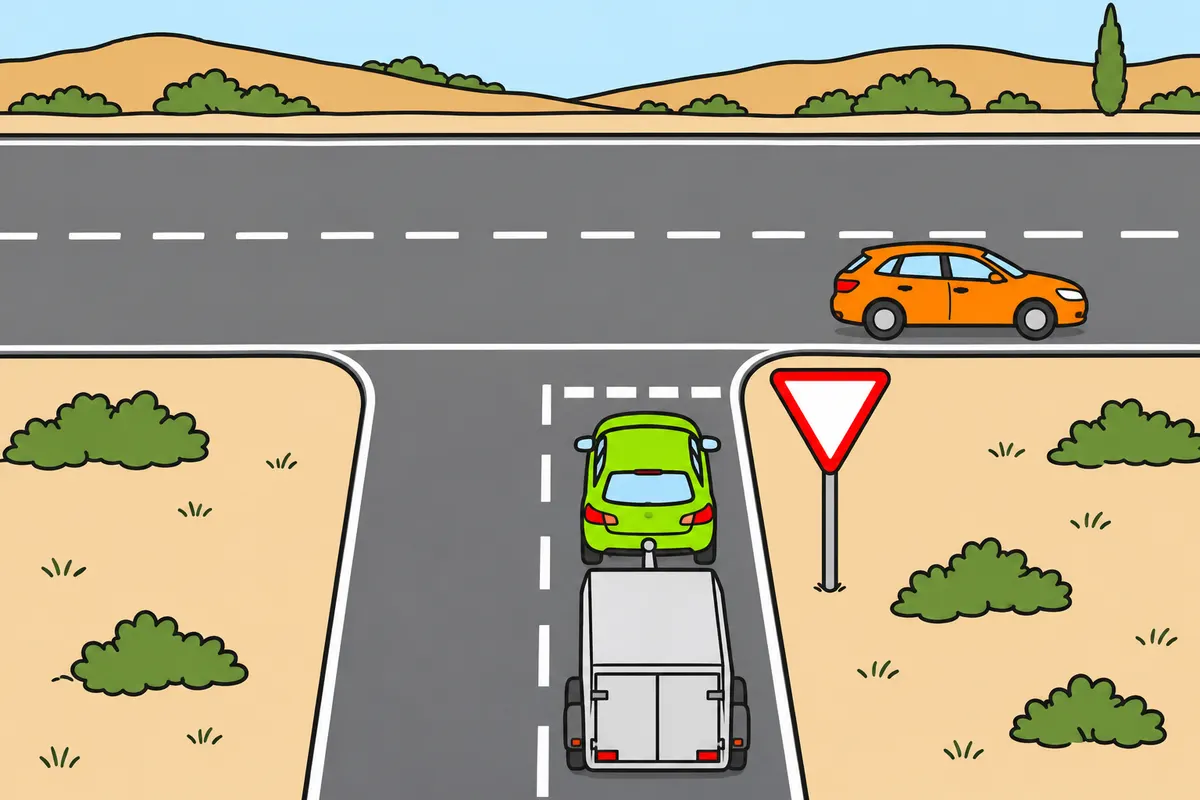
Give way without forcing others to brake or change direction suddenly.
| Sign | What you must do |
|---|---|
| R-1 | Give way to traffic on the road or lane you join |
| R-3 | You have junction priority over vehicles from another carriageway |
| R-4 | Prepare to lose priority; check signs at the next junction |
Remember
- Slow down, look and stop if necessary.
- Show early that you intend to give way.
- Your combination’s mass does not give you priority.
- Do not block a junction even when you have priority.
Exam trap: Wrong: give way always requires stopping. Right: stop only when needed to give way.
Read the full explanation
- R-1, give way, is an inverted triangle with a red border and white background. At the next junction, you must give way to traffic on the road you are approaching, or to traffic in the lane you intend to join. [RGC, art. 56](https://www.boe.es/buscar/act.php?id=BOE-A-2003-23514#a56). [RGC, Annex I, section 5](https://www.boe.es/buscar/act.php?id=BOE-A-2003-23514#A5).
- You must slow down progressively, observe and stop if necessary. If you can give way safely without stopping, R-1 does not require a complete stop. The difference from STOP concerns the compulsory stop; it does not mean you can ignore the priority of the priority road. [RGC, art. 56](https://www.boe.es/buscar/act.php?id=BOE-A-2003-23514#a56). [RGC, art. 58](https://www.boe.es/buscar/act.php?id=BOE-A-2003-23514#a58). [RGC, Annex I, section 5](https://www.boe.es/buscar/act.php?id=BOE-A-2003-23514#A5).
- You must show sufficiently early that you are going to give way. You must not start, continue or resume the manoeuvre if you force anyone with priority to change their speed or course abruptly. The mass of your combination does not give you priority. [RGC, art. 56](https://www.boe.es/buscar/act.php?id=BOE-A-2003-23514#a56). [RGC, art. 58](https://www.boe.es/buscar/act.php?id=BOE-A-2003-23514#a58). [RGC, Annex I, section 5](https://www.boe.es/buscar/act.php?id=BOE-A-2003-23514#A5).
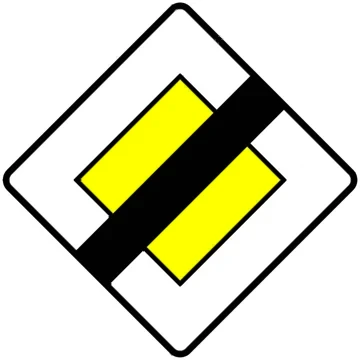
- R-3, priority road, indicates that you have priority at junctions over vehicles coming from another carriageway. R-4, end of priority, warns you that you are approaching the point where you lose priority. You must check which signs control the next junction. [RGC, art. 56](https://www.boe.es/buscar/act.php?id=BOE-A-2003-23514#a56). [RGC, Annex I, section 5](https://www.boe.es/buscar/act.php?id=BOE-A-2003-23514#A5).
- Priority junction signs warn you of the junction and your priority over the joining road. You must look at the diagram to identify the layout of the junction; having priority does not allow you to block it if there is not enough room to finish crossing it. [RGC, art. 56](https://www.boe.es/buscar/act.php?id=BOE-A-2003-23514#a56). [RGC, Annex I, section 5](https://www.boe.es/buscar/act.php?id=BOE-A-2003-23514#A5).
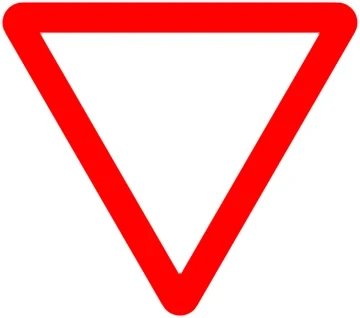 R-1
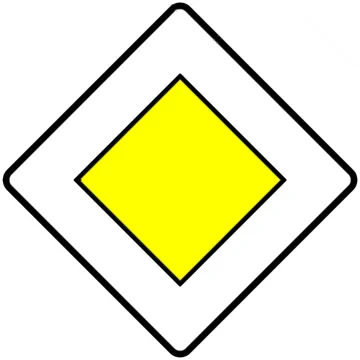 R-3
 R-4
13R-5 and R-6 at narrow sections
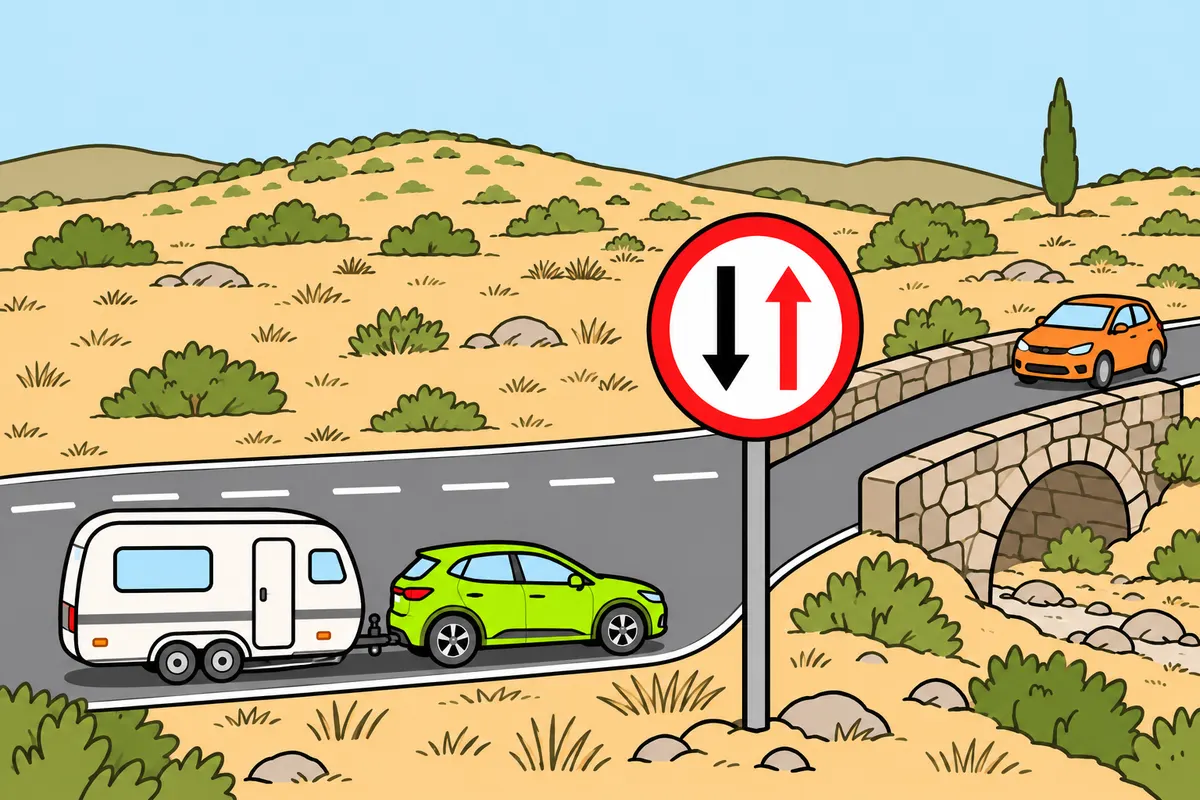
Check who has priority before entering a narrow section.
| Sign | What you must do |
|---|---|
| R-5 | Do not enter if you would force oncoming vehicles to stop |
| R-6 | You have priority; avoid danger if another vehicle already occupies the passage |
Remember
- Wait with space so your trailer does not block other entrances.
- Do not expect oncoming drivers to reverse because you have a caravan.
- Check width restrictions too.
Exam trap: Wrong: a triangular narrowing sign gives priority. Right: it warns; check who must wait.
Read the full explanation
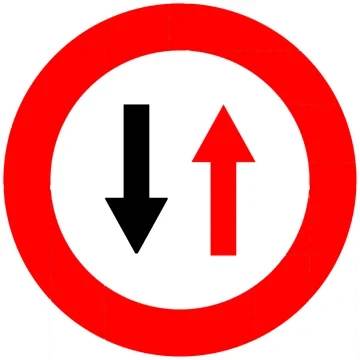
- R-5, priority for oncoming traffic, prohibits you from entering a narrow section if driving through it would force oncoming vehicles to stop. You must wait before the narrowing, leaving enough space to ensure that your trailer does not block access for others. [RGC, Annex I, section 5](https://www.boe.es/buscar/act.php?id=BOE-A-2003-23514#A5).
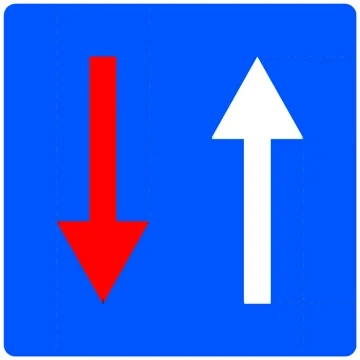
- R-6, priority over oncoming traffic, indicates that you have priority at the next narrow section. You can recognise it by its blue background and arrows, in contrast to the red-bordered circle of R-5; both regulate priority, although their shapes differ. [RGC, Annex I, section 5](https://www.boe.es/buscar/act.php?id=BOE-A-2003-23514#A5).
- At R-6, you must assess whether another vehicle is already physically occupying the narrow section and wait when necessary to avoid a dangerous encounter. The signposted priority requires you to be able to take the whole combination safely through the narrowing. [RGC, Annex I, section 5](https://www.boe.es/buscar/act.php?id=BOE-A-2003-23514#A5).
- A warning of a narrowing and an indication of priority convey different messages. A triangular sign may warn that the carriageway becomes narrower, but you must look for the signs that assign priority. Also check width restrictions before committing your combination to the narrow section. [RGC, Annex I, section 5](https://www.boe.es/buscar/act.php?id=BOE-A-2003-23514#A5).
 R-5
 R-6
14Entry prohibitions and vehicle categories
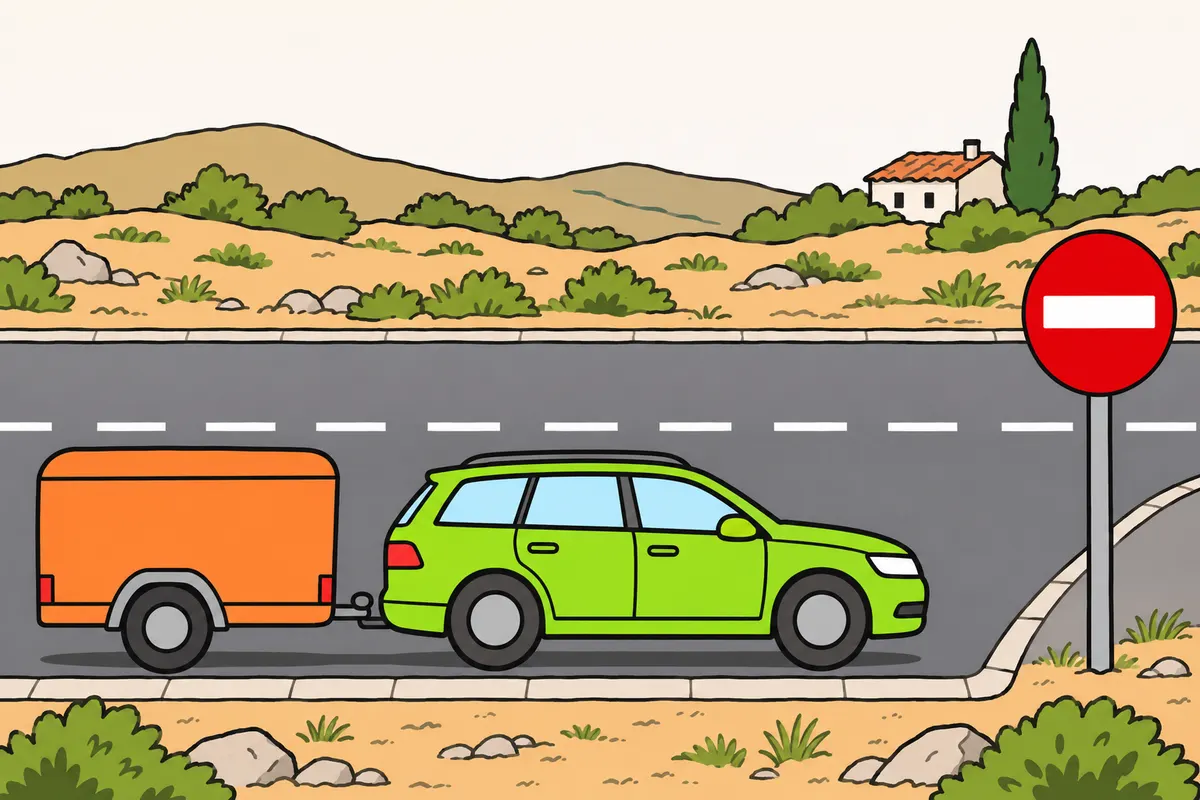
Check whether the prohibition covers your vehicle and what you carry.
| Sign | Who it affects |
|---|---|
| R-100 | All vehicles, in both directions |
| R-101 | Vehicles entering from the side facing the sign |
| R-102 | Motor vehicles |
| R-106 | Lorries, tractor units and goods vans, regardless of their mass |
| R-107 | Lorries, tractor units and goods vans whose MMA exceeds the figure shown, even when empty |
Remember
- Towing does not exempt you from a prohibition for motor vehicles.
- Do not automatically treat a car with a trailer as a lorry.
- Check the conditions when carrying dangerous goods.
- For environmental access rules, read authorised vehicles, times and exceptions.
Exam trap: Wrong: R-106 does not affect your B+E van. Right: it prohibits entry to lorries, tractor units and goods vans, regardless of their mass; it applies if your towing vehicle is a van.
Read the full explanation
- R-100, no vehicles, applies to all vehicles in both directions. R-101, no entry, prevents you from entering from the side where you face the sign. The first message prohibits traffic; the second restricts a specific entrance. [RGC, Annex I, section 5](https://www.boe.es/buscar/act.php?id=BOE-A-2003-23514#A5).
- R-102 prohibits entry by motor vehicles and therefore applies to your towing vehicle. You must also obey it when that vehicle tows a caravan or a goods trailer. [RGC, Annex I, section 5](https://www.boe.es/buscar/act.php?id=BOE-A-2003-23514#A5).
- R-106 prohibits entry by lorries, tractor units and goods vans, regardless of their mass: if your B+E towing vehicle is a van, it applies to you. R-107 prohibits entry by those categories when their MMA (maximum authorised mass) exceeds the figure shown, even when they are empty. You must compare the vehicle's MMA as shown in its documents with the tonnage on the sign. A passenger car with a trailer does not belong to those categories simply because it is towing. [RGC, Annex I, section 5](https://www.boe.es/buscar/act.php?id=BOE-A-2003-23514#A5). [RD 465/2025, catalogue, R-106 and R-107, p. 79128](https://www.boe.es/buscar/doc.php?id=BOE-A-2025-12199).
- Prohibitions relating to dangerous, explosive or flammable goods depend on what you transport and the conditions indicated by the sign. When planning your route, you must consider those symbols and the goods you carry; a B+E licence does not replace the specific requirements for particular goods. [RGC, Annex I, section 5](https://www.boe.es/buscar/act.php?id=BOE-A-2003-23514#A5).
- You must read signs restricting access on environmental grounds together with their supplementary conditions. You must check the authorised vehicles, times and signposted exceptions for the specific access, without assuming that having a trailer gives you permission to enter. [RGC, Annex I, section 5](https://www.boe.es/buscar/act.php?id=BOE-A-2003-23514#A5).
 R-100
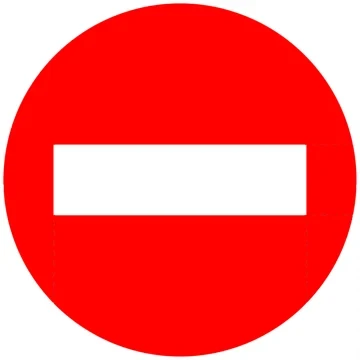 R-101
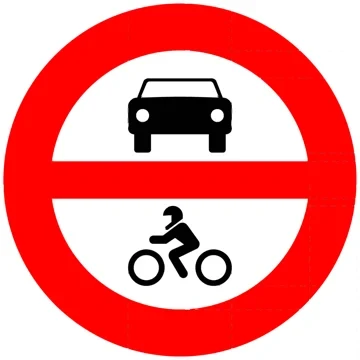 R-102
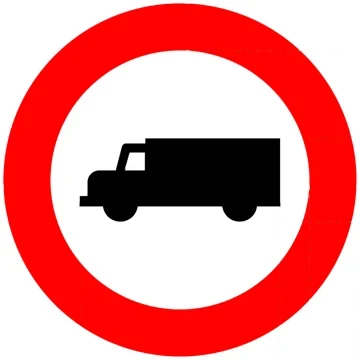 R-106
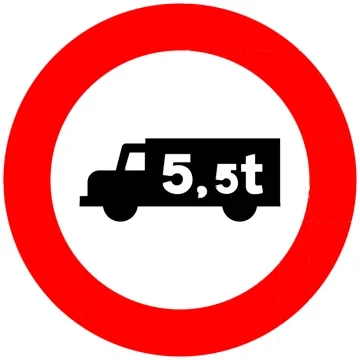 R-107
15R-112: trailer restriction
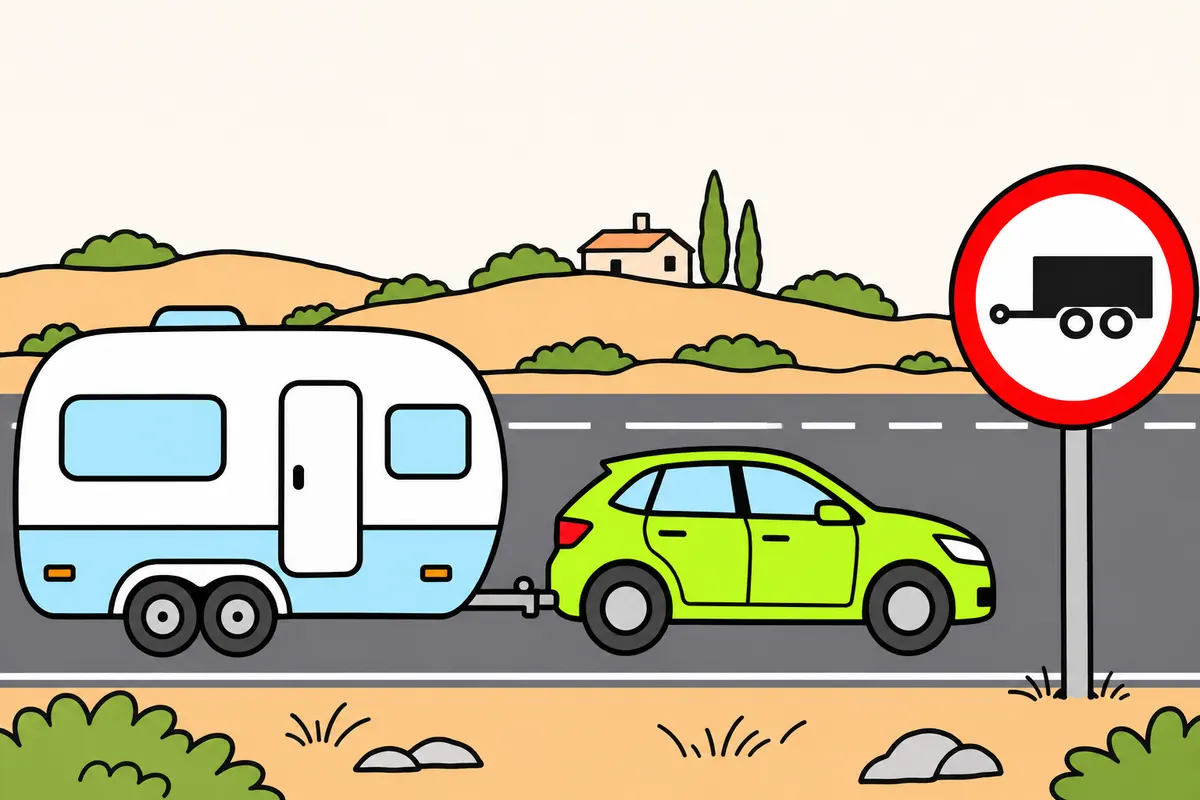
At R-112, check your trailer’s axles and maximum authorised mass.
| Trailer case at R-112 | What you must check |
|---|---|
| Single axle | It is exempt |
| Not exempt; no tonnage shown | You must not enter |
| Not exempt; tonnage shown | Do not enter if its MMA exceeds the figure |
Remember
- The sign prohibits motor vehicles towing trailers, subject to its exceptions.
- Your single-axle trailer is exempt.
- If a tonnage appears, compare it with your trailer’s maximum authorised mass.
- MMA means maximum authorised mass; unloading does not change it.
- Apply the axle exception and any tonnage condition together.
Exam trap: Wrong: at R-112 with tonnage, you check actual weight. Right: except for single-axle trailers, entry is prohibited if the trailer’s MMA exceeds the figure.
Read the full explanation
- R-112 prohibits entry by motor vehicles towing trailers, except single-axle trailers. You must check the trailer's axles: a twin-axle caravan is not exempt simply because a passenger car tows it. [RGC, Annex I, section 5](https://www.boe.es/buscar/act.php?id=BOE-A-2003-23514#A5).
- If a tonnage appears on the trailer silhouette or on a supplementary plate, the prohibition applies only when the trailer's MMA exceeds that figure. You must read the authorised mass for the trailer, not the mass of the towing vehicle. [RGC, Annex I, section 5](https://www.boe.es/buscar/act.php?id=BOE-A-2003-23514#A5).
- For example, if the sign shows 2 t and your trailer subject to the restriction has an MMA of 2,500 kg, you must obey the prohibition even when it is empty. Removing part of the load does not change the MMA you must use to assess this situation. [RGC, Annex I, section 5](https://www.boe.es/buscar/act.php?id=BOE-A-2003-23514#A5).
- You must apply the single-axle exception together with the tonnage condition where one is shown. Do not replace those criteria with an impression of how large or small the trailer looks. Nor should you assume a general exemption for a semi-trailer because of its name: the stated exception concerns the number of axles. [RGC, Annex I, section 5](https://www.boe.es/buscar/act.php?id=BOE-A-2003-23514#A5).
16R-200 to R-205: controls and dimensions
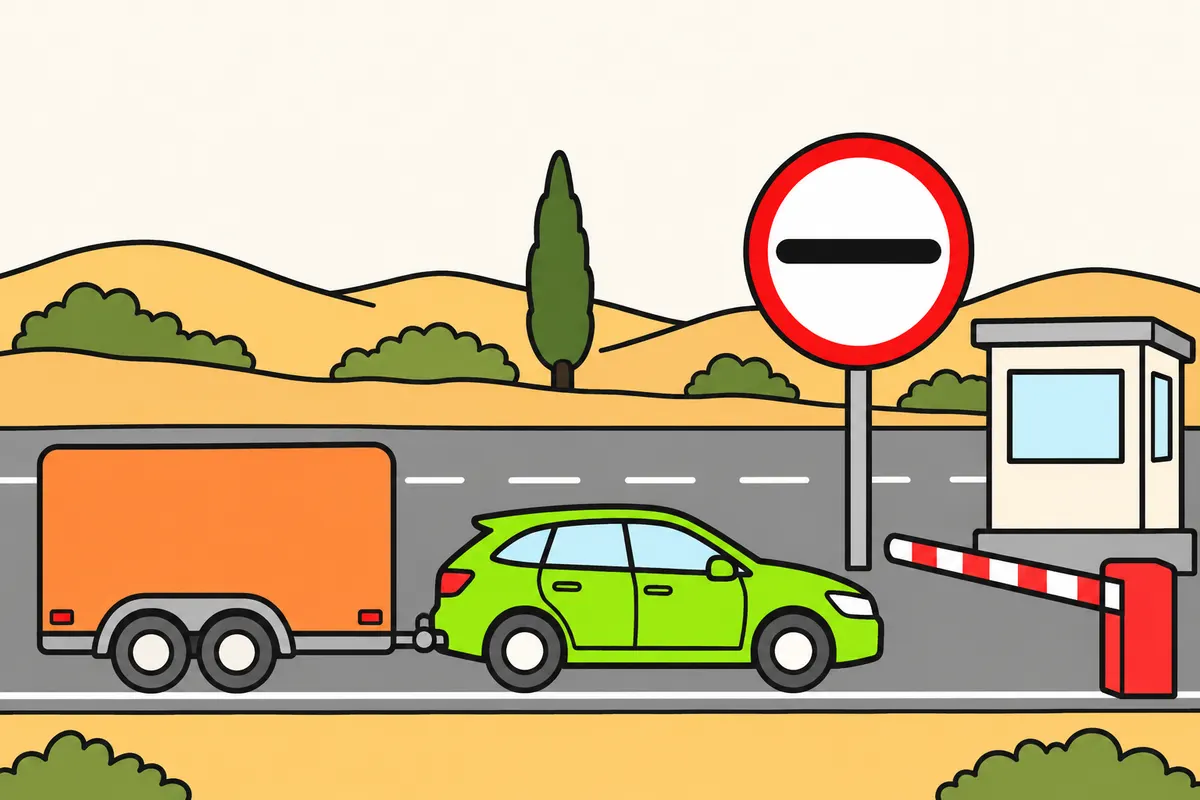
Check the exact measurement or mass each sign limits.
| Sign | What you must check |
|---|---|
| R-200 | Stop and meet the checkpoint’s requirements |
| R-201 | Actual mass, including everything carried |
| R-202 | Mass transmitted by each axle |
| R-203 | Vehicle or combination length, including load |
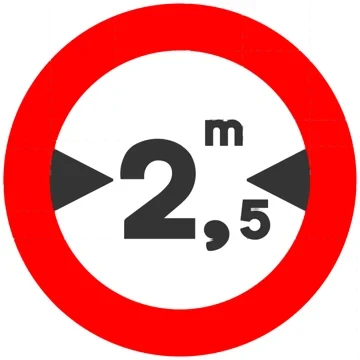
| R-204 | Width, including load |
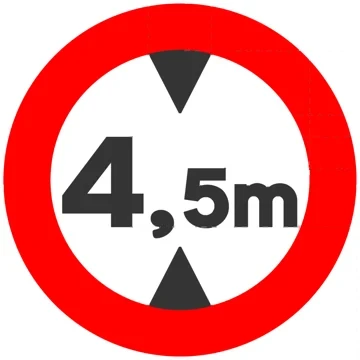
| R-205 | Height, including load |
Remember
- At a checkpoint, stop and meet its requirements before continuing.
- For length, width and height, include your trailer and load.
- Check the widest and highest parts.
- An acceptable total mass does not prove every axle meets its limit.
Exam trap: Wrong: for R-203, you measure only the car. Right: check your whole combination, including its load.
Read the full explanation
- R-200, no passing without stopping, identifies a point where you must stop for a check, customs, a toll or another indicated requirement. You may continue only once you have met that requirement; briefly braking and driving through a barrier or checkpoint is not enough. [RGC, Annex I, section 5](https://www.boe.es/buscar/act.php?id=BOE-A-2003-23514#A5).
- R-201, mass limit, refers to laden mass: the actual mass of the vehicle and what it carries. This differs from the MMA used for R-107 and for R-112 with a tonnage. The figure does not represent only the goods you carry. [RGC, Annex I, section 5](https://www.boe.es/buscar/act.php?id=BOE-A-2003-23514#A5).
- R-202, axle mass limit, prohibits passage if the mass transmitted by the wheels of any axle exceeds the value shown. An acceptable total mass does not prove that every axle complies with the limit. [RGC, Annex I, section 5](https://www.boe.es/buscar/act.php?id=BOE-A-2003-23514#A5).
- R-203 limits the length of the vehicle or combination, including the load. You must count the whole combination: a passenger car shorter than the figure shown does not allow you to pass if you exceed it with the trailer attached. You must interpret the sign using your actual overall dimensions. [RGC, Annex I, section 5](https://www.boe.es/buscar/act.php?id=BOE-A-2003-23514#A5).
- R-204 limits width and R-205 limits height, including the load. You must consider the widest and highest parts of the vehicles and what they carry. You study the calculation of authorised masses and dimensions in «Maximum dimensions and masses»; here, you must recognise which measurement each sign refers to. [RGC, Annex I, section 5](https://www.boe.es/buscar/act.php?id=BOE-A-2003-23514#A5).
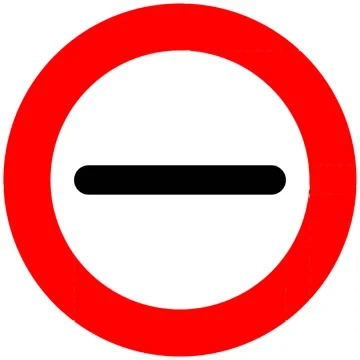 R-200
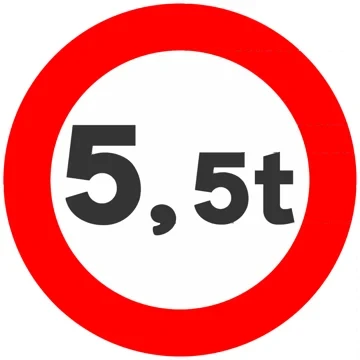 R-201
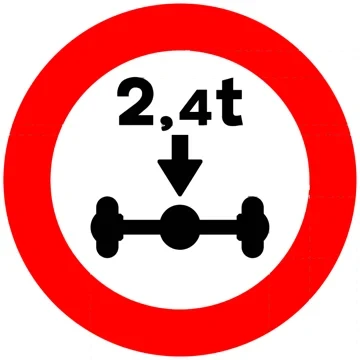 R-202
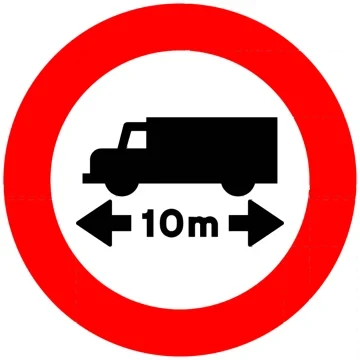 R-203
 R-204
 R-205
17Speed, separation and the end of restrictions
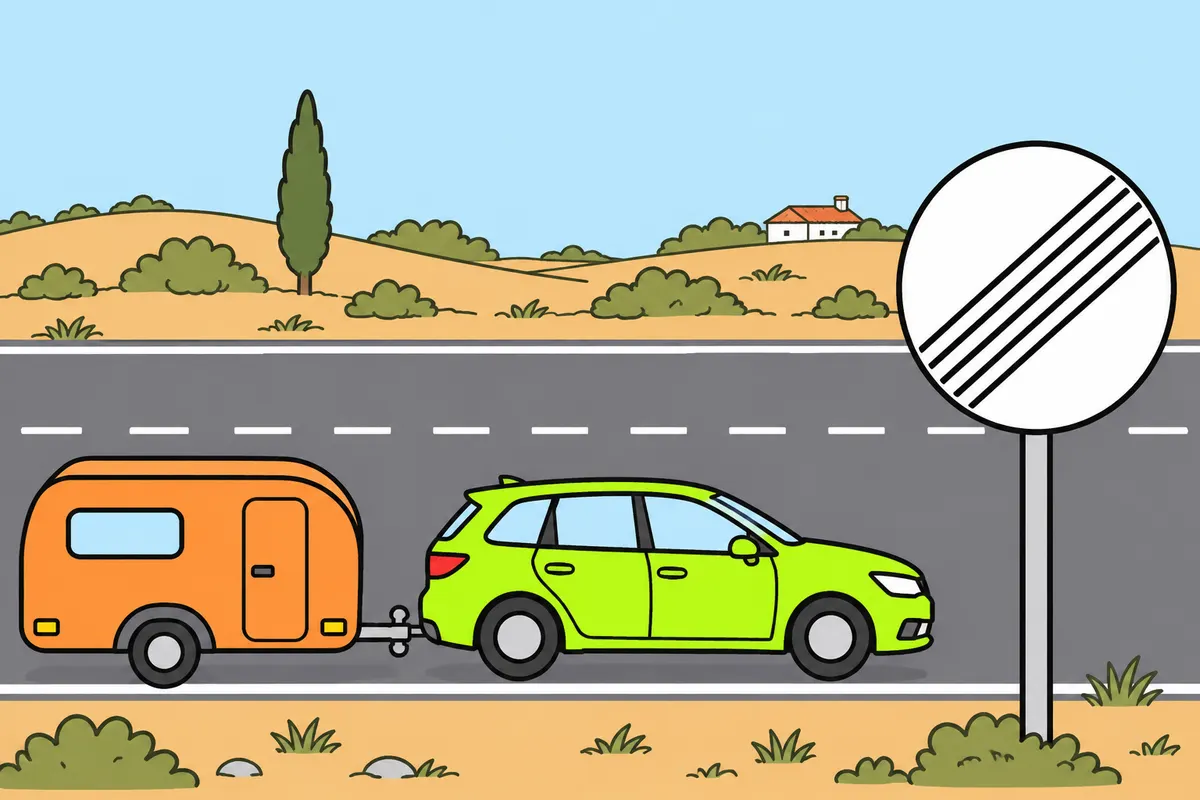
Apply signed limits with your combination’s rules, and check where each restriction ends.
| Sign | What ends |
|---|---|
| R-500 | Specific signed prohibitions for moving vehicles |
| R-501 | The speed limit |
| R-502 | The corresponding overtaking prohibition |
Remember
- Do not exceed R-301 or the limit for your combination.
- It lasts until another maximum or an applicable end-of-limit or end-of-prohibitions sign.
- Sharing a post or panel with a hazard warning, it ends after that hazard.
- On non-priority roads, it ends after crossing a priority road.
- At R-300, keep the indicated separation unless you intend to overtake.
- If R-300 has no figure, keep the regulatory distance.
Exam trap: Wrong: every junction ends a speed limit. Right: this requires leaving a junction with a priority road from a non-priority road.
Read the full explanation
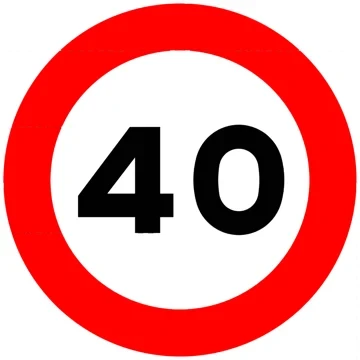
- R-301, maximum speed, shows in km/h the limit you must not exceed from the sign onwards. You must combine it with the limits applicable to your combination: a high figure does not turn a passenger car towing a trailer into a passenger car without a trailer. You study limits by road type in «Speed and distances with a trailer». [RGC, Annex I, section 5](https://www.boe.es/buscar/act.php?id=BOE-A-2003-23514#A5). [RGC, art. 52](https://www.boe.es/buscar/act.php?id=BOE-A-2003-23514#a52).
- The R-301 limit applies until another maximum speed sign, an end of speed limit sign or an applicable end of prohibitions sign. If it shares a post or panel with a danger warning sign, it ends when the indicated danger ends. Do not assume that every limit ends at any junction. [RGC, Annex I, section 5](https://www.boe.es/buscar/act.php?id=BOE-A-2003-23514#A5).
- If R-301 is on a road without priority, it ceases to apply when you leave a junction with a priority road. This ending depends on the roads' priority; a private entrance or a junction that does not meet that condition does not by itself have that effect. [RGC, Annex I, section 5](https://www.boe.es/buscar/act.php?id=BOE-A-2003-23514#A5).
- R-300, minimum separation, requires you to keep at least the indicated number of metres from the vehicle ahead, except when you are going to overtake. If no figure is shown, remember the distance required by the regulations. Metres identify a distance, whereas km/h expresses a speed. [RGC, Annex I, section 5](https://www.boe.es/buscar/act.php?id=BOE-A-2003-23514#A5). The separation indicated by R-300 and the separation required in tunnels and underpasses are different rules; you study their distances in «Speed and distances with a trailer». [RGC, art. 95.6](https://www.boe.es/buscar/act.php?id=BOE-A-2003-23514#a95).
- R-500 ends the specific signposted prohibitions for moving vehicles; R-501 ends the speed limit and R-502 ends the corresponding overtaking prohibition. You must continue to obey the general rules and any restrictions that the sign does not end. [RGC, Annex I, section 5](https://www.boe.es/buscar/act.php?id=BOE-A-2003-23514#A5).
 R-301
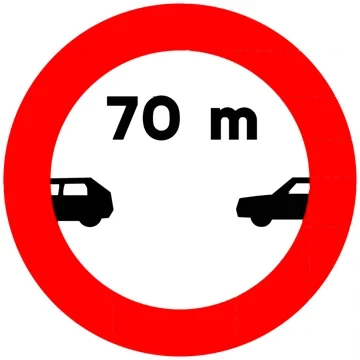 R-300
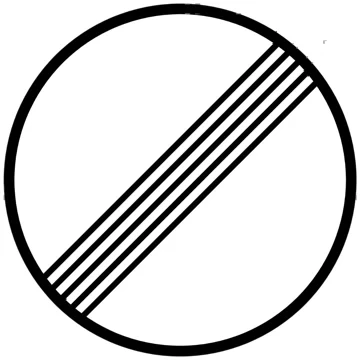 R-500
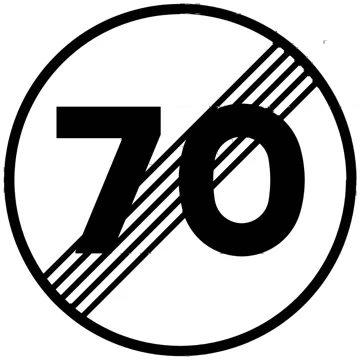 R-501
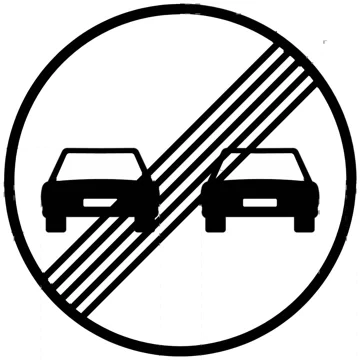 R-502
18Turning, overtaking and parking
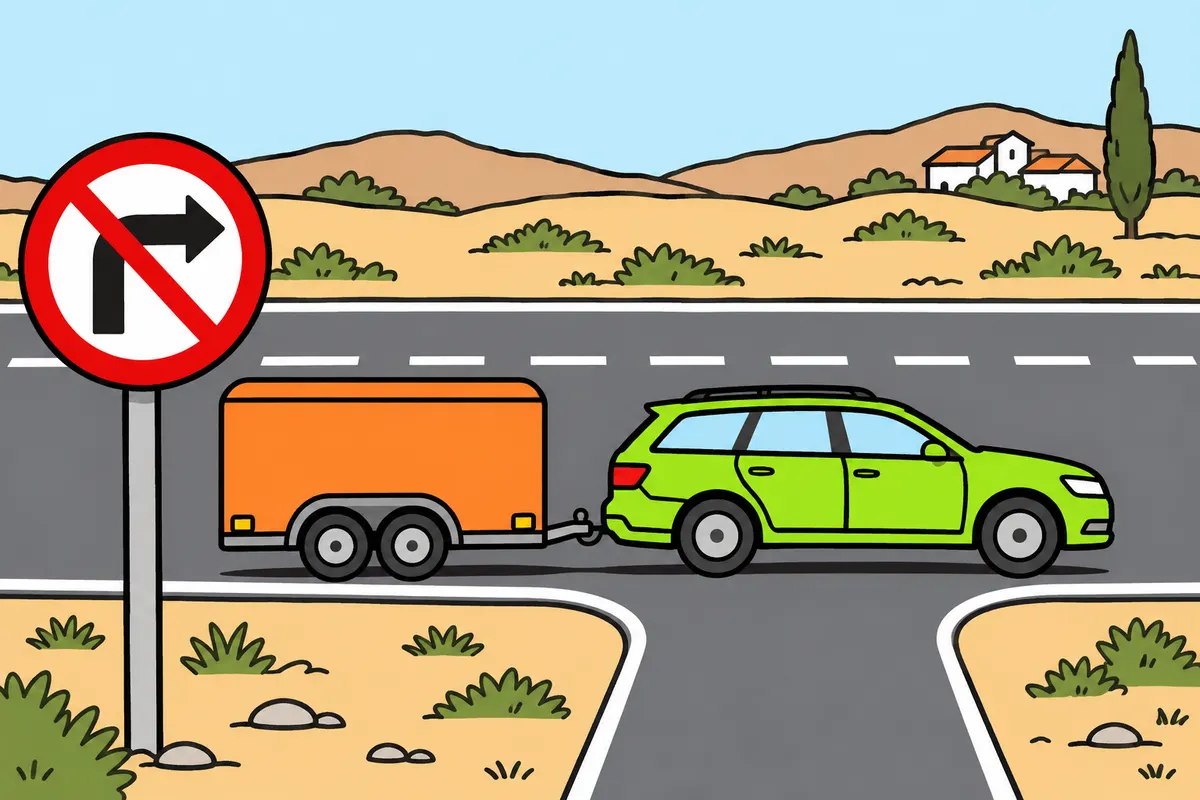
Distinguish the prohibited movement and the vehicle category affected.
| Sign and affected vehicles | What it prohibits |
|---|---|
| R-302 | Turning right |
| R-303 | Turning left and making U-turns |
| R-304 | Making U-turns |
| R-306: lorries with MMA over 3,500 kg | Overtaking motor vehicles, even without entering the oncoming area |
| R-307 | Stopping and parking on that side |
| R-308 | Parking on that side |
Remember
- At R-305, do not overtake motor vehicles if you must enter the oncoming area.
- Obey other overtaking prohibitions and conditions too.
- Adding masses does not turn your car with a trailer into a lorry.
- Read arrows, times, reservations and parking space boundaries.
Exam trap: Wrong: R-304 prohibits every left turn. Right: by itself, it prohibits U-turns.
Read the full explanation
- R-302 prohibits right turns. R-303 prohibits left turns and also U-turns. R-304 prohibits U-turns, without that message alone prohibiting all left turns. You must read the movement shown. [RGC, Annex I, section 5](https://www.boe.es/buscar/act.php?id=BOE-A-2003-23514#A5).
- R-305, no overtaking, prohibits you from overtaking motor vehicles when the manoeuvre requires you to enter the area for oncoming traffic. Where a rule prohibits overtaking, the sign reminds you of that prohibition. You must also comply with the other overtaking conditions, which you study in «Manoeuvres with a car and trailer». [RGC, Annex I, section 5](https://www.boe.es/buscar/act.php?id=BOE-A-2003-23514#A5).
- R-306 applies to lorries with an MMA exceeding 3,500 kg and prohibits overtaking motor vehicles even without entering the area for oncoming traffic. A passenger car with a trailer does not become a lorry because their combined mass exceeds that figure; you must identify the category the sign applies to. [RGC, Annex I, section 5](https://www.boe.es/buscar/act.php?id=BOE-A-2003-23514#A5).
- R-307 prohibits stopping and parking on the side where it is placed; R-308 prohibits parking. You must read the variants, arrows and panels that specify the section or times concerned. A parking prohibition does not by itself prohibit every stop required by traffic. [RGC, Annex I, section 5](https://www.boe.es/buscar/act.php?id=BOE-A-2003-23514#A5).
- At a limited-parking zone or reserved spaces, you must check the conditions shown by the signs. The length of your combination does not allow you to occupy a space reserved for others or extend beyond the markings that define the authorised parking position. [RGC, Annex I, section 5](https://www.boe.es/buscar/act.php?id=BOE-A-2003-23514#A5).
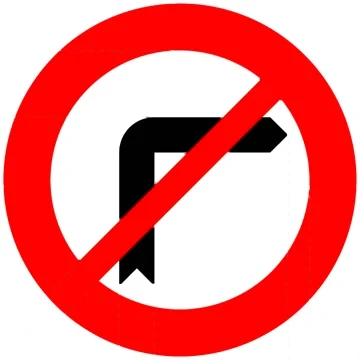 R-302
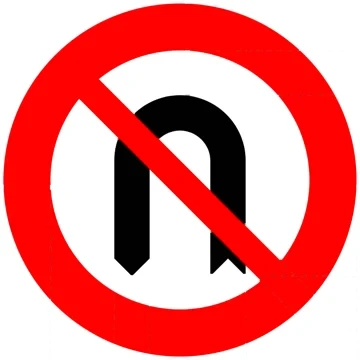 R-304
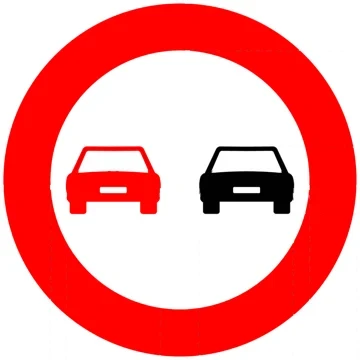 R-305
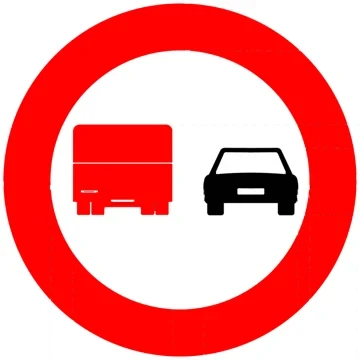 R-306
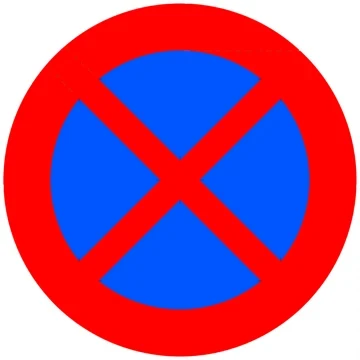 R-307
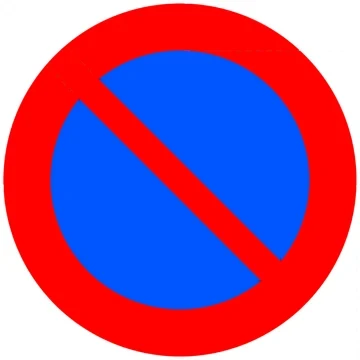 R-308
19Route and equipment requirements
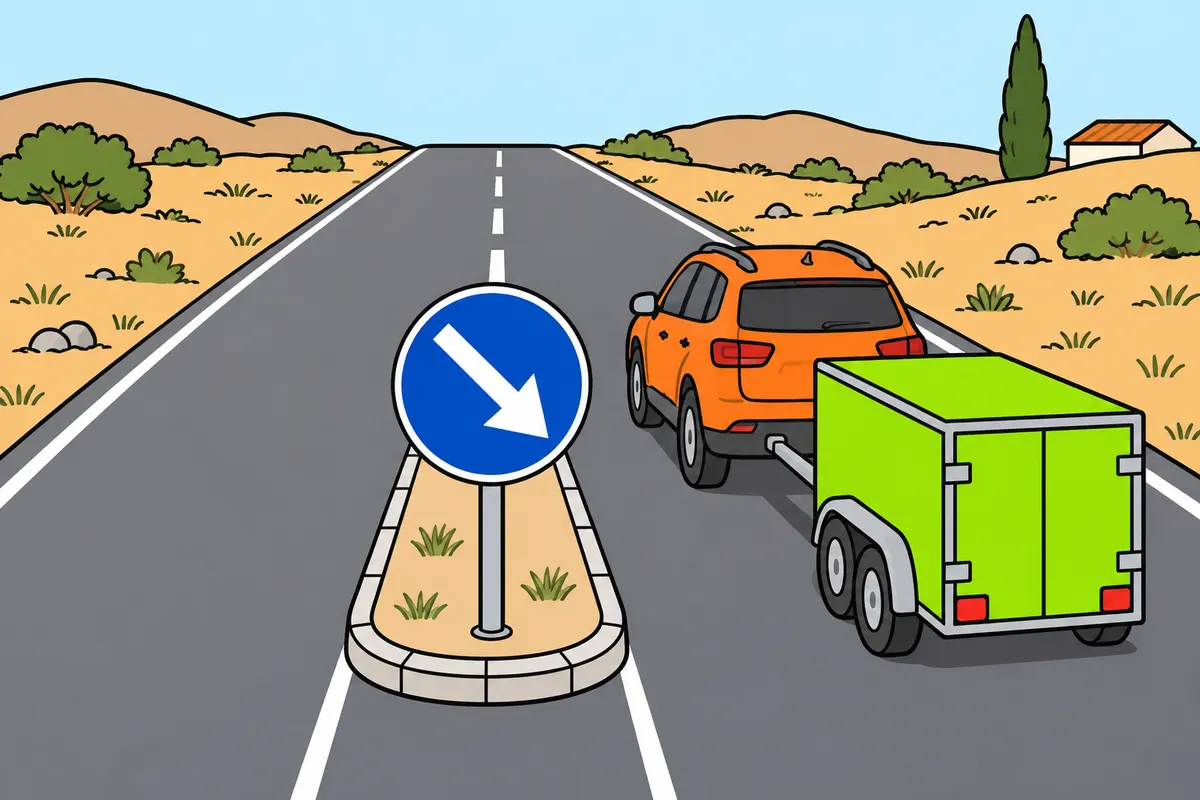
Follow the required route and check required equipment before entering.
| Sign | What you need |
|---|---|
| R-412 | Chains or authorised devices on a wheel each side of the same driven axle, or special snow tyres |
| R-412b | Winter tyres |
| R-413 | At least dipped beam headlights, even in good visibility |
| R-418 | Suitable, working electronic toll equipment |
Remember
- Distinguish a compulsory direction from a choice of permitted directions.
- R-402 requires the circular direction shown; it does not give entry priority.
- R-411 requires a minimum speed, subject to regulatory safety exceptions.
- It ends at another minimum, its end, or an equal or lower maximum.
- Check that your combination can meet the route’s conditions.
Exam trap: Wrong: chains only on the trailer satisfy R-412. Right: equip your towing vehicle’s driven axle as required.
Read the full explanation
- Mandatory direction signs require you to follow the direction indicated by the arrow. Mandatory passing signs tell you which side of a traffic island or obstacle you must pass. If a sign shows several permitted directions, you may choose any of those shown. [RGC, Annex I, point 5](https://www.boe.es/buscar/act.php?id=BOE-A-2003-23514#A5).
- R-402 requires you to follow the direction of circulation shown by the arrows. You must follow it as you drive through the junction, but you must not infer entry priority from this sign alone: look for the give way sign, traffic lights or other controls that apply to the entrance. [RGC, Annex I, point 5](https://www.boe.es/buscar/act.php?id=BOE-A-2003-23514#A5).
- R-411, minimum speed, requires you to drive at least at the speed shown until another minimum speed sign, an end-of-minimum-speed sign or an equal or lower maximum speed limit, subject to the regulatory safety exceptions. You must check whether your combination can use the route while meeting its conditions. The blue circle sets a compulsory minimum speed. [RGC, Annex I, point 5](https://www.boe.es/buscar/act.php?id=BOE-A-2003-23514#A5). [RGC, art. 49](https://www.boe.es/buscar/act.php?id=BOE-A-2003-23514#a49).
- R-412 requires chains or other approved anti-skid devices acting on at least one wheel on each side of the same driven axle, or special snow tyres. R-412b requires winter tyres. You must check the equipment of the towing vehicle, as this is the vehicle with a driven axle. [RGC, Annex I, point 5](https://www.boe.es/buscar/act.php?id=BOE-A-2003-23514#A5).
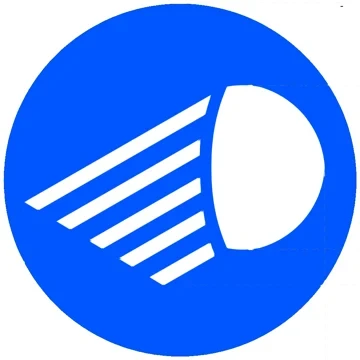
- R-413 requires you to drive with at least dipped beam on, even in good visibility. R-418 requires electronic toll payment with suitable equipment in working order. You must distinguish a requirement from an available service and check the lane conditions before entering with your trailer. [RGC, Annex I, point 5](https://www.boe.es/buscar/act.php?id=BOE-A-2003-23514#A5). [RGC, art. 132.1](https://www.boe.es/buscar/act.php?id=BOE-A-2003-23514#a132).
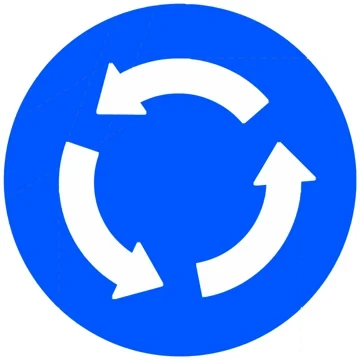 R-402
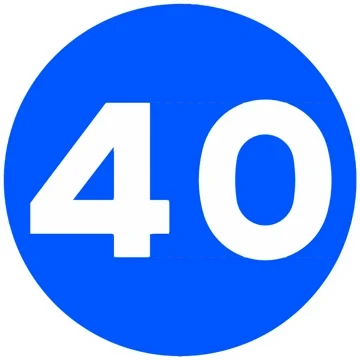 R-411
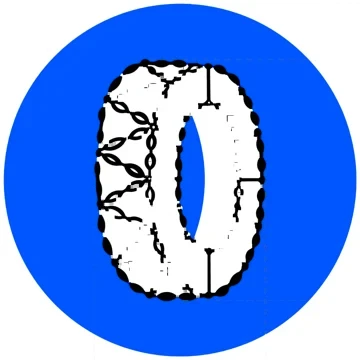 R-412
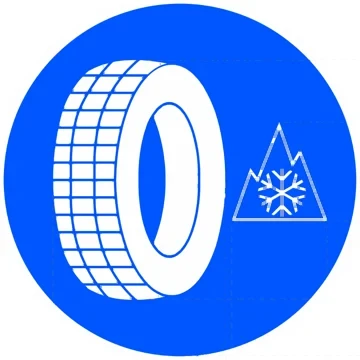 R-412b
 R-413
 R-418
20Warnings that affect towing a trailer
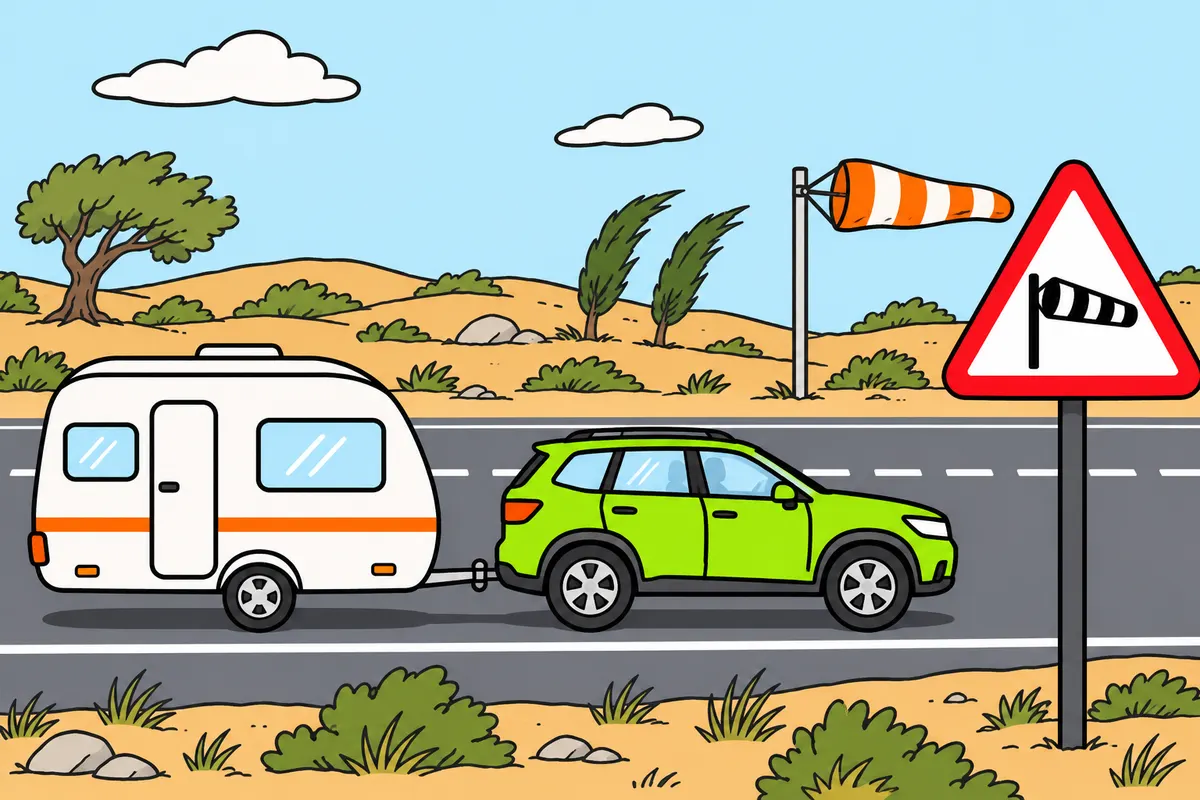
Expect the hazard and adjust your driving before your trailer reaches it.
| Sign | Hazard you must expect |
|---|---|
| P-16a | Steep descent |
| P-29 | Frequent strong crosswinds |
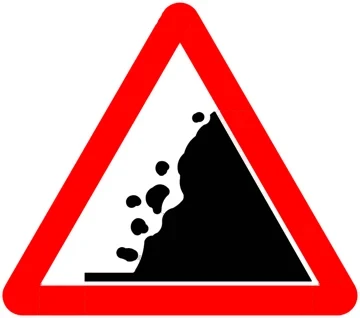
| P-26 | Falling rocks and possible obstacles |
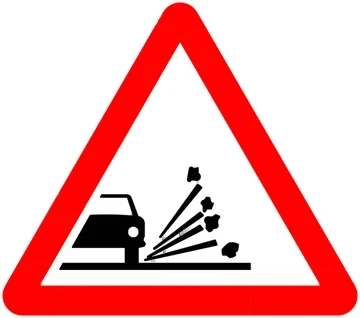
| P-28 | Loose chippings |
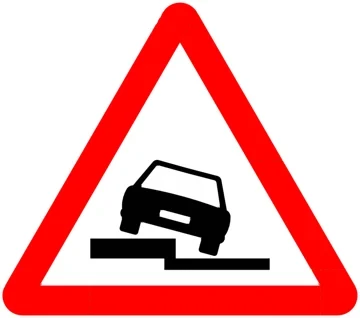
| P-30 | Edge drop |
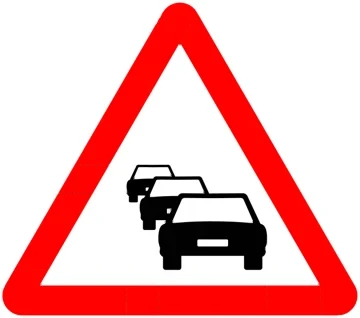
| P-31 | Congestion |
Remember
- At bends, allow for the space your trailer’s path needs.
- At narrow sections, check that your whole combination fits.
- The gradient shown is not a maximum speed.
- For crosswinds, anticipate danger and watch the windsock.
- Check whether a plate shows distance to danger or the affected section’s length.
Exam trap: Wrong: every warning sign sets the same speed. Right: adjust your driving to the specific hazard.
Read the full explanation
- Warning signs help you anticipate a hazard that is difficult to spot in time. You must adapt your driving to the hazard indicated; these signs do not all impose the same numerical speed limit or give you priority. A supplementary plate may show the distance to the hazard or the length of the affected stretch. [RGC, art. 144](https://www.boe.es/buscar/act.php?id=BOE-A-2003-23514#a144). [RGC, Annex I, point 5](https://www.boe.es/buscar/act.php?id=BOE-A-2003-23514#A5).
- When you approach a dangerous bend or a series of bends, you must identify which way the first bend goes. With a trailer, you must allow space for its path and adjust your speed before entering the bend, keeping the combination within the permitted path. [RGC, art. 144](https://www.boe.es/buscar/act.php?id=BOE-A-2003-23514#a144). [RGC, Annex I, point 5](https://www.boe.es/buscar/act.php?id=BOE-A-2003-23514#A5).
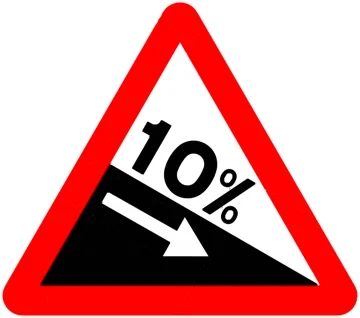
- P-16a warns of a steep descent. The percentage indicates the gradient, not the maximum speed. You must prepare as you approach the descent; descent technique and use of the braking system are covered in «Trailer braking» and «Safe driving with a trailer». [RGC, art. 144](https://www.boe.es/buscar/act.php?id=BOE-A-2003-23514#a144). [RGC, Annex I, point 5](https://www.boe.es/buscar/act.php?id=BOE-A-2003-23514#A5).
- A road narrows sign warns of a reduction in width on both sides or on the side shown by the symbol. R-204, by contrast, prohibits you from passing if you exceed the width shown. The warning does not guarantee that every combination can fit through. [RGC, art. 144](https://www.boe.es/buscar/act.php?id=BOE-A-2003-23514#a144). [RGC, Annex I, point 5](https://www.boe.es/buscar/act.php?id=BOE-A-2003-23514#A5).
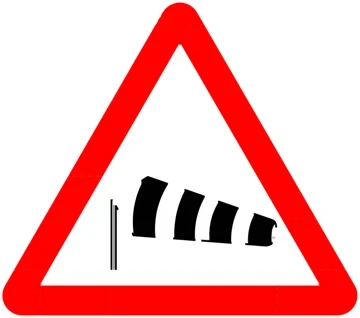
- P-29, crosswinds, warns of an area where strong winds frequently blow from the side. You must anticipate the risk when towing a caravan and observe the windsock where one is provided. The sign warns of the hazard; it does not itself indicate a mandatory direction. [RGC, art. 144](https://www.boe.es/buscar/act.php?id=BOE-A-2003-23514#a144). [RGC, Annex I, point 5](https://www.boe.es/buscar/act.php?id=BOE-A-2003-23514#A5).
- P-26 warns of falling rocks and possible obstacles; P-28, of loose chippings; P-30, of a drop at the edge of the carriageway; P-31, of congestion. Each symbol identifies the risk you must react to before the trailer reaches the affected area. [RGC, art. 144](https://www.boe.es/buscar/act.php?id=BOE-A-2003-23514#a144). [RGC, Annex I, point 5](https://www.boe.es/buscar/act.php?id=BOE-A-2003-23514#A5).
 P-16a
 P-29
 P-26
 P-28
 P-30
 P-31
21Junctions, crossings and vulnerable road users
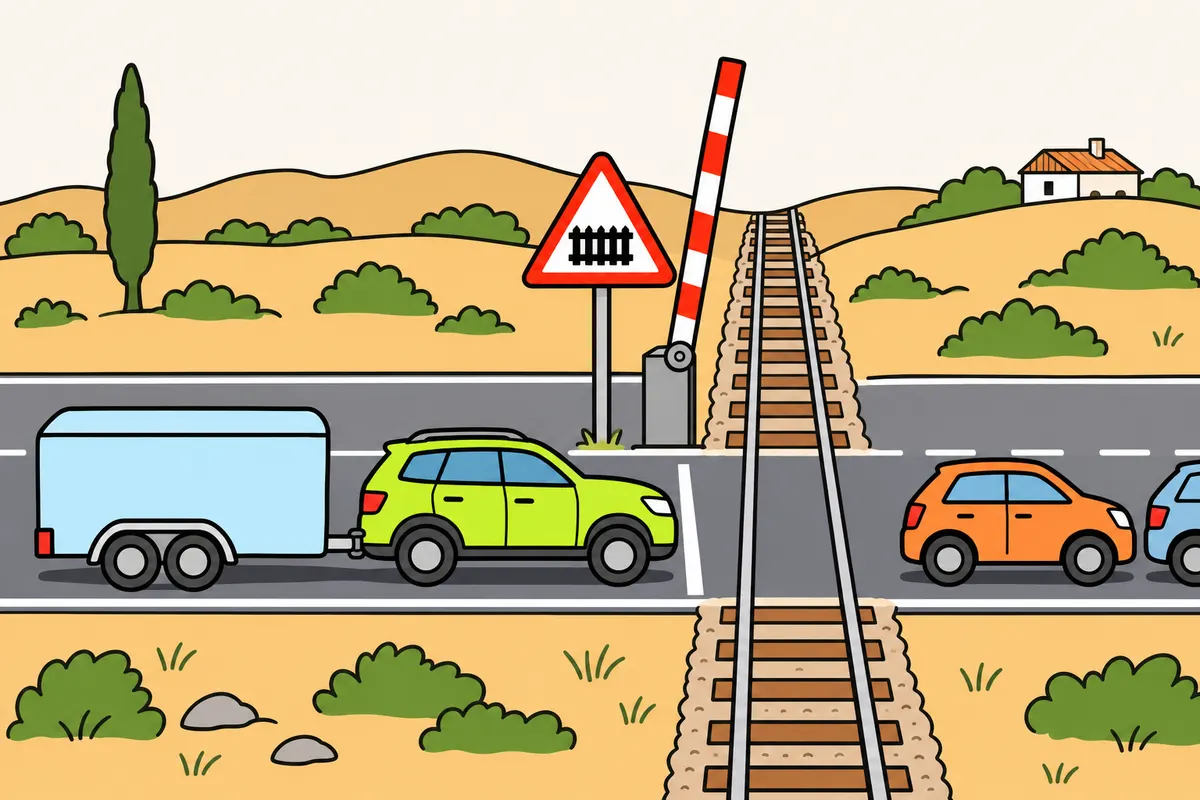
Before crossing, check the hazard and leave exit space for your whole combination.
| Sign | What you must recognise |
|---|---|
| Pedestrian or cyclist warning | A possible hazard nearby |
| Sign identifying a crossing | The actual crossing point |
Remember
- Do not enter a level crossing if you could become stranded on it.
- Check space beyond it for your car and trailer.
- Obey lights, barriers and signs controlling the crossing.
- Expect pedestrians, children or cyclists where warnings show them.
- Expect animals to enter the road where signs warn of them.
- Expect slippery surfaces, ice or poor visibility according to the sign.
Exam trap: Wrong: only the car needs to clear the tracks. Right: your whole trailer must clear them too.
Read the full explanation
- Warnings of a level crossing, opening bridge or two-way traffic require you to identify the potential conflict before you arrive. You must observe the lights, barriers and priority signs controlling that particular location; the warning sign does not replace their instructions. [RGC, art. 144](https://www.boe.es/buscar/act.php?id=BOE-A-2003-23514#a144). [RGC, art. 95](https://www.boe.es/buscar/act.php?id=BOE-A-2003-23514#a95). [RGC, Annex I, point 5](https://www.boe.es/buscar/act.php?id=BOE-A-2003-23514#A5).
- When you approach a level crossing, you must check that you can clear it completely. Do not enter if traffic conditions mean you become stranded on it. With a trailer, you need space on the far side for the whole combination, even if the towing vehicle can clear the tracks. [RGC, art. 144](https://www.boe.es/buscar/act.php?id=BOE-A-2003-23514#a144). [RGC, art. 95](https://www.boe.es/buscar/act.php?id=BOE-A-2003-23514#a95). [RGC, Annex I, point 5](https://www.boe.es/buscar/act.php?id=BOE-A-2003-23514#A5).
- Warnings of pedestrians, children or cyclists indicate an area where you must expect them to be present. You must distinguish a warning that a hazard is nearby from the sign identifying the exact location of a crossing; they serve different purposes as you approach. [RGC, art. 144](https://www.boe.es/buscar/act.php?id=BOE-A-2003-23514#a144). [RGC, Annex I, point 5](https://www.boe.es/buscar/act.php?id=BOE-A-2003-23514#A5).
- Signs showing domestic or wild animals warn you that animals may enter the road unexpectedly. Signs for slippery surfaces, ice or reduced visibility warn of conditions you must anticipate. Read the specific symbol and supplementary plates to identify the affected stretch or the circumstances of the hazard. [RGC, art. 144](https://www.boe.es/buscar/act.php?id=BOE-A-2003-23514#a144). [RGC, Annex I, point 5](https://www.boe.es/buscar/act.php?id=BOE-A-2003-23514#A5).
22Road, lane and direction signs
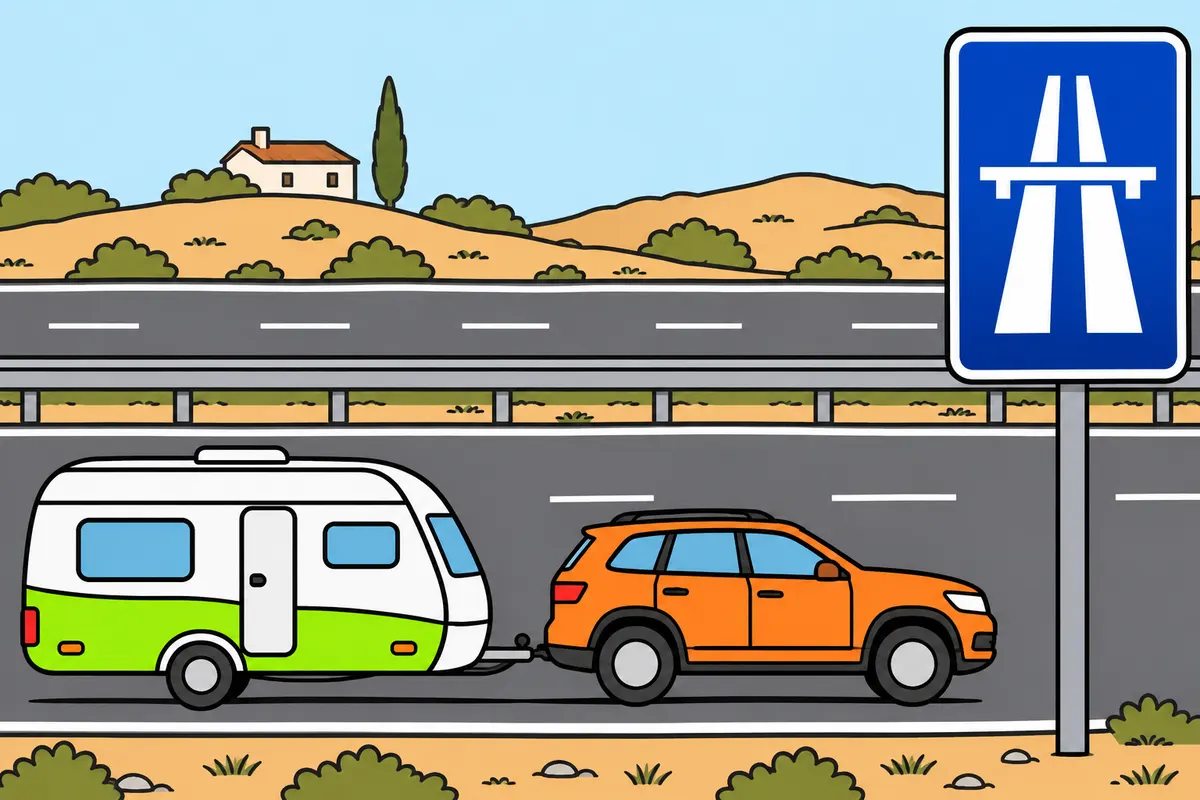
Plan your route and obey the conditions for each road, lane or zone.
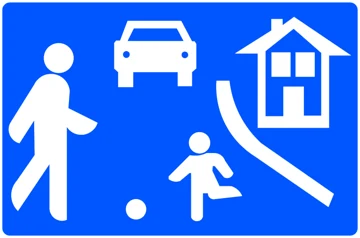
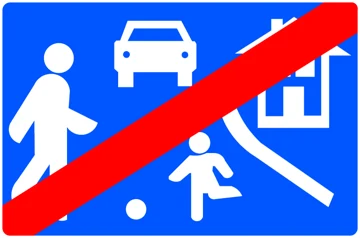
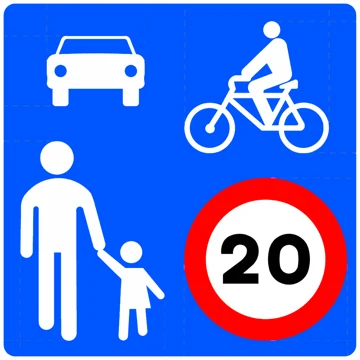
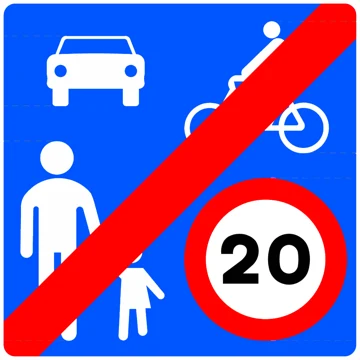
| Zone | Maximum speed | Games and sports | End sign |
|---|---|---|---|
| S-28: living and play zone, accompanied by R-301 | 10 km/h | You must expect them | S-29 |
| S-47: shared-use zone | 20 km/h | Not authorised | S-48 |
Remember
- Prepare for exits and read their restrictions.
- An arrow towards another lane does not give you priority to change lanes.
- S-1 identifies motorways; S-1a identifies dual carriageways; both may identify their slip roads.
- In S-28 and S-47 zones, park only in marked places.
- Expect cycles and, where applicable, personal mobility vehicles both ways unless otherwise specified.
- In both zones, pedestrians have priority and may use the whole zone.
Exam trap: Wrong: S-47 allows games like S-28. Right: games and sports are not authorised in the shared-use zone.
Read the full explanation
- S-1 identifies the start of an autopista (motorway) and S-1a the start of an autovía (dual carriageway), where their special rules apply. They may also identify the slip road leading to them. A sign showing a destination reached via such a road gives route information without necessarily marking its start. [RGC, art. 146](https://www.boe.es/buscar/act.php?id=BOE-A-2003-23514#a146). [RGC, Annex I, point 5](https://www.boe.es/buscar/act.php?id=BOE-A-2003-23514#A5).
- Lane signs show which lane continues, ends or has special rules. If they include a prohibition or requirement for a lane, you must apply that message to the road users it addresses. An arrow pointing towards an adjacent lane does not give you priority to move your trailer into it. [RGC, art. 146](https://www.boe.es/buscar/act.php?id=BOE-A-2003-23514#a146). [RGC, Annex I, point 5](https://www.boe.es/buscar/act.php?id=BOE-A-2003-23514#A5).
- Advance direction signs warn you of a decision ahead; direction signs guide you at the interchange; route confirmation signs remind you of destinations and distances. You must plan your route in advance, also reading the restrictions shown for the exits you intend to use. [RGC, art. 146](https://www.boe.es/buscar/act.php?id=BOE-A-2003-23514#a146). [RGC, Annex I, point 5](https://www.boe.es/buscar/act.php?id=BOE-A-2003-23514#A5).
- Road identifiers let you recognise a road by its number, letters or name. Location signs identify towns, territorial boundaries or places. The location and units let you work out whether a figure indicates distance, speed or tonnage. [RGC, art. 146](https://www.boe.es/buscar/act.php?id=BOE-A-2003-23514#a146). [RGC, Annex I, point 5](https://www.boe.es/buscar/act.php?id=BOE-A-2003-23514#A5).
- Supplementary plates may specify the priority route, the direction in which a sign applies or an exception. You must read them together with the main sign and relate them to your intended movement. A direction arrow does not override an entry prohibition or insufficient headroom for your caravan. [RGC, art. 146](https://www.boe.es/buscar/act.php?id=BOE-A-2003-23514#a146). [RGC, Annex I, point 5](https://www.boe.es/buscar/act.php?id=BOE-A-2003-23514#A5).
- S-28, a stay and play zone, sets a maximum speed of 10 km/h, accompanied by R-301 limiting speed to 10 km/h, and gives pedestrians priority. You must park only in marked places and expect pedestrians throughout the zone, as well as games and sports. Cycles and, where applicable, VMP (personal mobility vehicles) may travel in both directions unless otherwise specified; S-29 marks the end of this zone. [RGC, Annex I, point 5](https://www.boe.es/buscar/act.php?id=BOE-A-2003-23514#A5). [RD 465/2025, Annex I, catalogue, S-28](https://www.boe.es/buscar/doc.php?id=BOE-A-2025-12199).
- S-47, a shared-use zone, sets a maximum speed of 20 km/h and gives pedestrians priority in the shared space. You must park only in marked places and expect cycles and, where applicable, VMP in both directions unless otherwise specified; pedestrians may use the whole zone, and games and sports are not authorised. S-48 marks its end; S-30a identifies an area reserved for pedestrian use. [RGC, Annex I, point 5](https://www.boe.es/buscar/act.php?id=BOE-A-2003-23514#A5).
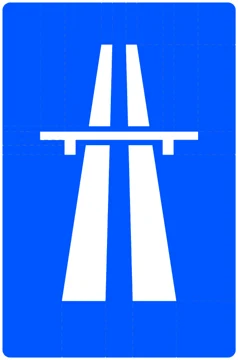 S-1
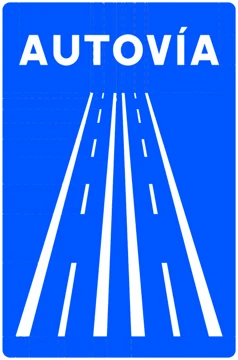 S-1a
 S-28
 S-29
 S-47
 S-48
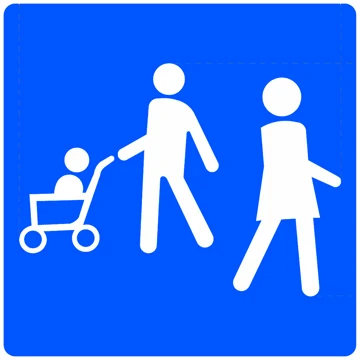 S-30a
23Services, tunnels and mountain roads
Check what each facility is for and whether your trailer can use it.
Remember
- Do not use an emergency lay-by for ordinary parking.
- Keep escape lanes clear for vehicles needing an emergency stop.
- At S-21, read pass status, restrictions, required equipment and where they apply.
- A campsite sign does not allow you to camp anywhere.
- Check that spaces accept your combination and its dimensions.
Exam trap: Wrong: a passable mountain road accepts every combination. Right: check its restrictions and required equipment.
Read the full explanation
- Tunnel, emergency lay-by and emergency exit signs help you recognise the facilities along your route. A place signed for pulling over in an emergency is reserved for that specific use; having enough space for your combination does not change its signed purpose. [RGC, art. 146](https://www.boe.es/buscar/act.php?id=BOE-A-2003-23514#a146). [RGC, Annex I, point 5](https://www.boe.es/buscar/act.php?id=BOE-A-2003-23514#A5).
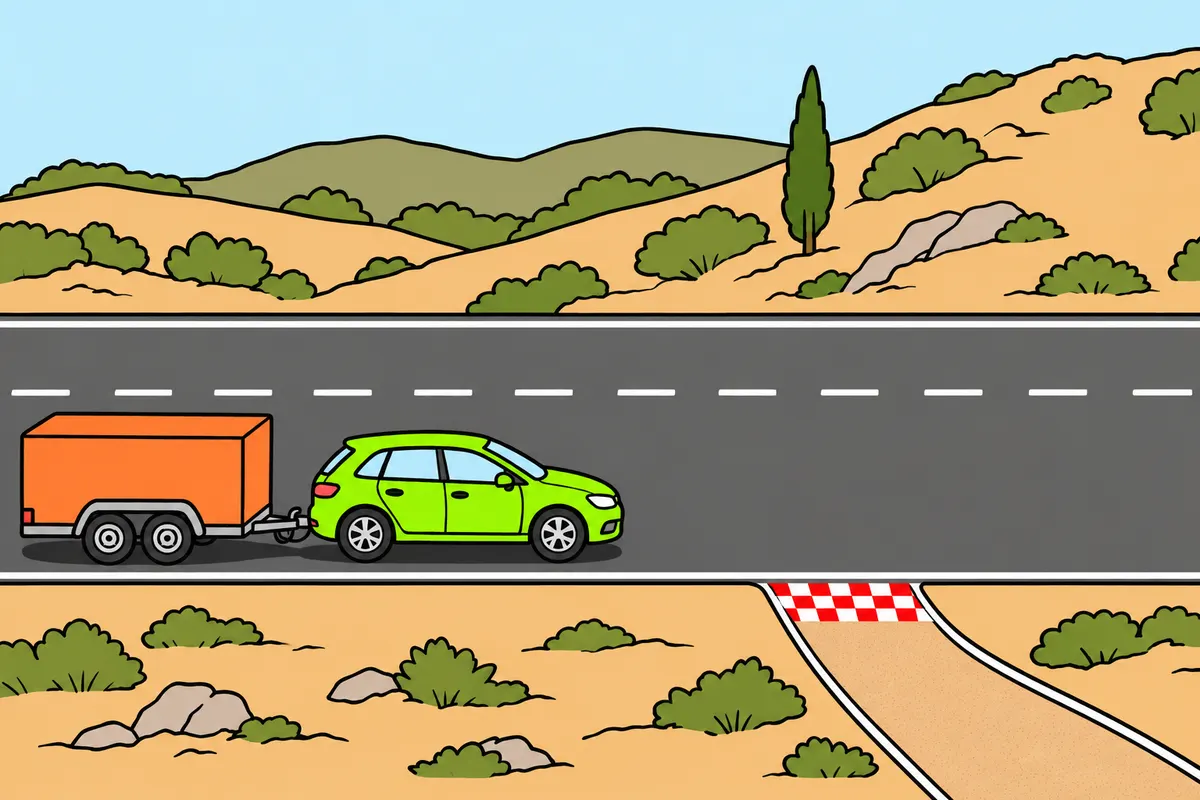
- An escape lane is intended to stop a vehicle when it needs this facility. The red and white chequered marking M-7.11 identifies its entrance, which you must keep clear of stopping or parking unrelated to that purpose. [RGC, art. 146](https://www.boe.es/buscar/act.php?id=BOE-A-2003-23514#a146). [RGC, Annex I, point 5](https://www.boe.es/buscar/act.php?id=BOE-A-2003-23514#A5).
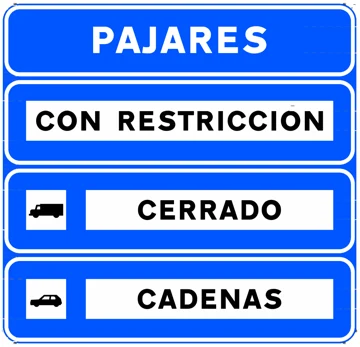
- S-21 tells you whether a stretch of road or mountain pass is open to traffic. You must read its status, restrictions or required equipment, and the point from which they apply together. A mountain pass that is open may impose conditions incompatible with your vehicle or combination. [RGC, art. 146](https://www.boe.es/buscar/act.php?id=BOE-A-2003-23514#a146). [RGC, Annex I, point 5](https://www.boe.es/buscar/act.php?id=BOE-A-2003-23514#A5).
- Service signs indicate fuel, charging, repairs, telephone, rest facilities, camping or caravan facilities. You must check which service is actually shown; a camping or caravan sign does not authorise you to camp anywhere along the route. [RGC, art. 146](https://www.boe.es/buscar/act.php?id=BOE-A-2003-23514#a146). [RGC, Annex I, point 5](https://www.boe.es/buscar/act.php?id=BOE-A-2003-23514#A5).
- You must use bays and areas designated for particular road users or vehicles under the conditions shown. You must check whether they allow your combination and its dimensions. A parking sign does not remove reservations, time restrictions or markings specifying its use. [RGC, art. 146](https://www.boe.es/buscar/act.php?id=BOE-A-2003-23514#a146). [RGC, Annex I, point 5](https://www.boe.es/buscar/act.php?id=BOE-A-2003-23514#A5).
 S-21
24Longitudinal lines and road edges
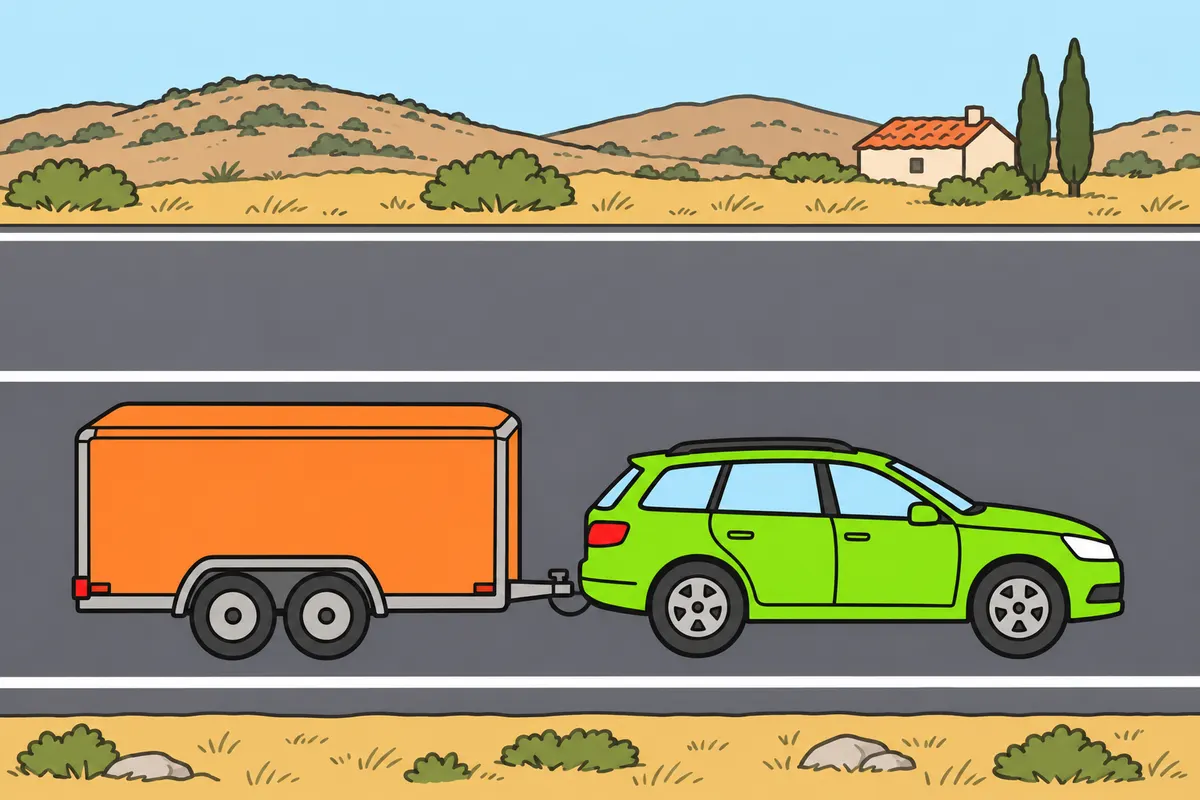
Distinguish road lines and check that your manoeuvre is permitted and safe.
| Line or situation | What you must do |
|---|---|
| Solid line | Do not cross or drive on it, except under regulatory exceptions |
| Solid line separating opposing traffic | Do not drive to its left either, except under regulatory exceptions |
| Double solid lines | Treat them like a single solid line |
| Solid beside broken | Obey the line on your side |
| Overtaking started from broken-line side between opposing directions | You may cross the solid line to return when finishing or abandoning overtaking |
Remember
- Cross broken lines only for permitted manoeuvres; give way to the lane you join.
- Do not drive along them unless insufficient lane width makes this necessary and safe.
- Your trailer’s width does not allow you to drive on any solid line.
- Warning broken lines announce a solid line or a hazardous section.
- An edge line does not change the rules for using the hard shoulder.
Exam trap: Wrong: a broken line guarantees safe overtaking. Right: check visibility, space and other conditions.
Read the full explanation
- Broken longitudinal markings M-1.1 to M-1.3 mark lane boundaries and allow you to cross them for permitted manoeuvres. You must respect the priority of traffic in the lane you are moving into. You must not drive along these markings, except where the lane is too narrow and doing so is necessary and safe. [RGC, Annex I, point 5](https://www.boe.es/buscar/act.php?id=BOE-A-2003-23514#A5).
- Solid lines M-2.1 to M-2.3 prohibit you from crossing or driving along them and, where they separate opposing directions of traffic, from driving to their left, subject to the regulatory exceptions. Two parallel solid lines have the same meaning as one. The width of your trailer does not give you general permission to drive on them. [RGC, Annex I, point 5](https://www.boe.es/buscar/act.php?id=BOE-A-2003-23514#A5).
- Where a solid line runs alongside a broken line, M-3.1 to M-3.3, you must follow the line on your side. If they separate opposing directions and you start overtaking from the broken-line side, you may cross the solid line to return to your lane when you complete or abandon the manoeuvre. [RGC, Annex I, point 5](https://www.boe.es/buscar/act.php?id=BOE-A-2003-23514#A5).
- Advance warning broken lines M-1.9 and M-1.10 warn of a solid line or a particularly hazardous stretch ahead. You must plan to complete any permitted manoeuvre in good time. Being allowed to cross a broken line does not mean you have enough visibility or safety margin to overtake with your trailer. [RGC, Annex I, point 5](https://www.boe.es/buscar/act.php?id=BOE-A-2003-23514#A5).
- Edge lines M-2.5 to M-2.7 mark the limits of the carriageway; whether they are solid does not change the rules for using the arcén (hard shoulder). M-1.13 separates opposing directions for guidance without regulating overtaking according to the available visibility; you must check the other conditions before manoeuvring. [RGC, Annex I, point 5](https://www.boe.es/buscar/act.php?id=BOE-A-2003-23514#A5).
25Transverse markings, arrows and reserved areas
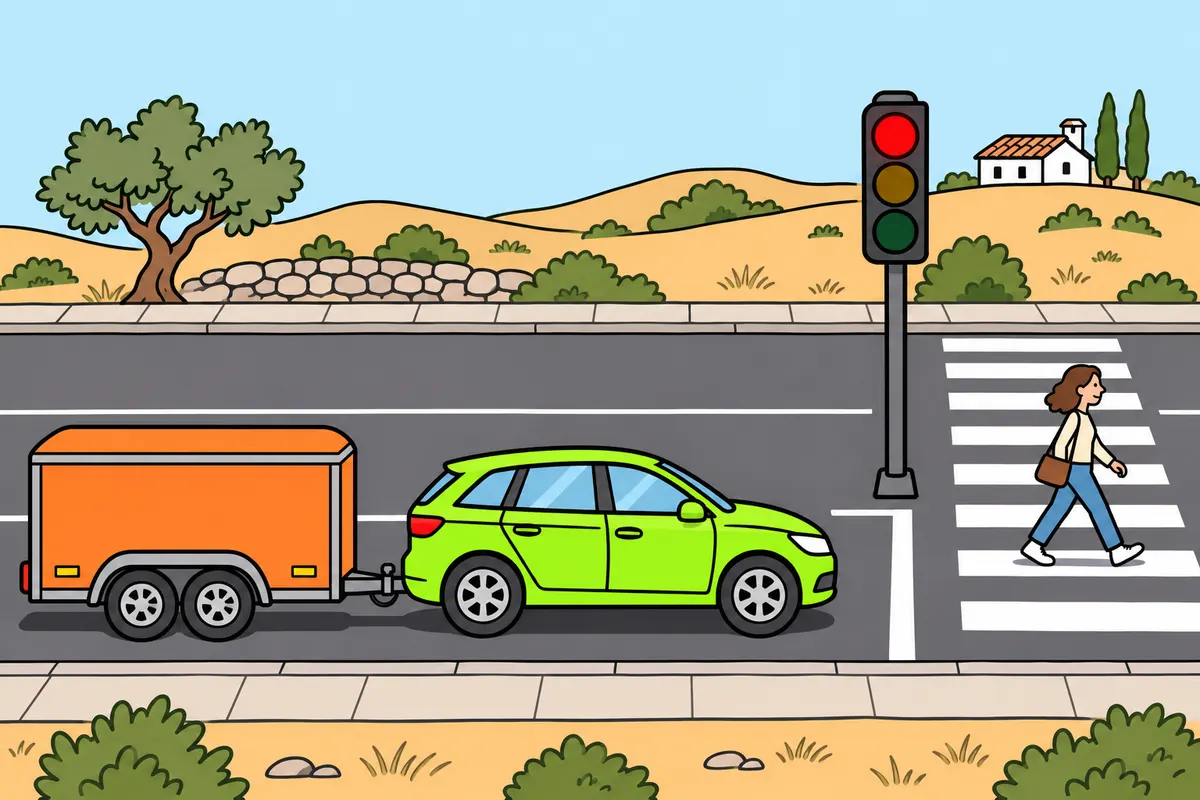
Obey your lane’s markings and keep crossings and reserved spaces clear.
| Marking | What you must do |
|---|---|
| STOP | Stop and give way |
| Give way | Give way; stop if necessary |
| Lane selection arrows | Follow your lane’s permitted or compulsory movements |
Remember
- When stopping, neither your vehicle nor its load may pass the stop line.
- STOP markings apply even without a signpost.
- Keep your trailer clear of pedestrian and cycle crossings while waiting.
- At an end-of-lane arrow, leave and give way to the adjacent lane.
- At a return arrow, abandon overtaking or finish as soon as possible.
- Keep your trailer out of reserved or closed areas too.
Exam trap: Wrong: you may always enter solid-bordered hatching. Right: only those required to use the hard shoulder are exempt.
Read the full explanation
- The M-4.1 stop line marks the point beyond which neither your vehicle nor its load may pass when you must stop because of a STOP sign, traffic lights, an officer's instruction or another specified reason. The M-4.2 broken transverse line identifies where you must give way when required. You must relate the line to the requirement that accompanies it. [RGC, Annex I, section 5](https://www.boe.es/buscar/act.php?id=BOE-A-2003-23514#A5).
- The M-6.3 and M-6.4 STOP markings require you to stop and give way; M-6.5, the give-way marking, requires you to give way and stop if necessary. If they are within a marked lane, they apply to you when you use that lane. The absence of an upright sign does not turn the road inscription into a recommendation. [RGC, Annex I, section 5](https://www.boe.es/buscar/act.php?id=BOE-A-2003-23514#A5).
- The M-4.3 pedestrian crossing marking identifies a crossing where you must give way to pedestrians. M-4.4 may identify a cycle crossing; the catalogue also provides for two broken lines at signal-controlled pedestrian crossings. You must interpret the markings, symbols and traffic lights together, and keep your trailer clear of the crossing while you wait. [RGC, Annex I, section 5](https://www.boe.es/buscar/act.php?id=BOE-A-2003-23514#A5).
- The M-5.1, M-5.2 and M-5.6 lane direction arrows indicate the movements permitted or required from the lane. M-5.4 warns that the lane ends and requires you to leave it, giving way to traffic in the adjacent lane. The M-5.5 return arrow warns of a continuous line ahead and requires you to abandon overtaking or complete it as soon as possible. [RGC, Annex I, section 5](https://www.boe.es/buscar/act.php?id=BOE-A-2003-23514#A5).
- You must not enter M-7.1 and M-7.2 hatched areas bordered by a continuous line, unless you are required to use the arcén (hard shoulder). You must keep your trailer's wheels out of them too. Road inscriptions and pictograms may reserve lanes, parking spaces or areas for other users. [RGC, Annex I, section 5](https://www.boe.es/buscar/act.php?id=BOE-A-2003-23514#A5).
26Colours and markings you must distinguish
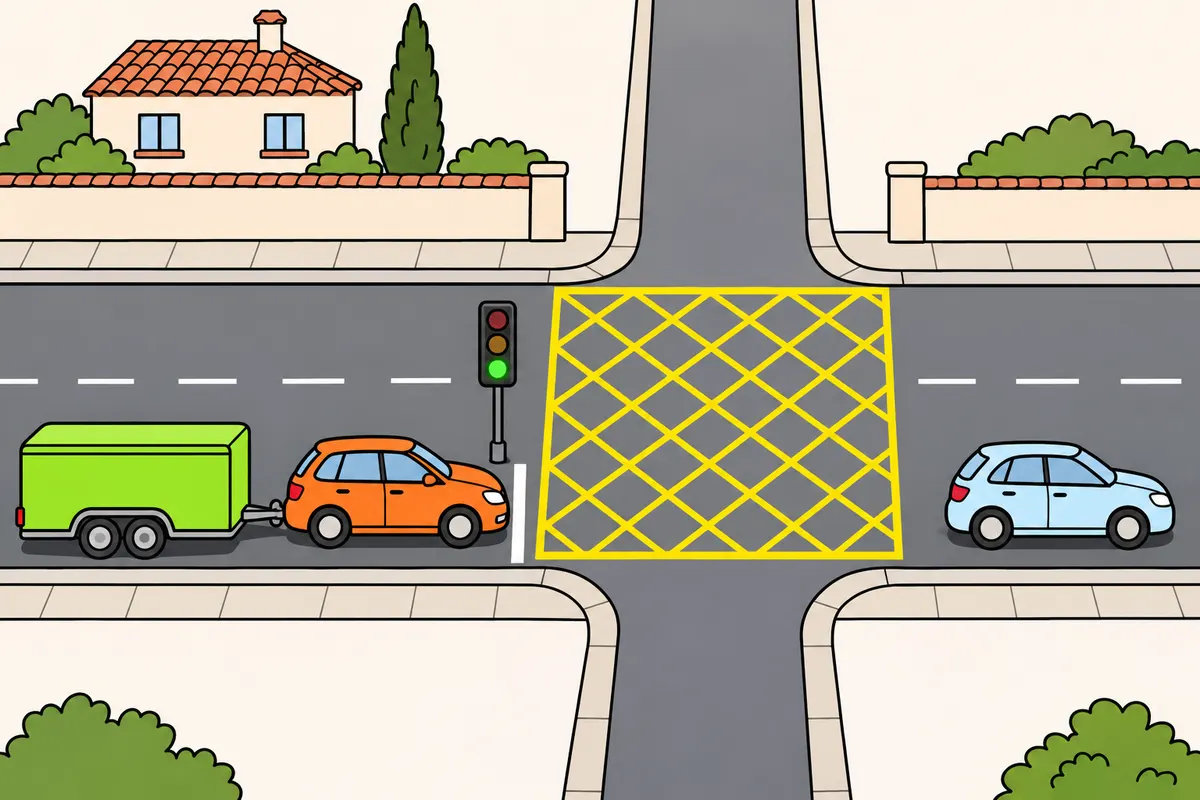
Distinguish yellow markings and check the conditions for parking spaces.
| Yellow marking | What you must respect |
|---|---|
| Broken line | Do not park along the section |
| Solid line | Do not stop or park along the section |
| Zigzag | Do not park; respect its reserved special use |
| Box | Do not block the junction |
Remember
- Distinguish yellow roadworks lines from stopping or parking restrictions.
- Read any times or temporary conditions shown on upright signs.
- At a yellow box, stay out if you would block crossing traffic.
- Check exit space for your whole combination, even with green or priority.
- Read times, reservations and duration limits for marked parking spaces.
- Do not occupy advanced waiting areas reserved for cycles or motorcycles.
Exam trap: Wrong: broken yellow also prohibits stopping. Right: it prohibits parking; solid yellow prohibits both.
Read the full explanation
- Markings are white except in expressly specified cases. The layout and positioning help you interpret whether a yellow marking guides you through roadworks or regulates stopping and parking. Coloured shapes intended to calm traffic do not, by that fact alone, constitute markings that impose a separate requirement. [RGC, Annex I, section 5](https://www.boe.es/buscar/act.php?id=BOE-A-2003-23514#A5).
- The M-7.7 broken yellow line prohibits parking along the stretch where it is marked; the M-7.8 continuous yellow line prohibits stopping and parking. Both may apply only at times specified by an upright sign at the start. You must read that condition before answering a question about the times when the restriction applies. [RGC, Annex I, section 5](https://www.boe.es/buscar/act.php?id=BOE-A-2003-23514#A5).
- The M-7.9 yellow zigzag prohibits parking by vehicles in general because it reserves the space for a special use, usually a bus stop or loading and unloading. You must respect the indicated use; carrying goods in your trailer does not authorise every use of the reserved area. [RGC, Annex I, section 5](https://www.boe.es/buscar/act.php?id=BOE-A-2003-23514#A5).
- The M-7.10 yellow box marking reminds you that you must not enter a junction if you are likely to stop and obstruct crossing traffic. You must follow this rule even when you have a green light or priority. Check that there is enough clear space beyond the junction for the towing vehicle and trailer. [RGC, Annex I, section 5](https://www.boe.es/buscar/act.php?id=BOE-A-2003-23514#A5).
- The M-7.3 and M-7.4 parking markings define parking spaces and vehicle positions; they may use other colours or pictograms to specify the applicable rules. You must check the signposted conditions on times, reserved use and duration, without assuming that every blue parking zone has the same hours nationwide. [RGC, Annex I, section 5](https://www.boe.es/buscar/act.php?id=BOE-A-2003-23514#A5).
- An advanced waiting area for cycles or motorcycles, marked out before the traffic lights and bearing the relevant pictograms, is reserved for those vehicles. You must stop your combination before the line that applies to you. The M-7.12 separation markings provide a reference for maintaining your distance from the vehicle ahead. [RGC, Annex I, section 5](https://www.boe.es/buscar/act.php?id=BOE-A-2003-23514#A5).
Interpreting several signs at an access road
Identify your route and check whether there is a real contradiction.
- Establish where your combination is and determine which signs regulate your lane and movement.
- Look first for instructions from officers, then for temporary signs or markers.
- Check traffic lights, upright signs and road markings, in that order.
- Apply the one with higher precedence if they are incompatible, or the most restrictive if they are of the same type.
- Comply with compatible messages together and check the exceptions for flashing amber lights and lane control signals.
Stop and give way at a STOP sign
Stopping and giving way are separate obligations that you must fulfil.
- Slow down in advance to bring your combination to a controlled stop.
- Stop completely before the line or, if there is no line, immediately before the junction.
- If visibility is exceptionally inadequate, move forward cautiously and stop again where you can see safely.
- Give way to traffic on the priority road, approaching from either side.
- Proceed when you do not force anyone to react abruptly and there is room for your entire trailer to clear the junction.
Check a restriction for your combination
The symbol determines which measurement you must compare.
- Identify the vehicles affected and read supplementary plates, times and exceptions.
- For R-112, check the axles and, if a tonnage is shown, the trailer’s MMA (maximum authorised mass).
- Distinguish the laden mass used by R-201 from the mass per axle used by R-202.
- For R-203, check the full length; for R-204 and R-205, check the width and height, including the load.
- If you do not meet a condition, choose a permitted route before entering the restricted section.
Check what you know
Real questions from the bank on this topic. Pick an answer to see the explanation.
Finished this module?
Mark it as read and you will see your progress on the theory list.