
Theory · A1 Licence - 125 cc Motorcycle · Module 10 of 18
Speed and distances on a motorcycle
You learn how to choose the speed limit for your motorcycle on each road and slow down when circumstances require it. You distinguish reaction, braking and stopping distances, and know what gap to keep to avoid rear-end collisions, allow overtaking and ride through tunnels. These distinctions are essential for answering A1 exam questions and keeping a safety margin for unexpected events.
1Legal limits and safe speed
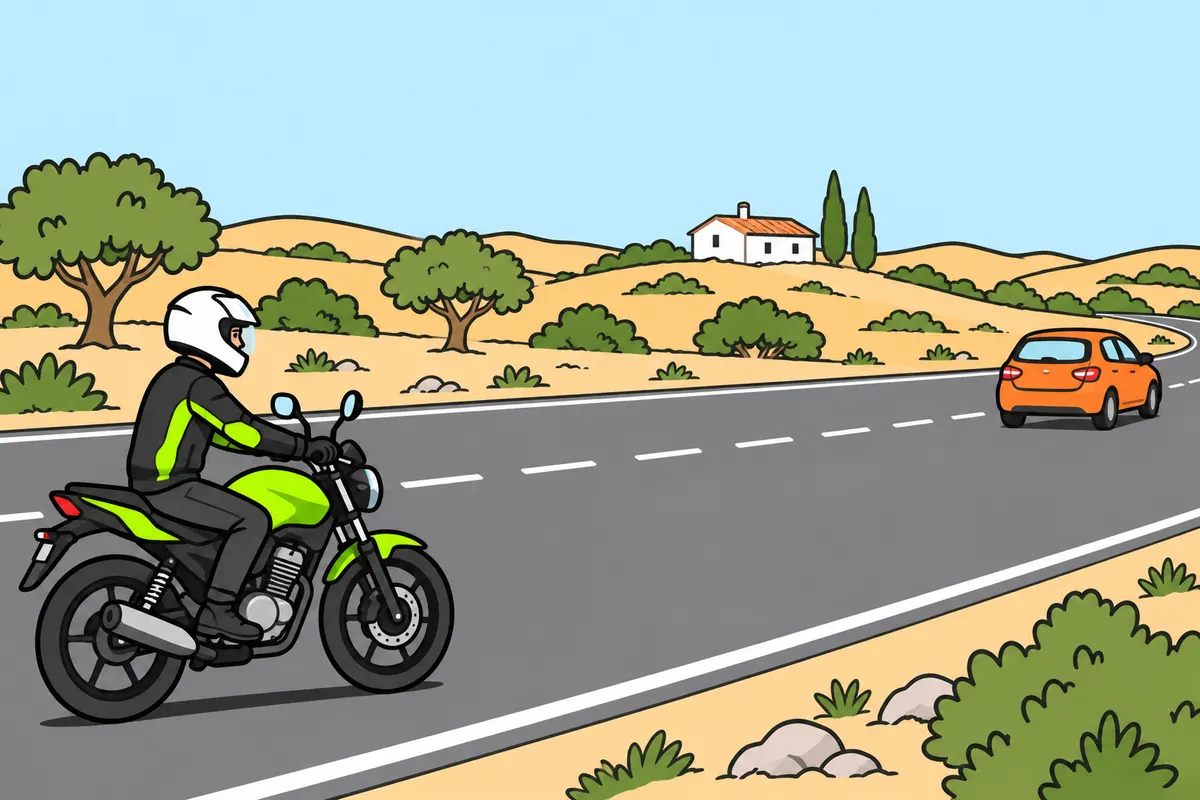
Choose a speed that lets you stop within the space you can see.
Remember
- Respect the limits, but slow down further when needed.
- Consider your health, traffic, weather and road surface.
- With passengers or luggage, review your speed and braking space.
- Slow down before sharp bends or places where you lose sight ahead.
Exam trap: Wrong: staying below the maximum guarantees safety. Right: slow down enough to stop within the space you can see.
Read the full explanation
- The maximum speed sets the permitted upper limit, and the minimum speed sets the speed below which you must not travel without justification. The appropriate speed depends on the circumstances: staying between two legal figures does not mean you can ride safely. [RGC, art. 45](https://www.boe.es/buscar/act.php?id=BOE-A-2003-23514#a45)
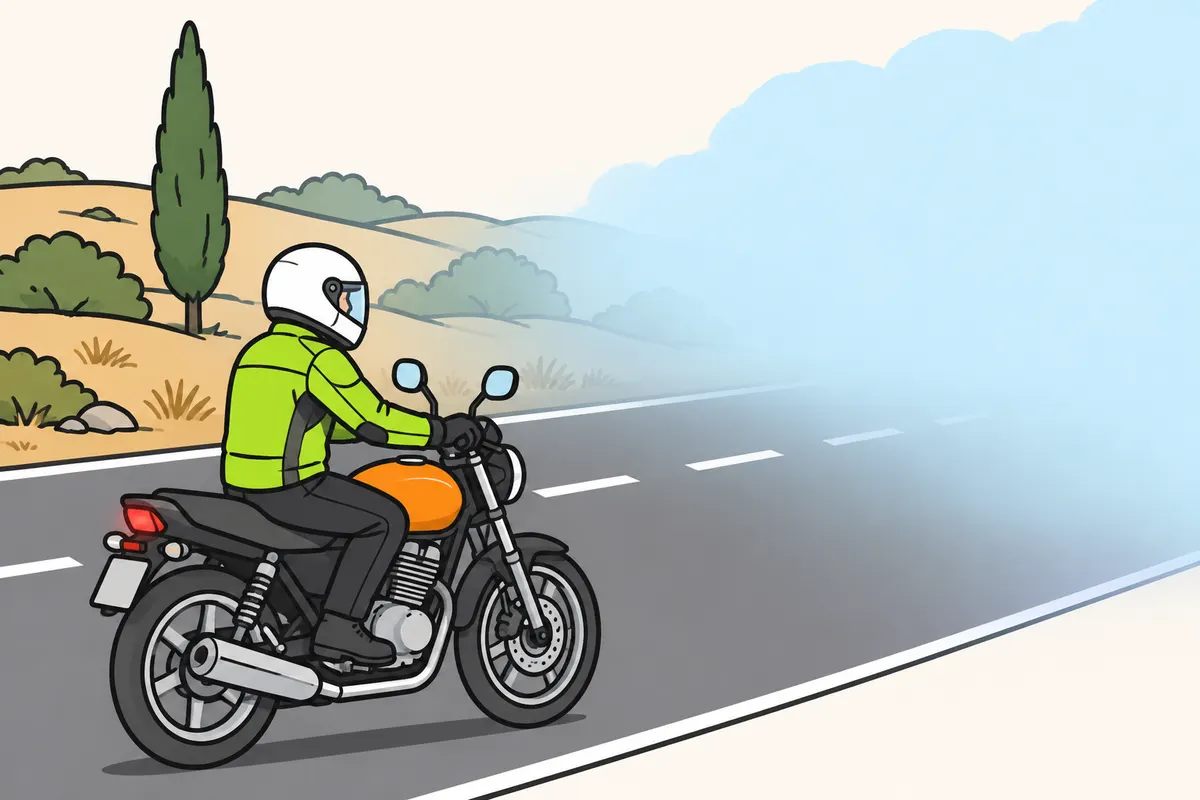
- You exceed the speed limit when you go above it, but you can also ride at an inappropriate speed without exceeding it. For example, you may need to ride below a road's maximum speed when fog makes obstacles difficult to see. [RGC, art. 45](https://www.boe.es/buscar/act.php?id=BOE-A-2003-23514#a45)
- You must assess your physical and mental condition, the traffic, the weather, the road surface, your motorcycle and its load. When you carry a passenger or luggage, you must reconsider your speed and braking margins. The power available and your experience do not entitle you to maintain the same speed in every situation. [RGC, art. 45](https://www.boe.es/buscar/act.php?id=BOE-A-2003-23514#a45)
- You must be able to stop within the distance you can see and before any obstacles that may appear. As you approach a sharp bend or a crest, slow down before you lose visibility. The area hidden from view may contain a stationary vehicle, even on a route you know. [RGC, art. 45](https://www.boe.es/buscar/act.php?id=BOE-A-2003-23514#a45)
2How you choose the applicable limit
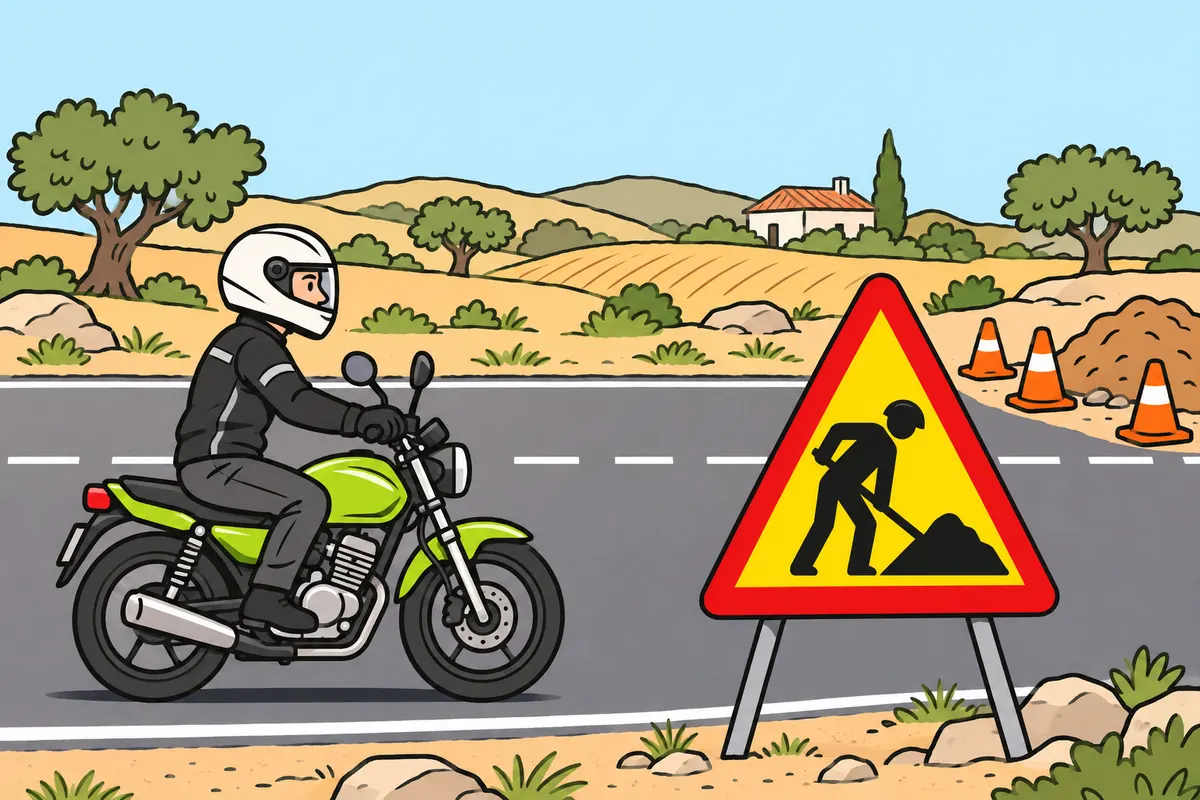
Choose your limit using the road, your vehicle, signs and your personal restrictions.
Remember
- Without specific signs, use the general limit for your road and vehicle.
- Obey temporary signs and any lower personal restrictions too.
- Check your speedometer and slow down before entering a slower area.
- Being a new rider does not itself mean a lower maximum.
- Vehicle testing needs a special permit and an authorised route.
- This exception excludes urban roads, through roads and stretches with specific limits.
Exam trap: Wrong: a test ride lets you exceed the limit. Right: only authorised vehicle testing allows this, with a special permit and authorised route, excluding urban roads, through roads and stretches with specific limits.
Read the full explanation
- The limit that applies to your motorcycle depends on the type of road, whether you are inside or outside a built-up area, the signs and any specific restrictions that apply to you. If there are no specific signs, you apply the relevant general limit; you do not need to see a repeated sign for that limit to be compulsory. [RGC, art. 47](https://www.boe.es/buscar/act.php?id=BOE-A-2003-23514#a47)
- The authorities may set specific limits for a stretch of road and temporary limits using temporary or variable signs. You must adjust your speed to these rules even when the road seems clear. Roadworks or an incident may require a lower maximum than the one you normally associate with that road. [RGC, art. 47](https://www.boe.es/buscar/act.php?id=BOE-A-2003-23514#a47)
- You must comply with restrictions relating to your personal circumstances, your vehicle's characteristics or its load. A sign allowing a particular speed does not cancel a lower specific limit that applies to you. To choose your speed, consider your personal and vehicle restrictions together with the rules for that stretch of road. [RGC, art. 52](https://www.boe.es/buscar/act.php?id=BOE-A-2003-23514#a52)
- Your speedometer gives you an indication of your speed; when you move from a high-speed road to a slower environment, check its reading and slow down in advance to comply with the applicable limit. [RGC, art. 45](https://www.boe.es/buscar/act.php?id=BOE-A-2003-23514#a45)
- If you are a new rider, you apply the limits for your motorcycle and the road: article 48.1 does not set a lower limit because you are a new rider or under 18 years old. You must also comply with any individual restrictions on your driving entitlement. [RGC, art. 48.1](https://www.boe.es/buscar/act.php?id=BOE-A-2003-23514#a48) [RGC, art. 52](https://www.boe.es/buscar/act.php?id=BOE-A-2003-23514#a52)
- The exception for vehicle testing requires a special permit and an authorised route: it allows you to exceed the general maximum by up to 30 km/h, but never on urban roads, stretches of road through a town or stretches with a specific limit. Taking a motorcycle for a test ride from a dealership does not in itself give you that authorisation. [RGC, art. 48](https://www.boe.es/buscar/act.php?id=BOE-A-2003-23514#a48)
3Autopistas (motorways) and autovías (dual carriageway highways) outside built-up areas
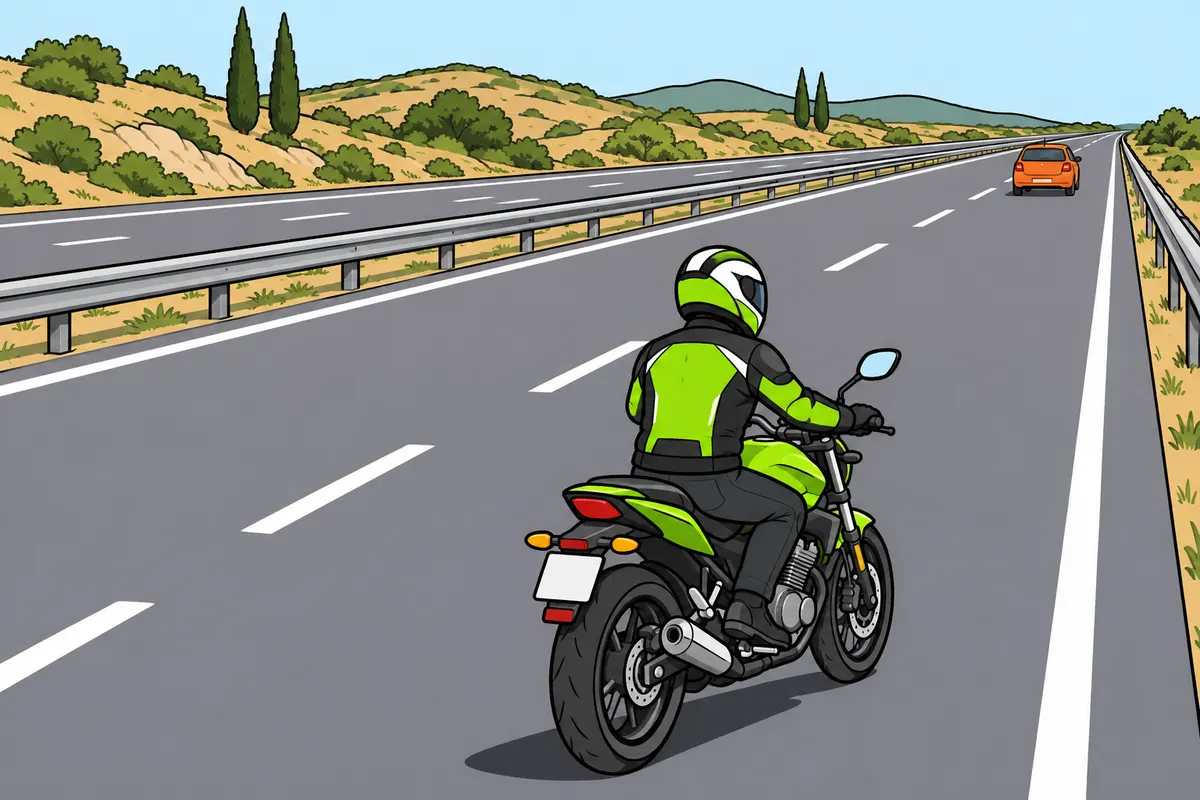
On autopistas and autovías outside built-up areas, respect speed limits and leave enough space.
| Vehicle | Access to autopistas and autovías |
|---|---|
| Motorcycle | Allowed if you meet the conditions |
| Moped | Prohibited |
Remember
- Obey any lower limit on your stretch of road.
- Do not demand a speed your motorcycle cannot reach.
- The general minimum still applies when the road is empty.
- In normal conditions, you can use the appropriate lane at that minimum.
Exam trap: Wrong: you can enter with a moped. Right: mopeds are prohibited from autopistas and autovías.
Read the full explanation
- On your A1 motorcycle without a trailer, the general maximum speed on autopistas and autovías outside built-up areas is 120 km/h. You must respect any lower limit on that stretch and your motorcycle's actual capabilities: the permitted limit does not guarantee that your motorcycle can reach it. [RGC, art. 48.1.a](https://www.boe.es/buscar/act.php?id=BOE-A-2003-23514#a48)
- The general minimum speed for power-driven vehicles on these roads is 60 km/h, even when there are no other vehicles. In normal circumstances, you may travel at that speed in the appropriate lane. [RGC, art. 49](https://www.boe.es/buscar/act.php?id=BOE-A-2003-23514#a49)
- You may ride your motorcycle on autopistas and autovías if you meet their conditions of use; mopeds are prohibited from entering them. [RGC, art. 38](https://www.boe.es/buscar/act.php?id=BOE-A-2003-23514#a38)
4Conventional roads and roads reserved for motor vehicles
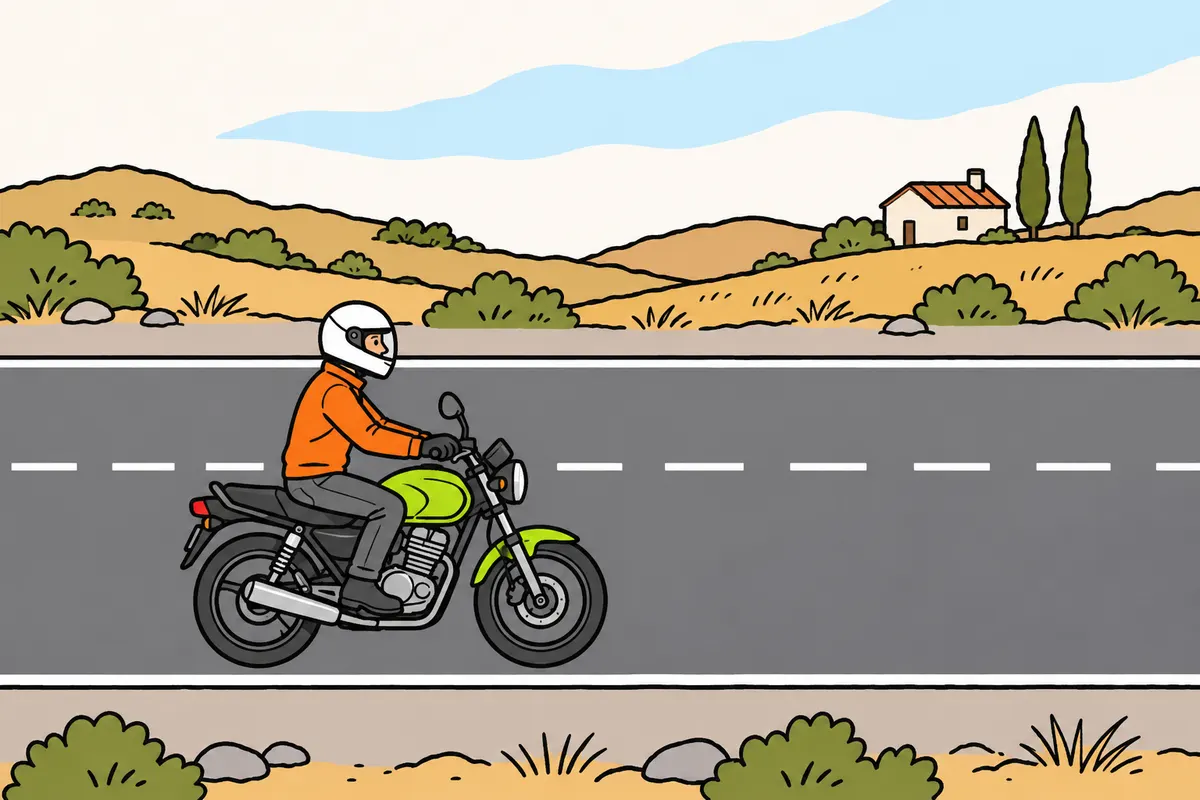
Check the road and your vehicle category before choosing your speed.
| Vehicle without trailer | Road outside built-up areas | General maximum |
|---|---|---|
| Motorcycle or tricycle classified as a motorcycle | Ordinary paved conventional road | 90 km/h |
| Motorcycle | Road reserved for motor vehicles | 90 km/h |
| Tricycle classified as a motorcycle | Autopista or autovía | 120 km/h |
| Tricycle not classified as a motorcycle | Interurban road | 70 km/h |
| Moped or light quadricycle | Interurban road where allowed | 45 km/h |
Remember
- Obey any lower limit that applies to you.
- Physical separation between directions does not automatically allow the higher maximum.
- Do not calculate minimum speeds by halving any maximum-speed sign.
- With A1, you can also ride mopeds and light quadricycles.
Exam trap: Wrong: every conventional road with several lanes allows 100 km/h. Right: for your motorcycle, opposing traffic must be physically separated and the road authority must set that limit; obey lower restrictions.
Read the full explanation
- On a paved conventional road outside a built-up area, the general maximum speed for your motorcycle without a trailer is 90 km/h. [RGC, art. 48.1.a](https://www.boe.es/buscar/act.php?id=BOE-A-2003-23514#a48)
- On conventional roads with physical separation between the two directions of traffic, the road authority may set a limit of 100 km/h for motorcycles. Physical separation makes this decision possible, but does not in itself make the maximum 100. You must check the rules for that stretch and continue to comply with any lower restriction that applies to you. [RGC, art. 48.1.a.1.º](https://www.boe.es/buscar/act.php?id=BOE-A-2003-23514#a48)
- On a road reserved for motor vehicles outside a built-up area, you apply the general maximum of 90 km/h on your motorcycle without a trailer, unless a different specific rule applies. Its entry sign identifies a road reserved for motor vehicles; you must also observe the speed limits signed along the route. [RGC, art. 48.1.a](https://www.boe.es/buscar/act.php?id=BOE-A-2003-23514#a48)
- On an ordinary conventional road, the general minimum for your vehicle category is 45 km/h, half the general maximum of 90. You calculate it from the general maximum for your vehicle category, not from any signed maximum. If a bend, an obstacle or the road surface requires a lower speed, you must adjust your speed accordingly. [RGC, art. 49](https://www.boe.es/buscar/act.php?id=BOE-A-2003-23514#a49)
- With A1, you may ride motor tricycles of up to 15 kW; the licence includes AM, which allows you to ride mopeds and drive light quadricycles. For these latter vehicles, you apply a general maximum outside built-up areas of 45 km/h, respecting any lower limit. If your tricycle is treated as a motorcycle, you apply 120 km/h on an interurban autopista or autovía and 90 km/h on a conventional road, without a trailer; if it is not treated as a motorcycle, you apply 70 km/h, subject to lower limits. [RGC, art. 48.1.a.2.º, e and h](https://www.boe.es/buscar/act.php?id=BOE-A-2003-23514#a48) [RGCond, art. 4](https://www.boe.es/buscar/act.php?id=BOE-A-2009-9481#a4) [RGCond, art. 5.2.a](https://www.boe.es/buscar/act.php?id=BOE-A-2009-9481#a5)
5Unpaved roads
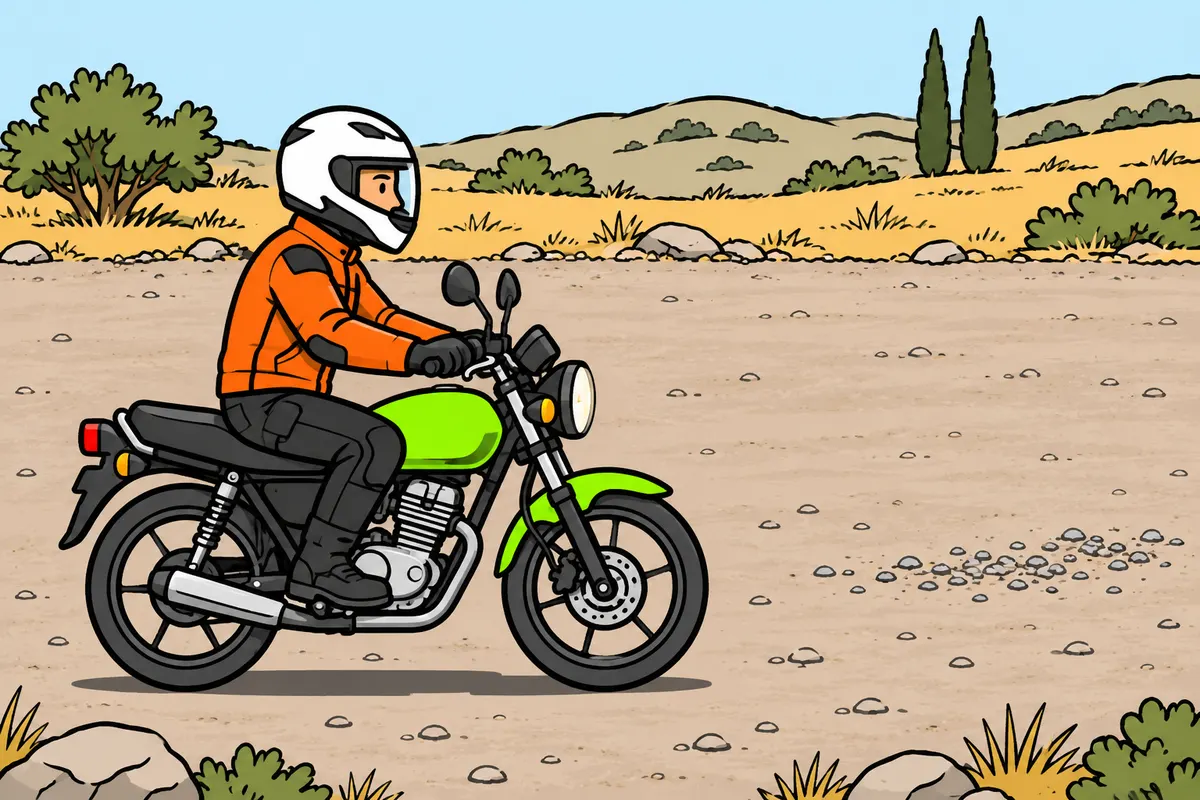
On unpaved roads outside built-up areas, slow down and leave more space.
Remember
- Check whether the road is paved.
- Mud, stones or danger may require you to ride below the minimum.
- Slow down for gravel or materials that wheels could throw up.
- Leave more space behind vehicles to avoid flying stones.
Exam trap: Wrong: a straight track lets you exceed 30 km/h. Right: on an unpaved road outside built-up areas, that is the maximum.
Read the full explanation
- On unpaved roads outside built-up areas, the maximum speed is 30 km/h. You must apply this limit to your motorcycle even if its engine allows much higher speeds or the track is straight. The name 'track' is not enough to decide: check the road's surface. [RGC, art. 48.1.f](https://www.boe.es/buscar/act.php?id=BOE-A-2003-23514#a48)
- The resulting general minimum for your motorcycle on that road is 15 km/h, half of 30. This figure does not oblige you to maintain that speed on mud, stones or in the presence of any other hazard that justifies a lower speed. Minimum limits must not lead you to ride without grip or without enough space to stop. [RGC, art. 49](https://www.boe.es/buscar/act.php?id=BOE-A-2003-23514#a49)
- You must slow down when you encounter loose gravel or materials that wheels may throw up. Increasing the gap from the vehicle ahead also reduces your exposure to material it throws up and gives you more time to spot uneven surfaces. You need to ride slowly both to maintain your stability and to keep others safe. [RGC, art. 46](https://www.boe.es/buscar/act.php?id=BOE-A-2003-23514#a46)
6Streets: 20, 30 and 50 km/h
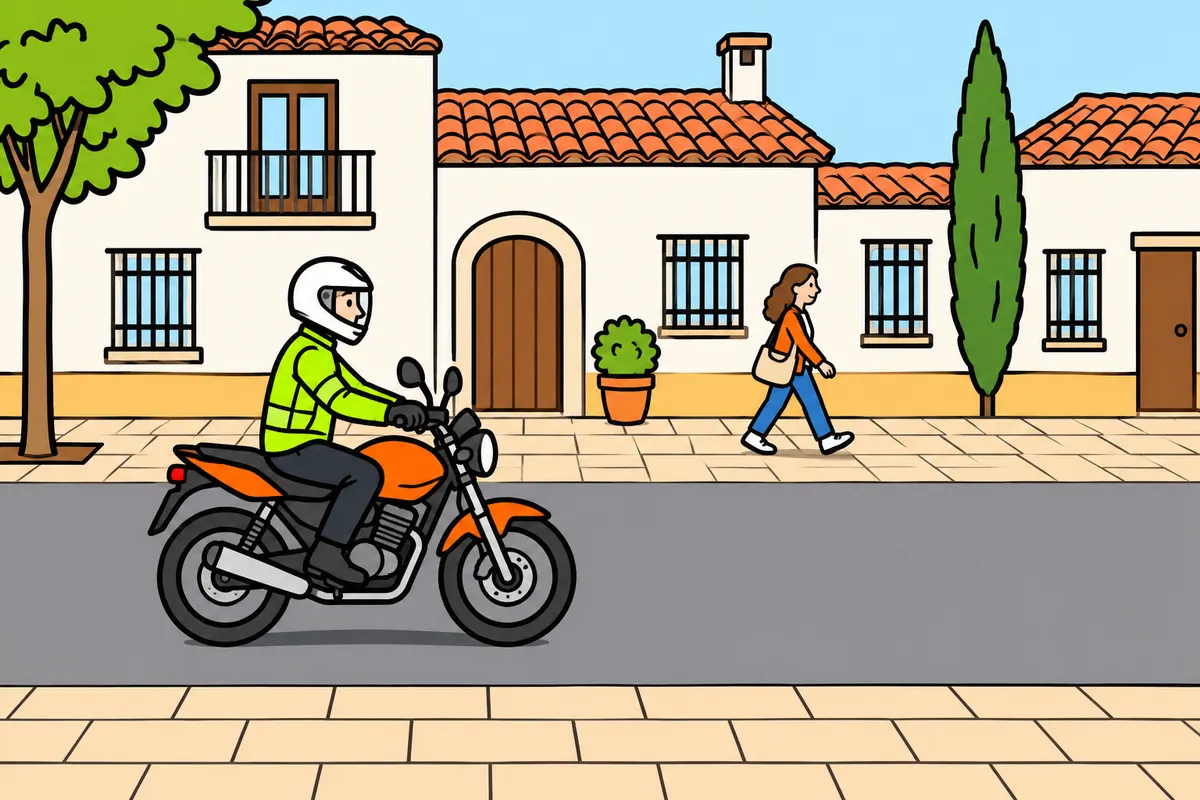
On streets, count lanes in each direction and check the signs.
| Street layout | General maximum |
|---|---|
| Carriageway and pavement at the same level | 20 km/h |
| One lane in each direction | 30 km/h |
| Two or more lanes in each direction, excluding reserved lanes | 50 km/h |
Remember
- Do not count reserved lanes or lanes exclusively for public transport.
- Obey lower signed limits.
- Exceptionally, signs may allow 50 km/h with one lane in each direction.
- Slow down further when conditions require it.
Exam trap: Wrong: you count a bus-only lane. Right: exclude it when counting lanes in each direction.
Read the full explanation
- On urban roads where the carriageway and pavement share a single level, the general maximum speed is 20 km/h. A single-level layout means that these spaces are at the same height. [RGC, art. 50.1.a](https://www.boe.es/buscar/act.php?id=BOE-A-2003-23514#a50)
- On an urban road with only one lane in each direction, the general maximum speed is 30 km/h. Two lanes in total, one for each direction, still means one lane in each direction. [RGC, art. 50.1.b](https://www.boe.es/buscar/act.php?id=BOE-A-2003-23514#a50)
- On urban roads with two or more lanes in each direction, the general maximum speed is 50 km/h. When counting these lanes, you exclude lanes reserved for particular users and lanes exclusively for public transport. A street with one ordinary lane and one bus-only lane does not therefore qualify for the maximum of 50. [RGC, art. 50.1.c and final paragraph](https://www.boe.es/buscar/act.php?id=BOE-A-2003-23514#a50)
- The municipal authority may lower these limits using specific signs. Exceptionally, it may raise the limit on a road with one lane in each direction to 50 km/h, also using signs. You must apply the limit actually in force and slow down further if pedestrians, hidden accesses or other circumstances require it. [RGC, art. 50.2 and 3](https://www.boe.es/buscar/act.php?id=BOE-A-2003-23514#a50)
7Through roads and high-speed roads in built-up areas
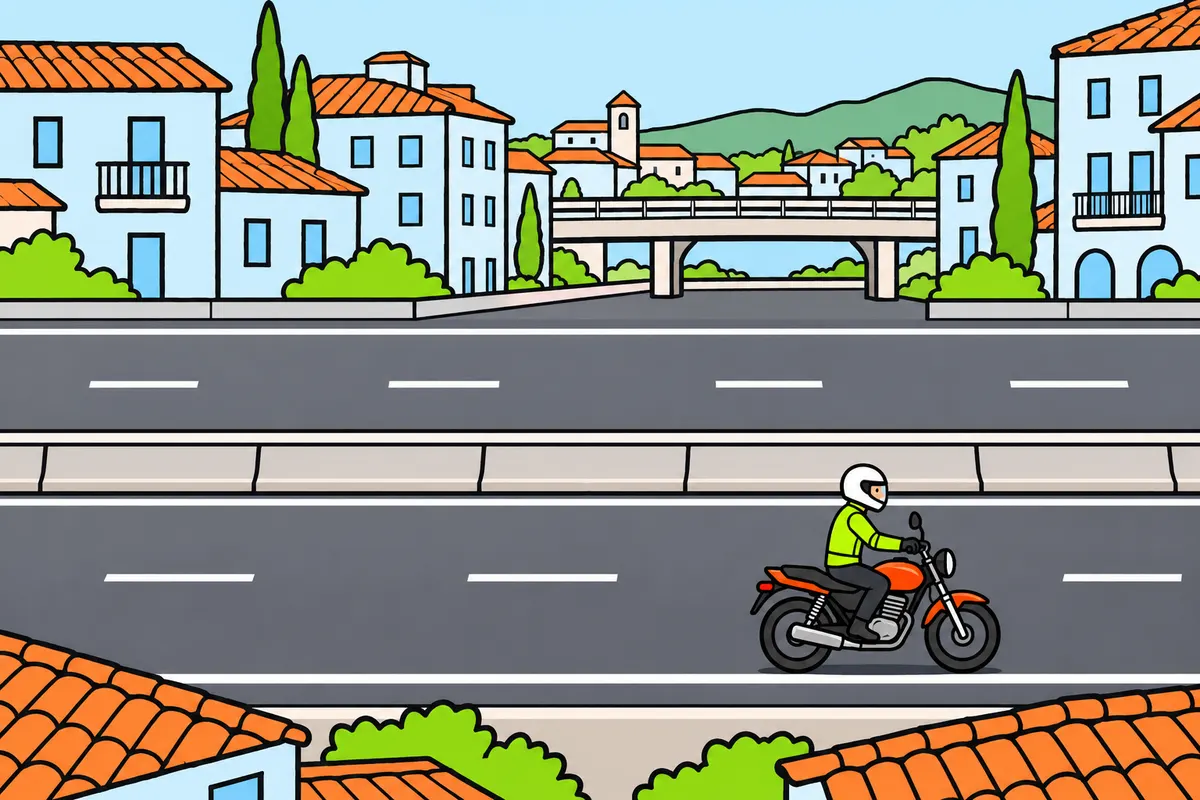
Inside built-up areas, distinguish through roads from autopistas and autovías.
| Road inside built-up areas | General maximum: your motorcycle without trailer |
|---|---|
| Through road | 50 km/h |
| Autopista or autovía | 80 km/h |
Remember
- On through roads, obey signed reductions.
- Do not assume an urban autopista allows the maximum used outside built-up areas.
- Raising the urban maximum requires agreement between the authorities and specific signs.
Exam trap: Wrong: every autopista allows 120 km/h. Right: inside built-up areas, the general maximum is 80 km/h; raising it requires agreement between the authorities and signs.
Read the full explanation
- On a travesía (the stretch of road through a town), the general maximum speed is 50 km/h. The municipal authority and the road authority may agree on a lower limit with specific signs; you must obey that limit where it is in force. [RGC, art. 50.5](https://www.boe.es/buscar/act.php?id=BOE-A-2003-23514#a50)
- On autopistas (motorways) and autovías (dual carriageway highways) within built-up areas, the general maximum speed is 80 km/h. Check whether the section is within a built-up area and follow the signs. [RGC, art. 50.6](https://www.boe.es/buscar/act.php?id=BOE-A-2003-23514#a50)
- The maximum of 80 may be increased by agreement between the municipal authority and the road authority, with specific signs. The increase must not exceed the general maximum for these roads outside built-up areas: 120 km/h for your motorcycle without a trailer. Do not assume this increase applies unless the situation specifies it. [RGC, art. 50.6](https://www.boe.es/buscar/act.php?id=BOE-A-2003-23514#a50)
8Areas for recreation and play, and shared-use zones
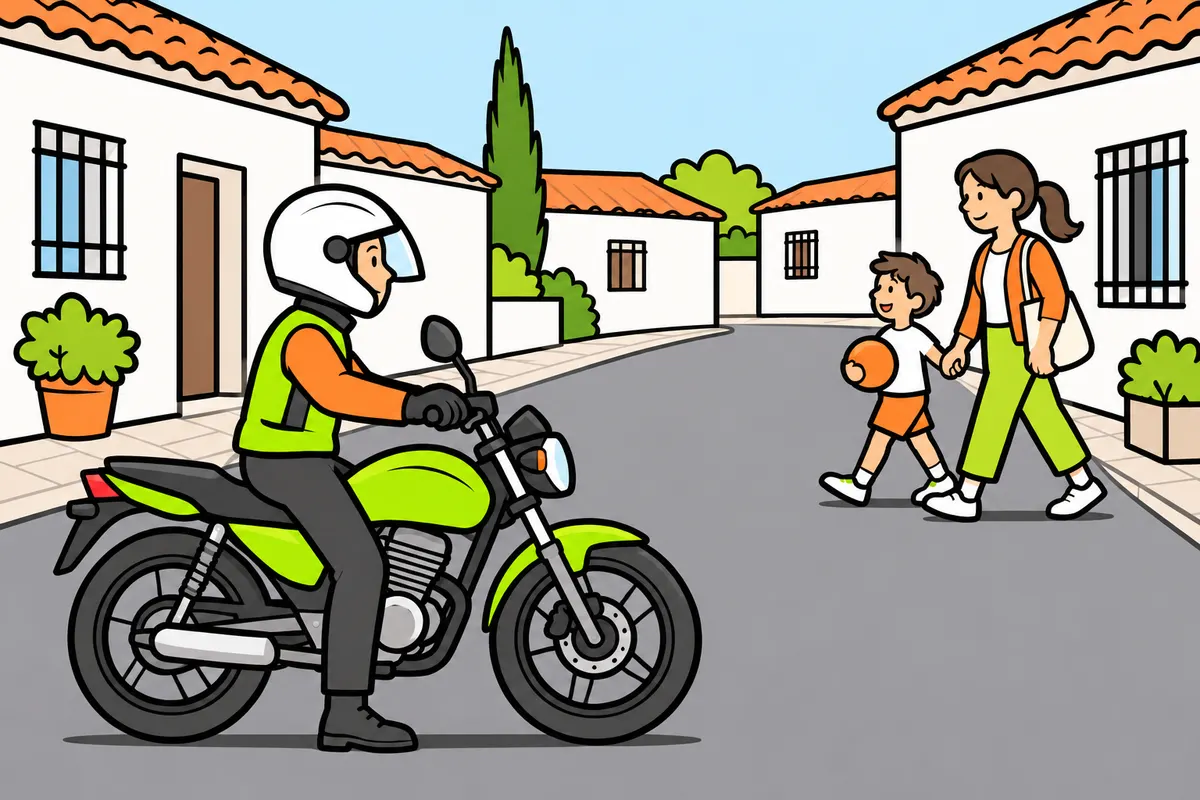
Give pedestrians priority and distinguish zones where games are allowed.
| Signed zone | Maximum | Games and sports |
|---|---|---|
| S-28: recreation and play | 10 km/h | Allowed |
| S-47: shared-use zone | 20 km/h | Prohibited |
Remember
- In both zones, pedestrians may use the whole traffic area.
- Stop if needed to give them priority.
- S-28 must have an accompanying R-301 showing 10 km/h.
Exam trap: Wrong: both zones allow games and the same speed. Right: S-28 allows games; S-47 prohibits them and has a different maximum.
Read the full explanation
- In an area for recreation and play indicated by S-28, the maximum speed is 10 km/h and you must give priority to pedestrians. Games and sports are permitted there. [RD 465/2025, catalogue, S-28](https://www.boe.es/buscar/doc.php?id=BOE-A-2025-12199)
- S-28 must be accompanied by R-301 showing 10 km/h. You must anticipate that pedestrians may use the whole area and may move unexpectedly; even within the speed limit, you may need to stop to respect their priority. The speed shown on the sign does not replace your duty to adapt your speed to the clear space you can see. [RD 465/2025, catalogue, S-28](https://www.boe.es/buscar/doc.php?id=BOE-A-2025-12199)
- In a shared-use zone marked with S-47, you must ride at no more than 20 km/h and give priority to pedestrians, who may use the whole traffic area. Games and sports are not permitted. [RD 465/2025, catalogue, S-47](https://www.boe.es/buscar/doc.php?id=BOE-A-2025-12199)
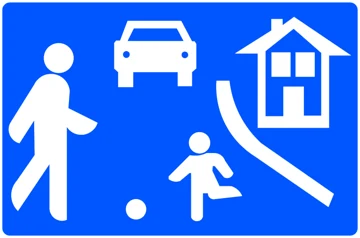 S-28
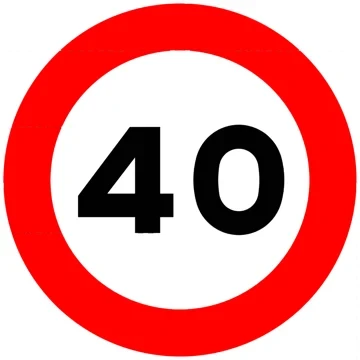 R-301
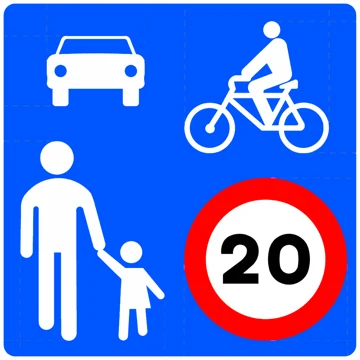 S-47
9Motorcycle with a trailer
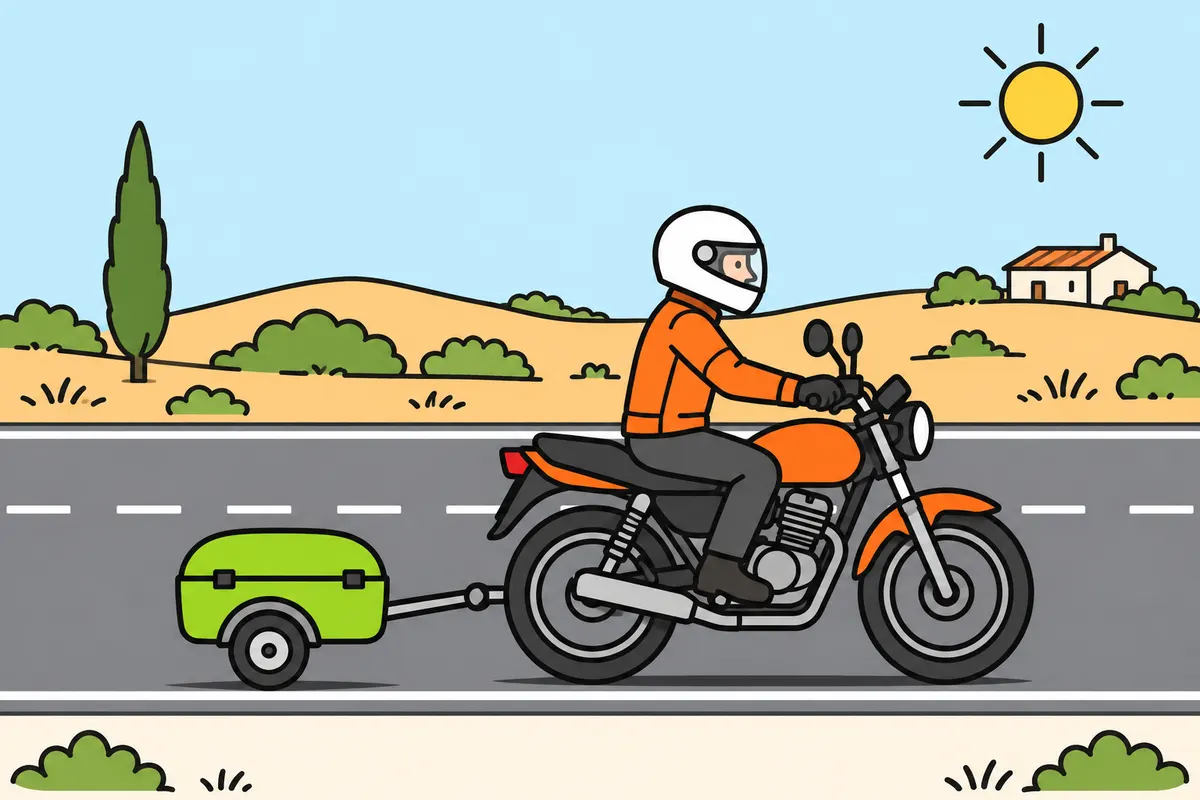
With a trailer, this course reduces general maximum speeds according to your towing vehicle’s category.
| Vehicle with trailer | Road outside built-up areas | Maximum |
|---|---|---|
| Motorcycle | Autopista or autovía | 108 km/h |
| Motorcycle | Ordinary conventional road | 81 km/h |
| Motorcycle | Unpaved road | 27 km/h |
| Tricycle not classified as a motorcycle | Interurban road | 63 km/h |
Remember
- This course applies the motorcycle-specific rule, not the general car-and-trailer column.
- Obey any lower limit that applies.
- Calculate the reduction using the maximum for your vehicle category.
- You must also meet the requirements for towing trailers.
- In built-up areas, follow the local rules that apply.
Exam trap: Wrong: you apply the general car-with-trailer column to your motorcycle. Right: this course applies the 10 % reduction to your motorcycle’s general maximum; obey lower limits.
Read the full explanation
- For a motorcycle with a trailer, this course applies the 10 % reduction in article 12.3.b to the general maximum speeds for motorcycles in article 48. This approach gives precedence to the specific motorcycle rule over the general column for motor vehicles with trailers in article 48.1.a, which gives 90 km/h on autopistas or autovías and 80 km/h on conventional roads. [RGC, art. 12.3.b](https://www.boe.es/buscar/act.php?id=BOE-A-2003-23514#a12) [RGC, art. 48.1.a](https://www.boe.es/buscar/act.php?id=BOE-A-2003-23514#a48)
- Using this approach, the calculated maximum speeds for your motorcycle with a trailer are 108 km/h on an autopista or autovía outside built-up areas, 81 km/h on an ordinary conventional road and 27 km/h on an unpaved road: you multiply 120, 90 and 30 respectively by 0.9. You must obey any lower applicable limit. [RGC, art. 12.3.b](https://www.boe.es/buscar/act.php?id=BOE-A-2003-23514#a12) [RGC, art. 48](https://www.boe.es/buscar/act.php?id=BOE-A-2003-23514#a48)
- Following the same approach used in the course, if you tow a trailer with a motor tricycle authorised by A1, you calculate the reduction from the maximum for its own category: for one not classified as a motorcycle, the maximum outside built-up areas of 70 km/h becomes 63 km/h, unless a lower limit applies. The classification of the towing vehicle determines the starting figure. [RGC, art. 12.3.b](https://www.boe.es/buscar/act.php?id=BOE-A-2003-23514#a12) [RGC, art. 48.1.h](https://www.boe.es/buscar/act.php?id=BOE-A-2003-23514#a48)
- You must also meet the towing requirements and comply with the applicable local by-laws when riding in urban areas; see “Passengers and loads on motorcycles”, under “Trailers: mass, time of travel and occupants”. [RGC, art. 12.3](https://www.boe.es/buscar/act.php?id=BOE-A-2003-23514#a12)
10Minimum speeds and reasons for riding more slowly
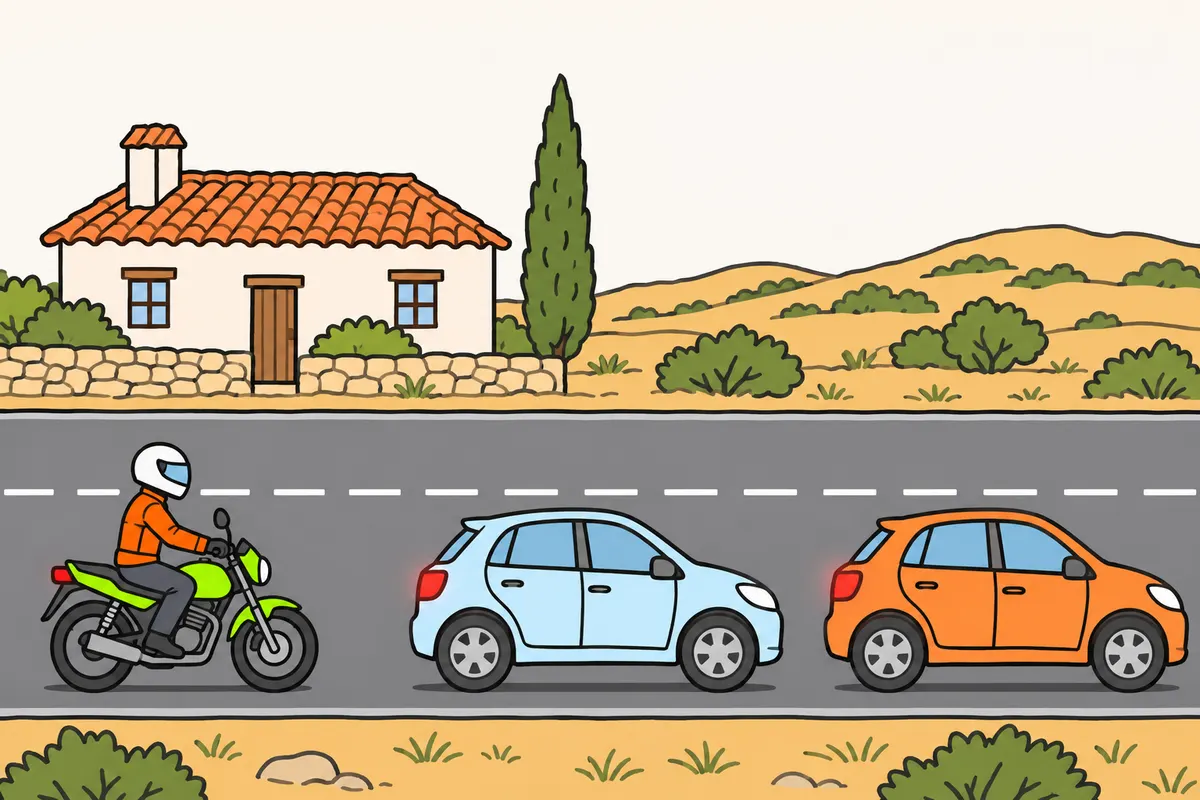
You can ride below the minimum speed when you have a justified reason.
| Street’s general maximum | General minimum, unless justified |
|---|---|
| 20 km/h | 10 km/h |
| 30 km/h | 15 km/h |
| 50 km/h | 25 km/h |
Remember
- Except on autopistas and autovías, halve the relevant general maximum.
- Traffic, breakdowns or dangerous road surfaces can justify riding more slowly.
- Personal preference is insufficient, even on an empty road.
- On authorised escort services, match your speed to the escorted vehicle.
- Use hazard warning lights if below minimum speed and at risk from behind.
Exam trap: Wrong: an empty road lets you ride below the minimum by choice. Right: you need a justified reason.
Read the full explanation
- On roads other than autopistas and autovías, the general minimum speed is half the general maximum speed for your vehicle category on that road. On urban streets with general maximum speeds of 20, 30 or 50, the corresponding minimum speeds are 10, 15 or 25 km/h. You must always take account of justified reasons for slowing down. [RGC, art. 49](https://www.boe.es/buscar/act.php?id=BOE-A-2003-23514#a49)
- You may travel below the minimum speeds if traffic, vehicle or road conditions prevent you from travelling faster without risk. Congestion, a breakdown or a dangerous road surface may justify this. Riding very slowly simply because you prefer to, without a reason, is not permitted even if the road is empty. [RGC, art. 49](https://www.boe.es/buscar/act.php?id=BOE-A-2003-23514#a49)
- The regulations also provide exceptions for special vehicles and special transport operations, and for protecting or escorting other vehicles. When providing these services, you must adapt your speed to that of the vehicle you are escorting. A private outing with friends does not in itself qualify as one of these escort services. [RGC, art. 49](https://www.boe.es/buscar/act.php?id=BOE-A-2003-23514#a49)
- If you cannot reach the minimum speed and there is a risk of a rear-end collision, you must warn others while moving by using your direction indicators as hazard warning lights. This warning does not replace the need to adapt your speed or allow you to continue when the condition of your motorcycle prevents you from doing so safely. [RGC, art. 49](https://www.boe.es/buscar/act.php?id=BOE-A-2003-23514#a49)
11Emergency slow riding and authorised hard shoulder use
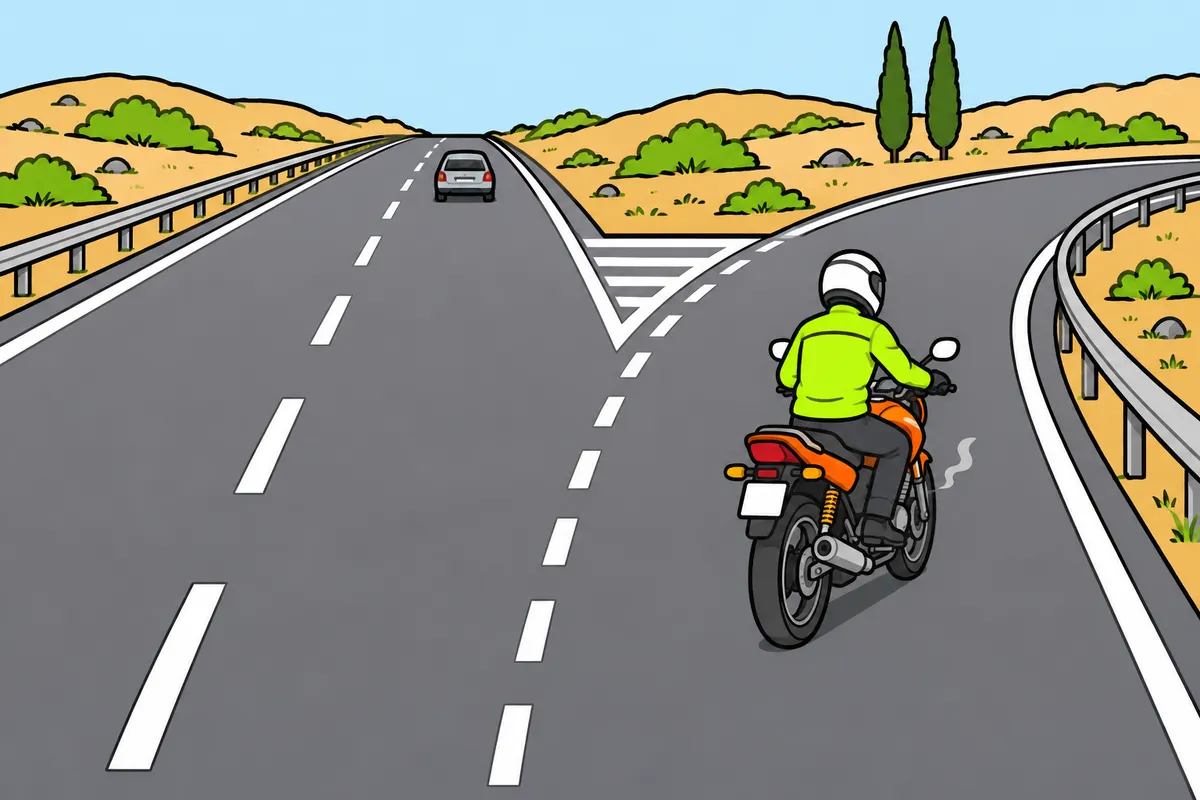
Use the hard shoulder only when permitted and when you meet all conditions.
| Situation for your motorcycle | Conditions |
|---|---|
| Emergency forcing abnormally slow riding | Serious traffic disruption; right-hand shoulder usable and wide enough |
| Congestion | Authorised, signed stretch; traffic stationary in lanes; single file; maximum 30 km/h |
Remember
- On autopistas or autovías, take the first exit if emergencies force abnormally slow riding.
- If you cannot continue safely, follow the breakdown procedure.
- Emergency slow riding seriously disrupting traffic requires a usable, wide enough right-hand shoulder.
- In queues, use only authorised, signed shoulders with traffic stationary in the lanes.
- Ride in single file, take extreme care and protect required shoulder users.
- Leave the shoulder if needed to avoid endangering them.
Exam trap: Wrong: any queue allows you onto any shoulder. Right: your motorcycle needs an authorised, signed stretch, stationary traffic in the lanes, single file and a maximum of 30 km/h, without endangering shoulder users.
Read the full explanation
- If an emergency forces you to travel at an abnormally low speed on an autopista or autovía, you must leave at the first exit. You must distinguish this situation from a general traffic queue. If you cannot continue safely, follow the procedure for a breakdown; “Accidents, breakdowns and assistance” explains the full procedure. [RGC, art. 38](https://www.boe.es/buscar/act.php?id=BOE-A-2003-23514#a38)
- If an emergency forces you to ride a motorcycle abnormally slowly and you seriously disrupt traffic, you fall within the rule allowing vehicles with an MMA (maximum authorised mass) not exceeding 3,500 kg to use the right-hand arcén (hard shoulder), provided it is usable and wide enough. Choosing to ride slowly is not sufficient grounds for using this rule. [RGC, art. 36](https://www.boe.es/buscar/act.php?id=BOE-A-2003-23514#a36)
- Exceptional use of the right-hand hard shoulder by motorcycles in congestion requires a section that is authorised and signposted for this purpose, with traffic in the lanes at a standstill. The maximum speed is 30 km/h and you must ride in single file, taking the utmost care. You must avoid endangering road users who are required to use the hard shoulder and leave it if necessary; this is not general permission to use any hard shoulder. [RGC, art. 36.3](https://www.boe.es/buscar/act.php?id=BOE-A-2003-23514#a36)
12Lanes with special limits
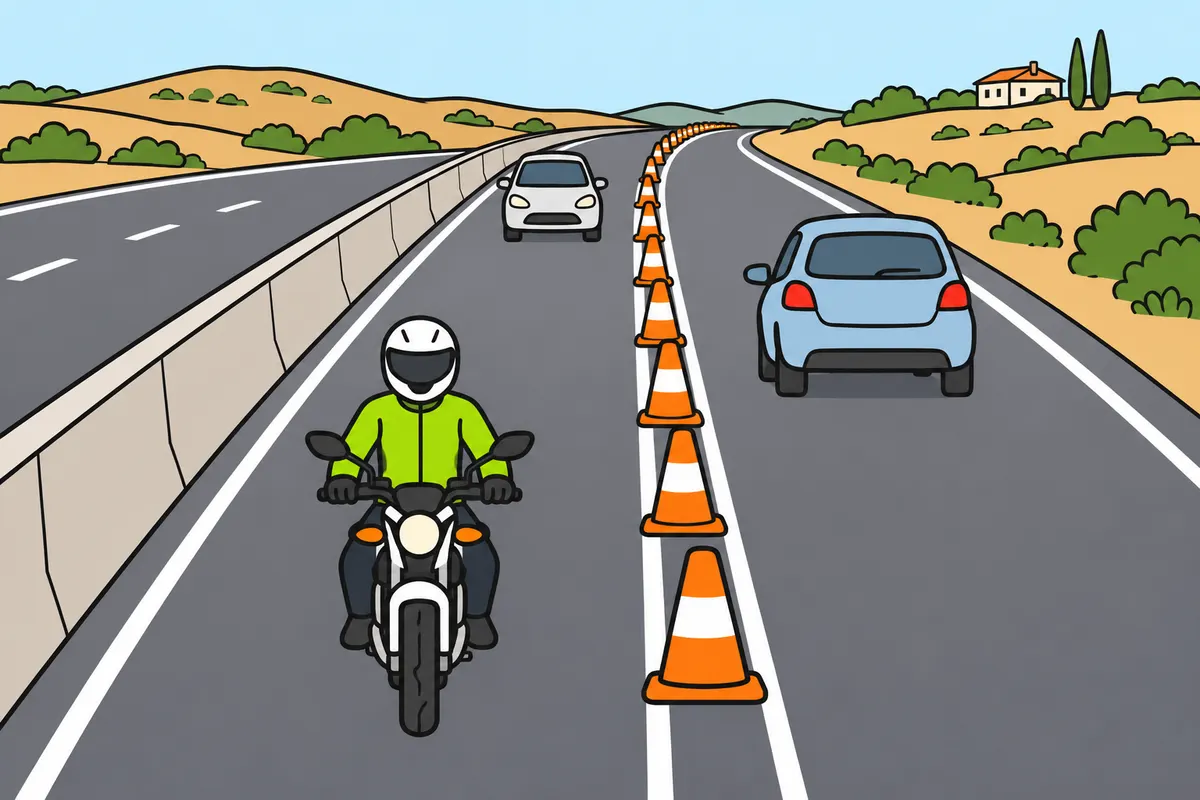
In special lanes, check which speed limits apply in each direction.
| Lane you use on your motorcycle | Limits unless lower limits apply |
|---|---|
| Lane opened in the opposite direction | 60 to 80 km/h |
| Adjacent normal direction: only one lane remains | 60 to 80 km/h |
| Adjacent normal direction: several lanes remain | General limits and signs |
| Temporary additional lane or lanes using shoulders | 60 to 80 km/h |
Remember
- Obey any lower limits set or signed.
- Keep a safe following distance.
- Tricycles not classified as motorcycles cannot use opposite-direction lanes opened for traffic flow.
Exam trap: Wrong: all adjacent lanes have an 80 km/h maximum. Right: in the adjacent normal direction, this range applies when only one lane remains, unless lower limits apply.
Read the full explanation
- In a lane opened to traffic travelling in the opposite direction to normal, you must travel between 60 and 80 km/h, or within lower limits if these are imposed or specifically signposted. Your motorcycle belongs to the categories allowed when the lane is opened to improve traffic flow; you cannot use it with a motor tricycle that is not classified as a motorcycle. Keep a safe following distance even if the lane is narrow. [RGC, art. 41.1](https://www.boe.es/buscar/act.php?id=BOE-A-2003-23514#a41)
- In the adjacent normal direction of travel, if only one lane remains, the 60 to 80 km/h range also applies, unless lower limits are imposed. If several lanes remain, you follow the corresponding general limits and the signs. [RGC, art. 41.1](https://www.boe.es/buscar/act.php?id=BOE-A-2003-23514#a41)
- In a temporary additional lane and in traffic lanes created by using the hard shoulders, the maximum is 80 and the minimum is 60 km/h, unless lower limits are imposed or signposted. You must adapt your speed further when the situation requires it; lane arrangements are covered in “Using the road with your motorcycle”. [RGC, art. 42.1](https://www.boe.es/buscar/act.php?id=BOE-A-2003-23514#a42)
13You must also respect speed limits when overtaking
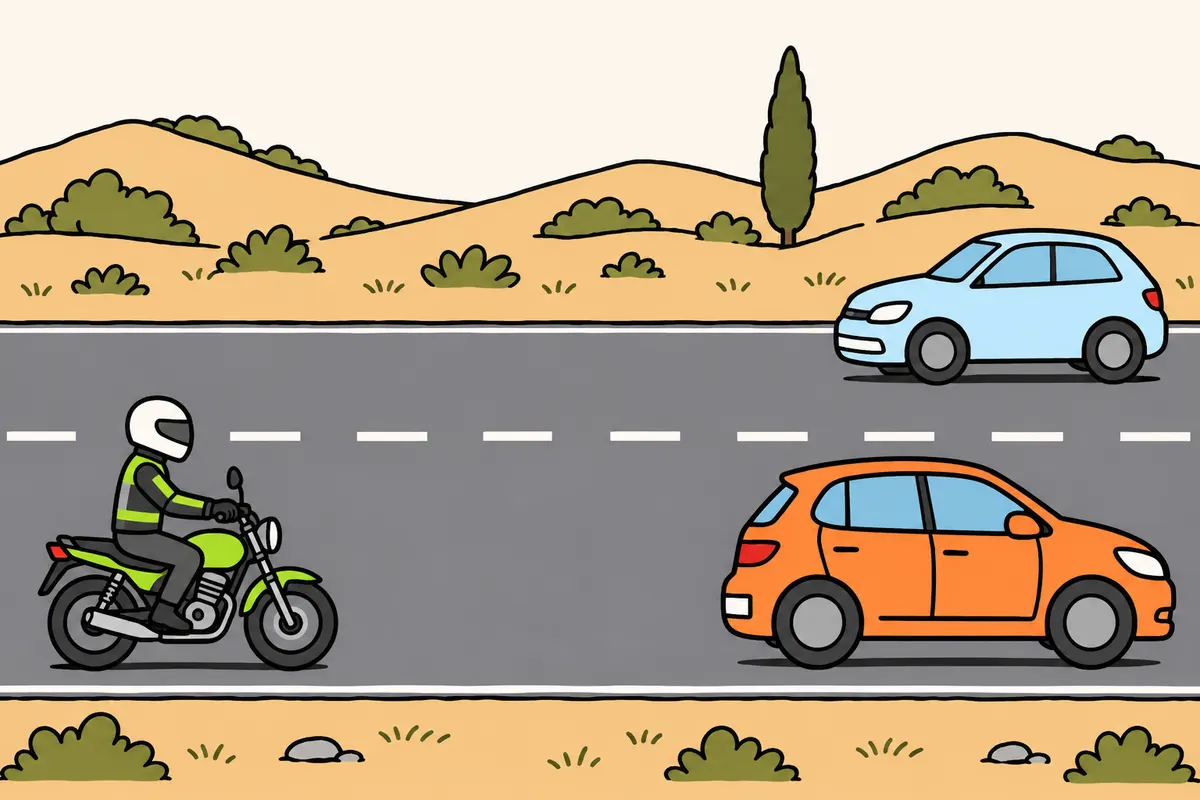
You must respect the maximum speed when overtaking too.
Remember
- Wait if you cannot overtake safely within the speed limit.
- You need enough space and enough difference in speed.
- When passing vulnerable road users, follow the specific precautions.
Exam trap: Wrong: overtaking lets you add 20 km/h. Right: stay within the maximum that applies.
Read the full explanation
- You must stay within the applicable maximum speed when overtaking. If you cannot overtake with a sufficient difference in speed, enough available distance and compliance with the limits, you must wait for a safe opportunity. [RGC, art. 48](https://www.boe.es/buscar/act.php?id=BOE-A-2003-23514#a48) [RGC, art. 50](https://www.boe.es/buscar/act.php?id=BOE-A-2003-23514#a50)
- When overtaking vulnerable road users or passing immobilised vehicles in the circumstances specified by the regulations, you must apply the specific speed and clearance precautions explained in «Manoeuvres on your motorcycle», under «Overtaking vulnerable road users» and «Passing obstacles and immobilised vehicles». [RGC, art. 85.4](https://www.boe.es/buscar/act.php?id=BOE-A-2003-23514#a85) [RGC, art. 88.1](https://www.boe.es/buscar/act.php?id=BOE-A-2003-23514#a88)
14Where you must take particular care to slow down
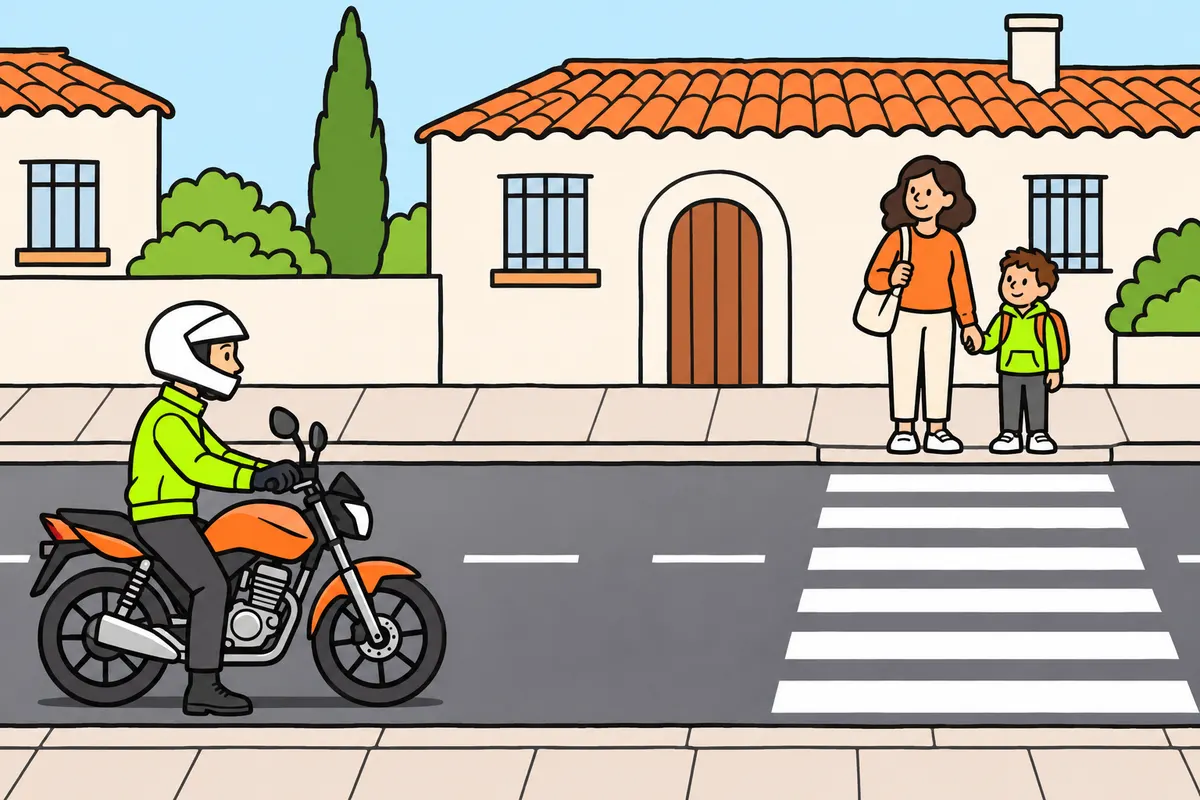
Slow down before reaching places where danger could appear.
Remember
- Slow down for pedestrians or animals that might enter your path; stop if needed.
- Watch for schools, markets, road entrances and stopped buses.
- Outside built-up areas, slow down near stopped vehicles, working assistance vehicles and cycles.
- Slow down at roundabouts, narrowings, poor visibility and junctions without priority.
- Slow down for slippery surfaces, flying materials or insufficient space for oncoming traffic.
- Approach level crossings and movable bridges below the maximum speed.
Exam trap: Wrong: cross a signed junction with virtually no visibility at 50 km/h. Right: that is a maximum; slow down further or stop if necessary.
Read the full explanation
- You must slow down and, if necessary, stop when pedestrians are present or you can reasonably expect them to move into your path. Pay particular attention to children, older people, blind people and people with reduced mobility. When approaching schools, markets and uncontrolled pedestrian crossings, anticipate the presence of people. [RGC, art. 46](https://www.boe.es/buscar/act.php?id=BOE-A-2003-23514#a46)
- You must slow down when animals are present or may enter the road, near buildings with direct access to the road and near stopped buses, especially school buses. Outside built-up areas, you must also slow down when approaching immobilised vehicles, assistance vehicles on duty and cycles on the carriageway or arcén (hard shoulder). [RGC, art. 46](https://www.boe.es/buscar/act.php?id=BOE-A-2003-23514#a46)
- You must reduce your speed when approaching level crossings, roundabouts and junctions where you do not have priority, narrow sections and areas with poor visibility. At properly signposted junctions with virtually no visibility, you must not exceed 50 km/h. This figure is a specific ceiling, not a recommendation to enter any junction at that speed. [RGC, art. 46](https://www.boe.es/buscar/act.php?id=BOE-A-2003-23514#a46)
- You must slow down when the road, the vehicles or the environmental conditions prevent you from passing an oncoming vehicle safely. You must also slow down on slippery surfaces or where you risk spraying water or scattering gravel. You may need to stop even when you are below the maximum speed and there appears to be enough space to pass. [RGC, art. 46](https://www.boe.es/buscar/act.php?id=BOE-A-2003-23514#a46)
- When approaching a level crossing or an opening bridge, you must take extra care and reduce your speed below the permitted maximum. Make your decision in advance and avoid approaching without enough braking distance. [RGC, art. 95](https://www.boe.es/buscar/act.php?id=BOE-A-2003-23514#a95)
15Visibility, bends and weather
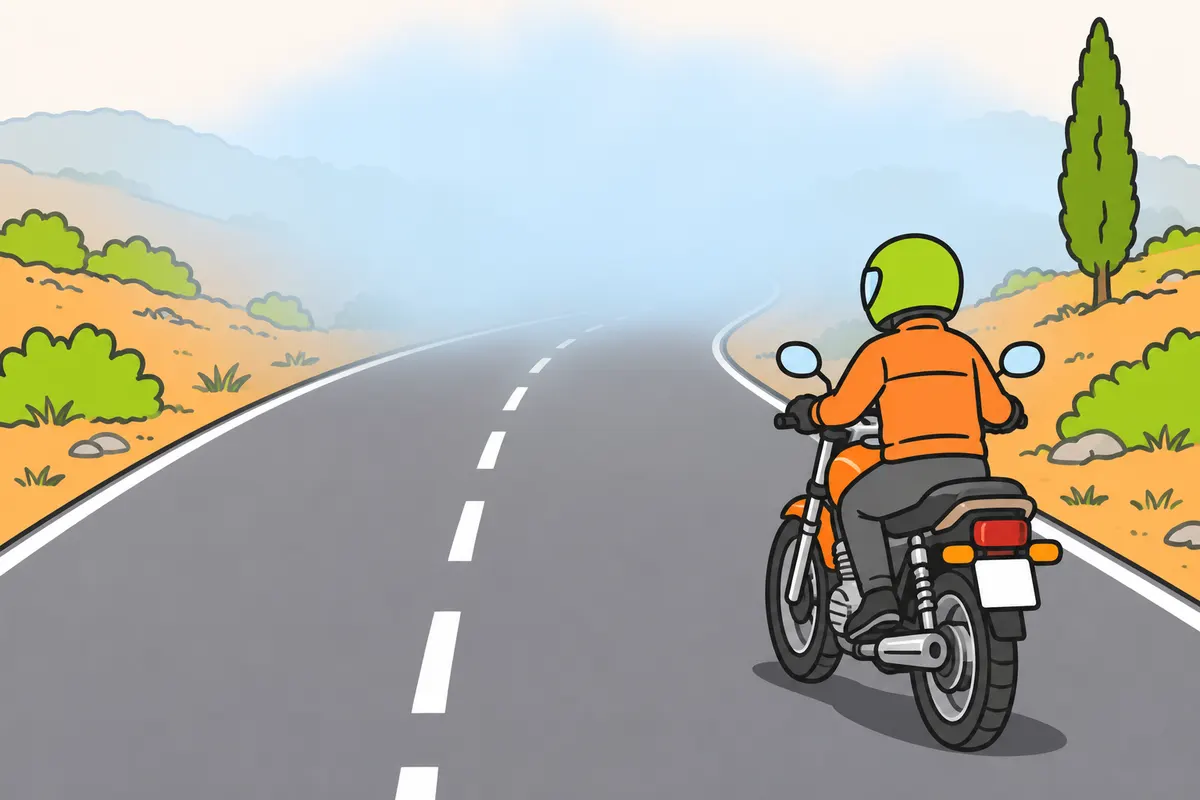
Adjust your speed to the space you can see and your tyres’ grip.
Remember
- Slow down in fog, heavy rain, snow, dust or smoke.
- If dazzled, slow down and stop if necessary.
- With faulty lights, you must still stop within the area they light.
- Slow down before bends or stretches with poor tyre grip.
- Allow more space with crosswinds, luggage or a passenger.
- At high speeds, you may notice fewer hazards at the sides.
Exam trap: Wrong: following another vehicle’s lights guarantees safety in fog. Right: keep enough visibility and distance to stop.
Read the full explanation
- In dense fog, heavy rain, snow or clouds of dust or smoke, you must slow down. Do not treat the lights of the vehicle ahead as a guarantee that the road is clear. You must retain enough visibility and distance to stop, even if you know the route or the vehicle ahead seems to maintain a steady pace. [RGC, art. 46](https://www.boe.es/buscar/act.php?id=BOE-A-2003-23514#a46)
- If you are dazzled, slow down as much as necessary, even to a stop, to avoid colliding with vehicles or pedestrians. You must adapt your speed to the distance you can actually see. If a lighting fault forces you to use less powerful lighting, slow down until you can stop within the illuminated area. [RGC, art. 102](https://www.boe.es/buscar/act.php?id=BOE-A-2003-23514#a102) [RGC, art. 107](https://www.boe.es/buscar/act.php?id=BOE-A-2003-23514#a107)
- On a motorcycle, you must adjust your speed before a bend or a section with poor grip, avoiding reaching it while still needing to brake sharply. Leaning and braking techniques are covered in «Motorcycle riding techniques»; here, the essential decision is to retain enough space and grip to control your progress. [RGC, art. 45](https://www.boe.es/buscar/act.php?id=BOE-A-2003-23514#a45)
- In a crosswind or when leaving a sheltered area, you must assess how your motorcycle’s stability changes. With a load, a passenger or tyres in poor condition, allow greater margins and adapt your speed. No fairing or assistance system automatically makes the legal maximum a safe speed. [RGC, art. 45](https://www.boe.es/buscar/act.php?id=BOE-A-2003-23514#a45)
- If you increase your speed considerably, your vision can focus on a narrower area and you may notice less to either side: this is tunnel vision. This perceptual narrowing of vision is different from the conditions of riding inside a tunnel. The agility of an A1 motorcycle does not compensate for the reduced time available to detect a hazard to either side. [DGT, Speed](https://www.dgt.es/export/sites/web-DGT/.galleries/downloads/conoce_la_dgt/que-hacemos/educacion-vial/adultos/no-formal/velocidad.pdf)
16Reaction: time and distance
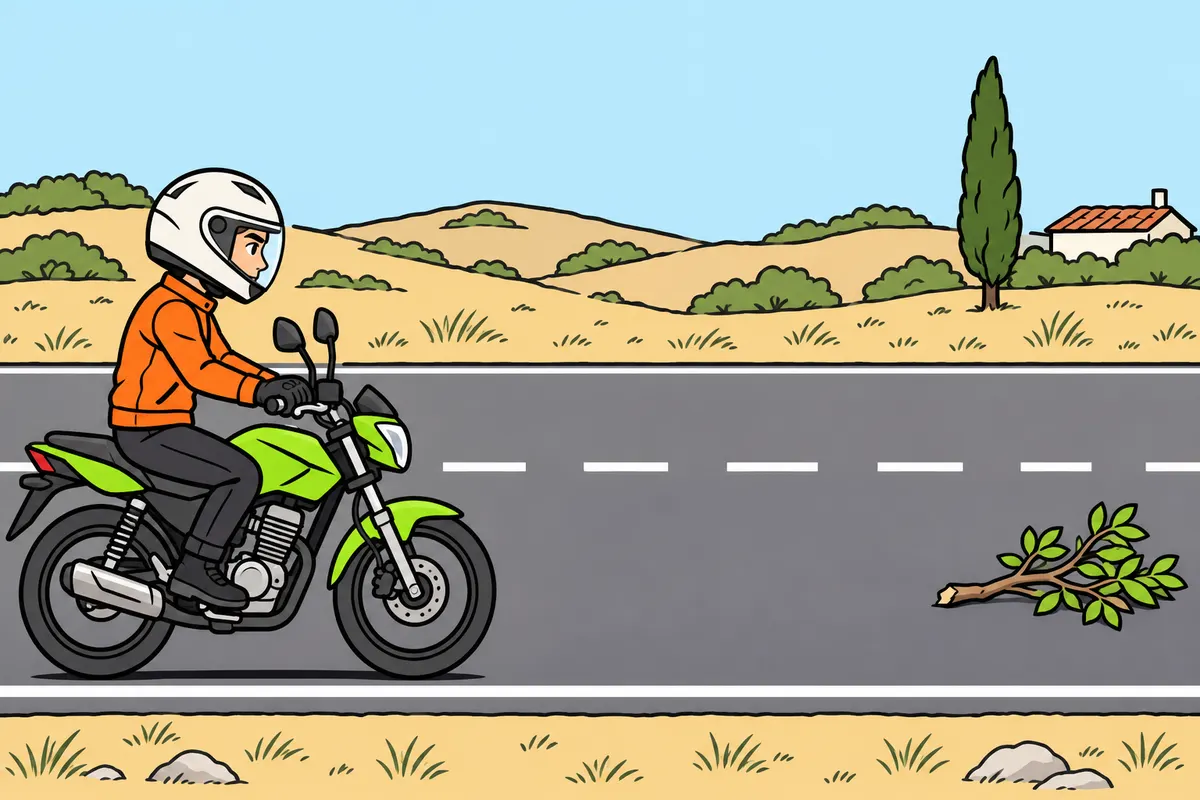
You already travel some distance while reacting, before you start braking.
| Concept | What you must distinguish |
|---|---|
| Reaction time | How long you take to start responding |
| Reaction distance | How far you travel during that time |
Remember
- Your reaction starts when you notice danger and ends when you start responding.
- The faster you ride, the further you travel before braking.
- Taking longer to react also increases this distance.
- Fatigue, alcohol, distractions and some medicines delay your response.
- For metres, divide km/h by 3.6, then multiply by reaction time in seconds.
Exam trap: Wrong: wet tarmac increases your reaction time. Right: it worsens braking; other factors affect your reaction.
Read the full explanation
- Your reaction time is the interval between detecting the need to act and beginning your response. Your reaction distance is the distance you travel during that interval, before you start braking. [DGT, Speed](https://www.dgt.es/export/sites/web-DGT/.galleries/downloads/conoce_la_dgt/que-hacemos/educacion-vial/adultos/no-formal/velocidad.pdf)
- For the same reaction time, increasing your speed means you travel more metres before applying the brakes. At the same speed, taking longer to react also increases that distance. As a calculation exercise, at 90 km/h you travel 25 metres per second; with a hypothetical reaction time of one second, you travel 25 metres.
- You can calculate this distance by converting km/h to m/s: divide the speed by 3.6 and multiply by the reaction time in seconds. At 120 km/h you travel approximately 33.3 metres in one second. These calculations use explicit assumptions; they are not statutory safe following distances or a claim that you always react within that time.
- Fatigue, alcohol, distractions and certain medicines can delay your response. Wet asphalt does not increase your reaction time: it makes braking less effective. Even with excellent tyres, you still travel several metres while perceiving the situation and deciding what to do. [DGT, Speed](https://www.dgt.es/export/sites/web-DGT/.galleries/downloads/conoce_la_dgt/que-hacemos/educacion-vial/adultos/no-formal/velocidad.pdf)
17Braking: from applying the brakes to a complete stop
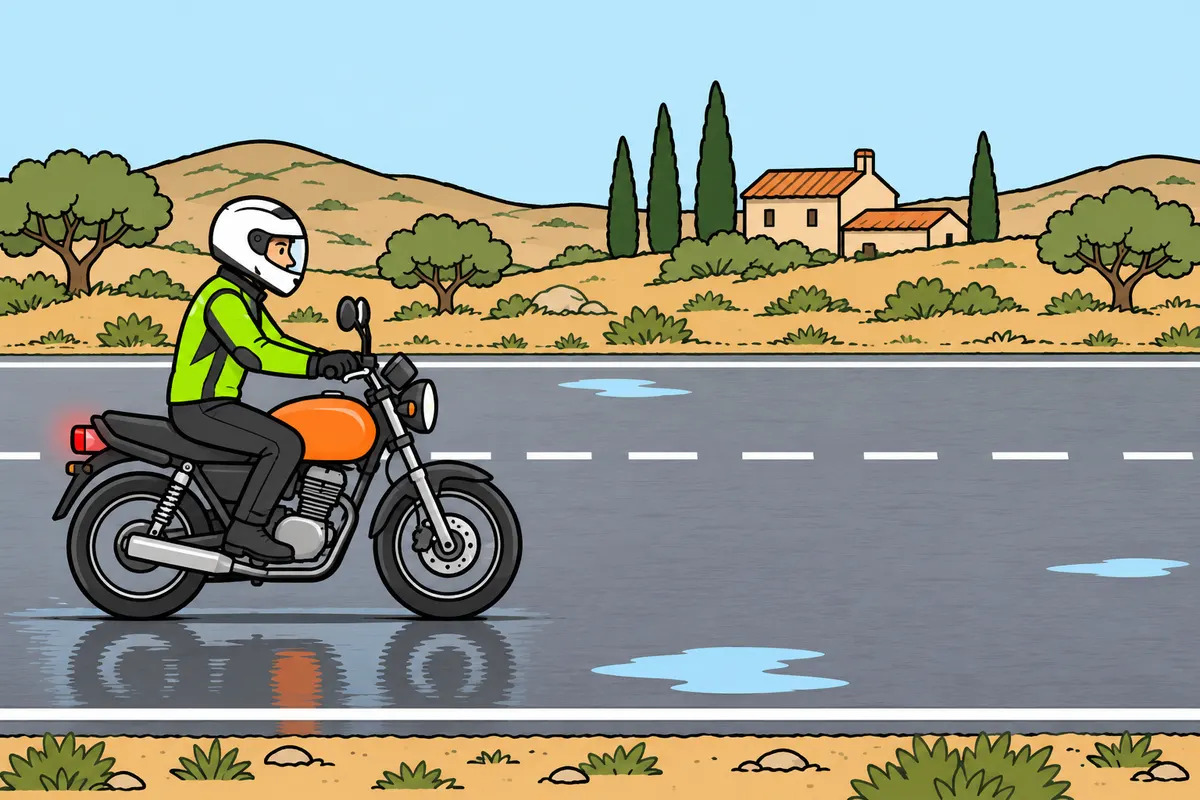
Your braking distance runs from applying the brakes until you stop.
Remember
- Adjust speed and gap for road surface, tyres, brakes, slope and load.
- In equal conditions, doubling speed roughly quadruples your braking distance.
- On wet roads, slow down and leave more space.
- With a passenger, your motorcycle may need more distance to brake.
- Downhill, allow more distance and remember that brakes can overheat.
- ABS helps prevent wheel locking; it cannot guarantee shorter braking on every surface.
Exam trap: Wrong: rain always increases braking distance by a fixed amount. Right: the increase depends on grip and other conditions.
Read the full explanation
- Your braking distance is the distance you travel from the moment you start braking until you come to a complete stop. It depends on speed, grip and braking effectiveness, with the road surface, tyres, brakes, gradient and load all having an influence. [DGT, Speed](https://www.dgt.es/export/sites/web-DGT/.galleries/downloads/conoce_la_dgt/que-hacemos/educacion-vial/adultos/no-formal/velocidad.pdf)
- In comparable conditions, your braking distance increases approximately with the square of your speed. If you double your speed, the physical relationship means multiplying that distance by four. You must keep all other conditions constant to use this comparison; it does not describe every actual braking manoeuvre on different surfaces. [DGT, Road safety issues, 2024, p. 106](https://sede.dgt.gob.es/.galleries/permisos-de-conducir/certificacion-aptitud-profesores-formacion-vial/2024/Manual-II-Cuestiones-de-Seguridad-Vial-2024.pdf)
- A wet or slippery carriageway can greatly increase your braking distance. You must reduce your speed and increase your following distance, without assigning an exact multiplier to all rain. If your speed and reaction time remain the same, poorer grip affects your braking distance and overall stopping distance; it does not reduce the metres you travel beforehand while reacting. [RGC, art. 45](https://www.boe.es/buscar/act.php?id=BOE-A-2003-23514#a45)
- Carrying a passenger increases your combined mass and changes your motorcycle’s handling; your braking distance may increase, so you must allow a greater margin. Adjust your speed and following distance to the load and the actual conditions. Preparing your passenger and adjusting your motorcycle are covered in «Motorcycle riding techniques». [RGC, art. 45](https://www.boe.es/buscar/act.php?id=BOE-A-2003-23514#a45) [DGT, motorcycle riding guide](https://www.dgt.es/export/sites/web-DGT/.galleries/downloads/nuestros_servicios/para-colaboradores-y-empresas/GUIA-MONITORES-MOTOCICLETA-NIPO.pdf)
- You must take the gradient into account: a descent can increase the distance you need to stop, and prolonged brake use can reduce braking effectiveness through overheating. ABS helps prevent wheel lock, but does not guarantee a shorter braking distance on every surface. Keep a margin even if you have electronic assistance systems. [DGT, motorcycle riding guide](https://www.dgt.es/export/sites/web-DGT/.galleries/downloads/nuestros_servicios/para-colaboradores-y-empresas/GUIA-MONITORES-MOTOCICLETA-NIPO.pdf)
18Stopping: the sum you must remember
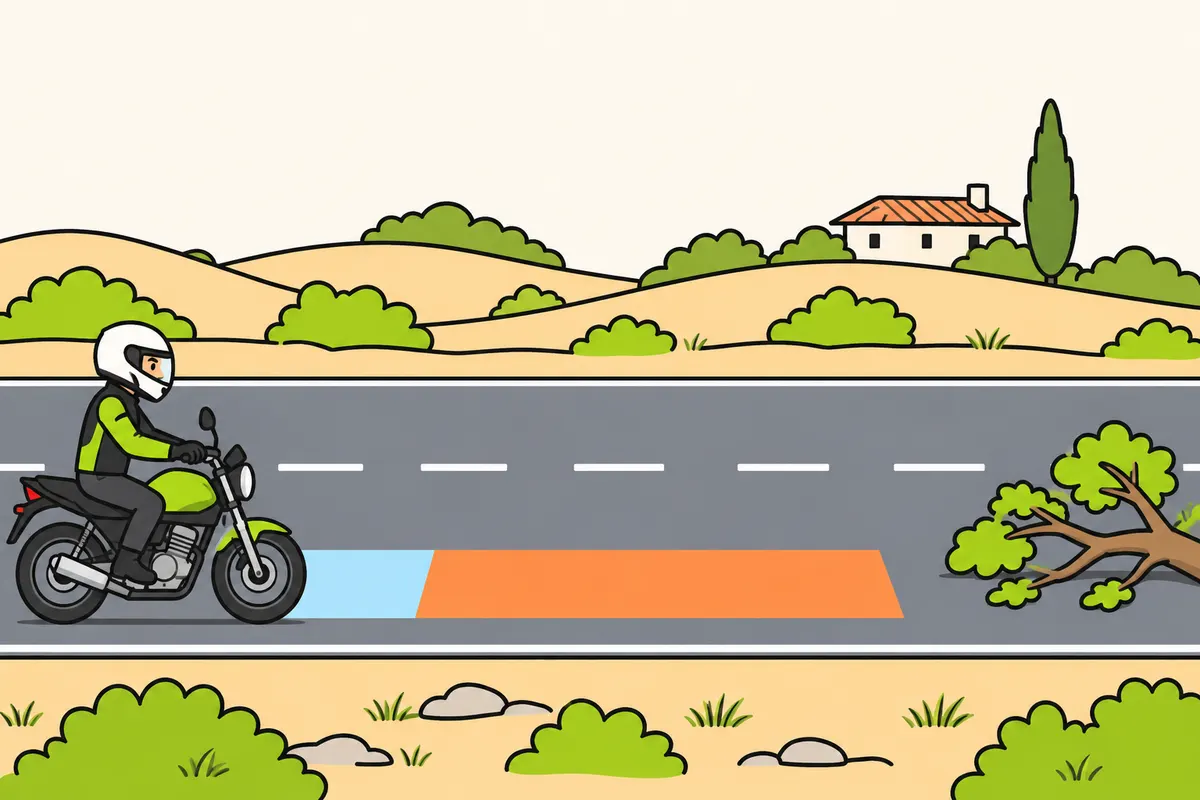
To stop, you need your reaction distance plus your braking distance.
| Stage of your stop | Distance covered |
|---|---|
| Reaction | From noticing the need to stop until starting to brake |
| Braking | From starting to brake until stopping completely |
Remember
- Count from noticing the danger until you stop completely.
- You need visible, clear space for both stages.
- Seeing an obstacle just your braking distance away is insufficient.
- As speed rises, you travel further during both stages.
Exam trap: Wrong: doubling speed quadruples your whole stopping distance. Right: reaction distance and braking distance increase differently.
Read the full explanation
- Your overall stopping distance, also known as your stopping distance or technical stopping distance, is the sum of your reaction distance and braking distance. It begins when you detect the need to stop and ends when you are stationary. You must account for both phases when you need to brake in an emergency too. [DGT, Speed](https://www.dgt.es/export/sites/web-DGT/.galleries/downloads/conoce_la_dgt/que-hacemos/educacion-vial/adultos/no-formal/velocidad.pdf)
- As an exercise, if you travel 20 metres while reacting and 30 while braking, your stopping distance is 50 metres. This is a teaching calculation using assumed figures, not a table of your motorcycle’s performance. You cannot use the result to claim that every motorcycle always stops within that distance.
- You must have enough visible, clear space to stop with a margin. Seeing an obstacle at a distance equal to your braking distance is not enough if you still have to react. You must allow for the full stopping distance before deciding that you can maintain your speed. [RGC, art. 45](https://www.boe.es/buscar/act.php?id=BOE-A-2003-23514#a45)
- As your speed increases, both the distance you travel before braking and your braking distance increase. Do not automatically apply a factor of four to your entire stopping distance when you double your speed: reaction distance and braking distance follow different relationships. To assess the space you need, consider reaction and braking separately. [DGT, Speed](https://www.dgt.es/export/sites/web-DGT/.galleries/downloads/conoce_la_dgt/que-hacemos/educacion-vial/adultos/no-formal/velocidad.pdf)
19Safe following distance
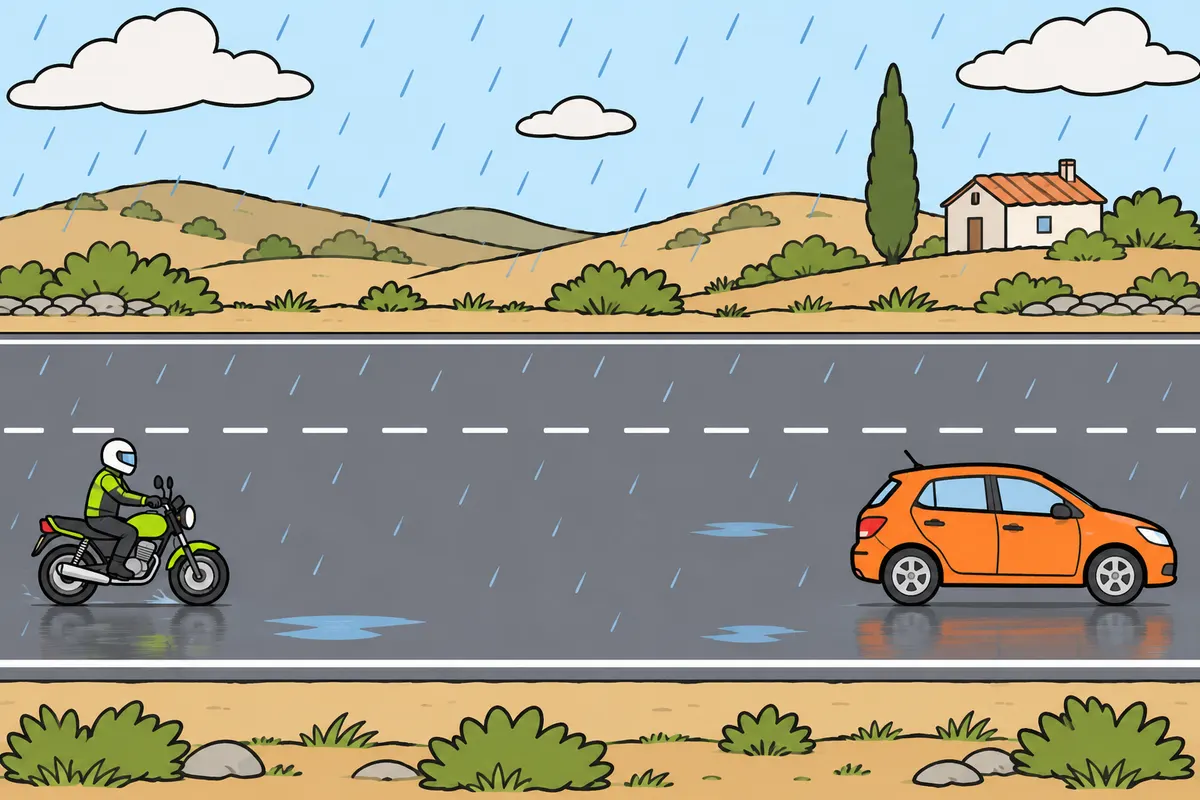
Leave enough space to stop without hitting the vehicle ahead if it brakes suddenly.
Remember
- Keep your gap inside and outside built-up areas, including before overtaking.
- Increase the gap with higher speed, worse visibility or less grip.
- Allow more space if your motorcycle or your reactions need it.
- In rain, doubling the gap is guidance; you may need more.
- Keep your distance when riding in a motorcycle group too.
- Following distance is your gap; stopping distance is how far you travel before stopping.
Exam trap: Wrong: motorcycle groups can ride close together like grouped cyclists. Right: keep enough distance to avoid rear-end collisions.
Read the full explanation
- You must leave enough space behind the vehicle ahead to stop without colliding with it if it brakes suddenly. Pay particular attention to speed, grip and braking ability. This obligation applies both inside and outside built-up areas, including when you prepare to overtake. [RGC, art. 54](https://www.boe.es/buscar/act.php?id=BOE-A-2003-23514#a54)
- You must increase the gap when you increase your speed, visibility worsens or grip decreases. You must also increase it when your vehicle's condition or your ability to respond requires a greater margin. Your safe following distance is the space between vehicles; your stopping distance describes how far you travel before you stop. [RGC, art. 54](https://www.boe.es/buscar/act.php?id=BOE-A-2003-23514#a54)
- In rain, you must leave a greater margin than in dry conditions. Doubling the gap is a DGT precautionary guideline, but you must increase it further if conditions require it. [DGT, Road safety topics](https://sede.dgt.gob.es/export/sites/dgt/.galleries/permisos-de-conducir/certificacion-aptitud-profesores-formacion-vial/2016/Seguridad-Vial-Ed.-2016.pdf)
- You must maintain the gap even when you ride with other motorcyclists. The exception allowing cyclists to ride in a group without the normal gap does not apply to a group of motorcycles. Keeping space allows you to react and makes safe manoeuvres easier. [RGC, art. 54](https://www.boe.es/buscar/act.php?id=BOE-A-2003-23514#a54)
20How you check your following gap in seconds
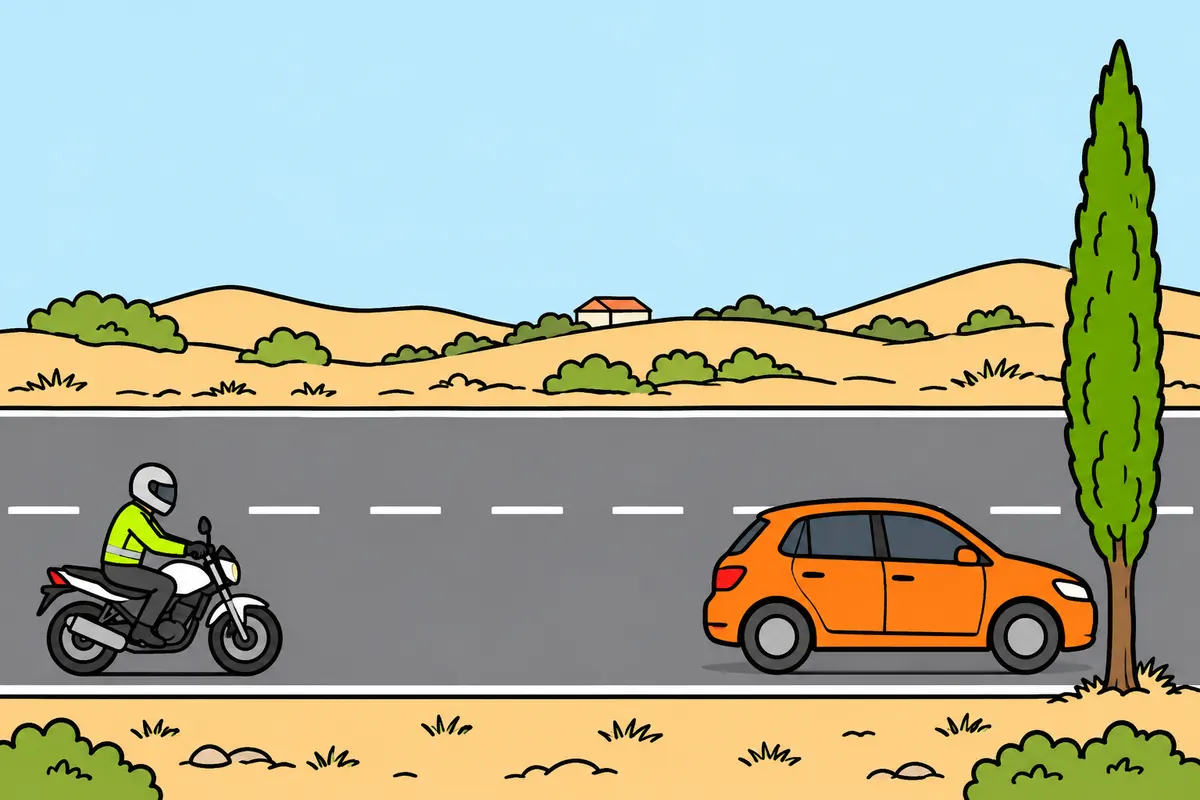
Use a fixed point to check your time gap behind the vehicle ahead.
Remember
- Start counting when the vehicle ahead passes a fixed point.
- Check how long you take to reach that point.
- Increase the time gap if it leaves insufficient space.
- With rain, fatigue or worn tyres, leave more time.
- Also respect specific distances, such as tunnel minimums.
Exam trap: Wrong: two seconds always guarantees safety. Right: it is guidance for favourable conditions; increase your gap and respect specific minimums.
Read the full explanation
- You can use a fixed point on the road to estimate the time gap: start counting when the vehicle ahead passes it and check how long you take to reach it. The DGT suggests the two-second rule as a guide in favourable conditions. You must increase the gap whenever it provides an insufficient margin. [DGT, motorcycle riding guide](https://www.dgt.es/export/sites/web-DGT/.galleries/downloads/nuestros_servicios/para-colaboradores-y-empresas/GUIA-MONITORES-MOTOCICLETA-NIPO.pdf)
- On wet tarmac, when you are tired or with worn or damaged tyres, two seconds may be insufficient. You must adapt the gap to your actual ability to respond and brake. This method does not replace your obligation to avoid a rear-end collision or the specific distances required in tunnels or other situations covered by the regulations. [RGC, art. 54](https://www.boe.es/buscar/act.php?id=BOE-A-2003-23514#a54)
- The advantage of a time gap is that it represents more metres as your speed increases. As a calculation, two seconds at 90 km/h equals 50 metres, and at 120 km/h about 66.7 metres.
21Space to allow overtaking
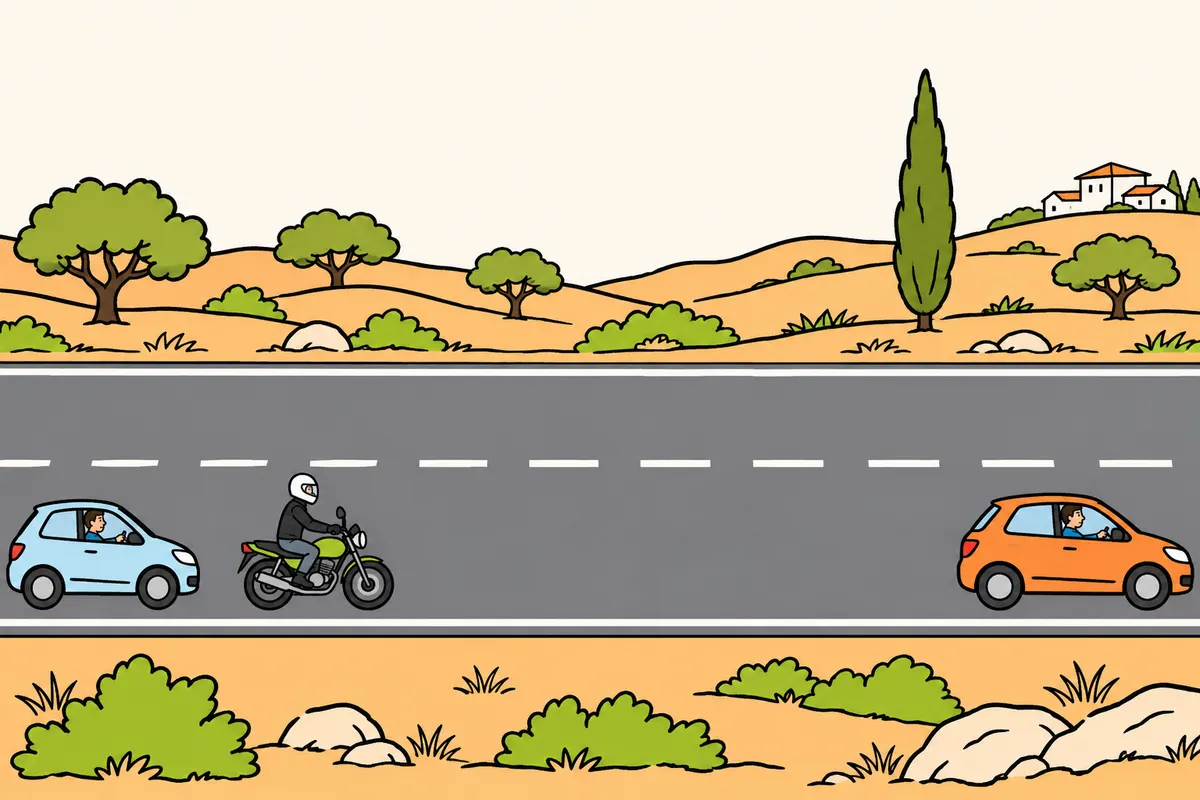
When required, also leave space for others to overtake you and pull in.
| Case | Extra space to allow overtaking |
|---|---|
| Outside built-up areas; one lane each way; overtaking allowed; traffic not too congested | Leave pulling-in space when following without signalling an intention to overtake |
| Vehicles over 3,500 kg MMA or over 10 metres total length | At least 50 metres, subject to the exceptions |
| Built-up areas; overtaking prohibited; several lanes your way; congestion prevents overtaking | No extra gap required; keep enough space to avoid collisions |
Remember
- When required, leave pulling-in space unless you signal your intention to overtake.
- Exceptions remove this extra gap, but you must always keep collision-avoidance space.
- An ordinary motorcycle has no general minimum gap of 50 metres.
Exam trap: Wrong: you can follow closely where overtaking is prohibited. Right: only the extra overtaking gap is removed; keep enough space to avoid a rear-end collision.
Read the full explanation
- As well as avoiding a rear-end collision, if you follow another vehicle without signalling your intention to overtake it, you must leave enough space for a vehicle behind to overtake you safely and pull into the gap. You must keep this gap on a road with one lane in each direction where overtaking is permitted and traffic is not too congested to allow it. [RGC, art. 54](https://www.boe.es/buscar/act.php?id=BOE-A-2003-23514#a54)
- This additional obligation to allow overtaking does not apply in built-up areas, where overtaking is prohibited, where there is more than one lane in your direction or when traffic is too congested to allow overtaking. In all these situations, you must maintain the basic following distance that prevents a collision if the vehicle ahead brakes. [RGC, art. 54](https://www.boe.es/buscar/act.php?id=BOE-A-2003-23514#a54)
- If you drive a vehicle with an MMA (maximum authorised mass) over 3,500 kg or a vehicle or vehicle combination with a total length over 10 metres, you must leave at least 50 metres for this purpose. This refers to MMA and total length, rather than payload or the space occupied by the vehicle ahead. [RGC, art. 54](https://www.boe.es/buscar/act.php?id=BOE-A-2003-23514#a54)
- On your ordinary motorcycle, this rule does not impose a specific minimum of 50 metres: you must maintain an appropriate following distance and, where applicable, leave space for other vehicles to pull in after overtaking you. [RGC, art. 54](https://www.boe.es/buscar/act.php?id=BOE-A-2003-23514#a54)
22Clearance from cyclists and other road users
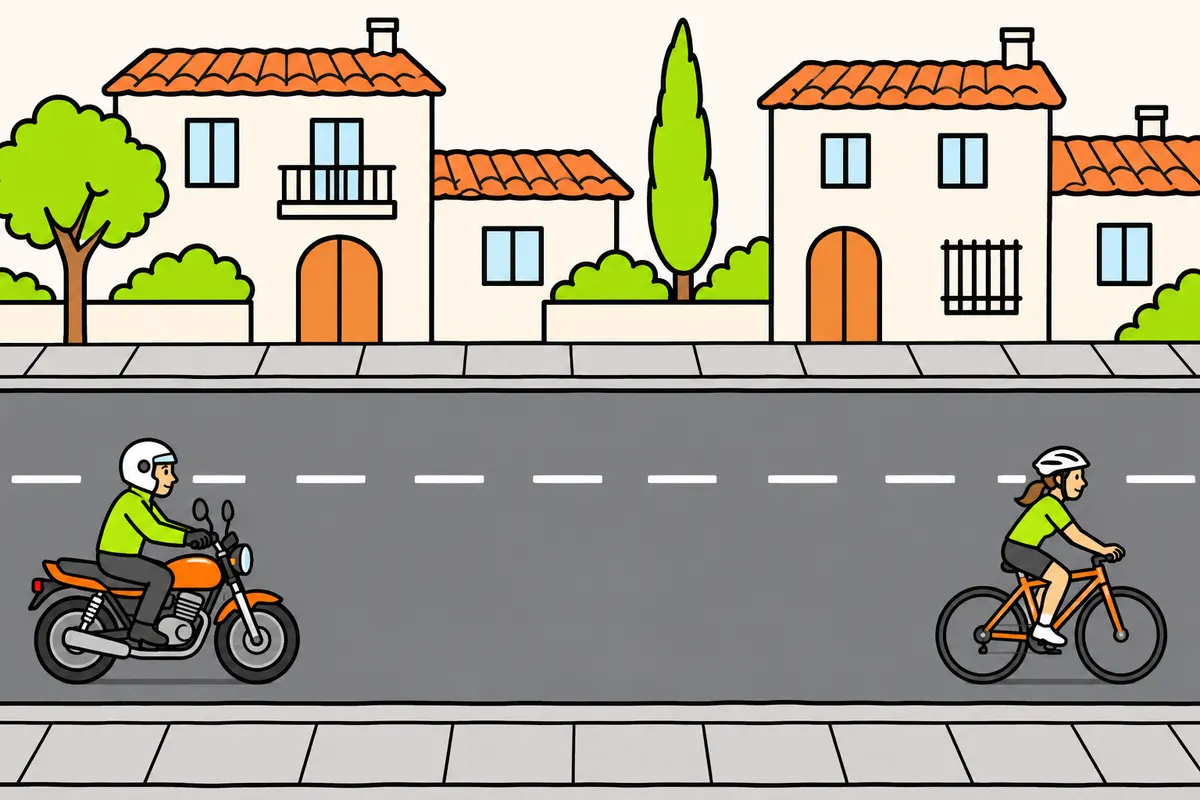
Distinguish the gap ahead of your motorcycle from the space you need beside it.
| Gap you leave | Purpose |
|---|---|
| Ahead | Respond to the vehicle ahead braking |
| At the side | Pass people, vehicles or obstacles safely |
Remember
- In urban areas, leave this minimum behind cyclists ahead in your same lane.
- Leave more space if you need it to stop without hitting them.
- When overtaking, also follow the side clearance and lane-use rules.
- Leave enough side clearance when meeting vehicles or passing obstacles.
- Consider width, road surface, visibility and wind.
- If you cannot pass safely, slow down or stop.
Exam trap: Wrong: the 5 metres behind a cyclist is your side clearance for overtaking. Right: it is the gap ahead, on urban roads in your same lane; overtaking has separate rules.
Read the full explanation
- On urban roads, you must leave at least 5 metres behind cyclists ahead of you in the same lane. You must combine this specific minimum with the distance you need to stop without hitting them. If your speed or the available grip requires more space, five metres is not enough. [RGC, art. 153.4](https://www.boe.es/buscar/act.php?id=BOE-A-2003-23514#a1-6)
- Your following distance allows you to respond if a cyclist brakes; to overtake, you must apply the lateral clearance and lane-use rules in «Manoeuvres on your motorcycle», in «Lateral clearance on your motorcycle» and «Overtaking vulnerable road users». [RGC, art. 85.4](https://www.boe.es/buscar/act.php?id=BOE-A-2003-23514#a85)
- When you pass an oncoming vehicle or ride past obstacles, you must leave sufficient lateral clearance for the road width, surface, visibility and wind. You may need a greater margin when you emerge from the shelter of a lorry or from a tunnel entrance; if you cannot pass safely, slow down or stop. Keeping a good following gap does not compensate for passing too close to something at your side. [RGC, art. 46](https://www.boe.es/buscar/act.php?id=BOE-A-2003-23514#a46)
23Tunnels and underpasses
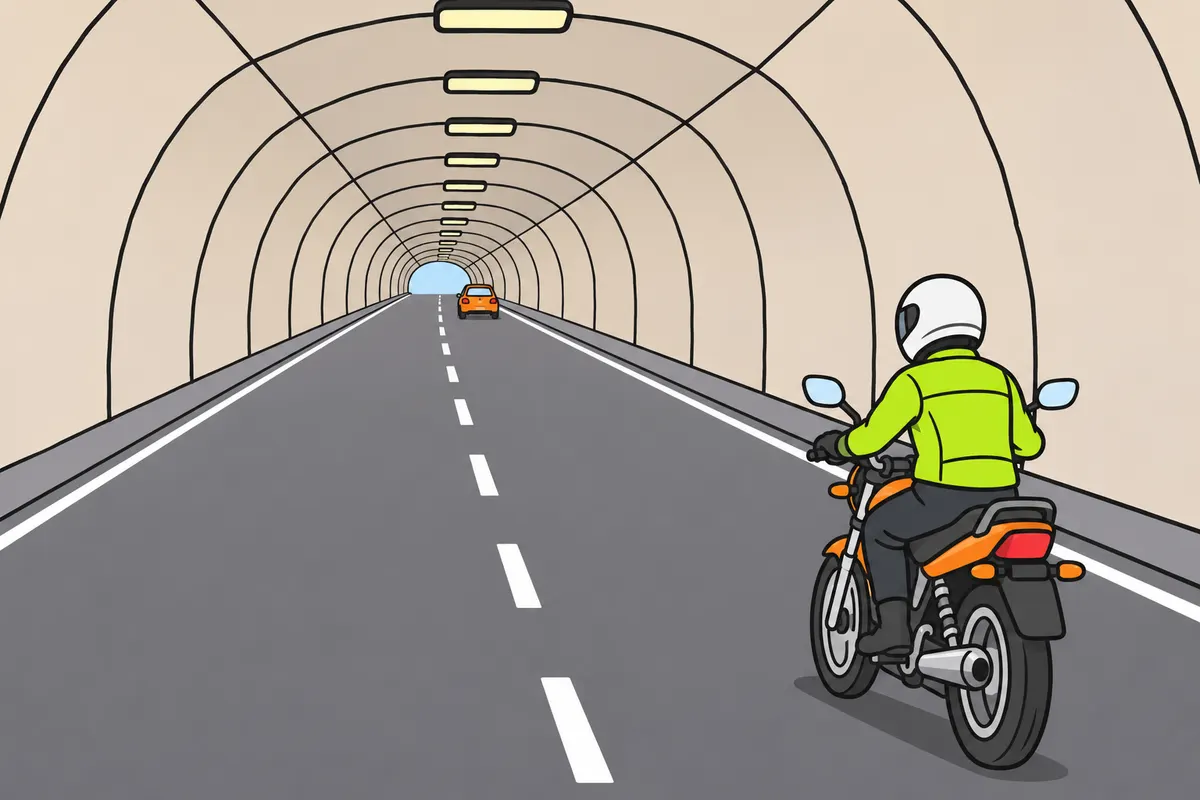
In tunnels and underpasses, keep the specific minimum gap and obey instructions.
| Vehicle when you do not intend to overtake | Minimum distance | Alternative minimum time gap |
|---|---|---|
| Your motorcycle | 100 metres | four seconds |
| Vehicle over 3,500 kg MMA | 150 metres | six seconds |
Remember
- When you do not intend to overtake, keep your vehicle’s required minimum gap.
- Increase your gap when conditions require it.
- Obey signs, panels, traffic lights and instructions.
- A tunnel alone does not set a different universal maximum speed.
- If traffic stops you, leave as much space as possible behind the vehicle ahead.
Exam trap: Wrong: lighting lets you reduce the tunnel minimum. Right: when you do not intend to overtake, keep your vehicle category’s minimum distance or time gap; increase it if needed.
Read the full explanation
- In tunnels and underpasses, when you do not intend to overtake, you must keep at least 100 metres or a minimum time gap of four seconds behind the vehicle ahead. This is the specific requirement for your motorcycle. You must increase the gap when conditions require it and comply with any specific instructions in the tunnel. [RGC, art. 95.6](https://www.boe.es/buscar/act.php?id=BOE-A-2003-23514#a95)
- If you drive a vehicle with an MMA over 3,500 kg, you must keep at least 150 metres or six seconds. These figures are minimum gaps that you must also maintain in good lighting and on familiar routes. [RGC, art. 95.6](https://www.boe.es/buscar/act.php?id=BOE-A-2003-23514#a95)
- Being in a tunnel does not in itself impose a different universal maximum speed: you must follow the road's speed limit and signs, adapting your speed to visibility and traffic. You must obey traffic lights, information panels and instructions given over loudspeakers or by other means. [RGC, art. 95.7](https://www.boe.es/buscar/act.php?id=BOE-A-2003-23514#a95)
- If you stop inside because of traffic conditions, you must stop as far as possible from the vehicle ahead. Your other duties while held up in this way (engine, lights, and you and your passenger remaining on the motorcycle) are explained in «Using the road with your motorcycle», in the section «Stopping inside a tunnel». [RGC, art. 97.3, final paragraph](https://www.boe.es/buscar/act.php?id=BOE-A-2003-23514#a97)
24Slowing down without causing a rear-end collision
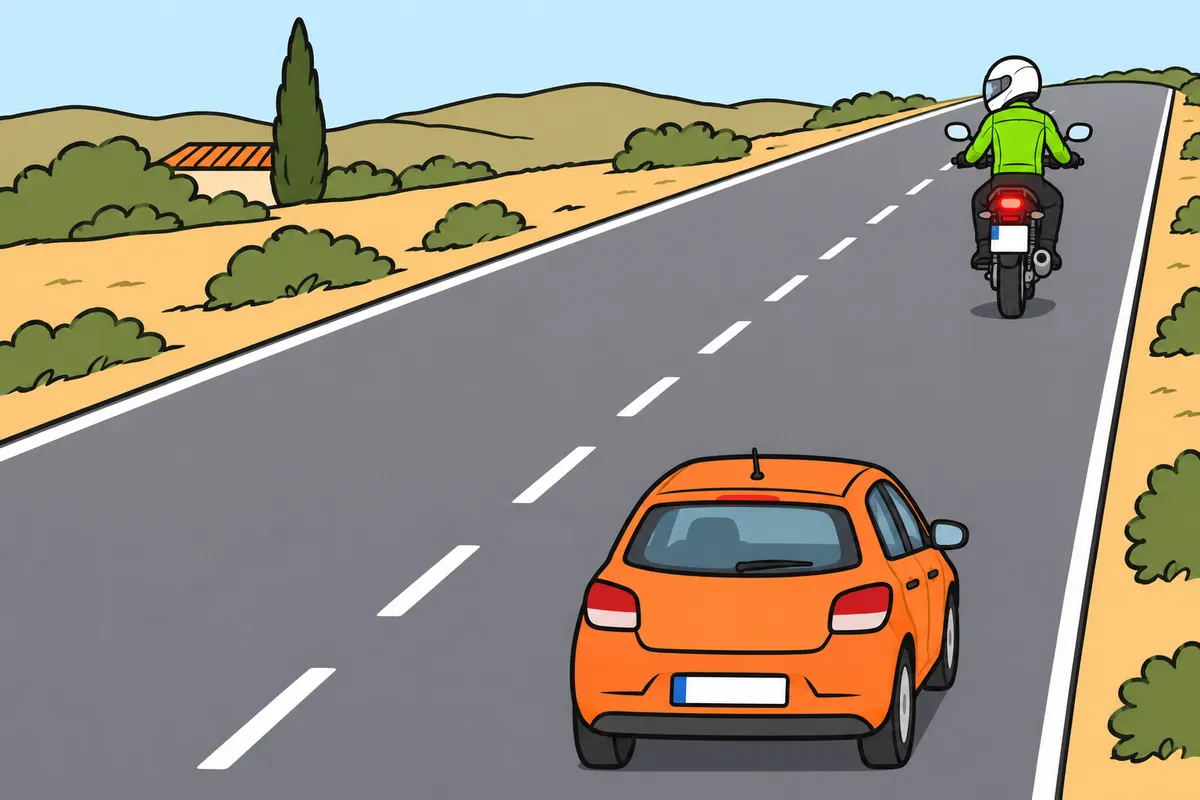
Before slowing considerably, check for danger and give warning whenever possible.
Remember
- Unless danger is immediate, check you can slow down without putting others at risk.
- Check your mirrors and plan your slowdown.
- Avoid sudden braking that could cause a collision from behind.
- Warn with repeated brake lights or short, rapid arm movements.
- Move your arm up and down.
- For immediate danger, do not delay necessary braking to finish giving warning.
Exam trap: Wrong: you must finish warning before braking for immediate danger. Right: act to avoid the danger without delaying necessary braking.
Read the full explanation
- Except in imminent danger, before you reduce your speed considerably, you must make sure you can do so without putting others at risk and give advance warning. You must avoid slowing down abruptly in a way that creates a risk of a rear-end collision. Checking your mirrors and anticipating the need to slow down helps you maintain a margin. [RGC, art. 53](https://www.boe.es/buscar/act.php?id=BOE-A-2003-23514#a53)
- Whenever possible, you must warn others of your intention to stop or brake heavily, even when traffic conditions require it. The regulations provide for repeated use of the brake lights or short, rapid up-and-down movements of your arm. [RGC, art. 109](https://www.boe.es/buscar/act.php?id=BOE-A-2003-23514#a109)
- In imminent danger, you must act to avoid it: the rule provides for this exception to the normal procedure for slowing down. Do not delay necessary braking to complete a sequence of checks or warnings first. Then maintain control and preserve the space available; emergency braking technique is covered in «Motorcycle riding techniques». [RGC, art. 53](https://www.boe.es/buscar/act.php?id=BOE-A-2003-23514#a53)
Choosing your motorcycle’s speed
Consider the road, the rules and actual conditions together.
- Identify whether your motorcycle has a trailer, the road type and whether you are inside or outside a built-up area.
- Find the generic maximum: 120, 90, 30 or the relevant urban limit; distinguish stretches of road through a town and motorways in built-up areas.
- Check signs, specific restrictions and limits for special lanes.
- Assess visibility, grip, traffic, your own condition, your motorcycle and its load.
- Slow down as much as necessary to stop within the distance you can see; apply the minimum speed with its justified exceptions.
Checking your following distance
Use a fixed reference point and increase the gap when necessary.
- Choose a visible fixed point that the vehicle ahead passes.
- Start counting when that vehicle reaches it and stop when you reach it.
- In favourable conditions, use two seconds as a preventive guide, increasing the interval if it is insufficient.
- In tunnels and underpasses, apply the specific gap explained in «Tunnels and underpasses».
- Continually reassess the gap if speed, visibility, load or grip changes.
Analysing a question about stopping
Divide the process into two phases.
- Identify the instant from which the distance travelled is measured.
- If it starts when you detect the hazard, include the metres travelled during your reaction time.
- Add the distance travelled from when you start braking until you stop.
- Classify each factor: rider response, speed, grip or vehicle performance.
- Do not confuse the total distance travelled before stopping with the gap you must keep between vehicles.
Finished this module?
Mark it as read and you will see your progress on the theory list.