
Theory · D1 Licence - Minibus · Module 7 of 18
Minibus speed and distances
You learn to choose your minibus speed according to the road, service, passengers and traffic conditions. You distinguish thinking, braking and stopping distances, and apply the general following distances, the 50-metre rule and tunnel minimum distances without confusing their exceptions.
1Legal limits and appropriate speed
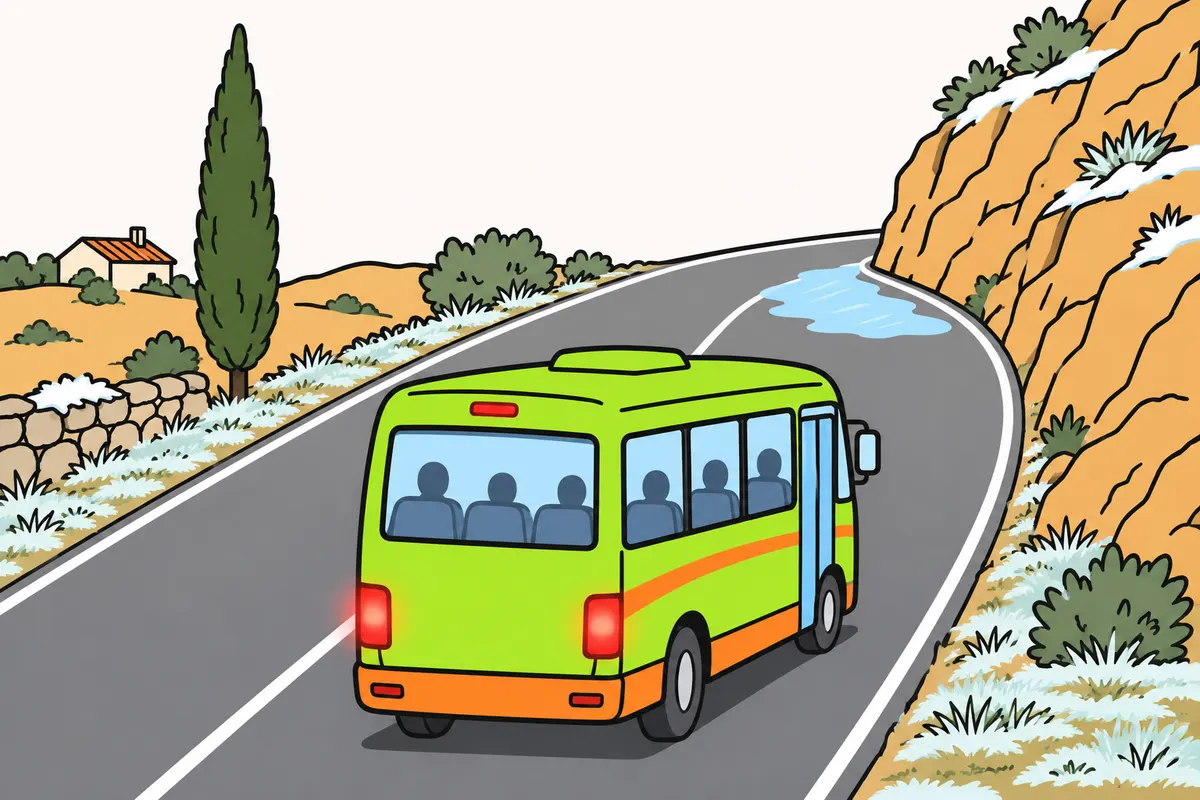
Choose a speed that lets you stop within the space you can see.
Remember
- Keeping below the maximum speed is not enough.
- Consider your condition, traffic, weather and the road.
- Consider your passengers and their luggage.
- Slow down if you cannot stop within the visible space.
- At higher speeds, you see hazards at the sides less clearly.
Exam trap: Wrong: driving below the limit means you are safe. Right: adapt your speed to the actual risk.
Read the full explanation
- The maximum speed is the permitted upper limit; the minimum prevents unjustifiably slow driving; the appropriate speed depends on the actual risk. You can drive below the maximum and still be travelling at a speed that is dangerous for your minibus, your passengers or your surroundings. [RGC, art. 45](https://www.boe.es/buscar/act.php?id=BOE-A-2003-23514#a45)
- You must choose a speed that allows you to stop your minibus within your field of vision and before any obstacles that may appear. If your stopping distance exceeds the distance you can see ahead, you must slow down even if the sign allows a higher speed. [RGC, art. 45](https://www.boe.es/buscar/act.php?id=BOE-A-2003-23514#a45)
- You must assess your physical and mental condition, the road, the vehicle, the load, the weather, the surroundings and the traffic. In your minibus, you must include the number of passengers and their luggage in this assessment. [RGC, art. 45](https://www.boe.es/buscar/act.php?id=BOE-A-2003-23514#a45)
- If you drive at 100 km/h where your limit is 90, you exceed the maximum. If you drive at 70 km/h on ice without enough room to stop, your speed can be inappropriate even though you do not exceed the limit. In the exam, you must identify which problem the question describes. [RGC, art. 45](https://www.boe.es/buscar/act.php?id=BOE-A-2003-23514#a45)
- As your speed increases, your useful field of vision narrows and you may become less aware of hazards to either side: this is tunnel vision. You must avoid relying solely on how stable the minibus feels and maintain a speed that allows you to observe and anticipate. [DGT, Risk factors and values, pp. 57-58](https://www.dgt.es/export/sites/web-DGT/.galleries/downloads/conoce_la_dgt/que-hacemos/educacion-vial/jovenes/factores-riesgo/factores-y-valores-de-riesgo.pdf)
2Motorways outside built-up areas
Outside built-up areas, obey your minibus speed limit and any lower restrictions.
| Minibus outside built-up areas | General maximum on motorways |
|---|---|
| Standard, without trailer | 100 km/h |
| With trailer | 90 km/h |
Remember
- Check limits for your service, equipment and road signs.
- Obey speed limits when overtaking too.
- Your minibus remains a bus even when empty.
- Slow down further in heavy rain, dense traffic or poor visibility.
Exam trap: Wrong: overtaking lets you exceed the limit. Right: obey your minibus maximum and any lower restriction.
Read the full explanation
- With your D1 minibus, the general maximum speed outside built-up areas is 100 km/h on both autopistas (motorways) and autovías (dual carriageways with motorway characteristics). For speed limits, it belongs to the bus category: you must check whether a lower restriction applies because of the service, equipment or signs. [RGC, art. 48](https://www.boe.es/buscar/act.php?id=BOE-A-2003-23514#a48)
- If you tow a trailer, you must apply the general maximum speeds for motor vehicles towing trailers: 90 km/h on an autopista or autovía and 80 km/h on a conventional road. With D1, you can tow a trailer with an MMA (maximum authorised mass) not exceeding 750 kg. [RGC, art. 48](https://www.boe.es/buscar/act.php?id=BOE-A-2003-23514#a48) [RGCond, art. 4](https://www.boe.es/buscar/act.php?id=BOE-A-2009-9481#a4)
- The bus category determines your general maximum speed even when you drive empty or with all passengers seated. [RGC, art. 48](https://www.boe.es/buscar/act.php?id=BOE-A-2003-23514#a48)
- When overtaking on an autopista or autovía outside built-up areas, you must observe the 100 km/h maximum for your standard minibus and any lower restriction. [RGC, art. 48](https://www.boe.es/buscar/act.php?id=BOE-A-2003-23514#a48)
- If a limit applying to the stretch of road is 80 km/h, you must observe it. The general maximum of 100 does not oblige you to reach it: in heavy rain, dense traffic or insufficient visibility, you must choose an even lower speed according to the risk. [RGC, art. 45](https://www.boe.es/buscar/act.php?id=BOE-A-2003-23514#a45) [RGC, art. 52](https://www.boe.es/buscar/act.php?id=BOE-A-2003-23514#a52) [RGC, art. 48](https://www.boe.es/buscar/act.php?id=BOE-A-2003-23514#a48)
3Conventional roads and unpaved roads
On conventional roads, your standard minibus has a general maximum of 90 km/h.
| Road | General maximum for your standard minibus |
|---|---|
| Conventional road | 90 km/h |
| Unpaved road | 30 km/h |
Remember
- A physical barrier between directions does not raise your minibus limit.
- Obey any lower limit for the stretch or service.
- On unpaved roads, slow down further if necessary.
- A road reserved for motor vehicles is not necessarily a motorway.
Exam trap: Wrong: a physical barrier allows 100 km/h. Right: your standard minibus still has a 90 km/h maximum on conventional roads.
Read the full explanation
- On a conventional road, your standard minibus has a general maximum speed of 90 km/h. You must apply any lower limits relevant to the stretch of road or the service. [RGC, art. 48](https://www.boe.es/buscar/act.php?id=BOE-A-2003-23514#a48)
- A conventional road with physical separation between opposing directions does not give your minibus a maximum of 100 km/h. The option to set that figure under article 48.1.a applies to the categories expressly listed there; your general maximum speed as a bus remains 90 km/h. [RGC, art. 48.1.a](https://www.boe.es/buscar/act.php?id=BOE-A-2003-23514#a48)
- On an unpaved road, you must observe a maximum of 30 km/h. In dusty conditions, over potholes or with poor grip, you must slow down further when necessary. [RGC, art. 48](https://www.boe.es/buscar/act.php?id=BOE-A-2003-23514#a48)
- Reserving a road for motor vehicles does not in itself make it an autopista or autovía. On a single-carriageway road reserved for motor vehicles, you must follow the applicable rules and signs; you cannot infer from the restricted access that you are allowed to drive your minibus at 100 km/h. [RGC, art. 47](https://www.boe.es/buscar/act.php?id=BOE-A-2003-23514#a47) [RGC, art. 48](https://www.boe.es/buscar/act.php?id=BOE-A-2003-23514#a48)
4School transport and transport of minors
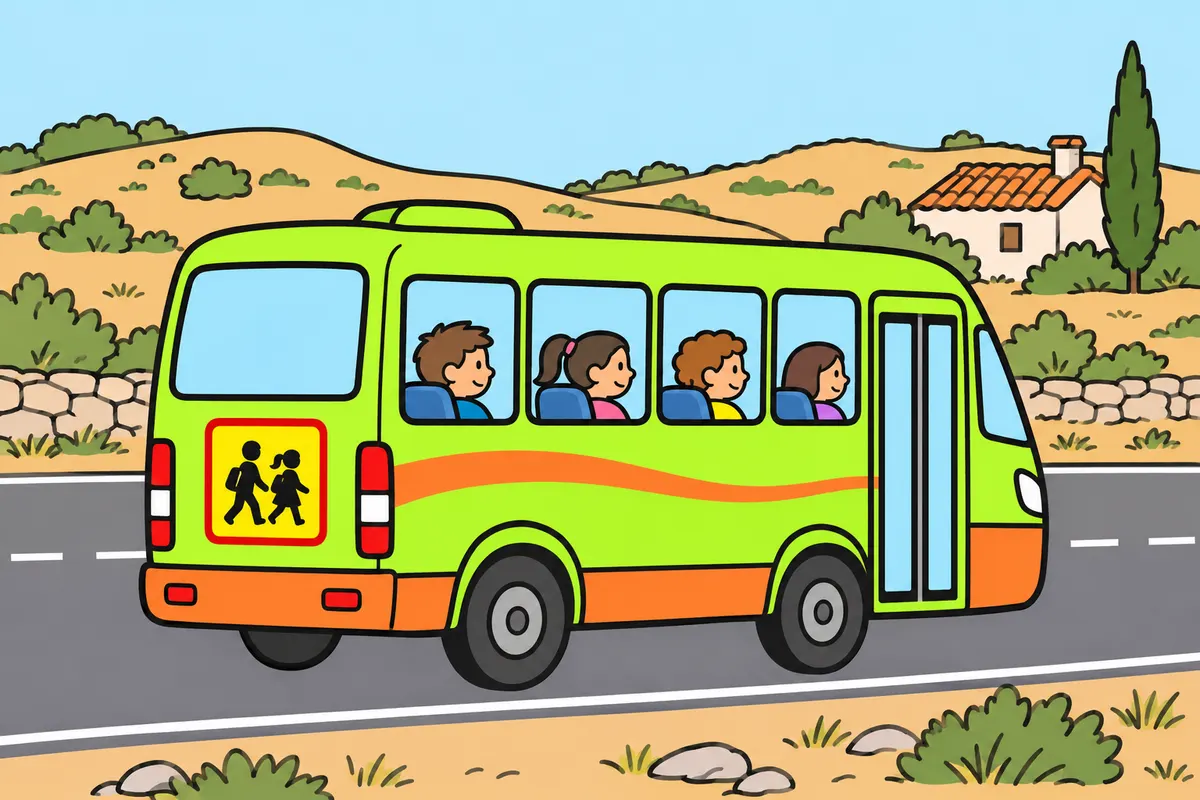
Use the reduced limits when you provide school transport or transport of minors.
| Road | Maximum for your standard school minibus |
|---|---|
| Motorway outside built-up areas | 90 km/h |
| Conventional road | 80 km/h |
| Urban street with one lane in each direction | 30 km/h, unless a lower limit applies |
| Unpaved road | 30 km/h, unless a lower limit applies |
Remember
- Calculate the reduction from the general interurban table, using vehicle and road type.
- Do not automatically subtract this reduction from signed limits.
- Obey all restrictions that apply.
- On unpaved roads, obey 30 km/h or any lower limit.
Exam trap: Wrong: carrying schoolchildren means subtracting ten from every sign. Right: reduce the general interurban table limits; obey lower restrictions.
Read the full explanation
- If you provide school transport and transport of minors, you must reduce the maximum speeds in the table in article 48.1.a by 10 km/h, according to the vehicle and road. For a standard minibus, this gives 90 km/h on an autopista or autovía and 80 km/h on a conventional road. [RGC, art. 48](https://www.boe.es/buscar/act.php?id=BOE-A-2003-23514#a48)
- The type of service determines whether the school transport reduction applies, even if you use the same minibus for other passenger transport journeys. [RGC, art. 48](https://www.boe.es/buscar/act.php?id=BOE-A-2003-23514#a48)
- You calculate the school transport reduction using the table for roads outside built-up areas in article 48.1.a. On an urban street with one lane in each direction and on an unpaved road, you must apply 30 km/h unless lower restrictions apply. [RGC, art. 48](https://www.boe.es/buscar/act.php?id=BOE-A-2003-23514#a48)
- If school transport rules and another limit apply together, you must observe all applicable restrictions. For example, on a conventional road, your school minibus has an upper limit of 80 km/h, but a specific limit of 60 requires you to drive at no more than 60, without automatically subtracting another ten from the signed limit. [RGC, art. 52](https://www.boe.es/buscar/act.php?id=BOE-A-2003-23514#a52) [RGC, art. 48](https://www.boe.es/buscar/act.php?id=BOE-A-2003-23514#a48)
5Standing passengers and absence of seat belts
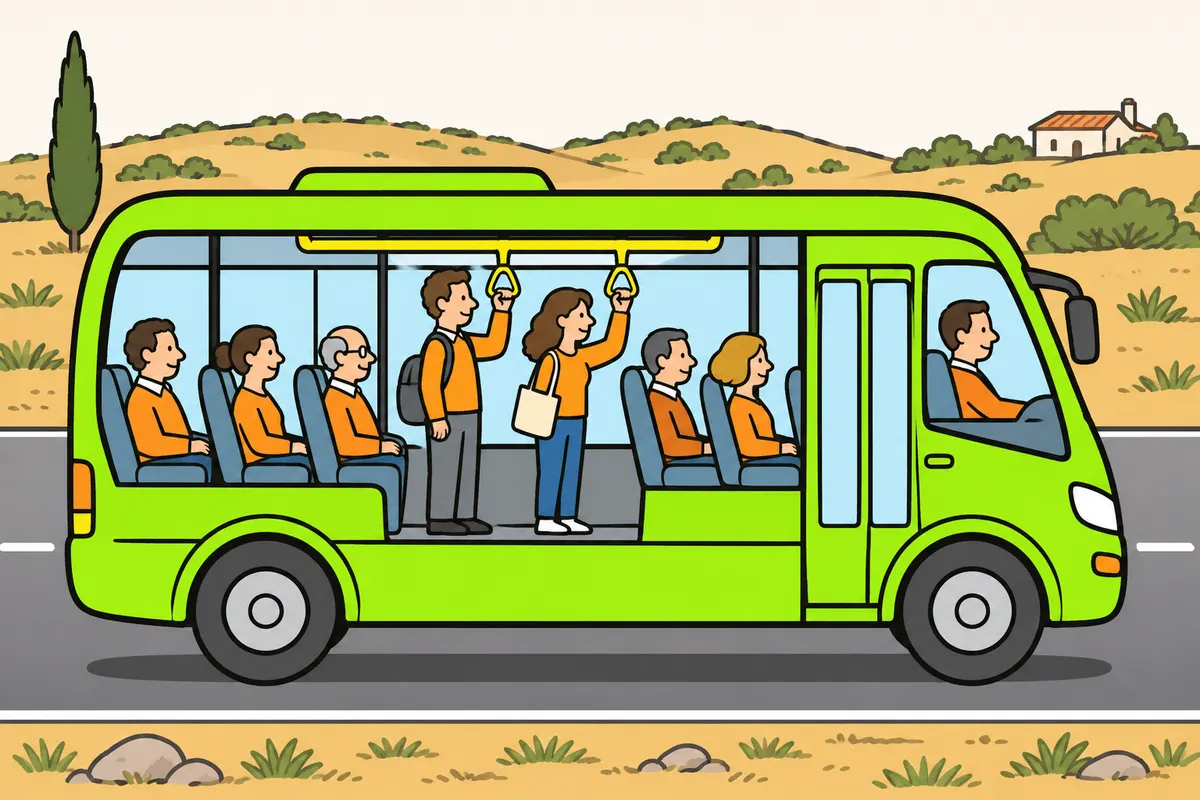
Outside built-up areas, standing passengers or no fitted seat belts mean an 80 km/h ceiling.
| Your minibus situation | Ceiling outside built-up areas |
|---|---|
| You carry authorised standing passengers | 80 km/h, unless a lower limit applies |
| No seat belts are fitted | 80 km/h, unless a lower limit applies |
Remember
- Apply this ceiling when you carry authorised standing passengers.
- Apply it also if your minibus has no seat belts fitted.
- Having standing places does not mean you are carrying standing passengers.
- Missing seat belts are different from fitted belts left unfastened.
- Obey any lower limit.
- For school transport without belts, do not subtract ten from the 80 km/h ceiling.
Exam trap: Wrong: having standing places alone triggers this ceiling. Right: you must actually carry standing passengers; having no fitted seat belts also triggers it.
Read the full explanation
- If you carry standing passengers in your minibus because it is authorised to do so, your maximum speed outside built-up areas is 80 km/h, regardless of the type of road. You must combine this upper limit with any lower limit: it does not allow you to exceed 30 km/h on an unpaved road. [RGC, art. 48](https://www.boe.es/buscar/act.php?id=BOE-A-2003-23514#a48)
- If your minibus is not fitted with seat belts, the maximum of 80 km/h outside built-up areas also applies. This is a condition relating to the vehicle’s equipment; you must not confuse it with someone failing to fulfil their obligation to fasten a seat belt that is fitted. [RGC, art. 48](https://www.boe.es/buscar/act.php?id=BOE-A-2003-23514#a48)
- Authorisation for standing places describes the vehicle’s capacity; to apply the condition relating to standing passengers, you must consider how your passengers are travelling on that journey. You study the conditions for authorising and using these places in «Transporting passengers and minors». [RGC, art. 48.1.b](https://www.boe.es/buscar/act.php?id=BOE-A-2003-23514#a48)
- If you transport schoolchildren in a minibus without seat belts, you must combine the rules: the maximum of 80 due to the equipment applies alongside the 90/80 limits for school transport. The general table provides the basis for the school transport reduction, so the combined result is 80 km/h on both types of road. [RGC, art. 48](https://www.boe.es/buscar/act.php?id=BOE-A-2003-23514#a48)
6Urban streets: 20, 30 and 50 km/h
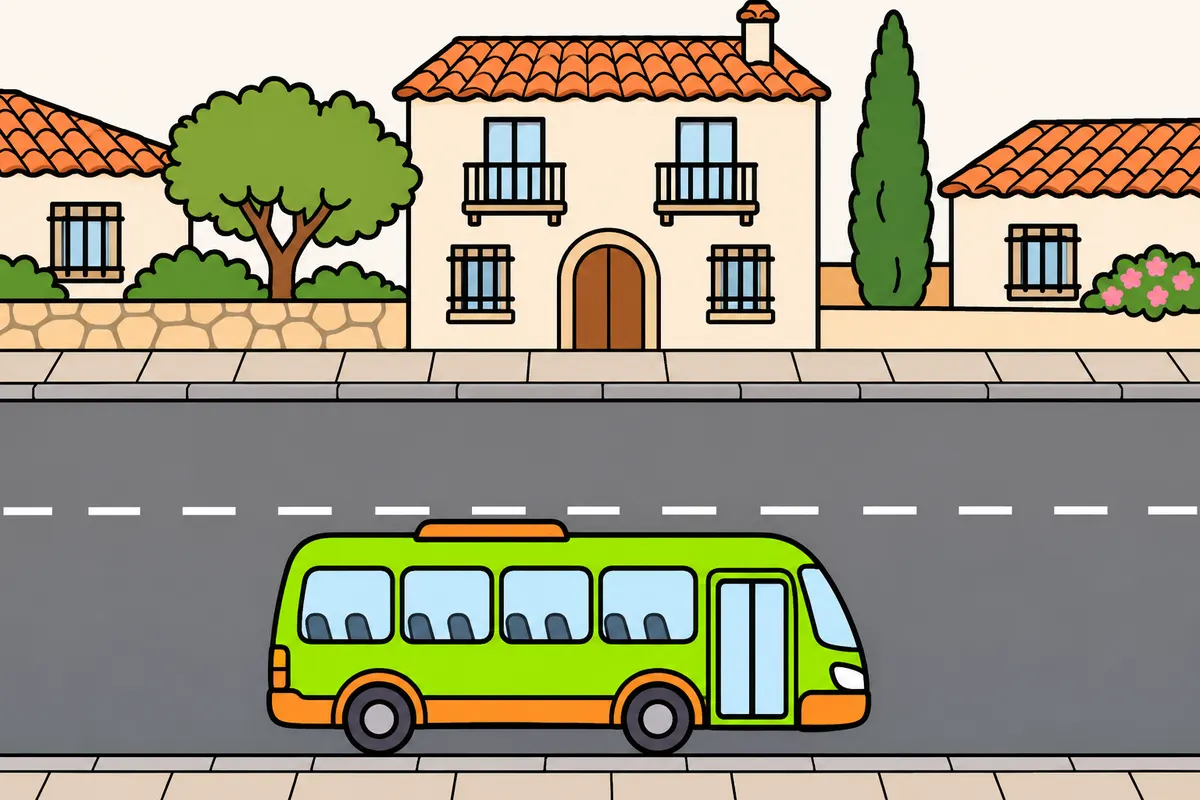
In towns, choose the limit according to the street and its signs.
| Urban situation | General or signed maximum |
|---|---|
| Carriageway and pavement at the same level | 20 km/h |
| One qualifying lane in each direction | 30 km/h |
| Two or more qualifying lanes in each direction | 50 km/h |
| Staying and play area: S-28 with R-301 | 10 km/h |
| Shared-use zone: S-47 | 20 km/h |
Remember
- Do not count reserved lanes or lanes exclusively for public transport.
- Obey signed reductions in speed limits.
- A specific sign may raise a single-lane street limit to 50 km/h.
- In S-28 and S-47 zones, give pedestrians priority.
Exam trap: Wrong: count the bus lane to choose 50 km/h. Right: with one general lane in each direction, the general maximum is 30 km/h.
Read the full explanation
- On an urban road where the carriageway and pavement share a single level, you must observe the general maximum speed of 20 km/h. [RGC, art. 50](https://www.boe.es/buscar/act.php?id=BOE-A-2003-23514#a50)
- On an urban road with only one lane in each direction, you must observe the general maximum speed of 30 km/h, including when you operate a scheduled service. [RGC, art. 50](https://www.boe.es/buscar/act.php?id=BOE-A-2003-23514#a50)
- On an urban road with two or more lanes in each direction, you must observe the general maximum speed of 50 km/h. You must count the eligible lanes in your direction. [RGC, art. 50](https://www.boe.es/buscar/act.php?id=BOE-A-2003-23514#a50)
- Lanes reserved for certain users or exclusively for public transport do not count when determining these limits. If you have one general traffic lane and one bus-only lane in each direction, you must not infer a general maximum of 50: the applicable figure is 30. [RGC, art. 50](https://www.boe.es/buscar/act.php?id=BOE-A-2003-23514#a50)
- You must observe any reductions in the general limits signed by the municipal authority. Exceptionally, it can raise the limit on a road with only one lane in each direction to 50 km/h by putting up specific signs. [RGC, art. 50](https://www.boe.es/buscar/act.php?id=BOE-A-2003-23514#a50)
- In an area for spending time and playing marked with S-28, you must observe a maximum of 10 km/h and give priority to pedestrians. The sign is accompanied by R-301 showing that limit. [RGC, annex I, catalogue of signs](https://www.boe.es/buscar/act.php?id=BOE-A-2003-23514#ani)
- In a shared-use zone marked with S-47, you must observe a maximum of 20 km/h and give priority to pedestrians. [RGC, annex I, catalogue of signs](https://www.boe.es/buscar/act.php?id=BOE-A-2003-23514#ani)
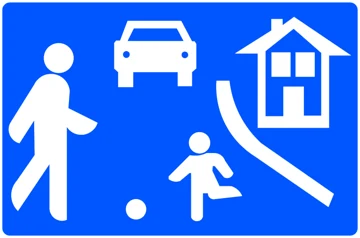 S-28
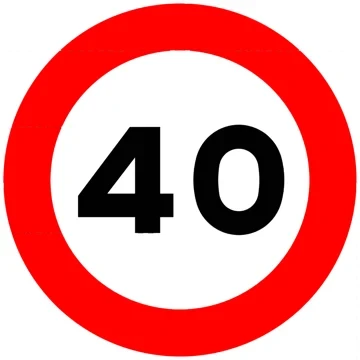 R-301
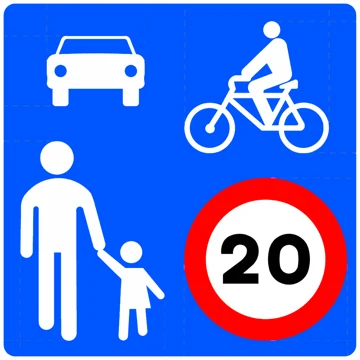 S-47
7Through roads and motorways within built-up areas
Distinguish through roads from motorways within built-up areas.
| Road within built-up areas | General maximum for your minibus |
|---|---|
| Through road | 50 km/h |
| Motorway | 80 km/h |
Remember
- On through roads, one lane each way does not change the general maximum.
- Obey signed reductions on through roads.
- Authorities may raise an urban motorway limit by agreement and specific signs.
- This increase cannot exceed your minibus maximum outside built-up areas.
Exam trap: Wrong: every motorway allows 100 km/h. Right: within built-up areas, the general maximum is 80 km/h; check signs.
Read the full explanation
- On a travesía (the stretch of road through a town), you must observe your minibus’s generic maximum speed of 50 km/h, even if there is only one lane in each direction. [RGC, art. 50](https://www.boe.es/buscar/act.php?id=BOE-A-2003-23514#a50)
- The speed limit on a stretch of road through a town may be reduced by agreement between the municipal authority and the road owner, with specific signs. If a limit of 30 applies to your route, you must observe it even if you remember the generic maximum of 50. [RGC, art. 50](https://www.boe.es/buscar/act.php?id=BOE-A-2003-23514#a50)
- On autopistas and autovías (motorways) within built-up areas, you must observe the generic maximum speed of 80 km/h. [RGC, art. 50](https://www.boe.es/buscar/act.php?id=BOE-A-2003-23514#a50)
- The limit of 80 may be increased by agreement between the municipal authority and the road owner, with specific signs, without exceeding the corresponding generic maximum speeds outside built-up areas. For your standard minibus, this increase does not allow you to exceed its maximum of 100 km/h. [RGC, art. 50](https://www.boe.es/buscar/act.php?id=BOE-A-2003-23514#a50)
8Signs and overlapping restrictions
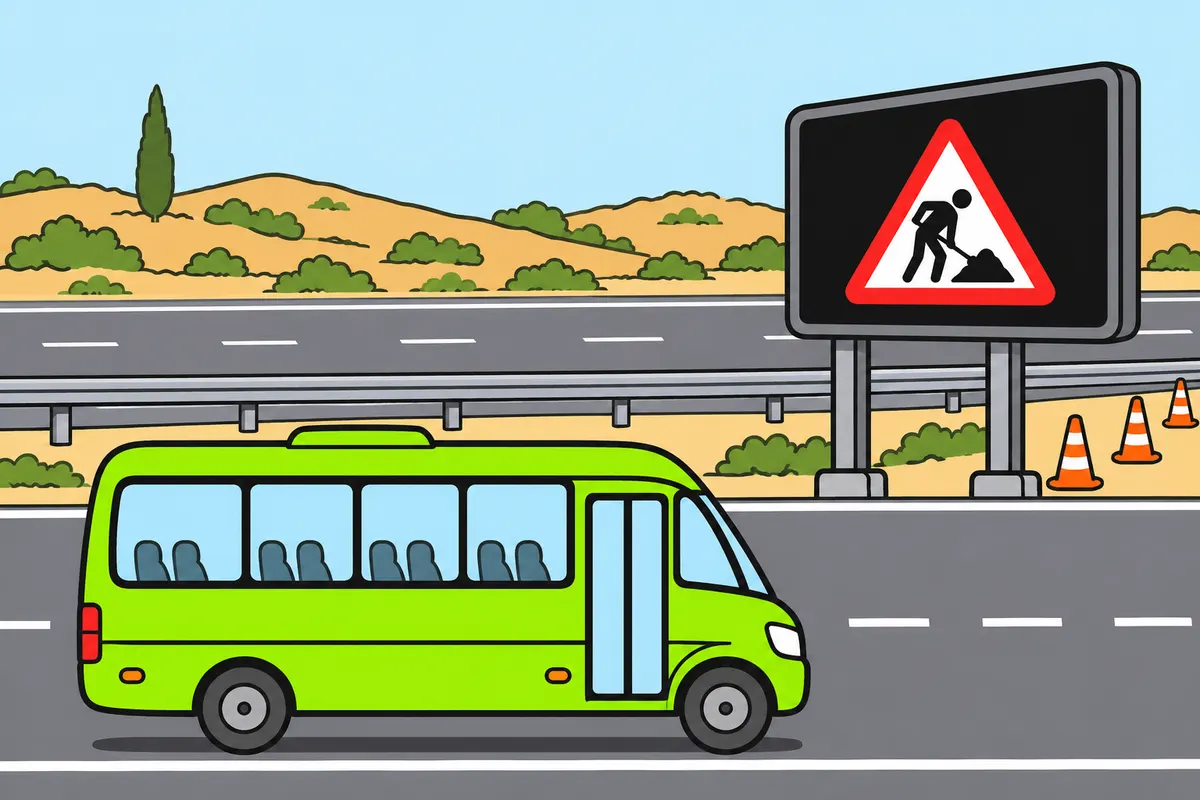
Obey signs and restrictions that apply to your minibus.
Remember
- Apply the specific limit for the stretch; otherwise, apply the general limit.
- Also check restrictions on you, your vehicle and its load.
- Obey temporary limits on variable message signs.
- When a restriction ends, apply the appropriate limit.
- Engine power does not decide your permitted speed.
Exam trap: Wrong: a high signed limit removes your lower personal or vehicle limit. Right: you must obey that lower limit too.
Read the full explanation
- You must apply the specific speed limit for the road section or, if there is none, the applicable generic limit. Road owners may set limits according to the road’s characteristics; traffic authorities may set temporary limits using temporary or variable signs. [RGC, art. 47](https://www.boe.es/buscar/act.php?id=BOE-A-2003-23514#a47)
- You must also check restrictions imposed on you as a driver because of your personal circumstances, and on your vehicle or vehicle combination because of its characteristics or load. A sign showing a high figure does not remove a lower limit that applies specifically to your minibus. [RGC, art. 52](https://www.boe.es/buscar/act.php?id=BOE-A-2003-23514#a52)
- If a variable message sign sets a limit of 70 km/h on an autovía outside built-up areas, you must observe 70. When that restriction ends, you must apply the limit appropriate to the road section and your minibus. [RGC, art. 47](https://www.boe.es/buscar/act.php?id=BOE-A-2003-23514#a47)
- You must distinguish between the speed your vehicle can technically reach and the speed you are allowed to drive at. Engine power, the operation of the speed limiter or the speed of the rest of the traffic in line do not replace the restrictions applying to the road and the transport service. [RGC, art. 45](https://www.boe.es/buscar/act.php?id=BOE-A-2003-23514#a45) [RGC, art. 52](https://www.boe.es/buscar/act.php?id=BOE-A-2003-23514#a52)
9Minimum speeds
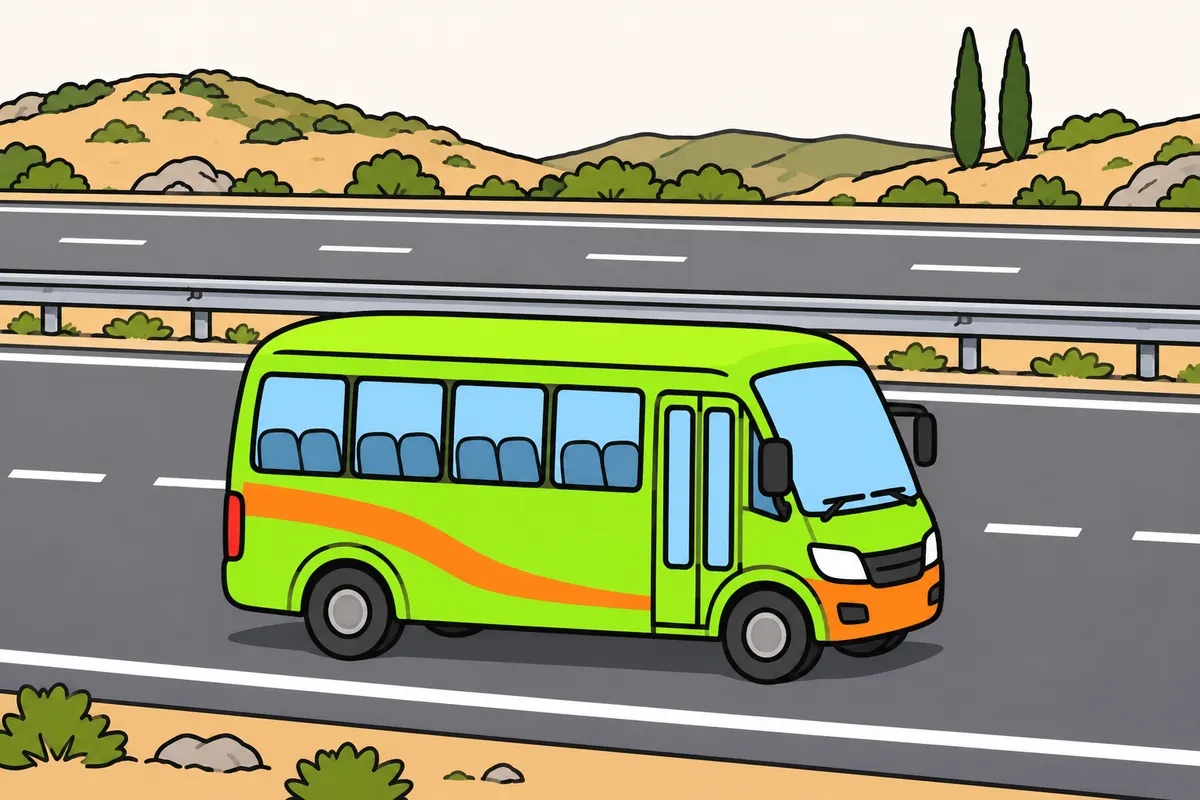
Unless you have a justified reason, obey the minimum speed for your vehicle and road.
| Road, vehicle or general maximum | Minimum without a justified reason |
|---|---|
| Motorways: motor vehicles | 60 km/h |
| Conventional roads: standard minibus | 45 km/h |
| Unpaved roads | 15 km/h |
| Urban road with general maximum of 20 km/h | 10 km/h |
| Urban road with general maximum of 30 km/h | 15 km/h |
| Urban road with general maximum of 50 km/h | 25 km/h |
Remember
- On motorways, the general minimum is 60 km/h.
- Elsewhere, use half the general maximum for your vehicle category on that road.
- Do not calculate the minimum by halving any signed maximum.
- Obey the minimum even when no other vehicles are present.
- Drive below it when you have a justified reason.
Exam trap: Wrong: halve any signed maximum. Right: use your vehicle category’s general maximum on that road; on motorways, the minimum is 60 km/h.
Read the full explanation
- On autopistas and autovías, you must observe the general minimum speed of 60 km/h for motor vehicles, unless there is a justified reason. The prohibition on driving below this speed without justification applies even when there are no other vehicles. [RGC, art. 49](https://www.boe.es/buscar/act.php?id=BOE-A-2003-23514#a49)
- On other roads, the reference minimum is half the generic speed limit of your vehicle category on that road. On a conventional road, for a standard minibus with a generic maximum of 90, the reference minimum is 45 km/h. [RGC, art. 49](https://www.boe.es/buscar/act.php?id=BOE-A-2003-23514#a49)
- On an unpaved road with a generic maximum speed of 30 km/h, half is 15 km/h. On urban roads with generic limits of 20, 30 and 50, the halves are 10, 15 and 25 km/h. You must read these values alongside the reasons that justify driving more slowly. [RGC, art. 49](https://www.boe.es/buscar/act.php?id=BOE-A-2003-23514#a49)
- You must not calculate the minimum by automatically dividing any signposted maximum speed by two. The rule refers to the generic speed limit; a sign limiting a section to 70 does not, by itself, create a minimum of 35 for your minibus. [RGC, art. 49](https://www.boe.es/buscar/act.php?id=BOE-A-2003-23514#a49)
- You must avoid obstructing the normal progress of others by driving at an abnormally low speed without a justified reason. The minimum is not an instruction to keep up the pace when safety requires you to slow down: you must identify whether the situation describes arbitrary slow driving or a real need. [RGC, art. 49](https://www.boe.es/buscar/act.php?id=BOE-A-2003-23514#a49)
10When you may drive below the minimum
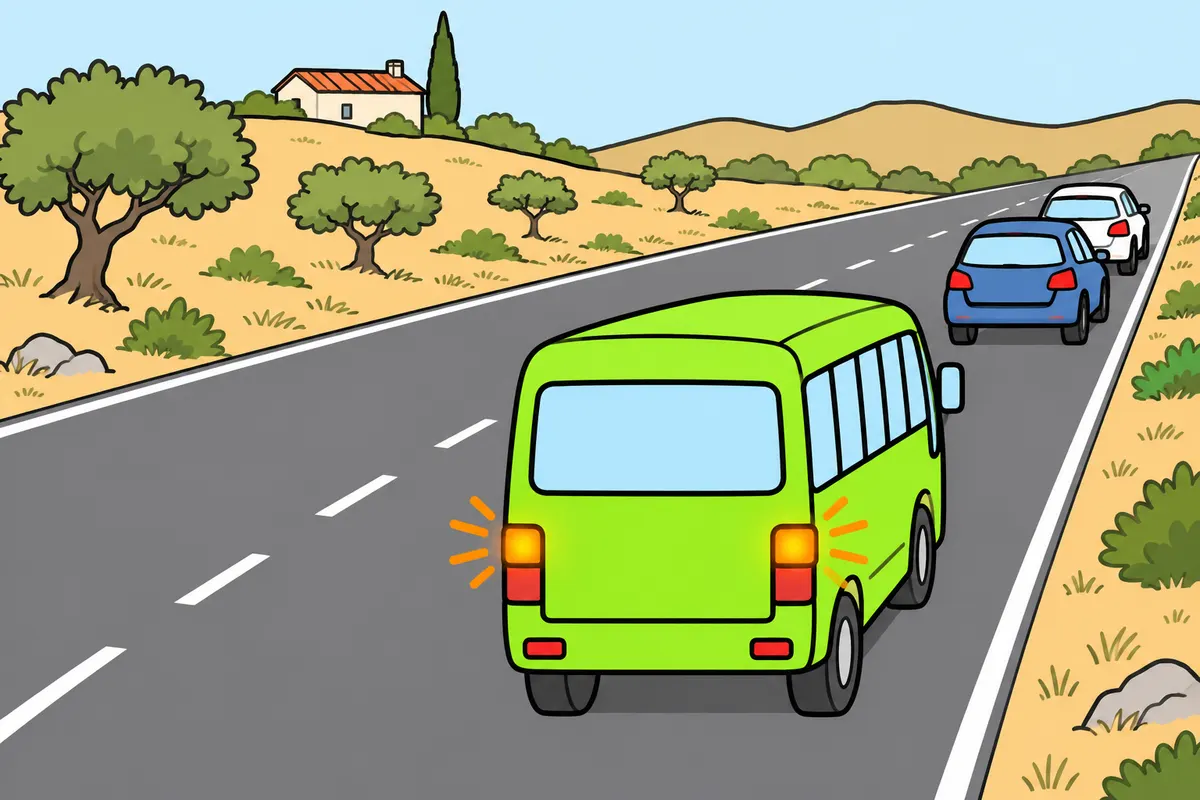
You may drive below the minimum when keeping it would be unsafe.
| Your minibus situation | Where you must drive |
|---|---|
| Maximum authorised mass above 3,500 kg | On the carriageway, except for emergency reasons |
| Maximum authorised mass up to 3,500 kg; emergency, abnormally low speed and serious traffic disruption | On the right-hand hard shoulder, if it is passable and wide enough |
| In that last case, if the hard shoulder is not passable or wide enough | Use only the part of the carriageway that is essential |
Remember
- A queue, breakdown or slippery road may justify this.
- Use hazard lights if you cannot reach the minimum and risk being hit behind.
- Leave the motorway if an emergency forces you to drive abnormally slowly.
- Take the first exit in that situation.
- Carrying an organised group does not make your minibus special transport.
Exam trap: Wrong: driving slowly always means using the hard shoulder. Right: above 3,500 kg maximum authorised mass, use the carriageway, except for emergency reasons.
Read the full explanation
- You may drive below the minimum when traffic, vehicle or road conditions prevent you from maintaining a higher speed safely. A traffic queue, a breakdown or very poor grip may justify this. [RGC, art. 49](https://www.boe.es/buscar/act.php?id=BOE-A-2003-23514#a49)
- There are also exceptions for special vehicles, special transport operations, and protecting or escorting other vehicles. Your bus does not qualify merely because it carries an organised group: you must follow the rule for the situation that actually applies. [RGC, art. 49](https://www.boe.es/buscar/act.php?id=BOE-A-2003-23514#a49)
- If you cannot reach the required minimum speed and there is a risk of a rear-end collision, you must use your hazard warning lights while driving. [RGC, art. 49](https://www.boe.es/buscar/act.php?id=BOE-A-2003-23514#a49)
- If an emergency forces you to drive at an abnormally low speed on an autopista or autovía, you must leave at the first exit. [RGC, art. 38](https://www.boe.es/buscar/act.php?id=BOE-A-2003-23514#a38) [RGC, art. 49](https://www.boe.es/buscar/act.php?id=BOE-A-2003-23514#a49)
- If your minibus exceeds 3,500 kg MMA (maximum authorised mass), you must drive on the carriageway, except in an emergency. If your minibus does not exceed 3,500 kg MMA and you drive at an abnormally low speed because of an emergency, seriously disrupting traffic, you must use the right-hand arcén (hard shoulder) if it is usable and wide enough; otherwise, you must occupy only as much of the carriageway as is essential. [RGC, arts. 30 and 31](https://www.boe.es/buscar/act.php?id=BOE-A-2003-23514#a30) [RGC, art. 36.1](https://www.boe.es/buscar/act.php?id=BOE-A-2003-23514#a36)
11Lanes with special rules
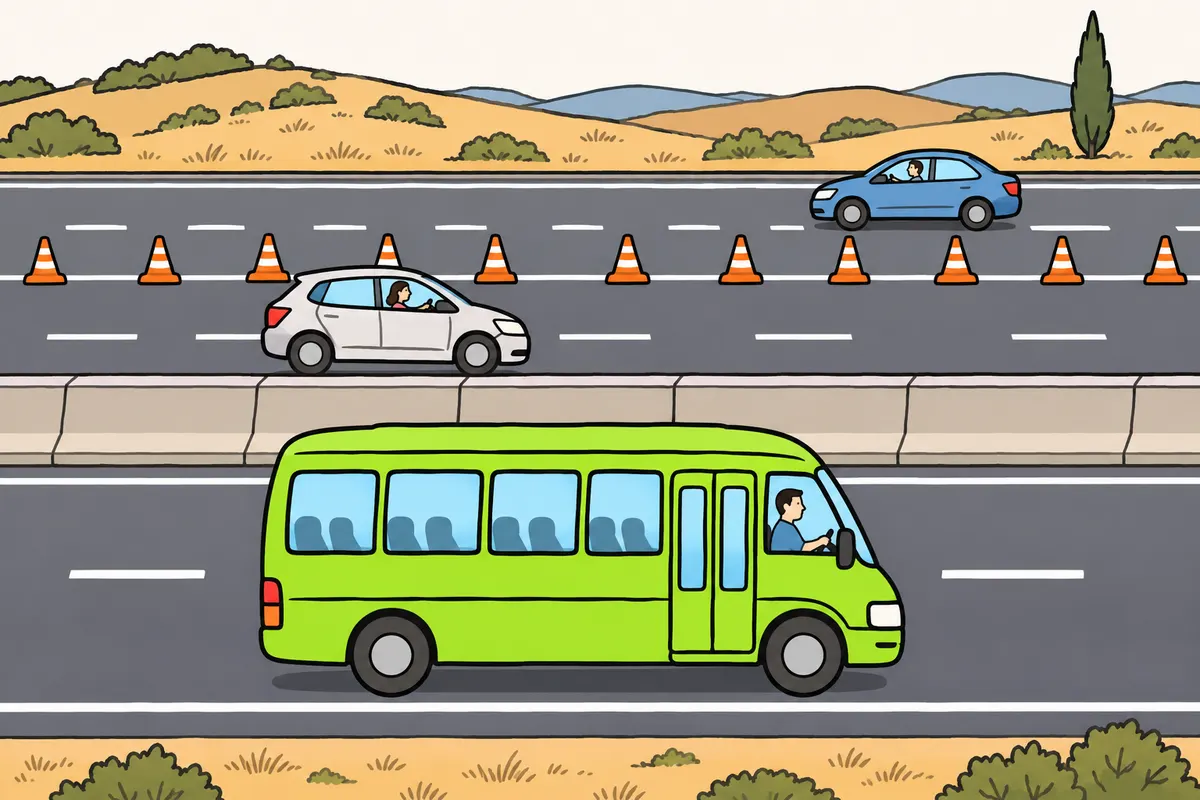
Before entering a special lane, check whether you may use it and its limits.
| Situation for your minibus | Speed or access rule |
|---|---|
| Opposite-direction lane opened to improve traffic flow | Entry prohibited |
| Opposite-direction lane for roadworks, if entry is allowed | 60 to 80 km/h, unless lower limits apply |
| Normal direction alongside it, with only one lane left in your direction | 60 to 80 km/h, unless lower limits apply |
| Normal direction alongside it, with several lanes left | Vehicle and road limits |
| Temporary additional lane or its hard shoulders | 60 to 80 km/h, unless lower limits apply |
| Reversible lane | Vehicle, road and signed limits |
Remember
- Do not enter an opposite-direction lane opened to improve traffic flow with your minibus.
- For roadworks, enter only if your vehicle is authorised and no prohibition applies.
- Obey lower limits that are established or signposted.
- Do not automatically apply these limits to a reversible lane.
Exam trap: Wrong: you may use an opposite-direction lane opened to improve traffic flow. Right: your minibus is prohibited; for roadworks, check authorisation and prohibitions.
Read the full explanation
- You are prohibited from using your minibus in a lane opened to traffic in the opposite direction to normal to improve traffic flow: it is reserved for motorcycles and passenger cars. [RGC, art. 41](https://www.boe.es/buscar/act.php?id=BOE-A-2003-23514#a41)
- If a lane is opened to traffic in the opposite direction to normal because of roadworks, you may use it if your vehicle type is authorised on the road undergoing the works, unless expressly prohibited. If you may enter with your minibus, you must observe a maximum of 80 and a minimum of 60, or lower limits if these are established or specifically signposted. [RGC, art. 41](https://www.boe.es/buscar/act.php?id=BOE-A-2003-23514#a41)
- If you drive in the normal direction alongside the lane opened to traffic in the opposite direction, and only one lane remains for your direction, the range of 60 to 80 km/h also applies, or a lower range if established or signposted. If several lanes remain, you must apply the speeds appropriate to the road and your vehicle. [RGC, art. 41](https://www.boe.es/buscar/act.php?id=BOE-A-2003-23514#a41)
- Where a temporary additional lane is provided, if you drive on the hard shoulders or in the additional lane, you must observe a maximum of 80 and a minimum of 60 km/h, or lower limits if established or signposted. [RGC, art. 42](https://www.boe.es/buscar/act.php?id=BOE-A-2003-23514#a42)
- In a reversible lane, you must not automatically apply the range of 60 to 80 km/h. You must observe the limits for your vehicle and the road, the specific signs and the actual conditions. A reversible lane, a temporary additional lane and a lane opened to traffic in the opposite direction to normal are different situations. [RGC, art. 40](https://www.boe.es/buscar/act.php?id=BOE-A-2003-23514#a40) [RGC, art. 47](https://www.boe.es/buscar/act.php?id=BOE-A-2003-23514#a47)
12Pedestrians, cyclists and stops
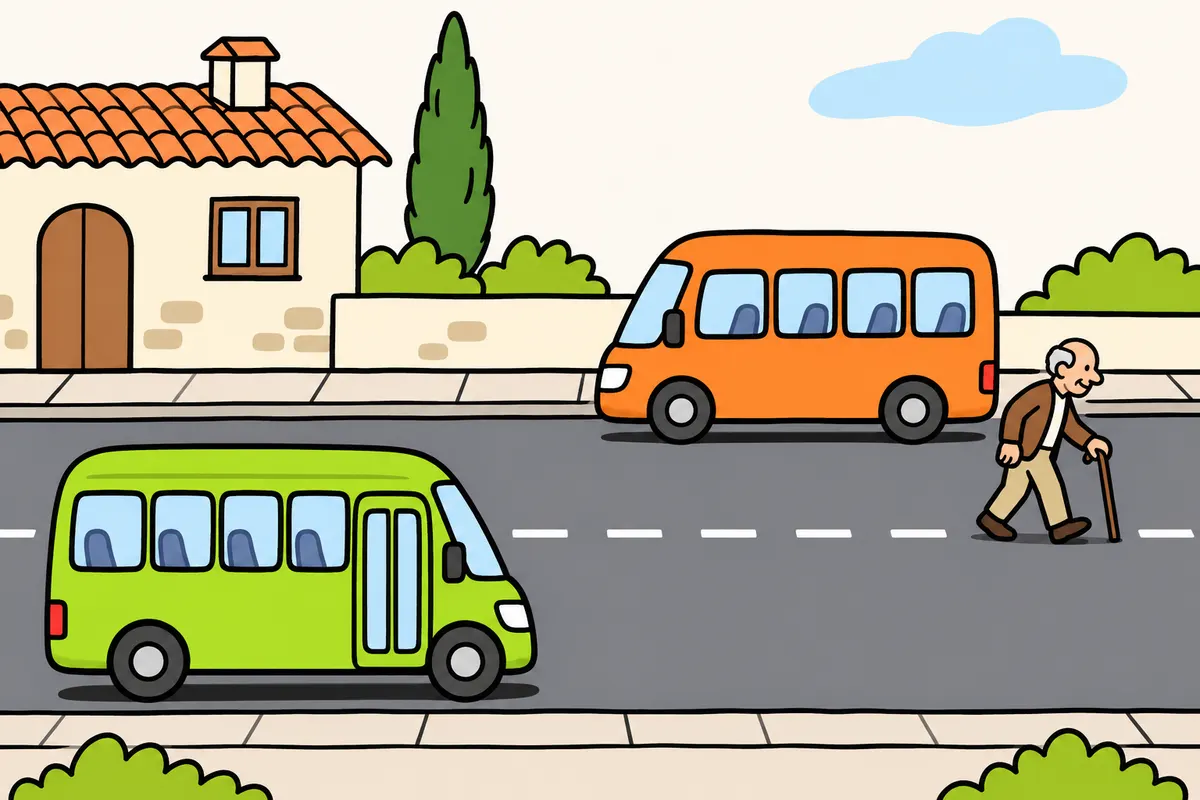
Slow down and prepare to stop where people or animals may appear.
Remember
- Slow down for pedestrians present or likely to enter your path.
- Pay special attention to children, older people and people with difficulties.
- Slow near cyclists, schools, markets and pedestrian crossings without lights or officer control.
- Slow down when approaching a stopped minibus, especially school transport.
- Its size may hide people crossing.
- Do not wait for a numbered speed sign before slowing for these risks.
Exam trap: Wrong: knowing the stop means you can maintain speed. Right: slow down when approaching the stopped minibus and expect someone to cross.
Read the full explanation
- You must slow down and stop if necessary when pedestrians are on the part of the road you are using or you can reasonably foresee them entering it. You must pay particular attention to children, older people, blind people and people with mobility difficulties. [RGC, art. 46](https://www.boe.es/buscar/act.php?id=BOE-A-2003-23514#a46)
- You must slow down as you approach cycles, junctions and the vicinity of roads reserved for cycles, pedestrian crossings without traffic lights or an officer controlling them, markets, educational establishments and places where children are likely to be present. You do not have to wait for a numerical speed limit sign before slowing down. [RGC, art. 46](https://www.boe.es/buscar/act.php?id=BOE-A-2003-23514#a46)
- You must slow down as you approach a stopped minibus, especially one providing school transport. Its size may hide people crossing the carriageway. In your own bus, you must anticipate this risk just like any other driver, even if you know the stop and how it operates. [RGC, art. 46](https://www.boe.es/buscar/act.php?id=BOE-A-2003-23514#a46)
- You must also slow down when animals are present or likely to appear, and on sections where buildings open directly onto the part of the road you are using. Outside built-up areas, you must do so as you approach vehicles immobilised on the carriageway, roadside assistance vehicles in service and cycles on the carriageway or hard shoulder. [RGC, art. 46](https://www.boe.es/buscar/act.php?id=BOE-A-2003-23514#a46)
13Junctions, narrow sections and visibility
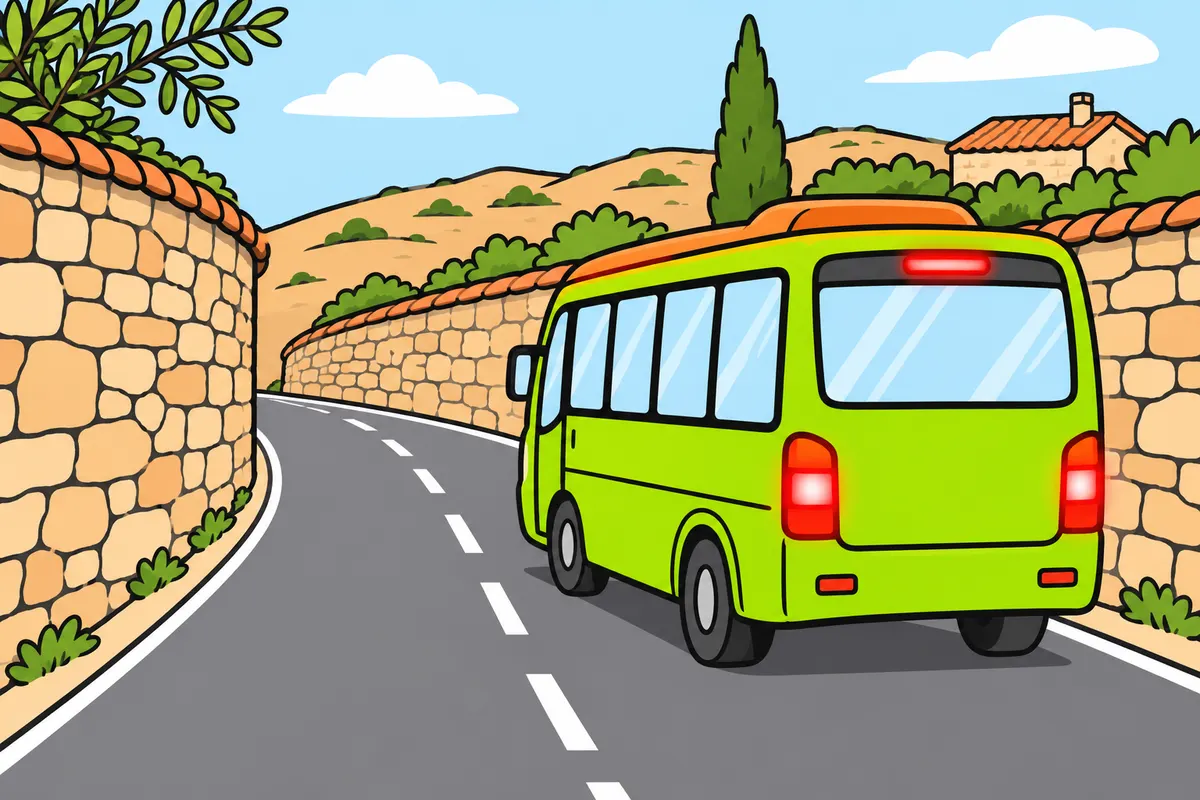
Slow down when you cannot see far or have less space to pass.
Remember
- Slow near narrow sections, roundabouts, level crossings and junctions where you lack priority.
- Stop if necessary.
- Slow for fog, heavy rain, snow, dust, smoke or dazzling light.
- Also adjust your distance from the vehicle ahead.
- Approach movable bridges and level crossings below the maximum speed.
- With an unrepairable lighting fault, you must stop within the area still lit.
Exam trap: Wrong: cross every junction with poor visibility at 50 km/h. Right: that maximum requires a signposted junction and virtually no visibility; obey lower limits and slow further when needed to stop.
Read the full explanation
- You must slow down when approaching roundabouts and junctions where you do not have priority, places with reduced visibility and narrow sections. Article 46.1.h also includes level crossings, whose specific precautions are explained below alongside those for opening bridges. This duty may require you to stop; you do not meet it by keeping to a single fixed speed at all these places. [RGC, art. 46.1.h](https://www.boe.es/buscar/act.php?id=BOE-A-2003-23514#a46)
- At properly signposted junctions where visibility of the road is virtually non-existent, you must not exceed 50 km/h. This is a specific maximum, not a recommendation to drive through at 50: you must observe any lower limit and drive at a speed that allows you to stop. [RGC, art. 46](https://www.boe.es/buscar/act.php?id=BOE-A-2003-23514#a46)
- You must slow down when passing an oncoming vehicle if the road conditions, the circumstances of either vehicle or the weather prevent you from doing so safely. With a minibus on a narrow carriageway, you must assess its size and the available space before reaching the point where you pass each other. [RGC, art. 46](https://www.boe.es/buscar/act.php?id=BOE-A-2003-23514#a46)
- You must slow down if you are dazzled and in dense fog, heavy rain, snowfall or clouds of dust or smoke. In these situations, difficulty seeing may coincide with reduced grip, so you must adjust both your speed and your following distance. [RGC, art. 46](https://www.boe.es/buscar/act.php?id=BOE-A-2003-23514#a46)
- When approaching an opening bridge or a level crossing, you must take extra care and reduce your speed below the maximum permitted. [RGC, art. 95](https://www.boe.es/buscar/act.php?id=BOE-A-2003-23514#a95)
- If a lighting fault that cannot be repaired during the journey forces you to drive with less powerful lights, you must slow down until you can stop within the illuminated area. You determine the appropriate speed from the actual range available, even if the section allows a higher speed. The specific use of lights is covered in the «Minibus lighting and signalling» module. [RGC, art. 107](https://www.boe.es/buscar/act.php?id=BOE-A-2003-23514#a107)
14Speed when passing vulnerable road users
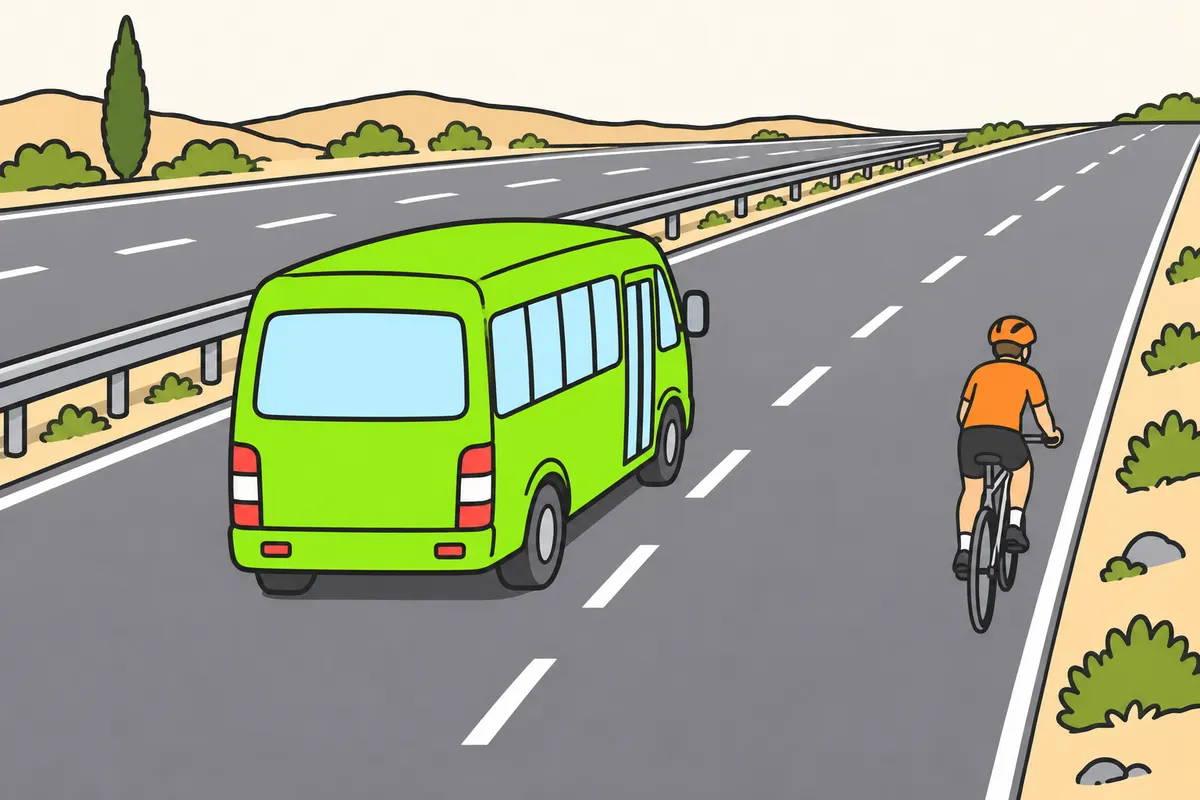
When overtaking vulnerable road users, leave space and slow down as required.
| Situation | What you must do |
|---|---|
| Overtaking pedestrians, animals, animal-drawn vehicles, mopeds, personal mobility vehicles or cyclists | Take extra care; outside built-up areas, drive at least 20 km/h below the limit |
| Clearance when overtaking those users | At least 1.5 m; use the adjacent or opposite lane as required |
| Several lanes in each direction | Change lanes completely |
| Passing an immobilised vehicle occupying your lane for breakdown, accident, emergency, assistance, maintenance or traffic duties | Leave at least 1.5 m, using the opposite lane if needed; drive at least 20 km/h below the limit |
Remember
- Outside built-up areas, slow before overtaking and throughout the manoeuvre.
- Subtract at least 20 km/h from the road limit, not your starting speed.
- Leave at least 1.5 m of sideways clearance.
- With several lanes in each direction, change lanes completely.
- Obey any lower limit and slow further if necessary.
Exam trap: Wrong: the immobilised-vehicle rule applies to every parked vehicle. Right: it must occupy all or part of your lane because of breakdown, accident, emergency, assistance, maintenance or traffic duties.
Read the full explanation
- When overtaking pedestrians, animals, animal-drawn vehicles, mopeds, personal mobility vehicles or cyclists, you must take extra care. Outside built-up areas, you must reduce your speed to at least 20 km/h below the road's speed limit before starting and throughout the manoeuvre. [RGC, art. 85](https://www.boe.es/buscar/act.php?id=BOE-A-2003-23514#a85)
- On a road with a 90 km/h limit, this requirement sets the maximum speed for the manoeuvre at 70 km/h, subject to any lower limits or the need to slow down further for safety. You reduce your speed by twenty relative to the road's speed limit, not relative to the speed at which you were travelling. [RGC, art. 85](https://www.boe.es/buscar/act.php?id=BOE-A-2003-23514#a85)
- You must leave at least 1.5 m of lateral clearance and use part or all of the adjacent lane or the oncoming lane as appropriate. Where there is more than one lane per direction, you must change lanes completely. The manoeuvre is covered in «Minibus manoeuvres». [RGC, art. 85](https://www.boe.es/buscar/act.php?id=BOE-A-2003-23514#a85)
- When passing a vehicle stopped wholly or partly in your lane because of a breakdown, accident, emergency, assistance, maintenance or traffic duties, you must leave at least 1.5 m of lateral clearance, using the opposite lane if needed, and reduce your speed to at least 20 km/h below the road's speed limit. You must not treat this situation as equivalent to passing any parked vehicle. [RGC, art. 88](https://www.boe.es/buscar/act.php?id=BOE-A-2003-23514#a88)
15Slowing down without causing a rear-end collision
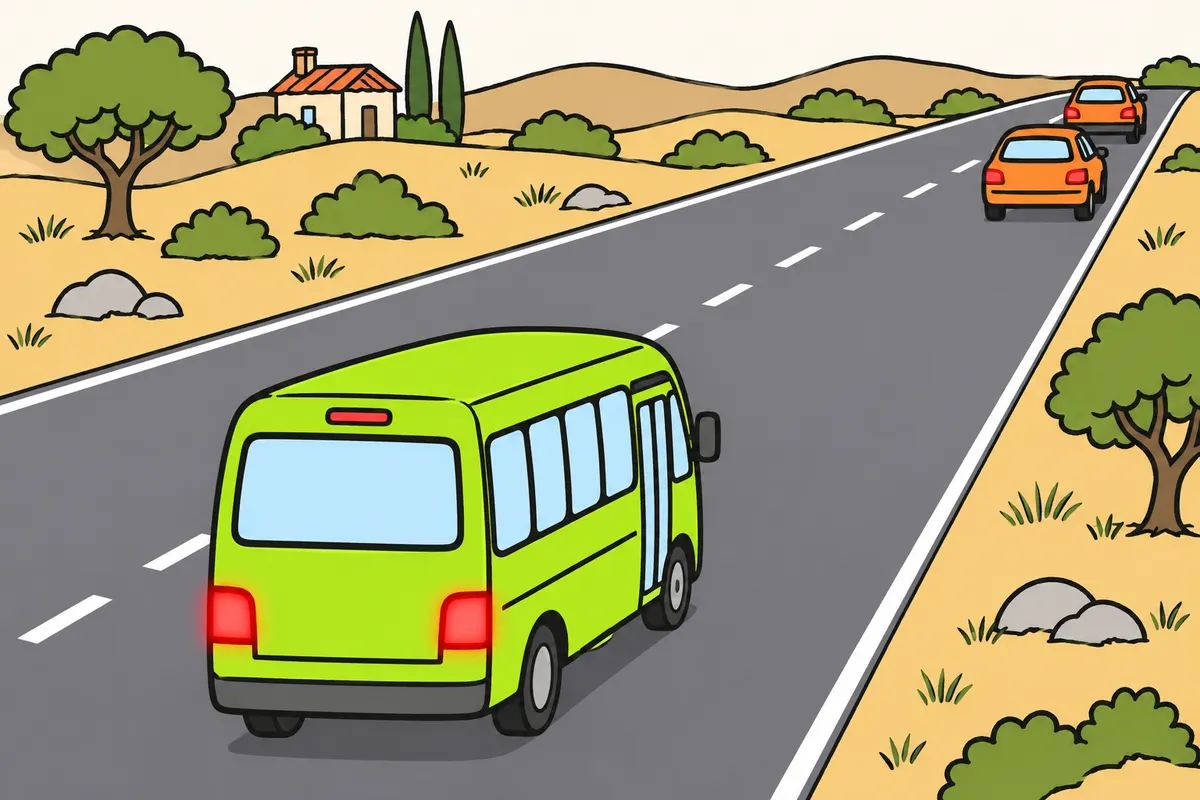
Plan major speed reductions early to avoid being hit from behind.
Remember
- Unless danger is imminent, check you can slow down without endangering others.
- Warn others beforehand and avoid sudden braking.
- Whenever possible, warn with repeated brake lights or the prescribed arm signal.
- If danger is imminent, act to avoid it.
- If you see a queue, slow down early and keep space.
- Protect your passengers when braking too.
Exam trap: Wrong: always warn before braking, even when danger is immediate. Right: with imminent danger, act to avoid it.
Read the full explanation
- Except in imminent danger, before slowing down considerably you must make sure you can do so without putting others at risk, give advance warning and avoid sudden braking that could cause a rear-end collision. You must anticipate approaching a queue, a stop or a slow section. [RGC, art. 53](https://www.boe.es/buscar/act.php?id=BOE-A-2003-23514#a53)
- You must give sufficient advance warning of your intention to bring the minibus to a standstill or brake heavily. Whenever you can, you must give this warning by repeatedly using the brake lights or by giving the prescribed arm signal. [RGC, art. 109](https://www.boe.es/buscar/act.php?id=BOE-A-2003-23514#a109)
- In imminent danger, you must act to avoid it: the exception allows you to respond urgently without waiting to complete an advance warning that is impossible to give. Your preventive driving must aim to keep such situations exceptional, especially when you carry standing passengers. [RGC, art. 53](https://www.boe.es/buscar/act.php?id=BOE-A-2003-23514#a53)
- You must adjust your speed in advance to protect the minibus occupants too. If you notice a traffic queue in good time, slow down progressively and maintain space; waiting until you are right behind the vehicle ahead removes your safety margin and increases the need for heavy braking. [RGC, art. 45](https://www.boe.es/buscar/act.php?id=BOE-A-2003-23514#a45) [RGC, art. 54](https://www.boe.es/buscar/act.php?id=BOE-A-2003-23514#a54)
16Thinking, braking and stopping distances
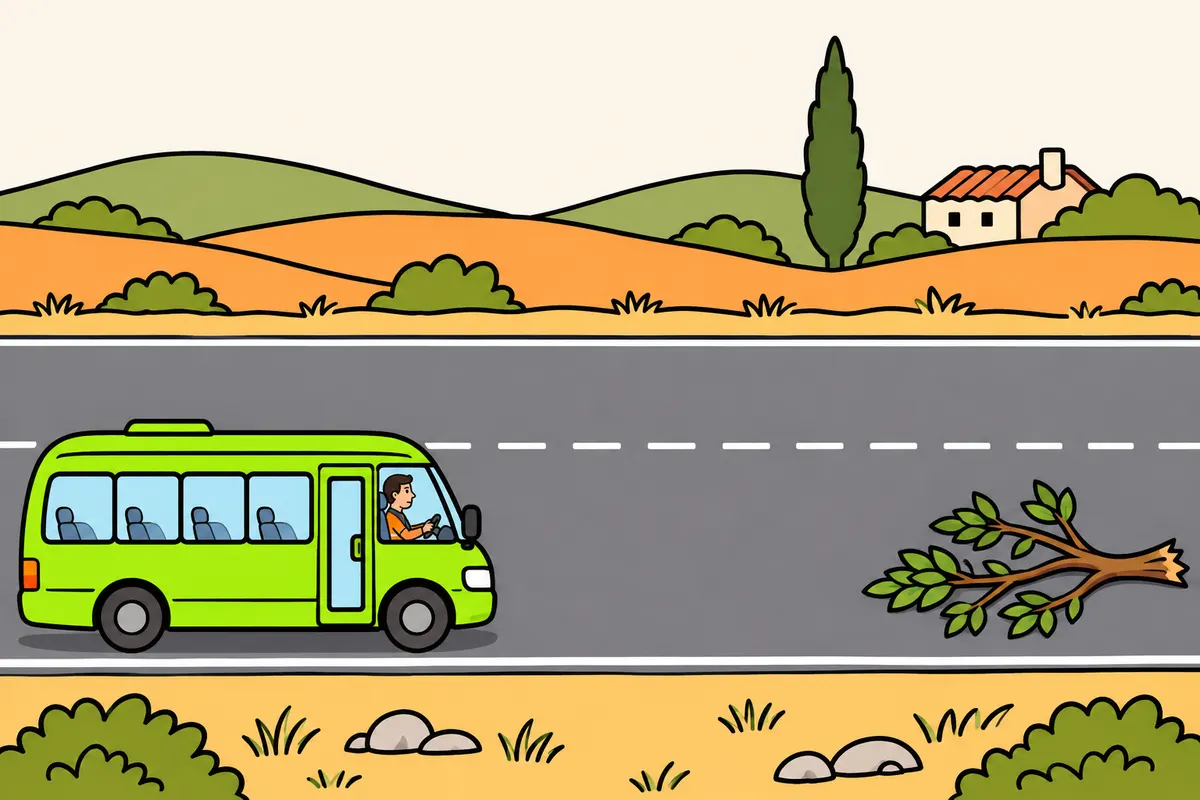
Add thinking distance and braking distance to find the space you need to stop.
| Distance | What you count |
|---|---|
| Thinking | From noticing danger until applying the brake |
| Braking | From applying the brake until stopping |
| Stopping | Thinking distance plus braking distance |
Remember
- While you react, your minibus keeps moving.
- Add both distances when solving an exercise.
- You must be able to stop within the space you can see.
- Do not confuse stopping distance with a universal minimum gap ahead.
Exam trap: Wrong: count only braking metres. Right: add the metres you travel while reacting.
Read the full explanation
- When stopping the minibus, you cover these distances: thinking distance, from when you perceive the danger until you apply the brake; braking distance, from when you apply it until you stop; and stopping distance, which is the sum of both. Your minibus keeps moving during your reaction time. [DGT, Distractions at the wheel, pp. 14-15](https://www.dgt.es/export/sites/web-DGT/.galleries/downloads/conoce_la_dgt/que-hacemos/educacion-vial/adultos/no-formal/Distracciones_al_volante.pdf)
- To calculate a scenario, you must add the two phases. If the question gives you a thinking distance of 20 m and a braking distance of 45 m, your stopping distance is 65 m. This is an arithmetic exercise using hypothetical data, not a table of compulsory distances for every bus.
- You must not equate stopping distance with a universal minimum following distance in metres. The former describes the process of stopping; your distance from the vehicle ahead must allow you to avoid a collision if it brakes suddenly and must also meet any applicable special minimum distances. [RGC, art. 54](https://www.boe.es/buscar/act.php?id=BOE-A-2003-23514#a54)
17Reaction time and thinking distance
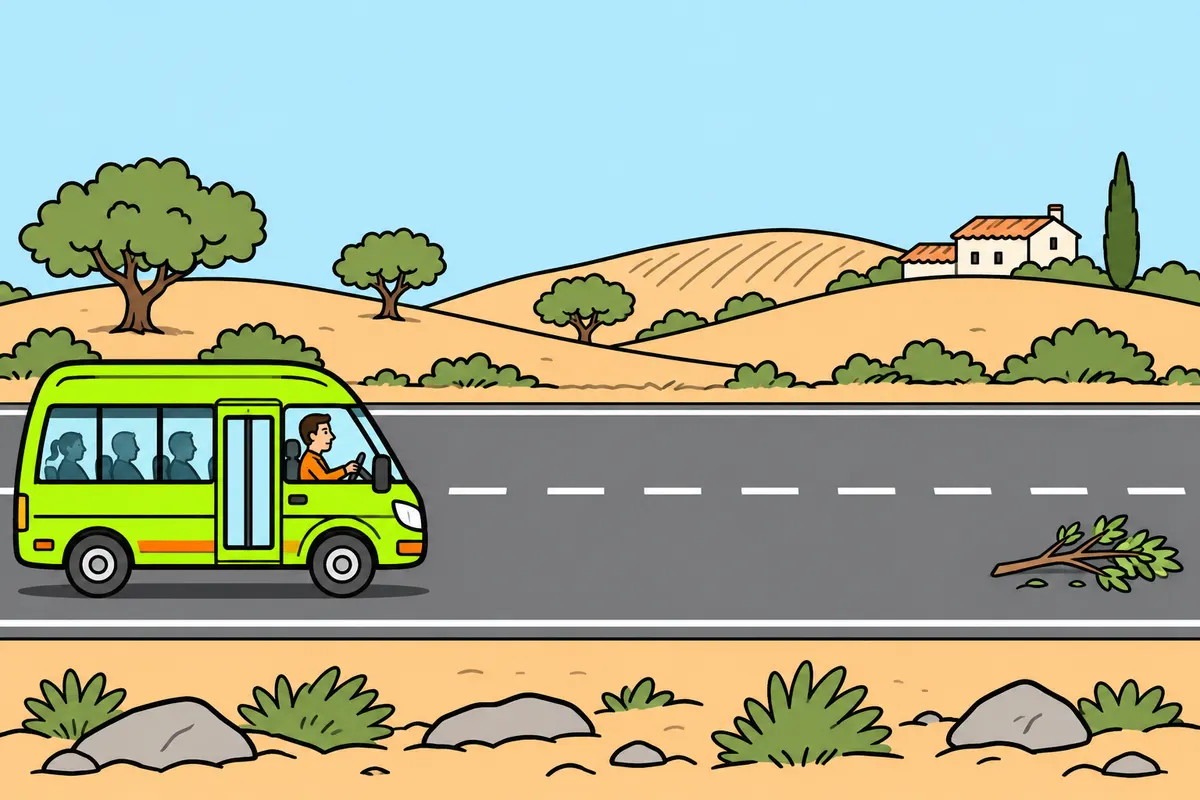
The faster you drive, the further you travel during the same reaction time.
| Exercise at 90 km/h | Distance you travel before braking |
|---|---|
| If you react in one second | 25 m |
| If you react in two seconds | 50 m |
Remember
- Separate reaction time from the metres you travel while reacting.
- Divide km/h by 3.6 to get metres per second.
- Then multiply by the seconds given in the exercise.
- Do not replace the question’s reaction time with a memorised figure.
- Sleepiness, fatigue and distractions can lengthen your reaction time.
Exam trap: Wrong: your reaction always takes 0.75 seconds. Right: this is guidance; use the exercise’s time and adapt your driving to your state.
Read the full explanation
- You must distinguish the time you take to react from the metres you travel during that time. With the same reaction time, you travel further before braking if you increase your speed. Travelling faster does not improve your reflexes. [DGT, Distractions at the wheel, p. 15](https://www.dgt.es/export/sites/web-DGT/.galleries/downloads/conoce_la_dgt/que-hacemos/educacion-vial/adultos/no-formal/Distracciones_al_volante.pdf)
- In exercises, you can convert km/h to m/s by dividing by 3.6, then multiply by the number of seconds given. At 90 km/h you travel 25 m per second; at 80, about 22.2; at 100, about 27.8. These are unit conversions, not legal safety distances.
- If the exercise assumes a reaction time of one second, at 90 km/h you travel 25 m before braking. If it assumes two seconds, you travel 50 m. You must use the time stated in the question to calculate the minibus's thinking distance.
- Your alertness, reflexes, mood and alcohol consumption can affect your reaction. You must take your condition into account when adapting your speed. Training on fatigue, medicines and distractions is covered in «The driver’s condition». [DGT, Distractions at the wheel, p. 15](https://www.dgt.es/export/sites/web-DGT/.galleries/downloads/conoce_la_dgt/que-hacemos/educacion-vial/adultos/no-formal/Distracciones_al_volante.pdf) [RGC, art. 45](https://www.boe.es/buscar/act.php?id=BOE-A-2003-23514#a45)
- As a teaching reference, the DGT considers a reaction time of about 0.75 seconds normal. You must understand this as guidance rather than a fixed duration: fatigue, sleepiness or a distraction can lengthen it, so you must adapt your speed and following distance to your actual condition. [DGT, Distractions at the wheel, p. 15](https://www.dgt.es/export/sites/web-DGT/.galleries/downloads/conoce_la_dgt/que-hacemos/educacion-vial/adultos/no-formal/Distracciones_al_volante.pdf)
18What increases a bus’s braking distance
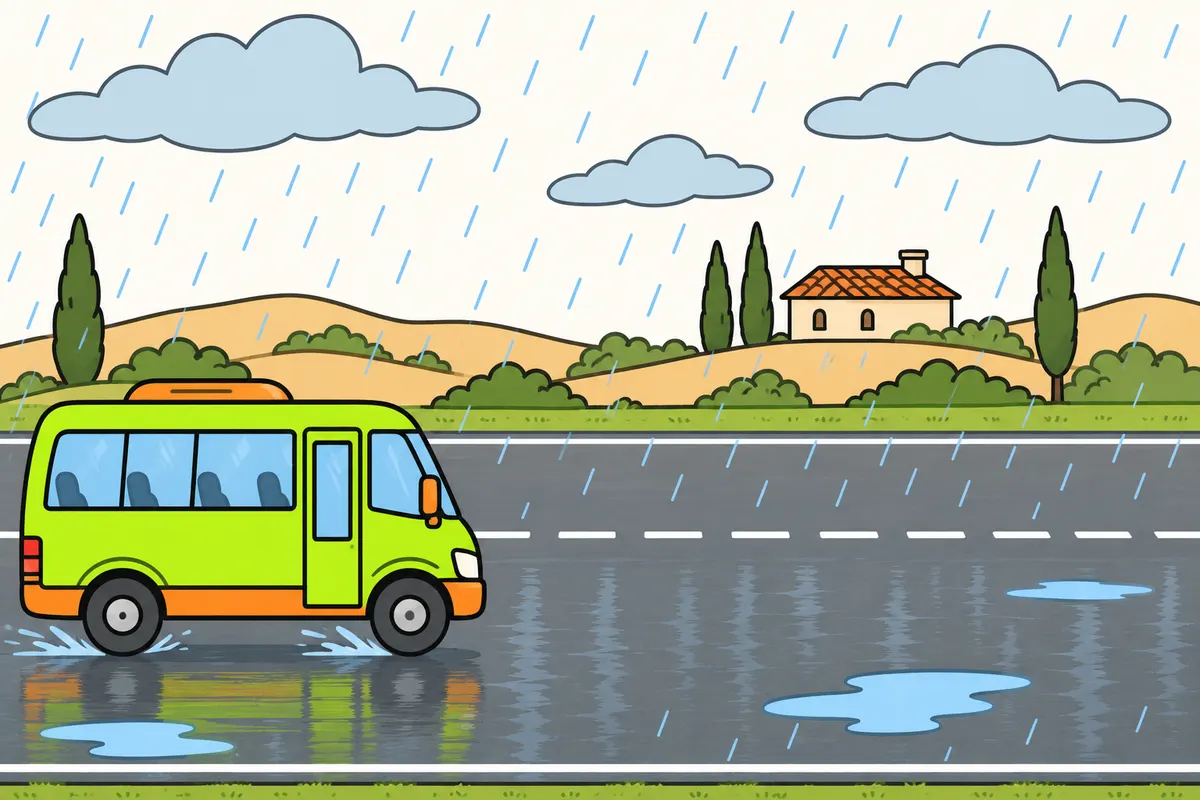
Speed, grip and your minibus condition affect the space you need to brake.
| Change in your speed | Approximate braking space: comparable conditions and the same braking ability |
|---|---|
| You double your speed | You need four times the space |
| You triple your speed | You need nine times the space |
Remember
- Check the condition of brakes, tyres and shock absorbers.
- Consider the load and how you place luggage.
- Do not copy car braking distances without checking.
- If braking needs more space, your total stopping distance increases too.
- Keep a safety margin even if your minibus has electronic aids.
Exam trap: Wrong: doubling speed only doubles braking distance. Right: with comparable conditions and the same braking ability, you need approximately four times the space.
Read the full explanation
- You must assess speed, grip and braking capability to maintain enough space. A bus with brake, tyre or shock absorber problems does not give you the same safety margin as one in good condition. Wheel size does not guarantee a shorter stopping distance. [RGC, art. 54](https://www.boe.es/buscar/act.php?id=BOE-A-2003-23514#a54)
- You must consider the condition and characteristics of the road, the minibus and its load. The mass and positioning of luggage, the brakes and the tyres affect braking; you must not apply an illustrative distance for a car to a laden minibus without checking. [DGT, Risk factors and values, pp. 54-56](https://www.dgt.es/export/sites/web-DGT/.galleries/downloads/conoce_la_dgt/que-hacemos/educacion-vial/jovenes/factores-riesgo/factores-y-valores-de-riesgo.pdf)
- If you need more metres to brake in practice, your total stopping distance also increases, even if you react just as quickly. In an exercise with a fixed thinking distance of 20 m, increasing a hypothetical braking distance from 30 to 50 m raises the total from 50 to 70 m.
- You must maintain a sufficient safety margin even if the minibus has braking or stability aids. Your legal duty to adjust speed and distance does not depend on having a particular electronic system. The operation of brakes and retarders is covered in the «Minibus brakes and retarders» module. [RGC, art. 45](https://www.boe.es/buscar/act.php?id=BOE-A-2003-23514#a45) [RGC, art. 54](https://www.boe.es/buscar/act.php?id=BOE-A-2003-23514#a54)
- Under comparable conditions and with the same deceleration capability, your braking distance increases with the square of your speed: if you double your speed, you need approximately four times the braking distance; if you triple it, nine times. You must distinguish this from thinking distance, which increases proportionally when reaction time stays the same. [DGT, Speed: 20 questions and answers](https://revista.dgt.es/es/reportajes/2015/07JULIO/0706-Velocidad-20-preguntas-y-respuestas.shtml)
19Grip, bends and gradients
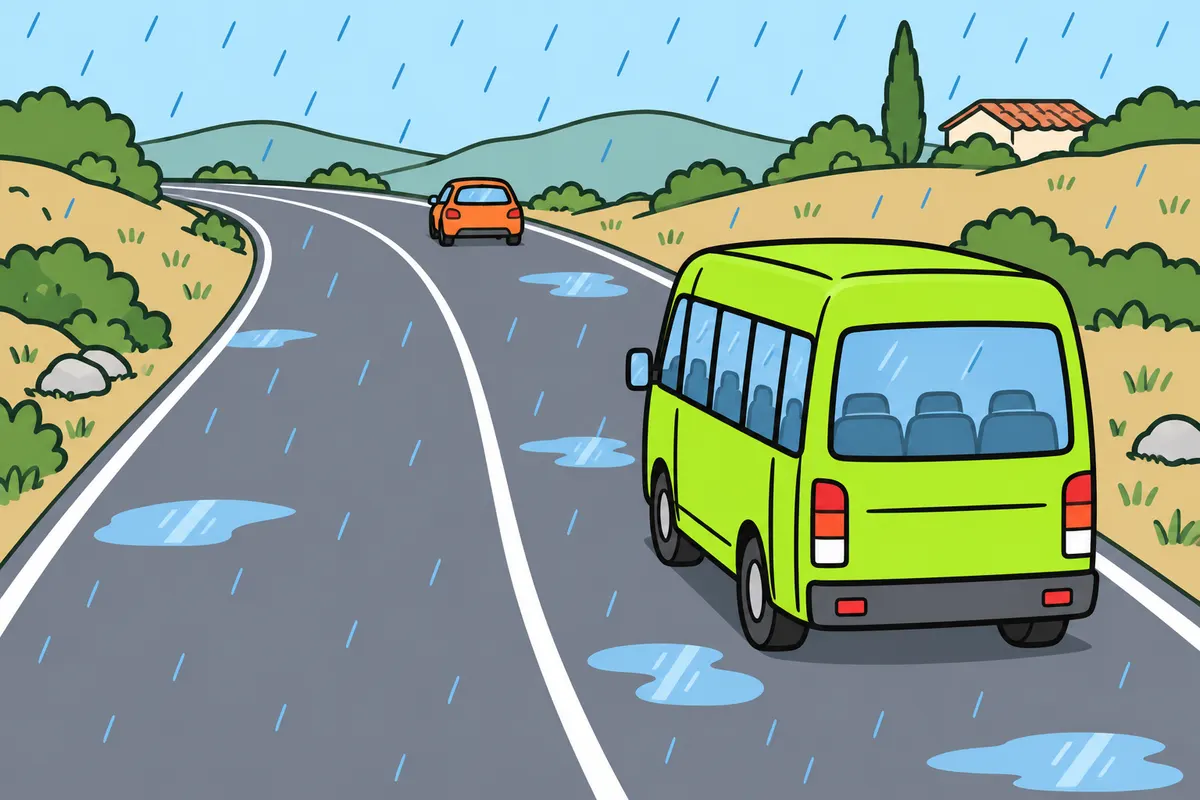
Adjust your speed and following distance when grip, visibility or control worsen.
Remember
- Slow on slippery surfaces or if you may splash water or throw gravel.
- Adjust your speed before bends and descents.
- In rain, snow or ice, assess grip and what you can see.
- In fog or smoke, do not follow the vehicle ahead closely.
- In crosswinds, slow down if you lose control.
- Increase your following distance if the vehicle ahead throws up gravel.
Exam trap: Wrong: every wet road needs the same distance multiplier. Right: keep enough space for the actual grip, visibility and braking conditions.
Read the full explanation
- You must reduce your speed on slippery surfaces. You must also do so if you could splash other road users or spray them with water, gravel or other material. [RGC, art. 46.1.g](https://www.boe.es/buscar/act.php?id=BOE-A-2003-23514#a46)
- In rain, snow or ice, you must assess grip and visibility together. You must not use a single distance multiplier for every situation: the law requires sufficient space for the actual braking conditions, rather than a universal figure for any wet carriageway. [RGC, art. 54](https://www.boe.es/buscar/act.php?id=BOE-A-2003-23514#a54)
- Before a bend or a descent, you must adapt your driving to the characteristics of the road and your minibus so that you can stop for foreseeable obstacles. [RGC, art. 45](https://www.boe.es/buscar/act.php?id=BOE-A-2003-23514#a45)
- In fog or smoke, you must slow down until you regain a safety margin suited to what you can see. Following closely behind the vehicle ahead to follow its lights reduces the space available precisely when you may notice braking late. You must maintain sufficient separation and comply with any applicable special minimum distances. [RGC, art. 45](https://www.boe.es/buscar/act.php?id=BOE-A-2003-23514#a45) [RGC, art. 54](https://www.boe.es/buscar/act.php?id=BOE-A-2003-23514#a54)
- In crosswinds or gusts, you must adapt your speed and maintain sufficient space. You must not seek shelter by following closely behind the vehicle ahead. If your speed prevents you from controlling the minibus or stopping for a visible obstacle, you must slow down until you regain safe conditions. [RGC, art. 45](https://www.boe.es/buscar/act.php?id=BOE-A-2003-23514#a45) [RGC, art. 54](https://www.boe.es/buscar/act.php?id=BOE-A-2003-23514#a54)
- With wet road markings, gravel or uneven surfaces, you must plan to slow down early and avoid sudden demands on tyre grip. If a vehicle ahead throws up gravel, increase your following distance to reduce your exposure to it, as well as maintaining the margin you need for braking. [RGC, art. 45](https://www.boe.es/buscar/act.php?id=BOE-A-2003-23514#a45) [RGC, art. 54](https://www.boe.es/buscar/act.php?id=BOE-A-2003-23514#a54)
20Following distance to avoid collisions
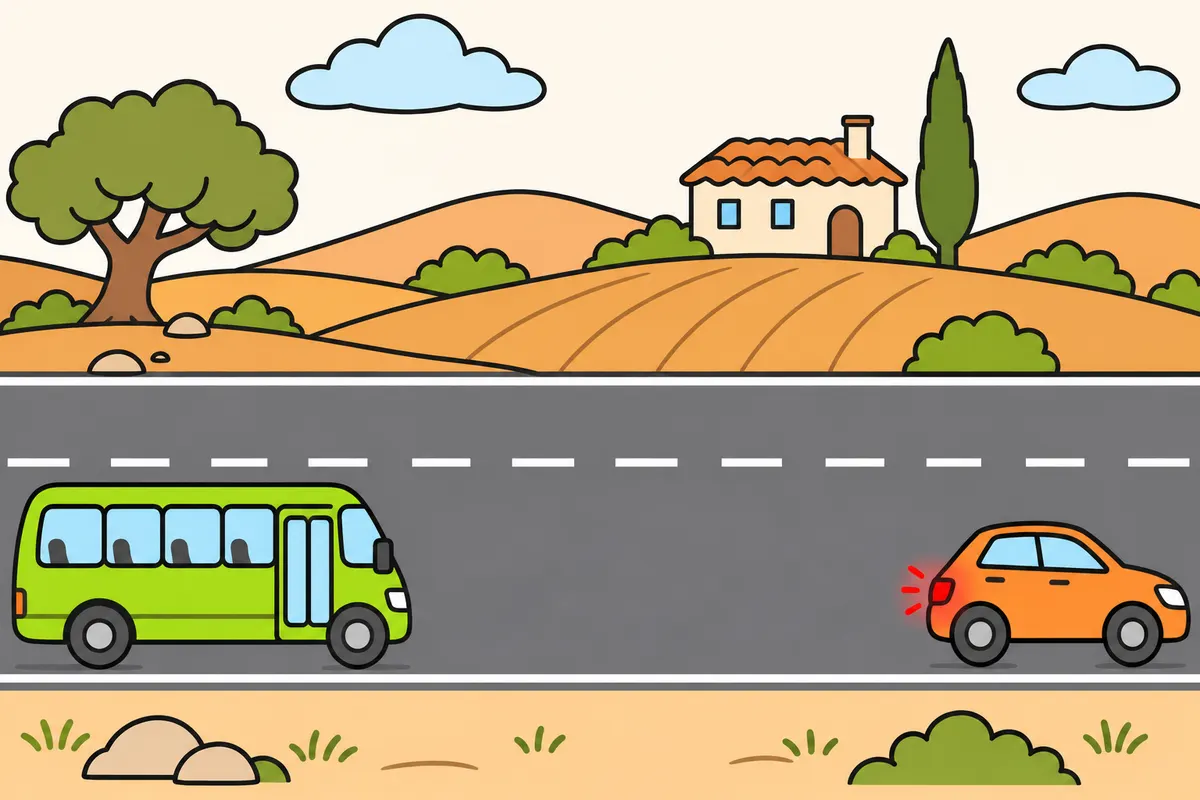
Leave enough space to stop without hitting the vehicle ahead if it brakes suddenly.
Remember
- Keep your following distance in towns and queues too.
- Increase your margin at higher speeds or with poorer grip.
- Do not reduce the gap because you are following another bus.
- If someone enters your gap, restore it by safely adjusting your speed.
- In towns, leave at least five metres behind a cyclist in your lane.
- Increase that minimum if you need more space to avoid a collision.
Exam trap: Wrong: meeting a numerical minimum is always enough. Right: also leave all the space needed to avoid a collision if the vehicle ahead brakes suddenly.
Read the full explanation
- You must leave enough clear space behind another vehicle to stop without colliding if it brakes suddenly. You must take particular account of speed, grip and braking. This obligation applies in towns, on roads and motorways, and in traffic queues; it does not depend on whether you can overtake. [RGC, art. 54](https://www.boe.es/buscar/act.php?id=BOE-A-2003-23514#a54)
- Outside the special cases, there is no single general distance in metres that applies to every bus and circumstance. If your speed increases or grip worsens, you must reassess your margin. Meeting a numerical minimum is not enough if you still cannot avoid a rear-end collision. [RGC, art. 54](https://www.boe.es/buscar/act.php?id=BOE-A-2003-23514#a54)
- You must not reduce your following distance because the vehicle ahead is another bus or because you can see over a car. What matters is being able to respond if it brakes suddenly. Experience on the route does not replace the clear space you need either. [RGC, art. 54](https://www.boe.es/buscar/act.php?id=BOE-A-2003-23514#a54)
- If another vehicle moves into the gap ahead, you must restore sufficient separation by adjusting your driving safely. [RGC, art. 54](https://www.boe.es/buscar/act.php?id=BOE-A-2003-23514#a54)
- On urban roads, you must stay at least five metres behind a cyclist ahead of you in the same lane. You must increase this margin if you need more space to avoid a rear-end collision. [RGC, art. 153.4](https://www.boe.es/buscar/act.php?id=BOE-A-2003-23514#a1-6) [RGC, art. 54](https://www.boe.es/buscar/act.php?id=BOE-A-2003-23514#a54)
21The additional 50-metre rule
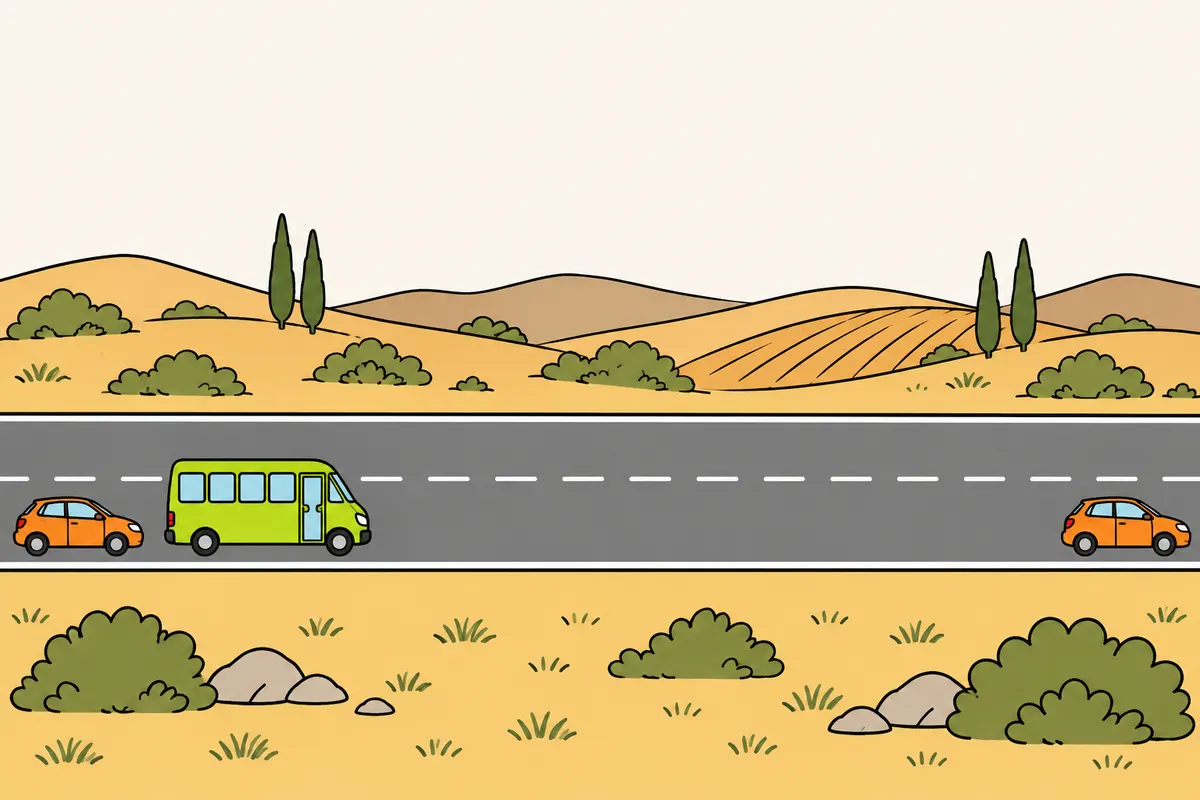
Leave 50 m when the rule applies so others can overtake you safely.
Remember
- Apply this minimum above 3,500 kg maximum authorised mass or 10 m total length.
- Meeting either condition is enough.
- Count the total length of your vehicle or combination.
- Check maximum authorised mass, not what your minibus weighs today.
- The rule concerns following without signalling an intention to overtake.
- Check exceptions; always keep enough space to brake without colliding.
Exam trap: Wrong: your minibus is exempt because it is under 10 m long. Right: above 3,500 kg maximum authorised mass, leave 50 m when following without signalling an intention to overtake, unless an exception applies.
Read the full explanation
- In addition to the space you need to stop without colliding, if you follow another vehicle without signalling an intention to overtake, you must leave a gap that allows a driver behind you to overtake you safely. This second obligation serves a different purpose and has explicit exceptions. [RGC, art. 54](https://www.boe.es/buscar/act.php?id=BOE-A-2003-23514#a54)
- For this purpose, you must leave at least 50 m if your vehicle has an MMA (maximum authorised mass) exceeding 3,500 kg or if the vehicle or combination has a total length exceeding 10 m. Either condition is sufficient: your D1 minibus may be subject to this obligation because of its MMA even though the maximum length permitted by the licence is eight metres. [RGC, art. 54](https://www.boe.es/buscar/act.php?id=BOE-A-2003-23514#a54) [RGCond, art. 4](https://www.boe.es/buscar/act.php?id=BOE-A-2009-9481#a4)
- You must check the MMA, rather than the weight you are carrying that day. A bus with an MMA exceeding 3,500 kg retains that MMA when travelling empty. The thresholds are above 3,500 kg and more than 10 m: being exactly at a threshold does not, by itself, meet that criterion. [RGC, art. 54](https://www.boe.es/buscar/act.php?id=BOE-A-2003-23514#a54)
- If you drive an eight-metre minibus with an MMA of 5,000 kg outside a built-up area, with one lane in each direction, overtaking permitted and traffic that is not congested, you must leave at least 50 m if you do not signal an intention to overtake. With a minibus whose MMA is 3,500 kg or less and whose length does not exceed 10 m, these criteria do not trigger that minimum, but you must leave enough space for others to overtake you when required. [RGC, art. 54](https://www.boe.es/buscar/act.php?id=BOE-A-2003-23514#a54)
22Exceptions to the overtaking gap
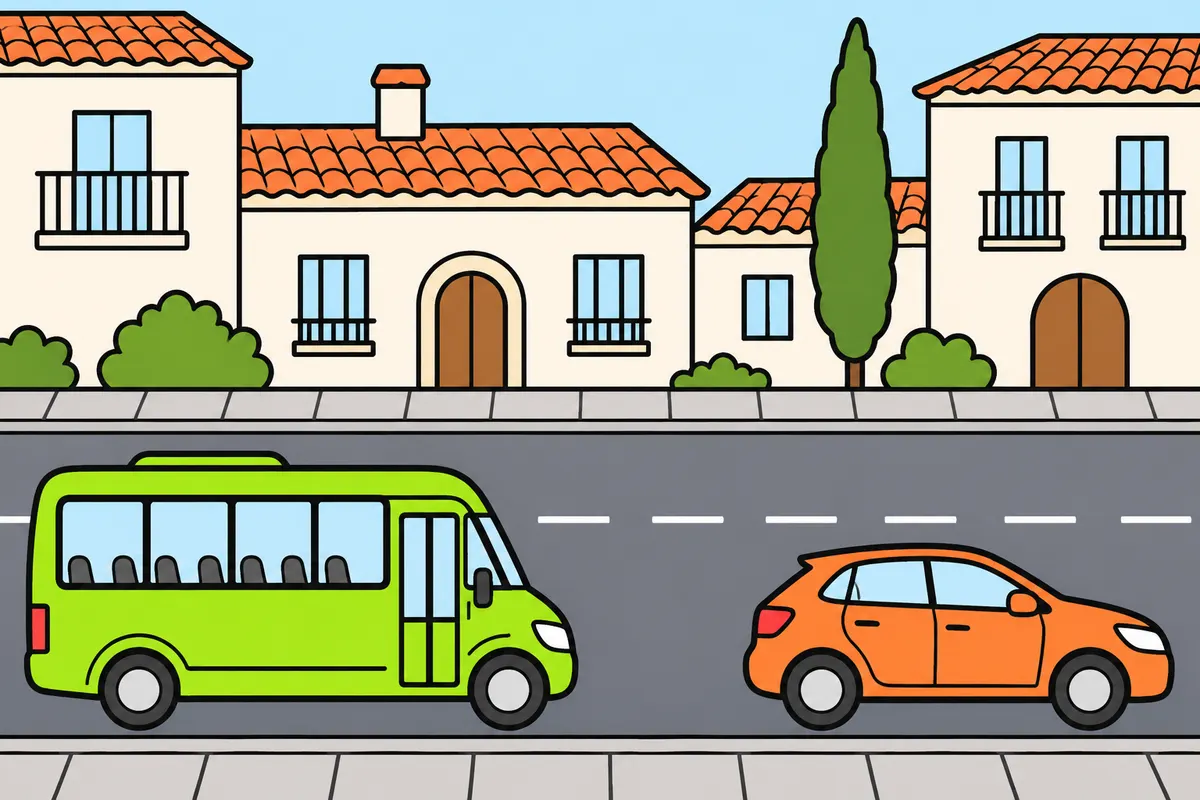
Exceptions to the overtaking gap do not remove your distance for avoiding collisions.
| Situation | Must you leave the additional gap so others can overtake? |
|---|---|
| You are within a built-up area | No |
| Overtaking is prohibited | No |
| There is more than one lane in your direction | No |
| Traffic is so congested that overtaking is impossible | No |
Remember
- Always keep enough space to brake without colliding.
- Keep this basic gap even when signalling an intention to overtake.
- Specific distances may apply in tunnels.
Exam trap: Wrong: where overtaking is prohibited, you can follow closely. Right: keep enough space to brake without colliding and obey any specific tunnel minimum.
Read the full explanation
- The additional gap intended to facilitate overtaking is not required in built-up areas. On a stretch of road through a town or on a street, you must maintain the space you need to brake without colliding, but you do not automatically apply the 50 m because of the minibus’s length or MMA. [RGC, art. 54](https://www.boe.es/buscar/act.php?id=BOE-A-2003-23514#a54)
- It is not required where overtaking is prohibited either. This exception concerns the purpose of allowing another driver to complete an overtaking manoeuvre; it does not remove the basic following distance needed to avoid a rear-end collision or any specific distance that may be required in a tunnel. [RGC, art. 54](https://www.boe.es/buscar/act.php?id=BOE-A-2003-23514#a54)
- It is not required when there is more than one lane in your direction or when traffic is so congested that overtaking is impossible. Driving your minibus on a motorway with two lanes in each direction does not, in itself, impose a general minimum gap of 50 m. [RGC, art. 54](https://www.boe.es/buscar/act.php?id=BOE-A-2003-23514#a54)
- Even if you signal your intention to overtake, you must maintain the separation you need to stop without colliding with the vehicle ahead. [RGC, art. 54](https://www.boe.es/buscar/act.php?id=BOE-A-2003-23514#a54)
23Tunnels and underpasses: distance according to MMA
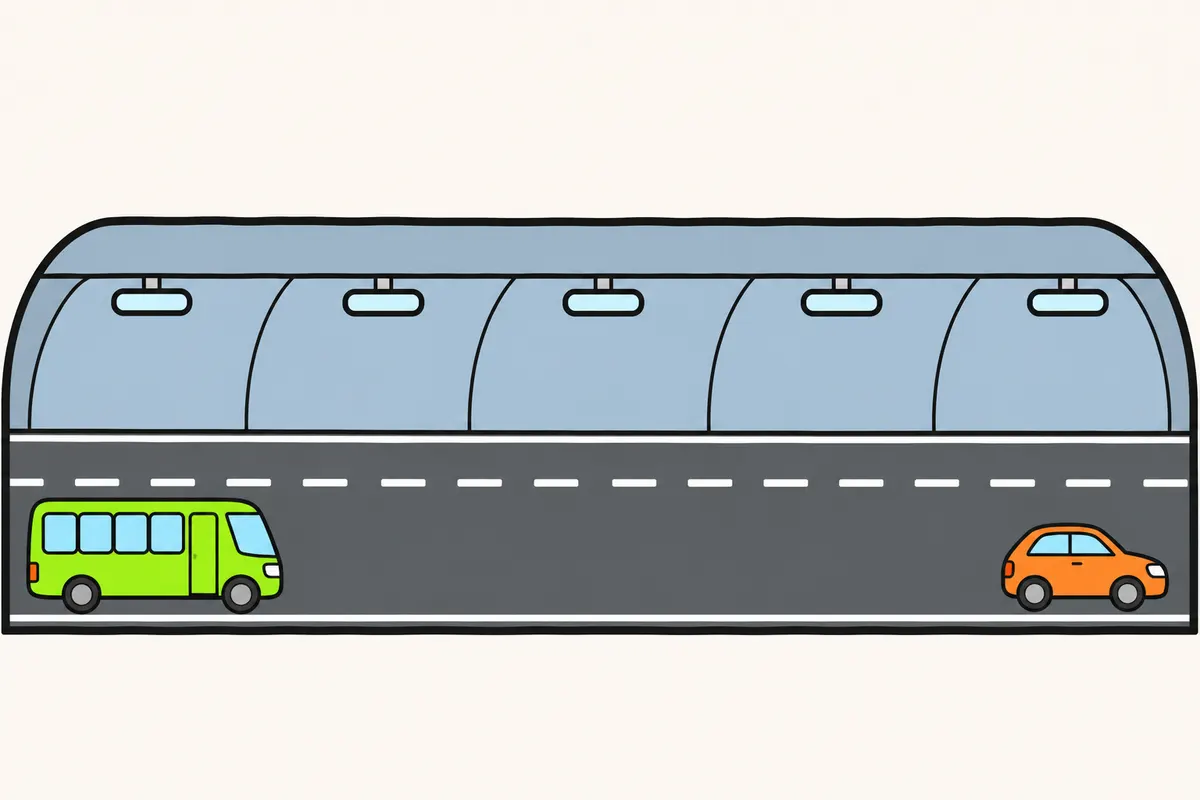
In tunnels and underpasses, choose your distance according to your vehicle’s maximum authorised mass.
| Your maximum authorised mass: no intention to overtake | Minimum in a tunnel or underpass |
|---|---|
| Up to and including 3,500 kg | 100 m or four seconds |
| Above 3,500 kg | 150 m or six seconds |
Remember
- Apply these minimums when you do not intend to overtake.
- Choose metres or seconds; do not add both alternatives.
- Check maximum authorised mass even when driving empty.
- Several lanes in your direction do not remove these minimums.
- Keep more space if grip or braking requires it.
Exam trap: Wrong: exactly 3,500 kg triggers the higher minimum. Right: use 100 m or four seconds; the higher minimum requires exceeding that maximum authorised mass.
Read the full explanation
- In tunnels and underpasses, when you do not intend to overtake, the general rule is to stay at least 100 m or four seconds behind the vehicle ahead. If your vehicle has an MMA exceeding 3,500 kg, you must maintain at least 150 m or six seconds. [RGC, art. 95](https://www.boe.es/buscar/act.php?id=BOE-A-2003-23514#a95)
- With a minibus whose MMA is 5,000 kg, you must choose 150 m or six seconds. With one whose MMA is 3,500 kg, the general minimum of 100 m or four seconds applies. The D1 licence does not specify a single MMA: you must read the vehicle’s figure before answering the question. [RGC, art. 95](https://www.boe.es/buscar/act.php?id=BOE-A-2003-23514#a95) [RGCond, art. 4](https://www.boe.es/buscar/act.php?id=BOE-A-2009-9481#a4)
- The threshold depends on the MMA, rather than whether you are carrying passengers or on your length. In an underpass, your minibus with an MMA exceeding 3,500 kg is subject to the 150 m or six-second rule even if it is less than eight metres long; travelling empty does not allow you to choose the general minimum. [RGC, art. 95](https://www.boe.es/buscar/act.php?id=BOE-A-2003-23514#a95)
- The rule specifies a distance in metres or a time gap. You must not add the two together or claim that six seconds always equals 150 m: the equivalence depends on speed. You must also maintain whatever additional margin grip and braking require. [RGC, art. 54](https://www.boe.es/buscar/act.php?id=BOE-A-2003-23514#a54) [RGC, art. 95](https://www.boe.es/buscar/act.php?id=BOE-A-2003-23514#a95)
- Having several lanes in your direction does not, by itself, remove these tunnel minimums. The exceptions in article 54 for facilitating overtaking do not replace the specific rules in article 95. You must always check whether the question places the minibus in a tunnel or underpass. [RGC, art. 95](https://www.boe.es/buscar/act.php?id=BOE-A-2003-23514#a95)
24Checking the time gap and entering the tunnel
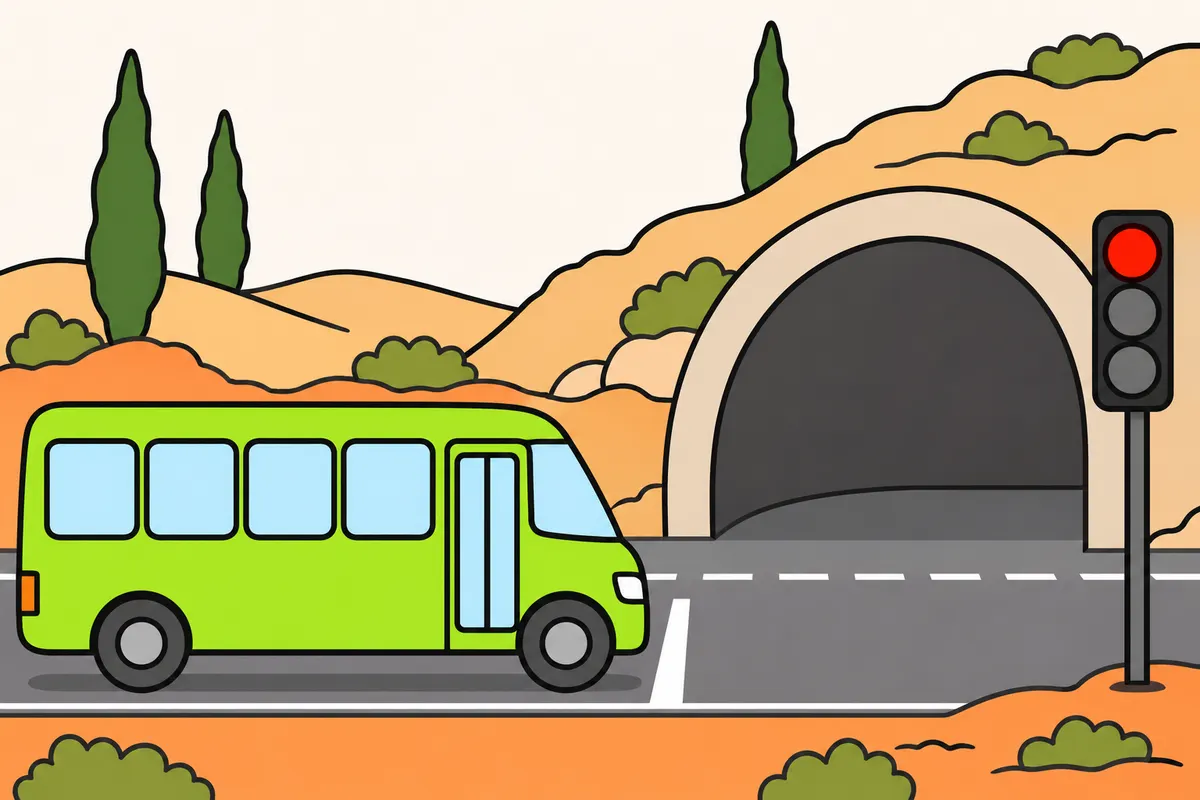
Count from a fixed point and obey signs before entering the tunnel.
| Your minibus speed | Distance you travel in six seconds |
|---|---|
| 90 km/h | 150 m |
| 60 km/h | 100 m |
Remember
- Choose a fixed point beside the road.
- Start when the rear of the vehicle ahead passes it.
- Stop when the front of your minibus reaches it.
- Do not enter if the traffic light prohibits you from proceeding.
- Obey signs, traffic lights and the instructions you receive.
- Adjust your speed to signs, your vehicle and conditions.
Exam trap: Wrong: six seconds always equals 150 m. Right: distance travelled depends on your speed; apply the legal alternative and keep enough space.
Read the full explanation
- To check the time gap, choose a fixed reference point: start counting when the rear of the vehicle ahead passes it and stop when the front of your minibus reaches it. Compare the result with the minimum time gap for your vehicle’s MMA, explained in the previous section. [RGC, art. 95.6](https://www.boe.es/buscar/act.php?id=BOE-A-2003-23514#a95)
- As an exercise, at 90 km/h you travel 25 m per second and six seconds represents 150 m. At 60 km/h, six seconds represents 100 m. These conversions explain why you must not automatically equate metres and seconds; you must apply the alternative specified by the regulations and maintain a sufficient margin. [RGC, art. 95](https://www.boe.es/buscar/act.php?id=BOE-A-2003-23514#a95) [RGC, art. 54](https://www.boe.es/buscar/act.php?id=BOE-A-2003-23514#a54)
- You must obey traffic lights, variable message signs and instructions given over public address systems or by other means. A tunnel does not have a single maximum speed simply because it is a tunnel: you must take account of signs, vehicle category and traffic conditions together. [RGC, art. 95](https://www.boe.es/buscar/act.php?id=BOE-A-2003-23514#a95) [RGC, art. 47](https://www.boe.es/buscar/act.php?id=BOE-A-2003-23514#a47)
- You must not enter if the traffic light at the entrance prohibits you from proceeding. For your speed inside, maintain enough stopping distance and the applicable specific minimum; do not move closer to the vehicle ahead to take advantage of the light changing. [RGC, art. 96](https://www.boe.es/buscar/act.php?id=BOE-A-2003-23514#a96) [RGC, art. 95](https://www.boe.es/buscar/act.php?id=BOE-A-2003-23514#a95)
25Traffic queues inside tunnels
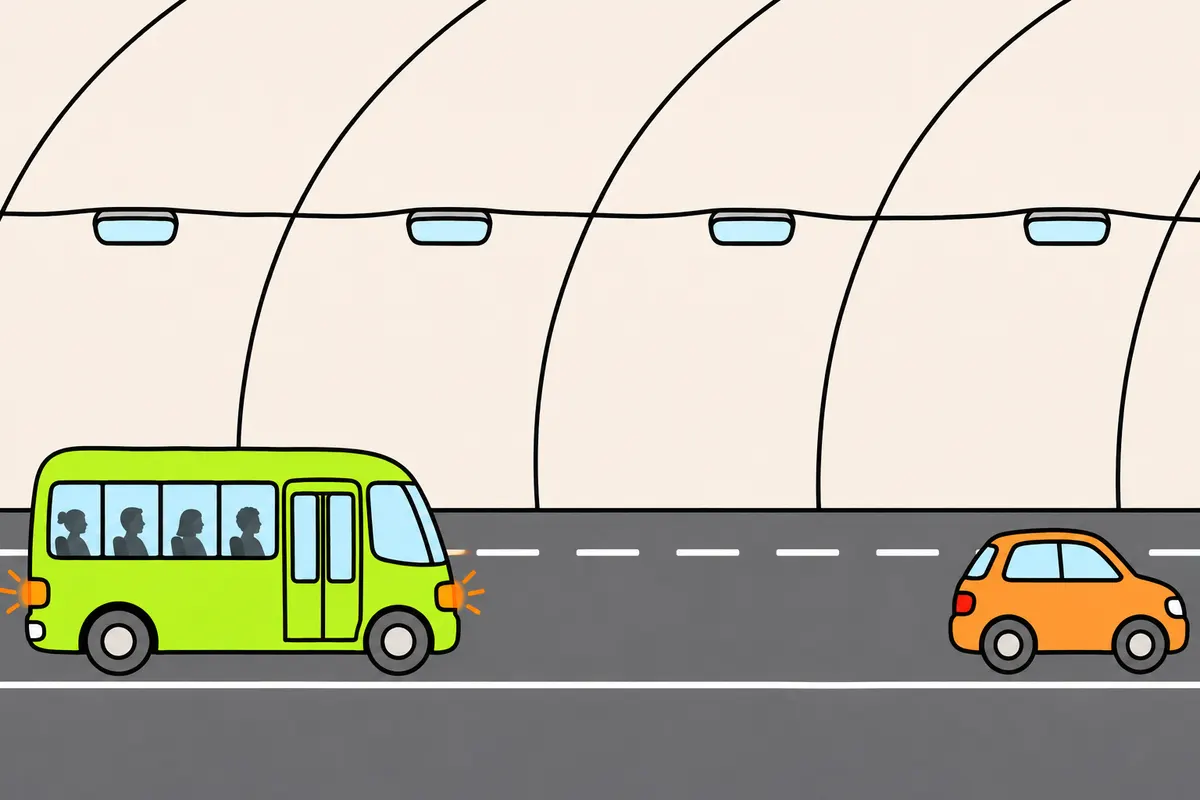
If a queue stops you in a tunnel, leave space and switch off the engine.
Remember
- Stop as far as possible from the vehicle ahead.
- Temporarily switch on hazard lights to warn drivers approaching from behind.
- Keep position lights on and switch off the engine.
- You and your passengers must stay inside during the traffic queue.
- A traffic queue is different from an emergency requiring evacuation.
Exam trap: Wrong: every tunnel queue requires evacuation. Right: when traffic stops you, stay inside with your passengers; an emergency requiring evacuation is a different situation.
Read the full explanation
- If traffic conditions bring you to a standstill in a tunnel or underpass, you must stop as far as possible from the vehicle ahead. [RGC, art. 97](https://www.boe.es/buscar/act.php?id=BOE-A-2003-23514#a97)
- While held up in this queue, you must temporarily switch on your hazard warning lights to warn drivers approaching from behind, keep the position lights on and switch off the engine. You must remain on board in a traffic queue; in an emergency, you may need to evacuate. [RGC, art. 97](https://www.boe.es/buscar/act.php?id=BOE-A-2003-23514#a97)
- You learn about breakdowns, fires, evacuation and passenger protection in tunnels in «Passenger safety and emergencies» and «Accidents and assistance». For this topic, you must remember the difference between keeping your distance while moving, stopping because of traffic and your obligation to adapt your speed before reaching a queue. [RGC, art. 45](https://www.boe.es/buscar/act.php?id=BOE-A-2003-23514#a45) [RGC, art. 95](https://www.boe.es/buscar/act.php?id=BOE-A-2003-23514#a95) [RGC, art. 97](https://www.boe.es/buscar/act.php?id=BOE-A-2003-23514#a97)
Choosing your minibus speed
Work through the situation by combining the road type, service and actual conditions.
- Identify whether you are driving outside a built-up area, on a street, on the stretch of road through a town or on a motorway within a built-up area.
- Find the maximum speed for your minibus and check school transport, standing passengers, seat belts and specific restrictions.
- Check the minimum speed and whether there is a justified reason to drive below it.
- Assess visibility, grip, traffic, load and your own condition; slow down until you can stop within the distance you can see.
Calculating stopping distance
Separate thinking distance from braking distance and add them together.
- Read the speed, reaction time and braking distance given in the exercise.
- If you need metres per second, divide the km/h by 3.6.
- Multiply the metres per second by the reaction time given.
- Add the thinking and braking distances; compare the total with the space available.
Deciding your following distance
Check each obligation without confusing its purpose.
- Always leave enough space to stop without colliding if the vehicle ahead brakes sharply.
- Outside the tunnel rules, check whether you must also leave a gap for others to overtake you.
- If your MMA (maximum authorised mass) exceeds 3,500 kg or your length exceeds 10 m, apply the 50 m rule where required; check built-up areas, overtaking prohibitions, lanes and traffic congestion.
- In a tunnel or underpass, when you do not intend to overtake, leave 150 m or six seconds if your MMA exceeds 3,500 kg; otherwise, leave 100 m or four seconds.
- Increase the gap if conditions require more space.
Approaching a traffic queue in a tunnel
Adjust your speed and keep as much space as possible.
- Look ahead for signs and the queue, and slow down smoothly where possible.
- Maintain the applicable tunnel minimum distance while driving without intending to overtake.
- When you stop because of traffic, stay as far as possible from the vehicle ahead.
- Temporarily warn others with your hazard warning lights, keep the position lights on, switch off the engine and remain in the vehicle with your passengers.
Finished this module?
Mark it as read and you will see your progress on the theory list.