
Theory · A1 Licence - 125 cc Motorcycle · Module 1 of 18
Essential definitions for riding a motorcycle
You learn to identify the parts and types of road, vehicle categories and the three limits a motorcycle must meet for you to ride it with an A1 licence. You interpret masses and people’s roles, and distinguish compulsory stops, brief stops, parking, junctions and overtaking so you can answer exam questions.
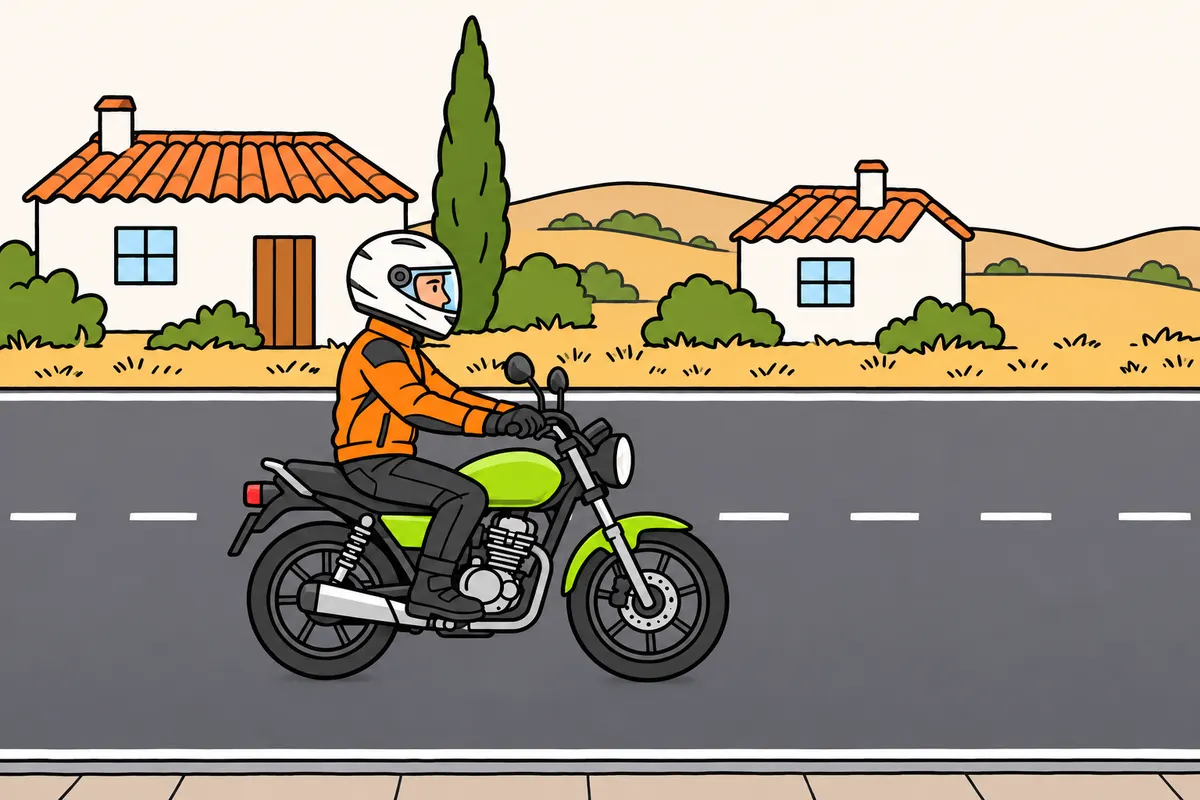
1Roads and the scope of the definitions
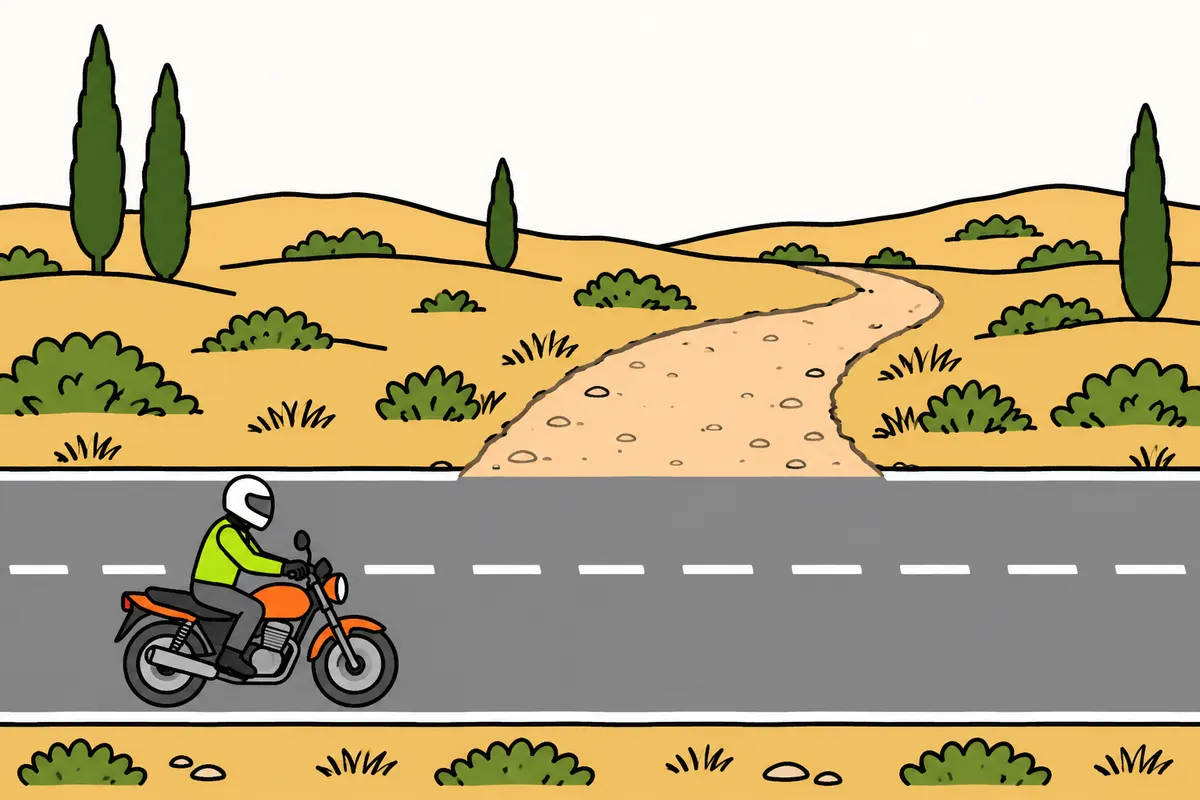
Recognise each road by its features and location.
| Public road | How you recognise it |
|---|---|
| Carretera | Surfaced, outside built-up areas, except its travesías |
| Interurban road | Outside a built-up area; may be unsurfaced |
| Urban road | Within a built-up area, excluding travesías |
Remember
- Distinguish the carriageway, lanes, hard shoulder and pavement.
- A wide unsurfaced track is not a carretera.
- On private land used by undefined users, traffic law applies unless other rules exist.
Exam trap: Wrong: every interurban road is surfaced. Right: it may be unsurfaced.
Read the full explanation
- A road is the space where traffic takes place. You can identify parts of it with specific functions, such as the carriageway, lane, arcén (hard shoulder) and pavement. [Traffic Act, Annex I](https://www.boe.es/buscar/act.php?id=BOE-A-2015-11722#ani)
- A carretera (road) is a paved public road outside a built-up area, except for its sections that form a travesía (through road in a built-up area). An unpaved track does not become a carretera just because it is wide or allows your motorcycle to pass. [Traffic Act, Annex I](https://www.boe.es/buscar/act.php?id=BOE-A-2015-11722#ani)
- An interurban road is a public road outside a built-up area. This is a broader concept than carretera: you must not assume that every interurban road is paved. An urban road, by contrast, is a public road within a built-up area, expressly excluding travesías. [Traffic Act, Annex I](https://www.boe.es/buscar/act.php?id=BOE-A-2015-11722#ani)
- The Traffic Act applies to public roads and land suitable for traffic, to those in common use even if they are not suitable for traffic, and, where no other rules apply, to private roads and land used by an indeterminate group of users. [Traffic Act, art. 2](https://www.boe.es/buscar/act.php?id=BOE-A-2015-11722#a2)
2Road platform and carriageway
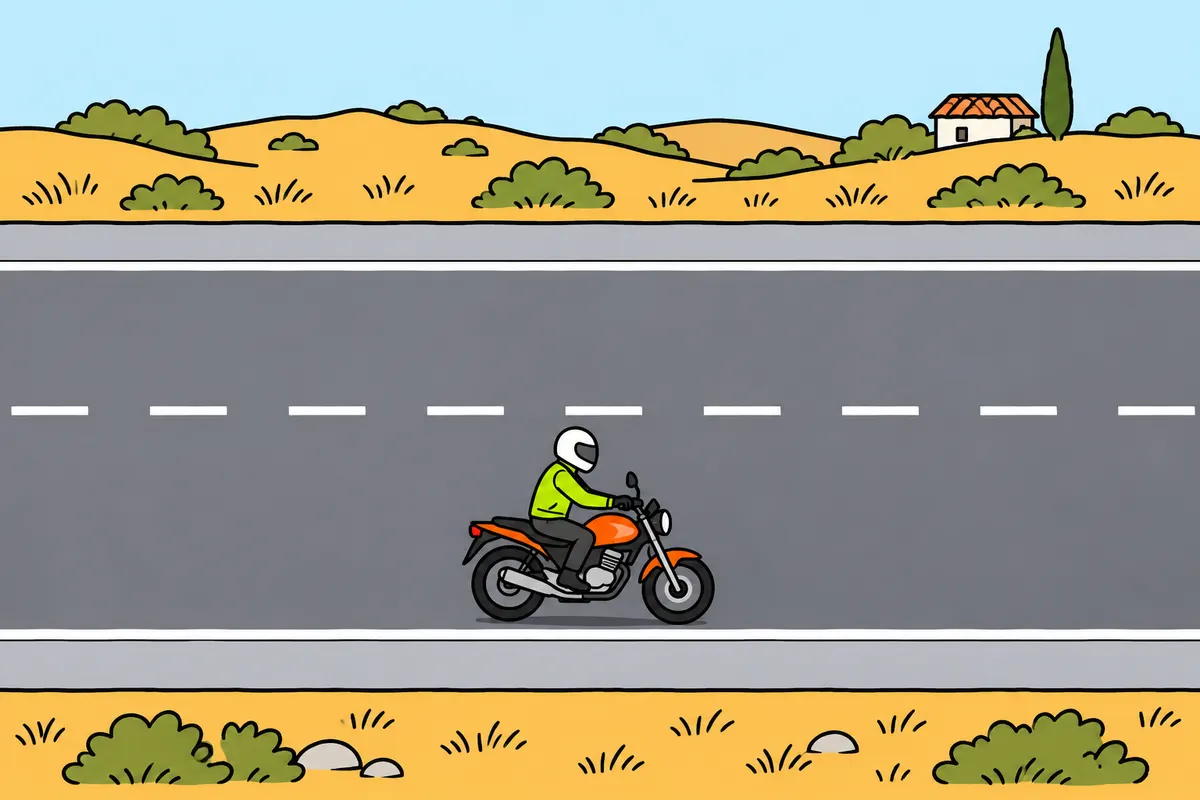
Distinguish the road platform, carriageway and lanes.
| Part | What it includes |
|---|---|
| Road platform | Carriageway and hard shoulders |
| Carriageway | Lanes |
Remember
- The road platform includes the carriageway and hard shoulders.
- You travel in lanes that form the carriageway.
- You may find a carriageway serving both directions.
Exam trap: Wrong: the hard shoulder forms part of the carriageway. Right: it forms part of the road platform.
Read the full explanation
- The road platform is the area of a road intended for vehicle use and consists of the carriageway and hard shoulders. [Traffic Act, Annex I](https://www.boe.es/buscar/act.php?id=BOE-A-2015-11722#ani)
- The carriageway is the part of a road intended for vehicle traffic and is made up of lanes. A road may have a single carriageway for both directions or separate carriageways for each direction. [Traffic Act, Annex I](https://www.boe.es/buscar/act.php?id=BOE-A-2015-11722#ani)
- On a road with two lanes, one in each direction, and no physical separation between them, you can identify one carriageway and two lanes. [Traffic Act, Annex I](https://www.boe.es/buscar/act.php?id=BOE-A-2015-11722#ani)
3Lanes: width and markings
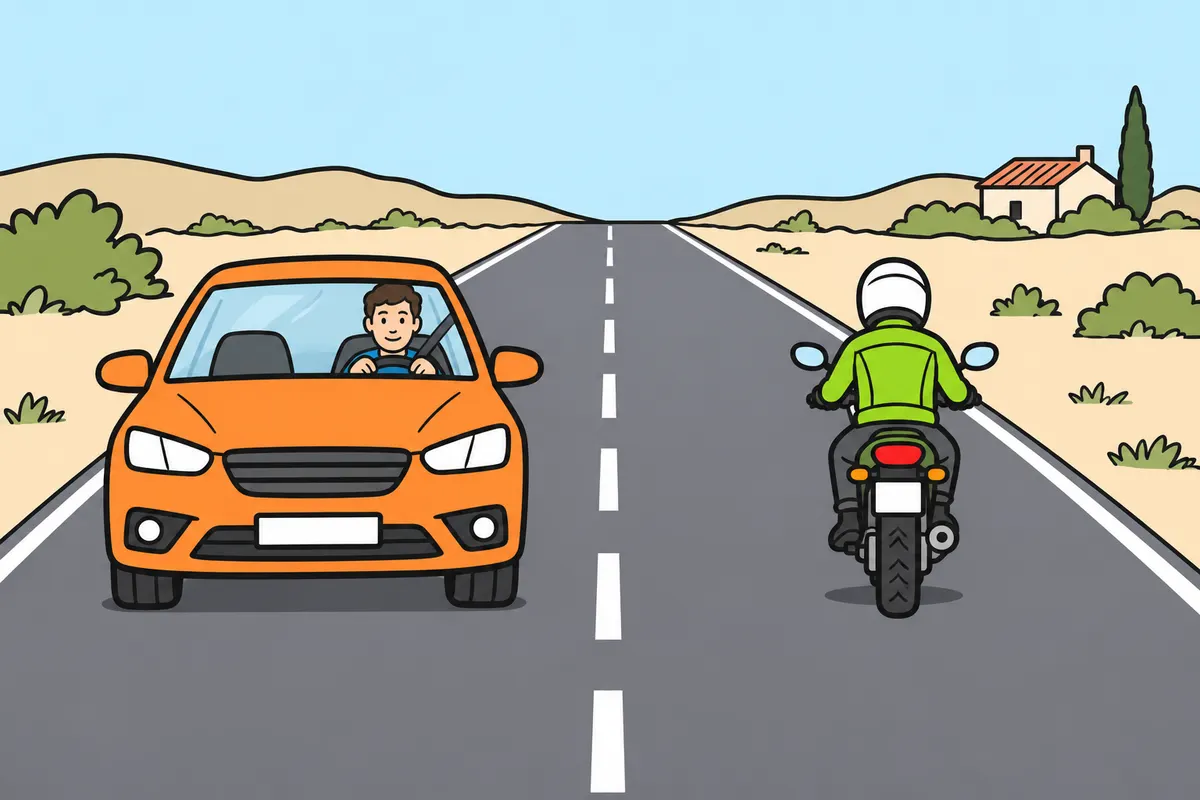
Recognise a lane by its width, even without markings.
| Term | Meaning |
|---|---|
| Lane | Strip of the carriageway |
| Direction of travel | Which way traffic moves |
Remember
- It must fit a line of motor vehicles other than motorcycles.
- You may find several lanes for the same direction.
- Before using a high-occupancy vehicle lane, check the conditions for that section.
Exam trap: Wrong: a gap counts as a lane if your motorcycle fits. Right: it must fit a line of motor vehicles other than motorcycles.
Read the full explanation
- A lane is a longitudinal strip into which a carriageway may be divided. It must be wide enough to accommodate a row of automobiles other than motorcycles. [Traffic Act, Annex I](https://www.boe.es/buscar/act.php?id=BOE-A-2015-11722#ani)
- You may find lanes marked by longitudinal lines and lanes without such markings. The absence of painted lines does not rule out the possible longitudinal division of a sufficiently wide carriageway. [Traffic Act, Annex I](https://www.boe.es/buscar/act.php?id=BOE-A-2015-11722#ani)
- Direction indicates the direction of traffic; a lane is a strip of the carriageway. You may find several lanes travelling in the same direction. [Traffic Act, Annex I](https://www.boe.es/buscar/act.php?id=BOE-A-2015-11722#ani)
- A high-occupancy vehicle lane is a lane specially reserved or designated for that traffic. The definition identifies its purpose; whether you may use it on your motorcycle depends on the rules and conditions for that section of road, explained in the «Using the road with your motorcycle» module. [Traffic Act, Annex I](https://www.boe.es/buscar/act.php?id=BOE-A-2015-11722#ani)
4Arcén (hard shoulder), pavement and refuge island
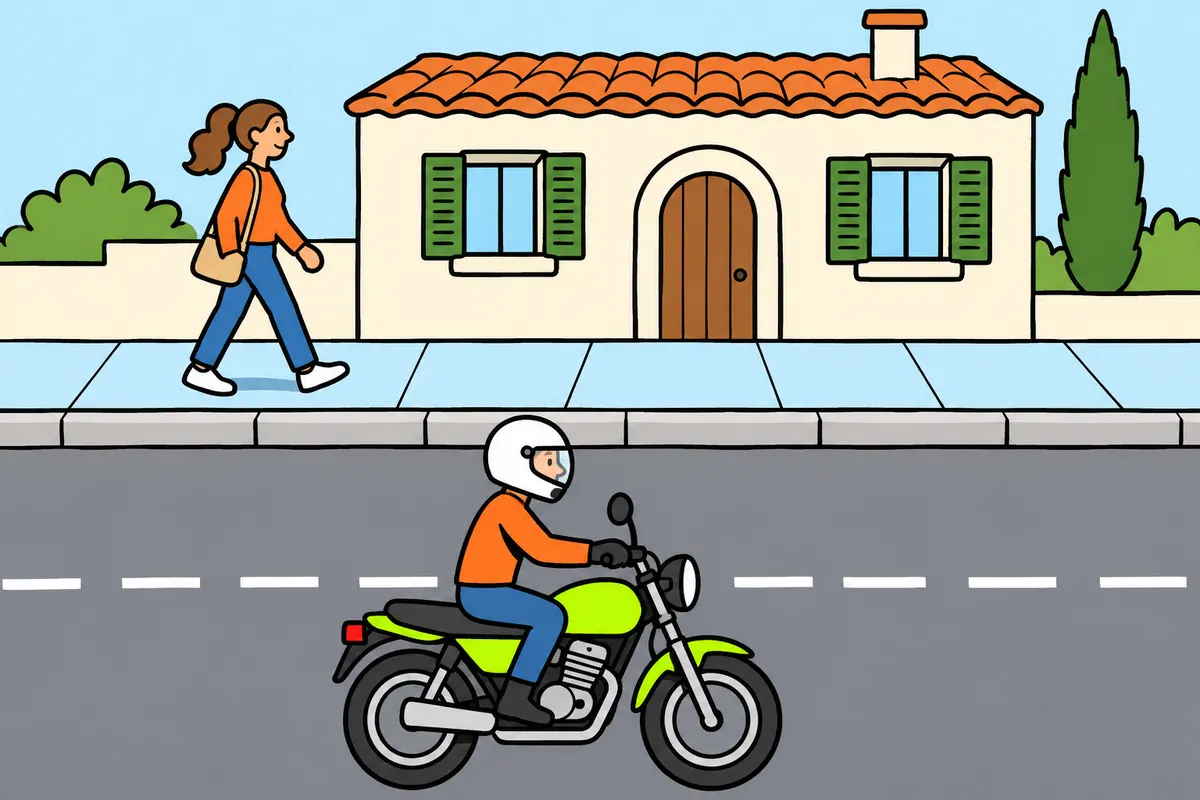
Recognise pedestrian spaces and respect pedestrian priority.
| Area | What you recognise |
|---|---|
| Hard shoulder | Surfaced strip beside the carriageway |
| Pavement | Space for pedestrians |
| Refuge island | Protected pedestrian area within the carriageway |
Remember
- Your motorcycle belongs to the automóvil legal category.
- The hard shoulder is not for this category, except in exceptional circumstances.
- A pavement may be level with the carriageway.
- On streets with a single level surface, give pedestrians priority throughout the carriageway.
Exam trap: Wrong: there is no pavement without a kerb. Right: a pavement need not be raised.
Read the full explanation
- The arcén is a surfaced longitudinal strip next to the carriageway. It is not intended for use by automobiles except in exceptional circumstances. [Traffic Act, Annex I](https://www.boe.es/buscar/act.php?id=BOE-A-2015-11722#ani)
- A pavement is a longitudinal area intended for pedestrians and may or may not be raised. A surface at the same level as the carriageway may still be a pavement. [Traffic Act, Annex I](https://www.boe.es/buscar/act.php?id=BOE-A-2015-11722#ani)
- A pedestrian area is reserved primarily for pedestrians to move through and spend time in, and includes pavements, squares, promenades and similar spaces. A refuge island is a pedestrian area on the carriageway, protected from vehicular traffic. [Traffic Act, Annex I](https://www.boe.es/buscar/act.php?id=BOE-A-2015-11722#ani)
- An area with a single level for the carriageway and pavement is designed to favour pedestrian traffic, with signs kept to a minimum. Pedestrians have priority at every point on the carriageway; you must respect this when riding your motorcycle. [Traffic Act, Annex I.83](https://www.boe.es/buscar/act.php?id=BOE-A-2015-11722#ani)
5Built-up areas, urban roads and travesías (through roads in built-up areas)
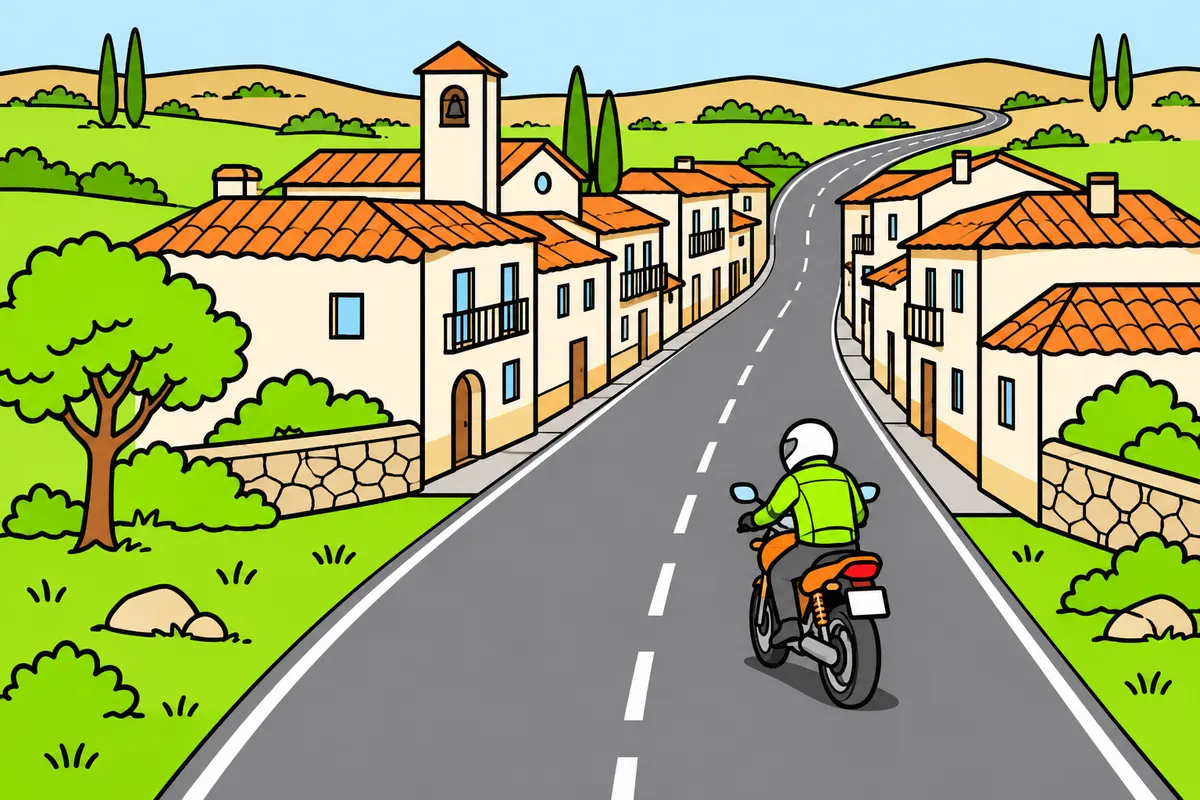
Recognise built-up areas by their signs and distinguish travesías.
| Term | What you recognise |
|---|---|
| Built-up area | Buildings and entry and exit signs |
| Travesía | Carretera within a built-up area, subject to the stated exclusion |
Remember
- Signs mark the entry and exit points of a built-up area.
- A travesía is a section of carretera within a built-up area.
- Exclude sections with access to an alternative road or bypass.
Exam trap: Wrong: every carretera section within a built-up area is a travesía. Right: exclude sections with access to an alternative road or bypass.
Read the full explanation
- A built-up area comprises buildings and is marked by the relevant signs at its entry and exit roads. [Traffic Act, Annex I](https://www.boe.es/buscar/act.php?id=BOE-A-2015-11722#ani)
- A travesía is a section of road that passes through a built-up area. The definition excludes sections with an alternative road or bypass to which they have access. [Traffic Act, Annex I](https://www.boe.es/buscar/act.php?id=BOE-A-2015-11722#ani)
6Autopista (motorway)
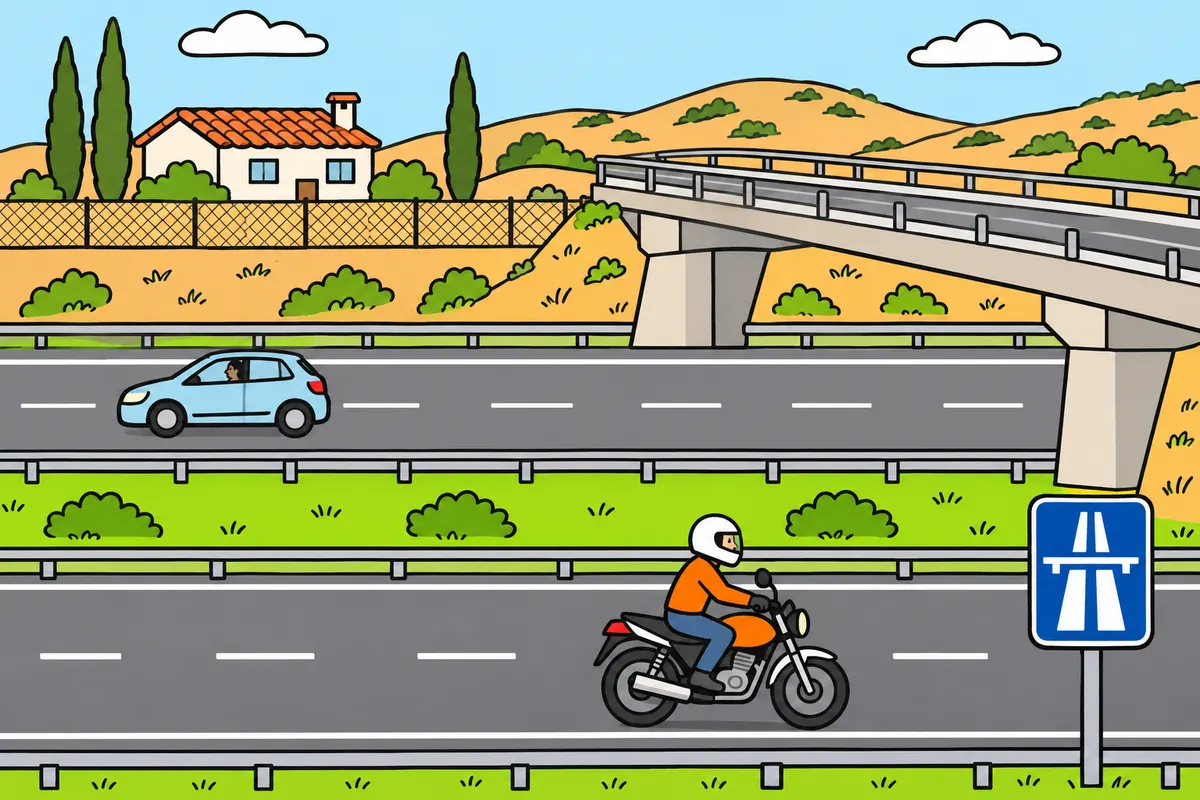
Recognise an autopista by its access, crossings and carriageways.
Remember
- It is built and signed exclusively for vehicles in the automóvil category.
- Your motorcycle belongs to this category.
- Adjoining properties have no access.
- There are no crossings at the same level.
- Carriageways are separate for each direction, subject to specific or temporary exceptions.
- A toll does not define an autopista.
Exam trap: Wrong: an autopista always charges a toll. Right: a toll is not part of its definition.
Read the full explanation
- An autopista is a road specially designed, built and signposted as such for the exclusive use of automobiles. [Traffic Act, Annex I](https://www.boe.es/buscar/act.php?id=BOE-A-2015-11722#ani)
- Adjacent properties have no access to the autopista. This lack of access is one of its legal characteristics. [Traffic Act, Annex I](https://www.boe.es/buscar/act.php?id=BOE-A-2015-11722#ani)
- An autopista does not cross paths, other roads, railways or tramways at the same level, nor is it crossed at the same level by communication routes or rights of way. [Traffic Act, Annex I](https://www.boe.es/buscar/act.php?id=BOE-A-2015-11722#ani)
- It has separate carriageways for each direction, normally divided by a strip not intended for traffic, subject to the specific or temporary exceptions provided for. Toll charging is not a condition in this definition. [Traffic Act, Annex I](https://www.boe.es/buscar/act.php?id=BOE-A-2015-11722#ani)
7Autovía (dual carriageway highway) and conventional road
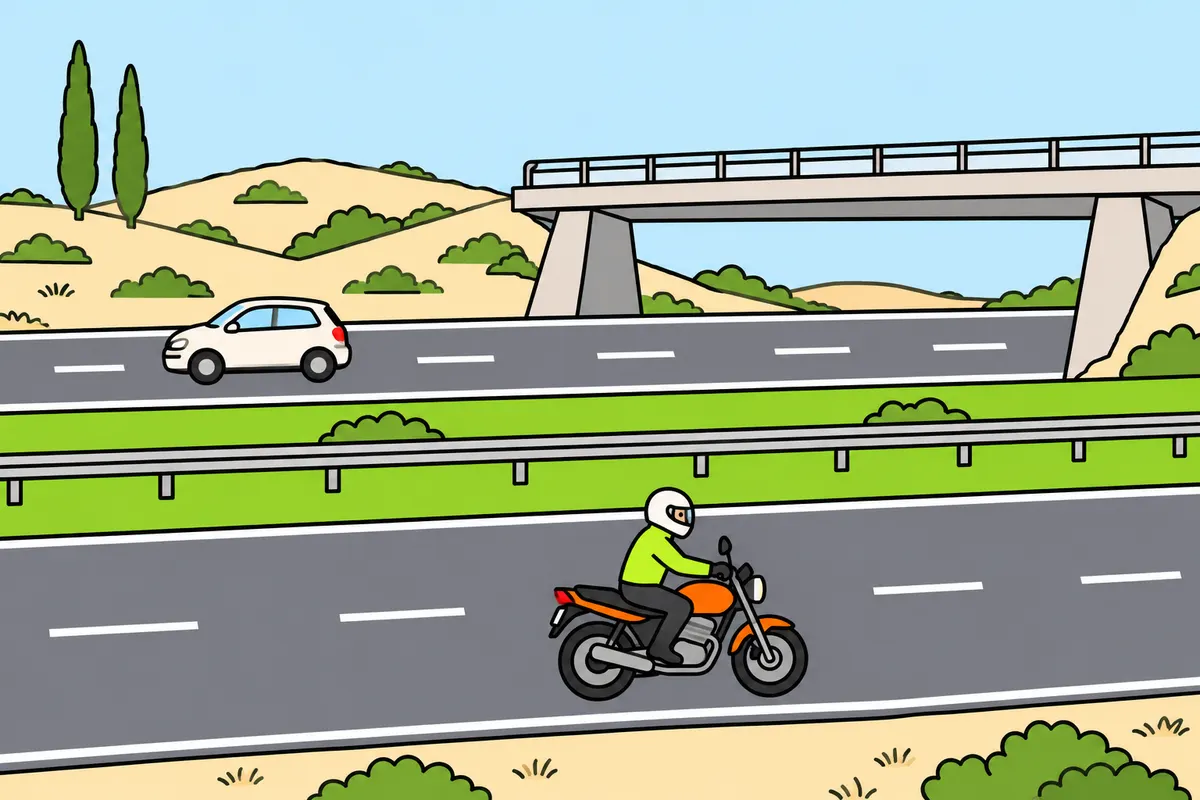
Distinguish an autovía from a conventional road by its features.
| Road | Features |
|---|---|
| Autovía | Limited access from adjoining properties |
| Conventional road | Does not meet autopista, autovía or road reserved for motor vehicles definitions |
Remember
- An autovía is built and signed as such.
- It has separate carriageways for each direction and no crossings at the same level.
- Its carriageways are separated, subject to specific or temporary exceptions.
Exam trap: Wrong: lanes alone identify a conventional road. Right: check all its defining features.
Read the full explanation
- An autovía is also a road specially designed, built and signposted as such. It has separate carriageways for each direction and no at-grade crossings with other roads, paths, railways or tramways. [Traffic Act, Annex I](https://www.boe.es/buscar/act.php?id=BOE-A-2015-11722#ani)
- On an autovía, access from adjacent properties is restricted. [Traffic Act, Annex I](https://www.boe.es/buscar/act.php?id=BOE-A-2015-11722#ani)
- Its carriageways are separated by a strip not intended for traffic, or by other means, subject to the exceptions provided for at particular points or in temporary situations. [Traffic Act, Annex I](https://www.boe.es/buscar/act.php?id=BOE-A-2015-11722#ani)
- A conventional road is one that does not meet the characteristics of an autopista (motorway), an autovía or a road reserved for motor vehicles. You may find different lane layouts on it. [Traffic Act, Annex I](https://www.boe.es/buscar/act.php?id=BOE-A-2015-11722#ani)
8Road reserved for motor vehicles
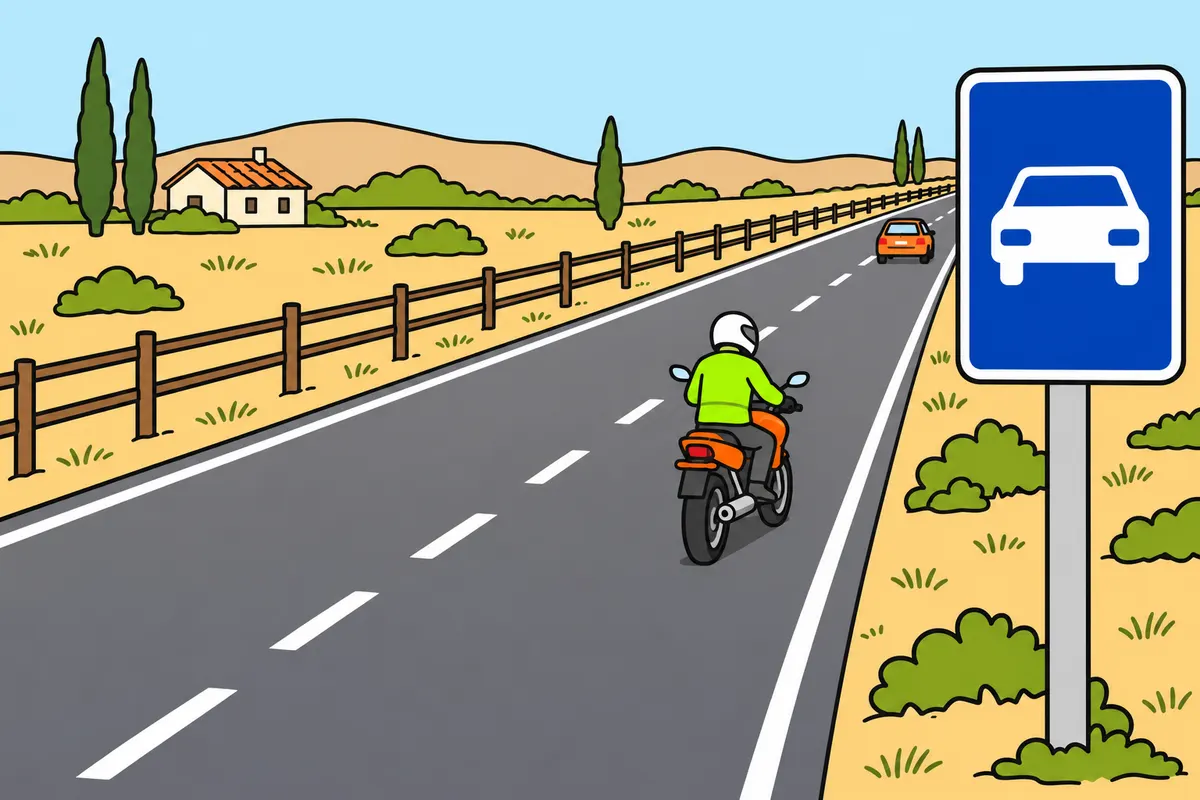
A road reserved for motor vehicles has a single carriageway and restricted use.
Remember
- It must be signed as a road reserved for motor vehicles.
- Adjoining properties have no access.
- A single carriageway may serve either direction or both.
Exam trap: Wrong: every single-carriageway road is conventional. Right: a road reserved for motor vehicles also has a single carriageway.
Read the full explanation
- A road reserved for motor vehicles is exclusively for motor vehicles and has a single carriageway. There is no direct access from adjacent properties, and the road must be signposted as such. [Traffic Act, Annex I](https://www.boe.es/buscar/act.php?id=BOE-A-2015-11722#ani)
- A single carriageway may carry traffic in one or both directions. [Traffic Act, Annex I](https://www.boe.es/buscar/act.php?id=BOE-A-2015-11722#ani)
9Junctions, roundabouts and level crossings
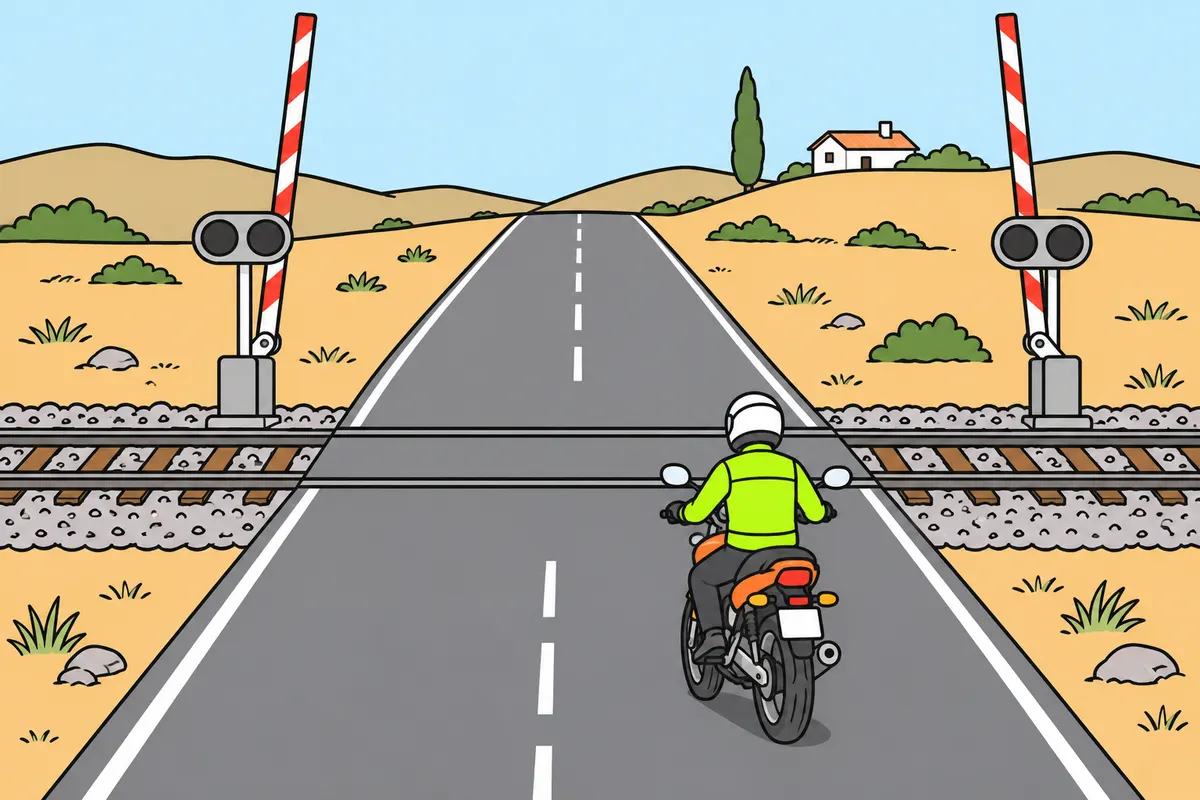
Distinguish crossings by their level and shape.
| Place | What you recognise |
|---|---|
| Roundabout | Junction with a circular carriageway |
| Flyover | Traffic paths at different levels |
| Level crossing | Road crosses a railway with its own track bed at the same level |
Remember
- At a junction, all crossings of vehicle paths are at the same level.
- A roundabout has a circular carriageway around a central island.
- A split roundabout has a direct connection through the island.
Exam trap: Wrong: a split roundabout legally counts as a roundabout. Right: the direct connection through its island excludes it.
Read the full explanation
- A junction is a point in the road network where all possible crossing paths of vehicles meet at the same level. [Traffic Act, Annex I](https://www.boe.es/buscar/act.php?id=BOE-A-2015-11722#ani)
- A flyover allows some paths to pass over others without crossing at the same level. [Traffic Act, Annex I](https://www.boe.es/buscar/act.php?id=BOE-A-2015-11722#ani)
- A roundabout is a special type of junction where the roads meet a circulating roadway around a central island. The so-called cut-through roundabouts, where roads connect directly across the island, are not roundabouts in the strict legal sense. [Traffic Act, Annex I](https://www.boe.es/buscar/act.php?id=BOE-A-2015-11722#ani)
- A level crossing is where a road and a railway line with its own trackbed cross at the same level. The rules for crossing, giving way or stopping are covered in the ‘Right of way’ module. [Traffic Act, Annex I](https://www.boe.es/buscar/act.php?id=BOE-A-2015-11722#ani)
10Vehicle, power-driven vehicle and automóvil (motor vehicle excluding special vehicles)
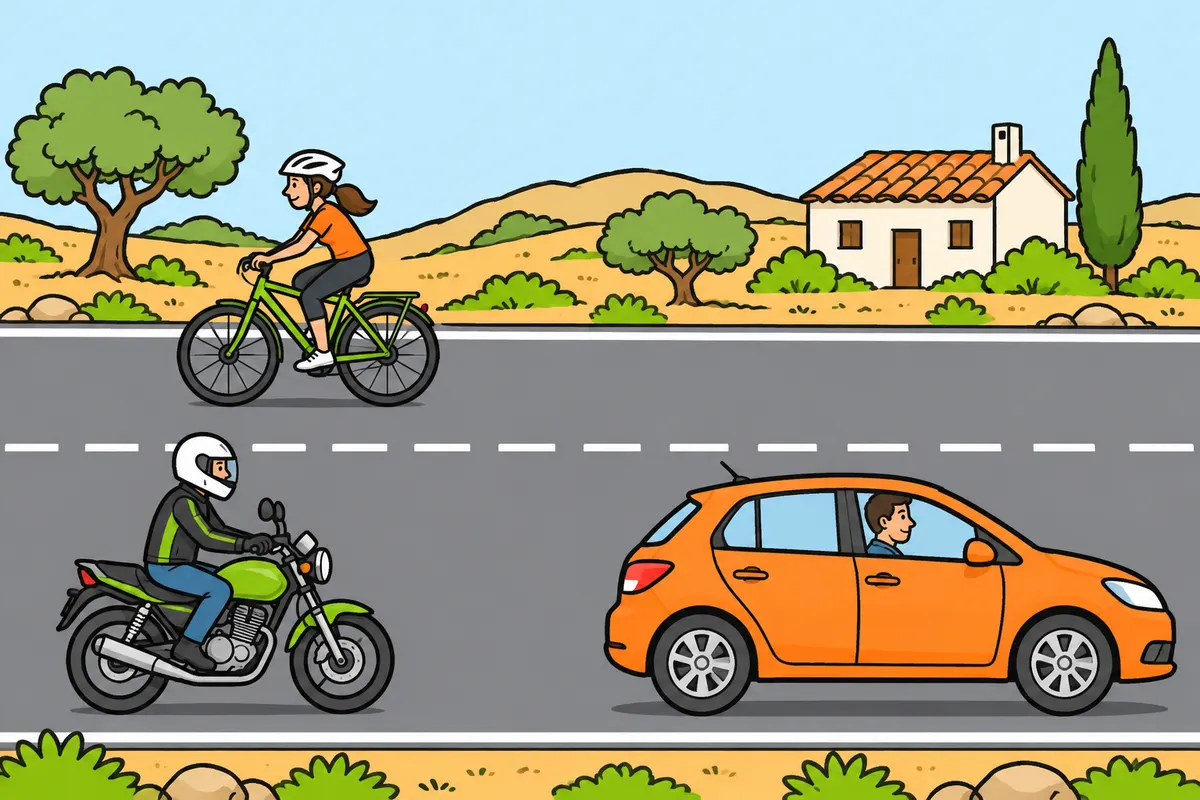
Distinguish vehicles, power-driven vehicles and the automóvil category.
| Category | Definition |
|---|---|
| Power-driven vehicle | Has a motor for propulsion, with legal exclusions |
| Automóvil | Power-driven vehicle for people, goods or towing for those purposes; excludes special vehicles |
Remember
- A vehicle can travel on roads or land covered by traffic law.
- Do not classify a vehicle just because it has a motor.
Exam trap: Wrong: every vehicle with a motor legally counts as power-driven. Right: there are legal exclusions.
Read the full explanation
- A vehicle is any device suitable for travelling on roads or land covered by traffic legislation. [RGV, Annex II](https://www.boe.es/buscar/act.php?id=BOE-A-1999-1826#anii)
- A power-driven vehicle has an engine for propulsion. The RGV excludes mopeds, trams, vehicles for people with reduced mobility, pedal cycles with electrically assisted pedalling and VMPs (personal mobility vehicles) from this definition. These are legal exclusions: a vehicle with an engine may fall into one of these categories. [RGV, Annex II](https://www.boe.es/buscar/act.php?id=BOE-A-1999-1826#anii)
- An automóvil is a motor vehicle normally intended to carry people or goods, or to tow other vehicles for that purpose; special vehicles are excluded. Your motorcycle is an automóvil and a power-driven vehicle, even though in everyday language automóvil is used to mean a car. [RGV, Annex II](https://www.boe.es/buscar/act.php?id=BOE-A-1999-1826#anii)
11Motorcycles and sidecars
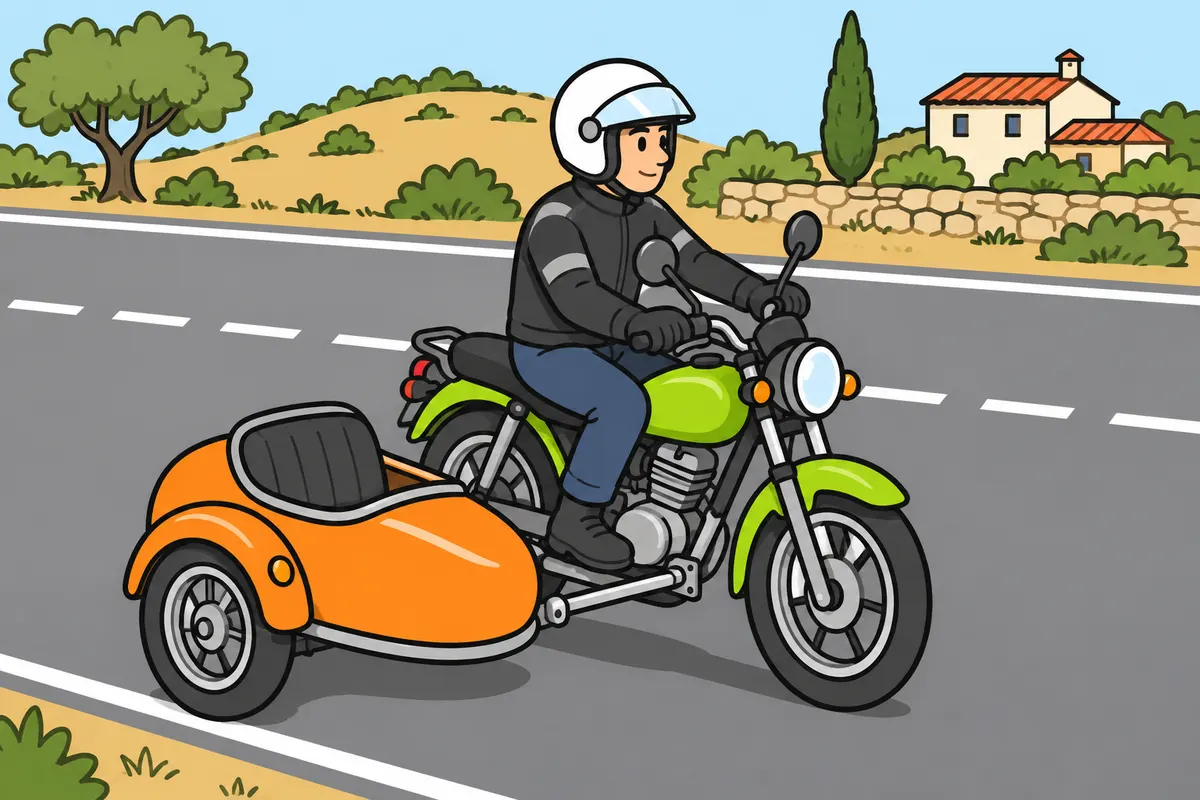
Classify your motorcycle by its technical features, rather than its commercial name.
| Motorcycle | Wheels |
|---|---|
| Without sidecar | Two |
| With sidecar | Three, arranged asymmetrically |
Remember
- Without a sidecar, your motorcycle has two wheels.
- With a sidecar, it has three wheels arranged asymmetrically.
- Exceeding either threshold is enough; you may also exceed both.
- The engine capacity test applies to internal combustion engines.
Exam trap: Wrong: you must exceed both 50 cm³ and 45 km/h. Right: either is enough; engine capacity applies only to internal combustion engines.
Read the full explanation
- A two-wheeled motorcycle has no sidecar and has an engine capacity greater than 50 cm³ if it has an internal combustion engine, and/or a design maximum speed greater than 45 km/h. [RGV, Annex II](https://www.boe.es/buscar/act.php?id=BOE-A-1999-1826#anii)
- Engine capacity measures the volume of the cylinders and is usually expressed in cubic centimetres: 50 cm³ is equivalent to 0.05 litres. You can find this measurement for a combustion motorcycle; for an electric one, you must refer to its propulsion characteristics and classification. [RGV, Annex II](https://www.boe.es/buscar/act.php?id=BOE-A-1999-1826#anii)
- A motorcycle with a sidecar has three wheels arranged asymmetrically around its longitudinal centreline and is subject to the same engine capacity or design speed criteria. [RGV, Annex II](https://www.boe.es/buscar/act.php?id=BOE-A-1999-1826#anii)
- Scooter, trail, sports and custom are commercial labels. To find out whether you can ride a motorcycle with A1, use its classification and technical characteristics. [RGV, Annex II](https://www.boe.es/buscar/act.php?id=BOE-A-1999-1826#anii)
12The three A1 motorcycle limits
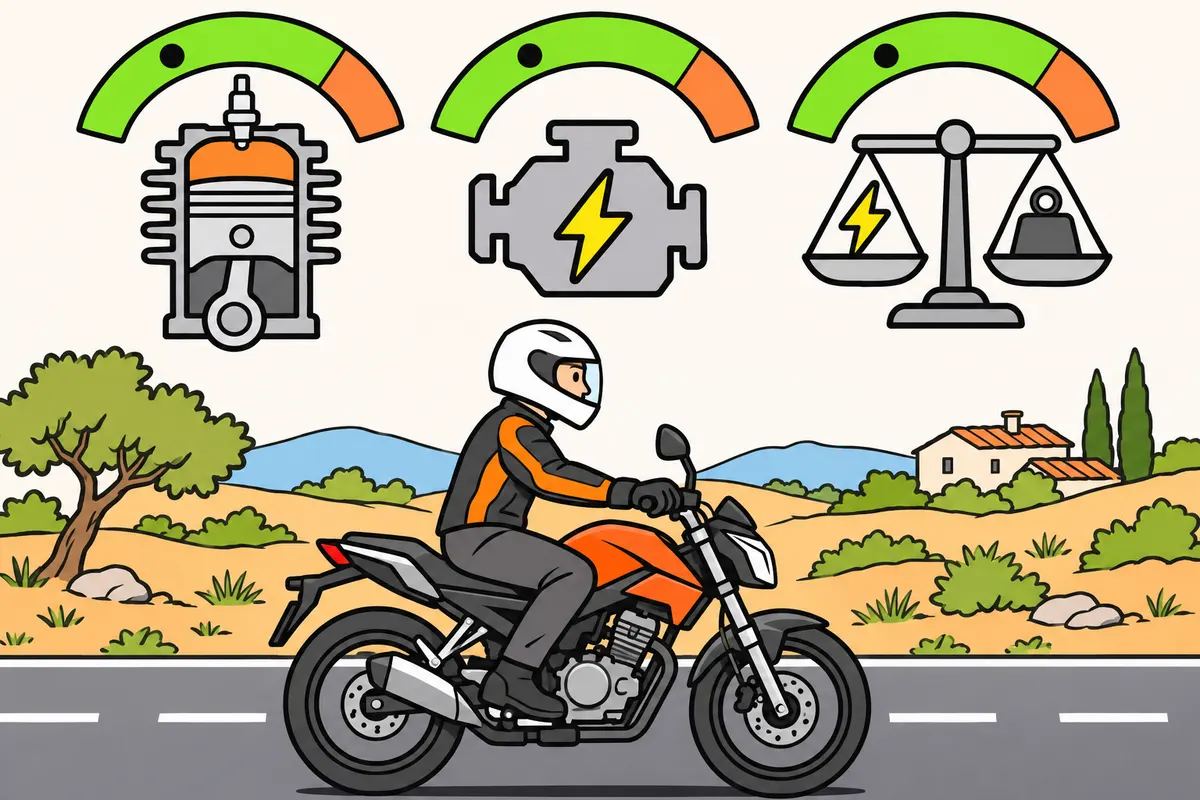
With A1, your motorcycle must meet all limits together.
Remember
- Check engine capacity, power and power-to-weight ratio.
- Exact maximum values are included if you meet the other requirements.
Exam trap: Wrong: any 125 cm³ motorcycle qualifies for A1. Right: it must also meet the power and power-to-weight limits.
Read the full explanation
- With A1, you can ride motorcycles with a maximum engine capacity of 125 cm³, a maximum power output of 11 kW and a maximum power-to-weight ratio of 0.1 kW/kg. You must be at least 16 years old to obtain A1. [RGCond, art. 4.2](https://www.boe.es/buscar/act.php?id=BOE-A-2009-9481#a4)
- The maximum values include equality: exactly 125 cm³, 11 kW and 0.1 kW/kg are within the limits if the other requirements are met. A 125 cm³ motorcycle with 12 kW exceeds the power limit. [RGCond, art. 4](https://www.boe.es/buscar/act.php?id=BOE-A-2009-9481#a4)
- A 125 cm³ motorcycle with 10 kW is outside the A1 limits if its power-to-weight ratio exceeds 0.1 kW/kg. [RGCond, art. 4.2](https://www.boe.es/buscar/act.php?id=BOE-A-2009-9481#a4)
13Engine capacity, power and power-to-weight ratio
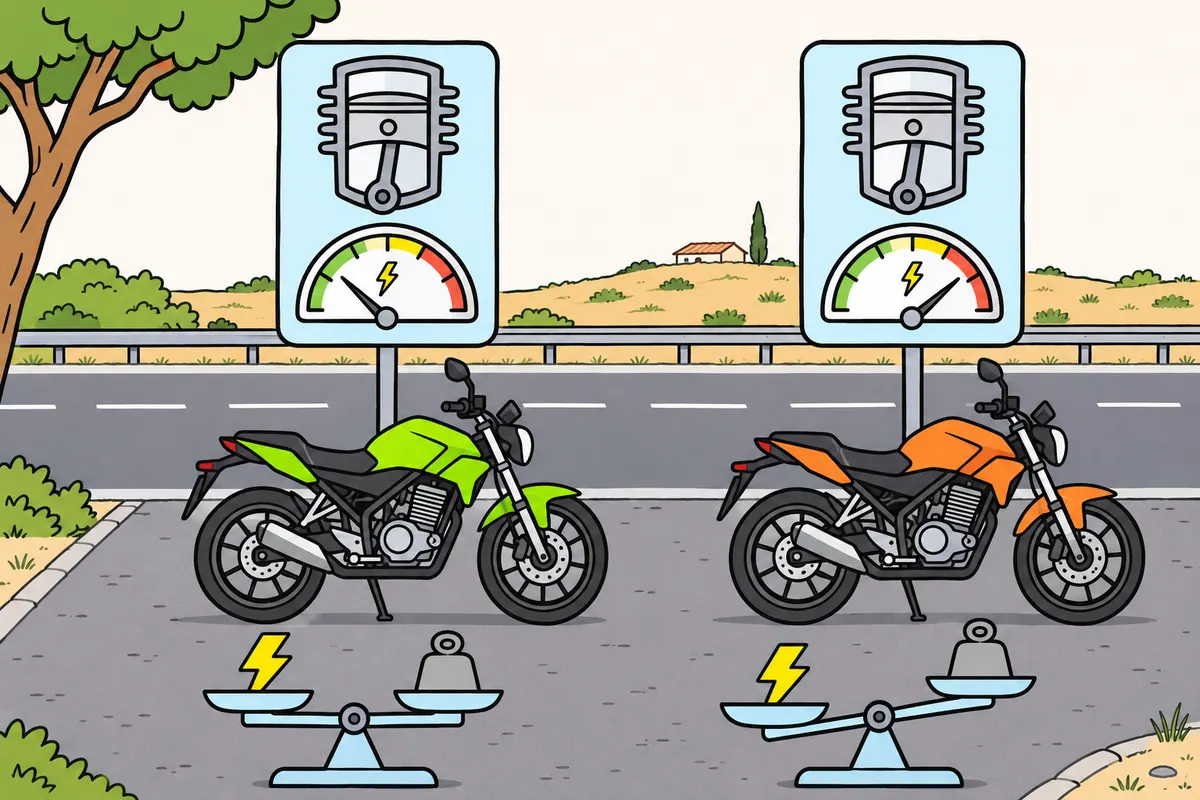
Restricting power does not change your motorcycle’s engine capacity.
| Exercise with 11 kW | Power-to-weight ratio |
|---|---|
| Reference mass: 110 kg | 0.1 kW/kg |
| Reference mass: 100 kg | 0.11 kW/kg |
Remember
- Check all technical features after restricting power.
- The same engine capacity does not always mean the same licence.
- Calculate the ratio using the correct reference mass.
Exam trap: Wrong: restricting power to 11 kW allows any engine capacity with A1. Right: an internal combustion motorcycle over 125 cm³ still does not qualify.
Read the full explanation
- Engine capacity and power are different measurements. Two motorcycles with the same engine capacity may require different licences if their other characteristics differ. [RGCond, art. 4](https://www.boe.es/buscar/act.php?id=BOE-A-2009-9481#a4)
- The power-to-weight ratio expresses how much power corresponds to each kilogram of the applicable reference mass. As an arithmetic exercise, 11 kW divided by 110 kg gives 0.1 kW/kg; divided by 100 kg it gives 0.11 kW/kg. [RGCond, art. 4](https://www.boe.es/buscar/act.php?id=BOE-A-2009-9481#a4)
- If a question describes a motorcycle restricted in power, you must check its resulting technical characteristics and that it meets all the A1 limits. Reducing the power does not reduce the engine capacity: restricting a combustion-engine motorcycle of more than 125 cm³ to 11 kW does not make it a motorcycle authorised for A1. [RGCond, art. 4](https://www.boe.es/buscar/act.php?id=BOE-A-2009-9481#a4)
14Included AM entitlement and motor tricycles
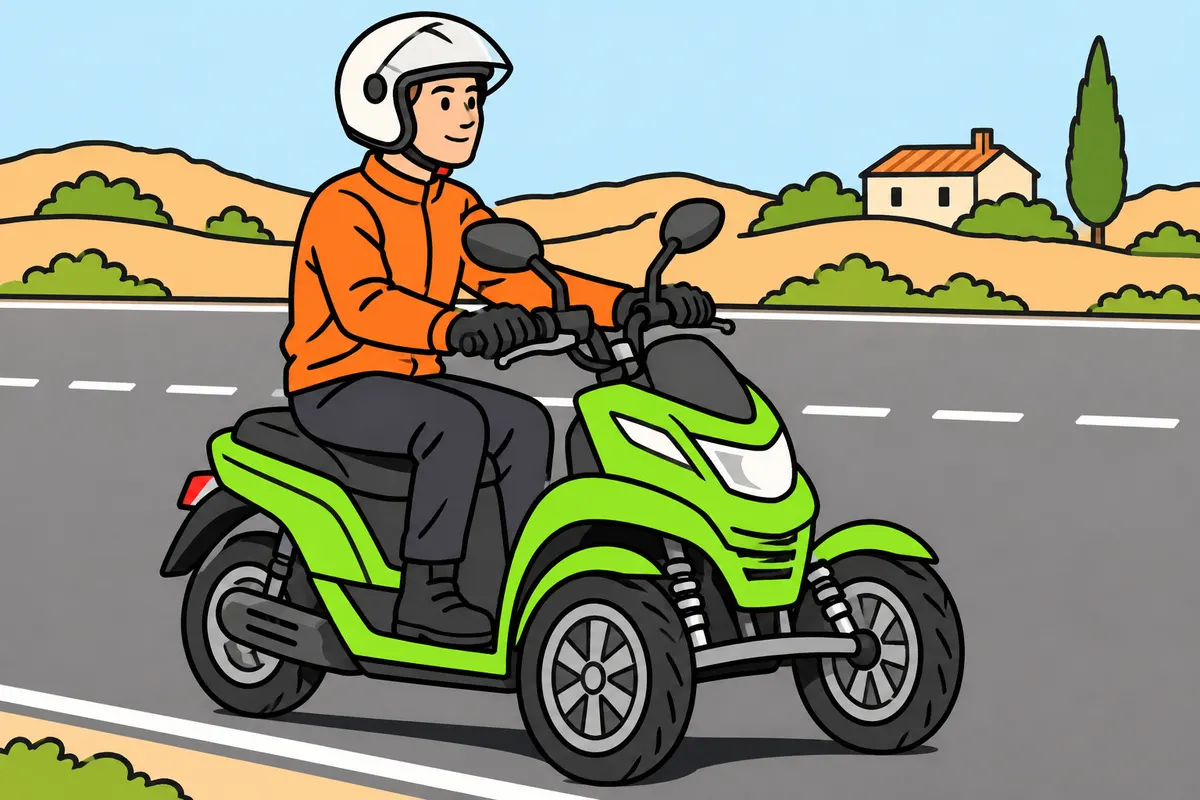
With A1, you also receive AM and can drive certain additional vehicles.
| Entitlement included with A1 | Vehicles |
|---|---|
| AM | Mopeds and light quadricycles, subject to restrictions |
| A1 | Motor tricycles up to 15 kW |
| Valid A1 | Vehicles for people with reduced mobility |
Remember
- Respect the restrictions shown on your licence.
- With a valid A1, you do not need LCM for reduced-mobility vehicles.
Exam trap: Wrong: the 15 kW limit also applies to motorcycles. Right: this limit is for motor tricycles.
Read the full explanation
- When you obtain A1, you also receive the AM licence. [RGCond, art. 5.2.a](https://www.boe.es/buscar/act.php?id=BOE-A-2009-9481#a5)
- With A1, you can ride motor tricycles whose power does not exceed 15 kW. [RGCond, art. 4](https://www.boe.es/buscar/act.php?id=BOE-A-2009-9481#a4)
- Under the AM entitlement included, you can ride two- or three-wheeled mopeds and light quadricycles, subject to the restrictions shown on your licence. [RGCond, art. 4.2](https://www.boe.es/buscar/act.php?id=BOE-A-2009-9481#a4)
- With A1, you can drive vehicles for people with reduced mobility, which are expressly included in the second part of the A1 row in article 4.2. If your A1 licence is valid, you do not need the LCM licence to drive them. [RGCond, art. 4.2](https://www.boe.es/buscar/act.php?id=BOE-A-2009-9481#a4) [RGCond, art. 6.1.a](https://www.boe.es/buscar/act.php?id=BOE-A-2009-9481#a6)
- The requirements for obtaining other licences and the equivalences with B are covered in “A1 licence and motorcycle documents”. [RGCond, art. 4](https://www.boe.es/buscar/act.php?id=BOE-A-2009-9481#a4)
15Mopeds and light quadricycles
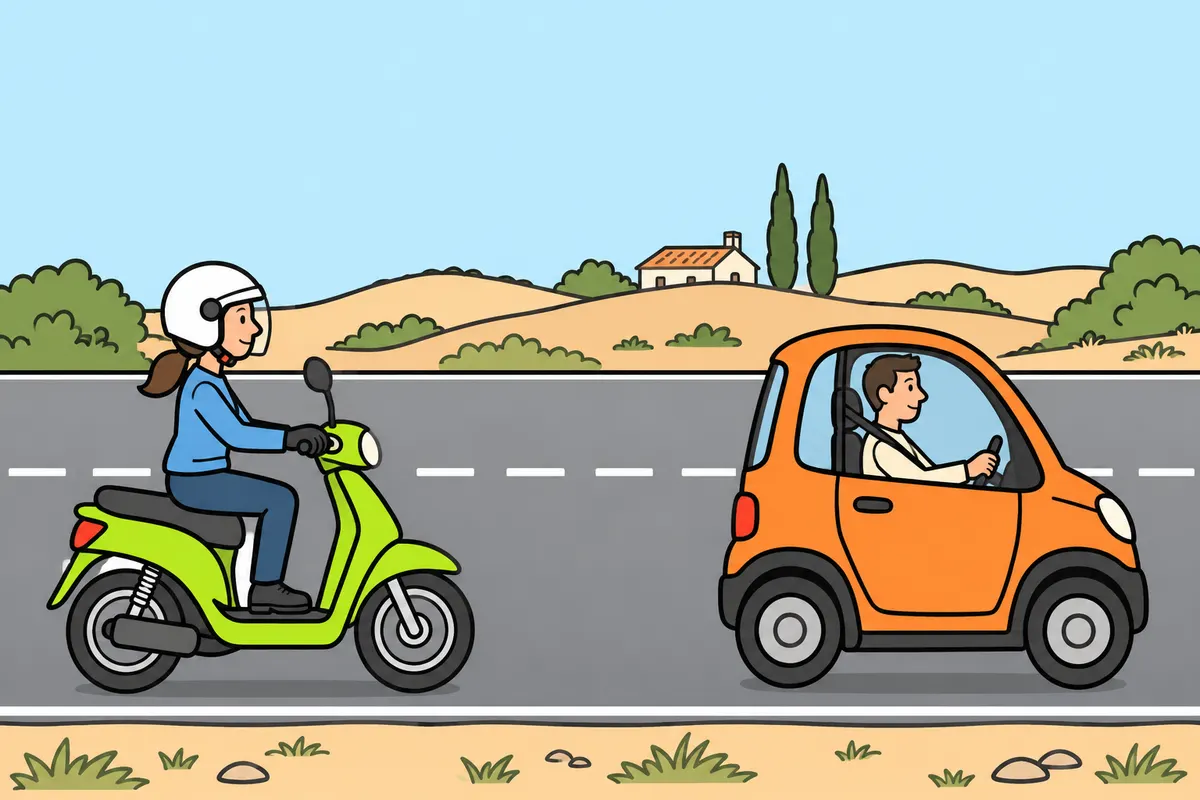
Distinguish the legal moped definition from the light quadricycle category.
| Vehicle and engine | Engine or mass limit |
|---|---|
| Two-wheeled moped, internal combustion | Up to 50 cm³ |
| Two-wheeled moped, electric | Maximum continuous rated power: 4 kW |
| Three-wheeled moped, spark ignition | Up to 50 cm³ |
| Three-wheeled moped, other internal combustion | Maximum net power: 4 kW |
| Three-wheeled moped, electric | Maximum continuous rated power: 4 kW |
| L6e light quadricycle | Up to 425 kg in running order |
| Four-wheeled moped, Traffic Act definition | Up to 350 kg unladen; excludes batteries if electric |
| Four-wheeled moped, spark ignition | Up to 50 cm³ |
| Four-wheeled moped, other internal combustion or electric | Up to 4 kW |
Remember
- Read which definition the question asks about.
- L6e allows up to two seats, including the driver’s.
- Distinguish unladen mass from mass in running order.
Exam trap: Wrong: 350 kg and 425 kg describe the same mass. Right: identify the definition and type of mass being asked about.
Read the full explanation
- A two-wheeled moped has a maximum design speed of no more than 45 km/h. Its internal combustion engine does not exceed 50 cm³; if it is electric, its maximum continuous rated power does not exceed 4 kW. [Ley de Tráfico (Traffic Act), annex I.9.a](https://www.boe.es/buscar/act.php?id=BOE-A-2015-11722#ani)
- A three-wheeled moped also has a maximum design speed of no more than 45 km/h. The Traffic Act sets a limit of 50 cm³ for spark-ignition engines, a maximum net power of 4 kW for other internal combustion engines, and a maximum continuous rated power of 4 kW for electric engines. [Ley de Tráfico (Traffic Act), annex I.9.b](https://www.boe.es/buscar/act.php?id=BOE-A-2015-11722#ani)
- The RGV refers to Regulation (EU) 168/2013 to define the L6e light quadricycle: four wheels, a maximum design speed of 45 km/h, a mass in running order of up to 425 kg, and up to two seats, including the driver’s. The Traffic Act definition of a four-wheeled moped sets a maximum unladen mass of 350 kg, excluding batteries for electric vehicles; a maximum speed of 45 km/h; and a maximum of 50 cm³ for spark-ignition engines, 4 kW maximum net power for other internal combustion engines, or 4 kW maximum continuous rated power for electric engines. The legal definition of a four-wheeled moped and the L6e type-approval category have their own criteria; in the exam, apply the criteria for the concept asked about in the question. [Ley de Tráfico (Traffic Act), annex I.9.c](https://www.boe.es/buscar/act.php?id=BOE-A-2015-11722#ani) [RGV, annex II](https://www.boe.es/buscar/act.php?id=BOE-A-1999-1826#anii) [Regulation (EU) 168/2013, annex I](https://www.boe.es/buscar/doc.php?id=DOUE-L-2013-80407)
16Tricycles, heavy quadricycles and quads
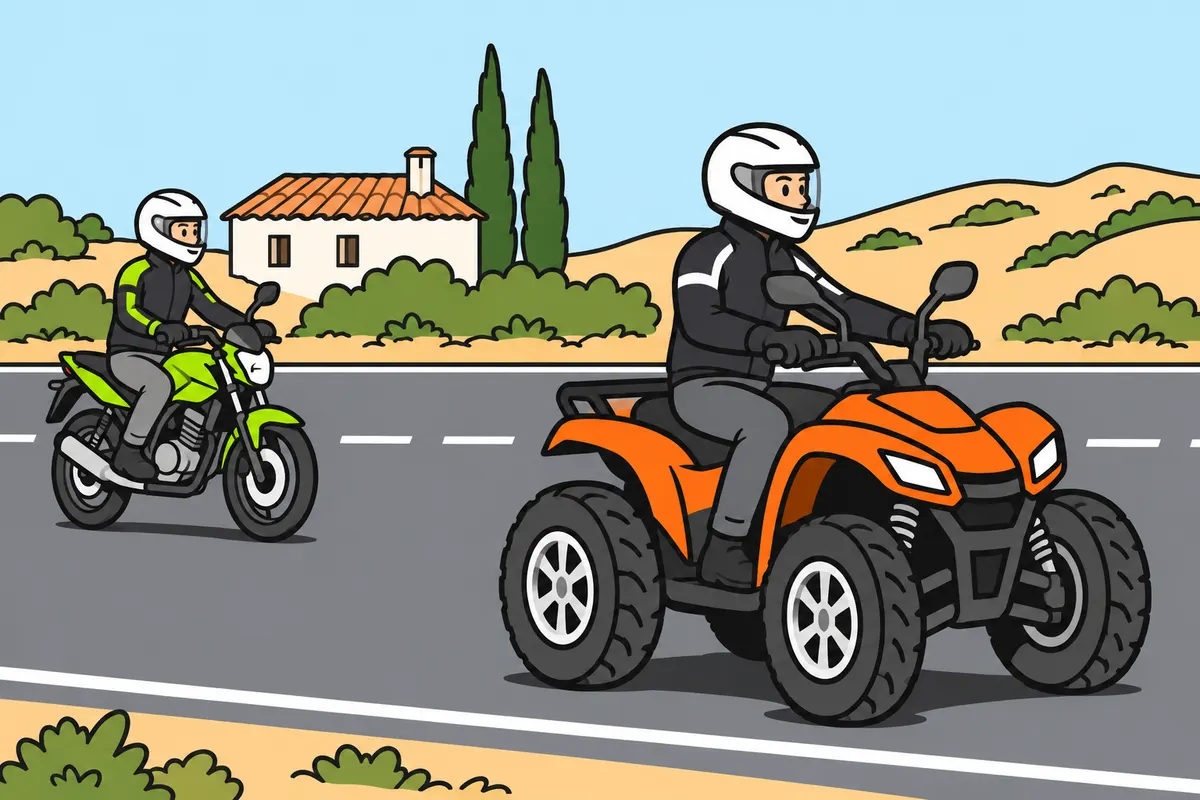
The name quad does not tell you which licence you need.
| Vehicle classification | Required entitlement |
|---|---|
| L6e light quadricycle | Different category from heavy quadricycles |
| L7e heavy quadricycle | B; A1 alone is insufficient |
Remember
- A motor tricycle has symmetrically arranged wheels.
- A heavy quadricycle cannot qualify as a light quadricycle.
- You need B for a heavy quadricycle.
- Do not extend light quadricycle entitlement to every quad or special vehicle.
Exam trap: Wrong: you can drive every quad with A1. Right: check its classification; A1 does not cover heavy quadricycles.
Read the full explanation
- An automóvil (motor vehicle) with three wheels has symmetrically arranged wheels and an engine larger than 50 cm³ if it has an internal combustion engine, and/or a maximum design speed of more than 45 km/h. [RGV, annex II](https://www.boe.es/buscar/act.php?id=BOE-A-1999-1826#anii)
- A heavy quadricycle belongs to category L7e and differs from the L6e light quadricycle. Common criteria include four wheels and a mass in running order of up to 450 kg for passenger transport or 600 kg for goods. It must also be impossible to classify it as L6e. [Regulation (EU) 168/2013, annex I](https://www.boe.es/buscar/doc.php?id=DOUE-L-2013-80407) [RGV, annex II](https://www.boe.es/buscar/act.php?id=BOE-A-1999-1826#anii)
- A1 alone does not authorise you to drive heavy quadricycles; you need a category B licence to drive them. [RGCond, art. 4](https://www.boe.es/buscar/act.php?id=BOE-A-2009-9481#a4) [RGV, annex II](https://www.boe.es/buscar/act.php?id=BOE-A-1999-1826#anii)
- Quad or ATV may be commercial terms for vehicles with different classifications. To identify one, you must check its technical category: it may be a light quadricycle, a heavy quadricycle or a special vehicle, and that classification determines which licence you need. [RGV, annex II](https://www.boe.es/buscar/act.php?id=BOE-A-1999-1826#anii)
17Other vehicles A1 does not authorise
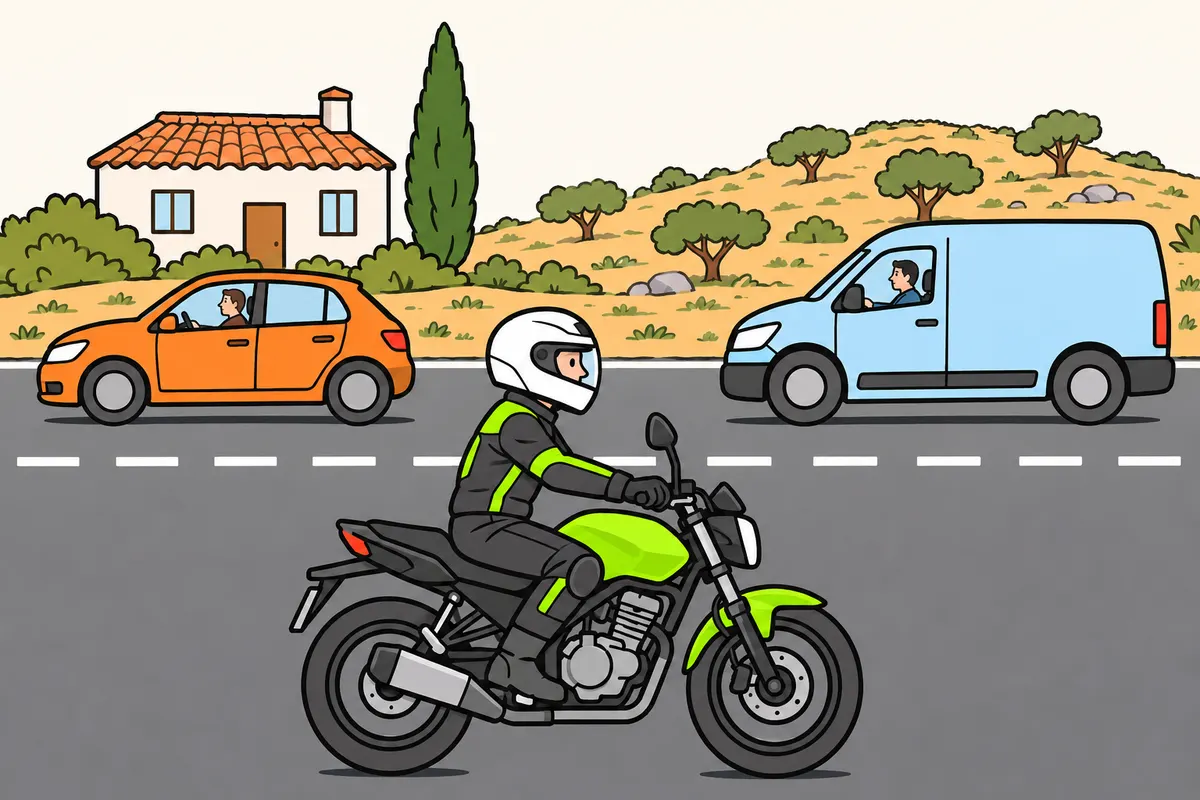
A1 alone does not authorise you to drive these other vehicles.
| Vehicle | How you recognise it |
|---|---|
| Passenger car | People; at least four wheels; up to eight seats besides the driver’s |
| Lorry | Goods; cab separate from the rest of the bodywork |
| Van | Goods; cab integrated into the bodywork |
| Bus or coach | People and luggage; more than nine seats including the driver’s |
| Special vehicle | Works, specific services or agricultural tasks |
Remember
- Distinguish a motorcycle from a passenger car.
- A special vehicle may move under its own power or be towed.
Exam trap: Wrong: A1 also allows you to drive a passenger car. Right: A1 alone does not give you that entitlement.
Read the full explanation
- A turismo (passenger car) is an automóvil intended to carry people, with at least four wheels and up to eight seats in addition to the driver’s. A1 alone does not give you a category B licence or authorise you to drive a turismo. [RGCond, art. 4](https://www.boe.es/buscar/act.php?id=BOE-A-2009-9481#a4) [RGV, annex II](https://www.boe.es/buscar/act.php?id=BOE-A-1999-1826#anii)
- A lorry and a van are built to carry goods, have at least four wheels and have up to nine seats including the driver’s. In a lorry, the cab is separate from the rest of the body; in a van, it is integrated into it. [RGV, annex II](https://www.boe.es/buscar/act.php?id=BOE-A-1999-1826#anii)
- A bus or coach has more than nine seats, including the driver’s, and is intended to carry people and luggage. This includes a trolleybus, which is connected to an electric line and does not run on rails. [RGV, annex II](https://www.boe.es/buscar/act.php?id=BOE-A-1999-1826#anii)
- A special vehicle is built for construction work, specific services or agricultural work, with the technical features set by regulations. It may be self-propelled or towed. [RGV, annex II](https://www.boe.es/buscar/act.php?id=BOE-A-1999-1826#anii)
18Cycles, VMP (personal mobility vehicles) and reduced mobility
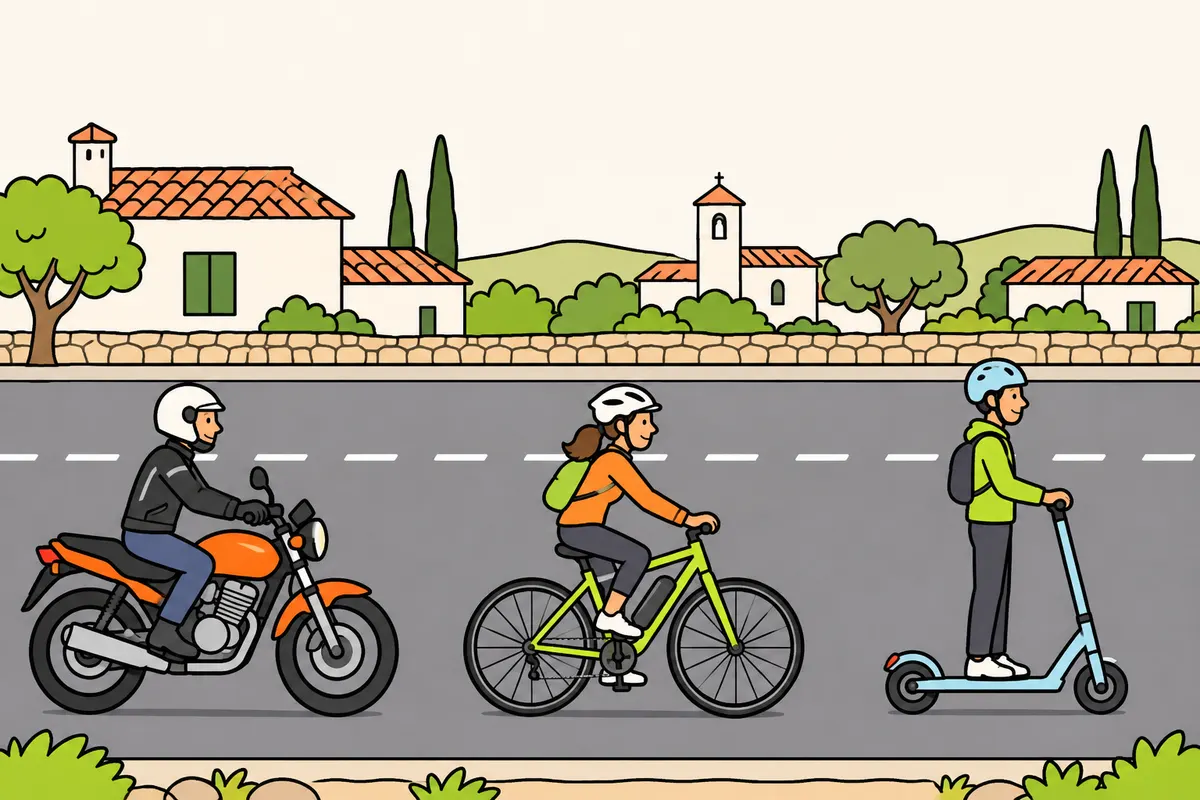
Distinguish vehicles by how they move and whom they are designed for.
| Vehicle | Feature |
|---|---|
| Cycle | Moves through its occupants’ muscular effort |
| Bicycle | Two-wheeled cycle |
| VMP | Maximum design speed between 6 and 25 km/h |
| Vehicle for people with reduced mobility | Built specifically for that use |
| Animal-drawn vehicle | Pulled by animals |
Remember
- Pedal assistance also cuts out when you stop pedalling.
- A VMP has a single place and only electric propulsion.
- A VMP may have a seat only if it is self-balancing.
- For reduced-mobility vehicles, unladen mass excludes the occupant.
Exam trap: Wrong: a VMP can always have a seat. Right: a seat is allowed only if it is self-balancing.
Read the full explanation
- A cycle has at least two wheels and is propelled by the muscular effort of its occupants; a bicycle is a two-wheeled cycle. You must also recognise an animal-drawn vehicle, which is pulled by animals, and not confuse it with a motor vehicle. [RGV, annex II](https://www.boe.es/buscar/act.php?id=BOE-A-1999-1826#anii)
- A pedal cycle with pedal assistance has an auxiliary electric motor with a maximum continuous rated power of 250 W. Assistance decreases progressively and cuts out before the cycle reaches 25 km/h or when you stop pedalling. [RGV, annex II](https://www.boe.es/buscar/act.php?id=BOE-A-1999-1826#anii)
- A VMP has one or more wheels, space for one person and exclusively electric propulsion, with a maximum design speed of between 6 and 25 km/h. It may only have a seat or saddle if it is self-balancing. [RGV, annex II](https://www.boe.es/buscar/act.php?id=BOE-A-1999-1826#anii)
- A vehicle for people with reduced mobility is specifically designed and built for people with a physical dysfunction or disability, rather than being a mere adaptation. Its unladen mass must not exceed 350 kg, and its maximum design speed on level ground must not exceed 45 km/h. The 350 kg refers to unladen mass, not mass with an occupant. [RGV, annex II](https://www.boe.es/buscar/act.php?id=BOE-A-1999-1826#anii)
19Trailers, semi-trailers and vehicle combinations
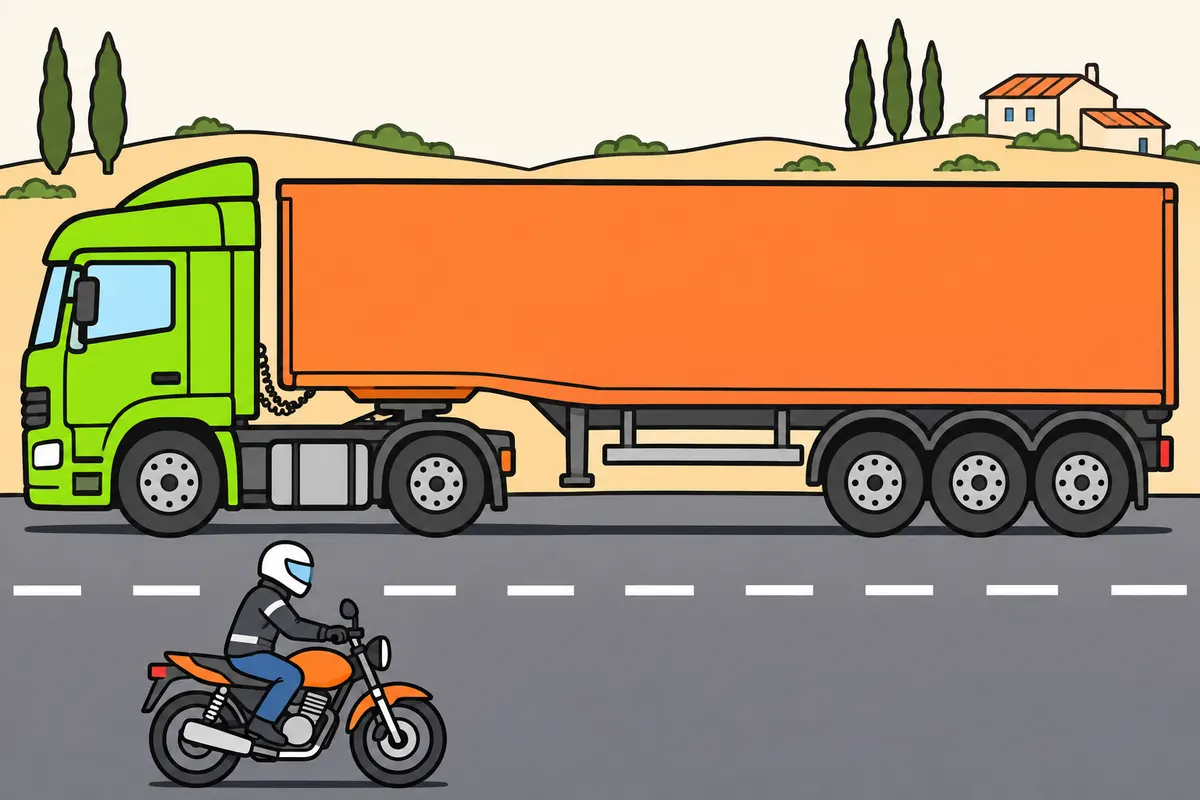
Distinguish trailers and semi-trailers by how they connect to the towing vehicle.
| Combination | Parts |
|---|---|
| Articulated vehicle | Power-driven vehicle and semi-trailer |
| Road train | Power-driven vehicle and trailer |
Remember
- A trailer cannot move under its own power.
- A semi-trailer rests partly on the towing vehicle and transfers substantial mass to it.
- The light trailer classification excludes agricultural trailers.
- Unloading a trailer does not reduce its MMA.
Exam trap: Wrong: exactly 750 kg MMA is too heavy for a light trailer. Right: it is included, except for agricultural trailers.
Read the full explanation
- A trailer is a non-self-propelled vehicle designed to be towed by a power-driven vehicle. A semi-trailer is designed to be coupled to an automóvil (motor vehicle excluding special vehicles), on which it rests partly and to which it transfers a substantial part of its mass. [RGV, Annex II](https://www.boe.es/buscar/act.php?id=BOE-A-1999-1826#anii)
- A light trailer has an MMA (maximum authorised mass) of no more than 750 kg; this classification excludes agricultural vehicles. Exactly 750 kg counts as light; having no load on the trailer does not reduce its MMA. [Traffic Act, Annex I, point 21](https://www.boe.es/buscar/act.php?id=BOE-A-2015-11722#ani)
- An articulated vehicle consists of a power-driven vehicle coupled to a semi-trailer; a road train consists of a power-driven vehicle connected to a trailer. Both are vehicle combinations. [RGV, Annex II](https://www.boe.es/buscar/act.php?id=BOE-A-1999-1826#anii)
- A tractor unit is built mainly to tow a semi-trailer. [RGV, Annex II](https://www.boe.es/buscar/act.php?id=BOE-A-1999-1826#anii)
- The conditions for towing a trailer with your motorcycle are covered in “Passengers and loads on motorcycles”.
20Tare mass and laden mass
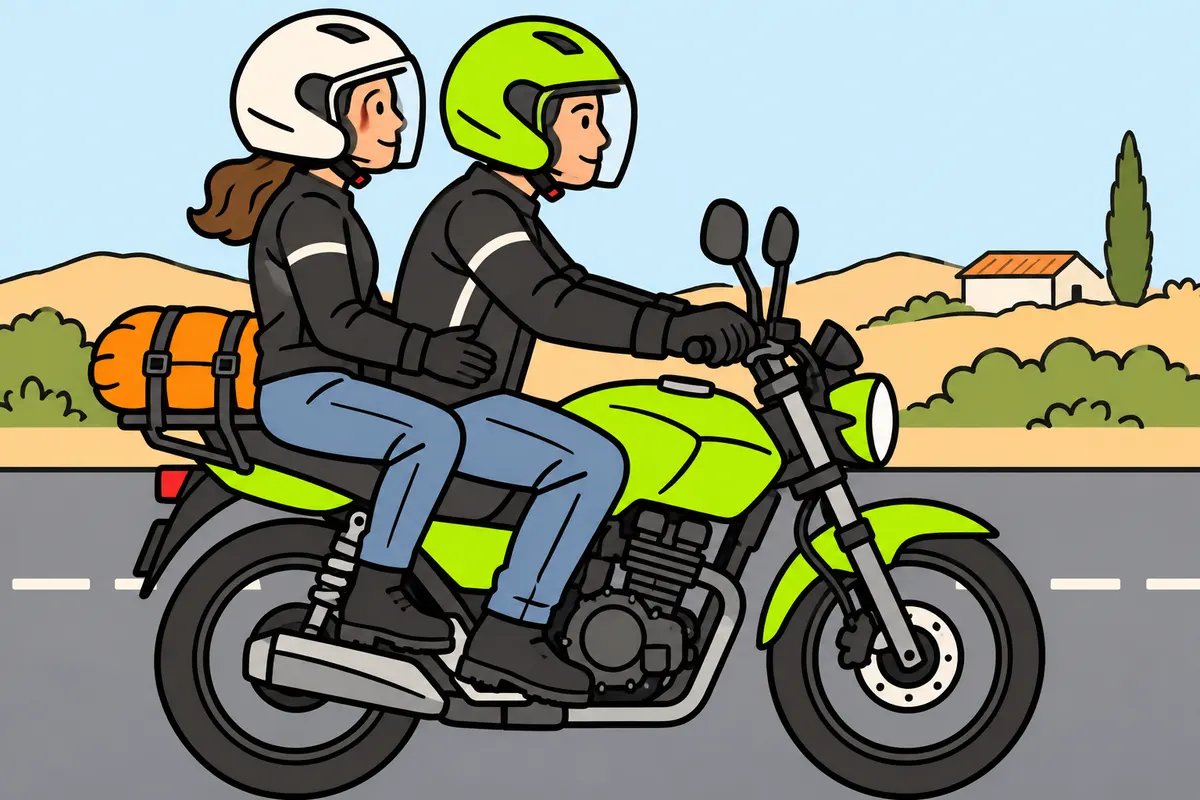
Count people and luggage when you calculate laden mass.
| Mass | What it includes |
|---|---|
| Tare mass | Equipped vehicle, without people or load |
| Laden mass | Actual vehicle, people and load |
Remember
- Tare mass includes fixed equipment and all necessary supplies.
- It includes fuel, fluids, tools and spare parts.
- Laden mass changes with what you carry.
Exam trap: Wrong: measured mass is the authorised maximum. Right: laden mass tells you the actual mass.
Read the full explanation
- Tare mass is the mass of the vehicle with its authorised fixed equipment, without service personnel, passengers or load, but with the full supplies of water, fuel and lubricant, and the necessary spare parts, tools and accessories. [RGV, Annex IX, section 1](https://www.boe.es/buscar/act.php?id=BOE-A-1999-1826#anix)
- Laden mass is the actual mass of the vehicle and its load, including the people in it. For your motorcycle, count the rider, authorised passenger and luggage. It varies between journeys and can change during a journey; simply measuring it does not make it an authorised maximum figure. [RGV, Annex IX, section 1](https://www.boe.es/buscar/act.php?id=BOE-A-1999-1826#anix)
- If an exercise gives you a tare mass of 130 kg and adds a 70 kg rider, a 55 kg passenger and 15 kg of luggage, the total is 270 kg, subject to the conditions stated in the question. [RGV, Annex IX, section 1](https://www.boe.es/buscar/act.php?id=BOE-A-1999-1826#anix)
21MMA and MMTA
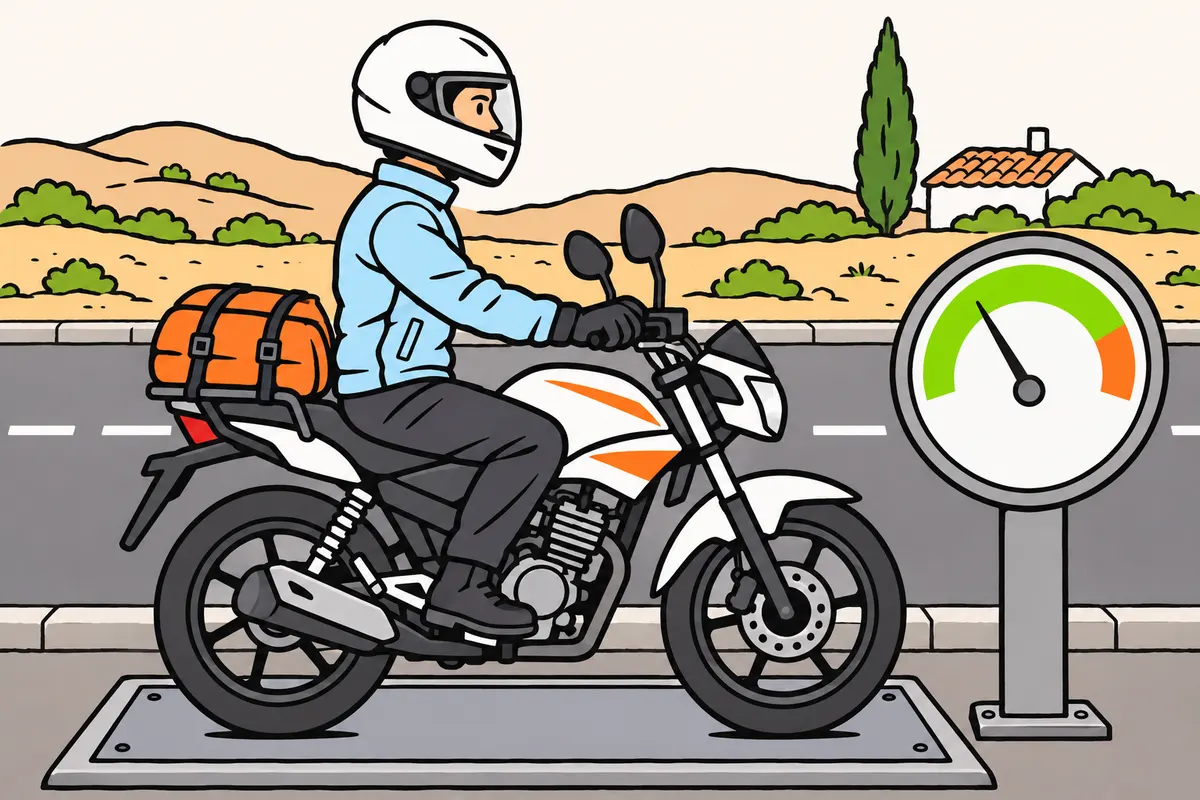
Respect MMA even when the manufacturer gives a higher technical mass limit.
| Limit | What determines it |
|---|---|
| MMA | Maximum authorised mass for travelling with a load |
| MMTA | Vehicle construction; specified by the manufacturer |
Remember
- MMA limits total laden mass on public roads.
- MMA is not the amount of luggage you can add.
- Axle mass is the mass its wheels transmit to the ground.
Exam trap: Wrong: a higher MMTA allows you to exceed MMA. Right: you must respect the authorised maximum.
Read the full explanation
- The maximum authorised mass, MMA, is the maximum permitted for using the vehicle, laden, on public roads. It is not the amount of luggage you can add or the mass of the vehicle without a rider. [RGV, Annex IX, section 1](https://www.boe.es/buscar/act.php?id=BOE-A-1999-1826#anix)
- The maximum technically permissible mass, MMTA, is based on the vehicle's construction and specified by the manufacturer. If the MMTA and MMA figures differ, a higher MMTA does not allow you to use it instead of the authorised maximum. [RGV, Annex IX, section 1](https://www.boe.es/buscar/act.php?id=BOE-A-1999-1826#anix)
- In an example with an MMA of 280 kg and an actual mass of 270 kg, 10 kg remain before reaching that MMA. If the actual mass is 285 kg, the excess is 5 kg. [RGV, Annex IX, section 1](https://www.boe.es/buscar/act.php?id=BOE-A-1999-1826#anix)
- The axle mass is the mass transmitted to the ground by the wheels on the same axle. You can distinguish it from the vehicle's total mass. Load distribution and securing are covered in “Passengers and loads on motorcycles”. [RGV, Annex IX, section 1](https://www.boe.es/buscar/act.php?id=BOE-A-1999-1826#anix)
22Motorcycle mass in running order
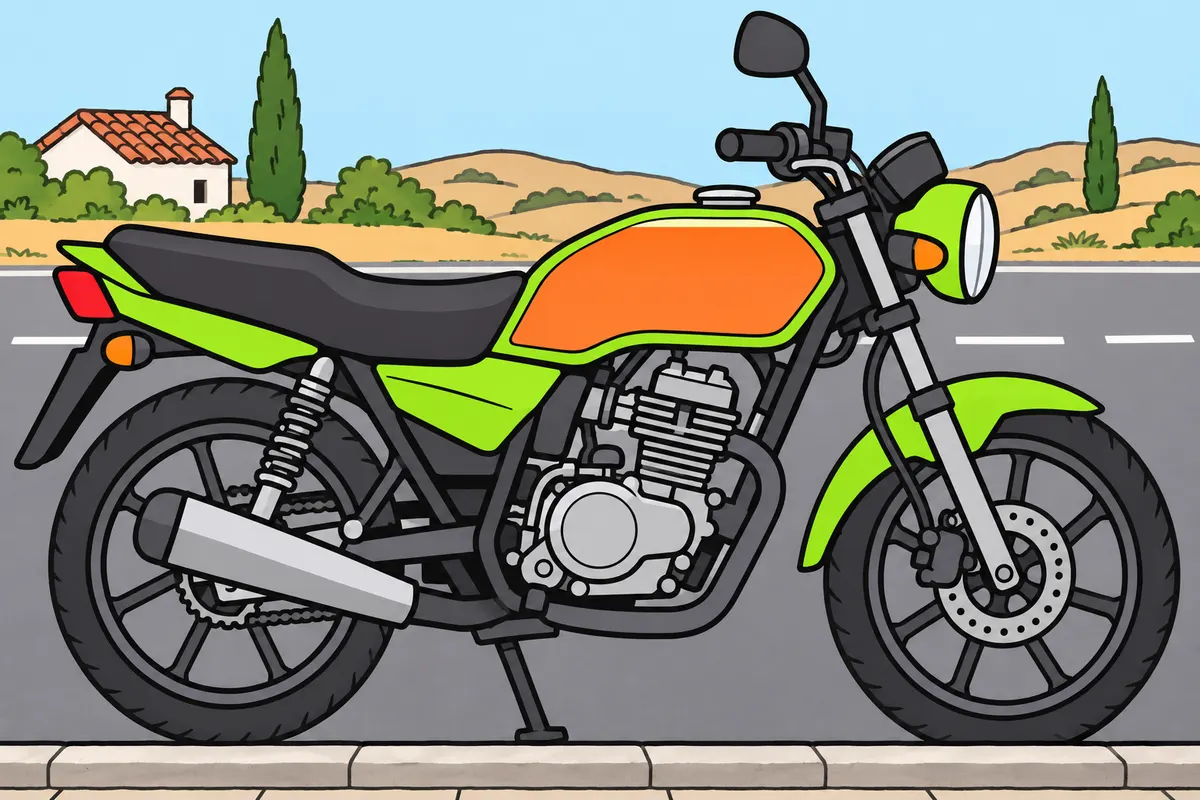
For your category L motorcycle, mass in running order excludes occupants.
| Rule | Mass in running order |
|---|---|
| General RGV rule | Tare mass plus 75 kg standard driver; refers category L to specific rules |
| Category L | Vehicle ready for normal use, with specified exclusions |
Remember
- Use the specific category L rule.
- Count fluids and the manufacturer’s standard equipment.
- Exclude the driver and passenger.
- For electric and hybrid vehicles, exclude propulsion batteries.
- The rules also exclude other specified items.
Exam trap: Wrong: always add a 75 kg driver to your motorcycle’s tare mass. Right: apply the specific category L rule, which excludes occupants.
Read the full explanation
- The general RGV rule defines mass in running order by adding a standard rider mass of 75 kg to the tare mass, but it expressly refers to a specific rule for category L vehicles. [RGV, Annex IX, section 1](https://www.boe.es/buscar/act.php?id=BOE-A-1999-1826#anix)
- For category L, mass in running order means the unloaded vehicle, ready for normal use, with fluids and the manufacturer's standard equipment. For liquid fuel, the tank is considered full when it is at least 90% of its capacity. [Regulation (EU) 168/2013, Article 5](https://www.boe.es/buscar/doc.php?id=DOUE-L-2013-80407) [RGV, Annex IX, section 1](https://www.boe.es/buscar/act.php?id=BOE-A-1999-1826#anix)
- Category L mass in running order excludes the rider and passenger; it also excludes propulsion batteries in electric or hybrid vehicles and the other items specified in its regulations. [Regulation (EU) 168/2013, Article 5](https://www.boe.es/buscar/doc.php?id=DOUE-L-2013-80407) [RGV, Annex IX, section 1](https://www.boe.es/buscar/act.php?id=BOE-A-1999-1826#anix)
23Driver, registered keeper and regular driver
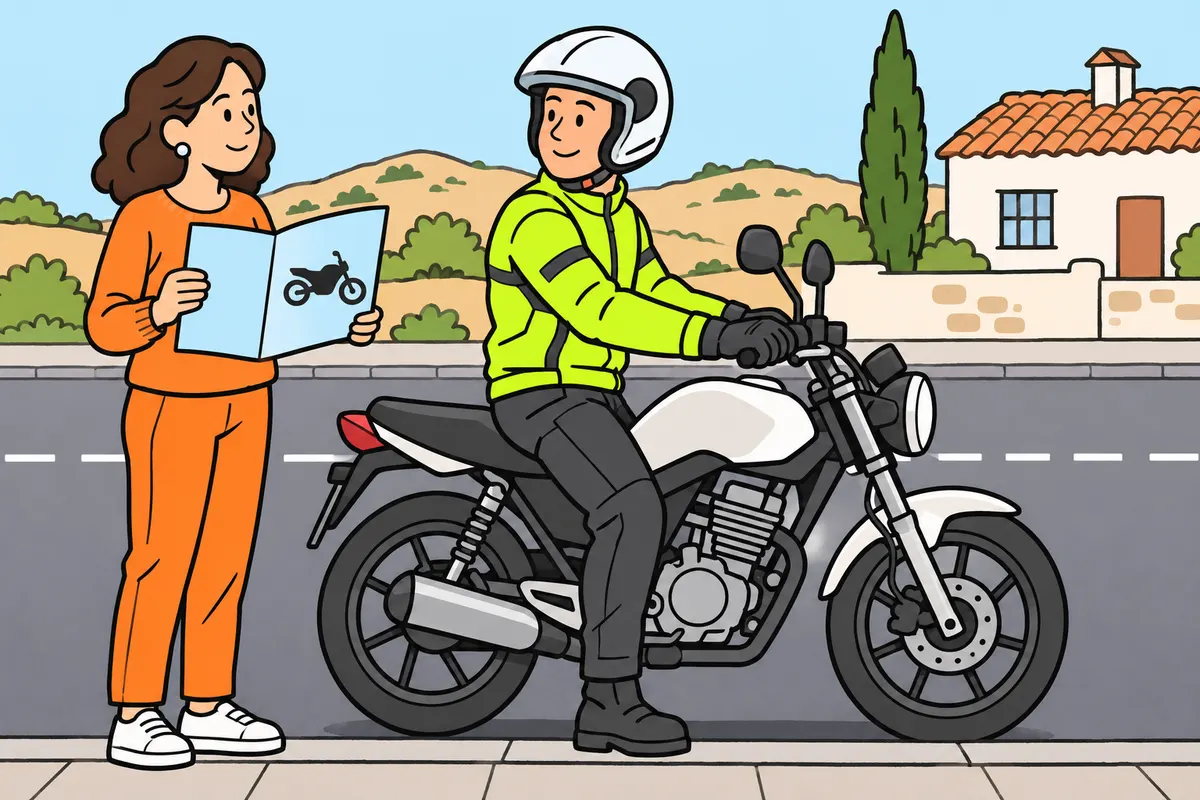
You can ride a motorcycle whose registered keeper is someone else.
| Person | Role |
|---|---|
| Registered keeper | Person named in the vehicle register |
| Regular driver | Usually drives the vehicle, with the designation reported |
| Current driver | Controls the vehicle at that moment |
| You register as an individual without authorisation to drive | You must designate a regular driver |
Remember
- You are the driver when you steer or control the vehicle.
- During instruction with additional controls, whoever manages those controls counts as the driver.
- Being the registered keeper does not mean you ride the motorcycle yourself.
- The regular driver must consent and hold the required licence.
- That licence must be entered in the Register of Drivers and Offenders.
- The keeper or long-term lessee reports the regular driver to the Vehicle Register.
Exam trap: Wrong: the registered keeper and driver are always the same person. Right: they can be different people.
Read the full explanation
- You are the driver when you control the steering or are in charge of the vehicle; the definition also includes someone in charge of animals. [Traffic Act, Annex I](https://www.boe.es/buscar/act.php?id=BOE-A-2015-11722#ani)
- In a vehicle used for learning with additional controls, the person responsible for those controls is considered the driver. [Traffic Act, Annex I](https://www.boe.es/buscar/act.php?id=BOE-A-2015-11722#ani)
- The registered keeper is the person in whose name the vehicle is entered in the relevant official register. You can ride a motorcycle registered to someone else; you can also be the registered keeper of one you do not ride yourself. [Traffic Act, Annex I](https://www.boe.es/buscar/act.php?id=BOE-A-2015-11722#ani)
- The regular driver must hold the necessary licence or permit, which must be recorded in the Register of Drivers and Offenders; they must consent to being designated and be reported to the Vehicle Register by the registered keeper or long-term hirer because they usually drive the vehicle or drive it most often. [Traffic Act, Annex I](https://www.boe.es/buscar/act.php?id=BOE-A-2015-11722#ani) If an individual without administrative authorisation to drive registers a vehicle, they must designate a regular driver. [Traffic Act, Annex I](https://www.boe.es/buscar/act.php?id=BOE-A-2015-11722#ani)
- In one case, you may identify three different people: the registered keeper, the regular driver and the person driving that day. A professional driver is a specific definition linked to the points-based driving licence and to the main work-related transport of people or goods. [Traffic Act, Annex I](https://www.boe.es/buscar/act.php?id=BOE-A-2015-11722#ani)
24Pedestrians and passengers
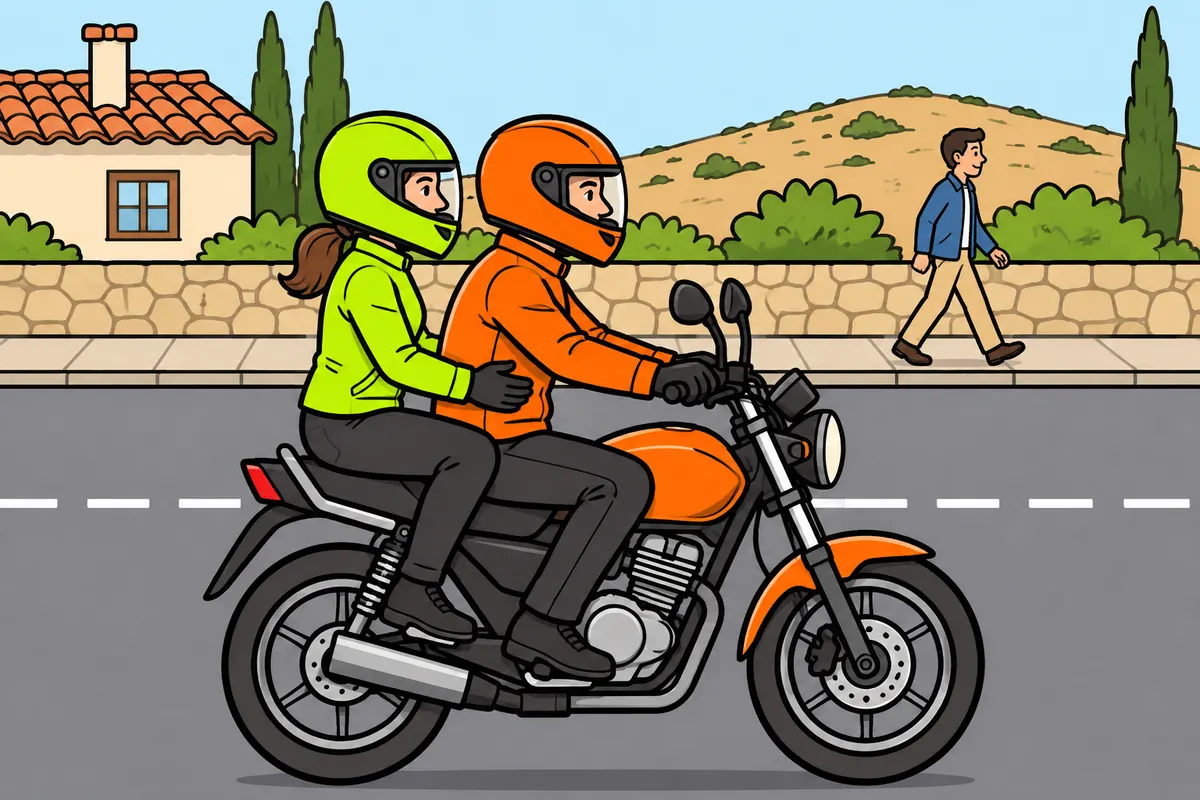
You may be a pedestrian or passenger depending on how you travel.
| Situation | Classification |
|---|---|
| You walk without acting as a driver | Pedestrian |
| You push a pram, disability wheelchair or small non-motorised vehicle | Pedestrian |
| You ride behind without steering the motorcycle | Passenger, even if you are its registered keeper |
Remember
- Walking a cycle or two-wheeled moped makes you a pedestrian.
- This exception does not mention walking a motorcycle.
- A disabled person using a wheelchair at walking pace is a pedestrian, even motorised.
- As a motorcycle passenger, you travel without steering.
- On a motorcycle, you and your passenger are vulnerable road users.
Exam trap: Wrong: walking a motorcycle appears in the pedestrian exception. Right: that exception mentions cycles and two-wheeled mopeds.
Read the full explanation
- You are a pedestrian when you travel on foot on roads or land covered by the law, without acting as a driver. Someone pushing or pulling a pushchair, a wheelchair or another small non-motorised vehicle is also considered a pedestrian. [Traffic Act, Annex I](https://www.boe.es/buscar/act.php?id=BOE-A-2015-11722#ani)
- A person wheeling a cycle or a two-wheeled moped is considered a pedestrian. The exception does not mention wheeling a motorcycle. [Traffic Act, Annex I](https://www.boe.es/buscar/act.php?id=BOE-A-2015-11722#ani)
- People with disabilities who travel at walking pace in a wheelchair are also considered pedestrians, whether or not the wheelchair is powered. [Traffic Act, Annex I](https://www.boe.es/buscar/act.php?id=BOE-A-2015-11722#ani)
- You are a passenger when you travel on the motorcycle without controlling it. For example, you can be its registered keeper and ride on the back while someone else drives. [Traffic Act, Annex I](https://www.boe.es/buscar/act.php?id=BOE-A-2015-11722#ani)
- Vulnerable road users are at greater risk of injury or serious injury because of how they travel or the physical characteristics of their age group. They include pedestrians, cyclists, VMP (personal mobility vehicle) users, and motorcycle and moped riders and passengers. You and your passenger are part of this group when you travel by motorcycle. [Traffic Act, Annex I.86](https://www.boe.es/buscar/act.php?id=BOE-A-2015-11722#ani)
25Compulsory stops, brief stops and parking
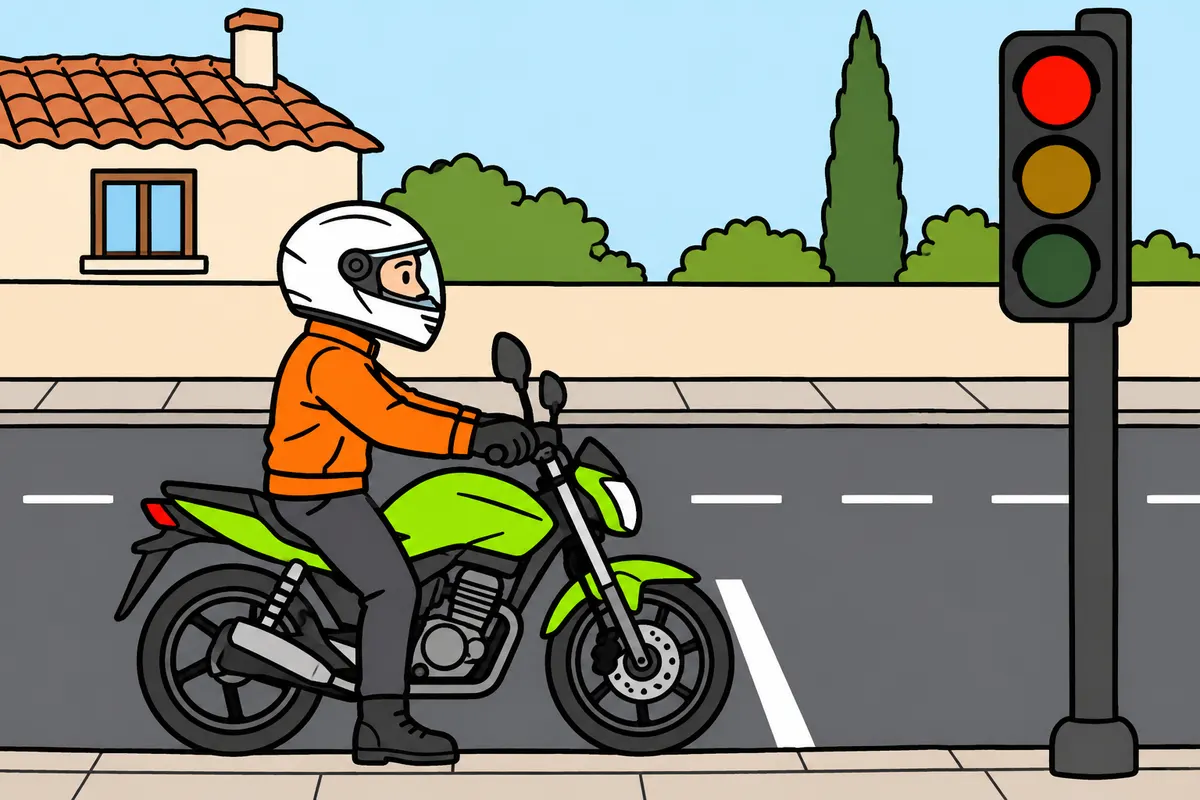
Classify a stop by its cause, duration and whether you leave the vehicle.
| Situation | Meaning |
|---|---|
| Compulsory stop | Emergency, traffic or obeying a rule |
| Brief stop | Less than two minutes, without leaving the vehicle |
| Parking | Any stop that is neither compulsory nor brief |
Remember
- Waiting at a red light is a compulsory stop.
- A traffic queue remains a compulsory stop however long you wait.
- If you voluntarily leave your motorcycle to visit a shop, you are parking.
Exam trap: Wrong: exactly two minutes voluntarily counts as a brief stop if you stay beside your motorcycle. Right: a brief stop requires less than two minutes and not leaving the vehicle.
Read the full explanation
- A compulsory stop is when you immobilise your vehicle because of an emergency, traffic conditions or compliance with a rule. If you have to wait at a red traffic light, obey an order to stop or wait in a traffic queue, this is a compulsory stop. [Traffic Act, Annex I](https://www.boe.es/buscar/act.php?id=BOE-A-2015-11722#ani)
- A brief stop lasts less than two minutes and requires you, as the driver, not to leave the vehicle. A voluntary immobilisation lasting exactly two minutes does not meet the definition of a brief stop, even if you stay beside your motorcycle and keep the engine running. [Traffic Act, Annex I](https://www.boe.es/buscar/act.php?id=BOE-A-2015-11722#ani)
- Parking is any immobilisation that is neither a compulsory stop nor a brief stop. If you voluntarily leave your motorcycle and go into a shop, you must identify this as parking even if you return within two minutes. If you remain stopped for five minutes because of a traffic queue, the reason means that it remains a compulsory stop. [Traffic Act, Annex I](https://www.boe.es/buscar/act.php?id=BOE-A-2015-11722#ani)
26Overtaking and passing stationary vehicles
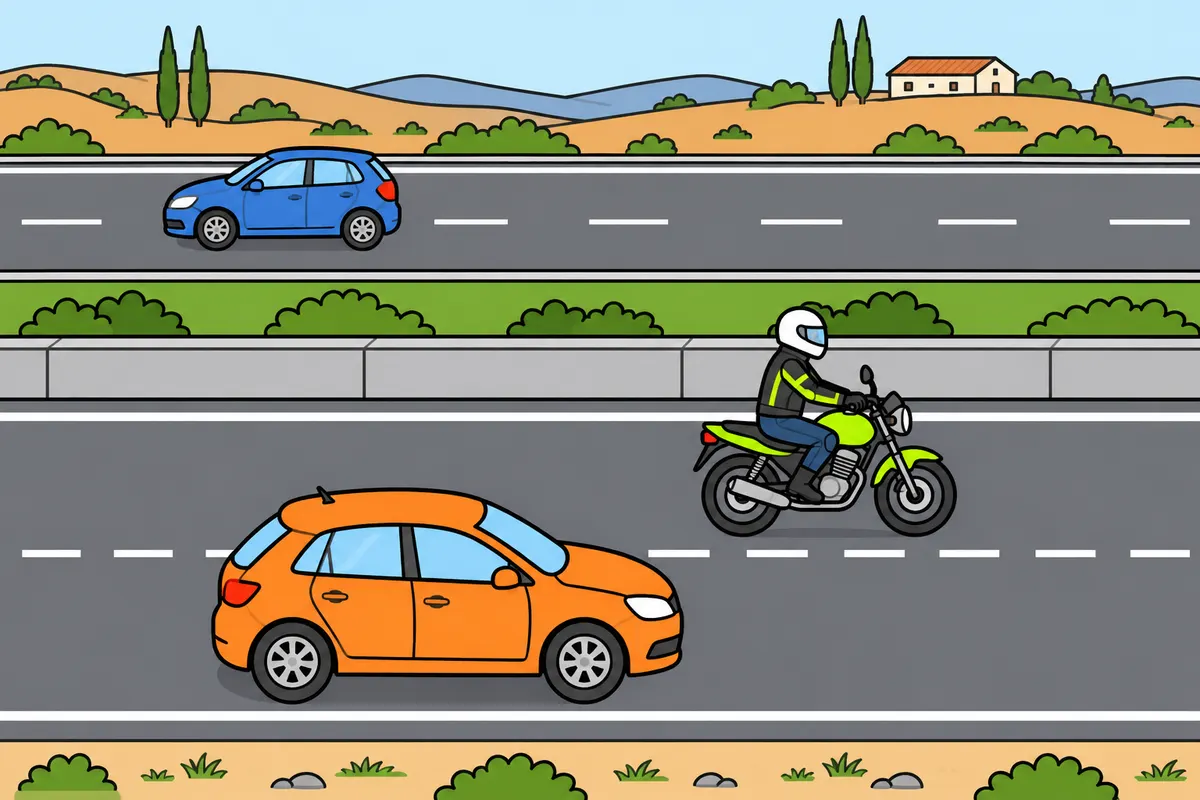
Distinguish overtaking a moving vehicle from passing a stationary one.
| Case | Classification |
|---|---|
| You pass a stationary vehicle | Passing a stationary vehicle |
| Dense traffic fills the road width; each lane’s speed depends on vehicles ahead | Moving faster in a lane does not count as overtaking |
| You move faster in acceleration, deceleration or reserved lanes than ordinary lanes, or vice versa | Does not count as overtaking |
Remember
- You overtake a vehicle travelling ahead in your direction.
- Exceptions to the definition do not allow you to use an unauthorised reserved lane.
- Your motorcycle group must follow the general overtaking rules.
Exam trap: Wrong: moving faster in a reserved lane lets you use it. Right: this exception does not authorise you to use a reserved lane you are not entitled to use.
Read the full explanation
- When overtaking, you pass another vehicle travelling ahead of you in the same direction. For example, on your motorcycle you pass a car that is still moving.
- In sufficiently dense traffic, when vehicles occupy the full width of the road and the speed in each lane depends on the vehicle ahead, moving faster in one lane than in another does not count as overtaking. [RGC, art. 83.2](https://www.boe.es/buscar/act.php?id=BOE-A-2003-23514#a83)
- Moving faster in an acceleration lane, deceleration lane or lane reserved for certain vehicles than in the normal lanes, or vice versa, also does not count as overtaking. This exception in definition does not authorise you to use a reserved lane that is not available to you. [RGC, art. 83.3](https://www.boe.es/buscar/act.php?id=BOE-A-2003-23514#a83)
- Passing a stationary vehicle means going past it. The conditions for doing so, including exceptional use of the opposing lane and the clearance and speed reduction required when passing vehicles immobilised because of a breakdown, accident or certain services, are covered in “Manoeuvres on your motorcycle”. [RGC, art. 88.1 and 88.2](https://www.boe.es/buscar/act.php?id=BOE-A-2003-23514#a88)
- For the rules that apply before overtaking, there is a specific exception for passing between cyclists riding in a group. Your motorcycle group must follow the general rules. [Traffic Act, art. 34.4](https://www.boe.es/buscar/act.php?id=BOE-A-2015-11722#a34)
Finished this module?
Mark it as read and you will see your progress on the theory list.