
Theory · A1 Licence - 125 cc Motorcycle · Module 2 of 18
A1 licence and motorcycle documents
You learn which motorcycles you can ride with an A1 licence and how it differs from A2 and A licences and the national B licence entitlement. You master the qualifying tests, renewal, documents, ITV (vehicle roadworthiness test), insurance and basic protective equipment duties so you can answer exam questions without confusing the rider’s authorisation with the vehicle’s.
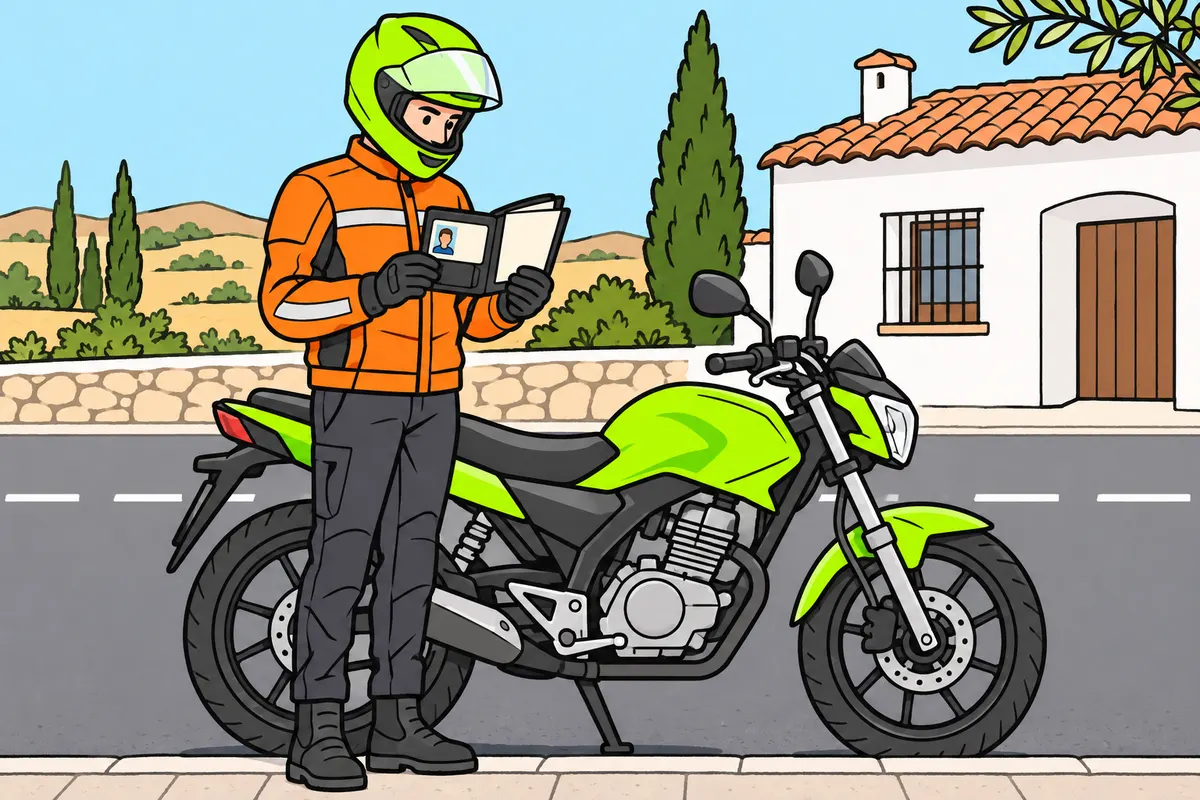
1A1 and A2: ages, vehicles and entitlements
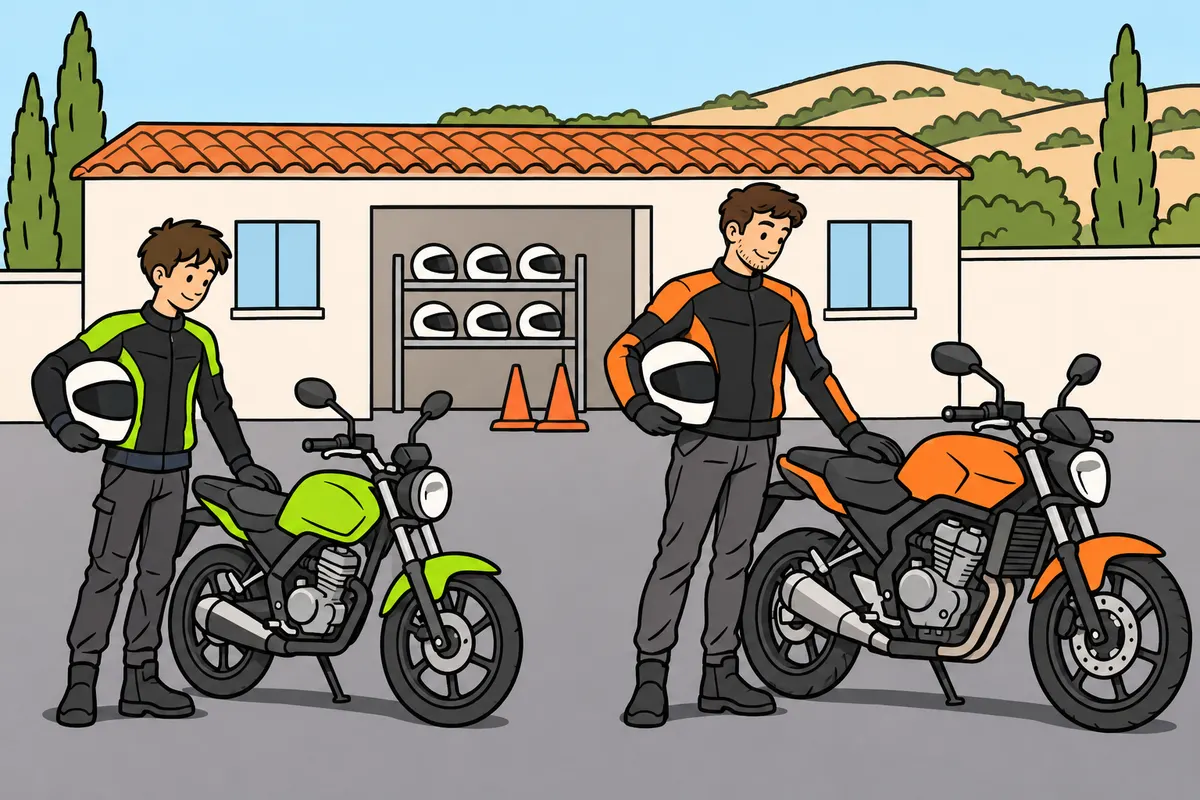
Check every licence limit before choosing your motorcycle.
| Motorcycle licence | Maximum power | Maximum power-to-weight ratio | Other conditions |
|---|---|---|---|
| A1 | 11 kW | 0.1 kW/kg | Up to 125 cm³ |
| A2 | 35 kW | 0.2 kW/kg | Original power: at most twice restricted power; no maximum engine capacity |
Remember
- With A1, you also get AM: this includes mopeds and light quadricycles.
- You can obtain A1 without holding AM first.
- With valid B held over three years, you can ride A1 motorcycles in Spain.
- This B entitlement does not give you an A1 licence.
- If B has restrictions, Tráfico must record relevant restrictions before you ride these motorcycles.
- A1 does not authorise motor quadricycles.
Exam trap: Wrong: engine capacity is enough. Right: your A1 motorcycle must meet all its maximum limits together.
Read the full explanation
- You can obtain category A1 from the age of 16 and category A2 from the age of 18. [RGCond, art. 4.2](https://www.boe.es/buscar/act.php?id=BOE-A-2009-9481#a4). You must have reached the minimum age by the first attempt at the practical tests. [RGCond, Annex VI.A.2](https://www.boe.es/buscar/act.php?id=BOE-A-2009-9481#anvi).
- With A1, you can ride motorcycles with or without a sidecar that meet all these maximum limits at the same time: 125 cm³, 11 kW and a power-to-weight ratio of 0.1 kW/kg. A 125 cm³ motorcycle with 12 kW is outside this category. [RGCond, art. 4.2](https://www.boe.es/buscar/act.php?id=BOE-A-2009-9481#a4).
- With A1, you can also drive motor tricycles of up to 15 kW and vehicles for people with reduced mobility. [RGCond, art. 4.2](https://www.boe.es/buscar/act.php?id=BOE-A-2009-9481#a4).
- When you obtain A1, you also obtain AM, which covers two- or three-wheeled mopeds and light quadricycles. A1 does not authorise you to drive motor quadricycles: the quadricycles you can drive under the included AM category are light quadricycles. [RGCond, art. 4.2, categories AM, A1 and B](https://www.boe.es/buscar/act.php?id=BOE-A-2009-9481#a4). [RGCond, art. 5.2.a](https://www.boe.es/buscar/act.php?id=BOE-A-2009-9481#a5). A2 includes A1 and therefore AM as well. [RGCond, art. 5.2.b](https://www.boe.es/buscar/act.php?id=BOE-A-2009-9481#a5).
- With A2, you can ride motorcycles with or without a sidecar of up to 35 kW and up to 0.2 kW/kg, provided they are not derived from a vehicle with more than twice that power. This category sets no maximum engine capacity. [RGCond, art. 4.2](https://www.boe.es/buscar/act.php?id=BOE-A-2009-9481#a4).
- If you hold a valid category B licence for more than three years, you can ride the motorcycles authorised by A1 within Spain; this national entitlement does not mean you have obtained category A1. [RGCond, art. 4.2](https://www.boe.es/buscar/act.php?id=BOE-A-2009-9481#a4). If your B licence is subject to adaptations, restrictions or other personal, vehicle or traffic limitations, the Jefatura Provincial de Tráfico (Provincial Traffic Headquarters) must first record the relevant adaptations or restrictions on your licence so that you can ride those motorcycles. [RGCond, art. 5.7](https://www.boe.es/buscar/act.php?id=BOE-A-2009-9481#a5).
- You can obtain A1 directly without any previous experience with AM. [RGCond, art. 4.2](https://www.boe.es/buscar/act.php?id=BOE-A-2009-9481#a4).
2Restricted motorcycles: calculate twice the resulting power
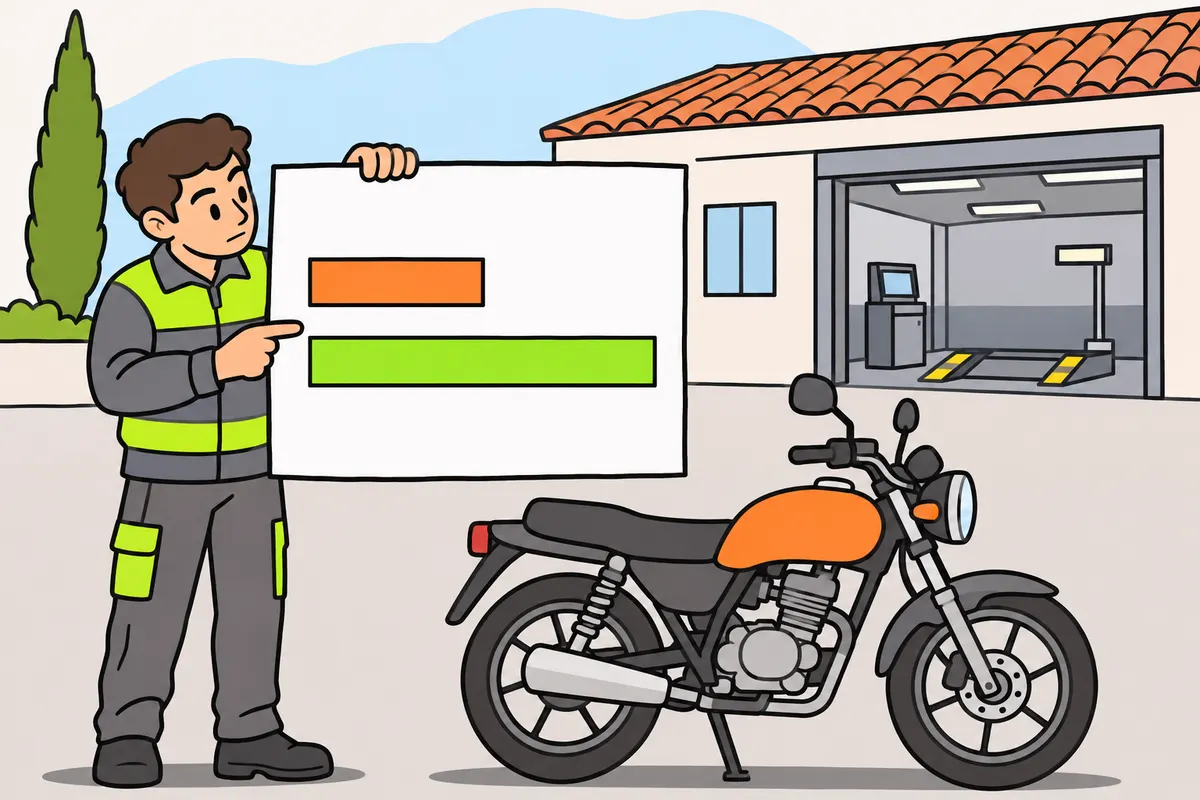
For A2, check that original power does not exceed twice the restricted power.
| Restricted A2 motorcycle power | Maximum original power |
|---|---|
| 35 kW | 70 kW |
| 30 kW | 60 kW |
| 25 kW | 50 kW |
Remember
- Also check the power-to-weight ratio.
- For A1, check all its limits, including engine capacity.
- Restricting power does not change the engine capacity.
- Original power can equal exactly twice the restricted power.
- You must have the restriction legally approved and recorded on the ITV card.
- If it needs alteration approval, present your motorcycle for inspection with the required documents.
Exam trap: Wrong: you can always start from 70 kW. Right: for A2, calculate twice the resulting restricted power.
Read the full explanation
- To check whether you can ride a restricted motorcycle, consult its ITV card (vehicle roadworthiness test card) and apply the limits for the relevant licence explained in “A1 and A2: ages, vehicles and entitlements”; the restriction affects power and leaves the engine capacity unchanged. [RGCond, art. 4.2](https://www.boe.es/buscar/act.php?id=BOE-A-2009-9481).
- If the motorcycle is restricted to 35 kW, its original power cannot exceed 70 kW. If it is restricted to 30 kW, its original power cannot exceed 60 kW; if restricted to 25 kW, it cannot exceed 50 kW. Always calculate twice the resulting power. Original power exactly twice the resulting power does not exceed the limit. [RGCond, art. 4.2](https://www.boe.es/buscar/act.php?id=BOE-A-2009-9481).
- The power restriction must be legalised and recorded on the ITV card. If the modification counts as a vehicle alteration, you must present the motorcycle for inspection within a maximum of 15 days, with the required documents. [RD 866/2010, art. 8](https://www.boe.es/buscar/act.php?id=BOE-A-2010-11154).
3Category A licence: progressive access and scope
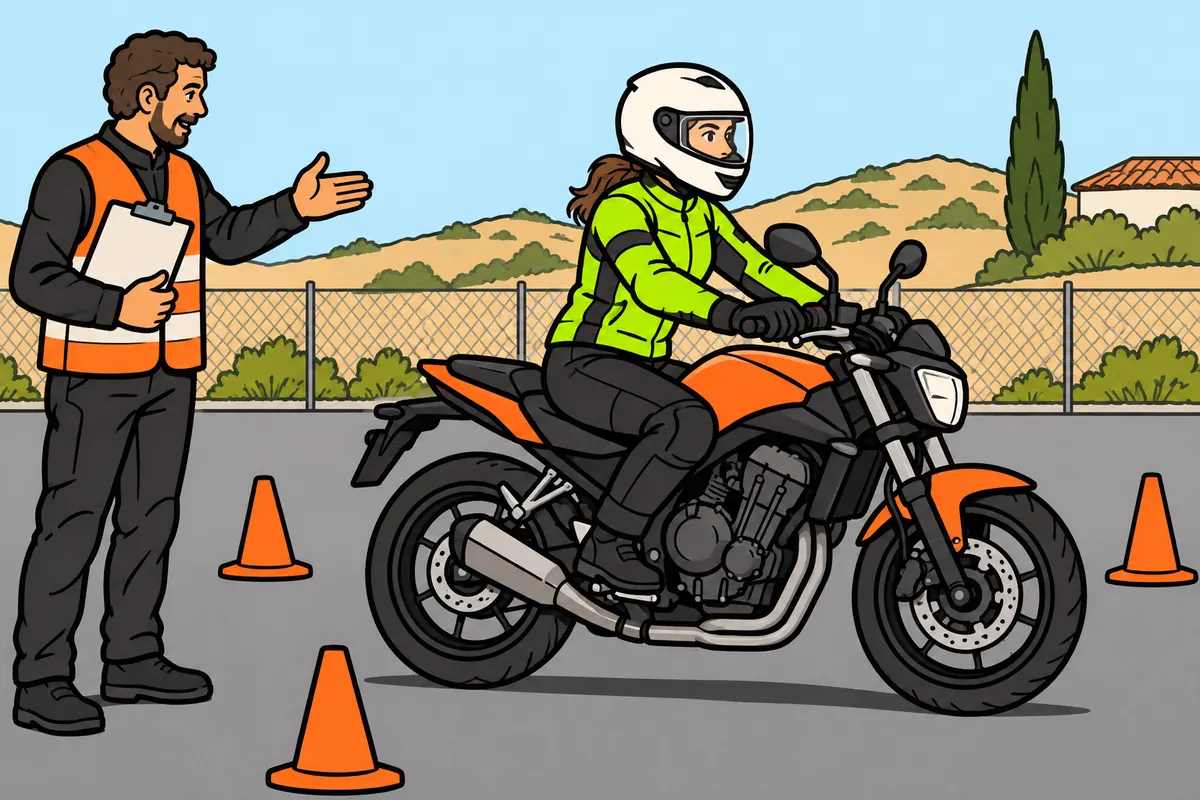
To obtain A, you need the required age, A2 experience and compulsory training.
| A course part | Minimum time |
|---|---|
| General theory | one and a half hours |
| Safety awareness | one and a half hours |
| Closed course | two hours |
| On-road riding | four hours; two on conventional roads |
Remember
- You need a valid A2 licence.
- With A, you can ride motorcycles beyond the A1 and A2 limits.
- You must follow any personal restrictions on your licence.
- To drive tricycles over 15 kW, you must be at least 21.
Exam trap: Wrong: you get A automatically after holding A2 long enough. Right: you need the required age, valid A2, experience and successful training.
Read the full explanation
- You can obtain category A from the age of 20 if you hold a valid A2 licence and have held it for at least two years, with experience riding the motorcycles it authorises. You must complete the prescribed training for category A to be issued to you. [RGCond, art. 4.2, category A](https://www.boe.es/buscar/act.php?id=BOE-A-2009-9481#a4). [RGCond, arts. 5.1.a and 5.4](https://www.boe.es/buscar/act.php?id=BOE-A-2009-9481#a5).
- With category A, you can ride motorcycles without the engine-capacity, power and power-to-weight limits that apply to A1 and A2. You must continue to comply with any individual restrictions shown on your licence. [RGCond, art. 4.2, category A](https://www.boe.es/buscar/act.php?id=BOE-A-2009-9481#a4).
- Category A also authorises you to drive motor tricycles, but until you have reached the age of 21 you cannot use it to drive those exceeding 15 kW. [RGCond, art. 4.2, category A](https://www.boe.es/buscar/act.php?id=BOE-A-2009-9481#a4).
- You must complete a course of at least nine teaching hours, spread over at least two days. [Order INT/210/2025, arts. 1 and 2](https://www.boe.es/buscar/act.php?id=BOE-A-2025-4408).
- The theory part consists of one and a half hours of general theory and another one and a half hours of awareness and road-safety education. [Order INT/210/2025, arts. 1 and 2](https://www.boe.es/buscar/act.php?id=BOE-A-2025-4408).
- The practical training includes two hours of manoeuvres on a closed circuit and four actual hours riding on roads open to traffic. Of those four hours, two must be on a conventional road. [Order INT/210/2025, arts. 1 and 2](https://www.boe.es/buscar/act.php?id=BOE-A-2025-4408).
4Tests you must pass and exemptions
Check which tests you need based on your valid licence and experience.
| Your case | What you must pass |
|---|---|
| Valid B: obtaining A1 | Specific theory, off-road and on-road tests |
| Valid A1: obtaining A2 | No specific theory; no minimum holding period for this exemption |
| A1: at least two years’ experience, progressive access to A2 | On-road test only; replacement training possible under a ministerial order |
Remember
- For A1, pass common theory, specific theory, off-road and on-road tests, unless exempt.
- Having AM does not replace these tests.
- You can skip common theory with a valid licence that required it.
- You can also skip it if your earlier pass is still valid.
Exam trap: Wrong: A1 exempts you from every A2 test. Right: it exempts you from specific theory; progressive access requires at least two years’ experience.
Read the full explanation
- To obtain A1, you must pass, unless an exemption applies, a common knowledge test, a motorcycle-specific test and two practical tests: a closed-circuit test and an on-road riding test. Holding AM does not prove that you have passed the common test for driving licences and does not replace the A1-specific and practical tests. [RGCond, arts. 47, 48, 49 and 54](https://www.boe.es/buscar/act.php?id=BOE-A-2009-9481).
- If you hold a valid B licence and want to obtain A1 as a separate category, exemption from the common theory test does not exempt you from the motorcycle-specific test, the circuit test or the on-road test. [RGCond, arts. 4.2 and 54](https://www.boe.es/buscar/act.php?id=BOE-A-2009-9481).
- You may be exempt from the common test if you hold a valid licence for which you had to pass that test, or if you have already passed it for another licence and the pass is still valid for its two-year period. [RGCond, arts. 53.1 and 54.1](https://www.boe.es/buscar/act.php?id=BOE-A-2009-9481).
- If you apply for A2 while holding a valid A1 licence, you are exempt from the motorcycle-specific theory test; you do not need two years of experience for this exemption. With at least two years of experience riding A1 motorcycles, you can use the progressive route to A2: you only have to pass the on-road riding test under article 49.2. Article 5.3 provides that this test may be replaced by training under the terms set by an order of the Minister of the Interior. [RGCond, arts. 5.3 and 54.2.a](https://www.boe.es/buscar/act.php?id=BOE-A-2009-9481).
5Applications, attempts and exam time limits
Follow exam time limits and attend on your assigned date.
| After failing | Minimum wait |
|---|---|
| Between second and third attempts | ten days |
| Between later attempts | fifteen days |
Remember
- Count minimum waiting periods from the date of your failed test.
- Tráfico sets your date according to availability.
- Recognised, properly justified urgency can shorten minimum waiting periods.
- Illness or other justified exceptional cases can extend the time between attempts.
Exam trap: Wrong: missing your test does not use an attempt. Right: you lose it unless you have a properly justified exceptional reason.
Read the full explanation
- As a general rule, each application entitles you to two test attempts. No more than six months must elapse between attempts under the same application; the regulations allow for illness or other duly justified exceptional cases. [RGCond, art. 51 and Annex VI.A.2](https://www.boe.es/buscar/act.php?id=BOE-A-2009-9481).
- If you fail a test on two attempts, at least ten days must pass between the second and third attempts. At least fifteen days must pass between later attempts, including those after the third. [RGCond, art. 51 and Annex VI.A.2](https://www.boe.es/buscar/act.php?id=BOE-A-2009-9481).
- These minimum intervals are counted from the date you took the test you failed. They may exceptionally be reduced in cases of recognised and duly justified urgency. These are regulatory minimums: the Jefatura sets the actual date according to service availability. [RGCond, art. 51 and Annex VI.A.2](https://www.boe.es/buscar/act.php?id=BOE-A-2009-9481).
- You can take the first theory test attempt no more than three months before reaching the minimum age. If you do not attend on the scheduled date, you lose that attempt unless there is a duly justified exceptional case. [RGCond, art. 51 and Annex VI.A.2](https://www.boe.es/buscar/act.php?id=BOE-A-2009-9481).
6Province and test centre
Take your tests in your application province, at the centre Tráfico assigns.
Remember
- Take your tests in the province where you submitted your application.
- Attend the centre assigned by the provincial traffic office.
Exam trap: Wrong: you can choose any test centre. Right: attend the centre Tráfico assigns.
Read the full explanation
- You take the tests in the province to which you submitted your application, at the centre designated by the Jefatura Provincial de Tráfico (Provincial Traffic Headquarters). [RGCond, art. 50 and Annex VI.A.1](https://www.boe.es/buscar/act.php?id=BOE-A-2009-9481).
7Motorcycle-specific theory: questions, duration and errors
Know the specific theory test format and follow the exam rules.
| Theory test | Questions allowed by regulations |
|---|---|
| Specific | 16 to 30 |
| Common | 30 to 50 |
Remember
- The correct answers depend on each question.
- You may get extra time for videos or properly justified special needs.
- Using a phone or prohibited information system ends your test and uses your attempt.
- You also face a fine and a six-month ban on all driving tests.
- Your pass validity starts the day after you pass.
- If you pass the next test within that period, the period starts again.
Exam trap: Wrong: regulations require exactly 20 specific questions. Right: they allow 16 to 30; the DGT uses 20.
Read the full explanation
- In the A1 motorcycle-specific test, the DGT uses a format of 20 questions, 20 minutes and a maximum of two errors. The 20 questions are the exam format in use, not a figure set by the regulations: Annex VI.B allows 16 to 30 specific questions; for the common test it allows 30 to 50. [RGCond, Annex VI.B](https://www.boe.es/buscar/act.php?id=BOE-A-2009-9481).
- Annex VI allows questions with between one and four correct answers; the number of valid answers depends on each question. [RGCond, art. 52 and Annex VI.A.4 and B](https://www.boe.es/buscar/act.php?id=BOE-A-2009-9481).
- You have one minute per question. The time may be extended in proportion to the duration of videos included in the test, and also to accommodate duly justified special needs. [RGCond, art. 52 and Annex VI.A.4 and B](https://www.boe.es/buscar/act.php?id=BOE-A-2009-9481).
- To pass, you must not exceed 10% errors out of the total number of questions. If the calculation gives a decimal, you apply the next whole number up. Thus, with 20 questions, the maximum is two errors. [RGCond, art. 52 and Annex VI.A.4 and B](https://www.boe.es/buscar/act.php?id=BOE-A-2009-9481).
- During the knowledge test, using a mobile phone or another prohibited system to receive or transmit information means exclusion and forfeiture of that exam attempt. It is also a very serious offence under the Traffic Act, punishable by a fine (art. 77.u), and for six months you cannot sit tests for any licence or permit (art. 80.4). [RGCond, art. 52 and Annex VI.A.4 and B](https://www.boe.es/buscar/act.php?id=BOE-A-2009-9481). [LTSV, arts. 77.u and 80.4](https://www.boe.es/buscar/act.php?id=BOE-A-2015-11722).
- A passed test remains valid for two years from the day after the day on which you passed. If you pass the next test within that period, the period starts again. [RGCond, art. 53.1](https://www.boe.es/buscar/act.php?id=BOE-A-2009-9481).
8Practical tests: identification, vehicle and communications
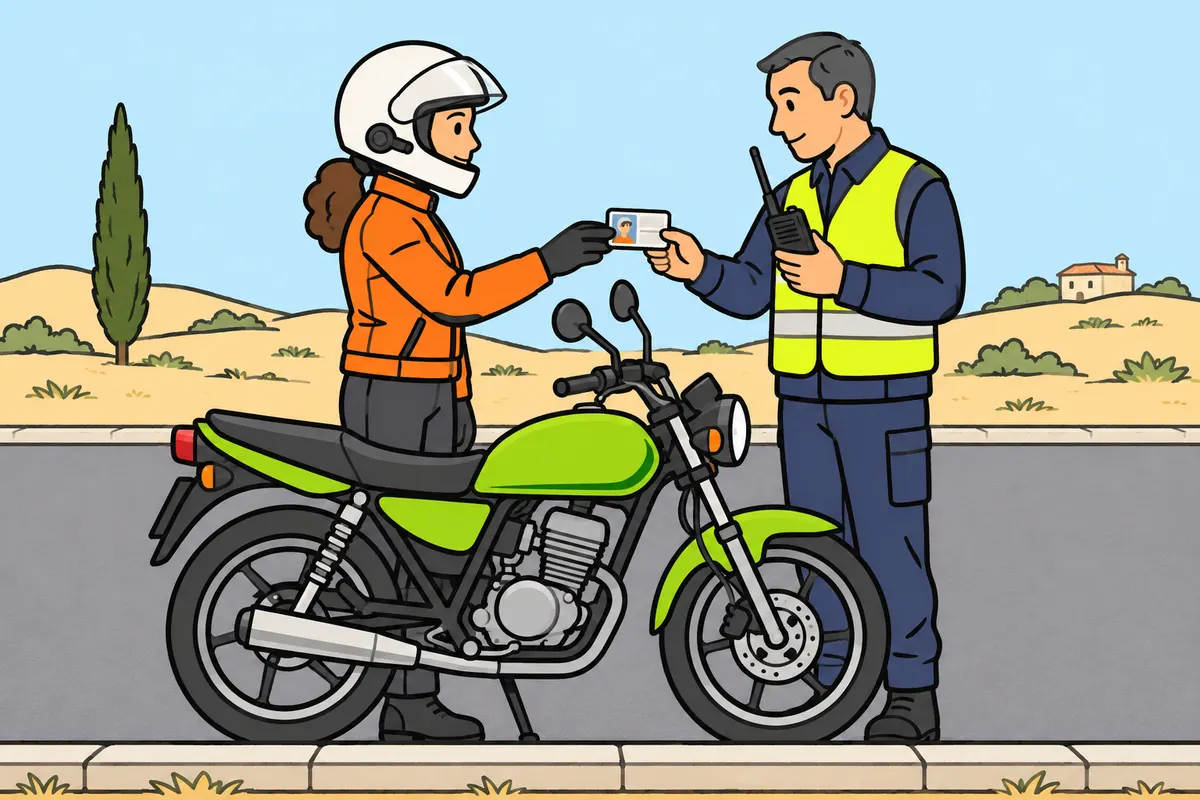
Bring the required identification and use only authorised communication systems during practical tests.
| Practical test problem | What happens to your test |
|---|---|
| Missing required identification | Does not start; you keep your attempt |
| Vehicle or systems fail requirements or work incorrectly | Does not start or is interrupted; you keep your attempt |
| Your instructor uses prohibited devices | Does not start or is interrupted; you keep your attempt |
Remember
- Show the identification documents you are asked for.
- The examiner can check your motorcycle, monitoring equipment and communication systems.
- Do not use phones or prohibited systems to record or transmit data.
- You can use prescribed test intercoms and systems used by Tráfico.
Exam trap: Wrong: missing identification costs you a practical attempt. Right: your test does not start and you keep the attempt.
Read the full explanation
- For practical tests and related procedures, officials may require you to show your DNI (Spanish national identity document), passport, residence card or driving licence, as applicable. [RGCond, Annex VI.A.3 and 4 and C.1](https://www.boe.es/buscar/act.php?id=BOE-A-2009-9481).
- If you do not present the required identification documents, the examiner decides that the test must not start, without forfeiture of the exam attempt. [RGCond, Annex VI.A.3 and 4 and C.1](https://www.boe.es/buscar/act.php?id=BOE-A-2009-9481).
- Before or during the test, the examiner may check that the vehicle, control equipment and communication systems meet the requirements and work properly. [RGCond, Annex VI.A.3 and 4 and C.1](https://www.boe.es/buscar/act.php?id=BOE-A-2009-9481).
- If those means do not work properly or fail to meet the requirements, the test does not start or is stopped, without forfeiture of the exam attempt. [RGCond, Annex VI.A.3 and 4 and C.1](https://www.boe.es/buscar/act.php?id=BOE-A-2009-9481).
- During practical tests, phones and systems for intercommunication, capturing, recording, receiving or transmitting data are prohibited, except for the intercoms approved for the test and the systems used by the traffic authorities to conduct it and process its results. [RGCond, Annex VI.A.3 and 4 and C.1](https://www.boe.es/buscar/act.php?id=BOE-A-2009-9481).
- If the instructor breaches the prohibition in Annex VI.A.4, the examiner does not start the test or stops it, without forfeiture of your exam attempt. [RGCond, Annex VI.A.3 and 4 and C.1](https://www.boe.es/buscar/act.php?id=BOE-A-2009-9481).
9Test motorcycle and automatic transmission
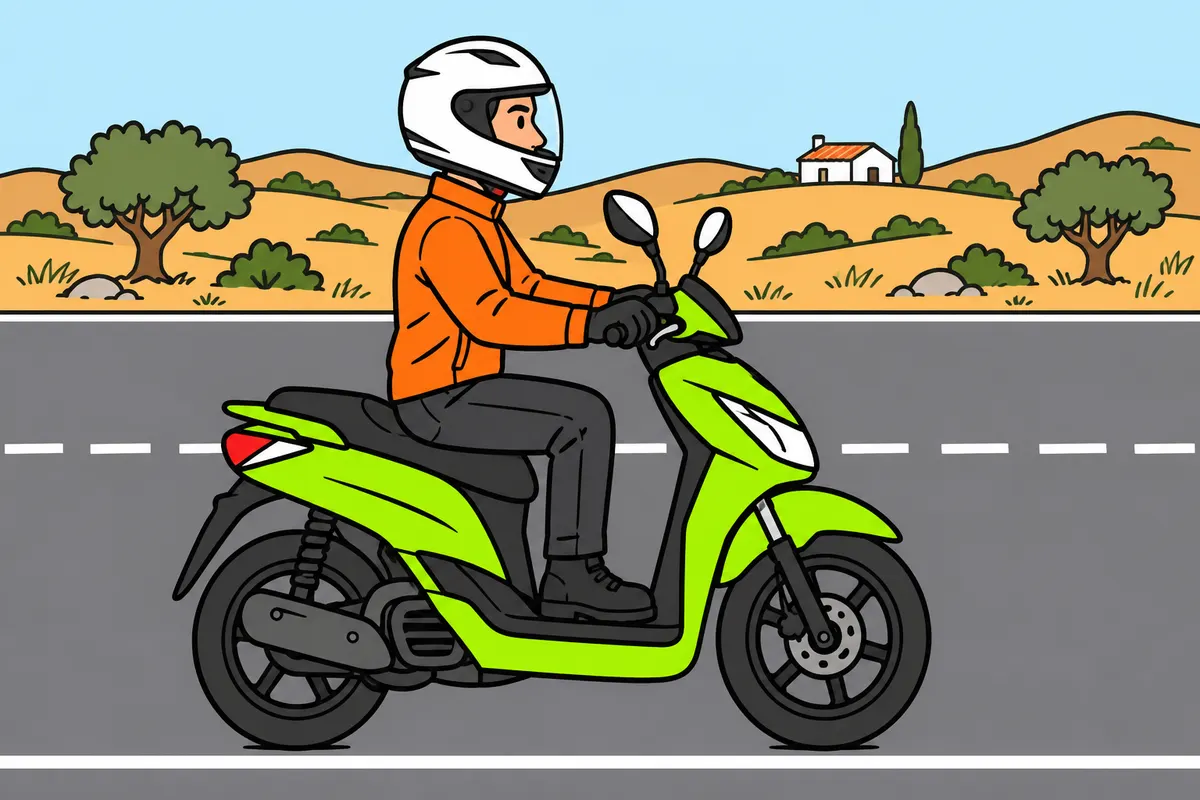
Choose a motorcycle that meets test requirements and check your licence restrictions.
| A1 test motorcycle | Engine requirements |
|---|---|
| Combustion | 115 to 125 cm³; maximum 11 kW and 0.1 kW/kg; capable of at least 90 km/h |
| Electric | At least 0.08 kW/kg; must also meet A1 limits |
Remember
- For your test, use a motorcycle with two single wheels and no sidecar.
- Your motorcycle must have two mirrors, one on each side.
- With code 78, you can only drive automatic vehicles.
- Follow the codes and subcodes recorded on your licence.
- 90 km/h is required motorcycle capability, not a compulsory speed during practice.
Exam trap: Wrong: any motorcycle allowed with A1 is suitable for your test. Right: check the additional test requirements.
Read the full explanation
- To take the A1 test, you must use a two-wheeled motorcycle without a sidecar. [RGCond, Annex VII.B.3](https://www.boe.es/buscar/act.php?id=BOE-A-2009-9481).
- If the test motorcycle has an internal combustion engine, it must have a capacity of 115 to 125 cm³, a maximum power of 11 kW, a power-to-weight ratio no greater than 0.1 kW/kg and a top speed of at least 90 km/h. These 90 km/h describe the capability of the test vehicle; they are not a speed you must reach during every practice session or a general limit for your A1 category. [RGCond, Annex VII.B.3](https://www.boe.es/buscar/act.php?id=BOE-A-2009-9481).
- If the test motorcycle is electric, its power-to-weight ratio must be at least 0.08 kW/kg, as well as complying with the category limits. The test vehicle must have two mirrors, one on each side; a motorcycle authorised for A1 may not meet every requirement needed for your test. [RGCond, art. 4 and Annex VII.A.2 and B.3](https://www.boe.es/buscar/act.php?id=BOE-A-2009-9481).
- If you take the practical test on a motorcycle with automatic transmission, your licence is restricted to vehicles with automatic transmission by code 78. For these purposes, a motorcycle is considered manual if you have to operate its clutch manually when starting or stopping and changing gear; check the restriction for your category before choosing another motorcycle. [RGCond, Annexes I and VII.A.4](https://www.boe.es/buscar/act.php?id=BOE-A-2009-9481).
- The adaptations and restrictions you must follow appear on your licence as harmonised European Union codes; for example, 01 identifies eyesight correction or protection, and 01.01 requires glasses. You must comply with the code and subcode recorded on your licence. [RGCond, art. 3.1](https://www.boe.es/buscar/act.php?id=BOE-A-2009-9481). [RGCond, Annex I](https://www.boe.es/buscar/act.php?id=BOE-A-2009-9481#ani).
10Off-road and on-road tests: order and duration
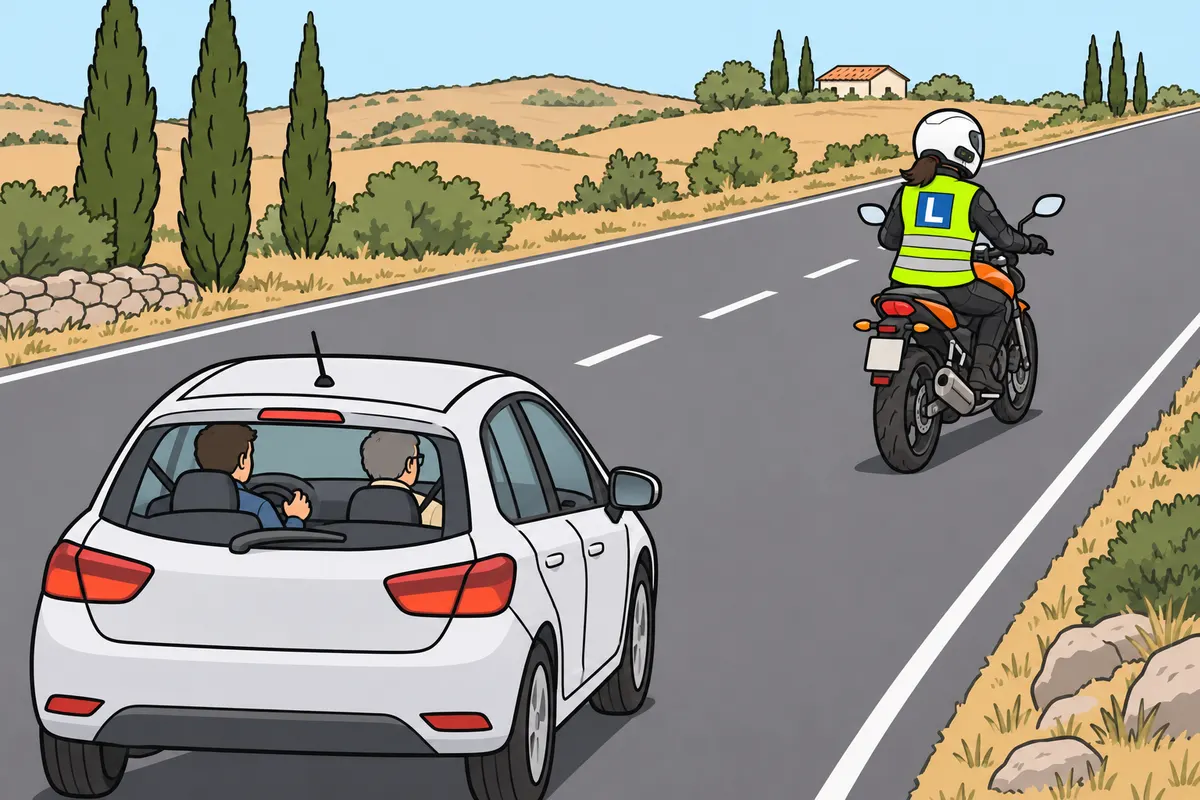
Pass theory first, then the off-road test, then the on-road test.
| Test | Time |
|---|---|
| Off-road: C, D and F together | Maximum 25 seconds |
| A1 on-road | Minimum 25 minutes, unless interrupted or suspended |
Remember
- After you pass off-road, Tráfico authorises you to learn on public roads.
- Learn under your instructor’s immediate direction and supervision.
- Carry your authorisation during training and your on-road test.
- During training and tests, wear an approved reflective vest with V-14 visible from behind.
- You ride alone; the examiner speaks by intercom from the accompanying vehicle.
- If hearing loss blocks instructions, you get GPS with a set route.
Exam trap: Wrong: the 25 minutes include all preparation. Right: they count driving and riding; reception, preparation, technical checks, special manoeuvres and results are excluded.
Read the full explanation
- You must pass the required theory tests before the off-road test, and the off-road test before the on-road test: each test is an elimination stage. [RGCond, arts. 53 and 55](https://www.boe.es/buscar/act.php?id=BOE-A-2009-9481#a55).
- After passing the off-road test, the Jefatura Provincial de Tráfico (Provincial Traffic Headquarters) grants you administrative authorisation to complete your practical training and learn on roads open to general traffic, under the immediate direction and supervision of a driving instructor. You must carry the authorisation both while learning and during the on-road test, and show it when required; it is valid for two years. [RGCond, art. 55.4](https://www.boe.es/buscar/act.php?id=BOE-A-2009-9481#a55). [RGCond, Annex VI.C.6](https://www.boe.es/buscar/act.php?id=BOE-A-2009-9481#anvi).
- The off-road test checks your control of the motorcycle through manoeuvres; the combined maximum time for manoeuvres C, D and F is 25 seconds. How to perform the manoeuvres is covered in “Motorcycle riding techniques”. [RGCond, arts. 53 and 55 and Annex VI.C.2](https://www.boe.es/buscar/act.php?id=BOE-A-2009-9481).
- In the A1 on-road test, the minimum riding and traffic time is 25 minutes, unless the test is interrupted or suspended. This excludes the initial reception, preparation, technical checks, special manoeuvres and communicating the result. [RGCond, art. 55 and Annex VI.C.2](https://www.boe.es/buscar/act.php?id=BOE-A-2009-9481).
- During training on roads open to traffic and during the on-road test, you must wear an approved high-visibility vest with signal V-14 stamped or printed on it, visible from behind. In the test, you ride the motorcycle alone and receive the examiner’s instructions through an effective intercom. The examiner and the instructor who drives travel in the accompanying vehicle; for hearing loss that prevents you from receiving the instructions, a GPS navigator with a route is provided. [RGCond, Annex VI.C.6 and C.7.5 and art. 55.4](https://www.boe.es/buscar/act.php?id=BOE-A-2009-9481#anvi).
11Equipment required for practical tests
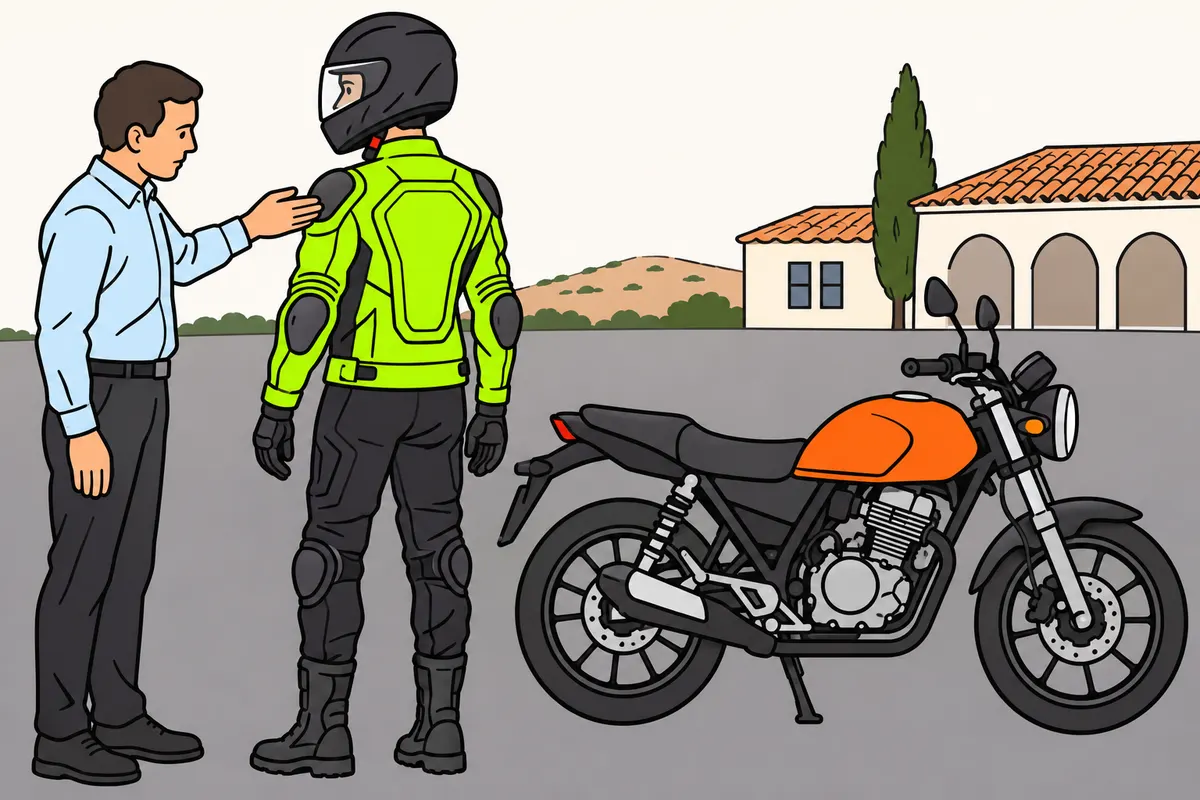
Attend practical tests wearing all the required protective equipment.
Remember
- Attend practical tests with the required protective equipment.
- Check the details in “Motorcyclist protective equipment”.
- If equipment is missing or unsuitable, you cannot start or continue the test.
- In that case, you keep your attempt.
Exam trap: Wrong: you can take your test without the required protective equipment. Right: if it is missing or unsuitable, the test does not start or is interrupted; you keep your attempt.
Read the full explanation
- You must attend practical tests with the required protective equipment, detailed in “Motorcyclist protective equipment”, because if it is missing or unsuitable the test cannot start or is stopped, without forfeiture of the exam attempt. [RGCond, Annex VI.C.1 and art. 57.2](https://www.boe.es/buscar/act.php?id=BOE-A-2009-9481#a57).
12Validity, renewal and expired licences
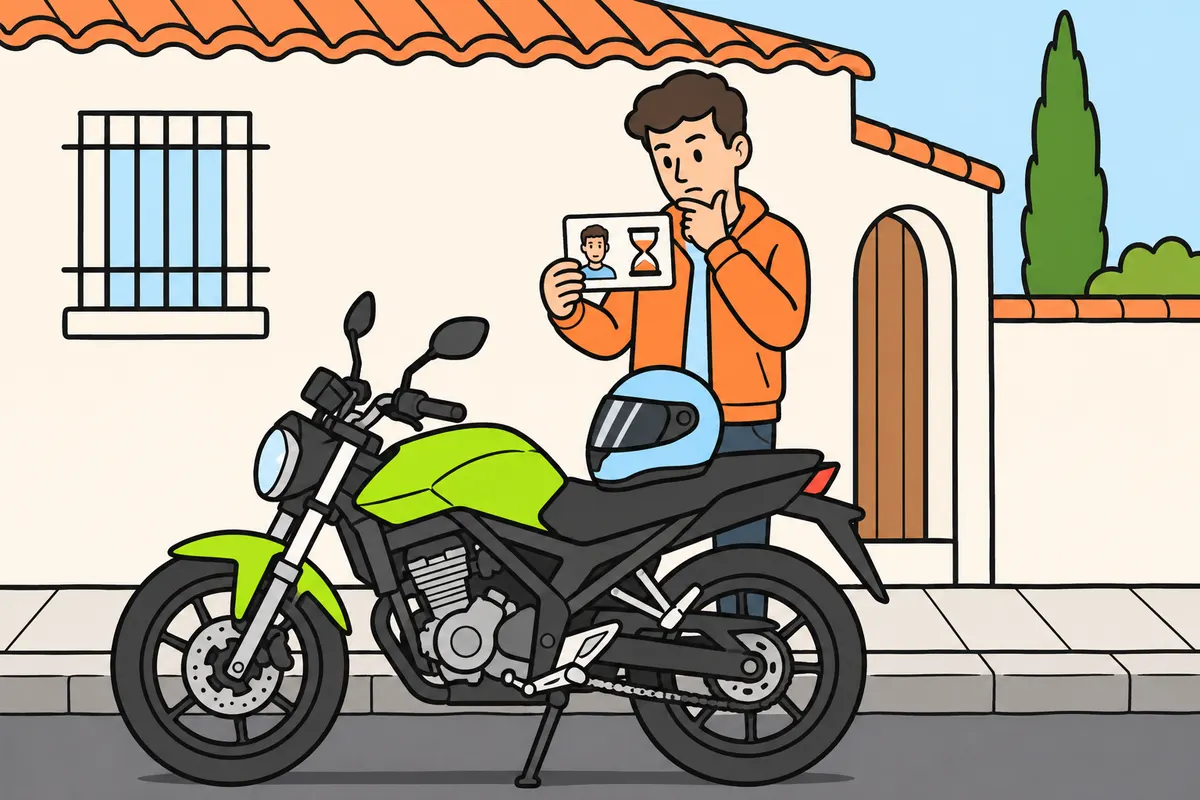
Renew your licence before it expires so you can keep riding.
| Your age: A1 and A2 | Normal validity |
|---|---|
| Under 65 | ten years |
| 65 or older | five years |
| Specified illnesses or impairments | May be shorter |
Remember
- Do not ride with an expired licence, even if you have a renewal appointment.
- To renew, apply and prove your physical and mental fitness.
- For normal renewal on expiry, you do not repeat the driving tests.
- If you renew within the normal early window, validity starts at the previous expiry.
- If exceptionally allowed to renew earlier, validity starts when you apply.
- Request duplicates for loss, theft or damage; return the original if recovered.
Exam trap: Wrong: renewal is automatic. Right: you must apply; you can renew an expired licence, but cannot ride while it remains expired. If a judge disqualifies you, do not drive during the period set.
Read the full explanation
- The standard validity period for A1 and A2 is ten years until you reach 65, and five years from that age. It may be shortened because of illnesses or impairments specified in the regulations. [RGCond, art. 12.2 and 3](https://www.boe.es/buscar/act.php?id=BOE-A-2009-9481#a12).
- Renewal is not automatic: you must apply for it if you want to continue riding. An expired licence does not authorise you to ride. [RGCond, arts. 12 and 13](https://www.boe.es/buscar/act.php?id=BOE-A-2009-9481).
- To renew, you must apply for an extension and prove that you still meet the required physical and psychological fitness standards. For an ordinary renewal because your licence has expired, you do not have to retake the theory, off-road or on-road tests; you must undergo the relevant medical assessment and complete the procedure. [RGCond, art. 13](https://www.boe.es/buscar/act.php?id=BOE-A-2009-9481). [DGT: renewing your licence](https://sede-org.dgt.gob.es/es/permisos-de-conducir/obtencion-y-gestion-de-permisos/renovacion-de-permiso-proximo-a-caducar/).
- You can apply to renew during the three months before expiry; the new validity period is counted from the expiry date of the licence you are renewing. In duly justified exceptional cases, you can apply earlier, but then the new period is counted from the date you submit the application. [RGCond, art. 13.1](https://www.boe.es/buscar/act.php?id=BOE-A-2009-9481).
- You can renew an expired licence through the ordinary procedure described in this section. Loss of validity because you have run out of points is covered in “The points-based driving licence”. [RGCond, arts. 12 and 13](https://www.boe.es/buscar/act.php?id=BOE-A-2009-9481). Disqualification from driving is a penalty imposed by a judge that prevents you from driving for the period set in the judgment. [Criminal Code, art. 47](https://www.boe.es/buscar/act.php?id=BOE-A-1995-25444#a47).
- If you lose your licence, it is stolen or it becomes damaged, you must apply for a replacement; do not confuse this with renewal on expiry. If you recover the original after obtaining a replacement because it was lost or stolen, you must return it to the Traffic Headquarters that issued it. [RGCond, art. 11](https://www.boe.es/buscar/act.php?id=BOE-A-2009-9481).
- You must notify the traffic authorities of changes to the details on your licence and to your address within 15 days of the change. [RGCond, art. 10](https://www.boe.es/buscar/act.php?id=BOE-A-2009-9481).
13New riders: when you display the L plate
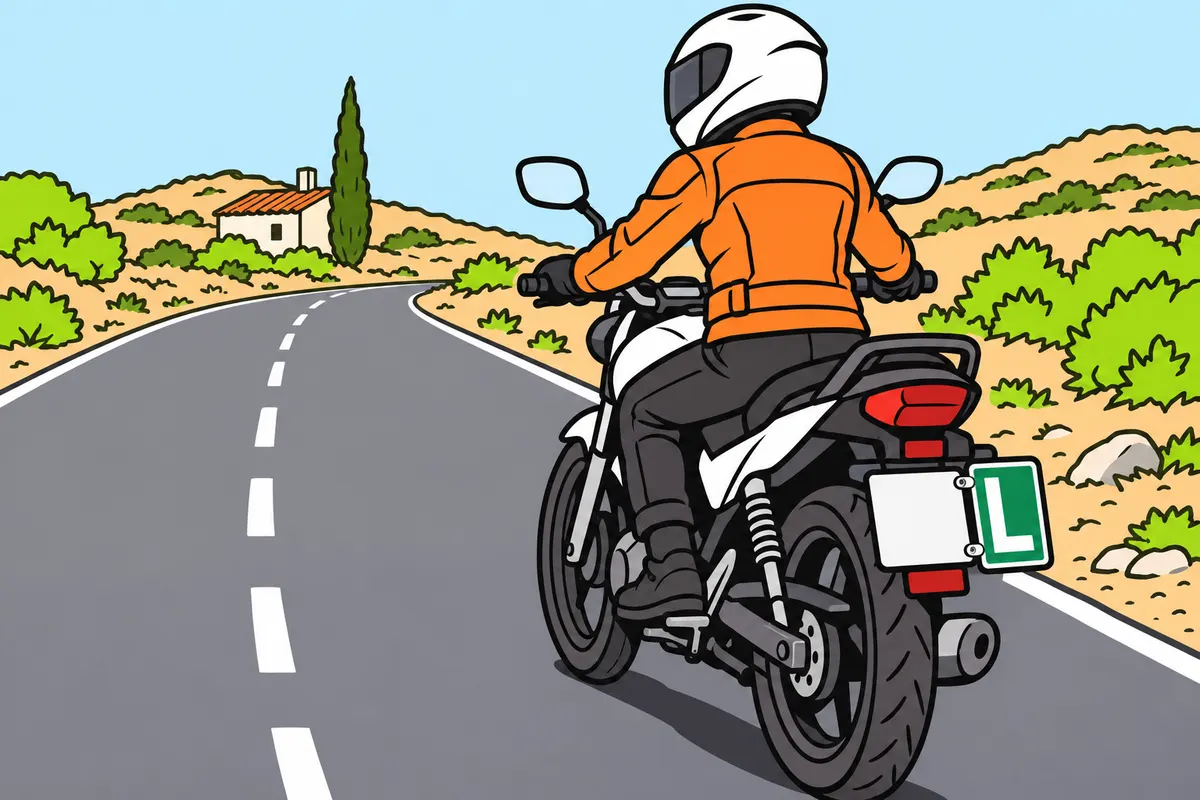
Display L during your first effective licence year, unless you already have enough experience.
Remember
- Place your L plate where it is visible at the rear of your motorcycle.
- On a motorcycle, it does not have to be on the left.
- The period pauses if your licence loses validity or is confiscated.
- It also pauses if you are disqualified from driving.
- It then continues for the time remaining.
Exam trap: Wrong: obtaining A1 always starts another year with L. Right: not if you already effectively held another licence, including AM, for at least one year.
Read the full explanation
- You must display the new rider L plate during the first year of holding your first licence. This period is suspended while your licence is invalid, is subject to an intervention, or you are disqualified from driving; it then continues for the time remaining. [RGV, Annex XI, V-13](https://www.boe.es/buscar/act.php?id=BOE-A-1999-1826).
- You do not start another year as a new rider when you obtain A1 if you have already effectively held another national or foreign, civilian or military licence for at least one year. For example, if you have held AM for a full year, you do not need to start another year displaying the L when you obtain A1. [RGV, Annex XI, V-13](https://www.boe.es/buscar/act.php?id=BOE-A-1999-1826).
- On a motorcycle, you place the L plate in a visible position at the rear. Although the general rule for other vehicles is the rear left, on a motorcycle it is enough for the plate to be visible from behind. [RGV, Annex XI, V-13](https://www.boe.es/buscar/act.php?id=BOE-A-1999-1826).
14Documents you must carry
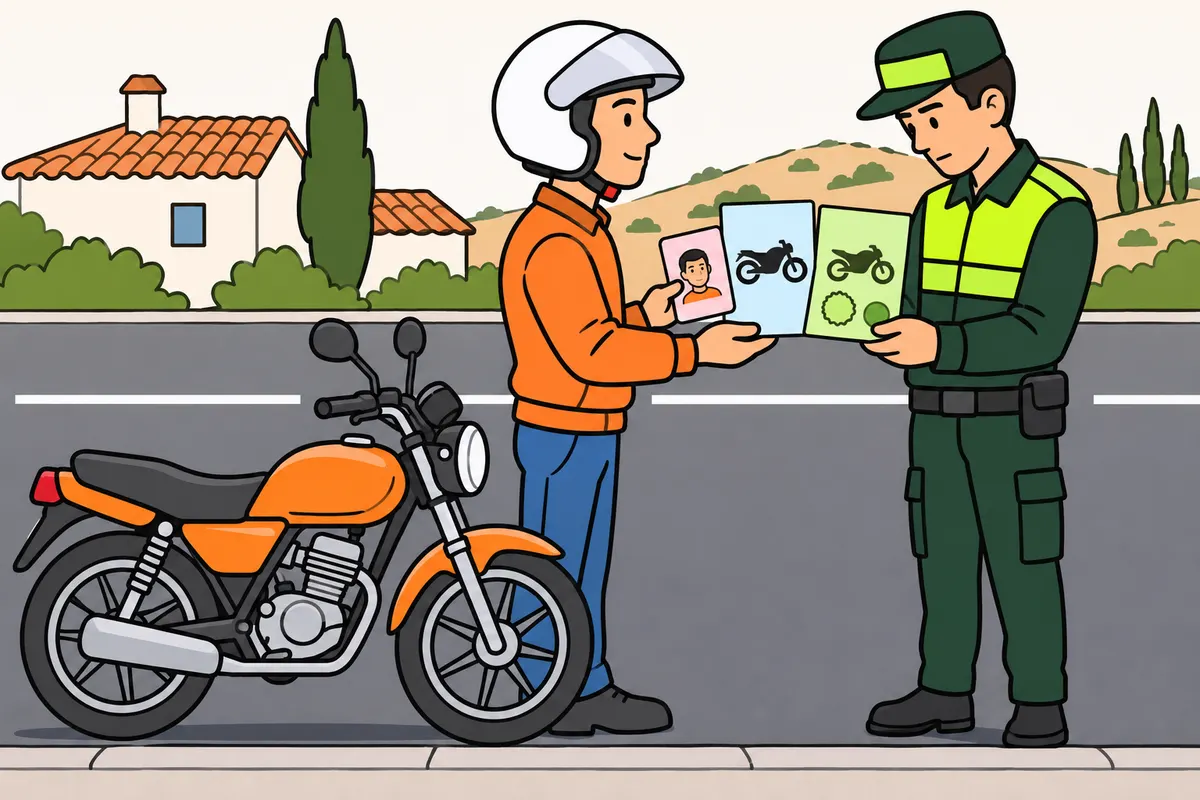
Carry proof of your driving entitlement and your motorcycle’s documents.
| Document | What it proves |
|---|---|
| Driving licence | Your entitlement to ride that motorcycle |
| Vehicle registration certificate | Vehicle documentation |
| ITV card | Technical details and inspections |
Remember
- Show your documents when officers ask for them.
- You can carry originals or properly checked or certified copies.
- An ordinary photocopy, photograph or homemade file is not an official document.
- Check the documents even if your motorcycle is borrowed or hired.
- Check that your licence allows you to ride that particular motorcycle.
Exam trap: Wrong: a photograph of your document is enough. Right: you need official documents or copies valid under the applicable rules.
Read the full explanation
- When you ride, you must carry a valid driving licence that is in force for that motorcycle. [RGCond, art. 3.2](https://www.boe.es/buscar/act.php?id=BOE-A-2009-9481#a3). You must also carry the permiso de circulación (vehicle registration certificate) and the motorcycle’s technical inspection certificate. [RGV, art. 26.1](https://www.boe.es/buscar/act.php?id=BOE-A-1999-1826#a26).
- Your driving licence confirms your authorisation as a rider; the vehicle registration certificate relates to the vehicle, and the ITV (vehicle roadworthiness test) card describes its technical characteristics and inspections. You must show these documents to officers who ask for them. [RGCond, art. 3.2](https://www.boe.es/buscar/act.php?id=BOE-A-2009-9481#a3). [RGV, art. 26.1](https://www.boe.es/buscar/act.php?id=BOE-A-1999-1826#a26).
- You may carry the original vehicle registration certificate and ITV card, or duly certified copies. [RGV, art. 26.2](https://www.boe.es/buscar/act.php?id=BOE-A-1999-1826#a26). For your driving licence, the DGT also accepts the original or an officially certified copy; a photograph or ordinary photocopy does not prove that it has been certified. [DGT: compulsory documents](https://www.dgt.es/nuestros-servicios/tu-vehiculo/documentacion-de-un-vehiculo/que-documentacion-debes-llevar-en-tu-vehiculo/).
- These document requirements also apply if you ride a borrowed or hired motorcycle: before setting off, check that you have the required documents and that your licence authorises you to ride that particular motorcycle. [RGCond, art. 3.2](https://www.boe.es/buscar/act.php?id=BOE-A-2009-9481#a3). [RGV, art. 26](https://www.boe.es/buscar/act.php?id=BOE-A-1999-1826#a26).
15miDGT and insurance: what you must show
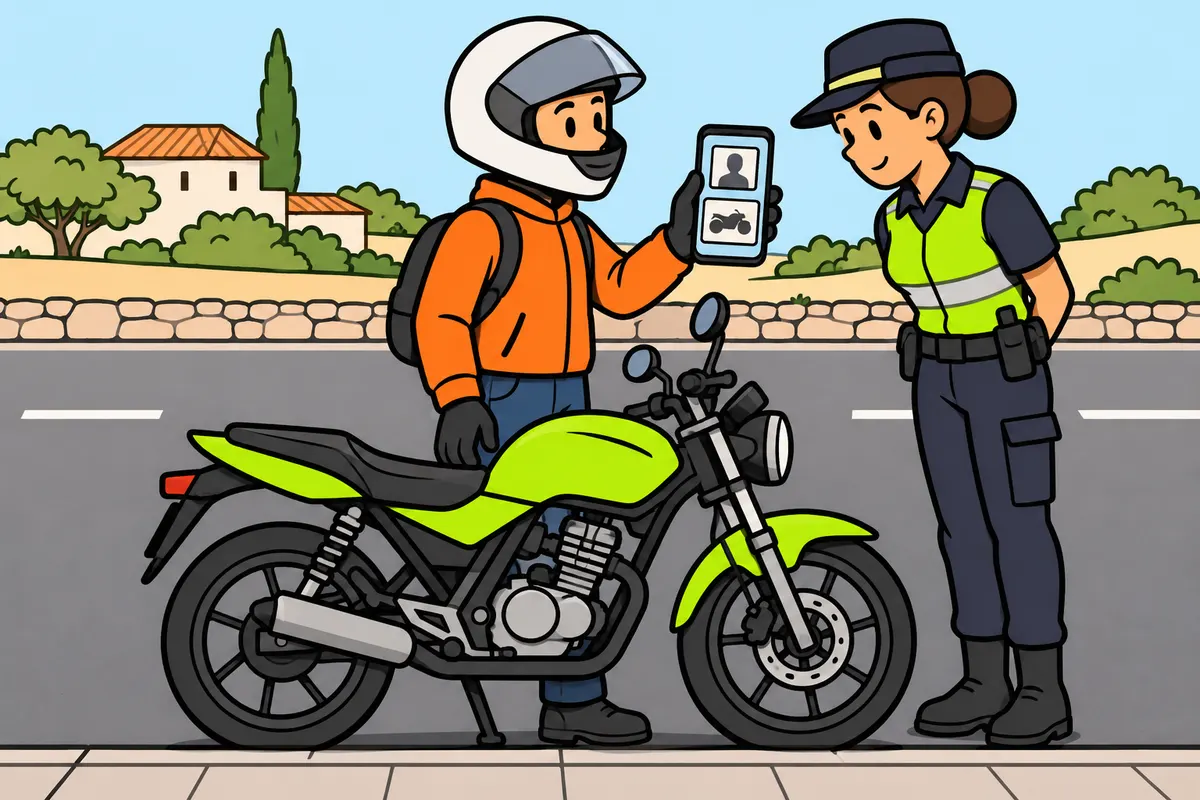
In Spain, miDGT can prove certain documents; abroad, carry physical documents.
| Where you ride | Documents |
|---|---|
| Spain | Documents available in miDGT: same validity as physical versions |
| Abroad | Physical documents and destination requirements |
Remember
- In Spain, use official miDGT to show the licences available in the app.
- You can show your driving licence and vehicle registration certificate this way.
- Abroad, carry physical documents and check your destination’s requirements.
- You do not need to carry the insurance policy or receipt as routine documents.
Exam trap: Wrong: not carrying the receipt means you have no insurance. Right: you need not carry it, but must meet insurance requirements.
Read the full explanation
- In Spain, you can present your driving licence and vehicle registration certificate through miDGT if they are available in the app; they have the same validity for riding as the physical documents. You must use the official app to show these documents; a photo in your phone’s gallery is not the same procedure. [DGT: vehicle documents and miDGT](https://www.dgt.es/nuestros-servicios/tu-vehiculo/documentacion-de-un-vehiculo/que-documentacion-debes-llevar-en-tu-vehiculo/).
- To ride abroad, you must carry the physical documents and check the destination’s requirements. [DGT: vehicle documents and miDGT](https://www.dgt.es/nuestros-servicios/tu-vehiculo/documentacion-de-un-vehiculo/que-documentacion-debes-llevar-en-tu-vehiculo/).
- You are not required to carry the insurance policy or the receipt for the latest payment as ordinary documents for riding. The insurance requirement is explained in “Compulsory insurance and lack of cover”. [DGT: vehicle documents and miDGT](https://www.dgt.es/nuestros-servicios/tu-vehiculo/documentacion-de-un-vehiculo/que-documentacion-debes-llevar-en-tu-vehiculo/).
16Vehicle registration certificate and ITV card
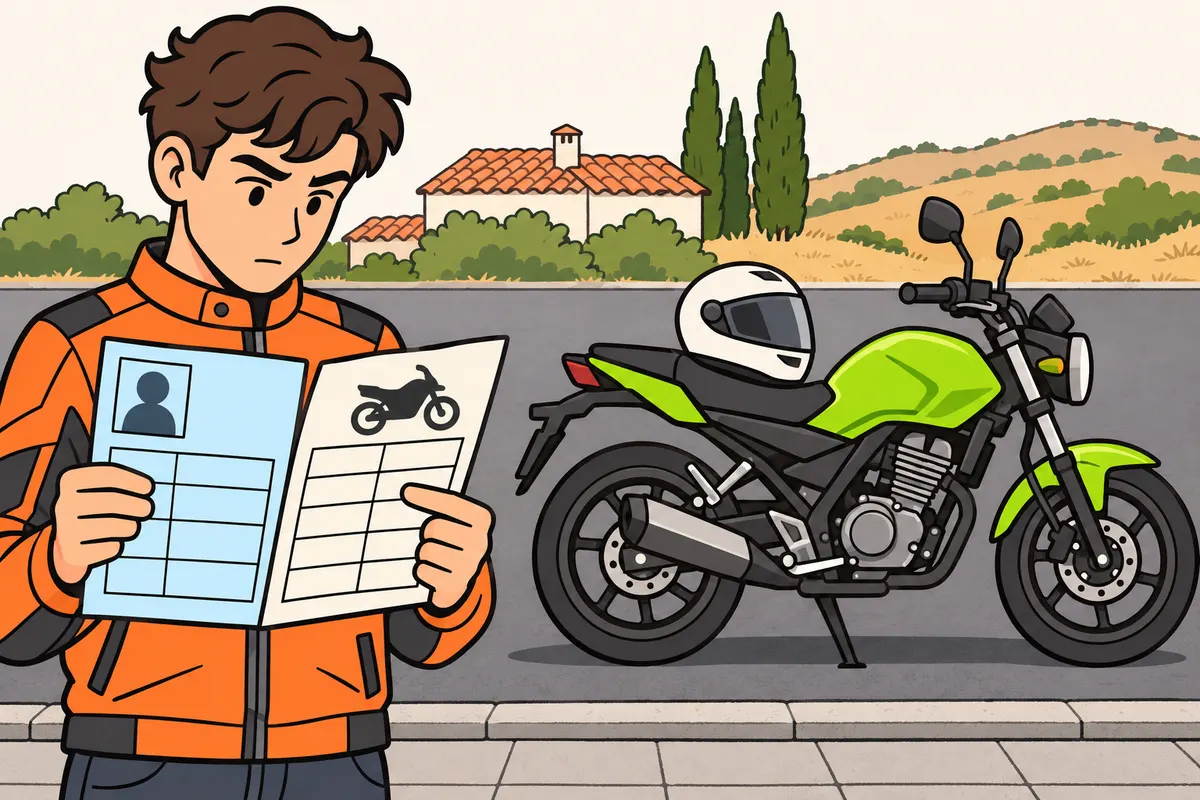
Check your documents for vehicle details, inspections and your responsibilities.
| Document | What you check |
|---|---|
| Vehicle registration certificate | Administrative and registered keeper details |
| ITV card | Technical details and inspections |
Remember
- Field B shows first registration; the seat count includes the rider.
- Check engine capacity, power, masses and alterations on the ITV card.
- As keeper or registered long-term lessee, check documents, inspections and safety-related maintenance.
- At 16 or 17, you answer for offences; responsible adults share fine liability.
- As rider, ensure passengers wear helmets and meet the minimum age.
Exam trap: Wrong: having an ITV card proves everything is correct. Right: check the result, validity and any faults arising afterwards.
Read the full explanation
- You must check the motorcycle’s and its registered keeper’s administrative details on the vehicle registration certificate. The first registration date is shown in field B, and the number of seats includes the rider. [RGV, arts. 26 and 29 and Annex XIII](https://www.boe.es/buscar/act.php?id=BOE-A-1999-1826).
- On the ITV card, you must check the technical characteristics that determine whether you can ride the motorcycle: engine capacity where applicable, power, masses and recorded modifications. [RGV, arts. 26 and 29 and Annex XIII](https://www.boe.es/buscar/act.php?id=BOE-A-1999-1826). [RGCond, art. 4.2](https://www.boe.es/buscar/act.php?id=BOE-A-2009-9481).
- The card and report let you check the inspections, but their mere existence does not show that the latest ITV result is favourable, that it is still valid, or that the motorcycle has not developed a fault since then. [RGV, arts. 26 and 29 and Annex XIII](https://www.boe.es/buscar/act.php?id=BOE-A-1999-1826).
- If you are the registered keeper, or a registered long-term lessee, you are responsible for offences relating to documents, periodic inspections and maintenance when defects affect safety. You must monitor these matters even if you let someone else ride the motorcycle regularly. [LTSV, art. 82.f](https://www.boe.es/buscar/act.php?id=BOE-A-2015-11722).
- If you ride at the age of 16 or 17, you remain responsible for the offences you commit. Your parents, guardians, foster carers and legal or de facto custodians, in that order, are jointly and severally liable with you for the fine under the terms of the law. [LTSV, art. 82.b](https://www.boe.es/buscar/act.php?id=BOE-A-2015-11722).
- As the rider, you are responsible if your passenger does not wear the required helmet or if you carry passengers who have not reached the required minimum age. The conditions for carrying passengers are covered in “Passengers and loads on motorcycles”. [LTSV, art. 82.a](https://www.boe.es/buscar/act.php?id=BOE-A-2015-11722#a82).
17Changes to details and buying a motorcycle
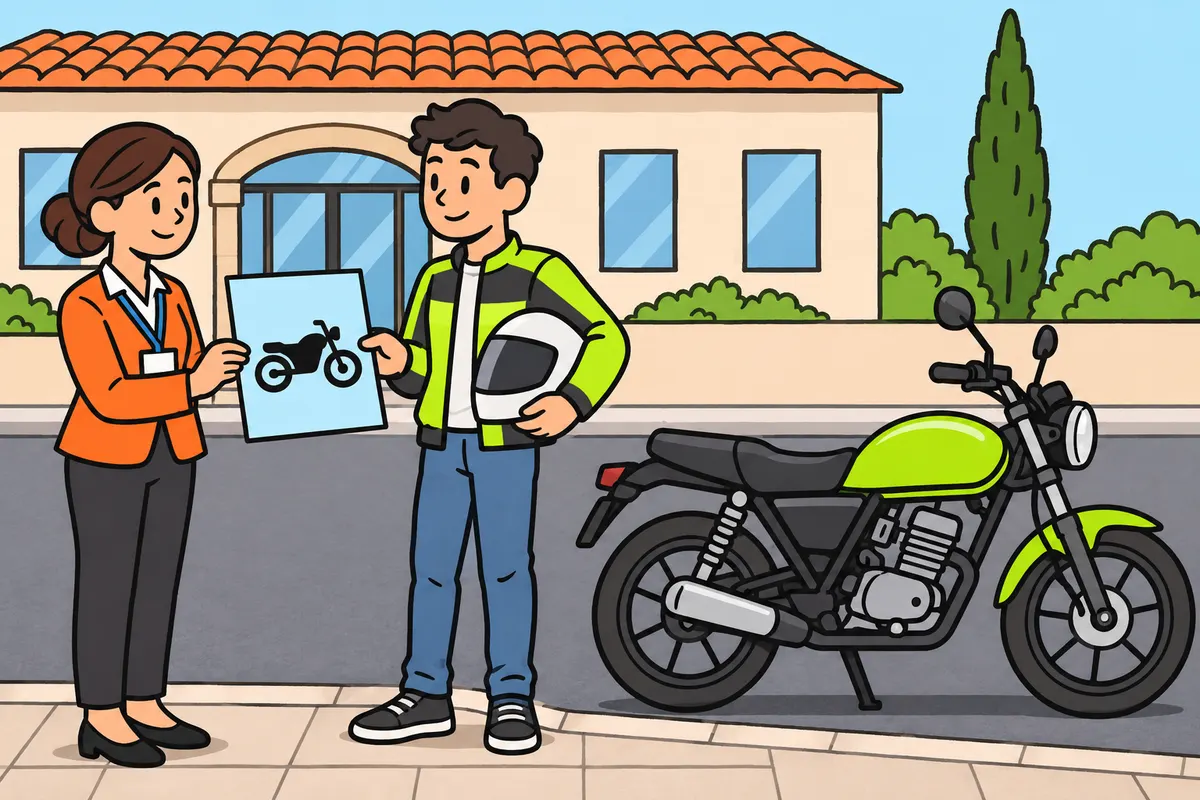
Report changes and complete sale or purchase paperwork within the deadlines.
| Your role | What you must do |
|---|---|
| Private seller | Notify transfer within ten days |
| Buyer | Request keeper change and new registration certificate within 30 days |
Remember
- If registration certificate details change, you need a new document.
- Do not confuse this with renewing your driving licence.
- Without sale notification, you remain listed as keeper until the change is registered.
- As buyer, you need the new registration certificate before using the motorcycle.
Exam trap: Wrong: selling alone removes you as registered keeper. Right: notify an ordinary private transfer within ten days.
Read the full explanation
- If you are the registered keeper and the vehicle’s recorded details change, you must notify the authorities within 15 days. If a change affects a detail that must appear on the vehicle registration certificate, a new document is issued; you must treat this procedure separately from renewing your personal driving licence. [RGV, arts. 30, 31 and 32](https://www.boe.es/buscar/act.php?id=BOE-A-1999-1826).
- If you sell or transfer the motorcycle in an ordinary private sale, you must notify Tráfico (the Spanish Traffic Authority) within ten days of the transfer. If you do not, you continue to be listed as the registered keeper for traffic purposes until it is registered in the other person’s name. [RGV, arts. 30, 31 and 32](https://www.boe.es/buscar/act.php?id=BOE-A-1999-1826).
- If you buy the motorcycle, you must apply for the change of registered keeper and renewal of the vehicle registration certificate within 30 days of purchase. You must have the new vehicle registration certificate to ride. [RGV, arts. 30, 31 and 32](https://www.boe.es/buscar/act.php?id=BOE-A-1999-1826).
18Routine motorcycle ITV
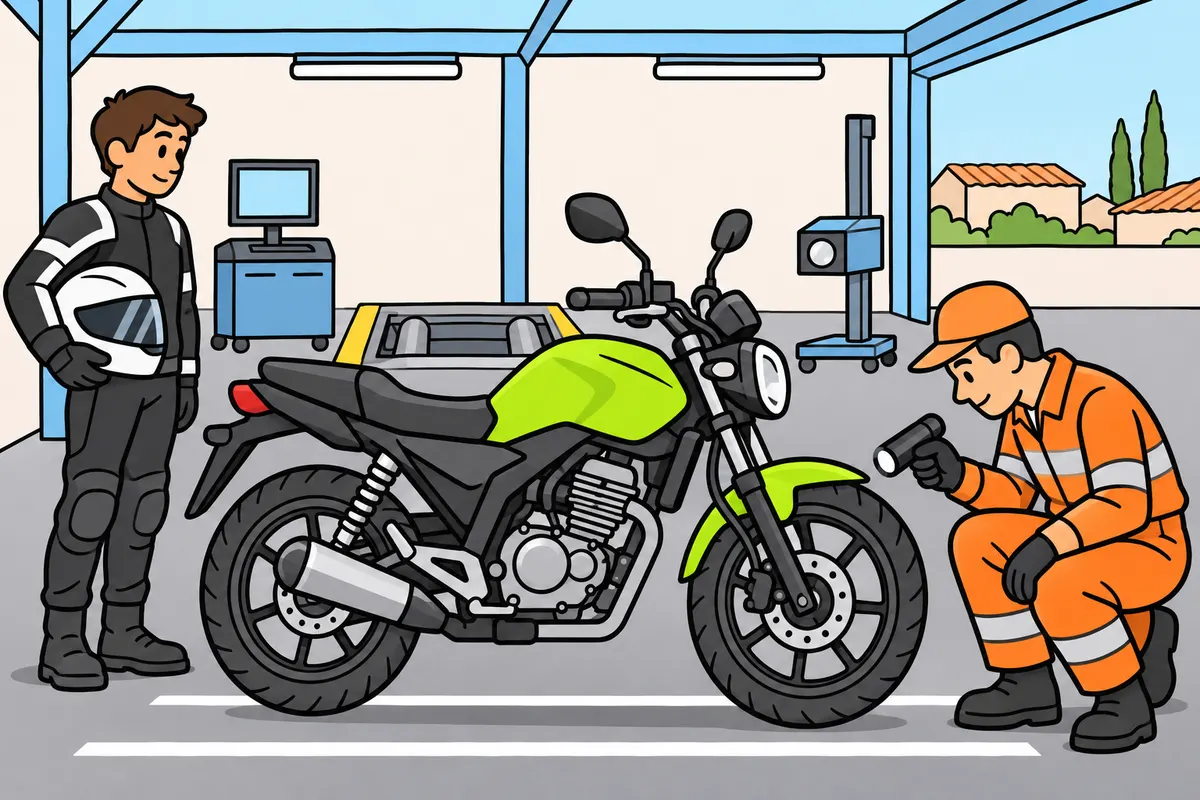
Calculate your motorcycle’s ITV age from its first registration or recorded entry into service.
| Ordinary privately used vehicle | Initial exemption | Afterwards |
|---|---|---|
| Motorcycle: neither historic nor riding-school | Until four years old | Every two years |
| Two-wheeled L1e moped | Until three years old | Every two years |
Remember
- Arrange your first ITV when the four-year deadline falls due.
- Count age from first registration or recorded entry into service.
- Buying used or changing keeper does not restart its age.
- A 125 cm³ motorcycle remains a motorcycle, even when you ride it with B.
Exam trap: Wrong: a private motorcycle needs annual ITV after ten years. Right: an ordinary private motorcycle, neither historic nor riding-school, keeps its two-year interval.
Read the full explanation
- For an ordinary private motorcycle that is neither historic nor used by a driving school, you must follow this schedule: it is exempt for up to four years, then it must be inspected every two years. You must arrange the first ITV when the four-year deadline is reached. [RD 920/2017, art. 6.1](https://www.boe.es/buscar/act.php?id=BOE-A-2017-12841).
- The two-year interval continues when the motorcycle is more than ten years old. If it is six, eight or twelve years old, you must not apply the annual interval used for older cars. [RD 920/2017, art. 6.1](https://www.boe.es/buscar/act.php?id=BOE-A-2017-12841).
- To calculate its age, you must use the first registration or entry into service recorded in the Vehicle Register. The date you bought it, the date of a change of registered keeper or the issue of a duplicate document does not reset the age of a used motorcycle. [RD 920/2017, art. 6.1](https://www.boe.es/buscar/act.php?id=BOE-A-2017-12841).
- The schedule also applies to 125 cm³ motorcycles: being rideable with A1 or under the national B licence entitlement does not make them mopeds. A two-wheeled L1e category moped is exempt for up to three years and must then be inspected every two years. [RD 920/2017, art. 6.1](https://www.boe.es/buscar/act.php?id=BOE-A-2017-12841).
19ITV (vehicle roadworthiness test) for riding-school and historic motorcycles
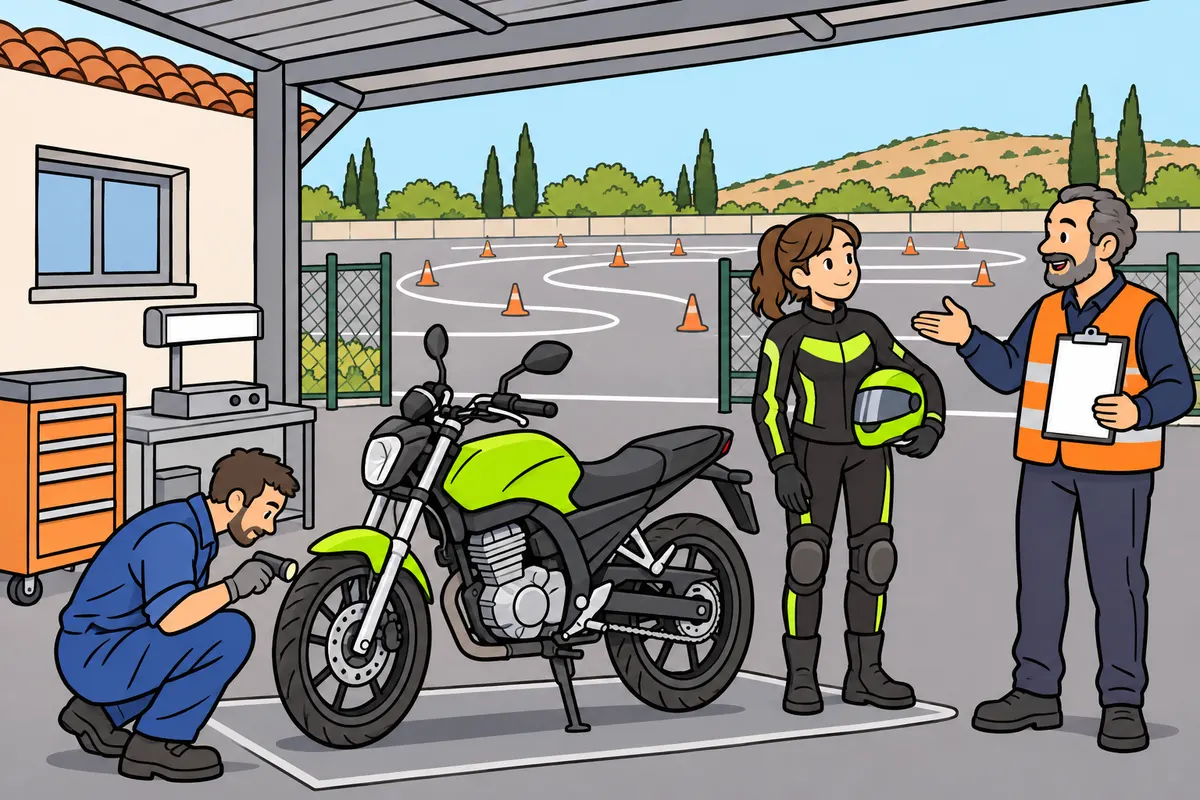
Check whether your motorcycle follows a riding-school schedule or is officially classified as historic.
| Motorcycle | ITV schedule |
|---|---|
| Riding-school: under two years | Exempt |
| Riding-school: two to five years | Annually |
| Riding-school: over five years | Every six months |
| Officially historic | Every four years; exempt over 60 years old |
Remember
- Your riding-school motorcycle may have different deadlines from your private motorcycle.
- To use historic rules, your motorcycle must be officially classified as historic.
- For historic motorcycles, count age from manufacture or first registration.
- If changed use requires more frequent inspections, update the card and inspection date.
Exam trap: Wrong: any old motorcycle gets historic exemption. Right: it needs official historic classification and must be over 60 years from manufacture or first registration.
Read the full explanation
- If you use a motorcycle intended for a driving school, you must follow the timetable specific to that service: exempt until two years old, annually from two to five years, and every six months once it is over five years old. A training motorcycle may have a different due date from your privately owned motorcycle of the same age. [RD 920/2017, art. 6.1, 2 and 7](https://www.boe.es/buscar/act.php?id=BOE-A-2017-12841).
- If the motorcycle is classified as historic, its inspection interval is every four years, with an exemption for historic vehicles over 60 years old from manufacture or first registration. This regime requires the motorcycle to be administratively classified as historic. [RD 920/2017, art. 6.1, 2 and 7](https://www.boe.es/buscar/act.php?id=BOE-A-2017-12841).
- If its use or service changes and a more demanding inspection interval applies, you must update the card status and inspection date in accordance with article 6.7. [RD 920/2017, art. 6.1, 2 and 7](https://www.boe.es/buscar/act.php?id=BOE-A-2017-12841).
20When and where you present your motorcycle for ITV
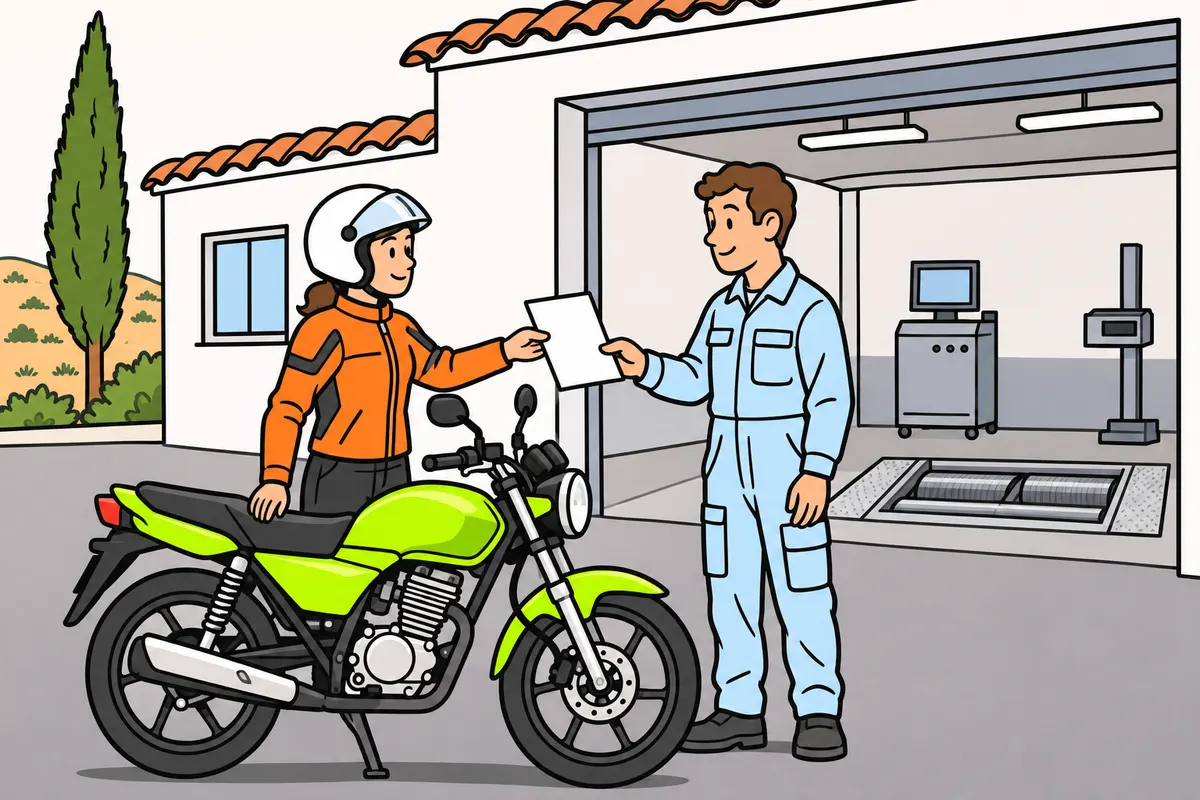
Choose an authorised ITV station and inspect early within the allowed window without losing validity.
Remember
- With a pass within this window, new validity runs from the previous expiry.
- You can also choose an authorised station to check repairs.
- If you make alterations, follow their procedure without waiting for routine ITV.
- After substantial accident damage, an inspection may be required following repairs.
- Follow that decision even if your periodic ITV remains valid.
- Before inspection, prove insurance; also keep your motorcycle safe.
Exam trap: Wrong: you must always return to the same station after repairs. Right: you can choose another authorised station.
Read the full explanation
- You must calculate the next due date from a favourable result. If you obtain one within the 30 calendar days before the previous ITV expires, the new validity period is calculated by adding the interval to the previous expiry date; you can therefore attend early within that period without losing days. [RD 920/2017, arts. 6, 8.3 and 11.8](https://www.boe.es/buscar/act.php?id=BOE-A-2017-12841).
- You can choose an authorised ITV station, and you can also choose a station for follow-up inspections after repairing defects. [RD 920/2017, arts. 6, 8.3 and 11.8](https://www.boe.es/buscar/act.php?id=BOE-A-2017-12841).
- If you modify the motorcycle, follow the modification procedure explained in “Restricted motorcycles: calculate twice the resulting power” before waiting for the next routine ITV. [RD 866/2010, art. 8](https://www.boe.es/buscar/act.php?id=BOE-A-2010-11154).
- If an accident causes serious damage that may affect the structure or safety components, an inspection may be required before the motorcycle is returned to the road after repair. You must comply with the relevant decision; a still-valid routine ITV does not remove this additional check. [RD 920/2017, arts. 6, 8.3 and 11.8](https://www.boe.es/buscar/act.php?id=BOE-A-2017-12841).
- Before any inspection, you must show that the motorcycle has compulsory insurance. You must also keep it in a safe condition: passing the ITV does not replace the manufacturer’s checks or make a fault that appears later acceptable. [RD 920/2017, arts. 6, 8.3 and 11.8](https://www.boe.es/buscar/act.php?id=BOE-A-2017-12841).
21ITV results and permitted use on the road
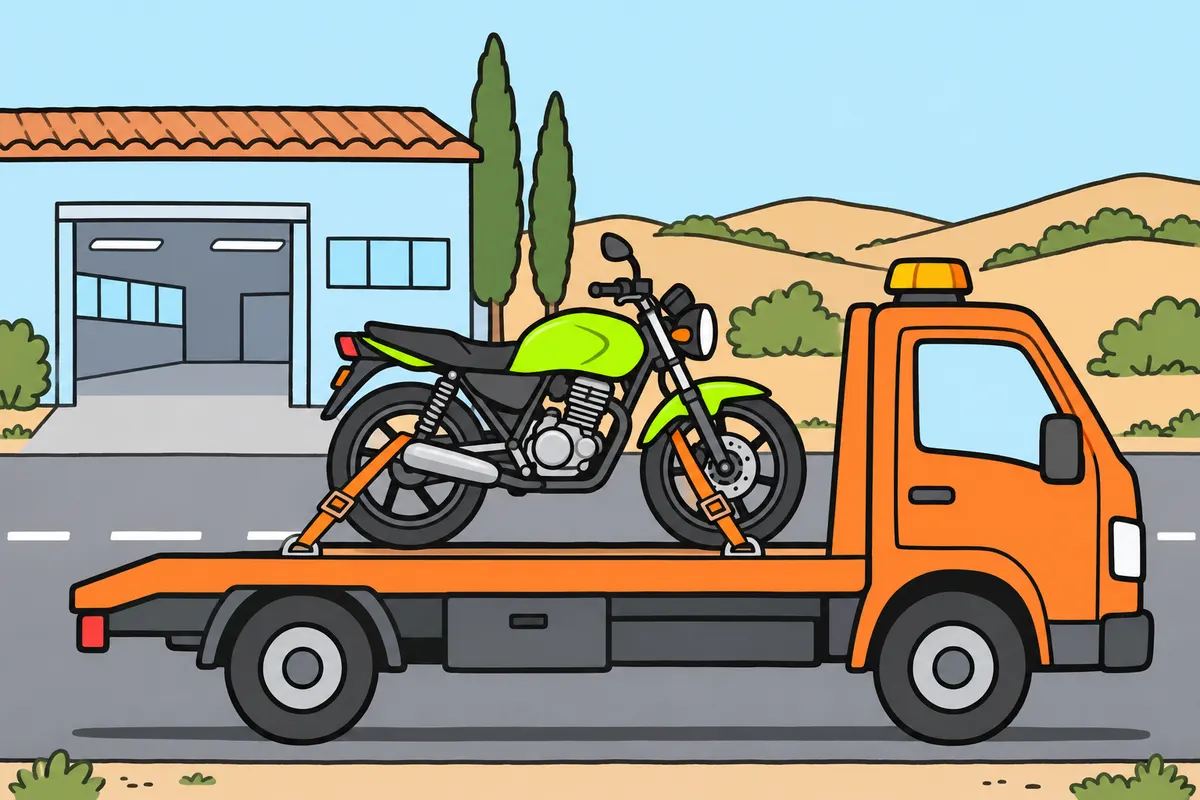
Read your ITV result to know whether you can ride or must arrange transport.
| Your motorcycle’s ITV result | Road use |
|---|---|
| Favourable: no defects or only minor defects | You can ride; repair minor defects |
| Unfavourable: serious defect | Only workshop, status regularisation where applicable, and return to ITV |
| Negative: very serious defect | Do not ride; transport by other means |
| Expired | Transport without riding on public roads; an appointment does not extend validity |
Remember
- Repair minor defects within the deadline.
- Minor defects alone need no return visit; return if the overall result requires it.
- After unfavourable or negative ITV, repair and return within the period granted.
- Count that period from the relevant first inspection.
- If late, you need a full inspection and may face a penalty.
Exam trap: Wrong: with negative ITV, you can ride to a nearby workshop. Right: arrange transport by other means, such as a recovery vehicle.
Read the full explanation
- If the inspection is favourable, no defects or only minor defects have been found. You must repair minor defects within a maximum of two months; on their own, they do not require a return inspection to prove the repair, unless you have to return after an unfavourable or negative result. [RD 920/2017, arts. 4, 9 and 11](https://www.boe.es/buscar/act.php?id=BOE-A-2017-12841).
- If a serious defect is found, the result is unfavourable. The motorcycle is prohibited from ordinary use and may only be ridden to a workshop, to regularise its status where applicable, and back to an ITV station. [RD 920/2017, arts. 4, 9 and 11](https://www.boe.es/buscar/act.php?id=BOE-A-2017-12841).
- If a very serious defect is found, the result is negative. You must arrange transport by means other than the motorcycle itself, such as a recovery vehicle. [RD 920/2017, arts. 4, 9 and 11](https://www.boe.es/buscar/act.php?id=BOE-A-2017-12841).
- After an unfavourable or negative result, you must repair the motorcycle and present it for another inspection within the period granted, which cannot exceed two months from the relevant first inspection. If you attend after the deadline, a full inspection must be carried out, without prejudice to any penalties. [RD 920/2017, arts. 4, 9 and 11](https://www.boe.es/buscar/act.php?id=BOE-A-2017-12841).
- If the ITV has expired, you must transport the motorcycle to the inspection by means that do not involve riding it on a public road. Having an appointment at the station does not extend the validity of an expired ITV. [RD 920/2017, art. 4.1](https://www.boe.es/buscar/act.php?id=BOE-A-2017-12841#a4).
22ITV report and V-19 sticker
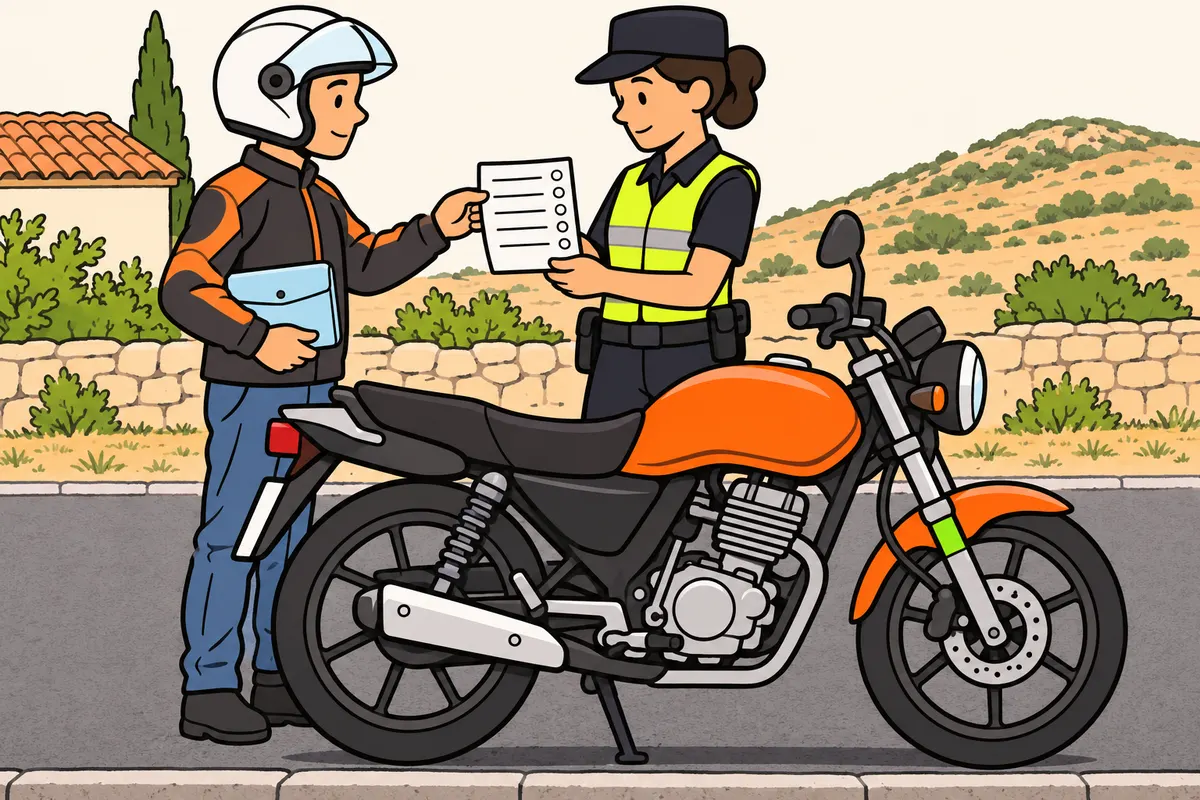
Carry your ITV report and display the sticker when required for your motorcycle.
| Your motorcycle | V-19 sticker |
|---|---|
| Ordinary: passes periodic ITV | Display in a clearly visible position |
| Officially classified as historic | Exempt from displaying it |
Remember
- Carry your latest inspection report and show it when asked.
- The report lists the result and defects.
- The station reports the result to the register and records it under applicable procedures.
- The sticker does not replace your ITV card, report or driving licence.
Exam trap: Wrong: historic motorcycles must always display the sticker. Right: officially historic motorcycles are exempt from V-19, but may still need inspection.
Read the full explanation
- You must carry the report from the latest inspection, which shows the result and any defects found. Officers may ask to see it; the station also reports the result to the Vehicle Register and records it on the ITV card under the applicable procedure. [RD 920/2017, arts. 10 and 12](https://www.boe.es/buscar/act.php?id=BOE-A-2017-12841).
- If your ordinary motorcycle passes its periodic ITV, you must display the V-19 sticker in a clearly visible place. [RD 920/2017, arts. 10 and 12](https://www.boe.es/buscar/act.php?id=BOE-A-2017-12841). [RGV, Annex XI, V-19](https://www.boe.es/buscar/act.php?id=BOE-A-1999-1826).
- The sticker does not replace the ITV card or report, and it does not prove that you hold a driving licence. Vehicles classified as historic are exempt from displaying the V-19 sticker; you must distinguish this exemption from any inspection obligations that apply to them. [RD 920/2017, arts. 10 and 12](https://www.boe.es/buscar/act.php?id=BOE-A-2017-12841).
23Compulsory insurance and lack of cover
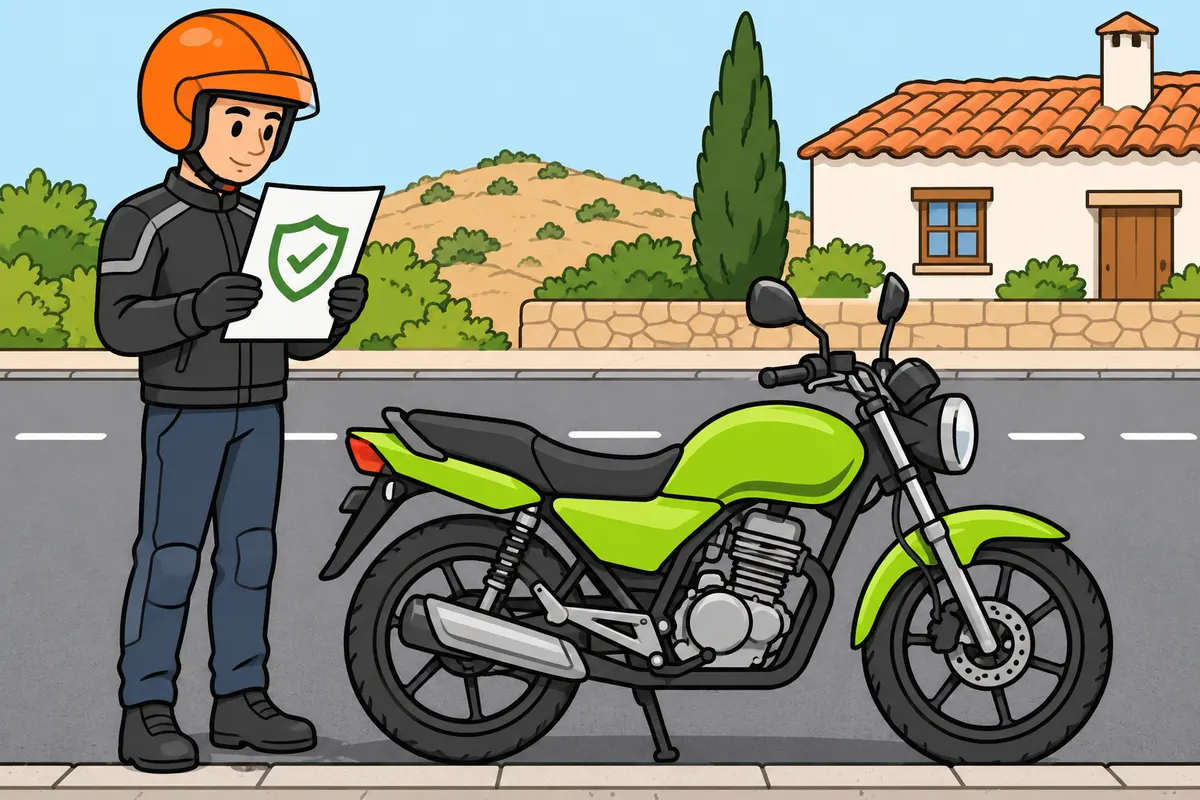
Keep compulsory insurance valid even if you rarely use your motorcycle.
| Precautionary impoundment or sealing | Duration |
|---|---|
| No insurance | one month |
| Repeat offence | three months |
| You breach impoundment or sealing | one year |
Remember
- If you own a motorcycle normally based in Spain, you must keep it insured.
- Another interested person can insure it, stating the capacity in which they act.
- You must also insure electric and 125 cm³ motorcycles.
- Your driving licence and ITV pass do not prove insurance.
- Without insurance, road use is banned; impoundment or sealing costs fall on the owner.
- To lift it, prove insurance and pay or guarantee the required costs.
Exam trap: Wrong: paying the fine replaces insurance. Right: you must take out cover; the fine depends on the circumstances.
Read the full explanation
- If you own a motorcycle normally kept in Spain, you must take out and maintain compulsory third-party liability insurance. Another person with an insurable interest may take it out, stating in what capacity; the policyholder, owner and rider do not necessarily have to be the same person. [Insurance Act, arts. 2 and 3](https://www.boe.es/buscar/act.php?id=BOE-A-2004-18911).
- You must insure the motorcycle even if it has a 125 cm³ engine, is electric or is rarely used. Holding a driving licence and having a favourable ITV result do not prove that it is insured: these are separate requirements that you must check together before riding. [Insurance Act, arts. 2 and 3](https://www.boe.es/buscar/act.php?id=BOE-A-2004-18911).
- If you fail to meet the insurance obligation, the law provides for a ban on use on the road, impoundment or immobilisation at the owner’s expense, and a fine of €601 to €3,005. The amount is graded according to whether you were riding, the vehicle’s category and service, the harm caused, how long it was uninsured and whether the offence was repeated. [Insurance Act, arts. 2 and 3](https://www.boe.es/buscar/act.php?id=BOE-A-2004-18911).
- The precautionary impoundment or immobilisation lasts one month, three months in the event of reoffending, and one year if you breach it. To have it lifted, you must prove that you have insurance and pay or guarantee the costs due; paying the fine does not replace taking out cover. [Insurance Act, arts. 2 and 3](https://www.boe.es/buscar/act.php?id=BOE-A-2004-18911).
24What insurance covers and what you must report
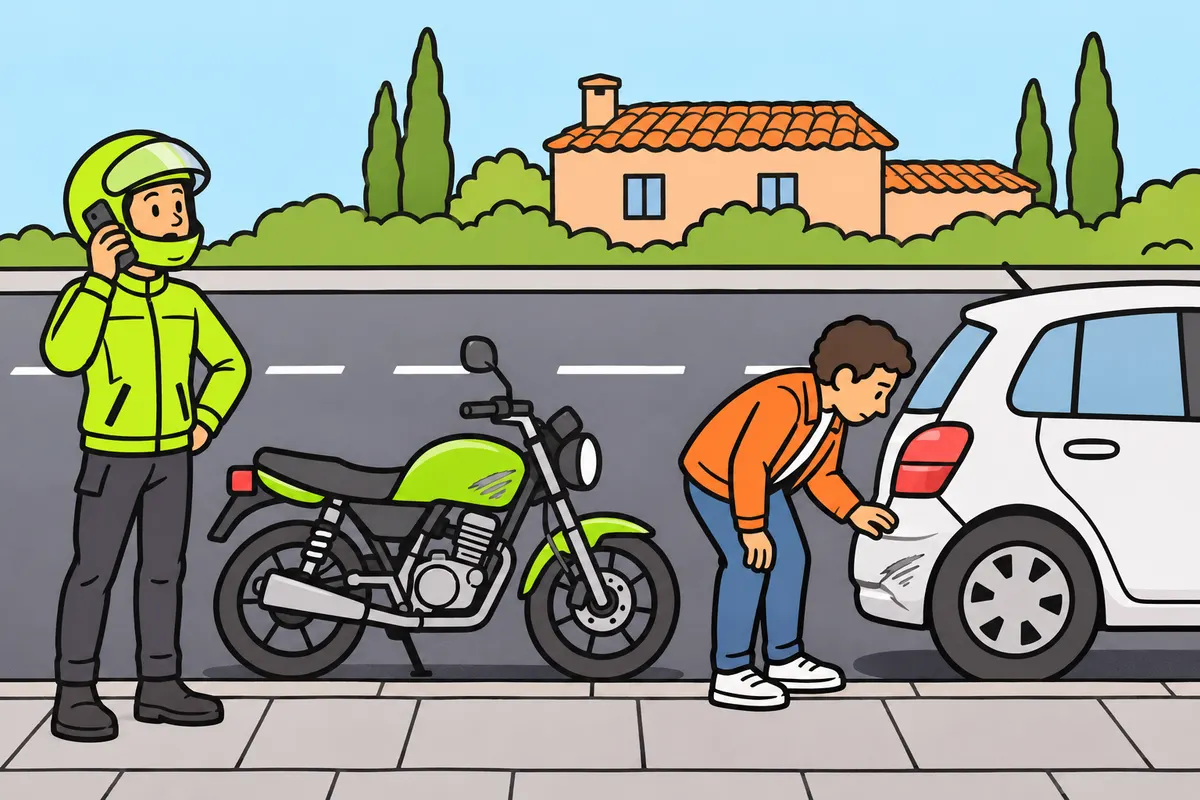
Distinguish harm to others from your own injuries, and report insured incidents on time.
| Damage or case | Compulsory cover |
|---|---|
| Injury and property damage to others | Within the legal scope |
| Your injuries as the rider responsible | Excluded |
| Insured motorcycle and carried items | Excluded |
| Property of policyholder, insured person, owner or rider | Excluded; also their spouses and relatives through the third degree by blood or marriage |
| Injury: victim solely at fault or force majeure unrelated to driving or vehicle operation | Liability may be excluded if legally established |
| Use of a vehicle legally considered stolen | Injury and property damage excluded from its compulsory insurance |
Remember
- Report from when you learn of the incident, unless your policy allows longer.
- As policyholder, insured person or beneficiary, explain the circumstances and consequences.
- Reporting the incident does not mean admitting fault.
- Without a helmet, compensation may fall if injuries worsen; it is not automatically lost.
- Your motorcycle’s faults or broken parts are not force majeure.
- For stolen vehicles, the Insurance Compensation Consortium may compensate victims in legally specified cases.
Exam trap: Wrong: compulsory insurance pays for your injuries when you ride and cause the accident. Right: you need additional personal cover; your passenger is not excluded simply for being a passenger.
Read the full explanation
- Compulsory insurance covers civil liability for personal injury and property damage caused to third parties within its legal scope. If you injure a pedestrian or damage another vehicle while riding your motorcycle, those losses are among the risks covered. [Insurance Act, arts. 1 and 5](https://www.boe.es/buscar/act.php?id=BOE-A-2004-18911).
- A passenger’s injuries are not excluded because they were on the motorcycle that caused the accident. To cover your own injuries as the rider of the vehicle that caused it, you need additional rider accident cover. [Insurance Act, arts. 1 and 5](https://www.boe.es/buscar/act.php?id=BOE-A-2004-18911).
- Compulsory cover also excludes damage to the insured vehicle, items being carried, or property belonging to the policyholder, insured person, owner or rider, their spouse, or relatives by blood or marriage up to the third degree. [Insurance Act, arts. 1 and 5](https://www.boe.es/buscar/act.php?id=BOE-A-2004-18911).
- For personal injury, the injured person’s sole fault or force majeure unrelated to riding or the vehicle’s operation may release you from liability when established in accordance with the law. Motorcycle defects and the breakage of its parts or mechanisms are excluded from this definition of force majeure. [Insurance Act, art. 1.1](https://www.boe.es/buscar/act.php?id=BOE-A-2004-18911).
- If you fail to comply with helmet or other protective equipment rules and this worsens your injuries, your compensation may be reduced under the law. The assessment takes your contribution to the harm into account. [Insurance Act, arts. 1 and 5](https://www.boe.es/buscar/act.php?id=BOE-A-2004-18911).
- The law excludes from compulsory insurance cover personal injury and property damage caused by the use of a stolen vehicle, under the terms of article 5.3. Victims may be entitled to compensation from the Consorcio de Compensación de Seguros (Insurance Compensation Consortium) in the cases provided for by law. [Insurance Act, art. 5.3](https://www.boe.es/buscar/act.php?id=BOE-A-2004-18911).
- If an accident occurs, you must notify your insurer as policyholder, insured person or beneficiary within the general maximum period of seven days from becoming aware of it, unless the policy allows more time. You must provide information about the circumstances and consequences; reporting it does not mean admitting that you are at fault. [Law 50/1980, art. 16](https://www.boe.es/buscar/act.php?id=BOE-A-1980-22501).
25Helmet, gloves and footwear: basic duties
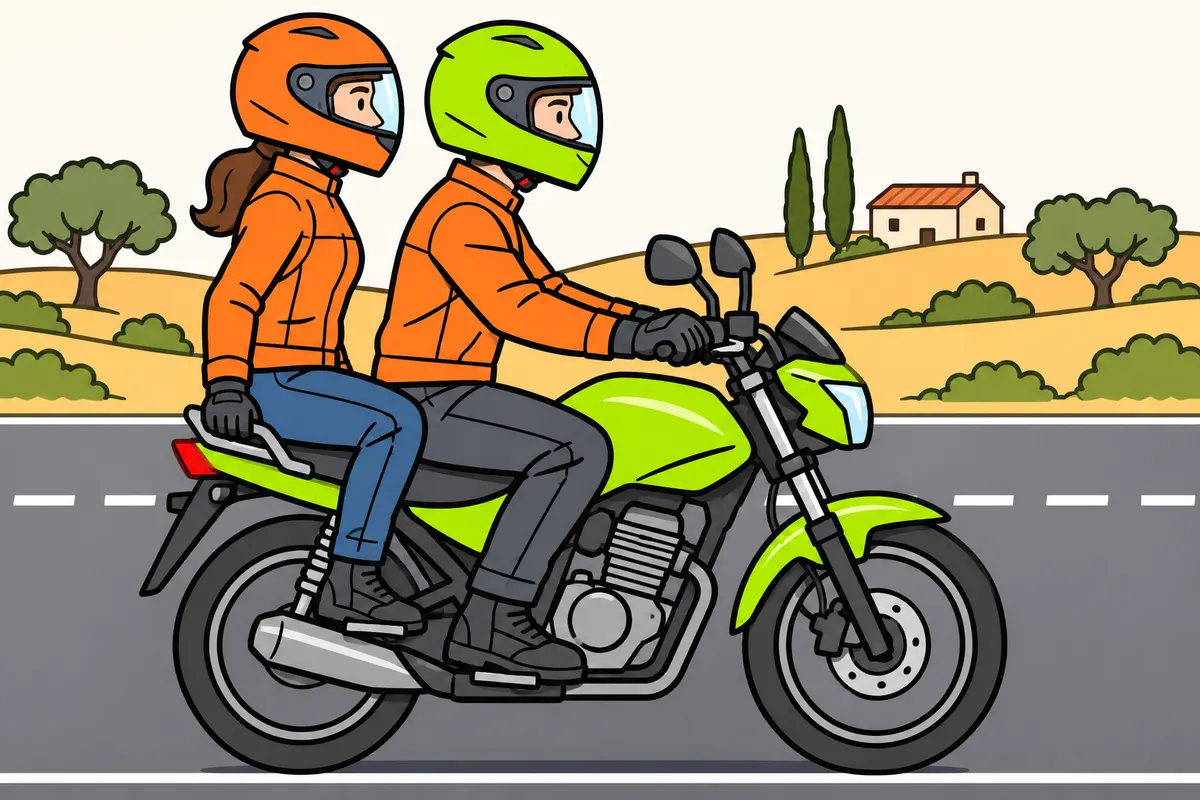
Follow the helmet, glove, footwear and vest duties explained in “Motorcyclist protective equipment”.
Remember
- You and your passenger must wear a properly fastened UNECE R22 approved helmet.
- You both need closed footwear covering the whole foot on every road.
- You and your passenger must wear protective gloves on interurban roads.
- Check “Motorcyclist protective equipment” for all protection duties.
- It also explains the exemption for a protective structure and seat belts.
Exam trap: Wrong: you must wear gloves on every road. Right: gloves are compulsory on interurban roads; closed footwear covering the whole foot is required on every road. Check the exemption for a protective structure and seat belts.
Read the full explanation
- You and your passenger must wear a properly fastened UNECE R22 approved helmet and closed footwear that covers the whole foot on every road, and protective gloves on interurban roads. The exemption for a protective structure and seat belt, and the vest, are explained in «Motorcyclist protective equipment». [RGC, art. 118.1.a-c](https://www.boe.es/buscar/act.php?id=BOE-A-2003-23514#a118). [RGV, Annex XII.3](https://www.boe.es/buscar/act.php?id=BOE-A-1999-1826).
Check whether a motorcycle qualifies for your A1 licence
Check the limits and documents together before riding.
- Check that your A1 licence is valid and follow any restrictions shown on it.
- Check the engine capacity of the combustion motorcycle: it must not exceed 125 cm³.
- Check the maximum power: it must not exceed 11 kW.
- Check that the power-to-weight ratio does not exceed 0.1 kW/kg.
- Compare those details with the technical documents and check that the ITV and insurance are valid.
A1 tests and later progression to A2
Distinguish theory exemptions from the practical tests you must pass.
- If you are not exempt, prepare for the common theory test and the specific motorcycle theory test.
- If you hold a valid B licence obtained by passing the common test, you are exempt from the common test and must prepare for the specific test.
- Do not mistake an AM licence for an exemption from the A1 common test.
- To obtain A1, pass the required knowledge tests, then the circuit test and finally the road test. If you later progress to A2 after two years’ experience on A1, you only have to pass the road test under Article 49.2; Article 5.3 provides for it to be replaced by training regulated by an order of the Minister for the Interior.
- Be at least 16 for your first practical test sitting and keep track of the two-year validity of passed tests.
Prepare to renew your licence
Keep your personal authorisation valid so you can ride.
- Check the expiry date of the category you need.
- Apply for renewal during the three months before expiry; applying earlier requires exceptional justification and means the new validity starts on the date you submit the application.
- Obtain the psychophysical fitness report and complete the relevant application.
- If your licence has expired, do not ride while it remains expired.
- Check the validity and scope of the authorisation you receive while the application is being processed.
Act according to the ITV result
The result determines the repairs and permitted journeys.
- Read the report and distinguish between a pass, an adverse result and a negative result.
- If the result is a pass with minor defects, repair them within a maximum of two months and display the V-19 when required.
- If the result is adverse, limit riding to journeys authorised for repairs, regularisation where applicable, and a return to the ITV station.
- If the result is negative, arrange transport by means other than riding the motorcycle.
- After an adverse or negative result, make the repairs and return within the time allowed, which cannot exceed two months.
Check what you know
Real questions from the bank on this topic. Pick an answer to see the explanation.
Finished this module?
Mark it as read and you will see your progress on the theory list.