
Theory · B+E Licence - Car with Trailer · Module 3 of 13
Maximum dimensions and masses
You learn to check the masses, axles, coupling and dimensions of your car and trailer. You calculate load projections according to whether the load is carried on the passenger car or the goods trailer, and interpret signs that restrict access.
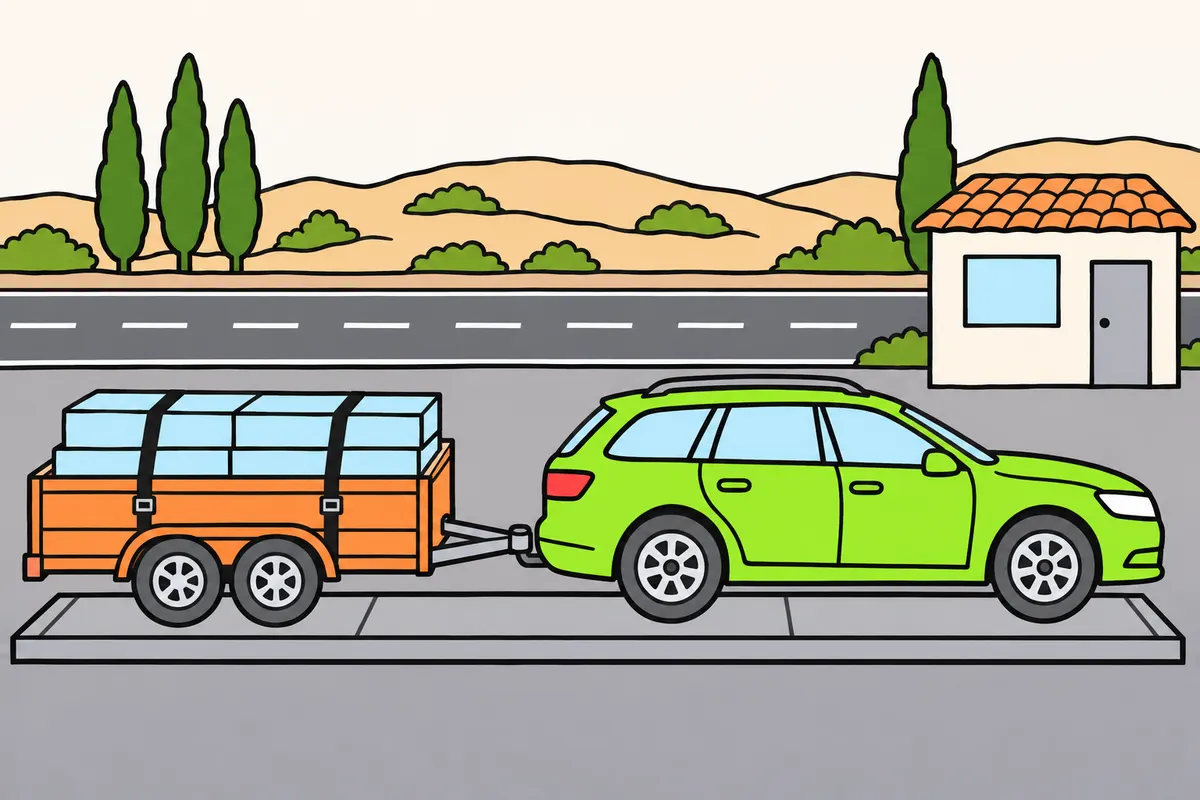
1Which limits you must check
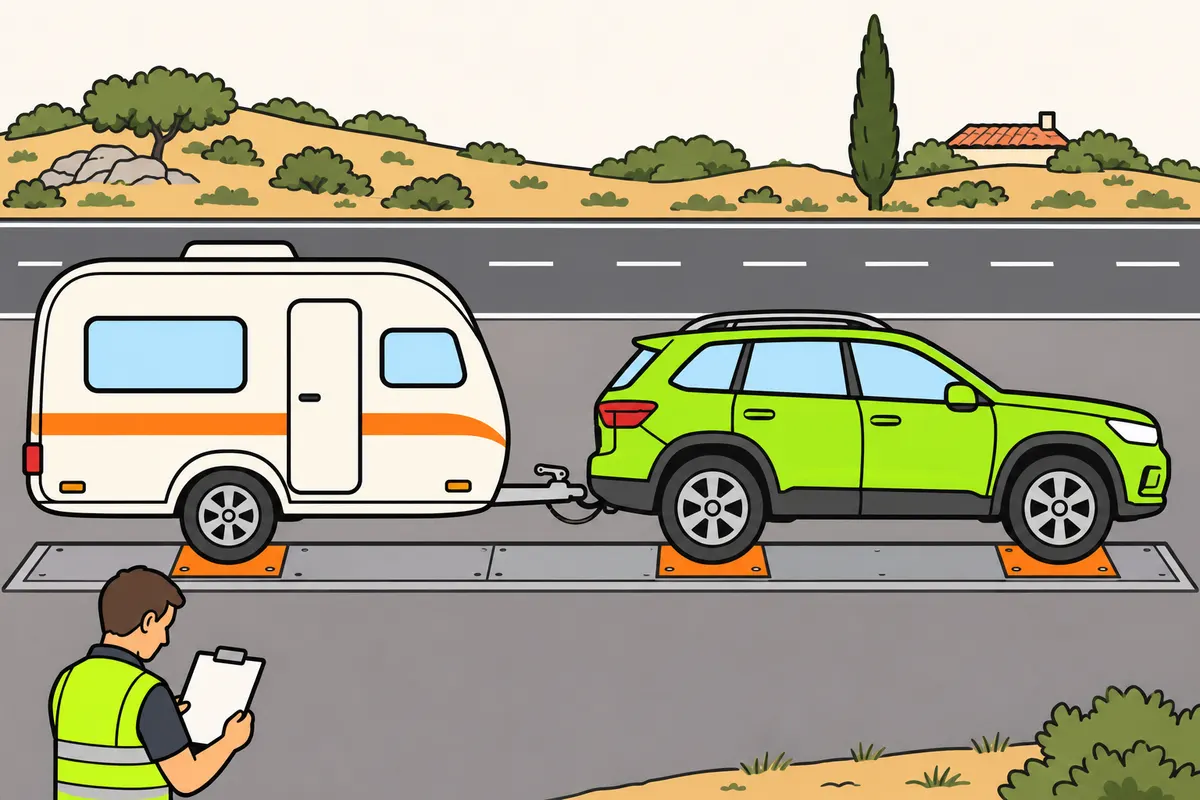
You must meet all limits for your car and trailer at the same time.
Remember
- Check each vehicle, each axle and the whole combination.
- Also check how much your car can tow.
- Meet both general limits and the limits authorised for your vehicle.
- Measure the vehicle with its load.
- Check restrictions on your route before setting off.
Exam trap: Wrong: meeting the total weight limit is enough. Right: also check vehicles, axles and towing capacity.
Read the full explanation
- To drive your car and trailer on the road, you must comply simultaneously with the mass limits for each vehicle, their axles, the combination and the towing capacity. A combination weighing less than the overall maximum does not prove that all its components are within their limits. [RGV, Annex IX](https://www.boe.es/buscar/act.php?id=BOE-A-1999-1826#anix).
- The general limit in Annex IX and the limit authorised for your particular vehicle apply simultaneously. A table may allow several tonnes on an axle, but your B+E trailer may have a much lower authorised limit: you must also comply with that individual figure. [RGV, Annex IX](https://www.boe.es/buscar/act.php?id=BOE-A-1999-1826#anix).
- When checking dimensions, you must take both the vehicle and its load into account, applying the type-approval measurement rules for its category. The usable load space and the statutory dimensions may have different measurements. [RGV, Annex IX](https://www.boe.es/buscar/act.php?id=BOE-A-1999-1826#anix).
- Before choosing a route, you must check your dimensions and masses against its restrictions. As a practical measure, note the height, width and length of the combination ready for travel: knowing a route with the car alone does not guarantee that you can use it with the caravan. [RGV, Annex IX](https://www.boe.es/buscar/act.php?id=BOE-A-1999-1826#anix).
2Tare mass, mass in running order and actual mass
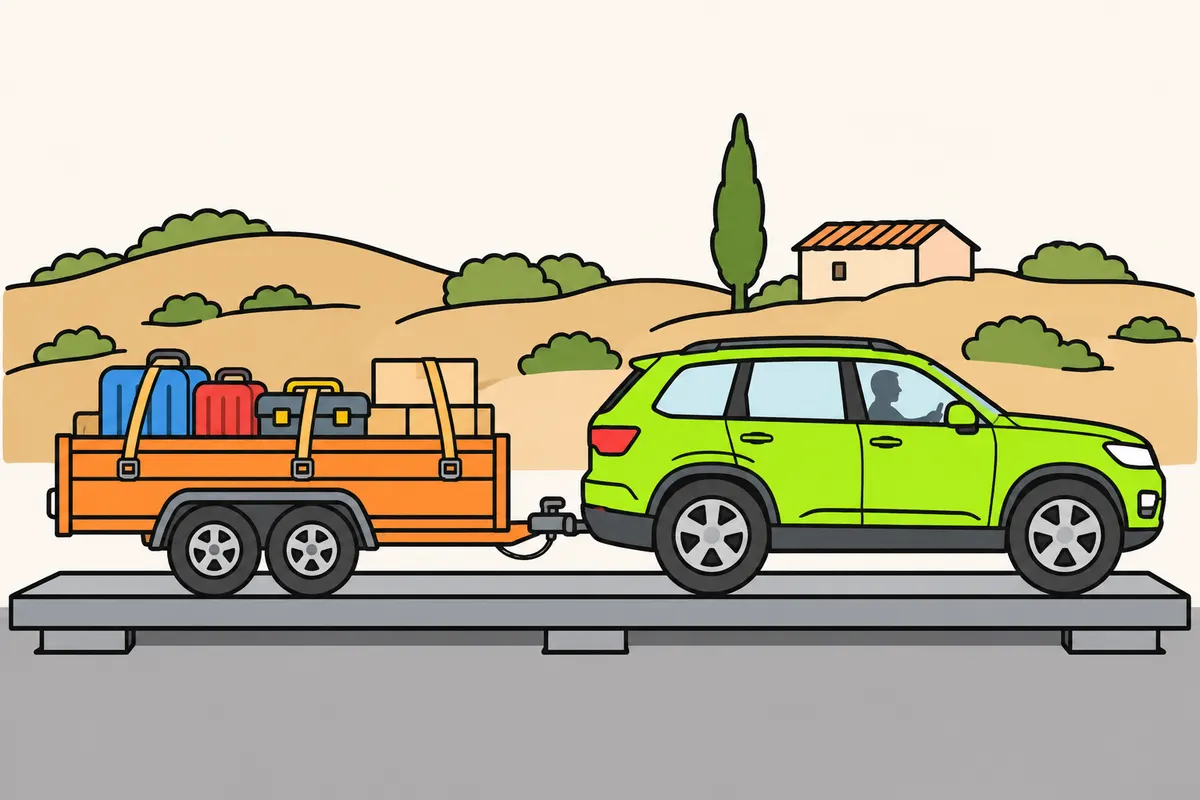
You must distinguish the weights defined in documents from the weight you actually carry.
| Term | What you count |
|---|---|
| Tare mass | Fixed equipment and full supplies; no people or load |
| Towing vehicle's mass in running order | Tare mass plus 75 kg for the standard driver |
| Laden mass | Actual weight of the vehicle, people and load |
Remember
- Count the actual weight of people, luggage and added accessories.
- Subtract actual weight from MMA to find your remaining allowance.
- Check the other limits before adding any load.
Exam trap: Wrong: count 75 kg for every occupant. Right: use their actual weight when checking a weighing result.
Read the full explanation
- Tare mass is the mass of the vehicle with its authorised fixed equipment and its full supply of water, fuel, lubricants, spare parts, tools and necessary accessories, without service personnel, passengers or load. [RGV, Annex IX](https://www.boe.es/buscar/act.php?id=BOE-A-1999-1826#anix).
- For your towing vehicle, you obtain the mass in running order by adding the standard driver mass of 75 kg to the tare mass. This is a statutory definition: it does not mean that you must replace the actual mass of any occupant with 75 kg when checking a weighing result. [RGV, Annex IX](https://www.boe.es/buscar/act.php?id=BOE-A-1999-1826#anix).
- Laden mass is the actual mass of the vehicle and its load, including service personnel and passengers. You must count what you actually carry: luggage, tools and added accessories use up your mass allowance even if you do not consider them goods. [RGV, Annex IX](https://www.boe.es/buscar/act.php?id=BOE-A-1999-1826#anix).
- To calculate a simple allowance, subtract the actual mass of the vehicle before you add the item from its MMA (maximum authorised mass). If a trailer with an MMA of 2,000 kg actually weighs 1,450 kg, you have an overall allowance of 550 kg, always subject to the other limits. [RGV, Annex IX](https://www.boe.es/buscar/act.php?id=BOE-A-1999-1826#anix).
3MMA and technical limits
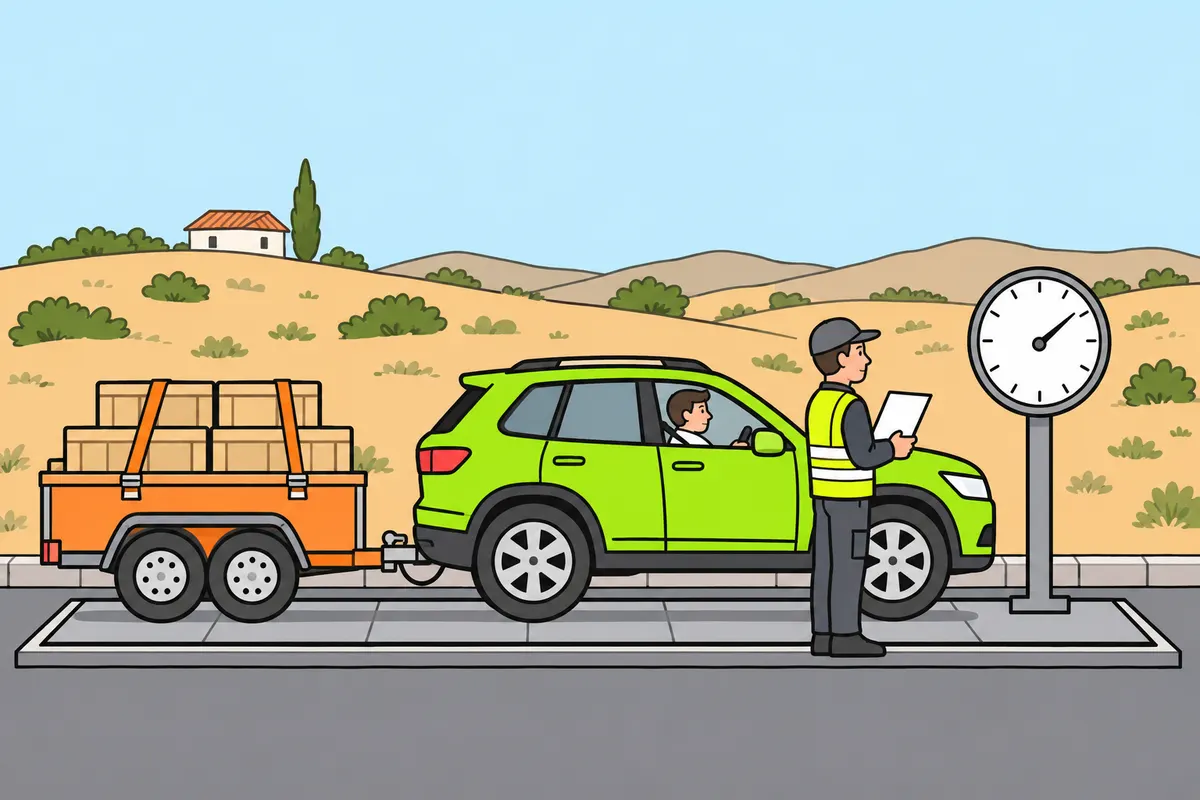
You must respect MMA even when the manufacturer's technical limit allows more weight.
| Limit | What it means for you |
|---|---|
| Maximum authorised mass | Maximum allowed for road use |
| Technically permissible maximum mass | Manufacturer's maximum based on vehicle construction |
Remember
- MMA means the maximum authorised mass for road use.
- Compare your actual weight with MMA.
- Check both technical and authorised limits for each axle.
- Also check both technical and authorised limits for the combination.
Exam trap: Wrong: load up to a higher technical limit. Right: you must also respect MMA.
Read the full explanation
- The maximum authorised mass, MMA, is the maximum mass permitted when you use the laden vehicle on public roads. You must compare it with the actual mass when driving; the authorised capacity is different from the reading on the scales for a particular journey. [RGV, Annex IX](https://www.boe.es/buscar/act.php?id=BOE-A-1999-1826#anix).
- The technically permissible maximum mass is based on the vehicle’s construction and is specified by the manufacturer. If it exceeds the MMA, you cannot decide for yourself to load up to it: the technical limit and the authorisation for road use are different concepts. [RGV, Annex IX](https://www.boe.es/buscar/act.php?id=BOE-A-1999-1826#anix).
- There is also a maximum authorised axle mass and a technically permissible maximum axle mass. You must check both when assessing load distribution, because a correct total mass can coexist with an overloaded axle. [RGV, Annex IX](https://www.boe.es/buscar/act.php?id=BOE-A-1999-1826#anix).
- You must distinguish between the maximum authorised mass of the combination and its technically permissible maximum mass. The first limits its use on the road; the second reflects the construction characteristics and performance declared for the combination. [RGV, Annex IX](https://www.boe.es/buscar/act.php?id=BOE-A-1999-1826#anix).
4B+E and the mass of your combination
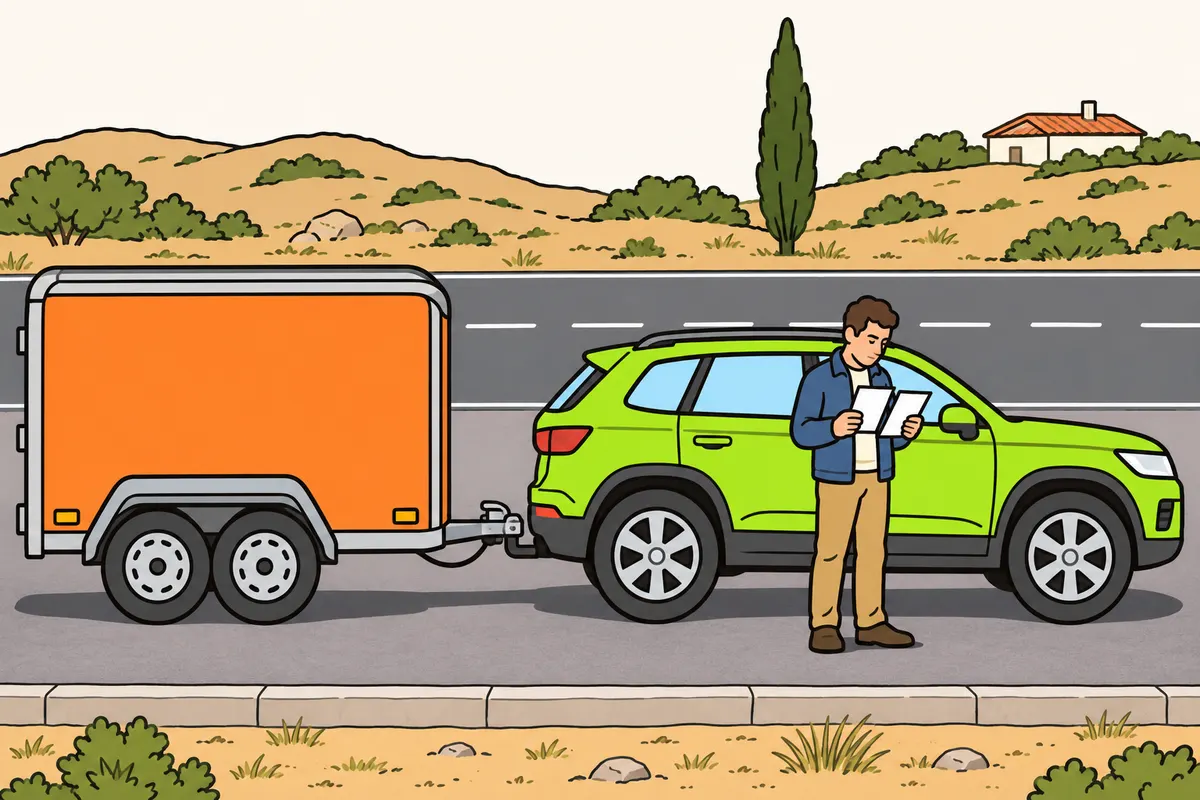
You need the right licence and a combination within its technical limits.
Remember
- Check that your licence covers your combination.
- Also check that the combination meets its technical limits.
- See ‘The B+E licence: limits, tests and validity’ for licence choices.
Exam trap: Wrong: the right licence is enough. Right: your combination must also meet its technical limits.
Read the full explanation
- To drive your combination, you need an appropriate licence and a combination compatible with its technical limits; the choice between B, code 96 and B+E is explained in «The B+E licence: limits, tests and validity», in the sections «MMA determines which licence you need» and «Sufficient licence and compatible combination». [RGCond, art. 4](https://www.boe.es/buscar/act.php?id=BOE-A-2009-9481#a4).
5Towable mass and combination mass
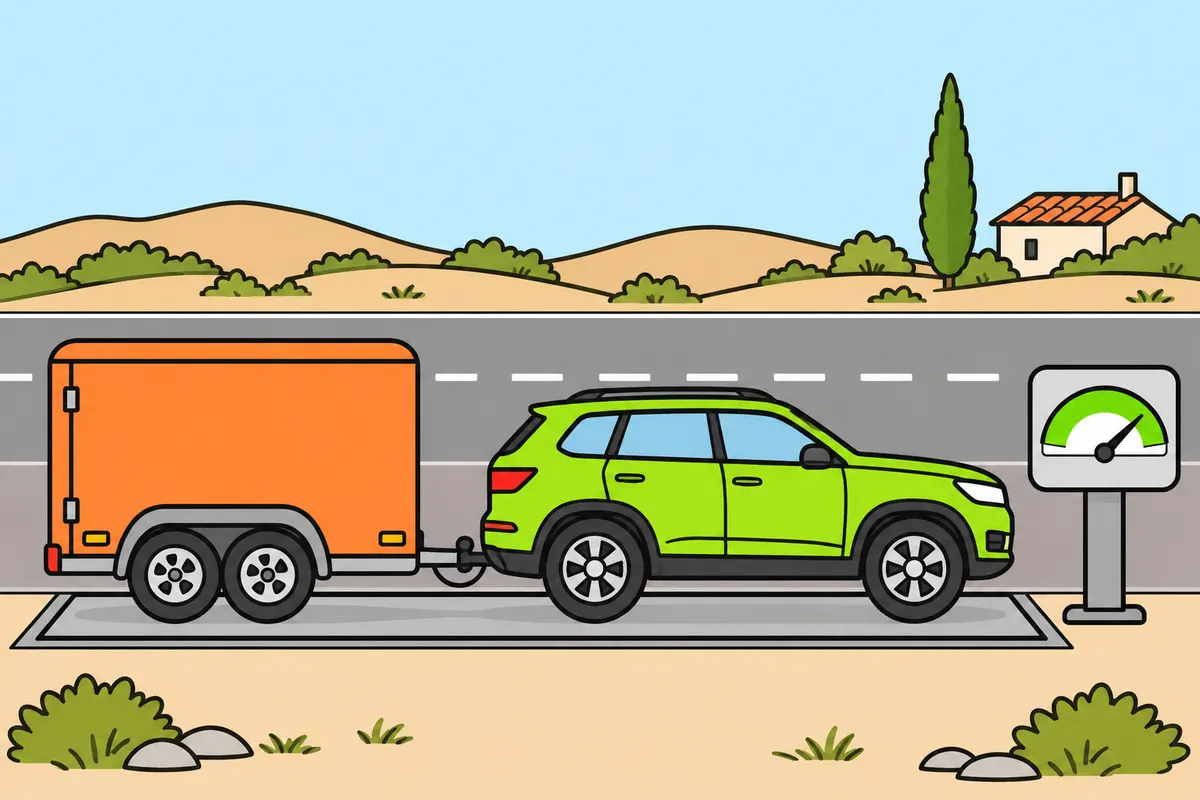
You must respect towing capacity and the total mass limit for your combination.
Remember
- MMR means the maximum authorised towable mass.
- For a car with trailer, calculate MMC = towing vehicle's MMA + MMR.
- Also respect the manufacturer's technical limit and any applicable legal limit.
- Check the coupling's strength.
- For centre-axle trailers and semi-trailers, subtract the actual vertical load on the coupling.
- Their towable mass counts the weight supported by their axles.
Exam trap: Wrong: the sum always allows that road weight. Right: also respect technical, legal and individual limits.
Read the full explanation
- The maximum authorised towable mass limits the trailer or semi-trailer that you can couple to the towing vehicle. For centre-axle trailers and semi-trailers, the definition deducts the actual vertical load transmitted to the coupling from the total actual mass: you consider the mass supported by their axles. [RGV, Annex IX](https://www.boe.es/buscar/act.php?id=BOE-A-1999-1826#anix).
- You must comply with the technically permissible towable mass determined by construction and the strength of the coupling device. You cannot deduce the towing capacity solely from the engine power, the size of the car or the trailer’s MMA. [RGV, Annex IX](https://www.boe.es/buscar/act.php?id=BOE-A-1999-1826#anix).
- For a towing vehicle with a trailer, the annex expresses the maximum combination mass as MMC = MMA + MMR of the towing vehicle. This result is limited by the technically permissible combination mass declared by the manufacturer and by the legally permissible mass where applicable. [RGV, Annex IX](https://www.boe.es/buscar/act.php?id=BOE-A-1999-1826#anix).
- If the towing vehicle has an MMA of 2,500 kg and an MMR of 2,000 kg, the sum is 4,500 kg. If the manufacturer limits the combination to 4,200 kg, you cannot drive with an actual mass of 4,500 kg: you must stay within 4,200 kg and also comply with all individual limits. [RGV, Annex IX](https://www.boe.es/buscar/act.php?id=BOE-A-1999-1826#anix).
6Towing limits according to braking system
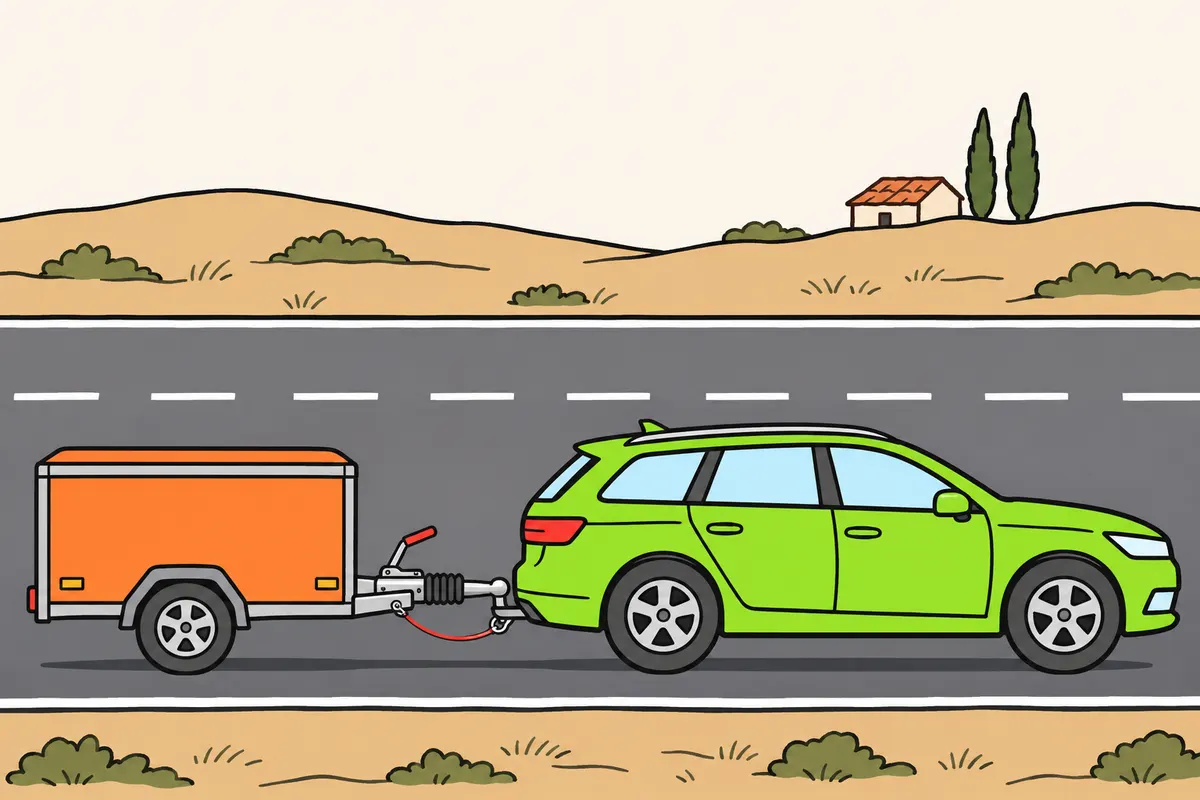
You must calculate towing limits using the trailer's brakes and the towing vehicle's type.
| Trailer brakes and towing vehicle type | Towable mass reference | Ceiling |
|---|---|---|
| Unbraked trailer | Half of the towing vehicle's tare mass increased by 75 kg | 750 kg |
| Overrun brake only; towing vehicle not off-road | Towing vehicle's MMA | 3,500 kg |
| Overrun brake only; off-road towing vehicle | 1.5 times the towing vehicle's MMA | 3,500 kg |
Remember
- Always apply a lower technical capacity if your vehicle has one.
- For continuous braking on category M and N1 vehicles, use the overrun-braking reference.
Exam trap: Wrong: an overrun brake always allows 3,500 kg. Right: respect the towing vehicle's mass reference and technical capacity.
Read the full explanation
- With an unbraked trailer, the maximum towable mass cannot exceed half the towing vehicle’s tare mass increased by 75 kg, or 750 kg under any circumstances. You must also apply the technical capacity authorised for the vehicle. [RGV, Annex IX](https://www.boe.es/buscar/act.php?id=BOE-A-1999-1826#anix).
- With a trailer that has only overrun braking, the general towing limit is the towing vehicle’s MMA, with a ceiling of 3,500 kg. If the motor vehicle is an off-road vehicle, the reference is 1.5 times its MMA, with the ceiling remaining at 3,500 kg. [RGV, Annex IX](https://www.boe.es/buscar/act.php?id=BOE-A-1999-1826#anix).
- For example, with a towing vehicle that is not an off-road vehicle and has an MMA of 2,000 kg, the overrun braking rule does not allow you to conclude that you can tow 3,500 kg. Its reference is 2,000 kg, and a lower technical capacity further reduces the permissible maximum. [RGV, Annex IX](https://www.boe.es/buscar/act.php?id=BOE-A-1999-1826#anix).
- With continuous braking, the same mass reference as for overrun braking applies to category M and N1 vehicles. You must distinguish this towing-capacity calculation from how the brakes work, which you study in «Trailer braking», in the sections «How overrun braking works» and «Continuous and semi-continuous braking». [RGV, Annex IX](https://www.boe.es/buscar/act.php?id=BOE-A-1999-1826#anix).
7Vertical load and weighing
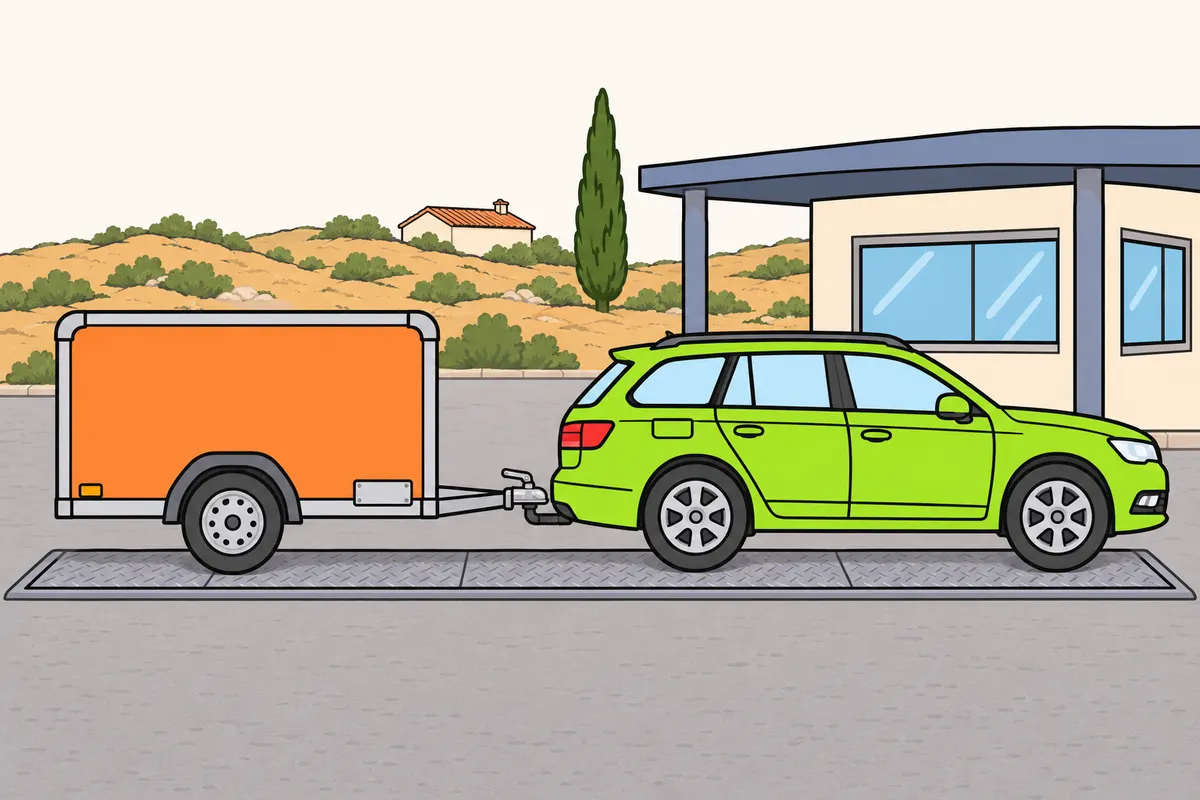
You must count the trailer's load on the coupling and respect your coupling's limit.
Remember
- For centre-axle trailers with evenly distributed loads, use the lower legal ceiling.
- Also respect the technical limits specified for your combination.
- Check your car's manual and coupling plate or documents.
- The vertical load counts towards your car's MMA and rear axle limits.
- You can weigh your combination by adding all its axle loads.
- Do not add the towball load again.
Exam trap: Wrong: always aim for 10 %. Right: this is a legal maximum for centre-axle trailers with evenly distributed loads; also respect any lower technical limit.
Read the full explanation
- With a centre-axle trailer, you must take account of the vertical load on the coupling. With the load uniformly distributed, the authorised maximum does not exceed the lower of these values: 10 % of the trailer's maximum mass or 1,000 kg. [RGV, Annex IX](https://www.boe.es/buscar/act.php?id=BOE-A-1999-1826#anix).
- The support load you should aim for is the one specified by the manufacturer for your combination; consult the towing vehicle's manual and the coupling plate or documentation. Its technical maximum may be much lower than the legal limit: if the plate states 75 kg, you must respect that 75 kg even if the 10 % calculation gives a higher figure. Values of 50, 75 or 100 kg are examples of specific limits, not a legal range or a universal recommendation. [RGV, Annex IX](https://www.boe.es/buscar/act.php?id=BOE-A-1999-1826#anix).
- The vertical load transmitted counts when determining the MMA (maximum authorised mass) of the towing vehicle and the maximum authorised masses of its rear axles. You must therefore include the trailer's effect when assessing a car loaded with occupants and luggage: checking only the trailer leaves the check incomplete. [RGV, Annex IX](https://www.boe.es/buscar/act.php?id=BOE-A-1999-1826#anix).
- To find the actual mass of the whole combination, you can add together the loads its axles transmit to the ground using a suitable weighing procedure. The load on the towball is included in the towing vehicle's axle loads and is counted only once. [RGV, Annex IX](https://www.boe.es/buscar/act.php?id=BOE-A-1999-1826#anix).
8Axles, tyres and ground contact
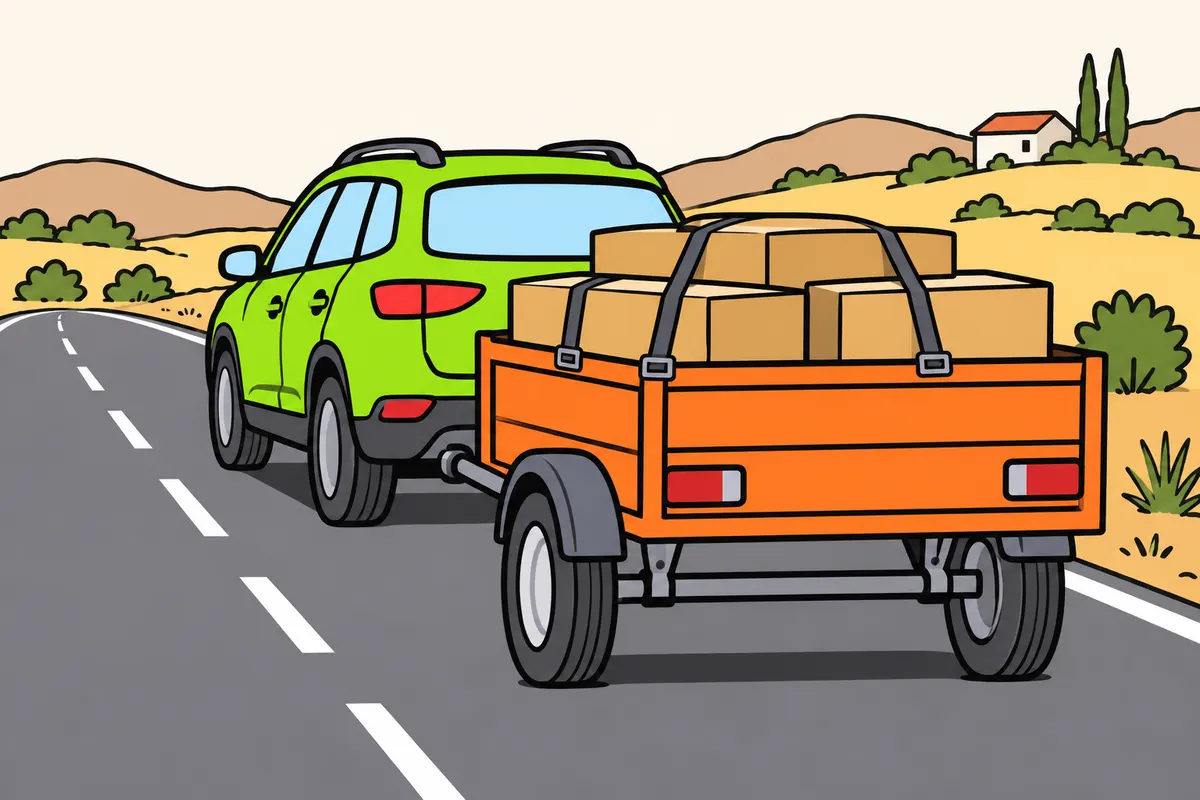
You must check each axle and tyre even when your total mass is allowed.
Remember
- Count all wheels on the same axle together.
- Twin wheels do not double the axle's limit.
- Check each tyre's permitted load using its load index and the vehicle's maximum speed.
- The road pressure limit applies to pneumatic tyres or tyres with similar elasticity.
Exam trap: Wrong: inflate your tyres to 9 kg/cm². Right: this figure limits pressure on the road surface.
Read the full explanation
- Axle mass is the mass transmitted to the ground by all the wheels on that axle. If it has twin wheels, you cannot apply the full limit to each wheel: the reference remains the whole axle. [RGV, Annex IX](https://www.boe.es/buscar/act.php?id=BOE-A-1999-1826#anix).
- You must not drive if the tyres carry loads above those permitted by their safety standards, according to their load indices and the vehicle's maximum speed. Complying with the MMA alone does not establish that each tyre is operating within its capacity. [RGV, Annex IX](https://www.boe.es/buscar/act.php?id=BOE-A-1999-1826#anix).
- On vehicles with pneumatic tyres or wheels of similar elasticity, you must not exceed 9 kg/cm² of gross contact area on the road surface. This is a limit on the pressure exerted on the road; you must not interpret it as the inflation pressure you should put in the tyres. [RGV, Annex IX](https://www.boe.es/buscar/act.php?id=BOE-A-1999-1826#anix).
9Load distribution and axle spacing requirements
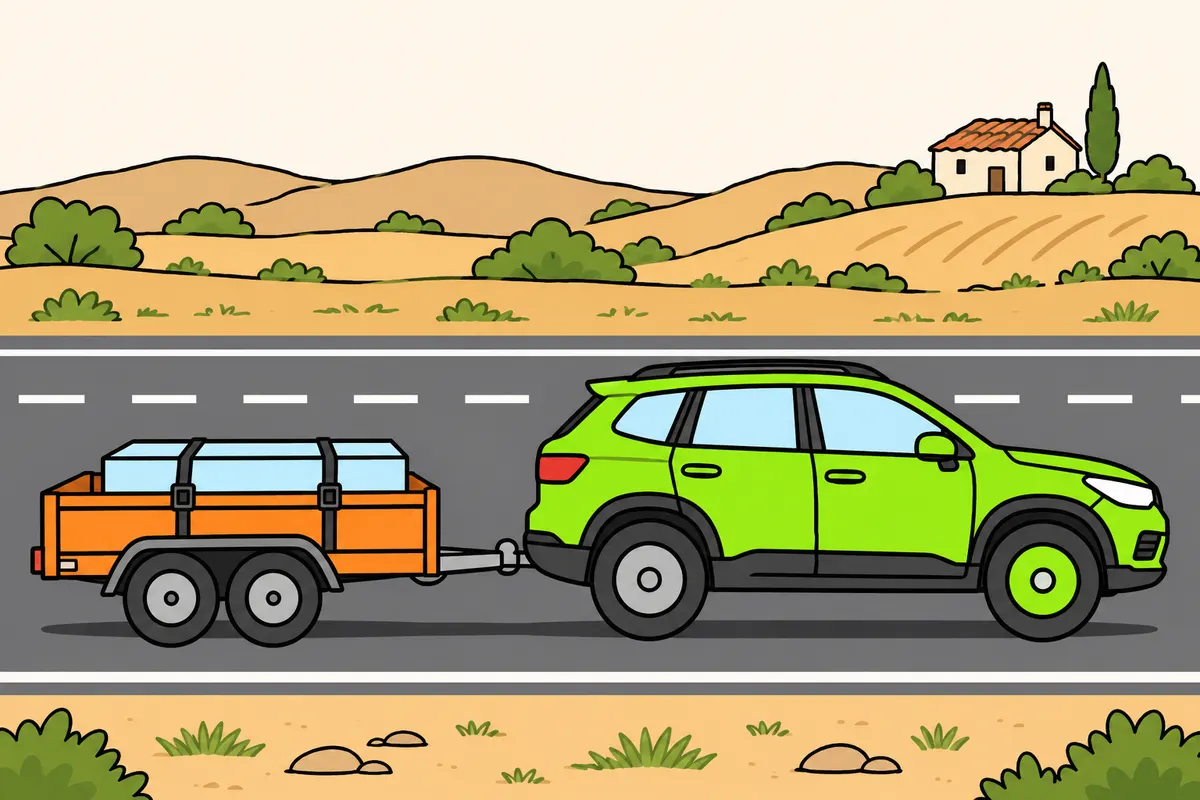
You must spread your load within axle limits and keep enough weight on driving axles.
Remember
- As a general rule, driving axles must support at least 25 %.
- For your combination, calculate this using its total actual laden mass.
- Also check that no axle carries too much weight.
- Spreading your load safely does not increase maximum masses.
- Keep at least 3.00 m between the car’s rear axle and trailer’s front axle.
- Measure between those axles, not between bodies or along the drawbar.
Exam trap: Wrong: calculate the percentage using only the car's weight. Right: use the whole combination's actual laden mass.
Read the full explanation
- As a general rule, the mass supported by the driving axle or axles must be at least 25 % of the total laden mass of the vehicle or combination. When applying this check to your combination, you must use its total actual mass, not just the car's mass. [RGV, Annex IX](https://www.boe.es/buscar/act.php?id=BOE-A-1999-1826#anix).
- Your load distribution may comply with the total mass limit yet fail to meet the minimum load on the driving axles or overload a rear axle. You must check all the limits together; distributing the load safely does not authorise you to increase the maximum masses either. [RGV, Annex IX](https://www.boe.es/buscar/act.php?id=BOE-A-1999-1826#anix).
- Your car and trailer form a road train: you may drive only if the distance between the motor vehicle's rear axle and the trailer's front axle is at least 3.00 m. This measurement is between those axles, not the clear space between the bodies or the length of the drawbar. [RGV, Annex IX, 2.1.6](https://www.boe.es/buscar/act.php?id=BOE-A-1999-1826#anix).
10Maximum width and height
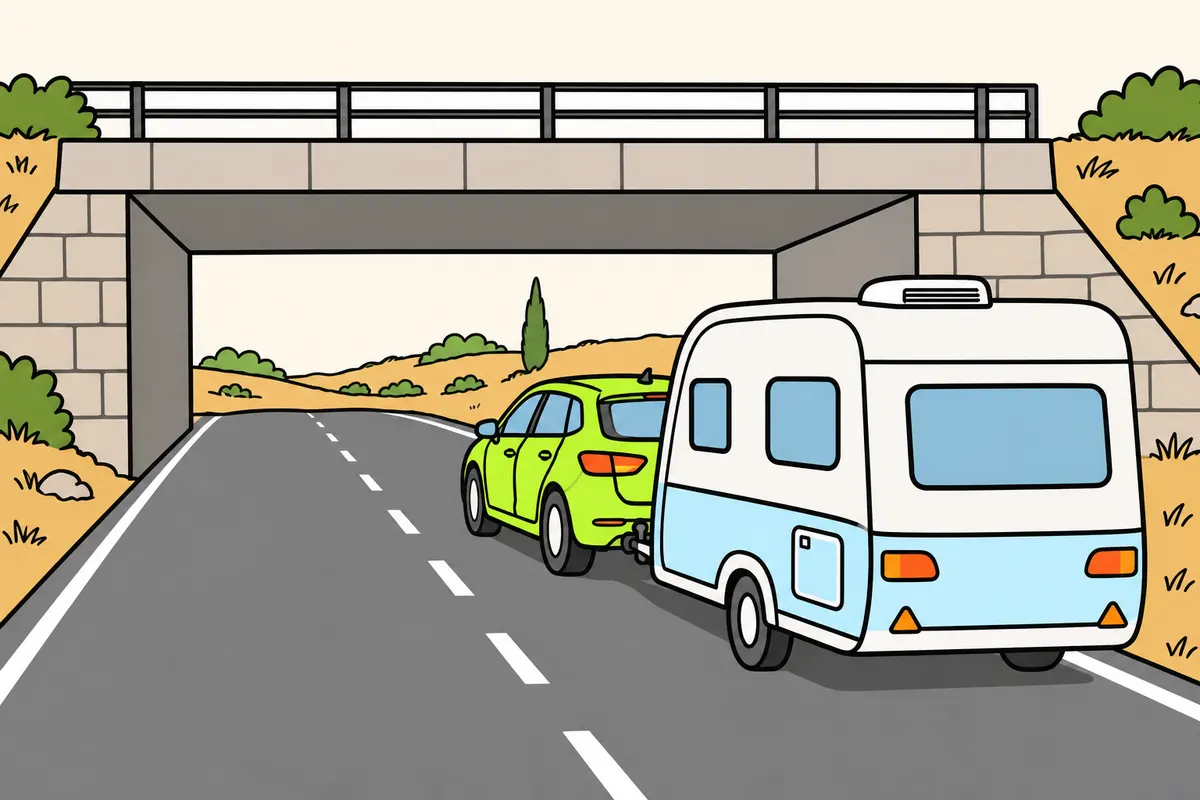
You must measure your combination's width and height with its load.
| Car with caravan or ordinary trailer | General maximum, including load |
|---|---|
| Width | 2.55 m |
| Height | 4.00 m |
Remember
- Include items that stick out upwards.
- Check available space at entrances and underpasses.
- A narrow trailer does not allow any side projection you choose.
Exam trap: Wrong: meeting the general height limit guarantees passage. Right: check the available height along your route.
Read the full explanation
- The general maximum width is 2.55 m. You must use this as the reference for your car with a caravan or ordinary trailer, including the load in accordance with the applicable rules; a narrower trailer does not authorise any side projection you choose. [RGV, Annex IX](https://www.boe.es/buscar/act.php?id=BOE-A-1999-1826#anix).
- The general maximum height, including the load, is 4.00 m. When preparing your journey, you must account for items projecting upwards and check the available clearance at entrances and underpasses; a height below 4 m does not guarantee that you can pass beneath every obstacle. [RGV, Annex IX](https://www.boe.es/buscar/act.php?id=BOE-A-1999-1826#anix).
11Vehicle and combination lengths
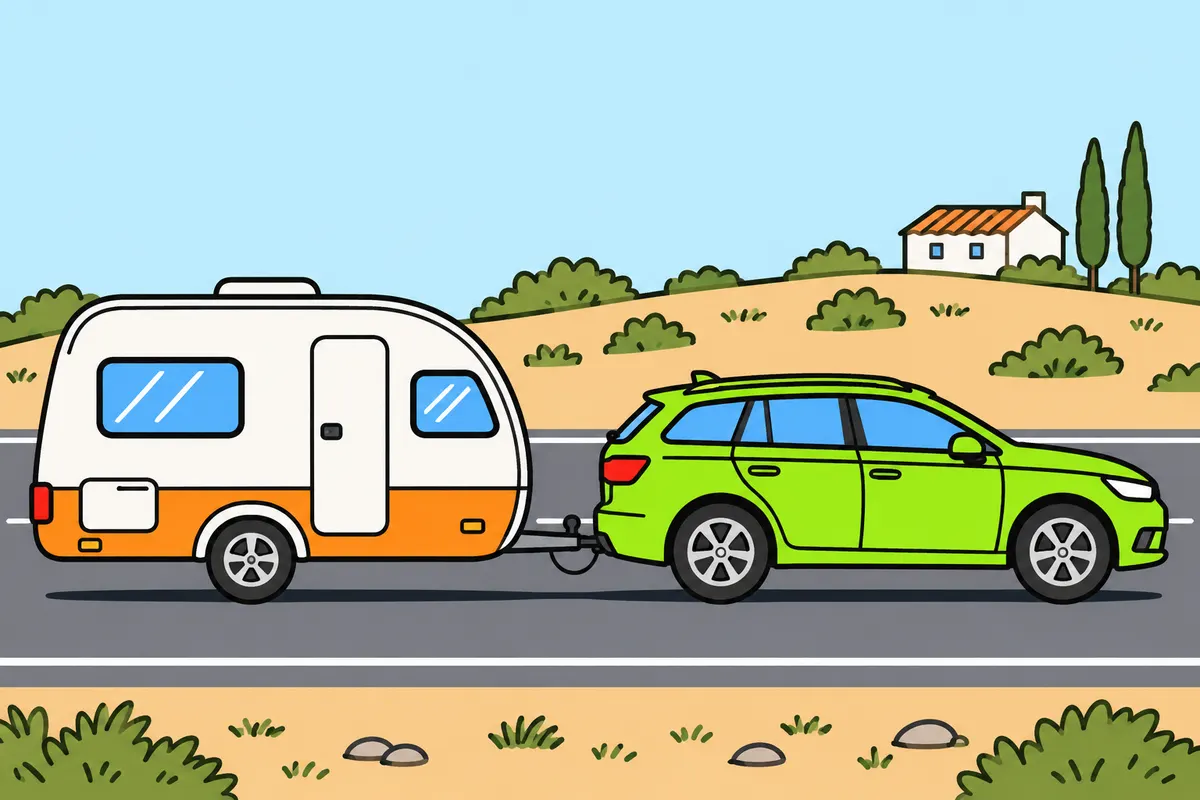
You must distinguish each vehicle's length limit from the combination's length limit.
| Vehicle or combination | General maximum length |
|---|---|
| Motor vehicle other than a bus | 12.00 m |
| Trailer | 12.00 m |
| Road train | 18.75 m |
Remember
- Your car and trailer form a road train.
- Also check the dimensions authorised for your own combination.
- If your combination exceeds 12 m, display V-6.
Exam trap: Wrong: add individual maximum lengths to find the combination's maximum. Right: a road train has its own limit.
Read the full explanation
- The general maximum length of a motor vehicle other than a bus or coach is 12.00 m; for a trailer it is 12.00 m. You must distinguish the maximum for each unit from the maximum for the combination: you cannot add the two together to obtain a permissible combination length of 24 m. [RGV, Annex IX](https://www.boe.es/buscar/act.php?id=BOE-A-1999-1826#anix).
- A road train has a general maximum length of 18.75 m; your car with a trailer belongs to this type of combination. This legal ceiling is far above the usual type-approved dimensions of a passenger car with a caravan: you must observe those of your own combination. You must mark a combination over 12 m in total length with the V-6 sign; its fitting is covered in the “Safety equipment for your vehicle combination” module, in the “Rear plate for a long vehicle” section. [RGV, Annex IX](https://www.boe.es/buscar/act.php?id=BOE-A-1999-1826#anix). [RGV, Annex XI, V-6](https://www.boe.es/buscar/act.php?id=BOE-A-1999-1826#v-6).
12Turning circle and available space
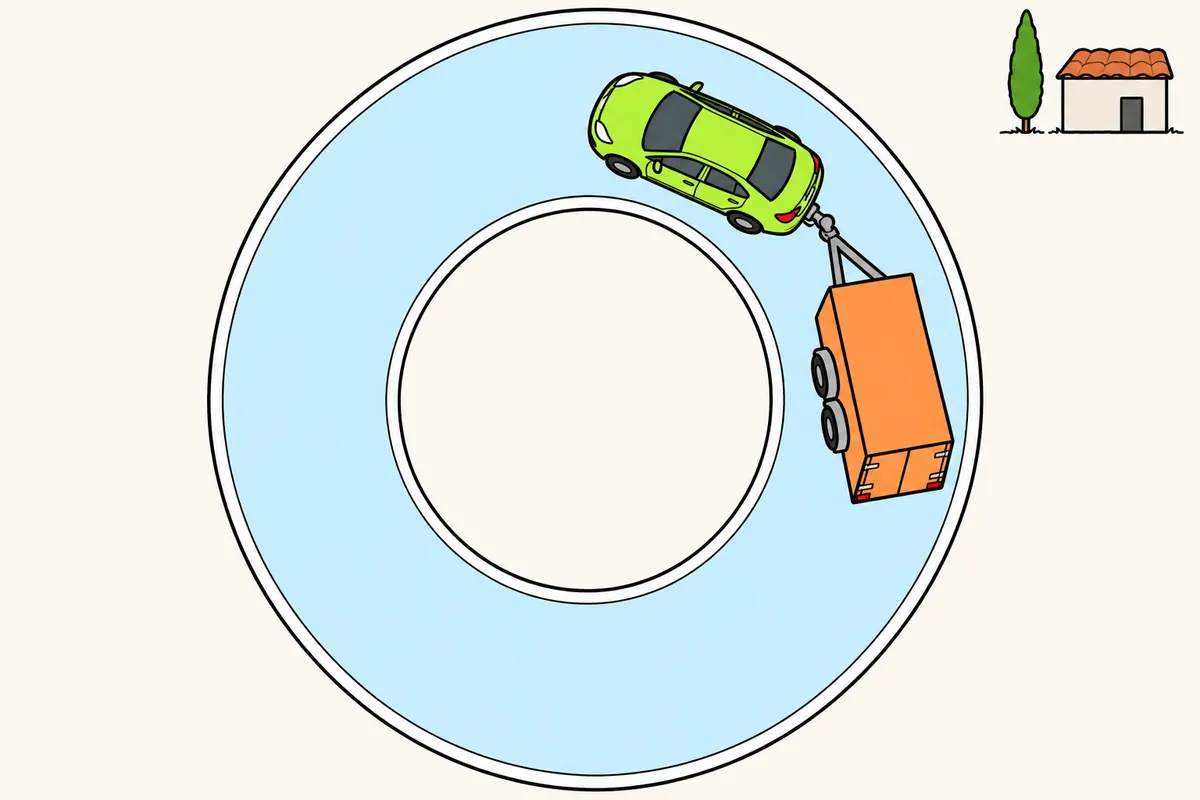
You must be able to turn fully in either direction within the required ring-shaped space.
Remember
- The turning area is the space between the inner and outer circles.
- No part of your vehicle or combination may leave this space.
- These measurements are radii, not diameters.
- They do not set a minimum width for every road.
Exam trap: Wrong: read these figures as diameters. Right: they are the turning area's radii.
Read the full explanation
- Your vehicle and your combination must be able to follow a complete 360° circular path in either direction within a ring with an outer radius of 12.50 m and an inner radius of 5.30 m. None of their outermost points may project beyond these circular boundaries. [RGV, Annex IX](https://www.boe.es/buscar/act.php?id=BOE-A-1999-1826#anix).
- The turning circle figures are radii, not diameters. The difference between the two radii is 7.20 m, but you must not interpret this as a universal minimum width for any road or as permission to occupy all that space when turning. [RGV, Annex IX](https://www.boe.es/buscar/act.php?id=BOE-A-1999-1826#anix).
13When your load may project
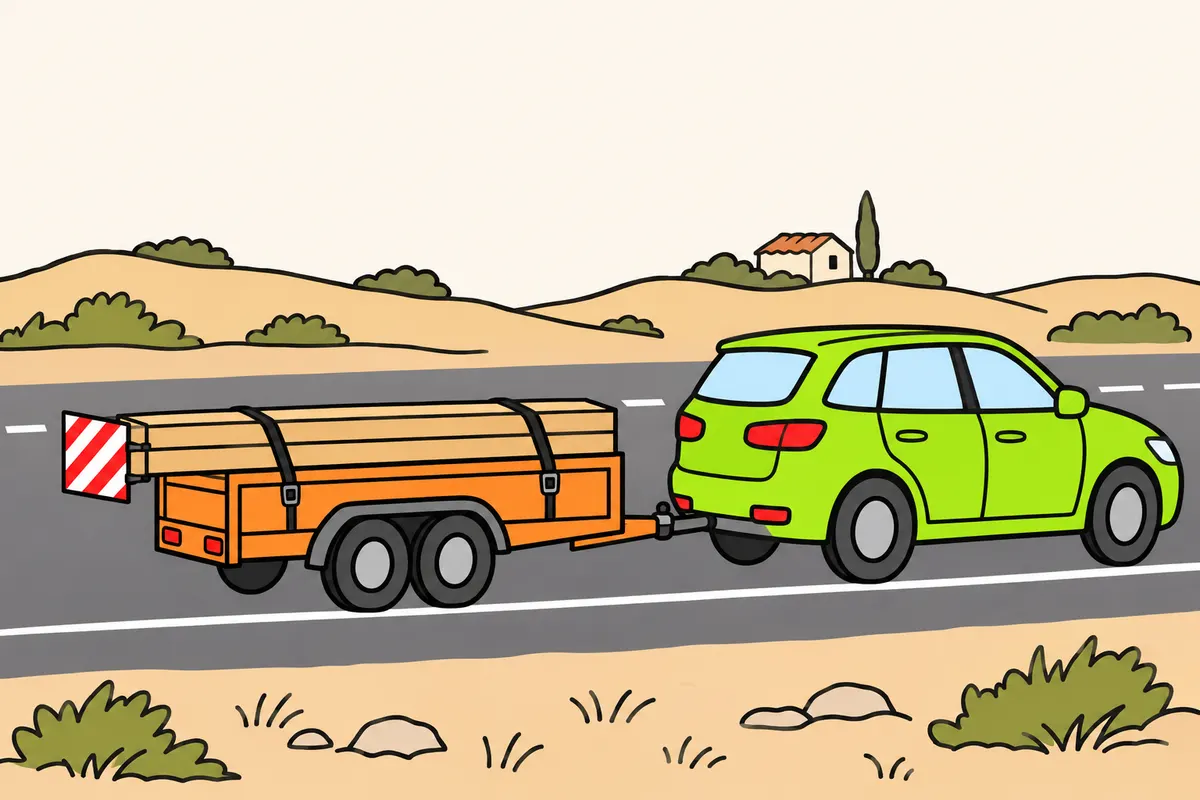
You must calculate allowed projections using the vehicle that carries the load.
| Vehicle carrying the load | Condition | Allowed projection |
|---|---|---|
| Passenger car | Divisible load | Rear only: up to 10 % of vehicle length |
| Passenger car | Indivisible load | Rear only: up to 15 % of vehicle length |
| Trailer exclusively for goods | Trailer longer than 5 m; load indivisible lengthways | Up to 2 m at front and 3 m at rear |
| Trailer exclusively for goods | Trailer 5 m or shorter; load indivisible lengthways | Up to one third of trailer length at each end |
Remember
- As a general rule, keep your load within the vehicle's outline.
- Calculate projections using the length of the vehicle carrying the load.
- For goods trailers, the exception requires a load that cannot be divided lengthways.
- Position and secure it; see ‘Projecting loads: identify which vehicle carries the load’.
- Then measure the aligned combination between its outermost ends, including the load.
- Do not count the drawbar or coupling space again.
Exam trap: Wrong: apply 15 % to car and trailer together. Right: calculate the passenger car's projection using its own length.
Read the full explanation
- The load must remain within the vehicle’s outline when viewed from above, except where the regulations allow otherwise; to choose the applicable exception, consult «Safe loading of your vehicle combination», section «Projecting loads: identify which vehicle carries the load». [RGC, art. 15.1](https://www.boe.es/buscar/act.php?id=BOE-A-2003-23514#a15).
- On your passenger car, the load may project only to the rear, by up to 10 % of its length, or 15 % if the load is indivisible. [RGC, art. 15.3](https://www.boe.es/buscar/act.php?id=BOE-A-2003-23514#a15).
- On a trailer intended exclusively for goods, loads of indivisible length may project up to 2 m at the front and 3 m at the rear if the vehicle exceeds 5 m, or up to one third of its length at each end if it measures 5 m or less, provided you meet the stowage and securing conditions. [RGC, art. 15.2.a](https://www.boe.es/buscar/act.php?id=BOE-A-2003-23514#a15).
- To measure the total loaded length, align the combination and measure the longitudinal distance between its foremost and rearmost points, including the load; a projection occupying part of the gap between the towing vehicle and trailer does not necessarily increase this overall distance. [RGV, Annex IX, 3.1](https://www.boe.es/buscar/act.php?id=BOE-A-1999-1826#anix).
- As a measurement example, if your aligned combination measures 11 m without a projecting load and an item extends 600 mm beyond its rear end, the overall length is 11.60 m; if it remains within the existing front end, that part adds no length to the combination. Compare the result with the maximum road train length explained in «Vehicle and combination lengths» and with the restrictions on your route. [RGV, Annex IX, 3.1](https://www.boe.es/buscar/act.php?id=BOE-A-1999-1826#anix).
- Permission for a load to project beyond the vehicle carrying it and checking the total length are separate operations: first calculate the exception for that vehicle, then measure the complete combination, without counting the drawbar or coupling space twice. [RGC, art. 15.2.a and 15.3](https://www.boe.es/buscar/act.php?id=BOE-A-2003-23514#a15).
14Side projections and protection
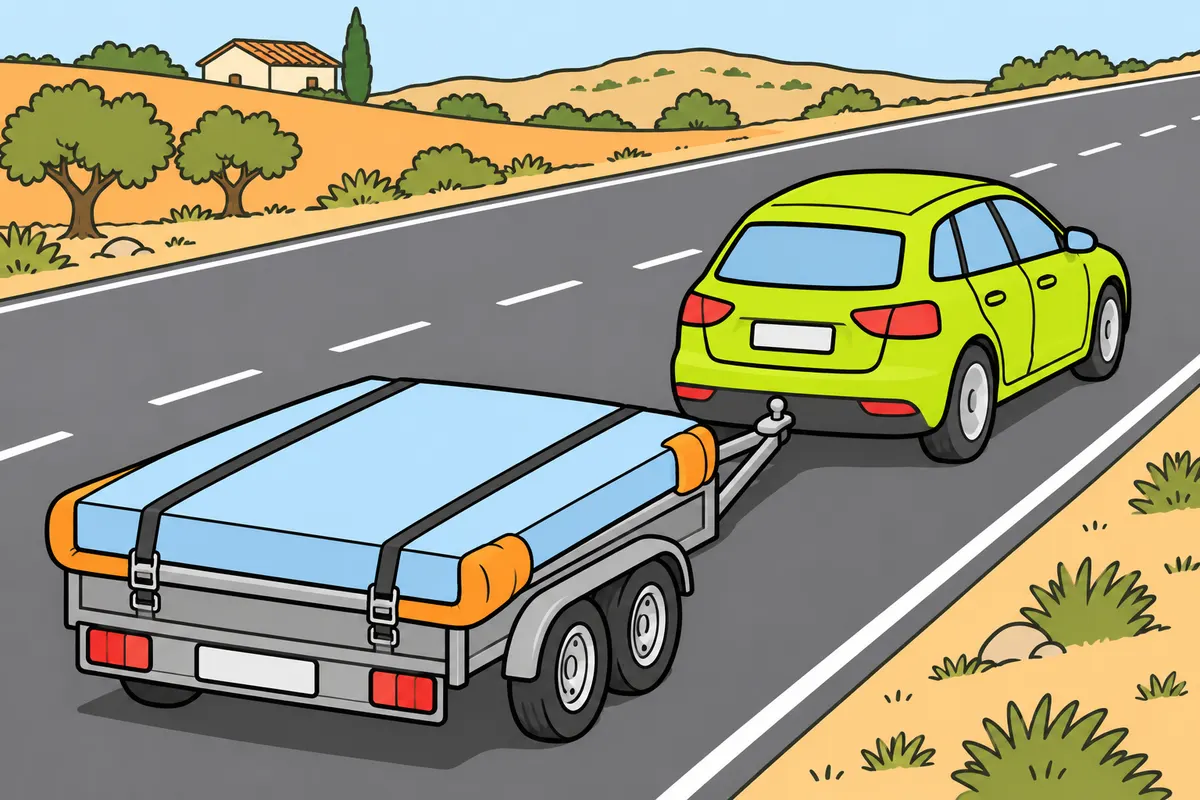
You must check the conditions for side projections and protect any projecting ends.
| Vehicle and load condition | Side limit | Other limits |
|---|---|---|
| Trailer exclusively for goods; indivisible load whose smallest dimension exceeds trailer width | Up to 0.40 m beyond each side | Total width no greater than 2.55 m |
Remember
- Protect the ends of any load that projects legally.
- Measure width between the load's outermost ends.
- If the load is off-centre, add each side projection separately.
- Measure height from the ground to the highest point, including load and support.
- Also check the space taken up by the end protection.
- Compare your measurements with route limits and obstacles.
Exam trap: Wrong: allow 0.40 m side projection on any passenger car. Right: this exception requires a trailer exclusively for goods and an indivisible load whose smallest dimension exceeds the trailer's width; total width must not exceed 2.55 m.
Read the full explanation
- On your goods-only trailer, when the smaller dimension of an indivisible load exceeds the vehicle’s width, you may have a projection of up to 0.40 m on each side, provided the total width does not exceed 2.55 m. [RGC, art. 15.2.b](https://www.boe.es/buscar/act.php?id=BOE-A-2003-23514#a15).
- To obtain the loaded width, measure between the outermost points on either side: if a platform measures 1.80 m and the item projects 0.30 m on each side, the result is 2.40 m. If the load is off-centre, add the left and right projections separately; the final width alone does not establish that each projection is permitted. [RGC, art. 15.2.b](https://www.boe.es/buscar/act.php?id=BOE-A-2003-23514#a15).
- For height, measure from the ground to the highest point of the complete setup, including the load and its support: an item placed on top of the load body may determine the height even if it does not project to either side. Compare this measurement with the general maximum in «Maximum width and height» and with the signposted height on your route. [RGV, Annex IX, 3.1](https://www.boe.es/buscar/act.php?id=BOE-A-1999-1826#anix).
- End protection and precautions against damage are covered in «Safe loading of your vehicle combination», section «Side projections and protected ends»; include the actual bulk of the protected end when checking the space available alongside walls, posts and entrances. [RGC, art. 15.5](https://www.boe.es/buscar/act.php?id=BOE-A-2003-23514#a15).
15Marking projecting loads
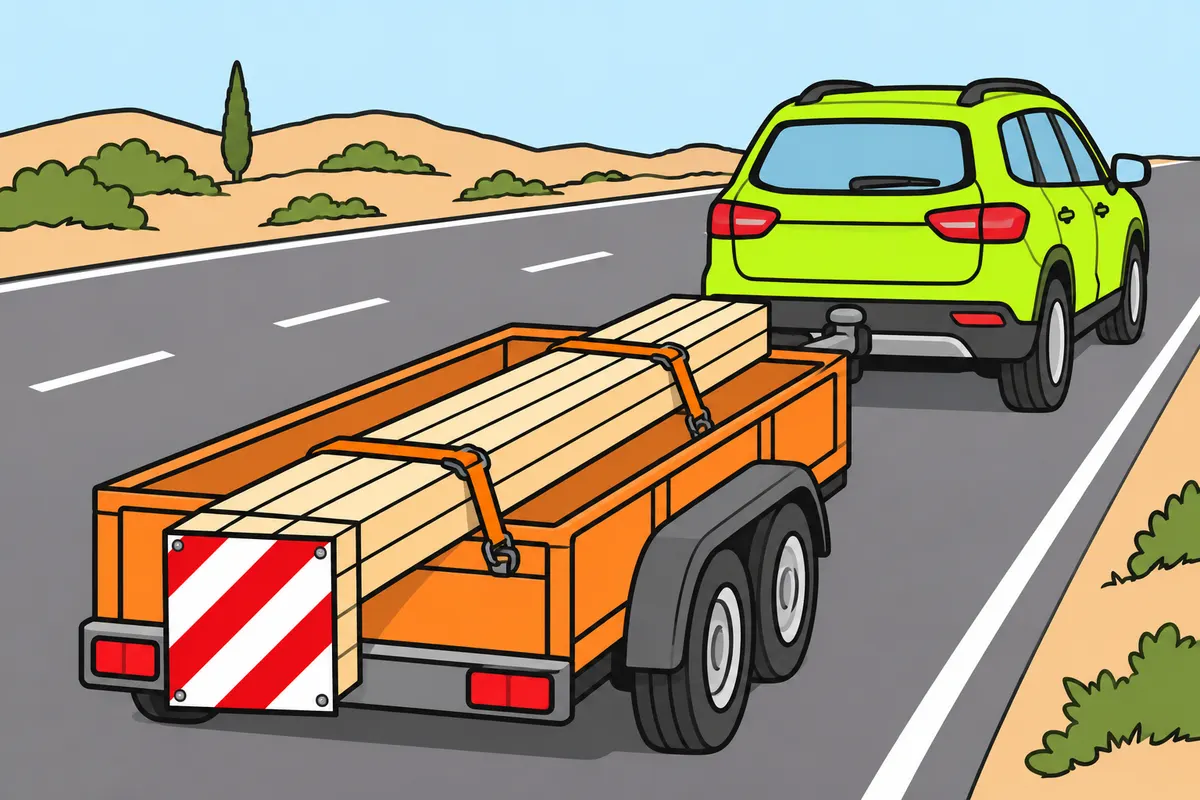
You must mark projecting loads and check the space they need when turning.
Remember
- Mark permitted rear projections with V-20; see ‘V-20: mark every permitted rear projection’.
- Measure sideways from the outer edge of the corresponding position light.
- See ‘Safe loading of your vehicle combination’ for panels, lights and reflectors.
- When turning, allow for the space swept by the load's rear end.
- Check that a load projecting forwards from your trailer has space near your car.
- At doorways and roofs, check outside measurements and turning space.
Exam trap: Wrong: measure from the bodywork to decide side marking. Right: measure from the corresponding position light's outer edge.
Read the full explanation
- A permitted rear projection requires V-20; for its positioning and night-time marking, consult «Safe loading of your vehicle combination», section «V-20: mark every permitted rear projection». [RGC, art. 15.6](https://www.boe.es/buscar/act.php?id=BOE-A-2003-23514#a15).
- The lateral distance of more than 0.40 m that determines whether additional marking is required is measured from the outer edge of the corresponding position light to the end of the load; its lights and reflectors are explained in «Safe loading of your vehicle combination», section «Lights for projecting loads in poor visibility». [RGC, art. 15.7](https://www.boe.es/buscar/act.php?id=BOE-A-2003-23514#a15).
- When checking turning space, consider the end of the load: a rear item far from the axles sweeps outwards when the trailer changes direction. Measurements taken in a straight line do not by themselves describe this path; relate its position to the turning circle in «Turning circle and available space». [RGV, Annex IX, 3.2.2](https://www.boe.es/buscar/act.php?id=BOE-A-1999-1826#anix).
- A load projecting from the front of the trailer may approach the towing vehicle as the combination articulates, even if it remains within the overall length in a straight line. As a practical check, examine the space available between the load, bodywork and coupling during a turn before entering a narrow entrance. [RGC, art. 15.2.a](https://www.boe.es/buscar/act.php?id=BOE-A-2003-23514#a15).
- Marking shows where the load ends; to decide whether it fits through a doorway or under a roof, use the external measurements obtained in the previous two sections and the space it occupies when turning, allowing a margin for the particular obstacle. [RGV, Annex IX, 3.1 and 3.2.2](https://www.boe.es/buscar/act.php?id=BOE-A-1999-1826#anix).
16Authorisation for special transport
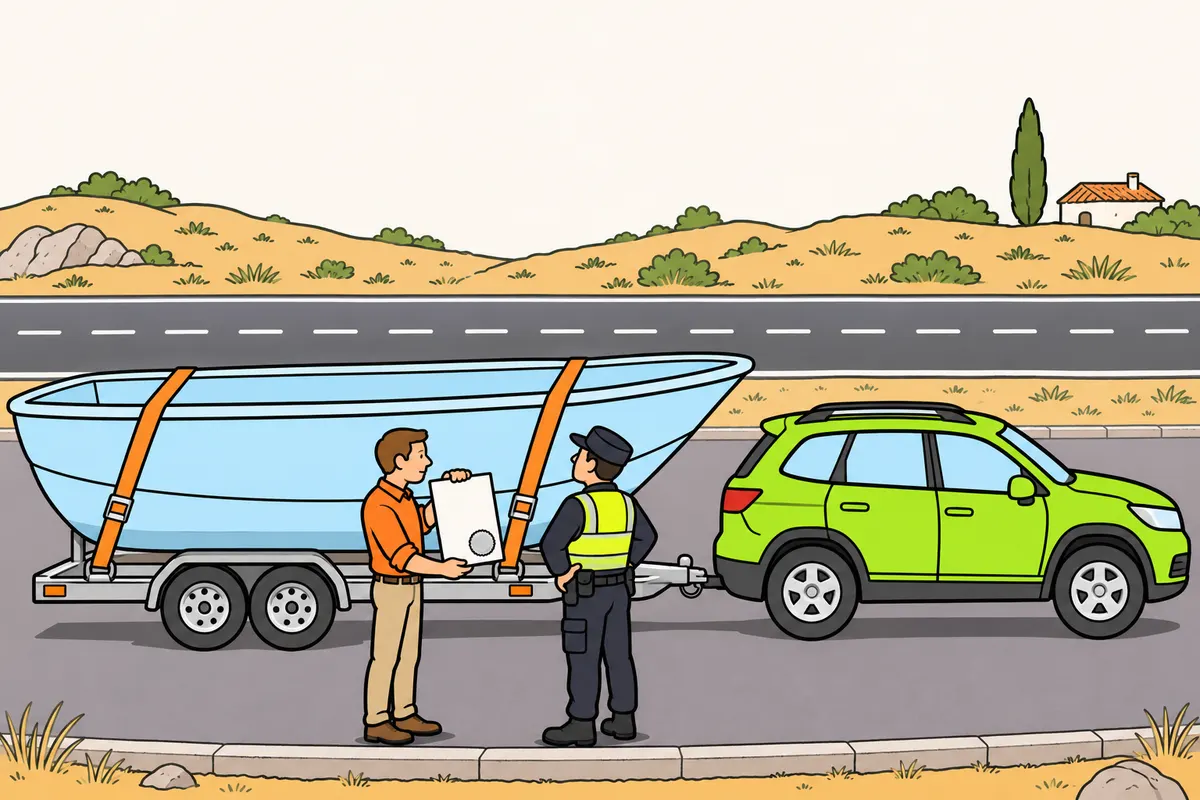
You need special authorisation when vehicle characteristics or an indivisible load require exceeding maximum limits.
Remember
- You need authorisation if your vehicle's technical characteristics require exceeding maximum limits.
- You also need it if an indivisible load requires exceeding them.
- The authorisation may limit journeys or its period of use.
- Granting it requires a binding report from the road authority.
- Coverage by the legally required transport authorisation must also be checked.
- Wanting a single trip does not make separate packages indivisible.
Exam trap: Wrong: B+E or a load panel alone allows an exceptional load. Right: get special authorisation when the vehicle's technical characteristics or an indivisible load require you to exceed the maximum limits.
Read the full explanation
- When the vehicle’s technical characteristics or an indivisible load make it necessary to exceed the maximum masses or dimensions, you must have the appropriate special authorisation. The traffic authority may grant it for a limited number of journeys or a specified period. [RGV, art. 14](https://www.boe.es/buscar/act.php?id=BOE-A-1999-1826#a14).
- Granting it requires a binding report from the road authority and verification that the legally required transport authorisation covers the operation. You must not treat it as a simple declaration by the driver or as an automatic consequence of holding B+E. [RGV, art. 14](https://www.boe.es/buscar/act.php?id=BOE-A-1999-1826#a14).
- For these purposes, an indivisible load is one that cannot be separated into two or more loads without unnecessary cost or risk of damage and that, because of its mass or dimensions, cannot be transported on a vehicle or combination complying with the ordinary maximum limits. [RGV, Annex IX, 1.15](https://www.boe.es/buscar/act.php?id=BOE-A-1999-1826#anix).
- An overload of items that you can split between several trips does not become indivisible because you prefer to make a single journey. Ordinary exceptions for projecting loads apply subject to their conditions; transport exceeding the maximum limits requires the corresponding authorisation. [RGV, art. 14](https://www.boe.es/buscar/act.php?id=BOE-A-1999-1826#a14).
17Signs that limit masses
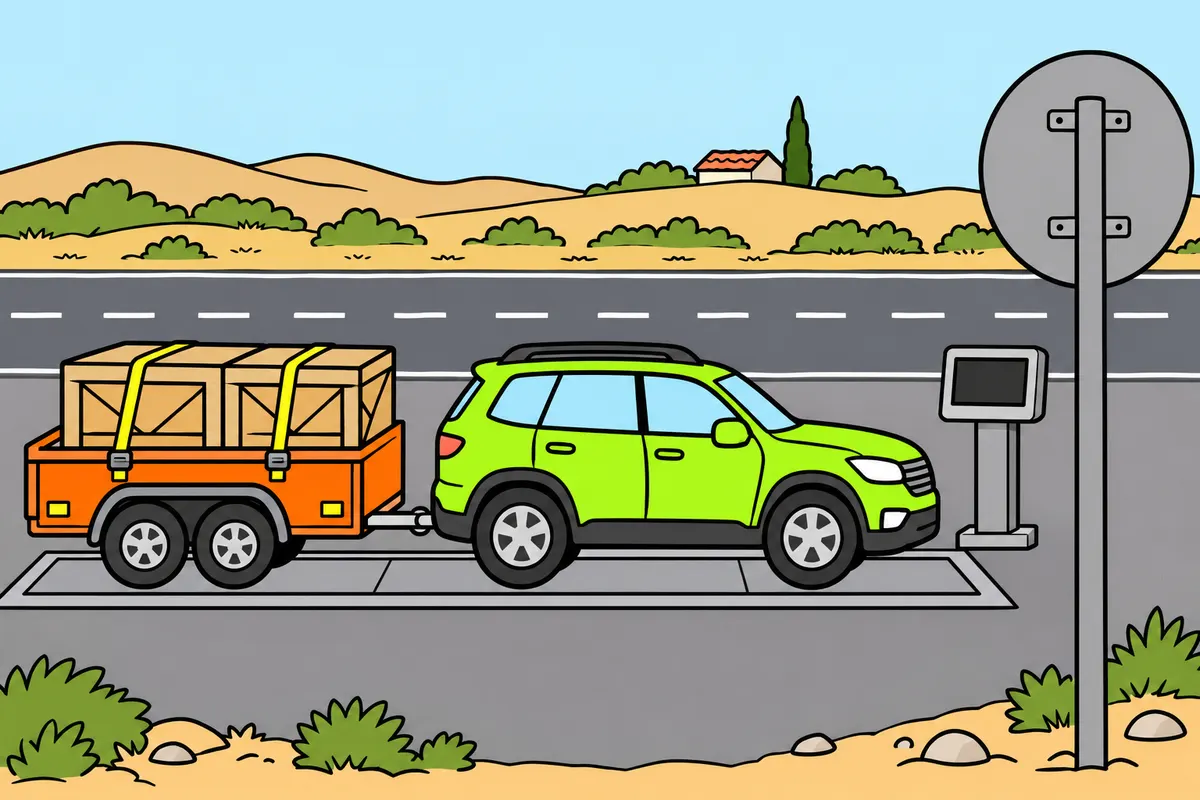
You must distinguish signs limiting actual weight from signs limiting MMA.
| Sign | Vehicles or parts affected | What you compare with the sign |
|---|---|---|
| R-201 | Vehicles | Actual laden mass |
| R-202 | Each vehicle axle | Mass transmitted by all its wheels |
| R-107 | Lorries, road tractors, goods vans and vans | MMA, even when empty |
Remember
- At R-201, compare your actual laden weight with the figure shown.
- At R-202, check each complete axle.
- An average axle weight does not prove you can pass.
- R-107 can apply even when you drive empty.
Exam trap: Wrong: read R-201 as an MMA limit. Right: it limits actual laden mass.
Read the full explanation
- R-201, mass limit, prohibits passage if the laden mass exceeds the tonnes shown. You must compare it with the actual mass; you must not automatically interpret this type of sign as a prohibition based on the documented MMA (maximum authorised mass). [RD 465/2025, official catalogue](https://www.boe.es/buscar/doc.php?id=BOE-A-2025-12199).
- R-202 limits the mass transmitted by all the wheels of any one axle. You must check each axle: an acceptable total combination mass or a low average per axle does not guarantee that you may pass. [RD 465/2025, official catalogue](https://www.boe.es/buscar/doc.php?id=BOE-A-2025-12199).
- At an R-201 sign showing 3.5 t, an actual mass of 3,600 kg exceeds the figure and one of 3,400 kg does not. At an R-202 sign showing 2 t, an axle transmitting 2,100 kg breaches the limit even if the other axles carry very little load. [RD 465/2025, official catalogue](https://www.boe.es/buscar/doc.php?id=BOE-A-2025-12199).
- R-107 prohibits entry to lorries, tractor units and vans whose MMA exceeds the figure shown, even when empty. If your B+E towing vehicle is a van, you must compare its MMA with the figure on the sign. [RD 465/2025, official catalogue, R-107](https://www.boe.es/buscar/doc.php?id=BOE-A-2025-12199).
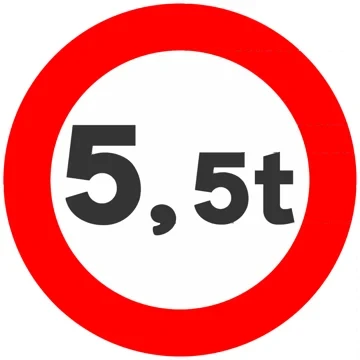 R-201
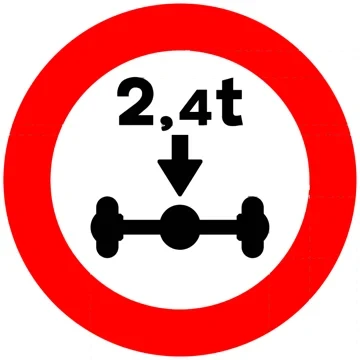 R-202
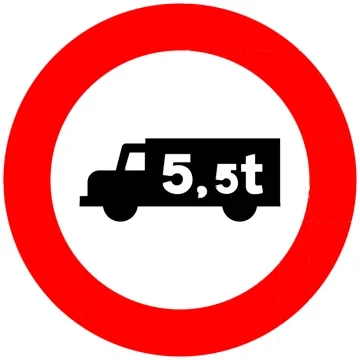 R-107
18Length, width and height signs
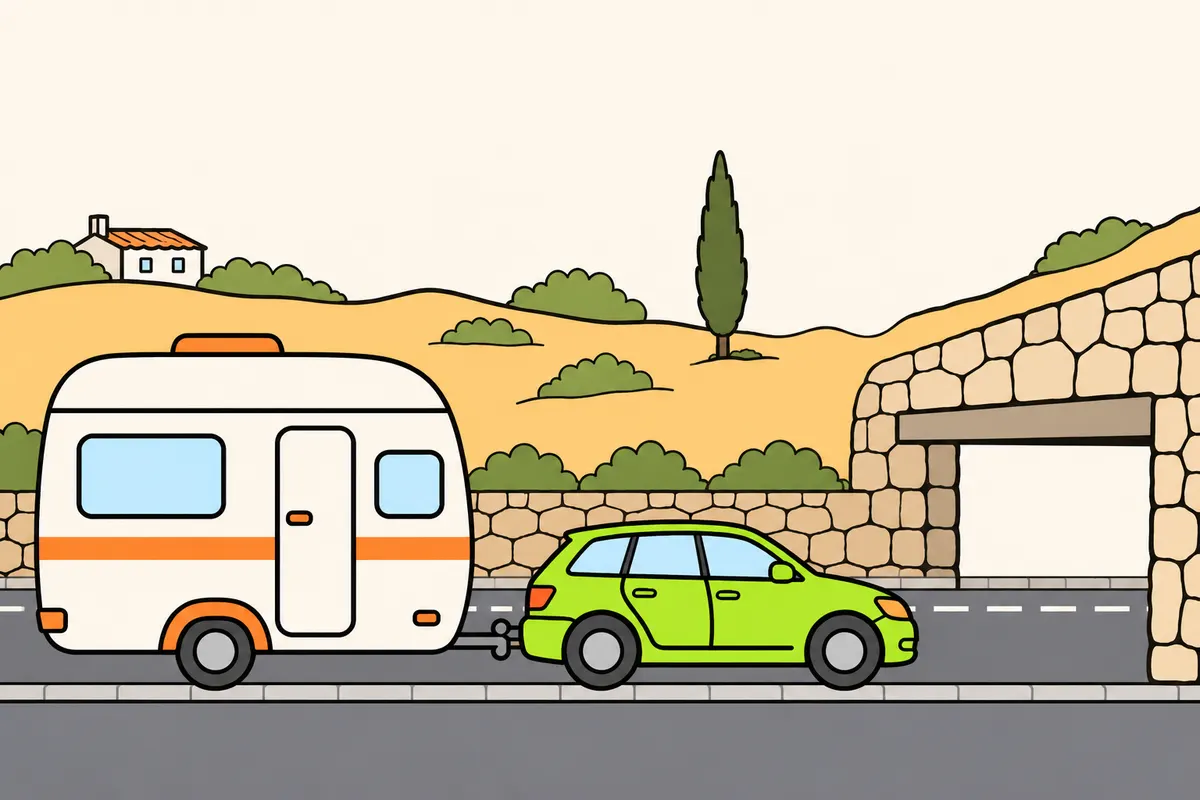
You must compare your whole combination's measurements with signs along your route.
| Sign | Vehicle or combination measurement, including load |
|---|---|
| R-203 | Maximum length |
| R-204 | Maximum width |
| R-205 | Maximum height |
Remember
- Include your load and accessories when measuring.
- For length, count the whole car and trailer.
- Do not pass if you exceed the figure shown.
- As a practical measure, keep a margin around obstacles.
- Check the actual measurements with accessories and load.
- A route planned for passenger cars does not replace checking your measurements.
Exam trap: Wrong: check only your car's length at R-203. Right: count the whole combination, including its load.
Read the full explanation
- R-203 limits the maximum length of vehicles or combinations, including the load. You must consider the complete car and trailer: a short towing vehicle does not allow you to enter if the combination exceeds the length shown. [RD 465/2025, official catalogue](https://www.boe.es/buscar/doc.php?id=BOE-A-2025-12199).
- R-204 limits the maximum width including the load, and R-205 limits the maximum height including the load. You must compare each dimension with its corresponding sign; complying with the width limit does not establish that you can pass under the obstacle. [RD 465/2025, official catalogue](https://www.boe.es/buscar/doc.php?id=BOE-A-2025-12199).
- If your combination measures 11 m and R-203 shows 10 m, being empty does not allow you to pass. If the caravan measures 3.20 m high and R-205 shows 3 m, you cannot pass either, even if you comply with the general maximum height of 4 m. [RD 465/2025, official catalogue](https://www.boe.es/buscar/doc.php?id=BOE-A-2025-12199).
- These signs prohibit exceeding the figure shown. As a practical recommendation, leave a margin at obstacles and check the actual dimensions with accessories and load: a visual estimate or a route calculated for passenger cars does not replace this check. [RD 465/2025, official catalogue](https://www.boe.es/buscar/doc.php?id=BOE-A-2025-12199).
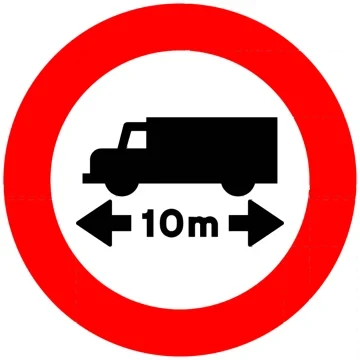 R-203
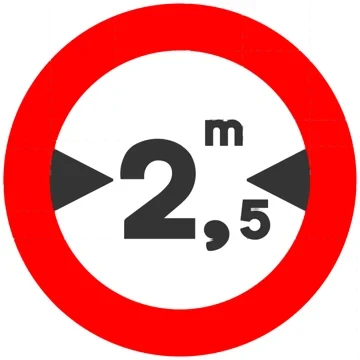 R-204
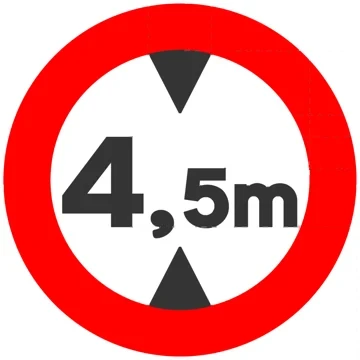 R-205
19Speed limiter and a category B towing vehicle
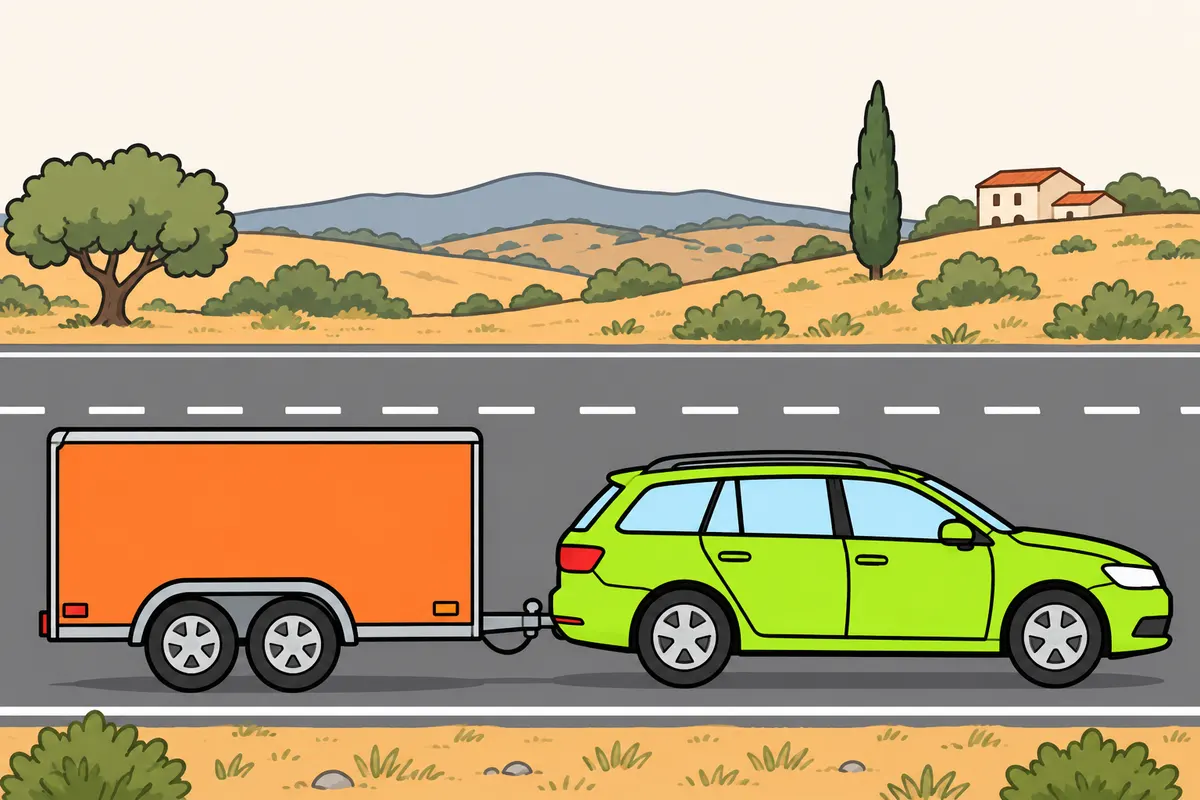
Your category B towing vehicle does not need this speed limiter.
| Towing vehicle category | Speed limiter rules |
|---|---|
| M2, M3, N2 or N3 | Apply |
| M1 or N1 | Do not apply |
Remember
- The speed limiter rules cover M2, M3, N2 and N3 motor vehicles.
- A category M1 or N1 car or goods vehicle is outside these rules.
- Adding a trailer does not change the towing vehicle's category.
Exam trap: Wrong: adding a trailer makes your category B towing vehicle need the limiter. Right: an M1 or N1 vehicle stays outside these rules when you attach a trailer.
Read the full explanation
- The speed limiter rules in RD 1417/2005 apply to motor vehicles in categories M2, M3, N2 and N3. Your passenger car or goods towing vehicle that you drive with a category B licence, in vehicle category M1 or N1, falls outside this scope: coupling a trailer and adding together the masses of the combination does not change the category of the motor vehicle or require it to have that speed limiter. [RD 1417/2005, art. 2](https://www.boe.es/buscar/act.php?id=BOE-A-2005-19990#a2).
Check masses before loading
Apply both the limits in annex IX and the specific limits for your combination.
- Identify the MMA (maximum authorised mass), axle masses and towing capacity of the towing vehicle and trailer.
- Check the mass limit for the combination and the vertical load capacity of the coupling.
- Calculate or weigh the actual mass with occupants, equipment and load; include the load the trailer places on the towing vehicle.
- Check each axle and each vehicle against its limit, as well as the total.
- Reduce or redistribute the load according to the limit exceeded, and check it again before driving.
Decide whether a projection is permitted
Follow article 15 of the RGC and check whether you need special authorisation.
- Identify the vehicle carrying the load and whether it is used exclusively for goods.
- Determine whether the load is indivisible and select the applicable exception.
- Calculate the permitted projections and measure the final dimensions.
- Check the general maximum limits and, where applicable, whether supplementary authorisation is required.
- Protect the ends and fit the required markings and lights; consult «Safe loading of your vehicle combination» for stowage.
Check your route against the dimensions
Compare the measurements of the combination ready for travel with the restrictions along the route.
- Note the length, width, height and relevant actual masses of the combination ready for travel.
- Identify signs limiting total mass, axle mass and dimensions.
- Compare each figure with the quantity limited by the sign, including the load where applicable.
- Check access points and turning space, and choose a suitable route before reaching the obstacle.
Finished this module?
Mark it as read and you will see your progress on the theory list.