
Theory · C1+E Licence - Light Truck with Trailer · Module 3 of 13
Maximum dimensions and masses
You learn to check the dimensions, total mass and axle loads of your C1 lorry with a trailer or semi-trailer. You apply the combination limit of 12,000 kg MMA (maximum authorised mass), road access restrictions and the speed limiter rules. Specialised exceptions are identified as further study; projecting loads, their protection and their marking are covered in «Safe, well-distributed loads».
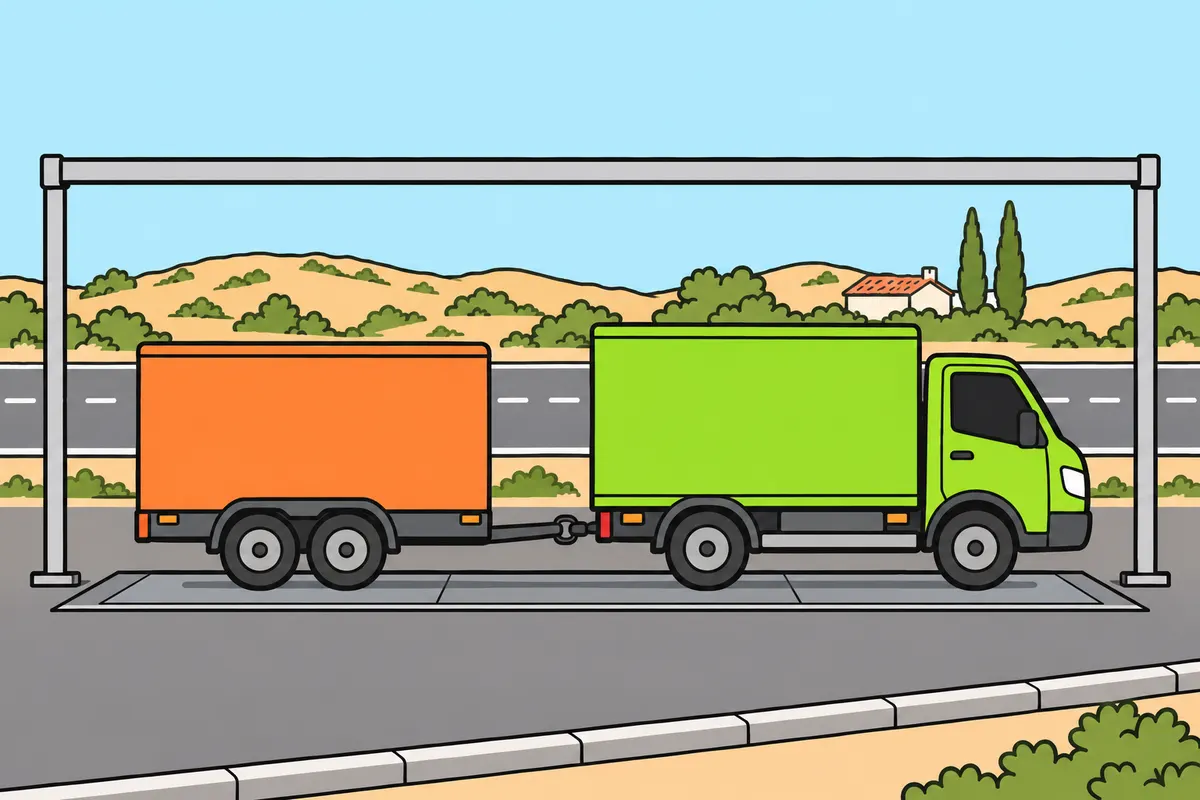
1Masses you must distinguish
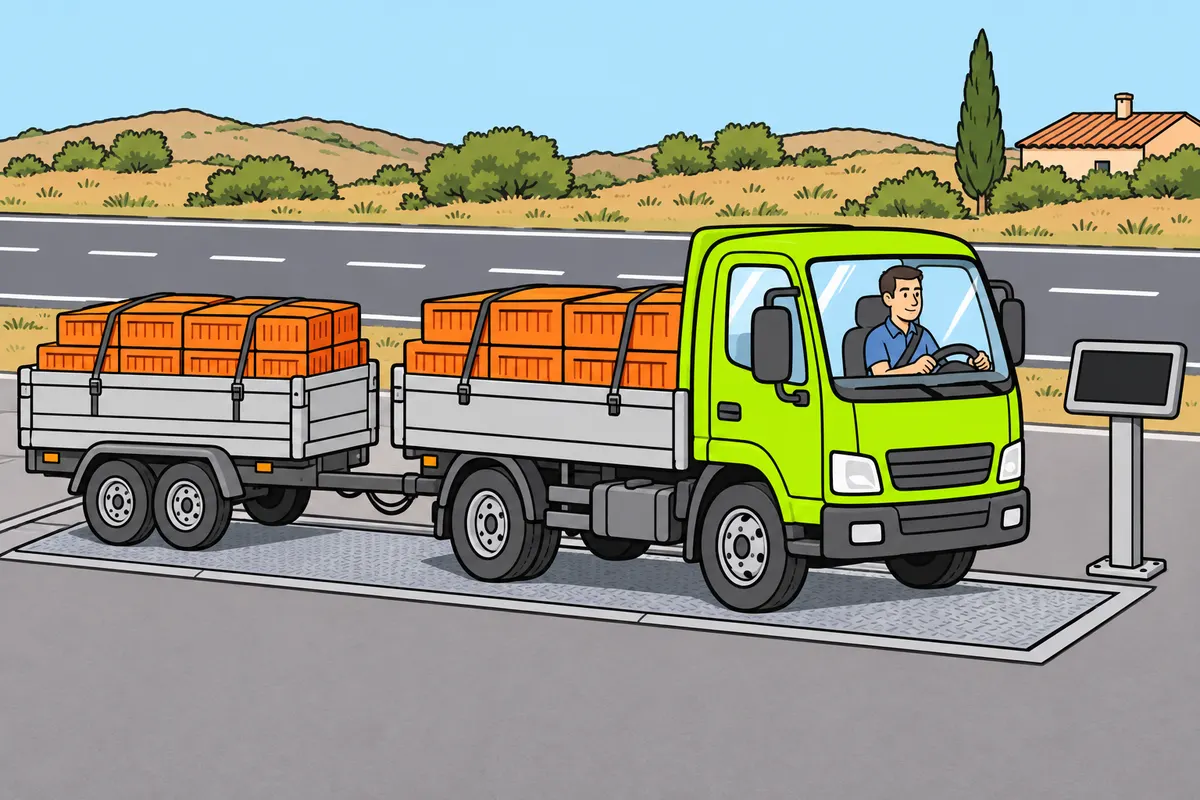
Distinguish your vehicle’s actual mass from its authorised maximum.
| Mass term | What you must distinguish |
|---|---|
| Tare | Equipped vehicle without people or goods |
| Mass in running order | Tare plus 75 kg for the driver |
| Laden mass | Actual weight including people and goods |
| MMA | Maximum authorised mass for road use when laden |
Remember
- Tare includes full fuel, water, tools and fixed equipment; it excludes people and goods.
- To find your actual mass, count all people and goods.
- Respect technical, legal and authorised limits.
- Your C1 vehicle MMA exceeds 3,500 kg and does not exceed 7,500 kg.
- With category B towing, towed MMA is over 3,500 kg; total limit: 12,000 kg.
- Check technical towing capacity; M1 and N1 towing vehicles have their own towing limits.
Exam trap: Wrong: unloading reduces MMA. Right: it reduces actual mass; the authorised MMA in your documents stays unchanged.
Read the full explanation
- The unladen mass includes authorised fixed equipment and the full complement of fuel, water, lubricant, spare parts, tools and necessary accessories, but excludes crew, passengers and goods. It is not the weight of a lorry without fuel. [RGV, Annex IX](https://www.boe.es/buscar/act.php?id=BOE-A-1999-1826#anix)
- The mass in running order is the unladen mass plus the standard driver mass of 75 kg. This is a regulatory reference: to determine the actual mass on the road, you must take account of what you actually carry, including people. [RGV, Annex IX](https://www.boe.es/buscar/act.php?id=BOE-A-1999-1826#anix)
- The laden mass is the actual mass of the vehicle and its load, including service personnel and passengers. The MMA (maximum authorised mass) is the maximum permitted for using it laden on public roads. Unloading reduces the actual mass, but does not change its authorised MMA. [RGV, Annex IX](https://www.boe.es/buscar/act.php?id=BOE-A-1999-1826#anix)
- The technically permissible maximum mass derives from the construction and the manufacturer’s specifications. The mass authorised for road use may be lower. You must comply with both, as well as the applicable legal maximum: a chassis capable of supporting more tonnes does not authorise you to carry them on the road. One tonne equals 1,000 kg. [RGV, Annex IX](https://www.boe.es/buscar/act.php?id=BOE-A-1999-1826#anix)
- With C1+E, your C1 towing vehicle has an MMA over 3,500 kg and no more than 7,500 kg; the trailer or semi-trailer exceeds 750 kg and the combination’s MMA does not exceed 12,000 kg. You can also form the permitted combination of a category B towing vehicle and a towed vehicle over 3,500 kg, within 12,000 kg. You must distinguish these licence limits from the general mass tables in Annex IX: a higher figure in those tables does not extend your licence. [RGCond, art. 4](https://www.boe.es/buscar/act.php?id=BOE-A-2009-9481#a4) Check that the category B towing vehicle is technically capable of towing that vehicle: for an M1 or N1 vehicle, the towable mass has its own limits. [RGV, Annex IX, 4.1.2.2 and 4.1.2.3](https://www.boe.es/buscar/act.php?id=BOE-A-1999-1826#anix)
2Combination mass and coupling load
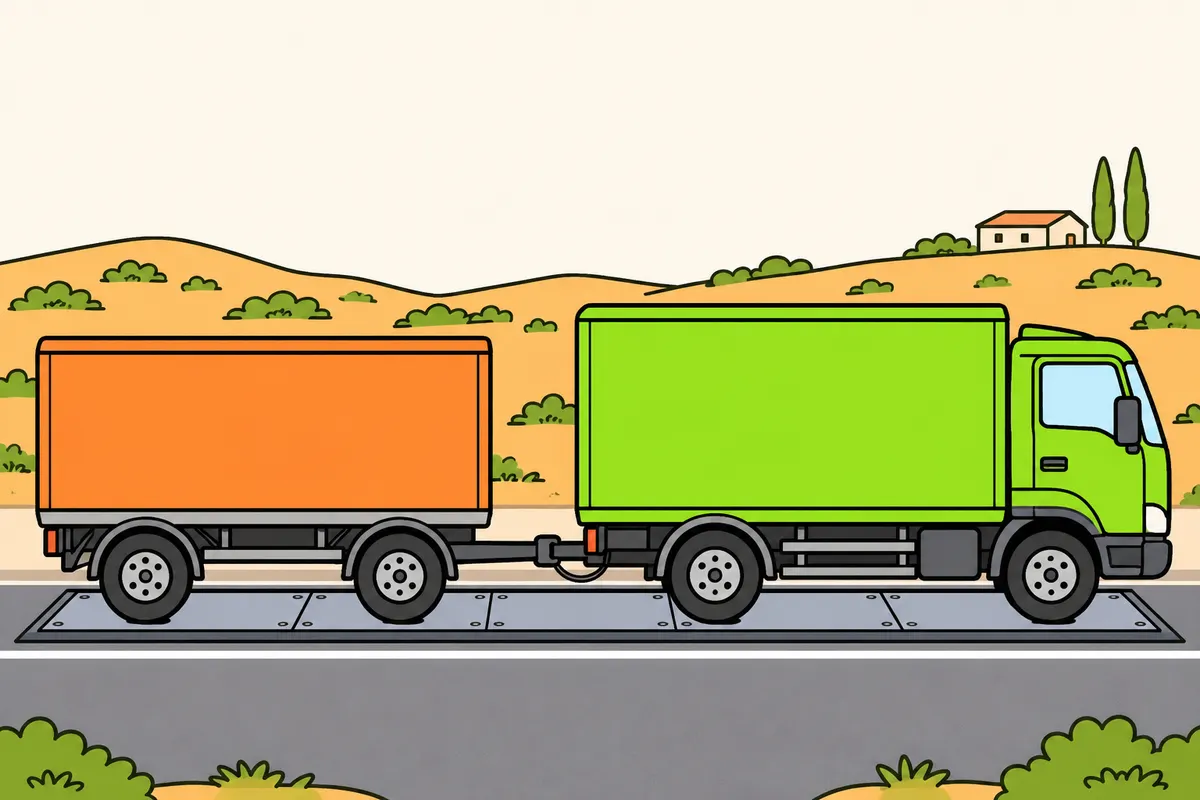
Check your combination, coupling and lorry’s towing limit.
| Towing vehicle and trailer brake | Regulatory towing limit |
|---|---|
| Ordinary towing vehicle; overrun braking alone | Towing vehicle MMA, capped at 3,500 kg |
| Off-road towing vehicle; overrun braking alone | 1.5 times its MMA, capped at 3,500 kg |
| Category N2 C1 lorry; continuous trailer braking | 1.5 times towing vehicle MMA; respect all other limits |
Remember
- For a towing vehicle with a trailer, check MMC = its MMA + MMR.
- For centre-axle trailers with evenly spread loads, use the lower vertical limit.
- This vertical load also counts towards towing vehicle and rear axle limits.
- Always check technical and authorised limits for your vehicle and coupling.
- Carrying fewer goods does not let you exceed your licence’s MMA limit.
Exam trap: Wrong: every B towing vehicle can use the N2 ratio. Right: that ratio applies to an N2 lorry with continuous trailer braking. Check technical, authorised and licence limits.
Read the full explanation
- The maximum authorised mass of the combination and its technically permissible maximum mass apply to the entire combination. The first limits its use on public roads and the second depends on its construction. With C1+E, you must also comply with the maximum combination MMA of 12,000 kg; carrying a small quantity of goods does not make a combination exceeding that limit suitable for your licence. [RGV, Annex IX](https://www.boe.es/buscar/act.php?id=BOE-A-1999-1826#anix) [RGCond, art. 4](https://www.boe.es/buscar/act.php?id=BOE-A-2009-9481#a4)
- For a towing vehicle with a trailer, section 4.3 gives MMC = MMA + MMR of the towing vehicle, subject to the additional limits set by the manufacturer and the legal mass of the combination. [RGV, Annex IX](https://www.boe.es/buscar/act.php?id=BOE-A-1999-1826#anix)
- If you use a centre-axle trailer, its maximum authorised vertical load on the coupling, with a uniformly distributed load, does not exceed the lower of these values: 10 % of its maximum mass or 1,000 kg. This load also counts towards the MMA of the towing vehicle and the maximum authorised mass of its rear axles. [RGV, Annex IX](https://www.boe.es/buscar/act.php?id=BOE-A-1999-1826#anix)
- You must check your lorry’s authorised towable mass as well as the trailer’s MMA. With an overrun brake alone, the regulatory towable limit is the towing vehicle’s MMA, up to 3,500 kg; if the motor vehicle is an off-road vehicle, the ratio may be 1.5 times its MMA, also within 3,500 kg. The technical capacity of the vehicle and coupling may impose a lower value. [RGV, Annex IX](https://www.boe.es/buscar/act.php?id=BOE-A-1999-1826#anix)
- For a category N2 C1 lorry with a trailer with continuous braking, the regulatory towable limit is 1.5 times the towing vehicle’s MMA. This does not allow you to exceed the technical and authorised masses or the 12,000 kg combination MMA limit for C1+E. If the towing vehicle is N1, the rule in section 4.1.2.2 applies: you must not apply the N2 ratio to every category B towing vehicle. [RGV, Annex IX](https://www.boe.es/buscar/act.php?id=BOE-A-1999-1826#anix) [RGCond, art. 4](https://www.boe.es/buscar/act.php?id=BOE-A-2009-9481#a4)
- As an example of how to read the documentation, a lorry with an MMA of 7,500 kg and a conventional trailer with an MMA of 4,500 kg add up to 12,000 kg. This total fits within the C1+E limit, but you must check that the lorry has sufficient towable mass and that the combination and its axles are authorised to support it. With this trailer, an overrun brake does not allow you to reach a towable mass of 4,500 kg. [RGV, Annex IX](https://www.boe.es/buscar/act.php?id=BOE-A-1999-1826#anix) [RGCond, art. 4](https://www.boe.es/buscar/act.php?id=BOE-A-2009-9481#a4)
3Checking several limits at once
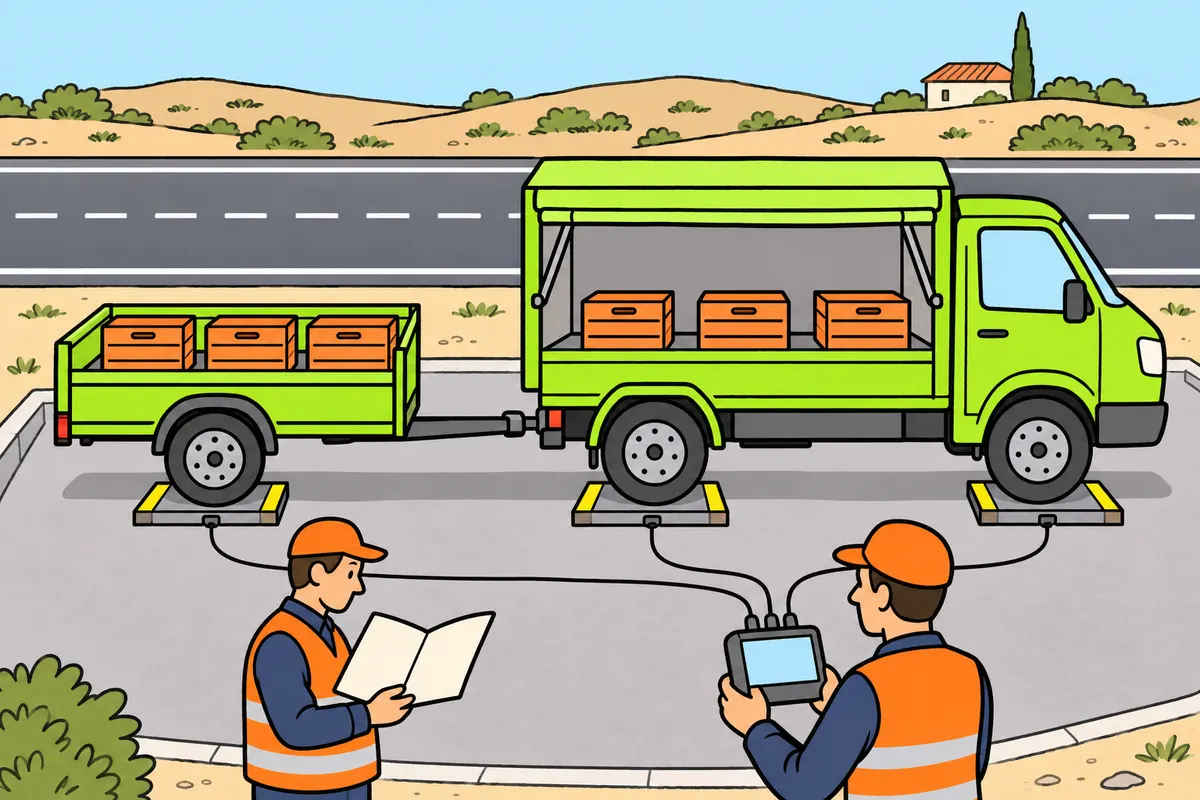
Respect vehicle, combination and axle limits at the same time.
Remember
- Identify your combination and count its axles before loading.
- Check the specific limits in your documents.
- Spread or reduce your load if an axle is overloaded.
- Respect your tyres’ load limits too.
Exam trap: Wrong: keeping within total mass is enough. Right: respect every axle limit too. Pressure on the road surface is not tyre inflation pressure.
Read the full explanation
- Before loading, you must identify the configuration: rigid lorry, lorry with a trailer or tractor unit with a semi-trailer, and count the axles on each unit. Then check the maximum masses for each vehicle, the combination and each axle or axle group. [RGV, Annex IX](https://www.boe.es/buscar/act.php?id=BOE-A-1999-1826#anix)
- You can be below the total maximum and still overload an axle. If your light lorry has a specific authorised maximum of 3,200 kg on the front axle and that axle carries 3,400 kg, you must correct the distribution or reduce the load even if the total is below 7,500 kg. The general maximum masses in the axle table do not replace lower limits for the individual vehicle. [RGV, Annex IX](https://www.boe.es/buscar/act.php?id=BOE-A-1999-1826#anix)
- You cannot load up to the maximum in the table when the documentation sets a lower value either. If your combination is authorised for 10,000 kg, the 12,000 kg limit of the C1+E licence does not give you the remaining 2,000 kg. You must simultaneously comply with your licence, the authorised and technical values, and the actual mass limits for each unit, combination and axle. [RGV, Annex IX](https://www.boe.es/buscar/act.php?id=BOE-A-1999-1826#anix) [RGCond, art. 4](https://www.boe.es/buscar/act.php?id=BOE-A-2009-9481#a4)
- In your combination, if the actual mass without goods is 6,000 kg and the applicable authorised maximum is 12,000 kg, the arithmetic margin is 6,000 kg. You must reduce it if any axle, unit or coupling reaches its limit first. [RGV, Annex IX](https://www.boe.es/buscar/act.php?id=BOE-A-1999-1826#anix) [RGCond, art. 4](https://www.boe.es/buscar/act.php?id=BOE-A-2009-9481#a4)
- Annex IX prohibits driving when the tyres carry loads exceeding those allowed by their safety standards, according to their load indices and the vehicle’s maximum speed. It also sets a maximum pressure on the road surface of 9 kg/cm² for pneumatic tyres or wheels of similar elasticity: this is not the inflation pressure you must choose. [RGV, Annex IX](https://www.boe.es/buscar/act.php?id=BOE-A-1999-1826#anix)
4Single axles and axle groups
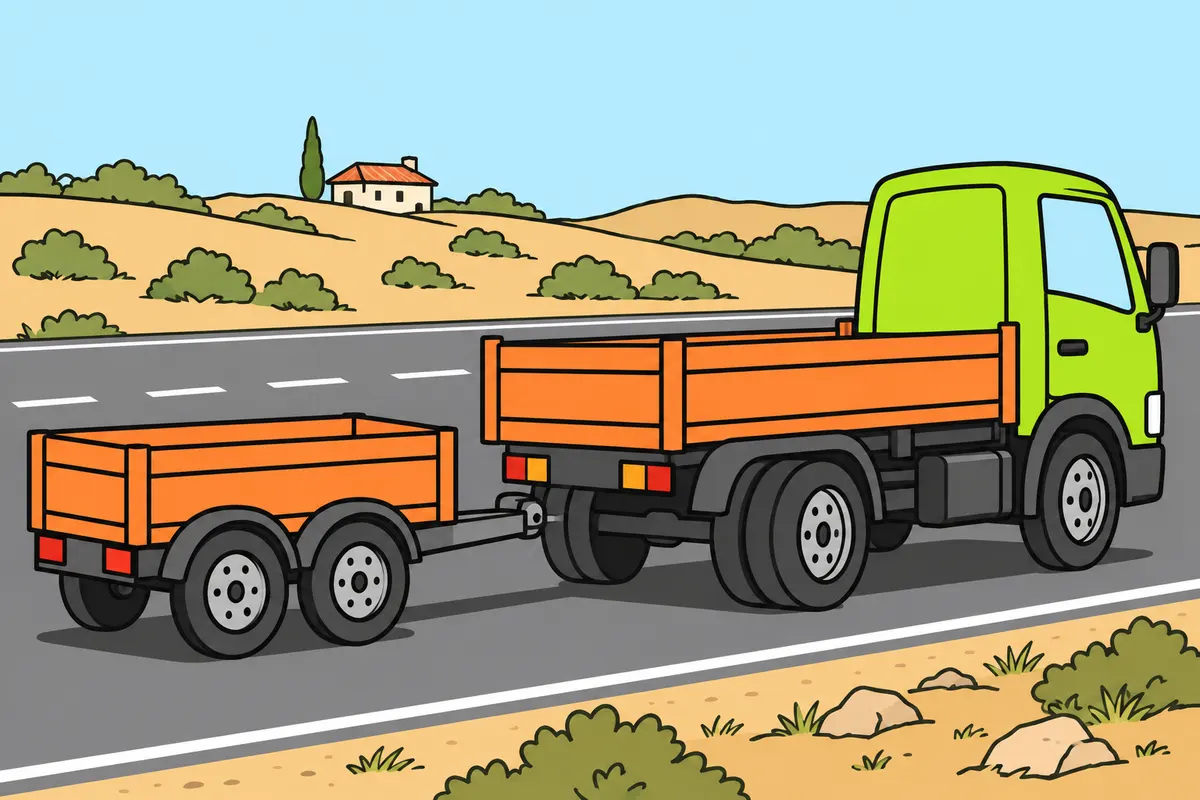
Identify each axle and apply the limit to the axle or whole group.
| Axle or group | How you recognise it |
|---|---|
| Tandem | Group of two axles |
| Triaxle tandem | Group of three axles |
| Retractable axle | You can raise or lower it |
| Loadable axle | Its load can vary without raising it |
Remember
- Respect any lower technical or authorised limit for your lorry.
- Twin wheels do not double your axle count.
- Check axle spacing and which vehicle the group belongs to.
Exam trap: Wrong: the tandem maximum applies to each axle. Right: it applies to the whole group.
Read the full explanation
- The axle mass is the mass transmitted to the ground through all the wheels fitted to that axle. For goods vehicles, the general maximum for a single driven axle is 12 t and for a single non-driven axle it is 10 t. In your C1 vehicle, you must comply with any lower technical or authorised maximum. [RGV, Annex IX](https://www.boe.es/buscar/act.php?id=BOE-A-1999-1826#anix)
- A group of two axles in a bogie is called a tandem; a group of three is called a tri-axle group. The group limits depend on the distance between the centres of its axles and on whether it belongs to the motor vehicle or the towed vehicle. You must read the distance d given in the scenario before choosing a figure. [RGV, Annex IX](https://www.boe.es/buscar/act.php?id=BOE-A-1999-1826#anix)
- Twin wheels do not turn one axle into two axles. An axle with four tyres is still one axle; the limit refers to the combined load transmitted by all its wheels. Similarly, an 18 t maximum for a tandem applies to the whole group, not to each of its two axles. [RGV, Annex IX](https://www.boe.es/buscar/act.php?id=BOE-A-1999-1826#anix)
- You must distinguish a retractable axle, which can be raised or lowered, from a load-relieving axle, whose load can vary without being raised. The device can distribute load or help you move off, but you must continue to comply with the authorised masses and technical limits of the vehicle and its axles in the configuration you use. [RGV, Annex IX](https://www.boe.es/buscar/act.php?id=BOE-A-1999-1826#anix)
5Motor vehicle tandem axles
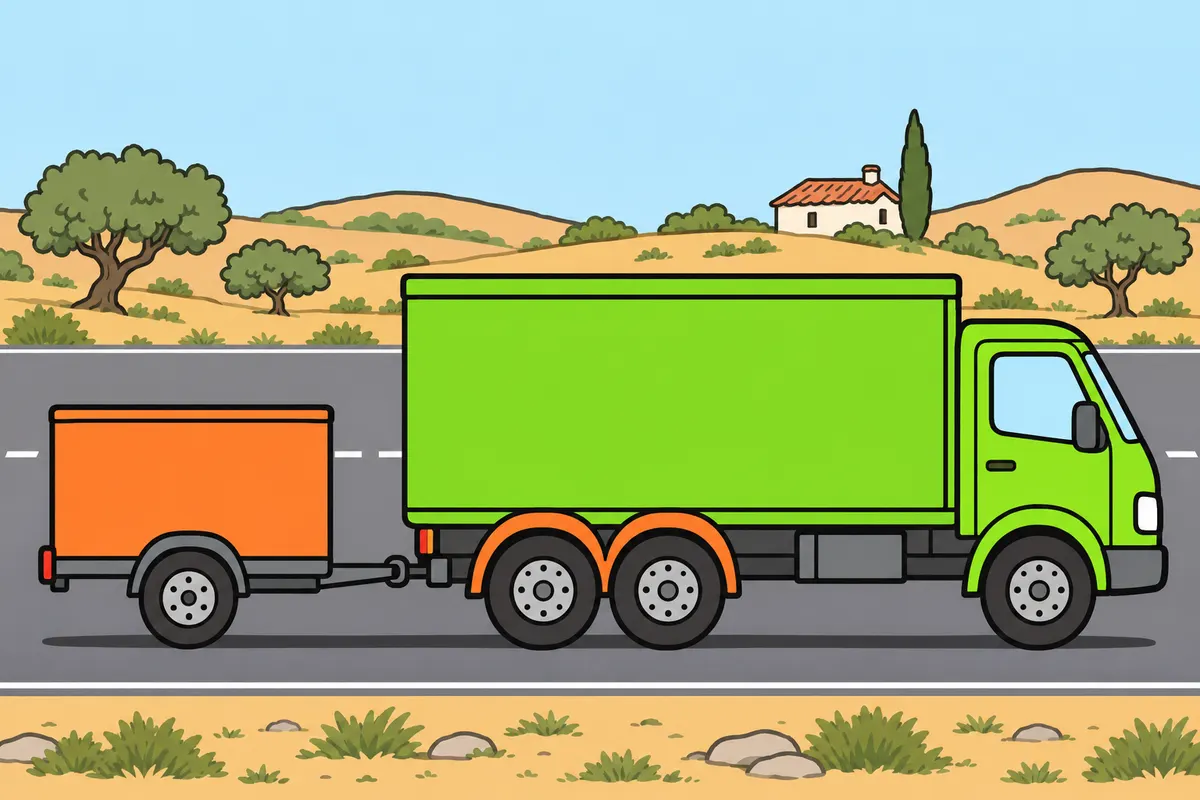
For your motor vehicle’s tandem, check axle spacing and equipment.
| Motor vehicle tandem spacing | Whole group maximum |
|---|---|
| Below 1.00 m | 12 t |
| At least 1.00 m but below 1.30 m | 16 t |
| At least 1.30 m but below 1.80 m | 18 t; 19 t with the special conditions |
Remember
- Measure spacing between axle centres.
- Check every equipment condition before using the special maximum.
Exam trap: Wrong: any motor vehicle tandem allows 19 t. Right: only from 1.30 m to below 1.80 m, with twin tyres and air or recognised equivalent suspension on the driving axle; alternatively, each driving axle has twin tyres and each axle’s maximum mass does not exceed 9.5 t.
Read the full explanation
- For a motor vehicle’s tandem, if d is less than 1.00 m, the maximum for the group is 12 t. This figure applies to the motor vehicle’s tandem, unlike the 11 t for a trailer or semi-trailer tandem with the same close spacing. First identify which unit it belongs to. [RGV, Annex IX](https://www.boe.es/buscar/act.php?id=BOE-A-1999-1826#anix)
- With a spacing of at least 1.00 m but less than 1.30 m, the maximum for the motor vehicle’s tandem is 16 t. Exactly 1.00 m falls within this range. [RGV, Annex IX](https://www.boe.es/buscar/act.php?id=BOE-A-1999-1826#anix)
- With a spacing from 1.30 m to less than 1.80 m, the general maximum for the motor vehicle’s tandem is 18 t. The Annex allows 19 t within this range when the driven axle has twin tyres and air suspension or suspension recognised as equivalent. [RGV, Annex IX](https://www.boe.es/buscar/act.php?id=BOE-A-1999-1826#anix)
- You can also apply the 19 t limit in the previous case when each driven axle has twin tyres and the maximum mass of each axle does not exceed 9.5 t. You must check the full condition: having two closely spaced axles or suspension of any type does not by itself establish entitlement to the 19 t maximum. [RGV, Annex IX](https://www.boe.es/buscar/act.php?id=BOE-A-1999-1826#anix)
6Trailer or semi-trailer tandem axles
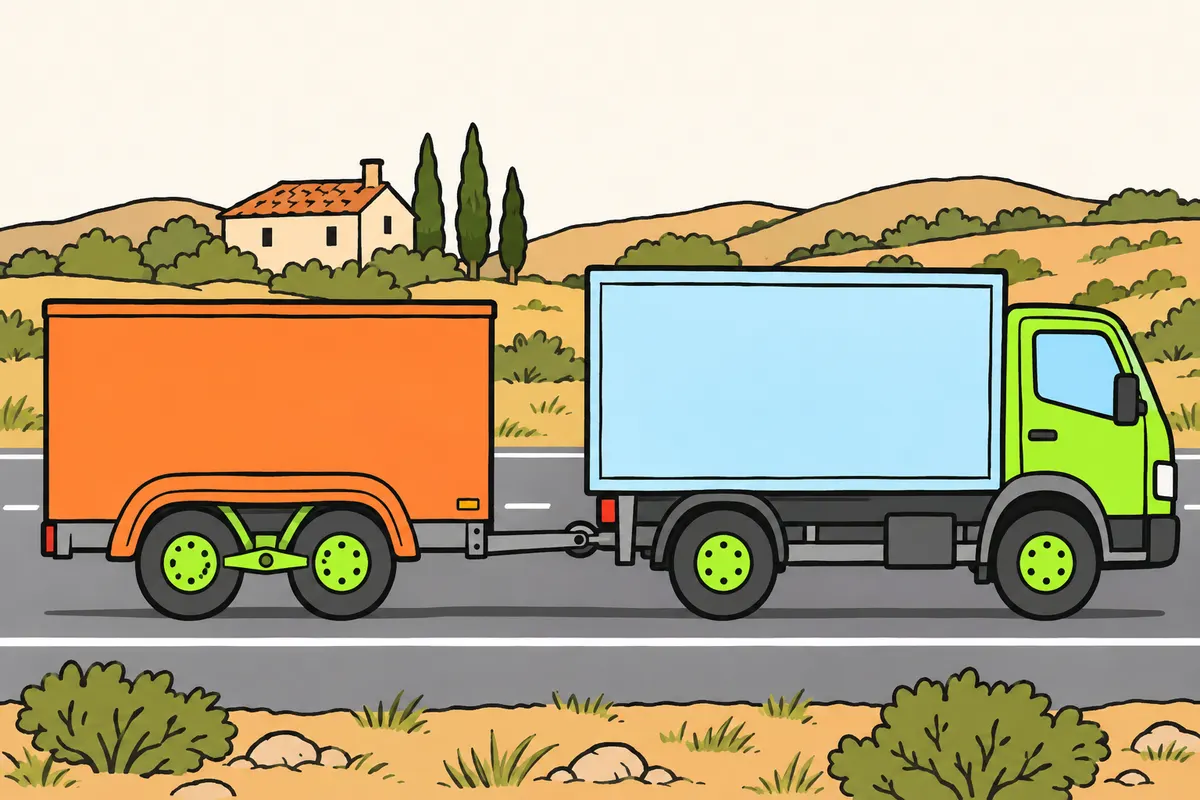
For your towed tandem, choose the maximum by spacing and configuration.
| Trailer or semi-trailer tandem spacing | Whole group maximum |
|---|---|
| Below 1.00 m | 11 t |
| At least 1.00 m but below 1.30 m | 16 t |
| At least 1.30 m but below 1.80 m | 18 t generally |
| At least 1.80 m | 20 t |
Remember
- Apply the maximum to the whole group.
- Do not use the motor vehicle tandem exception here.
- Check whether the tipping body meets the specific exception.
Exam trap: Wrong: any tipping body allows 20 t from 1.30 m to below 1.80 m. Right: in that range, the exception requires a semi-trailer with a reinforced tipping body specifically for construction, works or mining.
Read the full explanation
- For a trailer or semi-trailer tandem, if d is less than 1.00 m, the maximum is 11 t for the whole group. With d at least 1.00 m but less than 1.30 m, the maximum is 16 t. Both figures apply to the group, not to each wheel or each axle. [RGV, Annex IX](https://www.boe.es/buscar/act.php?id=BOE-A-1999-1826#anix)
- With d at least 1.30 m but less than 1.80 m, the general maximum for the towed vehicle’s tandem is 18 t. Exactly 1.30 m falls within this range. Do not apply the motor vehicle tandem’s 19 t exception here: it belongs to another row in the table. [RGV, Annex IX](https://www.boe.es/buscar/act.php?id=BOE-A-1999-1826#anix)
- With d at least 1.80 m, the maximum for the towed vehicle’s tandem is 20 t. Exactly 1.80 m allows you to apply this range to the group. The total mass conditions for heavy articulated vehicles are set out in «General masses for heavy lorries (reference)». [RGV, Annex IX](https://www.boe.es/buscar/act.php?id=BOE-A-1999-1826#anix)
- In the range from 1.30 m to less than 1.80 m, a semi-trailer with a reinforced tipping body specifically for use in construction, roadworks or mining has a maximum tandem mass of 20 t. You must provide evidence of this configuration; an ordinary tipping body is not enough to apply the exception. [RGV, Annex IX](https://www.boe.es/buscar/act.php?id=BOE-A-1999-1826#anix)
7Triaxle groups and trailer limits
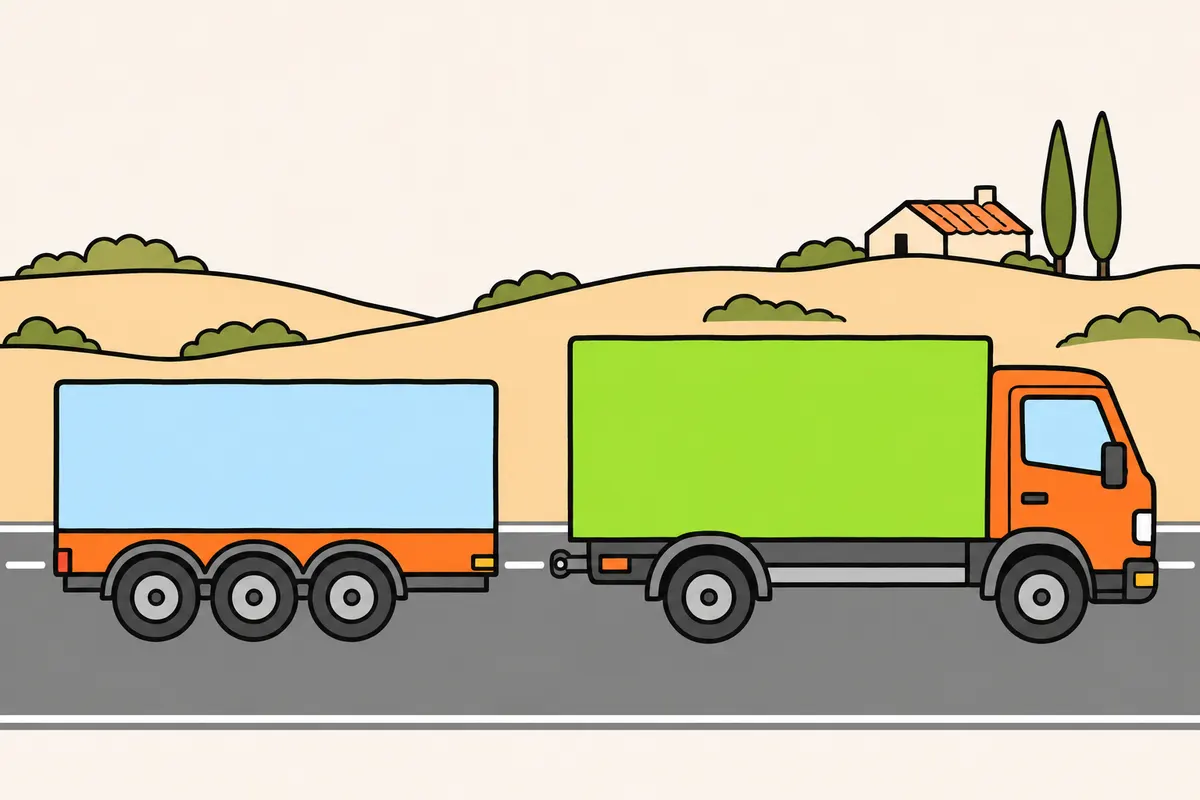
Check your triaxle group maximum separately from your trailer maximum.
| Trailer or semi-trailer case | General maximum |
|---|---|
| Triaxle group: consecutive spacing up to and including 1.30 m | 21 t for the group |
| Triaxle group: consecutive spacing above 1.30 m, up to and including 1.40 m | 27 t for the group |
| Complete two-axle trailer | 18 t |
| Complete three-axle trailer | 24 t |
Remember
- Read carefully whether the limit includes equality.
- Respect your trailer maximum even if its axles can support more.
Exam trap: Wrong: at 1.30 m spacing, you answer 27 t. Right: the triaxle group allows 21 t. Adding axle limits does not increase your trailer’s MMA.
Read the full explanation
- For a trailer or semi-trailer triaxle group with spacing between consecutive axles of 1.30 m or less, the maximum is 21 t. Exactly 1.30 m falls within this range, unlike the lower boundary of the next range. You must pay attention to the equality sign. [RGV, Annex IX](https://www.boe.es/buscar/act.php?id=BOE-A-1999-1826#anix)
- If the spacing between consecutive axles is more than 1.30 m and no more than 1.40 m, the maximum for the triaxle group is 27 t. With 1.35 m between each consecutive pair, you must answer 27 t for the whole group. This is not 27 t per axle or for the whole articulated vehicle. [RGV, Annex IX](https://www.boe.es/buscar/act.php?id=BOE-A-1999-1826#anix)
- A two-axle trailer has a general MMA (maximum authorised mass) of 18 t, and a three-axle trailer has a general MMA of 24 t. The type of vehicle unit and its own maximum still limit what you can carry. [RGV, Annex IX](https://www.boe.es/buscar/act.php?id=BOE-A-1999-1826#anix)
- If a trailer has two single non-driven axles, each is subject to the general limit of 10 t, but the whole trailer is still limited to 18 t. Adding 10 + 10 does not authorise you to drive with 20 t. You must comply with both the maximum for each axle and the maximum for the trailer. [RGV, Annex IX](https://www.boe.es/buscar/act.php?id=BOE-A-1999-1826#anix)
8Maximum mass of rigid lorries
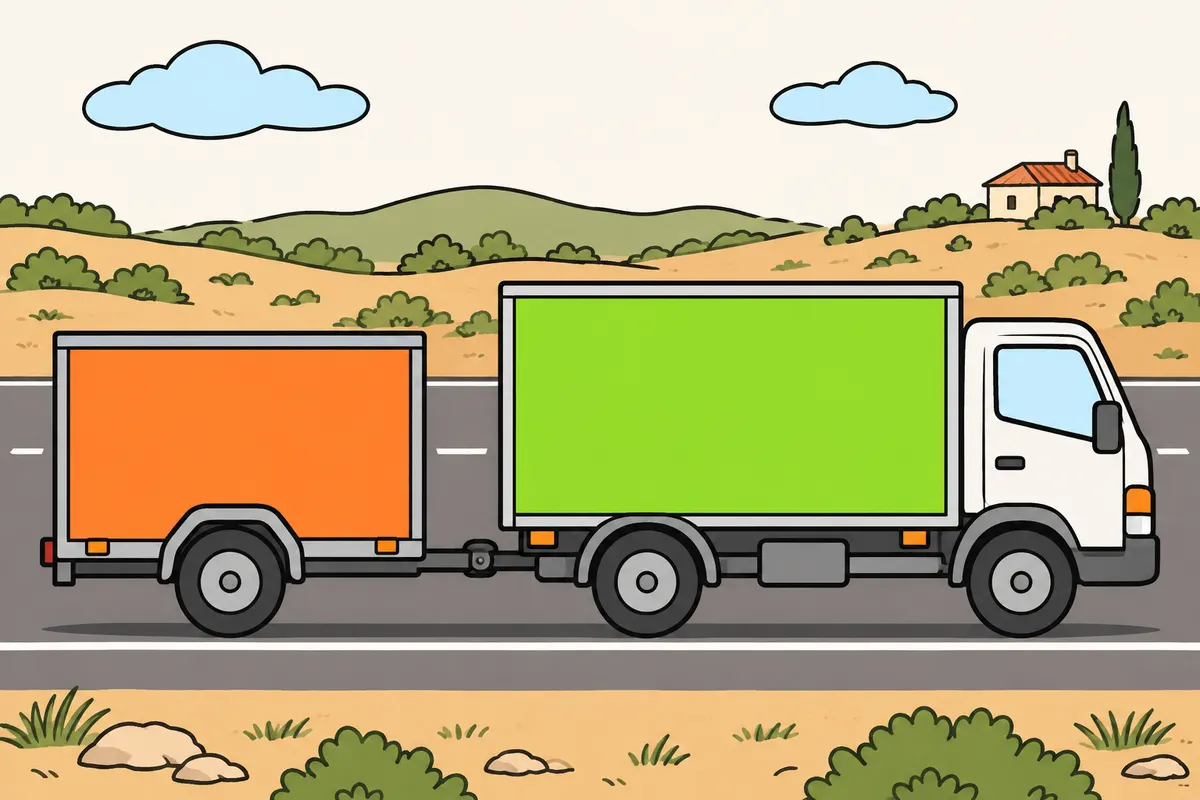
Calculate your goods allowance without exceeding the lorry’s MMA or axle limits.
Remember
- Subtract the lorry’s actual mass before loading from its MMA.
- Count the people and equipment travelling with you.
- A trailer’s vertical coupling load uses part of the lorry’s margin.
Exam trap: Wrong: the whole margin is available for goods. Right: subtract the vertical load received from a centre-axle trailer and respect axle limits.
Read the full explanation
- Your C1 lorry has a maximum MMA of 7,500 kg. To calculate how much cargo the towing vehicle can carry, subtract its actual mass before loading, including the people and equipment travelling in it, from its MMA. In an example where a lorry authorised for 7,500 kg weighs 4,800 kg ready for loading, the total available capacity is 2,700 kg, subject to its axle limits. [RGCond, art. 4.2](https://www.boe.es/buscar/act.php?id=BOE-A-2009-9481#a4) [RGV, Annex IX](https://www.boe.es/buscar/act.php?id=BOE-A-1999-1826#anix)
- When a centre-axle trailer transfers a vertical load to the lorry, that load uses up part of the towing vehicle's available capacity. If the same lorry in the example receives an actual load of 400 kg at the coupling, it has 2,300 kg of capacity left for cargo. You must take this transfer into account when calculating the mass of the loaded towing vehicle. [RGV, Annex IX](https://www.boe.es/buscar/act.php?id=BOE-A-1999-1826#anix)
9Articulated C1+E: tractor and semi-trailer
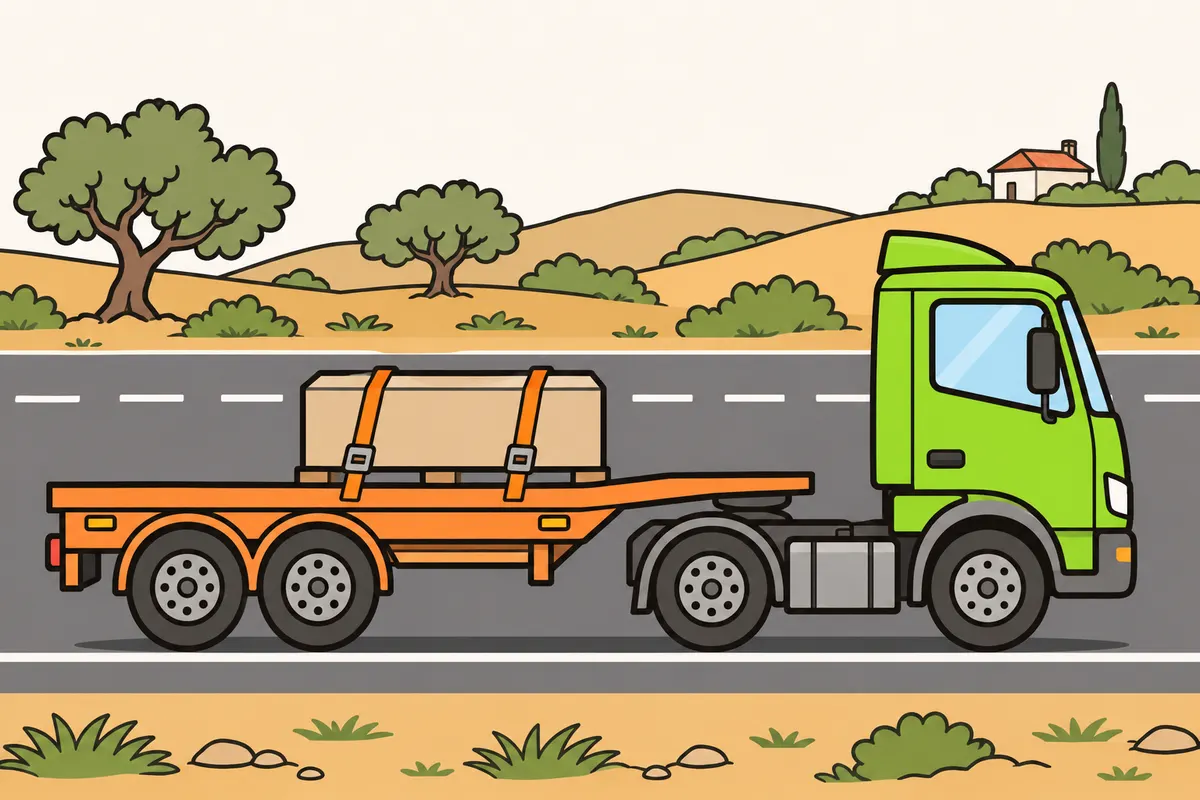
Add axle loads without counting the coupling load twice.
Remember
- The tractor axles already carry the load received through the fifth wheel.
- Add all axle loads to find the combination’s mass.
- For towing mass, subtract the coupling load from the semi-trailer’s actual mass.
- The fifth wheel position changes the load on the tractor axles.
Exam trap: Wrong: add the coupling load after adding all axle loads. Right: the fifth-wheel load is already included in the tractor unit’s axle loads.
Read the full explanation
- In an articulated vehicle, the semi-trailer transfers part of its mass to the tractor unit through the fifth wheel. To calculate the actual mass of the combination, add the loads supported by all the axles of the tractor unit and semi-trailer; the vertical coupling load is included in the weight on the tractor unit's axles. [RGV, Annex IX](https://www.boe.es/buscar/act.php?id=BOE-A-1999-1826#anix)
- The semi-trailer's maximum authorised towable mass is its maximum actual mass minus the actual vertical load on the coupling: it is the portion supported by its own axles. The position of the fifth wheel affects the distribution between the tractor unit's axles and the overall and axle limits you must observe. [RGV, Annex IX](https://www.boe.es/buscar/act.php?id=BOE-A-1999-1826#anix)
10Example of weighing an articulated C1+E vehicle
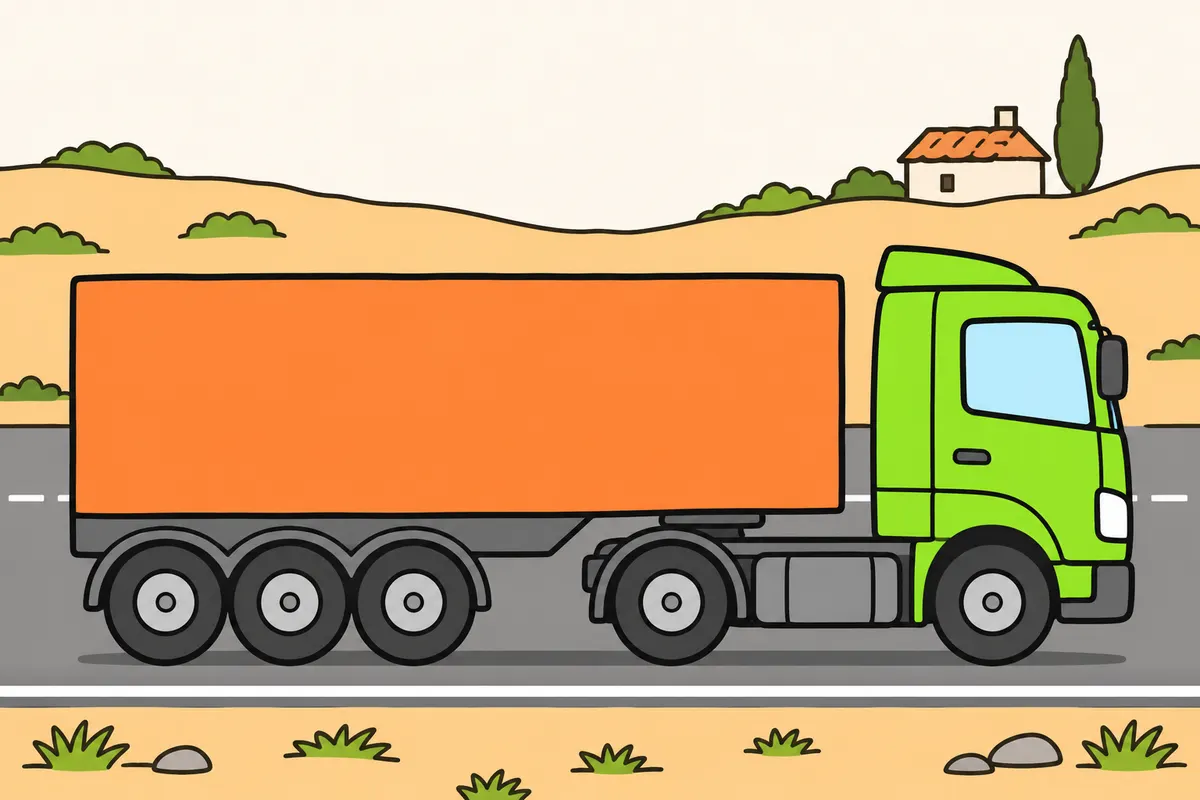
Distinguish the combination mass, semi-trailer mass and load on its axles.
| Masses in the articulated vehicle example | Value |
|---|---|
| Tractor axles, including fifth-wheel load | 6,500 kg |
| Semi-trailer axles: amount for checking towing mass | 4,500 kg |
| Combination: all axle loads added together | 11,000 kg |
| Semi-trailer: its axles plus fifth-wheel load | 6,000 kg |
Remember
- Add all axle loads to find the combination mass.
- Do not add the fifth-wheel load again.
- Include its fifth-wheel load when finding the semi-trailer mass.
- Compare each mass with the matching limit in your documents.
Exam trap: Wrong: add the 1,500 kg coupling load to all axle loads. Right: it is already included in the tractor’s 6,500 kg; the combination weighs 11,000 kg.
Read the full explanation
- In an example of a five-axle articulated vehicle, the two-axle tractor unit supports 2,500 kg at the front and 4,000 kg at the rear, and the semi-trailer's three axles together support 4,500 kg. The actual mass of the combination is 11,000 kg. If the fifth wheel transfers 1,500 kg to the tractor unit, that amount is included in its 6,500 kg: adding it to the 11,000 kg gives an incorrect result. [RGV, Annex IX](https://www.boe.es/buscar/act.php?id=BOE-A-1999-1826#anix)
- In that example, the semi-trailer has an actual mass of 6,000 kg: the 4,500 kg on its axles plus the 1,500 kg supported by the tractor unit. To check the towable mass, the portion supported by its own axles is 4,500 kg. You must compare each result with the corresponding limit in the documentation; the semi-trailer's actual mass and its contribution to the combination's axle weighing figures are different quantities. [RGV, Annex IX](https://www.boe.es/buscar/act.php?id=BOE-A-1999-1826#anix)
11Road trains
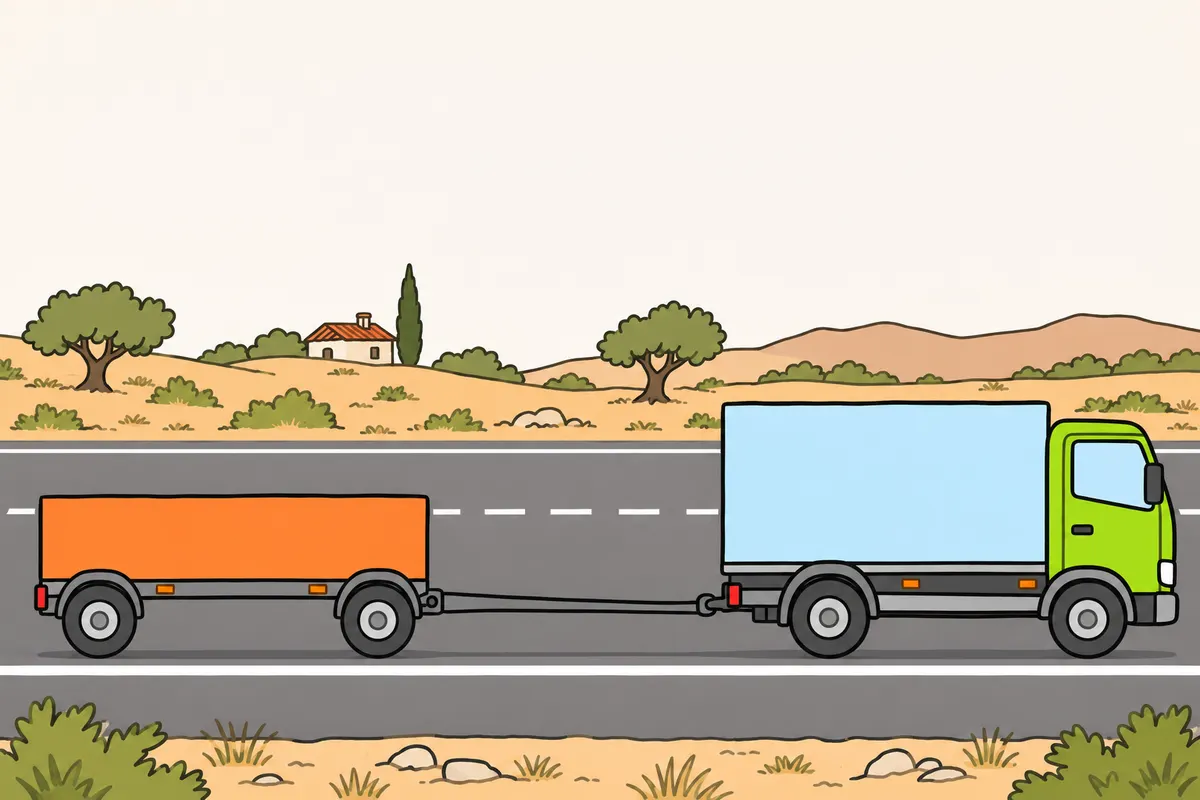
For your road train, check axles, spacing and weight on driving axles.
Remember
- Keep at least 3.00 m between the rear axle and trailer’s front axle.
- Driving axles generally carry at least 25% of the laden mass.
- This traction minimum does not allow you to overload the axles.
Exam trap: Wrong: measure the gap between the bodies. Right: measure between the motor vehicle’s rear axle and trailer’s front axle; the gap must be at least 3.00 m.
Read the full explanation
- In a road train, the distance between the motor vehicle's rear axle and the trailer's front axle must be at least 3.00 m. You must measure between those axles, rather than between the bodies or the ends of the coupling. A smaller spacing means you cannot drive the combination under Annex IX. [RGV, Annex IX](https://www.boe.es/buscar/act.php?id=BOE-A-1999-1826#anix)
- As a general rule, the mass supported by the driven axle or axles must reach 25 % of the total laden mass of the vehicle or combination. If your C1+E combination has an actual mass of 12,000 kg, at least 3,000 kg must rest on the driven axles. You must also observe their specific maximum: this minimum for traction does not authorise an overload. [RGV, Annex IX](https://www.boe.es/buscar/act.php?id=BOE-A-1999-1826#anix)
12Technology and intermodal transport increases (further study)
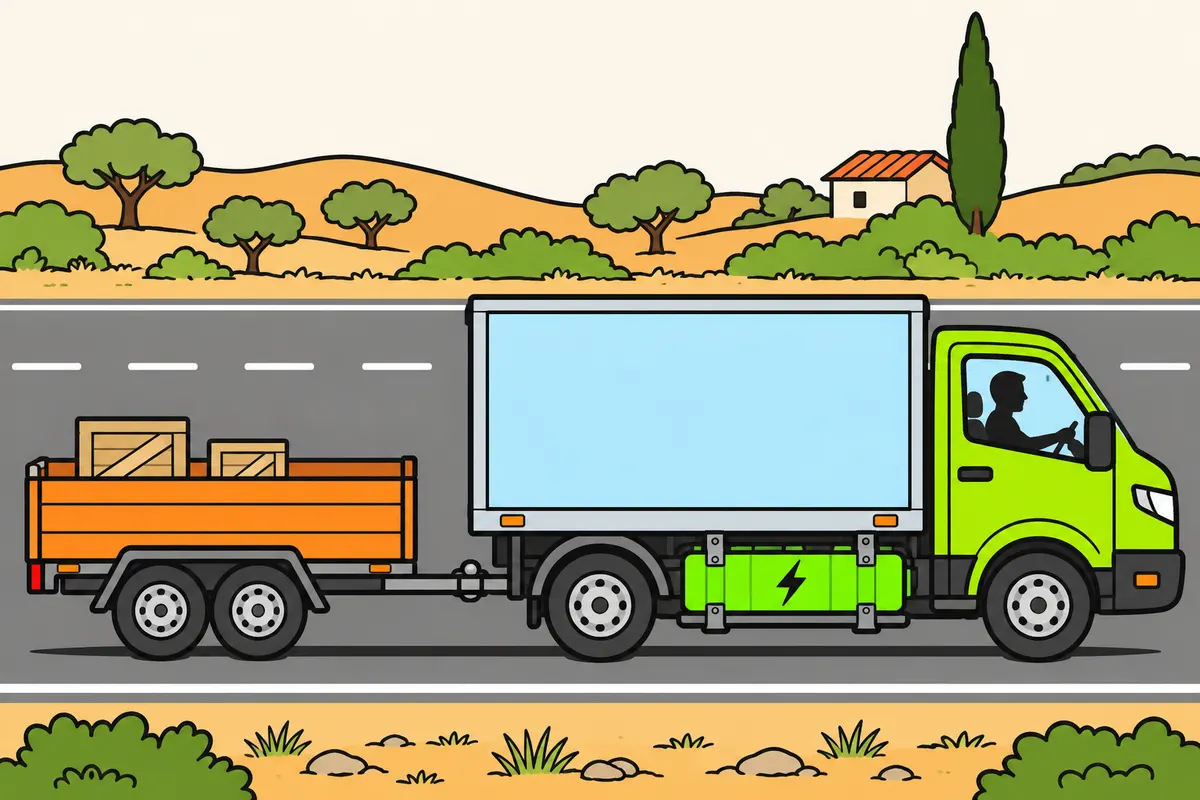
Use special increases only for the specified configurations and operations.
| Case covered by the table | Possible increase |
|---|---|
| Alternative-fuel technology | Its extra weight, up to 1 t |
| Zero-emission technology | Its extra weight, up to 2 t |
Remember
- Link a technology increase to the extra weight of that technology.
- These increases do not extend your C1+E licence limit.
- For specified urban services, respect technical mass and axle maximums.
- Check that your operation meets the definition of intermodal transport.
Exam trap: Wrong: carrying any container meets the intermodal transport definition. Right: your operation must meet the definition. This includes specified operations with containers or swap bodies totalling up to 45 feet, and inland waterway or maritime operations. For the latter, the initial or final road leg within the Union cannot exceed 150 km, except to reach the nearest suitable terminal in the specified configurations.
Read the full explanation
- Vehicles or combinations in the specified rows of the table may increase their MMA by the additional weight required by alternative-fuel technology, up to 1 t, or zero-emission technology, up to 2 t. These increases under Annex IX do not raise the MMA limit for C1+E. You must link the increase to the weight of that technology: it is not automatic authorisation to add that amount of cargo. [RGV, Annex IX](https://www.boe.es/buscar/act.php?id=BOE-A-1999-1826#anix)
- For vehicles intended for services in urban environments, the note allows up to 1 t in addition to the technology increases, without exceeding the maximum technically permissible mass or the axle limits. This provision applies to that intended service; you must identify it in the characteristics of the intended use. [RGV, Annex IX](https://www.boe.es/buscar/act.php?id=BOE-A-1999-1826#anix)
- The definition includes certain combined transport operations using containers or swap bodies with a total length of up to 45 feet, and operations using inland waterways or maritime transport. In the latter cases, the initial or final road leg must not exceed 150 km within the Union, subject to the regulatory exception for reaching the nearest suitable terminal in the specified configurations. [RGV, Annex IX](https://www.boe.es/buscar/act.php?id=BOE-A-1999-1826#anix)
13Round timber (further detail)
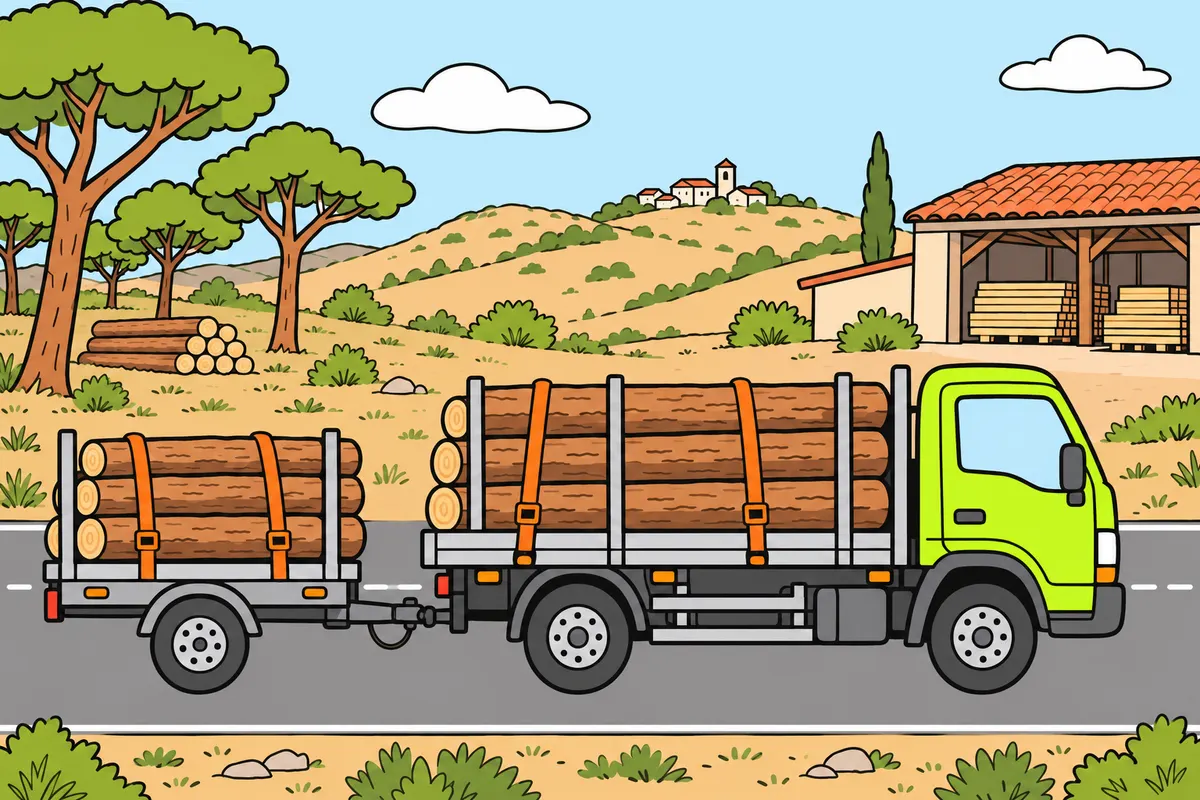
Check your timber’s actual mass and your combination’s traction conditions.
Remember
- Wood chips, sawdust and bark are not round timber.
- Calculate the actual mass of your logs and laden vehicle.
- Check the load on each axle too.
- Do not work out weight from the stack’s volume alone.
Exam trap: Wrong: carrying wood always lets you go below 25% on driving axles. Right: round-timber or euromodular combinations must retain enough weight to move off on an 8% gradient and respect axle maximums.
Read the full explanation
- Round timber comprises trunks of felled trees with their crowns and branches removed, and branches obtained by cutting. The definition excludes wood chips, sawdust and bark. This definition determines whether you can apply the mass exceptions specific to this transport. [RGV, Annex IX](https://www.boe.es/buscar/act.php?id=BOE-A-1999-1826#anix)
- For combinations carrying round timber and euromodular combinations, the mass on the driving axles may be less than 25 % if sufficient weight is ensured to move off on gradients of 8 %. This exception requires you to retain traction and comply with the maximum axle masses. [RGV, Annex IX](https://www.boe.es/buscar/act.php?id=BOE-A-1999-1826#anix)
- To carry timber with your C1+E combination, you must calculate the actual mass of the logs and the laden vehicle. The irregular shape of the pieces and the volume occupied by a stack do not, on their own, determine its mass; your checks must also establish the mass borne by the axles. [RGV, Annex IX](https://www.boe.es/buscar/act.php?id=BOE-A-1999-1826#anix)
14Maximum width
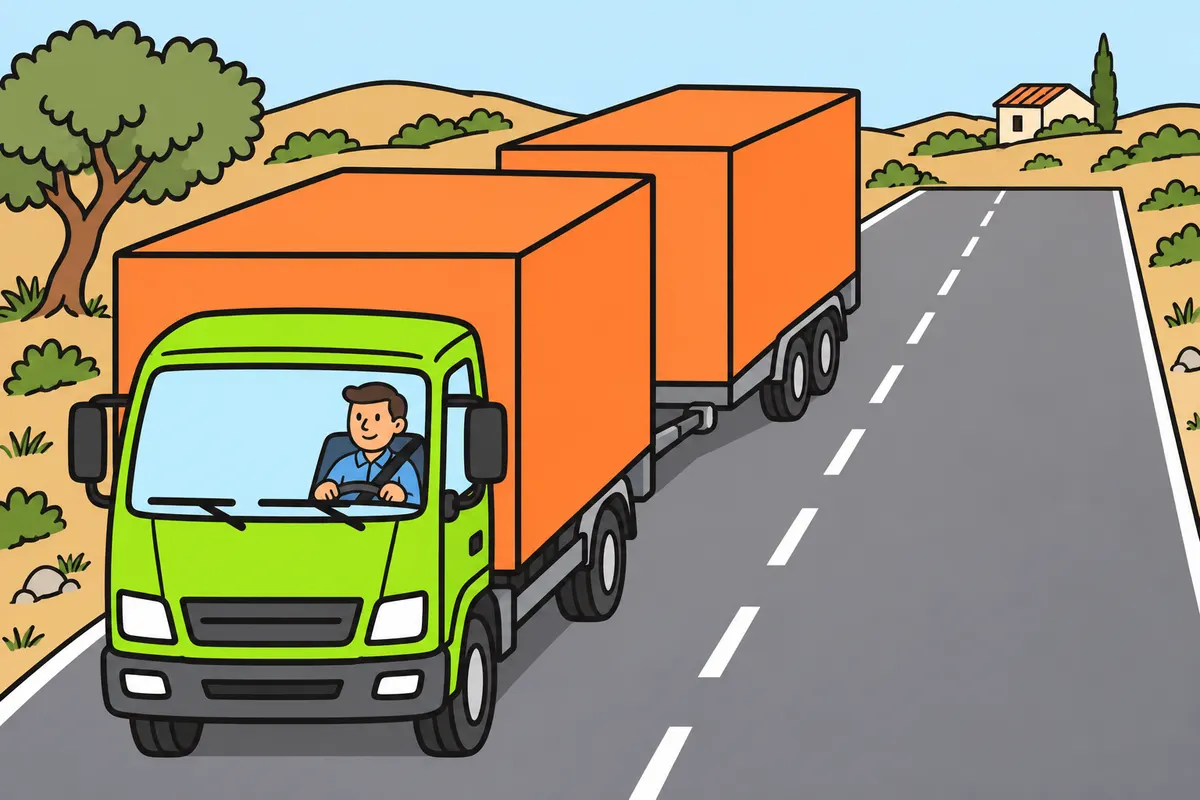
Check your whole laden vehicle’s width and your route’s restrictions.
| Case | Maximum width |
|---|---|
| General rule, including load | 2.55 m |
| Conditioned superstructure meeting the conditions | 2.60 m |
Remember
- Include your load when checking width.
- Do not measure only the cab if another part is wider.
- Check signs and the space available at narrow passages.
Exam trap: Wrong: any refrigerated vehicle allows 2.60 m. Right: its fixed or movable superstructure must be partly equipped for temperature-controlled goods. Each sidewall, including insulation, must be at least 45 mm thick.
Read the full explanation
- The general maximum authorised width is 2.55 m, including the load. You must check the widest part that must be measured under the applicable type-approval rules; knowing the width of the cab is not enough if the body, trailer or goods are wider. [RGV, Annex IX](https://www.boe.es/buscar/act.php?id=BOE-A-1999-1826#anix)
- The superstructures of temperature-controlled vehicles may be up to 2.60 m wide. For this exception, the fixed or demountable superstructure must be partially equipped to carry goods at controlled temperatures, and each side wall, including its insulation, must be at least 45 mm thick. Simply calling a vehicle refrigerated is not enough. [RGV, Annex IX](https://www.boe.es/buscar/act.php?id=BOE-A-1999-1826#anix)
- The exceptional width allowed for a temperature-controlled superstructure reflects its construction. For an indivisible load projecting sideways, you must apply the specific limits in article 15.2.b, explained in «Safe, well-distributed loads», under «Projecting loads and protecting their ends». [RGV, Annex IX](https://www.boe.es/buscar/act.php?id=BOE-A-1999-1826#anix) [RGC, art. 15](https://www.boe.es/buscar/act.php?id=BOE-A-2003-23514#a15)
- The legal width of your combination does not guarantee that you can get through a narrow section. You must check the signed restrictions along your route and the space needed for the whole vehicle. The statutory width measurement and the practical clearance check serve different purposes: you need both when planning. [RGV, Annex IX](https://www.boe.es/buscar/act.php?id=BOE-A-1999-1826#anix)
15Maximum height and 4.50 m exceptions
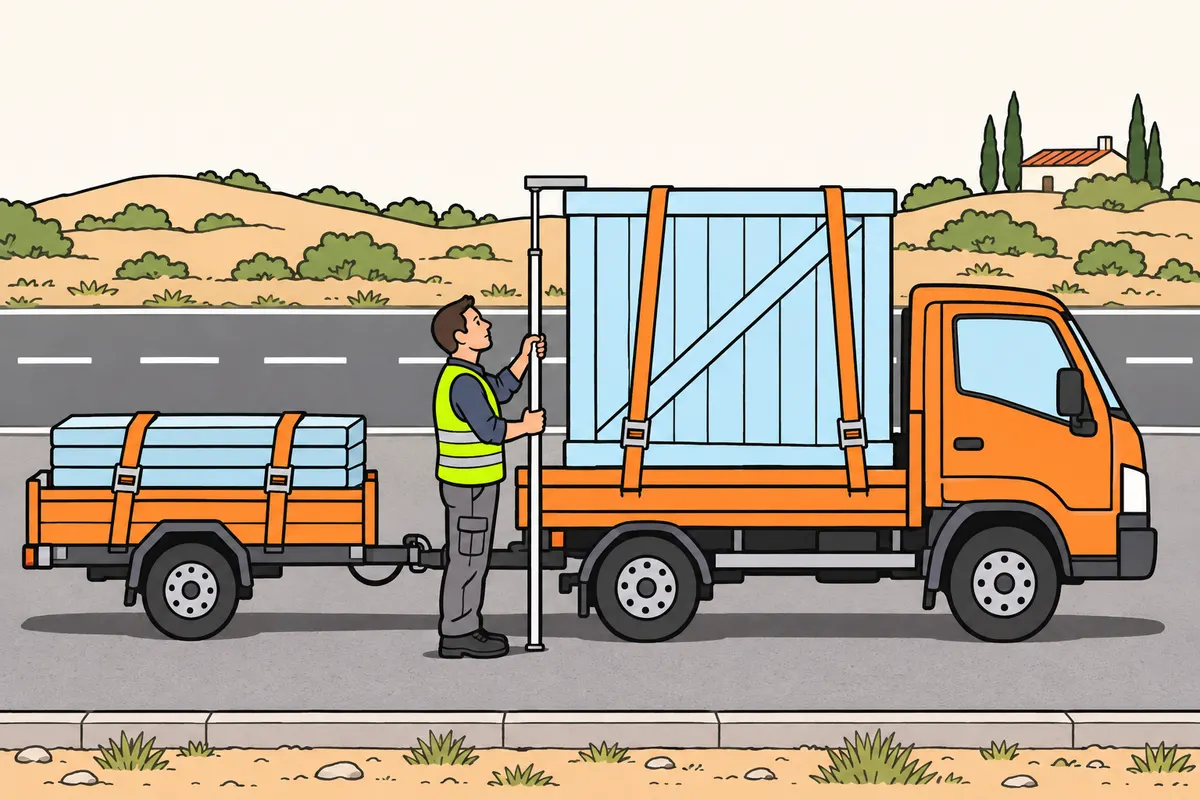
Measure your laden height and check whether you qualify for an exception.
| Vehicles covered by height exceptions | Maximum including load |
|---|---|
| Lorries or combinations specialising in vehicle transport; recovery vehicles for accident-damaged or broken-down vehicles | 4.50 m |
| Lorries or articulated vehicles with closed containers approved for combined, intermodal or ULD air transport | 4.50 m |
| Variable-height lorries or articulated vehicles for live animals, straw bales and fodder | 4.50 m |
| Supplies from suppliers to industrial facilities on predetermined routes below 50 km | 4.50 m |
Remember
- Measure to your highest point, including the load.
- Choose a route that fits your actual height.
- Respect road height restrictions even when you qualify for an exception.
Exam trap: Wrong: any lorry with a tall load can reach 4.50 m. Right: you must qualify for a specific exception and respect road restrictions.
Read the full explanation
- The general maximum height, including the load, is 4.00 m. You must measure up to the highest point of the laden vehicle, rather than the cab roof. A body, a container or goods stacked on top of other goods may determine the actual height you need to check before setting off. [RGV, Annex IX](https://www.boe.es/buscar/act.php?id=BOE-A-1999-1826#anix)
- Lorries or combinations specialised in transporting vehicles, and recovery vehicles with cranes intended to remove vehicles damaged in accidents or broken down, may reach 4.50 m, including the load. The exception requires the specialisation and function described; an ordinary lorry does not qualify for this height merely because it occasionally carries a tall item. [RGV, Annex IX](https://www.boe.es/buscar/act.php?id=BOE-A-1999-1826#anix)
- The 4.50 m limit also covers lorries or articulated vehicles carrying enclosed containers approved for combined or intermodal transport, or ULD-type air transport. The table also includes variable-height lorries or articulated vehicles for live animals, straw bales and fodder, and supplies from suppliers to industrial facilities on predetermined routes of less than 50 km. [RGV, Annex IX](https://www.boe.es/buscar/act.php?id=BOE-A-1999-1826#anix)
- Even if your vehicle qualifies for the 4.50 m limit, you must observe the height restrictions on each road. Your load must not obstruct movement beneath bridges, viaducts or overhead installations. You must choose a route compatible with your actual height and maintain a practical margin where measurements or clearance are uncertain. [RGV, Annex IX](https://www.boe.es/buscar/act.php?id=BOE-A-1999-1826#anix)
16Length of rigid vehicles, trailers and articulated vehicles
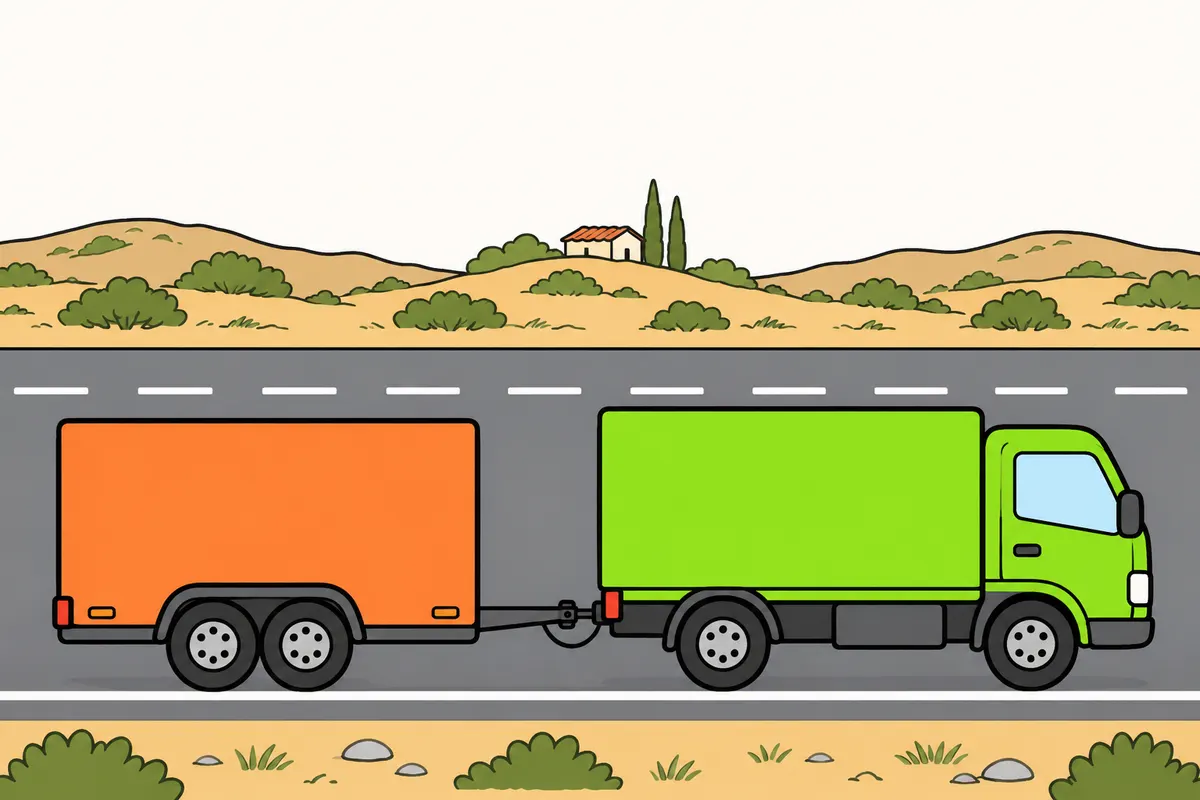
Check total length and each unit’s own measurements.
| Goods vehicle | General maximum length |
|---|---|
| Individual motor vehicle | 12.00 m |
| Individual trailer | 12.00 m |
| Complete articulated vehicle, including load | 16.50 m |
Remember
- Adding individual maximums does not authorise your combination’s length.
- Measure your whole articulated vehicle, including its load.
- Check semi-trailer distances from the kingpin axis.
Exam trap: Wrong: you can always use the full permitted rear projection. Right: total length also limits you. An ordinary 16.00 m articulated vehicle without additional authorisation has only 0.50 m total-length allowance for an indivisible load projecting only behind. Exception: bars, beams, pipes or similar indivisible longitudinal items may exceed the applicable length by 150 cm, provided length is the only maximum dimension exceeded.
Read the full explanation
- The general maximum length of a goods motor vehicle is 12.00 m, and that of a trailer is also 12.00 m. These are individual limits: you cannot infer from them that a 12 m lorry with a 12 m trailer is authorised as a 24 m combination. [RGV, Annex IX](https://www.boe.es/buscar/act.php?id=BOE-A-1999-1826#anix)
- The general maximum length of an articulated goods vehicle is 16.50 m, including the load. You must measure the complete combination and then check whether a specific exception applies. [RGV, Annex IX](https://www.boe.es/buscar/act.php?id=BOE-A-1999-1826#anix)
- On a semi-trailer, the distance between the axis of the coupling kingpin and the rear must not exceed 12.00 m. The horizontal distance from that axis to any point at the front must not exceed 2.04 m. These dimensions control its geometry and are not equivalent to the overall length of the articulated vehicle. [RGV, Annex IX](https://www.boe.es/buscar/act.php?id=BOE-A-1999-1826#anix)
- For an ordinary articulated vehicle measuring 16.00 m, without supplementary authorisation, an indivisible load projecting only to the rear has an allowance of 0.50 m within the overall length limit, except for bars, beams, pipes or other indivisible longitudinal items, which may exceed the applicable length by 150 cm when they exceed only the maximum length dimension. [RGV, Annex IX, table 3, note 5](https://www.boe.es/buscar/act.php?id=BOE-A-1999-1826#anix) You must combine the applicable overall limit with the rules set out in «Safe, well-distributed loads», under «Projecting loads and protecting their ends». [RGC, art. 13.1](https://www.boe.es/buscar/act.php?id=BOE-A-2003-23514#a13)
17Usable length of road trains and car transporters
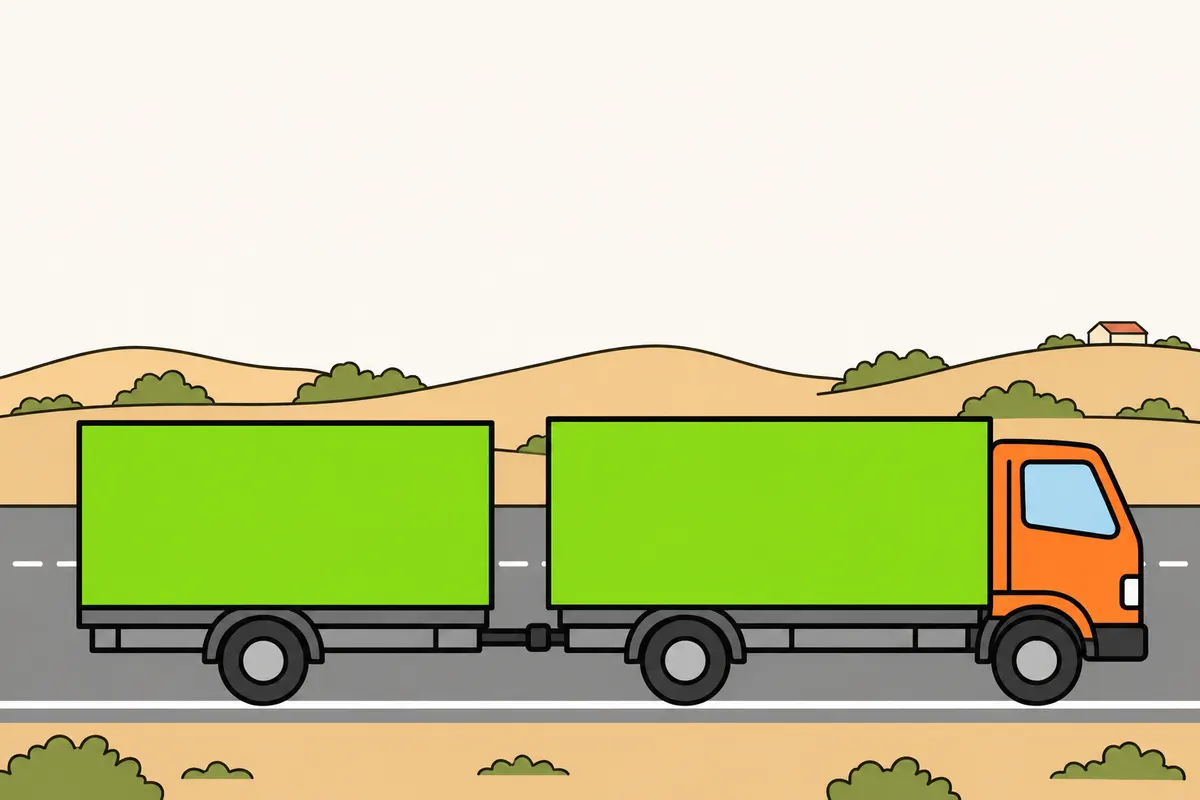
For your road train, check total length and loading area measurements.
| Road train | Maximum total length |
|---|---|
| General, including load | 18.75 m |
| Specialist vehicle transporter, laden, with authorised rear support or overhang | 20.55 m |
Remember
- Measure from the loading area’s front behind the cab to the trailer’s rear.
- For the second measurement, subtract the gap between lorry and trailer.
- On vehicle transporters, your rear support must not project beyond the load.
- Your load must not project ahead of the towing vehicle.
Exam trap: Wrong: every vehicle transporter allows 20.55 m even when empty. Right: you must be laden and use an authorised rear support or overhang. For rear load projection within the authorised total, the transported vehicle’s last axle must rest on the trailer structure.
Read the full explanation
- The general maximum length of a road train is 18.75 m, including the load. You must also comply with the dimensions that limit its loading area. The overall maximum does not replace these other measurements: a combination may stay within 18.75 m yet fail to meet the authorised geometry. [RGV, Annex IX](https://www.boe.es/buscar/act.php?id=BOE-A-1999-1826#anix)
- From the foremost point of the loading area behind the cab to the rearmost point of the trailer, the maximum distance measured parallel to the longitudinal axis is 16.40 m. If you subtract the gap between the rear of the motor vehicle and the front of the trailer from this distance, the maximum is 15.65 m. [RGV, Annex IX](https://www.boe.es/buscar/act.php?id=BOE-A-1999-1826#anix)
- Further detail: A road train specialised in transporting vehicles may reach 20.55 m when travelling laden and using an authorised rear overhang or support. This length exception retains the mass limits of your C1+E licence. You must check these conditions: this is not the general maximum for every road train, nor a length you can use unladen simply because it is a car transporter. [RGV, Annex IX](https://www.boe.es/buscar/act.php?id=BOE-A-1999-1826#anix) [RGCond, art. 4.2](https://www.boe.es/buscar/act.php?id=BOE-A-2009-9481#a4)
- Further detail: On this car transporter, the rear support must not project beyond the load. The load may project to the rear within the authorised overall length if the last axle of the vehicle being carried rests on the trailer structure; it must not project ahead of the towing vehicle. You must check the support, the load-bearing contact and the overall length together. [RGV, Annex IX](https://www.boe.es/buscar/act.php?id=BOE-A-1999-1826#anix)
18Specific length exceptions
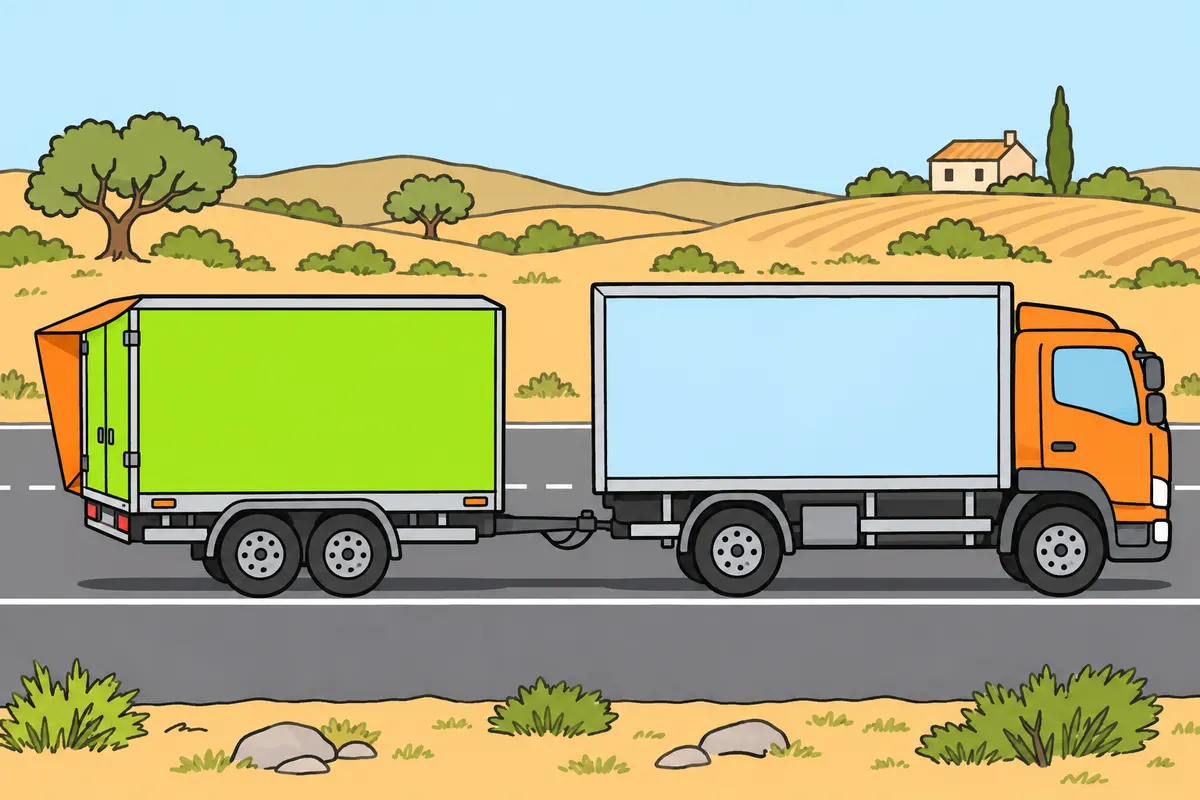
Use length exceptions only when you meet every condition.
| Case | Specified excess |
|---|---|
| 45-foot containers or swap bodies, laden or empty, in an intermodal operation | 15 cm for measurements specified by the note |
| Bars, beams, pipes or similar: group of indivisible items exceeding only maximum length | 150 cm for the relevant length |
Remember
- Do not use aerodynamic improvements to increase your load capacity.
- Fold, retract or remove devices if your safety or others’ safety is at risk.
- Consider areas limited to 50 km/h or less and vulnerable road users.
Exam trap: Wrong: any long load lets you add 150 cm. Right: only the specified longitudinal items qualify, carried as a group of indivisible items exceeding only maximum length, while meeting all other conditions.
Read the full explanation
- To carry 45-foot containers or swap bodies, laden or empty, in an intermodal operation, you may exceed the applicable maximum length or distance by 15 cm for the dimensions indicated by the table note. [RGV, Annex IX](https://www.boe.es/buscar/act.php?id=BOE-A-1999-1826#anix)
- The note on metal bars, beams, pipes or similar longitudinal items allows you to exceed the applicable length by 150 cm when they are carried as a set of indivisible items that exceeds only the maximum length dimension. An articulated vehicle with a base length of 16.50 m may reach 18.00 m in this case, provided the other conditions are met. This length exception also requires you to observe the mass limits for C1+E: the additional metres do not increase the MMA (maximum authorised mass) authorised by your licence. [RGV, Annex IX](https://www.boe.es/buscar/act.php?id=BOE-A-1999-1826#anix) [RGCond, art. 4.2](https://www.boe.es/buscar/act.php?id=BOE-A-2009-9481#a4)
- Further detail: Vehicles or combinations with approved cabs that improve aerodynamics, energy efficiency and safety, or with approved rear aerodynamic devices, may exceed the maximum length for that purpose. This additional length does not increase load capacity. Extending a body to carry more goods is not covered by this rule. [RGV, Annex IX](https://www.boe.es/buscar/act.php?id=BOE-A-1999-1826#anix)
- Further detail: You must fold, retract or remove aerodynamic devices if your safety or that of other road users is at risk. When using them, you must take account of areas with a speed limit of 50 km/h or lower and a greater presence of vulnerable road users. For intermodal compatibility, when folded or retracted they must not increase the maximum authorised length by more than 20 cm. [RGV, Annex IX](https://www.boe.es/buscar/act.php?id=BOE-A-1999-1826#anix)
19Turning circle and swept area
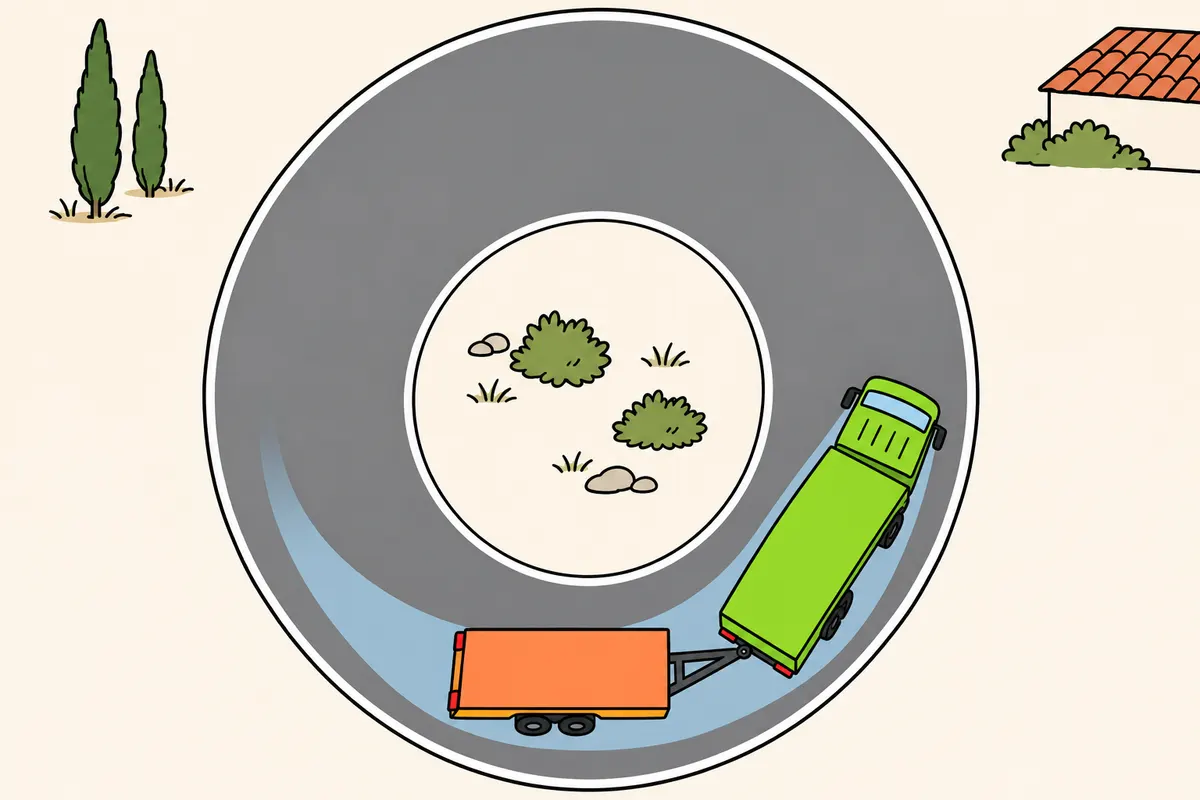
When turning, check the space occupied by your whole combination.
| Vehicle or combination | Outer radius | Inner radius |
|---|---|---|
| General | 12.50 m | 5.30 m |
| Euromodular | 14.50 m | 6.50 m |
Remember
- You must complete the turn both ways without leaving the circular band.
- Allow for the space your trailer occupies too.
Exam trap: Wrong: turning-circle measurements are diameters. Right: they are radii. In the category N rigid swept-path test, the sideways limit rises from 0.80 m to 1.00 m only with retractable or loadable axles raised.
Read the full explanation
- Every motor vehicle and combination must be able to complete a full 360° turn in either direction within a circular ring with an outer radius of 12.50 m and an inner radius of 5.30 m. These are radii, not diameters. No outermost point may project beyond those circles. [RGV, Annex IX](https://www.boe.es/buscar/act.php?id=BOE-A-1999-1826#anix)
- Further detail: For European Modular System configurations, the outer and inner radii may reach 14.50 m and 6.50 m respectively. You must use this pair only for these combinations. Their greater length and configuration require a specific route check, even if they comply with the maximum dimensions for their category. [RGV, Annex IX](https://www.boe.es/buscar/act.php?id=BOE-A-1999-1826#anix)
- In the swept-area test for a category N rigid vehicle, no part may extend more than 0.80 m beyond the reference vertical side plane when entering the prescribed turn. If it has retractable or load-relieving axles in the raised position, the limit is 1.00 m. When driving your C1 lorry with a trailer, you must also allow for the space occupied by the towed vehicle during the turn. [RGV, Annex IX, section 3.2.3](https://www.boe.es/buscar/act.php?id=BOE-A-1999-1826#anix)
20European Modular System combinations (further detail)
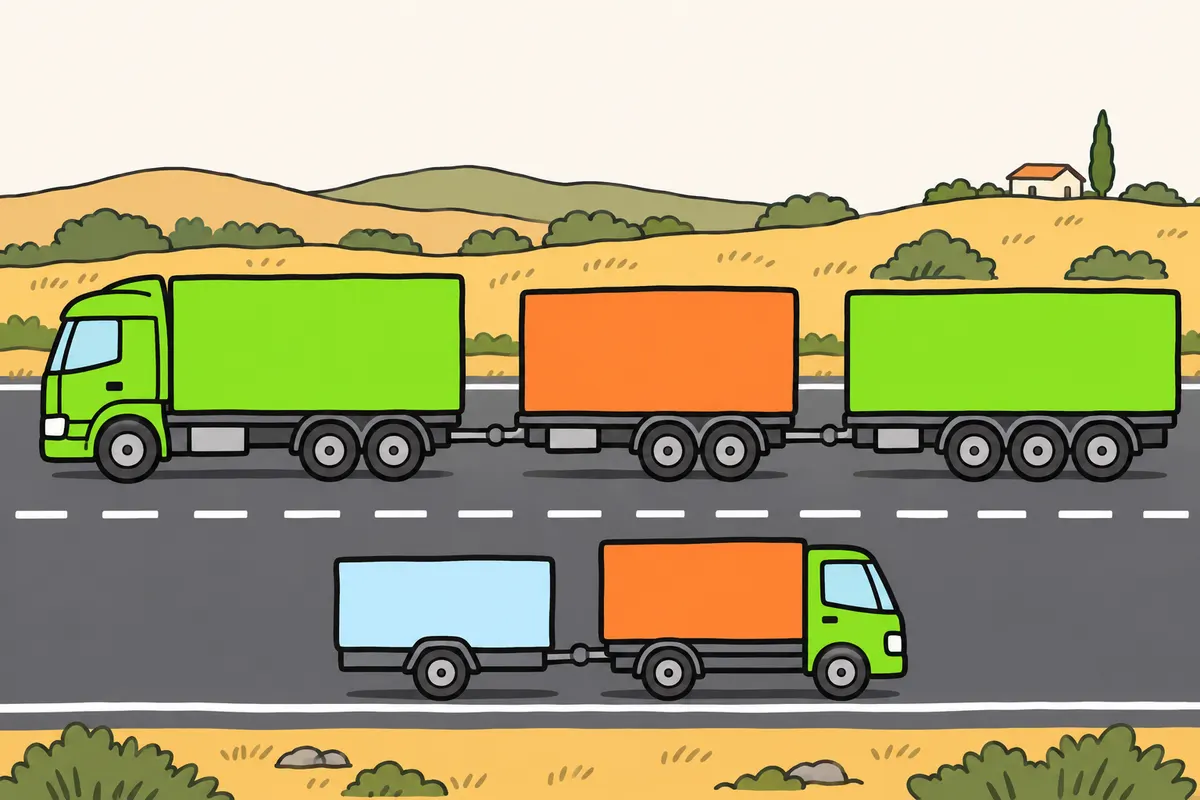
Your euromodular combination needs a configuration, route and load that meet its rules.
Remember
- Check the permitted route network and technical and safety requirements.
- Do not let your load project beyond the vehicles’ outline when viewed from above.
- Do not carry dangerous goods requiring regulatory ADR hazard panels.
- These masses exceed your C1+E licence entitlement.
Exam trap: Wrong: any large combination is euromodular and can use any road. Right: it needs more than six axle lines or at least three modules, with each unit meeting its individual limits. You can use only the permitted network and must meet its requirements.
Read the full explanation
- A European Modular System configuration is a combination with more than six axle lines or at least three modules, whose units, considered separately, comply with their respective maximum limits. The definition depends on the number of axle lines or modules, not on apparent volume or load capacity. [RGV, Annex IX](https://www.boe.es/buscar/act.php?id=BOE-A-1999-1826#anix)
- The maximum in the table for European Modular System combinations is 72 t and their maximum length is 32 m. This general framework is a reference in Annex IX; combinations with these MMA (maximum authorised mass) values exceed the entitlement of a C1+E licence. These figures do not apply to an ordinary five-axle articulated vehicle or a conventional road train. [RGV, Annex IX](https://www.boe.es/buscar/act.php?id=BOE-A-1999-1826#anix)
- Their use is restricted to the network of routes determined by the competent traffic authority, following a binding report from the road authorities on geometric, structural or other restrictions. You must check the approved route and the technical and safety requirements laid down; you cannot choose any road simply because you comply with 32 m and 72 t. [RGV, Annex IX](https://www.boe.es/buscar/act.php?id=BOE-A-1999-1826#anix)
- On these combinations, the load must not project beyond the plan-view outline of the vehicles carrying it. You must not carry dangerous goods for which the regulatory ADR hazard plates are compulsory either. You must distinguish this framework from the ordinary projection exceptions for an indivisible load. [RGV, Annex IX](https://www.boe.es/buscar/act.php?id=BOE-A-1999-1826#anix)
21Projecting loads and their marking
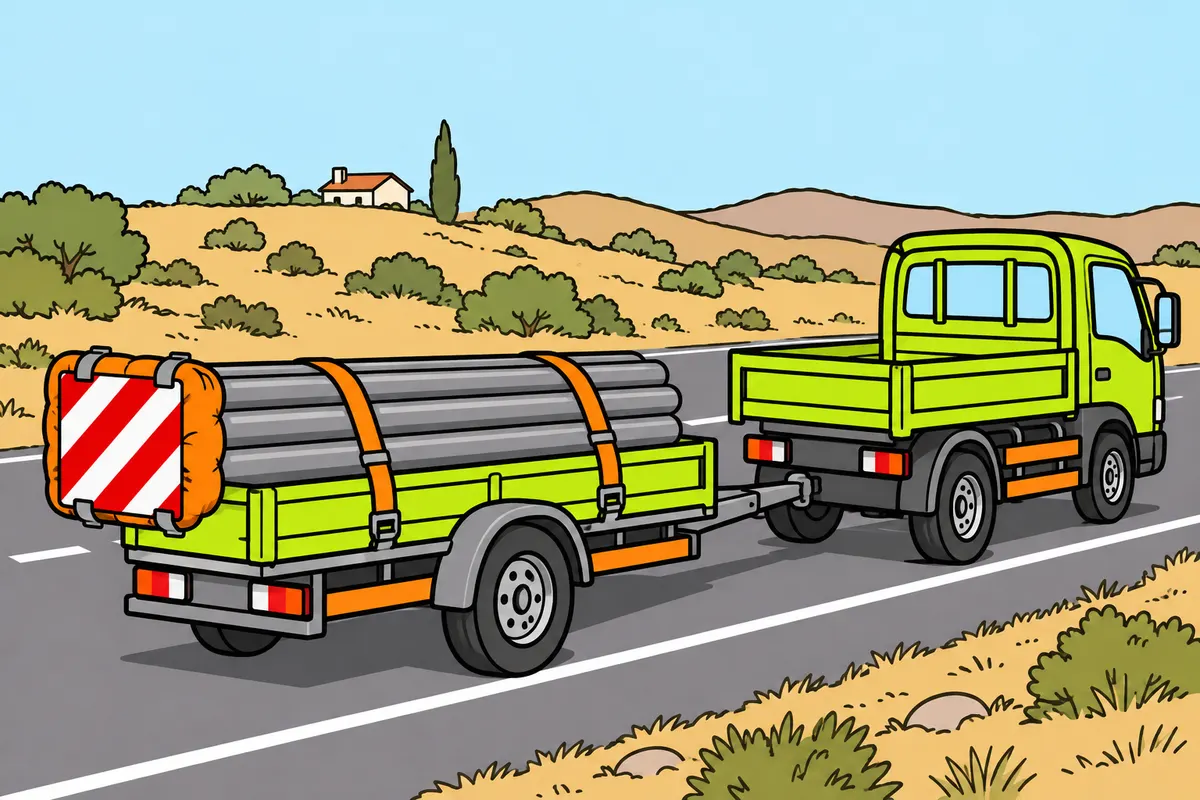
Check projection rules to measure, protect and mark your projecting load.
Remember
- Keep the load within the vehicle outline unless an exception applies.
- Meet both projection limits and maximum overall dimensions.
- Consult “Safe, well-distributed loads” before calculating projections.
- Protect the ends of projecting loads.
- Check where to place the rear V-20 panel.
- Check the required lights and reflectors.
Exam trap: Wrong: check only how far the load may project. Right: also check end protection, the V-20 panel, and required lights and reflectors in “Safe, well-distributed loads”.
Read the full explanation
- As a general rule, the load must remain within the plan-view outline of the vehicle. To use an exception for an indivisible load on your goods vehicle combination, you must comply with both the projection limits and the applicable maximum overall dimensions. [RGC, art. 15](https://www.boe.es/buscar/act.php?id=BOE-A-2003-23514#a15) [RGV, Annex IX](https://www.boe.es/buscar/act.php?id=BOE-A-1999-1826#anix)
- To calculate permitted projections and apply the requirements for end protection, the V-20 panel, lights and reflectors, see «Safe, well-distributed loads», under «Projecting loads and protecting their ends», «V-20 panel for loads projecting at the rear» and «Lights and reflectors for projecting loads». [RGC, art. 15](https://www.boe.es/buscar/act.php?id=BOE-A-2003-23514#a15)
22Indivisible loads and additional authorisation
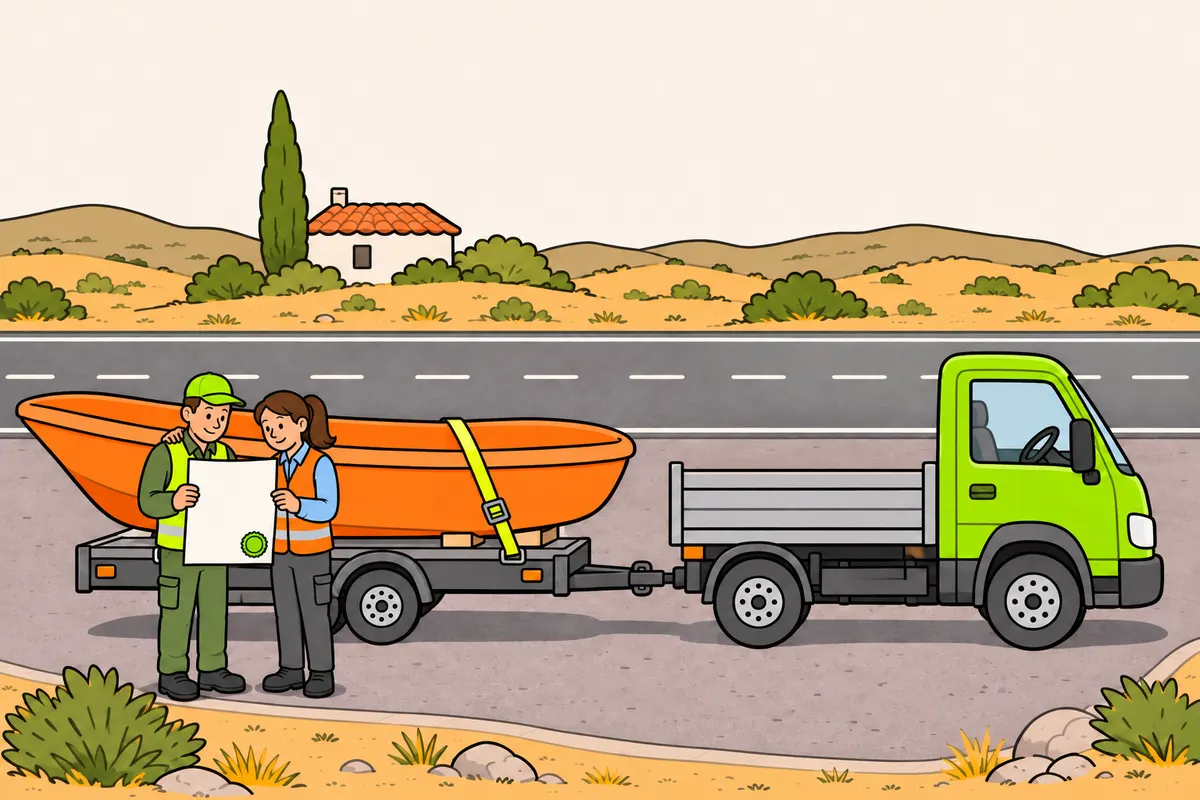
Get authorisation before driving if your indivisible load exceeds maximums without an applicable exception.
Remember
- Show that dividing your load would cause unnecessary cost or risk of damage.
- Check that its dimensions or mass prevent transport within regulatory maximums.
- Distinguish road-use authorisation from authorisation to operate a transport service.
- Check your route, limits and conditions before travelling.
- Authorisation does not extend your C1+E licence or your vehicle’s technical capacity.
Exam trap: Wrong: grouping items to save trips makes them indivisible. Right: grouped items must be of the same nature and intended for the same purpose. They cannot exceed dimensions other than those exceeded by the largest item, or exceed applicable combination and axle maximum masses.
Read the full explanation
- An indivisible load is one that cannot be divided for transport without unnecessary cost or risk of damage and that, because of its dimensions or mass, cannot be carried on a vehicle or combination complying with the regulatory maximum limits. You must justify this status: it does not depend on your preference for making a single journey. [RGV, art. 14.2](https://www.boe.es/buscar/act.php?id=BOE-A-1999-1826#a14) [RGC, art. 13.2](https://www.boe.es/buscar/act.php?id=BOE-A-2003-23514#a13) [RGV, Annex IX, section 1.15](https://www.boe.es/buscar/act.php?id=BOE-A-1999-1826#anix)
- Annex IX also provides for several items of the same nature intended for the same purpose, under precise conditions. Together, the items must not exceed a dimension other than those already exceeded by the largest item, nor exceed the maximum combination and axle masses in the applicable tables. [RGV, art. 14.2](https://www.boe.es/buscar/act.php?id=BOE-A-1999-1826#a14) [RGC, art. 13.2](https://www.boe.es/buscar/act.php?id=BOE-A-2003-23514#a13) [RGV, Annex IX, section 1.15](https://www.boe.es/buscar/act.php?id=BOE-A-1999-1826#anix)
- If an indivisible load inevitably exceeds the maximum limits and is not covered by a regulatory exception, you must obtain additional authorisation in advance. The traffic authority may grant it for limited journeys or a specified period, with a binding report from the road authority and verification of the transport authorisation required. [RGV, art. 14.2](https://www.boe.es/buscar/act.php?id=BOE-A-1999-1826#a14) [RGC, art. 13.2](https://www.boe.es/buscar/act.php?id=BOE-A-2003-23514#a13)
- You must distinguish additional authorisation to use the roads from authorisation to carry out transport operations and from the technical capability of the vehicle. Additional authorisation does not increase the masses you may drive with C1+E either. You must check the route, limits and conditions of the authorisation to use the roads before carrying out special transport. [RGV, art. 14.2](https://www.boe.es/buscar/act.php?id=BOE-A-1999-1826#a14) [RGC, art. 13.2](https://www.boe.es/buscar/act.php?id=BOE-A-2003-23514#a13)
23Special transport conditions
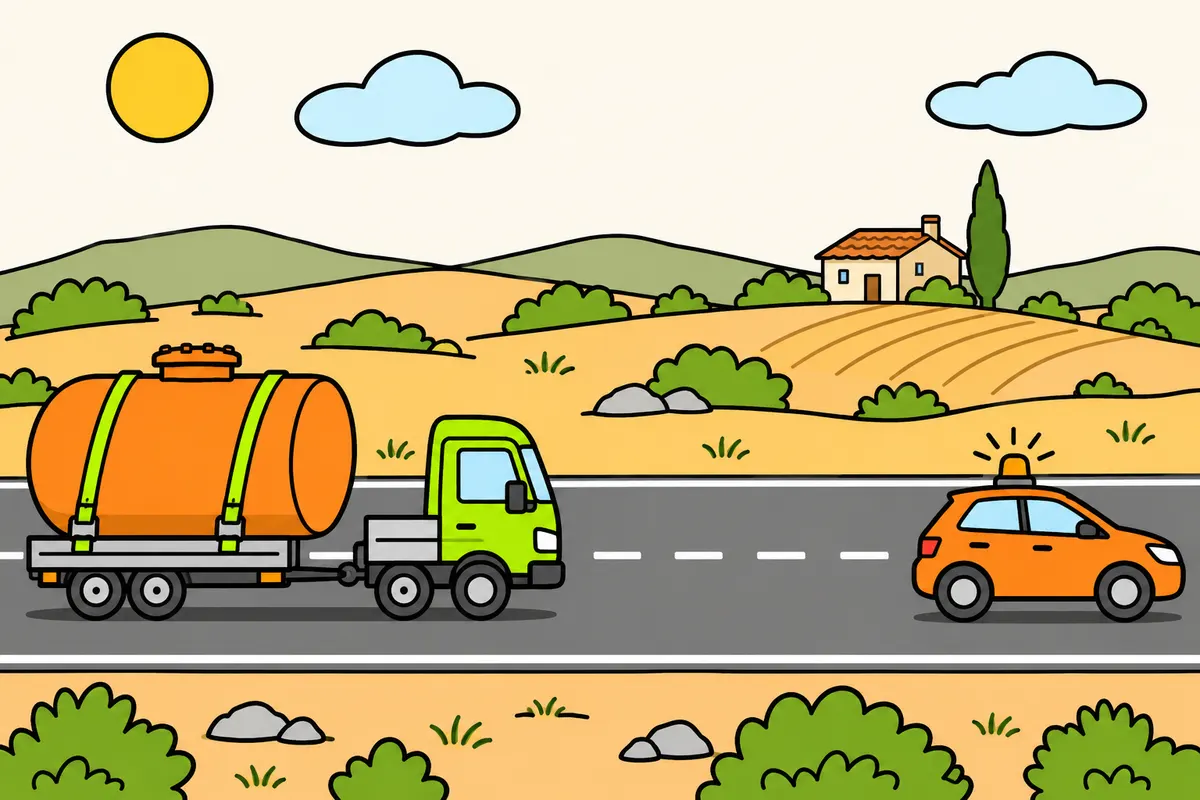
For special transport, prepare your route and meet your authorisation’s specific conditions.
| Group 1 special transport case | Escort |
|---|---|
| Width above 3 m or length above 20.55 m; motorway or dual carriageway | Behind, at least 50 m away |
| Width above 3 m or length above 20.55 m; other roads | Ahead |
| Conventional road; below half the road’s general speed limit | Another escort behind, at least 50 m away |
Remember
- For group 1, follow authorisation conditions; in towns, follow the municipal route.
- Help others overtake; stop and park off both carriageway and hard shoulder.
- Keep radio and telephone contact with your escort in a shared language.
- Suspend travel in dangerous weather or without the minimum visibility.
- For group 1 with specific or exceptional authorisation, notify each journey the day before.
- Above 5 m width, you need officers and the required advance notice.
Exam trap: Wrong: notifying the journey the day before replaces every other notice. Right: for group 1 with specific or exceptional authorisation, notify departure-province officers and the road authority’s designated services the day before, giving place, date, start time and authorisation copy. Above 5 m width, also give at least 72 hours’ notice to departure-province officers and the road authority’s designated body, stating each journey’s start place, date and time, registration numbers and authorisation copy.
Read the full explanation
- For group 1 special transport carrying an indivisible load, you must comply with the conditions of the additional authorisation, which take precedence over the applicable general traffic rules. On urban roads, you must follow the route specified by the municipal authority. You must plan the route using the actual authorisation, not a general rule on dimensions. [RGC, Annex III](https://www.boe.es/buscar/act.php?id=BOE-A-2003-23514#aniii) For group 1 transport with specific or exceptional authorisation, the holder must notify the officers in the province of departure and the services designated by the road authority of each journey the day before, stating the starting location, date and time and sending a copy of the authorisation. [RGC, Annex III](https://www.boe.es/buscar/act.php?id=BOE-A-2003-23514#aniii)
- If you exceed 3 m in width or 20.55 m in length, you need an escort vehicle: behind you, at a minimum distance of 50 m, on motorways; ahead of you on other roads. In addition, if you travel on a conventional road at less than half its generic speed limit, you need another escort vehicle behind you, at least 50 m away. The escort vehicle may use the V-2 warning light during the operation; it must be visible from the front and rear and switched off when the operation ends. If the width exceeds 5 m, you need an escort by officers; the holder must give at least 72 hours’ notice to the officers in the province of departure and the body designated by the road authority, stating the starting location, date and time of each journey, the registration numbers and enclosing a copy of the authorisation. [RGC, Annex III](https://www.boe.es/buscar/act.php?id=BOE-A-2003-23514#aniii)
- The common conditions require you to keep at least 50 m behind the vehicle ahead, facilitate overtaking, and stop and park off both the carriageway and the arcén (hard shoulder). Communication between the escort vehicle and the cab must be possible by radio and telephone in a shared language. You must also observe the specific restrictions in your authorisation. [RGC, Annex III](https://www.boe.es/buscar/act.php?id=BOE-A-2003-23514#aniii) You must suspend travel and move off the road platform when weather conditions pose a risk or when visibility is less than 150 m ahead or behind. [RGC, Annex III](https://www.boe.es/buscar/act.php?id=BOE-A-2003-23514#aniii)
- Before starting special transport, check the authorisation, warning signs and markings, and route conditions described in this section. [RGC, Annex III](https://www.boe.es/buscar/act.php?id=BOE-A-2003-23514#aniii)
24Signs restricting mass
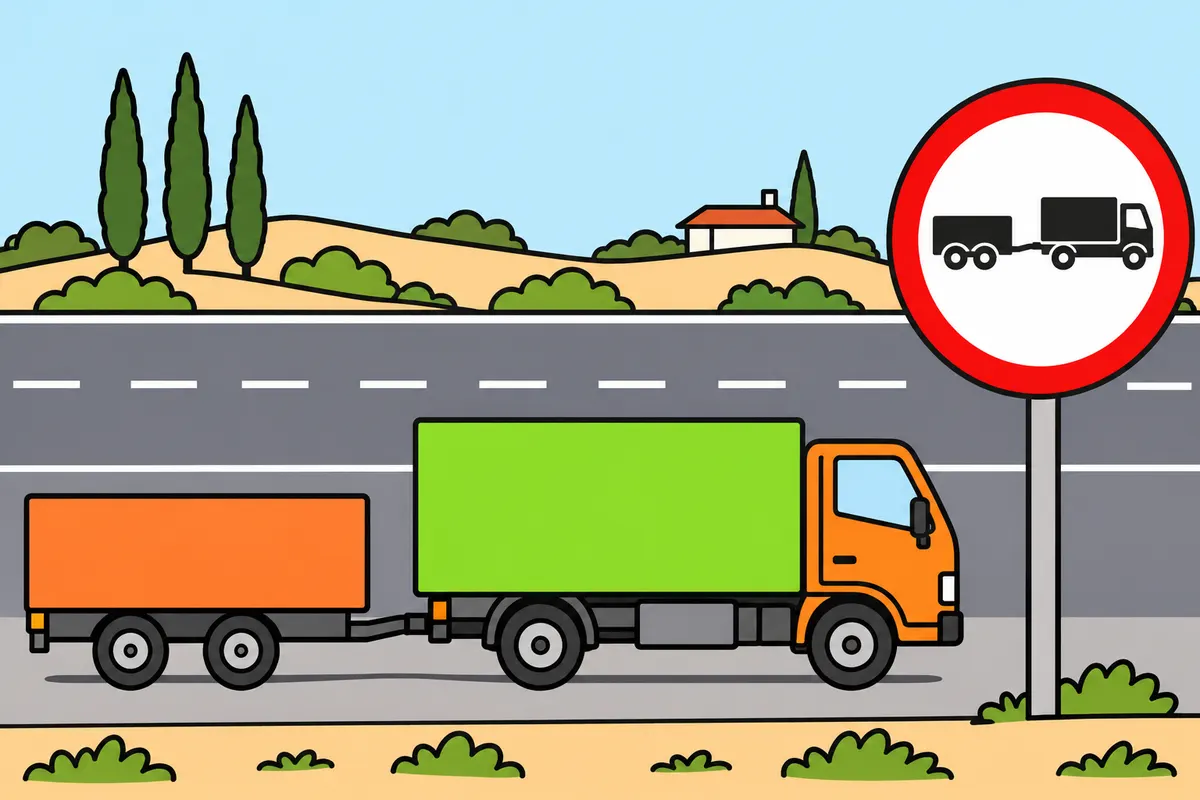
At a mass restriction sign, compare the weight that sign limits.
| Sign | What you must compare |
|---|---|
| R-201 | Vehicle or combination’s laden mass |
| R-202 | Mass transmitted to the ground by each axle |
| R-112 with a figure | MMA of trailers covered; single-axle trailers are excepted |
Remember
- For R-201, count your vehicle, people and goods.
- For R-202, check every axle; do not use an average.
- Unloading reduces actual mass but does not change your trailer’s MMA.
- Respect the road’s other restrictions too.
Exam trap: Wrong: R-201 limits MMA. Right: it limits laden mass when you exceed the figure; equality does not exceed it. R-112 showing 2 t prohibits motor vehicles towing trailers with MMA above 2,000 kg, except single-axle trailers.
Read the full explanation
- The R-201 sign, Mass limit, prohibits you from proceeding if your laden mass exceeds the number of tonnes shown. You must compare the actual mass of the vehicle or combination, including people and goods. It does not refer only to the weight of the load or to the authorised maximum stated in the documentation. [RGC, Annex I: catalogue in RD 465/2025](https://www.boe.es/buscar/doc.php?id=BOE-A-2025-12199)
- With an R-201 sign showing 5.5 t, a laden mass of exactly 5.5 t does not exceed the indicated value. Considering this sign alone, you may proceed; you must comply with all other restrictions. You do not need to be unladen to comply, and you must not treat equality as an excess. [RGC, Annex I: catalogue in RD 465/2025](https://www.boe.es/buscar/doc.php?id=BOE-A-2025-12199)
- The R-202 sign, Axle mass limit, prohibits you from proceeding if the mass transmitted to the ground by any axle through all its wheels exceeds the figure shown. You must check every axle. An acceptable total mass for the road does not compensate for an excess on one axle. [RGC, Annex I: catalogue in RD 465/2025](https://www.boe.es/buscar/doc.php?id=BOE-A-2025-12199)
- If an axle carries 4.5 t at an R-202 sign showing 4 t, you must not proceed even if the other axles allow the combination to comply with its maximum total mass. The sign limits the mass transmitted by each axle, in addition to the regulatory maximum limits. [RGC, Annex I: catalogue in RD 465/2025](https://www.boe.es/buscar/doc.php?id=BOE-A-2025-12199)
- The R-112 sign prohibits entry to motor vehicles with trailers, except single-axle trailers; if it shows 2 t, the prohibition applies to the trailers covered whose MMA exceeds 2,000 kg. Unloading the trailer does not reduce that MMA, whereas it does change the laden mass you compare with R-201. [RGC, Annex I: catalogue in RD 465/2025](https://www.boe.es/buscar/doc.php?id=BOE-A-2025-12199)
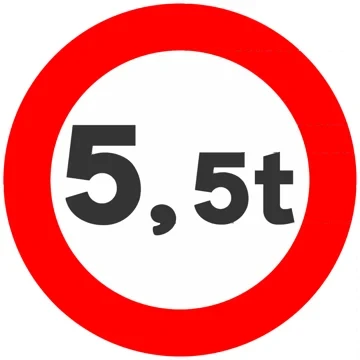 R-201
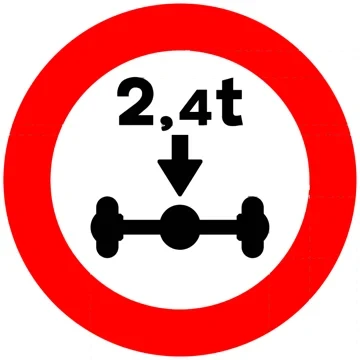 R-202
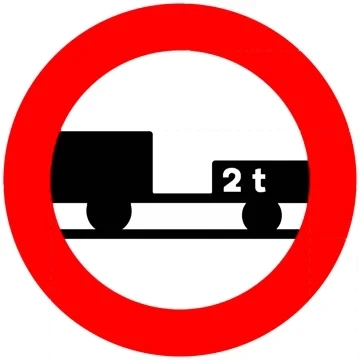 R-112
25Signs limiting dimensions
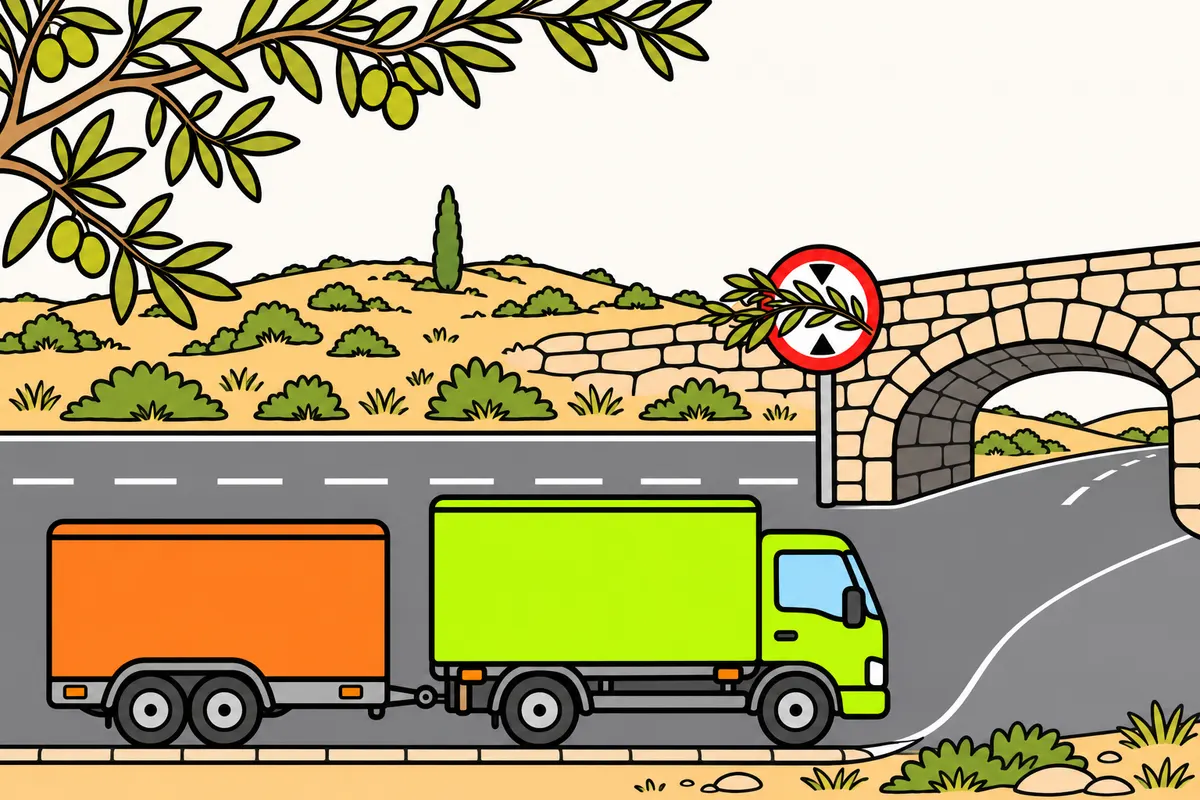
Check your whole laden combination’s dimensions before entering a restricted road.
| Sign | Dimension you must check |
|---|---|
| R-203 | Maximum vehicle or combination length, including load |
| R-204 | Maximum width, including load |
| R-205 | Maximum height, including load |
Remember
- Always include your load when measuring.
- Check your whole combination’s length, not just each unit’s length.
- Exact equality does not exceed these signs’ figures.
- Keep a practical safety margin and find a route that fits.
Exam trap: Wrong: your vehicle’s authorised height lets you ignore R-205. Right: respect the road restriction. A 4.20 m combination cannot pass a 4.10 m restriction even if it is allowed to reach 4.50 m.
Read the full explanation
- R-203, Length limit, prohibits entry to vehicles or combinations whose maximum length, including the load, exceeds the indicated limit. You must compare the whole combination: if its total length exceeds the signed limit, you cannot proceed even if the towing vehicle or each individual unit is shorter. [RGC, annex I: catalogue in RD 465/2025](https://www.boe.es/buscar/doc.php?id=BOE-A-2025-12199)
- R-204, Width limit, prohibits entry when your maximum width, including the load, exceeds the indicated figure. Horizontal arrows accompany the measurement in metres. General authorisation for a 2.60 m superstructure does not allow you to enter a road with a lower width limit. [RGC, annex I: catalogue in RD 465/2025](https://www.boe.es/buscar/doc.php?id=BOE-A-2025-12199)
- R-205, Height limit, prohibits entry if the vehicle's maximum height, including the load, exceeds the indicated limit. Vertical arrows indicate the restricted height. With a 4.20 m combination, you cannot proceed beyond a 4.10 m height limit, even if the regulations allow your configuration to reach 4.50 m. [RGC, annex I: catalogue in RD 465/2025](https://www.boe.es/buscar/doc.php?id=BOE-A-2025-12199)
- On these signs, the prohibition depends on exceeding the figure: an exactly equal measurement does not exceed it. When measuring and driving through an actual opening, you need a practical safety margin. Check the whole route and find a suitable alternative before reaching a place where your combination cannot continue. [RGC, annex I: catalogue in RD 465/2025](https://www.boe.es/buscar/doc.php?id=BOE-A-2025-12199)
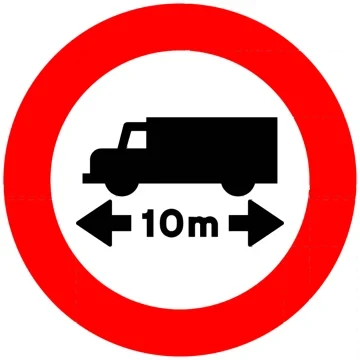 R-203
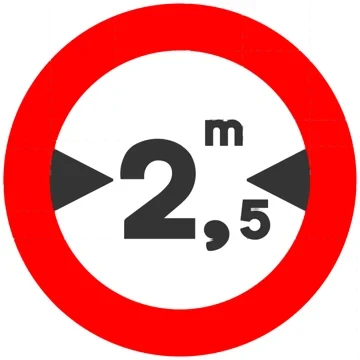 R-204
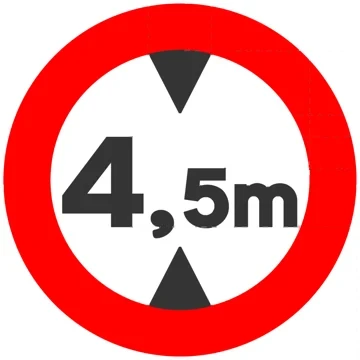 R-205
26Speed limiter on a C1 lorry
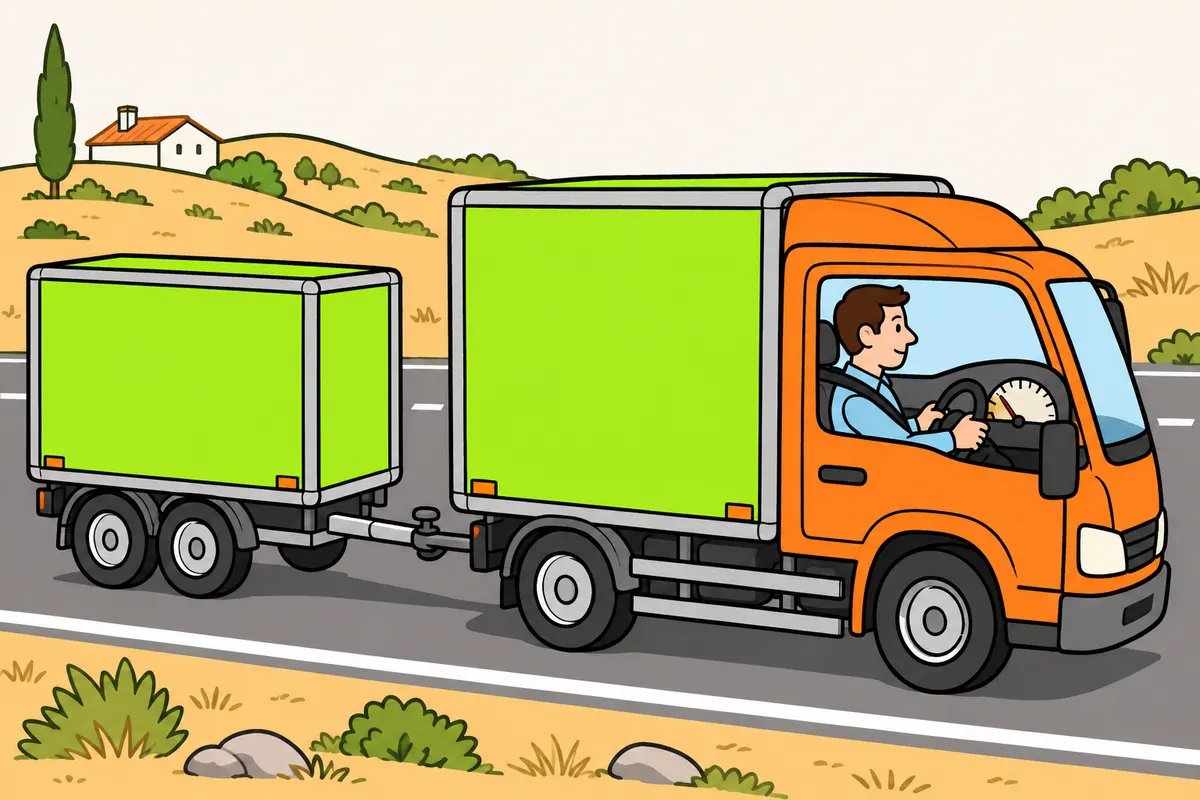
If your lorry requires a limiter, keep it working and respect each road’s speed limit.
| N2 lorries: registration or use | Rules you must check |
|---|---|
| 1 January 2005 onwards | Covered if within the regime’s scope |
| Between 1 October 2001 and 1 January 2005 | Euro 3-compliant vehicles covered |
| Armed Forces, law enforcement, civil protection, fire and other emergency services | Exempt |
| Design speed no greater than 90 km/h | Exempt |
| Scientific road trials; solely public service in urban areas | Exempt |
Remember
- Check whether your N2 requires a limiter based on registration and approval.
- With a category M1 or N1 B towing vehicle, this obligation does not apply.
- Keep your limiter working correctly with its seals intact.
- For faults or broken or removed seals, use an authorised body or workshop.
- Your limiter setting does not set the permitted speed on each road.
Exam trap: Wrong: you can drive at 90 km/h because your limiter allows it. Right: respect the speed applicable to your combination and road, even when lower.
Read the full explanation
- If your C1 lorry is subject to the speed limiter rules for N2 vehicles, you must have the device set so that you do not exceed 90 km/h. These rules cover vehicles with a design speed exceeding 25 km/h. [RD 1417/2005, art. 4](https://www.boe.es/buscar/act.php?id=BOE-A-2005-19990#a4) If you use a category M1 or N1 towing vehicle covered by a B licence, it is outside this requirement: article 2.a limits the scope to M2, M3, N2 and N3. [RD 1417/2005, art. 2.a](https://www.boe.es/buscar/act.php?id=BOE-A-2005-19990#a2)
- Article 5.2 of RD 1417/2005 defines which N2 vehicles are subject to the requirement by their registration date: 1 January 2005 or later, and between 1 October 2001 and 1 January 2005 for vehicles complying with Euro 3. Exemptions cover vehicles used by the Fuerzas Armadas (Armed Forces), the Fuerzas y Cuerpos de Seguridad (security forces), civil protection, fire services and other emergency services; vehicles with a design speed not exceeding 90 km/h; vehicles used for scientific road tests; and vehicles used only for public services in urban areas. [RD 1417/2005, art. 5](https://www.boe.es/buscar/act.php?id=BOE-A-2005-19990#a5) [RD 1417/2005, art. 7](https://www.boe.es/buscar/act.php?id=BOE-A-2005-19990#a7)
- The limiter must work correctly and retain its seals. If it malfunctions, or a seal breaks or is removed through use, vehicle repairs or work on the tachograph, you must have its operation checked by an authorised organisation or workshop. [RD 1417/2005, art. 8.1](https://www.boe.es/buscar/act.php?id=BOE-A-2005-19990#a8)
- The limiter setting does not determine the permitted speed on each road: consult «Speed and distances for the vehicle combination» when driving your combination.
27General masses for heavy lorries (reference)
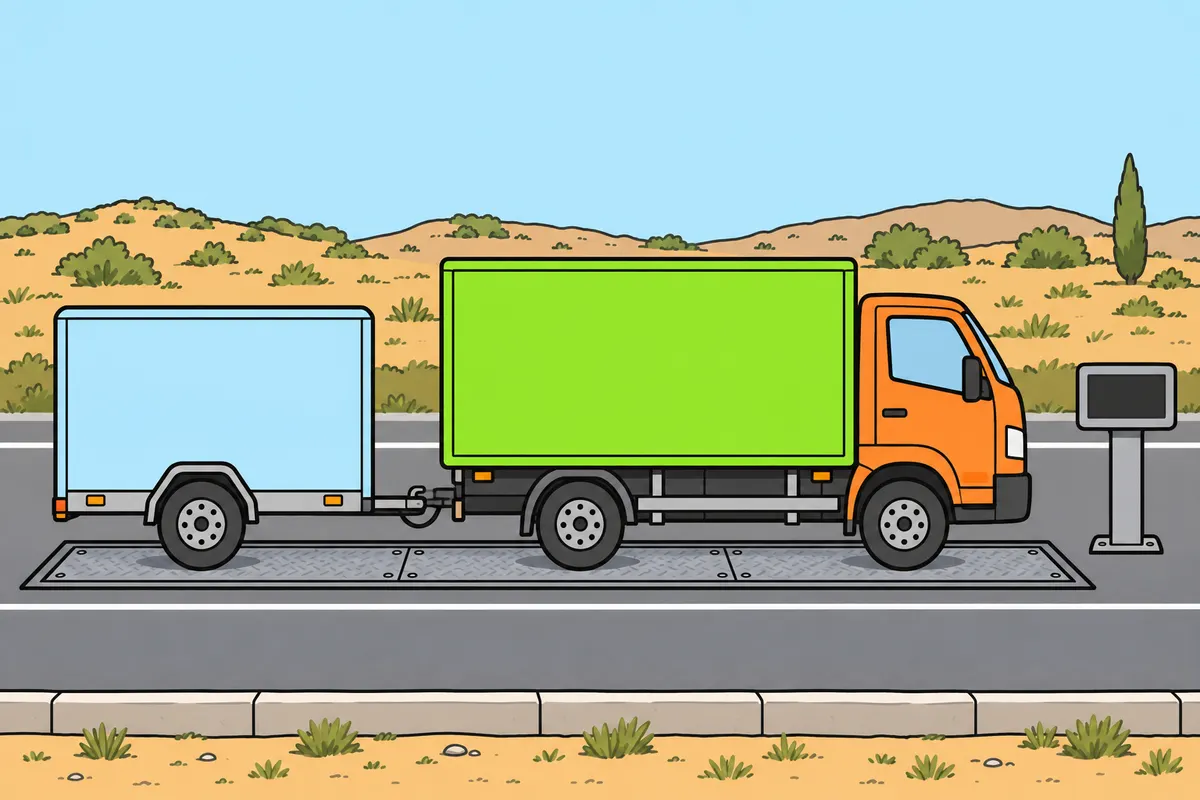
Use these general masses as a reference; they do not extend your C1+E entitlement.
| Heavy reference vehicles: configuration or case | General or conditional maximum |
|---|---|
| Rigid lorry: two axles | 18 t |
| Rigid lorry: three axles | 25 t; 26 t with required equipment |
| Rigid lorry: four axles, two steering axles and required equipment | 32 t |
| Other four-axle rigid lorries | 31 t |
| Articulated: two-axle tractor and two-axle semi-trailer; ordinary configuration | 36 t |
| Articulated: two-axle tractor and two-axle semi-trailer; twin tyres and air or equivalent suspension on driving axle; semi-trailer spacing over 1.80 m | 38 t; keep to 18 t for the motor vehicle and 20 t for the tandem |
| Articulated: two-axle tractor and two-axle semi-trailer; semi-trailer spacing from 1.30 m to under 1.80 m; reinforced tipping body for construction, roadworks or mining | 38 t; respect axle maxima |
| Articulated: motor vehicle with two or more axles; semi-trailer with three or more axles | 44 t |
| Articulated: three-axle motor vehicle; two-axle semi-trailer | 44 t |
| Road train: two-axle lorry and two-axle trailer | 36 t |
| Road train: two-axle lorry and three-axle trailer | 42 t |
| Road train: three-axle lorry and two- or three-axle trailer | 44 t |
| Intermodal: listed combinations meeting the definition and specific limits | Up to 2 t extra; 44 t may reach 46 t |
| Round timber: specified three-axle motor vehicle | 32 t |
| Round timber: other four-axle rigids covered by the note | 42 t |
| Round timber: specified five-axle articulated vehicles and road trains | 52 t |
| Round timber: specified articulated vehicles and road trains with six or more axles | 57 t |
| Round timber: four-axle road train covered by the note | 42 t |
Remember
- Count the axles on each unit separately.
- Check every condition before using a special maximum.
- Respect individual vehicle limits and axle maxima.
- These heavy rigid lorries also exceed your C1 towing vehicle’s own MMA.
Exam trap: Wrong: counting axles is enough to apply any special maximum. Right: for rigid lorries at 26 t and 32 t, you need twin tyres and air suspension or a recognised equivalent on the driving axle. Alternatively, each driving axle needs twin tyres, with each axle’s maximum mass no greater than 9.5 t. For 32 t, you also need four axles, including two steering axles. Round-timber special maximums apply only to the specified rows and predetermined routes between adjoining provinces, or routes no longer than 150 km between the forest and the nearest forest industry facility.
Read the full explanation
- You cannot drive any of these combinations with C1+E: the combination's MMA (maximum authorised mass) must not exceed 12,000 kg [RGCond, art. 4.2](https://www.boe.es/buscar/act.php?id=BOE-A-2009-9481#a4). The heavy rigid lorries in this reference also exceed the MMA limit for a C1 towing vehicle.
- Rigid lorries: The general table sets 18 t for a two-axle goods motor vehicle and 25 t for a three-axle goods motor vehicle. [RGV, annex IX](https://www.boe.es/buscar/act.php?id=BOE-A-1999-1826#anix)
- Rigid lorries: A three-axle lorry may reach 26 t when its drive axle has twin tyres and air suspension or a recognised equivalent. It may also reach this mass when each drive axle has twin tyres and the maximum mass of each axle does not exceed 9.5 t. You must check the conditions, rather than assume 26 t just because you count three axles. [RGV, annex IX](https://www.boe.es/buscar/act.php?id=BOE-A-1999-1826#anix)
- Rigid lorries: A four-axle rigid lorry with two steering axles may reach 32 t if it meets the conditions for twin tyres and air suspension or an equivalent on the drive axle, or those for twin tyres on each drive axle and a maximum of 9.5 t per axle. Other four-axle rigid lorries have a general maximum of 31 t. [RGV, annex IX](https://www.boe.es/buscar/act.php?id=BOE-A-1999-1826#anix)
- Four-axle articulated vehicles: For an articulated vehicle consisting of a two-axle tractor unit and a two-axle semi-trailer, the general maximum is 36 t in the standard rows of the table. [RGV, annex IX](https://www.boe.es/buscar/act.php?id=BOE-A-1999-1826#anix)
- Four-axle articulated vehicles: The table allows 38 t for the configuration whose drive axle has twin wheels and air suspension or an equivalent, with a distance of more than 1.80 m between the semi-trailer's axles. You must also comply with the 18 t limit for the motor vehicle and the 20 t limit for the semi-trailer's tandem axle group. All these conditions must be met. [RGV, annex IX](https://www.boe.es/buscar/act.php?id=BOE-A-1999-1826#anix)
- Four-axle articulated vehicles: The table allows 38 t for a four-axle articulated vehicle with semi-trailer axle spacing from 1.30 m to less than 1.80 m and a reinforced tipping body for construction, roadworks or mining. The load transmitted to the coupling must be compatible with the axle limits: the exception does not remove this check. [RGV, annex IX](https://www.boe.es/buscar/act.php?id=BOE-A-1999-1826#anix)
- Articulated vehicles with five or more axles: The general maximum is 44 t for an articulated vehicle with a motor vehicle with two or more axles and a semi-trailer with three or more axles. The usual configuration of a two-axle tractor unit and a three-axle semi-trailer falls within this row. [RGV, annex IX](https://www.boe.es/buscar/act.php?id=BOE-A-1999-1826#anix)
- Articulated vehicles with five or more axles: An articulated vehicle with a three-axle motor vehicle and a two-axle semi-trailer also has a general maximum of 44 t. You do not need to attribute three axles to the semi-trailer to recognise this second configuration. Count the tractor unit's axles and the semi-trailer's axles separately. [RGV, annex IX](https://www.boe.es/buscar/act.php?id=BOE-A-1999-1826#anix)
- Road trains: A four-axle road train, with a two-axle lorry and a two-axle trailer, has a general maximum of 36 t. The lorry and trailer are units with their own limits; fifth-wheel exceptions apply to the semi-trailer. [RGV, annex IX](https://www.boe.es/buscar/act.php?id=BOE-A-1999-1826#anix)
- Road trains: With a two-axle lorry and a three-axle trailer, the road train's general maximum is 42 t. With a three-axle lorry and a two- or three-axle trailer, the general maximum is 44 t. You therefore cannot answer that all five-axle combinations have the same maximum. [RGV, annex IX](https://www.boe.es/buscar/act.php?id=BOE-A-1999-1826#anix)
- Intermodal transport: Combinations in the rows marked for this purpose may increase their combination MMA by up to 2 t in intermodal transport operations. Under this provision, an articulated vehicle with a base limit of 44 t may have a maximum of 46 t if it meets the definition of an intermodal operation and its specific limits. Carrying just any container is not enough. [RGV, annex IX](https://www.boe.es/buscar/act.php?id=BOE-A-1999-1826#anix)
- Round timber: On predetermined routes between adjoining provinces, or routes of no more than 150 km between the forest and the nearest forest industry facility, the table allows 32 t for the three-axle motor vehicle in the corresponding row and 42 t for the other four-axle rigid lorries covered by its note. You must check the specific row. [RGV, annex IX](https://www.boe.es/buscar/act.php?id=BOE-A-1999-1826#anix)
- Round timber: On these routes, articulated vehicles and road trains in the rows marked for round timber may reach 52 t with five axles and 57 t with six or more. The note for the four-axle road train allows 42 t. [RGV, annex IX](https://www.boe.es/buscar/act.php?id=BOE-A-1999-1826#anix)
Check the mass before setting off
Cross-check the legal configuration against the documentation and the actual load distribution.
- Identify the towing vehicle, trailer or semi-trailer and the number of axles on each unit.
- Check that the towing vehicle and the combination MMA fall within C1+E: with a C1 towing vehicle, up to 7,500 kg MMA for the towing vehicle and up to 12,000 kg MMA for the combination.
- Select the row for the maximum combination mass and check whether an exception applies.
- Check the authorised and technically permissible masses for the combination, each unit, the coupling and the tyres.
- Determine the actual total mass and the mass on each axle or axle group, taking their spacing into account.
- Check the minimum mass on the driving axles and the mass restrictions along the route.
- Correct any excess before driving.
Deal with a projecting load
The projection must comply with both the load rules and the overall dimensions.
- Check that the load is indivisible and that the vehicle is intended exclusively for carrying goods.
- Calculate the permitted projections according to length and direction.
- Check the overall length, width and height, applying any relevant exception.
- If an unavoidable excess requires additional authorisation, obtain it before transport.
- Consult «Safe, well-distributed loads» for projection limits, protection of the ends, the V-20 panel, lights and reflectors.
Interpret an access restriction
Compare the correct measurement with the figure on the sign.
- Identify whether it restricts laden mass, axle mass, length, width or height.
- Obtain the actual figure for the laden combination; for axle mass, check each axle.
- Include the load when comparing dimensions and avoid substituting MMA for actual mass.
- If you exceed the figure, use a suitable route; if you do not exceed it, check the other restrictions.
Finished this module?
Mark it as read and you will see your progress on the theory list.