
Theory · D1 Licence - Minibus · Module 2 of 18
Minibus and transport documentation
You learn to check the documents for you as the driver, your D1 minibus and the passenger service, including the ITV (vehicle roadworthiness test), authorisations, CAP (Certificate of Professional Competence), tachograph records and insurance. You distinguish what each document proves, what you must present at an inspection and when a breach prevents you from continuing your journey.
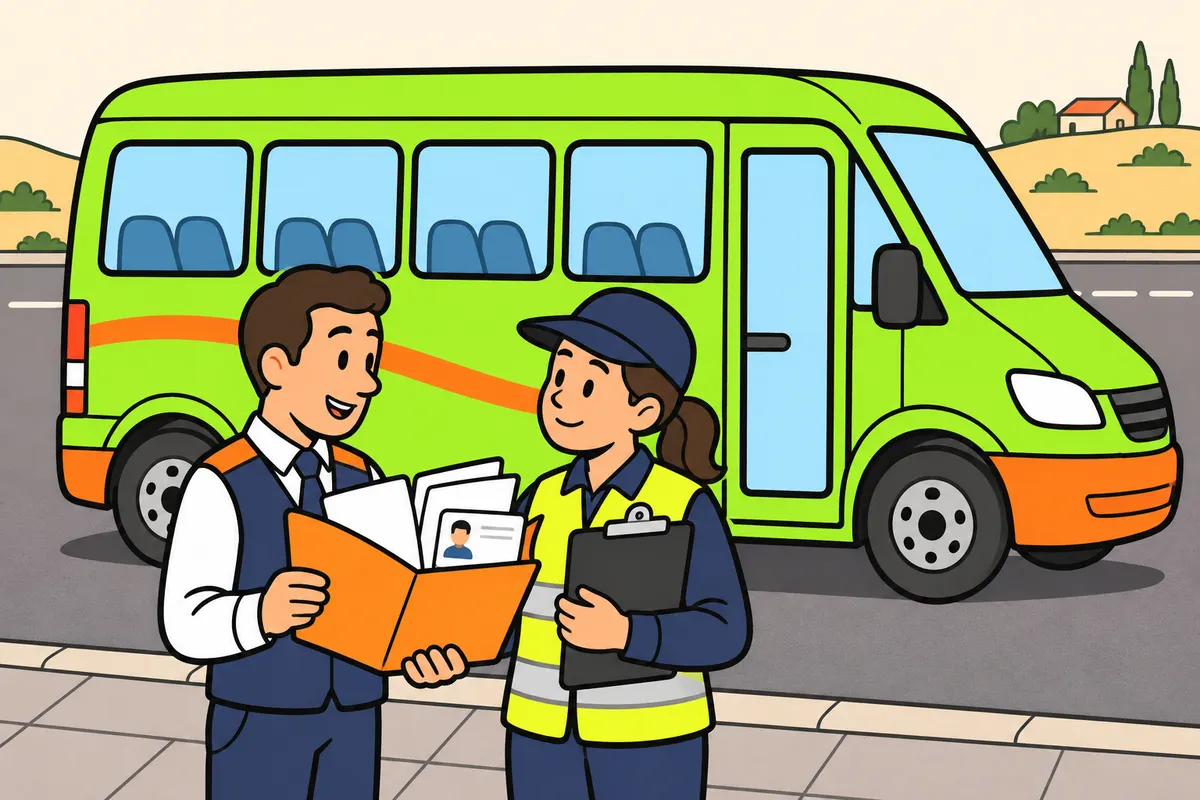
1Four separate document checks
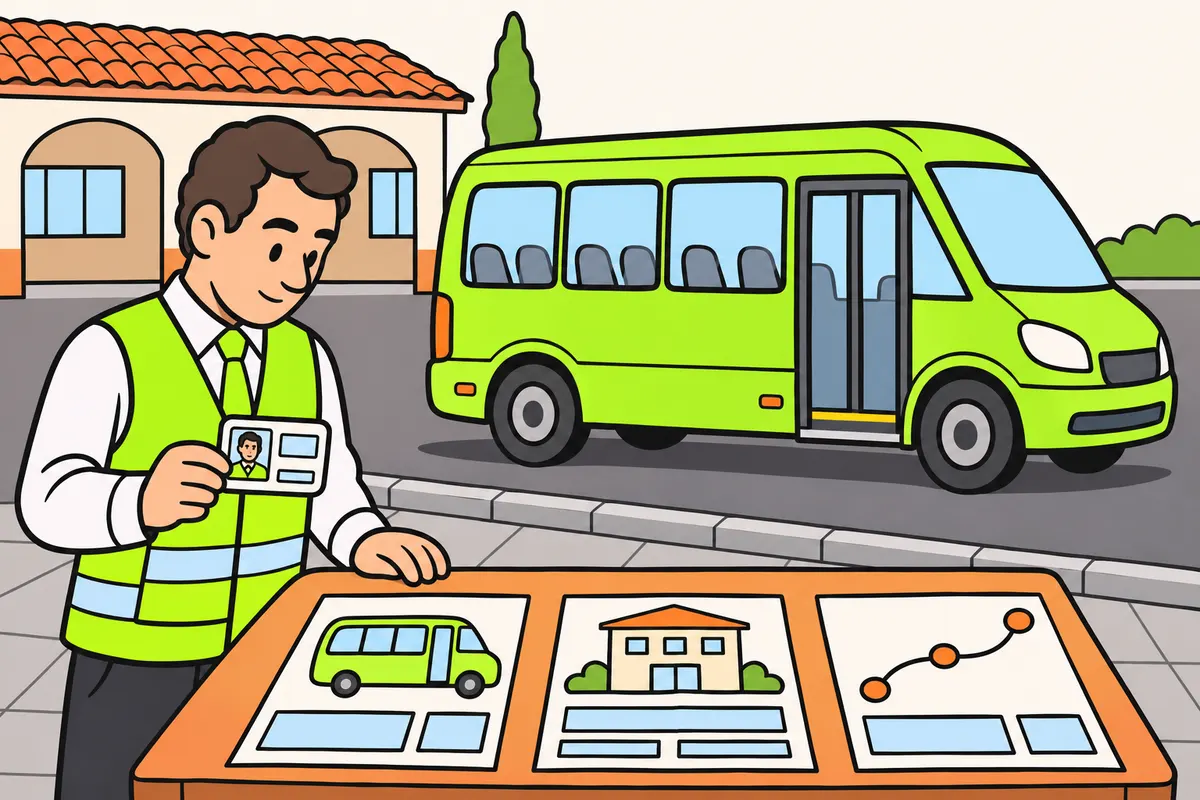
Before your service, check documents for yourself, the minibus, the company and the journey.
| Document | What you check |
|---|---|
| D1 licence | Your entitlement to drive |
| Vehicle registration certificate | Which minibus you drive |
| Transport authorisation | The company’s entitlement to operate |
| Journey documents | Which service you provide |
Remember
- Carry your valid licence and the required vehicle documents.
- Show them when officers ask.
- Use accepted paper or digital documents.
- A saved photograph is not automatically a valid digital document.
Exam trap: Wrong: your D1 licence authorises any transport service. Right: also check company authorisation and service documents.
Read the full explanation
- Before providing a service, you must check your authorisation as a driver, the minibus documentation, the company's authorisation and the journey documents. Each check answers a different question: who is driving, which vehicle is on the road, who is authorised to transport passengers and which service is being provided. [LOTT, art. 33](https://www.boe.es/buscar/act.php?id=BOE-A-1987-17803).
- You must carry your valid driving licence and the required vehicle documents and show them to officers who request them. You can provide proof using accepted physical or digital formats; a photograph you save yourself does not automatically count as a verifiable electronic document. [Traffic Act, art. 59](https://www.boe.es/buscar/act.php?id=BOE-A-2015-11722).
- Your D1 licence authorises you to drive; the permiso de circulación (vehicle registration certificate) identifies the minibus, and the transport authorisation authorises the business activity. [RGV, art. 26](https://www.boe.es/buscar/act.php?id=BOE-A-1999-1826); [LOTT, arts. 42 and 99](https://www.boe.es/buscar/act.php?id=BOE-A-1987-17803).
- With your D1 licence, you can drive vehicles designed for a maximum of sixteen passengers in addition to you and a maximum length of eight metres. You study the age requirements and licence conditions in «Passenger transport driving licences and categories». [RGCond, art. 4.2](https://www.boe.es/buscar/act.php?id=BOE-A-2009-9481).
2Permiso de circulación and ITV (vehicle roadworthiness test) card
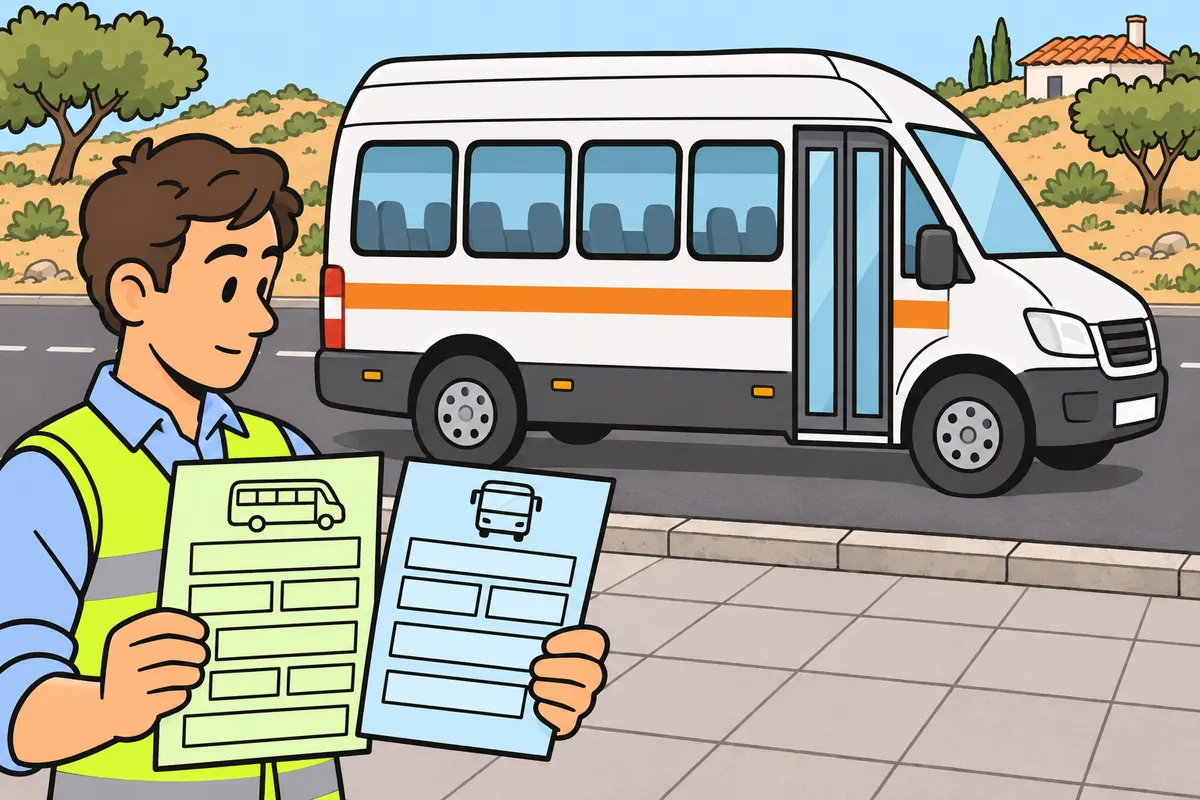
Check that the documents match your minibus and its approved features.
| Minibus document | What you check |
|---|---|
| Vehicle registration certificate | Vehicle identity and registered owner |
| ITV card | Technical features and recorded entries |
Remember
- Check the registration number and vehicle identification number.
- Follow the seating capacity and features approved in the technical data sheet.
- Within Spain, you can use the official documents available in miDGT.
- For international journeys, prepare the required paper documents.
- With a light trailer, carry its ITV card and check the coupling is compatible.
- Your light trailer displays the minibus’s rear registration number; no periodic ITV is required.
Exam trap: Wrong: you can add seats if they fit. Right: follow the approved interior layout.
Read the full explanation
- You must have the minibus's permiso de circulación and its technical inspection card. The registration certificate identifies the vehicle and its registered ownership; the ITV card certifies its technical characteristics and records the relevant entries. [RGV, art. 26 and Annex XIII](https://www.boe.es/buscar/act.php?id=BOE-A-1999-1826).
- Check that the registration number and chassis number match the minibus you are to drive. [ITV, art. 8 and Annex I, vehicle identification](https://www.boe.es/buscar/act.php?id=BOE-A-2017-12841).
- Check the technical data sheet for the authorised passenger capacity, masses and other characteristics that affect the service. You must comply with the minibus's approved configuration; a modified interior layout is not authorised simply because more seats physically fit. You study modifications in detail in the «Minibus maintenance and checks» module. [RGV, arts. 7 and 26](https://www.boe.es/buscar/act.php?id=BOE-A-1999-1826).
- Within Spain, you can use the documents available in miDGT with the validity recognised by the DGT. You must distinguish this official access from an unverified image. If you make an international journey, prepare the required physical documents and do not assume that the Spanish app replaces documents before every foreign authority. [DGT, documentation and the miDGT app](https://www.dgt.es/nuestros-servicios/tu-vehiculo/documentacion-de-un-vehiculo/la-documentacion-de-un-vehiculo/index.html).
- If you tow a trailer with an MMA (maximum authorised mass) of 750 kg or less, you must carry its ITV card and check that the minibus's card records a compatible coupling. A light trailer is exempt from periodic ITV inspections and has no registration number of its own: it displays the towing minibus's registration plate at the rear. [RGV, arts. 25, 26 and 49 and Annex XVIII](https://www.boe.es/buscar/act.php?id=BOE-A-1999-1826); [RD 920/2017, art. 6](https://www.boe.es/buscar/act.php?id=BOE-A-2017-12841).
3Documents when presenting the bus for its ITV
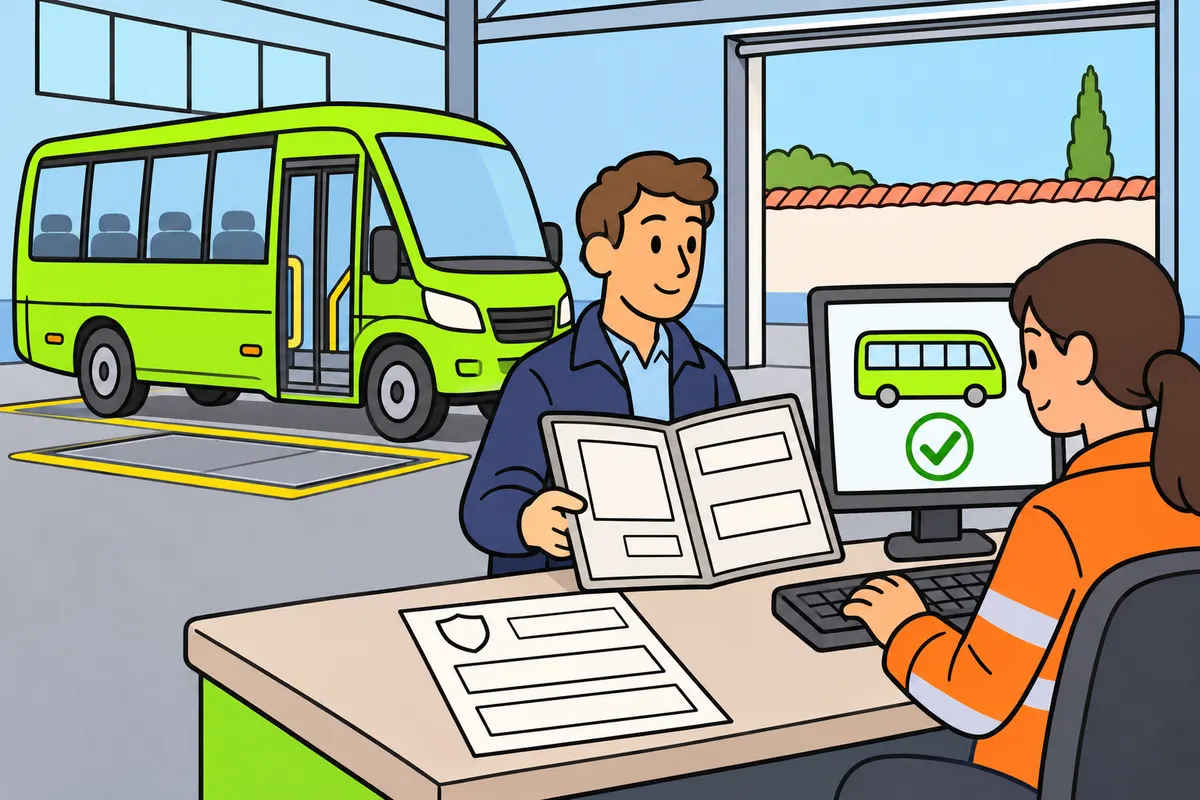
When presenting your minibus for ITV, allow checks of its identity, documents and insurance.
| Minibus ITV card | What you need to know |
|---|---|
| Electronic | You can start without paper if register data allows vehicle identification and checks |
| Not electronic | You must present the original card |
Remember
- Prove compulsory insurance is valid before any technical inspection.
- If the registration certificate is missing, the testing station has accepted alternatives.
- You can provide a certified copy or vehicle record extract; register checks also qualify.
- These alternatives do not remove your duty to carry required documents while driving.
Exam trap: Wrong: you never need the original card. Right: present it if your minibus has no electronic ITV card.
Read the full explanation
- When presenting the minibus for inspection, you must allow it to be identified and its documentation to be checked. If you do not provide the permiso de circulación, the DGT guideline provides for a verified copy, a vehicle history extract and a register lookup. Do not confuse this procedure at the inspection centre with a general exemption from carrying documentation when driving. [Guideline, criteria for presenting vehicles for inspection](https://www.dgt.es/export/sites/web-DGT/.galleries/downloads/muevete-con-seguridad/normas-de-trafico/VEH-vehiculos/report_Directriz-VEH-2024-13_V-II.pdf).
- If the minibus has an electronic ITV card, the inspection centre can consult the necessary data in the DGT register. The absence of a paper copy must not, on its own, prevent the inspection from starting when this electronic information is available to identify and check the vehicle. [Guideline, criteria for electronic ITV cards](https://www.dgt.es/export/sites/web-DGT/.galleries/downloads/muevete-con-seguridad/normas-de-trafico/VEH-vehiculos/report_Directriz-VEH-2024-13_V-II.pdf).
- If the minibus does not have an electronic ITV card, you must present the original ITV card. This allows approved modifications and entries that may not be computerised to be checked. Do not apply to paper documents a solution intended for vehicles whose technical data are available electronically. [Guideline, criteria for paper ITV cards](https://www.dgt.es/export/sites/web-DGT/.galleries/downloads/muevete-con-seguridad/normas-de-trafico/VEH-vehiculos/report_Directriz-VEH-2024-13_V-II.pdf).
- You must provide proof of compulsory insurance before any technical inspection. The inspection centre can check this through the prescribed procedure; if it needs documentation, valid proof of insurance establishes that the cover is in force. [ITV, art. 8.3](https://www.boe.es/buscar/act.php?id=BOE-A-2017-12841).
4Bus ITV inspection intervals
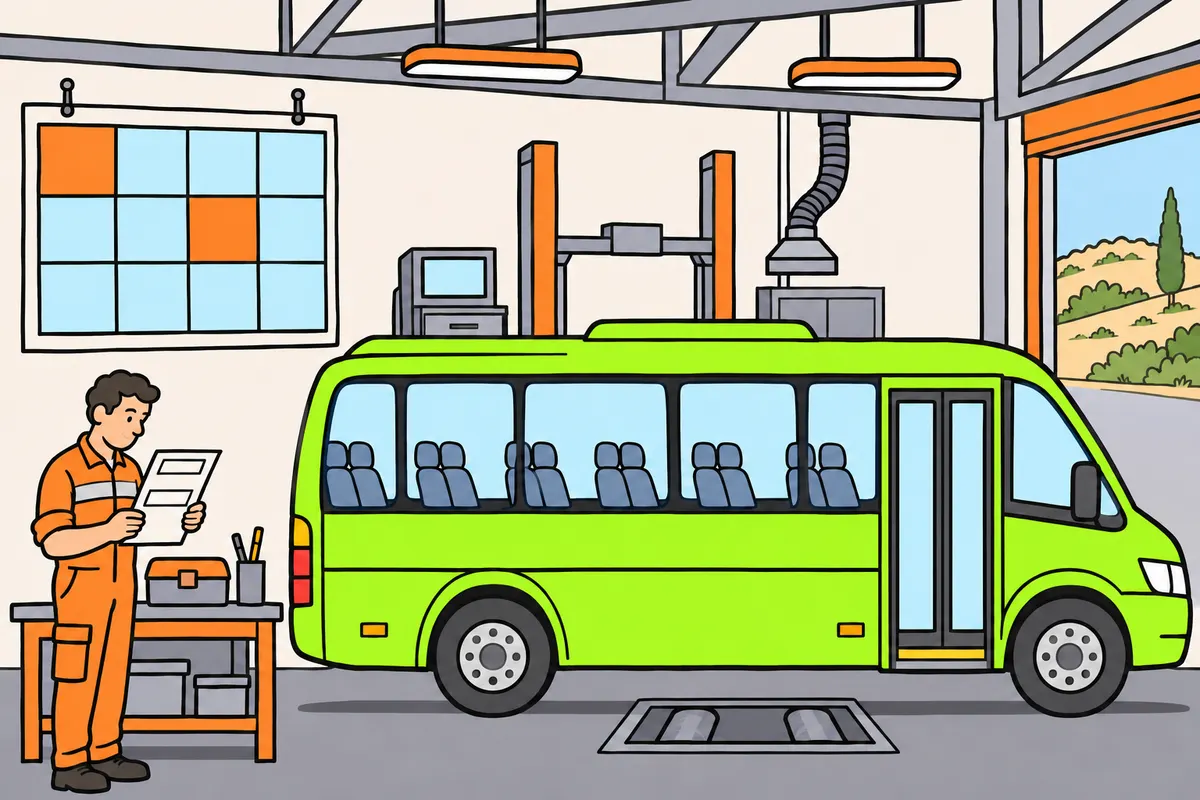
Check your minibus’s age to find out when you need an ITV.
| Age of your M2 or M3 minibus | ITV interval |
|---|---|
| Up to five years | Every year |
| Over five years | Every six months |
Remember
- Check the category and expiry date in your documents.
- Count from the recorded first registration or entry into service.
- Buying your minibus used does not restart its age.
Exam trap: Wrong: its age starts again when you buy it used. Right: keep its recorded age.
Read the full explanation
- Your category M2 or M3 minibus must undergo an ITV inspection every year up to five years of age and every six months when it is more than five years old. You must check its category and inspection expiry date in its documentation. [RD 920/2017, art. 6.1](https://www.boe.es/buscar/act.php?id=BOE-A-2017-12841).
- You calculate its age from the first registration or entry into service recorded in the register, under the rules in article 6. A change of ownership does not restart this calculation. If you buy a used minibus that is six years old, it keeps its six-monthly inspection interval even if you have only been using it in your company for a few days. [ITV, art. 6](https://www.boe.es/buscar/act.php?id=BOE-A-2017-12841).
5Expiry and additional inspections
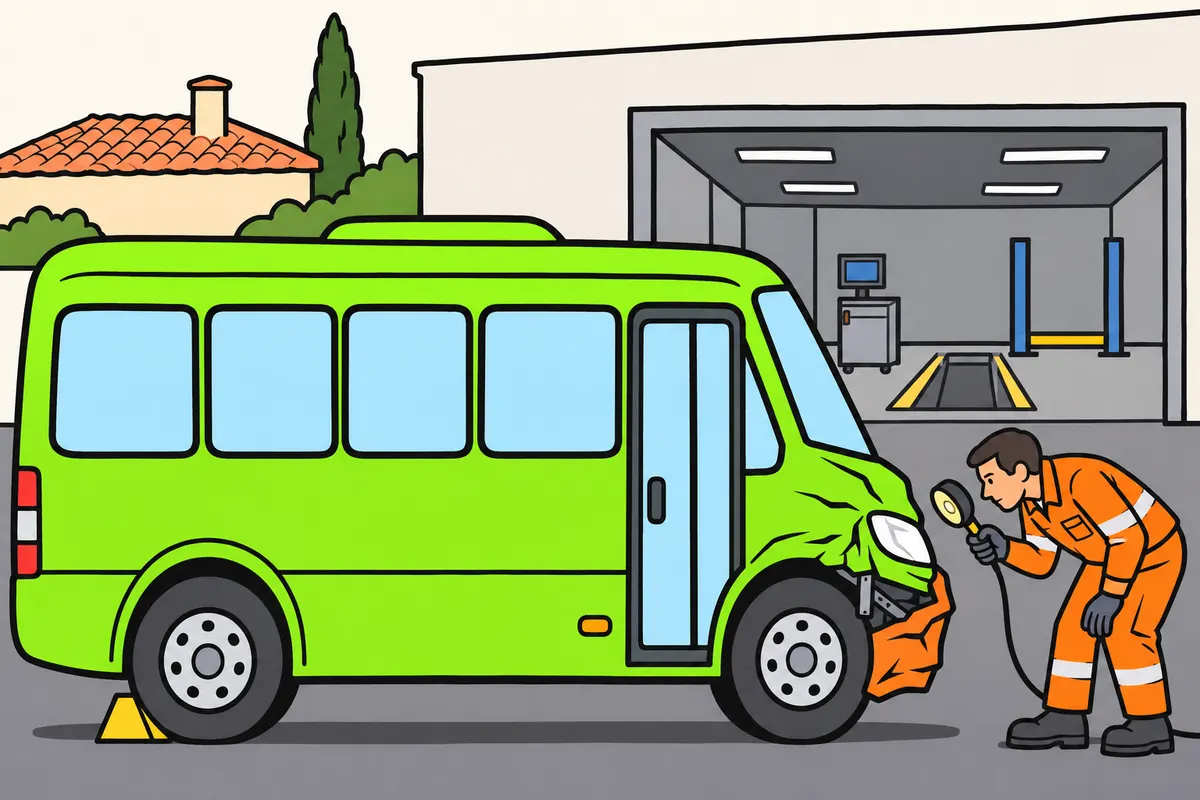
Check your ITV expiry date and situations requiring an additional inspection.
Remember
- Normally, calculate the next validity period from the favourable result.
- Within the stated early-inspection period, calculate from the previous expiry date.
- After serious safety or structural damage, comply with any required additional inspection.
- Changes to safety or environmental protection systems may require another inspection.
- Well-founded suspicions of road danger may also require an inspection.
- A non-compliance notice neither renews an expired ITV nor prevents an offence report.
Exam trap: Wrong: the notice lets you continue your service with an expired ITV. Right: it does not itself authorise you to continue.
Read the full explanation
- You calculate the next expiry date by adding the applicable inspection interval to the date of the favourable result. If you undergo the inspection within the thirty calendar days before expiry, you add the interval to the previous expiry date. [ITV, art. 6.5](https://www.boe.es/buscar/act.php?id=BOE-A-2017-12841).
- You must present the minibus for an additional inspection when it has suffered significant damage to safety components or its structure in the circumstances specified by the regulations. A periodic ITV inspection that is still valid is not enough to return to service after damage of this kind. Comply with the requirement and arrange the necessary repairs and inspection. [ITV, art. 6.7](https://www.boe.es/buscar/act.php?id=BOE-A-2017-12841).
- You may have to undergo an inspection before the expiry date because of modifications to safety or environmental protection systems, or because of reasonable grounds to suspect that the vehicle endangers road safety. [ITV, art. 6.7](https://www.boe.es/buscar/act.php?id=BOE-A-2017-12841).
- If officers detect a failure to comply with the inspection requirement, article 6.9 provides for a notice requiring you to submit the vehicle for an ITV inspection within ten days, without prejudice to an offence report. This notice does not make an expired ITV valid or, by itself, authorise you to continue providing the service. [ITV, art. 6.9](https://www.boe.es/buscar/act.php?id=BOE-A-2017-12841).
6Inspection report and sticker
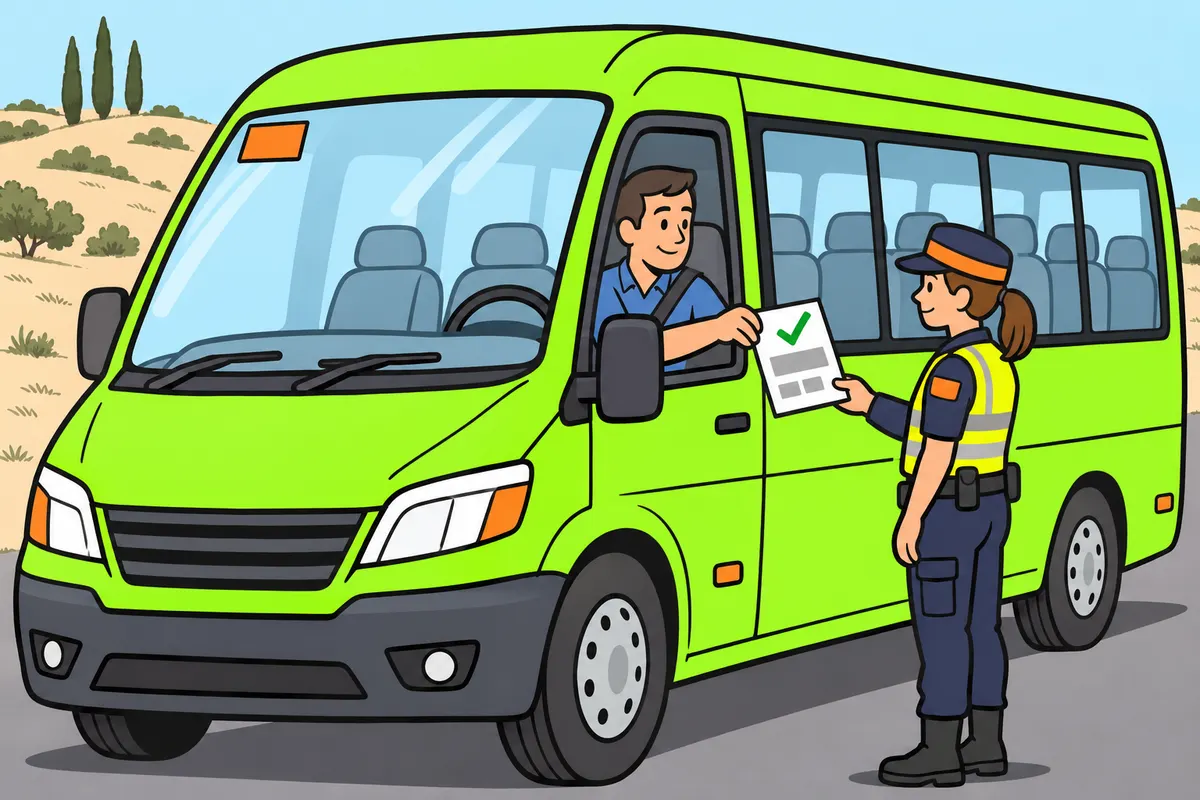
Keep your ITV report and put the sticker in the required place.
Remember
- Keep the latest report, even after a favourable ITV with no defects.
- Have it available for officers.
- Put the sticker inside, at the top right of your windscreen.
- The sticker shows you passed the periodic inspection and gives the next expiry.
- For technical checks, keep available inspection reports or prescribed electronic proof on board.
Exam trap: Wrong: the sticker means you can discard the report. Right: it replaces neither the report nor the technical card.
Read the full explanation
- You must keep the report from the latest ITV inspection and have it available for officers, including when the result is favourable and no defects are found. The report identifies the result and any deficiencies observed. The technical card, report and sticker serve related purposes, but they are not interchangeable documents. [ITV, art. 10](https://www.boe.es/buscar/act.php?id=BOE-A-2017-12841).
- After passing the periodic inspection, you must display the corresponding sticker on the minibus. You place it on the inside of the windscreen in the top right-hand corner. The clearly visible position specified for vehicles without a windscreen does not allow you to choose another window freely on a minibus that has one. [RGV, Annex XI, periodic technical inspection sticker](https://www.boe.es/buscar/act.php?id=BOE-A-1999-1826).
- The sticker shows that the vehicle has passed its periodic inspection and when the next one is due. It does not replace the report or insurance, nor does it prove that you hold a transport authorisation. [RGV, art. 26 and Annex XI](https://www.boe.es/buscar/act.php?id=BOE-A-1999-1826).
- For a technical roadside inspection, you must keep the latest periodic inspection certificate and roadside inspection report on board, if available, or the prescribed electronic evidence. [Roadside inspections, art. 8.1](https://www.boe.es/buscar/act.php?id=BOE-A-2017-6512).
7ITV (vehicle roadworthiness test): pass, fail and negative results
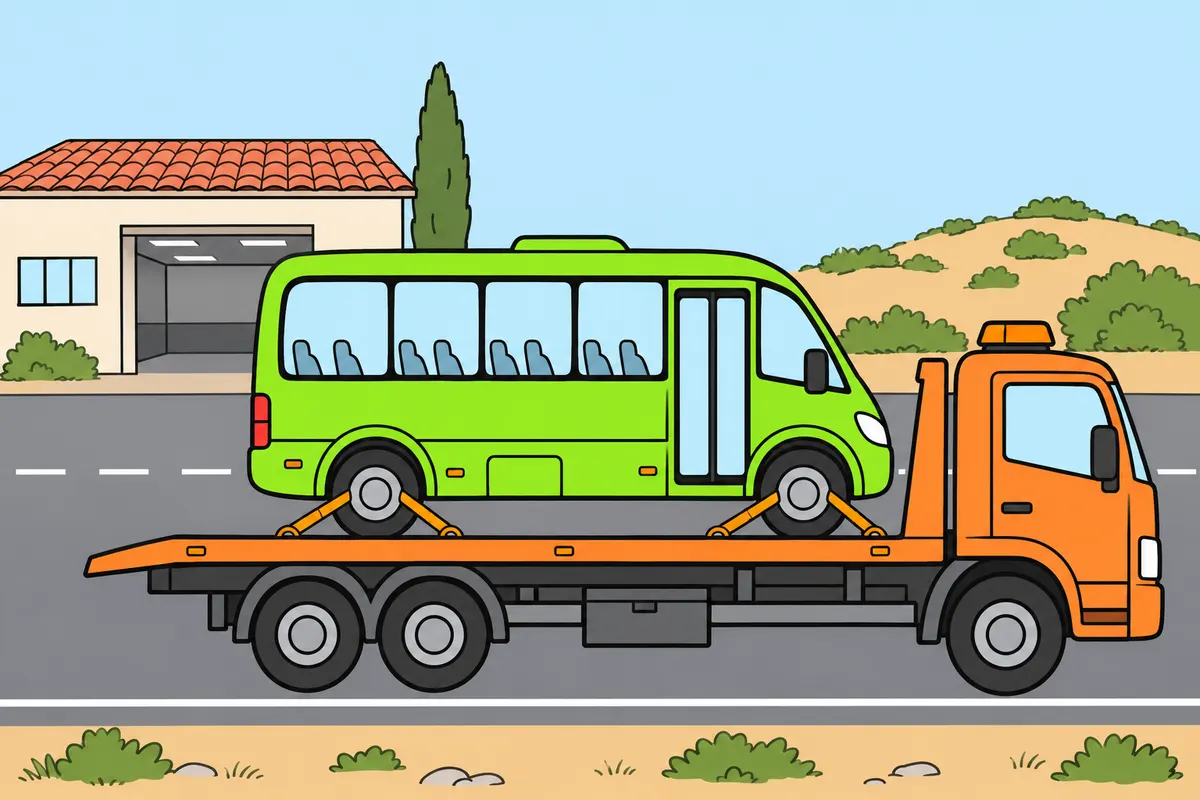
Your ITV result determines whether you can drive and how you must arrange repairs.
| Minibus result | Defects | What you can do |
|---|---|---|
| Favourable | None or minor | You can drive |
| Unfavourable | Serious | Only prescribed journeys for workshop repairs, regularising status and return to ITV |
| Negative | Very serious | Move your minibus by other means; do not drive it |
Remember
- Repair minor defects within the maximum period.
- Minor defects alone need no return, unless your result is unfavourable or negative.
- After an unfavourable result, meet your deadline for repairs and another inspection.
- Count the deadline from the first unfavourable or negative inspection.
- After a negative result, return for inspection once repairs are complete.
Exam trap: Wrong: you can provide services while repairing an unfavourable ITV. Right: the repair period does not allow you to continue services.
Read the full explanation
- If the inspection finds no defects or only minor defects, the result is a pass. You must repair minor defects within a maximum of two months; they do not require another inspection on their own, unless you have to return following a fail or negative result. [RD 920/2017, arts. 9 and 11.1](https://www.boe.es/buscar/act.php?id=BOE-A-2017-12841).
- If any serious defect is found, the result is a fail. The minibus is barred from normal road use: only the prescribed journeys to a workshop or to regularise its status and return to an ITV (vehicle roadworthiness test) station are permitted. You cannot continue an excursion or regular service by relying on the time allowed for repairs. [ITV, arts. 9 and 11.2](https://www.boe.es/buscar/act.php?id=BOE-A-2017-12841).
- You must rectify serious defects and present the minibus for another inspection within the time allowed, which cannot exceed two months from the first failed inspection. [RD 920/2017, art. 11.2](https://www.boe.es/buscar/act.php?id=BOE-A-2017-12841).
- With very serious defects, the result is negative and you must transport the minibus by means other than the vehicle itself. After rectifying them, you must present it for another inspection within a maximum of two months from the first negative inspection. [RD 920/2017, arts. 9 and 11.3](https://www.boe.es/buscar/act.php?id=BOE-A-2017-12841).
8The company’s transport authorisation
Check that your company and minibus are authorised for the service you provide.
| Service | What you check |
|---|---|
| General-use regular | Management contract and service conditions |
| Special regular | The corresponding authorisation |
Remember
- For public transport, check the required authorisation unless a legal exemption applies.
- Check that your minibus is linked to that authorisation.
- Check national authorisations in the Register of Transport Companies and Activities.
- Carry the required journey documents on board.
Exam trap: Wrong: an occasional transport authorisation lets you create a regular route. Right: each service must meet its own rules.
Read the full explanation
- To provide public passenger transport by minibus, your company needs the required transport authorisation, unless a legal exemption applies. You must check the activity actually carried out; having a registered, insured minibus with an ITV pass does not replace this business authorisation. Your D1 licence authorises you to drive, not to operate any service you choose. [LOTT, art. 42](https://www.boe.es/buscar/act.php?id=BOE-A-1987-17803).
- You must check that the minibus you use is linked to the authorisation as required by the regulations. Another company’s authorisation or another vehicle’s documents do not, on their own, justify this transport operation. The assigned vehicles and the holder of the authorisation must match the actual circumstances of the service. [ROTT, arts. 38.1 and 44](https://boe.es/buscar/act.php?id=BOE-A-1990-24442).
- National authorisations and their details are checked through their entry in the Registro de Empresas y Actividades de Transporte (Register of Transport Companies and Activities). You must carry the required journey documents on board. [ROTT, arts. 47–49](https://boe.es/buscar/act.php?id=BOE-A-1990-24442).
- A general-use regular service operates under its management contract and the conditions governing it; a special-use regular service requires the corresponding authorisation. Holding an occasional transport authorisation does not allow you to set up a regular route yourself or change the transport links served by a public service. [LOTT, arts. 71 and 89](https://www.boe.es/buscar/act.php?id=BOE-A-1987-17803).
9Ancillary private transport and school transport
Check the conditions and authorisations for your ancillary private or school transport service.
| Case | What you check |
|---|---|
| Ancillary private transport by minibus | Required authorisation, unless exempt, and conditions of the activity |
| Special regular school service | Service authorisation and vehicle requirements |
Remember
- A free journey is not automatically exempt from authorisation.
- For ancillary private transport, check that all legal conditions are met together.
- Show how passengers are connected to the company’s main activity.
- For school transport, organiser checks do not remove the operator’s duties.
Exam trap: Wrong: your driving licence replaces special regular school service authorisation. Right: also check the service authorisation.
Read the full explanation
- If a company whose main activity is not transport carries its employees or customers as an adjunct to that activity, you must check the rules for ancillary private transport. A journey being free of charge is not enough to make it exempt from authorisation. All the conditions laid down by law must be met together. [LOTT, arts. 102 and 103](https://www.boe.es/buscar/act.php?id=BOE-A-1987-17803).
- For ancillary private passenger transport by minibus, you need the required authorisation unless an exception applies. You must be able to substantiate the passengers’ connection with the activity and the other transport conditions. Organising journeys for its staff does not in itself make a company a public passenger transport operator. [ROTT, arts. 155 and 157](https://boe.es/buscar/act.php?id=BOE-A-1990-24442).
- If you provide a special-use regular school transport service, check that the service is covered by its authorisation and that the vehicle meets the corresponding requirements. Your driving licence does not replace the service authorisations. The organisation of stops, escorts and journey conditions is covered in «Transporting passengers and minors». [LOTT, art. 89](https://www.boe.es/buscar/act.php?id=BOE-A-1987-17803).
- The organisation contracting school transport covered by the cases in article 13 must require the operator to provide evidence of the appropriate authorisation, a valid tarjeta ITV (vehicle roadworthiness inspection card) and the applicable insurance policies. This check by the organiser does not remove the transport company’s obligations or make you personally the policyholder. [School transport, art. 13](https://www.boe.es/buscar/act.php?id=BOE-A-2001-8503).
10When you must carry a journey sheet
For public transport, carry a journey form unless you meet a specific exception.
| Exempt vehicles | When you can apply the exception |
|---|---|
| Vehicles expressly assigned to a general-use regular public service | While making a run of that service |
| Vehicles available in the special regular authorisation holder’s own name | While making a run covered by that authorisation |
Remember
- Link each exception to the vehicle and the specific run.
- Do not automatically extend the exception beyond that run.
- When collaborating with another vehicle, check the exception’s conditions.
- The company keeps journey forms available for inspection.
Exam trap: Wrong: a regular route exempts the whole company. Right: check the vehicle and run that qualify for the exception.
Read the full explanation
- If you provide public passenger transport, you must carry the corresponding hoja de ruta (journey sheet), except in the cases indicated in this section. [Order FOM/1230/2013, art. 1](https://www.boe.es/buscar/act.php?id=BOE-A-2013-7218).
- Vehicles expressly assigned to a general-use regular public service are exempt while making a journey on that service. You must relate the exemption to the vehicle and the specific journey. It does not automatically extend to any occasional service the same company provides outside that route. [Journey sheet, art. 1.1.a](https://www.boe.es/buscar/act.php?id=BOE-A-2013-7218).
- Vehicles available in the authorisation holder’s own name for a special-use regular service are also exempt while making a journey covered by that authorisation. If you operate as a collaborating operator with another vehicle, you must not assume this exemption applies without checking its conditions. Collaboration is expressly included among the service categories to be documented. [Journey sheet, arts. 1.1.b and 2](https://www.boe.es/buscar/act.php?id=BOE-A-2013-7218).
- The company must retain journey sheets for one year from the date of each service and make them available for inspection. [Order FOM/1230/2013, art. 1.2](https://www.boe.es/buscar/act.php?id=BOE-A-2013-7218).
11Details identifying the journey
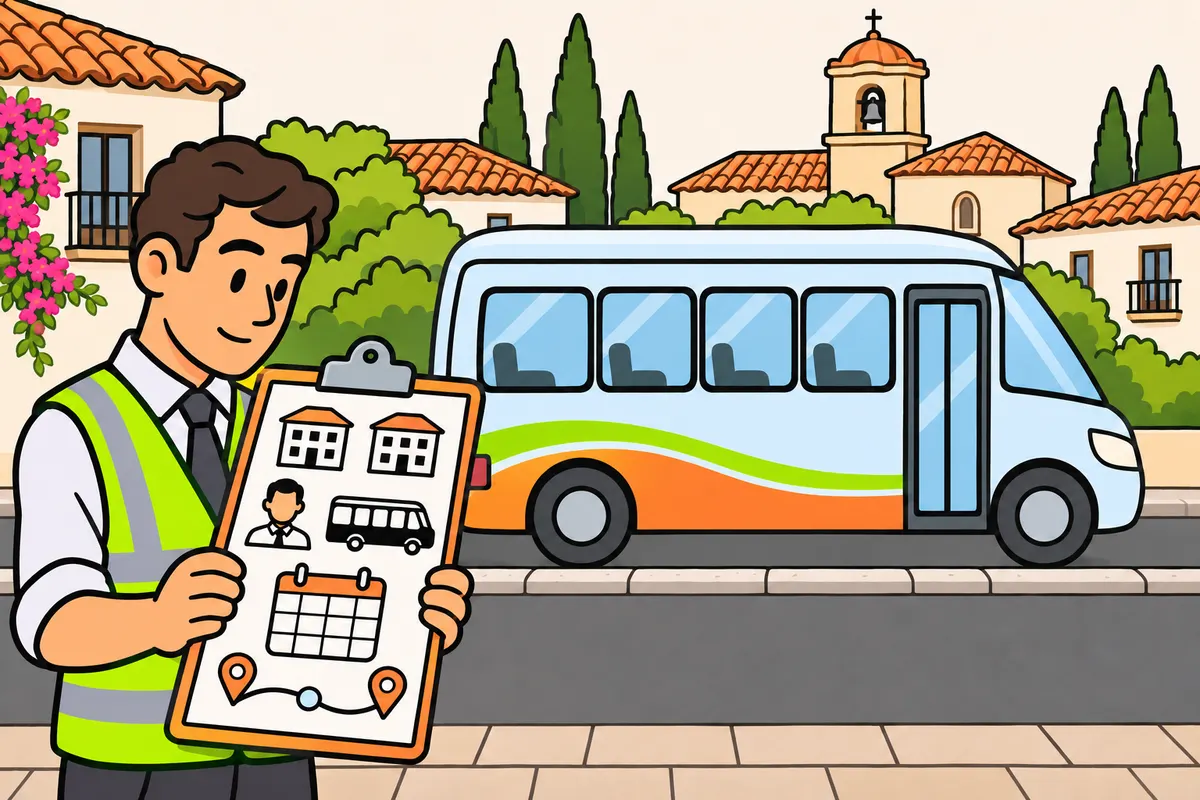
Check that your journey form identifies everyone involved, the journey and the service.
Remember
- Include names and tax identification numbers for the operator and the contracting party.
- Include origin, destination, date and minibus registration number.
- Add your name and tax identification number as the driver.
- For occasional and tourist services, include intermediate stops made.
- State whether the service is occasional, reinforcement, collaboration or tourist.
- For reinforcement or collaboration, also identify the service you support.
Exam trap: Wrong: for reinforcement, calling the service occasional is enough. Right: also identify the service you support.
Read the full explanation
- The journey sheet must show the name and NIF (tax identification number) of the transport company and of the party contracting the service. You must check that the details match the parties actually involved. [Journey sheet, art. 2.1.a and b](https://www.boe.es/buscar/act.php?id=BOE-A-2013-7218).
- The journey sheet must record the origin, destination and date of the service, together with the minibus registration number and your name and NIF as the driver. For occasional and tourist services, it must also record the intermediate stops made. [Journey sheet, art. 2.1.c to e](https://www.boe.es/buscar/act.php?id=BOE-A-2013-7218).
- You must record the nature of the service: occasional, occasional reinforcement of a general-use regular service, occasional collaboration on a special-use regular service, or tourist. For reinforcement or collaboration services, you must identify the service or transport operation being supported. [Journey sheet, art. 2.1.f](https://www.boe.es/buscar/act.php?id=BOE-A-2013-7218).
12Digital journey sheet and on-board copy
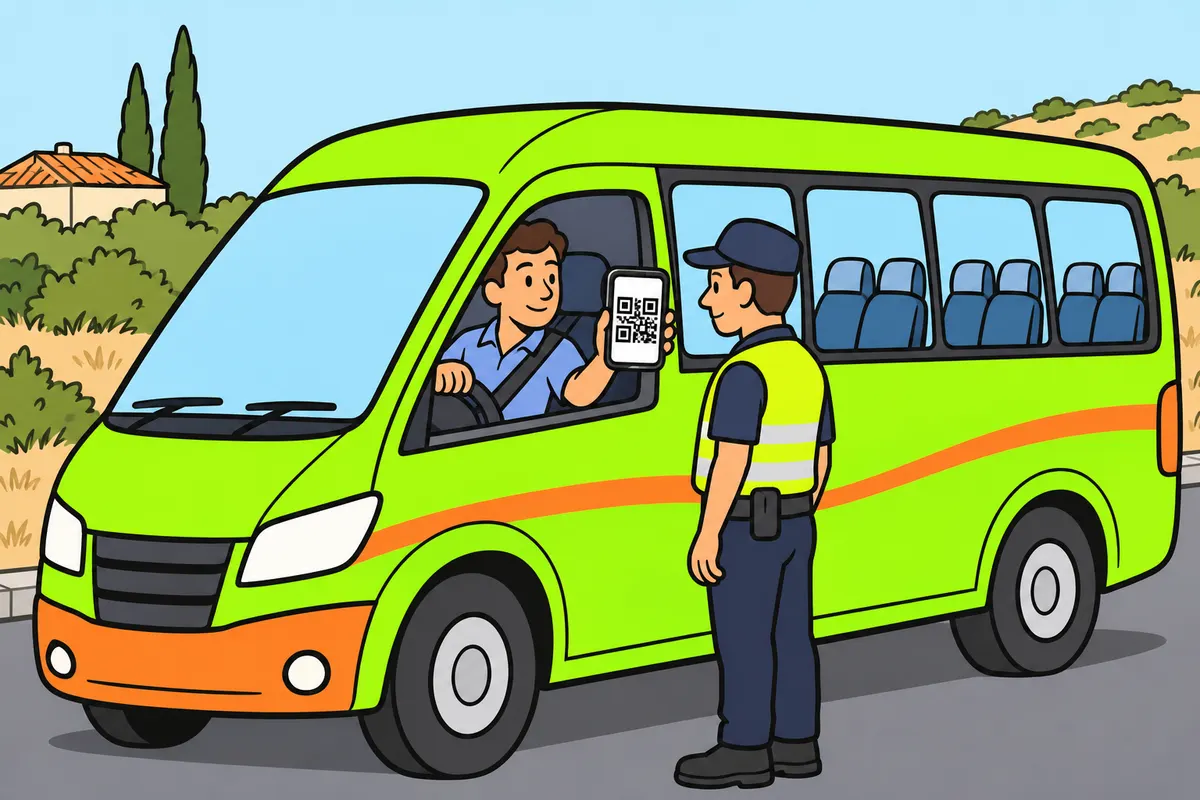
When required, carry a copy of your digital journey form with its QR code.
| Format | What you can generate or carry |
|---|---|
| Original document | A digitally created PDF; no photograph or scan |
| Copy on board | Electronic copy displayable on a mobile, or printed copy; always with QR code |
Remember
- The existing journey-form exceptions still apply.
- Generate the DeCA as a digitally created PDF before starting your service.
- Before departure, receive your electronic or printed copy with its QR code.
- During checks, present the DeCA with QR code, or the QR code itself.
- If the document changes, you must receive the updated or new PDF.
- The company must allow changes to the document to be checked.
Exam trap: Wrong: you record a minibus change only on paper. Right: update the digital document and receive the corresponding PDF.
Read the full explanation
- The required national journey sheet must be digital. You must carry it when your service is subject to this requirement, with the exceptions detailed in «When you must carry a journey sheet». [Act 9/2025, eighth transitional provision.2](https://www.boe.es/buscar/act.php?id=BOE-A-2025-24545).
- The documento electrónico de control administrativo (electronic administrative control document), DeCA, must be generated from the application data before the service actually starts. It must be a digitally native PDF with a maximum size of 5 MB. A scan or photograph of a handwritten sheet does not meet the specified requirements for generating this document. [DeCA, sections one and two](https://www.boe.es/buscar/act.php?id=BOE-A-2026-12784&lang=es&p=&tn=1).
- Before starting the service, you must receive a copy to carry on board, either electronically for display on a mobile device or printed on paper. In both cases it must contain the prescribed QR code. Carrying a printed copy does not conflict with the requirement for the original document to be digital. [DeCA, section seven](https://www.boe.es/buscar/act.php?id=BOE-A-2026-12784&lang=es&p=&tn=1).
- When asked for the document, you must present the DeCA with its QR code or, failing that, the QR code itself, which allows the electronic document to be downloaded from the repository. [Resolution of 5 June 2026, sections three and seven](https://www.boe.es/buscar/act.php?id=BOE-A-2026-12784&lang=es&p=&tn=1).
- If the digital document is modified during the service, the company may update the existing PDF, retaining the previous data and marking it as invalid with the reason for the change, or generate another PDF and retain the original to maintain traceability. It must send you the modified or new PDF. If you change minibuses, use the updated copy you receive from the company so that the registration number in the document matches the vehicle providing the service. [DeCA, section five](https://www.boe.es/buscar/act.php?id=BOE-A-2026-12784).
13Documentation for your passenger service
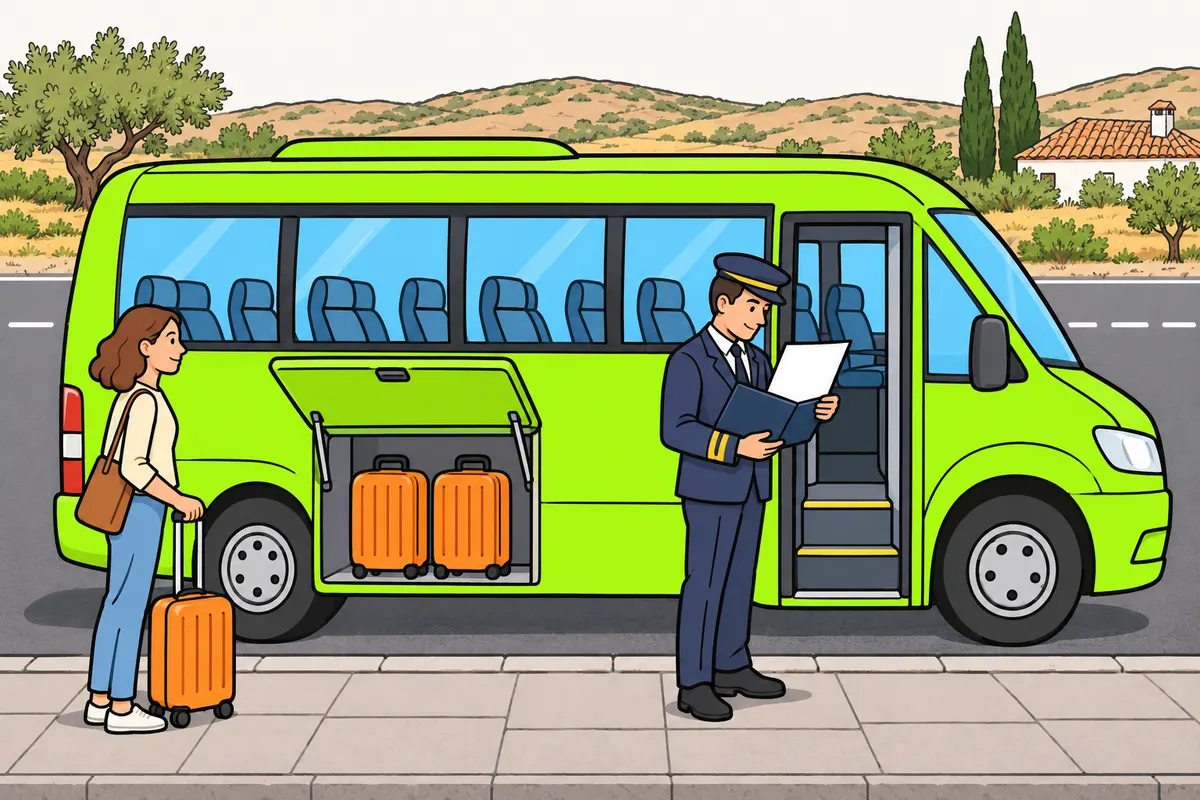
Carry the journey form or specific documents required for your passenger service.
Remember
- Check which documents your service requires.
- Carrying passengers’ luggage does not itself require a goods consignment note.
Exam trap: Wrong: passengers’ suitcases require a goods consignment note. Right: their luggage does not itself require one.
Read the full explanation
- For your passenger service, you must carry the journey form or the specific documentation that applies. Carrying passengers’ luggage does not in itself require a goods consignment note. [Order FOM/1230/2013, arts. 1 and 2](https://www.boe.es/buscar/act.php?id=BOE-A-2013-7218).
14International journeys and the Community licence
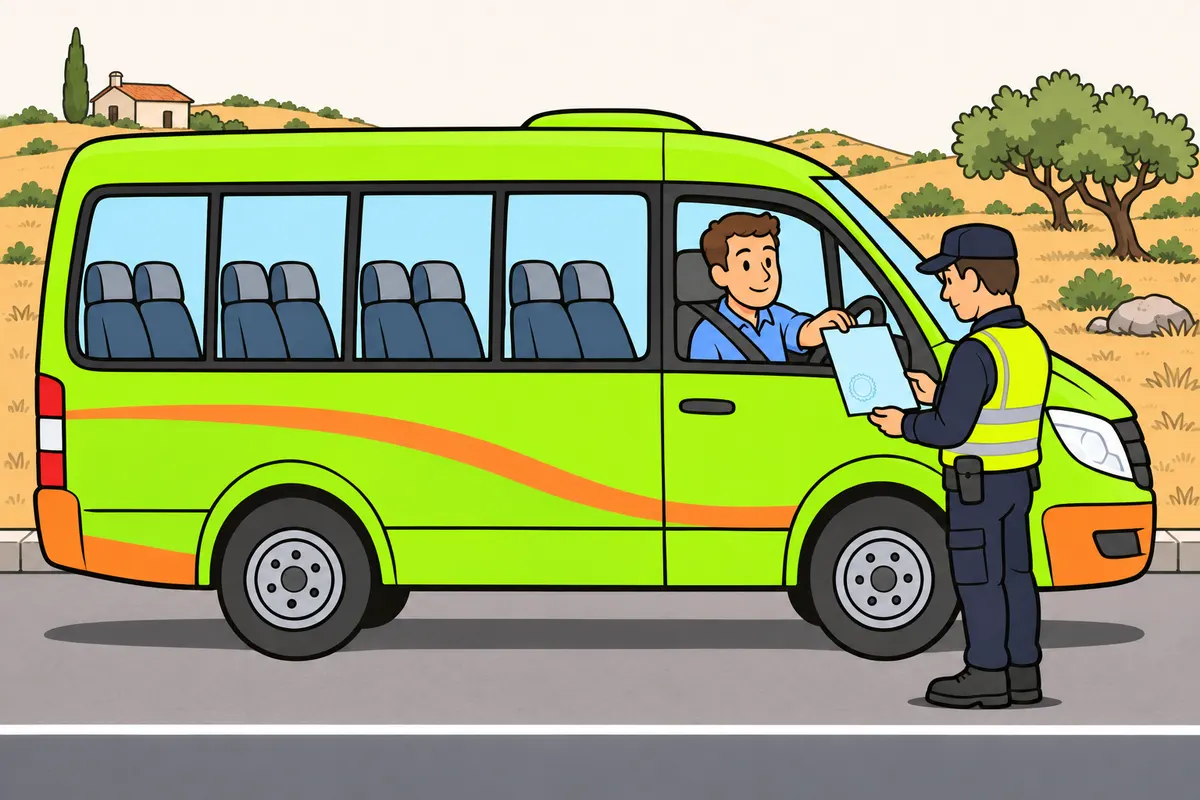
Before travelling abroad, check the authorisation and documents for your specific service.
| International service | What you check |
|---|---|
| Occasional, covered by the regulation | Form completed before departure: service type, main itinerary and operators |
| Regular | Service authorisation; special regular services under contract have specific rules |
| Special regular cabotage | Contract with the organiser or certified true copy as the control document |
Remember
- For international hire-or-reward transport covered by the regulation, check the Community licence.
- The operator keeps the original; you carry a certified true copy on board.
- You cannot use another company’s licence as your own.
- Show the documents when authorised officers ask.
- Do not assume the national digital document replaces international documents.
Exam trap: Wrong: you carry an ordinary photocopy of the Community licence. Right: carry the required certified true copy.
Read the full explanation
- If you carry passengers internationally for hire or reward under Regulation 1073/2009, you must check the Community licence. The carrier keeps the original and each vehicle carries a certified true copy on board. An ordinary photocopy is not equivalent to this certified true copy issued as proof of authorisation for international transport. [EU, art. 4](https://www.boe.es/buscar/doc.php?id=DOUE-L-2009-82159).
- The Community licence is personal and non-transferable; you cannot use another company’s licence as though it automatically covers your service. You must be able to present it to authorised officers who request it. You must distinguish its purpose from that of the national authorisation and the specific documents for the regular or occasional service you operate. [EU, art. 4](https://www.boe.es/buscar/doc.php?id=DOUE-L-2009-82159).
- On an international occasional service subject to the regulation, you must carry the relevant journey form, completed before each journey. It identifies at least the type of service, the main itinerary and the carriers involved. Do not assume that the digital national document automatically replaces international documents governed by specific rules. [EU, art. 12](https://www.boe.es/buscar/doc.php?id=DOUE-L-2009-82159).
- For an international regular service, you must check the service authorisation; special regular services covered by a contract have their own specific rules. For cabotage, article 17 recognises the contract with the organiser or a certified true copy as the control document for a special regular service. The document you must carry depends on the type of service you operate. [EU, arts. 5, 6 and 17](https://www.boe.es/buscar/doc.php?id=DOUE-L-2009-82159).
15The CAP qualification card
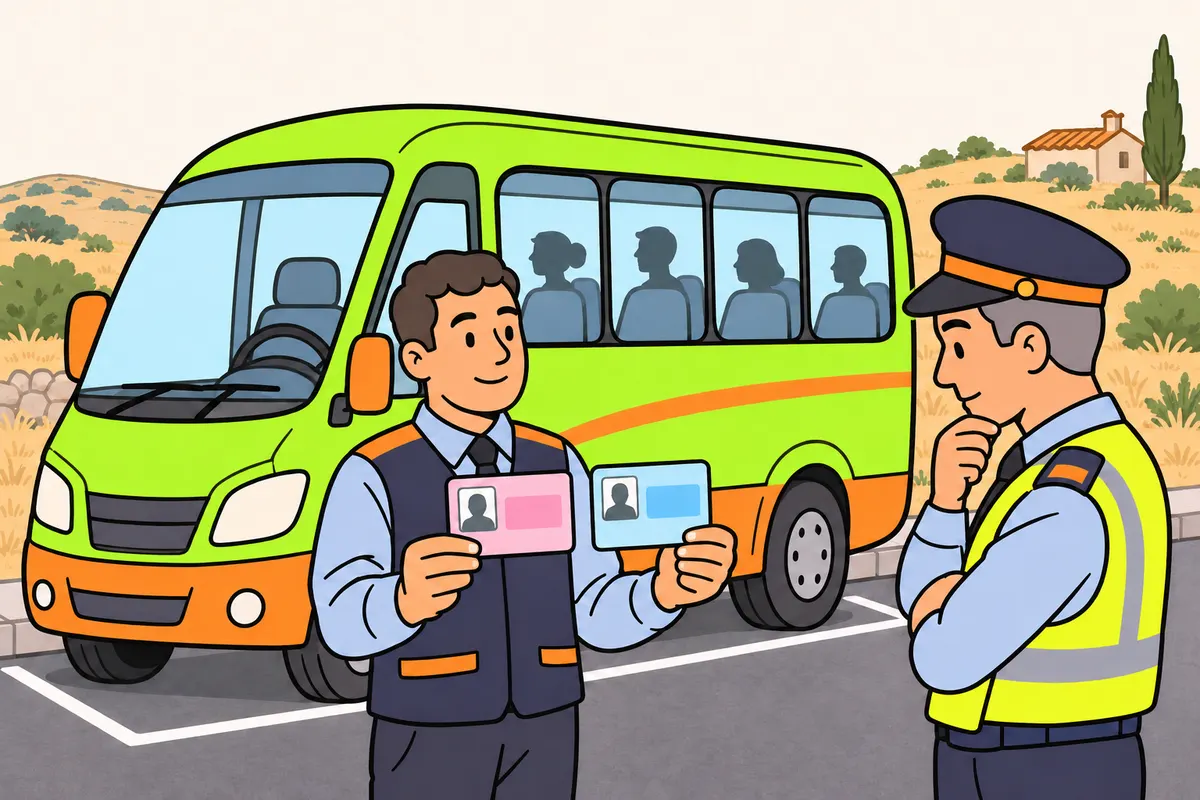
When your transport requires CAP, prove it is valid and carry your valid driving licence.
| CAP proof or exemption | What you check |
|---|---|
| Driving licence | Your current entitlement to drive |
| CAP | Your current professional qualification, when required |
| Exemption: practical lessons and tests for your licence or CAP | You must not carry out transport during these activities |
| Exemption: maintenance journeys | You must be maintenance staff travelling without passengers between the maintenance centre and the company served, in either direction; driving must not be your main activity |
Remember
- When CAP is required, carry your card or accepted proof while driving.
- Check your qualification’s expiry date and category.
- An empty minibus is not automatically exempt; you must meet a specific exemption.
- If you complete training earlier than the stated pre-expiry period, validity starts then.
- In that case, your previous card is withdrawn.
- For passenger transport, do not assume any company certificate proves CAP qualification.
Exam trap: Wrong: valid CAP lets you drive with an expired licence. Right: you also need a valid driving licence.
Read the full explanation
- When your transport operation is subject to CAP (professional driver qualification) requirements, you must carry your professional qualification card or an accepted document proving that your qualification is valid on board while driving. Obtaining a D1 licence and completing the CAP are separate qualifications; you cannot show only your driving licence and consider the required professional qualification covered. [CAP, arts. 1 and 20](https://www.boe.es/buscar/act.php?id=BOE-A-2021-6624).
- You need the CAP for road transport activities covered by the Royal Decree that require D or D1, unless a specific exemption applies. Practical lessons and tests to obtain a driving licence or the CAP are exempt, provided no transport operation takes place during these activities. Journeys without passengers made by maintenance staff between the maintenance centre and the transport company for which they carry out that maintenance, in either direction, are also exempt when driving is not their main activity. Driving an empty minibus does not in itself establish an exemption. [RD 284/2021, arts. 1 and 2.d and f](https://www.boe.es/buscar/act.php?id=BOE-A-2021-6624#a2).
- The qualification card is issued with a validity of five years. You must check the exact date and the relevant qualification category. If you complete periodic training more than twelve months before its expiry, article 20 counts the five years from completion of the course and provides for withdrawal of the previous card. [CAP, art. 20.1](https://www.boe.es/buscar/act.php?id=BOE-A-2021-6624).
- You must complete thirty-five hours of periodic training every five years to maintain your qualification, under the regulatory requirements. The course, the issue of the card and the validity of your driving licence are related but separate matters. A valid CAP card does not entitle you to drive if your driving licence is not valid. [CAP, arts. 7 and 20](https://www.boe.es/buscar/act.php?id=BOE-A-2021-6624).
- If you drive with proof of qualification issued by another Member State, you must recognise the Community-model driving licence bearing harmonised code 95 or the qualification card bearing that code. For drivers from third countries, check the accepted documents and the activity they cover: the driver attestation under Regulation 1072/2009 relates to goods transport. For your passenger service, you must not assume that any certificate issued by a company proves CAP qualification. [CAP, art. 20.3–5](https://www.boe.es/buscar/act.php?id=BOE-A-2021-6624).
16The tachograph driver card
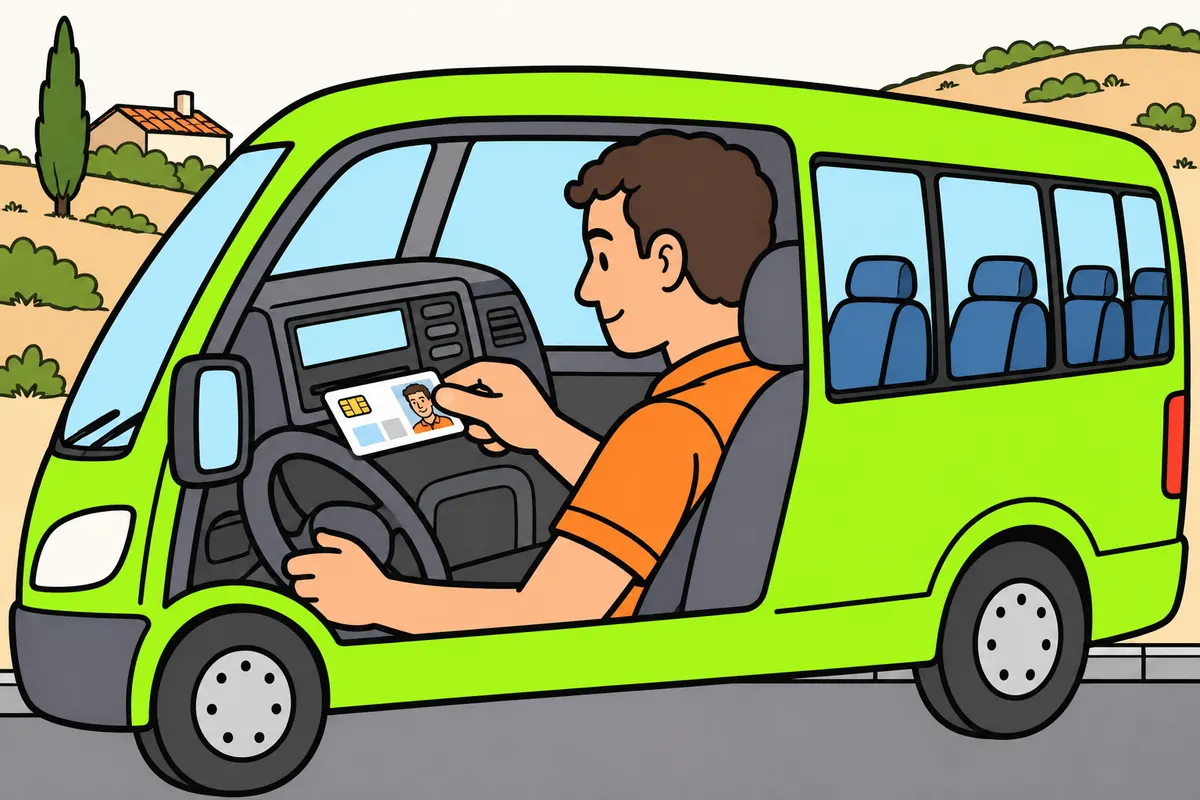
When digital tachograph use is required, use only your own valid driver card.
Remember
- Check your card’s validity before use.
- Do not use an expired or faulty card.
- Apply for renewal to the authority where you normally live.
- Company, workshop and control cards do not replace your personal driver card.
- Keep required records even when changing vehicle or company.
- Your tachograph card and CAP are different documents.
Exam trap: Wrong: you apply the theft or fault exception to an expired card. Right: that exception does not permit driving with an expired card.
Read the full explanation
- If you drive a minibus with a digital tachograph that you are required to use, you must use your personal driver card. You may hold only one valid driver card and may use only your own. Company, workshop and control cards serve other purposes and do not replace your identification as the driver. [Tachograph, arts. 2 and 27](https://www.boe.es/buscar/doc.php?id=DOUE-L-2014-80362&lang=es).
- You must check that your card is valid before using it; you cannot use an expired or faulty card. Its validity period cannot exceed five years. Do not confuse your tachograph card with the CAP, even though both relate to your professional activity and normally have similar validity periods. [Tachograph, arts. 26 and 27](https://www.boe.es/buscar/doc.php?id=DOUE-L-2014-80362&lang=es).
- To renew it, you must apply to the competent authority in your place of normal residence at least fifteen working days before it expires. Renewing in advance avoids starting a service without a valid card. The exceptional procedure for a stolen or faulty card does not provide general permission to drive with an expired one. [Tachograph, arts. 27–29](https://www.boe.es/buscar/doc.php?id=DOUE-L-2014-80362&lang=es).
- If you use several vehicles, you must maintain continuity of your records and carry the required documents for the period subject to checks. Changing company or switching from a minibus with a digital tachograph to one with an analogue tachograph does not erase your previous activity or allow you to leave record sheets or printouts at the office if you must present them during a check. [Tachograph, arts. 34 and 36](https://www.boe.es/buscar/doc.php?id=DOUE-L-2014-80362&lang=es).
17Records you must present: the current day and 56 days
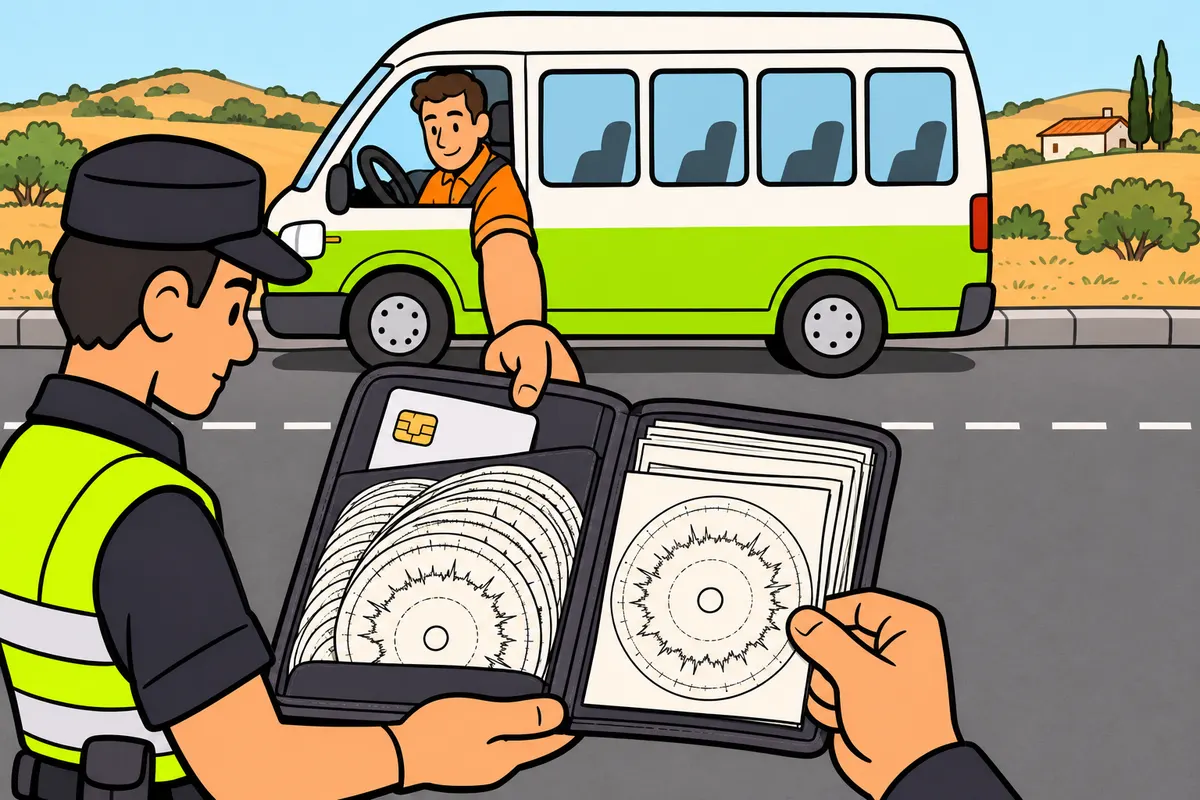
At checks, present the required records for today and the preceding days.
| Tachograph in the vehicle checked | What you present for the required period |
|---|---|
| Analogue | Used charts, manual records, relevant printouts and your driver card if you have one |
| Digital | Your card, required manual records and printouts, and charts from analogue driving days |
Remember
- Add the day of the check to the preceding period.
- Keep records readable and help officers check them.
- A single printout does not replace all required documents.
- This period is separate from company downloading and record-storage deadlines.
Exam trap: Wrong: you include today within the preceding 56 days. Right: add today to those days.
Read the full explanation
- At a check, you must be able to present the applicable documentation for the current day and the previous fifty-six days. The day of the check is in addition to those fifty-six days: it is not included in them. You must distinguish this period for which records must be available at the roadside from the company’s deadlines for downloading or archiving data. [56, art. 2.12, amendment to art. 36 of Regulation 165/2014](https://www.boe.es/buscar/doc.php?id=DOUE-L-2020-81223).
- If you drive a vehicle with an analogue tachograph, you must present the record sheets used during that period, the relevant manual records and printouts, and your driver card if you hold one. The fact that the minibus being inspected has an analogue tachograph does not make a digital card you have used in other vehicles irrelevant. [Tachograph, art. 36.1, as amended by Regulation 2020/1054](https://www.boe.es/buscar/doc.php?id=DOUE-L-2014-80362&lang=es).
- If you drive with a digital tachograph, you must present your card, the required manual records and printouts, and the record sheets for days when you drive with an analogue tachograph. You must keep and produce the records that legally document your activity and rest periods. [Tachograph, art. 36.2, as amended by Regulation 2020/1054](https://www.boe.es/buscar/doc.php?id=DOUE-L-2014-80362&lang=es).
- You must keep your records legible and facilitate their inspection. Officers may analyse displayed, printed or transferred data, as well as the relevant record sheets and documents. [Tachograph, arts. 33 and 36](https://www.boe.es/buscar/doc.php?id=DOUE-L-2014-80362&lang=es).
18Printouts for a lost or faulty card
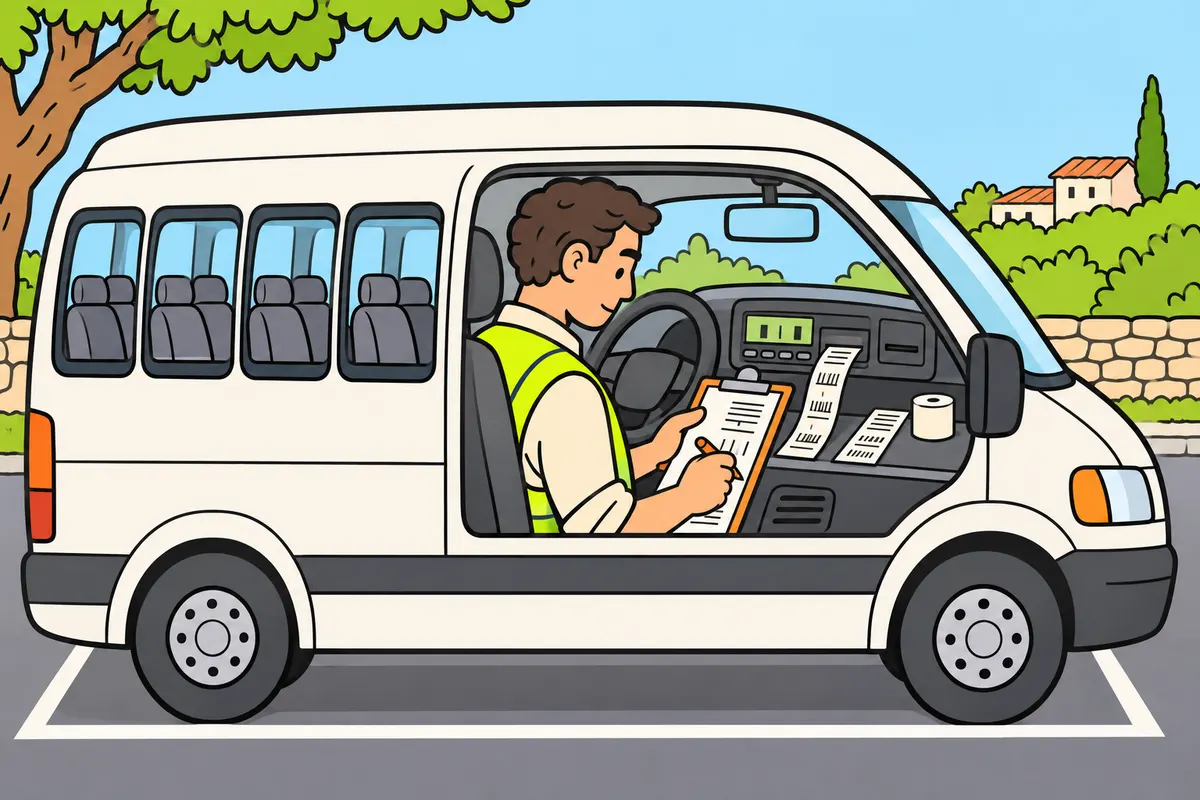
If your card fails or disappears, document the incident and record your activity with printouts.
Remember
- Document damage, faults, loss or theft and apply for a replacement.
- Report theft where it happened; report loss and keep supporting documents.
- Longer only for necessary vehicle return to base, proving you cannot use the card.
- Print at departure and journey end; add identification, signature and required activity periods.
- Keep printouts and record periods that faulty equipment does not record correctly.
- Carry enough paper for your service and allow printing during checks.
Exam trap: Wrong: you drive without your card because you forgot it. Right: the exception covers justified damage, faults, loss or theft, not forgetting it.
Read the full explanation
- If your card is damaged, malfunctions, is lost or is stolen, you must document the incident and apply for a replacement within seven calendar days. You must report theft to the authorities of the State where it occurs and report loss in accordance with the regulation. Keep the supporting documents to explain why you cannot present or use your card. [Tachograph, art. 29](https://www.boe.es/buscar/doc.php?id=DOUE-L-2014-80362&lang=es).
- In these cases, you may continue driving without a card for a maximum of fifteen calendar days, or longer only if this is necessary to return the vehicle to its premises and you can justify why you cannot present or use the card. You must not extend this exception to simply forgetting a valid card. [Tachograph, art. 29.5](https://www.boe.es/buscar/doc.php?id=DOUE-L-2014-80362&lang=es).
- At the start of the journey, you must print out the vehicle data and add your first name and surname, card or driving licence number and signature, as well as the periods that must be entered. At the end, you must print out the recorded periods and add any other work, availability and rest periods that are not recorded, together with your identification and signature. [Tachograph, art. 35.2](https://www.boe.es/buscar/doc.php?id=DOUE-L-2014-80362&lang=es).
- You must carry and keep these printouts as part of the documentation that allows your activity to be reconstructed. If the recording equipment itself breaks down, the regulation requires entries covering periods that are not recorded correctly. You study tachograph operation and repair in «The minibus tachograph»; this section specifies the supporting documents you must present. [Tachograph, arts. 35–37](https://www.boe.es/buscar/doc.php?id=DOUE-L-2014-80362&lang=es).
- Before setting off, you must check that you can produce the required printouts, with enough paper for the duration of the service. Both you and the company must allow data from the digital tachograph to be printed when the inspecting officer requests it. Keeping previous printouts does not replace this ability to print during a check. [Tachograph, art. 33.1](https://www.boe.es/buscar/doc.php?id=DOUE-L-2014-80362&lang=es).
19Justifying exceptions for occasional services
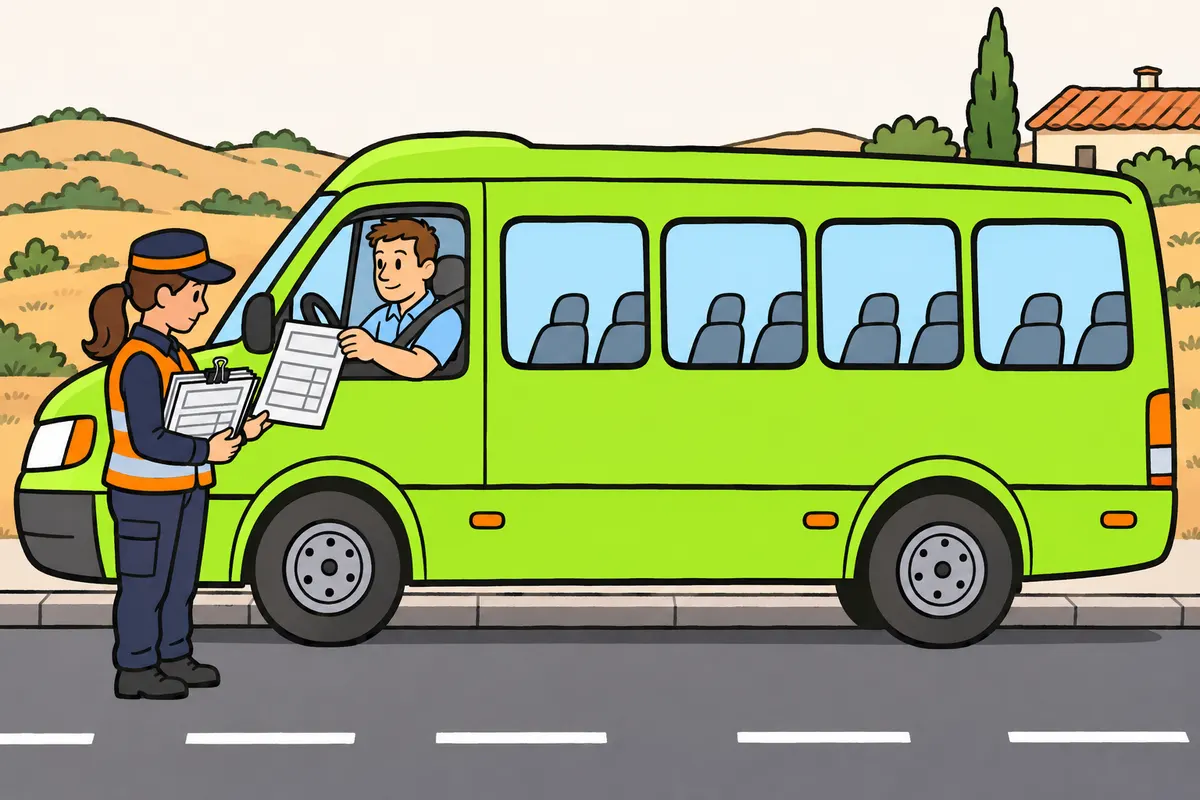
To use break and rest exceptions, show that your service meets their conditions.
Remember
- Saying you carry tourists is not enough.
- The company must give you the documents before your journey.
- While the planned digital form is unavailable, carry the required completed form.
- Also carry previous copies, on paper or electronically, when required.
- The limit on carrying copies requires a tachograph recording service type to technical requirements.
- Do not assume every digital tachograph meets those requirements.
Exam trap: Wrong: carrying the form automatically lets you exceed time limits. Right: meet every condition of the exception you use.
Read the full explanation
- If you use the specific break and rest exceptions for occasional passenger transport, you must be able to prove that the service meets their conditions. Simply stating verbally that you are driving tourists is not enough. Regulation 561/2006 links checks to journey documentation as well as tachograph records. [Flexibility, art. 1.4, insertion of art. 16.4 into Regulation 561/2006](https://www.boe.es/buscar/doc.php?id=DOUE-L-2024-80636).
- Under the documentation requirements of article 16.4, you must carry a completed journey form containing the information required by Regulation 1073/2009 and paper or electronic copies of the forms for the previous fifty-six days. The company must supply the documentation before the journey. This obligation concerns substantiating the use of the specified exceptions. [Flexibility, art. 1.4](https://www.boe.es/buscar/doc.php?id=DOUE-L-2024-80636).
- You must take account of the provision’s express conditions: it regulates substantiation while the planned digital journey form is unavailable and limits the obligation to carry copies when the vehicle has a tachograph that records the type of service in accordance with the specified technical developments. You must not automatically treat every digital tachograph as meeting this condition. [Flexibility, art. 1.4, inserted art. 16.4 and 5](https://www.boe.es/buscar/doc.php?id=DOUE-L-2024-80636).
- Even if you carry a journey form, you must still meet the substantive conditions of the exception you invoke. The document provides evidence of the service, but does not itself authorise you to exceed time limits. Calculations for breaks, daily rest and postponing weekly rest are covered in the «Driving and rest times» module. [Flexibility, art. 1](https://www.boe.es/buscar/doc.php?id=DOUE-L-2024-80636).
20Compulsory bus insurance
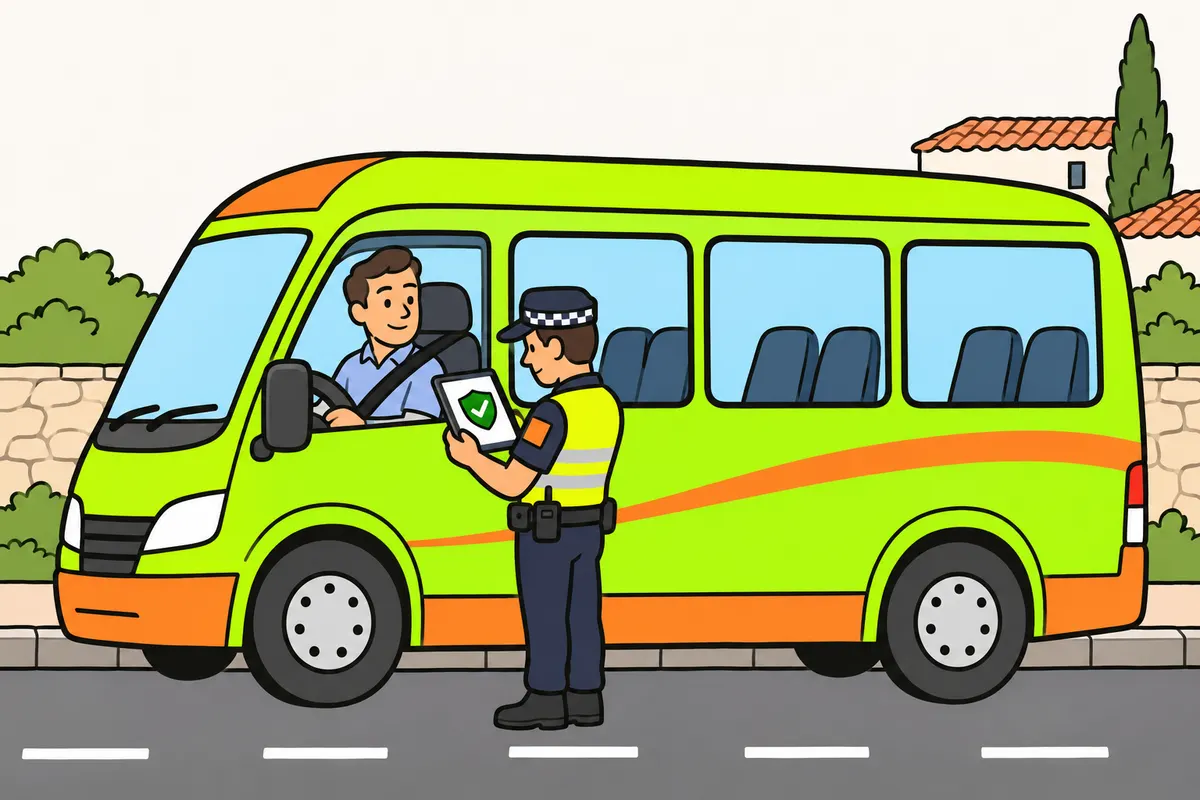
Before departure, check that this particular minibus has valid compulsory insurance.
Remember
- The owner must maintain compulsory civil liability insurance.
- Insurance for another company minibus does not cover this vehicle.
- Officers check insurance in the insured vehicle database.
- If they cannot confirm cover there, provide the required proof of premium payment.
- Without compulsory insurance, you cannot drive on the road.
- To lift impoundment or sealing, prove insurance and meet the financial requirements.
Exam trap: Wrong: you must always hand over a paper receipt. Right: officers first check validity through the prescribed database.
Read the full explanation
- The owner must maintain the minibus’s compulsory civil liability insurance in accordance with the law. You must check that the vehicle you take out is insured; it is not enough for the company to have insured another minibus in its fleet. This insurance covers liability for damage arising from road use within its statutory scope. [Insurance, arts. 1 and 2](https://www.boe.es/buscar/act.php?id=BOE-A-2004-18911).
- Officers check whether the insurance is valid through the Fichero Informativo de Vehículos Asegurados (insured vehicle information register). If they cannot confirm it by this means, article 14 provides for proof through the receipt for payment of the current premium, containing the required details. [FIVA, art. 14](https://www.boe.es/buscar/act.php?id=BOE-A-2008-14915).
- If the compulsory insurance is absent, road use is prohibited, and impoundment or sealing at the owner’s expense and a fine of 601 to 3,005 euros are provided for, with the amount determined by the circumstances. [Insurance, art. 3.1](https://www.boe.es/buscar/act.php?id=BOE-A-2004-18911).
- The precautionary impoundment or sealing provided for when insurance is absent lasts one month; for a repeat offence, three months, and if the measure is breached, one year. You must prove that insurance is in place for the measure to be lifted and meet the requirements concerning costs. These periods belong to this specific system, rather than applying to every immobilisation of a minibus. [RDL 8/2004, art. 3.1.b](https://www.boe.es/buscar/act.php?id=BOE-A-2004-18911).
21SOV and school transport cover
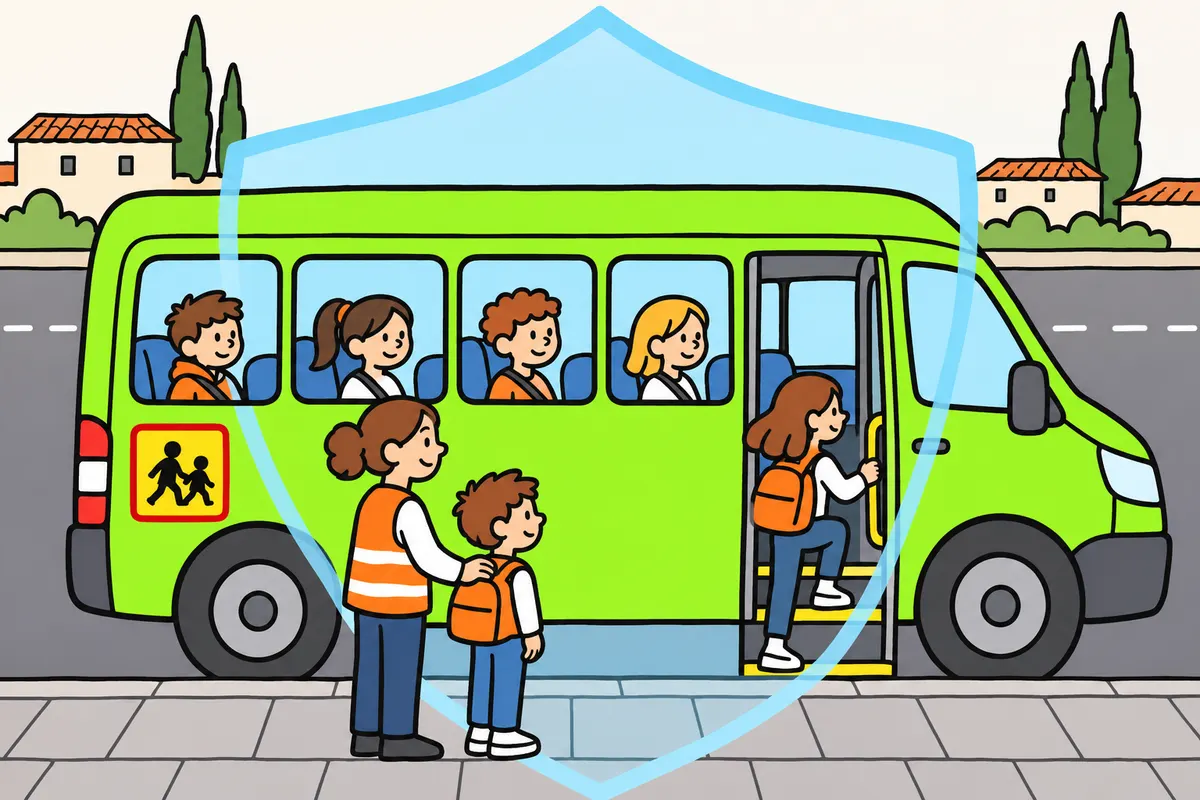
Distinguish passenger accident insurance from the required civil liability insurance.
| Cover | What you distinguish |
|---|---|
| SOV | Prescribed compensation and healthcare for covered accidents |
| Vehicle civil liability | SOV does not replace this insurance |
| School transport and transport of minors covered by the rules | The company has unlimited civil liability cover for damage to occupants |
Remember
- For public collective transport within its scope, check the operator takes out SOV.
- Recognise its application to urban and interurban minibus services.
- Covered accidents include boarding, alighting and direct luggage handover or retrieval, under regulatory conditions.
- A paid or free ticket normally proves passenger status.
- SOV also protects children who travel without paying fares.
- Tickets may be lost or destroyed in accidents; do not always demand physical tickets.
Exam trap: Wrong: SOV provides all unlimited school transport cover. Right: the company also needs that additional cover when required.
Read the full explanation
- For public collective passenger transport within its scope, the operator must take out Seguro Obligatorio de Viajeros (compulsory passenger insurance), SOV. Its scope includes urban and interurban minibus services. It is individual accident insurance for passengers, compatible with other cover, and does not replace the vehicle’s civil liability insurance. [SOV, arts. 1–5 and 12](https://www.boe.es/buscar/act.php?id=BOE-A-1989-30474).
- SOV provides the prescribed compensation and healthcare for bodily injuries from covered accidents. It also covers accidents when boarding or alighting correctly and during the direct handing over or collection of luggage under the regulatory conditions. [SOV, arts. 7–9](https://www.boe.es/buscar/act.php?id=BOE-A-1989-30474).
- Passenger status is normally proved by a ticket or travel pass, whether paid for or free. SOV also protects minors exempt from payment; the regulations provide for a presumption where it is plausible that a ticket not bearing the passenger’s name is destroyed or lost in the accident. Do not insist on physical possession of a ticket in every circumstance. [SOV, arts. 6 and 13.3](https://www.boe.es/buscar/act.php?id=BOE-A-1989-30474).
- For school transport and transport of minors covered by RD 443/2001, the company must have unlimited civil liability cover for injury to occupants, as well as complying with compulsory insurance legislation. You must attribute this additional cover to the company and distinguish it from SOV’s fixed benefits. [School transport, arts. 12 and 13](https://www.boe.es/buscar/act.php?id=BOE-A-2001-8503).
22Tickets and complaint forms
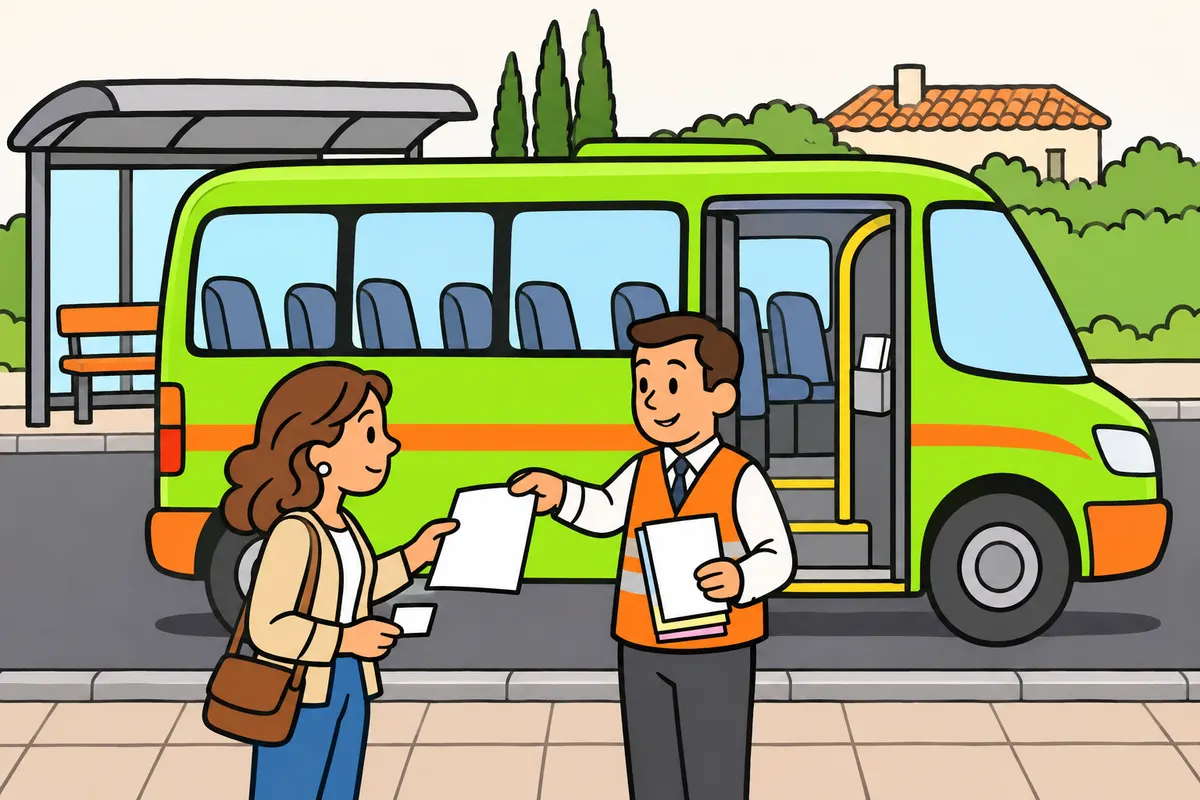
Distinguish passenger tickets and provide complaint forms where they are compulsory.
| Copy in the triplicate model | Where it goes |
|---|---|
| First | Competent authority |
| Second | Complainant |
| Third | Company, attached to the book |
Remember
- The ticket proves passenger status, not ITV validity or authorisations.
- For general-use regular public services, check when you must carry complaint forms.
- Carry them when stops lack fixed facilities authorised to sell tickets.
- Where forms are compulsory, display a notice saying they are available.
- Give them to anyone who asks.
- Do not automatically extend this duty to every occasional-service minibus.
Exam trap: Wrong: the ticket proves the company is authorised. Right: it proves passenger status; authorisations serve another purpose.
Read the full explanation
- The ticket or travel pass establishes passenger status; the company’s and vehicle’s authorisations serve different purposes. The ticket provides proof of passenger status under the terms of SOV; it does not prove that the minibus has a valid ITV (vehicle roadworthiness test) or that the company holds the necessary authorisation for the service. [SOV, arts. 6 and 13.3](https://www.boe.es/buscar/act.php?id=BOE-A-1989-30474).
- Companies contracted to operate general-use regular public services and stations must have the prescribed complaint book or forms. These must be available on vehicles when the service has stops without fixed facilities authorised to sell tickets. You must not extend this obligation under the order to every minibus operating occasional services simply because it carries passengers. [Journey documentation, art. 3.1 and 2](https://www.boe.es/buscar/act.php?id=BOE-A-2013-7218).
- Where a complaint book or forms are compulsory, a notice must inform users that they are available. You must provide them to anyone who requests them. [Order FOM/1230/2013, art. 3.3 and 4](https://www.boe.es/buscar/act.php?id=BOE-A-2013-7218).
- For the form in triplicate, the first copy is sent to the competent authority, the second is given to the complainant and the third remains with the company, attached to the book. The company must send its copy to the administration within the regulatory period of thirty days. [Journey documentation, art. 3.4](https://www.boe.es/buscar/act.php?id=BOE-A-2013-7218).
23How you cooperate with an inspection
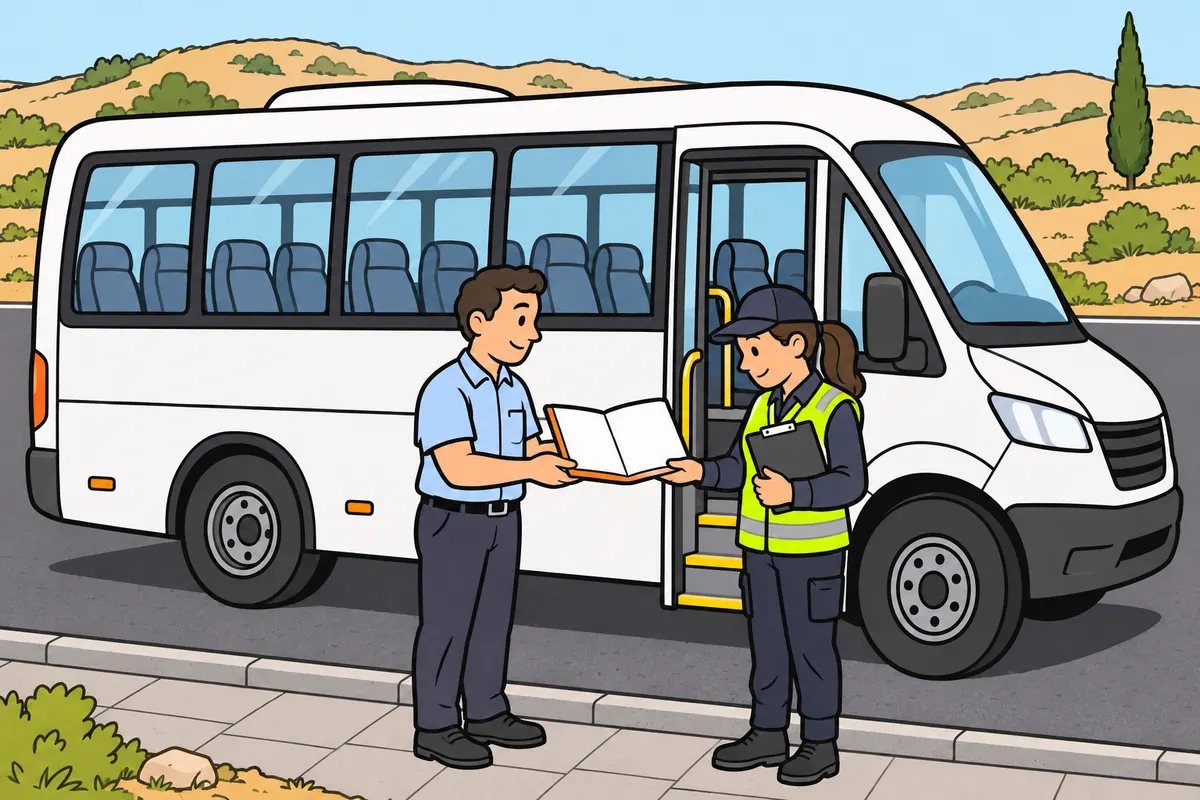
Help with inspections and present the documents you must carry on board.
| Transfer for suspected technical faults or specified alterations | Outward distance you distinguish |
|---|---|
| General rule | Up to thirty kilometres |
| Station in your direction of travel | That limit does not apply |
Remember
- Transport inspectors act as public authorities while carrying out their duties.
- On the road, you represent the company for onboard documents and service information.
- Allow access to the vehicle, its parts and relevant documents.
- Keep the report you receive for later checks.
- Suspected technical faults or specified alterations may require transfer to a suitable testing station.
- Follow the order and allow the checks.
Exam trap: Wrong: you always send the inspector to the office. Right: present the documents that must be available in your minibus.
Read the full explanation
- You must facilitate inspection of the minibus and the documents required for the service. Transport inspection staff have the status of public authorities when carrying out their duties. This obligation is not limited to occasional journeys and does not cease because the company’s office is in another province. [LOTT, art. 33](https://www.boe.es/buscar/act.php?id=BOE-A-1987-17803).
- On the road, you act as the company’s representative regarding the documentation that must be carried on board and information about the service being operated. You must provide what you are legally required to present. It is not enough always to refer the inspector to an office manager for documents that must be available in the minibus itself. [LOTT, art. 33.3](https://www.boe.es/buscar/act.php?id=BOE-A-1987-17803).
- During a roadside technical inspection, you must cooperate and provide access to the vehicle, its parts and the relevant documentation. The inspection may begin with the available reports and a visual check and lead to a more detailed inspection. You must keep the copy of the report you receive so it can be checked during subsequent inspections. [Roadside inspections, arts. 8, 14 and 17](https://www.boe.es/buscar/act.php?id=BOE-A-2017-6512).
- In the cases of suspected technical faults or alteration of systems under article 6.7, officers may order you to take the vehicle to a suitable testing station, with an outward journey of up to thirty kilometres. If the station is in your direction of travel, this distance limit does not apply. You must facilitate the transfer and checks under the conditions of the instruction. [RD 920/2017, art. 6.7](https://www.boe.es/buscar/act.php?id=BOE-A-2017-12841).
24Grounds for immobilisation at a roadside check
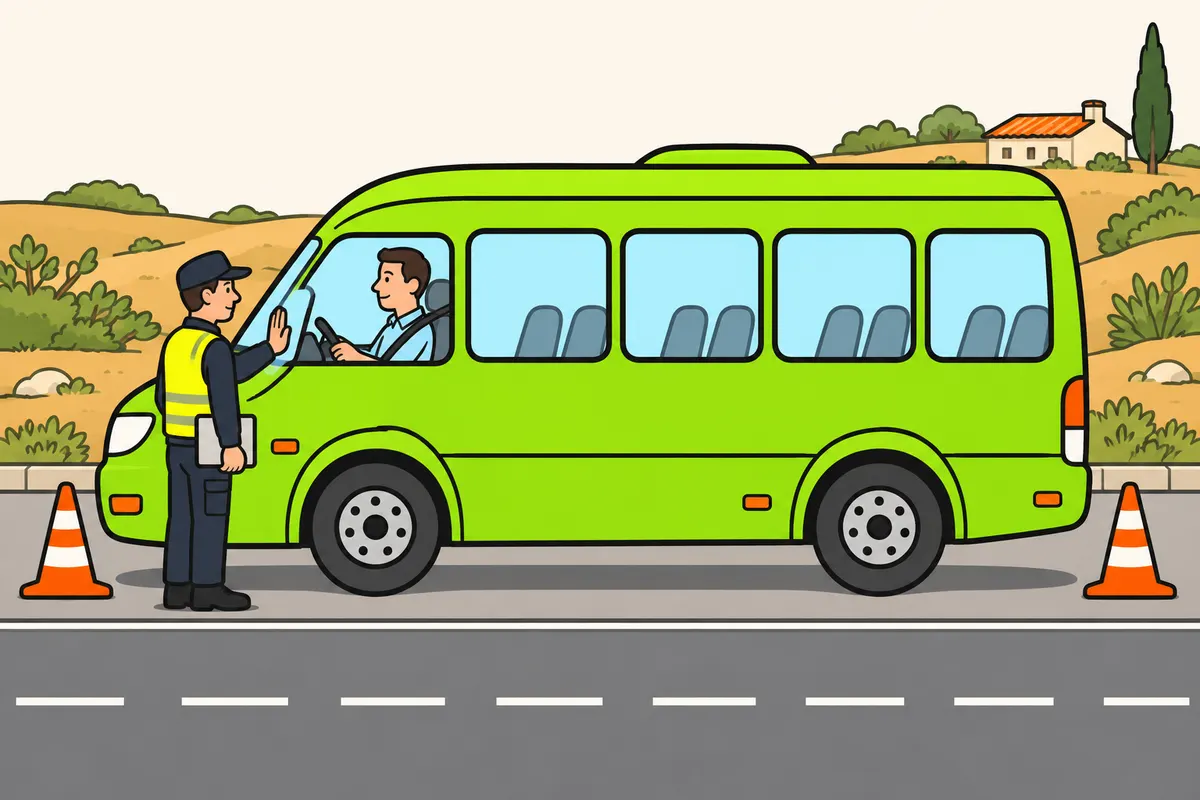
You may be immobilised for missing authorisation, serious risks or other specified breaches.
| Case | Conditions you distinguish |
|---|---|
| Traffic Act: driving or rest | Driving excess or rest reduction above 50 %, unless another driver takes over |
| Transport law: daily driving, breaks or daily rest | Roadside immobilisation, except minor breaches with no more than thirty kilometres to destination |
| Excess occupancy | Fifty per cent increase in authorised places, excluding the driver’s seat |
Remember
- Check that you hold the correct licence for your minibus.
- Missing insurance, authorisation or particularly serious defects can lead to immobilisation.
- Positive alcohol or drug tests, or refusing tests, can also qualify in specified cases.
- Reasonable signs of tampering with control equipment can also lead to immobilisation.
- Distinguish missing entitlement from document issues that accepted legal checks can resolve.
- Immobilisation thresholds do not allow smaller breaches.
Exam trap: Wrong: below the more-than-50 % threshold, you can never be immobilised. Right: transport law covers other breaches with their own conditions.
Read the full explanation
- Officers may immobilise the minibus if it lacks administrative authorisation for road use, fails to meet its conditions or has defects that pose a particularly serious risk. They may also do so if compulsory insurance is absent. You must distinguish an actual lack of authorisation from a documentation issue that can be checked by legally accepted means. [Traffic Act, art. 104.1.a, b and e](https://www.boe.es/buscar/act.php?id=BOE-A-2015-11722).
- You must hold the appropriate driving entitlement for the D1 minibus you use; company ownership of the vehicle does not entitle any employee to drive it. The express grounds in the Traffic Act include driving a vehicle that requires a C or D licence without the corresponding entitlement, as well as testing positive or refusing alcohol or drug tests in the specified circumstances. [Traffic Act, arts. 59 and 104.1.d and k](https://www.boe.es/buscar/act.php?id=BOE-A-2015-11722).
- The Traffic Act allows immobilisation for exceeding driving time or reducing rest by more than fifty per cent of the regulatory time, unless another driver takes over. This specific case does not constitute a general tolerance for less serious breaches. [Traffic Act, art. 104.1.f](https://www.boe.es/buscar/act.php?id=BOE-A-2015-11722).
- Transport legislation requires immobilisation for breaches of daily driving, break or daily rest rules detected on the road, unless the offence is minor and the remaining distance to the destination is no more than thirty kilometres. It also provides for other cases, such as transport without authorisation or tampering. [LOTT, art. 143.4](https://www.boe.es/buscar/act.php?id=BOE-A-1987-17803).
- Other grounds include reasonable indications of tampering with monitoring instruments and overloading with passengers that increases the authorised number of seats by fifty per cent, excluding the driver’s seat. You must respect the minibus’s authorised capacity even when the excess does not reach the threshold for immobilisation. [Traffic Act, art. 104.1.g and i](https://www.boe.es/buscar/act.php?id=BOE-A-2015-11722).
25What you must do if the bus is immobilised
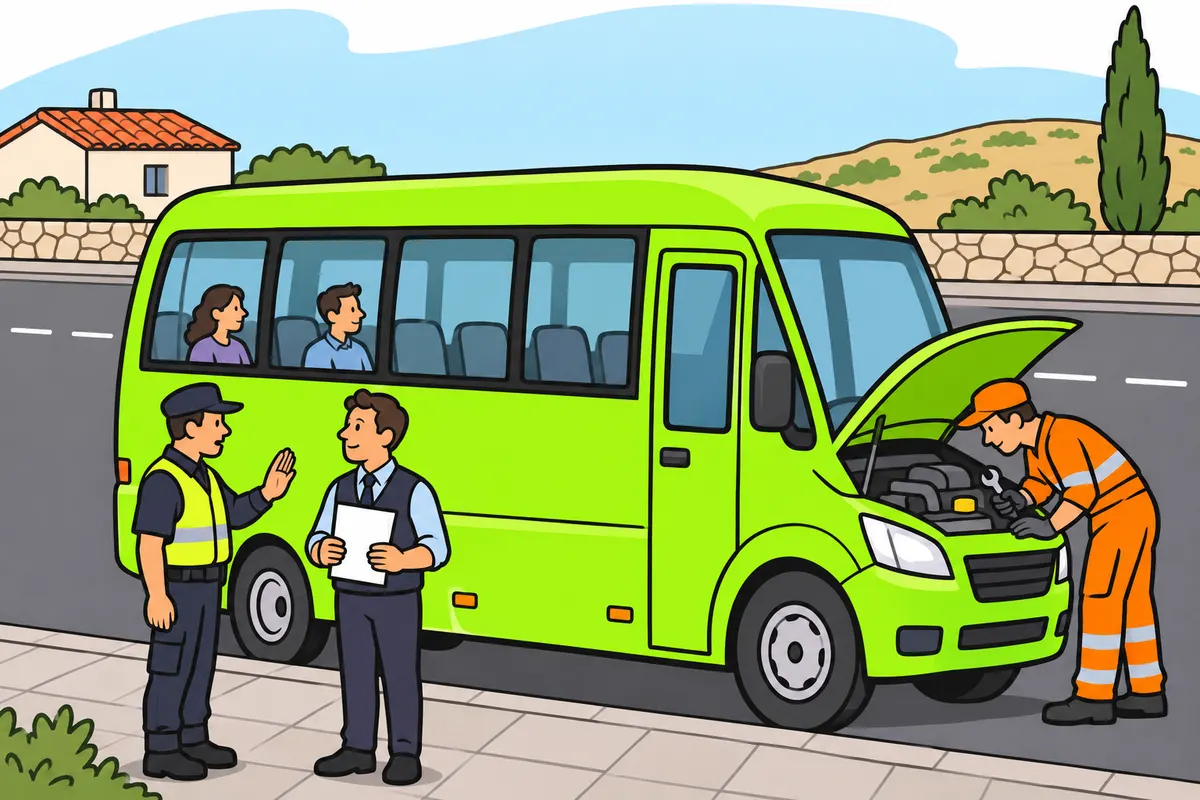
Respect immobilisation, resolve its cause and inform your company so it can help passengers.
| Problem | What you must do |
|---|---|
| Documents | Get valid proof or the required authorisation |
| Technical problem | Resolve it through the required procedure |
| Emissions, tampering or evading surveillance in specified cases | Get certification from the designated workshop |
| Immobilisation costs | The offending driver pays; otherwise the usual driver or hirer pays |
| If neither is available | The registered keeper pays |
| Theft or use against the keeper’s will | These cases are exempt if duly justified |
| Payment before release | You may appeal and claim costs from whoever caused the measure |
| Until payment is proved | Officers may withhold the vehicle registration certificate until payment is proved |
Remember
- Follow instructions about where to leave the minibus.
- Do not drive on while the cause remains.
- If the checkpoint is dangerous, follow the order to move.
- That move does not let you finish the service.
- Tell your company to arrange passenger care and a safe onward journey.
- Pay before immobilisation is lifted, though you may appeal.
Exam trap: Wrong: you can pay the costs after immobilisation is lifted. Right: pay first, though you may appeal; duly justified theft or use against the keeper’s will is exempt.
Read the full explanation
- You must comply with the location for immobilisation specified by the officers, who may order you to drive there, and remedy the cause so that the measure can be lifted. [Traffic Act, art. 104.2 and 5](https://www.boe.es/buscar/act.php?id=BOE-A-2015-11722#a104). The costs of an immobilisation are paid by the offending driver (failing that the usual driver or renter, then the owner) and must be paid before the immobilisation is lifted, without prejudice to appeal. You may also recover these costs from whoever caused the measure. Officers may withhold the permiso de circulación (vehicle registration certificate) until payment is shown. Duly substantiated cases of theft or use against the owner’s wishes are excepted. [Traffic Act, art. 104.6](https://www.boe.es/buscar/act.php?id=BOE-A-2015-11722#a104).
- If the problem concerns documentation, you must obtain valid documentary proof or the appropriate authorisation; if it is technical, you must resolve it through the required procedure. In the cases involving emissions, tampering or systems designed to evade monitoring under article 104.3, certification from the designated workshop is required. [Traffic Act, art. 104.2 and 3](https://www.boe.es/buscar/act.php?id=BOE-A-2015-11722).
- If immobilisation at the roadside check creates a danger, you must follow the order to move the minibus to the designated location. This ordered movement does not amount to authorisation to complete the service. Transport regulations make the transport operator responsible for the custody of the vehicle and the costs prescribed for the relevant operations. [LOTT, art. 143.4](https://www.boe.es/buscar/act.php?id=BOE-A-1987-17803).
- If the minibus is immobilised, inform the company so that it can arrange care for the passengers and the safe continuation of their journey while complying with the measure. Actions to protect passengers are covered in «Passenger safety and emergencies» and «Accidents and assistance». [LOTT, art. 143.4](https://www.boe.es/buscar/act.php?id=BOE-A-1987-17803).
Prepare your documents before departure
Check the driver, vehicle, company and service separately.
- Check your licence, proof of CAP where required and the driver card for the applicable tachograph.
- Identify the minibus and check its permiso de circulación (vehicle registration certificate), tarjeta ITV (vehicle technical inspection card), inspection report, expiry date and insurance.
- Check the company’s authorisation and the conditions for the service and the vehicle assigned to it.
- Determine whether you must carry a national digital journey form, international documentation or proof that the service is exempt.
- Check that you can present the DeCA (electronic administrative control document) or its QR code and the applicable records for the current day and the previous 56 days.
Act according to the ITV result
The repair period does not allow you to continue operating a service following an unfavourable or negative inspection result.
- Read the result and the defects listed in the inspection report.
- If the result is favourable with minor defects, repair them within a maximum of two months and keep the report and sticker.
- If the result is unfavourable, restrict journeys to the permitted cases involving a repair workshop, bringing the vehicle into compliance and a new ITV.
- If the result is negative, arrange for the minibus to be transported by other means.
- Rectify the defects and meet the deadline granted for a new inspection, within the statutory maximum.
Present documents at a roadside check
Assist with the inspection and comply with the measures imposed.
- Stop the minibus as instructed and keep the required documents available.
- Present the driver, vehicle and service documents requested, together with their means of verification.
- Provide the DeCA or QR code and the tachograph records for the period being checked.
- Cooperate with the technical examination and keep the report you receive.
- If immobilisation is ordered, comply with the specified location and coordinate with the company to rectify the problem and care for passengers.
- Resume your journey only when the measure can be lifted because its cause has ceased.
Finished this module?
Mark it as read and you will see your progress on the theory list.