
Theory · D+E Licence - Bus with Trailer · Module 2 of 13
Driver and vehicle combination documentation
You learn how to check your D+E licence and the documents, insurance and ITV (vehicle roadworthiness test) for the bus and its trailer. You learn the qualifying ages, restrictions, and renewal and procedure deadlines so that you can answer exam questions and prepare a combination with all its documents in order.
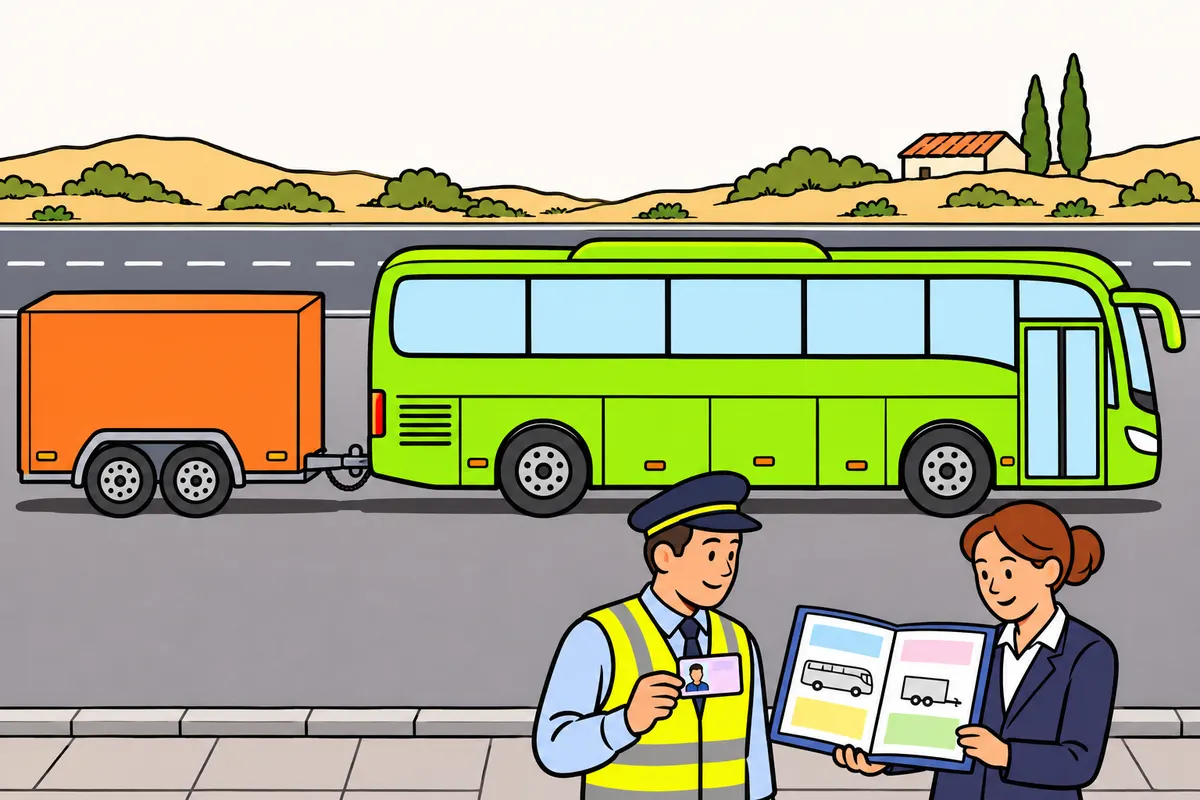
1Three separate checks
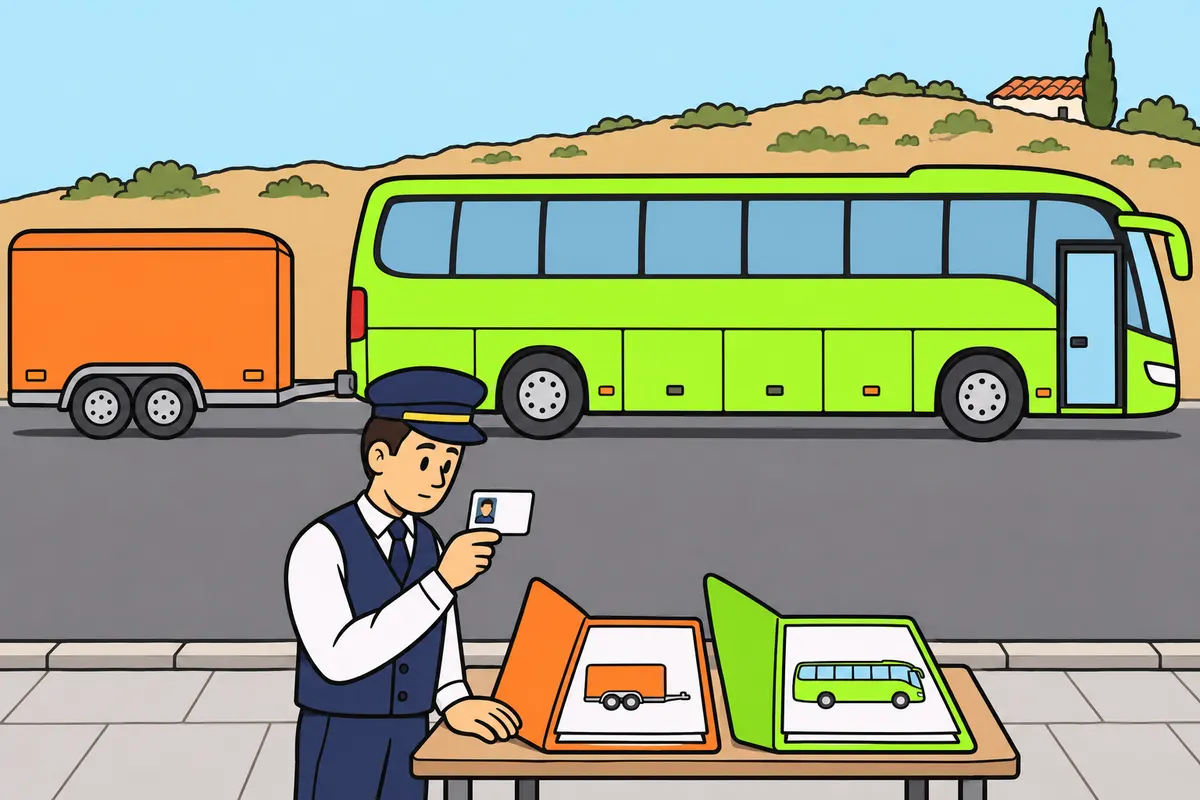
Check your licence and each vehicle’s documents before you leave.
| Document | What it proves |
|---|---|
| Your driving licence | What you can drive |
| Registration certificate | Identity of the authorised vehicle |
| ITV card | Vehicle technical specifications |
Remember
- Check documents for the bus and the trailer you actually use.
- Check that insurance remains valid for each unit requiring it.
- Show your documents when officers ask.
Exam trap: Wrong: the bus documents are enough. Right: check the coupled trailer’s documents too.
Read the full explanation
- Your driving licence proves what you can drive. The permiso de circulación (vehicle registration certificate) identifies the authorised vehicle, and the tarjeta ITV (technical inspection card) contains its technical specifications. To use the combination, you must hold the appropriate driving entitlement and meet the documentation requirements for both vehicles. [RGV, art. 26](https://www.boe.es/buscar/act.php?id=BOE-A-1999-1826)
- With a bus and luggage trailer, you must check both units. Each retains its own documentary identity even when coupled together and owned by the same company. Documents for another trailer in the fleet do not cover the one you use that day. [RGV, arts. 25 and 26](https://www.boe.es/buscar/act.php?id=BOE-A-1999-1826)
- Keeping an insurance policy does not guarantee that the insurance remains valid. Check its validity for the bus and for any trailer subject to compulsory insurance, especially if you take a unit that has been parked for some time or whose documents someone else prepares. [LRCSCVM, art. 2](https://www.boe.es/buscar/act.php?id=BOE-A-2004-18911)
- When officers ask for the documents, you must show them. Organising them before departure helps you detect incorrect registration numbers, cards belonging to another trailer or overdue inspections. This administrative check complements the combination's safety check, covered in the Maintenance and inspection of the combination module. [RGV, art. 26](https://www.boe.es/buscar/act.php?id=BOE-A-1999-1826)
2Who issues the D+E licence

You need the traffic authority to grant the right licence for your combination.
Remember
- Submitting an application does not mean you have been granted a licence.
- Your driving school trains you; the medical centre checks your fitness.
- Provincial Traffic Offices issue your licence.
- Check the categories and conditions on your card.
Exam trap: Wrong: a medical certificate already lets you drive. Right: you need the granted authorisation.
Read the full explanation
- Your D+E is a driving licence, not an agricultural vehicle licence or the bus's registration certificate. You need prior administrative authorisation corresponding to the class of vehicle or combination you drive. [RGCond, arts. 1 and 4](https://www.boe.es/buscar/act.php?id=BOE-A-2009-9481)
- The Jefaturas Provinciales de Tráfico (Provincial Traffic Offices) issue civilian driving licences and the administrative authorisations that temporarily replace them. Your driving school trains you and the medical centre certifies your physical and mental fitness, but neither is the authority that grants your licence. [RGCond, art. 2](https://www.boe.es/buscar/act.php?id=BOE-A-2009-9481)
- You must obtain authorisation by meeting the age and physical and mental fitness requirements and passing the required tests. Submitting an application, enrolling at a driving school or receiving a favourable medical certificate does not amount to being granted a licence. The tests are detailed in the D+E licence: requirements, tests and validity module. [RGCond, art. 7](https://www.boe.es/buscar/act.php?id=BOE-A-2009-9481)
- The different licence categories you hold must appear on a single document. You must check the categories entered and their conditions, rather than assume that the card authorises you to drive any heavy vehicle or any combination with a trailer. [RGCond, art. 4.1](https://www.boe.es/buscar/act.php?id=BOE-A-2009-9481)
3D+E age and entitlement
Your access to D+E depends on your age, CAP qualification and service.
| D+E access age | Required CAP qualification | Conditions |
|---|---|---|
| 24 years | No CAP age reduction | General minimum age |
| 23 years | Accelerated initial qualification | No special route limit stated |
| 21 years | Standard initial qualification | No special route limit stated |
| 21 years | Accelerated initial qualification | Only regular services with routes up to 50 km |
| 18 years | Standard initial qualification | Spain only: no passengers, or regular services up to 50 km |
| 20 years | Standard initial qualification | Spain only until 21; no passenger or route restriction |
Remember
- You need a valid D licence to obtain D+E.
- If you hold D and obtain C+E, you also receive D+E.
- Obtaining D+E also gives you B+E and D1+E.
- D+E covers a D bus with a trailer above 750 kg MMA.
- An empty trailer keeps its MMA: maximum authorised mass.
- CAP does not replace your driving licence.
Exam trap: Wrong: any CAP allows any service at the same age. Right: check qualification, age, territory and route.
Read the full explanation
- The general minimum age for D+E is 24. With CAP (Certificate of Professional Competence) obtained through the standard initial qualification, you can obtain it at 21. The type of CAP is one of the conditions for the lower age limit; working for a passenger transport company does not by itself prove that you meet this requirement. [RGCond, art. 4.2](https://www.boe.es/buscar/act.php?id=BOE-A-2009-9481)
- With CAP obtained through the accelerated initial qualification, you can obtain D+E at 23. If you are 21 and have accelerated CAP, your passenger transport entitlement is limited to regular services whose route does not exceed 50 km. This limit concerns the route of the regular service, not any short occasional journey. [RGCond, art. 4.2](https://www.boe.es/buscar/act.php?id=BOE-A-2009-9481)
- With standard CAP, you can drive within Spain from 18 without passengers or on regular passenger services whose route does not exceed 50 km. From 20, with that standard CAP, you can drive within Spain without this passenger or route restriction. The restriction to Spanish territory remains until you reach 21. [RGCond, art. 4.2](https://www.boe.es/buscar/act.php?id=BOE-A-2009-9481)
- To obtain D+E, you must hold a valid D licence. If you hold D and obtain C+E, you are also granted D+E; obtaining D+E includes B+E and D1+E. Your licence and CAP demonstrate different requirements: professional training does not by itself grant a driving category. [RGCond, art. 5](https://www.boe.es/buscar/act.php?id=BOE-A-2009-9481)
- D+E authorises a combination consisting of a towing vehicle covered by D and a trailer whose MMA (maximum authorised mass) exceeds 750 kg. D authorises a bus with a trailer whose MMA does not exceed 750 kg. Driving with an empty trailer does not change its MMA or the category you need; the tests are covered in D+E licence: requirements, tests and validity. [RGCond, art. 4.2](https://www.boe.es/buscar/act.php?id=BOE-A-2009-9481)
4How to read your licence
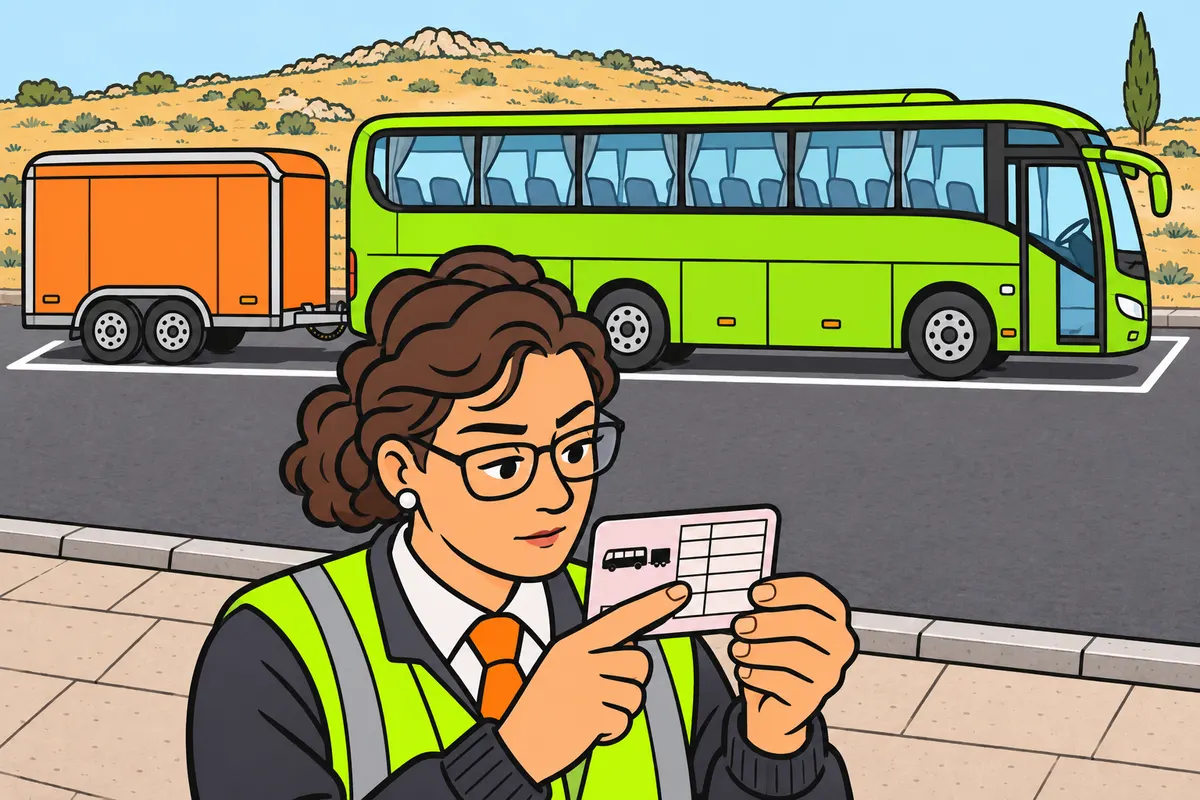
Check the validity and restrictions of your D+E category.
Remember
- Find the D+E row on the back.
- Distinguish the first issue date from the expiry date.
- Follow restrictions even when you change company or bus.
- Check each code’s meaning and the category it affects.
Exam trap: Wrong: you can use expired D+E because another category remains valid. Right: D+E must be valid.
Read the full explanation
- On the card, you must locate your identity details, the issuing authority and the relevant dates. On the reverse, you can check the categories, the date each was first issued, its expiry date and coded restrictions. [RGCond, art. 9 and Annex I](https://www.boe.es/buscar/act.php?id=BOE-A-2009-9481)
- The D+E row shows the entitlement you need for a bus with a non-light trailer. Another valid category on the same card does not allow you to use an expired category. When planning a route, check the authorisation needed for the complete combination and any restrictions that affect you. [RGCond, art. 12 and Annex I](https://www.boe.es/buscar/act.php?id=BOE-A-2009-9481)
- The entries on your licence may restrict the people, vehicles or driving conditions covered. You must comply with them even when driving a replacement bus or one belonging to another company. A valid document does not remove your obligation to use prescribed adaptations or corrective aids. [RGCond, art. 3](https://www.boe.es/buscar/act.php?id=BOE-A-2009-9481)
- A medical or administrative code has a different meaning from a licence category. A number in the remarks field does not by itself extend your authorisation to all combinations. To interpret its scope, check its meaning and the category or categories to which it applies. [RGCond, Annex I](https://www.boe.es/buscar/act.php?id=BOE-A-2009-9481)
5Normal D+E validity
Your normal D+E renewal period changes with your age.
| Your age | Normal D+E validity |
|---|---|
| Under 65 years | 5 years |
| 65 years and over | 3 years |
Remember
- Always check your actual expiry date.
- Health reasons may shorten your licence’s validity.
- A future expiry date cannot override lost validity or losing all your points.
Exam trap: Wrong: you apply B renewal periods to D+E. Right: normally, D+E lasts 5 years under 65, then 3 years.
Read the full explanation
- Your D+E licence is normally valid for 5 years while you are under 65 and for 3 years from that age. [RGCond, art. 12.1](https://www.boe.es/buscar/act.php?id=BOE-A-2009-9481)
- The same normal validity schedule applies to D, D1 and D1+E. If you obtain D+E at 50, its normal validity is 5 years, unless reduced for health reasons. [RGCond, art. 12](https://www.boe.es/buscar/act.php?id=BOE-A-2009-9481)
- Validity may be shorter than the normal period if you have an illness or impairment that may worsen and justifies the reduction. You must follow the actual expiry date of your authorisation, even if you know the general D+E periods by heart. [RGCond, art. 12.3](https://www.boe.es/buscar/act.php?id=BOE-A-2009-9481)
- Validity also depends on continuing to meet the requirements for obtaining the licence and not losing all your points. A future date printed on the card does not authorise you to drive if your licence has lost validity or another measure prevents you from driving. [RGCond, art. 12.5 and 12.6](https://www.boe.es/buscar/act.php?id=BOE-A-2009-9481)
6When and how to renew
You can renew early, but an appointment does not extend your licence.
Remember
- You can renew from 3 months before expiry.
- Within this window, your new period starts at the previous expiry date.
- You must prove your fitness and complete the procedure.
- Expiry alone does not require you to retake tests when renewing.
- Do not drive with an expired category.
- Renewal does not necessarily give all your categories the same expiry date.
Exam trap: Wrong: your appointment lets you drive with expired D+E. Right: you cannot drive under that expired category.
Read the full explanation
- You can apply for normal renewal from 3 months before expiry. If you do so within that period, the new period runs from the licence's expiry date, so applying early within this window does not shorten your remaining validity. [RGCond, art. 13.1](https://www.boe.es/buscar/act.php?id=BOE-A-2009-9481)
- To renew, you must prove that you retain the required physical and mental fitness. You can renew through an authorised Centro de Reconocimiento de Conductores (driver medical assessment centre) that handles the procedure, or through the DGT by submitting the report and required documents. [DGT, licence renewal](https://sede-org.dgt.gob.es/es/permisos-de-conducir/obtencion-y-gestion-de-permisos/renovacion-de-permiso-proximo-a-caducar/)
- You can apply to renew an expired licence, and expiry alone does not require you to retake the tests for obtaining it. However, you cannot drive under that category while it is expired. [RGCond, arts. 12.4 and 13.3](https://www.boe.es/buscar/act.php?id=BOE-A-2009-9481)
- Renewing a group 2 category also renews any group 1 entitlements you hold, for their respective periods. Each category retains its applicable validity period; you can check their dates separately on the reverse. [RGCond, art. 13.1](https://www.boe.es/buscar/act.php?id=BOE-A-2009-9481)
7Medical assessment and physical and mental fitness
You must remain medically fit to drive your bus and trailer.
Remember
- Visit an authorised driver medical assessment centre.
- Disclose illnesses and treatments that need assessment.
- Follow the required adaptations, restrictions and expiry dates.
- Seek a fitness assessment if illness or treatment affects your driving.
Exam trap: Wrong: fitness to drive a car is enough for D+E. Right: you need group 2 fitness.
Read the full explanation
- To obtain or renew D+E, you must meet the group 2 physical and mental fitness requirements. Being fit to drive a car is not enough: the regulations distinguish between groups and set specific criteria. The assessment must evaluate your fitness for the heavy vehicle category you apply for. [RGCond, arts. 44 and 45 and Annex IV](https://www.boe.es/buscar/act.php?id=BOE-A-2009-9481)
- You must undergo the assessment at an authorised Centro de Reconocimiento de Conductores. Its checks cover the relevant abilities and illnesses specified in the regulations; they are not equivalent to a bus inspection or your company's occupational medical assessment. Disclose the medical history and treatments that need assessment. [RGCond, art. 44 and Annex IV](https://www.boe.es/buscar/act.php?id=BOE-A-2009-9481)
- A favourable result may be subject to restrictive conditions, adaptations or reduced validity. You must comply with the decision and the entries on your licence; you cannot decide for yourself that an adaptation is unnecessary because the vehicle has automatic transmission or driving aids. [RGCond, arts. 3 and 7.2 and Annex IV](https://www.boe.es/buscar/act.php?id=BOE-A-2009-9481)
- If you develop an illness or impairment that compromises the driving requirements, you must assess your fitness and arrange the appropriate checks or changes. The expiry date does not guarantee that you retain all your abilities. Check the effects of the illness and its treatment before driving. [RGCond, art. 12.6 and Annex IV](https://www.boe.es/buscar/act.php?id=BOE-A-2009-9481)
8Common restrictions and codes
Follow each licence code in the category where it appears.
| Code on your licence | What it means |
|---|---|
| 01.01 | You must wear glasses |
| 01.02 | You must wear contact lenses |
| 01.06 | You may wear glasses or contact lenses |
| 78 | Automatic transmission only in the associated category |
| 95 | CAP professional competence with its date |
| 96 | Certain category B combinations |
Remember
- Follow your specific eyesight correction code.
- Drive a vehicle meeting your required adaptations.
Exam trap: Wrong: code 95 grants D+E. Right: it proves professional competence; you also need the relevant category.
Read the full explanation
- If your licence shows 01.01, you must drive with glasses; 01.02 means contact lenses, and 01.06 allows glasses or contact lenses. You must comply with the specific subcode: you cannot choose to interchange the different forms of vision correction yourself. [RGCond, Annex I.B](https://www.boe.es/buscar/act.php?id=BOE-A-2009-9481)
- Code 78 restricts you to driving vehicles with automatic transmission. Its application depends on the category to which it is attached on your authorisation. [RGCond, Annex I.B](https://www.boe.es/buscar/act.php?id=BOE-A-2009-9481)
- Adaptations may affect the clutch, brakes, accelerator or steering, among other systems. If you have such a condition, you must drive a vehicle that meets it. [RGCond, art. 3 and Annex I.B](https://www.boe.es/buscar/act.php?id=BOE-A-2009-9481)
- Code 95 identifies CAP professional competence with the date shown; 96 refers to certain category B combinations. Their purpose differs from the D+E category and its medical codes: 95 does not by itself grant a heavy vehicle licence, and 96 does not replace it. [RGCond, Annex I.B](https://www.boe.es/buscar/act.php?id=BOE-A-2009-9481)
9Documents you must carry
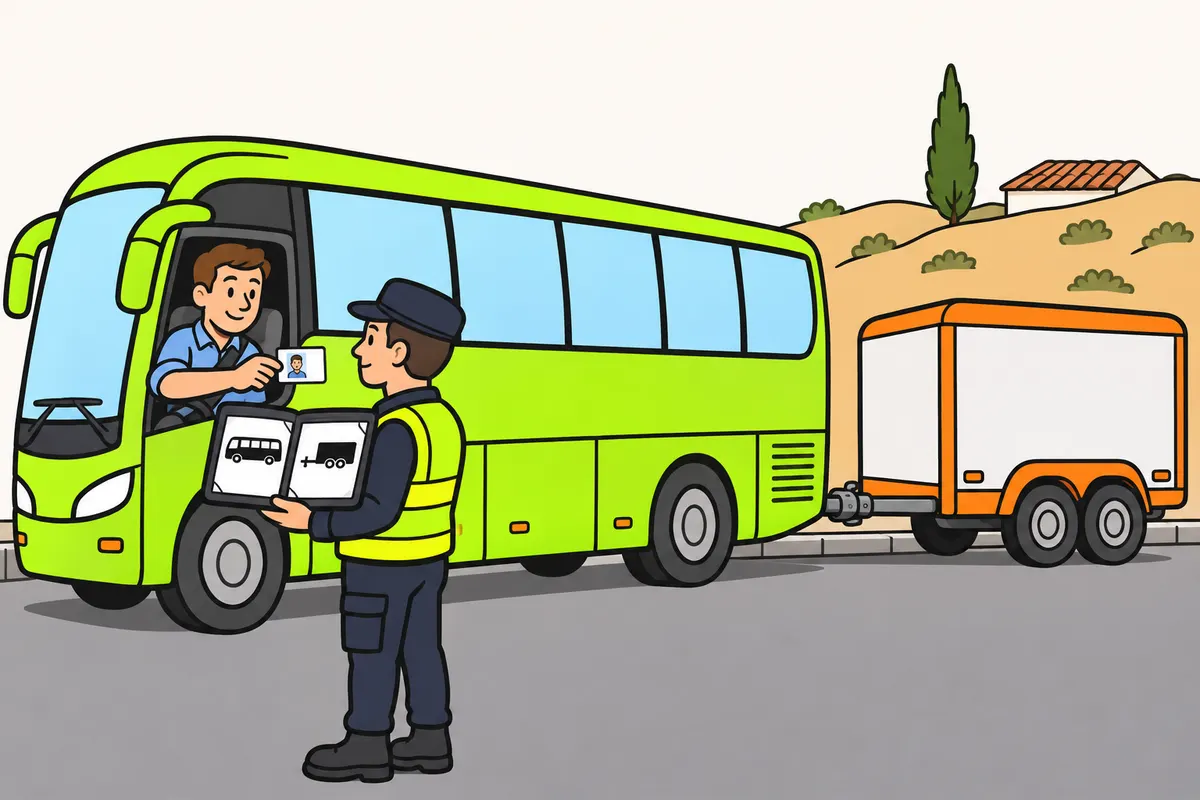
Carry your valid driving authorisation and the documents for each unit.
Remember
- Carry your valid licence or a temporary authorisation replacing it.
- Carry registration certificates and ITV cards for your bus and non-light trailer.
- You may use duly certified photocopies of vehicle documents.
- Keep the latest ITV report: officers may ask for it.
- For services requiring CAP, carry valid proof in an accepted document.
Exam trap: Wrong: applying for a duplicate replaces your licence. Right: you need a valid licence or temporary replacement authorisation.
Read the full explanation
- You must carry your valid driving licence and show it when officers request it. A temporary authorisation replacing it allows you to drive subject to its stated conditions; an application for renewal or a duplicate is not by itself that authorisation. [RGCond, arts. 2 and 3](https://www.boe.es/buscar/act.php?id=BOE-A-2009-9481)
- You must carry the registration certificates and ITV cards for the bus and the non-light trailer. The trailer retains its documents even if it has no engine, is hired or is used only for luggage. Changing the coupled unit requires you to prepare its corresponding documents. [RGV, arts. 25 and 26](https://www.boe.es/buscar/act.php?id=BOE-A-1999-1826)
- You can replace original vehicle documents with duly certified photocopies. This applies to each unit's registration certificate and ITV card; an ordinary photocopy does not meet the requirement. [RGV, art. 26.2](https://www.boe.es/buscar/act.php?id=BOE-A-1999-1826#a26)
- Traffic enforcement officers may request the latest ITV report. You must keep it with the documents to demonstrate the result and its conditions. [RD 920/2017, art. 10.3](https://www.boe.es/buscar/act.php?id=BOE-A-2017-12841)
- To drive your bus with trailer professionally on a service subject to CAP, you must hold valid CAP and carry the driver qualification card or an accepted document proving it. You can prove it through an EU driving licence bearing code 95 in the cases recognised by article 20, such as drivers from other EU Member States. The qualification card is valid for 5 years. [RD 284/2021, arts. 1, 2 and 20](https://www.boe.es/buscar/act.php?id=BOE-A-2021-6624)
10Digital documents and proof of insurance
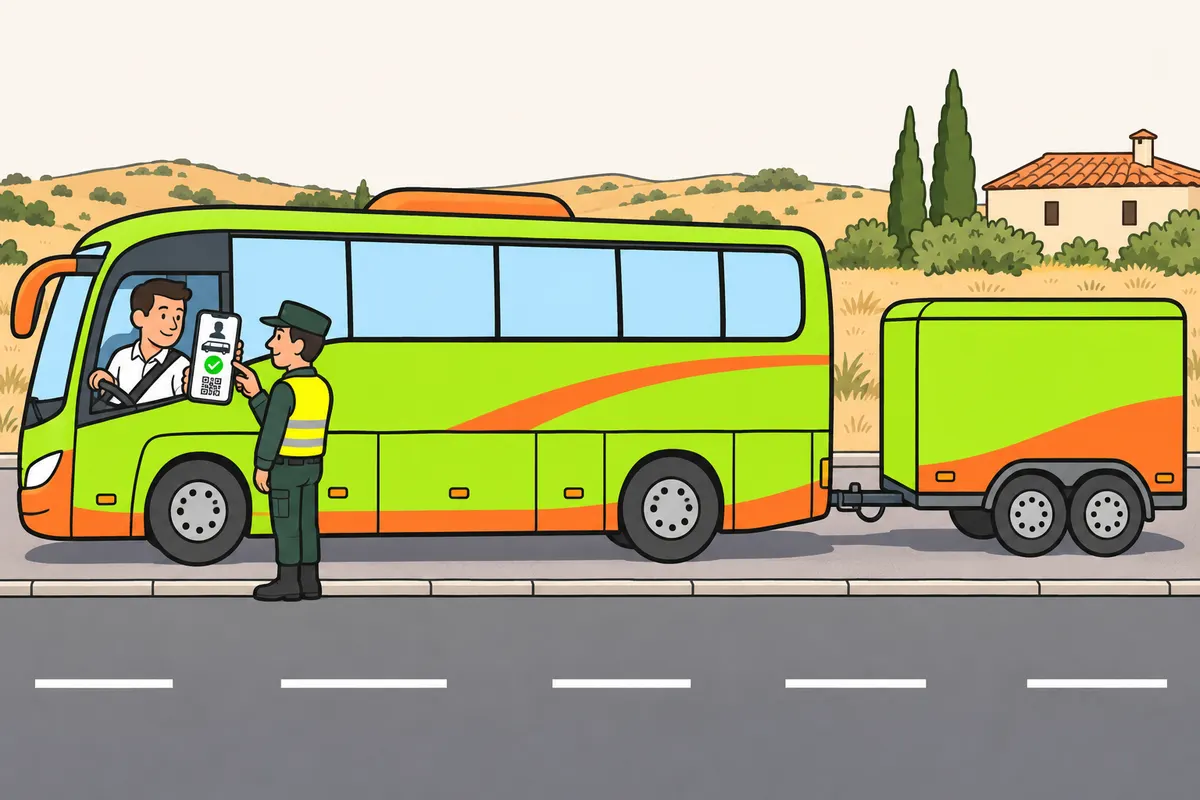
In Spain, you can show official miDGT documents; keep compulsory insurance valid.
| Where you drive | What you need to remember |
|---|---|
| Within Spain | Official miDGT driving licence and registration certificate have legal validity |
| Outside Spain | Carry physical documents and check requirements |
Remember
- Show official miDGT documents, rather than saved photographs or screenshots.
- Outside Spain, carry physical documents and check destination requirements.
- You need not carry the insurance policy or payment receipt.
- Check valid insurance for each unit requiring it.
- Keep insurance details to help with any incident.
Exam trap: Wrong: no insurance receipt requirement means you can drive uninsured. Right: you must maintain compulsory insurance.
Read the full explanation
- In Spain, your driving licence and registration certificate available in miDGT have the same legal validity as physical documents. You must show the official documents in the app; a saved photograph or screenshot is not by itself that verifiable document. [DGT, digital documents](https://sede.dgt.gob.es/export/sites/dgt/es/appmidgt/index.html)
- For a journey outside Spain, you must carry physical documents and check the destination's requirements. The equivalence declared by the DGT for miDGT applies to driving within Spanish territory. [DGT, scope of miDGT](https://www.dgt.es/export/sites/web-DGT/.galleries/Images/notas-de-prensa/2020/ya-se-puede-llevar-el-permiso-de-conducir-en-el-movil/NP-APP-MI-DGT.pdf)
- You are not required to carry the insurance policy or the receipt for the latest payment in the vehicle. Officers can check insurance electronically. This exemption from carrying documents does not exempt you from taking out and maintaining compulsory insurance for each unit subject to it. [DGT, proof of insurance](https://revista.dgt.es/es/reportajes/2019/04ABRIL/0417-Documentacion.shtml)
- You can keep the insurer, policy and assistance details for each unit to simplify matters if an incident occurs. If you use another trailer, identify its insurance and check its actual cover; a receipt found in the bus may belong to a different unit. [LRCSCVM, art. 2](https://www.boe.es/buscar/act.php?id=BOE-A-2004-18911)
11Registration certificate for each unit
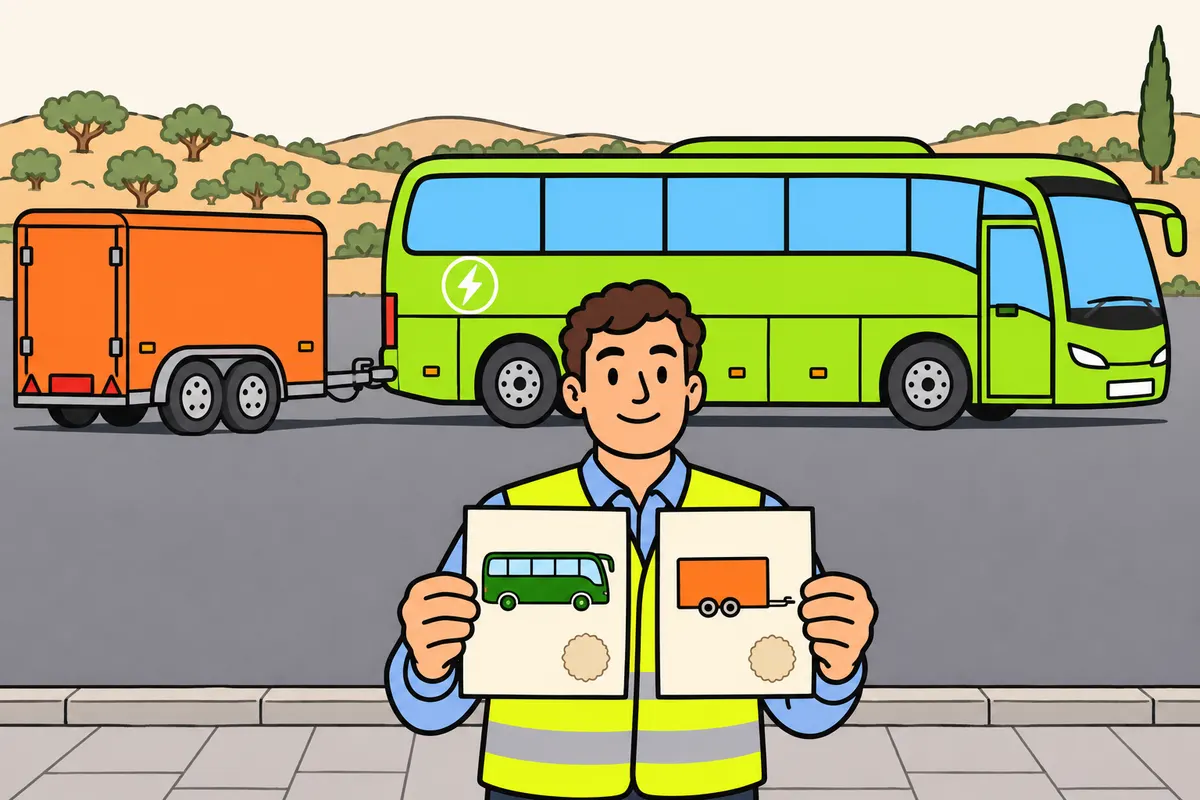
Your bus and non-light trailer each need their own registration certificate.
| Registration certificate field | What you can check |
|---|---|
| S.1 | Seats, including the driver’s |
| S.2 | Standing places, if any |
Remember
- Check the registration number, vehicle identity and registered keeper.
- A temporary Traffic Office authorisation can replace the registration certificate.
- An invoice or transfer application is not enough.
- If the vehicle is deregistered, its certificate loses validity.
Exam trap: Wrong: the bus certificate covers a heavy trailer. Right: each unit needs its own authorisation.
Read the full explanation
- The bus and any trailer with an MMA exceeding 750 kg must be registered and have authorisation to circulate. The bus's certificate does not replace the luggage trailer's: each has its own registration number and registered identity. [RGV, arts. 25 and 26](https://www.boe.es/buscar/act.php?id=BOE-A-1999-1826)
- You can identify the registration number, vehicle and registered keeper on the registration certificate. Field S.1 also shows the number of seats, including the driver's, and S.2 shows standing places, if any. [RGV, art. 29 and Annex XIII](https://www.boe.es/buscar/act.php?id=BOE-A-1999-1826)
- The Jefatura de Tráfico (Traffic Office) can issue a temporary authorisation replacing the registration certificate with its regulatory effects. The document must constitute a replacement authorisation; a purchase invoice or ownership transfer application does not by itself fulfil that function. [RGV, art. 26.1.a](https://www.boe.es/buscar/act.php?id=BOE-A-1999-1826)
- If a vehicle is deregistered, its registration certificate loses validity. Physically keeping the document does not authorise you to use the vehicle on public roads. Before adding a unit to the route, you must make sure its administrative status allows it to circulate. [RGV, art. 34](https://www.boe.es/buscar/act.php?id=BOE-A-1999-1826)
12ITV card and technical data
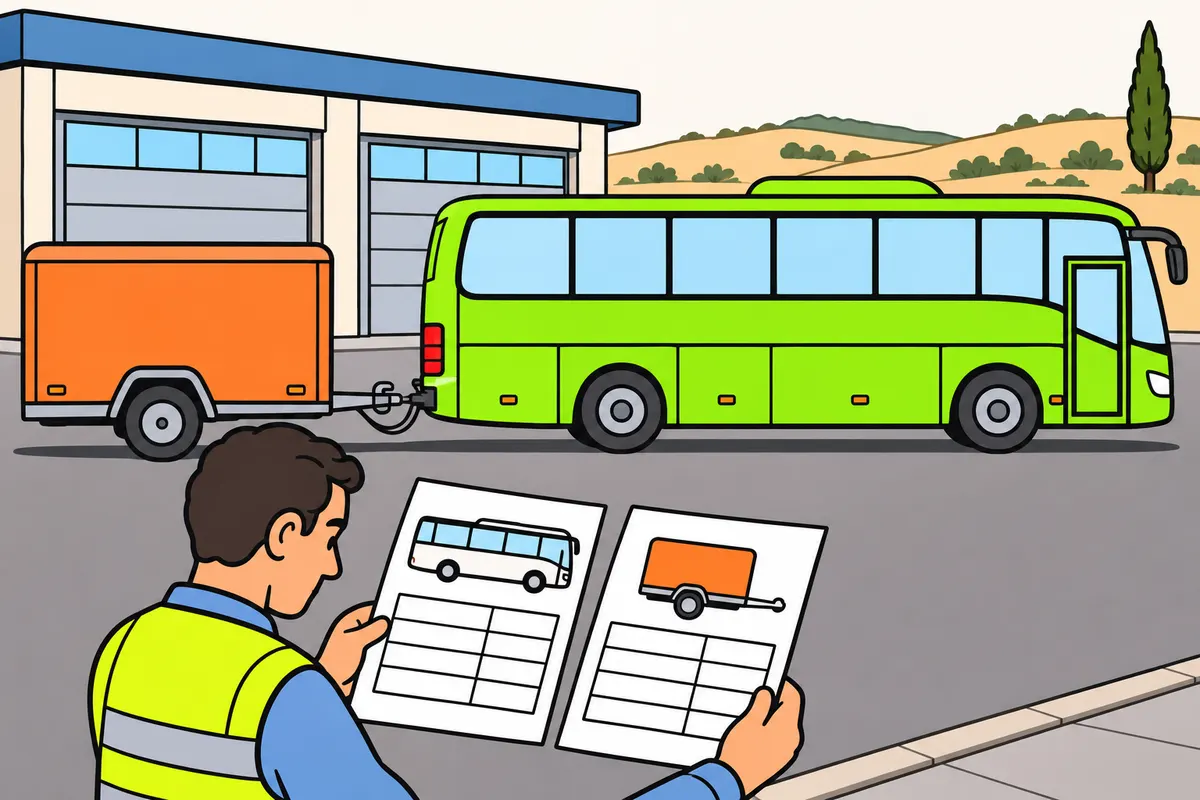
Use the ITV card to check technical specifications and whether coupling is allowed.
Remember
- Your D+E licence does not increase the combination’s technical limits.
- An official electronic card printout counts as a document.
- An informal company copy is not that official printout.
- Get modifications approved and update documents when required.
- With a light trailer, carry its ITV card too.
- Your bus ITV card’s reverse must show a coupling compatible with that trailer.
Exam trap: Wrong: having a technical card proves ITV is valid. Right: also check the required inspections.
Read the full explanation
- The ITV card allows you to identify the technical specifications of the bus and trailer. It contains relevant information about the vehicle you have and the technical conditions that apply to it. [RGV, arts. 10 and 26](https://www.boe.es/buscar/act.php?id=BOE-A-1999-1826)
- The units' authorised masses and technical specifications determine which coupling you can use. Your D+E entitlement does not increase the technical capacity of the bus or trailer. The limits and combination calculations are covered in Dimensions, masses and speed limiters. [RGV, arts. 9 and 25](https://www.boe.es/buscar/act.php?id=BOE-A-1999-1826)
- The ITV card may be electronic, with a printed copy. The official printout retains its status as a document; an informal company transcription does not. If you need a replacement, the procedure depends on the card's format. [DGT, electronic technical data card](https://sede.dgt.gob.es/es/vehiculos/duplicado-y-renovacion-de-documentacion/duplicado-de-la-ficha-tecnica/)
- The coupling and modifications must be approved under the applicable rules. If vehicle specifications affecting its documents change, you must complete the necessary inspections and updates. [RGV, art. 7](https://www.boe.es/buscar/act.php?id=BOE-A-1999-1826)
- If you drive the bus with a trailer whose MMA does not exceed 750 kg, you must carry the trailer's ITV card. The reverse of the bus's ITV card must state that it has a coupling system compatible with that trailer fitted. [RGV, art. 26.1.c](https://www.boe.es/buscar/act.php?id=BOE-A-1999-1826#a26)
13ITV for the bus and trailer
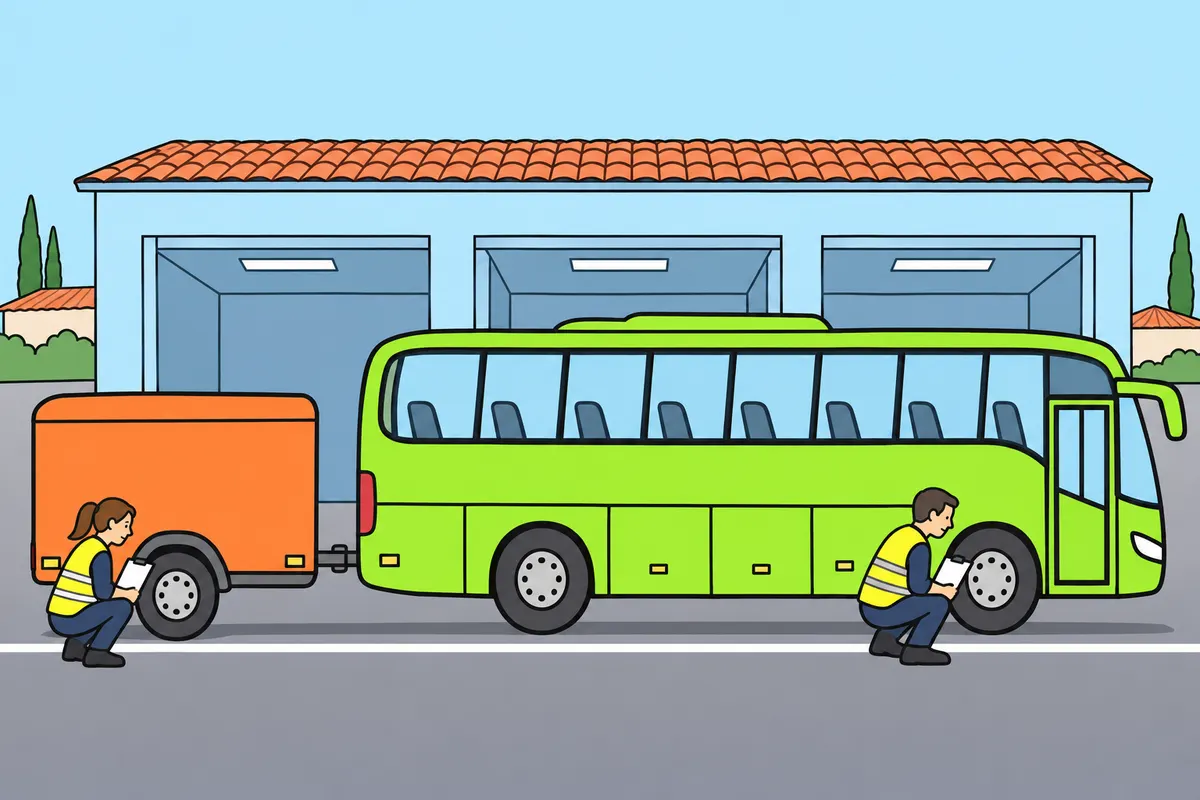
Check the ITV schedule separately for your bus and trailer.
| Vehicles | Age | ITV frequency |
|---|---|---|
| M2 and M3 buses | Up to 5 years | Every year |
| M2 and M3 buses | Over 5 years | Every 6 months |
| O2 luggage trailer | Up to 10 years | Every year |
| O2 luggage trailer | Over 10 years | Every 6 months |
Remember
- Count age from the recorded first registration or entry into service.
- Buying used does not restart the vehicle’s age.
- Arrange your bus’s first ITV at one year.
- Each unit keeps its own schedule.
Exam trap: Wrong: buses only need six-monthly ITV after 10 years. Right: buses need it when over 5 years old.
Read the full explanation
- Your category M2 or M3 bus must undergo ITV (vehicle roadworthiness test) annually up to 5 years old and every 6 months when more than 5 years old. These vehicles carry people and their luggage and have more than eight seats, excluding the driver's. You must schedule the first inspection at one year; they have no initial four-year exemption. [RD 920/2017, art. 6.1](https://www.boe.es/buscar/act.php?id=BOE-A-2017-12841)
- Your O2 luggage trailer undergoes ITV every year up to 10 years old and every 6 months when more than 10 years old, regardless of the bus's age. [RD 920/2017, art. 6.1](https://www.boe.es/buscar/act.php?id=BOE-A-2017-12841#a6)
- Each unit's age is counted from its first registration or entry into service recorded in the Registro de Vehículos (Vehicle Register). Buying a used combination or changing its registered keeper does not restart the calculation. To organise inspections, you must check the dates for both vehicles separately. [RD 920/2017, art. 6.1](https://www.boe.es/buscar/act.php?id=BOE-A-2017-12841)
- If you use a 7-year-old bus and a 4-year-old luggage trailer, the bus has ITV every 6 months and the trailer annually, under the normal schedule described. Six-monthly means every 6 months, and biennial means every 2 years. [RD 920/2017, art. 6.1](https://www.boe.es/buscar/act.php?id=BOE-A-2017-12841)
14ITV expiry and early inspection
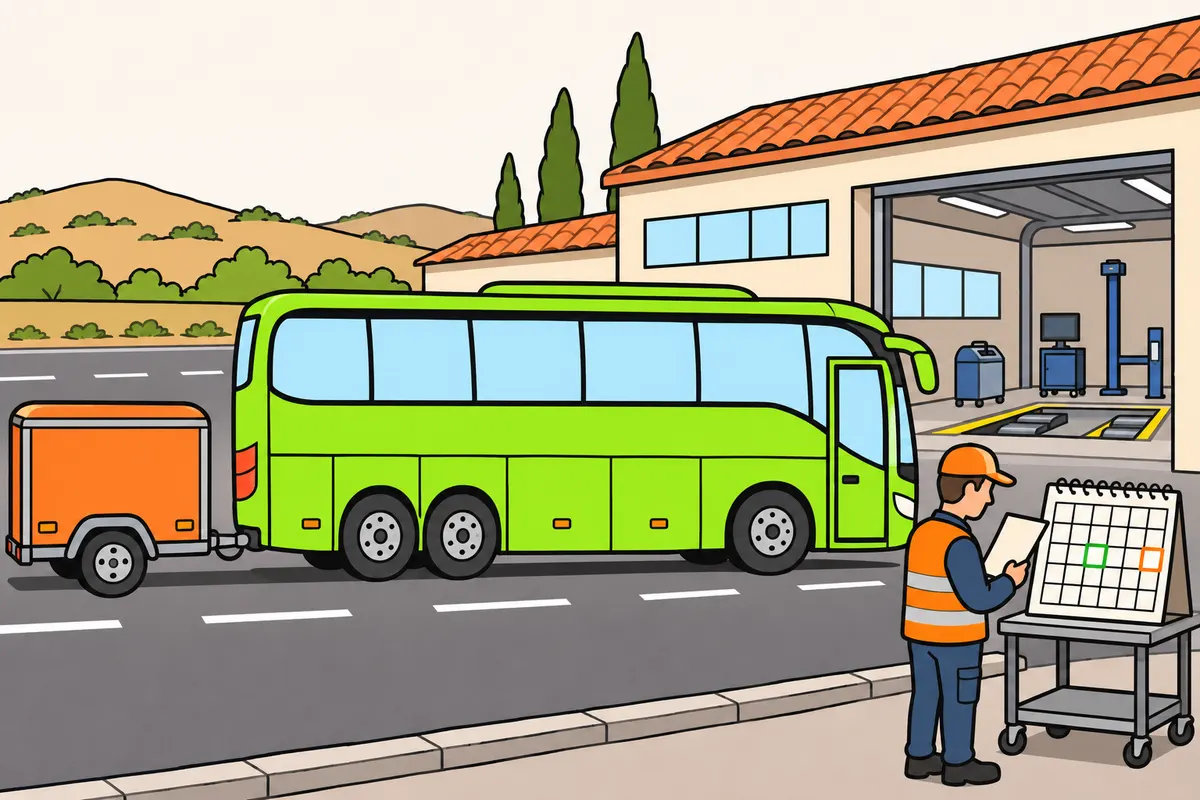
Pass ITV on time; passing shortly before expiry can preserve your renewal date.
Remember
- Check each unit’s next ITV date.
- Passing within the previous 30 calendar days preserves the expiry date as reference.
- Otherwise, the new period runs from the date you pass.
- An appointment does not extend expired ITV.
- Prove each unit’s compulsory insurance before its ITV.
Exam trap: Wrong: you can drive for 30 days after expiry. Right: the window is before expiry and requires an ITV pass.
Read the full explanation
- You must present each vehicle for inspection within its deadline. You must check the next ITV date in its records and documents rather than deduce it solely from its age. Units may have different expiry dates even if they share the same annual or six-monthly frequency. [RD 920/2017, arts. 4 and 6](https://www.boe.es/buscar/act.php?id=BOE-A-2017-12841)
- If you pass ITV within the 30 calendar days before expiry, the new period runs from the previous expiry date. You can use this window to organise fleet inspections without losing the remaining days of validity of the previous inspection. [RD 920/2017, art. 6.5](https://www.boe.es/buscar/act.php?id=BOE-A-2017-12841)
- Outside that case, validity is calculated by adding the applicable interval to the date of the passed inspection. The 30-day window is before expiry: it does not authorise you to drive after expiry. [RD 920/2017, art. 6.5](https://www.boe.es/buscar/act.php?id=BOE-A-2017-12841)
- An appointment at the station does not extend ITV validity or allow you to continue a passenger service with an expired inspection. You must arrange transport without driving on the strength of the appointment. [RD 920/2017, art. 4](https://www.boe.es/buscar/act.php?id=BOE-A-2017-12841)
- Proof of compulsory insurance is a prerequisite for ITV. If you take the bus or luggage trailer for inspection separately, each unit must meet this condition. [RD 920/2017, art. 8.3](https://www.boe.es/buscar/act.php?id=BOE-A-2017-12841)
15Pass result and minor defects
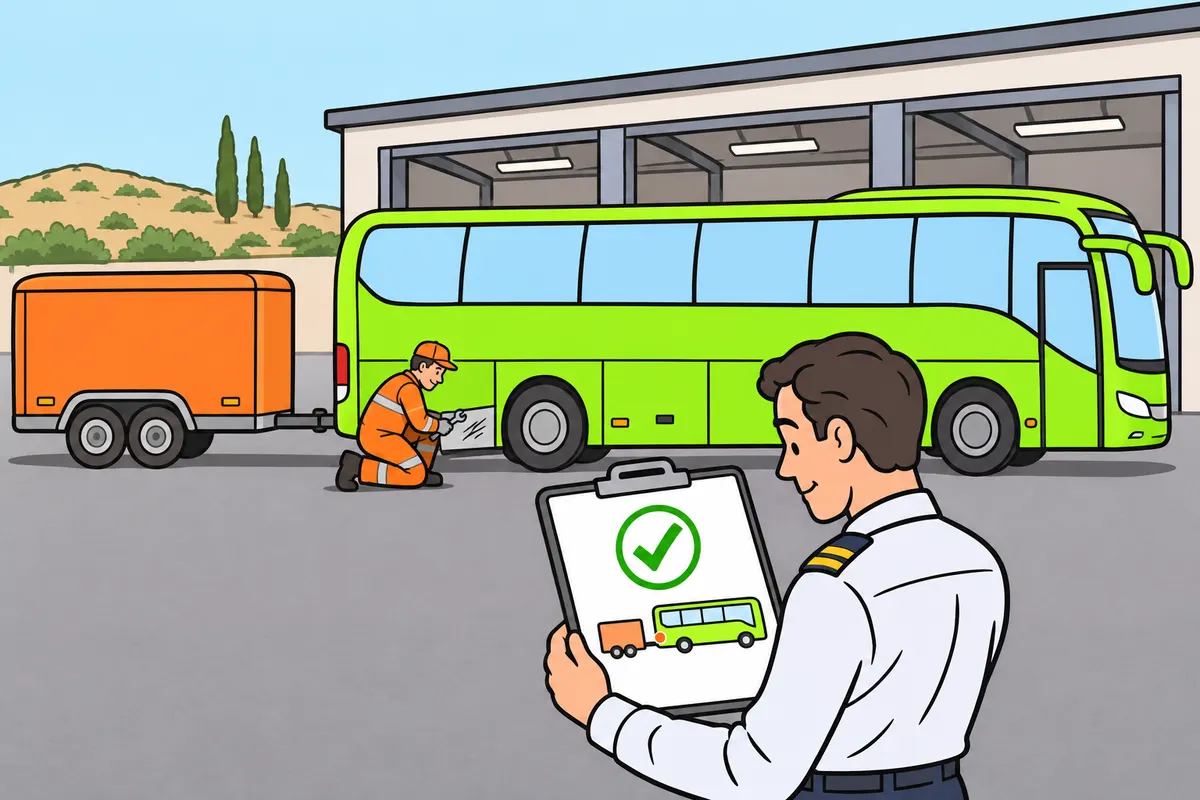
You must repair minor defects even when your vehicle passes ITV.
Remember
- Read your report even when you pass.
- Repair minor defects within the deadline.
- Minor defects alone do not require a return inspection to check repairs.
- You must return when required after an unfavourable or negative result.
- Keep your vehicle in good condition between inspections.
Exam trap: Wrong: passing ITV lets you ignore minor defects. Right: repair them within a maximum of 2 months.
Read the full explanation
- The inspection is a pass when no defects or only minor defects are found. You must read the report to find out whether repairs remain outstanding: a pass with minor defects does not mean all components are free from deficiencies. [RD 920/2017, art. 9.4](https://www.boe.es/buscar/act.php?id=BOE-A-2017-12841)
- You must repair minor defects within a maximum of 2 months. On their own, they do not require another inspection to check the repair, unless the vehicle must return following an unfavourable or negative result. [RD 920/2017, art. 11.1](https://www.boe.es/buscar/act.php?id=BOE-A-2017-12841)
- Each inspection's result and details are recorded in its report, which constitutes the technical inspection certificate. The station enters the result on the ITV card and notifies the Vehicle Register electronically on the day of inspection. You can use the report to identify defects awaiting repair. [RD 920/2017, art. 10](https://www.boe.es/buscar/act.php?id=BOE-A-2017-12841)
- You must keep the vehicle in the condition required by the regulations between inspections. A later fault may require repair even if ITV remains valid for months. For the exam, distinguish the periodic inspection obligation from your check of the bus's and trailer's current condition. [RGV, art. 10](https://www.boe.es/buscar/act.php?id=BOE-A-1999-1826)
16Unfavourable and negative ITV results
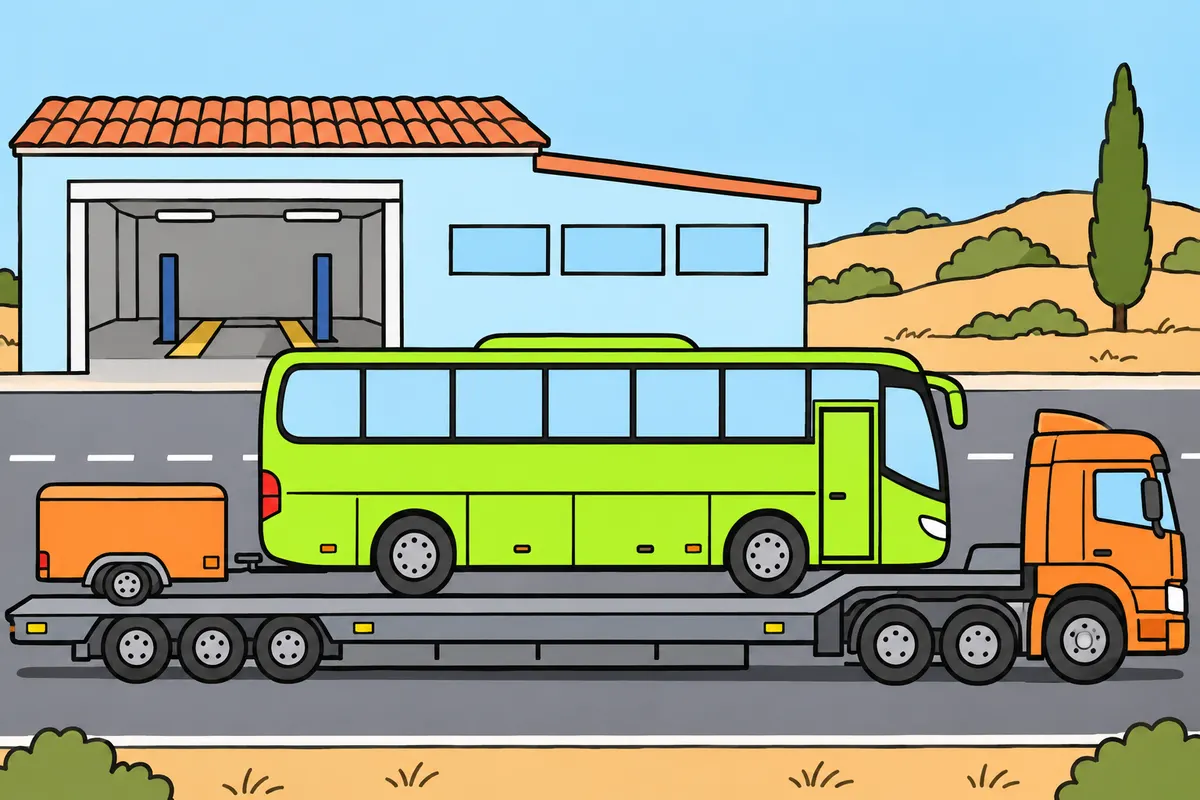
An unfavourable or negative ITV result prevents you from continuing your normal service.
| ITV result | Defect | Permitted transport |
|---|---|---|
| Unfavourable | Serious | To a workshop or to regularise its status, then back to ITV |
| Negative | Very serious | From the station, using means other than the vehicle itself |
Remember
- Follow your specific deadline: no more than 2 months from the first result.
- This deadline does not let you continue a commercial route.
- After the repair deadline, the second inspection will be a full inspection.
- You can choose the station for later inspections.
Exam trap: Wrong: after negative ITV, you can drive to a workshop. Right: transport from the station must use other means.
Read the full explanation
- If a serious defect is found, the result is desfavorable (unfavourable). The vehicle is barred from normal road use: it may be taken to a workshop or, where applicable, to regularise its status and return to an ITV station. [RD 920/2017, arts. 9 and 11.2](https://www.boe.es/buscar/act.php?id=BOE-A-2017-12841)
- With an unfavourable result, you must rectify the defects and present the vehicle for another inspection within no more than 2 months of the first unfavourable result. [RD 920/2017, art. 11.2](https://www.boe.es/buscar/act.php?id=BOE-A-2017-12841)
- If a very serious defect is found, the inspection result is negativa (negative). Transport from the station to its destination must use means other than the vehicle itself, for example a suitable transport service. [RD 920/2017, arts. 9 and 11.3](https://www.boe.es/buscar/act.php?id=BOE-A-2017-12841)
- After a negative result, you must repair the vehicle and present it for inspection within no more than 2 months of the first negative result. If you present a vehicle for a second inspection after the repair deadline granted, a full technical inspection is carried out, without prejudice to any applicable penalties. You can choose the station for the first and subsequent inspections. [RD 920/2017, art. 11.3, 11.4 and 11.8](https://www.boe.es/buscar/act.php?id=BOE-A-2017-12841)
17ITV sticker for each vehicle
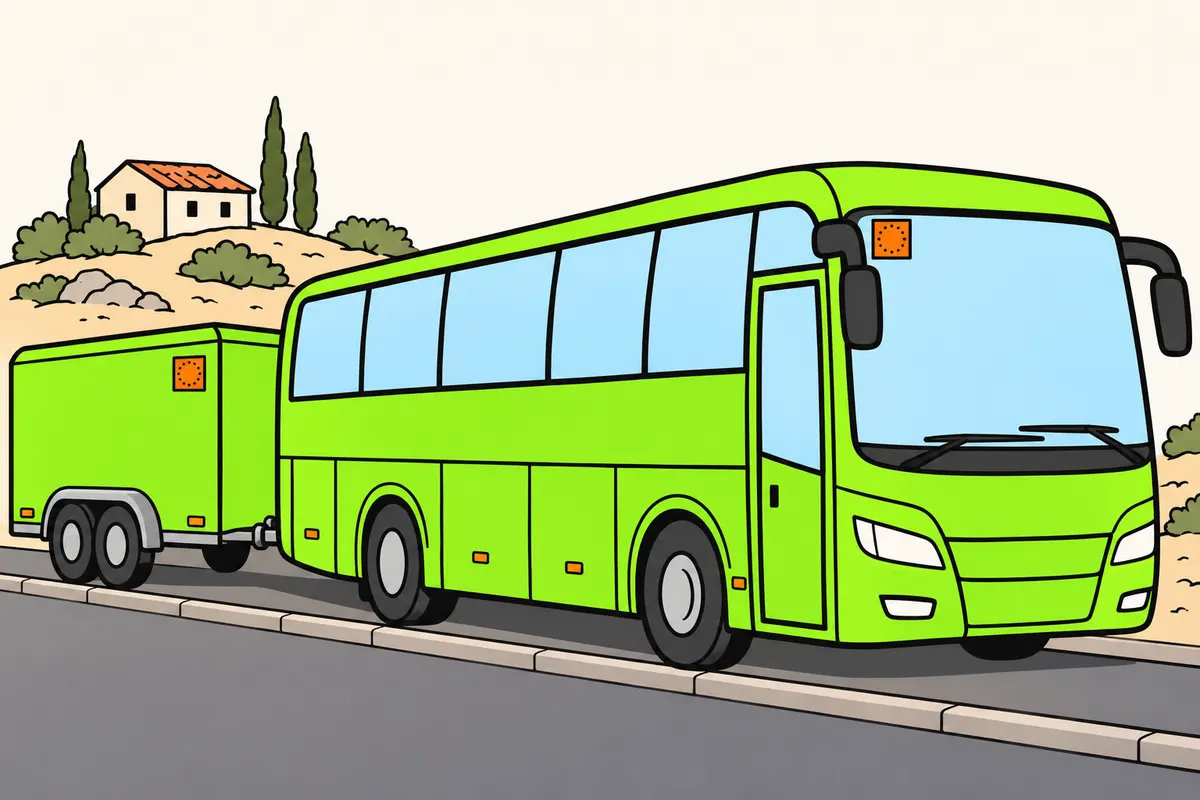
Place each vehicle’s ITV sticker in its required position.
| Vehicle | Where you place its V-19 |
|---|---|
| Bus | Inside the windscreen, in the upper right-hand corner |
| Trailer without a windscreen | Somewhere clearly visible |
Remember
- The V-19 sticker shows an ITV pass and the next inspection due.
- It does not replace the registration certificate, ITV card or report.
- Your trailer needs its own sticker after passing required periodic ITV.
- Modifications and certain serious accident damage may require other inspections.
Exam trap: Wrong: the bus V-19 proves the trailer passed ITV. Right: each inspected vehicle has its own sticker.
Read the full explanation
- The V-19 sticker indicates that the vehicle has passed its periodic technical inspection and when the next one is due. You must associate it with the inspected vehicle, not the transport company or driver. It does not replace the permiso de circulación (vehicle registration certificate), card or inspection report. [RGV, Annex XI, V-19](https://www.boe.es/buscar/act.php?id=BOE-A-1999-1826)
- On the bus, you must place the V-19 in the upper right-hand corner of the windscreen, on the inside. [RGV, Annex XI, V-19.2](https://www.boe.es/buscar/act.php?id=BOE-A-1999-1826)
- On a trailer without a windscreen, you must place its V-19 somewhere clearly visible. The bus's sticker relates to its own inspection; the trailer you couple must display its own when it is subject to periodic inspection and has passed. [RGV, Annex XI, V-19.2](https://www.boe.es/buscar/act.php?id=BOE-A-1999-1826)
- Besides periodic inspections, there are inspections for modifications and for vehicles involved in accidents with significant damage to their structure or safety components. If your bus or trailer falls into these cases, you must meet the applicable inspection requirement even if its periodic ITV has not yet expired. [RD 920/2017, arts. 5 and 6.7](https://www.boe.es/buscar/act.php?id=BOE-A-2017-12841)
18Compulsory insurance for the combination
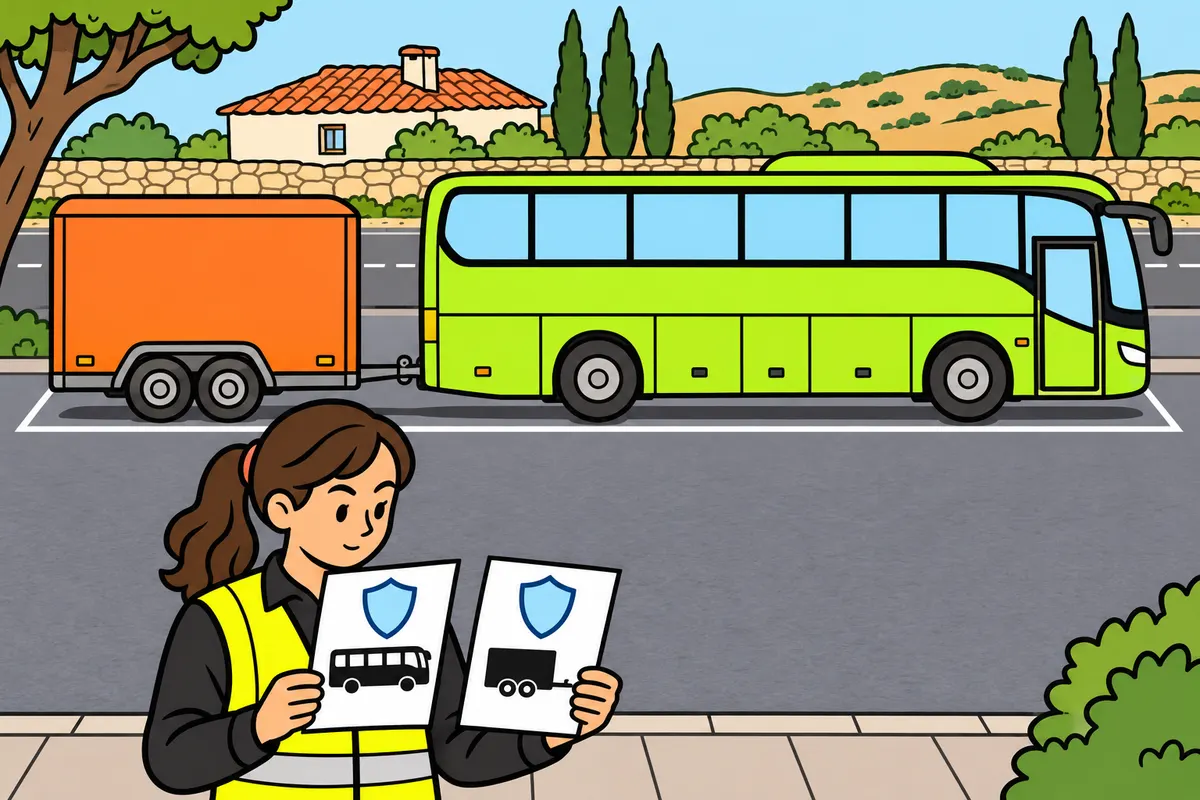
Check that every unit requiring compulsory insurance has valid cover.
| Vehicle | Own compulsory insurance |
|---|---|
| Bus | Required |
| Trailer above 750 kg MMA | Required |
| Trailer or semi-trailer not above 750 kg MMA | Exempt |
Remember
- The owner must take out and maintain compulsory insurance.
- You can drive without being the owner or policyholder.
- An empty heavy trailer still needs insurance.
- Uncoupling it does not automatically remove its insurance obligation.
Exam trap: Wrong: bus insurance replaces heavy trailer insurance. Right: check insurance for both units.
Read the full explanation
- The owner of each vehicle subject to the obligation and normally based in Spain must take out and maintain valid civil liability insurance. The owner, policyholder and driver may be different people: you can drive a bus insured by its company without owning it. [LRCSCVM, art. 2](https://www.boe.es/buscar/act.php?id=BOE-A-2004-18911)
- Your bus must be insured, as must any trailer with an MMA exceeding 750 kg. The bus's compulsory insurance does not replace the trailer's insurance obligation. Check both units' cover when you are assigned a different trailer for passengers' luggage. [LRCSCVM, arts. 1 bis and 2](https://www.boe.es/buscar/act.php?id=BOE-A-2004-18911)
- Trailers and semi-trailers whose MMA does not exceed 750 kg are exempt from their own compulsory insurance. The exemption uses MMA, not the load on that journey. A non-light luggage trailer remains subject to insurance even when empty. [LRCSCVM, art. 2.8.b](https://www.boe.es/buscar/act.php?id=BOE-A-2004-18911)
- For the purposes of this law, trailers intended for use with the legally defined vehicles are covered whether coupled or uncoupled. The luggage trailer retains its insurance obligation when you leave it detached from the bus. [LRCSCVM, art. 1 bis.1.b](https://www.boe.es/buscar/act.php?id=BOE-A-2004-18911)
19What damage insurance covers
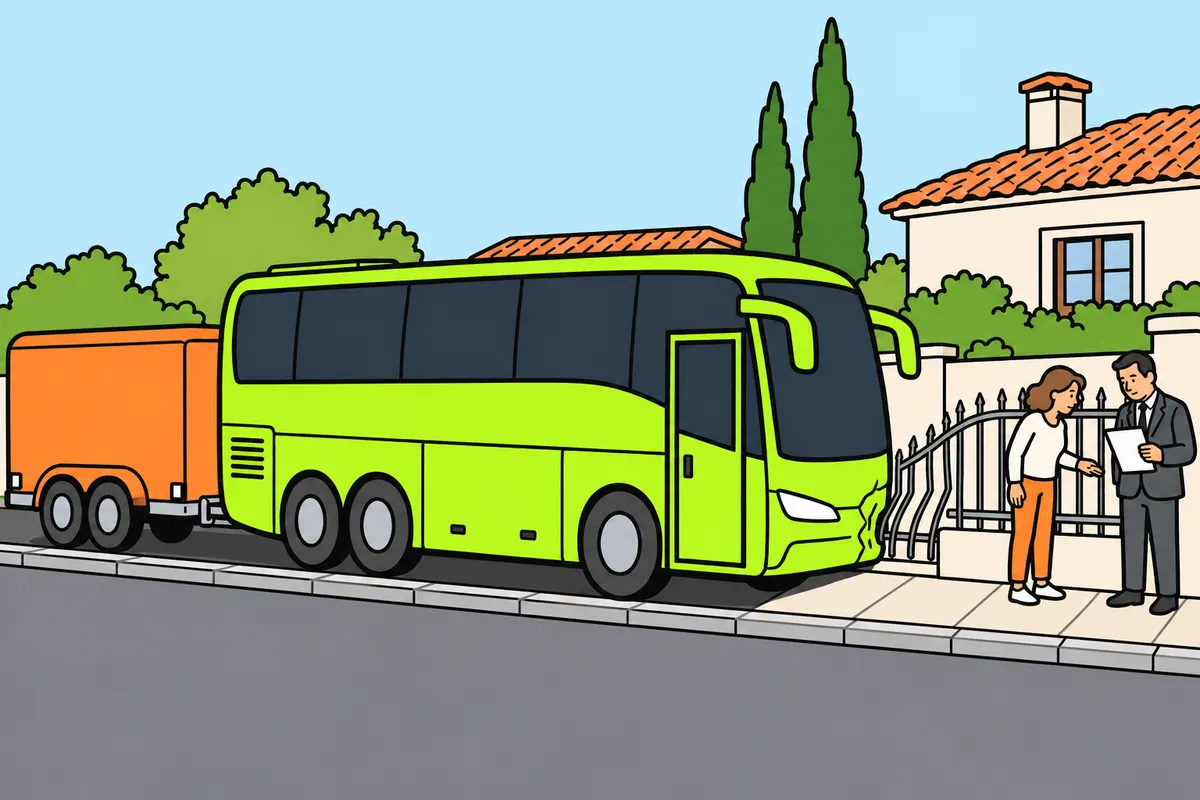
Compulsory insurance protects third parties, but you must understand its exclusions.
| Damage or injury | Compulsory cover of the vehicle causing the accident |
|---|---|
| Injuries to passengers as injured third parties | May be covered |
| Injury or death of the driver causing the accident | Excluded |
| Damage to the insured vehicle and things carried | Excluded |
| Property belonging to the policyholder, insured person, owner or driver | Property damage excluded |
| Property of their spouses or relatives up to the third degree | Property damage excluded: relatives by blood or marriage |
Remember
- Distinguish your own losses from harm you cause to third parties.
- If you cause the accident, your compulsory insurance excludes your injuries.
- Check other cover for damage to your vehicle and luggage.
Exam trap: Wrong: your compulsory insurance covers your injuries if you cause the accident. Right: injuries to the driver causing it are excluded.
Read the full explanation
- Compulsory insurance covers legally enforceable civil liability for personal injury and property damage caused to third parties within its scope. If you injure another road user or damage someone else's installation with your bus and trailer, you must distinguish that harm from damage to the bus itself. [LRCSCVM, arts. 1 and 2](https://www.boe.es/buscar/act.php?id=BOE-A-2004-18911)
- Passengers may be injured third parties in an accident caused by the bus. Injury to or death of the driver of the vehicle causing the accident is excluded from its compulsory insurance. If you cause the accident, that cover does not by itself provide personal insurance for your injuries. [LRCSCVM, art. 5.1](https://www.boe.es/buscar/act.php?id=BOE-A-2004-18911)
- Compulsory insurance does not cover damage to the insured vehicle or the things carried in it. For damage to the bus, insured trailer or luggage, you must examine the voluntary cover and relevant insurance policies. Passengers' injuries and damage to their luggage are treated differently under this cover. [LRCSCVM, art. 5.2](https://www.boe.es/buscar/act.php?id=BOE-A-2004-18911)
- Property damage to belongings of the policyholder, insured person, owner or driver, or of their spouse or relatives up to the third degree by blood or marriage, is also excluded. You must check who owns the damaged property, even if the object is outside the vehicle. [LRCSCVM, art. 5.2](https://www.boe.es/buscar/act.php?id=BOE-A-2004-18911)
20Victims, exclusions and notifying the insurer
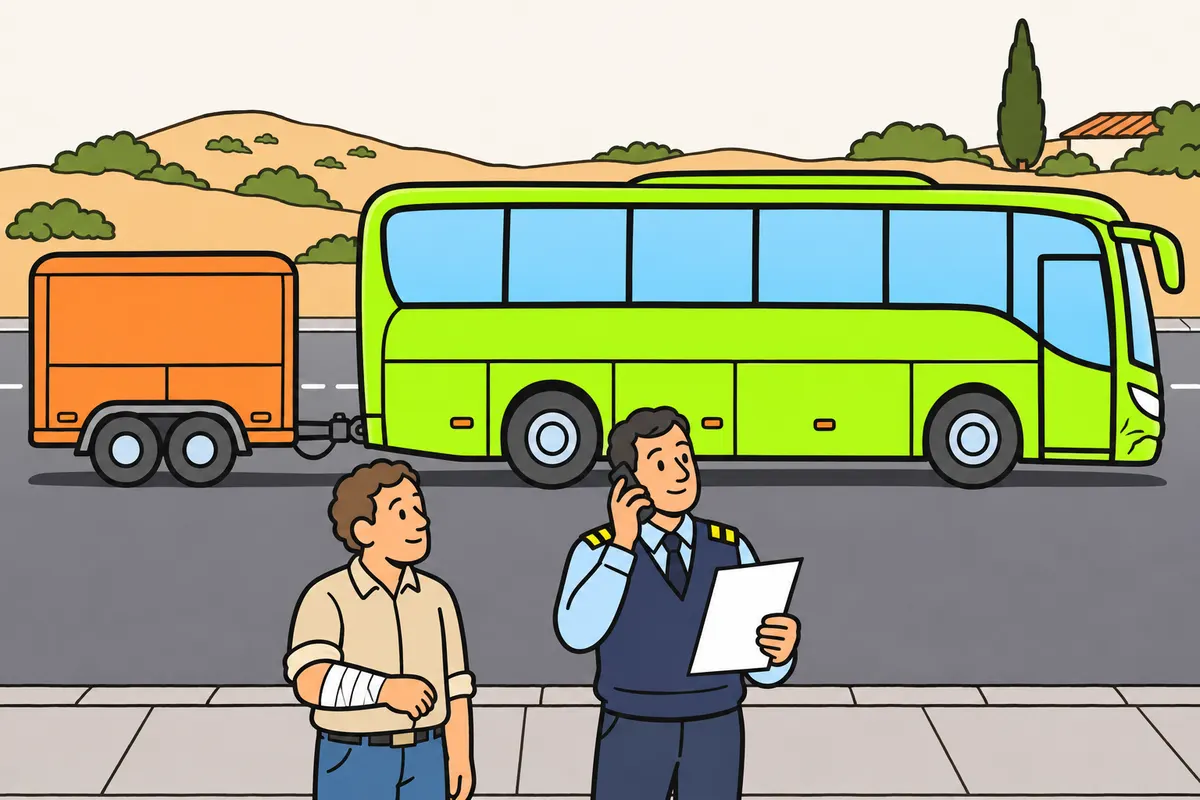
Distinguish compensation for victims from the insurer’s later claims against those responsible.
Remember
- A victim’s carelessness does not automatically remove compensation.
- The insurer may pay, then claim from those responsible where the law allows.
- A stolen or uninsured vehicle does not always mean no compensation.
- The Insurance Compensation Consortium may become involved.
- As policyholder, insured person or beneficiary, notify your insurer after learning of the incident.
- You have at most 7 days, unless your policy allows longer.
Exam trap: Wrong: reporting an accident means admitting responsibility. Right: you report the facts so the insurer can manage cover.
Read the full explanation
- A victim's contribution to the harm may reduce their compensation under the statutory conditions. The law distinguishes personal injury from property damage and sole fault from shared fault. You must consider that specific contribution when assessing liability for the accident. [LRCSCVM, art. 1](https://boe.es/buscar/act.php?id=BOE-A-2004-18911)
- A driver's failure to meet obligations does not mean the insurer can invoke any contractual exclusion against the injured party. You must distinguish compensation for the victim from the right of recovery: in the cases provided by law, the insurer can pay and then recover the amounts paid from the person responsible. [LRCSCVM, arts. 6 and 10](https://www.boe.es/buscar/act.php?id=BOE-A-2004-18911)
- Damage caused by a stolen vehicle is subject to the statutory exclusion and protection arrangements, potentially involving the Consorcio de Compensación de Seguros (Insurance Compensation Consortium). You must not conclude that victims always receive no compensation because the vehicle causing the damage was stolen or uninsured. [LRCSCVM, arts. 5.3 and 11](https://www.boe.es/buscar/act.php?id=BOE-A-2004-18911)
- If you are the policyholder, insured person or beneficiary, you must notify the insurer of the incident within a maximum of 7 days of becoming aware of it, unless the policy allows longer. Reporting the facts does not amount to admitting liability; it allows the insurer to learn of the accident and manage the relevant cover. [Law 50/1980, art. 16](https://www.boe.es/buscar/act.php?id=BOE-A-1980-22501)
21Consequences of having no insurance
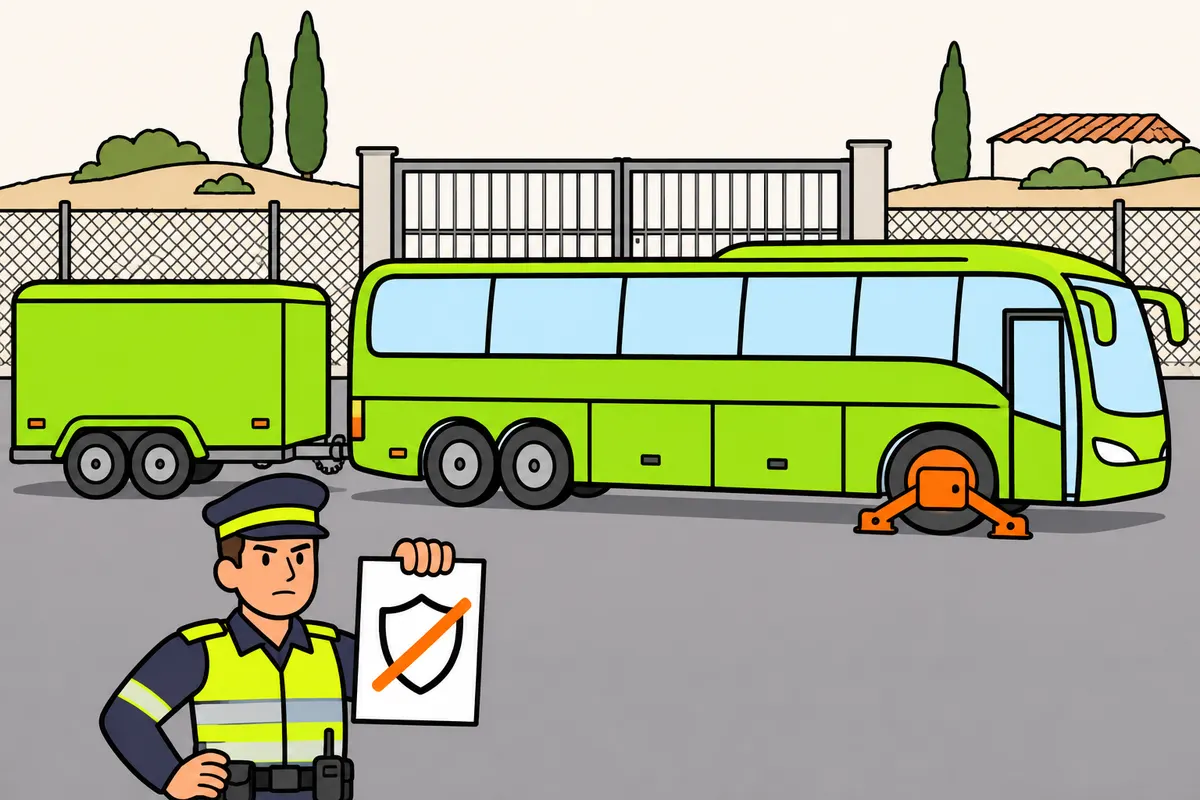
You cannot drive a vehicle without its required compulsory insurance.
| Case | Impoundment or sealing period |
|---|---|
| No insurance | 1 month |
| Repeat offence | 3 months |
| You breach the impoundment or seal | 1 year |
Remember
- An ITV pass and valid driving licence do not replace insurance.
- The owner pays impoundment or sealing costs.
- To lift the measure, you must prove insurance.
- To recover the vehicle, pay or secure the costs.
- The fine depends on the circumstances.
- The non-driving owner shares civil liability, unless they prove the vehicle was stolen.
Exam trap: Wrong: you can travel and arrange insurance afterwards. Right: without required compulsory insurance, driving in Spain is prohibited.
Read the full explanation
- If a vehicle is subject to compulsory insurance and is uninsured, it is prohibited from circulating in Spanish territory. The prohibition also applies to a vehicle whose driver has all personal documents in order. [LRCSCVM, art. 3.1.a](https://www.boe.es/buscar/act.php?id=BOE-A-2004-18911)
- Lack of insurance results in impoundment or sealing, at the owner's expense. The precautionary measure lasts 1 month, 3 months for a repeat offence and 1 year if the impoundment or seal is breached. Insurance must be proven to lift the measure; the costs must be paid or secured before the vehicle is returned. [LRCSCVM, art. 3.1.b](https://www.boe.es/buscar/act.php?id=BOE-A-2004-18911)
- The fine for failing to comply with the insurance obligation ranges from 601 to 3,005 euros. Its amount takes account of factors including whether the vehicle was being driven, its category, service, harm caused, duration without insurance and repeat offending. [LRCSCVM, art. 3.1.c](https://www.boe.es/buscar/act.php?id=BOE-A-2004-18911)
- The non-driving owner of an uninsured vehicle shares civil liability with its driver for damage caused, unless the owner proves that the vehicle was stolen from them. Driving someone else's vehicle does not remove liability for causing damage or the consequences of failing to insure it. [LRCSCVM, art. 1.3](https://www.boe.es/buscar/act.php?id=BOE-A-2004-18911)
22Changes of details, ownership and duplicates
Report changes on time and distinguish getting a duplicate from renewing.
| Document | What you do after loss or recovery |
|---|---|
| Driving licence | Request a duplicate; return a recovered original to the issuing Traffic Office |
| Registration certificate | Request a duplicate; immediately destroy the recovered invalidated original |
| Official paper ITV card | Request a duplicate at an ITV station |
| eITV | You can request a duplicate from the DGT |
Remember
- Report changes to your licence details or address within 15 days.
- As registered keeper, report each unit’s registered detail changes within 15 days.
- For sales between non-dealers, notify the sale within 10 days as seller.
- As buyer, request registration in your name within 30 days of purchase.
- You need the new registration certificate to drive the vehicle.
- A duplicate driving licence keeps its expiry date.
Exam trap: Wrong: a duplicate renews your D+E. Right: it keeps the same expiry date.
Read the full explanation
- If your licence details or address change, you must notify Tráfico (the traffic authority) within 15 days of the change. If you are the registered keeper of the bus or registered trailer, you must report changes to its registered details within 15 days, dealing with each affected unit. [RGCond, art. 10](https://www.boe.es/buscar/act.php?id=BOE-A-2009-9481). [RGV, art. 30.2](https://www.boe.es/buscar/act.php?id=BOE-A-1999-1826)
- If you sell the bus or registered trailer in a transaction between people who are not vehicle dealers, you must notify the transfer within 10 days. If you buy it, you must apply for the registration certificate in your name within 30 days of purchase; you need the new certificate to drive it. If you buy both units, process the change for each one. [RGV, art. 32.1 and 32.3](https://www.boe.es/buscar/act.php?id=BOE-A-1999-1826)
- If your driving licence is lost, stolen or damaged, apply for a duplicate; this procedure retains the D+E expiry date. If you recover the original after obtaining a duplicate for theft or loss, you must return it to the issuing Traffic Office. [RGCond, arts. 11 and 12](https://www.boe.es/buscar/act.php?id=BOE-A-2009-9481)
- If a unit's registration certificate is lost, stolen or damaged, you can request a duplicate as its registered keeper. Issuing it invalidates the original: if you recover it, you must destroy it immediately. [RGV, art. 30.1](https://www.boe.es/buscar/act.php?id=BOE-A-1999-1826)
- If you need to replace the bus's or trailer's ITV card, request a duplicate of the official paper card at an ITV station; if it has eITV, you can request it from the DGT. [DGT, duplicate technical data card](https://sede.dgt.gob.es/es/vehiculos/duplicado-y-renovacion-de-documentacion/duplicado-de-la-ficha-tecnica/)
23Responsibility for documentation
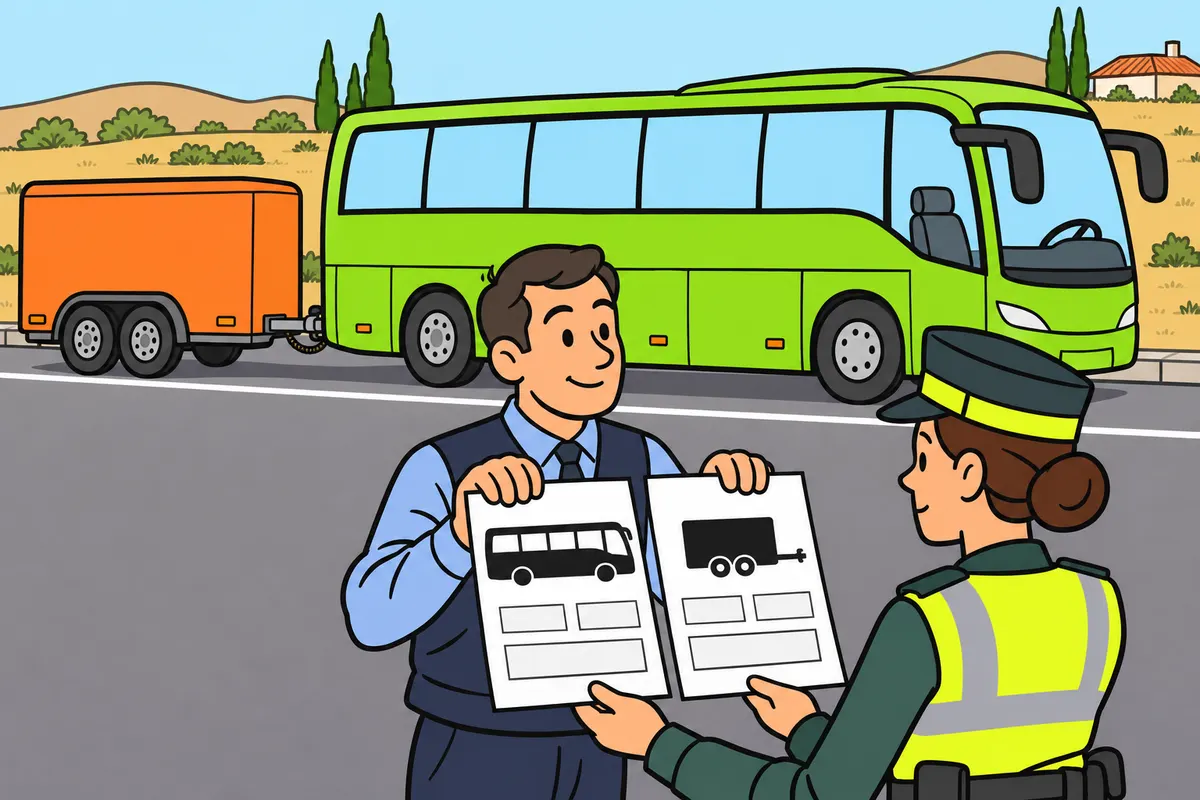
You must be able to show documents even when your company handles the procedures.
| Responsible person | Document, ITV and maintenance offences affecting safety |
|---|---|
| Registered keeper | Normally responsible |
| Long-term lessee recorded in the Vehicle Register | Responsible instead of the registered keeper |
Remember
- Carry documents for the trailer actually coupled to your bus.
- Distinguish document offences from your own driving offences.
- Being the usual driver does not make you the registered long-term lessee.
- As registered keeper, prevent driving by anyone who never obtained the appropriate licence.
- This duty also applies to the registered long-term lessee.
Exam trap: Wrong: your company keeps the documents, so you need not show them. Right: as driver, you must show the required documents.
Read the full explanation
- The company may keep documents and organise procedures, but as the driver you must be able to show the required documents for the units you use. Carrying documents for the trailer left at base instead of the one coupled does not meet this obligation. [RGV, art. 26](https://www.boe.es/buscar/act.php?id=BOE-A-1999-1826)
- The registered keeper is responsible for offences relating to vehicle documents, periodic inspections and maintenance where deficiencies affect safety. You must distinguish this administrative responsibility from offences you personally commit while driving and civil liability for accident damage. [LTSV, art. 82.1.f](https://www.boe.es/buscar/act.php?id=BOE-A-2015-11722)
- If you appear in the Vehicle Register as the long-term lessee, you bear the stated responsibility for these offences instead of the registered keeper. Being only the usual driver or insurance policyholder does not by itself give you the registered status of long-term lessee. [LTSV, art. 82.1.f](https://www.boe.es/buscar/act.php?id=BOE-A-2015-11722)
- As registered keeper, you must prevent anyone who has never obtained the appropriate licence from driving the vehicle. This obligation also applies to the long-term lessee recorded in the Register. Assigning a bus with a heavy trailer requires you to check the category held by the person who is to drive it. [LTSV, art. 11](https://www.boe.es/buscar/act.php?id=BOE-A-2015-11722)
Check the documents before departure
Check the driver and each unit of the combination.
- Check that your D+E is valid and that you comply with its restrictions.
- Identify the bus and trailer using their documents.
- Prepare the registration certificates, ITV cards and inspection reports.
- Check the ITV expiry date and result for each unit.
- Check that each unit subject to compulsory insurance has valid cover and that you can show the required documents.
Renew D+E
Prepare for expiry and distinguish renewal from obtaining a duplicate.
- Find the D+E expiry date and any specific restriction.
- Apply for renewal within the preceding 3 months if you use the normal procedure.
- Undergo the group 2 medical assessment at an authorised centre.
- Complete the application and keep any replacement authorisation issued to you, observing its conditions.
- Check the categories, dates and codes on the document you receive.
Act according to the ITV result
The report determines whether you can drive and how you must rectify defects.
- Read the result and defects in the inspected unit's report.
- With a pass and minor defects, repair them within a maximum of 2 months.
- With an unfavourable result, limit journeys to the authorised cases and return for inspection within the stated deadline, no more than 2 months.
- With a negative result, arrange transport from the station by means other than the vehicle itself and present it for inspection again after repairs, within the maximum of 2 months.
- Keep the report and check the new expiry date when the inspection is a pass.
Finished this module?
Mark it as read and you will see your progress on the theory list.