
Theory · D+E Licence - Bus with Trailer · Module 3 of 13
Dimensions, masses and speed limiters
You learn to calculate the mass and dimension limits for your bus with a trailer, interpret access restrictions and deal with projecting loads and special transport scenarios. You can select the figures specific to passenger transport and recognise which buses must have a speed limiter and how it must be set.
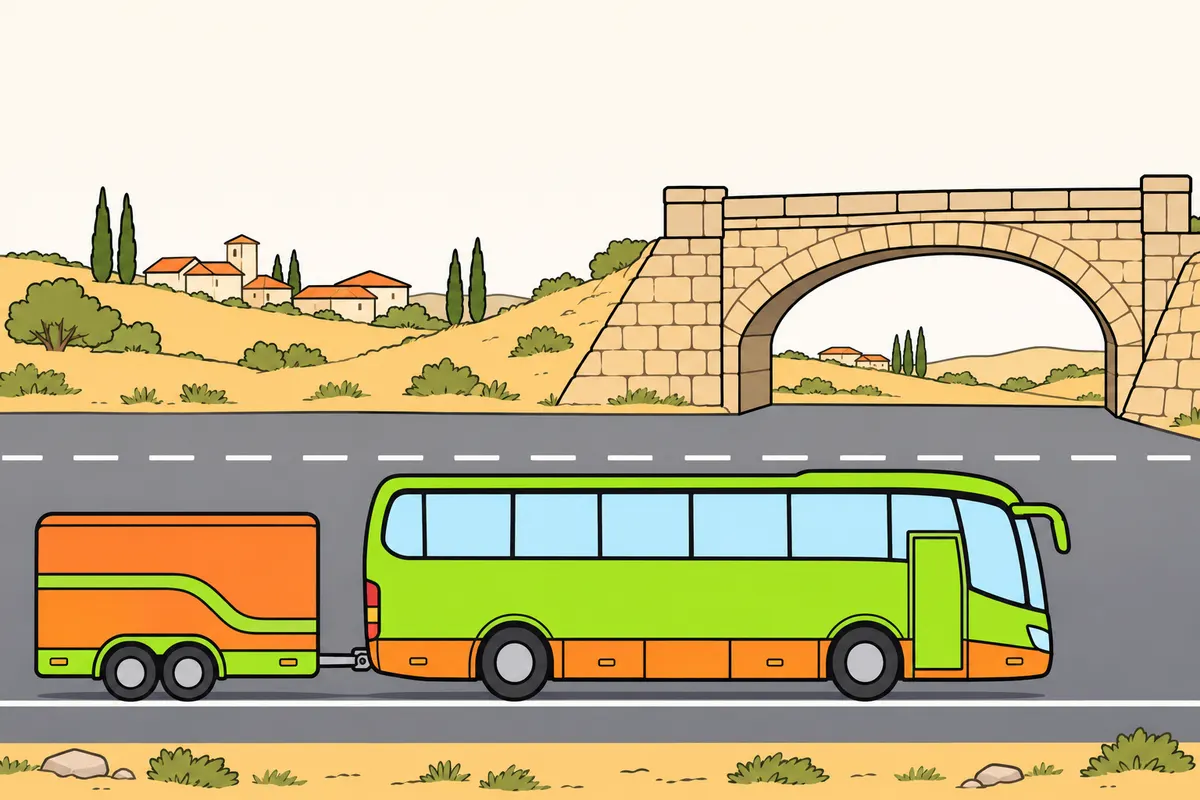
1The masses you need to distinguish
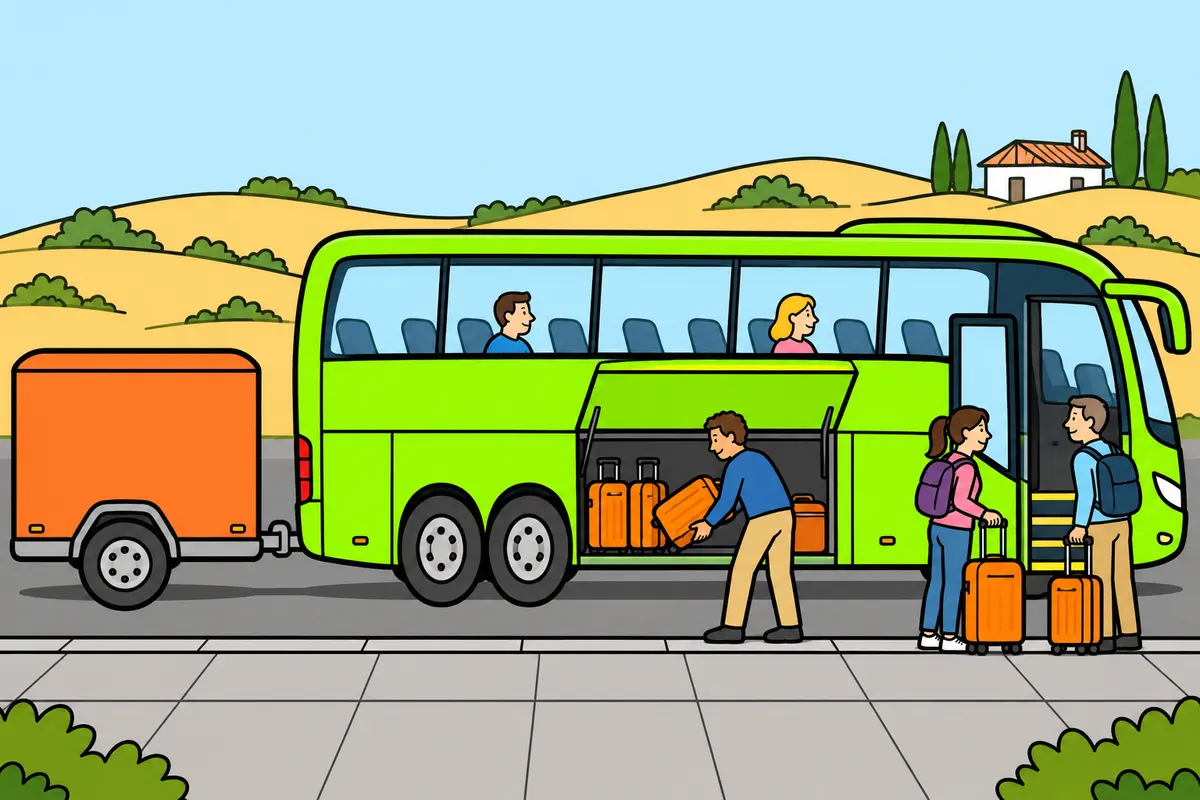
Distinguish your actual mass from the permitted maximum masses.
| Term | What it includes |
|---|---|
| Unladen mass | Equipped vehicle without people or load |
| Mass in running order | Unladen mass plus standard driver mass; standard attendant mass if carried |
| Laden mass | Vehicle and everything you actually carry |
| MMA | Maximum authorised mass for driving laden |
Remember
- Include a full fuel supply in unladen mass.
- Leave people and luggage out of unladen mass.
- For running order, add the standard driver mass.
- If you carry an attendant, add their standard mass too.
- Respect technical, legal and authorised limits.
Exam trap: Wrong: unloading luggage reduces your MMA. Right: it reduces laden mass; your MMA stays unchanged.
Read the full explanation
- The tara (unladen mass) includes the bus with its authorised fixed equipment and a full supply of fuel, water, lubricants, spare parts, tools and necessary accessories, without service personnel, passengers or a load. The suitcases and passengers you take on board for the journey increase the actual mass but do not form part of this unladen mass. [RGV, annex IX](https://www.boe.es/buscar/act.php?id=BOE-A-1999-1826#anix)
- The mass in running order adds a standard driver mass of 75 kg to the unladen mass. On buses and coaches, you also add 75 kg for an accompanying crew member if you carry one. This is a regulatory reference value; to assess the actual mass when driving, you must take into account the people and objects you actually carry. [RGV, annex IX](https://www.boe.es/buscar/act.php?id=BOE-A-1999-1826#anix)
- The laden mass is the actual mass of the vehicle, including its load, service personnel and passengers. The masa máxima autorizada (maximum authorised mass), MMA, is the maximum mass at which you may use it laden on public roads. Unloading luggage reduces the former but does not change the MMA in the documentation. [RGV, annex IX](https://www.boe.es/buscar/act.php?id=BOE-A-1999-1826#anix)
- The technically permissible maximum mass depends on the construction and the manufacturer’s specifications. Your authorisation may set a lower value: you must comply with both and with the regulatory maximum. Figures in tonnes include the vehicle and everything it carries; one tonne equals 1,000 kg. [RGV, annex IX](https://www.boe.es/buscar/act.php?id=BOE-A-1999-1826#anix)
2Combination mass and coupling load
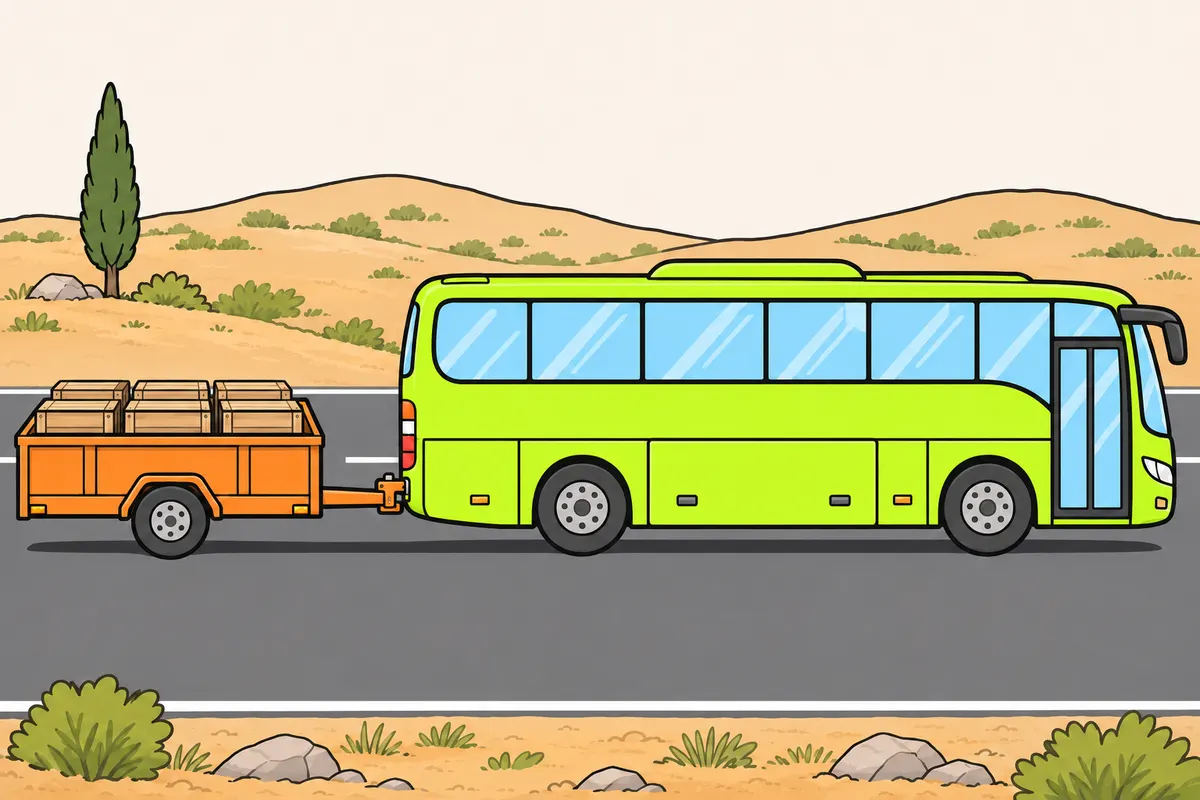
Check the combination limit and the load on your coupling.
Remember
- Calculate MMC = MMA + MMR of your bus.
- Respect any lower technical, legal or authorised maximum.
- For centre-axle trailers, subtract actual vertical coupling load when calculating towable mass.
- Count each load only once in the combination.
- Coupling load also counts towards bus and rear axle limits.
- Respect the technical capacity of your coupling too.
Exam trap: Wrong: choose the higher coupling limit. Right: for a centre-axle trailer with a uniformly distributed load, use the lower of 10 % of its maximum mass and 1,000 kg. Also respect bus, axle and technical coupling limits.
Read the full explanation
- The maximum authorised combination mass refers to the laden bus and its laden trailer. There is also a technically permissible maximum combination mass, determined by its construction and performance characteristics. Adding the individual MMA values does not guarantee that you may drive the combination at that total mass. [RGV, annex IX](https://www.boe.es/buscar/act.php?id=BOE-A-1999-1826#anix)
- The masa remolcable máxima autorizada (maximum authorised towable mass), MMR, limits the towed vehicle you may couple to the bus. For a centre-axle trailer, you use its maximum actual mass minus the actual vertical load transmitted to the coupling: the portion supported by its own axles. When calculating the combination mass, you must count each load only once. [RGV, annex IX](https://www.boe.es/buscar/act.php?id=BOE-A-1999-1826#anix)
- Paragraph 4.3 establishes MMC = MMA + MMR of the towing vehicle. This result is limited by the technically permissible maximum mass declared by the manufacturer and by the maximum legal combination mass where applicable. For example, you must still comply with a specific combination authorisation that sets a lower value than the arithmetic result. [RGV, annex IX](https://www.boe.es/buscar/act.php?id=BOE-A-1999-1826#anix)
- For a centre-axle trailer with a uniformly distributed load, the maximum authorised vertical load on the coupling does not exceed the lower of 10 % of its maximum mass and 1,000 kg. It also counts towards the MMA of the bus and its rear axles, and must comply with the technical capacity of the coupling. [RGV, annex IX](https://www.boe.es/buscar/act.php?id=BOE-A-1999-1826#anix)
3Checking several limits at once
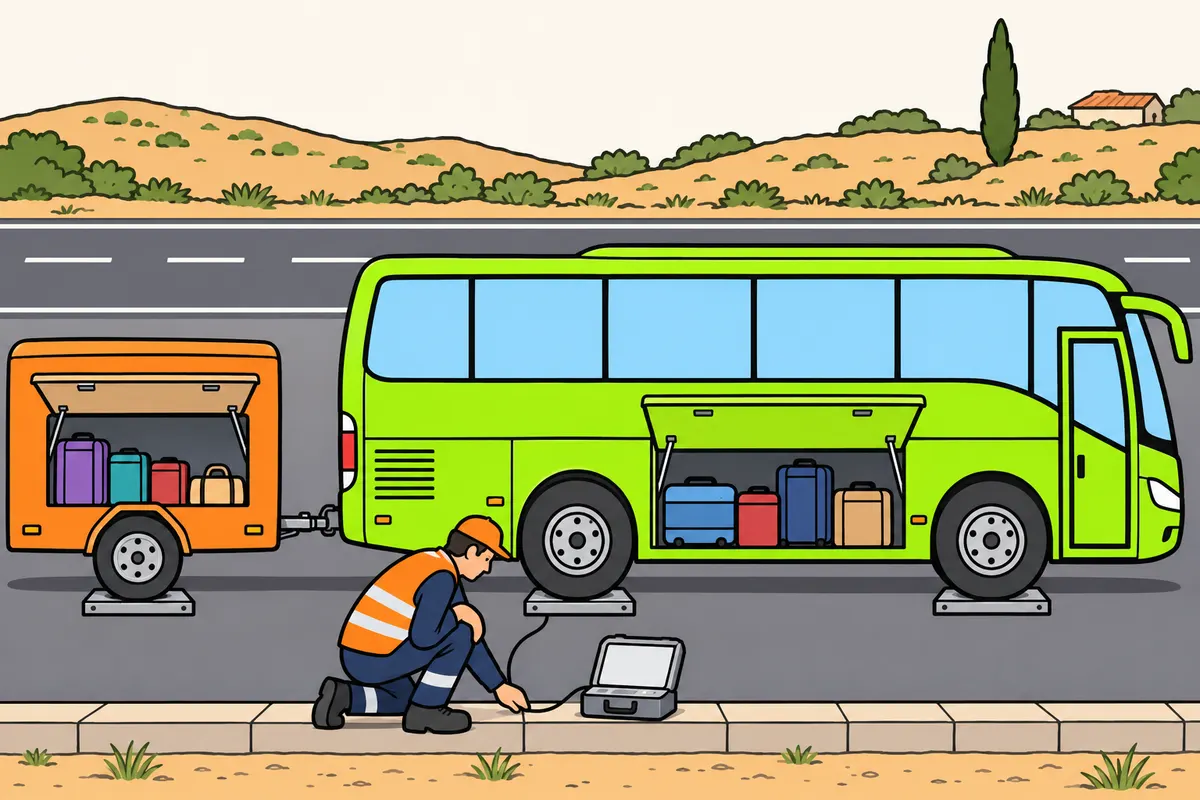
Before setting off, check all your limits together.
Remember
- Check your bus, trailer, combination, axles, coupling and tyres.
- You can meet the total limit while overloading an axle.
- Reduce or redistribute your load before driving.
- Include coupling load when checking your bus.
- Respect tyre load limits for their load indices and your maximum speed.
Exam trap: Wrong: inflate tyres to 9 kg/cm². Right: this limits pressure on the road surface, not tyre inflation pressure.
Read the full explanation
- To prepare to set off, identify the bus, its class and number of axles, and the type of trailer. Cross-check the maximum masses of each unit against the towable mass and the authorised combination mass. Then check the axles, axle groups, coupling and tyres: all these limits apply simultaneously. [RGV, annex IX](https://www.boe.es/buscar/act.php?id=BOE-A-1999-1826#anix)
- You can comply with the total mass limit and still overload an axle. If a non-driven axle transmits 10.3 t to the ground, it exceeds the general limit of 10 t even if the bus is below its MMA. You must reduce the load or correct its distribution before driving; spare capacity on another axle does not offset this excess. [RGV, annex IX](https://www.boe.es/buscar/act.php?id=BOE-A-1999-1826#anix)
- Luggage in the trailer can affect the bus through the coupling. For example, a vertical load of 150 kg uses some of the mass capacity of the towing vehicle and its affected axles. The available capacity therefore also depends on the passengers and luggage you carry inside the bus. [RGV, annex IX](https://www.boe.es/buscar/act.php?id=BOE-A-1999-1826#anix)
- The tyres must not support more load than their safety standards permit, according to their load indices and the vehicle’s maximum speed. The maximum pressure on the road surface for pneumatic tyres or wheels with similar elasticity is 9 kg/cm² of gross contact area; this figure is not the inflation pressure you must use. [RGV, annex IX](https://www.boe.es/buscar/act.php?id=BOE-A-1999-1826#anix)
4Single axles and axle groups
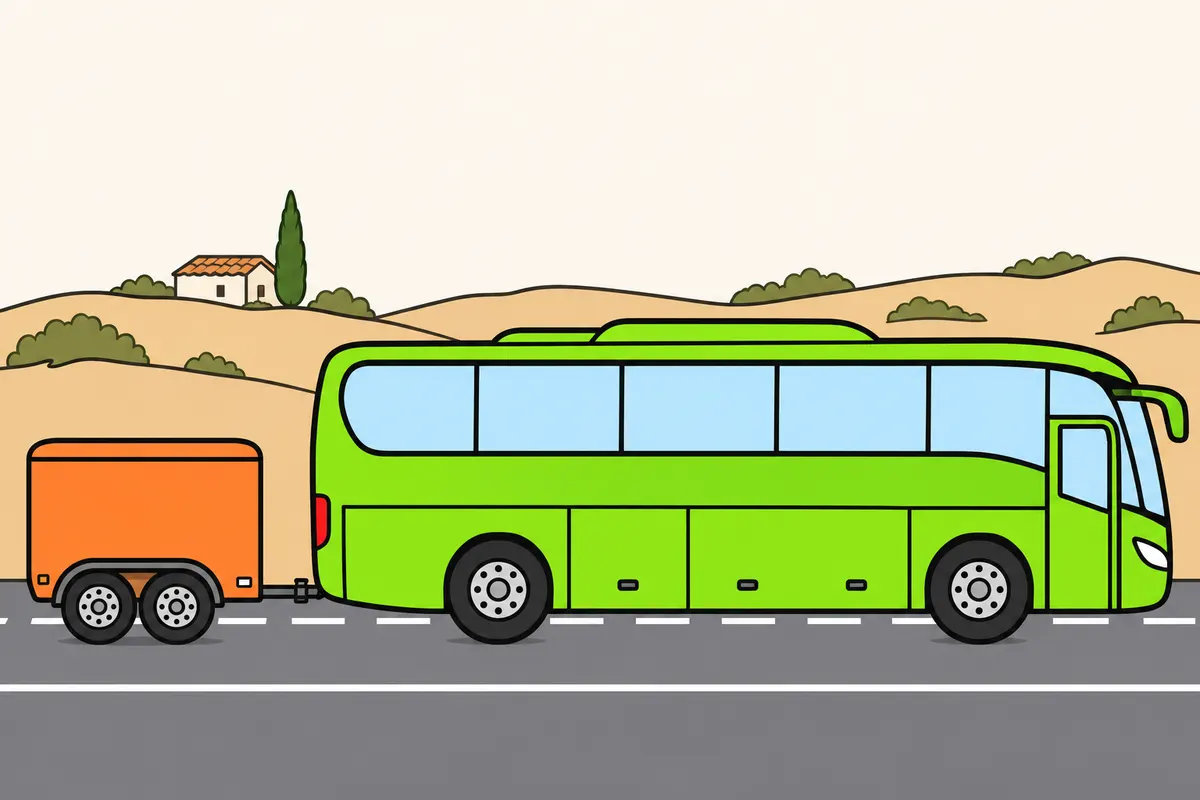
Choose each axle limit by its function and your bus class.
| Axle and vehicle | Maximum |
|---|---|
| Single non-driving axle | 10 t |
| Class II or III bus driving axle | 12.6 t |
| Class I bus driving axle | 13 t |
Remember
- Count all wheels on an axle within its mass.
- Twin wheels do not create another axle.
- For axle groups, check spacing between axle centres.
- Distinguish motor vehicle groups from trailer groups.
Exam trap: Wrong: use 13 t for your class III coach driving axle. Right: its limit is 12.6 t.
Read the full explanation
- The axle mass is the mass transmitted to the ground by all the wheels on that axle. The maximum for a single non-driven axle is 10 t. For the driven axle of class II and III buses and coaches, used for interurban and long-distance services, the table sets 12.6 t; for class I urban buses, it sets 13 t. [RGV, annex IX](https://www.boe.es/buscar/act.php?id=BOE-A-1999-1826#anix)
- The general figure for a driven axle is 12 t, but for your bus you must select the row specific to its class where applicable. You do not use the 13 t reserved for an urban bus when calculating the limit for a driven axle on a class III coach. The vehicle’s technical classification determines which row you use. [RGV, annex IX](https://www.boe.es/buscar/act.php?id=BOE-A-1999-1826#anix)
- A tandem consists of two axles in a bogie; a tri-axle tandem consists of three. The spacing d between the axle centres and whether they belong to the motor vehicle or the towed vehicle determine the group’s maximum mass. Twin wheels do not turn one axle into two: all its wheels share that axle’s limit. [RGV, annex IX](https://www.boe.es/buscar/act.php?id=BOE-A-1999-1826#anix)
- You can raise or lower a retractable axle using its mechanism; with a load-relieving axle, you can change its load without lifting it. The number of wheels you see does not replace identifying the axles and their operating configuration. You must keep the loads within the authorised and technical values for the configuration you use. [RGV, annex IX](https://www.boe.es/buscar/act.php?id=BOE-A-1999-1826#anix)
5Motor vehicle tandem axle group
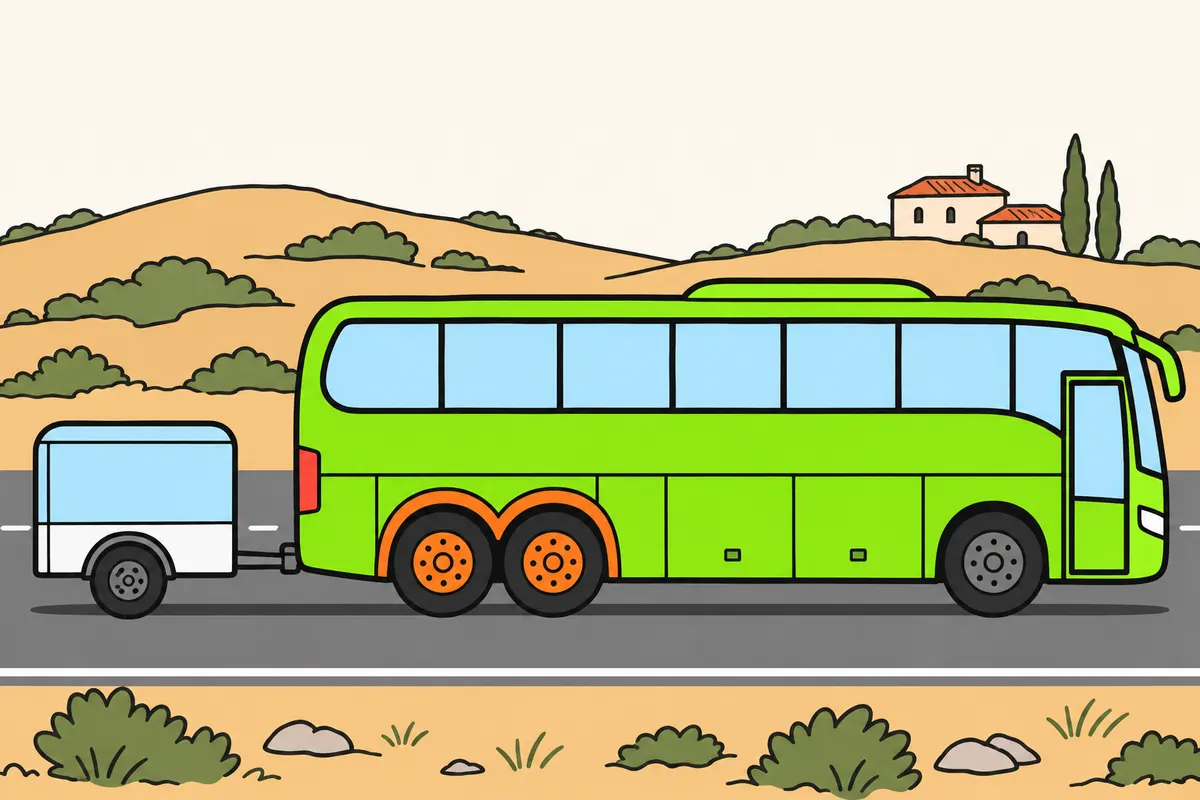
Your motor vehicle tandem limit depends on axle spacing and equipment.
| Motor vehicle tandem spacing | Group maximum |
|---|---|
| Below 1.00 m | 12 t |
| At least 1.00 m; below 1.30 m | 16 t |
| At least 1.30 m; below 1.80 m | 18 t; 19 t only under the stated conditions |
Remember
- Measure spacing between axle centres.
- Apply the limit to the whole group.
- Use the motor vehicle table when checking your bus.
Exam trap: Wrong: every motor vehicle tandem allows 19 t. Right: only with spacing from 1.30 m to below 1.80 m, and either twin tyres plus air suspension or recognised equivalent on the driving axle, or twin tyres on each driving axle with each axle’s maximum mass no more than 9.5 t.
Read the full explanation
- For the tandem axle group on your motor vehicle, if d is less than 1.00 m, the group maximum is 12 t. This figure applies to the motor vehicle’s tandem axle group and differs from the 11 t for an equally closely spaced tandem axle group on a trailer or semi-trailer. First identify which unit it belongs to. [RGV, annex IX](https://www.boe.es/buscar/act.php?id=BOE-A-1999-1826#anix)
- With spacing of at least 1.00 m but less than 1.30 m, the maximum for the motor vehicle’s tandem axle group is 16 t. Exactly 1.00 m falls within this range. [RGV, annex IX](https://www.boe.es/buscar/act.php?id=BOE-A-1999-1826#anix)
- With spacing from 1.30 m to less than 1.80 m, the general maximum for the motor vehicle’s tandem axle group is 18 t. The annex allows 19 t within this range when the driven axle has twin tyres and air suspension or suspension recognised as equivalent. [RGV, annex IX](https://www.boe.es/buscar/act.php?id=BOE-A-1999-1826#anix)
- You may also apply the 19 t in the previous case when each driven axle has twin tyres and the maximum mass of each axle does not exceed 9.5 t. You must check the full condition: having two closely spaced axles or any type of suspension does not, on its own, establish entitlement to the 19 t maximum. [RGV, annex IX](https://www.boe.es/buscar/act.php?id=BOE-A-1999-1826#anix)
6Trailer or semi-trailer tandem axle group
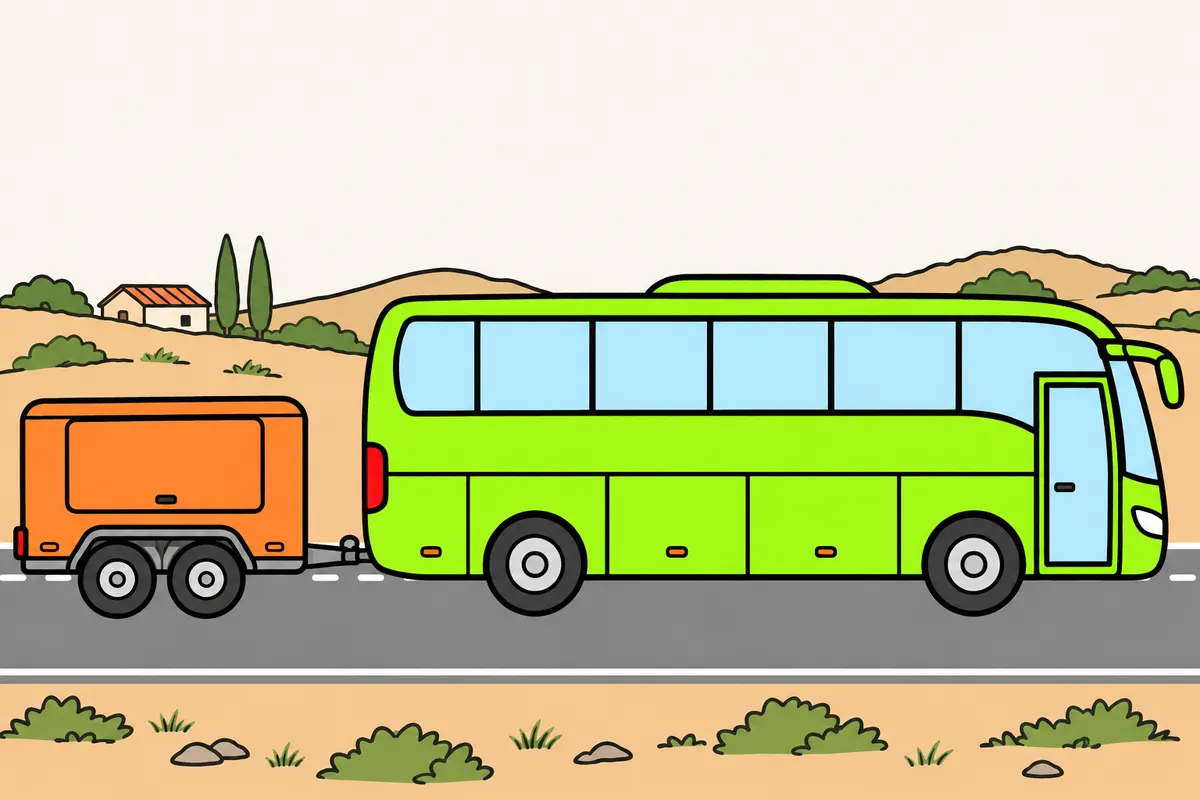
Use the trailer table to check your trailer tandem limit.
| Trailer or semi-trailer tandem spacing | General group maximum |
|---|---|
| Below 1.00 m | 11 t |
| At least 1.00 m; below 1.30 m | 16 t |
| At least 1.30 m; below 1.80 m | 18 t |
| At least 1.80 m | 20 t |
Remember
- Apply these masses to the whole group.
- Also respect your trailer MMA and bus MMR.
- Do not use construction, roadworks or mining tipping semi-trailer exceptions for luggage trailers.
Exam trap: Wrong: apply the motor vehicle tandem’s 19 t to your trailer. Right: from 1.30 m to below 1.80 m, its general maximum is 18 t.
Read the full explanation
- For the trailer’s tandem axle group, spacing d of less than 1.00 m permits a maximum of 11 t for the whole group. If d is at least 1.00 m but less than 1.30 m, the maximum is 16 t. These are limits from the axle table; the luggage trailer’s MMA may be much lower. [RGV, annex IX](https://www.boe.es/buscar/act.php?id=BOE-A-1999-1826#anix)
- With d of at least 1.30 m but less than 1.80 m, the towed tandem axle group has a general maximum of 18 t. Exactly 1.30 m falls within this range. The 19 t exception for the motor vehicle’s tandem axle group belongs to another row and you must not apply it to the trailer. [RGV, annex IX](https://www.boe.es/buscar/act.php?id=BOE-A-1999-1826#anix)
- With d of at least 1.80 m, the maximum for the towed tandem axle group is 20 t. Exactly 1.80 m falls within this range. None of these figures increases the bus’s towable mass or the authorised mass of the trailer you have coupled to it. [RGV, annex IX](https://www.boe.es/buscar/act.php?id=BOE-A-1999-1826#anix)
- Further detail: the 20 t tandem axle group exception for certain semi-trailers with reinforced tipping bodies applies to construction, roadworks or mining; you must not apply it to the luggage trailer. [RGV, annex IX, table 1](https://www.boe.es/buscar/act.php?id=BOE-A-1999-1826#anix)
7Tri-axle group and trailer limits
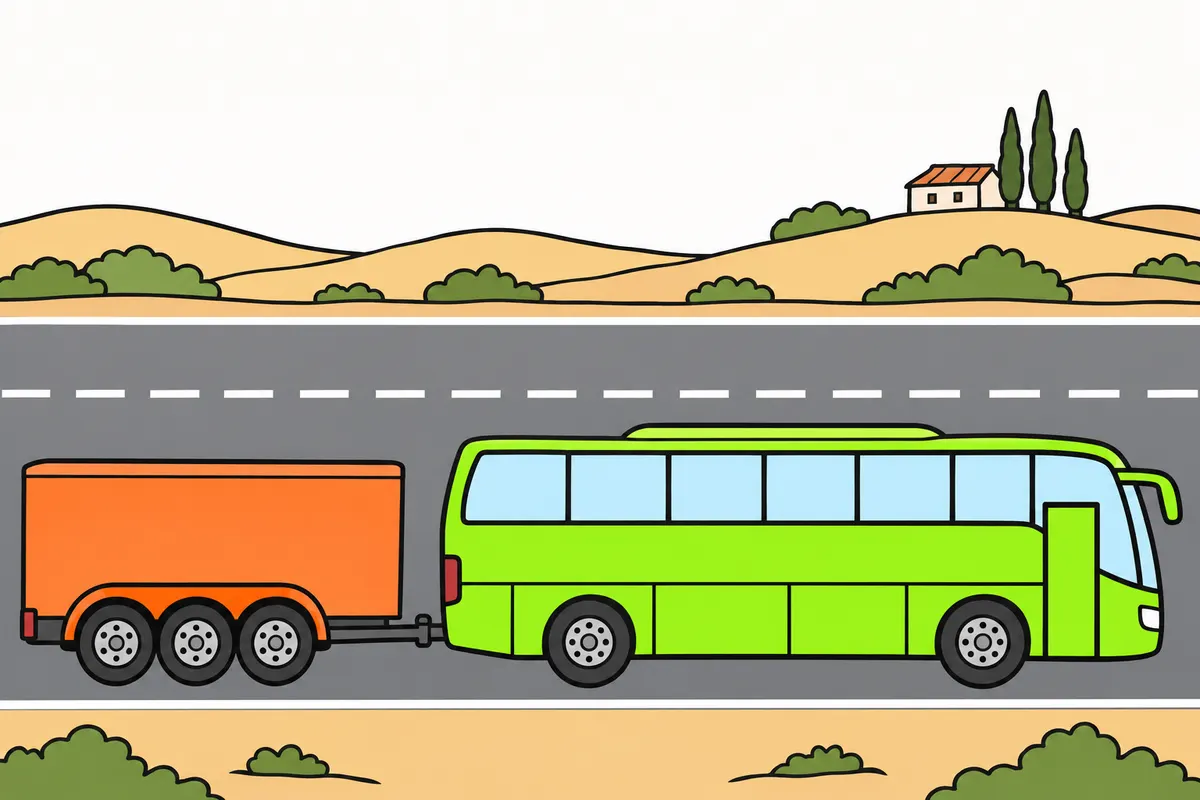
Distinguish the tri-axle group limit from your whole trailer limit.
| Towed part | Condition | Maximum |
|---|---|---|
| Tri-axle group | Spacing up to and including 1.30 m | 21 t |
| Tri-axle group | Over 1.30 m; up to and including 1.40 m | 27 t |
| Whole trailer | Two axles | 18 t |
| Whole trailer | Three axles | 24 t |
Remember
- Measure spacing between consecutive axles in the group.
- Also respect your specific authorisation and bus towable mass.
- Do not add individual axle limits to increase your MMA.
Exam trap: Wrong: allow 27 t for the whole trailer. Right: this is the tri-axle group limit within its spacing interval; also respect your trailer MMA.
Read the full explanation
- For a tri-axle group on a trailer with a distance between consecutive axles of 1.30 m or less, the maximum is 21 t. If the distance is greater than 1.30 m and no greater than 1.40 m, the maximum for the group is 27 t. You must apply the exact range in the table. [RGV (General Vehicle Regulations), Annex IX](https://www.boe.es/buscar/act.php?id=BOE-A-1999-1826#anix)
- With d = 1.30 m, the limit is 21 t; with d = 1.35 m, it is 27 t. These values refer to the whole group, not to each axle. A question about a tri-axle group concerns a different quantity from a question about the MMA (maximum authorised mass) of the trailer or combination. [RGV, Annex IX](https://www.boe.es/buscar/act.php?id=BOE-A-1999-1826#anix)
- The general MMA of a two-axle trailer is 18 t, and that of a three-axle trailer is 24 t. These are the statutory ceilings for these units, subject to their individual authorisation. To couple them to a bus, you must still comply with the specific towable mass for category M. [RGV, Annex IX](https://www.boe.es/buscar/act.php?id=BOE-A-1999-1826#anix)
- Two single non-driven axles, each limited to 10 t, do not authorise a two-axle trailer of 20 t simply by adding their limits together. You must comply with the maximum for the axles, the unit and the combination at the same time. The same reasoning prevents you from applying the 27 t limit for a tri-axle group to the whole trailer. [RGV, Annex IX](https://www.boe.es/buscar/act.php?id=BOE-A-1999-1826#anix)
8Maximum mass of rigid buses
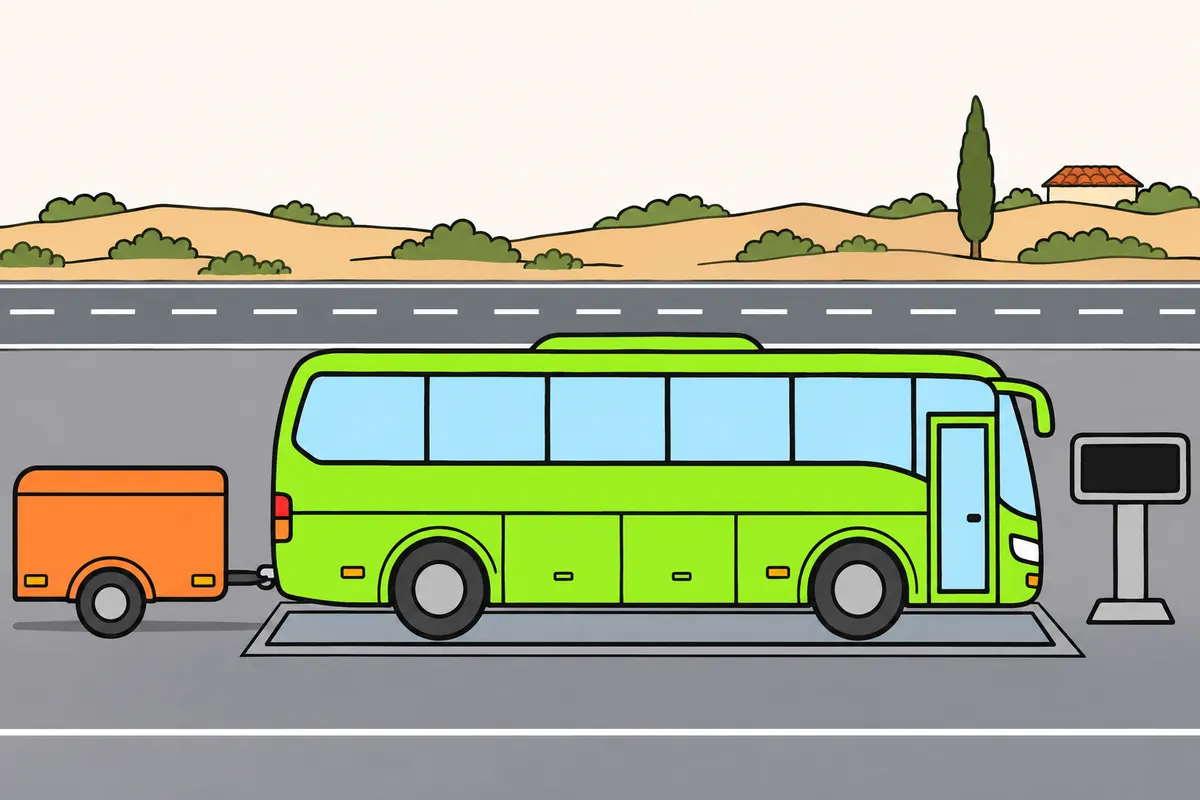
Choose your bus maximum mass by its class and number of axles.
| Vehicle | Regulatory maximum |
|---|---|
| Two-axle class I bus | 20 t |
| Two-axle class II or III bus | 19.50 t |
| Three-axle motor vehicle | 25 t; 26 t under the stated conditions |
| Three-axle articulated bus | 28 t |
| Four-axle rigid vehicle with two steering axles | 32 t under the stated conditions |
| Other four-axle rigid vehicles | 31 t |
Remember
- Also check your vehicle’s specific authorisation.
- Distinguish an articulated bus from a bus towing a separate trailer.
Exam trap: Wrong: apply 26 t or 32 t without checking equipment. Right: for 26 t with three axles, or 32 t with four axles including two steering axles, you need either twin tyres plus air suspension or recognised equivalent on the driving axle, or twin tyres on each driving axle with each axle’s maximum mass no more than 9.5 t.
Read the full explanation
- A two-axle class I urban bus has a statutory MMA of 20 t. For two-axle class II and III buses and coaches, used for interurban and long-distance services, the maximum is 19.50 t. You must select the limit by bus class and also check what is authorised for that particular unit. [RGV, Annex IX](https://www.boe.es/buscar/act.php?id=BOE-A-1999-1826#anix)
- A three-axle motor vehicle has a general maximum of 25 t. It can reach 26 t if the drive axle has twin tyres and air suspension or a recognised equivalent, or if each drive axle has twin tyres and the maximum mass of each does not exceed 9.5 t. [RGV, Annex IX](https://www.boe.es/buscar/act.php?id=BOE-A-1999-1826#anix)
- Further detail: A four-axle rigid vehicle with two steering axles can reach 32 t under the conditions requiring twin tyres and air suspension or an equivalent on the drive axle, or twin tyres on each drive axle and a maximum of 9.5 t per axle. Other four-axle rigid vehicles have a general maximum of 31 t. [RGV, Annex IX](https://www.boe.es/buscar/act.php?id=BOE-A-1999-1826#anix)
- A three-axle articulated bus has a maximum of 28 t. Its articulation forms part of the bus and is not equivalent to the luggage trailer in your D+E combination. You must therefore distinguish that row from the row for a rigid bus to which you couple a separate trailer. [RGV, Annex IX](https://www.boe.es/buscar/act.php?id=BOE-A-1999-1826#anix)
9Bus towable mass
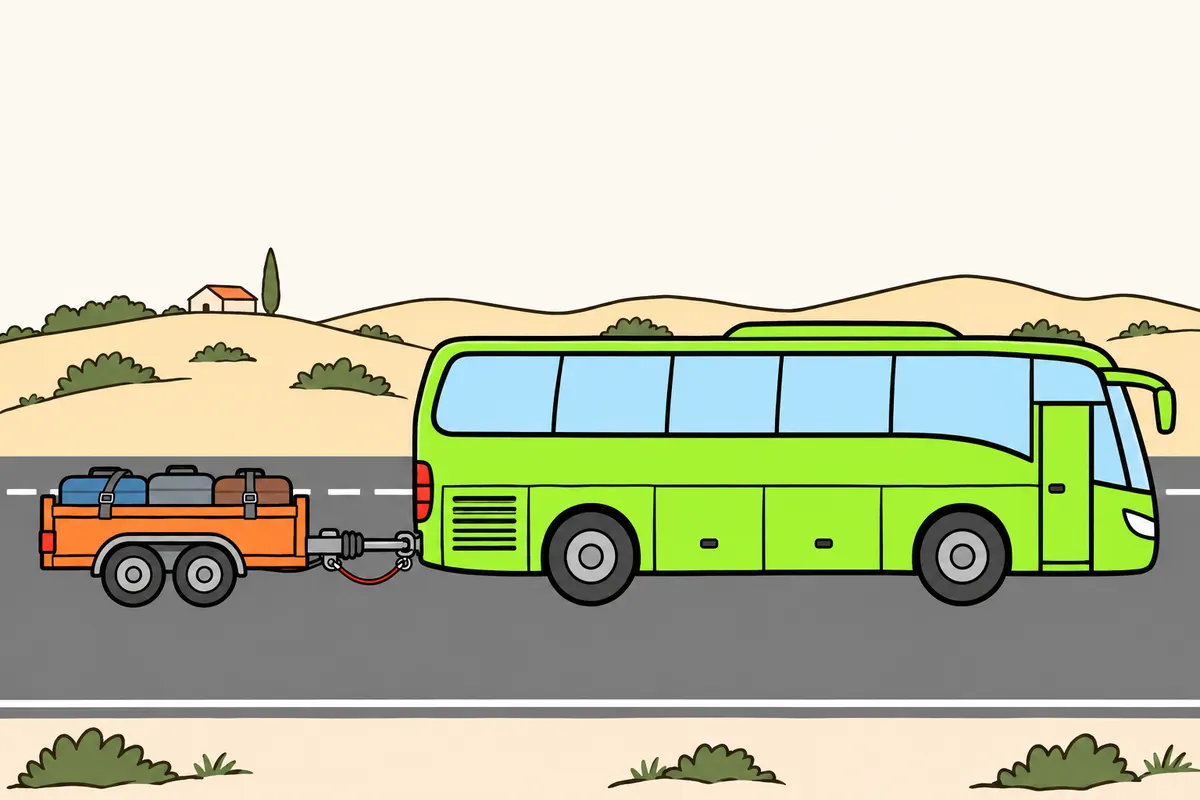
Check your bus towable mass against the trailer braking system.
| Trailer brakes when towing with a category M bus | Towable mass limit |
|---|---|
| Overrun or continuous | No more than bus MMA or 3,500 kg |
| Unbraked | Half the towing vehicle’s unladen mass increased by 75 kg; never above 750 kg |
Remember
- Your bus belongs to category M.
- Respect the technical capacities of your bus and coupling.
- Your D+E licence does not increase your combination’s capacity.
- Respect any combination maximum below your calculated result.
Exam trap: Wrong: continuous brakes let you use the N2 and N3 lorry rule. Right: your bus follows the category M rule and its technical limits.
Read the full explanation
- Buses belong to category M for towable mass purposes. Their MMR (maximum towable mass) must not exceed the technically permissible capacity of the vehicle and coupling. You must also apply the limit set by section 4.1 according to the trailer's braking system; a high technical capacity does not remove that statutory limit. [RGV, Annex IX](https://www.boe.es/buscar/act.php?id=BOE-A-1999-1826#anix)
- For a trailer with an overrun brake, the maximum towable mass is limited by the MMA of the towing vehicle and, in all cases, by 3,500 kg. Section 4.1.2.3 refers to this same rule when the towing vehicle is in category M and the trailer has continuous braking. The towable mass limit of 1.5 times the MMA provided for N2 and N3 does not apply to your bus. [RGV, Annex IX](https://www.boe.es/buscar/act.php?id=BOE-A-1999-1826#anix)
- For an unbraked trailer, the towable mass is limited to half the towing vehicle's unladen mass plus 75 kg and must never exceed 750 kg. This case helps you interpret the tables, although the heavy trailer used with D+E requires you to apply the conditions for its braking system. [RGV, Annex IX](https://www.boe.es/buscar/act.php?id=BOE-A-1999-1826#anix)
- For example, if a coach has an MMA of 19,500 kg and an authorised MMR of 3,000 kg, the combination formula gives 22,500 kg as the initial ceiling. If its authorised or technical maximum combination mass is lower, you must use that lower value. Holding a D+E licence does not increase any of these capacities. [RGV, Annex IX](https://www.boe.es/buscar/act.php?id=BOE-A-1999-1826#anix)
10Road trains
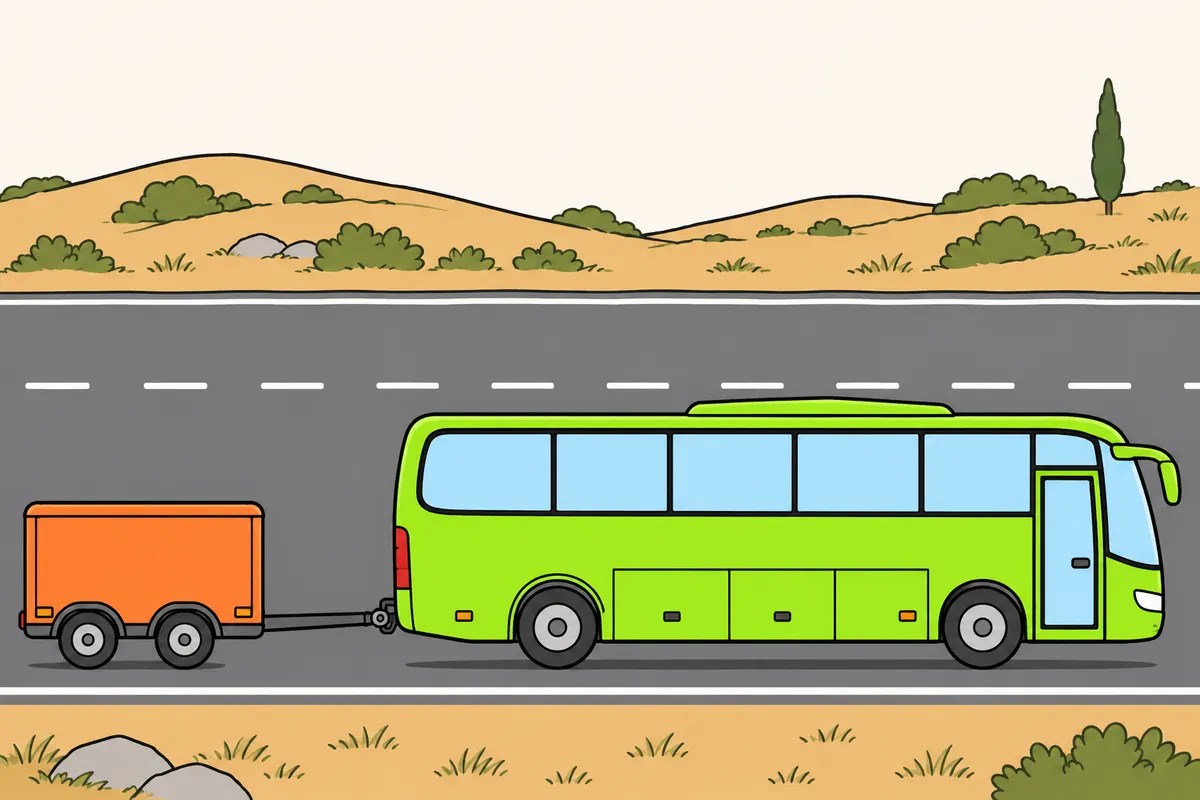
Your bus and trailer must meet both individual and combination limits.
| Road train: motor vehicle and trailer axles | General ceiling; other limits apply |
|---|---|
| Two and two | 36 t |
| Two and three | 42 t |
| Three and two or three | 44 t |
Remember
- Measure from your bus’s rearmost axle to your trailer’s front axle.
- Do not measure the gap between the bodies.
- Keep enough mass on driving axles without exceeding their limits.
- Respect your bus’s specific towable mass.
Exam trap: Wrong: your axle count allows loading to the general ceiling. Right: also respect each unit’s mass limits, your bus MMR and category M restrictions.
Read the full explanation
- Further detail: Your bus with a trailer forms a road train. The general table sets 36 t for a two-axle motor vehicle with a two-axle trailer; 42 t for two plus three axles; and 44 t for a three-axle motor vehicle with a two- or three-axle trailer. These are general ceilings that do not replace the bus's specific MMR or allow you to load it to those figures. [RGV, Annex IX](https://www.boe.es/buscar/act.php?id=BOE-A-1999-1826#anix)
- For your passenger vehicle combination, first calculate the actual capacity from the authorised bus and trailer. A two-axle coach limited to 19.50 t and with an MMR of 3.50 t does not gain a capacity of 36 t because the two vehicles have four axles in total: you must also comply with the limits for each unit and for category M. [RGV, Annex IX](https://www.boe.es/buscar/act.php?id=BOE-A-1999-1826#anix)
- In a road train, there must be at least 3.00 m between the rear axle of the motor vehicle and the front axle of the trailer. The reference points are the axles, not the ends of the bodies or the visible gap between the bus and the luggage compartment. [RGV, Annex IX](https://www.boe.es/buscar/act.php?id=BOE-A-1999-1826#anix)
- The mass on the drive axle or axles must be at least 25 % of the total laden mass of the ordinary vehicle or combination. With an actual mass of 20 t, you need at least 5 t on the drive axles, while also respecting their maximum. This traction requirement does not give you any allowance to overload the drive axle. [RGV, Annex IX](https://www.boe.es/buscar/act.php?id=BOE-A-1999-1826#anix)
11Further detail: increases for technology
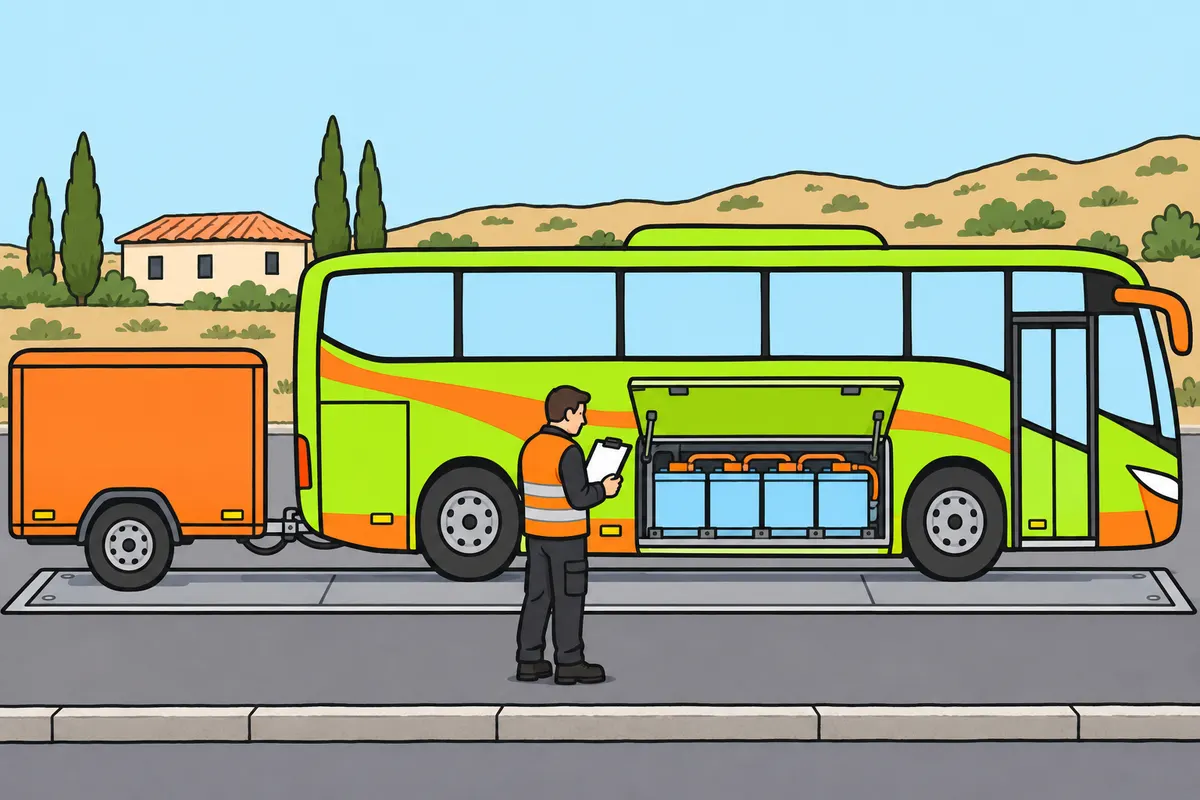
You can offset extra technology weight only where the relevant table note applies.
| Vehicles covered by the relevant table note | Maximum increase |
|---|---|
| Alternative fuel vehicles or combinations | Up to 1 t for extra technology weight |
| Zero-emission heavy vehicles | Up to 2 t for extra technology weight |
| Vehicles intended for urban services | Up to 1 t additionally; respect technical and axle maxima |
Remember
- Justify the extra weight needed for the technology.
- Check that your table row carries the relevant note.
- Respect your specific authorisation and technical capacities.
- For urban services, also respect maximum axle masses.
Exam trap: Wrong: new technology automatically lets you add luggage. Right: the technology increase offsets justified extra technology weight, only in applicable rows.
Read the full explanation
- In the rows carrying the relevant note, vehicles or combinations powered by alternative fuels may increase their MMA by the additional weight required by that technology, up to 1 t. For zero-emission heavy vehicles, the maximum increase is 2 t. The note does not apply indiscriminately to every row in the table. [RGV, Annex IX](https://www.boe.es/buscar/act.php?id=BOE-A-1999-1826#anix)
- The purpose of the increase is to compensate for the mass of the technology, so you must substantiate the additional weight required. You cannot automatically add one tonne of luggage because you use alternative fuel, or two because you have zero-emission propulsion. You must also respect the technical capacities and the individual authorisation. [RGV, Annex IX](https://www.boe.es/buscar/act.php?id=BOE-A-1999-1826#anix)
- For vehicles intended for services in urban environments, the note allows up to 1 t in addition to the stated technology increases. This is conditional on not exceeding the technically permissible maximum mass or the maximum axle masses. The intended service and the applicable row must be substantiated. [RGV, Annex IX](https://www.boe.es/buscar/act.php?id=BOE-A-1999-1826#anix)
12Maximum width
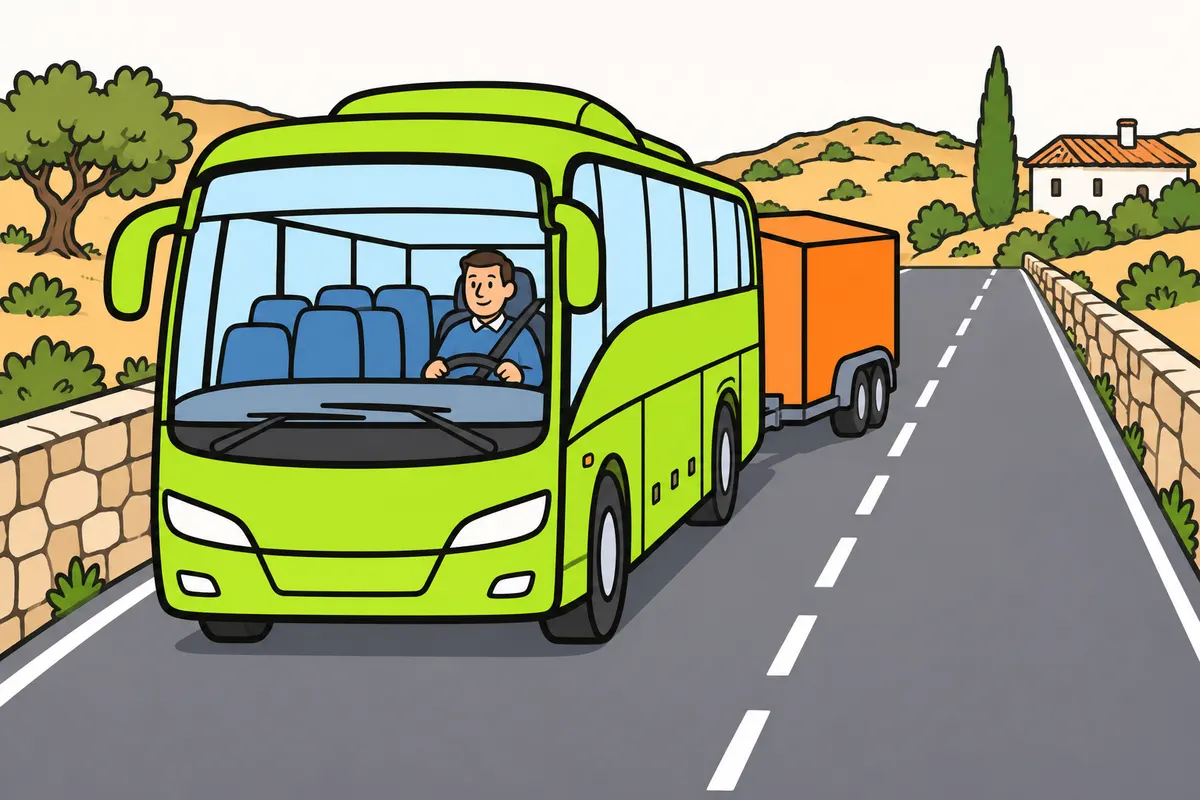
Check your bus, trailer and load width before choosing your route.
| Vehicle or structure | Maximum width |
|---|---|
| General rule, including load | 2.55 m |
| Prisoner bus: central cells and aisle; separate front driving/escort and rear escort compartments | 2.60 m |
| Temperature-controlled goods body with insulated side walls at least 45 mm thick | 2.60 m |
Remember
- Include your load when measuring width.
- Check obstacles and restrictions along your route.
- Allow room for your trailer’s path when turning.
Exam trap: Wrong: air conditioning allows your coach to be 2.60 m wide. Right: it does not make your coach a temperature-controlled goods vehicle.
Read the full explanation
- The general maximum width is 2.55 m, including the load. You must check the bus body, the trailer and the items you carry. Statutory dimensions are measured according to the type-approval rules applicable to the category; to pass through a gap, you also need sufficient physical space. [RGV, Annex IX](https://www.boe.es/buscar/act.php?id=BOE-A-1999-1826#anix)
- Further detail: Buses specially adapted to transport prisoners may reach 2.60 m. The definition requires a central compartment for cells, separated from the front driving and escort compartments and the rear escort compartment, and a central aisle. This width does not apply to any passenger coach. [RGV, Annex IX](https://www.boe.es/buscar/act.php?id=BOE-A-1999-1826#anix)
- Further detail: The superstructures of vehicles specially equipped for temperature-controlled goods may also reach 2.60 m, with side walls, including insulation, at least 45 mm thick. Air conditioning in your bus's passenger compartment does not make it this type of specially equipped vehicle. [RGV, Annex IX](https://www.boe.es/buscar/act.php?id=BOE-A-1999-1826#anix)
- Plan your route according to the width and geometry of the whole combination. A body that complies with the statutory maximum may encounter a narrower width restriction, and the trailer may need additional space when turning. The authorised width alone does not guarantee clearance between obstacles. [RGV, Annex IX](https://www.boe.es/buscar/act.php?id=BOE-A-1999-1826#anix)
13Maximum bus height
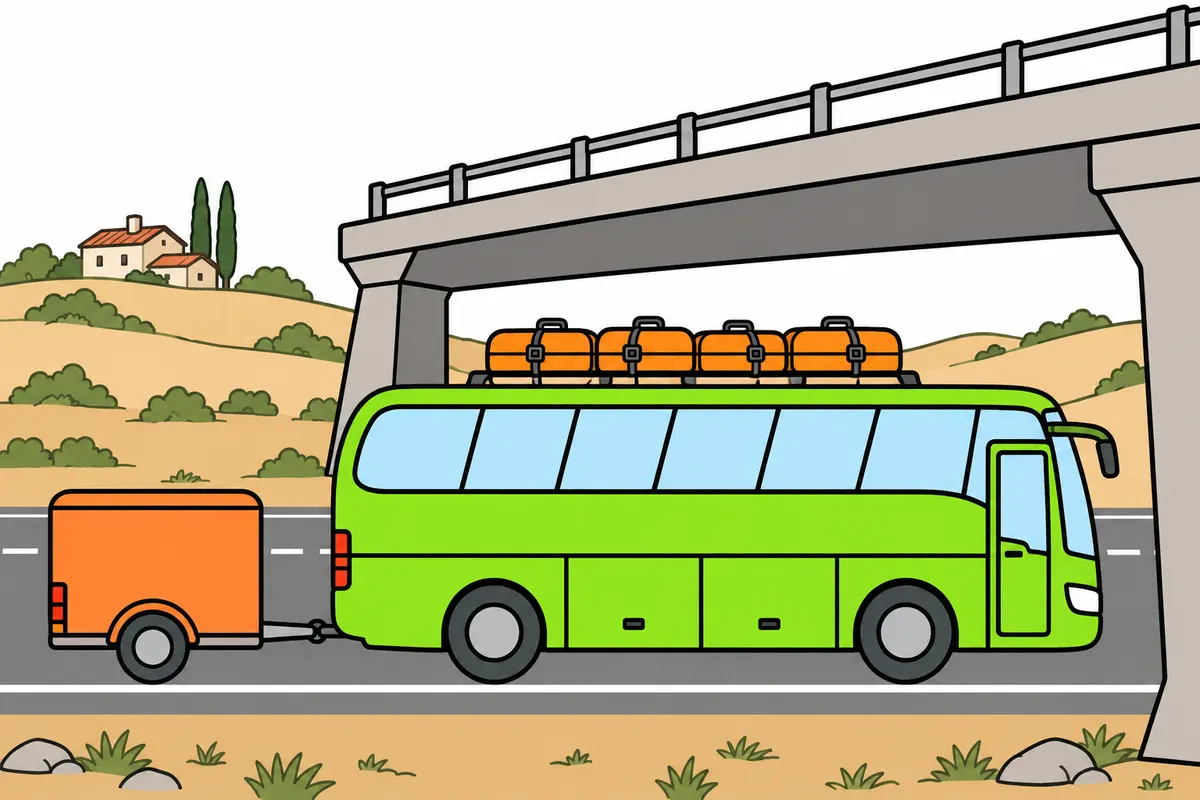
Measure your total height and use only the exception for your bus class.
| Bus | Maximum height including load |
|---|---|
| General rule | 4.00 m |
| Class I urban bus | 4.20 m |
Remember
- Include luggage, racks and everything fitted on your roof.
- Also check your laden trailer’s height.
- Check your route before reaching bridges or overhead structures.
- Do not apply goods vehicle exceptions to your bus carrying luggage.
Exam trap: Wrong: two decks or entering a city allows 4.20 m. Right: this exception requires your bus to be class I.
Read the full explanation
- The general maximum height is 4.00 m, including the load. You must consider the highest point of the bus and trailer, including anything fitted to them or carried on them. Luggage placed on the roof or on a rack counts when checking the overall height. [RGV, annex IX](https://www.boe.es/buscar/act.php?id=BOE-A-1999-1826#anix)
- A class I urban bus has a specific maximum height of 4.20 m. This exception depends on the vehicle class. You cannot use it for a class III coach because you occasionally drive it within a city or because it has two decks. [RGV, annex IX](https://www.boe.es/buscar/act.php?id=BOE-A-1999-1826#anix)
- Further detail: The 4.50 m exceptions in the table apply to the goods transport operations and specialised vehicles described there: car transporters, recovery vehicles and certain lorries or articulated vehicles. Carrying suitcases with a bus and trailer does not allow you to use these exceptions. [RGV, annex IX](https://www.boe.es/buscar/act.php?id=BOE-A-1999-1826#anix)
- Your load must not prevent passage under bridges, viaducts or overhead installations, or damage road structures and planting. As practical preparation, keep a reliable record of the loaded combination's height and check that the route allows passage before you reach the obstacle. [RGV, annex IX](https://www.boe.es/buscar/act.php?id=BOE-A-1999-1826#anix)
14Length of rigid buses, trailers and articulated buses
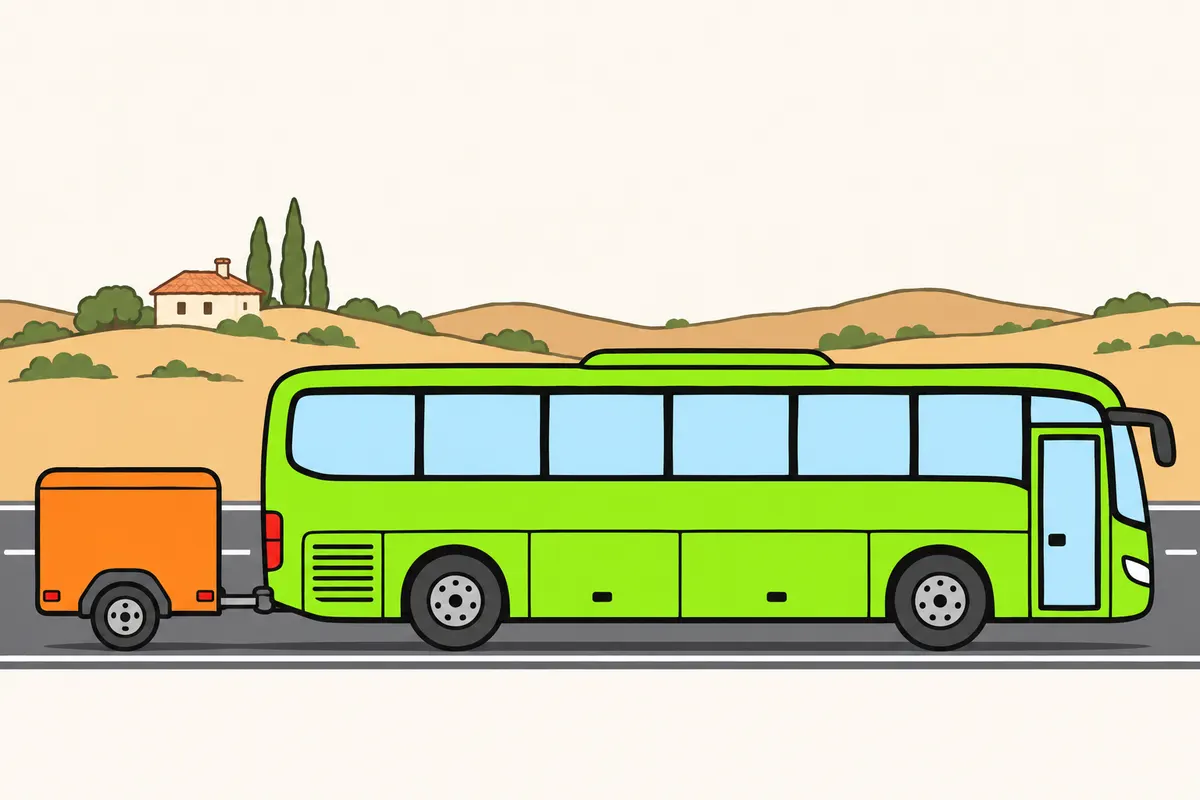
Check your whole combination length without adding the separate bus and trailer maxima.
| Vehicle or combination | Maximum length |
|---|---|
| Two-axle rigid bus | 13.50 m |
| Rigid bus with more than two axles | 15.00 m |
| Articulated bus | 18.75 m |
| Trailer | 12.00 m |
| Bus including its trailer | 18.75 m |
| Articulated goods vehicle: general rule | 16.50 m |
Remember
- Include detachable accessories such as a ski rack.
- Check whether the question describes an articulated bus or goods vehicle.
- Check the whole combination with your trailer coupled.
Exam trap: Wrong: add the individual maximum lengths. Right: your bus including its trailer must not exceed 18.75 m; accessories also count.
Read the full explanation
- A two-axle rigid bus has a maximum length of 13.50 m. If it has more than two axles, the maximum is 15.00 m. You must not apply the general length of 12.00 m specified for other motor vehicles to these two classes of bus. [RGV, annex IX](https://www.boe.es/buscar/act.php?id=BOE-A-1999-1826#anix)
- An articulated bus has a maximum length of 18.75 m. You must not confuse it with an articulated goods vehicle, whose general maximum is 16.50 m. In a passenger transport exam, you must identify which vehicle the question describes when it uses the word ‘articulated’. [RGV, annex IX](https://www.boe.es/buscar/act.php?id=BOE-A-1999-1826#anix)
- A trailer has a general maximum length of 12.00 m, but a bus with a trailer, including the trailer, must not exceed 18.75 m. You cannot add the individual maxima together: you cannot tow a 12 m trailer with a 15 m bus to form a 27 m combination. [RGV, annex IX](https://www.boe.es/buscar/act.php?id=BOE-A-1999-1826#anix)
- You must keep detachable bus accessories, such as a ski rack, within the applicable maximum length, including the accessories. With a rear accessory fitted to a two-axle rigid bus, you must keep the total length within 13.50 m. Being able to remove it does not exclude it from the measurement while you drive with it fitted. [RGV, annex IX](https://www.boe.es/buscar/act.php?id=BOE-A-1999-1826#anix)
15Turning circle and swept area
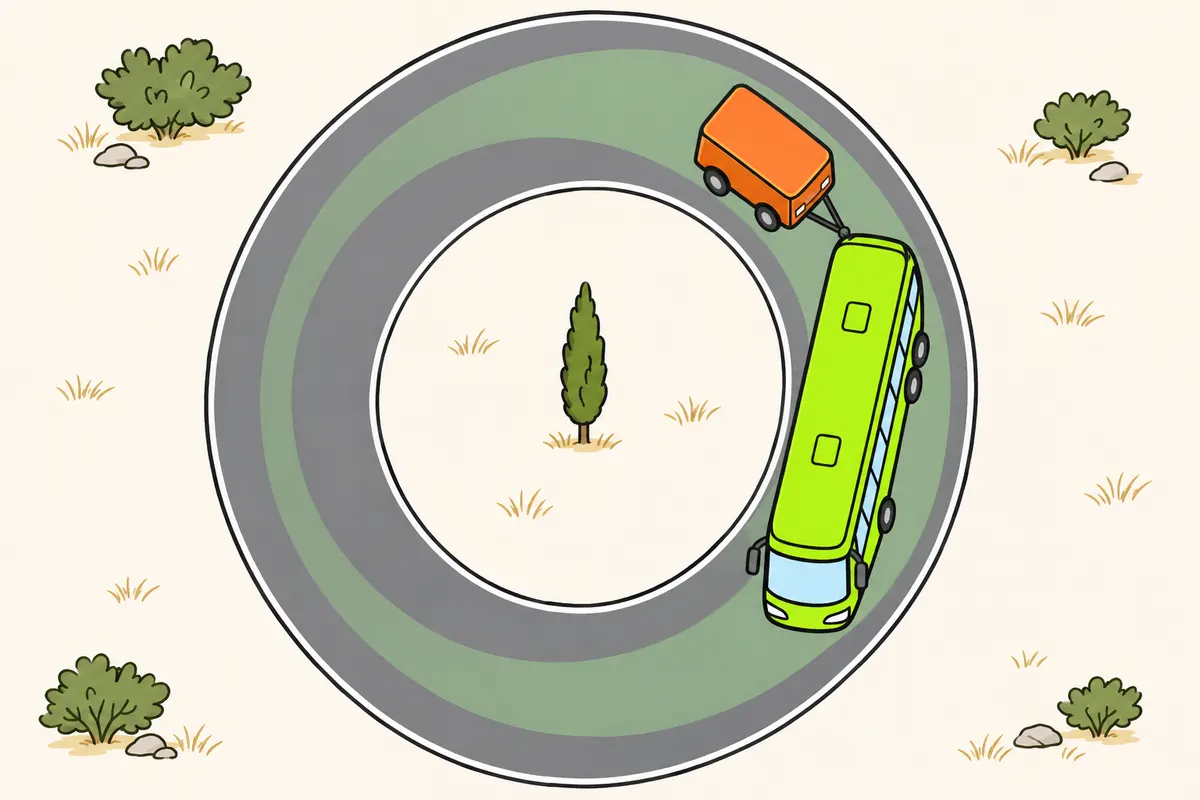
When turning, check all space occupied by your bus, trailer and projecting parts.
| Bus test | Maximum projection beyond reference plane |
|---|---|
| Entering the circle from a straight line | 0.60 m |
| Forward circular movement: rigid M2 or M3 bus | 0.80 m |
| Forward circular movement: articulated M2 or M3 bus | 1.20 m |
Remember
- The turning circle figures are radii.
- Check your whole combination, including projecting parts.
- Passing the test does not guarantee space at every corner.
- Check real accesses and obstacles before choosing your route.
- In these tests, measure projection beyond the reference side plane.
Exam trap: Wrong: swap the test figures. Right: straight-line entry and forward circular movement have different limits; also check circular movement with lift axles raised.
Read the full explanation
- Every motor vehicle and combination must be able to complete a full 360° turn in both directions within a circular ring with an outer radius of 12.50 m and an inner radius of 5.30 m. No outermost point may project beyond these circles. These are radii, not diameters; you must assess the envelope of the whole combination. [RGV, annex IX](https://www.boe.es/buscar/act.php?id=BOE-A-1999-1826#anix)
- Further detail: The specific bus test starts with a vertical plane tangential to the outer side of the stationary vehicle; for an articulated bus, its two rigid sections are aligned. As the bus moves from a straight line into the circular area, no part may extend more than 0.60 m beyond that plane. This is a separate condition from the turning radius. [RGV, annex IX](https://www.boe.es/buscar/act.php?id=BOE-A-1999-1826#anix)
- Further detail: Section 3.2.3 adds requirements for M2 and M3 vehicles when moving forwards along the 12.50 m circle: projection beyond the reference plane must not exceed 0.80 m for a rigid bus or 1.20 m for an articulated bus. This requirement also applies with lift axles raised. [RGV, annex IX](https://www.boe.es/buscar/act.php?id=BOE-A-1999-1826#anix)
- When choosing a route, you must consider the entire area swept by the bus, trailer and projections. Meeting the regulatory test does not replace checking actual corners, access points and obstacles. The specific technique for managing these paths is covered in the ‘Driving techniques with a bus and trailer’ module. [RGV, annex IX](https://www.boe.es/buscar/act.php?id=BOE-A-1999-1826#anix)
16Projecting loads: limits and marking
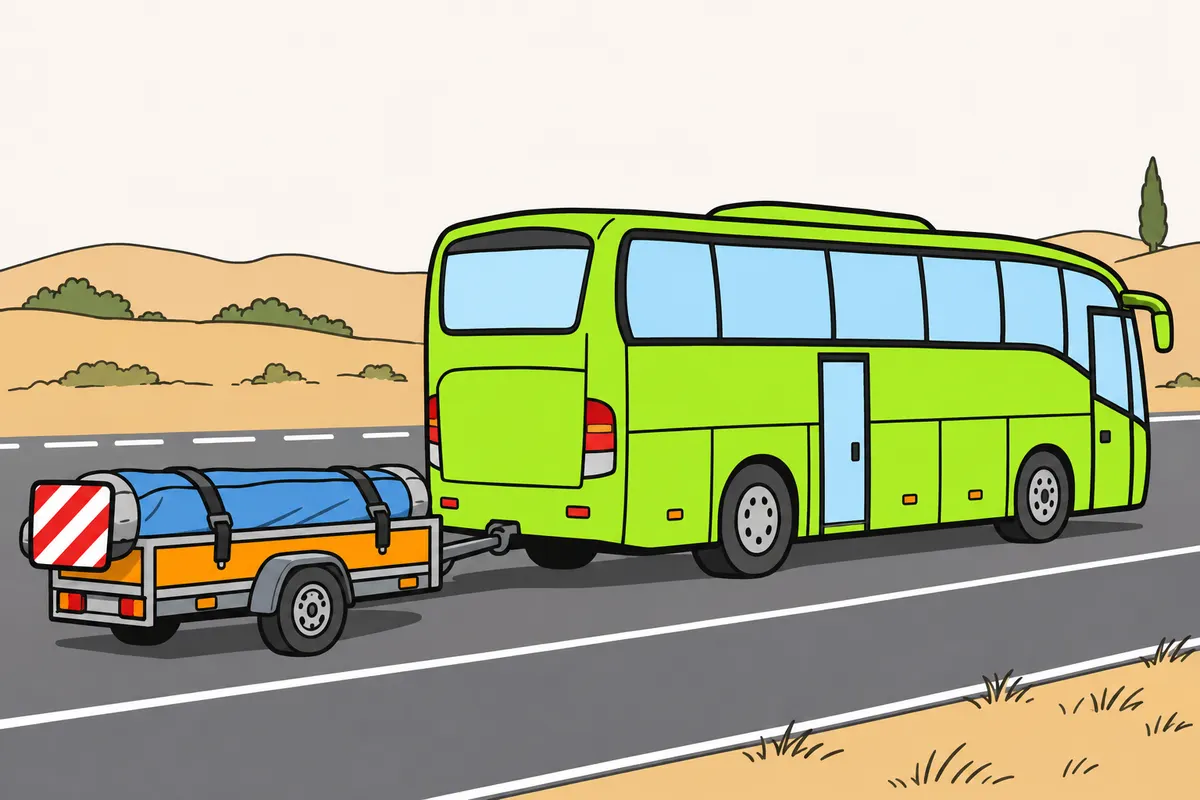
Distinguish permitted bus and trailer projections, and mark them correctly.
| Vehicle or case | Projection limit or required marking |
|---|---|
| Passenger bus | Rear only: up to 10 % of its length; 15 % for an indivisible load |
| Goods-only trailer over 5 m long; indivisible items longer than its load space | Up to 2 m at the front and 3 m at the rear |
| Goods-only trailer 5 m long or shorter; indivisible items longer than its load space | Up to one third of its length at each end |
| Goods-only trailer; the smaller dimension of an indivisible load exceeds its width | Up to 0.40 m each side; maximum overall width 2.55 m |
| Rear projection between sunset and sunrise or in significantly reduced visibility | Add a red light to the V-20 panel |
| Front projection between sunset and sunrise or in significantly reduced visibility | Mark with a white light |
| Side end over 0.40 m from the outer edge of a front or rear position light; at night or in significantly reduced visibility | Front: white light and reflector. Rear: red light and reflector |
Remember
- Protect the projecting end and prevent damage or danger.
- Leave room for coupling movement and secure your load properly.
- Fit the rear V-20 panel perpendicular to your vehicle’s length.
- For full-width rear projection, fit two panels forming an inverted V.
- At night or in significantly reduced visibility, add the required lights.
- Include projections when checking your authorised overall dimensions.
Exam trap: Wrong: apply goods trailer projection limits to your bus. Right: your bus may project only at the rear, up to 10 % of its length or 15 % for an indivisible load; projections do not increase authorised overall dimensions.
Read the full explanation
- You must keep the load within the vehicle's outline when viewed from above, except as provided in article 15. For a bus, intended for passenger transport, paragraph 3 allows projection only at the rear: up to 10 % of its length, or 15 % if the load is indivisible. [RGC, art. 15](https://www.boe.es/buscar/act.php?id=BOE-A-2003-23514#a15)
- On a trailer intended exclusively for carrying luggage or other goods, indivisible items longer than their load space may project under paragraph 2.a: if the vehicle is more than 5 m long, up to 2 m at the front and 3 m at the rear; if it is 5 m long or less, up to one third of its length at each end. You must also allow the space needed for the coupling to articulate and ensure correct stowage. [RGC, art. 15](https://www.boe.es/buscar/act.php?id=BOE-A-2003-23514#a15)
- If the smaller dimension of the indivisible load exceeds the width of that goods trailer, it may project up to 0.40 m on each side, with a maximum overall width of 2.55 m. This sideways projection exception applies to vehicles intended exclusively for goods, not to passenger buses. [RGC, art. 15](https://www.boe.es/buscar/act.php?id=BOE-A-2003-23514#a15)
- You must protect the projecting end and take precautions to avoid damage or danger to other road users, even when the projection is within the permitted dimensions. [RGC, art. 15](https://www.boe.es/buscar/act.php?id=BOE-A-2003-23514#a15)
- Every rear projection requires a V-20 panel at the rearmost end of the load, kept perpendicular to the vehicle's longitudinal axis at all times. If the load projects lengthways across the full rear width, you must fit two panels, one at each side, forming an inverted V. [RGC, art. 15.6, wording under RD 465/2025](https://www.boe.es/buscar/doc.php?id=BOE-A-2025-12199)
- Between sunset and sunrise, or when visibility is significantly reduced, you must add a red light to the rear projection; you must mark a front projection with a white light. [RGC, art. 15.6, wording under RD 465/2025](https://www.boe.es/buscar/doc.php?id=BOE-A-2025-12199)
- In these night-time or poor-visibility conditions, if a side extremity of the load is more than 0.40 m from the outer edge of the front or rear position light, you must mark it with a white light and reflector facing forwards, and a red light and reflector facing rearwards. The reference point for this marking is the position light, whereas you measure the sideways load projection limit from the vehicle. [RGC, art. 15](https://www.boe.es/buscar/act.php?id=BOE-A-2003-23514#a15)
- The permitted projection must also fit within the authorised overall dimensions. For example, on an 18.25 m bus and trailer combination, a rear projection of 0.50 m gives a total length of 18.75 m: you must also check that the projection is permitted for the vehicle carrying the load. Individual projection limits do not increase the combination's maximum length. [RGC, art. 13](https://www.boe.es/buscar/act.php?id=BOE-A-2003-23514#a13) [RGV, annex IX](https://www.boe.es/buscar/act.php?id=BOE-A-1999-1826#anix)
- Luggage placement and restraint are covered in ‘Safe luggage and loads’, in the ‘Projections and marking’ section; projection limits and their regulatory marking requirements are covered in full here.
17Further detail: indivisible loads and supplementary authorisation
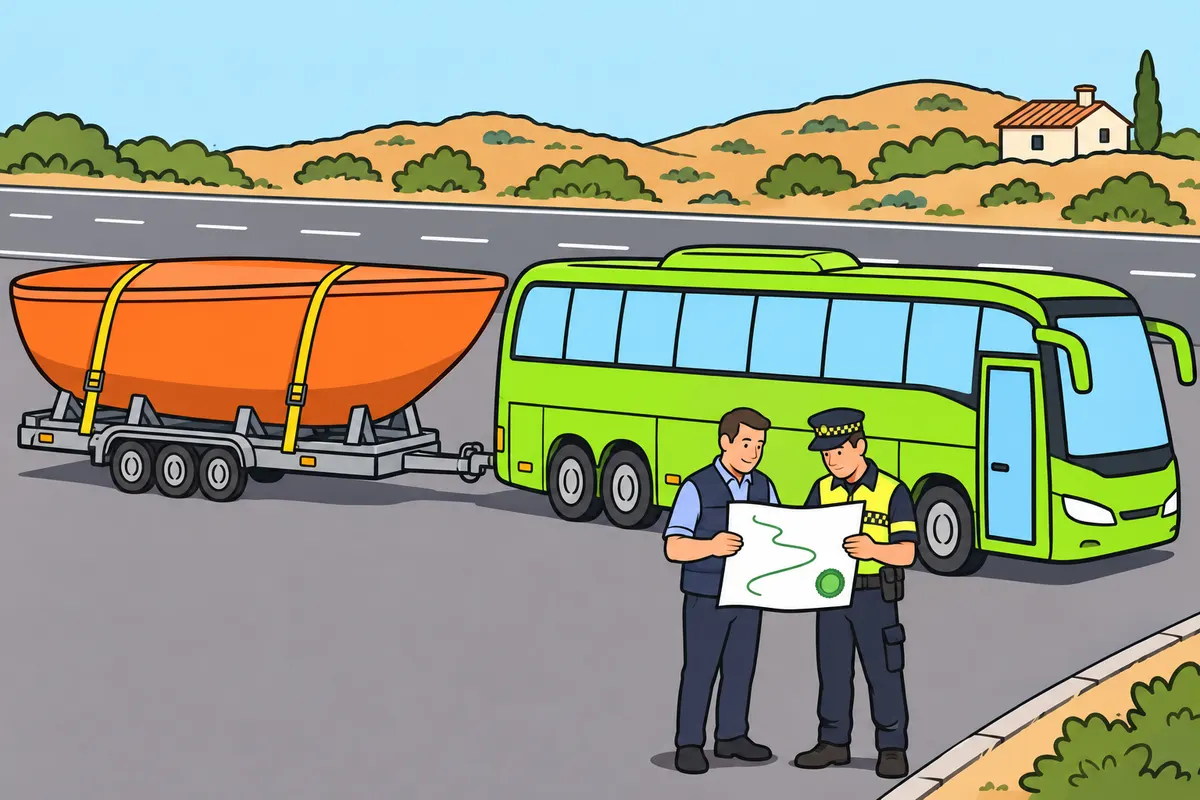
Get prior supplementary authorisation if an indivisible load inevitably exceeds maxima without an exception.
Remember
- Justify why dividing your load would cause unnecessary cost or risk of damage.
- Wanting to make a single journey is not enough.
- Follow the route and conditions in your supplementary authorisation.
- Also respect technical capacity and the applicable transport authorisation.
Exam trap: Wrong: freely group items as an indivisible load. Right: items must be of the same nature and intended for the same purpose. They must not exceed dimensions other than those already exceeded by the largest item, or applicable combination and axle mass maxima.
Read the full explanation
- An indivisible load is one that you cannot split for transport without unnecessary cost or risk of damage and that, because of its dimensions or mass, you cannot carry on a vehicle or combination complying with the regulatory maxima. You must justify this status: it does not depend on your preference for making a single trip. [RGV, art. 14](https://www.boe.es/buscar/act.php?id=BOE-A-1999-1826#a14) and [RGC, art. 13](https://www.boe.es/buscar/act.php?id=BOE-A-2003-23514#a13)
- Annex IX also provides for several items of the same nature and intended for the same purpose under precise conditions. The collection of items must not exceed a dimension other than those already exceeded by the largest item, or exceed the maximum combination and axle masses in the applicable tables. [RGV, art. 14](https://www.boe.es/buscar/act.php?id=BOE-A-1999-1826#a14) and [RGC, art. 13](https://www.boe.es/buscar/act.php?id=BOE-A-2003-23514#a13) [RGV, annex IX, section 1.15](https://www.boe.es/buscar/act.php?id=BOE-A-1999-1826#anix)
- If an indivisible load inevitably exceeds the maxima and is not covered by a regulatory exception, you must obtain supplementary authorisation in advance. The traffic authority may grant it for a limited number of journeys or a specified period, subject to a binding report from the road authority and verification of the relevant transport authorisation. [RGV, art. 14](https://www.boe.es/buscar/act.php?id=BOE-A-1999-1826#a14) and [RGC, art. 13](https://www.boe.es/buscar/act.php?id=BOE-A-2003-23514#a13)
- The supplementary circulation authorisation sets the route and conditions for the special transport operation. You must also comply with the requirements of the authorisation to carry out transport and the vehicle's technical capacity, each of which serves its own purpose. [RGV, art. 14](https://www.boe.es/buscar/act.php?id=BOE-A-1999-1826#a14) [RGC, art. 13](https://www.boe.es/buscar/act.php?id=BOE-A-2003-23514#a13)
18Further detail: special transport conditions
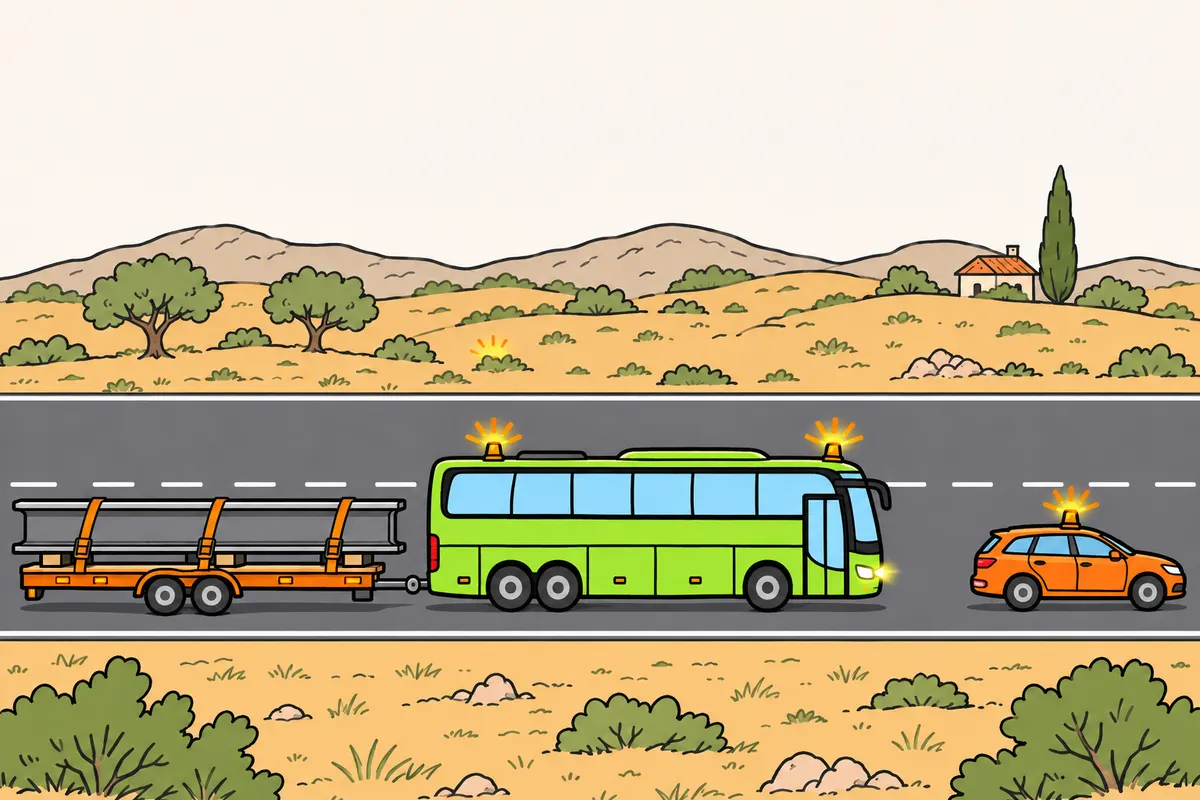
For special transport, plan your route using your authorisation and follow its conditions.
| Group 1 special transport with an indivisible load | Condition |
|---|---|
| Width over 3 m or length over 20.55 m | Escort behind, at least 50 m away, on motorways and autovías; ahead on other roads |
| Conventional road: below half the road’s general speed limit | Another escort behind, at least 50 m away |
| General authorisation | Maximum 70 km/h; day and night travel allowed |
| Specific authorisation | Maximum 60 km/h; day and night allowed; notify each journey the day before |
| Exceptional authorisation | Authorised speed, never above 60 km/h; notify each journey the day before; night travel requires permission |
| Width over 5 m | Traffic officer escort; notify each journey at least 72 hours beforehand |
Remember
- On urban roads, follow the route set by the municipal authority.
- Keep at least 50 m behind vehicles ahead and help others overtake.
- Stop and park off both the carriageway and hard shoulder.
- Use dipped beam and V-2 lights marking your vehicle’s cross-section.
- Stop travelling and leave the road platform if weather creates danger.
- Do the same without at least 150 m visibility ahead and behind.
Exam trap: Wrong: a general rule alone is enough for your special transport. Right: for group 1 indivisible loads, authorisation conditions take precedence; obey stricter ITV limits. Above 5 m width, notify each journey to officers in the departure province and the body designated by the road authority, with the details and a copy of your authorisation.
Read the full explanation
- For a group 1 special transport operation involving an indivisible load, you must comply with the supplementary authorisation conditions, which take precedence over the applicable general traffic rules. On urban roads, you must follow the route set by the municipal authority. You must plan the route using the specific authorisation, not a general rule on dimensions. [RGC, annex III](https://www.boe.es/buscar/act.php?id=BOE-A-2003-23514#aniii)
- If you exceed 3 m in width or 20.55 m in length, you need an escort vehicle: behind you, at least 50 m away, on motorways and autovías (dual carriageways); ahead of you on other roads. In addition, if you drive on a conventional road at less than half the road's generic speed limit, you need another escort vehicle behind you, at least 50 m away. The escort vehicle may use the V-2 signal during the operation, visible to the front and rear, and must switch it off when the operation ends. [RGC, annex III](https://www.boe.es/buscar/act.php?id=BOE-A-2003-23514#aniii)
- The common conditions require you to keep at least 50 m behind the vehicle ahead, make overtaking easier and stop and park off both the carriageway and the arcén (hard shoulder). Communication between the escort vehicle and the cab must be possible by radio and telephone in a shared language. You must also observe the specific restrictions in your authorisation. [RGC, annex III](https://www.boe.es/buscar/act.php?id=BOE-A-2003-23514#aniii)
- For group 1, the maximum speed is 70 km/h with a general authorisation and 60 km/h with a specific authorisation; with an exceptional authorisation, it is the authorised speed, without exceeding 60 km/h, with any stricter ITV (vehicle roadworthiness test) limits taking precedence. With a specific or exceptional authorisation, you must notify each journey the day before, as set out in the annex. The detailed speed rules are covered in the ‘Speed and distances for the combination’ module. [RGC, annex III](https://www.boe.es/buscar/act.php?id=BOE-A-2003-23514#aniii)
- Under this regime, you must keep dipped beam on and use the V-2 light signals marking the vehicle's cross-section, as well as any other required markings and signals. You must stop travelling and leave the road platform if the weather creates a risk or you do not have at least 150 m of visibility both ahead and behind. [RGC, annex III](https://www.boe.es/buscar/act.php?id=BOE-A-2003-23514#aniii)
- If the width exceeds 5 m, you need an escort by traffic officers. The authorisation holder must notify each journey at least 72 hours in advance to the officers in the province of departure and the body designated by the road authority, providing the details and a copy of the authorisation. A general or specific authorisation allows travel by day and night; an exceptional authorisation must expressly permit night-time travel. [RGC, annex III](https://www.boe.es/buscar/act.php?id=BOE-A-2003-23514#aniii)
19Signs limiting mass
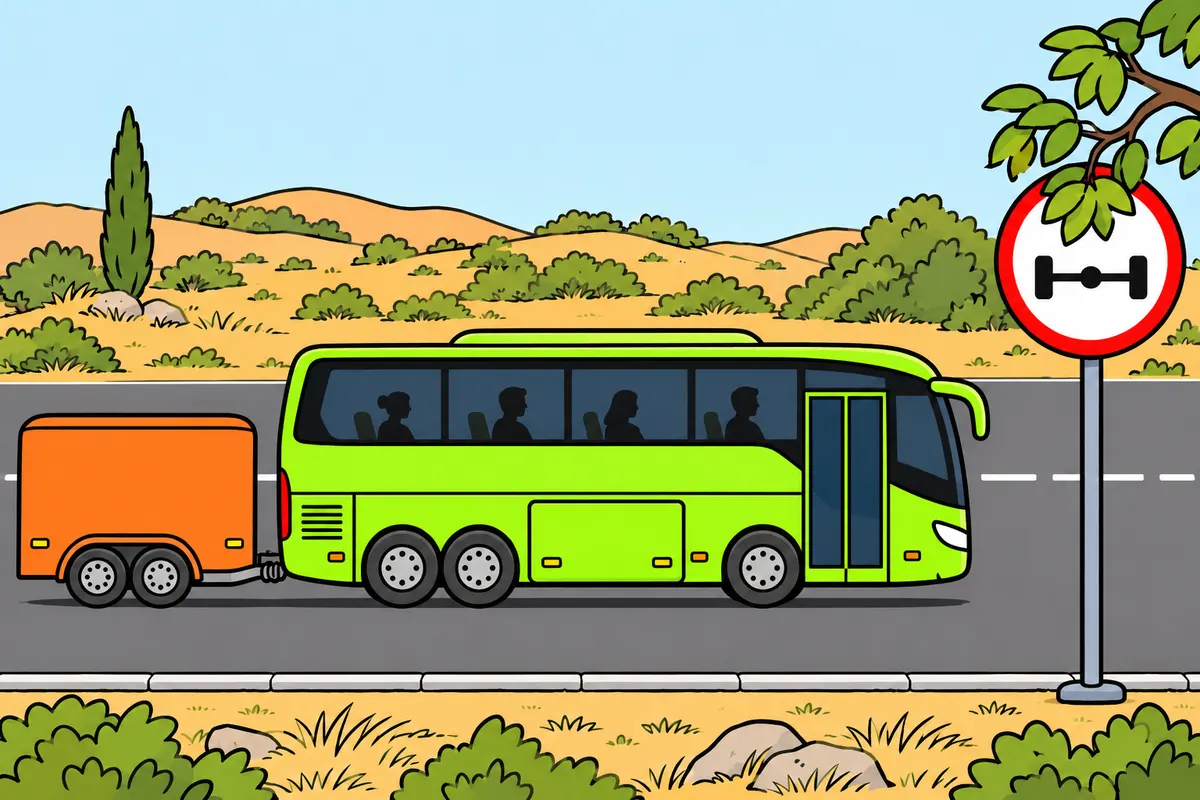
Compare your actual mass and each axle mass with the relevant sign.
| Sign | What you compare |
|---|---|
| R-201 | Actual laden mass of your whole vehicle or combination |
| R-202 | Mass each axle transmits to the ground |
Remember
- Include people and luggage in your laden mass.
- Check every axle.
- Do not average axle loads or divide them between twin wheels.
- Matching the sign’s figure does not exceed it.
- Respect other restrictions too.
Exam trap: Wrong: compare R-201 with your MMA. Right: compare actual mass, including people and luggage; passage is prohibited if you exceed the figure.
Read the full explanation
- R-201, Mass limit, prohibits entry if your laden mass exceeds the number of tonnes shown. You must compare the actual mass of the vehicle or combination, including people and luggage. It does not refer only to the weight of the load or to the authorised maximum stated in the documentation. [RGC, annex I: catalogue under RD 465/2025](https://www.boe.es/buscar/doc.php?id=BOE-A-2025-12199)
- With an R-201 showing 20 t, a laden mass of exactly 20 t does not exceed the figure shown. Considering that sign alone, you may pass; you must comply with all other restrictions. If the actual mass of your bus and trailer is 20.2 t, the sign prohibits entry even if you are authorised for a higher mass. [RGC, annex I: catalogue under RD 465/2025](https://www.boe.es/buscar/doc.php?id=BOE-A-2025-12199)
- R-202, Axle mass limit, prohibits entry if the mass transmitted to the ground by any axle through all its wheels exceeds the figure shown. You must check every axle. A total mass acceptable for the road does not offset an excess on one axle. [RGC, annex I: catalogue under RD 465/2025](https://www.boe.es/buscar/doc.php?id=BOE-A-2025-12199)
- If one axle carries 9 t at an R-202 showing 8 t, you must not pass even if another carries only 4 t. You must not calculate the average across axles or divide by the twin wheels to justify passing. The sign sets a limit on the load of each axle concerned, in addition to the regulatory maximums. [RGC, annex I: catalogue under RD 465/2025](https://www.boe.es/buscar/doc.php?id=BOE-A-2025-12199)
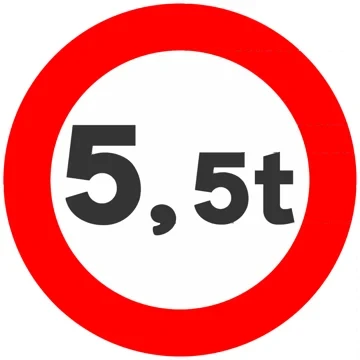 R-201
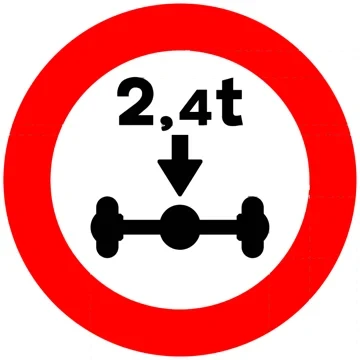 R-202
20Signs limiting dimensions
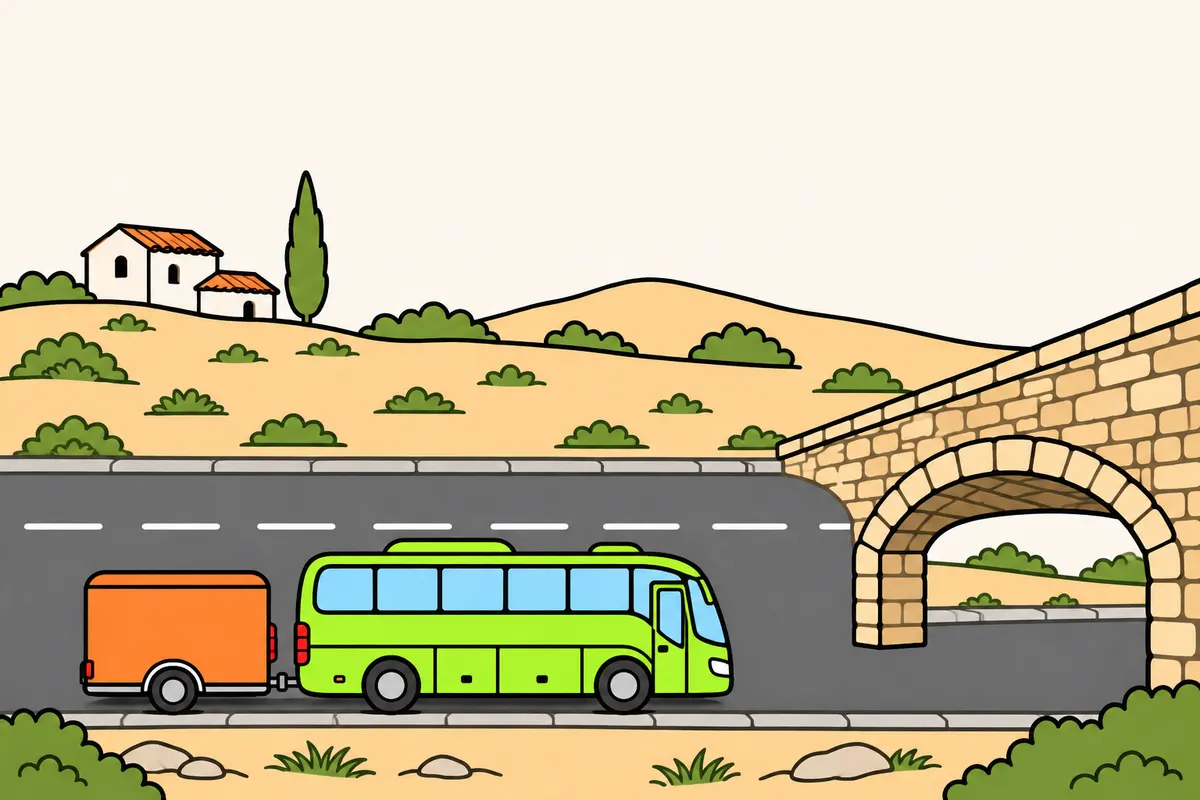
Before passing, compare your complete dimensions with the sign and check the actual space.
| Sign | Dimension limited |
|---|---|
| R-203 | Whole vehicle or combination length, including load |
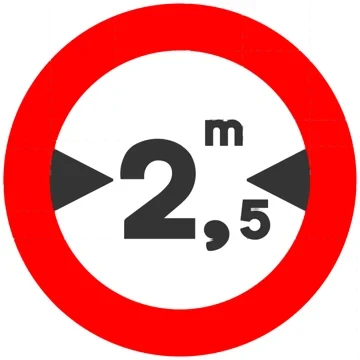
| R-204 | Width including load; horizontal arrows |
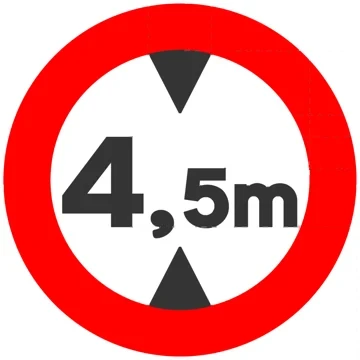
| R-205 | Height including load; vertical arrows |
Remember
- Include your load in every measurement.
- For length, measure your whole combination.
- Matching the signed figure does not exceed it.
- Also allow a practical safety margin.
- Find a suitable route before reaching the obstacle.
Exam trap: Wrong: your authorised height allows passage at every sign. Right: a 4.20 m urban bus cannot pass an R-205 showing 4.10 m.
Read the full explanation
- R-203, Length limit, prohibits entry to vehicles or combinations whose maximum length, including the load, exceeds the length shown. You must compare the complete combination: the fact that the towing vehicle or each unit separately is shorter does not allow you to pass if the combined length exceeds the sign's limit. [RGC, annex I: catalogue under RD 465/2025](https://www.boe.es/buscar/doc.php?id=BOE-A-2025-12199)
- R-204, Width limit, prohibits entry when your maximum width, including the load, exceeds the figure shown. Horizontal arrows accompany the measurement expressed in metres. Authorisation for a prisoner transport bus to be 2.60 m wide does not allow you to enter a road with a lower width limit. [RGC, annex I: catalogue under RD 465/2025](https://www.boe.es/buscar/doc.php?id=BOE-A-2025-12199)
- R-205, Height limit, prohibits entry when the maximum height of the vehicle, including the load, exceeds the height shown. The arrows point vertically. With an urban bus 4.20 m high, you must not pass a 4.10 m height limit even if the regulations allow that height for its class. [RGC, annex I: catalogue under RD 465/2025](https://www.boe.es/buscar/doc.php?id=BOE-A-2025-12199)
- For these signs, the prohibition depends on exceeding the figure: an exactly equal measurement does not exceed it. When measuring and driving through an actual passage, you also need a practical safety margin. Check the whole route and find a suitable alternative before reaching a place where your combination cannot continue. [RGC, annex I: catalogue under RD 465/2025](https://www.boe.es/buscar/doc.php?id=BOE-A-2025-12199)
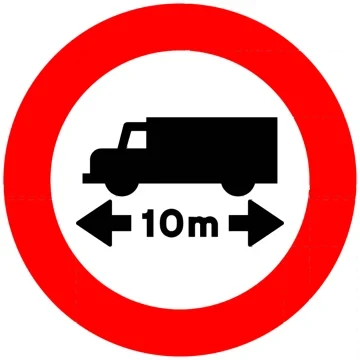 R-203
 R-204
 R-205
21Speed limiters: vehicles and settings
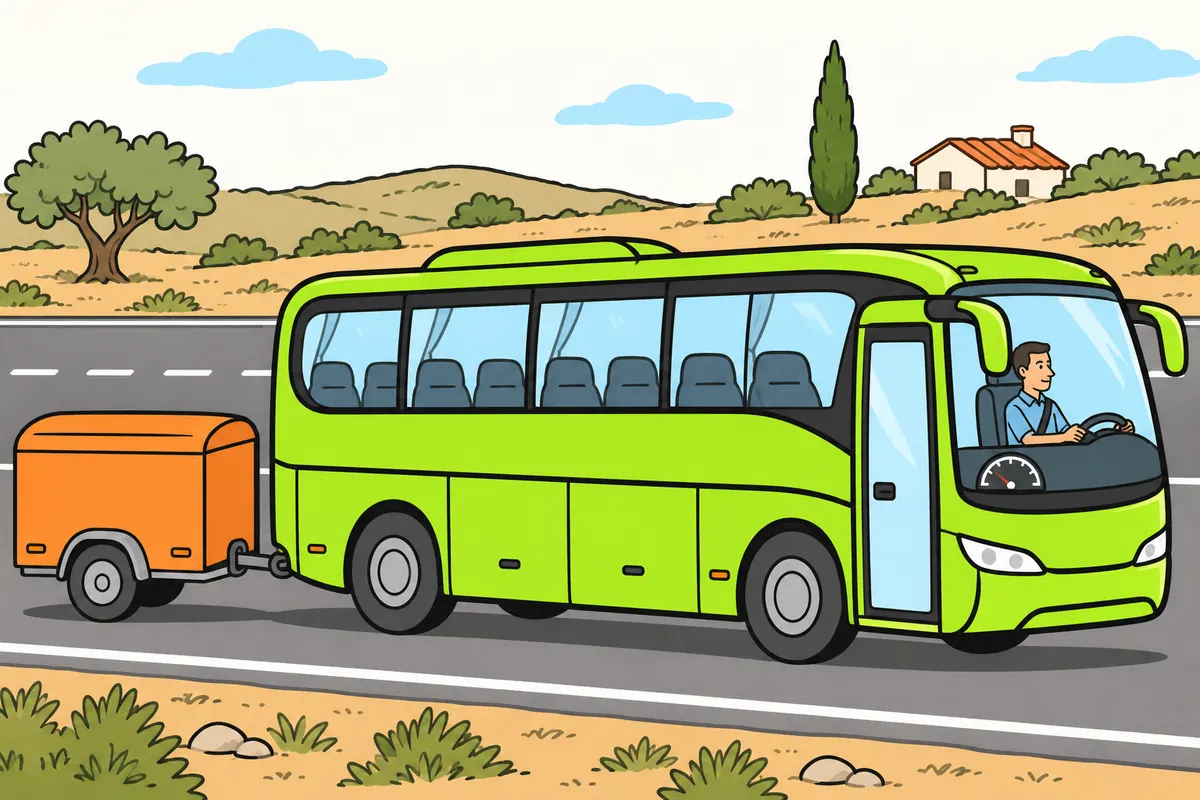
Your bus limiter does not allow you to exceed driving speed limits.
| Vehicles covered by the requirement | Limiter setting |
|---|---|
| M2 and M3 buses | Must prevent exceeding 100 km/h |
| N2 and N3 goods vehicles | Must prevent exceeding 90 km/h |
Remember
- Check your category, registration date and possible exemptions.
- Adding a trailer does not turn your bus into a goods vehicle.
- Your trailer has no separate engine speed limiter.
- Respect combination limits, signs and traffic conditions.
Exam trap: Wrong: drive at 100 km/h because your limiter allows it. Right: obey any lower limit for your combination or road.
Read the full explanation
- The Reglamento General de Vehículos (General Vehicle Regulations) requires a speed limiter where the legislation listed in its annex I provides for one. For your bus, the Spanish rules on use are in RD 1417/2005, which implements the framework of Directive 92/6/CEE as amended by Directive 2002/85/CE. The requirement depends on the category, registration date and applicable exemptions. [RGV, art. 11.12](https://www.boe.es/buscar/act.php?id=BOE-A-1999-1826#a11) [RD 1417/2005, arts. 2–7](https://www.boe.es/buscar/act.php?id=BOE-A-2005-19990)
- Buses in categories M2 and M3 that fall within the scope of the rules must have their speed limiter set so that they cannot exceed 100 km/h. M2 covers passenger vehicles with more than eight seats in addition to the driver's seat and a maximum mass not exceeding 5 t; M3 covers those over 5 t. [RD 1417/2005, arts. 2 and 3](https://www.boe.es/buscar/act.php?id=BOE-A-2005-19990#a3) [Regulation (EU) 2018/858, art. 4](https://www.boe.es/buscar/doc.php?id=DOUE-L-2018-81001)
- For goods vehicles in category N2, with a maximum mass over 3.5 t and up to 12 t, and N3, over 12 t, the setting must prevent speeds above 90 km/h. The setting for your bus, if subject to the requirement, is 100 km/h; adding a trailer does not turn it into a category N vehicle. The trailer has no separate engine speed limiter. [RD 1417/2005, arts. 3 and 4](https://www.boe.es/buscar/act.php?id=BOE-A-2005-19990#a4) [Regulation (EU) 2018/858, art. 4](https://www.boe.es/buscar/doc.php?id=DOUE-L-2018-81001)
- The speed limiter setting is a vehicle requirement and does not authorise you to drive at that speed. You must obey the limits applicable to your bus and trailer, the signs and the traffic conditions, even if the device allows you to reach a higher speed. Speed limits by road type are covered in “Speed and distances for the combination”. [RD 1417/2005, art. 3](https://www.boe.es/buscar/act.php?id=BOE-A-2005-19990#a3) [RGC, art. 48](https://www.boe.es/buscar/act.php?id=BOE-A-2003-23514#a48)
22Limiter scope, exemptions and checks
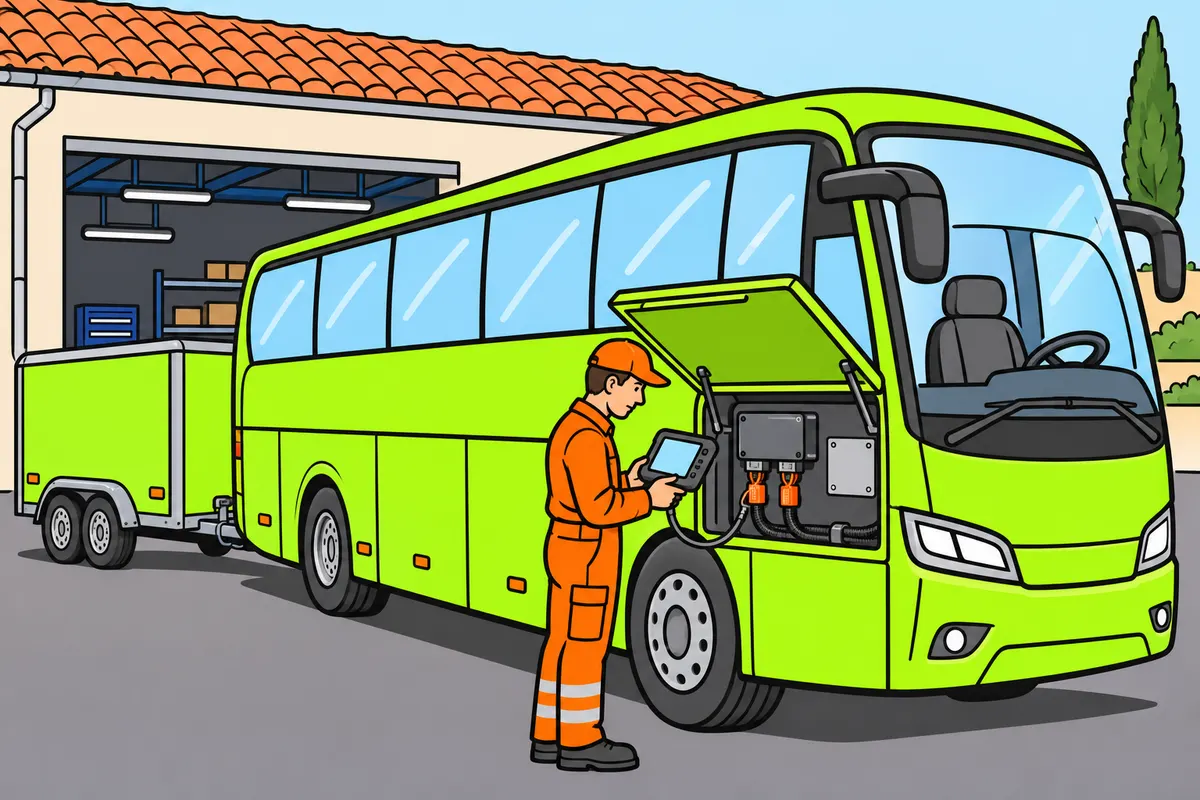
Check whether your bus needs a limiter and keep it working correctly.
| Vehicles and cases | Requirement or exemption |
|---|---|
| M3 over 10 t | Registered on or after 1 January 1988 (RD 1417/2005, art. 5.1) |
| M2, M3 over 5 t up to 10 t, and N2 | Registered on or after 1 January 2005; also registered between 1 October 2001 and 1 January 2005 if meeting the specified Euro 3 emissions (RD 1417/2005, art. 5.2.a and b) |
| Armed Forces, law enforcement, civil protection, fire and other emergency services | Exempt |
| Vehicles unable by construction to exceed the specified speeds | Exempt |
| Vehicles used for scientific road tests | Exempt |
| Vehicles used solely for public services in urban areas | Exempt |
Remember
- Check mass, registration date and emissions where relevant.
- Keep your limiter working correctly and preserve its seals.
- Have it checked if it works outside the required values.
- Also arrange checks if seals break or are removed through use or repair.
- Use authorised bodies and workshops for installation and checks.
- Have its operation checked after every installation.
Exam trap: Wrong: entering a city exempts your coach. Right: this exemption requires use solely for public services in urban areas.
Read the full explanation
- For M3 vehicles over 10 t, article 5.1 of RD 1417/2005 makes the requirement apply to those registered on or after 1 January 1988. The registration date determines the scope: you must check it in the bus documentation. [RD 1417/2005, art. 5.1](https://www.boe.es/buscar/act.php?id=BOE-A-2005-19990#a5)
- For M2, M3 over 5 t and up to 10 t, and N2 vehicles, article 5.2.a of RD 1417/2005 includes those registered on or after 1 January 2005. It also includes those registered between 1 October 2001 and 1 January 2005 that meet the Euro 3 emissions requirements specified in the legislation. The weight, date and this technical condition determine whether the requirement applies. [RD 1417/2005, art. 5.2.a and b](https://www.boe.es/buscar/act.php?id=BOE-A-2005-19990#a5)
- Vehicles used by the Armed Forces, law enforcement bodies, civil protection, fire services and other emergency services are exempt. So are vehicles whose design prevents them from exceeding the specified speeds, those used for scientific tests on roads and those used solely for public services in urban areas. A coach does not become exempt simply because it enters a city. [RD 1417/2005, art. 7](https://www.boe.es/buscar/act.php?id=BOE-A-2005-19990#a7)
- The installed speed limiter must work correctly at all times and retain its seals. If it operates outside the required values, or a seal is broken or removed through use or repair, it must be checked. Installation and checks must be carried out by organisations and workshops previously authorised by the competent industry authority. [RD 1417/2005, art. 8](https://www.boe.es/buscar/act.php?id=BOE-A-2005-19990#a8)
- Each installation must be followed by an operational check. The workshop fits an installation plate in a visible position in the cab and seals and marks the device and connections as required by the legislation, with the specified exception for factory installations with their regulatory plate and seals. These markings allow you to identify the setting without tampering with it. [RD 1417/2005, art. 15](https://www.boe.es/buscar/act.php?id=BOE-A-2005-19990#a15)
Check the mass before setting off
Consider the bus, luggage trailer and actual distribution of passengers and load together.
- Identify the bus class, the axles on each unit and the trailer type.
- Check the MMA (maximum authorised mass), MMR (maximum towable mass) and maximum combination mass; apply the category M towable mass limit.
- Calculate the actual mass including passengers, service staff, luggage and equipment.
- Check axle and axle-group loads, the vertical coupling load and tyre capacity.
- Check the minimum mass on the driving axles and the route restrictions.
- Reduce or redistribute the load until you comply with every limit.
Interpret an access restriction
Compare the correct measurement with the figure on the sign.
- Identify whether the restriction applies to laden mass, axle mass, length, width or height.
- Establish the actual figure for the laden combination; for axle mass, check each axle.
- Include the load when comparing dimensions and avoid using MMA in place of actual mass.
- If you exceed the figure, use a suitable alternative route; if you do not exceed it, check the other restrictions.
Finished this module?
Mark it as read and you will see your progress on the theory list.