
Theory · A1 Licence - 125 cc Motorcycle · Module 4 of 18
Your fitness to drive safely
Learn to recognise when alcohol, drugs, medicines, tiredness or emotions compromise your safety on a 125 cc motorcycle. Master the limits, including the zero limit if you are under 18, the tests, and the rules on phones and helmet intercoms so you can answer the A1 exam questions.
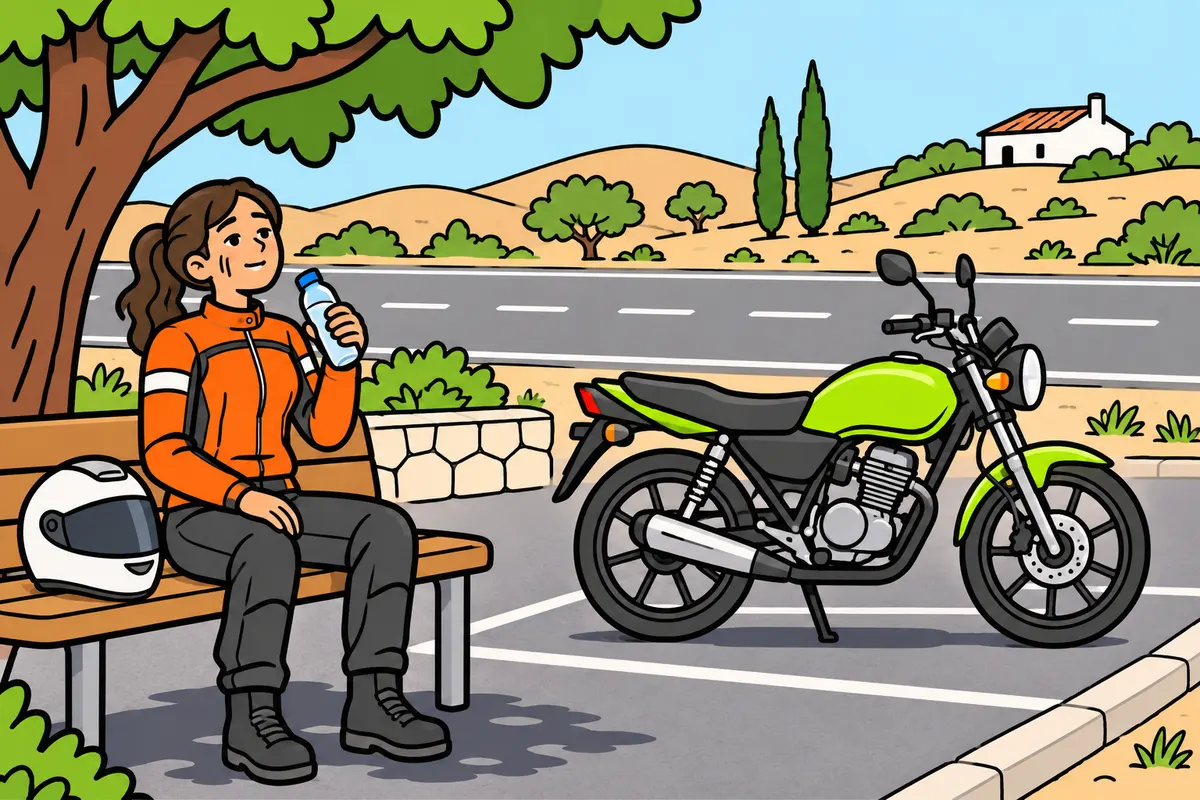
1Being fit to drive
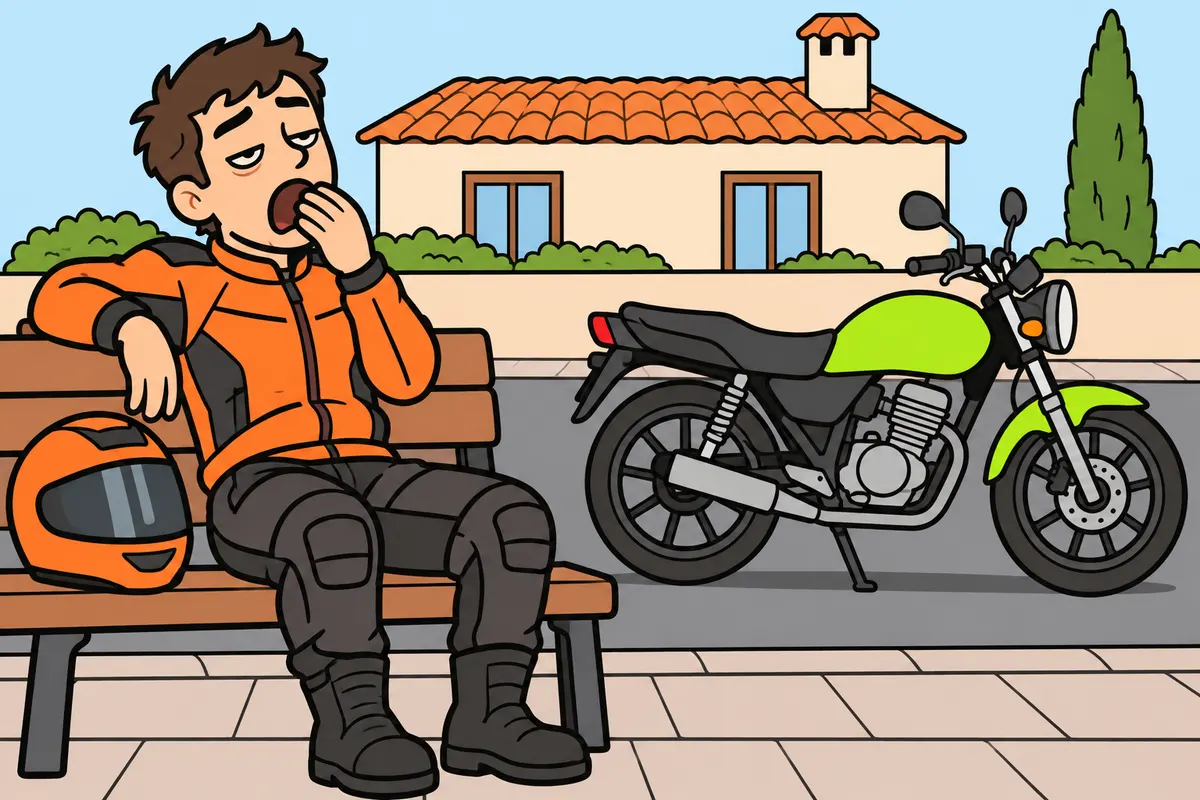
You must be able to control your motorcycle throughout the whole journey.
Remember
- Check how you feel before setting off.
- You need clear vision, free movement and constant attention.
- Keep your balance and control the motorcycle's controls.
- If you feel dizzy, sleepy or upset, postpone your journey.
- Use other transport if you cannot ride safely.
Exam trap: Wrong: you can ride tired if your destination is nearby. Right: you must be fit even for short journeys.
Read the full explanation
- You must be fit to control your motorcycle throughout the whole journey. Your fitness changes from day to day and even during the same journey: having a licence, experience and a motorcycle in good condition does not make up for feeling dizzy, sleepy or unsettled. [RGC, art. 17](https://www.boe.es/buscar/act.php?id=BOE-A-2003-23514#a17).
- You must retain freedom of movement, adequate vision and constant attention. On a motorcycle, you need to observe traffic and coordinate the throttle, brakes and steering while keeping your balance; interference with any of these tasks can lead to a fall. [RGC, art. 18](https://www.boe.es/buscar/act.php?id=BOE-A-2003-23514#a18).
- Before setting off, ask yourself whether you have rested, whether you have taken any substances, whether any treatment affects you and whether you can concentrate. If you are not fit to drive, find another means of transport or postpone the journey; the fact that your destination is nearby does not remove the danger.
2Perception, attention and response
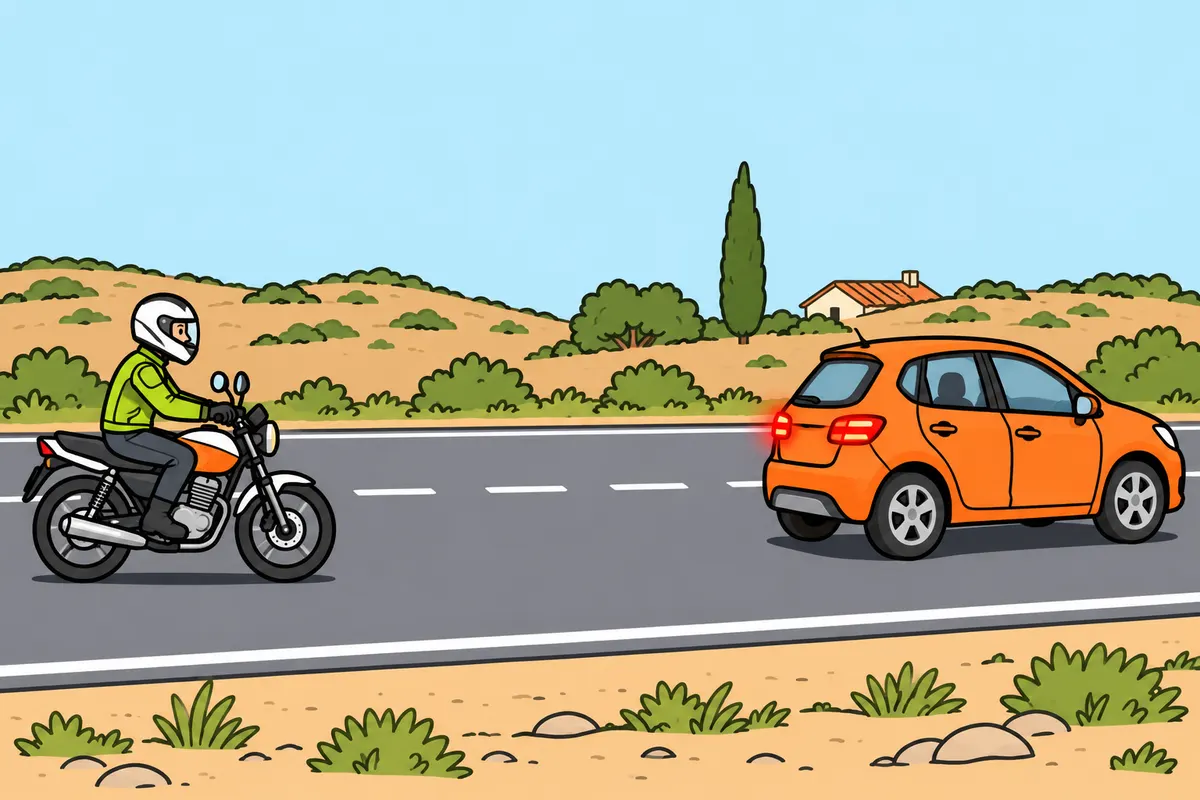
If you take longer to react, you travel further before braking.
Remember
- Look ahead, to either side and behind you.
- Assess risks before you act.
- Your reaction time is how long you take to respond.
- Tiredness, alcohol and distractions can delay your response.
- Your stopping distance includes the distance travelled while reacting and while braking.
Exam trap: Wrong: good tyres make up for your distraction. Right: they cannot remove the distance you travel before reacting.
Read the full explanation
- You must take in what is happening ahead, to the sides and behind, interpret the risks and choose a response. Seeing a vehicle does not mean you have correctly judged its speed or intention: your attention and information processing must also be working properly.
- Reaction time is the interval needed to respond to a stimulus. If you are fatigued, distracted or under the influence of alcohol, you may take longer to notice someone braking and start to react.
- At the same speed, if your reaction time increases, you travel further before braking. Stopping distance includes reaction and braking: a good tyre does not remove the metres you have travelled without responding because you were looking at a screen.
- Illness, some medicines, sleepiness and intense emotions can make it harder for you to respond. Distance calculations are covered in the “Speed and distances on a motorcycle” module.
3Alcohol: units and general limit
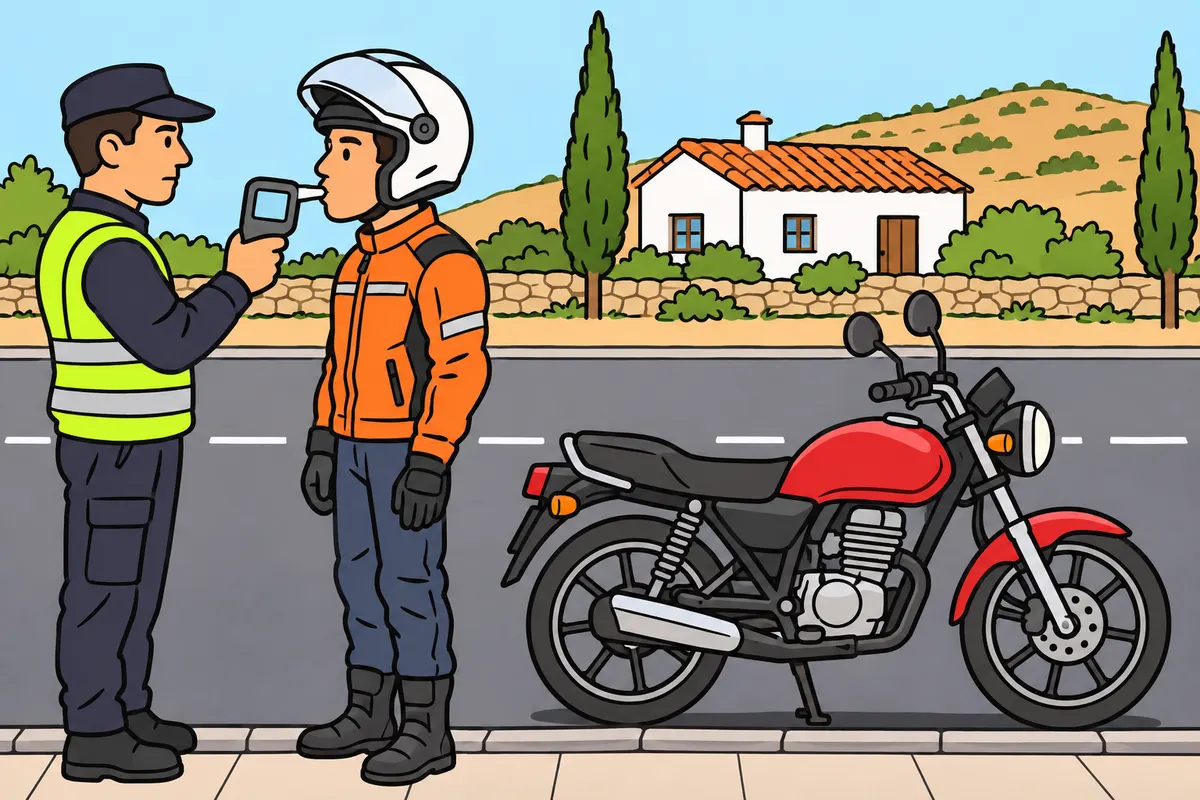
If the general limit applies, distinguish blood measurements from breath measurements.
| Measurement: adults under general rules | Unit | Maximum |
|---|---|---|
| Blood | Grams per litre | 0.5 g/l |
| Air you breathe out | Milligrams per litre | 0.25 mg/l |
Remember
- These limits apply only to adults covered by the general rules.
- Check whether your licence history means a reduced limit applies.
- If you are underage, your alcohol level must be zero.
- Avoid alcohol if you plan to ride.
- You can lose riding skills even below the legal limit.
Exam trap: Wrong: you mix up blood and breath limits. Right: if the adult general rules apply, the maximum is 0.5 g/l in blood and 0.25 mg/l in breath.
Read the full explanation
- Blood alcohol concentration is the concentration of alcohol in your blood. In the exam, you will see grams per litre of blood, g/l, and milligrams per litre of exhaled air, mg/l; exhaled air is what you breathe out when you blow, not a blood sample.
- If you are an adult and the general rules apply to you, you must not exceed 0.5 g/l of blood or 0.25 mg/l of exhaled air. On your private motorcycle, you must also check whether you are still within the reduced-limit period based on how long you have held your licence; if you are under 18, the zero limit applies to you. [RGC, art. 20](https://www.boe.es/buscar/act.php?id=BOE-A-2003-23514#a20) and [LTSV, art. 14](https://www.boe.es/buscar/act.php?id=BOE-A-2015-11722#a14).
- If you are going to drive, avoid drinking alcohol. Being within the legal limit does not guarantee that you retain your abilities; a beer or a glass of wine also contains alcohol and can affect your riding even if you do not feel drunk. [DGT, alcohol](https://www.dgt.es/muevete-con-seguridad/evita-conductas-de-riesgo/consumo-de-alcohol/index.html).
4Zero limit, reduced limit and licence-holding period
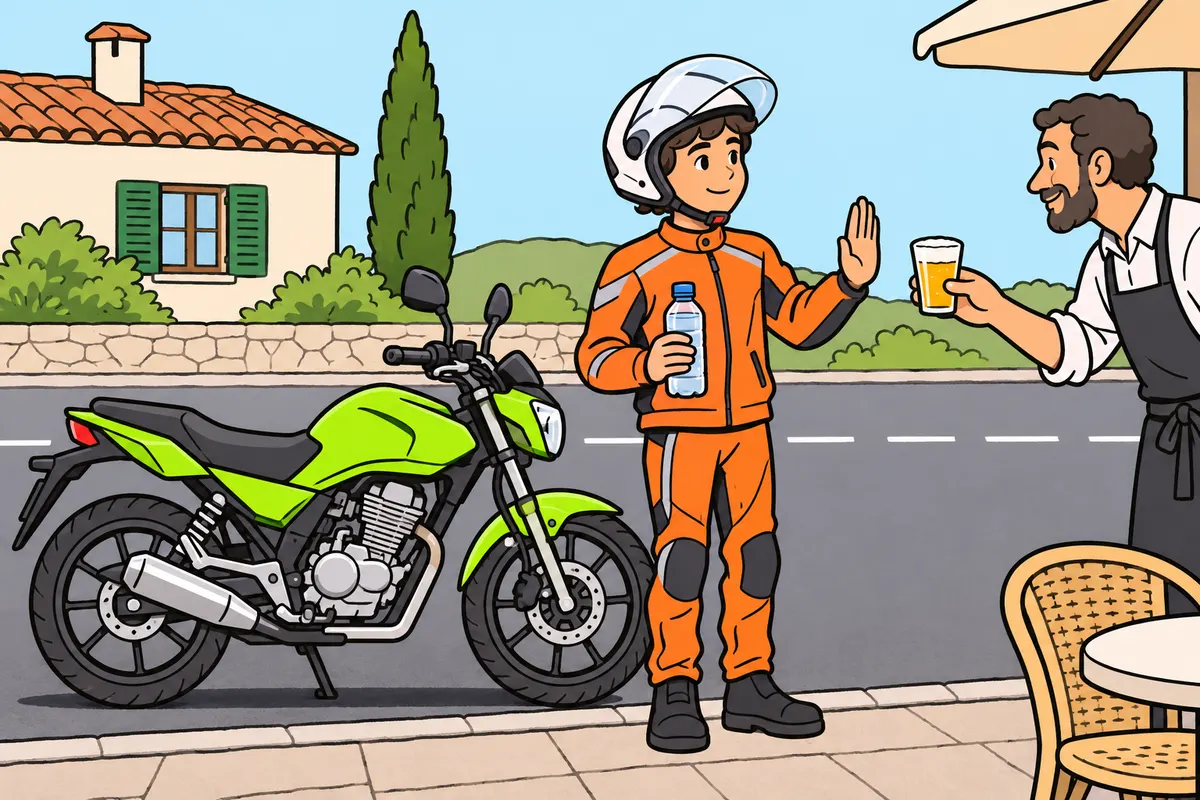
Your age, licence history and vehicle determine which alcohol limit you must follow.
| Your age, licence history or vehicle driven | Maximum in blood | Maximum in breath |
|---|---|---|
| You are under 18 | 0 g/l | 0 mg/l |
| You are an adult within the relevant two-year licence period | 0.3 g/l | 0.15 mg/l |
| Goods vehicles with maximum authorised mass over 3,500 kg | 0.3 g/l | 0.15 mg/l |
| Passenger vehicles with more than nine authorised seats | 0.3 g/l | 0.15 mg/l |
| Public service vehicles; school or child transport | 0.3 g/l | 0.15 mg/l |
| Dangerous goods vehicles; emergency vehicles; special transport vehicles | 0.3 g/l | 0.15 mg/l |
Remember
- If you are underage, your limit is zero, even as a new rider.
- As an adult, use reduced limits during the relevant two-year licence period.
- Your birthday does not restart that period.
- Another licence category does not automatically restart it if earlier licence time counts.
- LCM and LVA licences do not shorten this period for your motorcycle.
- For the listed vehicles, authorised weight, seats or service count, even when empty.
Exam trap: Wrong: as an underage new rider, you may reach 0.15 mg/l. Right: your limit is zero.
Read the full explanation
- If you ride an A1 motorcycle while under 18, your limit is 0 g/l of blood and 0 mg/l of exhaled air. You must apply this rule even if the question calls you a novice driver: no amount of alcohol is permitted for you under the reduced limit. [LTSV, art. 14](https://www.boe.es/buscar/act.php?id=BOE-A-2015-11722#a14).
- For the two years after obtaining the licence or permit that entitles you to drive, article 20 sets limits of 0.3 g/l in blood and 0.15 mg/l in exhaled air. You must apply these figures if you are an adult and are still within that period; while you are under 18, the zero limit takes precedence. [RGC, art. 20](https://www.boe.es/buscar/act.php?id=BOE-A-2003-23514#a20) and [LTSV, art. 14](https://www.boe.es/buscar/act.php?id=BOE-A-2015-11722#a14).
- The period is calculated from the relevant licence-holding date, not simply from your birthday. If you obtain your A1 licence when you turn 16, you must maintain a zero limit throughout your entire minority; when you reach adulthood, you must check whether you have completed the two years since obtaining the licence. [RGC, art. 20](https://www.boe.es/buscar/act.php?id=BOE-A-2003-23514#a20) and [LTSV, art. 14](https://www.boe.es/buscar/act.php?id=BOE-A-2015-11722#a14).
- Obtaining a new category of licence does not automatically restart the period if you hold another licence whose holding period counts. A driving licence counts only for vehicles you are entitled to drive with it: the date of an earlier LCM or LVA licence does not shorten the two-year reduced-limit period when riding your A1 motorcycle. [RGC, art. 20, final paragraph](https://www.boe.es/buscar/act.php?id=BOE-A-2003-23514#a20).
- If you drive vehicles intended for carrying goods with an MMA exceeding 3,500 kg, passenger vehicles with more than nine seats, public-service vehicles, school and child transport vehicles, vehicles carrying dangerous goods, emergency vehicles or vehicles used for special transport, you must not exceed 0.3 g/l in blood or 0.15 mg/l in exhaled air. The vehicle's MMA, authorised seats or service determine which limit applies, even when it is travelling empty. [RGC, art. 20](https://www.boe.es/buscar/act.php?id=BOE-A-2003-23514#a20).
5How blood alcohol concentration varies
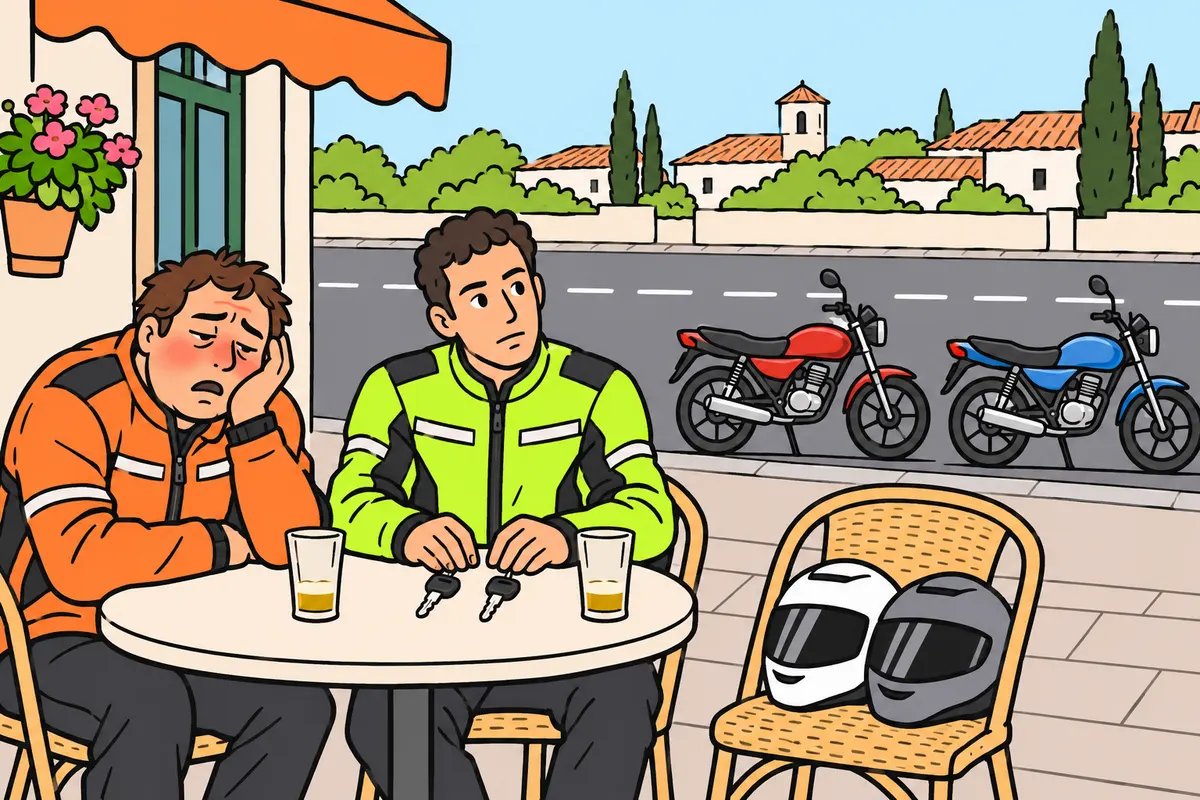
Your alcohol level can keep rising after you stop drinking.
Remember
- Do not judge how much you can drink by comparing yourself with others.
- Food can delay absorption, but cannot stop alcohol entering your blood.
- Your body removes alcohol slowly.
- Coffee, showers and exercise do not lower your alcohol level.
- Sleeping for a few hours does not guarantee you have removed the alcohol.
- Being young or used to drinking does not protect you.
Exam trap: Wrong: after 90 minutes, you can ride. Right: your level may peak between 30 and 90 minutes, with individual differences; this is no safe waiting time.
Read the full explanation
- You cannot calculate a safe amount to drink by comparing yourself with someone else. The total amount, rate of consumption, weight, sex and personal circumstances all matter; two motorcyclists who drink the same amount can get different results.
- Alcohol can reach its peak concentration between 30 and 90 minutes after drinking, with individual variations. Your level can continue to rise after you put your glass down: this interval is physiological guidance, not a waiting time that allows you to drive. [DGT, absorption](https://www.dgt.es/muevete-con-seguridad/evita-conductas-de-riesgo/consumo-de-alcohol/index.html).
- Eating can delay absorption, but it does not stop alcohol entering your blood. Spirits and carbonated mixers can encourage faster absorption; drinking slowly also does not guarantee that alcohol will not build up or that you will remain within the limit.
- Alcohol leaves your body slowly, and sleeping for a few hours does not guarantee that you will wake up alcohol-free. Do not rely on coffee, showers, exercise, sweets or chewing gum to lower your level: feeling more awake does not prove that the substance has left your body.
- Fatigue, illness and combining alcohol with medicines or other drugs can make the impairment worse. Neither youth nor being used to drinking protects you: feeling less drunk does not mean that you are riding safely.
6Alcohol: effects when riding a motorcycle
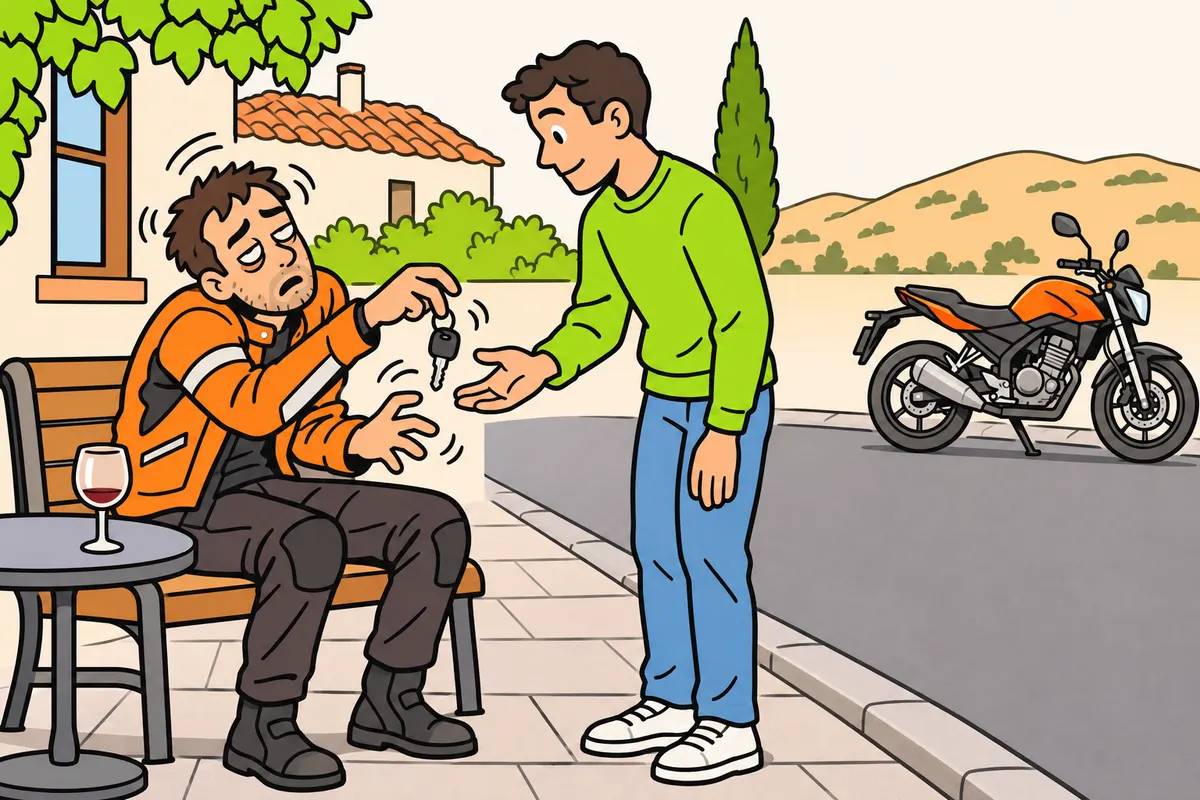
Alcohol worsens your vision, balance and reactions even when you feel capable.
Remember
- You may feel confident while judging risks less accurately.
- You may see signs, distances and vehicles beside you less clearly.
- You may lose balance and brake less precisely.
- You may react later and feel sleepy.
- Do not use alcohol to fight cold or tiredness.
- If you have been drinking, arrange another way to travel.
Exam trap: Wrong: drinking improves your reflexes. Right: it can delay your response and give you false confidence.
Read the full explanation
- Alcohol is a depressant of the central nervous system, although at first you may feel euphoric or less inhibited. This apparent energy can come with less caution: you may think you are in control of the motorcycle while judging a bend or joining traffic less accurately.
- You may perceive lights, signs, distances and speeds less accurately. Your field of vision may narrow and you may recover more slowly after being dazzled; on a motorcycle, you also need to detect a vehicle appearing from the side, not just what you are looking at ahead. [DGT, effects of alcohol](https://revista.dgt.es/es/salud-vial/2019/1001-Salud-Vial-como-influye-el-alcohol-en-la-conduccion.shtml).
- You may lose coordination, balance and precision when using the controls. Keeping the motorcycle upright at low speed, applying the brake smoothly or correcting your line all require abilities that alcohol can impair even when you do not appear obviously drunk.
- You may take longer to react, become distracted and feel sleepier. Alcohol can also cause overconfidence, impulsiveness and aggressive behaviour.
- Do not use alcohol to combat the cold, worries or tiredness. If you have been drinking, arrange an alternative for yourself and your motorcycle; reducing your speed or choosing familiar streets does not restore the abilities you need to drive.
7Who must take a test
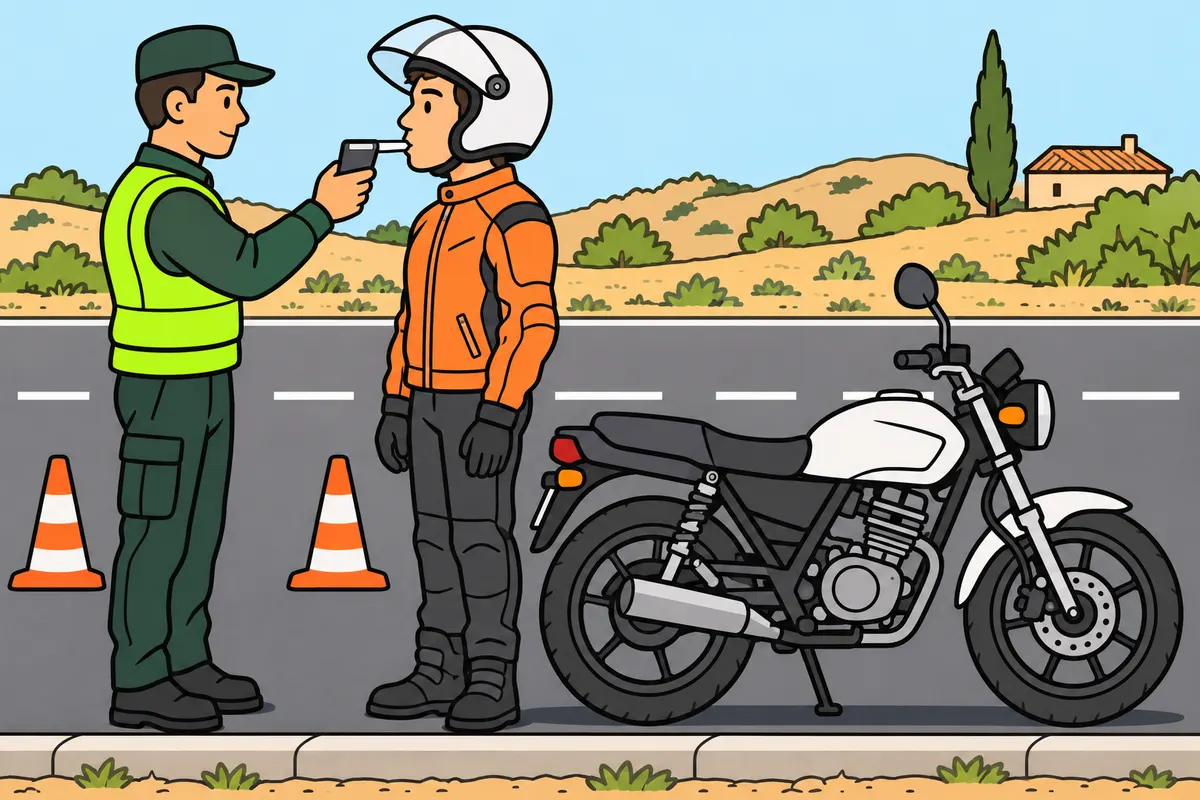
As a rider, you must take tests required by traffic officers.
| Your situation on the road | When you must take tests |
|---|---|
| You drive any vehicle | When traffic officers require them |
| You are another road user | When legally required after accident involvement or an offence you committed |
Remember
- You must cooperate even if you believe you have ridden correctly.
- Officers may test you at preventive checkpoints.
- You need not show symptoms or have had an accident.
- This duty applies to drivers of any vehicle.
Exam trap: Wrong: you can refuse if you have committed no offence. Right: as a driver, you must also cooperate at preventive checkpoints.
Read the full explanation
- As a motorcycle rider, you must take alcohol and drug tests required by officers responsible for traffic enforcement. You do not need to have been involved in an accident or show symptoms for this duty to apply. [Traffic Act, art. 14](https://www.boe.es/buscar/act.php?id=BOE-A-2015-11722#a14).
- You may be tested at preventive checks, if you show signs of being under the influence, if you have committed an offence, and in circumstances involving accidents. You must follow the officers’ instructions even if you believe you have ridden correctly. [RGC, art. 21](https://www.boe.es/buscar/act.php?id=BOE-A-2003-23514#a21).
- The duty applies to drivers of any vehicle; it is not limited to cars or professional vehicles. Other road users involved in a traffic accident or who have committed an offence under the law must also take a test. [Traffic Act, art. 14](https://www.boe.es/buscar/act.php?id=BOE-A-2015-11722#a14).
8Alcohol test and second measurement
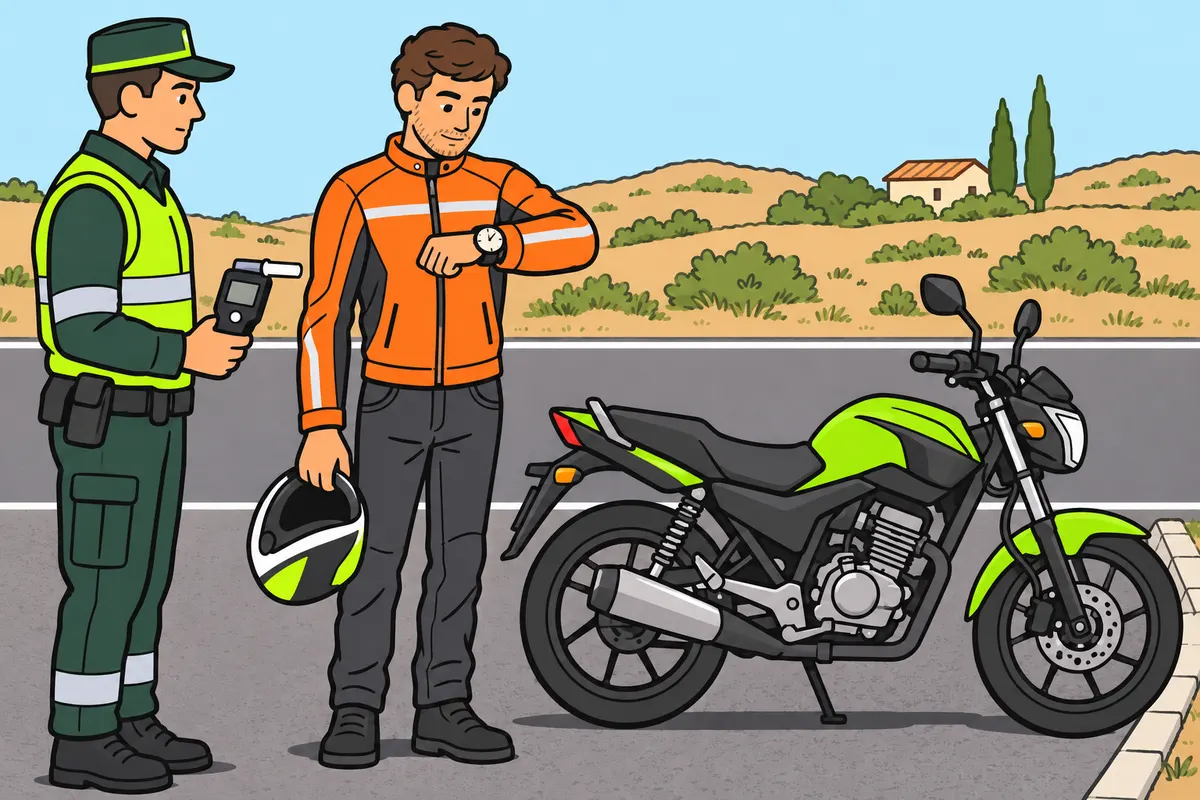
The second alcohol measurement confirms the check with a breath test.
Remember
- Blow as the officer instructs you.
- The device measures alcohol in your breath in mg/l.
- You must repeat the test if you exceed your limit or show clear symptoms.
- Clear symptoms require another test even if you have not reached your limit.
- You, your companions or witnesses present can check the time between tests.
- You can ask for your comments to be recorded, but must cooperate.
Exam trap: Wrong: the second test is a blood test. Right: you blow again, with at least 10 minutes between measurements.
Read the full explanation
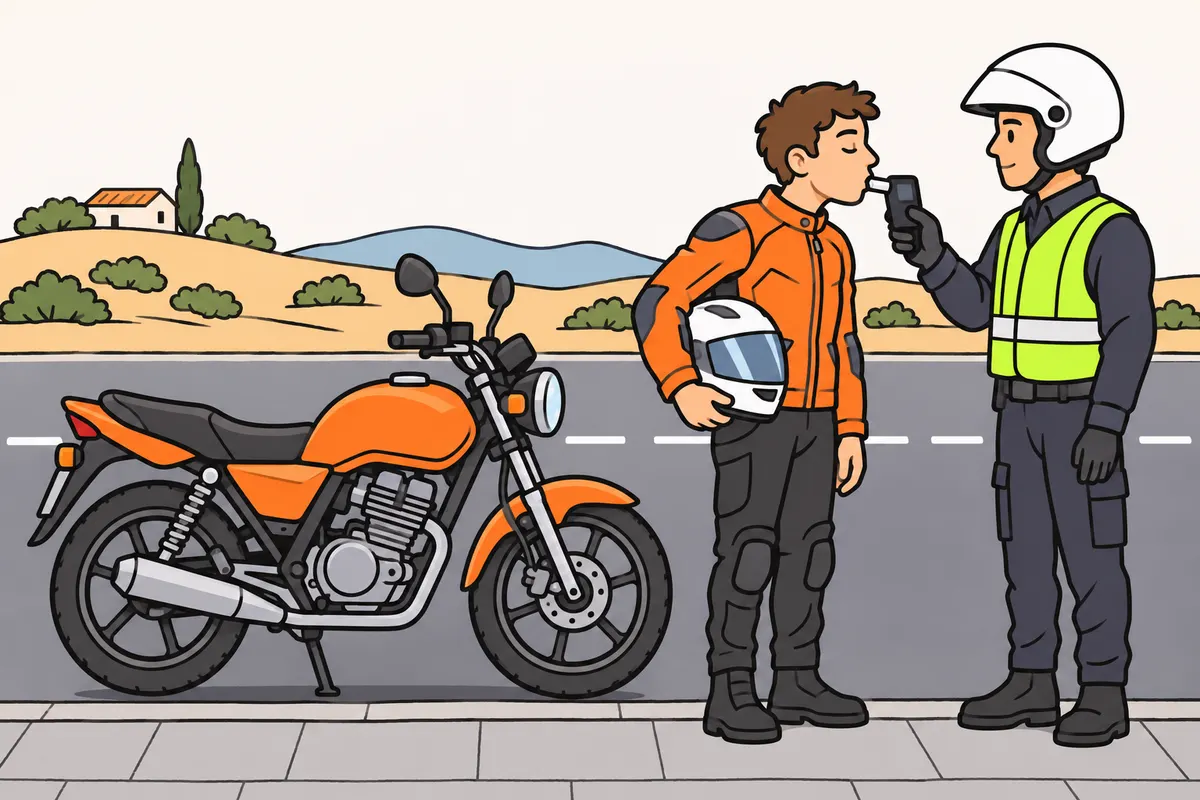
- The standard check involves blowing into an approved breathalyser. You must follow the instructions for the measurement to be valid; the device measures the concentration of alcohol in your breath, so you must read the result in mg/l. [RGC, art. 22](https://www.boe.es/buscar/act.php?id=BOE-A-2003-23514#a22).
- If you exceed the applicable limit, or show clear signs of being under the influence even without reaching it, the officer must give you a second breath test and inform you beforehand. This second measurement is part of the safeguard procedure. [RGC, art. 23](https://www.boe.es/buscar/act.php?id=BOE-A-2003-23514#a23).
- You have the right to check that at least 10 minutes pass between the first and second tests. You can check this yourself or through companions or witnesses who are present. [RGC, art. 23](https://www.boe.es/buscar/act.php?id=BOE-A-2003-23514#a23).
- You can make comments and submissions and ask for them to be recorded. Disputing the result does not remove your duty to cooperate with the checks established by law. [RGC, art. 23](https://www.boe.es/buscar/act.php?id=BOE-A-2003-23514#a23).
9Confirmatory tests and drug testing
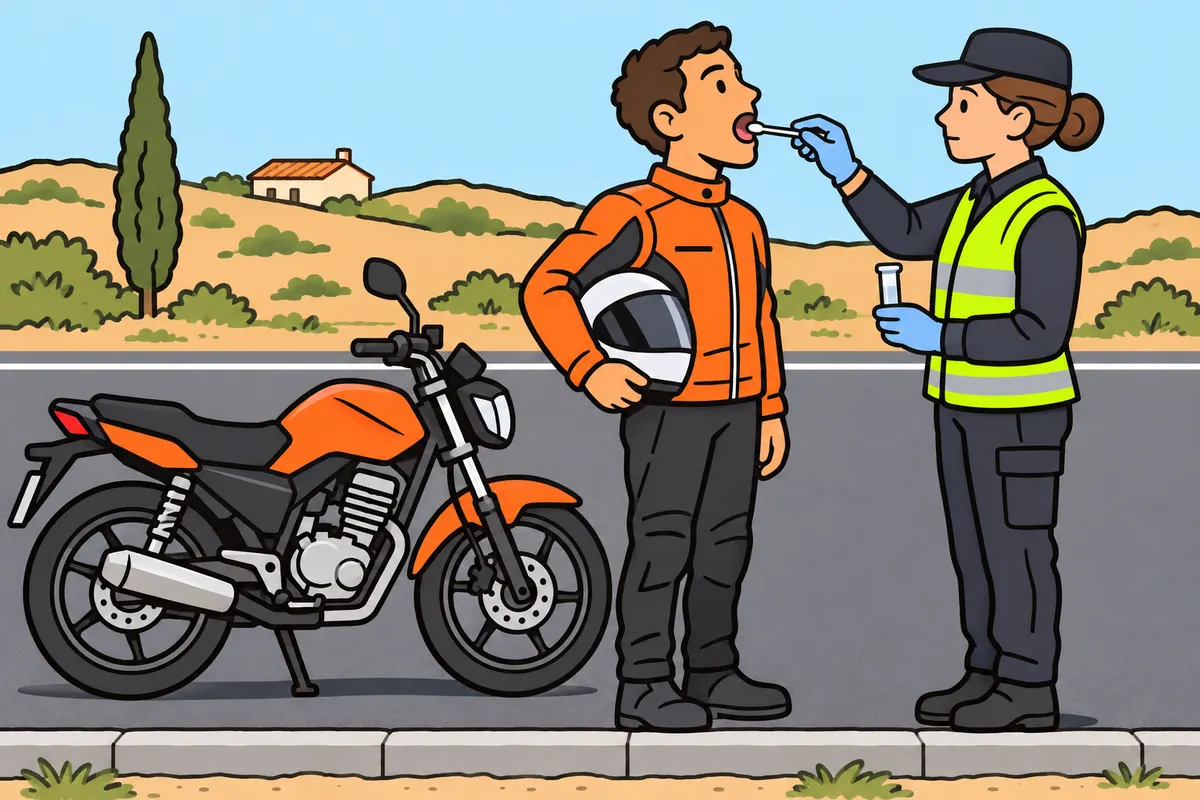
You can request a further test to check the result.
| Test | How it is done |
|---|---|
| Usual drug screening | Saliva device, followed by analysis of a saliva sample |
| Further alcohol or drug test you request | Preferably a blood test, unless justified exceptions apply |
Remember
- The further test preferably uses blood, unless justified exceptions apply.
- If the test you request is positive, you must pay for it.
- For alcohol, you pay a deposit, refunded if the result is negative.
- Do not apply alcohol limits to drugs.
- If medical difficulties prevent the usual test, officers may arrange other suitable checks.
Exam trap: Wrong: a medical problem lets you reject testing. Right: officers may arrange a medical examination or suitable clinical tests.
Read the full explanation
- You can request confirmatory tests for alcohol or drugs, preferably by blood test unless exceptional circumstances justify another method. [Traffic Act, art. 14](https://www.boe.es/buscar/act.php?id=BOE-A-2015-11722#a14).
- If the requested confirmatory test is positive, you must pay for it. For alcohol tests, the regulations provide for payment to be deposited in advance and refunded if the confirmatory result is negative. [RGC, art. 23](https://www.boe.es/buscar/act.php?id=BOE-A-2003-23514#a23).
- The standard drug test uses an approved saliva device, followed by analysis of a sufficient saliva sample. Alcohol’s numerical limits do not apply to drugs. [Traffic Act, art. 14](https://www.boe.es/buscar/act.php?id=BOE-A-2015-11722#a14).
- If a justified reason prevents the usual tests, a medical examination or appropriate clinical analyses may be arranged. You must explain any genuine problems and follow the instructions: a medical difficulty does not make the check optional for you as the rider. [Traffic Act, art. 14](https://www.boe.es/buscar/act.php?id=BOE-A-2015-11722#a14).
10Refusal, immobilisation and criminal offences
Riding under the influence or refusing required tests can be a criminal offence.
| Your age when refusal is a criminal offence | Consequences |
|---|---|
| You are an adult | Six months to one year in prison; driving ban over one year, up to four years |
| You are under 18 | Juvenile criminal law applies; your age does not let you refuse |
Remember
- You can commit a criminal offence without causing an accident.
- Riding under the influence can be criminal below these figures too.
- Refusing a legally required test can be criminal without a positive result.
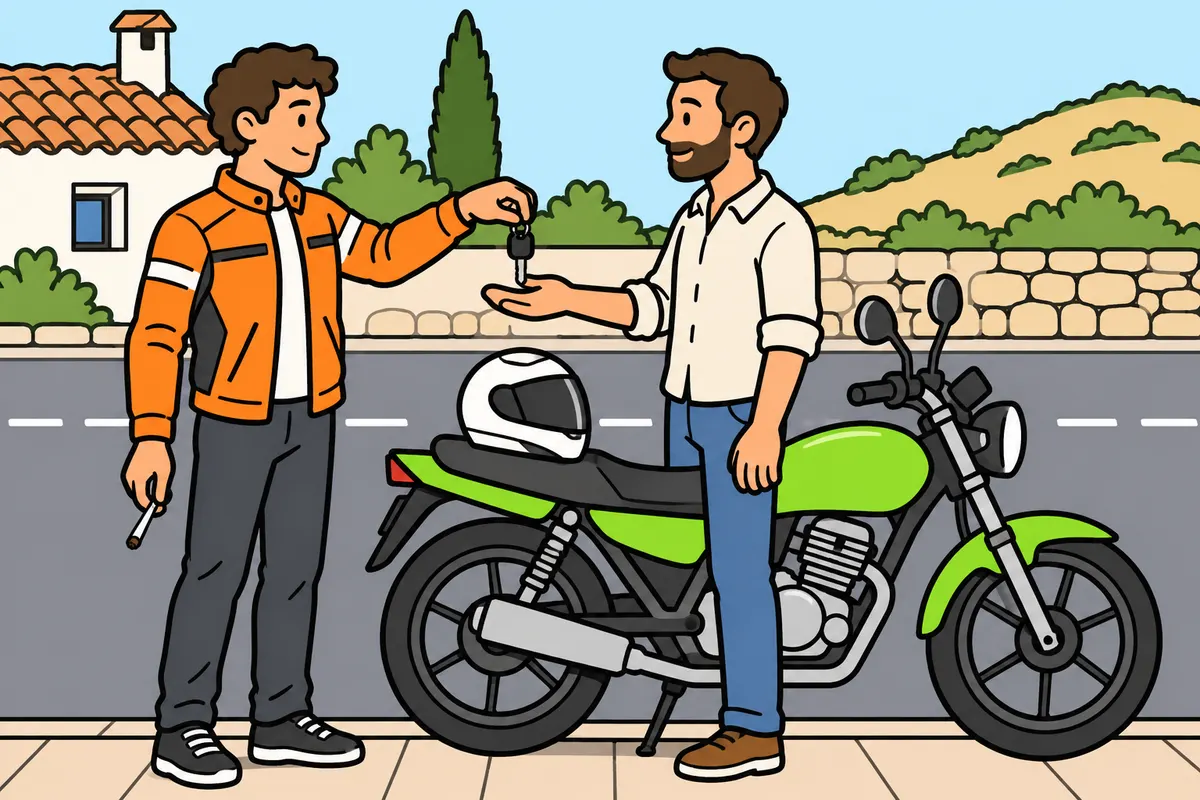
- After a positive result or refusal, officers may stop your motorcycle being used.
- Respect this restriction until officers authorise its removal.
- Unless a court orders otherwise, another suitably licensed driver may take charge with assurances.
Exam trap: Wrong: 0.60 mg/l is an allowed level. Right: ordinary legal limits are lower; exceeding this figure is always a criminal offence.
Read the full explanation
- If the conduct does not amount to a criminal offence, exceeding the alcohol limit, riding with drugs in your system or failing to take the tests are very serious offences. Refusing tests lawfully required by an officer may constitute the criminal offence of refusal even if there is no positive result. [Traffic Act, art. 77](https://www.boe.es/buscar/act.php?id=BOE-A-2015-11722#a77) and [Criminal Code, art. 383](https://www.boe.es/buscar/act.php?id=BOE-A-1995-25444#a383).
- Riding a motorcycle under the influence of alcohol or drugs may be a criminal offence even if you have not caused an accident and even if your alcohol level is below the criminal threshold. For alcohol, the Criminal Code makes it an offence in all cases when the level exceeds 0.60 mg/l in breath or 1.2 g/l in blood. [Criminal Code, art. 379.2](https://www.boe.es/buscar/act.php?id=BOE-A-1995-25444#a379).
- Under the adult criminal law regime, refusal under article 383 is punishable by imprisonment for six months to one year and disqualification from driving for more than one year and up to four years. If you are under 18, liability for a criminal act is governed by the legislation on juvenile criminal responsibility: you must not automatically assume that adult penalties apply to you or believe that your age allows you to refuse. [Criminal Code, art. 19](https://www.boe.es/buscar/act.php?id=BOE-A-1995-25444#a19) and [art. 383](https://www.boe.es/buscar/act.php?id=BOE-A-1995-25444#a383).
- After a positive test or a refusal, officers may immobilise your motorcycle. Unless a judicial authority orders otherwise, another authorised driver who offers sufficient guarantees may take charge of it. You must comply with the measure until the officers confirm that it can be lifted. [RGC, art. 25](https://www.boe.es/buscar/act.php?id=BOE-A-2003-23514#a25) and [Traffic Act, art. 104](https://www.boe.es/buscar/act.php?id=BOE-A-2015-11722#a104).
- Your points balance and points deductions are covered in “The points-based driving licence”.
11Drugs: prohibition and false confidence
You must not ride with drugs present unless every condition of the medical exception applies.
| Type of substance | How it can affect you |
|---|---|
| Depressant | Slows your body's functions |
| Stimulant | Makes you feel alert and possibly overconfident |
| Perception-altering substance | Changes what you perceive |
Remember
- The exception requires a medical prescription and use for treatment.
- You must also remain attentive, cautious and able to ride carefully.
- Do not rely only on feeling normal.
- Do not choose your own safe waiting time after taking drugs.
- Mixing substances can increase or hide their effects.
- A stimulant does not cancel out alcohol.
Exam trap: Wrong: a prescription alone lets you ride. Right: you need a medical prescription, use for treatment, and the ability to remain careful, cautious and attentive.
Read the full explanation
- You must not ride with drugs in your system. The legal exception requires all of the following: a medical prescription, therapeutic purpose, and your ability to retain due care, caution and attention; a prescription does not allow you to ride while impaired by its effects. [Traffic Act, art. 14](https://www.boe.es/buscar/act.php?id=BOE-A-2015-11722#a14).
- Depressants can slow your functions; stimulants can make you feel energised and overconfident; hallucinogenic drugs can distort your perception. None of these effects makes riding a motorcycle safer. [DGT, drugs](https://www.dgt.es/muevete-con-seguridad/evita-conductas-de-riesgo/consumo-de-drogas-y-medicacion/).
- You cannot be sure you are fit to ride because you feel normal or because the pleasant sensation has passed. The effects and detectable presence of a drug do not necessarily match your subjective impression; do not use a rule of thumb about time since consumption as permission to ride.
- Combining substances can intensify or mask their effects. You must especially avoid believing that a stimulant counteracts alcohol: you may feel less tired while still judging traffic poorly and acting less precisely.
12Effects of drugs and medicines
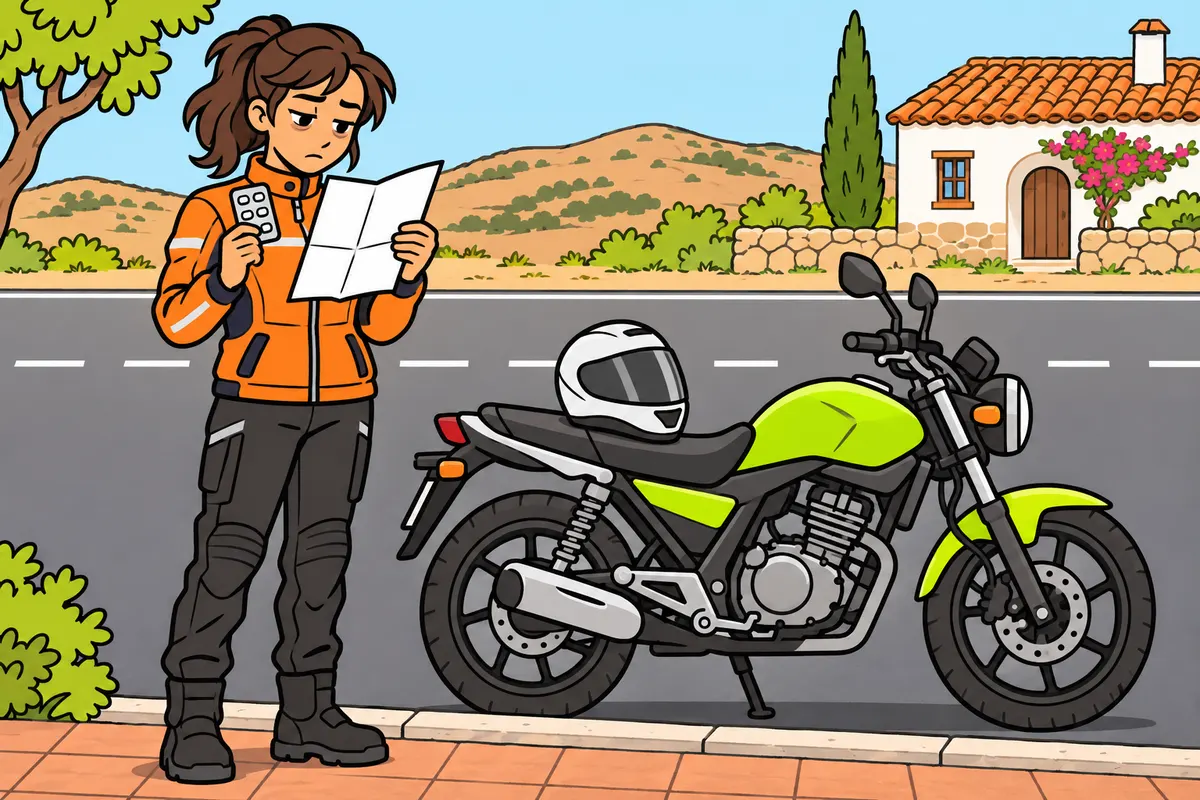
Drugs and some treatments can change how you control your motorcycle.
| Substance | Possible effects on you |
|---|---|
| Cannabis | Sleepiness, distraction, slow reactions; changes how you judge space and time |
| Cocaine | Agitation, impulsiveness, aggression and overconfidence |
| Amphetamines | Hide your fatigue; you may feel very tired afterwards |
| Ecstasy | Changes your attention, perception and vision |
| Hallucinogens | You may perceive things that do not exist |
| Heroin and other opiates | Make you drowsy and slow your responses |
| Some antihistamines | Make you sleepy and reduce your reflexes |
| Anti-anxiety medicines, sleeping medicines and other psychiatric medicines | Can make you sleepy, confused or slow |
Remember
- Check the effects of any treatment before setting off.
- Some medicines for allergies or colds can make you sleepy.
- A sleeping tablet can still affect you when you wake up.
- Painkillers can also affect your vision, concentration or coordination.
- Avoid mixing medicines with alcohol.
Exam trap: Wrong: amphetamines remove your fatigue. Right: they can hide it and leave you very tired when their effects wear off.
Read the full explanation
- Cannabis can cause drowsiness, distraction, slow reactions and changes to your perception of space and time; you may misjudge how soon another vehicle will reach a junction.
- Cocaine can cause agitation, impulsiveness, aggression and overconfidence. Amphetamines can mask your fatigue and encourage risk-taking; when their effects wear off, intense tiredness may set in.
- Ecstasy can affect your attention, perception and vision. Hallucinogens can make you perceive stimuli that are not there and cause dangerous reactions that affect your motorcycle’s path.
- Heroin and other opiates can cause sedation and slow reactions. Combinations can make the effects worse. [DGT, drugs and medicines](https://www.dgt.es/export/sites/web-DGT/.galleries/downloads/conoce_la_dgt/que-hacemos/educacion-vial/adultos/no-formal/drogas.pdf).
- Some antihistamines for allergies or colds can make you sleepy and reduce your reflexes. Anxiolytics, sleeping pills and other psychiatric medicines can cause drowsiness, confusion or slowness; a sleeping pill may still affect you when you wake up.
- Painkillers and other treatments can affect your vision, concentration or coordination. Check their effects even if they are not medicines for sleeping. [DGT, medicines](https://www.dgt.es/export/sites/web-DGT/.galleries/downloads/muevete-con-seguridad/evita-conductas-riesgo/Medicamentos_conduccion_PoblacionGeneral.pdf).
- Avoid mixing medicines with alcohol: their effects can be intensified, causing drowsiness or impairment even if the amount you drink seems small. You must consider interactions before setting off, not wait to discover them on a bend or while braking. [DGT, interactions](https://revista.dgt.es/es/salud-vial/2021/0408-Interactuacion-medicamentos.shtml).
13Medicines and the warning pictogram
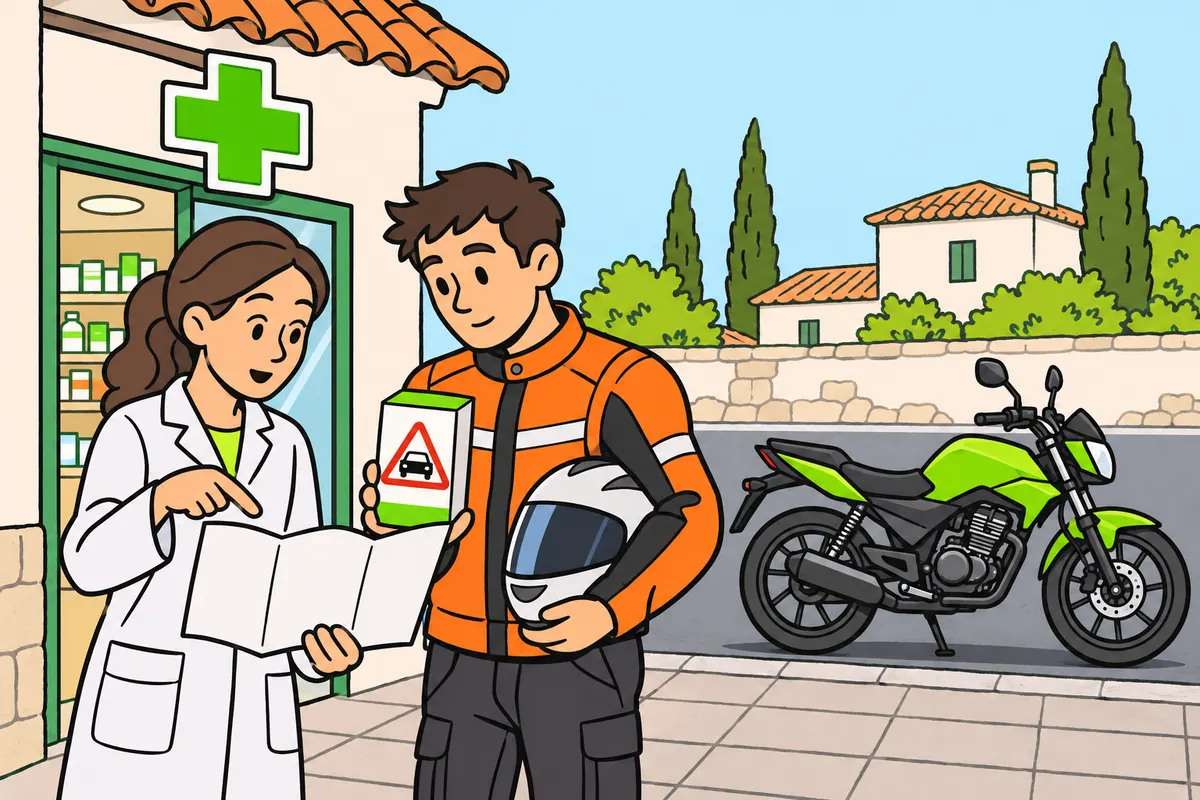
Check how your medicine affects riding before you use your motorcycle.
Remember
- Check products sold without a prescription and herbal products too.
- The red triangle with a black car warns of possible effects on driving.
- Read the driving section of the medicine's leaflet.
- Ask your doctor or pharmacist, and explain that you ride a motorcycle.
- Take extra care when starting treatment, changing doses or combining medicines.
- Do not change or stop treatment yourself so that you can ride.
Exam trap: Wrong: the symbol automatically bans driving and only concerns cars. Right: it warns of possible effects; read the leaflet and seek advice for motorcycle riding too.
Read the full explanation
- You must check the effects of any medicine, including medicines sold without a prescription. A single cold remedy can make you drowsy; you do not need to have combined several medicines to experience effects that make riding your motorcycle difficult. You must also ask about herbal products: being natural does not guarantee that you can ride safely.
- The red triangle with a black car and the instruction to read the package leaflet warns you about possible effects on driving. [RD 1345/2007, Annex IV.1.f](https://www.boe.es/buscar/act.php?id=BOE-A-2007-19249#aniv).
- Read the section on driving and using machines in the package leaflet and ask your doctor or pharmacist. You must tell them that you ride a motorcycle and ask about dizziness, blurred vision, drowsiness or loss of coordination.
- Take extra care when starting treatment, changing the dose or combining several medicines. Do not change the dose yourself or stop treatment so that you can ride; if you experience effects that are incompatible with riding your motorcycle, do not ride and seek advice.
- You may feel weak or dizzy, have difficulty concentrating, slower reflexes or feel overexcited. Not all medicines cause drowsiness, and not everyone receiving treatment is unfit to ride: you must assess the specific product, the illness and your individual response. [DGT, interactions](https://revista.dgt.es/es/salud-vial/2021/0408-Interactuacion-medicamentos.shtml).
14Illness, age and physical and mental fitness
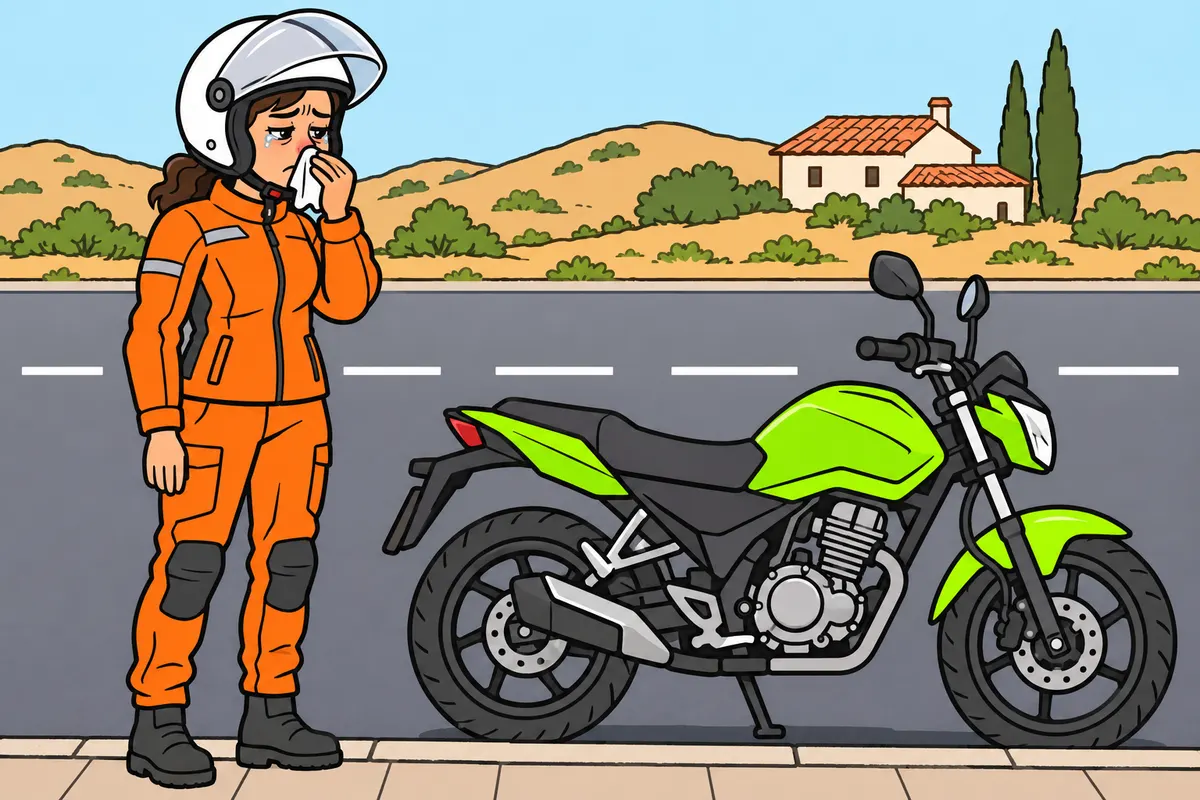
Assess your health and actual abilities before riding.
Remember
- Assess both your illness and its treatment.
- If symptoms prevent motorcycle control, postpone your journey or stop safely.
- Follow your licence restrictions, including any requirement to wear glasses or contact lenses.
- Seek advice about frequent drowsiness, dizziness or loss of consciousness.
- For a long-term illness, agree with your healthcare professional how to handle episodes.
- Keep up with check-ups and recognise your limits, whatever your experience.
Exam trap: Wrong: an illness always prevents you from riding. Right: this depends on your condition, treatment and medical assessment; follow your licence conditions.
Read the full explanation
- Consider both your illness and its treatment. A cold can make you feel unwell and make it harder to pay attention; an allergy can cause watery eyes or sneezing. If these symptoms prevent you from observing and controlling your motorcycle, postpone the journey or stop safely.
- Dizziness, loss of consciousness, significant visual disturbances or problems that affect movement require medical assessment. Do not try to diagnose yourself or decide that an illness is compatible with riding just because nothing happened on previous occasions.
- For the fitness assessment, category A1 belongs to group 1. You must meet the physical and mental fitness requirements in Annex IV and comply with any restrictions or adaptations that apply to you; an illness does not always have the same outcome for everyone. [RGCond, art. 45](https://www.boe.es/buscar/act.php?id=BOE-A-2009-9481#a45).
- You must comply with the conditions of your licence, such as any required vision correction. [RGCond, art. 46](https://www.boe.es/buscar/act.php?id=BOE-A-2009-9481#a46).
- If you often feel sleepy during the day, ask about possible sleep disorders such as sleep apnoea. Sleeping for many hours and still feeling exhausted also deserves attention: neither a controlled illness nor a valid licence removes the need to assess how you feel that day.
- If you have a chronic illness, you must know its warning symptoms and agree with your healthcare professional on what to do if you have an episode. Diabetes, epilepsy, cardiovascular conditions and mental health conditions require you to assess their progress, control and treatment; do not conclude that every diagnosis prevents you from riding or that treatment alone guarantees your fitness. [RGCond, Annex IV](https://www.boe.es/buscar/act.php?id=BOE-A-2009-9481#aniv).
- You must judge your fitness by your actual abilities and medical condition, not just your age. Ageing can bring difficulties with vision, hearing, mobility or response; on a motorcycle, you must pay particular attention to your balance, turning your head and precise control.
- Experience helps you anticipate, but it does not counteract impairment caused by alcohol, medicines or sleepiness. If you notice new problems with orientation, responding or keeping your line, seek advice and adapt your journeys to the professional assessment. [DGT, health advice](https://www.dgt.es/export/sites/web-DGT/.galleries/downloads/conoce_la_dgt/que-hacemos/conocimiento-e-investigacion/Guia-Consejo-Sanitario_vr.pdf).
- If you have little experience, you still devote more conscious attention to the controls and may become tired sooner. You must plan journeys that gradually increase in difficulty, avoid pressure from the group and recognise your limits; this risk is not exclusive to any particular age and does not make an accident inevitable.
- Keep up with your check-ups and pay attention to changes in your vision, hearing and health. Do not apply to your motorcycle an adaptation intended specifically for a car: the applicable conditions must be set for your licence and vehicle; validity and renewal are covered in “A1 licence and motorcycle documents”.
15Fatigue: causes, symptoms and response
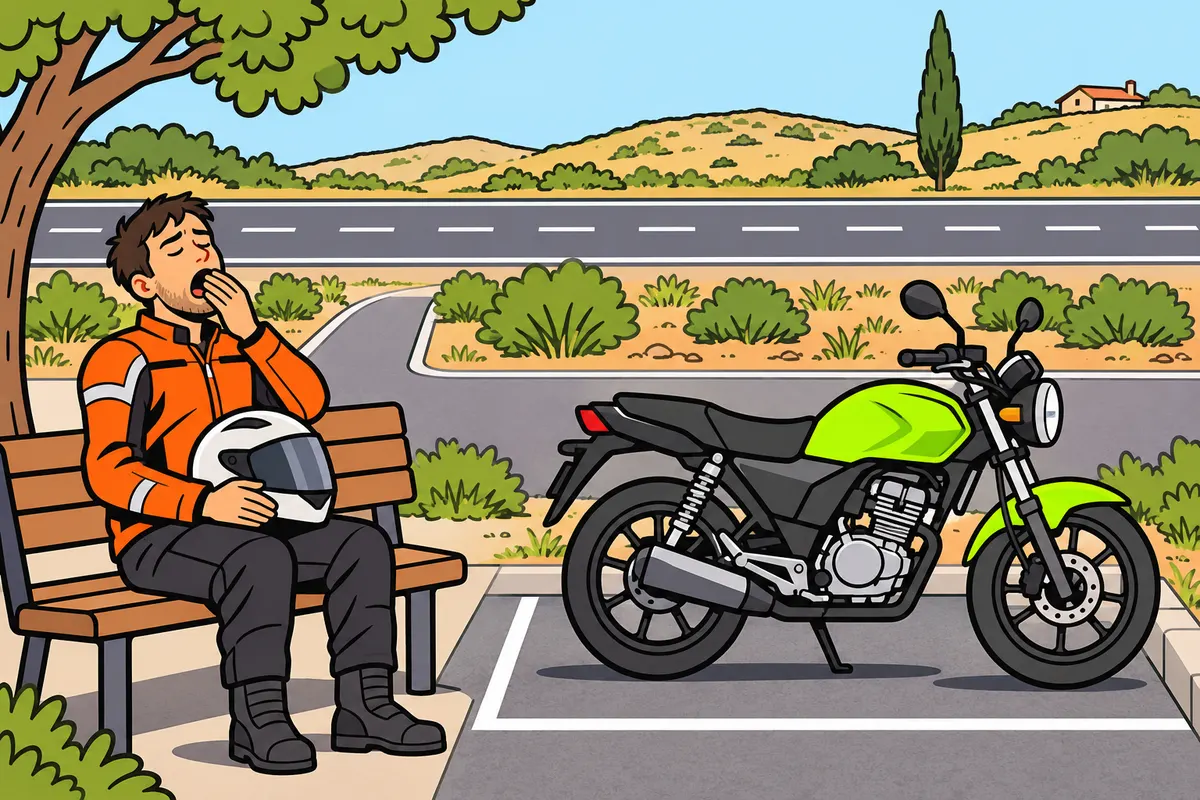
If you feel tired, stop as soon as possible somewhere safe and rest.
Remember
- Wind, your riding position, noise and weather can tire you.
- Difficult traffic and dull, repetitive journeys can also tire you.
- Recognise yawning, blurred vision and difficulty concentrating.
- Stiffness and numb arms are warning signs too.
- Tiredness can delay your reactions and cause mistakes.
- Do not wait until you are exhausted or reach your planned break.
Exam trap: Wrong: speeding up or opening your visor removes tiredness. Right: you must stop somewhere suitable and safe, and rest.
Read the full explanation
- You can experience physical and mental tiredness. On a motorcycle, factors include maintaining a riding posture, the effort of using the controls, noise and exposure to wind, cold or heat; being outdoors does not guarantee that you stay alert throughout the journey.
- Heavy traffic, unfamiliar sections, a deteriorated road surface and bad weather can demand more effort. You must expect a difficult route to tire you sooner even if it is short; do not judge your capacity only by how many kilometres remain.
- Riding fast for a long time, setting off after a demanding day or getting too little rest contributes to fatigue. Stress, illness, alcohol and heavy meals also play a part; several factors can combine and reduce your attention. [DGT, fatigue](https://www.dgt.es/muevete-con-seguridad/evita-conductas-de-riesgo/conducir-con-fatiga/).
- Monotony can also reduce your vigilance, even on motorways with little traffic. A familiar and apparently simple road can make you stop looking for hazards; do not assume that a straight road requires little attention.
- An uncomfortable riding position or restrictive clothing can increase the effort and tiredness of your journey. The choice and fit of protective equipment are covered in “Motorcyclist protective equipment”.
- Heavy eyelids, blurred vision, frequent blinking, yawning and difficulty concentrating are symptoms of fatigue. If you find it hard to interpret signs or maintain an orderly scan, do not wait until you are extremely exhausted before interrupting your journey.
- You may feel stiff, have pain in your neck or back, numb arms or cramps. Repeatedly changing position and needing to stretch are warning signs you must take seriously; on a motorcycle, discomfort can also make your control inputs less precise.
- Fatigue can increase irritability, indecision and distraction, and slow your reactions. You can make mistakes even when you try to compensate through greater willpower.
- You must stop as soon as possible in a suitable, safe place and rest. Speeding up to arrive sooner or opening your visor does not remove fatigue; you must not keep riding to cover a planned distance if symptoms appear before your next break.
16Sleep, drowsiness and microsleeps
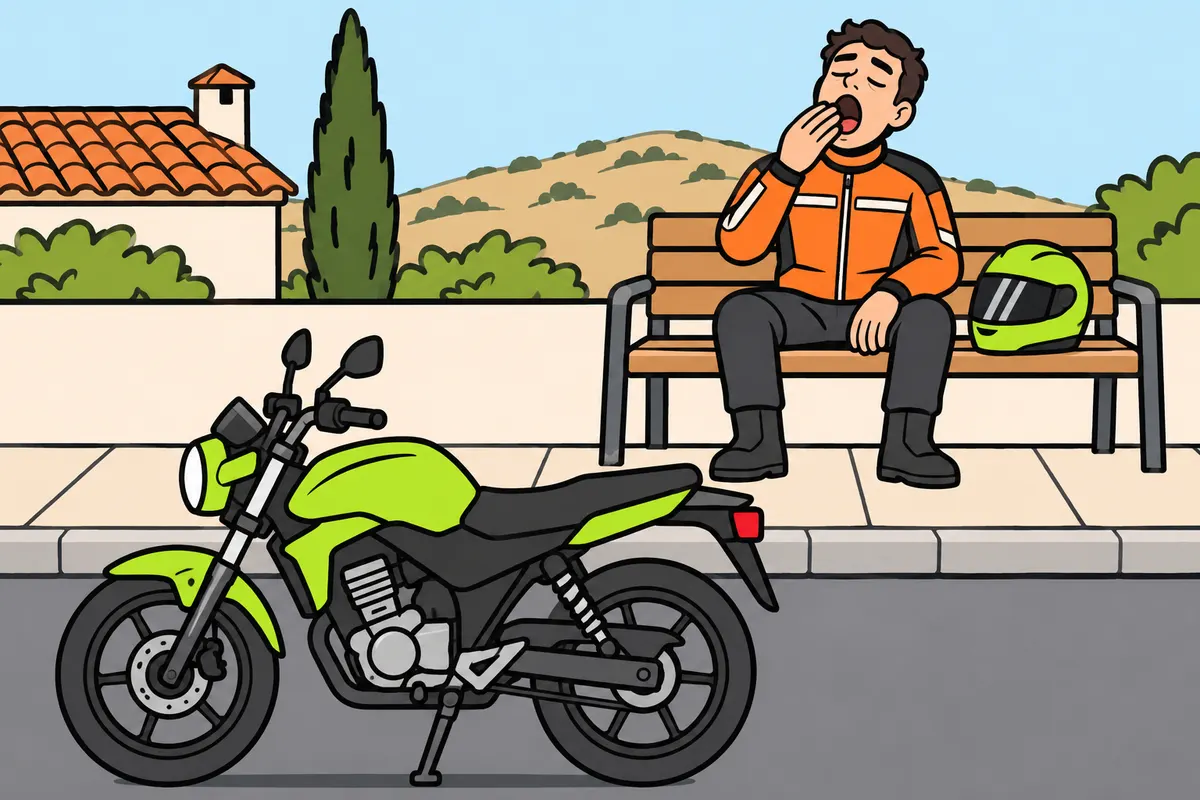
Sleepiness reduces your riding ability before you fall asleep.
Remember
- A microsleep is brief, involuntary sleep that you may not notice.
- You cannot control it through willpower.
- Heavy eyelids, nodding off and yawning are warning signs.
- Stop safely if you forget the stretch travelled or struggle to hold your line.
- You can feel sleepy at any time.
- Get enough sleep; if you remain drowsy, avoid riding and seek advice.
Exam trap: Wrong: you can continue until you fall fully asleep. Right: drowsiness already makes your decisions and movements harder.
Read the full explanation
- Drowsiness affects you before you fall completely asleep. You may process information less effectively, make decisions late and perform automatic movements without properly monitoring traffic; on a motorcycle, a brief lapse in attention can directly affect your balance and line.
- A microsleep is a brief, involuntary episode of sleep that may go unnoticed by you. You cannot control it through willpower, and a moment is enough to drift into another lane or leave the road. [DGT, Road Safety Questions, topic 7](https://sede.dgt.gob.es/export/sites/dgt/.galleries/permisos-de-conducir/certificacion-aptitud-profesores-formacion-vial/2024/Manual-II-Cuestiones-de-Seguridad-Vial-2024.pdf).
- You must watch for heavy eyelids, nodding off, repeated yawning, difficulty remembering the section you have ridden and errors in your line. Missing a sign or not remembering the last few kilometres are reasons to stop, not proof that you can continue just because you are still controlling the motorcycle.
- Sleeping too little, sleeping in fragments or changing your schedule can make you drowsy. The early hours of the morning and the first hours of the afternoon encourage sleep, but you can feel drowsy at any time; a quiet road does not remove the risk.
- You must get enough sleep to feel rested and keep regular hours. Do not treat a general guideline for adult sleep as a guarantee of rest for every age: your sleep quality, personal needs and possible disorders also matter; if you remain drowsy, do not ride and seek advice. [DGT, sleep and riding](https://www.dgt.es/comunicacion/noticias/cansancio-estas-son-las-senales-de-alarma).
17Resting and deciding whether to continue
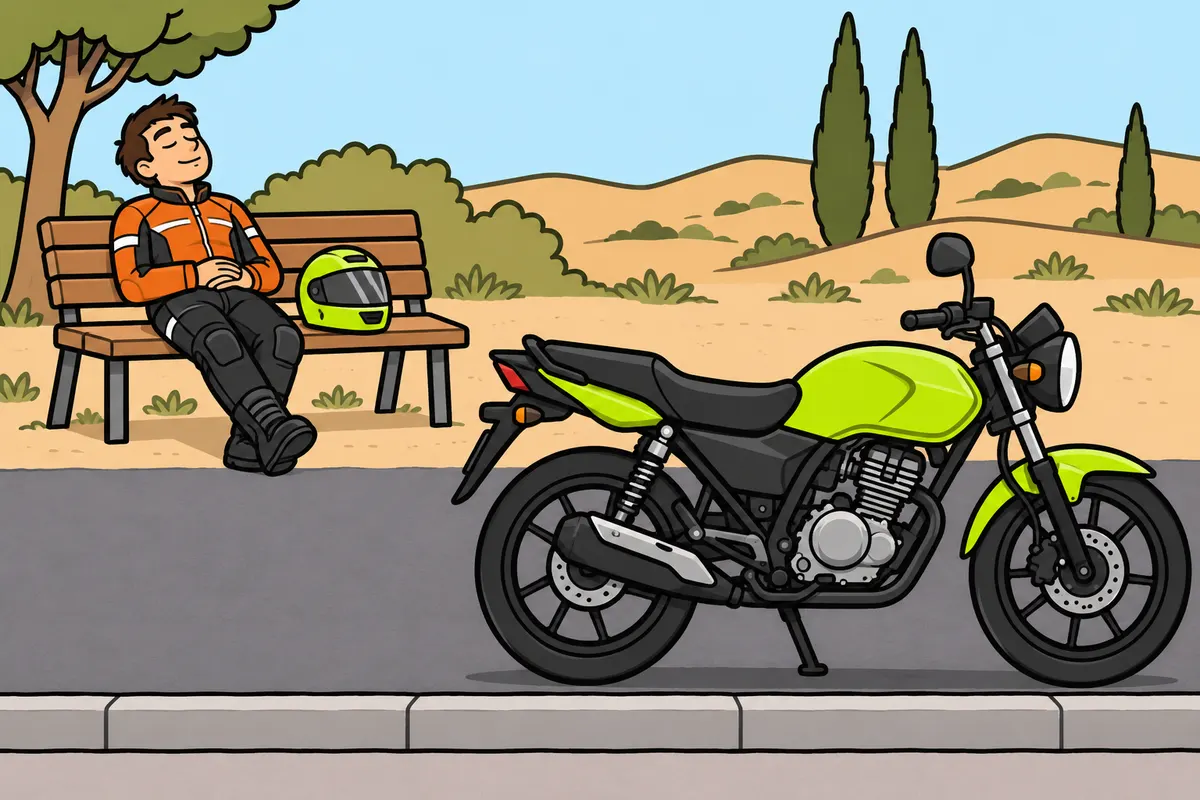
Plan breaks and stop earlier if your condition requires it.
Remember
- For prevention, stop every 2 hours or 200 km, whichever comes first.
- Stop earlier if effort, weather or your condition requires it.
- If sleepy, stop somewhere safe and sleep if you need to.
- Before continuing, check that your abilities have recovered.
- Coffee, energy drinks and music cannot replace sleep.
- If you remain tired, rest longer or postpone your journey.
Exam trap: Wrong: you can wait until 2 hours have passed despite feeling sleepy. Right: symptoms require an earlier stop; a break does not guarantee you can continue.
Read the full explanation
- As a preventive guideline, stop riding every 2 hours or every 200 km, whichever comes first. You must take more frequent breaks if the effort, weather or your condition requires them; this does not authorise you to ride until you reach those figures when you have symptoms. [DGT, preventive breaks](https://www.dgt.es/comunicacion/noticias/cansancio-estas-son-las-senales-de-alarma/).
- If you are sleepy, you need to sleep. You must stop in a safe place and rest; the DGT advises taking a 20- or 30-minute break and sleeping if you need to. Before continuing, check whether you have recovered your abilities: neither a break nor a short nap by itself guarantees that you are ready. [DGT, sleep and rest](https://www.dgt.es/comunicacion/noticias/cansancio-estas-son-las-senales-de-alarma/).
- Do not replace sleep with coffee, energy drinks, loud music or air on your face. These may temporarily change how alert you feel, but they do not remove the need to rest; sleepiness can return when you think you have overcome it.
- Prepare an alternative if the tiredness continues: rest for longer, postpone your return or leave the motorcycle in a safe place. Do not treat an electronic fatigue warning as permission to continue until it sounds; your own symptoms already require you to act.
- On a group ride, you must say that you need to stop and avoid competing to see who can last longest. An agreed arrival time does not justify continuing when drowsy; plan breaks so that you can rest without pressure from others.
18Food, hydration and temperature
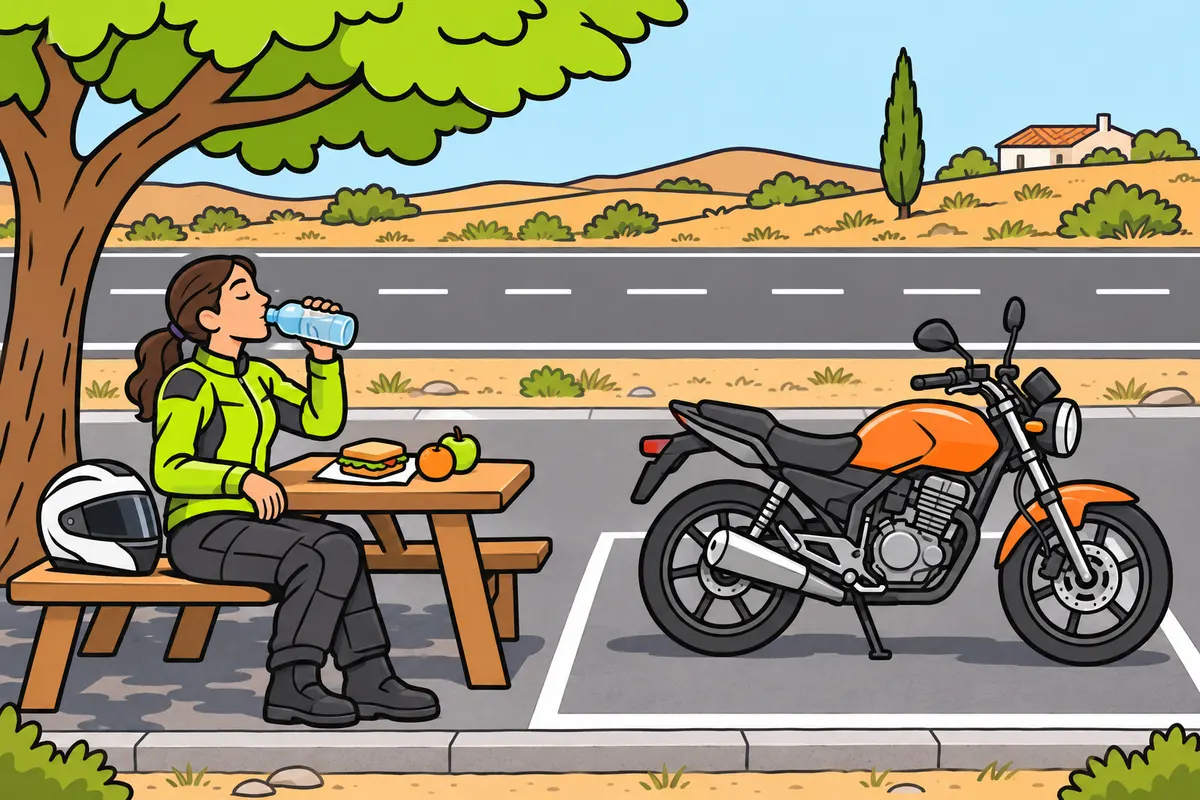
Eat light meals, drink water during stops and notice how heat and cold affect you.
Remember
- Avoid heavy meals before travelling.
- Do not set off very hungry.
- Drink during stops.
- Stop somewhere safe if you feel unwell, stiff or unable to concentrate.
- Save eating and drinking for a safe stop.
Exam trap: Wrong: set off without eating to avoid feeling sluggish. Right: avoid both heavy meals and setting off very hungry.
Read the full explanation
- You must avoid heavy meals before a journey: they can make you feel heavy and drowsy. You should also avoid setting off when extremely hungry; discomfort, lack of energy or dizziness can make it harder to pay attention to riding.
- Choose light meals and stay hydrated during stops. [DGT, food](https://www.dgt.es/muevete-con-seguridad/conviertete-en-un-buen-conductor/consejos-generales/consejos-alimentacion/).
- On a motorcycle, you are exposed to heat and cold. If you feel unwell or stiff, or have difficulty concentrating, stop in a safe place.
- Save eating and drinking for a safe stop. Doing so while riding occupies your hands and attention and can make control more difficult; prepare the items you need in advance so that you do not have to look for them in your pockets or luggage while riding.
19Distractions: eyes, hands and thoughts
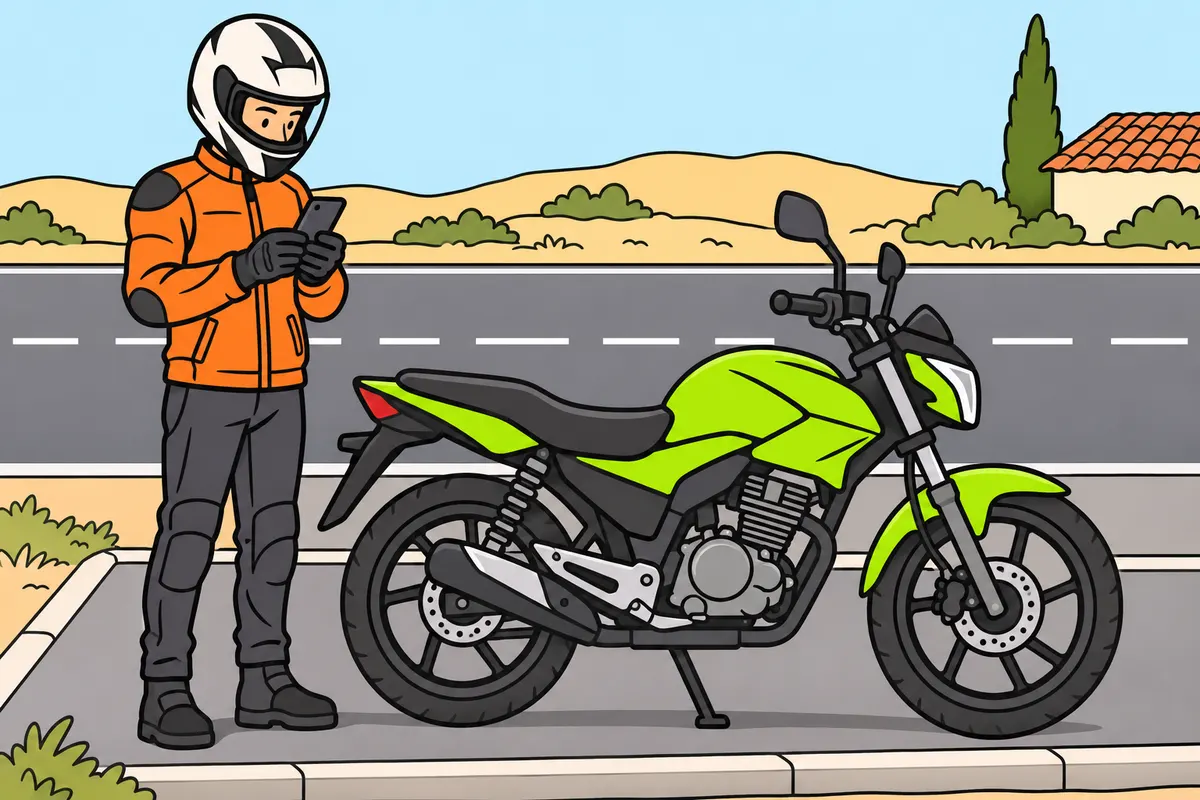
Your eyes, hands or thoughts can distract you from riding.
| Distraction | What can happen to you |
|---|---|
| Eyes | You look away from traffic |
| Hands | You take a hand off the controls |
| Thoughts | You think about something else while looking at the road |
Remember
- Watch traffic without staring at a single point.
- Avoid searching for objects or adjusting equipment while riding.
- Stop somewhere suitable if you need to solve a problem.
- Searching for or lighting a cigarette occupies your hands and attention.
- Set up notifications before leaving.
- A conversation can distract you even when you touch nothing.
Exam trap: Wrong: looking at the road guarantees attention. Right: a worry can prevent you from understanding the traffic around you.
Read the full explanation
- You can be distracted by taking your eyes off the road, removing one hand from the controls or turning your thoughts to something else. You do not need to look at a screen: a worry or absorbing conversation can prevent you from processing traffic even when your eyes remain directed towards the road.
- You must avoid looking for objects, adjusting equipment or attending to your passenger if this interferes with riding. If you need to deal with a problem, stop in a suitable place; on a motorcycle, having one hand occupied can leave you unable to operate a control you need immediately.
- A shop window, an advertisement, someone else’s accident or an unusual event can catch your eye. You must keep observing your surroundings usefully and avoid staring at a single point; too much stimulation can also prevent you from assessing relevant signs.
- Tiredness, stress and familiarity with the route can make you less attentive. A distraction delays the detection of danger and can lead to a rear-end collision or leaving the road.
- Smoking, looking for a cigarette or lighting one occupies your hands and attention and can make it harder to control your motorcycle. [RGC, art. 18.1](https://www.boe.es/buscar/act.php?id=BOE-A-2003-23514#a18).
- You must avoid being startled or absorbed by a passenger’s conversation or an audible alert. Set up notifications before setting off: you can be distracted even if you do not touch your phone, because your attention also shifts when you hear or think about a message you have received.
20Phones, intercoms and navigation
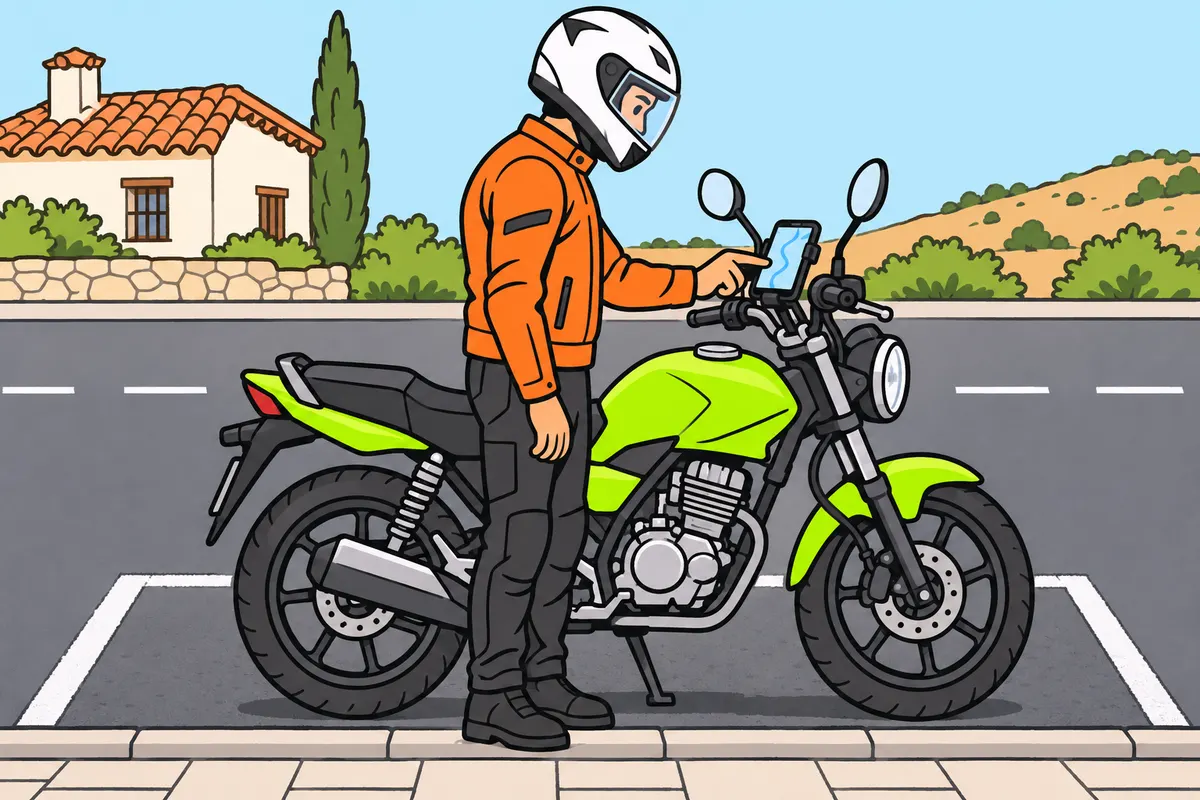
Prepare your devices before leaving and avoid handling them while riding.
| Device or situation on your motorcycle | Rules you must follow |
|---|---|
| Hands-free communication | Use neither hands nor headphones or earphones, subject to the specific helmet exception |
| Device integrated into your protective helmet | Wireless and certified or approved; only intercommunication or navigation; must not affect safety |
| Phone between your helmet and head | Prohibited; you lose 3 points |
| Permitted conversation | Avoid it if it absorbs you or traffic needs more attention |
Remember
- Do not handle your phone or satnav, even in a holder.
- To use them, park somewhere permitted and safe.
- Waiting at a red light or in a queue still counts as driving.
- Mount your satnav without blocking your view, movement or controls.
- Obey real road signs even if your satnav says otherwise.
- If you miss an exit, continue safely and let your satnav recalculate.
Exam trap: Wrong: any earphone can serve as an intercom. Right: the exception requires a certified or approved wireless device integrated into your protective helmet, only for intercommunication or navigation, without affecting safety.
Read the full explanation
- You cannot operate a phone or navigation device manually while riding, even if it is mounted on a holder. Set up alerts, calls, your destination and intercom before setting off. [LTSV, art. 13.3](https://www.boe.es/buscar/act.php?id=BOE-A-2015-11722#a13).
- Stopping at a red traffic light or in a traffic queue is still part of riding: it is not the time to handle your phone. To do so, find a permitted, safe place and park; travelling very slowly does not create an exception either. [LTSV, art. 13.3](https://www.boe.es/buscar/act.php?id=BOE-A-2015-11722#a13).
- Hands-free communication requires you not to use your hands or wear audio headsets, earphones or similar devices, with the specific exception of a motorcycle helmet. A permitted conversation can still distract you: avoid the call if it absorbs your attention or traffic demands more of it. [RGC, art. 18](https://www.boe.es/buscar/act.php?id=BOE-A-2003-23514#a18).
- You may use certified or approved wireless devices integrated into your protective helmet exclusively for intercom or navigation, provided they do not affect safety. [RGC, art. 18.2.a](https://www.boe.es/buscar/act.php?id=BOE-A-2003-23514#a18).
- You cannot ride with a mobile phone wedged between your helmet and your head: this behaviour incurs a loss of 3 points. [LTSV, Annex II.20](https://www.boe.es/buscar/act.php?id=BOE-A-2015-11722#anii).
- Mount the navigation device where it does not interfere with your vision, movements or controls. [RGC, art. 18.1](https://www.boe.es/buscar/act.php?id=BOE-A-2003-23514#a18).
- You can use navigation instructions that are compatible with the permitted helmet system, without letting them absorb your attention. If you miss an exit, continue safely and let the system recalculate; never make a sudden manoeuvre to follow an instruction.
- You must obey the actual signs and rules even if the navigation device says otherwise. Its maps may contain errors; if an instruction confuses you, stay in control and find a legal alternative without staring at the screen as traffic changes.
21Emotions, stress and peer pressure
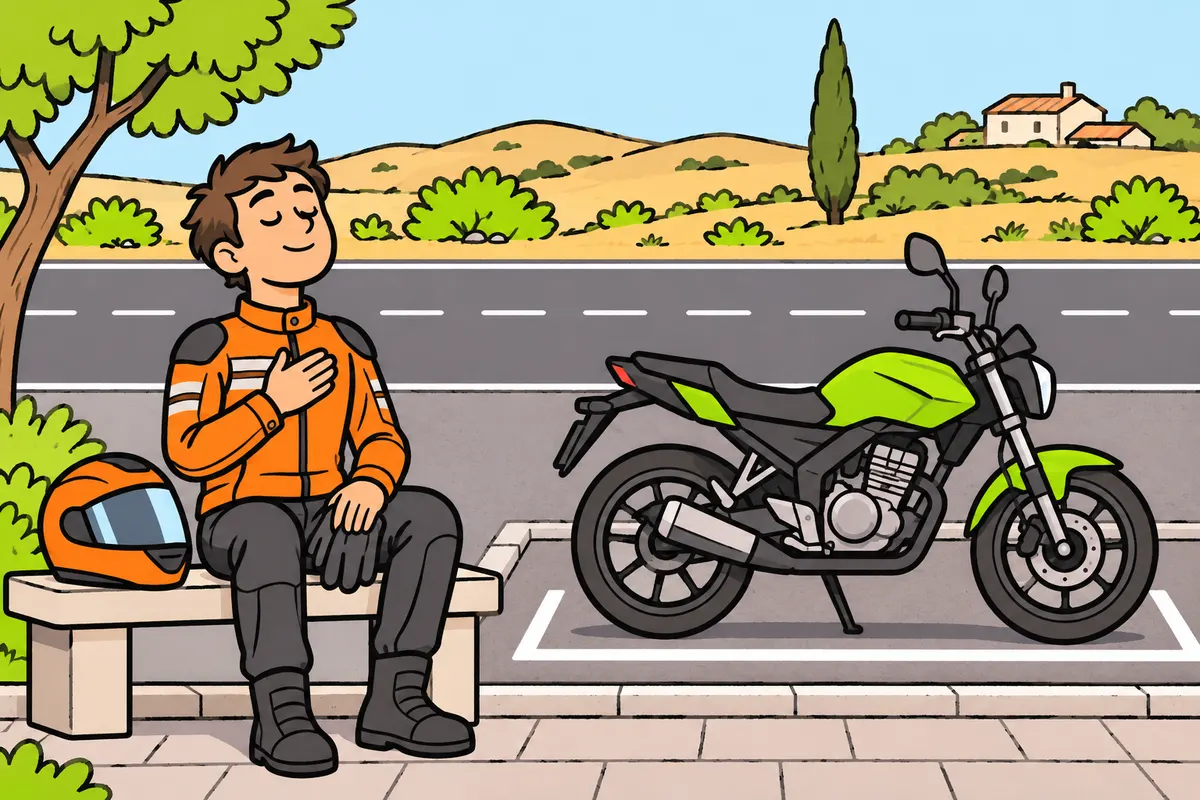
If emotions or group pressure prevent concentration, postpone or interrupt your journey.
Remember
- Assess how arguments, worries and intense happiness affect you.
- Set off with enough time and accept delays.
- Do not respond to provocation by chasing or racing.
- In a group, keep a pace you can control.
- You can stop, rest or choose another route.
- Seek professional help if anxiety, low mood or sleep problems persist.
Exam trap: Wrong: you must match the group's pace even beyond your abilities. Right: recognise your limits and choose to stop or change your route.
Read the full explanation
- You must consider how an argument, sad news, anxiety or intense happiness affects you. Emotions can occupy your thoughts and change your decisions; if you cannot concentrate, postpone setting off or stop riding in a safe place.
- Stress can increase haste, irritability and impulsiveness, and then leave you exhausted. Set off in good time, plan your route and allow for delays; trying to make up time through risky manoeuvres adds demands when your ability to pay attention may be reduced. [DGT, stress](https://www.dgt.es/muevete-con-seguridad/evita-conductas-de-riesgo/Conducir-con-estres).
- Do not respond to provocation by chasing, competing or arguing with another driver. You must regain your composure and make predictable decisions; on a motorcycle, a sudden reaction can endanger your stability as well as cause conflict with other road users.
- When riding in a group, do not try to show off your skill or keep up with a pace that is too much for you. You must be able to choose to stop, rest or return by another route; pressure to accompany others does not change your abilities or your duties as a driver.
- If anxiety, low mood or difficulty sleeping persists, seek professional advice. You must also take account of any treatment you are prescribed and avoid self-medicating to cope with the journey; the decision to ride requires you to assess your health, medication and how you feel at the time.
Check that you are fit to ride before setting off
Decide whether you are fit to ride before getting on your motorcycle.
- Assess your rest, attention, symptoms and emotional state.
- Check whether you have consumed alcohol or drugs and read any medicine warnings.
- Set your navigation and configure alerts before setting off.
- If you are unfit to ride, postpone the journey or use another form of transport.
Cooperate with a breathalyser check
Distinguish breath measurements from a medical confirmation test.
- Follow the officers’ instructions and take the test with the breathalyser.
- If you exceed the applicable limit or show clear symptoms, a second test is carried out.
- Make sure at least 10 minutes pass between the two tests.
- Make any relevant observations and request a confirmation test if you wish; this is preferably a blood test.
- Comply with the immobilisation and do not resume your journey unless you are authorised and fit to do so.
Act when you feel fatigue or sleepiness
Symptoms require you to act before your planned break.
- Recognise the first warning signs: loss of attention, stiffness, yawning or nodding off.
- Find a suitable, safe place to stop.
- Rest and, if you are sleepy, sleep; a 20 or 30 minute nap is a guide.
- Assess your recovery and extend the break or postpone the journey if you are still affected.
- Plan breaks every 2 hours or 200 km as a maximum preventive guideline, and sooner whenever you need to.
Finished this module?
Mark it as read and you will see your progress on the theory list.