
Theory · A1 Licence - 125 cc Motorcycle · Module 5 of 18
Pedestrians and vulnerable road users
You will learn how to protect pedestrians, cyclists, VMP users and horse riders when riding your motorcycle, and recognise the rules they must follow. You will practise priority situations, distances and precautions that help you identify the correct answers in the A1 exam.
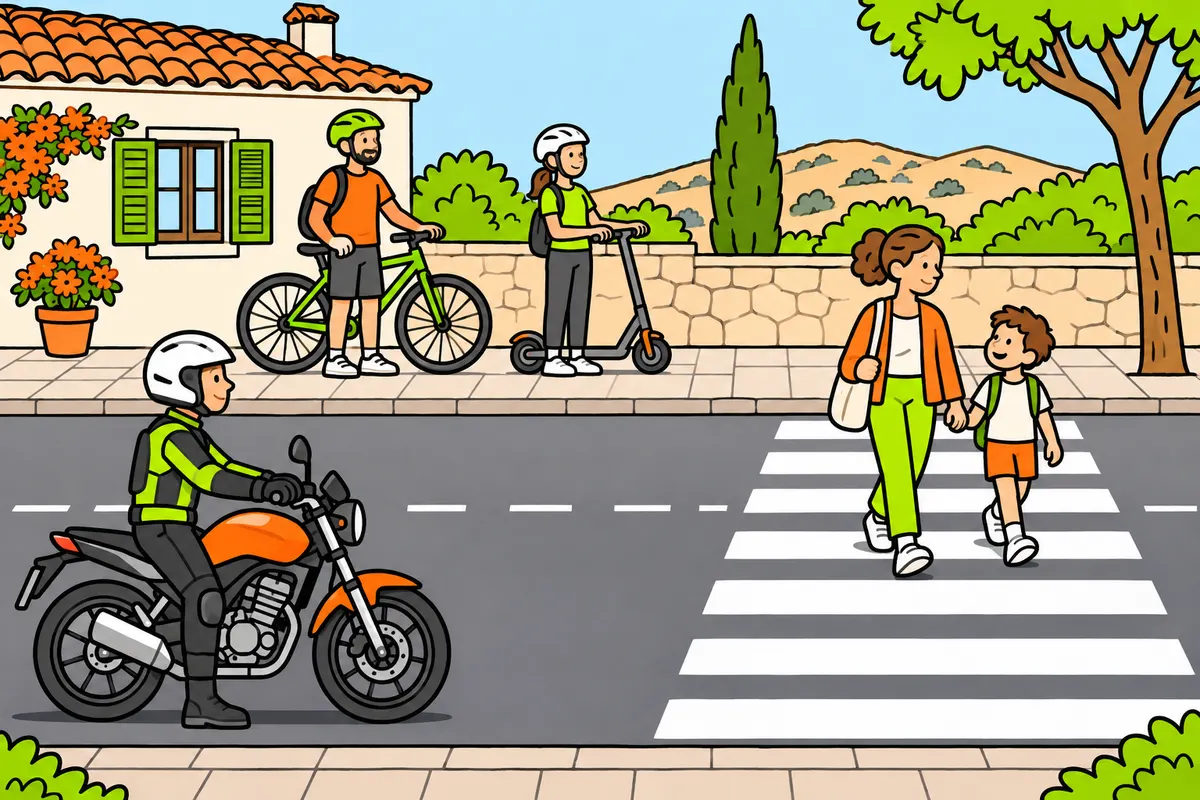
1Sharing the road with vulnerable users
You must protect people who are more exposed when you ride your motorcycle.
Remember
- Take special care around pedestrians, cyclists and personal mobility vehicle (VMP) users.
- Pay extra attention to children, older people and disabled people.
- Expect sudden movements and leave room to react.
- Do not assume people can hear your motorcycle.
- Use your horn only when allowed.
Exam trap: Wrong: your vulnerability removes your duties. Right: you must protect others when riding too.
Read the full explanation
- You must take particular care to protect people travelling on foot, by bicycle or on a VMP (personal mobility vehicle), as well as people with reduced mobility or a disability. You must also pay particular attention to children and older people. Your duty of care applies whatever vehicle you are riding, including your A1 motorcycle. [RGC, art. 121](https://www.boe.es/buscar/act.php?id=BOE-A-2003-23514#a121) [LTSV, art. 13.1](https://www.boe.es/buscar/act.php?id=BOE-A-2015-11722#a13)
- As a motorcyclist, you are also exposed to injury and need room to react, but your vulnerability does not lessen your duties towards others. You must anticipate that a pedestrian may not notice you approaching and that a cyclist may need to change course to avoid an obstacle. [LTSV, art. 13.1](https://www.boe.es/buscar/act.php?id=BOE-A-2015-11722#a13)
- Pedestrians have priority in the situations set out in the regulations. To answer a question, identify the location, route and signs: a pedestrian crossing, your motorcycle turning, crossing a pavement or access to a refuge island. You must combine priority with caution. [RGC, art. 121](https://www.boe.es/buscar/act.php?id=BOE-A-2003-23514#a121)
- Do not rely on the noise of your motorcycle to alert people to your presence. Watch people and the space they may move into, and be ready to respond safely. If another road user makes a mistake, you must still act to avoid putting them at risk. [RGC, art. 121](https://www.boe.es/buscar/act.php?id=BOE-A-2003-23514#a121)
- Do not use your horn to greet someone on the pavement, invite them to cross or intimidate a cyclist. You may use it to avoid a possible accident in the situations allowed by the regulations, but it never replaces observation or gives you priority. [RGC, art. 110](https://www.boe.es/buscar/act.php?id=BOE-A-2003-23514#a110)
2Anticipating pedestrians entering the road
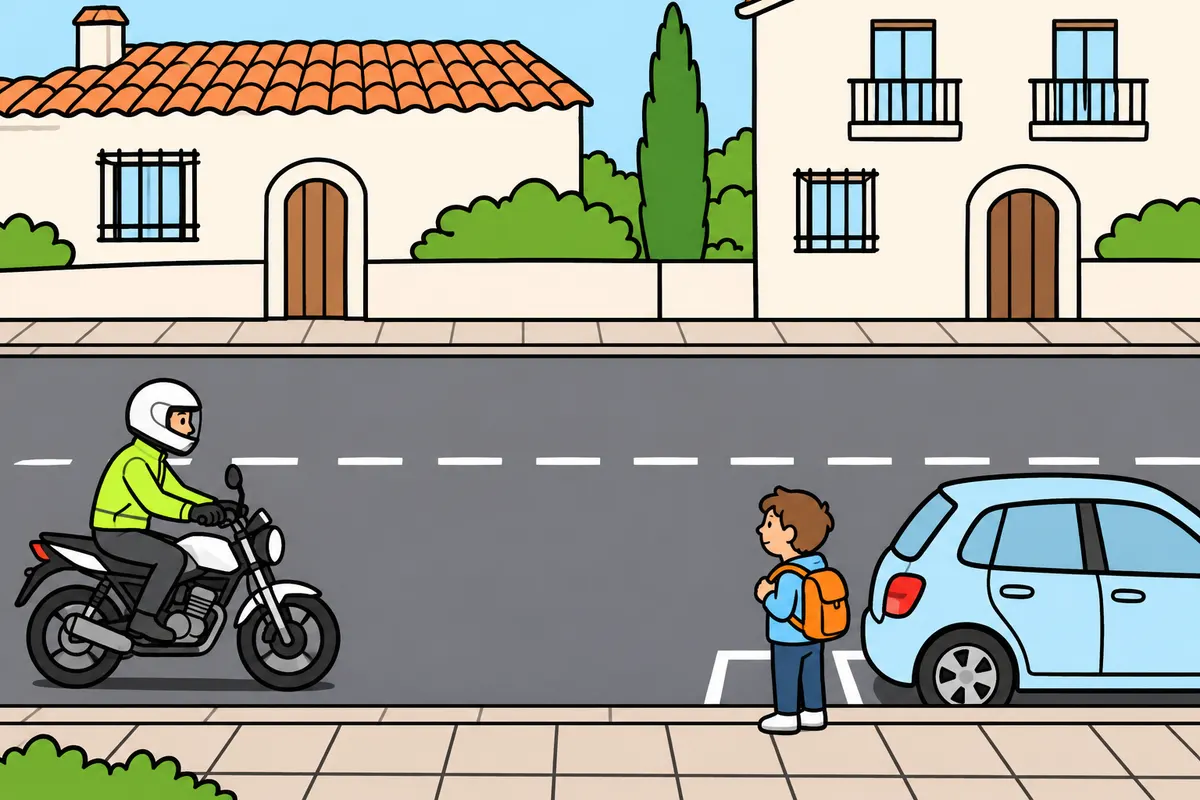
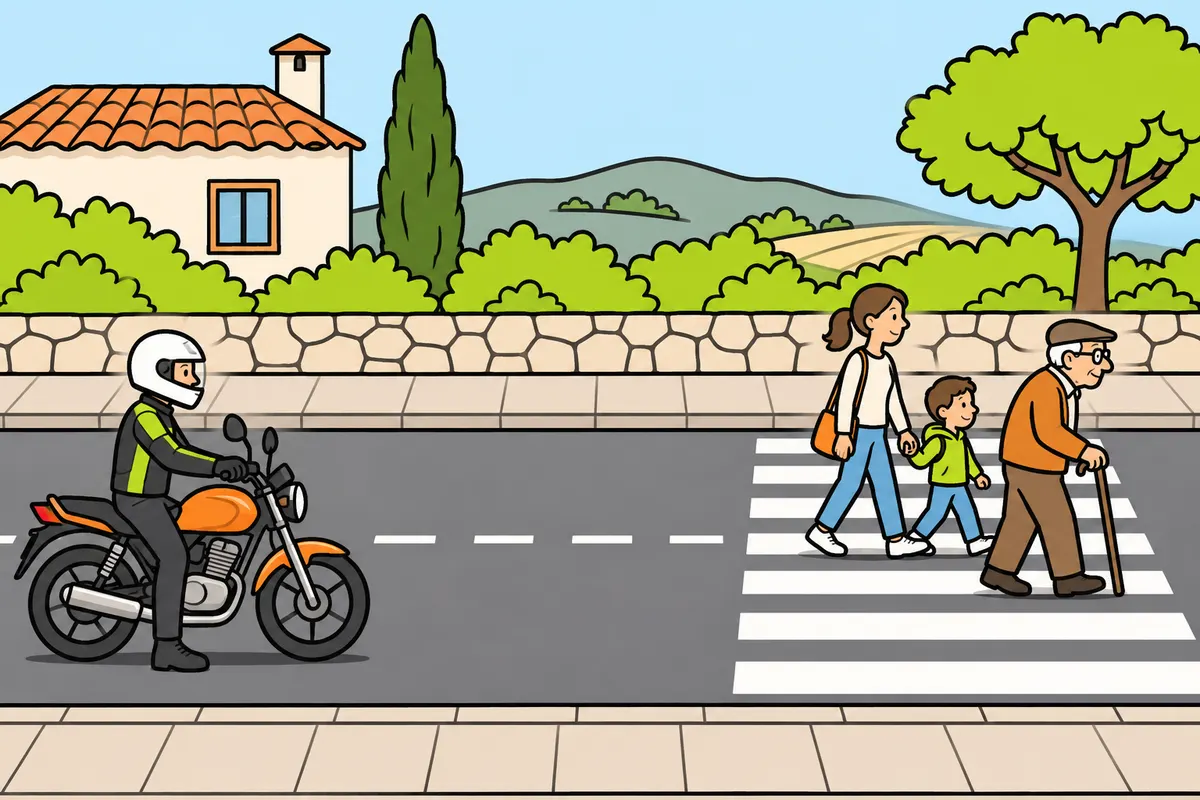
Slow down if you can foresee someone entering your path.
Remember
- Slow down and stop if needed, even without a pedestrian crossing.
- Watch between parked cars and near schools and markets.
- Take extra care around children, older people and people with mobility difficulties.
- Slow near bicycles, cycle routes and crossings without traffic lights or officers.
- Avoid spraying water or gravel onto others.
Exam trap: Wrong: wait until a pedestrian steps onto the road. Right: slow down if you can reasonably expect them to enter.
Read the full explanation
- You must reduce your speed and stop if necessary when there are pedestrians on the part of the road you are using, or you can reasonably anticipate that they may enter it. This duty applies even if they have not yet stepped onto the carriageway and even if there is no signed crossing. [RGC, art. 46](https://www.boe.es/buscar/act.php?id=BOE-A-2003-23514#a46)
- Anticipate their movements especially carefully when you see children, older people, blind people or people with obvious mobility difficulties. A child may appear from behind a parked car; a person with reduced mobility may need more time to cross. You must adjust your approach to these circumstances. [RGC, art. 46](https://www.boe.es/buscar/act.php?id=BOE-A-2003-23514#a46)
- When approaching markets, schools and places where you can expect to find children, you must ride at a moderate speed. Watch between parked vehicles and near entrances. Do not assume that the area is clear just because you cannot see anyone at that moment. [RGC, art. 46](https://www.boe.es/buscar/act.php?id=BOE-A-2003-23514#a46)
- You must also reduce your speed when approaching cycles, cycle routes and pedestrian crossings without traffic lights or an officer controlling them. If there is water or gravel, adjust your speed to avoid spraying it onto other road users. The speed limit shown by a sign may be too high for the conditions. [RGC, art. 46](https://www.boe.es/buscar/act.php?id=BOE-A-2003-23514#a46)
3Approaching a pedestrian crossing
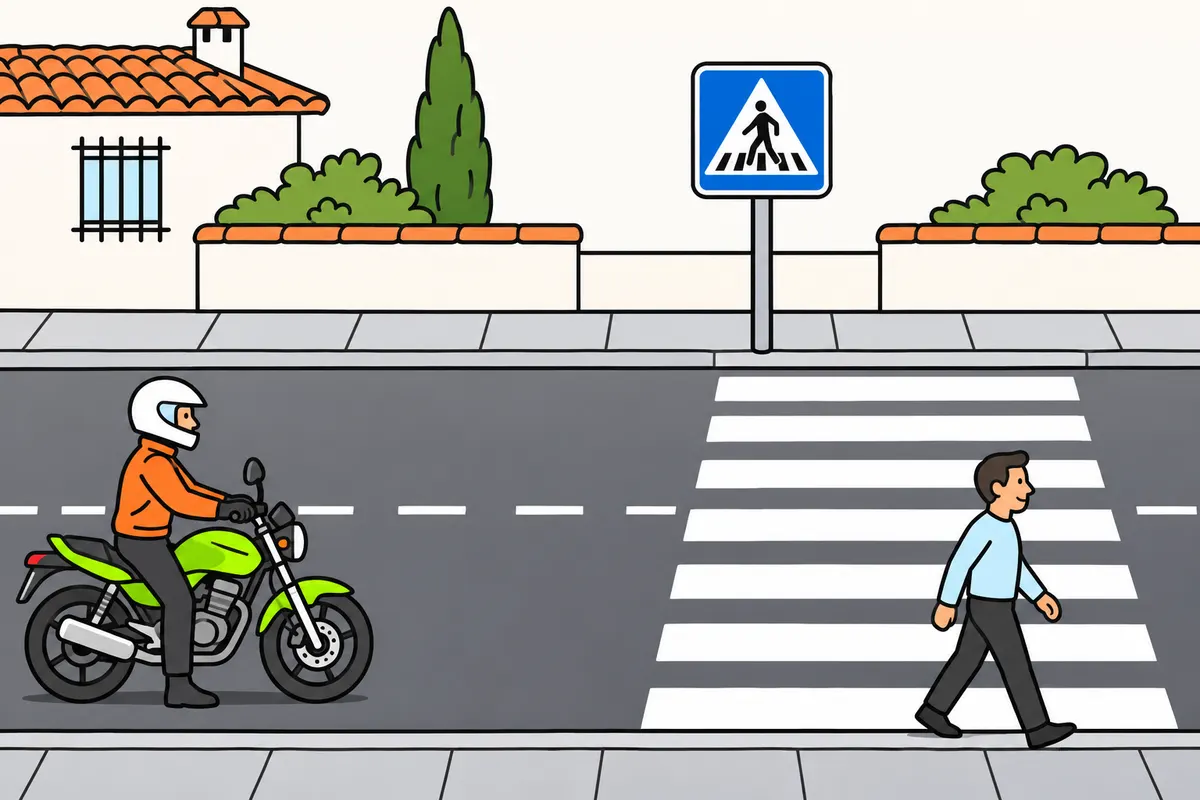
Give way at marked crossings and keep the path clear for people crossing.
Remember
- Look at both ends of the crossing for hidden people.
- Approach with enough space to stop.
- Let pedestrians cross your path safely.
- A stopped vehicle may hide someone crossing.
- Do not enter if you expect to stop and block the crossing.
Exam trap: Wrong: squeeze through beside a pedestrian. Right: do not force them to stop or change course.
Read the full explanation
- You must give way to pedestrians at properly signed crossings. Approach with enough room to stop your motorcycle before obstructing their path. Look at both ends of the crossing and check for people partly hidden by cars, bins or street furniture. [RGC, art. 65](https://www.boe.es/buscar/act.php?id=BOE-A-2003-23514#a65)
- If you have to stop to let someone cross, allow them to cross your path safely. Do not move forward close to them or use your motorcycle’s size to squeeze through a gap that makes them stop or change course. [RGC, art. 65](https://www.boe.es/buscar/act.php?id=BOE-A-2003-23514#a65)
- If a vehicle is stopped beside the crossing, assume that it may be letting someone cross whom you cannot see. Your higher position compared with some cars does not remove blind spots. You must be able to stop and respect the pedestrian’s priority without making them move aside. [RGC, art. 65](https://www.boe.es/buscar/act.php?id=BOE-A-2003-23514#a65)
- You must give way on your motorcycle even if another driver does not. An informal signal from the driver next to you does not guarantee that the pedestrian’s path is clear. [RGC, art. 65](https://www.boe.es/buscar/act.php?id=BOE-A-2003-23514#a65)
- Even when you have priority, you must not enter a pedestrian or cycle crossing if you expect to be stopped on it and obstruct crossing traffic. Check that there is enough room to clear it before moving forward, especially in queues near traffic lights. [RGC, art. 59](https://www.boe.es/buscar/act.php?id=BOE-A-2003-23514#a59)
4Overtaking and keeping crossings clear
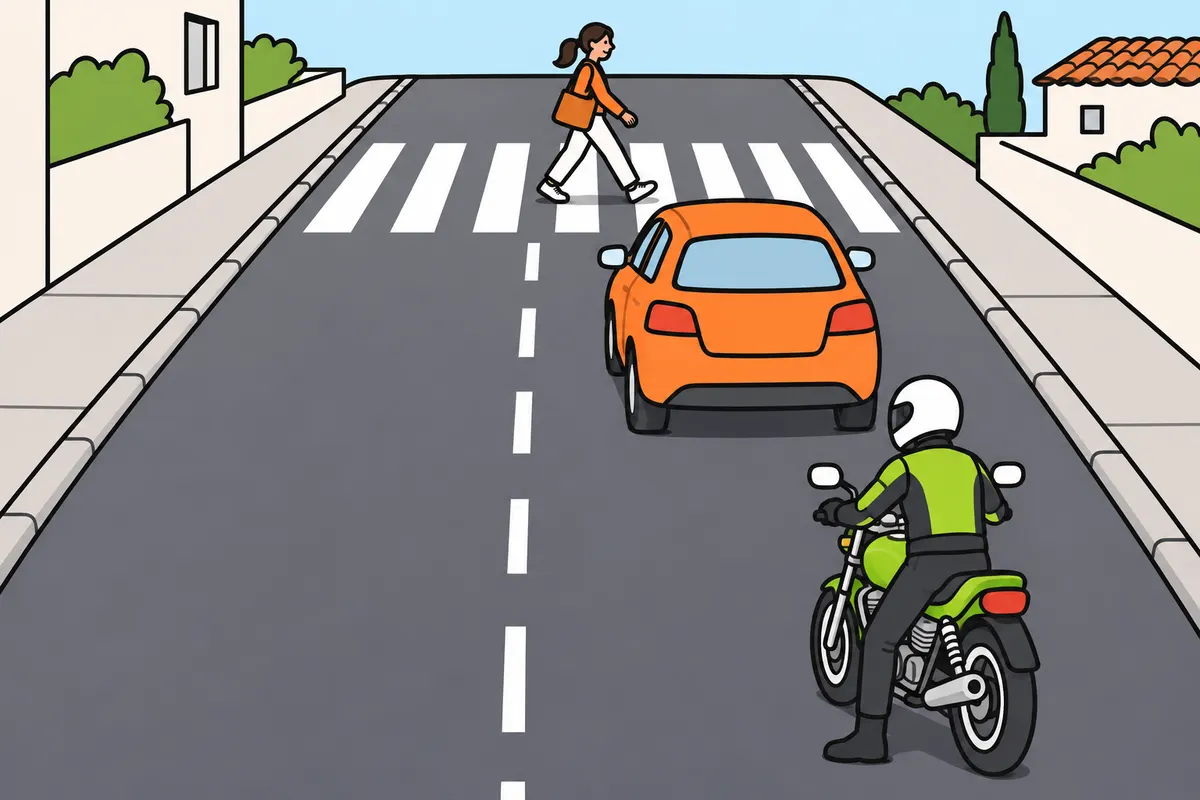
Do not overtake at marked pedestrian crossings or near them.
Remember
- Do not overtake at cycle route junctions or near them.
- Look for people hidden behind vehicles.
- Also watch people approaching along the cycle route.
- Wait until you can see enough of the crossing person's path.
Exam trap: Wrong: overtake at the crossing because you can brake quickly. Right: overtaking remains prohibited.
Read the full explanation
- Overtaking is prohibited at signed pedestrian crossings, at junctions with cycle routes and near them. Overtaking restrictions are covered in “Manoeuvres on your motorcycle”, section “Places where you cannot overtake”. [RGC, art. 87](https://www.boe.es/buscar/act.php?id=BOE-A-2003-23514#a87)
- If a van blocks your view of the end of a crossing, look for signs that someone may be behind it: feet visible beneath the vehicle, a child’s seat or someone heading towards the carriageway. As a precaution, keep where you can see without moving your motorcycle into the pedestrian route. [RGC, art. 46](https://www.boe.es/buscar/act.php?id=BOE-A-2003-23514#a46)
- At entrances to cycle routes, also watch for people approaching along them. A bicycle may reach the crossing while you are watching the vehicle ahead. Keep both routes in view until the conflict has cleared, especially when a line of cars blocks your side view. [RGC, art. 46](https://www.boe.es/buscar/act.php?id=BOE-A-2003-23514#a46)
- If the person crossing becomes hidden again behind another vehicle, wait until you can see enough of their route. Someone accompanying them may move at a different speed and become separated. This also protects people crossing with a stick or pushing a wheelchair. [RGC, art. 65](https://www.boe.es/buscar/act.php?id=BOE-A-2003-23514#a65)
5Junctions, turns and garage access
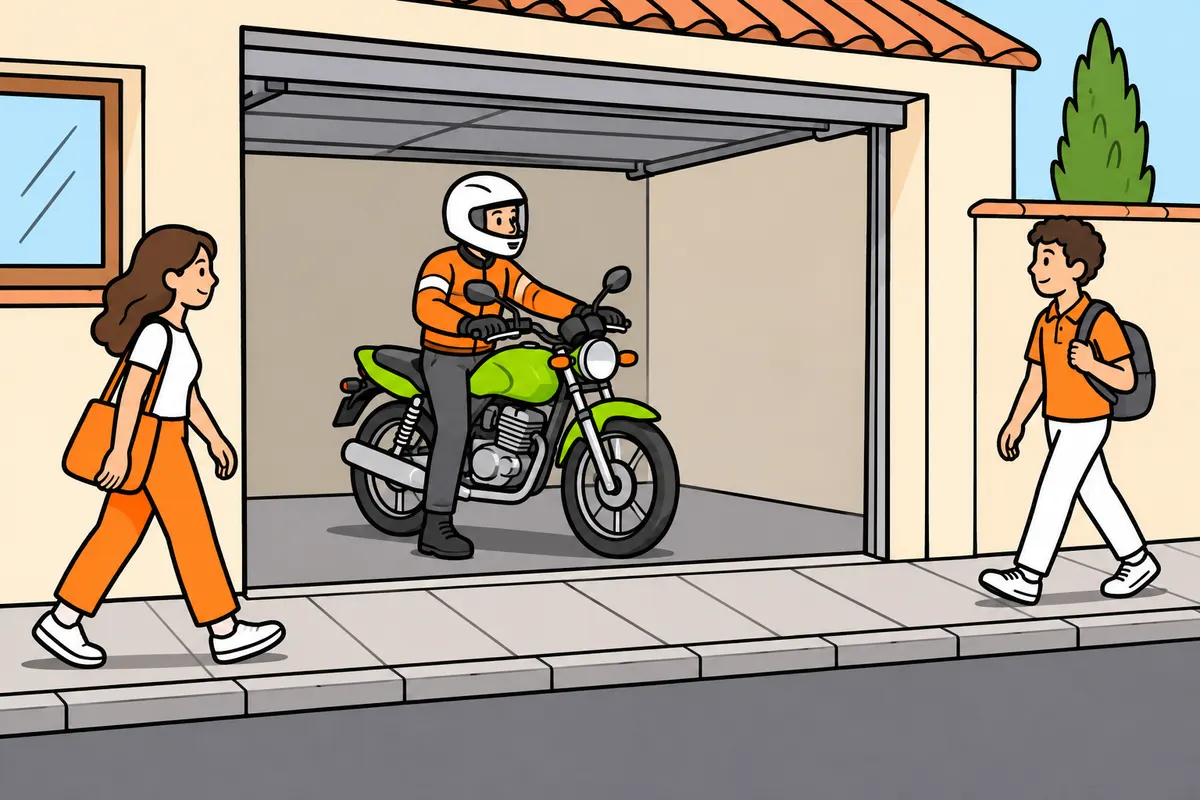
Give way to pedestrians when turning or crossing their space.
| Your manoeuvre | Who you give way to |
|---|---|
| Turn into another road | Pedestrians crossing it, even without a crossing |
| Cross a shoulder | Pedestrians using it because no pedestrian area is available |
| Cross a pedestrian area through authorised access | People using it |
Remember
- When turning, let pedestrians cross the road you are entering.
- Give way even without a marked crossing.
- Crossing a shoulder, give way to pedestrians with no pedestrian area available.
- Give way when crossing a pedestrian area through an authorised access.
- Look both ways when entering or leaving a garage.
Exam trap: Wrong: you have priority when leaving a garage. Right: give way when crossing pedestrian space.
Read the full explanation
- When turning into another road, you must give way to pedestrians crossing it, even if there is no pedestrian crossing. Look towards the road you are turning into before you turn: watching only traffic approaching on the carriageway may mean you miss someone. [RGC, art. 65](https://www.boe.es/buscar/act.php?id=BOE-A-2003-23514#a65)
- If you cross an arcén (hard shoulder) used by pedestrians who have no pedestrian area available, you must let them pass. Their priority does not depend on the hard shoulder being marked as a crossing. For example, apply this rule when turning off the road into a side access. [RGC, art. 65](https://www.boe.es/buscar/act.php?id=BOE-A-2003-23514#a65)
- When you cross a pedestrian area at a place where vehicles are permitted, you must give way to people using it. Riding your motorcycle out of or into a garage does not allow you to force your way across the pavement. [RGC, art. 65](https://www.boe.es/buscar/act.php?id=BOE-A-2003-23514#a65)
- Pavements and other pedestrian areas have specific protection. Check the whole area before crossing it, including for people approaching from either side. A vehicle’s authorised access to a restricted area does not remove pedestrians’ priority. [RGC, art. 65](https://www.boe.es/buscar/act.php?id=BOE-A-2003-23514#a65)
6Buses, school groups and processions
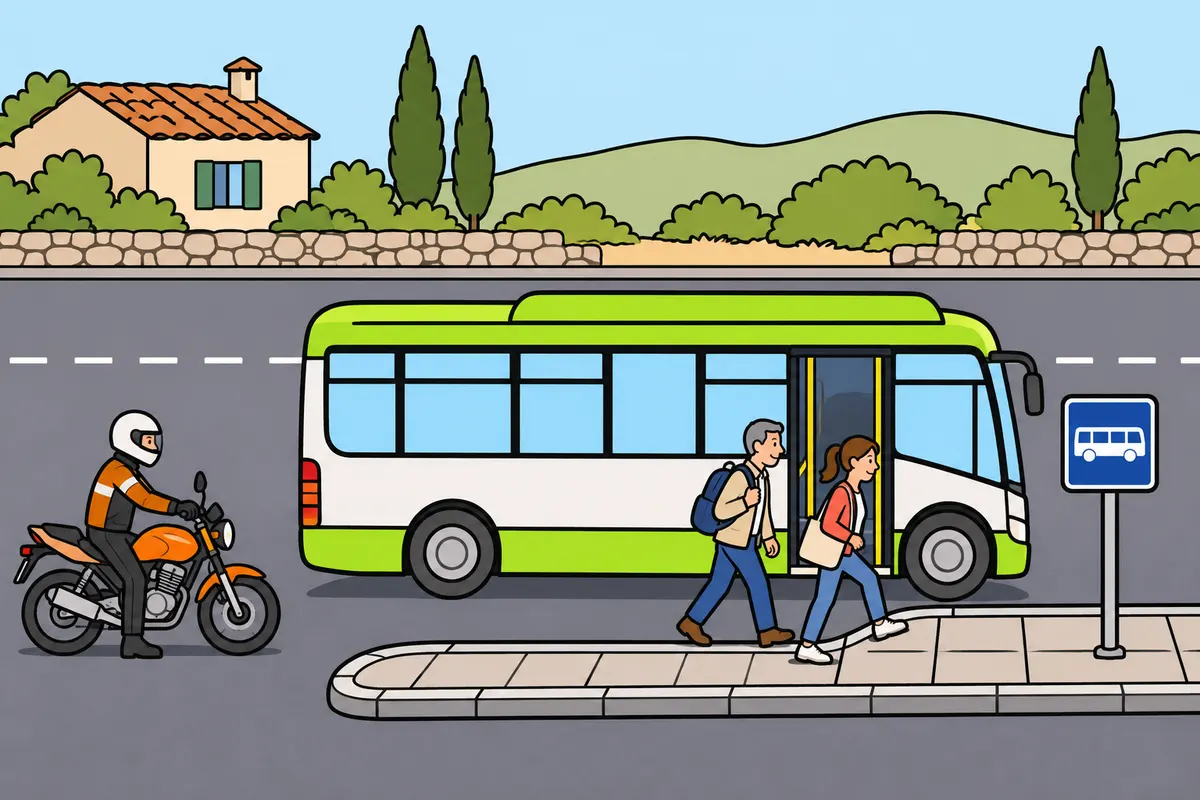
Give way to passengers on their protected route and organised groups on foot.
| Situation | What you must do |
|---|---|
| Passengers at a signed stop | Give way between transport and nearest pedestrian area or refuge |
| School groups, processions and military units on foot | Give way without splitting the group |
| Stopped bus | Slow down, especially for school buses |
Remember
- At signed stops, protect the route between bus and nearest pedestrian area or refuge.
- Give way to boarding or alighting passengers on that route.
- Do not split school groups, organised processions or military units on foot.
- Slow near stopped buses, especially school buses.
Exam trap: Wrong: passengers have priority on every crossing from a stop. Right: at signed stops, give way between the transport and the nearest pedestrian area or refuge.
Read the full explanation
- You must give way to people boarding or who have got off public transport at a signed stop when they are between the vehicle and the nearest pedestrian area or refuge island. This priority protects that specific route; identify where the person is in relation to the bus. [RGC, art. 65](https://www.boe.es/buscar/act.php?id=BOE-A-2003-23514#a65)
- You must also give way to school groups, organised processions and military units on foot. Do not try to ride through the group by using a small gap. Expect the length of the group to extend your waiting time. [RGC, art. 65](https://www.boe.es/buscar/act.php?id=BOE-A-2003-23514#a65)
- When a bus stop is beside a refuge island, pay attention to the space between the island and the bus. Passengers may cross through it to board or get off. Watch their route and do not block the protected access with your motorcycle. [RGC, art. 65](https://www.boe.es/buscar/act.php?id=BOE-A-2003-23514#a65)
- Passengers’ priority protects the route between public transport and the nearest pedestrian area or refuge island; it does not extend to every crossing they make from the stop. [RGC, art. 65](https://www.boe.es/buscar/act.php?id=BOE-A-2003-23514#a65)
- You must reduce your speed when approaching a stationary bus, especially one carrying schoolchildren. You do not need to see a child on the carriageway before taking this precaution. Slow down before reaching the part of the bus that hides possible passenger exits. [RGC, art. 46.1.e](https://www.boe.es/buscar/act.php?id=BOE-A-2003-23514#a46)
7School areas and care facilities
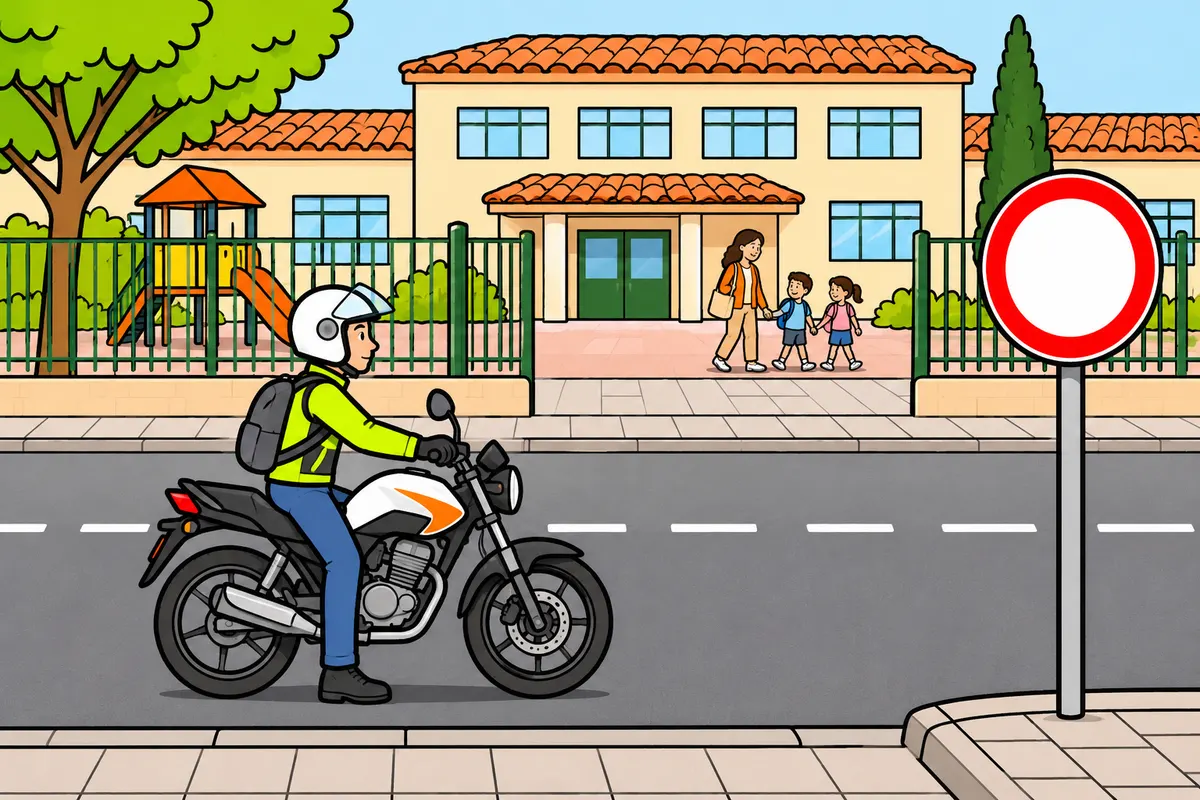
Follow signed measures near schools and care facilities.
Remember
- Check signs for speed, access and parking.
- Motor vehicle restrictions may also apply to your motorcycle.
- Watch exits and obstacles that hide people.
- Be ready to stop before reaching the danger.
- Permission to enter does not let you stop anywhere.
Exam trap: Wrong: apply one speed to all these centres. Right: follow the specific signs.
Read the full explanation
- You must comply with the restrictions and measures established on safe school routes or in safe school zones. The authorities may reduce speed, calm traffic or restrict motor vehicles and mopeds. Your motorcycle is a motor vehicle. [RGC, art. 158, RD 518/2026](https://www.boe.es/buscar/doc.php?id=BOE-A-2026-13889)
- Specific measures on speed, parking and traffic management may be introduced near schools, hospitals and centres for older people or people with disabilities. Read the signs at the location; do not assume one speed limit applies to all these areas. [RGC, art. 158, RD 518/2026](https://www.boe.es/buscar/doc.php?id=BOE-A-2026-13889)
- As a precaution, watch the exits from centres, vehicle access points and obstacles that hide people of short stature. Be ready to stop before reaching the conflict point, especially at school drop-off and pick-up times. [RGC, art. 158, RD 518/2026](https://www.boe.es/buscar/doc.php?id=BOE-A-2026-13889)
- Local permission to enter to drop off or collect someone does not allow you to stop anywhere you choose. Follow the access conditions and protect pedestrian routes, dropped kerbs and the visibility of people who need to cross. [RGC, art. 158, RD 518/2026](https://www.boe.es/buscar/doc.php?id=BOE-A-2026-13889)
8Speed on shared streets
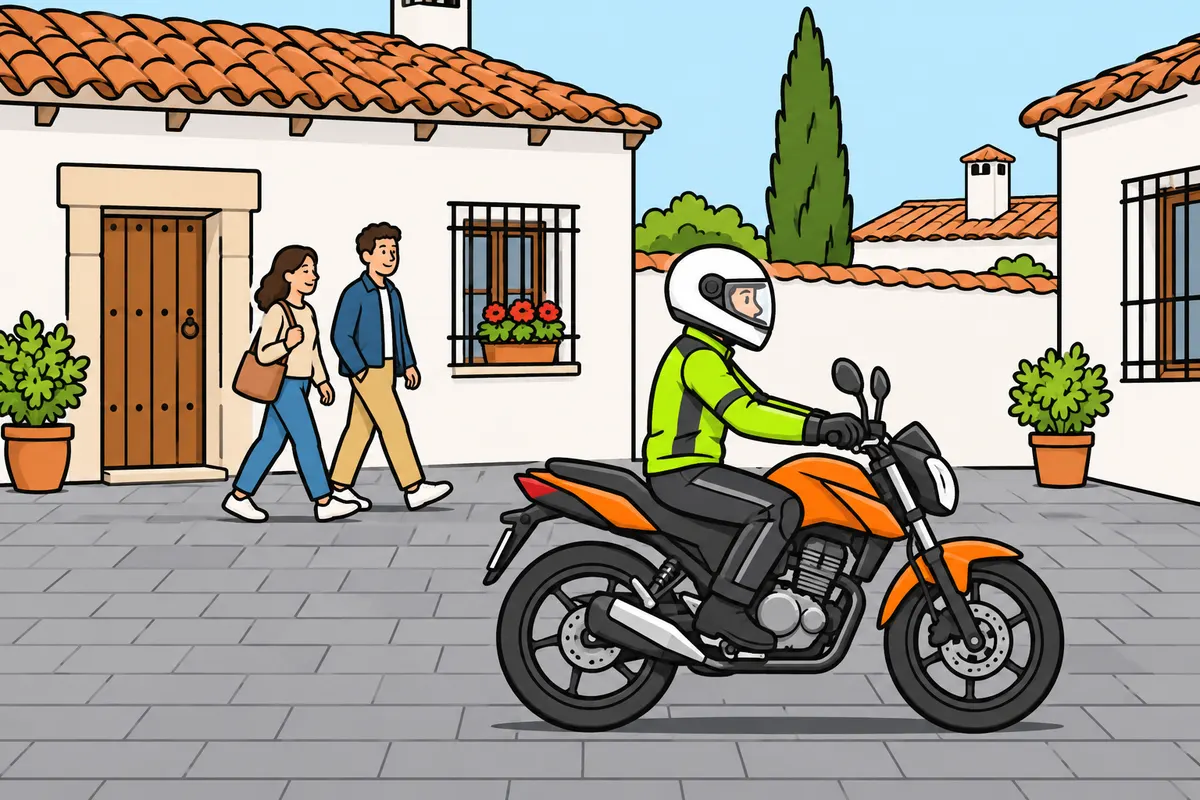
Adjust your speed to the street, its signs and nearby pedestrians.
| Urban road: your motorcycle | General limit |
|---|---|
| Carriageway and pavement sharing one level | 20 km/h |
| One lane each way | 30 km/h; exceptionally, a signed 50 km/h |
| Two or more lanes each way | 50 km/h |
Remember
- Count lanes in each direction, leaving out reserved lanes.
- Where road and pavement share one level, pedestrians have priority everywhere.
- Municipal signs can lower the general limits.
- Exceptionally, signs can raise limits on streets with one lane each way.
- Slow down and stop if needed when pedestrians may enter your path.
Exam trap: Wrong: add lanes in both directions together. Right: count each direction separately, excluding reserved lanes.
Read the full explanation
- On your motorcycle, you must observe the general urban limit of 30 km/h on roads with a single lane in each direction. Count the lanes in each direction; do not add the lanes in both directions together. Lanes reserved for certain users or public transport do not count towards this number. Always follow any applicable specific signs. [RGC, art. 50](https://www.boe.es/buscar/act.php?id=BOE-A-2003-23514#a50)
- On roads with a single platform shared by the carriageway and pavement, the general limit is 20 km/h and pedestrians have priority anywhere on the carriageway. The absence of marked pedestrian crossings does not remove that priority. Your speed must allow you to give way safely to people crossing. [RGC, art. 50](https://www.boe.es/buscar/act.php?id=BOE-A-2003-23514#a50) [LTSV, Annex I, definition 83](https://www.boe.es/buscar/act.php?id=BOE-A-2015-11722#ani)
- On urban roads with two or more lanes in each direction, the general limit is 50 km/h. The municipal authority may lower limits by signs and, exceptionally, raise the limit on a road with one lane in each direction to 50 km/h, also by signing it. [RGC, art. 50](https://www.boe.es/buscar/act.php?id=BOE-A-2003-23514#a50)
- Do not automatically ride at the maximum speed on a street with pedestrians nearby. If there is a risk that someone may step into your path, slow down and stop if necessary. For the exam, distinguish the road's general limit from the speed required by the presence of vulnerable road users. [RGC, art. 50](https://www.boe.es/buscar/act.php?id=BOE-A-2003-23514#a50)
9Areas for staying, playing and sharing
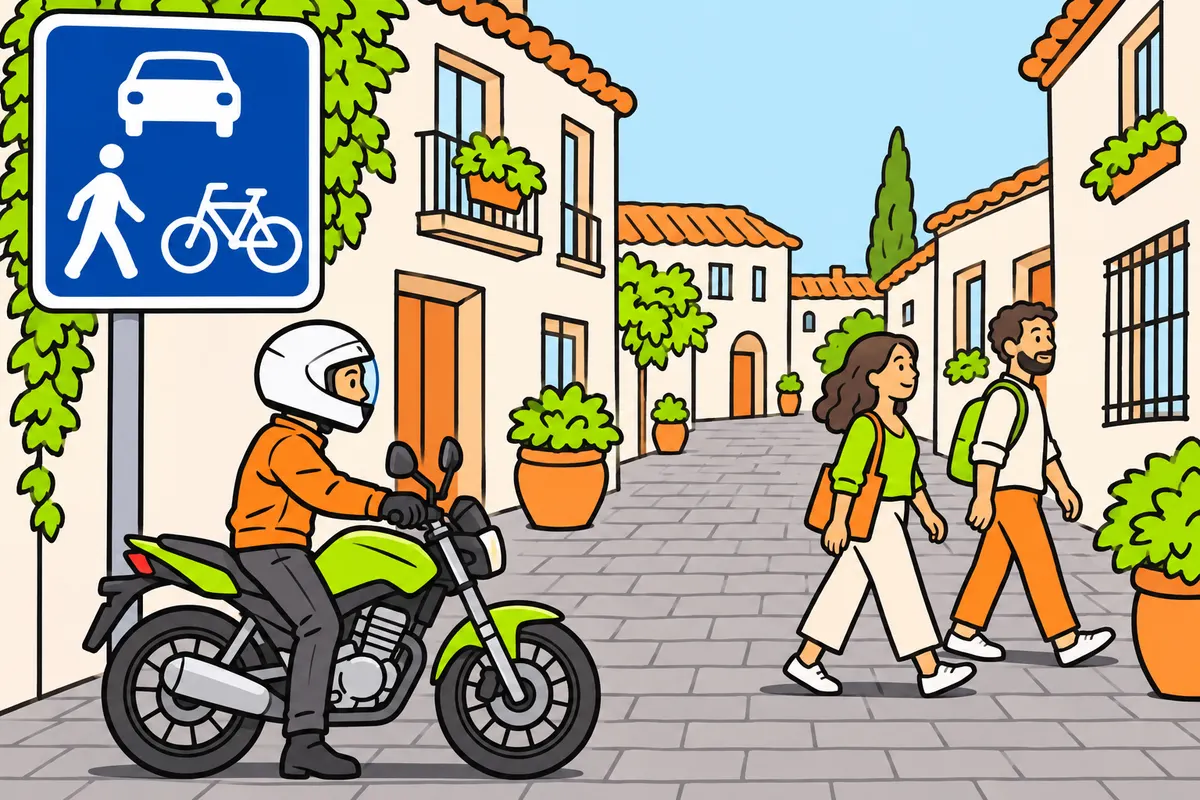
In these shared areas, give pedestrians priority and obey the speed limits.
| Area: includes your motorcycle | Maximum | Games and sports |
|---|---|---|
| S-28: area for staying and playing | 10 km/h | Allowed |
| S-47: shared-use area | 20 km/h | Not allowed |
Remember
- Pedestrians may use the whole area; there are no marked pedestrian crossings.
- Park only where signs or markings allow.
- S-28 must be accompanied by R-301 showing its limit.
- Expect cycles and, where applicable, VMPs both ways unless restricted.
- This does not allow your motorcycle to travel both ways.
Exam trap: Wrong: games are allowed in both areas. Right: games are allowed in S-28, but not S-47.
Read the full explanation
- Sign S-28, Area for staying and playing, sets a maximum of 10 km/h and gives priority to pedestrians. It must be accompanied by R-301 showing that limit. You must observe it on your motorcycle too: it does not depend on engine capacity or on whether you can see children playing at that moment. [RGC, Annex I, catalogue in RD 465/2025](https://www.boe.es/buscar/doc.php?id=BOE-A-2025-12199)
- In an S-28 area, pedestrians may use the entire circulation space and games and sports are allowed; pedestrian crossings are not marked. You may park only in places designated by signs or road markings. Expect people to move from anywhere in the area; do not expect them to find a painted crossing. [RGC, Annex I, catalogue in RD 465/2025](https://www.boe.es/buscar/doc.php?id=BOE-A-2025-12199)
- Sign S-47, Shared-use area, sets a limit of 20 km/h and gives priority to pedestrians, with vehicles, cyclists and pedestrians sharing the space. Pedestrians may use the whole area and pedestrian crossings are not marked; games and sports are not allowed. Park only where designated. [RGC, Annex I, catalogue in RD 465/2025](https://www.boe.es/buscar/doc.php?id=BOE-A-2025-12199)
- In these areas, cycles and, where applicable, VMPs may travel in both directions unless the competent authority provides otherwise. Check for traffic coming in the opposite direction before manoeuvring. The specific permissions for bicycles and VMPs do not give you the same permission on your motorcycle. [RGC, Annex I, catalogue in RD 465/2025](https://www.boe.es/buscar/doc.php?id=BOE-A-2025-12199)
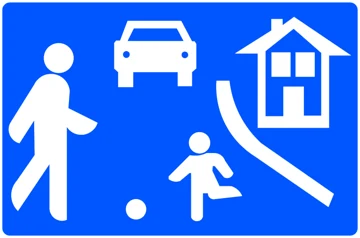 S-28
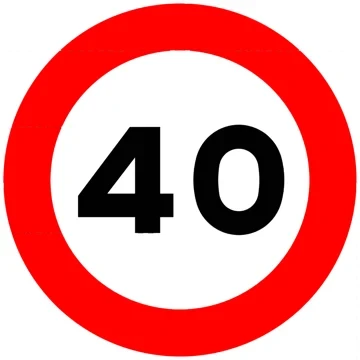 R-301
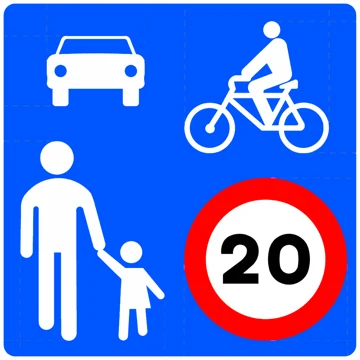 S-47
10Walking and using pedestrian areas
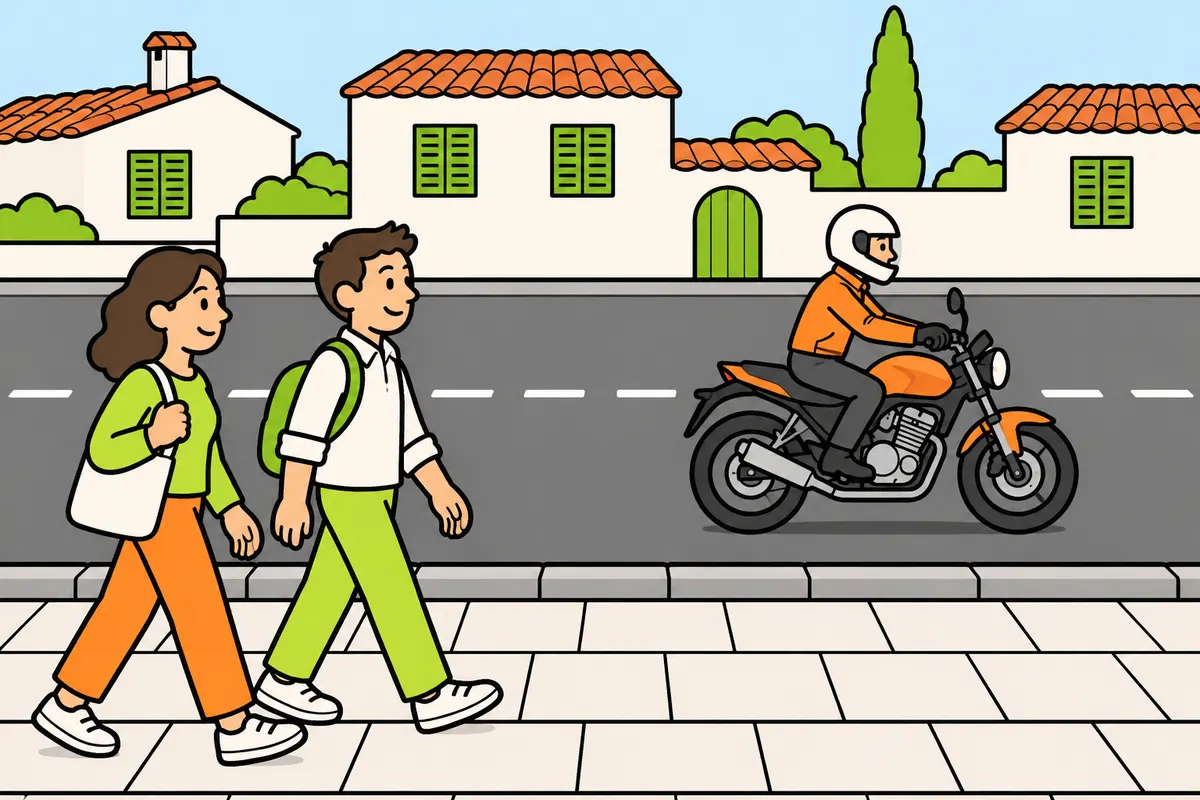
Respect pavements and the special rules for other pedestrian areas.
| Space or case | Rule |
|---|---|
| Pavement | Reserved for pedestrians; do not ride your motorcycle here |
| Children up to twelve cycling | Only if local bylaws allow; supervising adult must walk |
| Other pedestrian areas | Local permission may allow bicycles and VMPs; pedestrians retain priority |
Remember
- Pedestrians must use a usable pedestrian area.
- Without one, pedestrians may use the shoulder, then the carriageway carefully if needed.
- Respect the pavement when crossing an authorised access on your motorcycle.
- Local bylaws may allow bicycles and VMPs in other pedestrian areas.
- The child exception needs local permission and an adult supervising on foot.
Exam trap: Wrong: any cyclist may ride on the pavement. Right: local bylaws may allow children up to twelve, supervised by an adult on foot.
Read the full explanation
- Pedestrians must use a usable pedestrian area. Pavements are reserved for their movement and use, and vehicles are prohibited from travelling on them. On your motorcycle, respect this space when entering or leaving an authorised access. [RGC, art. 152, RD 518/2026](https://www.boe.es/buscar/doc.php?id=BOE-A-2026-13889)
- In other pedestrian areas, local regulations may allow bicycles and VMPs to share the space, while pedestrians retain priority. This does not allow you to enter on your motorcycle or make every pavement a route for electric scooters. [RGC, art. 152, RD 518/2026](https://www.boe.es/buscar/doc.php?id=BOE-A-2026-13889)
- Local regulations may allow children up to twelve years old to cycle on pavements when accompanied by an adult on foot. Do not extend this exception to every cyclist or assume it allows the adult to ride on the pavement too. [RGC, art. 152, RD 518/2026](https://www.boe.es/buscar/doc.php?id=BOE-A-2026-13889)
- If there is no usable pedestrian area, pedestrians may use the arcén (hard shoulder) and, if it is absent or unusable, the carriageway, taking great care and not obstructing traffic. Adjust your speed and distance to protect them. [RGC, art. 152, RD 518/2026](https://www.boe.es/buscar/doc.php?id=BOE-A-2026-13889)
11Pedestrians on the hard shoulder or carriageway
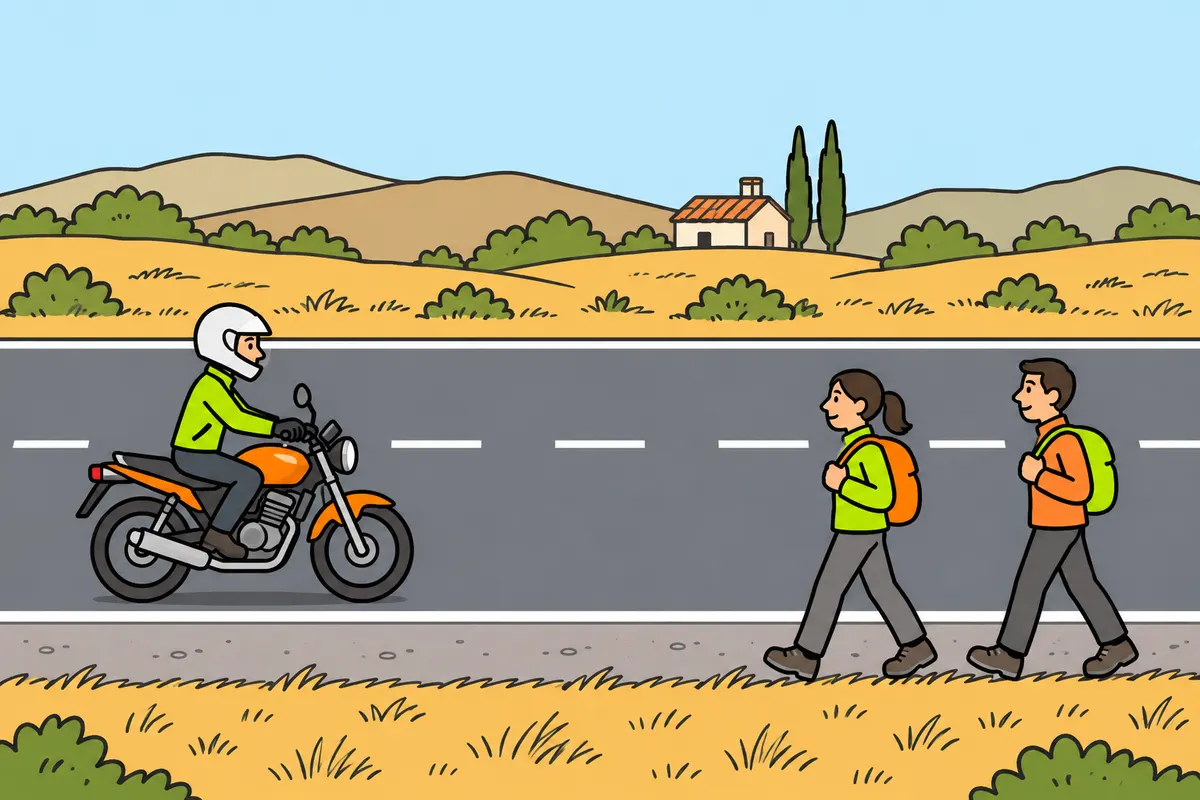
Without a usable pedestrian area, pedestrians must choose the permitted side; expect them.
| Pedestrians without a usable pedestrian area | Side |
|---|---|
| General rule | Left; right if safer |
| Anyone pushing a cycle, two-wheeled moped, VMP or similar | Right |
| Group led by one person | Right |
| Wheelchair user who counts as a pedestrian | Pedestrian rule for the location and safety |
Remember
- Pedestrians must use a usable shoulder; otherwise, the carriageway.
- They must keep near the outer edge, single file, carefully, without obstructing traffic.
- They must not wait there if a refuge or suitable area is available.
- They must clear the carriageway when priority vehicles signal.
- On your motorcycle, expect pedestrians on either side.
Exam trap: Wrong: wheelchair users must always keep right. Right: they follow pedestrian rules for the location and safety.
Read the full explanation
- If there is no usable pedestrian area, pedestrians must walk on the left-hand arcén (hard shoulder) in their direction of travel if it exists and is usable; otherwise, they must use the carriageway, as far from traffic as possible. They may use the right-hand side for safety reasons. Expect them on either side. [RGC, art. 122](https://www.boe.es/buscar/act.php?id=BOE-A-2003-23514#a122)
- Anyone pushing or pulling a cycle, two-wheeled moped, VMP or similar vehicle must keep to the right and obey the signs. The same applies to groups led by one person and to anyone who must use that side for safety. You may encounter them travelling in the same direction as your motorcycle. [RGC, art. 122](https://www.boe.es/buscar/act.php?id=BOE-A-2003-23514#a122)
- On the arcén or carriageway, pedestrians must walk close to the outer edge, one behind another, carefully and without obstructing traffic. They must not remain there if they have a refuge or suitable area available, including while waiting for a vehicle. Expect them to move towards that refuge. [RGC, art. 122](https://www.boe.es/buscar/act.php?id=BOE-A-2003-23514#a122)
- A wheelchair user who is legally a pedestrian follows the pedestrian rule that applies to the location and the safety conditions; there is no general requirement to keep to the right. Pedestrians must clear the carriageway when they perceive the signals of priority vehicles. Expect these movements. [RGC, art. 122](https://www.boe.es/buscar/act.php?id=BOE-A-2003-23514#a122)
12Pedestrian visibility
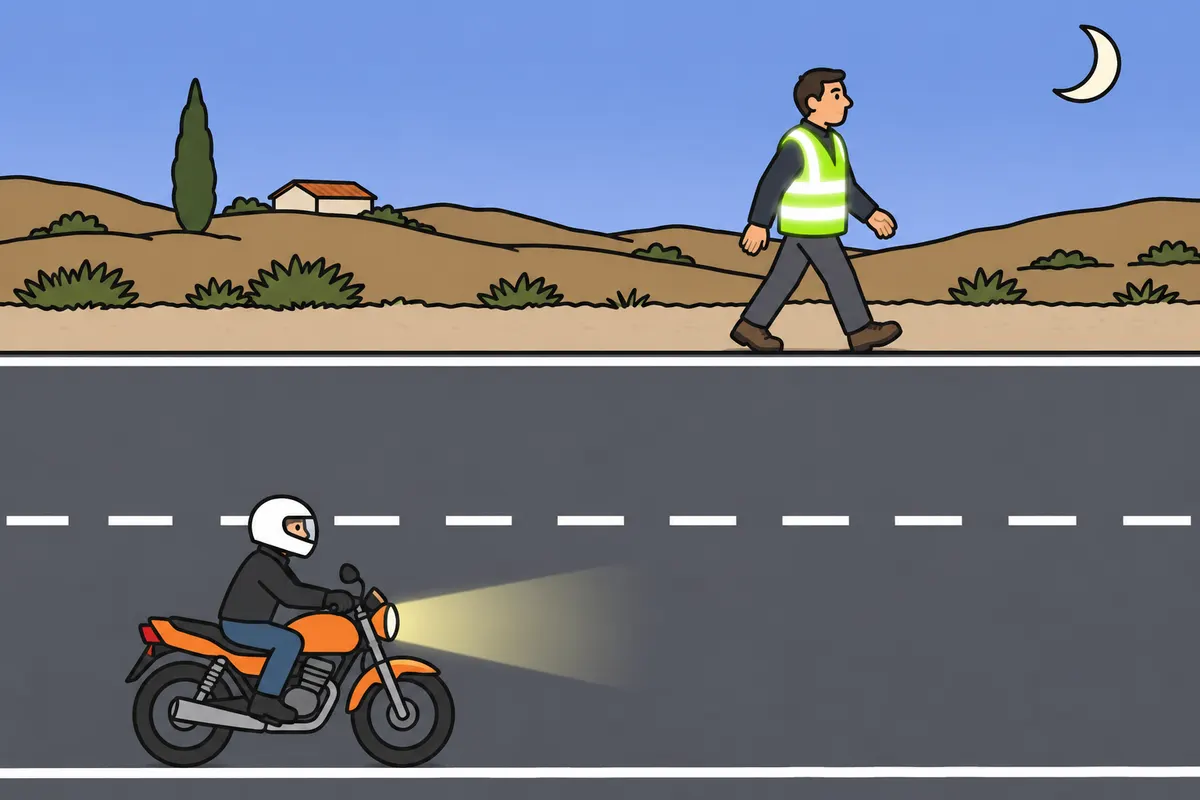
Expect hard-to-see pedestrians on interurban shoulders and carriageways; adapt your riding to visibility.
Remember
- In those conditions, pedestrians must use regulation luminous or reflective equipment.
- Light-coloured clothes do not replace this item.
- In those conditions, groups need extra lights beside the carriageway centre.
- These lights show white or yellow forwards, red backwards.
- On your motorcycle, slow down if you cannot see the road edge clearly.
Exam trap: Wrong: pedestrians need luminous or reflective equipment only at night. Right: they also need it in significantly reduced visibility on interurban carriageways or shoulders.
Read the full explanation
- A pedestrian travelling on the carriageway or arcén on an interurban road between sunset and sunrise must wear at least one luminous or reflective item visible from at least 150 metres, in accordance with the regulations on personal protective equipment. [RGC, art. 123](https://www.boe.es/buscar/act.php?id=BOE-A-2003-23514#a123)
- Pedestrians have the same duty when weather or environmental conditions significantly reduce visibility, even during the day. Expect people who are hard to see: light-coloured clothing alone does not replace the required item. [RGC, art. 123](https://www.boe.es/buscar/act.php?id=BOE-A-2003-23514#a123)
- In these conditions, groups must also carry lights indicating their position and dimensions on the side nearest the centre of the carriageway: white or yellow lights facing forwards and red lights facing backwards. Their orientation helps you identify the group's direction of travel. [RGC, art. 123](https://www.boe.es/buscar/act.php?id=BOE-A-2003-23514#a123)
- As a motorcyclist, look for these lights without assuming every pedestrian uses them correctly. Slow down if you cannot see the edge of the road clearly. A pedestrian's duty to make themselves visible does not remove your duty to adapt your riding to what you can see. [RGC, art. 123](https://www.boe.es/buscar/act.php?id=BOE-A-2003-23514#a123)
13Crossing the road on foot correctly
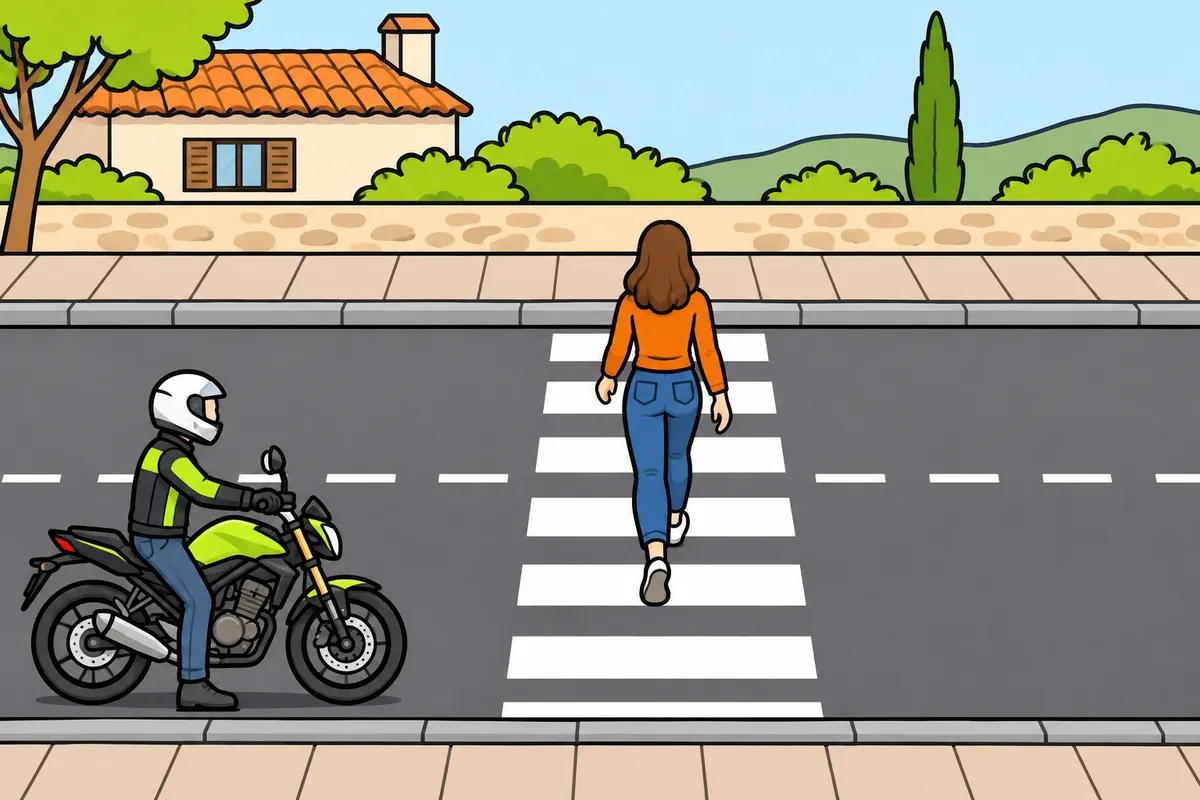
Pedestrians must use nearby crossings and obey signals; anticipate their path.
| Where pedestrians cross | What they must follow |
|---|---|
| Controlled crossing | Pedestrian lights; without them, officers or vehicle lights |
| Marked uncontrolled crossing | Priority, but enter only when safe |
| Away from a crossing | Cross without risk or undue obstruction |
Remember
- Pedestrians must use crossings in the area, rather than crossing nearby.
- They must obey pedestrian lights; without them, follow officers or vehicle traffic lights.
- At uncontrolled crossings, pedestrians have priority but must enter only when safe.
- Away from crossings, they must cross without risk or undue obstruction.
- They must cross straight across, without unnecessary stops or delays.
- They must go around squares and roundabouts, using authorised crossings across their carriageways.
Exam trap: Wrong: priority lets pedestrians step out without looking. Right: at uncontrolled crossings, they must check vehicle distances and speeds.
Read the full explanation
- If there are pedestrian crossings in the area, pedestrians must use them and must not cross nearby. They must obey the pedestrian traffic light or, if there is none, the traffic officer or signal that allows vehicles to proceed. You must watch for these indications as you approach. [RGC, art. 124](https://www.boe.es/buscar/act.php?id=BOE-A-2003-23514#a124)
- At a marked crossing without such controls, pedestrians have priority, but must step onto it only when the distance and speed of vehicles make it safe to do so. You must approach with enough room to give way. [RGC, art. 124](https://www.boe.es/buscar/act.php?id=BOE-A-2003-23514#a124)
- Away from a crossing, pedestrians must make sure they can cross without risk or undue obstruction. They must cross perpendicular to the carriageway, without stopping or delaying unnecessarily. You must anticipate their path when you see them beside the edge of the road. [RGC, art. 124](https://www.boe.es/buscar/act.php?id=BOE-A-2003-23514#a124)
- Pedestrians must go around squares and roundabouts; they may cross the carriageway only at an authorised pedestrian crossing. You must look for these crossings at roundabout entrances and exits. [RGC, art. 124](https://www.boe.es/buscar/act.php?id=BOE-A-2003-23514#a124)
14Traffic lights and pedestrian paths
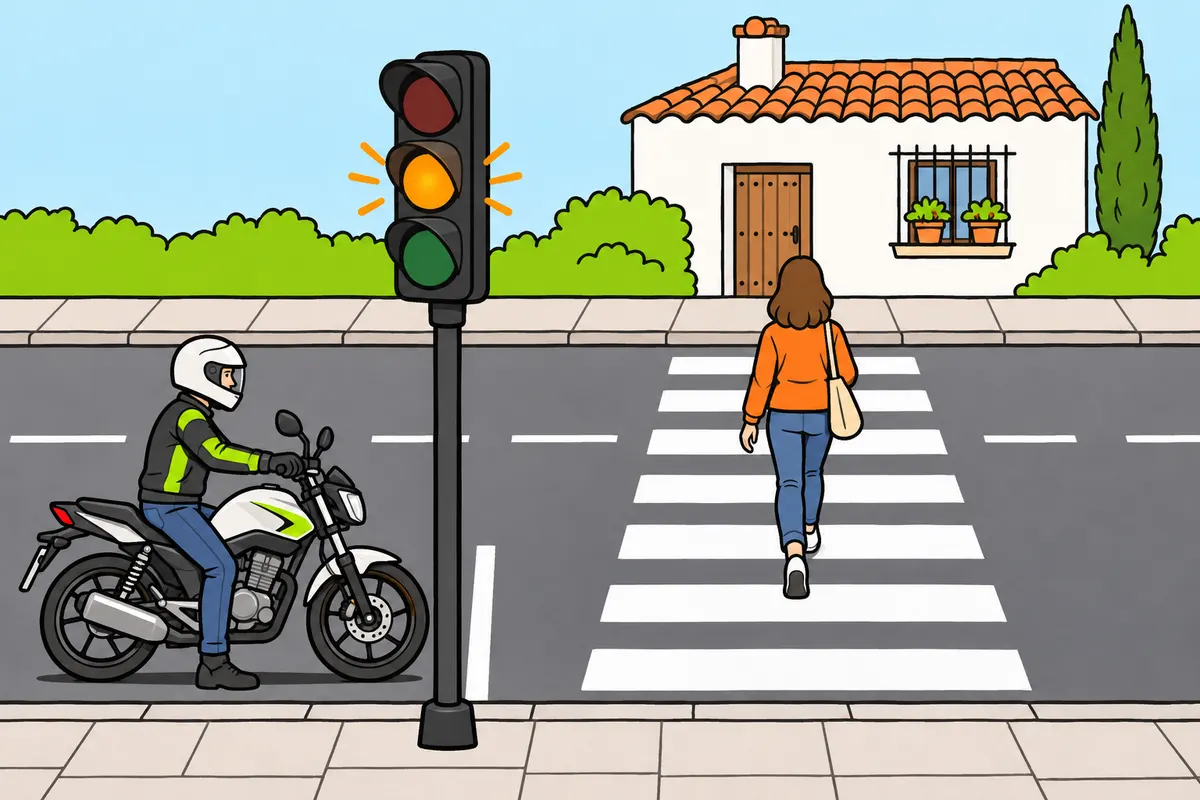
Follow each traffic light according to the road user it applies to.
| Pedestrian traffic light | When you walk |
|---|---|
| Steady red | Do not start crossing |
| Steady green | You may start crossing |
| Flashing green | Little time remains to finish before red |
Remember
- At flashing amber, take extra care and give way where required.
- Also obey signs that require you to stop.
- On a green arrow against black, proceed without endangering people crossing.
- A bicycle traffic light does not authorise your motorcycle to pass.
Exam trap: Wrong: flashing amber gives you priority. Right: give way where required.
Read the full explanation
- A steady red figure prohibits pedestrians from starting to cross; a steady green figure allows them to start. A flashing green warns that little time remains to finish crossing and that red will come on. You must expect pedestrians to be finishing their crossing. [RGC, art. 143 and Annex I, section 4.1](https://www.boe.es/buscar/act.php?id=BOE-A-2003-23514)
- As a motorcyclist, a flashing amber light requires you to take extra care and give way when appropriate. You must respect pedestrian priority and any other signs requiring you to stop. You must not interpret the flashing light as permission to go first in front of a pedestrian. [RGC, Annex I, section 4.2.d, RD 518/2026](https://www.boe.es/buscar/doc.php?id=BOE-A-2026-13889)
- If you proceed following a green arrow on a black background, you must do so carefully and without endangering anyone crossing. Watch the path of the entire turn, because traffic light authorisation to make it does not allow you to compromise the safety of other road users. [RGC, art. 143 and Annex I, section 4](https://www.boe.es/buscar/act.php?id=BOE-A-2003-23514)
- A traffic light with a cycle symbol is for cycles. You must not use its green light to ride your motorcycle if the traffic light for your lane prohibits you from doing so. The vehicle category determines which indication you must obey, even if you share an access point near the cycle crossing. [RGC, art. 143 and Annex I, section 4](https://www.boe.es/buscar/act.php?id=BOE-A-2003-23514)
15Pedestrians on autopistas (motorways) and autovías (dual carriageways)
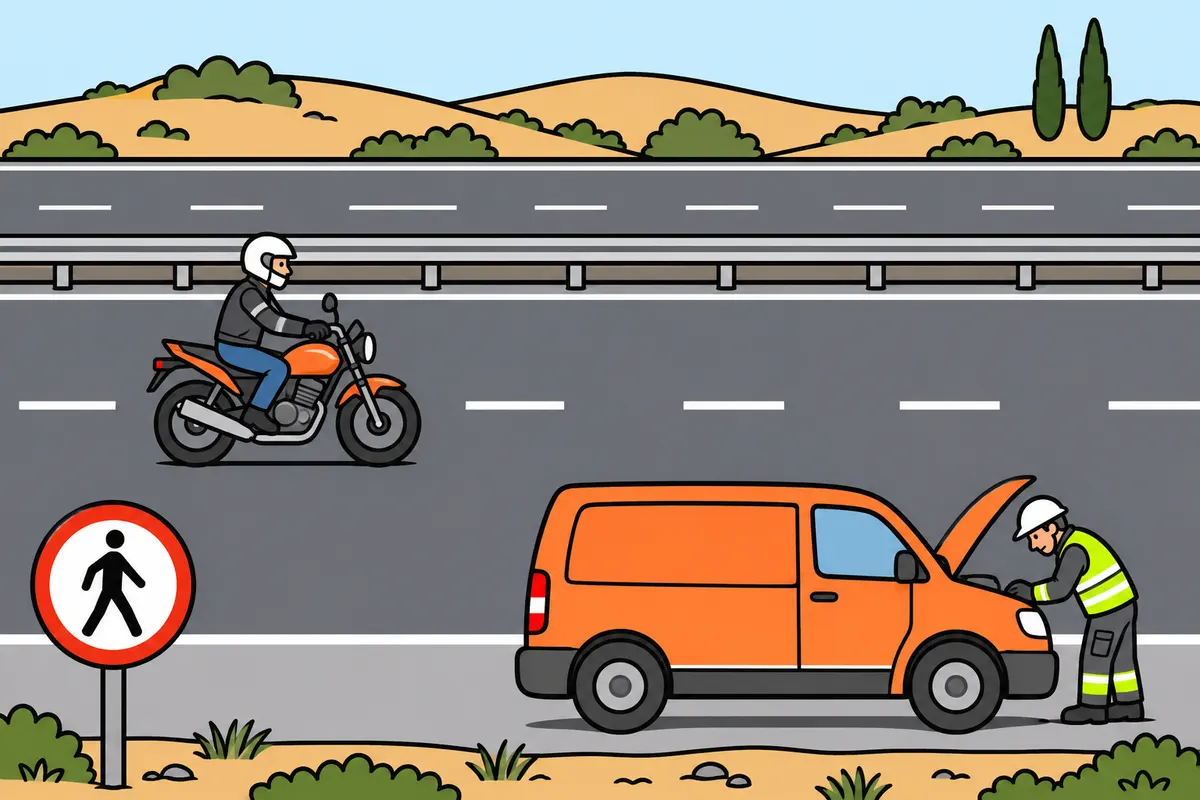
Do not walk along autopistas or autovías except under the regulated exceptions.
Remember
- Do not hitchhike, including at toll plazas.
- In emergencies and service work, follow the regulatory conditions.
- Service personnel may walk there only when strictly essential.
- When riding, expect people near breakdowns or roadworks.
- Reduce risk and watch their movements.
Exam trap: Wrong: pedestrians can never appear there. Right: emergency and service exceptions exist, subject to safety conditions.
Read the full explanation
- Pedestrians may not travel on autopistas or autovías, except in the regulatory emergency and service situations and under the conditions set out for them. They may not hitchhike either, including at toll plazas. You must anticipate people being present if a vehicle is immobilised, even though the arcén (hard shoulder) is not an ordinary pedestrian route. [RGC, art. 125](https://www.boe.es/buscar/act.php?id=BOE-A-2003-23514#a125)
- Occupants or workers providing emergency, maintenance, recovery or special vehicle services may travel there when strictly necessary for the service, provided they take safety measures. [RGC, art. 125](https://www.boe.es/buscar/act.php?id=BOE-A-2003-23514#a125)
- If you find workers or people beside a broken-down vehicle, you must anticipate their movements and reduce the risk. Do not assume that the ban on pedestrian travel means a person can never be present. The full procedure for breakdowns is covered in ‘Accidents, breakdowns and assistance’. [RGC, art. 125](https://www.boe.es/buscar/act.php?id=BOE-A-2003-23514#a125)
16Where cyclists ride
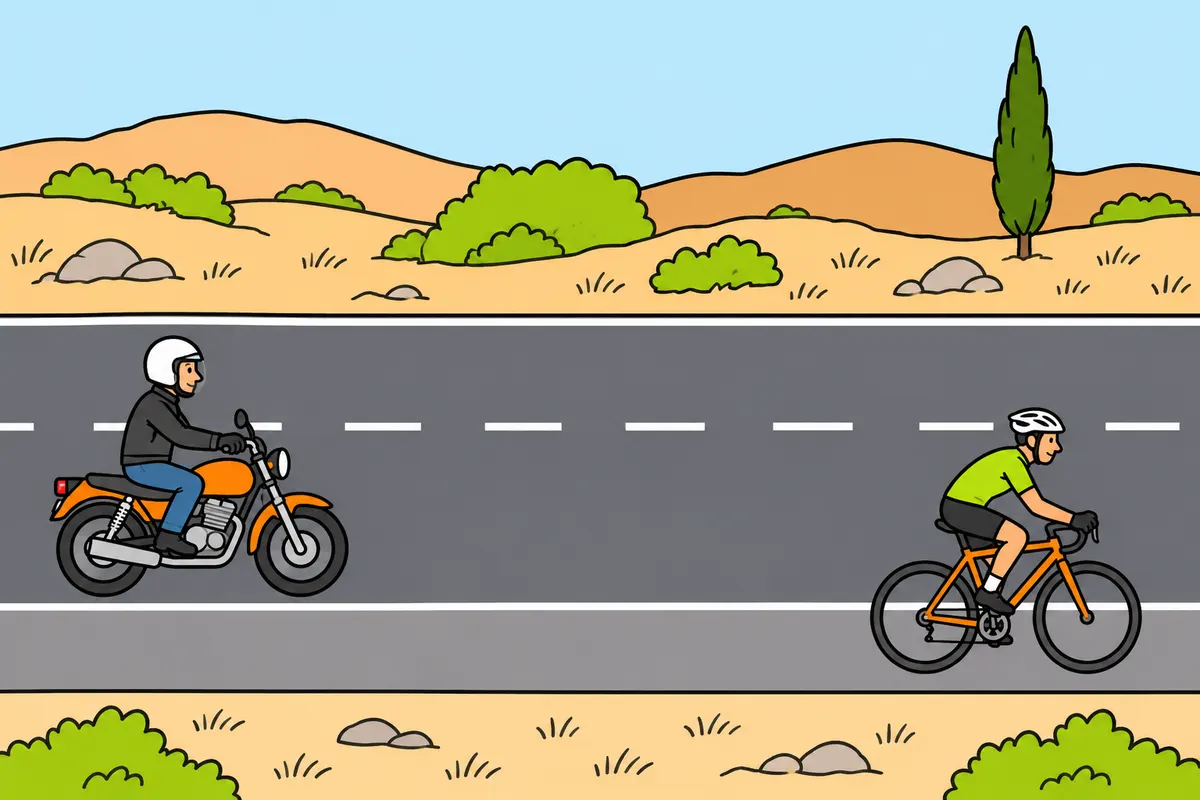
Leave cyclists space and recognise where they may ride.
| Case for cyclists | Rule |
|---|---|
| Autopista | Prohibited |
| Autovía | Over 14, on shoulder, unless signs prohibit |
| Two abreast | Allowed on shoulder; necessary carriageway space if shoulder space is insufficient |
| On carriageway: limited visibility, traffic flow affected, night or significantly reduced visibility | Must ride single file |
Remember
- Respect cyclists using the usable, wide-enough right shoulder on roads.
- If space is insufficient, they may use the necessary carriageway space.
- On long, winding descents, cyclists may use the right carriageway when safe.
- On autovías, cyclists must stay on the shoulder.
- Do not close off their space when approaching a bend.
Exam trap: Wrong: cyclists must always ride single file. Right: they may ride two abreast on the shoulder. On the carriageway, they must ride single file where visibility is limited, if they affect traffic flow, at night or in significantly reduced visibility.
Read the full explanation
- On roads, if there is no part specifically designated for them, cycles must use the right-hand hard shoulder if it is passable and wide enough. If it is not, they may use as much of the carriageway as necessary. As a motorcyclist, you must allow them to do so and wait for a safe opportunity to overtake. [RGC, art. 36](https://www.boe.es/buscar/act.php?id=BOE-A-2003-23514#a36)
- On long descents with bends, cyclists may leave the hard shoulder and use as much of the right-hand side of the carriageway as they need when it is safe. On autovías they must remain on the hard shoulder. You must not close off their space as you approach a bend. [RGC, art. 36](https://www.boe.es/buscar/act.php?id=BOE-A-2003-23514#a36)
- They may ride two abreast on the hard shoulder; if there is no hard shoulder, or it is not passable and wide enough, they may also use as much of the carriageway as necessary. However, when riding on the carriageway, they must ride single file on stretches with limited visibility, when they affect traffic flow, at night or when visibility is significantly reduced. [RGC, art. 36.2](https://www.boe.es/buscar/act.php?id=BOE-A-2003-23514#a36)
- Cyclists over 14 may ride on the hard shoulder of autovías unless signs prohibit it for safety reasons; they may not ride on autopistas. You must expect them on autovías where they are allowed and not confuse these with autopistas. [RGC, art. 38](https://www.boe.es/buscar/act.php?id=BOE-A-2003-23514#a38) [RGC, art. 36](https://www.boe.es/buscar/act.php?id=BOE-A-2003-23514#a36)
17Bicycles in towns and following distance
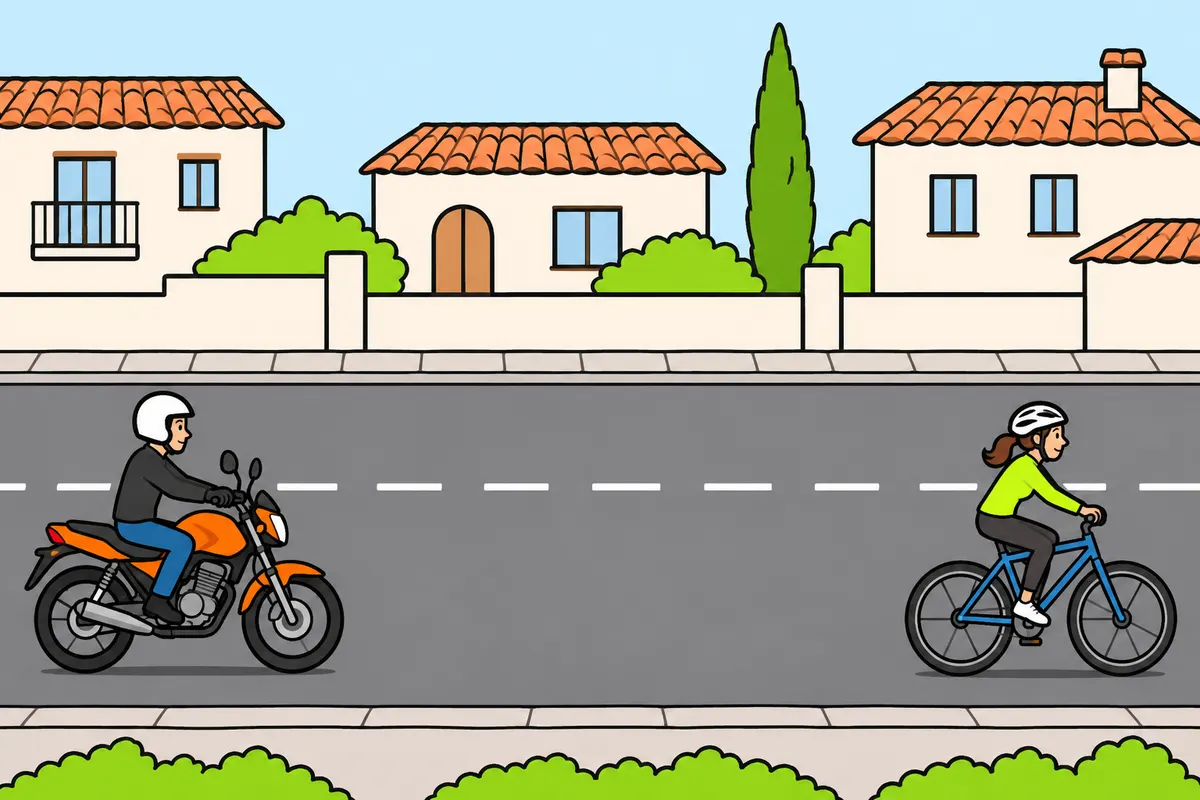
Respect cyclists’ road position and leave enough space behind them.
Remember
- In towns, cyclists preferably ride in the lane centre when safe.
- With several lanes each way, they use the right, except for turns or safety.
- Cycle routes are preferred; signs may make them compulsory.
- Increase your following distance when speed or grip requires.
- Check both sides: cyclists may overtake on the right or left.
- Keep reserved waiting areas clear.
Exam trap: Wrong: confuse following distance with sideways clearance. Right: stay at least five metres behind a bicycle ahead in your lane.
Read the full explanation
- If there is no specific route, bicycles travel on the carriageway. If there is a cycle route, its use is preferred and signs may make it compulsory. In towns, cyclists should preferably ride in the centre of the lane when this is safe for them and others. [RGC, art. 153, RD 518/2026](https://www.boe.es/buscar/doc.php?id=BOE-A-2026-13889)
- Where there are at least two lanes in each direction, cyclists use the right-hand lane, but may use others to change direction or for safety. You must not insist that they ride close to parked vehicles: riding in the centre of the lane can protect them from doors, obstacles and overtaking too closely. [RGC, art. 153, RD 518/2026](https://www.boe.es/buscar/doc.php?id=BOE-A-2026-13889)
- You must leave at least five metres between your motorcycle and the bicycle in front of you in the same lane. You must increase this distance if speed or grip conditions require it. The minimum following distance does not replace the lateral clearance required when overtaking. [RGC, art. 153.4](https://www.boe.es/buscar/act.php?id=BOE-A-2003-23514#a153)
- Cyclists may overtake on the right or left, whichever is safer, and pass stationary vehicles or vehicles that stop frequently to use advanced waiting areas. You must check both sides before moving and keep the relevant reserved space clear. [RGC, art. 153, RD 518/2026](https://www.boe.es/buscar/doc.php?id=BOE-A-2026-13889)
18Two-way cycling and urban VMP (personal mobility vehicle) use
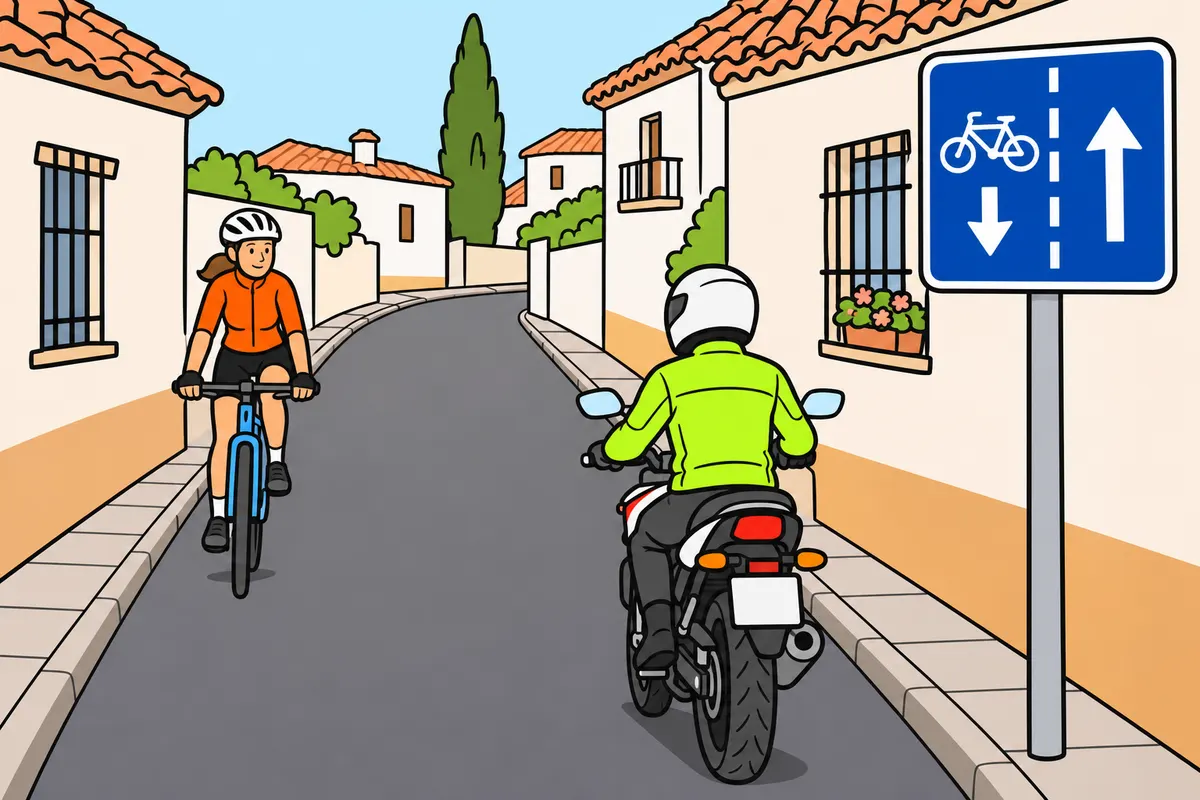
Recognise authorised two-way cycling and protect VMP users too.
Remember
- Two-way cycling needs municipal permission and signs provided beforehand.
- Move towards your right to allow safe passing.
- If passing is impossible, traffic following the designated direction has priority.
- On authorised roads, the stated urban bicycle rules also apply to VMPs.
- Pavement cycle tracks follow local rules; you cannot use them on your motorcycle.
Exam trap: Wrong: every one-way street allows oncoming bicycles. Right: it needs a single lane, a limit of 30 km/h or less, municipal permission and prior signs.
Read the full explanation
- On urban roads with one lane and a speed limit of 30 km/h or less, the municipal authority may allow bicycles to travel in both directions, provided signs are in place beforehand. You must not assume that every one-way street allows this: you need to look for signs authorising it. [RGC, art. 153.6, RD 518/2026](https://www.boe.es/buscar/doc.php?id=BOE-A-2026-13889)
- In this situation, you must move to your right to allow traffic to pass safely in the opposite direction. If there is not enough room to pass, vehicles travelling in the road’s designated direction have priority. You must reduce speed and negotiate the meeting without squeezing the cyclist against the edge. [RGC, art. 153.6, RD 518/2026](https://www.boe.es/buscar/doc.php?id=BOE-A-2026-13889)
- On roads where VMPs are authorised, the urban rules on lane position, spacing, overtaking and two-way travel in paragraphs 3 to 7 of article 153 apply. You must therefore also keep the required five-metre following distance behind a VMP. [RGC, art. 155.2, RD 518/2026](https://www.boe.es/buscar/doc.php?id=BOE-A-2026-13889)
- Cycle pavements are regulated by the municipality. Where they cross the carriageway, you must watch the paths of people using the cycle route and those walking on the pedestrian part. The presence of nearby cycle infrastructure does not authorise you to ride your motorcycle on it. [RGC, art. 153.7, RD 518/2026](https://www.boe.es/buscar/doc.php?id=BOE-A-2026-13889)
19Priority for bicycles and groups
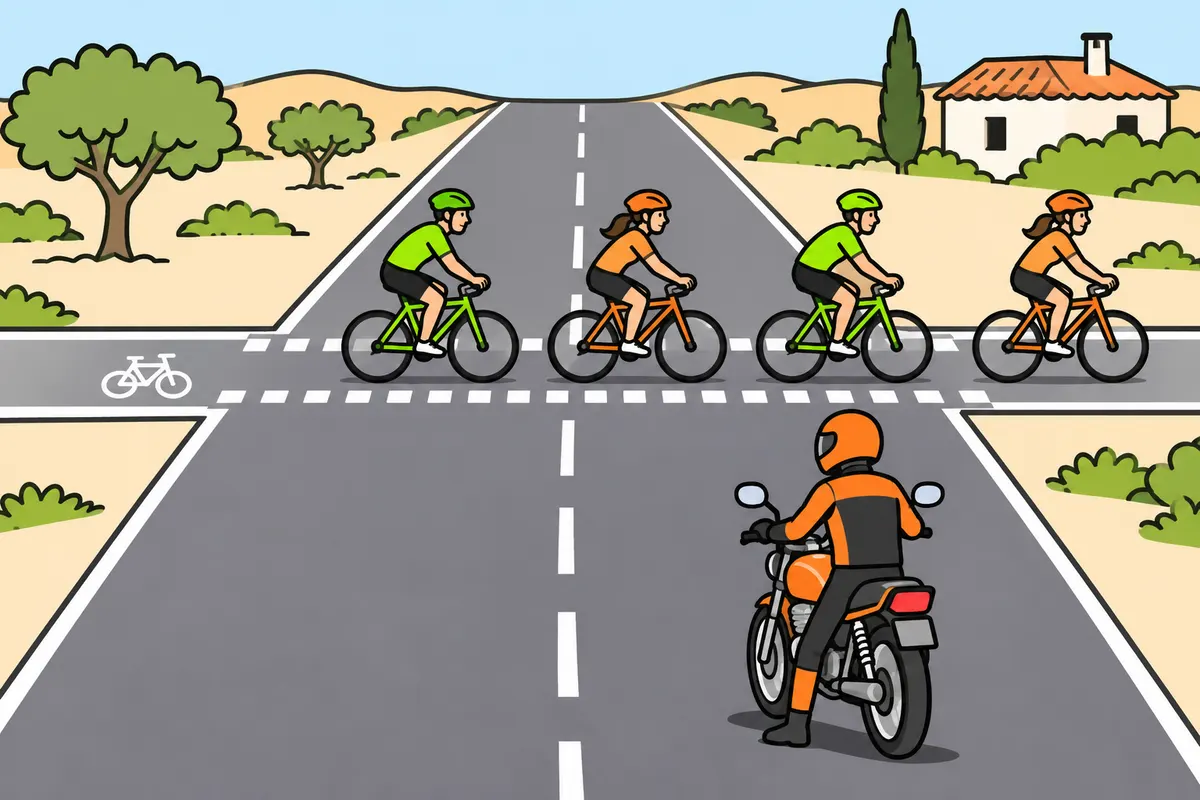
Give bicycles priority where required and let crossing groups stay together.
| How the cyclist crosses | Priority at a pedestrian-only crossing |
|---|---|
| Riding | The crossing alone gives no pedestrian priority |
| Walking and pushing | Pedestrian rules apply |
Remember
- Give way on properly marked cycle lanes, cycle crossings or shoulders.
- When turning, let nearby cyclists pass where the rules require.
- Wait when the first cyclist in a group starts crossing or enters a roundabout.
- Do not ride between group members.
- Elsewhere, apply the general priority rules.
- Avoid hitting anyone, even when they lack priority.
Exam trap: Wrong: riding across a pedestrian-only crossing gives pedestrian priority. Right: cyclists must dismount and push to count as pedestrians.
Read the full explanation
- You must give way to cyclists travelling in a cycle lane, across a cycle crossing or along a properly signed arcén (hard shoulder). Check both sides of the route before crossing it on your motorcycle. Priority depends on the crossing conditions and the signs governing the conflict. [RGC, art. 64](https://www.boe.es/buscar/act.php?id=BOE-A-2003-23514#a64)
- If you turn right or left to enter another road and a cyclist is nearby, you must let them pass in the permitted cases. Check your mirrors and the area alongside you before turning, and do not cut across the path of a bicycle travelling beside you. [RGC, art. 64](https://www.boe.es/buscar/act.php?id=BOE-A-2003-23514#a64)
- When cyclists are travelling in a group and the first cyclist has started crossing or entered a roundabout, the group has priority in that situation. You must wait and avoid riding your motorcycle between its members. Check the full length of the group before continuing. [RGC, art. 64](https://www.boe.es/buscar/act.php?id=BOE-A-2003-23514#a64)
- Outside those situations, the general priority rules between vehicles apply. A bicycle does not have universal priority because its user is vulnerable. If the cyclist gets off and walks across with the bicycle, recognise that the situation has become a pedestrian one and apply the relevant rules. [RGC, art. 64](https://www.boe.es/buscar/act.php?id=BOE-A-2003-23514#a64)
- If someone rides a bicycle across a crossing reserved exclusively for pedestrians, distinguish them from someone crossing on foot: that crossing alone does not give them pedestrian priority. To count as a pedestrian, the cyclist must get off and push the bicycle on foot. Take care all the same and avoid hitting them even if they do not have priority. [RGC, arts. 64 and 65](https://www.boe.es/buscar/act.php?id=BOE-A-2003-23514#a64) [LTSV, Annex I, definition 4](https://www.boe.es/buscar/act.php?id=BOE-A-2015-11722#ani)
20Overtaking cyclists: clearance and predictable movements
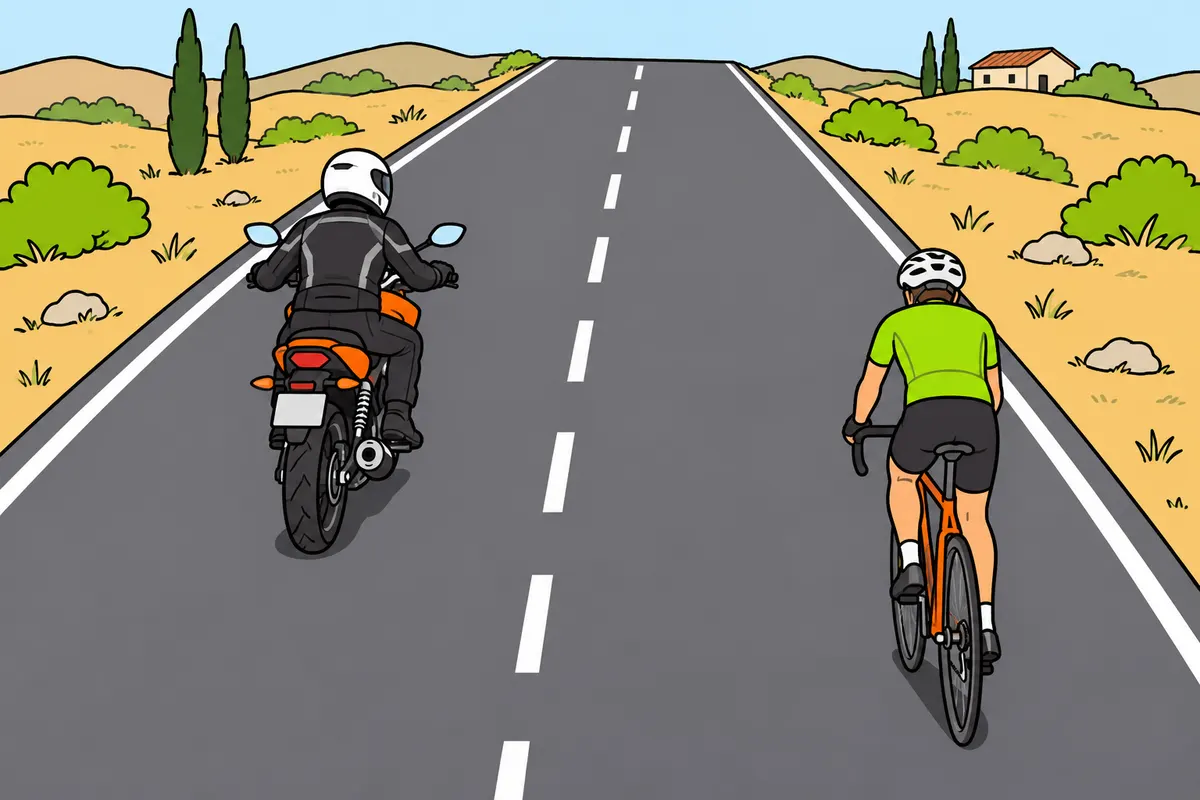
Leave cyclists space and expect them to move away from the edge.
Remember
- When overtaking a cyclist, leave the minimum sideways clearance.
- Expect movements when they set off, climb slopes or look behind.
- Watch for parked car doors that may open.
- Look for potholes and obstacles ahead of the bicycle.
- Wait if there is not enough space to protect the cyclist.
- Approach pedestrians with bags, walking sticks or walking aids smoothly.
Exam trap: Wrong: expect a cyclist to follow a fixed line. Right: leave space for predictable movements and wait if space is insufficient.
Read the full explanation
- When overtaking a cyclist on your motorcycle, you must leave at least 1.5 metres of lateral clearance. As an extra precaution, watch their balance: they may wobble when starting, riding uphill or looking behind. Leave room for this predictable movement and wait if the available space is not enough to protect them. [RGC, art. 85.4](https://www.boe.es/buscar/act.php?id=BOE-A-2003-23514#a85)
- Beside parked vehicles, anticipate that an open door may force a cyclist to swerve suddenly. Look at the occupants and the space between the bicycle and the cars; overtake only if you can leave the cyclist a safe way through. Pressing them towards the doors takes away the very space they need to avoid them.
- A pothole, drain or debris at the edge may push a bicycle's path towards your motorcycle. As a precaution, watch the road surface ahead of the cyclist as well as their current position. If an obstacle is where you would catch up with them, delay passing until they have cleared it.
- When pedestrians are near the edge of the road, allow for the space they need to walk and for the movement of bags, sticks or mobility aids. Someone walking beside another person may move aside without seeing you approach. Bring your motorcycle closer smoothly to give them time to notice you and keep their balance. [RGC, art. 121](https://www.boe.es/buscar/act.php?id=BOE-A-2003-23514#a121)
21Overtaking safely outside built-up areas
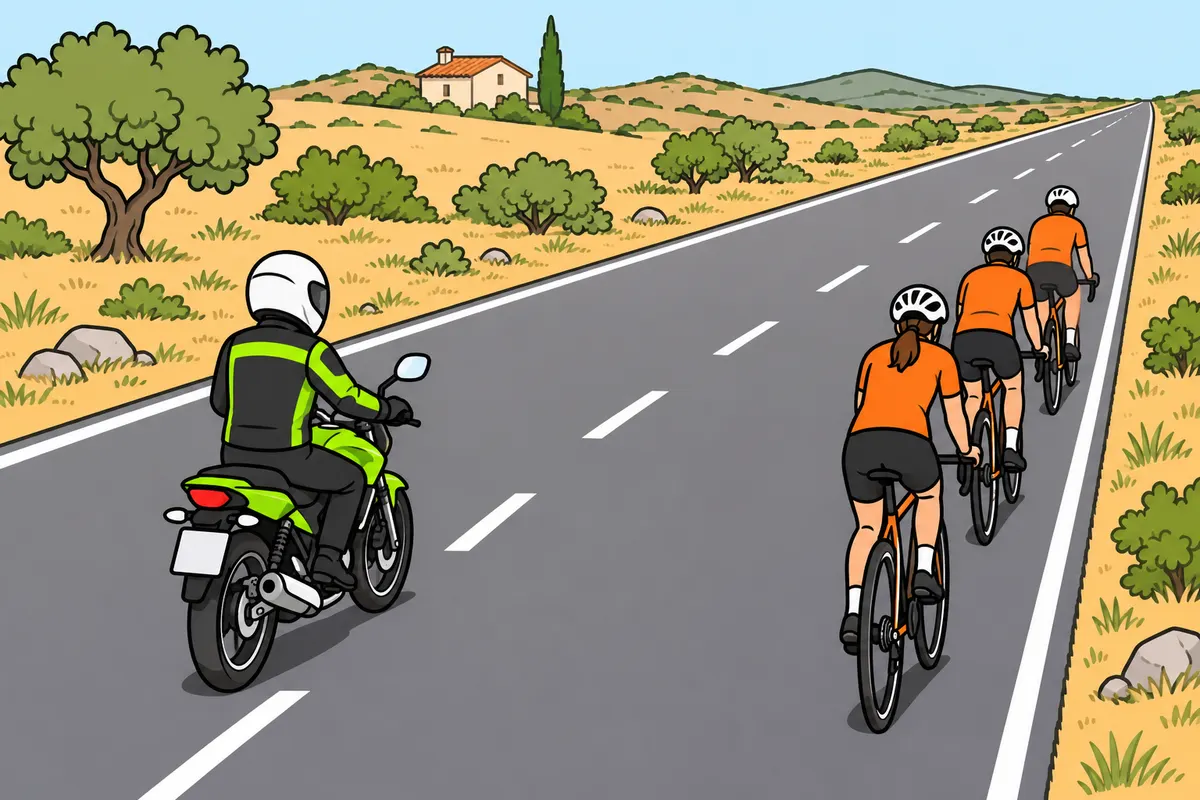
Choose a safe moment to overtake and keep the cyclist’s path clear.
Remember
- Watch the slope and wind: they may move the cyclist sideways.
- Also look for less visible members of the group.
- Expect braking to affect those behind.
- Leave space when a cyclist signals with an arm.
- When finishing, do not cut across the path of their front wheel.
- Check the space occupied by the cyclist, luggage and trailer.
Exam trap: Wrong: move back in front of the bicycle too soon. Right: keep its path clear so it need not brake or swerve.
Read the full explanation
- On the road, watch how a cyclist's effort changes with the gradient and wind. Pedalling out of the saddle or being hit by a gust may cause small sideways movements. As a precaution, choose a moment when their path is predictable and you can maintain a steady clearance throughout the pass.
- As you approach a group, also look for members who are less visible: someone behind another cyclist or near the edge may appear when the formation changes. Anticipate that the front of the group may brake for an obstacle and that this reaction may pass back to those behind.
- If a cyclist extends an arm, leave room for the signal and the manoeuvre they are indicating. Signalling may require them to hold the handlebars with one hand. Avoid approaching right beside the arm they are using, and watch which entrance or junction they are looking towards.
- After passing the bicycle, keep the space in front of its front wheel clear: cutting across its path may force the cyclist to brake or swerve and cause a fall. As a precaution, look at the whole cyclist before moving back towards their line of travel, especially if they are carrying luggage or towing a trailer. [RGC, art. 85.3](https://www.boe.es/buscar/act.php?id=BOE-A-2003-23514#a85)
22Waiting for obstacles and hidden road users
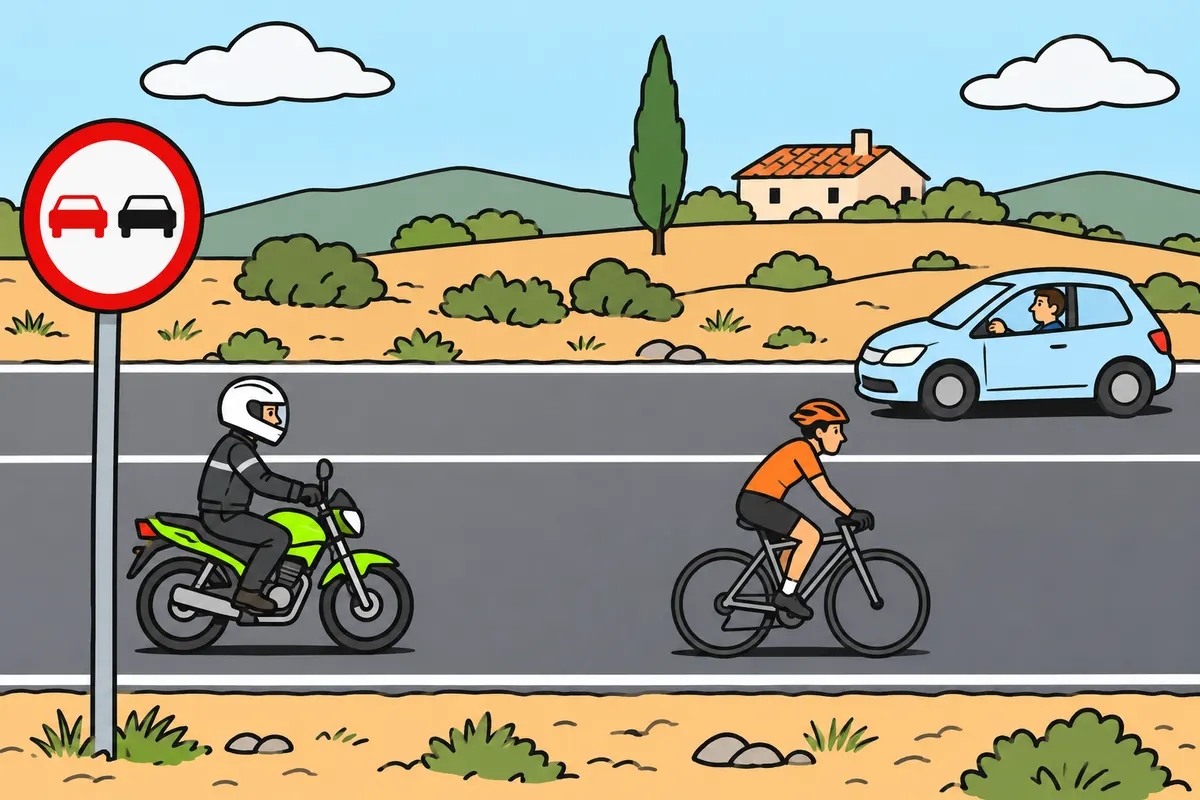
Wait if obstacles or people hide a bicycle’s safe path.
Remember
- At narrow sections, wait if the cyclist needs to move away from the edge.
- Beside stopped vehicles, watch for doors and hidden people.
- Slow down before reaching an area you cannot see.
- Watch whether the cyclist dismounts or starts walking.
- Wait if pedestrians and cyclists need to go around the same obstacle.
Exam trap: Wrong: a slow bicycle is always safe to overtake. Right: wait if it needs space to avoid an obstacle.
Read the full explanation
- A bicycle's slow speed does not guarantee that you can pass without compromising its safety. At a narrow section, check whether the cyclist needs to move away from the edge to avoid a wall, vegetation or a damaged road surface. Wait until they have passed through so you do not force them to choose between your motorcycle and the obstacle.
- If a stationary vehicle hides people beside the carriageway, pay attention to its doors and the space between its front and the edge. Someone dealing with a breakdown or helping another person out may appear. Slow down before reaching the hidden area and remain able to stop.
- A cyclist who stops beside a junction may put a foot down, get off or start walking with the bicycle. Observe this change and their direction before continuing. Protecting the road user means paying attention to what they are doing at that moment as well as recognising the vehicle they are using. [RGC, art. 121](https://www.boe.es/buscar/act.php?id=BOE-A-2003-23514#a121)
- When pedestrians and cyclists meet beside an obstacle, wait until each has a clear route. A person may go around it on the bicycle's side and force the cyclist to swerve. As a precaution, do not ride your motorcycle into that space while their paths are still uncertain.
- Clearances, lane use and the 20 km/h reduction are covered in “Manoeuvres on your motorcycle”, under “Lateral clearance on your motorcycle”, “Overtaking vulnerable road users” and “Passing obstacles and immobilised vehicles”.
23Protection and transport on bicycles
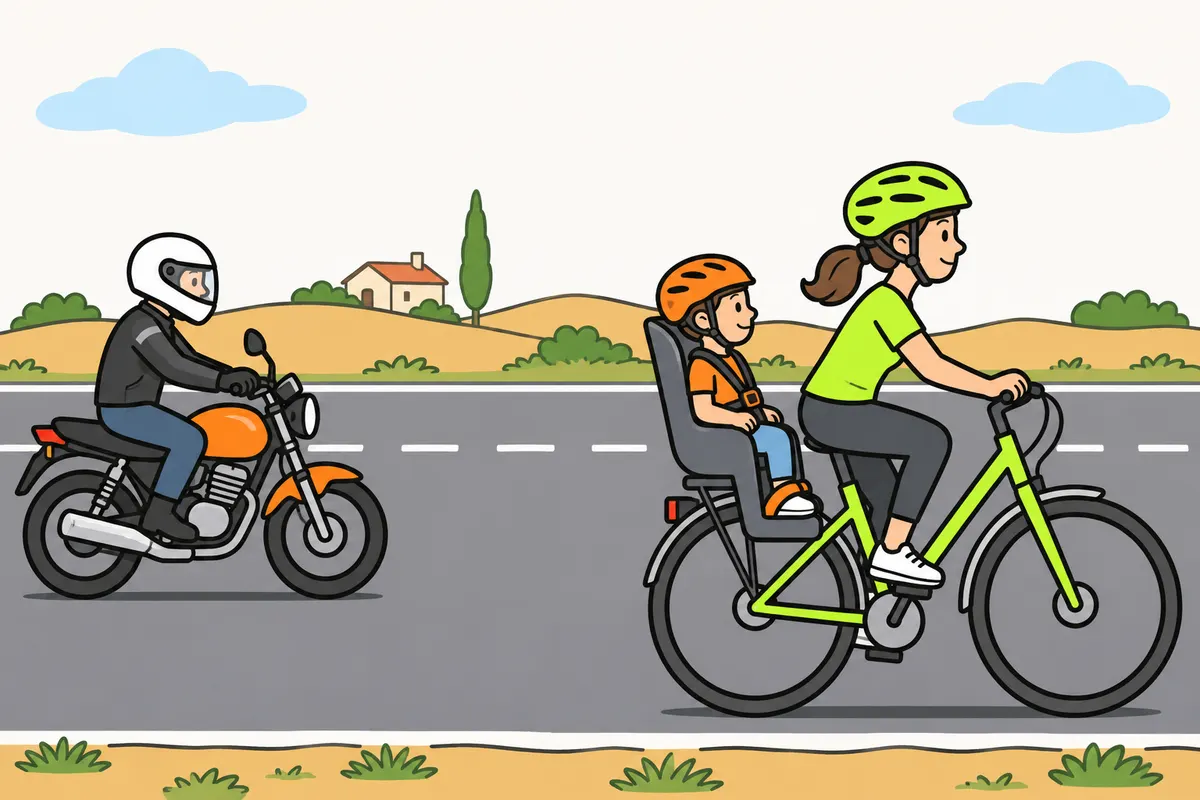
Cyclists must follow protection and transport rules; protect them even if they fail to.
| Bicycle and other cycle users | Helmet required |
|---|---|
| On interurban roads | Yes |
| Under 16 | On every road |
| Professional activity | Also in towns and travesías |
Remember
- Cyclists must wear approved or certified, properly fastened helmets when required.
- On interurban roads at night or in significantly reduced visibility, cyclists need reflective/luminous equipment.
- To carry people or loads, cyclists must be adults and meet technical requirements.
- A child must sit unaided and use a suitable extra seat.
- On interurban roads, this transport requires daylight and enough visibility.
- Professional cyclists must wear a high-visibility reflective vest on every road.
Exam trap: Wrong: cyclists only need helmets outside towns. Right: under-16s need them on every road; professionals also need them in towns and travesías.
Read the full explanation
- Users of bicycles and other cycles must wear an approved or certified helmet, fastened correctly, on roads outside built-up areas. Children under 16 must wear one on every road; people working professionally on a cycle must also wear one in towns and travesías (through roads in built-up areas). You must protect them even if they fail to meet this requirement. [RGC, art. 118](https://www.boe.es/buscar/act.php?id=BOE-A-2003-23514#a118)
- A cyclist travelling on a road outside a built-up area at night or when visibility is significantly reduced must carry at least one regulation-compliant luminous or reflective item visible from 150 metres. Recognise this as personal protection, distinct from the cycle's lights. [RGC, art. 118](https://www.boe.es/buscar/act.php?id=BOE-A-2003-23514#a118)
- To carry people or loads on a cycle, its rider must be an adult and meet the technical requirements. On a bicycle built for one person, the rider may carry children weighing up to 22 kg who can sit up unaided in a suitable additional seat. Allow for the space taken up by that seat. [RGC, art. 154, RD 518/2026](https://www.boe.es/buscar/doc.php?id=BOE-A-2026-13889)
- Cycle trailers for people, animals weighing up to 15 kg or loads must meet the applicable technical specifications and restrictions. The load must not compromise stability or obscure lights. Outside built-up areas, these transport conditions require you to travel in daylight and with adequate visibility. [RGC, art. 154, RD 518/2026](https://www.boe.es/buscar/doc.php?id=BOE-A-2026-13889)
- Anyone working professionally while riding a bicycle must wear a high-visibility reflective vest on all roads. Keep a safe clearance from them even if they are not wearing one. [RGC, art. 118.4](https://www.boe.es/buscar/act.php?id=BOE-A-2003-23514#a118)
24VMPs: rider, helmet and visibility
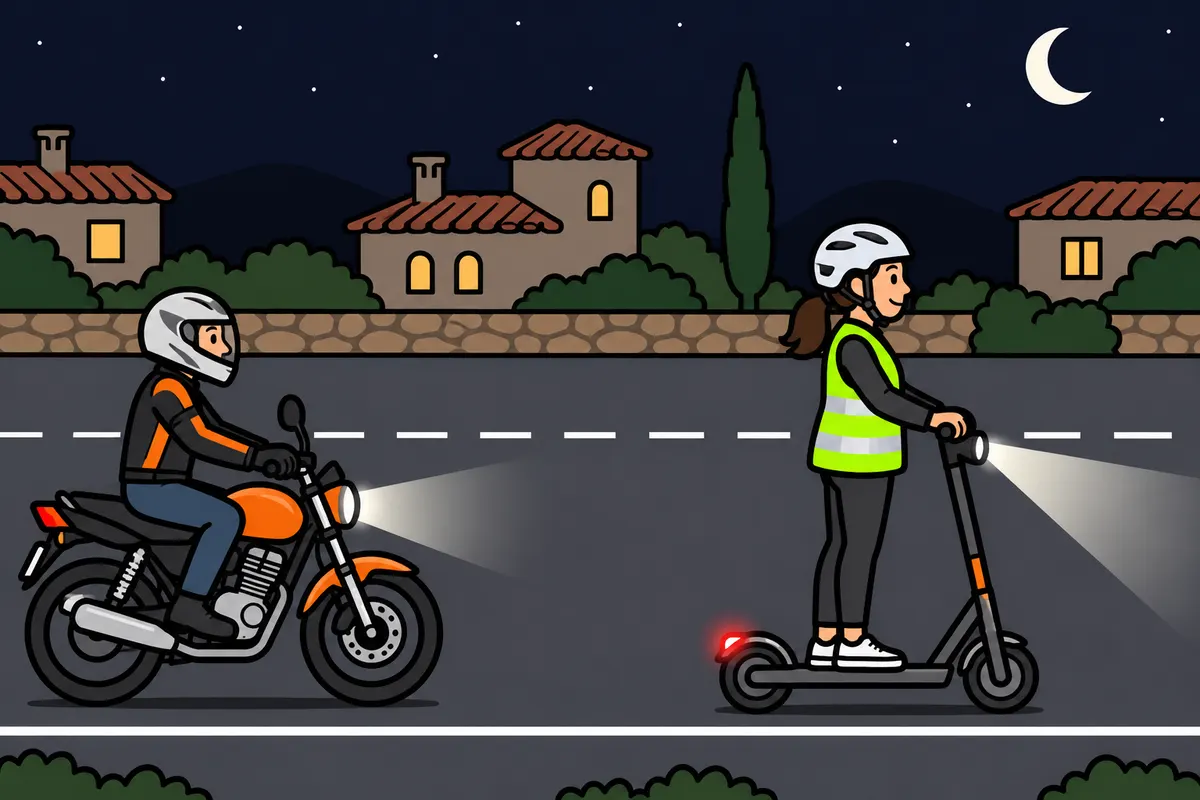
VMP riders must meet age and protection rules; anticipate their presence.
Remember
- VMP riders must wear an approved or certified, properly fastened helmet.
- At night or in reduced visibility, riders need regulation luminous or reflective equipment.
- Riders must signal manoeuvres by arm; leave them room.
- Lights are required at night, in tunnels and in significantly reduced visibility.
- Professional VMP riders must wear a high-visibility reflective vest on every road.
- Reduced-mobility VMP users at walking pace count as pedestrians.
Exam trap: Wrong: VMP daytime lights are already always required. Right: they become compulsory one year after 1 October 2026. Lights are already required at night, in tunnels and in significantly reduced visibility.
Read the full explanation
- A VMP rider must be at least 15 years old. [RGC, art. 155.3](https://www.boe.es/buscar/act.php?id=BOE-A-2003-23514#a155) By regulatory definition, these vehicles have one seat. [RGV, Annex II](https://www.boe.es/buscar/act.php?id=BOE-A-1999-1826#anii) Treat someone riding one as a driver and distinguish them from someone walking while pushing it.
- A VMP rider must wear an approved or certified helmet, fastened correctly. At night or when visibility is significantly reduced, they must also use a regulation-compliant luminous or reflective item visible from at least 150 metres. Anticipate their presence even if they are not carrying these items. [RGC, art. 118](https://www.boe.es/buscar/act.php?id=BOE-A-2003-23514#a118) [RGC, art. 155, RD 518/2026](https://www.boe.es/buscar/doc.php?id=BOE-A-2026-13889)
- A VMP rider must signal manoeuvres with an arm and use lights at night, in tunnels and when visibility is significantly reduced. Daytime lights under article 155.5 are required from one year after 1 October 2026, the date RD 518/2026 comes into force, under its third transitional provision. Watch their signals and leave room for them to signal without losing their balance. [RGC, arts. 98 and 155.4-5](https://www.boe.es/buscar/act.php?id=BOE-A-2003-23514) [RD 518/2026, third transitional provision and third final provision](https://www.boe.es/buscar/doc.php?id=BOE-A-2026-13889)
- A person with reduced mobility who uses a VMP at walking pace is considered a pedestrian for the purposes of the regulations. This status depends on reduced mobility and travelling at walking pace; simply travelling slowly does not qualify. [RGC, art. 155, RD 518/2026](https://www.boe.es/buscar/doc.php?id=BOE-A-2026-13889)
- Anyone working professionally while riding a VMP must wear a high-visibility reflective vest on any road. Keep a safe clearance from them even if they are not wearing a conspicuous garment. [RGC, art. 118.4](https://www.boe.es/buscar/act.php?id=BOE-A-2003-23514#a118) [RGC, art. 85](https://www.boe.es/buscar/act.php?id=BOE-A-2003-23514#a85)
25VMPs: roads, attention and identification
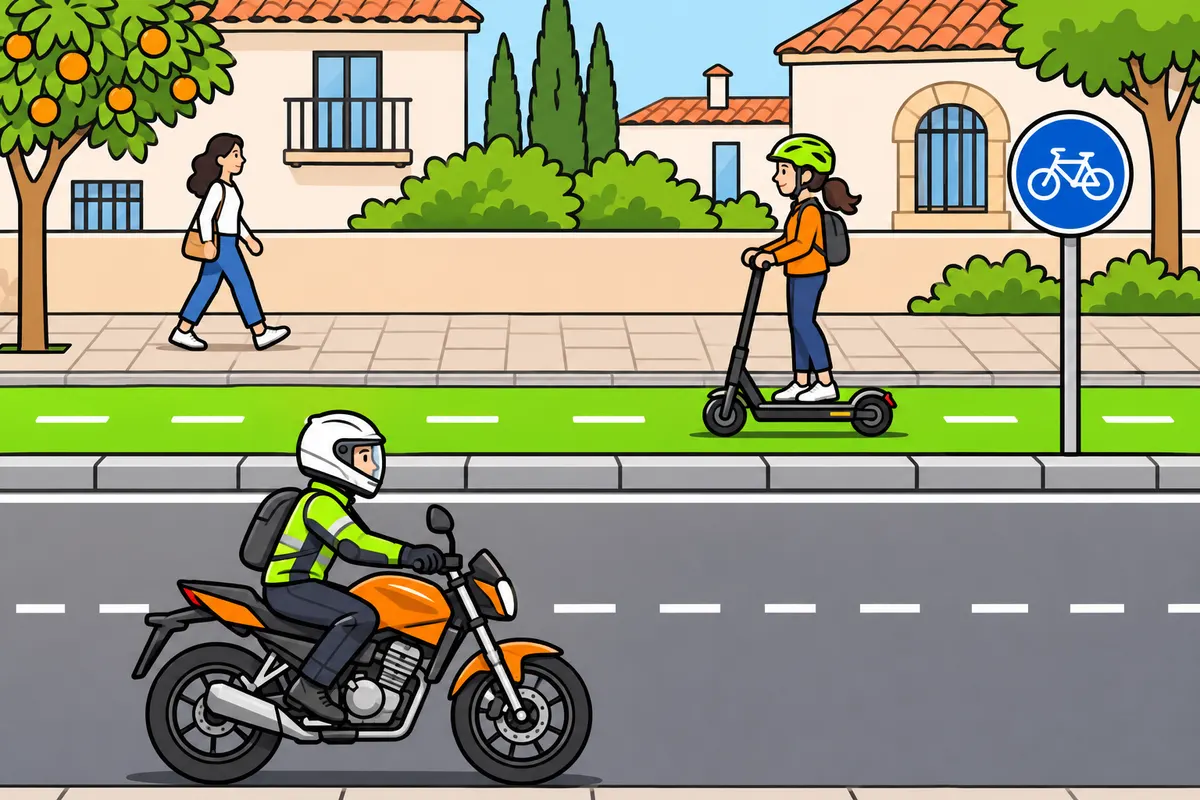
VMP riders must use authorised roads; expect them on these routes.
| Road for VMPs | Rule |
|---|---|
| Autopistas, autovías, travesías and pavements | Prohibited |
| Interurban roads and urban tunnels | Prohibited, except legal exceptions without prohibitory signs |
| Legal exceptions | Cycle routes, cycle lanes, protected cycle lanes, cycle tracks, cycle paths and roads closed to motor vehicles |
| Other pedestrian areas | Local bylaws apply; pedestrians have priority |
Remember
- VMPs cannot use pavements, autopistas, autovías or travesías.
- In other pedestrian areas, follow local bylaws and give pedestrians priority.
- VMP riders must not use phones or headphones while riding.
- They must take alcohol and drug tests when legally required.
- A VMP needs a registration certificate, identification label and compulsory insurance.
- Technical certification is a separate procedure.
Exam trap: Wrong: urban tunnels are always forbidden to VMPs. Right: legal exceptions cover cycle routes and roads closed to motor vehicles, unless signs prohibit VMPs.
Read the full explanation
- VMPs (personal mobility vehicles) may not be ridden on autopistas (motorways), autovías (dual carriageways) or travesías (through roads in built-up areas). They are also prohibited on interurban roads and in urban tunnels, except on cycle routes, cycle lanes, protected cycle lanes, cycle tracks, cycle paths and roads closed to motor vehicles where the signs do not prohibit them. You must expect to encounter them on authorised routes. [RGC, art. 38](https://www.boe.es/buscar/act.php?id=BOE-A-2003-23514#a38)
- VMPs may not be ridden on pavements. Local by-laws apply in other pedestrian areas, where VMP riders must give priority to pedestrians. The municipality also regulates the use of skates and skateboards. You must watch for crossings of these routes when manoeuvring. [RGC, art. 152, RD 518/2026](https://www.boe.es/buscar/doc.php?id=BOE-A-2026-13889) [RGC, art. 155, RD 518/2026](https://www.boe.es/buscar/doc.php?id=BOE-A-2026-13889)
- A VMP rider may not use a mobile phone or headphones while riding and must take alcohol and drug tests in the cases provided for by law. You must take care in case the rider is distracted. [LTSV, arts. 13 and 14](https://www.boe.es/buscar/act.php?id=BOE-A-2015-11722)
- To be used on the road, a VMP must have a registration certificate, an identification label and compulsory insurance. Its technical certification is a separate procedure. This category is defined by exclusively electric propulsion and a maximum design speed of between 6 and 25 km/h; you must anticipate the difference in speed compared with your motorcycle. [DGT, VMP](https://www.dgt.es/nuestros-servicios/tu-vehiculo/vehiculos-de-movilidad-personal-vmp/)
26Horse riders, animals and livestock
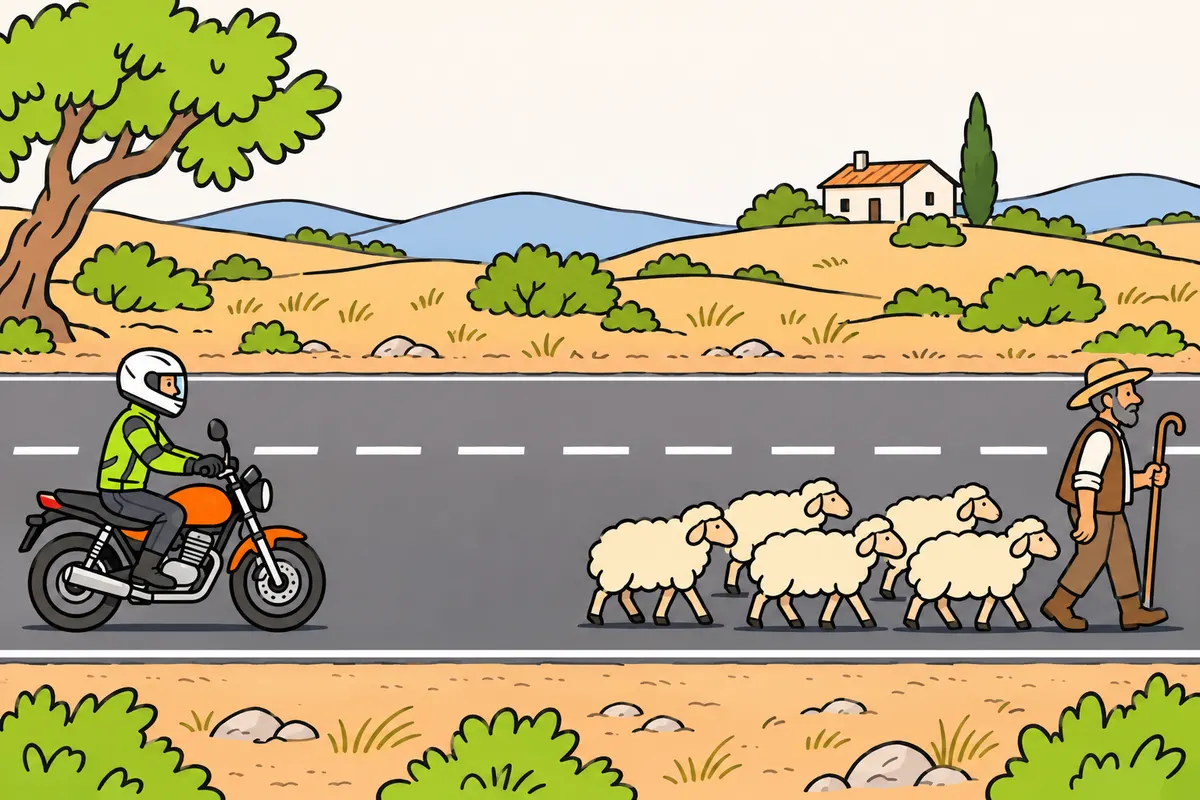
Slow down near animals and give way where the rules require.
| Situation with animals | Your action on a motorcycle |
|---|---|
| Signed livestock crossing | Give way |
| Turning into a road animals cross | Give way |
| Crossing their shoulder without a livestock track | Give way |
| Other narrow sections and junctions | Animal handlers give way, except where animals have priority |
Remember
- Animals need supervision and may use roads only without a usable livestock route.
- They must use the alternative with the least traffic.
- They must use the right shoulder or stay near the right edge.
- A lone animal may use the left if safer.
- Herds must walk in separate groups, each with a handler.
- Animals must not use autopistas or autovías.
Exam trap: Wrong: animals have priority at every junction. Right: give way at signed livestock crossings, when turning into roads they cross, and when crossing their shoulder without a livestock track.
Read the full explanation
- Draught, pack and riding animals, and livestock, may use these roads only if there is no practicable route along a livestock track. They must be under supervision and use the alternative with the least traffic. They must be led by at least one person over 18 who can control them. You must expect to encounter them on rural roads. [RGC, art. 126](https://www.boe.es/buscar/act.php?id=BOE-A-2003-23514#a126) [RGC, art. 127](https://www.boe.es/buscar/act.php?id=BOE-A-2003-23514#a127)
- Animals must use the right-hand arcén (hard shoulder) or travel close to the right edge of the carriageway, without entering pedestrian areas. A lone animal may travel along the left edge if that is safer. Herds must walk and stay within the right half of the carriageway. You must allow for the space they occupy as you approach. [RGC, art. 127](https://www.boe.es/buscar/act.php?id=BOE-A-2003-23514#a127)
- Herds must be divided into reasonably sized groups, with enough space between them and at least one person leading each group. At night, when lighting is insufficient, or when visibility is reduced, their handlers must carry white or yellow lights at the front and red lights at the rear, near the centre of the carriageway. Animals must not be left unsupervised if they could enter the road. You must also watch the verges. [RGC, art. 127](https://www.boe.es/buscar/act.php?id=BOE-A-2003-23514#a127)
- As a motorcyclist, you must slow down around animals and give way to them on signed livestock tracks, when turning into a road they are crossing, and when crossing a hard shoulder they are using where there is no livestock track. Animals and animal-drawn vehicles may not use autopistas or autovías. [RGC, arts. 66 and 128](https://www.boe.es/buscar/act.php?id=BOE-A-2003-23514#a66) [RGC, art. 127](https://www.boe.es/buscar/act.php?id=BOE-A-2003-23514#a127)
- Anyone leading animals must cross at authorised and signed crossings, or at other points where the necessary safety conditions are met. At narrow sections and junctions, they must give way to vehicles, except in the cases where animals have priority under article 66. You must watch the horse rider's path and wait if you cannot pass safely. [RGC, art. 127](https://www.boe.es/buscar/act.php?id=BOE-A-2003-23514#a127)
27Your motorcycle near spaces used by vulnerable people
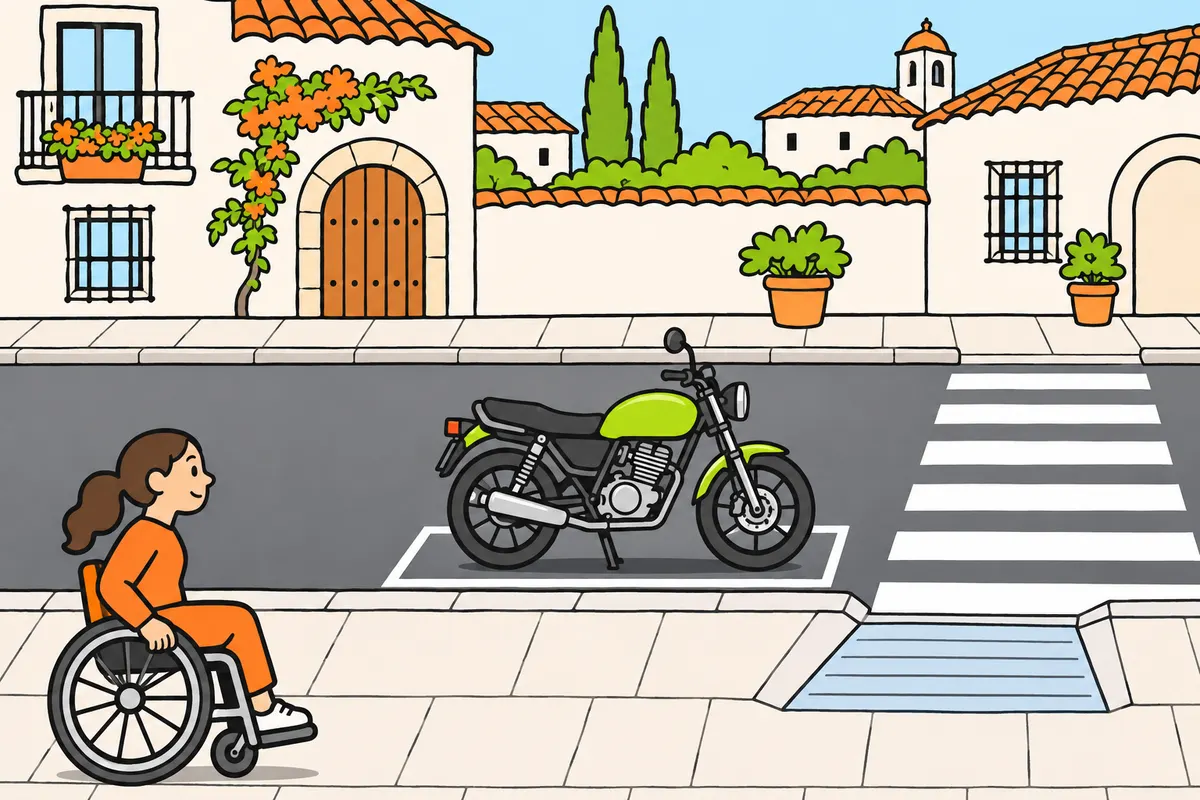
Keep pedestrian spaces clear and follow special permissions when riding your motorcycle.
| Case for your motorcycle | Conditions |
|---|---|
| Parking in pedestrian spaces | Local rules may allow it without obstructing movement, especially for disabled people or people with reduced mobility |
| Shoulder exceptionally opened to motorcycles | Agreed, signed section; lanes stopped by congestion; single file; maximum 30 km/h |
Remember
- Check local bylaws and signs before parking in pedestrian spaces.
- Generally, do not park on pavements, promenades or pedestrian spaces.
- Do not stop or park on pedestrian or cycle crossings.
- Do not block dropped kerbs or pedestrian access.
- Use specially opened motorcycle shoulders only on officially designated, signed sections.
- At organised cycle rides, follow authorised staff and traffic controls.
Exam trap: Wrong: use any shoulder when traffic stops. Right: it needs signed authorisation. Ride single file at no more than 30 km/h, protect shoulder users and leave if necessary.
Read the full explanation
- As a general rule, you may not park on pavements, promenades or pedestrian areas. The municipality may regulate stopping and parking two-wheeled vehicles there, provided this does not obstruct movement, especially for people with disabilities or reduced mobility. You must check the local by-law and the specific signs. [RGC, art. 94](https://www.boe.es/buscar/act.php?id=BOE-A-2003-23514#a94) [RGC, art. 156, RD 518/2026](https://www.boe.es/buscar/doc.php?id=BOE-A-2026-13889)
- You may not stop or park on pedestrian or cycle crossings, or block dropped kerbs or pedestrian access points. The fact that your motorcycle takes up little space or that you stay nearby does not justify obstructing a wheelchair user's route or forcing anyone to step down into the carriageway. [RGC, arts. 91 and 94](https://www.boe.es/buscar/act.php?id=BOE-A-2003-23514#a91) [RGC, art. 156, RD 518/2026](https://www.boe.es/buscar/doc.php?id=BOE-A-2026-13889)
- If you use a hard shoulder exceptionally opened to motorcycles while the lanes are stopped by congestion, you must ride in single file at no more than 30 km/h. You must protect those required to use it and leave it if necessary. The authorisation requires an agreed and signed section. [RGC, art. 36.3](https://www.boe.es/buscar/act.php?id=BOE-A-2003-23514#a36)
- If you encounter an organised cycling event, you must obey the traffic control and instructions from authorised personnel. Organised events involving more than 50 cyclists for sporting, tourist or cultural purposes require prior authorisation. You must not confuse them with any informal group of cyclists. [RGC, art. 55 and Annex II, section 2](https://www.boe.es/buscar/act.php?id=BOE-A-2003-23514#anii)
Approaching a pedestrian crossing
Observe, slow down and give way before crossing a pedestrian’s path.
- Identify the crossing, traffic lights and people approaching it.
- Slow down in good time and check areas hidden by other vehicles.
- Stop your motorcycle if you must give way; do not block the pedestrian’s route.
- Continue when the crossing is clear and the signs allow you to proceed.
Overtaking a cyclist on your motorcycle
Decide based on the space available, visibility and conditions on the stretch of road.
- Check for prohibitions and make sure nobody has started an incompatible manoeuvre.
- Allow at least 1.5 metres of lateral clearance and use the adjacent lane; where there is more than one lane in your direction, change lanes completely.
- Outside built-up areas, travel at least 20 km/h below the speed limit before you start and throughout the manoeuvre.
- Wait if you could impede oncoming traffic, including anyone riding on the hard shoulder.
- Pass the whole group and return gradually without cutting across its path.
Crossing a road on foot
Having priority must go together with checking that it is safe.
- Look for an authorised crossing and obey the traffic officer or traffic lights.
- Check the distance and speed of vehicles before entering the road.
- Cross straight across without delay or unnecessary stops.
- At a square or roundabout, go around the carriageway unless there is an authorised pedestrian crossing.
Finished this module?
Mark it as read and you will see your progress on the theory list.