
Theory · A1 Licence - 125 cc Motorcycle · Module 8 of 18
Motorcycle lights and signals
You learn to choose your motorcycle lighting during the day, at night, in tunnels and in poor visibility without dazzling others. You distinguish compulsory and optional lights, manoeuvre and emergency signals, and the plates you must recognise to answer A1 exam questions.
1Seeing, being seen and giving warnings
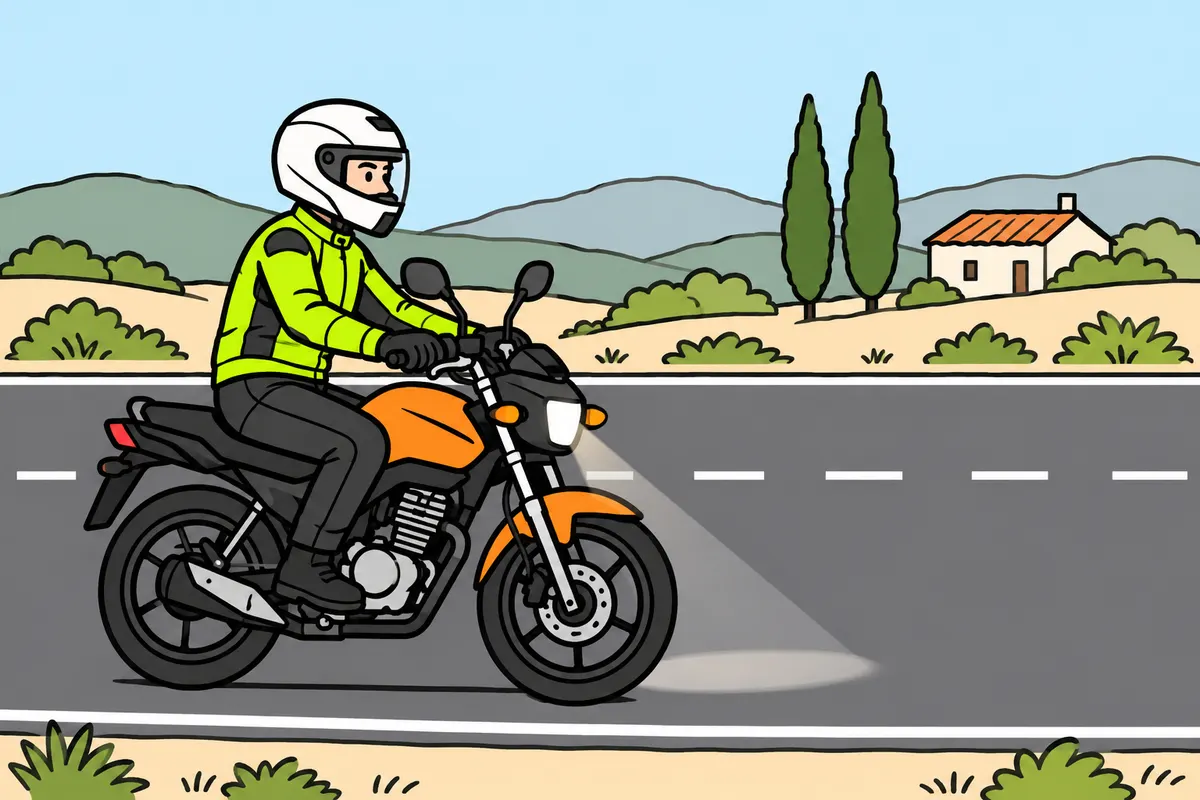
Use your lights to see, be seen and warn others.
Remember
- Use the right lights from sunset to sunrise.
- Choose your lights for the road and its lighting.
- Having a light fitted does not mean you can always use it.
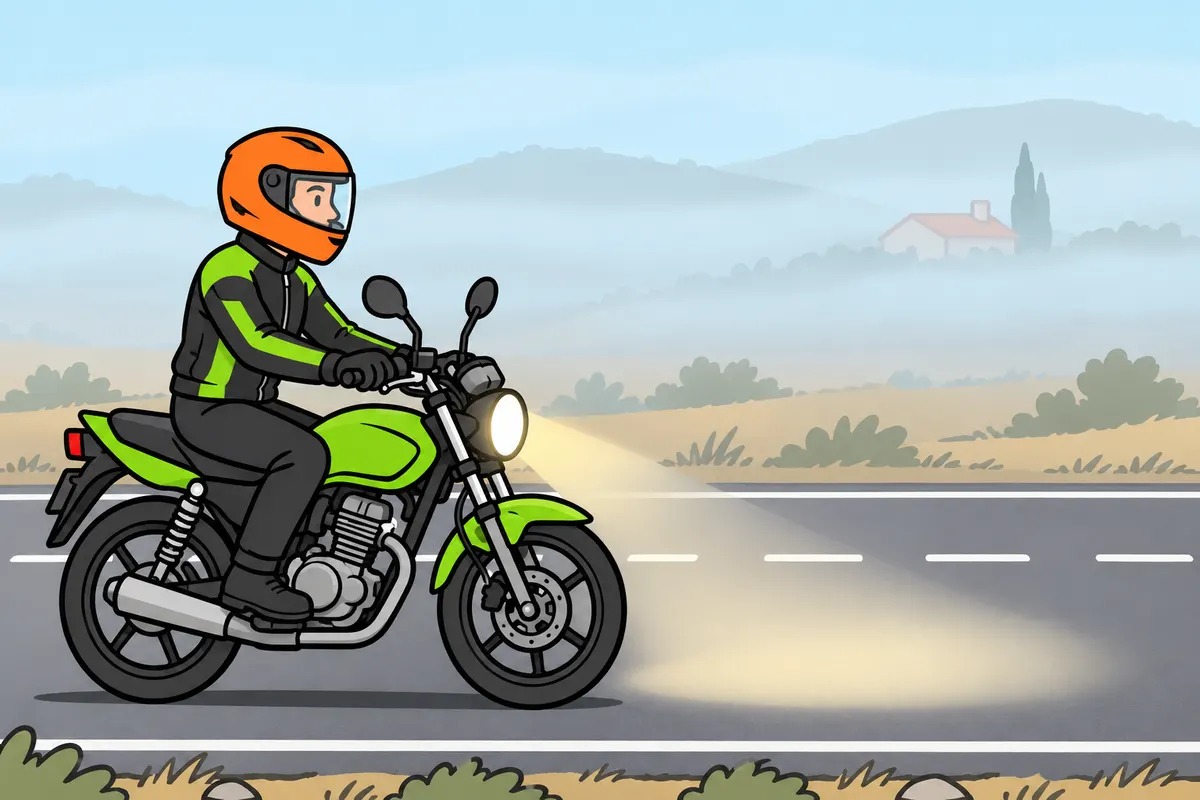
- Make your motorcycle visible when visibility is poor.
Exam trap: Wrong: use fog lights whenever you have them. Right: use them only in permitted conditions.
Read the full explanation
- Your lights serve three purposes: illuminating the carriageway so you can see, showing your presence so others can see you, and signalling a manoeuvre or hazard. On your motorcycle, dipped beam and main beam illuminate the road ahead; position lights, brake lights and indicators convey different information. [RGV, art. 16](https://www.boe.es/buscar/act.php?id=BOE-A-1999-1826#a16).
- You must distinguish between the rules requiring a device to be fitted and those requiring you to switch it on. You may have optional fog lights, but you may only use them in the circumstances allowed by the regulations. Likewise, your motorcycle must have main beam, although you must ride with dipped beam when circumstances require it. [RGV, art. 17](https://www.boe.es/buscar/act.php?id=BOE-A-1999-1826#a17). [RGC, art. 101](https://www.boe.es/buscar/act.php?id=BOE-A-2003-23514#a101).
- You must use the appropriate lights from sunset to sunrise. Your choice depends on the type of road and its lighting, as explained in the sections on dipped beam and main beam. [RGC, art. 98](https://www.boe.es/buscar/act.php?id=BOE-A-2003-23514#a98)
- Your lights also allow you to warn others of your presence in poor visibility. The conditions for using front and rear fog lights differ and are explained in their respective sections. [RGC, art. 106](https://www.boe.es/buscar/act.php?id=BOE-A-2003-23514#a106)
2Equipment on a motorcycle without a sidecar
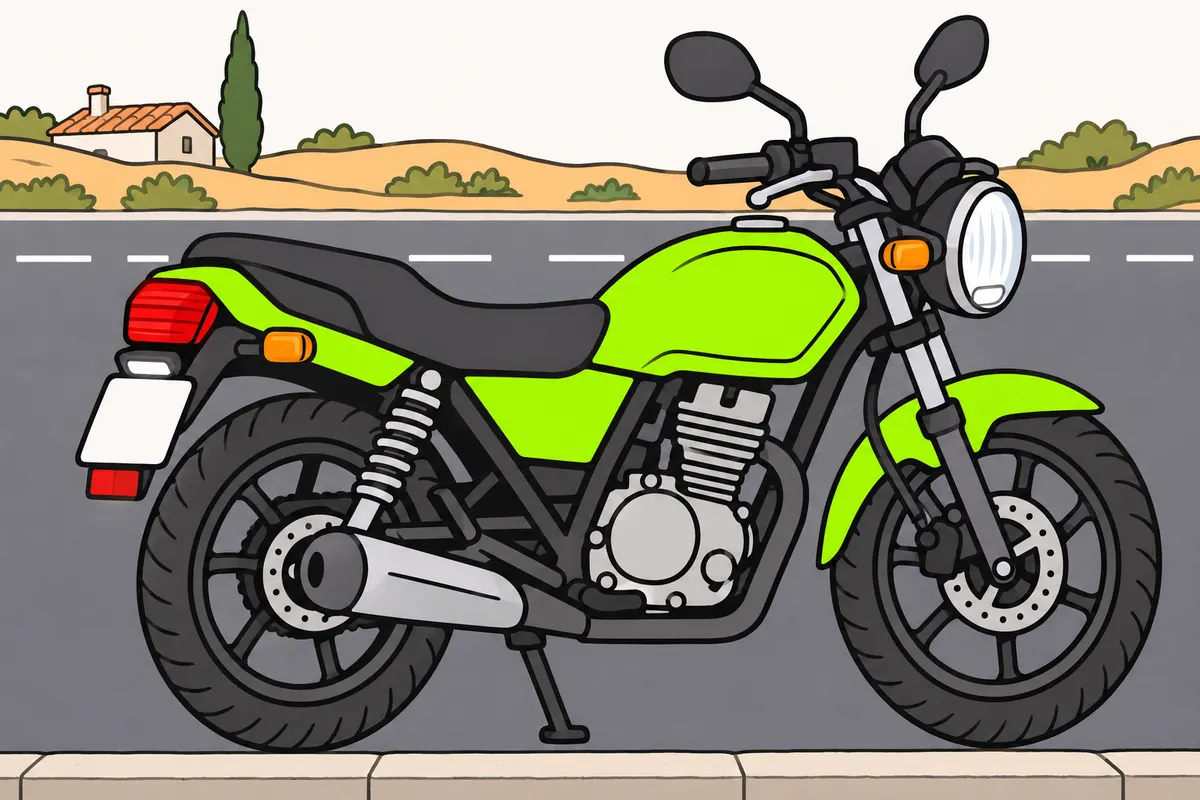
Keep the lights required by your motorcycle’s type approval.
| Equipment: motorcycle without sidecar | What you need to recognise |
|---|---|
| Dipped beam and main beam | White; one or two lights for each function |
| Indicators | Two front and two rear; check the rules for motorcycles made before the date shown |
| Extra S3 brake light | Allowed under UN Regulation 53 |
Remember
- You need dipped/main beam, brake lights, position lights and rear number plate lighting.
- You also need the reflector described in “Reflectors and side visibility”.
- Recognise your indicators by their amber colour.
- Check your model’s type approval before changing its equipment.
Exam trap: Wrong: remove any equipment listed as optional. Right: keep equipment required by your motorcycle’s type approval.
Read the full explanation
- Your motorcycle must have dipped beam, main beam, brake lights, rear number plate lighting, front and rear position lights, and the reflector described in «Reflectors and side visibility». The table for your motorcycle without a sidecar does not include end-outline marker lamps, parking lights or reversing lights. [RGV, art. 16 and Annex X](https://www.boe.es/buscar/act.php?id=BOE-A-1999-1826#a16)
- You can identify one or two white dipped-beam lights and one or two white main-beam lights. Two front lamp units may perform different functions; check the controls and lighting layout on your model. [RGV, Annex X](https://www.boe.es/buscar/act.php?id=BOE-A-1999-1826#anx)
- You can identify the direction indicators as two at the front and two at the rear, all amber. Annex X makes them compulsory for motorcycles from 1 November 1999; for a motorcycle manufactured earlier, you must follow the rules and type approval applicable to it. [RGV, Annex X](https://www.boe.es/buscar/act.php?id=BOE-A-1999-1826#anx).
- You must retain the equipment required by your model's type approval. The general table and the type-approval regulations complement each other: UN Regulation 53 allows an additional category S3 brake light. You can find details of reflectors in «Reflectors and side visibility» and daytime running lights in «Daytime running lights and automatic systems». [RGV, art. 17 and Annex X](https://www.boe.es/buscar/act.php?id=BOE-A-1999-1826#a17). [UN Regulation 53, paras. 5.14-5.17](https://www.boe.es/buscar/doc.php?id=DOUE-L-2020-80040).
3Position lights: presence and width
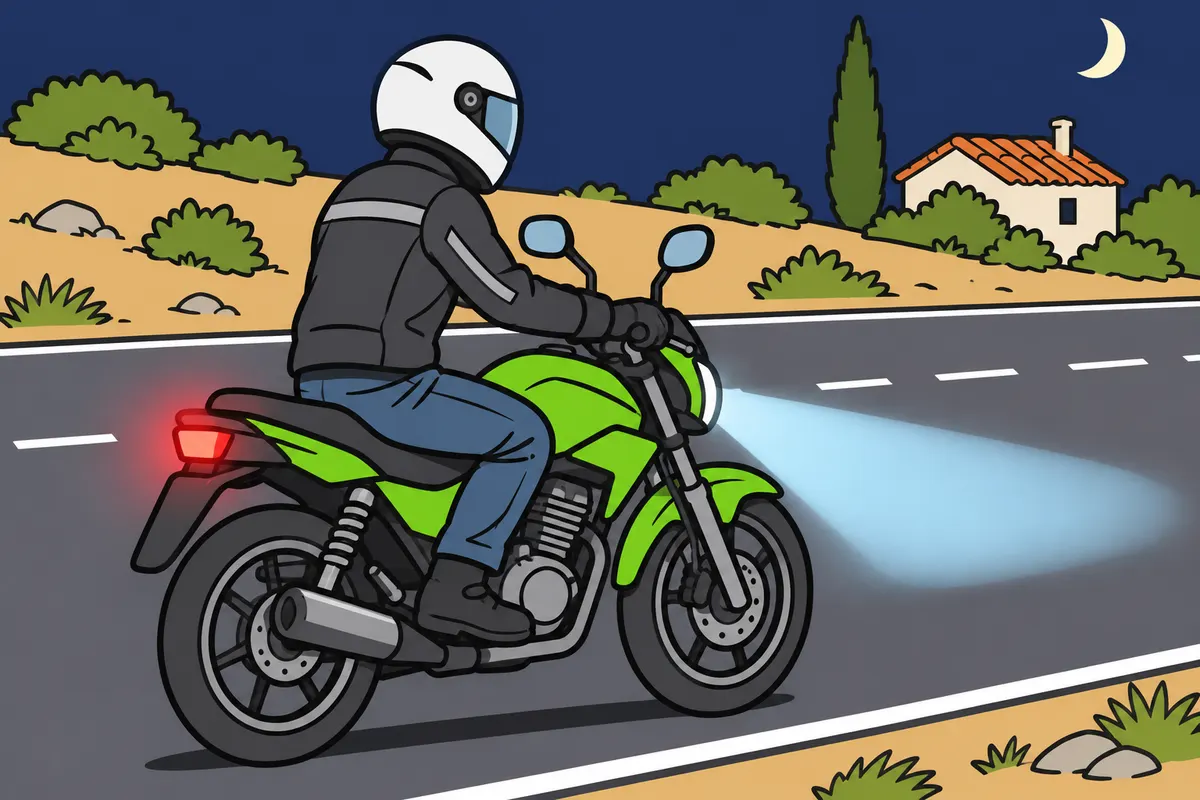
Use position lights to show your presence and width, alongside the right driving lights.
| Your vehicle’s position lights | Colour |
|---|---|
| Front | White or amber |
| Rear | Red |
Remember
- Switch on position lights at night, in tunnels and in underpasses.
- Also use them when visibility is greatly reduced.
- Add the driving lights needed for the situation.
- When switching on position lights, also check rear position lights and number plate lighting.
Exam trap: Wrong: ride at night using only position lights. Right: use the appropriate driving lights too.
Read the full explanation
- You use position lights to make your vehicle's presence and width visible. You may have one or two white or amber lights at the front and one or two red lights at the rear; a type-approved amber position light serves a different purpose from an indicator. [RGV, Annex X](https://www.boe.es/buscar/act.php?id=BOE-A-1999-1826#anx)
- You must keep your position lights on when riding at night, going through tunnels or underpasses, or in conditions that significantly reduce visibility. You must not ride in these circumstances using only position lights: you also need the appropriate lights for riding in that situation. [RGC, art. 99](https://www.boe.es/buscar/act.php?id=BOE-A-2003-23514#a99). [RGC, art. 101](https://www.boe.es/buscar/act.php?id=BOE-A-2003-23514#a101).
- With equipment type-approved under UN Regulation 53, you switch the front position lights, rear position lights and number plate lighting on and off together through linked connections, subject to the exceptions provided for other functions. When you operate the position-light control, you must also check the rear: seeing a light at the front does not prove that the rear light works. [UN Regulation 53, para. 5.10](https://www.boe.es/buscar/doc.php?id=DOUE-L-2020-80040).
4Dipped beam during the day too
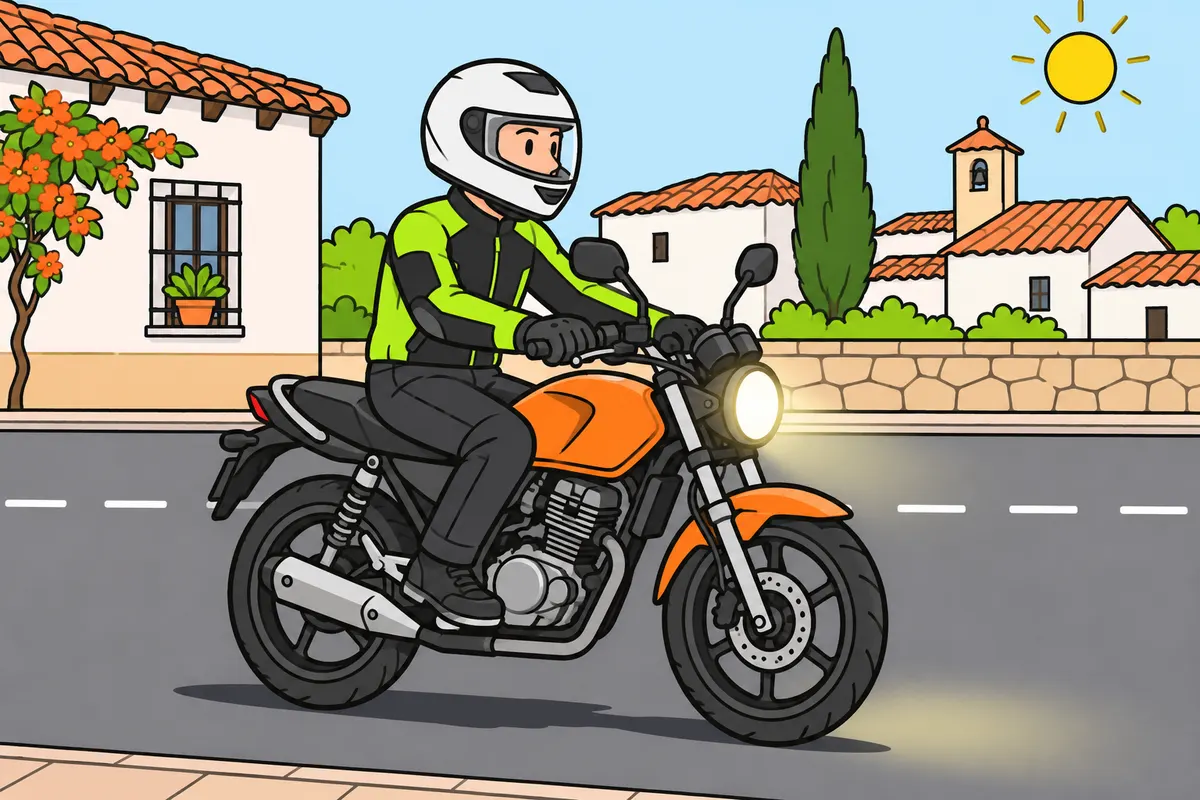
Keep dipped beam on during the day when riding your motorcycle on any road.
Remember
- Use dipped beam even in sunshine and good visibility.
- Use it in towns, on ordinary roads, motorways and dual carriageways.
- Daytime running lights do not replace dipped beam for this requirement.
Exam trap: Wrong: daytime dipped beam is only needed outside built-up areas. Right: use it on your motorcycle on every road.
Read the full explanation
- You must keep your dipped-beam headlight on during the day when riding a motorcycle on any road subject to traffic legislation. The rule in article 104 covers urban roads, other roads, autopistas (motorways) and autovías (dual carriageway highways), even in sunshine and good visibility. You cannot use daytime running lights instead of dipped beam to meet this requirement. [RGC, art. 104](https://www.boe.es/buscar/act.php?id=BOE-A-2003-23514#a104).
- With dipped beam, you illuminate the road ahead of your motorcycle with a beam designed to avoid causing discomfort or dazzling oncoming traffic and other road users. You can distinguish it from lights mainly intended to show your presence by its purpose of lighting the carriageway. [RGV, Annex X.1.2](https://www.boe.es/buscar/act.php?id=BOE-A-1999-1826#anx).
5Daytime running lights and automatic systems
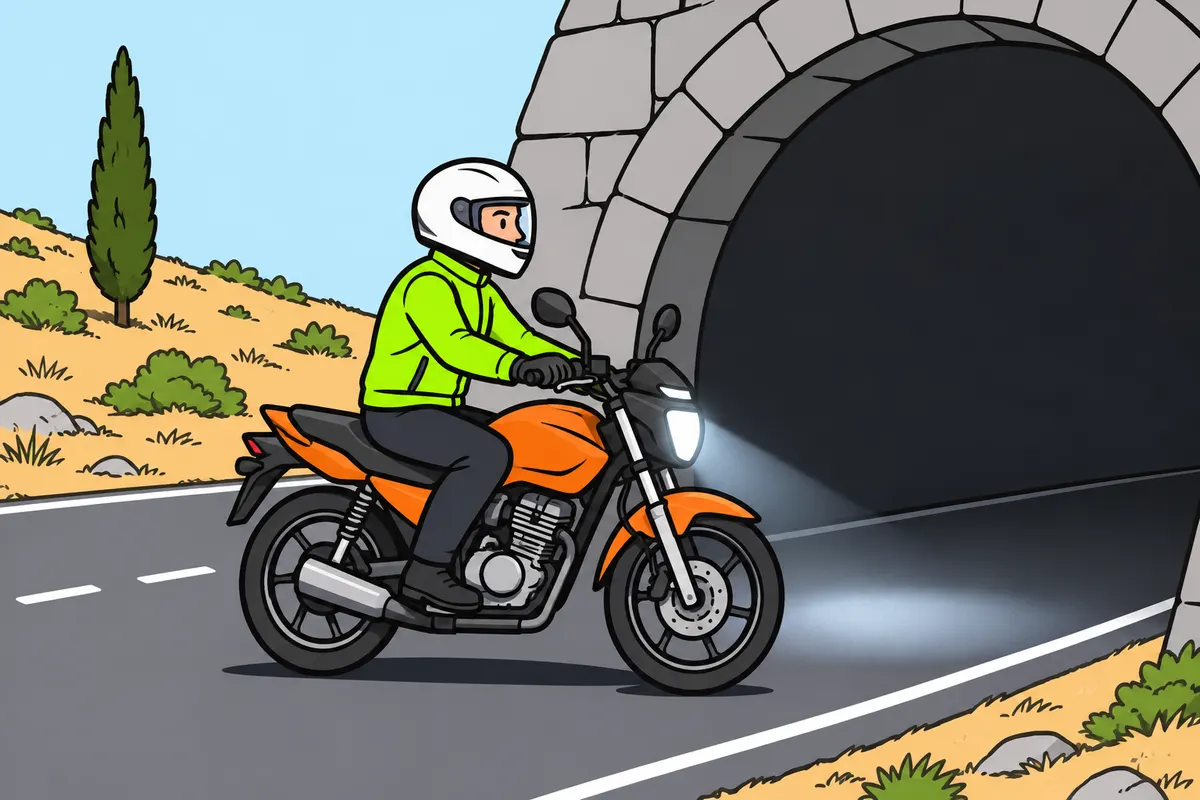
Check which lights are on, even when your motorcycle switches them on automatically.
| Situation: motorcycle with this type approval | What happens to the lights |
|---|---|
| Daytime running lights on | Rear position lights also come on; front position lights and number plate lighting may operate separately or together |
| Daytime running light sharing its light surface with an indicator | That side’s daytime running light stays off throughout the indicator cycle, including between flashes |
Remember
- Daytime running lights make your motorcycle visible during the day.
- Check that the required lights work before entering a dark area.
- Recognise white front daytime running lights; fitting them is optional.
- With this type approval, daytime running lights switch off when you switch headlights on.
- When you flash your headlights, daytime running lights may stay on.
Exam trap: Wrong: automatic lights need no checks. Right: check that the required lights are working.
Read the full explanation
- You can identify daytime running lights by their purpose of making your motorcycle visible during the day: type-approval rules provide for one or two optional white lights at the front. Your rear position lights must come on with them; the front position lights and number plate lighting may come on separately or together. These connections describe the type-approved equipment; you can find the rules for choosing your riding lights during the day in «Dipped beam during the day too». [UN Regulation 53, paras. 5.13 and 6.13.1-2 and 6.13.7.1](https://www.boe.es/buscar/doc.php?id=DOUE-L-2020-80040).
- Check which lights are actually on even if your motorcycle activates them automatically: with an automatic setting or darkness sensor, you need to check that the required light is working before entering a dark area. [RGC, art. 98](https://www.boe.es/buscar/act.php?id=BOE-A-2003-23514#a98) [RGC, art. 101](https://www.boe.es/buscar/act.php?id=BOE-A-2003-23514#a101)
- On a motorcycle type-approved under these provisions of UN Regulation 53, the daytime running light switches off automatically when you switch on the headlights, except when you use them to flash. If you notice this change when you operate the control, it reflects the intended operation of the equipment's connections. [UN Regulation 53, para. 6.13.7.1](https://www.boe.es/buscar/doc.php?id=DOUE-L-2020-80040).
- When you have a daytime running light reciprocally incorporated with a direction indicator, the daytime running light on that side must remain off throughout the indicator's operating cycle, including the intervals between flashes. You may notice it switching off without this indicating a fault: it allows others to see the direction signal clearly. [UN Regulation 53, para. 6.13.7.3](https://www.boe.es/buscar/doc.php?id=DOUE-L-2020-80040).
6Dipped beam at night and in built-up areas
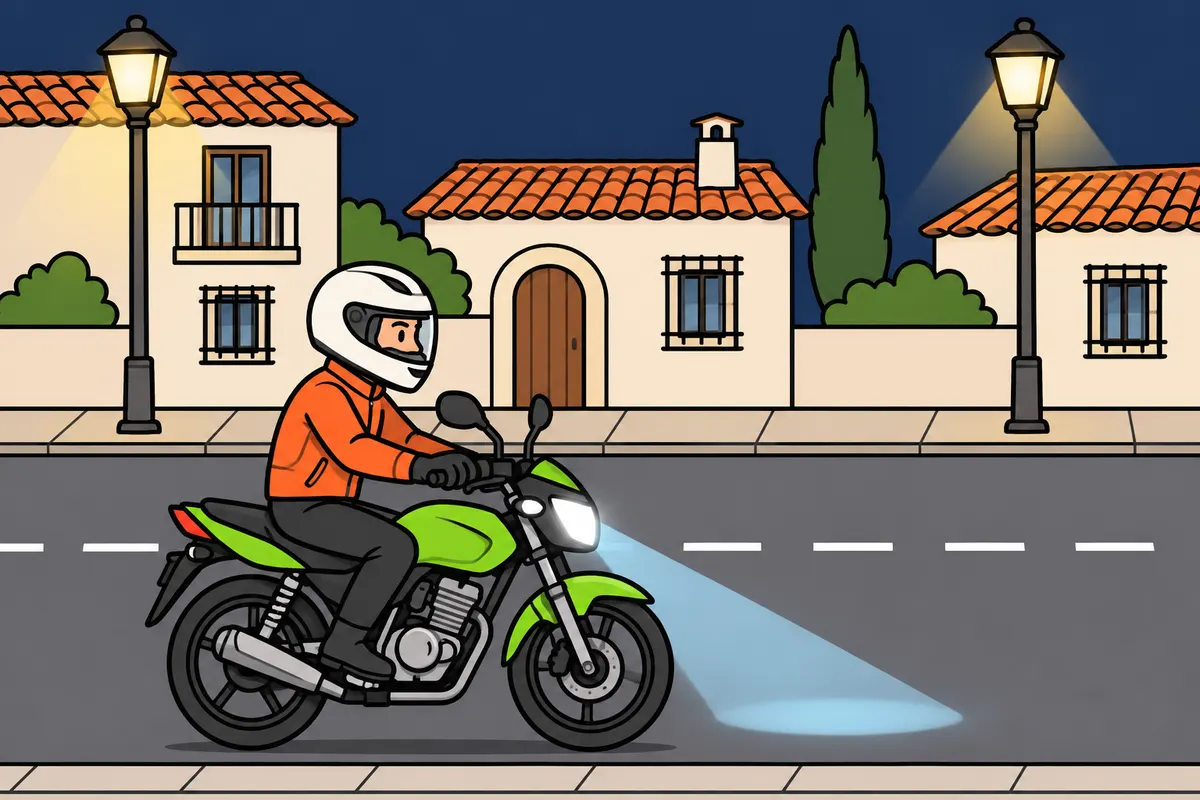
At night, choose dipped beam according to lighting, location and the risk of dazzle.
| Situation when riding your motorcycle | Lights you must use |
|---|---|
| At night, well-lit road | Position lights and dipped beam |
| At night, poorly lit road in a built-up area | Dipped beam |
| Poor lighting: outside built-up areas at night, or tunnels and underpasses at any time | Dipped beam if you have no main beam, although your motorcycle must have it |
| Same poorly lit situations, up to 40 km/h | Dipped beam if you are not using main beam |
| Same poorly lit situations, risk of dazzle | Dipped beam |
Remember
- Use position lights and dipped beam even when street lights let you see well.
- In built-up areas, use dipped beam on dark streets too.
- Outside built-up areas, dip your headlights if you could dazzle others.
Exam trap: Wrong: a dark street needs main beam. Right: use dipped beam within built-up areas.
Read the full explanation
- You must use position lights and dipped beam at night on sufficiently lit urban and interurban roads, even if the street lights allow you to see without difficulty. [RGC, art. 101](https://www.boe.es/buscar/act.php?id=BOE-A-2003-23514#a101)
- Within built-up areas, you must also use dipped beam when the road is insufficiently lit. You need the same riding lights on a dark street as elsewhere in the built-up area. [RGC, art. 101](https://www.boe.es/buscar/act.php?id=BOE-A-2003-23514#a101)
- At night on insufficiently lit interurban roads, and at any time in insufficiently lit tunnels or underpasses, you must use dipped beam in the three circumstances set out in article 101.2: if you have no main beam; if you ride at a speed no greater than 40 km/h without using main beam; or if you could dazzle other road users. The general rule includes having no main beam, although your motorcycle must have it as compulsory equipment. [RGC, art. 101.2](https://www.boe.es/buscar/act.php?id=BOE-A-2003-23514#a101).
7When you must use main beam
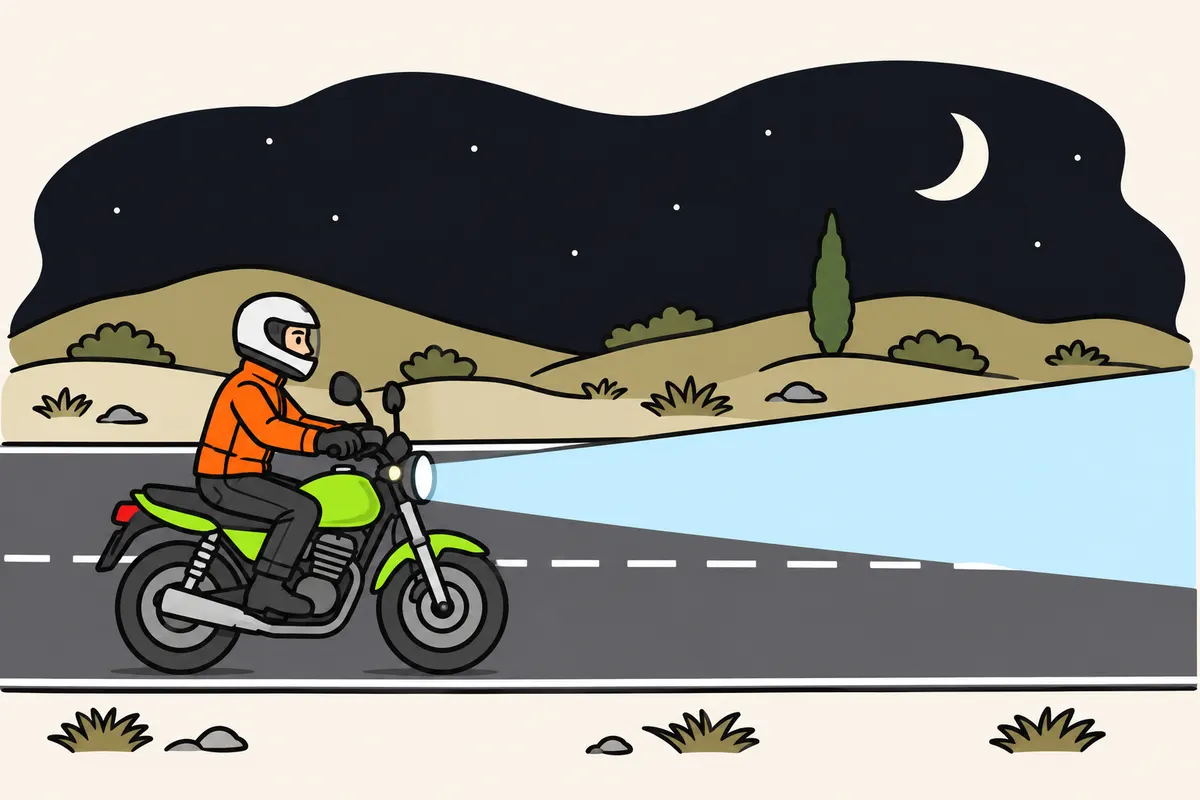
Use main beam when all required conditions apply, unless you must dip your headlights.
| With normal vision, anywhere on the carriageway | How you recognise insufficient lighting |
|---|---|
| You cannot read a number plate at 10 m | This condition alone is enough |
| You cannot distinguish a dark vehicle at 50 m | This condition alone is enough |
Remember
- The requirement applies at night, outside built-up areas, on poorly lit roads.
- You must also exceed 40 km/h and have no duty to use dipped beam.
- You may use main beam at lower speeds when permitted, without dazzling others.
- Keep position lights on with main beam, whether dipped beam is on or off.
- Do not keep main beam on when stopped or parked.
- Do not alternate main and dipped beam for warnings that are not permitted.
Exam trap: Wrong: exceeding 40 km/h always requires main beam. Right: only at night, outside built-up areas, on insufficiently lit roads, unless you must use dipped beam.
Read the full explanation
- You must switch on main beam at night when you travel at more than 40 km/h, outside built-up areas and on an insufficiently lit road, unless you must use dipped beam, particularly to avoid dazzling others. All three conditions must apply for your speed to determine this obligation. [RGC, art. 100](https://www.boe.es/buscar/act.php?id=BOE-A-2003-23514#a100) [RGV, art. 16](https://www.boe.es/buscar/act.php?id=BOE-A-1999-1826#a16)
- You may use main beam at a speed no higher than 40 km/h in circumstances where its use is permitted and without dazzling others. The threshold of more than 40 determines the obligation described, rather than prohibiting main beam below that speed. [RGC, art. 100](https://www.boe.es/buscar/act.php?id=BOE-A-2003-23514#a100). [RGC, art. 101](https://www.boe.es/buscar/act.php?id=BOE-A-2003-23514#a101).
- You may switch on main beam on its own or together with dipped beam, keeping the position lights on. [RGC, art. 100](https://www.boe.es/buscar/act.php?id=BOE-A-2003-23514#a100) [RGV, art. 15](https://www.boe.es/buscar/act.php?id=BOE-A-1999-1826#a15)
- You must not keep main beam on when your motorcycle is stopped or parked. You must also not alternate between main and dipped beam for any purpose other than permitted warnings. Avoid confusing continuous road illumination with a brief, legally permitted flash to warn of danger. [RGC, art. 100](https://www.boe.es/buscar/act.php?id=BOE-A-2003-23514#a100).
- You can identify a road as insufficiently lit if, with normal vision and at any point on the carriageway, you cannot read a number plate at 10 metres or distinguish a dark vehicle at 50 metres. Either circumstance is sufficient; these are not prescribed distances you wait for before dipping your headlights. [RGC, art. 100](https://www.boe.es/buscar/act.php?id=BOE-A-2003-23514#a100).
8Avoiding dazzle and being dazzled
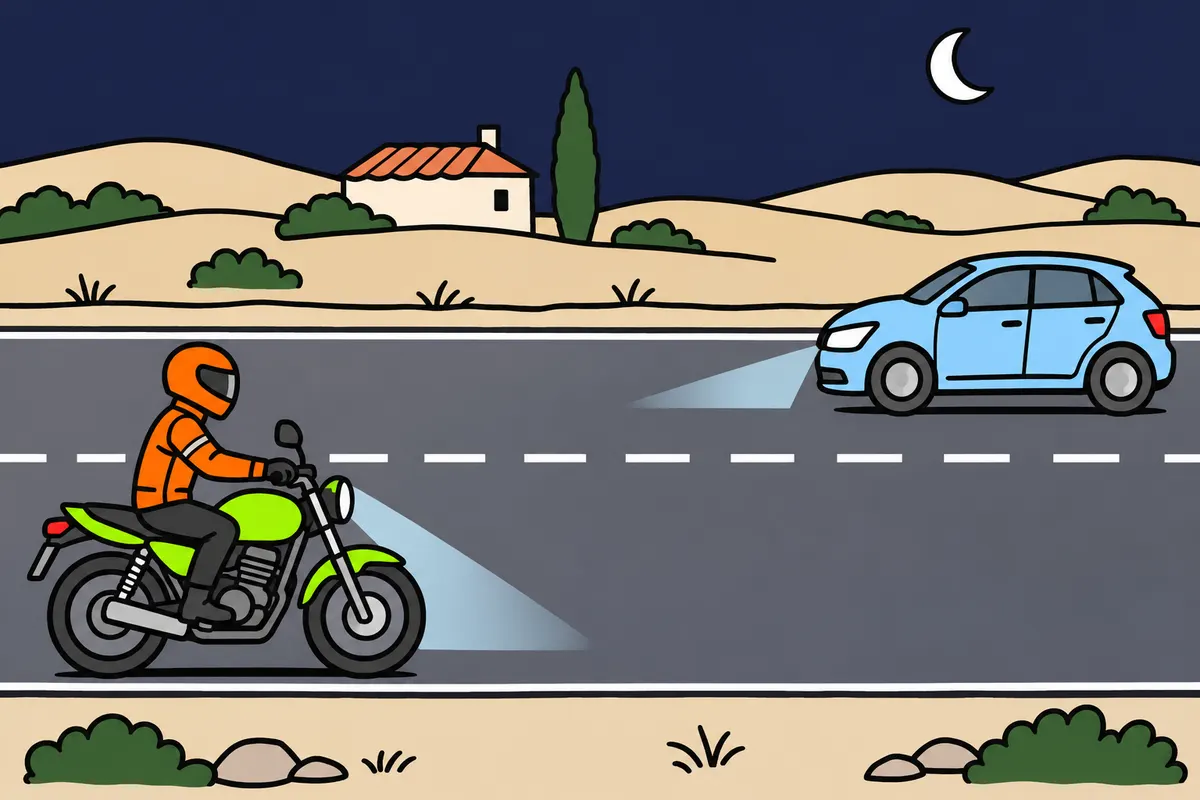
Switch to dipped beam as soon as you could dazzle anyone.
Remember
- Protect people travelling on other routes too.
- Dip your headlights even if the other driver keeps main beam on.
- You can dazzle the driver ahead through their mirrors.
- Separate carriageways on a dual carriageway do not remove this risk.
- If dazzled, slow down; stop if necessary.
- After passing, restore main beam only if you cannot dazzle anyone.
Exam trap: Wrong: wait until a fixed distance before dipping. Right: dip as soon as you could dazzle anyone.
Read the full explanation
- You must replace main beam with dipped beam as soon as you recognise any possibility of dazzling others. You protect users of your road and also those on another transport route. There is no single distance that allows you to keep main beam on until a fixed number of metres in every situation. [RGC, art. 102](https://www.boe.es/buscar/act.php?id=BOE-A-2003-23514#a102).
- When you pass an oncoming vehicle, you must switch to dipped beam even if its driver keeps main beam on. You may restore main beam once you have passed the vehicle, provided you cannot dazzle another road user. [RGC, art. 102](https://www.boe.es/buscar/act.php?id=BOE-A-2003-23514#a102)
- You must take the same precaution when following another vehicle, because you can dazzle its driver through the mirrors. The absence of oncoming traffic is not enough to permit main beam. On an autovía (dual carriageway highway), you must not assume main beam is safe merely because the two directions are physically separated. [RGC, art. 102](https://www.boe.es/buscar/act.php?id=BOE-A-2003-23514#a102).
- If you are dazzled, you must reduce your speed as much as necessary, even to a complete stop, to avoid running into vehicles or pedestrians travelling in your direction. On your motorcycle, maintain control and a steady course. [RGC, art. 102](https://www.boe.es/buscar/act.php?id=BOE-A-2003-23514#a102)
9Tunnels and special lanes
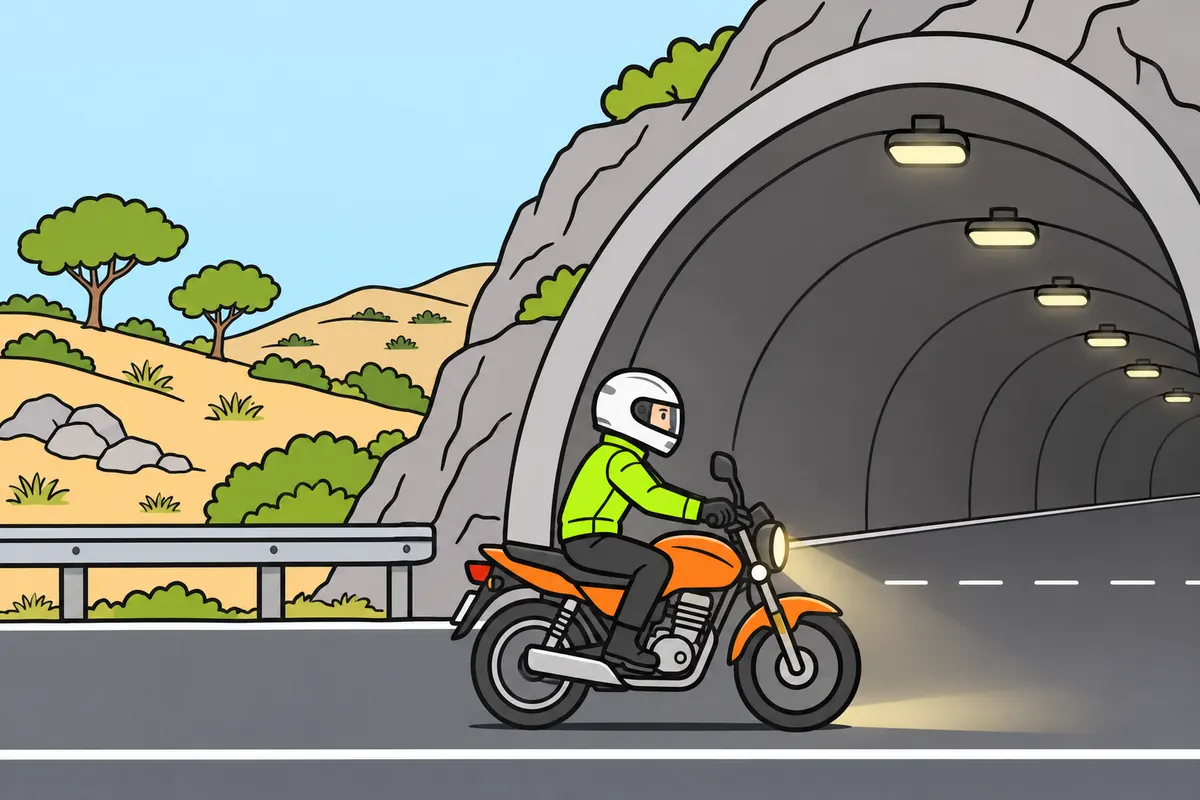
Use the appropriate lights in tunnels at any time of day.
| Situation when riding your motorcycle | What you must do |
|---|---|
| Well-lit tunnel | Use position lights and dipped beam |
| Poorly lit tunnel | Choose dipped or main beam under the lighting, speed, location and dazzle rules |
| Reversible, temporary additional or contraflow lane | Use dipped beam during the day too |
Remember
- Enter with lights on even if you can see the tunnel exit.
- This also applies to underpasses and sections marked with the tunnel sign.
- A tunnel in a built-up area does not allow normal use of main beam.
Exam trap: Wrong: every tunnel needs main beam. Right: consider lighting, speed and dazzle, and follow built-up area rules.
Read the full explanation
- You must enter tunnels, underpasses and stretches covered by the tunnel sign with the appropriate lights on at any time of day. This obligation does not depend on whether it is night, the length of the tunnel or whether the exit appears visible. [RGC, art. 98](https://www.boe.es/buscar/act.php?id=BOE-A-2003-23514#a98).
- In a sufficiently lit tunnel, you must keep your position lights and dipped beam on. In an insufficiently lit tunnel, your choice between dipped and main beam follows the regulatory conditions, including speed and dazzle. A tunnel within a built-up area does not make main beam the normal permitted lighting in town. [RGC, art. 100](https://www.boe.es/buscar/act.php?id=BOE-A-2003-23514#a100). [RGC, art. 101](https://www.boe.es/buscar/act.php?id=BOE-A-2003-23514#a101).
- You must use dipped beam during the day in reversible lanes, temporary additional lanes and lanes opened to traffic travelling against the normal direction. This requirement also applies to vehicles covered by articles 41 and 42. For you, it is in addition to the general daytime dipped-beam requirement for motorcycles. [RGC, art. 104](https://www.boe.es/buscar/act.php?id=BOE-A-2003-23514#a104).
- The conditions for entering and travelling in these lanes are explained in «Using the road with your motorcycle», in the sections «Reversible lanes», «Lanes opened in the opposite direction to normal» and «Temporary additional lanes». [RGC, art. 104](https://www.boe.es/buscar/act.php?id=BOE-A-2003-23514#a104)
10Front fog lights
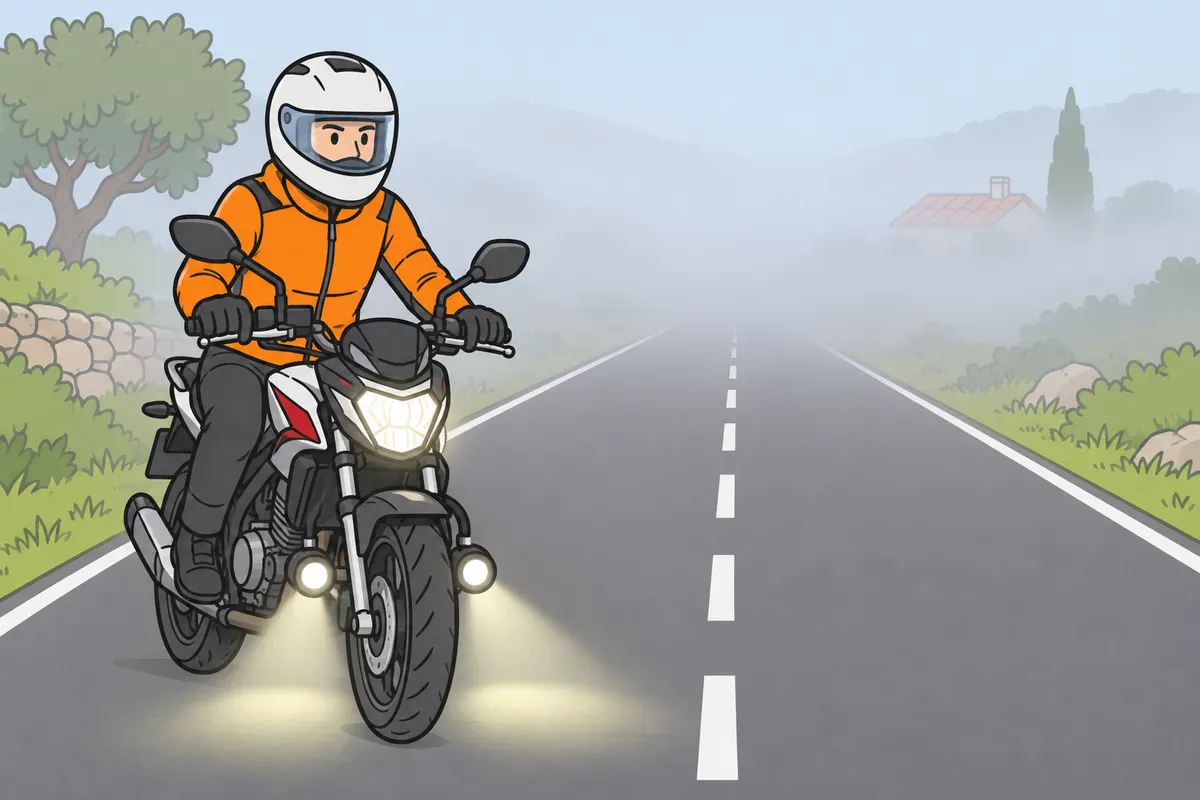
Use front fog lights only in permitted conditions.
| Situation | When you may use front fog lights |
|---|---|
| Poor visibility | When permitted weather or environmental conditions greatly reduce visibility |
| Without poor visibility | Carriageway no wider than 6.50 m, with signs warning of closely spaced bends |
Remember
- You may fit them on your motorcycle without a sidecar, following its type approval.
- Use them when fog, heavy rain, snow, smoke or dust greatly reduces visibility.
- Keep dipped beam on during daytime motorcycle riding and in special lanes.
- Keep position lights and any other required lights on.
- Switch off fog lights when the permitted conditions end.
- Potholes, gravel or darkness alone do not allow you to use them.
Exam trap: Wrong: any bend allows front fog lights. Right: without poor visibility, you need a carriageway no wider than 6.50 m and signs warning of closely spaced bends.
Read the full explanation
- You may equip your motorcycle without a sidecar with one or two front fog lights, white or selective yellow. Fitting them is optional under the RGV, but must comply with type approval. [RGV, art. 17](https://www.boe.es/buscar/act.php?id=BOE-A-1999-1826#a17). [RGV, Annex X](https://www.boe.es/buscar/act.php?id=BOE-A-1999-1826#anx).
- You may use them when weather or environmental conditions significantly reduce visibility: fog, heavy rain, snowfall, smoke, dust or similar circumstances. Fog does not need to be thick for you to switch on the front fog light, unlike the particularly adverse conditions required for the rear fog light. [RGC, art. 106](https://www.boe.es/buscar/act.php?id=BOE-A-2003-23514#a106).
- Article 106 allows you to use the front fog light on its own or together with dipped beam, or even main beam, while keeping the position lights on and meeting all other obligations. When riding your motorcycle during the day, keep dipped beam on to meet its specific requirement; fog lights also do not remove the requirement for dipped beam in a special lane. [RGC, art. 106](https://www.boe.es/buscar/act.php?id=BOE-A-2003-23514#a106). [RGC, art. 104](https://www.boe.es/buscar/act.php?id=BOE-A-2003-23514#a104).
- You may also use them on a narrow road with many bends if the carriageway is 6.50 metres wide or less and the stretch is signed as a series of closely spaced bends. Both conditions must apply: carriageway width and signs. A narrow lane within a wider carriageway does not, by itself, meet these conditions. [RGC, art. 106](https://www.boe.es/buscar/act.php?id=BOE-A-2003-23514#a106).
- You may use front fog lights only while the authorised conditions apply. On a road that is simply dark, you must choose your normal lighting according to how well the road is lit. [RGC, art. 106](https://www.boe.es/buscar/act.php?id=BOE-A-2003-23514#a106).
- In fog, as practical advice, use dipped beam and the front fog light when appropriate: main beam reflected by the fog can make it harder for you to see. Potholes or loose gravel alone do not permit you to use fog lights. [RGC, arts. 102 and 106](https://www.boe.es/buscar/act.php?id=BOE-A-2003-23514#a106)
11Rear fog lights
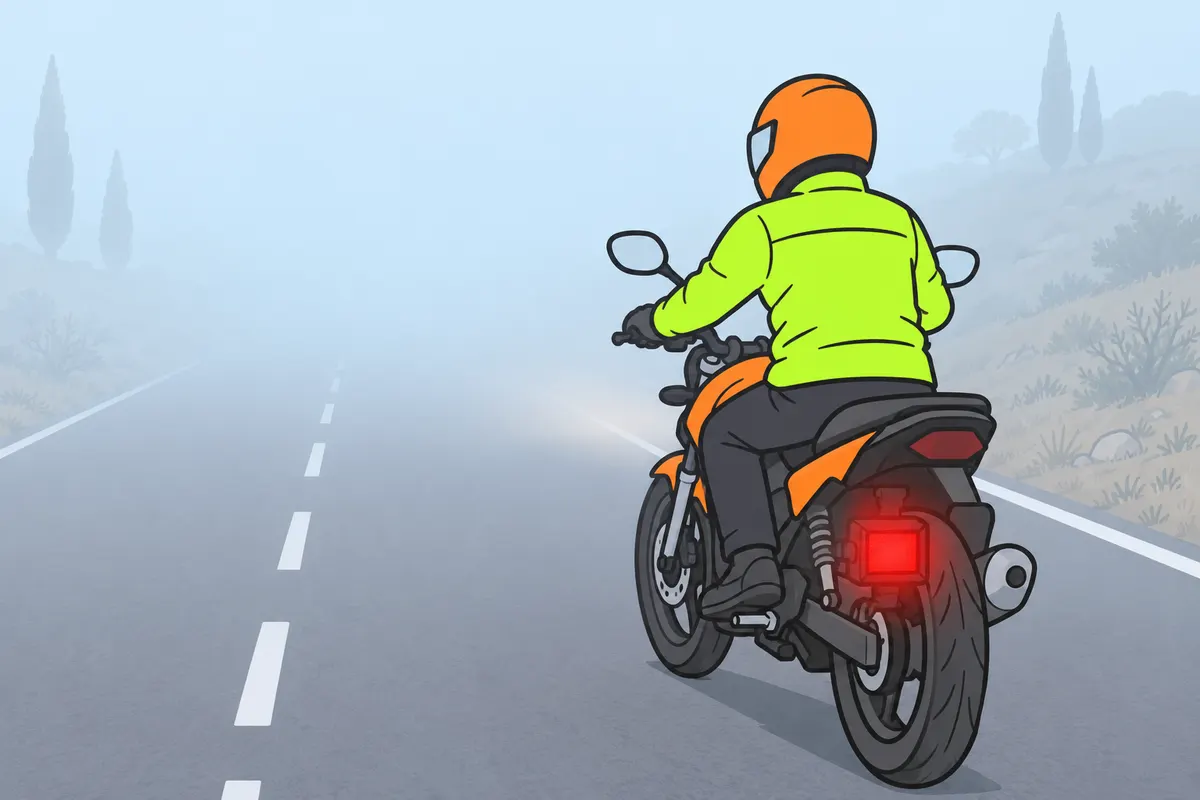
If you have rear fog lights, use them only in particularly poor visibility.
| Rain | What you need to distinguish |
|---|---|
| Heavy | Allows front fog lights; does not by itself require rear fog lights |
| Very heavy | Use rear fog lights if fitted |
Remember
- Fitting red rear fog lights is optional on your motorcycle.
- If fitted, use them in thick fog or very heavy rain.
- Also use them in heavy snow or dense clouds of smoke or dust.
- Keep them off unless visibility is particularly poor.
- With both fitted, you must be able to switch rear fog lights off separately.
Exam trap: Wrong: any rain requires rear fog lights. Right: if fitted, use them only in particularly adverse conditions.
Read the full explanation
- You may have one or two red rear fog lights; fitting them is optional for a motorcycle. If your motorcycle does not have them, you must not confuse this equipment option with a faulty position light or brake light, which are compulsory equipment. [RGV, art. 16](https://www.boe.es/buscar/act.php?id=BOE-A-1999-1826#a16). [RGV, art. 17](https://www.boe.es/buscar/act.php?id=BOE-A-1999-1826#a17). [RGV, Annex X](https://www.boe.es/buscar/act.php?id=BOE-A-1999-1826#anx).
- If your motorcycle has a rear fog light, you must use it only in particularly adverse conditions: thick fog, very heavy rain, heavy snowfall or dense clouds of smoke or dust. Heavy rain that permits the front fog light does not in itself require the rear fog light: pay attention to the intensity described. [RGC, art. 106](https://www.boe.es/buscar/act.php?id=BOE-A-2003-23514#a106).
- The rear fog light makes your presence clear when visibility is very poor. Its intensity can inconvenience the driver behind you and make it harder for them to distinguish your braking signals; operate its switch according to the conditions of use given in the previous point. [RGC, art. 106](https://www.boe.es/buscar/act.php?id=BOE-A-2003-23514#a106).
- The rear fog light installation allows you to switch it on with main beam, dipped beam or the front fog light switched on; if there is a front fog light, you must be able to switch off the rear fog light independently of it. This is a wiring requirement for the type-approved equipment. [UN Regulation 53, para. 6.11.6](https://www.boe.es/buscar/doc.php?id=DOUE-L-2020-80040).
12Braking and warnings of slowing down
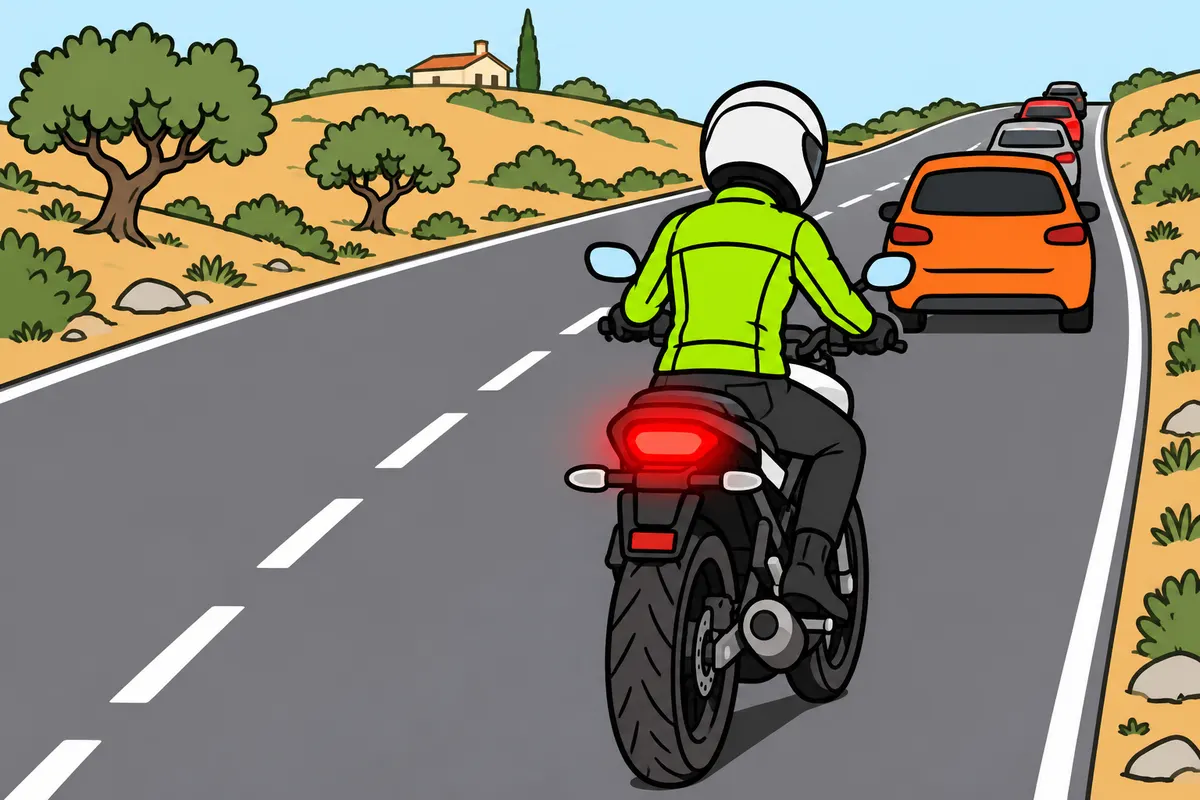
Warn others before stopping or slowing down greatly, whenever you can.
Remember
- Recognise your brake light: red, at the rear, brighter than your position light.
- Check the brake light with each brake control separately.
- Warn others with repeated brake light signals or the prescribed arm signal.
- Warn others even when traffic forces you to stop or slow down greatly.
Exam trap: Wrong: both brakes must be applied together to light the brake light. Right: check its response to each control separately.
Read the full explanation
- You can recognise the brake light by its red light at the rear, which is brighter than the position light. Under the general table, a motorcycle without a sidecar has one or two brake lights; when they come on, they indicate that you are braking. [RGV, Annex X](https://www.boe.es/buscar/act.php?id=BOE-A-1999-1826#anx) [UN Regulation 53, para. 2 and 6.4](https://www.boe.es/buscar/doc.php?id=DOUE-L-2020-80040)
- You must check the response of the light separately when you operate the front brake and the rear brake on a conventional motorcycle with these controls. Type approval requires the brake lights to come on when you operate the service brake. [UN Regulation 53, para. 6.4.6](https://www.boe.es/buscar/doc.php?id=DOUE-L-2020-80040).
- If you are about to stop or reduce your speed considerably, you must give warning, whenever possible, by repeatedly operating the brake lights or using the prescribed arm signal. You must also do this when traffic forces you to slow down or stop; it is not limited to a stop you choose to make voluntarily. [RGC, art. 109](https://www.boe.es/buscar/act.php?id=BOE-A-2003-23514#a109).
13Direction indicators
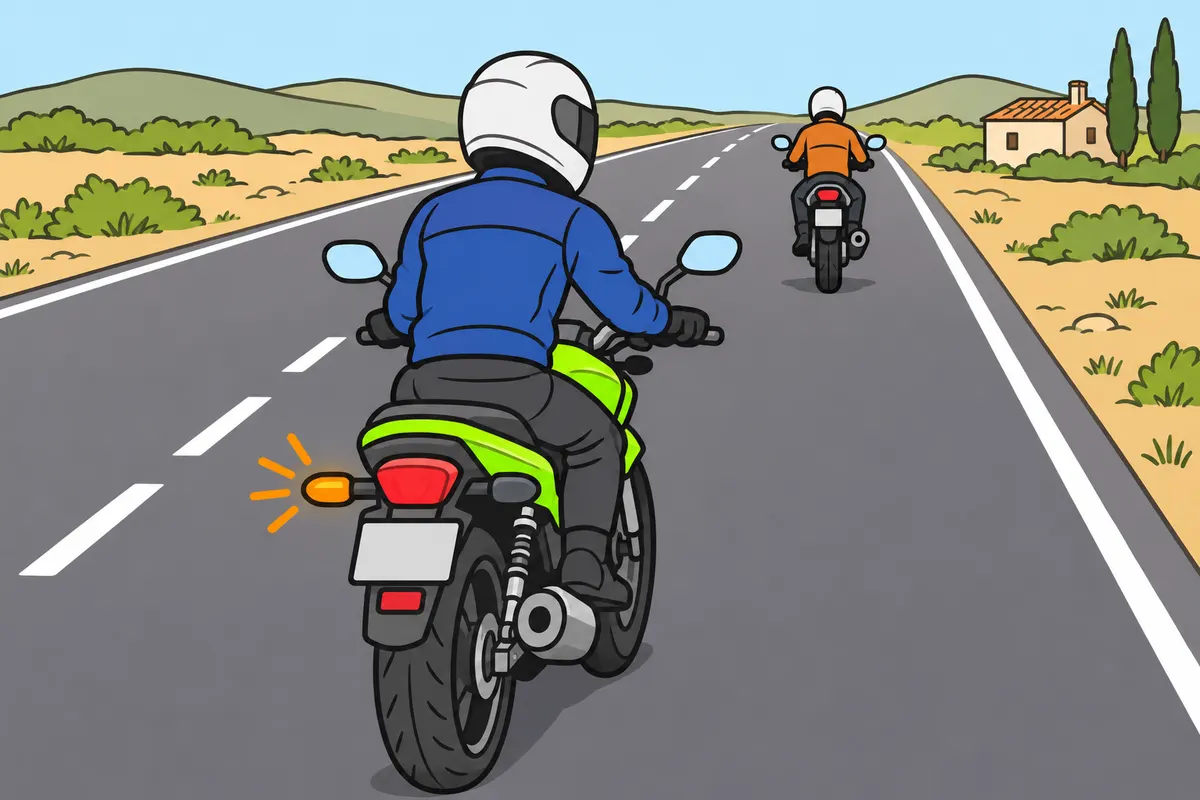
Signal before moving sideways, and cancel your indicator when you finish.
Remember
- Use the indicator on the side you are moving towards.
- Signal well in advance and keep signalling throughout the manoeuvre.
- Signal when overtaking another motorcycle if you move sideways.
- Signal when moving sideways to stop or park.
- You may need to warn of both braking and sideways movement.
- Check that you can move safely.
Exam trap: Wrong: your indicator gives you priority. Right: it only warns others; check safety before moving.
Read the full explanation
- You must give sufficient advance warning of a sideways movement using the indicator on the side towards which you are moving. You must also signal when overtaking another motorcycle if you move sideways from your line of travel. [RGC, art. 108](https://www.boe.es/buscar/act.php?id=BOE-A-2003-23514#a108). [RGC, art. 109](https://www.boe.es/buscar/act.php?id=BOE-A-2003-23514#a109).
- You must keep the indicator on throughout the manoeuvre and cancel it once you have taken up your new line of travel. Check that your motorcycle’s indicator has cancelled: leaving it on can signal a different turn from the one you intend to make and confuse other road users. [RGC, art. 109](https://www.boe.es/buscar/act.php?id=BOE-A-2003-23514#a109).
- You must use the appropriate indicator if you move towards that side to stop or park. The braking warning and the indicator communicate different aspects of your actions: you may need both so that whoever is following you understands what you are about to do. [RGC, art. 109](https://www.boe.es/buscar/act.php?id=BOE-A-2003-23514#a109).
- You must not interpret an indicator as giving you priority or permission to move without checking that it is safe. Its purpose is to warn. Observation, road positioning and the rules for turning and changing lanes are covered in the «Manoeuvres on your motorcycle» module. [RGC, art. 108](https://www.boe.es/buscar/act.php?id=BOE-A-2003-23514#a108). [RGC, art. 109](https://www.boe.es/buscar/act.php?id=BOE-A-2003-23514#a109).
14Regulation arm signals
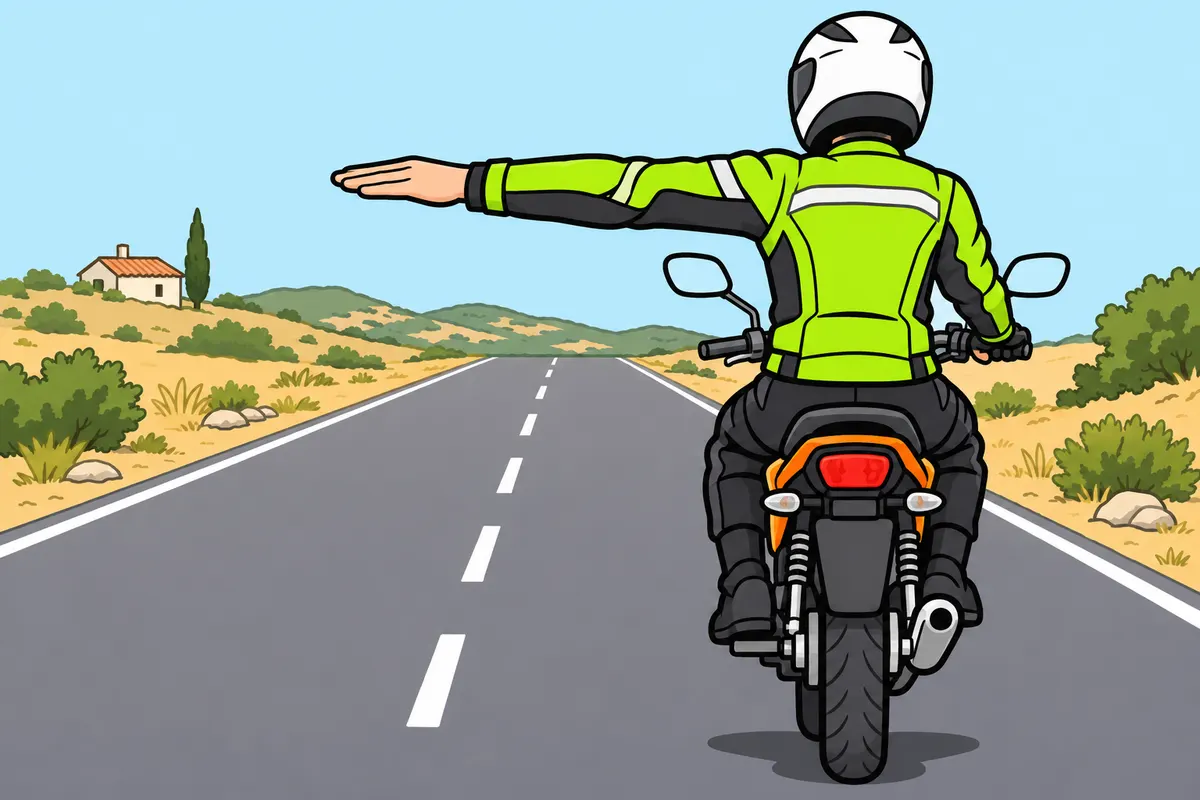
When light signals are unavailable, use a prescribed arm signal that others can see.
| Your arm signal | What you announce |
|---|---|
| Left arm horizontal, palm down | Moving left |
| Left arm bent upwards, palm open | Moving right |
| Short, quick movements up and down | Slowing down greatly or stopping |
| Arm horizontal, palm backwards, when no reversing light is available | Reversing |
Remember
- Normally, use your lights to give warnings.
- Your arm signal must follow the rules and be visible to others.
- When these conditions apply, it overrides a conflicting light signal.
- Signalling reversing does not make a prohibited reversing manoeuvre legal.
Exam trap: Wrong: any gesture overrides lights. Right: only a prescribed arm signal that others can see takes precedence.
Read the full explanation
- As a general rule, you must use light signals to give warning; if these are unavailable, you may use your arm. An arm signal is only valid if others can see it and you give it in accordance with the regulations. If it contradicts another visual signal, the arm signal takes precedence provided it meets these conditions. [RGC, art. 108](https://www.boe.es/buscar/act.php?id=BOE-A-2003-23514#a108).
- If you extend your arm horizontally with your palm facing down, you signal a movement towards the side indicated by your hand. If you bend it upwards with your palm open, you signal a movement towards the opposite side. With your left arm, a horizontal signal means left and an upward bend means right. [RGC, art. 109](https://www.boe.es/buscar/act.php?id=BOE-A-2003-23514#a109).
- To give the arm signal for slowing down considerably or stopping described in «Braking and warnings of slowing down», you move your arm up and down with short, rapid movements. [RGC, art. 109](https://www.boe.es/buscar/act.php?id=BOE-A-2003-23514#a109)
- To give the arm signal for reversing when there is no reversing light, you extend your arm horizontally with your palm facing backwards. The manoeuvre must be permitted as well as correctly signalled. [RGC, art. 109](https://www.boe.es/buscar/act.php?id=BOE-A-2003-23514#a109).
15Motorcycle hazard warning lights
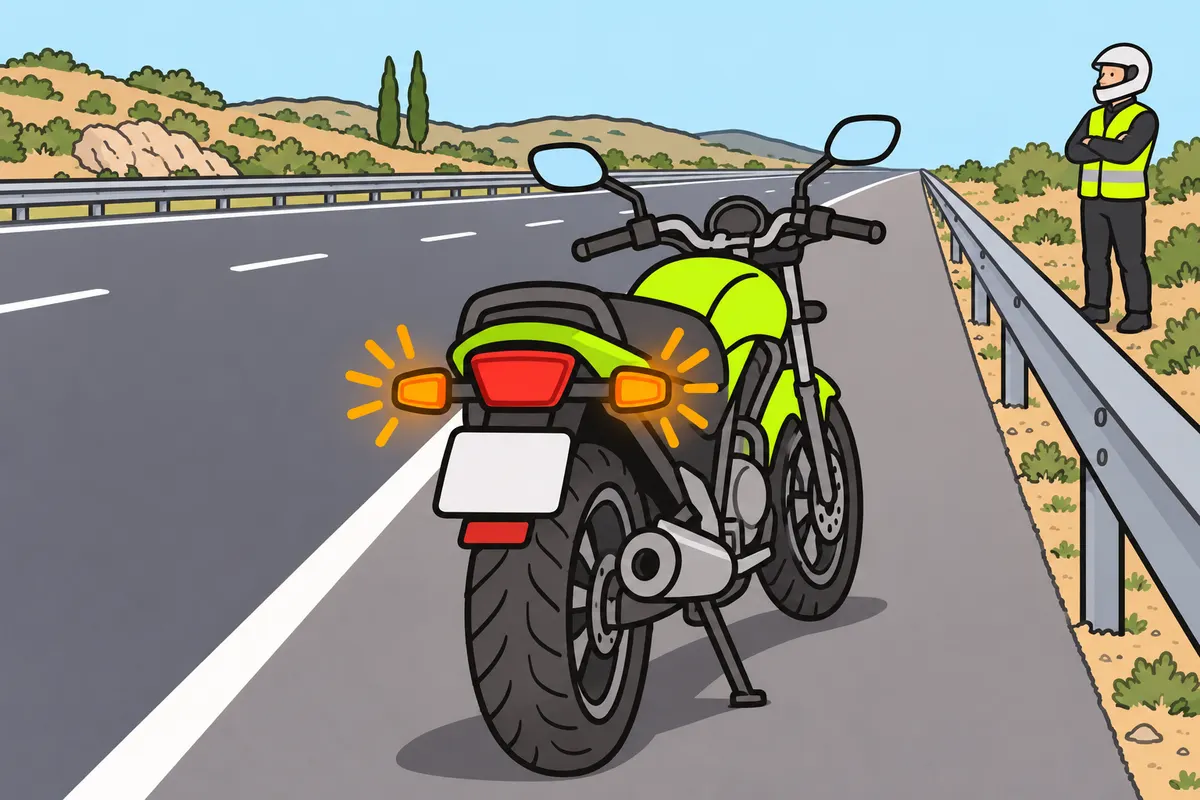
If your motorcycle has hazard warning lights, use them when required.
Remember
- Hazard warning lights switch all your indicators on together.
- Fitting them is optional on your motorcycle.
- Use them if you cannot reach minimum speed and risk being hit from behind.
- If immobilised on a motorway or dual carriageway, use them if fitted.
- Also do this where visibility is greatly reduced; add position lights when required.
- After an accident or breakdown, warn of the obstruction; use hazards if fitted.
Exam trap: Wrong: riding slowly always requires hazards. Right: you must be unable to reach the required minimum speed and risk being hit from behind.
Read the full explanation
- The hazard warning lights operate all the direction indicators together to warn of danger. You may have them fitted to your motorcycle: installation is optional under the RGV, with no specific engine-capacity threshold. [RGV, art. 17](https://www.boe.es/buscar/act.php?id=BOE-A-1999-1826#a17) [RGV, Annex X](https://www.boe.es/buscar/act.php?id=BOE-A-1999-1826#anx)
- You must use them if your vehicle cannot reach the required minimum speed and there is a risk of a rear-end collision. Both conditions must apply: the rule does not make all slow riding an automatic reason to switch on the hazard warning lights. [RGC, art. 49.3](https://www.boe.es/buscar/act.php?id=BOE-A-2003-23514#a49).
- If you become immobilised on an autopista (motorway) or autovía (dual carriageway highway), or where conditions significantly reduce visibility, you must use your hazard warning lights if fitted, and your position lights when required. Although there is no general obligation to fit hazard warning lights, you must still use them in these situations if your motorcycle has them. [RGC, art. 109](https://www.boe.es/buscar/act.php?id=BOE-A-2003-23514#a109).
- After an accident or breakdown, you must warn others of the obstruction and switch on your hazard warning lights if fitted, as well as any other required lights. Switching them on does not authorise you to park where prohibited or ride along the arcén (hard shoulder) to get past a traffic queue; it does not give you emergency vehicle priority either. [RGC, art. 130](https://www.boe.es/buscar/act.php?id=BOE-A-2003-23514#a130). [RGC, art. 109](https://www.boe.es/buscar/act.php?id=BOE-A-2003-23514#a109).
16Motorcycle immobilised at night
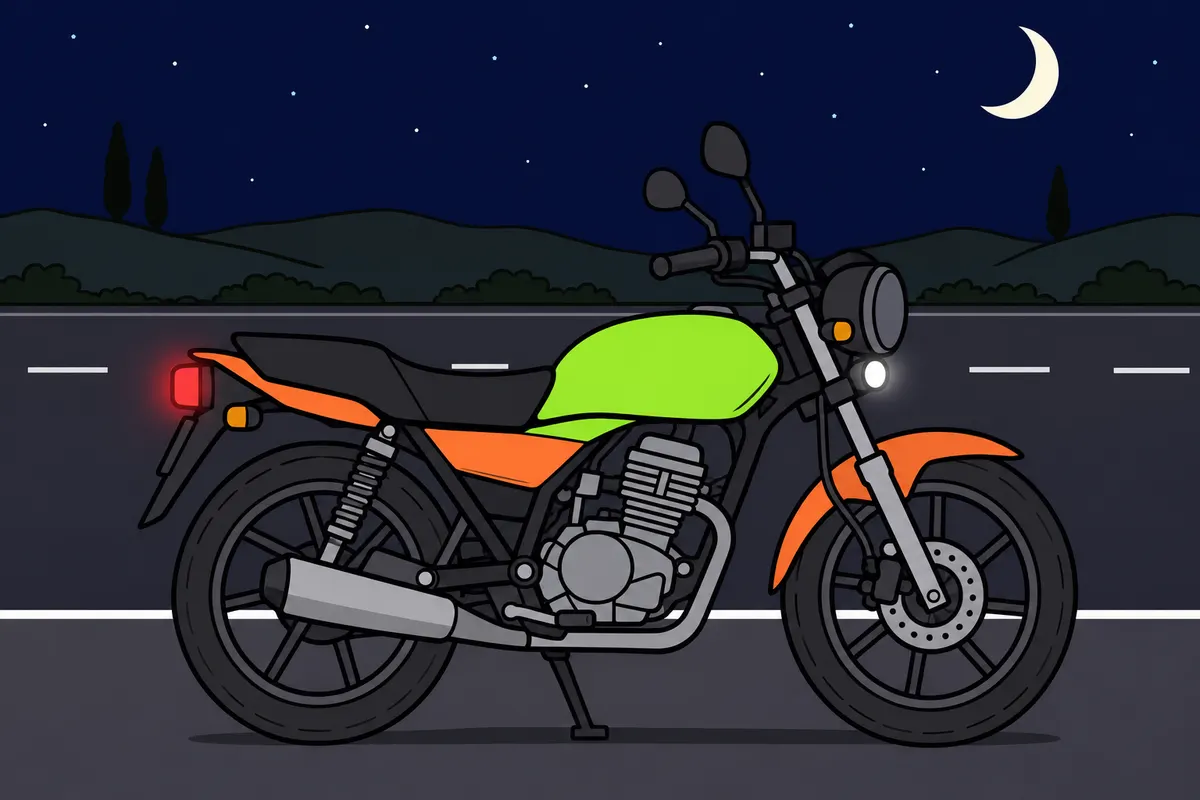
Keep position lights on when immobilised at night or in poor visibility.
| Situation: your motorcycle without a sidecar | What you must do |
|---|---|
| Immobilised at night or in poor visibility on the carriageway or hard shoulder | Keep position lights on |
| Stopped or parked at night on a poorly lit through road’s carriageway or shoulder | Keep position lights on |
| Parked on an urban road that is not a through road | You may switch position lights off if lighting makes your motorcycle visible from far enough away |
Remember
- On the carriageway or hard shoulder, keep position lights on, whatever the cause.
- If your motorcycle blocks traffic, move it when you can.
Exam trap: Wrong: any lit street allows parking without position lights. Right: only an urban road that is not a through road, with lighting that makes your motorcycle visible from far enough away.
Read the full explanation
- If you become immobilised between sunset and sunrise, or in reduced visibility, on the carriageway or hard shoulder of a road, you must keep the position lights on. This applies whatever the cause: it is not limited to voluntary parking and does not require a breakdown. [RGC, art. 105](https://www.boe.es/buscar/act.php?id=BOE-A-2003-23514#a105).
- On an inadequately lit travesía (stretch of road through a town), if you stop or park at night on the carriageway or hard shoulder, you must keep the position lights on. On your motorcycle without a sidecar, these are the lights you use to signal your presence while waiting. [RGC, art. 105.2](https://www.boe.es/buscar/act.php?id=BOE-A-2003-23514#a105).
- On an urban road that is not a travesía, you may leave a motorcycle parked without the position lights on when the lighting allows it to be seen from a sufficient distance. [RGC, art. 105](https://www.boe.es/buscar/act.php?id=BOE-A-2003-23514#a105).
- If your motorcycle obstructs the carriageway after an accident or breakdown, you must warn others of its presence and move it off the carriageway to a position that complies with the parking rules whenever feasible. The procedure is covered in «Manoeuvres on your motorcycle», in the section «Immobilisation after a breakdown or in an emergency». [RGC, art. 130.1](https://www.boe.es/buscar/act.php?id=BOE-A-2003-23514#a130).
17Stopping in a tunnel and refuelling
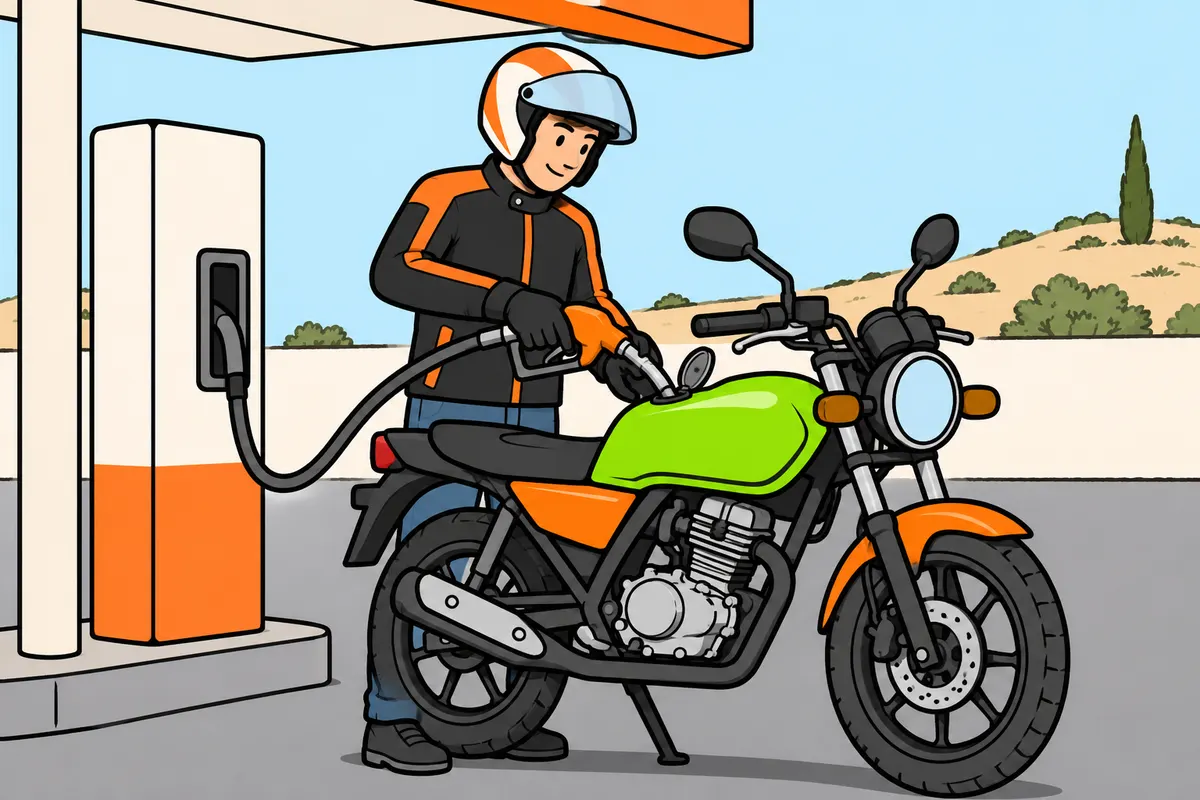
Switch off your engine when stopped in a tunnel and before refuelling.
| Situation | What you switch off or keep on |
|---|---|
| Stopped in a tunnel or enclosed place | Switch the engine off immediately |
| Forced wait over two minutes in a tunnel or enclosed place | Keep the engine off and position lights on until you continue |
| Refuelling | Switch off the engine, lights, radio and transmitting devices, such as your mobile phone |
Remember
- In tunnels or enclosed places, switch off your engine as soon as you stop.
- Do not wait until the stop becomes an extended wait.
- At self-service pumps, you must meet the refuelling requirements yourself.
Exam trap: Wrong: leave the engine running for the first few minutes in a tunnel. Right: switch it off as soon as you stop.
Read the full explanation
- You must always switch off the engine whenever your motorcycle is stopped inside a tunnel or in an enclosed place, even if you remain in your riding position. This general obligation applies from the moment you stop. [RGC, art. 115.1](https://www.boe.es/buscar/act.php?id=BOE-A-2003-23514#a115).
- If you have to remain stopped in a tunnel or another enclosed place for more than two minutes, you must keep the engine switched off until you can continue and keep the position lights on. Paragraph 115.2 expressly adds this requirement to keep the position lights on during a prolonged wait. [RGC, art. 115.2](https://www.boe.es/buscar/act.php?id=BOE-A-2003-23514#a115).
- If you are stopped by traffic, you must act differently from when you have a breakdown or a fire: see the section «Stopping inside a tunnel» in the «Using the road with your motorcycle» module. [RGC, art. 97.3](https://www.boe.es/buscar/act.php?id=BOE-A-2003-23514#a97).
- To refuel, you must switch off the lights, radio and devices that emit electromagnetic radiation, such as your mobile phone, and keep the engine switched off while filling up. At a self-service filling station, you must meet these requirements yourself. [RGC, art. 115.3-4](https://www.boe.es/buscar/act.php?id=BOE-A-2003-23514#a115).
18High-visibility vest and V-16 beacon
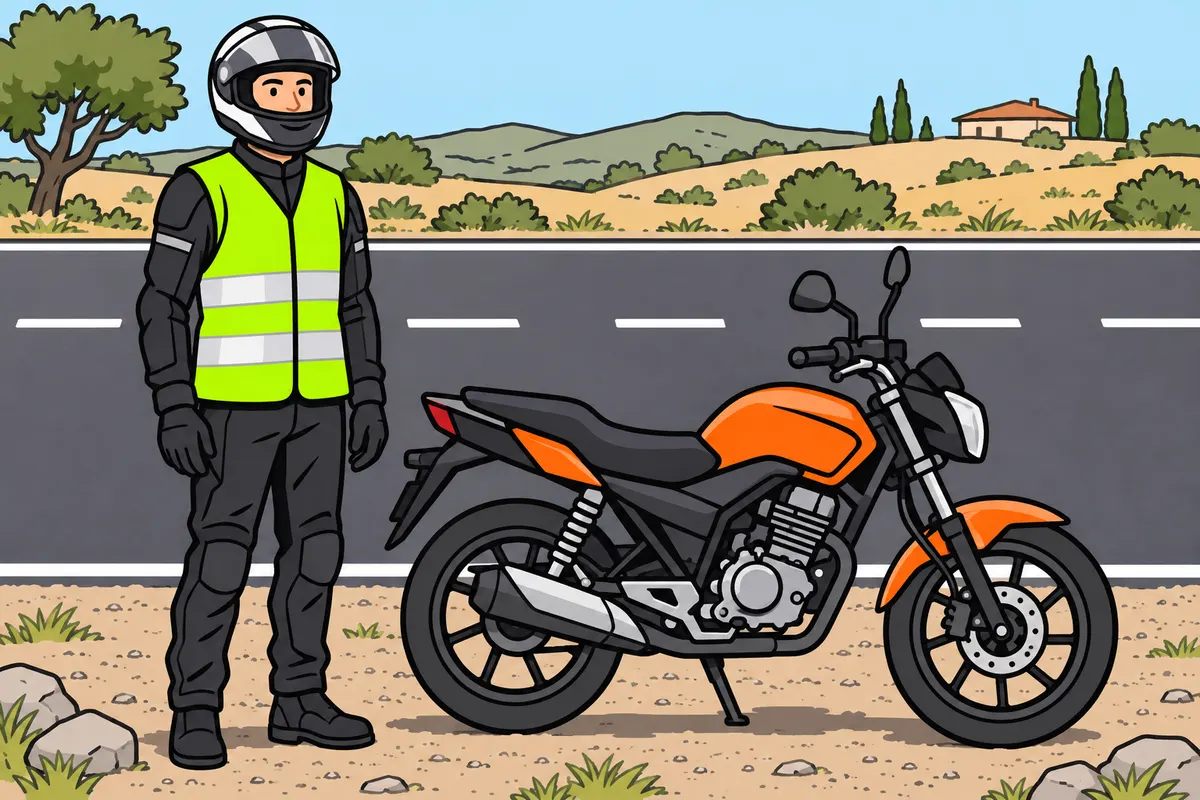
Carry a reflective vest; carrying a beacon on your motorcycle is optional.
Remember
- Carry a high-visibility vest that meets personal protective equipment requirements.
- Wear it when getting off onto an interurban road’s carriageway or hard shoulder.
- You do not have to carry a V-16 on your motorcycle.
- If you carry one, use it when immobilised by an accident or breakdown.
- Place it as high as possible on your immobilised motorcycle, ensuring maximum visibility.
Exam trap: Wrong: optional V-16 carrying means optional use. Right: if you carry one, you must use it when immobilised by an accident or breakdown.
Read the full explanation
- You must carry a high-visibility reflective vest on your motorcycle that meets the requirements for personal protective equipment, and wear it when you get off and stand on the carriageway or hard shoulder of an interurban road. [RGV, Annex XII.3](https://www.boe.es/buscar/act.php?id=BOE-A-1999-1826#anxii). [RGC, art. 118.4](https://www.boe.es/buscar/act.php?id=BOE-A-2003-23514#a118).
- You are not required to carry a V-16 beacon on your motorcycle; if you carry one, you must use it when you become immobilised after an accident or breakdown: see «Accidents, breakdowns and assistance», in the section «Connected V-16 beacon and A1 equipment». [RGV, Annex XII.1](https://www.boe.es/buscar/act.php?id=BOE-A-1999-1826#anxii). [RGC, art. 130.4](https://www.boe.es/buscar/act.php?id=BOE-A-2003-23514#a130).
- When you use it, place it as high as possible on the immobilised motorcycle, ensuring maximum visibility. [RGV, Annex XI, V-16](https://www.boe.es/buscar/act.php?id=BOE-A-1999-1826#v-16)
19Reflectors and side visibility
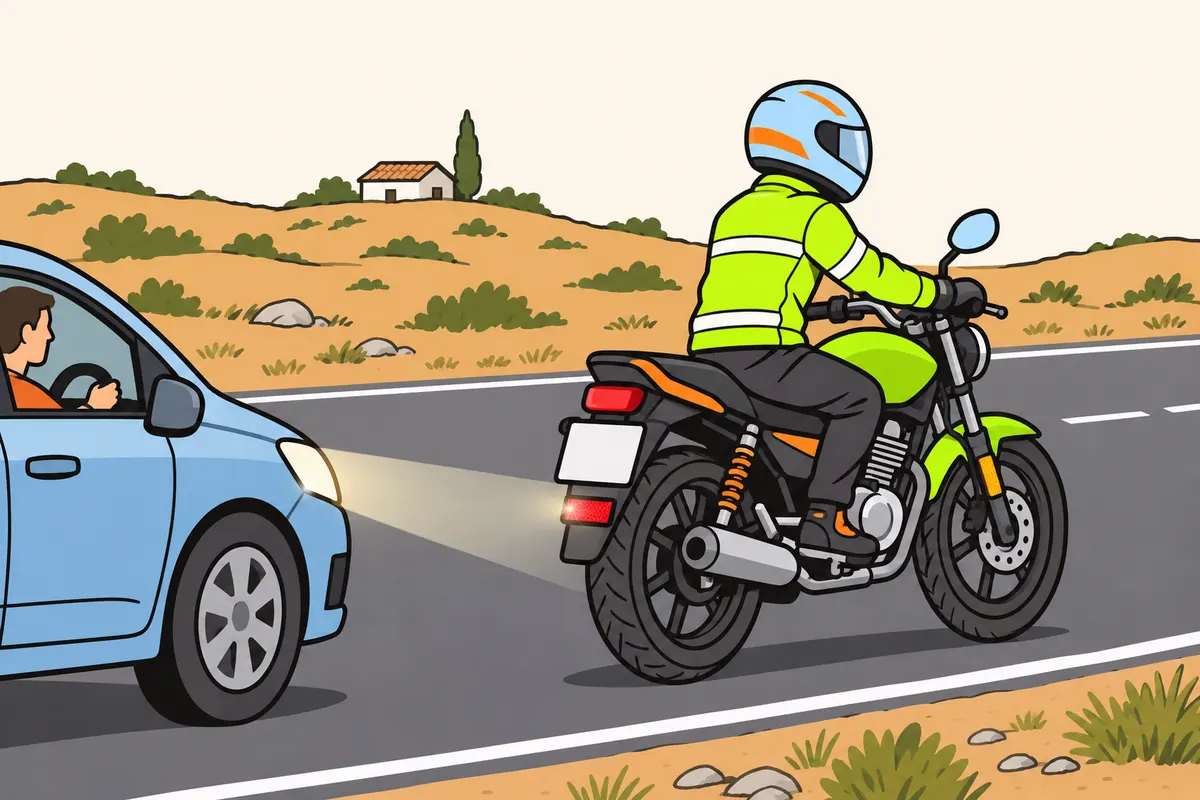
Your reflector returns light it receives; it does not produce its own light.
| Reflector: motorcycle without a sidecar | Colour and shape |
|---|---|
| Rear | Red, not triangular |
| Sides | Amber, not triangular; one or two on each side |
Remember
- Your motorcycle without a sidecar needs a red rear reflector that is not triangular.
- You cannot replace position lights with a reflector.
- Remember that your reflector does not produce its own light.
- Do not count your reflective number plate as a reflector.
- Side reflectors are optional under the general table.
- Keep the side reflectors required by your model’s type approval.
Exam trap: Wrong: your motorcycle’s rear reflector is triangular. Right: it is red and not triangular.
Read the full explanation
- You must equip your motorcycle without a sidecar with a red, non-triangular rear reflector. It reflects light received from another source, such as the headlights of an approaching vehicle, back towards that source. It emits no light of its own and does not replace the position lights, even though you can see it lit up when light falls on it. [RGV, art. 16](https://www.boe.es/buscar/act.php?id=BOE-A-1999-1826#a16). [RGV, Annex X](https://www.boe.es/buscar/act.php?id=BOE-A-1999-1826#anx).
- Side reflectors are amber and non-triangular; the general table specifies one or two on each side. [RGV, Annex X](https://www.boe.es/buscar/act.php?id=BOE-A-1999-1826#anx). Their installation is optional under the general table, but compulsory where the applicable type-approval requirements of UN Regulation 53 require them; you must retain those required for your model. [UN Regulation 53, para. 5.14](https://www.boe.es/buscar/doc.php?id=DOUE-L-2020-80040).
- The retroreflective number plate and the prescribed reflective plates or signs have their own functions and do not count as reflectors. When checking your motorcycle, you must identify the reflector as a separate device from the plate, even though both return light when you shine a light on them. [RGV, Annex X.1.16](https://www.boe.es/buscar/act.php?id=BOE-A-1999-1826#anx).
20End-outline marker lamps, parking lights and reversing lights
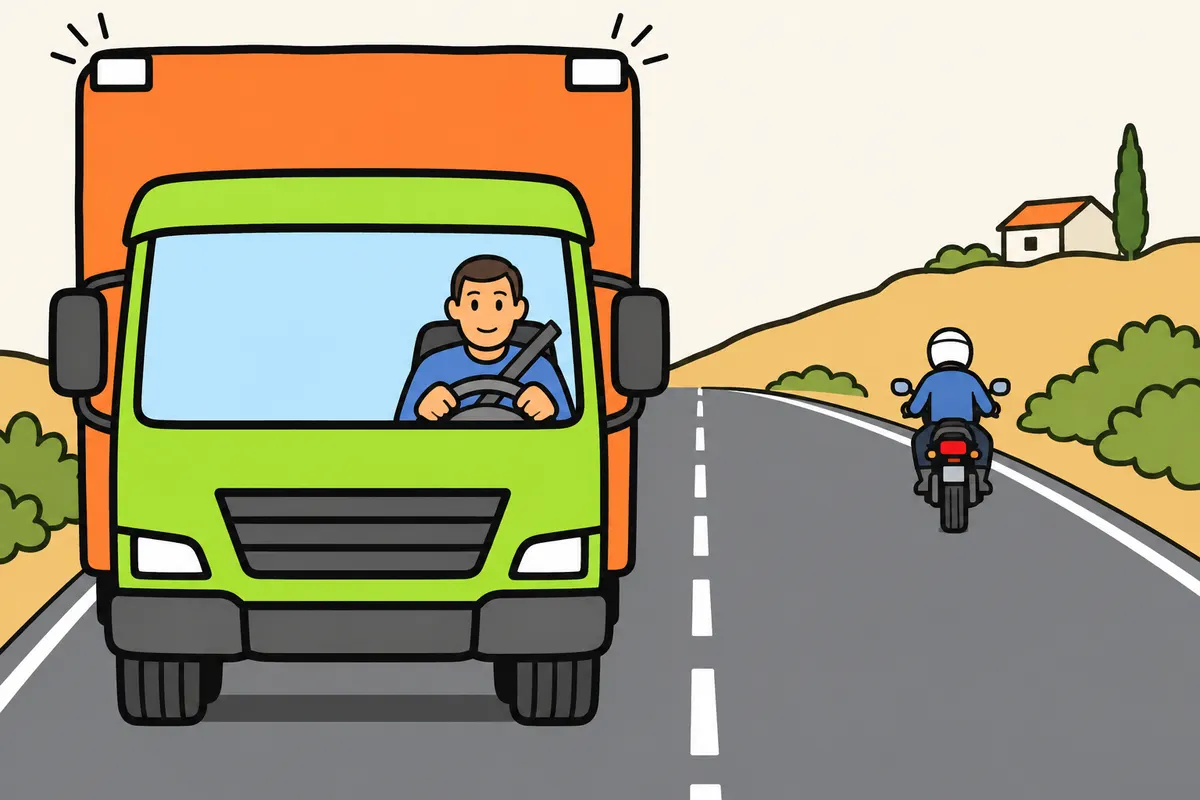
Recognise marker and reversing lights by what each light does.
| Light on other vehicles | Purpose |
|---|---|
| End-outline marker lamps | Show width and size from upper outer edges; supplement position lights |
| Reversing lights | Light the area behind; warn that the vehicle is reversing or about to reverse |
Remember
- Do not identify end-outline marker lamps only by their height.
- Use end-outline marker lamps to judge where a vehicle’s edges are.
- You can anticipate reversing even while the vehicle is still stationary.
Exam trap: Wrong: reversing lights only come on when the vehicle moves. Right: you may see them lit before it reverses.
Read the full explanation
- You can recognise another vehicle’s end-outline marker lamps by their position near its highest outer edges: they show its overall width and supplement the position lights to indicate its size. From your motorcycle, use these points of light as references for the vehicle’s edges, especially when passing a wide oncoming vehicle at night. [RGV, Annex X.1.15](https://www.boe.es/buscar/act.php?id=BOE-A-1999-1826#anx).
- The reversing light illuminates the road behind the vehicle and warns that it is reversing or about to reverse. If it comes on in the car ahead of your motorcycle, you can anticipate it reversing even while it is still stationary. The warning expresses an intention, and you must interpret it together with any movement you observe. [RGV, Annex X.1.7](https://www.boe.es/buscar/act.php?id=BOE-A-1999-1826#anx).
21If your motorcycle has a sidecar
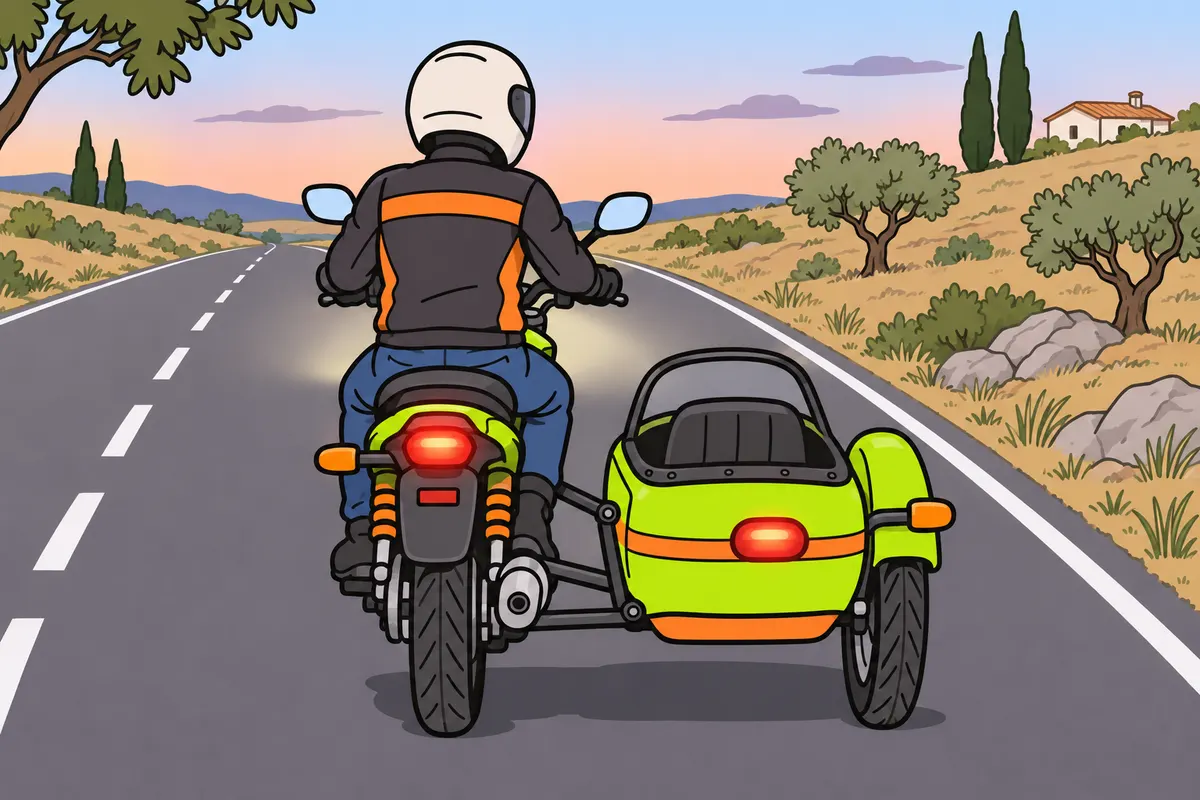
If you have a sidecar, follow the lighting rules for the whole combination.
| Part of your motorcycle and sidecar combination | What you need to recognise |
|---|---|
| Combination’s front position lights | Two or three, white or amber; only one on the sidecar |
| Combination’s rear position and brake lights | Two or three red lights per function; only one per function on the sidecar |
| Two lights for a function on the motorcycle | Symmetrical about its lengthwise centre line |
| Combination’s indicators | At its outer edges |
| Combination’s rear reflectors | One or two, red and not triangular |
| Number plate lighting | Illuminates the rear plate |
Remember
- Keep dipped beam on by day and follow the motorcycle lighting rules at night.
- You may fit fog lights and other devices authorised for the combination.
Exam trap: Wrong: only the motorcycle’s lights matter. Right: follow the lighting table for the combination.
Read the full explanation
- If your motorcycle has a sidecar, you must apply the lighting table for the combination. It has two or three white or amber front position lights; two or three red rear position lights; and two or three red brake lights. For each of these functions, only one light is on the sidecar; if there are two on the motorcycle, they are symmetrical about its longitudinal centre plane. This lets you recognise the combination’s width and warnings without confusing it with a two-wheeled motorcycle. [RGV, Annex X, table for motorcycles with sidecars](https://www.boe.es/buscar/act.php?id=BOE-A-1999-1826#anx).
- You may fit the fog lights specified for the combination and the other devices authorised for four-wheeled motor vehicles that article 17.3 permits. [RGV, art. 17.3](https://www.boe.es/buscar/act.php?id=BOE-A-1999-1826#a17).
- The combination’s direction indicators are positioned at its outer edges. The table also requires one or two red, non-triangular rear reflectors; the number plate light illuminates the rear plate. The sidecar changes the distribution of the equipment, while the rules for using the motorcycle’s dipped beam, main beam and fog lights remain those explained in this module. [RGV, Annex X](https://www.boe.es/buscar/act.php?id=BOE-A-1999-1826#anx).
22Motor tricycle lighting
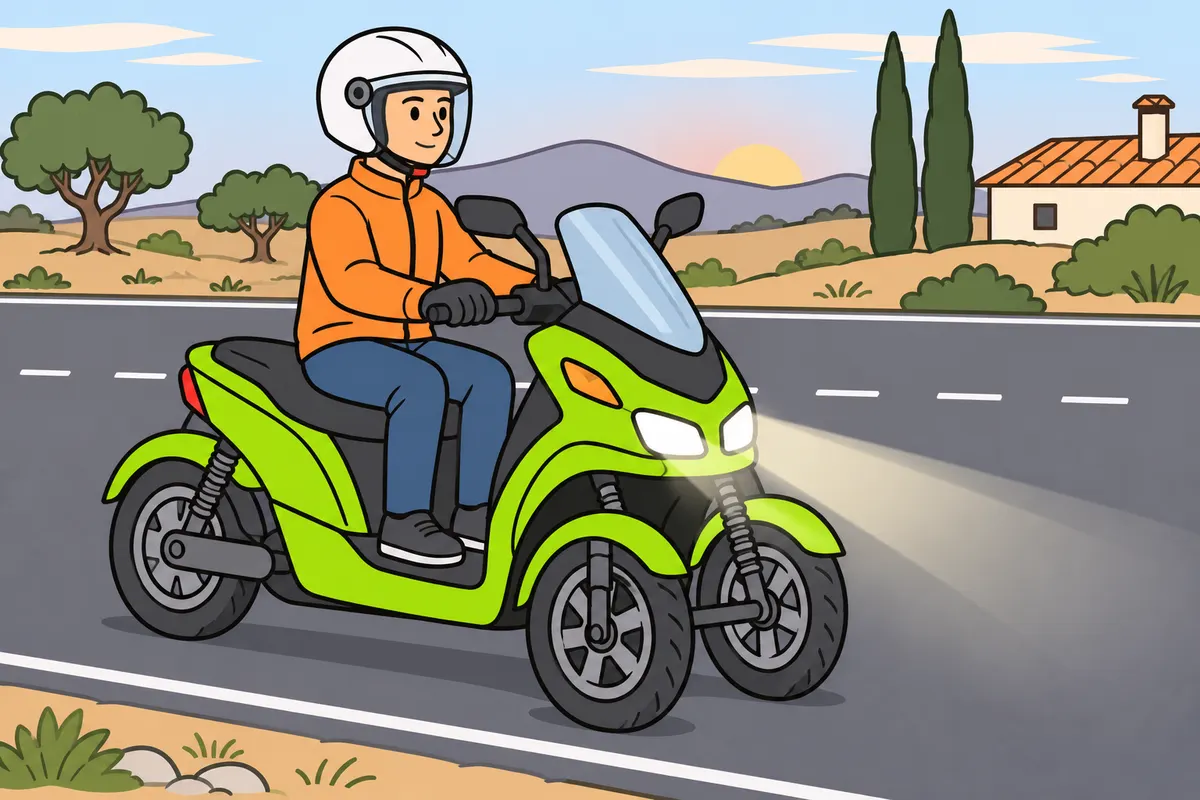
For a motor tricycle, check its technical category and its own lighting table.
| Motor tricycle equipment | What you must check |
|---|---|
| Dipped beam, main beam, position and brake lights | One or two per function; two if maximum width exceeds 1,300 mm |
| Colours | Dipped and main beam white; front position white or amber; rear position and brake red |
| Rear number plate | White lighting |
| Indicators and hazards | Amber indicators, two per side; indicators and hazards mandatory from the date shown |
| Red rear reflectors, not triangular | One up to 1,000 mm wide; two above that width |
| Reversing and fog lights | Optional; reversing light white |
Remember
- Do not confuse a symmetrical tricycle with a motorcycle and sidecar.
- Check the category on its technical document, even if it looks like a scooter.
- Use the appropriate lights at night, in tunnels and in poor visibility.
- Do not automatically apply the motorcycle daytime dipped beam rule to every tricycle.
- In special lanes, follow the dipped beam requirement that applies.
- If you have only one rear fog light, it must be on the left.
Exam trap: Wrong: hazards are optional on every tricycle, as on motorcycles. Right: the tricycle table requires them from 1 November 1999.
Read the full explanation
- If you ride a motor tricycle covered by A1, you must apply its technical category rather than work out its equipment requirements simply by counting the wheels. The licence covers motor tricycles with a maximum power not exceeding 15 kW; a motorcycle with a sidecar has a different lighting table from a vehicle with three symmetrically arranged wheels. [RGCond, art. 4](https://www.boe.es/buscar/act.php?id=BOE-A-2009-9481#a4). [RGV, Annex X](https://www.boe.es/buscar/act.php?id=BOE-A-1999-1826#anx).
- On a three-wheeled vehicle, you can recognise white dipped and main beam headlights, white or amber front position lights, red rear position lights and brake lights, and a white rear number plate light. The table allows one or two lights for dipped beam, main beam, position lights and brake lights, but requires two for each of these functions if the maximum width exceeds 1,300 millimetres. You must check the category on the ficha técnica (vehicle technical data sheet), even if the vehicle looks like a scooter. [RGV, Annex X](https://www.boe.es/buscar/act.php?id=BOE-A-1999-1826#anx).
- You can recognise the amber direction indicators, two on each side, and the hazard warning lights. The specific table makes them compulsory from 1 November 1999; you must not apply the generally optional status of motorcycle hazard warning lights to this vehicle. The rear reflectors are red and non-triangular: the table specifies one for widths up to 1,000 millimetres and two above that width. [RGV, Annex X](https://www.boe.es/buscar/act.php?id=BOE-A-1999-1826#anx).
- You may find a white reversing light, which is optional in this category, as well as optional fog lights. You must interpret the reversing light coming on as a warning of that intention, without mistaking it for an indicator or brake light. If there is only one rear fog light, the table places it on the left. [RGV, art. 17.4](https://www.boe.es/buscar/act.php?id=BOE-A-1999-1826#a17). [RGV, Annex X](https://www.boe.es/buscar/act.php?id=BOE-A-1999-1826#anx).
- You must use the appropriate lights at night, in tunnels and in reduced visibility. The general daytime obligation in article 104.a applies to motorcycles; you must not automatically extend it to every tricycle just because you can ride it with A1, although its type approval may require automatic switch-on. In special lanes, you must comply with the dipped-beam requirement that applies to all vehicles authorised to use them. [RGC, arts. 98 and 104](https://www.boe.es/buscar/act.php?id=BOE-A-2003-23514#a104).
23Headlight flashes and audible warnings
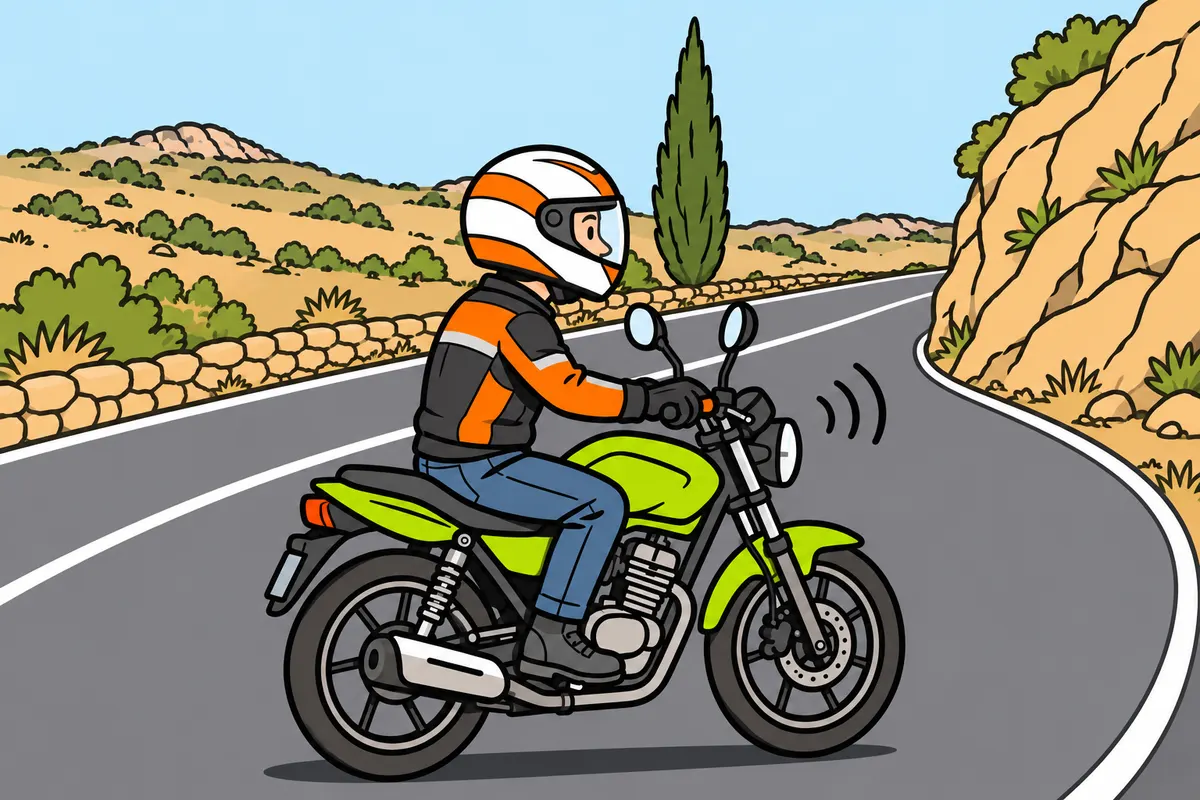
Use headlight flashes or your horn only for permitted warnings.
| Your warning | What it means |
|---|---|
| Horn or brief headlight flashes | You warn of your presence for permitted purposes |
| Indicator | You announce your intended course |
Remember
- You may use your horn to avoid an accident, including in built-up areas.
- Outside built-up areas, you may warn another driver that you intend to overtake.
- You may replace these warnings with very brief headlight flashes, without dazzling others.
- Do not use horns or flashes to greet, demand passage or show impatience.
- Avoid shrill sounds and excessive warnings.
Exam trap: Wrong: warnings give you priority during a private urgent service. Right: this requires especially serious circumstances and no other means available; use an intermittent horn and hazards if fitted, or the prescribed procedure, and obey traffic rules.
Read the full explanation
- You may give warnings using very brief flashes of dipped beam, main beam or both alternately, for the same purposes as permitted audible warnings. You may do this even in built-up areas, avoiding dazzling anyone. Permission to use these flashes does not allow you to use main beam continuously in built-up areas. [RGC, art. 109](https://www.boe.es/buscar/act.php?id=BOE-A-2003-23514#a109).
- You may use your horn to prevent a possible accident, especially on narrow roads with many bends. Outside built-up areas, you may warn another driver of your intention to overtake them. You must avoid a shrill sound and any unjustified or excessive use. [RGC, art. 110](https://www.boe.es/buscar/act.php?id=BOE-A-2003-23514#a110).
- Warning others of your presence with your horn or headlight flashes serves a different purpose from the indicator that signals your intended direction. Greeting someone, expressing impatience or demanding passage are not authorised uses. [RGC, art. 108](https://www.boe.es/buscar/act.php?id=BOE-A-2003-23514#a108) [RGC, art. 109](https://www.boe.es/buscar/act.php?id=BOE-A-2003-23514#a109) [RGC, art. 110](https://www.boe.es/buscar/act.php?id=BOE-A-2003-23514#a110)
- If, exceptionally, you carry out an urgent service under the serious circumstances set out in article 70 and you cannot use any other means, you must give a warning by sounding your horn intermittently and using your hazard warning lights, if fitted, or by following the prescribed procedure. You must obey the rules: these warnings do not give your private motorcycle the status of a priority vehicle. [RGC, art. 70](https://www.boe.es/buscar/act.php?id=BOE-A-2003-23514#a70).
24Number plate and rear lighting
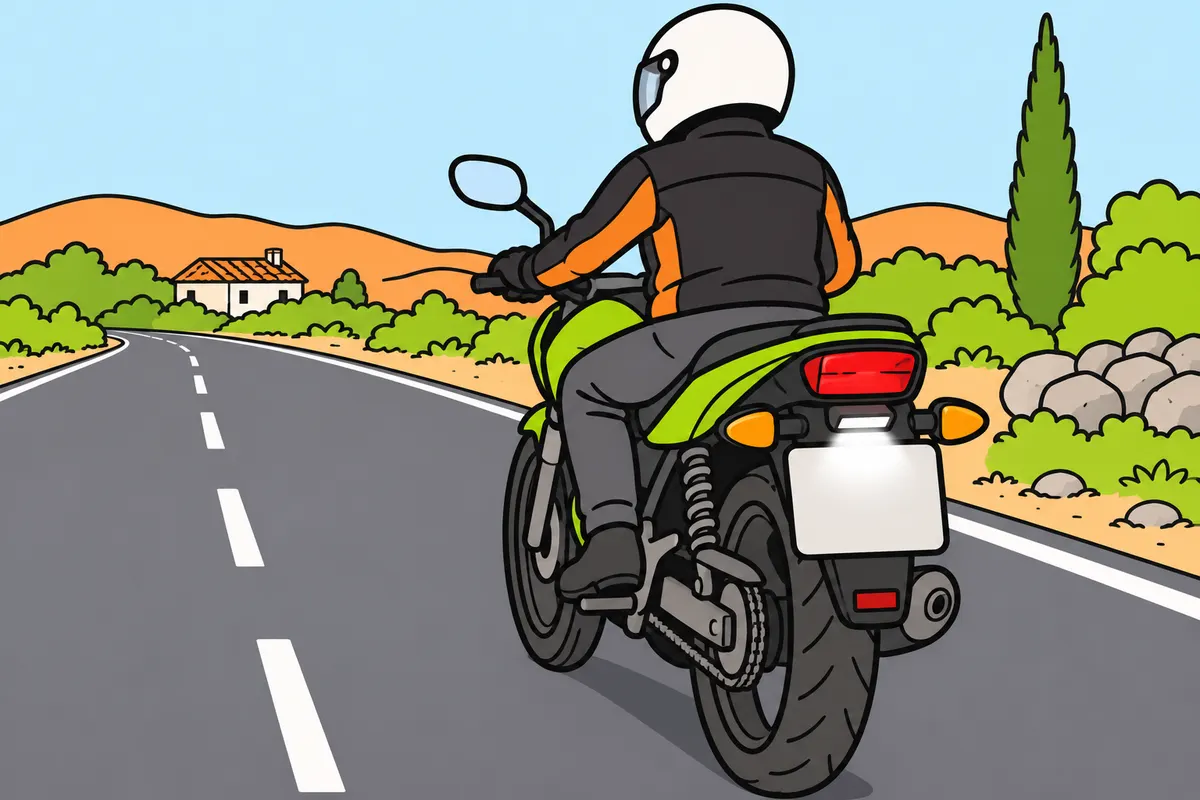
Keep your motorcycle’s rear number plate visible and light it when required.
| Motorcycle number plate | When you may use it |
|---|---|
| Standard | General format |
| Short | Only for two-wheeled trial and enduro motorcycles |
Remember
- You need a single rear number plate, vertical or nearly vertical.
- Recognise its white background and black characters.
- Use white number plate lighting whenever driving lights are required.
- Reflective material does not replace that light.
- Check that luggage hides neither your plate nor your lights and indicators.
Exam trap: Wrong: choose a short plate for its looks. Right: it is reserved for two-wheeled trial and enduro motorcycles.
Read the full explanation
- You must display a single number plate at the rear of your motorcycle, vertically or almost vertically. The standard motorcycle plate has a white background and black characters. [RGV, Annex XVIII](https://www.boe.es/buscar/act.php?id=BOE-A-1999-1826#anxviii).
- The standard motorcycle plate measures 220 by 160 millimetres. The short format of 132 by 96 millimetres is reserved for two-wheeled trial and enduro motorcycles; you cannot freely choose it for any motorcycle for aesthetic reasons. [RGV, Annex XVIII, table 1](https://www.boe.es/buscar/act.php?id=BOE-A-1999-1826#anxviii).
- You must have a white rear number plate light. When driving lights are compulsory under the circumstances in article 103, you must keep that plate and any markings that require illumination lit. The reflective nature of the backing does not replace the lighting device. [RGC, art. 103](https://www.boe.es/buscar/act.php?id=BOE-A-2003-23514#a103). [RGV, Annex X](https://www.boe.es/buscar/act.php?id=BOE-A-1999-1826#anx).
- You must not position luggage, additional plates or decorations so that they obscure the number plate or make it difficult to read, or cover lights and indicators. You must check this with your luggage already secured: a light that works but is hidden does not convey its warning properly. [RGV, art. 49](https://www.boe.es/buscar/act.php?id=BOE-A-1999-1826#a49). [RGC, art. 14](https://www.boe.es/buscar/act.php?id=BOE-A-2003-23514#a14).
25L plate, ITV (vehicle roadworthiness test) and other markings
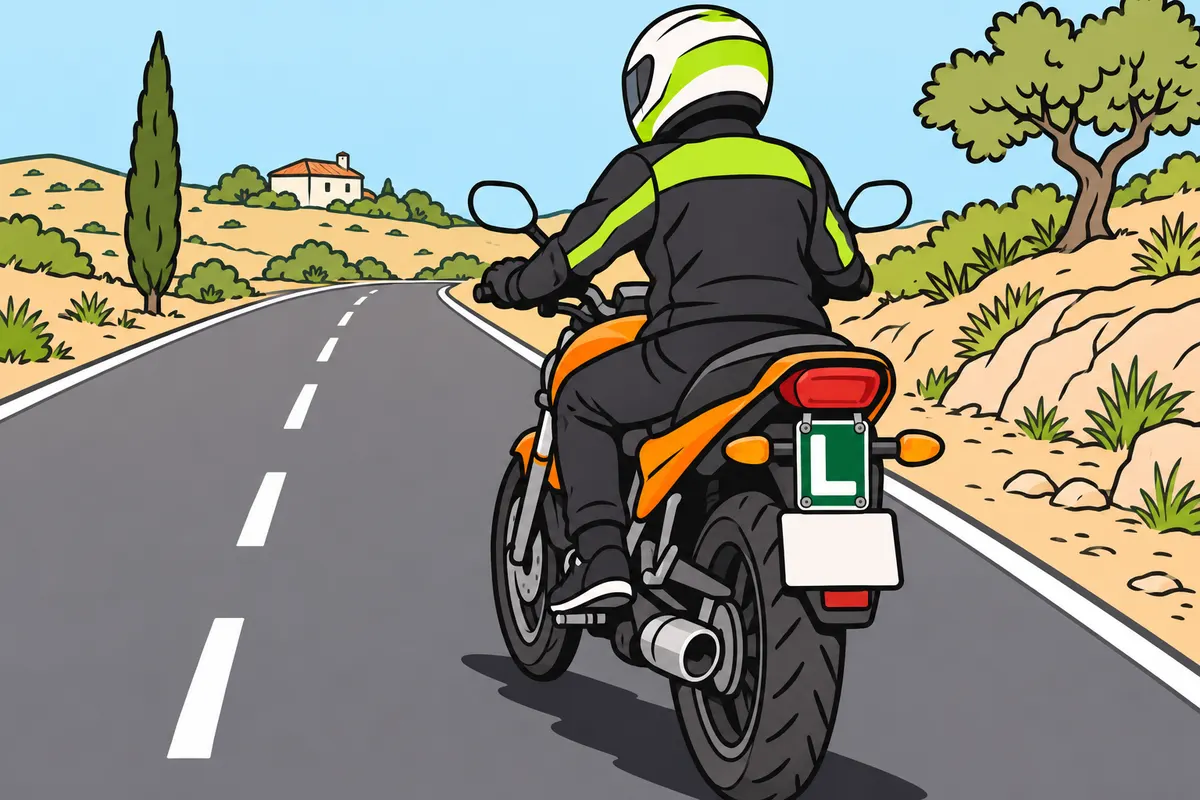
Recognise your motorcycle’s markings and when you must display them.
| Marking | What you need to recognise |
|---|---|
| V-13 | Novice driver |
| V-19 | Passed periodic roadworthiness test |
| Environmental sticker | Vehicle’s registered environmental classification |
| Red and white striped panel | Load projecting at the rear |
| V-14 | Vehicle used for instruction or driving tests |
Remember
- Check whether the authorities require you to display your environmental sticker.
- Without a windscreen, put it somewhere clearly visible.
- On driving school vehicles, display the tuition sign only during that use.
Exam trap: Wrong: the environmental sticker is always optional. Right: display it when the responsible authority expressly requires it.
Read the full explanation
- The V-13 identifies you as a new rider and the V-19 certifies that your vehicle has passed its periodic roadworthiness test; your obligations are explained in «A1 licence and motorcycle documents», in the sections «New riders: when you display the L plate» and «ITV report and V-19 sticker». [RGV, Annex XI, V-13](https://www.boe.es/buscar/act.php?id=BOE-A-1999-1826#v-13) and [V-19](https://www.boe.es/buscar/act.php?id=BOE-A-1999-1826#v-19).
- The environmental badge identifies your vehicle’s registered environmental classification. You may be required to display it where the competent authority expressly requires this; on a vehicle without a windscreen, you display it in a clearly visible place. You study its classification and low-emission zones in «Preventive and efficient motorcycle riding». [RGV, Annex XI, V-25](https://www.boe.es/buscar/act.php?id=BOE-A-1999-1826#v2).
- You can recognise the projecting-load panel by its red and white stripes; it indicates a rear projection. You study when it applies and the load limits for your motorcycle in «Passengers and loads on motorcycles». [RGV, Annex XI, V-20](https://www.boe.es/buscar/act.php?id=BOE-A-1999-1826#v-20).
- The V-14 learner-driver sign identifies the vehicle you use for instruction or driving tests; on driving-school vehicles, you must only display it while using the vehicle for that purpose. [RGV, Annex XI, V-14](https://www.boe.es/buscar/act.php?id=BOE-A-1999-1826#v-14).
26Maintenance, faults and authorised equipment
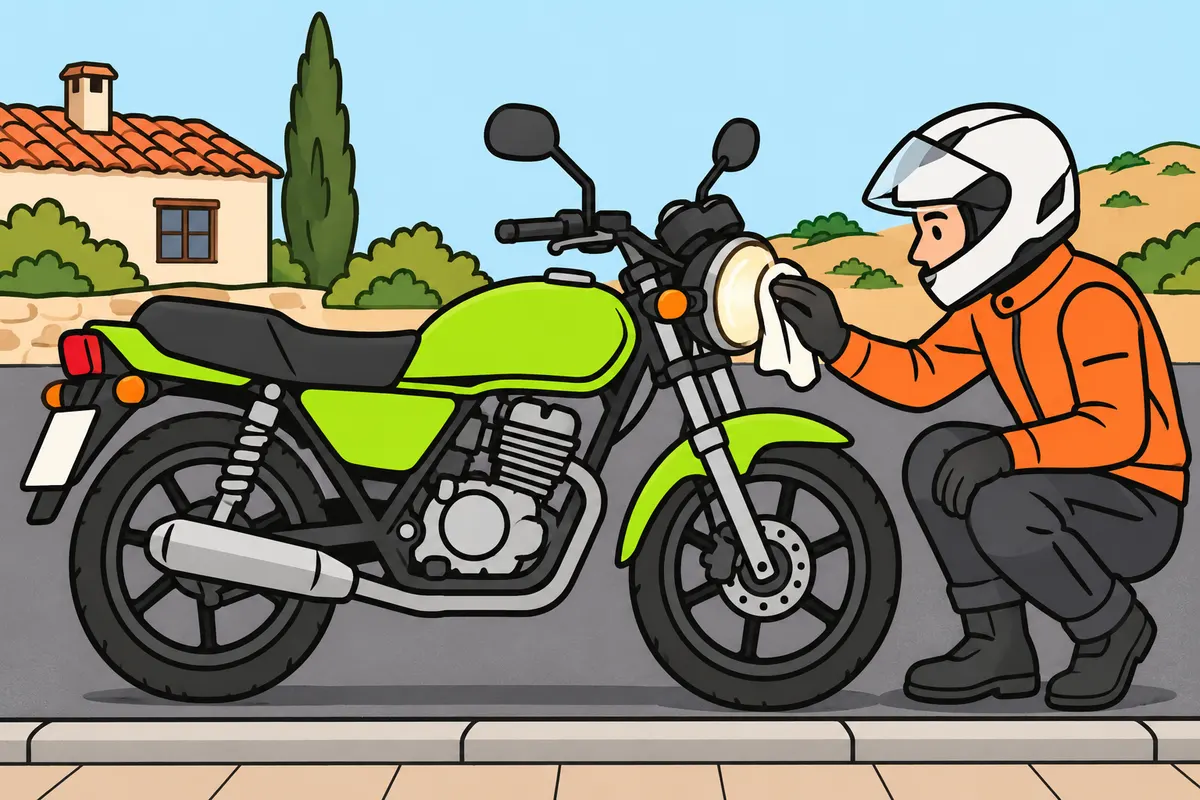
Keep your lights clean, correctly aimed and working.
Remember
- Before setting off, check lights, indicators, brake lights and number plate lighting.
- Check whether an impact has changed your headlamp’s aim.
- With a passenger or luggage, adjust your headlamp following the manufacturer’s instructions.
- If a fault cannot be fixed during your journey and reduces lighting, slow down.
- You must stop within the lit area; request help if you cannot ride safely.
- Do not add unauthorised lights or luminous or reflective paint.
Exam trap: Wrong: no spare bulb requirement means faulty mandatory lights are acceptable. Right: you need no spare bulbs, but required lights must work.
Read the full explanation
- You must keep lighting and signalling devices clean, securely attached and in working order. As a practical check, inspect the position lights, dipped beam, main beam, indicators, brake light and number plate light before setting off. You must check whether an impact has changed the headlamp alignment. [RGV, art. 15](https://www.boe.es/buscar/act.php?id=BOE-A-1999-1826#a15).
- You must maintain the correct headlamp adjustment when carrying a passenger or luggage and follow the manufacturer’s procedure. If the beam is too high, you can dazzle others; if it is too low, it reduces the area you can see effectively. [RGC, art. 102](https://www.boe.es/buscar/act.php?id=BOE-A-2003-23514#a102). [RGV, art. 15](https://www.boe.es/buscar/act.php?id=BOE-A-1999-1826#a15).
- If a fault that you cannot repair during your journey forces you to ride with reduced-intensity lighting, you must reduce your speed so that you can stop within the illuminated area. You must not interpret this rule as permission to continue riding normally without the mandatory lights; seek a safe solution and request assistance when you cannot ride safely. [RGC, art. 107](https://www.boe.es/buscar/act.php?id=BOE-A-2003-23514#a107).
- You are not required to carry a set of spare bulbs on your motorcycle. This does not allow you to ride with faulty mandatory lighting. If you replace a light source or fit accessories, you must comply with the approved system, without adding unauthorised lights or luminous and reflective paints. [RGV, Annex XII](https://www.boe.es/buscar/act.php?id=BOE-A-1999-1826#anxii). [RGV, art. 15](https://www.boe.es/buscar/act.php?id=BOE-A-1999-1826#a15).
- If you ride without the required lighting, you commit a serious offence, generally punishable by a fine of 200 euros. You must not assume that this amount applies to every technical defect or every instance of incorrect use: the classification depends on the specific circumstances. [Traffic Act, art. 76.e](https://www.boe.es/buscar/act.php?id=BOE-A-2015-11722#a76) and [art. 80](https://www.boe.es/buscar/act.php?id=BOE-A-2015-11722#a80).
Choosing lights during your journey
Check the motorcycle-specific requirement and the conditions on the stretch of road.
- During the day, use dipped beam when riding your motorcycle on any road.
- Before a tunnel or in reduced visibility, check the position lights and the lights required for riding; do not rely solely on the sensor.
- At night, in built-up areas or where lighting is sufficient, use the position lights and dipped beam.
- Outside built-up areas with insufficient lighting, use main beam at more than 40 km/h if you cannot dazzle anyone; otherwise use dipped beam.
- Use the fog lights appropriate to the conditions and switch them off when the conditions permitting their use cease.
Signalling a sideways movement
Your signal communicates your intention throughout the movement.
- Observe your surroundings and check whether you can carry out the manoeuvre safely.
- Switch on the indicator on the side towards which you intend to move in good time.
- Keep signalling throughout the movement and respect the applicable priority rules.
- Cancel the indicator when you take up your new course; check that it is no longer on.
Warning others of an immobilised motorcycle
Combine your motorcycle lighting with measures to make yourself visible when you get off.
- Put on your high-visibility reflective vest before entering the carriageway or arcén (hard shoulder) of an interurban road.
- Warn others that your motorcycle is immobilised and switch on the hazard warning lights, if fitted, in the circumstances required by the regulations.
- At night or in reduced visibility, keep the position lights on; switch off main beam if you are stopped or parked.
- Apply the V-16 rule in «Accidents, breakdowns and assistance», section «Connected V-16 beacon and A1 equipment».
- Remove the motorcycle when feasible and continue protecting those involved and requesting help as set out in «Accidents, breakdowns and assistance».
Finished this module?
Mark it as read and you will see your progress on the theory list.