
Theory · D1 Licence - Minibus · Module 9 of 18
Minibus lighting and signalling
You learn to choose the minibus lighting according to the road, visibility and circumstances, and to recognise the lights and identification signs required by its size or service. You master the differences between fitting and using lights, preventing dazzle, and exam questions about fog lamps, end-outline marker lamps, school transport and the connected V-16.
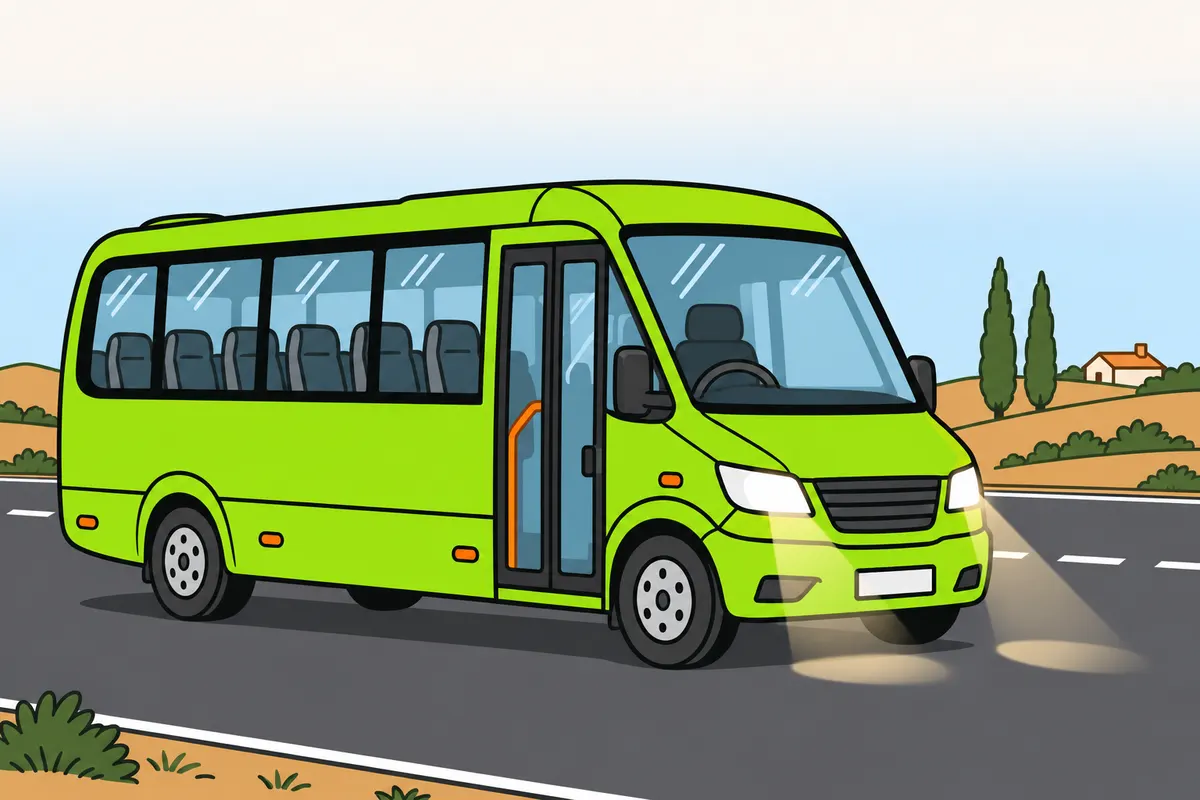
1What you must identify on the bus
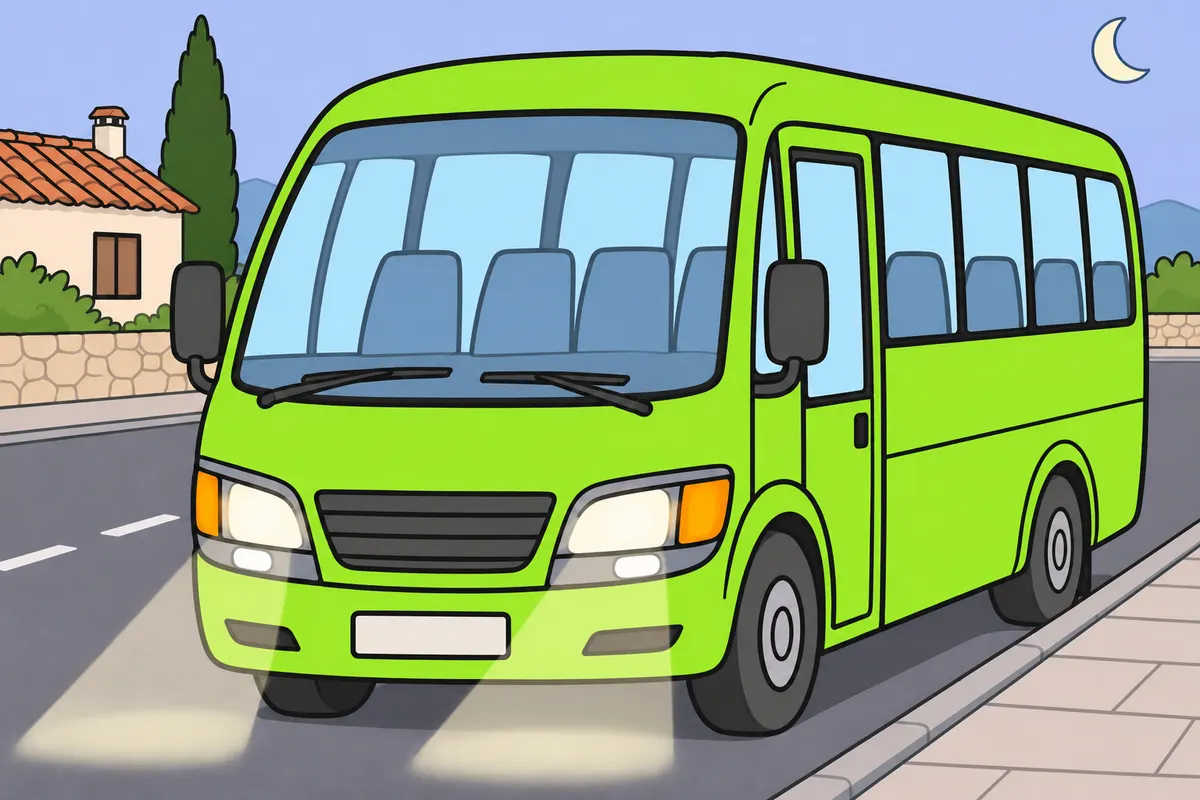
You must distinguish lights for seeing, being seen and giving warnings.
| Minibus fog lights | Fitting |
|---|---|
| Front | Optional |
| Rear | Compulsory |
Remember
- Check your minibus’s actual measurements.
- You must have rear fog lights; front fog lights are optional.
- Do not add illuminated decorations without authorisation.
Exam trap: Wrong: having a light means always keeping it on. Right: follow its conditions of use.
Read the full explanation
- You must distinguish three functions: lighting the carriageway so that you can see, showing the presence and dimensions of the minibus so that others can see you, and warning of a manoeuvre or danger. One device may be grouped with another in the same lamp unit without sharing its function or conditions of use. [RGV, Annex X](https://www.boe.es/buscar/act.php?id=BOE-A-1999-1826#anx).
- Your minibus must have dipped beam, main beam, reversing lights, direction indicators with hazard warning lights, brake lights, rear number plate lighting, front and rear position lights and rear fog lights. You must add the devices required by its dimensions; the basic equipment does not depend on whether you provide a school transport service. [RGV, art. 16](https://www.boe.es/buscar/act.php?id=BOE-A-1999-1826#a16).
- Front fog lights are optional; you must not confuse them with compulsory rear fog lights. You may also find authorised devices that depend on the vehicle category and type approval; the general table in Annex X applies together with its notes and the relevant technical regulations. [RGV, art. 17](https://www.boe.es/buscar/act.php?id=BOE-A-1999-1826#a17).
- When two devices serve the same purpose, they must match in colour and intensity and be positioned symmetrically to the extent required by the regulations. You must not add illuminated decorations, paint or reflectors without regulatory authorisation, even if you think they make the minibus more visible. [RGV, art. 15](https://www.boe.es/buscar/act.php?id=BOE-A-1999-1826#a15).
- Your D1 licence covers vehicles carrying up to 16 passengers in addition to the driver and measuring up to 8 m in length. You must check the actual length and width of the minibus to determine the requirements for side devices and end-outline marker lamps: the licence category does not prove that it exceeds the installation thresholds. [RGCond, art. 4](https://www.boe.es/buscar/act.php?id=BOE-A-2009-9481#a4).
2When you must switch on the lights
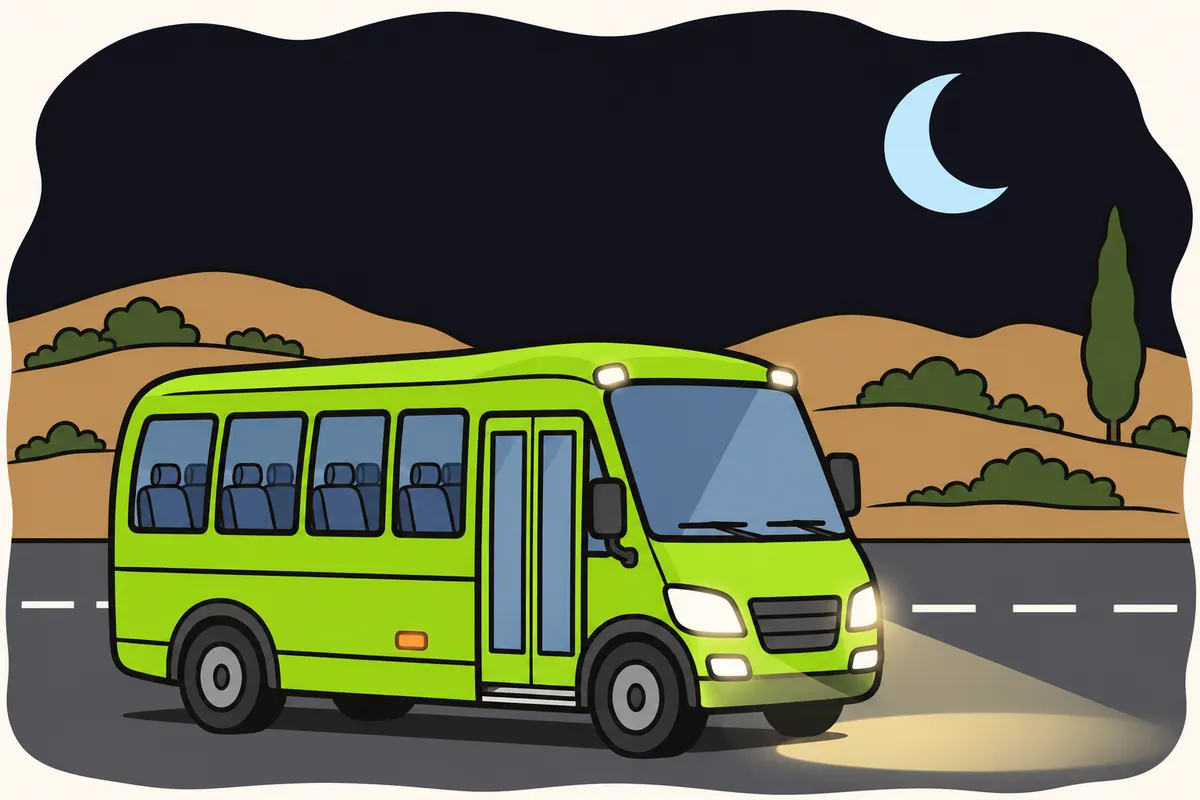
You must use lights at night, in tunnels and when visibility is much worse.
Remember
- Switch on your lights from sunset to sunrise.
- Use lights in tunnels and underpasses, including during the day.
- Use lights when visibility is significantly reduced.
- Add position lights and, above 2.10 m wide, end-outline marker lamps.
Exam trap: Wrong: you can drive without lights in a lit tunnel. Right: use the required lighting.
Read the full explanation
- You must use the appropriate lights from sunset to sunrise. This obligation applies to your minibus throughout a night journey, even if you know the route and see no other road users; the choice between dipped beam and main beam depends on the specific conditions. [RGC, art. 98](https://www.boe.es/buscar/act.php?id=BOE-A-2003-23514#a98).
- At any time of day, you must switch on the appropriate lights in tunnels, underpasses and stretches covered by the Tunnel sign, S-5. You must not wait until the interior seems dark: artificial lighting does not remove the obligation to use your vehicle lights. [RGC, art. 98](https://www.boe.es/buscar/act.php?id=BOE-A-2003-23514#a98).
- You must also switch them on when weather or environmental conditions significantly reduce visibility. You must assess fog, heavy rain, snowfall and clouds of smoke or dust, even at midday; your service timetable alone does not determine which lights you need. [RGC, art. 106](https://www.boe.es/buscar/act.php?id=BOE-A-2003-23514#a106).
- In these circumstances, you must keep the position lights on and, if your minibus is more than 2.10 m wide, the end-outline marker lamps, as well as the appropriate lights for seeing the road. You must not answer a question about a wide minibus by mentioning only dipped beam and forgetting the lights that indicate its dimensions. [RGC, art. 99](https://www.boe.es/buscar/act.php?id=BOE-A-2003-23514#a99).
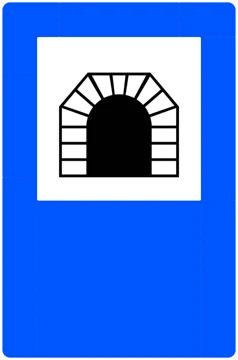 S-5
3Position lights: presence and width
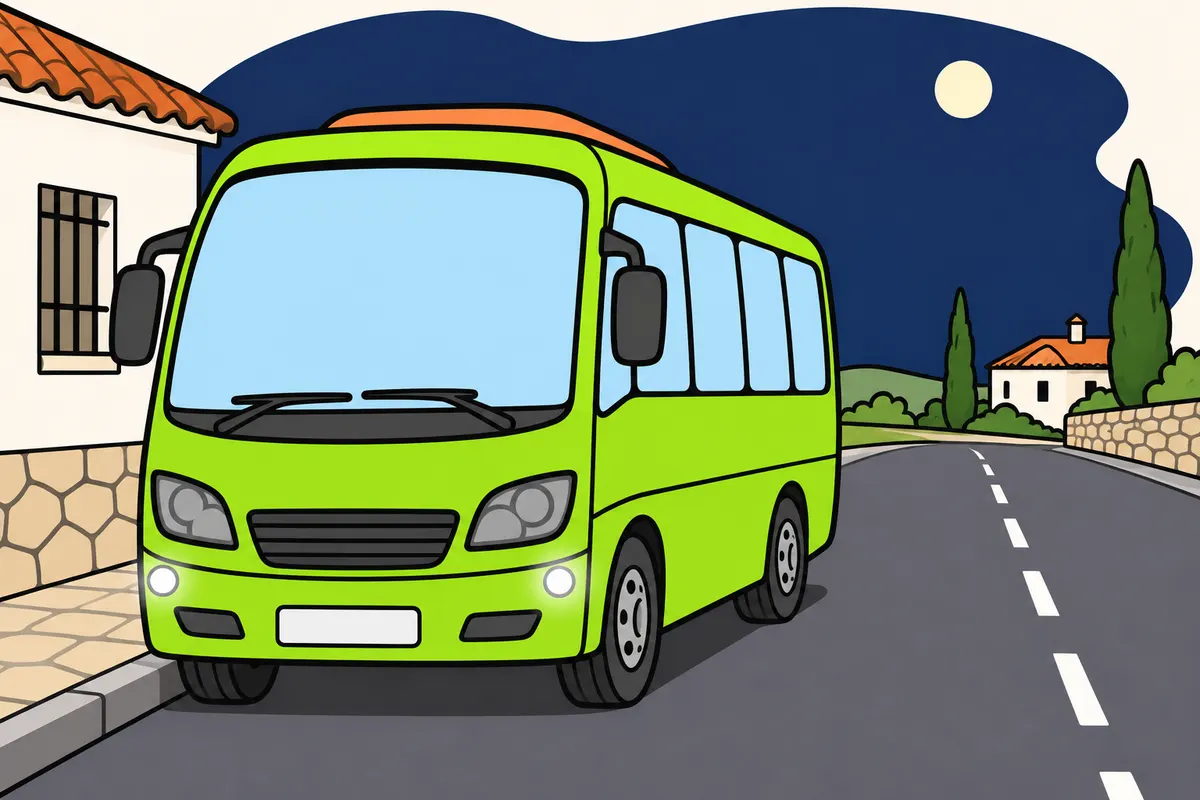
Position lights show your presence and width but do not light the road enough for driving.
| Minibus position lights | Colour |
|---|---|
| Front | White |
| Rear | Red |
Remember
- Front position lights are white; rear position lights are red.
- Do not drive with position lights alone.
- Add dipped beam in lit tunnels.
- You may need position lights when immobilised at night or in reduced visibility.
Exam trap: Wrong: street lights let you drive using only position lights at night. Right: add dipped beam.
Read the full explanation
- Your minibus has two white front position lights and two red rear position lights, located towards the outer edges. Their purpose is to indicate its presence and width when viewed from the front or rear; on their own, they do not provide the lighting you need to drive. [RGV, Annex X](https://www.boe.es/buscar/act.php?id=BOE-A-1999-1826#anx).
- When you drive at night or through a sufficiently lit tunnel, you must use dipped beam as well as the position lights. Driving with only the position lights on does not meet this obligation, even if you can see the carriageway thanks to street lights or the headlights of vehicles ahead of you. [RGC, art. 101](https://www.boe.es/buscar/act.php?id=BOE-A-2003-23514#a101).
- The rear position lights must switch on automatically when you switch on dipped beam, main beam, front position lights, rear number plate lighting or fog lights. The front position lights come on with dipped beam, main beam and front fog lights; permitted headlight flashes are subject to the technical exception provided for light signals. [RGV, art. 15](https://www.boe.es/buscar/act.php?id=BOE-A-1999-1826#a15).
- You may need the position lights when your minibus is stationary on the carriageway or the arcén (hard shoulder) at night or in reduced visibility. In this case, their purpose is to allow others to recognise the obstruction; you must not confuse this use with permission to drive using only the position lights. [RGC, art. 105](https://www.boe.es/buscar/act.php?id=BOE-A-2003-23514#a105).
4End-outline marker lamps: the width of the coach
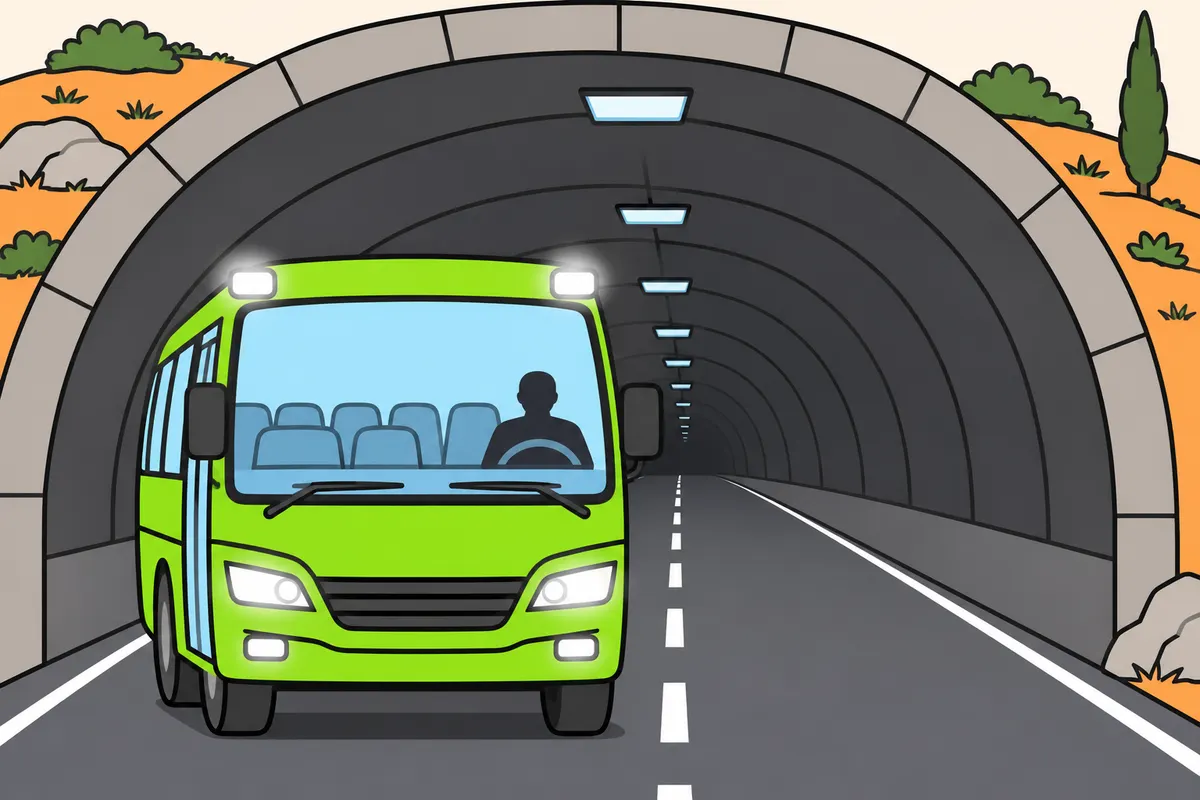
You must have end-outline marker lamps if your minibus exceeds the stated width.
| Motor vehicle width | Fitting end-outline marker lamps |
|---|---|
| Between 1.80 and 2.10 m | Optional |
| Over 2.10 m | Compulsory |
Remember
- Recognise these high lamps: white at the front, red at the rear.
- Above 2.10 m wide, use them with position lights.
- Use them at night, in tunnels and when visibility is significantly reduced.
- Immobilised on carriageway or shoulder: keep them on at night or in reduced visibility.
Exam trap: Wrong: exactly 2.10 m requires end-outline marker lamps. Right: you must exceed that width.
Read the full explanation
- If your minibus is more than 2.10 m wide, you must have end-outline marker lamps: two white lamps visible from the front and two red lamps visible from the rear. They are positioned as high as the vehicle allows and near its outer edges to show its overall width and complement the position lights. [RGV, Annex X](https://www.boe.es/buscar/act.php?id=BOE-A-1999-1826#anx).
- Between 1.80 and 2.10 m in width, fitting end-outline marker lamps is optional on the motor vehicles covered by the general table. You must read the question carefully: a width of exactly 2.10 m does not meet the condition of exceeding 2.10 m that determines the general obligation. [RGV, Annex X](https://www.boe.es/buscar/act.php?id=BOE-A-1999-1826#anx).
- In a minibus more than 2.10 m wide, you must switch on the end-outline marker lamps together with the position lights at night, in tunnels and when visibility is significantly reduced. If you drive through a tunnel during the day, this obligation does not depend on whether the road outside is sunny or the tunnel has street lights. [RGC, art. 99](https://www.boe.es/buscar/act.php?id=BOE-A-2003-23514#a99).
- If you become immobilised on the carriageway or hard shoulder at night or in reduced visibility, you must also keep the end-outline marker lamps on where required. You must not confuse these high-mounted lamps with an indication of the maximum authorised height or with amber direction indicators. [RGC, art. 105](https://www.boe.es/buscar/act.php?id=BOE-A-2003-23514#a105).
5Side marker lamps and reflectors
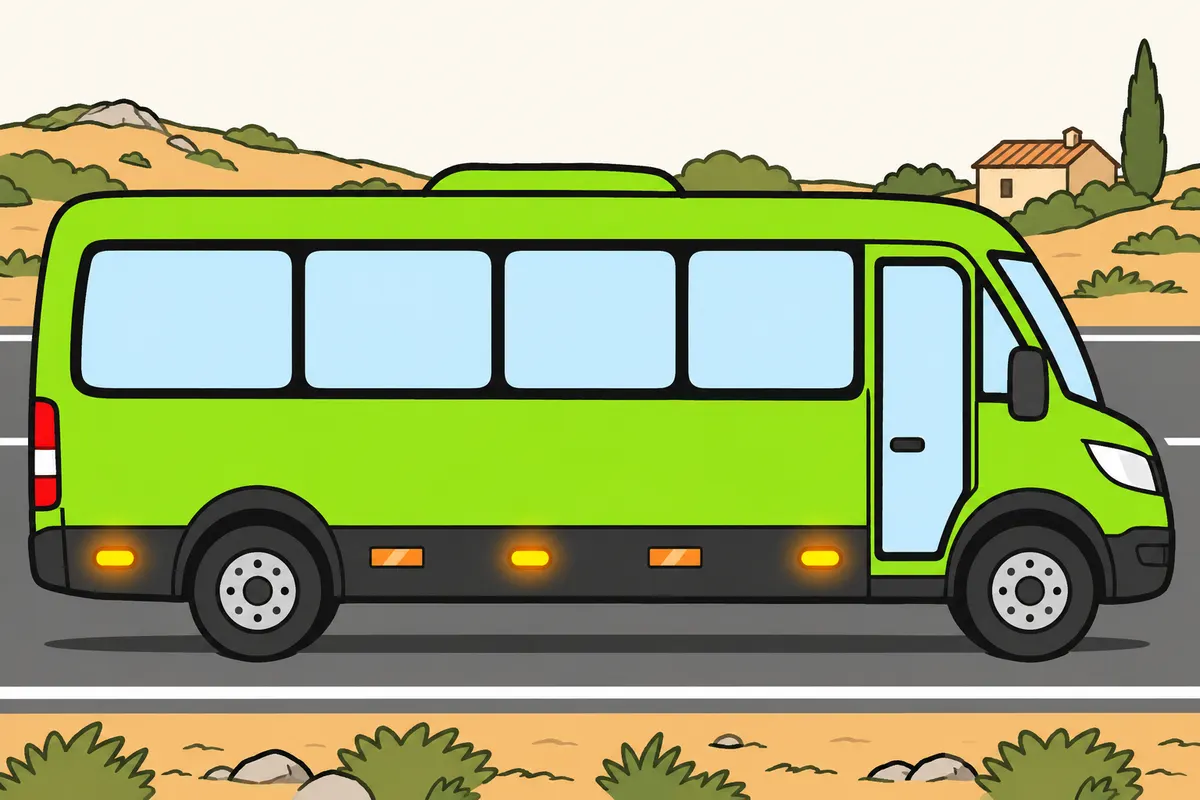
You must check length to know whether you need side lights and reflectors.
| Vehicle | Red rear reflectors |
|---|---|
| Minibus | Non-triangular |
| Luggage trailer | Triangular, with a point upwards |
Remember
- Your complete minibus needs side marker lamps if it exceeds 6 m.
- You also need non-triangular side reflectors if you exceed 6 m.
- Chassis cabs have an exception for side marker lamps.
- Side marker lamps are amber; certain rear arrangements allow red.
- A reflector returns light it receives; it produces no light.
- If you tow a trailer, check its own lights too.
Exam trap: Wrong: exactly 6 m requires side devices. Right: this general threshold requires you to exceed 6 m.
Read the full explanation
- If your minibus is more than 6 m long, you must have side marker lamps, subject to the regulatory exception for chassis-cabs. In a complete minibus of that length, you must have them; this obligation depends on length, whereas end-outline marker lamps depend on width. [RGV, art. 16](https://www.boe.es/buscar/act.php?id=BOE-A-1999-1826#a16).
- The side lamps are amber and are distributed along the side of the vehicle; the table specifies a minimum of two and a maximum according to length and the applicable regulations. Exceptionally, they may be red if they are grouped, combined or incorporated with certain rear devices. [RGV, Annex X](https://www.boe.es/buscar/act.php?id=BOE-A-1999-1826#anx).
- You must also have non-triangular side reflectors when your minibus is more than 6 m long. If it does not exceed that length, side marker lamps and side reflectors are optional under the general rule; you must not assume a fixed number of four lights for every minibus. [RGV, art. 16](https://www.boe.es/buscar/act.php?id=BOE-A-1999-1826#a16).
- A reflector reflects light received from an external source and does not generate its own light. Your minibus must have two red non-triangular rear reflectors; reflective number plates and other regulatory markings are not considered reflectors. [RGV, Annex X](https://www.boe.es/buscar/act.php?id=BOE-A-1999-1826#anx).
- If you drive a minibus 7.50 m long, you must have side marker lamps and side reflectors because it exceeds 6 m; if it measures exactly 6 m, that general threshold does not make them compulsory. You must check its width separately for end-outline marker lamps: a short minibus can also be wide. [RGV, arts. 16 and 17](https://www.boe.es/buscar/act.php?id=BOE-A-1999-1826#a16).
- If you tow a luggage trailer, you must distinguish its red triangular rear reflectors, with one point facing upwards, from the non-triangular reflectors on the minibus. The trailer has its own position lights, brake lights, direction indicators and rear number plate lighting according to its category; you must not rely solely on the towing vehicle’s lamp units. [RGV, art. 16](https://www.boe.es/buscar/act.php?id=BOE-A-1999-1826#a16).
6Dipped beam: your usual driving lights
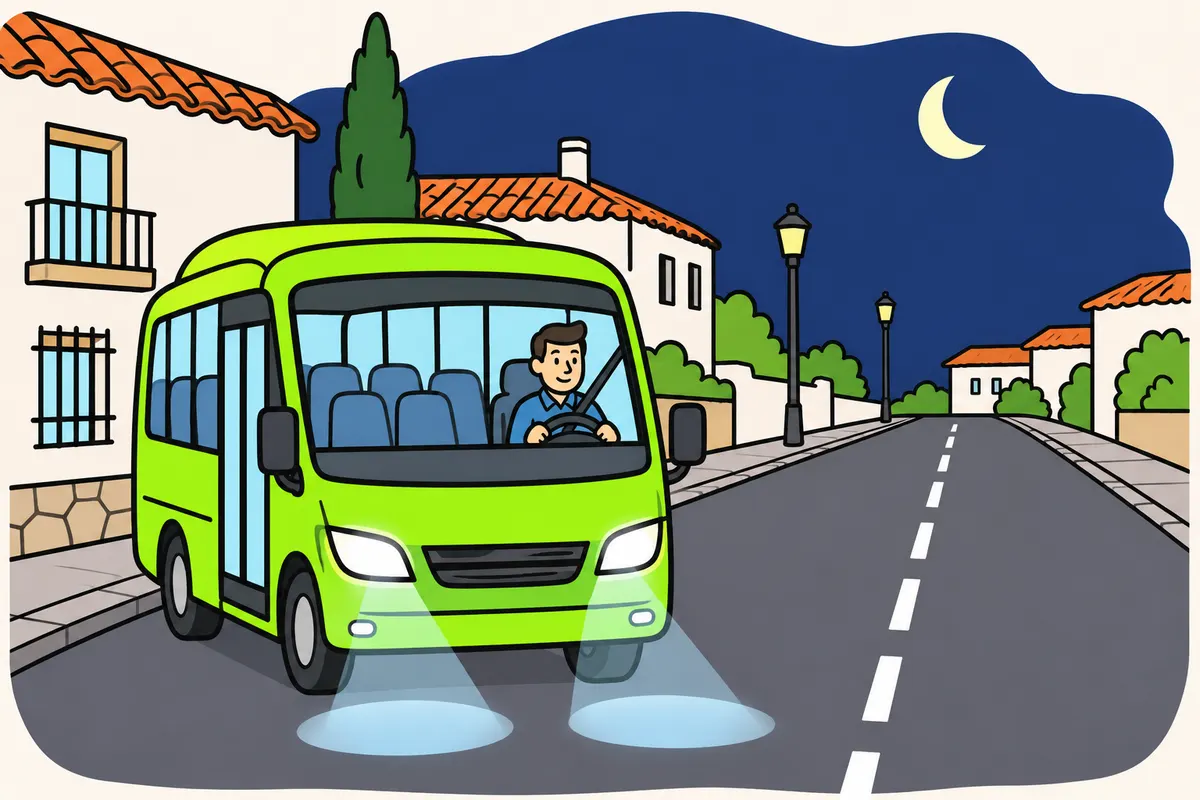
You must use dipped beam at night in built-up areas and whenever you could dazzle others.
Remember
- Recognise dipped beam: white front lights.
- At night in built-up areas, use dipped beam and position lights, even without streetlights.
- At night, use dipped beam on sufficiently lit roads.
- On dark interurban roads at night, up to 40 km/h:
- Use dipped beam unless you use main beam.
- Switch to dipped beam if you could dazzle others.
Exam trap: Wrong: a dark street allows main beam. Right: at night, use dipped beam in built-up areas.
Read the full explanation
- Your minibus must have two white front dipped-beam headlights. You must also recognise these as low-beam or short-range headlights; they light the road ahead without the range of main beam and are the driving lights you use in the specified circumstances to avoid dazzling others. [RGV, Annex X](https://www.boe.es/buscar/act.php?id=BOE-A-1999-1826#anx).
- At night, you must use dipped beam, as well as the position lights, on urban roads and sufficiently lit interurban roads. Within built-up areas, you must also use it if the road is insufficiently lit; a dark street does not authorise you to drive along it using main beam. [RGC, art. 101](https://www.boe.es/buscar/act.php?id=BOE-A-2003-23514#a101).
- On an insufficiently lit interurban road at night, you must use dipped beam if you drive at a speed not exceeding 40 km/h and do not use main beam. Exactly 40 km/h is included in this case; the speed-based obligation to use main beam requires you to exceed that value. [RGC, art. 101](https://www.boe.es/buscar/act.php?id=BOE-A-2003-23514#a101).
- You must use dipped beam whenever there is a possibility of dazzling others, even if you are driving on a dark road and need to reduce your speed. You must apply the same criterion in insufficiently lit tunnels and underpasses: other people’s safety limits your use of main beam. [RGC, art. 101](https://www.boe.es/buscar/act.php?id=BOE-A-2003-23514#a101).
7Main beam: range and limits on use
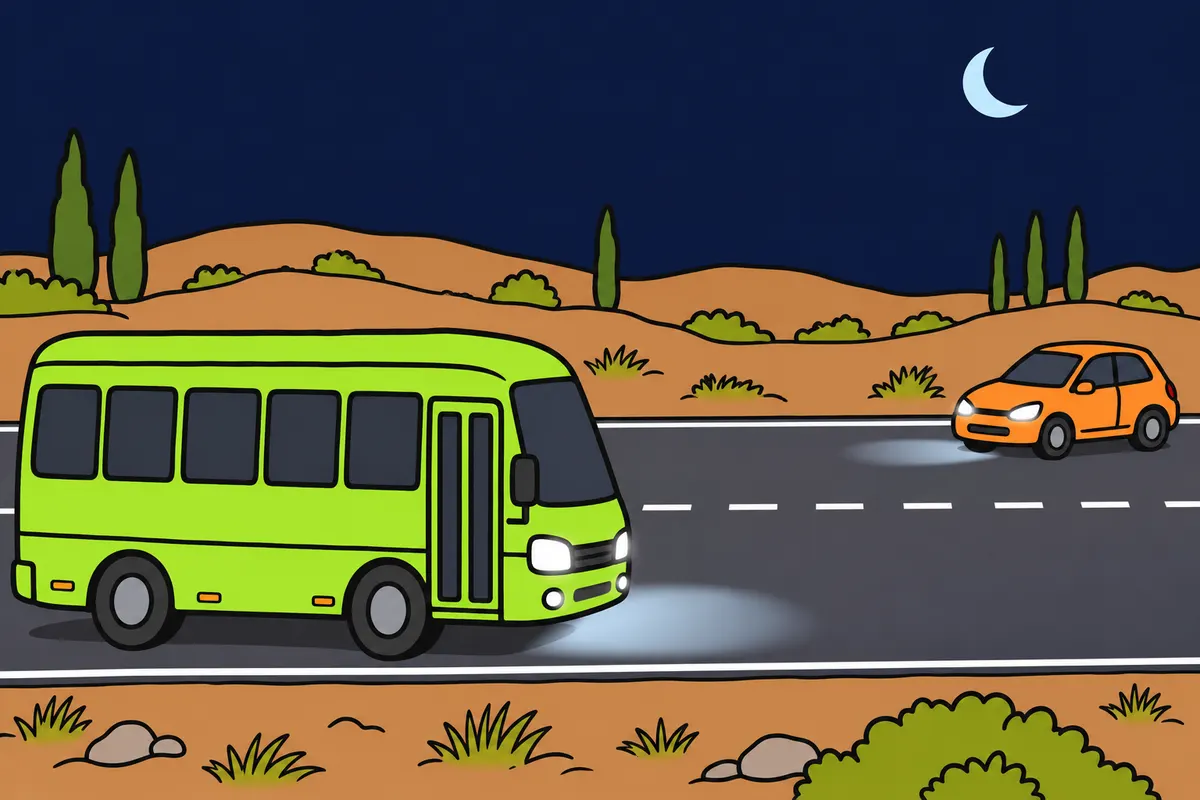
You must use main beam on dark interurban roads at night, above the threshold, without dazzling.
Remember
- Outside built-up areas, at night: main beam above 40 km/h, insufficient lighting, without dazzling.
- Keep required position lights on, even when using main beam without dipped beam.
- Do not keep main beam on when stopped or parked.
- With normal vision, failing either reference means the road is insufficiently lit.
Exam trap: Wrong: at 40 km/h you must always use main beam. Right: you must exceed that speed, outside built-up areas, at night, with insufficient lighting and no risk of dazzling others.
Read the full explanation
- Main beam is white and fitted at the front; the general table specifies an even number of lamps according to the category and regulations. Its purpose is to illuminate the road over a long distance, but having it does not allow you to keep it on on every road. [RGV, Annex X](https://www.boe.es/buscar/act.php?id=BOE-A-1999-1826#anx).
- Outside built-up areas, at night on an insufficiently lit road, you must use main beam when travelling at more than 40 km/h unless you must use dipped beam to avoid dazzling others. For example, a dark, clear road may require main beam; if traffic appears that you could dazzle, you must switch to dipped beam. [RGC, art. 100](https://www.boe.es/buscar/act.php?id=BOE-A-2003-23514#a100).
- You may use main beam on its own or together with dipped beam, provided you keep the required position lights on. Using main beam on its own refers to its use in relation to dipped beam and does not allow you to switch off the lights indicating the presence and width of the minibus. [RGC, art. 100](https://www.boe.es/buscar/act.php?id=BOE-A-2003-23514#a100).
- You must not keep main beam on when the minibus is stopped or parked. You must also not flash between dipped and main beam for purposes other than those permitted by the regulations; you must distinguish an authorised brief warning from continuous use of main beam to light the road while driving. [RGC, art. 100](https://www.boe.es/buscar/act.php?id=BOE-A-2003-23514#a100).
- To assess the road lighting, you must remember two criteria: being unable to read a number plate at 10 m or distinguish a dark vehicle at 50 m, with normal vision at any point on the carriageway. Either circumstance is enough for the road to be considered insufficiently lit. [RGC, art. 100](https://www.boe.es/buscar/act.php?id=BOE-A-2003-23514#a100).
8How to avoid dazzling others
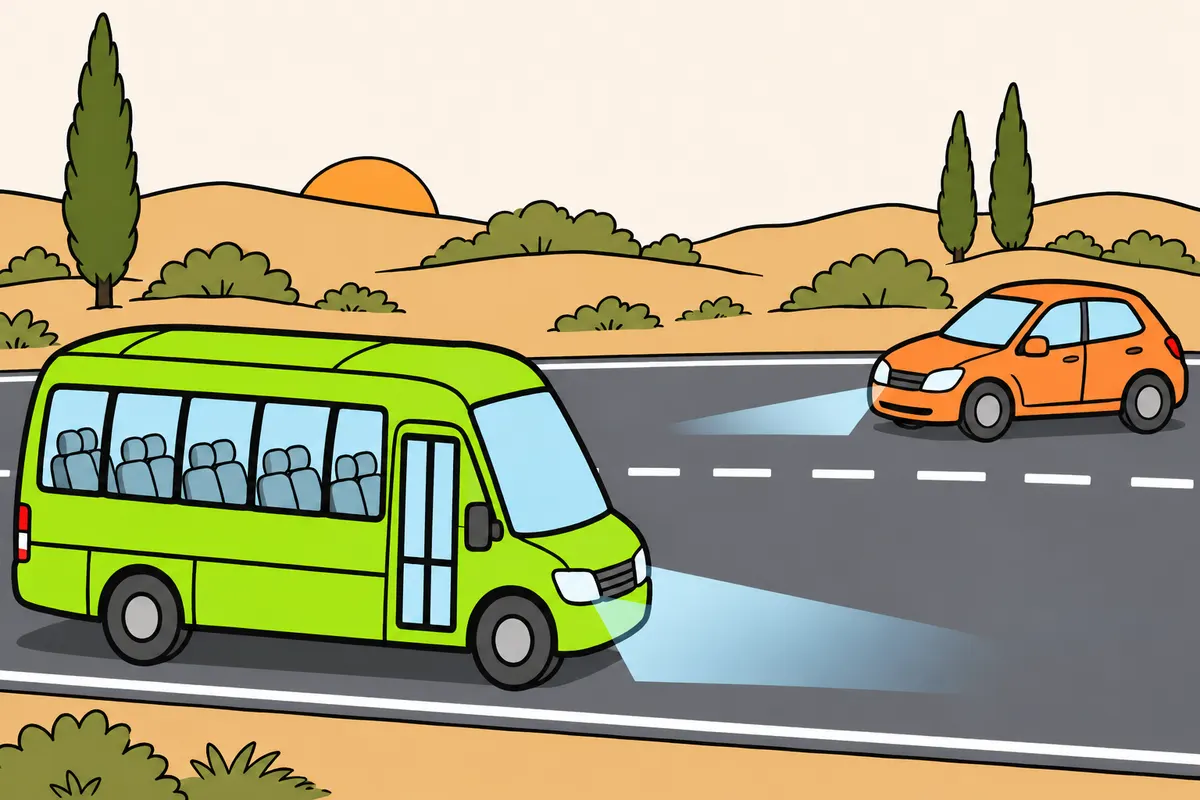
You must switch to dipped beam as soon as you could dazzle anyone.
Remember
- Do not wait for a fixed distance or a request through headlight flashes.
- Keep dipped beam on until you have passed an oncoming vehicle.
- Do not respond with main beam if someone dazzles you.
- Avoid dazzling the driver ahead through their mirrors.
- If dazzled, slow down; stop if necessary.
Exam trap: Wrong: you can keep main beam on until someone warns you. Right: switch to dipped beam as soon as you notice a risk of dazzling.
Read the full explanation
- You must switch from main beam to dipped beam as soon as you recognise any possibility of dazzling a user of the same road or another transport route. You must not wait until you reach a fixed distance or until the other driver asks you by flashing their headlights. [RGC, art. 102](https://www.boe.es/buscar/act.php?id=BOE-A-2003-23514#a102).
- When meeting an oncoming vehicle, you must keep dipped beam on until you have passed it. You must do this even if the oncoming driver wrongly keeps main beam on; responding with main beam prolongs the danger and does not relieve you of your duty to avoid dazzling others. [RGC, art. 102](https://www.boe.es/buscar/act.php?id=BOE-A-2003-23514#a102).
- You must also protect drivers ahead of you: your main beam can dazzle them through their mirrors. You must assess the actual situation when following or overtaking a vehicle; travelling in the same direction does not remove the need for this precaution. [RGC, art. 102](https://www.boe.es/buscar/act.php?id=BOE-A-2003-23514#a102).
- If you are dazzled, you must reduce your speed as much as necessary, even stopping, to avoid running into vehicles or pedestrians. In the minibus, you must prioritise regaining enough vision to control your driving; you must not continue at the same speed relying on the route you remember. [RGC, art. 102](https://www.boe.es/buscar/act.php?id=BOE-A-2003-23514#a102).
9Tunnels and underpasses
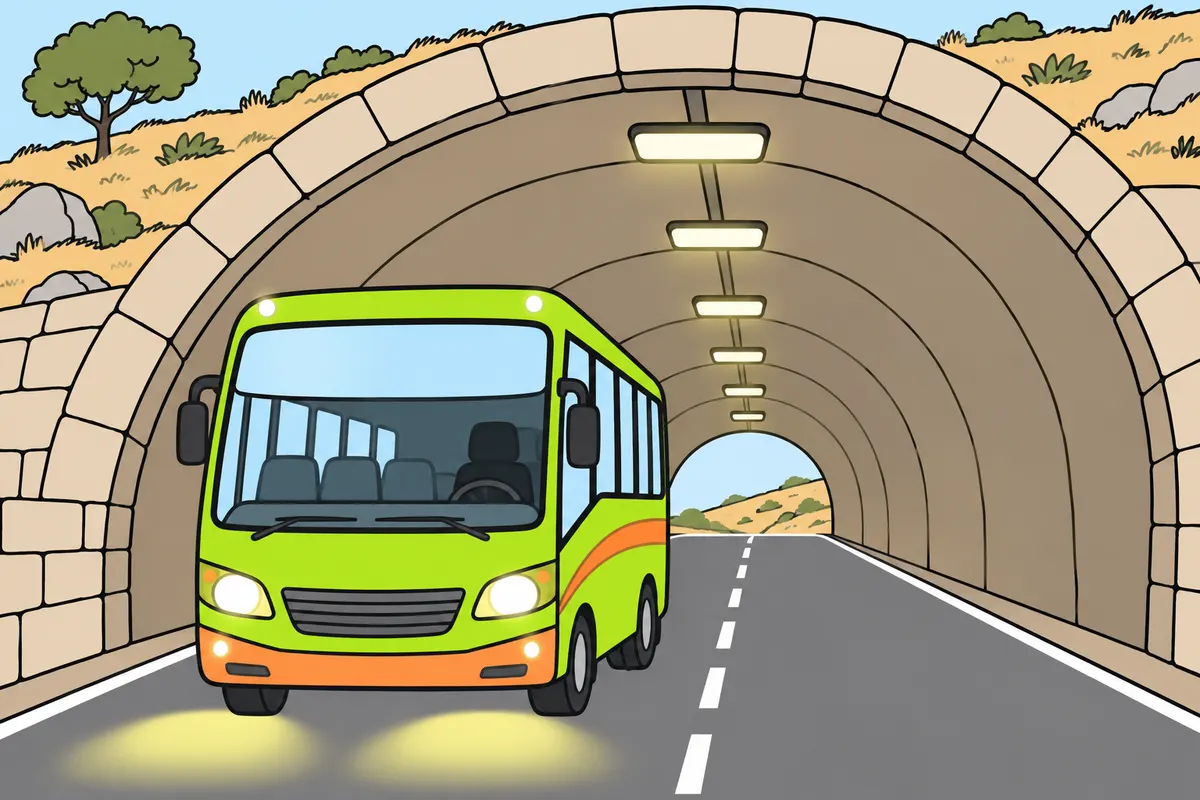
You must enter tunnels with the required lights on, even during the day.
| Minibus situation in tunnel | Lights for seeing ahead |
|---|---|
| Sufficiently lit tunnel | Dipped beam |
| Dark interurban tunnel, above 40 km/h, without dazzling or exceptions | Main beam |
| Dark interurban tunnel, up to 40 km/h, not using main beam | Dipped beam |
Remember
- In a lit tunnel, use dipped beam and position lights.
- Add end-outline marker lamps if your width exceeds 2.10 m.
- When stopped inside, always switch off the engine and keep position lights on.
- After waiting over two minutes, keep the engine off and position lights on.
- Use hazard warning lights for emergencies.
- In traffic queues, use hazard warning lights briefly to warn drivers approaching behind.
Exam trap: Wrong: every tunnel requires main beam. Right: use it in a dark interurban tunnel above 40 km/h, without dazzling and except where dipped beam is required.
Read the full explanation
- Before entering, you must select the required lighting, even in daylight when the tunnel appears bright. You must keep the position lights on and, where applicable, the end-outline marker lamps, which are required when the width exceeds 2.10 m; front daytime running lights alone do not meet these requirements for the minibus. [RGC, art. 99](https://www.boe.es/buscar/act.php?id=BOE-A-2003-23514#a99).
- If the tunnel is sufficiently lit, you must use dipped beam as well as position lights. You must not answer that you can drive through it with only daytime running lights or only position lights because you can see the road surface; the specific requirement applies at any time of day. [RGC, art. 101](https://www.boe.es/buscar/act.php?id=BOE-A-2003-23514#a101).
- In an insufficiently lit tunnel outside built-up areas, you must use main beam if you exceed 40 km/h and there is no risk of dazzling others, subject to the exceptions requiring dipped beam. If you travel at 40 km/h or less and do not use main beam, you must use dipped beam; the same lighting selection is not required in every tunnel. [RGC, art. 100](https://www.boe.es/buscar/act.php?id=BOE-A-2003-23514#a100).
- If you are immobilised by an emergency or traffic inside a tunnel or underpass, you must switch on the hazard warning lights and keep the position lights on; in a traffic queue, the hazard warning is temporary. You must always switch off the engine when stopped inside a tunnel or enclosed place; if the wait lasts more than two minutes, you must keep the engine off and the position lights on. [RGC, art. 97](https://www.boe.es/buscar/act.php?id=BOE-A-2003-23514#a97) and [art. 115](https://www.boe.es/buscar/act.php?id=BOE-A-2003-23514#a115).
10Daytime dipped beam in special lanes
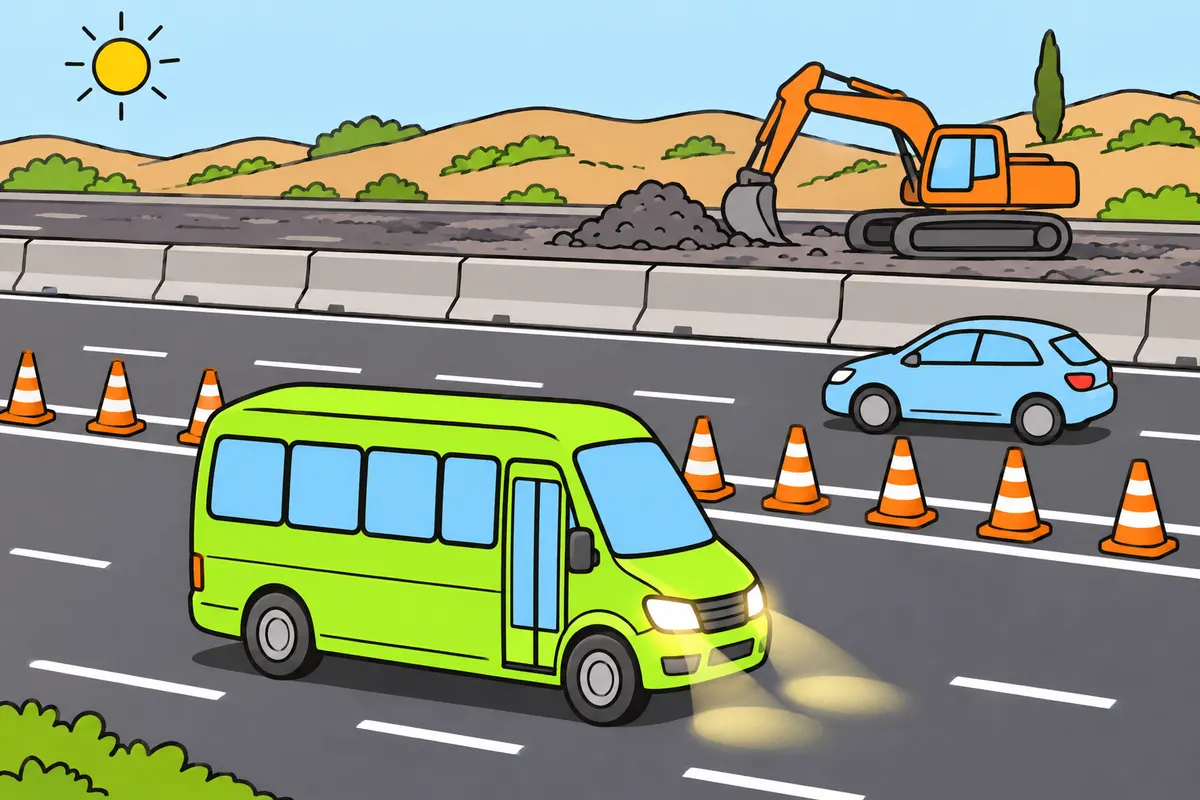
You must use dipped beam in the specified special lanes, including during the day.
| Lane opened against usual direction | Minibus access |
|---|---|
| To improve traffic flow | You cannot use it |
| For roadworks | You may use it if authorised on the road and not expressly prohibited |
Remember
- Use dipped beam in reversible, temporary additional and opposite-direction lanes.
- Also use it in the normal-direction lane beside the opposite-direction lane.
- With an additional lane, also use dipped beam on the opened hard shoulders.
- Daytime running lights do not replace dipped beam.
Exam trap: Wrong: your minibus can use any lane opened against the usual direction. Right: for traffic flow, only cars and motorcycles qualify; for roadworks, you may use it if authorised on the road and not expressly prohibited.
Read the full explanation
- You must use dipped beam by day and by night when driving in a reversible lane, a temporary additional lane or a lane opened to traffic travelling against the usual direction. Daytime running lights do not replace the express requirement to switch on dipped beam in these lanes. [RGC, art. 104](https://www.boe.es/buscar/act.php?id=BOE-A-2003-23514#a104).
- You must not use a lane opened against the usual direction solely to improve traffic flow in your minibus: this arrangement is limited to cars and motorcycles. If the lane is opened because of roadworks, vehicles allowed on the road may use it unless expressly prohibited, and you must keep dipped beam on. [RGC, art. 41](https://www.boe.es/buscar/act.php?id=BOE-A-2003-23514#a41).
- You must also use dipped beam when driving in a lane running in the normal direction next to the lane opened against the usual direction. The question may place the minibus outside the temporary lane: the lighting requirement still applies to the adjacent lane described in the article. [RGC, art. 41](https://www.boe.es/buscar/act.php?id=BOE-A-2003-23514#a41).
- When a temporary additional lane is opened using the arcenes (hard shoulders), vehicles travelling on these and in the additional lane must use at least dipped beam by day and by night. You must consider the entire traffic arrangement, not just the lane in the centre. [RGC, art. 42](https://www.boe.es/buscar/act.php?id=BOE-A-2003-23514#a42).
11Daytime running lights and automatic lighting
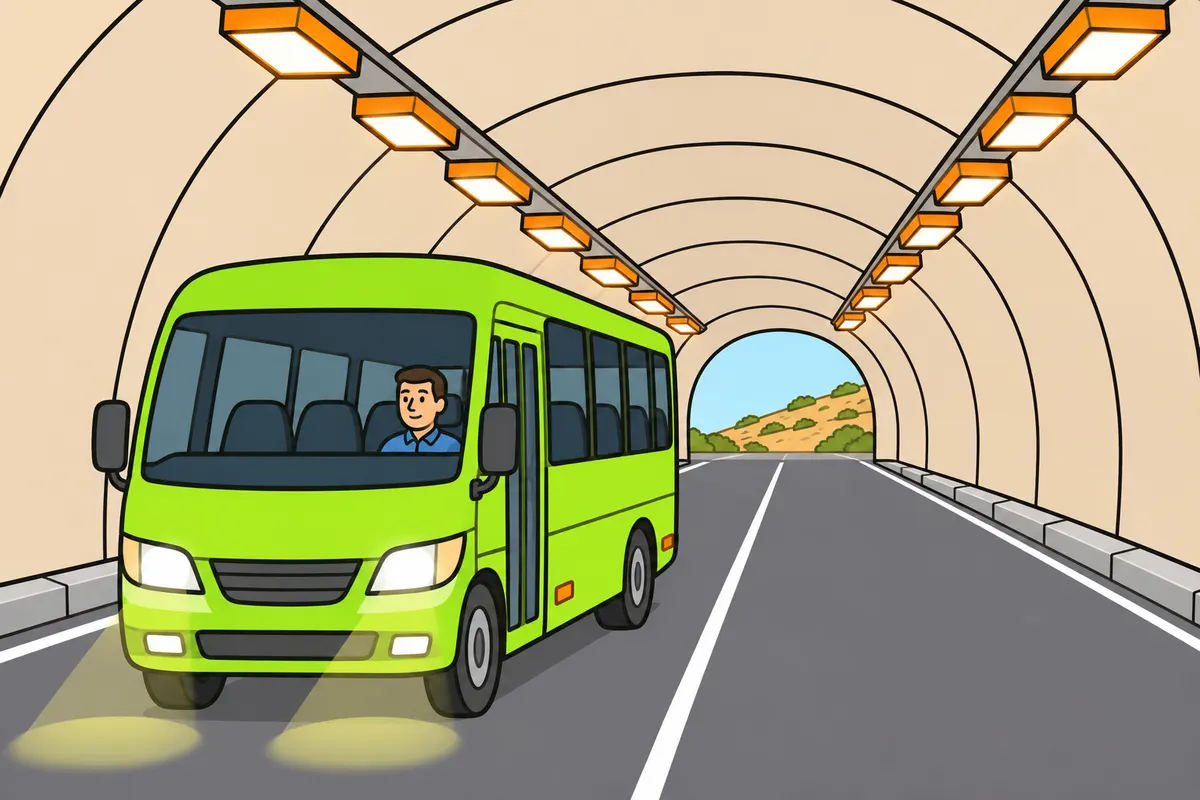
You must check which lights are on, even with automatic lighting.
Remember
- Daytime running lights make you visible during the day.
- They may leave your rear lights off.
- In lit tunnels, select position lights and dipped beam, even without automatic activation.
- Driving a minibus does not require dipped beam all day on every road.
Exam trap: Wrong: automatic lighting is always enough. Right: check that your required lights are on.
Read the full explanation
- You must understand daytime running lights as a system for making the vehicle visible during the day. If your minibus has them, you must not confuse their operation with selecting dipped beam or assume that they illuminate the road like dipped beam. [DGT, Lights: what they are and how to use them](https://revista.dgt.es/es/educacion-formacion/conducir-mejor/2023/0608-Luces.shtml).
- In your minibus, the requirement to use dipped beam during the day depends on the driving situations specified in the regulations; the bus category alone does not require its use on every road. You must apply the lighting requirements for special lanes, tunnels, darkness or reduced visibility. [RGC, art. 104](https://www.boe.es/buscar/act.php?id=BOE-A-2003-23514#a104).
- If the vehicle has automatic lighting, you must check that the lights actually switched on meet the driving conditions. Automation does not change your duty in a sufficiently lit tunnel: you must use position lights and dipped beam, even if the sensor detects that there is still plenty of light. [RGC, art. 101](https://www.boe.es/buscar/act.php?id=BOE-A-2003-23514#a101).
- Daytime running lights may leave the rear lights off: you must select the appropriate lighting when you also need to indicate the rear of the minibus. [DGT, daytime running lights](https://revista.dgt.es/es/noticias/nacional/2015/12DICIEMBRE/1223luces-de-dia.shtml).
12Front fog lamps: when you may use them
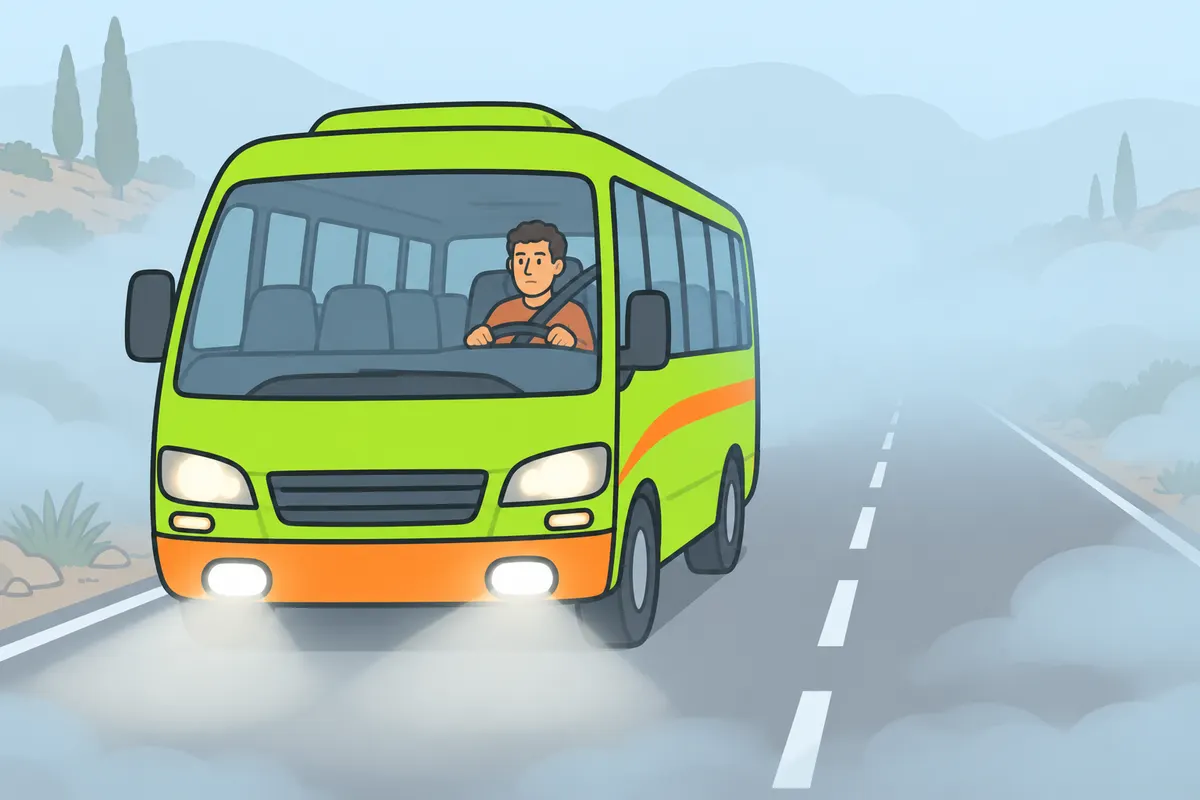
You may use front fog lights in reduced visibility or on certain narrow, winding roads.
Remember
- You do not have to fit front fog lights to your minibus.
- Use them when fog, heavy rain, snowfall, smoke or dust significantly reduces visibility.
- Keep position lights and other required lights on.
- You may use them without dipped beam when their use is permitted.
Exam trap: Wrong: any bend allows front fog lights. Right: without visibility conditions allowing them, you need a carriageway no wider than 6.50 m and signs showing a series of closely spaced bends.
Read the full explanation
- Front fog lamps are optional on the minibus and, if fitted, the general table specifies two, white or selective yellow. Fitting them allows you to increase illumination close to the vehicle in the situations where their use is authorised. [RGV, Annex X](https://www.boe.es/buscar/act.php?id=BOE-A-1999-1826#anx).
- You may use them in weather or environmental conditions that significantly reduce visibility: fog, heavy rain, snowfall, or smoke and dust. In these circumstances, you must use front fog lamps, dipped beam or main beam, as appropriate; keeping only the position lights on is not enough. [RGC, art. 106](https://www.boe.es/buscar/act.php?id=BOE-A-2003-23514#a106).
- You may use front fog lamps without dipped beam or together with dipped beam and even with main beam when authorised. You must keep the position lights and all other required lighting on: using them without another forward-facing headlamp does not mean you may switch off all the lights indicating the vehicle’s presence. [RGC, art. 106](https://www.boe.es/buscar/act.php?id=BOE-A-2003-23514#a106).
- You may also use them on a narrow, winding road if both requirements are met: a carriageway 6.50 m wide or less and signs indicating a series of bends close together. A single bend or a wide road does not meet this exception. [RGC, art. 106](https://www.boe.es/buscar/act.php?id=BOE-A-2003-23514#a106).
- You must not switch on front fog lamps simply because it is night or to improve the appearance of the minibus. When neither the visibility conditions nor the exception for a narrow, winding road apply, you must use the appropriate ordinary lighting. [RGC, art. 106](https://www.boe.es/buscar/act.php?id=BOE-A-2003-23514#a106).
13Rear fog lights: particularly adverse conditions
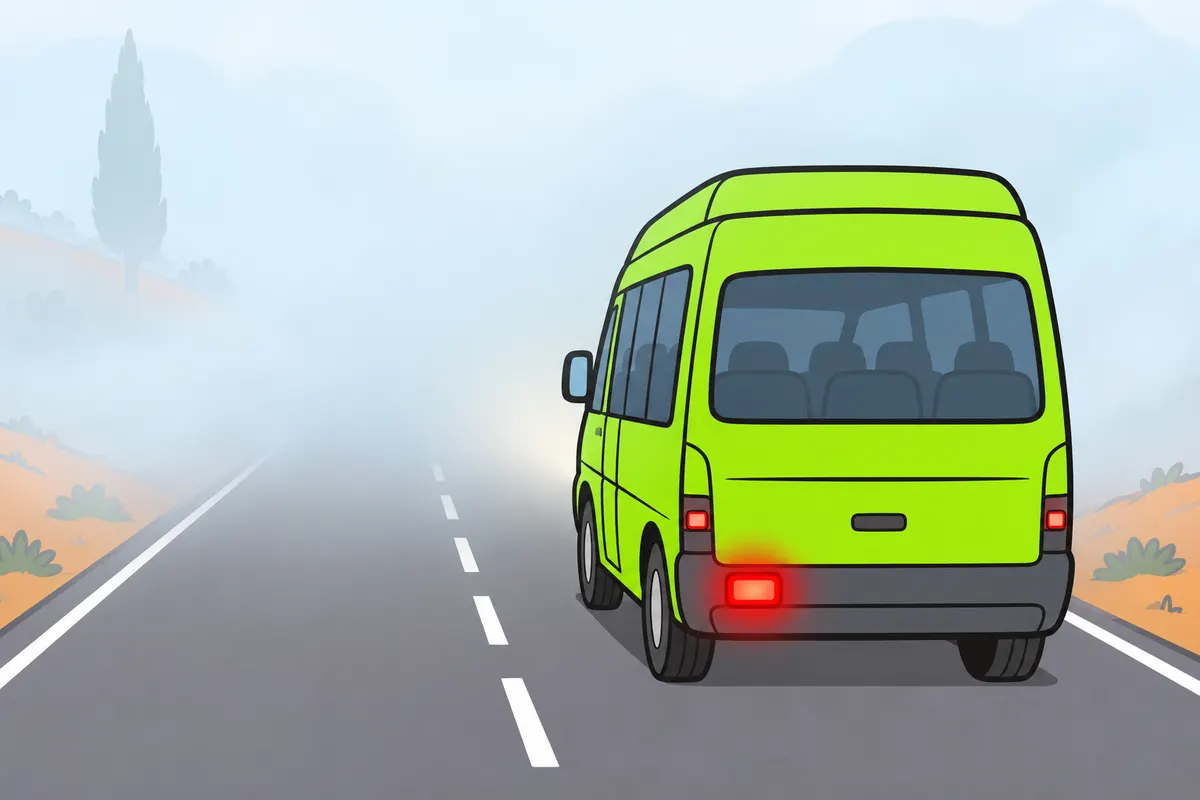
You must reserve rear fog lights for particularly poor visibility.
Remember
- You must have red rear fog lights on your minibus.
- Use them in thick fog, very heavy rain or heavy snowfall.
- You must also use them in dense clouds of dust or smoke.
- You must also have main beam, dipped beam or front fog lights on.
- Switch them off when these particularly poor conditions end.
Exam trap: Wrong: any rain allows rear fog lights. Right: use them in particularly adverse conditions; there is no general 50 m threshold for switching them on.
Read the full explanation
- Your minibus must have one or two red rear fog lights. If it has one, it may be on the left or in the centre; if it has two, they are positioned towards the outer edges in accordance with the applicable regulations. You must not memorise that there are always exactly two. [RGV, annex X](https://www.boe.es/buscar/act.php?id=BOE-A-1999-1826#anx).
- You must switch them on when conditions are particularly adverse: thick fog, very heavy rain, heavy snowfall or dense clouds of dust or smoke. You must not equate any rain with very heavy rain, or any mist with thick fog; rear fog lights require more severe conditions, and you must reserve them for these situations. [RGC, art. 106](https://www.boe.es/buscar/act.php?id=BOE-A-2003-23514#a106).
- Article 106 does not set a general visibility threshold of 50 m for switching on rear fog lights. You must decide according to the conditions described in the rule; the 50 m in the definition of an insufficiently lit road relates to a different matter. [RGC, art. 106](https://www.boe.es/buscar/act.php?id=BOE-A-2003-23514#a106).
- You can only switch on the rear fog lights if the main beam, dipped beam or front fog lights are also on. You must not confuse this technical condition with permission to use them: even if the switch allows you to turn them on, you must only keep them on when visibility justifies it. [RGV, art. 15](https://www.boe.es/buscar/act.php?id=BOE-A-1999-1826#a15).
- In normal visibility, you must keep the rear fog lights off: their intense light can cause discomfort to those following your minibus. A dark or winding road on its own requires you to select the appropriate ordinary lighting for the road and its lighting conditions. [RGC, art. 106](https://www.boe.es/buscar/act.php?id=BOE-A-2003-23514#a106).
14Direction indicators
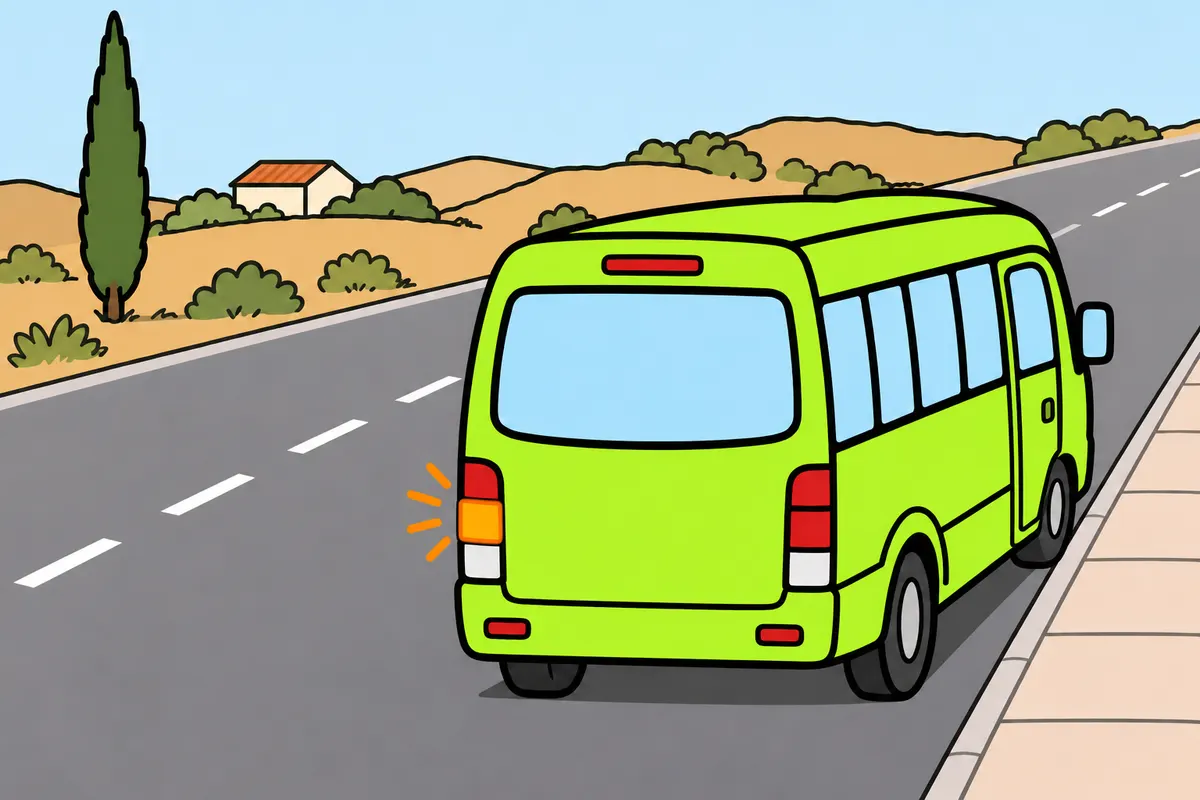
You must signal every sideways movement early and end the signal when you finish.
| Your left-arm signal | Movement indicated |
|---|---|
| Horizontal, palm down | Left |
| Bent upwards, palm extended | Right |
Remember
- Signal towards the side you intend to move.
- Signal even if you do not enter another lane.
- Keep your indicator on throughout the manoeuvre; switch it off when finished.
- Use your arm only if light signals are unavailable and your gesture is visible.
- A valid arm signal takes priority over a conflicting light signal.
Exam trap: Wrong: you only signal when changing lanes. Right: signal every sideways movement.
Read the full explanation
- Your minibus’s direction indicators emit amber light and are positioned at the outer edges and along the sides in accordance with the regulations. The general table specifies an even number greater than two; you must distinguish their flashes from the side marker lamps, even though both may be the same colour. [RGV, annex X](https://www.boe.es/buscar/act.php?id=BOE-A-1999-1826#anx).
- You must give sufficient advance warning of every sideways movement, even if you do not enter the adjacent lane. Use the indicator on the side towards which you intend to move; in a minibus, you must signal the course you intend to take and separately check that you can follow it safely. [RGC, art. 109](https://www.boe.es/buscar/act.php?id=BOE-A-2003-23514#a109).
- You must keep the indicator on throughout the manoeuvre and switch it off once your minibus is following its new course. You must not leave the indicator on after completing the sideways movement, because you would be signalling an intention different from your actual intention. [RGC, art. 109](https://www.boe.es/buscar/act.php?id=BOE-A-2003-23514#a109).
- As a general rule, you must signal using the vehicle’s lights or, if these are unavailable, with your arm, provided the signal is visible and complies with the regulations. A valid arm signal takes precedence over a contradictory light signal; you must not rely on a gesture hidden by the bodywork. [RGC, art. 108](https://www.boe.es/buscar/act.php?id=BOE-A-2003-23514#a108).
- If you use your arm, extending it horizontally with your palm facing down indicates movement towards that side; bending it upwards with your palm open indicates movement towards the opposite side. With your left arm, a horizontal signal means left and an upward-bent signal means right. [RGC, art. 109](https://www.boe.es/buscar/act.php?id=BOE-A-2003-23514#a109).
15Braking and reversing
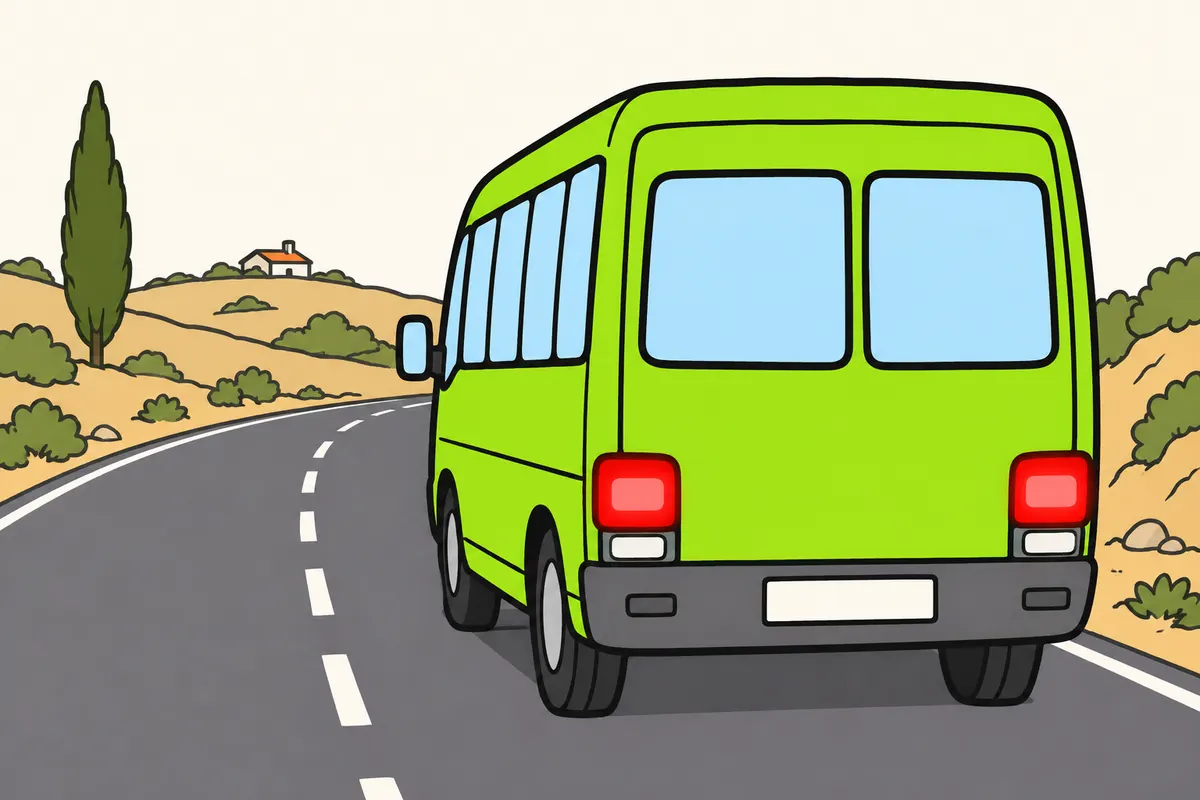
Brake lights are red; reversing lights are white.
| Your minibus lights | Colour | Purpose |
|---|---|---|
| Brake lights | Red | Warn that you are braking |
| Reversing lights | White | Light the area behind and warn that you are reversing |
Remember
- If possible, warn of major slowing by lighting your brake lights repeatedly.
- You may warn by moving your arm up and down with short, quick movements.
- Keep your compulsory reversing light working.
- Check vehicle category and type approval before deciding about a third brake light.
Exam trap: Wrong: car requirements for a third brake light always apply to your minibus. Right: check its category and type approval.
Read the full explanation
- Brake lights are red and positioned at the rear. The general table requires two; it lists the third brake light as optional for the motor vehicle covered by this table, subject to its category and type approval, and you must not automatically apply passenger car requirements to your minibus. [RGV, annex X](https://www.boe.es/buscar/act.php?id=BOE-A-1999-1826#anx).
- Whenever possible, you must warn of your intention to bring your minibus to a standstill or slow down considerably by using the brake lights repeatedly. You may also move your arm up and down in short, rapid movements; you may need to give this warning because of a traffic queue. [RGC, art. 109](https://www.boe.es/buscar/act.php?id=BOE-A-2003-23514#a109).
- Your minibus must have reversing lights: the general table specifies one or two white lights at the rear. They illuminate the area behind you and warn that you are reversing; a white rear light of this type is not a position light, an end-outline marker lamp or a fog light. [RGV, annex X](https://www.boe.es/buscar/act.php?id=BOE-A-1999-1826#anx).
- You must signal reversing with the corresponding light. If the vehicle has no reversing light, the prescribed hand signal consists of extending your arm horizontally with your palm facing backwards; in your minibus, the light is compulsory equipment and you must keep it working. [RGC, art. 109](https://www.boe.es/buscar/act.php?id=BOE-A-2003-23514#a109).
16Hazard warning lights: all indicators flashing together
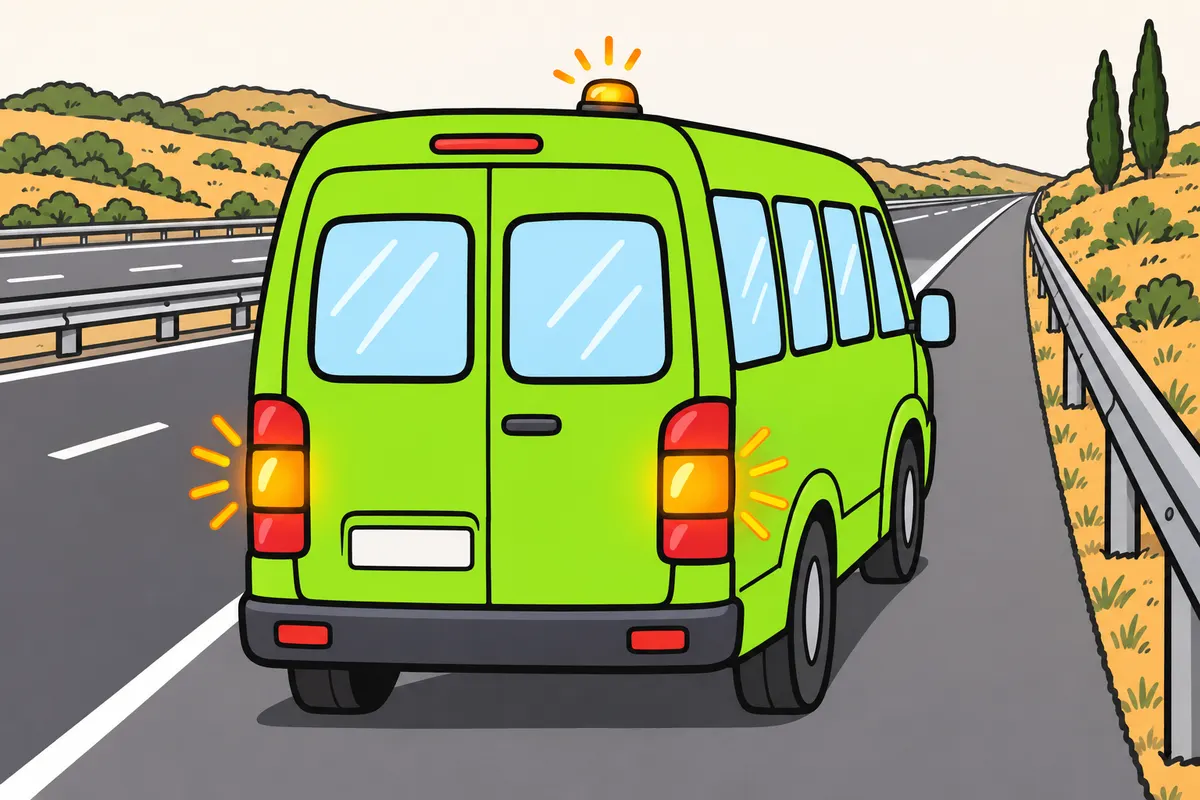
You must use hazard warning lights to warn of the specified dangers.
Remember
- When immobilised on a motorway, use hazard warning lights.
- Also switch on position lights where required.
- Also do this when immobilised where visibility is significantly reduced.
- While driving, use hazards if you justifiably cannot reach minimum speed, risking rear-end collisions.
- To stop or park, also use the indicator on the appropriate side.
Exam trap: Wrong: all slow driving requires hazard warning lights. Right: while driving, use them if a justified reason prevents you reaching minimum speed and there is a risk of a rear-end collision.
Read the full explanation
- All minibuses must have hazard warning lights, which operate all the direction indicators simultaneously. They emit amber light and use the same indicators; you must distinguish them from the portable V-16 beacon and the illuminated school transport pictogram. [RGV, art. 16](https://www.boe.es/buscar/act.php?id=BOE-A-1999-1826#a16).
- If you become immobilised on an autopista or autovía (motorway), or in places or circumstances that significantly reduce visibility, you must warn of your presence using the hazard warning lights and, where appropriate, the position lights. This warning system is compulsory on your minibus; you must not limit its use to school services. [RGC, art. 109](https://www.boe.es/buscar/act.php?id=BOE-A-2003-23514#a109).
- If, for a justified reason, you cannot reach the required minimum speed and there is a risk of a rear-end collision, you must use the hazard warning lights while driving. These circumstances must both apply; you must not make simultaneous flashing of the indicators a routine signal for any slow driving or ordinary stop. [RGC, art. 49](https://www.boe.es/buscar/act.php?id=BOE-A-2003-23514#a49).
- When you intend to stop or park, you must also use the indicator on the corresponding side. You must not replace the signal for sideways movement with all four indicators: these warn of a general hazard, while the indicator communicates which way you intend to move. [RGC, art. 109](https://www.boe.es/buscar/act.php?id=BOE-A-2003-23514#a109).
17Immobilised and parked buses
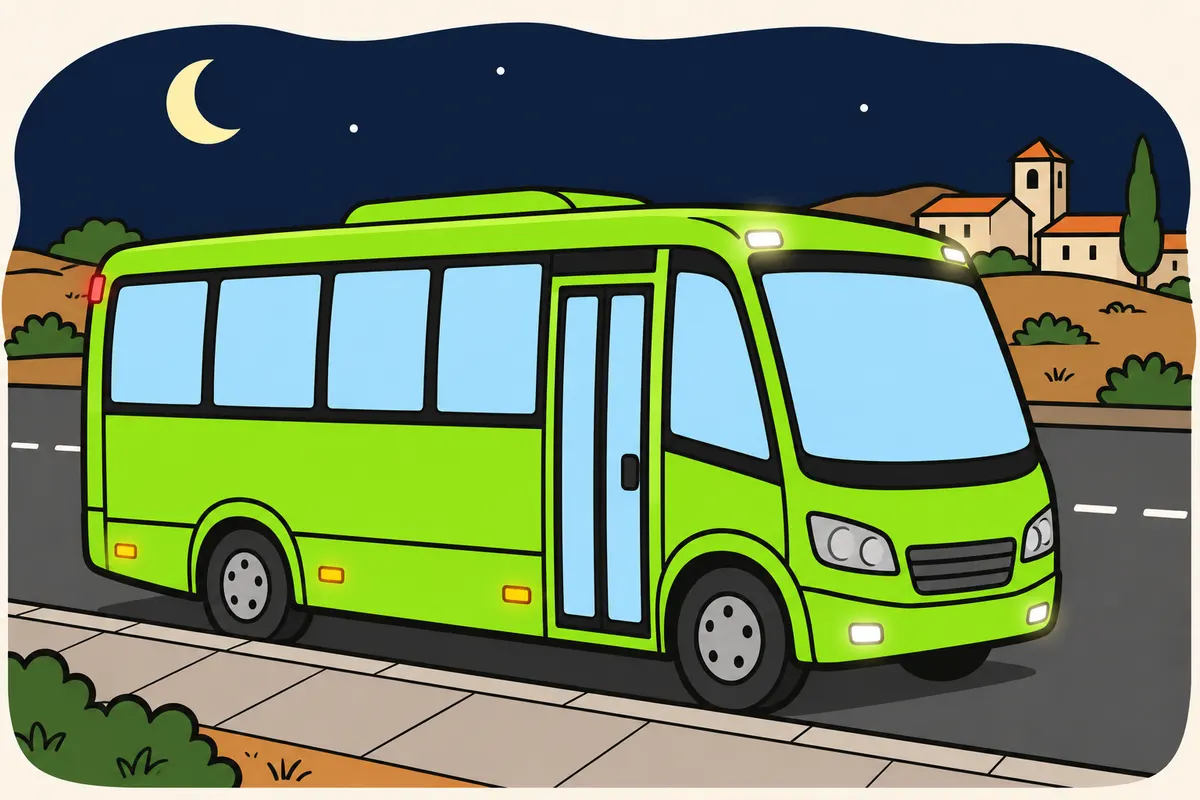
You must keep presence lights on when immobilised at night or in reduced visibility.
| Minibus situation at night | Lights |
|---|---|
| Stopped or parked on carriageway or shoulder of a poorly lit through road | Position lights |
| Parked parallel to the kerb on that through road | You may replace position lights with approved parking lights or carriageway-side position lights |
| Parked on an urban road other than a through road, sufficiently visible | You may leave position lights off |
Remember
- Immobilised on carriageway or shoulder: keep position lights on.
- Also keep required end-outline marker lamps on.
- This rule applies at night or in reduced visibility.
- Check your measurements before fitting parking lights.
Exam trap: Wrong: you can park without position lights on any street. Right: on urban roads other than through roads, you may do so if lighting makes your vehicle visible from a sufficient distance.
Read the full explanation
- If you become immobilised on the carriageway or arcén (hard shoulder) between sunset and sunrise, or in reduced visibility, you must keep the position lights and, where appropriate, the end-outline marker lamps on. This rule applies whatever the cause; you must not switch off the lights that make your vehicle visible because you have stopped the engine. [RGC, art. 105](https://www.boe.es/buscar/act.php?id=BOE-A-2003-23514#a105).
- If you stop or park at night on the carriageway or hard shoulder of an insufficiently lit stretch of road through a town, you must keep the position lights on. When you are parked parallel to the road, you may replace them with parking lights or the two position lights on the side facing the carriageway, using the appropriate regulation-compliant equipment. [RGC, art. 105](https://www.boe.es/buscar/act.php?id=BOE-A-2003-23514#a105).
- You may only fit parking lights to vehicles up to 6 m long and about 2 m wide; you cannot fit them to a 7 m minibus. [RGV, art. 17](https://www.boe.es/buscar/act.php?id=BOE-A-1999-1826#a17) and [annex X, note 3](https://www.boe.es/buscar/act.php?id=BOE-A-1999-1826#anx).
- On urban roads other than stretches of road through a town, you may leave a vehicle parked without its position lights on when the lighting allows it to be distinguished from a sufficient distance. You must not apply this exception to every urban road without checking the lighting, or to any minibus stopped because of a breakdown. [RGC, art. 105](https://www.boe.es/buscar/act.php?id=BOE-A-2003-23514#a105).
18Connected V-16: warning of an immobilised vehicle
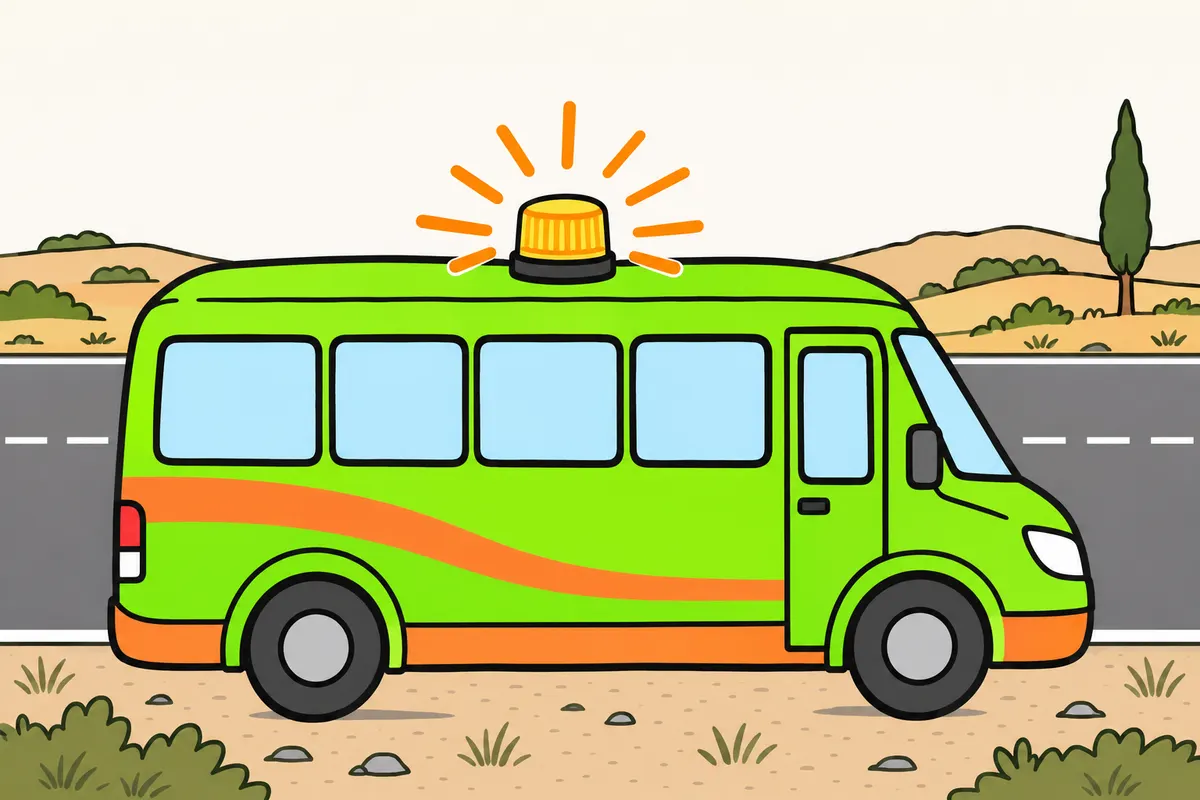
You must carry the listed safety equipment in your minibus, regardless of its maximum authorised mass.
Remember
- Carry a certified connected V-16, a reflective vest and suitable approved fire-extinguishing equipment.
- You must carry this equipment whatever your minibus’s maximum authorised mass.
- Study vest use in “Accidents and assistance”, section “High-visibility vest and getting out safely”.
- Study beacon use in “Accidents and assistance”.
Exam trap: Wrong: only heavier buses need this equipment. Right: your minibus must carry it regardless of its maximum authorised mass.
Read the full explanation
- You must carry a certified connected V-16, a high-visibility reflective vest and suitable type-approved firefighting equipment in working order in your minibus. This equipment is compulsory for buses regardless of their maximum authorised mass. [RGV, annex XII.2](https://www.boe.es/buscar/act.php?id=BOE-A-1999-1826#anxii).
- For using the vest and getting out of your minibus safely, see «High-visibility vest and getting out safely» in «Accidents and assistance».
- You study the use, characteristics and positioning of the connected V-16 in «Accidents and assistance», in the sections «The bus’s connected V-16» and «Warning other drivers does not call an ambulance».
19Lights while warning other traffic and V-27
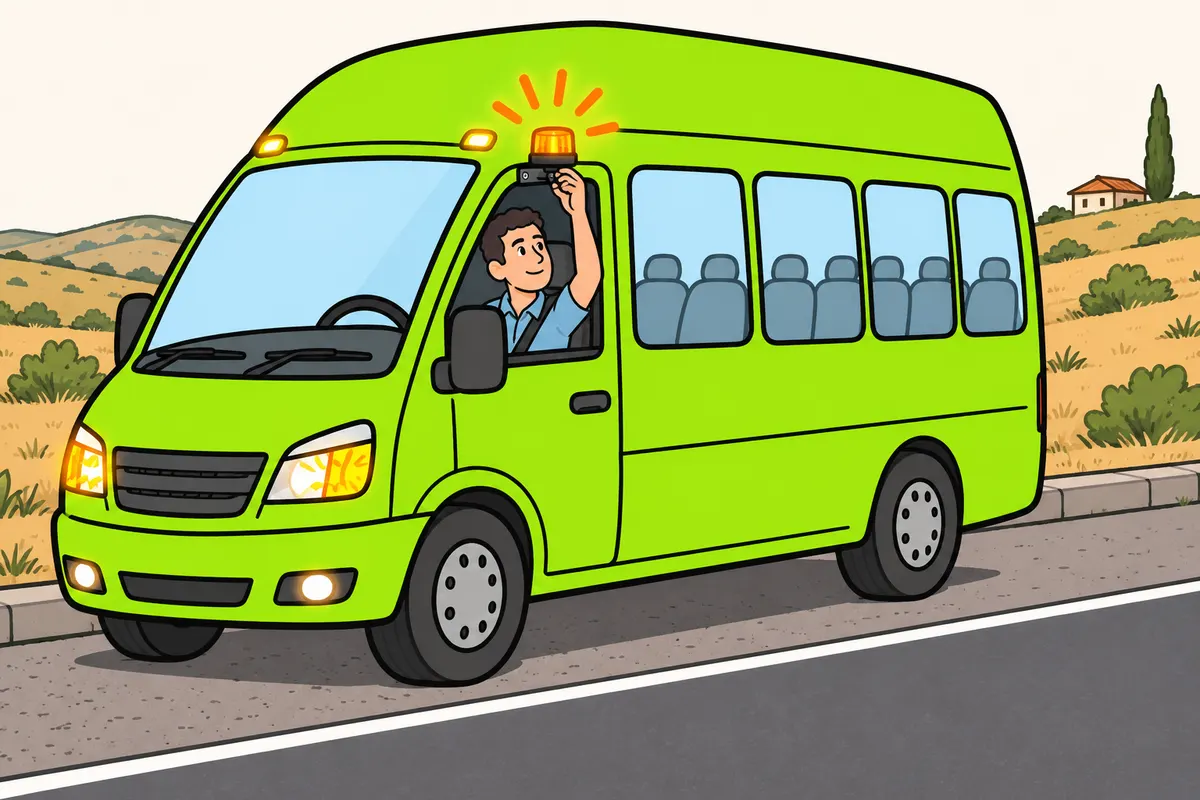
While signalling an immobilisation as the road is cleared, keep hazard warning lights on.
| Device | Purpose for you |
|---|---|
| V-16 | You warn of your immobilised vehicle |
| V-27, virtual triangle | You receive an optional warning of a nearby hazard |
Remember
- While signalling an immobilisation and clearing the road, keep hazard warning lights on.
- Also keep position lights and end-outline marker lamps on where appropriate.
- Distinguish the optional V-27 warning from your V-16 beacon.
Exam trap: Wrong: V-27 warns others that your vehicle is immobilised. Right: V-27 warns you of a nearby hazard; V-16 warns others of your immobilisation.
Read the full explanation
- While you warn other traffic that your vehicle is immobilised and the road is being cleared, you must keep the hazard warning lights on and, where required, the position lights and end-outline marker lamps. [RGC, art. 130.4](https://www.boe.es/buscar/act.php?id=BOE-A-2003-23514#a130).
- You may find the optional V-27 signal, Triángulo virtual (virtual warning triangle), in the on-board system. It warns you of a nearby hazard reported to the connected vehicle platform. This is information received by your vehicle; you must distinguish it from the V-16 you carry to warn other traffic when your own vehicle is immobilised. [RGV, annex XI, V-27](https://www.boe.es/buscar/act.php?id=BOE-A-1999-1826#v2-3).
20Number plates, interior lighting and doors
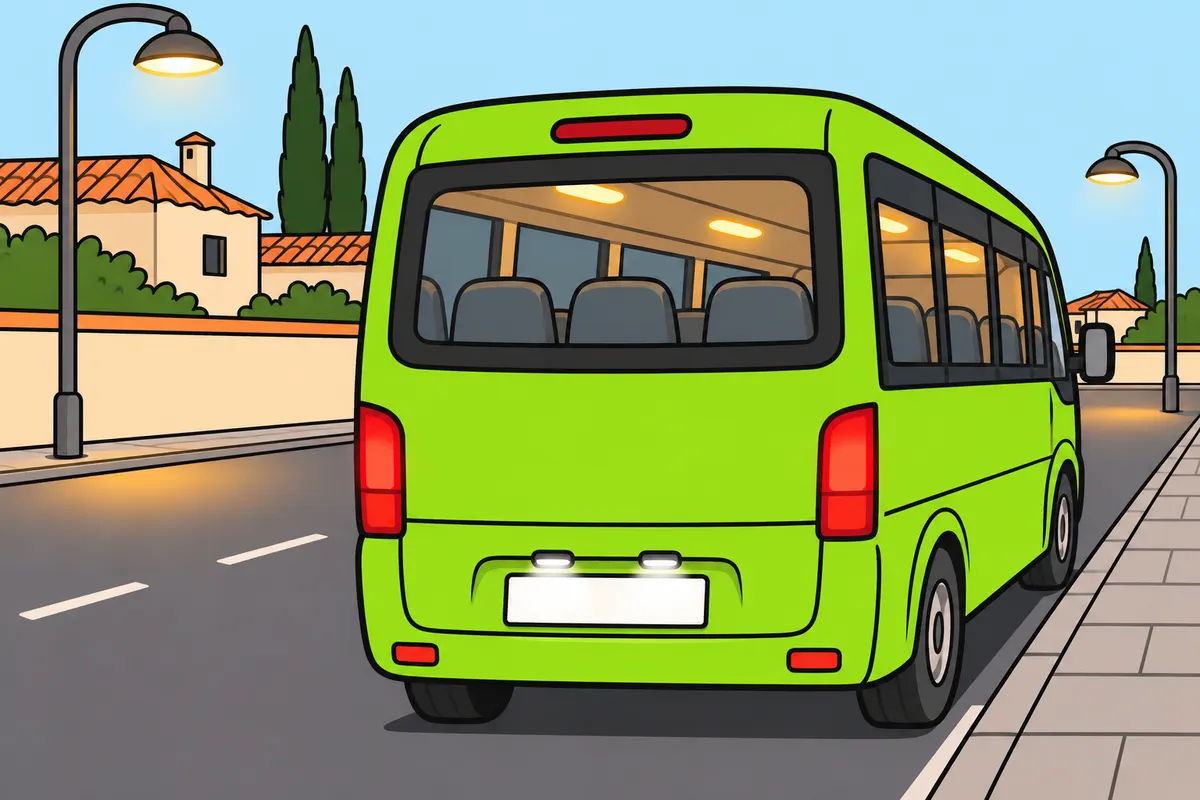
You must light your rear number plate and have interior lighting for public passenger services.
| White rear light | What you illuminate |
|---|---|
| Number plate light | The rear plate |
| Reversing light | The area behind for reversing |
Remember
- Light your rear plate when position lights or reduced-visibility lighting are required.
- Street lights do not remove this duty.
- You must have interior lighting for public passenger services.
- Use interior lighting without dazzling or unduly bothering others.
- Recognise optional door lights: they are visible only while doors are opening.
Exam trap: Wrong: a white reversing light replaces the number plate light. Right: distinguish their functions.
Read the full explanation
- Your minibus must have two flat, rectangular number plates, one at the front and one at the rear. As a general rule, they are centred on the vehicle's longitudinal plane; if this is not possible, the rear plate may be on the left, and the front plate is subject to the construction-related exceptions provided for in the regulations. [RGV, annex XVIII, III](https://www.boe.es/buscar/act.php?id=BOE-A-1999-1826#iii-3).
- You must illuminate the rear number plate whenever position lights or lighting for reduced visibility are required. Depending on the service, this obligation may extend to other statutory illuminated markings; you must not assume that the number plate only needs lighting on roads without streetlights. [RGC, art. 103](https://www.boe.es/buscar/act.php?id=BOE-A-2003-23514#a103).
- The rear number plate light is white and must illuminate the plate. You must distinguish it from a white light directed towards the carriageway for reversing: both are at the rear, but they serve different purposes and you do not use either as a substitute for the other. [RGV, annex X](https://www.boe.es/buscar/act.php?id=BOE-A-1999-1826#anx).
- If your minibus is intended for public passenger services, it must have interior lighting in the passenger compartment. This equipment requirement is not limited to night services, and article 16 does not require a specific blue or white colour for the interior lighting. [RGV, art. 16](https://www.boe.es/buscar/act.php?id=BOE-A-1999-1826#a16).
- You must use the interior lighting in a way that does not dazzle or unduly disturb other road users. You may find optional illuminated or reflective door-opening devices, visible only while the doors are opening; you must not confuse them with direction indicators or hazard warning lights. [RGV, art. 17](https://www.boe.es/buscar/act.php?id=BOE-A-1999-1826#a17). You can find the statutory definition of interior lighting in [RGV, annex X](https://www.boe.es/buscar/act.php?id=BOE-A-1999-1826#anx).
21V-6: vehicles over 12 metres long
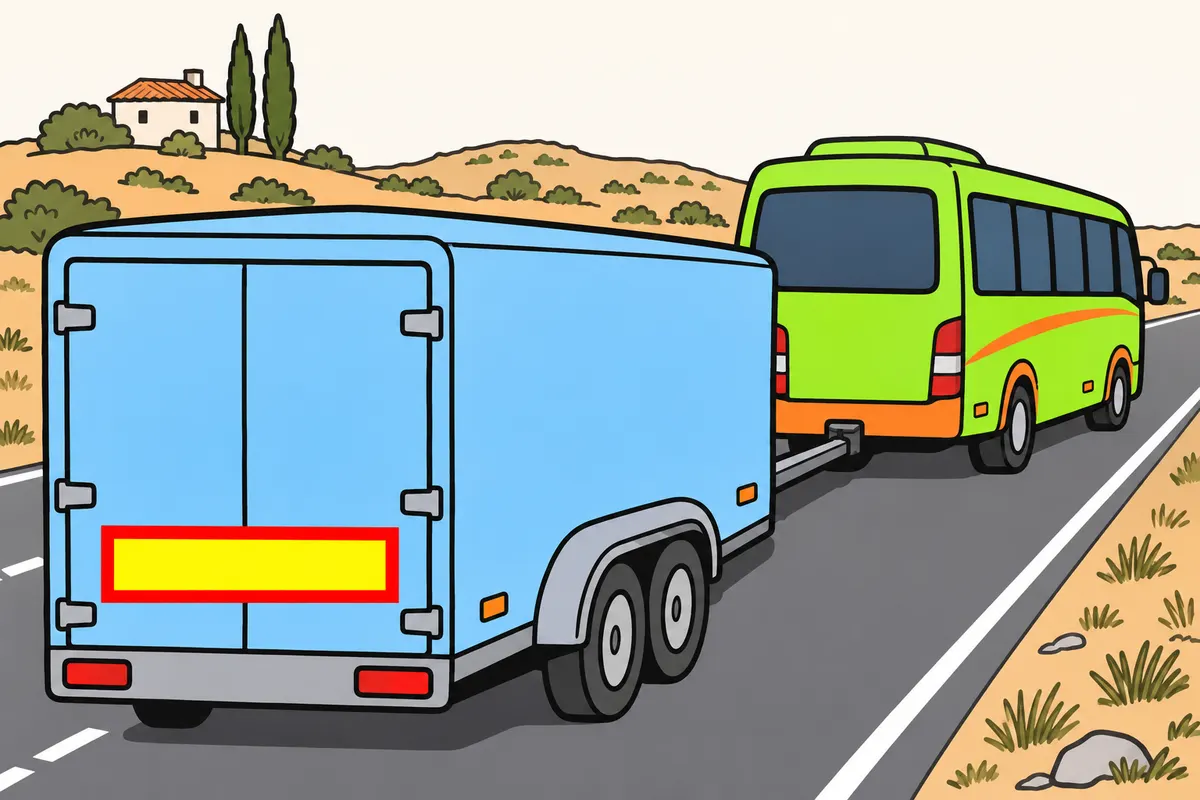
You must display V-6 if your vehicle and trailer exceed the stated total length.
| Total vehicle combination length | V-6 required because of length |
|---|---|
| Exactly 12 m | Not compulsory |
| Over 12 m | Compulsory |
Remember
- Check the total length of your vehicle and trailer.
- Your D1 minibus alone does not need V-6 because of length.
- Place it centrally at the rear.
- You may use symmetrical plates instead if this allows better positioning.
- The plate has a yellow reflective background and a fluorescent red border.
Exam trap: Wrong: exactly 12 m requires V-6. Right: display it when the combination exceeds 12 m.
Read the full explanation
- Your D1 minibus, which has a maximum length of 8 m, does not need V-6 on account of its own length. If you tow a trailer and the combination exceeds 12 m, you must display this Vehículo largo (long vehicle) sign; the licence limit for the towing vehicle does not replace checking the combination. [RGCond, art. 4](https://www.boe.es/buscar/act.php?id=BOE-A-2009-9481#a4) and [RGV, annex XI, V-6](https://www.boe.es/buscar/act.php?id=BOE-A-1999-1826#v-6).
- You must place V-6 at the rear, centred on the vehicle's axis. Where advisable for better positioning, you may replace it with two plates of similar characteristics, arranged symmetrically and as close to the edges as possible; you must not arbitrarily place a single plate on one side. [RGV, annex XI, V-6](https://www.boe.es/buscar/act.php?id=BOE-A-1999-1826#v-6).
- You must position the V-6 plates between 500 and 1,500 mm above the ground and use type-approved plates. You identify them by their yellow reflective surface and fluorescent red border; they are neither a set of lights nor public passenger service markings. [RGV, annex XI, V-6](https://www.boe.es/buscar/act.php?id=BOE-A-1999-1826#v-6).
- You must compare the actual total length of the combination with 12 m: at exactly 12 m, you do not need V-6 on this basis, whereas at more than 12 m you do. Do not confuse this threshold with the length of more than 6 m that determines the minibus's side devices, or with the width of more than 2.10 m that requires end-outline marker lamps. [RGV, annex XI, V-6](https://www.boe.es/buscar/act.php?id=BOE-A-1999-1826#v-6).
22V-9 and other bus markings
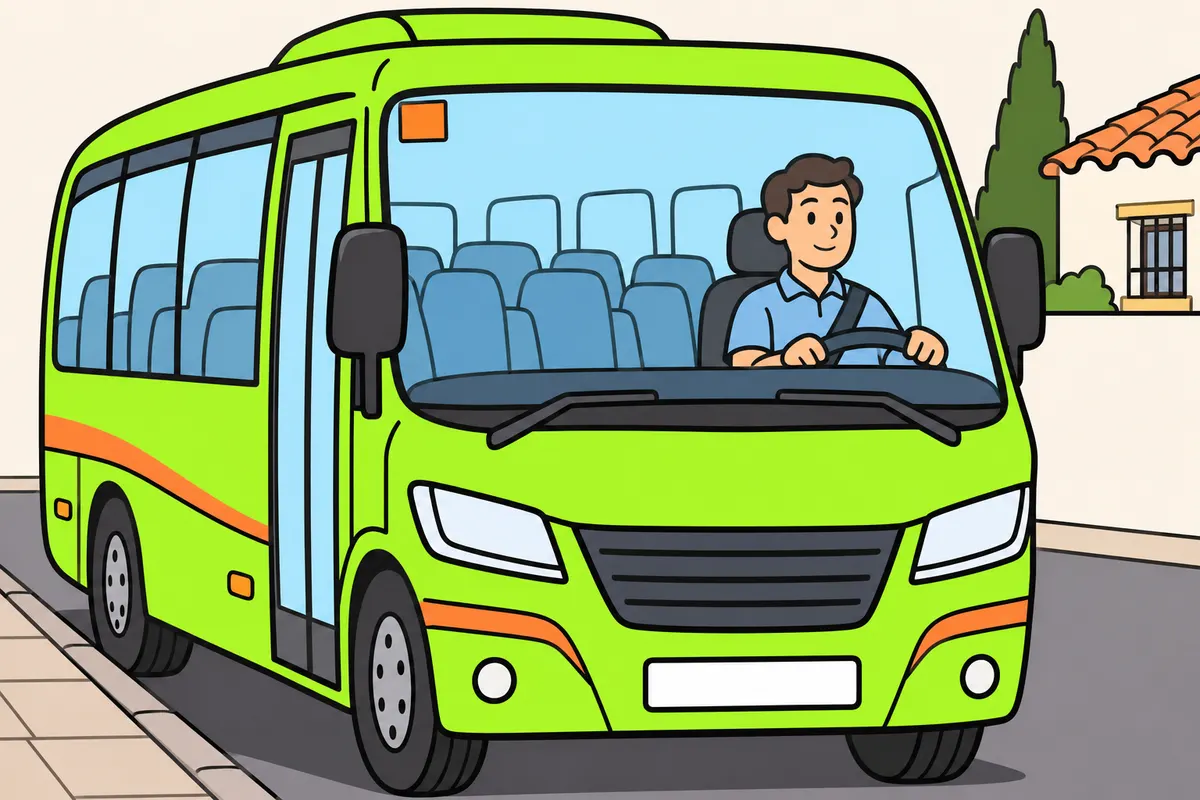
Place each marking where its purpose requires.
| Minibus marking | Position |
|---|---|
| V-19, passed ITV inspection | Inside the windscreen, top right |
| V-25, environmental sticker, if required | Inside the windscreen, bottom right |
| V-13, if applicable | At the rear left, visible |
Remember
- For public services, place S.P. beside your front and rear number plates.
- Light the rear S.P. under the same conditions as your rear number plate.
- Show V-14 at the front and rear only during instruction or a test.
- It identifies the minibus’s use for instruction or a test.
- Do not assume obtaining D1 alone requires V-13.
- Display V-4 at the rear if your personal circumstances or special authorisation require it.
Exam trap: Wrong: obtaining D1 always requires V-13. Right: consider your first licence and whether you previously actually held another for at least a year.
Read the full explanation
- If your minibus is used to provide public services, you must identify it with V-9, Servicio público (public service): you must place the two S.P. plates at the front and rear, beside the respective number plates. They identify its use for public services; you must not confuse them with the number plate or a long vehicle plate. [RGV, annex XI, V-9](https://www.boe.es/buscar/act.php?id=BOE-A-1999-1826#v-9).
- You must illuminate the rear S.P. plate under the same conditions as the rear number plate. You must not attribute this obligation to side plates or claim that displaying the letters inside the windscreen is enough without placing them in the prescribed position. [RGV, annex XI, V-9](https://www.boe.es/buscar/act.php?id=BOE-A-1999-1826#v-9).
- You must place the V-19 sticker showing a pass at the ITV (vehicle roadworthiness test) in the upper right-hand corner of the windscreen, on the inside. It also indicates when the next inspection is due; you must not place it on the left or on the rear window. You study inspection intervals in «Minibus and transport documentation». [RGV, annex XI, V-19](https://www.boe.es/buscar/act.php?id=BOE-A-1999-1826#v-19).
- If you drive a driving-school minibus during instruction or a test, you must display V-14 at the front and rear, visible only during those activities. V-14 identifies the vehicle's use for instruction or testing. [RGV, annex XI, V-14](https://www.boe.es/buscar/act.php?id=BOE-A-1999-1826#v-14).
- For V-13, you must consider when you obtained your first licence and whether you previously actually held another licence for at least one year, rather than just the date of your D1 licence. If you are required to display it, you must place it visibly on the left at the rear; it does not identify a passenger service. [RGV, annex XI, V-13](https://www.boe.es/buscar/act.php?id=BOE-A-1999-1826#v-13).
- V-4, Limitación de velocidad (speed restriction), indicates the speed the vehicle must not exceed. You must display it visibly at the rear if required by your personal circumstances or a special road-use authorisation; you must not assume it is required on every minibus simply because it is a passenger vehicle. [RGV, annex XI, V-4](https://www.boe.es/buscar/act.php?id=BOE-A-1999-1826#v-4).
- If you are required to display V-25, Distintivo ambiental (environmental badge), you must place it in the lower right-hand corner of the windscreen, on the inside. The competent authority may make its display compulsory through its regulations; you must distinguish it from V-19, which is placed at the top right. You study the conditions for low-emission zones in «Preventive and efficient minibus driving». [RGV, annex XI, V-25](https://www.boe.es/buscar/act.php?id=BOE-A-1999-1826#v2).
23V-10 and school transport lights
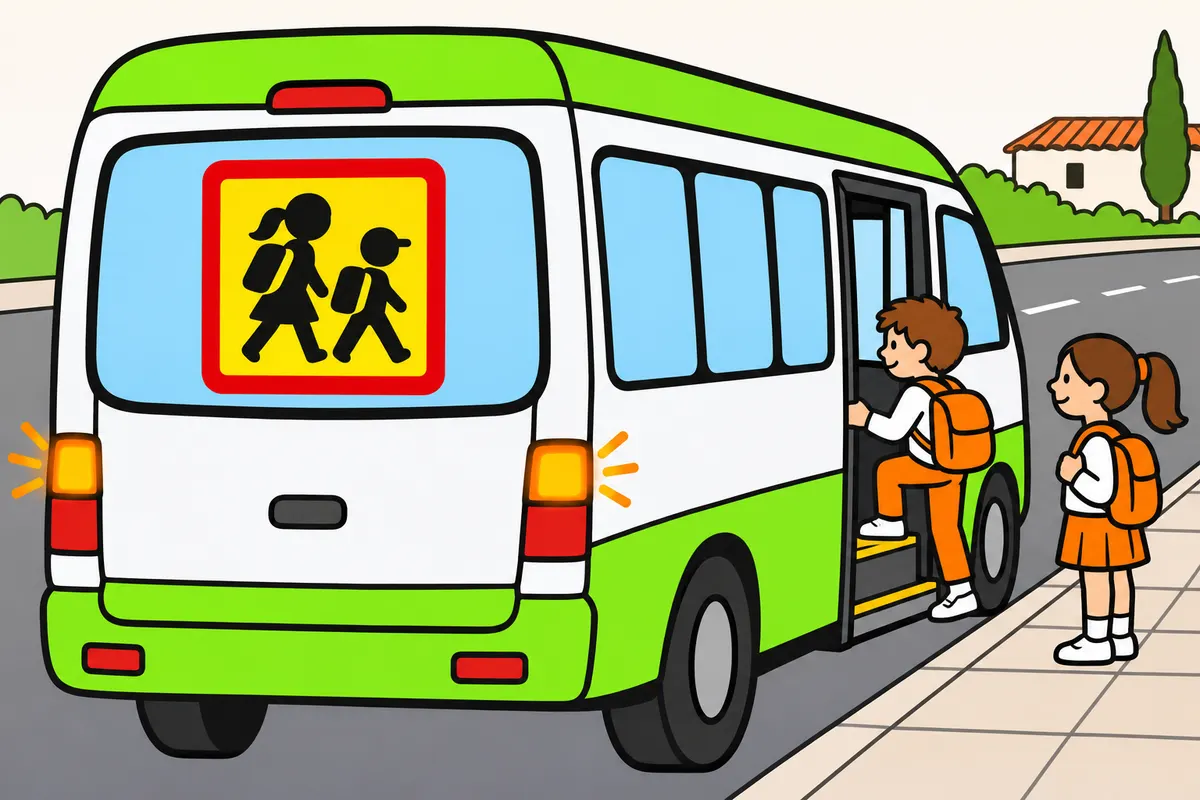
At school stops, use hazard warning lights during boarding or alighting, including by day.
| V-10 arrangement | Position on vehicles covered by the rule |
|---|---|
| General | Inside, front and rear, visible from outside |
| Alternative: up to 19 seats, children’s square without wording rectangle | Rear only, sign with 20 cm sides |
Remember
- Show V-10 on school and child transport services covered by the rule.
- Secure it firmly; you must be able to fit and remove it without tools.
- At these stops, use hazard warning lights during boarding or alighting, including by day.
- The illuminated pictogram flashes from the moment the doors unlock.
- Switch it off after doors close: maximum 20 seconds, also after moving off.
- Check the reversing warning if your school bus meets the registration condition.
Exam trap: Wrong: any minor on board requires V-10. Right: display it on school and child transport services covered by the rule; carrying minors on an ordinary service is not enough. The audible reversing warning is required on school buses registered from 1 January 2002, under article 4.4 of RD 443/2001.
Read the full explanation
- During school transport services and services for minors covered by RD 443/2001, you must display V-10, Transporte escolar (school transport). In the standard configuration, you place the signs inside at the front and rear, visible from outside; you must distinguish this from the alternative size and number of signs provided for by the RGV for small vehicles. You display it because you are operating that service, not simply because you carry a minor on a regular service. [RD 443/2001, art. 5](https://www.boe.es/buscar/act.php?id=BOE-A-2001-8503#a5) and [RGV, annex XI, V-10](https://www.boe.es/buscar/act.php?id=BOE-A-1999-1826#v-10).
- You must secure the school transport sign firmly and perpendicular to the minibus's axis, using a system that allows you to fit or remove it easily without tools. Simply resting it somewhere where it can turn, fall or become hidden from approaching road users is not enough. [RGV, annex XI, V-10](https://www.boe.es/buscar/act.php?id=BOE-A-1999-1826#v-10).
- You may use the alternative V-10 that omits the rectangle with the wording and retains the square with the children's symbol. For vehicles with up to 19 seats, annex XI provides for a rear sign with sides of 20 cm and no front sign in this configuration; your D1 minibus falls within this capacity range. You must not mix this alternative with the standard configuration of two signs. [RGV, annex XI, V-10](https://www.boe.es/buscar/act.php?id=BOE-A-1999-1826#v-10).
- At stops on these services, you must switch on the hazard warning lights while passengers board or alight, both by day and at night. This obligation applies to vehicles covered by the regulations; it does not mean you must drive the whole journey with all indicators flashing together. [RD 443/2001, art. 4](https://www.boe.es/buscar/act.php?id=BOE-A-2001-8503#a4).
- You may use the statutory illuminated pictogram: it activates when you unlock the doors, before they open fully, and flashes. You must switch it off after closing the doors, with a maximum technical tolerance of 20 seconds; RD 443/2001 limits its illumination to stops for boarding or alighting and allows a maximum of 20 seconds after you move off. You must comply with both limits and must not keep it illuminated throughout the journey. [RGV, annex XI, V-10](https://www.boe.es/buscar/act.php?id=BOE-A-1999-1826#v-10) and [RD 443/2001, art. 5](https://www.boe.es/buscar/act.php?id=BOE-A-2001-8503#a5).
- Your school minibus's audible reversing warning must operate in synchronisation with its reversing lights if your vehicle is subject to the requirements of article 4.4 of RD 443/2001: buses registered from 1 January 2002. [RD 443/2001, art. 4](https://www.boe.es/buscar/act.php?id=BOE-A-2001-8503#a4).
24Headlight flashes and brief warnings
You may give brief headlight flashes for permitted warnings, without dazzling others.
Remember
- You may use them to prevent a possible accident.
- Outside built-up areas, you may warn the driver you intend to overtake.
- You may replace permitted audible warnings with flashes, including within built-up areas.
- Do not use them to greet, protest or hurry others.
- Use the appropriate indicator for sideways movement.
Exam trap: Wrong: flashing gives you priority. Right: use flashes only as warnings for authorised purposes, briefly and without dazzling.
Read the full explanation
- You may give brief light warnings for the purposes that permit audible warnings and as a substitute for them, even within built-up areas. You must use dipped beam, main beam or alternate between the two at very short intervals without dazzling anyone; you must not keep main beam on throughout the warning. [RGC, art. 109](https://www.boe.es/buscar/act.php?id=BOE-A-2003-23514#a109).
- You have no regulatory justification for using warnings to greet, hurry or protest at someone. The permitted purposes include preventing a possible accident and, outside built-up areas, warning the driver you intend to overtake; they do not give you priority. [RGC, art. 110](https://www.boe.es/buscar/act.php?id=BOE-A-2003-23514#a110).
- If you want to signal a sideways movement, you must use the appropriate direction indicator and must not replace it with headlight flashes. Each warning has a specific purpose: permitted flashes attract attention, while the indicator identifies the side towards which you intend to move. [RGC, art. 109](https://www.boe.es/buscar/act.php?id=BOE-A-2003-23514#a109).
25Visibility of lighting devices and breakdowns
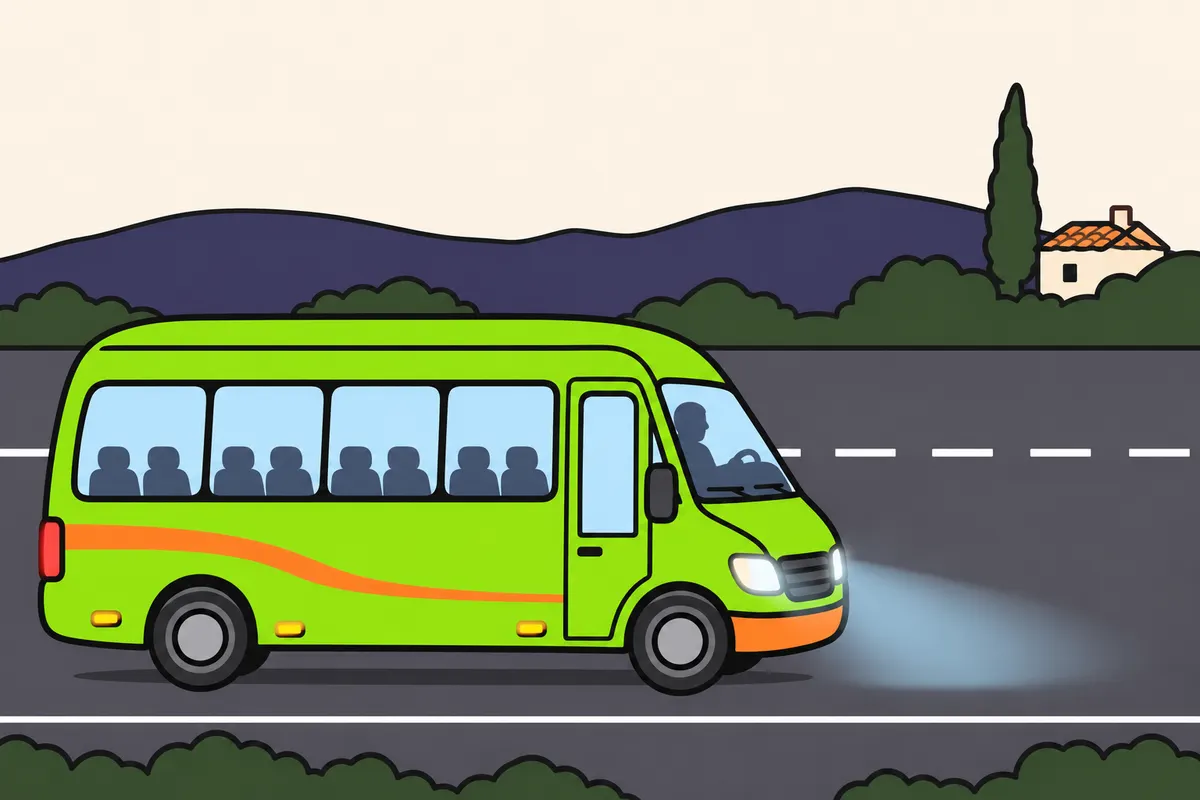
You must adapt speed to available light and keep all devices visible.
Remember
- If a fault cannot be repaired en route and lighting weakens, slow down.
- You must be able to stop within the lit area.
- Keep headlights clean and correctly adjusted.
- Also check side lights, end-outline marker lamps, indicators and rear lights.
- Do not cover lights, plates, markings or signals with luggage or accessories.
- You must also maintain any optional devices fitted.
Exam trap: Wrong: seeing the road proves all lighting works. Right: also check that others can see you from every side.
Read the full explanation
- If a fault that cannot be repaired during the journey forces you to drive with less intense lighting, you must reduce your speed so that you can stop the minibus within the illuminated area. You must not maintain your normal service speed when the effective range of the headlights is reduced. [RGC, art. 107](https://www.boe.es/buscar/act.php?id=BOE-A-2003-23514#a107).
- As a practical check, you must make sure that the headlights are neither dirty nor aimed in a way that dazzles others or illuminates only the area too close to the vehicle. Adjusting them means adjusting the beam, not changing the physical width of the headlight or lowering it as far as possible; you must maintain the technical conditions required by the regulations. [RGV, art. 15](https://www.boe.es/buscar/act.php?id=BOE-A-1999-1826#a15).
- You must also keep the side marker lamps, end-outline marker lamps, direction indicators and rear lights working: being able to see the road from the driving seat does not prove that the minibus is visible from all sides. Any optional device you fit must also meet type-approval and operating requirements. [RGV, art. 15](https://www.boe.es/buscar/act.php?id=BOE-A-1999-1826#a15).
- Annex XII does not require you to carry a spare wheel or a set of spare bulbs in your minibus; you must keep the compulsory lighting working. You can find the required equipment in «Connected V-16: warning of an immobilised vehicle», and checks and repairs are covered in «Minibus maintenance and checks». [RGV, annex XII.2](https://www.boe.es/buscar/act.php?id=BOE-A-1999-1826#anxii).
- You must position luggage and its accessories so that they do not obscure lights, light signals, plates, compulsory markings or hand signals. A ski rack that obscures the minibus’s position lights is not acceptable simply because you are travelling during the day; a reflective panel does not replace those lights either. [RGC, art. 14](https://www.boe.es/buscar/act.php?id=BOE-A-2003-23514#a14).
Choosing lights during service
Check the situation and select your lighting before you need it.
- Identify night-time, a tunnel, reduced visibility or a lane where dipped beam is compulsory during the day.
- Switch on the position lights and, where required, the end-outline marker lamps; select dipped beam according to the conditions.
- Outside built-up areas with insufficient lighting, use main beam if you exceed 40 km/h and cannot dazzle anyone.
- In poor visibility, consider using front fog lamps; reserve the rear fog lamp for particularly unfavourable conditions.
- Review your choice when you leave a tunnel, change roads or visibility improves.
Switching from main beam to dipped beam without dazzling
Act as soon as there is a possibility of disturbing other road users.
- Watch for oncoming vehicles, vehicles you are following and users of other roads close to the beam.
- Switch from main beam to dipped beam as soon as you might dazzle them.
- Adjust your speed to the available field of vision.
- When passing an oncoming vehicle, wait until you have passed it before switching back to main beam where appropriate.
Warning other traffic when your minibus is immobilised
Combine the vehicle’s warning lights with the regulatory beacon.
- Identify the lights your immobilised minibus needs according to the location and visibility.
- Keep the vehicle’s warning lights on while the road is being cleared.
- Follow the procedure for using V-16 and requesting help explained in «Accidents and assistance».
Finished this module?
Mark it as read and you will see your progress on the theory list.