
Theory · D1 Licence - Minibus · Module 12 of 18
Passenger safety and emergencies
You learn to prepare the safety equipment in your D1 minibus, inform passengers and direct their evacuation. You answer questions on seat belts, fires, breakdowns and tunnels, choosing when to get out and when to remain inside to protect your passengers.
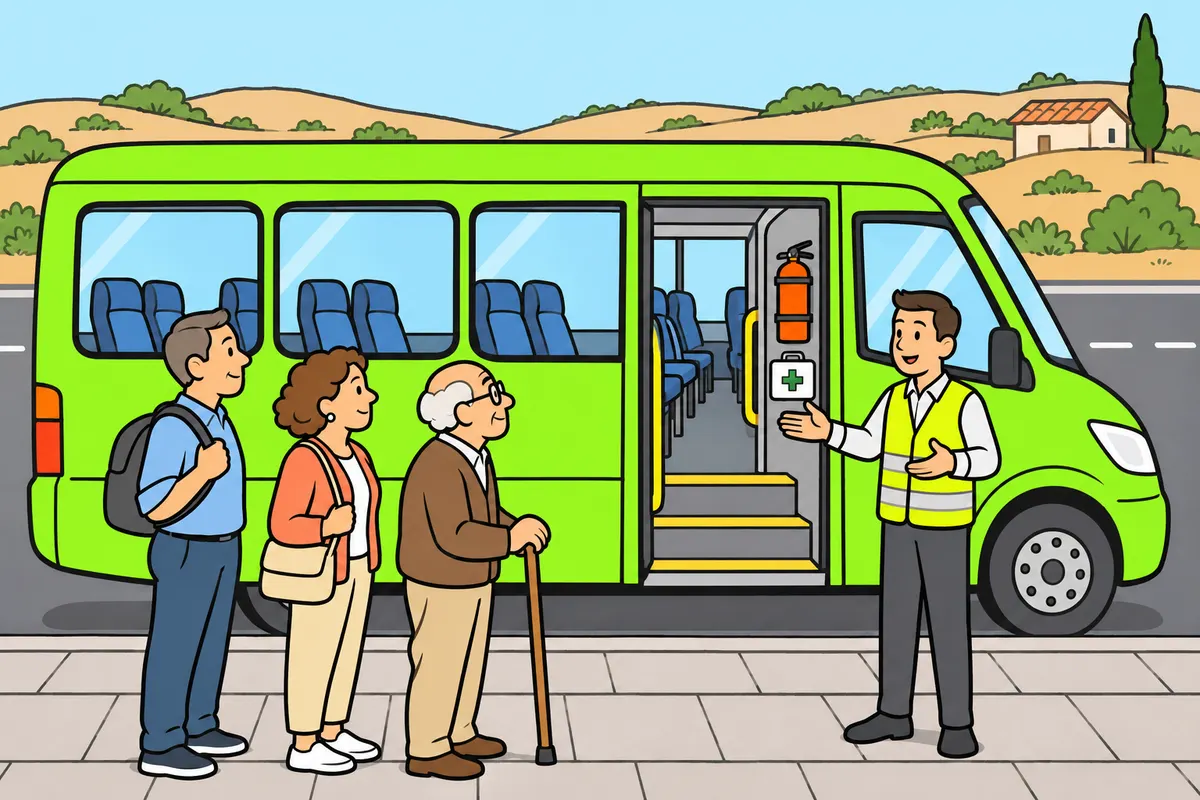
1Prepare the passenger compartment for safety
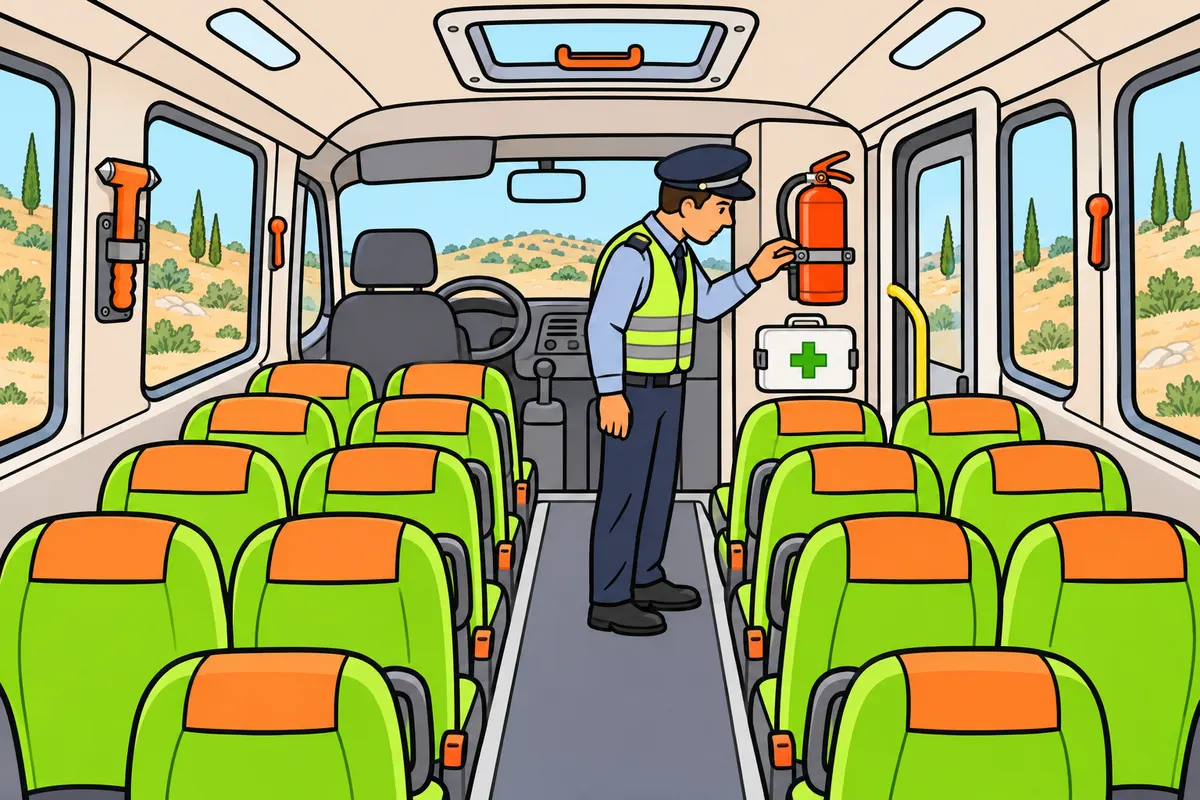
Locate and check the safety equipment before starting your service.
Remember
- Locate exits, controls, glass-breaking devices, the fire extinguisher and first-aid kit.
- Also locate the central emergency control, if fitted.
- Check equipment is secured, accessible and has readable instructions.
- Check its location again when you change minibuses.
- Place objects without blocking your movement, view or exits.
- Identify who needs help and agree what to do with accompanying staff.
Exam trap: Wrong: You assume all minibuses have the same controls. Right: Check each vehicle.
Read the full explanation
- Before the service, you must locate the emergency doors and windows, hatches, their controls and the devices for breaking glass. Also identify the fire extinguisher, first-aid kit and central emergency control, if fitted: you must be able to find them without walking through the minibus searching for them during an evacuation. [DGT, bus safety](https://www.dgt.es/muevete-con-seguridad/viaja-seguro/en-autobus/).
- Check that the equipment is present, secured and accessible and that you can read its instructions. If you change minibuses, check its layout again: the location of a control or the way an exit opens may vary between vehicles and their different type approvals.
- You must maintain your freedom of movement, field of vision and the attention needed to protect the occupants. Place objects so that they do not interfere with you; a bag beside the pedals or an item that makes it difficult to reach a door compromises your response to an emergency. [RGC, art. 18](https://www.boe.es/buscar/act.php?id=BOE-A-2003-23514#a18).
- Identify anyone who may need help to get out and agree with the accompanying staff how to act. Do not let this preparation turn into an improvised evacuation: know the vehicle’s equipment and plan a usable route for each passenger area, including areas far from your driving position.
2Information when boarding the bus
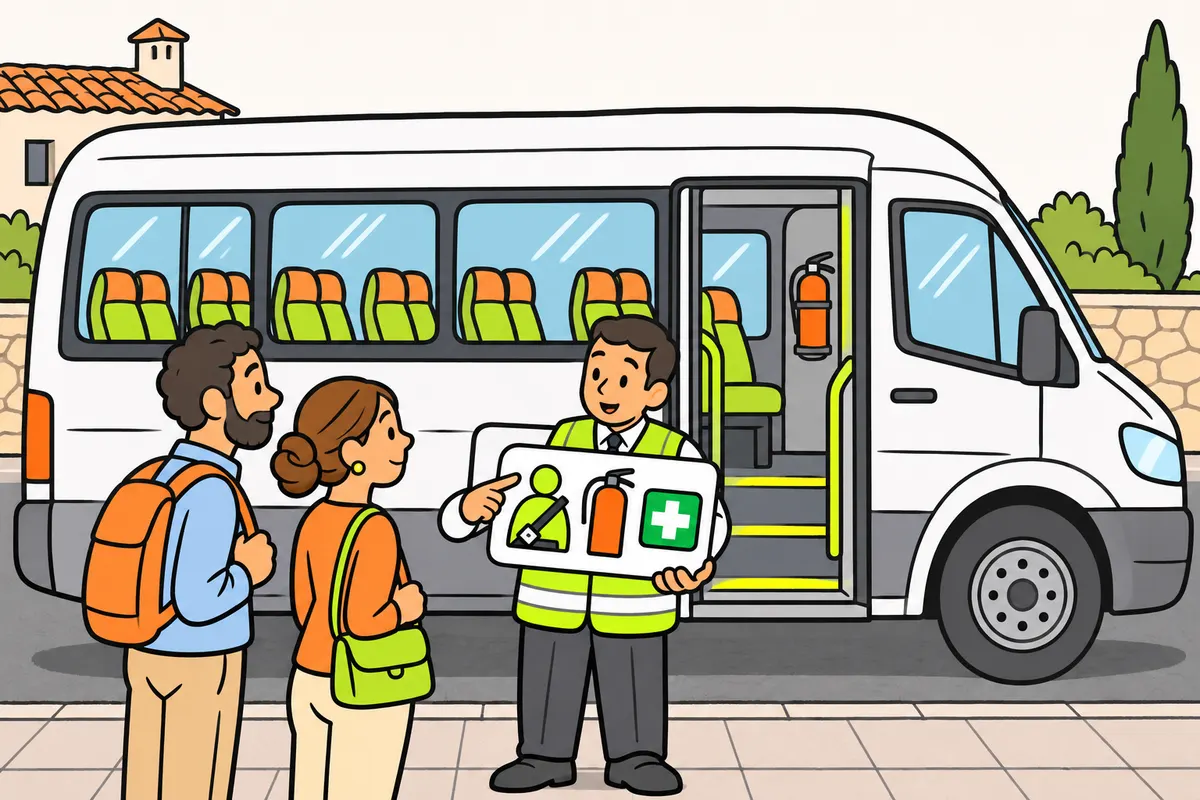
Give safety information when passengers board or immediately beforehand.
Remember
- In public transport, give the safety information specified by your company.
- Explain where exits are, how to use them and where extinguishers are.
- Explain that a first-aid kit is available and fitted seat belts are compulsory.
- Explain the risks and possible liability of not wearing a seat belt.
- Explain luggage, emergencies, accessibility and following instructions from authorised staff.
- You can speak, show pictures or videos; check passengers understand.
Exam trap: Wrong: You wait for an emergency to give information. Right: Inform passengers when boarding or immediately beforehand.
Read the full explanation
- On public bus passenger services, you must provide the safety information specified by the company as passengers board the vehicle or immediately beforehand. [Order FOM/1230/2013, art. 4](https://www.boe.es/buscar/act.php?id=BOE-A-2013-7218#a4).
- You must know what this information contains: the location and use of doors, access points and emergency exits, the location of fire extinguishers and the availability of a first-aid kit. It also covers compulsory seat belt use where fitted, the risks of failing to use it and the liability that may arise from non-compliance. [Order FOM/1230/2013, art. 4](https://www.boe.es/buscar/act.php?id=BOE-A-2013-7218#a4).
- The information must cover where to place hand luggage, the main emergency recommendations and the obligation to follow safety instructions from you and accredited staff. It also includes the accessibility arrangements for the vehicle and, where applicable, the stations at which you stop. [Order FOM/1230/2013, art. 4](https://www.boe.es/buscar/act.php?id=BOE-A-2013-7218#a4).
- You can communicate this information verbally or through graphics or audiovisual media. In practice, check that the message is understandable and that luggage does not obscure the instructions; if the screen fails, use another available means to ensure the information reaches passengers. [Order FOM/1230/2013, art. 4](https://www.boe.es/buscar/act.php?id=BOE-A-2013-7218#a4).
3Keep exits and routes clear
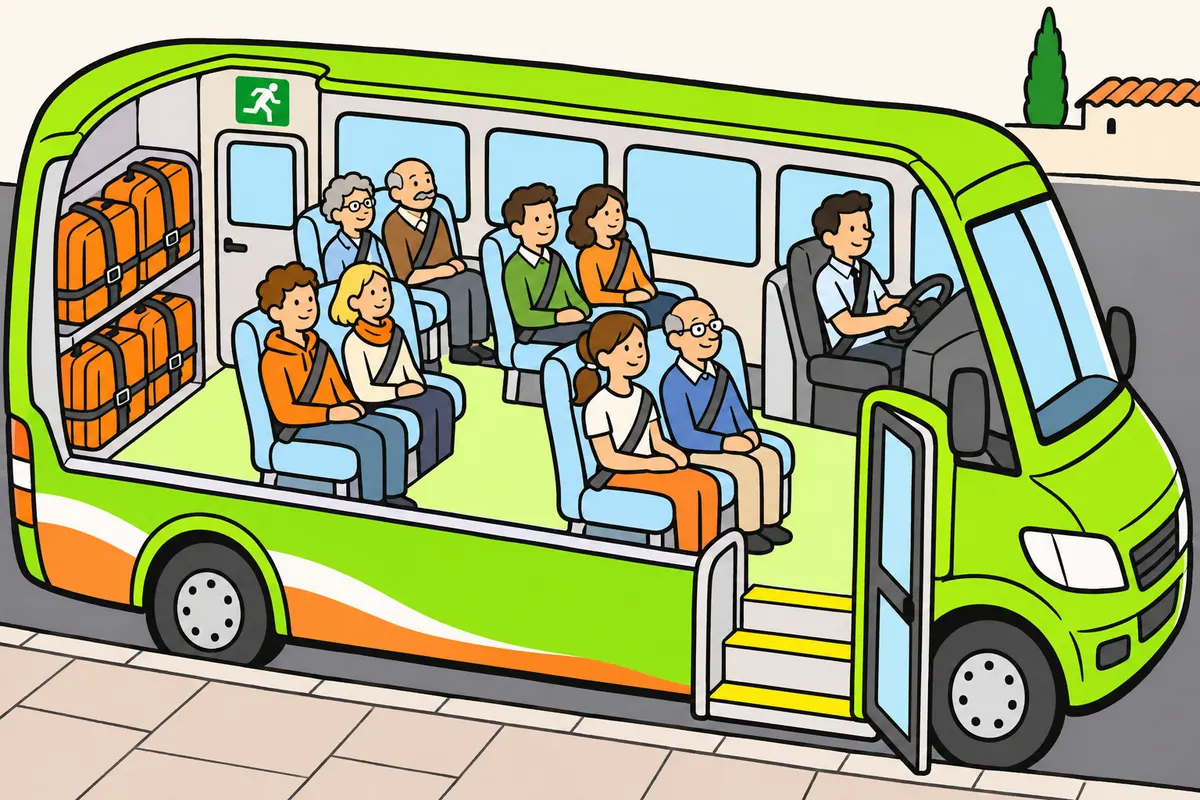
Keep exits clear and choose those that let passengers escape safely.
| Exit | Use |
|---|---|
| Service door | Normal boarding and alighting |
| Emergency door, window or hatch | Escape when necessary |
Remember
- Identify exits by their signs and instructions.
- Keep aisles, exits and controls clear.
- Place luggage where it cannot move and block an exit.
- Check for traffic, drops, smoke and fire outside.
- Direct passengers towards the different usable exits.
Exam trap: Wrong: You block an exit to prevent misuse. Right: Keep its emergency opening mechanism usable.
Read the full explanation
- You normally use service doors for boarding and alighting; emergency exits allow escape when necessary. These may include doors, windows and hatches; identify those fitted to your minibus by their signs and instructions, without assuming that every pane of glass provides an escape route. [UN Regulation 107, annex 3, section 7.6](https://www.boe.es/doue/2026/139/L00001-00167.pdf).
- Keep aisles and access to exits and their controls clear. A suitcase can block several passengers even if it is not heavy; place it in the luggage space and check that it cannot slide towards a door when you brake or the minibus tilts. Do not lock or block an exit in a way that prevents its emergency operation: it must remain usable as its mechanism is designed to operate. [UN Regulation 107, annex 3, section 7.6](https://www.boe.es/doue/2026/139/L00001-00167.pdf).
- You must be able to recognise the safety signs that identify exits and explain how to operate their devices. These are vehicle instructions, separate from the signs that regulate road traffic: to evacuate, you need to locate the opening and understand the action shown by its pictograms. [UN Regulation 107, annex 3, section 7.6.11](https://www.boe.es/doue/2026/139/L00001-00167.pdf).
- Before choosing an exit, also check what is on the other side: traffic, a drop, smoke or fire may make it dangerous. When organising an evacuation, direct passengers towards usable exits and avoid crowding them at a blocked opening while other areas of the minibus have a safe alternative.
4Doors and emergency opening
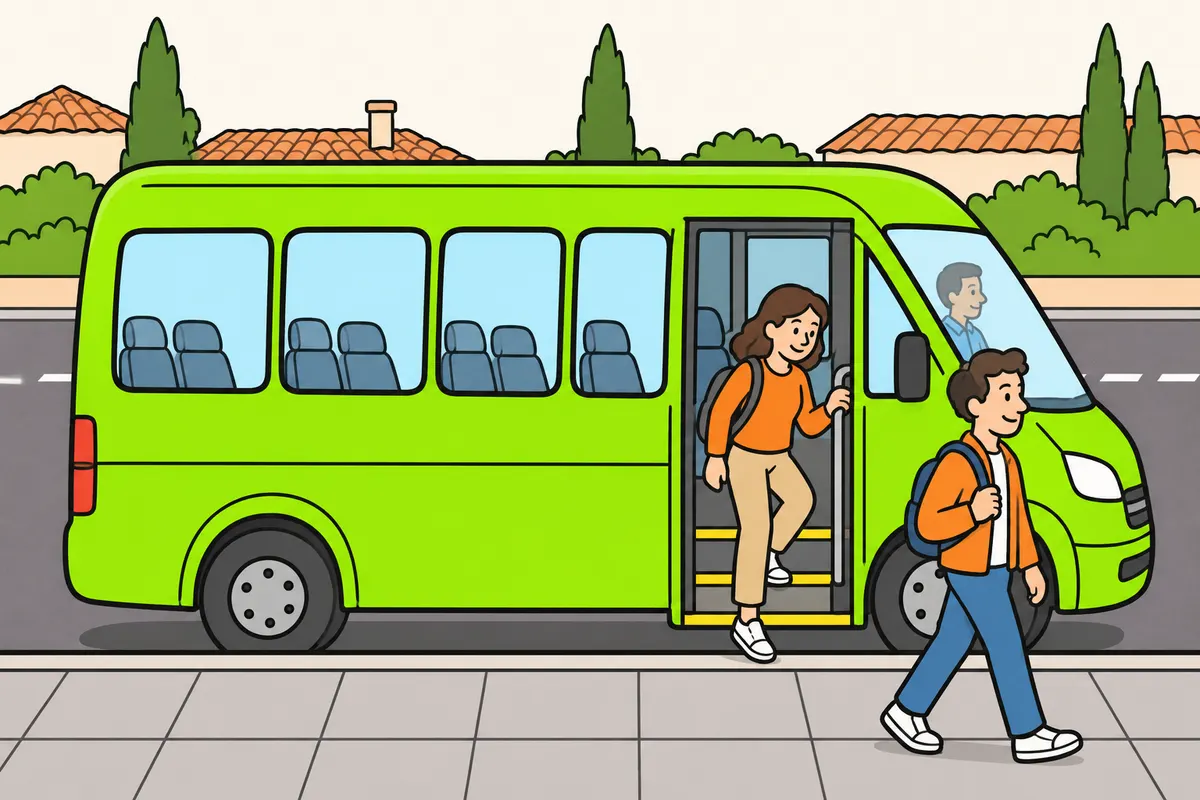
Open doors only when fully stopped, and check passengers can get out safely.
Remember
- Drive with doors closed, even if the air conditioning fails.
- Before opening, check you will not endanger anyone, including cyclists.
- Learn to use the internal and external emergency controls.
- Do not assume the stop button opens doors without power.
- In school transport and transport of minors, protect controls against misuse.
- Choose a door with a safe exit; keep passengers clear of its movement.
Exam trap: Wrong: You disable controls to protect them from children. Right: Protect them without disabling them beyond what technical regulations allow.
Read the full explanation
- You must keep the doors closed while driving and wait until the vehicle is completely stationary before opening them. Before opening them or allowing passengers to alight, check that you do not endanger other road users, including cyclists; a climate control fault does not allow you to carry passengers with the doors open. [RGC, art. 114](https://www.boe.es/buscar/act.php?id=BOE-A-2003-23514#a114).
- Locate the internal and external emergency opening controls and learn the sequence indicated on the vehicle itself. Do not assume that the normal stop-request button opens a door without power: you must know the device provided for emergencies and how it allows you to operate the door. [DGT, bus safety](https://www.dgt.es/muevete-con-seguridad/viaja-seguro/en-autobus/).
- On services covered by the rules on school transport and transport of minors, you must ensure that emergency opening devices are protected against misuse by minors. This protection does not allow you to disable them beyond what the applicable technical regulations permit. [RD 443/2001, art. 4.2.2.ª](https://www.boe.es/buscar/act.php?id=BOE-A-2001-8503#a4).
- Open a usable door first when it provides a safe exit, and help passengers move clear of its path. Do not force the group through a door facing a live traffic lane simply because it is closest to your driving position; check that it is safe to exit outside.
5Windows, hammers and hatches
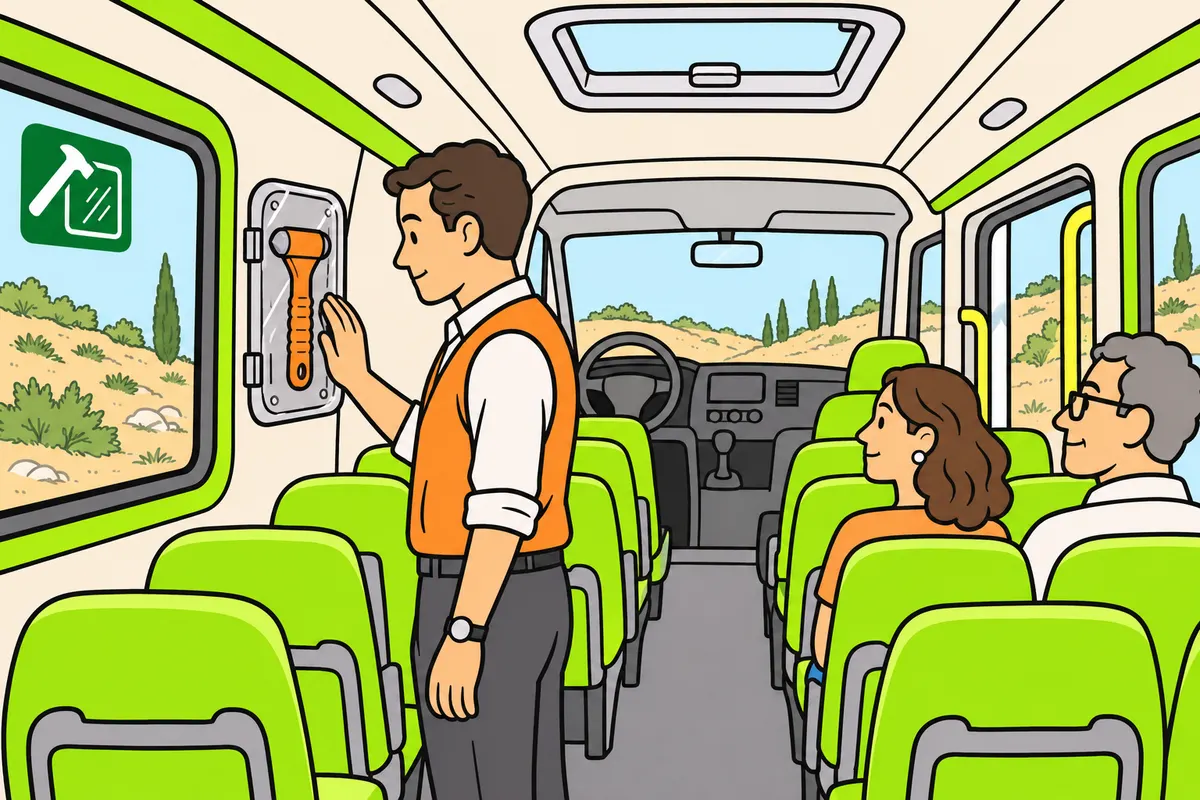
Use each emergency window or hatch according to its instructions.
| Emergency window | What you must do |
|---|---|
| With opening mechanism | Open it according to its instructions |
| Designed to be broken | Use the provided device according to its instructions |
Remember
- Check whether the window opens or needs breaking.
- Do not treat laminated glass like toughened glass designed to break.
- Keep hammers accessible and check they are present before departure.
- In school transport and transport of minors, keep hammers protected for emergencies only.
- Before breaking glass, move people away; afterwards, protect them from edges and fragments.
- After overturning, find usable exits and check the landing area outside.
Exam trap: Wrong: You try to break any glass. Right: Identify the emergency window and follow its instructions.
Read the full explanation
- You may be able to open an emergency window using its mechanism, or you may need to break the glass with the device provided. Type approval allows for different designs; you must not treat laminated glass as a toughened-glass window designed to be broken. Follow the sign and the manufacturer’s instructions. [UN Regulation 107, annex 3, section 7.6.8](https://www.boe.es/doue/2026/139/L00001-00167.pdf).
- Keep hammers or glass-breaking devices accessible and check that they are present before setting off. On school transport and transport of minors, you must keep them properly protected and reserve them for emergencies: they are not tools for ventilating the vehicle or for passengers to practise with during the journey. [RD 443/2001, art. 4.2.7.ª](https://www.boe.es/buscar/act.php?id=BOE-A-2001-8503#a4).
- If you need to break a window designed for this purpose, move people away and use its device as instructed. As an evacuation precaution, protect passengers from edges and fragments and check the surface outside where they can support themselves; do not tell them to jump blindly through the opening.
- If the minibus overturns onto its doors, you must consider other usable doors, emergency windows or the roof hatch. A hatch may provide an exit when the doors are blocked; do not assume that it remains above your head after the vehicle overturns. [DGT, minibus evacuation](https://www.dgt.es/muevete-con-seguridad/viaja-seguro/en-autobus/).
6Compulsory fire extinguisher and minimum rating
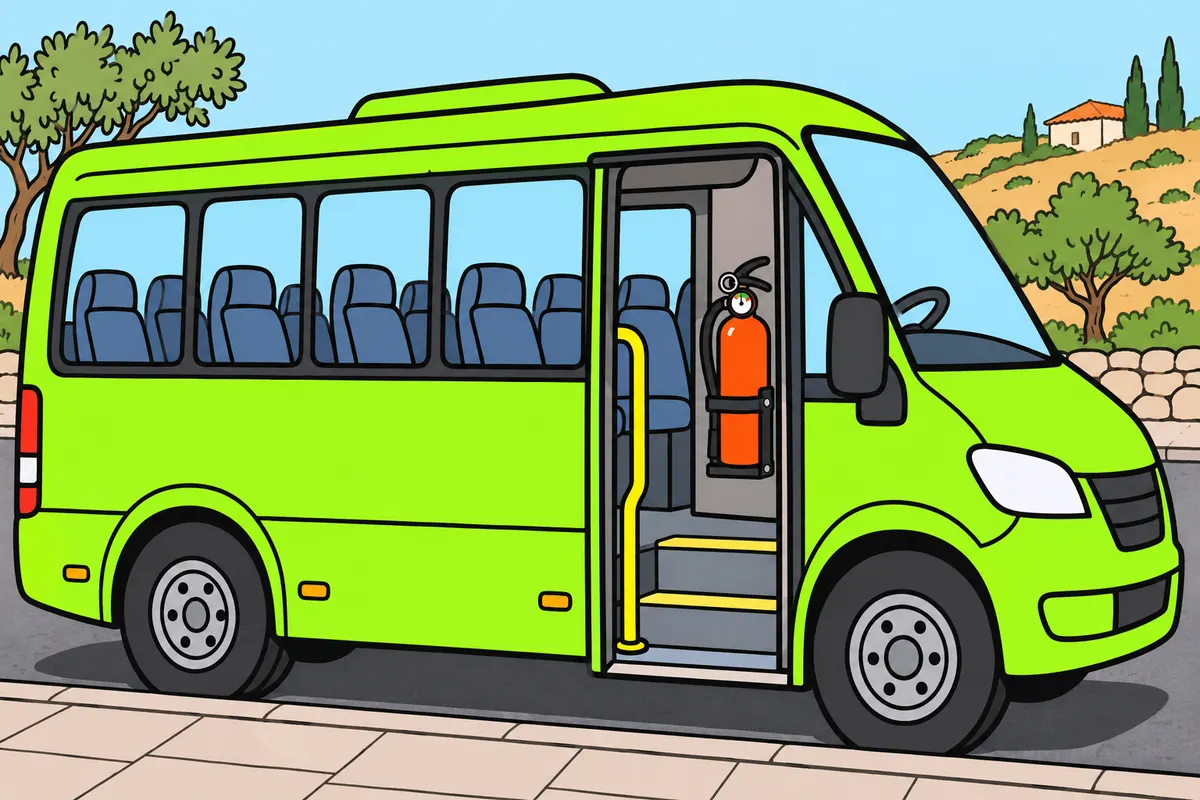
Carry a suitable extinguisher and check its rating against your minibus capacity.
Remember
- Carry approved equipment in working order, whatever the maximum authorised mass.
- Use the vehicle's capacity, even when fewer people are travelling.
- For your D1 minibus, use the category up to 23 seats, including you.
- Carry an extinguisher with a minimum rating of 8A/34B.
- The rating shows performance, not kilograms of extinguishing agent.
- For new or replacement equipment, use portable, manually operated extinguishers with a suitable agent.
Exam trap: Wrong: You answer that only dry powder is permitted. Right: Another suitable agent can meet the requirements.
Read the full explanation
- You must carry suitable, type-approved firefighting equipment in working order in your minibus, whatever its MMA (maximum authorised mass). [RGV, annex XII.2](https://www.boe.es/buscar/act.php?id=BOE-A-1999-1826#anxii).
- For your D1 minibus, with up to 16 passengers in addition to you and a maximum length of 8 m, you must apply the equipment requirement for the category of up to 23 seats including the driver: one fire extinguisher with a minimum rating of 8A/34B. Count the vehicle’s capacity. [RGCond, art. 4](https://www.boe.es/buscar/act.php?id=BOE-A-2009-9481#a4); [Order of 27 July 1999, second section](https://www.boe.es/buscar/act.php?id=BOE-A-1999-16887#segundo).
- The letters and figures in the rating express extinguishing effectiveness against the fire classes indicated. They do not express the kilograms of extinguishing agent or allow you to choose equipment solely by its external size: you must check its identification and suitability for the vehicle. [Order of 27 July 1999, second section](https://www.boe.es/buscar/act.php?id=BOE-A-1999-16887#segundo).
- When you install or replace fire extinguishers covered by the order, they must be portable and manually operated, with an agent suitable for the vehicle, preferably dry powder or another suitable agent. Check the equipment’s suitability and required characteristics. [Order of 27 July 1999, first section](https://www.boe.es/buscar/act.php?id=BOE-A-1999-16887#primero).
7Access to and maintenance of the fire extinguisher
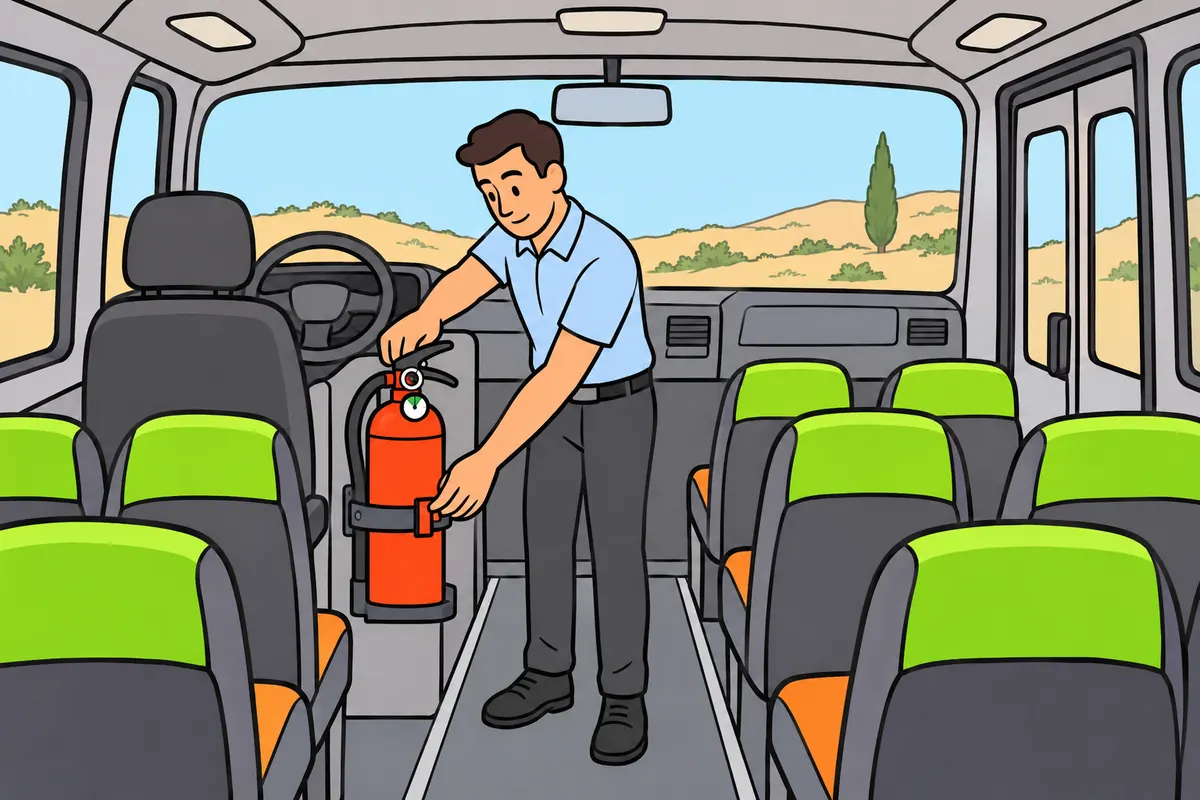
Keep your extinguisher accessible, secured and in good condition.
Remember
- Locate the extinguisher and learn to release it from its bracket.
- Check you can reach it without moving bags or other obstacles.
- Check where the extinguisher near your driving seat is located.
- If protected against theft, its location must be marked and removal easy.
- Report broken seals, damage, lost charge or abnormal gauge readings, if fitted.
Exam trap: Wrong: You assume the extinguisher works because it is still fitted. Right: Report damage and faults.
Read the full explanation
- You must know where the fire extinguisher is and be able to remove it quickly. As a practical check, make sure its bracket holds it securely and that no bag, cover or interior modification prevents access to it; even suitable equipment becomes less useful if you and your passengers cannot reach it during an incident.
- Vehicle construction regulations provide for space for one or more fire extinguishers, with one near the driver's seat. When you familiarise yourself with the minibus, check its exact location and how to release it from its bracket; the technical provision for space and the minimum rating required for the extinguisher are separate requirements. [UN Regulation 107, Annex 3, section 7.5.4.1](https://www.boe.es/doue/2026/139/L00001-00167.pdf).
- The equipment may be protected against theft or vandalism if its location is indicated and it can be removed easily in an emergency. A protective device designed to be broken or opened when needed is not the same as keeping the extinguisher somewhere none of the passengers can find it. [UN Regulation 107, Annex 3, section 7.5.4.3](https://www.boe.es/doue/2026/139/L00001-00167.pdf).
- The owner or designated person must regularly monitor the condition of the extinguisher, and at least the maintenance operations referred to in the Order must be carried out. As the driver, report broken seals, damage, loss of charge or abnormalities in the indicator, where fitted, and do not assume equipment is serviceable just because it is still in its bracket. [Order of 27 July 1999, first section](https://www.boe.es/buscar/act.php?id=BOE-A-1999-16887#primero).
8First-aid kit and initial assistance
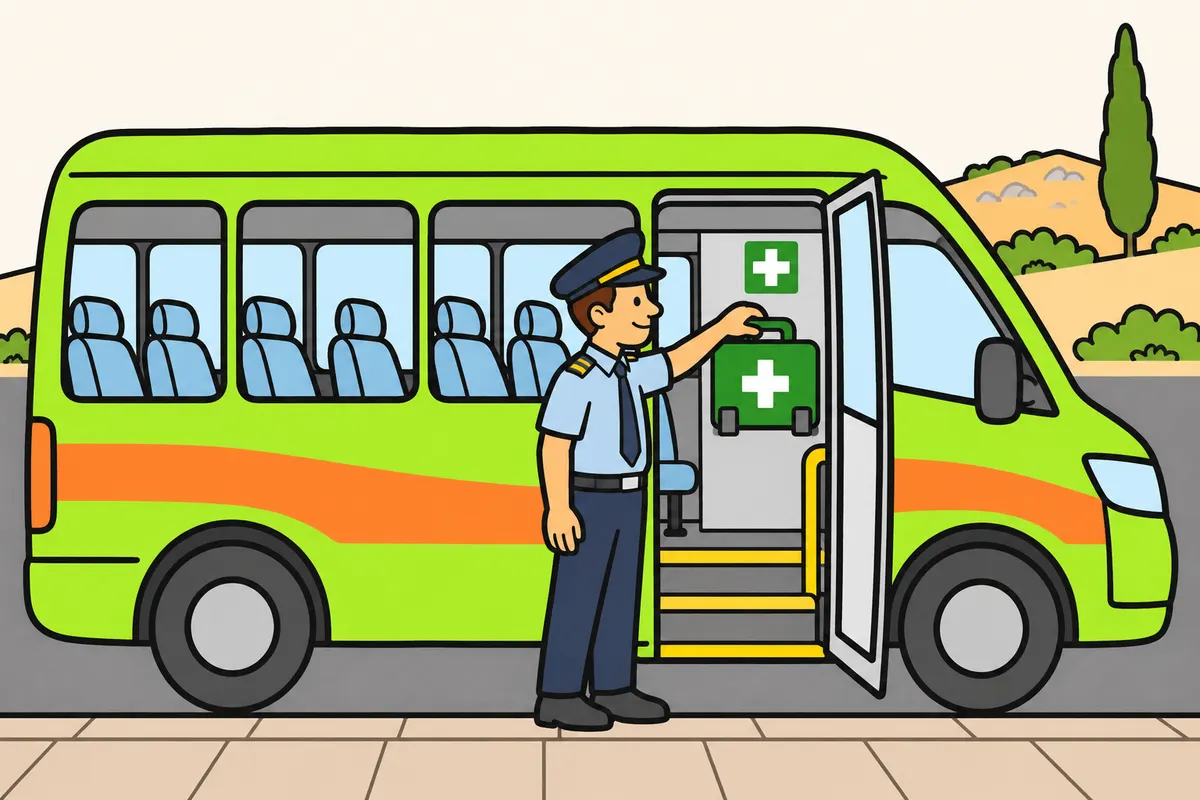
Know your first-aid kit and help within your knowledge without delaying medical assistance.
Remember
- Locate the first-aid kit and check you can reach it.
- In public bus transport, tell passengers it is available.
- Check packaging, dates and replacement of used supplies.
- Store supplies according to their instructions.
- Request medical help when needed and follow emergency services' instructions.
Exam trap: Wrong: You give medicines simply because you have a first-aid kit. Right: Use supplies within your knowledge and follow emergency services' instructions.
Read the full explanation
- You must locate the first-aid kit and know how to access it without unpacking luggage or searching for an unfamiliar key. The minimum information required on public bus services includes the presence of the kit, so you must include it when explaining the safety equipment available on board. [Order FOM/1230/2013, art. 4.2.d](https://www.boe.es/buscar/act.php?id=BOE-A-2013-7218#a4).
- Vehicle construction regulations provide for space for first-aid kits and allow them to be protected against theft when their location is marked and they can be removed easily. Do not confuse this type-approval provision with a universal list of medicines you must administer to passengers. [UN Regulation 107, Annex 3, section 7.5.4](https://www.boe.es/doue/2026/139/L00001-00167.pdf).
- Check the condition of the supplies, their packaging, the dates shown and whether used items have been replaced. Store the supplies according to their instructions; you must not rely on a first-aid kit left in the heat or filled with opened products whose storage conditions and cleanliness are unknown to you.
- You must help casualties and request medical assistance when necessary. Use the supplies within the limits of your knowledge and follow instructions from the emergency services; having a first-aid kit does not make you a healthcare professional or justify delaying the call while you search for a product to treat a serious injury. [RGC, art. 129](https://www.boe.es/buscar/act.php?id=BOE-A-2003-23514#a129). First-aid techniques are covered in the module “Accidents and assistance”.
9Seat belts for you and your passengers
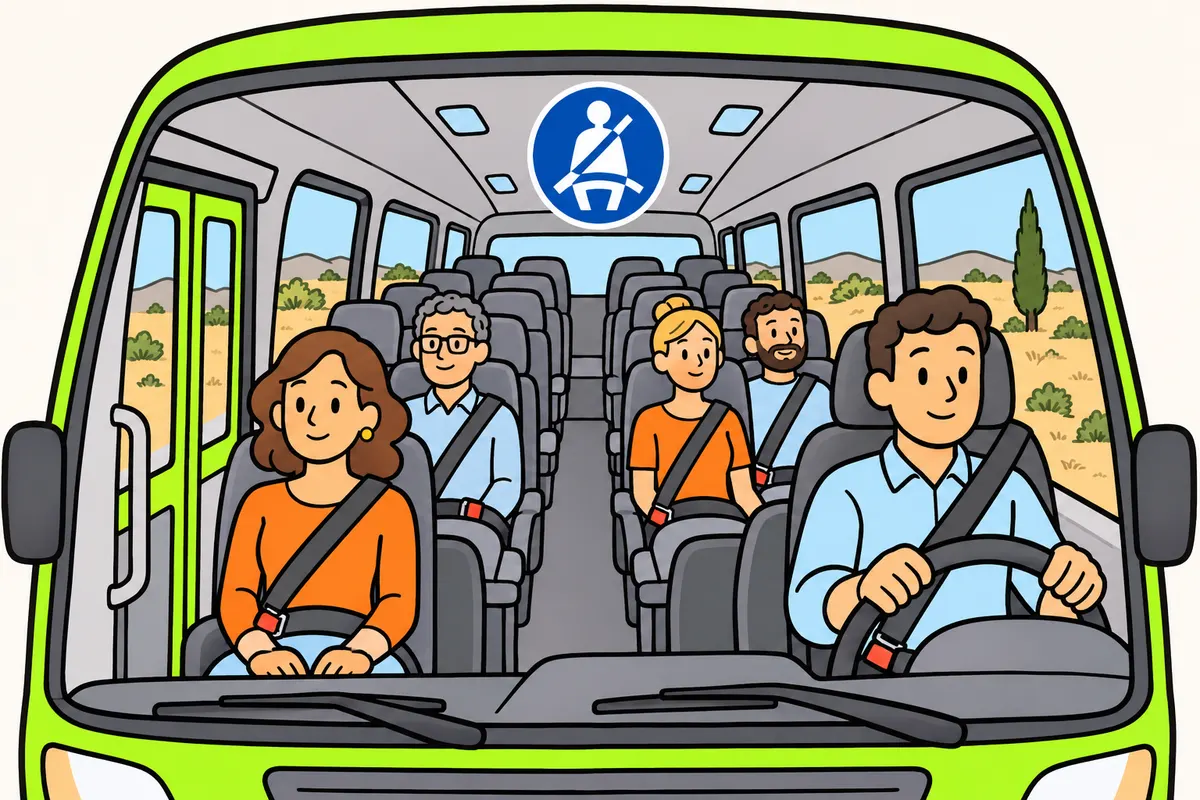
Wear your seat belt and tell passengers that they must use theirs.
Remember
- Fasten your approved seat belt correctly.
- Remember: passengers must use fitted belts unless legally exempt.
- Apply this duty both in towns and outside them.
- In minibuses with more than nine seats, including you, tell passengers about this duty.
- Use staff, audiovisual media, notices or regulation pictograms visible at every seat.
- Explain adjustment and release without unfastening belts while moving.
Exam trap: Wrong: You wear your seat belt only outside towns. Right: Wear it in towns too, unless legally exempt.
Read the full explanation
- You must wear your approved seat belt correctly fastened. Passengers must also use the seat belts fitted, on urban and interurban roads, unless legally exempt. [RGC, art. 117](https://www.boe.es/buscar/act.php?id=BOE-A-2003-23514#a117).
- In a minibus with more than nine seats including the driver's seat, you must inform passengers that they must use the seat belt or appropriate restraint system. You, the guide or the person in charge of the group can do this, or you can use audiovisual means, notices or regulation pictograms visible at every seat. [RGC, art. 117](https://www.boe.es/buscar/act.php?id=BOE-A-2003-23514#a117).
- Explain that each passenger must adjust the belt to fit their body according to its instructions and know how to release the buckle to evacuate. Check that they understand how to do this without unfastening it while the vehicle is moving.
- Exemptions, child restraint systems and responsibility for their use are covered in “Transporting passengers and minors”.
10Recognise the emergency and decide
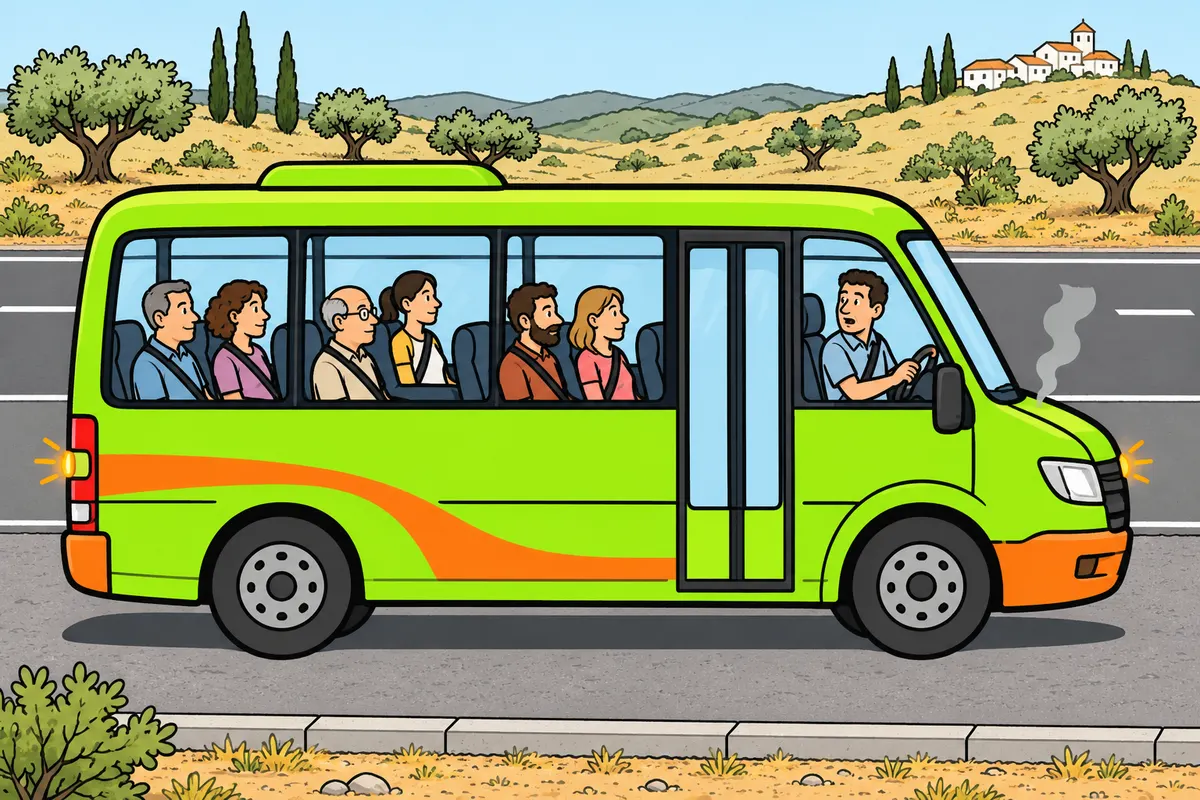
Decide according to the actual danger and protect people before belongings.
| Situation | What you must assess |
|---|---|
| Road breakdown without fire | Whether you can get out to a safe place |
| Fire | Necessary evacuation without delay |
| Stopped in a tunnel | Specific instructions for the cause |
Remember
- With smoke, burning smells, alarms or dangerous faults, find somewhere safe to stop.
- Keep control and alert passengers with short phrases.
- Prepare passengers without letting them enter the aisle while you stop.
- Assess danger outside before ordering passengers out.
- Do not delay a necessary evacuation to recover luggage.
- Organise assistance and request help without increasing danger.
Exam trap: Wrong: You make everyone get out just to check the engine. Right: Decide according to the danger and safety outside.
Read the full explanation
- If you notice smoke, a burning smell, an alarm or a fault that compromises safety, take preventive action by finding a safe place to bring the vehicle to a halt without waiting to reach your destination. Maintain control and alert passengers with short instructions so they remain ready and keep the aisle clear as you stop.
- You must decide according to the actual danger: a breakdown without fire, a fire and a traffic queue require different responses. On the open road, whether you can get out depends on whether there is a safe place; in a tunnel, there are specific instructions for emergencies and for simply stopping because of traffic. [RGC, arts. 97 and 130](https://www.boe.es/buscar/act.php?id=BOE-A-2003-23514).
- Give priority to protecting people and calling for help over recovering belongings or investigating a fault. Do not delay a necessary evacuation to open the luggage hold and hand out suitcases; do not make the whole group get out into traffic just so you can examine the engine either.
- You must assess the situation quickly and take measures that avoid increasing the danger. If a collision occurs, organising aid and requesting assistance are part of your duties; adapt your help to the circumstances and do not create another dangerous situation as you approach passengers. [RGC, art. 129](https://www.boe.es/buscar/act.php?id=BOE-A-2003-23514#a129).
11Direct an orderly evacuation
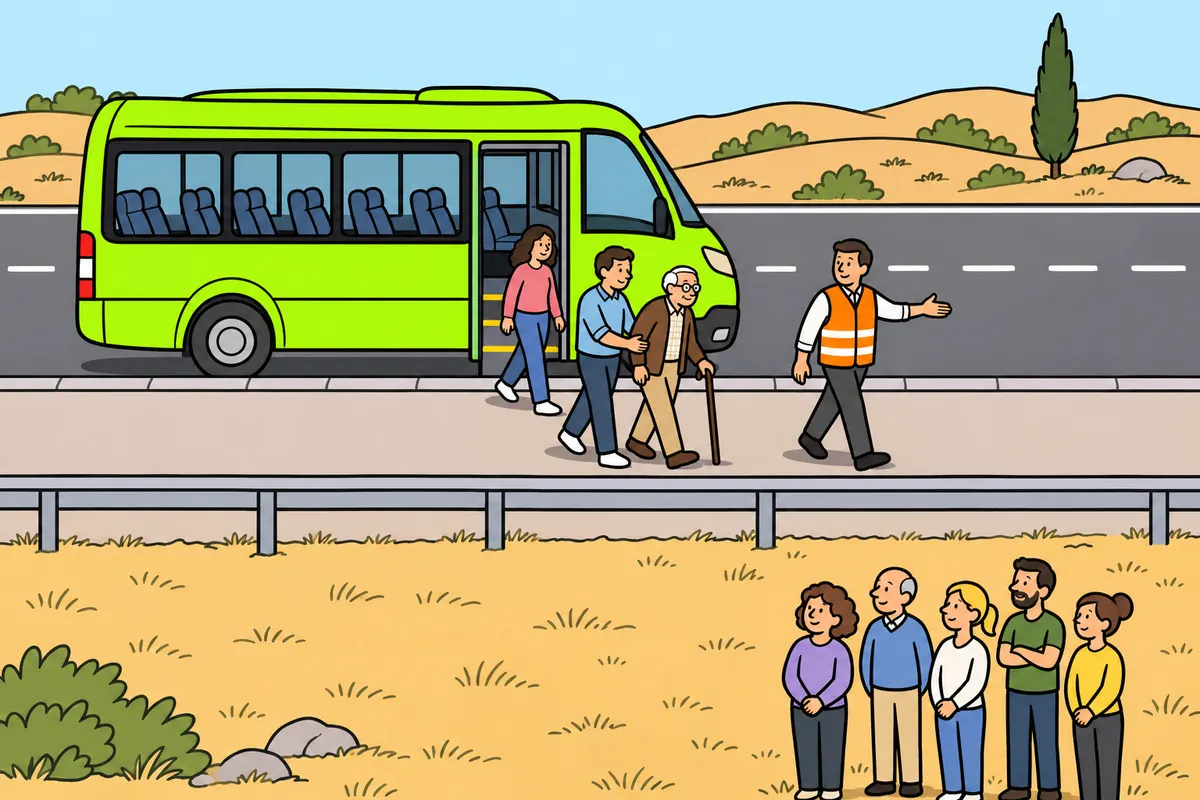
Secure your minibus, direct evacuation, then gather and count your passengers.
Remember
- Stop, apply the parking brake and switch off the engine.
- Assess traffic, stability, smoke and fire before choosing exits and a meeting place.
- Give short instructions, assign helpers and tell passengers to leave luggage behind.
- Tell passengers to release belts; let those beside each usable exit leave first.
- Evacuate without pushing; gather everyone away from traffic, fire and smoke.
- Count passengers, report anyone missing and prevent anyone returning for belongings.
Exam trap: Wrong: You follow the recommended distance even towards another danger. Right: Adapt the distance to your surroundings; avoid traffic lanes and other dangers.
Read the full explanation
- Step 1. You must stop and secure the minibus with the parking brake; switch off the engine. Assess the traffic, the vehicle's stability, smoke and fire to choose the exits and the assembly point. This is practical evacuation guidance that you must adapt to the incident. [RGC, art. 129](https://www.boe.es/buscar/act.php?id=BOE-A-2003-23514#a129).
- Step 2. You must give brief instructions: which exit each area uses and who helps passengers who need assistance. Tell them to release their seat belts to get out and leave their luggage behind. Let those beside each usable exit go through first. [DGT, bus evacuation](https://www.dgt.es/muevete-con-seguridad/viaja-seguro/en-autobus/).
- Step 3. You must direct a rapid exit, without pushing, through the safe doors; use emergency windows or hatches if the doors are blocked. Operate each mechanism according to the vehicle's instructions. [DGT, bus evacuation](https://www.dgt.es/muevete-con-seguridad/viaja-seguro/en-autobus/).
- Step 4. You must lead the group to a place protected from traffic, fire and smoke. The DGT advises moving at least 30 metres away from the bus; adapt this recommendation to the surroundings without entering traffic lanes or leading the group towards another danger. [DGT, bus evacuation](https://www.dgt.es/muevete-con-seguridad/viaja-seguro/en-autobus/).
- Step 5. You must count the evacuees and check that everyone who was travelling is accounted for. Tell the emergency services if anyone is missing and give their last known location; prevent people from returning for belongings. Check the passenger compartment only if you can do so without exposing yourself to danger. This is practical guidance for keeping track of the group. [RGC, art. 129](https://www.boe.es/buscar/act.php?id=BOE-A-2003-23514#a129).
12Help those who cannot get out unaided
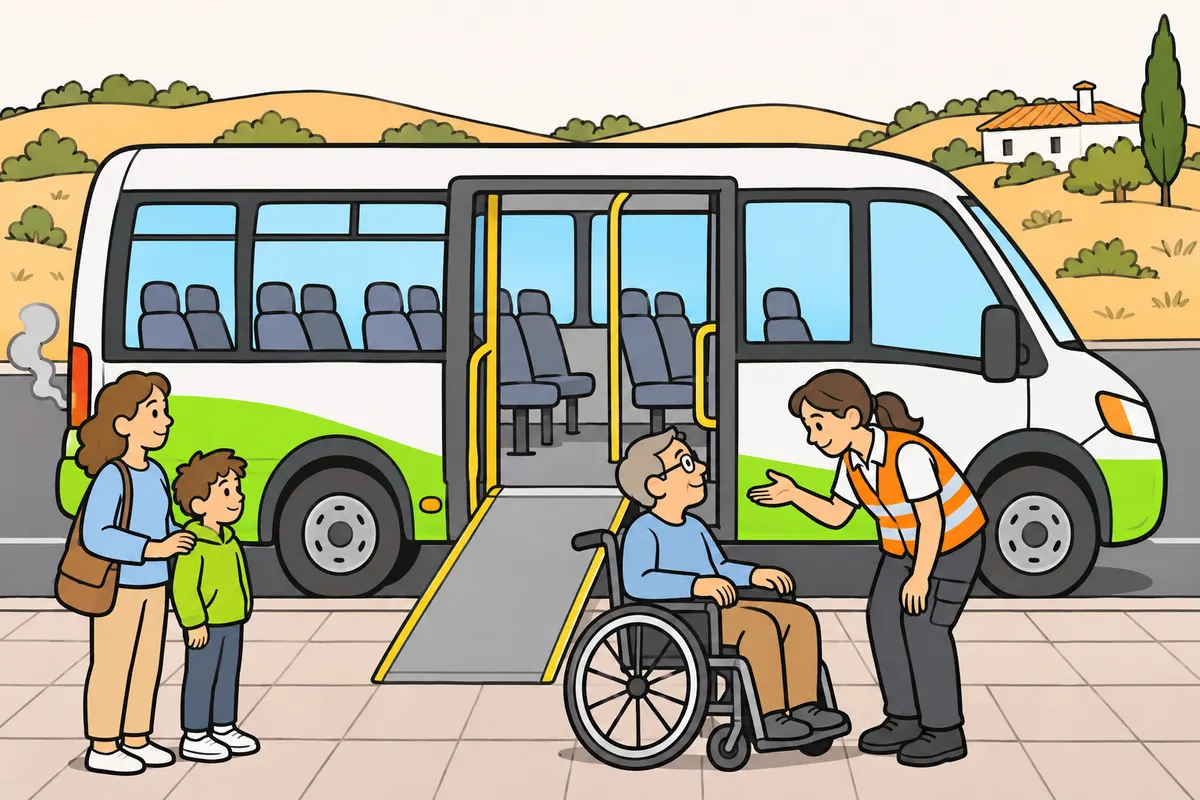
Organise help for those who need it without blocking exits or increasing danger.
Remember
- Identify help needed and explain to each person what you will do.
- Assign helpers without blocking others.
- Use only routes and devices that work and allow a safe exit.
- If anyone is trapped, request help; report their location and access difficulties.
- In immediate danger, coordinate help with emergency services without creating more casualties.
- If you become incapacitated, passengers can escape danger without waiting for your orders.
Exam trap: Wrong: You improvise a dangerous rescue of an injured person sheltered from danger. Right: Request help; in immediate danger, coordinate with emergency services without creating more casualties.
Read the full explanation
- Identify the needs of passengers with reduced mobility, children or people with sensory impairments, and familiarise yourself with the vehicle's assistance devices. During an emergency, address the person directly and explain what you are going to do; do not assume that someone who does not react quickly has understood the instruction.
- Assign helpers without blocking everyone else's exit and choose a route that is actually usable. A lift or ramp may be damaged, have no power or lead towards danger: follow its operating procedure and do not spend time on an unusable mechanism while smoke affects the passenger compartment.
- If people are trapped, you must call for help and report their location and any difficulties in reaching them. You must not improvise a dangerous rescue to remove an injured person who is safe where they are; if there is immediate danger, coordinate your actions with the emergency services and provide whatever help you can without causing more casualties. [RGC, art. 129](https://www.boe.es/buscar/act.php?id=BOE-A-2003-23514#a129).
- If you become incapacitated, passengers do not have to wait for your orders to escape danger. The DGT explains that they may need to use the emergency opening mechanism, the engine stop control or the parking brake; you must therefore help them recognise the safety equipment in advance. [DGT, bus emergency](https://www.dgt.es/muevete-con-seguridad/viaja-seguro/en-autobus/).
13Fire on board: protect your passengers
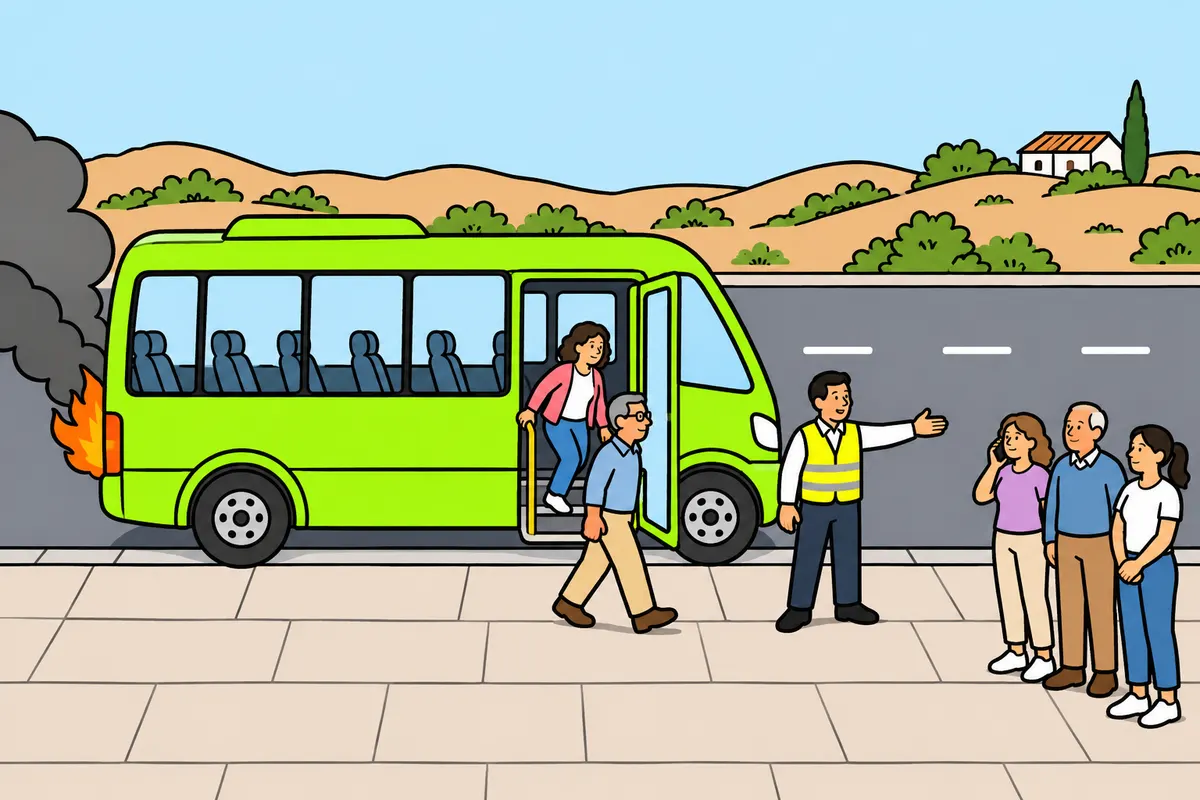
Evacuate without delay during a fire and request help from a safe place.
Remember
- Stop, secure your minibus and switch off the engine.
- Order passengers out through exits away from fire and smoke.
- Request urgent help; report where the fire is and anyone still inside.
- Avoid suddenly opening burning compartments or interfering with electrical or fuel systems.
- Stop firefighting if flames grow or smoke threatens your escape.
- Prevent returns for belongings; wait for a safety assessment before restarting the service.
Exam trap: Wrong: You try to extinguish the fire before evacuating. Right: Only tackle a small fire with a suitable extinguisher, knowing how to use it and keeping a safe escape route, without delaying evacuation.
Read the full explanation
- If a fire breaks out on board, you must stop and secure the minibus, switch off the engine and order an evacuation through exits away from the fire and smoke. Follow the sequence in the evacuation section without delaying it to try to extinguish the fire. This is guidance for protecting your passengers. [RGC, art. 129](https://www.boe.es/buscar/act.php?id=BOE-A-2003-23514#a129).
- You must request urgent assistance and explain that a bus with passengers is involved, where the fire is and whether anyone remains inside. Make the call from a safe place or ask someone else to do so while you direct the evacuation; also identify any access difficulties that may affect the emergency services' arrival. [RGC, art. 129](https://www.boe.es/buscar/act.php?id=BOE-A-2003-23514#a129).
- You must only attempt to control a small fire if you have the right fire extinguisher, know how to use it and retain a safe escape route, without delaying the passengers' evacuation. For guidance on use, follow the equipment's instructions; abandon the attempt if the flames grow or smoke threatens your escape route.
- Avoid suddenly opening the compartment containing the fire, breathing in smoke or tampering with electrical and fuel systems. Keep the service suspended until the vehicle's safety is assessed and arrange a safe alternative for the group. [DGT, Road safety matters, action in the event of fire](https://sede.dgt.gob.es/export/sites/dgt/.galleries/permisos-de-conducir/certificacion-aptitud-profesores-formacion-vial/2026/MANUAL-II-Cuestiones-de-Seguridad-Vial.pdf).
14Road breakdown with passengers
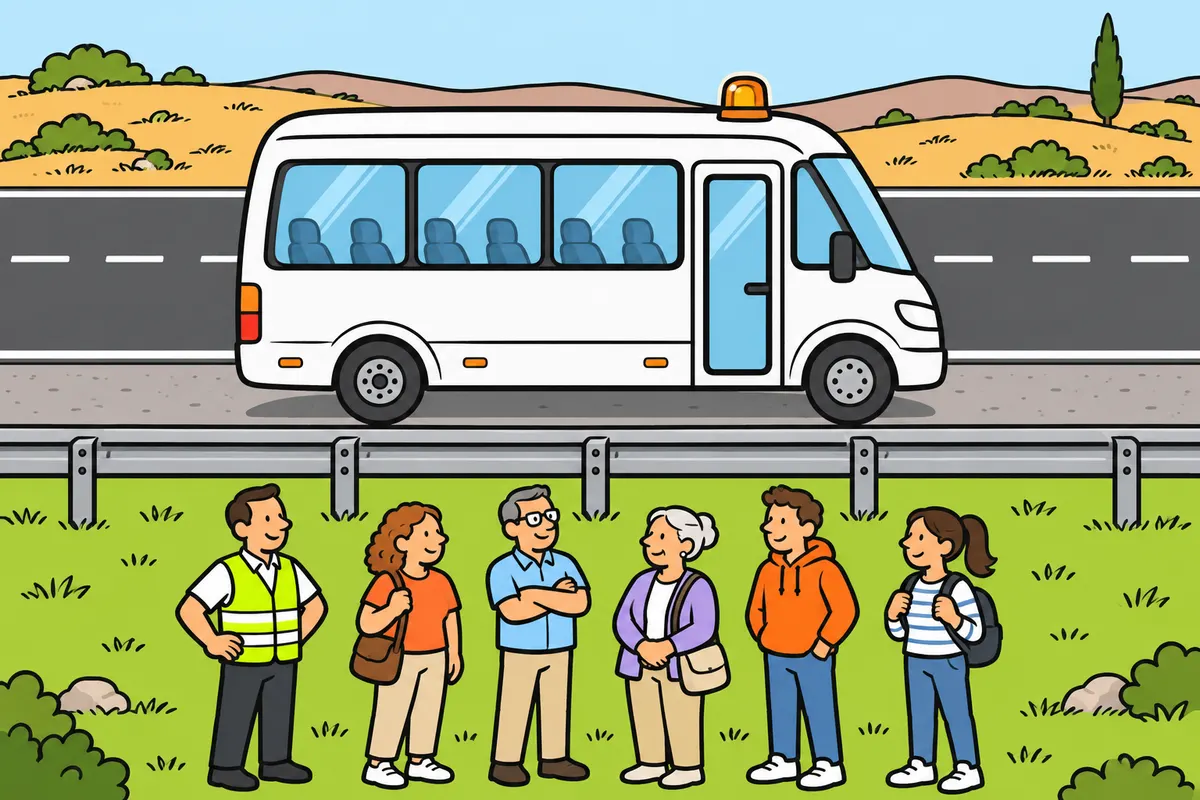
If a fault prevents control or stopping, immobilise your minibus and request assistance.
Remember
- See “Accidents and assistance” for moving your minibus and deciding whether to get out.
- Use the hard shoulder to reach an available exit and reduce exposure to traffic.
- If you cannot control or stop the minibus, secure it and request help.
- If fire or another immediate danger appears, reassess and request urgent instructions.
- Follow this module’s evacuation steps, using exits that remain safe.
Exam trap: Wrong: You use the hard shoulder even when you cannot control or stop the minibus. Right: Secure it and request assistance.
Read the full explanation
- Moving the minibus out of danger and the general decision on whether to get out or remain inside are explained in «Accidents and assistance», in the sections «Breakdown: move the bus out of danger» and «Keeping passengers safe while waiting». [RGC, art. 130.2 and 3](https://www.boe.es/buscar/act.php?id=BOE-A-2003-23514#a130).
- Driving along the arcén (hard shoulder) allows you to reach the available exit and reduce exposure to traffic; if the fault prevents you from controlling or stopping the vehicle, you must, as a safety measure, immobilise it and request the appropriate assistance.
- If a fire or another immediate danger arises, you must reassess your passengers' situation and request urgent instructions; follow this module's evacuation procedure according to which exits remain usable. [RGC, art. 129](https://www.boe.es/buscar/act.php?id=BOE-A-2003-23514#a129).
15Warn other traffic without exposing yourself to danger
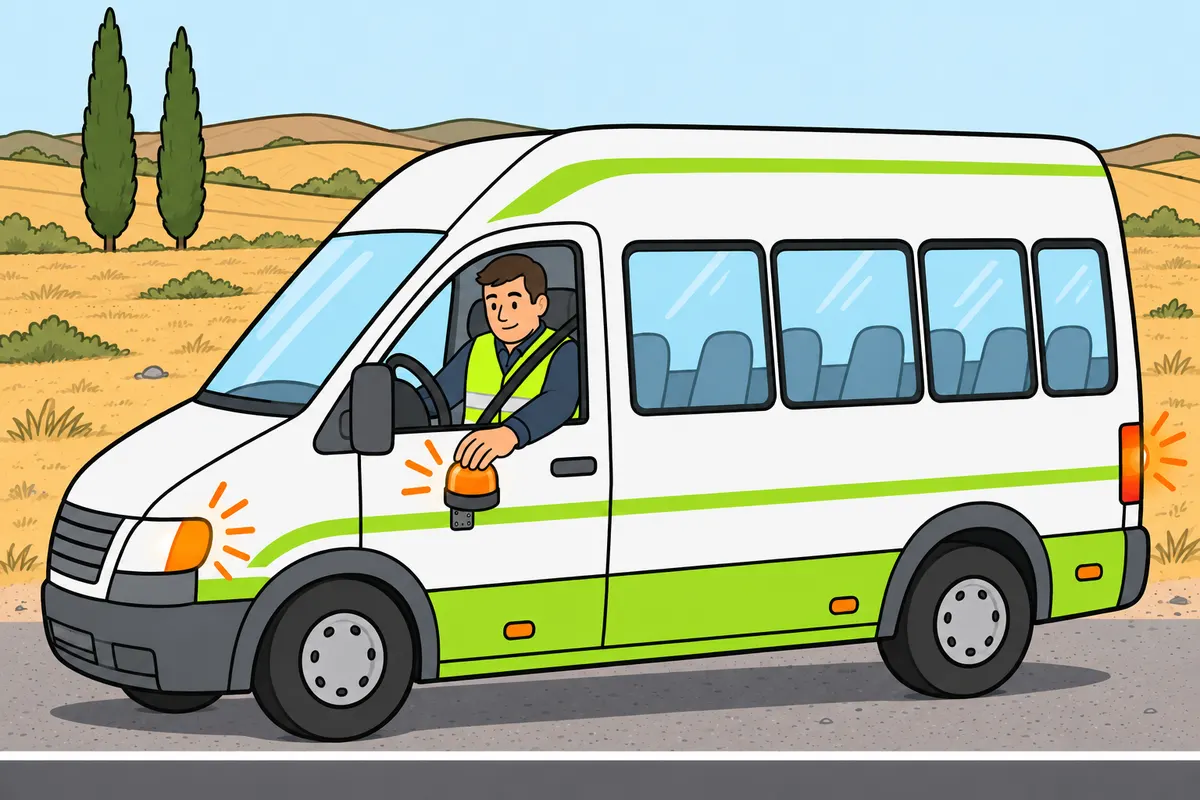
Use the connected V-16 to warn traffic and keep passengers away from traffic.
Remember
- Use the connected V-16 and appropriate lights to warn that your vehicle is immobilised.
- Do not keep passengers on the hard shoulder, even if you wear a vest.
- Keep your vest within reach and put it on before getting out.
- See “Accidents and assistance” for signalling and getting out safely.
Exam trap: Wrong: You keep passengers on the hard shoulder because you wear a high-visibility vest. Right: Do not keep passengers on the hard shoulder.
Read the full explanation
- Use the connected V-16 and the appropriate lights to warn that the vehicle is immobilised, and follow the precautions for getting out and using a high-visibility vest explained in «Accidents and assistance». [RGC, art. 130.4](https://www.boe.es/buscar/act.php?id=BOE-A-2003-23514#a130).
- Wearing a high-visibility vest does not authorise you to remain exposed to traffic or to line passengers up on the hard shoulder; as a precaution, keep it within reach so you can put it on before getting out. Warning other traffic about the vehicle must allow you to continue looking after the group's safety.
16Calling for help, waiting and safe transfer
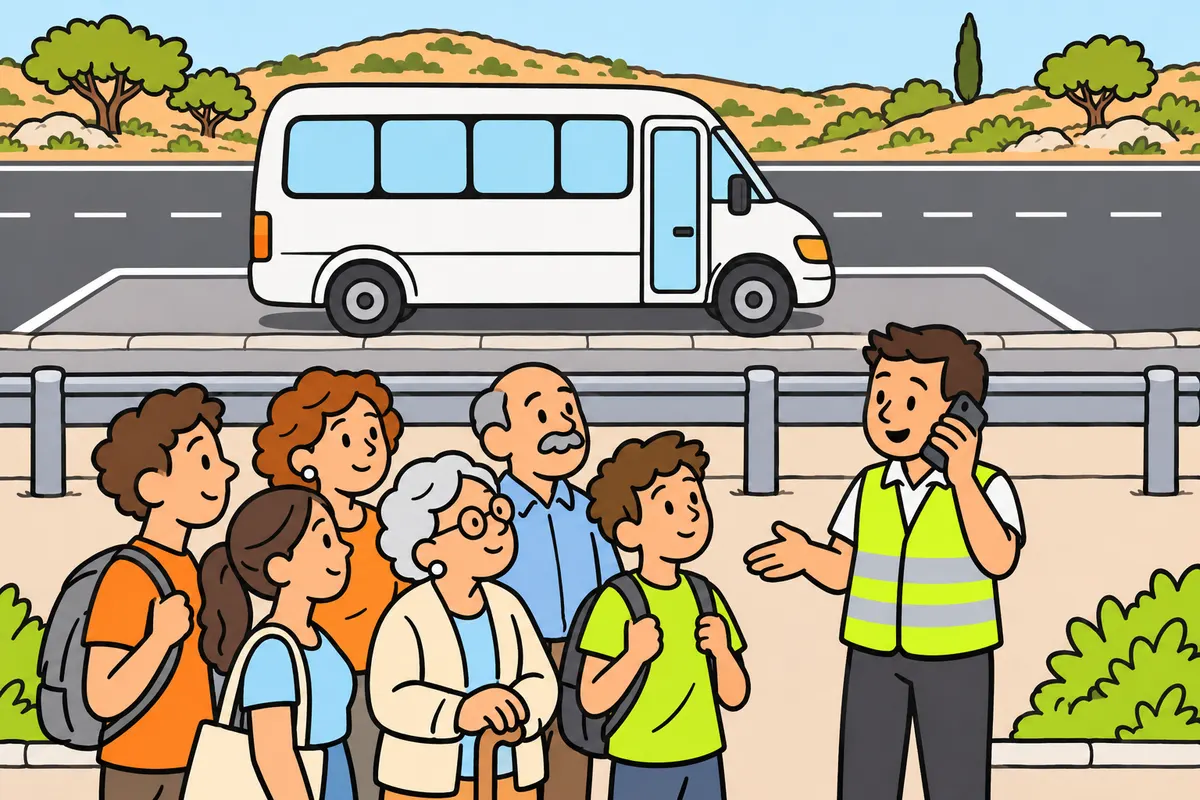
Request help, keep your group together and organise a safe transfer.
Remember
- See “Accidents and assistance” for calling 112 and what information to give.
- Prevent anyone returning for luggage or walking away along the road.
- Notify your company or assistance provider and check nobody is missing.
- Keep your group together; report any location change to emergency services.
- Arrange removal of your minibus promptly, if possible without creating danger.
- Arrange safe access to replacement transport; request intervention if you cannot ensure safety.
Exam trap: Wrong: You make your group cross a motorway to change vehicles. Right: Agree a protected place and safe access.
Read the full explanation
- Calling 112 and the details you must provide are explained in «Accidents and assistance», in the section «Calling 112 with useful information». [RGC, art. 129](https://www.boe.es/buscar/act.php?id=BOE-A-2003-23514#a129).
- Inform the company or assistance service and keep the group together in the chosen area. Check that no passengers are missing and report any change of location to the services coming to help; prevent anyone from returning to the minibus for a suitcase or walking away along the road.
- You must take the necessary measures to remove the vehicle obstructing the carriageway as soon as possible, where feasible and without creating danger. Coordinate its removal with the assistance services, without trying to get passengers to push a bus while exposed to traffic or leaving them unprotected to improvise a repair. [RGC, art. 130.1](https://www.boe.es/buscar/act.php?id=BOE-A-2003-23514#a130).
- Agree on a protected location and safe access to the replacement vehicle. Do not make the group cross a motorway or keep them waiting in a lane; if you cannot ensure that everyone can move safely, request help from the relevant services before organising the transfer.
17Tunnels: prepare for an emergency
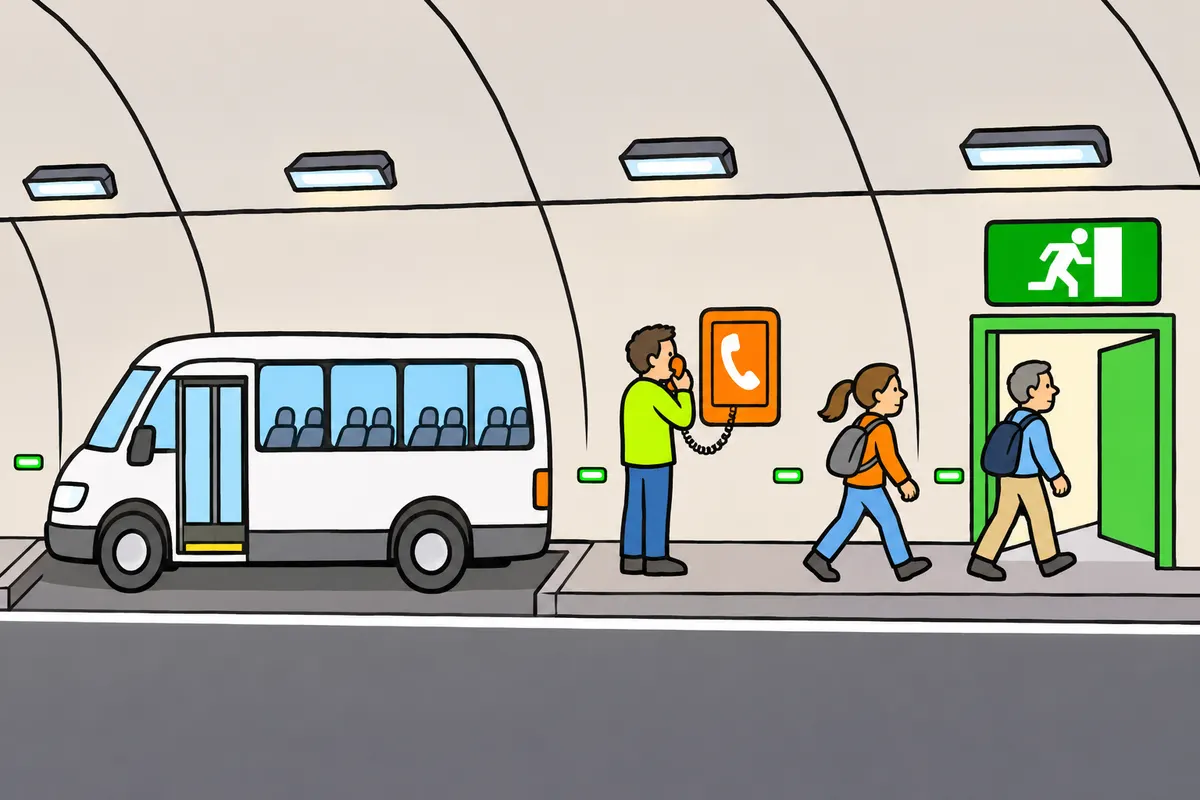
Locate tunnel emergency areas and follow the instructions given.
Remember
- Check the signs for emergency lay-bys and exits.
- Follow traffic lights, message signs and loudspeaker instructions.
- Use the SOS emergency telephone to request help.
- To evacuate, follow the signposted pedestrian route towards a refuge or exit.
Exam trap: Wrong: You ignore the pedestrian route. Right: Follow signs towards the refuge or exit.
Read the full explanation
- Locate the tunnel's emergency lay-bys and exits, and follow the instructions given by its traffic lights, information panels and public address system during the emergency.
- You must use the SOS emergency telephone to request help and head towards the refuge or exit to evacuate. Follow the route signposted for pedestrians. [RGC, art. 97](https://www.boe.es/buscar/act.php?id=BOE-A-2003-23514#a97).
- Lighting and distances when driving through tunnels are covered in «Minibus lighting and signalling» and «Minibus speed and distances».
18Tunnel: breakdown leaving you immobilised
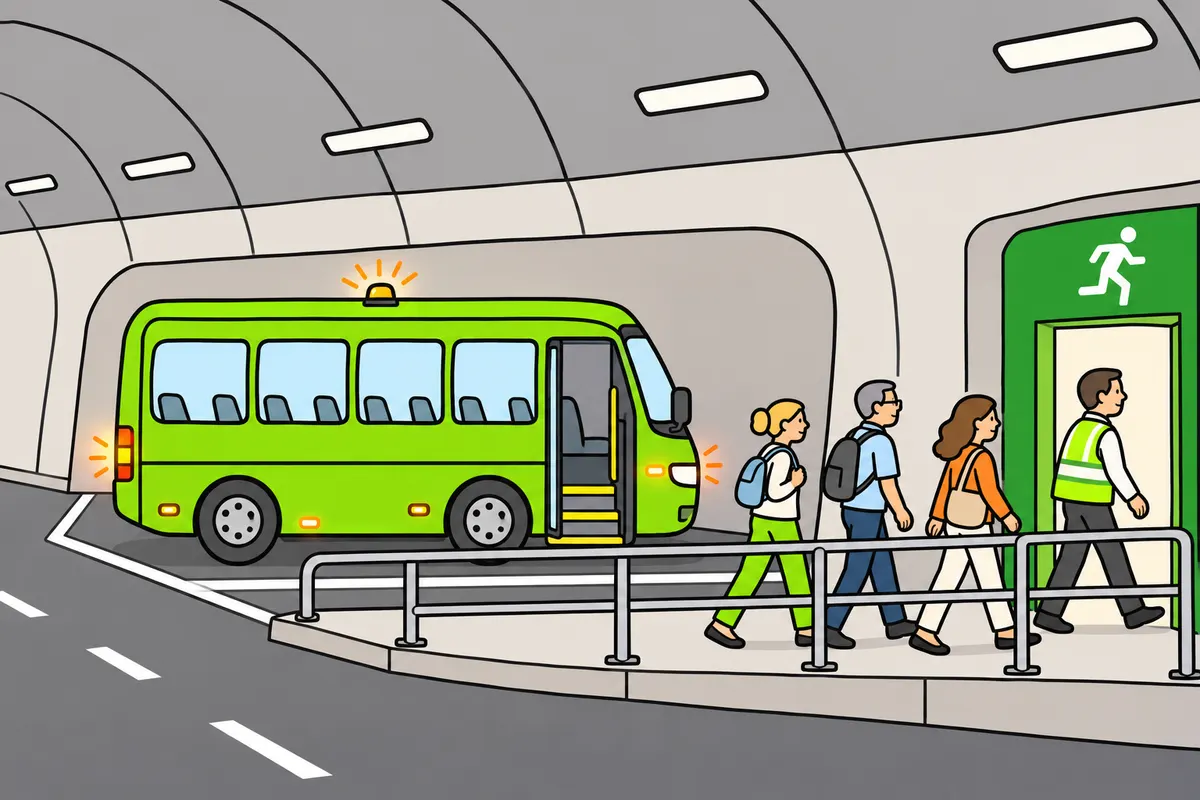
If an emergency immobilises you in a tunnel, warn traffic, request help and evacuate.
| Tunnel breakdown | What you must do |
|---|---|
| You can continue safely | Reach the exit or, if impossible, an emergency area |
| An emergency immobilises you | Warn traffic, request help and evacuate to the nearest refuge or exit |
Remember
- If safe, drive to the exit; otherwise, reach an emergency area if possible.
- If immobilised, seek the nearest reserved area in your direction of travel.
- If none exists, pull close to the right-hand edge.
- Switch off the engine, switch on hazard lights and keep the position lights on.
- Activate the warning light; request help promptly using an SOS telephone, if available.
- Take passengers to the nearest refuge or exit; follow instructions received.
Exam trap: Wrong: You send someone along the carriageway to place signs. Right: Use the beacon; when evacuating, avoid the carriageway if areas closed to vehicles exist.
Read the full explanation
- If a breakdown allows you to continue driving safely, you must continue to the exit of the tunnel or underpass or, if you cannot, to an area reserved for emergencies. Do not stop in the lane to inspect the fault when you can safely reach one of these locations. [RGC, art. 97.3.f](https://www.boe.es/buscar/act.php?id=BOE-A-2003-23514#a97).
- If an emergency leaves you immobilised, place the minibus in the nearest reserved area in your direction of travel, if possible; if there is none, pull close to the right-hand edge. You must switch off the engine, switch on the hazard warning lights and keep the position lights on. [RGC, art. 97.3](https://www.boe.es/buscar/act.php?id=BOE-A-2003-23514#a97).
- You must position and activate the regulatory warning light device and request assistance without delay using the nearest SOS emergency telephone, if there is one, following the instructions you receive. To use the device, follow the guidance in «Accidents and assistance» without sending a passenger along the carriageway to place warning signs away from the minibus. [RGC, art. 97.3.c and d](https://www.boe.es/buscar/act.php?id=BOE-A-2003-23514#a97).
- In this emergency, you must leave the minibus with the other occupants and head quickly to the nearest refuge or exit. If there are areas closed to vehicles, you must not walk along the carriageway; organise the passengers' evacuation along that route and report whether anyone needs assistance to complete it. [RGC, art. 97.3.e](https://www.boe.es/buscar/act.php?id=BOE-A-2003-23514#a97).
19Tunnel: fire or traffic queue
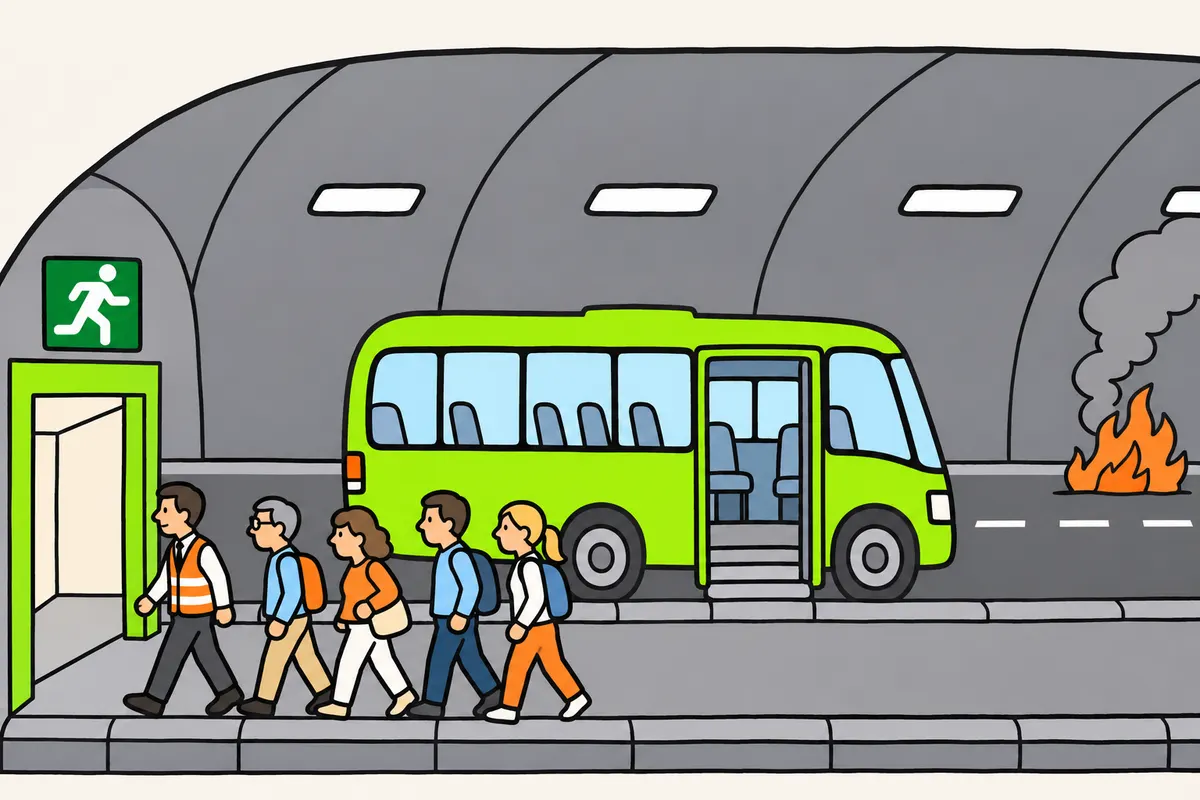
In a tunnel, evacuate during a fire and stay inside during a simple traffic queue.
| Tunnel situation | What you must do |
|---|---|
| Fire | Evacuate with passengers away from the fire |
| Traffic queue only | Stay inside with passengers; use hazard lights temporarily, position lights on, engine off |
| Traffic queue only | Stop as far as possible from the vehicle ahead |
Remember
- With fire, pull as far right as possible and switch off the engine.
- Leave the key in the ignition and doors open.
- Evacuate to the nearest refuge or exit, away from the fire.
- Use areas closed to traffic where available; avoid the carriageway.
- In a simple traffic queue, switch off the engine; keep position lights on.
- Keep passengers informed; reassess if smoke appears or you receive evacuation orders.
Exam trap: Wrong: You evacuate for a simple queue or lock your minibus during a fire. Right: Stay inside for a queue; during a fire, evacuate leaving the key in the ignition and doors open.
Read the full explanation
- If there is a fire in a tunnel, you must move the minibus as far to the right as possible so that you do not obstruct the emergency services. Switch off the engine and leave the key in the ignition and the doors open; do not lock the vehicle to protect its contents while you organise the evacuation. [RGC, art. 97.3](https://www.boe.es/buscar/act.php?id=BOE-A-2003-23514#a97).
- You must evacuate with your passengers towards the nearest refuge or exit in the direction away from the fire. Use areas closed to traffic where available, avoiding the carriageway; do not lead the group past the fire to reach the tunnel entrance you came through. [RGC, art. 97.3](https://www.boe.es/buscar/act.php?id=BOE-A-2003-23514#a97).
- If you are stationary solely because of traffic conditions, you must remain inside with your passengers. Switch on the hazard warning lights temporarily to warn approaching drivers, keep the position lights on, switch off the engine and stop as far as possible from the vehicle ahead. [RGC, arts. 97.3 and 115](https://www.boe.es/buscar/act.php?id=BOE-A-2003-23514#a115).
- You must reassess your decision if the situation changes: a traffic queue with no other danger and a fire require different actions. In practice, keep your passengers informed and ready to follow evacuation instructions if smoke appears or the tunnel services order an evacuation; prevent passengers from getting out on their own initiative to look at the queue.
Road breakdown with passengers
Apply article 130 of the RGC according to whether the minibus can move and whether it is safe outside.
- Apply the vehicle removal measures explained in «Accidents and assistance» and assess how they affect passenger protection.
- Apply the warning measures and precautions for getting out explained in «Accidents and assistance» while keeping the group under control.
- Check whether there is a safe area beyond the carriageway and hard shoulders and an exit on the side away from traffic.
- If it is safe to get out, direct the group to that area without remaining in traffic lanes or on the arcén (hard shoulder); if it is not, keep passengers inside with their seat belts fastened.
- Request assistance, call 112 if there is an emergency and coordinate waiting, vehicle removal and any transfer to another vehicle.
Evacuating the minibus
Adapt this practical procedure to the danger, the vehicle and the instructions from the emergency services.
- Secure the vehicle against movement and determine which exits and outside areas you can use.
- Give brief instructions, assign help to those who need it and direct each area towards a safe exit.
- Have everyone get out without pushing or taking luggage; use emergency mechanisms or glass-breaking devices according to their instructions.
- Guide the group to a protected area and keep them away from the minibus, traffic and smoke.
- Check who has been evacuated, report anyone still inside and prevent anyone returning for belongings.
Fire on board
Protect people and raise the alarm; using the extinguisher requires safe conditions.
- Stop and secure the minibus as safely as possible.
- Order evacuation through exits away from fire and smoke, without collecting luggage.
- Call 112 or have someone call, and report the location, passengers and anyone trapped.
- Only consider tackling a small fire in its initial stage if you have suitable equipment, the necessary knowledge and a safe escape route, without delaying evacuation.
- Assemble the group in safety, prevent anyone returning on board and follow the instructions from the emergency services.
Deciding what to do inside a tunnel
Distinguish the situations covered by article 97.3 of the RGC.
- Traffic queue with no other danger: remain inside with your passengers, switch on the hazard warning lights temporarily, keep the position lights on and switch off the engine.
- Breakdown that allows you to drive safely: continue to the exit or, if you cannot, to an emergency area.
- Emergency leaving you immobilised: seek an emergency lay-by or the right-hand edge, switch off the engine, switch on the hazard warning lights and position lights, warn other traffic and request assistance using an SOS call point if available.
- In an emergency, evacuate towards the nearest refuge or exit using areas closed to traffic.
- If there is a fire: leave the key in the ignition and the doors open, allow emergency services to pass and lead the group away from the fire.
Finished this module?
Mark it as read and you will see your progress on the theory list.