
Theory · D1 Licence - Minibus · Module 13 of 18
Safe minibus driving
You learn to drive the minibus smoothly, approach stops and monitor doors, blind spots and swept space. You prepare for D1 exam decisions on manoeuvres, visibility, wind, descents and adverse conditions, protecting seated passengers and those occupying authorised standing places.
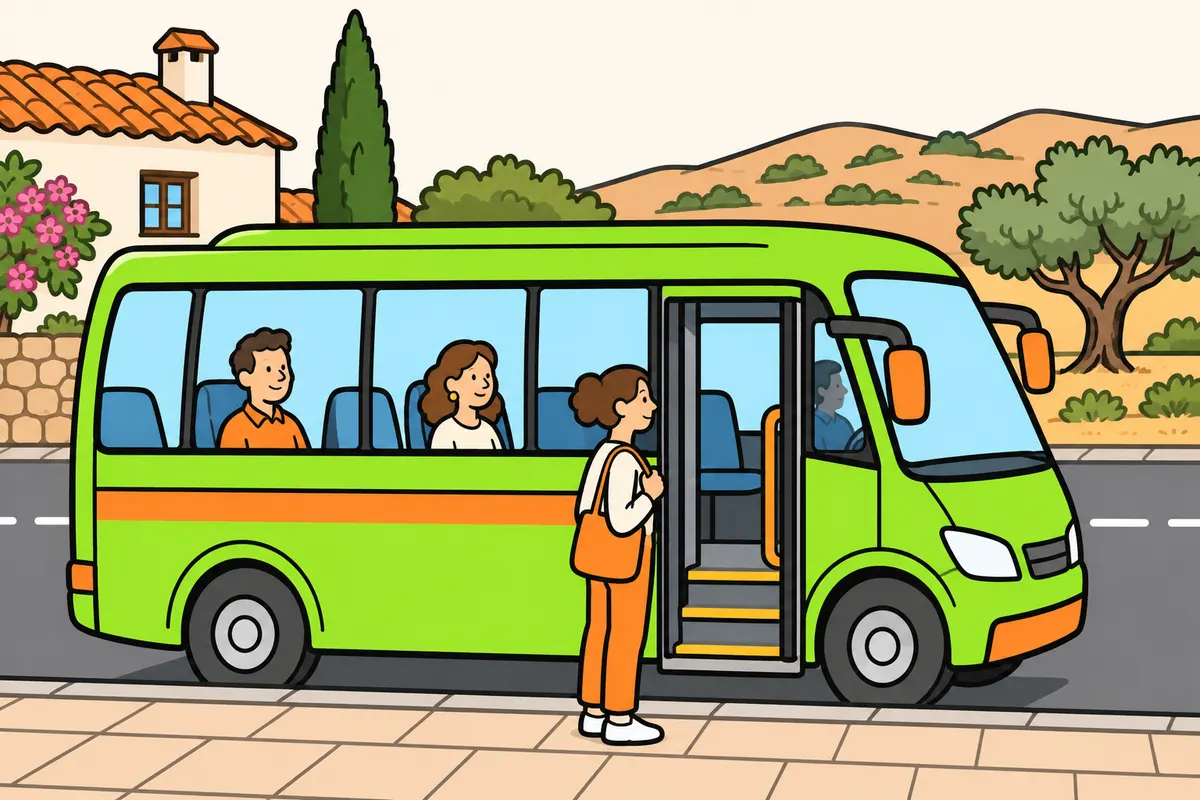
1Smooth driving to protect passengers
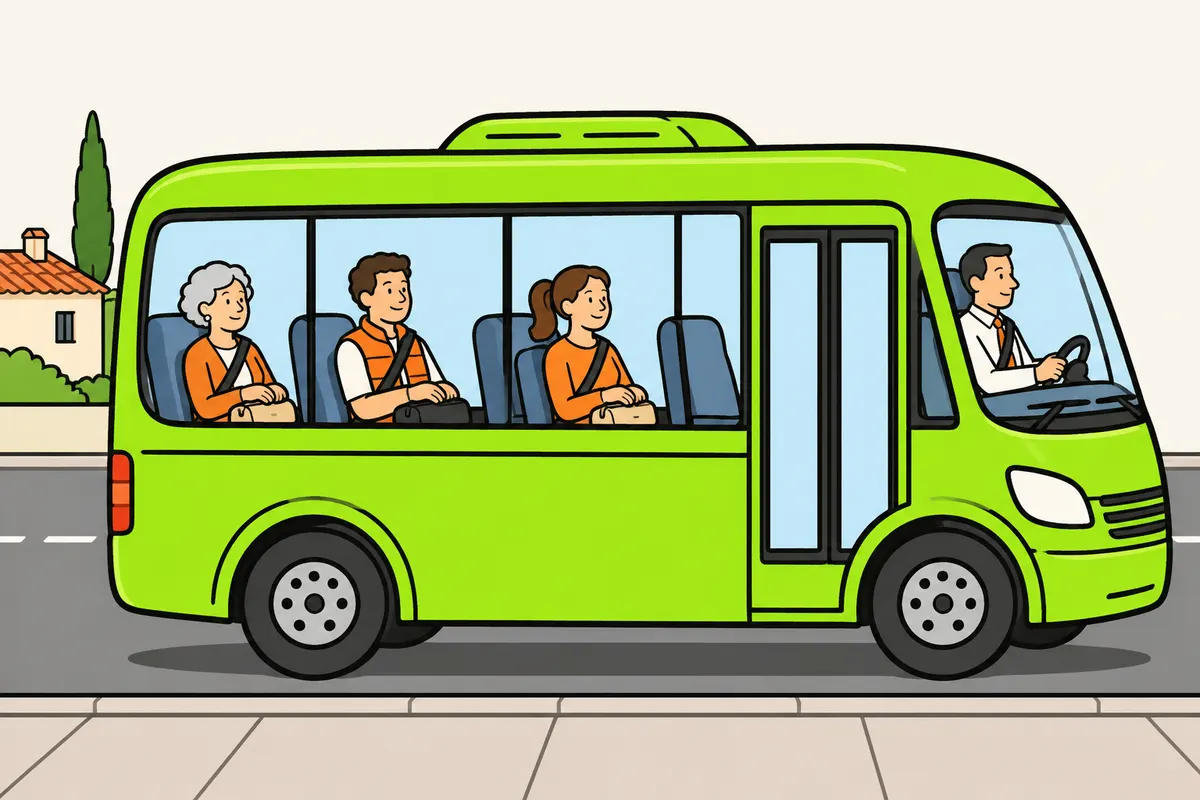
Drive smoothly to protect all your passengers.
| When you drive | Where passengers move |
|---|---|
| You accelerate | Backwards |
| You brake | Forwards |
| You take a bend | Outwards |
Remember
- Move off and stop without jolts.
- Protect seated passengers too.
- Carry standing passengers only if your vehicle allows them.
- Anticipate movements to prevent falls.
Exam trap: Wrong: you must never brake hard. Right: in an emergency, brake as firmly as necessary.
Read the full explanation
- In a minibus, you must stop and move off without jolts or sudden movements and ensure passengers' safety while travelling and when boarding or alighting. [RGC, art. 11](https://www.boe.es/buscar/act.php?id=BOE-A-2003-23514#a11)
- When you accelerate, passengers tend to move backwards relative to the vehicle; when you brake, forwards; on a bend, towards the outside. You must anticipate these movements, especially if you carry passengers in authorised standing places, older people or people with balance difficulties. The conditions for using authorised standing places are covered in «Transporting passengers and minors».
- Seated passengers can also knock against something or lose belongings following a sudden change in movement. Low minibus occupancy reduces the number of people exposed, but each person still needs stability throughout the journey.
- Smooth driving requires anticipation and precision. You must apply the controls progressively according to traffic, grip and the minibus's response, leaving space to adjust your driving without violent corrections.
2Preparation and effective observation
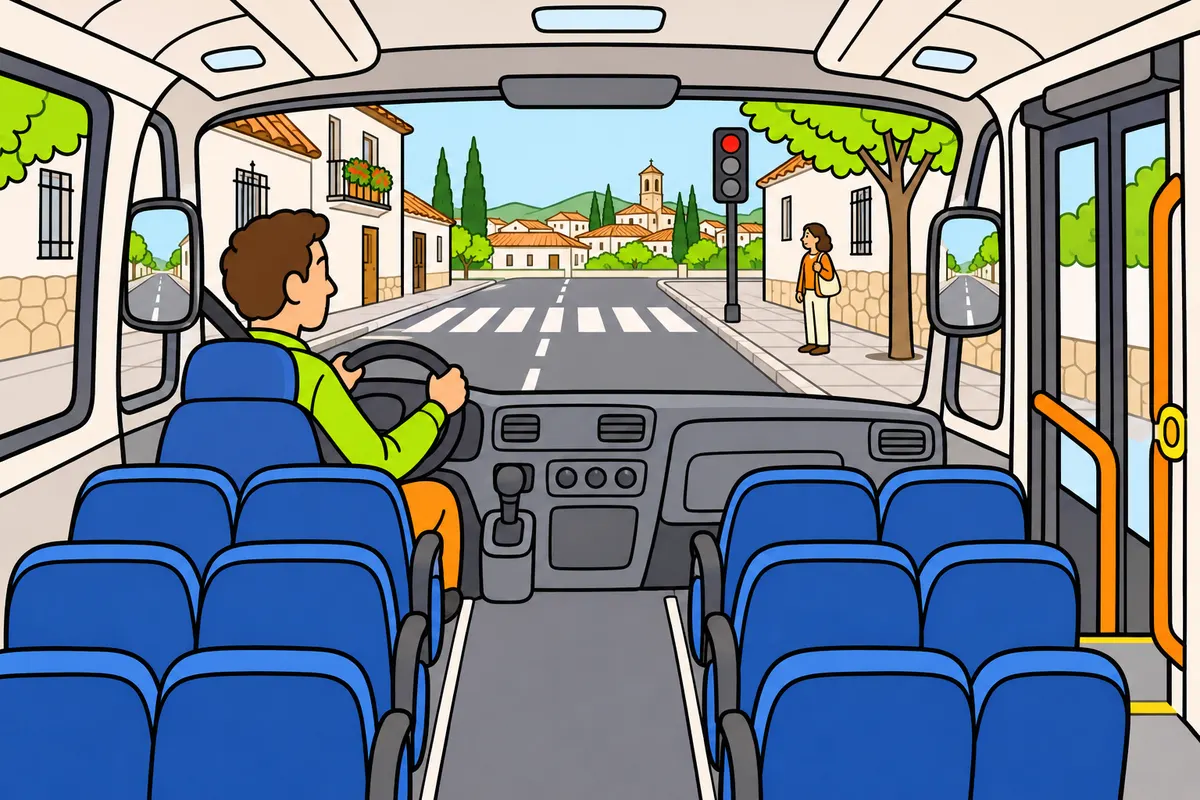
Set up your driving position and check your surroundings before moving.
Remember
- Adjust your seat and mirrors before setting off.
- Know the actual dimensions of your minibus.
- Look ahead, nearby and to the sides.
- Check the space again just before each manoeuvre.
- Before overtaking, confirm you can complete the whole manoeuvre.
Exam trap: Wrong: having priority means you can stop checking. Right: always check you can pass safely.
Read the full explanation
- Before moving off, adjust your seat and mirrors so that you can reach the controls without stretching and maintain the necessary field of vision. You must maintain freedom of movement and constant attention; do not deal with a passenger's request by looking backwards while driving. [RGC, art. 18.1](https://www.boe.es/buscar/act.php?id=BOE-A-2003-23514#a18)
- With a D1 licence, you drive vehicles designed and built for a maximum of 16 passengers in addition to you and up to 8 m long. To plan access routes and stops, you must know the actual dimensions, wheelbase and overhangs of the particular minibus; the licence limit does not describe the space each model needs to turn. [RGCond, art. 4](https://www.boe.es/buscar/act.php?id=BOE-A-2009-9481#a4)
- Combine observation well ahead, observation of your immediate surroundings and brief glances in the mirrors. You must spot traffic lights, queues, pedestrians and vehicles approaching from behind early; looking only at the vehicle ahead makes it harder to anticipate braking and leaves the sides unmonitored.
- Before every manoeuvre, update your information: an area that was clear a few moments ago may now be occupied by a bicycle or pedestrian, even when you have priority or follow a familiar route.
- Before overtaking, assess your minibus's length and acceleration capability, as well as visibility and the space to return without adversely affecting anyone. A small vehicle ahead can also hide a hazard or travel alongside one; if you cannot confirm that the entire path is clear, wait. Overtaking rules are covered in «Minibus manoeuvres».
3Moving off and accelerating progressively
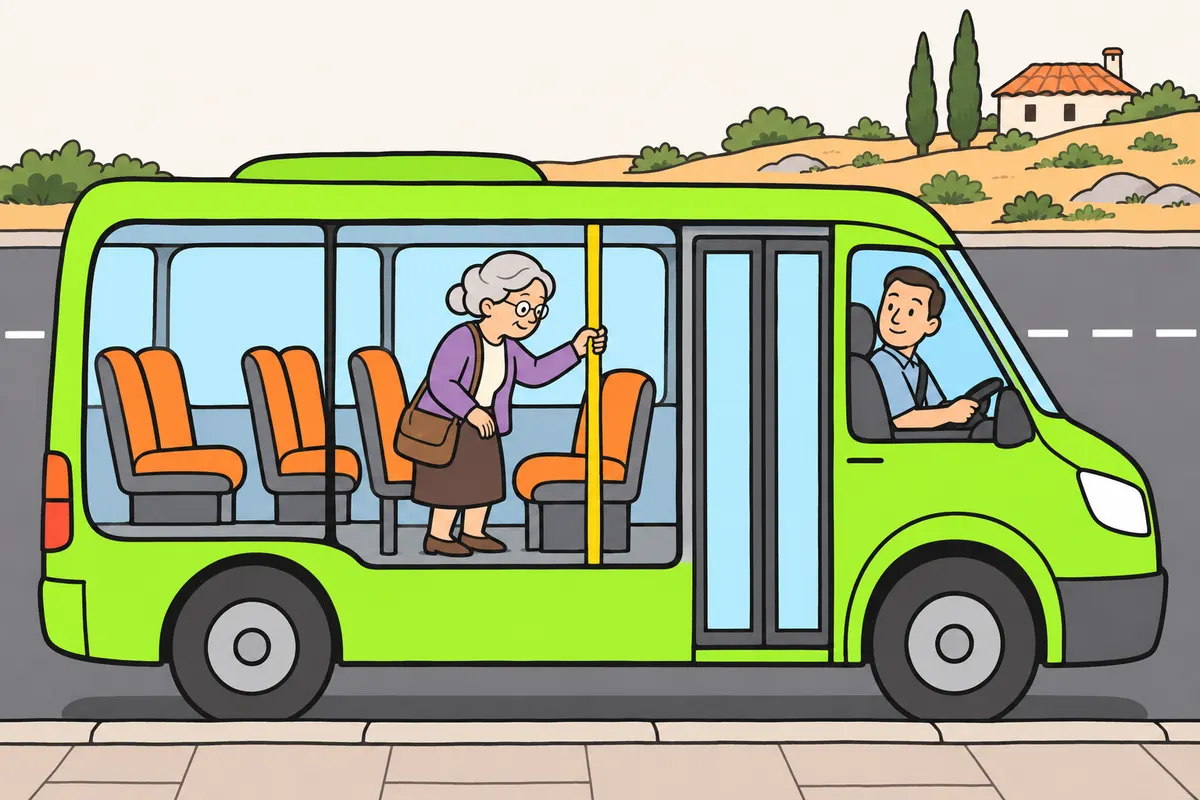
Move off only when your passengers are safe, and accelerate gradually.
Remember
- Check nobody is boarding, alighting or trapped.
- Allow time for passengers to reach a handhold or seat.
- Accelerate without jerks.
- Know how your manual or automatic gearbox responds.
- Check vehicle aids; do not trust them blindly.
- Keep enough space to brake smoothly at the next stop.
Exam trap: Wrong: safety systems prevent every dangerous movement. Right: check how they work and move off carefully.
Read the full explanation
- Before moving off, check that boarding and alighting have finished and that no passenger is trapped, halfway on board or in a dangerous position. You must protect those who need more time to reach a handhold or their seat. [RGC, art. 11](https://www.boe.es/buscar/act.php?id=BOE-A-2003-23514#a11)
- Apply the accelerator progressively and avoid delivering all the available power at once. If your minibus has a manual gearbox, coordinate the clutch and accelerator without jerking; if it is automatic, know how it responds when you release the brake and avoid being caught out by its initial forward movement.
- Hill-hold systems, the bus stop brake and door interlocks depend on the vehicle: check how they work and do not assume that they prevent every unintended movement.
- As you increase speed, maintain enough margin to stop progressively at the next stop or traffic queue. Accelerating hard only to brake immediately afterwards reduces comfort and your ability to respond without jolts when someone enters the carriageway.
4Braking without jolts
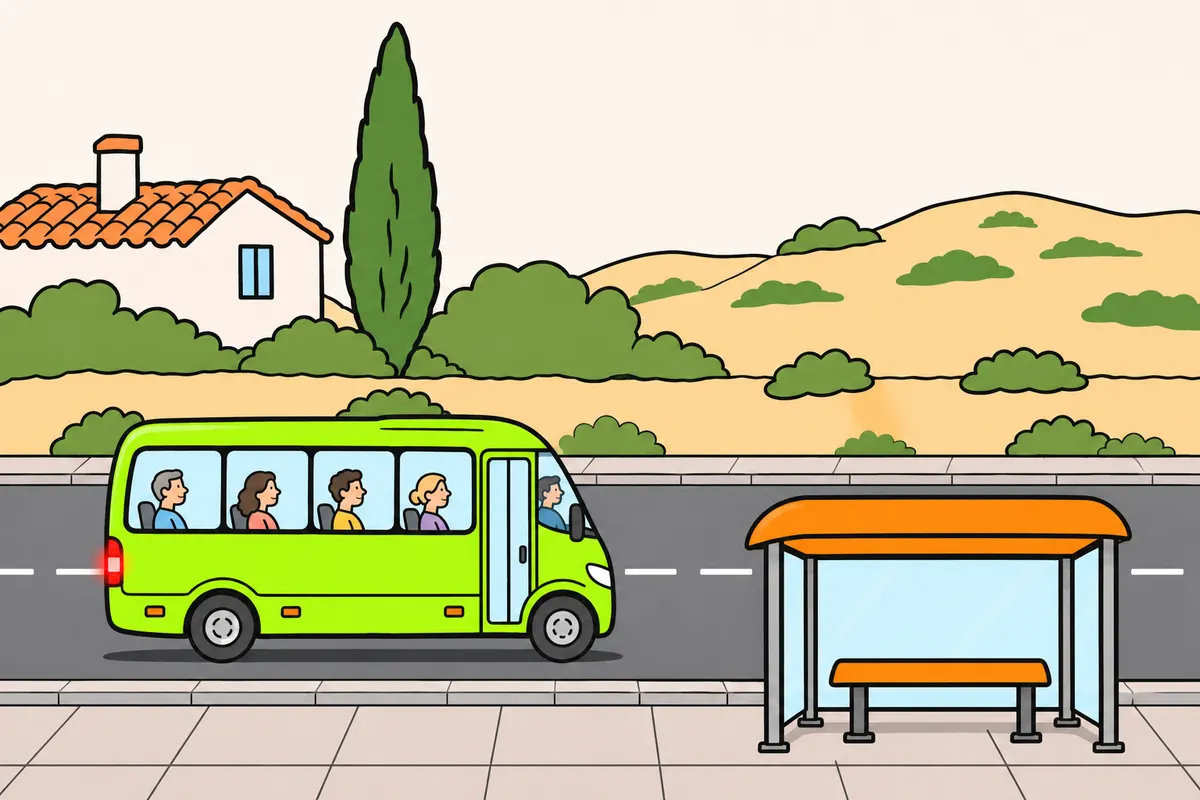
Anticipate braking and keep enough space to stop safely.
Remember
- Look early for where you will stop.
- Brake gradually and avoid jolts as you stop.
- Adjust your following distance to speed, grip and braking ability.
- If someone follows too closely, increase your space ahead.
- In an emergency, brake as firmly as necessary.
Exam trap: Wrong: moving closer to the vehicle ahead solves tailgating. Right: increase your space ahead.
Read the full explanation
- Look ahead to where you intend to stop, release the accelerator when appropriate and apply the brake progressively. You must adjust the pressure as you approach so that you reach the stopping point slowly, avoiding the final pitching movement that can unbalance passengers.
- Keep a distance that allows you to stop without hitting the vehicle ahead if it brakes sharply, taking account of speed, grip and braking capability. In a minibus, this margin also allows you to give a warning and brake more gently when you carry standing passengers. [RGC, art. 54](https://www.boe.es/buscar/act.php?id=BOE-A-2003-23514#a54)
- Braking distance is the distance you travel from applying the brake until you stop. Speed, mass and its distribution, gradient, tyres, shock absorbers, brakes and the road surface affect the response. Calculating thinking and stopping distances is covered in «Minibus speed and distances».
- If the vehicle behind follows too closely, increase your margin ahead and slow down earlier to avoid late braking.
- In an emergency, you must brake as firmly as necessary and maintain control of your path. The limits of ABS and specific braking techniques are covered in «Minibus brakes and retarders».
5Approaching a stop
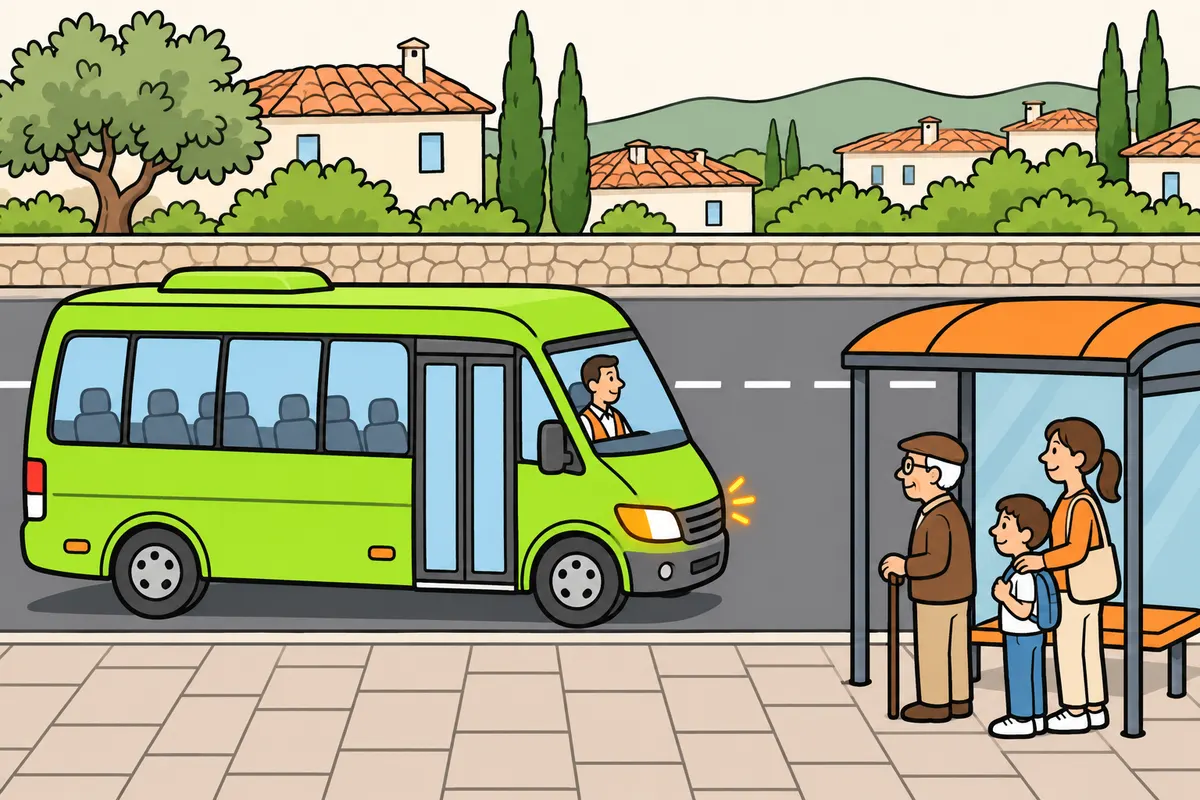
Approach the stop slowly and prepare safe access for your passengers.
Remember
- Look for pedestrians, obstacles and vehicles occupying the stop.
- Check your mirrors and signal early.
- Slow down gradually.
- Align the whole minibus, including the rear.
- If an obstacle blocks your approach, stop and find a safe solution.
Exam trap: Wrong: indicating lets you cut someone off. Right: check the space is clear.
Read the full explanation
- Identify the stop in good time and check for people waiting near the edge, vehicles occupying the space or pedestrians who may cross. You must reduce your speed and stop if necessary when someone may suddenly enter the carriageway, especially children, older people or people with disabilities. [RGC, art. 46](https://www.boe.es/buscar/act.php?id=BOE-A-2003-23514#a46)
- Check your mirrors and signal your intention sufficiently early before moving sideways. You must slow down progressively so that others understand the manoeuvre and passengers keep their balance. [RGC, art. 109](https://www.boe.es/buscar/act.php?id=BOE-A-2003-23514#a109)
- Plan an approach that allows you to align the whole minibus with the edge, without turning sharply at the end. You must judge the positions of the doors and rear axle: positioning the front correctly does not ensure that the centre or rear door is accessible.
- If an obstacle prevents you from approaching correctly, you must stop and assess a safe solution in accordance with the service and the signs. Do not force your way through by scraping past a vehicle or open the doors for passengers to alight between obstacles or directly into a dangerous traffic area.
6Kerbs, doors and accessibility
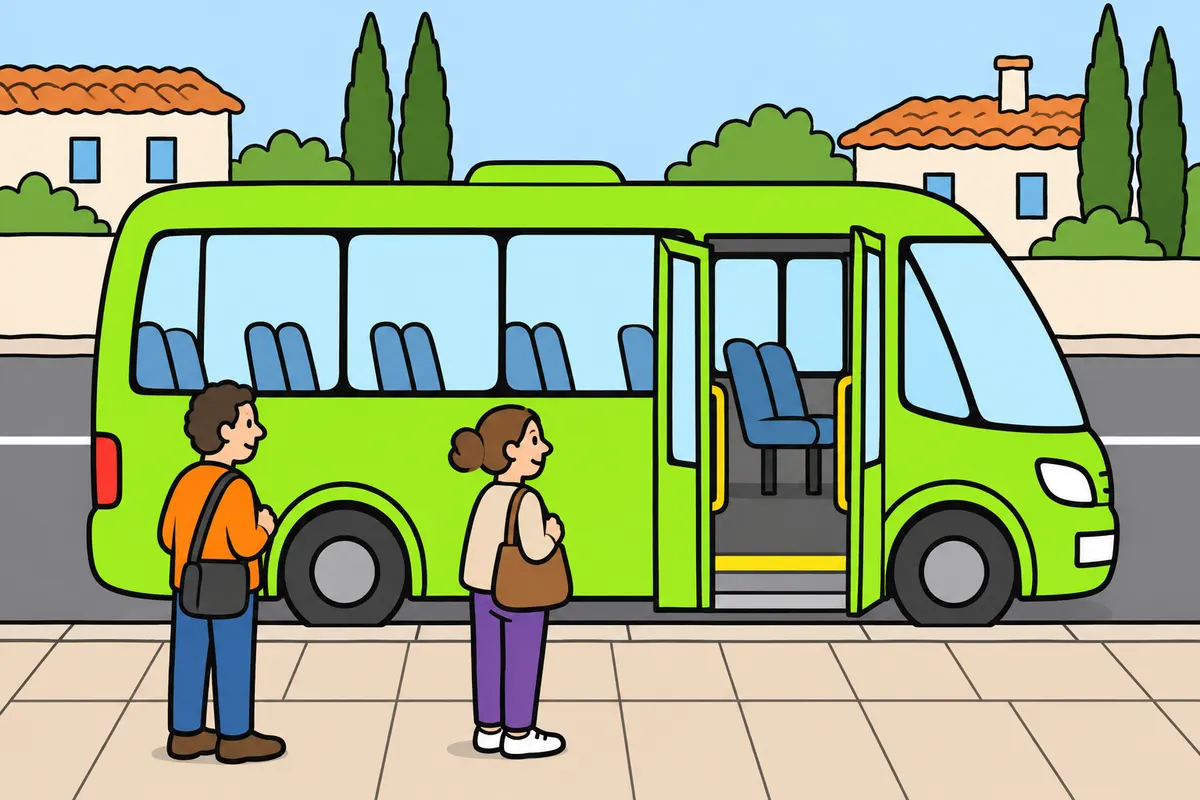
Bring your doors close to the right edge without endangering anyone.
| Case | How you must position yourself |
|---|---|
| Service stop | As close as possible to the right edge, with safe access |
| Practical test manoeuvre L | On the right, parallel and no more than 20 cm from the kerb |
Remember
- Stop as close as possible to the right edge.
- Position yourself parallel, unless the road or other circumstances make another position advisable.
- Avoid striking the kerb or mounting the pavement.
- Keep your minibus still when using a ramp or lift.
- Before restoring ride height, check you cannot hit people or objects.
- Stow the access device before leaving.
Exam trap: Wrong: every stop requires a gap of no more than 20 cm. Right: that measurement applies to manoeuvre L in the practical test.
Read the full explanation
- When providing public passenger transport, you must stop and move off as close as possible to the right-hand edge of the carriageway. Being close reduces the gap passengers have to cross, but does not permit you to strike the kerb, mount the pavement or endanger people waiting. [RGC, art. 11](https://www.boe.es/buscar/act.php?id=BOE-A-2003-23514#a11)
- As the normal arrangement, you must position the vehicle parallel to the edge of the carriageway; another position is permitted when the road's characteristics or other circumstances make it advisable. At a stop, check that the rear is not left away from the edge and that all doors in use provide safe access. [RGC, art. 92](https://www.boe.es/buscar/act.php?id=BOE-A-2003-23514#a92)
- In manoeuvre L of the practical test, you must park on the right-hand side, parallel to and no more than 20 cm from the kerb, with no obstacles to boarding or alighting when you operate the rear door; you must then close it and pull away. That figure applies to this test and is not a universal clearance for every stop in service. [RGCond, annex VI, C.4.L](https://www.boe.es/buscar/act.php?id=BOE-A-2009-9481#anvi)
- If you use kneeling, a ramp or a lift, you must follow the sequence specified for that minibus and keep it immobilised. Before restoring normal ride height, check that the bodywork's movement does not strike people, kerbs or objects; before setting off, check that the access device is stowed.
- In this manoeuvre L of the test, you must enter and leave forwards, with a maximum of one movement to park and one to leave. The layout provides a street at least 6 m wide, an initial lateral clearance of 1.20 m, a minimum parking length of twice the vehicle's length and 1.50 m free of obstacles for passengers; these are the exercise's measurements, not dimensions required at every stop. [RGCond, annex VI, C.4.L](https://www.boe.es/buscar/act.php?id=BOE-A-2009-9481#anvi)
7Opening, monitoring and closing doors
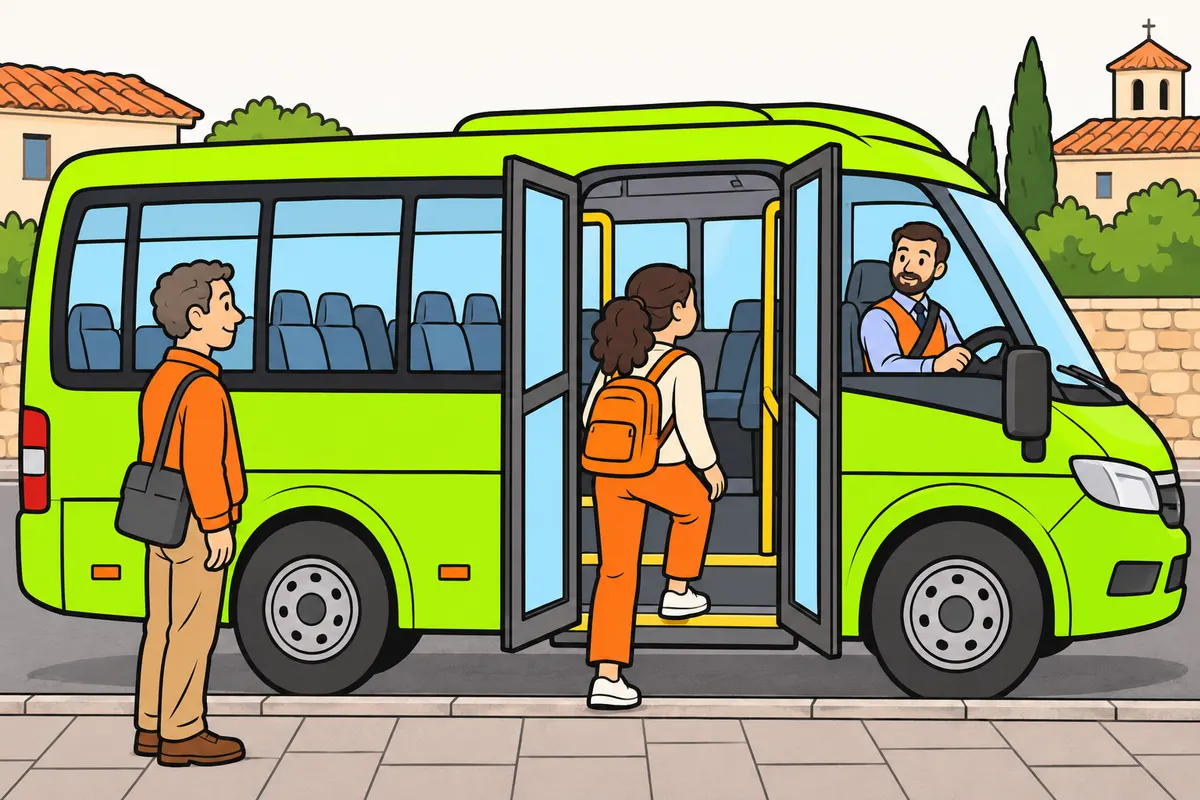
Open doors only when completely stopped, and check them before moving off.
Remember
- Keep your minibus still throughout boarding and alighting.
- Check opening doors and alighting will cause no danger or obstruction.
- Watch inside, outside and on the steps.
- Before closing, check for people and objects that could become trapped.
- Check doors are closed, even with sensors and cameras.
- If a door fails, follow the manufacturer’s and service procedures.
Exam trap: Wrong: you can drive with doors open because it is hot. Right: keep them closed while moving.
Read the full explanation
- You must bring the minibus to a complete standstill before opening the doors. You must not drive with them open, or open them or allow passengers to alight without checking that this creates no danger or obstruction, especially for bicycles. [RGC, art. 114](https://www.boe.es/buscar/act.php?id=BOE-A-2003-23514#a114)
- Throughout boarding and alighting, monitor the entrance directly, through mirrors or using the monitors provided. Check both inside and outside: someone may remain beside the door leaf, on a step or behind a group that has alighted.
- Before closing the doors, check for people, rucksacks, clothing, walking sticks and other objects that could become trapped. Contact-sensitive devices and cameras help you, but you must check that the doors have closed properly and not assume that a door is secure simply because you have operated the control.
- On passenger transport vehicles, unauthorised people must refrain from operating the doors or closing them at stops in a way that obstructs boarding. [RGC, art. 114](https://www.boe.es/buscar/act.php?id=BOE-A-2003-23514#a114)
- If a door fault occurs, you must follow the manufacturer's and the transport service's procedures before continuing. Do not override a safety device to keep to the timetable or assume that an apparently closed door is properly latched.
8Leaving a marked stop
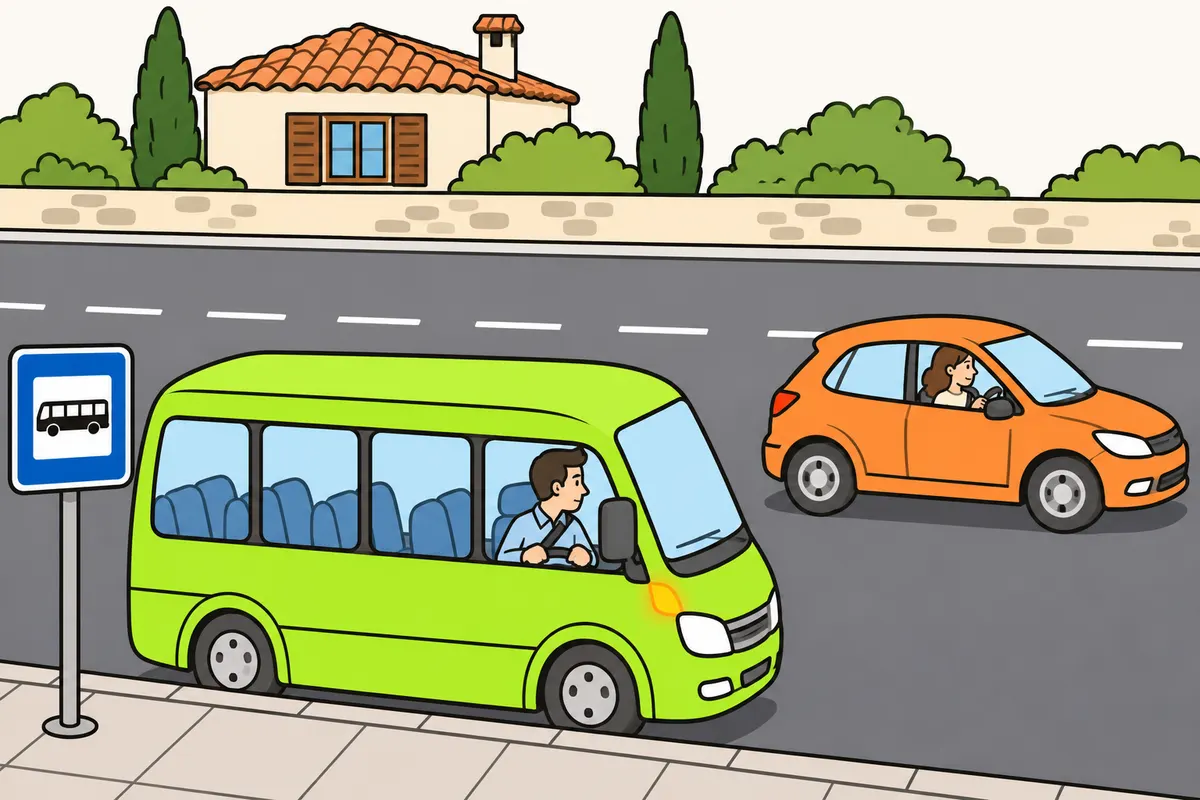
Signal before leaving the stop and check you can join traffic safely.
| Other drivers’ situation | How they must help you leave |
|---|---|
| Joining traffic, especially from a marked stop | As far as possible |
| In built-up areas | Move sideways if possible or slow down, stopping if necessary |
Remember
- Check doors, surroundings and your path before moving off.
- Pay particular attention to your left side.
- Other drivers must help you join traffic as far as possible.
- Check pedestrians, cyclists and the movement of your rear end.
- Wait if you cannot leave safely.
Exam trap: Wrong: others must help you leave, so you can move without checking. Right: signal and check there is no danger.
Read the full explanation
- Before moving off again, you must check that the doors are closed, check your immediate surroundings, the left-hand side and your path into the traffic, and signal the manoeuvre. When joining the traffic, you must make sure you can do so safely, taking account of the position, path and speed of other vehicles. [RGC, art. 72](https://www.boe.es/buscar/act.php?id=BOE-A-2003-23514#a72)
- Other drivers must help you join the traffic as far as possible, especially when you leave a marked passenger transport stop. In built-up areas, they must move sideways if possible or slow down, stopping if necessary. [RGC, art. 73](https://www.boe.es/buscar/act.php?id=BOE-A-2003-23514#a73)
- Wait if it is unsafe to join the traffic, even though other drivers must help you pull out: you must take the precautions needed to avoid an accident. [RGC, art. 73](https://www.boe.es/buscar/act.php?id=BOE-A-2003-23514#a73)
- As you pull away from the kerb, monitor the rear swinging towards the pavement and check again for pedestrians and cyclists near the front.
9Swept space and rear wheels
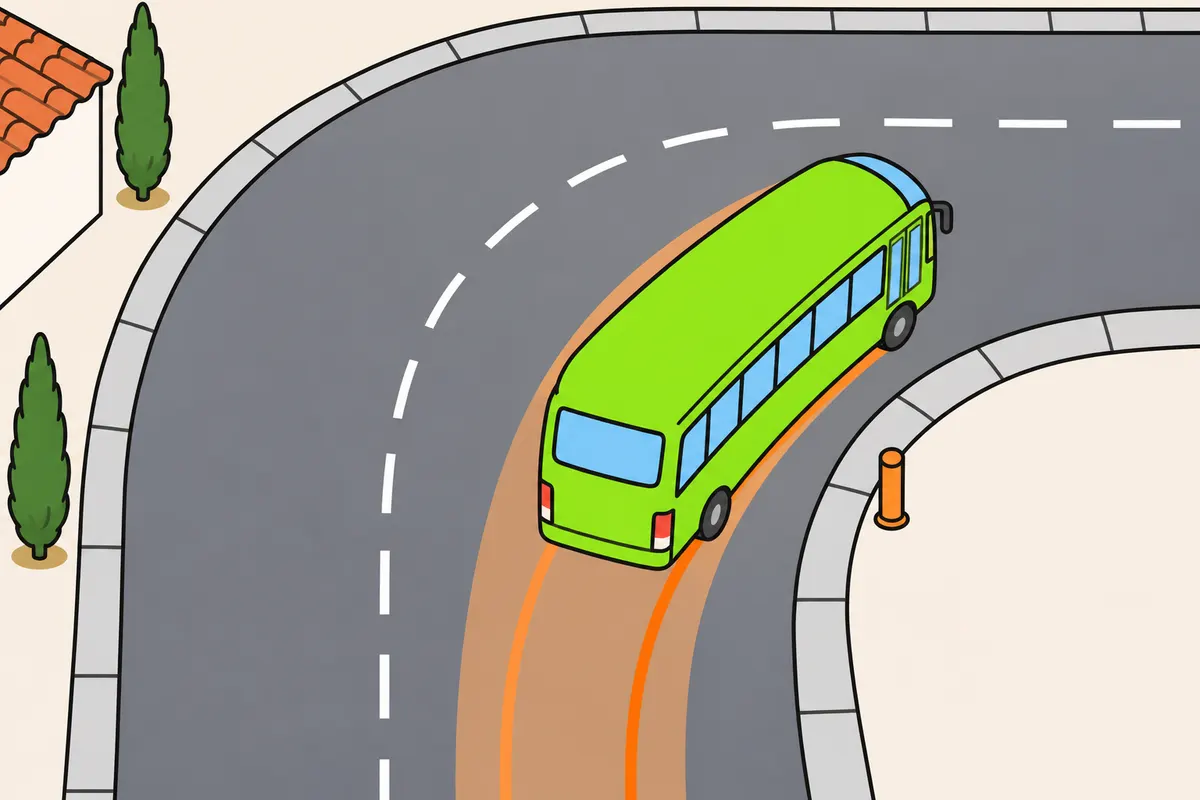
Watch the whole space your minibus occupies during every manoeuvre.
Remember
- Check bodywork, mirrors, wheels and ends.
- When you turn, rear wheels usually pass closer to the inside.
- Avoid tightening your turn too early.
- Use reference points for the minibus you drive.
- If unsure you can pass, stop before touching anything.
Exam trap: Wrong: if the front fits, everything fits. Right: check sides, rear wheels and ends too.
Read the full explanation
- The swept space is the entire area occupied by the minibus during a manoeuvre, not just the line followed by its front wheels. You must check the bodywork, mirrors, wheels and extremities. [RGCond, annex VI, C.3: changes of direction](https://www.boe.es/buscar/act.php?id=BOE-A-2009-9481#anvi)
- When turning, the rear wheels of a rigid minibus normally follow a path further to the inside than the front wheels. You must leave space beside the kerb and avoid tightening the turn too soon: you could hit a corner, a traffic island or a road user beside the inside of the vehicle.
- The wheelbase and vehicle configuration affect how far the rear wheels cut in during a turn. Familiarise yourself with the reference points of the minibus you drive, especially if you change to a model with a longer wheelbase.
- You must watch how the side of the vehicle moves throughout the manoeuvre, making slow, controlled movements. If you are unsure of the clearance, stop before making contact: a small, hurried correction can bring the rear closer to an obstacle even if the front appears to move away from it.
10Overhangs and high obstacles
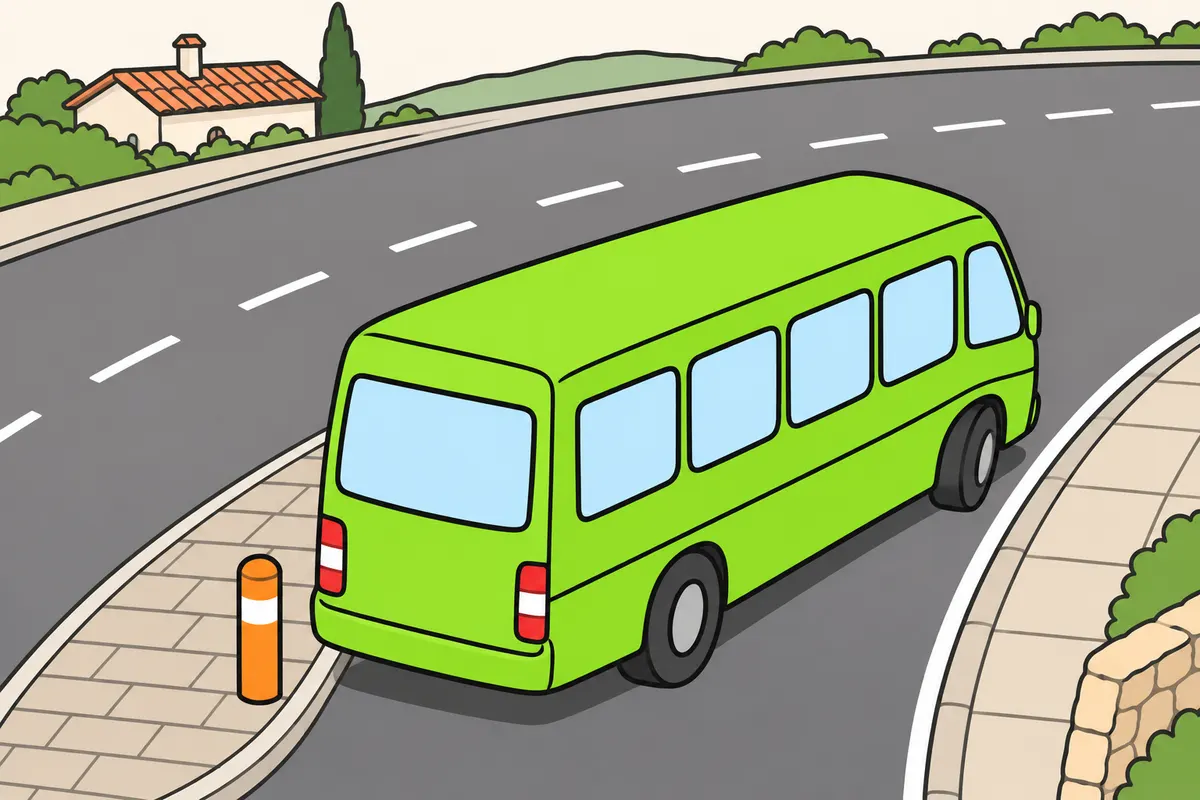
Watch the ends of your bodywork and obstacles above and below.
| Your turn in a rigid minibus | Where the rear end may swing |
|---|---|
| Right | Left |
| Left | Right |
Remember
- Overhangs extend ahead of the front axle or behind the rear axle.
- Watch the outside of your turn too.
- Check branches, balconies, posts and bus shelters.
- On ramps, slow down and check underneath for clearance.
- Remember your height can change with the suspension.
Exam trap: Wrong: watching the wheels is enough. Right: the ends can hit obstacles outside the wheels’ tracks.
Read the full explanation
- An overhang is the part of the bodywork extending ahead of the front axle or behind the rear axle. When turning, you must anticipate that these ends follow different paths from the tyres and can hit obstacles outside the wheel tracks.
- As you start a right turn, the rear overhang of a rigid minibus can swing to the left; in a left turn, it can swing to the right. You must watch the outside of the turn as well as the inside rear wheel, especially when leaving a stop close to people.
- The front also swings sideways and can encroach on the space beside a bus shelter, a post or a parked vehicle. You must monitor your mirrors and the height of obstacles: branches, balconies and projecting objects can strike the upper part of the vehicle even when the ground is clear.
- On ramps, at changes of gradient and at depot entrances, you must anticipate possible contact between the road surface and the underside or an overhang. Slow down and check the clearance; the body height can vary with the suspension and kneeling system, so a fixed reference point does not apply in all conditions.
11Tight turns in a minibus
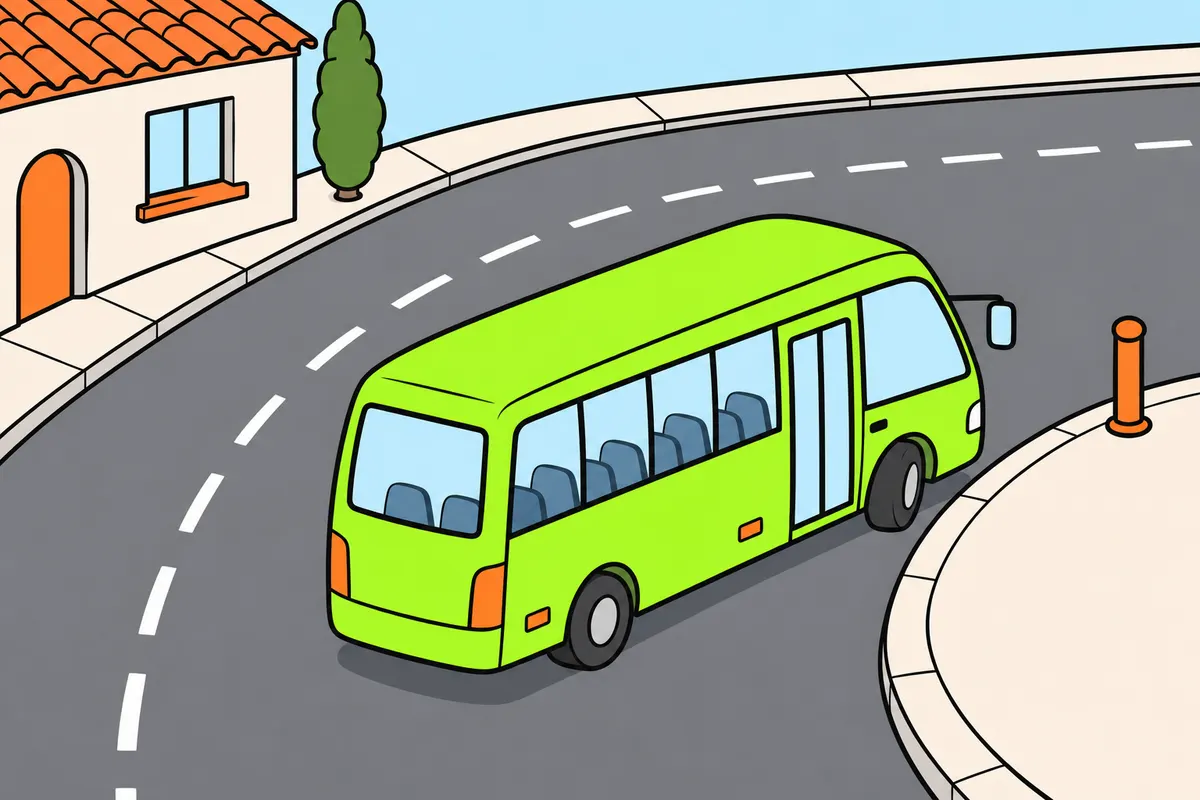
Slow down before turning and check your whole minibus fits.
Remember
- Watch the inside and outside of your turn.
- Use reference points for your model.
- Watch your inside rear wheel until you complete the exit.
- Before correcting, check space on the opposite side.
- When changing lanes, give way to anyone already in that lane.
Exam trap: Wrong: your dimensions let you occupy another lane without checking. Right: if they prevent normal positioning, take the precautions needed to avoid all danger.
Read the full explanation
- Before turning, you must slow to a speed that allows you to observe and control the entire path, without trying to solve a lack of space with a sudden steering movement. Keep watching both sides: on the inside, there is a risk of the wheels cutting in towards the kerb; on the outside, the ends can swing out.
- The normal positioning rules for changing direction depend on the direction of the turn and the road. If the vehicle's dimensions prevent you from complying strictly with that positioning, you must take the precautions needed to avoid any danger; this is not general permission to occupy another lane without looking. [RGC, art. 75](https://www.boe.es/buscar/act.php?id=BOE-A-2003-23514#a75) [RGC, art. 76](https://www.boe.es/buscar/act.php?id=BOE-A-2003-23514#a76)
- At a tight corner, you must take the front far enough forward to allow the rear axle to pass without mounting the kerb, while leaving clearance for the mirrors and the front end. Use the model's reference points and watch the result in your mirrors.
- On a roundabout or tight bend, you must maintain control of your lane position and the path of the inside rear wheel until you complete the exit. Before correcting to one side, check the space on the opposite side: a correction can clear one end while bringing the other closer to a pedestrian, post or vehicle.
- When moving into another lane, you must give priority to anyone already in it. Signal the movement and check that there is room for the entire minibus, including its extremities and lateral clearance. [RGC, art. 74](https://www.boe.es/buscar/act.php?id=BOE-A-2003-23514#a74)
12Blind spots and vision aids
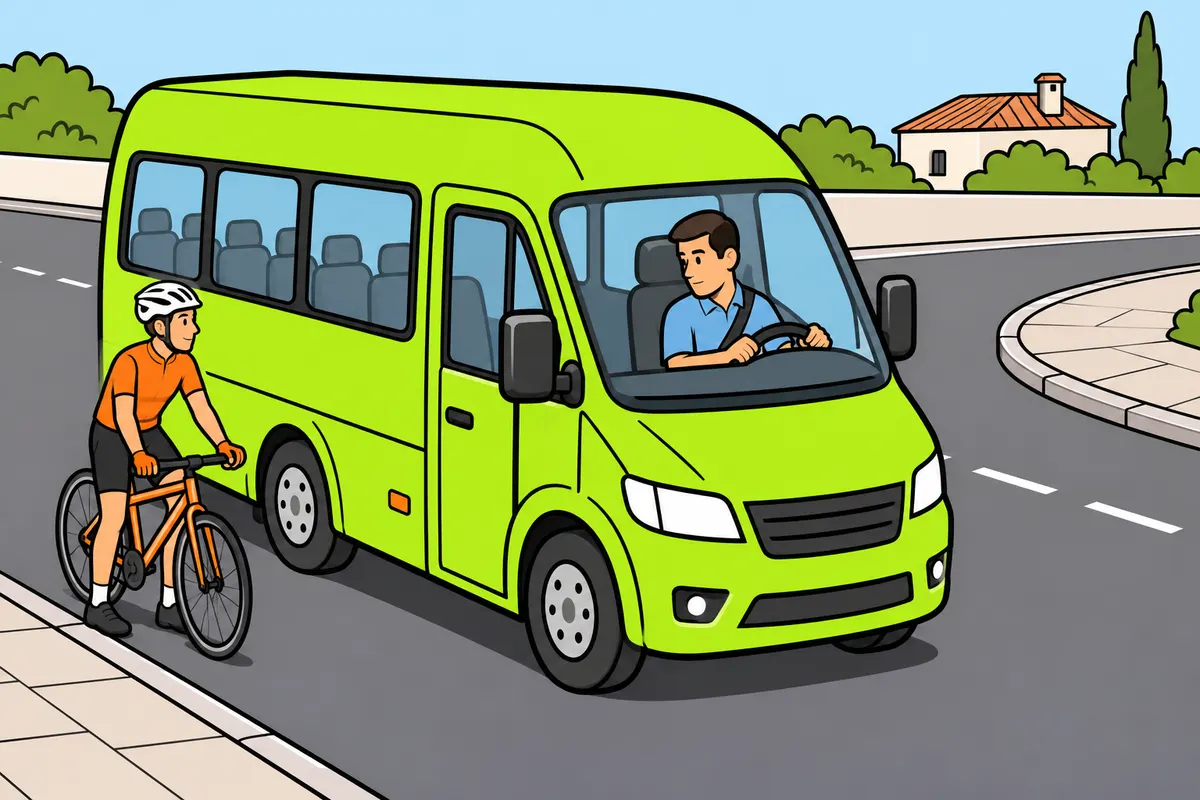
Check hidden areas even when you have mirrors and cameras.
| Mirror | M2/M3 minibuses: RGV table and type approval |
|---|---|
| Class II: main | You must have one on each side under the table |
| Class IV: wide-angle | Optional under the table; also follow your vehicle’s type approval |
| Class V: close-proximity | Optional under the table; at maximum load, including supports and every adjustment, entirely above 2 m |
| Class VI: front | Absent from this table; check your vehicle’s type approval |
Remember
- You may not see someone beside the front.
- Look again just before turning or changing lanes.
- Learn which area each mirror and camera shows.
- Keep your mirrors and cameras clean.
- Avoid distraction from screens unrelated to driving.
- If you lose sight of someone nearby, stop and locate them.
Exam trap: Wrong: all mirrors are compulsory because you hold D1. Right: distinguish the RGV table from your vehicle’s type approval.
Read the full explanation
- You may have areas with no direct view in front of, behind and alongside the minibus. You must pay particular attention to short people or anyone very close to the bodywork: the high seating position does not guarantee that you can see a child beside the front.
- In a category M2 or M3 minibus, you must have two class II main exterior mirrors, one on each side, as specified in the RGV table. Class I identifies the interior mirror; class III covers the main mirrors for M1 and N1. [RGV, annex III](https://www.boe.es/buscar/act.php?id=BOE-A-1999-1826#aniii)
- Class IV identifies the wide-angle exterior mirror and class V the close-proximity mirror. The RGV table provides for one optional mirror of each class for M2/M3; the class V mirror, including its supports and in every adjustment position, must be more than 2 m above the ground with the full permitted load. You must also comply with the vehicle's type approval. [RGV, annex III](https://www.boe.es/buscar/act.php?id=BOE-A-1999-1826#aniii)
- If your minibus has a class VI front mirror, you can use it to view the area immediately in front of the bodywork; the close-proximity mirror helps you check the nearby area alongside. You must check each field of view before moving off or turning. Class VI is defined in the type-approval regulations and does not appear in the table in annex III of the RGV. [UNECE Regulation No. 46, para. 2.1.1.13](https://www.boe.es/buscar/doc.php?id=DOUE-L-2014-81759)
- Before turning or moving sideways, check your mirrors and nearby areas using the means available, moving your head slightly when this helps and keeping control of the vehicle. A bicycle may move up alongside while you wait; look again just before moving into its possible path.
- Wide-angle mirrors alter the apparent size and distance of objects, and cameras have a limited field of view. You must learn their reference points, keep their surfaces clean and recognise which area lies outside each image.
- You may use the monitors needed to supervise boarding and alighting, or rear manoeuvring cameras, under the prescribed conditions. This exception does not allow you to be distracted by screens unrelated to driving; you must check the images while continuing to monitor your surroundings. [RGC, art. 18](https://www.boe.es/buscar/act.php?id=BOE-A-2003-23514#a18)
- In a right turn, you must pay particular attention to the space between the minibus and the road edge before closing that gap. If you lose sight of a nearby cyclist or pedestrian, do not assume that they have moved away: stop and confirm where they are before continuing.
13What you hide and what you cannot see
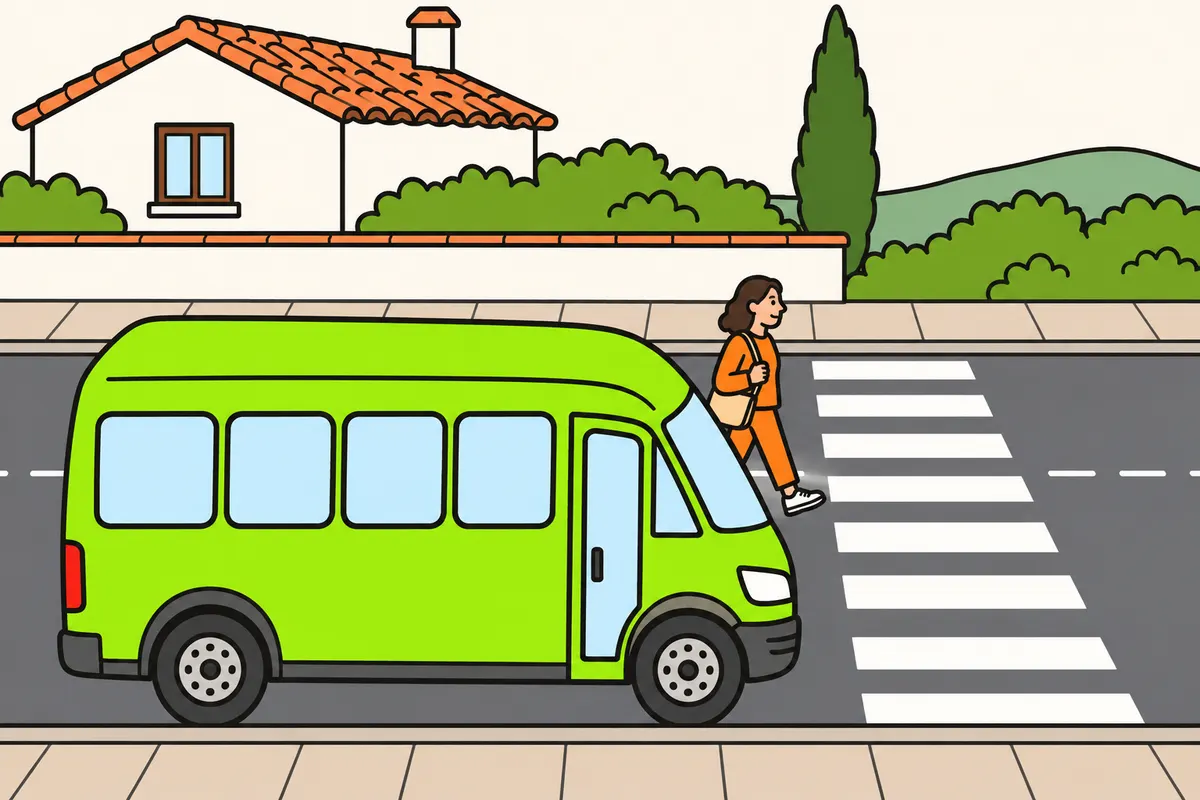
Keep your view clear and remember your minibus can hide dangers from others.
Remember
- Check areas hidden by pillars and frames.
- Reposition people or luggage that block your view.
- Keep windows clean and clear of mist.
- Before leaving, check for pedestrians in front and behind.
- When approaching another stopped bus, expect hidden pedestrians.
- Keep lights, signals and plates clear of luggage.
Exam trap: Wrong: giving way means everyone sees the pedestrian. Right: your bodywork may hide them from other drivers.
Read the full explanation
- The bodywork, windscreen pillars, door frames and mirrors can hide part of your surroundings from you. You must relate these obstructions to what you are looking for: a pedestrian on a corner may remain hidden behind a pillar as you approach. Shift your line of sight slightly when it is safe and confirm that the space is clear before turning.
- Passengers and luggage must not encroach on your required field of vision or interfere with the controls. If an item of luggage or a person prevents you from seeing the side of the vehicle or a mirror, you must reposition them before moving off. [RGC, art. 18.1](https://www.boe.es/buscar/act.php?id=BOE-A-2003-23514#a18)
- Glazed surfaces must allow you to see clearly. Keep the area you look through clear and use demisting and cleaning as necessary; signs or objects next to the windscreen can add a hidden area to those created by the vehicle's structure. [RGC, art. 19](https://www.boe.es/buscar/act.php?id=BOE-A-2003-23514#a19)
- Your minibus can block other drivers' view of a pedestrian crossing, traffic lights or traffic at a junction. You must anticipate that someone may try to edge out or overtake you to regain visibility, and that a pedestrian may assume others have seen them. Stopping to give way to them does not guarantee that another driver can see them behind your bodywork. [RGC, art. 46.1](https://www.boe.es/buscar/act.php?id=BOE-A-2003-23514#a46)
- During a stop, the front and rear of the vehicle can hide someone who starts to cross. You must check both ends before moving off and move forward only with enough room to stop; when approaching another stationary bus, also anticipate hidden pedestrians. Moderate your speed and stop if someone potentially stepping out makes this necessary. [RGC, art. 46](https://www.boe.es/buscar/act.php?id=BOE-A-2003-23514#a46)
- The load and its accessories must leave lights, illuminated signals, hand signals and compulsory plates or markings visible, so that other road users can understand your warnings. [RGC, art. 14](https://www.boe.es/buscar/act.php?id=BOE-A-2003-23514#a14)
14Planning a departure without reversing
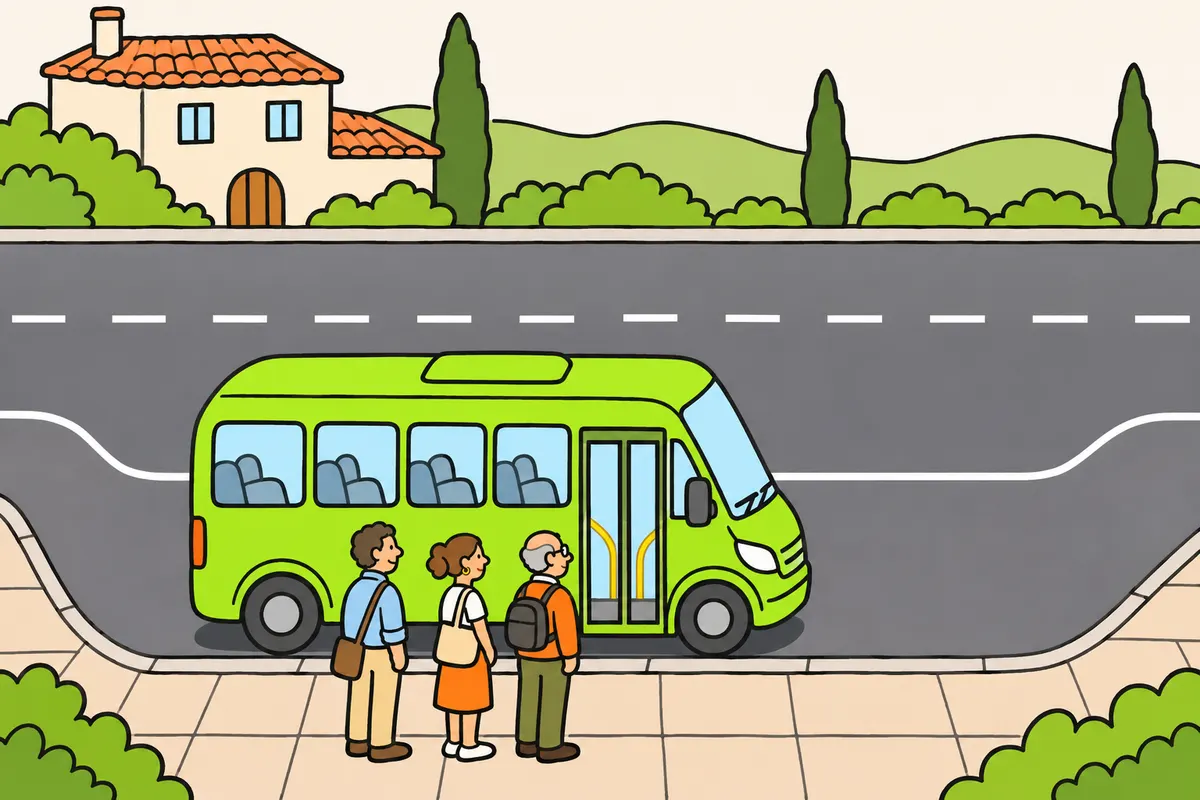
Before entering a stop or parking area, plan how you will leave.
Remember
- Choose a position that reduces reversing among passengers.
- Check your whole route, including the final space.
- Assess space and visibility before entering.
Exam trap: Wrong: a legal manoeuvre is always safe. Right: check space and visibility too.
Read the full explanation
- Before entering a bus bay or parking space, you must plan how to leave and favour an arrangement that reduces reversing among passengers. Check the entire route, not just the final space: a legal manoeuvre can be unsafe because of insufficient space or visibility.
- You study the legal conditions and limits for reversing in «Minibus manoeuvres».
15Reversing while monitoring your surroundings
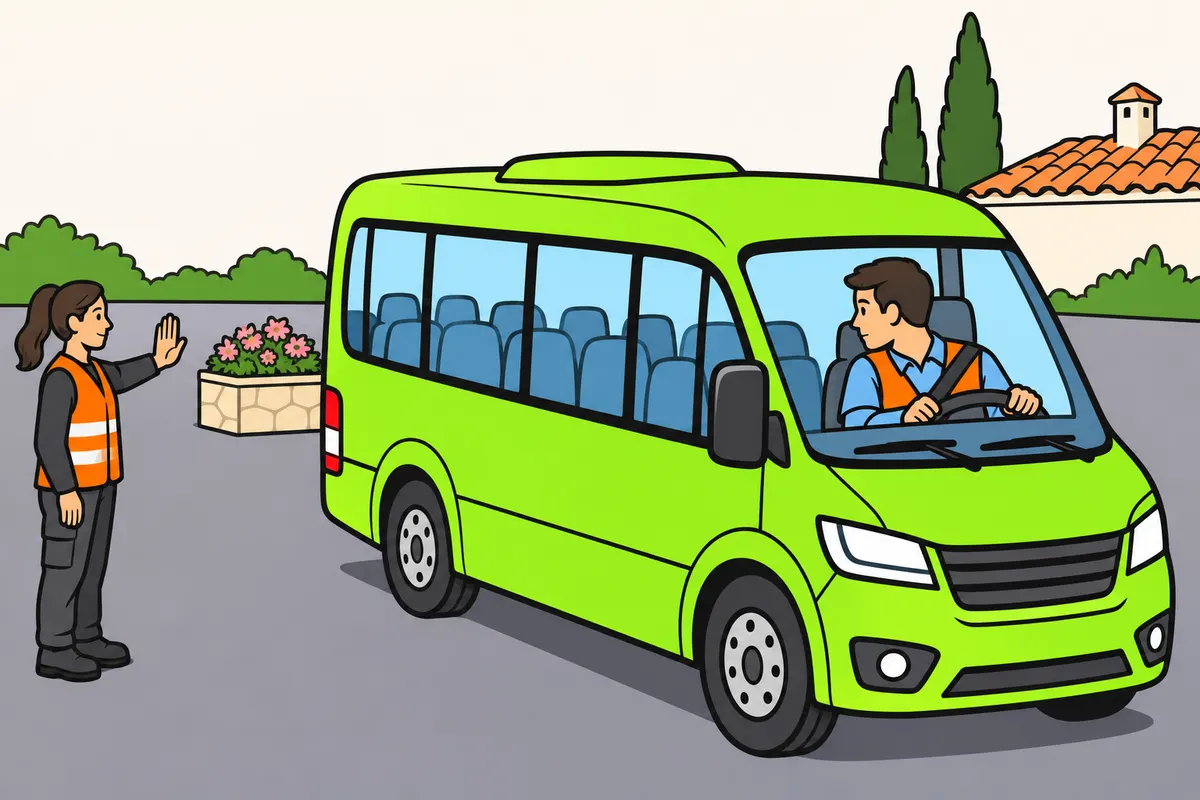
Reverse slowly and stop if you cannot monitor all your surroundings.
Remember
- Warn others and check space, visibility and time.
- If you need more information, get out to check or ask for help.
- Before getting out, secure your minibus against movement.
- Agree clear signals with anyone helping you.
- Watch the sides and the front swinging too.
- Stop for a warning or danger; abandon the manoeuvre if necessary.
Exam trap: Wrong: you can continue after losing sight of your helper. Right: when someone helps you, stop if you cannot see them or understand their signal.
Read the full explanation
- You must reverse slowly, after signalling your intention and checking that visibility, space and time allow you to do so safely. If you need more information, you must get out to check or follow another person's directions; having mirrors does not mean you have to manoeuvre blindly. [RGC, art. 81](https://www.boe.es/buscar/act.php?id=BOE-A-2003-23514#a81)
- If you get out to inspect, you must first secure the vehicle against movement and check again before moving it. Look for low objects, high obstacles and pedestrians who may enter from either side; the route may change while you return to the driving seat.
- If another person helps you, agree on clear signals and a position where you can see them, outside the minibus's path. As a safety technique, you must stop if you lose sight of them or do not understand a signal; their help does not replace your responsibility to control the manoeuvre. [RGC, art. 81](https://www.boe.es/buscar/act.php?id=BOE-A-2003-23514#a81)
- You must also monitor the movement of the front when turning while reversing, and the sides as they approach obstacles. Do not focus all your attention on the centre of the camera image: the front end can sweep through an occupied space while the rear moves away.
- You must stop immediately if you hear a warning, detect a nearby person, animal or vehicle, or safety requires it, and abandon the manoeuvre if necessary. The reversing alarm, if fitted, warns of your movement but does not prove that others have noticed it. [RGC, art. 81](https://www.boe.es/buscar/act.php?id=BOE-A-2003-23514#a81)
16Bends, load and stability
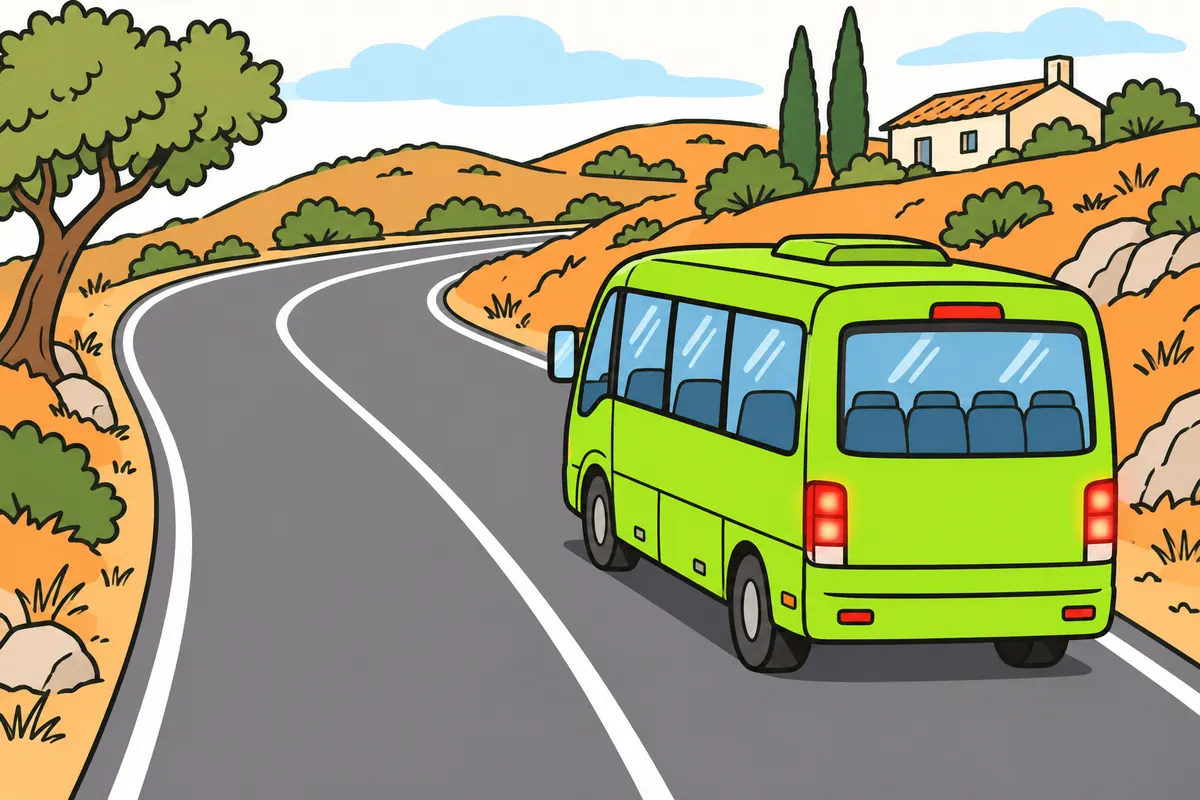
Slow down before each bend and adapt your driving to your load.
Remember
- Choose your speed before entering the bend.
- Steer, accelerate and brake gradually.
- Consider the height and distribution of your load.
- Luggage affects handling even in a closed hold.
- Avoid sudden weight shifts on successive bends.
- With poor visibility, slow down and check exit space.
Exam trap: Wrong: electronic assistance corrects any excessive entry speed. Right: adjust speed beforehand for your minibus and load.
Read the full explanation
- You must choose your speed before entering a bend and use the steering, accelerator and brake progressively. Entering too fast and trying to correct this by braking or steering abruptly increases the demand on tyre grip and can compromise the minibus's stability.
- The height of the centre of gravity and the load distribution affect body roll and the risk of overturning. You must adapt your driving to the particular minibus and its occupancy, without relying on a familiar road or an electronic aid to compensate for excessive entry speed.
- The mass and position of luggage affect axle load distribution, stability and braking. Adjust your driving to that distribution: an enclosed luggage hold allows you to store luggage, but its contents still contribute to the movements of the bodywork.
- On successive bends, you must link your paths without abrupt load transfers from one side to the other. Watch the swept area on the inside and obstacles on the outside, and do not accelerate to get through the section sooner; with standing passengers, a sudden change in the direction of the forces acting on them can cause falls even without a skid.
- At a narrowing or a junction with poor visibility, slow down in advance and check the width, height and space to exit. You must be able to stop for whatever appears. [RGC, arts. 45 and 46](https://www.boe.es/buscar/act.php?id=BOE-A-2003-23514#a45)
17Preparing for a long descent
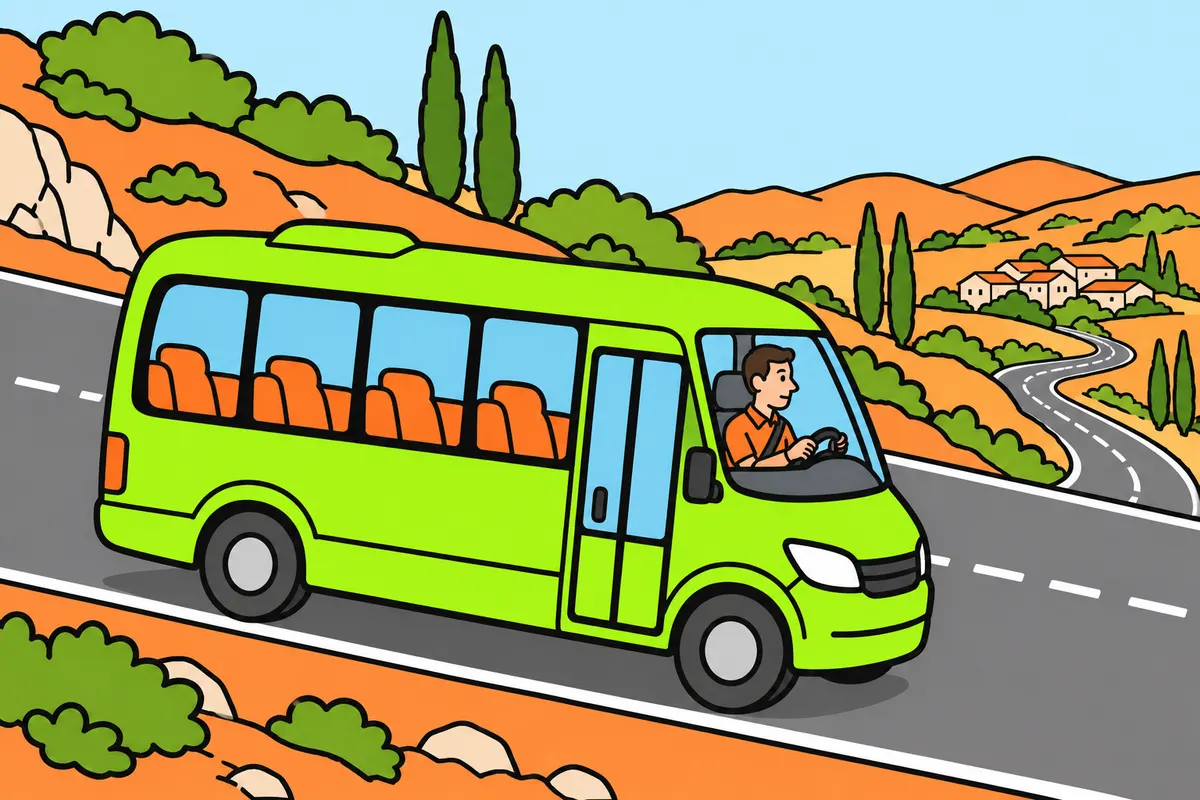
Choose your speed and braking support before starting a long descent.
Remember
- Assess gradient, bends, load and grip.
- Select a gear that helps control your speed.
- Avoid descending in neutral or with the clutch pressed.
- Know your automatic gearbox’s descent functions.
- Avoid downshifting beyond the engine’s permitted speed.
- Avoid continuously overloading your service brake.
Exam trap: Wrong: wait until you gain speed to prepare for the descent. Right: choose a moderate speed and suitable gear beforehand.
Read the full explanation
- Before starting a long descent, you must assess its gradient, length and bends, as well as the load and grip. Select a moderate initial speed and a gear ratio that provides braking to hold the minibus back; waiting until it gains a lot of speed makes it harder to regain control without placing excessive demands on the brakes.
- You must maintain a suitable gear ratio and use engine braking and the available auxiliary braking systems according to the manufacturer's instructions. Do not descend in neutral or with the clutch depressed: you lose the braking effect you need to prevent your speed from increasing continuously.
- With automatic transmission, you must know the descent mode or gear selection available on your model. Do not force a downshift that takes the engine beyond its permissible speed range or assume that the automatic system always selects the braking effect needed for the weight and gradient.
- You must avoid continuous, excessive use of the service brake, because overheating can reduce its effectiveness. Combine an appropriate speed with a suitable braking effect from the engine and auxiliary systems to preserve braking capacity for when you need it. [DGT: using brakes on slopes](https://www.dgt.es/comunicacion/noticias/frenos-como-usarlos-correctamente/)
18Using the retarder appropriately
Use your retarder according to the manual and road grip.
Remember
- Apply its braking effect gradually.
- Know your minibus’s controls and limits.
- You can reduce brake workload and heating.
- Avoid using it on slippery surfaces and follow the manual.
- If the manufacturer prohibits its use, do not activate it.
- If you cannot control speed, find a safe place to stop.
Exam trap: Wrong: the retarder alone can stop and park your minibus. Right: use the systems intended for stopping and securing it.
Read the full explanation
- The retarder helps you maintain or reduce speed without placing all the work on the service brakes. To stop the minibus and secure it against movement, you must use the systems intended for those functions, in accordance with the manual.
- Depending on the minibus, you may have engine braking and electrical or hydraulic auxiliary systems, with different controls and levels. You must know the equipment fitted and apply its braking effect progressively; there is no universal setting or engine speed for all minibuses.
- You can use the retarder in the situations allowed by the manufacturer, as well as on descents. Its specific usefulness depends on speed, installation and operating conditions; you must adjust the level of braking to the vehicle's response to avoid subjecting passengers to abrupt deceleration.
- On slippery surfaces, the braking effect applied to the driven wheels can cause them to lose grip. As a preventive measure, avoid using the retarder in these conditions and follow the manufacturer's specific instructions; if the manual prohibits its use, do not activate it, even at a low setting. [DGT, Mechanics Manual, braking enhancement systems](https://sede.dgt.gob.es/export/sites/dgt/.galleries/permisos-de-conducir/certificacion-aptitud-profesores-formacion-vial/2022/Manual-VIII-Mecanica-2022.pdf)
- Monitor warnings and temperature or operating limits, and reduce the demand in accordance with the vehicle's procedure. If you cannot maintain a safe speed, find a suitable place to stop.
19Slopes and securing the vehicle
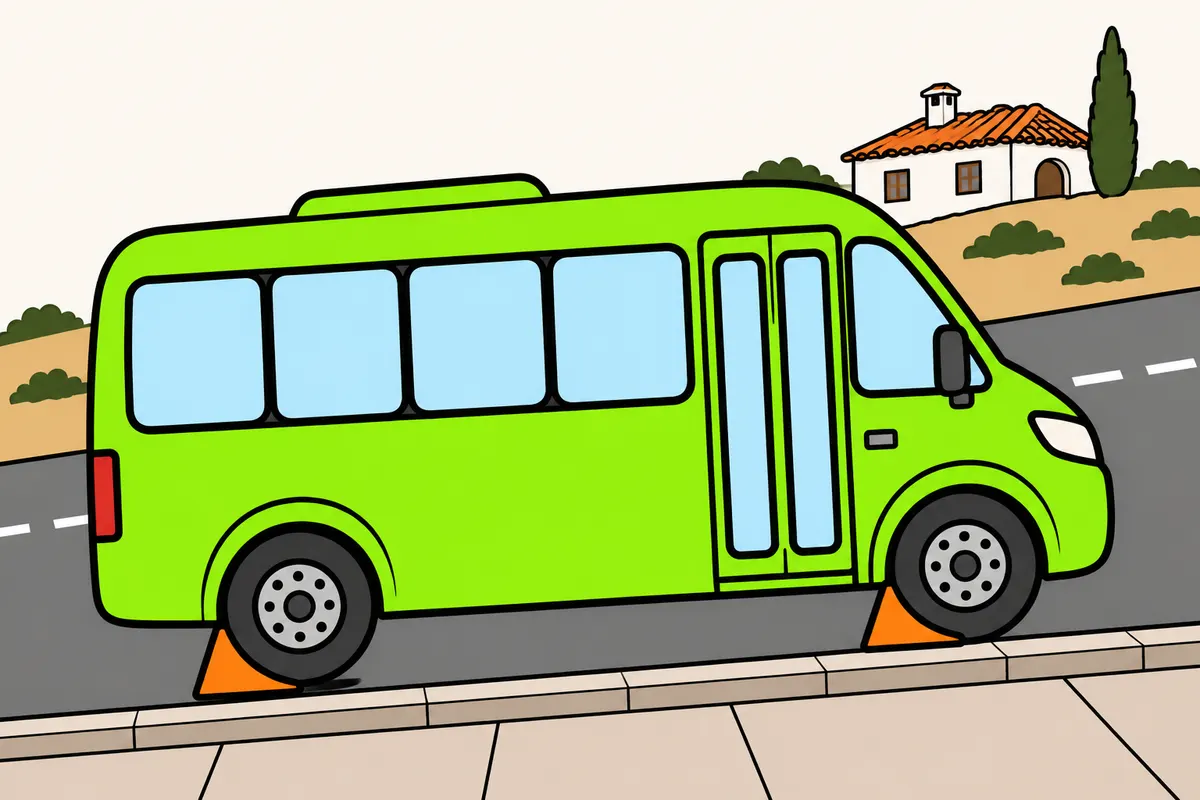
Secure your minibus on slopes using the proper systems.
| Slope | Manual gearbox when you leave your seat | Wheel direction if resting against the kerb |
|---|---|---|
| Uphill | Leave first gear engaged | Towards the centre of the carriageway |
| Downhill | Leave reverse engaged | Outwards, away from the carriageway |
Remember
- When moving off, use the intended system to hold it until departure without rollback.
- If you leave your seat, stop the engine and switch off the starting system.
- Apply your parking brake too; if you walk away, prevent unauthorised use.
- On significant slopes, add proper chocks or rest a steered wheel against the kerb.
- Avoid using stones as chocks.
- Remove chocks and check your surroundings before moving off.
Exam trap: Wrong: you can hold it still with the accelerator and clutch. Right: when moving off on a slope, use the intended system.
Read the full explanation
- When moving off on a slope, you must hold the minibus using the system provided until you can move off without rolling backwards unintentionally. Coordinate the controls and avoid holding it stationary using the accelerator and clutch: you need a controlled start that does not surprise passengers or anyone behind you.
- If you leave the driving seat when stopping or parking, you must stop the engine, switch off the ignition and apply the parking brake; if you walk away, prevent unauthorised use. With manual transmission, leave first gear engaged uphill and reverse gear downhill, or select the parking position where applicable. [RGC, art. 92](https://www.boe.es/buscar/act.php?id=BOE-A-2003-23514#a92)
- On a significant gradient, you must also secure the minibus with purpose-made wheel chocks or rest a steered wheel against the kerb. If you use the kerb, turn the wheels towards the centre of the carriageway uphill and towards the outside downhill; do not use stones or improvised objects. [RGC, art. 92](https://www.boe.es/buscar/act.php?id=BOE-A-2003-23514#a92)
- Before moving off again, you must remove any chocks used and check your surroundings and intended path. You must not confuse the bus stop brake used on urban services or the retarder with parking measures: use each system for its intended purpose. [RGC, art. 92](https://www.boe.es/buscar/act.php?id=BOE-A-2003-23514#a92)
20Crosswinds and the shielding effect
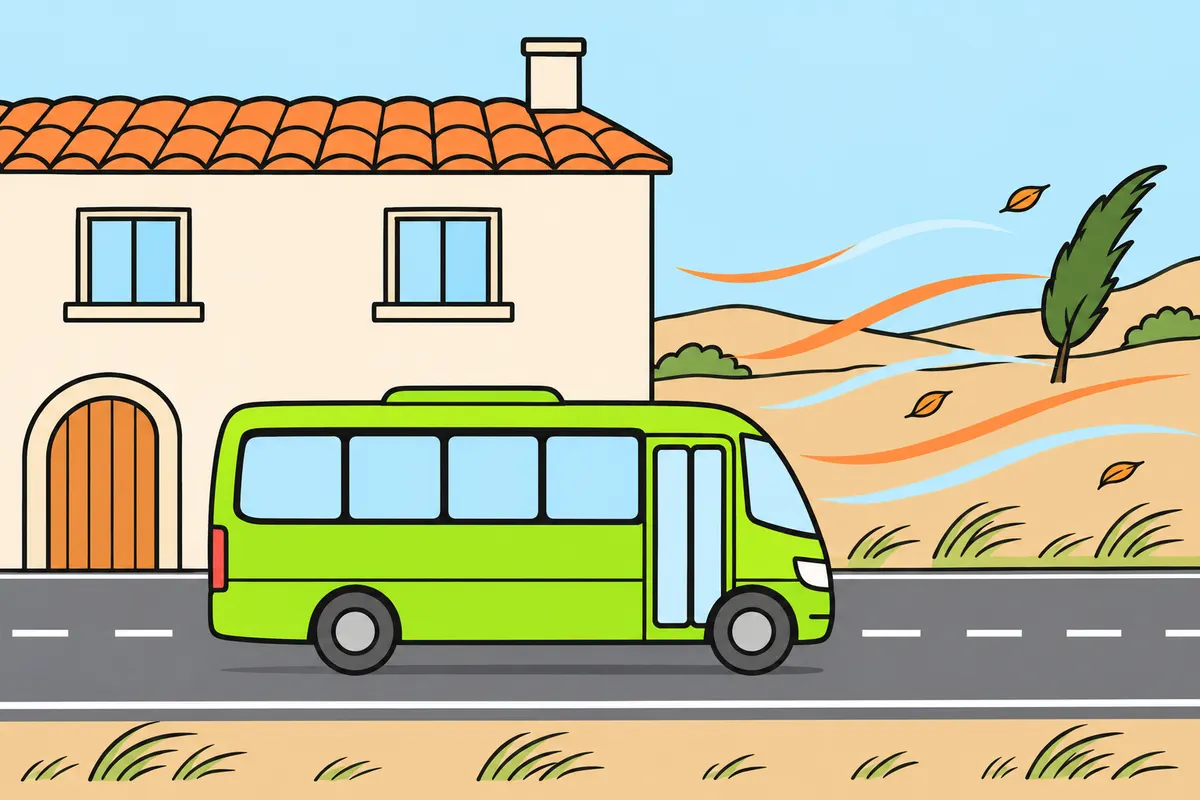
In strong wind, slow down and expect gusts when shelter ends.
| Wind | What you must expect |
|---|---|
| Headwind | Resists forward movement and makes acceleration harder |
| Crosswind | Can push you off course and affect stability |
Remember
- Hold your steering wheel firmly and correct gently.
- Keep space ahead and to the sides.
- Expect gusts after tunnels, buildings and large vehicles.
- Avoid accelerating or seeking shelter close behind the vehicle ahead.
- If you cannot maintain your path, find a safe place to stop.
Exam trap: Wrong: a sheltered stretch means the wind has ended. Right: you may meet a gust when that shelter ends.
Read the full explanation
- Because of its large side area, your minibus is sensitive to crosswind gusts, which can push it off course and compromise its stability. A headwind opposes forward movement and can make acceleration more difficult; a crosswind requires you to pay particular attention to your path.
- In strong winds, you must reduce your speed, hold the steering wheel firmly and maintain clearance ahead and to the sides. Make gradual corrections and avoid gripping so rigidly that you make sudden steering movements; reducing your speed improves your safety margin, but does not eliminate the effect of gusts. [RGC, art. 45](https://www.boe.es/buscar/act.php?id=BOE-A-2003-23514#a45)
- When leaving a tunnel, passing buildings, crossing a viaduct or passing another large vehicle, you must anticipate a change in your exposure to the wind. With the shielding effect, temporary shelter can disappear suddenly: do not mistake a sheltered stretch for the end of the danger. [DGT: winter driving, wind](https://revista.dgt.es/es/educacion-formacion/conducir-mejor/2024/1712-Conduccion-invernal.shtml)
- If gusts prevent you from keeping safely on course, find a safe place to stop and comply with restrictions.
21Rain and slippery surfaces
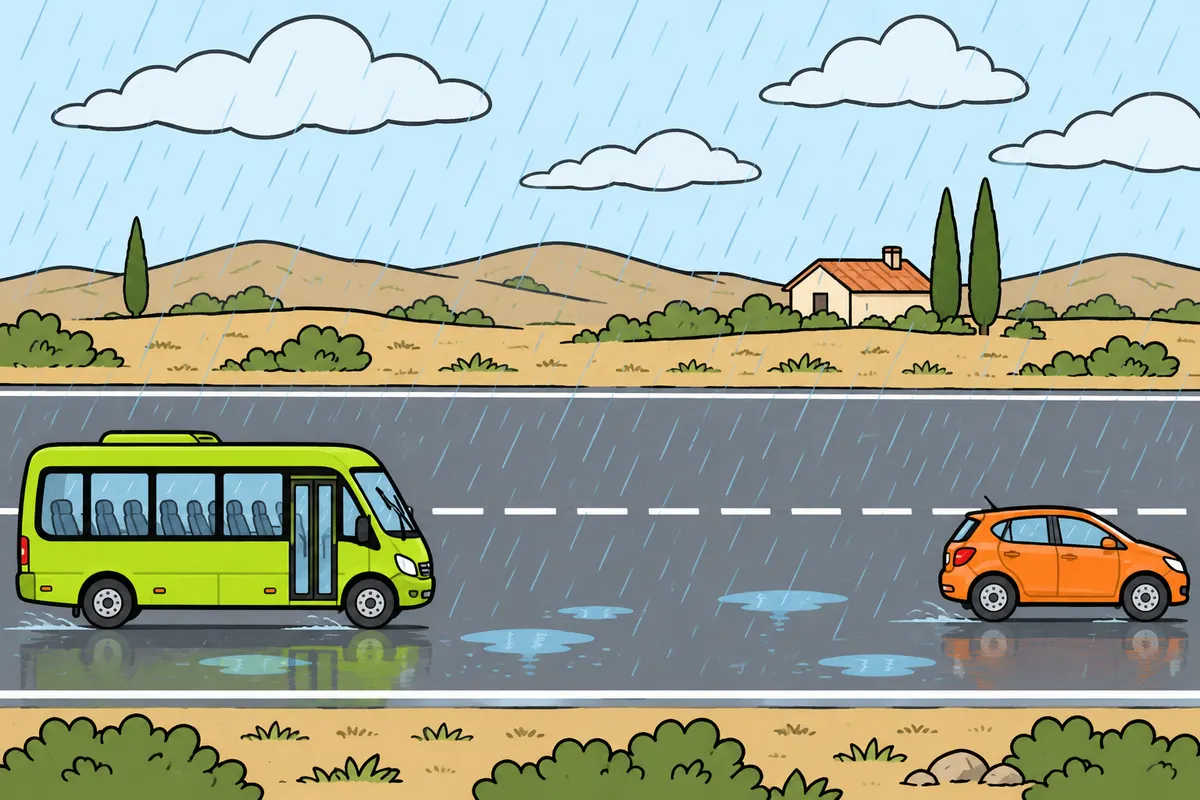
In rain, slow down and increase your following distance.
Remember
- Take particular care with the first drops.
- Brake and steer gently.
- Watch road markings, metal covers and wet leaves.
- Keep your windscreen clean and clear of mist.
- Avoid starting a manoeuvre if you cannot see where it ends.
- Adjust your safety margin for tyres, water, load and road surface.
Exam trap: Wrong: all wet-road braking distances increase by a fixed amount. Right: assess the actual conditions.
Read the full explanation
- In rain, you must reduce your speed and increase your following distance to compensate for reduced grip and visibility. The first drops can make dirt on the road surface particularly slippery.
- You must anticipate braking and turns and use the controls particularly gently on road markings, metal covers, wet leaves and polished surfaces. The change in grip as you cross these surfaces can affect your path and your passengers' balance.
- Spray from other vehicles can temporarily hide the carriageway and dirty mirrors or cameras. You must keep the windscreen clean, use the wipers and demisting system and allow yourself more time and space to observe, without starting a manoeuvre if you cannot see where it ends.
- Your braking distance on wet roads depends on speed, tyres, water, load and the road surface; there is no fixed multiplier for every situation. Adjust the space ahead to the specific conditions. [RGC, art. 54](https://www.boe.es/buscar/act.php?id=BOE-A-2003-23514#a54)
22Standing water and loss of tyre contact
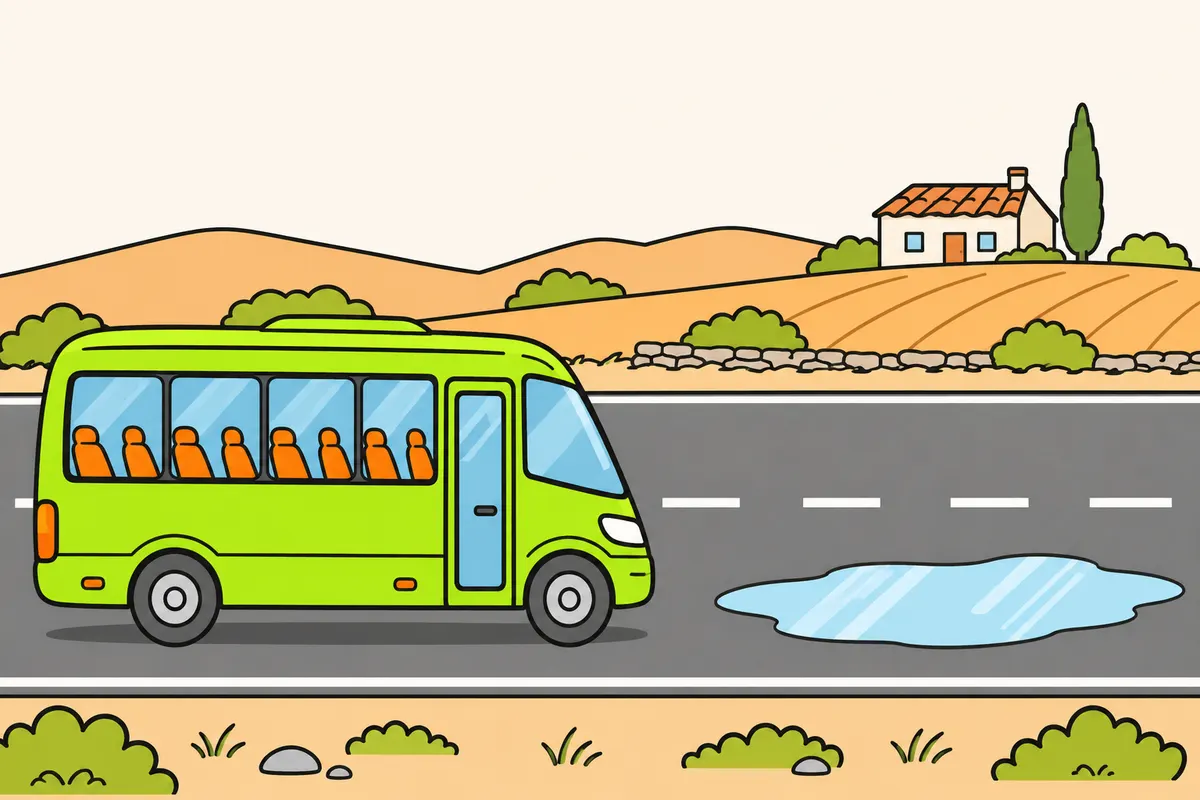
Prevent loss of tyre contact by slowing down before standing water.
Remember
- Keep your tyres in the condition specified for your minibus.
- If you lose grip, avoid sudden braking and steering.
- Hold your steering wheel steady and ease off the accelerator gently.
- Wait for grip to return before correcting gradually.
- Avoid entering water if depth, current and road condition are unknown.
- If visibility is unsafe, slow down and stop somewhere safe when necessary.
Exam trap: Wrong: weight guarantees you can cross any puddle without losing control. Right: slow beforehand and do not rely on your minibus’s mass.
Read the full explanation
- You experience aquaplaning when water prevents adequate contact between the tyre and the road surface and you lose the ability to steer or brake effectively. You must prevent it by reducing your speed before reaching standing water and keeping your tyres in the condition specified for the minibus.
- If you feel this loss of contact, you must avoid harsh braking, acceleration and sudden steering movements, keep the steering wheel steady and ease off the accelerator gently. Wait until you regain grip before making gradual corrections; turning the wheel further and further can cause a sharp deviation when the wheels regain grip.
- You face different risks on a flooded stretch from those of a shallow puddle. If you do not know the depth, current or condition of the road surface, avoid entering: the water can conceal holes washed out beneath the surface or sweep the minibus away even if the bodywork seems high enough.
- If water, hail or spray prevents you from seeing safely, you must slow down before you lose your visual reference points and find a safe place to stop when necessary. Your priority is to maintain control and visibility, without stopping unexpectedly somewhere that exposes passengers and those following you to danger.
23Fog and effective lighting
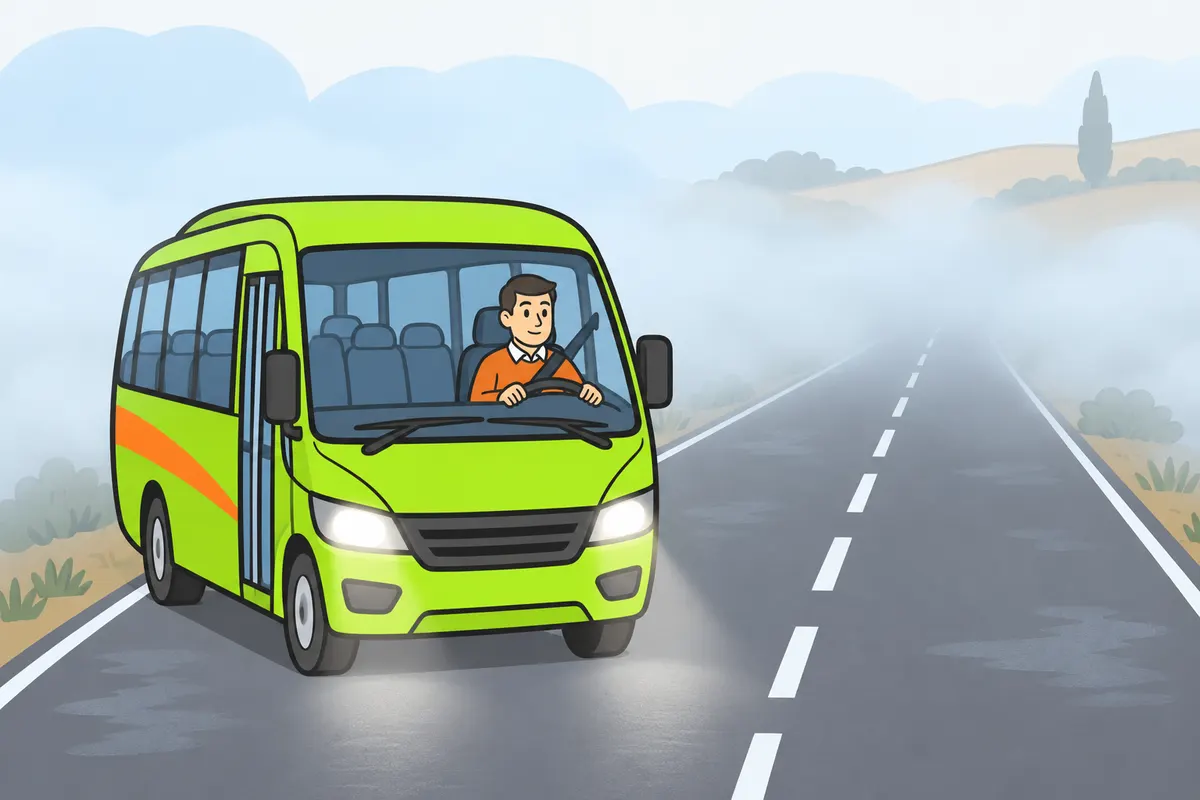
In fog, use your lane as a reference and choose suitable lights.
| Light | When you can use it under this section |
|---|---|
| Front fog lamps | When visibility is significantly reduced; you may use them, dipped beam or main beam |
| Rear fog lamp | Thick fog, very heavy rain, heavy snowfall or dense smoke or dust |
Remember
- Keep your own lane references; lights ahead may disappear.
- Use the required lights when visibility is significantly reduced.
- Use dipped beam to avoid intense reflection from main beam in fog.
- Switch off your rear fog lamp when conditions do not justify it.
- Look for people who are hard to see, especially near stops.
- Check dampness, misted windows and mirrors; see Minibus lighting and signalling for lighting rules.
Exam trap: Wrong: any rain allows rear fog lamp use. Right: reserve it for particularly adverse conditions.
Read the full explanation
- In fog, adapt your observation to the short distance you can see: the lights of the vehicle ahead can disappear if it stops or leaves the road. Use your own lane reference points to decide your path.
- When weather conditions significantly reduce visibility, you must use the prescribed lights. Article 106 allows front fog lamps or dipped or main beam; as a driving technique in fog, dipped beam avoids the intense reflection from main beam, and front fog lamps can help you see if you have them fitted. [RGC, art. 106](https://www.boe.es/buscar/act.php?id=BOE-A-2003-23514#a106)
- You must have the rear fog lamp switched on only in particularly adverse conditions, such as thick fog, very heavy rain, heavy snowfall or dense clouds of smoke or dust. The use of lights is covered in «Minibus lighting and signalling». [RGC, art. 106.2](https://www.boe.es/buscar/act.php?id=BOE-A-2003-23514#a106)
- You must also watch for moisture on the road surface, misting and the condition of your mirrors: fog limits what you see and can coincide with reduced grip. Look out for less visible road users, especially near stops; the glow of a headlamp alone does not let you identify their exact position.
24Snow, ice and restrictions
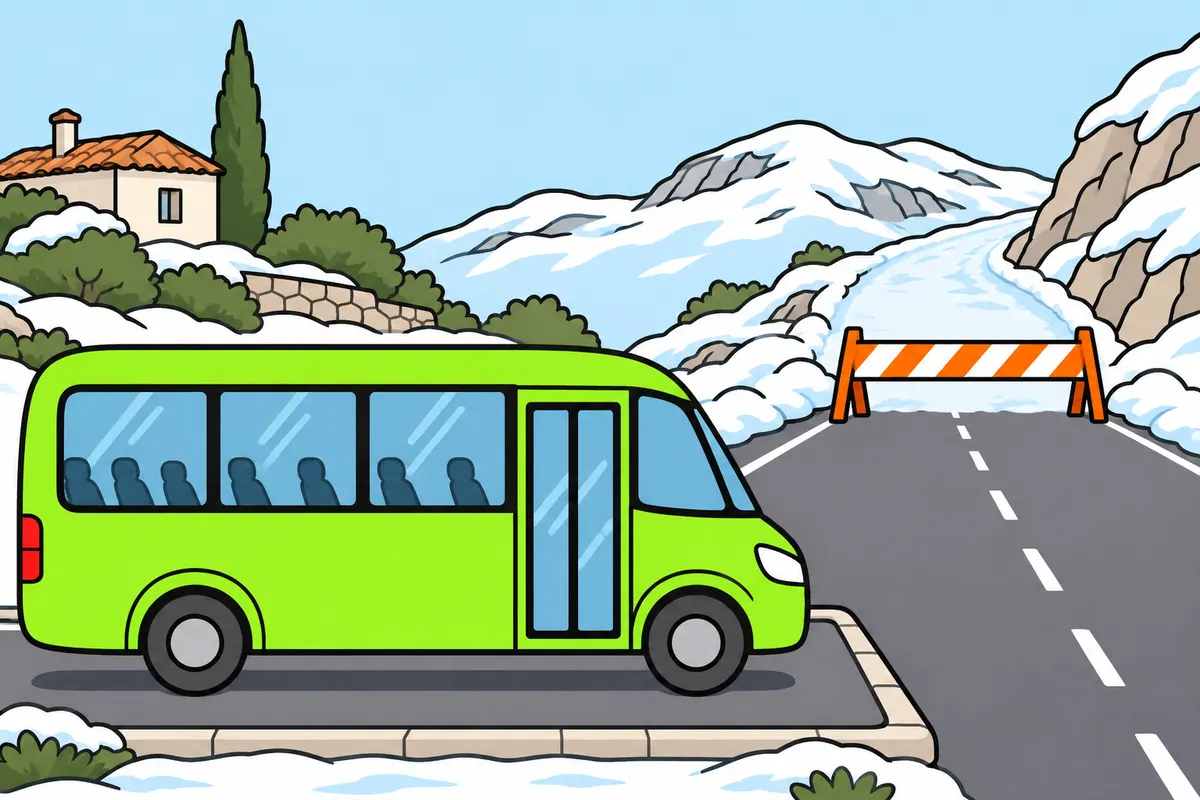
In snow or ice, check restrictions and operate all controls very gently.
Remember
- Check bus restrictions before setting off.
- Prepare speed reductions before bends and slopes.
- Expect snow to hide kerbs and obstacles.
- Suspect ice near zero, especially in shade, damp areas and on bridges.
- On ice, avoid sudden steering, accelerator and brake corrections.
- Adapt retarder use to grip and your minibus’s instructions.
Exam trap: Wrong: chains alone let you continue at the red level. Right: buses face restrictions; exceptional travel requires following the procedure and conditions for certain high-mountain stretches.
Read the full explanation
- Before setting off when snow is possible, you must check the condition of the route and restrictions for buses, rather than just whether a car can get through. Whether you can proceed depends on the instructions and conditions on that stretch, your equipment and your ability to look after passengers safely if the journey is interrupted.
- In snow, you must accelerate, brake and steer gently and prepare to slow down before bends or slopes. Compacted snow can be very slippery and hide markings, kerbs or obstacles; do not approach the edge based solely on the apparent width of the cleared space.
- The red snow traffic level brings restrictions for buses: you must not assume that fitting chains is enough to continue. The DGT provides for exceptional travel on certain high-mountain stretches through its specific procedure and subject to its conditions; check that your service meets all the requirements. [DGT: buses and the red level](https://www.dgt.es/nuestros-servicios/autorizaciones-obras-y-usos-excepcionales-de-la-via/autorizaciones-especiales-de-circulacion/comunicaciones-para-circulacion-excepcional-con-nivel-rojo/)
- At temperatures close to or below zero, you must suspect ice, particularly in damp or shaded areas, on bridges and in places where water has flowed. You may find it difficult to see, and it can remain even when a nearby stretch is clear; slow down in advance and avoid heavy steering and braking demands at the same time.
- If you cross a patch of ice, you must stay calm and avoid sudden steering, accelerator or brake inputs. Do not instinctively apply strong braking through the driving wheels: adapt your use of retarders to the available grip and the minibus instructions.
25Night driving, dazzle and stops
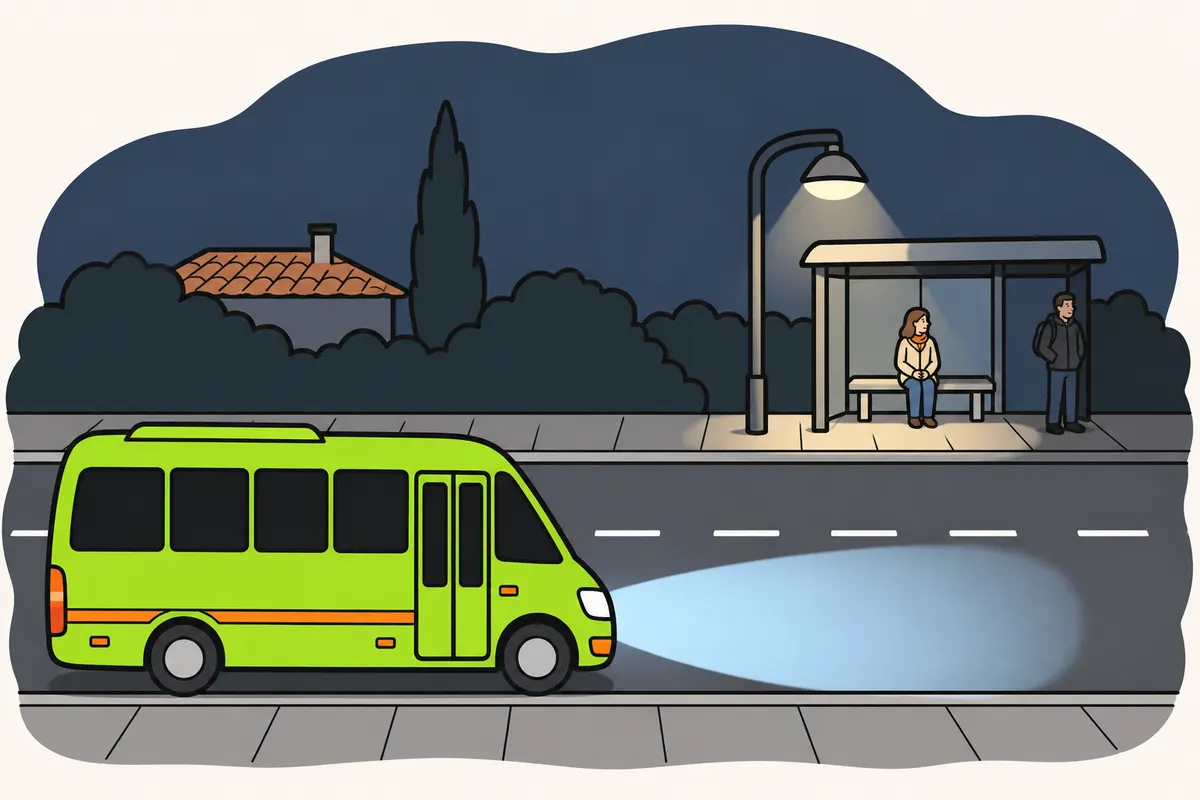
At night, drive at a speed that lets you stop within the distance you see.
Remember
- Keep windows, mirrors, cameras and headlights clean.
- At dark stops, check edges, steps and people beside the doors.
- Switch to dipped beam if you might dazzle anyone, including through mirrors.
- If dazzled, slow as necessary, even to a stop.
- Avoid looking directly at dazzling lights.
- If drowsy or losing attention, find a safe place to stop.
Exam trap: Wrong: faulty lights let you keep your usual speed. Right: if a fault that cannot be repaired en route forces you to use dimmer lights, slow until you can stop within the illuminated area.
Read the full explanation
- At night, you must adjust your speed so that you can stop the minibus within the distance you can actually see, rather than drive solely according to the permitted speed limit. Your elevated driving position and the minibus’s headlights do not guarantee that you can spot a pedestrian in dark clothing or an obstacle outside the beam. [RGC, art. 45](https://www.boe.es/buscar/act.php?id=BOE-A-2003-23514#a45)
- You must keep the windscreen, mirrors, cameras and headlights clean, and avoid interior reflections that obscure your view outside. At poorly lit stops, check the edge, the steps and the people near each door; seeing someone under a street light does not mean you can see someone waiting in the shadows.
- You must switch from main beam to dipped beam as soon as there is a possibility of dazzling anyone, including through rear-view mirrors and even if the other driver does not change their lights. If you are dazzled, slow down as much as necessary, even to a stop, to avoid hitting vehicles or pedestrians. [RGC, art. 102](https://www.boe.es/buscar/act.php?id=BOE-A-2003-23514#a102)
- When lights dazzle you, avoid looking directly at them and use reliable reference points along the road edge while continuing to watch your lane. You must take extra care on bends and at the crests of hills, where lights can appear suddenly. [DGT: night driving](https://revista.dgt.es/es/reportajes/2021/12DICIEMBRE/1214-Conduccion-nocturna.shtml)
- You must anticipate entering and leaving areas with very different lighting levels, and avoid accelerating until you can make out reference points again. If you become drowsy or cannot stay alert, find a safe place to stop; drowsiness is covered in «The driver’s condition» and the legal time limits in «Driving and rest times».
- If a fault that cannot be repaired during the journey forces you to drive with lights of reduced intensity, reduce your speed until you can stop within the illuminated area. Pay particular attention to bends and approaches to stops, where the direction of the beam can leave the road edge or passengers in the shadows. [RGC, art. 107](https://www.boe.es/buscar/act.php?id=BOE-A-2003-23514#a107)
Making a stop and moving off again
Sequence for controlling the bus, doors and surroundings without jolts.
- Observe the stop, its obstacles and nearby people; check your mirrors and signal your approach.
- Slow down progressively and align the doors with an accessible area alongside the right-hand edge.
- Bring the minibus to a complete stop before opening the doors and keep watch while passengers board and alight.
- Check that nobody is trapped or in a dangerous position; close the doors and stow the access devices.
- Signal your departure and check your path, blind spots and the sweep of the overhangs.
- Pull out only when you can do so safely and accelerate progressively.
Handling a necessary reversing manoeuvre
Check that it is legal and keep watch throughout the manoeuvre.
- Check that reversing is permitted and that there is no safe way forwards.
- Inspect the route and obstacles; if you need to get out, first secure the vehicle against movement.
- Arrange help from another person if needed and agree on signals and a visible position outside the vehicle’s path.
- Warn others of the manoeuvre and reverse slowly, watching the rear, sides and front swing.
- Stop if you lose your reference points, receive a warning or someone appears nearby; check again or abandon the manoeuvre.
Descending a mountain pass with braking capacity in reserve
Prepare to control speed before the minibus gains speed.
- Assess the gradient, bends, load, grip and restrictions before starting the descent.
- Reduce speed and select a suitable gear within the permitted engine speed range.
- Use engine braking and the retarder in accordance with the manual and the available grip.
- Monitor speed and warnings; use the service brake when necessary, avoiding continuous overloading.
- If you cannot maintain a safe descent, find a safe place to stop and resolve the cause before continuing.
Check what you know
Real questions from the bank on this topic. Pick an answer to see the explanation.
Finished this module?
Mark it as read and you will see your progress on the theory list.