
Theory · B Licence - Car · Module 2 of 6
Signs
Master the hierarchy between officers, temporary signage, traffic lights, vertical signs and road markings. In the exam you must recognise which order prevails, what conduct each sign requires, and when a temporary indication changes what you would normally expect to see on the road.
8 min read8 sectionsReviewed Apr 8, 2026
Sign library
All 620 signals of the official catalogue in force (Royal Decree 465/2025), each with its drawing and description, and a test to practise them.
1Hierarchy of signage
- The priority between signs is not arbitrary: first you obey officers' orders, then temporary signage, then traffic lights, then vertical signs and finally road markings.
- If two signs appear to contradict each other, the higher-ranking one prevails. In the exam, many questions are solved by remembering this hierarchy before looking at shape or colour.
- Signs apply from the point where they are placed, unless they indicate a distance, the length of a stretch, or the end of a prohibition.
- Practise saying out loud which source is in charge in each scene: officer, roadworks, traffic light, vertical sign or marking. That order stops you answering out of habit when faced with similar images.
2Families of signs
- Danger warning signs warn of a risk; regulatory signs impose prohibitions or obligations; information signs guide, confirm or inform about the use of the road.
- Traffic lights regulate passage with priority over an incompatible vertical sign. The lights may be aimed at all road users or at a specific lane, vehicle or manoeuvre.
- Road markings define lanes, excluded areas, pedestrian crossings, continuous or broken lines, and rules on stopping, parking and priority.
- Don't just memorise colours: link shape, message and required conduct. A question can hide the answer in a single word like obligation, prohibition, priority or information.
3Practical reading in the exam
- Don't study signs as isolated pictures: link each one to the required conduct, the vehicle's position and the anticipation needed.
- At a junction, a priority sign outweighs the general priority-to-the-right rule. At roadworks, temporary signage can override the permanent signage.
- When the question mentions a reversible lane, an extra lane or a temporary diversion, pay attention to road delineation devices, arrows and variable message signs.
- In images, also check which lane you're driving in. Many traps show a sign that's only valid for one direction, one lane or one specific manoeuvre.
4Vertical signs and the affected stretch
- A vertical sign does not always apply to the whole road for the entire route. You must check whether it indicates a start, an end, a distance, the length of the stretch or exceptions for specific road users.
- When the question talks about parking, stopping, overtaking or turning, first identify whether the sign regulates that exact action or only informs about another circumstance.
- Placement matters: a sign before a junction, inside a roundabout or above a lane can change which movement it affects.
- If no specific figure appears on the sign or in the question, don't invent one. Apply the general conduct and leave the specific detail to the rule in force.
5Road markings and traffic lights
- Road markings complete what you see on vertical signs: they can order you to stop, separate directions, reserve spaces or warn that a manoeuvre is no longer safe.
- A continuous line should not be read in isolation if there's a traffic light, an officer or a temporary sign ordering something else. Always go back to the hierarchy before answering.
- Traffic lights with arrows, lanes or specific addressees require you to check who they're aimed at. Not every light in an image regulates your movement.
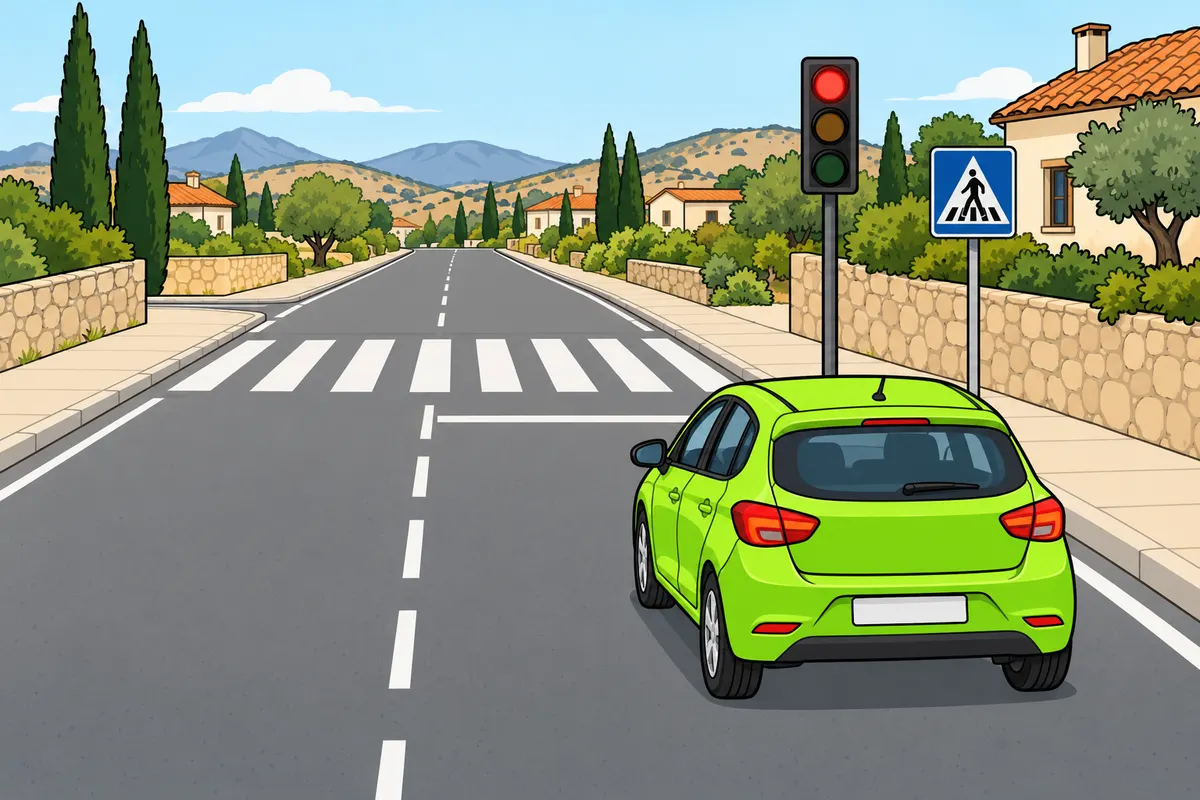
- At pedestrian crossings and stop lines, the marking places you where you must wait. The typical mistake is to look only at the traffic light and stop too late.
6Official catalogue and the 2025 update
- The official sign catalogue was updated in 2025. The reform introduces new representations and adapts pictograms and panels to current mobility.
- To study rigorously, use up-to-date material and be wary of old diagrams that still include discontinued signs or incomplete meanings in their examples.
- If a question pits a new sign against a classic one, the key remains the same: identify danger, prohibition, obligation or information and apply the correct conduct.
- When you're unsure between two similar pictograms, don't answer based on visual similarity. Ask yourself what risk or restriction it communicates and what the driver must do.
7Revision method
- Group your mistakes by family: priority, prohibition, obligation, roadworks, lanes and markings. This way you spot patterns instead of repeating the same confusion with different pictures.
- Make flashcards with the image on one side and the required conduct on the other. The goal isn't to name the sign, but to know what you'll do when you see it.
- In a 30-question, 30-minute test, don't spend too much time on a doubtful sign. Mark the hierarchy, rule out impossibilities and come back if you have time left.
- Review signs alongside real situations: junctions, merges, roadworks and parking. The DGT usually asks about application, not isolated definitions.
8Shortened broken lines, reversible and additional lanes
- A shortened broken line can warn that a continuous line is near or that visibility or another special risk reduces the safe gap; it is not just a shorter decorative line. Read the accompanying sign or marking before deciding what movement it permits.
- A reversible lane is delimited by double broken lines on both sides and its direction is governed by lane-control signals; do not infer a direction change from one short line alone.
- A temporary additional lane is enabled for a particular stretch and is marked and controlled as such; it is not automatically reversible. Follow the cones, signs, arrows and road markings in force.
- When a diagram is incomplete, hold the answer until the operating indication and the affected lane are clear.
Read the lane before the line
The same broken-line family can appear in different operating contexts.
- Identify the line and whether it is shortened.
- Look for reversible-lane signals, arrows or panels.
- Check whether the lane is simply an added lane in the road layout.
- Apply only the direction and movement shown by the complete marking and signs.
Check what you know
Real questions from the bank on this topic. Pick an answer to see the explanation.
Finished this module?
Mark it as read and you will see your progress on the theory list.