
Theory · B Licence - Car · Module 3 of 6
Vulnerable road users
Licence B requires you to drive with preventive priority towards pedestrians, cyclists, motorcyclists and road users with less physical protection. A small driver error can have serious consequences, so the exam values anticipation, distance, moderate speed and reading the surroundings.
8 min read7 sectionsReviewed Apr 8, 2026
1Who is vulnerable
- Vulnerable road users are those with less physical protection against an impact: pedestrians, cyclists, motorcyclists, users of personal mobility vehicles and people with reduced mobility.
- Vulnerability doesn't depend on whether they have priority at that moment. It depends on the fact that an error or impact can cause them much greater harm.
- The exam often asks about these road users in urban scenes, crossings, turns, overtaking manoeuvres and doors of parked vehicles, because these combine little margin for error.
- Your goal as a driver is to anticipate conflicts before they appear. Reducing speed and increasing vigilance isn't courtesy, it's preventive driving.
2Pedestrians and designated crossings
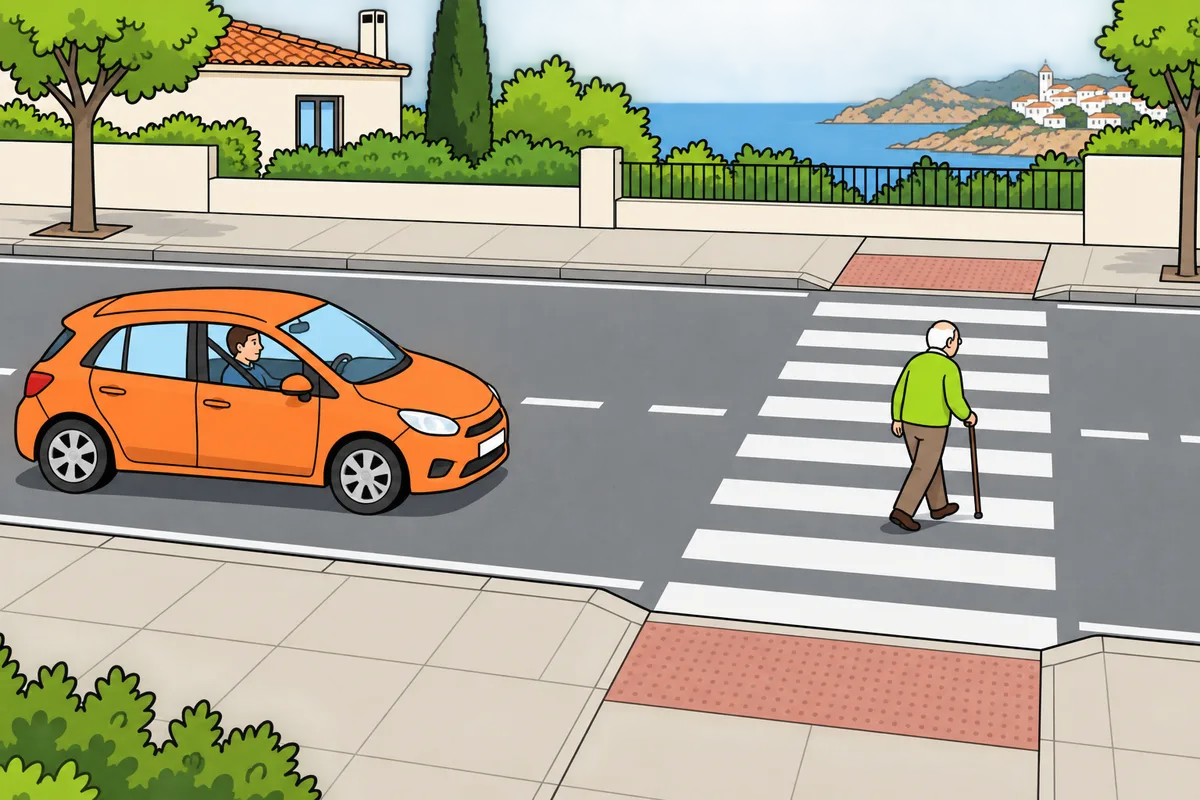
- The driver must take extra care when approaching children, older people, blind people or people with mobility problems, even when they have priority.
- At pedestrian crossings, pavements, transport stops and areas with reduced visibility, you must adapt your speed and be ready to stop.
- A pedestrian doesn't stop being vulnerable because they make a mistake; your duty as a driver is to anticipate and avoid the harm.
- When a vehicle partly blocks your view of a crossing or pavement, slow down before you can see the pedestrian. Reduced visibility is already a sign of risk.
3Cyclists and mopeds
- When overtaking bicycles or mopeds, you must leave enough lateral separation and reduce speed if circumstances require it, so as not to intimidate them.
- On roads with several lanes per direction, overtaking cycles or mopeds must be done by fully or partly occupying the adjoining lane when necessary to guarantee safety.
- Don't overtake if you can't maintain margin, visibility and control. Being in a hurry doesn't justify passing close to or intimidating someone with less stability.
- At turns, junctions and roundabouts, check mirrors and blind spots. A cyclist can be on a path you don't see if you only look straight ahead.
4Motorcyclists and blind spots
- Motorcyclists are more visible than a bicycle in some situations, but they still have little physical protection against an impact.
- Before changing lane, opening a door or turning, check your mirrors and blind spot. The so-called dooring effect is a typical cause of collisions.
- Don't invade a motorcycle's lateral space in tailbacks or narrow lanes. Keeping a predictable course avoids scares and defensive manoeuvres.
- In the exam, a small motorcycle in the mirror can be the key to the answer. Don't treat the image as if it only contained cars.
5Personal mobility vehicles and urban coexistence
- Personal mobility vehicles don't follow exactly the same rules as a car, but they remain vulnerable road users and may be subject to additional local bylaws.
- In urban settings, you must anticipate unexpected crossings, changes of direction and mixed traffic in low-speed zones or areas near schools.
- The best defence is to read your surroundings before a conflict appears: school zones, delivery riders, cycle lanes, shared crossings and parked vehicles.
- If a local bylaw or sign regulates a shared space, you must respect it. If you don't know the detail, apply caution and don't invent permissions.
6Doors, stops and obstacles
- Never open a door without checking your mirrors and blind spot; the so-called dooring effect is a typical cause of collisions with cyclists and motorcyclists.
- Near stops, schools, bins or tall vehicles, expect hidden movements. The risk doesn't start when you see the road user, but when they might appear.
- When parking or setting off, signal, look and move slowly. A vulnerable road user may occupy a space you thought was clear seconds earlier.
- The DGT uses these scenes a lot because they seem simple. The decisive detail is usually who could be hidden or suffer more harm.
7Preventive priority
- Having priority does not authorise you to maintain your speed if the other road user could enter into conflict. The duty to avoid harm still applies.
- Reducing speed, leaving space and signalling your manoeuvres also protects whoever makes a mistake. Defensive driving does not mean giving up the rules.
- At crossings, cycle lanes, turns and overtaking manoeuvres, combine the rule with technical empathy: imagine the vulnerable road user hasn't seen you.
- Practise questions by first looking for the most fragile road user. That approach makes clear when you must give way, wait, keep your distance or take extra care before moving on.
Check what you know
Real questions from the bank on this topic. Pick an answer to see the explanation.
Finished this module?
Mark it as read and you will see your progress on the theory list.