
Theory · D+E Licence - Bus with Trailer · Module 10 of 13
Driving techniques with a bus and trailer
You learn to drive a bus with a luggage trailer, anticipating stability, wind, trailer sway and the space occupied by the whole combination. You practise turns, reversing in a straight line and around a corner, approaches and manoeuvres G, L and M, keeping movements smooth for passengers and considering other road users’ visibility.
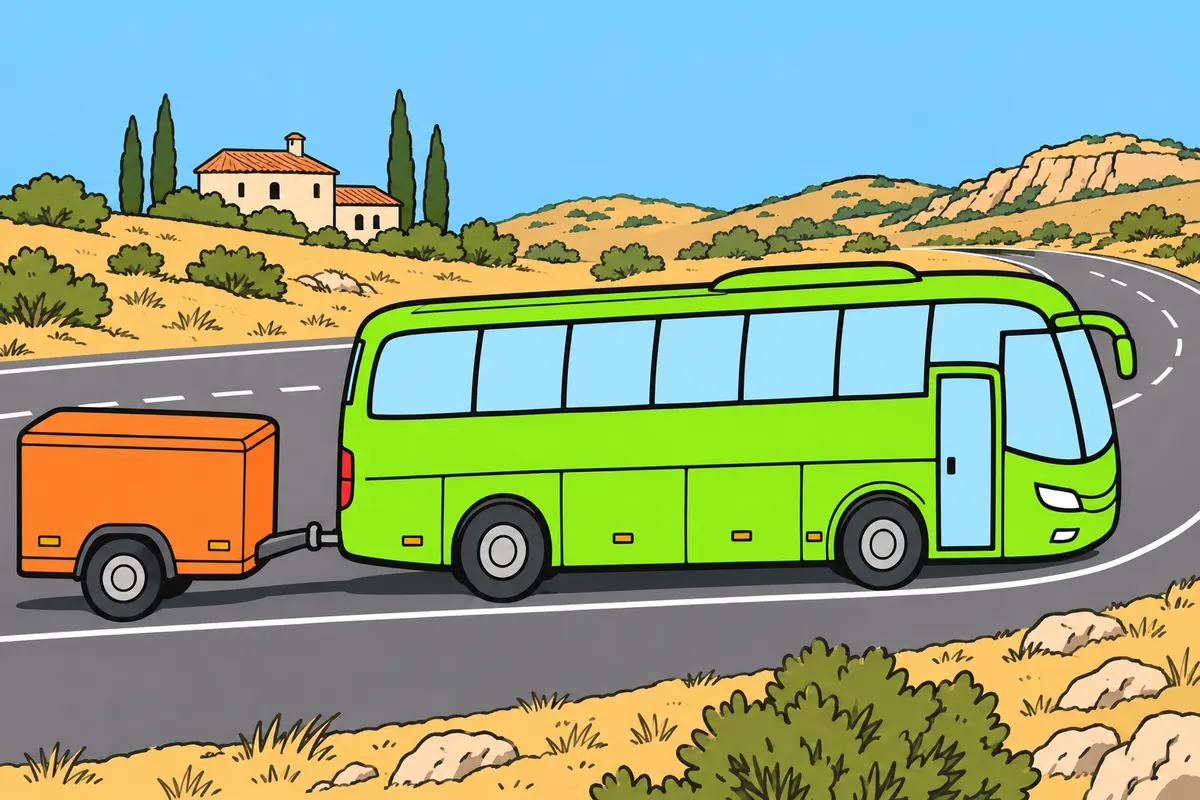
1Preparing the combination and route
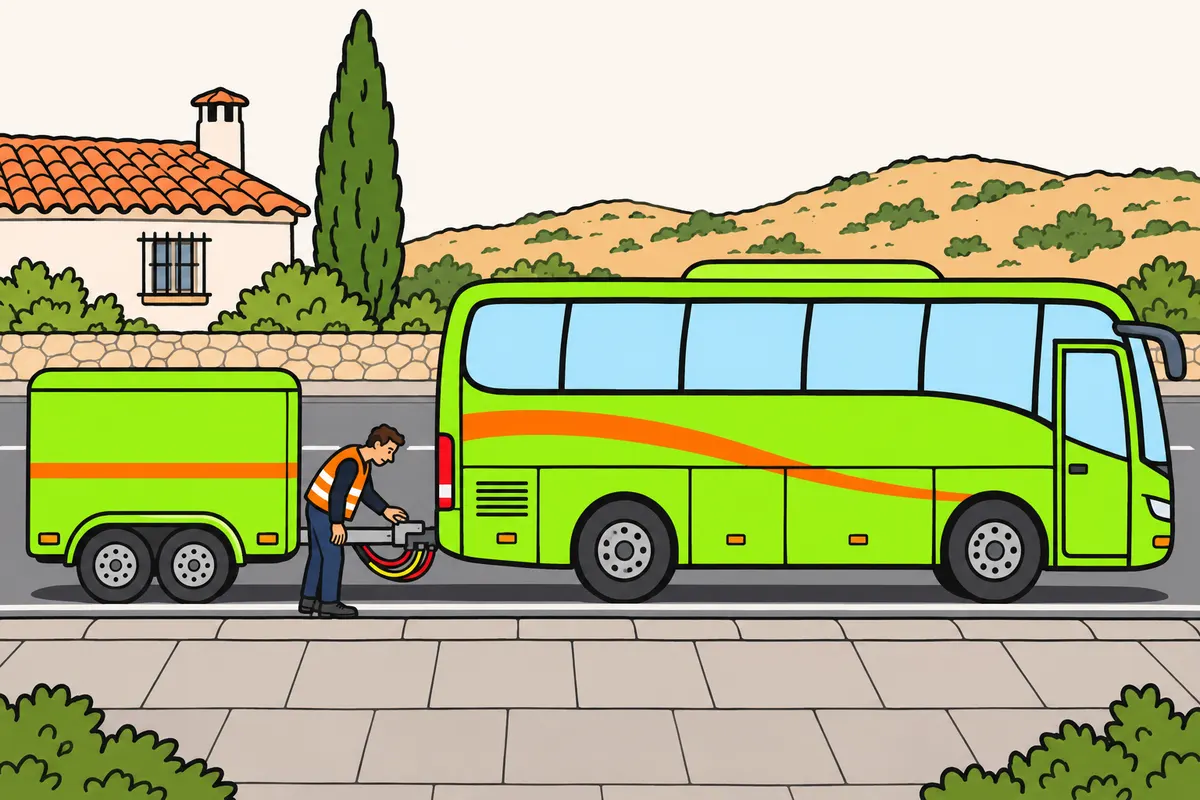
Prepare your route and check the bus and trailer before setting off.
Remember
- Plan your route using the actual dimensions and weight, including the load.
- Check the coupling, connections and raised, secured supports.
- Check tyres, lights and brakes on both the bus and trailer.
- Adjust your seat, mirrors, head restraint and seat belt while stationary.
- Before moving, check both sides and behind the trailer.
- Wait until passengers finish boarding and alighting, and close the doors.
Exam trap: Wrong: Move off because you have checked the vehicle. Right: Also check your surroundings, that nobody is boarding or alighting, and that the doors are closed.
Read the full explanation
- Before setting off, study the route using the actual dimensions and mass of the combination, including its load. Identify access points, low clearances, restrictions and turning spaces; also plan where you can legally stop or turn around if you encounter a passage you cannot negotiate.
- Check that the coupling is closed and locked, that the electrical and brake connections are secure, and that any trailer supports are retracted and secured. Check that cables and pipes can move freely as the combination articulates, without dragging or becoming trapped. [RGCond, Annex V.B.3, points 6-8](https://www.boe.es/buscar/act.php?id=BOE-A-2009-9481).
- Check the tyres, lights and brake operation on both units; check the pressure gauges and vehicle warnings before moving off. If you find a fault that compromises safety, resolve it before driving; “Maintenance and inspection of the vehicle combination” covers these checks in detail.
- With the vehicle stationary, adjust your seat, mirrors, head restraint and seat belt; check that the doors are closed and familiarise yourself with the retarder and parking brake controls. You must be able to demonstrate this preparation in the practical tests. [RGCond, Annex V.B.3, points 6-8](https://www.boe.es/buscar/act.php?id=BOE-A-2009-9481).
- Before moving off again after a voluntary or compulsory stop, or from the roadside, check all your surroundings again, including the sides and rear of the trailer. Check that passengers have finished boarding and alighting and that the doors are closed. Do not move off while anyone is boarding the bus or assume that people beside the trailer will move away when they hear the engine. [RGC, art. 11](https://www.boe.es/buscar/act.php?id=BOE-A-2003-23514#a11); [RGC, art. 114](https://www.boe.es/buscar/act.php?id=BOE-A-2003-23514#a114).
2Loading and dynamic behaviour
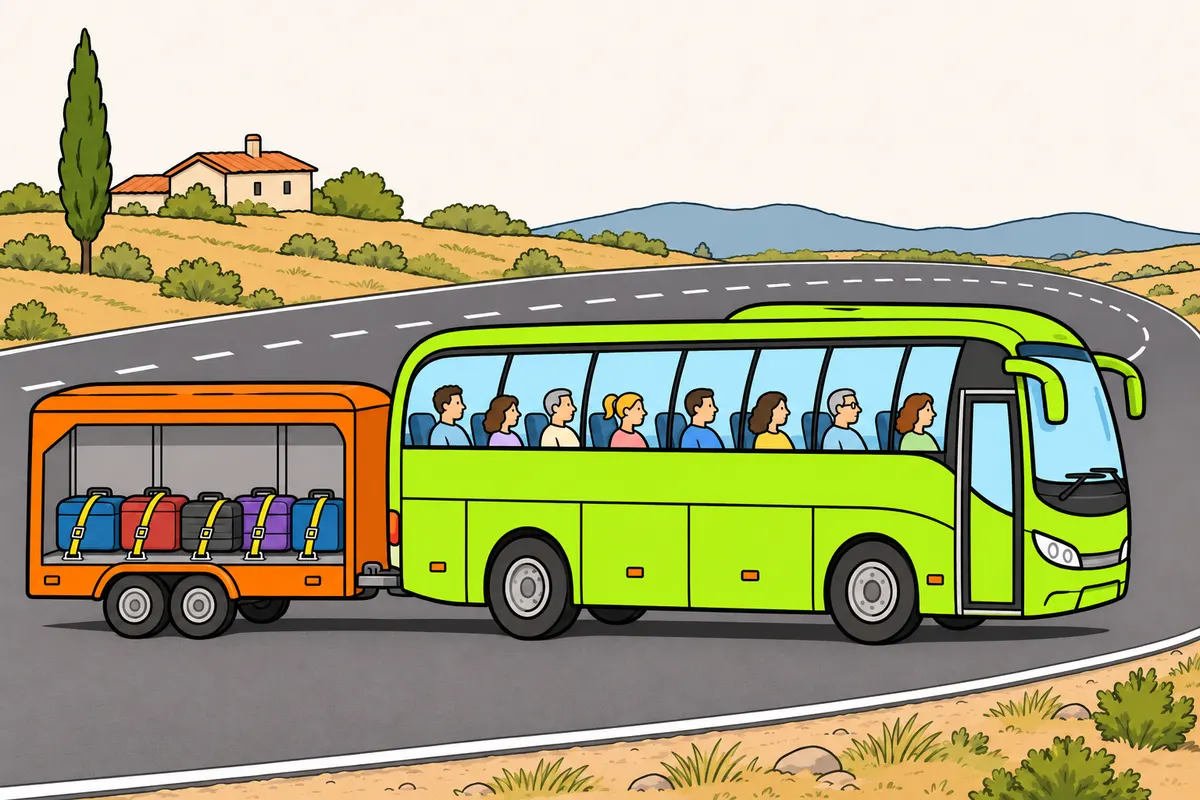
Distribute your load properly and adapt your driving to keep the combination stable.
Remember
- Respect weight limits even when all the luggage fits.
- Spread luggage without concentrating weight on either side.
- With a high load, slow down before turning: you could overturn.
- Allow for movement of objects or liquids you carry.
- Stay alert with an empty trailer: it can also lose stability.
- Carry passengers only in authorised places and secure loose objects.
Exam trap: Wrong: Carry passengers in the luggage trailer because the bus is full. Right: Without authorised passenger places, you cannot carry them there, even with their agreement or on short journeys.
Read the full explanation
- Know how passengers and luggage are distributed among the authorised positions in the bus and how luggage is distributed in the trailer and between its axles. Avoid concentrating the load on one side, overloading or placing an unsuitable load on the coupling. You must respect the technical and authorised limits even if all the luggage fits. For positioning and securing luggage, see “Safe luggage and loads”, and for the combination's limits, see “Dimensions, masses and speed limiters”. [RGC, art. 14](https://www.boe.es/buscar/act.php?id=BOE-A-2003-23514#a14).
- A high load raises the centre of gravity and reduces your margin against overturning when taking bends or changing course abruptly. Slow down before turning and avoid combining a tight turn with heavy braking. Even if the load does not shift, the combination can lose stability if your speed is inappropriate.
- When carrying objects or containers whose contents can move, anticipate braking and changes of direction: their movements can alter the trailer's response. Do not become complacent with an empty trailer either; the available grip changes and the sides remain exposed to the wind. Always adapt your driving technique to the number of passengers on board, the luggage and the vehicle. [RGC, art. 45](https://www.boe.es/buscar/act.php?id=BOE-A-2003-23514#a45).
- You must carry people in places intended and equipped for them. You must not use a luggage trailer with no authorised passenger places to carry passengers, even if the bus is full, the journey is short or the passengers agree to travel there. Also secure objects in the passenger compartment so that they do not interfere with your vision, movements or attention. [RGC, arts. 10 and 18](https://www.boe.es/buscar/act.php?id=BOE-A-2003-23514#a10).
3Looking ahead and checking blind spots
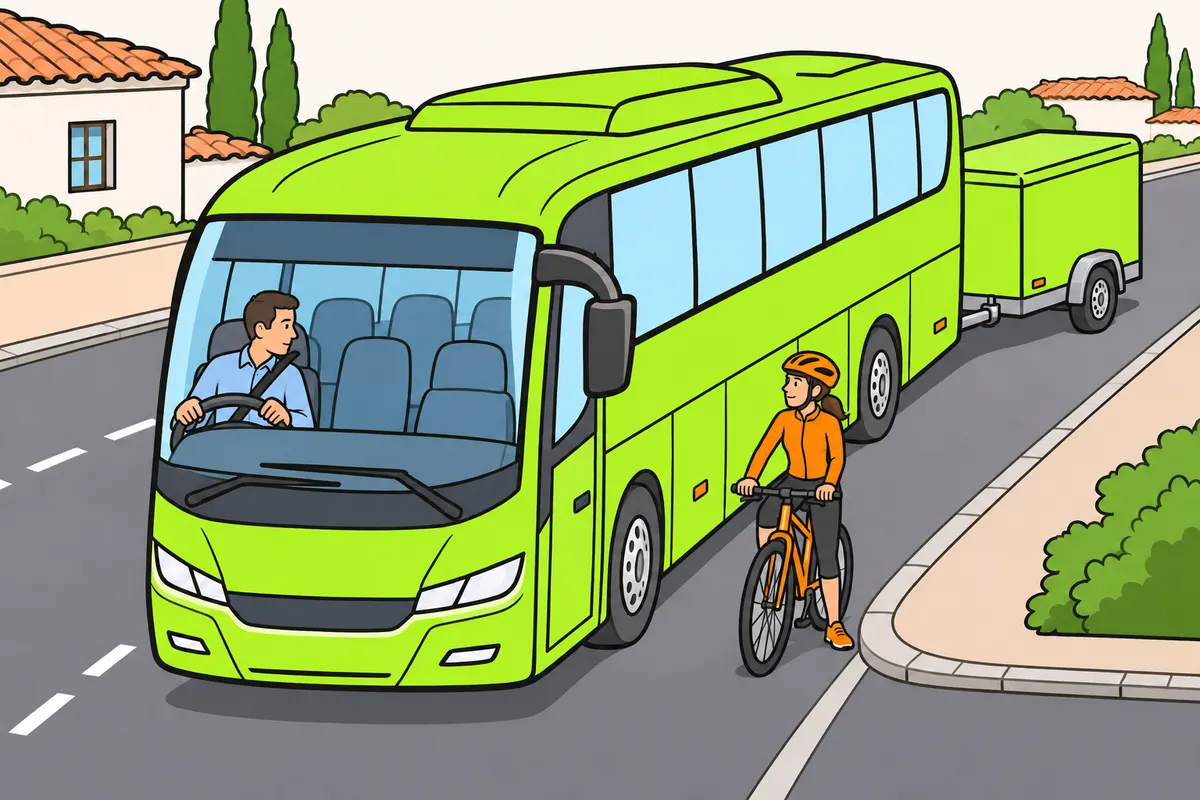
Look ahead, nearby and in your mirrors, and check areas you cannot see.
Remember
- Keep checking the road ahead, nearby areas and your mirrors.
- Keep your mirrors clean and properly adjusted.
- Check hidden areas before moving off, changing lanes or turning.
- Pay particular attention to your right side and behind the trailer.
- Use cameras as aids and understand their limits.
Exam trap: Wrong: Turn because nobody appears in your mirror. Right: Check hidden areas; pedestrians or cyclists could be there.
Read the full explanation
- Alternate between looking well ahead, checking the area nearby and checking your mirrors. Spotting a traffic queue, a crest or a narrowing of the road early allows you to slow down progressively and avoid improvised manoeuvres.
- Adjust your mirrors to monitor the sides and the trailer's path, and keep them clean. Your view changes during a turn: part of the trailer can hide another area from you. Do not assume that an area is clear simply because no road user appears in the mirror; take blind spots into account.
- Before moving off, changing lanes or turning, pay particular attention to the area around the driving position, the right-hand side and the rear. A cyclist or pedestrian can be out of your sight and enter the combination's swept area. Cameras and driver aids supplement your observation; you must know their limitations and remain in control.
4Smooth controls and appropriate speed
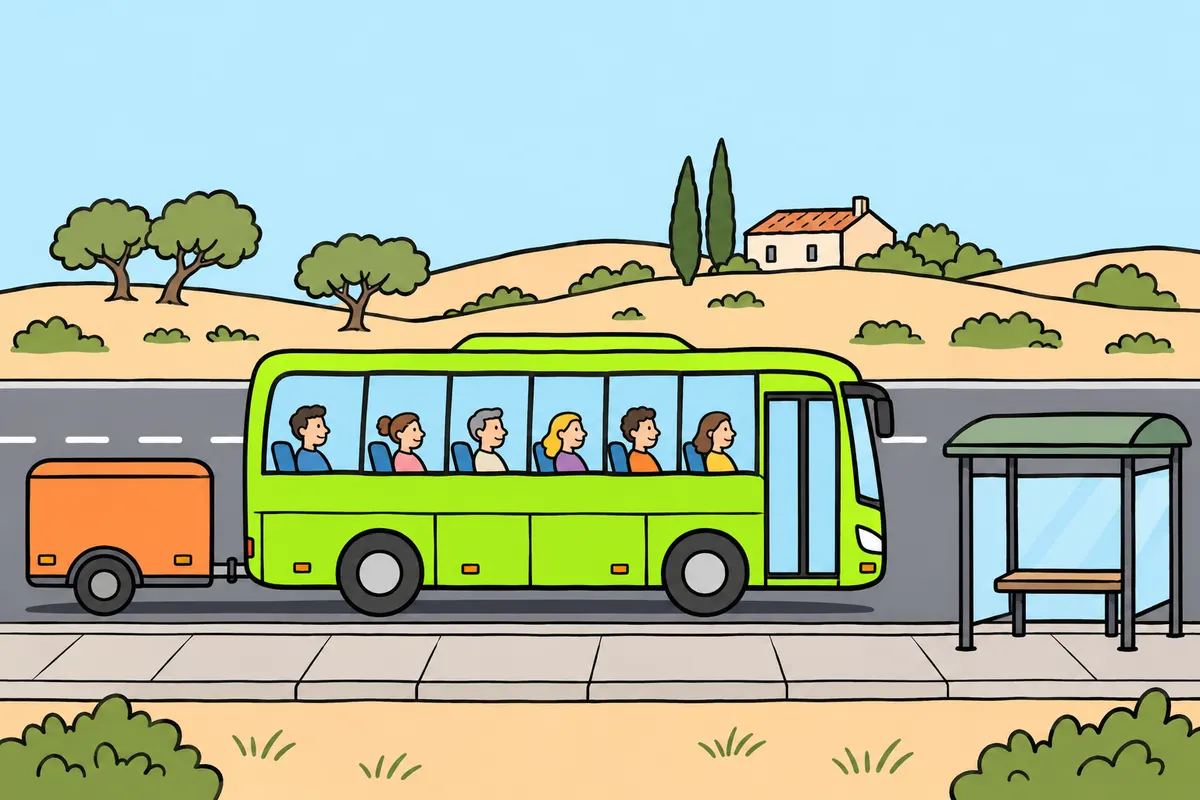
Use your controls smoothly to stay in control and protect your passengers.
Remember
- Accelerate, change gear, brake and steer gradually.
- Avoid jolts that could make passengers fall.
- Prepare for stops and ease your braking towards the end.
- Check limits in “Speed and distances for the combination”.
Exam trap: Wrong: Make violent corrections to save time. Right: Use your controls gradually and keep control of the combination.
Read the full explanation
- Accelerate, change gear, brake and steer progressively. Smooth control avoids sudden load transfers and helps the bus and trailer maintain a stable course. You must remain in control of the combination at all times; rushing or making abrupt corrections reduces the margin you need to deal with an unexpected event. See “Speed and distances for the combination” for the limits applicable to a bus with a trailer and how to adapt your speed. [RGC, art. 17](https://www.boe.es/buscar/act.php?id=BOE-A-2003-23514#a17).
- When carrying passengers, you must move off, stop and turn without jolts or sudden movements that could cause falls. Anticipate your approach to a stop and ease the braking as you come to a halt; smoothness is also expressly assessed in the D+E road test. Progressive driving avoids unnecessary acceleration and braking and helps you drive efficiently. [RGC, art. 11](https://www.boe.es/buscar/act.php?id=BOE-A-2003-23514#a11); [RGCond, Annex V.B.4](https://www.boe.es/buscar/act.php?id=BOE-A-2009-9481).
5Separation and room to stop
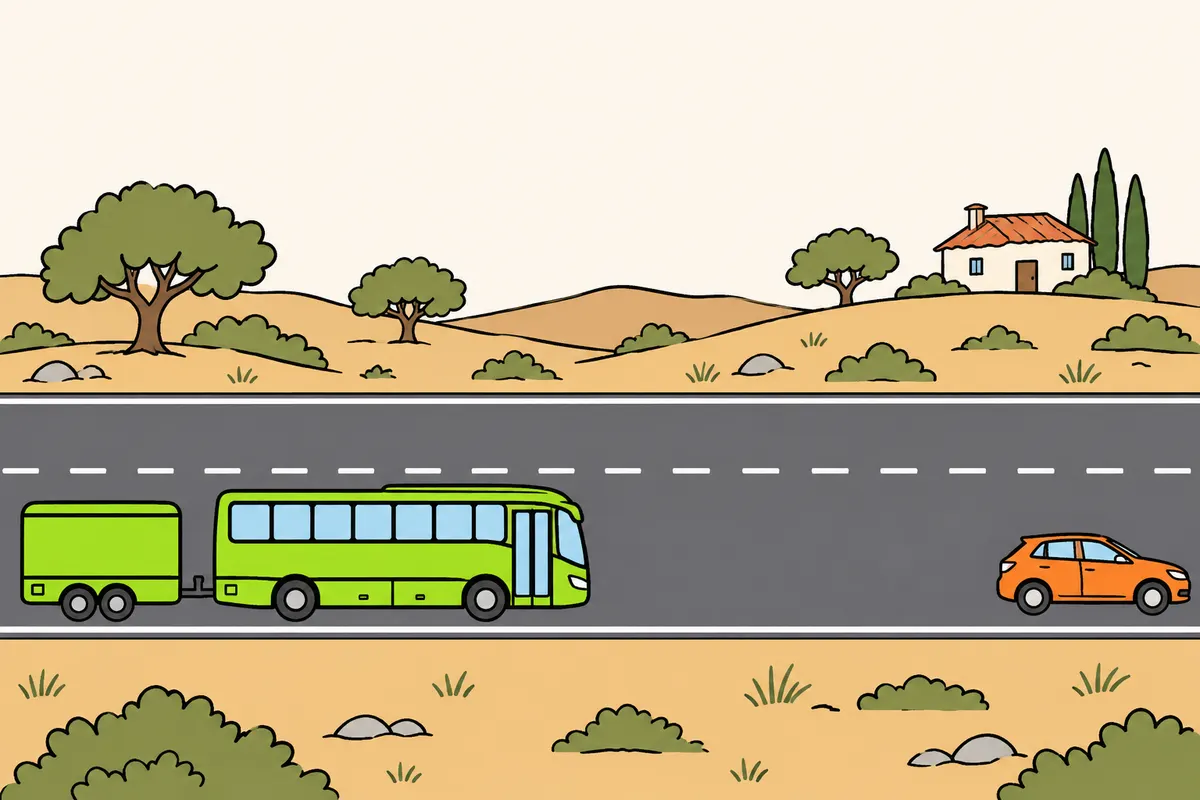
Keep room to brake smoothly and adapt your gap to the conditions.
Remember
- Leave room to prepare your braking before reaching a queue.
- Adapt your gap to luggage, passengers, grip and visibility.
- Watch brake lights and traffic movements ahead.
- If someone enters your gap, restore it gradually.
- Measure from your front to the rear of the vehicle or trailer ahead.
- Check distances in “Speed and distances for the combination”.
Exam trap: Wrong: Brake sharply when someone enters your gap. Right: Restore your gap gradually, without unnecessary braking.
Read the full explanation
- Leave enough room to ease off the accelerator and prepare to brake before reaching a queue. With a bus and trailer, too small a gap forces you to act quickly and subjects passengers to jolts. Adjust this margin to the luggage, passenger numbers, grip and visibility; statutory distances and stopping distance are covered in “Speed and distances for the combination”. [RGC, art. 45](https://www.boe.es/buscar/act.php?id=BOE-A-2003-23514#a45).
- Watch the brake lights and movements of several vehicles ahead whenever visibility allows. If another vehicle moves into your gap, restore the margin progressively without unnecessary braking. In a line of buses, judge the gap from your front to the rear of the vehicle or trailer ahead, and maintain a sufficient view of how traffic is developing.
6Tunnels, queues and cyclists ahead
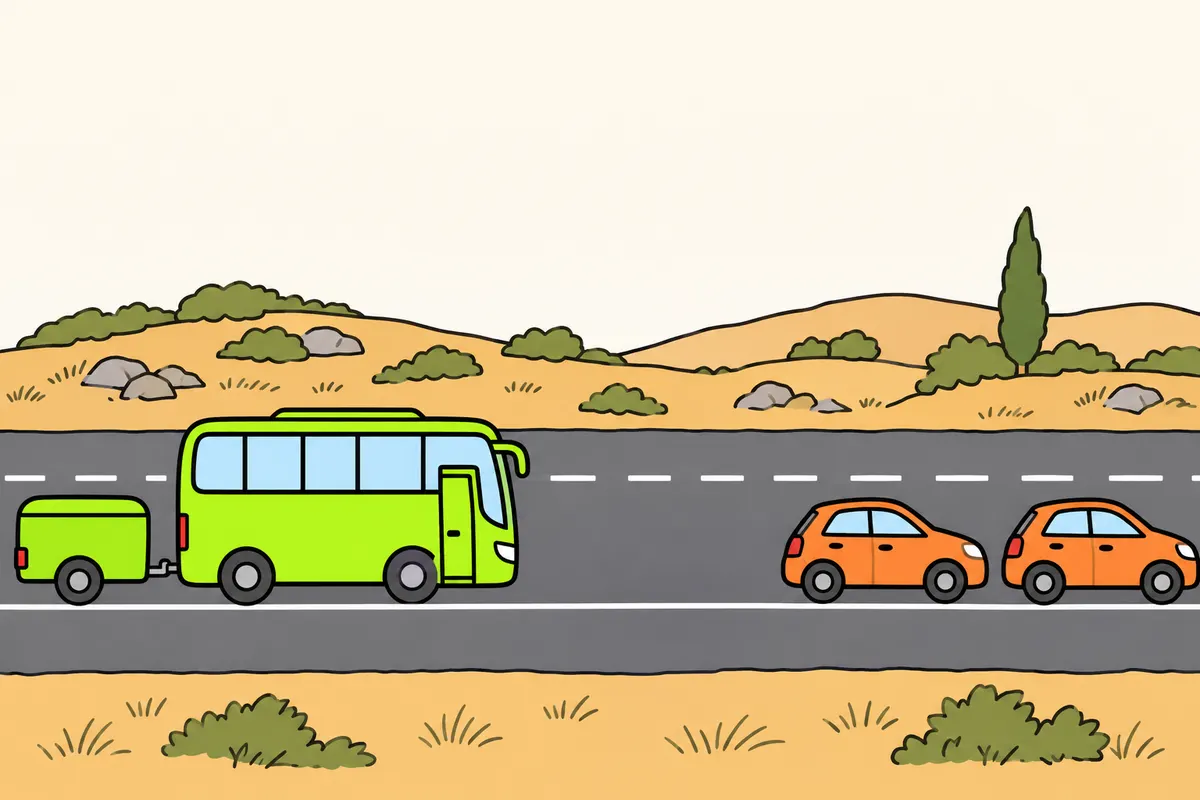
Approach queues slowly and smoothly, keeping room to react.
| Lanes per direction on motorways and dual carriageways | Emergency corridor: walking-pace or stopped queues, when priority vehicles approach |
|---|---|
| Two | Between both lanes: move left from the left lane; right from the right lane. |
| Three or more | Between the leftmost lane and its neighbour: move left from the leftmost; right from all others. |
Remember
- Check tunnel distances in “Speed and distances for the combination”.
- In towns, keep at least 5 m behind bicycles in your lane.
- If you cannot overtake safely, match the cyclist’s speed without pressuring them.
- Check behind without neglecting the road ahead.
- Avoid stopping very close to the vehicle ahead.
- When moving again, avoid immediately closing the whole gap.
Exam trap: Wrong: Accelerate to close the gap when moving again. Right: Keep room to react and manoeuvre.
Read the full explanation
- Before entering a tunnel, plan your speed so that you can maintain the gap without abrupt changes of pace; the distances are covered in “Speed and distances for the combination”.
- When approaching a traffic queue, slow down progressively and keep space to react. Also check behind to identify approaching road users, without neglecting the road ahead. Stopping too close to the vehicle in front reduces your room to manoeuvre; when moving off again, avoid accelerating to close the entire gap that has opened up immediately.
- On urban roads, you must stay at least 5 m behind a bicycle ahead of you in the same lane. If you cannot overtake under the required conditions, match the cyclist's pace without putting pressure on them; the front of the bus and your high driving position can make it harder to judge how close you are getting. [RGC, art. 153.4](https://www.boe.es/buscar/act.php?id=BOE-A-2003-23514#a1-6).
- On motorways and autovías (dual carriageways), if a traffic queue makes you travel at walking pace or stop, you must move to the side to leave an emergency corridor when priority vehicles approach. With two lanes in each direction, the corridor is between the two lanes; with three or more, it is between the leftmost lane and the lane next to it. If you are in the leftmost lane, move to the left; in any other lane, move to the right. Move the whole combination progressively and check that the trailer leaves the corridor clear. [RGC, art. 32.1](https://www.boe.es/buscar/act.php?id=BOE-A-2003-23514#a32).
7Crosswinds and changes in exposure
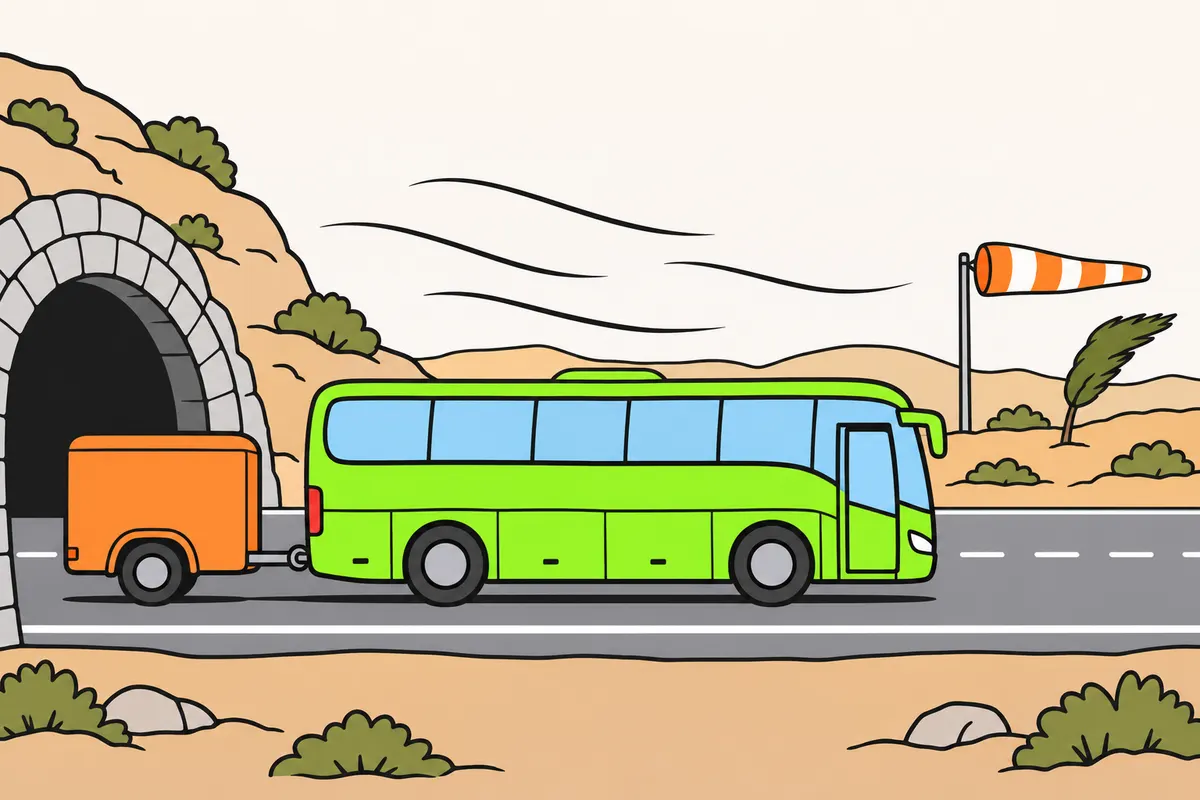
In crosswinds, slow down early and keep room for gentle steering corrections.
Remember
- Hold your steering wheel firmly and avoid sudden steering.
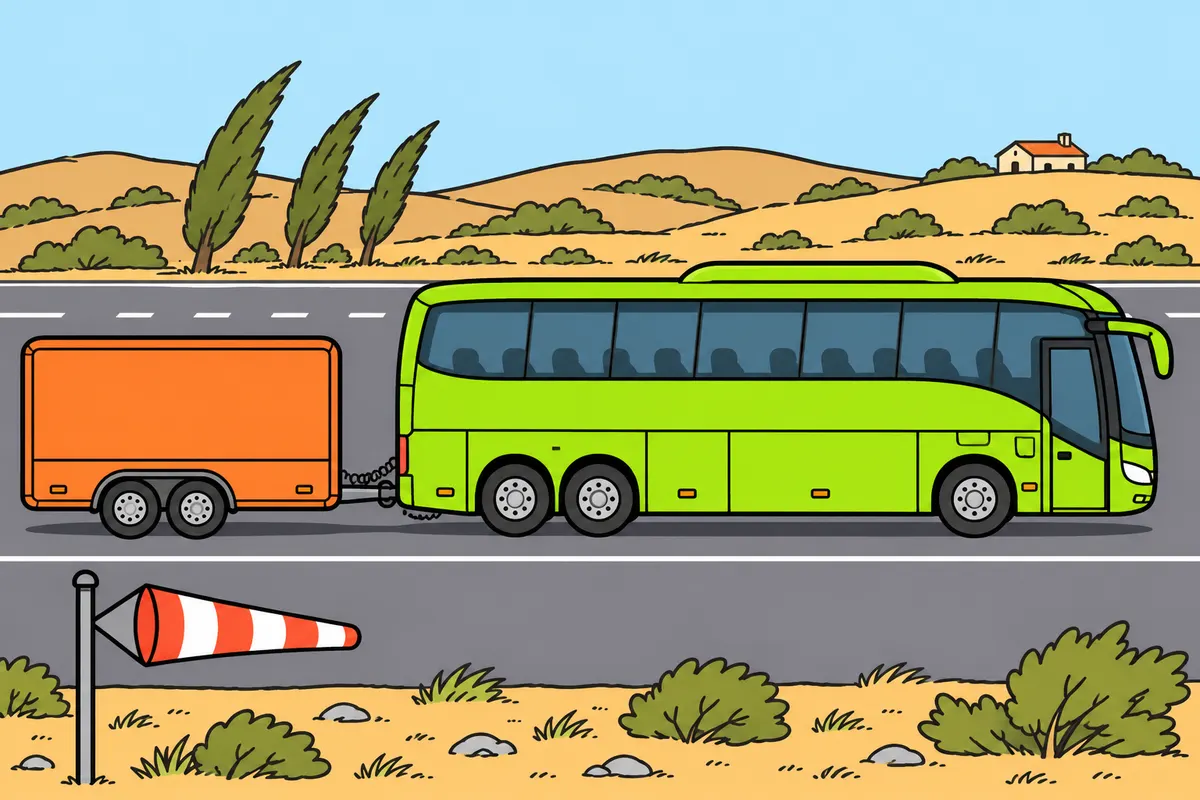
- Expect gusts when leaving tunnels or sheltered areas, and crossing viaducts.
- Expect changes in wind when passing large vehicles.
- Keep space beside you to maintain your course.
- If you cannot control the combination, stop safely somewhere permitted and sheltered.
- In strong winds, use the right-hand lane and do not overtake or pass.
Exam trap: Wrong: Accelerate to escape wind or relax because your trailer is empty. Right: Slow down early; an empty trailer can also be blown off course or overturn.
Read the full explanation
- In crosswinds, reduce your speed in good time, hold the steering wheel firmly and make gentle corrections. A long, tall combination presents a large surface area to the wind; travelling unladen does not eliminate the risk of being blown off course or overturning. There is no single safe speed for all vehicles and all gusts. [RGC, art. 45](https://www.boe.es/buscar/act.php?id=BOE-A-2003-23514#a45).
- Pay particular attention when leaving a tunnel, crossing a viaduct or leaving an area sheltered by buildings, screens or trees. The wind can strike suddenly. Keep lateral clearance and avoid moving close to the edge or other vehicles before entering that area, because you need space to maintain your course.
- When passing a large oncoming vehicle or overtaking one, the shelter from the wind can change briefly and disappear as you pass it. Anticipate this change without making a sudden precautionary steering movement. Check that you can keep the combination within the space available to it before starting a manoeuvre that leaves you alongside for a long time.
- If conditions prevent you from controlling the combination, find a sheltered place where stopping is permitted and you can stop safely; do not accelerate to get out of the area sooner. In strong winds, the requirement to use the right-hand lane and the overtaking prohibition in point 20.4 also apply. [RGC, art. 45](https://www.boe.es/buscar/act.php?id=BOE-A-2003-23514#a45).
8Body roll, trailer sway and loss of stability
If your trailer sways, avoid sudden reactions and check the cause when safely stopped.
| Situation | What you must recognise |
|---|---|
| Body roll | The body rocks. |
| Trailer sway | The trailer moves from side to side. |
| Jackknifing | The bus and trailer form an excessive angle and you lose control. |
Remember
- Ease off your accelerator gently and keep your steering steady.
- Avoid accelerating, braking sharply or making alternating sharp steering movements.
- Follow your vehicle’s safety instructions.
- Stop somewhere safe and check the cause before continuing.
- Do not continue while safety remains compromised.
Exam trap: Wrong: Trust electronic aids to take bends too fast. Right: Adapt your speed; aids cannot prevent every loss of stability.
Read the full explanation
- Body roll is the rocking movement of the bodywork; trailer sway involves the trailer veering alternately from side to side. You must recognise these as a reduction in your safety margin, rather than a normal reaction you can ignore. Speed, wind, uneven load distribution, play in the coupling or the condition of the tyres and suspension can contribute to them.
- If swaying starts, avoid accelerating, braking sharply or trying to counter it with alternating sudden steering movements. Ease off the accelerator gently, keep the steering steady and follow the safety instructions for your vehicle and its systems. A violent reaction can increase the angle between the vehicles and cause you to lose control of the combination.
- When you can stop safely, check the cause before continuing: the load, its restraints, the tyres and the connection between the vehicles need attention. If you need an inspection or repair, do not resume driving while safety remains compromised.
- Distinguish trailer sway from the combination folding, known as jackknifing: the bus and trailer form an excessive angle and no longer follow a controlled course. You must prevent this with an appropriate speed, sufficient grip and progressive control inputs. Electronic stability and anti-lock systems are aids and do not allow you to enter a bend too fast.
9Bends: slow down before entering
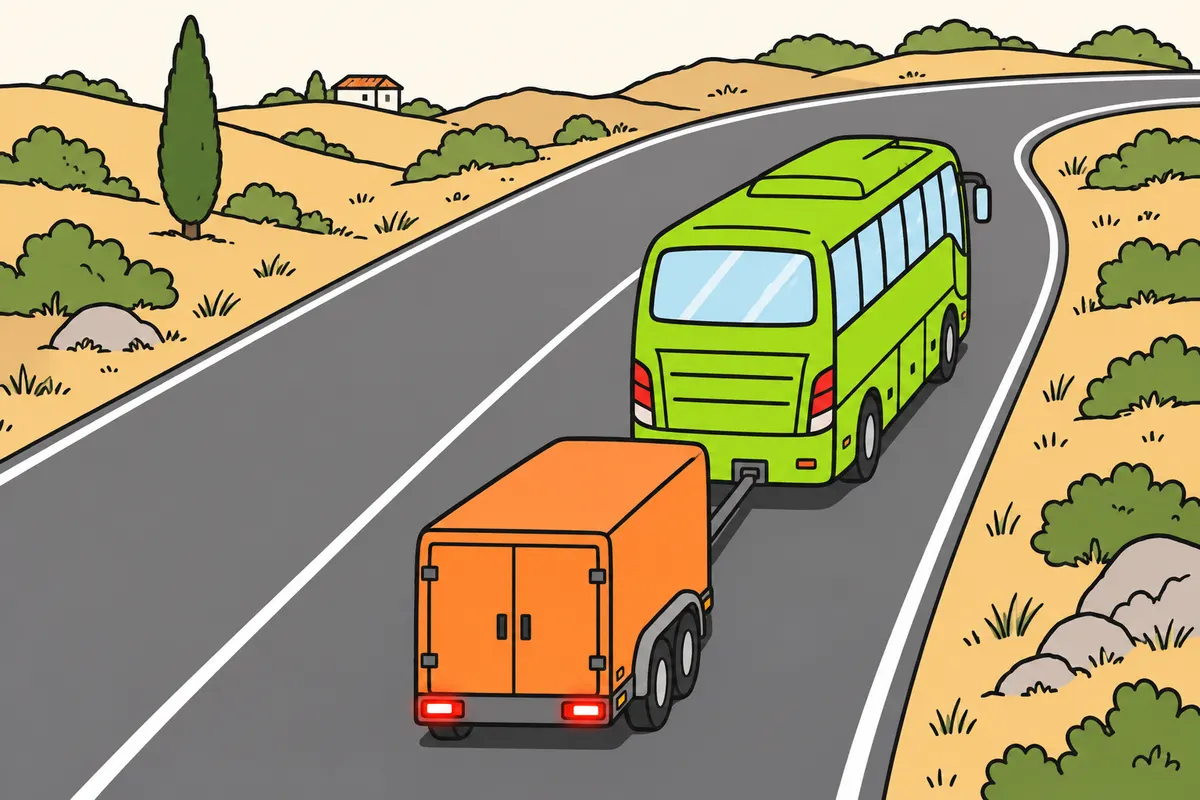
Slow down before bends and follow a smooth path within your available space.
Remember
- Assess the bend, visibility and road surface.
- Adjust your speed and gear before entering.
- Avoid sudden braking or abrupt gear changes within the bend.
- Watch the path of your trailer and the bodywork.
- Accelerate gradually when you can straighten up and have checked the whole combination.
Exam trap: Wrong: Cut the bend because nobody is coming. Right: Keep out of the opposing lane; wait or find another solution if you cannot pass safely.
Read the full explanation
- Assess the bend's radius, visibility, gradient, banking and road surface condition before you reach it. Adjust your speed and gear on the approach so that you can negotiate it without abrupt braking or steering inputs. The same bend can require a different speed with a different load, rain or wind.
- Enter at a speed that allows you to keep the combination stable and within the space available to it. A high load increases susceptibility to overturning: the vehicle does not have to skid to lose stability.
- Maintain a smooth course and avoid sudden braking or abrupt gear changes within the bend. If you need to adjust your speed, do so as progressively as safety allows. On the exit, accelerate gradually when you can straighten the steering and have checked the path of the whole combination.
- Do not move into the opposite direction of travel to improve your line or assume that an absence of traffic allows you to cut the bend. You must anticipate both the trailer's inward tracking and the space occupied by the bodywork. If you cannot pass safely and comply with the traffic conditions, wait or find another solution. [RGC, art. 45](https://www.boe.es/buscar/act.php?id=BOE-A-2003-23514#a45).
10Inward tracking and outward swing
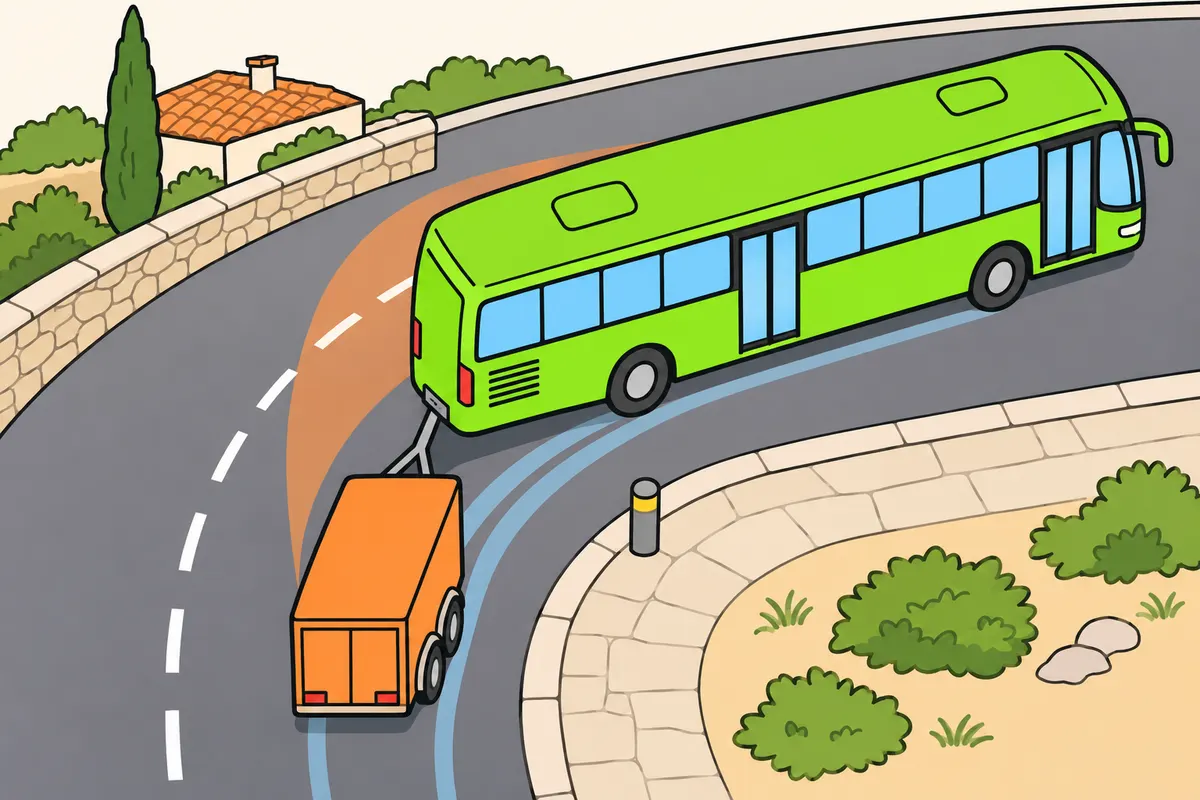
When turning, watch the space inside your wheels and outside your bodywork.
| Movement when turning | What you must watch |
|---|---|
| Inward tracking | Your trailer wheels can follow a path further inside. |
| Outward swing | The rear bodywork can swing outwards. |
Remember
- Watch both sides throughout the turn.
- Learn reference points for your type of trailer.
- Check clearances at low speed.
- Before swinging wide, look, signal and wait for a safe gap.
- Stop if you lose your safety clearance.
Exam trap: Wrong: Swing wide and expect another lane to give way. Right: Your size gives you no priority over anyone using that lane.
Read the full explanation
- As you move forwards through a tight turn at low speed, the trailer can follow a path further towards the inside of the turn than the bus's wheels. You must judge where its axles pass in relation to kerbs, traffic islands, posts and nearby road users; getting the front through is not enough.
- The bodywork occupies more than just the path of the tyres. The rear overhang can swing outwards from the turn and approach a vehicle, wall or pedestrian on the other side. Watch both sides: while the wheels track inwards, another part of the combination can occupy space outside that path.
- The behaviour depends on wheelbases, overhangs, articulation points and any steering axles. Learn the reference points for your configuration and check the space at low speed. A bus towing a trailer with a pivoting front axle does not respond exactly like one towing a trailer with fixed centre axles; do not use a single steering reference for every configuration.
- If your dimensions require you to swing wide for a turn, you must take every precaution to avoid danger. This does not give you priority over anyone occupying another lane. Observe, signal the necessary lateral movement, wait for a gap and monitor the swing throughout the manoeuvre; if you lose your clearance, stop. [RGC, art. 76](https://www.boe.es/buscar/act.php?id=BOE-A-2003-23514#a76).
11Urban turns and narrow passages
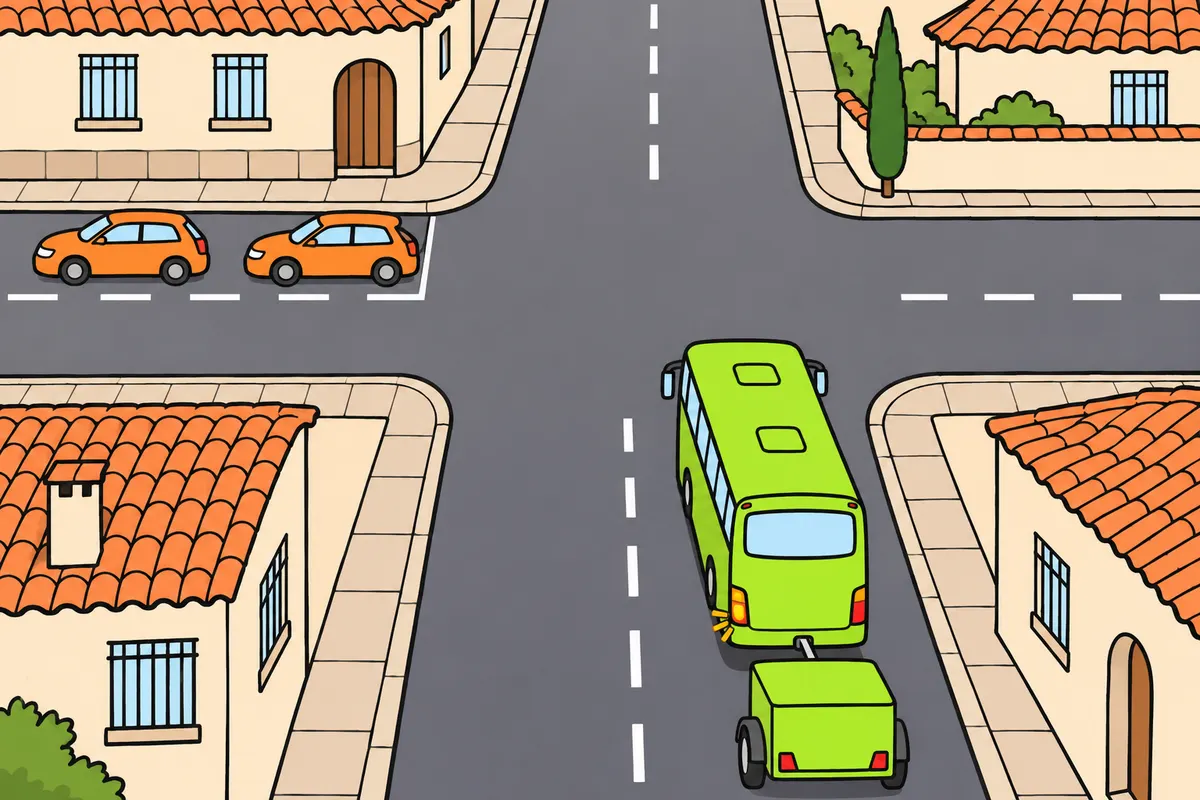
Before turning or entering narrow passages, check all the space your combination needs.
| Turn | What you must check |
|---|---|
| Right | Nobody is beside your right side or where the wheels will track. |
| Left | You can clear the junction with the whole combination. |
Remember
- Signal every movement and make it only when safe.
- Check narrow passages for width and height, including mirrors and load.
- Slow down before entering and watch both sides.
- With poor visibility, proceed only when you can check that passage is safe.
Exam trap: Wrong: Enter a junction because you have priority, although the exit is blocked. Right: Stay out if you expect to stop inside and obstruct crossing traffic.
Read the full explanation
- Before turning right, check that no cyclist, motorcyclist or pedestrian is alongside your right-hand side or in the space into which the wheels track. If you need to swing wide, avoid making the movement look like a definite turn in the opposite direction. You must signal each lateral movement and make it only when it is safe. [RGC, art. 74](https://www.boe.es/buscar/act.php?id=BOE-A-2003-23514#a74).
- When turning left, assess whether the combination's length allows you to complete the crossing and clear it. Do not enter a junction if you can foresee being stopped inside it and obstructing crossing traffic, even if you have priority. A queue on the other side can leave the trailer blocking the junction long after the bus has passed through. [RGC, art. 59](https://www.boe.es/buscar/act.php?id=BOE-A-2003-23514#a59).
- Before a narrow passage, check the available width and height along the entire route, taking account of mirrors, the load and any projecting parts. Slow down before entering and keep reference points on both sides.
- At junctions with restricted visibility, slow down and move forwards only when you can check that it is safe to proceed. Avoid using the vehicle's size to force your way through. Signs and priority rules determine who goes first; your driving technique must prevent the need to manoeuvre from becoming a risk to others. [RGC, art. 46](https://www.boe.es/buscar/act.php?id=BOE-A-2003-23514#a46).
12Roundabouts with a long combination
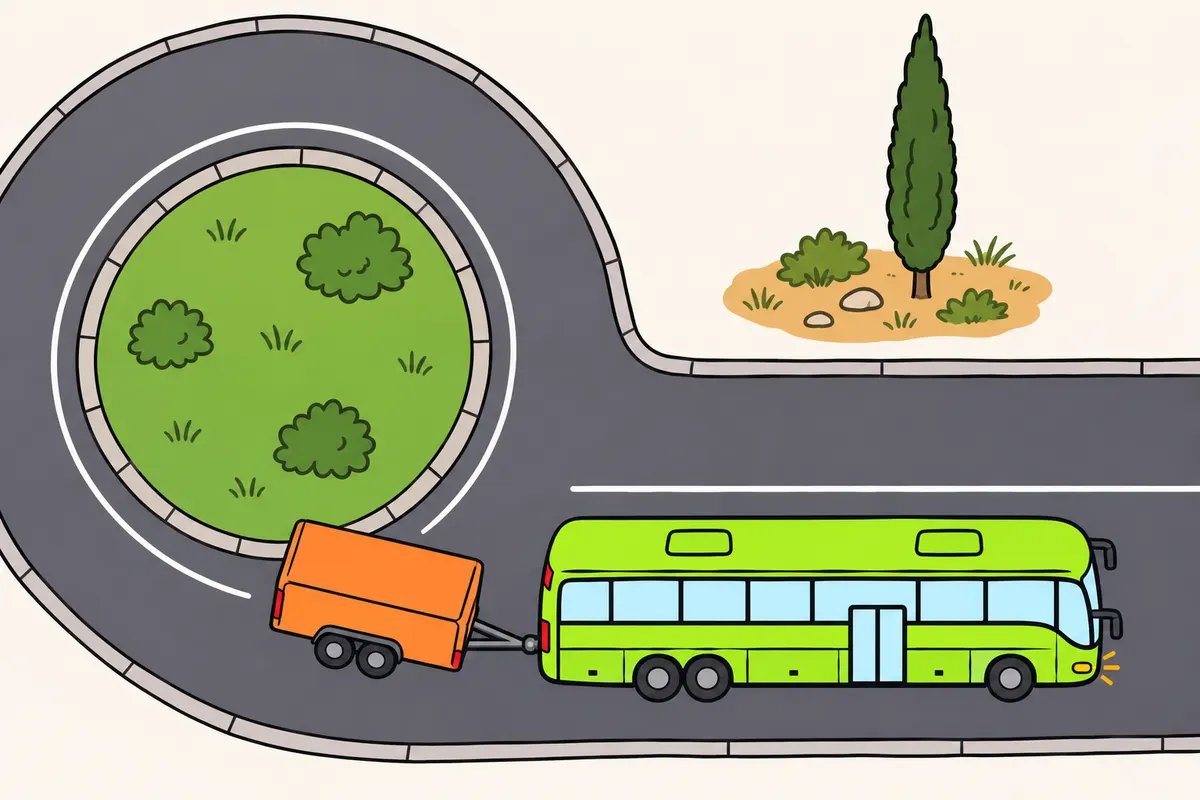
At roundabouts, allow space for your whole combination and respect vehicles in other lanes.
Remember
- Judge the gap using your acceleration and total length.
- Watch the central island and the space outside your bodywork.
- Before entering another lane, check, respect its users’ priority and signal.
- Signal right to leave.
- Keep your speed low until your trailer has also completed the exit.
Exam trap: Wrong: Enter another lane suddenly because you need space. Right: Check it is clear, respect anyone using it and signal your movement.
Read the full explanation
- Judge the gap you need to enter by the loaded bus's acceleration and the full length of the combination; a gap sufficient for a car can force you to brake while the trailer is still entering.
- Anticipate the trailer's inward tracking near the central island and its outward swing. On a small roundabout, you may need more than one lane because of the combination's dimensions. Before occupying another lane, you must check that it is clear, respect the priority of anyone travelling in it and signal the lateral movement; you must not swing out abruptly into another vehicle's path. See «Manoeuvres with a bus and trailer» for priority, lane choice and leaving roundabouts. [RGC, art. 76](https://www.boe.es/buscar/act.php?id=BOE-A-2003-23514#a76).
- Signal right to leave and watch the inside of the turn, the pavement and nearby crossings. Do not consider the manoeuvre complete when the bus exits: you must check that the trailer leaves the roundabout without mounting the kerb or striking a road user. Keep your speed low until the whole combination is aligned with its onward path.
13Joining traffic and changing lanes
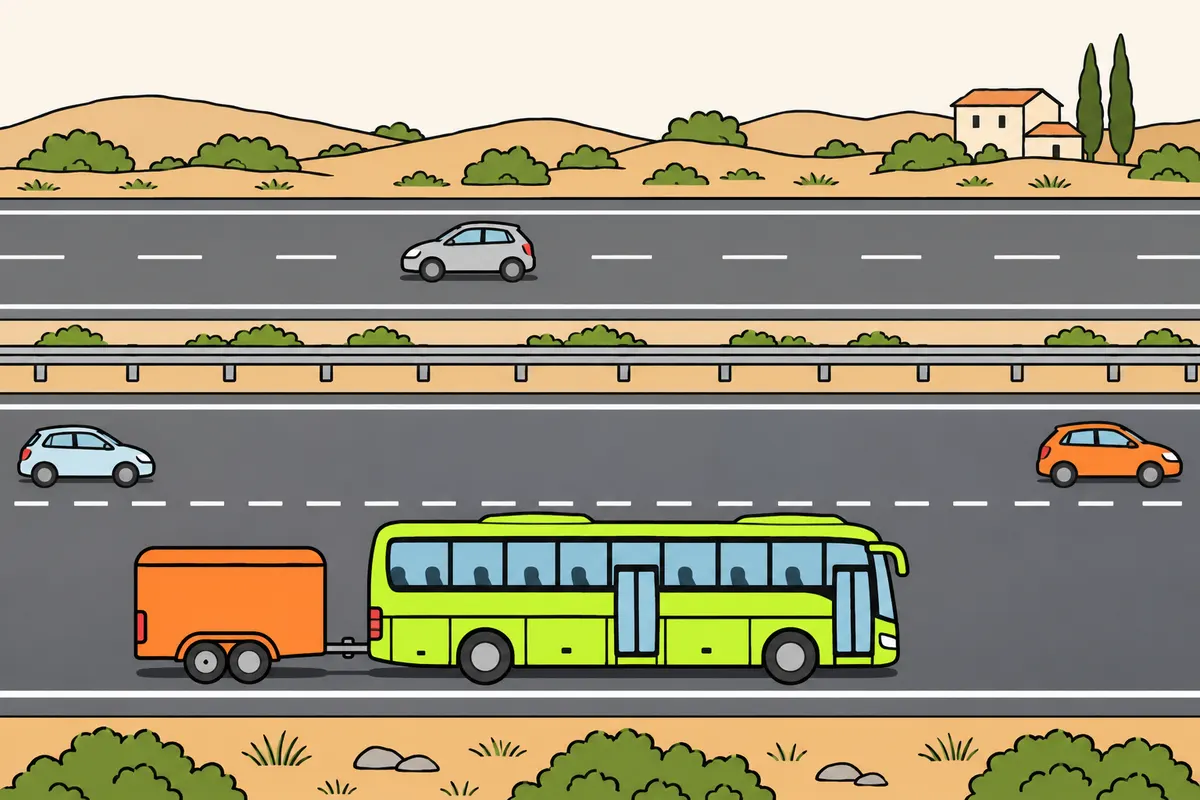
Choose a gap large enough for your bus and trailer, and move gradually.
| Combinations over 7 m, outside built-up areas, with three or more lanes per direction; except in adverse weather and signed restrictions | Lane use |
|---|---|
| Right-hand lane | Normally use this lane. |
| Lane immediately beside it | You may use it when advisable, without obstructing anyone following you. |
Remember
- Judge the gap using your acceleration when loaded and your total length.
- Move gradually so your trailer does not suddenly enter someone else’s path.
- Check joining and lane rules in “Manoeuvres with a bus and trailer”.
Exam trap: Wrong: Judge the gap for your bus alone. Right: Allow space right to the end of your trailer.
Read the full explanation
- Prepare to join traffic or change lanes by checking the gap as far back as where the rear end of the trailer will be; you study the rules for both manoeuvres in «Manoeuvres with a bus and trailer».
- Assess the gap according to the loaded bus's acceleration and the length to the end of the trailer. Start moving across with room for both units and move gradually to prevent the trailer from suddenly moving into another road user's path.
- Subject to the adverse weather requirements in point 20.4 and any signed restrictions, outside built-up areas, on roads with three or more lanes in each direction, if your combination exceeds 7 m in length, you must normally use the right-hand lane and may use the lane immediately next to it when circumstances warrant it, without obstructing another vehicle following you. Plan your road position in advance to avoid repeated lane changes with a long combination. [RGC, art. 31.2](https://www.boe.es/buscar/act.php?id=BOE-A-2003-23514#a31).
14Overtaking: judging time and space
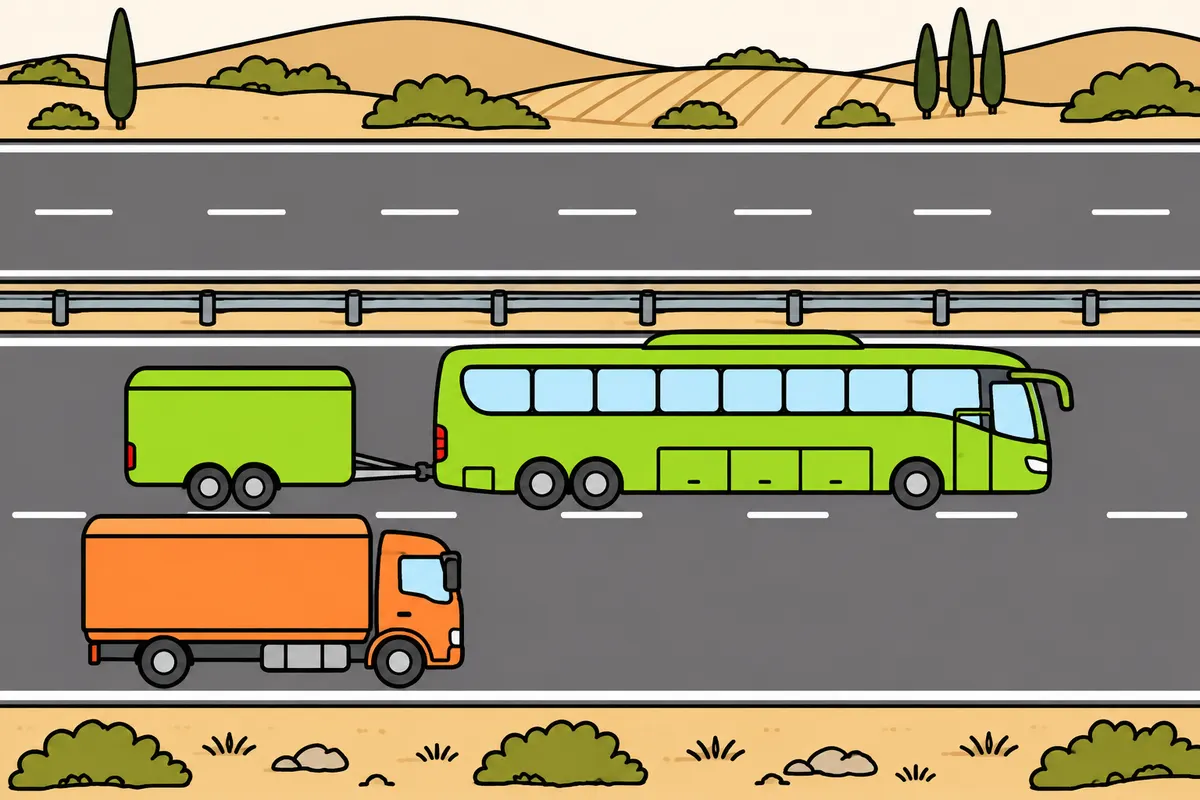
Overtake only when you can complete the manoeuvre with enough space and within your speed limit.
Remember
- Assess visibility, gradient, load and the difference in speed.
- Allow space to pull out, pass and return with the whole combination.
- At almost equal speeds, you take much longer to overtake.
- Before returning, check your mirrors: your whole trailer must have passed.
- Return smoothly without forcing the other driver to change speed or course.
Exam trap: Wrong: Return when only your bus has passed. Right: Wait until your whole trailer has passed and leave clearance for the overtaken vehicle.
Read the full explanation
- Before leaving your lane, allow room for the trailer to return to it too; you study overtaking requirements and prohibitions in «Manoeuvres with a bus and trailer».
- Assess visibility, the length of both vehicles, the difference in speed, the gradient and your acceleration capability with your load. You must have room to pull out, pass and return with the whole combination. If the difference in speed is small, the manoeuvre takes longer; do not start it relying on another road user to let you finish. [RGC, art. 84](https://www.boe.es/buscar/act.php?id=BOE-A-2003-23514#a84).
- To return to your lane, wait until the whole trailer has passed the vehicle you are overtaking and leave it room. Check this in your mirrors and return gradually, without forcing its driver to change course or speed. The fact that the bus has passed does not mean that the rear end has passed; any visual reference you use must be valid for your combination. [RGC, art. 85](https://www.boe.es/buscar/act.php?id=BOE-A-2003-23514#a85).
- At almost equal speeds, such as those of two lorries limited to around 90 km/h, overtaking can take a very long time: this is known as «elephant overtaking». With your bus and trailer, you must only start if the difference in speed allows you to finish quickly, with enough room and without exceeding your speed limit. You find the rules on lorry speed limiters in article 4; you study your speed limits in «Speed and distances for the combination». [RD 1417/2005, art. 4](https://www.boe.es/buscar/act.php?id=BOE-A-2005-19990#a4). [RGC, art. 85](https://www.boe.es/buscar/act.php?id=BOE-A-2003-23514#a85).
15Overtaking vulnerable road users
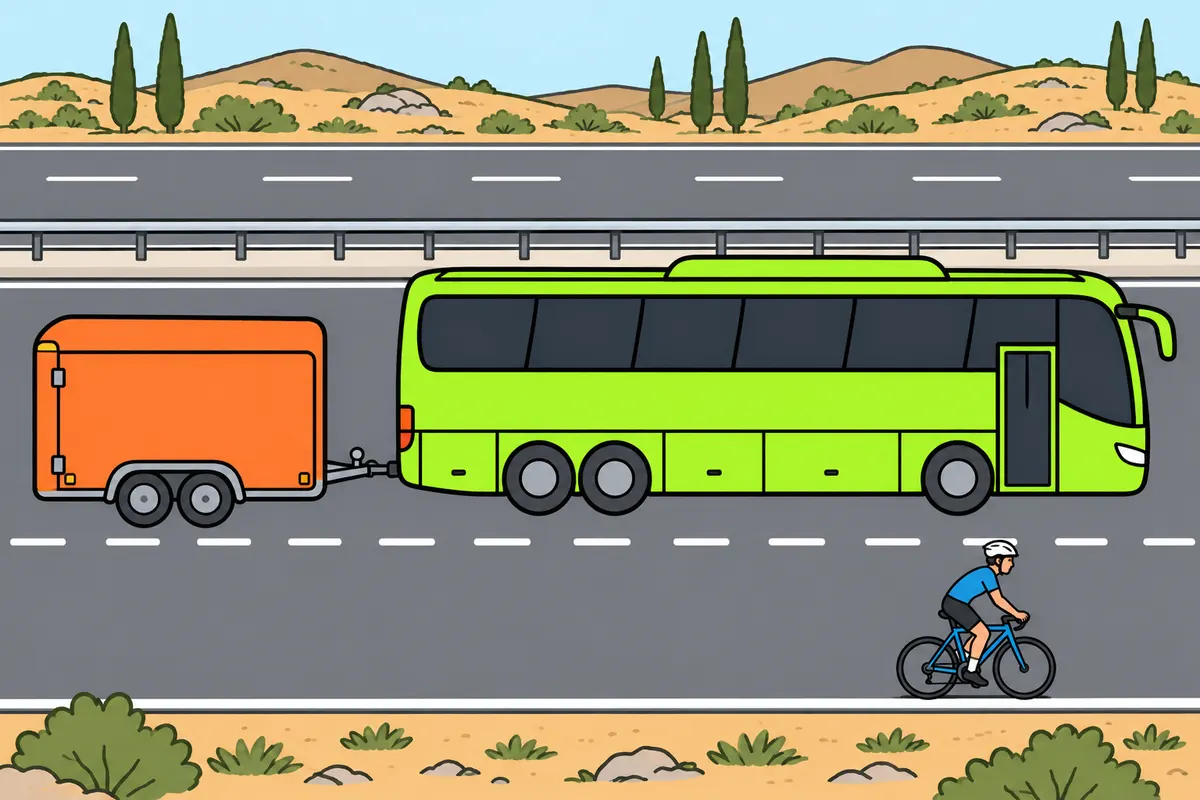
When overtaking, keep lateral clearance until your whole trailer has passed.
Remember
- Remember that displaced air can destabilise a cyclist.
- Do not cut them off when returning to your lane.
- Check overtaking conditions in “Manoeuvres with a bus and trailer”.
Exam trap: Wrong: Reduce lateral clearance once your bus has passed. Right: Maintain it until the end of your trailer has passed.
Read the full explanation
- Adjust the bus's path so that you maintain the overtaking clearance as the trailer's axles and body pass too; you study the statutory clearances and conditions in «Manoeuvres with a bus and trailer».
- Maintain the lateral clearance until the end of the trailer has passed: the displaced air can destabilise a cyclist. Avoid cutting them off as you return to your lane. [RGC, art. 85](https://www.boe.es/buscar/act.php?id=BOE-A-2003-23514#a85).
16How you affect others’ visibility and safety
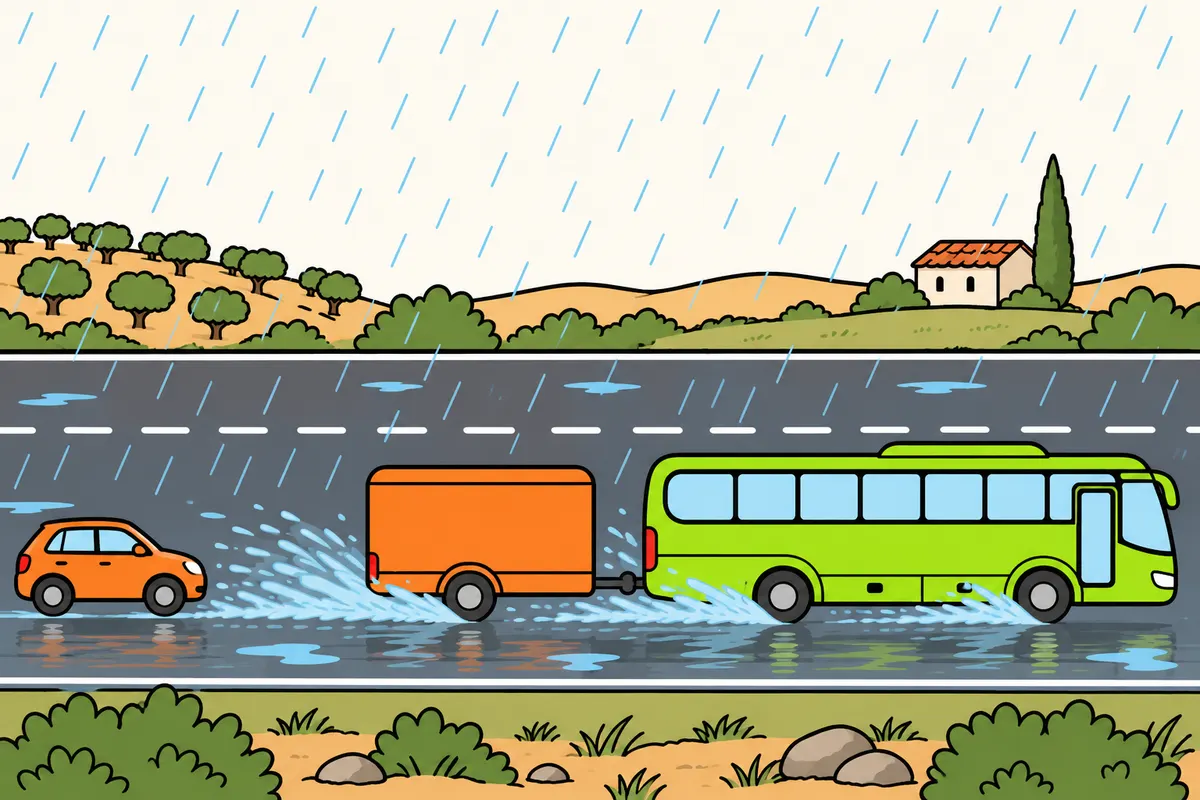
Remember that your combination can block other drivers’ views.
Remember
- In rain, slow down gently: your wheels can spray water over others.
- Avoid sudden sideways movements when others pass alongside.
- Near crossings, expect your vehicle to hide pedestrians from other drivers.
- Do not move while anyone remains in your combination’s path.
- Consider how long you block others’ views when overtaking.
Exam trap: Wrong: Assume R-306 prohibits your bus from overtaking because it tows a trailer. Right: R-306 prohibits lorries over 3,500 kg MMA from overtaking motor vehicles; it does not apply to your bus just because it tows a trailer.
Read the full explanation
- In rain, the wheels of the bus and trailer throw up spray that can momentarily block the view of drivers following or overtaking you. Slow down gently and avoid sudden sideways movements as they pass alongside you. [DGT, heavy vehicles](https://revista.dgt.es/es/educacion-formacion/conducir-mejor/2021/0420-Vehiculos-pesados-cerca.shtml). [RGC, art. 46.1.g](https://www.boe.es/buscar/act.php?id=BOE-A-2003-23514#a46).
- Your bus and trailer can hide a pedestrian crossing in front of you from drivers in other lanes. As you approach a crossing, anticipate this obstruction to their view and avoid moving forward while anyone remains in the combination's path. You must take extra care around vulnerable road users. [RGC, art. 17](https://www.boe.es/buscar/act.php?id=BOE-A-2003-23514#a17).
- When planning to overtake, also consider how you obstruct other road users' view while you remain alongside another vehicle. R-306, «No overtaking by lorries», prohibits lorries with an MMA (maximum authorised mass) over 3,500 kg from overtaking any motor vehicle, including cars and motorcycles, even without entering the lanes for oncoming traffic. This sign does not apply to your bus just because it is towing a trailer. You study the signs that apply to your combination in «Signs and priority with a bus and trailer». [RD 465/2025, annex I, catalogue, R-306](https://www.boe.es/buscar/doc.php?id=BOE-A-2025-12199).
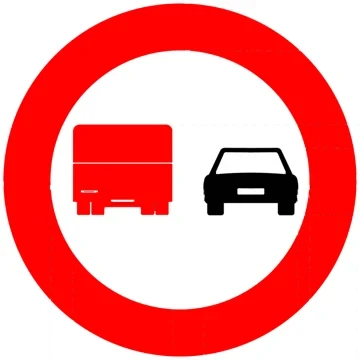 R-306
17When others overtake you
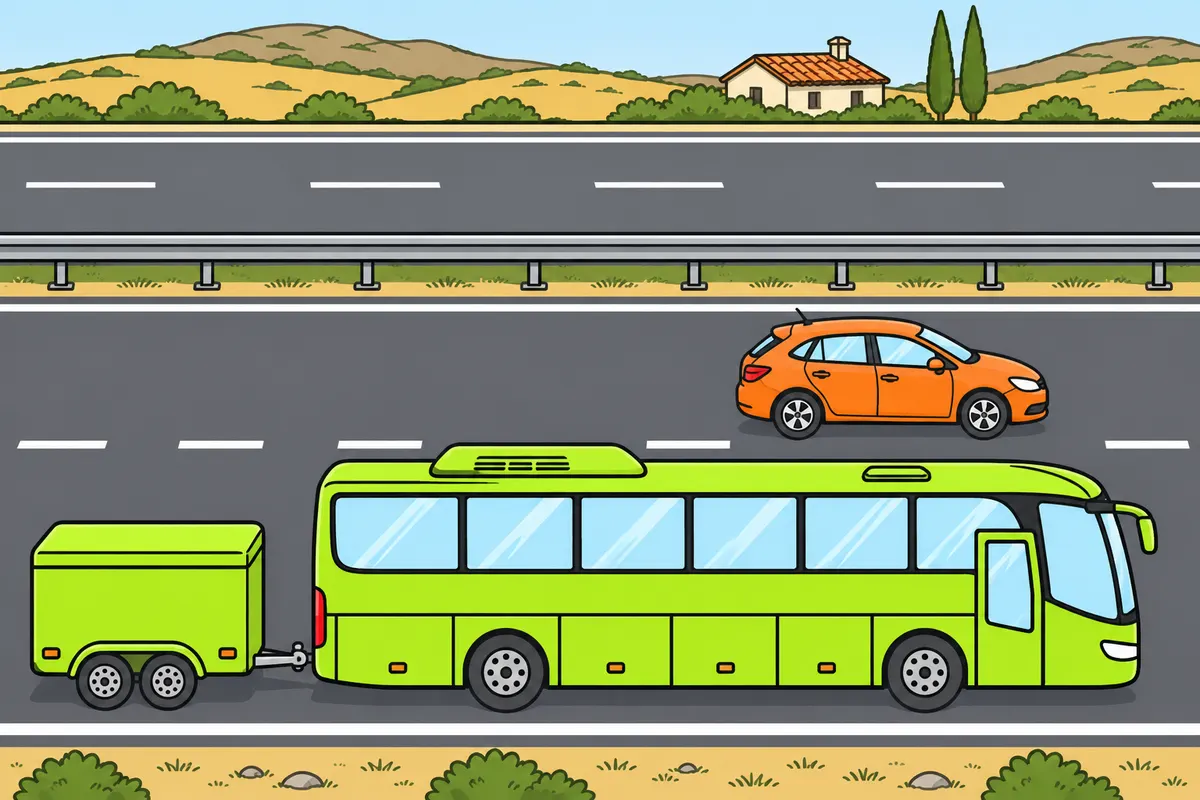
When others overtake, keep a steady course and help them pass when required.
Remember
- Watch your trailer’s side and avoid sudden corrections.
- Normally, use the carriageway; the hard shoulder is reserved for emergencies.
- Before permitted shoulder use, check its strength, width, continuity and other users.
- If the shoulder is unusable, help others pass by slowing down.
Exam trap: Wrong: Always use the hard shoulder to help others overtake. Right: You must slow down or move onto a usable hard shoulder when oncoming traffic or carriageway conditions prevent easy, safe overtaking.
Read the full explanation
- While another vehicle passes you, avoid adjustments to your course that bring the trailer closer to it; you study your duties when being overtaken in «Manoeuvres with a bus and trailer».
- With your heavy combination, you must drive on the carriageway; article 31.1 excludes use of the arcén (hard shoulder) except in an emergency. Article 86.3 sets out the specific circumstances for helping others pass: you must slow down or move onto a usable hard shoulder when oncoming traffic or the characteristics of the carriageway prevent others from overtaking you easily and safely. [RGC, art. 31](https://www.boe.es/buscar/act.php?id=BOE-A-2003-23514#a31). [RGC, art. 86](https://www.boe.es/buscar/act.php?id=BOE-A-2003-23514#a86).
- Before moving aside in these circumstances, check the hard shoulder's load-bearing capacity, width and continuity for both units, as well as the presence of cyclists and other road users. If it is not usable, help others pass by slowing down in accordance with article 86.3. [RGC, art. 86](https://www.boe.es/buscar/act.php?id=BOE-A-2003-23514#a86).
18Descents: preparing to control speed
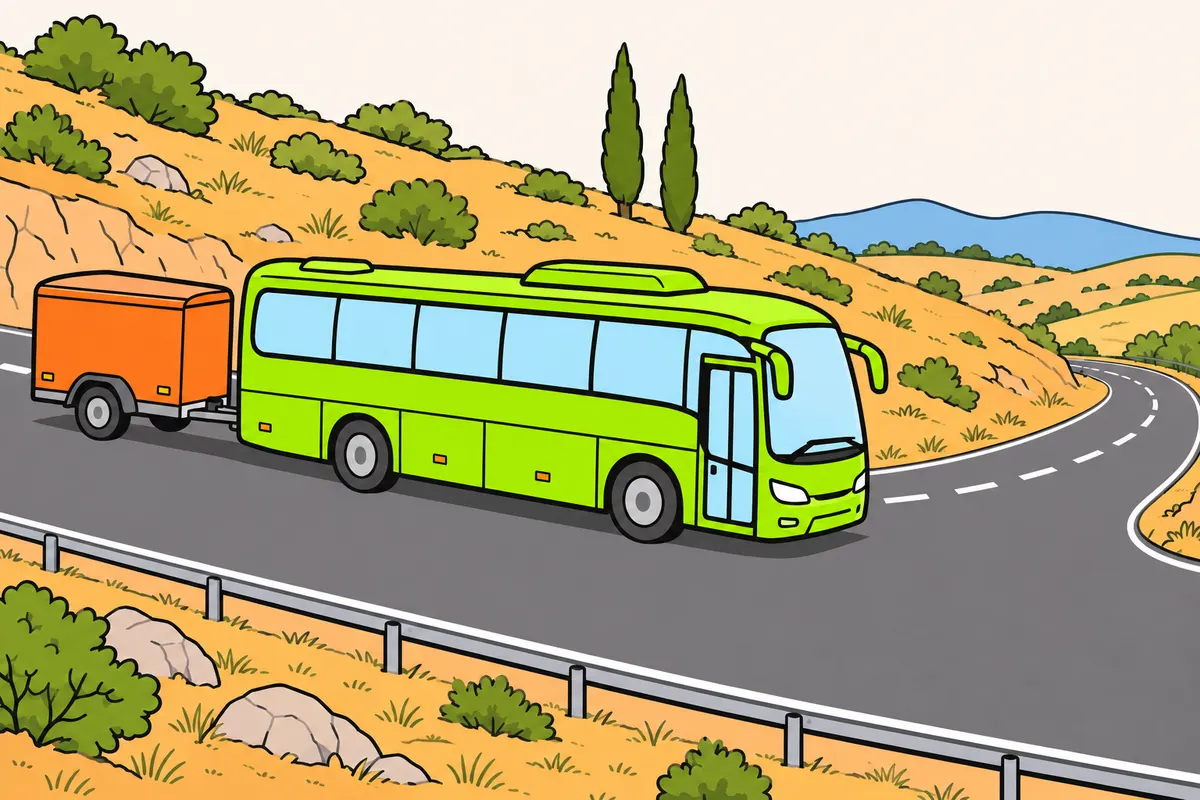
Prepare for each downhill bend so you enter with your combination stable.
Remember
- Set your speed and gear before starting the descent.
- Check descent preparation in “Trailer and combination braking”.
- Avoid combining a tight turn with sudden retarding action.
- Remember that your trailer can push your bus sideways.
Exam trap: Wrong: Apply sudden retarding action in a tight turn. Right: Prepare early; the trailer’s push can increase the angle between your bus and trailer.
Read the full explanation
- Set your speed and select your gear before starting the descent so that you can maintain a steady speed with the whole combination; you study gear selection and preventing overheating in «Trailer and combination braking».
- Anticipate each bend on the descent so that you reach it with the combination stable. Avoid combining abrupt retardation with a tight turn: the trailer can push the bus sideways and increase the angle between the two units.
19Retarders: progressive use and limits
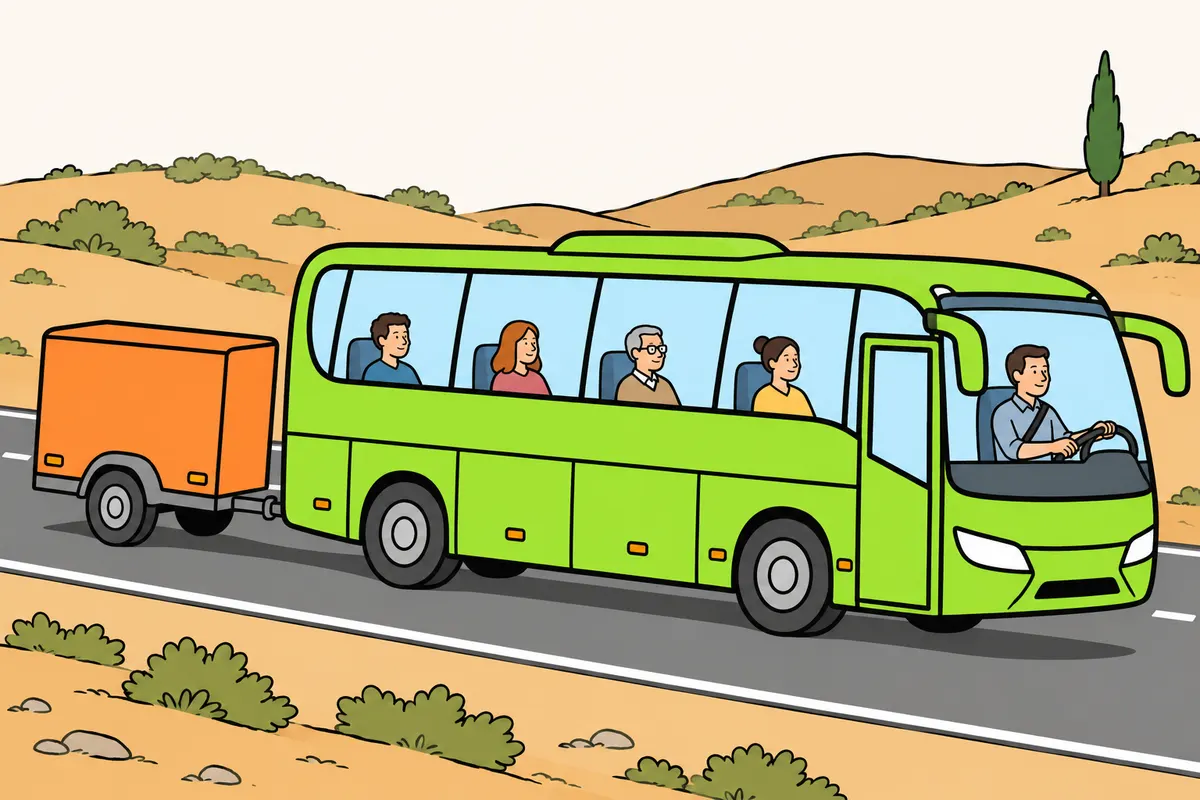
Use speed reduction systems gradually, following available grip and the manufacturer’s instructions.
Remember
- Check retarders in “Trailer and combination braking”.
- Apply engine braking and the retarder in stages.
- Check the response before increasing it.
- Adjust their use to the available grip.
- Use particular care to keep your passengers comfortable.
Exam trap: Wrong: Always apply the same retarding action. Right: Adjust your controls to grip and the manufacturer’s instructions.
Read the full explanation
- Apply engine braking and the retarder in stages and observe how the combination responds before increasing its intensity; you study the operation and limits of engine braking and retarders in «Trailer and combination braking».
- Adjust your use of the controls to suit the available grip and the manufacturer's instructions, taking particular care to keep movements smooth for passengers. In D+E, you are assessed on your use of the available braking and speed reduction systems. [RGCond, Annex V.B.4](https://www.boe.es/buscar/act.php?id=BOE-A-2009-9481).
20Rain, skidding and poor visibility
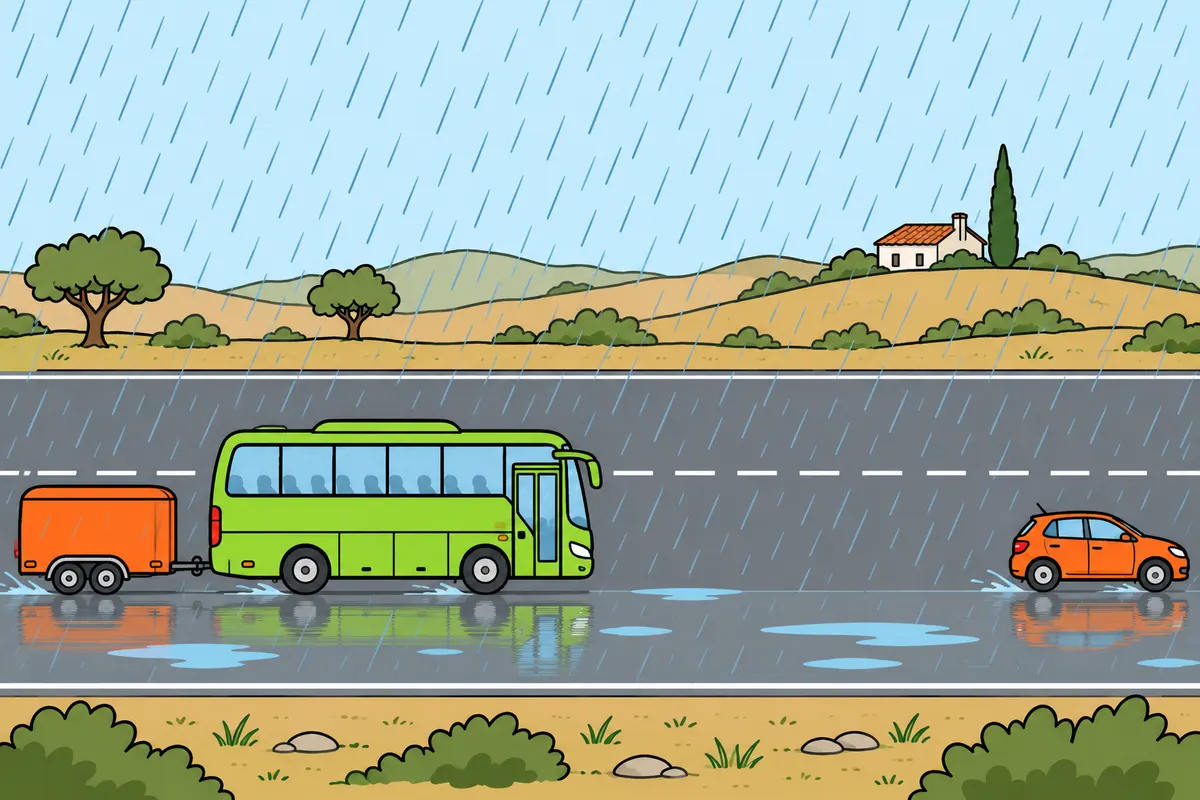
On slippery roads or with poor visibility, slow down early and increase your separation.
Remember
- Avoid sudden acceleration, braking and steering.
- Watch for wet markings, metal covers and standing water.
- Slow down on straight sections and leave a safety margin for bends.
- Adapt your speed to how far you can see; use the required lights.
- In snow, ice, fog that reduces visibility or strong wind:
- Use the right-hand lane and do not overtake or pass.
Exam trap: Wrong: Keep your dry-road pace because you have electronic aids. Right: Slow down; aids cannot compensate for faulty tyres or make every braking or steering demand safe.
Read the full explanation
- In rain or on a slippery road surface, reduce your speed and increase your following distance before you need to brake. Avoid sudden acceleration, braking and steering movements, especially on wet road markings, metal covers or areas of standing water. [RGC, art. 46](https://www.boe.es/buscar/act.php?id=BOE-A-2003-23514#a46).
- You use grip both to brake and to change direction. If you demand too much of both at once, you can lose control; slow down on the straight and enter bends with a safety margin. Driver assistance systems do not simply allow you to maintain your dry-road pace or compensate for unsuitable or defective tyres.
- In fog, heavy rain, dust or smoke, adjust your speed to the distance you can see and use the required lights. Keep checking your mirrors, access points and road markings. [RGC, art. 45](https://www.boe.es/buscar/act.php?id=BOE-A-2003-23514#a45).
- In snow, ice, fog that reduces visibility or strong winds, you must drive your bus and trailer in the right-hand lane and refrain from overtaking or passing: the DGT's annual resolution sets out this obligation for buses, articulated buses and vehicle combinations. In adverse weather, the DGT can also restrict the movement of certain types of vehicles. [DGT Resolution of 14 January 2026, section D.1.1](https://www.boe.es/buscar/act.php?id=BOE-A-2026-1255).
21Reversing: check and protect
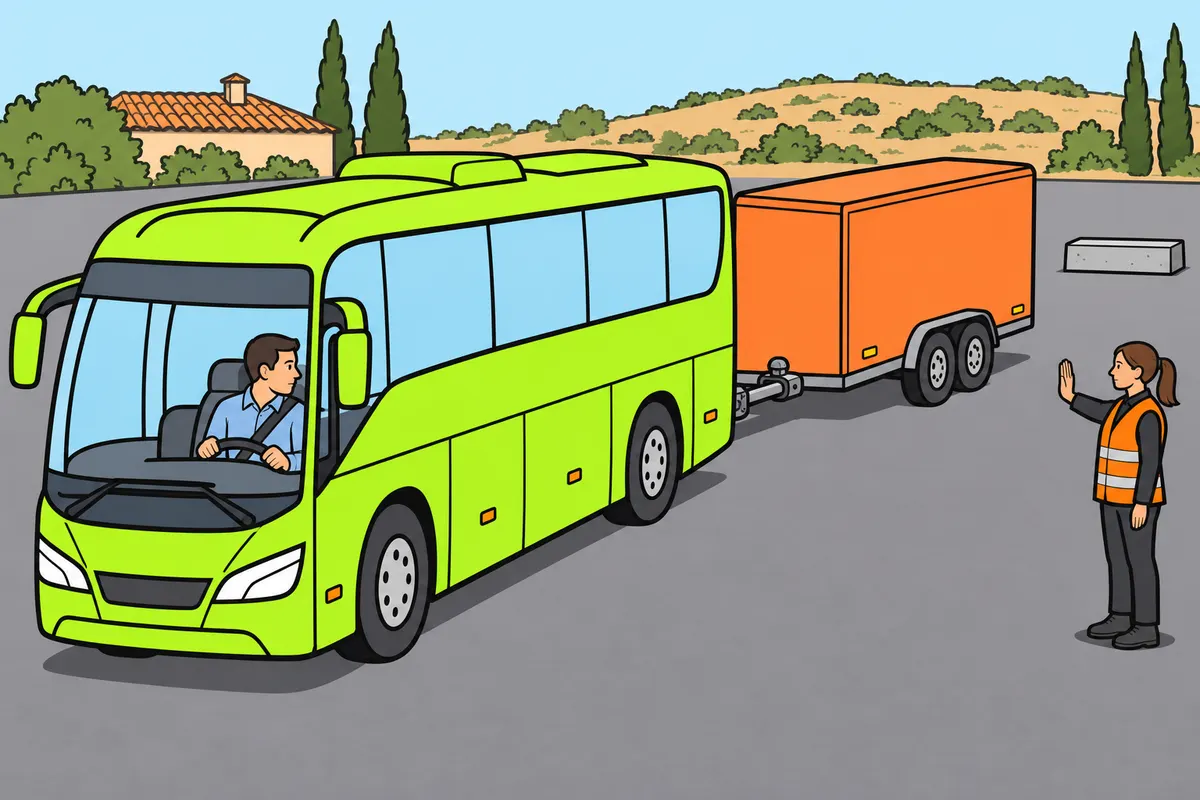
Before reversing, check your destination and protect anyone guiding you.
Remember
- Check when you may reverse in “Manoeuvres with a bus and trailer”.
- Check low obstacles and all the space both units will occupy.
- Agree clear signals with anyone guiding you.
- Keep your guide visible, outside your path and places where they could be trapped.
- Stop if you lose sight of your guide.
Exam trap: Wrong: Keep reversing after losing sight of your guide. Right: Stop when you lose visual contact.
Read the full explanation
- Before reversing, choose a starting position that minimises the angle between the bus and trailer and allows you to observe both sides; you study the circumstances in which reversing is permitted and the permitted distance in «Manoeuvres with a bus and trailer».
- Check your destination and the area swept by both vehicles, including low obstacles that do not appear in the mirrors. If someone guides you, agree on clear signals and a visible position outside the vehicle path and trapping zones; stop if you lose visual contact. [RGC, art. 81](https://www.boe.es/buscar/act.php?id=BOE-A-2003-23514#a81).
22Reversing in a straight line
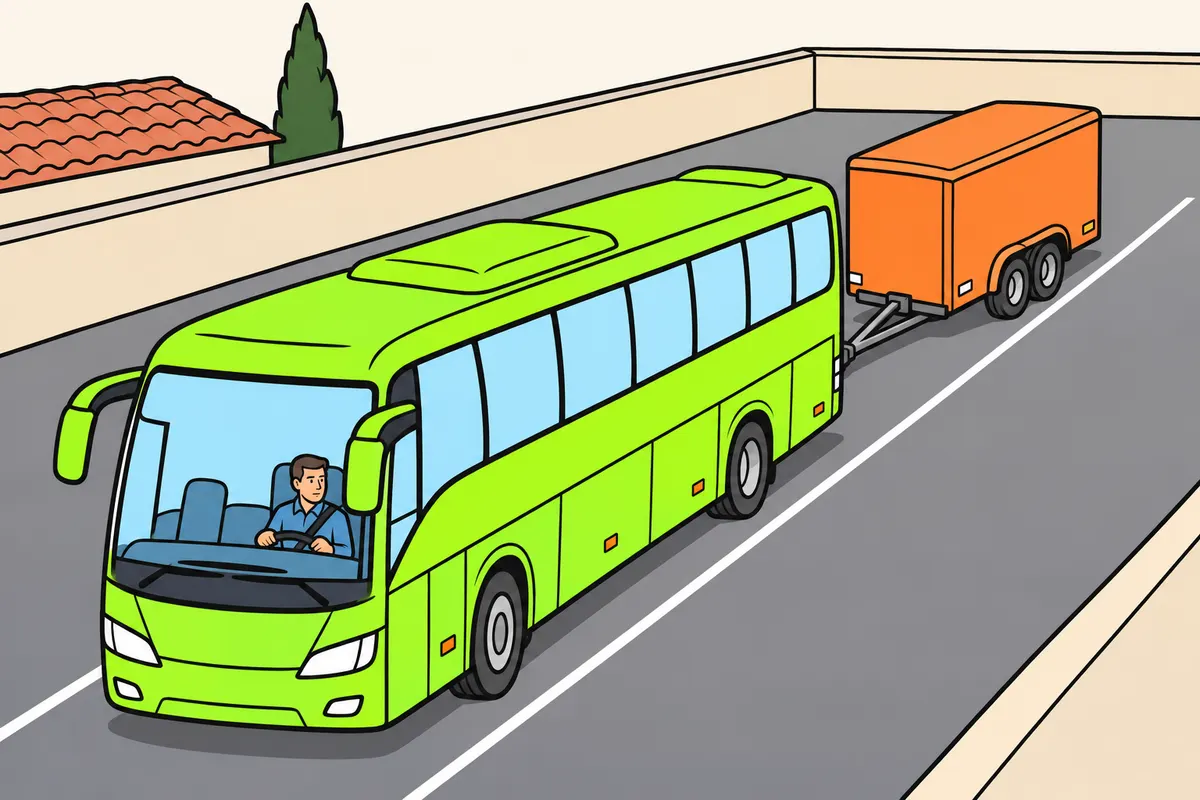
To reverse straight, start aligned and make small corrections while watching both mirrors.
Remember
- Align your combination first, if you can do so legally and safely.
- Check high and low obstacles, doors and fixtures.
- Reverse very slowly and watch both sides.
- Make small corrections and observe their effect.
- Use reference points suited to your trailer’s configuration.
- If badly misaligned, stop; move forwards to realign only where permitted.
Exam trap: Wrong: Make a large steering correction because you are moving slowly. Right: Limit the angle; you can damage bodywork, drawbar and connections even at minimal speed.
Read the full explanation
- Prepare your starting position by moving forwards until the bus and trailer are aligned with the space you intend to reverse into, provided you can do so legally and safely. Good initial positioning reduces the corrections you need later. Also check overhead clearance, doors, installations and obstacles that may lie above or below your usual view in the mirrors.
- Reverse at very low speed, keeping reference points in both mirrors. Compare the position of the trailer's sides with the edges of the passage and detect any deviation early. Do not focus only on the mirror that gives you the best view of your destination: the other side can also approach an obstacle.
- With a trailer with fixed centre axles, steering the bus changes the coupling angle and the trailer's direction, and you must anticipate its response. Make small corrections and observe their effect before turning the steering wheel further. A trailer with a pivoting front axle adds another pivot point and requires specific reference points; do not assume that one configuration behaves like another without practice.
- If the alignment deteriorates significantly, stop and, if the location and manoeuvre allow, move forwards to restore it before reversing again. Monitor the articulation limits, the connections and the clearance between the bus body, drawbar and trailer. An excessive angle can cause damage even at very low speed.
23Reversing around a corner
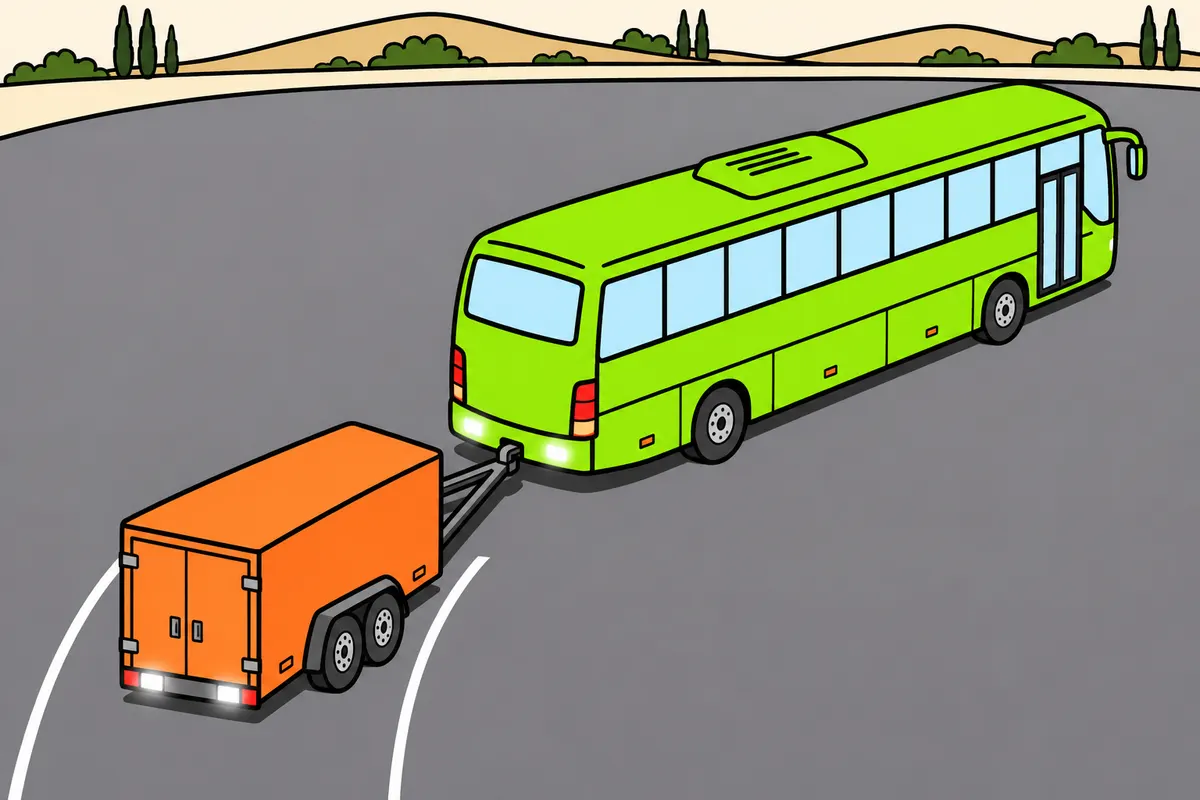
When reversing around corners, anticipate your trailer’s turn and finish aligned.
| Rear direction: fixed centre-axle trailer | Initial steering when reversing |
|---|---|
| Left | Steer slightly right; then straighten and follow. |
| Right | Steer slightly left; then straighten and follow. |
Remember
- Also allow space for your bus on the opposite side.
- Watch the inside, your bus’s swept area and the hidden side.
- If you lack reliable reference points, stop and check or ask for guidance.
- Reduce the angle before your trailer reaches its final direction.
- With a pivoting front axle, also control that axle’s direction.
Exam trap: Wrong: Use the same steering reference for every trailer. Right: The opposite steering reference shown applies to a fixed centre-axle trailer.
Read the full explanation
- First assess where the rear of the trailer needs to go and how much space the bus needs on the opposite side. With a trailer with fixed centre axles, you need to create an angle between the vehicles to start turning in reverse: you steer the bus to move the rear of the trailer towards the intended side, then follow and correct its path.
- As a guide for a trailer with fixed centre axles, if you want to move its rear to the left, start by turning the steering wheel slightly to the right; to move it to the right, turn slightly to the left. You must straighten up and follow the trailer's path in good time to limit the angle. Do not use this guide as a universal sequence for a trailer with a pivoting front axle: you must also control the direction of that axle.
- Monitor the inside of the bend, the area swept by the bus and the side that becomes less visible. In general, positioning yourself to give a better direct view of the side you are reversing towards makes control easier, but never replaces checking the hidden side. If you lack reliable reference points, stop and check or ask someone to guide you.
- Before the trailer reaches its final orientation, progressively reduce the angle between the vehicles so that you finish aligned. If you wait until the trailer has turned fully, the angle can keep tightening and you can overshoot the intended path. Practise this anticipation with your combination in a suitable enclosed area; do not learn by improvising on a road in use.
24Approaching an unloading area
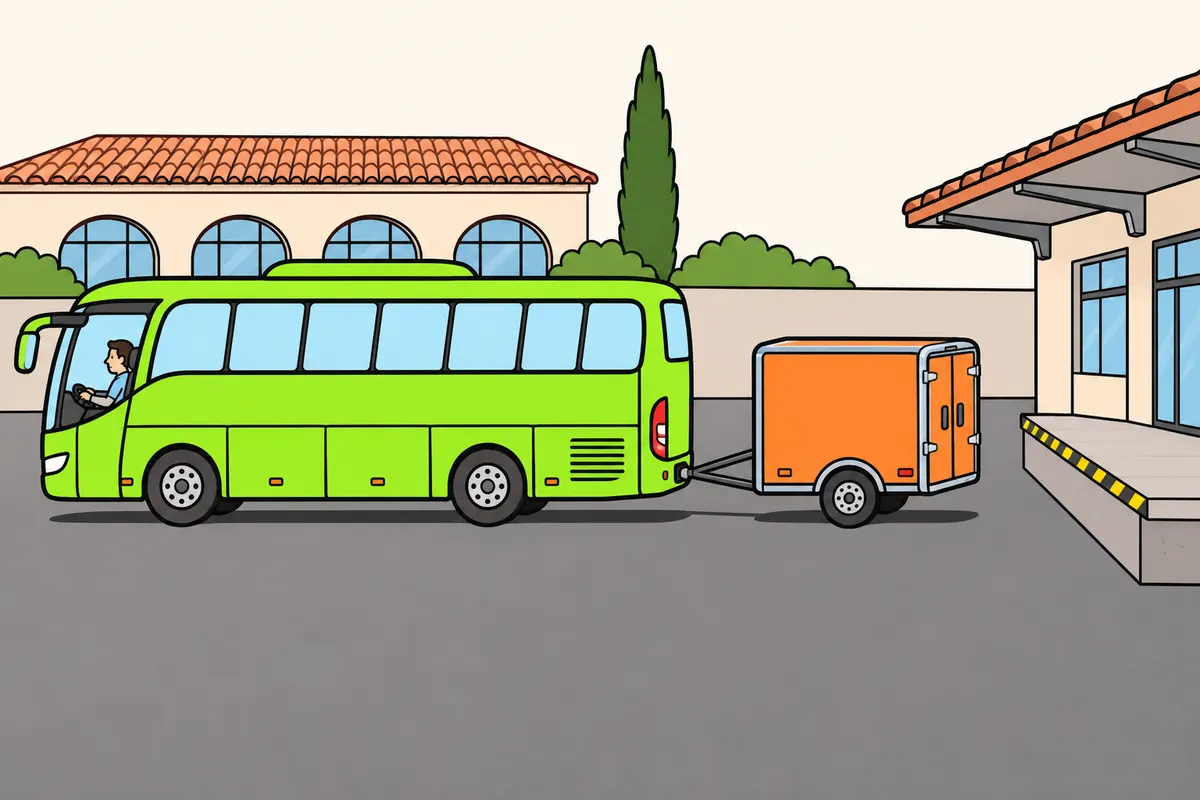
Approach unloading areas so your trailer finishes aligned, and stop before contact.
Remember
- Allow space to open doors and unload.
- Use reference points on both sides.
- Avoid hitting fixtures with your bodywork or drawbar.
- If you lose reference points, stop and check your position.
- Choose where to secure both units without working between the drawbar and bus.
Exam trap: Wrong: Choose your unloading position without checking your exit. Right: First check the gradient and space to leave.
Read the full explanation
- Choose a final position that allows you to secure both vehicles against movement and unload luggage without anyone working between the drawbar and the bus. Before approaching, identify the gradient and the space you need to leave; you study the rules for securing the combination when leaving the driving position in «Manoeuvres with a bus and trailer».
- If you bring the luggage trailer up to an unloading area or loading bay, prepare a path that allows you to finish aligned. Check the space for opening the doors and unloading; use reference points on both sides and prevent the overhang or drawbar from striking any installation. Stop before contact and check your position if you lose your reference points. [RGCond, Annex VI](https://www.boe.es/buscar/act.php?id=BOE-A-2009-9481).
25Practical test: manoeuvres G, L and M
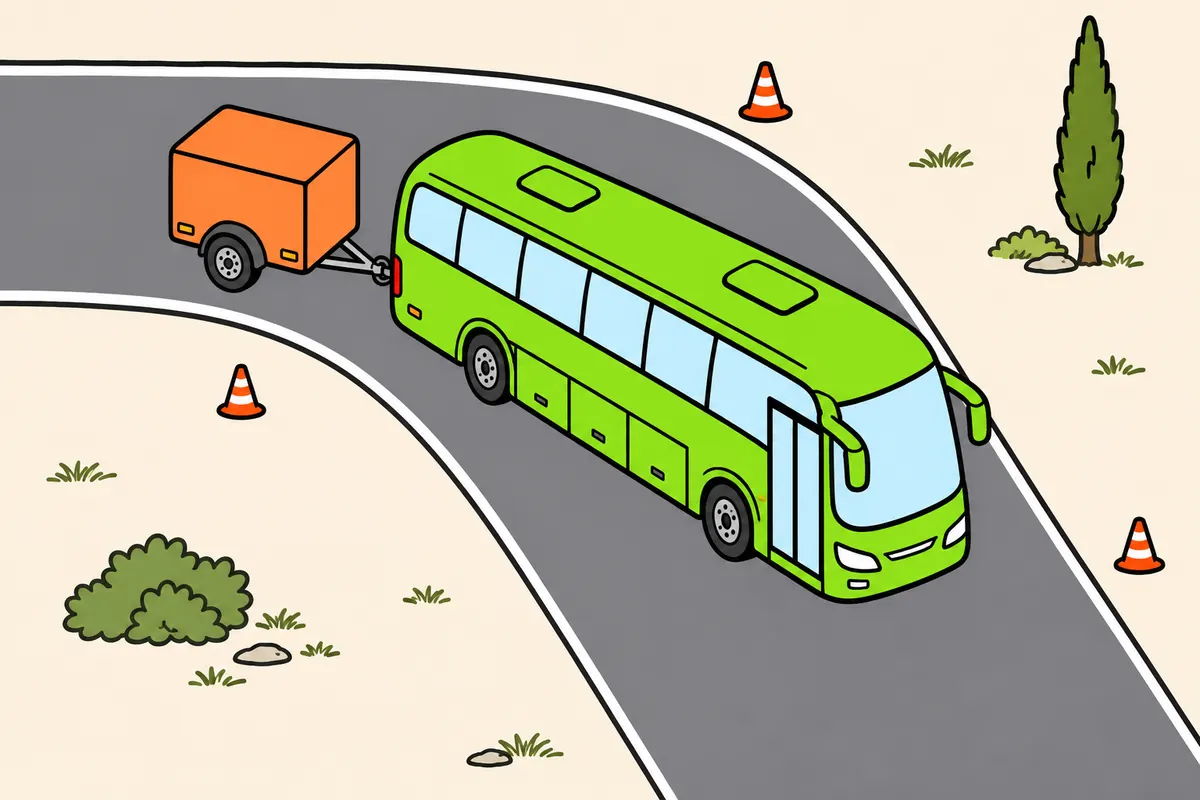
For your D+E test, prepare manoeuvres G, L and M.
| D+E and D1+E test | What you must do |
|---|---|
| G | Reverse straight and around a corner. |
| L | Park to let passengers board and alight safely. |
| M | Couple and uncouple your trailer. |
Remember
- First demonstrate your preparation and safety checks.
- In G, keep steady engine speed and stay centred without touching boundaries.
- In G, do not stop or steer while stationary.
- If a real danger arises, stop even during the exercise.
- In M, you may get out once during the approach to check.
- With a non-automatic coupling, you may position the drawbar manually.
Exam trap: Wrong: Make a forward correction in G with any trailer. Right: One forward correction is allowed with a pivoting-front-axle trailer. N applies to B+E; K applies to C1+E and C+E. Show appropriate protective or safety equipment where required; identical special clothing is not required for everyone.
Read the full explanation
- When you obtain D+E by taking the tests, you must carry out the following manoeuvres on a closed course: G, reversing in a straight line and around a corner; L, parking to allow passengers to board and alight safely; and M, coupling and uncoupling the trailer. D1+E uses the same manoeuvres. You must first demonstrate preparation and safety checks; the closed-course test does not replace the applicable road test. [RGCond, Annex V.B.3, point 8](https://www.boe.es/buscar/act.php?id=BOE-A-2009-9481).
- In G, position the rear at least 10 m before the start of the corner, reverse along the straight section, go around the corner and continue for at least another 10 m along the final straight section. You must maintain a steady engine speed and keep the combination approximately centred. The layout simulates a right-hand or left-hand corner. [RGCond, Annex VI.C.4](https://www.boe.es/buscar/act.php?id=BOE-A-2009-9481).
- The corner in G has an angle of approximately 90° and a minimum radius of 3.50 m. For a rigid vehicle with a trailer with a steerable front axle, the Annex specifies a lane width of 7 m; the table provides for widths between 3.50 and 4.50 m for combinations with a single-axle trailer. Practise with the configuration used and the corresponding course dimensions, without applying the reference dimensions for a solo vehicle to a bus with a trailer. [RGCond, Annex VI.C.4](https://www.boe.es/buscar/act.php?id=BOE-A-2009-9481).
- In G, you must not mount or force the wheels against the kerb, drive on or beyond the lane boundaries with the wheels, touch boundary markers, stop during the manoeuvre or turn the steering wheel while the vehicle is stationary. The Annex allows one forward correction for combinations with a trailer with a steerable front axle; do not assume this is allowed for every configuration. If a real danger arises, you must stop: carrying out the exercise never justifies running anyone over or hitting anything. [RGCond, Annex VI.C.4](https://www.boe.es/buscar/act.php?id=BOE-A-2009-9481).
- Manoeuvre N, parking alongside a kerb for loading or unloading, applies to B+E. For D+E, you must prepare G, L and M; K applies to C1+E and C+E. [RGCond, Annex V.B.3, points 7 and 8](https://www.boe.es/buscar/act.php?id=BOE-A-2009-9481).
- In M, you must immobilise and detach the trailer, leave the bus alongside it and drive forwards until you face the trailer at a distance of at least 10 m before approaching it in reverse. The Annex allows you to get out once during this approach to check; with a non-automatic coupling, it allows you to align the drawbar manually. The technical procedure for connections, locking and supports is explained in «Safe coupling and uncoupling». [RGCond, Annex VI.C.4](https://www.boe.es/buscar/act.php?id=BOE-A-2009-9481).
- Before or during the tests, the examiner may check that you have the appropriate protective or safety equipment, where applicable. This provision does not in itself require all D+E candidates to wear the same special clothing. You must be able to show the equipment and carry out the safety checks appropriate to your combination. [RGCond, Annex VI](https://www.boe.es/buscar/act.php?id=BOE-A-2009-9481).
26Approaching a stop and manoeuvre L
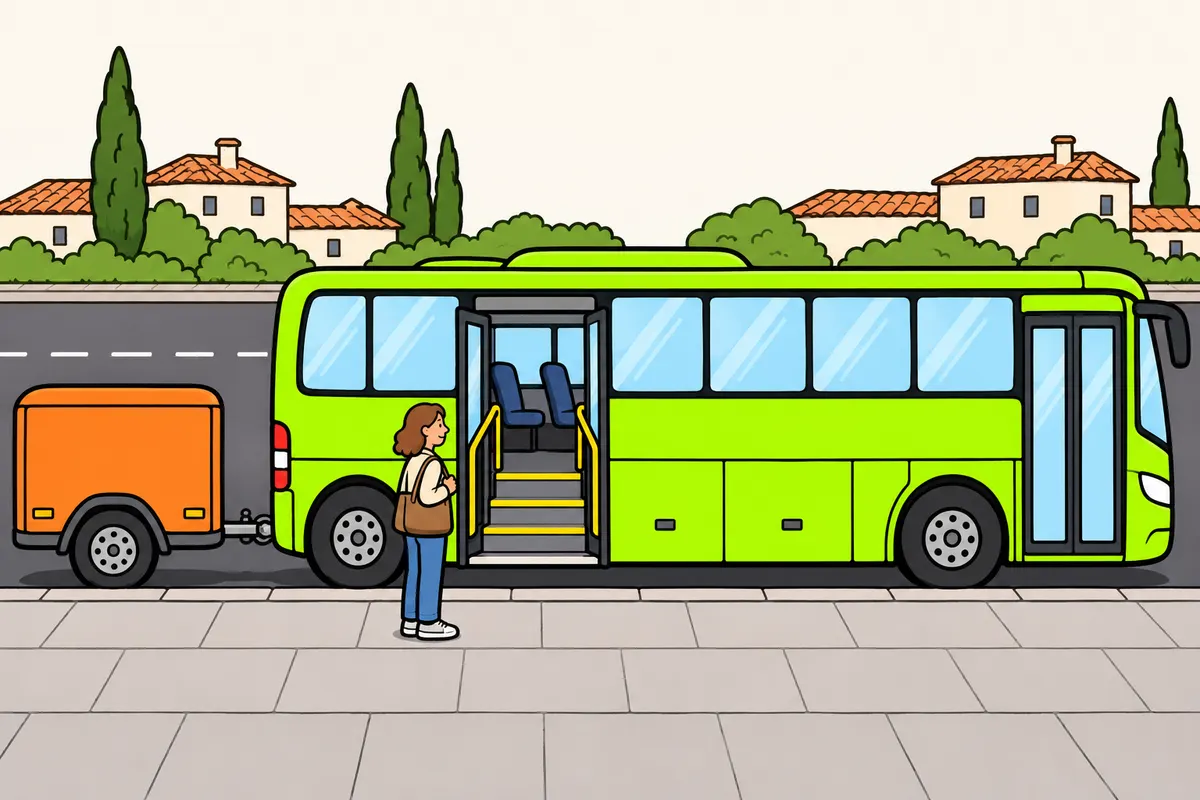
Prepare your stop so passengers can board and alight safely.
Remember
- Approach slowly and allow space for your combination and departure.
- In L, park on the right, parallel to the kerb.
- In L, use at most one movement to park and another to leave.
- Always move forwards in L; do not reverse.
- Open the rear door for safe access; close it before moving off.
- Before leaving, check passengers, surroundings and traffic; signal and give way when required.
Exam trap: Wrong: Simply bring your bus close to the kerb in L. Right: Park parallel, no more than 20 cm away, and allow passengers to board and alight safely.
Read the full explanation
- Prepare for the stop in good time and allow space for the bus, the trailer and moving off afterwards. Approach slowly, watching the kerb and the area swept by the vehicle bodies. A bus shelter, tree or litter bin may leave room for the tyres to pass yet prevent a door from opening or strike an end of the vehicle.
- In L, you must park on the right-hand side, leaving the vehicle parallel to the kerb and no more than 20 cm from it. You must position the vehicle so that passengers can board and alight safely when you open the rear door; you must then close the door and move off. [RGCond, Annex VI.C.4](https://www.boe.es/buscar/act.php?id=BOE-A-2009-9481).
- In L, you have a maximum of one movement to park and one to move off; you must always carry out the manoeuvre forwards. Plan your path from the approach to avoid needing to reverse. [RGCond, Annex VI.C.4](https://www.boe.es/buscar/act.php?id=BOE-A-2009-9481).
- The layout for L provides for a simulated street at least 6 m wide, an initial lateral clearance of 1.20 m and a parking length of at least twice the length of the vehicle or combination. You must have 1.50 m clear of obstacles for passengers to board and alight. [RGCond, Annex VI.C.4](https://www.boe.es/buscar/act.php?id=BOE-A-2009-9481).
- In actual service, immobilise the bus before allowing passengers to board and check that no one is trapped, beside the trailer or within the swept area as you move off. You must look after passengers while travelling, boarding and alighting, and drive with the doors closed. Move off smoothly after checking the traffic, signalling your intention to join it and giving way where required. [RGC, art. 11](https://www.boe.es/buscar/act.php?id=BOE-A-2003-23514#a11); [RGC, art. 114](https://www.boe.es/buscar/act.php?id=BOE-A-2003-23514#a114).
Turning with the whole combination
Anticipate the path of the inner wheels and the outward swing before turning the steering wheel.
- Check the exit, mirrors and blind spots.
- Slow down before the turn and judge the paths of the axles, bodywork and overhangs.
- Signal and check priority before taking up the space you need.
- Steer progressively while watching both sides.
- Maintain control until the rear end has passed; stop if you lose your safety margin.
Reversing around a corner in a real manoeuvre
Position the combination, create an articulation angle and straighten up using small movements.
- Check that you may legally reverse and limit the distance.
- Inspect the destination and swept area; arrange assistance if visibility is insufficient.
- Position the combination and gradually create the required angle.
- Watch both sides and follow the turn without making the articulation angle too tight.
- Stop if you lose your reference points or someone appears; pull forwards to correct your position if permitted and safe.
- Straighten up before reaching your destination and immobilise the combination.
Check what you know
Real questions from the bank on this topic. Pick an answer to see the explanation.
Finished this module?
Mark it as read and you will see your progress on the theory list.