
Theory · B+E Licence - Car with Trailer · Module 10 of 13
Safe driving with a trailer
You learn to plan your route and drive your B+E combination with stability, anticipation and enough space for the trailer. You practise dealing with wind, bends, overtaking and descents, and understand reversing and manoeuvres G, M and N, which you must prepare for the test.
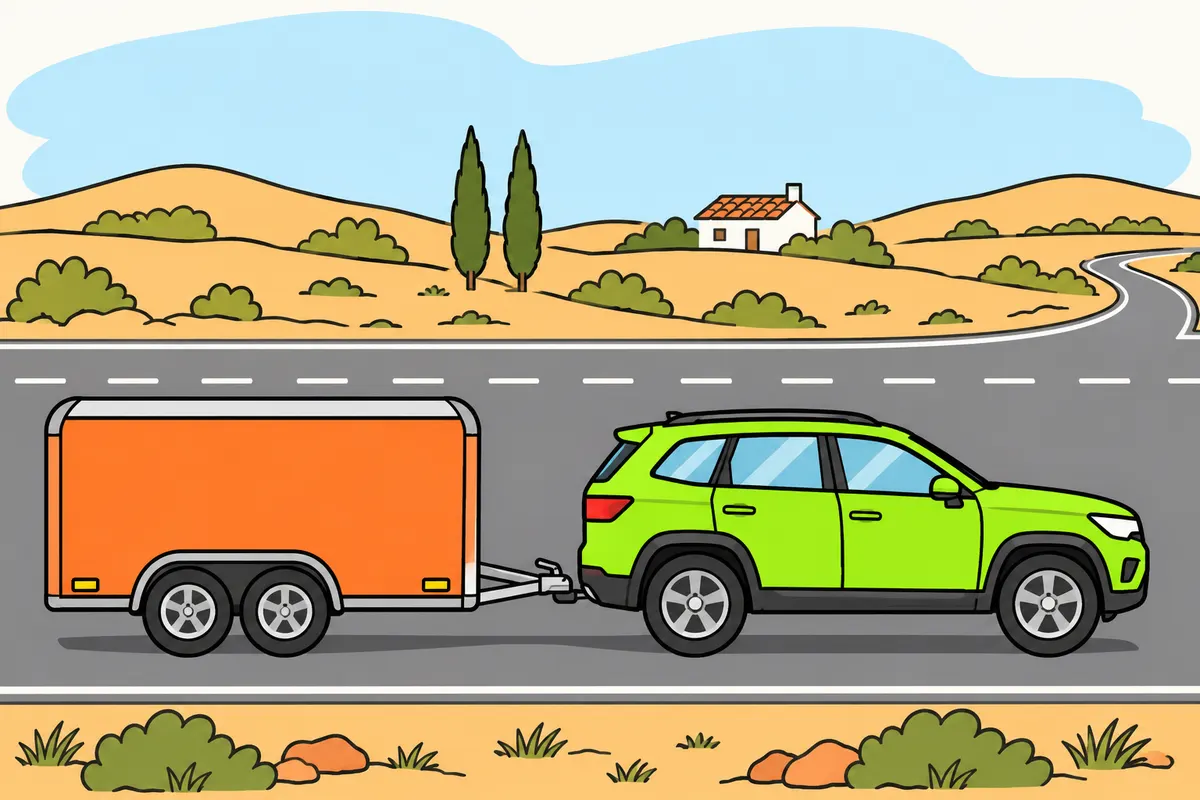
1Your route must suit the whole combination
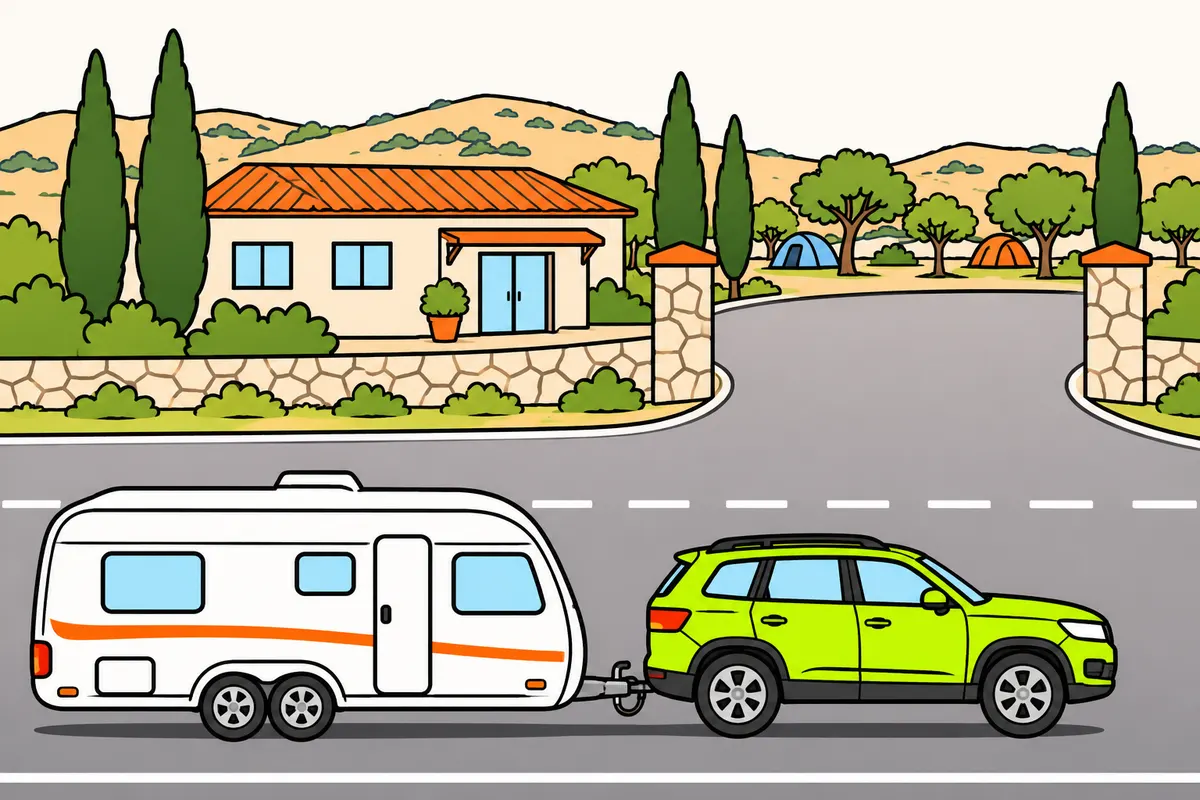
Plan a route with enough room for your car and trailer.
Remember
- Check the height, width, length and weight of your whole combination.
- Check restrictions, low bridges and turning space.
- Plan your arrival and a way to drive out forwards.
- Check the weather and road conditions.
- Set your satnav before moving.
Exam trap: Wrong: a familiar road suits any trailer. Right: check its dimensions, restrictions and space at the destination.
Read the full explanation
- Before setting off, plan a route compatible with the actual height, width, length and masses of your combination. Check restrictions, underpasses, car park entrances, narrow streets and turning space. A route suitable for the car alone can lead you somewhere that is very difficult to leave with a caravan or a loaded trailer.
- Prepare the final stretch too: the entrance to the campsite, farm, car park or unloading point. Find somewhere to wait and work out how to position the combination so you can drive out forwards. Avoiding a dead-end street or an entrance with too tight a turn allows you to complete the journey without relying on a long reversing manoeuvre among pedestrians and vehicles.
- Check road conditions and the weather forecast, particularly wind on bridges, mountain passes and exposed stretches. Choose alternative routes and rest stops with space for the whole combination. You must adapt your speed to the road, load, traffic and environmental conditions so that you can stop within the clear distance you can see. [RGC, art. 45](https://www.boe.es/buscar/act.php?id=BOE-A-2003-23514#a45).
- Set your satnav and review the trailer instructions before moving off. Prepare just as thoroughly for short, domestic or familiar journeys: knowing the road does not confirm that roadworks, an access point or a restriction allow you through. The DGT recommends preparing your journey and checking your vehicle and luggage. [DGT, preparing your journey](https://www.dgt.es/muevete-con-seguridad/viaja-seguro/como-planificar-un-viaje-seguro-por-carretera).
2Check the combination before moving it
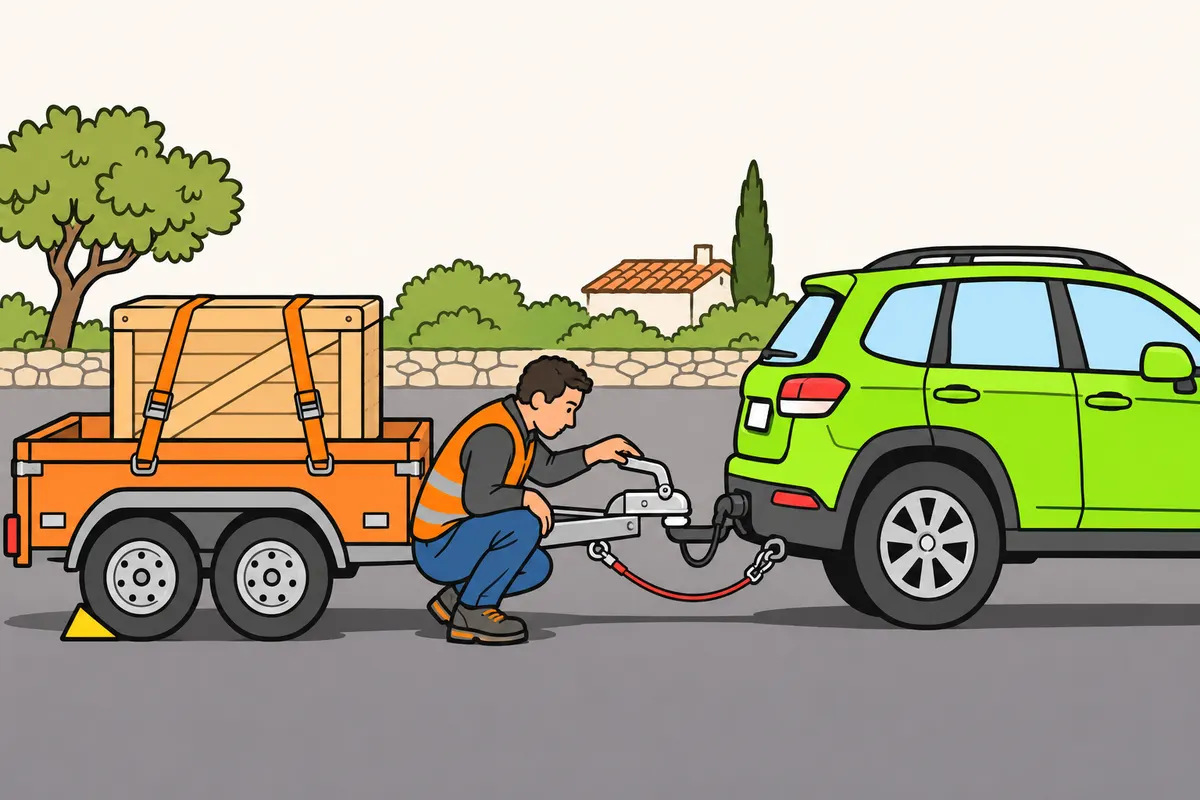
Check your car and trailer before setting off.
Remember
- Check that the coupling is closed and locked.
- Check connections, safety devices and retracted supports.
- Secure catches and the load.
- Test the lights; check tyres and pressures.
- Respect technical limits, even if your licence allows more.
- After securing the coupling, release brakes and restraints; test slowly somewhere safe.
Exam trap: Wrong: plugging in confirms the lights work. Right: check that they light up.
Read the full explanation
- Carry out a walk-round check: coupling closed and locked, safety devices connected, connections in place, supports retracted, catches secured and load secured against movement. Leave cables and lines enough freedom to allow articulation without dragging. Follow the full procedure in the «Safe coupling and uncoupling» module and your equipment instructions.
- Check that the trailer lights work, including brake lights and indicators: inserting the plug does not prove that they work. Check the tyres and tyre pressures on the towing vehicle and trailer according to the load and the manufacturer's instructions. If you notice an unusual noise, vibration or response, investigate the cause; driving faster does not correct a fault.
- Check the compatibility of the combination and its technical limits before loading it. You must respect the mass limits for each vehicle, the combination and each axle, as well as the coupling's capacity; your licence does not increase these capacities. The «Maximum dimensions and masses» module explains how to calculate them. [RGV, Annex IX](https://www.boe.es/buscar/act.php?id=BOE-A-1999-1826#anix).
- Before joining traffic, confirm that you have released the brakes and removed the relevant devices used to prevent movement after securing the coupling. Check how the combination responds at low speed in a safe area. In the B+E test, you must demonstrate that you know how to check the load, coupling, brake and electrical connections. [RGCond, Annex V.B.3.7](https://www.boe.es/buscar/act.php?id=BOE-A-2009-9481#anv).
3Distribute the load to maintain stability
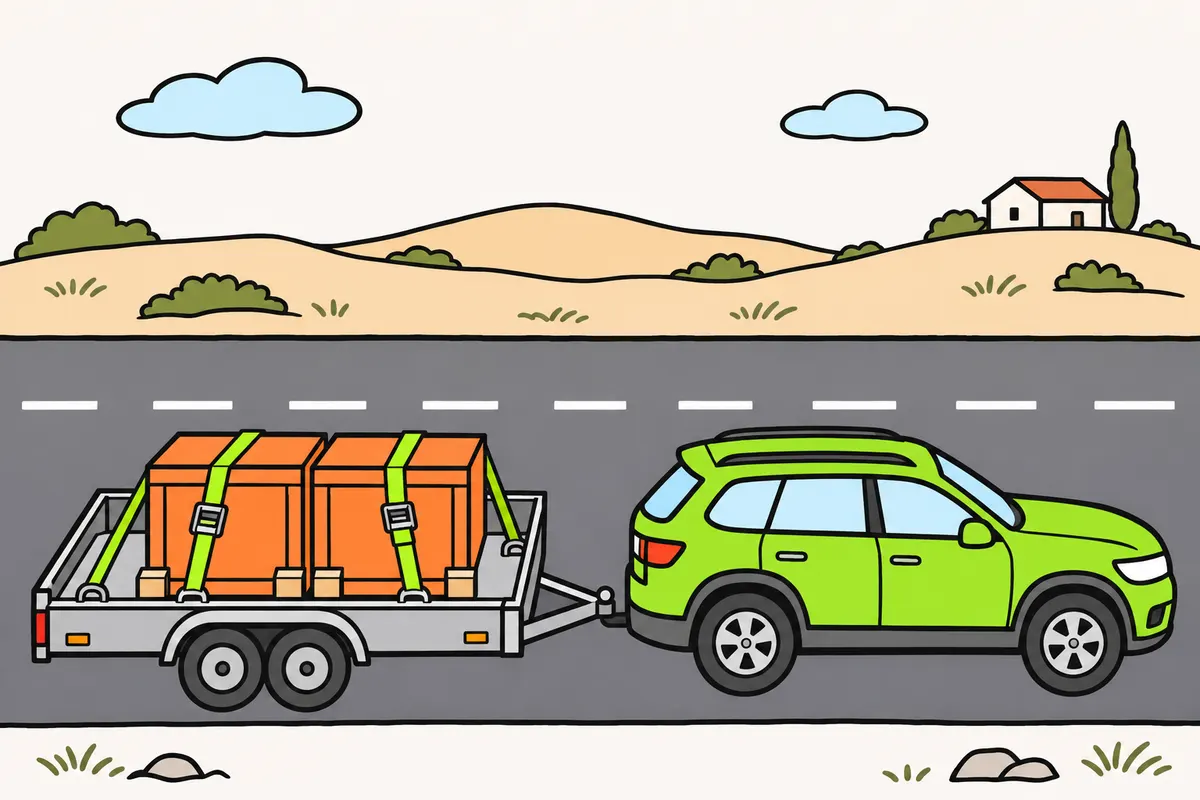
Spread and secure your load to keep your trailer stable.
Remember
- With centre-axle trailers, place heavy items low down, close to the axles.
- Balance the weight between both sides.
- Avoid putting all the weight at the front or back.
- Secure your load even inside an enclosed trailer.
- Keep lights and number plates clear.
- Check balance after loading, unloading or moving items.
Exam trap: Wrong: putting everything at the front prevents swaying. Right: follow the manufacturer’s loading instructions and limits.
Read the full explanation
- In a centre-axle trailer, place heavy items low down and close to the axles, balanced between the two sides. Distribute the rest according to the manufacturer's instructions. A high load raises the centre of gravity, and an uneven distribution between the sides makes it harder to maintain balance when turning or travelling over uneven surfaces. [DGT, driving with a trailer: load distribution](https://revista.dgt.es/es/educacion-formacion/conducir-mejor/2024/0620-Conducir-con-remolque.shtml).
- Avoid concentrating weight at the rear end: this can reduce the load on the drawbar and encourage swaying. Do not indiscriminately concentrate everything at the front either, because excessive load on the coupling alters the towing vehicle's load distribution. You must adjust the load position, vertical load and axle limits together, rather than seek stability by adding weight without measuring it. [DGT, driving with a trailer: load distribution](https://revista.dgt.es/es/educacion-formacion/conducir-mejor/2024/0620-Conducir-con-remolque.shtml).
- Secure and block the load so that it stays in place during acceleration, braking and cornering. Being inside an enclosed body does not prevent it from moving. You must prevent the load and accessories from falling, dragging, moving dangerously, compromising stability or obscuring lights, signs or plates. [RGC, art. 14](https://www.boe.es/buscar/act.php?id=BOE-A-2003-23514#a14).
- After loading, unloading or moving an item, reassess the trailer's balance. A distribution that is suitable when you set off can change as you remove material during the journey. If you suspect that the load has shifted, stop somewhere safe to check it; do not try to compensate continuously for a lean with the steering wheel. [RGC, art. 14](https://www.boe.es/buscar/act.php?id=BOE-A-2003-23514#a14).
4Vertical load on the coupling
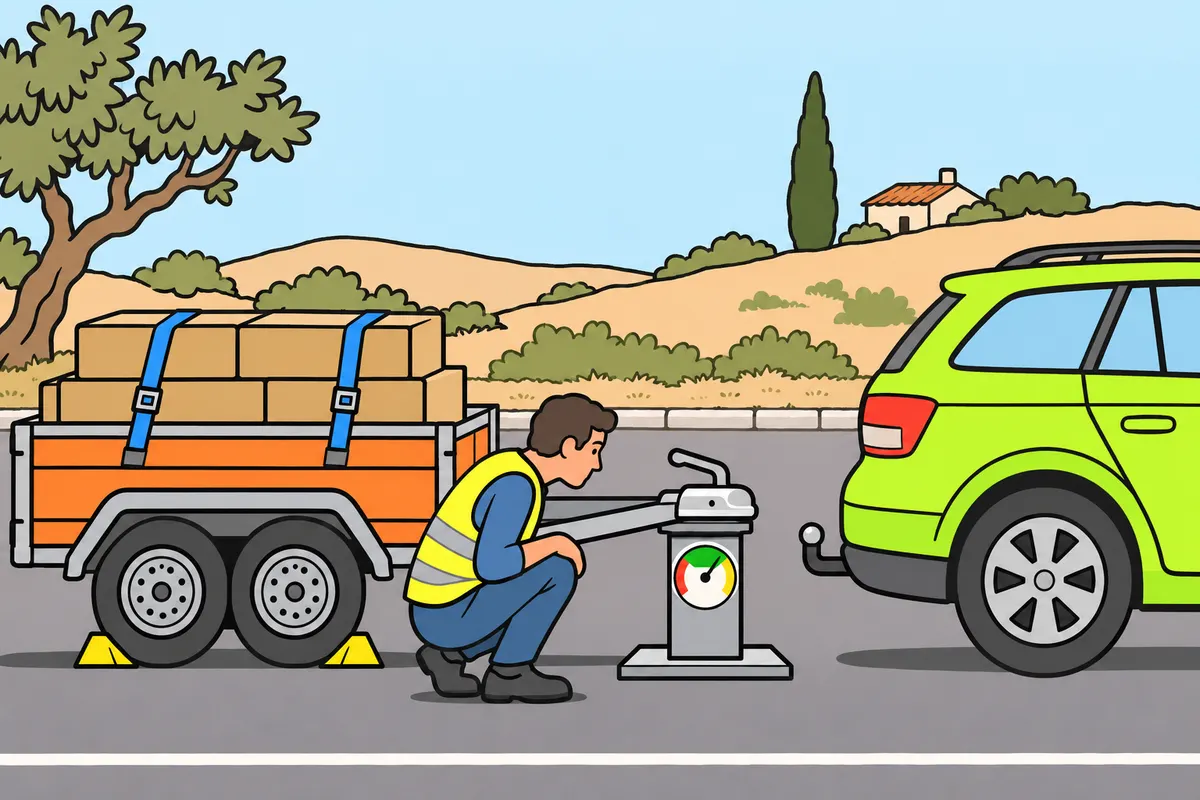
Check how much weight your trailer puts on the coupling.
Remember
- Respect the lowest limit for your car, coupling and trailer.
- For centre-axle trailers, use the lower of the stated maximums.
- Also respect any lower technical limit.
- Include this weight when checking your car and its rear axles.
- Measure the coupling load following the manufacturer’s instructions.
Exam trap: Wrong: always load to 10 %. Right: for centre-axle trailers, use the lowest of 10 % of maximum trailer mass, 1,000 kg and the technical limits.
Read the full explanation
- Distinguish between trailer mass and vertical load: the latter is the load transferred to the towing vehicle's coupling. In a centre-axle trailer, part of the mass rests on its wheels and part on the coupling. The maximum technically permissible vertical load depends on the design and manufacturer. [RGV, Annex IX, section 1.14](https://www.boe.es/buscar/act.php?id=BOE-A-1999-1826#anix).
- Check the values permitted for the towing vehicle, coupling device and trailer, and respect the lowest limit. You must take this load into account when loading the car: luggage, occupants and the load transferred through the drawbar can overload the vehicle or its rear axle even when the trailer itself does not exceed its limit. [RGV, Annex IX, section 4](https://www.boe.es/buscar/act.php?id=BOE-A-1999-1826#anix).
- For centre-axle trailers, the statutory limit for the authorised vertical load on the coupling is the lower of 10 % of the trailer's maximum mass and 1,000 kg, without exceeding the technical limits. This is a maximum, not an instruction to always load to 10 % or a universal ideal load for your car. [RGV, Annex IX, section 4.2](https://www.boe.es/buscar/act.php?id=BOE-A-1999-1826#anix).
- Check the vertical load using your equipment manufacturer's measurement procedure. If the value exceeds a permissible limit, redistribute and secure the items before driving. [RGV, Annex IX, sections 1.14 and 4.2](https://www.boe.es/buscar/act.php?id=BOE-A-1999-1826#anix). [DGT, driving with a trailer: load distribution](https://revista.dgt.es/es/educacion-formacion/conducir-mejor/2024/0620-Conducir-con-remolque.shtml).
5Watch the trailer while watching the road
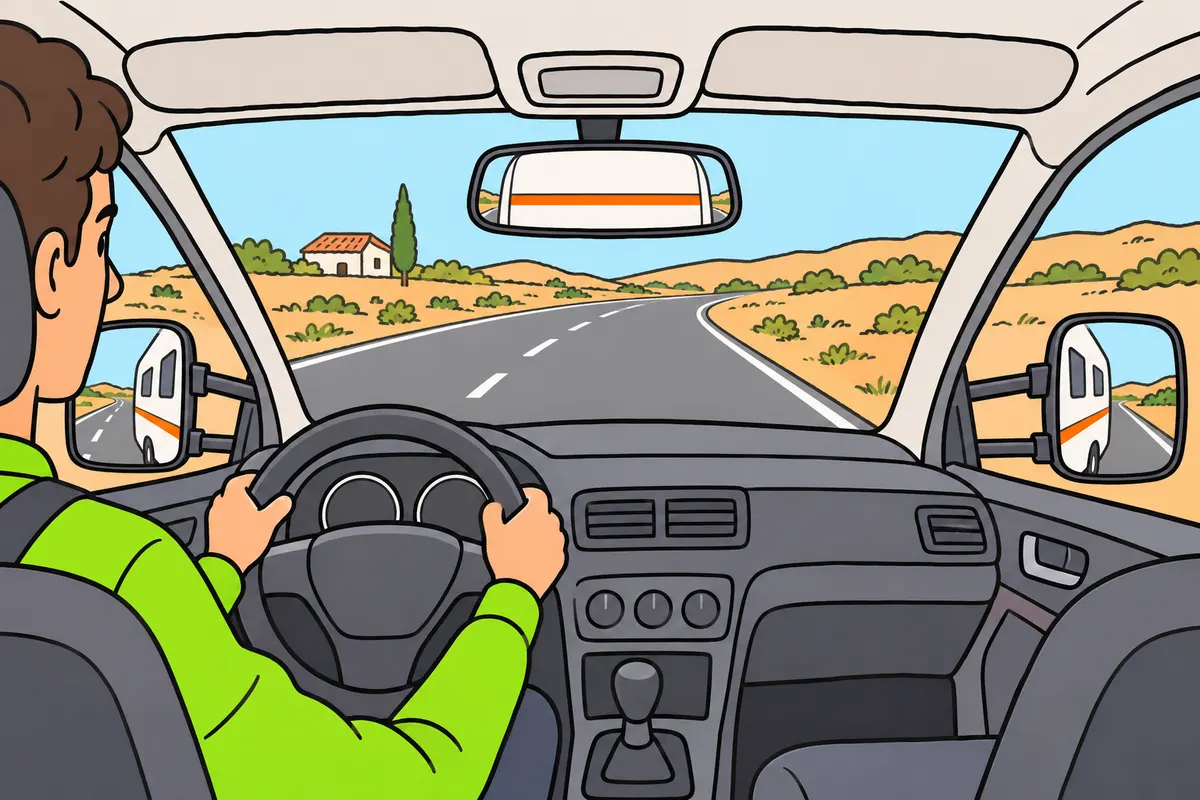
Watch the road and check your trailer briefly in your mirrors.
Remember
- Adjust your seat and mirrors before setting off.
- Add suitable mirrors if your trailer limits your view.
- Alternate looking ahead with brief mirror checks.
- Check blind spots before changing direction.
- Know which areas your cameras cannot show.
- Do not handle your phone while driving.
Exam trap: Wrong: an empty screen proves the side is clear. Right: check hidden areas too.
Read the full explanation
- Adjust your seat and mirrors before setting off. You need to see both sides and traffic approaching from behind; if the trailer's width restricts the field of view you need, use suitable or additional mirrors. If a caravan blocks your view through the rear window, you still need sufficient indirect vision.
- Alternate looking well ahead with brief checks of your mirrors and nearby surroundings. Look for queues, narrow sections, bends and possible exits before reaching them; use your mirrors to check alignment, the path of the combination and traffic. Constantly watching the caravan can cause you to notice a hazard in front of the car too late.
- Before changing course, also check your blind spots without looking away from the road for too long. Cameras and sensors help, but you must know which areas they cover and which areas the trailer or load conceals. Do not assume that one side is clear simply because nobody appears on a screen.
- Maintain freedom of movement, a clear view and constant attention, with objects and animals positioned so that they do not interfere with driving. Do not handle your mobile phone to check a route while driving, even when moving slowly. Monitoring the trailer requires you to remain attentive throughout the journey. [Traffic Act, art. 13](https://www.boe.es/buscar/act.php?id=BOE-A-2015-11722#a13).
6Use smooth controls and anticipate
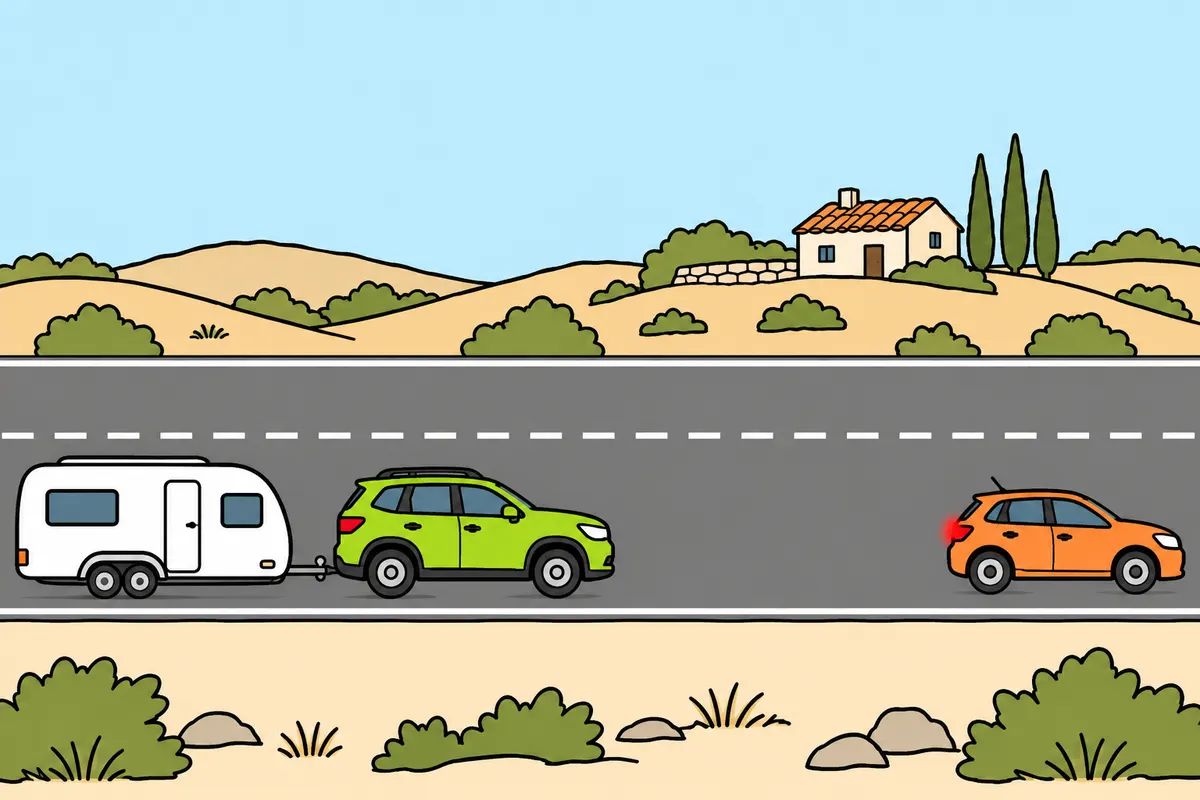
Drive smoothly and prepare for changes in speed.
Remember
- Accelerate gradually and steer smoothly.
- Anticipate traffic braking ahead.
- Before slowing considerably, check behind and warn others as appropriate.
- For immediate danger, brake as the emergency requires.
- If you feel tired, rest; if you feel sleepy, sleep.
- Check your medicine instructions without changing your treatment yourself.
Exam trap: Wrong: smooth driving rules out sudden braking. Right: act as an emergency requires.
Read the full explanation
- Accelerate progressively, select the gear before demanding power and steer without jerky movements. When braking or releasing the accelerator, aim to change speed gradually. Smooth, coordinated driving reduces shifts in loading and helps the towing vehicle and trailer maintain a stable path.
- Notice traffic slowing down early and ease off the accelerator in good time. Use the available engine braking and the brakes as necessary, without closing the gap and braking at the last moment. Smoothness usually improves efficiency too; it does not mean drawing out braking when an emergency requires you to brake immediately.
- You must remain in control of the vehicle at all times and take extra care near vulnerable road users. If you need to reduce your speed considerably, check behind and give the appropriate warning, avoiding dangerously abrupt braking unless there is imminent danger. [RGC, arts. 17 and 53](https://www.boe.es/buscar/act.php?id=BOE-A-2003-23514#a53).
- Check your condition before setting off and when planning breaks. If you become fatigued, rest somewhere safe; if you feel sleepy, you need to sleep. Alcohol, drugs and certain medicines can impair your ability to respond, and experience does not neutralise their effects: consult the treatment instructions without changing your treatment yourself.
7Appropriate speed and stopping space
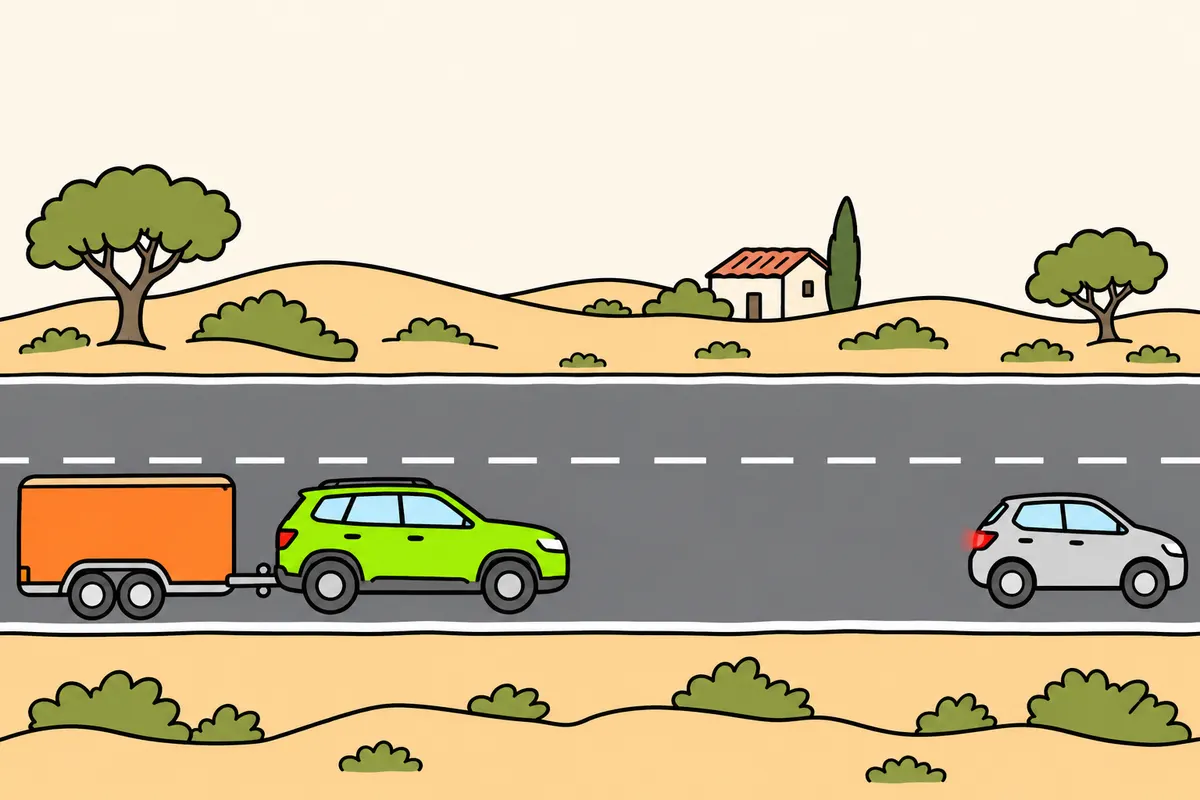
Adapt your speed and leave enough space to stop your whole combination.
Remember
- Consider your load, wind, tyres and brakes.
- Check stability even with an empty trailer.
- Slow down before tight turns.
- Watch traffic well ahead to anticipate braking.
- Leave enough space to stop if the vehicle ahead brakes sharply.
Exam trap: Wrong: trailer brakes guarantee the same response as your car alone. Right: allow more margin.
Read the full explanation
- Adjust your speed to the trailer's behaviour, the load, the wind and the available grip; even when towing it empty, you must assess its stability. Check the combination's limits for each type of road in «Speed and distances with a trailer». [RGC, art. 45](https://www.boe.es/buscar/act.php?id=BOE-A-2003-23514#a45).
- On urban approaches and tight turns, slow down before steering the towing vehicle and check that the trailer has room to follow it. Keep to a speed that allows you to stop if someone enters the area swept by the combination. [RGC, art. 46](https://www.boe.es/buscar/act.php?id=BOE-A-2003-23514#a46).
- Anticipate braking by watching several vehicles ahead: the combination's response depends on its load, tyres and brakes. You can increase your safety margin by easing off the accelerator early; avoid using it up by getting closer to the vehicle ahead. [DGT, driving with a trailer](https://revista.dgt.es/es/educacion-formacion/conducir-mejor/2024/0620-Conducir-con-remolque.shtml).
- Keep enough distance to stop without a collision if the driver ahead brakes sharply. When towing a trailer, you must allow a greater margin and must not assume that its brakes guarantee the same response as the car on its own. There is no fixed increase in metres that applies to every combination and situation. [RGC, art. 54.1](https://www.boe.es/buscar/act.php?id=BOE-A-2003-23514#a54).
8Distance, queues and space for others
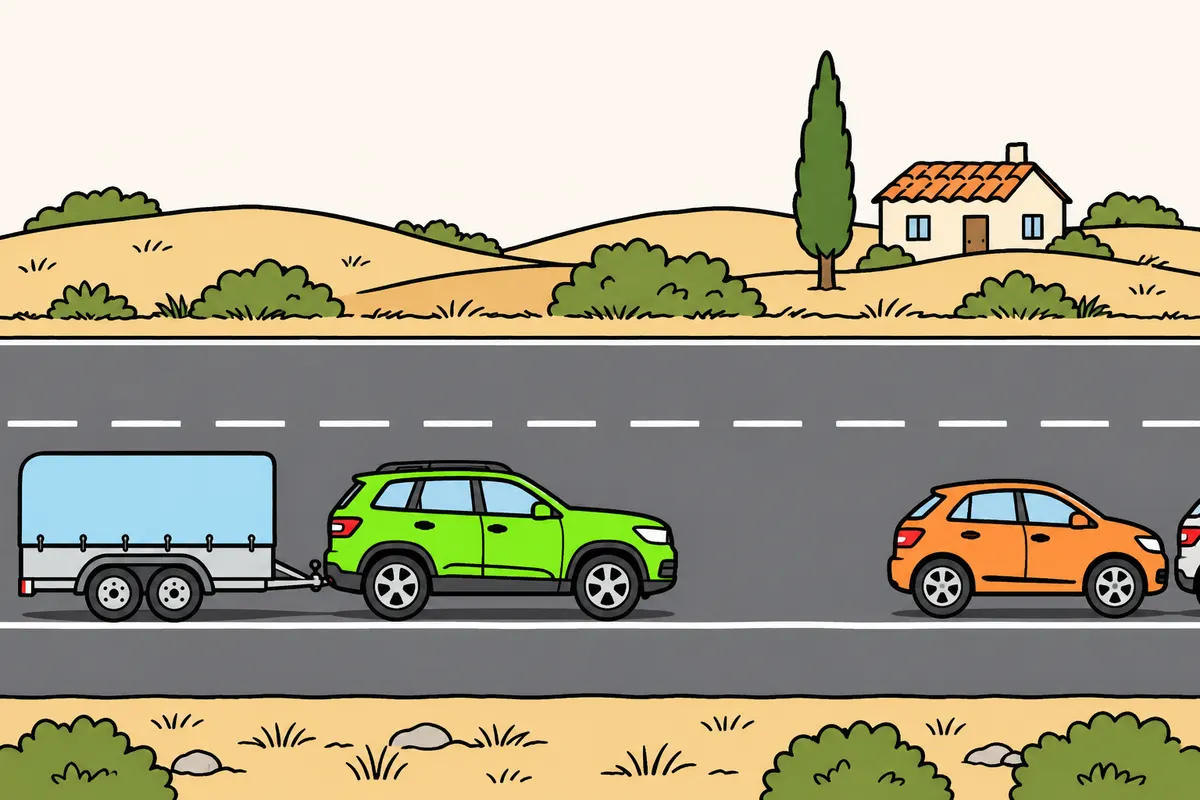
Leave room to stop and move your whole combination in queues.
Remember
- Slow down early as you approach slow traffic.
- Avoid repeated acceleration and braking in a queue.
- Leave room to move off with your combination aligned.
- Do not enter a junction if your trailer will block crossing traffic.
- Clear the carril de emergencia (emergency corridor) smoothly with your whole combination.
- Check in your mirrors that the trailer leaves the passage clear.
Exam trap: Wrong: moving your car aside is enough. Right: clear the carril de emergencia (emergency corridor) with your whole combination.
Read the full explanation
- As you approach slow traffic, leave room to slow down progressively without jerking the trailer. The required separation distances and their exceptions are covered in «Speed and distances with a trailer». [DGT, efficient driving](https://www.dgt.es/muevete-con-seguridad/conviertete-en-un-buen-conductor/consejos-generales/conduccion-eficiente/).
- When you stop in a queue, leave room to move off with the combination aligned. Avoid repeated acceleration and braking if you can follow the traffic smoothly. [DGT, efficient driving](https://www.dgt.es/muevete-con-seguridad/conviertete-en-un-buen-conductor/consejos-generales/conduccion-eficiente/).
- Do not enter a junction if you expect to end up blocking crossing traffic; the available space must also accommodate the rear of the trailer. [RGC, art. 59](https://www.boe.es/buscar/act.php?id=BOE-A-2003-23514#a59).
- Move the whole combination smoothly when clearing the carril de emergencia (emergency corridor) and check in your mirrors that the trailer is outside the passage space; see how to form it in «Manoeuvres with a car and trailer». [RGC, art. 32.1](https://www.boe.es/buscar/act.php?id=BOE-A-2003-23514#a32).
9Rain, fog, snow and slippery surfaces
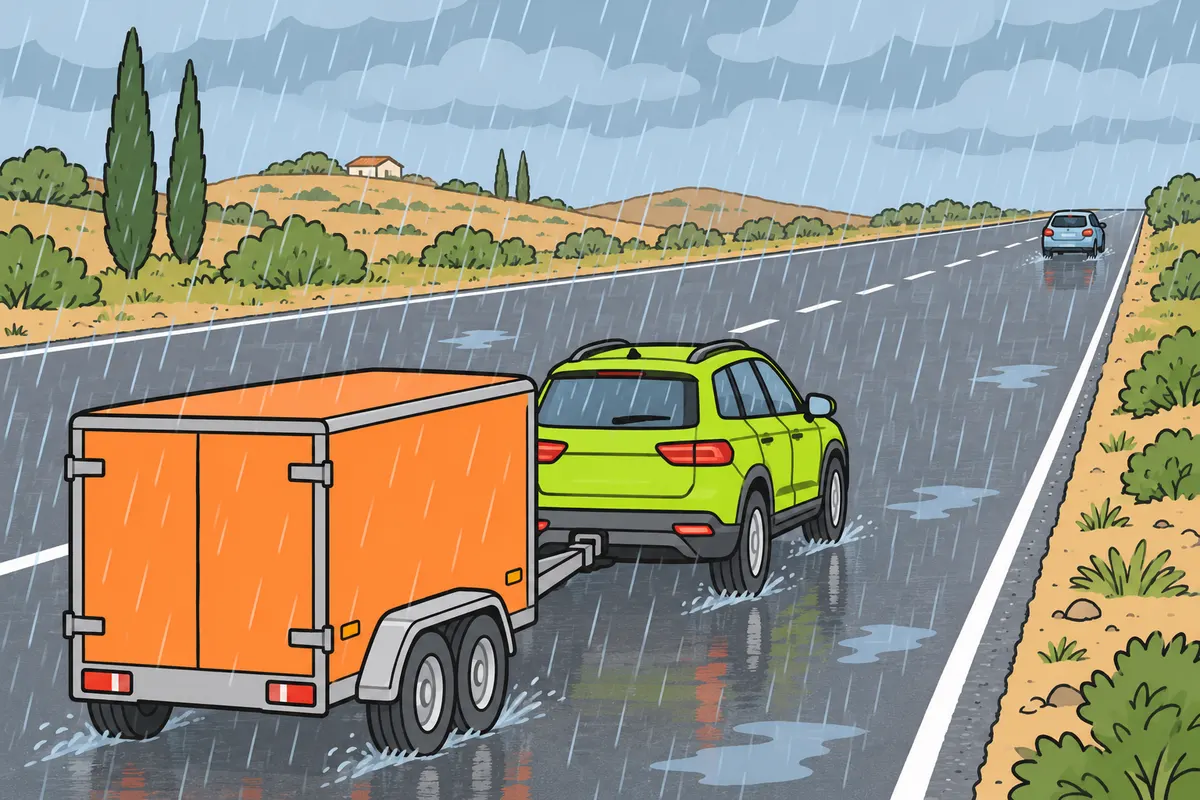
In bad weather, slow down and leave more space.
Remember
- In rain, increase your gap and use the controls smoothly.
- Do not follow another vehicle’s lights closely in fog.
- Check the trailer lights too.
- Use the rear fog light in thick fog, very heavy rain or heavy snow.
- You may also use it in dense smoke or dust.
- If you cannot continue safely, find a permitted, protected place to stop.
Exam trap: Wrong: more distance always makes it safe to continue. Right: stop in a permitted, protected place if you cannot continue safely.
Read the full explanation
- In rain, slow down and increase your following distance before traffic forces you to brake. The road surface may offer less grip, and water makes it harder to judge markings, obstacles and the depth of puddles. Having driven along a road many times does not guarantee that its conditions allow your usual speed.
- Use the controls gently when crossing wet markings, covers and areas of loose gravel. Adjust your speed before reaching them whenever you can; accelerating to cross them quickly or braking sharply on them demands more grip. Keep enough lateral clearance to prevent the trailer from getting close to a slippery edge too.
- In fog or heavy rain, drive so that you can stop within the distance you can see, and keep checking your mirrors. Avoid getting closer to the lights of the vehicle ahead to use them as a guide. If you cannot continue safely, find a sheltered place where you are allowed to stop; increasing your distance alone does not mean you should continue.
- You must use the required lights when visibility is significantly reduced and check that they also work at the rear of the trailer. Reserve the rear fog light for particularly adverse conditions, such as thick fog, very heavy rain, heavy snow or dense smoke or dust. [RGC, art. 106](https://www.boe.es/buscar/act.php?id=BOE-A-2003-23514#a106).
- On snow, use smooth movements to keep the trailer within the available space and anticipate corrections to your path; check which lanes you can use and the ban on overtaking in these conditions in «Manoeuvres with a car and trailer». [RGC, art. 32.2](https://www.boe.es/buscar/act.php?id=BOE-A-2003-23514#a32).
10Anticipate gusts of wind
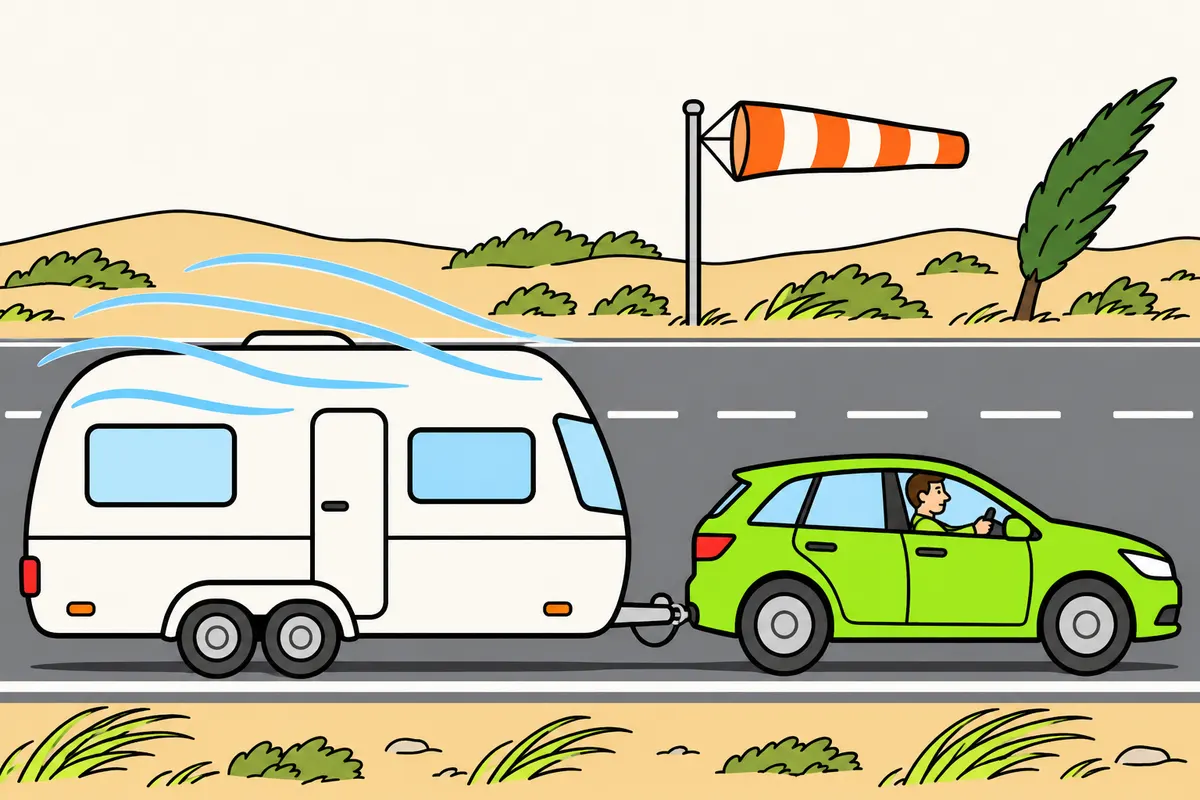
Expect changes in wind and steer gently.
Remember
- Slow down and hold your steering wheel with both hands.
- Take care on bridges and at tunnel exits.
- When passing a lorry, expect the side wind to return.
- Leave side clearance for your whole combination.
- If gusts prevent control, stop somewhere safe and authorised.
Exam trap: Wrong: one wind speed is safe for everyone. Right: assess your combination and respect restrictions.
Read the full explanation
- A caravan or tall trailer exposes a large side area to the wind. Reduce your speed, hold the steering wheel with both hands and maintain a steady path with gentle corrections. Wind does not improve braking or hold the combination down against the road; a gust can affect the towing vehicle and trailer differently. [DGT, wind](https://revista.dgt.es/es/reportajes/2020/12DICIEMBRE/1215-Invierno-Viento.shtml).
- Pay attention to bridges, viaducts, open plains, tunnel exits and gaps between buildings or trees. When shelter ends, the sideways force can change suddenly. Slow down before the exposed section and avoid accelerating into an area where you can already see difficulty in maintaining a steady path. [DGT, wind](https://revista.dgt.es/es/reportajes/2020/12DICIEMBRE/1215-Invierno-Viento.shtml).
- When you overtake a lorry, its body can shelter you temporarily, with the wind returning as you pass it; the trailer may also be exposed while the car is sheltered. Keep lateral clearance and allow enough space. The DGT warns about this shielding effect and the particular sensitivity of trailers. [DGT, wind](https://revista.dgt.es/es/reportajes/2020/12DICIEMBRE/1215-Invierno-Viento.shtml).
- If gusts prevent you from maintaining control, interrupt your journey in a safe place where you are allowed to stop. There is no universal wind speed that makes every combination safe. You must assess its size, load and behaviour, follow any restrictions imposed and avoid stopping where the manoeuvre or exposure itself creates another danger. [DGT, wind](https://revista.dgt.es/es/reportajes/2020/12DICIEMBRE/1215-Invierno-Viento.shtml).
11Respond to snaking without making it worse
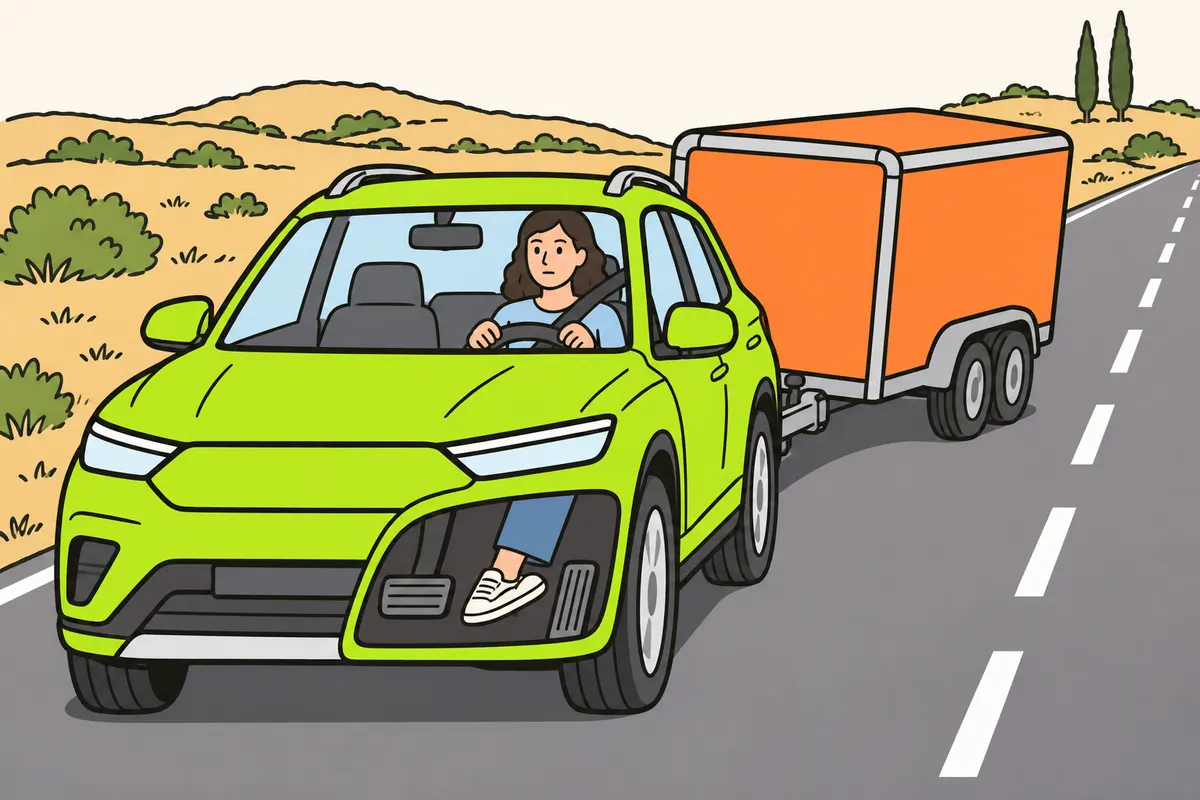
If your trailer snakes, slow down gradually without sudden movements.
Remember
- Hold your steering wheel firmly and maintain your direction.
- Ease off the accelerator gradually.
- Do not accelerate or chase the sway with alternating steering movements.
- Avoid braking as a correction for snaking.
- If a collision is imminent, act as the danger requires.
- Once stable, stop safely and check the cause.
Exam trap: Wrong: a stabiliser fixes every problem. Right: check your load, coupling and tyres before continuing.
Read the full explanation
- Recognise sway as oscillations of the trailer transmitted to the towing vehicle, distinct from the slight articulation that is normal during a turn. Inappropriate speed, gusts, turbulence, a shifted load or incorrect load distribution can contribute to it. If you notice increasing instability, act early without increasing your speed.
- Hold the steering wheel firmly, maintain your direction of travel and ease off the accelerator progressively to reduce speed. Avoid chasing each oscillation by steering alternately from side to side. In response to snaking, the DGT advises releasing the accelerator and avoiding braking so as not to worsen the instability. [DGT, driving with a trailer](https://revista.dgt.es/es/educacion-formacion/conducir-mejor/2024/0620-Conducir-con-remolque.shtml).
- Do not accelerate to try to pull the combination taut. This driving guidance does not remove the need to act if a collision is imminent. If your vehicle has a trailer stabilisation system, follow its manual; any intervention by the system does not replace your reduction in speed.
- Once you regain stability, find somewhere to stop safely and check the load, the load on the coupling, the tyres and the coupling itself. Do not continue at the same speed without investigating significant oscillation. A stabiliser does not correct overloading, incorrect load distribution or mechanical defects: resolve the cause before resuming your journey.
12Prepare for the bend before turning
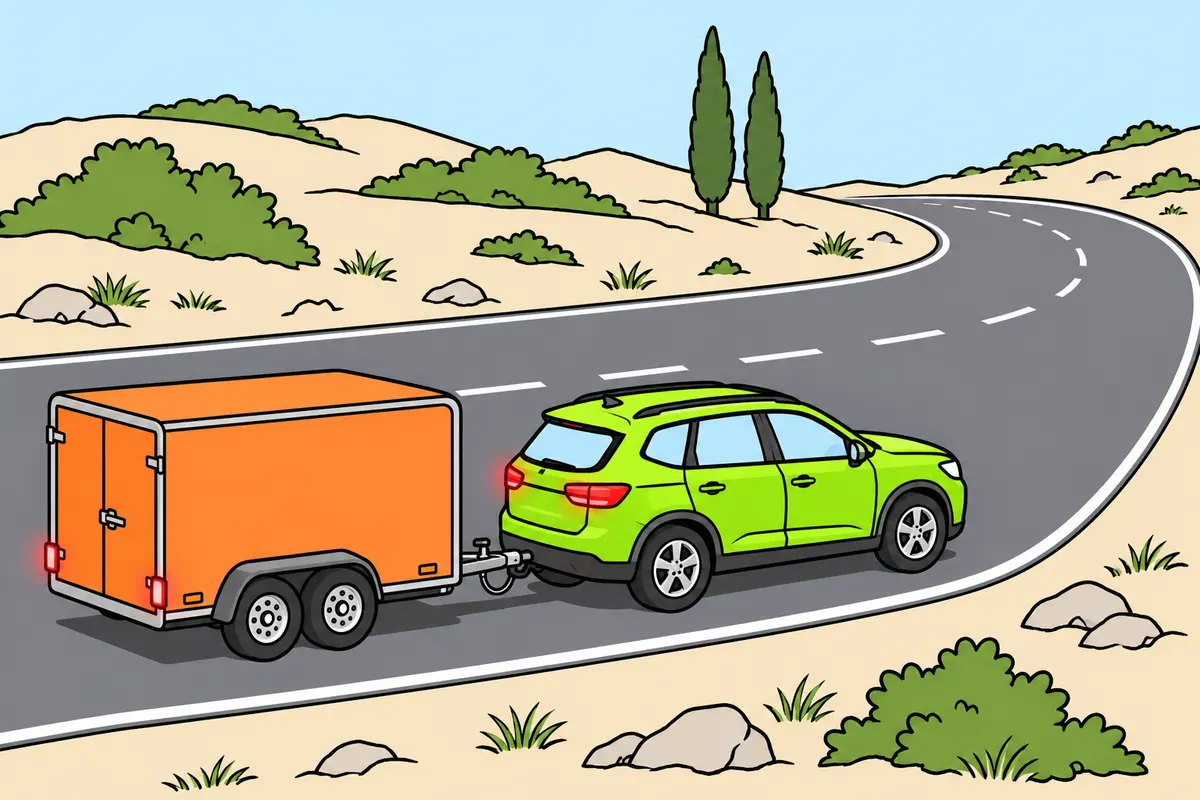
Slow down and choose a suitable gear before entering a bend.
Remember
- Prepare for the bend with your combination aligned whenever possible.
- Keep your steering steady through the bend.
- Do not cross into oncoming traffic or widen your turn onto the hard shoulder.
- Look towards the exit and check your trailer wheels.
- Accelerate gradually as your whole combination comes out aligned.
Exam trap: Wrong: you must never brake in a bend. Right: respond to danger and keep control.
Read the full explanation
- Assess the radius, gradient, visibility and grip before entering. Slow down progressively and select a suitable gear while the combination is aligned, whenever conditions allow. If you approach too fast, the trailer demands more lateral grip and can push the towing vehicle, leave its intended path or contribute to an overturn. [DGT, efficient driving: bends](https://www.dgt.es/muevete-con-seguridad/conviertete-en-un-buen-conductor/consejos-generales/conduccion-eficiente/).
- Through the bend, steer smoothly and avoid sudden changes in accelerator or brake input. Do not treat this as a ban on braking when faced with danger: you need to maintain control and act according to the emergency. Prevention means preparing your entry so that a major correction is unnecessary. [DGT, efficient driving: bends](https://www.dgt.es/muevete-con-seguridad/conviertete-en-un-buen-conductor/consejos-generales/conduccion-eficiente/).
- Look towards the exit while continuing to check where the trailer's wheels are travelling. Do not cut into the opposite direction of traffic or use the arcén (hard shoulder) as an extension of your lane. Your speed must allow you to stop for foreseeable obstacles, especially when visibility is reduced. [RGC, arts. 45 and 46](https://www.boe.es/buscar/act.php?id=BOE-A-2003-23514#a46).
- Build up speed progressively as the path opens out and the combination comes out of the bend aligned. Do not accelerate strongly just because the front of the car has finished turning: the trailer may still be in the bend. Watch its actual position and keep a margin from edges, barriers and nearby road users. [RGCond, annex V.B.4.4](https://www.boe.es/buscar/act.php?id=BOE-A-2009-9481#anv).
13Allow for the inner path and outer sweep
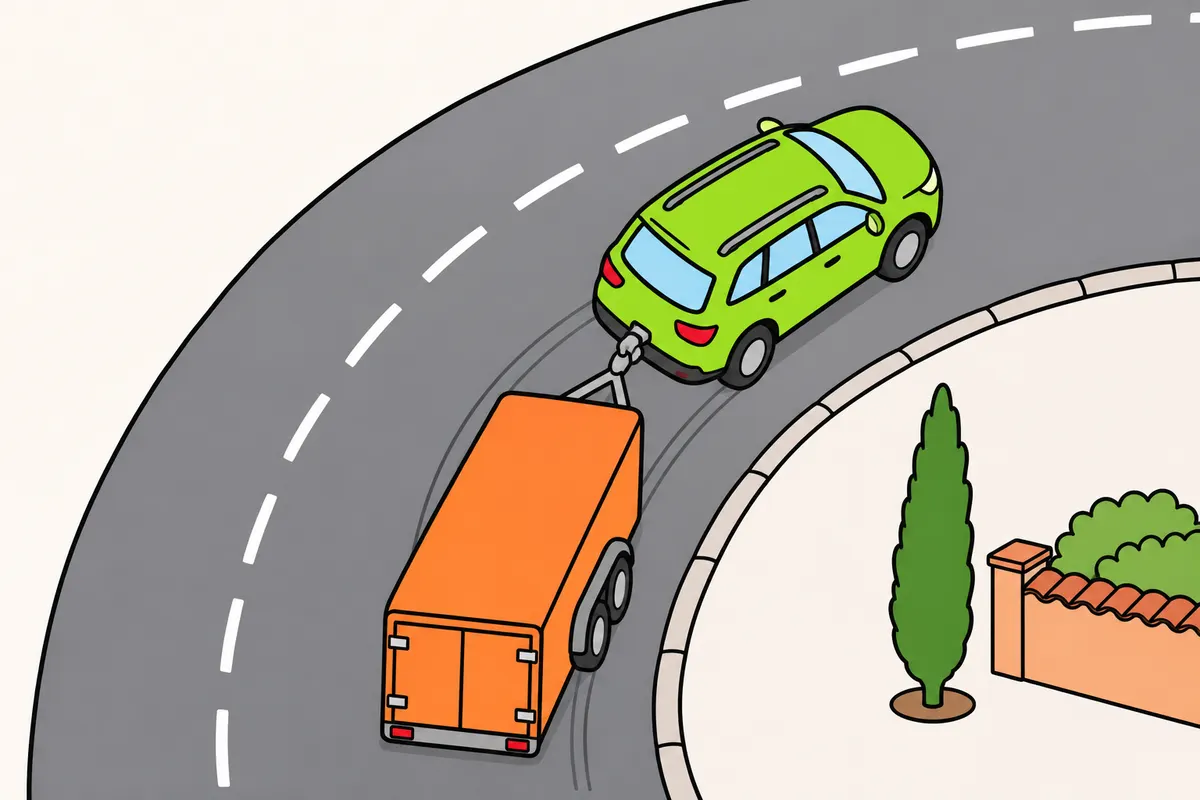
Check where the wheels and corners of your whole combination will pass.
| Trailer part in a tight turn | Space you must watch |
|---|---|
| Wheels | Path further inside the turn than your car |
| Corners and rear overhang | Space outside the turn |
Remember
- Leave space inside the turn for your trailer wheels.
- Also watch rear corners that swing outwards.
- Prepare wider turns without sudden movements towards the opposite side.
- Check headroom and clearance underneath your trailer.
- Keep your coupling properly closed.
Exam trap: Wrong: an obstacle is clear once your car has passed. Right: check the inner path and outer sweep of the whole trailer.
Read the full explanation
- On a tight turn, the trailer wheels usually follow a path further to the inside than the towing vehicle's wheels. You must leave enough space to prevent them from mounting the kerb or coming close to a pedestrian, cyclist or vehicle. The fact that the car's rear wheel has passed an obstacle does not prove that the trailer will clear it. [RGCond, annex V.B.4.4: length, overhangs and checks](https://www.boe.es/buscar/act.php?id=BOE-A-2009-9481#anv). [DGT, driving with a trailer: turns](https://revista.dgt.es/es/educacion-formacion/conducir-mejor/2024/0620-Conducir-con-remolque.shtml).
- Also watch the trailer's corners and rear overhang: the bodywork can sweep outwards beyond the turn. When leaving a parking space next to a wall, post or vehicle, watching the towball and wheels is not enough. Allow for the full size of the combination and clearance on both sides. [RGCond, annex V.B.4.4: length, overhangs and checks](https://www.boe.es/buscar/act.php?id=BOE-A-2009-9481#anv).
- Plan a slightly wider path when necessary, without making an improvised move in the opposite direction just before turning. Article 76 allows you to depart from the normal position for turning if your dimensions or another justified reason prevent you from following it, taking the necessary precautions to avoid danger. It does not give you priority because of your size. [RGC, art. 76](https://www.boe.es/buscar/act.php?id=BOE-A-2003-23514#a76).
- At narrow entrances and changes of gradient, also check overhead clearance and the space beneath the drawbar, supports and rear end. Move slowly so that you can stop before making contact. Do not solve a lack of space by driving with a partially open coupling: the intended articulation requires the coupling to be properly closed. [RGCond, annex V.B.4.4: length, overhangs and checks](https://www.boe.es/buscar/act.php?id=BOE-A-2009-9481#anv).
14Junctions, roundabouts and narrow sections
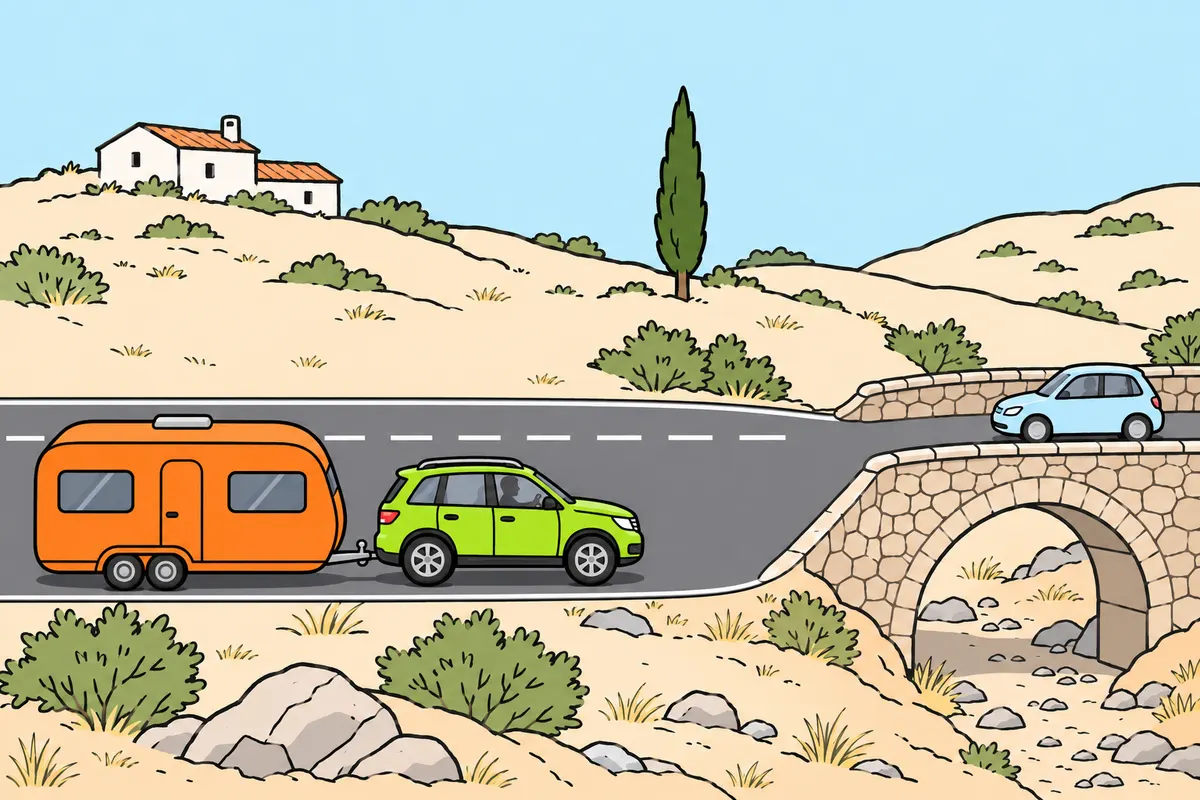
Cross and turn only when you have space and respect priority.
Remember
- Allow more time to cross than with the car alone.
- At STOP, stop at the line; without one, immediately before the junction.
- Give way after stopping.
- Without enough visibility, stop again where you can see without endangering anyone.
- At roundabouts, prepare your exit while respecting traffic in other lanes.
- Before a narrow section, check that your whole combination fits.
Exam trap: Wrong: your size forces others to move aside. Right: respect signs and priority rules.
Read the full explanation
- Approach a junction with enough room to stop the whole combination and look before committing it to the crossing. If visibility is poor, take particular care to reduce your speed. Allow for taking longer to clear the junction than with the car alone, and for acceleration limited by the mass you are towing. [RGC, art. 46](https://www.boe.es/buscar/act.php?id=BOE-A-2003-23514#a46). [DGT, driving with a trailer: turns](https://revista.dgt.es/es/educacion-formacion/conducir-mejor/2024/0620-Conducir-con-remolque.shtml).
- At R-2, compulsory stop or STOP, you must stop at the line or, if there is no line, immediately before the junction, and give way. If you do not have sufficient visibility from the stopping position, stop again where you can see without endangering others. Sounding the horn does not replace stopping or give you priority. [Official catalogue, R-2 and stop markings](https://www.boe.es/buscar/doc.php?id=BOE-A-2025-12199).
- Enter a roundabout at a speed that allows you to stay in your lane and anticipate the trailer's inner path. To leave, get into position in good time and respect those occupying the lane you need to cross. If you cannot move across safely, continue until you can prepare for another exit, without cutting across anyone else's path. [RGC, art. 74.2](https://www.boe.es/buscar/act.php?id=BOE-A-2003-23514#a74).
- Before entering a narrow section, leave yourself room to check whether the whole combination fits. Follow the signs and priority rules, and avoid accelerating to get through first. Near pedestrians and cyclists, watch the space occupied by the trailer throughout the turn; its size requires you to anticipate, never to insist that others move aside. [RGC, art. 46](https://www.boe.es/buscar/act.php?id=BOE-A-2003-23514#a46).
 R-2
15Join traffic and change lanes with a margin
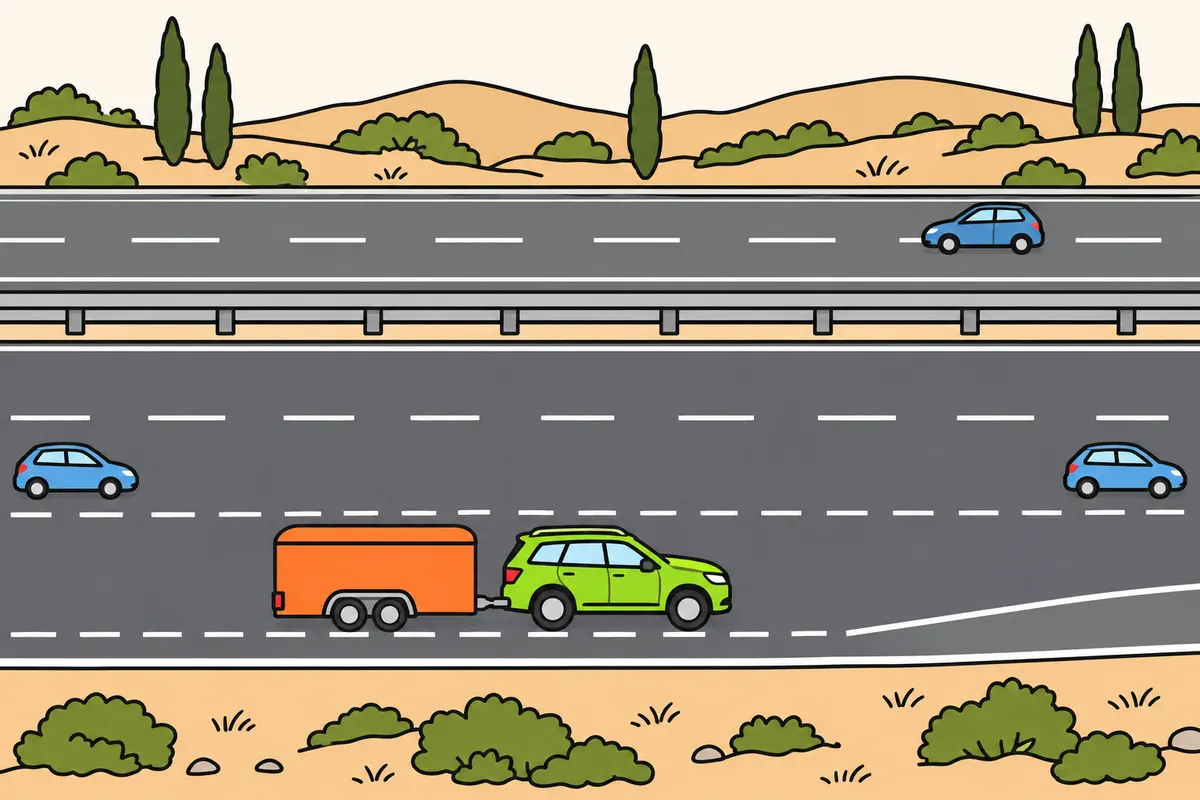
Find a gap big enough to join traffic or move your whole combination sideways.
Remember
- Judge space using your total length and ability to accelerate.
- Watch traffic from the start of the acceleration lane.
- Give way; do not rely on others braking.
- Check mirrors and blind spots before moving sideways.
- Finish with your trailer aligned inside the lane.
Exam trap: Wrong: signalling gives you priority when changing lanes. Right: give way to traffic already in the lane.
Read the full explanation
- Choose a gap for joining traffic that allows for the length and acceleration of the whole combination. Observe traffic early and wait for a margin that allows you to join without needing sudden acceleration. Priority and signalling for the manoeuvre are covered in «Manoeuvres with a car and trailer». [DGT, driving with a trailer](https://revista.dgt.es/es/educacion-formacion/conducir-mejor/2024/0620-Conducir-con-remolque.shtml).
- In an acceleration lane, assess the traffic from the start and adjust your speed to the opportunity to join. Remember that you need more space to gain speed when loaded. Do not rely on others changing lanes or braking; any help they give you does not replace your obligation to give way. [RGC, art. 72.1](https://www.boe.es/buscar/act.php?id=BOE-A-2003-23514#a72).
- Before moving sideways, check your mirrors, blind spots and the space available for both vehicles. Steer progressively and check that the trailer is within the lane and aligned before considering the manoeuvre complete. [RGCond, annex V.B.4.1 and 4.4](https://www.boe.es/buscar/act.php?id=BOE-A-2009-9481#anv).
- Get into the lane you need for your route in good time and avoid a series of lane changes that repeatedly shift the trailer's weight from side to side. See «Manoeuvres with a car and trailer» for the lanes you may use according to the length of the combination. [RGC, art. 31.2](https://www.boe.es/buscar/act.php?id=BOE-A-2003-23514#a31).
16Overtake allowing for the full length
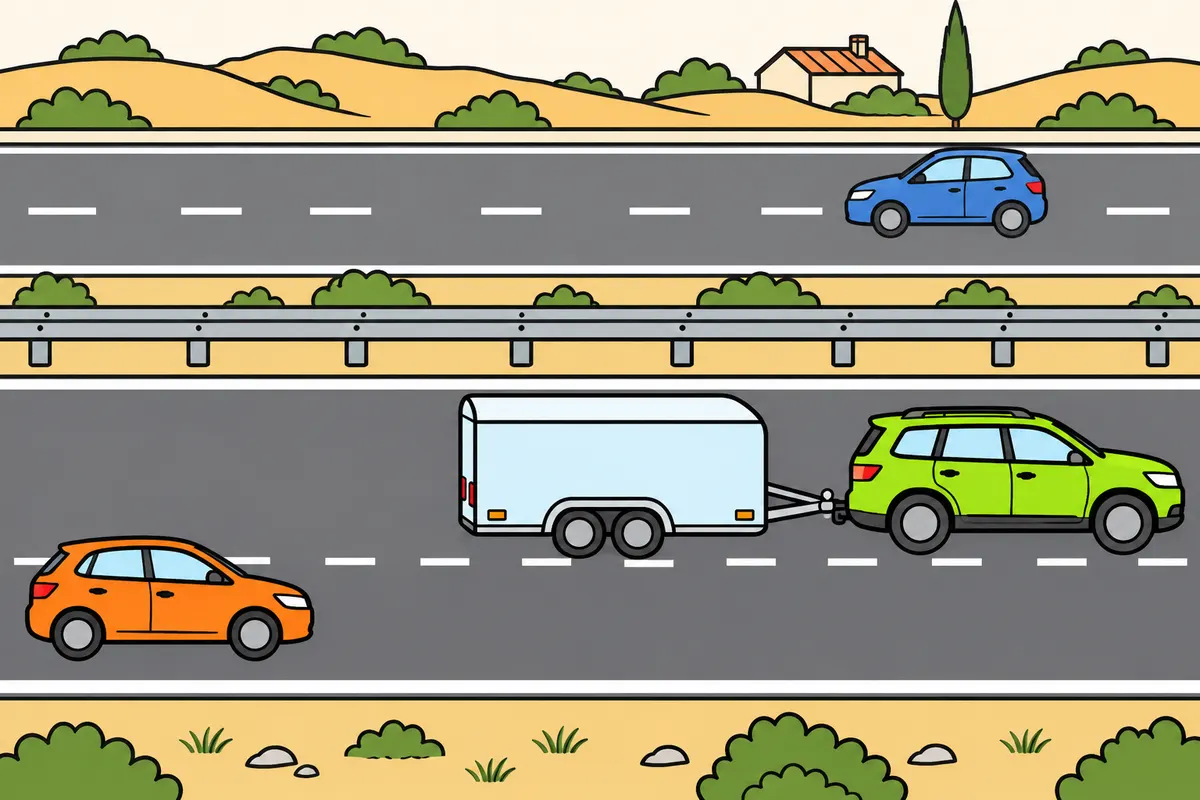
Overtake only if you can pass and return with your whole trailer.
Remember
- Consider power, gradient, wind and the difference in speeds.
- If you doubt you can finish within the limits, wait.
- Return only when your trailer’s rear has passed with room to spare.
- When someone overtakes you, do not increase your speed.
- Expect turbulence from large vehicles without moving towards an unstable hard shoulder.
Exam trap: Wrong: return once your car has passed. Right: wait until your trailer has passed too.
Read the full explanation
- Assess the available power, gradient, wind and speed difference before deciding to overtake. You need space to pass the other vehicle and return with the entire trailer clear. See «Manoeuvres with a car and trailer» for overtaking conditions and prohibitions. [DGT, driving with a trailer](https://revista.dgt.es/es/educacion-formacion/conducir-mejor/2024/0620-Conducir-con-remolque.shtml).
- The trailer adds length and can reduce your ability to accelerate. A manoeuvre you can easily judge with the car empty may leave you in the adjacent lane for too long. If you doubt whether you can complete it within the applicable limits and with space to spare, wait; do not increase the risk to make up journey time.
- Check in your mirrors that the rear of the trailer has cleared the other vehicle with room to spare before returning gradually. Your seat's position relative to the other car is not a reference for the full length. [DGT, driving with a trailer](https://revista.dgt.es/es/educacion-formacion/conducir-mejor/2024/0620-Conducir-con-remolque.shtml).
- If you are being overtaken, help the manoeuvre by keeping a predictable course and not increasing your speed. As a large vehicle passes, anticipate turbulence and changes in shelter from the wind. Do not move towards the edge to make room at the cost of putting the trailer wheels onto an unstable arcén (hard shoulder). [RGC, art. 86](https://www.boe.es/buscar/act.php?id=BOE-A-2003-23514#a86).
17Protect vulnerable road users throughout the pass
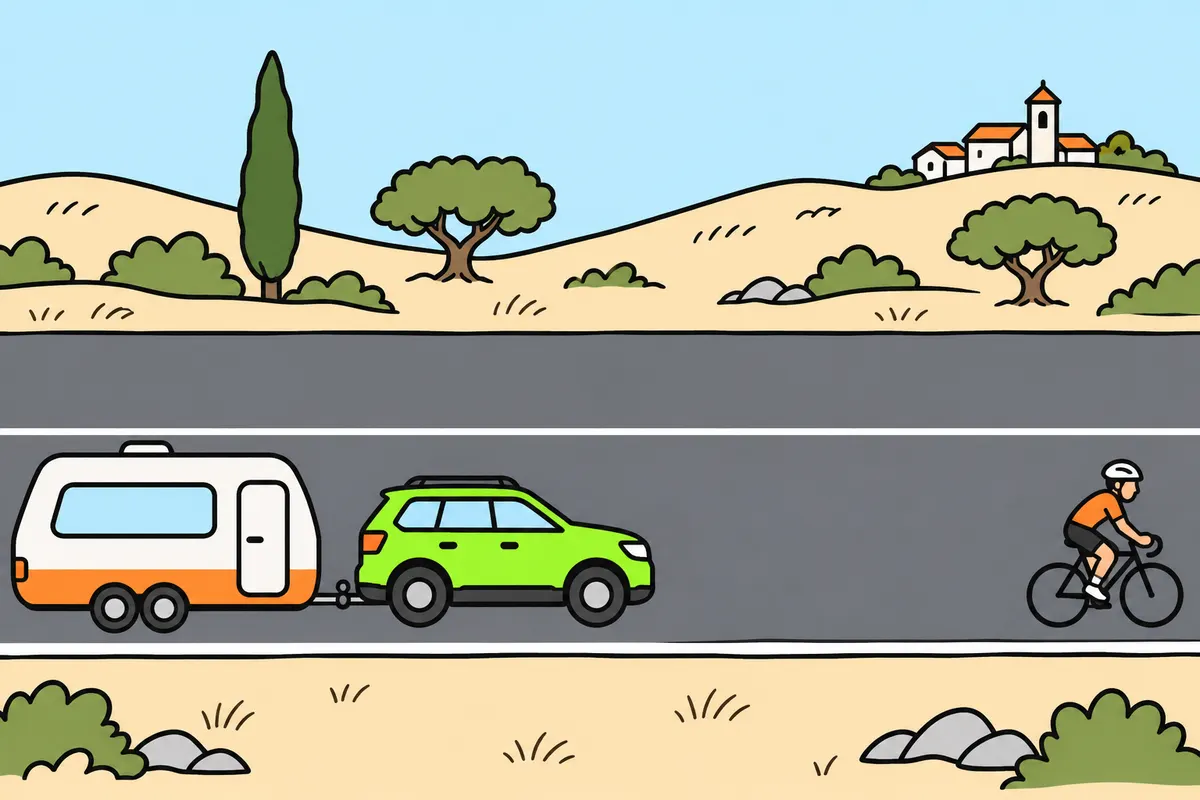
Leave the cyclist space throughout the pass of your whole combination.
Remember
- Increase the gap behind a cyclist when conditions require it.
- Measure clearance from the nearest part of your car, load or trailer.
- Do not return to your lane too soon and cut off the cyclist.
- If the whole combination cannot pass safely, wait behind.
Exam trap: Wrong: measure clearance from your car alone. Right: include the nearest part of your load and trailer.
Read the full explanation
- Plan your pass alongside a vulnerable road user so that the trailer also maintains lateral clearance throughout the manoeuvre. See «Manoeuvres with a car and trailer» for the clearance, lane use and speed reduction required when overtaking. [RGC, art. 85.4](https://www.boe.es/buscar/act.php?id=BOE-A-2003-23514#a85).
- Increase your margin behind a cyclist when grip, visibility or your combination's response requires it; avoid moving close to pressure them before overtaking. See «Speed and distances with a trailer» for the legally required separation. [RGC, art. 153.4](https://www.boe.es/buscar/act.php?id=BOE-A-2003-23514#a1-6).
- Judge clearance from the nearest part of your combination, including the load and trailer bodywork, rather than just the side of the car. A wider caravan can come close to the cyclist when the towing vehicle appears to have sufficient clearance. Avoid returning to the lane too soon and cutting off their space with the rear end.
- If you do not have enough space to complete the pass with the whole combination, wait behind without forcing the manoeuvre. Also watch those approaching on the opposite hard shoulder and anticipate that the cyclist may move out to avoid an obstacle. [RGC, art. 85.4](https://www.boe.es/buscar/act.php?id=BOE-A-2003-23514#a85).
18Long climbs and descents
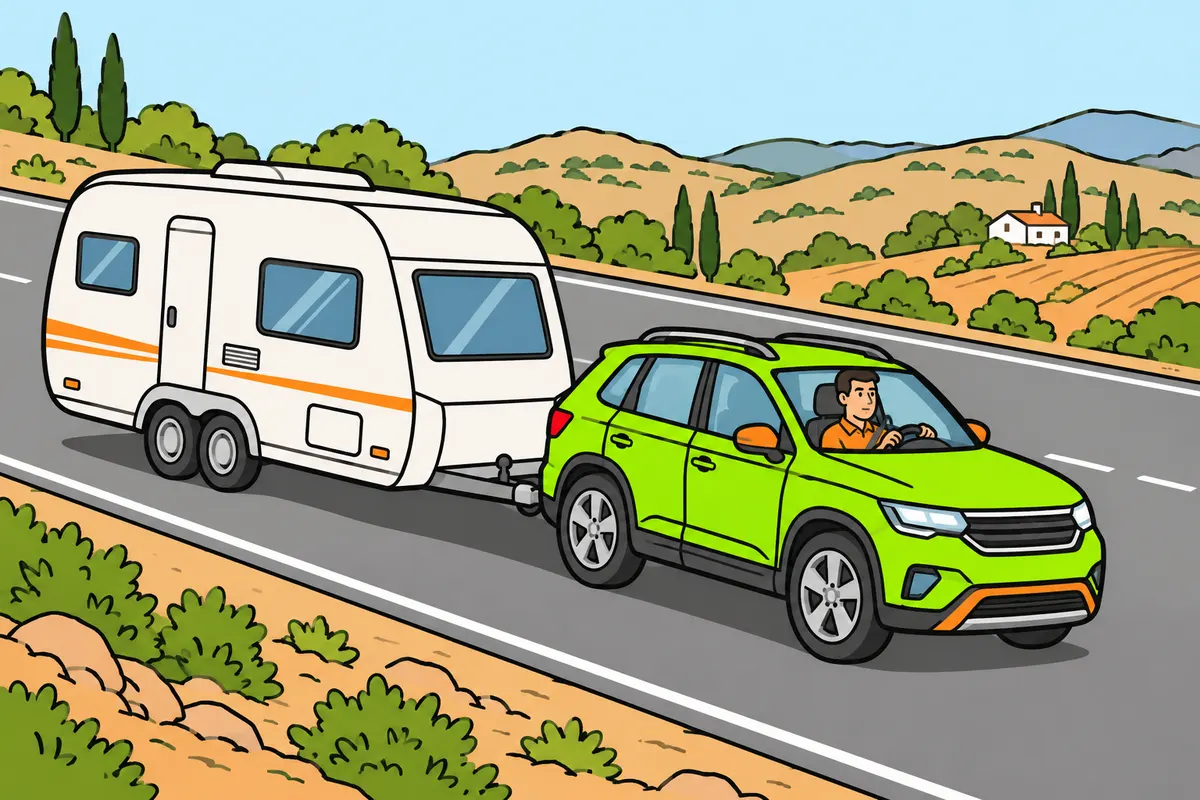
Choose a suitable gear and use engine braking on slopes.
| Slope | What you must prepare |
|---|---|
| Climb | A gear providing enough power |
| Long descent | Moderate speed and a gear providing engine braking |
Remember
- On climbs, change down before you lose almost all your speed.
- Do not hold the combination on a slope by slipping the clutch.
- Before descending, slow down; choose a gear providing engine braking without overworking the engine.
- In an automatic, choose a suitable mode using the handbook.
- Use the brakes when needed; constant pressure can overheat them.
- If braking weakens, control your speed and stop somewhere safe.
Exam trap: Wrong: coast downhill in neutral to save fuel. Right: keep engine braking.
Read the full explanation
- On a climb, select a gear in advance that provides pulling power without making the engine run at an unsuitable speed. Do not wait until you have lost almost all your speed before changing down. Know how your transmission behaves and avoid keeping the clutch slipping to hold the combination on a slope: use the means provided to secure it against movement. [DGT, driving with a trailer: gradients](https://revista.dgt.es/es/educacion-formacion/conducir-mejor/2024/0620-Conducir-con-remolque.shtml).
- Before a long descent, reduce your speed and select a gear that provides sufficient engine braking, following the manual. With an automatic gearbox, use the mode or gear selection that allows you to control the descent. Do not choose a gear so low that it forces the engine to exceed its permitted speed. [DGT, driving with a trailer: gradients](https://revista.dgt.es/es/educacion-formacion/conducir-mejor/2024/0620-Conducir-con-remolque.shtml).
- Use engine braking and the service brake when necessary, anticipating the need and preferably with the combination in line. Relying on constant pressure on the pedal can overheat the brakes and reduce their effectiveness. Engine braking helps reduce their workload, but does not by itself guarantee that they never overheat. [DGT, efficient driving: braking on gradients](https://www.dgt.es/muevete-con-seguridad/conviertete-en-un-buen-conductor/consejos-generales/conduccion-eficiente/).
- Do not descend in neutral or keep the clutch pedal down to let the combination coast: you remove engine braking. Do not wait until the end to brake hard either. If you notice a loss of braking effectiveness, control your speed and look for a safe place to stop and resolve it; do not continue relying on a final application of the brakes. [DGT, efficient driving](https://www.dgt.es/muevete-con-seguridad/conviertete-en-un-buen-conductor/consejos-generales/conduccion-eficiente/).
19Prepare to reverse
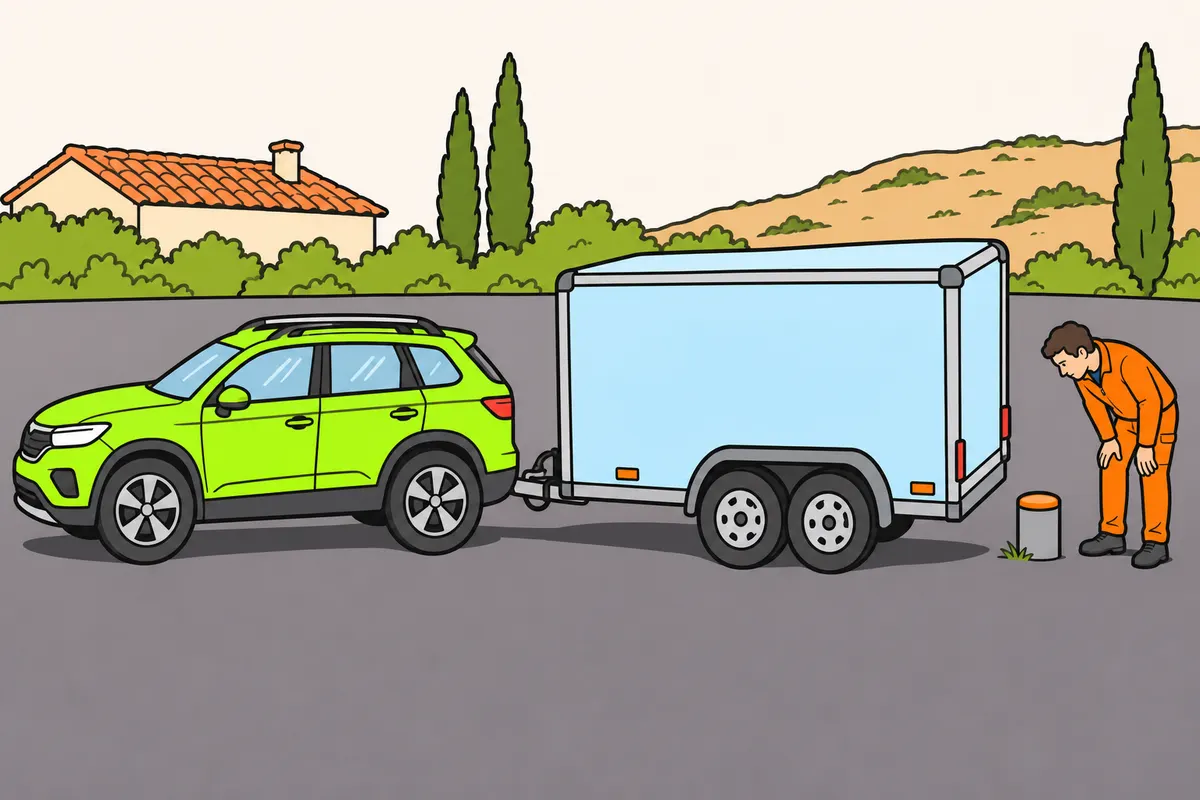
Before reversing, check the space and make sure you can move safely.
Remember
- Position yourself to reverse as little as possible and see both sides.
- In a safe area, get out to check hidden areas.
- Look again immediately before moving.
- Reverse slowly and signal.
- Agree signals with your helper; stop if you lose sight of them.
- Stop immediately if you hear a warning or notice danger.
Exam trap: Wrong: your helper takes responsibility. Right: you remain responsible for the manoeuvre.
Read the full explanation
- Choose a starting position that reduces the need to reverse and lets you see both sides. In a safe place, get out to check for low obstacles, posts, children and the area hidden by the trailer. Check your surroundings again immediately before moving, because people or vehicles may enter the area you have inspected.
- You must reverse slowly, signalling and checking that you can do so safely through direct observation, mirrors and, if necessary, another person's help. If you need a helper, agree clear signals and maintain visual contact; stop if you lose it. Having help does not transfer your responsibility to the person outside. [RGC, art. 81](https://www.boe.es/buscar/act.php?id=BOE-A-2003-23514#a81).
- Set up in a position that lets you reverse as little as possible without making the articulation angle too tight. See «Manoeuvres with a car and trailer» for the circumstances, distances and places in which reversing is permitted on the road. [RGC, art. 80](https://www.boe.es/buscar/act.php?id=BOE-A-2003-23514#a80).
- If you hear a warning or detect a risk while reversing, stop immediately. The dimensions for exercise G are explained in its closed-course section. [RGC, art. 81](https://www.boe.es/buscar/act.php?id=BOE-A-2003-23514#a81).
20Control articulation when reversing
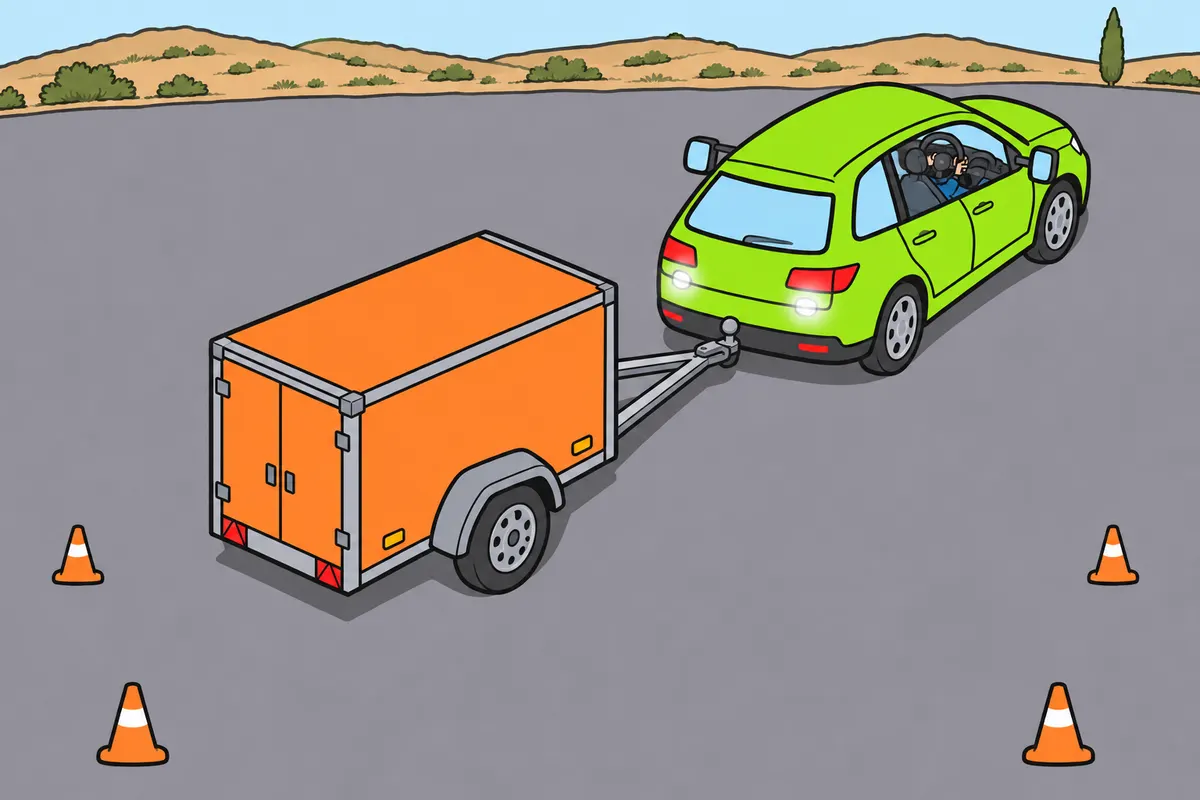
Reverse slowly and correct the angle between your car and trailer early.
Remember
- With a centre-axle trailer and ball coupling, start aligned whenever possible.
- Initially, your trailer turns the opposite way to your steering wheel.
- Make small corrections and watch both mirrors.
- Watch corners, sides and the gap between your vehicles.
- In an ordinary manoeuvre, stop if you lose your path.
- Move forwards to align only when safe and permitted.
Exam trap: Wrong: every trailer needs the same steering movements. Right: learn how your combination responds.
Read the full explanation
- With the usual combination of a centre-axle trailer and ball coupling, start in a straight line whenever space allows. When you start reversing, turning the steering wheel one way directs the rear of the trailer the other way. You need to learn this response with your particular combination, without automatically applying the movements you use with the car alone.
- Reverse very slowly and make small corrections while looking in both mirrors. To guide the trailer to one side, start it turning and then follow it with the towing vehicle, preventing the angle from becoming tighter. You must anticipate when to unwind the steering: waiting for a large deviation means you need a larger correction.
- Watch the rear end, the inside flank, the front of the towing vehicle and the gap between the vehicles. Excessive articulation can jackknife the trailer, cause the bodywork to collide or damage connections. There is no universal steering-wheel angle that works for every trailer: geometry, wheelbase and coupling position all affect it.
- If you lose your intended path during an ordinary manoeuvre, stop and, when safe and permitted, move forwards to straighten up before trying again. On the closed course, you must know which corrections are allowed for each exercise. Practise in an authorised place without traffic, using reference points on the test vehicle, without letting memorised marks replace observation.
21Park and secure the combination against movement
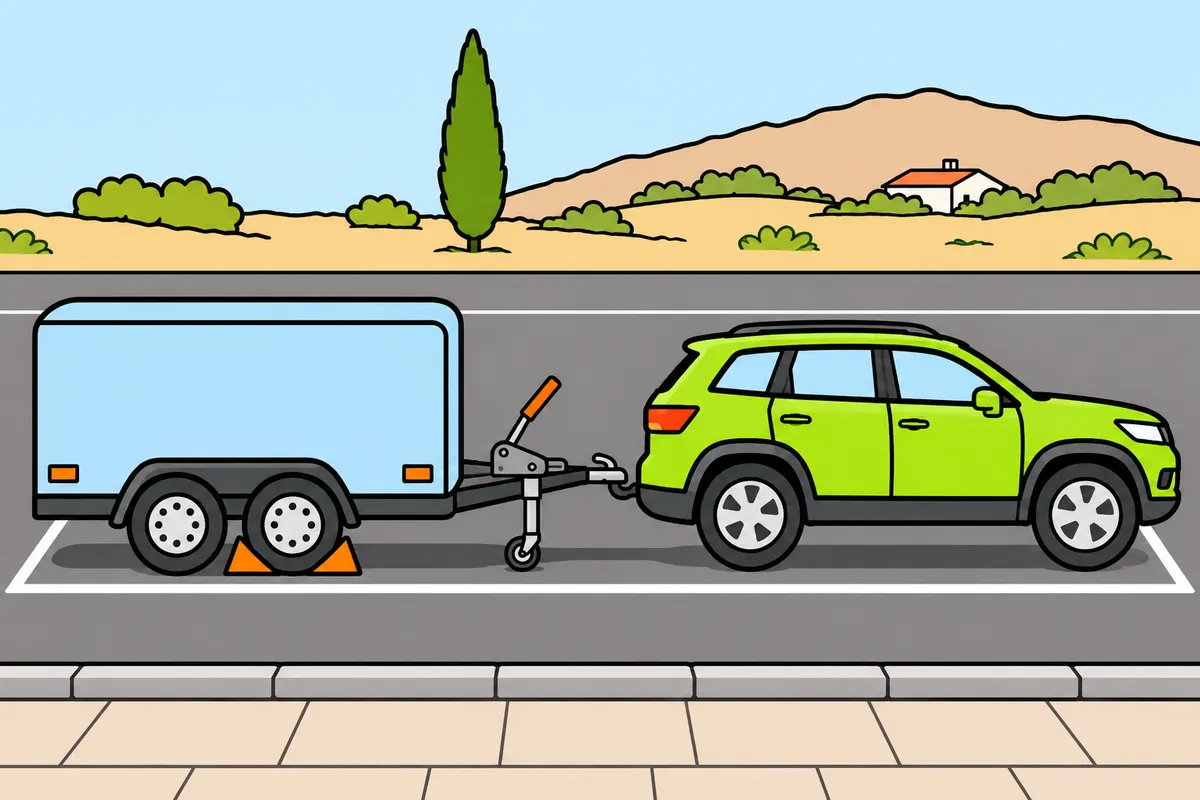
Park where your whole combination fits and secure it before uncoupling.
Remember
- Choose a permitted space with room to manoeuvre and leave.
- Check the ground and slope before uncoupling.
- Secure the combination before leaving the controls.
- Stay out of its path when placing or removing chocks.
- Secure the trailer and put supports in place before releasing the coupling.
Exam trap: Wrong: your car’s brake holds an uncoupled trailer. Right: immobilise your trailer before separating it.
Read the full explanation
- Find a permitted parking space that accommodates the total length and width and leaves room to manoeuvre and leave. Check the ground, gradient and load-bearing capacity beneath the supports if you intend to uncouple. Park without creating danger or seriously obstructing others; the size of the combination does not authorise you to leave part of it across a crossing or access point. [RGC, art. 91](https://www.boe.es/buscar/act.php?id=BOE-A-2003-23514#a91).
- Before leaving the controls, check that the combination remains stationary and that you can get out without exposing yourself to traffic. Apply the braking, transmission and securing measures explained in «Manoeuvres with a car and trailer». [RGC, art. 92.3](https://www.boe.es/buscar/act.php?id=BOE-A-2003-23514#a92).
- If you need to place or remove devices that prevent movement, secure the combination first and avoid standing in its possible path. Choosing chocks and securing the combination on a gradient are covered in «Manoeuvres with a car and trailer»; the equipment you must carry is covered in «Safety equipment for your vehicle combination». [RGC, art. 92.3.d](https://www.boe.es/buscar/act.php?id=BOE-A-2003-23514#a92).
- Before separating the towing vehicle, immobilise the trailer using its intended devices and position the necessary supports. The car's brake no longer holds the trailer when you uncouple it; do not rely on holding the drawbar by hand. Follow the sequence in the «Safe coupling and uncoupling» module.
22What you demonstrate in the B+E practical tests
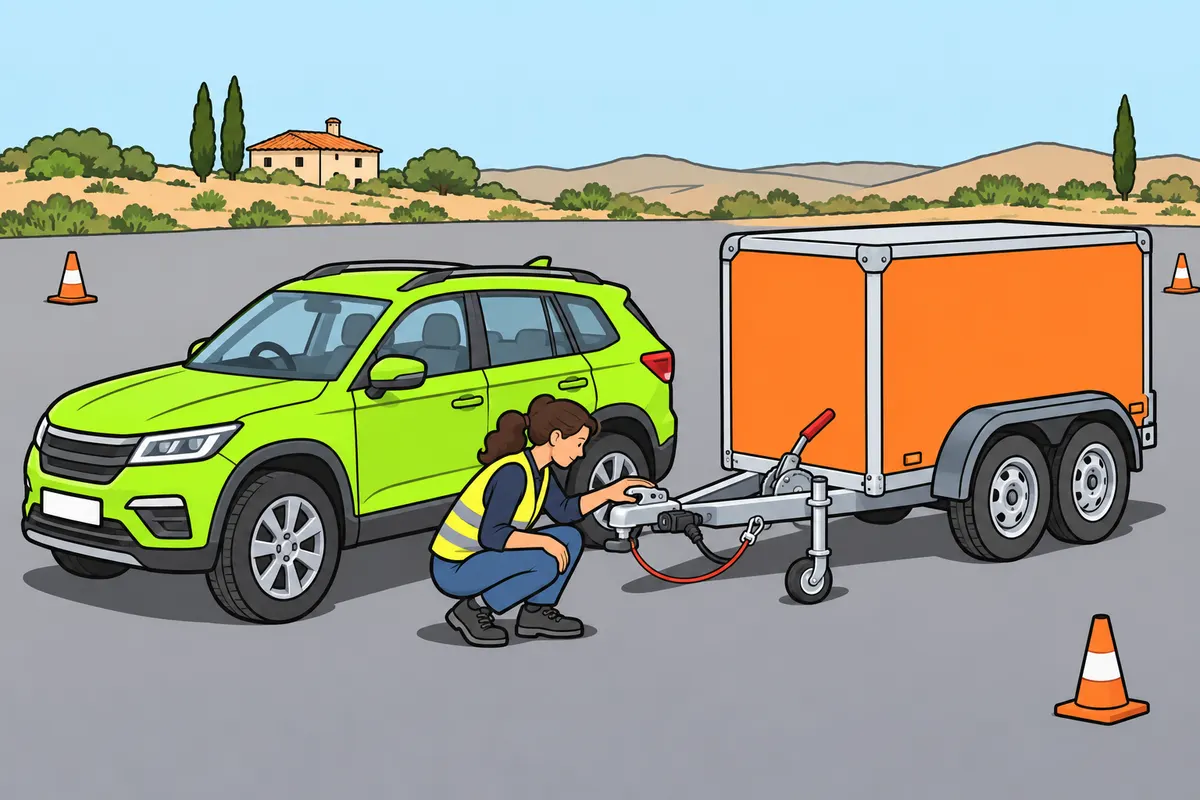
Show that you can prepare and drive your combination safely.
| B+E closed-course manoeuvre | What you must demonstrate |
|---|---|
| G | Reverse straight and around a bend |
| M | Couple and uncouple |
| N | Park safely for loading or unloading |
Remember
- Prepare for the closed-course test and open-road driving.
- Adjust your seat, mirrors, seat belt and head restraint.
- Check the vehicle, load, coupling, brakes and connections.
- Follow signs, priorities and distances throughout the drive.
- Allow for the combination’s length and overhangs on bends.
- Use the braking systems and drive smoothly to save fuel.
Exam trap: Wrong: practising category B manoeuvres is enough. Right: prepare for the specific B+E exercises.
Read the full explanation
- You must prepare for both the closed-course test and driving on public roads. On the B+E closed course, you identify G, reversing straight and around a bend; M, coupling and uncoupling; and N, parking safely for loading or unloading. [RGCond, annex V.B.3.7](https://www.boe.es/buscar/act.php?id=BOE-A-2009-9481#anv).
- Before manoeuvring, adjust the seat, mirrors, seat belt and head restraint, check that the doors are closed and carry out the prescribed randomly selected checks of tyres, steering, brakes, fluids, lights, reflectors, indicators and horn. Also check the trailer's load compartment, its fastenings and the positioning and securing of the load items. [RGCond, annex V.B.3.3.a-d and V.B.3.7.a](https://www.boe.es/buscar/act.php?id=BOE-A-2009-9481#anv).
- You must also check the coupling mechanism, brake and electrical connections, and demonstrate that you can make the combination ready for the road. As well as memorising a sequence, learn to explain what you check and which defect prevents you from setting off. The procedure must match the actual equipment used in your test. [RGCond, annex V.B.3.7](https://www.boe.es/buscar/act.php?id=BOE-A-2009-9481#anv).
- On public roads, you must demonstrate observation, compliance with priority rules and signs, use of position lights, speed, separation and safe handling during manoeuvres. Take account of the whole combination when joining traffic, turning, overtaking and negotiating junctions. [RGCond, annex V.B.4.1 and 4.4](https://www.boe.es/buscar/act.php?id=BOE-A-2009-9481#anv).
- In the B+E test, you must check the brake and steering assistance, use the different braking systems and reduce speed using the available means other than the service brake. Adapt your path around bends to the combination's length and overhangs. [RGCond, annex V.B.4.4](https://www.boe.es/buscar/act.php?id=BOE-A-2009-9481#anv).
- You must move off, change gear and stop smoothly and safely, and drive to reduce fuel consumption and emissions when accelerating, decelerating, climbing and descending gradients, selecting gears manually where appropriate. Checks include wheels, fastenings, mudguards, windows, windscreen wipers and fluids; use the tachograph if it applies to the vehicle and service. [RGCond, annex V.B.4.4](https://www.boe.es/buscar/act.php?id=BOE-A-2009-9481#anv).
- Practise with the particular combination you present for the test so that you recognise its reference points for turning, visibility and articulation; its vehicle requirements are explained in «The B+E licence: limits, tests and validity», under «The vehicle you present for the test». [RGCond, annex VII.B.7](https://www.boe.es/buscar/act.php?id=BOE-A-2009-9481).
23Manoeuvre G: reversing straight and around a bend
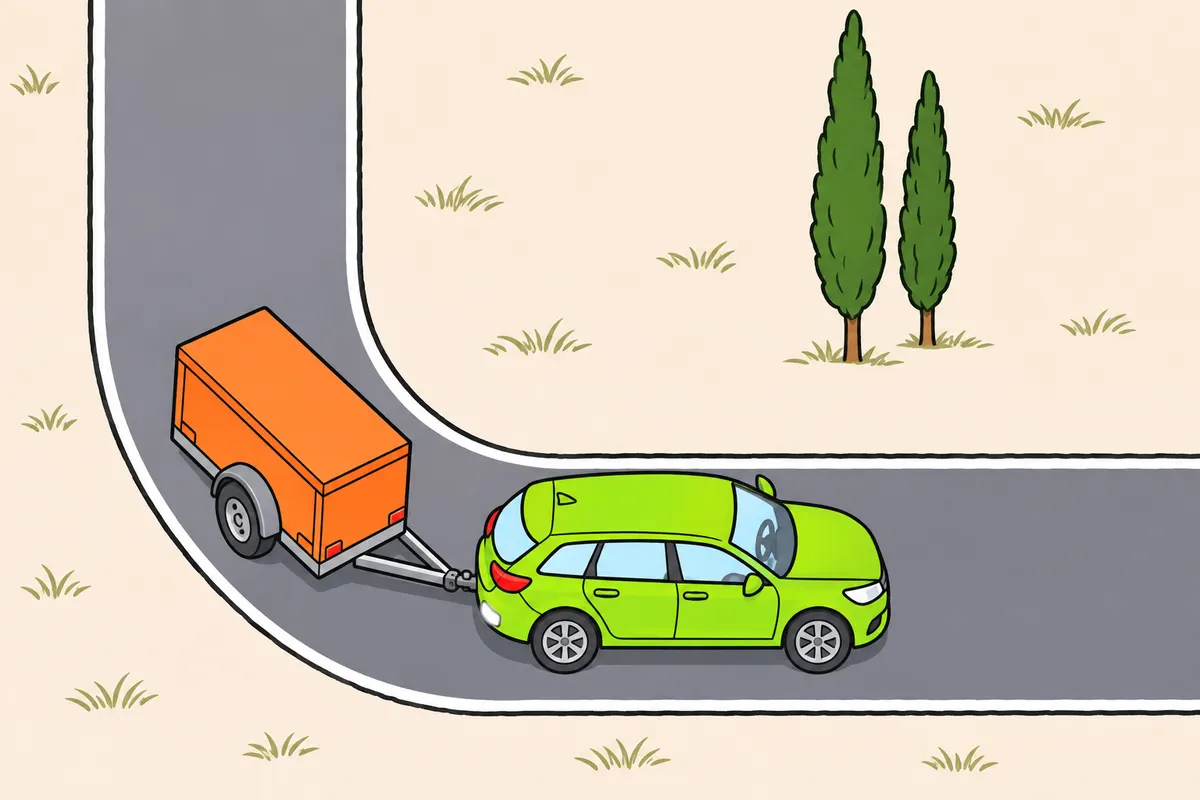
In manoeuvre G, reverse straight and around a bend without leaving the course.
| Trailer type in G | Specific condition |
|---|---|
| Single axle | Lane width from 3.50 to 4.50 m |
| Trailer with a movable front axle | One forward correction is allowed |
| Usual centre-axle trailer | That forward correction is not allowed |
Remember
- Start with the rear of the combination at least 10 m before the bend.
- After the bend, reverse at least another 10 m.
- Keep the combination centred and move at a steady speed.
- Do not cross boundary markings or touch kerbs or markers.
- Do not stop or steer while the combination is stationary.
- Stop if there is real danger, even if this counts as a fault.
Exam trap: Wrong: you may always correct forwards in G. Right: only a trailer with a movable front axle allows one forward correction.
Read the full explanation
- Position the rear of the combination at least 10 m from the start of the bend. You must reverse along the straight section, around the bend and for at least another 10 m along the final straight, leaving the combination reasonably centred. Maintain a steady engine speed throughout. [RGCond, annex VI.C.4, G](https://www.boe.es/buscar/act.php?id=BOE-A-2009-9481#anvi).
- The bend has an angle of approximately 90° and a minimum radius of 3.50 m. For combinations with a single-axle trailer, the lane width is between 3.50 and 4.50 m; the regulations distinguish other configurations. Familiarise yourself with the dimensions of the exercise for your vehicle, without applying a universal width to every combination. [RGCond, annex VI.C.4, G](https://www.boe.es/buscar/act.php?id=BOE-A-2009-9481#anvi).
- During the manoeuvre, you must not mount or push against kerbs, drive your wheels onto or beyond the boundary markings, or touch the objects marking the limits of the space. You must also avoid stopping the combination during the exercise or turning the steering while stationary. Prepare small, continuous corrections throughout the route. [RGCond, annex VI.C.4, G](https://www.boe.es/buscar/act.php?id=BOE-A-2009-9481#anvi).
- The forward correction allowed in G applies to combinations with a trailer with a movable front axle: one is permitted. Do not automatically assume this applies to the usual centre-axle trailer. Although stopping may count as a fault in the exercise, you must stop for a real danger: never risk a collision to avoid a fault. [RGCond, annex VI.C.4, G](https://www.boe.es/buscar/act.php?id=BOE-A-2009-9481#anvi).
24Manoeuvre M: approach and coupling
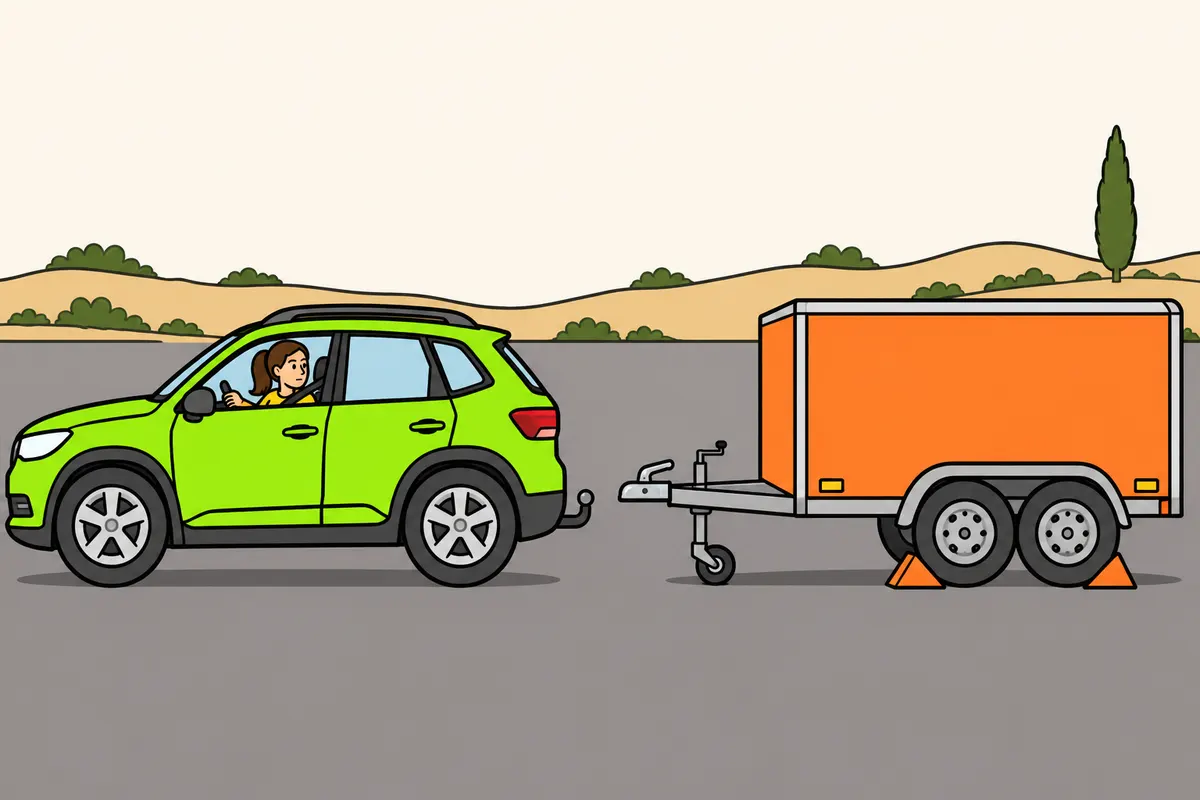
In manoeuvre M, uncouple and couple again, leaving your combination ready to drive.
Remember
- Secure the trailer and put necessary supports in place before uncoupling.
- Leave your car beside the trailer.
- Drive forwards and face the trailer from at least 10 m away.
- During the reversing approach, you may get out once to check.
- Connect everything and check the coupling is locked before driving.
- Remove chocks when appropriate and retract the supports.
Exam trap: Wrong: align a non-automatic drawbar while moving. Right: do it by hand only when both vehicles are stationary.
Read the full explanation
- You must demonstrate that you can uncouple and couple safely, leaving the towing vehicle beside the trailer, rather than simply aligned in front of it. Immobilise the vehicles correctly before separating them and leave the trailer secured, with the necessary supports in the case of a semi-trailer. [RGCond, annexes V.B.3.7 and VI.C.4, M](https://www.boe.es/buscar/act.php?id=BOE-A-2009-9481#anvi).
- To approach again, drive forwards and position the towing vehicle in front of the trailer at a distance of at least 10 m. Reverse while checking alignment, height and available space until you couple up. Do not use a helper standing between the vehicles as a reference point or allow anyone to try to hold back a moving trailer. [RGCond, annex VI.C.4, M](https://www.boe.es/buscar/act.php?id=BOE-A-2009-9481#anvi).
- During this reversing approach, you may get out of the towing vehicle once to make the necessary checks. If the coupling is not automatic, you may guide the drawbar manually in accordance with the procedure, with the vehicles immobilised. This specific permission does not authorise you to carry out checks while the combination is moving. [RGCond, annex VI.C.4, M](https://www.boe.es/buscar/act.php?id=BOE-A-2009-9481#anvi).
- Complete the lighting, signalling and safety connections and check that the coupling is locked before moving the combination. Remove and stow the chocks when appropriate and retract the relevant supports. The exercise requires you to leave it ready for the road, not merely bring the towball and coupling head together; the full mechanical procedure is covered in «Safe coupling and uncoupling». [RGCond, annex VI.C.4, M](https://www.boe.es/buscar/act.php?id=BOE-A-2009-9481#anvi).
25Manoeuvre N: approach for loading or unloading
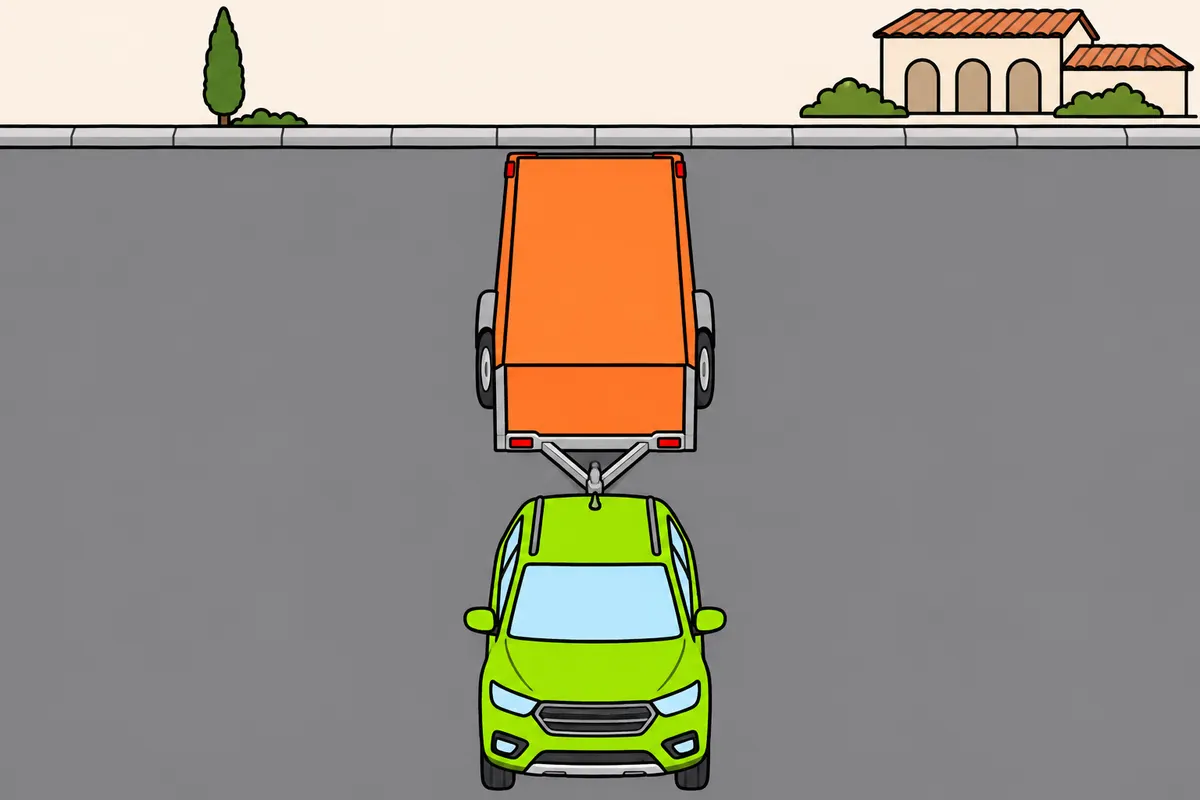
In manoeuvre N, reverse your trailer’s rear towards the kerb.
Remember
- Start stationary, centred and at right angles to the kerb.
- Leave at least 10 m from your trailer’s rear to the kerb.
- Reverse slowly and keep the trailer centred.
- You may make one forward correction during the approach.
- The street is at least 25 m long and 6 m wide.
- Stop and secure the combination before leaving the controls.
Exam trap: Wrong: measure from your car. Right: measure from the trailer’s rear; do not drive the wheels onto the kerb.
Read the full explanation
- Start with the combination stationary, centred and perpendicular to a kerb. You must leave at least 10 m between the rear of the trailer and the kerb. The exercise consists of reversing towards it, keeping the trailer centred, without applying the parking reference points you use for a passenger car on its own. [RGCond, annex VI.C.4, N](https://www.boe.es/buscar/act.php?id=BOE-A-2009-9481#anvi).
- You must finish with the rear end of the trailer no more than 0.30 m from the kerb, without extending more than 0.20 m beyond it. Memorise both measurements and check which end you use as your reference: these distances are not measured from the car, nor do they permit you to drive the wheels onto the kerb. [RGCond, annex VI.C.4, N](https://www.boe.es/buscar/act.php?id=BOE-A-2009-9481#anvi).
- In N, you may make one forward corrective movement during the approach. The exercise lane is at least 25 m long and 6 m wide. Do not confuse this correction with the rules for G, or the measurements for N with those for a loading platform for other licence categories. [RGCond, annex VI.C.4, N](https://www.boe.es/buscar/act.php?id=BOE-A-2009-9481#anvi).
- Practise the approach at very low speed, comparing both sides and correcting deviations early. Stop the combination without hitting anything and secure it before leaving the controls. In an actual loading or unloading operation, you must also assess the people present, the ground and possible changes in mass distribution as you move the items.
Preparing to set off with a trailer
Link your route, mass distribution and final checks.
- Confirm that your route and destination accommodate the dimensions and masses of the combination.
- Distribute the load low down and evenly, and check the vertical load and technical limits.
- Secure the items and check fastenings, coupling, connections, supports and safety devices.
- Check tyres, lights and brakes, and adjust the mirrors for the trailer.
- Set off safely and gently check how the combination responds.
Dealing with trailer sway
Reduce speed without causing further oscillations.
- Hold the steering wheel firmly and maintain your direction of travel.
- Ease off the accelerator progressively and avoid steering alternately from side to side to follow the trailer.
- Avoid braking to correct snaking, and do not accelerate to try to pull the combination taut.
- Once the combination is stable, find a safe place to stop.
- Check the load, vertical load, tyres and coupling, and resolve the cause before continuing.
Preparing for a long descent
You establish control before you reach the slope.
- Observe the gradient, bends, grip and traffic, and moderate your speed.
- Select a gear or transmission mode that provides suitable engine braking without exceeding the engine speed limit.
- Keep a gear engaged and use the available engine braking.
- Brake when necessary, anticipating bends and avoiding continuous overloading of the service brake.
- If a braking fault occurs, seek to stop safely and resolve it.
Reversing and parking on the road
Control the space, articulation and final immobilisation.
- Choose a permitted location and check hidden areas on foot when necessary.
- Position the combination in a straight line if possible, look again and signal the manoeuvre.
- Reverse slowly and make small corrections, watching both sides and the angle between the vehicles.
- Stop if there is a risk or you lose sight of your helper; pull forwards to correct your position when it is safe and permitted.
- When you finish, secure the combination against movement using the appropriate brake, transmission setting and wheel chocks before leaving the controls or uncoupling.
Check what you know
Real questions from the bank on this topic. Pick an answer to see the explanation.
Finished this module?
Mark it as read and you will see your progress on the theory list.