
Theory · A1 Licence - 125 cc Motorcycle · Module 13 of 18
Passengers and loads on motorcycles
You will learn who may travel with you and where they must sit, how to stay within the motorcycle’s capacity, and how to secure luggage. You will study load projections on a narrow motorcycle, their marking, and the conditions for towing a trailer.
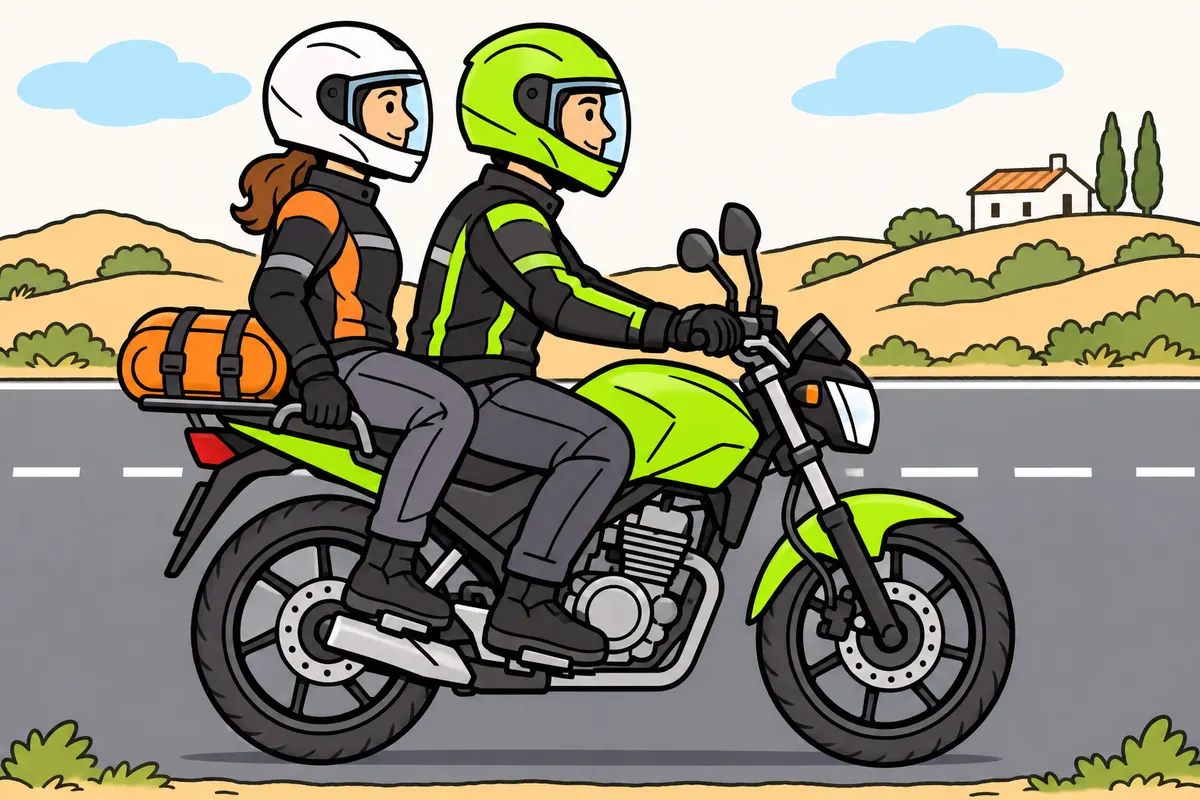
1Authorised seats and rear passenger
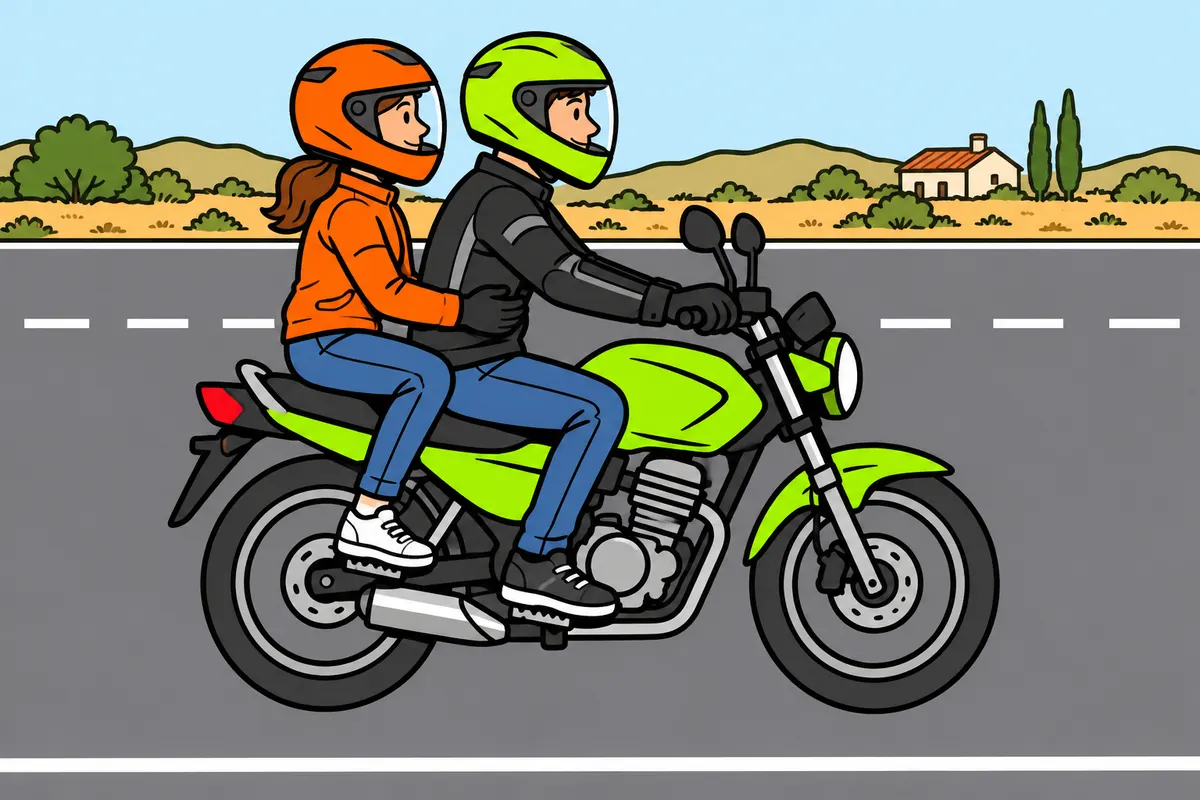
You can carry a passenger when your vehicle has an authorised seat for them.
| Vehicle | Where passengers sit |
|---|---|
| Motorcycle | In the authorised rear seat, astride, with feet on the footrests |
| Motor tricycle | In the designated documented seats |
Remember
- Check the authorised seats on your registration certificate; your seat counts too.
- Carry your passenger behind you, with a leg on each side.
- Check that their feet rest on the side footrests.
- Never carry them between you and the handlebars.
- A top box or luggage rack is not a passenger seat.
- At 16 or 17, you can carry a passenger who meets the rules.
Exam trap: Wrong: an A1 rider aged 16 cannot carry a passenger. Right: you can if the seat is authorised and the passenger meets the general age, posture and foot support requirements.
Read the full explanation
- You may carry a passenger if this is stated on the permiso de circulación (vehicle registration certificate). As to age, seat and posture, they must be over twelve, sit astride behind you and rest their feet on the side footrests. The helmet and other protective equipment are covered in “Rider and passenger protection”. [RGC, art. 12.1](https://www.boe.es/buscar/act.php?id=BOE-A-2003-23514#a12)
- You may carry only the authorised number of people, including the rider. [RGC, art. 9](https://www.boe.es/buscar/act.php?id=BOE-A-2003-23514#a9) A top box or luggage carrier is not a seat for a person. [RGC, art. 10](https://www.boe.es/buscar/act.php?id=BOE-A-2003-23514#a10)
- You can obtain the A1 licence from the age of 16. [RGCond, art. 4](https://www.boe.es/buscar/act.php?id=BOE-A-2009-9481#a4) At 16 or 17, for example, you can carry a 14-year-old friend on your two-seat 125 cc motorcycle if they meet the passenger requirements; the article does not require an additional minimum age or a minimum period of holding the licence. [RGC, art. 12.1](https://www.boe.es/buscar/act.php?id=BOE-A-2003-23514#a12)
- On a motor tricycle, you may carry the passengers listed on the permiso de circulación in the seats provided for them. The seating requirements in article 12.1 apply to mopeds and motorcycles. The A1 licence covers motor tricycles up to 15 kW. [RGC, arts. 9 and 10](https://www.boe.es/buscar/act.php?id=BOE-A-2003-23514#a9) [RGC, art. 12.1](https://www.boe.es/buscar/act.php?id=BOE-A-2003-23514#a12) [RGCond, art. 4](https://www.boe.es/buscar/act.php?id=BOE-A-2009-9481#a4)
2Exception for children over seven
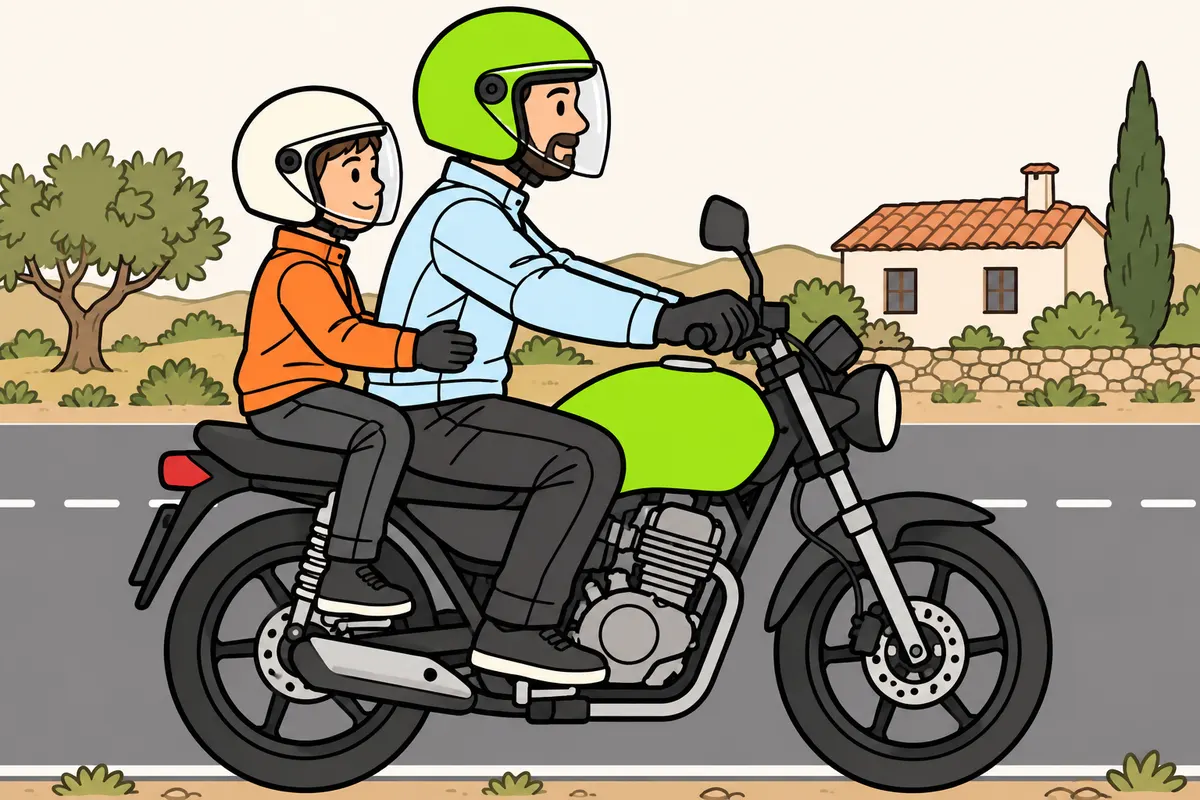
You can carry a child over seven under the family exception conditions.
| Your relationship | Who can use the exception |
|---|---|
| Parent or guardian | You can use it without being an adult |
| Another person | You must be an adult authorised by the parent or guardian |
Remember
- You can use this exception on urban and interurban roads.
- You must be their parent, guardian, or an adult authorised by them.
- The child still needs the rear seat, helmet, astride posture and footrests.
- Do not carry them if they cannot reach the footrests.
- At 16 or 17, you qualify only as their parent or guardian.
Exam trap: Wrong: family consent lets any young person carry the child. Right: you must be an adult unless you are the child's parent or guardian. The child must be over seven and meet the helmet, rear seat, posture and foot support requirements.
Read the full explanation
- Exceptionally, you may carry a child over seven if you are their father, mother or guardian, or an adult authorised by them. This exception applies on urban and interurban roads. [RGC, art. 12.2](https://www.boe.es/buscar/act.php?id=BOE-A-2003-23514#a12) [Traffic Act, art. 13.5](https://www.boe.es/buscar/act.php?id=BOE-A-2015-11722#a13)
- The exception for children also requires you to meet the rear passenger requirements described in the first section and use the compulsory equipment. If the child cannot reach the footrests, their age and family authorisation do not allow you to carry them. [RGC, art. 12.2](https://www.boe.es/buscar/act.php?id=BOE-A-2003-23514#a12)
- At 16 or 17, you cannot carry a child over seven and up to 12 as an authorised person: you must be an adult, unless you are the child’s father, mother or guardian. [RGC, art. 12.2](https://www.boe.es/buscar/act.php?id=BOE-A-2003-23514#a12)
3Sidecar seats
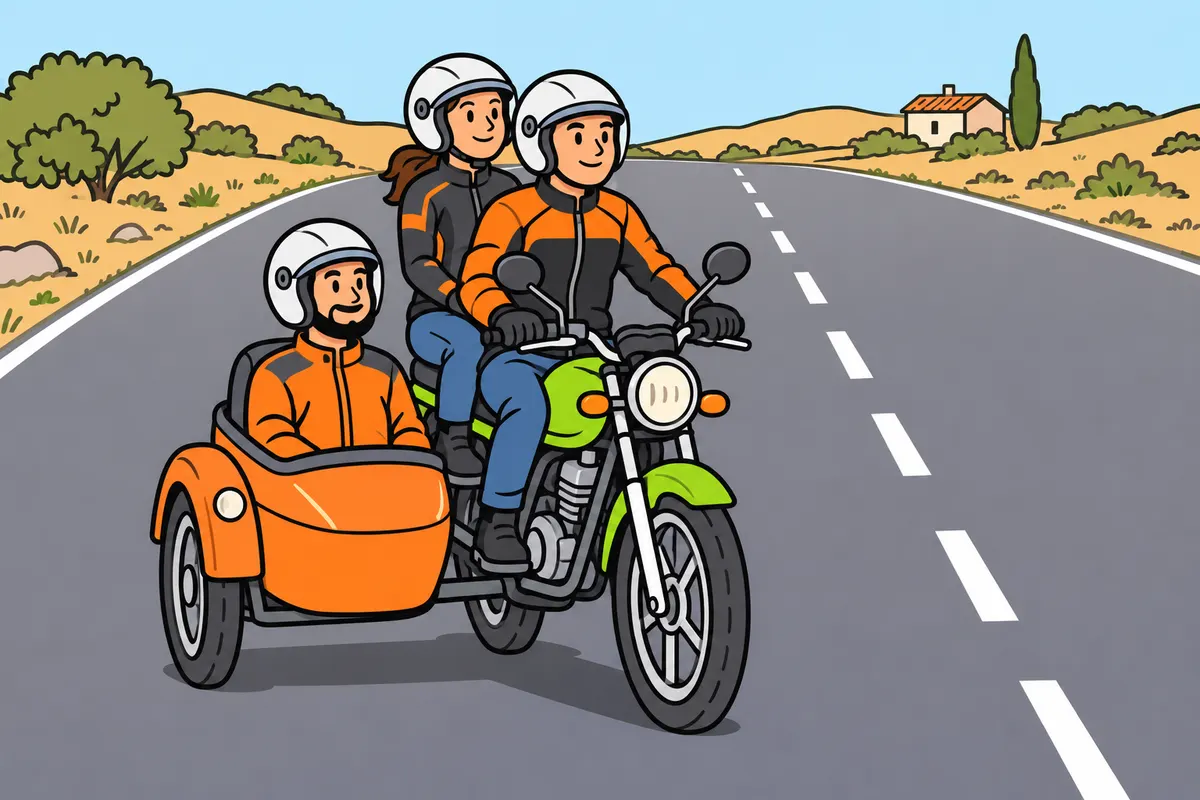
With a sidecar, follow the authorised seating and child age rules.
| Seat on a motorcycle with sidecar | Where the occupant sits |
|---|---|
| Sidecar | In its designated seating area |
| Authorised rear seat | Behind you, astride |
Remember
- Check the authorised seats for your motorcycle and sidecar configuration.
- You can carry the sidecar occupant and a rear passenger if authorised.
- The sidecar occupant uses their designated seating area.
- Secure loads so they cannot obstruct or injure occupants.
- The child age rule and family exception also apply in a sidecar.
Exam trap: Wrong: a sidecar lets you ignore a child's age. Right: follow the general age rule or meet the family exception.
Read the full explanation
- On a motorcycle with a sidecar, you may carry its occupant and, if authorised, another passenger behind you. You must respect the seats recorded for that configuration. [RGC, art. 12](https://www.boe.es/buscar/act.php?id=BOE-A-2003-23514#a12)
- The sidecar occupant must use the seat provided. Any load must be secured so that it does not obstruct or injure the occupants. [RGC, art. 10](https://www.boe.es/buscar/act.php?id=BOE-A-2003-23514#a10)
- The age restrictions for children also apply to motorcycles with sidecars: the sidecar seat does not let you avoid either the general rule or the family exception. [Traffic Act, art. 13.5](https://www.boe.es/buscar/act.php?id=BOE-A-2015-11722#a13)
4Rider and passenger protection
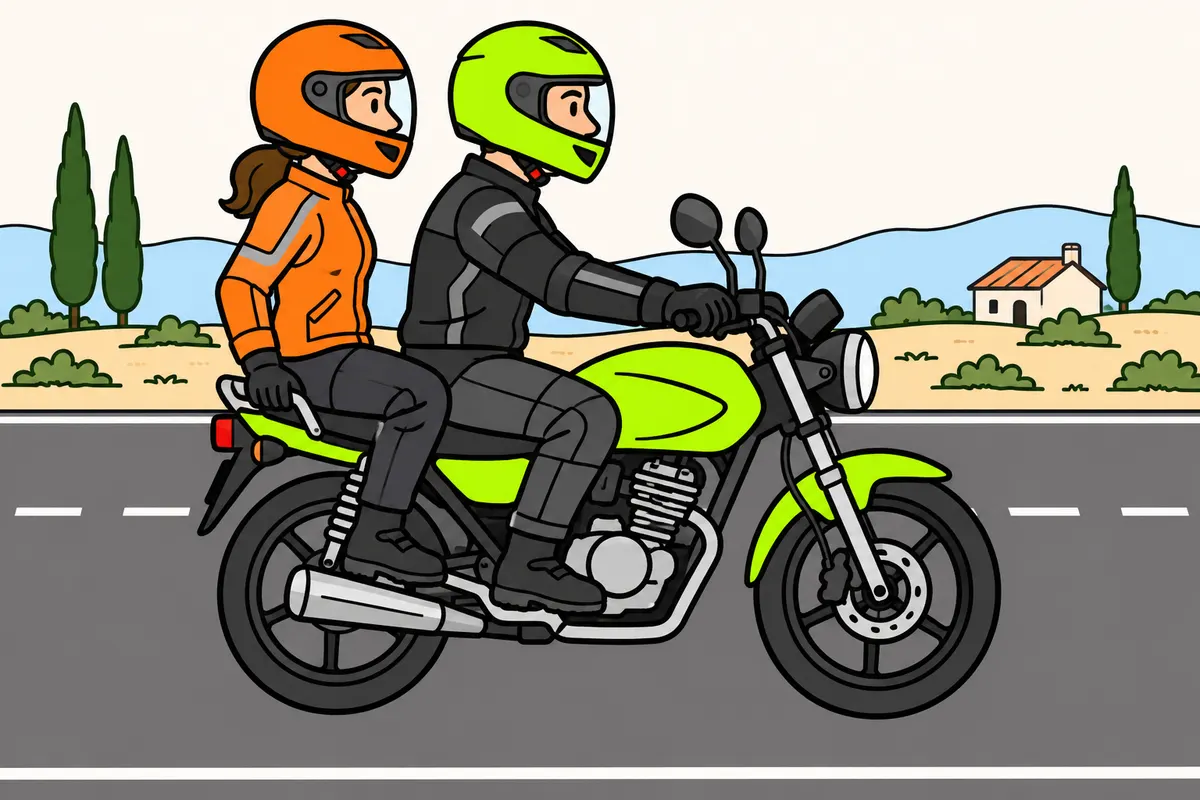
You and your passengers must use the required protective equipment.
| Vehicle and condition | Equipment for you and your passengers |
|---|---|
| Motorcycle or motor tricycle without a documented exemption | Helmet and closed footwear on every road; protective gloves on interurban roads |
| Motorcycle or motor tricycle with protective structure and seat belts recorded on the ITV card | Seat belt on every road; exempt from helmet, gloves and closed footwear |
| Moped using the AM entitlement included in A1 | You and your passenger may use certified helmets for one year from 1 October 2026 |
Remember
- On motorcycles and motor tricycles, wear a properly fastened approved UNECE Regulation 22 helmet.
- Require your passengers to wear that helmet on every road too.
- Wear closed footwear covering your whole foot on every road.
- Wear protective gloves on interurban roads.
- Check your ITV card for the protective structure and seat belt exemption.
- On a moped, you may both use certified helmets during the period below.
Exam trap: Wrong: any motorcycle with a seat belt gives you a helmet exemption. Right: the protective structure and seat belts must be recorded on the ITV card, and you must wear the seat belt on every road.
Read the full explanation
- On a motorcycle, with or without a sidecar, or on a motor tricycle, you and your passengers must wear a correctly fastened helmet approved under UNECE Regulation No. 22 on every road. [RGC, art. 118](https://www.boe.es/buscar/act.php?id=BOE-A-2003-23514#a118) If you ride a moped using the AM entitlement included in your A1 licence, you and your passenger may use a certified helmet for one year from 1 October 2026. [RD 518/2026, first transitional provision](https://www.boe.es/buscar/doc.php?id=BOE-A-2026-13889)
- On these vehicles, you must wear closed footwear covering the whole foot on every road, and protective gloves on interurban roads. The choice and fit of equipment are covered in “Motorcyclist protective equipment”. [RGC, art. 118](https://www.boe.es/buscar/act.php?id=BOE-A-2003-23514#a118)
- If your motorcycle or tricycle has a protective structure and seat belts, and this is recorded on the ITV (vehicle roadworthiness test) card, you are exempt from wearing a helmet, gloves and closed footwear, but you must wear the seat belt on every road. [RGC, art. 118](https://www.boe.es/buscar/act.php?id=BOE-A-2003-23514#a118)
5Mass and luggage carrier capacity
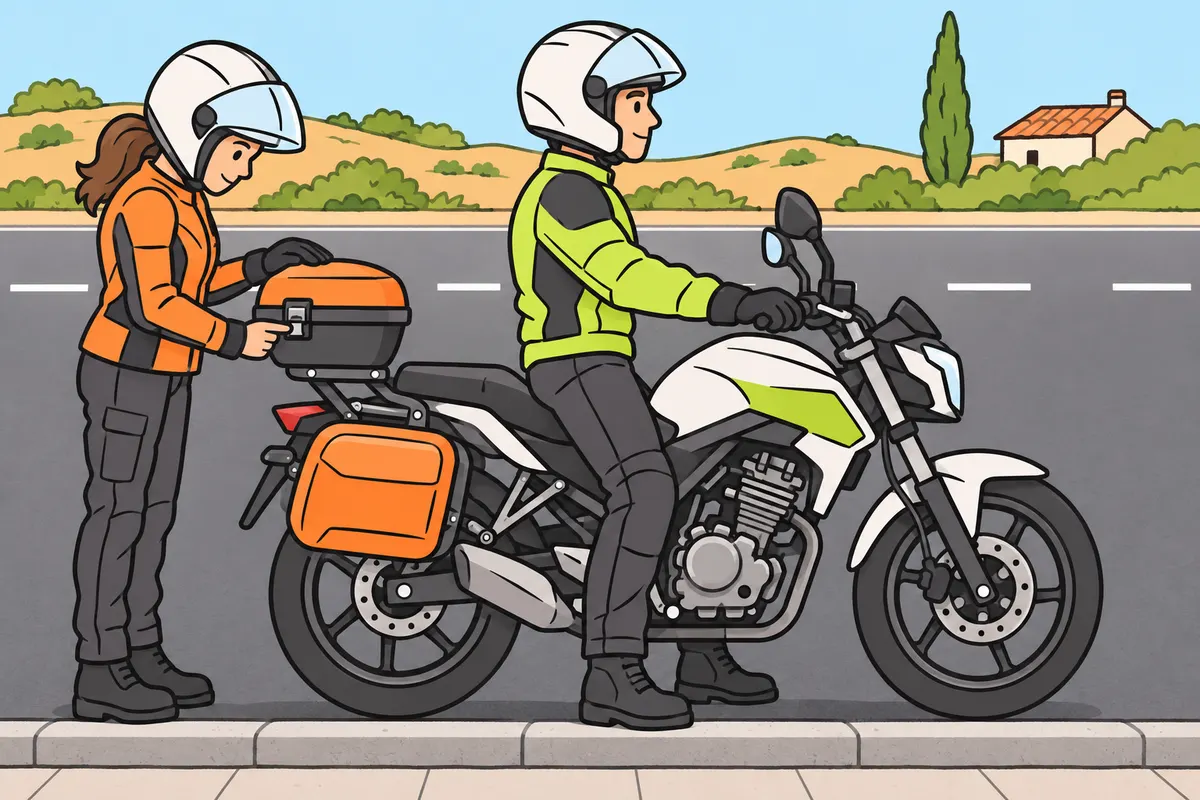
Keep the loaded motorcycle and every carrier or case within its weight limit.
Remember
- MMA is the maximum permitted mass of your laden vehicle.
- Add the motorcycle, rider, passenger, accessories and luggage.
- Respect axle loads and the technical limits of your motorcycle and tyres.
- Check your ITV card and the manufacturer's instructions.
- Respect the separate capacity of each case, mounting and luggage rack.
- Include accessory weight and check catches and fastenings.
Exam trap: Wrong: MMA limits only your luggage. Right: it includes your motorcycle, people, accessories and luggage.
Read the full explanation
- The MMA (maximum authorised mass) is the maximum mass of the laden vehicle authorised for road use. When checking it, you must add the motorcycle, rider, passenger, accessories and luggage; it is not just the capacity of the panniers. [RGV, annex IX, section 1.6](https://www.boe.es/buscar/act.php?id=BOE-A-1999-1826#anix)
- You must comply with the MMA and the permitted axle loads, as well as the technical limits of your motorcycle and its tyres. Check the ITV card and the manufacturer’s instructions. [RGC, art. 9](https://www.boe.es/buscar/act.php?id=BOE-A-2003-23514#a9) [RGV, annex IX](https://www.boe.es/buscar/act.php?id=BOE-A-1999-1826#anix)
- Each pannier, mount and luggage carrier has its own capacity. You must respect the limit for each component, include the weight of accessories, and check the locks and fastenings. [RGC, art. 14](https://www.boe.es/buscar/act.php?id=BOE-A-2003-23514#a14)
6Positioning and securing luggage
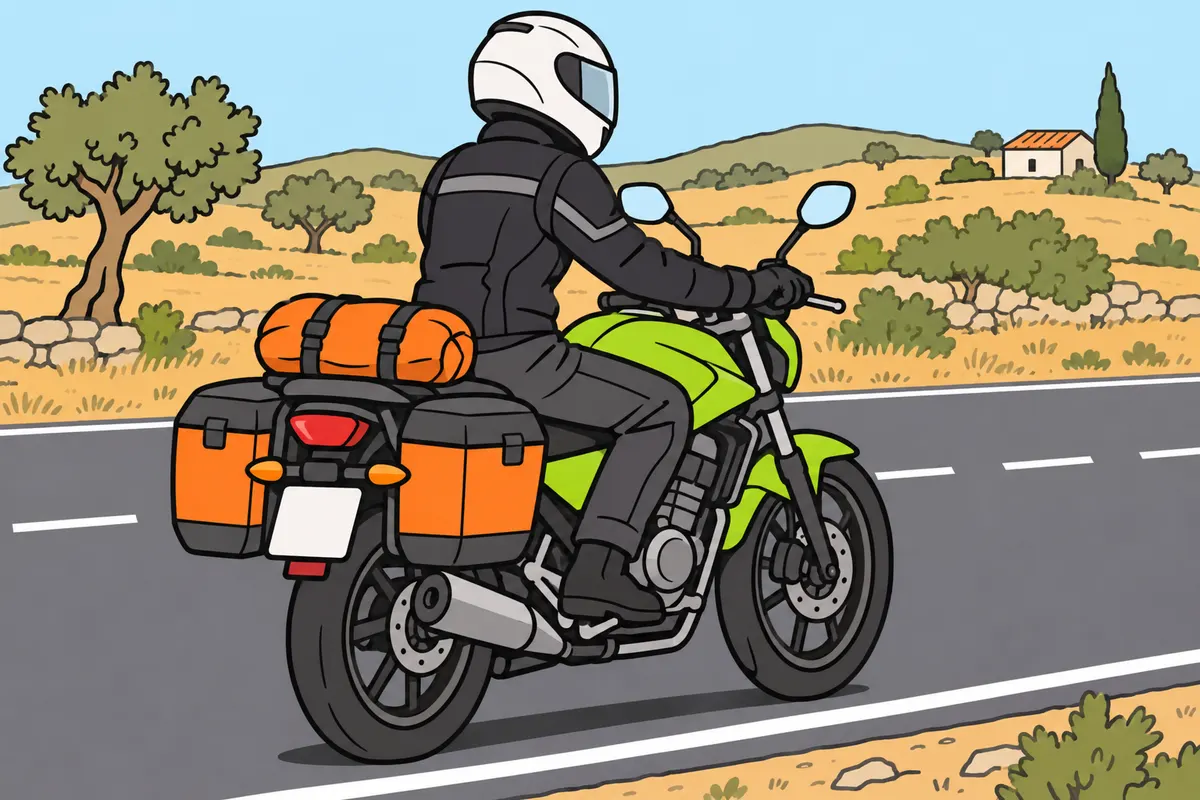
Spread and secure luggage so your motorcycle stays stable and its controls stay clear.
Remember
- Spread weight evenly; place heavy items low and near the centre.
- Secure the load, accessories and contents of your cases.
- Tuck straps away from the wheels.
- Keep lights, the number plate, markings and hand signals visible.
- Fully cover dusty materials and anything that may fall off; avoid nuisance.
- Keep your view, movement, handlebars and controls clear.
Exam trap: Wrong: closing your cases is enough. Right: secure their contents and accessories too, to prevent falls, dangerous movement and loss of stability.
Read the full explanation
- As a general guideline, distribute the weight evenly between the side panniers and place heavy items low down and close to the centre of the motorcycle, in the spaces provided. [DGT, motorcycle luggage](https://revista.dgt.es/es/reportajes/2023/06JUNIO/0608-como-llevar-equipaje.shtml)
- You must arrange and secure luggage and its accessories to prevent dragging, falling, dangerous movement or loss of stability. Also secure the contents of panniers and tuck away straps that could reach the wheels. [RGC, art. 14](https://www.boe.es/buscar/act.php?id=BOE-A-2003-23514#a14)
- Luggage must not obscure lights, light signals, the number plate, compulsory markings or your hand signals. It must not cause avoidable noise, dust or nuisance either. [RGC, art. 14](https://www.boe.es/buscar/act.php?id=BOE-A-2003-23514#a14)
- You must cover completely and effectively any materials that produce dust or could fall. Dangerous, harmful, unhealthy or troublesome goods are also subject to their specific regulations. [RGC, art. 14](https://www.boe.es/buscar/act.php?id=BOE-A-2003-23514#a14)
- Objects, animals and passengers must leave you with clear vision, the ability to concentrate and freedom of movement. A tank bag must not obstruct the handlebars or controls. Getting on, holding on and the passenger’s behaviour, as well as adapting your riding, are covered in “Motorcycle riding techniques”. [RGC, art. 18](https://www.boe.es/buscar/act.php?id=BOE-A-2003-23514#a18)
7Load projections on a motorcycle less than one metre wide
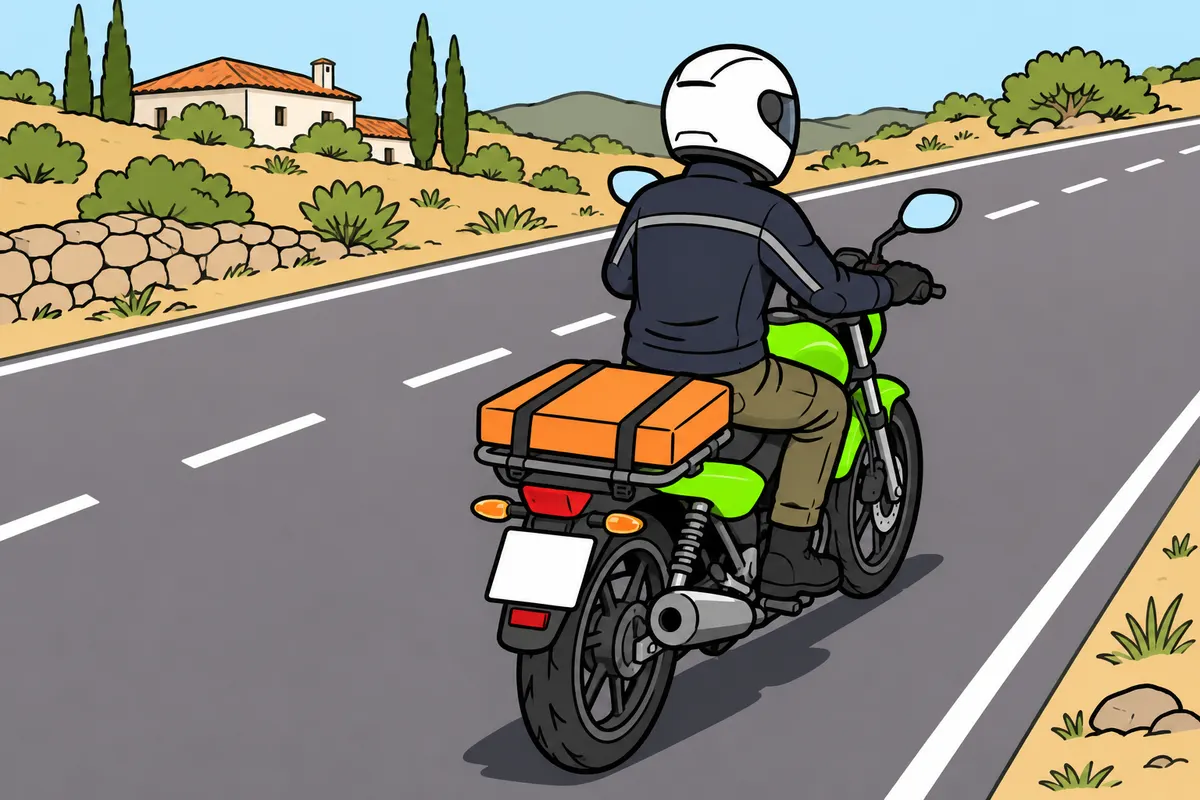
On a narrow motorcycle, measure each load projection from the correct place.
| Load on motorcycles under one metre wide | Limit |
|---|---|
| Front | Must not project |
| Rear | Up to 25 cm from vehicle end |
| Each side | Up to 50 cm from centre line |
Remember
- These limits apply if your motorcycle is less than one metre wide.
- Your load must not project at the front.
- Measure rear projection from the end of the vehicle.
- Measure each side edge from the motorcycle's centre line.
- Check each side separately.
- Respect authorised dimensions and road restrictions.
Exam trap: Wrong: you can add 50 cm from each side of your motorcycle. Right: on a motorcycle less than one metre wide, measure 50 cm from the centre line, separately on each side.
Read the full explanation
- You must comply with the authorised dimensions of the laden vehicle and any road restrictions. A load may project only in the permitted circumstances. [RGC, art. 13](https://www.boe.es/buscar/act.php?id=BOE-A-2003-23514#a13) [RGC, art. 15](https://www.boe.es/buscar/act.php?id=BOE-A-2003-23514#a15)
- If your motorcycle is less than one metre wide, the load must not project forwards and may project up to 25 cm behind. You must measure the projection from the outermost point of the vehicle. [RGC, art. 15.4](https://www.boe.es/buscar/act.php?id=BOE-A-2003-23514#a15)
- On that motorcycle, each side edge of the load may be no more than 50 cm from the longitudinal axis. Measure from the motorcycle's centre line; do not add that distance from each side. [RGC, art. 15.4](https://www.boe.es/buscar/act.php?id=BOE-A-2003-23514#a15)
- Check the limit separately on each side. For example, one edge 55 cm from the axis breaches the limit even if the other is 40 cm away. [RGC, art. 15](https://www.boe.es/buscar/act.php?id=BOE-A-2003-23514#a15)
8Sidecars one metre wide or more and V-20
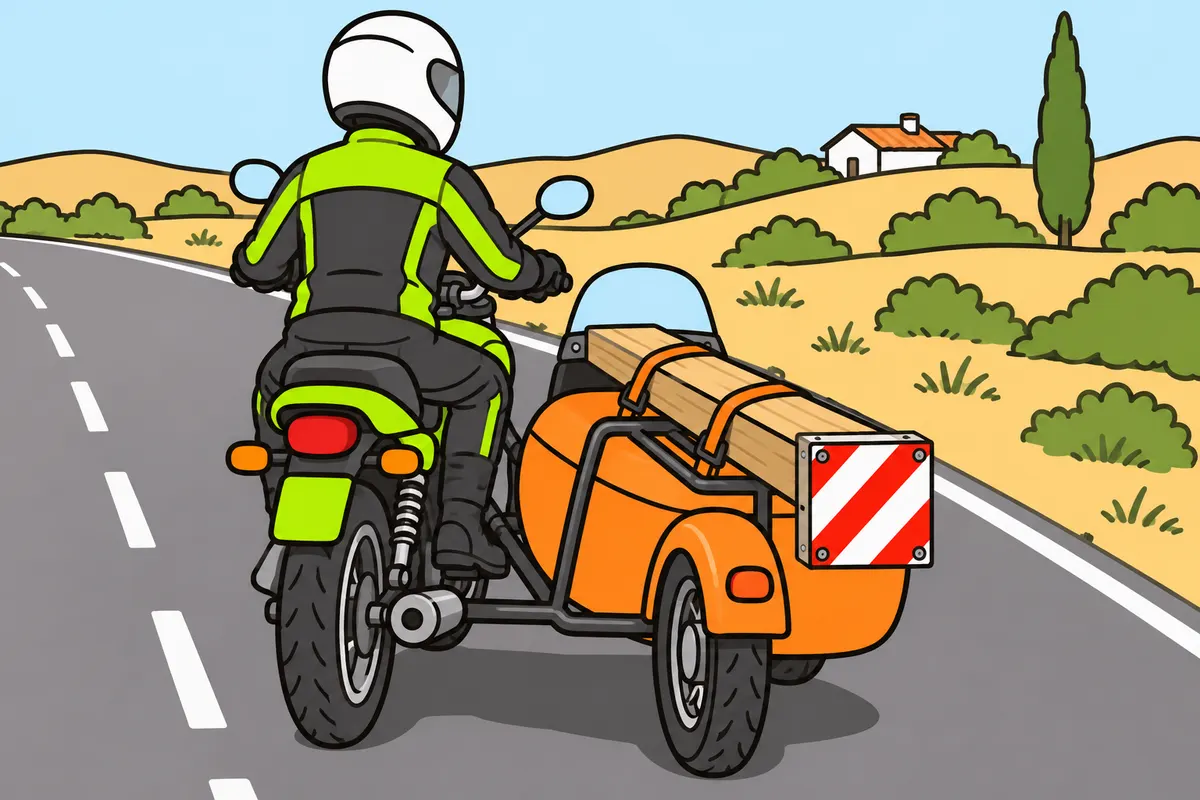
Apply the correct rear projection and marking rule for your vehicle's width.
| Vehicle | Rear projection | V-20 |
|---|---|---|
| Motorcycle under one metre wide | Up to 25 cm | Not for this allowance |
| Motorcycle with sidecar, one metre wide or more | 10 % of length; 15 % for indivisible load | Required |
Remember
- The V-20 has reflective red and white diagonal stripes.
- When required, put it at the rearmost point, perpendicular to the vehicle’s length.
- If the projection spans the full rear width, fit two panels.
- Place their stripes to form an upside-down V.
Exam trap: Wrong: every rear load needs V-20. Right: a permitted rear projection of up to 25 cm on a motorcycle less than one metre wide does not need it.
Read the full explanation
- You do not need a V-20 panel for the permitted rear projection on your motorcycle less than one metre wide: article 15.6 requires this panel only in the circumstances covered by paragraphs 15.2 and 15.3, while your motorcycle is covered by paragraph 15.4. [RGC, arts. 15.4 and 15.6](https://www.boe.es/buscar/act.php?id=BOE-A-2003-23514#a15)
- If your motorcycle with sidecar is one metre wide or more, you may use the general rear projection allowance of 10% of the vehicle's length, or 15% for an indivisible load; that projection must carry a V-20 sign. [RGC, arts. 15.3 and 15.6](https://www.boe.es/buscar/act.php?id=BOE-A-2003-23514#a15)
- The V-20 identifies a load projecting behind the vehicle and has reflective red and white diagonal stripes. Where required, place it at the rearmost point, perpendicular to the vehicle's axis. If the projection spans the full rear width, place two panels with their stripes forming an inverted V. [RGV, Annex XI, V-20](https://www.boe.es/buscar/act.php?id=BOE-A-1999-1826#v-20) [RGC, art. 15.6](https://www.boe.es/buscar/act.php?id=BOE-A-2003-23514#a15)
9Protection and lights for projecting loads
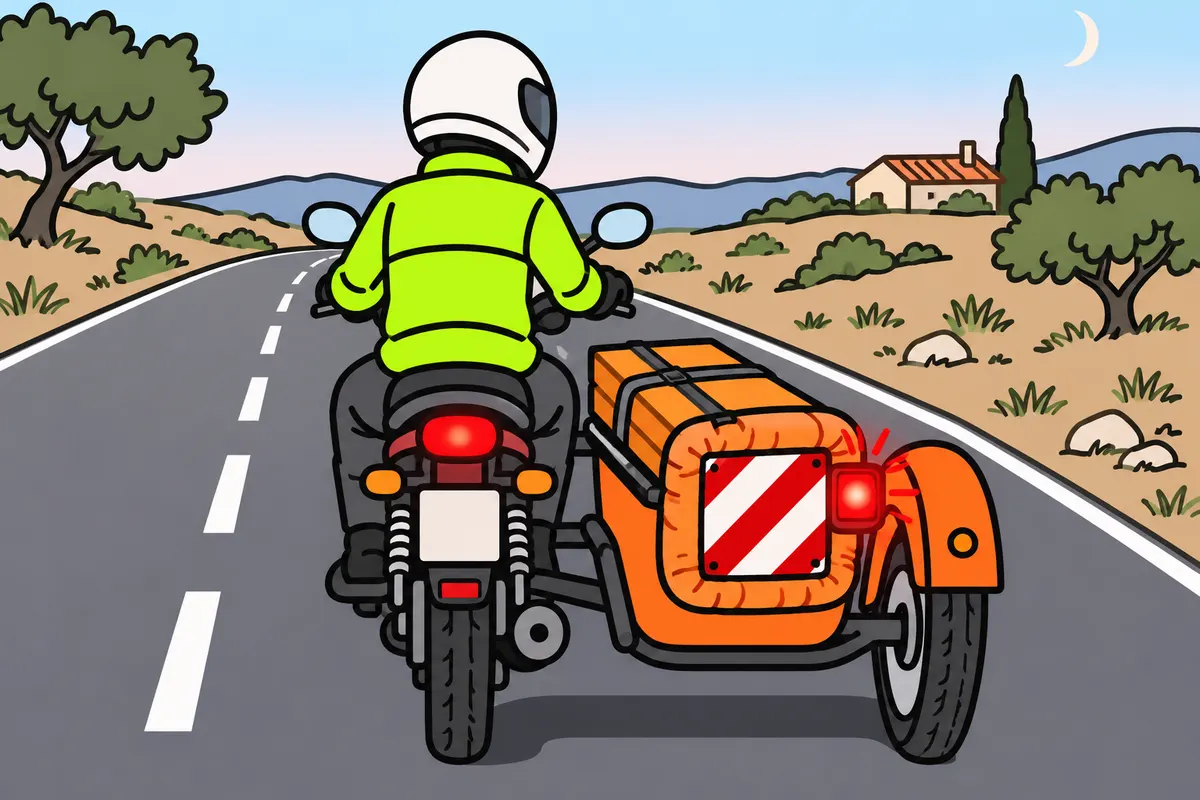
Protect legal projections and add lights and reflectors when required.
| Side end requiring marking | Light and reflector to fit |
|---|---|
| Forwards | White |
| Rearwards | Red |
Remember
- Protect the end of any load that legally projects.
- Required rear marking needs a red light at night or with significantly reduced visibility.
- A white front light permits no front projection on your narrow motorcycle.
- Measure 40 cm from the outer edge of the relevant position light.
- Beyond that distance, mark each side end at night or with significantly reduced visibility.
Exam trap: Wrong: measure 40 cm from the centre line. Right: if your load projects sideways, measure from the outer edge of the relevant position light. Beyond that distance, mark each end with a white light and reflector facing forwards and a red light and reflector facing rearwards, between sunset and sunrise or with significantly reduced visibility.
Read the full explanation
- If a load projects legally, you must protect its end and prevent injury or danger to other road users. [RGC, art. 15.5](https://www.boe.es/buscar/act.php?id=BOE-A-2003-23514#a15)
- In the rear-signalling circumstances set out in article 15.6, between sunset and sunrise or when visibility is significantly reduced, you must add a red light to the panel. A white light applies to a legally authorised forward projection; it does not permit one on a narrow motorcycle. [RGC, art. 15.6](https://www.boe.es/buscar/act.php?id=BOE-A-2003-23514#a15)
- If a load projects sideways and its edge is more than 40 cm from the outer edge of the corresponding position light, between sunset and sunrise or when visibility is significantly reduced you must mark each end: a white light and reflector facing forwards, and a red light and reflector facing backwards. Measure those 40 cm from the light, not from the axis. [RGC, art. 15.7](https://www.boe.es/buscar/act.php?id=BOE-A-2003-23514#a15)
10Trailers: mass, time of travel and occupants
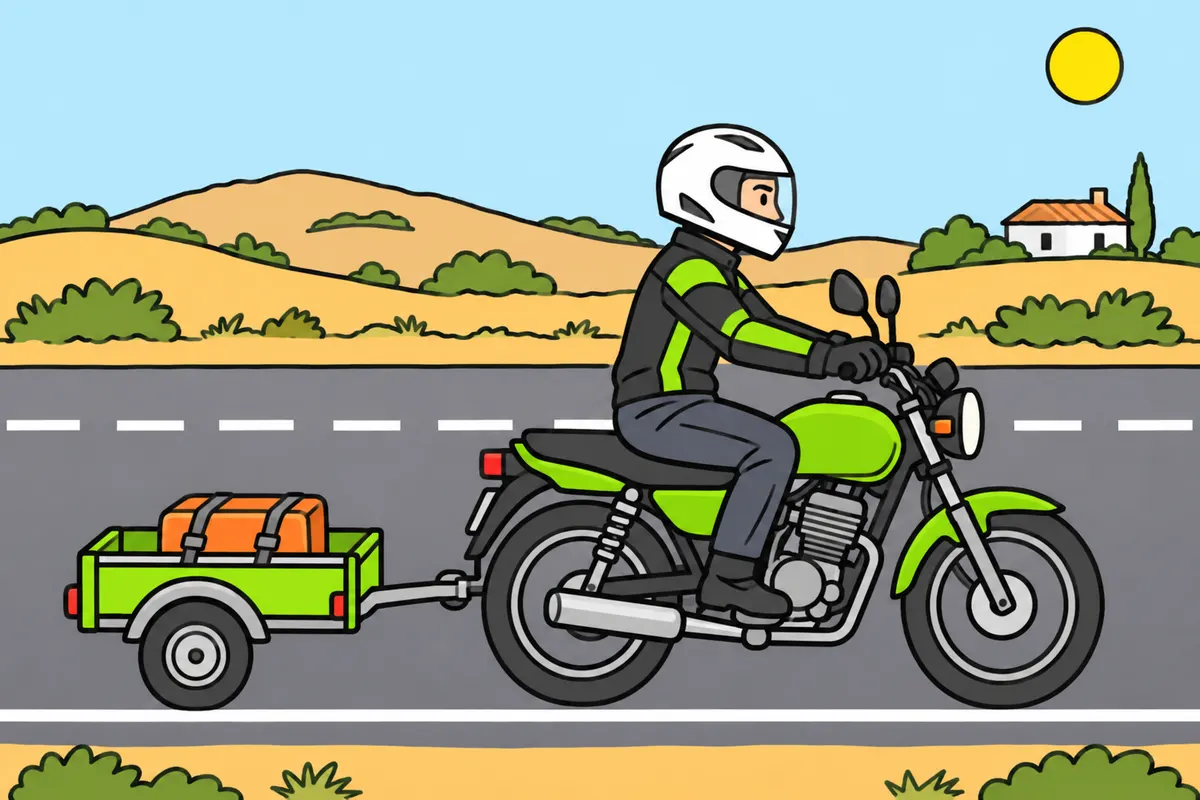
Tow within the weight limit, by day and when visibility is not reduced.
Remember
- You can tow a trailer or semi-trailer with a motorcycle or motor tricycle.
- Use the towing vehicle's unladen mass to calculate the limit.
- Travel by day and without conditions that reduce visibility.
- Do not carry people in the trailer.
- In urban areas, follow the municipal by-law too.
Exam trap: Wrong: calculate the 50 % limit using MMA. Right: the trailer must not exceed 50 % of your motorcycle or motor tricycle's unladen mass.
Read the full explanation
- You may tow a trailer or semi-trailer with your motorcycle or motor tricycle. The article requires it not to exceed 50% of the unladen mass of the towing vehicle; the reference is that mass, not its MMA (maximum authorised mass). [RGC, art. 12.3](https://www.boe.es/buscar/act.php?id=BOE-A-2003-23514#a12)
- With either of these vehicles, you must travel during daylight and when visibility is not reduced. You must not carry people in the trailer. In urban traffic, you must follow the relevant municipal bylaw. [RGC, art. 12.3](https://www.boe.es/buscar/act.php?id=BOE-A-2003-23514#a12)
11Speed when towing a trailer
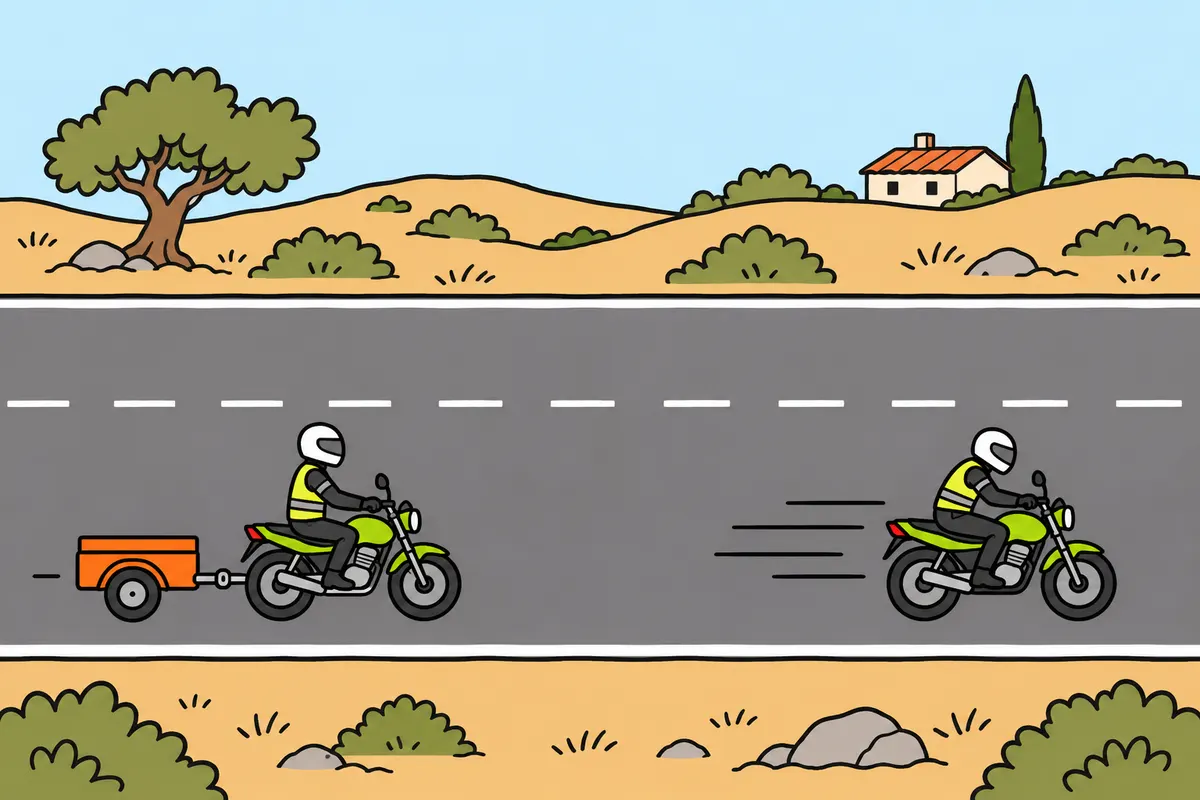
When towing, reduce the general speed limit for your motorcycle or motor tricycle.
| General speed limit for your motorcycle | Speed with a trailer |
|---|---|
| 120 km/h | 108 km/h |
| 90 km/h | 81 km/h |
Remember
- Reduce the towing vehicle's general speed limit for that road by 10 %.
- Following the course criterion, multiply your vehicle’s general limit by 0.90.
- See ‘Motorcycle with a trailer’ in ‘Speed and distances on a motorcycle’.
Exam trap: Wrong: you keep the same general speed limit when towing. Right: reduce the limit for your motorcycle or motor tricycle by 10 %.
Read the full explanation
- When towing a trailer, you must reduce the general speed limits in article 48 that apply to your motorcycle or motor tricycle by 10%. To calculate the result, multiply the general limit by 0.90: for a motorcycle, applying the course criterion, 120 km/h becomes 108 km/h and 90 km/h becomes 81 km/h. Use the general speed limit for the towing vehicle on that road; the criterion and limits for each road are explained in “Speed and distances on a motorcycle”, section “Motorcycle with a trailer”. [RGC, art. 12.3](https://www.boe.es/buscar/act.php?id=BOE-A-2003-23514#a12) [RGC, art. 48](https://www.boe.es/buscar/act.php?id=BOE-A-2003-23514#a48)
12Loading and unloading
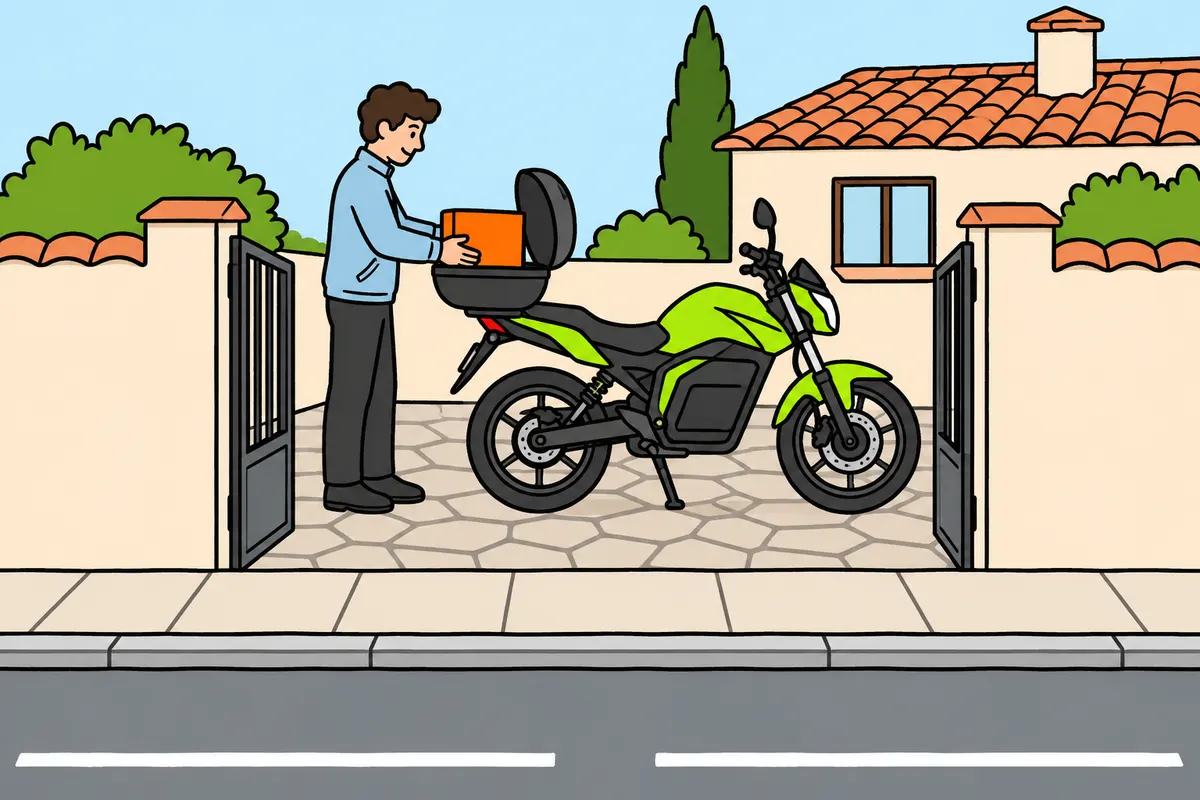
Load and unload off the road unless using the road is unavoidable.
Remember
- Load and unload off the road whenever you can.
- If road use is unavoidable, avoid danger and serious disruption.
- Follow stopping and parking rules.
- In built-up areas, follow local rules on times and places.
- Work nearest the carriageway edge where possible, quickly and without needless inconvenience.
- Do not put goods on the carriageway, hard shoulder or pedestrian areas.
Exam trap: Wrong: you can unload on the road for convenience. Right: use the road only when unavoidable, avoiding danger and serious disruption. Follow stopping and parking rules and local rules in built-up areas.
Read the full explanation
- You must load and unload off the road. If it is unavoidable to do so on the road, avoid danger and serious disruption, follow the rules for stopping and parking and, in built-up areas, comply with municipal rules on times and locations. [RGC, art. 16](https://www.boe.es/buscar/act.php?id=BOE-A-2003-23514#a16)
- Where possible, you must work from the side nearest the edge of the carriageway, quickly and without unnecessary inconvenience. You must not place goods on the carriageway, the arcén (hard shoulder) or pedestrian areas. [RGC, art. 16](https://www.boe.es/buscar/act.php?id=BOE-A-2003-23514#a16)
Checking a passenger
Check the legal requirements before setting off.
- Check the authorised seats and available payload.
- Check the passenger’s age and, where relevant, who is riding to determine whether the child exception applies.
- Check the passenger’s equipment, rear seat, astride position and foot support.
Checking luggage
Check capacity, fastenings and projections.
- Check the maximum authorised mass (MMA) and the limits for carriers and cases.
- Secure the load and keep the controls, your view, lights and number plate unobstructed.
- Measure projections according to the vehicle’s width and use the required markings.
Finished this module?
Mark it as read and you will see your progress on the theory list.