
Theory · D1+E Licence - Minibus with Trailer · Module 8 of 13
Speed and distances with a minibus and trailer
You learn the speed limits and minimum speeds for a D1 minibus with a trailer and how to adapt your driving. You learn about reaction, braking and stopping distances, the gap needed to avoid rear-end collisions, the 50 metres needed to allow overtaking, urban following distances behind cyclists and distances in tunnels.
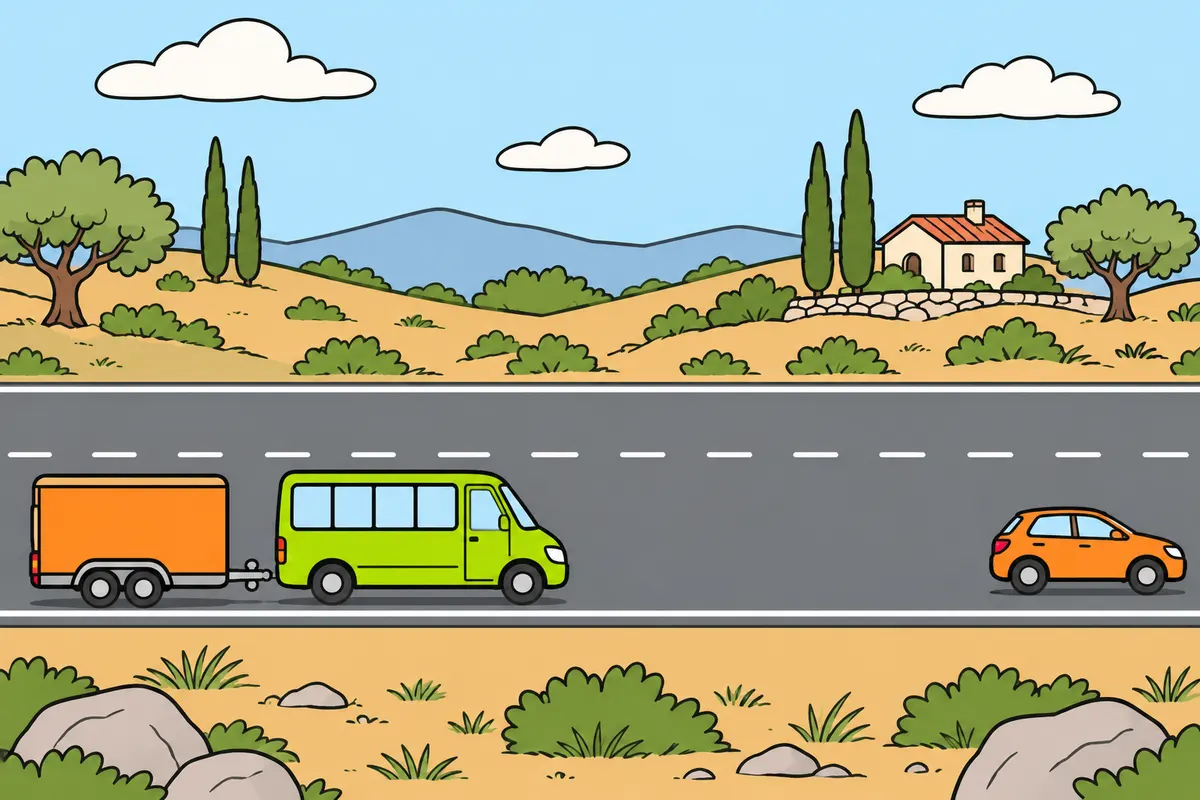
1Legal maximum and appropriate speed
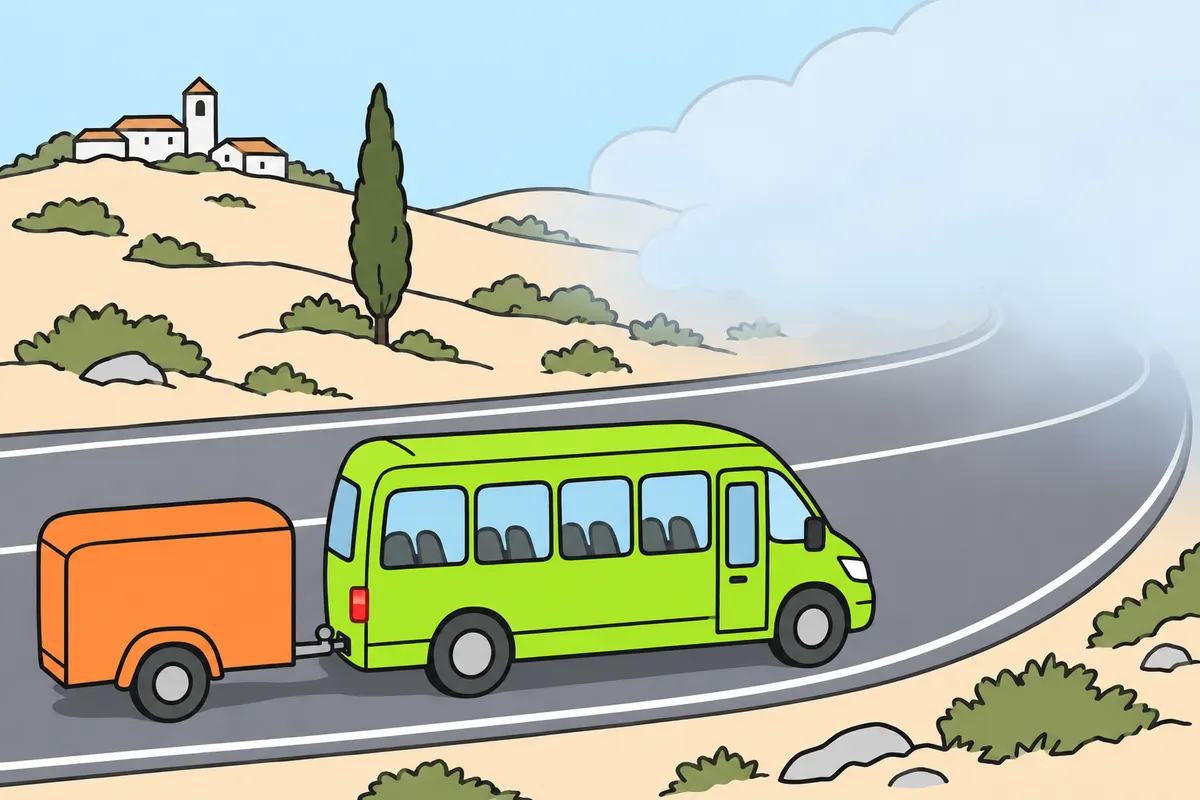
Choose a speed that lets you stop within the space you can see.
Remember
- Adapt your speed to the weather, traffic, road and your condition.
- Allow for your combination and its load.
- Slow down even when you are below the legal maximum.
Exam trap: Wrong: keeping within the maximum guarantees safety. Right: slow down further when needed to control and stop your combination.
Read the full explanation
- The maximum speed is the legal ceiling; the minimum prevents unjustifiably slow driving. You must choose an appropriate speed that allows you to control and stop the combination in response to a foreseeable hazard, even if this is below the maximum. [RGC, art. 45](https://www.boe.es/buscar/act.php?id=BOE-A-2003-23514#a45)
- You can drive at an inappropriate speed without exceeding the permitted figure. For example, 80 km/h on a conventional road can be too fast for your minibus and trailer in fog, on ice or on a sharp bend. [RGC, art. 45](https://www.boe.es/buscar/act.php?id=BOE-A-2003-23514#a45)
- You must adapt your speed to your physical and mental condition, the condition and characteristics of the road, the vehicle, its load, the weather and the traffic. Driving the combination unladen does not allow you to apply the limits for a passenger car. When it is laden, you must assess how it actually responds, without inventing a fixed speed reduction for every load. [RGC, art. 45](https://www.boe.es/buscar/act.php?id=BOE-A-2003-23514#a45)
- You must be able to stop within your field of vision and before any obstacle that may appear. If the clear distance you can see becomes shorter, slow down until your stopping distance fits within it. Knowing the route does not guarantee that the carriageway beyond a bend or the brow of a hill remains clear. [RGC, art. 45](https://www.boe.es/buscar/act.php?id=BOE-A-2003-23514#a45)
2Motorways outside built-up areas
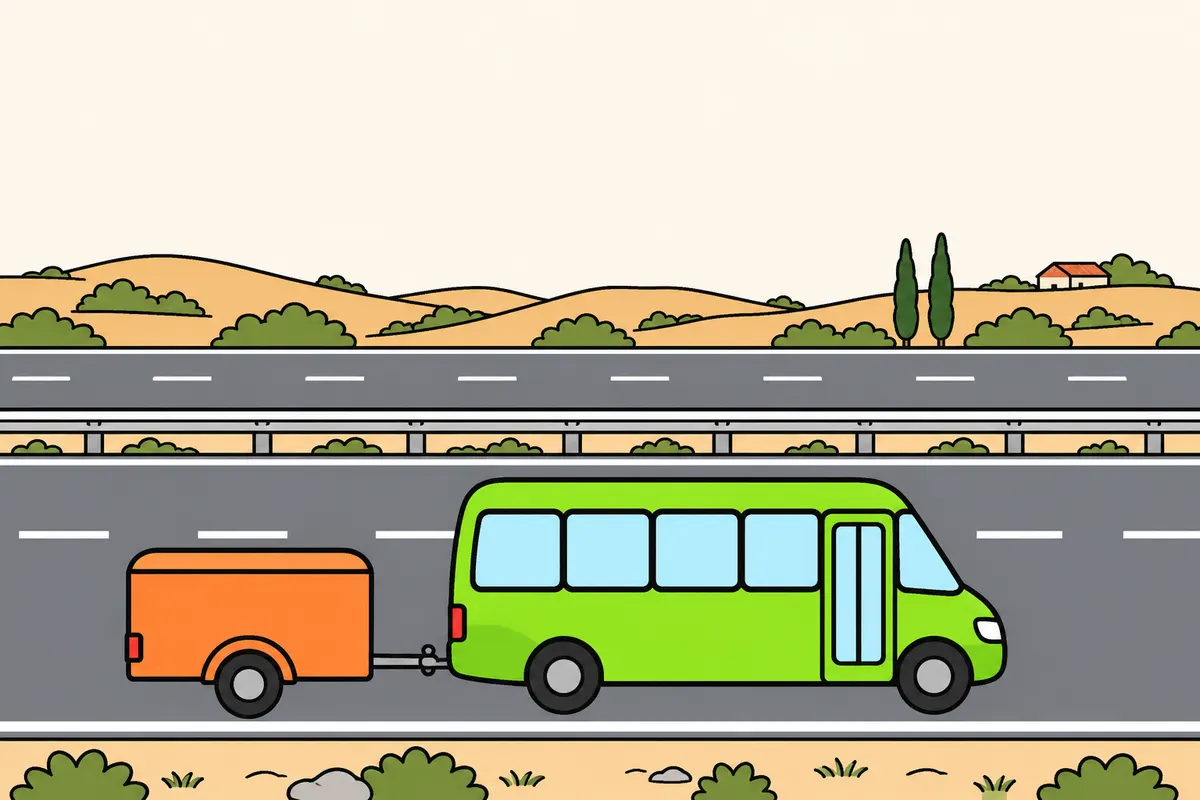
With your minibus and trailer, keep within the motorway maximum outside built-up areas.
| Road outside built-up areas | General maximum: minibus with trailer |
|---|---|
| Autopista | 90 km/h |
| Autovía | 90 km/h |
Remember
- The maximum is the same on autopistas and autovías (motorways).
- Obey any lower limit for the road section, vehicle or service.
- An empty trailer or fewer passengers does not raise your maximum.
- Check the special conditions for school transport and seat belts.
Exam trap: Wrong: you can use the maximum for a bus without a trailer. Right: your combination’s general maximum outside built-up areas is 90 km/h.
Read the full explanation
- With your D1 minibus and trailer, the general maximum on autopistas and autovías (motorways) outside built-up areas is 90 km/h: you must use the column for motor vehicles towing trailers. The 100 km/h maximum for buses and coaches does not allow you to reach that speed with this combination. You must observe any lower limit applicable to the road section, vehicle or service. [RGC, art. 48](https://www.boe.es/buscar/act.php?id=BOE-A-2003-23514#a48)
- The 90 km/h maximum is the same on an autopista and an autovía. An empty trailer and carrying few passengers do not raise this limit. If you provide school transport or transport for minors, or if the bus or coach has no seat belts, you must also apply the relevant specific conditions. [RGC, art. 48](https://www.boe.es/buscar/act.php?id=BOE-A-2003-23514#a48)
- To answer a question involving a 70 km/h limit on an autovía, you must keep 70 as the ceiling for that section and slow down further if necessary. A sign showing a value above the maximum for your category does not, by itself, authorise you to exceed the 90 km/h limit for the combination. [RGC, art. 48](https://www.boe.es/buscar/act.php?id=BOE-A-2003-23514#a48)
3Conventional roads and roads reserved for motor vehicles
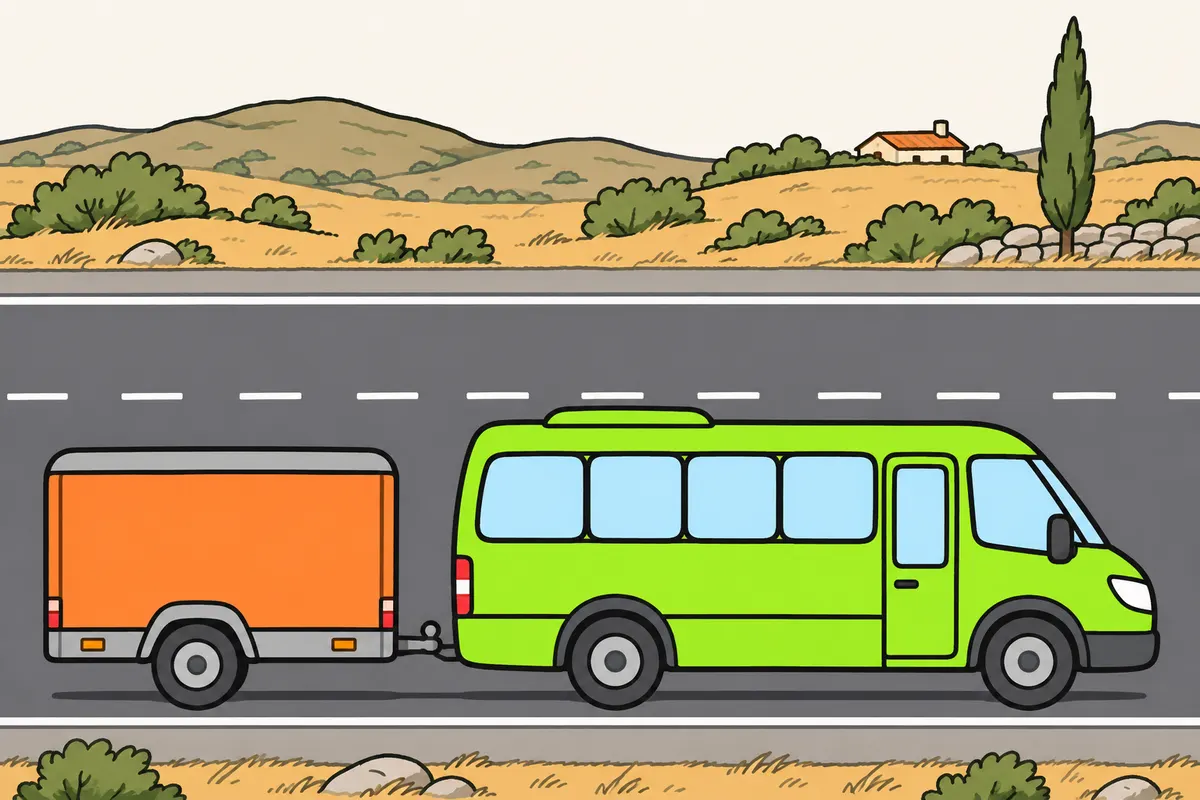
On conventional roads, your general maximum with a trailer is 80 km/h.
| Road outside built-up areas | General maximum: minibus with trailer |
|---|---|
| Conventional road | 80 km/h |
| Conventional road reserved for motor vehicles | 80 km/h |
Remember
- This maximum also applies with wide hard shoulders or several lanes.
- Physical separation between opposing directions does not raise your maximum.
- A road reserved for motor vehicles is not automatically a motorway.
- Obey any lower limit that applies.
- Do not exceed your maximum to overtake.
Exam trap: Wrong: roads reserved for motor vehicles always allow motorway speeds. Right: on a conventional road, your general maximum is 80 km/h.
Read the full explanation
- Outside built-up areas, the general maximum for your ordinary combination on a conventional road is 80 km/h. You also apply this if the road has a wide arcén (hard shoulder), a good surface or several lanes in your direction. [RGC, art. 48](https://www.boe.es/buscar/act.php?id=BOE-A-2003-23514#a48)
- The option to set a 100 km/h limit on a conventional road with physical separation between opposing traffic flows applies to the categories expressly listed in article 48, which do not include your passenger-carrying combination. The 80 km/h maximum still applies to you, unless a lower limit applies. [RGC, art. 48](https://www.boe.es/buscar/act.php?id=BOE-A-2003-23514#a48)
- A conventional road reserved for motor vehicles does not become an autopista or autovía simply because of that restriction on use. With your minibus and trailer, you must give 80 km/h as the general maximum on it. [RGC, art. 48](https://www.boe.es/buscar/act.php?id=BOE-A-2003-23514#a48)
- With your minibus and trailer, you cannot overtake a passenger car maintaining 90 km/h on that road: it already exceeds the maximum speed you can reach. Nor can you exceed 80 to overtake a lorry travelling at 80. The need to complete a manoeuvre quickly does not authorise you to exceed the speed limit. [RGC, art. 48](https://www.boe.es/buscar/act.php?id=BOE-A-2003-23514#a48)
4Unpaved roads
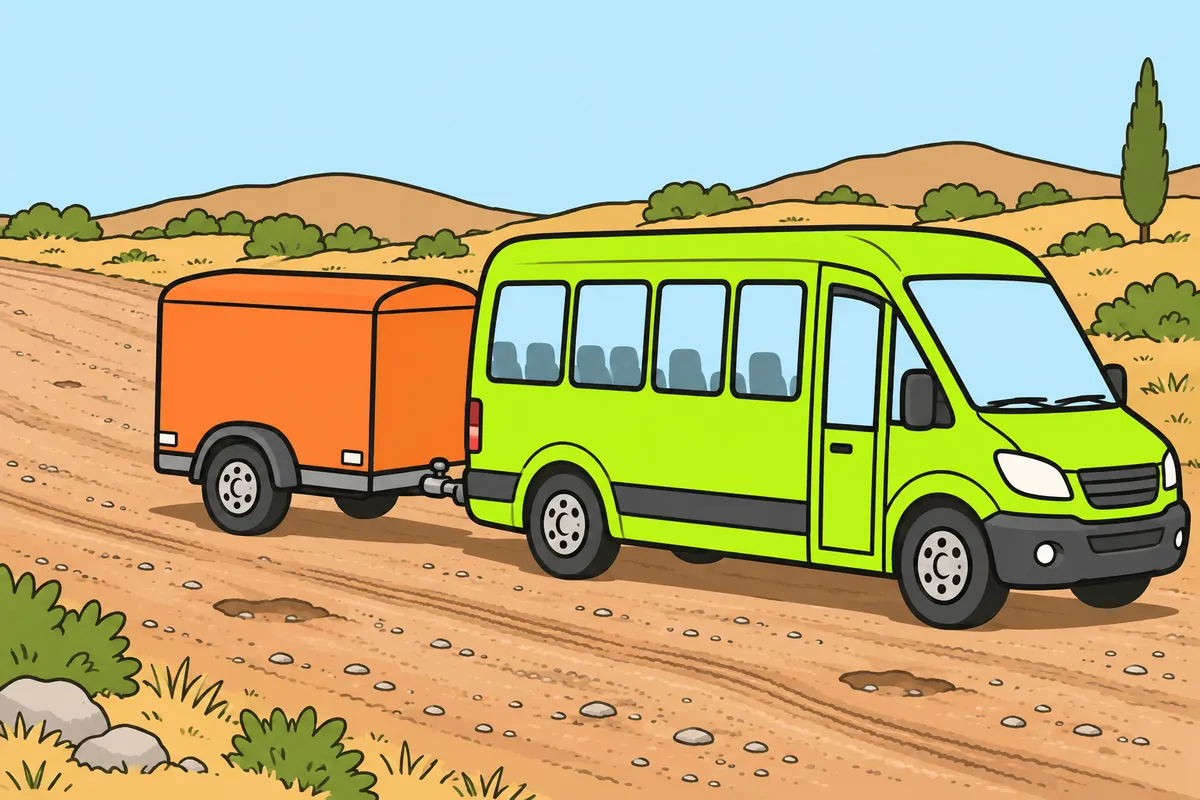
On unpaved roads, keep below 30 km/h and slow down further when needed.
Remember
- Check the surface, signs and whether your combination is allowed access.
- Slow down for potholes, dust, loose gravel or slopes.
- Do not choose the limit just because a road is called a track.
Exam trap: Wrong: you can always drive at 30 km/h on unpaved roads. Right: slow down further when needed to stay in control.
Read the full explanation
- On an unpaved road, your maximum speed limit is 30 km/h. The limit relates to the absence of paving, rather than simply to the road being called a track. You must check the surface and any specific signs, as well as whether your combination is allowed to use it. [RGC, art. 48](https://www.boe.es/buscar/act.php?id=BOE-A-2003-23514#a48)
- That 30 km/h does not guarantee safe driving over potholes, ruts, dust or loose gravel. You may need to drive much more slowly to maintain grip and control of the whole combination. The load, gradient and space available to pass oncoming road users may require a further reduction. [RGC, art. 48](https://www.boe.es/buscar/act.php?id=BOE-A-2003-23514#a48)
- Different rules apply on a dirt access road and a narrow paved road: on the first, the unpaved-road limit applies; on the second, you must identify the applicable rules and slow down because of the narrowness. With passengers and luggage on board, avoid a speed that causes loss of control or harsh braking, even if you do not exceed 30 km/h. [RGC, art. 48](https://www.boe.es/buscar/act.php?id=BOE-A-2003-23514#a48) [RGC, art. 45](https://www.boe.es/buscar/act.php?id=BOE-A-2003-23514#a45)
5Urban streets: 20, 30 and 50
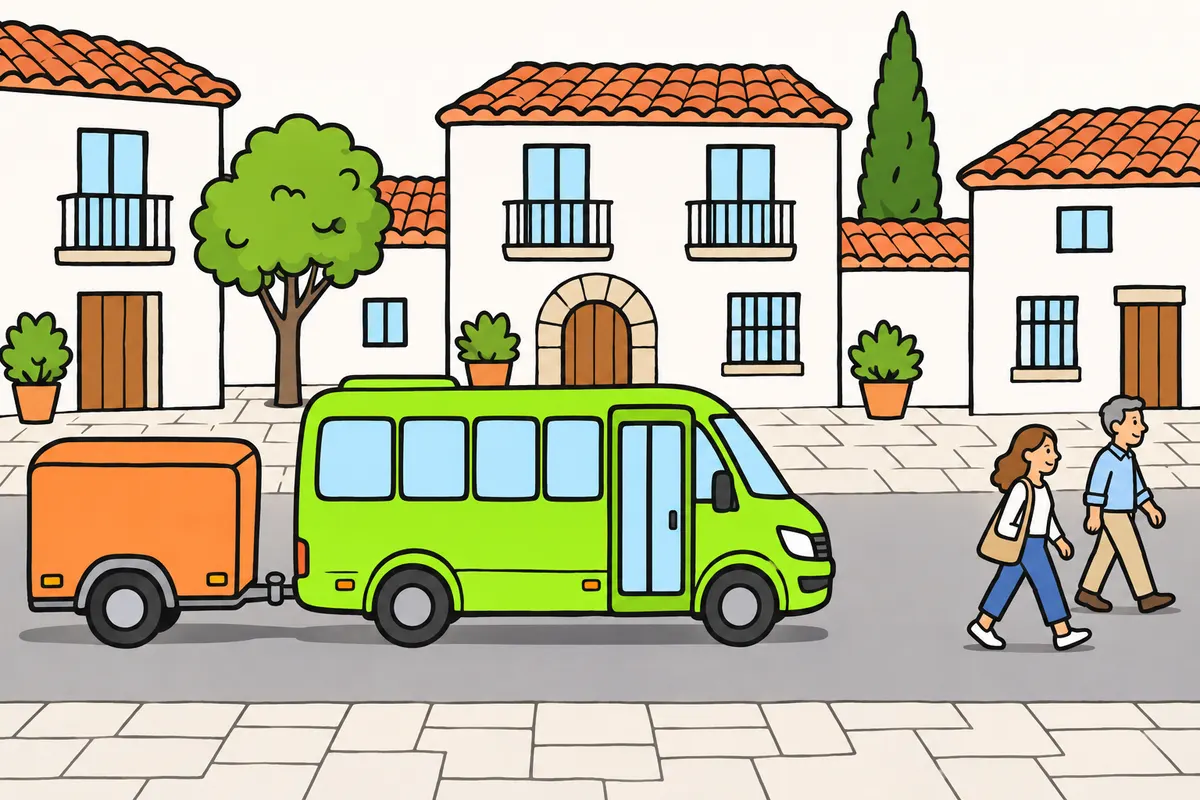
In town, identify the street type and count only the relevant lanes.
| Urban street | General maximum |
|---|---|
| Carriageway and pavement at the same level | 20 km/h |
| One lane in each direction | 30 km/h |
| Two or more lanes in each direction, excluding reserved lanes | 50 km/h |
Remember
- These limits apply when your combination is allowed to use the street.
- Do not count reserved lanes or lanes only for public transport.
- The council can lower limits using signs.
- Exceptionally, signs can allow 50 km/h with one lane in each direction.
- Slow down further when there is danger.
Exam trap: Wrong: you count a bus-only lane to raise the maximum. Right: exclude that lane when choosing the general limit.
Read the full explanation
- On an urban road where the carriageway and pavement share a single level, the general maximum is 20 km/h. On an urban road with only one lane in each direction, it is 30 km/h. On an urban road with two or more lanes in each direction, it is 50 km/h. These limits also apply to your combination when it is authorised to use the street. [RGC, art. 50](https://www.boe.es/buscar/act.php?id=BOE-A-2003-23514#a50)
- When counting lanes, you must not include those reserved for particular users or those exclusively for public transport. If your direction has one general traffic lane and one exclusive bus lane, you must not conclude that you have two general traffic lanes and a maximum of 50. [RGC, art. 50](https://www.boe.es/buscar/act.php?id=BOE-A-2003-23514#a50)
- The municipal authority may lower urban speed limits by means of specific signs. Exceptionally, it may raise the limit on a road with only one lane in each direction to 50 km/h, also by means of specific signs. [RGC, art. 50](https://www.boe.es/buscar/act.php?id=BOE-A-2003-23514#a50)
- On a shared surface, between access points and with pedestrians nearby, even 20 km/h can be inappropriate. You must adjust your speed to the distance you can see and the space occupied by the whole combination. The general figure does not replace your duty to stop if circumstances require it. [RGC, art. 50](https://www.boe.es/buscar/act.php?id=BOE-A-2003-23514#a50)
6Through roads and motorways in built-up areas
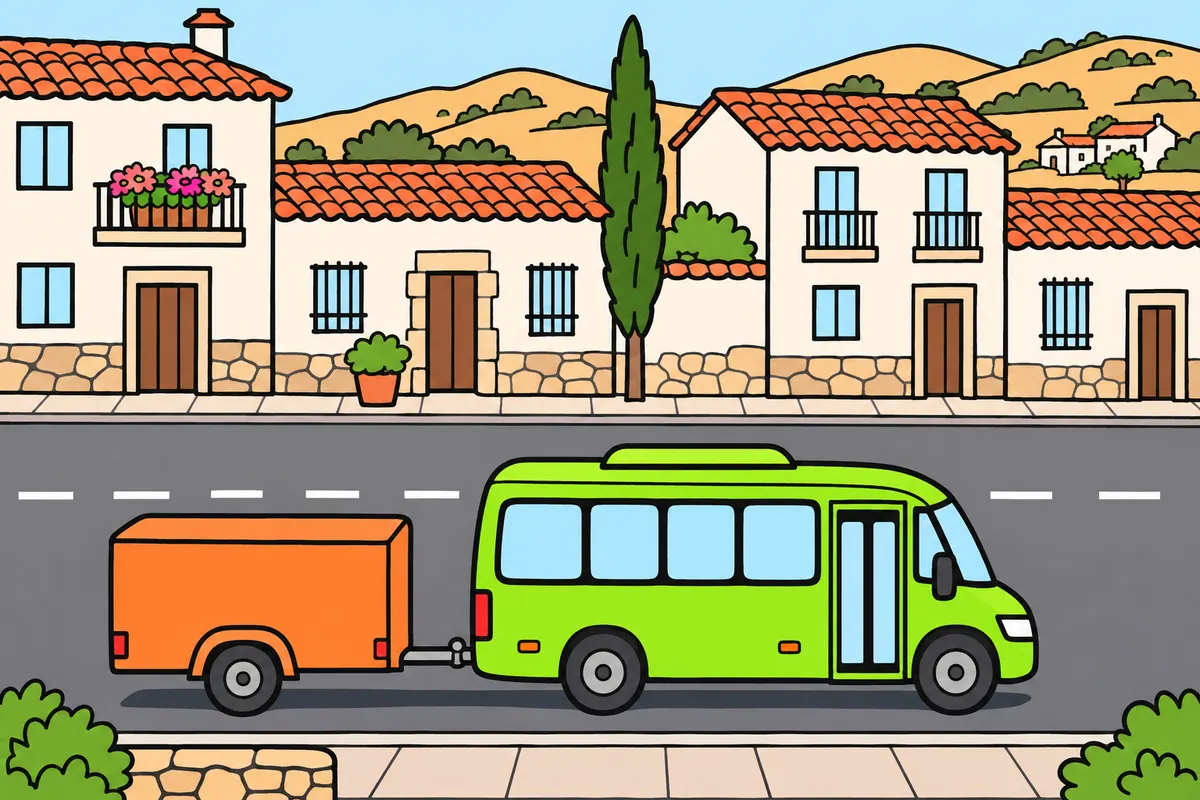
Distinguish through roads from motorways within built-up areas.
| Road within built-up areas | General maximum: minibus with trailer |
|---|---|
| Through road | 50 km/h |
| Autopista or autovía | 80 km/h |
Remember
- Identify the road type before choosing your speed.
- On through roads, obey any lower limit that applies.
- A signed increase cannot exceed your category’s maximum outside built-up areas.
- Adapt your speed before entering each new road section.
Exam trap: Wrong: a signed increase to 100 allows that speed. Right: your ordinary combination cannot exceed 90 km/h.
Read the full explanation
- On a travesía (the stretch of road through a town), your general maximum is 50 km/h, unless another limit applies. The limit may be lowered by agreement between the municipal authority and the road authority, with specific signs. [RGC, art. 50](https://www.boe.es/buscar/act.php?id=BOE-A-2003-23514#a50)
- On autopistas and autovías within built-up areas, the general maximum is 80 km/h. You need to know the location and type of road to choose the correct limit. [RGC, art. 50](https://www.boe.es/buscar/act.php?id=BOE-A-2003-23514#a50)
- The maximum on these autopistas and autovías may be raised by agreement between the municipal authority and the road authority, with specific signs, without exceeding the general maximum for your category outside built-up areas. For your ordinary combination, the corresponding ceiling is 90 km/h. An increase allowing travel at 100 does not give you that maximum. [RGC, art. 50](https://www.boe.es/buscar/act.php?id=BOE-A-2003-23514#a50)
- On a journey, you may go from a conventional road to a travesía and then to an urban street with one lane in each direction. Each section has its own rules; adapt your speed before entering it. [RGC, art. 50](https://www.boe.es/buscar/act.php?id=BOE-A-2003-23514#a50)
7School transport and bus or coach conditions
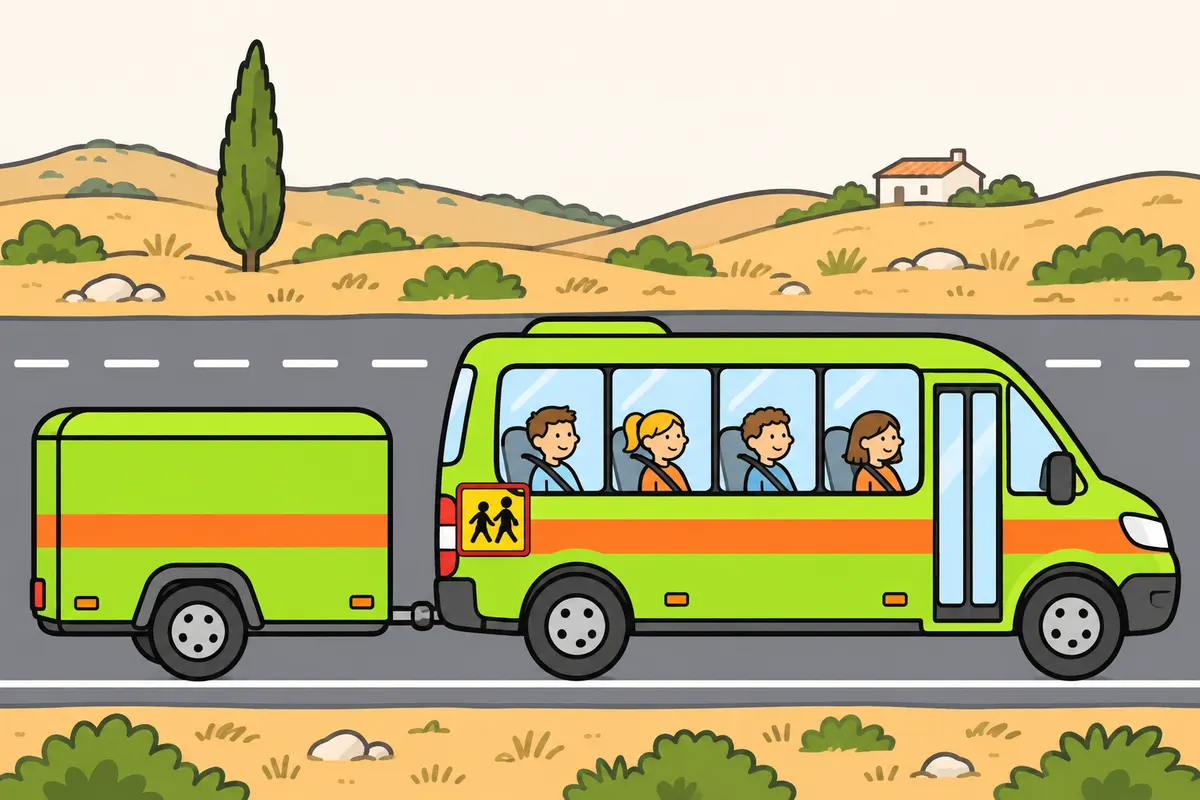
For school transport or transport for minors, reduce your combination’s maximum outside built-up areas.
| School or children’s transport: minibus with trailer | Maximum outside built-up areas |
|---|---|
| Autopista or autovía | 80 km/h |
| Conventional road | 70 km/h |
Remember
- Calculate the reduction from the limits for your combination with a trailer.
- Without seat belts, your ceiling outside built-up areas is 80 km/h.
- The same ceiling applies with standing passengers, where carrying them is authorised.
- That ceiling does not authorise standing passengers or removing seat belts.
- Always apply the lowest limit that applies.
- Do not automatically subtract ten from signs or urban limits.
Exam trap: Wrong: you calculate the school transport reduction from a bus without a trailer. Right: use your combination’s maximum outside built-up areas.
Read the full explanation
- If you provide school transport or transport for minors, you must reduce the maximum interurban speed in the table for your combination by 10 km/h. This gives you 80 km/h on motorways outside built-up areas and 70 km/h on conventional roads. The reduction starts from the 90/80 limits for a motor vehicle with a trailer, rather than the limits for a bus or coach without one. [RGC, art. 48](https://www.boe.es/buscar/act.php?id=BOE-A-2003-23514#a48)
- If your bus or coach has no seat belts, its maximum speed outside built-up areas is 80 km/h, whatever the road type. The same ceiling applies when you carry standing passengers where this is authorised. This provision limits your speed; it does not in itself authorise you to carry standing passengers or dispense with seat belts. [RGC, art. 48](https://www.boe.es/buscar/act.php?id=BOE-A-2003-23514#a48)
- You must comply with all limits that apply together. With a minibus without seat belts and a trailer, you must not exceed 80 km/h on a motorway outside a built-up area; if you also provide school transport or transport for minors, the ceiling on conventional roads is 70 km/h. Apply each rule to its own base limit and keep to the most restrictive limit. [RGC, art. 48](https://www.boe.es/buscar/act.php?id=BOE-A-2003-23514#a48)
- You calculate the school transport reduction from the table in article 48.1.a; the 30 km/h limit on unpaved roads comes from article 48.1.f. On urban streets, the general limits of 20, 30 and 50 km/h come from article 50.1: you do not subtract ten from urban limits or from every signed limit because you provide this service. [RGC, art. 48](https://www.boe.es/buscar/act.php?id=BOE-A-2003-23514#a48) [RGC, art. 50](https://www.boe.es/buscar/act.php?id=BOE-A-2003-23514#a50)
8Signs, restrictions and the speed limiter
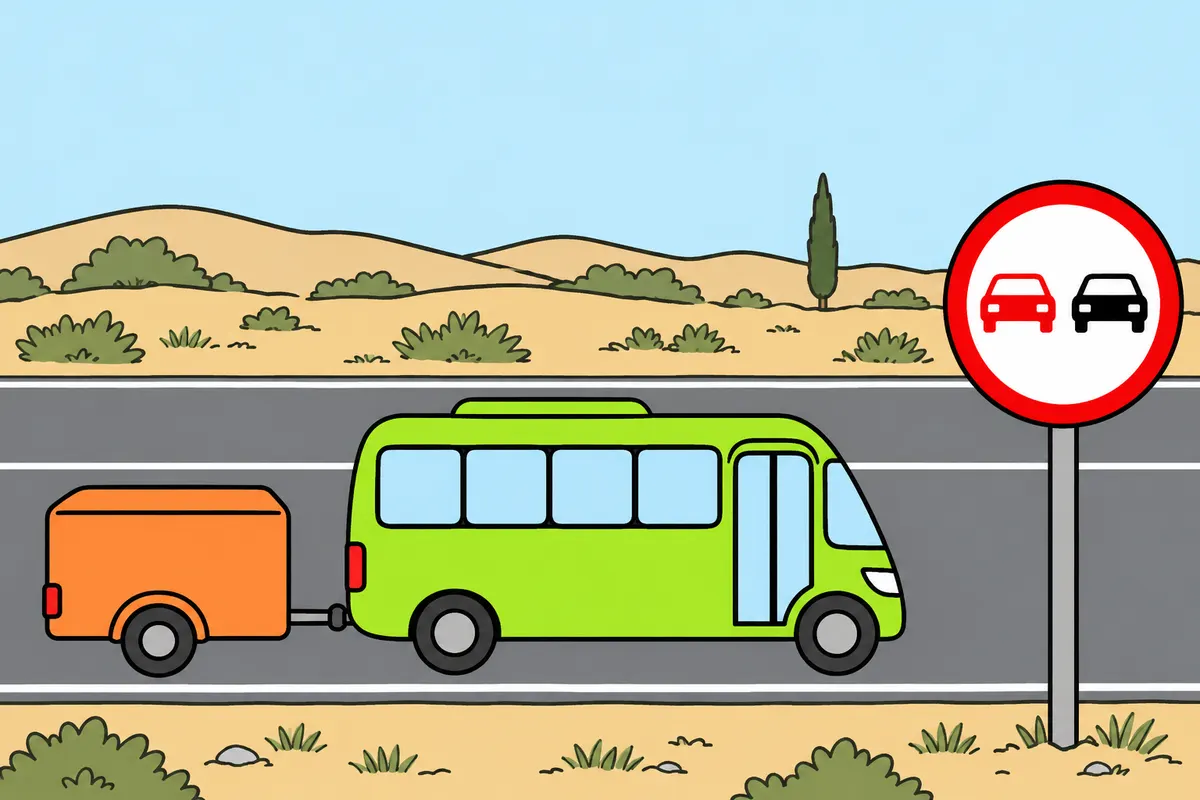
Obey every applicable limit, even when your speed limiter allows a higher speed.
Remember
- Obey temporary and variable speed signs.
- Also obey restrictions for the driver, vehicle and load.
- Keep the limiter working properly, with its seals intact.
- Do not help alter its operation.
Exam trap: Wrong: a limiter set to 100 km/h allows you to drive that fast. Right: obey lower limits for your combination and road section.
Read the full explanation
- You must observe specific signed limits, including temporary and variable limits, and those imposed on you as a driver, your vehicle or its load. If several applicable restrictions coincide, you must comply with them all. A general speed limit sign does not remove a restriction specific to your combination. [RGC, art. 47](https://www.boe.es/buscar/act.php?id=BOE-A-2003-23514#a47) [RGC, art. 52](https://www.boe.es/buscar/act.php?id=BOE-A-2003-23514#a52)
- Your category M2 or M3 minibus must have a speed limiter set to prevent you from exceeding 100 km/h. Exemptions apply to vehicles of the Armed Forces and security forces, civil protection, fire and other emergency services, vehicles whose design prevents them from exceeding that speed, vehicles intended for scientific road tests and vehicles used only for urban public transport. [RD 1417/2005, arts. 3 and 7](https://www.boe.es/buscar/act.php?id=BOE-A-2005-19990#a3) [RD 1417/2005, art. 7](https://www.boe.es/buscar/act.php?id=BOE-A-2005-19990#a7) [RGC, art. 52](https://www.boe.es/buscar/act.php?id=BOE-A-2003-23514#a52)
- With your M2 minibus fitted with a limiter set to 100 km/h, you must observe the maximum speeds for the combination with a trailer: 90 km/h on motorways outside built-up areas and 80 km/h on conventional roads. [RGC, art. 48](https://www.boe.es/buscar/act.php?id=BOE-A-2003-23514#a48)
- You must keep the limiter in good working order with its seals intact. If you participate or assist in installing or activating devices that alter its operation, you commit a very serious offence. You can find details of installation and checks in “Maximum dimensions and masses”. [RD 1417/2005, art. 8](https://www.boe.es/buscar/act.php?id=BOE-A-2005-19990#a8) [Traffic Act, art. 77.m](https://www.boe.es/buscar/act.php?id=BOE-A-2015-11722#a77)
9General minimum speeds for the combination
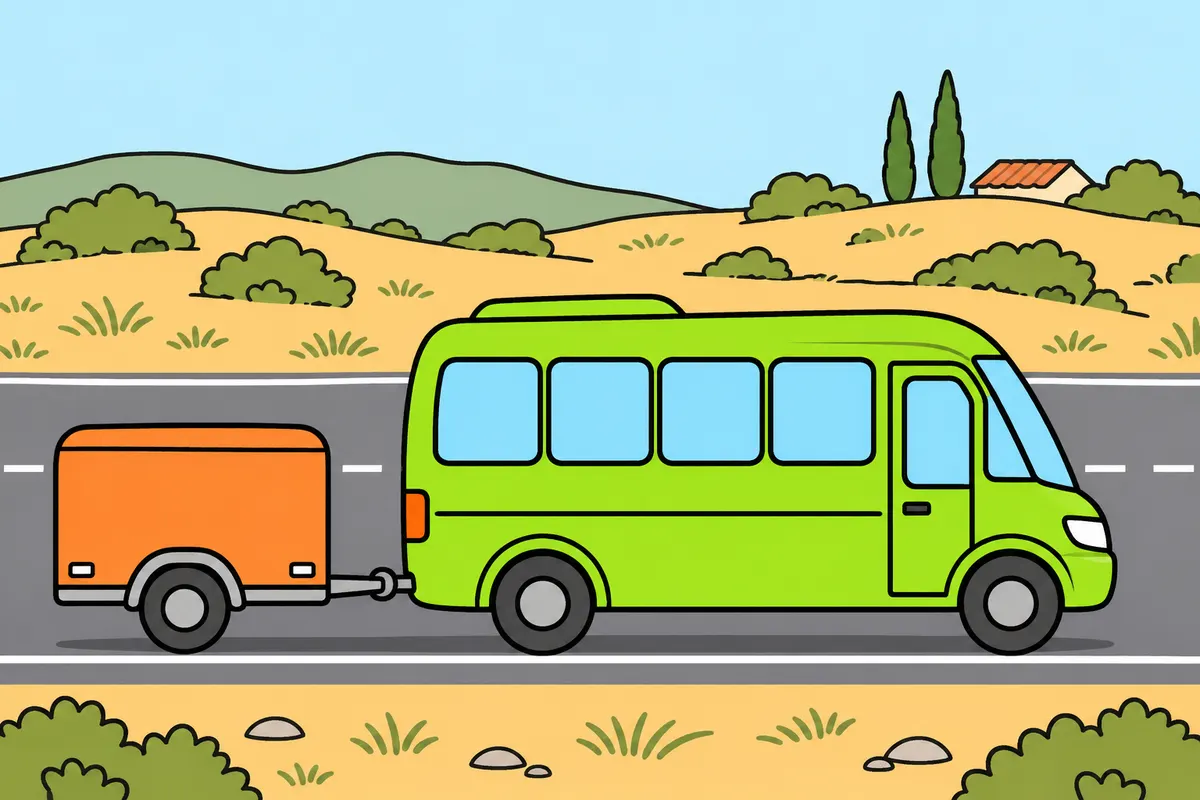
Unless you have a justified reason, obey the general minimum for your category and road.
| Road and general rules | General minimum: ordinary minibus with trailer |
|---|---|
| Autopista or autovía | 60 km/h |
| Conventional road, including those reserved for motor vehicles | 40 km/h |
| Unpaved road | 15 km/h |
| Urban road with a general maximum of 20 km/h | 10 km/h |
| Urban road with a general maximum of 30 km/h | 15 km/h |
| Urban or through road with a general maximum of 50 km/h | 25 km/h |
Remember
- On autopistas and autovías, the general minimum is 60 km/h.
- Elsewhere, use half the general limit for your vehicle category on that road.
- On a road reserved for motor vehicles, use the conventional-road minimum.
- Do not calculate the minimum from any maximum-speed sign.
- Also obey minimum-speed signs.
- Do not drive below the minimum without justification, even without other traffic.
Exam trap: Wrong: you halve any signed maximum. Right: use the general speed limit for your vehicle category on that road.
Read the full explanation
- On motorways, the general minimum speed for motor vehicles is 60 km/h, including your ordinary combination. This minimum has its own value for these roads, and you may drive below it for the justified reasons provided for in the regulations. [RGC, art. 49](https://www.boe.es/buscar/act.php?id=BOE-A-2003-23514#a49)
- On other roads, the general minimum is half the general speed limit for your vehicle category on that road. With your ordinary combination on a conventional road, the pair of limits is a maximum of 80 and a minimum of 40 km/h. On a road reserved for motor vehicles with conventional-road characteristics, you must apply that same reference, rather than the motorway minimum. [RGC, art. 49](https://www.boe.es/buscar/act.php?id=BOE-A-2003-23514#a49)
- On an unpaved road with a general maximum of 30 km/h, half is 15 km/h. For urban roads subject to the ordinary general limits, the pairs are 20/10, 30/15 and 50/25 km/h. On an ordinary stretch of road through a town with a general maximum of 50, the minimum reference is 25. These minimum speeds do not require you to drive at an unsafe speed. [RGC, art. 49](https://www.boe.es/buscar/act.php?id=BOE-A-2003-23514#a49)
- You must not calculate the minimum by automatically halving any specific maximum shown on a sign. Under article 49, you use the general limit for your vehicle category and the road as the basis; you must also observe a signed minimum where there is one. You must not drive below the minimum without justification even when there are no other vehicles on the road. [RGC, art. 49](https://www.boe.es/buscar/act.php?id=BOE-A-2003-23514#a49)
10When you can drive below the minimum
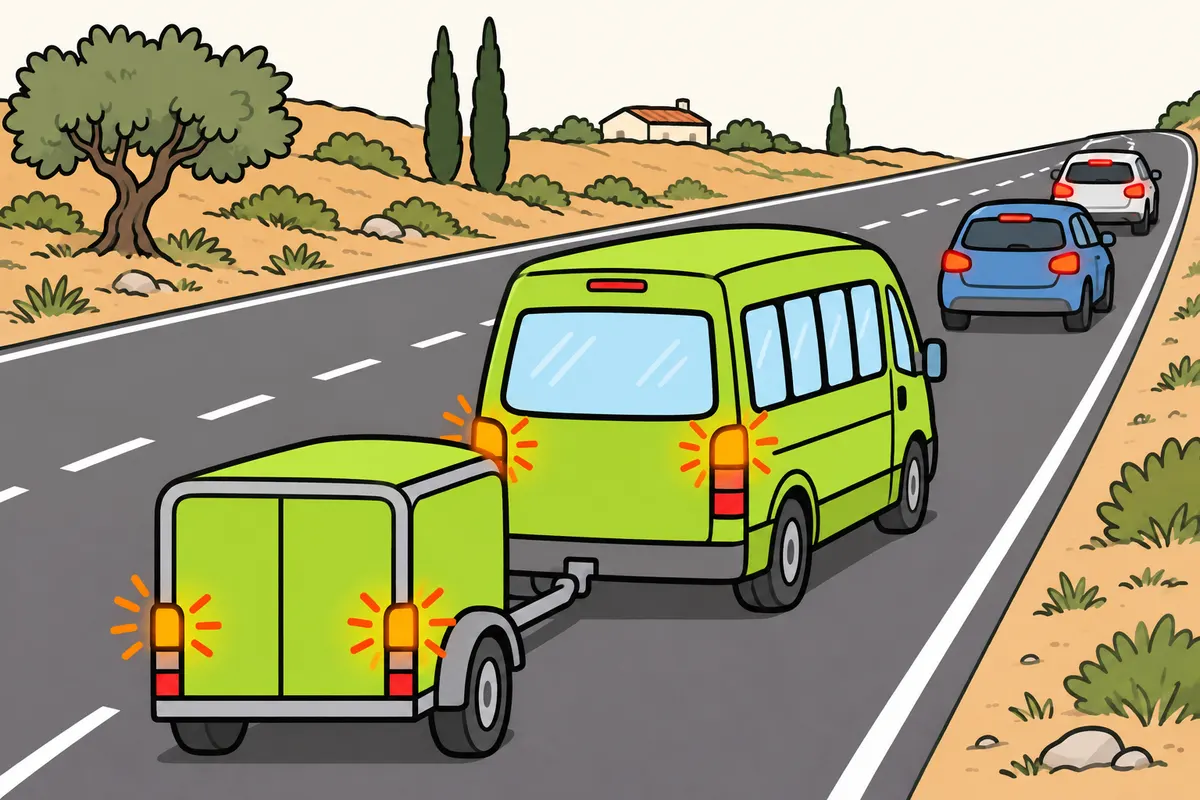
You may drive below the minimum when justified conditions make maintaining it dangerous.
Remember
- Slow down when traffic, road or vehicle conditions prevent safe progress.
- Ice, queues, poor visibility or a breakdown can justify this.
- Use hazard warning lights if below the minimum and risking a rear-end collision.
- With a minibus above 3,500 kg MMA, continue on the carriageway.
- Slow driving alone does not require you to use the hard shoulder.
Exam trap: Wrong: slow driving forces your heavy minibus onto the hard shoulder. Right: above 3,500 kg MMA, continue on the carriageway; the hard shoulder is reserved for emergency reasons.
Read the full explanation
- You may drive below the minimum when traffic, your vehicle or the road prevents you from maintaining a higher speed safely. A queue, ice, insufficient visibility or a breakdown may justify this. [RGC, art. 49](https://www.boe.es/buscar/act.php?id=BOE-A-2003-23514#a49)
- The regulations also cover special vehicles, special transport operations and protection or escort duties, where you adapt your speed to that of the vehicle you accompany. Your justification comes from the circumstances or the service provided for in the regulations. [RGC, art. 49](https://www.boe.es/buscar/act.php?id=BOE-A-2003-23514#a49)
- If you cannot reach the required minimum speed and there is a risk of a rear-end collision, you must switch on your hazard warning lights while driving. With a minibus with an MMA (maximum authorised mass) over 3,500 kg, you must continue on the carriageway; driving slowly does not require you to move onto the arcén (hard shoulder), which is reserved for emergencies. Your obligation to use the right-hand hard shoulder, where it is usable and wide enough, when an emergency forces you to drive abnormally slowly and seriously disrupts traffic applies only to vehicles with an MMA not exceeding 3,500 kg. [RGC, art. 49](https://www.boe.es/buscar/act.php?id=BOE-A-2003-23514#a49) [RGC, art. 31](https://www.boe.es/buscar/act.php?id=BOE-A-2003-23514#a31) [RGC, art. 36](https://www.boe.es/buscar/act.php?id=BOE-A-2003-23514#a36)
- You must distinguish between moving slowly out of necessity, stopping because of an emergency and leaving a road because of a breakdown. Here, you need to recognise when a lower speed is justified and how to warn of the risk of a rear-end collision. You can find the full breakdown procedures in “Responding to accidents and breakdowns”. [RGC, art. 49](https://www.boe.es/buscar/act.php?id=BOE-A-2003-23514#a49)
11People, animals and nearby access points
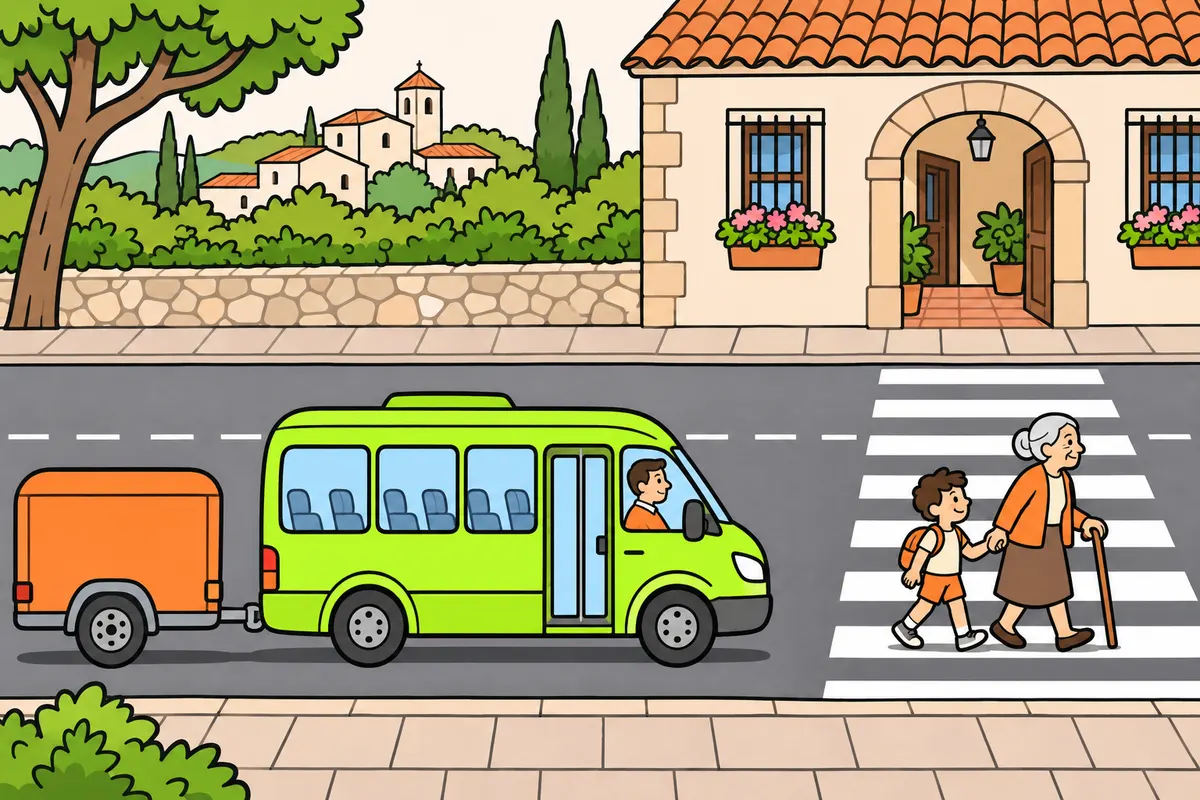
Slow down before people or animals could enter your path.
Remember
- Slow down, and stop if needed, for pedestrians or their possible sudden entry.
- Pay particular attention to children, older people and people with mobility or sight difficulties.
- Slow down near cyclists, schools, markets and uncontrolled pedestrian crossings.
- Slow down for animals or buildings with direct road access.
- Slow down when approaching a stopped bus, especially a school bus.
- Outside built-up areas, slow down near stopped vehicles and assistance services.
Exam trap: Wrong: you wait until someone is in front before slowing down. Right: anticipate people entering your path.
Read the full explanation
- You must slow down and, if necessary, stop when pedestrians are on the part of the road you use or you can reasonably expect them to enter it. Pay particular attention to children, older people, blind people and people with reduced mobility. From the cab, you may have a good view into the distance while finding nearby areas difficult to see. [RGC, art. 46](https://www.boe.es/buscar/act.php?id=BOE-A-2003-23514#a46)
- You must slow down as you approach cycles, roads reserved exclusively for cycles, their junctions and pedestrian crossings without traffic lights or an officer controlling them. You must also do so near markets, schools and places where you can expect to find children. You must prepare to respond before anyone enters the path of your minibus or trailer. [RGC, art. 46](https://www.boe.es/buscar/act.php?id=BOE-A-2003-23514#a46)
- You must drive at a moderate speed when animals are present or you can anticipate them entering the road, and on stretches with buildings that open directly onto the part of the road you use. You need to anticipate hazards at an access hidden by a vehicle or building. [RGC, art. 46](https://www.boe.es/buscar/act.php?id=BOE-A-2003-23514#a46)
- You must slow down as you approach a stopped bus or coach, especially one providing school transport. Outside built-up areas, you must also do so when approaching vehicles immobilised on the carriageway, roadside assistance services and cycles on the carriageway or hard shoulder. Stay alert for people who may be hidden, and avoid letting the size of your combination reduce the clearance you leave. [RGC, art. 46](https://www.boe.es/buscar/act.php?id=BOE-A-2003-23514#a46)
12Junctions, narrow sections and visibility
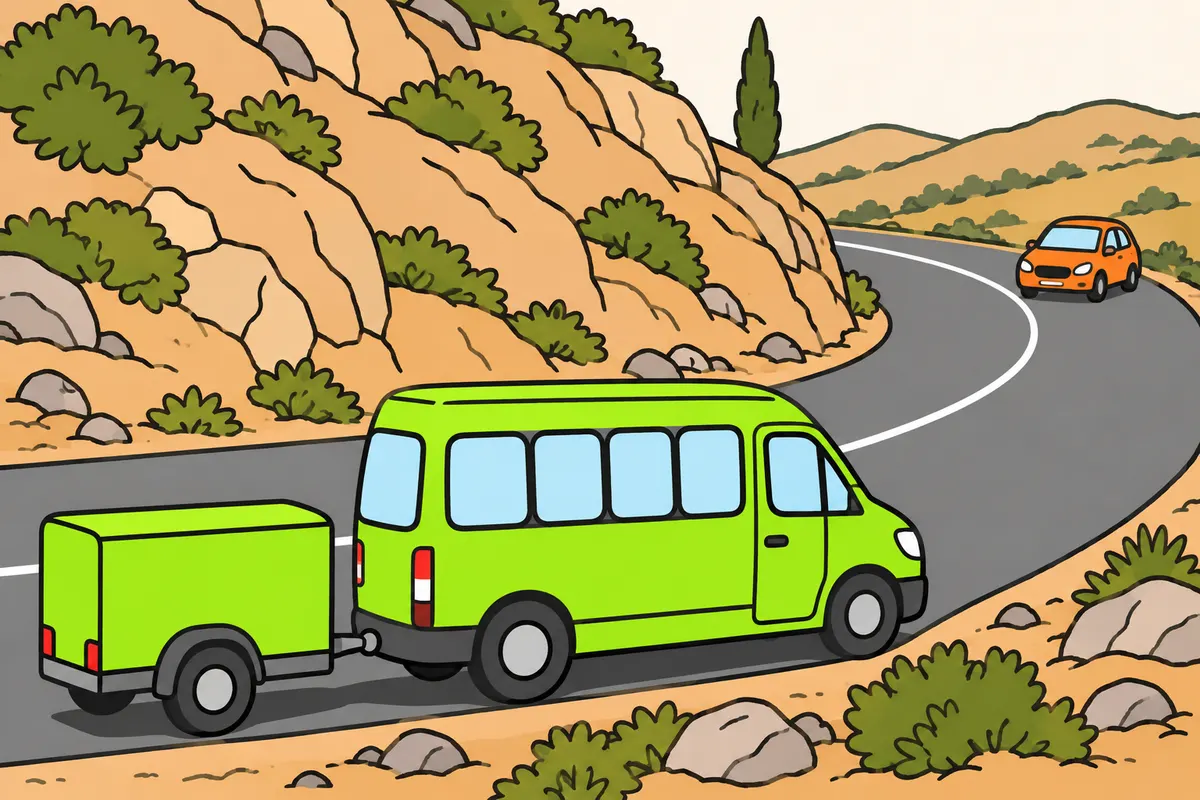
Slow down for junctions, narrow sections or poor visibility, and stop when needed.
Remember
- Slow down at level crossings, roundabouts and junctions where you lack priority.
- At properly signed junctions with practically no visibility, do not exceed 50 km/h.
- Obey lower limits and slow down further when needed to stop.
- Allow space for your trailer when passing oncoming vehicles.
- If dazzled, slow down and stop if necessary.
- With weaker lighting, slow down to stop within the illuminated area.
Exam trap: Wrong: you must cross a properly signed junction with practically no visibility at 50 km/h. Right: this is a ceiling; obey lower limits and slow down further if necessary.
Read the full explanation
- You must slow down as you approach level crossings, roundabouts and junctions where you do not have priority, and where the road narrows or visibility is reduced. You may need to stop to meet this obligation. You cannot rely on a single speed to pass safely through all these places: the safe speed depends on the layout, traffic and actual visibility. [RGC, art. 46](https://www.boe.es/buscar/act.php?id=BOE-A-2003-23514#a46)
- If a junction is properly signposted and visibility along the road is virtually non-existent, you must not exceed 50 km/h. You must treat this figure as a specific ceiling, rather than a recommended speed for passing through. If another limit is lower or you need to drive more slowly to be able to stop, you must meet that more restrictive requirement. [RGC, art. 46](https://www.boe.es/buscar/act.php?id=BOE-A-2003-23514#a46)
- When passing an oncoming vehicle, slow down if the space, the characteristics of the vehicles or the weather prevents you from doing so safely. With a long combination, you may have little lateral clearance on a tight bend. You must also allow for the space your trailer needs and stop if you cannot continue safely. [RGC, art. 46](https://www.boe.es/buscar/act.php?id=BOE-A-2003-23514#a46)
- If you are dazzled, you must slow down and even stop if necessary. In dense fog, heavy rain, snow, dust or smoke, you must adjust your driving to what you can actually see. Even if you have priority or your lights are on, you must be able to stop within the distance you can see and control. [RGC, art. 46](https://www.boe.es/buscar/act.php?id=BOE-A-2003-23514#a46)
- If a fault that you cannot repair en route forces you to drive with less intense lighting, you must reduce your speed until you can stop within the illuminated area. You must base your appropriate speed on that actual range, even if the stretch of road permits a higher speed. [RGC, art. 107](https://www.boe.es/buscar/act.php?id=BOE-A-2003-23514#a107)
13Rain, wind, bends and descents
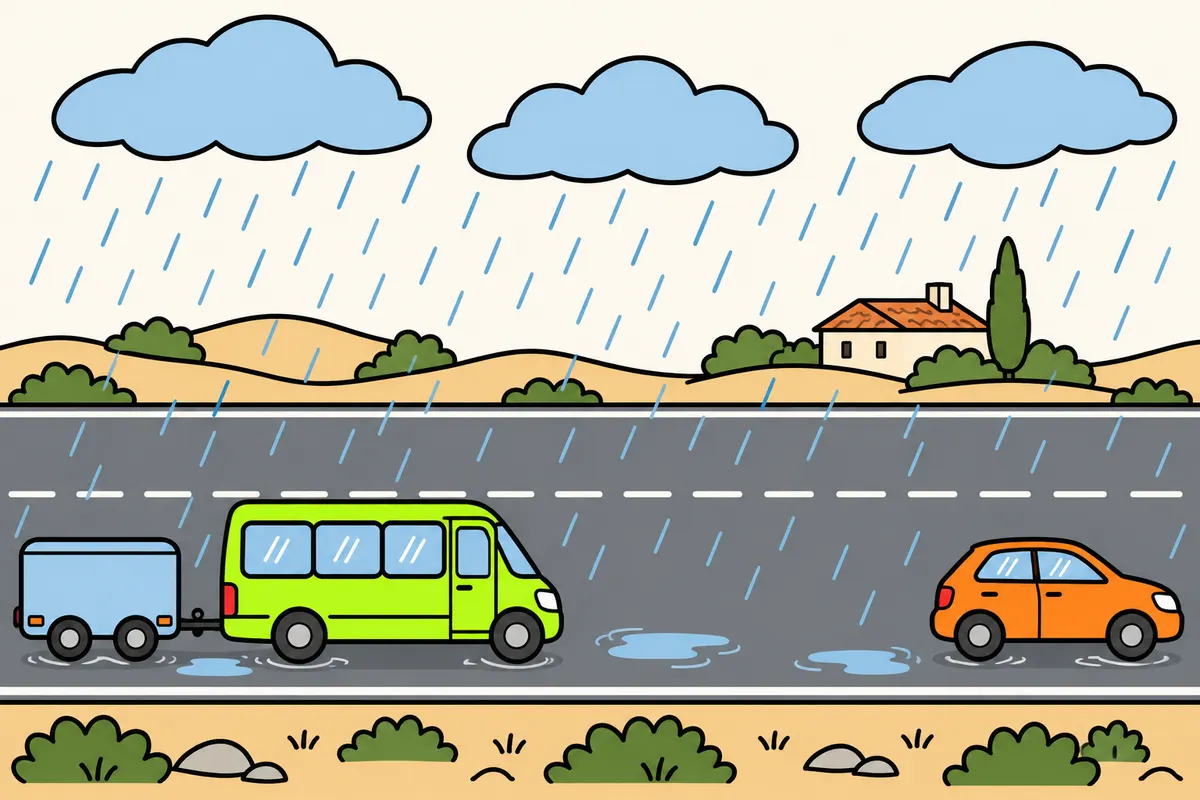
Adapt your speed before rain, gusts, bends and descents.
Remember
- In rain or on slippery roads, slow down and leave more space ahead.
- Slow down where you might throw water or gravel onto others.
- Expect gusts when leaving tunnels or sheltered areas.
- Choose your speed for a bend before entering it.
- Allow for your load and how it is distributed.
- On long descents, use suitable gears and supplementary braking as the manufacturer instructs.
Exam trap: Wrong: you correct excessive entry speed by braking harshly within a bend. Right: choose a suitable speed beforehand.
Read the full explanation
- In rain or on a slippery road surface, you must slow down and increase the gap to the vehicle ahead. You must also moderate your speed wherever you may splash water or throw gravel or other material onto other road users. Loss of grip is not the only issue: the movement of your combination can put those nearby at risk. [RGC, art. 46](https://www.boe.es/buscar/act.php?id=BOE-A-2003-23514#a46) [RGC, art. 45](https://www.boe.es/buscar/act.php?id=BOE-A-2003-23514#a45)
- You must adapt your speed to the wind and gusts, especially with a tall or long combination. Anticipate changes in exposure when leaving a tunnel or a sheltered area. Slow down in good time and use smooth inputs; you do not need to wait until you notice a significant deviation from your course before correcting it. [RGC, art. 45](https://www.boe.es/buscar/act.php?id=BOE-A-2003-23514#a45)
- You must choose your speed for a bend before entering it, taking account of visibility, its radius, the road surface and the load. You must allow for the passengers in the minibus and the luggage in the trailer: a high centre of gravity or a poorly distributed load can impair stability. [RGC, art. 45](https://www.boe.es/buscar/act.php?id=BOE-A-2003-23514#a45)
- On a long descent, you must maintain a speed you can control and leave a braking margin. As technical guidance, select a suitable gear and use the available engine braking and retardation in accordance with the manufacturer’s instructions to avoid overloading the service brake. Detailed use of retarders and trailer brakes is covered in «Trailer and combination braking». [RGC, art. 45](https://www.boe.es/buscar/act.php?id=BOE-A-2003-23514#a45)
14Slowing down without causing rear-end collisions
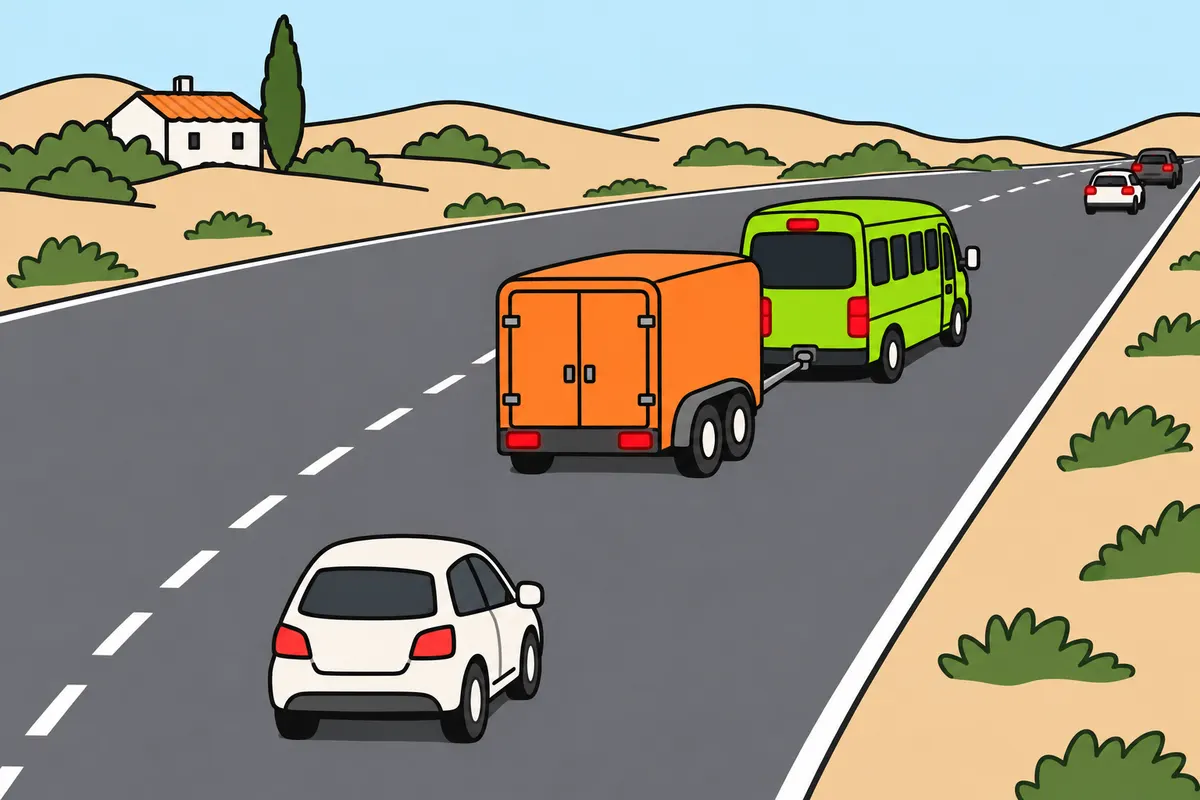
Before slowing down considerably, check behind and warn others whenever possible.
Remember
- Except in imminent danger, check you can slow down without endangering others.
- Check your mirrors while keeping your attention ahead.
- When you see a queue, start slowing down early.
- Whenever possible, warn with repeated brake lights or the prescribed arm signal.
- In imminent danger, act without waiting to complete a warning.
Exam trap: Wrong: the driver behind must keep their distance, so you need not warn them. Right: except in imminent danger, check safety and warn before slowing down considerably.
Read the full explanation
- Unless there is imminent danger, before slowing down considerably you must check that you can do so without putting other drivers at risk and give advance warning. You must avoid sudden deceleration that could cause a rear-end collision. The duty of the driver behind you to keep a safe distance does not remove your duty to anticipate. [RGC, art. 53](https://www.boe.es/buscar/act.php?id=BOE-A-2003-23514#a53)
- You must check the traffic behind you in your mirrors when preparing to slow down significantly, while keeping your attention on the road ahead. When you see a queue, start adjusting your speed in good time rather than waiting until you reach its tail. The length and response of your combination make this anticipation especially valuable. [RGC, art. 53](https://www.boe.es/buscar/act.php?id=BOE-A-2003-23514#a53)
- Whenever possible, you must warn others that you intend to stop or brake considerably by repeatedly operating your brake lights or giving the prescribed arm signal. Article 109 also regulates the use of hazard warning lights when your vehicle is immobilised on an autopista or autovía (motorway), or when visibility is significantly reduced. [RGC, art. 109](https://www.boe.es/buscar/act.php?id=BOE-A-2003-23514#a109) [RGC, art. 53](https://www.boe.es/buscar/act.php?id=BOE-A-2003-23514#a53)
- If an imminent danger arises, you must act to avoid it: the exception allows you to respond as necessary without waiting to complete an advance warning. The aim is to preserve space ahead and make your deceleration predictable to those behind you. [RGC, art. 53](https://www.boe.es/buscar/act.php?id=BOE-A-2003-23514#a53)
15Speed when passing vulnerable road users
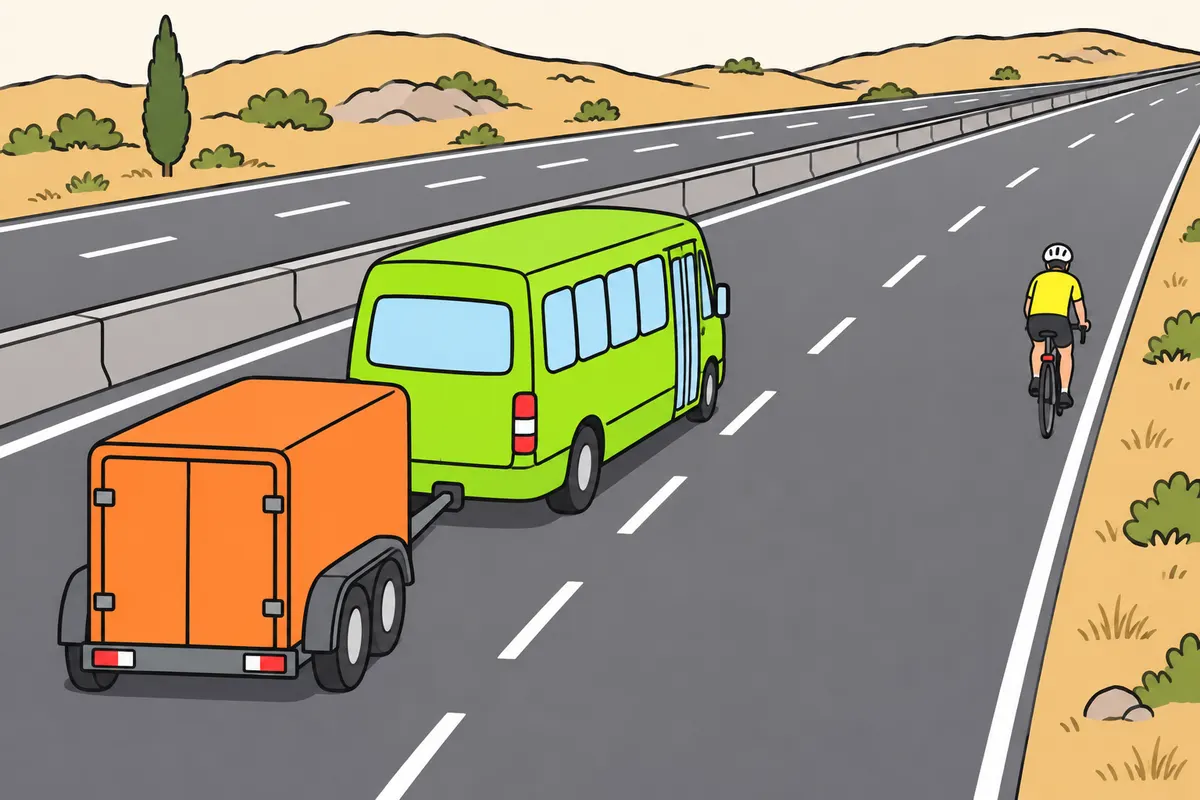
When passing vulnerable road users, meet both the lateral clearance and speed reduction requirements.
| Situation | Speed | Lateral clearance |
|---|---|---|
| Overtaking pedestrians, animals, animal-drawn vehicles, mopeds, personal mobility vehicles or cyclists outside built-up areas | At least 20 km/h below the road limit, before and throughout | At least 1.5 m; change lanes completely with several lanes per direction |
| Passing a vehicle occupying your lane due to breakdown, accident, emergency, assistance or maintenance service | At least 20 km/h below the road limit | At least 1.5 m; use the opposite lane if needed |
Remember
- Outside built-up areas, reduce speed before overtaking and throughout the manoeuvre.
- Travel at least 20 km/h below the road’s speed limit.
- Also obey your combination’s maximum and slow down further when needed.
- Leave at least 1.5 m and use part or all of the adjacent lane.
- With several lanes in each direction, change lanes completely.
Exam trap: Wrong: you only need to slow down or leave lateral clearance. Right: meet both requirements together. The stopped-vehicle rule does not cover traffic queues.
Read the full explanation
- When overtaking pedestrians, animals, animal-drawn vehicles, mopeds, personal mobility vehicles, cyclists or groups of cyclists, you must take particular care. Outside built-up areas, you must travel at least 20 km/h below the road’s speed limit before starting and throughout the manoeuvre. [RGC, art. 85](https://www.boe.es/buscar/act.php?id=BOE-A-2003-23514#a85)
- You must combine this reduction with the maximum speed for your combination and a speed appropriate to the circumstances. If the road has a 70 km/h limit, the resulting maximum after the reduction is 50 km/h. If safety requires a lower speed, you must slow down further; subtracting this amount does not automatically make the manoeuvre safe. [RGC, art. 85](https://www.boe.es/buscar/act.php?id=BOE-A-2003-23514#a85)
- You must leave at least 1.5 m of lateral clearance and use part or all of the adjacent lane or the lane for oncoming traffic; where there is more than one lane per direction, you must change lanes completely. Lateral clearance and reduced speed are simultaneous requirements, not alternatives you can choose between. [RGC, art. 85](https://www.boe.es/buscar/act.php?id=BOE-A-2003-23514#a85)
- When passing a vehicle stopped for one of the reasons listed in article 88 that occupies all or part of your lane, you must leave at least 1.5 m of lateral clearance, using the opposite lane if needed, and travel at least 20 km/h below the road’s speed limit. This includes breakdowns, accidents and emergency, assistance or maintenance services as specified there; it is not a rule for passing a queue stopped by traffic. [RGC, art. 88](https://www.boe.es/buscar/act.php?id=BOE-A-2003-23514#a88) [RGC, art. 85](https://www.boe.es/buscar/act.php?id=BOE-A-2003-23514#a85)
16Reaction time and reaction distance
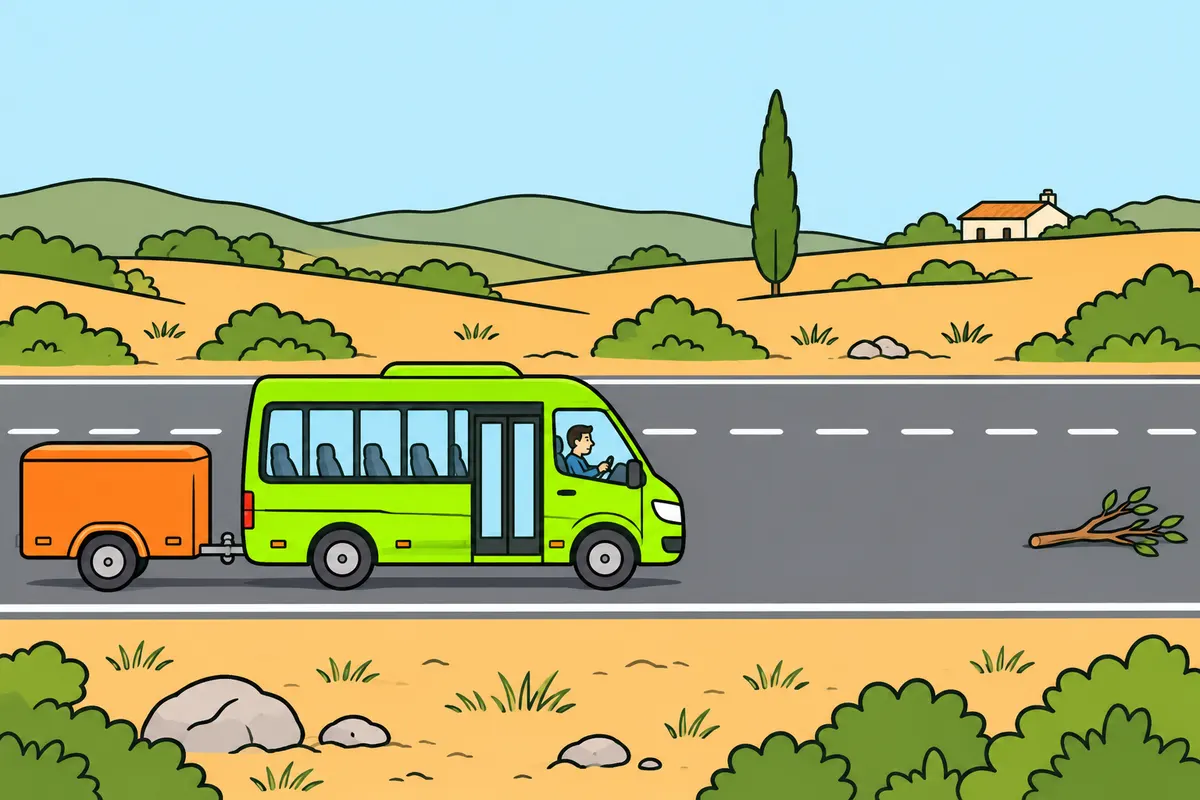
While you react, you keep moving before you start braking.
Remember
- Your reaction starts when you notice danger and ends when you begin responding.
- Tiredness, sleepiness and distractions can delay your response.
- Alcohol and some medicines can also delay it.
- With the same reaction time, doubling speed doubles the distance you travel.
Exam trap: Wrong: these figures are legal minimum following distances. Right: they show how far you travel each second at those speeds.
Read the full explanation
- Your reaction time runs from when you perceive a hazard until you begin to respond. Your reaction distance is the distance you travel during that interval. Fatigue, sleepiness, distractions, alcohol and some medicines can lengthen your reaction time. [DGT, Road Safety Manual 2026](https://sede.dgt.gob.es/export/sites/dgt/.galleries/permisos-de-conducir/certificacion-aptitud-profesores-formacion-vial/2026/MANUAL-II-Cuestiones-de-Seguridad-Vial.pdf)
- With the same reaction time, if you double your speed, you travel twice as many metres before braking. At 90 km/h you travel 25 m per second; at 80 km/h, approximately 22.2 m. These are speed conversions, not statutory minimum following distances. [DGT, Road Safety Manual 2026](https://sede.dgt.gob.es/export/sites/dgt/.galleries/permisos-de-conducir/certificacion-aptitud-profesores-formacion-vial/2026/MANUAL-II-Cuestiones-de-Seguridad-Vial.pdf)
17Braking distance of the combination
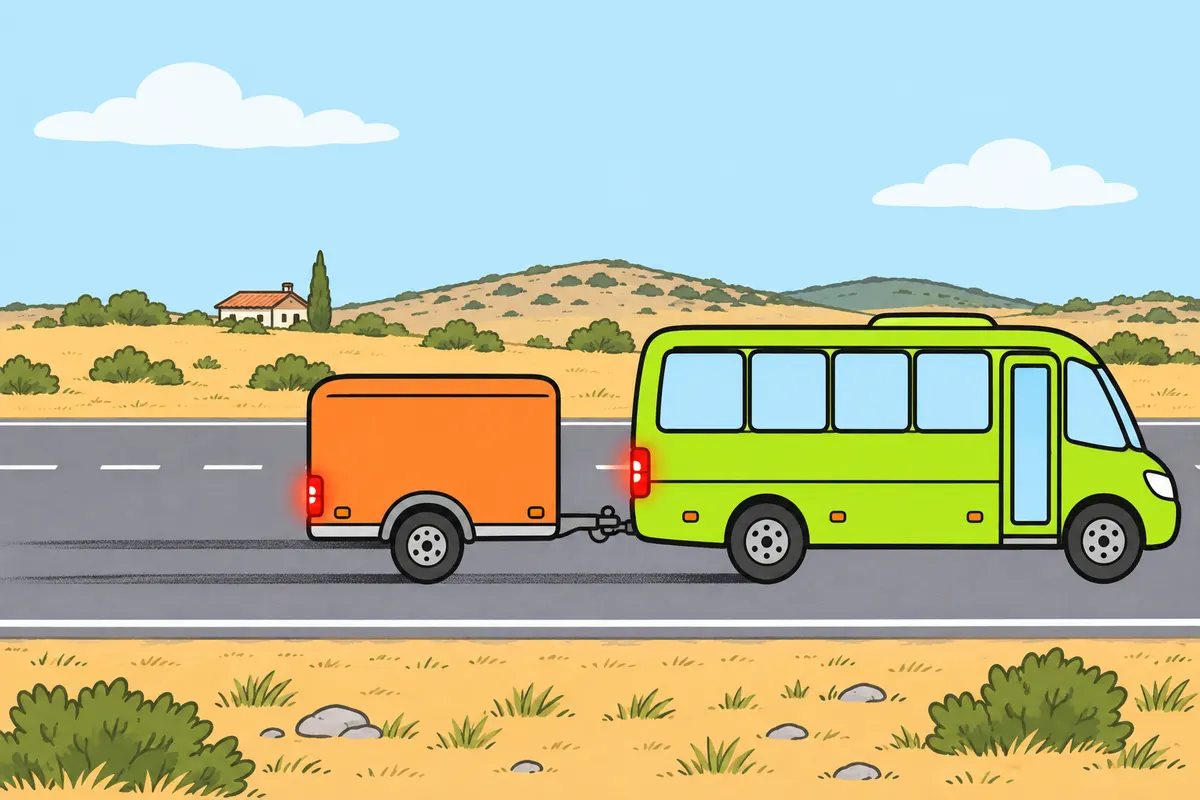
Your braking distance runs from applying the brake until your combination stops.
Remember
- Allow for speed, grip, vehicle condition and load.
- With equal conditions and comparable braking, doubling speed roughly quadruples braking distance.
Exam trap: Wrong: doubling speed only doubles braking distance. Right: with equal conditions and comparable braking, it becomes approximately four times as long.
Read the full explanation
- Your braking distance is the distance you travel from when you apply the brake until your combination stops. It depends on speed, grip, vehicle condition and load. With all other conditions equal and comparable deceleration, if you double your speed, your braking distance is approximately four times the original distance. [DGT, Road Safety Manual 2026](https://sede.dgt.gob.es/export/sites/dgt/.galleries/permisos-de-conducir/certificacion-aptitud-profesores-formacion-vial/2026/MANUAL-II-Cuestiones-de-Seguridad-Vial.pdf)
- The effects of the load, the braking systems and the technique for braking your minibus with a trailer are covered in «Trailer and combination braking».
18Stopping distance
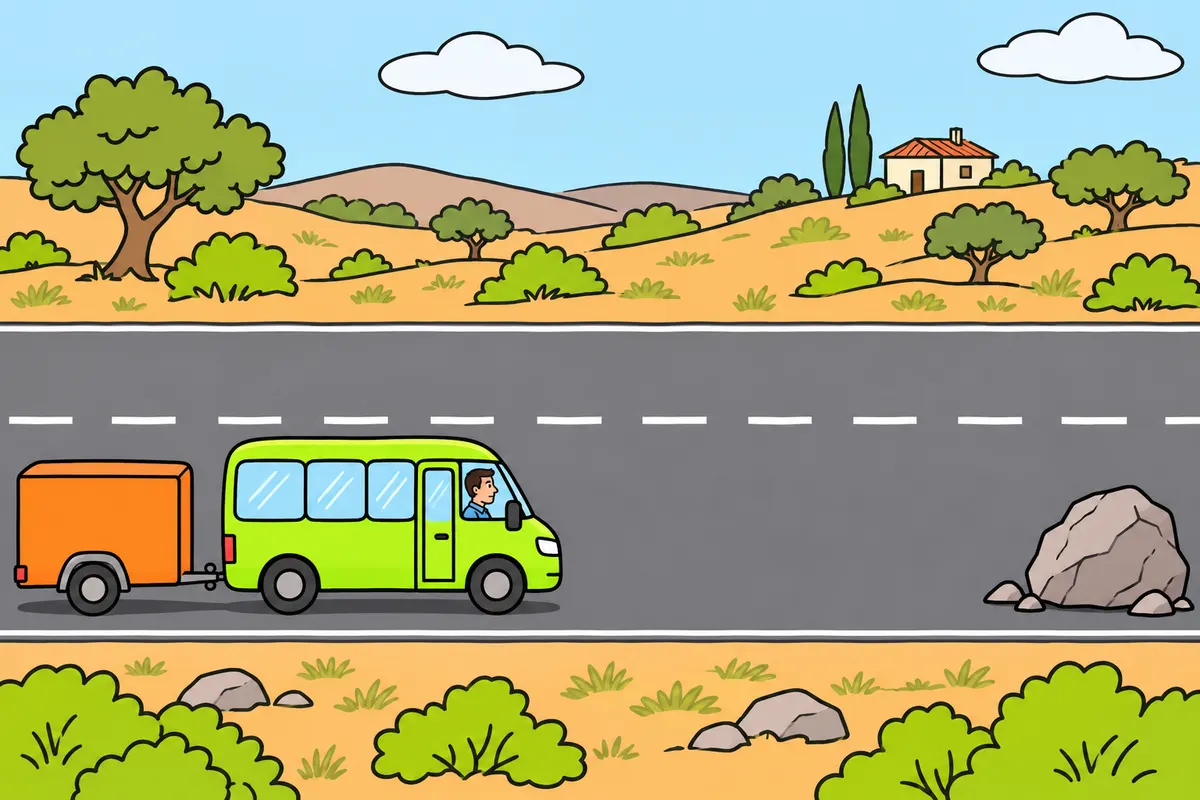
To stop, you need your reaction distance plus your braking distance.
Remember
- Count from noticing the need to stop until you have stopped completely.
- For fixed obstacles, stop your whole combination within the visible space.
- Leave enough space if the vehicle ahead brakes suddenly.
Exam trap: Wrong: stopping distance starts when you press the brake. Right: it also includes the distance you travel while reacting.
Read the full explanation
- Your stopping distance is the sum of your reaction distance and braking distance: it covers the distance from when you perceive the need to stop until you come to a complete halt. [DGT, Road Safety Manual 2026](https://sede.dgt.gob.es/export/sites/dgt/.galleries/permisos-de-conducir/certificacion-aptitud-profesores-formacion-vial/2026/MANUAL-II-Cuestiones-de-Seguridad-Vial.pdf)
- You must be able to stop the entire combination within the visible distance ahead of a fixed obstacle. When following another vehicle, you must leave enough space to avoid hitting it if it brakes suddenly. [RGC, art. 45](https://www.boe.es/buscar/act.php?id=BOE-A-2003-23514#a45) [RGC, art. 54](https://www.boe.es/buscar/act.php?id=BOE-A-2003-23514#a54)
19Safe following distance to avoid rear-end collisions
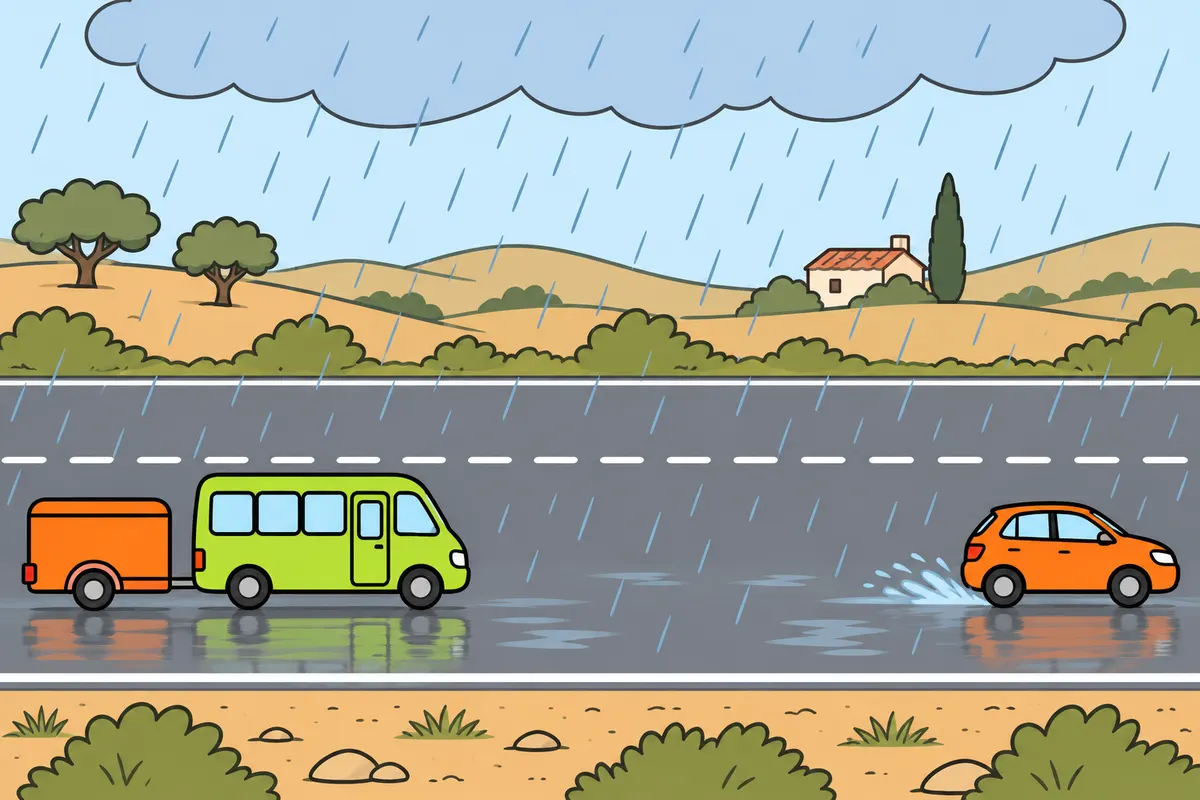
Leave enough space to avoid a collision if the vehicle ahead brakes suddenly.
Remember
- Increase your gap with higher speed, less grip or worse visibility.
- If someone moves into your gap, restore it gradually.
- Avoid dangerous braking while restoring the gap.
- You must also keep a safe gap behind groups of cyclists.
- On loose gravel, increase your gap to avoid flying stones.
- Do not move closer because spray makes it harder to see.
Exam trap: Wrong: a single distance works everywhere. Right: adapt your gap to conditions and obey any specific minimum.
Read the full explanation
- Whenever you drive behind another vehicle, you must leave enough space to stop without colliding if it brakes sharply. You must pay particular attention to speed, grip and braking capability. Apart from cases with specific minimum gaps, article 54 does not set a single distance in metres valid for every situation. [RGC, art. 54](https://www.boe.es/buscar/act.php?id=BOE-A-2003-23514#a54)
- You must increase the gap as speed increases, grip worsens or visibility decreases. Spray from the vehicle ahead can make it harder to spot a queue. [RGC, art. 54](https://www.boe.es/buscar/act.php?id=BOE-A-2003-23514#a54)
- If another vehicle moves into the gap you have left, you must gradually restore sufficient separation without causing dangerous braking by those behind you. Your duty to avoid a rear-end collision remains even if another driver’s manoeuvre has reduced the gap. [RGC, art. 54](https://www.boe.es/buscar/act.php?id=BOE-A-2003-23514#a54)
- When you follow a group of cyclists with your minibus and trailer, you must maintain enough space to avoid a rear-end collision. The exception allowing bicycles to travel as a group without the normal separation applies to their riders. [RGC, art. 54](https://www.boe.es/buscar/act.php?id=BOE-A-2003-23514#a54)
- If there is loose gravel, increase the gap to reduce the risk of stones thrown up by the vehicle ahead hitting your windscreen. In rain, you must also take account of spray and slippery road markings. [RGC, art. 45](https://www.boe.es/buscar/act.php?id=BOE-A-2003-23514#a45) [RGC, art. 54](https://www.boe.es/buscar/act.php?id=BOE-A-2003-23514#a54)
20Minimum gaps: 50 metres and following cyclists
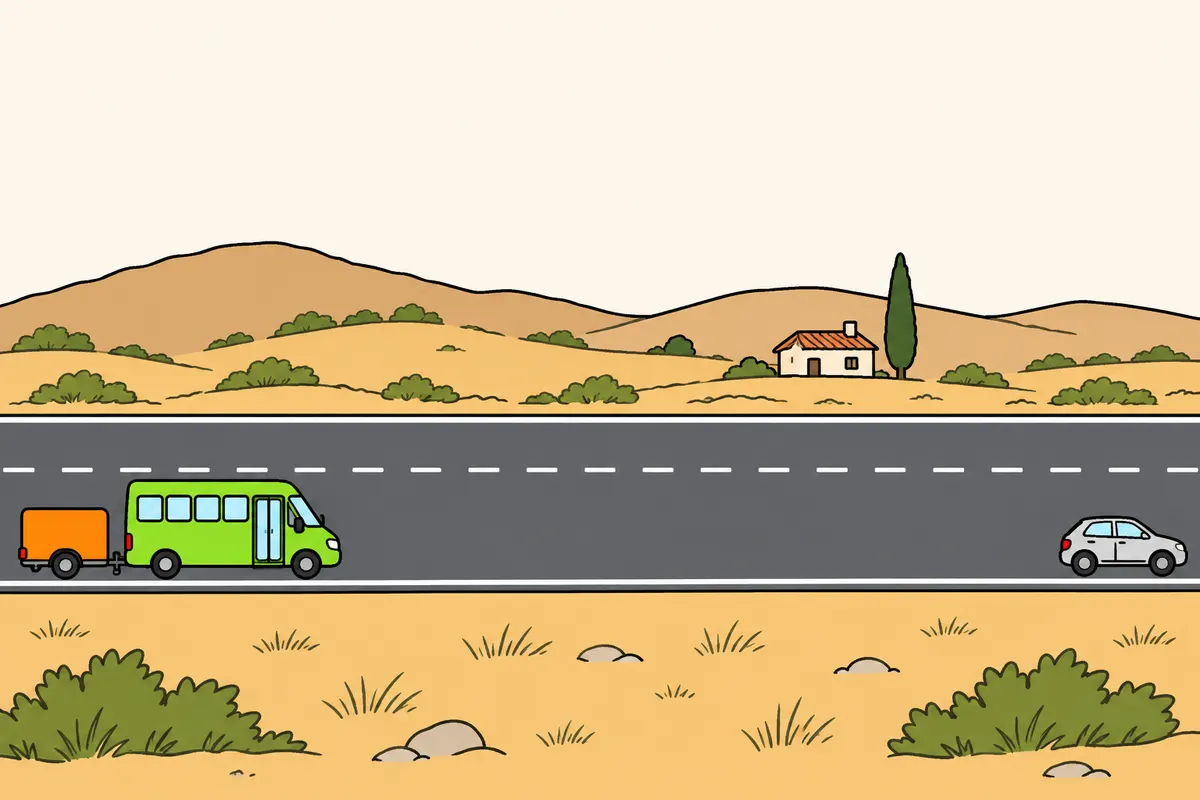
Keep the collision-avoidance gap and any additional minimum gap that applies.
| Vehicle or situation | Minimum gap |
|---|---|
| Vehicle above 3,500 kg MMA, or vehicle or combination longer than 10 m; no overtaking signal and no exception | 50 m to allow overtaking; more if needed |
| Following cyclists in your lane in an urban area | 5 m; more if needed |
Remember
- Check your vehicle’s MMA and your combination’s total length.
- Exceeding either threshold is enough for the relevant minimum.
- The 50 m helps others overtake when you do not signal overtaking.
- Check the exceptions to this additional gap.
- Leave more space when needed to avoid a rear-end collision.
- In urban areas, leave at least 5 m behind cyclists in your lane.
Exam trap: Wrong: every combination must always leave exactly 50 m. Right: apply this minimum if your vehicle exceeds 3,500 kg MMA or your vehicle or combination exceeds 10 m, without signalling an intention to overtake, outside built-up areas, where overtaking is allowed, without several lanes in your direction, and without congestion preventing overtaking. Leave more space if needed.
Read the full explanation
- In addition to the gap needed to avoid a collision, if you follow another vehicle without signalling an intention to overtake, you must leave enough space for the driver behind to overtake you safely. For vehicles with an MMA (maximum authorised mass) exceeding 3,500 kg and vehicles or combinations with a total length exceeding 10 m, this gap is at least 50 m. [RGC, art. 54](https://www.boe.es/buscar/act.php?id=BOE-A-2003-23514#a54)
- You only need to meet one of the criteria: a vehicle with an MMA exceeding 3,500 kg, or a vehicle or combination with a total length exceeding 10 m. You must use the MMA, not the payload or the number of occupants on that journey. With D1+E, check the minibus specifications and the full length with the trailer; the licence category does not replace this check. [RGC, art. 54](https://www.boe.es/buscar/act.php?id=BOE-A-2003-23514#a54)
- On a road outside a built-up area with one lane in each direction, where overtaking is permitted and traffic allows it, you must maintain this minimum gap if you meet either criterion and do not signal an intention to overtake. With an 11 m combination, the length alone is enough even if the minibus does not exceed 3,500 kg. The gap allows another driver to pass you and return safely in front of you. [RGC, art. 54](https://www.boe.es/buscar/act.php?id=BOE-A-2003-23514#a54)
- The 50 m is a minimum for this separation, not a universally sufficient distance. If speed, rain or braking capability means you need 70 m to avoid a rear-end collision, you must leave at least that larger gap. You must meet both requirements at the same time. [RGC, art. 54](https://www.boe.es/buscar/act.php?id=BOE-A-2003-23514#a54)
- In urban areas, if you follow cyclists travelling in your lane, you must leave at least 5 m. Increase this gap if you need more space to avoid a rear-end collision. [RGC, art. 153.4](https://www.boe.es/buscar/act.php?id=BOE-A-2003-23514#a1-6) [RGC, art. 54](https://www.boe.es/buscar/act.php?id=BOE-A-2003-23514#a54)
21Exceptions to the ordinary 50-metre gap
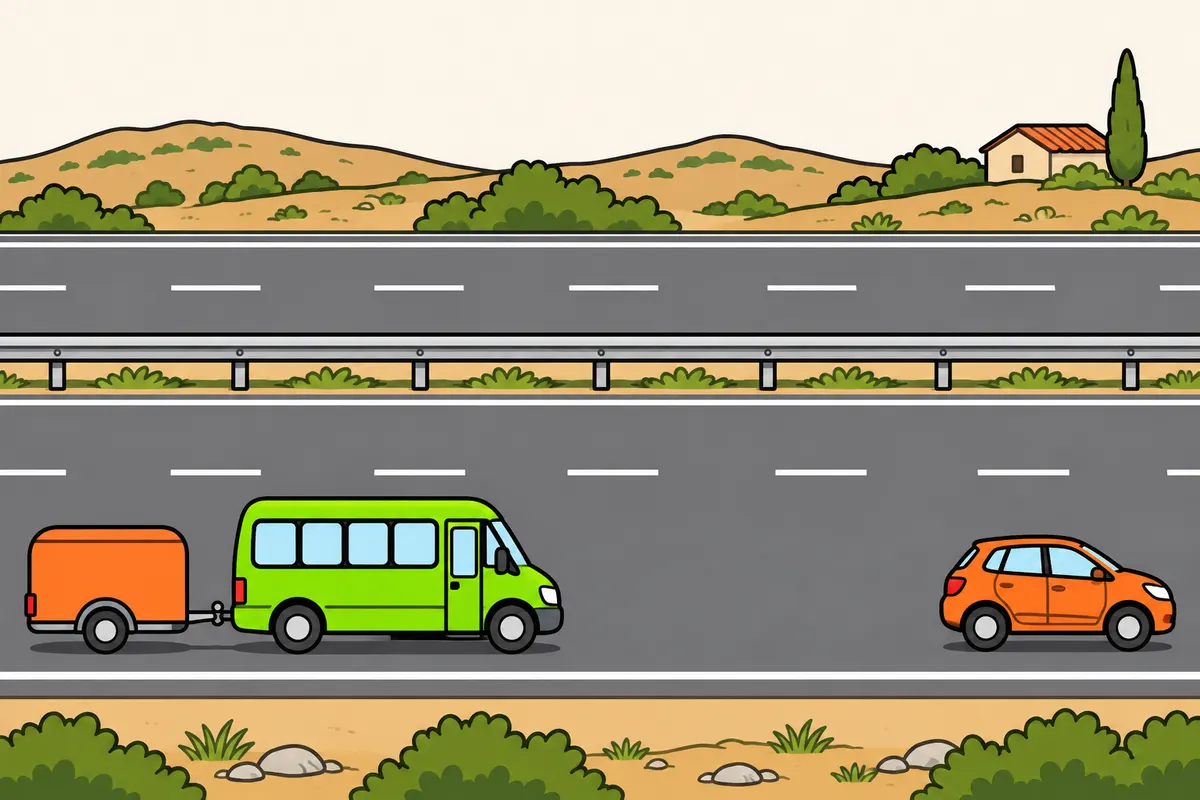
Exceptions to the ordinary 50-metre gap still require you to prevent rear-end collisions.
| Situation | Additional gap to allow overtaking |
|---|---|
| Built-up area | Not required |
| Overtaking prohibited | Not required |
| More than one lane in your direction | Not required |
| Congestion prevents overtaking | Not required |
Remember
- In built-up areas, the additional gap to allow overtaking is not required.
- It is also unnecessary where overtaking is prohibited or your direction has several lanes.
- It is also unnecessary when congestion prevents overtaking.
- Even when signalling overtaking, keep enough space to avoid collisions.
- Do not apply these exceptions to specific tunnel distances.
Exam trap: Wrong: where overtaking is prohibited, you can follow very closely. Right: always keep enough space to avoid a rear-end collision.
Read the full explanation
- The additional gap to allow overtaking is not required in built-up areas, where overtaking is prohibited, where there is more than one lane in your direction, or when traffic is so congested that overtaking is impossible. [RGC, art. 54](https://www.boe.es/buscar/act.php?id=BOE-A-2003-23514#a54)
- On a motorway with two lanes in your direction, you do not automatically have to leave a minimum of 50 m simply because you drive a long combination. You must maintain enough space to stop without colliding. The road’s speed limit and traffic occupying the right-hand lane do not remove this basic duty. [RGC, art. 54](https://www.boe.es/buscar/act.php?id=BOE-A-2003-23514#a54)
- On a road where overtaking is prohibited, outside a tunnel and with no other specific minimum, you must leave the distance needed to avoid a rear-end collision. If conditions require a greater distance, you must leave more space even though the exception applies. [RGC, art. 54](https://www.boe.es/buscar/act.php?id=BOE-A-2003-23514#a54)
- Signalling an intention to overtake does not remove the need for a gap to avoid a collision either. Also, the exceptions in article 54.3 do not apply to the specific minimum gaps in tunnels. [RGC, art. 54](https://www.boe.es/buscar/act.php?id=BOE-A-2003-23514#a54)
22Tunnels and underpasses: distance according to MMA
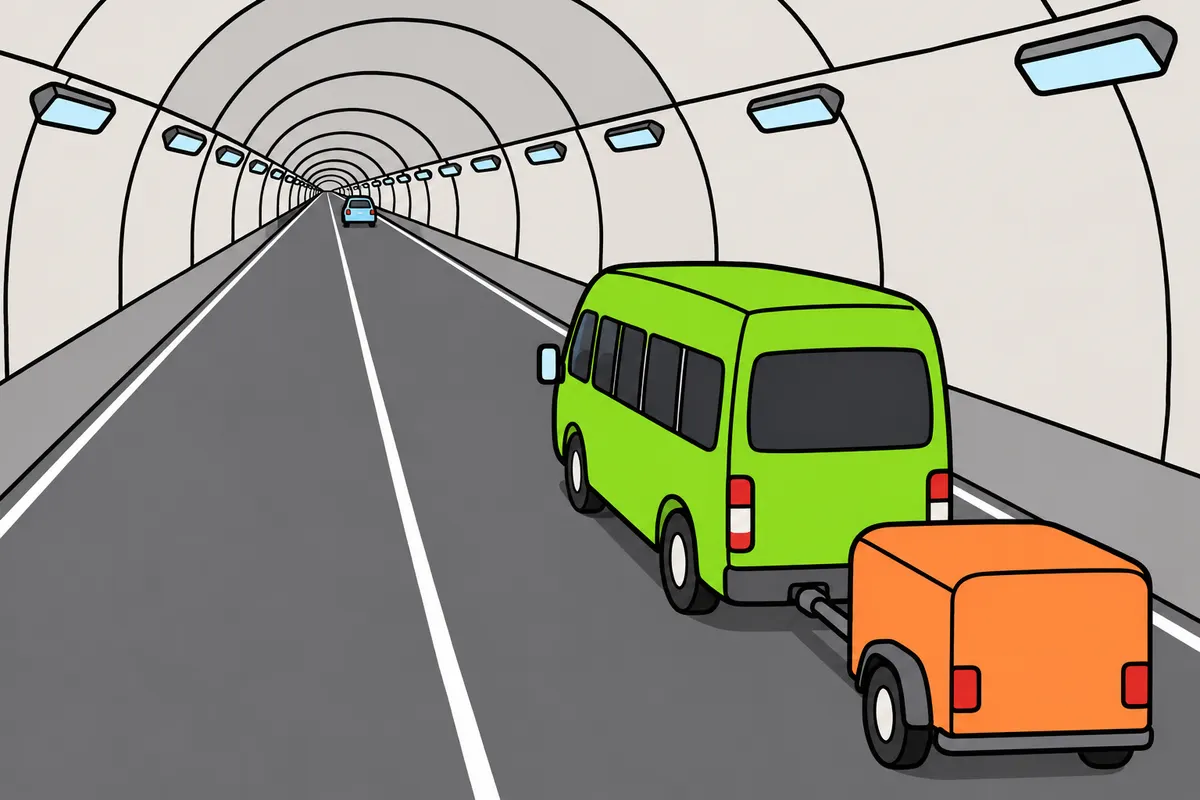
In tunnels, without intending to overtake, choose your gap according to your minibus’s MMA.
| Minibus MMA, without intending to overtake | Minimum in tunnels or underpasses |
|---|---|
| Up to 3,500 kg | 100 m or four seconds |
| Above 3,500 kg | 150 m or six seconds |
Remember
- These minima also apply in underpasses when you do not intend to overtake.
- Check your minibus’s MMA.
- Metres and seconds are alternative ways to measure the gap.
- Time from the preceding vehicle’s rear passing a point until your front reaches it.
- Also obey signs and leave any larger gap needed for safety.
- Several lanes or an overtaking ban do not remove these minima.
Exam trap: Wrong: you choose the distance just from your licence or length. Right: check your minibus’s MMA; these minima apply when you do not intend to overtake.
Read the full explanation
- When you do not intend to overtake, you must leave at least 100 m or four seconds behind the vehicle ahead in tunnels or underpasses. If your minibus has an MMA exceeding 3,500 kg, you must leave at least 150 m or six seconds. [RGC, art. 95](https://www.boe.es/buscar/act.php?id=BOE-A-2003-23514#a95)
- You must maintain this separation while driving, as well as any gap required for safety and by signs. The regulations give distance in metres or a time interval as alternative references. [RGC, art. 95](https://www.boe.es/buscar/act.php?id=BOE-A-2003-23514#a95)
- You can measure the interval using a fixed point: count from when the rear of the vehicle ahead passes it until the front of your minibus reaches it. If its MMA exceeds 3,500 kg and you use this time reference, you must leave at least six seconds. [RGC, art. 95](https://www.boe.es/buscar/act.php?id=BOE-A-2003-23514#a95)
- You must not apply the article 54 exception for places where overtaking is prohibited to reduce the tunnel minimum. Nor does this minimum cease to apply because there are several lanes in your direction if you do not intend to overtake. If you actually carry out a permitted overtake, you must still maintain the separation needed to avoid a collision. [RGC, art. 54](https://www.boe.es/buscar/act.php?id=BOE-A-2003-23514#a54) [RGC, art. 95](https://www.boe.es/buscar/act.php?id=BOE-A-2003-23514#a95)
23Adapting your driving to a tunnel
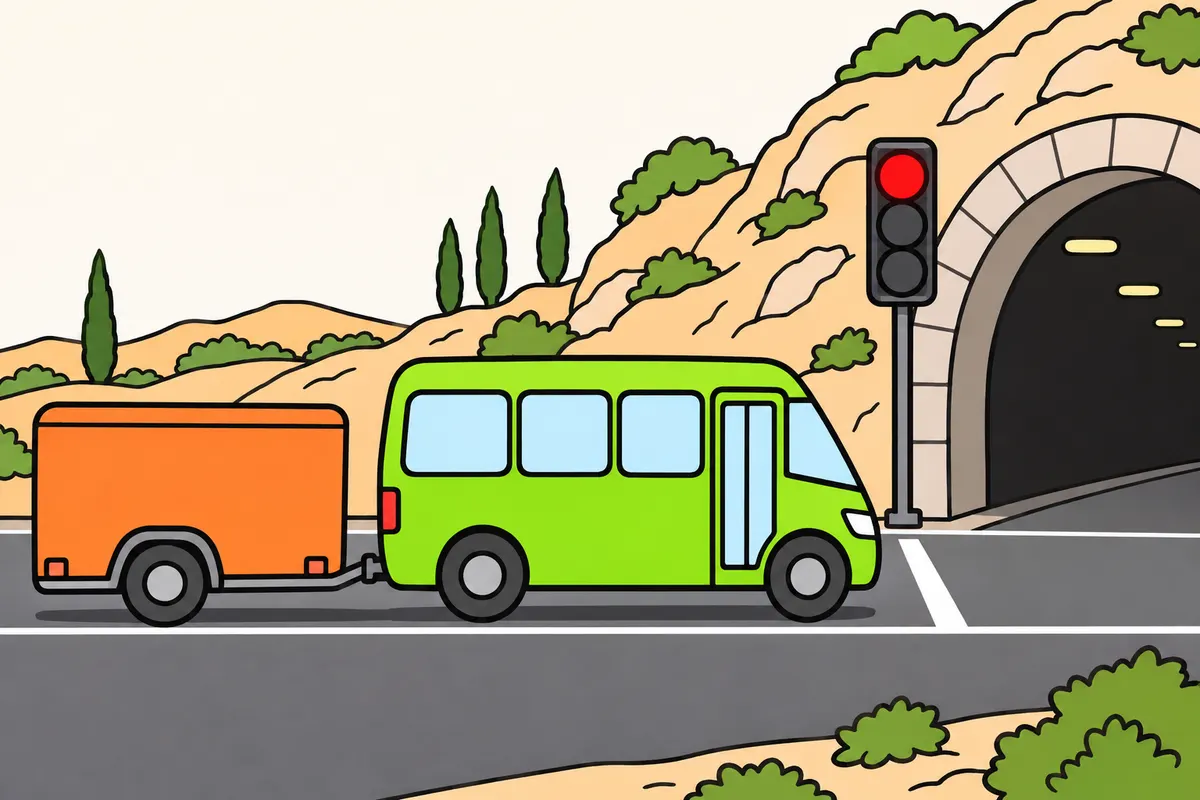
Before entering a tunnel, adapt your driving and obey its signals.
| Tunnel layout | Overtaking |
|---|---|
| Only one lane in your direction | Prohibited |
| Two-way traffic with several lanes in your direction | Only without entering the opposing direction |
Remember
- Combine the road limit, your combination’s limit and the signs.
- Slow down before entering if visibility, lighting or traffic changes.
- Do not enter when the traffic light prohibits entry.
- Obey message signs and loudspeaker instructions.
- Use the necessary lights at any time of day.
Exam trap: Wrong: you can overtake in any tunnel. Right: with only one lane in your direction, overtaking is prohibited in tunnels, underpasses and sections marked as tunnels. In two-way tunnels, you may only overtake with several lanes in your direction, without entering the opposing direction.
Read the full explanation
- These articles do not set a single maximum speed that replaces all limits on entering any tunnel. You must take account of the road type, the maximum speed for your combination and the tunnel signs together. Slow down in advance if lighting, traffic or visibility makes it inappropriate to maintain your speed from outside the tunnel. [RGC, art. 95](https://www.boe.es/buscar/act.php?id=BOE-A-2003-23514#a95)
- You must obey traffic lights, variable message signs and instructions over loudspeakers or by other means. You cannot enter if the traffic light at the entrance prohibits entry; the regulatory exception for emergency, assistance and maintenance teams does not give you this right during ordinary transport operations. [RGC, art. 96](https://www.boe.es/buscar/act.php?id=BOE-A-2003-23514#a96) [RGC, art. 95](https://www.boe.es/buscar/act.php?id=BOE-A-2003-23514#a95)
- You must use the appropriate lights in tunnels and underpasses at any time of day. If visibility changes as you enter, adapt your driving to maintain control within the distance you can see. For details of lighting devices, see «Safety devices on the combination». [RGC, art. 98](https://www.boe.es/buscar/act.php?id=BOE-A-2003-23514#a98) [RGC, art. 95](https://www.boe.es/buscar/act.php?id=BOE-A-2003-23514#a95)
- In tunnels with two-way traffic, you must not overtake unless there is more than one lane in your direction and you do so without entering the opposite direction. The prohibition on overtaking with only one lane in your direction extends to tunnels, underpasses and stretches covered by the tunnel sign. [RGC, art. 87](https://www.boe.es/buscar/act.php?id=BOE-A-2003-23514#a87) [RGC, art. 95](https://www.boe.es/buscar/act.php?id=BOE-A-2003-23514#a95)
24Traffic queues inside a tunnel
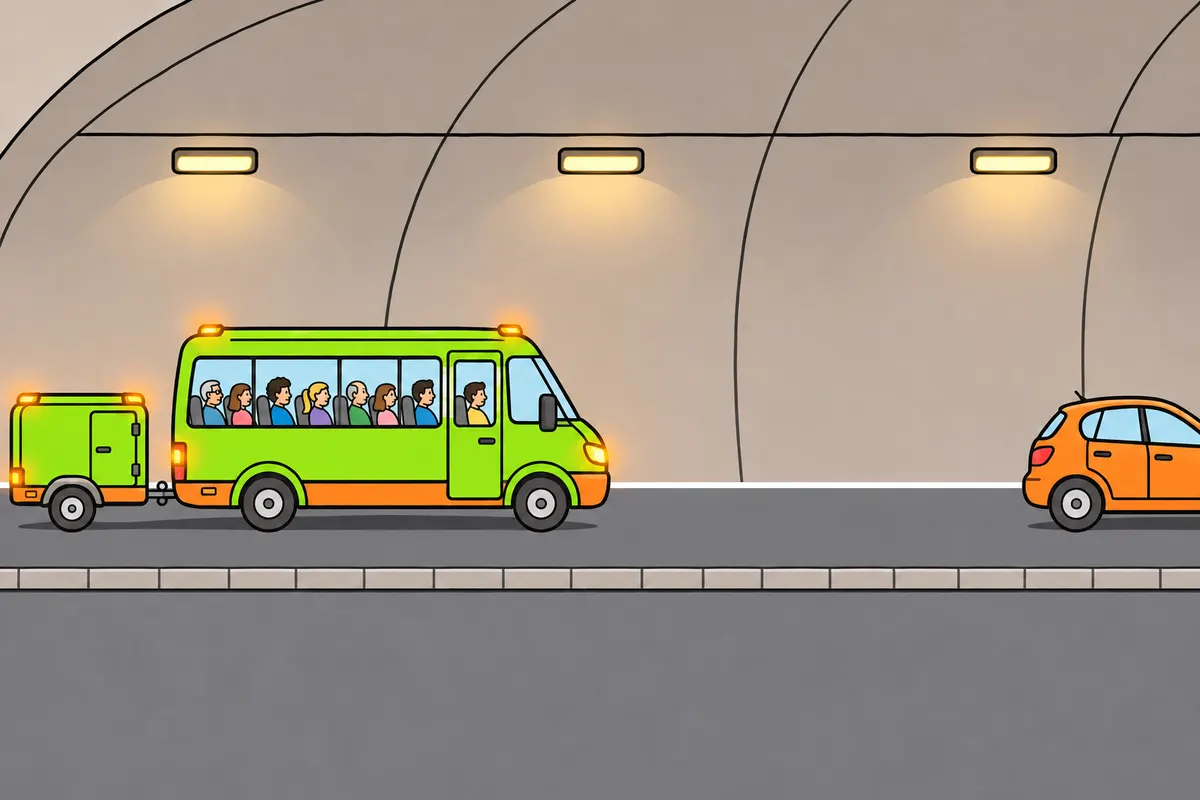
When stopped in a tunnel queue, switch off your engine and keep position lights on.
Remember
- When you see a queue, slow down gradually.
- When traffic makes you stop, leave as much space ahead as possible.
- Temporarily switch on your hazard warning lights to warn drivers behind.
- Keep position lights on and always switch off your engine when stopped.
- If traffic causes the stop, stay inside with your passengers.
- For a breakdown, fire or other emergency, follow the tunnel instructions.
Exam trap: Wrong: you apply the moving-traffic distances to a stationary queue. Right: when traffic makes you stop, leave as much space ahead as possible. Always switch off your engine when stopped in the tunnel, even if you remain at the wheel. If the wait lasts more than two minutes, keep the engine switched off and the position lights on.
Read the full explanation
- If you see a queue inside a tunnel, you must slow down progressively and avoid leaving it until the last moment to preserve a gap. If traffic forces you to stop, you must stop as far as possible from the vehicle ahead. This instruction concerns stops caused by traffic and does not set a different numerical minimum for every case. [RGC, art. 97](https://www.boe.es/buscar/act.php?id=BOE-A-2003-23514#a97)
- When stopped in these circumstances, you must temporarily switch on the hazard warning lights to warn drivers approaching from behind, keep the position lights on and switch off the engine. You and your passengers must remain in the vehicle when traffic is the cause of the stop. [RGC, art. 97](https://www.boe.es/buscar/act.php?id=BOE-A-2003-23514#a97)
- If the wait inside a tunnel or another enclosed place lasts more than two minutes, you must keep the engine off and the position lights on. You must switch off the engine throughout any stop in these places, even if you remain at the wheel. [RGC, art. 115](https://www.boe.es/buscar/act.php?id=BOE-A-2003-23514#a115)
- In the event of a breakdown, fire or other emergency, follow the tunnel instructions and the procedure in «Responding to accidents and breakdowns». [RGC, art. 97](https://www.boe.es/buscar/act.php?id=BOE-A-2003-23514#a97)
25Lanes with specific limits
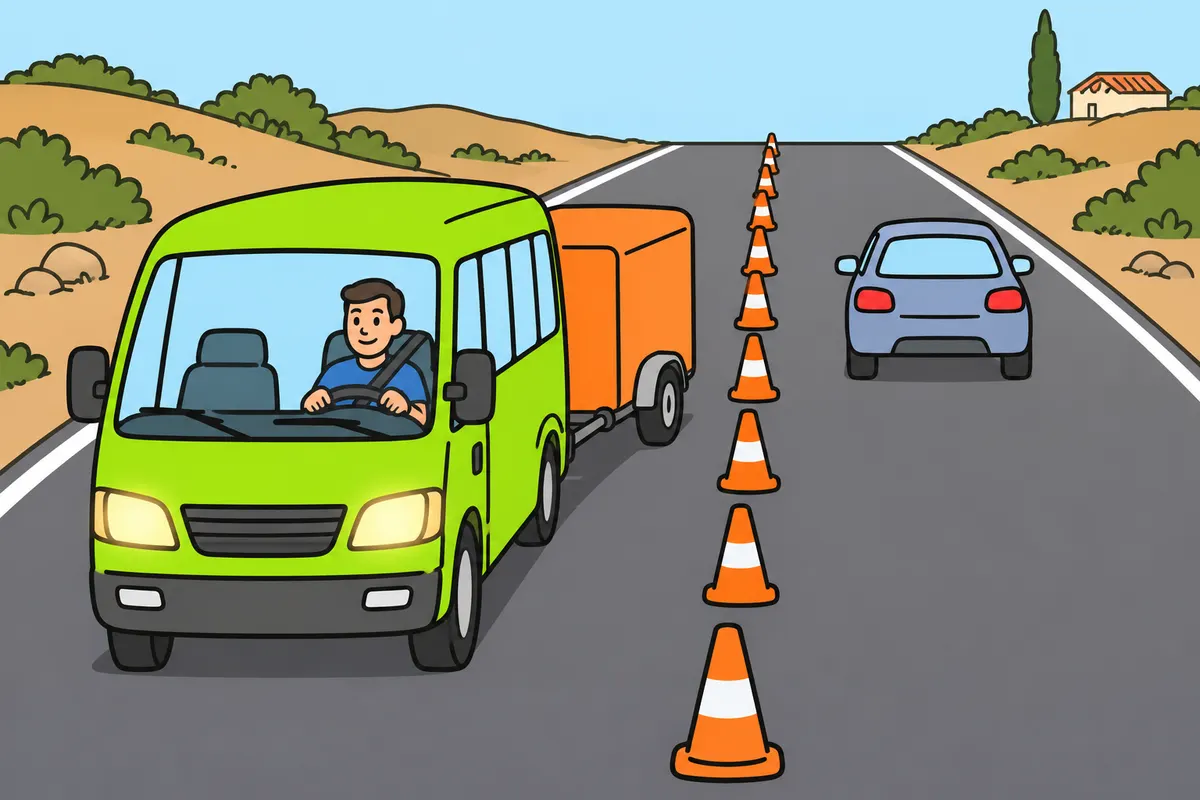
In special lanes, check whether you can enter and obey their speed and lighting rules.
| Lane: minibus with trailer | Applicable speed |
|---|---|
| Contraflow lane opened to improve traffic flow | Use prohibited |
| Contraflow lane for roadworks, if authorised and no express prohibition applies | Between 60 and 80 km/h, or lower speeds if prescribed or signposted |
| Adjacent lane in the normal direction, with only one lane available in your direction | Between 60 and 80 km/h, or lower speeds if prescribed or signposted |
| Adjacent lane in the normal direction, with several lanes in your direction | Ordinary limits for your combination and road |
| Temporary additional lane and hard shoulders opened to traffic | Between 60 and 80 km/h, or lower speeds if prescribed or signposted |
Remember
- Do not enter contraflow lanes opened to improve traffic flow with your combination.
- For roadworks, enter only if your combination is authorised and no express prohibition applies.
- In these lanes, use dipped beam headlights by day and by night.
- Also use dipped beam headlights in the adjacent lane travelling in the normal direction.
- In temporary additional lanes and opened hard shoulders, use dipped beam day and night.
- Follow lane markings without entering lanes for the opposite direction.
Exam trap: Wrong: you can enter any contraflow lane with a trailer. Right: entry is prohibited when it opens to improve traffic flow. For roadworks, you may enter if your combination is authorised on the road and no express prohibition applies. Obey the special limits, including lower speeds prescribed or signposted, and use dipped beam headlights by day and by night.
Read the full explanation
- You must not use a lane opened in the opposite direction to normal to improve traffic flow with your minibus and trailer: it is reserved for cars without trailers and motorcycles. If it is opened because of roadworks, you may use it when your combination is permitted on the road and there is no express prohibition. In that case, you must drive between 60 and 80 km/h, or at lower speeds if these are prescribed or signposted, with your dipped beam headlights on by day and by night. You must stay within the marked lane without entering the lanes for traffic travelling in the normal direction, even to overtake. [RGC, art. 41](https://www.boe.es/buscar/act.php?id=BOE-A-2003-23514#a41)
- If you drive in the normal direction in the lane next to the one opened in the opposite direction, you must keep your dipped beam headlights on by day and by night and respect the separation provided by the delineators. With only one lane available in your direction, the maximum speed is 80 km/h and the minimum is 60 km/h, or lower speeds if these are prescribed or signposted. If several lanes remain available in your direction, the ordinary limits for your combination and the road apply. [RGC, art. 41](https://www.boe.es/buscar/act.php?id=BOE-A-2003-23514#a41)
- A temporary additional lane uses both arcenes (hard shoulders) to provide two lanes in one direction and one in the other. You may drive your combination in accordance with the signs. In both the additional lane and the hard shoulders opened to traffic, you must maintain a speed between 60 and 80 km/h, or lower speeds if these are prescribed or signposted, and keep your dipped beam headlights on by day and by night. Follow the temporary layout without entering the lanes for oncoming traffic or altering the delineators. [RGC, art. 42](https://www.boe.es/buscar/act.php?id=BOE-A-2003-23514#a42)
Choosing the combination's speed
Consider the road, vehicle, transport service and actual conditions together.
- Identify whether you are outside a built-up area, on an urban road, on a through road or on a motorway within a built-up area.
- Apply your combination's maximum speed: 90/80 outside built-up areas; 30 on unpaved roads; 20/30/50 on streets, depending on their layout; 50 on through roads and 80 on motorways within built-up areas.
- Check whether you are providing school transport or transport for minors, whether the bus or coach has no seat belts, and which vehicle-specific or signed restrictions you must follow.
- Check the minimum speed and whether you have a justified reason to drive below it.
- Slow down as much as necessary to stop within the distance you can see and keep the combination under control.
Choosing the following distance
Maintain a safe following distance and comply with the applicable minimum gaps.
- Assess the distance you need to avoid a collision if the vehicle ahead brakes suddenly.
- In urban areas, leave at least 5 m behind cyclists ahead of you in the same lane.
- If you are not signalling an intention to overtake, check the ordinary 50 m rule for a maximum authorised mass (MMA) exceeding 3,500 kg or an overall length exceeding 10 m.
- Check its exceptions: built-up areas, places where overtaking is prohibited, roads with more than one lane in each direction or congestion that prevents overtaking.
- In tunnels or underpasses, if you do not intend to overtake, leave 100 m or four seconds; with a vehicle whose MMA exceeds 3,500 kg, leave 150 m or six seconds.
- Check the signs and leave a larger gap if safety conditions require it.
Anticipating a traffic queue
Slow down while maintaining your gap ahead and giving traffic behind enough warning.
- Spot the queue and check the traffic behind while keeping your attention on the road ahead.
- Warn of a significant reduction in speed whenever possible and slow down progressively.
- Keep enough distance to stop the whole combination.
- If a queue brings you to a standstill in a tunnel, stop as far as possible from the vehicle ahead, switch on your hazard warning lights temporarily, keep the position lights on and switch off the engine.
- Stay in the vehicle if traffic brings you to a standstill and follow the tunnel instructions.
Finished this module?
Mark it as read and you will see your progress on the theory list.