
Theory · C+E Licence - Articulated Truck · Module 12 of 13
Responding to accidents and breakdowns
You learn to protect an immobilised heavy vehicle combination, signal it with the connected V-16 beacon, call 112 and provide first aid without worsening injuries. You answer questions about evacuation, fires and tunnels, and distinguish your duties to assist, remain at the scene and identify yourself.
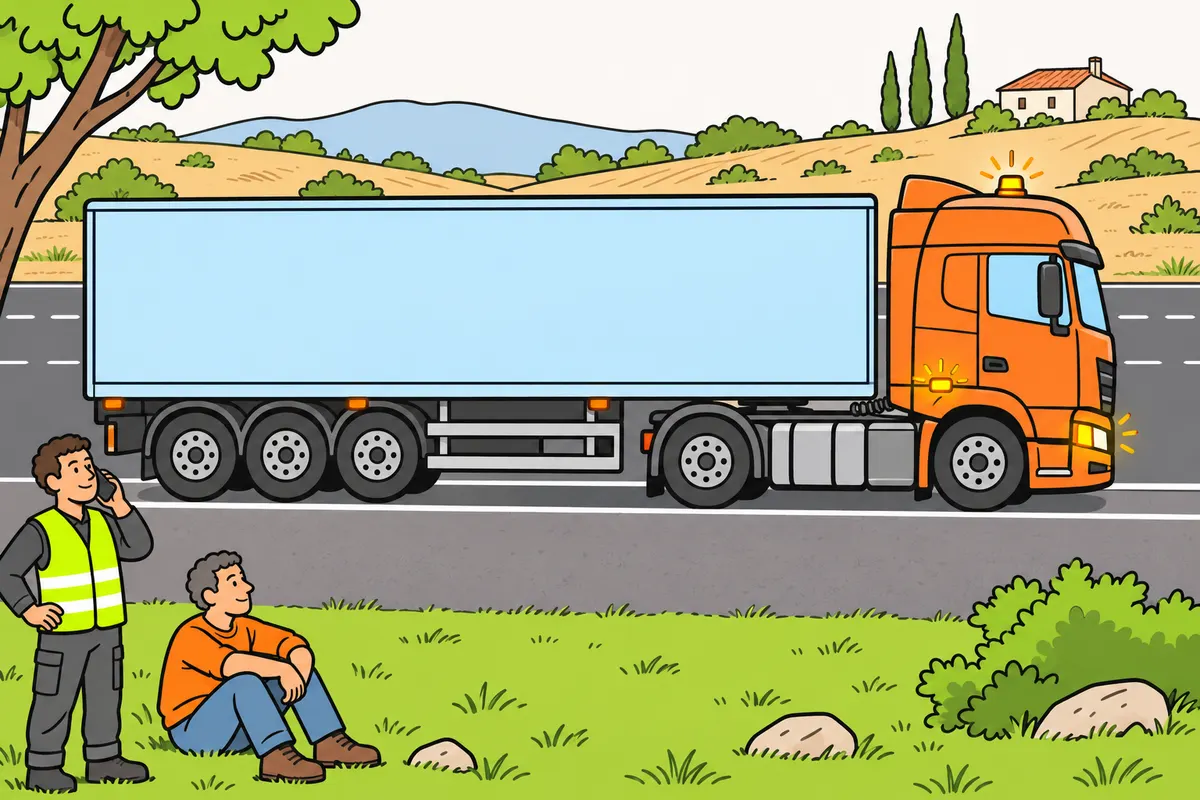
1PAS: protect, alert and assist
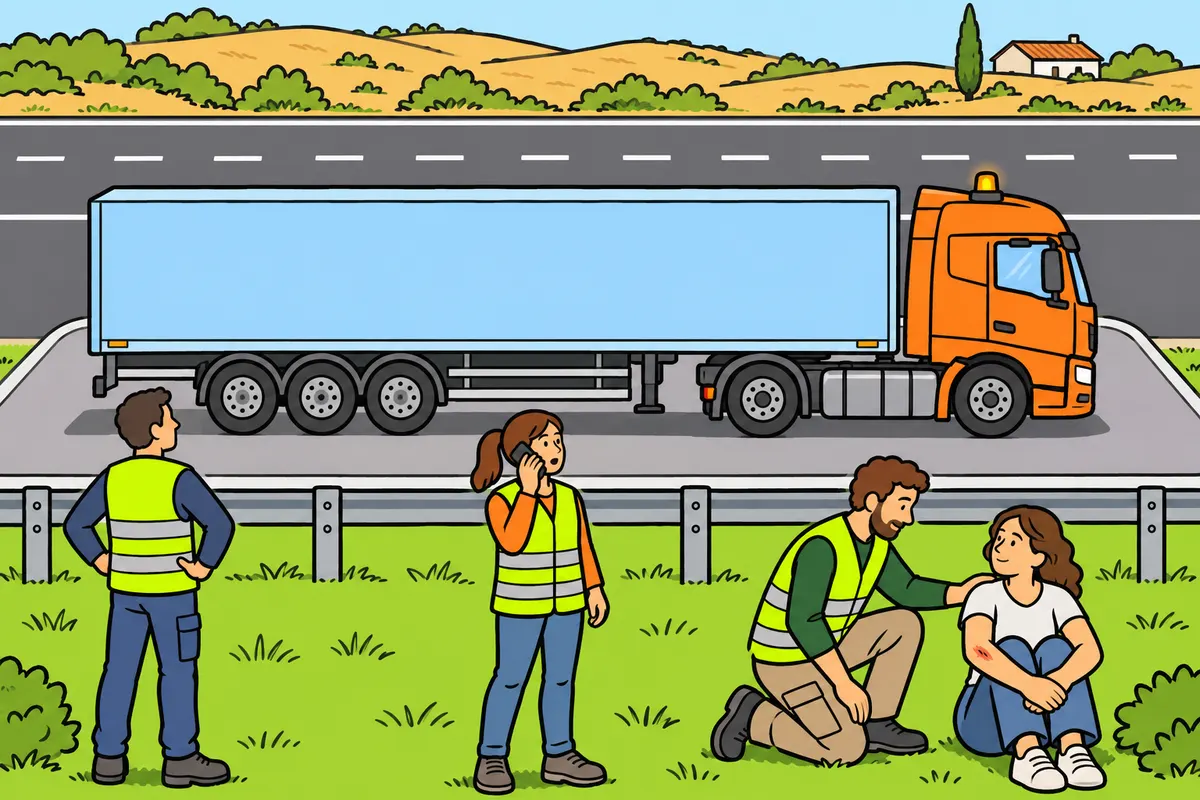
First protect the scene, then call for help, then assist.
Remember
- Check traffic, the trailer and the load before approaching.
- Make sure someone calls 112, and keep watching for danger.
- Only give help you know how to provide.
Exam trap: Wrong: You assist before protecting the scene. Right: First prevent another accident, then call for help and assist.
Read the full explanation
- You must organise your response using PAS: protect, alert and assist, in that order. First prevent the accident from causing another one; then call for help and provide the assistance you know how to give. With a heavy vehicle combination, you must also check the trailer, the load and the space they occupy: looking only at the cab leaves hazards unidentified. [DGT, first aid 2026](https://sede.dgt.gob.es/export/sites/dgt/.galleries/permisos-de-conducir/certificacion-aptitud-profesores-formacion-vial/2026/MANUAL-IX-Primeros-auxilios.pdf)
- You must stay calm and assess the scene before approaching. Observe the traffic, its direction, visibility, the people affected and any obvious hazards. Do not confuse speed with haste: parking across the road or running between vehicles can make you another casualty and hinder the arrival of assistance. [RGC, art. 129](https://www.boe.es/buscar/act.php?id=BOE-A-2003-23514#a129)
- If other people are available, you can assign specific tasks: one calls 112 and another helps from a protected area. Check that someone actually makes the call. Protection and alerting can continue while you provide assistance; PAS establishes priorities, rather than allowing you to stop monitoring hazards once care begins. [DGT, first aid 2026](https://sede.dgt.gob.es/export/sites/dgt/.galleries/permisos-de-conducir/certificacion-aptitud-profesores-formacion-vial/2026/MANUAL-IX-Primeros-auxilios.pdf)
- You must provide assistance or call for help, cooperate to prevent harm and help establish what happened. This obligation does not make you a healthcare professional or justify carrying out procedures you do not know. Calling for urgent help is part of providing assistance. [RGC, art. 129](https://www.boe.es/buscar/act.php?id=BOE-A-2003-23514#a129)
2Stopping the combination without creating another danger
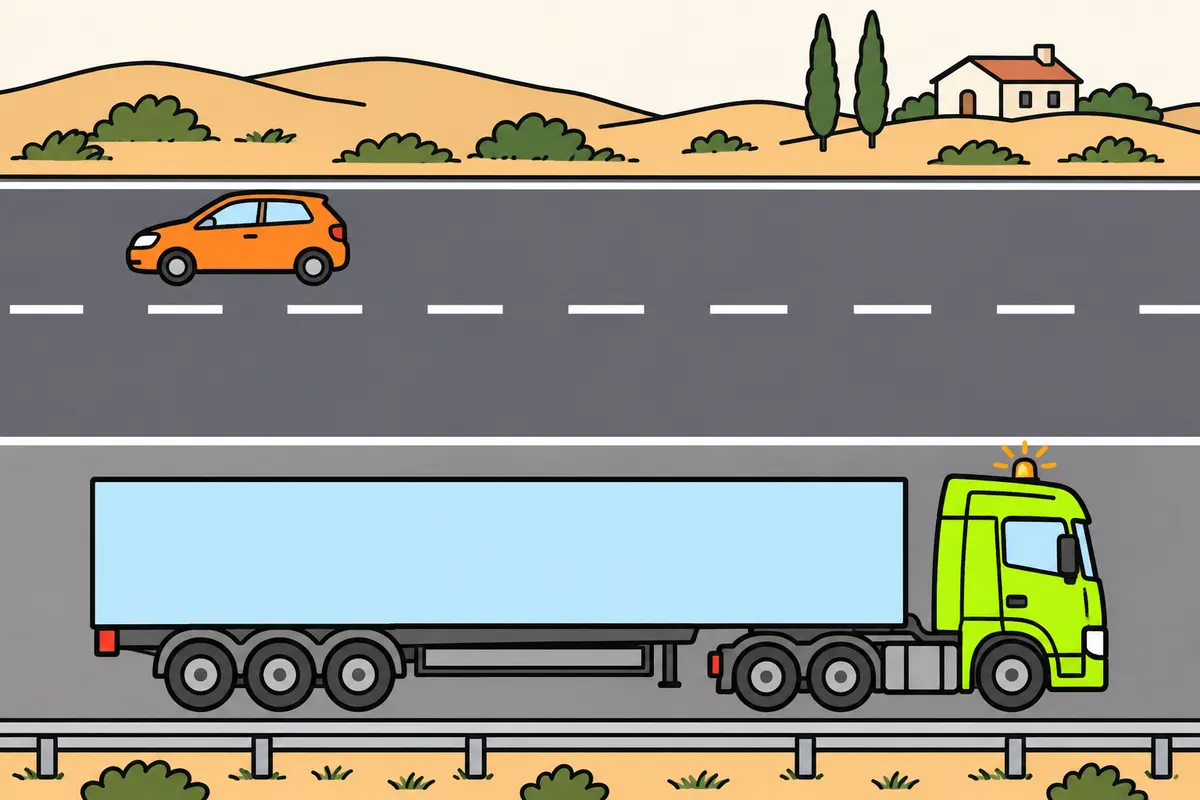
Stop and secure your combination without creating more danger.
Remember
- If you are involved, stop without creating danger.
- If you can continue safely after a crash or breakdown, clear the carriageway.
- If you need assistance, use the right hard shoulder towards the first available exit.
- If you cannot leave, stop where you cause the least obstruction.
- Before getting out, stop the engine, switch off ignition and apply the parking brake.
- Follow the specific instructions for a tunnel fire.
Exam trap: Wrong: You move because the engine runs. Right: Move only if your whole combination can move safely.
Read the full explanation
- If you are involved, you must stop without creating another danger. If you arrive as a witness and your help is needed, find somewhere to leave the lorry without blocking those arriving or hiding injured people from view. An articulated lorry needs more space than a car; do not force it into an unsafe position to be close to the accident. [RGC, art. 129](https://www.boe.es/buscar/act.php?id=BOE-A-2003-23514#a129)
- If a breakdown or collision allows you to continue safely, you must resume driving immediately to clear the carriageway. When you need assistance, leave the traffic lanes as soon as possible and head for the first available exit using the right-hand arcén (hard shoulder). If this is not possible, stop on that hard shoulder or wherever you cause the least obstruction. [RGC, art. 130](https://www.boe.es/buscar/act.php?id=BOE-A-2003-23514#a130)
- You must not treat a running engine as sufficient proof of safety. A misaligned trailer, a shifted load or a serious brake fault can prevent safe movement. If you cannot continue, warn other road users and request suitable assistance; rapid removal must be compatible with the safety of the combination and other road users. [RGC, art. 130](https://www.boe.es/buscar/act.php?id=BOE-A-2003-23514#a130)
- Before leaving the driving position, secure the combination against unintended movement. You must switch off the engine, switch off the ignition, apply the parking brake and follow your vehicle’s immobilisation procedure, except where specific instructions apply, such as those for a tunnel fire. Do not stand between the tractor unit and semi-trailer or go underneath a damaged vehicle to investigate the breakdown; report the symptoms from a protected position. [RGC, art. 92](https://www.boe.es/buscar/act.php?id=BOE-A-2003-23514#a92)
3Hazard warning lights, position lights and end-outline marker lamps
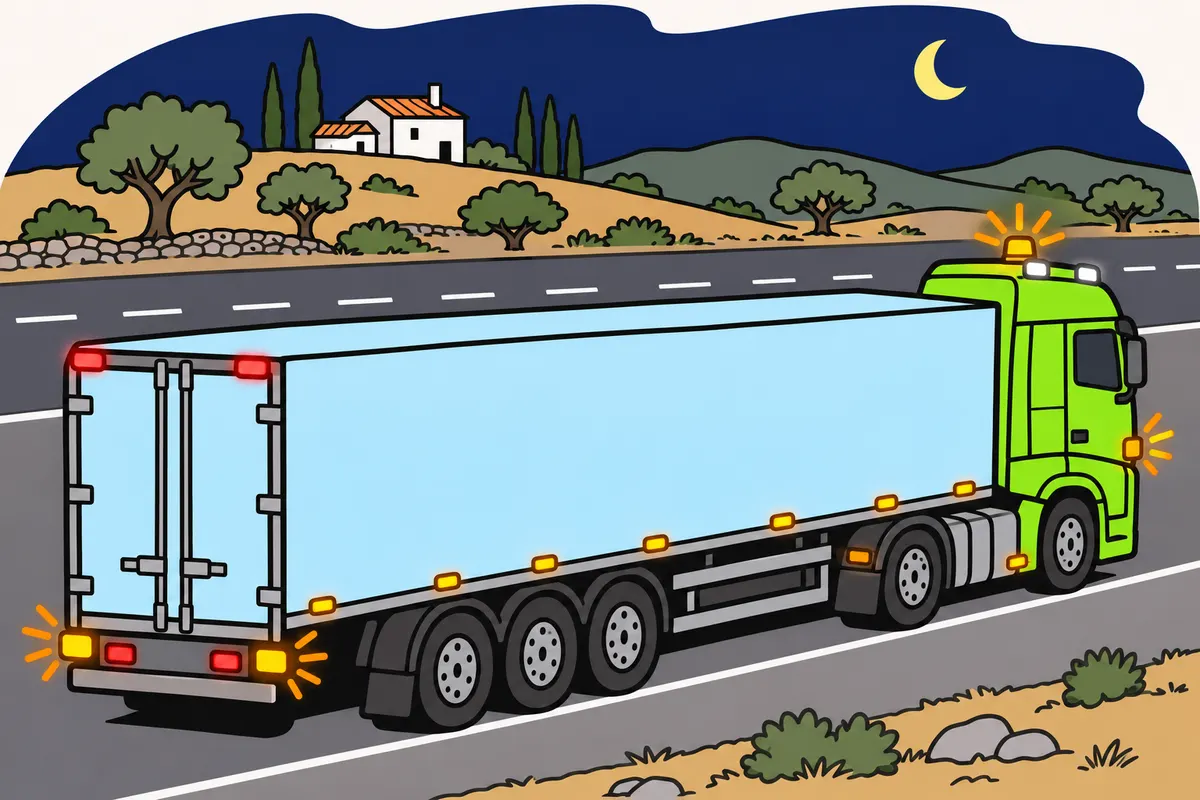
Use the beacon and required lights to make your whole combination visible.
Remember
- Switch on hazard lights, if fitted, and use the required beacon too.
- When stopped on the carriageway or hard shoulder, keep position lights on.
- This applies at night or in seriously reduced visibility.
- Keep end-outline marker lamps on where required.
- If immobilised in your lane, drivers must pass leaving at least 1.5 m.
- They must also drive at least 20 km/h below the limit.
Exam trap: Wrong: The V-16 replaces your lights. Right: Keep hazard lights on and, where required, position lights and end-outline marker lamps.
Read the full explanation
- If your vehicle is immobilised by an accident or breakdown, you must switch on the hazard warning lights if fitted. You must also use the regulatory hazard warning device. These warnings complement each other: switching on all the direction indicators simultaneously does not replace the connected beacon or make it safe to remain on the hard shoulder. [RGC, art. 130](https://www.boe.es/buscar/act.php?id=BOE-A-2003-23514#a130)
- If you are immobilised at night, between sunset and sunrise, on the carriageway or hard shoulder, you must keep the position lights and, where applicable, the end-outline marker lamps on. This is also required when visibility is significantly reduced. With a combination, you must consider its full size and ensure the trailer is visible. [RGC, art. 105](https://www.boe.es/buscar/act.php?id=BOE-A-2003-23514#a105)
- If your combination is immobilised by a breakdown or accident and occupies all or part of the lane in your direction, drivers passing it must leave at least 1.5 m of lateral clearance and travel at least 20 km/h below the speed limit on that road. [RGC, art. 88.1](https://www.boe.es/buscar/act.php?id=BOE-A-2003-23514#a88)
- The lighting requirements for the tractor unit and trailer are covered in «Safety devices for the vehicle combination», in «Position lights and number plate lighting», «Brake lights, indicators and hazard warning lights» and «End-outline marker lamps: recognising the width».
4Mandatory connected V-16 beacon
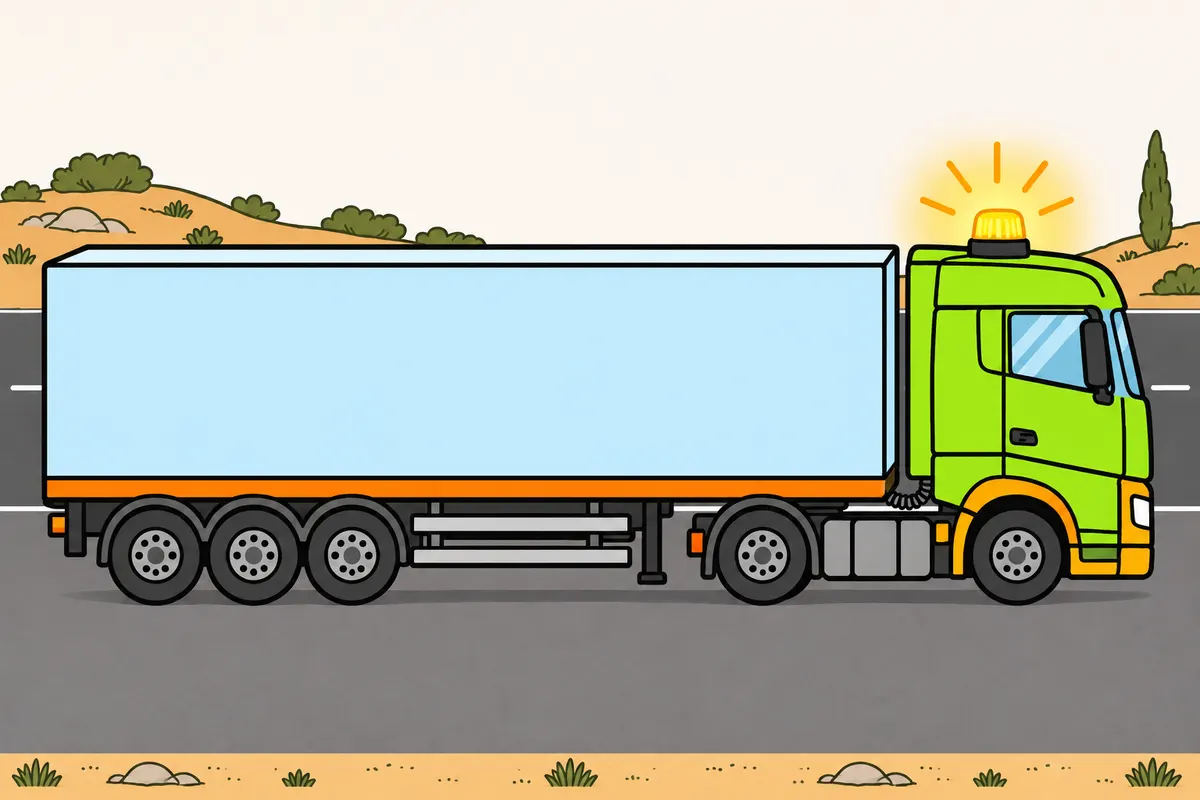
For your combination registered in Spain, carry and use a certified connected beacon.
Remember
- Check the make and model on the official DGT list.
- Keep the V-16 within reach from your cab.
- Activate it when stopped on the road in danger, or for a fallen load.
- Follow the procedure for placing it safely on a high cab.
- The beacon sends your location to warn traffic.
- Separately request any medical or mechanical assistance you need.
Exam trap: Wrong: You use triangles or an unconnected beacon. Right: Your combination registered in Spain needs a certified connected V-16.
Read the full explanation
- For your combination registered in Spain, you must carry a certified connected V-16 as the regulatory hazard warning device. Every driver must use the regulatory warning device when the vehicle is immobilised on the road in a hazardous situation; for your combination, you must use the connected V-16. Warning triangles and beacons without connectivity do not fulfil this regulatory function for this vehicle. Check the make and model against the official DGT list. [RGC, art. 130.4](https://www.boe.es/buscar/act.php?id=BOE-A-2003-23514#a130) [RGV, annex XII.1.a and 2](https://www.boe.es/buscar/act.php?id=BOE-A-1999-1826#anxii) [DGT, V-16 devices](https://www.dgt.es/muevete-con-seguridad/tecnologia-e-innovacion-en-carretera/Dispositivos-de-presenalizacion-V16/)
- You must activate and position the beacon to warn that your vehicle is immobilised or that a load has fallen onto the carriageway; «Placing the beacon on a high cab» gives the procedure adapted to a heavy vehicle combination. [RGV, annex XI, V-16.1-2](https://www.boe.es/buscar/act.php?id=BOE-A-1999-1826#v-16)
- You must keep the beacon accessible from the cab; its technical specifications, certification and connectivity are explained in «Safety devices for the vehicle combination», in the sections «Connected V-16 beacon and mandatory equipment» and «What the beacon must do». [DGT, V-16 devices](https://www.dgt.es/muevete-con-seguridad/tecnologia-e-innovacion-en-carretera/Dispositivos-de-presenalizacion-V16/)
- The V-16 signal communicates your location to warn traffic of the danger, but you must separately request any medical or breakdown assistance you need. [RGV, annex XI, V-16.4 and 9](https://www.boe.es/buscar/act.php?id=BOE-A-1999-1826#v-16) [DGT, V-16 devices](https://www.dgt.es/muevete-con-seguridad/tecnologia-e-innovacion-en-carretera/Dispositivos-de-presenalizacion-V16/)
5Placing the beacon on a high cab
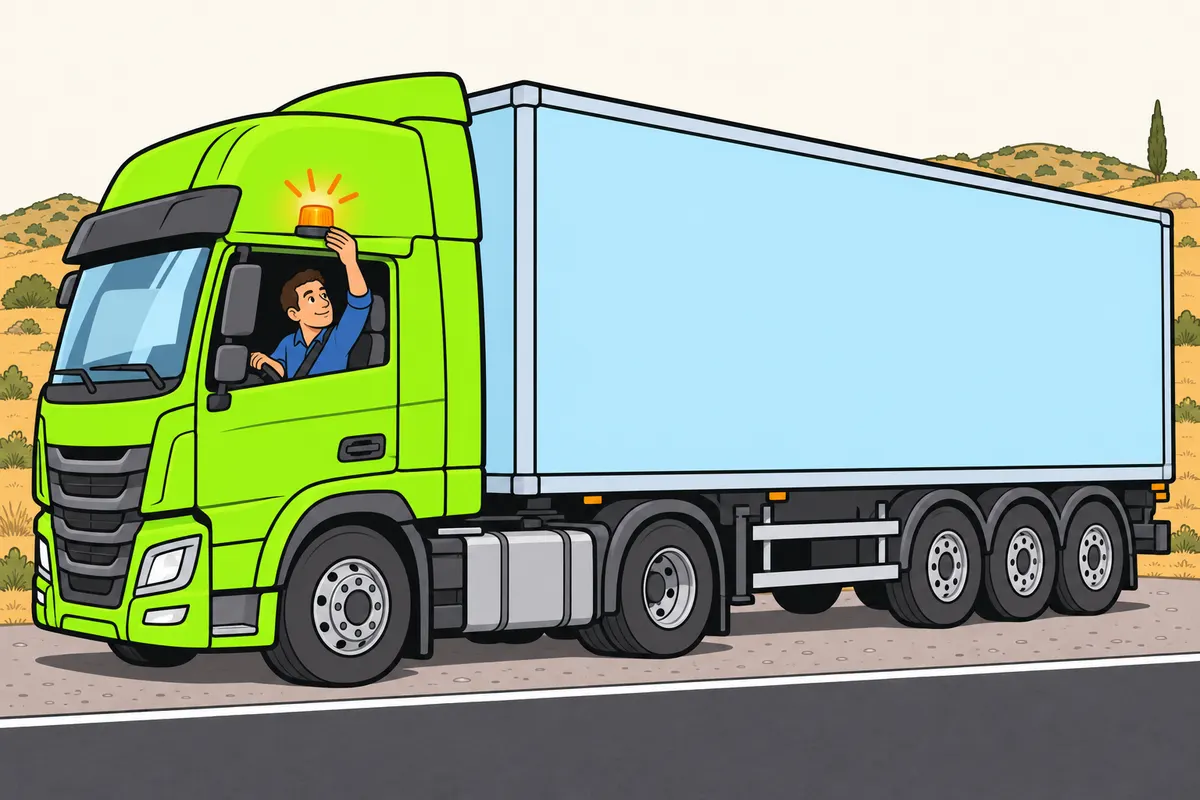
Place your beacon where you can do so safely, following the given order.
| Heavy combination with bodywork above the cab | Where you can place the V-16 |
|---|---|
| You can get out safely | You can place it at the rear of the vehicle. |
| You cannot get out safely | Place it at the highest accessible point outside the cab. |
| That height is beyond your reach | Only then use the driver’s door or the side of the vehicle. |
Remember
- Check whether you can place it from inside.
- If the bodywork extends above the cab, follow the cases in the table.
- Follow your model’s instructions to fix it and keep it correctly oriented.
- Do not climb onto the cab, load or semi-trailer.
Exam trap: Wrong: You go straight to the door or climb onto the roof. Right: With bodywork above the cab, you can place it at the rear if you can get out safely. If you cannot get out, use the highest accessible point outside the cab. Only if that height is beyond your reach can you use the driver’s door or the side.
Read the full explanation
- On a heavy vehicle combination whose bodywork extends above the cab, you can place the V-16 at the rear of the vehicle if you can get out safely. If you cannot get out, you must place it on the highest accessible exterior part of the cab. Only if that height is beyond your reach can you attach it to the driver’s door or the side of the vehicle. [DGT, V-16 placement](https://www.dgt.es/muevete-con-seguridad/tecnologia-e-innovacion-en-carretera/Dispositivos-de-presenalizacion-V16/)
- You must not climb onto the cab, the load or the semi-trailer to gain height. You must apply the principle of maximum visibility alongside protecting people. Before positioning it, assess whether you can do so from inside; falling from the lorry or exposing yourself to traffic adds another emergency to the existing one. [DGT, V-16 placement](https://www.dgt.es/muevete-con-seguridad/tecnologia-e-innovacion-en-carretera/Dispositivos-de-presenalizacion-V16/)
- You must follow the instructions for your model to secure it and maintain its correct orientation. If the surface does not allow magnetic attachment, use a mount compatible with the device, such as a suitable suction cup, following the manufacturer’s instructions. [DGT, V-16 placement](https://www.dgt.es/muevete-con-seguridad/tecnologia-e-innovacion-en-carretera/Dispositivos-de-presenalizacion-V16/)
6High-visibility vest and leaving the cab
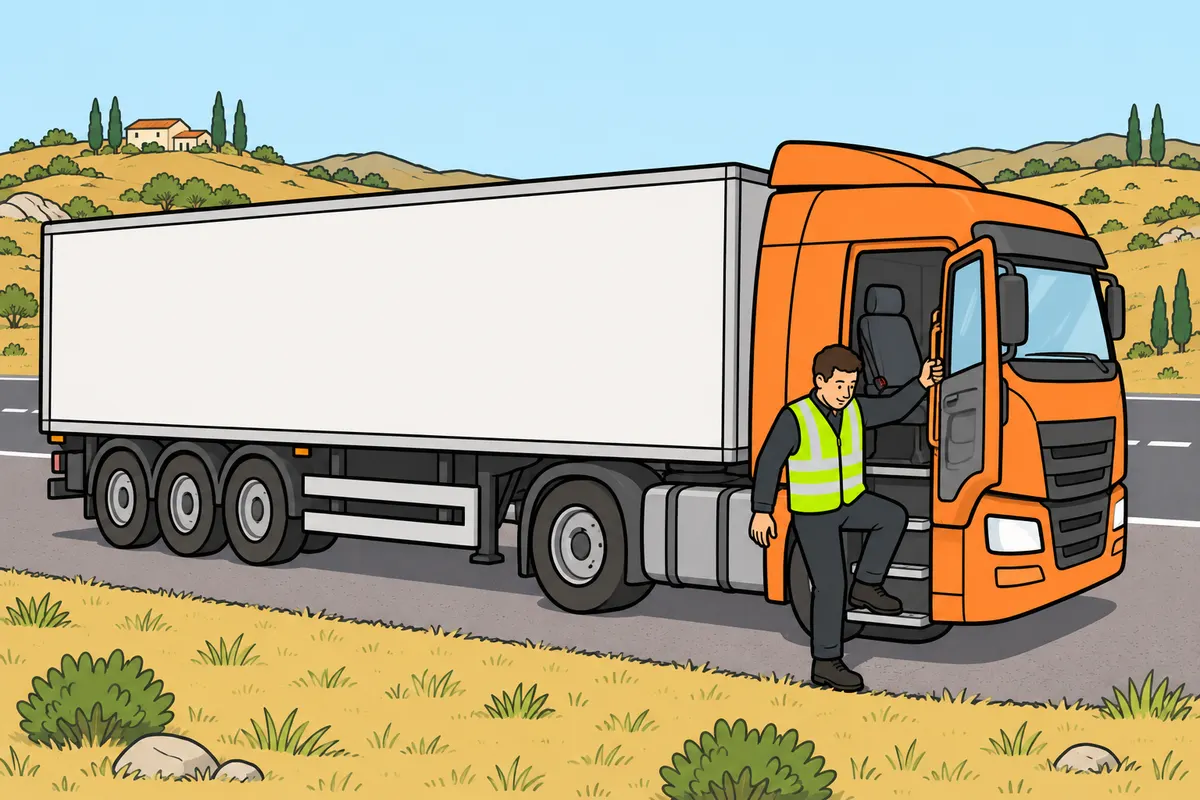
Wear your vest before getting out, and leave only when you can reach safety.
| Stopped combination: general situation | What you must do |
|---|---|
| You cannot continue and can leave safely | Leave for safety beyond lanes and hard shoulders. |
| You cannot leave safely | Stay inside with your seat belt fastened. |
Remember
- With a non-agricultural combination, wear your vest on carriageways or hard shoulders outside towns.
- Put it on before getting out, even in daylight.
- If you cannot continue, leave only for somewhere safe beyond lanes and hard shoulders.
- Exit away from traffic; do not wait in lanes or on hard shoulders.
- In tunnels, follow the specific breakdown or fire instructions.
Exam trap: Wrong: You always get out. Right: In the general situation, if you cannot leave safely, stay inside with your seat belt fastened.
Read the full explanation
- As the driver of a non-agricultural vehicle combination, you must wear a reflective high-visibility vest when you leave the vehicle and enter the carriageway or hard shoulder of an interurban road. This obligation also applies in full daylight. [RGC, art. 118](https://www.boe.es/buscar/act.php?id=BOE-A-2003-23514#a118)
- You must put on the vest before getting out if you are going to enter an interurban carriageway or hard shoulder; see its specifications and equipment requirements in «Safety devices for the vehicle combination», in the section «High-visibility vest». [RGC, art. 118.4](https://www.boe.es/buscar/act.php?id=BOE-A-2003-23514#a118)
- If your combination is immobilised and cannot resume driving, you must leave it when there is a safe place outside the area comprising the carriageway and hard shoulders. You must get out on the side away from the traffic flow, without walking along or remaining in the lanes or hard shoulders that form that area. Also guide your passenger, if you have one. [RGC, art. 130](https://www.boe.es/buscar/act.php?id=BOE-A-2003-23514#a130)
- If conditions do not allow you to leave the vehicle safely, you must remain inside with your seat belt fastened. You must not jump over a barrier onto a drop or cross traffic lanes in search of protection. Distinguish this general situation from the specific evacuation instructions for a breakdown or fire in a tunnel. [RGC, art. 130](https://www.boe.es/buscar/act.php?id=BOE-A-2003-23514#a130)
7Protecting occupants and other road users
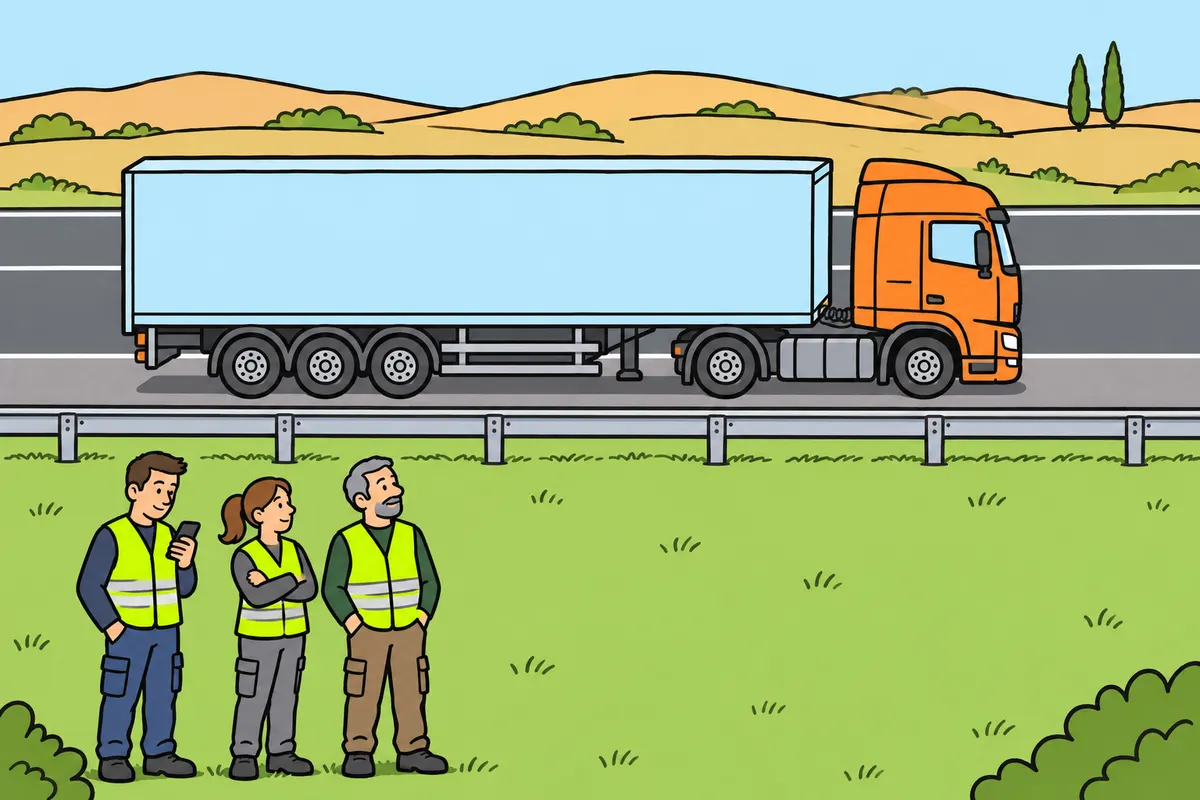
Protect your passengers and leave space for help to arrive.
Remember
- If you can leave safely, wait away from your combination and traffic.
- Do not wait in front of, behind or beside the semi-trailer.
- Check that there is safe space beyond any barrier.
- Tell passengers where to get out and wait.
- If someone has difficulty moving, ask 112 for instructions.
- Let emergency vehicles through, follow officers’ instructions and avoid sudden movements.
Exam trap: Wrong: You direct traffic from an unprotected area. Right: Help only where safe and follow officers’ instructions.
Read the full explanation
- If you can get out safely, find a sheltered place off the carriageway and hard shoulder, away from the combination. Do not wait in front of, behind or right beside the semi-trailer: a rear-end collision can move it. You must check your surroundings before choosing where to wait; a barrier only helps if there is a safe space on the other side. [RGC, art. 130](https://www.boe.es/buscar/act.php?id=BOE-A-2003-23514#a130)
- You must prevent occupants from gathering on the arcén (hard shoulder) or between vehicles involved in the accident. Explain clearly where to get out and where to wait. If someone has difficulty moving, tell 112 and ask for instructions: evacuation must avoid further injuries and exposure to traffic. [RGC, art. 130](https://www.boe.es/buscar/act.php?id=BOE-A-2003-23514#a130)
- You must not enter the carriageway to direct others on your own initiative in an unprotected area. You can help where it is safe and follow the officers’ instructions. If an articulated lorry blocks several lanes, there is a spill or visibility is very poor, an accurate report allows protection to be organised with suitable resources. [RGC, art. 129](https://www.boe.es/buscar/act.php?id=BOE-A-2003-23514#a129)
- You must leave room for ambulances, firefighters and recovery services to work. When you notice the signals of a priority vehicle, make way according to the circumstances and the instructions you receive. Avoid sudden movements with your combination that could swing the trailer towards other vehicles or block access to the accident. [RGC, art. 69](https://www.boe.es/buscar/act.php?id=BOE-A-2003-23514#a69)
8Calling 112 with useful information
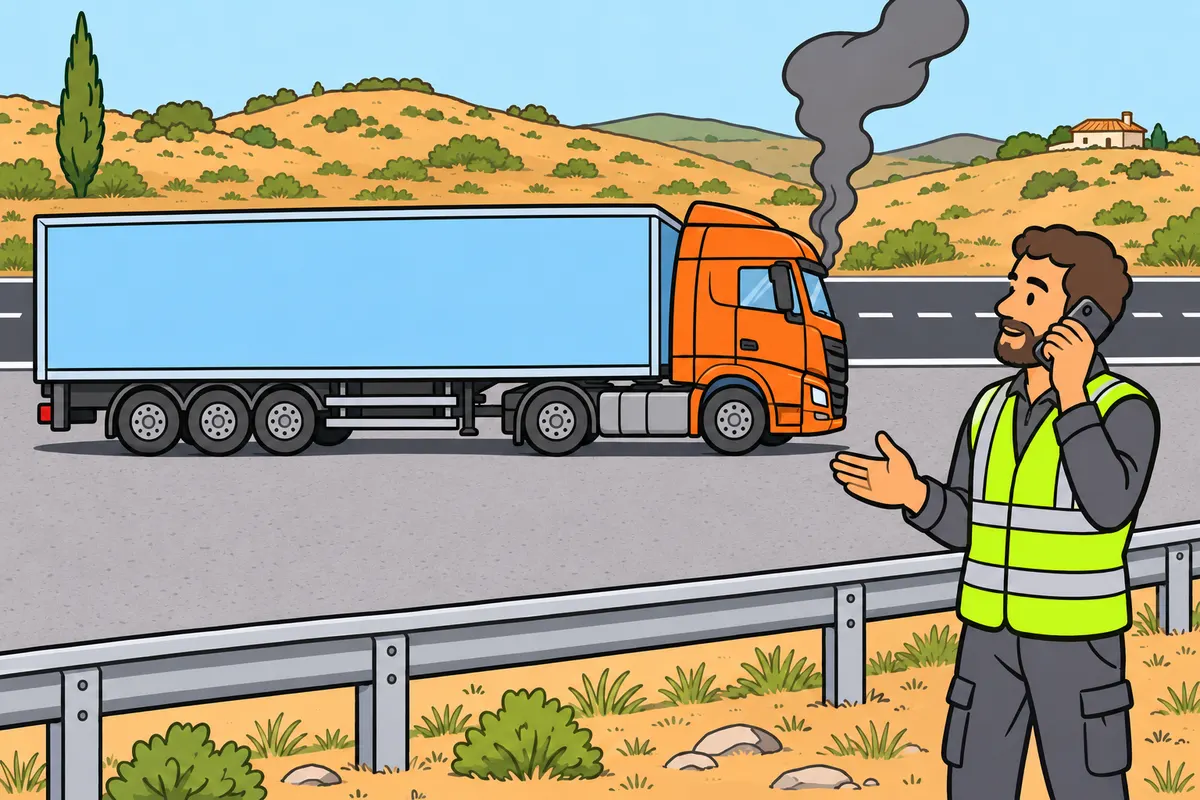
Call from safety and explain where you are and what has happened.
Remember
- Call if there are injuries, fire or serious danger.
- Give the road, kilometre point if known, and direction of travel.
- Describe how many people are affected, whether they respond and how they breathe.
- Report heavy bleeding, trapped people, fire, spills and a shifted load.
- Explain your vehicle combination and which part blocks the road.
- Follow instructions and keep your phone available.
Exam trap: Wrong: Activating the V-16 calls an ambulance. Right: Call 112 if you need emergency assistance.
Read the full explanation
- You must call 112 to report an emergency involving injuries, fire or serious danger. Call from a safe place and speak calmly. First give your location: the road, kilometre marker if you know it, direction of travel and visible landmarks. A clear location is especially important when each carriageway has a different access route. [DGT, first aid 2026](https://sede.dgt.gob.es/export/sites/dgt/.galleries/permisos-de-conducir/certificacion-aptitud-profesores-formacion-vial/2026/MANUAL-IX-Primeros-auxilios.pdf)
- You must explain what has happened and how many people you can see are affected, distinguishing those who respond from those who appear unconscious. Report anyone who is not breathing normally, any heavy bleeding and anyone who is trapped. You do not need to give a diagnosis; describe specific observations and answer the operator’s questions. [DGT, first aid 2026](https://sede.dgt.gob.es/export/sites/dgt/.galleries/permisos-de-conducir/certificacion-aptitud-profesores-formacion-vial/2026/MANUAL-IX-Primeros-auxilios.pdf)
- With a C+E combination, you must state whether it is a tractor unit with a semi-trailer or a lorry with a trailer, whether it has overturned and which part is blocking the road. Report fire, smoke, spills and a shifted load. If you know what the goods are, describe them without approaching damaged containers to find out. [DGT, first aid 2026](https://sede.dgt.gob.es/export/sites/dgt/.galleries/permisos-de-conducir/certificacion-aptitud-profesores-formacion-vial/2026/MANUAL-IX-Primeros-auxilios.pdf)
- You must follow the instructions and keep your phone available in case you are contacted again. If the operator guides you while you provide assistance, you can use the loudspeaker. Wait for the operator to end the call and report any significant change in the casualties’ condition or the hazards at the scene. [DGT, first aid 2026](https://sede.dgt.gob.es/export/sites/dgt/.galleries/permisos-de-conducir/certificacion-aptitud-profesores-formacion-vial/2026/MANUAL-IX-Primeros-auxilios.pdf)
9Requesting assistance for the combination and its load
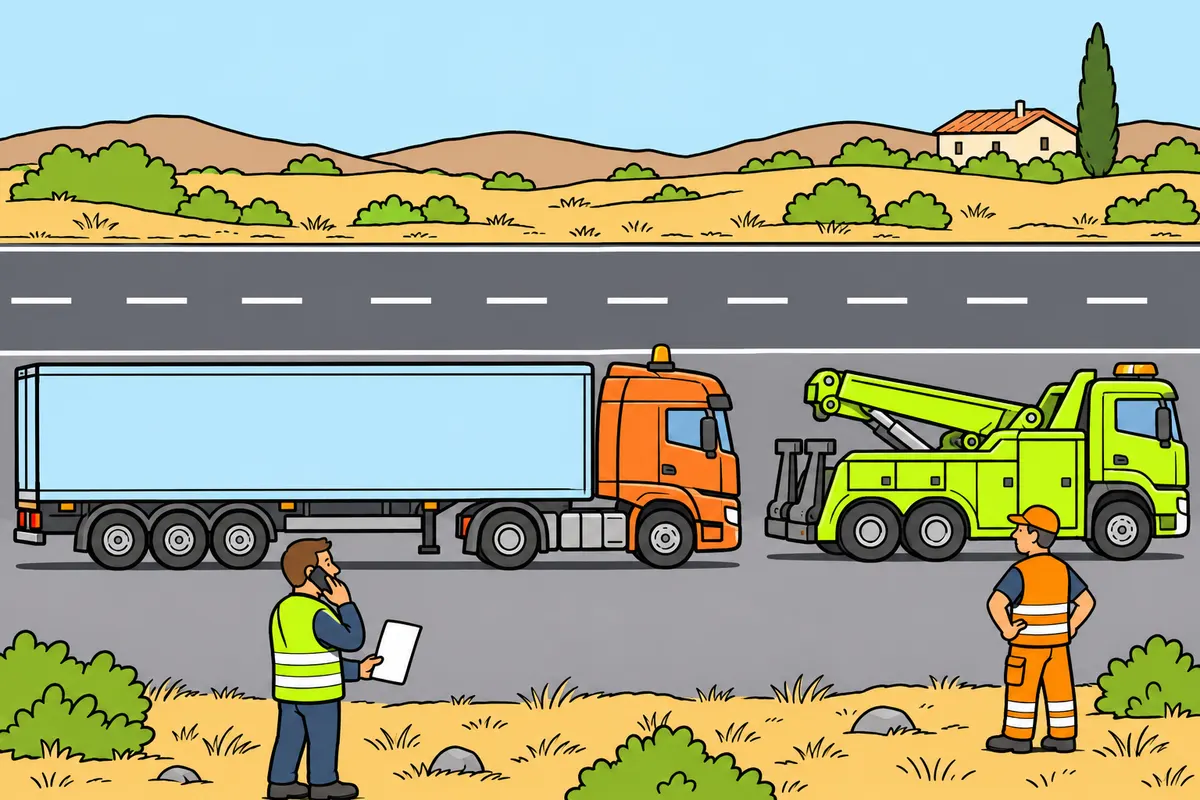
Request suitable equipment to remove your combination and load safely.
Remember
- Explain your heavy combination, its position, fault and visible damage.
- Give dimensions and mass from vehicle records if asked.
- Warn others before arranging removal of the vehicle or load.
- If possible, move off the carriageway and park correctly.
- Do not collect packages from open lanes or try lifting overturned vehicles.
- Do not uncouple the semi-trailer if its stability or supports are unsafe.
Exam trap: Wrong: A C+E licence makes your lorry a recovery vehicle. Right: Arrange removal with the proper service and follow the authorities’ instructions.
Read the full explanation
- If you need mechanical assistance, you must explain that you are driving a heavy vehicle combination and describe the breakdown, its position and any visible damage. Provide information about dimensions and mass if requested, using the vehicle’s data. The company needs to select equipment capable of working on the towing vehicle, trailer and load without increasing the danger. [RGC, art. 130](https://www.boe.es/buscar/act.php?id=BOE-A-2003-23514#a130)
- You must take the necessary measures to remove the vehicle or load obstructing the carriageway as soon as possible, after marking the hazard. If feasible, you must move the vehicle off the carriageway and position it in accordance with parking rules. You are not required to carry out a dangerous removal yourself: request the necessary equipment. [RGC, art. 130](https://www.boe.es/buscar/act.php?id=BOE-A-2003-23514#a130)
- You must not collect packages from a lane open to traffic or try to lift an overturned vehicle with your lorry. You must also not uncouple the semi-trailer as an improvised solution if its stability or supports are compromised. In these situations, you must provide information and leave the physical work to those with suitable equipment. [RGC, art. 129](https://www.boe.es/buscar/act.php?id=BOE-A-2003-23514#a129)
- Removing a broken-down vehicle or one involved in an accident is the responsibility of roadside assistance services that meet the regulatory requirements; the rules provide for exceptional situations involving mass or dimensions. Holding a C+E licence does not make your lorry a recovery vehicle. You must coordinate recovery with the appropriate service and follow the authorities’ instructions. [RD 159/2021, art. 8.4](https://www.boe.es/buscar/act.php?id=BOE-A-2021-4194#a8)
10Risks specific to articulated lorries
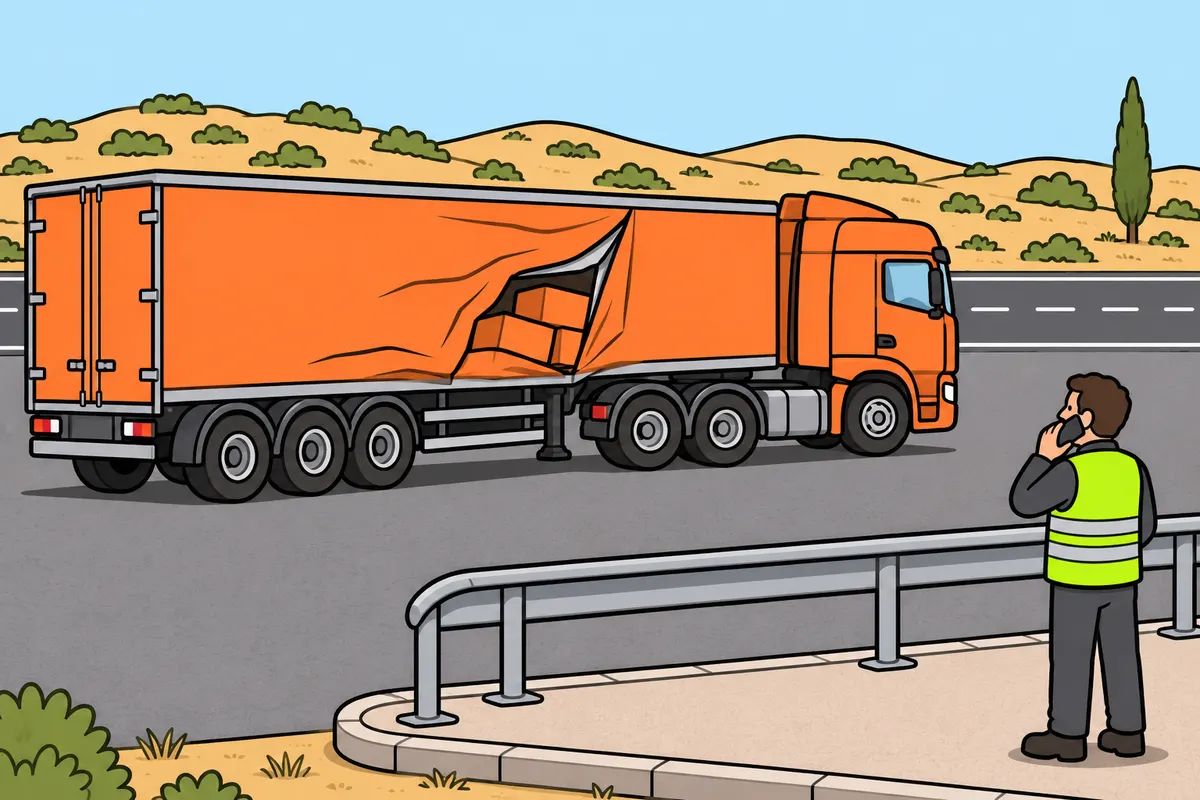
Keep away from unstable loads and places where your combination could crush you.
Remember
- Do not open doors or loosen restraints if shifted loads could fall.
- Keep out of gaps between units, wheels, barriers or vehicles.
- After a crash, do not assume brakes or couplings are safe.
- On significant slopes, secure your combination with suitable chocks or prescribed kerb positioning.
- Do not use stones as chocks.
- Move away from spills; with dangerous goods, also follow their specific instructions.
Exam trap: Wrong: The brake alone suffices on a significant slope. Right: When stopped or parked, your combination also needs suitable chocks or a steered wheel positioned against the kerb as prescribed.
Read the full explanation
- You must keep clear of a shifted load or deformed bodywork. Opening doors or loosening a restraint can release items that were being held in place. As a protective measure, report that the load is unstable and avoid the area where it could fall; checking load stowage is covered in «Safe, well-distributed loads», in the section «Partial deliveries and opening doors». [RGC, art. 129](https://www.boe.es/buscar/act.php?id=BOE-A-2003-23514#a129)
- You must consider the possibility of the combination moving and avoid crush zones between the two units, wheels, barriers or vehicles. After a collision, you cannot assume that the brake or coupling works correctly. Observe from a protected place and describe any movement or deformation to the roadside assistance service. [RGC, art. 129](https://www.boe.es/buscar/act.php?id=BOE-A-2003-23514#a129)
- If your combination is stopped or parked on a significant gradient, you must take the additional precaution of chocking required for combinations and vehicles with an MMA (maximum authorised mass) over 3,500 kg. You can use suitable wheel chocks or rest a steered wheel against the kerb as prescribed by the regulations. You must not use stones instead of wheel chocks. [RGC, art. 92](https://www.boe.es/buscar/act.php?id=BOE-A-2003-23514#a92)
- If you see a spill, smoke or damaged containers, you must move away and report it. Do not touch unknown substances or approach them to smell them or read labels. If you carry dangerous goods, you must also apply the specific instructions for that transport operation; this licence does not replace the training or procedures required for those goods. [RGC, art. 129](https://www.boe.es/buscar/act.php?id=BOE-A-2003-23514#a129)
11Vehicle or load fire
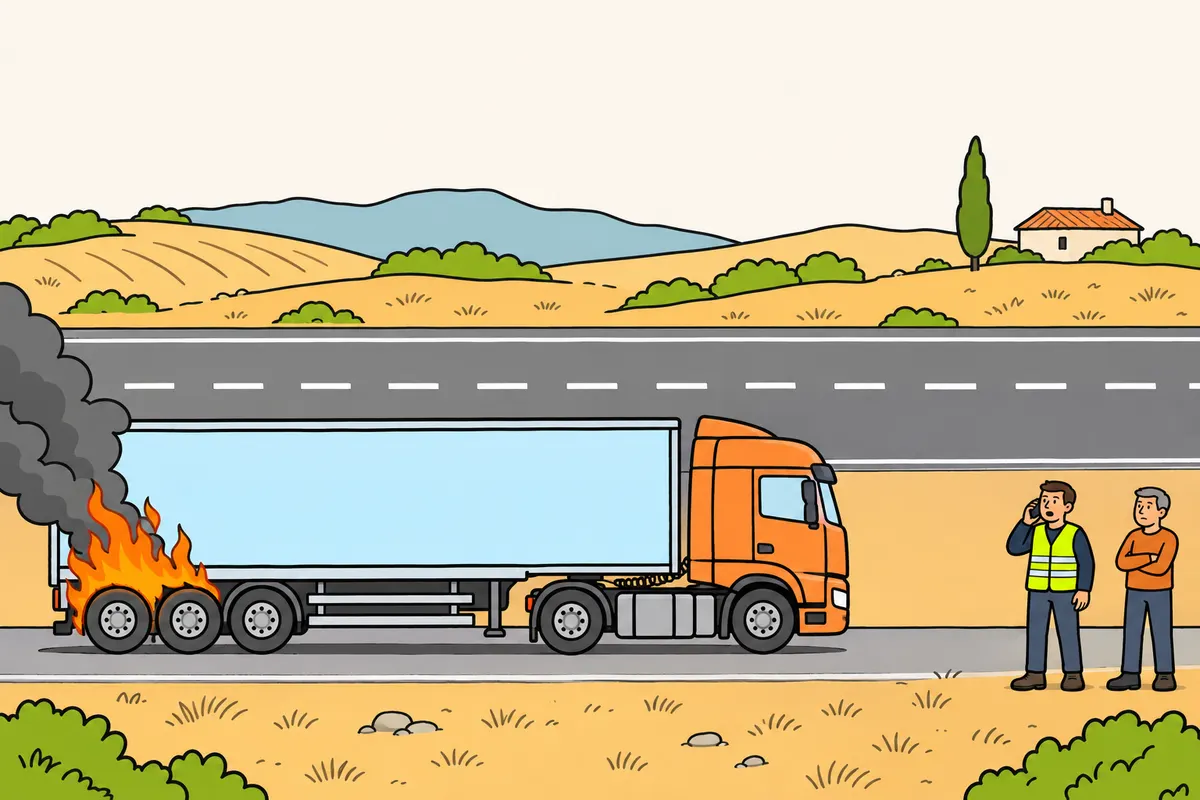
With fire, protect people and call for help before trying to save the load.
Remember
- Your non-special combination must carry suitable, approved fire equipment that works.
- Know where it is and how to use it.
- Stop safely, move people away and call 112.
- Only tackle small fires with knowledge, a safe escape route and no personal danger.
- Withdraw if fire grows or smoke prevents action.
- Do not open burning compartments, use water on unknown fires or light flames.
Exam trap: Wrong: Carrying an extinguisher means tackling every fire. Right: Only tackle a small developing fire if you know how, have a safe escape route and face no personal danger.
Read the full explanation
- Your combination, unless classified as a special vehicle, must carry suitable, approved fire-extinguishing equipment in working order, in addition to a V-16 and a high-visibility vest. You must know where it is and how to use it; see the section «Fire extinguishers for goods vehicle combinations» in the module «Safety devices for the vehicle combination» for the classes and number of extinguishers according to the combination’s mass. The requirement to carry it does not mean you must expose yourself to a developed fire or enter the semi-trailer’s load compartment to try to save the goods. [RGV, annex XII.2](https://www.boe.es/buscar/act.php?id=BOE-A-1999-1826#anxii)
- If you detect a fire, you must prioritise stopping safely, moving people away and calling 112. Explain whether the tractor unit, a tyre, the trailer or the load is burning, and report any goods you know about. Do not delay the call to unload, look for documents or check whether you can bring the fire fully under control. [DGT, first aid 2026](https://sede.dgt.gob.es/export/sites/dgt/.galleries/permisos-de-conducir/certificacion-aptitud-profesores-formacion-vial/2026/MANUAL-IX-Primeros-auxilios.pdf)
- You must only attempt to tackle a small fire in its early stages if you know how to use the extinguisher, have a safe escape route and can do so without exposing yourself to danger. You must follow the equipment’s instructions and withdraw if the fire grows or smoke prevents you from acting. Do not open burning compartments or handle damaged tanks or systems on your own initiative. [DGT, first aid 2026](https://sede.dgt.gob.es/export/sites/dgt/.galleries/permisos-de-conducir/certificacion-aptitud-profesores-formacion-vial/2026/MANUAL-IX-Primeros-auxilios.pdf)
- You must not apply water indiscriminately to a fire whose origin or burning contents are unknown. The extinguishing agent must be suitable for the fire and the risks present. A heavy vehicle combination can contain fuel, electrical equipment and a wide variety of goods; your essential task as the first person to respond is to protect people and help firefighters do their work. [DGT, first aid 2026](https://sede.dgt.gob.es/export/sites/dgt/.galleries/permisos-de-conducir/certificacion-aptitud-profesores-formacion-vial/2026/MANUAL-IX-Primeros-auxilios.pdf)
- You must not smoke or light flames at the accident scene, especially if there is a spill. You must also keep other people away from debris and smoke. If lighting is insufficient, help only from a safe position and avoid dazzling those arriving at or working on the emergency. [DGT, first aid 2026](https://sede.dgt.gob.es/export/sites/dgt/.galleries/permisos-de-conducir/certificacion-aptitud-profesores-formacion-vial/2026/MANUAL-IX-Primeros-auxilios.pdf)
12Breakdown inside a tunnel
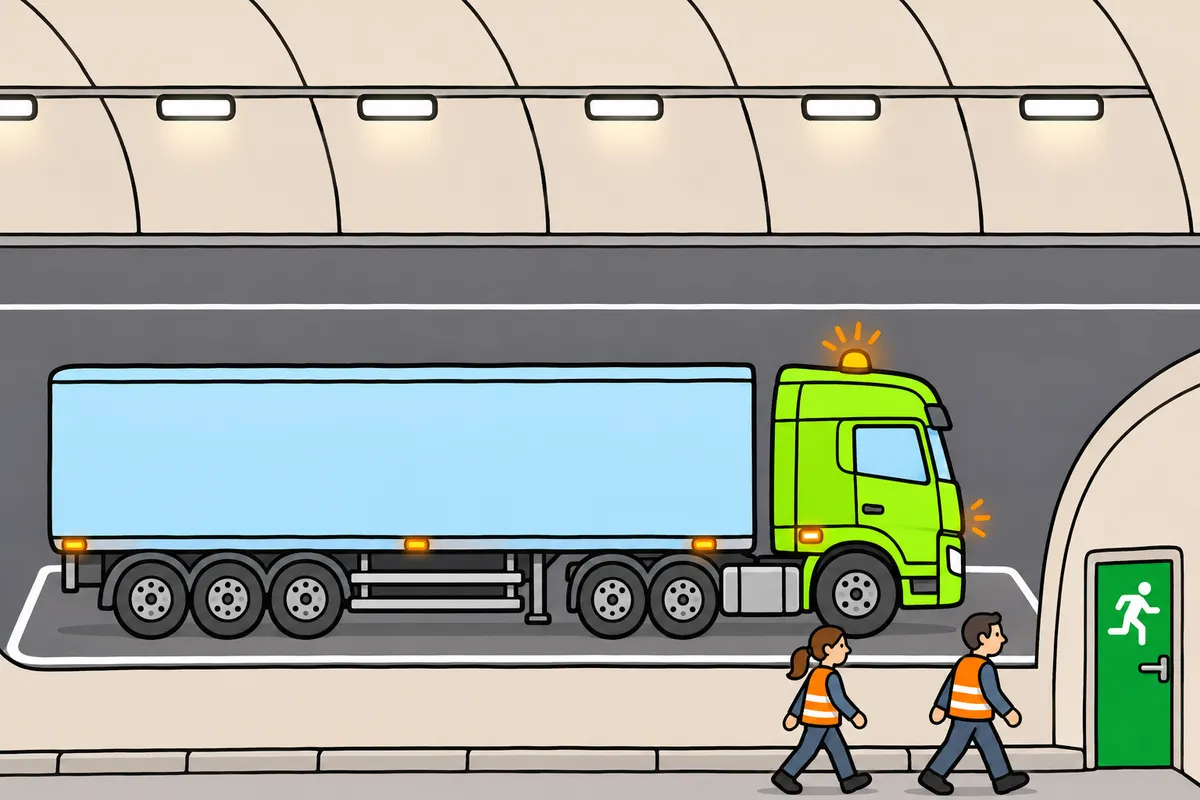
If you cannot safely leave the tunnel, warn others, request help and seek refuge.
Remember
- If you can move safely, continue out of the tunnel or underpass.
- If you cannot leave, try to reach an emergency area.
- When immobilised, use the nearest designated area ahead; otherwise, keep far right.
- Stop the engine, use hazard lights, keep position lights on and activate your beacon.
- Request help through the nearest SOS telephone, if available.
- Leave for the nearest refuge or exit, using vehicle-free areas where available.
Exam trap: Wrong: You reverse on your own initiative. Right: Follow the tunnel’s traffic lights, panels, announcements and instructions.
Read the full explanation
- If the breakdown allows you to continue driving safely, you must continue to the exit of the tunnel or underpass; if that is not possible, reach an area reserved for emergencies. You must not stop the articulated lorry in a lane to examine a fault when you can leave the tunnel safely. Whether you can continue depends on the combination’s actual condition. [RGC, art. 97](https://www.boe.es/buscar/act.php?id=BOE-A-2003-23514#a97)
- If you are immobilised by an emergency, you must position your vehicle in the nearest reserved area in your direction of travel or, if there is none, as close as possible to the right-hand edge. You must switch off the engine, switch on the hazard warning lights, keep the position lights on, and place and activate the luminous hazard warning device. [RGC, art. 97](https://www.boe.es/buscar/act.php?id=BOE-A-2003-23514#a97)
- You must request help without delay using the nearest SOS emergency telephone, if there is one, and follow its instructions. You and all other occupants must leave the vehicle and go quickly to the nearest refuge or exit. You must not walk on the carriageway where there are areas closed to vehicle traffic. [RGC, art. 97](https://www.boe.es/buscar/act.php?id=BOE-A-2003-23514#a97)
- You must obey the tunnel’s traffic lights, information signs and public-address announcements. If you call by phone, specify the tunnel, direction of travel and landmarks identifying your position. The combination’s length can make access routes or refuges difficult to reach; do not try to resolve this by reversing or making a U-turn on your own initiative. [RGC, art. 97](https://www.boe.es/buscar/act.php?id=BOE-A-2003-23514#a97)
13Fire and traffic queues in tunnels
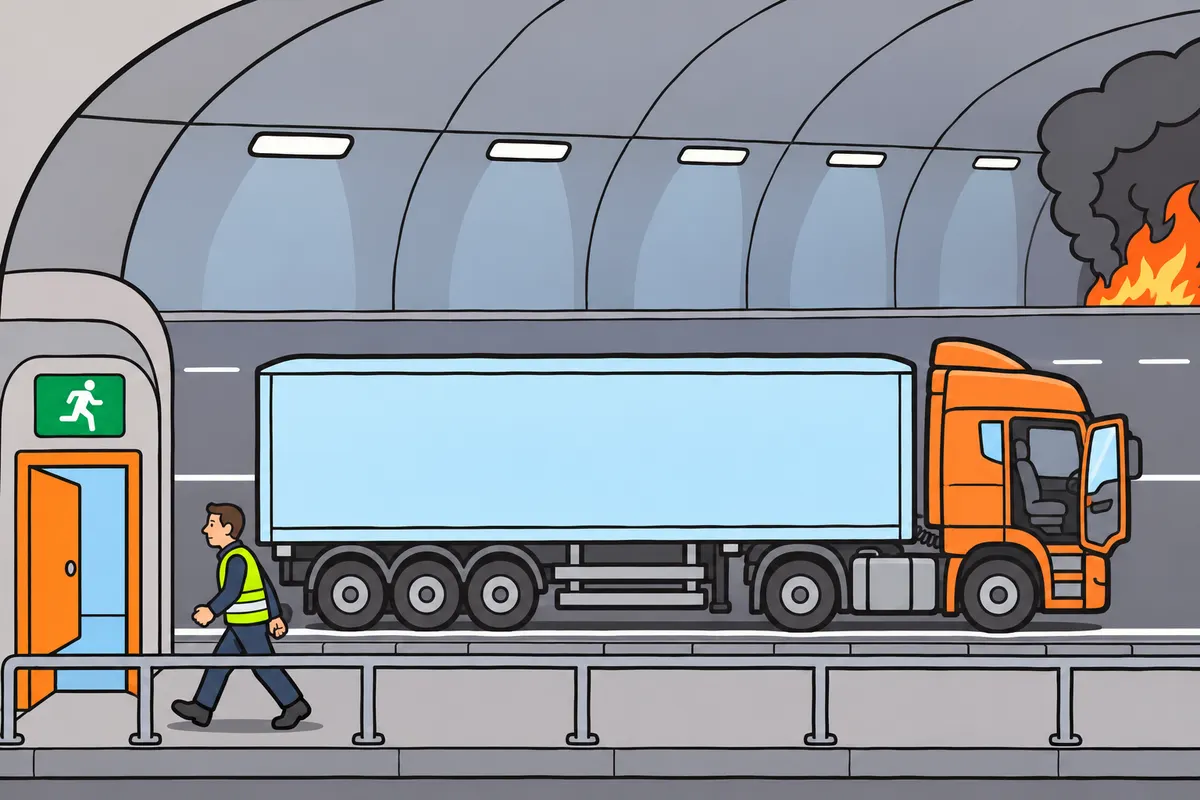
In a tunnel, leave during a fire and stay inside during an ordinary queue.
| Tunnel situation | What you must do |
|---|---|
| Fire | Leave for a refuge or exit away from the fire. |
| Queue without another emergency | Stay inside with the engine off and position lights on. If fire starts, evacuate. |
| Queue with a wait lasting more than two minutes | Keep the engine off and position lights on until you can continue. |
Remember
- For fire, move as far right as possible and stop the engine.
- Leave the key in the ignition and doors open.
- Head for the nearest refuge or exit away from the fire.
- Use vehicle-free areas, follow instructions and avoid dense smoke.
- For queues, always stop the engine, keep position lights on and use hazards temporarily.
- Stop as far as possible from the vehicle ahead.
Exam trap: Wrong: You remove the key and close doors during a tunnel fire. Right: Leave the key in and doors open, then evacuate away from the fire.
Read the full explanation
- If there is a fire in a tunnel, you must move your vehicle as far to the right as possible to let emergency services through, switch off the engine and leave the key in the ignition and the doors open. These instructions apply specifically to this situation. Do not waste time collecting belongings or return to the semi-trailer to check the load. [RGC, art. 97](https://www.boe.es/buscar/act.php?id=BOE-A-2003-23514#a97)
- You must leave the vehicle and head for the nearest refuge or exit in the direction away from the fire. If there are areas closed to vehicles, you must use them instead of the carriageway. Follow the evacuation instructions and do not go through dense smoke trying to reach a chosen exit without taking account of the situation. [RGC, art. 97](https://www.boe.es/buscar/act.php?id=BOE-A-2003-23514#a97)
- If you stop inside a tunnel because of traffic conditions, you must remain in the vehicle, stop as far as possible from the vehicle ahead, switch on the hazard warning lights temporarily to warn approaching drivers and keep the position lights on. You must always switch off the engine when you stop; if the wait lasts more than two minutes, you must keep it switched off until you can continue and keep the position lights on. [RGC, art. 97.3](https://www.boe.es/buscar/act.php?id=BOE-A-2003-23514#a97) [RGC, art. 115](https://www.boe.es/buscar/act.php?id=BOE-A-2003-23514#a115)
- If a fire breaks out while you are in a traffic queue, you must follow the evacuation instructions for that situation. Pay attention to changes on the signs, traffic lights and public address system, and to the instructions of the personnel managing the emergency; report anyone who needs help to leave the cab. [RGC, art. 97](https://www.boe.es/buscar/act.php?id=BOE-A-2003-23514#a97)
14Blocking a level crossing or movable bridge
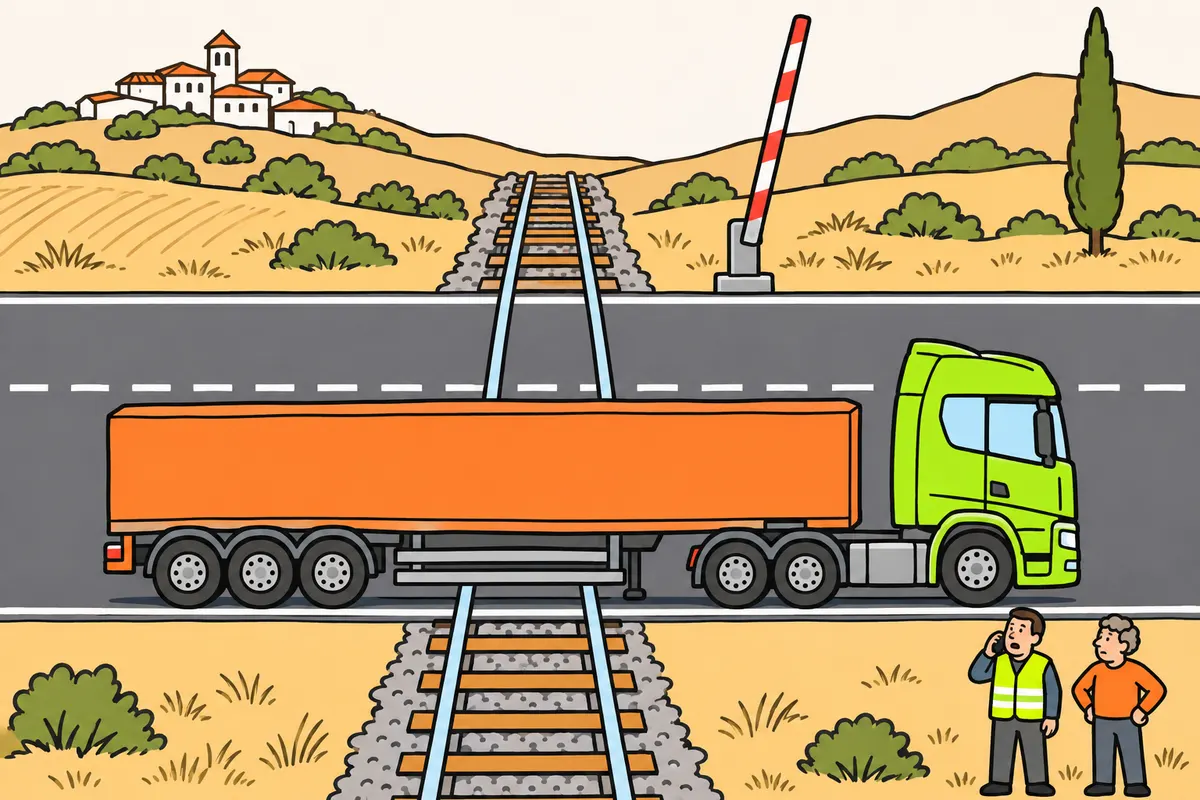
Get passengers out of danger and try to clear the crossing quickly.
Remember
- If circumstances beyond your control stop you on a level crossing, evacuate quickly.
- Do the same if your load falls there or blocks a movable bridge.
- Check that both tractor unit and trailer leave the danger zone.
- If you cannot clear it, immediately warn approaching train drivers and road drivers.
- Use available means to give enough advance warning.
- Request help; give the location, heavy vehicle details and any fallen load.
Exam trap: Wrong: You stay inside arranging assistance. Right: Move occupants away and, if you cannot clear the crossing or bridge, immediately warn approaching drivers.
Read the full explanation
- If circumstances beyond your control leave you stopped on a level crossing, or your load falls onto it, you must take steps to get the occupants out quickly and clear the crossing as soon as possible. With a vehicle combination, you must consider both units: moving only the tractor unit does not guarantee that the semi-trailer is clear of the danger zone. [RGC, art. 97](https://www.boe.es/buscar/act.php?id=BOE-A-2003-23514#a97)
- If you cannot clear the crossing, you must immediately take whatever steps you can to give approaching train drivers and road drivers sufficient advance warning. You must ask for help and report the obstruction, its location and the fact that it involves a heavy vehicle or a load that has fallen onto the tracks. [RGC, art. 97](https://www.boe.es/buscar/act.php?id=BOE-A-2003-23514#a97)
- You must take the same steps if your vehicle becomes immobilised or the load falls onto a movable bridge. Do not remain inside trying to arrange mechanical assistance by phone while the occupants remain exposed to danger. The priority is to move people away from danger and raise the alarm so that the affected traffic can be stopped. [RGC, art. 97](https://www.boe.es/buscar/act.php?id=BOE-A-2003-23514#a97)
15Providing assistance within your knowledge
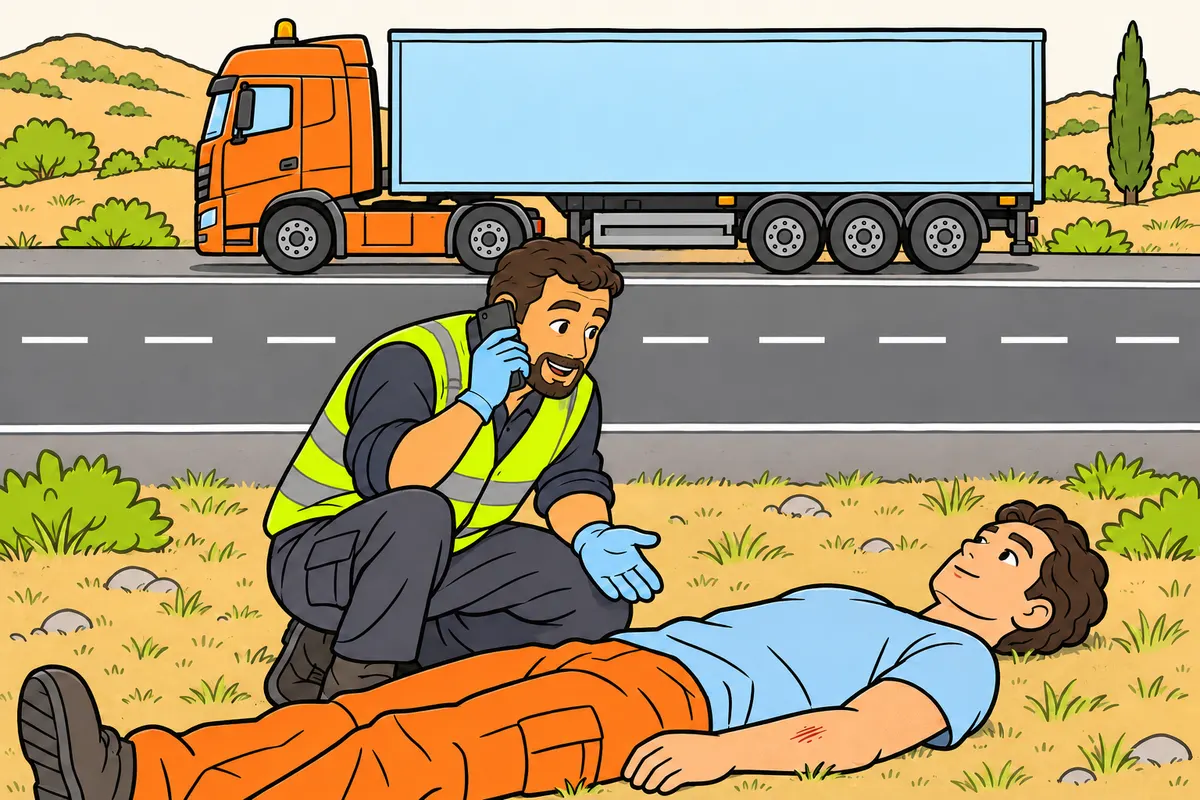
Help calmly within your knowledge, without making injuries worse.
Remember
- Protect the scene and request help before giving care.
- Introduce yourself, reassure the person and explain that help is coming.
- Do not give food, drinks, alcohol or medicines on your own initiative.
- Protect yourself from blood; use gloves if available.
- Report any worsening condition to 112.
- Follow emergency priorities for no response, abnormal breathing or massive bleeding.
Exam trap: Wrong: You help whoever shouts loudest first. Right: Describe everyone’s signs and follow the priorities given by 112.
Read the full explanation
- Once you have made the scene safe and called for help, you must assist without making injuries worse. Introduce yourself, speak calmly and explain that help has been called. Avoid alarming comments about the casualty's condition. You must monitor their responses and report any deterioration to 112 while you wait for the professionals. [DGT, first aid 2026](https://sede.dgt.gob.es/export/sites/dgt/.galleries/permisos-de-conducir/certificacion-aptitud-profesores-formacion-vial/2026/MANUAL-IX-Primeros-auxilios.pdf)
- You must not give a casualty food, drinks, alcohol or medication on your own initiative. Nor must you try to wake them by giving them water or making them stand up. They may need urgent assistance even if they say they feel well; your wish to reassure them must not lead you to give them any substances or conceal symptoms from medical services. [DGT, first aid 2026](https://sede.dgt.gob.es/export/sites/dgt/.galleries/permisos-de-conducir/certificacion-aptitud-profesores-formacion-vial/2026/MANUAL-IX-Primeros-auxilios.pdf)
- You must protect yourself from contact with blood and other bodily fluids, using gloves if you have them. A first-aid kit can help you cover a wound, but it does not replace calling for help or authorise you to give treatment. Do not waste time looking for non-essential supplies when the person is unresponsive, is not breathing normally or has life-threatening bleeding. [DGT, first aid 2026](https://sede.dgt.gob.es/export/sites/dgt/.galleries/permisos-de-conducir/certificacion-aptitud-profesores-formacion-vial/2026/MANUAL-IX-Primeros-auxilios.pdf)
- If there are several casualties, you must report how many there are and describe the signs you observe; the person shouting the loudest is not necessarily the one who needs attention first. Unresponsiveness, abnormal breathing or massive bleeding are warning signs. Follow the priorities given by 112 and avoid leaving anyone whose condition may deteriorate unmonitored. [DGT, first aid 2026](https://sede.dgt.gob.es/export/sites/dgt/.galleries/permisos-de-conducir/certificacion-aptitud-profesores-formacion-vial/2026/MANUAL-IX-Primeros-auxilios.pdf)
16Checking responsiveness and breathing
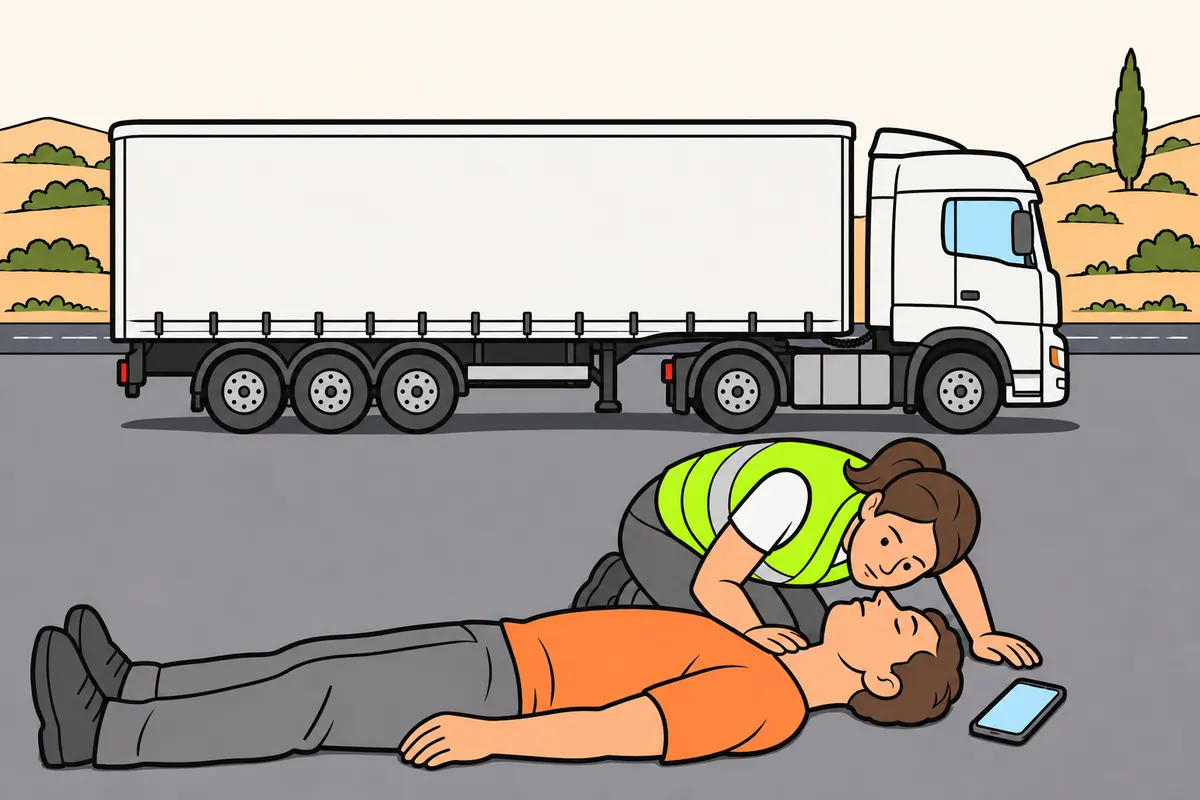
Check whether the person responds and breathes normally, without delaying help.
| Person who does not respond | What you must do |
|---|---|
| Breathing normally | Monitor and protect their airway; avoid unnecessary movement. |
| Not breathing normally | Suspect cardiac arrest and follow emergency instructions. |
Remember
- Speak loudly and gently touch their shoulders; do not shake them.
- If they do not respond, request help and call 112.
- Watch their chest and follow instructions to keep their airway open.
- Isolated gasps are not normal breathing.
- If they neither respond nor breathe normally, start the actions emergency services direct.
- If they breathe normally but do not respond, monitor them; avoid unnecessary movement.
Exam trap: Wrong: You count a gasp as normal breathing. Right: With no response or normal breathing, suspect cardiac arrest and follow 112 without delaying to check a pulse.
Read the full explanation
- You must check whether the person responds by speaking loudly to them and gently touching their shoulders, without shaking them. If they answer, ask how they feel and avoid unnecessary movement. If they do not respond, call for help and immediately report this to 112; you can keep your phone on speaker to receive instructions while you assess their breathing. [DGT, first aid 2026](https://sede.dgt.gob.es/export/sites/dgt/.galleries/permisos-de-conducir/certificacion-aptitud-profesores-formacion-vial/2026/MANUAL-IX-Primeros-auxilios.pdf)
- You must check whether they are breathing normally for no more than 10 seconds. Watch for chest movement and follow the instructions for keeping the airway open, taking possible traumatic injury into account. You must not delay calling for help or starting resuscitation while trying to count an exact breathing rate or find a pulse if you are not a healthcare professional. [DGT, first aid 2026](https://sede.dgt.gob.es/export/sites/dgt/.galleries/permisos-de-conducir/certificacion-aptitud-profesores-formacion-vial/2026/MANUAL-IX-Primeros-auxilios.pdf)
- Occasional gasps, gasping for air or agonal breathing are not normal breathing. If the person is unresponsive and is not breathing normally, you must suspect cardiorespiratory arrest and start the action directed by the emergency services. [DGT, first aid 2026](https://sede.dgt.gob.es/export/sites/dgt/.galleries/permisos-de-conducir/certificacion-aptitud-profesores-formacion-vial/2026/MANUAL-IX-Primeros-auxilios.pdf)
- If the person is unresponsive but is breathing normally, you must keep monitoring them and protect their airway without moving them for comfort. A road casualty may have a cervical spine injury. If they vomit or you cannot keep their airway open, you must follow the instructions from 112 and prioritise preventing suffocation with the minimum movement necessary. [DGT, first aid 2026](https://sede.dgt.gob.es/export/sites/dgt/.galleries/permisos-de-conducir/certificacion-aptitud-profesores-formacion-vial/2026/MANUAL-IX-Primeros-auxilios.pdf)
17Basic adult resuscitation and AED use
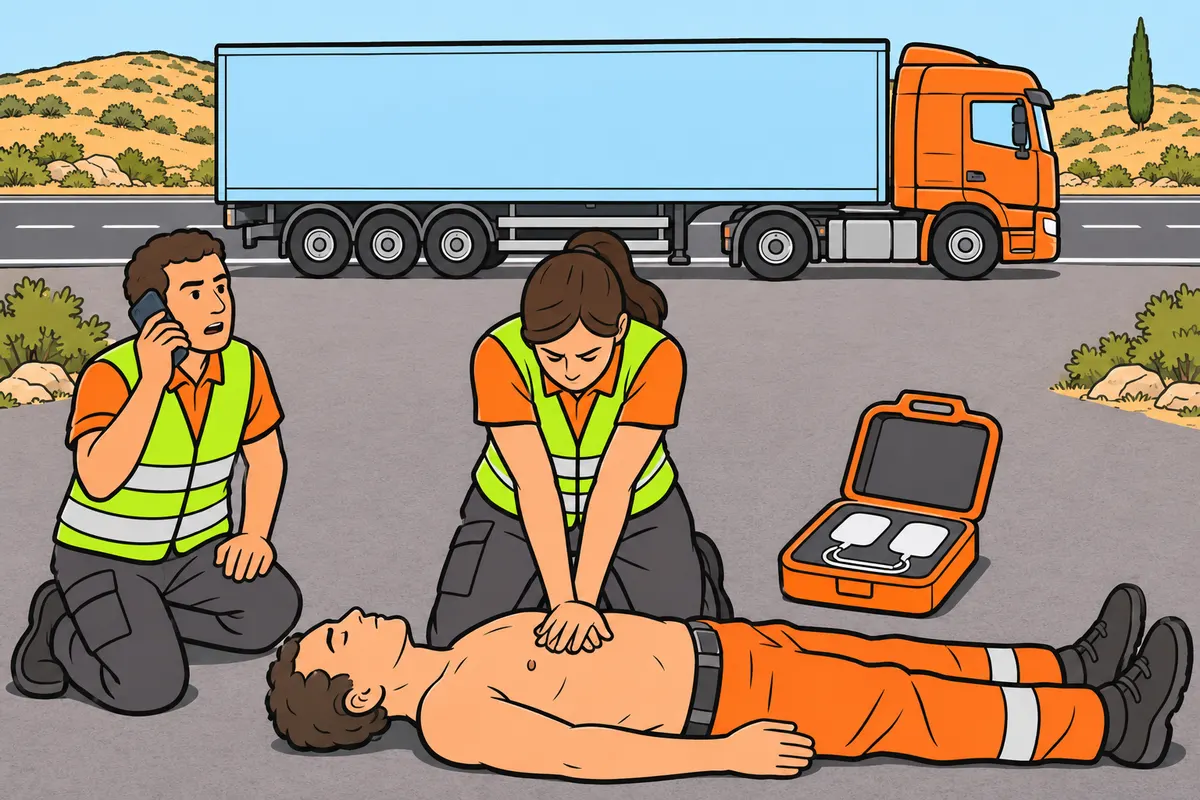
If an adult neither responds nor breathes normally, start resuscitation following emergency instructions.
| Adult resuscitation | What you must do |
|---|---|
| You know how and can give breaths | Alternate 30 compressions and 2 breaths. |
| You do not know how or cannot give breaths | Give continuous compressions following the operator. |
Remember
- Press the centre of the chest, over the lower half of the breastbone.
- Place hands together, keep arms straight and let the chest rise between presses.
- Minimise pauses and ask someone to take over if possible.
- Use an AED promptly, following its instructions and 112.
- Do not touch the person during analysis or a shock.
- Continue until takeover, professional instruction, clear recovery, danger preventing continuation or exhaustion.
Exam trap: Wrong: 30:2 is the compression speed. Right: If you know how and can give breaths, alternate 30 compressions and 2 breaths; give 100 to 120 compressions per minute.
Read the full explanation
- If an adult is unresponsive and is not breathing normally, you must start CPR following the instructions from 112. You must compress the centre of the chest, over the lower half of the breastbone, with one hand on top of the other and your arms straight. The recommended rate is 100 to 120 compressions per minute, allowing the chest to recoil between compressions. [DGT, first aid 2026](https://sede.dgt.gob.es/export/sites/dgt/.galleries/permisos-de-conducir/certificacion-aptitud-profesores-formacion-vial/2026/MANUAL-IX-Primeros-auxilios.pdf)
- You must aim for effective compressions and minimise interruptions. The recommended compression depth for an adult is approximately 5 cm; you must not use this technique on children or infants without adapting it. If other people are present, you can ask someone to take over to maintain the quality of chest compressions while another person stays in contact with the emergency services. [DGT, first aid 2026](https://sede.dgt.gob.es/export/sites/dgt/.galleries/permisos-de-conducir/certificacion-aptitud-profesores-formacion-vial/2026/MANUAL-IX-Primeros-auxilios.pdf)
- If you know how to give rescue breaths and can do so, you must alternate 30 compressions with 2 rescue breaths, giving only enough air to make the chest rise. If you do not know how to give rescue breaths or cannot do so, you must give continuous compressions following the operator's instructions. [DGT, first aid 2026](https://sede.dgt.gob.es/export/sites/dgt/.galleries/permisos-de-conducir/certificacion-aptitud-profesores-formacion-vial/2026/MANUAL-IX-Primeros-auxilios.pdf)
- If an automated external defibrillator, AED (DEA in Spain), is available, you must use it as soon as possible, following its instructions and those from 112. Ask someone to bring it if possible. You must not touch the casualty during analysis or a shock, and you must resume compressions when the device instructs you to do so. [DGT, first aid 2026](https://sede.dgt.gob.es/export/sites/dgt/.galleries/permisos-de-conducir/certificacion-aptitud-profesores-formacion-vial/2026/MANUAL-IX-Primeros-auxilios.pdf)
- You must continue until professionals take over or tell you to stop, clear signs of recovery appear, a danger prevents you from continuing, or you are exhausted and cannot continue. The arrival of an ambulance alone does not mean that someone has actually taken over. You must report what you have observed and what you have done. [DGT, first aid 2026](https://sede.dgt.gob.es/export/sites/dgt/.galleries/permisos-de-conducir/certificacion-aptitud-profesores-formacion-vial/2026/MANUAL-IX-Primeros-auxilios.pdf)
18Moving an injured person and keeping their helmet on
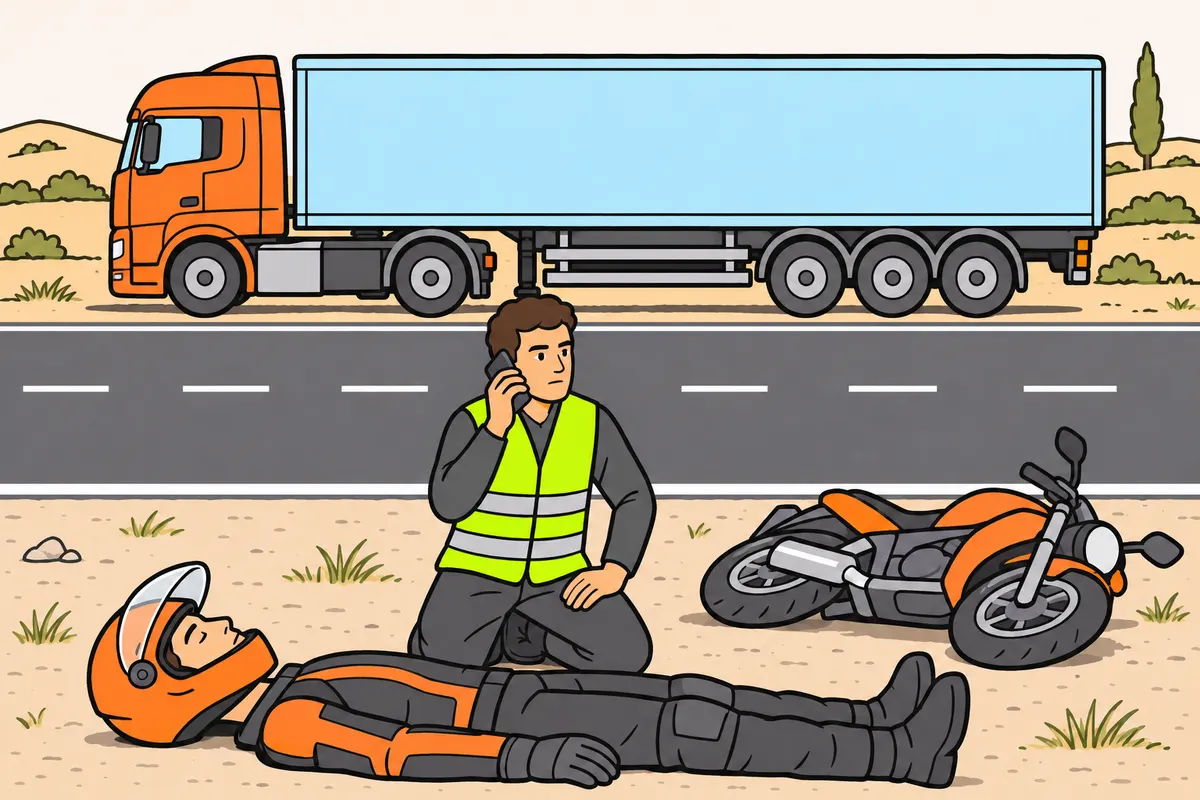
Avoid moving injured people or removing helmets unless needed to save life.
| Injured person’s situation | What you must do |
|---|---|
| No immediate danger or lifesaving treatment requiring movement | Avoid moving them. |
| Uncontrollable immediate danger or lifesaving treatment requiring movement | Ask for instructions and minimise movement. |
| Unconscious, breathing normally, without traumatic injury | The recovery position helps protect their airway. |
| Traumatic injury with vomiting and suffocation risk | Prioritise their airway following 112. |
Remember
- Do not pull or drag injured people out just for comfort.
- Move them only for uncontrollable immediate danger or lifesaving treatment requiring movement.
- Ask for instructions and move them as little as possible.
- Do not remove helmets for comfort, identification or to give air.
- Do not test neck movement or make someone with weakness walk.
- Do not automatically use the recovery position after a crash.
Exam trap: Wrong: You can never remove a helmet. Right: Usually keep it on; if it blocks breathing or there is cardiac and respiratory arrest, follow 112 and seek trained help.
Read the full explanation
- As a first-aid rule, you must not remove a person from a vehicle or drag them to make them more comfortable. You may worsen spinal injuries or bleeding. You only move them if there is an immediate danger you cannot control or a life-saving intervention requires it; ask for instructions and limit movement to what is essential. [DGT, first aid 2026](https://sede.dgt.gob.es/export/sites/dgt/.galleries/permisos-de-conducir/certificacion-aptitud-profesores-formacion-vial/2026/MANUAL-IX-Primeros-auxilios.pdf)
- As a general rule, you must leave an injured motorcyclist's helmet on. You must not remove it to make them more comfortable, identify them or give them air. Removing it requires the correct technique and protection of the neck. The life-saving exception applies if the helmet makes breathing difficult or the person is in cardiorespiratory arrest; follow the instructions from 112 and get help from trained people. [DGT, first aid 2026](https://sede.dgt.gob.es/export/sites/dgt/.galleries/permisos-de-conducir/certificacion-aptitud-profesores-formacion-vial/2026/MANUAL-IX-Primeros-auxilios.pdf)
- You must not tell someone with neck pain to turn their head to check its range of movement, or make someone walk if they feel weakness or tingling after the impact. You must report these symptoms. The fact that a person can move or speak does not allow you to rule out a serious injury yourself. [DGT, first aid 2026](https://sede.dgt.gob.es/export/sites/dgt/.galleries/permisos-de-conducir/certificacion-aptitud-profesores-formacion-vial/2026/MANUAL-IX-Primeros-auxilios.pdf)
- The recovery position helps protect the airway of an unconscious person who is breathing normally and has no traumatic injury; you must not use it automatically after an accident. If there is vomiting and a risk of suffocation, you must prioritise keeping the airway open with guidance from 112. [DGT, first aid 2026](https://sede.dgt.gob.es/export/sites/dgt/.galleries/permisos-de-conducir/certificacion-aptitud-profesores-formacion-vial/2026/MANUAL-IX-Primeros-auxilios.pdf)
19External bleeding and embedded objects
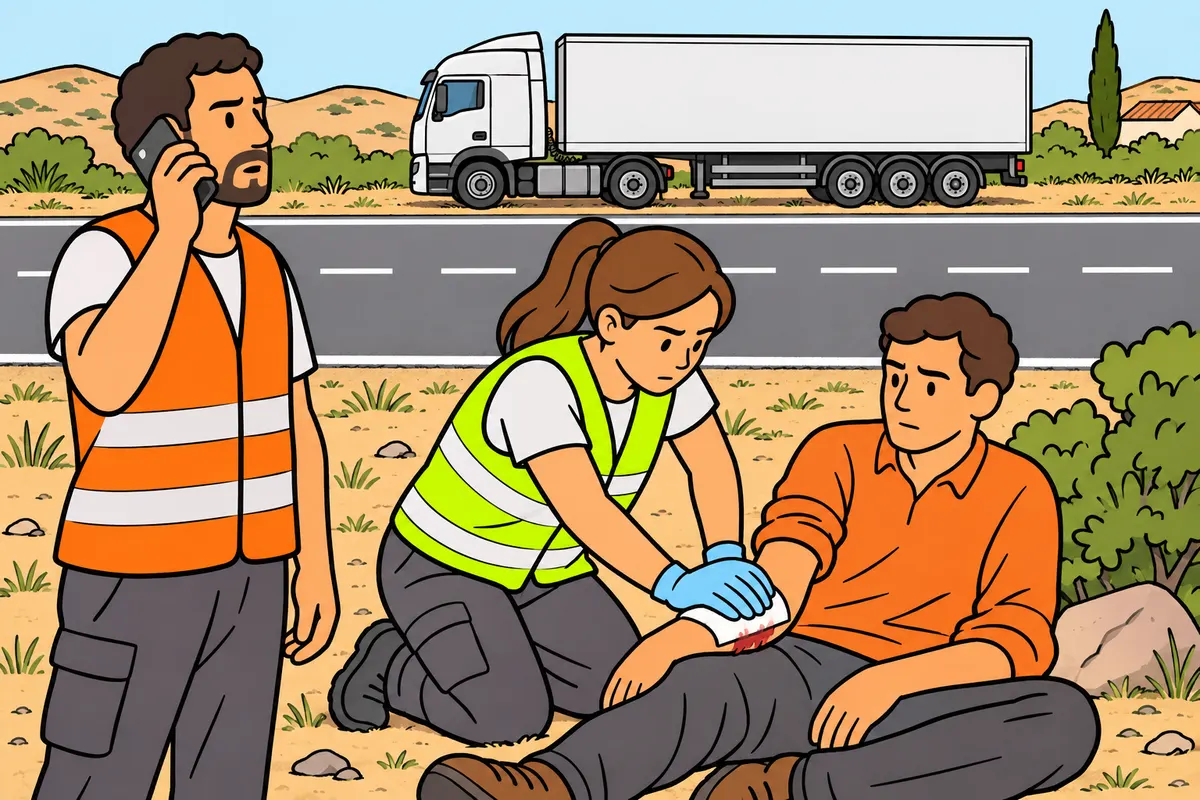
Control bleeding with pressure and leave embedded objects in place.
Remember
- For heavy external bleeding, raise the alarm and press firmly with clean material.
- Protect your hands.
- If material becomes soaked, add more on top without removing the first layer.
- Leave embedded objects in place; prevent movement and press around them if needed.
- Do not forcibly raise a limb that may be broken.
- If you use a tourniquet, note the time; do not loosen it yourself.
Exam trap: Wrong: You use a tourniquet for every wound. Right: It may be needed for life-threatening limb bleeding uncontrolled by direct pressure; follow your training and 112.
Read the full explanation
- If you see heavy external bleeding, you must call for help and apply firm, sustained direct pressure with gauze or a clean cloth, protecting your hands. You must not replace this pressure with simply cleaning the wound. If several people are present, one can maintain pressure while another explains the severity of the bleeding to 112. [DGT, first aid 2026](https://sede.dgt.gob.es/export/sites/dgt/.galleries/permisos-de-conducir/certificacion-aptitud-profesores-formacion-vial/2026/MANUAL-IX-Primeros-auxilios.pdf)
- If the dressing becomes soaked, you must add more material on top without removing the material in contact with the wound, and maintain pressure. Repeatedly lifting it to check the result can interrupt bleeding control. You must not forcibly raise a limb that may be fractured or waste time looking for pressure points you do not know how to use. [DGT, first aid 2026](https://sede.dgt.gob.es/export/sites/dgt/.galleries/permisos-de-conducir/certificacion-aptitud-profesores-formacion-vial/2026/MANUAL-IX-Primeros-auxilios.pdf)
- You must not remove embedded glass, pieces of metal or other objects: removing them can worsen the injury and bleeding. You must prevent them from moving and apply pressure around them when necessary, without pushing them further in. In a lorry accident, you must also not cut or move a vehicle part that pierces or traps a casualty. [DGT, first aid 2026](https://sede.dgt.gob.es/export/sites/dgt/.galleries/permisos-de-conducir/certificacion-aptitud-profesores-formacion-vial/2026/MANUAL-IX-Primeros-auxilios.pdf)
- A suitable tourniquet may be necessary for life-threatening bleeding from a limb that cannot be controlled with direct pressure. You must use it in accordance with your training and the instructions from 112, note the time and not loosen it on your own initiative. It is not suitable for every wound, and you must not improvise one with a thin cord. [DGT, first aid 2026](https://sede.dgt.gob.es/export/sites/dgt/.galleries/permisos-de-conducir/certificacion-aptitud-profesores-formacion-vial/2026/MANUAL-IX-Primeros-auxilios.pdf)
20Internal bleeding, shock and fractures
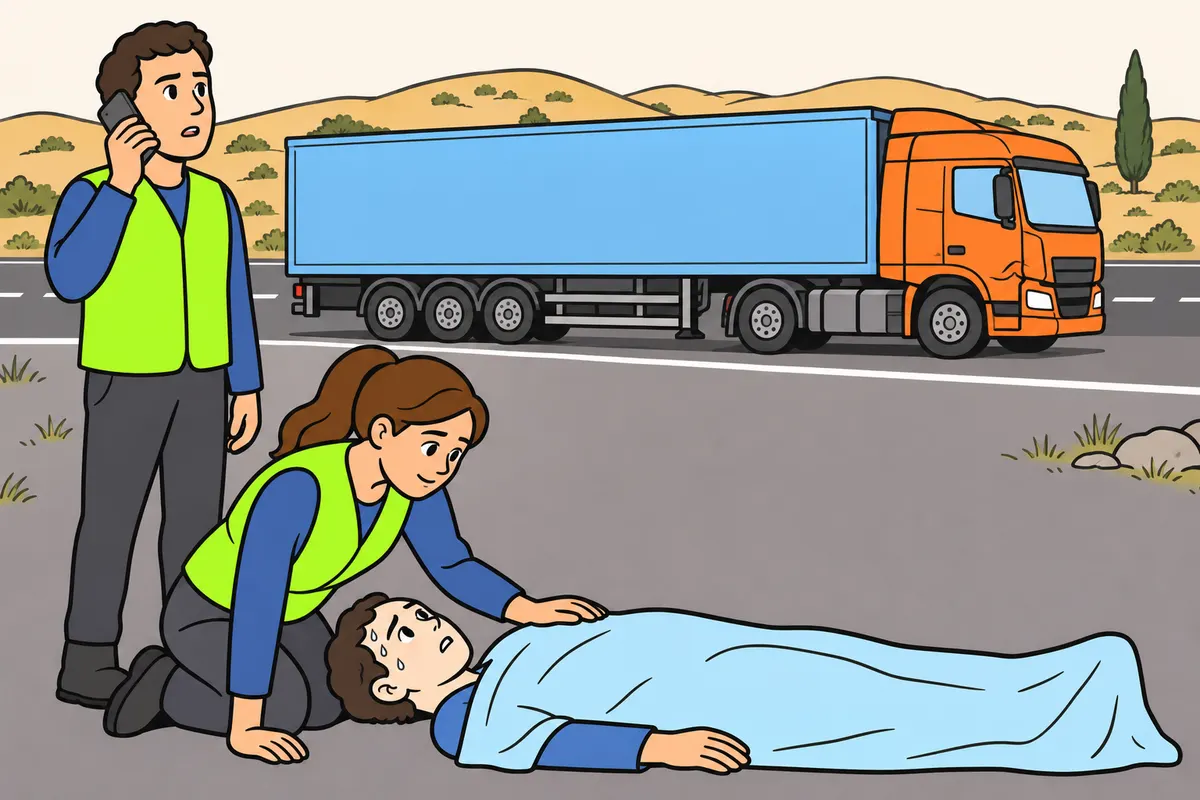
Report signs of internal bleeding and protect broken limbs without straightening them.
Remember
- Report paleness, cold skin, sweating, weakness, confusion or rapid breathing after a crash.
- Internal bleeding can happen without visible blood.
- Reassure them, keep them warm, monitor them and prevent walking.
- Do not automatically raise their legs.
- After a major impact, do not plug or press bleeding ears or noses.
- Protect limbs as found; cover wounds without pushing bones inside or pressing visible fragments.
Exam trap: Wrong: You straighten a deformed limb. Right: Protect it as found, avoid testing movement and call 112.
Read the full explanation
- You must report pale skin, cold skin, sweating, weakness, confusion or rapid breathing after a collision to 112, even if you see no blood: there may be internal bleeding and shock. Reassure the casualty, protect them from the cold and monitor their responsiveness and breathing; prevent them from walking and do not automatically raise their legs. [DGT, first aid 2026](https://sede.dgt.gob.es/export/sites/dgt/.galleries/permisos-de-conducir/certificacion-aptitud-profesores-formacion-vial/2026/MANUAL-IX-Primeros-auxilios.pdf)
- If blood or fluid comes from an ear or the nose after a severe impact, you must report it and protect the area without blocking the opening or applying pressure. Do not insert gauze into the ear. [DGT, first aid 2026](https://sede.dgt.gob.es/export/sites/dgt/.galleries/permisos-de-conducir/certificacion-aptitud-profesores-formacion-vial/2026/MANUAL-IX-Primeros-auxilios.pdf)
- If a limb is severely painful, deformed, swollen or difficult to move, you must protect it in the position in which you find it, without testing its movement or straightening it. If a wound opens onto the fracture, cover it with clean material without pushing the bone back in or pressing on a visible fragment; a fracture with intact skin can also cause internal bleeding. [DGT, first aid 2026](https://sede.dgt.gob.es/export/sites/dgt/.galleries/permisos-de-conducir/certificacion-aptitud-profesores-formacion-vial/2026/MANUAL-IX-Primeros-auxilios.pdf)
- You can consult “Moving an injured person and keeping their helmet on” for precautions when you suspect a spinal injury. You must tell 112 if the casualty has fallen from the cab, been struck by a vehicle, become trapped, been in a rollover or been thrown out of the vehicle, without trying to free them by pulling on a limb. [DGT, first aid 2026](https://sede.dgt.gob.es/export/sites/dgt/.galleries/permisos-de-conducir/certificacion-aptitud-profesores-formacion-vial/2026/MANUAL-IX-Primeros-auxilios.pdf)
21Burns and clothing on fire
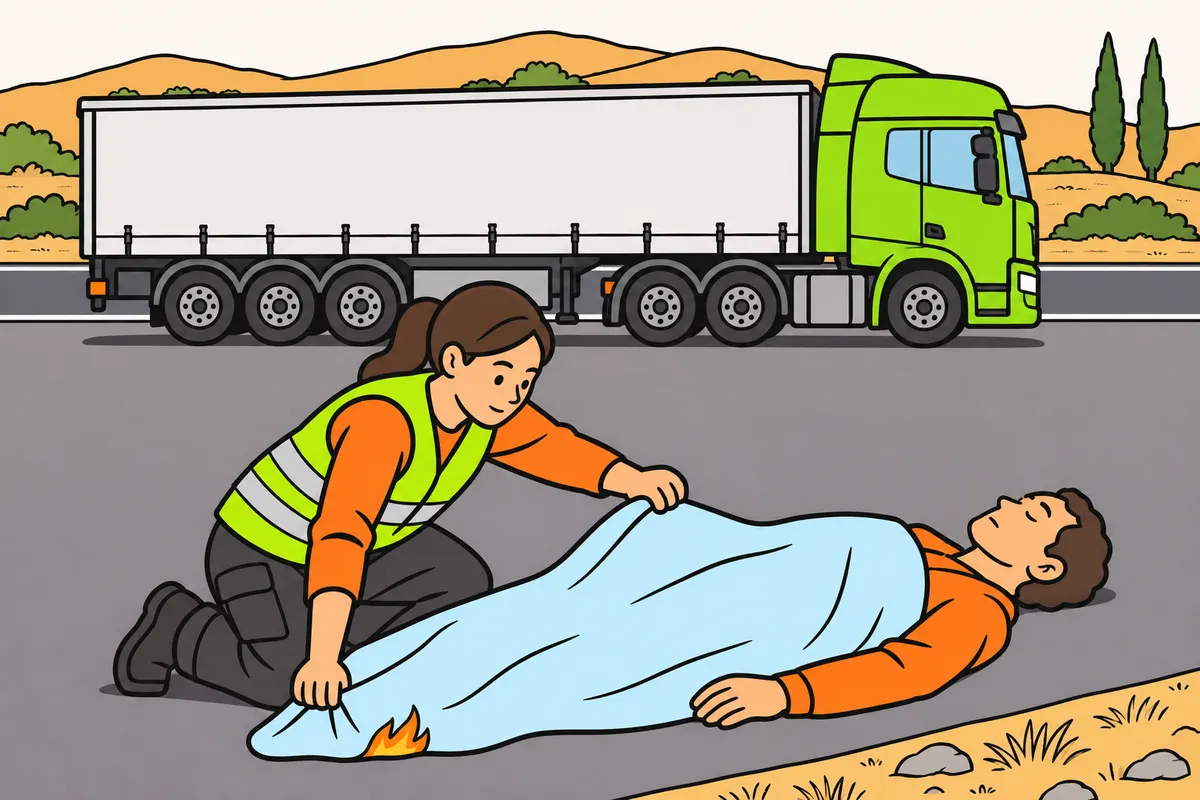
Put out flames without endangering yourself and cool burns with cool water.
Remember
- If clothing burns, prevent running and help without endangering yourself.
- You can smother flames with a suitable blanket, leaving their face uncovered.
- Cool thermal burns with cool water; keep the rest of the person warm.
- Do not apply ice, oil, creams or home remedies.
- Leave stuck clothing and blisters alone; cover loosely with clean material.
- Report extensive or deep burns, smoke exposure or breathing problems to 112.
Exam trap: Wrong: You spray an extinguisher at burning clothing without precautions. Right: Smother flames safely, protect the person’s face and follow emergency instructions.
Read the full explanation
- If someone’s clothing is on fire, you must help put out the flames without putting yourself at risk and prevent them from running. You can smother the flames with a suitable blanket without covering their face, and follow the emergency services’ instructions. You must not indiscriminately aim a fire extinguisher at their body; helping a person requires different precautions from extinguishing a vehicle fire. [DGT, first aid 2026](https://sede.dgt.gob.es/export/sites/dgt/.galleries/permisos-de-conducir/certificacion-aptitud-profesores-formacion-vial/2026/MANUAL-IX-Primeros-auxilios.pdf)
- For a thermal burn, you must cool the area with cool water and protect the person to prevent heat loss from the rest of their body. You must not apply ice, oil, ointments or home remedies. If the burn is extensive, deep or affects breathing, you must report it to 112 immediately. [DGT, first aid 2026](https://sede.dgt.gob.es/export/sites/dgt/.galleries/permisos-de-conducir/certificacion-aptitud-profesores-formacion-vial/2026/MANUAL-IX-Primeros-auxilios.pdf)
- You must not pull off clothing stuck to the skin or burst blisters. You must cover the injury with suitable clean material, without applying pressure or touching the burnt surface. Avoid bringing injured surfaces together and do not rub the area to clean it: the purpose of first aid is to protect and limit damage until medical care arrives. [DGT, first aid 2026](https://sede.dgt.gob.es/export/sites/dgt/.galleries/permisos-de-conducir/certificacion-aptitud-profesores-formacion-vial/2026/MANUAL-IX-Primeros-auxilios.pdf)
- If there is smoke, coughing, difficulty breathing or facial burns, you must report this even if the external injury looks small. Do not enter a smoke-filled cab to retrieve belongings or expose yourself to unknown vapours. You must first make the scene safe and follow the instructions of firefighters and medical personnel. [DGT, first aid 2026](https://sede.dgt.gob.es/export/sites/dgt/.galleries/permisos-de-conducir/certificacion-aptitud-profesores-formacion-vial/2026/MANUAL-IX-Primeros-auxilios.pdf)
22Waiting for medical transport and handing over information
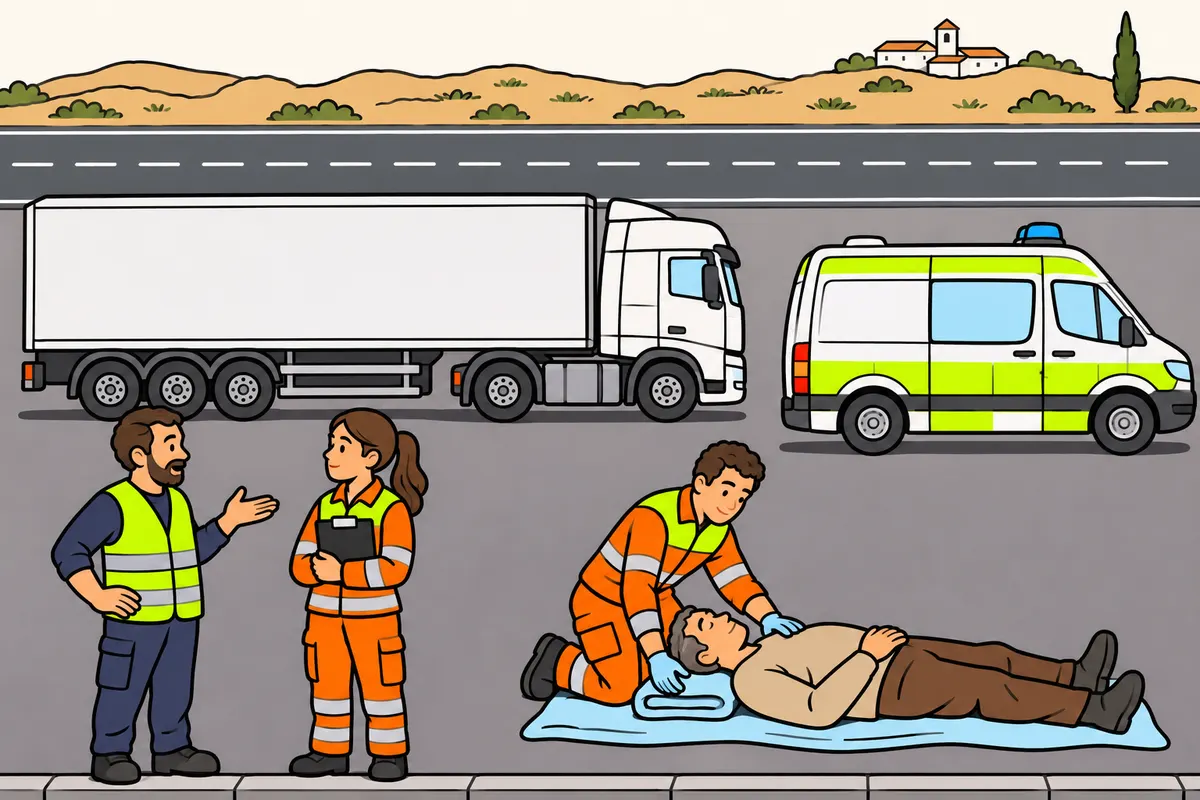
Wait for medical transport and clearly report the person’s condition and your care.
Remember
- Do not transport casualties in your cab or load compartment on your own initiative.
- If help is delayed, call 112 again and describe changes.
- Explain initial responses and breathing, changes and the care you gave.
- If you used a tourniquet, report the time.
- Also report fire, spills or unstable loads.
- Make room and separate what you saw from what others told you.
Exam trap: Wrong: A long wait automatically allows transport. Right: Exceptional transport requires assessing danger, resources and available instructions; consult 112 again.
Read the full explanation
- As a general rule, you must wait for medical transport and continue the care you have been instructed to provide. You must not transport an injured person in the cab or load compartment of the lorry on your own initiative. Moving them away from an immediate fire and transporting them to hospital are different decisions; an emergency extraction does not turn the vehicle combination into an ambulance. [DGT, first aid 2026](https://sede.dgt.gob.es/export/sites/dgt/.galleries/permisos-de-conducir/certificacion-aptitud-profesores-formacion-vial/2026/MANUAL-IX-Primeros-auxilios.pdf)
- If assistance is delayed, you must contact 112 again and describe any changes in the casualty’s condition. You must not treat a fixed waiting period as automatic authorisation to transport an unconscious casualty or one with severe bleeding. Transport in exceptional circumstances requires an assessment of the danger, the resources and the instructions available, not just the time elapsed. [DGT, first aid 2026](https://sede.dgt.gob.es/export/sites/dgt/.galleries/permisos-de-conducir/certificacion-aptitud-profesores-formacion-vial/2026/MANUAL-IX-Primeros-auxilios.pdf)
- When assistance arrives, you must report the casualty’s initial responsiveness and breathing, any changes you have observed and the measures you have taken. If you have used a tourniquet, report the time it was applied; if you have observed fire, spills or an unstable load, report these too. You must then make room and follow instructions, remaining available to provide the necessary information. [DGT, first aid 2026](https://sede.dgt.gob.es/export/sites/dgt/.galleries/permisos-de-conducir/certificacion-aptitud-profesores-formacion-vial/2026/MANUAL-IX-Primeros-auxilios.pdf)
- You must help establish what happened by describing facts you have actually witnessed. Distinguish your observations from what someone else tells you. Do not delay a rescue action to preserve a photograph, and do not disturb debris or traces out of curiosity; the safety of casualties and traffic takes priority. [RGC, art. 129](https://www.boe.es/buscar/act.php?id=BOE-A-2003-23514#a129)
23Remaining at the scene, identifying yourself and cooperating
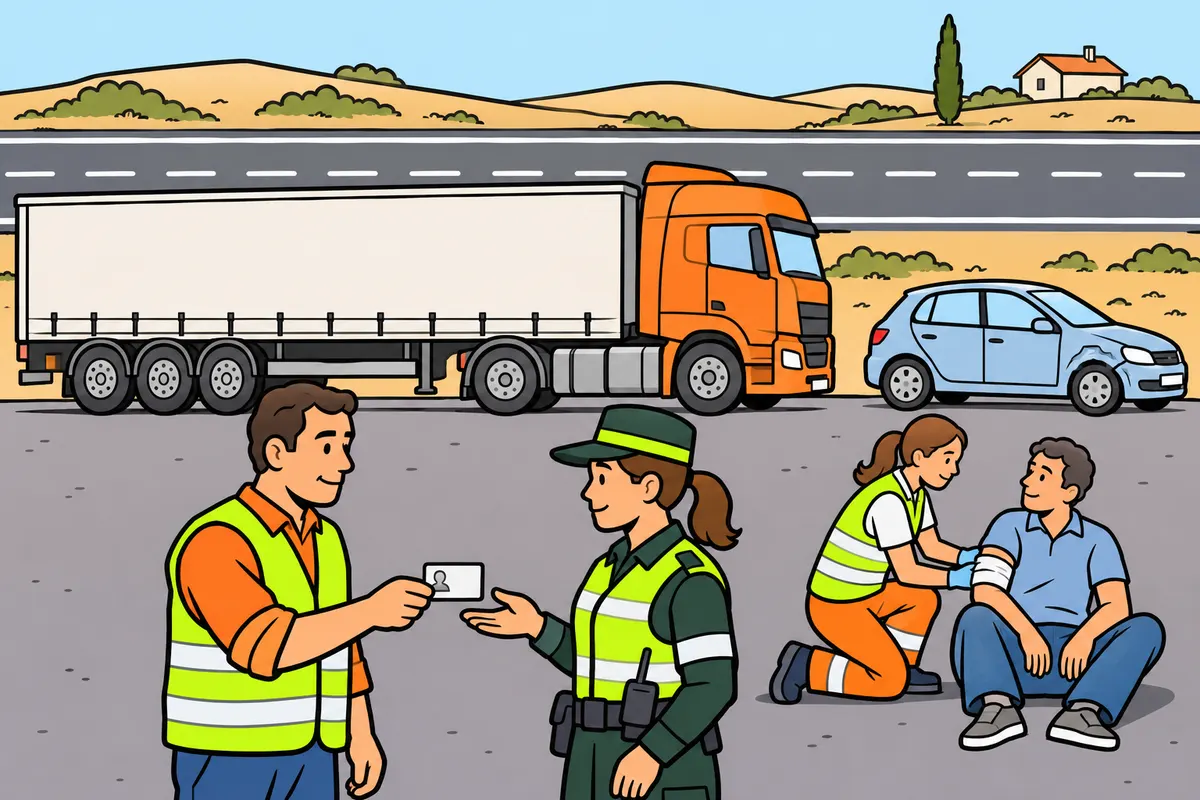
Follow your duties to report, remain and identify yourself according to what happened.
| Accident situation | What you must do |
|---|---|
| Apparent injuries or deaths | Notify authorities and remain or return, unless a permitted exception applies. |
| Clearly minor injuries, restored traffic safety, nobody involved requests notification or remaining | You need not notify authorities or remain. |
| Only property damage; affected person absent | Promptly give them your name and address, directly or through officers. |
Remember
- With apparent injuries or deaths, notify authorities and remain or return.
- You may leave with permission, to assist injured people or for your own treatment.
- Give identity and vehicle details when requested; identify both units.
- For property damage with the affected person absent, promptly send your name and address.
- Complete the accident report somewhere safe beyond lanes and hard shoulders.
- Preserve evidence when required, unless this harms injured people or traffic.
Exam trap: Wrong: Apparently minor injuries alone allow you to leave. Right: The exception requires clearly minor injuries, restored traffic safety and nobody involved requesting notification or your remaining.
Read the full explanation
- If anyone appears to be injured or dead, you must notify the authorities and remain at the scene or return until they arrive. You may leave if you are authorised to do so, if you must assist injured people or if you need treatment yourself. You must not leave simply because you have provided a registration number or called your company. [RGC, art. 129](https://www.boe.es/buscar/act.php?id=BOE-A-2003-23514#a129)
- You do not need to notify the authorities or remain at the scene if the only injuries are clearly minor, traffic safety has been restored and no one involved requests it. All these conditions must be met together. You must not decide on your own that a loss of consciousness is minor or use this exception when the road is still obstructed. [RGC, art. 129](https://www.boe.es/buscar/act.php?id=BOE-A-2003-23514#a129)
- You must provide your identity to the other people involved if they ask, and also provide the vehicle details when requested. With a C+E combination, you must be able to identify the units involved; correctly note the registration numbers of the tractor unit and the trailer or semi-trailer, along with the details needed to process the insurance claim. [RGC, art. 129](https://www.boe.es/buscar/act.php?id=BOE-A-2003-23514#a129)
- If there is only property damage and the affected person is absent, you must take steps to give them your name and address as soon as possible, either directly or through the officers. You must complete the accident report in a safe place off the road; doing so on the carriageway or hard shoulder is prohibited. [RGC, art. 130](https://www.boe.es/buscar/act.php?id=BOE-A-2003-23514#a130) [RGC, art. 129](https://www.boe.es/buscar/act.php?id=BOE-A-2003-23514#a129)
- If someone appears to be dead or seriously injured, or the authorities have been notified, you must avoid disturbing traces and useful evidence unless preserving them harms the injured or traffic. If you are a witness and your help is clearly unnecessary or officers are already dealing with the incident, avoid stopping out of curiosity and follow their instructions. [RGC, art. 129](https://www.boe.es/buscar/act.php?id=BOE-A-2003-23514#a129)
24Failure to provide assistance and leaving the scene
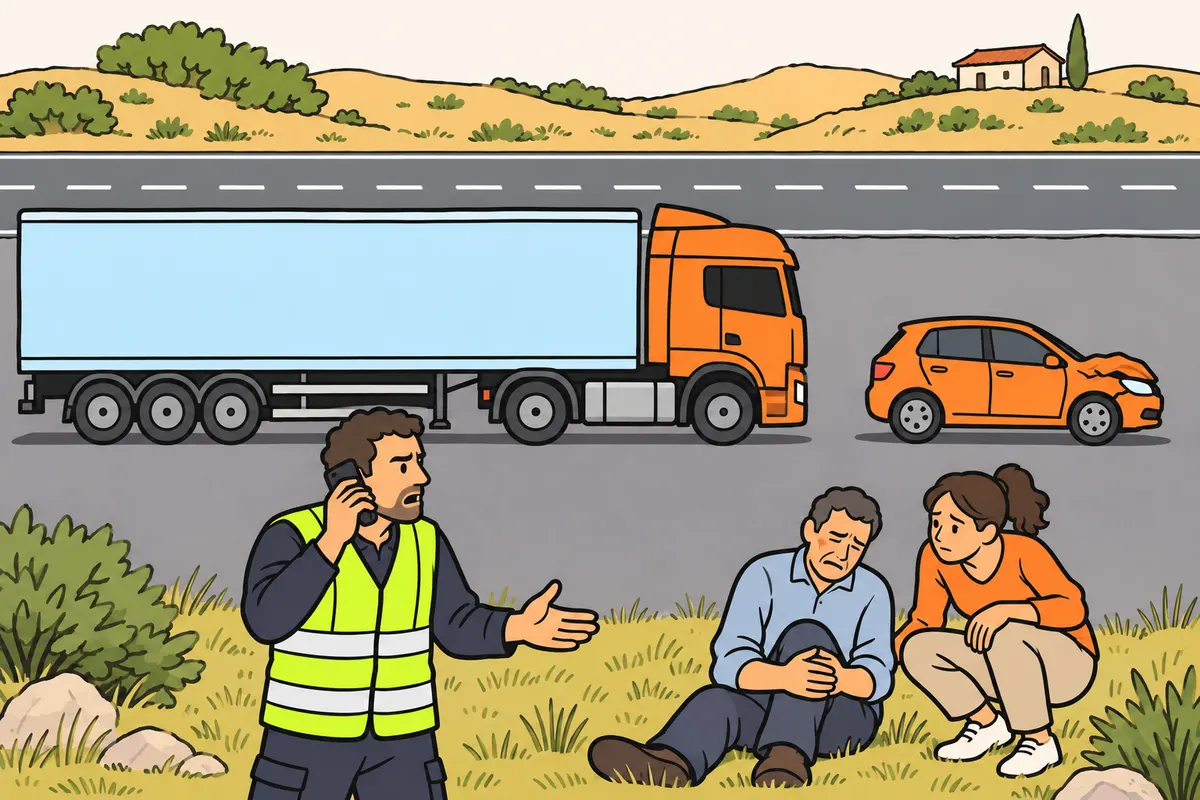
Help or urgently request help, and distinguish failing to assist from leaving the scene.
| Offence and case: you caused the accident | Imprisonment | Driving disqualification |
|---|---|---|
| Failure to assist: accidental crash | 6 to 18 months | Not stated here. |
| Failure to assist: negligent crash | 6 months to 4 years | Not stated here. |
| Leaving: negligent crash, outside failure-to-assist cases | 6 months to 4 years | 1 to 4 years |
| Leaving: accidental crash, outside failure-to-assist cases | 3 to 6 months | 6 months to 2 years |
Remember
- Help a helpless person in obvious serious danger if safe for you and others.
- If you cannot help directly, urgently request help from others.
- Distinguish the general fine from penalties when you caused the accident.
- If you caused deaths or legally specified injuries, do not voluntarily leave.
- Other people being present does not allow you to leave that accident.
- Distinguish penalties for failing to assist from penalties for leaving.
Exam trap: Wrong: Every failure means prison, or others helping lets you leave. Right: General failure carries a fine; penalties change if you caused the accident. Outside failure-to-assist cases, voluntarily leaving without risk to yourself or others after causing deaths or legally specified injuries can be a separate offence.
Read the full explanation
- Article 195 of the Código Penal (Criminal Code) penalises failure to assist a helpless person in obvious and serious danger when you can do so without risk to yourself or others. If you are unable to help directly, you must urgently seek help from others; danger does not justify neglecting to raise the alarm. [Código Penal (Criminal Code), art. 195](https://www.boe.es/buscar/act.php?id=BOE-A-1995-25444#a195)
- In the general case, failure to provide assistance is punishable by a fine calculated over 3 to 12 months; the same penalty applies if you fail to seek urgent help when you are unable to provide it yourself. If you caused the accident by chance, the prison term is 6 to 18 months; if you caused it through negligence, it is 6 months to 4 years. [Código Penal (Criminal Code), art. 195](https://www.boe.es/buscar/act.php?id=BOE-A-1995-25444#a195)
- If you cause an accident involving deaths or the injuries specified by law, voluntarily leaving the scene when remaining poses no risk to yourself or others may constitute the specific offence of leaving the scene, outside the cases covered by article 195. You must not assume that the presence of other people allows you to leave after causing an accident of this kind. [Código Penal (Criminal Code), art. 382 bis](https://www.boe.es/buscar/act.php?id=BOE-A-1995-25444#a3-2)
- For this offence of leaving the scene, if the accident results from negligence, the penalties are imprisonment for 6 months to 4 years and disqualification from driving for 1 to 4 years. If the accident occurs by chance, the penalties are imprisonment for 3 to 6 months and disqualification for 6 months to 2 years. [Código Penal (Criminal Code), art. 382 bis](https://www.boe.es/buscar/act.php?id=BOE-A-1995-25444#a3-2)
Accident or breakdown involving the combination: PAS
Protect people, summon help and provide only the assistance you know how to give.
- Stop and immobilise the combination without creating another danger; if you can continue safely, clear the lanes in accordance with article 130.
- Switch on the hazard warning lights and any other required lights; activate and place the connected V-16 beacon somewhere accessible and visible.
- Put on your high-visibility vest before entering the carriageway or arcén (hard shoulder) on interurban roads; leave on the side away from traffic only if there is a safe place beyond the carriageway and hard shoulder.
- Call 112 if there are injuries, fire or serious danger and give the location, direction of travel, casualties, combination and load.
- Check responsiveness and breathing, control severe bleeding and follow the operator’s instructions; keep monitoring until someone takes over.
Assessing and assisting an adult
If the person is unresponsive and is not breathing normally, you must act immediately.
- Check that it is safe and ask loudly whether the person is all right, without shaking them.
- If they do not respond, call for help, call 112 and use speakerphone if you can.
- Check for normal breathing for no more than 10 seconds; isolated gasps do not count as normal breathing.
- If they are not breathing normally, start compressions at 100-120 per minute; alternate at a ratio of 30:2 if you know how to give rescue breaths and can do so.
- Use an AED (automated external defibrillator) if available and follow its instructions; continue until the person recovers, someone takes over or you cannot continue.
Emergency in a tunnel
Distinguish between a breakdown, a fire and a stop caused by traffic.
- If the breakdown allows you to continue safely, reach the exit or emergency area.
- If you are immobilised, move as far to the right as possible or into the reserved area; switch off the engine, switch on the hazard warning lights, keep the position lights on and activate the V-16 beacon.
- Request help using the SOS emergency telephone if there is one and follow the instructions; evacuate to the refuge or exit via the protected area.
- If there is a fire, leave the key in the ignition and the doors open and evacuate in the opposite direction to the fire.
- If there is only a traffic queue, remain in the vehicle, keep the position lights on, switch off the engine and temporarily use the hazard warning lights to warn approaching drivers.
Finished this module?
Mark it as read and you will see your progress on the theory list.