
Theory · LCM Licence - Reduced Mobility Vehicle · Module 15 of 15
Accidents and breakdowns
You learn how to make the scene safe when a vehicle is immobilised, alert 112 and give assistance without worsening injuries. You distinguish the rules applicable to your LCM vehicle, the use of the connected V-16 and exam answers on helmets, first aid and emergencies in tunnels.
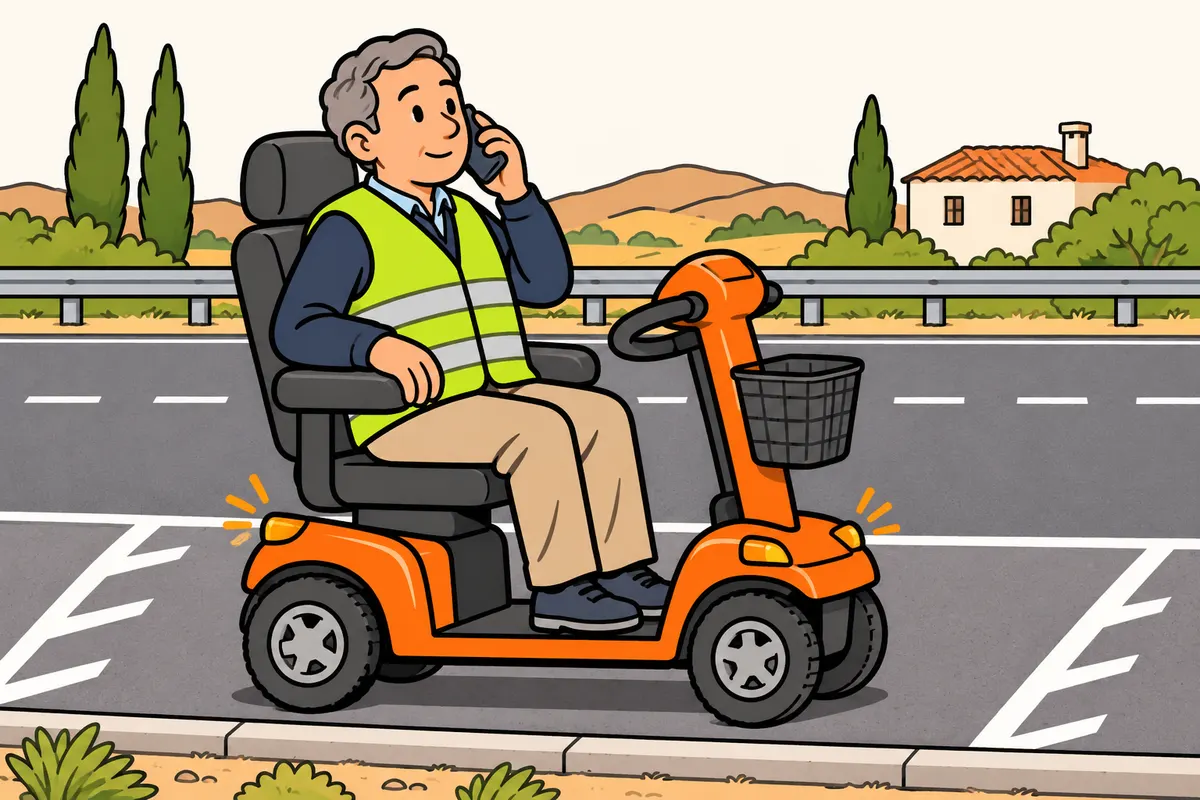
1PAS: protect, alert and assist
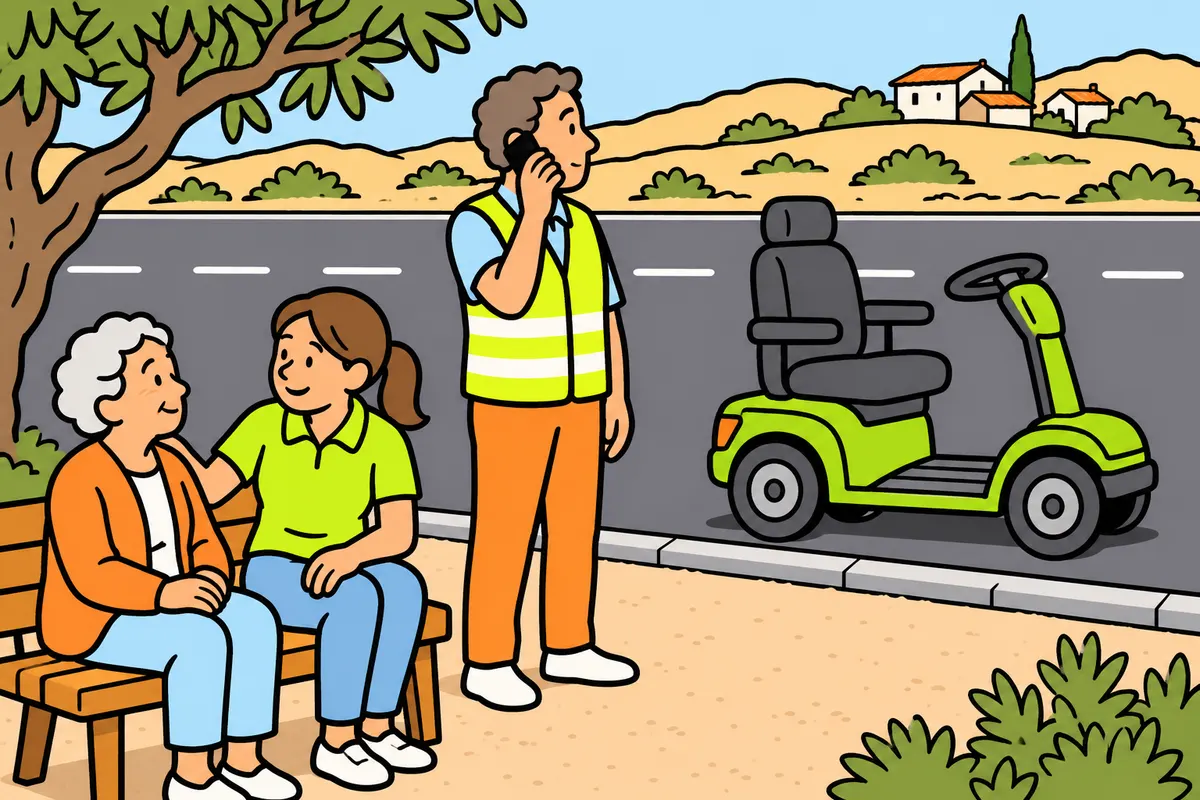
Protect yourself first, then call for help and give assistance.
Remember
- Check traffic, fire and injured people without putting yourself in danger.
- Protect the scene of a breakdown even when nobody is injured.
- Give people specific tasks and check they complete them.
- Only use first-aid techniques you know.
Exam trap: Wrong: start by moving the casualty. Right: protect the scene first without causing another accident.
Read the full explanation
- You must apply PAS: protect, alert or notify, and assist. First check that you can intervene without causing another accident; then call for help and provide the assistance you know how to give. This order helps you decide what to do when you encounter traffic, injured people and immobilised vehicles at the same time. [DGT, first aid 2026](https://sede.dgt.gob.es/export/sites/dgt/.galleries/permisos-de-conducir/certificacion-aptitud-profesores-formacion-vial/2026/MANUAL-IX-Primeros-auxilios.pdf).
- You can share tasks among several people: while someone makes the call, another person can stay with a casualty in a safe place. Give specific tasks and check that they are carried out. Do not assume that another witness has called for help just because they have a phone in their hand.
- A breakdown also requires protective measures even if no one is injured. Your LCM vehicle may be difficult to see among other vehicles, and you may need help to leave it. Think first about people, then about repairs, personal belongings or continuing your journey.
- You must stay calm and assess the whole situation: where vehicles are moving, what obstacles there are, whether there is a fire and how many people need help. This initial observation allows you to provide useful information without approaching a dangerous area or wasting time trying to work out who was to blame.
2Your duty to help
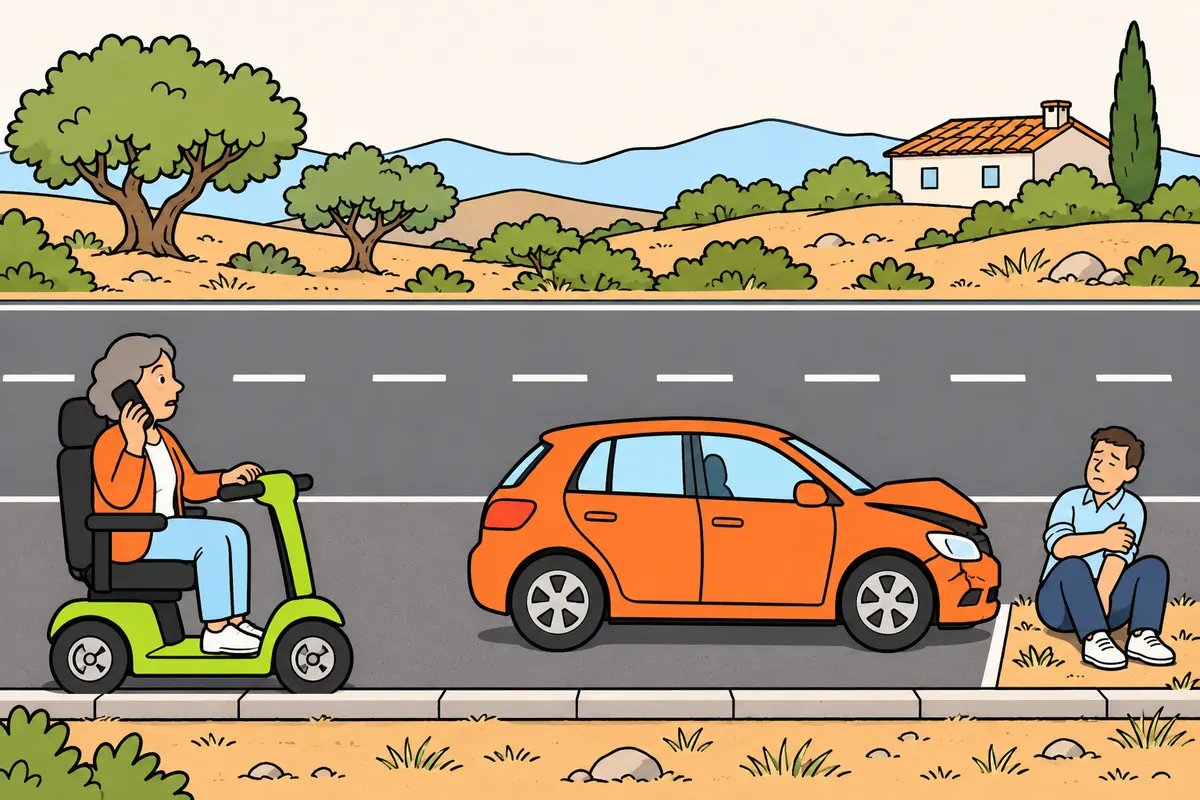
You must help or request help within your abilities, without putting yourself in danger.
Remember
- You must help if you are involved, witness an accident or learn about it.
- If you cannot intervene, request urgent assistance.
- Explain any difficulties you have with helping.
- Keep clear of the emergency services.
Exam trap: Wrong: limited mobility removes your duty to help. Right: request assistance if you cannot intervene.
Read the full explanation
- If you are involved in an accident, witness it or become aware of it, you must give or call for assistance, cooperate to prevent further harm and help establish the facts. This duty also applies to you as a witness; it does not depend on whether you drive a passenger car or an LCM vehicle. [Traffic Act, art. 51](https://www.boe.es/buscar/act.php?id=BOE-A-2015-11722#a51).
- You must adapt the help you give to what you can actually do. If your mobility prevents you from approaching or performing a first aid procedure, you can provide a precise location, report a fire and explain evacuation needs. Calling for urgent help is a useful and necessary action.
- You must not expose yourself or put others in danger to attempt a rescue. If you encounter a helpless person in clear and serious danger, failing to assist may be a criminal offence if you can help without risk; if you cannot intervene, you must call for urgent assistance. [Código Penal (Criminal Code), art. 195](https://www.boe.es/buscar/act.php?id=BOE-A-1995-25444#a195).
- As a witness, avoid stopping out of curiosity or forming a crowd that gets in the way. If the authorities are dealing with the accident and do not need your help, follow their instructions. If you have relevant information, pass it on safely without obstructing ambulance access.
3Stopping without creating another danger
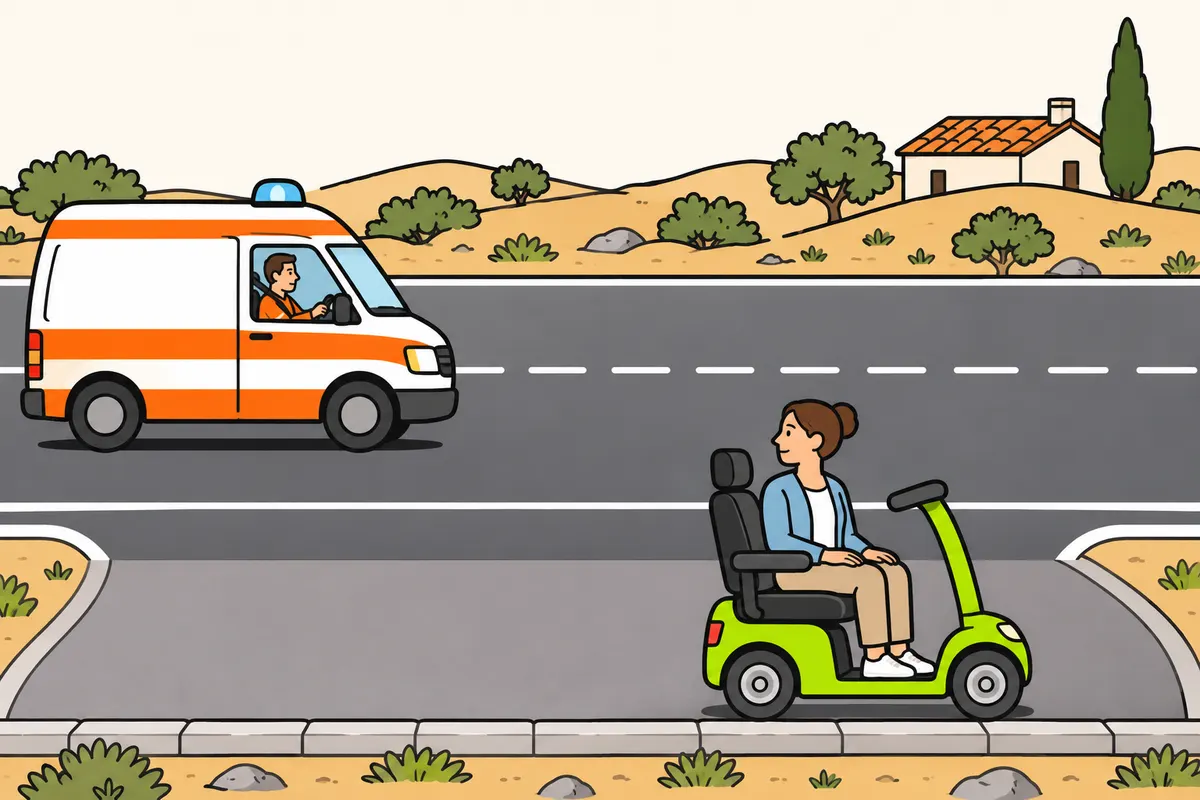
You must stop and secure your vehicle without creating another danger.
Remember
- Leave access clear for emergency services.
- Reduce speed if your brakes, steering or controls fail.
- Do not keep driving with a dangerous fault.
- Prevent your vehicle from moving accidentally.
- Switch off propulsion when appropriate and request assistance.
Exam trap: Wrong: keep driving to see whether the fault disappears. Right: slow down and stop safely.
Read the full explanation
- At an accident, you must stop in a way that does not create another danger. Choose a place that allows access for the emergency services and check the traffic before making any movement. Do not block an exit or park beside a casualty to get a better view. [RGC, art. 129](https://www.boe.es/buscar/act.php?id=BOE-A-2003-23514#a129).
- If you detect a major fault in the brakes, steering or adapted controls, try to reduce your speed and stop using the control you still have. Do not keep driving to see whether the fault disappears. Even a small vehicle can stray into another vehicle's path or run someone over if you lose control.
- Unusual noises, vibrations and warnings require attention. When a breakdown affects safety, you must not try to compensate by accelerating or start repairs while exposed to traffic. Request assistance and explain which function has failed so that recovery appropriate to your vehicle can be arranged.
- Once you have stopped, use the devices provided to prevent accidental movement and switch off the propulsion system where appropriate. Take particular care on slopes and with adapted controls: accidental contact must not set the vehicle in motion while you call for help or try to get out.
4Lights and warning signals when immobilised
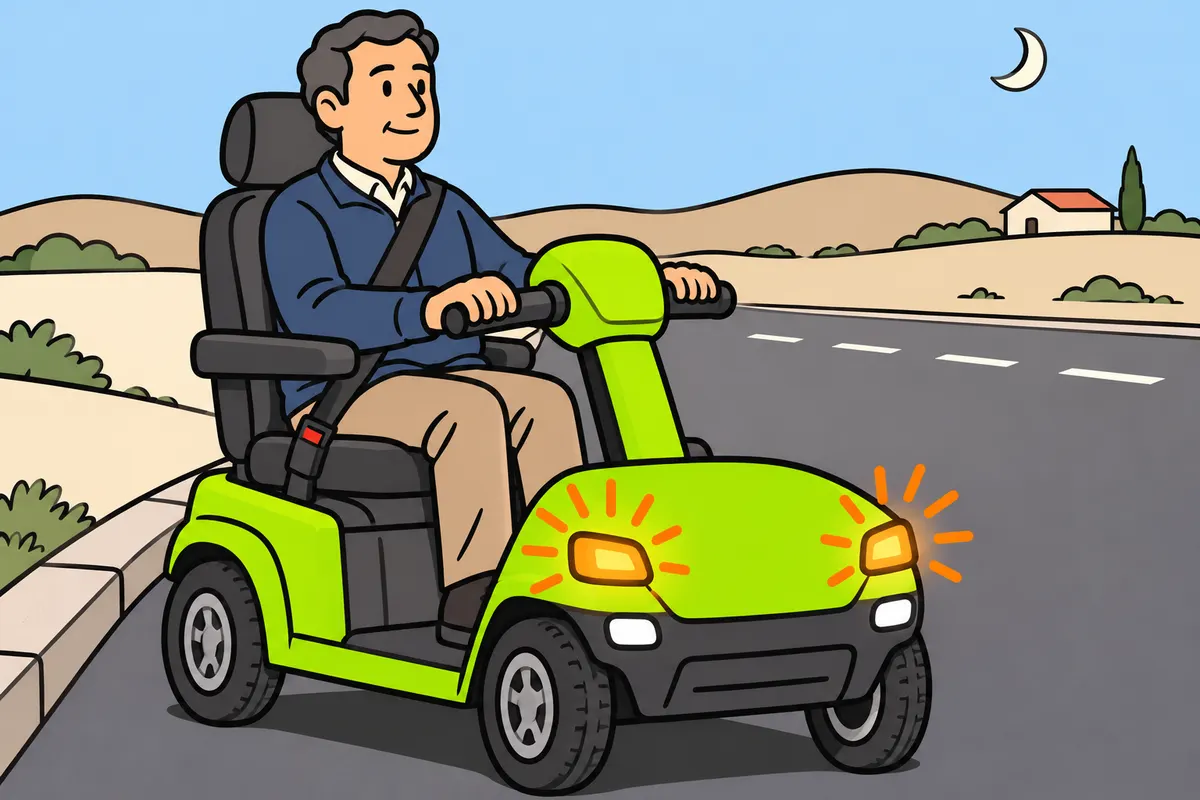
You must warn others about your stopped vehicle using the appropriate lights.
| Lights | When to use them while immobilised |
|---|---|
| Hazard warning lights, if fitted | When you need to warn about the obstruction |
| Position lights | On the carriageway or hard shoulder, at night or in significantly reduced visibility |
Remember
- Use hazard warning lights, if fitted, when you need to warn about the obstruction.
- Keep position lights on between sunset and sunrise or in significantly reduced visibility.
- This includes the carriageway and hard shoulder.
- Keep your phone and warning equipment within reach.
- Do not stand in front of the obstruction to direct traffic.
Exam trap: Wrong: hazard warning lights always replace position lights. Right: keep position lights on when required.
Read the full explanation
- You must switch on the hazard warning lights, if your vehicle has them, when a breakdown or accident makes it necessary to warn others of the obstruction. Their purpose is to warn others, not to reserve space for repairs or give you priority to rejoin traffic when the vehicle works again. [RGC, art. 130](https://www.boe.es/buscar/act.php?id=BOE-A-2003-23514#a130).
- You must keep the position lights on when you are immobilised on the carriageway or arcén (hard shoulder) between sunset and sunrise or in significantly reduced visibility. Hazard warning lights and position lights serve different purposes; you must not automatically use one as a substitute for the other. [RGC, art. 105](https://www.boe.es/buscar/act.php?id=BOE-A-2003-23514#a105).
- Do not assume that all LCM vehicles have the same bodywork or equipment. Learn how to operate the lights available and keep your phone and warning equipment within reach of your position. This preparation is especially useful when getting out or moving requires time and assistance.
- If your vehicle stops on a bend, at the crest of a hill or in a dark area, explain this when you call for help. Having lights on does not guarantee that everyone sees it in time. Keep out of the paths of approaching vehicles and do not try to direct traffic by standing in front of the obstruction.
5Connected V-16: distinctions you must understand
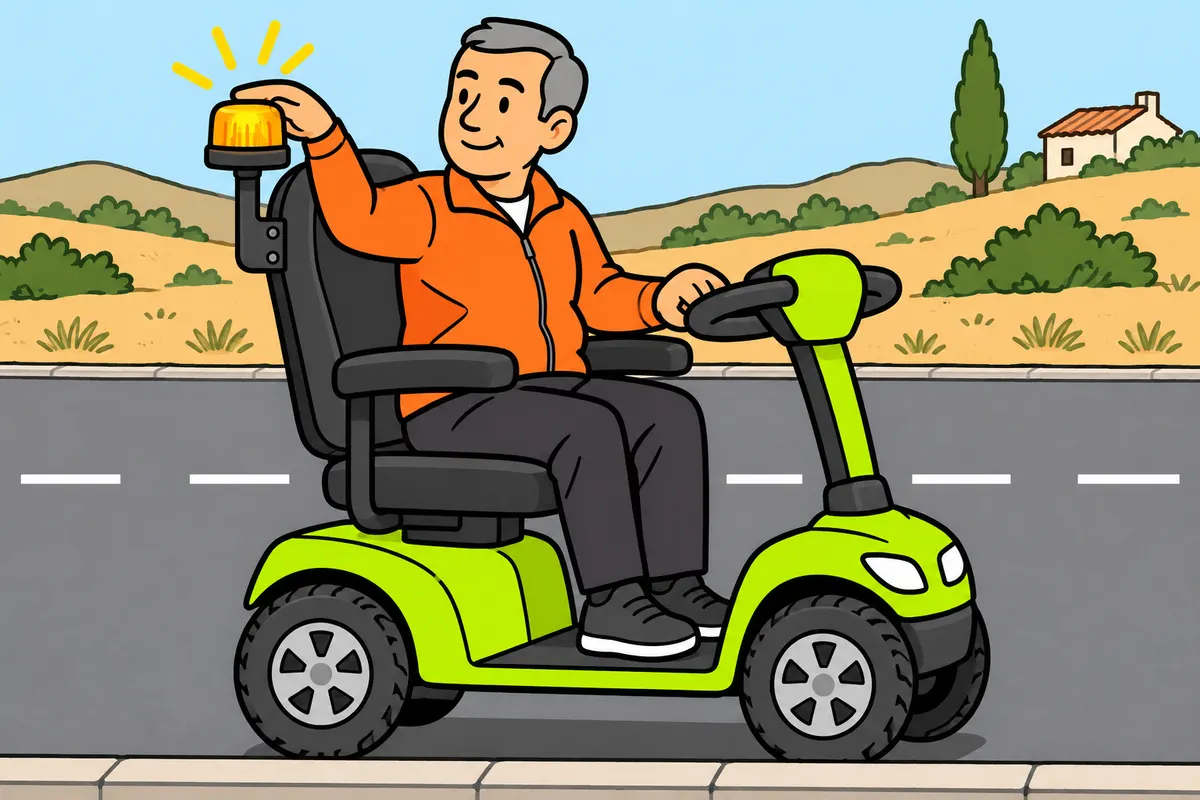
You must warn of danger, although your LCM need not carry a V-16.
| Your LCM situation | V-16 duty |
|---|---|
| Carrying a V-16 | You do not have to carry one |
| You carry a V-16 and are immobilised on the road in a hazard | You must use it; it must be connected and certified |
Remember
- If you carry one, use it when immobilised on the road in a hazard.
- The certified, connected V-16 is the prescribed warning device; triangles are not.
- Place it as high and visible as possible without risking your safety.
- Its amber light is a vehicle signal.
- Do not climb or enter the carriageway to place it.
Exam trap: Wrong: your LCM need not carry a V-16, so you never have to use one. Right: if you carry one, use it when immobilised on the road in a hazard.
Read the full explanation
- The regulatory hazard warning device is the certified, connected V-16; warning triangles are not the regulatory device. [RGC, art. 130.4](https://www.boe.es/buscar/act.php?id=BOE-A-2003-23514#a130); [RGV, annex XII](https://www.boe.es/buscar/act.php?id=BOE-A-1999-1826#anxii).
- You are not required to carry a V-16 in your LCM vehicle; if you carry one, you must use it when you are immobilised on the road in a hazardous situation. The general duty to use the regulatory device and the equipment each vehicle category must carry are separate matters. [RGC, art. 130.4](https://www.boe.es/buscar/act.php?id=BOE-A-2003-23514#a130); [RGV, annex XII](https://www.boe.es/buscar/act.php?id=BOE-A-1999-1826#anxii).
- The V-16 emits an amber light, and you must place it as high as possible and where it is most visible when you use it. The code V-16 refers to a vehicle signal governed by the Reglamento de Vehículos (Vehicle Regulations), rather than an upright road sign to look for in the road sign catalogue. [RGV, annex XI, V-16](https://www.boe.es/buscar/act.php?id=BOE-A-1999-1826#v-16).
- For your LCM vehicle, prepare an accessible mounting position compatible with its structure. Do not climb or enter the carriageway in search of an ideal height. If you cannot place it without risk, explain your situation to 112 in an emergency and prioritise personal protection; a beacon does not make up for dangerous exposure.
6Using the beacon without confusing its functions
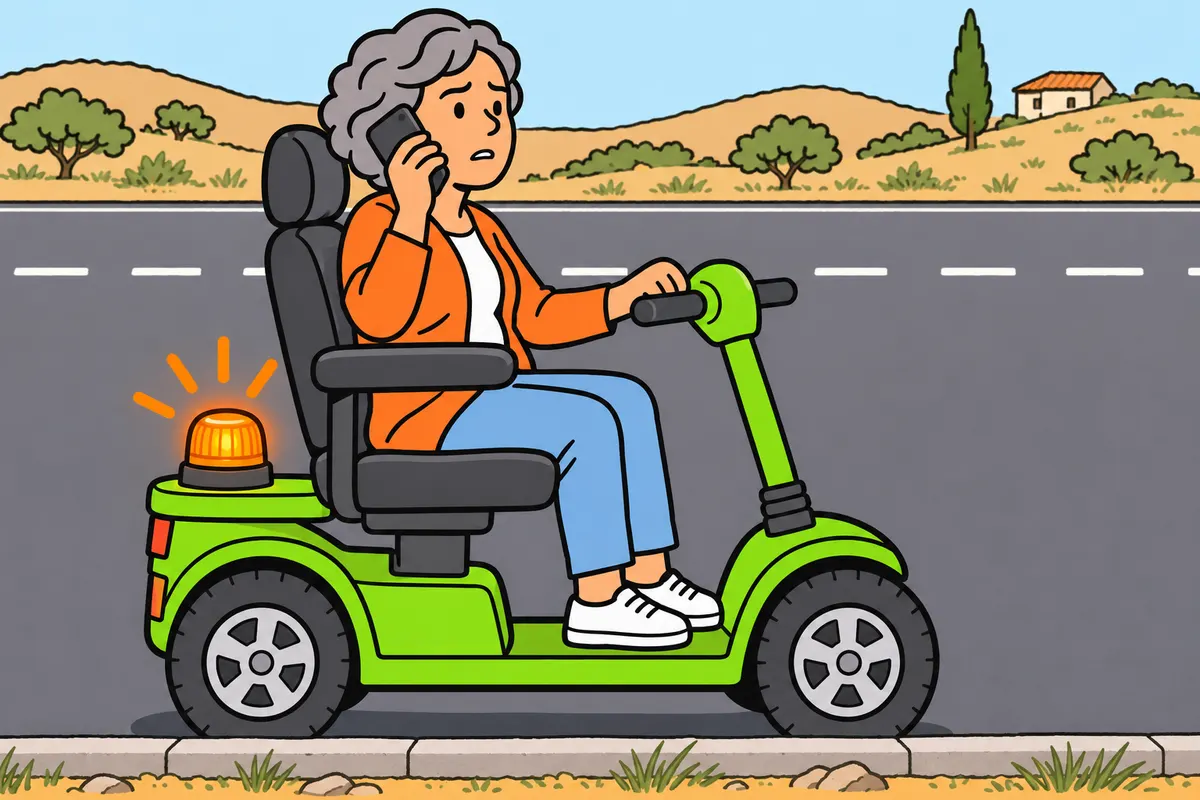
Your beacon warns traffic, but you must call if you need urgent help.
Remember
- Check that your model is certified and its connectivity service is valid.
- Prepare its mounting according to the manufacturer's instructions.
- Practise handling it in a protected place without losing your support.
- Call 112 if you need rescue or urgent assistance.
- Explain if you cannot leave your vehicle.
Exam trap: Wrong: activate the beacon and wait for an ambulance. Right: call 112 if you need urgent assistance.
Read the full explanation
- If you carry a V-16, check that its make and model appear on the official list of certified devices and that its connectivity service is valid. It is not enough for the packaging to advertise an emergency light. Keep the device ready according to its instructions so that it works when you need it. [DGT, V-16](https://www.dgt.es/muevete-con-seguridad/tecnologia-e-innovacion-en-carretera/Dispositivos-de-presenalizacion-V16/).
- Prepare the beacon's mounting according to the manufacturer's instructions and the procedure in the section «Connected V-16: distinctions you must understand». If your LCM vehicle has curved surfaces, a non-metallic cover or storage that is difficult to open from the seat, check in a protected place how you can handle the device without losing your support.
- The beacon transmits the location of the immobilised vehicle to warn traffic of the danger. It does not itself call for medical assistance or report how many people are injured or that you are trapped. If you need rescue or urgent assistance, you must call 112 as well as provide a warning signal. [DGT, V-16](https://www.dgt.es/muevete-con-seguridad/tecnologia-e-innovacion-en-carretera/Dispositivos-de-presenalizacion-V16/).
- When you speak to the emergency services, also describe the conditions for accessing your vehicle: which side they can approach from, any blocked door or the space needed to help you. If someone else uses your phone, tell them how to explain your mobility needs. These details allow a response suited to your situation to be prepared.
7Reflective vest and personal visibility
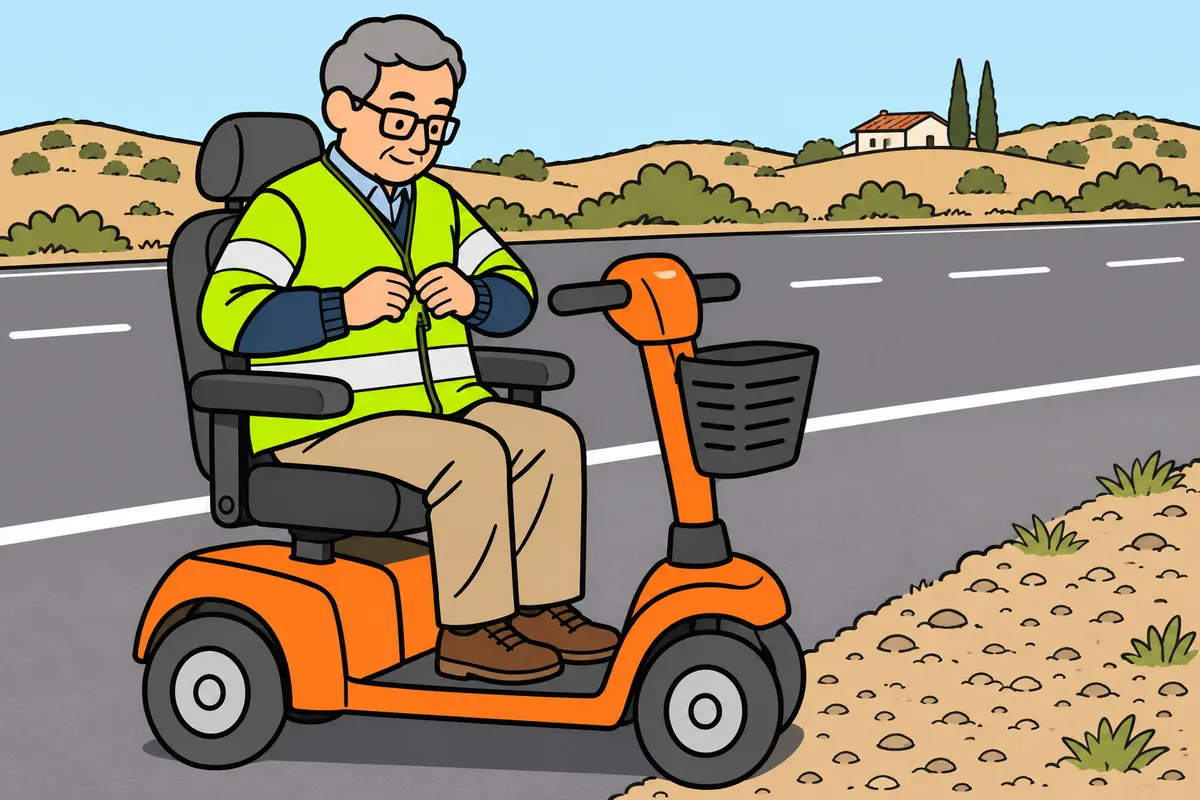
You should carry a reflective vest and seek protection from traffic.
| Vehicle category | Vest when getting out |
|---|---|
| Your LCM | Recommended; not expressly included in the legal list |
| Passenger cars, motorcycles and other listed categories | Required when you drive and get out onto an interurban carriageway or hard shoulder |
Remember
- Keep your vest accessible from your seat.
- Put it on before getting out if you can.
- Do not wait beside your vehicle if you can reach a safe area.
- Avoid crossing lanes; explain if you cannot reach a protected place.
Exam trap: Wrong: your vest makes waiting beside traffic safe. Right: reach a safe area if you can.
Read the full explanation
- For your safety, you are advised to carry a high-visibility reflective vest and put it on before getting out whenever you can. Keep it within reach of your seat. This recommendation is especially useful if you need more time to transfer, use an assistive device or reach a protected area.
- The legal obligation to wear a vest applies to the categories listed in article 118.4, such as passenger cars, motorcycles and other vehicles, when their drivers get out and occupy the carriageway or arcén (hard shoulder) on interurban roads. The LCM category is not expressly included in that list. [RGC, art. 118](https://www.boe.es/buscar/act.php?id=BOE-A-2003-23514#a118).
- The vest makes you more visible, but does not prevent a vehicle from hitting you. Do not stay beside your LCM vehicle waiting for the recovery vehicle if you can reach a safe area. You must not assume that an approaching driver has seen you simply because you are wearing reflective clothing.
- Do not confuse wearing a vest with being allowed to walk anywhere on the road. Choose a protected route and avoid crossing lanes. If barriers, a change in level or your mobility prevent you from reaching a safe place, explain this limitation to the emergency services instead of improvising a dangerous exit.
8Deciding whether you can leave the vehicle
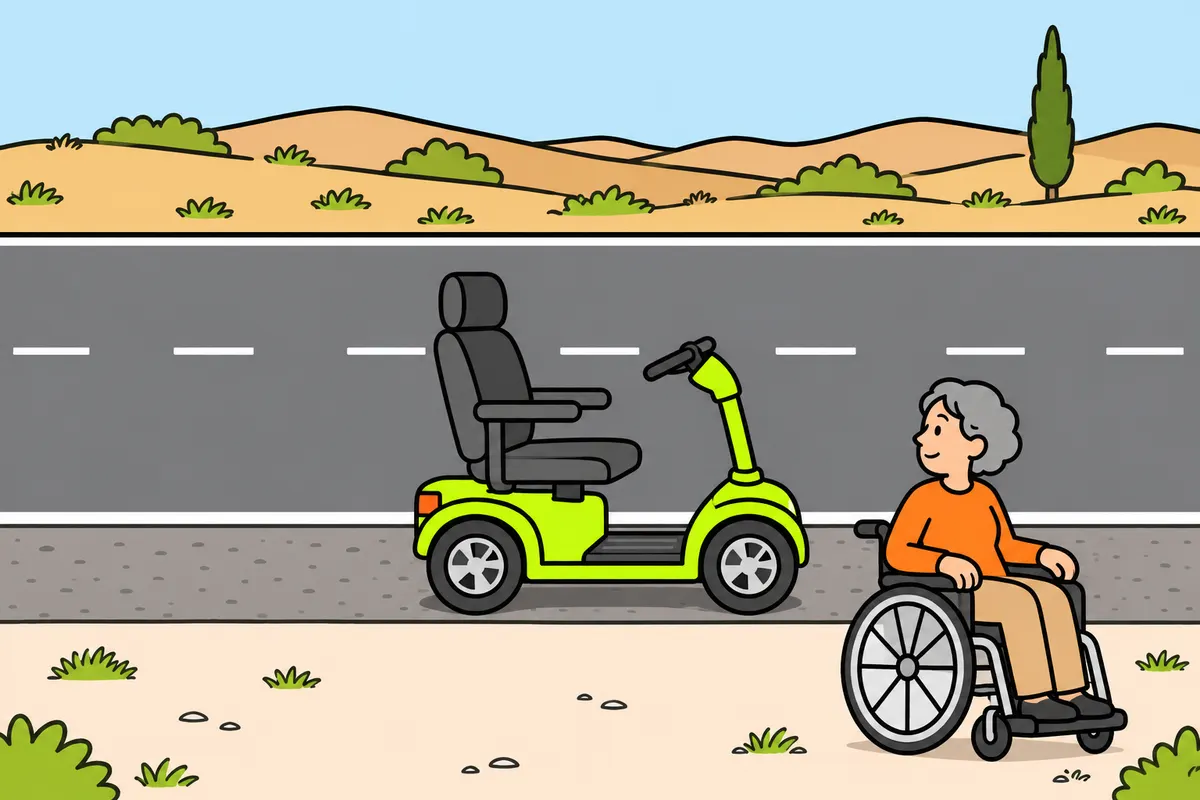
You must check whether you can leave and reach a safe place.
| Situation | What you must do |
|---|---|
| You can leave and reach a safe place | Leave without walking or waiting in lanes or hard shoulders |
| Traffic prevents a safe exit | Stay inside with your seat belt fastened |
| Smoke or fire | Move away from danger and request urgent rescue |
Remember
- When you cannot continue, leave if you can reach a safe, accessible place.
- Use the side away from traffic; avoid walking or waiting in lanes or shoulders.
- If traffic prevents a safe exit, stay inside with your seat belt fastened.
- Explain if your mobility prevents you from leaving.
- If smoke or fire appears, move away from danger and request urgent rescue.
Exam trap: Wrong: always get out. Right: if traffic prevents a safe exit, stay inside with your seat belt fastened; with fire, move away and request rescue.
Read the full explanation
- When your vehicle cannot continue, the general rule is to leave it if there is a safe place outside the road platform used by traffic. You must get out on the side away from the traffic flow, without moving along or remaining in lanes or on hard shoulders. Assess the entire process of getting out, not just opening a door. [RGC, art. 130](https://www.boe.es/buscar/act.php?id=BOE-A-2003-23514#a130).
- If traffic prevents you from getting out safely, you must remain inside with your seat belt fastened. Apply the rule to your vehicle's actual layout and report it if you have no usable exit. You must not unfasten your seat belt and step into the lane to check from outside whether anyone is coming. [RGC, art. 130](https://www.boe.es/buscar/act.php?id=BOE-A-2003-23514#a130).
- In an LCM vehicle, you must assess whether you can negotiate the edge of the hard shoulder, reach a refuge or make a transfer without falling. An area beyond a barrier may not be accessible to you. Explain this when asking for help so that the services can secure the scene and assist you.
- Do not position yourself between your vehicle and the traffic, or in front of or behind it if another impact could trap you. Avoid returning to collect belongings. If smoke or fire appears, you need to move away from the danger and request urgent rescue; do not stay because you are applying a rule about waiting without taking the fire into account.
9Breakdowns, assistance and recovery
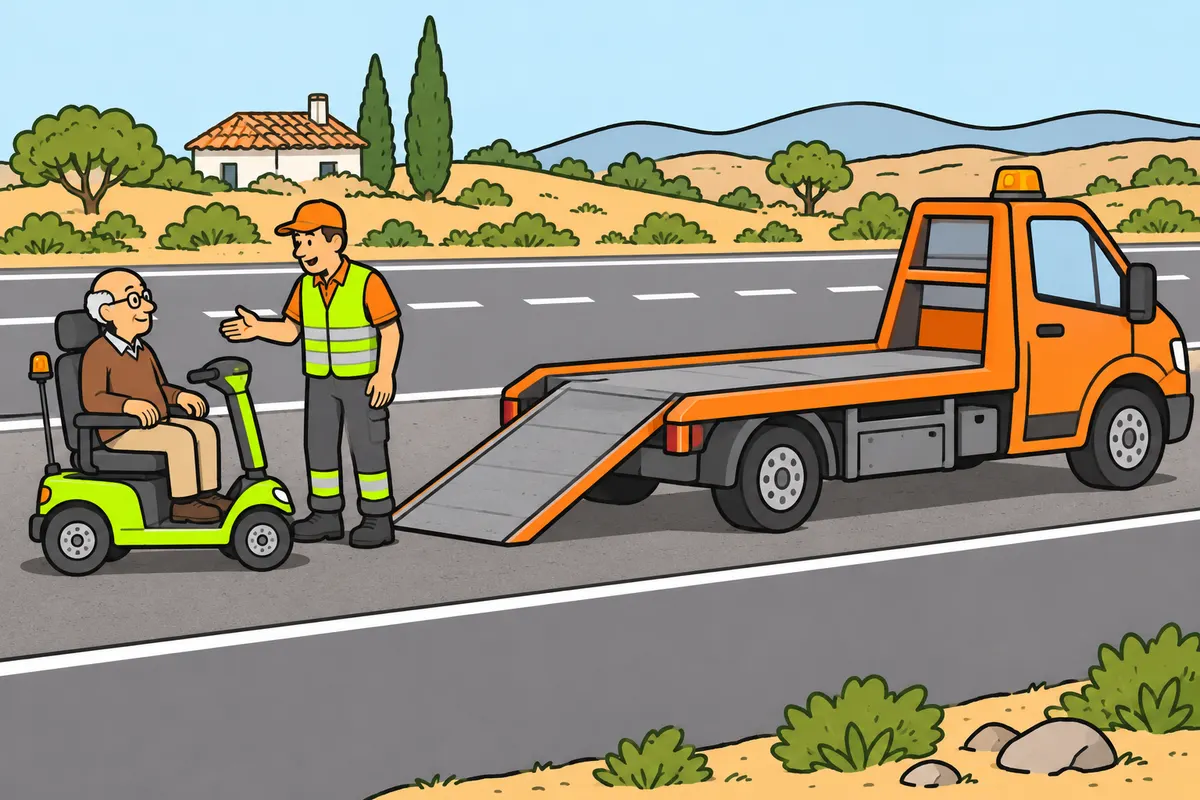
You must arrange safe recovery and fix the dangerous fault before driving again.
Remember
- Warn others and arrange removal of the obstruction as soon as possible.
- Move your vehicle only if you can do so safely.
- Explain its adaptations and any personal assistance you need.
- Do not improvise towing with a rope or push through traffic.
- Check that you can use your controls and supports correctly.
Exam trap: Wrong: you can continue if the engine restarts. Right: first resolve the fault that affected safety.
Read the full explanation
- If your vehicle obstructs the road, you must try to have it removed as soon as possible, giving warning and positioning it off the carriageway when feasible. If it can still move safely, look for a place where it causes less obstruction; do not continue with brakes or steering that you cannot control. [RGC, art. 130](https://www.boe.es/buscar/act.php?id=BOE-A-2003-23514#a130).
- Explain to the breakdown assistance service that this is a vehicle for people with reduced mobility. Describe its adaptations and say whether you need personal assistance as well as vehicle recovery. The solution must allow you to travel safely, rather than simply taking the vehicle away and leaving you exposed on the road.
- Do not improvise a tow with a rope or ask someone else to push the vehicle among traffic. Ask the breakdown assistance service how to recover it and how to operate its transmission or brake. The operation may require specialist equipment and the manufacturer's instructions.
- Before continuing your journey, you must resolve the cause of the safety problem. The engine restarting does not prove that the vehicle is fit to drive. If the adapted controls or your supports are damaged, you need to be able to use them correctly before driving again.
10Alerting 112 with useful information
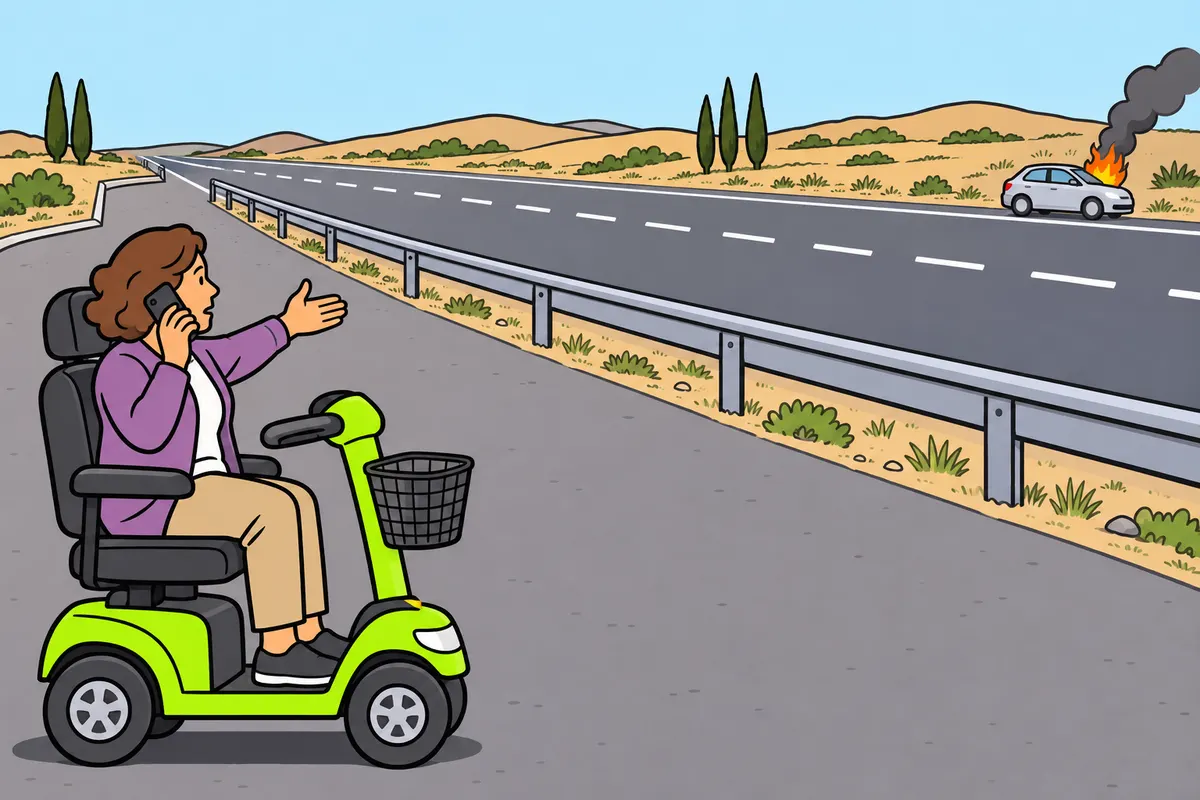
You must report the emergency, your location and the help you need.
Remember
- Call for injuries, fire, trapped people or serious danger.
- Give the road, direction and landmarks, or street and junction.
- Explain what happened, who needs help and any dangers.
- Say early if you need help getting out.
- Give your name and phone number.
- Do not hang up until told.
Exam trap: Wrong: find your insurer first despite danger to people. Right: call 112 without delay.
Read the full explanation
- You must call 112 in an emergency involving injured people, fire, trapped people or serious danger. The call is free and enables the necessary resources to be mobilised. You can deal with a breakdown that does not create an emergency through breakdown assistance; if people are at risk, do not delay the emergency call while looking for your insurer's details first. [DGT, first aid 2026](https://sede.dgt.gob.es/export/sites/dgt/.galleries/permisos-de-conducir/certificacion-aptitud-profesores-formacion-vial/2026/MANUAL-IX-Primeros-auxilios.pdf).
- Give the precise location: road, kilometre point if you know it, direction of travel, nearby town and visible landmarks. On a street, give its name and a building number or junction. If you are in a tunnel, identify it and say which entrance you used, without walking along the carriageway to look for a sign.
- Explain what has happened, how many vehicles and people you can see, and whether anyone is unresponsive, having difficulty breathing, bleeding heavily or trapped. Also report fire, smoke, spillages and obstacles. Describe facts; you do not need to diagnose an injury or establish who is responsible for the services to start organising help.
- Give your name and a contact telephone number, answer the operator's questions and do not hang up until told to do so. If you can, use the speakerphone to follow their instructions. If your mobility makes it difficult to get out or give physical assistance, say so at the start so that you are not instructed to do something you cannot do.
11Maintaining communication and helping the rescue
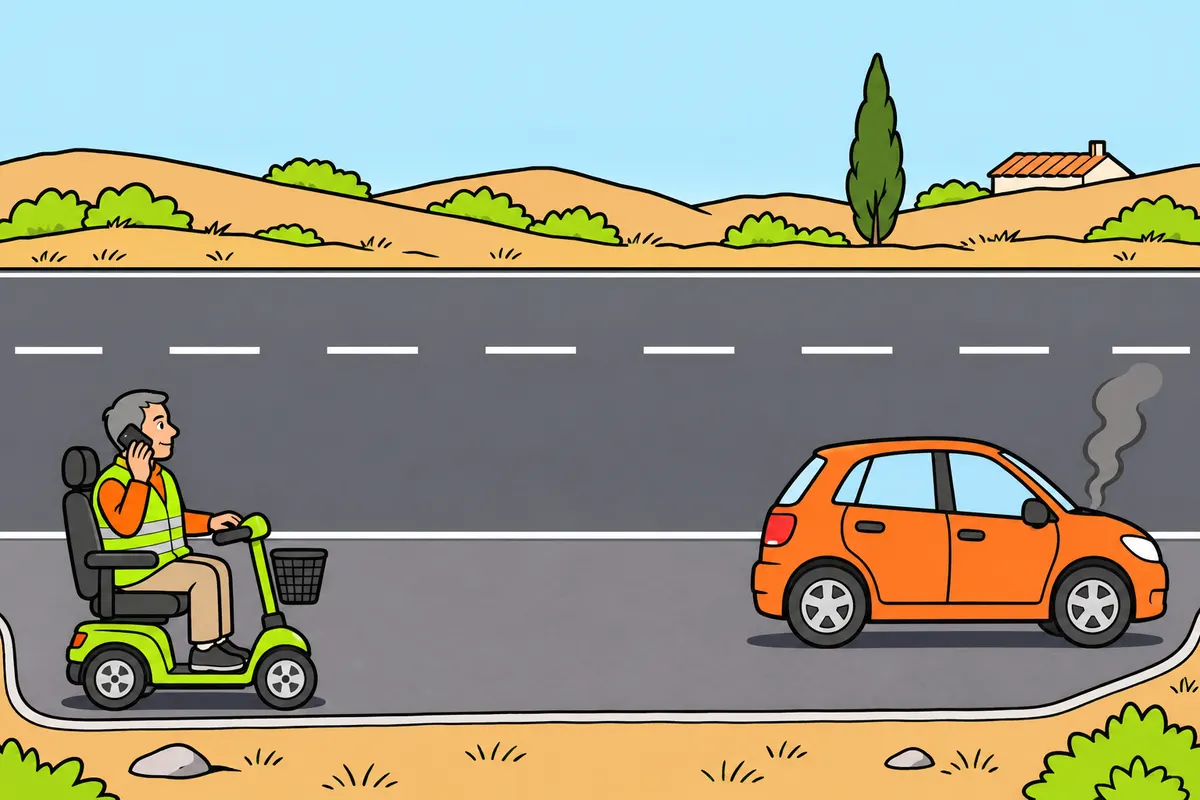
You must report changes and help emergency services reach the scene.
| Coverage | What you can do |
|---|---|
| Your operator has no coverage, but another network is available | Try calling 112 |
| No network is available | Find another safe way to request help, such as an accessible SOS emergency telephone |
Remember
- Report any fire or worsening of a casualty’s condition.
- Check the location and help requested by anyone calling.
- Keep access clear and follow instructions.
- Explain what first aid you gave and when.
Exam trap: Wrong: 112 always works without coverage. Right: a conventional mobile call needs an available network; seek another safe way to request help if none exists.
Read the full explanation
- If conditions change, you must report it: a fire starts, a casualty becomes unresponsive or the safe exit is blocked. Describe what has changed while keeping yourself protected. Incomplete initial information does not justify waiting silently when the situation gets significantly worse.
- A lack of coverage from your network operator does not necessarily mean you cannot call 112: another available network can be used. If no network has coverage, you must not assume that a conventional mobile call is guaranteed. Look for another safe way to request help, such as an accessible SOS emergency telephone. [DGT, first aid 2024](https://sede.dgt.gob.es/.galleries/permisos-de-conducir/certificacion-aptitud-profesores-formacion-vial/2024/Manual-IX-Primeros-Auxilios_2024.pdf).
- If someone else makes the call, confirm which location they have given and what help they have requested. Avoid repeated calls without new information that hinder coordination. Remain available to provide further details and use the phone for emergency instructions, not to film casualties.
- Help ambulances, firefighters and officers gain access by following their instructions and keeping the working area clear. If you have used a first aid technique, explain which one and when. If someone has a pre-existing mobility or communication limitation, describe it without confusing it with an injury caused by the collision.
12Giving assistance without causing further injuries
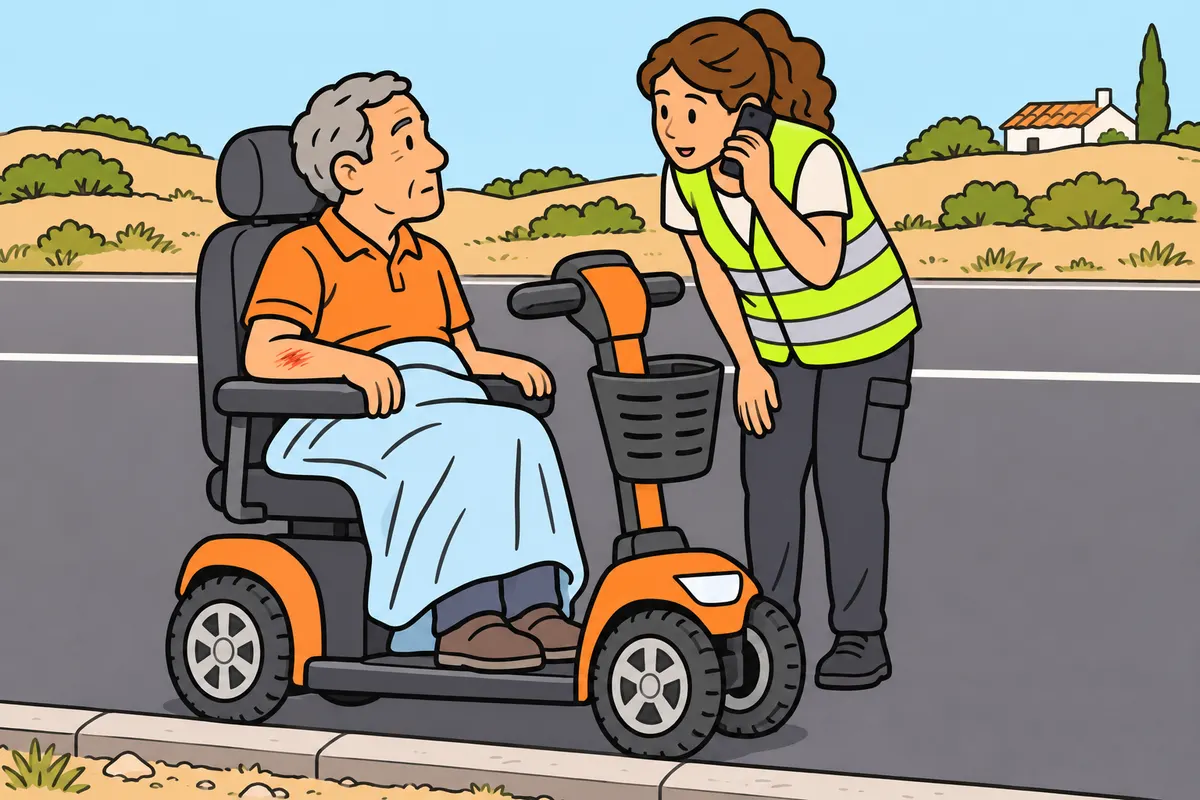
You must support and monitor casualties without causing further injuries.
Remember
- Help within your knowledge and follow 112’s instructions.
- Speak calmly and explain that you have requested help.
- As a general rule, do not move casualties or take them out.
- Do not give food, drinks, alcohol or medicine on your own initiative.
- Keep them warm without covering their face or pressing injuries.
- Keep checking their response and breathing.
Exam trap: Wrong: make a conscious casualty walk to check their condition. Right: serious injuries are possible; do not make them walk.
Read the full explanation
- You must give assistance within your knowledge and abilities and follow the instructions from 112. Speak to the casualty, introduce yourself and tell them you have called for help. Remain calm in your dealings with them and avoid alarming comments about their injuries; support and monitoring are useful even if you cannot perform physical techniques.
- As a general rule, you must not move injured people or take them out of the vehicle. They may have spinal injuries that are not visible. Do not sit them up, lift them or make them walk to see whether they are all right; a conscious person can also have a serious injury. [DGT, guide to assisting those affected](https://www.dgt.es/export/sites/web-DGT/.galleries/downloads/nuestros_servicios/victimas/WEB_GUIA_AYUDA_AFECTADOS_SINIESTROS.pdf).
- You must not give food, drinks, alcohol or medicines on your own initiative. Even if the casualty is thirsty or seems to have recovered, they need assessment. You must not apply home remedies to wounds or burns either. Tell the operator what the person is asking for so that you receive appropriate guidance. [DGT, first aid 2026](https://sede.dgt.gob.es/export/sites/dgt/.galleries/permisos-de-conducir/certificacion-aptitud-profesores-formacion-vial/2026/MANUAL-IX-Primeros-auxilios.pdf).
- Protect the casualty from cold and rain without covering their face or pressing on injuries. Keep checking whether they respond and how they breathe. Do not leave them to deal with vehicle damage, and prevent others from moving or handling them for convenience or out of an uncoordinated desire to help.
13Checking responsiveness and breathing
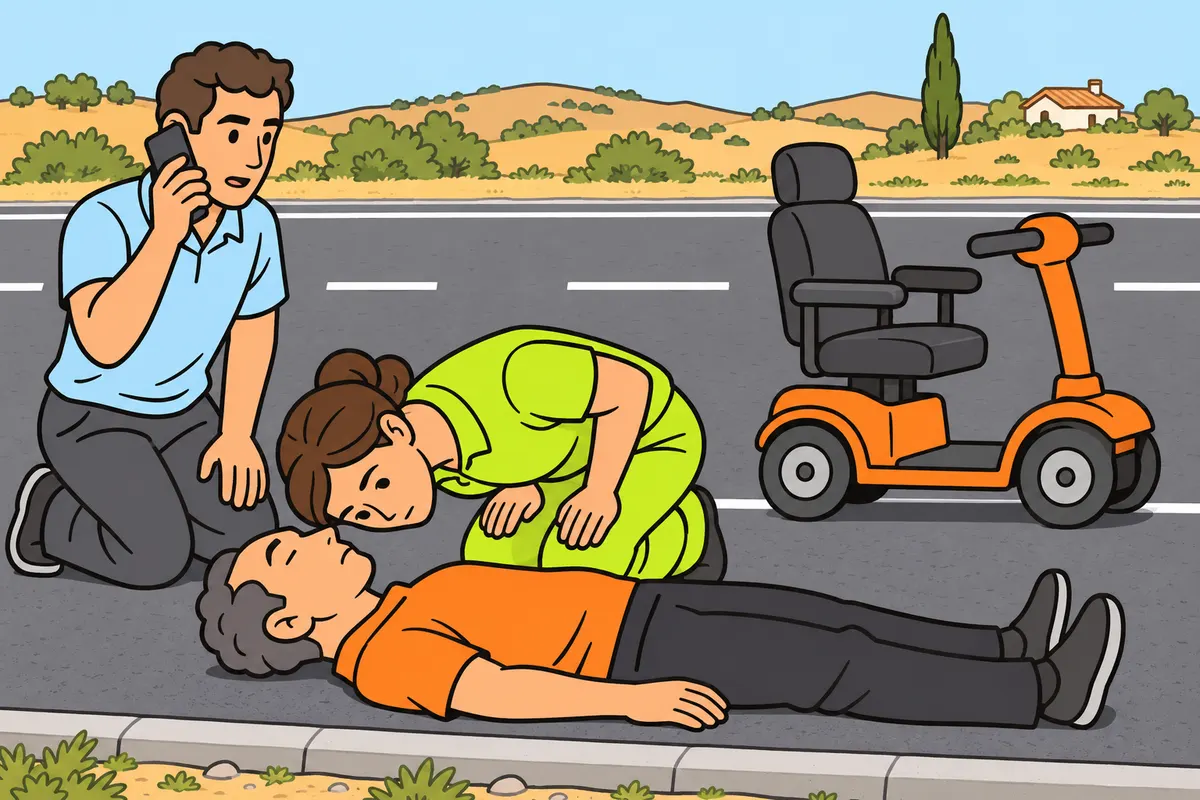
If someone does not respond, you must check whether they are breathing normally.
| Unresponsive person | What you must do |
|---|---|
| Breathing normally | Monitor and protect their airway as instructed; avoid moving their neck |
| Vomiting or airway at risk | Report it and follow instructions, moving them as little as necessary |
Remember
- Speak to them without shaking them violently.
- If they do not respond, request help and follow 112’s instructions.
- Do not mistake occasional gasps for normal breathing.
- Do not automatically use the recovery position after a road accident.
- If they vomit, follow instructions to keep their airway clear.
Exam trap: Wrong: gasping means normal breathing. Right: occasional gasps are not normal breathing.
Read the full explanation
- You must check whether the person responds by speaking to them and looking for a reaction without shaking them violently. If they do not respond, call for immediate help and check whether they are breathing normally, following the instructions from 112. A lack of response does not mean that they have died or that you can simply leave them alone.
- Look for chest movements and normal breathing. Do not spend more than 10 seconds checking. Occasional gasps or gulping breaths do not count as normal breathing; do not waste time trying to count their breathing rate over a minute or checking for a pulse if you have no medical training. [DGT, first aid 2026](https://sede.dgt.gob.es/export/sites/dgt/.galleries/permisos-de-conducir/certificacion-aptitud-profesores-formacion-vial/2026/MANUAL-IX-Primeros-auxilios.pdf).
- If they are unconscious but breathing normally, monitor them and protect their airway as instructed. With a road casualty, you must take traumatic injuries into account and avoid unnecessary twisting of the neck. You do not automatically place everyone who is unresponsive in the recovery position.
- If they vomit or their airway is at risk, report this and follow the instructions to keep it clear with as little movement as necessary. Avoiding movement does not mean letting them suffocate. If you need to change their position, seek help and try to keep their head, neck and torso aligned without forcing them.
14Basic adult CPR
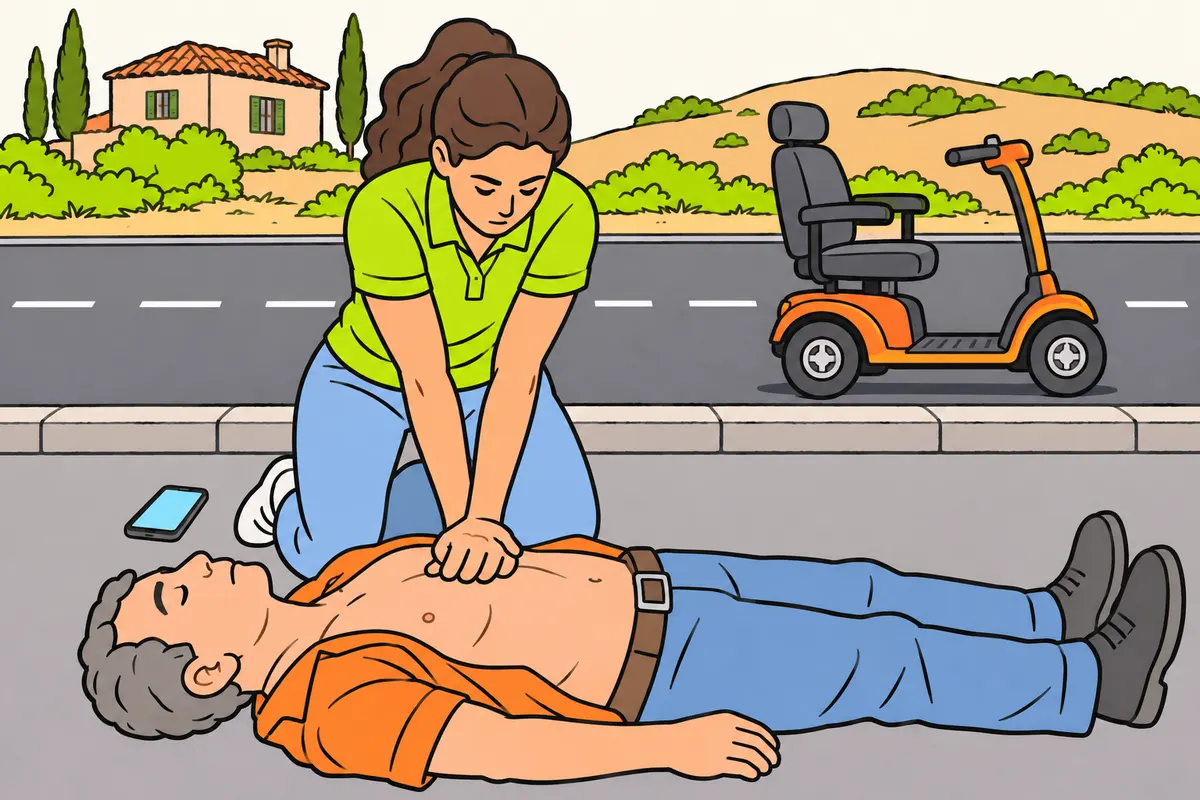
If an adult is unresponsive and not breathing normally, start CPR following emergency instructions.
| Adult resuscitation | What you must do |
|---|---|
| You know how and can give rescue breaths | Alternate 30 compressions with 2 breaths |
| You are not confident giving rescue breaths | Give continuous compressions as instructed |
Remember
- Follow 112’s instructions and ask for an available defibrillator.
- Press the centre of their chest with your arms straight.
- Let their chest rise again after each compression.
- If you cannot give rescue breaths, continue compressions as instructed.
- Ask someone to take over if you cannot give effective compressions.
- Continue until professionals take over, you are told to stop, recovery, exhaustion or danger.
Exam trap: Wrong: 30:2 is the number of compressions per minute. Right: alternate 30 compressions with 2 breaths if you know how and are able.
Read the full explanation
- If an adult is unresponsive and is not breathing normally, you must suspect cardiac arrest and start resuscitation under the guidance of 112. Put your phone on speaker if you can and ask a specific person to bring an available defibrillator. Do not wait for an ambulance to arrive before starting the measures you are instructed to take.
- For chest compressions, place your hands in the centre of the chest, over the lower half of the breastbone, with your arms straight. For an adult, you must compress the chest by about 5 centimetres, at a rate of 100 to 120 per minute, allowing the chest to rise fully after each compression. [DGT, first aid 2026](https://sede.dgt.gob.es/export/sites/dgt/.galleries/permisos-de-conducir/certificacion-aptitud-profesores-formacion-vial/2026/MANUAL-IX-Primeros-auxilios.pdf).
- If you know how to give rescue breaths and are able to do so, alternate 30 compressions with 2 rescue breaths. If you are not confident in this technique, give continuous compressions, following the emergency services' instructions. Do not confuse the 30:2 ratio with the number of compressions per minute: they describe different aspects of the procedure. [DGT, first aid 2026](https://sede.dgt.gob.es/export/sites/dgt/.galleries/permisos-de-conducir/certificacion-aptitud-profesores-formacion-vial/2026/MANUAL-IX-Primeros-auxilios.pdf).
- Continue until professionals take over or tell you to stop, clear signs of recovery appear, you are too exhausted to continue or the location becomes unsafe. If your mobility prevents you from giving effective compressions, explain this and ask someone to take over; you can continue helping with the call and coordination.
15Defibrillator and continuous monitoring
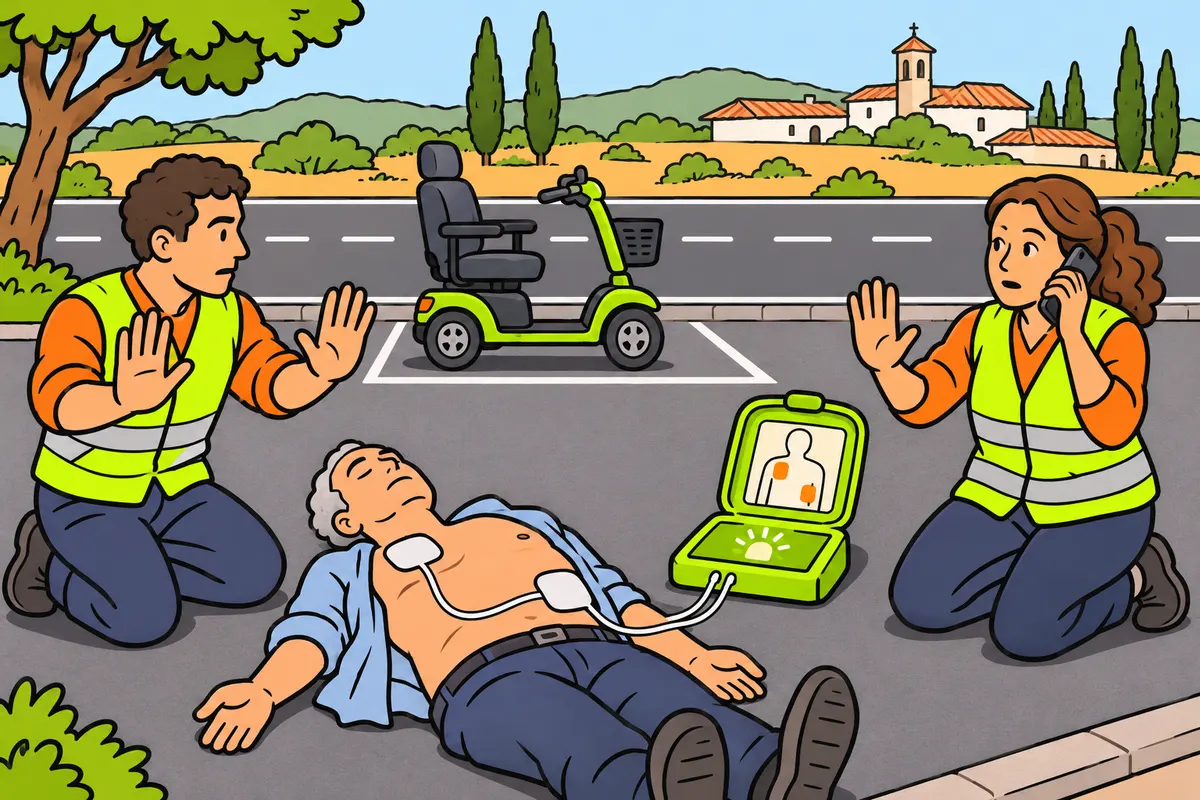
You must follow the defibrillator and monitor the casualty until professionals take over.
Remember
- Switch on the AED and follow its instructions.
- Place its pads as shown in the diagrams.
- Do not touch the casualty during analysis or a shock.
- Warn others not to touch them either.
- Keep monitoring them if normal breathing returns.
- For children and babies, give their age and follow 112’s instructions.
Exam trap: Wrong: decide on a shock from the casualty’s appearance. Right: the AED analyses and decides whether a shock is appropriate.
Read the full explanation
- If you have an automated external defibrillator, known in Spain as a DEA, switch it on and follow its instructions. The device analyses the heart rhythm and determines whether a shock is needed; you must not decide this based on the casualty's appearance. Continue to follow the instructions from 112 as well. [Rioja Salud, adult CPR](https://www.riojasalud.es/servicios/urgencias/articulos/maniobras-de-reanimacion-cardiopulmonar-en-el-adulto).
- Apply the pads as shown in their diagrams and avoid touching the casualty while the device is analysing the rhythm or delivering a shock. Warn anyone helping to stand clear at that moment. Then resume the action instructed by the device, without disconnecting it on your own initiative.
- If the person starts breathing normally again, this does not mean you can leave. Keep monitoring them and report any changes. Their breathing may deteriorate again, and you must be ready to follow the emergency services' instructions until professionals take over.
- Do not automatically apply the technical details described for an adult to children or infants. Report their approximate age and follow the guidance from 112. In the exam, always identify which casualty a figure or technique refers to before selecting your answer.
16External bleeding: direct pressure
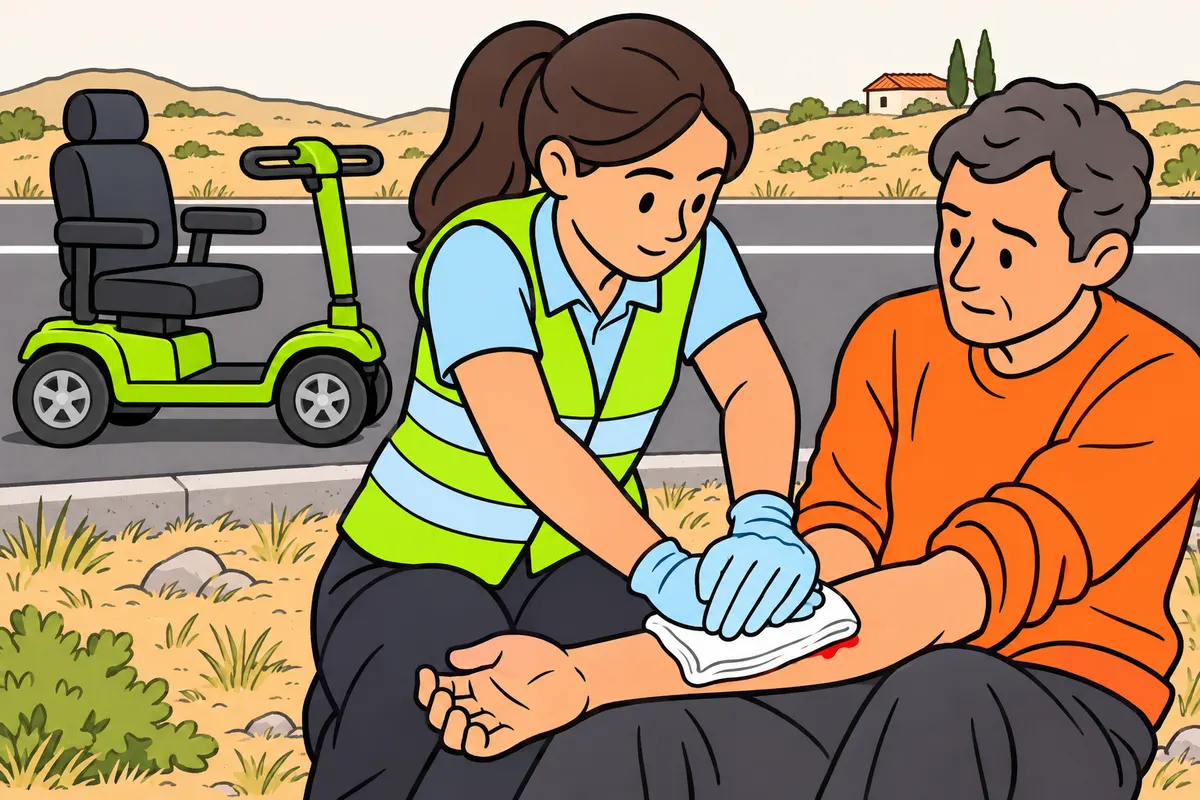
You must control heavy bleeding with steady direct pressure where possible.
| Case | What you must do |
|---|---|
| Wound where direct pressure is possible | Maintain pressure with clean material |
| Embedded object | Do not remove it or press on it; ask for instructions |
Remember
- Call for help and follow 112’s instructions; use gloves if available.
- Press the wound with gauze or clean fabric.
- If it becomes soaked, add material without removing the previous dressing.
- Do not remove embedded objects or press directly on them.
- Do not improvise thin ties or periodically loosen a tourniquet.
Exam trap: Wrong: every cut needs a tourniquet. Right: uncontrolled, life-threatening limb bleeding may need one, with suitable equipment and training or guidance from 112.
Read the full explanation
- A haemorrhage is a loss of blood. If you see heavy bleeding, you must report it immediately and act to control it, following the instructions from 112. Use gloves if you have them and avoid direct contact with blood; protecting yourself allows you to continue helping without adding an unnecessary risk.
- You must apply firm, continuous direct pressure to the wound with gauze or a clean cloth whenever possible. Do not keep lifting the dressing to look. If it becomes soaked, add more material and maintain pressure instead of removing what is helping to contain the bleeding. [DGT, first aid 2026](https://sede.dgt.gob.es/export/sites/dgt/.galleries/permisos-de-conducir/certificacion-aptitud-profesores-formacion-vial/2026/MANUAL-IX-Primeros-auxilios.pdf).
- If an object is embedded in the wound, do not remove it or press directly on it. Removing it can make the bleeding worse. Ask for instructions on protecting the area and report what you see, especially if the casualty also has difficulty breathing or becomes less responsive.
- Do not treat every cut as a reason to use a tourniquet. For life-threatening bleeding from a limb that cannot be controlled, this technique may be necessary with suitable equipment and training or guidance from 112. Do not improvise with thin ties or periodically loosen a tourniquet applied to control severe bleeding.
17Internal bleeding and warning signs
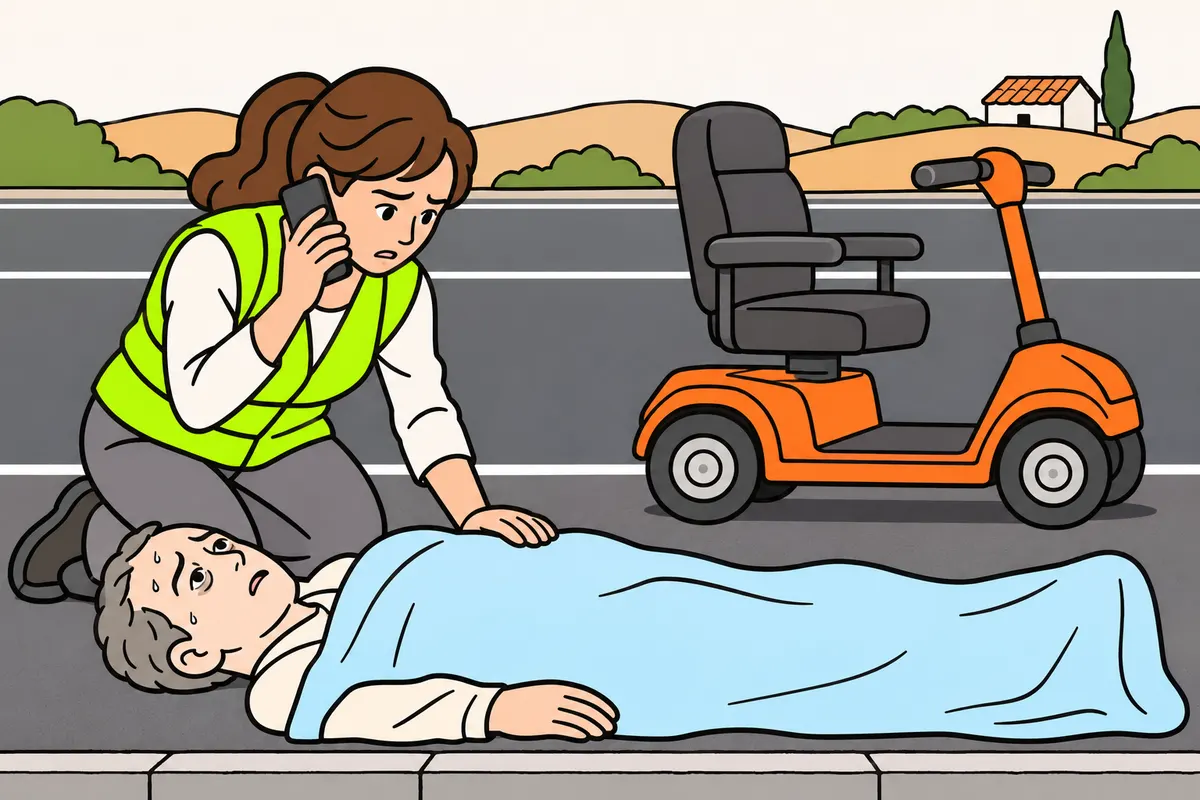
You must suspect internal bleeding even when you see little blood.
Remember
- Report paleness, cold sweat, weakness or loss of consciousness after an impact.
- Monitor and protect from cold as explained in “Giving assistance without causing further injuries”.
- Avoid movement and follow medical staff’s instructions.
- Do not automatically raise a road casualty’s legs.
- If you suspect head or facial injury, do not plug bleeding ears or nose.
- Call 112 and monitor breathing and consciousness.
Exam trap: Wrong: plug a bleeding nose after a possible head or facial injury. Right: with that suspicion, do not plug ears or nose; report it and monitor the casualty.
Read the full explanation
- Internal bleeding can occur without an obvious external wound. After an impact, pale skin, cold sweats, weakness or a declining level of consciousness are warning signs that you must report. Do not rule out a serious injury because there is little blood visible on clothing or on the ground. [DGT, first aid 2026](https://sede.dgt.gob.es/export/sites/dgt/.galleries/permisos-de-conducir/certificacion-aptitud-profesores-formacion-vial/2026/MANUAL-IX-Primeros-auxilios.pdf).
- You must avoid moving the casualty and wait for assistance with them in the position indicated by medical staff; do not automatically raise a road casualty's legs, as they may have injuries that make this movement inadvisable. For protection from the cold and giving drinks, apply what is explained in «Giving assistance without causing further injuries».
- If you suspect a head or facial injury and see blood coming from an ear or the nose, you must not plug these openings or insert objects to clean them: this may be internal bleeding that is escaping through a body opening. Avoid moving the head, report the bleeding to 112 and monitor breathing and consciousness. [DGT, first aid 2026, traumatic brain injury, p. 109](https://sede.dgt.gob.es/export/sites/dgt/.galleries/permisos-de-conducir/certificacion-aptitud-profesores-formacion-vial/2026/MANUAL-IX-Primeros-auxilios.pdf#page=109).
- For example, a person may be able to talk at first and become progressively confused after a collision. You must explain this change and not simply put it down to fright. Monitoring while you wait is part of giving assistance: the initial assessment is not definitive.
18Burns and clothing on fire
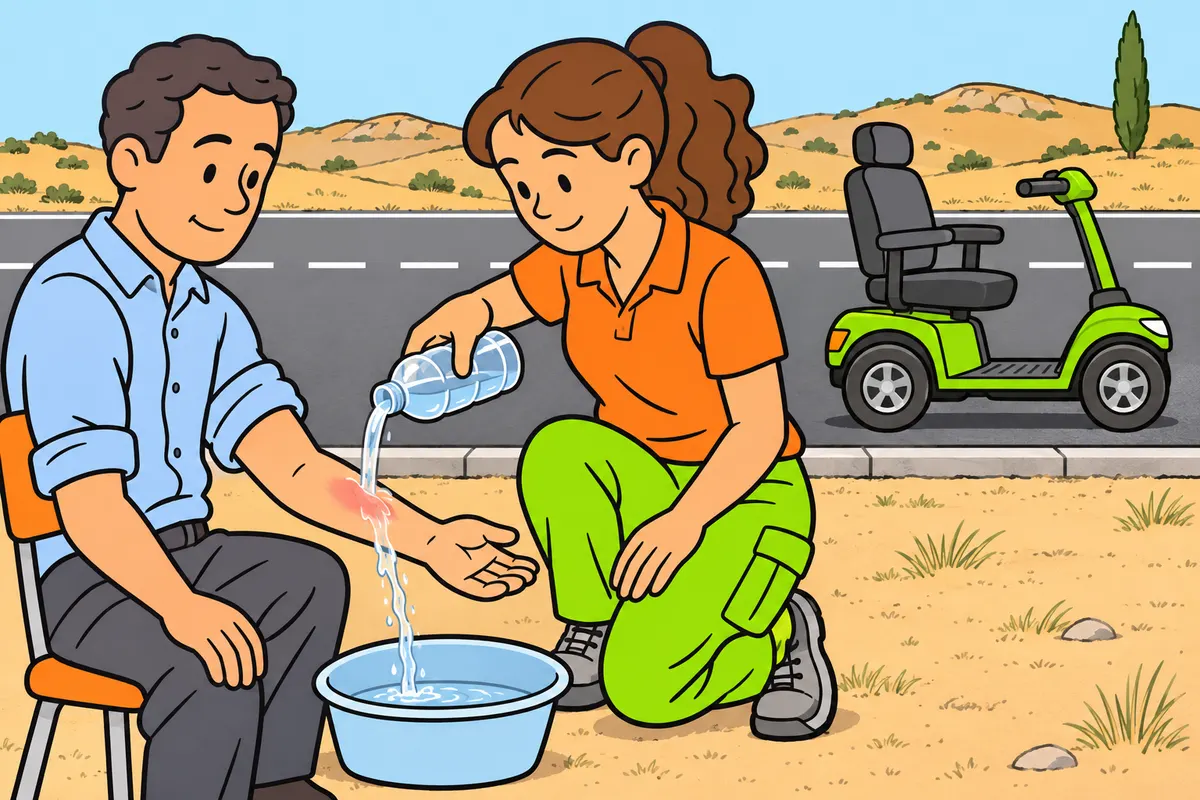
You must cool thermal burns without pulling off stuck clothing or applying home remedies.
Remember
- If their clothing burns, prevent running and help without risking your safety.
- Cool a thermal burn with cool water if possible.
- Avoid cooling the whole body.
- Do not use ice, oils, ointments or toothpaste.
- Cover loosely with clean material; do not burst blisters.
- Call 112 for breathing difficulties, voice changes or worsening condition.
Exam trap: Wrong: pull clothing stuck to a burn away. Right: leave it attached and do not touch the burnt surface.
Read the full explanation
- If someone's clothing is on fire, you must help put out the flames without exposing yourself to the fire. Stop them from running; follow the instructions from 112 and use suitable means if you can do so safely. Do not aim a fire extinguisher indiscriminately at their face or delay calling for help while you look for equipment.
- For a thermal burn, you must cool the area with cool water whenever possible, while avoiding cooling the whole body. Do not use ice or remedies such as oils, toothpaste or ointments. Then protect the area with clean material without applying pressure. [DGT, first aid 2026](https://sede.dgt.gob.es/export/sites/dgt/.galleries/permisos-de-conducir/certificacion-aptitud-profesores-formacion-vial/2026/MANUAL-IX-Primeros-auxilios.pdf).
- Do not pull off clothing stuck to the skin or burst blisters. Avoid touching the burned surface. You cannot judge an injury's depth by its appearance alone; report its approximate extent and whether it affects the face, hands or other sensitive areas.
- Smoke exposure and facial burns may be accompanied by breathing problems. If the casualty has difficulty breathing, their voice changes or their condition worsens, inform 112 immediately. Do not send them back to the vehicle to retrieve documents, and do not assume that being away from the flames removes the need for assistance.
19Fractures and protecting the spine
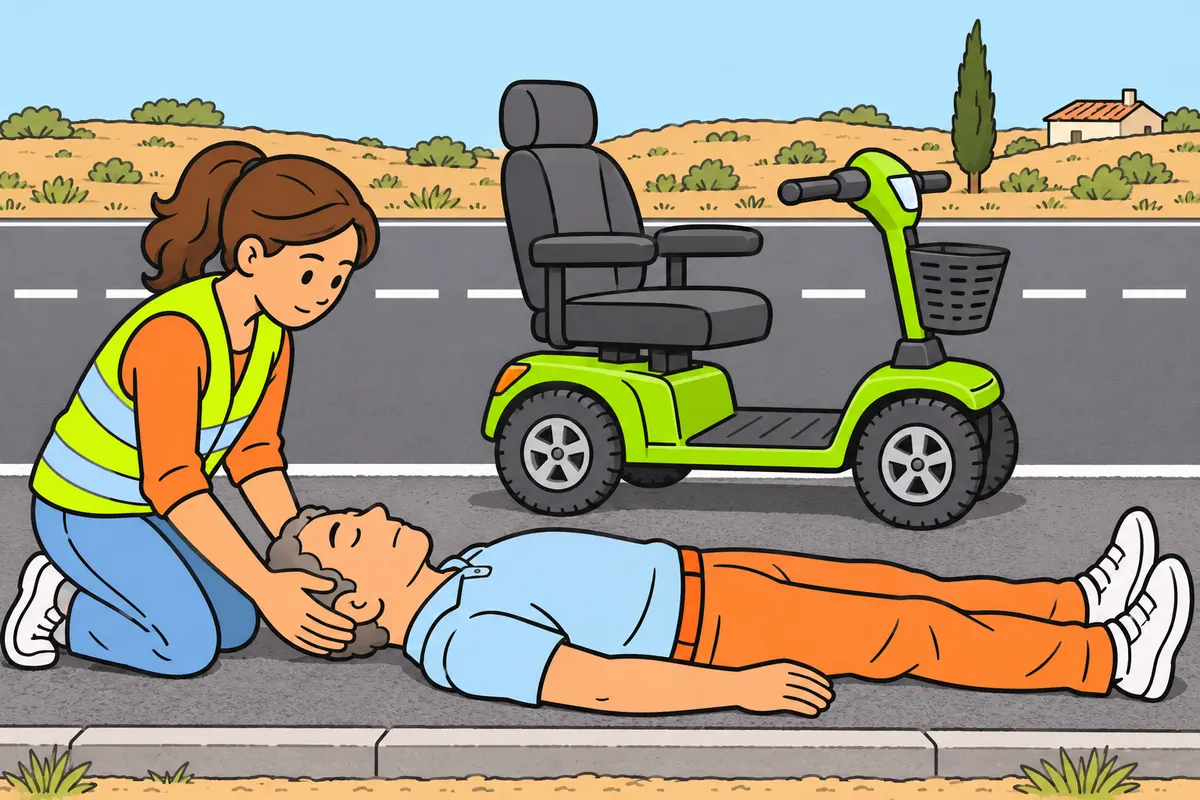
You must prevent movement and protect injuries without trying to reposition bones.
Remember
- Do not make casualties walk or force movement to check an injury.
- Do not straighten deformed limbs or push exposed bone back in.
- Protect wounds with clean material.
- Protect the head, neck and back; do not pull their arms.
- Report any loss of strength or sensation.
- Explain previous limitations without ruling out new injuries.
Exam trap: Wrong: reposition a bone to help. Right: avoid moving the area and protect the wound without pushing bone back in.
Read the full explanation
- You must suspect a fracture if there is pain, deformity, swelling or difficulty moving an area after an impact. Do not ask the casualty to walk or force a movement to check. A fracture can occur alongside other injuries and significant bleeding even if the skin remains intact. [DGT, first aid 2026](https://sede.dgt.gob.es/export/sites/dgt/.galleries/permisos-de-conducir/certificacion-aptitud-profesores-formacion-vial/2026/MANUAL-IX-Primeros-auxilios.pdf).
- You must prevent movement of the injured area and must not try to put a bone back into place or straighten a deformed limb. If there is a wound, cover it with clean material without pushing any exposed bone back in. An open fracture can have an opening to the outside even if you cannot see a bone protruding.
- After a collision, you must take particular care of the head, neck and back. Do not pull the person out by the arms or lift them by the armpits for convenience. If they report a loss of sensation or strength, pass this information on without making them repeat movements.
- If the person uses prostheses, supports or adaptations, explain to the medical staff how they use them and what limitations they already had. Do not dismantle these items unnecessarily or use a known limitation to rule out a new injury. Ask the conscious person before doing anything to their personal aids.
20Helmets and exceptional movement of casualties
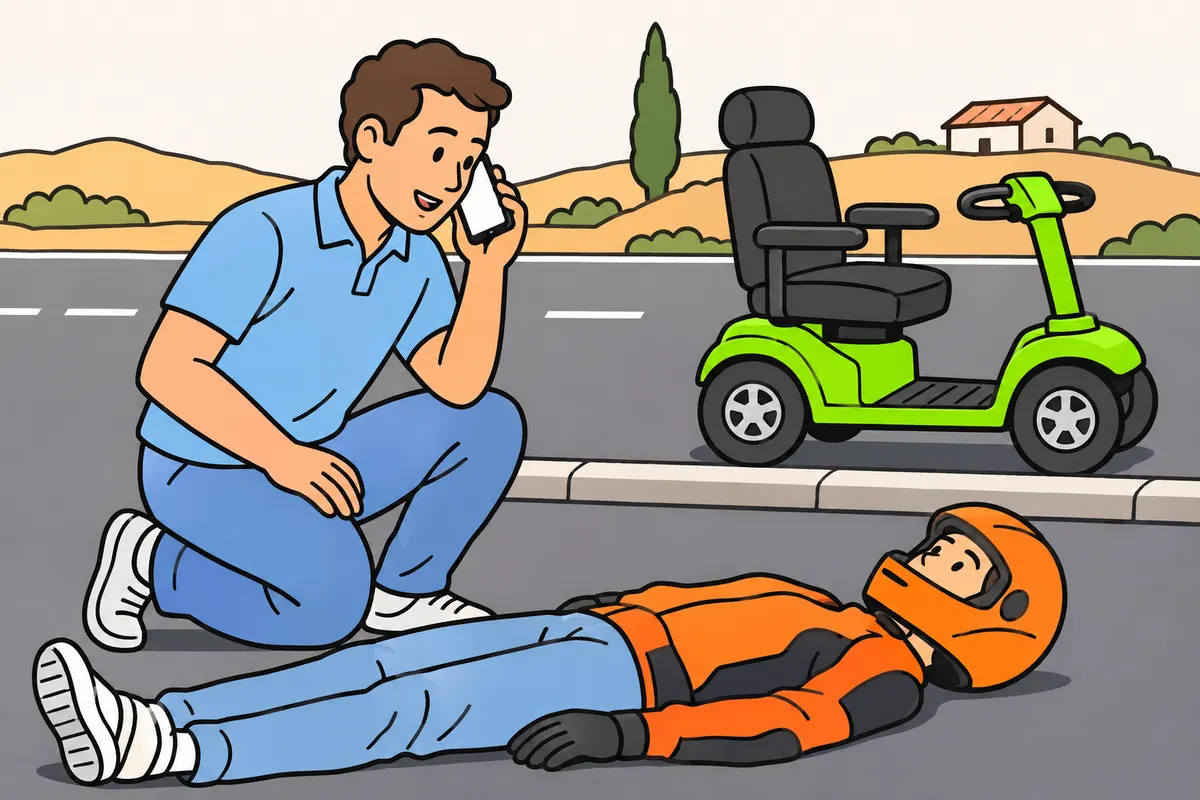
You must leave helmets on and avoid moving casualties unless essential to protect life.
Remember
- Do not remove a helmet routinely or for comfort.
- If it prevents breathing care or resuscitation, ask 112 for instructions.
- Let trained people act if present.
- Move casualties only for immediate danger or essential life-saving action.
- If extraction is essential, seek help and minimise head, neck and trunk movement.
- Do not force a trapped person free.
Exam trap: Wrong: you must never remove a helmet. Right: removal may be necessary if it prevents breathing care or resuscitation; seek instructions and trained help.
Read the full explanation
- If you find an injured motorcyclist or cyclist wearing a helmet, you must leave it on as a general rule. Removing it to make them comfortable can move their neck and worsen an injury. Speak to the person and prevent other witnesses from removing it without necessity or the knowledge to do so.
- You may need to remove the helmet if it prevents you from attending to breathing or performing resuscitation. This is an exception based on necessity, not a routine procedure: ask 112 for instructions and let trained people act if they are present. Do not delay a life-saving action by interpreting the rule as absolute. [DGT, first aid 2026](https://sede.dgt.gob.es/export/sites/dgt/.galleries/permisos-de-conducir/certificacion-aptitud-profesores-formacion-vial/2026/MANUAL-IX-Primeros-auxilios.pdf).
- You must only move a casualty when it is essential to remove them from immediate danger or to carry out a life-saving action. A fire is different from the discomfort of remaining seated. If you need to get them out, seek help and follow the operator’s instructions to minimise movement of the head, neck and torso.
- Do not try to force someone free if they are trapped between deformed vehicle parts. Report that they are trapped and the dangers around them. If you are the person who cannot get out of your LCM vehicle, explain whether this is due to the bodywork, an injury or your usual mobility limitations so that rescuers can prepare.
21Fire in your LCM vehicle
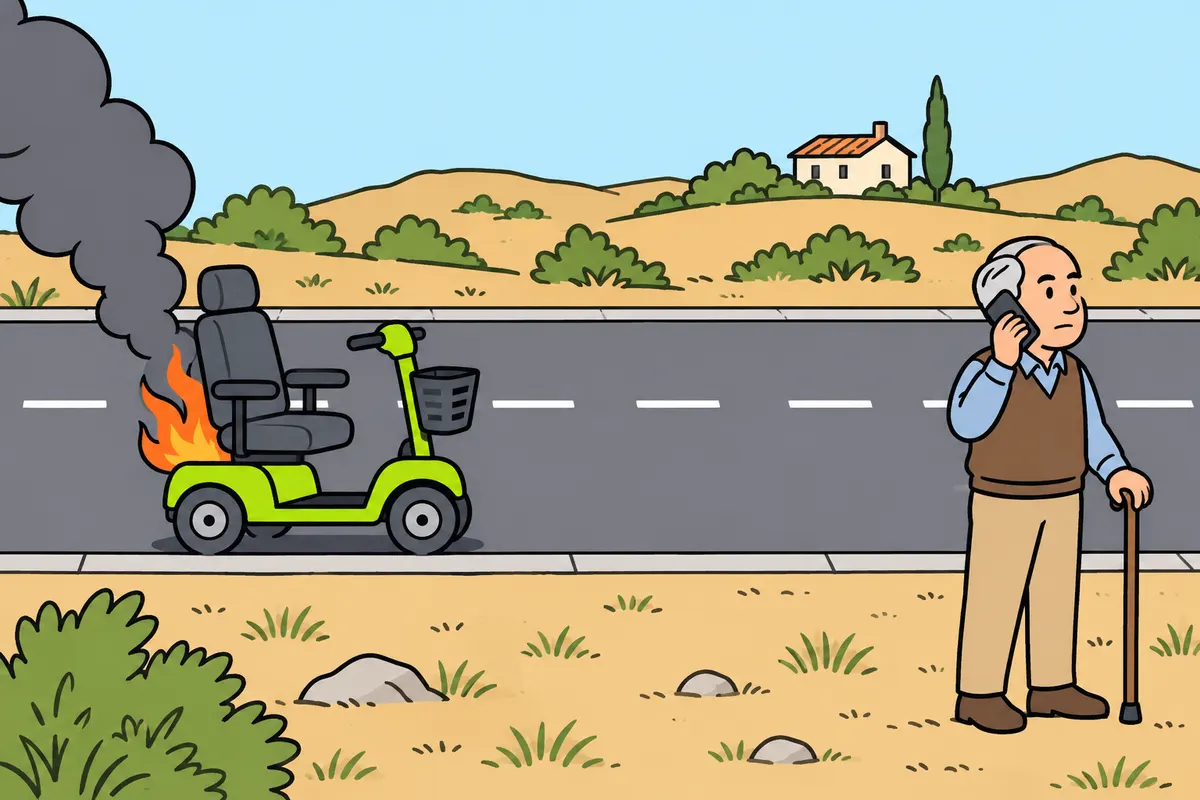
With smoke or fire, you must protect people and request urgent help.
Remember
- Stop safely and switch off propulsion if you can.
- Call 112 and say who cannot get out.
- Move away from fire and smoke; do not return for belongings.
- Help others out only if you can do so without risking your safety.
- Do not fully open a burning compartment.
- Report electric power or fuel spills; do not handle damaged batteries.
Exam trap: Wrong: try to put out every fire. Right: attempt this only while it is starting, with suitable equipment, knowledge and a clear escape route; retreat if it grows or smoke is heavy.
Read the full explanation
- If you notice smoke, a strong burning smell or flames, you must stop safely, switch off the propulsion system if you can and alert 112. Say whether anyone is unable to get out. Do not spend time checking the cause while smoke reaches the occupied area.
- You must move away from the fire and smoke and help the occupants only if you can do so without putting yourself at risk. Do not go back for luggage or documents. Assistance must prioritise people; damage to a vehicle does not justify risking a life to try to save it.
- If the fire is in its early stages, you must only try to control it with suitable equipment, a clear escape route and sufficient knowledge. If it grows or there is heavy smoke, move away and wait for the fire service. Do not fully open a burning compartment to inspect it: you can help the fire spread and put yourself at risk. [DGT, what to do in tunnels](https://www.dgt.es/muevete-con-seguridad/conviertete-en-un-buen-conductor/consejos-generales/consejos-tuneles/index.html).
- If your vehicle is electric, report this; if it uses fuel and you see a spill, report that too. Do not handle connections, damaged batteries or unknown liquids. Follow the emergency services’ instructions and the manufacturer’s safety guidance rather than applying the same fire-extinguishing procedure to every model.
22Breakdown in a tunnel or underpass
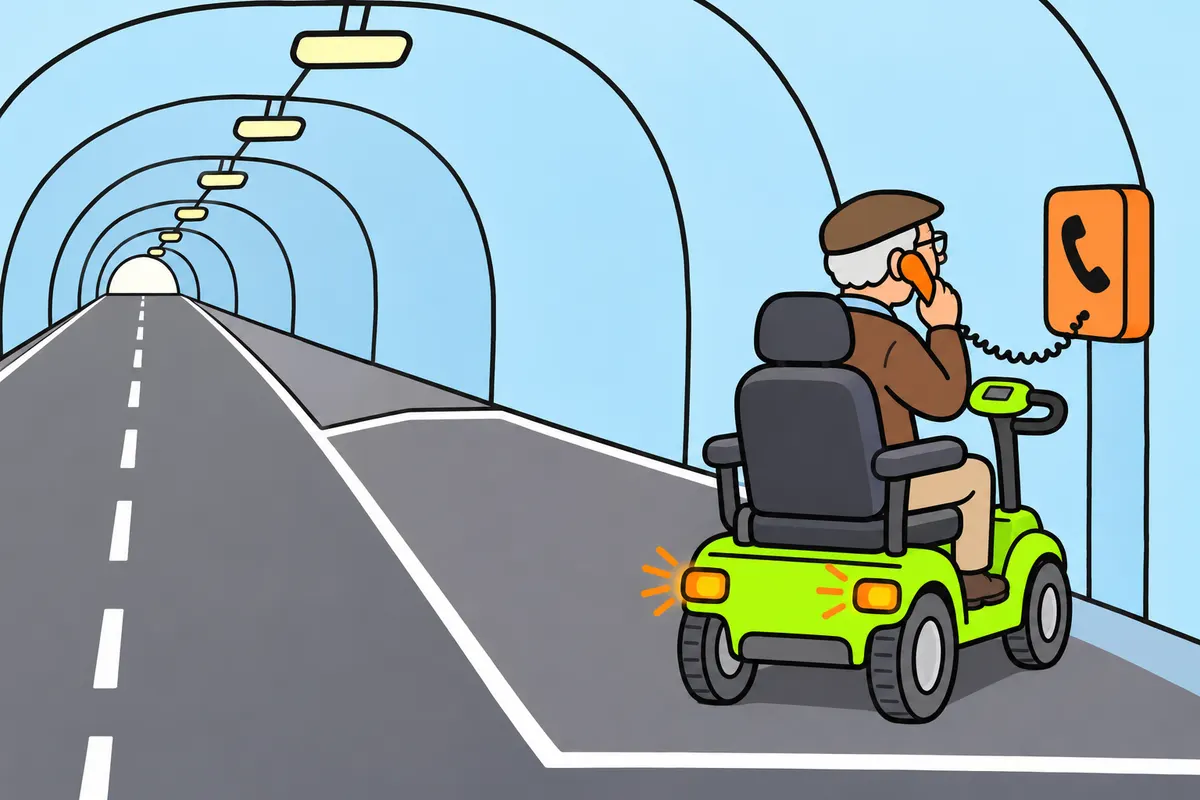
In a tunnel, you must distinguish a breakdown from a traffic queue.
| Situation in the tunnel | What you must do |
|---|---|
| Immobilised by an emergency | Head for the nearest refuge or exit, using areas closed to traffic where available |
| Traffic queue | Stay inside; switch off the engine, keep position lights on and use hazards temporarily |
Remember
- Leave or reach an emergency area only if you can drive safely.
- When immobilised, switch off the engine; use hazard warning lights and position lights.
- Move towards the right or an emergency area if possible.
- Request help using the SOS emergency telephone; explain any difficulties evacuating.
- In a traffic queue, stop as far as possible from the vehicle ahead.
- In emergencies, reach shelter using areas closed to traffic where available.
Exam trap: Wrong: evacuate for a simple traffic queue. Right: stay inside, switch off the engine, keep position lights on and use hazard warning lights temporarily.
Read the full explanation
- If a breakdown allows you to drive safely, you must continue to the exit of the tunnel or underpass; if you cannot reach it, continue to an area reserved for emergencies. If you are immobilised by an emergency, you must switch off the engine, switch on the hazard warning lights and keep the position lights on. [RGC, art. 97.3](https://www.boe.es/buscar/act.php?id=BOE-A-2003-23514#a97).
- If you can, you must move the vehicle to the nearest emergency area in your direction of travel; if there is none, as close as possible to the right-hand edge. Use the V-16 in accordance with the section “Connected V-16: distinctions you must understand” and request help without delay using the nearest SOS emergency telephone, if there is one, following its instructions. [RGC, art. 97.3](https://www.boe.es/buscar/act.php?id=BOE-A-2003-23514#a97).
- When you are immobilised by an emergency in this way, you and the other occupants must leave the vehicle and head for the nearest refuge or exit, using areas closed to traffic where available. Follow the signs and public address announcements; if you need help to evacuate, say so using the SOS emergency telephone or by calling 112. [RGC, art. 97.3](https://www.boe.es/buscar/act.php?id=BOE-A-2003-23514#a97).
- If you are immobilised by a traffic queue inside a tunnel or underpass, you and your passengers must remain inside the vehicle. You must switch off the engine, keep the position lights on and temporarily switch on the hazard warning lights to warn those approaching from behind. Stop as far as possible from the vehicle ahead. [RGC, art. 97.3](https://www.boe.es/buscar/act.php?id=BOE-A-2003-23514#a97).
23Fire inside a tunnel
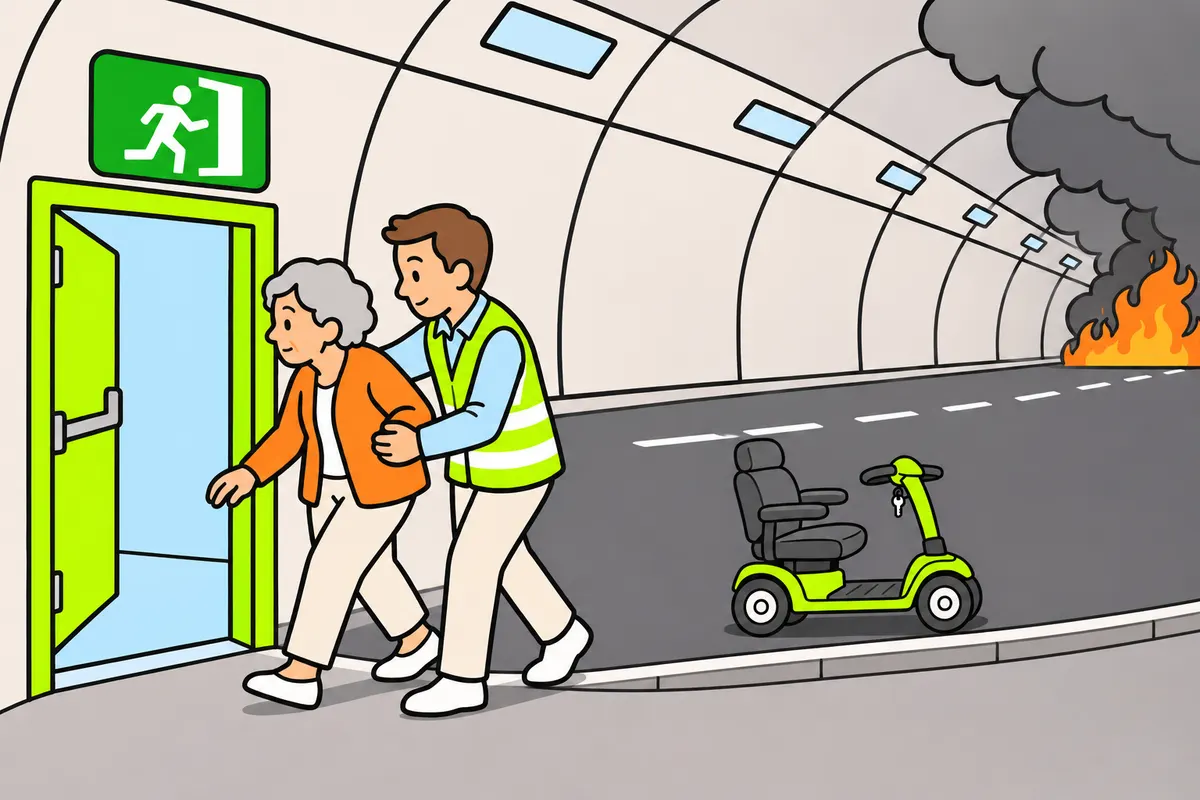
You must help rescuers reach the scene and evacuate away from the fire.
Remember
- Move as far right as possible to help rescuers reach you.
- Switch off the engine; leave the key in and doors open.
- Head for the nearest refuge or exit, away from the fire.
- Use areas closed to traffic where available and follow instructions.
- Do not cross smoke to find your vehicle or turn back.
- Need help evacuating? Use the SOS emergency telephone or call 112 immediately.
Exam trap: Wrong: wait inside during a fire as in a queue. Right: leave towards a refuge or exit, away from the fire; request help if needed.
Read the full explanation
- In the event of a fire, you must pull as far to the right as possible to allow emergency services to enter, switch off the engine and leave the key in the ignition and the doors open. You must leave the vehicle and head for the nearest refuge or exit in the opposite direction to the fire. [RGC, art. 97](https://www.boe.es/buscar/act.php?id=BOE-A-2003-23514#a97).
- Use areas closed to vehicle traffic where available and follow the instructions of the tunnel services. Do not cross a smoke-filled area to look for the vehicle or attempt a U-turn that could block rescue operations. Reaching safety takes priority over your belongings.
- If you need help to evacuate, you must report this immediately using the SOS emergency telephone or by calling 112, specifying the location and how many people cannot move. Do not assume that staff know your needs from seeing an LCM vehicle; explain whether you need help transferring out of the vehicle, assistance with walking or rescue from entrapment.
- When someone helps you, explain how you can assist and which movements are impossible or dangerous for you. Avoid an improvised manoeuvre that causes a fall onto the carriageway. Follow rescue instructions and maintain communication while there is immediate danger.
24Details, remaining at the scene and medical transport
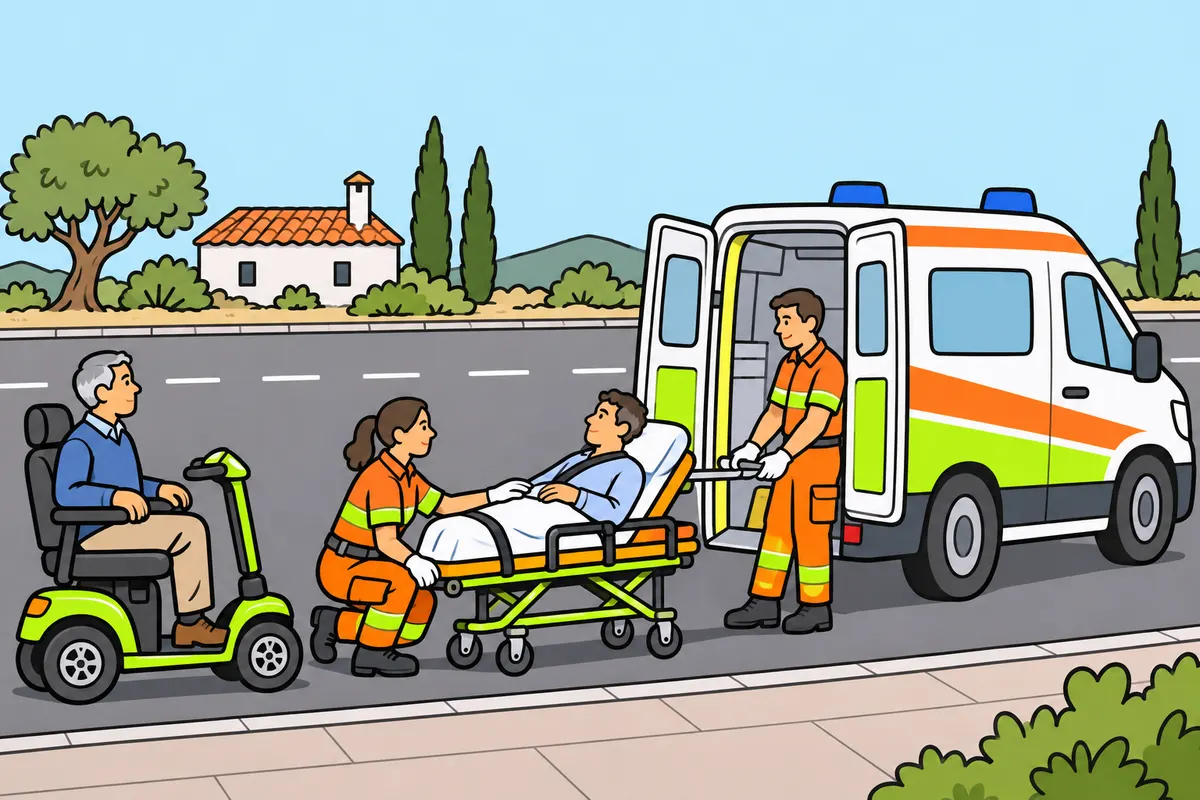
You must give details, stay when required and leave medical transport to professionals.
| Case | Your duty |
|---|---|
| Only property damage caused by you; affected person absent | Send your name and address promptly, directly or through the police |
| Apparent injuries or deaths | Notify authorities and stay or return, unless authorised, giving essential help or needing treatment |
| Clearly minor injuries | Exception only if safety is also restored and nobody involved requests official intervention |
| Deaths, serious injuries or authorities notified | Preserve traces and evidence unless this harms casualties or obstructs traffic |
Remember
- Give your identity and vehicle details to others involved who ask.
- If you caused damage and its owner is absent, send your name and address.
- With apparent injuries or deaths, notify authorities and stay or return until they arrive.
- You may leave with permission, for essential assistance or for your own treatment.
- Preserve evidence for deaths, serious injuries or notified authorities, unless casualties or traffic suffer.
- Leave transport to medical services; update 112 if they are delayed.
Exam trap: Wrong: leave because injuries seem minor. Right: the exception requires clearly minor injuries, restored safety and nobody involved requesting official intervention.
Read the full explanation
- You must give your identity and vehicle details to others involved who request them. If you cause only property damage and the affected person is absent, you must get your name and address to them as soon as possible, directly or through the police. The absence of injuries does not justify simply leaving. [RGC, art. 129](https://www.boe.es/buscar/act.php?id=BOE-A-2003-23514#a129).
- If anyone appears to be injured or dead, you must notify the authorities and remain at the scene or return until they arrive, unless you are authorised to leave, need to give assistance or need medical attention yourself. The exception requires injuries to be clearly minor, safety to be restored and no one involved to request intervention. If you have doubts about the severity, request help. [RGC, art. 129](https://www.boe.es/buscar/act.php?id=BOE-A-2003-23514#a129).
- You must preserve traces and evidence if anyone is dead or seriously injured, or if the authorities have been notified, unless doing so harms the injured or obstructs traffic. Do not alter the scene to argue about responsibility, but do not prevent essential protective measures merely to keep the vehicle’s position unchanged. [RGC, art. 129](https://www.boe.es/buscar/act.php?id=BOE-A-2003-23514#a129).
- As a general rule, you must leave transport to hospital to the medical services. Your LCM vehicle does not replace an ambulance or its immobilisation and monitoring equipment. If assistance is delayed, update 112; do not treat a waiting period as automatic authorisation to transport an injured person.
PAS at a collision
You coordinate protection, alerting and assistance according to your abilities.
- Observe the traffic, vehicles, smoke and casualties without putting yourself at risk.
- Stop safely, secure the vehicle and warn other road users using the means available.
- Call 112 and give the location, details of injuries and hazards, and any mobility or rescue needs.
- Follow the instructions, stay with the casualties and carry out only actions you know how to perform.
- Monitor any changes and give the professionals information about what happened.
Your LCM vehicle breaks down
You need a safe exit that you can use.
- Slow down and stop using the control you still have; do not continue with a dangerous fault.
- Secure the stationary vehicle and use the hazard warning lights and position lights when required.
- If you carry a connected V-16, activate it and place it where it is visible without putting yourself at risk.
- Assess whether you can leave on the side away from traffic and reach an accessible safe place.
- If you cannot get out safely, remain protected and explain your situation; request assistance and, in an emergency, call 112.
An unresponsive adult
Follow the instructions from 112 and do not mistake gasping for normal breathing.
- Shout for help and call 112 on speakerphone if you can.
- Check for normal breathing for no more than 10 seconds, following the instructions.
- If the person is not breathing normally, start compressions: 100-120 per minute and about 5 cm deep.
- If you know how to give rescue breaths and can do so, alternate 30 compressions with 2 rescue breaths; otherwise, continue with compressions.
- Use an available automated external defibrillator (AED) and continue following its instructions and those from 112 until someone takes over or you are told to stop.
Fire in a tunnel
Help the rescue and evacuate away from the fire.
- Move the vehicle to the right if you can do so safely.
- Switch off the engine and leave the key in the ignition and the doors open.
- Raise the alarm using an SOS emergency telephone or 112 and say if you need help to evacuate.
- Head for the nearest refuge or exit in the direction away from the fire, using areas closed to traffic where available.
- Follow the public address announcements and the instructions of the emergency services.
Finished this module?
Mark it as read and you will see your progress on the theory list.