
Theory · LCM Licence - Reduced Mobility Vehicle · Module 14 of 15
Drive safely and make yourself visible
You learn how to prepare your vehicle for people with reduced mobility, assess your fitness and stay attentive throughout your journey. You learn to adapt your speed and safety margins to the road surface, weather and visibility, with particular attention to helping other drivers see you in time and to common sources of confusion in the LCM test.
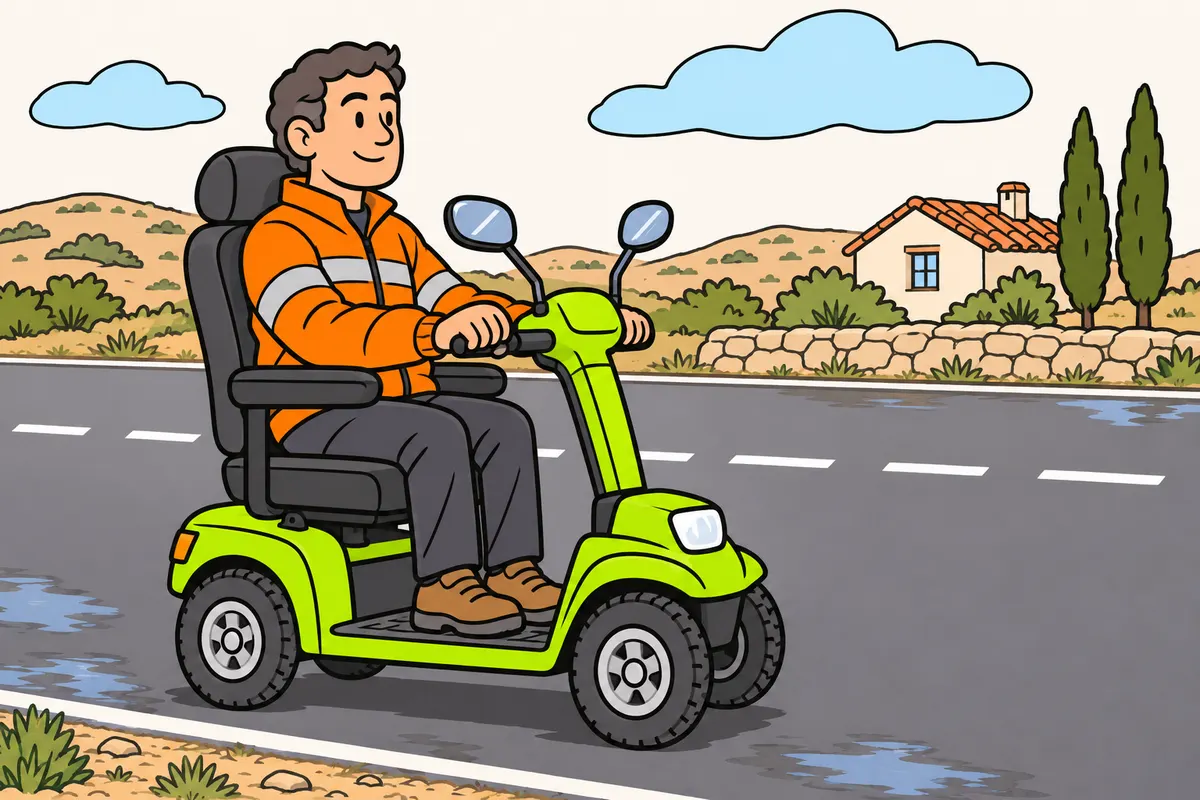
1Plan a safe journey
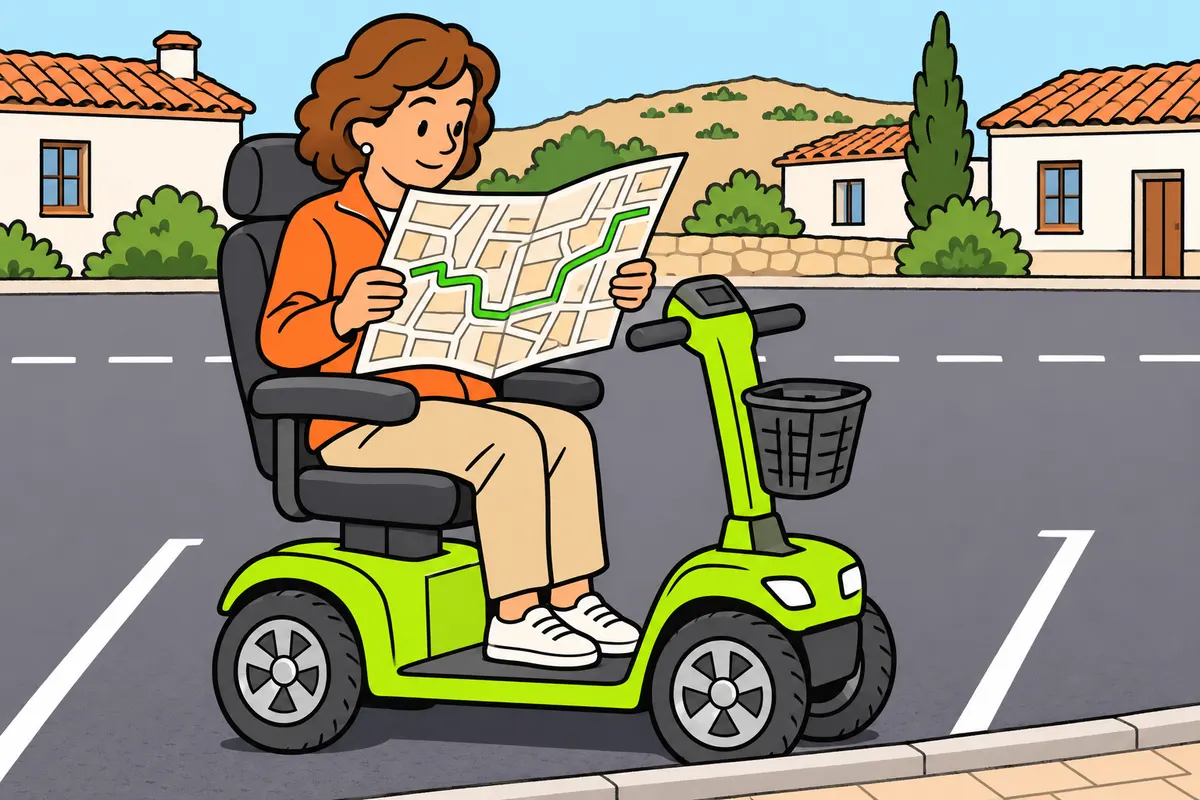
Plan a permitted route suited to your vehicle.
Remember
- Check slopes, junctions, traffic and places to rest.
- Check traffic and weather that could affect your route.
- Follow the adaptations and restrictions on your driving authorisation.
- Bring your prescribed aids or corrective lenses.
- Do not use autopistas (motorways) or autovías (dual carriageway motorways).
- Check the road edge and where you can wait before junctions.
Exam trap: Wrong: You always accept the fastest route. Right: Check that it is permitted for your vehicle and suits your needs.
Read the full explanation
- You must plan a route suited to the capabilities of your vehicle for people with reduced mobility. Consider gradients, difficult junctions, traffic, range and places where you can rest or interrupt your journey. Even a familiar route can have roadworks, obstacles or weather conditions that differ from what you remember.
- Before setting off, check traffic incidents and the weather forecast if they may affect your route. In a slow vehicle, it is advisable to avoid situations that leave you exposed to heavy traffic or poor visibility for a long time. Planning an alternative allows you to decide without improvising under pressure. [DGT, traffic recommendations](https://www.dgt.es/conoce-el-estado-del-trafico/recomendaciones-de-trafico).
- You must comply with the adaptations, restrictions and limitations stated on your driving authorisation, including when you drive under another licence that entitles you to drive this vehicle. Check that you have any prescribed corrective devices or aids with you and that you can use the specified controls. [RGCond, art. 3](https://www.boe.es/buscar/act.php?id=BOE-A-2009-9481#a3).
- Choose a permitted route: vehicles for people with reduced mobility are prohibited from using autopistas (motorways) and autovías (dual carriageway motorways). This prohibition also matters when you set up a sat nav; simply accepting the fastest route is not enough. Road use is covered in «Where you must drive». [RGC, art. 38](https://www.boe.es/buscar/act.php?id=BOE-A-2003-23514#a38).
- When comparing routes, consider the condition of the road edge and whether you can wait before junctions. A shorter street may force you to deal with cross slopes, access points with poor visibility or a series of narrow sections. Choose according to your model's capabilities and dimensions, allowing time to deal with each difficulty without accepting gaps because of pressure from drivers behind you.
2Check your vehicle before moving off
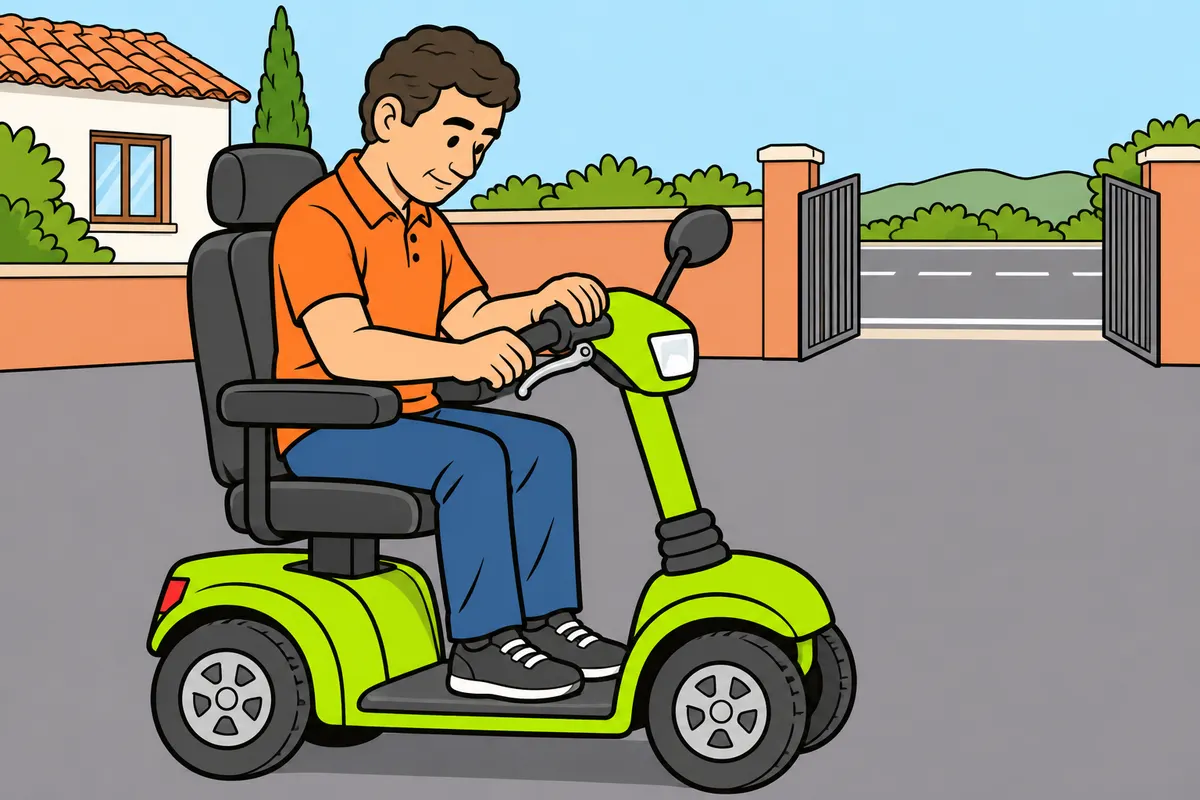
Check that you can control and stop your vehicle before setting off.
Remember
- Check brakes, steering and adapted controls.
- Check tyres and the pressure specified for your model.
- Check lights, indicators and mirrors.
- Check wipers and demisting equipment if fitted.
- Allow enough energy for your journey and a reserve.
- Fix significant faults before moving off.
Exam trap: Wrong: You set off with faulty brakes for a short journey. Right: Fix the fault before departure.
Read the full explanation
- Check the brakes, steering and adapted controls following the manufacturer's manual. Carry out functional checks in safe conditions before joining traffic. Check that you can accelerate, steer and stop the vehicle smoothly, without effort or movements that make you lose stability.
- Inspect the tyres and check the pressure specified by the manufacturer for the conditions of use. Look for visible damage or abnormalities and pay attention to the vehicle's warnings. You do not need to memorise a universal pressure: you must know the pressure for your model, without automatically using the pressure for a passenger car.
- Include the lights, signalling equipment, mirrors and, where fitted, windscreen wipers and demisting system in your checks. Check that you have enough energy to complete the route with a reserve. Simply inspecting the bodywork or putting the documents in place does not replace checking the components that allow you to see, control the vehicle and stop.
- If you find a serious fault in the brakes, steering or adaptations, do not set off until you resolve it. You need to investigate the cause of abnormal noises and vibrations; increasing speed does not correct them. Your duty to remain in control also applies at low speeds and on short journeys. [RGC, art. 17](https://www.boe.es/buscar/act.php?id=BOE-A-2003-23514#a17).
3Set up your driving position and controls
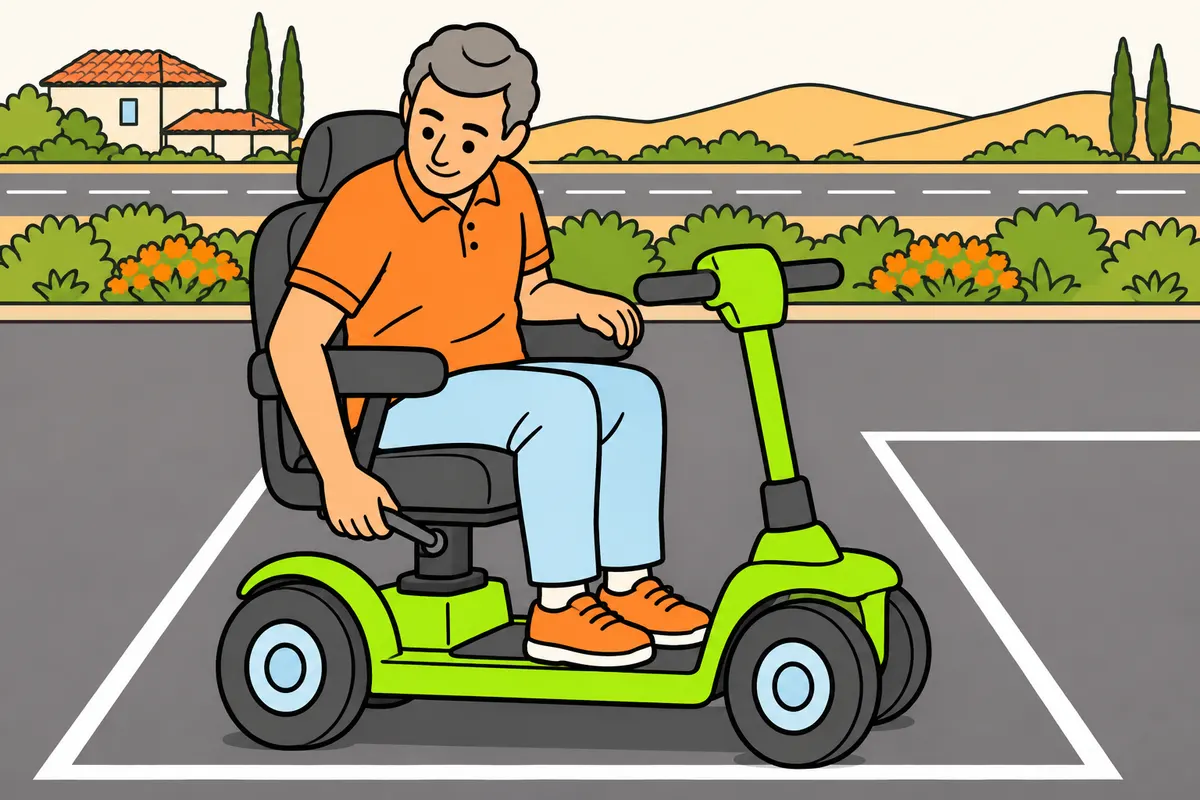
Adjust your posture and keep controls clear before driving.
Remember
- Adjust your seat and supports before setting off.
- Check you can reach controls without losing stability.
- Move bags and clothing that could catch on controls.
- Do not improvise adaptations or disable restrictions.
- If your posture slips, stop somewhere safe and permitted before adjusting it.
Exam trap: Wrong: You adjust your seat while moving. Right: Stop somewhere safe and permitted and secure your vehicle.
Read the full explanation
- You must adjust the seat, supports and adjustable components before driving. You need a stable position from which you can reach the controls without overstretching or moving your body dangerously. Check the range of movement of the adapted controls in the posture you actually use when driving.
- Maintain freedom of movement and an adequate field of vision. A bag beside the brake control or an item of clothing that catches can prevent a quick response. You must position objects and, where authorised, occupants so that they do not interfere with your driving. [RGC, art. 18](https://www.boe.es/buscar/act.php?id=BOE-A-2003-23514#a18).
- Keep adaptations in good condition and use each one for its intended purpose. Do not improvise devices to compensate for a faulty control or disable a limitation to gain speed. If your control needs change, seek an assessment and a suitable technical solution before continuing to use an unsafe configuration.
- If you lose your driving posture during the journey, do not try to readjust several components while moving. Find a safe place where you are allowed to stop, immobilise the vehicle and correct the cause. Driving smoothly helps you maintain bodily stability, but it does not replace a properly prepared seat, support or adaptation.
4Ensure a clear view from your driving position
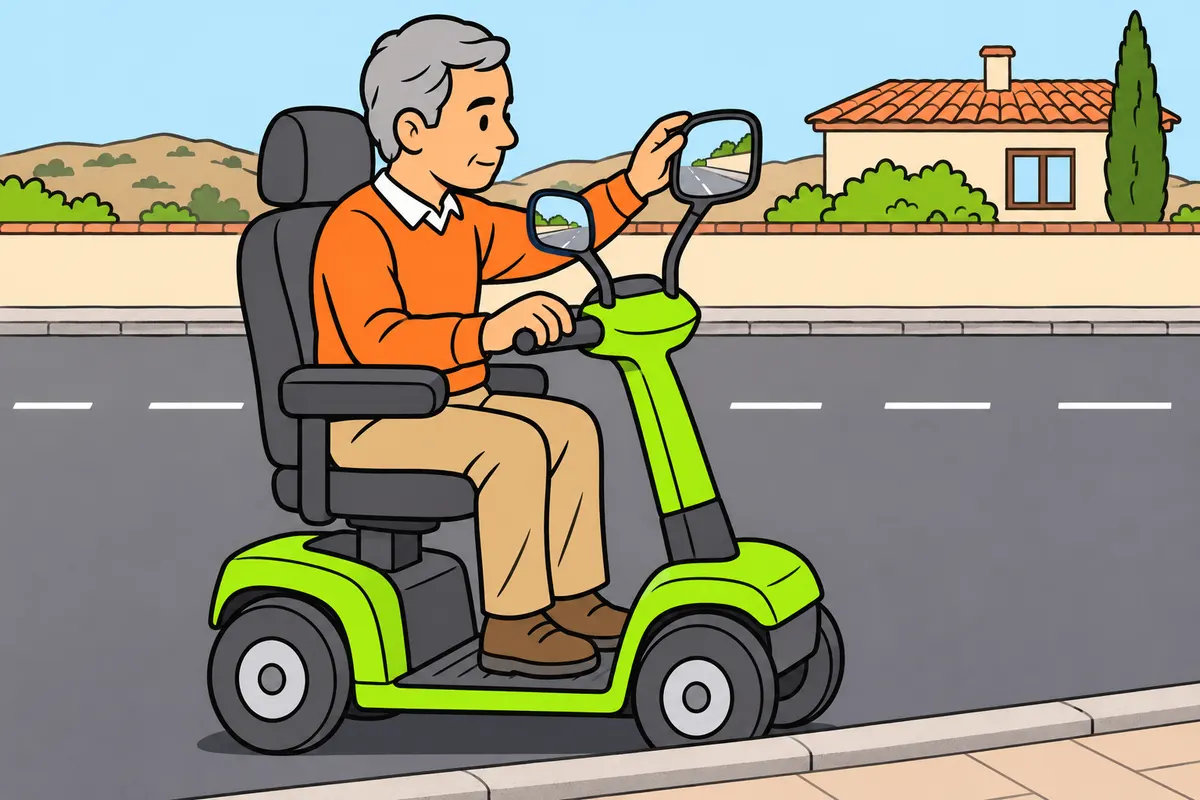
Adjust your mirrors and remove anything blocking your view.
Remember
- Adjust mirrors from your driving position.
- Clean windows, mirrors and lights.
- If you have a windscreen, clear ice, dirt and mist.
- Move objects that block your view.
- Check blind spots before changing course.
- Keep watching ahead while checking your surroundings.
Exam trap: Wrong: You rely only on mirrors. Right: Check blind spots and what hides the road from your actual driving position. If you move forward to see, keep room to stop before interfering with other road users.
Read the full explanation
- Adjust the mirrors after adopting your driving posture. They must give you useful information about the area behind and beside you without forcing you to let go of the controls. A poorly adjusted mirror hinders observation even in good light and even if you know the street perfectly.
- Keep windows, mirrors and lights clean. If your vehicle has a windscreen, remove dirt, ice and misting that prevent you from seeing; do not settle for a small clear area. Your view through the windows must be free of obstructions that hide the road. [RGC, art. 19](https://www.boe.es/buscar/act.php?id=BOE-A-2003-23514#a19).
- Do not let luggage, accessories or hanging objects block an important part of your view. Also check that you can see when turning or looking to one side. A configuration that is comfortable when stationary may hide pedestrians or vehicles from you as you reach a junction.
- Mirrors do not eliminate all blind spots. Before changing course, check the area your manoeuvre may affect, using observation methods suited to your vehicle and your range of movement. Do this without leaving the area ahead unobserved for too long.
- From your actual driving height, check what parked cars, waste containers and vegetation hide from view. An area visible from a higher position may be hidden from your seat. At junctions, look for a position from which you can observe while keeping a safe space to wait; if you need to move forwards to see, do so in a way that allows you to stop before interfering with other road users.
5Restraints, occupants and objects
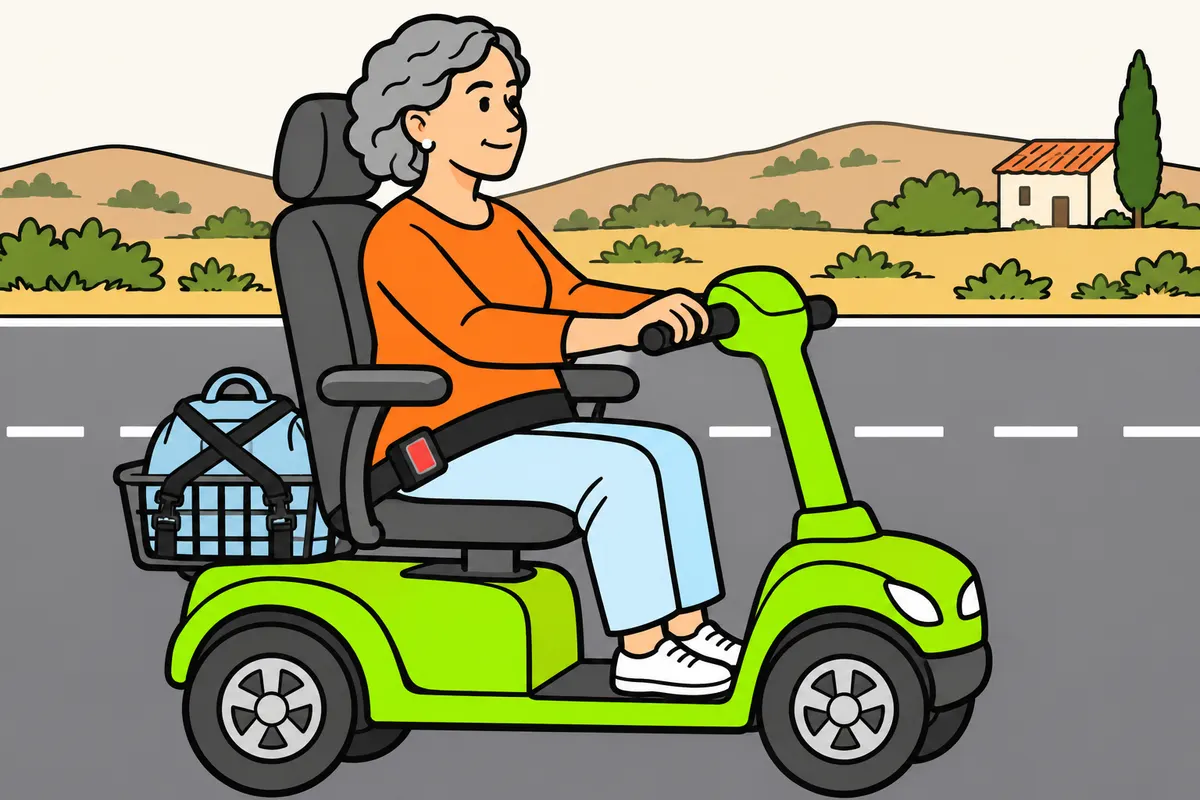
Use the required protection and secure your belongings.
| Case: minor passenger 135 cm or less in your LCM vehicle | What you must do |
|---|---|
| Authorised passenger seat | Use an approved child restraint suited to their height and weight. |
| General rule | Place the child in a rear seat. |
| No rear seats | You may place the child in front. |
| All rear seats occupied by children subject to this same obligation | You may place the child in front. |
| Impossible to install all necessary child restraints in the rear | You may place the child in front. |
| Rear-facing child seat in front | Deactivate the frontal airbag for that seat, if fitted. |
| Installing the child seat | Check compatibility and follow the manufacturer’s instructions. |
Remember
- If approved seat belts are fitted, use them unless an exemption applies.
- Use them on urban and interurban roads.
- A medical or disability exemption requires the relevant certificate.
- Show that certificate if an officer asks.
- Secure objects without blocking controls or lights.
- Carry passengers only within authorised capacity and conditions.
Exam trap: Wrong: An authorised seat lets you carry a child without a child restraint. Right: If you carry a minor who is 135 cm or less, use an approved restraint suited to their height and weight. Check compatibility and follow the conditions for using a front seat.
Read the full explanation
- If your vehicle has approved seat belts, you must wear them correctly fastened on urban and interurban roads, unless an applicable exemption applies. This duty to use seat belts refers to those fitted to the vehicle. [RGC, art. 117.1](https://www.boe.es/buscar/act.php?id=BOE-A-2003-23514#a117).
- Having reduced mobility does not in itself exempt you from wearing a seat belt. Exemption on grounds of serious medical reasons or disability requires the relevant certificate, which you must present if an officer requests it. [RGC, art. 119](https://www.boe.es/buscar/act.php?id=BOE-A-2003-23514#a119).
- Place and secure objects in the spaces provided, preventing them from moving when you brake or turn. Distribute the weight according to the vehicle's instructions: concentrating it inappropriately can impair stability. No object must block a control or obscure lights or signalling equipment. [RGC, art. 18](https://www.boe.es/buscar/act.php?id=BOE-A-2003-23514#a18).
- Check the authorised seats and the conditions for carrying a passenger in «Seats and authorised passengers», in «Your vehicle: characteristics and maintenance», and the age requirements in «LCM licence, the test and obeying signs». Protection for a child passenger is explained in the next point of this section.
- If your LCM vehicle has an authorised passenger seat and you carry a minor who is 135 cm tall or less, you must use an approved child restraint system suitable for their height and weight. They must occupy a rear seat; they may sit in the front if there are no rear seats, if all rear seats are occupied by children subject to this same requirement or if it is impossible to install all the necessary systems in the rear. If you use a rear-facing child seat in the front, you must deactivate the frontal airbag for that seat, where fitted. Install the system following its manufacturer's instructions and check its compatibility with the vehicle; an authorised seat alone does not guarantee that you can install it. [RGC, arts. 117.1, 117.3 and 117.4](https://www.boe.es/buscar/act.php?id=BOE-A-2003-23514#a117).
6Accident factors and common causes
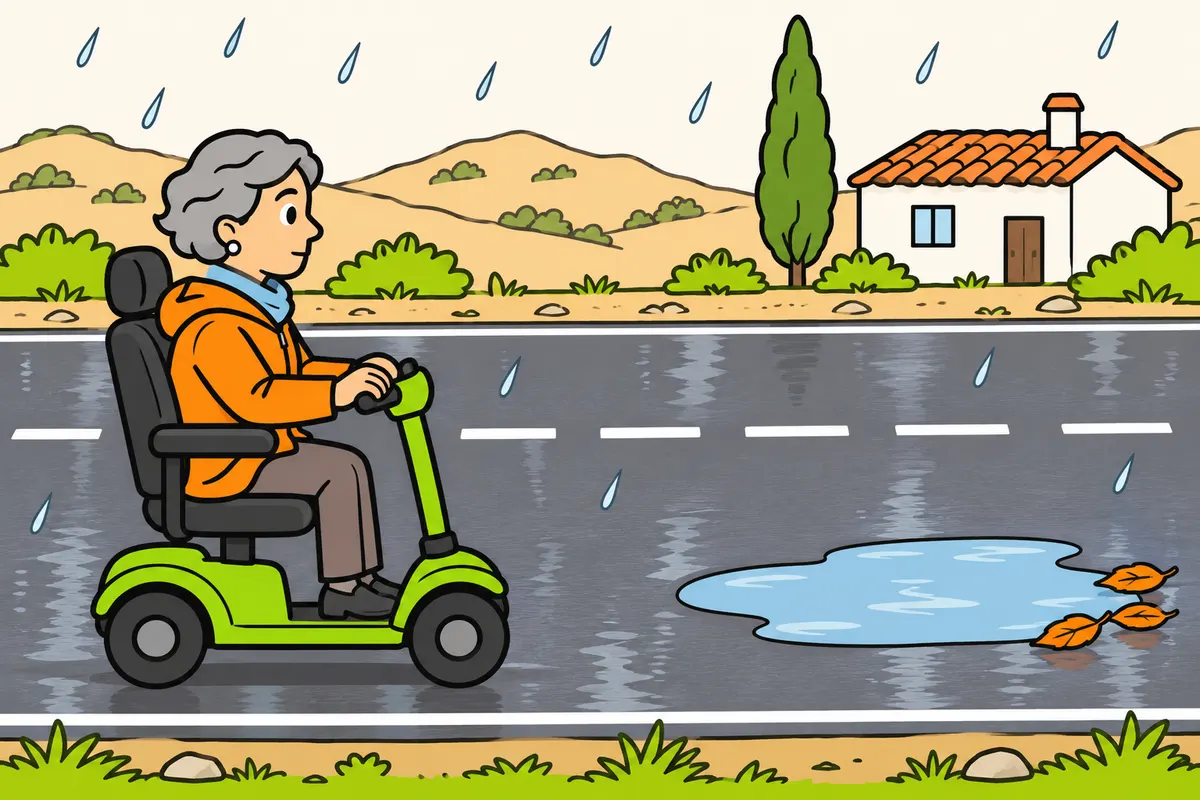
Consider yourself, your vehicle and the road together to prevent accidents.
Remember
- Stay attentive and adapt your speed.
- Avoid alcohol if you will drive.
- Check vehicle faults and difficult road surfaces.
- Assess whether you can brake or change course before an obstacle.
Exam trap: Wrong: You feel protected because you drive slowly. Right: Also prevent distraction, alcohol use and unsuitable speed.
Read the full explanation
- An accident can involve a combination of factors relating to the driver, the vehicle and the road or surroundings. In your LCM vehicle, a distraction, poor brakes and a wet road surface can have a combined effect: you must assess them together, even if each difficulty seems manageable on its own. [RGCond, annex V.B.1, 2.ª](https://www.boe.es/buscar/act.php?id=BOE-A-2009-9481).
- Distractions, inappropriate speed and alcohol are among the main contributing factors in fatal accidents. You can prevent them by staying attentive, adapting your driving and avoiding alcohol when you drive; driving a small, slow vehicle does not eliminate these risks. [DGT, contributing factors](https://www.dgt.es/comunicacion/notas-de-prensa/la-velocidad-sigue-siendo-uno-de-los-principales-factores-concurrentes-de-los-accidentes-de-trafico).
- The same obstacle may require different responses depending on your vehicle's configuration: a pothole near the edge can affect wheel support, and a narrow section can leave you without lateral clearance. Assess where your path leads if you need to brake or correct your course, as well as checking whether the vehicle fits through.
7Assess whether you are fit to drive
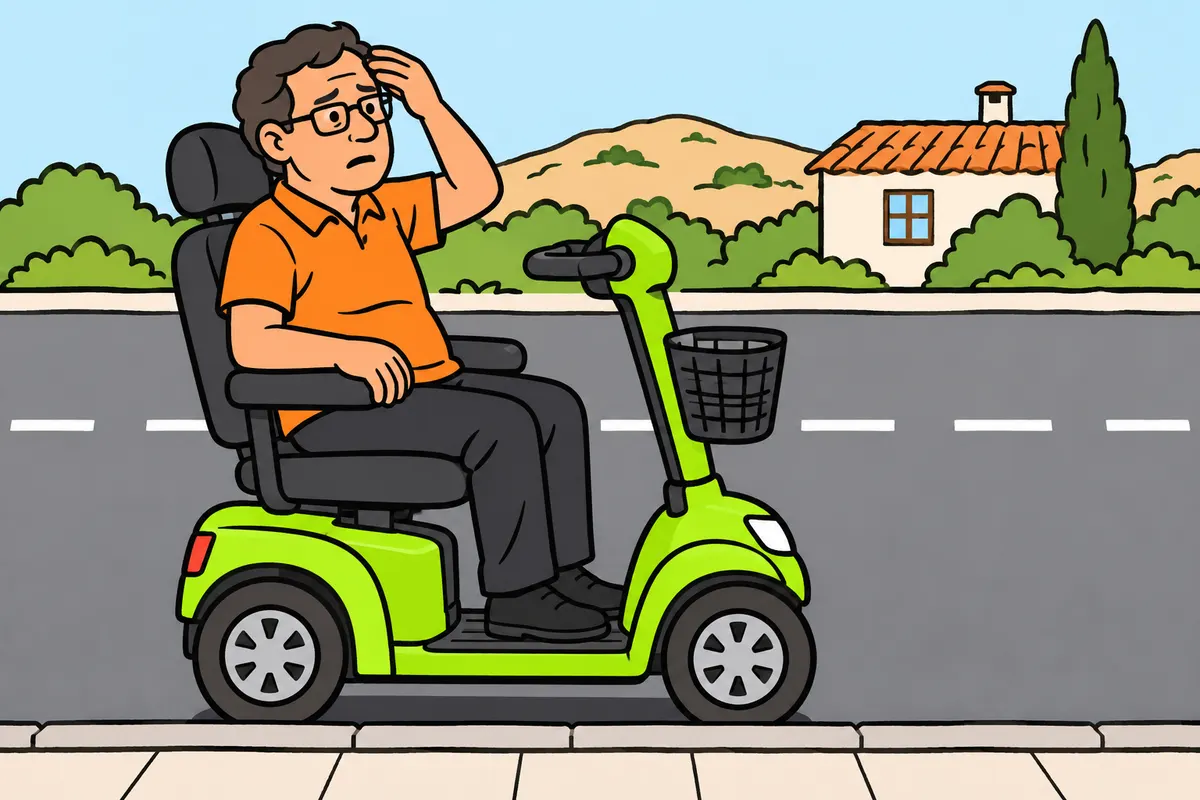
Drive only when you can observe, understand traffic and use controls safely.
Remember
- Check how you feel before setting off.
- Postpone your journey if you cannot drive safely.
- Seek advice if illness or treatment could affect you.
- Use corrective aids required by your driving authorisation.
- If you cannot drive safely, find somewhere safe to stop.
- Seek help if you do not regain the fitness needed.
Exam trap: Wrong: You speed up to get home when unwell. Right: Find somewhere safe to stop.
Read the full explanation
- Before setting off, check whether you are rested, alert and able to operate your vehicle. Dizziness, severe pain, weakness or impaired vision can prevent you from responding safely. If your condition prevents you from operating the controls or interpreting traffic, you must postpone your journey. [RGC, art. 17](https://www.boe.es/buscar/act.php?id=BOE-A-2003-23514#a17).
- An illness or a change in treatment can affect your ability even if your licence is valid. Consult a healthcare professional if you have any doubts about driving. Do not assume you can drive because your vehicle is small or because you only need to travel a few streets.
- Use the glasses, contact lenses or other corrective aids specified on your driving entitlement. If they are damaged or your vision with them is inadequate, stop your journey safely. Do not try to compensate for inadequate vision by moving closer to the vehicle ahead to follow its movements. [RGCond, art. 3](https://www.boe.es/buscar/act.php?id=BOE-A-2009-9481#a3).
- If your ability becomes impaired during your journey, make your driving less demanding and find a safe place to stop. Do not speed up to get home sooner. If you do not regain the fitness needed to drive, ask for help and use another means of transport.
8Recognise fatigue and rest
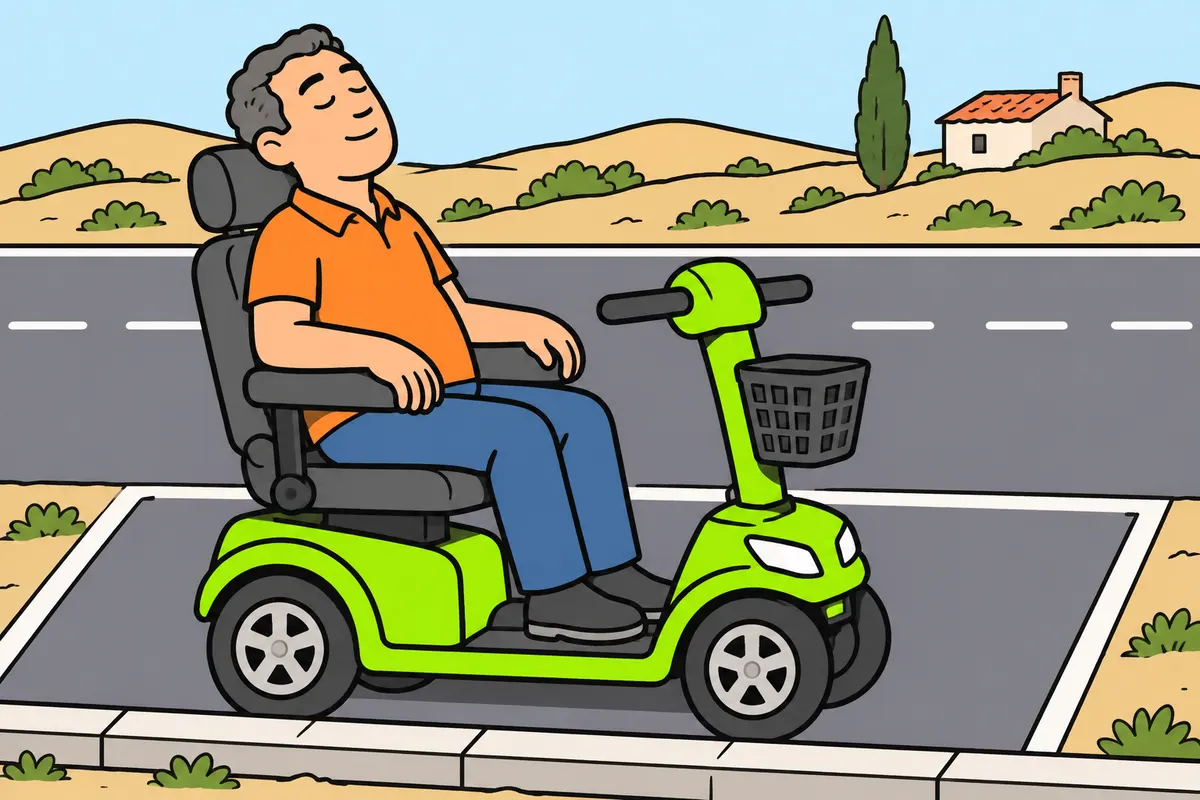
If you feel tired, stop and rest before continuing.
Remember
- If you feel tired, stop driving and rest.
- See “Driver fitness” for causes and warning signs.
- Plan breaks in places accessible for your needs.
Exam trap: Wrong: You wait until tired before looking for rest. Right: Plan where to park and rest.
Read the full explanation
- If you feel fatigued, stop driving and rest; the causes and warning signs are explained in «Driver fitness».
- Plan rest stops where you can park and access a suitable space for your needs, without relying on finding one when you are tired.
9Drowsiness means you must interrupt your journey
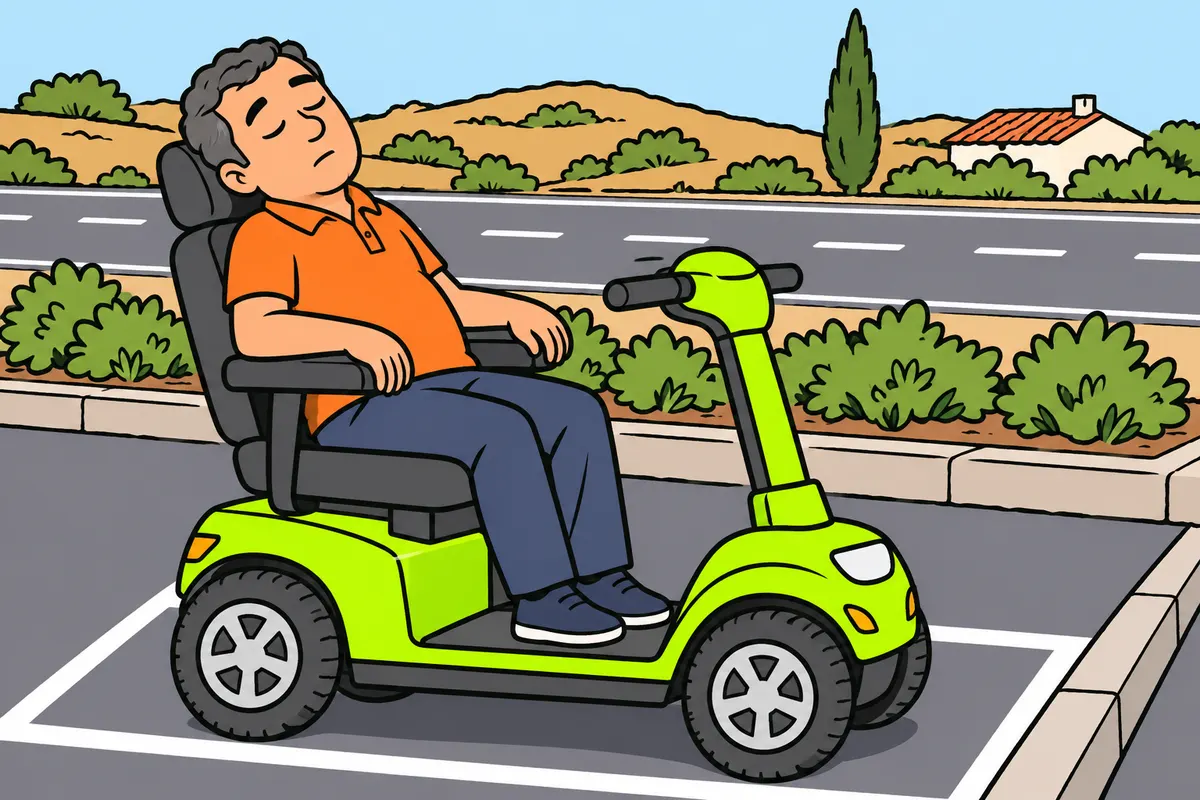
If you feel sleepy, interrupt your journey and sleep.
Remember
- If you feel sleepy, interrupt your journey to sleep.
- See “Sleepiness and microsleeps” in “Driver fitness”.
- Prepare an accessible alternative way home.
- Plan how to collect your LCM vehicle if you leave it parked.
Exam trap: Wrong: You keep driving while sleepy. Right: Interrupt your journey to sleep and use your planned alternative way home.
Read the full explanation
- If you feel sleepy, stop your journey to sleep; see «Sleepiness and microsleeps» in «Driver fitness».
- Arrange an accessible alternative for your return journey and for collecting your LCM vehicle if you need to leave it parked.
10Alcohol: remember your applicable limit
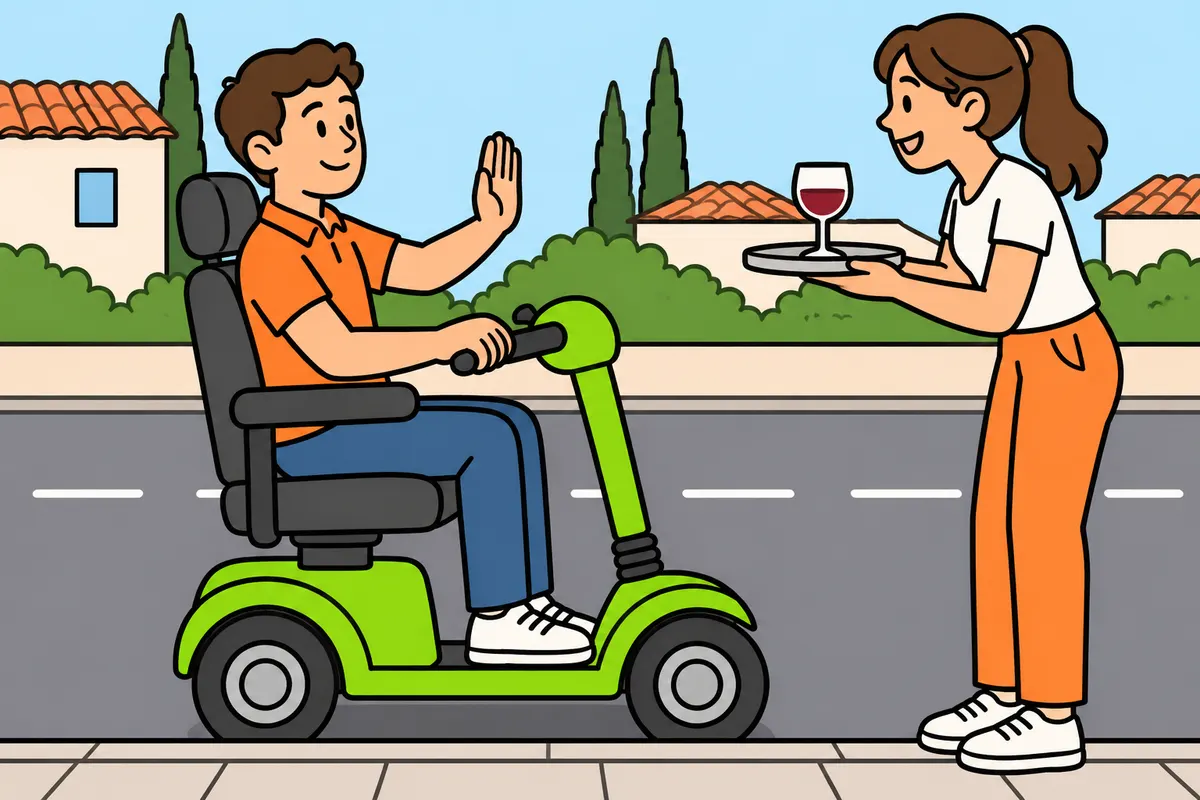
Apply your alcohol limit and avoid drinking when you drive.
Remember
- Apply the limit for your age and the time you have held your licence.
- See “Driver fitness” for limits and their units.
- Decide not to drink before setting off.
- Plan a way home that meets your mobility needs.
Exam trap: Wrong: You choose a limit without considering your age and how long you have held your licence. Right: Apply the limit that corresponds to you.
Read the full explanation
- Apply the limit that corresponds to your age and how long you have held your licence; the limits and their units are covered in «Driver fitness». [RGC, art. 20](https://www.boe.es/buscar/act.php?id=BOE-A-2003-23514#a20). [Traffic Act, art. 14](https://www.boe.es/buscar/act.php?id=BOE-A-2015-11722#a14).
- Plan outings with the preventive decision not to drink, and arrange how to return in a way that meets your mobility needs.
11Alcohol and drugs: effects and checks
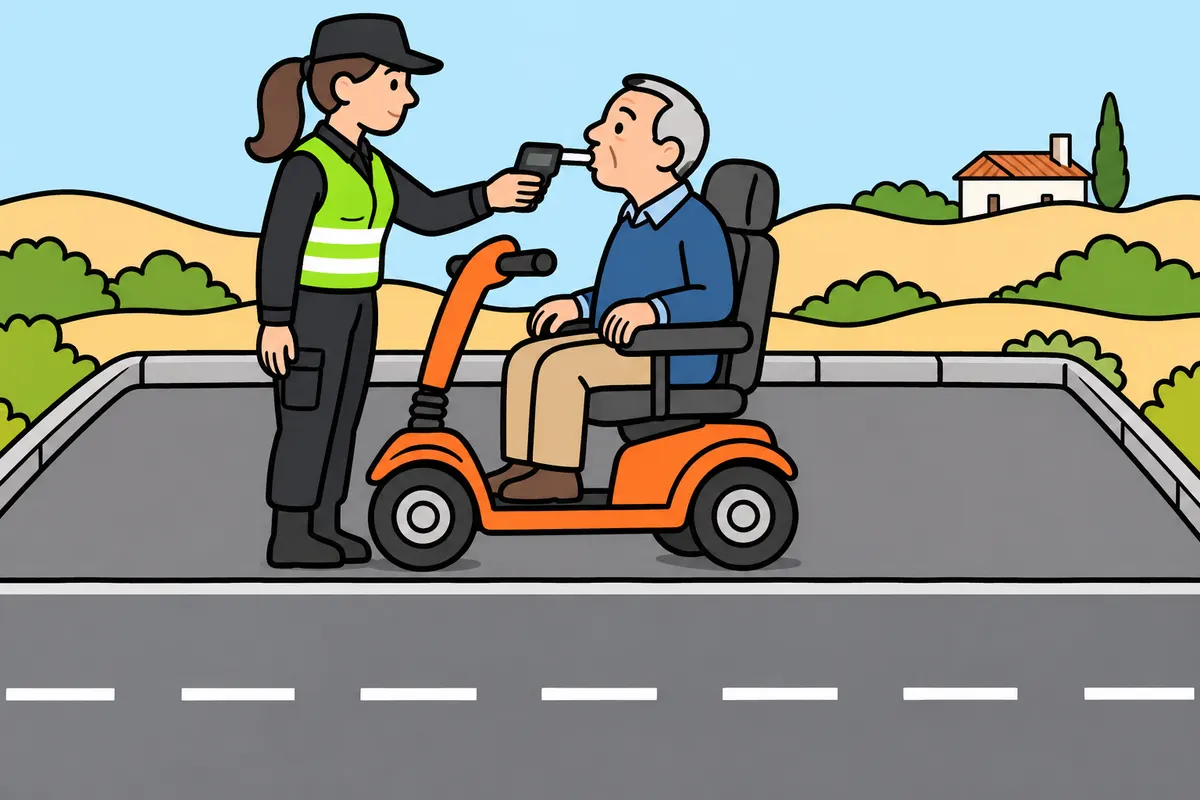
Check alcohol and drug rules and plan a safe way home.
Remember
- See “Driver fitness” for prohibitions, effects and tests.
- If you cannot drive safely, use your planned way home.
- Anyone driving your LCM vehicle needs valid driving authorisation. [RGCond, art. 6.1.a]
Exam trap: Wrong: You let anyone drive your LCM vehicle. Right: Check that they have valid driving authorisation.
Read the full explanation
- The prohibitions, effects and tests relating to alcohol and drugs are explained in «Driver fitness». [Traffic Act, art. 14](https://www.boe.es/buscar/act.php?id=BOE-A-2015-11722#a14).
- If your condition prevents you from driving, use your planned way of getting home; bear in mind that anyone else needs a valid driving entitlement to drive your LCM vehicle. [RGCond, art. 6.1.a](https://www.boe.es/buscar/act.php?id=BOE-A-2009-9481#a6).
12Medicines: read and seek advice
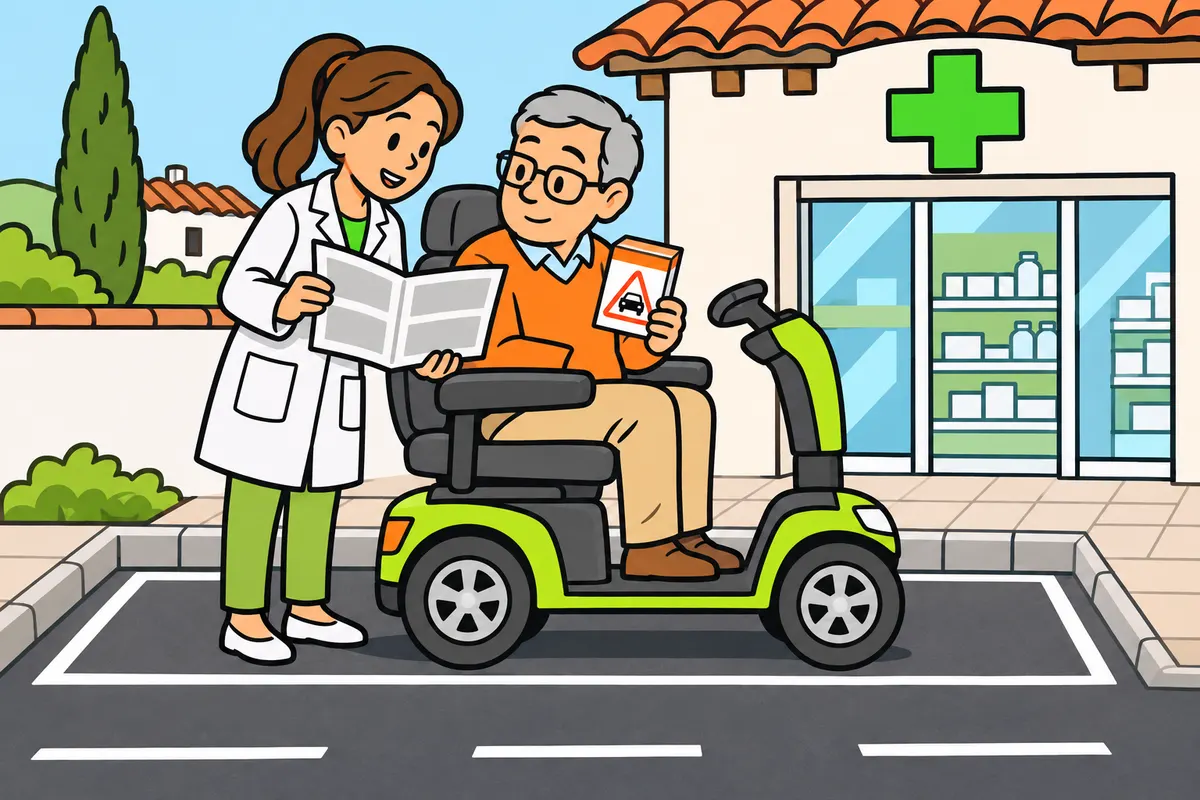
Read medicine warnings and seek advice about effects on your driving.
Remember
- Check the warnings for your treatment.
- Ask a healthcare professional if you have doubts.
- See “Medicines and the patient information leaflet” for the pictogram and effects.
- Explain which adapted controls you use and the effort your journey requires.
- Consider another way to travel that suits your treatment.
Exam trap: Wrong: You seek advice without explaining how you drive. Right: Explain your adapted controls and the effort your journey requires.
Read the full explanation
- Check the warnings for your treatment and discuss any doubts with a healthcare professional; the pictogram and the effects of medicines are covered in «Medicines and the patient information leaflet» in «Driver fitness».
- Explain which adapted controls you use and how much effort your journey requires so that you can assess an alternative means of transport compatible with your treatment.
13Attention and emotions
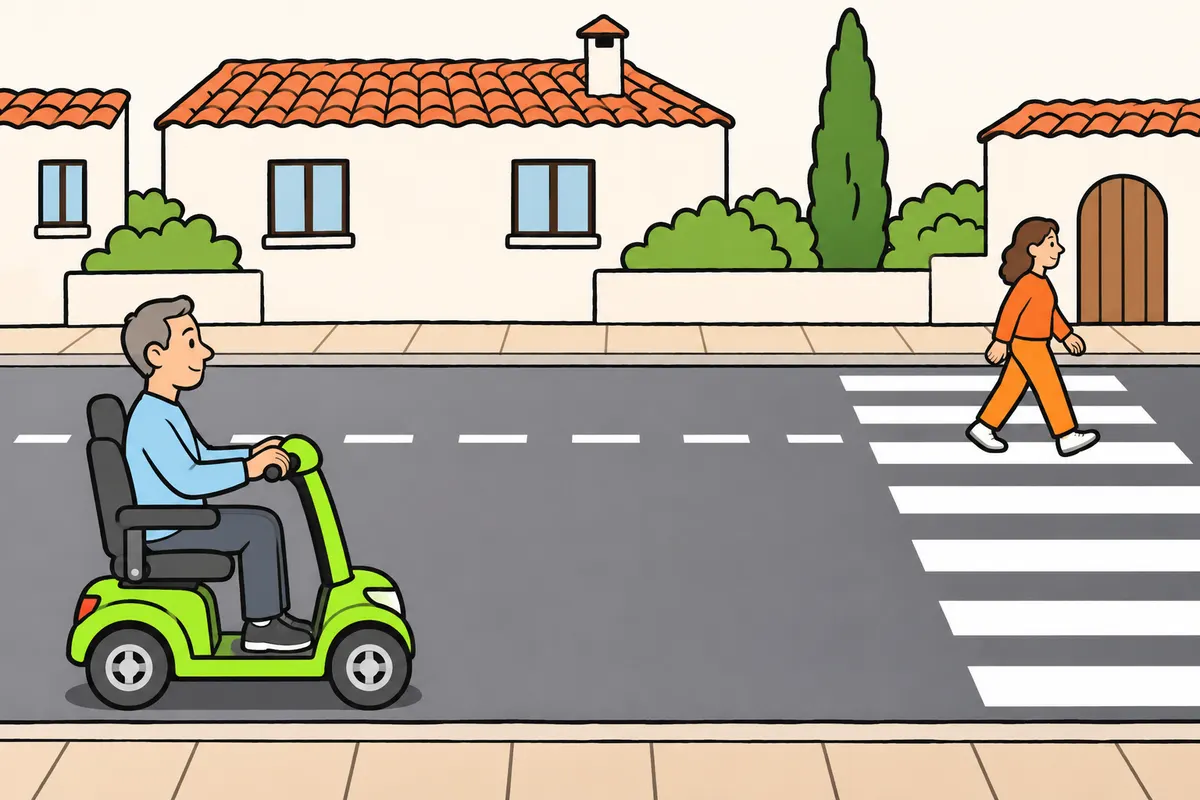
Give traffic your attention and avoid driving when upset.
Remember
- Avoid distractions from advertising, other people’s accidents or falling objects.
- Leave difficult conversations until you reach a resting place.
- If an argument stops you concentrating, postpone departure or stop safely.
- Keep observing even on familiar journeys.
Exam trap: Wrong: You think looking ahead is enough. Right: You must also keep your attention on driving.
Read the full explanation
- You must give driving your constant attention. Avoid distractions such as advertising, someone else's accident, falling objects or conversations that upset you. You can keep your eyes ahead while thinking about something else and notice a hazard too late. [RGC, art. 18](https://www.boe.es/buscar/act.php?id=BOE-A-2003-23514#a18).
- Anger, anxiety and haste can lead you to accept small gaps or make abrupt manoeuvres. If an argument prevents you from concentrating, delay setting off or find a safe place to stop the argument. Do not turn personal pressure into an obligation to keep going at any cost.
- At junctions and in narrow streets, focus your attention on your path and on road users who may appear on either side. If a conversation requires a complex answer, put it off until you reach a place to rest. Operating adapted controls may require a particular sequence: allow yourself time to complete it without neglecting the road. [RGC, art. 18](https://www.boe.es/buscar/act.php?id=BOE-A-2003-23514#a18).
- On a familiar journey, you must keep observing: an open door, roadworks or a person may appear where there is usually nothing. Do not drive from memory. Familiarity helps you find your way, but does not replace checking what is happening on that journey.
14Phone and sat nav
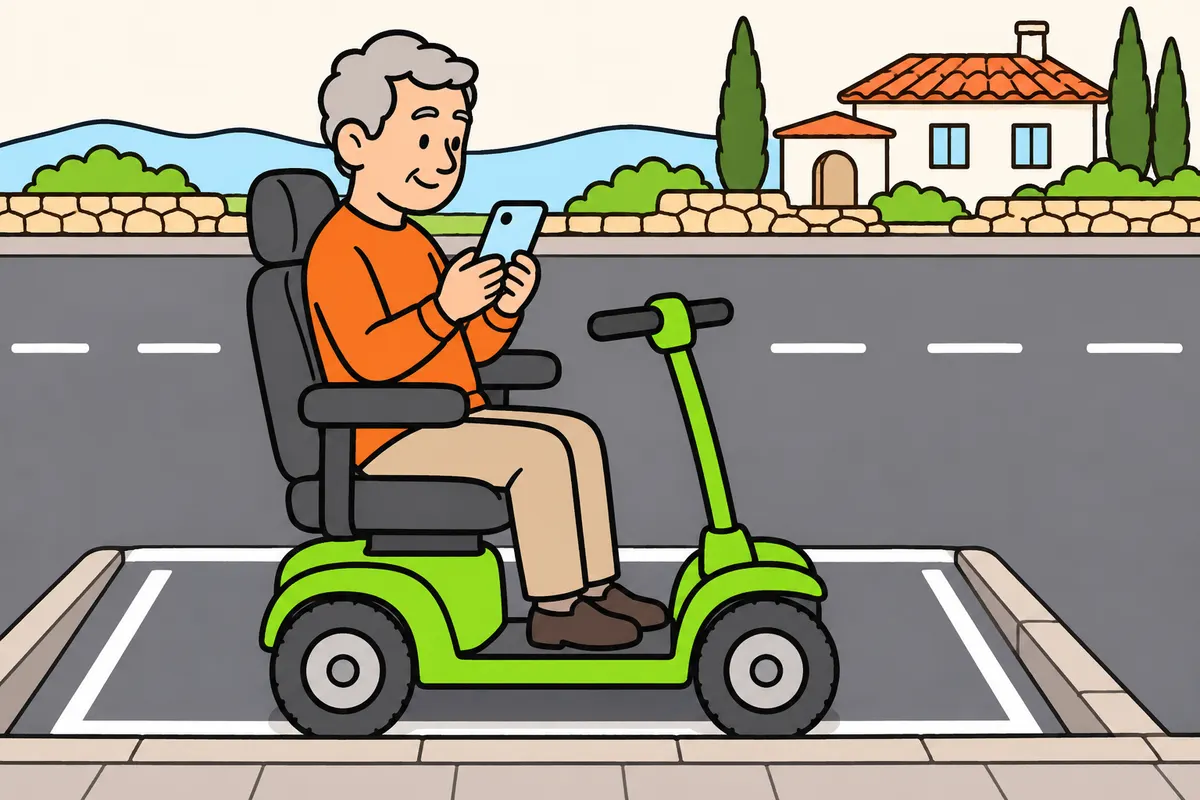
Set up your sat nav before departure and park before handling your phone.
| Device in your vehicle | Rule |
|---|---|
| Radar detector | You must not carry it, even switched off. |
| Traffic enforcement jammer | You must not install or carry it. |
| Radar location warning device | Excluded from this prohibition. |
Remember
- Do not handle your phone or operate your sat nav while driving.
- See “Driver fitness” for rules on phones, headphones and earphones.
- Set up your route before setting off.
- Park to change your route.
- Position it without blocking your view or adapted controls.
Exam trap: Wrong: You carry a switched-off radar detector. Right: You must not carry it, even switched off.
Read the full explanation
- The rules on phones, headphones and sat navs are explained in «Driver fitness»; avoid operating them while driving. [RGC, art. 18](https://www.boe.es/buscar/act.php?id=BOE-A-2003-23514#a18).
- Set your route before setting off and position the device without blocking your view or obstructing adapted controls; park to change the route.
- You must not carry radar or speed camera detectors in your vehicle, even when switched off, or install or carry jammers or other devices intended to evade or interfere with traffic enforcement. Devices that warn you of the location of these systems are excluded from this prohibition. [RGC, art. 18.3](https://www.boe.es/buscar/act.php?id=BOE-A-2003-23514#a18).
15Observe and anticipate decisions
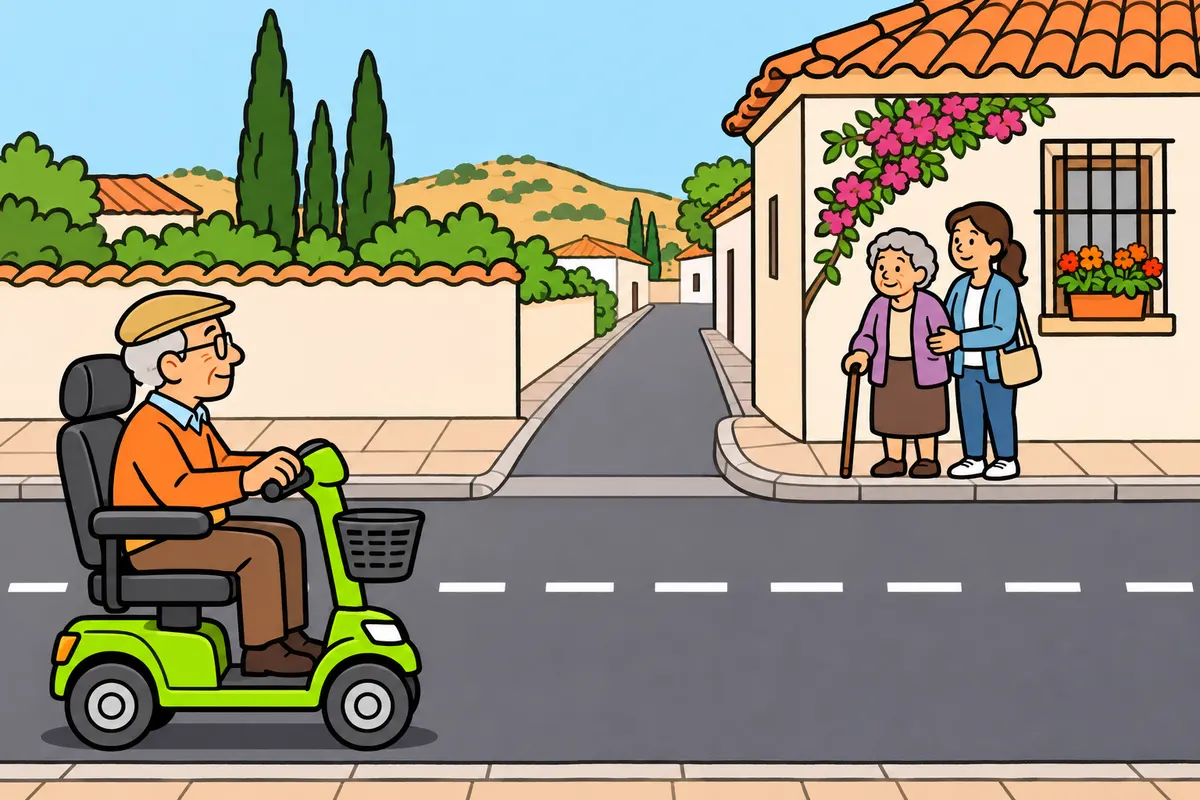
Observe early and manoeuvre only when safe.
Remember
- Look between the distance, nearby surroundings and mirrors.
- Check blind spots before turning or changing position.
- Signal early when required.
- Be ready to stop at junctions with poor visibility.
- Anticipate movements by pedestrians and other vulnerable people.
- Check you can clear the junction; wait safely if its exit is blocked.
Exam trap: Wrong: You enter without a clear view because you have priority. Right: Observe and prepare to stop.
Read the full explanation
- Look far enough ahead to detect bends, junctions, narrow sections, potholes and people near your path. Alternate between looking into the distance, checking your immediate surroundings and checking your mirrors. Focusing only on the vehicle ahead makes you depend on its decisions and reduces your own safety margin.
- Before moving off from the edge of the road, changing your position on the road or turning, check your surroundings and the relevant blind spots. Signal in good time when required, but remember that giving a signal does not prove that others have seen you. Carry out the manoeuvre only when you can do so safely. [RGC, art. 109](https://www.boe.es/buscar/act.php?id=BOE-A-2003-23514#a109).
- At a junction where buildings or vehicles block your view, approach ready to stop. Having priority does not remove the need to observe or make it safe to enter without being able to see. Using the horn does not replace observation or guarantee that another road user stops.
- Pay particular attention to pedestrians, children, older people and people with disabilities or mobility difficulties. Anticipate unexpected movements and slow down before they move into your path. Your own vulnerability does not remove your responsibility to protect others. [RGC, art. 17](https://www.boe.es/buscar/act.php?id=BOE-A-2003-23514#a17).
- As you approach a garage exit, watch both the opening and any wheels or vehicle front that may emerge. Your LCM vehicle may remain outside the view of the person emerging until it is very close. Be ready to stop without assuming that the other driver has noticed you simply because they have turned their head towards you.
- Before crossing a junction, assess how long you need to clear it, taking account of your actual acceleration and the gradient. A gap large enough for a faster vehicle may leave you exposed to traffic crossing your path. If the exit is blocked, wait where you can remain protected. Priority rules and the rules on blocking junctions are covered in «Priority and right of way».
16Choose a speed that allows you to stop
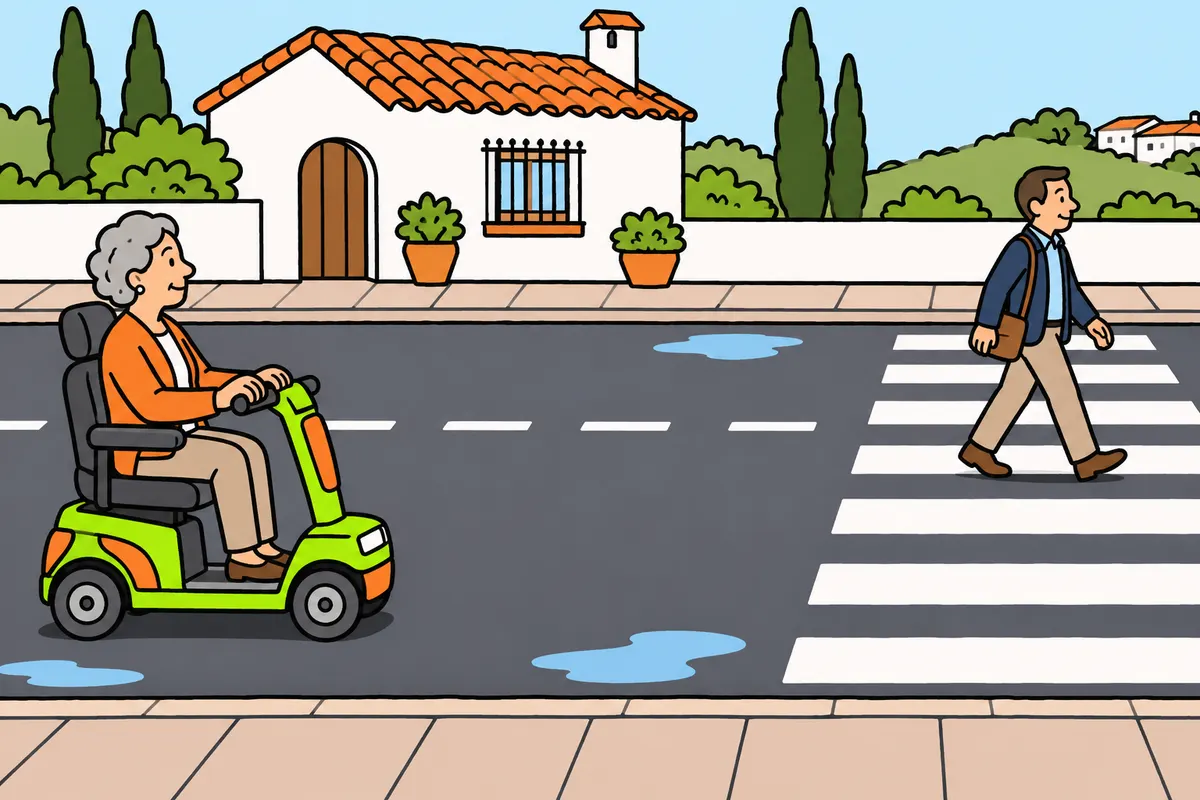
Adapt your speed so you can stop within the distance you can see.
| Case for your reduced-mobility vehicle | Speed reference |
|---|---|
| Design speed on level ground | Must not exceed 45 km/h. |
| Urban road: one lane each direction | General limit: 30 km/h. |
| Urban road: carriageway and pavement at same level | General limit: 20 km/h. |
Remember
- Follow limits, personal restrictions and road conditions.
- Slow further for pedestrians, poor visibility or poor grip.
- Do not choose speed through haste or fear of delaying others.
- Check signs and exceptions to general limits.
Exam trap: Wrong: You maintain 45 km/h because your vehicle can. Right: Slow down when limits or conditions require it.
Read the full explanation
- You must obey the speed limit and also adapt your speed to your condition, the vehicle, its load, the traffic, the road and the weather. You need to be able to stop within the distance you can see to be clear and before foreseeable obstacles. The maximum limit is not a speed you must always maintain. [RGC, art. 45](https://www.boe.es/buscar/act.php?id=BOE-A-2003-23514#a45).
- A vehicle for people with reduced mobility must have a design speed no higher than 45 km/h on level ground. This does not allow you to drive at that speed everywhere: you must obey lower limits, personal restrictions and conditions that require you to slow down further. [RGV, annex II](https://www.boe.es/buscar/act.php?id=BOE-A-1999-1826).
- On urban roads with a single lane in each direction, the general limit is 30 km/h; on roads where the carriageway and pavement share a single level surface, it is 20 km/h. Pay attention to signs and the exceptions set out in the regulations. Even within the limit, you must slow down if pedestrians appear, visibility is poor or grip is limited. [RGC, art. 50](https://www.boe.es/buscar/act.php?id=BOE-A-2003-23514#a50).
- Do not choose your speed according to your arrival time, engine noise or fear of holding others up. If you drive more slowly than other vehicles, behave predictably and prepare for changes in speed. The full set of limits and distances is covered in «Speed and safe following distances».
17Reaction, braking and stopping distances
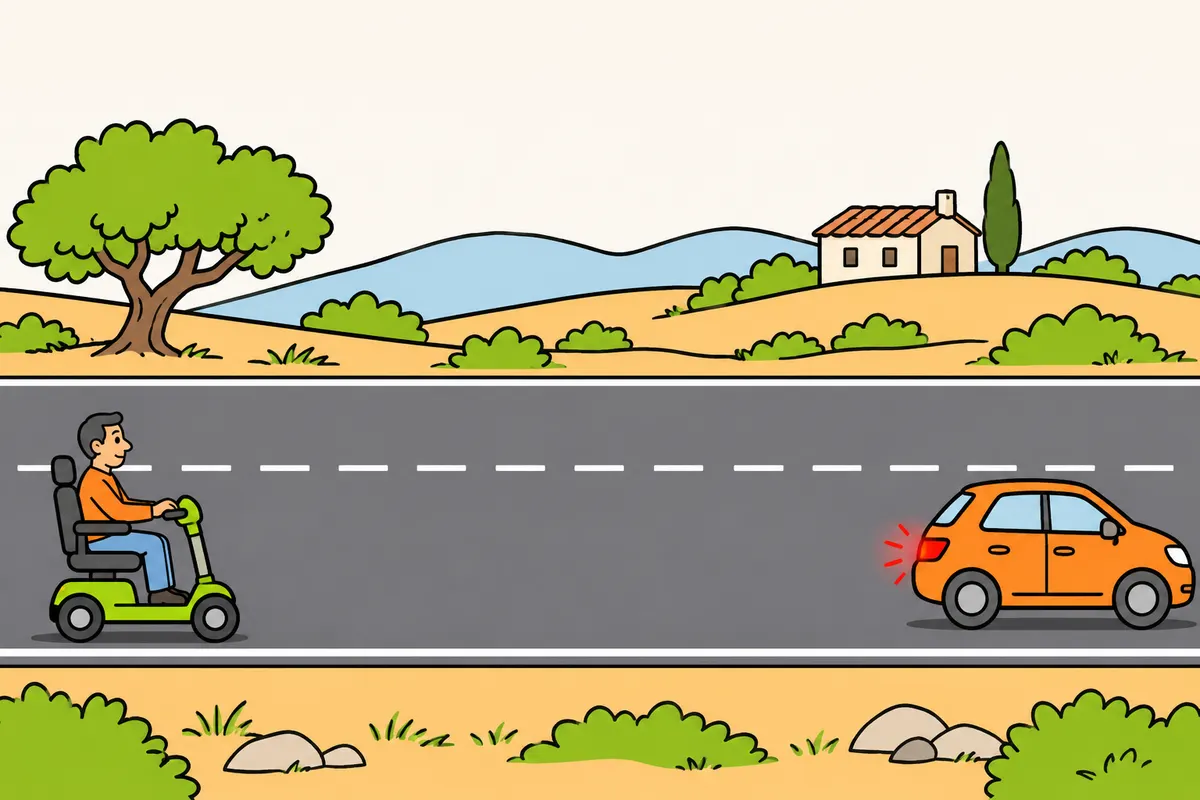
You need space both to react and to brake.
| Distance | Meaning |
|---|---|
| Reaction | From noticing danger until you start braking. |
| Braking | From starting to brake until you stop. |
| Stopping | Reaction distance plus braking distance. |
Remember
- Your vehicle keeps moving while you react.
- Tiredness, distraction and alcohol can delay your reaction.
- Braking depends on speed, grip, brakes, tyres, load and slope.
- At higher speeds, you need more stopping space.
- Allow extra space in rain or on slippery surfaces.
Exam trap: Wrong: You think good brakes remove all earlier travel. Right: You also travel while reacting before braking.
Read the full explanation
- Your reaction distance is the distance you travel from noticing a hazard until you start applying the brake. During that interval, the vehicle continues moving. If you are distracted, tired or affected by alcohol, you may take longer to begin responding.
- Your braking distance starts when you apply the brake and ends when the vehicle stops. It depends on speed, grip, the condition of the tyres and brakes, the load and the gradient. You must assess your actual vehicle rather than use a fixed figure for every situation.
- Your total stopping distance combines your reaction distance and your braking distance. Having good brakes does not eliminate the distance you travel before applying them. This is why looking ahead and staying fit to drive are as important as maintaining the braking system.
- Higher speed reduces the time you have to understand a hazard and increases the distance you need to stop. If it rains or the road surface is slippery, you must allow an extra margin. Do not wait until you first brake hard to discover that the gap you have chosen is too small.
18Keep space ahead and to the sides
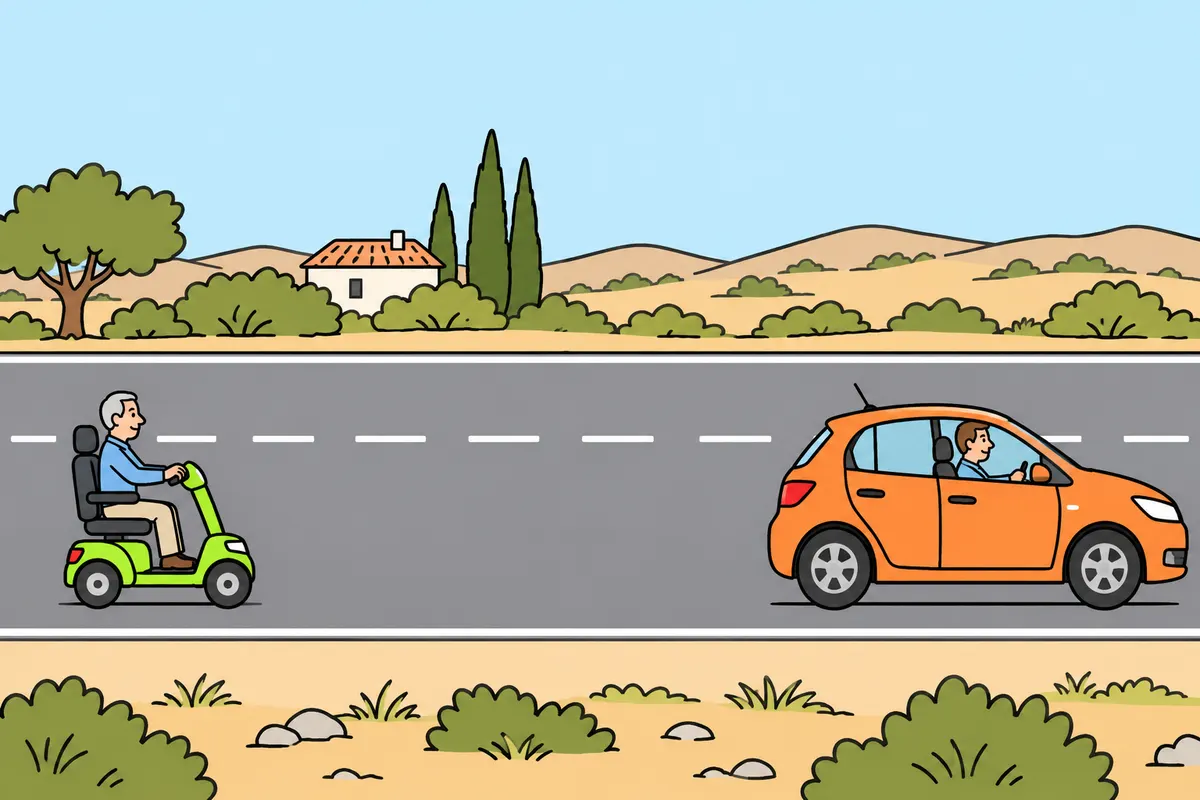
Leave space ahead and beside you to respond without hitting anything.
Remember
- Leave enough space to stop if the vehicle ahead brakes suddenly.
- Increase your gap in rain, fog, tiredness or poor visibility.
- Do not brake suddenly to punish someone following closely.
- Leave side clearance beside people, parked vehicles and damaged edges.
- If you cannot pass safely, slow down and wait.
- Use margins when a stopped vehicle blocks your lane after a breakdown or service.
Exam trap: Wrong: You pass too closely when a vehicle stopped for a breakdown, accident or emergency, assistance or maintenance service occupies your lane. Right: Leave at least 1.5 metres and travel at least 20 km/h below the limit. Use the opposite lane if needed and safe, and keep every wheel safely supported.
Read the full explanation
- Leave a gap that allows you to stop without hitting the vehicle ahead if it brakes suddenly. You must take particular account of speed, grip and braking ability. Driving slowly does not allow you to drive too close to another vehicle: you also need space to react to an unexpected stop. [RGC, art. 54](https://www.boe.es/buscar/act.php?id=BOE-A-2003-23514#a54).
- Increase your safety margin in rain or fog, when tired or when you have difficulty observing your surroundings. Do not follow the lights of the vehicle ahead closely to find your way: as well as seeing less, you may encounter the same obstacle without time to avoid it. A greater distance does not compensate for a speed that is excessive for what you can see.
- In traffic queues, keep space to react and manoeuvre, and continue checking your mirrors. Do not close the gap as much as possible to prevent another vehicle from joining. Avoid braking suddenly in response to someone following you too closely; help keep driving predictable and free of provocation.
- Leave space to the sides when passing pedestrians, cyclists, parked vehicles and damaged road edges. A door, a change of course or a wheel dropping onto a lower surface may mean you need extra space. If the available gap does not allow you to continue safely, slow down further and wait instead of forcing your way through.
- The conditions for overtaking pedestrians, animals, animal-drawn vehicles, mopeds, VMP (personal mobility vehicles) and cyclists, including groups, are covered in «Manoeuvres with your LCM vehicle»; apply the complete rule before attempting to pass in your vehicle. [RGC, art. 85.4](https://www.boe.es/buscar/act.php?id=BOE-A-2003-23514#a85).
- When passing a vehicle stopped because of a breakdown, an accident or an emergency, assistance or maintenance service that occupies all or part of your lane, you must leave at least 1.5 metres of lateral clearance and travel at least 20 km/h below the road's speed limit. Use the opposite lane if necessary, checking that you can do so safely. [RGC, art. 88](https://www.boe.es/buscar/act.php?id=BOE-A-2003-23514#a88).
- Watch the space that all the wheels travel over, as well as the width of the bodywork. A sunken drain, a displaced cover or a crumbling edge may leave one side of the vehicle without support. Plan your path in advance and wait if traffic prevents you from maintaining it; correcting your course just as you reach the defect may bring you closer to someone passing you.
19Bends, slopes and stability
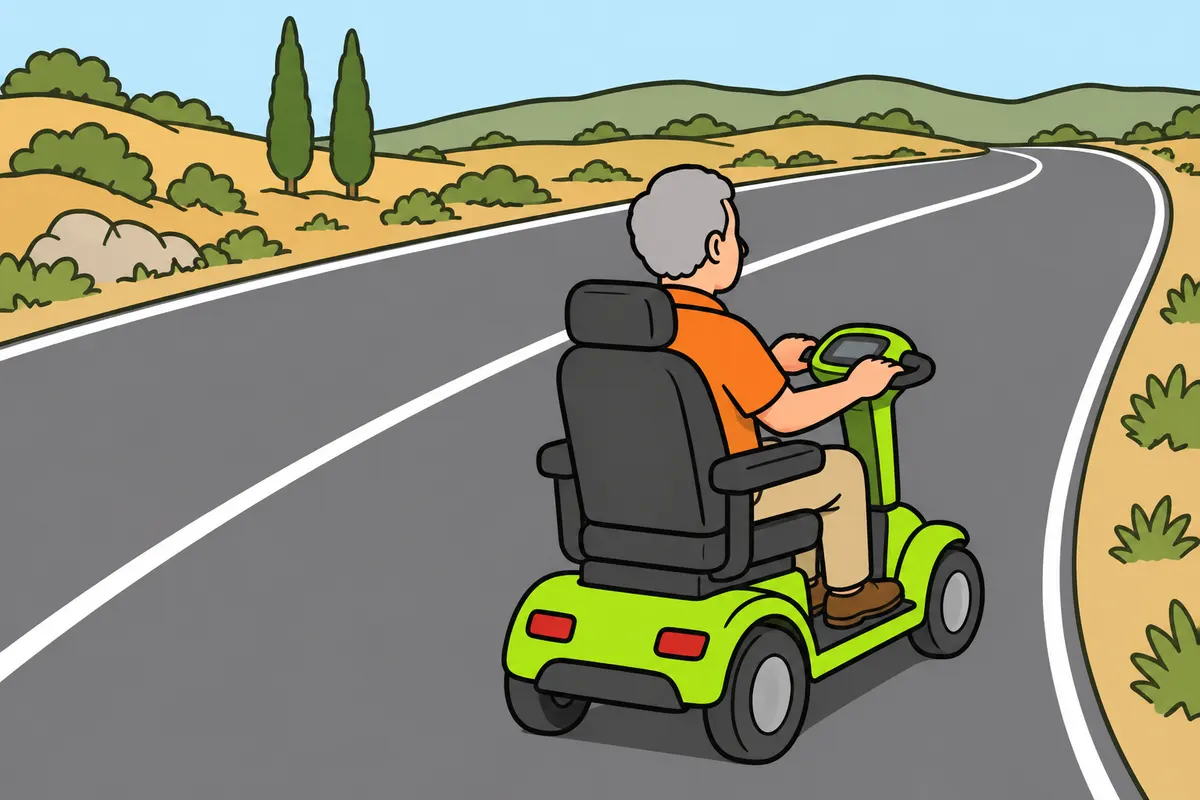
Prepare for bends and slopes with suitable speed and smooth movements.
Remember
- Slow down before entering a bend.
- Keep your course without entering the opposite direction.
- Assess slopes and changes in level using your model’s manual.
- Distribute the load properly and avoid sudden turns.
- Control speed from the start of long descents.
- Do not disconnect the transmission to coast downhill.
Exam trap: Wrong: You use one gear for every vehicle. Right: Use a suitable mode or gear if available and specified by the manufacturer. Do not drive a wheel onto a kerb to make room; change route if no passage suits your model.
Read the full explanation
- Before a bend, adjust your speed and brake progressively if necessary. Entering too fast can make you run wide or lose stability. Avoid waiting until you are in the bend to steer sharply and brake hard at the same time; plan your path using what you can see.
- Through the bend, use the controls smoothly and maintain your course within the appropriate part of the road. Do not cut the bend by straying onto the side for oncoming traffic or move towards an unsafe edge to let someone pass. Once you complete the turn, gradually pick up speed if conditions allow.
- Assess slopes and changes in level according to your model’s manual, especially where there is a sideways slope or an edge without sufficient support. There is no universally safe angle of tilt for all vehicles covered by this licence. An unevenly distributed load and sudden changes of direction can compromise your stability.
- On a long descent, control your speed from the start and avoid overloading the brakes. Use the appropriate mode or gear if available and specified by the manufacturer; not all these vehicles have selectable gears. Do not disengage the transmission to coast downhill or wait until the end to brake.
- A kerb is not an escape surface equivalent to the carriageway. Avoid dealing with a tight encounter by putting one wheel onto the kerb: the change in level alters the vehicle’s support and can make it tilt suddenly. If an authorised access route includes a raised section, check that it is compatible with your ground clearance and the manufacturer’s instructions; avoid grounding the underside or getting stuck across a slope.
- Pay particular attention to sideways slopes when crossing a garage entrance or a rounded road edge. If the wheels on one side are higher, a quick correction can increase instability. Choose a path that provides continuous support within the authorised part of the road. If there is no route compatible with your model, change your itinerary rather than testing how far it can tilt.
20Rain and slippery road surfaces
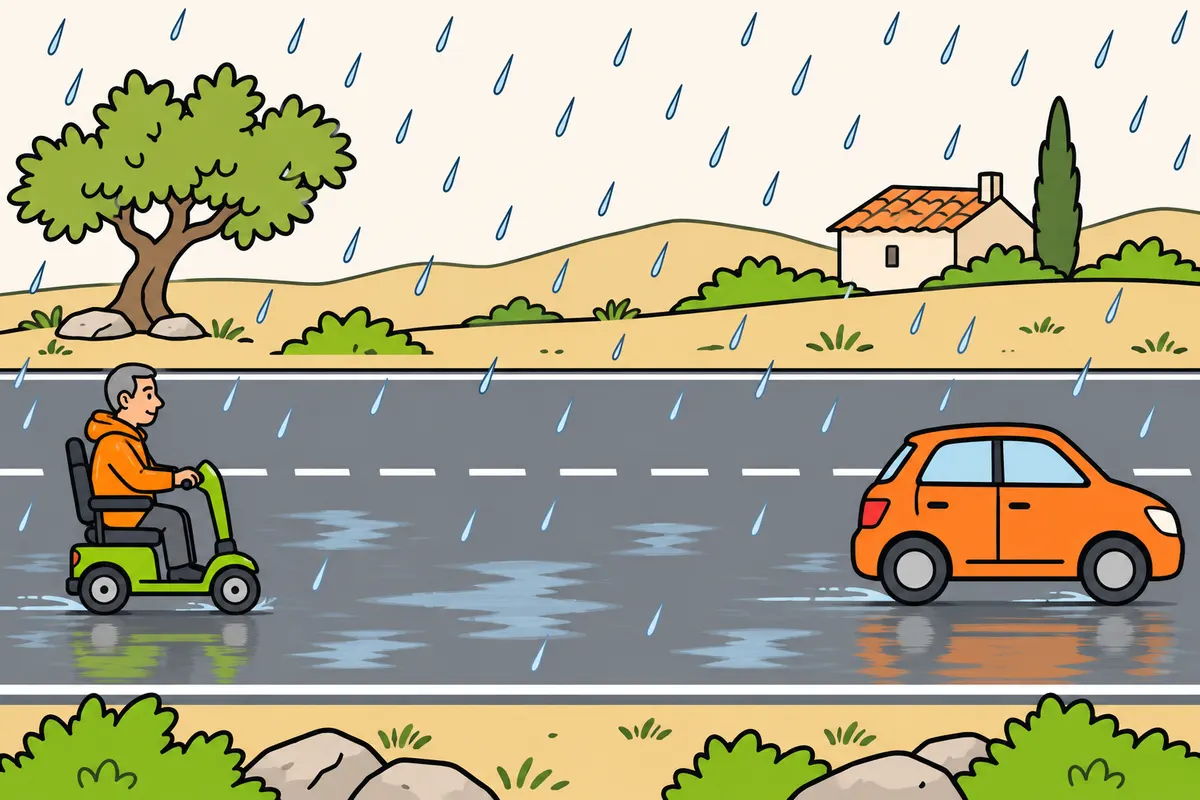
In rain, slow down and leave more braking space.
Remember
- The first drops can make the road very slippery.
- Slow before wet paint, leaves or loose chippings.
- Steer, accelerate and brake smoothly.
- Prepare for spray to block your view.
- Do not cross water of unknown depth or flowing water.
- If travel becomes unsafe, find a suitable place away from traffic.
Exam trap: Wrong: You brake sharply on wet paint. Right: Slow beforehand and use smooth movements.
Read the full explanation
- In rain, grip decreases and you need more space to brake. Reduce your speed and increase your following distance before a difficult situation. The first drops can mix with dust and grease to form a particularly slippery film: light rain does not guarantee good grip. [DGT, rain and smooth driving](https://revista.dgt.es/es/reportajes/2018/12DICIEMBRE/1312-Lluvia.shtml).
- Watch for wet painted markings, leaves, loose gravel, polished cobblestones and dirt. Slow down before reaching the surface and cross it with smooth steering, accelerator and brake inputs. Do not accelerate to leave the area as quickly as possible or assume that every part of the surface provides the same grip.
- Spray from a large vehicle can suddenly hide the road from view. Keep a safety margin and use any cleaning and demisting equipment fitted to your vehicle. If you have no protection from water, also consider how it affects your vision, the controls and your ability to drive.
- Do not cross a flooded area if you do not know its depth or if there is a current. Do not stop in a place at risk of flooding either. If water or rain prevents you from continuing safely, find a suitable place out of traffic and wait for safe conditions. [DGT, recommendations](https://www.dgt.es/conoce-el-estado-del-trafico/recomendaciones-de-trafico).
- When crossing a wet painted crossing, prepare to slow down before the stripes and use the controls progressively. On a nearby turn, you may have paint beneath some wheels and asphalt beneath others. This difference in grip requires anticipation, especially if your model has small wheels or sensitive controls. Apply the right-of-way rules set out in «Priority and right of way».
21Standing water and loss of grip
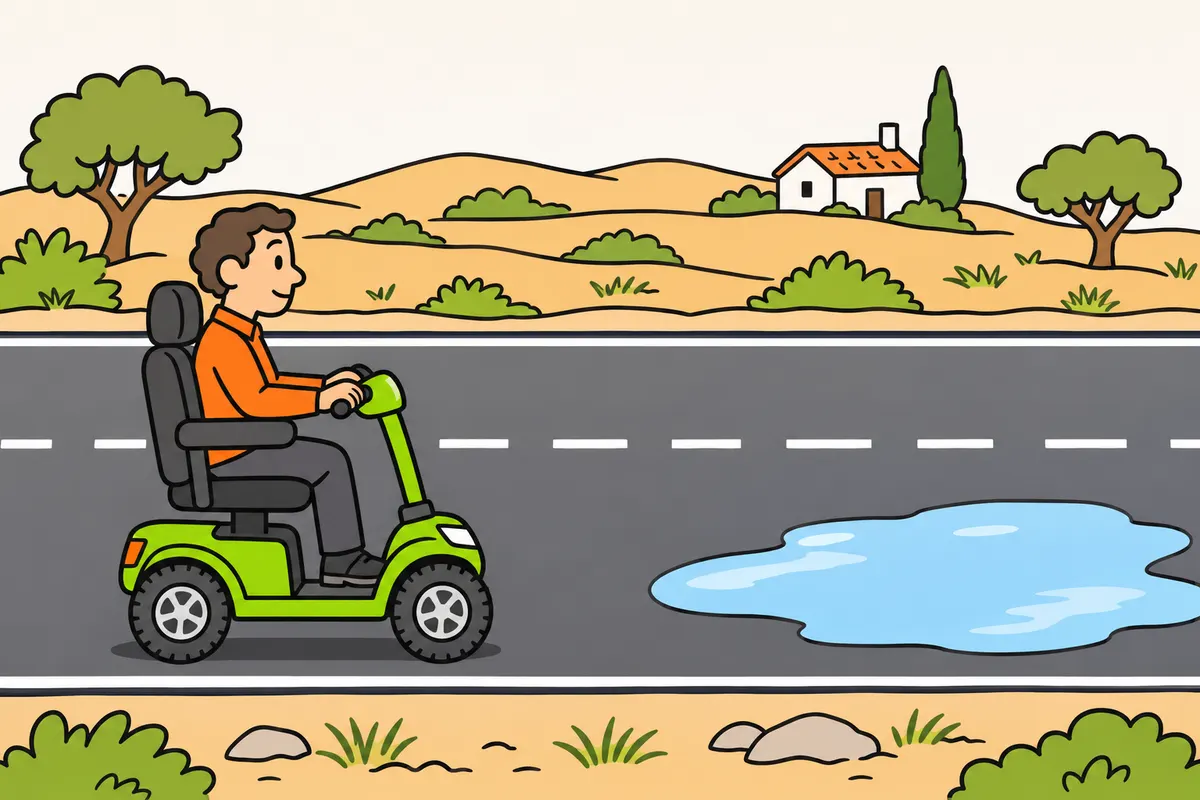
Slow before standing water to avoid losing contact with the road.
Remember
- Keep your tyres in good condition.
- Do not assume any speed makes every puddle safe.
- If grip is lost, avoid sudden braking, acceleration or steering.
- Ease your control inputs gently until grip returns.
- After water, check suspected wet brakes gently, safely and according to the manual.
- If normal braking does not return, stop safely and request assistance.
Exam trap: Wrong: You test brakes while losing grip. Right: Check afterwards, gently at low speed, without danger and following the manual.
Read the full explanation
- Aquaplaning occurs when a layer of water prevents effective contact between the tyre and the road surface. You can lose your ability to steer and brake. You must prevent it by reducing your speed before reaching standing water and keeping suitable tyres in good condition. [DGT, water and aquaplaning](https://www.dgt.es/comunicacion/noticias/como-conducir-sin-meterse-en-charcos).
- Standing water, speed and tyre condition affect the risk. There is no universal speed or depth that makes every puddle safe. Watch for dips and depressions in the road surface and avoid manoeuvres that take you abruptly towards another area or road user.
- If you feel the vehicle losing grip on water, avoid harsh braking, acceleration and steering. Keep control of the controls and gently reduce your inputs until grip returns. Do not simply apply skid-control techniques explained for passenger cars with a different transmission to your vehicle.
- If you suspect the brakes are wet after driving through water, check their response gently at low speed without putting anyone at risk, following the manual. If normal braking does not return, stop safely and request assistance. Do not carry out this check while you are losing grip.
22Snow, ice and winter preparation
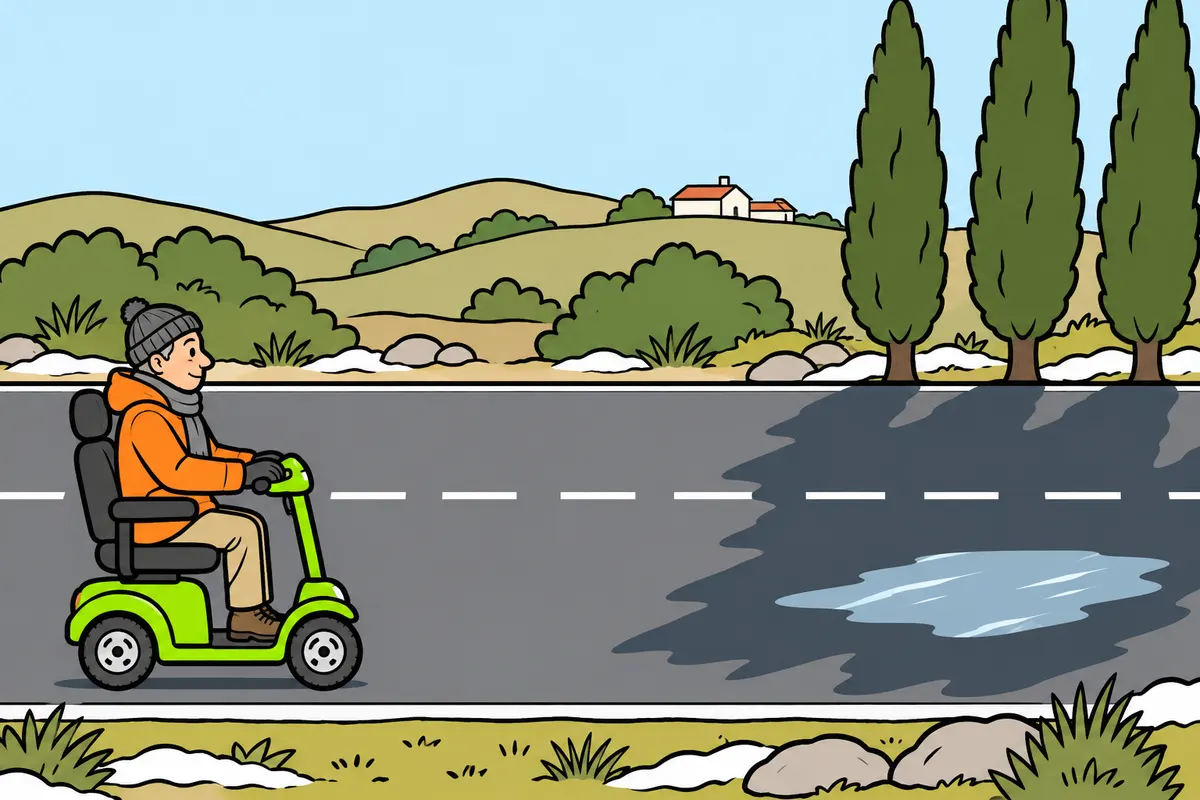
On snow or ice, increase your gap and use controls very gently.
Remember
- Check your route and equipment allow safe travel.
- Suspect ice in shade, on bridges and in damp areas.
- Slow before reaching danger.
- Clear windows and mirrors if fitted.
- Remove snow that stops you seeing or being seen.
- Follow your manual and obey equipment restrictions.
Exam trap: Wrong: You trust the grip because no snow is visible. Right: Ice may still be present.
Read the full explanation
- On snow or ice, you may have very little grip, even at low speed. Leave plenty of space and use the controls smoothly. Before setting off, check whether your route and your model’s equipment allow you to make the journey safely; postponing it may be the best decision. [DGT, ice and snow](https://www.dgt.es/comunicacion/noticias/hielo-y-nieve-con-la-adherencia-al-limite/).
- Suspect ice in damp, shaded areas, on bridges and wherever water can freeze. A carriageway with no visible snow does not guarantee grip. If you identify a dangerous area, slow down well in advance and avoid reaching it while braking or steering sharply. [DGT, winter driving](https://revista.dgt.es/es/educacion-formacion/conducir-mejor/2024/1217-Conduccion-invernal.shtml).
- Clear the windows and mirrors if your vehicle has them, and remove any snow that prevents you from seeing or being seen. Clearing only the space directly in front of your eyes is not enough. Check your view to the sides and rear before joining traffic that may also have difficulty stopping.
- Do not memorise a particular gear for all vehicles for people with reduced mobility: they may have different transmissions and controls. Follow the manual to move off without wheelspin and control descents. Observe restrictions and do not enter a stretch that requires equipment incompatible with your vehicle.
23Fog, dust and smoke
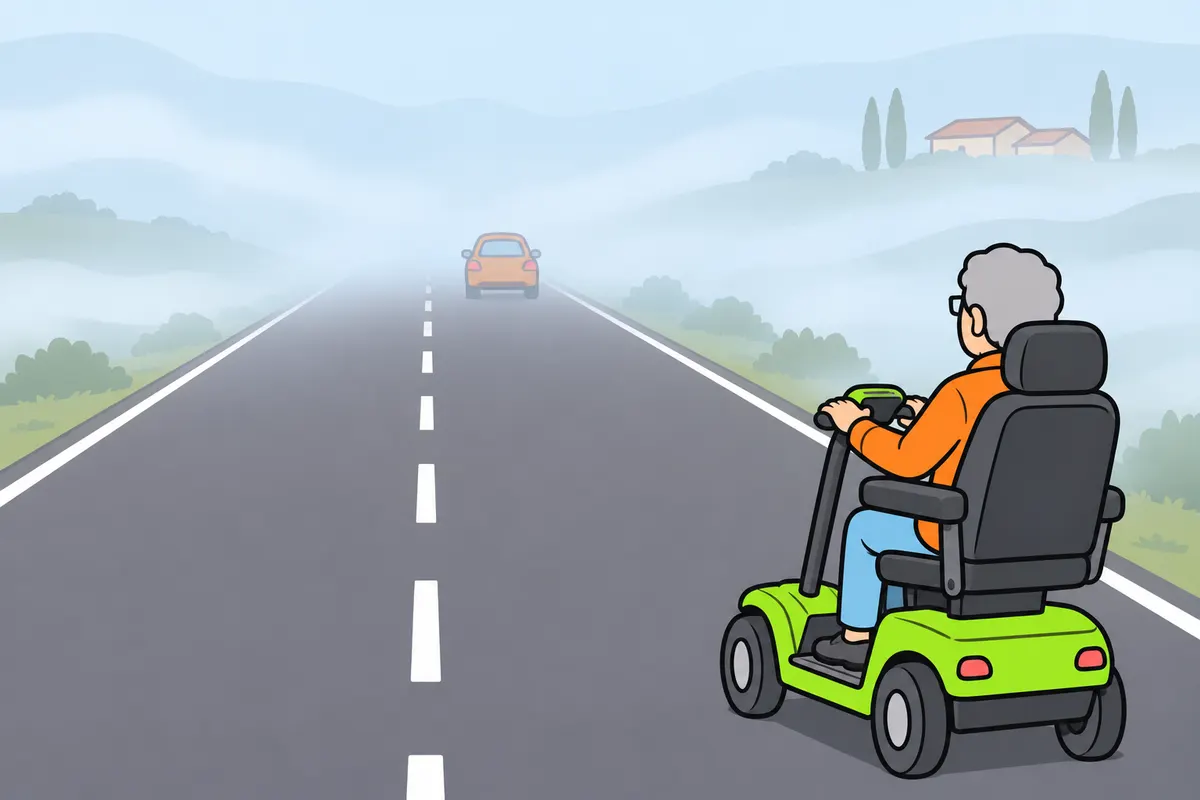
In fog, dust or smoke, slow down and increase your gap.
Remember
- Do not closely follow the lights ahead.
- If you cannot see your route safely, find somewhere permitted and sheltered to stop.
- Use appropriate lights when visibility is significantly reduced.
- If fitted, use your rear fog lamp only in particularly adverse conditions.
- These include thick fog, very heavy rain, heavy snowfall, dense dust or smoke.
- Do not rely on main beam: reflections can reduce your view.
Exam trap: Wrong: You use your rear fog lamp in light fog. Right: If fitted, reserve it for particularly adverse conditions.
Read the full explanation
- In fog, you can see less far ahead and moisture can also reduce grip. Reduce your speed progressively, increase your following distance and pay particular attention to junctions and road edges. [DGT, winter driving](https://revista.dgt.es/es/educacion-formacion/conducir-mejor/2024/1217-Conduccion-invernal.shtml).
- A cloud of dust or smoke can suddenly hide signs, obstacles and vehicles. Take the same precautions: lower speed, a greater safety margin and smooth actions. If you cannot see your route clearly enough to proceed safely, find a permitted, protected place to pause your journey.
- Use the appropriate lights when visibility is significantly reduced. If you have a rear fog light, reserve it for particularly unfavourable conditions, such as thick fog, very heavy rain, heavy snowfall or dense clouds of dust or smoke. Do not use it automatically whenever there is a little moisture. [RGC, art. 106](https://www.boe.es/buscar/act.php?id=BOE-A-2003-23514#a106).
- Avoid relying on main beam to drive through fog: reflected light can make it harder to see. If you have an enclosed cabin, keep the windows clear so that misting does not add to the difficulties outside. Powerful lighting does not replace slowing down when you can only see a few metres ahead.
24Crosswinds and large vehicles
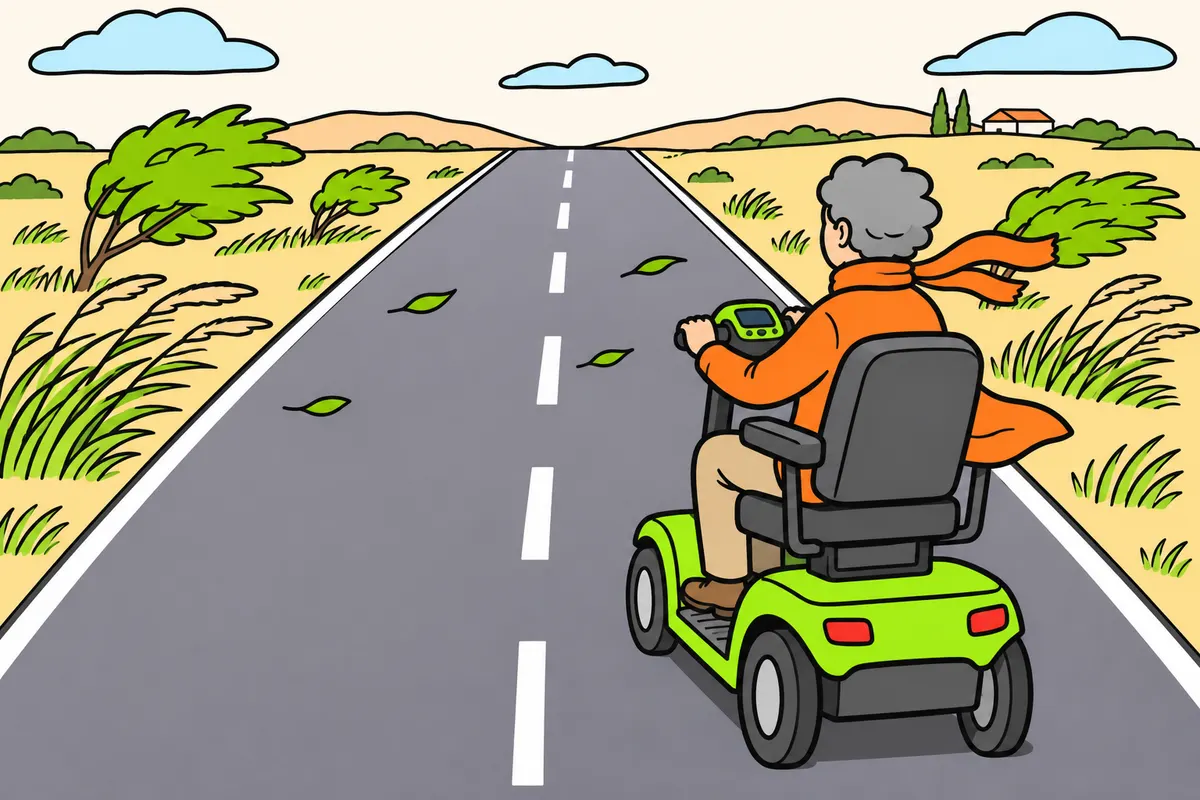
In crosswinds, slow down and avoid sudden steering corrections.
Remember
- Keep firm control of the controls and avoid violent corrections.
- Expect gusts when leaving sheltered areas.
- Keep a predictable course when a large vehicle passes.
- Do not swerve towards a damaged edge.
- If control becomes impossible, stop somewhere permitted and sheltered.
Exam trap: Wrong: You accelerate to escape the wind sooner. Right: Slow down and stop safely if you cannot retain control.
Read the full explanation
- Crosswinds and gusts can push you off course and compromise stability. Reduce your speed, keep firm control of the controls and avoid violent corrections. You must pay particular attention to your vehicle, its load and its exposed surface area, without assuming that all configurations react in the same way.
- Anticipate changes in wind force when you leave the shelter of buildings, trees or large vehicles, and in open areas. The wind can drop momentarily and suddenly return. Do not maintain a fixed steering correction without checking how your course is changing. [DGT, winter driving](https://revista.dgt.es/es/educacion-formacion/conducir-mejor/2024/1217-Conduccion-invernal.shtml).
- If a large vehicle passes you, maintain a predictable course and a reasonable distance from the edge. Do not swerve aside onto a damaged arcén (hard shoulder). Also watch for obstacles, branches or objects that the wind may blow into your path.
- If gusts prevent you from maintaining control, find a sheltered place where you are allowed to stop. Do not accelerate to get through the area sooner or carry bulky objects that are poorly secured. Your decision to continue must depend on your actual safety, not on pressure from traffic building up behind you.
25Make yourself visible around lorries and buses
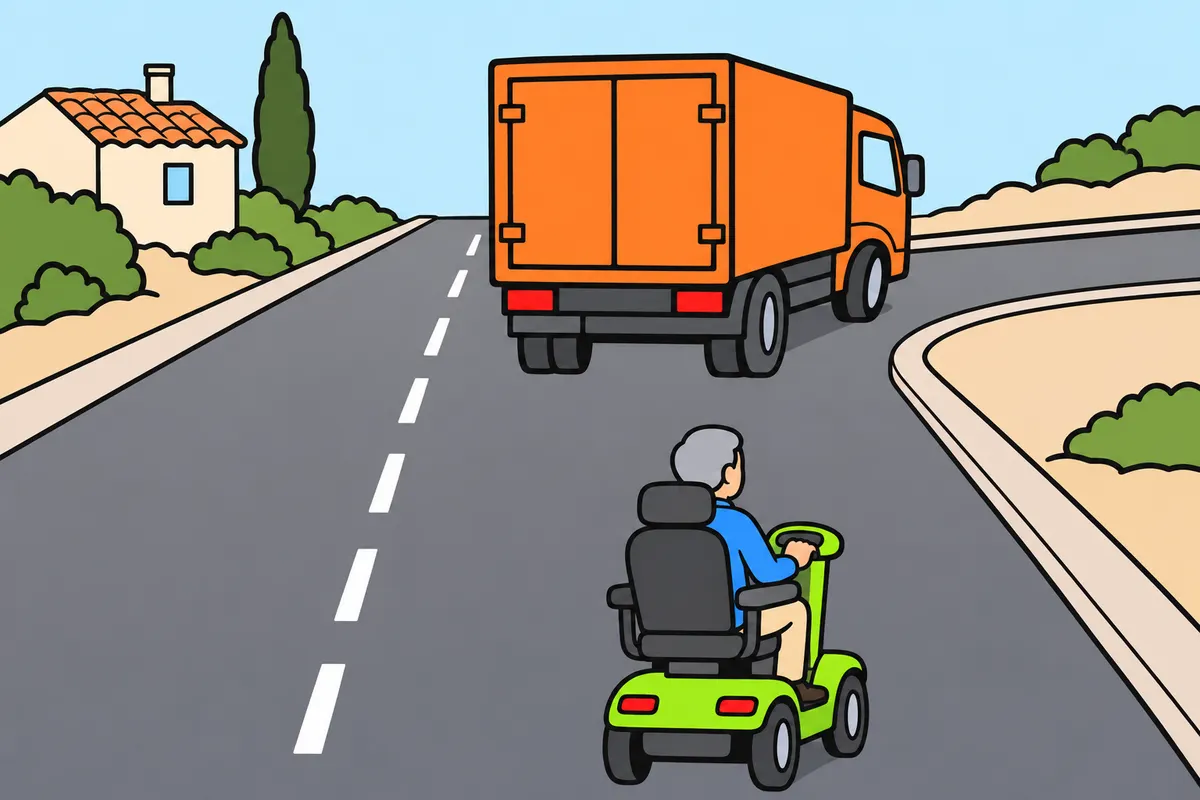
Avoid areas where a large vehicle’s driver cannot see you.
Remember
- Do not stay close alongside or behind lorries and buses.
- When one turns right, avoid the gap beside its right side and road edge.
- Wait with space until it finishes turning.
- Increase your gap behind large vehicles to improve your view.
- At junctions, check that parked vehicles do not hide you from the other driver.
Exam trap: Wrong: You think the driver sees you because you see the lorry. Right: You may be hidden from its mirrors.
Read the full explanation
- Lorries and buses have blind spots in front, behind and along their sides. Your small, low vehicle can be hidden in these areas: avoid staying alongside them or close behind them, even if you can see the large vehicle. [DGT, blind spots](https://www.dgt.es/comunicacion/notas-de-prensa/senalizacion-de-angulos-muertos-la-nueva-senal-para-proteger-a-los-usuarios-vulnerables-en-las-ciudades/).
- When a lorry or bus is about to turn right, avoid positioning yourself between its right-hand side and the edge of the road. You can be out of the driver's sight and within the space it needs to turn. Wait with sufficient clearance until it completes the manoeuvre. [DGT, blind spots](https://revista.dgt.es/es/noticias/internacional/2021/02FEBRERO/0205vehiculos-pesados-dispositivo-angulo-muerto-francia.shtml).
- If you drive behind a large vehicle, increase your following distance so you can see the road and have time to react. Do not move closer to take advantage of its shelter: its size hides junctions, signs and obstacles from you. [RGC, art. 54](https://www.boe.es/buscar/act.php?id=BOE-A-2003-23514#a54).
- At a junction with vehicles parked near the corner, distinguish between seeing the other driver and the other driver being able to see you. Your outline can be hidden behind the first parked vehicle. Keep a place where you can wait and observe how the visible area changes as you approach, without assuming that an ambiguous gesture alone confirms that the other driver is giving way.
26At night: see and be seen
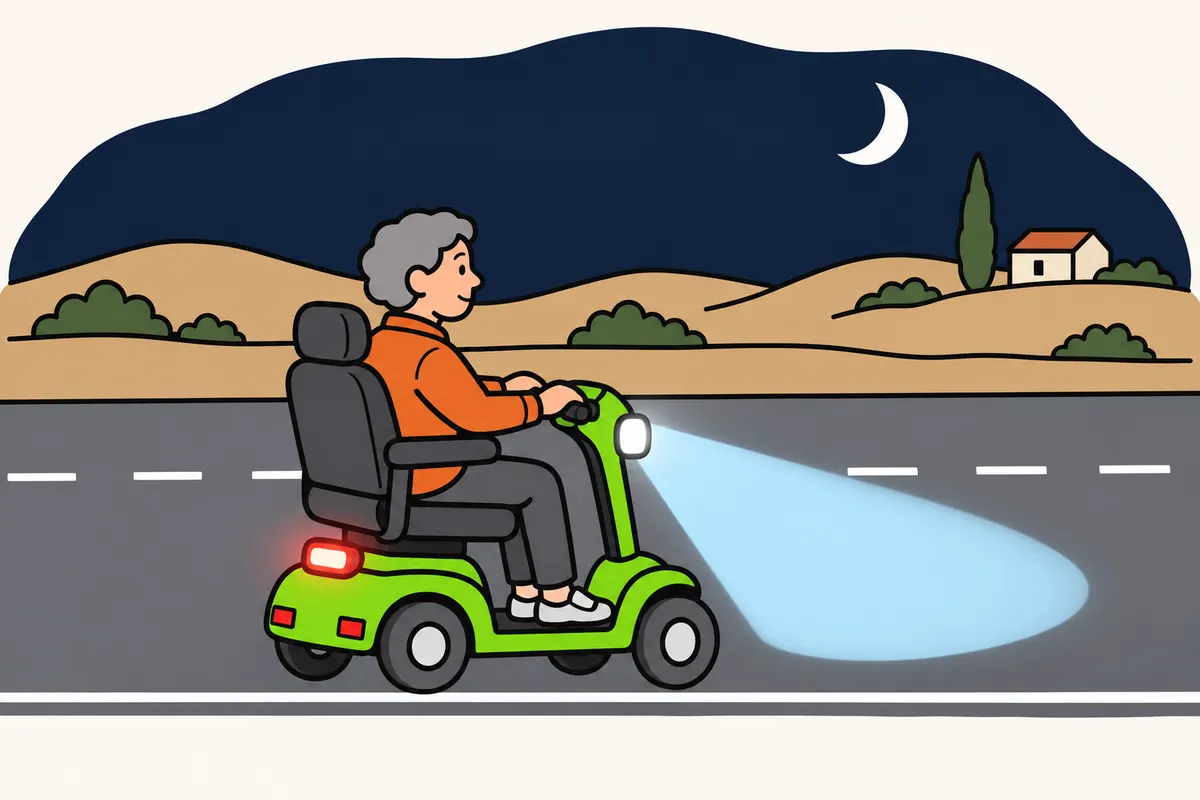
Use the required lights and adapt your speed to what you can see.
Remember
- Keep required lights and reflectors clean, working and uncovered.
- Use appropriate lights at night.
- Also use them in tunnels and underpasses during daylight.
- Use appropriate lights when visibility is significantly reduced.
- If dazzled, slow down, even stopping safely if necessary.
- If fitted, switch main beam to dipped beam before dazzling others, including through mirrors.
Exam trap: Wrong: You switch off required lights to save energy. Right: Prepare enough energy before departure and keep those lights on.
Read the full explanation
- In a slow vehicle, you must help other drivers notice your presence in good time. Keep the required lights and reflective devices clean and working. Make sure luggage or accessories do not cover them and do not switch off required lights to save energy: make sure you have enough range before setting off.
- You must use the appropriate lights between sunset and sunrise, and also during the day in tunnels and underpasses. Conditions that significantly reduce visibility also require you to use lights. The devices and circumstances are covered in detail in «LCM vehicle lights and signalling». [RGC, art. 98](https://www.boe.es/buscar/act.php?id=BOE-A-2003-23514#a98). [RGC, art. 106](https://www.boe.es/buscar/act.php?id=BOE-A-2003-23514#a106).
- Adjust your speed to the illuminated area you can actually see, especially when moving from a bright area into a dark one. Do not assume that being able to make out another vehicle's lights means you can recognise every obstacle. Look out for pedestrians, road edges and objects that may not stand out against their surroundings.
- If you are dazzled, reduce your speed as much as necessary, even to the point of stopping safely. Maintain your course and avoid staring at the light source. If your vehicle has main beam headlights, you must switch to dipped beam whenever they could dazzle others, including through their mirrors. [RGC, art. 102](https://www.boe.es/buscar/act.php?id=BOE-A-2003-23514#a102).
- When leaving an area lit by shop windows, check whether you can still make out the road edge and low obstacles. In your LCM vehicle, a small object can affect the wheels even if other drivers do not notice it. Prepare to slow down within the area you can still see; if you need to change course, also check for vehicles approaching from behind.
27Sun, heat and smooth driving
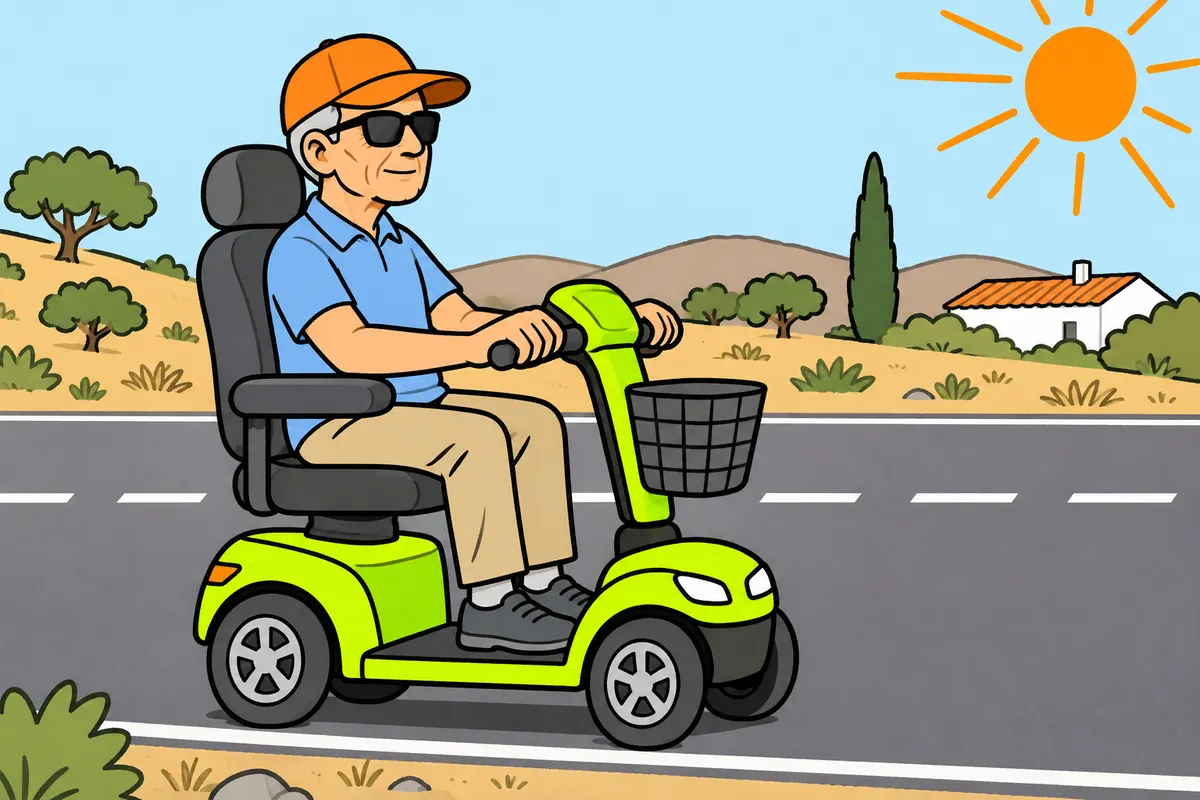
In sun or heat, protect your view and attention.
Remember
- If sunlight dazzles you, slow according to what you can see.
- Use your sun visor if fitted and clean your windows.
- Plan water and breaks in hot weather.
- Drink when safely stopped.
- Accelerate, turn and brake progressively.
- Before slowing considerably, check around you and signal when possible.
Exam trap: Wrong: You think smooth driving rules out hard braking. Right: Imminent danger may require hard braking.
Read the full explanation
- If the sun dazzles you, slow down according to what you can see and use suitable protection, such as the sun visor if fitted. Keep the windows clean to limit reflections. Do not continue into an area you cannot see just because you remember the road layout or have priority.
- In hot weather, monitor your attention, comfort and signs of tiredness. Plan water and rest breaks and, if you have a climate-controlled cabin, set a comfortable temperature. Drink when you are safely stationary so that you do not occupy the hands or attention you need for the controls. [DGT, fatigue](https://www.dgt.es/muevete-con-seguridad/evita-conductas-de-riesgo/conducir-con-fatiga/).
- Drive with anticipation, accelerating, turning and braking progressively. This improves comfort and helps you maintain control. Do not confuse smoothness with passivity: an imminent danger may require hard braking.
- If you need to slow down considerably, check your surroundings and warn others of your intention whenever possible, avoiding abrupt actions unless danger is imminent. If you need to abandon your journey because of bad weather, fatigue or a breakdown, find a suitable, safe place. Protection and subsequent actions are covered in «Accidents and breakdowns». [RGC, art. 53](https://www.boe.es/buscar/act.php?id=BOE-A-2003-23514#a53).
28Save energy and reduce emissions and noise
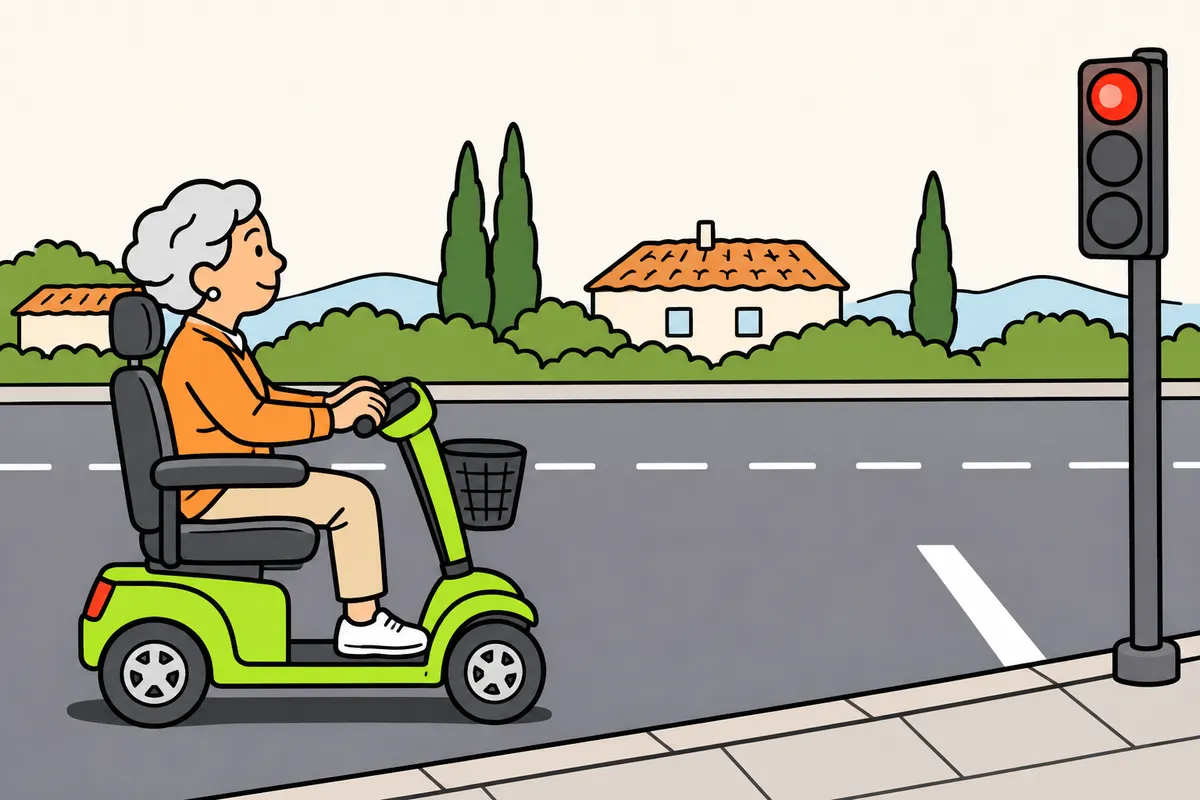
Drive smoothly and maintain your vehicle to save energy and reduce nuisance.
Remember
- Accelerate progressively and anticipate stops to save energy.
- Do not carry unnecessary weight.
- Follow the manufacturer’s maintenance and tyre pressure instructions.
- Do not drive above legal noise, gas or smoke limits.
- Use your horn only when authorised, without excessive use.
- Check restrictions and permissions before entering a low-emission zone.
Exam trap: Wrong: You assume your LCM vehicle is exempt from environmental restrictions. Right: Check the restrictions and authorisations that apply to your vehicle.
Read the full explanation
- Accelerate progressively and anticipate stops to avoid unnecessary acceleration and braking. This reduces your LCM vehicle's battery or fuel consumption. Use your model's energy-saving modes according to the manual and retain the ability to respond to traffic. [DGT, efficient driving](https://sede.dgt.gob.es/export/sites/dgt/.galleries/permisos-de-conducir/certificacion-aptitud-profesores-formacion-vial/2026/MANUAL-II-Cuestiones-de-Seguridad-Vial.pdf).
- Avoid carrying unnecessary weight and follow the manufacturer's maintenance schedule and specified tyre pressures: these affect consumption and range. Do not use gear or engine-speed recommendations intended for a passenger car for your model. [DGT, efficient driving](https://sede.dgt.gob.es/export/sites/dgt/.galleries/permisos-de-conducir/certificacion-aptitud-profesores-formacion-vial/2026/MANUAL-II-Cuestiones-de-Seguridad-Vial.pdf).
- You must not drive if your vehicle exceeds the regulatory limits for noise, gases or smoke. If it has a combustion engine, keep the exhaust system in good condition; an electric vehicle can also cause a noise nuisance. [RGC, art. 7](https://www.boe.es/buscar/act.php?id=BOE-A-2003-23514#a7).
- Use the horn only in authorised circumstances and avoid using it without reason or excessively. Audible warnings and the conditions for using them are covered in «LCM vehicle lights and signalling». [RGC, art. 110](https://www.boe.es/buscar/act.php?id=BOE-A-2003-23514#a110).
- Before entering a low-emission zone, check the restrictions and authorisations applicable to your vehicle. The authorities can restrict entry and traffic for environmental reasons; driving an LCM vehicle does not allow you to assume a general exemption. [RGC, art. 157](https://www.boe.es/buscar/act.php?id=BOE-A-2003-23514#a1-10).
Preparing to set off
Complete your preparations before joining traffic.
- Assess your rest, eyesight, medication and ability to use the controls; if you are not fit to drive, postpone your journey.
- Check the brakes, steering, tyres, lights and range in accordance with the manual.
- Adjust your driving position, supports, adaptations and mirrors; clear the windows and secure objects.
- Use the seat belt and any required protective equipment; set your route and put your phone away.
- Check your surroundings, make sure you can join traffic safely and move off smoothly.
Responding to fatigue or drowsiness
Interrupt your journey before your ability to control the vehicle deteriorates.
- Recognise tiredness, lack of attention or heavy eyelids without waiting until you make a mistake.
- Slow down predictably and look for a safe place where you are allowed to stop.
- Park and rest; if you are sleepy, sleep.
- Reassess your fitness before continuing and ask for help or alternative transport if you are not fit to drive again.
Responding to rain or poor visibility
Give yourself more space and time to stop safely.
- Notice changes in grip or visibility and avoid abrupt adjustments.
- Reduce your speed progressively and increase your clearance ahead and to the sides.
- Use the appropriate lights and keep your view clear using the equipment fitted to your vehicle.
- Make sure you can stop within the distance you can see; do not follow another vehicle’s lights closely.
- If you cannot continue safely, interrupt your journey in a sheltered place where stopping is permitted and there is no risk of flooding.
Preparing for a bend
Adapt your driving before placing demands on your vehicle’s grip and stability.
- Assess the road layout, visibility, surface, gradient and traffic.
- Slow down in advance and brake progressively if necessary.
- Take the bend with smooth steering and speed control, keeping to a safe course.
- Complete the turn progressively and accelerate only as much as conditions allow.
Check what you know
Real questions from the bank on this topic. Pick an answer to see the explanation.
Finished this module?
Mark it as read and you will see your progress on the theory list.