
Theory · LCM Licence - Reduced Mobility Vehicle · Module 13 of 15
Sharing the road with vulnerable users
You learn to share the road with pedestrians, cyclists, VMP (personal mobility vehicle) users, motorcyclists and horse riders, paying particular attention to children, older people and people with reduced mobility. You distinguish the priorities, crossings and safety margins that apply to the vehicle you drive with your LCM licence, so you can answer exam questions without confusing it with a wheelchair or a VMP.
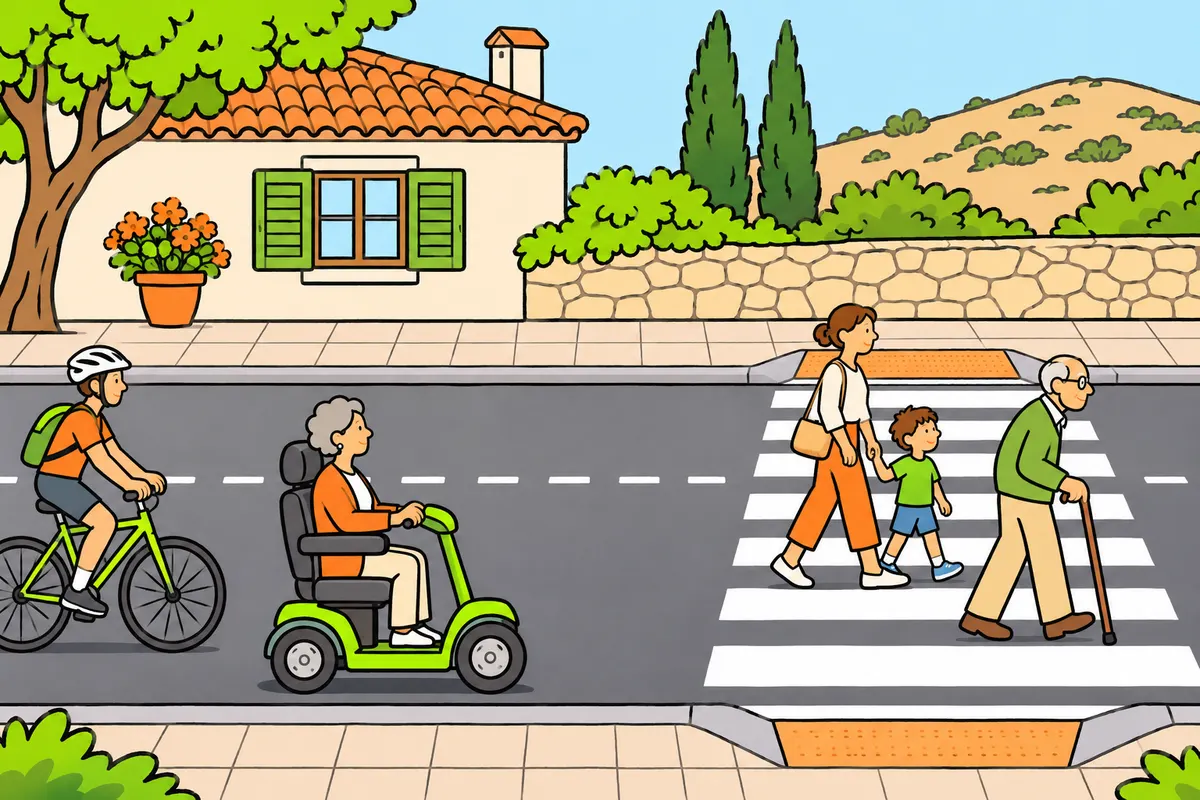
1Your vehicle must also protect others
You must protect others even when your vehicle is small and slow.
Remember
- With an LCM licence, you drive a vehicle, not a VMP.
- Your vulnerability does not give you general priority.
- Take special care around children, older people and people with disabilities.
- Watch places where pedestrians and cyclists may appear.
- Slow down or stop if you cannot continue safely.
- Do not use your horn to force anyone aside.
Exam trap: Wrong: your reduced mobility gives you priority. Right: respect priority rules and avoid danger.
Read the full explanation
- When you drive with an LCM licence, you drive a vehicle for people with reduced mobility. Your own vulnerability, the vehicle’s small size or its slow speed do not give you general priority over people on foot. You must avoid putting them at risk or causing them inconvenience and adapt your behaviour to their needs. [RGC, art. 121](https://www.boe.es/buscar/act.php?id=BOE-A-2003-23514#a121)
- Vulnerable road users include pedestrians, cyclists, users of VMP (personal mobility vehicles), and riders and passengers of motorcycles and mopeds. Among pedestrians, children, older people, people with disabilities and people with reduced mobility deserve particular protection. Vulnerability means a greater risk of injury, rather than unconditional priority. [LTSV, Annex I, concept 86](https://www.boe.es/buscar/act.php?id=BOE-A-2015-11722#ani)
- Do not confuse your vehicle with a VMP: vehicles for people with reduced mobility are excluded from that definition. The fact that both may be electric or compact does not make their rules on access, road use or driving interchangeable. Identify the type of vehicle before answering a question. [RGV, Annex II](https://www.boe.es/buscar/act.php?id=BOE-A-1999-1826#anii)
- As part of defensive driving, watch the paths people may take and the places from which someone may emerge. If you cannot continue safely, slow down further or stop; do not force a pedestrian or cyclist to move out of your way by accelerating, changing direction abruptly or pressuring them with your horn. [RGC, art. 46](https://www.boe.es/buscar/act.php?id=BOE-A-2003-23514#a46)
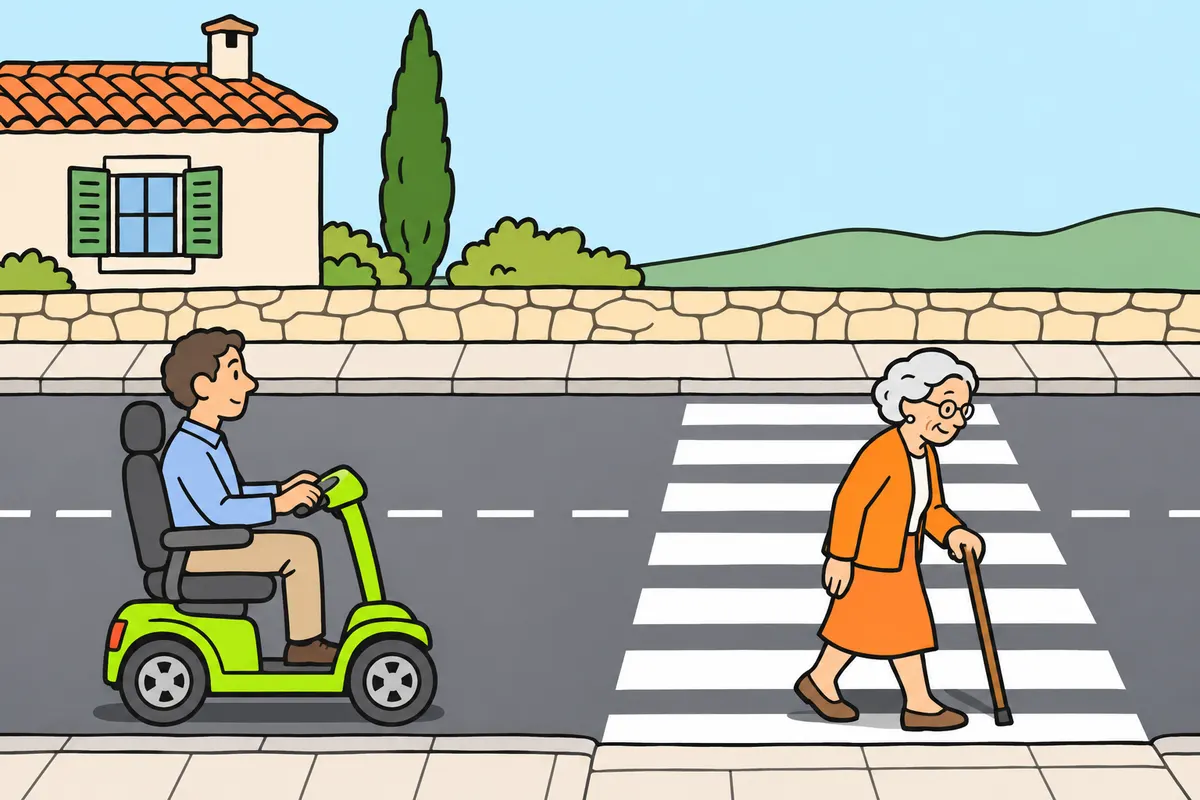
2A speed that allows you to stop
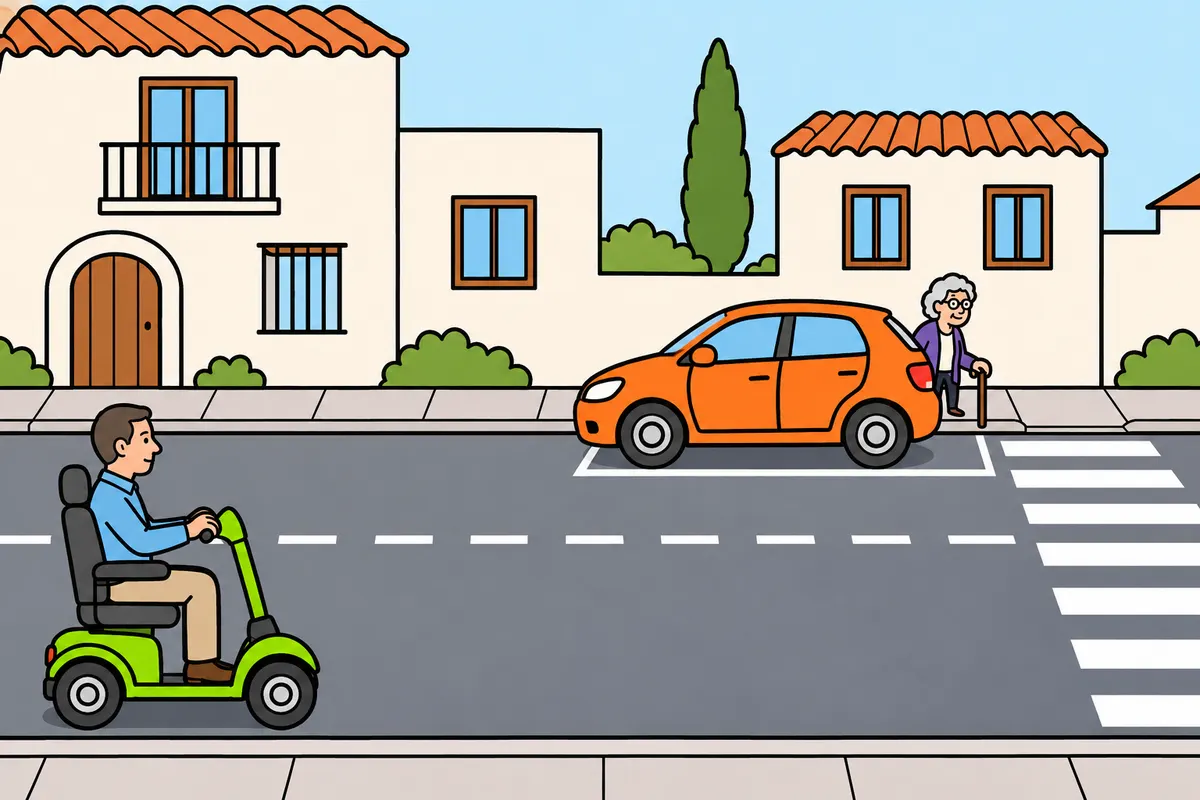
You must travel slowly enough to stop within the space you can see.
Remember
- Slow down before someone enters your path.
- Take extra care around children, older people and anyone with sight or movement difficulties.
- Slow down near bicycles and routes for cycles.
- Slow down at crossings without an officer or traffic lights.
- Look for people hidden between parked vehicles.
- Expect people near markets, schools, building entrances and stationary buses.
Exam trap: Wrong: your slow vehicle is always safe. Right: adapt your speed and leave braking space.
Read the full explanation
- You must choose a speed that allows you to stop your vehicle within the distance you can see and before foreseeable obstacles. Your vehicle’s limited performance does not guarantee safe progress: near someone crossing or emerging from between parked vehicles, you may need to travel much more slowly. [RGC, art. 45](https://www.boe.es/buscar/act.php?id=BOE-A-2003-23514#a45)
- Reduce your speed when pedestrians are on the part of the road you use or you can reasonably expect them to enter it. Take extra care around children, older people, blind people and people who have difficulty moving; you must not wait until they are directly in front of you before reacting. [RGC, art. 46](https://www.boe.es/buscar/act.php?id=BOE-A-2003-23514#a46)
- You must also reduce your speed when approaching bicycles, routes reserved for cycles and pedestrian crossings without an officer or traffic lights. Even if a crossing looks empty at first glance, you must keep watching: parked vehicles, street furniture or other obstacles may hide someone who is about to cross. [RGC, art. 46](https://www.boe.es/buscar/act.php?id=BOE-A-2003-23514#a46)
- At markets, educational establishments, buildings with direct access to the road and beside stationary buses, you must anticipate people emerging. Leave enough room to brake and avoid accelerating to get past first. Your engine noise, familiarity with the route or being in a hurry do not determine a safe speed. [RGC, art. 46](https://www.boe.es/buscar/act.php?id=BOE-A-2003-23514#a46)
3Children and school surroundings
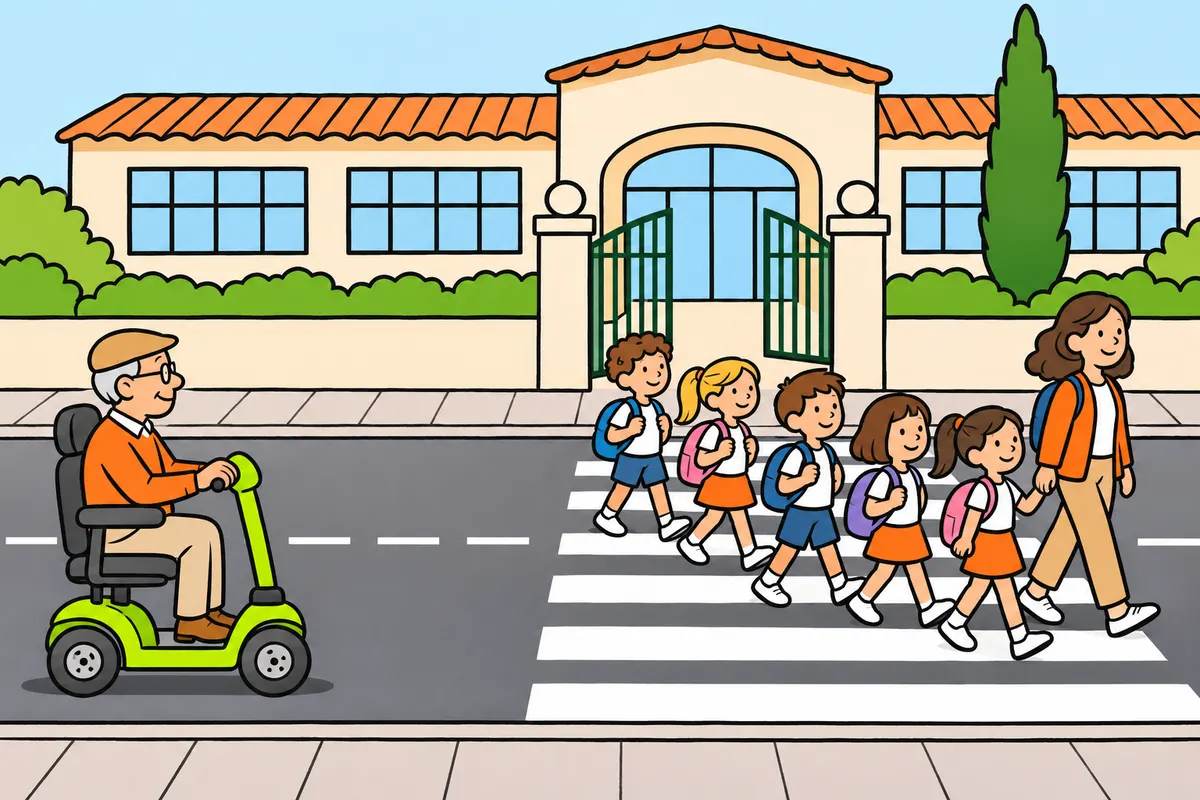
You must expect sudden movements from children and let school groups pass.
Remember
- Slow down near schools and wherever you may find children.
- Stop if necessary.
- Watch doors, corners and gaps between vehicles.
- Let the whole school group walking in line pass.
- Expect children hidden in front of or behind a stationary school bus.
- Obey school area restrictions even with an LCM licence.
Exam trap: Wrong: you can pass through a gap in a school line. Right: wait until the whole group has passed.
Read the full explanation
- When approaching a school or somewhere you can expect children to be present, you must reduce your speed and stop if necessary. In practice, watch doors, corners and gaps between vehicles: a ball or a child beside the kerb is a reason to anticipate someone suddenly entering your path. [RGC, art. 46](https://www.boe.es/buscar/act.php?id=BOE-A-2003-23514#a46)
- If a line of schoolchildren is passing, you must respect their priority and let them pass. As they are a group, you must watch the whole group and check that everyone has passed before continuing with your vehicle. [RGC, art. 65](https://www.boe.es/buscar/act.php?id=BOE-A-2003-23514#a65)
- Beside a stationary school bus, watch both ends and the space hidden behind its bodywork. A child may emerge from there without first appearing in your field of vision. Leave enough room to stop before reaching that area; passengers’ priority at marked stops is explained in «Pedestrian priority without a striped crossing». [RGC, art. 46](https://www.boe.es/buscar/act.php?id=BOE-A-2003-23514#a46).
- Around schools, you may encounter safe routes, restrictions and traffic-calming measures. You must follow the specific rules, without assuming that your LCM licence exempts you because it is a licence for reduced mobility. These measures may also protect areas around hospitals and centres for older people or people with disabilities. [RGC, art. 158](https://www.boe.es/buscar/act.php?id=BOE-A-2003-23514#a1-11)
4Older people and disability
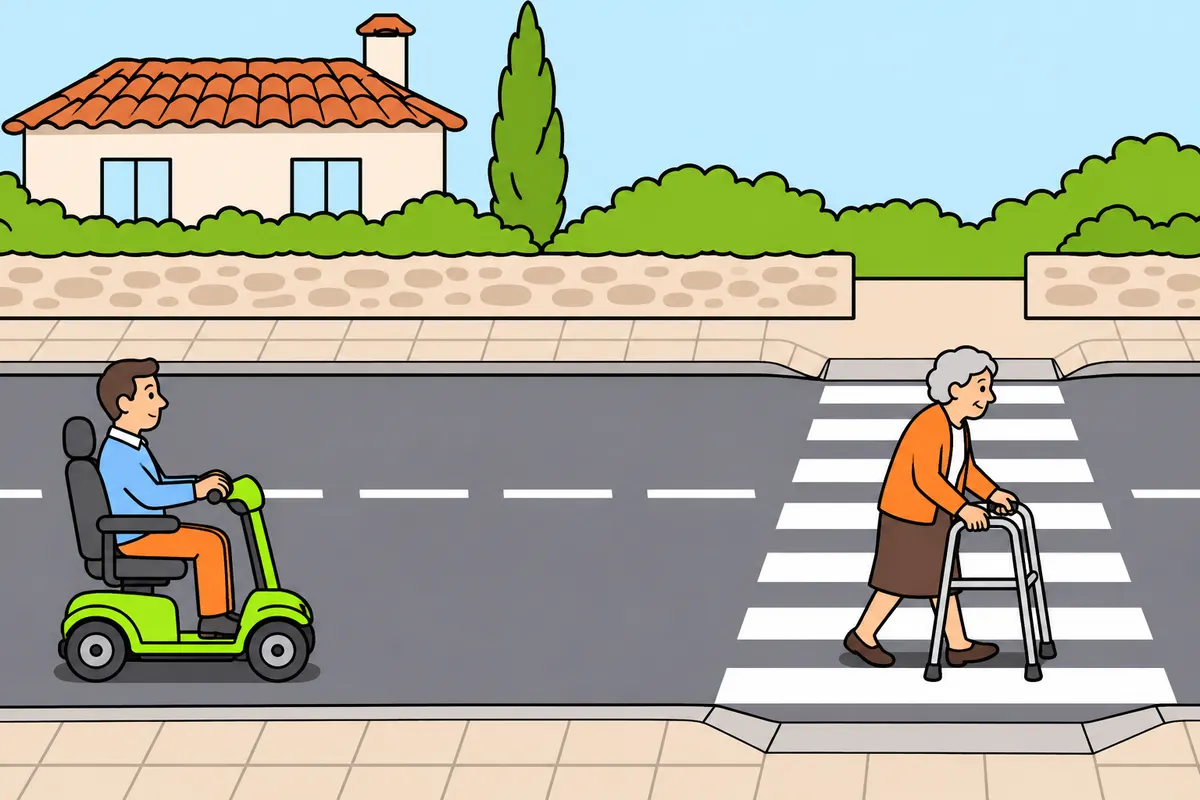
You must give time and space to people who need more help moving around.
Remember
- Wait while someone, their stick, walking frame or wheelchair could remain in your path.
- No eye contact does not mean someone has decided against crossing.
- Slow down around sight or movement difficulties, and stop when necessary.
- Keep entrances and dropped kerbs clear.
- Before turning, joining traffic or reversing, look for people you might miss.
Exam trap: Wrong: sounding your horn is enough to continue. Right: check that you can move safely.
Read the full explanation
- You must take particular care around someone who takes time to start or finish crossing. As a precaution, give them time and space; do not move off while their body, walking stick, walking frame or wheelchair could be in your path. The duty to protect pedestrians applies to every vehicle, including yours. [RGC, art. 121](https://www.boe.es/buscar/act.php?id=BOE-A-2003-23514#a121)
- You must not interpret the absence of eye contact or the absence of a gesture as someone giving up their intention to cross. Around blind people or people with obvious mobility difficulties, slow down and stop when circumstances require it. Sounding your horn does not replace checking that you can continue without putting them in danger. [RGC, art. 46](https://www.boe.es/buscar/act.php?id=BOE-A-2003-23514#a46)
- Keep access points and dropped-kerb crossings clear so people can get past the kerb. Stopping in a way that prevents their normal use creates a serious obstacle for those who need that route. Your reduced mobility does not justify blocking the access someone else needs to get around. [RGC, art. 91](https://www.boe.es/buscar/act.php?id=BOE-A-2003-23514#a91)
- Before joining traffic, turning or reversing, also check the space immediately around you where short road users or people in wheelchairs may be. This is part of your duty to control the vehicle and pay attention: your vehicle’s small size does not eliminate blind spots. [RGC, art. 18](https://www.boe.es/buscar/act.php?id=BOE-A-2003-23514#a18)
5Wheelchairs and pedestrian status
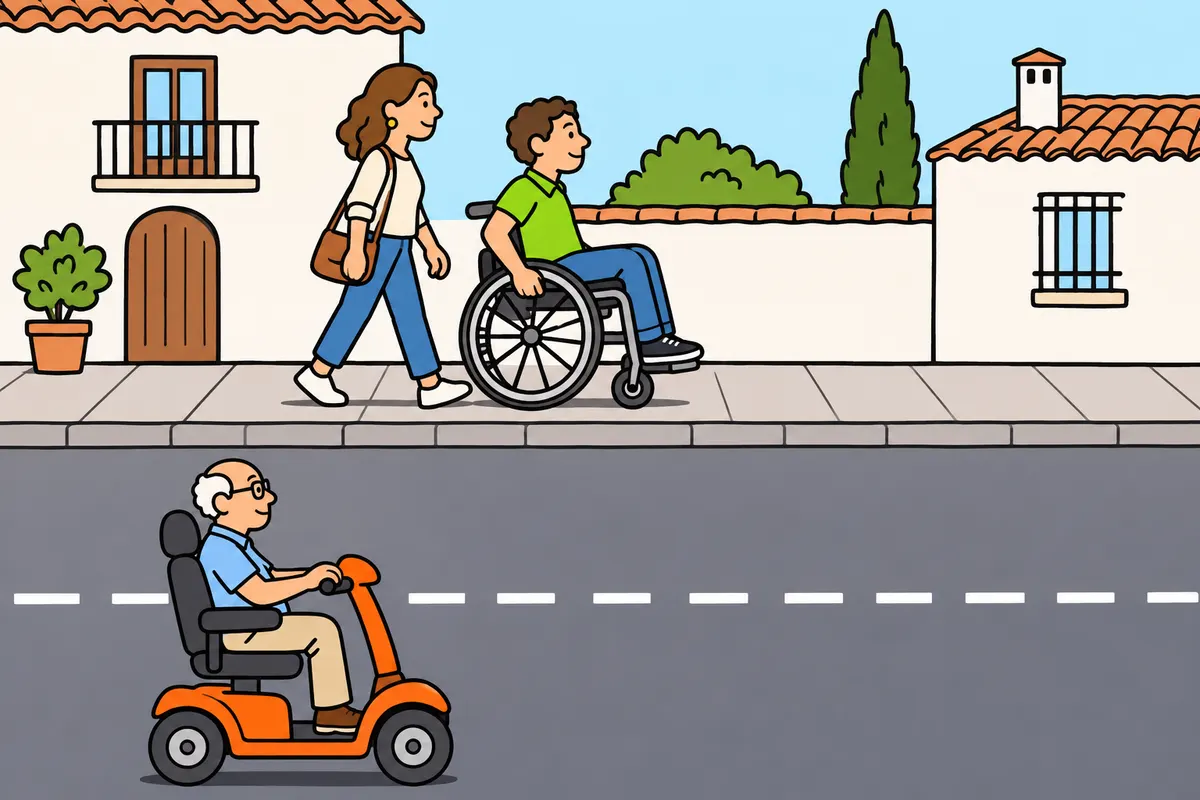
You must distinguish when you count as a pedestrian and when you drive a vehicle.
| Your situation | Your status |
|---|---|
| You have a disability and use a wheelchair at walking pace, motorised or not | Pedestrian |
| You have reduced mobility and use a VMP at walking pace | Pedestrian |
| You drive your vehicle with an LCM licence | Vehicle driver |
| You walk a bicycle or two-wheeled moped | Pedestrian |
Remember
- LCM does not automatically let you use pavements or cross as a pedestrian.
- As a wheelchair pedestrian, use an available, usable pedestrian area.
- Otherwise, use the usable left hard shoulder, or the carriageway if none exists.
- Safety or another legal exception may require you to use the right.
Exam trap: Wrong: you must always use the right in a wheelchair. Right: a wheelchair alone does not require this.
Read the full explanation
- If you have a disability and travel at walking pace in a wheelchair, with or without a motor, you have pedestrian status. You also count as a pedestrian if you push a pram or a small non-motorised vehicle, or walk while pushing a cycle or a two-wheeled moped. [LTSV, Annex I, concept 4](https://www.boe.es/buscar/act.php?id=BOE-A-2015-11722#ani)
- If you have reduced mobility and travel on a VMP at walking pace, you count as a pedestrian for the purposes of the Regulations. This status depends on you having reduced mobility and travelling at walking pace; driving a vehicle authorised by an LCM licence is subject to its own rules. [RGC, art. 155](https://www.boe.es/buscar/act.php?id=BOE-A-2003-23514#a1-8)
- You must not automatically treat every mobility aid vehicle as a wheelchair with pedestrian status. Check its classification and the relevant legal circumstances: driving with an LCM licence does not in itself authorise you to drive on the pavement, cross as a pedestrian or use a route reserved for pedestrians. [RGC, art. 152](https://www.boe.es/buscar/act.php?id=BOE-A-2003-23514#a1-5)
- If you have pedestrian status in a wheelchair and there is no usable pedestrian area, you must follow the rule requiring you to use the usable left-hand arcén (hard shoulder) or, if there is none, the carriageway, unless safety reasons or another applicable circumstance require you to use the right-hand side. Using a wheelchair does not in itself require you to travel on the right. [RGC, art. 122](https://www.boe.es/buscar/act.php?id=BOE-A-2003-23514#a122)
6Pavements and shared spaces
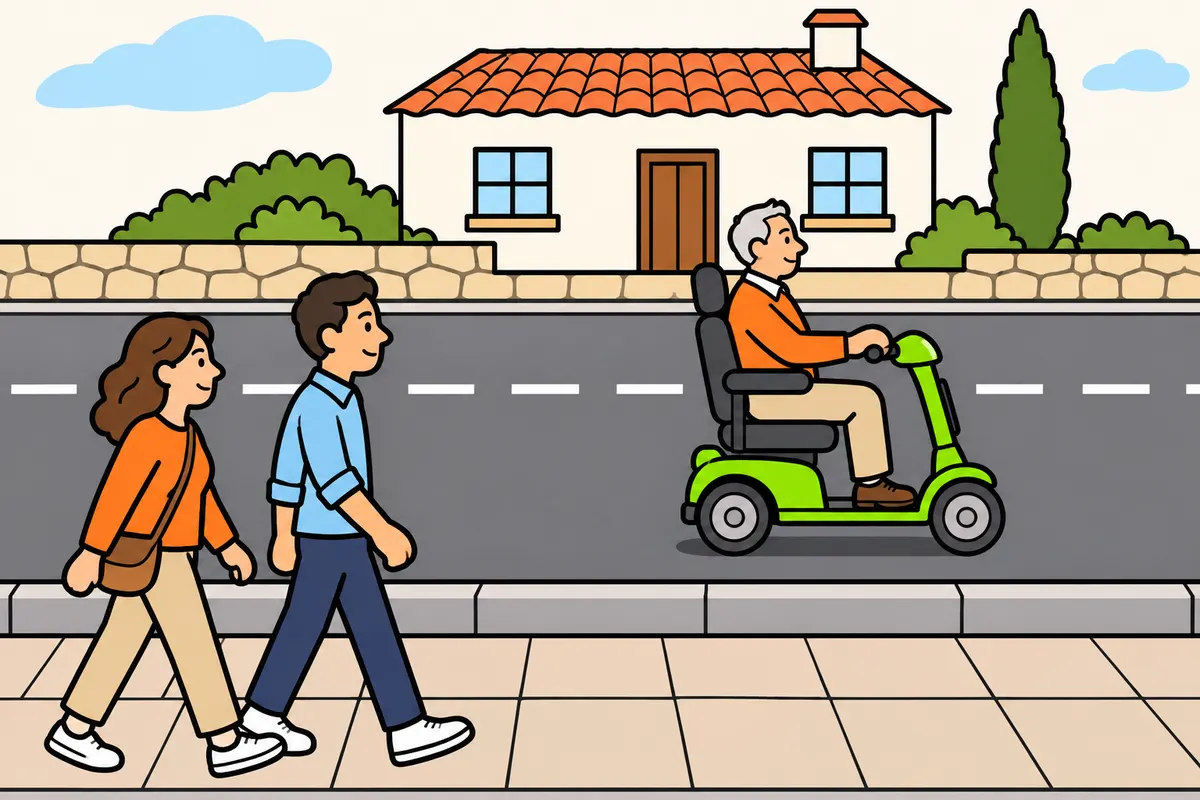
You must check whether you may enter and respect pedestrian priority.
Remember
- Do not drive along pavements except under regulated exceptions.
- Your vehicle being narrow or slow does not give you permission.
- Check access permissions for other pedestrian areas.
- Give way to pedestrians when crossing a pedestrian area at an authorised access.
- On shared level surfaces, slow down further if necessary.
Exam trap: Wrong: pedestrians always need a marked crossing on a shared level surface. Right: where the shared level surface is designed and adapted to favour pedestrian movement, pedestrians have priority anywhere on the carriageway.
Read the full explanation
- Pavements are reserved for pedestrians to move along and spend time on, and vehicles are prohibited from travelling along them, subject to the exceptions set out in the regulations. Your vehicle for people with reduced mobility is not allowed access simply because it is narrow or moves slowly. Do not confuse travelling along a pavement with crossing it at an authorised access point to a property. [RGC, art. 152](https://www.boe.es/buscar/act.php?id=BOE-A-2003-23514#a1-5)
- In other pedestrian areas, the municipal authority may regulate shared use by pedestrians, bicycles and VMPs while respecting pedestrian priority. This possibility does not give your vehicle general permission to enter. Before entering, you must check the restrictions and permissions applicable to that place and your vehicle category. [RGC, art. 152](https://www.boe.es/buscar/act.php?id=BOE-A-2003-23514#a1-5)
- When you cross a pedestrian area at an authorised location, you must give way to pedestrians using it. For example, when crossing the pavement at an authorised access point, you cannot force someone to stop or step down onto the carriageway to let your vehicle pass. [RGC, art. 65](https://www.boe.es/buscar/act.php?id=BOE-A-2003-23514#a65)
- In an area where the carriageway and pavement form a single level surface, designed and equipped to favour pedestrian movement, pedestrians have priority at any point on the carriageway. Also check the access conditions. [LTSV, Annex I, concept 83](https://www.boe.es/buscar/act.php?id=BOE-A-2015-11722#ani) The general speed limit on roads where the carriageway and pavement form a single level surface is 20 km/h; you must reduce your speed further when necessary. [RGC, art. 50](https://www.boe.es/buscar/act.php?id=BOE-A-2003-23514#a50).
7How to approach a pedestrian crossing
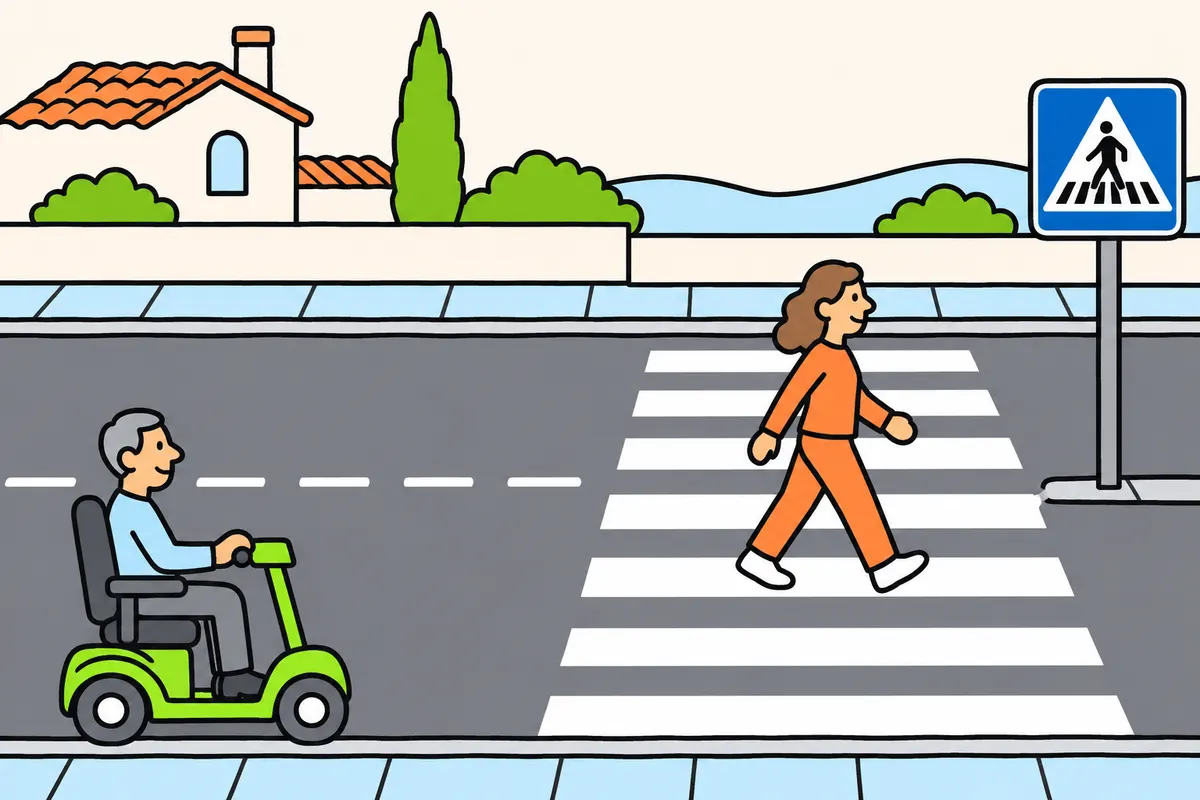
You must approach crossings ready to stop and keep the crossing clear.
Remember
- At crossings without officers or traffic lights, slow down and check both sides.
- Look for hidden people even when the stripes seem empty.
- Give way to people using marked crossings and help them enter safely.
- Do not accelerate to pass first or pressure people with your horn.
- Stop before the stripes, leaving space for people to cross.
- Wait if you could stop and block a pedestrian or cycle crossing.
Exam trap: Wrong: you need not give way without traffic lights. Right: respect pedestrian priority at marked crossings.
Read the full explanation
- As you approach a crossing without an officer or traffic lights, you must slow down and be prepared to stop. Check both sides, hidden areas and anyone approaching the crossing. Do this even if you initially see no one on the stripes: a safe approach begins before you reach the crossing. [RGC, art. 46](https://www.boe.es/buscar/act.php?id=BOE-A-2003-23514#a46)
- At a properly marked pedestrian crossing, you must give way to pedestrians using it. Help them cross safely when they show their intention to do so; do not accelerate to get past before they step onto it or use your horn to make them wait. The absence of traffic lights does not remove their priority. [RGC, art. 65](https://www.boe.es/buscar/act.php?id=BOE-A-2003-23514#a65)
- Stop far enough back to keep the crossing clear and allow pedestrians to see and be seen. Leave enough space for a wheelchair or pushchair to cross, including the exit onto the opposite pavement. [RGC, art. 65](https://www.boe.es/buscar/act.php?id=BOE-A-2003-23514#a65)
- Even if you have priority or permission to proceed, you must not enter a pedestrian or cycle crossing if you expect to stop and block traffic crossing your path. Wait before the crossing until there is enough room beyond it for your vehicle, without forcing people crossing to go around it. [RGC, art. 59](https://www.boe.es/buscar/act.php?id=BOE-A-2003-23514#a59)
- The M-4.3 pedestrian crossing marking consists of white stripes parallel to the centre line of the carriageway, forming a transverse set. At crossings controlled by traffic lights, two parallel broken transverse lines may also be used. From your vehicle, identify the whole crossing area and keep watching both ends. [RD 465/2025, RGC Annex I, section 4.2](https://www.boe.es/buscar/doc.php?id=BOE-A-2025-12199).
8Traffic lights and officers at crossings
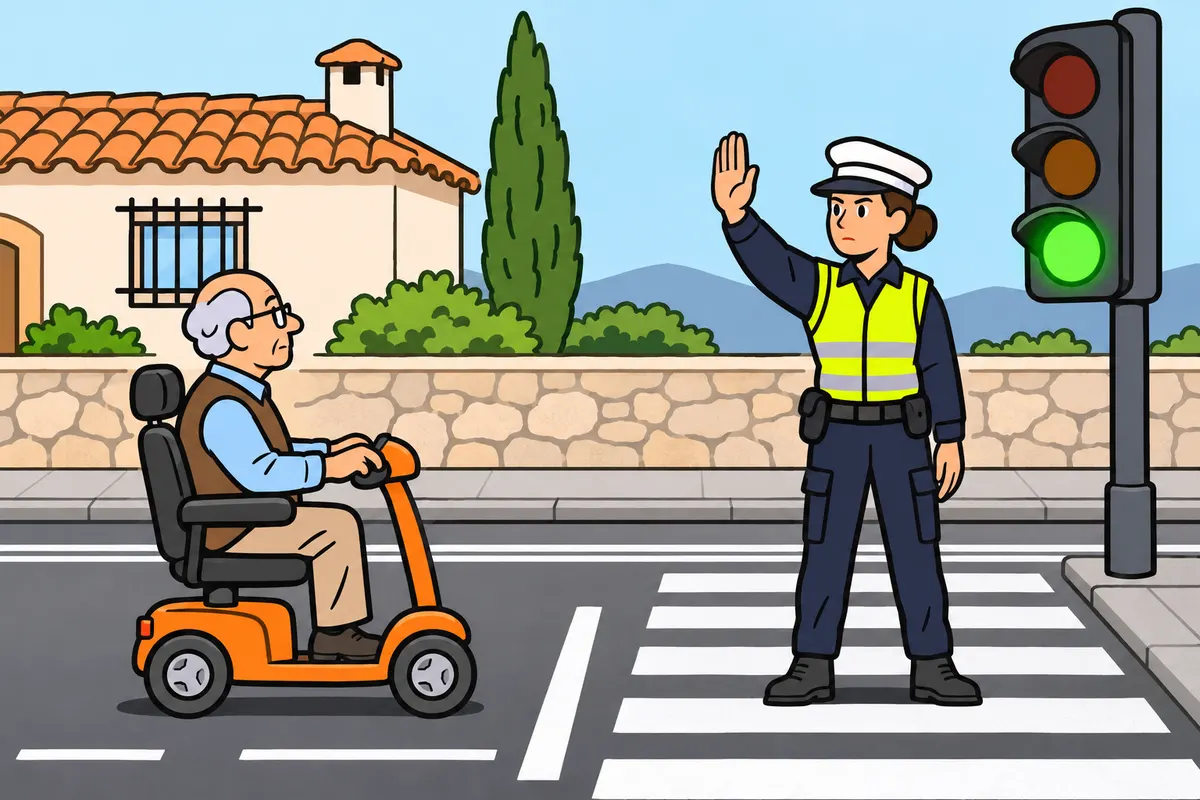
You must obey officers and signals while still watching people crossing.
| Instruction or signal | What you must follow |
|---|---|
| Officer's instruction | Takes priority over other signs and signals |
| Traffic lights | Take priority over upright signs and road markings |
| Flashing amber | Take care, respect priority and obey other stop requirements |
Remember
- With flashing amber, take extra care and give way when required.
- Flashing amber does not cancel another sign requiring you to stop.
- As a pedestrian, obey your pedestrian traffic lights.
- Without pedestrian lights, stay off the carriageway while officers or lights allow vehicles through.
- Before moving off, check whether anyone is finishing crossing.
Exam trap: Wrong: green lets you disobey an officer. Right: obey the officer's instructions.
Read the full explanation
- You must obey the controls applicable to the crossing: officers' instructions take precedence over all other signs and signals, and traffic lights take precedence over upright signs and road markings. The presence of stripes does not allow you to ignore an instruction to stop, and a green light does not allow you to disobey an officer. [RGC, art. 133](https://www.boe.es/buscar/act.php?id=BOE-A-2003-23514#a133)
- A flashing amber light facing vehicles requires you to take extra care and give way where required; it does not give you priority over pedestrians. Nor does it exempt you from obeying another sign that requires you to stop. Apply the crossing's priority rules and check that you can cross it safely. [RGC, Annex I, traffic lights](https://www.boe.es/buscar/act.php?id=BOE-A-2003-23514)
- As a pedestrian, you must obey the pedestrian traffic lights. If there are none, but vehicle traffic is controlled by an officer or traffic lights, you must not step onto the carriageway while those controls allow vehicles to travel along it. Being a pedestrian does not allow you to ignore the instructions. [RGC, art. 124](https://www.boe.es/buscar/act.php?id=BOE-A-2003-23514#a124)
- When driving, keep watching people who are finishing crossing and avoid creating a conflict when you move off again. Do not replace this check with looking only at your traffic light: you must remain in control and adjust your speed to any obstacles that may appear. [RGC, art. 45](https://www.boe.es/buscar/act.php?id=BOE-A-2003-23514#a45)
9Pedestrian priority without a striped crossing
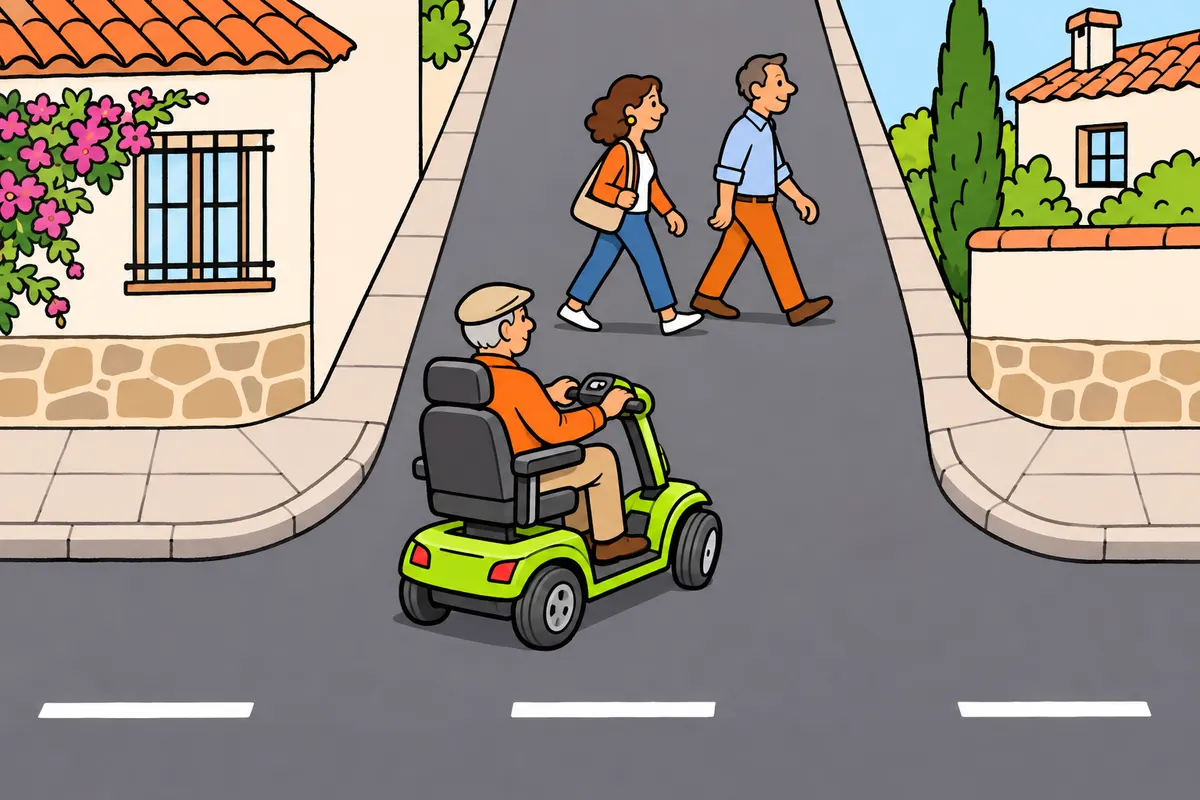
You must also give way to pedestrians in certain places without marked crossings.
| Your situation | People you must let pass |
|---|---|
| You turn into another road | Pedestrians crossing that road |
| You cross a hard shoulder with no pedestrian area available | Pedestrians using that hard shoulder |
| Public transport at a marked stop | People boarding or alighting, between the vehicle and nearest pedestrian area or refuge |
Remember
- When turning into another road, give way to pedestrians crossing it.
- When crossing a hard shoulder, give way to pedestrians without a pedestrian area.
- Let organised processions and military units on foot pass.
- Even with priority, slow down and avoid hitting anyone.
Exam trap: Wrong: anyone beside any bus has priority. Right: give way to people boarding or alighting at a marked stop, between public transport and the nearest pedestrian area or refuge.
Read the full explanation
- If you turn into another road and pedestrians are crossing it, you must give way to them even if there is no pedestrian crossing. Check the road you are entering before completing the turn: signalling your manoeuvre does not oblige people crossing to stop so that you can finish first. [RGC, art. 65](https://www.boe.es/buscar/act.php?id=BOE-A-2003-23514#a65)
- If your path crosses an arcén (hard shoulder) used by pedestrians who have no pedestrian area available, you must let them pass. Remember this when entering or leaving an access: regularly driving your vehicle on the hard shoulder does not give you priority to cut across their path. [RGC, art. 65](https://www.boe.es/buscar/act.php?id=BOE-A-2003-23514#a65)
- You must give way to people who are about to board or have alighted from a public transport vehicle at a marked stop and are between that vehicle and the nearest pedestrian area or refuge. Do not extend this priority to anyone crossing from any point beside any bus. [RGC, art. 65](https://www.boe.es/buscar/act.php?id=BOE-A-2003-23514#a65)
- You must also let military units on foot and organised processions pass. In other cases, vehicles' general priority on the carriageway and hard shoulder is subject to the exceptions in the regulations; even when you have priority, you must slow down and avoid hitting a pedestrian if a risk arises. [RGC, art. 64](https://www.boe.es/buscar/act.php?id=BOE-A-2003-23514#a64)
10Crossing rules when you are a pedestrian
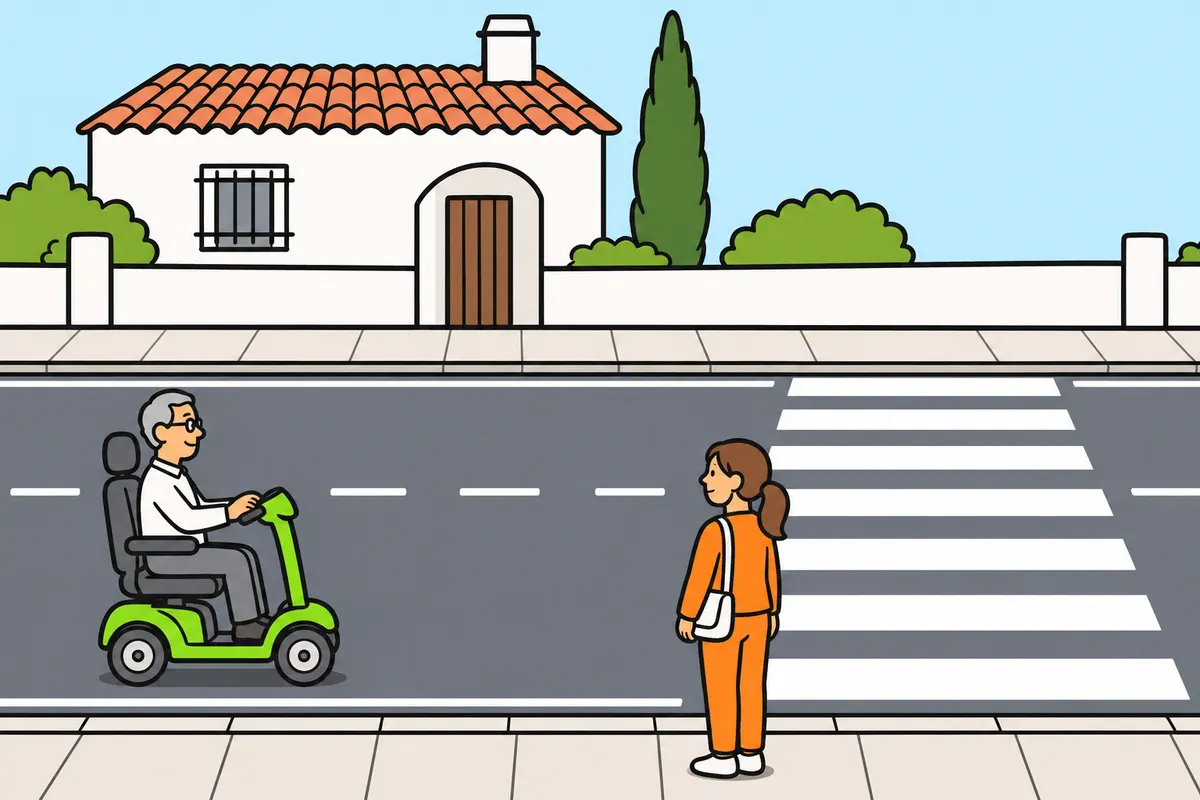
As a pedestrian, you must choose the proper crossing place and check it is safe.
Remember
- Use pedestrian crossings in the area instead of crossing beside them.
- At crossings without other controls, check vehicle distances and speeds before entering.
- Away from crossings, cross without risk or undue obstruction.
- Cross straight across, without diagonal routes or unnecessary stops.
- Go around squares and roundabouts unless there is a designated pedestrian crossing.
Exam trap: Wrong: priority guarantees drivers have seen you. Right: at a crossing without other controls, enter only when vehicle distances and speeds make it safe.
Read the full explanation
- If there are pedestrian crossings in the area, you must use them to cross the carriageway, rather than crossing nearby. Plan your route to the designated crossing point; as a driver, knowing this obligation does not allow you to keep driving towards someone who is crossing improperly and is in danger. [RGC, art. 124](https://www.boe.es/buscar/act.php?id=BOE-A-2003-23514#a124)
- At a crossing with road markings and no other controls, you have priority as a pedestrian, but you must only step onto it when the distance and speed of vehicles allow you to do so safely. You must check for approaching traffic before you start; priority does not guarantee that every driver has seen you. [RGC, art. 124](https://www.boe.es/buscar/act.php?id=BOE-A-2003-23514#a124)
- Away from a crossing, you must first make sure that you can cross without risk or undue obstruction. Cross at right angles to the centre line of the carriageway, without unnecessary delays or stops and without obstructing others. [RGC, art. 124](https://www.boe.es/buscar/act.php?id=BOE-A-2003-23514#a124)
- To reach the other side of a square or roundabout, you must go around it unless there is a designated pedestrian crossing. From your vehicle, watch crossings at entrances and exits and people approaching along their edges. [RGC, art. 124](https://www.boe.es/buscar/act.php?id=BOE-A-2003-23514#a124)
11Pedestrians on hard shoulders and carriageways
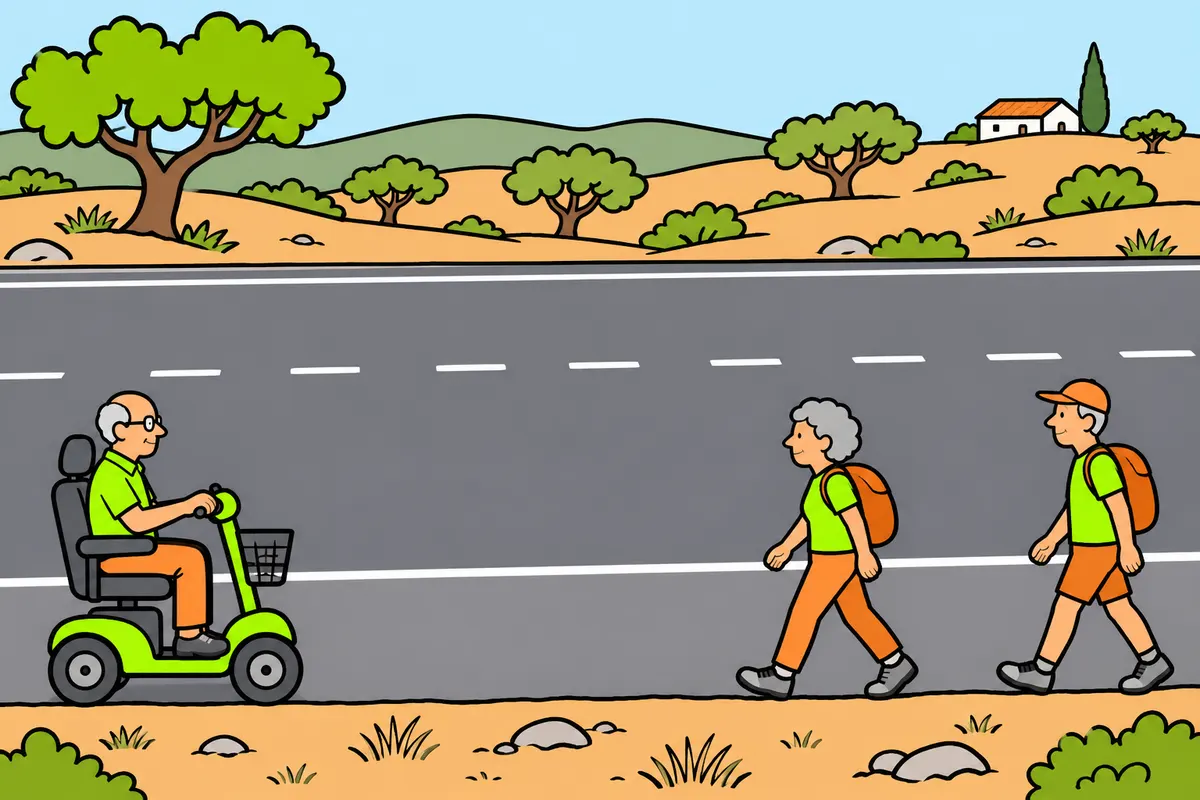
As a pedestrian, you must use pedestrian areas and know which side to use otherwise.
| Pedestrian without usable area | Side you must use |
|---|---|
| General case | Left; right if justified by safety |
| You push or pull a cycle, two-wheeled moped, VMP or similar vehicle | Right |
| You are in a group led by someone | Right |
| Safety prevents you using the left | Right |
Remember
- Use the pedestrian area if it exists and you can use it.
- Otherwise, use a usable hard shoulder, or the carriageway if none exists.
- Keep close to the outer edge and walk in single file.
- If a refuge is available, wait there until your vehicle is alongside.
- With LCM, expect pedestrians coming towards you on your hard shoulder.
- Slow down and stop if you cannot pass safely.
Exam trap: Wrong: all pedestrians always use the left. Right: some cases require the right; obey officers and signs too.
Read the full explanation
- As a pedestrian, you must use the available pedestrian area. If there is none or it is unusable, you must walk on the usable hard shoulder on your left in your direction of travel or, if there is none, on the carriageway, as far from traffic as possible. You may use the right-hand side if safety reasons justify it. [RGC, art. 122](https://www.boe.es/buscar/act.php?id=BOE-A-2003-23514#a122)
- You must travel on the right when pushing or pulling a cycle, two-wheeled moped, VMP (personal mobility vehicle) or vehicle with similar characteristics. If you are in a group led by one person, or should not travel on the left for safety reasons, you must also travel on the right, obeying officers and signs. [RGC, art. 122](https://www.boe.es/buscar/act.php?id=BOE-A-2003-23514#a122)
- When walking on the hard shoulder or carriageway, you must keep close to the outer edge, take extra care and walk in single file without causing an obstruction. If there is a refuge or suitable space, you must not stand waiting on the carriageway or hard shoulder to board a vehicle: step onto it only when the vehicle is alongside you. [RGC, art. 122](https://www.boe.es/buscar/act.php?id=BOE-A-2003-23514#a122)
- As a driver with an LCM licence, expect to encounter pedestrians facing you on the right-hand hard shoulder you use. The hard shoulder is not reserved exclusively for your vehicle or for bicycles. Adjust your speed and clearance, and stop if there is not enough space to pass safely. [RGC, art. 46](https://www.boe.es/buscar/act.php?id=BOE-A-2003-23514#a46)
12Visibility of people on foot
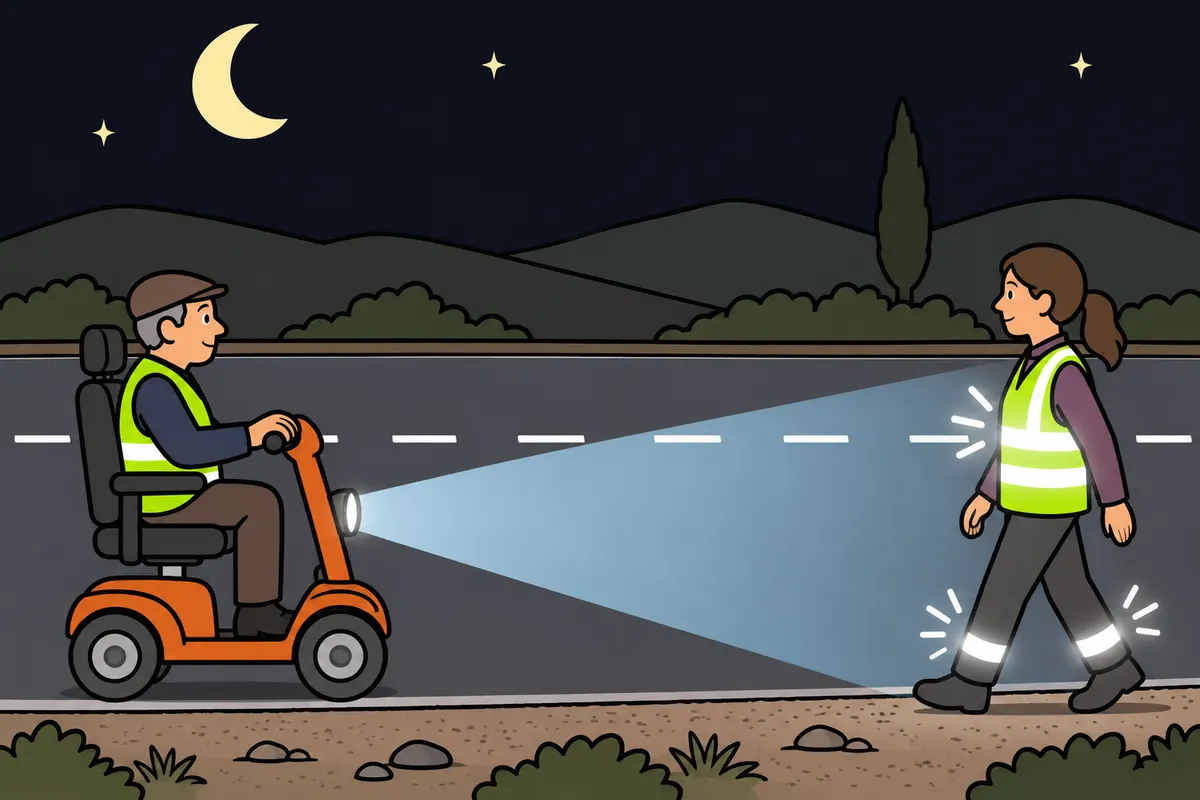
You must make yourself visible when walking and watch for poorly visible people when driving.
Remember
- On interurban roads in darkness or poor visibility, carry light-emitting or reflective equipment.
- It must meet regulations and be visible from the required minimum distance.
- In these conditions, groups also need lights on the side nearest the carriageway centre.
- Group lights show white or yellow ahead and red behind.
- When driving, slow down even if you can only see a reflector.
- With LCM, you cannot use autopistas or autovías.
Exam trap: Wrong: pedestrians may normally walk on autopistas and autovías. Right: this is prohibited except under regulated exceptions; hitchhiking is also prohibited, including at toll plazas.
Read the full explanation
- If you walk on the carriageway or hard shoulder of an interurban road between sunset and sunrise or when visibility is significantly reduced, you must carry or wear at least one luminous or reflective item that complies with personal protective equipment regulations and is visible to drivers from at least 150 metres away. [RGC, art. 123](https://www.boe.es/buscar/act.php?id=BOE-A-2003-23514#a123)
- In these conditions, if you travel in a group, you must also carry lights that show the group's position and dimensions, placed on the side nearest the centre of the carriageway. They must show white or yellow to the front and red to the rear; they may be combined in a single unit. [RGC, art. 123](https://www.boe.es/buscar/act.php?id=BOE-A-2003-23514#a123)
- From your vehicle, you must not mistake a lone reflector for a stationary object or wait until you can make out the person's whole body before slowing down. In reduced visibility, you must drive so that you can stop for an obstacle within the distance you can see, even if the person walking fails to meet their visibility obligations. [RGC, art. 45](https://www.boe.es/buscar/act.php?id=BOE-A-2003-23514#a45)
- As a pedestrian, you must not travel on autopistas (motorways) or autovías (dual carriageway motorways) except in the exceptional cases provided for in the regulations, and you must not hitchhike on them, including in toll plazas. You must not drive your vehicle for people with reduced mobility on autopistas or autovías either; route planning is covered in «Where you must drive». [RGC, art. 38](https://www.boe.es/buscar/act.php?id=BOE-A-2003-23514#a38) [RGC, art. 125](https://www.boe.es/buscar/act.php?id=BOE-A-2003-23514#a125).
13Sharing the hard shoulder with bicycles
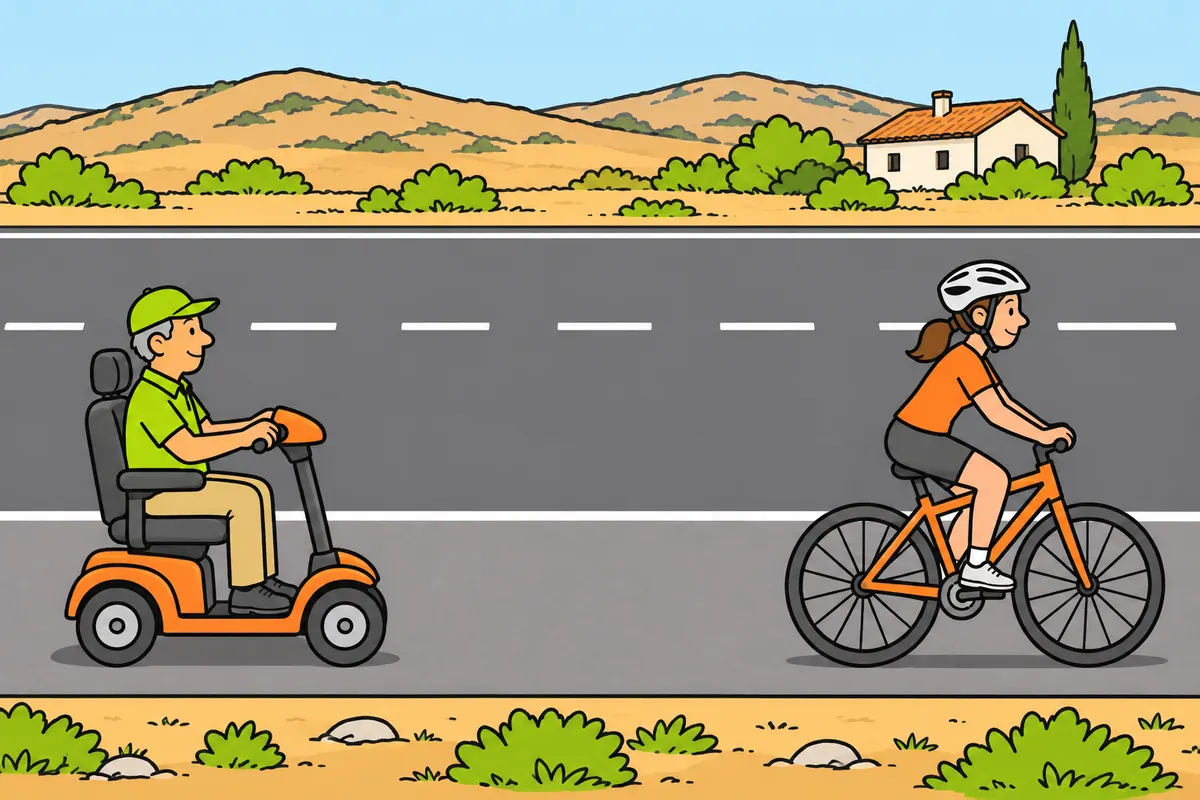
You must share the hard shoulder without riding alongside bicycles.
| Bicycles: situation | How cyclists may ride |
|---|---|
| Usable, sufficient hard shoulder | Two abreast |
| No usable, sufficient hard shoulder | Two abreast, using only the necessary carriageway space |
| Poor visibility, affecting traffic flow, darkness or significantly reduced visibility | Single file |
| Long descent with bends | Necessary part of the right carriageway if safe; exception for autovías |
Remember
- Without a route specifically for your vehicle, use the usable, sufficient right hard shoulder.
- If it is insufficient, use only the necessary part of the carriageway.
- Do not drive alongside a bicycle.
- Expect cyclists to change position and avoid getting close behind them.
Exam trap: Wrong: the bicycle exception lets you drive beside them with LCM. Right: that exception does not include your vehicle.
Read the full explanation
- If no part of the road is specifically designated for your vehicle, you must use the right-hand arcén (hard shoulder) when it is usable and wide enough; otherwise, you must use only as much of the carriageway as necessary. Cycles follow this general hard shoulder rule, so you must anticipate encounters and differences in speed. [RGC, art. 36](https://www.boe.es/buscar/act.php?id=BOE-A-2003-23514#a36)
- You must not travel alongside a bicycle simply because you both use the hard shoulder. The rule prohibits the listed vehicles from travelling alongside one another and provides a specific exception for bicycles; it does not extend that exception to your vehicle driven with an LCM licence. [RGC, art. 36](https://www.boe.es/buscar/act.php?id=BOE-A-2003-23514#a36)
- Bicycles may ride two abreast on the hard shoulder and, if there is no usable hard shoulder of sufficient width, on as much of the carriageway as necessary. They must ride in single file on sections with no visibility, when they affect traffic flow, and at night or in significantly reduced visibility. Do not assume that every pair is riding incorrectly. [RGC, art. 36](https://www.boe.es/buscar/act.php?id=BOE-A-2003-23514#a36)
- On long descents with bends, cyclists may use as much of the right-hand side of the carriageway as they need if it is safe, subject to the exception for autovías (dual carriageway motorways). In practice, expect changes in road position and avoid getting close to their rear wheel: neither the hard shoulder nor their initial course guarantees that they do not move sideways. [RGC, art. 36](https://www.boe.es/buscar/act.php?id=BOE-A-2003-23514#a36)
14Bicycles on urban streets
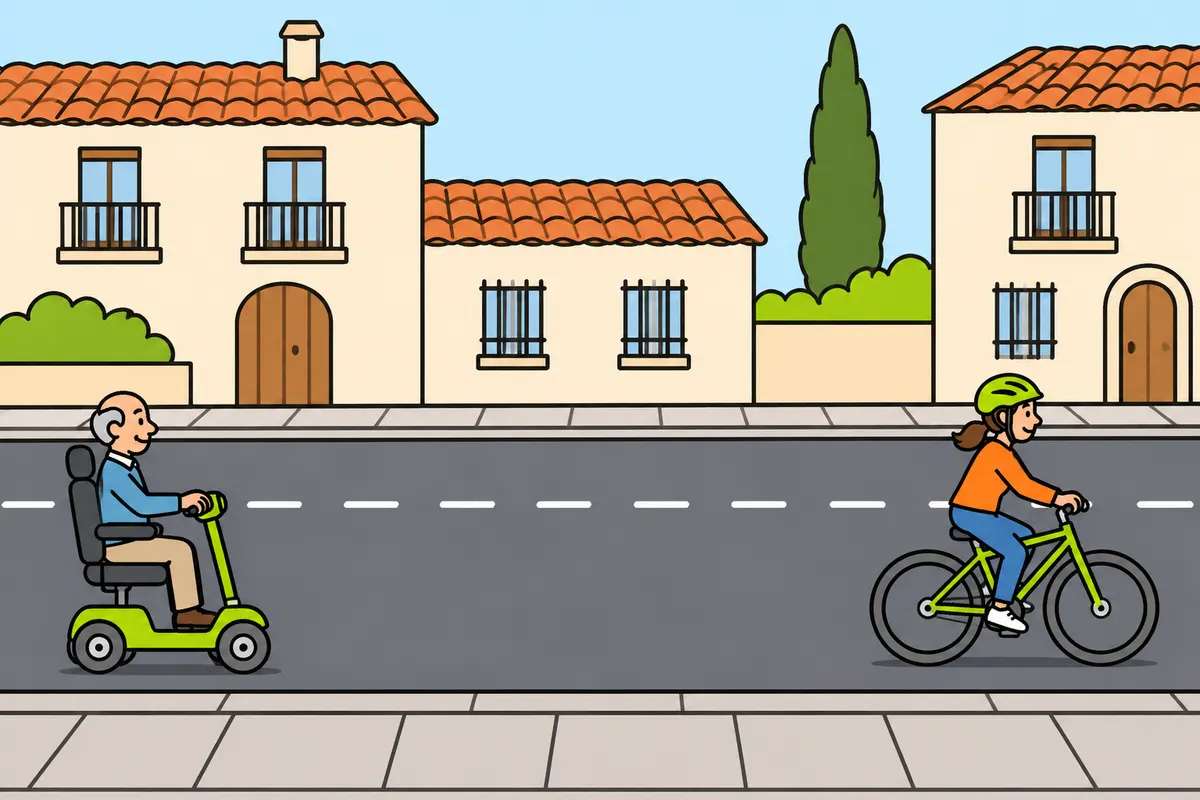
In towns, you must respect cyclists' space and permitted movements.
| Urban case: 5 m rule for motor vehicles | What you must remember |
|---|---|
| You drive a motor vehicle behind a cyclist in the same lane | Keep at least 5 m behind |
| Single-lane street limited to 30 km/h or less | Municipal signs may authorise bicycles in both directions |
| You meet someone on that authorised two-way route | Move right; if impossible, the road's designated direction has priority |
Remember
- Without a specific cycle route, expect bicycles on the carriageway.
- A specific cycle route is preferred; signs may make it compulsory.
- Cyclists preferably use the lane centre when safe.
- With several lanes each way, cyclists use the right, except for turns or safety.
- Before turning or moving off, check both sides.
- Cyclists may pass on either side and pass queues to reach advanced waiting areas.
Exam trap: Wrong: with LCM, you must keep exactly 5 metres behind a cyclist. Right: those 5 metres are a recommended starting gap for your vehicle; increase it when needed to stop without a collision. The urban rule in the same lane applies only to motor vehicles.
Read the full explanation
- In towns and cities, bicycles use the carriageway if there is no dedicated lane or route. If there is one, its use is preferred and signs may make it compulsory. You must not pressure a cyclist to leave a carriageway they are legally entitled to use. [RGC, art. 153](https://www.boe.es/buscar/act.php?id=BOE-A-2003-23514#a1-6)
- Cyclists preferably ride in the centre of the lane if their safety and that of others allow it. On roads with at least two lanes in each direction, they use the right-hand lane and may use the others to change direction or for safety. You must not try to squeeze your vehicle into the same space alongside them. [RGC, art. 153](https://www.boe.es/buscar/act.php?id=BOE-A-2003-23514#a1-6)
- The urban rule requiring a minimum following distance of 5 metres behind a cyclist in the same lane expressly applies to drivers of motor vehicles. [RGC, art. 153.4](https://www.boe.es/buscar/act.php?id=BOE-A-2003-23514#a1-6) Your vehicle for people with reduced mobility is excluded from that definition. [LTSV, Annex I, definition 12](https://www.boe.es/buscar/act.php?id=BOE-A-2015-11722#ani) As a precautionary recommendation for your LCM vehicle, you can use those 5 metres as an initial margin, without treating them as a sufficient guarantee in every situation. You must increase the distance whenever necessary so that you can stop without a collision if the cyclist brakes suddenly. [RGC, art. 54](https://www.boe.es/buscar/act.php?id=BOE-A-2003-23514#a54).
- On single-lane urban roads with a limit of 30 km/h or less, the municipal authority may use signs to authorise bicycles to travel in both directions. You must move over to your right to pass each other safely; if this is not possible, whoever is travelling in the direction normally established for the road has priority. [RGC, art. 153](https://www.boe.es/buscar/act.php?id=BOE-A-2003-23514#a1-6)
- Bicycles may overtake on the right or left as their safety requires and pass vehicles that are stationary or stopping frequently at traffic lights and in queues to use advanced waiting areas. Check both sides before turning or moving off; your vehicle being stationary does not rule out a cyclist alongside it. [RGC, art. 153](https://www.boe.es/buscar/act.php?id=BOE-A-2003-23514#a1-6)
15Junctions and groups of cyclists
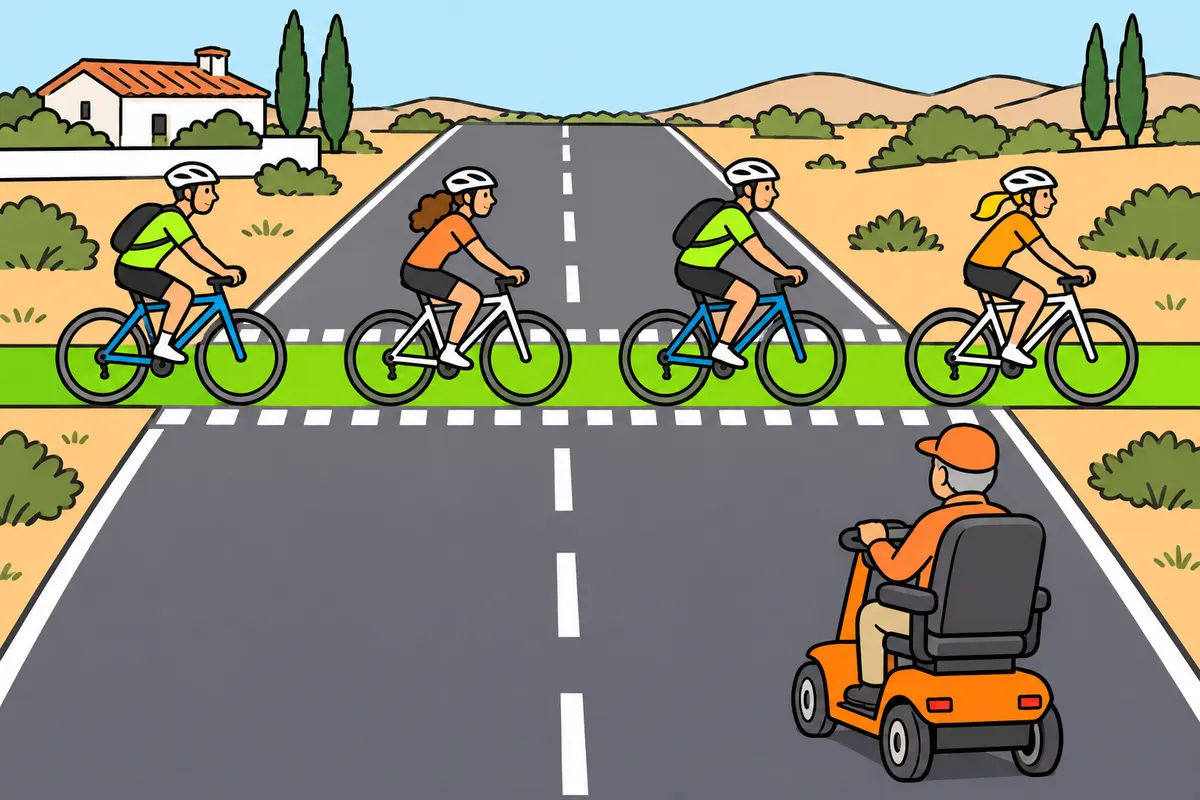
You must respect a cycling group's priority once its first rider starts crossing.
| How you cross by bicycle | Your status or priority |
|---|---|
| You ride across a pedestrian-only crossing | You do not gain pedestrian priority |
| You walk your bicycle | You are a pedestrian |
| You use a marked cycle crossing | You have the applicable cyclist priority |
Remember
- Give way to cyclists on properly marked cycle lanes, cycle crossings or hard shoulders.
- Wait when the first rider of a group starts crossing or enters a roundabout.
- Do not cut between members of the group.
- Before turning, check alongside you and respect cycle route priorities.
- Outside special cases, apply the general priority rules between vehicles.
- Avoid hitting anyone even if they cross incorrectly.
Exam trap: Wrong: riding a bicycle across the stripes gives pedestrian priority. Right: dismount and walk the bicycle to have pedestrian status.
Read the full explanation
- Cyclists have priority over other vehicles when using a properly signed cycle lane, cycle crossing or hard shoulder. If your path crosses their route, you must respect that priority. Do not confuse a crossing of a cycle route with a crossing intended solely for pedestrians. [RGC, art. 64](https://www.boe.es/buscar/act.php?id=BOE-A-2003-23514#a64)
- When a group of cyclists travels together and the first cyclist has started crossing or entered a roundabout, the group has priority. You must wait for the whole group to pass. [RGC, art. 64](https://www.boe.es/buscar/act.php?id=BOE-A-2003-23514#a64)
- The specific priority rule for a cyclist near a turn into another road refers to motor vehicles and mopeds. Your vehicle has its own classification. When preparing for any turn, check alongside you and along the cycle route, respect the applicable priorities and avoid cutting across anyone’s path in a way that creates danger. [RGC, art. 64](https://www.boe.es/buscar/act.php?id=BOE-A-2003-23514#a64)
- Outside these special cases, the general rules on priority between vehicles apply. A bicycle does not have universal priority because it is vulnerable, but you must slow down as you approach and avoid any manoeuvre that puts it at risk. If a conflict arises, you must take precautions regardless of who has priority. [RGC, art. 64](https://www.boe.es/buscar/act.php?id=BOE-A-2003-23514#a64)
- A person riding a bicycle does not gain pedestrian priority by riding across a pedestrian crossing. If they dismount and push it, they have pedestrian status. Distinguish this situation from a cycle crossing; if a bicycle crosses incorrectly, you must avoid hitting the cyclist and stop if necessary. [LTSV, Annex I, definition 4](https://www.boe.es/buscar/act.php?id=BOE-A-2015-11722#ani)
16Overtaking vulnerable users
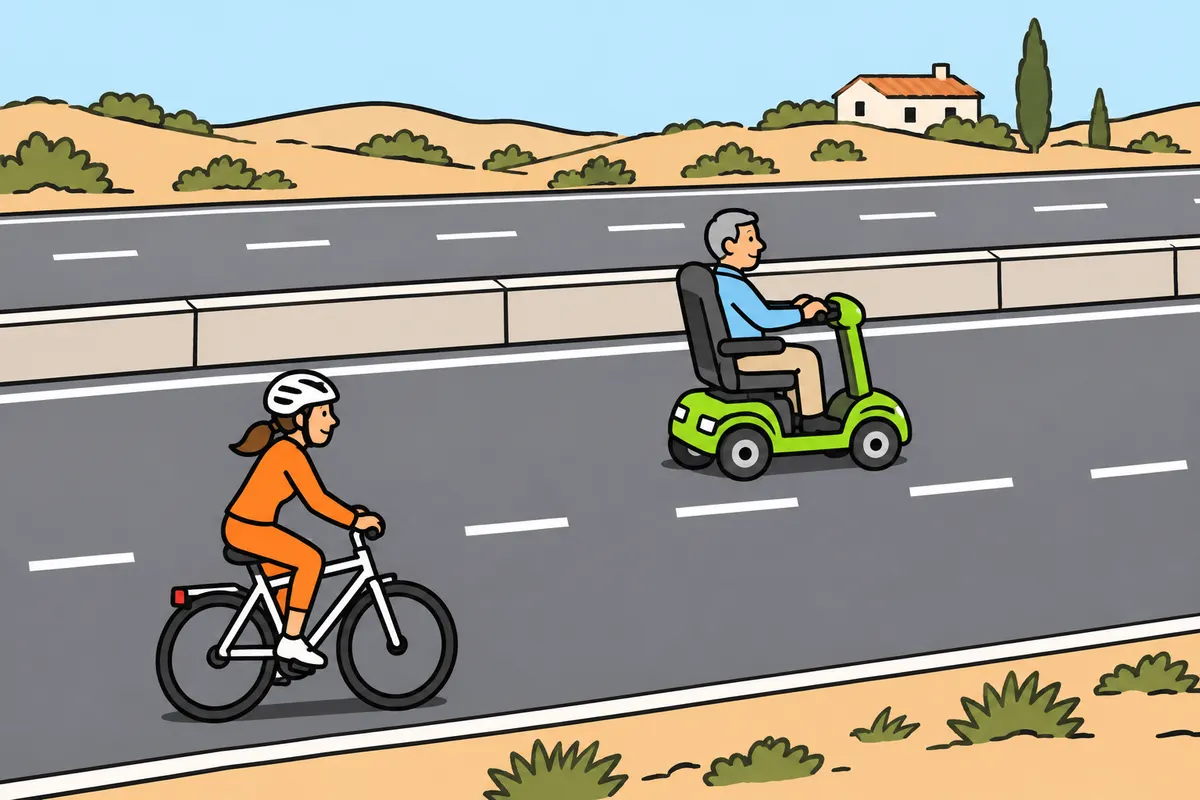
You must overtake with enough space, suitable speed and safety throughout.
Remember
- Protect pedestrians, animals, animal-drawn vehicles, mopeds, VMPs and cyclists when overtaking.
- Use part or all of the appropriate adjacent or opposing lane.
- With more than one lane each way, change lanes completely.
- Do not endanger or obstruct oncoming users, even on the hard shoulder.
- Wait unless you can travel clearly faster and finish safely.
- Return without cutting anyone off; treat a cycling group as a single unit.
Exam trap: Wrong: outside built-up areas, you may overtake at the road's limit. Right: before and throughout this overtaking manoeuvre, travel at least 20 km/h below that limit; obey any lower vehicle limit and slow down further if necessary.
Read the full explanation
- When you overtake pedestrians, animals, animal-drawn vehicles, mopeds, VMP (personal mobility vehicles) or cyclists, you must take particular care. This also applies to your small vehicle: apparently leaving enough space to pass is not sufficient if you force the road user you are overtaking to change course abruptly or compromise their stability. [RGC, art. 85](https://www.boe.es/buscar/act.php?id=BOE-A-2003-23514#a85)
- You must move partly or fully into the adjacent lane or the lane for oncoming traffic, as appropriate, and leave at least 1.5 metres of lateral clearance. If the carriageway has more than one lane in each direction, you must change lanes completely. [RGC, art. 85](https://www.boe.es/buscar/act.php?id=BOE-A-2003-23514#a85)
- Outside built-up areas, you must drive at least 20 km/h below the road’s speed limit before starting and throughout this overtaking manoeuvre. For example, with a limit of 50 km/h, the maximum under this rule is 30 km/h; you must also respect any lower limit specific to your vehicle and reduce your speed further if necessary. [RGC, art. 85](https://www.boe.es/buscar/act.php?id=BOE-A-2003-23514#a85)
- You must not overtake in a way that endangers or obstructs oncoming road users, even if they are on the hard shoulder. Check especially for oncoming bicycles: their being outside the centre of the carriageway does not allow you to encroach on the space they need or force them to move aside. [RGC, art. 85](https://www.boe.es/buscar/act.php?id=BOE-A-2003-23514#a85)
- If your vehicle cannot maintain a noticeably higher speed than the road user you are overtaking and complete the manoeuvre safely, you must wait behind. At the end, move back gradually without cutting anyone off; a group of cyclists is treated as a single moving unit. [RGC, art. 85](https://www.boe.es/buscar/act.php?id=BOE-A-2003-23514#a85)
17Where you must wait to overtake
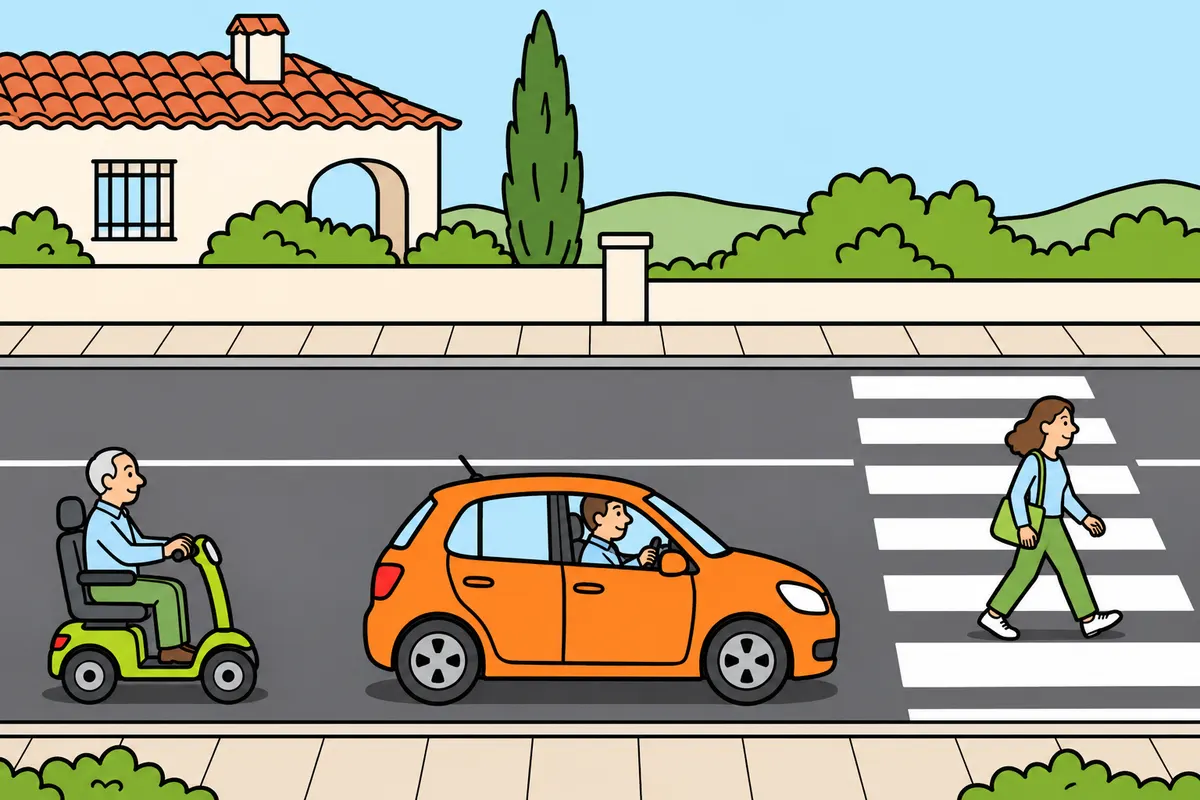
You must wait to overtake when the place or conditions make it unsafe.
Remember
- Do not overtake at marked pedestrian crossings, cycle route junctions or near them.
- A vehicle stopped ahead may hide someone crossing.
- Do not overtake without enough visibility to complete or abandon the manoeuvre safely.
- Check you have space to pull out and return safely.
- Wait if you cannot meet clearance, lane and other requirements.
- Do not pressure people with your horn or by following too closely.
Exam trap: Wrong: an exception lets you enter the opposing lane blindly. Right: where overtaking is prohibited, the exception for bicycles, mopeds, VMPs, pedestrians or animals applies only if their speed allows safe overtaking.
Read the full explanation
- You must not overtake at marked pedestrian crossings, junctions with cycle routes or near them. Do not take advantage of the vehicle ahead stopping, or of your own slow speed, to pass it beside the crossing: it may be giving way to someone you cannot yet see. [RGC, art. 87](https://www.boe.es/buscar/act.php?id=BOE-A-2003-23514#a87)
- You must also refrain from overtaking where visibility does not allow you to complete or abandon the manoeuvre safely. Before pulling out to overtake, you must check the available space and whether you can move back safely; your vehicle’s narrow width does not compensate for a bend or crest hiding oncoming traffic. [RGC, art. 87](https://www.boe.es/buscar/act.php?id=BOE-A-2003-23514#a87)
- On a section where overtaking is prohibited, the Regulations allow exceptional cases of overtaking bicycles, mopeds, VMP, pedestrians or animals if their speed allows you to do so safely. This possibility requires you to check that the entire manoeuvre is safe; it does not authorise you to move blindly into the path of oncoming traffic. [RGC, art. 88](https://www.boe.es/buscar/act.php?id=BOE-A-2003-23514#a88)
- If you cannot maintain the clearance, use the necessary lane and meet the other conditions, wait for a safe opportunity. Do not force your way through by sounding the horn or driving close behind a cyclist to make them move aside. The manoeuvre must be safe throughout. [RGC, art. 85](https://www.boe.es/buscar/act.php?id=BOE-A-2003-23514#a85)
18Cyclists’ protection and visibility
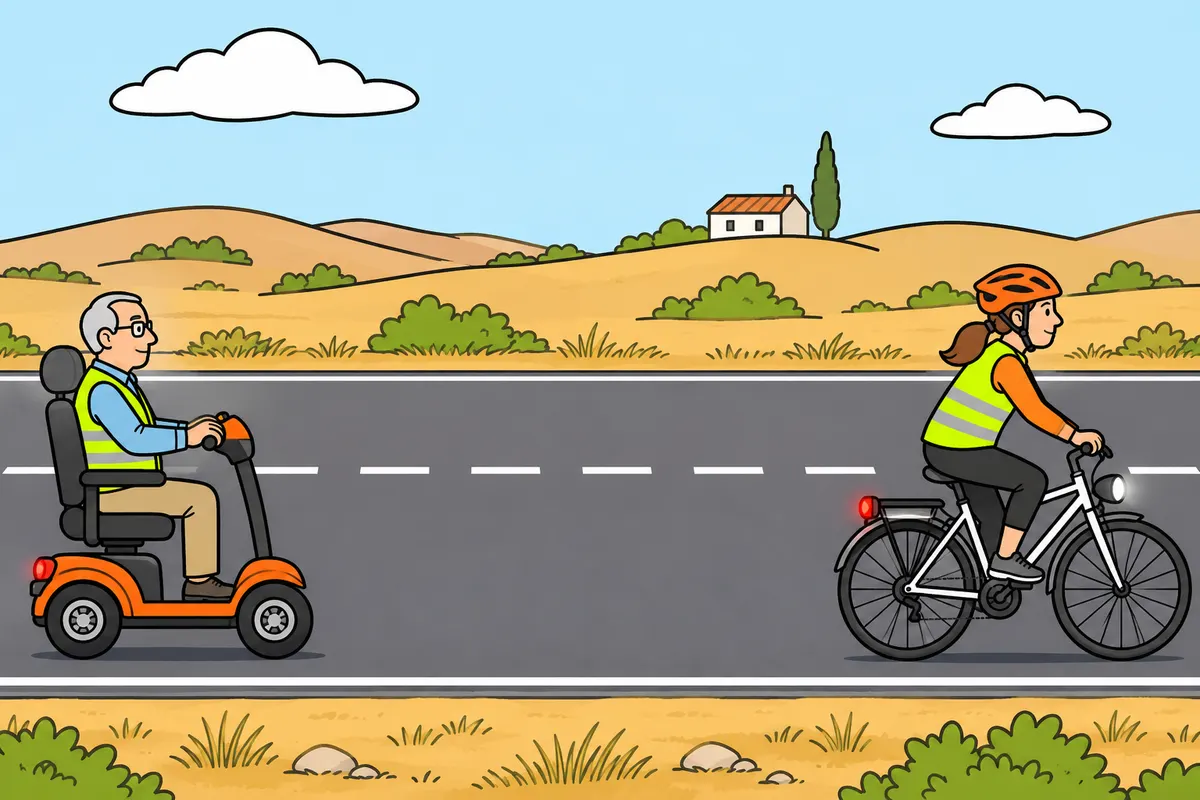
You must keep safe distances even when cyclists wear protection and have lights.
| Bicycle or other cycle user | Where helmets are required |
|---|---|
| Rider or passenger | Interurban roads |
| You are under 16 | Every road |
| You ride professionally | Also urban roads and travesías |
Remember
- When a helmet is required, use an approved or certified helmet, properly fastened.
- On interurban roads in darkness or poor visibility, carry light-emitting or reflective equipment.
- Your item must meet regulations and be visible from the required minimum distance.
- When cycling professionally, wear a regulation reflective vest on every road.
- With LCM, keep all safety gaps even when you see helmets, vests or lights.
Exam trap: Wrong: a helmet lets you overtake closer. Right: keep the full required safety clearance.
Read the full explanation
- On bicycles and other cycles, riders and passengers must wear a type-approved or certified helmet, correctly fastened, on interurban roads. Anyone under 16 must wear one on every road. Do not confuse the age threshold for wearing a helmet with the age for obtaining your LCM licence. [RGC, art. 118](https://www.boe.es/buscar/act.php?id=BOE-A-2003-23514#a118)
- Riders who work professionally on a bicycle or other cycle must also wear a helmet on urban roads and travesías (stretches of road through a town). Anyone carrying out this work must wear a high-visibility reflective vest that complies with personal protective equipment regulations on all types of road. Delivery work does not give special priority. [RGC, art. 118](https://www.boe.es/buscar/act.php?id=BOE-A-2003-23514#a118)
- On interurban roads, between sunset and sunrise or in significantly reduced visibility, a bicycle rider must wear at least one regulation light-emitting or reflective item visible from at least 150 metres. This personal item supplements the requirement for the bicycle itself to be visible. [RGC, art. 118](https://www.boe.es/buscar/act.php?id=BOE-A-2003-23514#a118)
- As an LCM driver, maintain your safety margins even if the cyclist wears a helmet, a reflective vest or lights. These provide protection and visibility; they do not prevent harm from a glancing collision or being cut off. Your full overtaking obligations still apply, regardless of the equipment you see. [RGC, art. 85](https://www.boe.es/buscar/act.php?id=BOE-A-2003-23514#a85)
19Children on bicycles and passengers
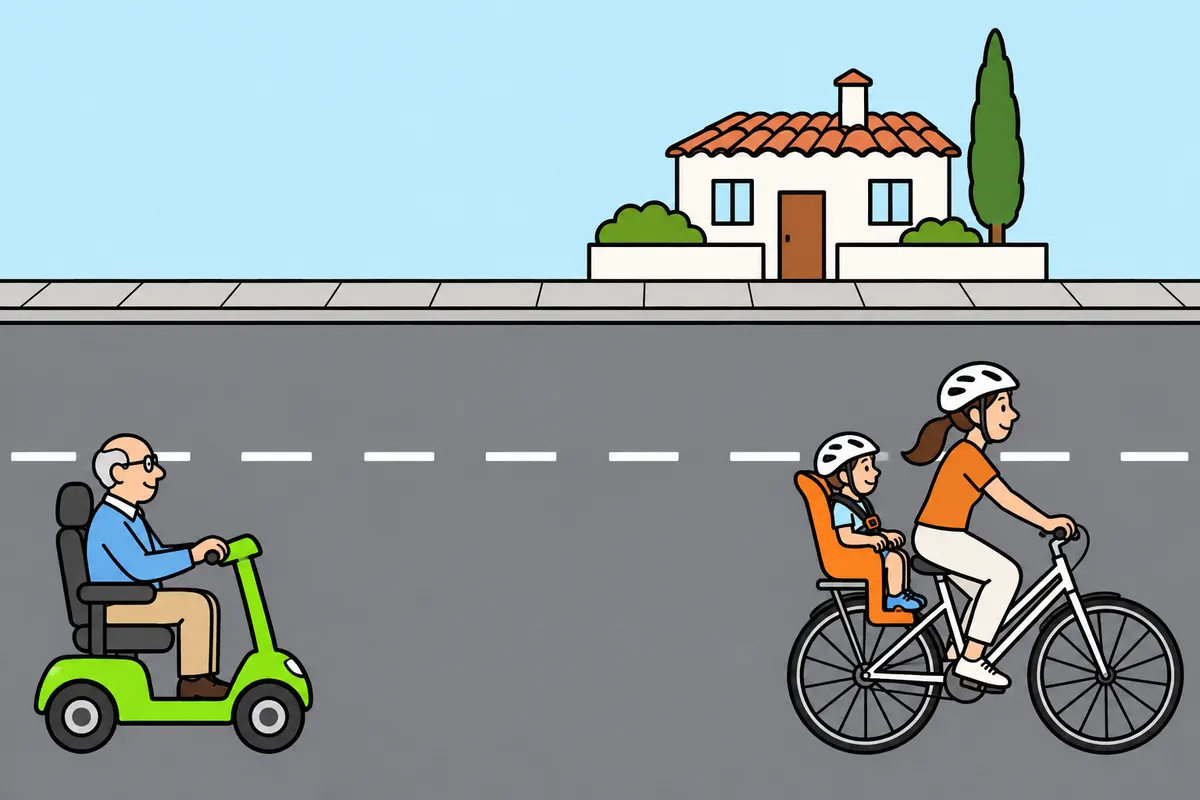
You must know the conditions for children's bicycles and carrying passengers.
| Bicycle case | Conditions |
|---|---|
| Child's bicycle on a pavement | Municipal permission, child up to 12, supervised by an adult on foot |
| Passenger on a bicycle or cycle built for one person | Adult rider; child up to 22 kg who can sit unaided; regulation additional seat |
| Loads or passengers on interurban roads | Only by day and without conditions reducing visibility |
Remember
- Do not assume any bicycle may use any pavement.
- Municipal permission for children's bicycles does not extend to your LCM vehicle.
- Carrying loads or passengers on cycles requires you to be an adult.
- Use type-approved additional seats until the order on their technical specifications takes effect.
- Allow for all the space taken by the bicycle and its carrying equipment.
- With LCM, respect priorities and safety gaps around bicycles carrying children.
Exam trap: Wrong: any child may cycle on the pavement. Right: municipal rules may allow children up to 12, supervised by an adult on foot.
Read the full explanation
- Municipal by-laws may allow children's bicycles on pavements for children up to 12 years old supervised by an adult on foot. You must not infer general permission to cycle on any pavement or extend this permission to your vehicle for people with reduced mobility. [RGC, art. 152](https://www.boe.es/buscar/act.php?id=BOE-A-2003-23514#a1-5)
- To carry loads or passengers on a bicycle or cycle, you must be an adult and meet the technical requirements. If the vehicle is built for one person, you may carry a child weighing up to 22 kg who can sit unaided in an additional seat. On interurban roads, these rules apply during daylight and in conditions that do not reduce visibility. [RGC, art. 154.1, 154.2 and 154.5](https://www.boe.es/buscar/act.php?id=BOE-A-2003-23514#a1-7).
- Until the ministerial order governing their technical specifications comes into force, additional seats must be type-approved. [RD 518/2026, second transitional provision](https://www.boe.es/buscar/doc.php?id=BOE-A-2026-13889) People or loads must be positioned so that they do not fall, drag along the ground, move dangerously, compromise stability or obscure lights or signals. When sharing the road, anticipate greater width and space requirements when a bicycle carries a child. [RGC, art. 154.3](https://www.boe.es/buscar/act.php?id=BOE-A-2003-23514#a1-7).
- If you share a junction with a bicycle carrying passengers, the same duty to give way and overtaking clearances apply. Do not try to squeeze past the additional seat or a trailer. Assess the space occupied by the bicycle and all its carrying equipment throughout the manoeuvre. [RGC, art. 85](https://www.boe.es/buscar/act.php?id=BOE-A-2003-23514#a85)
20What a VMP is and who can ride it
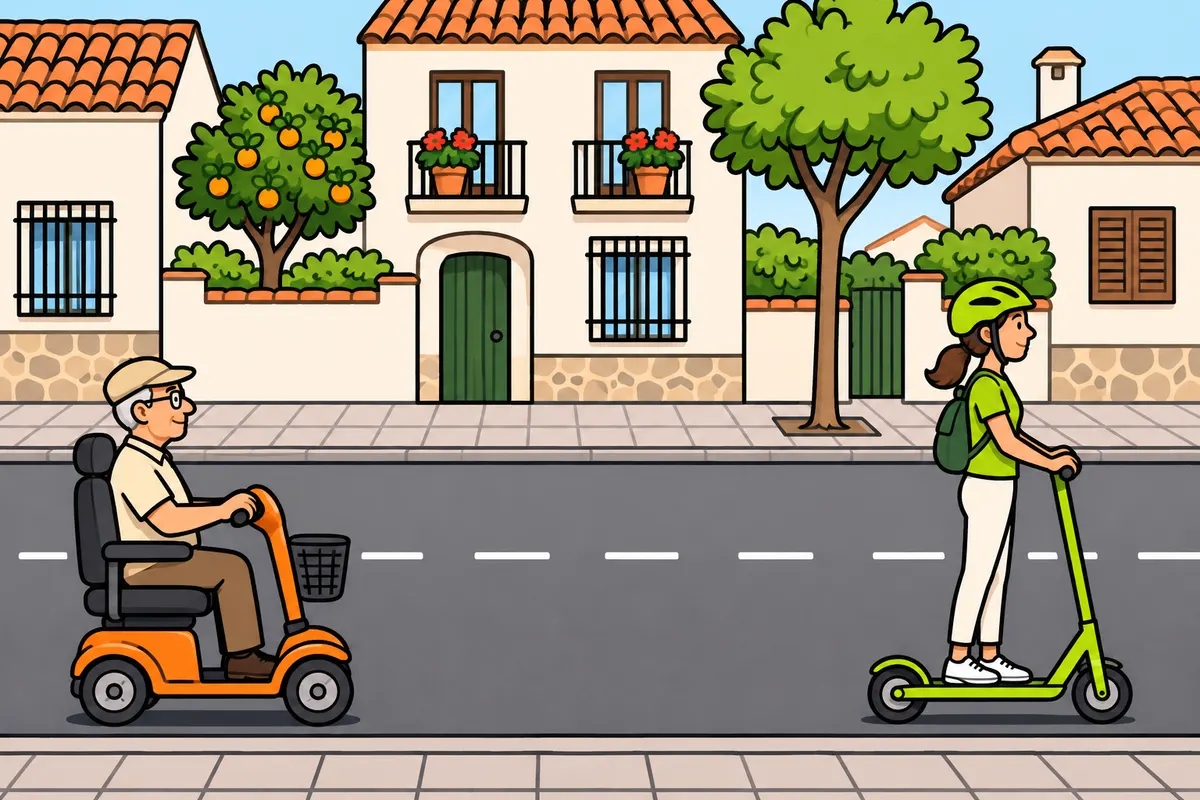
You must distinguish VMPs from your vehicle and respect their minimum riding age.
Remember
- A VMP is electric and has a single place.
- Do not carry passengers, including children.
- A VMP may have a seat or saddle only if it is self-balancing.
- Your vehicle for people with reduced mobility is not a VMP.
- When riding a VMP, signal manoeuvres with your arm as required.
- Leave space for riders to balance and signal.
Exam trap: Wrong: getting an LCM licence at 14 lets you ride VMPs. Right: you cannot ride a VMP under 15.
Read the full explanation
- A VMP (personal mobility vehicle) has space for just one person, one or more wheels and exclusively electric propulsion, with a maximum design speed between 6 and 25 km/h. It may only have a seat or saddle if it is self-balancing. [RGV, Annex II](https://www.boe.es/buscar/act.php?id=BOE-A-1999-1826#anii)
- You must not ride a VMP if you are under 15. Being 14 and eligible for an LCM licence does not allow you to ride an electric scooter outside this rule: the age requirement depends on the category you use. You must not confuse the licence with general authorisation to use any electric device. [RGC, art. 155](https://www.boe.es/buscar/act.php?id=BOE-A-2003-23514#a1-8)
- When driving your vehicle, anticipate changes in the VMP rider's balance and avoid crowding them from the side. If you overtake, you must apply the protective conditions for these users, including the required clearance. [RGV, Annex II](https://www.boe.es/buscar/act.php?id=BOE-A-1999-1826#anii)
- When riding a VMP, you must signal your manoeuvres with your arm in the prescribed way. Observe these signals and leave enough space for the rider to signal and maintain their course without forcing you to pass close to their arm. Signalling a manoeuvre does not automatically give any driver or rider priority. [RGC, art. 155](https://www.boe.es/buscar/act.php?id=BOE-A-2003-23514#a1-8)
21Where VMPs may travel
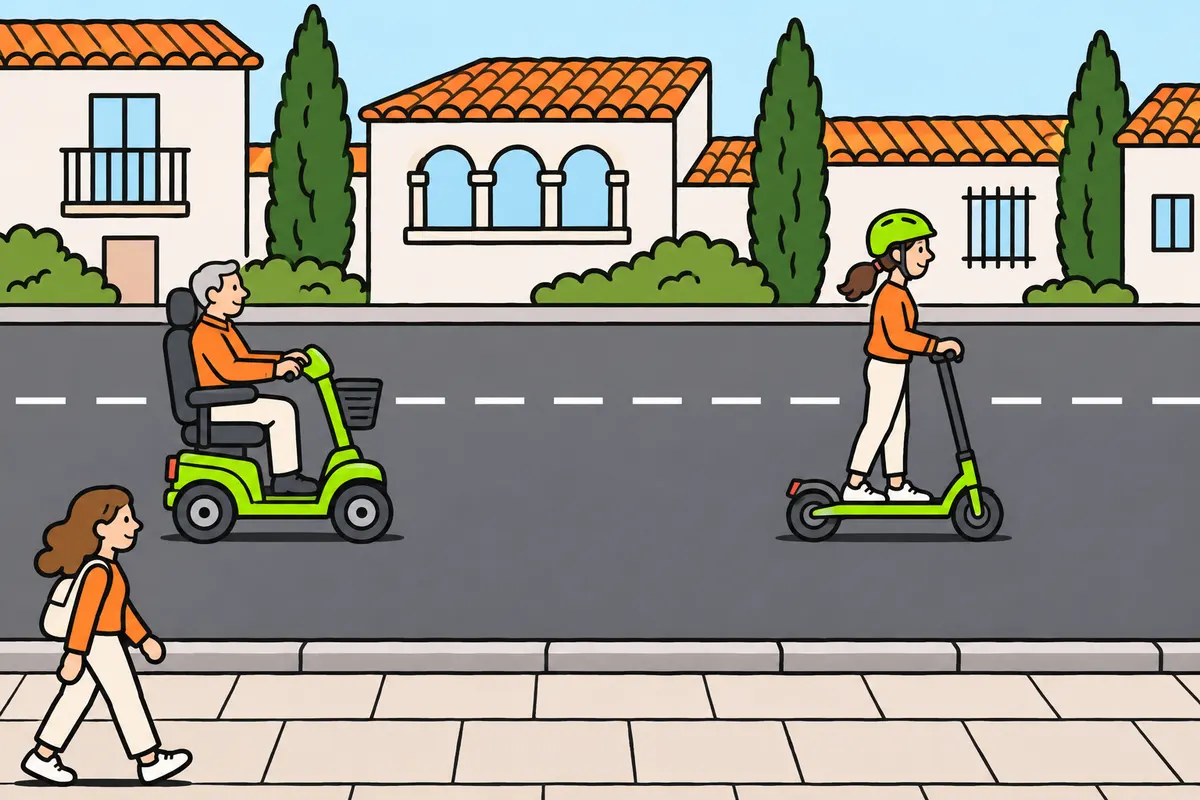
You must check which routes allow VMPs and their specific restrictions.
| VMP route | Access |
|---|---|
| Autopista, autovía or travesía | Prohibited |
| Interurban road or urban tunnel | Prohibited except certain cycle routes or roads closed to motor vehicles, unless signs prohibit |
| Urban roads and areas | Subject to municipal permission and signs |
| Pavement: ordinary VMP | Prohibited |
Remember
- Check municipal rules and signs before riding a VMP.
- Do not assume every cycle lane allows VMPs.
- You cannot ride an ordinary VMP along a pavement.
- In other pedestrian areas, you need municipal permission and must respect pedestrian priority.
- Expect VMPs in the lane centre and check both sides.
- For skates or non-motorised skateboards, check municipal rules; never hold onto moving vehicles.
Exam trap: Wrong: you may ride a VMP on any road. Right: interurban roads and urban tunnels are prohibited except certain cycle routes and roads closed to motor vehicles, provided signs do not prohibit access.
Read the full explanation
- VMPs are prohibited on autopistas and autovías (motorways) and on stretches of road through a town. On interurban roads and in urban tunnels, the prohibition includes an exception for certain cycle routes and roads closed to motor vehicles, provided signs do not prohibit access. You must not summarise this as unrestricted access to any road. [RGC, art. 38](https://www.boe.es/buscar/act.php?id=BOE-A-2003-23514#a38)
- The municipal authority regulates which urban roads and areas VMPs may use and the conditions for doing so. A quiet street or cycle lane is not enough to infer all the local rules: you must obey the specific restrictions and signs along the route. [RGC, art. 155](https://www.boe.es/buscar/act.php?id=BOE-A-2003-23514#a1-8)
- VMP access to pedestrian spaces is governed by the rules in ‘Pavements and shared spaces’; the personal exception allowing people with reduced mobility to travel at walking pace is explained in ‘Wheelchairs and pedestrian status’. [RGC, art. 152](https://www.boe.es/buscar/act.php?id=BOE-A-2003-23514#a1-5)
- On roads authorised for VMPs, the rules in paragraphs 3 to 7 of article 153 apply: lane positioning, urban overtaking and other regulated situations. You must therefore anticipate their presence in the centre of the lane and check to the sides when moving off or turning. [RGC, art. 155](https://www.boe.es/buscar/act.php?id=BOE-A-2003-23514#a1-8)
- If you use skates or unpowered skateboards, you must check which roads and conditions of use the municipal authority permits. Do not confuse them with an electric VMP or hold onto your vehicle or another moving vehicle to be towed along: changes in speed and direction make this dangerous. [RGC, art. 155](https://www.boe.es/buscar/act.php?id=BOE-A-2003-23514#a1-8).
22Protecting VMP users
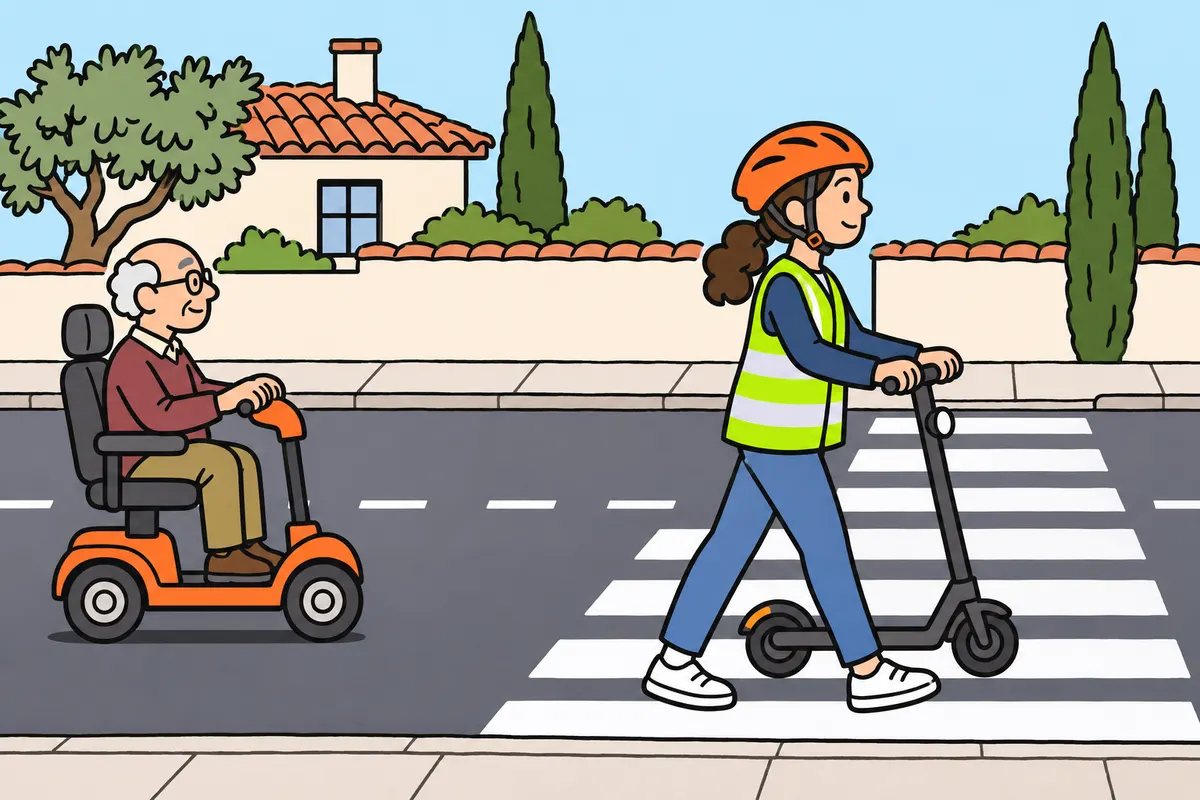
When riding a VMP, you must protect yourself, stay visible and pay attention.
| VMP at a pedestrian crossing | What you must distinguish |
|---|---|
| You ride the VMP | You do not automatically become a pedestrian |
| You walk the VMP | You cross as a pedestrian |
Remember
- Wear an approved or certified helmet, properly fastened.
- In darkness or significantly reduced visibility, carry a regulation light-emitting or reflective item.
- It must be visible from the required minimum distance, including in towns.
- When riding a VMP professionally, wear a regulation reflective vest on every road.
- On bicycles and VMPs, obey alcohol, drug and testing rules.
- Do not use a handheld phone or headphones connected to audio equipment.
Exam trap: Wrong: VMP lights are only required at night. Right: keep them on in tunnels and significantly reduced visibility too; daytime use is required once one year has elapsed from 1 October 2026.
Read the full explanation
- When riding a VMP, you must wear a properly fastened type-approved or certified helmet. Between sunset and sunrise, or when visibility is significantly reduced, you must also use a regulation light-emitting or reflective item visible from at least 150 metres. This personal visibility requirement is not limited to interurban roads. [RGC, art. 118](https://www.boe.es/buscar/act.php?id=BOE-A-2003-23514#a118)
- The requirement to keep a VMP's lights on during the day applies once one year has elapsed from 1 October 2026, the date RD 518/2026 enters into force. At night, in tunnels and when visibility is significantly reduced, you must keep its lights on. [RD 518/2026, third transitional provision and third final provision](https://www.boe.es/buscar/doc.php?id=BOE-A-2026-13889)
- When riding a VMP as part of your professional activity, you must wear a high-visibility reflective vest complying with personal protective equipment regulations on any road. Neither the vest nor the helmet gives these riders general priority; you must apply the junction rules and protect them when sharing space. [RGC, art. 118](https://www.boe.es/buscar/act.php?id=BOE-A-2003-23514#a118)
- To use an exclusively pedestrian crossing as a pedestrian, you must get off the VMP and push it. From your vehicle, observe the crossing person's entire path and keep their exit clear. [RGC, arts. 121 and 155.6](https://www.boe.es/buscar/act.php?id=BOE-A-2003-23514#a121).
- When riding a bicycle or VMP, you must also obey the alcohol and drug rules and undergo tests required by officers. If you are under 18, your alcohol limit is 0 g/l in blood and 0 mg/l in exhaled breath; these rules are explained in detail in ‘Driver fitness’. [LTSV, art. 14](https://www.boe.es/buscar/act.php?id=BOE-A-2015-11722#a14).
- When riding a VMP or bicycle, you must remain attentive and must not use a hand-held phone or earphones connected to audio equipment. As a driver with an LCM licence, you must leave a safety margin for other people's possible mistakes; another user's failure to obey the rules does not authorise you to endanger them. [RGC, art. 18](https://www.boe.es/buscar/act.php?id=BOE-A-2003-23514#a18).
23Motorcyclists, mopeds and delivery riders
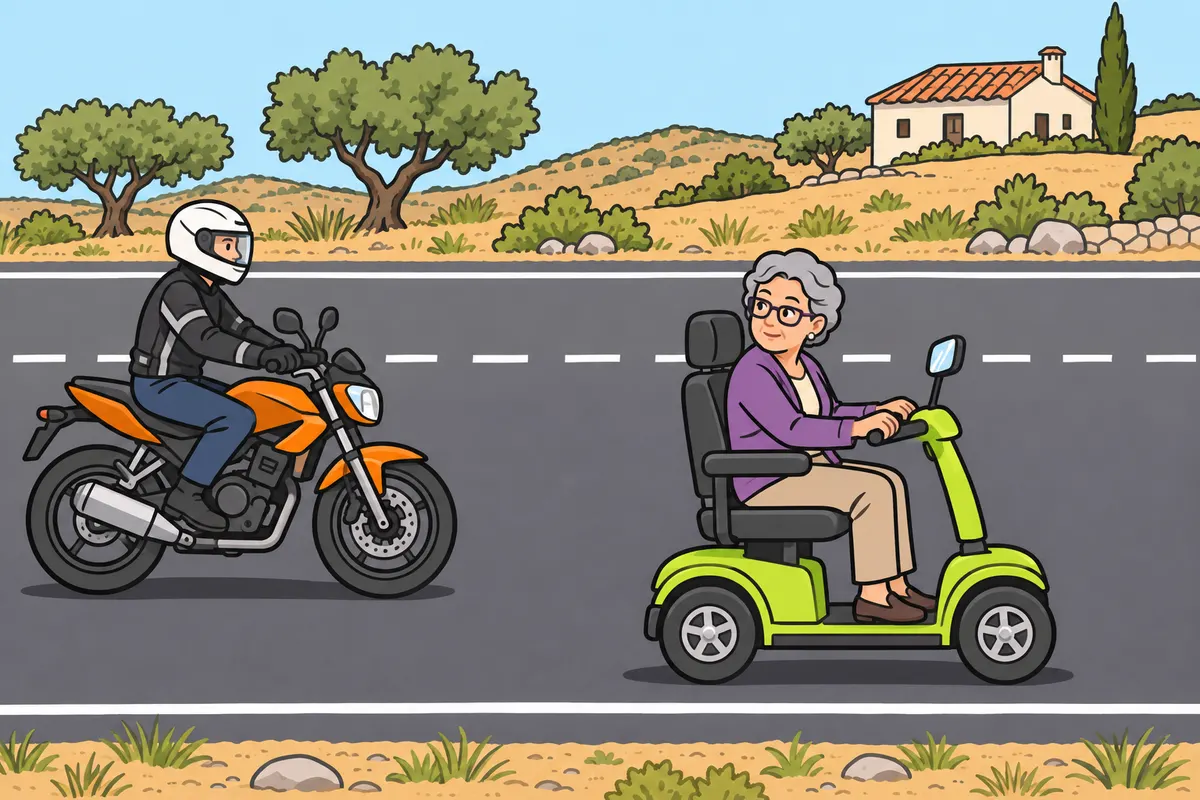
You must check both sides and recognise special motorcycle and moped conditions.
| Protection | Vehicles covered | Rule, except documented protective structure and seat belt exemption |
|---|---|---|
| Helmet | Motorcycles and mopeds | Fastened; certified moped helmets accepted for one year from 1 October 2026 |
| Gloves | Motorcycles | Interurban roads |
| Closed footwear | Motorcycles | Every road; must cover the whole foot |
Remember
- Check mirrors and surroundings before changing position.
- If you have doors, stop and check that opening them creates no danger.
- Delivery riders follow the rules for the vehicle they use.
- Delivery work gives no priority or general permission to enter pedestrian spaces.
- Motorcyclists must protect you on the hard shoulder and leave it if necessary.
Exam trap: Wrong: any motorcycle may use the hard shoulder. Right: exceptional use requires designated, signposted stretches, traffic stopped by congestion, single file and a maximum of 30 km/h.
Read the full explanation
- When sharing the road with a motorcycle or moped, watch for it approaching from either side and avoid sudden manoeuvres. As a preventive measure, check your mirrors and surroundings before moving: its smaller size does not mean it is far away or that its rider can compensate whenever their path is cut off. [RGC, art. 18](https://www.boe.es/buscar/act.php?id=BOE-A-2003-23514#a18)
- Exceptional use of the right-hand arcén (hard shoulder) by motorcycles requires officially designated and signed stretches and traffic at a standstill due to congestion. It is limited to 30 km/h and single file. Motorcyclists must protect you and others required to use the hard shoulder and leave it if necessary; do not assume that any use of the hard shoulder is lawful. [RGC, art. 36](https://www.boe.es/buscar/act.php?id=BOE-A-2003-23514#a36)
- If your vehicle has doors, do not open them until you have stopped completely and checked that you do not create a danger, especially for cyclists. Also check for motorcycles and people who may pass beside you: stopping does not make the space alongside you clear. [RGC, art. 114](https://www.boe.es/buscar/act.php?id=BOE-A-2003-23514#a114)
- If you see a delivery rider, identify the actual vehicle: bicycle, VMP, moped or motorcycle. Delivery work does not create a category with its own priority or authorise riding in any pedestrian space. You must anticipate stops and turns and apply the same duty not to endanger other road users. [RGC, art. 121](https://www.boe.es/buscar/act.php?id=BOE-A-2003-23514#a121)
- When using a motorcycle or moped, you must wear the required protective equipment: a fastened helmet and, on motorcycles, gloves on interurban roads and closed footwear covering the foot on every road, except where the documented exemption for a protective structure and seat belt applies. On mopeds, certified helmets are accepted during the transitional period of one year from 1 October 2026. [RGC, art. 118](https://www.boe.es/buscar/act.php?id=BOE-A-2003-23514#a118); [RD 518/2026, first transitional provision](https://www.boe.es/buscar/doc.php?id=BOE-A-2026-13889).
24Horse riders and animals on your route
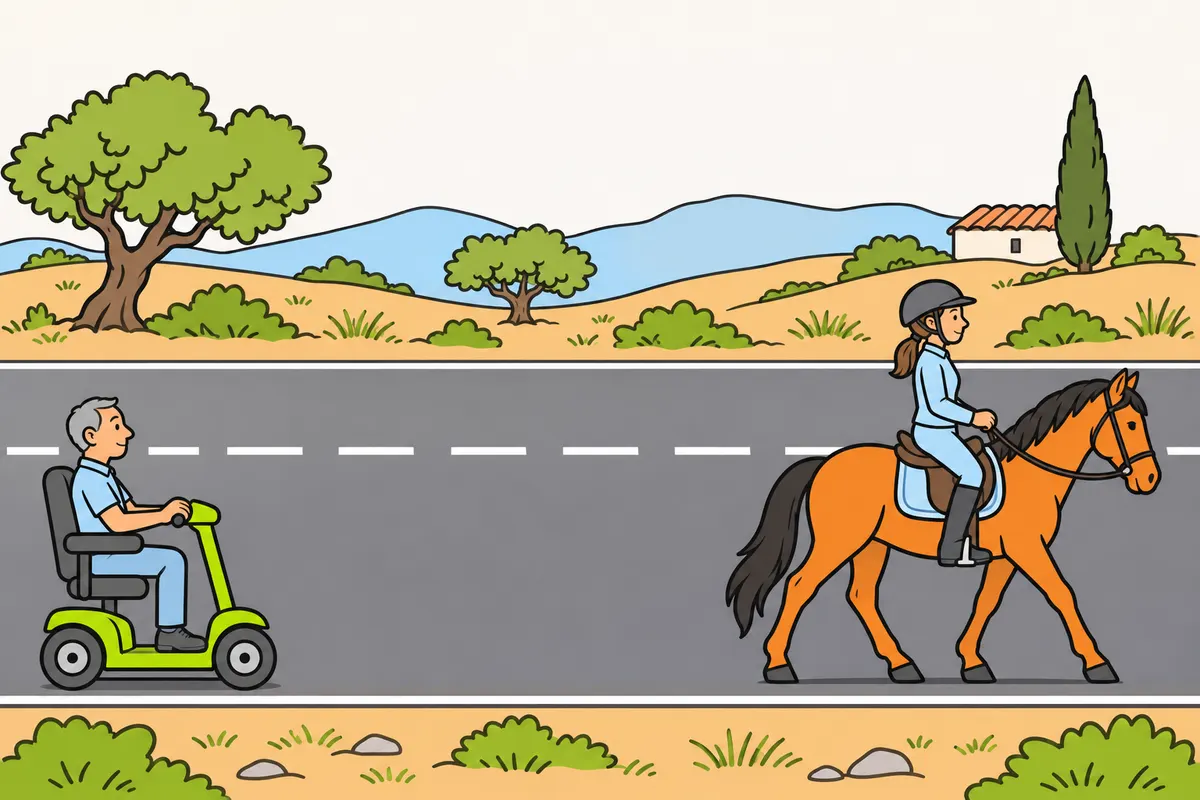
You must approach animals calmly and respect their priority and safety gaps.
| Draught, pack or riding animals | Conditions for road use |
|---|---|
| Route | No usable livestock route |
| Supervision | Someone over 18 who can control the animals |
| Usual position | Right hard shoulder or close to the right edge |
Remember
- Slow down when animals are present or may appear.
- Avoid acceleration and unnecessary noise near horses.
- Give way on signposted livestock routes.
- When turning into another road, give way to animals crossing it.
- When crossing a hard shoulder, give way to animals without an available livestock route.
- Wait if you cannot pass with enough space.
Exam trap: Wrong: you may skim past a horse because you drive slowly. Right: leave at least 1.5 metres and change lanes completely with more than one lane each way; outside built-up areas, travel at least 20 km/h below the road limit and slow further for risk.
Read the full explanation
- You must reduce your speed when animals are on the part of the road you use or you can anticipate their appearance. As a practical precaution, approach a ridden horse gently, avoid unnecessary acceleration and noise, and wait if you cannot pass with a safety margin. A movement by the animal can also affect its rider. [RGC, art. 46](https://www.boe.es/buscar/act.php?id=BOE-A-2003-23514#a46)
- You must give way to animals on signed livestock routes, when you turn into another road they are crossing, and when you cross a hard shoulder along which they are travelling because no livestock route is available. These are exceptions to vehicles' general priority. [RGC, art. 66](https://www.boe.es/buscar/act.php?id=BOE-A-2003-23514#a66)
- Draught, pack or riding animals may only use these roads if no practicable livestock route is available and they are supervised. They must be led by at least one person over 18 who can control them. They must use the right-hand hard shoulder or, if they need to use the carriageway, keep as close as possible to its right-hand edge; you may encounter a single animal being led along the left-hand edge where this is safer. [RGC, art. 127](https://www.boe.es/buscar/act.php?id=BOE-A-2003-23514#a127) [RGC, art. 126](https://www.boe.es/buscar/act.php?id=BOE-A-2003-23514#a126).
- When passing a horse, also observe the space needed by its rider, the reins and anything projecting outwards. A sideways movement by the animal can close a gap that seemed sufficient. Apply the clearances and speed reduction explained in ‘Overtaking vulnerable users’, and wait if the encounter does not allow you to maintain them. [RGC, art. 85](https://www.boe.es/buscar/act.php?id=BOE-A-2003-23514#a85).
25Sharing the road without pressuring or blocking others
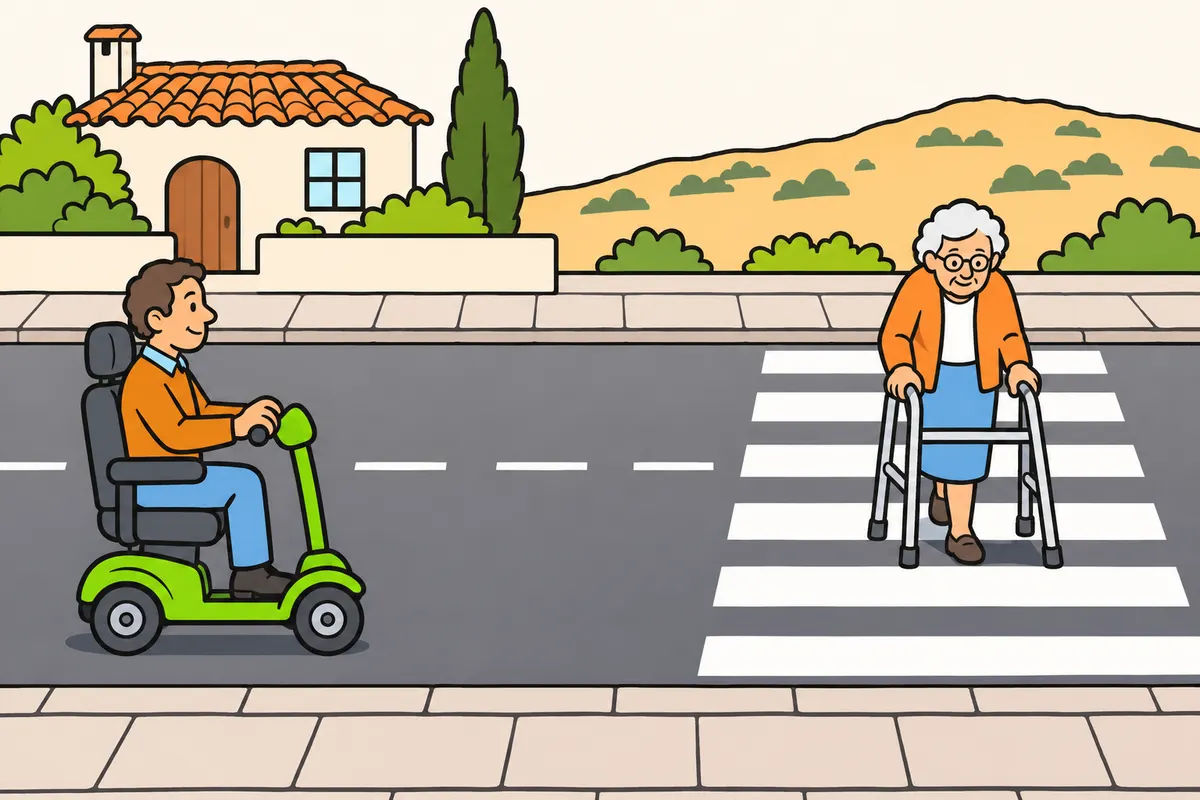
You must give way clearly, leave space and avoid blocking other users.
Remember
- Use your horn only when legally allowed, such as preventing a possible accident.
- Do not use it to order people aside.
- Give up passing if you cannot keep enough space and avoid danger.
- Do not stop or park on pedestrian or cycle crossings.
- Do not seriously obstruct pedestrians.
- To give way, slow down gradually and wait without edging forward.
Exam trap: Wrong: your horn forces others to move aside. Right: it gives no priority and does not replace slowing down and watching.
Read the full explanation
- You may only use audible warnings in the circumstances permitted by law, such as to avoid a possible accident; unjustified or excessive use is prohibited. Warning of a danger does not give you priority or replace slowing down and observing. [RGC, art. 110](https://www.boe.es/buscar/act.php?id=BOE-A-2003-23514#a110)
- An apparently sufficient width does not guarantee that you can pass safely between people and obstacles. In practice, consider the space that a walking frame, a bicycle or a horse may need, and do not attempt to pass if you cannot maintain the required clearance and avoid danger. Driving slowly does not remove this obligation. [RGC, art. 85](https://www.boe.es/buscar/act.php?id=BOE-A-2003-23514#a85)
- You must not stop or park on pedestrian or cycle crossings or seriously obstruct pedestrian traffic. Before bringing your vehicle to a standstill, check that you do not force anyone to step out into traffic to get around it. You find the full stopping and parking rules in «Manoeuvres with your LCM vehicle». [RGC, art. 94](https://www.boe.es/buscar/act.php?id=BOE-A-2003-23514#a94)
- You must give way clearly and in good time: slow down progressively and wait as long as necessary so that the road user with priority can continue without having to react abruptly. When you drive with an LCM licence, you must cooperate, maintain control and respect other vulnerable road users. [RGC, art. 58](https://www.boe.es/buscar/act.php?id=BOE-A-2003-23514#a58)
Approaching a pedestrian crossing
Prepare to stop before you reach the crossing area.
- Observe the instructions of the officer or traffic lights and check both sides of the crossing.
- Slow down in good time and look for people hidden behind vehicles or obstacles.
- Give way when required and stop with the crossing kept clear.
- Wait until people have moved out of your path and you have space beyond the crossing.
- Move off smoothly, checking both sides again.
Deciding whether you can overtake a vulnerable road user
Apply the conditions of article 85 even when driving a small vehicle.
- Identify the road user, the location and any overtaking prohibitions.
- Check visibility, oncoming traffic and whether you can complete the manoeuvre.
- Check that you can leave 1.5 metres of clearance and change lanes completely where there is more than one lane per direction.
- Outside built-up areas, comply with the requirement to drive at least 20 km/h below the road speed limit and with any other applicable limits.
- Signal and overtake only if you can do everything safely; otherwise, wait behind.
- Return gradually, without cutting across the other user’s path or splitting a group of cyclists.
Encountering pedestrians on the arcén (hard shoulder)
You may share the hard shoulder with people walking towards you.
- Spot people and slow down before you approach them.
- Assess their path, the available width, visibility and traffic on the carriageway.
- Wait or stop if you cannot pass with the required clearance and under the required conditions.
- Continue smoothly without pressuring them with your horn or forcing them out of their space.
Check what you know
Real questions from the bank on this topic. Pick an answer to see the explanation.
Finished this module?
Mark it as read and you will see your progress on the theory list.