
Theory · LCM Licence - Reduced Mobility Vehicle · Module 12 of 15
Driver fitness
You learn to recognise when alcohol, drugs, medication, fatigue or your health prevent you from driving a vehicle for people with reduced mobility safely. You master the applicable limits, especially zero alcohol if you are under 18, testing procedures and the rules on attention and phones that may appear in your LCM test.
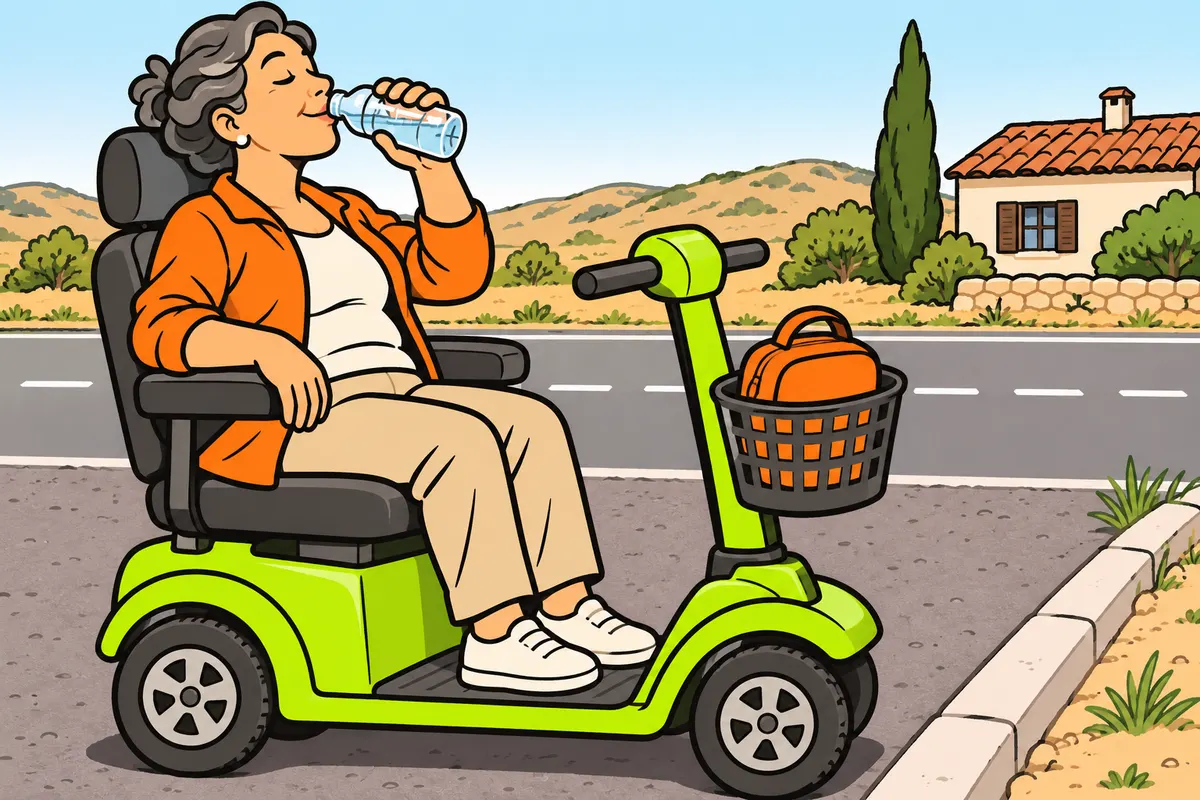
1You must be fit to drive
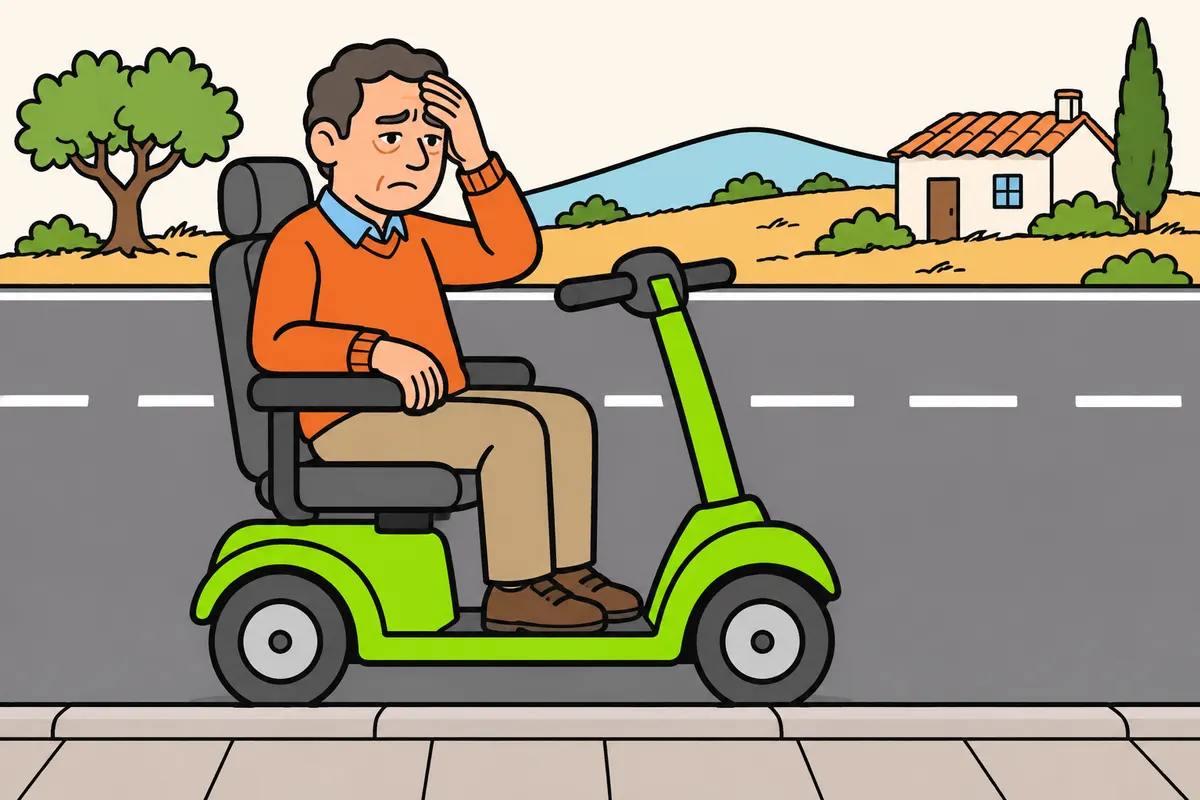
You must stay able to control your vehicle throughout the journey.
Remember
- Before leaving, check your rest, health, treatment and mood.
- Think about the whole journey, including the return trip.
- Do not set off if you cannot control your vehicle.
- Follow the adaptations and restrictions on your licence.
- Reduced mobility does not mean you cannot drive.
Exam trap: Wrong: you can drive while dizzy if you stay nearby. Right: you must always control your vehicle.
Read the full explanation
- You must be able to control your vehicle throughout the journey. Having a licence and knowing the controls does not make up for dizziness, a lapse in attention or an excessively slow reaction; if your condition prevents you from controlling the vehicle, you must not move off. This requirement also applies when your journey is short and you drive slowly. [RGC, art. 17](https://www.boe.es/buscar/act.php?id=BOE-A-2003-23514#a17)
- Before setting off, you must consider your rest, health, medical treatment and emotional state together. You may handle the vehicle correctly in a quiet area yet feel overwhelmed when a pedestrian approaches, another vehicle overtakes you or you need to make a decision at a junction. You must anticipate the demands of the whole journey, including the return trip.
- Limited mobility does not in itself mean that you are generally unfit to drive. With a suitable vehicle and suitable personal circumstances, you can drive within the terms of your entitlement; what matters is that you retain the required abilities and comply with any adaptations or restrictions that apply to you. Assessment is individual. [RGCond, arts. 44 and 46](https://www.boe.es/buscar/act.php?id=BOE-A-2009-9481#a46)
- When studying, you must distinguish legal obligations from safety recommendations. Alcohol limits and the ban on handling a mobile phone are enforceable rules; planning rest breaks or choosing a light meal are preventive measures. A recommendation does not authorise you to continue when you are still unfit to drive.
2Perceiving, deciding and reacting
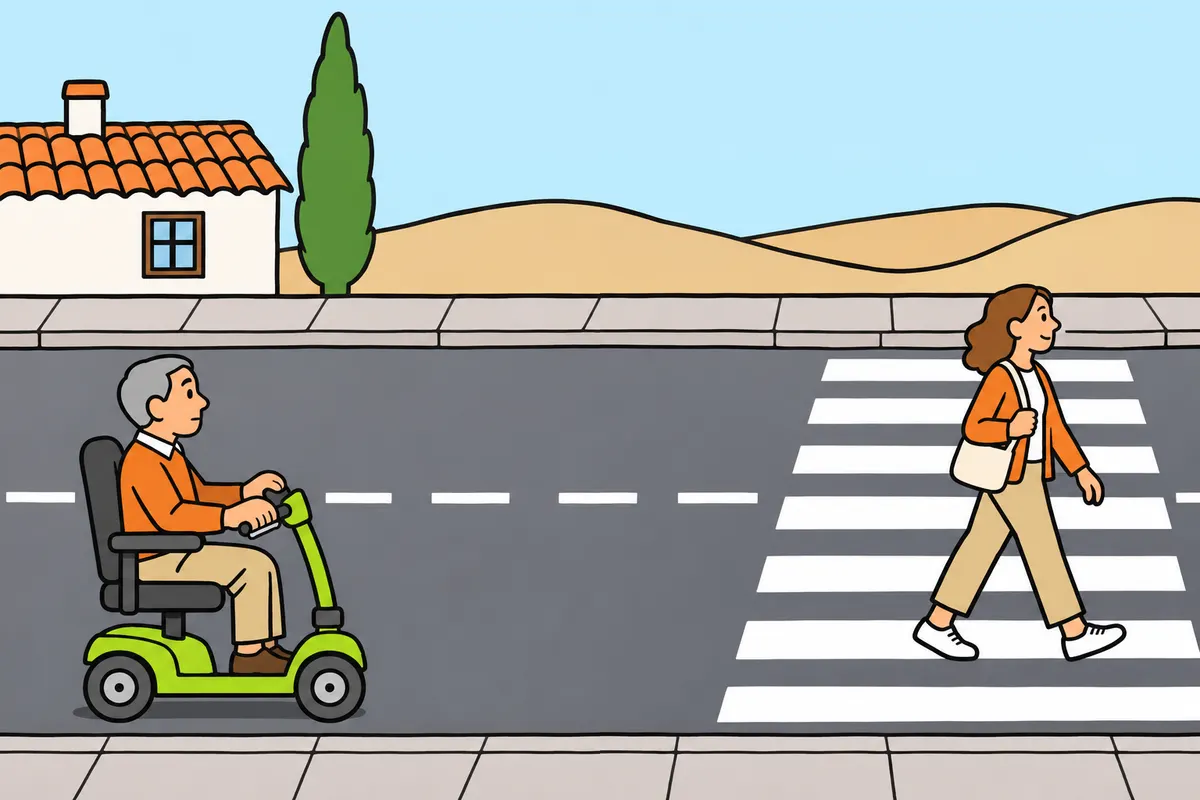
You need to observe, understand danger, decide and start responding.
Remember
- Your reaction time ends when you start responding.
- Sleepiness, tiredness and some substances can delay your response.
- Look ahead, to the sides and behind.
- Stay alert even when driving slowly.
Exam trap: Wrong: your reaction time includes all braking. Right: it ends when you start responding.
Read the full explanation
- You must observe, interpret what is happening, choose a response and carry it out. Reaction time runs from the moment you perceive a stimulus until you start to respond; it does not include the whole braking process. If you notice a pedestrian stepping into your path, you first need to recognise the danger and start applying the brake.
- You may take longer to react if you are sleepy, fatigued, ill or experiencing intense emotions. Alcohol, drugs and certain medicines can also impair this response. You may have difficulty detecting the danger, understanding it, deciding what to do or operating the controls accurately.
- You must use your vision to gather information ahead, to the sides and behind, without fixing your gaze on a single point. If you only look at the nearby edge of the road, you may miss a vehicle joining the road or a pedestrian. Listening to your surroundings helps, but it does not replace visual observation or justify becoming distracted.
- Even though your LCM vehicle travels slowly, you must maintain your attention and coordination. A small error when operating a control can bring you close to a kerb or another road user; other vehicles can also approach quickly. You must not see your own low speed as protection against every personal error.
3Alcohol: units and the general rule
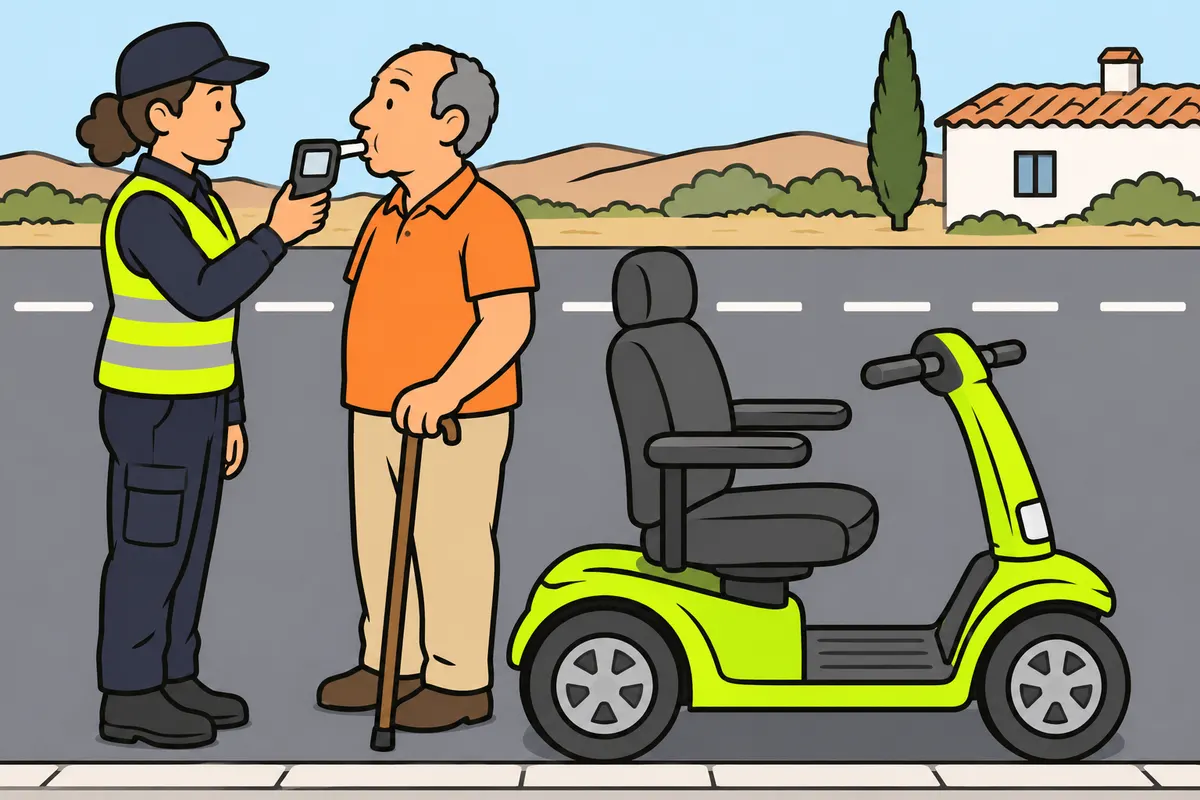
You must distinguish alcohol units and check which limit applies to you.
| Measurement: adults under general rule | Unit | Maximum |
|---|---|---|
| Blood | Grams per litre | 0.5 g/l |
| Exhaled breath | Milligrams per litre | 0.25 mg/l |
Remember
- Check your age, licence experience and vehicle service before choosing your limit.
- For a breathalyser, use the breath figure.
- Staying within your limit does not mean driving without risk.
- If you have drunk alcohol, arrange another way to travel.
Exam trap: Wrong: blood and breath figures are interchangeable. Right: each has its own unit and limit.
Read the full explanation
- Blood alcohol concentration is expressed in grams per litre; the measurement in exhaled breath is expressed in milligrams per litre. You may see the abbreviations g/l and mg/l. If a question mentions the breathalyser and the air you breathe out, you must look for the breath figure without confusing the units.
- As an adult driver subject to the general rule, you must not exceed 0.5 g/l in blood or 0.25 mg/l in exhaled breath. You must first check whether a different limit applies because of your age, how long you have held your licence or the vehicle's service; the general rule does not cover every case. [RGC, art. 20](https://www.boe.es/buscar/act.php?id=BOE-A-2003-23514#a20)
- You must interpret the word ‘above’ correctly: the article prohibits exceeding the applicable limit. This legal precision does not make the maximum a recommended amount to drink. To prevent risk, you must choose not to drink, because your abilities can be impaired without you feeling drunk and before you reach the administrative limit. Exceeding the statutory limit is a very serious offence. [LTSV, art. 77.c](https://www.boe.es/buscar/act.php?id=BOE-A-2015-11722#a77)
- You must not use the maximum limit to calculate how many drinks you can have and still drive. The size of the drink, its alcohol content and your personal circumstances affect the result. If you have been drinking, you must arrange to travel without driving instead of relying on a count of drinks or your impression that you feel fine.
4If you are underage, zero alcohol
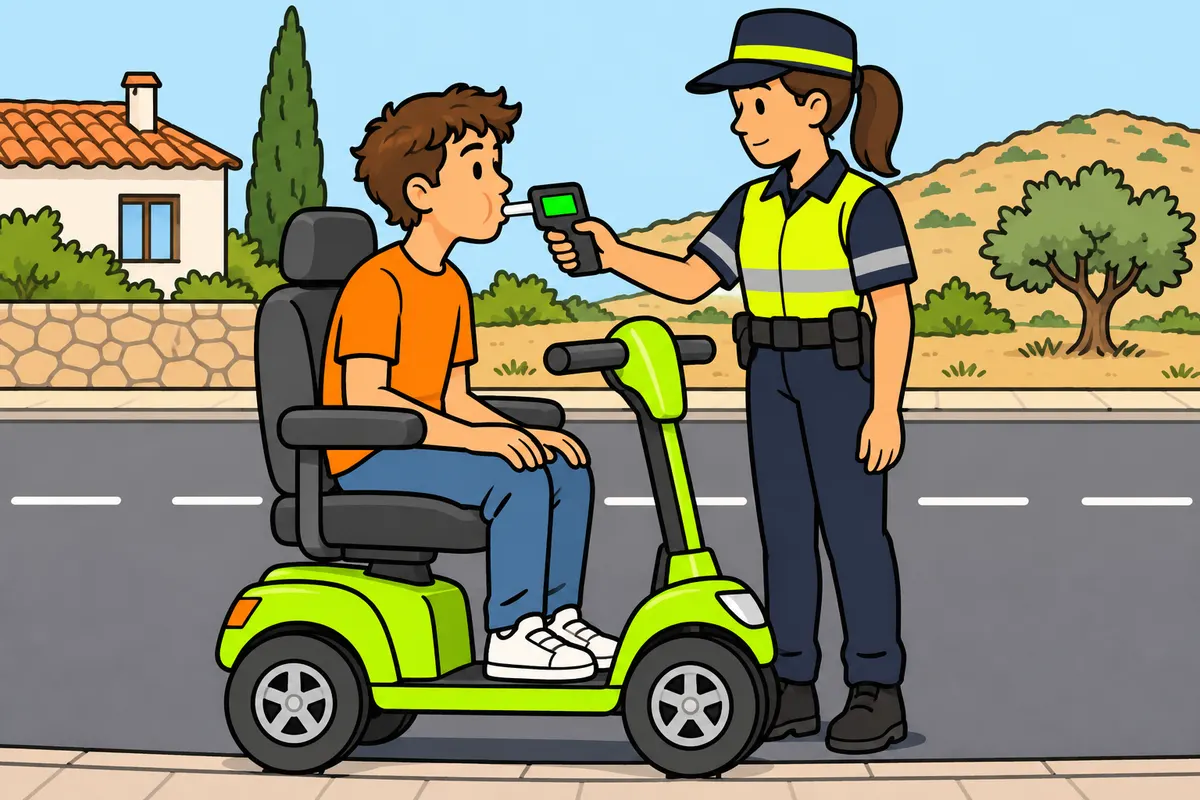
If you are underage, you must drive any vehicle without alcohol.
Remember
- If you are underage, zero alcohol also applies to your LCM vehicle.
- Being a novice does not allow you the adult novice limit.
- Experience does not change this duty.
Exam trap: Wrong: as an underage novice, you can reach 0.15 mg/l. Right: your legal limit is zero.
Read the full explanation
- If you are under 18, you must not drive any vehicle with an alcohol concentration above 0 g/l in blood or 0 mg/l in exhaled breath. The rule expressly includes any vehicle, so it applies to you when driving with an LCM licence. [LTSV, art. 14.1](https://www.boe.es/buscar/act.php?id=BOE-A-2015-11722#a14)
- If a question combines being underage with being a novice driver, you must deal with being underage first. The experience you have gained with your LCM licence, the length of the journey and your knowledge of the streets do not change the applicable limit. [LTSV, art. 14.1](https://www.boe.es/buscar/act.php?id=BOE-A-2015-11722#a14)
5Novice drivers and how licence experience is counted
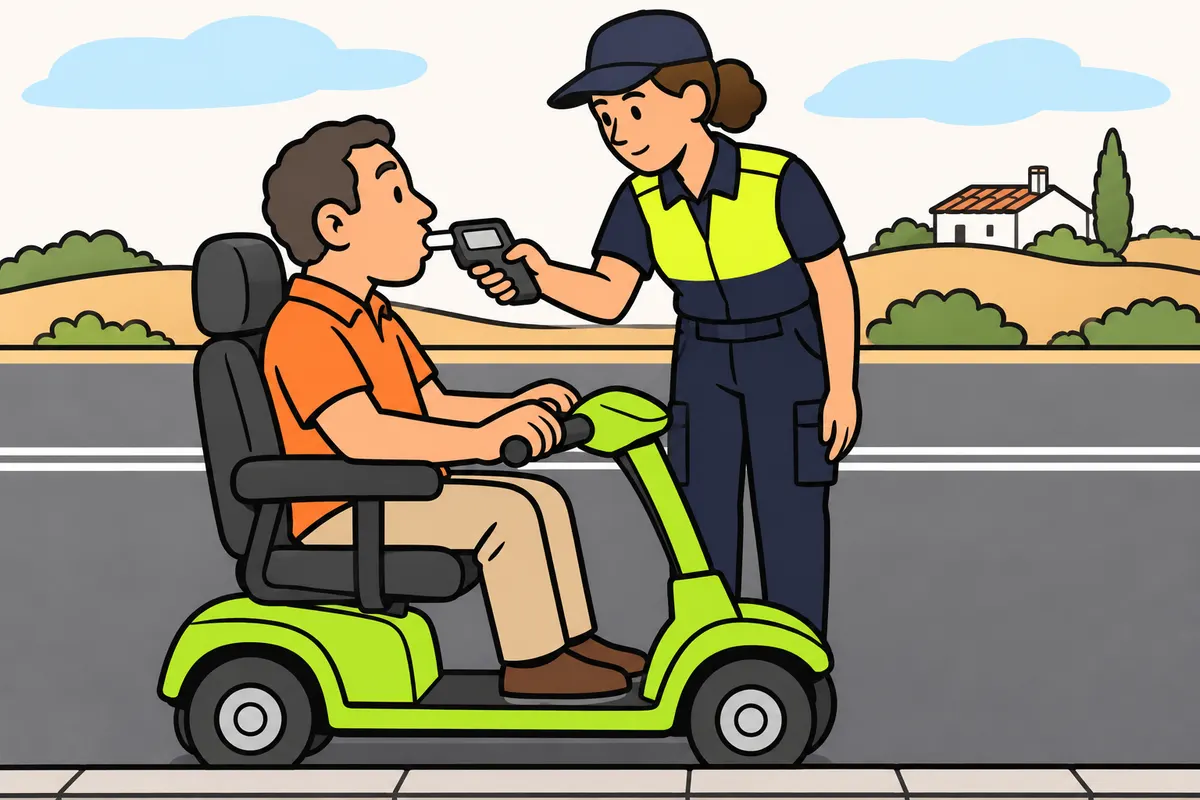
You must check your age and the licence experience that counts for your vehicle.
Remember
- As an adult novice, your lower limit lasts for the first two years.
- If you are underage, you must follow the zero limit.
- Your LCM experience counts for vehicles that this licence allows you to drive.
- Do not automatically count that experience towards driving a car.
- This period differs from your points balance and licence validity.
Exam trap: Wrong: your LCM experience automatically counts for a car. Right: it counts only where that licence is sufficient.
Read the full explanation
- During the two years after obtaining the driving permit or licence that entitles you to drive, you must not exceed 0.3 g/l in blood or 0.15 mg/l in exhaled breath. You must apply this lower limit if you are an adult and still within that period. [RGC, art. 20](https://www.boe.es/buscar/act.php?id=BOE-A-2003-23514#a20)
- For these purposes, the time you have held a driving licence only counts when you drive vehicles for which that licence is sufficient. You must therefore count the time you have held your LCM licence when driving the vehicle it authorises; you must not automatically carry that experience over to driving a passenger car. [RGC, art. 20](https://www.boe.es/buscar/act.php?id=BOE-A-2003-23514#a20)
- You must not confuse the two-year period with a lower alcohol limit with your initial points balance or your licence's validity period. These are separate matters, each with its own conditions. For this topic, you must check your age, the entitlement that authorises you to drive and the licence experience that counts, in that order.
6Vehicles and services with a lower limit
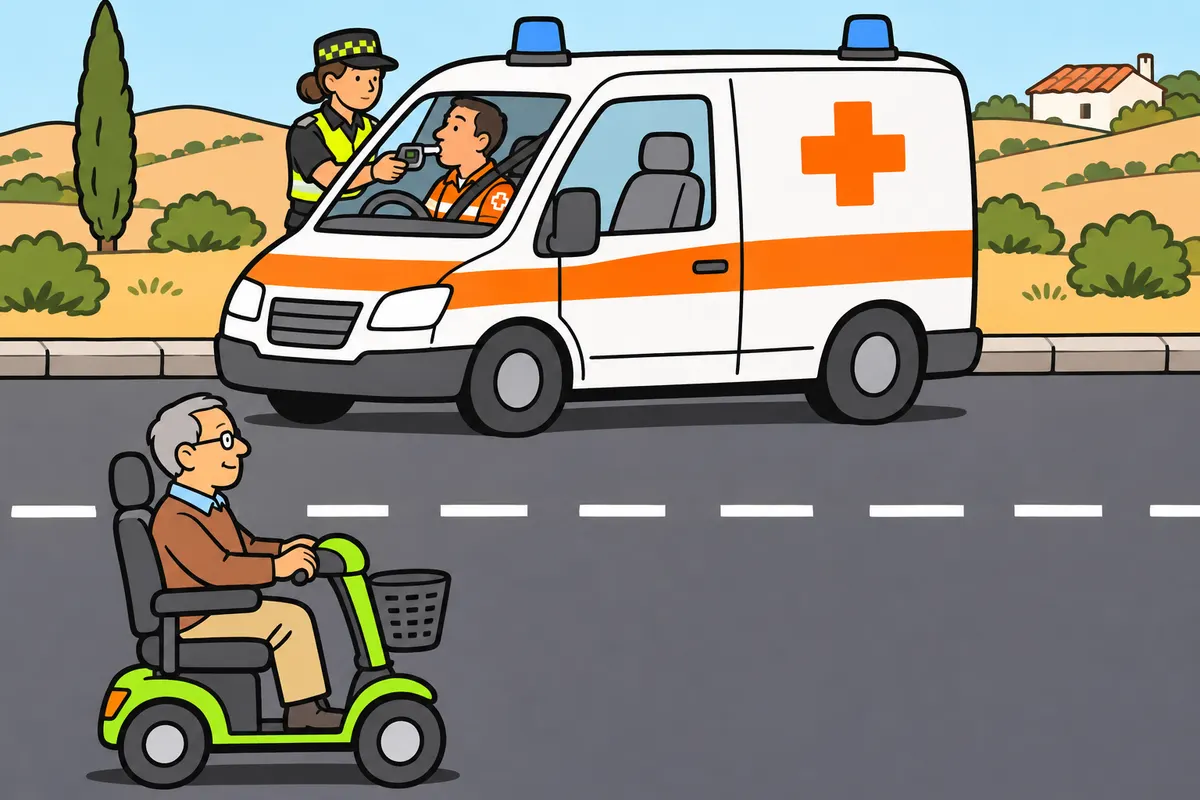
You must apply the lower alcohol limit for the actual vehicle or service.
| Vehicles or services with lower limit | Condition |
|---|---|
| Goods vehicles | MMA over 3,500 kg |
| Passenger vehicles | More than nine seats |
| Public service; school transport and transport of minors | Based on service |
| Dangerous goods; emergency services; special transport | Based on service |
Remember
- Check maximum authorised mass, not the load you carry.
- Count the vehicle’s seats, not just its current passengers.
- Experience does not remove a lower limit based on service.
- Your private LCM journey to a medical appointment is not an emergency service.
Exam trap: Wrong: your private trip to the doctor is an emergency service. Right: check the actual category and service.
Read the full explanation
- The maximum alcohol concentration is also 0.3 g/l in blood or 0.15 mg/l in breath when you drive goods vehicles with an MMA (maximum authorised mass) above 3,500 kg and passenger vehicles with more than nine seats. You must consider the maximum authorised mass and the number of seats, rather than the current load or number of occupants. [RGC, art. 20](https://www.boe.es/buscar/act.php?id=BOE-A-2003-23514#a20)
- The same lower limit applies to public service vehicles, school transport and transport for minors, dangerous goods vehicles, emergency service vehicles and special transport vehicles. The list also covers these services when the vehicle is neither a lorry nor a bus. [RGC, art. 20](https://www.boe.es/buscar/act.php?id=BOE-A-2003-23514#a20)
- You must not consider your vehicle an emergency service vehicle because you are travelling to a medical appointment. Nor must you equate personal use of a vehicle for people with reduced mobility with special transport on the list. You must apply the actual category and service described in the scenario.
- The applicable limit may depend on your status as a novice driver or on the vehicle and service you drive. As an experienced driver, you may be subject to the lower limit because of the service you provide. In your private LCM vehicle, the factors you must check in particular are whether you are underage and how long you have held your licence.
7How alcohol impairs your abilities
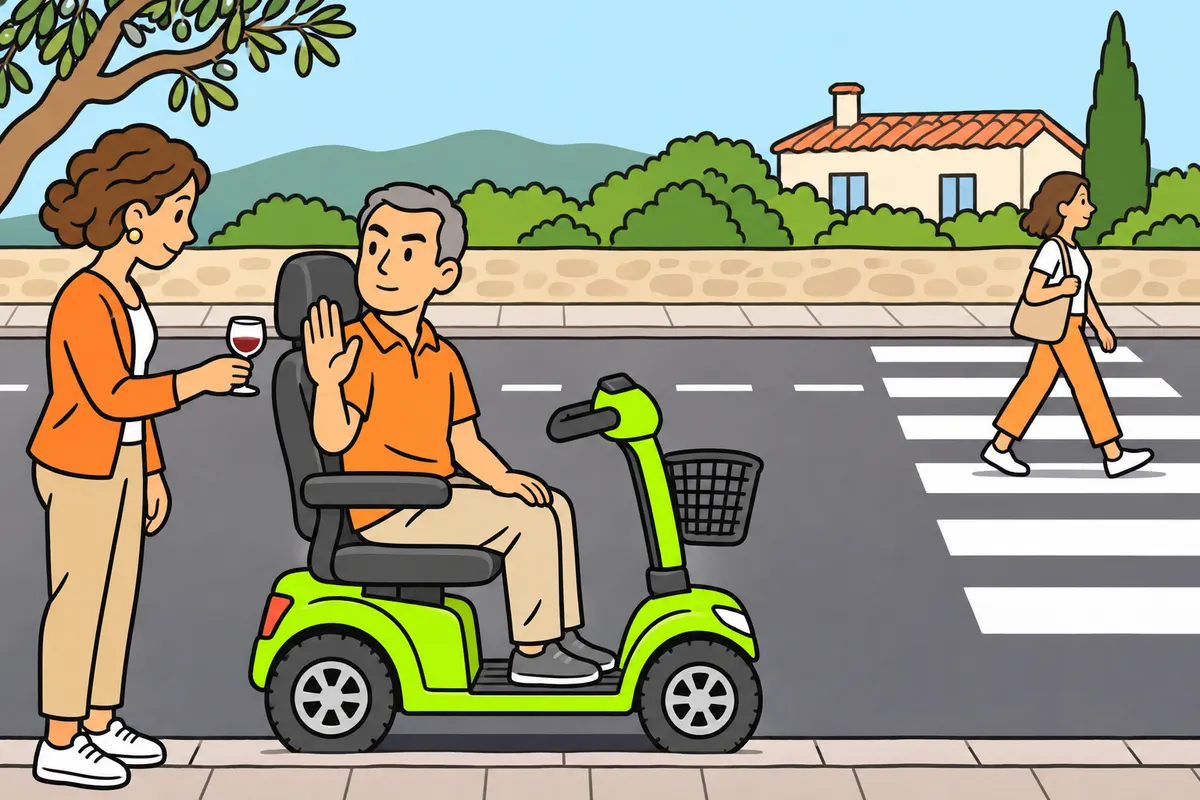
After drinking, you may react worse even when you feel more confident.
Remember
- You may accept risks you would reject without alcohol.
- You may misjudge distances and look less to the sides.
- You may start braking late and use controls less accurately.
- Do not compare your abilities with someone else who has been drinking.
Exam trap: Wrong: feeling confident proves you drive well. Right: alcohol can mislead you about your abilities.
Read the full explanation
- After drinking, you may feel confident and accept risks you would reject when sober. You must distrust the impression that you drive better or more easily: it may reflect an impaired assessment of danger. Your experience with your vehicle and knowledge of the route do not counteract the effects of alcohol.
- You may perceive your surroundings less clearly, misjudge distances and check less carefully to the sides. In your LCM vehicle, this may cause you to misjudge how long another vehicle takes to catch up with you or to notice someone crossing too late. You may also have more difficulty coping with glare and paying attention to several signs.
- Alcohol can increase your reaction time and impair your coordination. You must associate this with starting to brake too late, an imprecise manoeuvre or an inappropriate decision. It can also impair your understanding of what is happening even when you remain awake.
- You may not realise how much alcohol is affecting you. If someone else has drunk the same amount and seems fine, you cannot conclude that your alcohol level or abilities are the same. You must take preventive action without using personal feelings as a substitute for a reliable check. [DGT, alcohol](https://www.dgt.es/muevete-con-seguridad/evita-conductas-de-riesgo/consumo-de-alcohol/)
8Absorption and false remedies
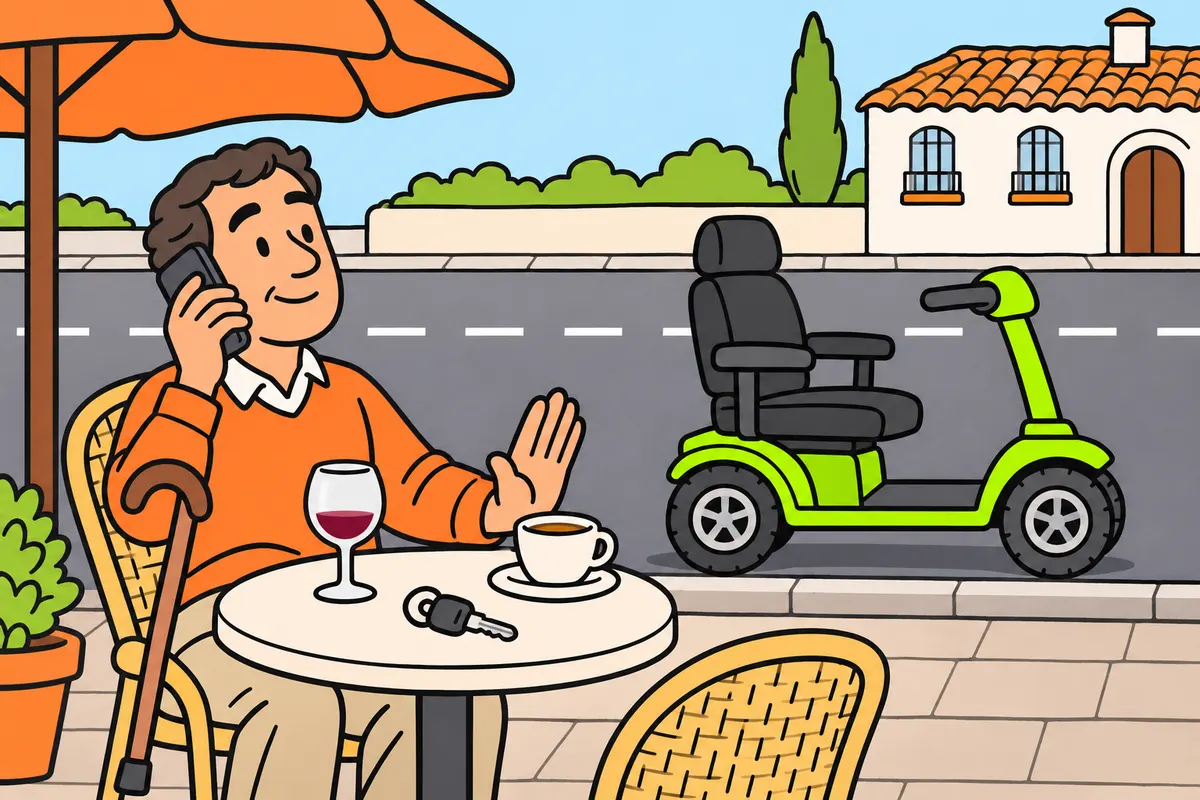
You cannot remove alcohol with tricks or calculate a safe driving time yourself.
Remember
- Eating does not stop alcohol entering your blood.
- Your alcohol level may keep rising after your last drink.
- Coffee, showers and exercise do not remove alcohol.
- Sleeping for a while does not guarantee you can drive.
- Avoid mixing alcohol with medicines or other drugs.
Exam trap: Wrong: coffee allows you to drive again. Right: feeling awake does not remove alcohol.
Read the full explanation
- You must take into account the amount of alcohol, how quickly you drink, food intake and personal characteristics. Drinking on an empty stomach can lead to faster absorption; eating does not prevent alcohol from entering your bloodstream. The effect of a meal on absorption does not, on its own, allow you to predict your alcohol level.
- Your alcohol concentration can continue to rise after your last drink. You must avoid assuming that stopping drinking allows you to drive immediately or that an apparently low alcohol level stays the same throughout your journey. Absorption and elimination take time and vary according to the circumstances.
- You must not rely on coffee, water, sweets, chewing gum, a shower or exercise to eliminate alcohol and restore your fitness to drive. Feeling more awake does not prove that the alcohol has gone. Sleeping for a while does not allow you to set a safe time to return either.
- You must avoid mixing alcohol with medicines or other drugs: the harmful effects can intensify and become difficult to predict. The preventive option is to arrange another means of transport in advance. For your return journey, you must plan an alternative that does not depend on calculating when the alcohol is gone.
9When you must undergo tests
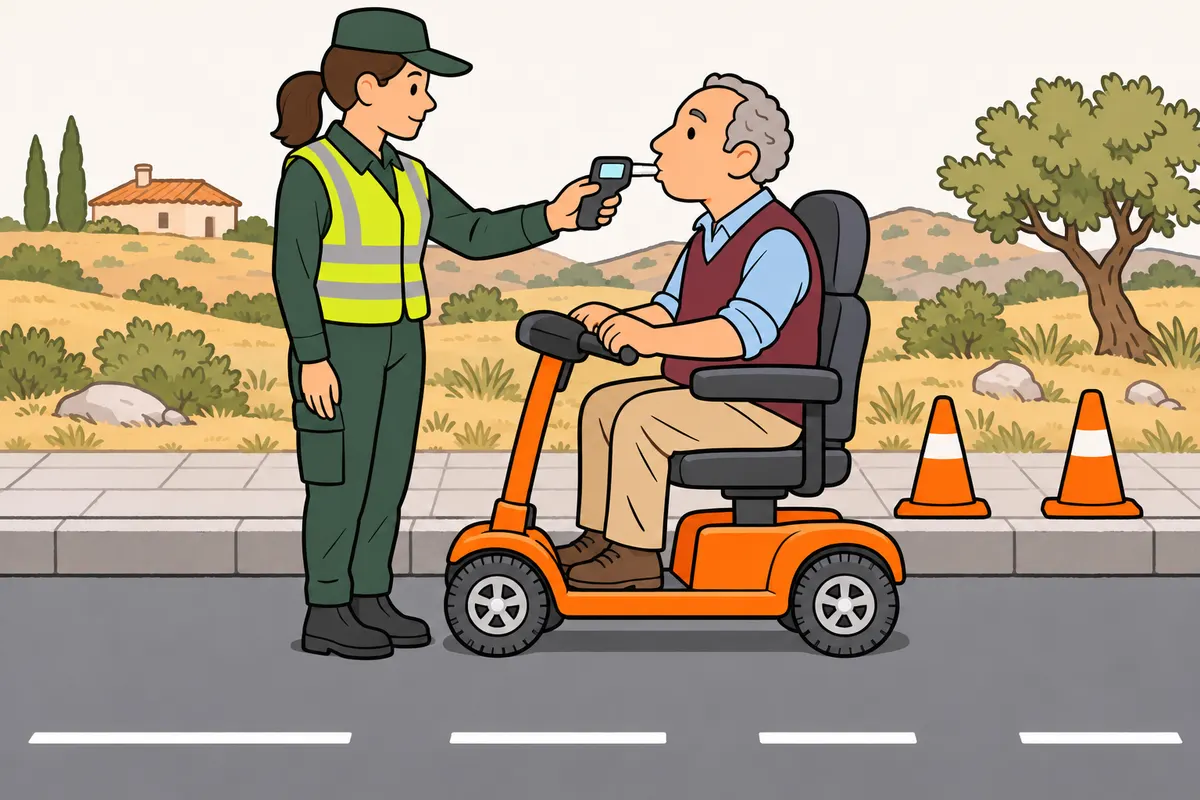
You must take tests when traffic officers lawfully require them.
| Your role on the road | When tests apply |
|---|---|
| You drive an LCM vehicle | When traffic officers lawfully require tests |
| You drive: alcohol tests | Preventive check, symptoms, reported offence or direct involvement as a possibly responsible party in an accident |
| You are a pedestrian or another road user | If involved in an accident or you have committed an offence, as the law provides |
Remember
- Your LCM licence does not exempt you from tests.
- A preventive check needs no symptoms or previous offence.
- Report any injury or illness that prevents you from taking the standard test.
- A justified medical inability may require an examination or clinical tests.
Exam trap: Wrong: as a driver, you are tested only after an accident. Right: a preventive check needs no previous offence or irregular driving.
Read the full explanation
- As the driver of an LCM vehicle, you must undergo alcohol and drug tests lawfully required by officers responsible for traffic enforcement. You do not need to have been involved in an accident for this obligation to apply. Your type of licence and your vehicle's low speed do not exempt you from testing. [LTSV, art. 14.2](https://www.boe.es/buscar/act.php?id=BOE-A-2015-11722#a14)
- You may be required to undergo alcohol tests at a preventive checkpoint, if you show symptoms, if you are reported for an offence or if you are directly involved in an accident as someone potentially responsible. You must understand these circumstances separately: a preventive check does not require the officer to have previously seen you driving irregularly. [RGC, art. 21](https://www.boe.es/buscar/act.php?id=BOE-A-2003-23514#a21)
- If you use the road as a pedestrian or another road user, you must also undergo tests when you are involved in a traffic accident or have committed an offence as provided by law. These circumstances concern your participation as a road user; preventive checks are aimed at drivers. [LTSV, art. 14.2](https://www.boe.es/buscar/act.php?id=BOE-A-2015-11722#a14)
- If an injury or illness genuinely prevents you from taking the standard test, you must report this. For justified reasons, you may be required to undergo a medical examination or any clinical tests that medical professionals consider appropriate. You must distinguish medical inability from a voluntary refusal to cooperate. [LTSV, art. 14.3](https://www.boe.es/buscar/act.php?id=BOE-A-2015-11722#a14)
10Alcohol testing: second test and confirmatory test
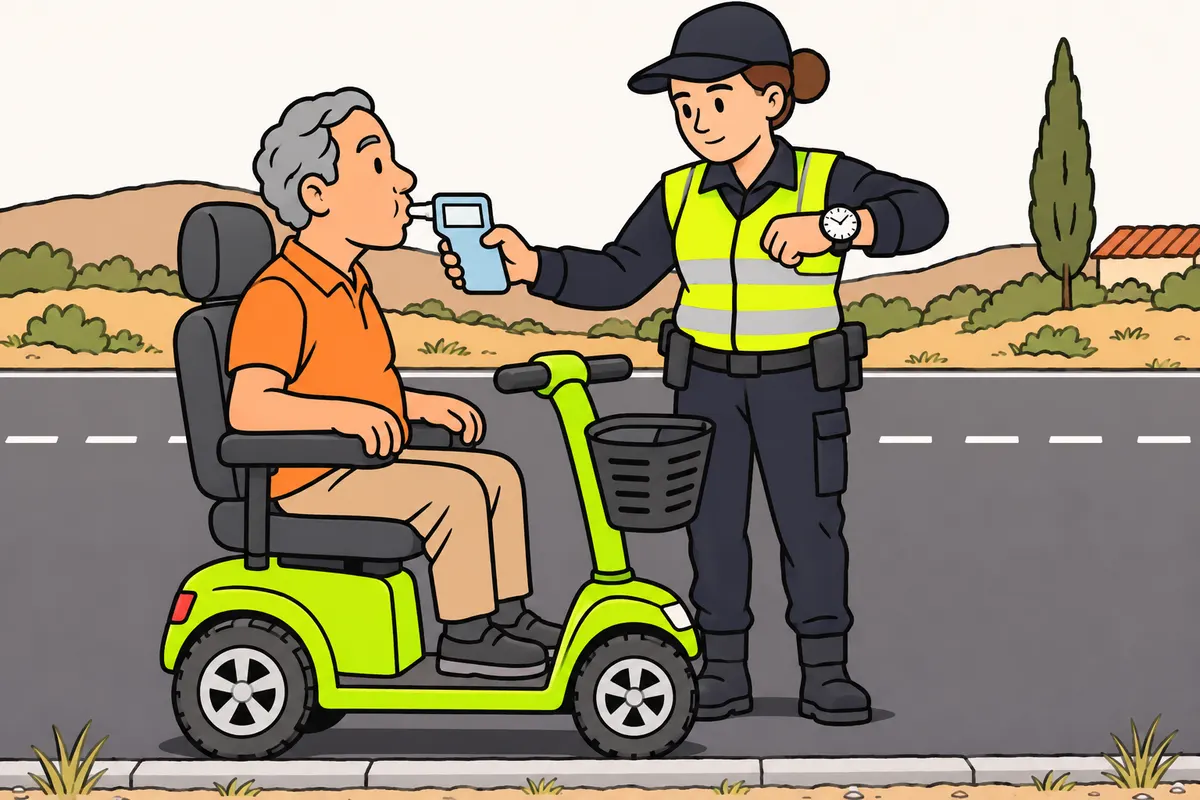
You must distinguish the second breath test from a confirmatory test you can request.
| Test or result | What to remember |
|---|---|
| Standard and second tests | You provide exhaled breath |
| Requested confirmatory test | Preferably a blood test |
| Positive alcohol confirmation | You pay; an advance deposit is required |
| Negative alcohol confirmation | Your deposit is refunded |
Remember
- Blow as the officer instructs you.
- You get a second breath test if over your limit or showing clear symptoms.
- The officer must tell you first; you or someone present can check the interval.
- You can ask to record your comments and request a confirmatory test.
- Confirmation preferably uses blood, except in justified exceptional circumstances.
- You cannot replace the required tests with another test of your own choice.
Exam trap: Wrong: the gap between breath tests is at most 10 minutes. Right: at least 10 minutes must pass.
Read the full explanation
- You take the standard alcohol test by providing a breath sample using an approved device. You must blow as the officer instructs; the breathalyser measures alcohol in your breath without taking blood. This distinction helps you recognise the unit mg/l when interpreting a result. [RGC, art. 22](https://www.boe.es/buscar/act.php?id=BOE-A-2003-23514#a22)
- If you exceed the applicable limit or show obvious symptoms even without reaching it, the officer gives you a second breath test and must inform you beforehand. At least 10 minutes must pass between the two tests. You may check this interval yourself or through a companion or witness who is present. [RGC, art. 23](https://www.boe.es/buscar/act.php?id=BOE-A-2003-23514#a23)
- You may make comments or representations for the record and request a confirmatory test. This is an additional check beyond the second breathalyser reading and preferably takes the form of a blood test, unless there are justified exceptional reasons. This right applies to both alcohol and drugs. [LTSV, art. 14.5](https://www.boe.es/buscar/act.php?id=BOE-A-2015-11722#a14)
- If you request a confirmatory alcohol test, the RGC provides for an advance deposit covering its cost; if the result is positive, you bear the cost, and if it is negative, your deposit is refunded. You must exercise your right to a confirmatory test by following the procedure, without unilaterally replacing the required tests with another test of your choice. [RGC, art. 23.4](https://www.boe.es/buscar/act.php?id=BOE-A-2003-23514#a23)
11Refusal and immobilisation
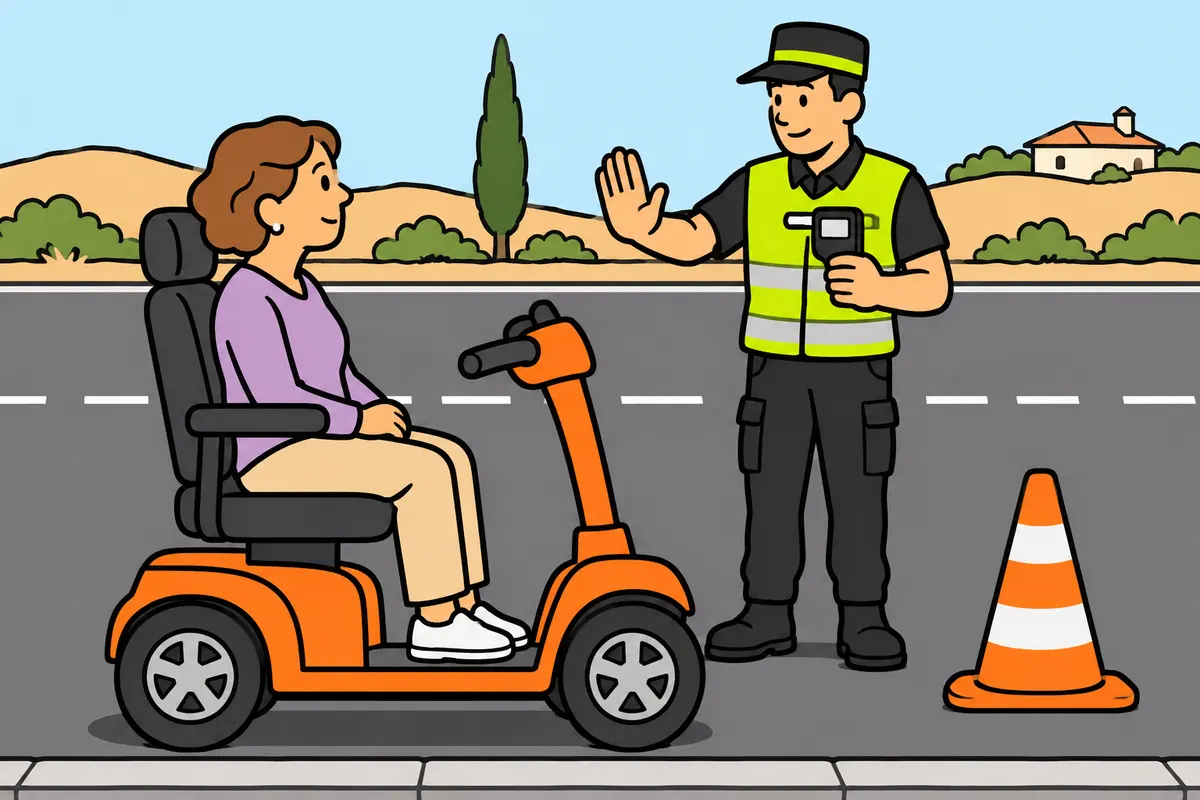
If you test positive or refuse testing, officers may immobilise your vehicle.
Remember
- Refusing a lawfully required test is a very serious offence.
- Refusal has consequences even without a positive result.
- You cannot continue driving because you plan to pay the fine later.
- For alcohol cases, a replacement needs valid entitlement and must satisfy officers.
- A replacement driver does not remove your responsibility.
- Wait until the cause ends or officers accept a replacement, subject to court orders.
Exam trap: Wrong: no positive result means no immobilisation. Right: officers may also immobilise your vehicle for refusing tests.
Read the full explanation
- If you refuse a legally required test, you commit a very serious offence, even without a positive reading. Your duty to cooperate allows alcohol or drug use to be investigated; refusing the test has consequences for that failure to comply in itself. [LTSV, art. 77.d](https://www.boe.es/buscar/act.php?id=BOE-A-2015-11722#a77)
- Officers may immobilise your vehicle if you test positive or refuse alcohol or drug tests. Immobilisation is an immediate measure that prevents you from continuing to drive; the penalty relates to the offence committed and is dealt with through the relevant procedure. [LTSV, art. 104.1.d](https://www.boe.es/buscar/act.php?id=BOE-A-2015-11722#a104)
- In alcohol-related cases, another person with the appropriate driving entitlement who gives the officers sufficient assurance may take over driving. You must check that this person is entitled to drive your particular vehicle and is fit to do so. Having someone take over does not remove your responsibility for the offence. [RGC, art. 25](https://www.boe.es/buscar/act.php?id=BOE-A-2003-23514#a25)
- You must comply with the immobilisation for as long as its cause persists. If the judicial authority orders your vehicle to be impounded or seized, you must comply with its instructions. You study the points system in detail in the module «The LCM licence points system». [RGC, art. 25.3](https://www.boe.es/buscar/act.php?id=BOE-A-2003-23514#a25)
12Drugs: prohibition and detection
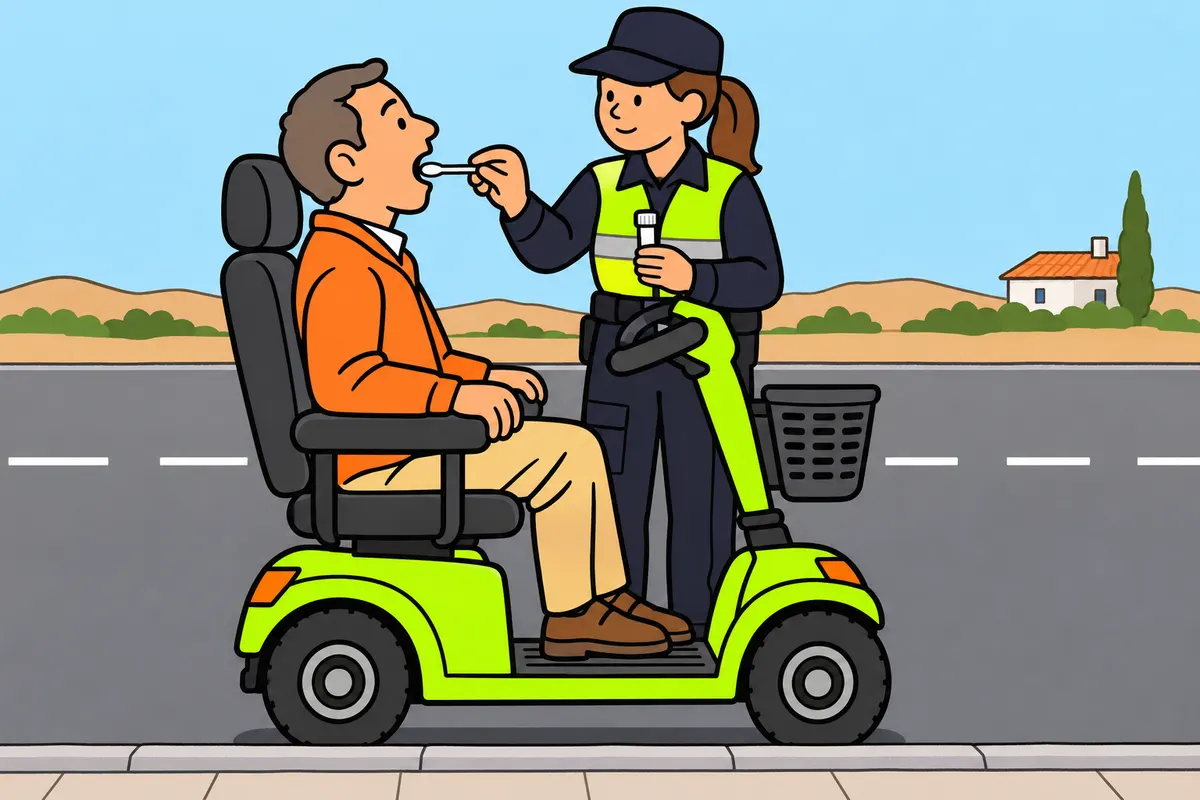
You cannot drive with drugs present unless you meet every condition of the medical exception.
| Your case | Rule |
|---|---|
| Recreational drugs present | You must not drive |
| Prescribed substance used for treatment | You must remain fit to drive carefully, cautiously and attentively |
Remember
- You have no permitted amount of recreational drugs for driving.
- The exception requires a prescription, treatment purposes and suitable driving abilities.
- A prescription does not allow you to drive while sleepy or confused.
- Standard testing uses saliva, followed by analysis of a sample.
- You must take tests even if you say you used drugs earlier.
Exam trap: Wrong: a prescription always lets you drive. Right: it requires treatment purposes and careful, cautious, attentive driving.
Read the full explanation
- You must not drive with drugs present in your body. You must distinguish this prohibition from the numerical alcohol limits: for recreational use, there is no amount of a drug that you can assume is permitted when driving your LCM vehicle. Feeling normal does not prove that you are fit to drive again or that no drugs are detectable. [LTSV, art. 14.1](https://www.boe.es/buscar/act.php?id=BOE-A-2015-11722#a14)
- The exception requires you to use substances under a medical prescription and for therapeutic purposes, provided that you remain fit to drive with care, caution and attention. You must meet all these conditions together; a prescription does not authorise you to drive with drowsiness, confusion or poor coordination caused by the treatment. [LTSV, art. 14.1](https://www.boe.es/buscar/act.php?id=BOE-A-2015-11722#a14)
- You undergo standard drug detection through a saliva test using an approved device, followed by laboratory analysis of a sufficient saliva sample. You must not confuse this procedure with alcohol testing: blowing into a breathalyser does not replace the saliva test for drugs. [LTSV, arts. 14.3 and 14.5](https://www.boe.es/buscar/act.php?id=BOE-A-2015-11722#a14)
- If you drive with drugs present in your body in the prohibited circumstances, you commit a very serious offence. You must avoid relying on tricks to conceal drug use or on waiting periods someone else has told you about. You remain obliged to undergo tests even if you claim to have taken drugs at another time. [LTSV, art. 77.c](https://www.boe.es/buscar/act.php?id=BOE-A-2015-11722#a77)
13Effects of different drugs
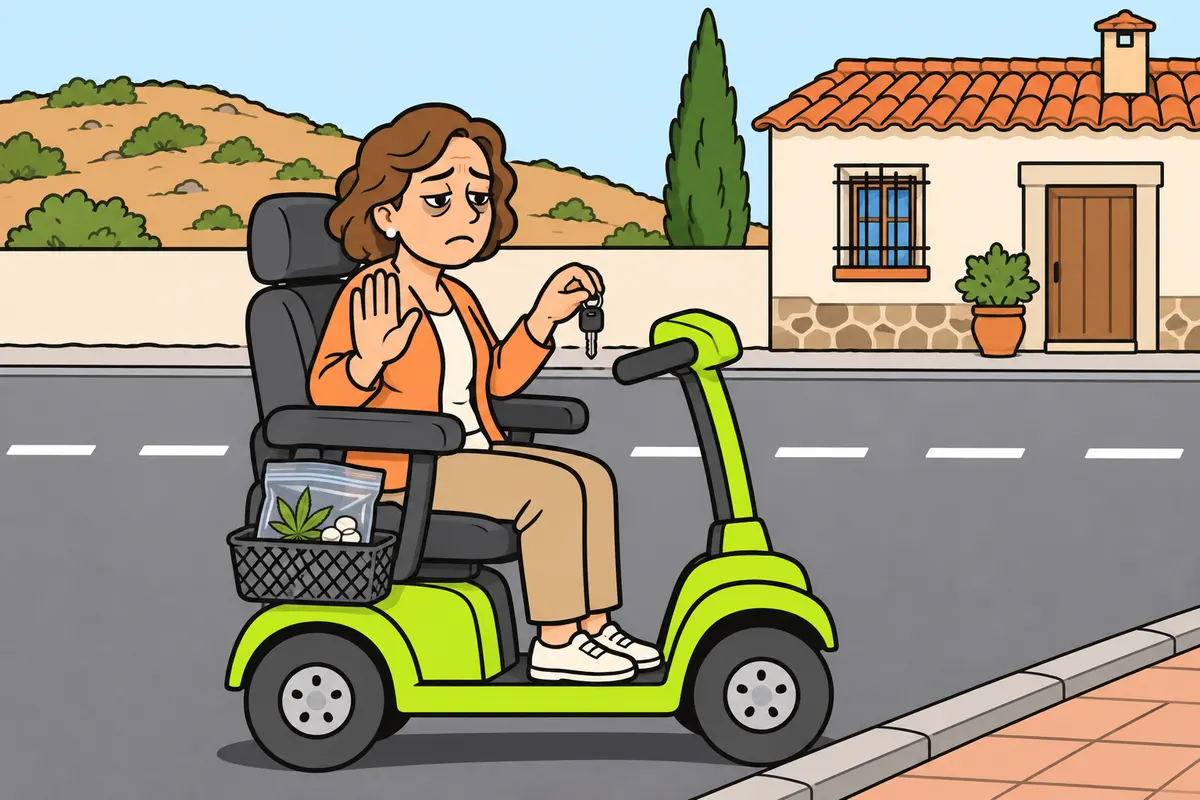
Drugs can affect your attention and decisions in different ways.
| Substance you take | Effects you may experience |
|---|---|
| Cannabis | Poorer perception, attention and coordination |
| Cocaine | Too much confidence and more risk-taking |
| Amphetamines | Hidden tiredness and severe fatigue afterwards |
| Ecstasy | Blurred vision and dazzle |
| Hallucinogens | Seriously mistaken understanding of your surroundings |
Remember
- Do not confuse feeling relaxed or awake with driving safely.
- Amphetamines can hide your tiredness without removing it.
- Mixing drugs together or with alcohol adds risks you cannot easily predict.
Exam trap: Wrong: a stimulant improves your driving. Right: feeling energetic does not guarantee attention or good decisions.
Read the full explanation
- With cannabis, you can experience impaired perception, attention and coordination. You must associate these effects with misjudging the space available or responding late to an approaching vehicle. A subjective feeling of relaxation does not make driving safer or allow you to compensate for the impairment by driving slowly. [DGT, drugs and medication](https://www.dgt.es/muevete-con-seguridad/evita-conductas-de-riesgo/consumo-de-drogas-y-medicacion/)
- With cocaine, you can overestimate your abilities and take more risks. The stimulation can be accompanied by impulsiveness, aggression or reduced awareness of danger. You must reject the idea that being more awake means you are better prepared to operate the controls and make prudent decisions. [DGT, drugs and medication](https://www.dgt.es/muevete-con-seguridad/evita-conductas-de-riesgo/consumo-de-drogas-y-medicacion/)
- With amphetamines, you can mask tiredness without removing your need for rest. When the stimulation wears off, you can feel very fatigued. If you keep driving because you feel you can carry on for longer, you expose yourself to the impairment that the stimulation can conceal: feeling energetic does not guarantee sustained attention or an appropriate response. [DGT, drugs and medication](https://www.dgt.es/muevete-con-seguridad/evita-conductas-de-riesgo/consumo-de-drogas-y-medicacion/)
- With ecstasy, you can experience visual disturbances, dazzle or blurred vision; with hallucinogenic substances, you can interpret your surroundings in a profoundly mistaken way. You must avoid drawing any conclusion about safety based on one drug having different effects from another. Mixing drugs with one another or with alcohol adds risks that are difficult to predict. [DGT, drugs and medication](https://www.dgt.es/muevete-con-seguridad/evita-conductas-de-riesgo/consumo-de-drogas-y-medicacion/)
14Medicines and the patient information leaflet
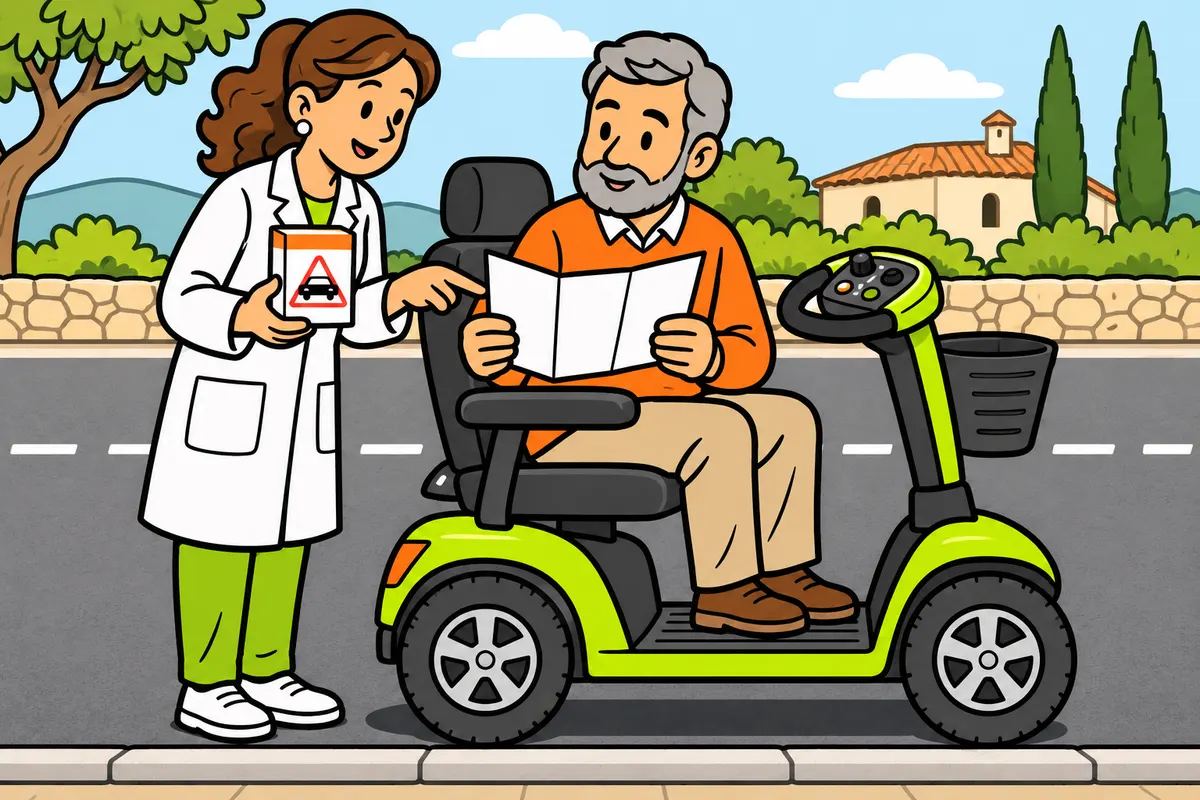
Before driving during treatment, you must read the leaflet and check its effects.
Remember
- Read the “Driving and using machines” section.
- Ask your doctor or pharmacist if you have doubts.
- The red triangle containing a car warns you of possible effects.
- Check effects when starting treatment, changing doses or combining medicines.
- Do not change or stop treatment on your own.
- If your abilities are affected, stop driving safely.
Exam trap: Wrong: the medicine symbol automatically bans driving. Right: read the leaflet and check how it affects you.
Read the full explanation
- Before driving while receiving treatment, you must read the information in the medicine's patient information leaflet about its effects on driving and using machines, and ask your doctor or pharmacist if you have any doubts. You must explain that you drive a vehicle for people with reduced mobility and which controls you use, so that the advice takes account of what you actually do. [RD 1345/2007, Annex V](https://www.boe.es/buscar/act.php?id=BOE-A-2007-19249#anv)
- The pictogram on the packaging shows a red triangle with a car and directs you to the patient information leaflet. You must understand it as a warning of possible effects on driving; by itself, it does not impose an automatic ban on everyone. You must not interpret it as a road sign with a code from the sign catalogue either. [AEMPS, driving pictogram](https://www.aemps.gob.es/industria/etiquetado/conduccion/pictograma.htm) [RD 1345/2007, Annex IV](https://www.boe.es/buscar/act.php?id=BOE-A-2007-19249#aniv)
- Some medicines can cause drowsiness, dizziness, blurred vision or poor coordination. You must take particular care to check for these effects when starting treatment, changing the dose or combining medicines. The fact that a product is sold without a prescription or is derived from plants does not mean you can conclude that it has no effect on driving. [DGT, medicines and interactions](https://revista.dgt.es/es/salud-vial/2021/0408-Interactuacion-medicamentos.shtml)
- You must not stop or change your treatment on your own initiative so that you can drive. You must seek advice on how to combine treatment with driving and avoid alcohol, which can increase adverse effects. If you notice that your abilities are affected, you must stop driving even if the medicine is prescribed and you only have a short distance left to travel.
15Fatigue: causes and effort
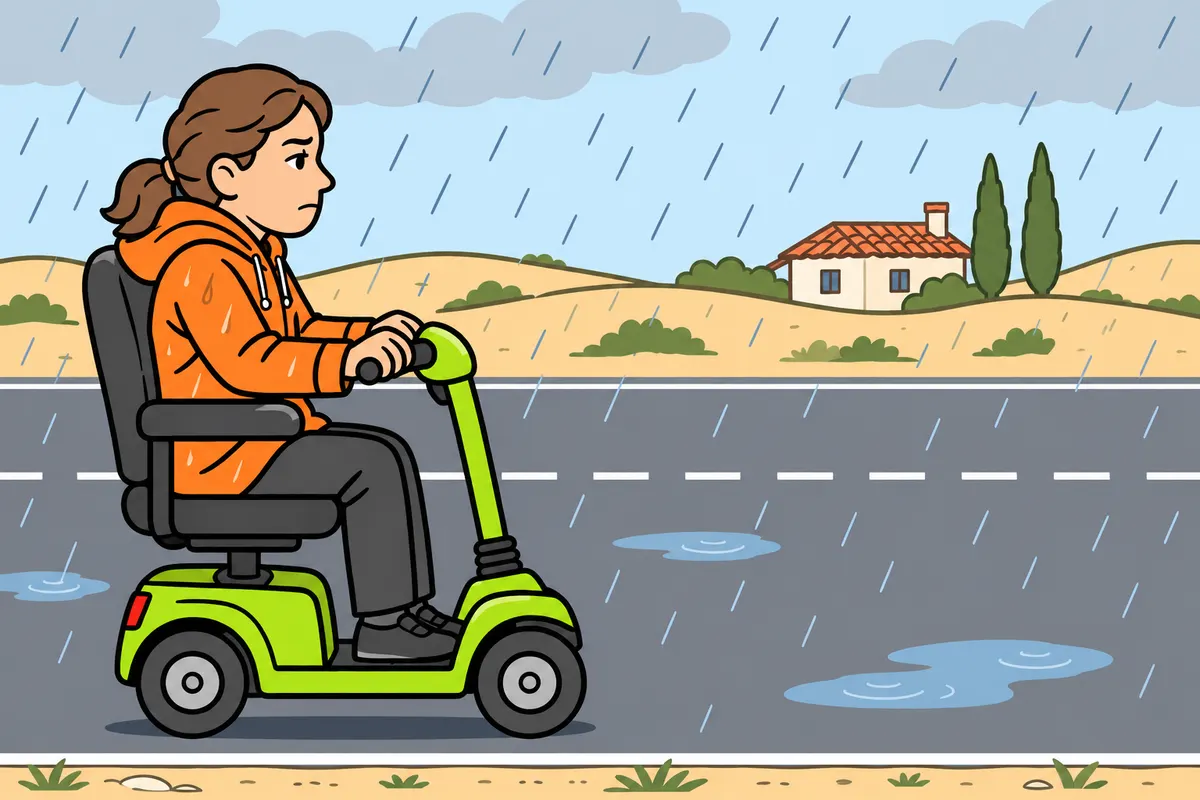
You can become tired through physical effort and staying alert.
| Type of tiredness | What can tire you |
|---|---|
| Physical | Using controls and maintaining your posture |
| Mental | Watching and making decisions constantly |
Remember
- Your concentration can suffer even without muscle pain.
- Heavy traffic and poor visibility increase your effort.
- Adjust your posture and controls before leaving.
- Check how noise, ventilation, cold and heat affect you.
- Consider tiredness built up before you enter the vehicle.
Exam trap: Wrong: a short journey guarantees you are not tired. Right: assess the tiredness you already have.
Read the full explanation
- You can become physically fatigued from the effort of operating the controls and maintaining your posture, and mentally fatigued from constant vigilance and decision-making. Mental tiredness can impair your concentration or delay your detection of a hazard even without muscle pain.
- You must anticipate greater effort in heavy traffic, on unfamiliar routes and in difficult visibility conditions. Rain or an uneven road surface can require more corrections and observation. In an LCM vehicle, watching for other vehicles approaching and maintaining a precise course can also be tiring.
- An uncomfortable posture, controls that are difficult to reach, noise or insufficient ventilation can increase your tiredness. You must adjust your driving position to your needs before setting off. If your vehicle has no enclosed cabin, you must also assess how cold, heat and exposure to the elements affect you.
- You can accumulate fatigue from driving for too long without a break, sleeping poorly, being ill or experiencing intense worries. You must also assess the effort you have made before getting into the vehicle. The distance of your journey alone does not tell you how much tiredness you have accumulated. [DGT, fatigue](https://www.dgt.es/muevete-con-seguridad/evita-conductas-de-riesgo/conducir-con-fatiga/)
16Fatigue: recognise the warning signs
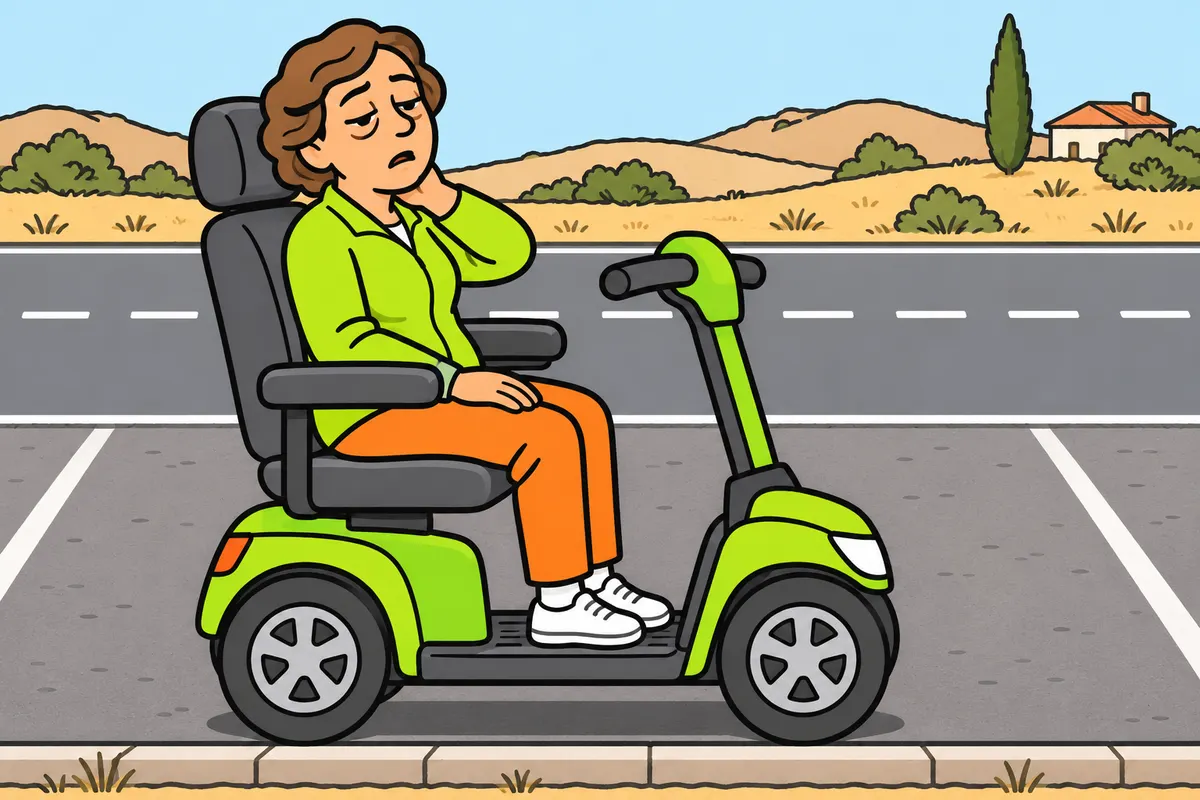
You must stop somewhere safe when tiredness makes observation or control difficult.
Remember
- Watch for heavy eyes, unclear vision and trouble concentrating.
- You may notice slow movements, discomfort or difficulty deciding.
- Do not speed up to finish sooner.
- Stop before tiredness becomes severe.
- Continue only when you are fit to drive again.
- Seek medical help if discomfort continues or unusual symptoms appear.
Exam trap: Wrong: keeping moving proves you are fine. Right: tiredness may already be reducing your abilities.
Read the full explanation
- Fatigue can give you heavy eyes, difficulty concentrating, less clear vision and a need to change posture repeatedly. You can also experience discomfort in your neck or back and stiffness. If the symptoms make it difficult to operate the controls or observe your surroundings, you must find a safe place to stop and rest.
- You can notice slower or less precise movements, unnecessary corrections and difficulty making decisions. You can also feel irritable or nervous. You must take these signs into account even if you are still keeping the vehicle on course: being able to keep moving does not prove that you retain a sufficient safety margin.
- If you start overlooking signs or doubting simple decisions, you must reassess your condition. Increasing your speed to finish sooner reduces the time available and places extra demands on you precisely when your abilities are impaired.
- You must stop before fatigue becomes severe and resume only when you are fit to do so again. If rest does not relieve the discomfort or you experience an unusual symptom, you must seek help or medical advice. You must not automatically attribute any dizziness or weakness to ordinary tiredness.
17Sleepiness and microsleeps
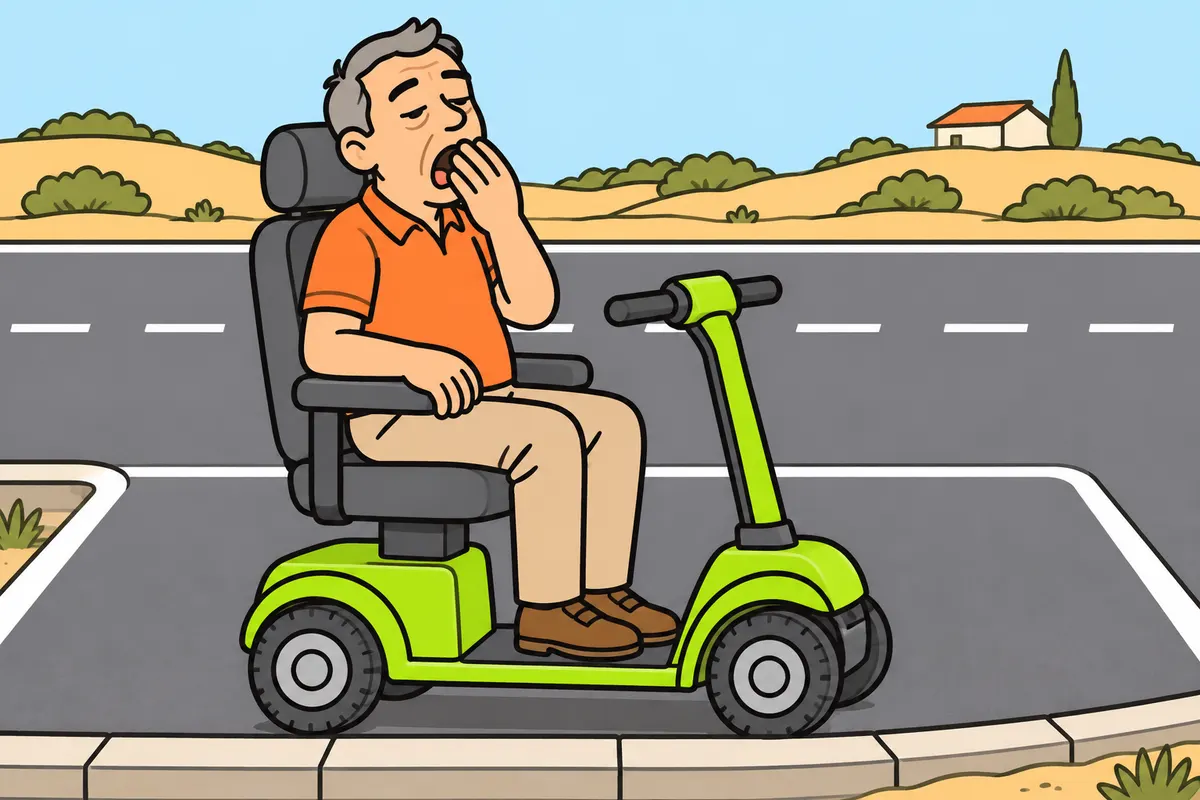
You must stop at signs of sleepiness, before you fall asleep.
| What you notice | What it means |
|---|---|
| Drowsiness | You need sleep |
| Fatigue | You are tired; sleepiness may also occur |
| Microsleep | You briefly fall asleep without meaning to and lose awareness |
Remember
- You can feel sleepy during daylight and on familiar journeys.
- Stop if you keep yawning or struggle to keep your eyes open.
- Not remembering a recent stretch of road warns you of danger.
- A microsleep briefly removes your awareness.
- You cannot choose when you fall asleep.
- Seek advice for frequent or unexplained sleepiness.
Exam trap: Wrong: you can wait until you fall asleep. Right: stop when warning signs appear.
Read the full explanation
- Drowsiness is the need to sleep and can occur alongside fatigue, although they are different states. Sleeping less than you need, resting poorly or changing your schedule makes sleepiness while driving more likely. Spending many hours in bed does not prove that your sleep is restorative.
- You can feel sleepy during the day, especially at times when you are less alert or after a large meal. Monotony and light traffic can make it easier to lose vigilance. You must also take precautions on your usual route: knowing every junction does not prevent you from overlooking a new hazard.
- You must stop if you yawn repeatedly, struggle to keep your eyes open or your head up, and lose track of what is happening. Not remembering a recent stretch of your journey or noticing late that you have drifted off course are important warning signs. The danger arises even without you falling fully asleep.
- You can experience a microsleep: a brief episode of involuntary sleep during which you lose vigilance. You must not rely on being able to control voluntarily when you fall asleep. If you experience frequent or unexplained drowsiness, you must seek medical advice, because you may have a sleep disorder that requires assessment. [DGT, sleepiness and tiredness](https://www.dgt.es/muevete-con-seguridad/evita-conductas-de-riesgo/Conducir-con-sueno-o-cansancio)
18Rest, food and comfort
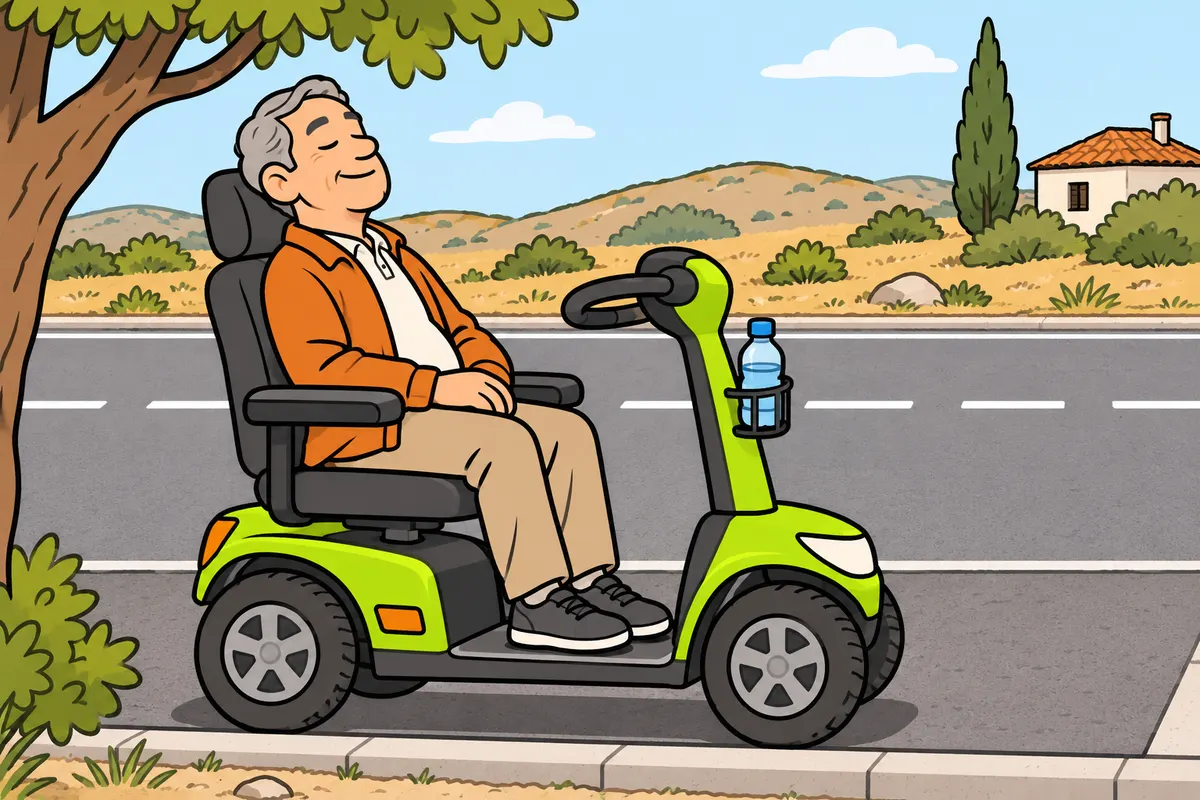
You should plan breaks and must stop sooner if you need to.
Remember
- For prevention, stop every 2 hours or 200 km, whichever comes first.
- Take breaks around 20 to 30 minutes; stop sooner if needed.
- If sleepy, sleep and continue only when your abilities return.
- Do not replace rest with coffee, music or an open window.
- Avoid large meals and plan breaks to eat and drink.
- Choose clothes and, with pedals, shoes that let you use controls accurately.
Exam trap: Wrong: you must complete the recommended interval before stopping. Right: stop sooner if you need to.
Read the full explanation
- As a general preventive guideline, you must take a break from driving every 2 hours or every 200 km, whichever comes first, with breaks of about 20 to 30 minutes. In your LCM vehicle, you must pay particular attention to time and stop sooner if you need to; do not wait until you have covered a long distance. These are preventive recommendations, not tachograph rules. [DGT, sleepiness and tiredness](https://www.dgt.es/muevete-con-seguridad/evita-conductas-de-riesgo/Conducir-con-sueno-o-cansancio)
- If you feel sleepy, you must sleep and resume only when you have recovered your faculties. A brief break does not guarantee this recovery. You must not replace sufficient rest with opening a window, turning up the music, drinking coffee or using stimulants: feeling alert for a moment does not remove the cause.
- You must avoid very large meals and stay adequately hydrated. Plan breaks to eat and drink without distracting yourself while operating the controls. If you have a medical condition with specific dietary requirements, you must follow medical advice and not improvise changes to complete your journey. [DGT, food and nutrition for drivers](https://www.dgt.es/muevete-con-seguridad/conviertete-en-un-buen-conductor/consejos-generales/consejos-alimentacion/)
- You must choose clothing and, when you use pedals, footwear that allow precise control. Check in particular that your clothes do not interfere with your adapted controls. Your obligation is to maintain freedom of movement and control; you must not turn advice about a particular item of clothing into a general ban on that item by name. [RGC, art. 18.1](https://www.boe.es/buscar/act.php?id=BOE-A-2003-23514#a18)
19Distractions inside and outside your vehicle
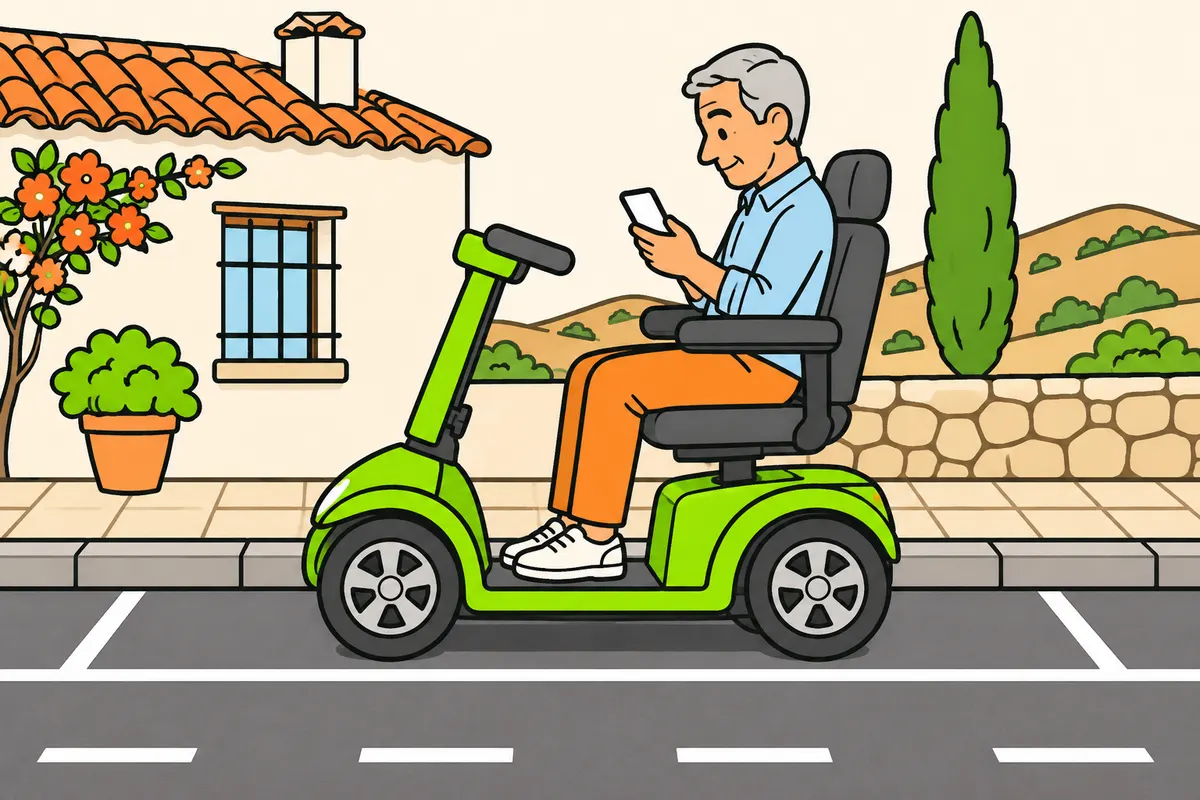
You must keep your attention, clear view and freedom to move.
Remember
- Prepare objects and devices before leaving.
- You can be distracted even while looking ahead.
- If something falls, stop safely before picking it up.
- Do not stare at advertisements or incidents.
- Ask your authorised passenger to stop distracting you.
- Park if you need to deal with something yourself.
Exam trap: Wrong: looking ahead guarantees attention. Right: your thoughts can also distract you.
Read the full explanation
- You must maintain the necessary attention, field of vision and freedom of movement at all times. A distraction can take your eyes off the road, occupy your hands or absorb your thoughts. Even when you look ahead, you can stop processing traffic information if you are focused on a worry. [RGC, art. 18.1](https://www.boe.es/buscar/act.php?id=BOE-A-2003-23514#a18)
- You can become distracted when looking for something, adjusting the music, eating, drinking or lighting a cigarette. You must prepare objects and devices before setting off and leave tasks that require attention until you have parked. If an object falls while you are driving, you must maintain control and stop safely before picking it up.
- A shop window, an advertisement, an incident or an eye-catching vehicle can also draw your attention away from relevant traffic. You must observe what you need to drive, without keeping your gaze on less relevant details. If your surroundings are complex, you must focus on paths of travel and risks, avoiding additional tasks that compete for your attention.
- If you travel with an authorised passenger, you must avoid absorbing conversations or actions that interfere with driving. You must ask for a distraction to stop and park if you need to deal with something yourself. Objects must be placed so that they do not interfere with your movements or your use of the controls. [RGC, art. 18.1](https://www.boe.es/buscar/act.php?id=BOE-A-2003-23514#a18)
20Phones, headphones and hands-free systems
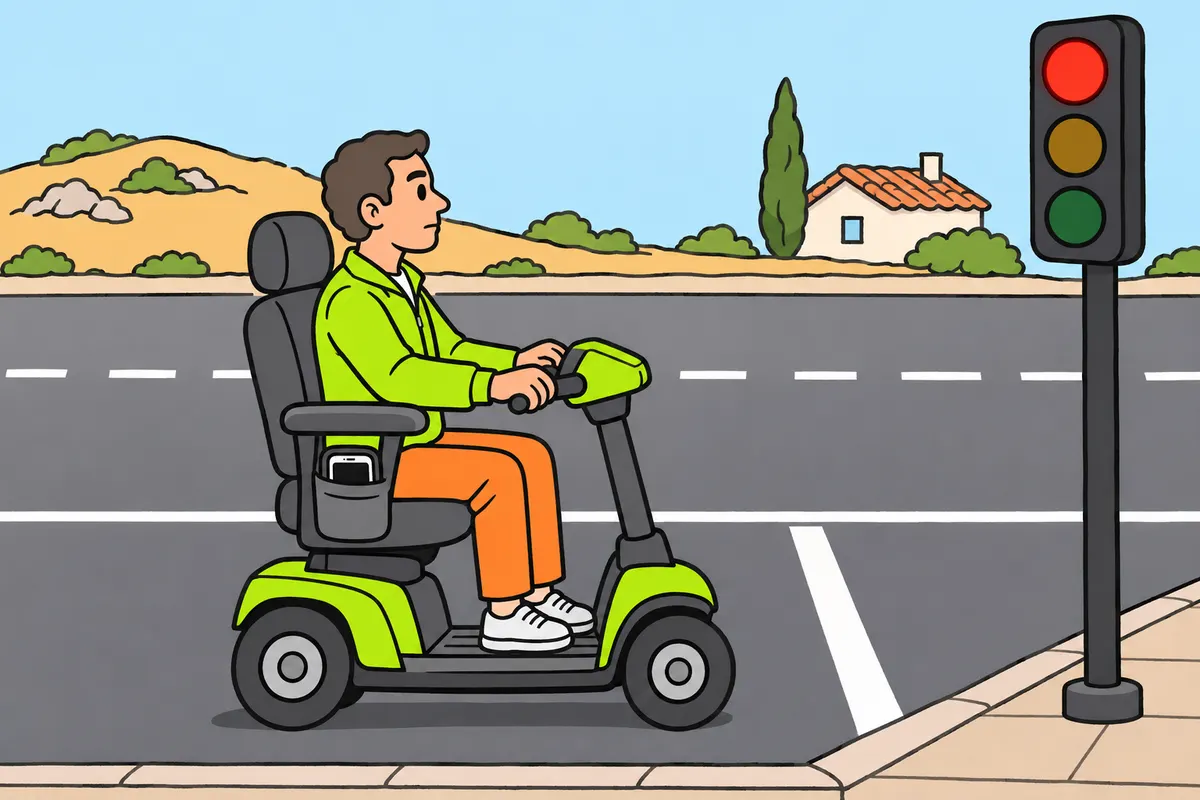
You must park somewhere permitted and safe before using your phone by hand.
| Your situation in an LCM vehicle | What you can do |
|---|---|
| Phone in your hands while driving | You must not use it |
| Headphone or earphone, even one | You must not use it to communicate |
| Communication without hands, headphones or earphones | May be allowed; stay attentive |
| Parked somewhere permitted and safe | You can use your phone by hand before setting off again |
Remember
- Do not handle your phone while driving, even slowly.
- Red lights and traffic queues are still part of driving.
- Set up your phone before you leave.
- In your LCM vehicle, communicate without your hands, headphones or earphones.
- Hands-free calls can still distract you.
- Park somewhere permitted and safe before an important or upsetting conversation continues.
Exam trap: Wrong: you can write messages at a red light. Right: park somewhere permitted and safe first.
Read the full explanation
- You must not use your mobile phone manually while driving your LCM vehicle to make calls, read, write, check social media or adjust settings. The prohibition also applies during the day, on short journeys and at low speeds. You must set up your phone and put it away so that you are not tempted to handle it while driving. [LTSV, art. 13.3](https://www.boe.es/buscar/act.php?id=BOE-A-2015-11722#a13)
- Stopping at traffic lights or in a traffic queue is part of driving. If you need to use your phone with your hands, you must first park somewhere permitted and safe, and finish using it before moving off again. [LTSV, art. 13.3](https://www.boe.es/buscar/act.php?id=BOE-A-2015-11722#a13)
- You may communicate without using your hands or wearing headsets, earphones or similar devices. The specific exception for approved devices built into motorcycle and moped helmets is not a general authorisation to use earphones while driving your LCM vehicle. [RGC, art. 18.2](https://www.boe.es/buscar/act.php?id=BOE-A-2003-23514#a18)
- Even if you use a permitted hands-free system, the conversation can take your attention and cause you to miss signs or misjudge an approach. You must postpone calls that require concentration. If you need to have an important conversation or it upsets you, you must park before continuing it; a permitted device does not guarantee attentive driving.
21Navigation and other screens
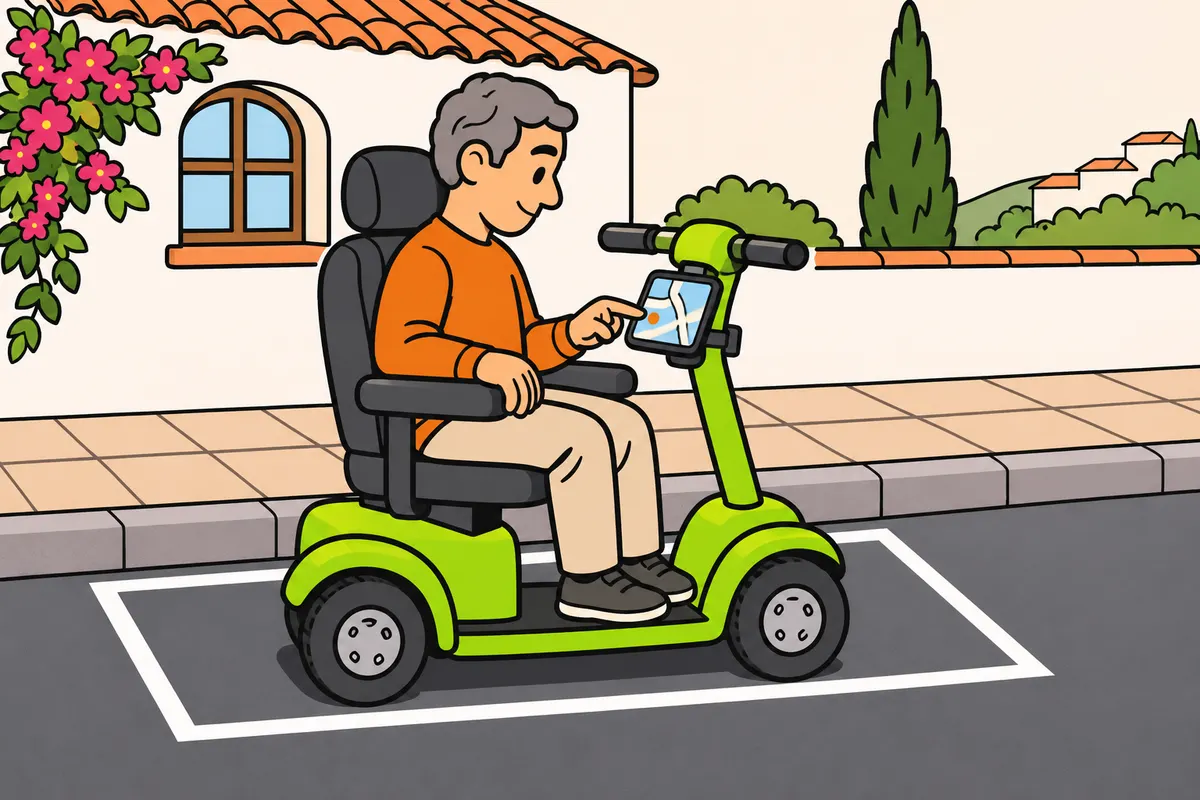
You must set up navigation while parked and stay attentive throughout your journey.
| Screen use while driving | Rule |
|---|---|
| Sat nav | You can receive directions; do not operate it by hand |
| Internet, television or entertainment videos | You must not use these while moving |
| Reversing camera | Its function is exempted; this does not allow every screen use |
Remember
- Do not operate your sat nav by hand while driving.
- If you miss directions, continue safely until you can check the route.
- Check that the route suits your LCM vehicle.
- Position the mount without blocking your view or interfering with controls.
- Avoid distracting notifications.
- If you notice symptoms, rest without waiting for a vehicle warning.
Exam trap: Wrong: GPS replaces your attention. Right: you must observe and decide whether the route is safe.
Read the full explanation
- You may use navigation instructions, but you must set up the route with your vehicle parked. The exception allowing GPS screens does not permit you to operate them manually while driving. You must listen to the instructions without letting them replace your own observation or judgement about the safety of the route. [RGC, art. 18.1](https://www.boe.es/buscar/act.php?id=BOE-A-2003-23514#a18) [LTSV, art. 13.3](https://www.boe.es/buscar/act.php?id=BOE-A-2015-11722#a13)
- If you miss an instruction, you must continue safely until you can check the route. In an LCM vehicle, you must check that the route is suitable for your vehicle; the sat nav may give an instruction that does not match where you are authorised to drive.
- While your vehicle is moving, you must not use screens with internet access, television or video playback for your entertainment as the driver. The rule makes exceptions for monitors needed to see pedestrians boarding or alighting, rear manoeuvring cameras and GPS because of their assistance functions. [RGC, art. 18.1](https://www.boe.es/buscar/act.php?id=BOE-A-2003-23514#a18)
- You must position any mount so that it does not obstruct your view or interfere with the controls. You must also avoid alerts and notifications that startle you or tempt you to look. If your vehicle has attention warnings, you must heed them without waiting for them before resting: recognising your own symptoms remains essential.
22Illness, vision and age
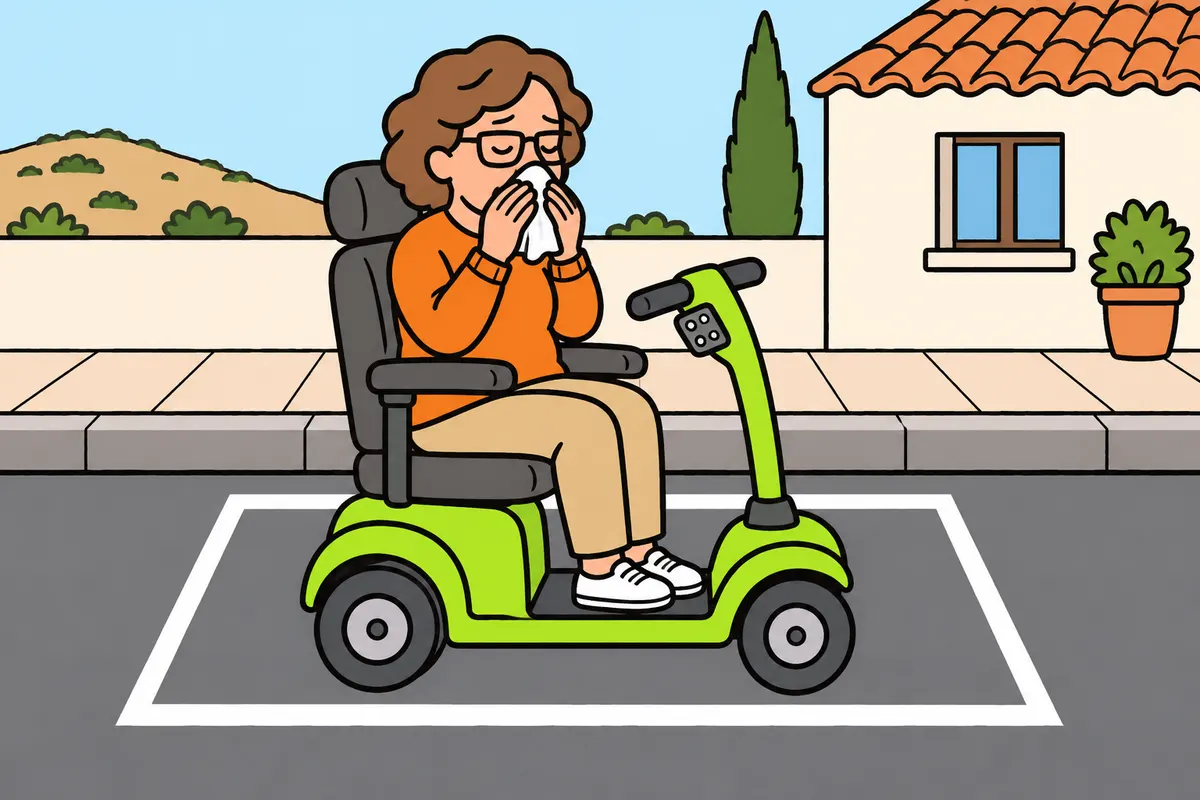
Assess your health, follow licence conditions and pass tests to obtain or renew your licence.
Remember
- Ask how your illness affects driving and follow the advice.
- Use the eyesight correction your licence requires.
- Seek an assessment for new problems with eyesight, attention or movement.
- Consider your symptoms and medicine effects together.
- Stop safely if you cannot see properly or use the controls.
- Your age and experience cannot replace checking your abilities.
Exam trap: Wrong: a valid licence proves you can drive today. Right: also check how you feel.
Read the full explanation
- If you have an illness, you must know how it can affect your driving and what to do during an acute episode. You must seek advice on whether it is compatible with driving and follow the guidance you receive. Your fitness is assessed according to the illness, its progression, your treatment and the applicable conditions. [RGCond, Annex IV](https://www.boe.es/buscar/act.php?id=BOE-A-2009-9481#aniv)
- You must comply with the personal conditions and any adaptations or restrictions on your licence. If you need vision correction to drive, you must use the correction required by your licence conditions. If you develop new difficulties with seeing, hearing, coordinating movements or staying attentive, you must seek an assessment rather than relying solely on experience to compensate for them. [RGCond, art. 46 and Annex IV](https://www.boe.es/buscar/act.php?id=BOE-A-2009-9481#a46)
- With a cold or an allergy, you may experience fatigue, sneezing, watery eyes or difficulty concentrating; some treatments also cause drowsiness. You must assess your symptoms and medication together. If an episode prevents you from observing your surroundings or operating the controls, you must stop driving safely and not continue until you are fit to do so again.
- As you age, you may need more time to process information or experience changes in vision, hearing and mobility. You must adapt your planning to your actual abilities and have your health checked. Being young does not remove your vulnerability due to lack of experience, and being older does not in itself mean you are unable to drive.
- To obtain or renew your licence, you must undergo the tests and examinations that determine your physical and mental fitness. Renewal periods and their possible reduction for health reasons are explained in «Driver and vehicle documentation», in the section «When to renew». [RGCond, art. 44](https://www.boe.es/buscar/act.php?id=BOE-A-2009-9481#a44)
23Emotions, stress and decisions
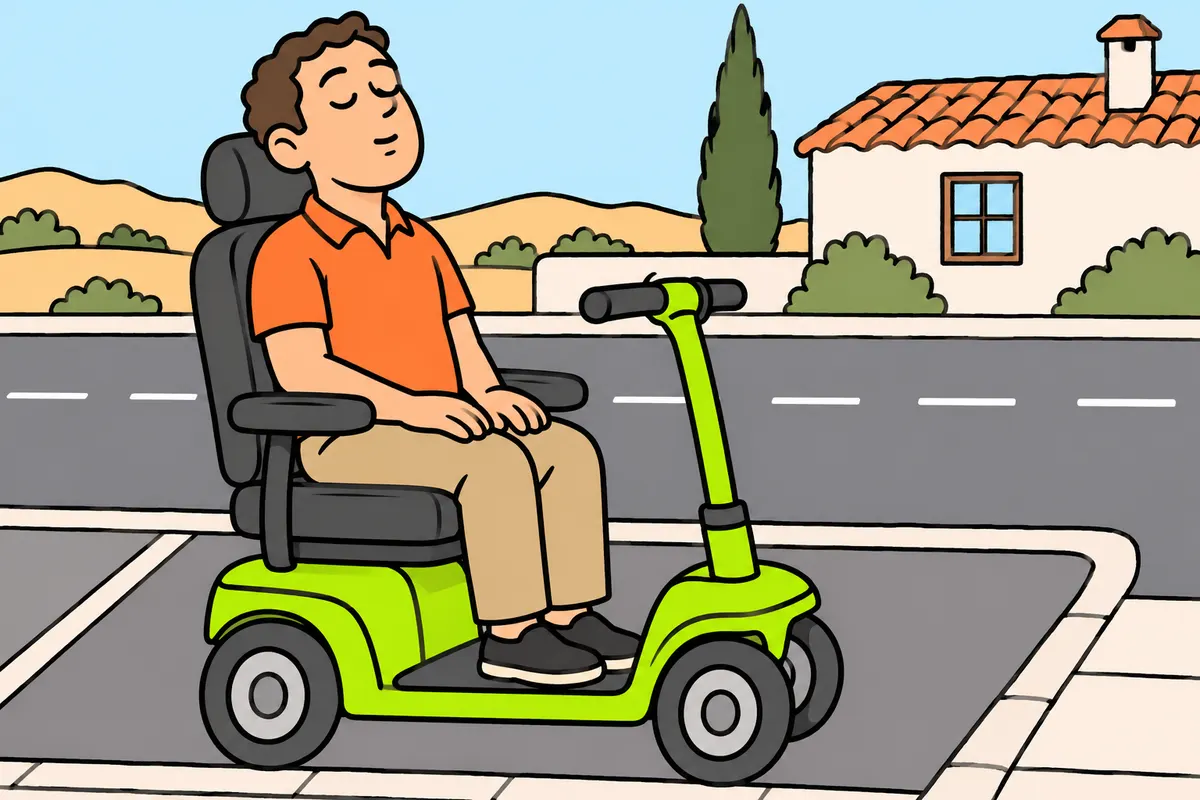
You must delay or interrupt driving if your emotions prevent you from paying attention.
Remember
- Check how you feel before leaving.
- Do not let rushing or other people’s impatience change your safe decisions.
- If a conversation upsets you, find somewhere permitted and safe to park.
- Continue only when you are fit to drive again.
- Seek professional help if the problem continues.
Exam trap: Wrong: driving helps you release anger. Right: wait until you regain the attention you need.
Read the full explanation
- If you are very angry, sad or worried, you may focus on what has happened and miss traffic information. You must assess your state before setting off. A heated argument or shocking news may justify postponing your journey until you regain the attention you need to drive.
- Under intense stress, you may become impatient, impulsive or aggressive. You must avoid letting a horn, a wait or a rush to arrive lead you to take risks. In your LCM vehicle, you must stick to your safety decisions even if someone else seems impatient to overtake you. [DGT, stress](https://www.dgt.es/muevete-con-seguridad/evita-conductas-de-riesgo/Conducir-con-estres)
- If a conversation upsets you during your journey, you must focus on controlling your vehicle and look for a permitted, safe place to park. You must continue only when you are fit to make calm decisions and pay attention to traffic again.
- If you have anxiety, depression or another persistent problem, you must seek professional care and follow the treatment. You must consider both your symptoms and the effects of treatment before driving, with an individual assessment where appropriate. [RGCond, Annex IV](https://www.boe.es/buscar/act.php?id=BOE-A-2009-9481#aniv)
Decide whether you are fit to set off
Check that you are fit for the whole journey before starting the vehicle.
- Assess your rest, attention, health, medication and emotional state.
- Check that you can observe your surroundings and operate your controls precisely, taking account of your personal limitations.
- If you have consumed alcohol or drugs, arrange to travel without driving; if the problem is medical, seek advice on whether it is compatible with driving.
- If you feel sleepy or dizzy, or have a limitation that prevents you from controlling the vehicle, postpone setting off and find a suitable solution.
- Start your journey only when you have the necessary faculties, and reassess them if symptoms appear.
Cooperate at an alcohol or drugs check
You must comply with the requirement to take a test and distinguish the second measurement from a medical confirmation test.
- Stop the vehicle as directed by the officer and follow their instructions.
- Take the required test: a breath test for alcohol; a saliva test and subsequent sample analysis for drugs.
- For alcohol testing, if a second test is required, check that at least 10 minutes pass between the two tests.
- Make any relevant observations and, if you wish, request a medical confirmation test, preferably a blood test.
- If immobilisation is ordered, comply until it is lifted or an authorised replacement driver is accepted; do not continue on your own initiative.
Act when you are fatigued, sleepy or severely distracted
Stop driving safely and address the cause before continuing.
- Recognise the symptoms and stop adding tasks such as calls, adjustments or absorbing conversations.
- Maintain control and look for a safe place where parking is permitted.
- Rest; if you are sleepy, you need to sleep. If you have a health problem, seek appropriate help.
- Reassess how you feel without relying solely on coffee, ventilation or a break of a fixed duration.
- Resume only if you have recovered your faculties; otherwise, arrange another way to travel.
Finished this module?
Mark it as read and you will see your progress on the theory list.