
Theory · LCM Licence - Reduced Mobility Vehicle · Module 11 of 15
LCM vehicle lights and signalling
You learn to choose the lights for your LCM vehicle at night, in tunnels and in poor visibility, and to signal manoeuvres and warn others when your vehicle is immobilised without dazzling them. You distinguish the technical equipment requirements aligned with those for three-wheeled mopeds and the vehicle plates and stickers that may apply to you, an essential distinction for answering exam questions without automatically applying passenger-car rules.
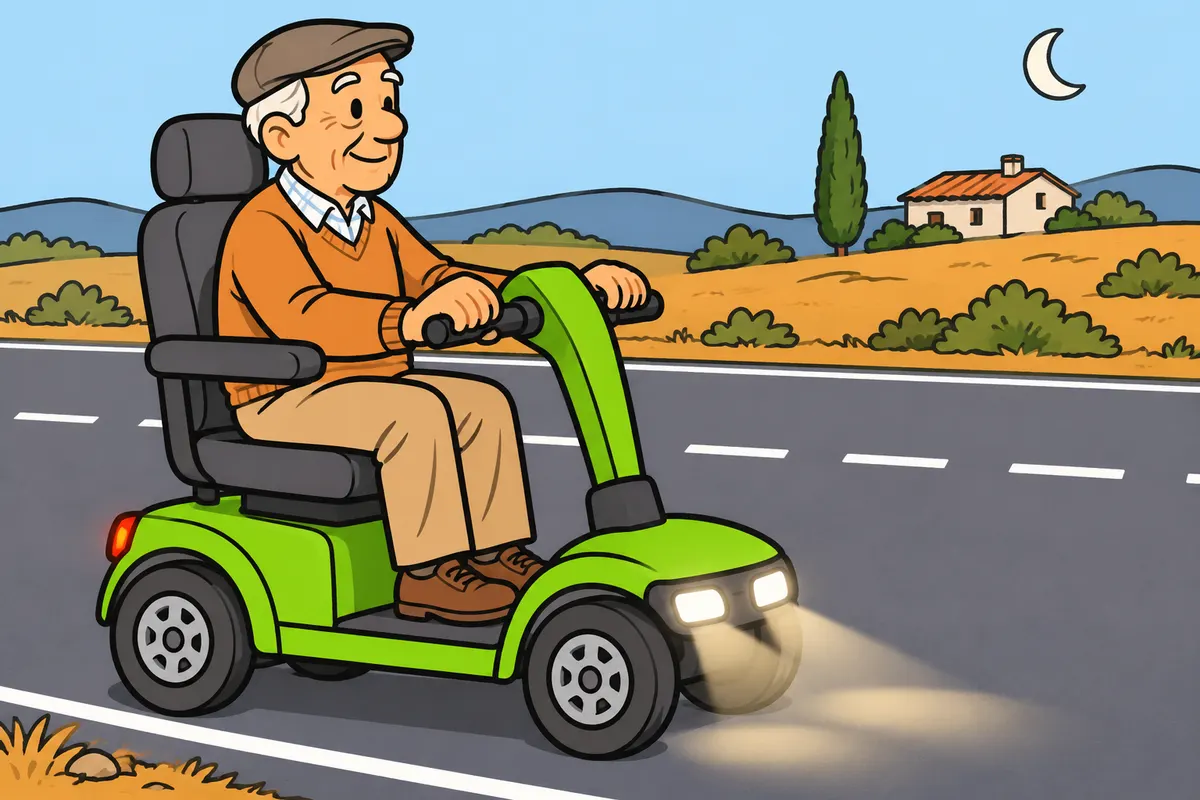
1LCM equipment summary
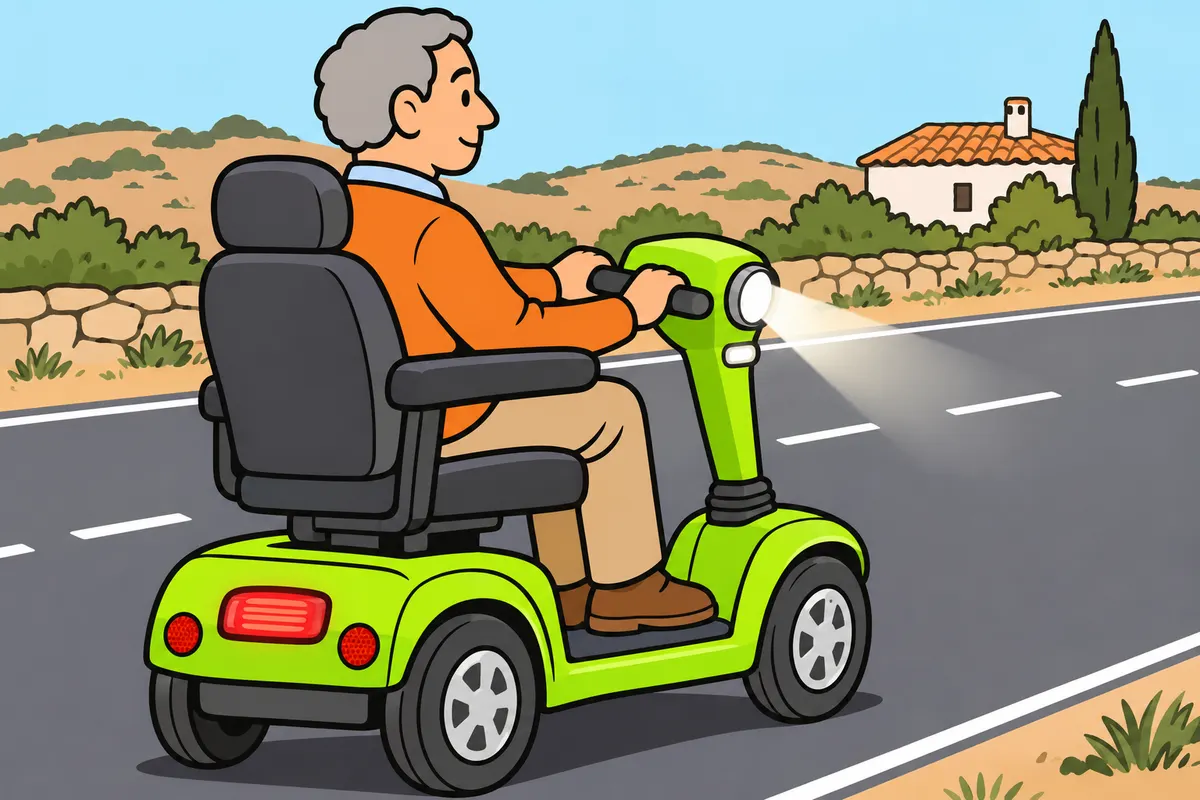
You must carry the lighting equipment required for your LCM.
| Equipment on your LCM | Rule |
|---|---|
| Dipped beam and front and rear position lights | Compulsory |
| Brake lights | Compulsory; optional on mopeds first used up to 1 November 1999 |
| Rear reflectors | Compulsory and non-triangular; two if wider than 1 m |
| Indicators | Compulsory with enclosed bodywork; optional without it |
| Main beam, side reflectors and rear number-plate lighting | Optional; follow type approval |
| Dipped beam, position lights and brake lights when wider than 1,300 mm | Two lights per function; also two main-beam lights if fitted |
Remember
- You need dipped beam, position lights and non-triangular rear reflectors.
- With enclosed bodywork, you must have indicators.
- Use only devices approved for your model.
- A single light for any specified function must be central.
- If you have non-retractable pedals, they must have amber reflectors.
- Check the older brake light exception in the table.
Exam trap: Wrong: your LCM needs every light required on a car. Right: follow its technical category and model requirements.
Read the full explanation
- Your LCM vehicle is technically treated as a three-wheeled moped. You must have dipped beam, front and rear position lights, brake lights and non-triangular rear reflectors; indicators are compulsory if you have enclosed bodywork. [RGV, art. 21](https://www.boe.es/buscar/act.php?id=BOE-A-1999-1826#a21).
- Main beam, side reflectors and rear number plate lighting are optional; indicators are also optional if you do not have enclosed bodywork. You must comply with your model’s type approval for any additional device. [RGV, art. 21](https://www.boe.es/buscar/act.php?id=BOE-A-1999-1826#a21).
- As a technical reference, if your vehicle is more than 1,300 mm wide, you must have two lamps for each of the dipped beam, position light and brake light functions, and two main beam lamps if your vehicle has main beam. If you have only one lamp for any of these functions, it is fitted centrally. You must have two rear reflectors if your vehicle is more than 1 m wide; non-retractable pedals, if fitted, have amber reflectors. The table keeps brake lights optional for mopeds first put into circulation up to 1 November 1999. You study installation details and checks in «Your vehicle: characteristics and maintenance». [RGV, Annex X](https://www.boe.es/buscar/act.php?id=BOE-A-1999-1826#anx).
2See, be seen and communicate
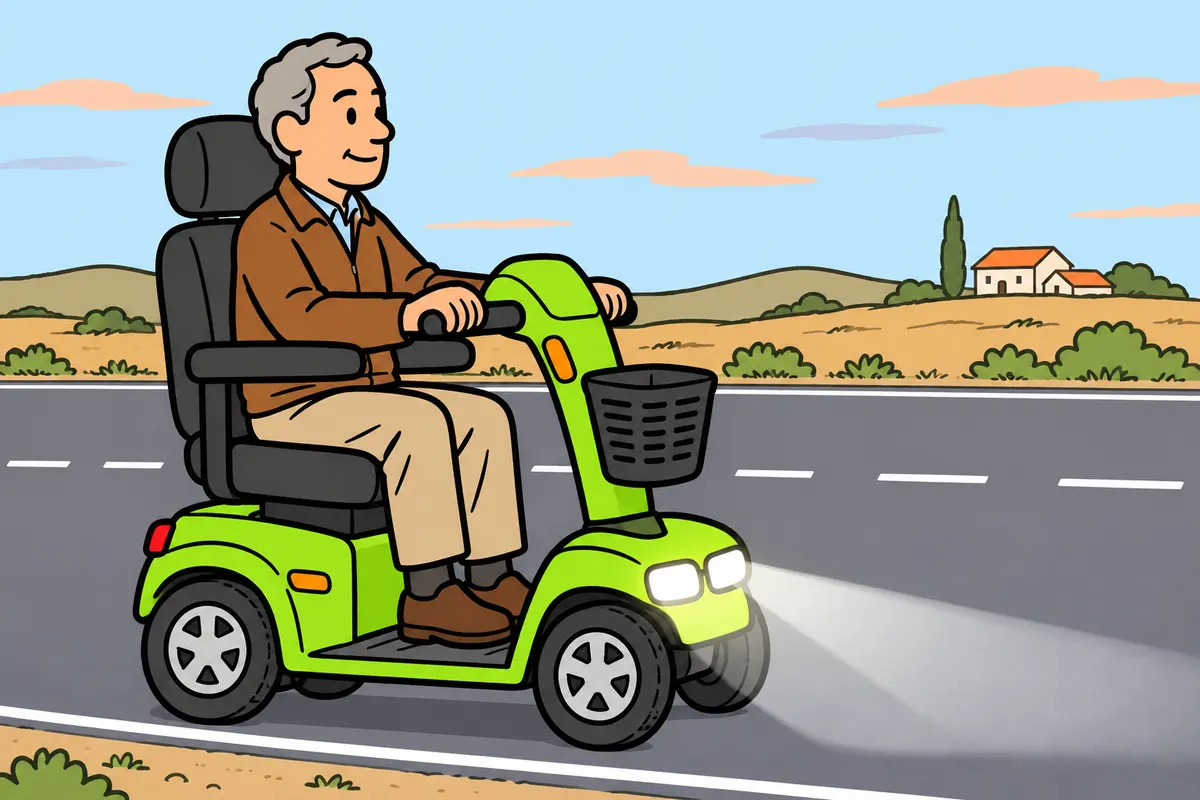
Choose each light for what you need to see or communicate.
| Device | What you do with it |
|---|---|
| Dipped beam and main beam | Light the road |
| Position lights | Show your presence |
| Indicators | Announce where you intend to move |
| Brake light | Show that you are applying the brake |
| Reflectors | Reflect light from elsewhere |
Remember
- Recognise white lights at the front and red lights at the rear.
- Recognise indicators by their flashing amber light.
- Distinguish reflectors from lamps.
- Do not confuse a reflective number plate with a reflector.
Exam trap: Wrong: every red rear light means the same thing. Right: check its brightness, position and operation.
Read the full explanation
- With dipped beam and main beam, you illuminate the carriageway ahead; with position lights, you show your vehicle’s presence. Your indicators signal the direction in which you intend to move, and your brake lights show that you are applying the service brake. Select the control according to the function you need. [RGV, Annex X](https://www.boe.es/buscar/act.php?id=BOE-A-1999-1826#anx).
- At the front, you must recognise the white light of dipped beam, main beam and position lights specified in the applicable table; at the rear, the red light of position lights and brake lights. Your indicators emit a flashing amber light. A red rear light does not always serve the same purpose: observe its intensity, location and mode of operation. [RGV, Annex X](https://www.boe.es/buscar/act.php?id=BOE-A-1999-1826#anx).
- Reflectors reflect light from another source, such as the headlights of an approaching vehicle. Lamps, by contrast, produce light when supplied with electricity. For this classification, you do not count a retroreflective number plate or a reflective regulation sign as a reflector either. [RGV, Annex X](https://www.boe.es/buscar/act.php?id=BOE-A-1999-1826#anx).
3Night and reduced visibility
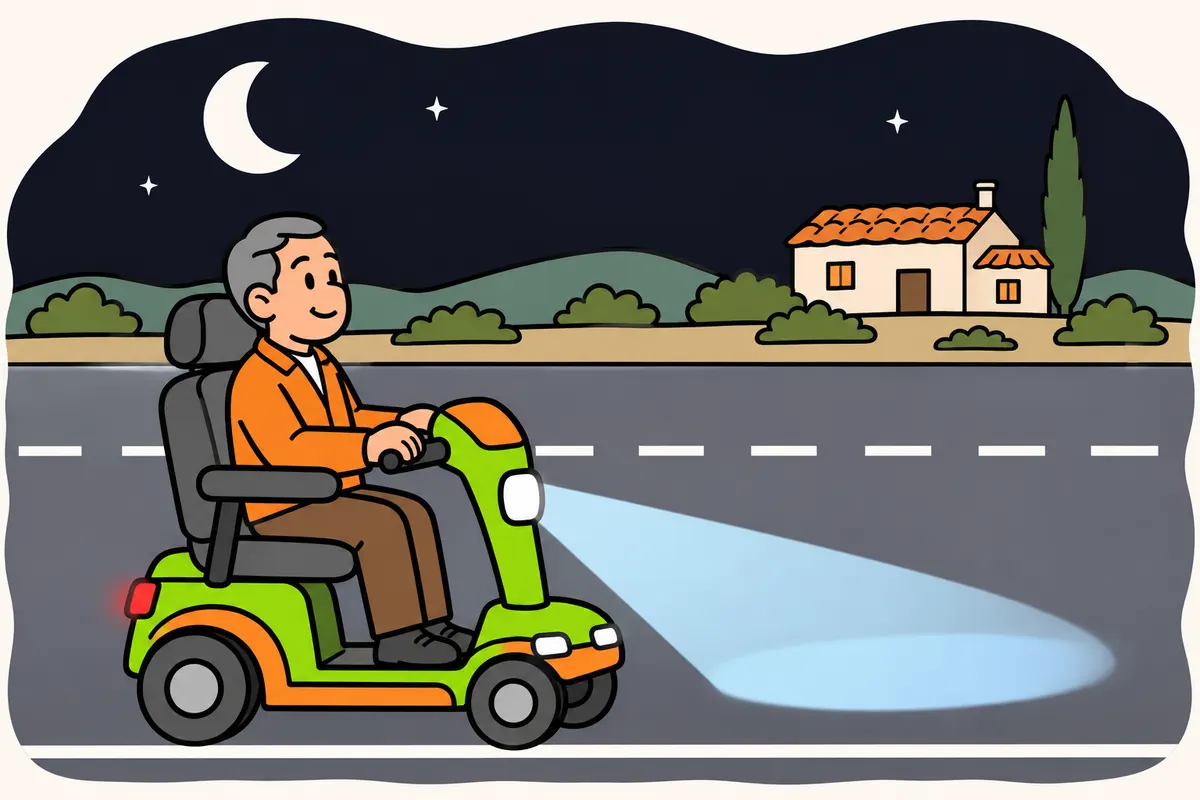
Switch on your lights at night and when visibility is significantly reduced.
Remember
- Use lights from sunset to sunrise.
- Do this in towns and outside built-up areas.
- Use lights when fog, heavy rain, snow, smoke or dust significantly reduce visibility.
- Keep position lights and the appropriate front lighting on.
- If unsure others can see you, position lights and dipped beam are recommended.
- Keep your distance and adjust your speed to what you can see.
Exam trap: Wrong: switch off lights to save battery power. Right: prepare your vehicle to provide the necessary lighting.
Read the full explanation
- You must use the appropriate lights from sunset to sunrise. This obligation applies to your LCM vehicle both in town and on roads outside built-up areas; it does not depend on whether your journey is long, other vehicles are nearby or you know the street you are driving along well. [RGC, art. 98](https://www.boe.es/buscar/act.php?id=BOE-A-2003-23514#a98).
- You must also switch on your lights when fog, heavy rain, snowfall, smoke, dust or similar conditions significantly reduce visibility. You must assess what you can actually see and what others can make out, even at a time of day when it is usually light. [RGC, art. 106](https://www.boe.es/buscar/act.php?id=BOE-A-2003-23514#a106).
- In these conditions, you must keep the position lights on and use the appropriate front lighting. You cannot justify switching them off to save energy or extend your range; you must prepare your vehicle so that you have the necessary lighting throughout your journey. Your choice between dipped beam, main beam and fog lights depends on the specific conditions for using each. [RGC, art. 99](https://www.boe.es/buscar/act.php?id=BOE-A-2003-23514#a99).
- As a recommendation, if you are unsure whether others can make you out, use position lights and dipped beam and adapt your driving to the distance you can see. Do not move closer to the vehicle ahead to guide yourself solely by its rear lights: keeping your distance allows you to respond if it brakes or disappears into the fog. [RGC, art. 45](https://www.boe.es/buscar/act.php?id=BOE-A-2003-23514#a45).
4Position lights
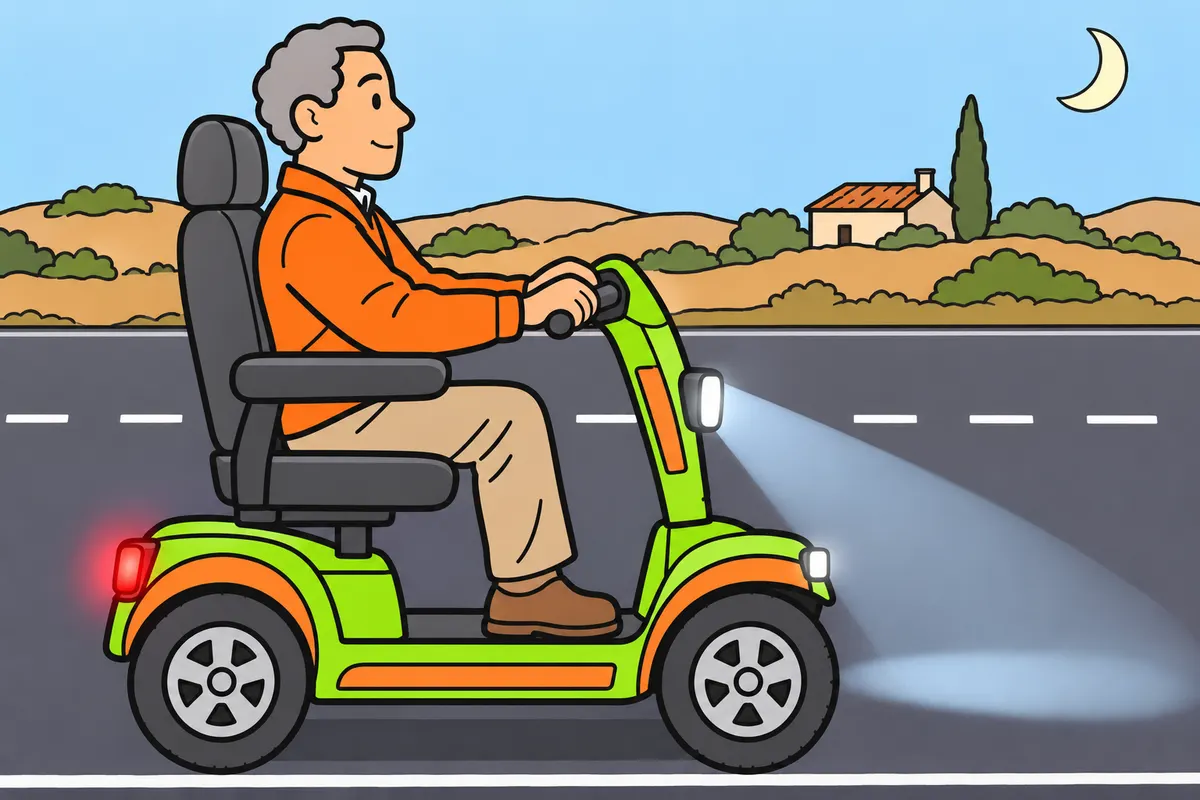
Position lights show your presence and width; you need other lights when driving.
| Position lights | Colour to recognise |
|---|---|
| Front | White |
| Rear | Red |
Remember
- Recognise white position lights at the front and red at the rear.
- At night, in tunnels or significantly reduced visibility, add the appropriate front lighting.
- Keep position lights on with dipped beam, main beam or front fog lights.
Exam trap: Wrong: drive at night using only position lights. Right: add the appropriate front lighting.
Read the full explanation
- With position lights, you show your presence and width: white at the front and red at the rear. You must use them together with the appropriate front lighting when driving at night, in tunnels or in significantly reduced visibility. [RGC, art. 99](https://www.boe.es/buscar/act.php?id=BOE-A-2003-23514#a99).
- When you switch on dipped beam, main beam or front fog lights, you must have the front position lights on; you also use the rear position lights together with the other lighting specified in the regulations. [RGV, art. 15](https://www.boe.es/buscar/act.php?id=BOE-A-1999-1826#a15).
5Dipped beam: your usual driving lights
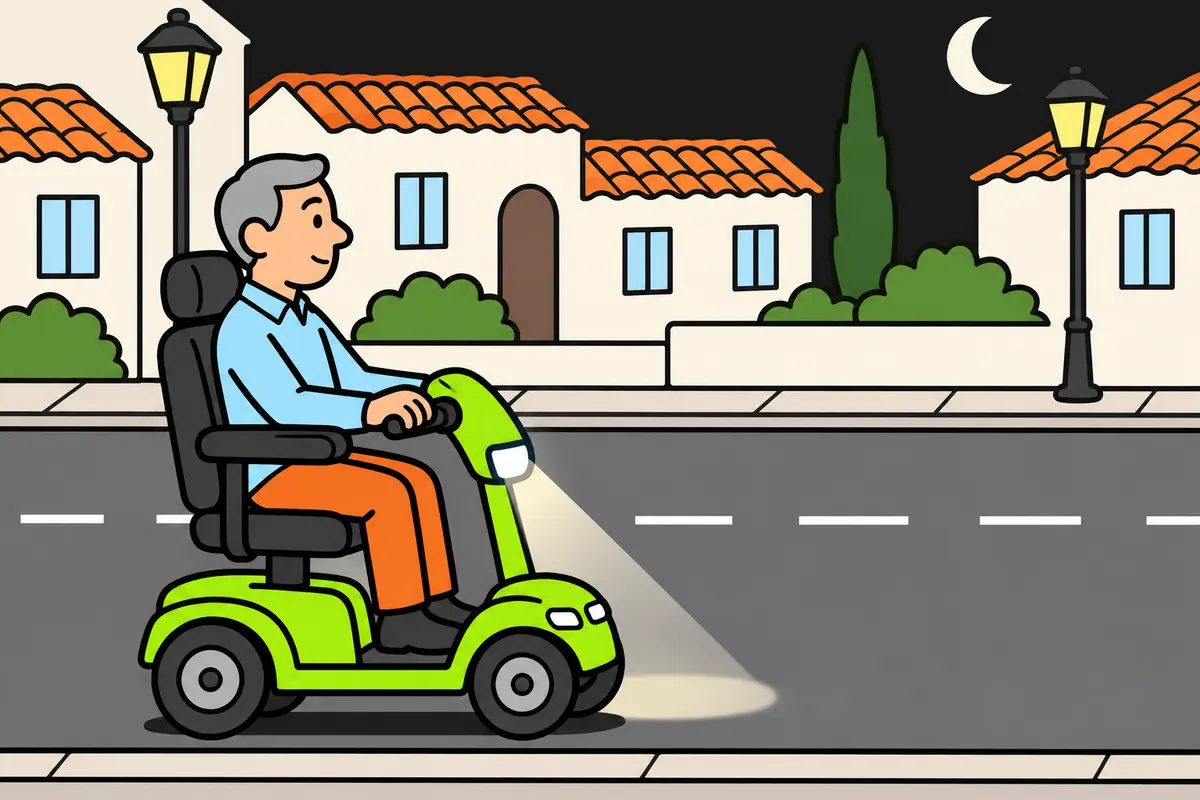
Use position lights and dipped beam as your usual LCM lighting.
| Situation for your LCM | Lights to use |
|---|---|
| Night in built-up areas or on adequately lit roads | Position lights and dipped beam |
| Dark road without main beam fitted | Position lights and dipped beam |
| Dark road with main beam fitted | Position lights and appropriate front lighting, without dazzling others |
Remember
- Your LCM must have dipped beam fitted.
- At night in built-up areas, use position lights and dipped beam.
- Do the same on adequately lit roads outside built-up areas at night.
- Without main beam, use position lights and dipped beam on dark roads.
- If you have main beam, follow its conditions and avoid dazzling others.
Exam trap: Wrong: you must fit main beam to drive at night. Right: it is optional; without it, use position lights and dipped beam.
Read the full explanation
- On your LCM vehicle, dipped beam is the short-range lighting that must be fitted, under the technical equipment requirements equivalent to those for a three-wheeled moped. Its beam illuminates the area close to your vehicle and allows you to select suitable front lighting for general use. Whether you have enclosed or open bodywork does not change this fitting requirement. [RGV, art. 21.2.2](https://www.boe.es/buscar/act.php?id=BOE-A-1999-1826#a21).
- Use position lights and dipped beam at night in built-up areas and on sufficiently lit interurban roads. When choosing the control setting, combine your general duty to use lights with the short-range lighting fitted to your LCM vehicle. Street lighting allows you to see your surroundings, but you must keep your vehicle’s lights on so that others can see you. [RGC, arts. 98 and 99](https://www.boe.es/buscar/act.php?id=BOE-A-2003-23514#a98).
- On a dark road, use dipped beam if your LCM vehicle has no main beam. If it has main beam, the next section explains when you must select it. As you approach other road users, switch to dipped beam as soon as you might dazzle them, even though main beam gives you a wider view; you must also consider the light reaching those coming towards you or travelling ahead of you. [RGC, art. 102](https://www.boe.es/buscar/act.php?id=BOE-A-2003-23514#a102).
6Main beam and the 40 km/h threshold
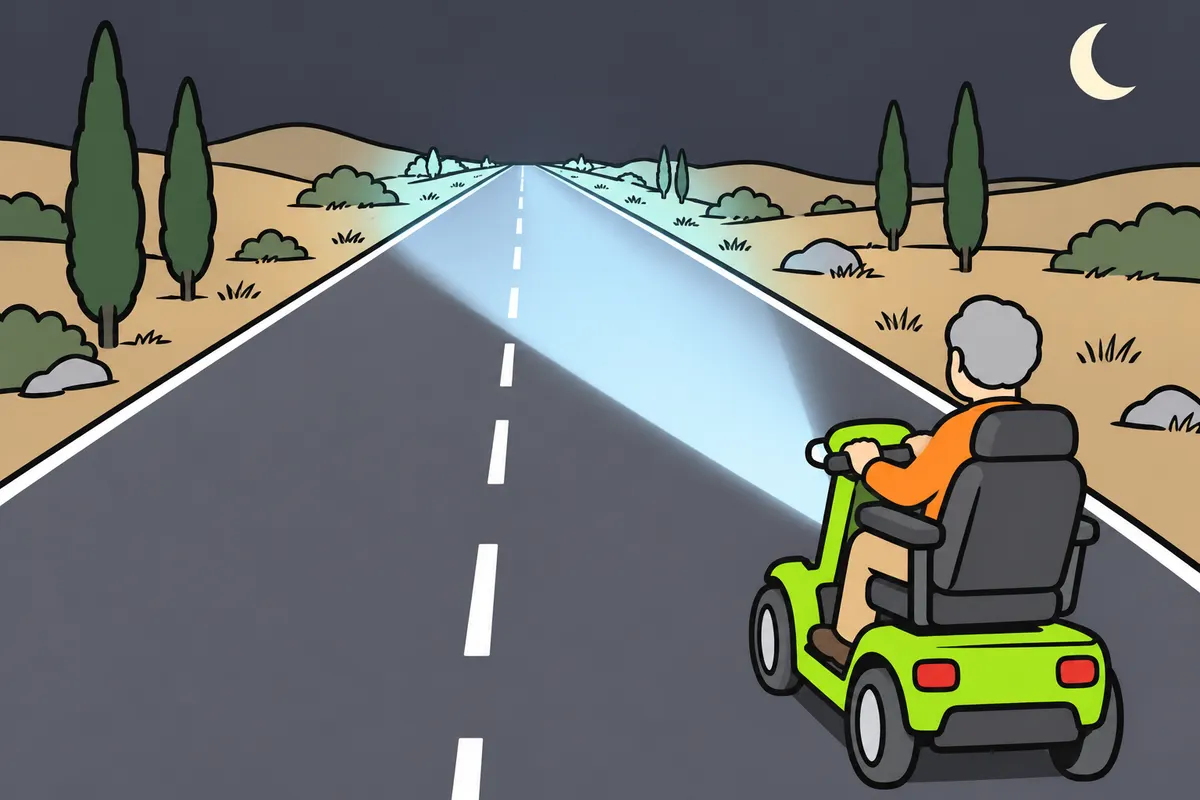
If fitted, main beam use depends on speed, lighting, location and dazzling others.
| Case when your LCM has main beam | What you must do |
|---|---|
| Above 40 km/h, at night, outside built-up areas, on an inadequately lit road | Use main beam unless dipped beam is required, especially to avoid dazzling others |
| Inadequately lit tunnel, underpass or section signposted as a tunnel | Apply the speed and anti-dazzle conditions at any time of day |
| 40 km/h or below | You may use dipped beam |
Remember
- Keep position lights on when using main beam.
- You may combine main beam and dipped beam where appropriate.
- Switch off main beam when you stop or park.
- Only flash your headlights for permitted purposes.
Exam trap: Wrong: night always requires main beam. Right: if fitted, use it above 40 km/h, at night, outside built-up areas on inadequately lit roads, unless dipped beam is required, especially to avoid dazzling others. In inadequately lit tunnels, underpasses and sections signposted as tunnels, apply the speed and anti-dazzle conditions at any time.
Read the full explanation
- If you have main beam, you must use it when driving at more than 40 km/h at night, outside built-up areas and on an insufficiently lit road, unless you must switch to dipped beam, particularly to avoid dazzling others. The article also covers insufficiently lit tunnels, underpasses and stretches signposted as tunnels at any time of day. [RGC, art. 100](https://www.boe.es/buscar/act.php?id=BOE-A-2003-23514#a100).
- At exactly 40 km/h, you do not meet the condition of driving at more than 40 km/h. At that speed or below, you may use dipped beam; darkness alone does not require you to use main beam. [RGC, art. 100](https://www.boe.es/buscar/act.php?id=BOE-A-2003-23514#a100).
- You may use main beam together with dipped beam where appropriate, keeping the position lights on. You must switch off main beam when you stop or park. You cannot repeatedly switch between main beam and dipped beam for just any purpose either: you may give light signals only in the specific circumstances provided for, and you must always avoid dazzling others. [RGC, art. 100](https://www.boe.es/buscar/act.php?id=BOE-A-2003-23514#a100).
7How to recognise an inadequately lit road
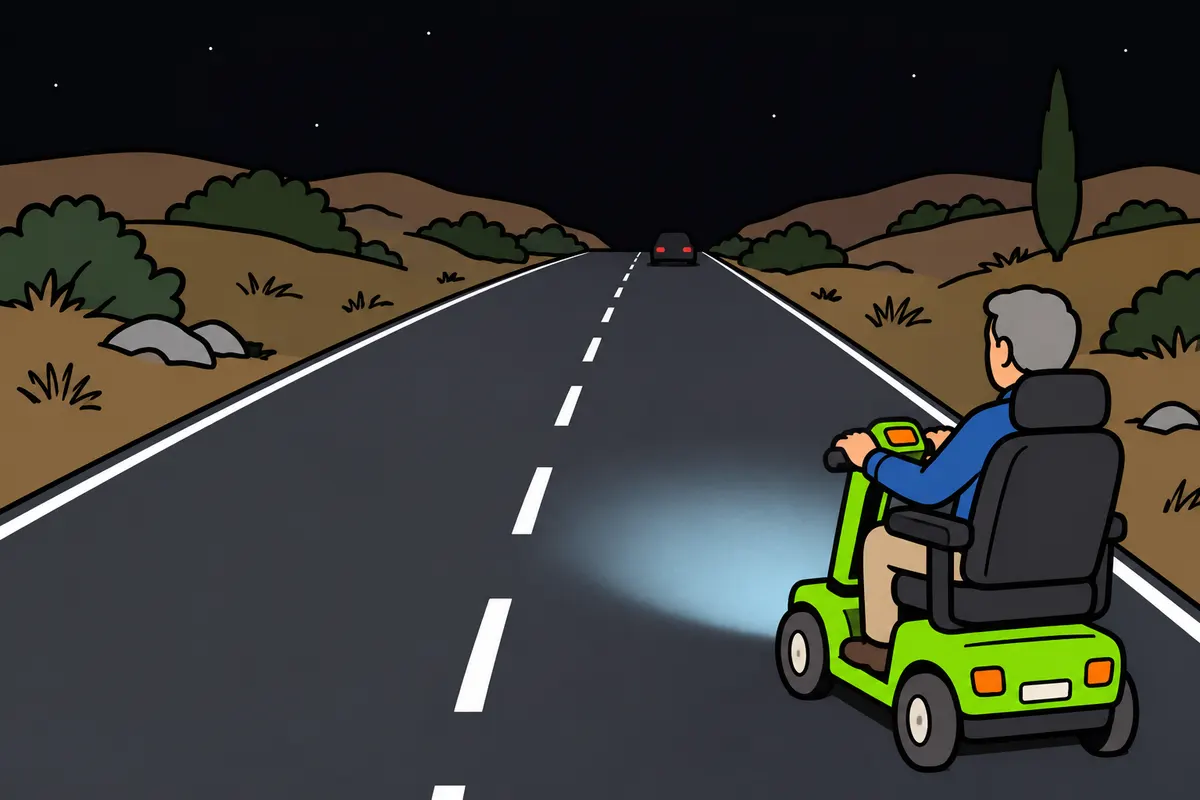
Treat a road as inadequately lit if either vision check fails.
| With normal vision | The road is inadequately lit if… |
|---|---|
| At 10 metres | You cannot read a number plate |
| At 50 metres | You cannot make out a dark vehicle |
Remember
- Check with normal vision from the carriageway.
- Only one check needs to fail.
- Switch to dipped beam as soon as you could dazzle someone.
Exam trap: Wrong: wait until you are 50 metres away to dip your headlights. Right: dip earlier if you could dazzle someone.
Read the full explanation
- You must consider a road inadequately lit if, with normal vision, at any point on the carriageway you cannot read a number plate at 10 metres or distinguish a dark vehicle at 50 metres. Either circumstance is enough; both do not need to apply. [RGC, art. 100](https://www.boe.es/buscar/act.php?id=BOE-A-2003-23514#a100).
- You must not treat these distances as permission to keep main beam on until you are 50 metres from another driver. You must switch to dipped beam whenever there is a risk of dazzling someone, which may arise at a greater distance or through the mirrors of the vehicle ahead. [RGC, art. 102](https://www.boe.es/buscar/act.php?id=BOE-A-2003-23514#a102).
8Dazzle: switch to dipped beam
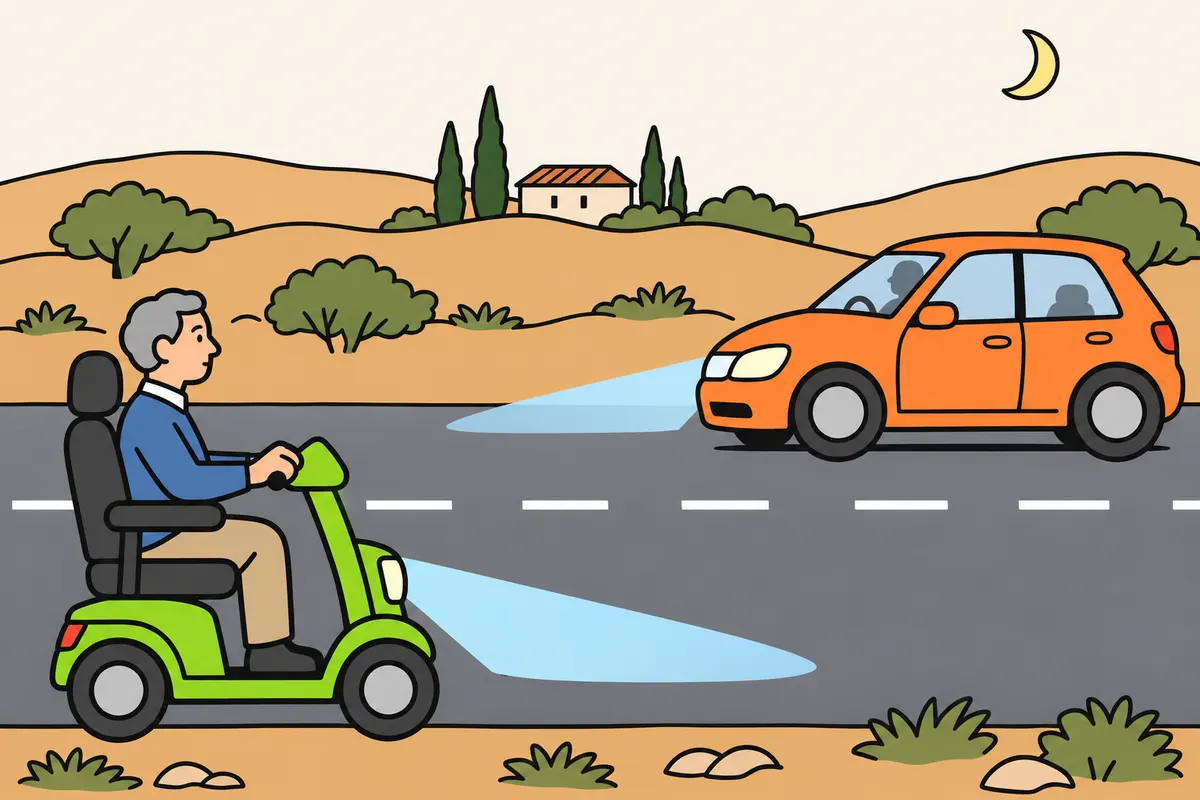
Switch to dipped beam as soon as you could dazzle someone.
Remember
- Protect people using another transport route too.
- Dip your headlights even if the other driver keeps main beam on.
- Remember that you can dazzle drivers ahead through their mirrors.
- Restore main beam after passing the oncoming vehicle, only if nobody is dazzled.
- If dazzled, slow down as necessary; stop if needed.
- Keeping your course and avoiding looking directly at the light are recommended.
Exam trap: Wrong: wait for someone to flash their headlights. Right: dip as soon as you notice a risk of dazzling someone.
Read the full explanation
- You must switch from main beam to dipped beam as soon as you realise that you may dazzle another user. This protection also extends to users of another transport route. [RGC, art. 102](https://www.boe.es/buscar/act.php?id=BOE-A-2003-23514#a102).
- You must maintain this precaution even if the other driver does not dip their headlights. When passing an oncoming vehicle, you must only switch back to main beam after you have passed it and checked that you are not dazzling anyone else. Another person’s incorrect behaviour does not remove your obligation. [RGC, art. 102](https://www.boe.es/buscar/act.php?id=BOE-A-2003-23514#a102).
- You must also switch to dipped beam if you may cause discomfort to the driver ahead through their mirrors. You must bear this in mind when approaching from behind, even if you have not passed any oncoming traffic for some time. The rule is not limited to headlights shining directly into someone’s eyes. [RGC, art. 102](https://www.boe.es/buscar/act.php?id=BOE-A-2003-23514#a102).
- If you are dazzled, you must reduce your speed as much as necessary, even stopping, to avoid running into vehicles or pedestrians travelling in your direction. As a recommendation, keep your course and avoid staring at the light source; do not retaliate by keeping main beam directed at the other driver. [RGC, art. 102](https://www.boe.es/buscar/act.php?id=BOE-A-2003-23514#a102).
9Tunnels and underpasses during the day
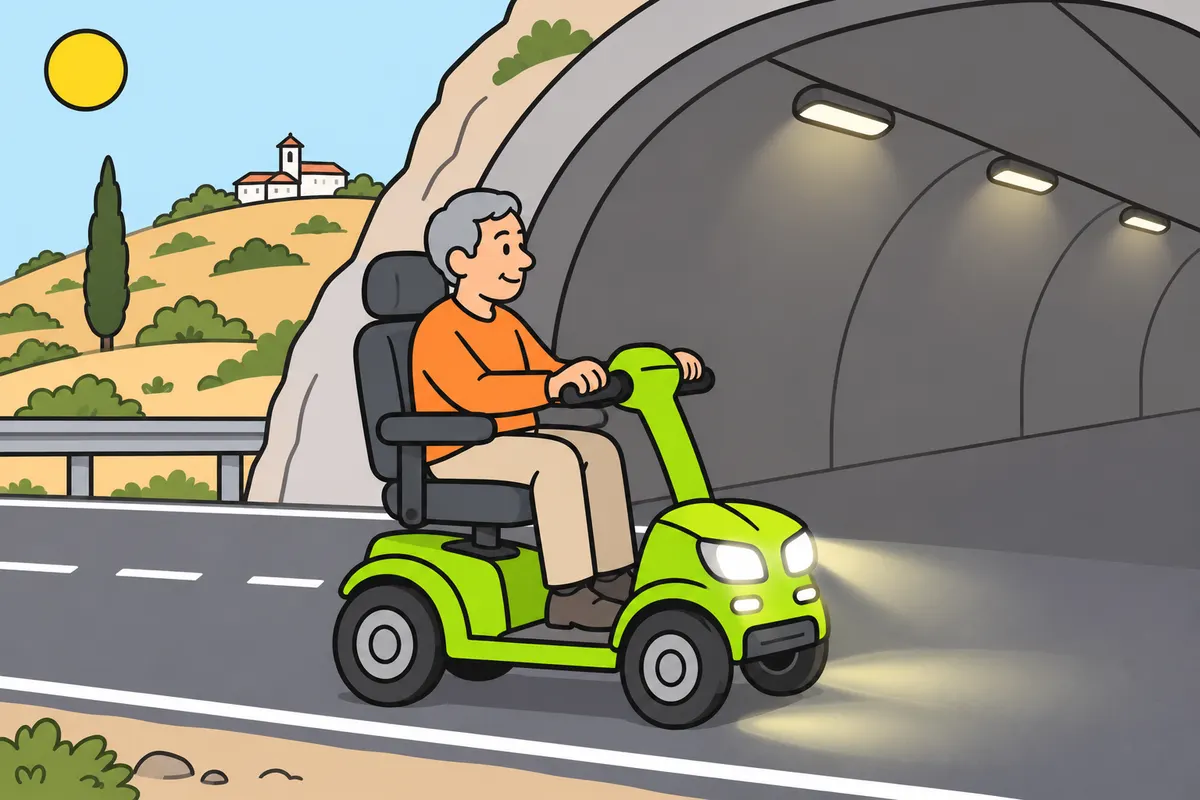
You must switch on appropriate lighting in tunnels and underpasses, even during the day.
| Tunnel situation for your LCM | What you do |
|---|---|
| Adequately lit | Use position lights and dipped beam |
| Inadequately lit, without main beam | Use position lights and dipped beam |
| Inadequately lit, with main beam | Keep position lights on; apply the speed and anti-dazzle conditions |
Remember
- Sign S-5 also requires lighting throughout the marked section.
- Switch on your lights even if you can see the exit.
- Keep position lights on with the appropriate front lighting.
- When leaving, check the daylight and visibility outside.
Exam trap: Wrong: use only daytime running lights in a lit tunnel. Right: use position lights and dipped beam.
Read the full explanation
- You must switch on the appropriate lights when entering a tunnel or underpass at any time of day. This obligation also applies to sections covered by sign S-5 (Tunnel). It does not depend on the length of the underground section or on whether you can see the exit from the entrance. [RGC, art. 98](https://www.boe.es/buscar/act.php?id=BOE-A-2003-23514#a98).
- In an adequately lit tunnel, use the position lights and dipped beam that your LCM vehicle must have fitted. The general obligation to switch on your lights also applies during the day; daytime running lights do not replace this combination. [RGC, art. 98](https://www.boe.es/buscar/act.php?id=BOE-A-2003-23514#a98).
- In an inadequately lit tunnel, your choice of front lighting depends on the lights fitted, your speed and the risk of dazzling others. Apply the threshold explained in the “Main beam and the 40 km/h threshold” section to main beam. If your LCM vehicle has no main beam, use dipped beam with the position lights; the absence of optional main beam headlights does not in itself prevent you from travelling through the tunnel. [RGC, arts. 98-100](https://www.boe.es/buscar/act.php?id=BOE-A-2003-23514#a98).
- When you leave, you must decide according to the conditions outside. If there is fog or heavy rain, or it is still night-time, you must keep on the lights required for those conditions. [RGC, art. 106](https://www.boe.es/buscar/act.php?id=BOE-A-2003-23514#a106).
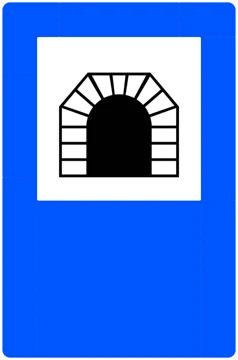 S-5
10Daytime dipped beam and special lanes
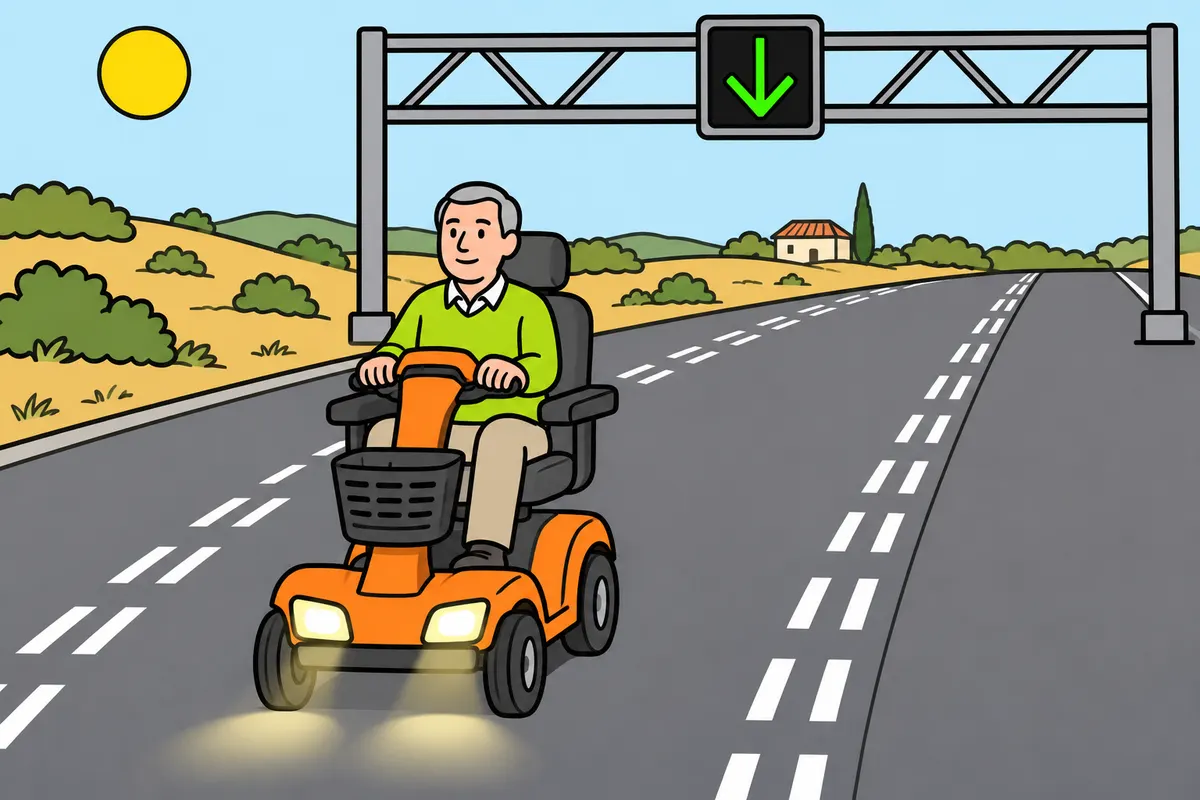
Use dipped beam in special lanes, but first check that your LCM may enter.
| Reason for opening a contraflow lane | Vehicles allowed |
|---|---|
| To improve traffic flow | Passenger cars and motorcycles; your LCM cannot enter |
| Roadworks | Vehicles allowed on that road, unless expressly prohibited |
Remember
- Your LCM does not have the general daytime lighting duty applying to motorcycles.
- In good visibility, outside compulsory situations, dipped beam is recommended.
- Use dipped beam day and night in reversible and temporary additional lanes.
- Do the same in contraflow lanes if you may legally use them.
- This duty may also cover normal-direction lanes beside a contraflow lane.
Exam trap: Wrong: dipped beam allows you into any lane. Right: first check whether your LCM may use it.
Read the full explanation
- The obligation under article 104 for motorcycles to use dipped beam throughout the day on any road does not make your LCM vehicle a motorcycle. In good visibility, when no other compulsory lighting requirement applies, you can use dipped beam as a recommended way of making yourself visible, distinguishing this recommendation from a general obligation for your vehicle category. [RGC, art. 104](https://www.boe.es/buscar/act.php?id=BOE-A-2003-23514#a104).
- You must use dipped beam day and night if you use a reversible lane. It is also required in temporary additional lanes and lanes opened to traffic travelling in the opposite direction to the normal flow, whenever you can legally use them. Switching on your lights never gives you access to a lane prohibited for your vehicle. [RGC, art. 104](https://www.boe.es/buscar/act.php?id=BOE-A-2003-23514#a104).
- Lanes opened in the opposite direction to the normal flow to improve traffic flow are reserved for passenger cars and motorcycles. If they are opened because of roadworks, you can use them in any vehicle permitted on that road, unless expressly prohibited. You must know this difference so that you do not choose an answer allowing you to enter in an LCM vehicle simply because you have dipped beam on. [RGC, art. 41](https://www.boe.es/buscar/act.php?id=BOE-A-2003-23514#a41).
- The obligation to use dipped beam may also apply to lanes carrying traffic in the normal direction alongside a lane opened in the opposite direction. First establish whether your vehicle can use the road, then which lights you must use; the full rules on lane use are in the “Where you must drive” module. [RGC, art. 41](https://www.boe.es/buscar/act.php?id=BOE-A-2003-23514#a41).
11Daytime running lights and automatic switching
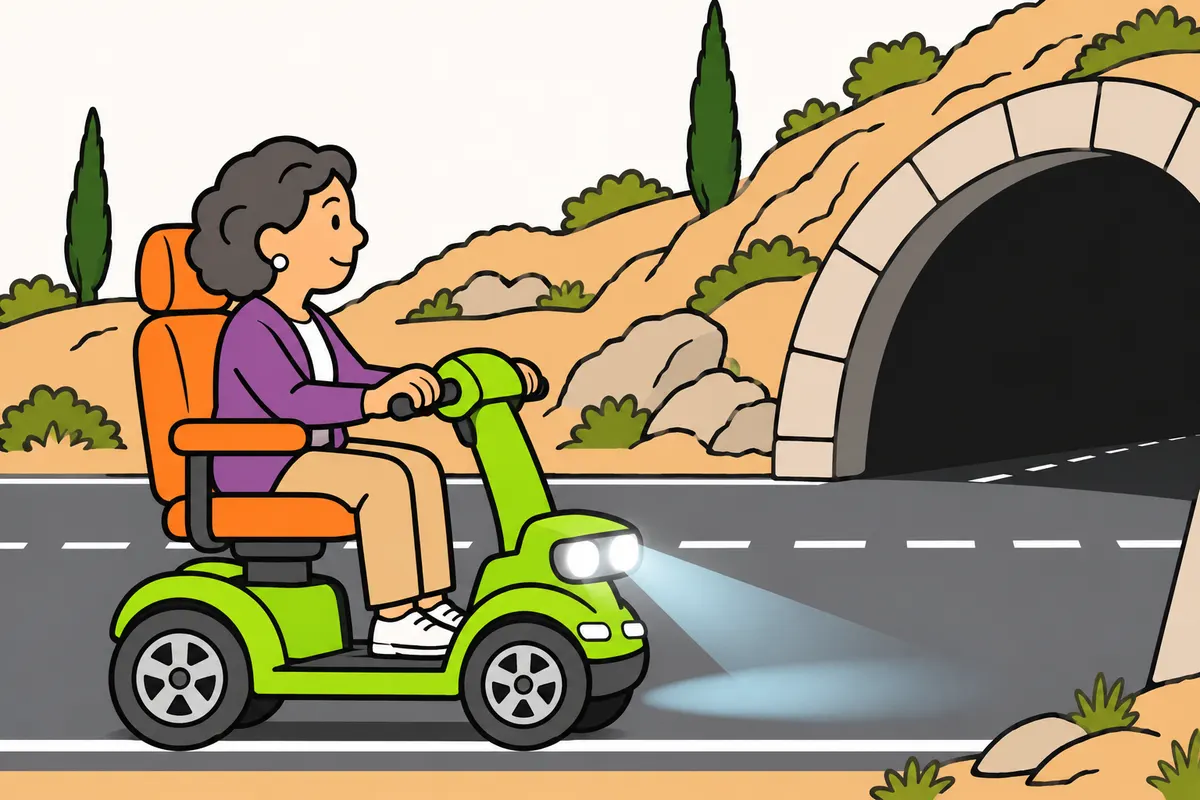
Check that automatic lighting switches on the lights you need.
Remember
- Daytime running lights make you more visible during the day.
- At night and in tunnels, select position lights and dipped beam.
- In bad weather, use the appropriate lighting.
- If the automatic system does not switch it on, do so yourself.
Exam trap: Wrong: always trust automatic lighting. Right: check and select the lights you need.
Read the full explanation
- Daytime running lights make you more visible during the day. You must select position lights and dipped beam in the night-time and tunnel situations explained; in adverse weather, use the appropriate lights. If the automatic lighting system does not select them, you must do so yourself. [RGC, art. 98](https://www.boe.es/buscar/act.php?id=BOE-A-2003-23514#a98).
12Front fog lights: conditions of use
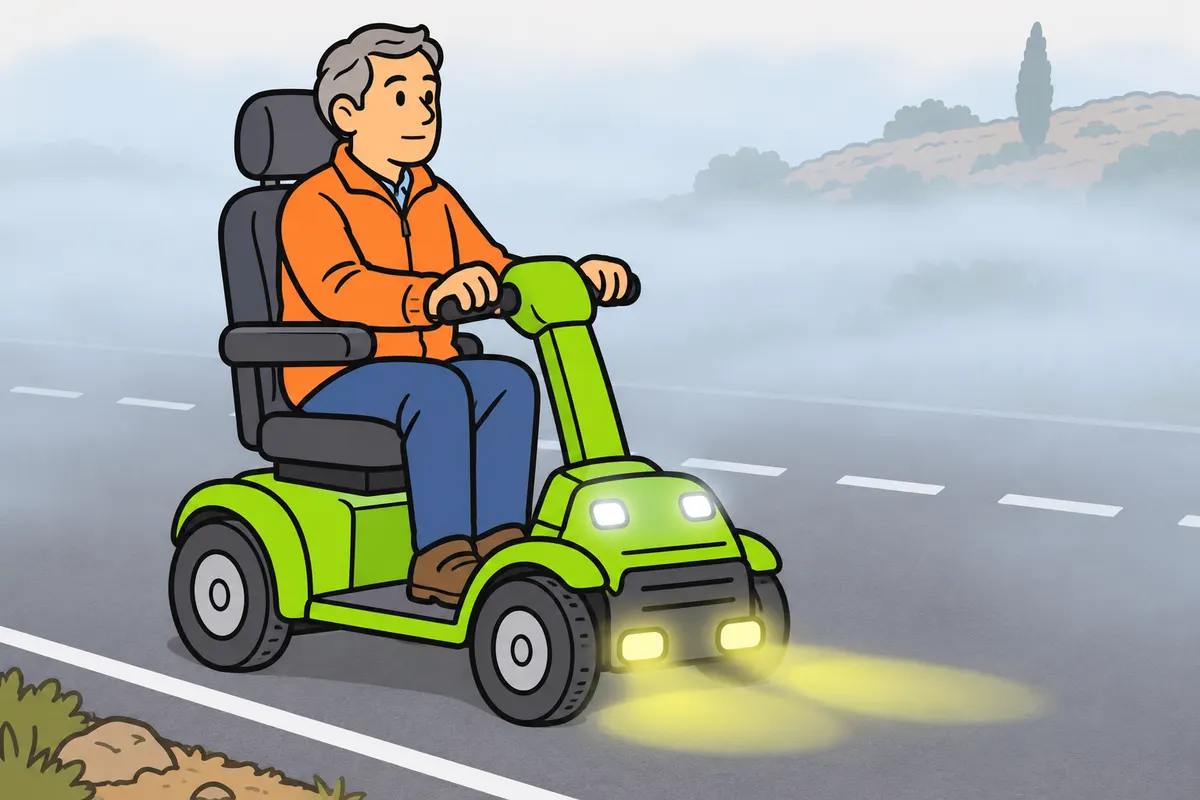
You may use front fog lights in significantly reduced visibility or on certain signposted bends.
| Case | When you may use front fog lights |
|---|---|
| Fog, heavy rain, snow, dust or smoke | When visibility is significantly reduced |
| Road layout | Carriageway no wider than 6.50 metres, with signposted successive bends close together |
Remember
- In significantly reduced visibility, use front fog lights, dipped beam or main beam appropriately.
- You may combine front fog lights with dipped beam or main beam where appropriate.
- You may use them without dipped beam, but keep position lights on.
- Light rain without significantly reduced visibility is not enough.
Exam trap: Wrong: a narrow road is enough. Right: for road layout alone, the carriageway must be 6.50 metres wide or less, with signposted successive bends close together.
Read the full explanation
- You can use front fog lights when weather or environmental conditions significantly reduce visibility, such as fog, heavy rain, snowfall, dust or smoke. In these circumstances, you must use front fog lights, dipped beam or main beam in accordance with their conditions of use. Light rain without a significant reduction in visibility does not in itself justify using fog lights. [RGC, art. 106](https://www.boe.es/buscar/act.php?id=BOE-A-2003-23514#a106).
- You can use them without dipped beam, or together with dipped beam or main beam where appropriate, but you must keep the position lights on. Using front fog lights alone refers to the lamps that illuminate the road ahead; the position lights continue to show the vehicle’s presence and width. [RGV, art. 15](https://www.boe.es/buscar/act.php?id=BOE-A-1999-1826#a15).
- You can also use them on a carriageway no more than 6.50 metres wide with many bends, provided the section has signs warning of a series of closely spaced bends. You must check both conditions: a single bend, a narrow road without these signs or a wider carriageway is not enough. [RGC, art. 106](https://www.boe.es/buscar/act.php?id=BOE-A-2003-23514#a106).
13Rear fog light: severely reduced visibility
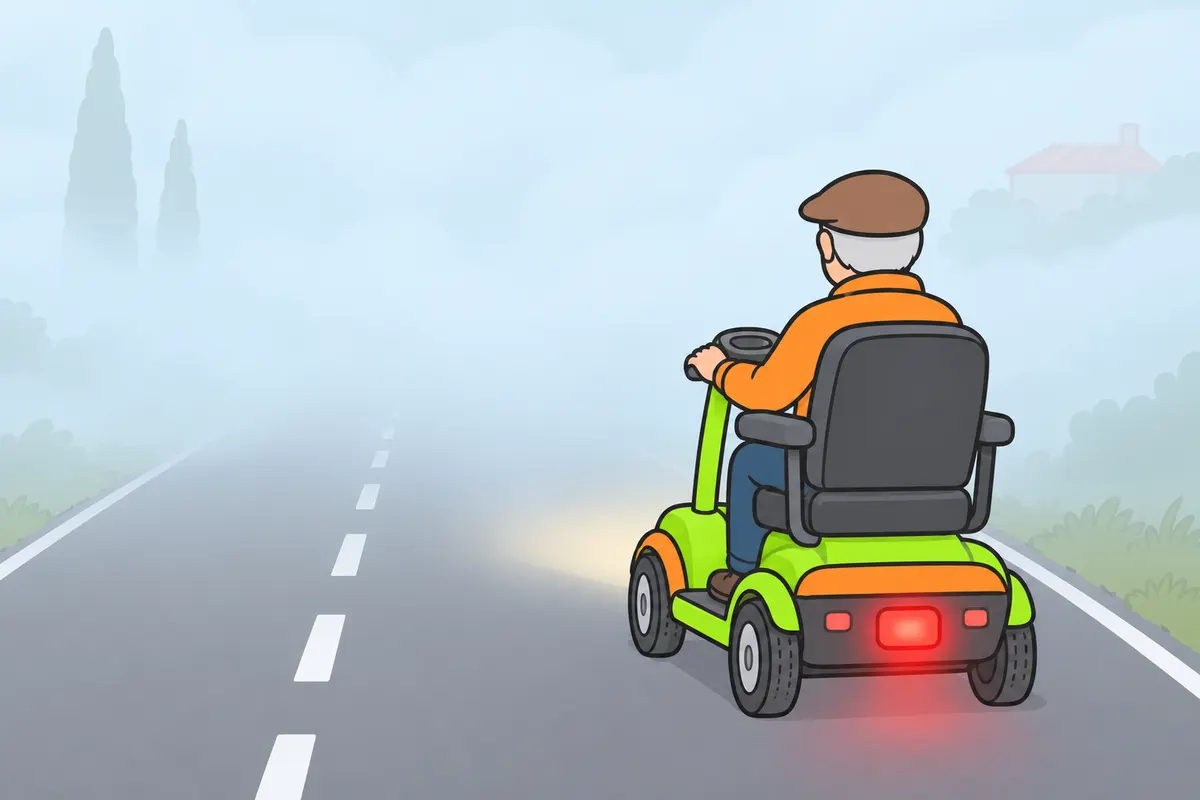
If you have an approved rear fog light, use it only in particularly poor visibility.
| Case with an approved rear fog light | What you must do |
|---|---|
| Heavy rain | Use appropriate lighting; this alone does not justify the rear fog light |
| Very heavy rain | Switch on the rear fog light with the required front lighting |
| Signposted bends on a narrow section | Do not switch on the rear fog light for this reason alone |
Remember
- Not every LCM must have a rear fog light.
- Recognise its red light.
- Use it in thick fog, very heavy rain, heavy snowfall, dense smoke or dust.
- Switch it off when those conditions end.
- To switch it on, use dipped beam, main beam or front fog lights.
- Position lights alone are not enough to switch it on.
Exam trap: Wrong: always use rear fog lights with front fog lights. Right: the rear fog light requires particularly adverse conditions.
Read the full explanation
- The rear fog light is a red light that helps others see you from behind in dense fog. You must not confuse it with the position lights or brake lights, or assume that fitting it is compulsory on every LCM vehicle: the applicable technical equipment requirements are not the general table for passenger cars. [RGV, Annex X](https://www.boe.es/buscar/act.php?id=BOE-A-1999-1826#anx).
- If your vehicle has an approved rear fog light, you must switch it on only in particularly adverse conditions: thick fog, very heavy rain, heavy snowfall or dense clouds of smoke or dust. Heavy rain requires lighting; very heavy rain justifies using the rear fog light. [RGC, art. 106](https://www.boe.es/buscar/act.php?id=BOE-A-2003-23514#a106).
- You must not switch on the rear fog light simply because you are using the front fog light. A narrow stretch with signposted bends allows you to use the front fog light under the applicable conditions, but does not in itself authorise the rear fog light. When the particularly adverse conditions clear, you must switch it off to avoid causing unnecessary discomfort to anyone following you. [RGC, art. 106](https://www.boe.es/buscar/act.php?id=BOE-A-2003-23514#a106).
- To switch on the rear fog light, you must have main beam, dipped beam or the front fog light switched on. You must know how to use the control so that you select only the functions appropriate at each moment. [RGV, art. 15](https://www.boe.es/buscar/act.php?id=BOE-A-1999-1826#a15).
14End-outline marker lamps and side marking
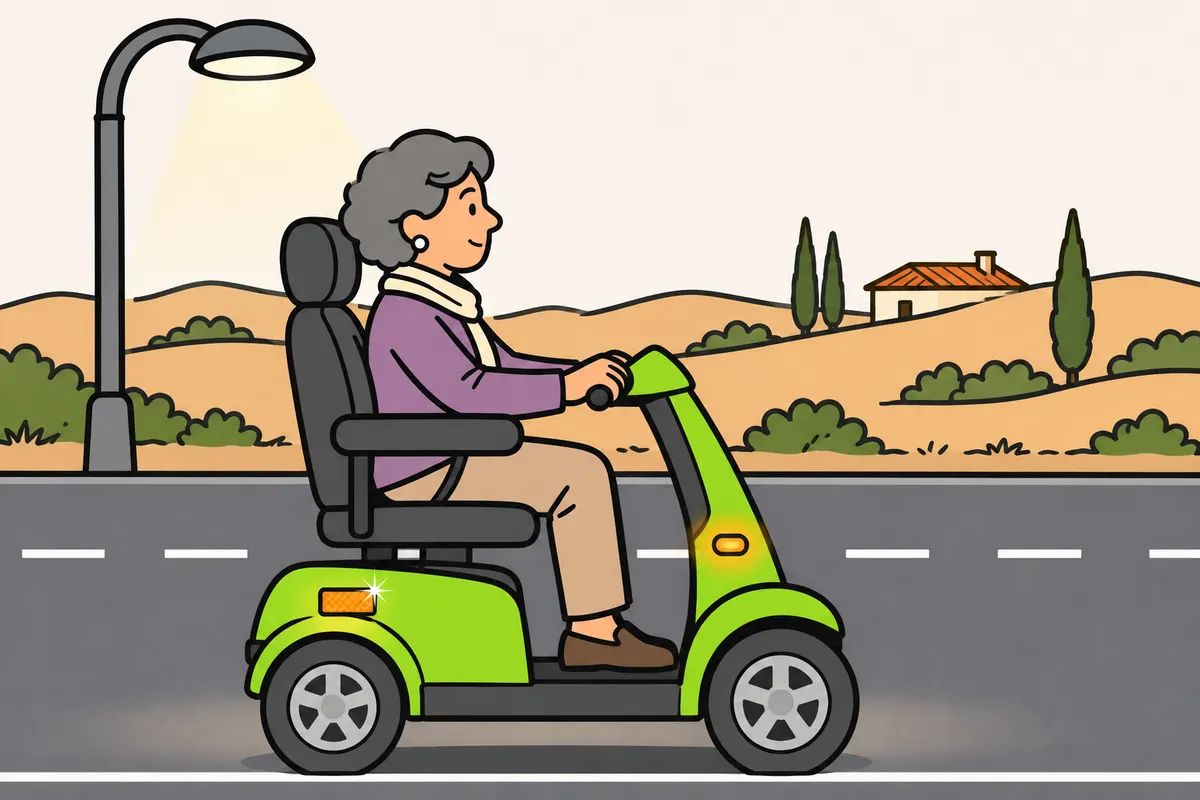
Distinguish lights that show width from side reflectors.
| Side device | How it works |
|---|---|
| Side position light | Emits light |
| Side reflector | Reflects light from elsewhere |
Remember
- End-outline marker lamps supplement position lights and show width.
- Follow the approved equipment requirements for your LCM.
- Side reflectors are optional on your LCM.
- You have no general duty to fit side position lights.
Exam trap: Wrong: apply all car equipment requirements to your LCM. Right: follow its category and type approval; the marker-lamp usage rule applies above 2.10 m in situations requiring position lights.
Read the full explanation
- End-outline marker lamps indicate width and complement the position lights. The rule on their use requires you to switch them on when the width exceeds 2.10 m in situations requiring position lights; you must follow the approved equipment requirements for your LCM vehicle, without assuming that those for an automóvil (a motor vehicle category defined in Spanish law) apply to it. [RGC, art. 99](https://www.boe.es/buscar/act.php?id=BOE-A-2003-23514#a99).
- A side marker lamp emits light, while a side reflector reflects the light it receives. For your LCM vehicle, side reflectors are optional and there is no general requirement to fit side marker lamps in the category to which it is treated as equivalent. [RGV, art. 21](https://www.boe.es/buscar/act.php?id=BOE-A-1999-1826#a21).
15Reflectors: making you visible by reflection
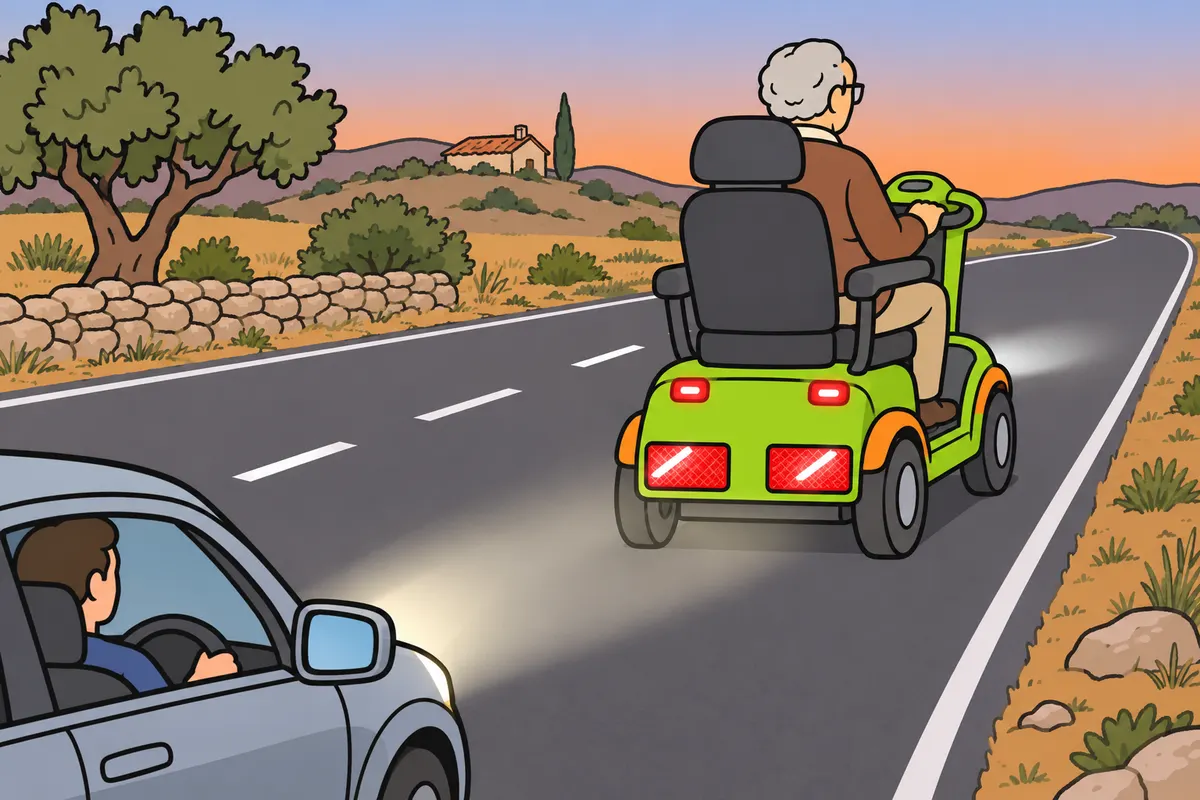
Keep your LCM’s red, non-triangular rear reflectors visible.
Remember
- Reflectors reflect light from another source.
- Keep your rear reflectors visible.
- They do not replace position lights or the required front lighting.
Exam trap: Wrong: reflectors let you drive without lights. Right: you must also switch on the appropriate lighting.
Read the full explanation
- The rear reflectors on your LCM vehicle are red and non-triangular. You must keep them visible; they reflect external light and do not replace switching on the position lights and the appropriate front lighting. [RGV, Annex X](https://www.boe.es/buscar/act.php?id=BOE-A-1999-1826#anx).
16Indicators: signalling in good time
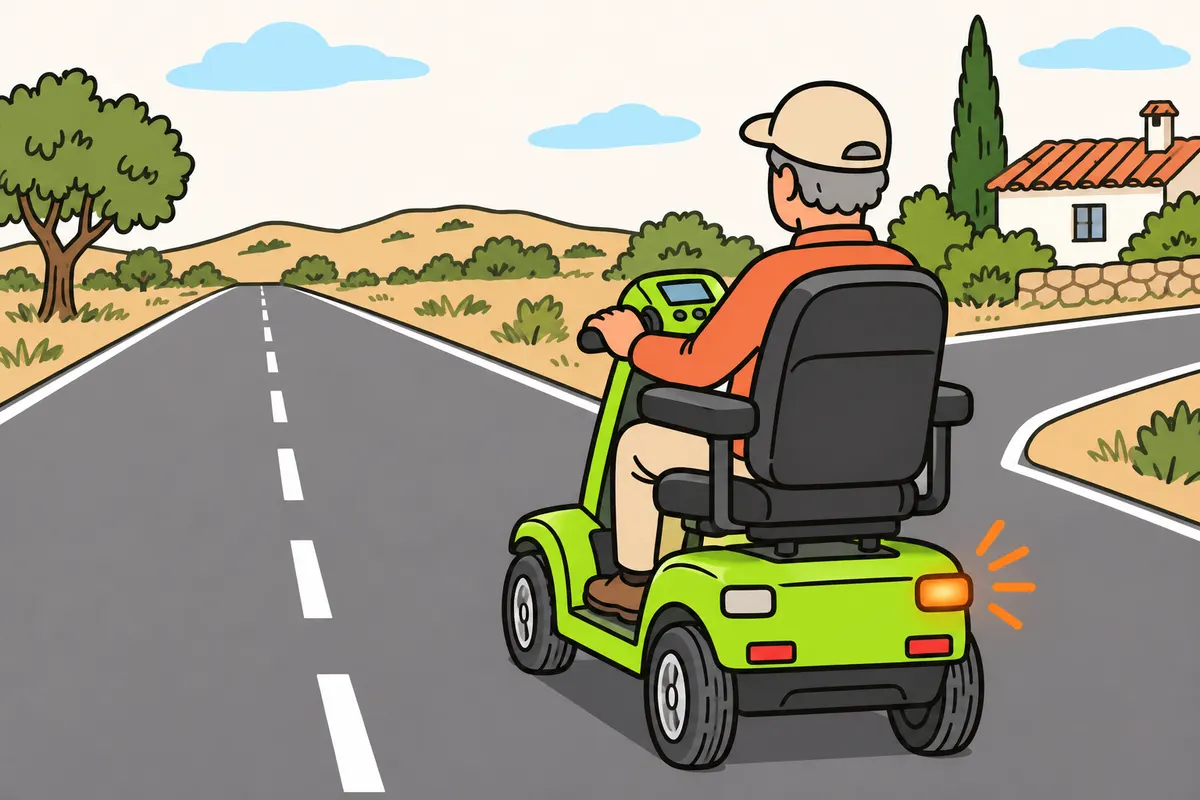
Signal in advance and keep your indicator on throughout the manoeuvre.
Remember
- Use the indicator on the side towards which you are moving.
- Check that you can manoeuvre safely.
- Respect other road users.
- Switch off your indicator when you take your new course.
Exam trap: Wrong: your indicator gives you priority. Right: it only announces your intention.
Read the full explanation
- You must signal lateral movements, changes of direction and other manoeuvres that require signalling in good time. Use the indicator on the side towards which you are moving and keep it on throughout the movement you have signalled. You must switch it off when your vehicle takes up its new course. [RGC, art. 109](https://www.boe.es/buscar/act.php?id=BOE-A-2003-23514#a109).
- Before moving, you must check that you can do so safely and respect other road users: your indicator communicates your intention but does not give you priority. An indicator left on by mistake can lead another driver to expect a turn you do not intend to make. [RGC, art. 74](https://www.boe.es/buscar/act.php?id=BOE-A-2003-23514#a74).
17Arm signals
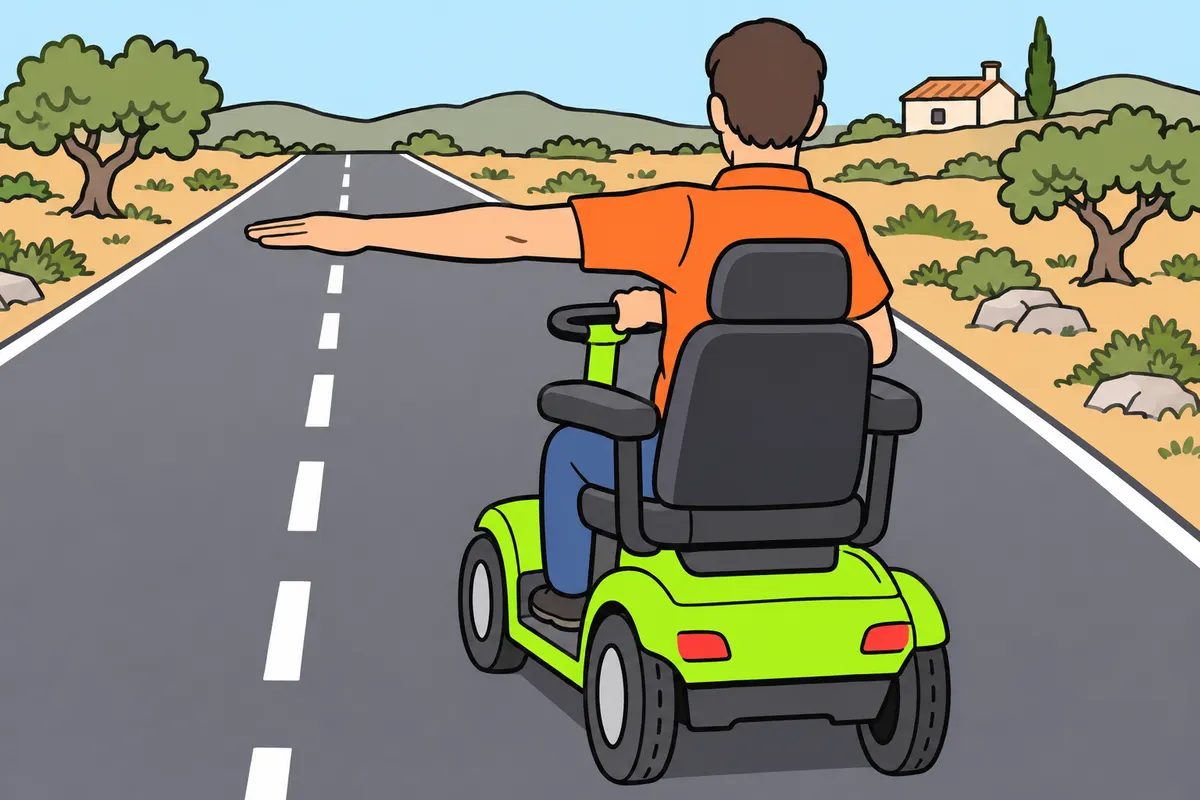
Use your arm when light signals are unavailable, if you can signal safely.
| What you want to announce | How you position your arm |
|---|---|
| Movement towards the side of your arm | Horizontal, palm down |
| Movement towards the opposite side | Bent upwards, palm open |
| Reversing without a reversing light | Horizontal, palm facing backwards |
| Considerable slowing or intention to stop | Short, quick movements up and down |
Remember
- Your signal must follow the rules and be visible to others.
- A valid arm signal overrides a conflicting light signal.
- Do not release an essential control to signal.
- Always keep control of your vehicle.
Exam trap: Wrong: any gesture replaces an indicator. Right: your signal must be visible, follow the rules and allow you to control the vehicle.
Read the full explanation
- As a general rule, you must use light signals and, if these are unavailable, arm signals. An arm signal is valid only if others can see it and it uses the prescribed arm positions. When valid, it overrides a conflicting light signal. [RGC, art. 108](https://www.boe.es/buscar/act.php?id=BOE-A-2003-23514#a108).
- To signal a movement towards the side your arm points to, you must extend it horizontally with your palm facing down. To signal a movement towards the opposite side, you must bend your arm upwards with your palm open. For example, extending your left arm horizontally signals a movement to the left. [RGC, art. 109](https://www.boe.es/buscar/act.php?id=BOE-A-2003-23514#a109).
- To signal reversing without a reversing light, you must extend your arm horizontally with your palm facing backwards. To signal a considerable reduction in speed or your intention to stop, you can move your arm up and down with short, rapid movements. These are different signals and you must associate each position with its purpose. [RGC, art. 109](https://www.boe.es/buscar/act.php?id=BOE-A-2003-23514#a109).
- In a vehicle with adapted controls, you must plan how to signal without losing control. The existence of these signals does not authorise you to release an essential control or carry out an unsafe manoeuvre. You must maintain control of your vehicle and ensure that others can see your signal. [RGC, art. 17](https://www.boe.es/buscar/act.php?id=BOE-A-2003-23514#a17).
18Braking and reversing
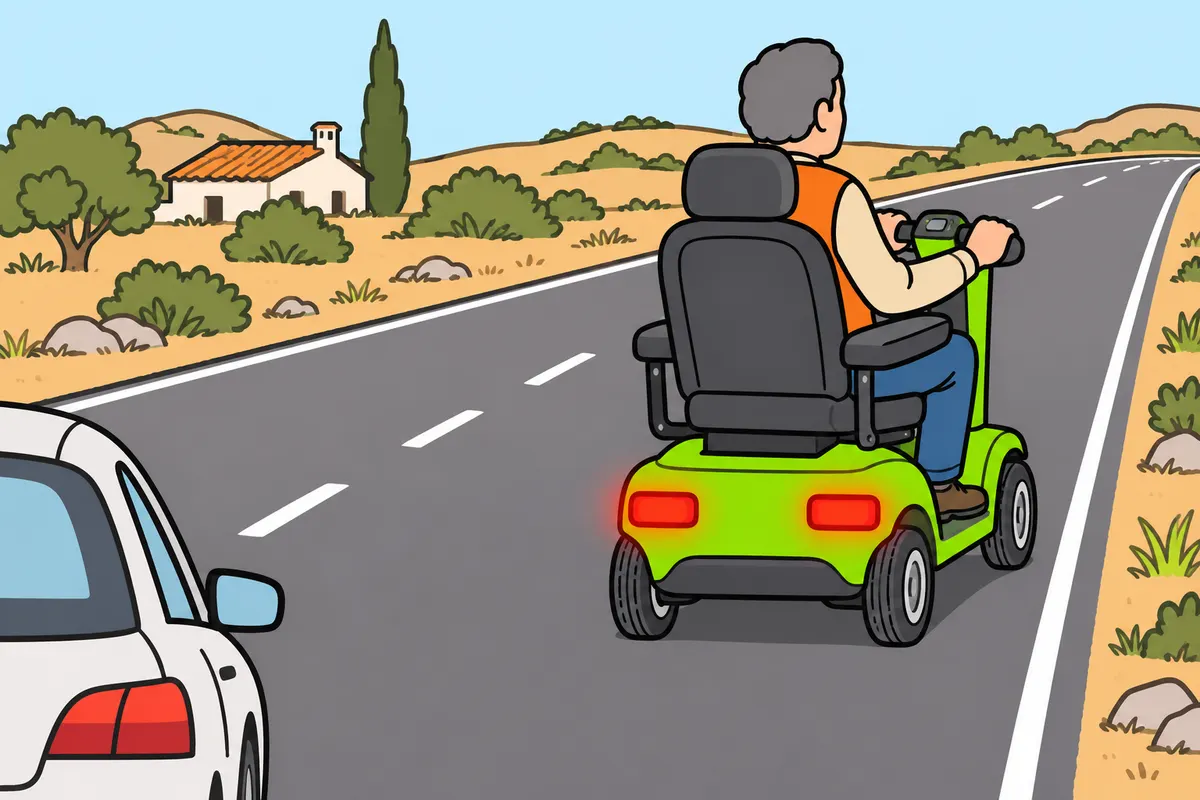
Warn others before heavy braking and when you intend to reverse.
| To announce reversing | What you must use |
|---|---|
| You have a reversing light | The reversing light |
| You have no reversing light | The prescribed arm signal |
Remember
- Your red brake light shows that you are applying the service brake.
- Whenever possible, warn of heavy braking by repeatedly operating your brake lights.
- Do this before stopping too, even when traffic requires you to stop.
- Do not delay necessary braking to give a warning.
Exam trap: Wrong: without a reversing light, you may reverse without warning. Right: use the prescribed arm signal.
Read the full explanation
- The red brake light tells anyone following you that you are applying the service brake. [RGV, Annex X](https://www.boe.es/buscar/act.php?id=BOE-A-1999-1826#anx).
- Whenever possible, you must warn others of heavy braking or your intention to stop by repeatedly activating the brake lights, even when traffic requires you to do so. The warning must come before you slow down so that anyone following you can react. [RGC, art. 109](https://www.boe.es/buscar/act.php?id=BOE-A-2003-23514#a109).
- If you have a reversing light, you must use it to signal reversing; its function also includes illuminating the area behind you. If you do not have one, you must use the prescribed arm signal. You must not assume that the absence of this light prevents all reversing or allows you to reverse without signalling. [RGC, art. 109](https://www.boe.es/buscar/act.php?id=BOE-A-2003-23514#a109).
19Hazard warning lights: all indicators at once
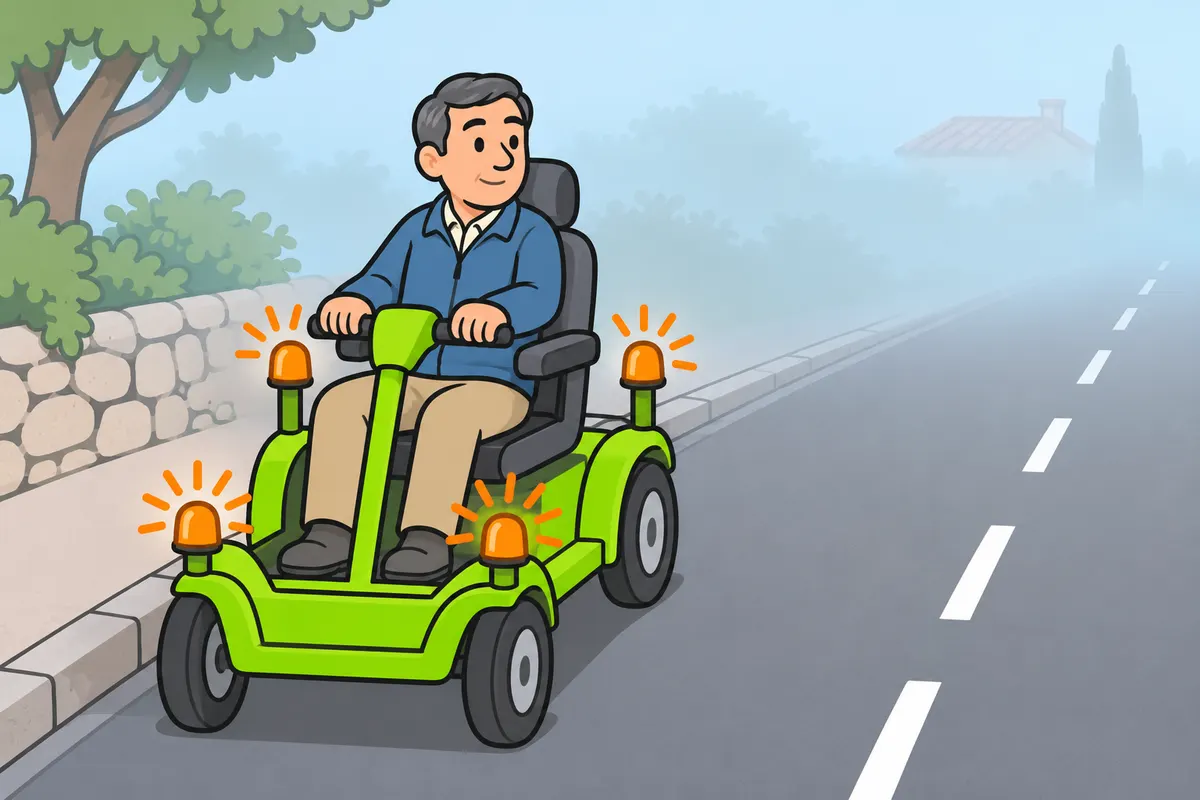
Use hazard warning lights to warn of danger; they give you no special permissions.
Remember
- Hazard warning lights switch on all your indicators together.
- They are different from a V-16 beacon.
- If fitted, use hazard warning lights when immobilised in significantly reduced visibility.
- Add position lights when required.
- While driving, use hazards below the required minimum speed with rear-end collision risk.
- Try to have your vehicle removed if it obstructs traffic.
Exam trap: Wrong: always use hazards because your LCM is slow. Right: while driving, you must be unable to reach the required minimum speed and face a risk of a rear-end collision.
Read the full explanation
- The hazard warning signal consists of all direction indicators flashing simultaneously. It warns that your vehicle temporarily presents a hazard. It does not mean that you intend to turn in both directions at once, nor is it equivalent to switching on a V-16 beacon. [RGV, annex X](https://www.boe.es/buscar/act.php?id=BOE-A-1999-1826#anx).
- If your vehicle is equipped with hazard warning lights, you must use them to signal that it is immobilised in places or circumstances where visibility is significantly reduced, in addition to the position lights where required. The obligation to use them applies when your LCM model is fitted with the device. [RGC, art. 109.2.c](https://www.boe.es/buscar/act.php?id=BOE-A-2003-23514#a109).
- If you cannot reach the required minimum speed and there is a risk of a rear-end collision, you must use your hazard warning lights while driving. These conditions must be present: you must not keep them on permanently simply because you drive a vehicle with limited performance. [RGC, art. 49](https://www.boe.es/buscar/act.php?id=BOE-A-2003-23514#a49).
- You must not interpret hazard warning lights as permission to stop anywhere or disregard the rules. You must signal the danger and take steps to have your vehicle removed when it causes an obstruction; the warning helps others react, but does not remove the obstacle. [RGC, art. 130](https://www.boe.es/buscar/act.php?id=BOE-A-2003-23514#a130).
20Flashing your headlights as a warning
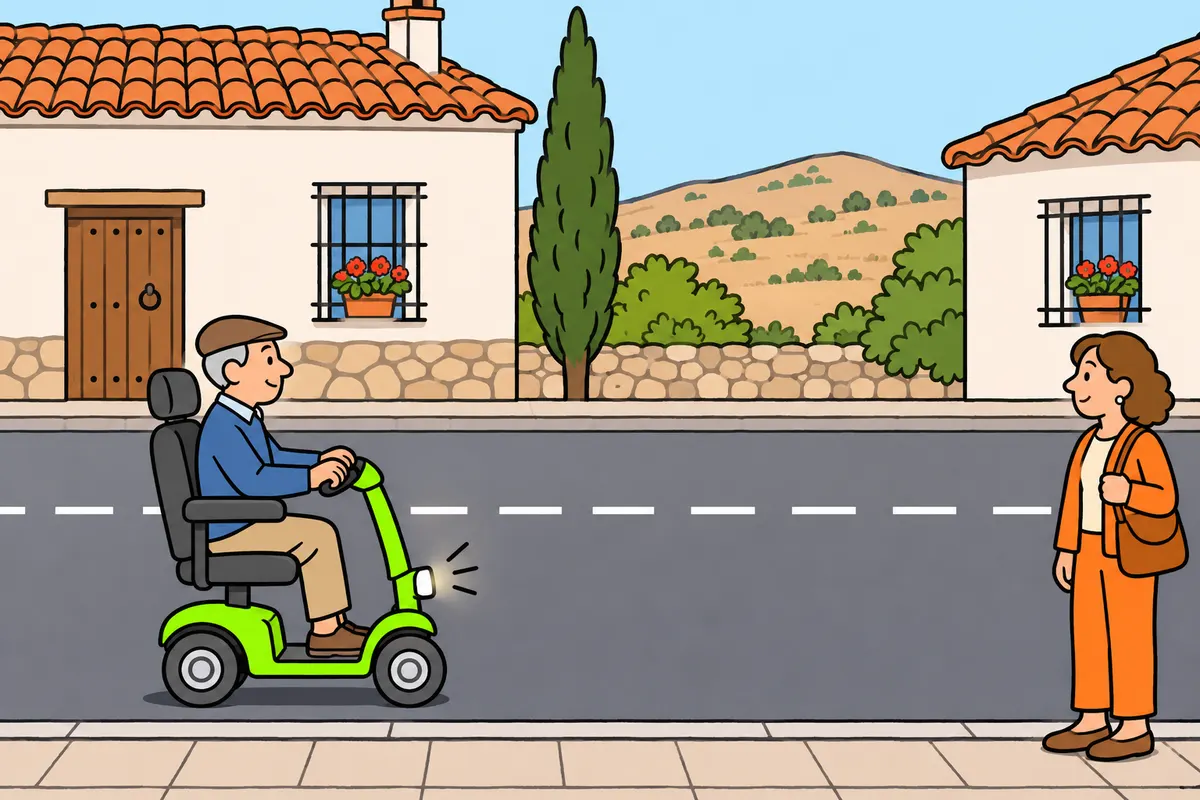
You may flash headlights briefly for permitted warnings, without dazzling others.
| Purpose of your warning | Where you may give it |
|---|---|
| Prevent a possible accident | Inside or outside built-up areas |
| Announce your intention to overtake | Outside built-up areas |
Remember
- You may use dipped beam, main beam or both alternately at very short intervals.
- You may warn to prevent a possible accident, including in built-up areas.
- Outside built-up areas, you may announce your intention to overtake.
- Flashing your headlights gives you no priority.
- Do not treat another driver’s flashes as proof that the way is clear.
Exam trap: Wrong: flash to demand priority. Right: flash only for permitted purposes, without dazzling others.
Read the full explanation
- You may give light warnings at very short intervals, using dipped beam, main beam or alternating between both, for the purposes permitted for audible warnings. You must avoid dazzling others. You may do this even in built-up areas; this does not mean you may drive through them with main beam continuously on. [RGC, art. 109](https://www.boe.es/buscar/act.php?id=BOE-A-2003-23514#a109).
- You may use them to prevent a possible accident and, outside built-up areas, to tell another driver that you intend to overtake. Headlight flashes warn of your presence: no flash gives you priority or removes the need for the necessary checks. [RGC, art. 110](https://www.boe.es/buscar/act.php?id=BOE-A-2003-23514#a110).
- You must not flash your headlights repeatedly for purposes other than those allowed by the regulations. You must not interpret another driver's flashes as a guarantee that the way is clear either. [RGC, art. 100](https://www.boe.es/buscar/act.php?id=BOE-A-2003-23514#a100).
21Lights when your vehicle is immobilised
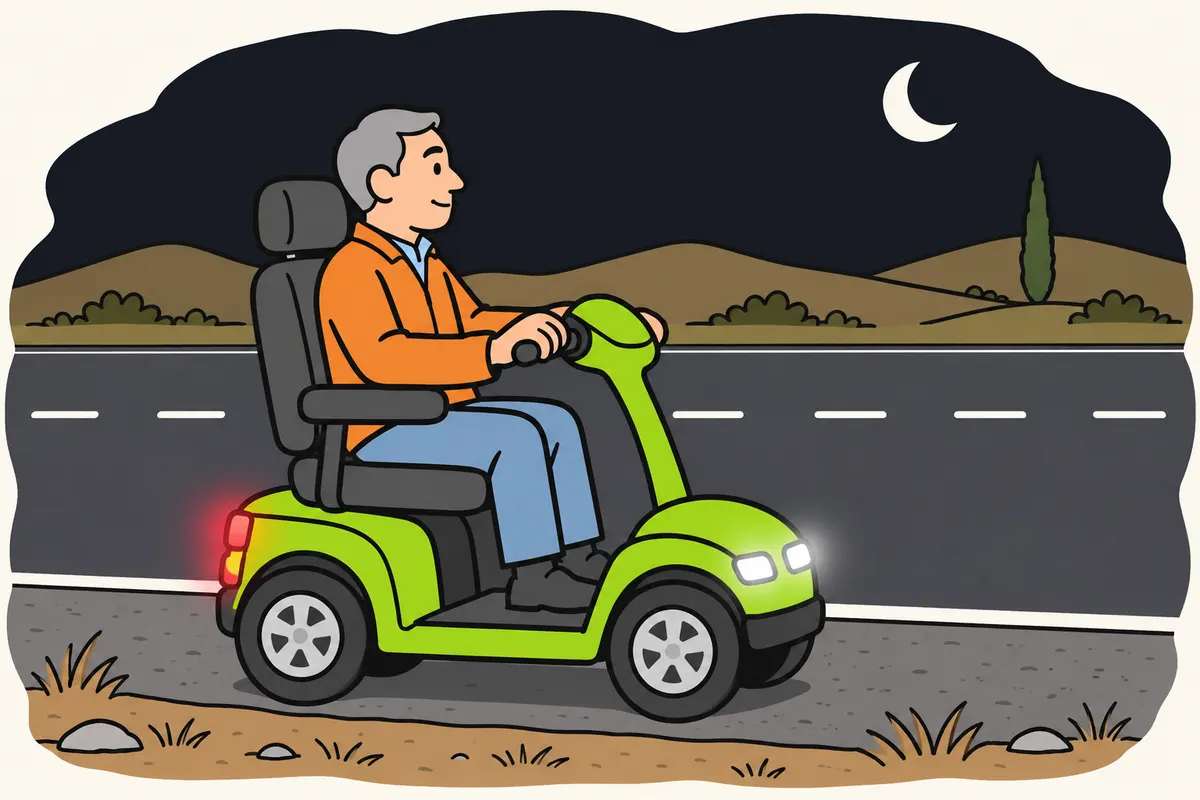
When immobilised, keep the lights required for your location and visibility on.
| Place and situation | What you must do |
|---|---|
| At night, on the carriageway or hard shoulder of an inadequately lit through road | Keep position lights on when stopped or parked |
| Same conditions, parked in line, with an approved system | You may replace position lights with parking lights or carriageway-side position lights |
| Parked on an urban road other than a through road, sufficiently visible under the lighting | You need not leave position lights on |
Remember
- At night on the carriageway or hard shoulder, keep position lights on.
- Keep end-outline marker lamps on where required; do this in reduced visibility too.
- Check every condition before switching off position lights.
Exam trap: Wrong: parking always lets you switch off position lights. Right: this exception requires an urban road other than a through road, a parked vehicle and lighting that makes it visible from a sufficient distance.
Read the full explanation
- If your vehicle becomes immobilised at night on the carriageway or arcén (hard shoulder), you must keep the position lights and, where applicable, the end-outline marker lamps on. You must also do this in the reduced visibility conditions described in article 106. You must consider breakdowns as well as other causes: a stationary vehicle still needs to be seen clearly. [RGC, art. 105](https://www.boe.es/buscar/act.php?id=BOE-A-2003-23514#a105).
- If you stop or park at night on the carriageway or hard shoulder of an insufficiently lit stretch of road through a town, you must keep the position lights on. If you are parallel parked, you may replace them with the parking lights or the two position lights on the side facing the carriageway, provided your vehicle has the necessary approved system. [RGC, art. 105](https://www.boe.es/buscar/act.php?id=BOE-A-2003-23514#a105).
- On an urban road that is not a stretch of road through a town, if you are parked and the lighting allows your vehicle to be seen clearly from a sufficient distance, you are not obliged to leave the position lights on. This exception applies only to parking on that lit urban road; on a stretch of road through a town, the conditions in the previous point apply. [RGC, art. 105](https://www.boe.es/buscar/act.php?id=BOE-A-2003-23514#a105).
- Parking lights have the specific function of indicating the presence of a parked vehicle in a built-up area, and you may use them as an alternative only under the specified conditions. [RGV, annex X](https://www.boe.es/buscar/act.php?id=BOE-A-1999-1826#anx).
22Immobilisation inside a tunnel
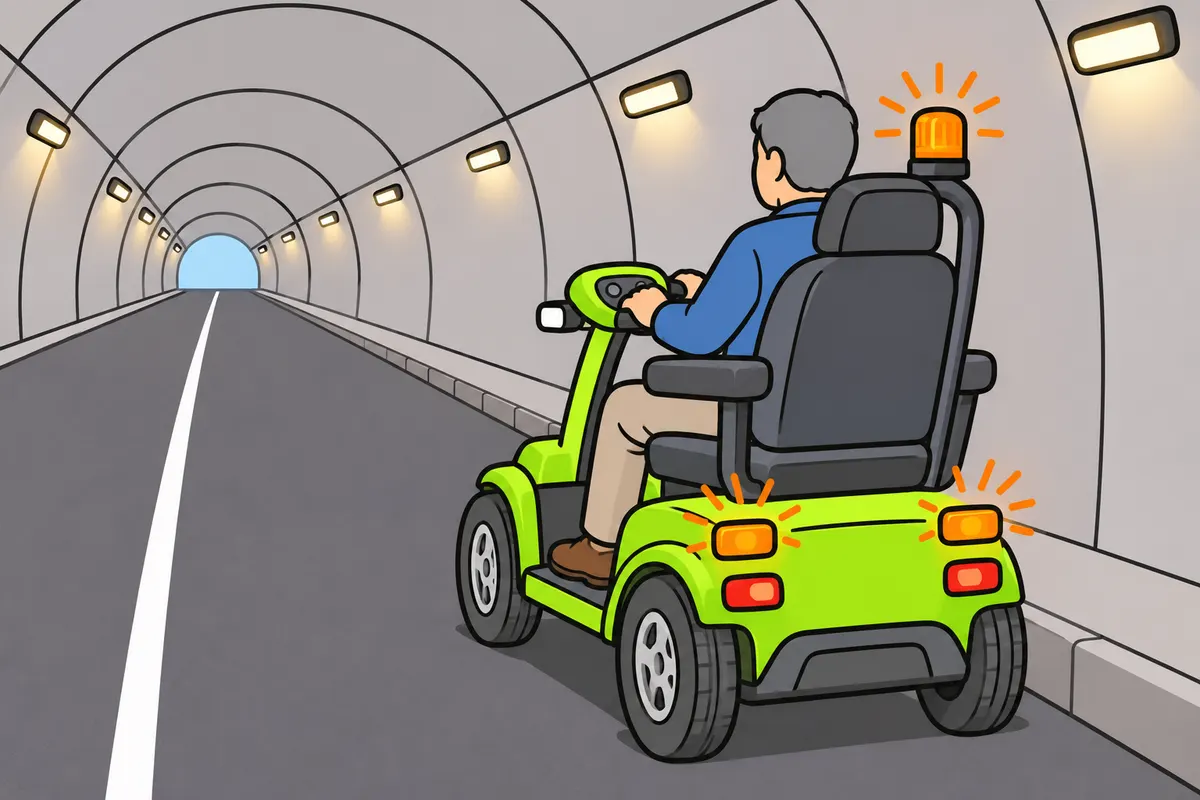
If you stop in a tunnel or closed place, switch off the engine immediately.
Remember
- Switch off the engine when you stop, even if you stay at the wheel.
- Do this while refuelling too.
- If you wait more than two minutes, keep the engine off.
- Keep position lights on until you can continue.
- For emergencies or traffic hold-ups, see «Accidents and breakdowns».
Exam trap: Wrong: wait two minutes before switching off the engine. Right: switch it off as soon as you stop in a tunnel or closed place, even if you stay at the wheel, including while refuelling. If you wait more than two minutes, keep it off and keep position lights on.
Read the full explanation
- When your vehicle remains stopped inside a tunnel or enclosed place, you must switch off the engine even if you remain at the wheel. If the wait lasts more than two minutes, you must keep the engine off until you can continue driving and keep the position lights on. You must switch the engine off as soon as you stop, including while refuelling. [RGC, art. 115.1 and 115.2](https://www.boe.es/buscar/act.php?id=BOE-A-2003-23514#a115).
- You can find the procedure for an emergency or a traffic hold-up inside a tunnel in «Accidents and breakdowns», «Breakdown in a tunnel or underpass». [RGC, art. 97.3](https://www.boe.es/buscar/act.php?id=BOE-A-2003-23514#a97).
23Connected V-16 and your LCM vehicle
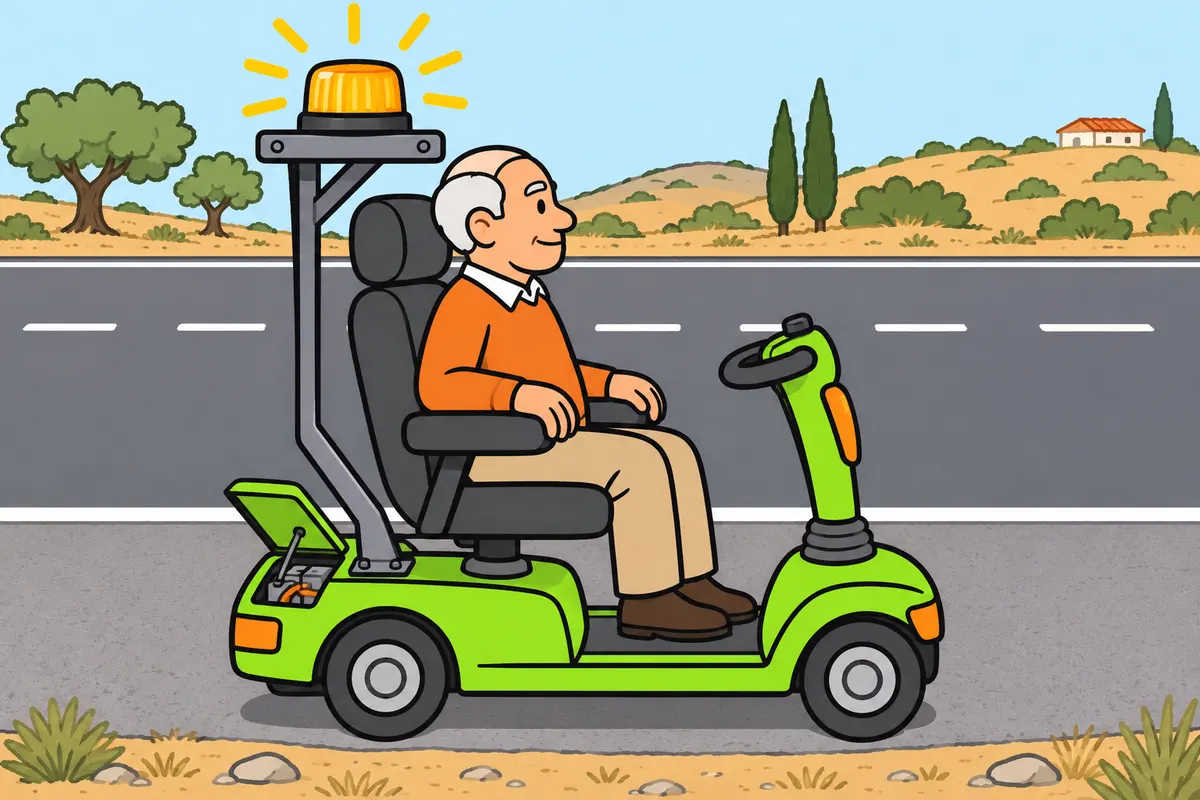
Recognise how your connected V-16 beacon gives light and communicates.
Remember
- See the conditions for use in «Accidents and breakdowns».
- It sends activation, deactivation and location data to the national access point.
Exam trap: Wrong: the light lasts exactly 30 minutes. Right: it maintains the required intensity for at least 30 minutes.
Read the full explanation
- You can find the conditions for using a V-16 in your LCM vehicle in «Accidents and breakdowns», «Connected V-16: distinctions you must understand».
- The beacon covers a horizontal field of 360 degrees and maintains the light intensity required by the regulations for at least 30 minutes. It communicates its activation, deactivation and geographical position to the national access point for traffic and mobility. [RGV, annex XI, V-16, paragraphs 3.a-b and 4](https://www.boe.es/buscar/act.php?id=BOE-A-1999-1826#v-16).
24Plates, stickers and personal restrictions
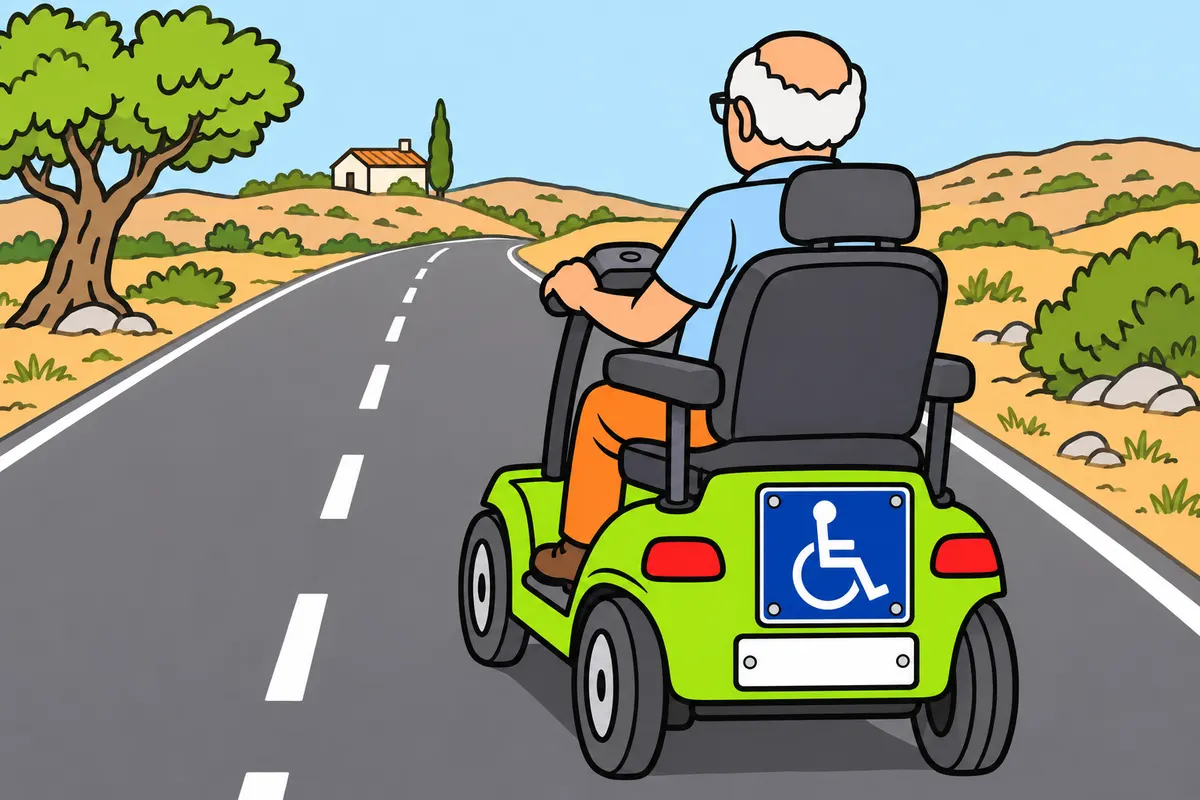
Distinguish each sign and use only the one that applies to your situation.
| Sign or sticker | What you must remember |
|---|---|
| V-15 | Disability affecting movement; blue and white plates at the front and rear |
| V-4 | For a personal speed restriction: visible at the rear, showing your specific limit |
| V-5 | Not required simply for being slow: LCM is excluded from the motor vehicle definition |
| V-13 | White L on green; duty concerns your first driving permit, not an LCM licence; visible at the rear when required |
| V-19 | Shows inspection pass and next due date; inside top right with a windscreen, otherwise clearly visible; historic vehicles exempt |
| V-20 | For regulated rear-projecting loads: at the rearmost end, perpendicular to the vehicle’s axis; two panels in an inverted V if spanning the whole rear width; add a red light at night or in reduced visibility |
Remember
- Keep your number plate readable, without confusing decorations.
- Your LCM licence and V-15 do not replace the parking card.
- Display the card inside; its holder must drive or travel in the vehicle.
- You do not need V-5 simply because you drive slowly.
- An LCM licence alone does not require you to display an L.
- Before carrying a rear-projecting load, check the applicable limits and conditions.
Exam trap: Wrong: V-15 gives you parking-card rights. Right: display a valid parking card, and its holder must drive or travel in the vehicle.
Read the full explanation
- You must keep the registration number assigned to your vehicle legible and ensure that the number plate is fitted in accordance with the regulations. You must not add decorations or symbols to the plate or fit anything that makes it difficult to read correctly. You must not use the accessibility symbol as a substitute for registration plate identification. [RGV, art. 49](https://www.boe.es/buscar/act.php?id=BOE-A-1999-1826#a49).
- The V-15 sign indicates that you drive with a disability that makes getting around difficult and identifies the concessions that apply. It consists of two plates, one at the front and one at the rear, in blue and white. The annex retains the official name «Minusválido» (disabled person) for this sign. [RGV, annex XI, V-15](https://www.boe.es/buscar/act.php?id=BOE-A-1999-1826#v-15).
- You must not confuse V-15 with the parking card for people with disabilities. To exercise the rights granted by that card, you must display it visibly inside the vehicle; it is for personal use and its holder must be driving or travelling in the vehicle. Your LCM licence alone does not replace the card. [RD 1056/2014, arts. 6 and 7](https://www.boe.es/buscar/act.php?id=BOE-A-2014-13362#a6).
- If you have a speed restriction imposed because of your personal circumstances, you must display a visible V-4 sign at the rear showing the corresponding figure. You must not invent a V-4 plate with the same value for everyone with an LCM licence. The sign indicates a specific restriction that you must obey. [RGV, annex XI, V-4](https://www.boe.es/buscar/act.php?id=BOE-A-1999-1826#v-4).
- V-5 identifies motor vehicles or vehicle combinations whose design speed does not exceed 40 km/h. Your vehicle for people with reduced mobility is excluded from the definition of a motor vehicle; driving slowly does not require you to display this sign. [RGV, annex XI, V-5](https://www.boe.es/buscar/act.php?id=BOE-A-1999-1826#v-5); [Traffic Act, annex I.12](https://www.boe.es/buscar/act.php?id=BOE-A-2015-11722#ani).
- V-13 displays the white L on a green background for a novice driver. The obligation applies when you first obtain a driving licence of the permiso category, rather than an LCM licence; for these vehicles, the annex provides for visible placement at the rear when you are required to display it, without requiring it to be on the left. [RGV, annex XI, V-13](https://www.boe.es/buscar/act.php?id=BOE-A-1999-1826#v-13).
- The V-19 sticker confirms a successful periodic inspection and indicates when the next one is due. If your vehicle has a windscreen, you must place it at the top right on the inside; without a windscreen, you must place it somewhere clearly visible. Vehicles classified as historic are exempt from displaying it; you study the intervals and documentation in «Driver and vehicle documentation». [RD 920/2017, art. 12; RGV, V-19](https://www.boe.es/buscar/act.php?id=BOE-A-2017-12841#a1-4).
- If you carry a load that projects to the rear in the cases covered by article 15.6, you must mark it with V-20 at its rearmost end, perpendicular to the vehicle's longitudinal axis. If it occupies the full rear width, you must use two panels forming an inverted V; at night or in reduced visibility, you must add a red light. You must first check the load limits applicable to your vehicle in the module «Your vehicle: characteristics and maintenance». [RGC, art. 15](https://www.boe.es/buscar/act.php?id=BOE-A-2003-23514#a15).
25Number plate lighting and lighting failure
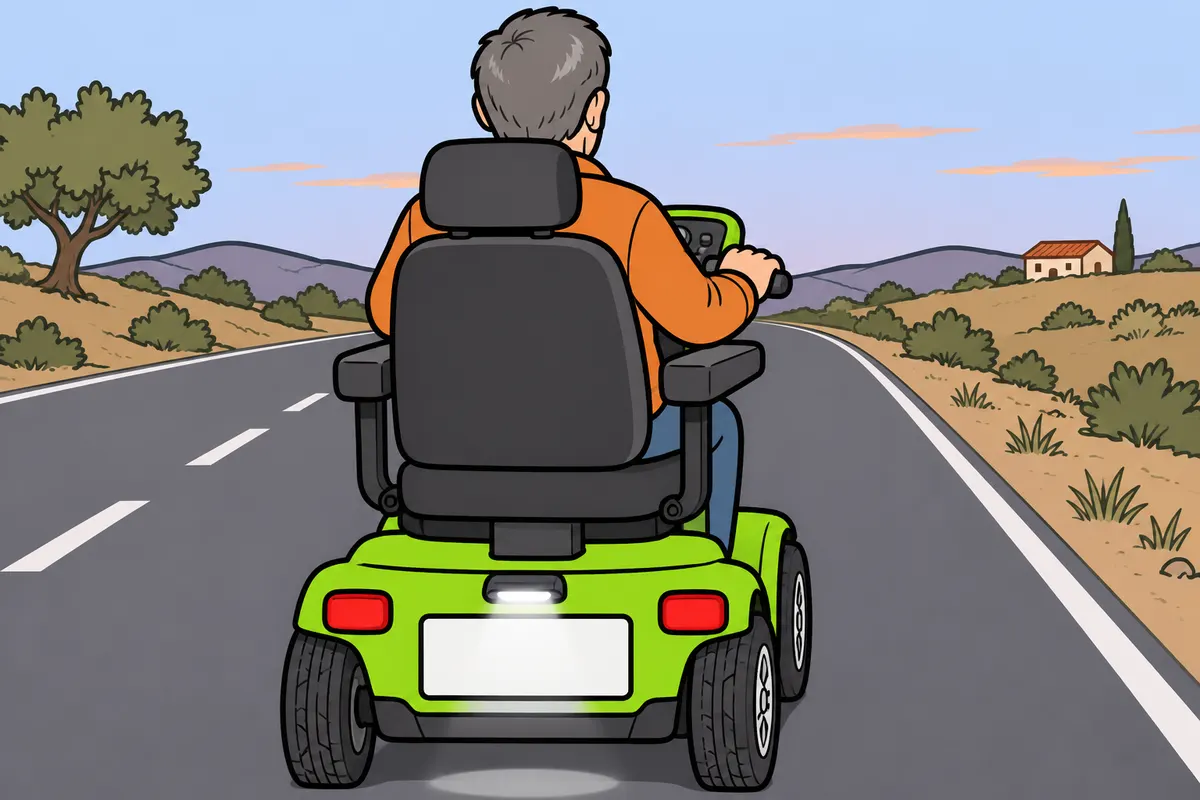
If a fault reduces your lighting, adjust your speed to the area you can see.
Remember
- Distinguish number-plate lighting from the plate’s reflective background.
- Rear number-plate lighting is optional in your equivalent technical category.
- Its use depends on the conditions and your vehicle’s regulatory characteristics.
- For an irreparable fault during your journey, slow down if your lighting becomes weaker.
- You must be able to stop within the illuminated area.
- If you cannot continue safely, stop safely and ask for assistance.
Exam trap: Wrong: keep the same speed with weaker lights after an irreparable fault during your journey. Right: slow down until you can stop within the illuminated area; if you cannot continue safely, stop and ask for help.
Read the full explanation
- Distinguish number plate lighting from the plate’s retroreflective background. The light illuminates the rear number plate mounting area and is listed as optional in the technical table for the equivalent vehicle category; article 103 regulates when you must switch it on in circumstances requiring position lights and in reduced visibility, taking account of the vehicle’s regulatory characteristics. You must not apply passenger car equipment requirements without qualification. [RGC, art. 103](https://www.boe.es/buscar/act.php?id=BOE-A-2003-23514#a103).
- You study checks on operation, cleanliness and adjustment in «Your vehicle: characteristics and maintenance».
- If a fault that you cannot repair during your journey forces you to drive with reduced lighting intensity, you must reduce your speed so that you can stop within the illuminated area. If you cannot continue safely, you must stop safely and request assistance. [RGC, art. 107](https://www.boe.es/buscar/act.php?id=BOE-A-2003-23514#a107).
Choose your lights before driving
Decide according to visibility, location, equipment and the risk of dazzling others.
- Check which lights are fitted, that they work and that they are not obscured.
- Identify whether it is night-time, whether there is a tunnel or underpass, or whether visibility is significantly reduced.
- Switch on the position lights and the appropriate front lights; in a sufficiently lit tunnel, use dipped beam.
- Consider main beam only if it is fitted and its conditions of use are met; switch to dipped beam if you could dazzle anyone.
- Select fog lights only if your vehicle is authorised to have them fitted and their conditions of use are met.
- Review your choice when the lighting or weather changes.
Signal a manoeuvre
Communicate your intention while maintaining control of your vehicle.
- Observe your surroundings and check that you can manoeuvre safely.
- Use the appropriate indicator well in advance or, if it is unavailable, a clearly visible arm signal.
- Keep signalling throughout the manoeuvre you have indicated.
- End the signal when you take up your new course and check that the indicator is off.
Make your immobilised vehicle visible
Combine the appropriate lights and advance warning devices.
- Identify which lights you need when your vehicle is immobilised, according to the location and visibility.
- See «Lights when your vehicle is immobilised» for position lights and «Hazard warning lights: all indicators at once» for hazard warning lights.
- In a tunnel, see «Immobilisation inside a tunnel».
- To position the V-16 and deal with a breakdown, see «Accidents and breakdowns», «Using the beacon without confusing its functions».
Finished this module?
Mark it as read and you will see your progress on the theory list.