
Theory · LCM Licence - Reduced Mobility Vehicle · Module 10 of 15
Manoeuvres with your LCM vehicle
You learn to observe, signal and carry out joining traffic, sideways movements, overtaking, turns and reversing with your LCM vehicle. You learn to choose where to stop or park and how to secure your vehicle when immobilised, distinguishing general rules from specific conditions that may appear in your test.
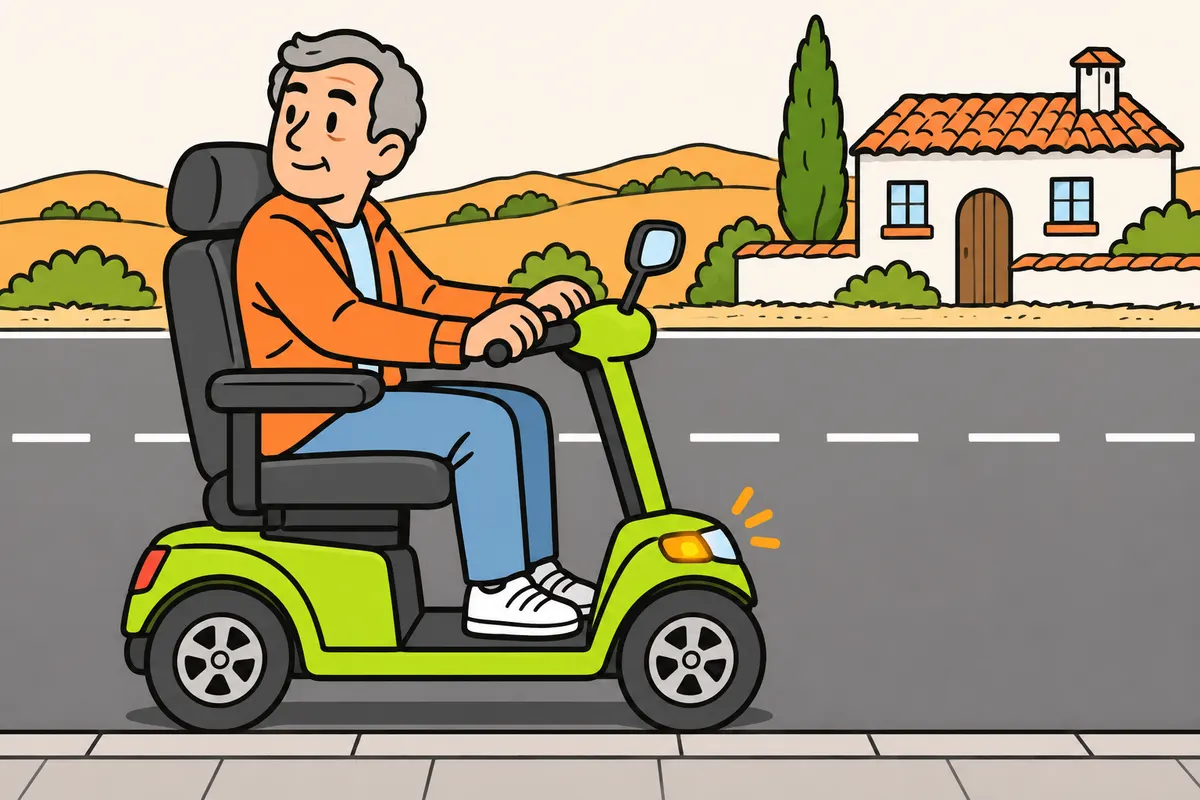
1Observe, signal and manoeuvre
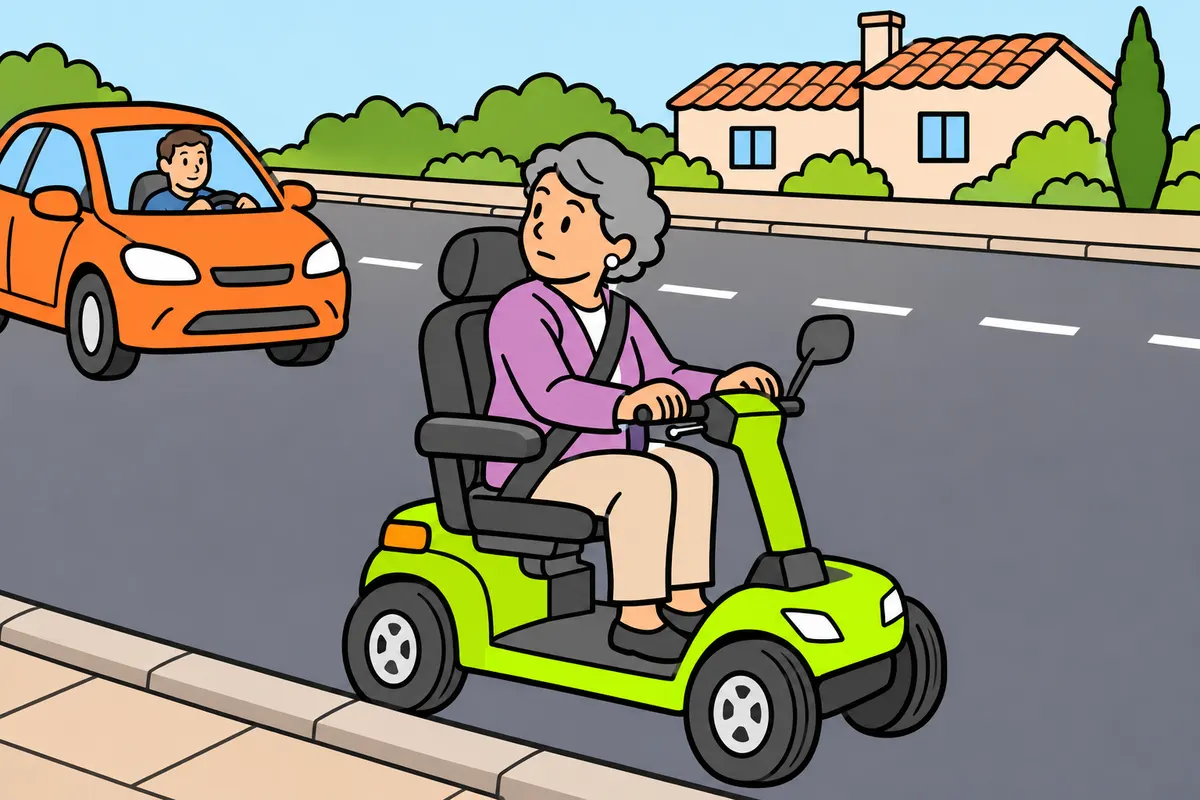
Before moving, look, signal and check that you can act safely.
Remember
- Check your mirrors and the areas they do not show.
- Check the space your whole vehicle will occupy.
- Adjust your mirrors to your driving position before setting off.
- Keep looking throughout the manoeuvre.
- Move smoothly and control your adapted controls.
Exam trap: Wrong: you signal and expect others to let you pass. Right: signalling does not give you priority.
Read the full explanation
- Before joining traffic, changing lanes, overtaking, turning or bringing your vehicle to a standstill, follow the mirror, signal, manoeuvre sequence. First check that you can do so; then communicate your intention and finally act. Signalling does not give you priority or oblige others to make room for you. [RGC, art. 108](https://www.boe.es/buscar/act.php?id=BOE-A-2003-23514#a108).
- Combine your mirrors with direct observation of your surroundings and the relevant blind spots. You must check the space that your entire vehicle will occupy, including its extremities. As practical advice, adjust your mirrors to suit your driving position and adapted controls before moving off. [RGC, art. 74](https://www.boe.es/buscar/act.php?id=BOE-A-2003-23514#a74).
- You must maintain control throughout the manoeuvre and keep observing as you carry it out. An initially safe situation can become unsafe if a pedestrian appears, another vehicle changes course or an obstacle reduces the available space. [RGC, art. 74](https://www.boe.es/buscar/act.php?id=BOE-A-2003-23514#a74).
- Make movements progressively and at a speed that allows you to correct your course or stop safely. As a driving technique, avoid abrupt turns and combine acceleration, steering and braking smoothly; with an LCM vehicle, knowing the location and response of your adapted controls is essential for this precision. [RGC, art. 3](https://www.boe.es/buscar/act.php?id=BOE-A-2003-23514#a3).
2How to signal each movement
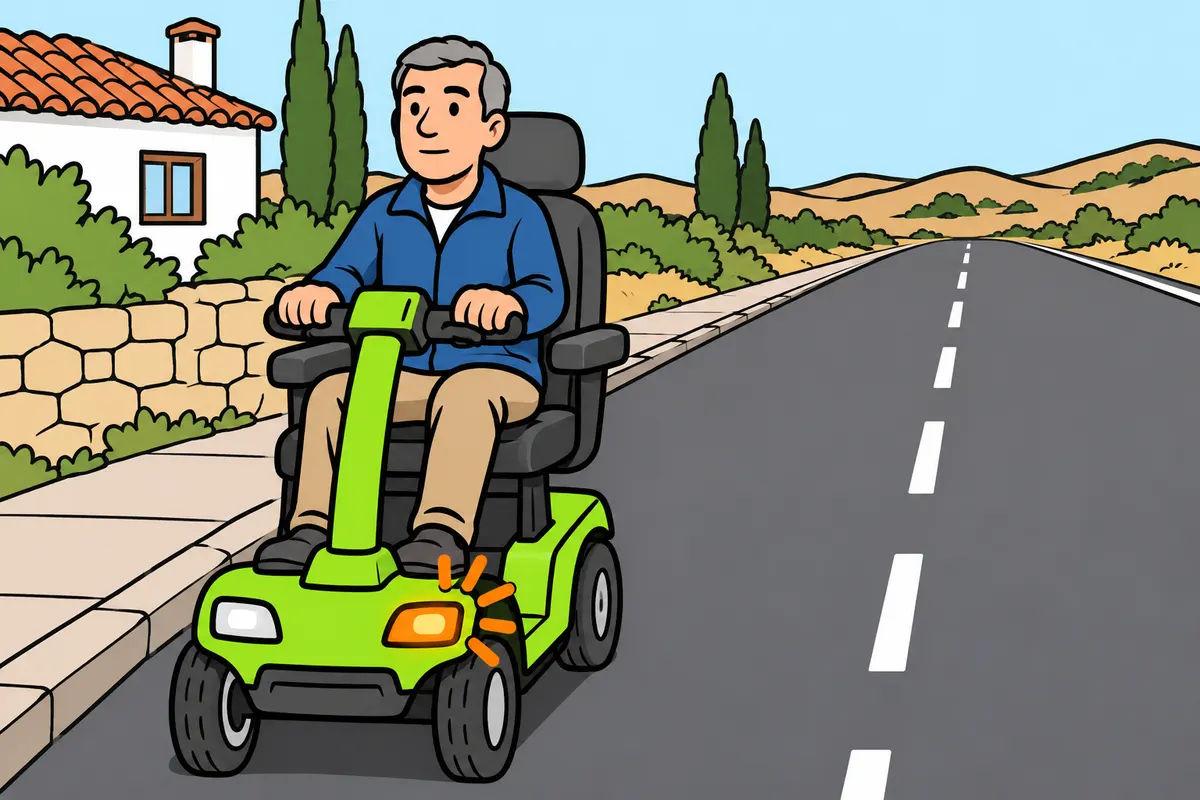
Warn others in good time and keep signalling until you complete the movement.
| Movement | Signal with your left arm |
|---|---|
| Left | Extend it horizontally, palm down. |
| Right | Bend it upwards, hand extended. |
| Reversing, without a reversing light | Extend it horizontally, palm facing backwards. |
| Stopping or braking considerably | Move it up and down in short, quick movements. |
Remember
- Use lights; if they are unavailable, use the prescribed arm signals.
- Cancel your indicator when you adopt your new course.
- When stopping or parking, also signal the side you approach, if fitted.
- For considerable braking, repeat the brake lights when possible.
Exam trap: Wrong: you use hazard lights to announce any stop. Right: signal the side you approach, if fitted; hazard lights do not allow you to stop where prohibited.
Read the full explanation
- You must signal sideways movements, reversing and your intention to bring your vehicle to a standstill or reduce speed considerably in good time. Normally use your vehicle’s light signals and, if these are unavailable, the prescribed arm signals. [RGC, art. 109](https://www.boe.es/buscar/act.php?id=BOE-A-2003-23514#a109).
- For a sideways movement, use the indicator on the side towards which you are moving. Keep signalling until you have adopted your new course, then cancel the signal. The indicator signals the movement, not the entire time you subsequently remain in a lane or an indefinite series of overtaking manoeuvres. [RGC, art. 109](https://www.boe.es/buscar/act.php?id=BOE-A-2003-23514#a109).
- Your arm signals must be correct and visible to others; if they meet these conditions, they override any conflicting light signal. To signal left with your left arm, extend it horizontally with your palm facing down; to signal right, bend it upwards with your hand extended. [RGC, arts. 108 and 109](https://www.boe.es/buscar/act.php?id=BOE-A-2003-23514#a109).
- Signal reversing with your reversing light, if fitted; otherwise, extend your arm horizontally with your palm facing backwards. To warn that you are bringing your vehicle to a standstill or braking heavily, use your brake lights repeatedly whenever possible, or move your arm up and down with short, rapid movements. [RGC, art. 109](https://www.boe.es/buscar/act.php?id=BOE-A-2003-23514#a109).
- If you intend to stop or park, also use the indicator on the side you are approaching, if your vehicle has one. Hazard warning lights do not replace this signal or authorise you to occupy a prohibited place; you use them to indicate your vehicle’s presence in the specified circumstances. [RGC, art. 109](https://www.boe.es/buscar/act.php?id=BOE-A-2003-23514#a109).
3Joining traffic from the roadside or an access road
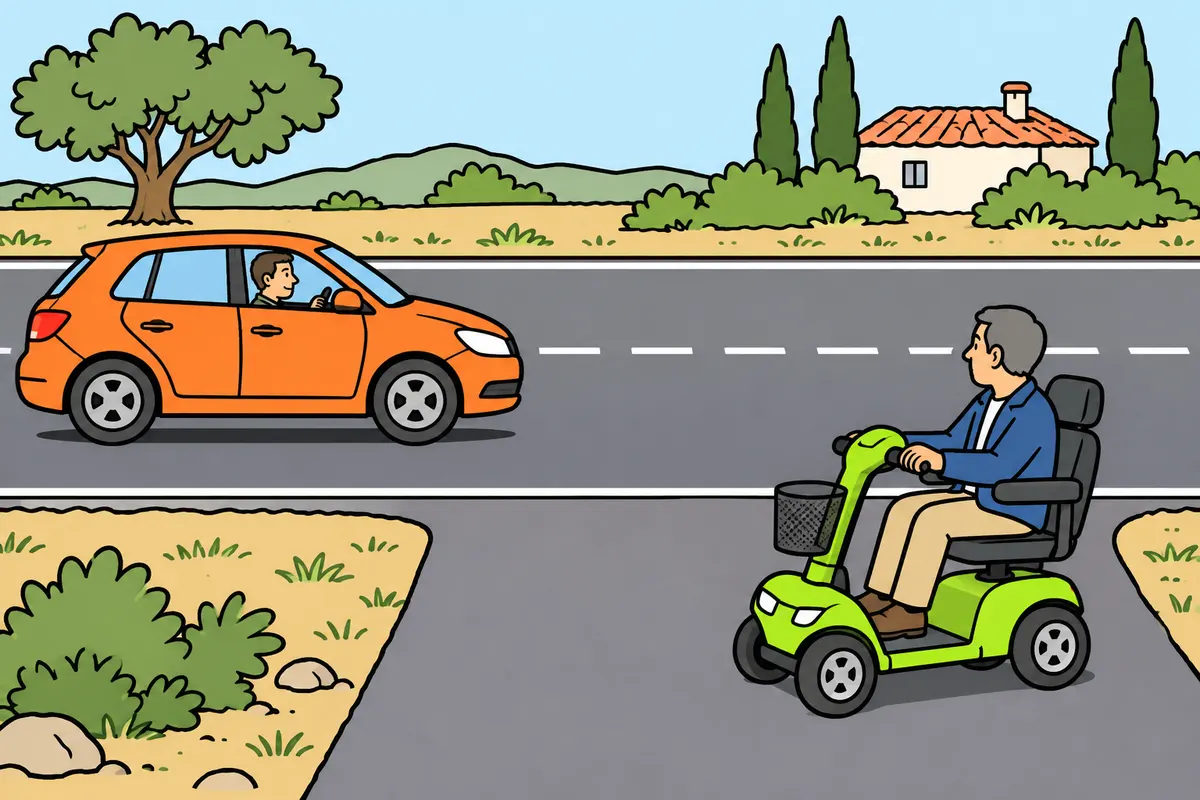
To join traffic, give way and wait for a safe gap.
Remember
- Check others' position, direction and speed.
- Signal with your lights even if you enter in a straight line.
- Look behind, at the hard shoulder and for pedestrians at the access.
- From a private road, move at a speed that lets you stop at once.
- Give way to public road traffic in both directions.
- Ask for help if you need it to check that it is safe.
Exam trap: Wrong: you enter because the other vehicle is far away. Right: also check its speed and whether you can enter safely.
Read the full explanation
- You join traffic when you move off after stopping or parking, or leave an adjoining property, service area or access road to enter the traffic flow. You must first check that you can do so without danger and give way to those travelling on the road you are entering. [RGC, art. 72](https://www.boe.es/buscar/act.php?id=BOE-A-2003-23514#a72).
- Assess other road users’ position, course and speed together. With your LCM vehicle, allow enough margin to reach a speed compatible with the traffic without forcing anyone to brake sharply. A vehicle being far away is not enough if it is approaching fast and you enter its path. [RGC, art. 72](https://www.boe.es/buscar/act.php?id=BOE-A-2003-23514#a72).
- You must use a visible signal when joining traffic, even if your initial path appears straight. Pay particular attention to anyone approaching from behind, users of the arcén (hard shoulder) and pedestrians crossing the access. Only start moving when your signalling and the available gap allow you to do so safely. [RGC, art. 72](https://www.boe.es/buscar/act.php?id=BOE-A-2003-23514#a72).
- If you emerge from an exclusively private track onto a public road, you must move at a speed that allows you to stop immediately. You give way to vehicles on the public road, whichever direction they are travelling in. If you need guidance from another person to check that there is no danger, you must seek that help. [RGC, art. 72](https://www.boe.es/buscar/act.php?id=BOE-A-2003-23514#a72).
4Joining lanes and helping others join
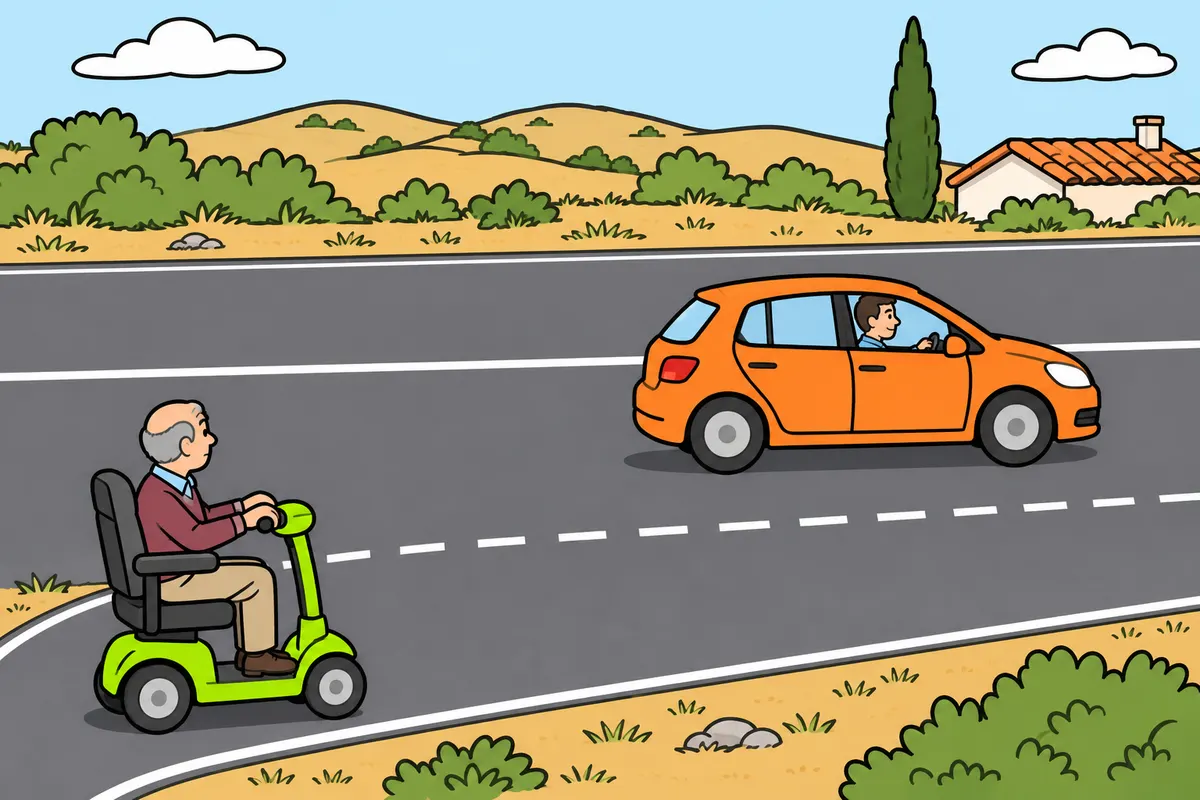
When joining, give way; when already travelling, help others join where possible.
| Your situation | What you must do |
|---|---|
| Joining traffic | Give way and check that you can join safely. |
| Already travelling | Help others join where possible and safe. |
| Bus leaving a marked stop in a built-up area | Help it leave; stop if needed. |
Remember
- Check at the start of an acceleration lane if you can join.
- If you need to stop, stop at the start of the lane.
- Adjust speed without exceeding your vehicle's or the road's limits.
- Your LCM cannot use motorways or dual carriageway motorways.
- Help others join when it is possible and safe.
Exam trap: Wrong: an acceleration lane gives you priority. Right: you must give way when joining.
Read the full explanation
- When there is an acceleration lane on a road you are allowed to use, check at its beginning whether it is safe to join, even stopping there if necessary. Then use the length of the lane to reach a suitable speed, observing the restrictions applicable to your vehicle and the road. [RGC, art. 72](https://www.boe.es/buscar/act.php?id=BOE-A-2003-23514#a72).
- You must not enter autopistas (motorways) or autovías (dual carriageway motorways) with your LCM vehicle; see «Where you must drive» for the roads you are allowed to use. [RGC, art. 38](https://www.boe.es/buscar/act.php?id=BOE-A-2003-23514#a38).
- If you are already in the traffic flow, you must help others join as far as possible. You can adjust your speed or move sideways where permitted and safe; before changing your road position, check for anyone occupying the space you intend to enter. Helping someone join does not remove their duty to give way. [RGC, art. 73](https://www.boe.es/buscar/act.php?id=BOE-A-2003-23514#a73).
- In built-up areas, you must help public transport vehicles pull away from their marked stops: move sideways if you can or reduce your speed, stopping if necessary. As a bus driver, you must also signal before pulling away and take the precautions needed to prevent accidents. [RGC, art. 73](https://www.boe.es/buscar/act.php?id=BOE-A-2003-23514#a73).
5Moving sideways and changing lanes
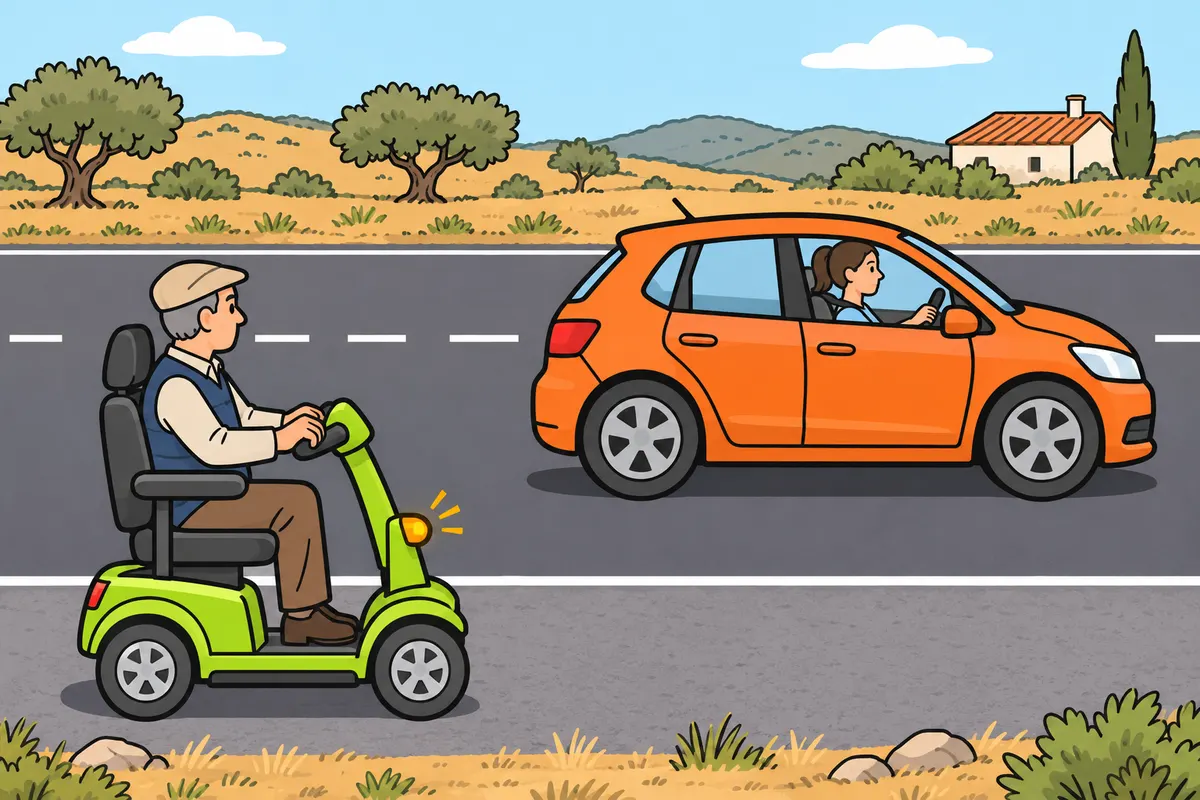
When changing lanes, give way to traffic already in that lane.
Remember
- Look ahead, behind and to the sides.
- Signal an appreciable sideways move even without changing lanes.
- Move gradually; wait if it is unsafe.
- Before leaving the hard shoulder, look and signal.
- Then return to the position required for your LCM.
Exam trap: Wrong: your indicator makes others let you change lanes. Right: give way to traffic already in that lane.
Read the full explanation
- Before changing lanes, you must respect the priority of vehicles already travelling in the lane you want to enter. Check ahead, behind and to the sides: a gap ahead may be insufficient if another vehicle is approaching quickly from behind. [RGC, art. 74](https://www.boe.es/buscar/act.php?id=BOE-A-2003-23514#a74).
- You must also signal any significant sideways movement, even if you do not cross a lane marking. For example, moving aside to avoid an obstacle may affect the course of someone behind you. Following a bend along your current course does not in itself require you to signal a change of direction. [RGC, art. 109](https://www.boe.es/buscar/act.php?id=BOE-A-2003-23514#a109).
- Plan your movement with enough space and time and carry it out gradually. There is no universal observation distance or clearance for all lane changes: you must assess speeds, width, visibility and the space available to return. If the situation is unsafe, wait. [RGC, art. 74](https://www.boe.es/buscar/act.php?id=BOE-A-2003-23514#a74).
- When leaving the hard shoulder to carry out a manoeuvre, check the traffic on the carriageway and signal your movement. When you finish, return to the appropriate road position for your LCM vehicle; its use of the hard shoulder is explained in «Where you must drive». [RGC, art. 36](https://www.boe.es/buscar/act.php?id=BOE-A-2003-23514#a36).
6Deciding whether you can overtake
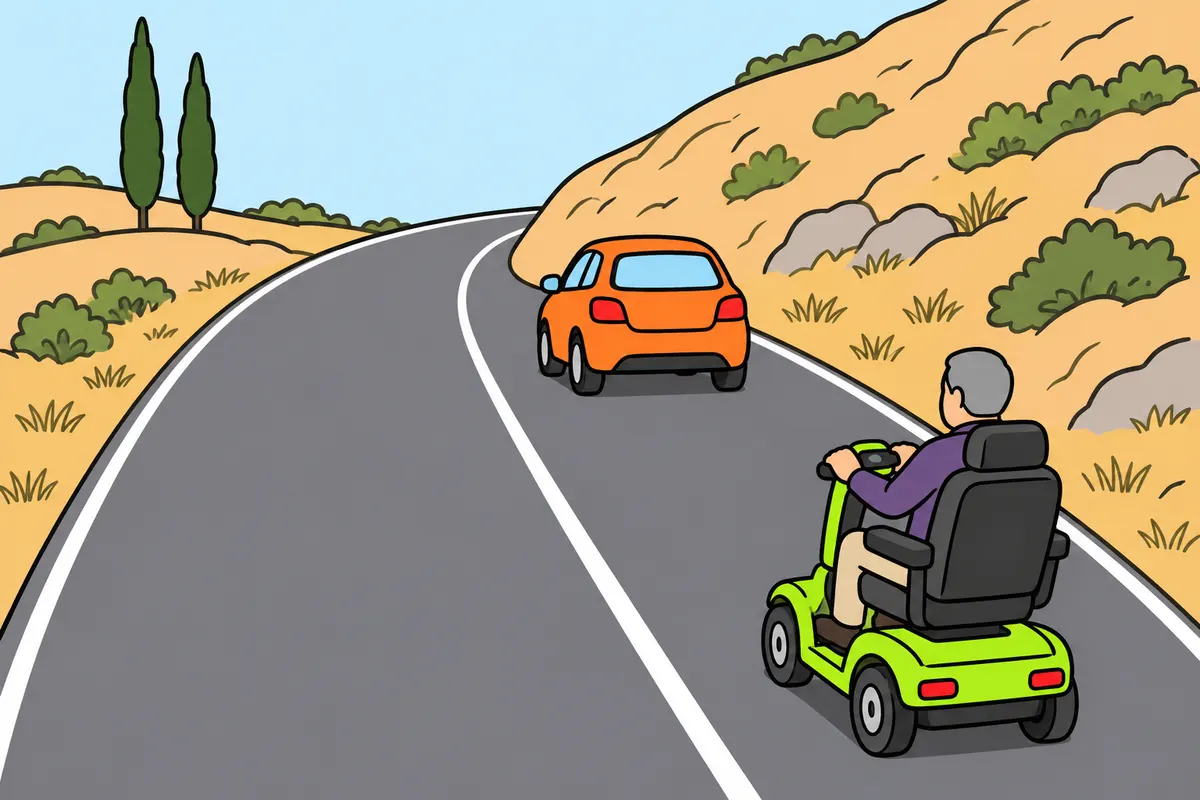
Overtake only when you have the visibility, space and time to finish safely.
Remember
- Check that nobody behind has started to overtake you.
- Give way if the vehicle ahead signals a move to the same side.
- If it waits a reasonable time, warn before overtaking legally.
- Do not exceed either limit while alongside.
- You must respect both limits during an overtake.
- Do not stay alongside another vehicle to accompany it.
Exam trap: Wrong: you only avoid exceeding both limits together. Right: with your LCM, exceeding either 15 seconds or 200 metres alongside is prohibited.
Read the full explanation
- You must only start overtaking when you can complete the manoeuvre or abandon it without risk. Check visibility, the available space, other road users’ speed and where you will return. The small size of the vehicle you want to pass does not make up for poor visibility or insufficient acceleration capacity. [RGC, art. 84](https://www.boe.es/buscar/act.php?id=BOE-A-2003-23514#a84).
- You must make sure that no one following you in your lane has started overtaking you. You must also check whether the vehicle ahead has signalled a movement towards the same side: in that case, you respect its priority. [RGC, art. 84](https://www.boe.es/buscar/act.php?id=BOE-A-2003-23514#a84).
- If the vehicle ahead signals a movement but does not carry it out within a reasonable time, you can overtake when it is legal and safe, after warning its driver with a prescribed audible or light signal. [RGC, art. 84](https://www.boe.es/buscar/act.php?id=BOE-A-2003-23514#a84).
- With your LCM vehicle, you must not overtake another vehicle if you are going to remain alongside it for more than 15 seconds or travel more than 200 metres alongside it. You must respect both limits during the manoeuvre. [RGC, art. 36.5](https://www.boe.es/buscar/act.php?id=BOE-A-2003-23514#a36).
- The prohibition on travelling side by side does not prevent permitted overtaking within these limits. Remaining alongside another vehicle to accompany it counts as travelling side by side. [RGC, arts. 36.2 and 36.5](https://www.boe.es/buscar/act.php?id=BOE-A-2003-23514#a36).
7Which side you can overtake on
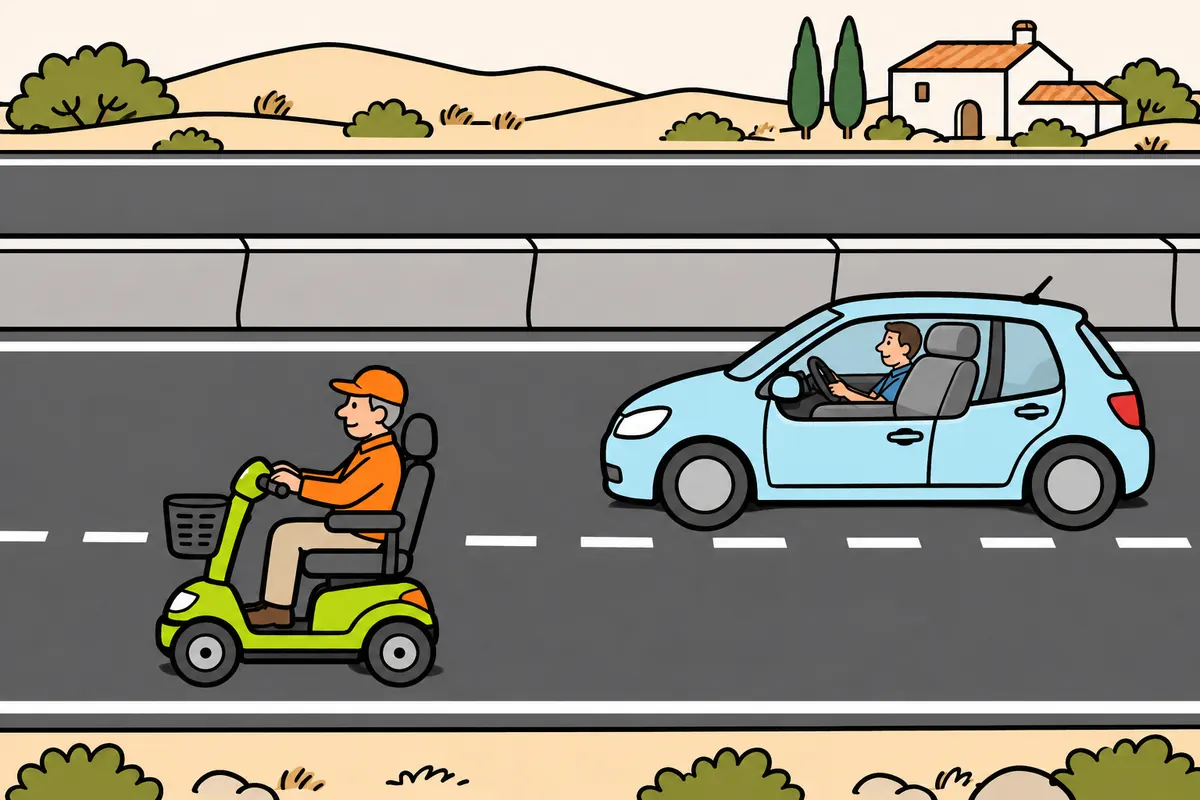
Usually overtake on the left; use the right only in permitted cases.
| Case | Side to overtake |
|---|---|
| General rule | Left. |
| Vehicle ahead clearly signals a left turn or stop | Right, with enough space and extra care. |
| Tram in the centre of a two-way road | Right, with enough space and extra care. |
| Built-up area, marked lanes in the same direction | You may pass on the right if you create no danger. |
Remember
- Always check that you can overtake safely.
- Signal each sideways movement when required.
- To pass on the right, you need enough space and extra care.
Exam trap: Wrong: several lanes allow overtaking on the right outside built-up areas. Right: this exception requires a built-up area and marked lanes in the same direction, without creating danger.
Read the full explanation
- As a general rule, you must overtake on the left. Check that the manoeuvre is permitted and that you can carry it out safely; driving a slow vehicle does not allow you to choose either side freely or enter spaces reserved for other road users. [RGC, art. 82](https://www.boe.es/buscar/act.php?id=BOE-A-2003-23514#a82).
- You must overtake on the right, if there is enough space and you take extra care, when the driver ahead clearly signals an intention to turn left or stop on that side. This also applies to trams travelling in the centre of two-way roads. [RGC, art. 82](https://www.boe.es/buscar/act.php?id=BOE-A-2003-23514#a82).
- Within built-up areas, you may overtake on the right on carriageways with at least two lanes in the same direction marked by longitudinal road markings, provided you check that you do not create a danger. [RGC, art. 82](https://www.boe.es/buscar/act.php?id=BOE-A-2003-23514#a82).
- If you overtake on the right of a vehicle signalling a left turn, check that there is enough space for your entire LCM vehicle to pass and that the vehicle ahead does not hide other road users. Follow the signalling instructions in «How to signal each movement» if you need to move sideways. [RGC, art. 82](https://www.boe.es/buscar/act.php?id=BOE-A-2003-23514#a82).
8Progress in queues and lanes
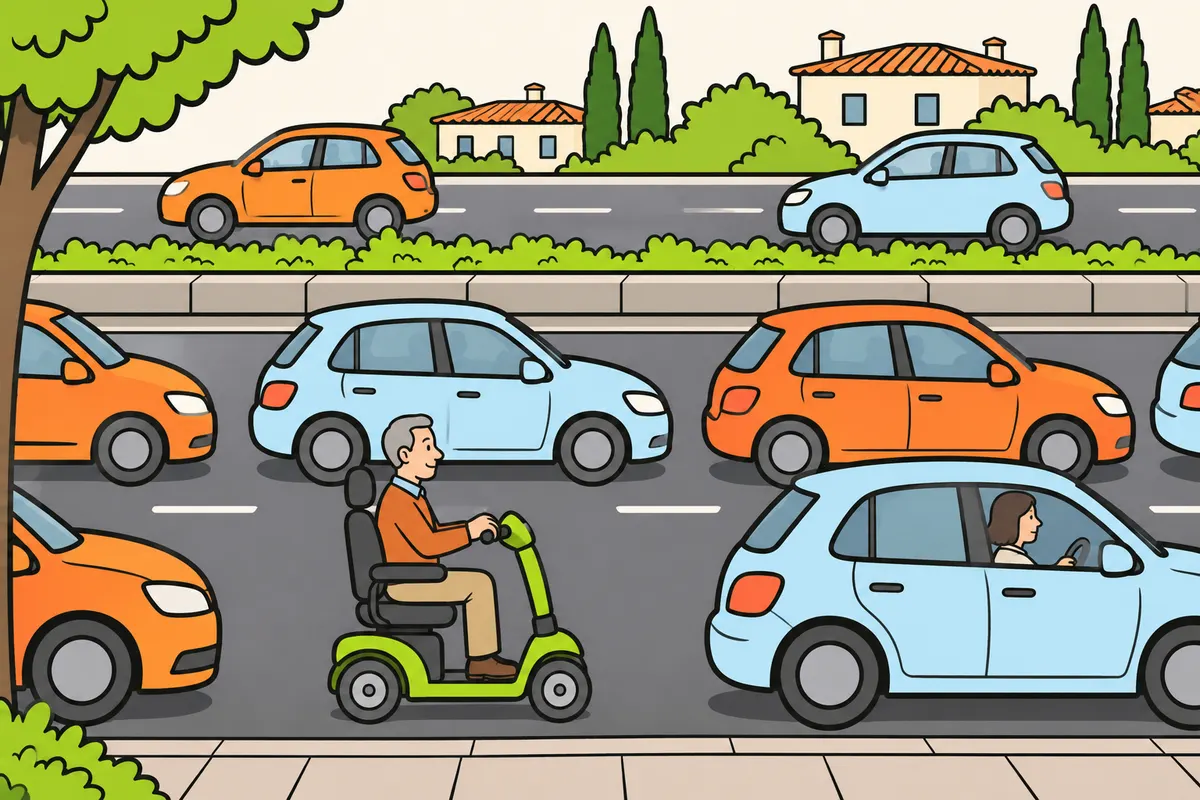
In congested traffic, one queue moving faster does not always count as overtaking.
| Situation | How to understand the movement |
|---|---|
| Congested traffic with all the stated conditions | Different progress between queues is not overtaking. |
| Normal lane beside acceleration, deceleration or reserved lane | Different progress is not overtaking; still obey lane access rules. |
Remember
- All lanes must be occupied and speed set by the vehicle ahead.
- In that situation, do not change lanes to gain places.
- Move to prepare for a turn, leave the road or choose a direction.
- Do not use reserved lanes without permission.
- Keep to the position required for your LCM.
Exam trap: Wrong: you call any passing on the right queuing traffic. Right: all lanes must be occupied and speed must depend on the vehicle ahead.
Read the full explanation
- In congested traffic, when all lanes are occupied and your speed is determined by the vehicle ahead, one queue moving faster than another is not considered overtaking. You must consider all these conditions together: having a few vehicles nearby is not enough to treat any passing on the right as progress in a traffic queue. [RGC, art. 83](https://www.boe.es/buscar/act.php?id=BOE-A-2003-23514#a83).
- In this situation, you must not change lanes to gain places. Permitted lane changes are those needed to prepare for a turn, leave the carriageway or follow a particular direction. Keeping a predictable course prevents your vehicle from appearing in gaps where other drivers do not expect it. [RGC, art. 83](https://www.boe.es/buscar/act.php?id=BOE-A-2003-23514#a83).
- Different rates of progress between ordinary lanes and acceleration lanes, deceleration lanes or lanes reserved for certain vehicles are also not considered overtaking. This rule does not give you access to a reserved lane: you must distinguish between what that difference in progress means and whether you are allowed to use the lane. [RGC, art. 83](https://www.boe.es/buscar/act.php?id=BOE-A-2003-23514#a83).
- If there are several lanes in your direction and you intend to overtake again, you may remain in the lane you are using as long as you do not unduly inconvenience anyone approaching faster from behind. You must also follow the rules on where your LCM vehicle must travel and return to the part of the road you must use. [RGC, art. 83](https://www.boe.es/buscar/act.php?id=BOE-A-2003-23514#a83).
9Carrying out and completing an overtake
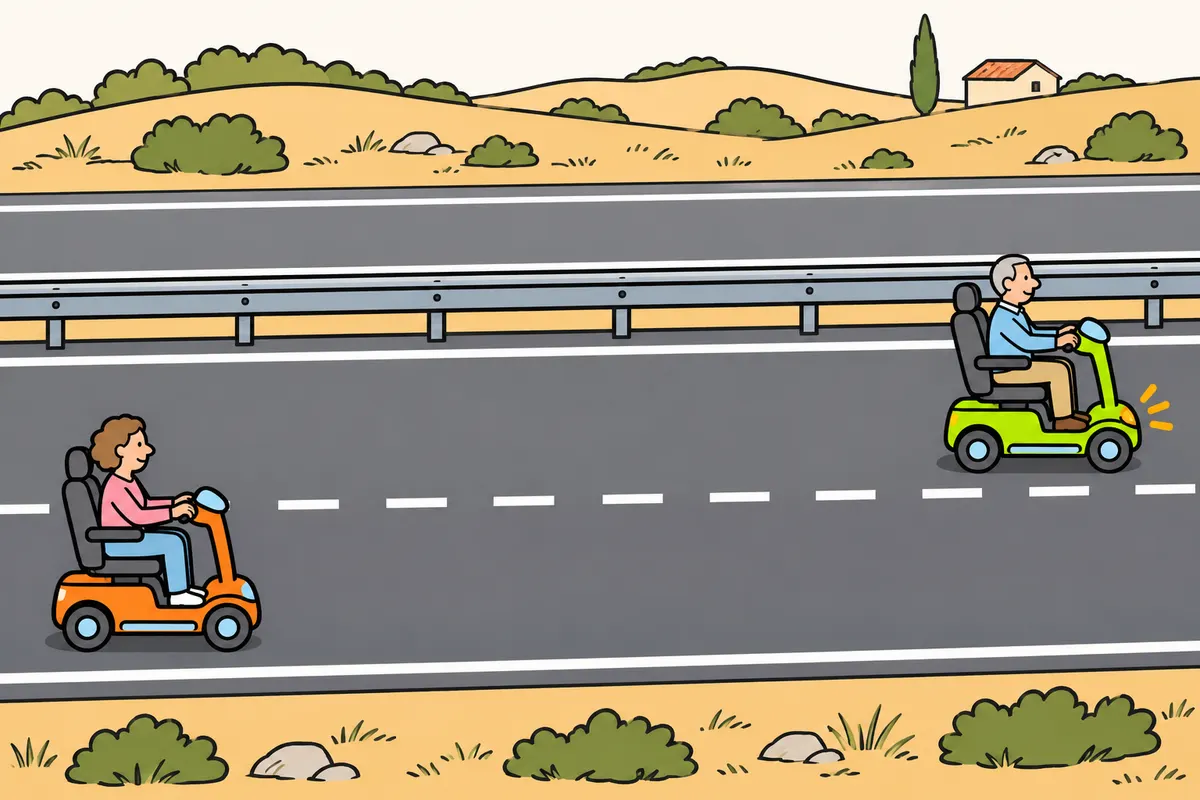
Overtake with space and return without forcing the other driver to brake or swerve.
Remember
- You need a clearly higher speed, within your limits.
- Leave enough space to the side.
- Return smoothly and signal your move.
- If finishing becomes dangerous, slow down and return with the right signals.
- You may flash your headlights briefly without dazzling, even in built-up areas.
Exam trap: Wrong: you use the horn in a built-up area just to announce an overtake. Right: you may use the horn for this outside built-up areas.
Read the full explanation
- While overtaking, you must travel at a speed clearly higher than that of the vehicle you are overtaking and keep sufficient lateral clearance. You must not exceed the speed limits that apply to you to finish sooner. If your LCM vehicle does not have a sufficient speed advantage, you must not start the manoeuvre. [RGC, art. 85](https://www.boe.es/buscar/act.php?id=BOE-A-2003-23514#a85).
- Allow enough space to move back in without forcing the driver you overtake to brake or change course. Once you have passed, move back gradually as soon as possible and signal your sideways movement. [RGC, art. 85](https://www.boe.es/buscar/act.php?id=BOE-A-2003-23514#a85).
- If circumstances arise that make completing the overtake risky, slow down and return to your lane, giving the appropriate signals. You must decide to move back while there is still enough space to regain your place without forcing the driver you are overtaking to change course. [RGC, art. 85](https://www.boe.es/buscar/act.php?id=BOE-A-2003-23514#a85).
- You may use brief headlight flashes to warn others of your intention without dazzling them, even within built-up areas. You may use the horn to announce an overtake outside built-up areas; unnecessary or excessive use is prohibited. No warning replaces observation, your indicator or the safety conditions you must meet. [RGC, art. 109](https://www.boe.es/buscar/act.php?id=BOE-A-2003-23514#a109); [RGC, art. 110](https://www.boe.es/buscar/act.php?id=BOE-A-2003-23514#a110).
10Clearance when overtaking vulnerable users
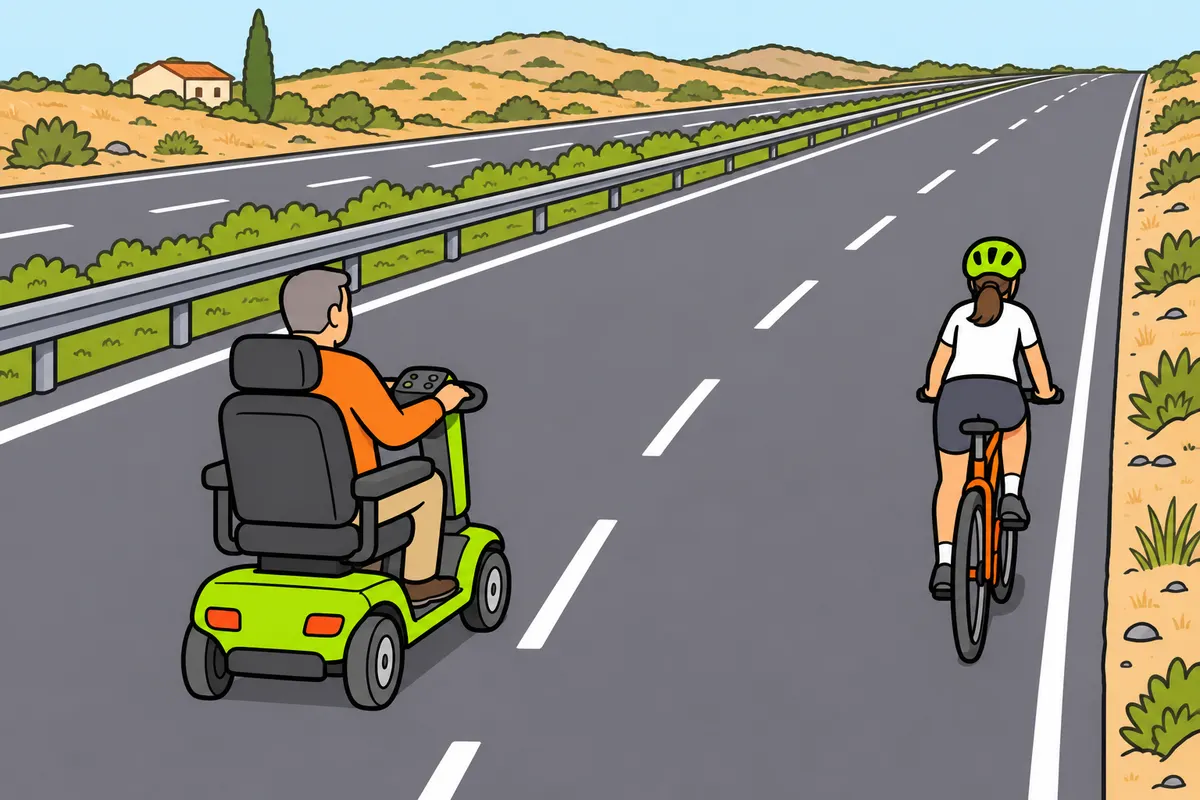
When passing vulnerable users, leave enough space and reduce speed where required.
| When your LCM overtakes these users | Space you must leave |
|---|---|
| General rule | Use part or all of the next or oncoming lane; leave at least 1.5 metres. |
| More than one lane in each direction | Change lanes completely. |
Remember
- Protect pedestrians, cyclists, animals, mopeds and personal mobility vehicles.
- Animal-drawn vehicles are included.
- Leave the minimum clearance inside and outside built-up areas.
- Do not endanger or obstruct oncoming users, including those on the hard shoulder.
- Treat a group of cyclists as one unit.
- Also obey your LCM limits on travelling alongside another vehicle.
Exam trap: Wrong: you calculate the reduction from your previous speed. Right: outside built-up areas, reduce by at least 20 km/h from the road limit, before and during the overtake; obey any lower limit that applies.
Read the full explanation
- When overtaking pedestrians, animals, animal-drawn vehicles, mopeds, personal mobility vehicles or cyclists, you must leave at least 1.5 metres of lateral clearance and use part or all of the adjacent lane or the lane for oncoming traffic. This protection applies both within and outside built-up areas. [RGC, art. 85](https://www.boe.es/buscar/act.php?id=BOE-A-2003-23514#a85).
- If the carriageway has more than one lane per direction, you must change lanes completely when overtaking these road users. You must wait if you cannot meet these conditions safely. [RGC, art. 85](https://www.boe.es/buscar/act.php?id=BOE-A-2003-23514#a85).
- Outside built-up areas, before starting these overtakes and throughout the manoeuvre, you must keep your speed at least 20 km/h below the road’s speed limit. This reduction is measured against the road’s speed limit and also requires you to comply with any lower limit that applies to you. [RGC, art. 85](https://www.boe.es/buscar/act.php?id=BOE-A-2003-23514#a85).
- You must not overtake in a way that endangers or obstructs oncoming road users, even if they are travelling on the arcén (hard shoulder). You must treat a group of cyclists as a single moving unit and allow enough space to pass the whole group, while also respecting the limit on travelling alongside other vehicles that applies to your vehicle. [RGC, art. 85](https://www.boe.es/buscar/act.php?id=BOE-A-2003-23514#a85).
11When another vehicle overtakes you
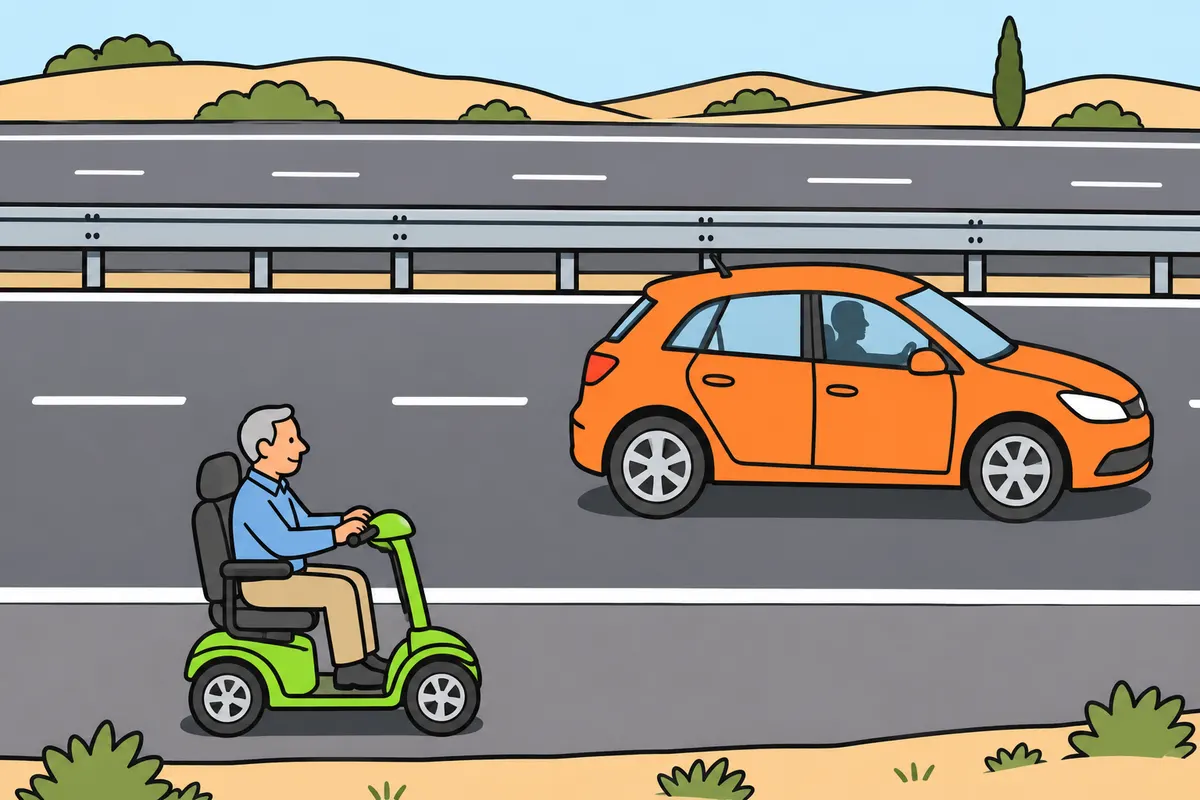
When someone overtakes you, help them pass without speeding up or creating danger.
| What the other driver does | What you must do |
|---|---|
| Continues and danger arises | Slow down to help resolve it. |
| Clearly abandons and brakes to return behind | Help them return; do not brake in a way that makes it less safe. |
Remember
- Move close to the right edge safely.
- With your LCM, keep using the hard shoulder where required.
- Do not speed up or move in a way that hinders the overtake.
- If safe passing is difficult, slow down or use a usable hard shoulder soon.
Exam trap: Wrong: you always brake when danger appears. Right: if the driver brakes to return behind you, help them without making it less safe.
Read the full explanation
- If you notice that the driver behind wants to overtake you, you must keep close to the right-hand edge. In your LCM vehicle, you must also continue to use the hard shoulder where required: the general rule for a vehicle being overtaken does not remove that obligation. Do not approach a dangerous edge or make sudden movements to make room. [RGC, art. 86](https://www.boe.es/buscar/act.php?id=BOE-A-2003-23514#a86).
- You must not increase your speed or carry out manoeuvres that prevent or hinder overtaking. Keep a predictable course. If you have signalled a left turn or a stop on the left and someone passes you on the right, you must keep as far to the left as possible without obstructing oncoming road users. [RGC, art. 86](https://www.boe.es/buscar/act.php?id=BOE-A-2003-23514#a86).
- If danger arises once the overtake has begun, you must reduce your speed to help resolve it. However, if the overtaking driver clearly abandons the manoeuvre and brakes to move back behind you, you must not brake in a way that makes the situation less safe: you must help them move back in according to their actual movement. [RGC, art. 86](https://www.boe.es/buscar/act.php?id=BOE-A-2003-23514#a86).
- If your speed restrictions and the road conditions make it difficult for others to overtake you safely, you must slow down or move onto a usable hard shoulder as soon as possible. In the circumstances specified by the regulations, where you cannot move fully to the side but it is safe to pass, you may indicate this with your right indicator or the prescribed arm signal; this indication does not relieve the overtaking driver of the duty to check. [RGC, art. 86](https://www.boe.es/buscar/act.php?id=BOE-A-2003-23514#a86).
12Overtaking prohibitions due to visibility and space
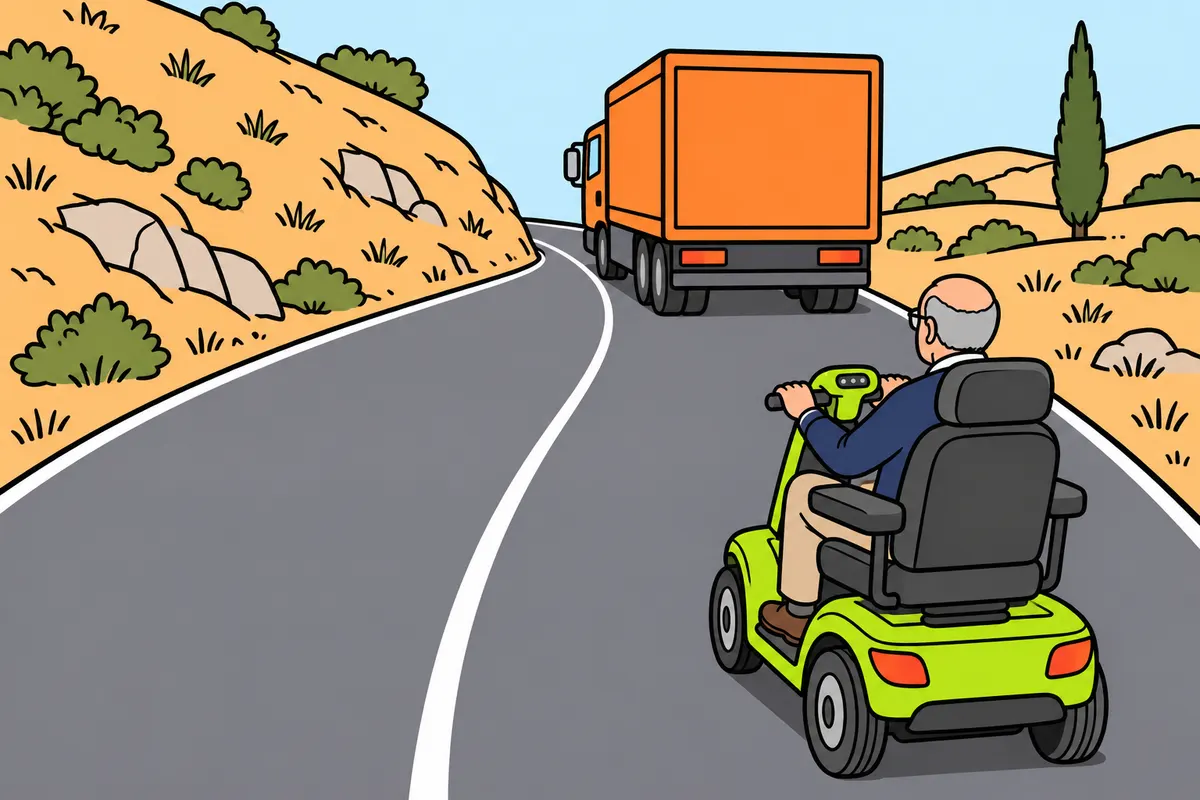
Do not overtake if you lack the visibility or space to return safely.
Remember
- Do not follow an overtaking vehicle if it blocks your view.
- Do not pass a vehicle overtaking if you would enter the oncoming side.
- Before passing several vehicles, make sure you can return without harming them.
- Do not use the centre lane if oncoming traffic is overtaking.
Exam trap: Wrong: a central line lets you overtake without visibility. Right: the exception requires clearly separated directions and no entry into space for oncoming traffic.
Read the full explanation
- You must not overtake on bends or at crests with limited visibility, or anywhere you cannot see far enough to complete or abandon the manoeuvre safely. Fog, dazzle or a large vehicle may prevent this even if the section appears straight and there is no specific sign. [RGC, art. 87](https://www.boe.es/buscar/act.php?id=BOE-A-2003-23514#a87).
- The exception for separated directions of travel requires them to be clearly marked out and allows the manoeuvre only if you can complete it without entering the space reserved for oncoming traffic. [RGC, art. 87](https://www.boe.es/buscar/act.php?id=BOE-A-2003-23514#a87).
- You must not continue overtaking behind a vehicle that blocks your view of the road ahead. You must also not overtake a vehicle that is itself overtaking if doing so requires you to enter the opposite direction of travel. You must assess your own visibility and space without relying on someone else’s decision. [RGC, art. 84](https://www.boe.es/buscar/act.php?id=BOE-A-2003-23514#a84).
- You must not overtake several vehicles in succession unless you are sure you can return to the right when oncoming traffic appears without adversely affecting the vehicles you overtake. With an LCM vehicle, a line of vehicles can quickly use up your speed advantage and the permitted time and distance for travelling alongside other vehicles. [RGC, art. 84](https://www.boe.es/buscar/act.php?id=BOE-A-2003-23514#a84).
- On a two-way carriageway with three lanes separated by broken lines, you may overtake only when the centre lane is not occupied by an oncoming vehicle that is overtaking. You must check that you can use it and return safely; you must never compete for that space with someone already occupying it. [RGC, art. 84](https://www.boe.es/buscar/act.php?id=BOE-A-2003-23514#a84).
13Overtaking at crossings, junctions and tunnels
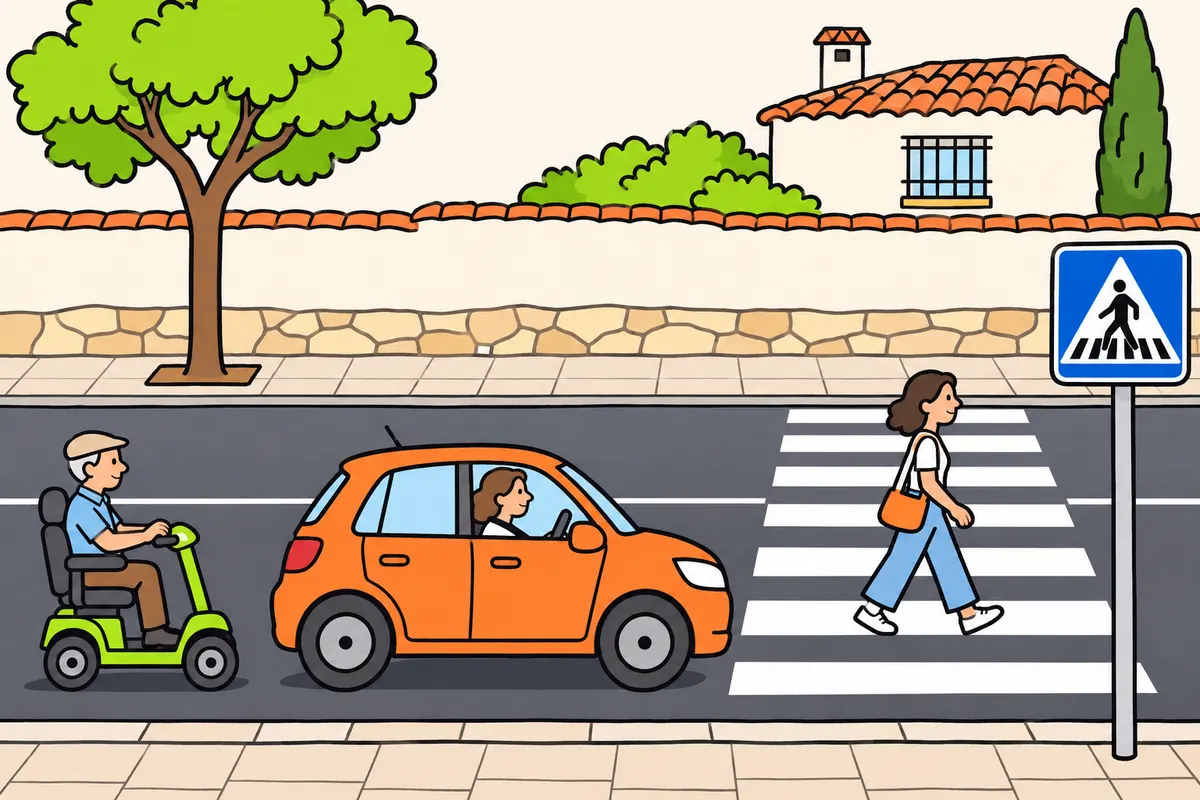
Check the restrictions at each place before you overtake.
| Place | What to check |
|---|---|
| Marked pedestrian or cycle crossing, level crossing and nearby | Do not overtake. |
| Other junctions and nearby | Exceptions apply only in stated cases and when safe. |
| Exceptions at other junctions | Roundabout, compulsory pass on the right, clear priority or two-wheeled vehicle. |
| Tunnel, underpass or signed tunnel section | Do not overtake if there is one lane for your direction. |
| Tunnel with several lanes for your direction | Obey signs and safety rules; do not enter oncoming traffic. |
Remember
- Obey the signs and road markings.
- An exception does not remove other prohibitions.
- An LCM licence does not let you ignore signs.
Exam trap: Wrong: you may overtake slowly at a marked pedestrian crossing. Right: you may not overtake there or nearby, even when passing a two-wheeled vehicle.
Read the full explanation
- You must not overtake at marked pedestrian crossings, at junctions with cycle routes or at level crossings, or on their approaches. The prohibition includes the approaches, where a vehicle may hide someone about to cross. [RGC, art. 87](https://www.boe.es/buscar/act.php?id=BOE-A-2003-23514#a87).
- At other junctions and on their approaches, there are exceptions to the prohibition: roundabouts, overtaking that must take place on the right, carriageways with explicitly signed priority and overtaking two-wheeled vehicles. For each exception, you must maintain safe conditions, and any other applicable prohibitions still apply. [RGC, art. 87](https://www.boe.es/buscar/act.php?id=BOE-A-2003-23514#a87).
- In tunnels, underpasses and sections covered by the tunnel sign, you must not overtake when there is only one lane in your direction. If there are more lanes, you must check the signs and all other conditions; having another lane does not allow you to enter the opposite direction of travel. [RGC, art. 87](https://www.boe.es/buscar/act.php?id=BOE-A-2003-23514#a87).
- You must also check for prohibitions imposed by the applicable signs and road markings. You must not ignore a marking or sign restricting the manoeuvre because you drive a vehicle for people with reduced mobility; any legal exception must apply to the specific situation you face. [RGC, art. 132](https://www.boe.es/buscar/act.php?id=BOE-A-2003-23514#a132).
14Passing obstacles and stationary vehicles
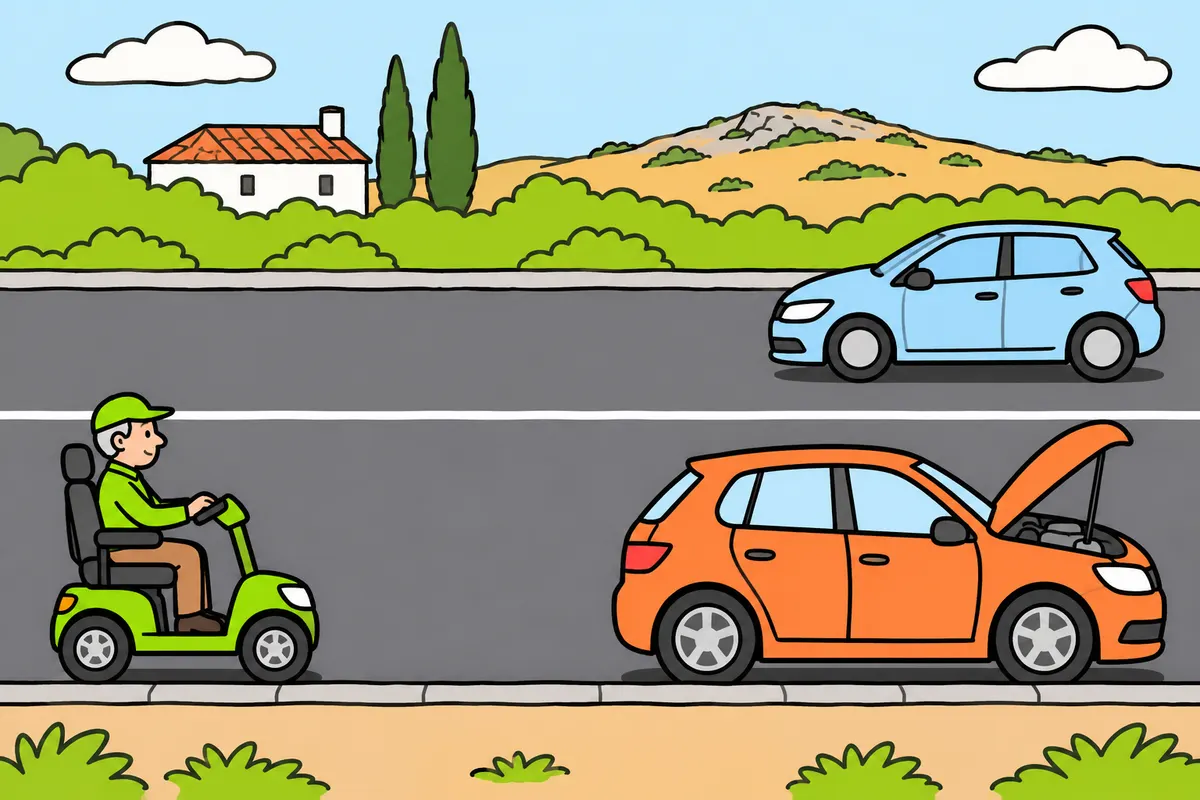
You may pass certain obstacles only after checking that it is safe.
| Situation | What you may do |
|---|---|
| Vehicle stopped for a reason unrelated to traffic, blocking your lane | You may pass without danger, even where overtaking is prohibited. |
| Breakdown, crash, emergency, help, maintenance or traffic control in your lane | Leave at least 1.5 metres and reduce by at least 20 km/h from the limit. |
| Obstacle requiring entry into the oncoming side | Pass only after checking that it is safe. |
Remember
- A queue stopped by traffic is not a breakdown.
- Wait if you cannot leave the required space and reduce speed as required.
- The exception for certain slow users does not include every slow vehicle.
- Do not force oncoming traffic to stop.
Exam trap: Wrong: you enter the oncoming side to pass a queue stopped by traffic. Right: the exception requires a stop unrelated to traffic needs and no danger.
Read the full explanation
- If you find a stationary vehicle occupying your lane where overtaking is prohibited, you may pass it, even by entering the opposite direction of travel, after checking that there is no danger, provided it is not stationary because of traffic conditions. A queue waiting at traffic lights is stationary because of traffic conditions and does not qualify for this exception. [RGC, art. 88](https://www.boe.es/buscar/act.php?id=BOE-A-2003-23514#a88).
- When you pass a vehicle stopped in your lane because of a breakdown, an accident, an emergency, assistance, maintenance or traffic control, you must leave at least 1.5 metres of lateral clearance, using the opposite lane if needed, and reduce your speed to at least 20 km/h below the road's speed limit. If you cannot do so safely, wait. [RGC, art. 88](https://www.boe.es/buscar/act.php?id=BOE-A-2003-23514#a88).
- Under the exceptional conditions of article 88, you may also overtake cycles, mopeds, VMP (personal mobility vehicles), pedestrians, animals, animal-drawn vehicles, and special agricultural vehicles and their combinations when their speed allows you to do so without risk. You must check that the exception applies to the situation; it does not authorise you to overtake any slow vehicle. [RGC, art. 88](https://www.boe.es/buscar/act.php?id=BOE-A-2003-23514#a88).
- If an obstacle forces you to enter the opposite direction of travel, you must only pass it after making sure you can do so without danger. You must take the same precaution on sections where overtaking is permitted: you must wait if there is a conflict, rather than relying on oncoming traffic to stop. [RGC, art. 89](https://www.boe.es/buscar/act.php?id=BOE-A-2003-23514#a89).
15Preparing to turn
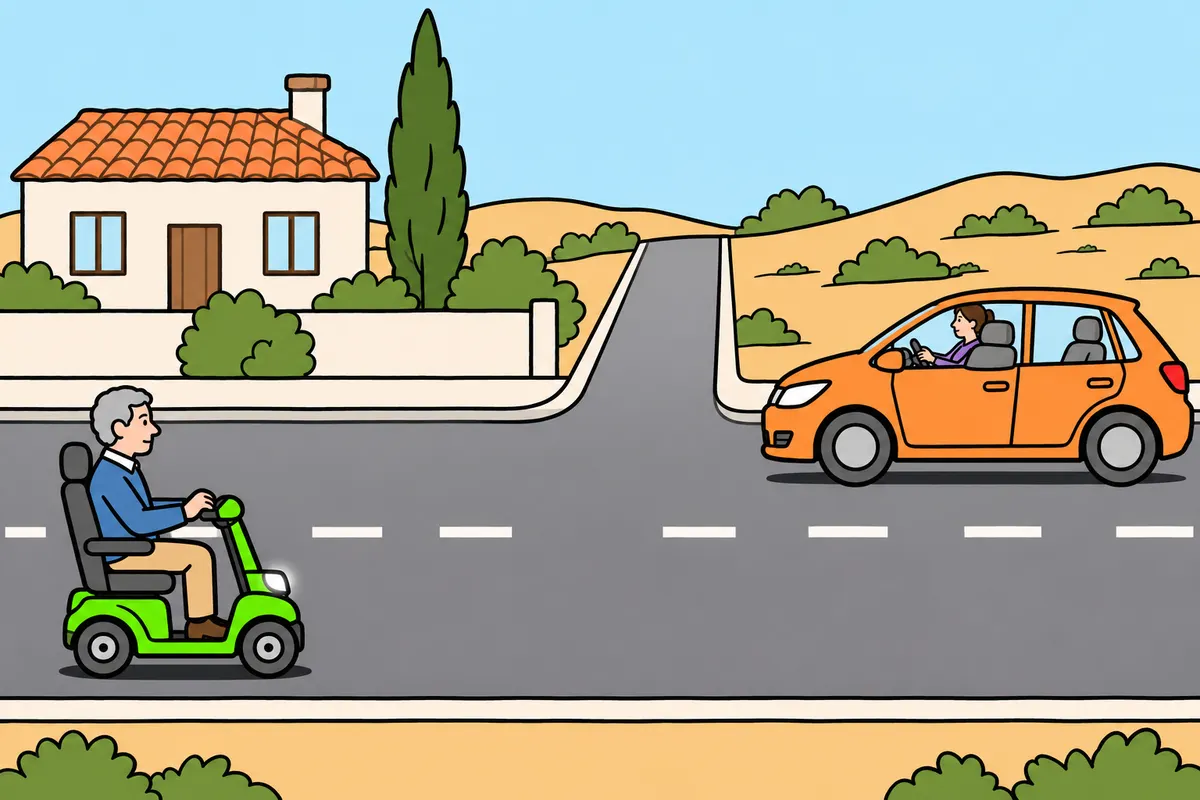
Prepare your turn in good time and give way to those with priority.
Remember
- Signal before turning and check ahead and behind.
- Do not turn left if you cannot see well enough.
- Move into position in good time and follow road signs.
- Enter the deceleration lane early if you may use that road.
- Give way to pedestrians crossing the road you enter, even without a crossing.
- Give way to nearby cyclists if you will cross their path.
Exam trap: Wrong: your indicator lets you cut across others when turning. Right: give way to pedestrians and cyclists in the stated cases.
Read the full explanation
- To turn onto another road, enter another carriageway or leave the one you are using, you must signal in advance and check that you can do so without danger. Assess the traffic behind you and the speed and distance of oncoming traffic. If it is not safe, you must not proceed. [RGC, art. 74](https://www.boe.es/buscar/act.php?id=BOE-A-2003-23514#a74).
- If you want to turn left and do not have sufficient visibility, you must not start the manoeuvre. You may need a generous margin in your LCM vehicle to clear the path you cross. [RGC, art. 74](https://www.boe.es/buscar/act.php?id=BOE-A-2003-23514#a74).
- You must move into the appropriate position in advance and carry out the manoeuvre using as little space and time as safety allows. [RGC, art. 75](https://www.boe.es/buscar/act.php?id=BOE-A-2003-23514#a75).
- If the road layout or signs require you to turn in a particular way, you must follow them. Where there is a deceleration lane on a road your vehicle is allowed to use, approach in good time in the lane nearest the exit and enter the deceleration lane as soon as possible. [RGC, art. 77](https://www.boe.es/buscar/act.php?id=BOE-A-2003-23514#a77).
- When you turn onto another road, you must give way to pedestrians crossing it, even if there is no marked crossing. If you turn and cross the paths of nearby cyclists, you must respect their priority. [RGC, art. 64](https://www.boe.es/buscar/act.php?id=BOE-A-2003-23514#a64); [RGC, art. 65](https://www.boe.es/buscar/act.php?id=BOE-A-2003-23514#a65).
16Where to position yourself for a turn
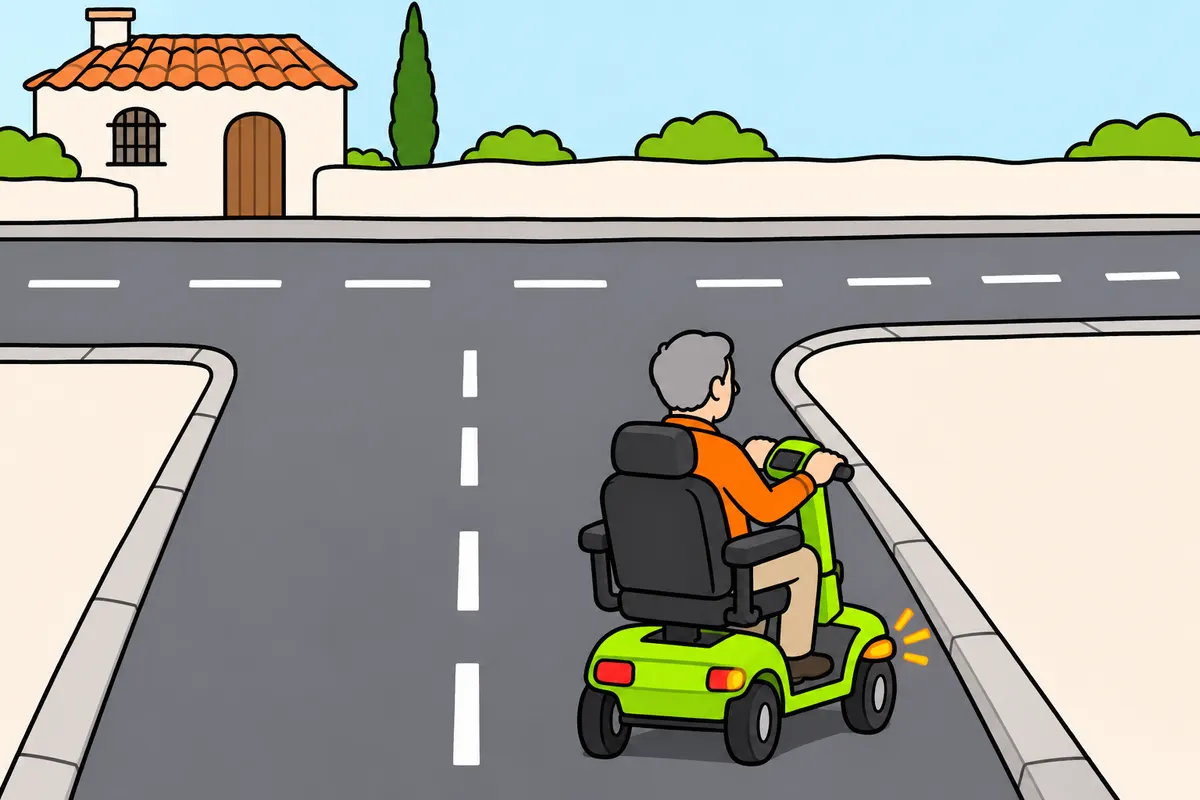
For your turn, position yourself according to its direction and the road layout.
| Turn with your LCM and road type | Usual position |
|---|---|
| Right | Close to the right edge. |
| Left on a one-way road | Close to the left edge. |
| Left on a two-way road | Near the centre line, without entering the oncoming side. |
| Left on a two-way road with three lanes and broken lines | In the centre lane. |
Remember
- Use a different position if the road requires it.
- Before turning right, check that nobody is on your right.
- Keep the junction centre on your left unless signs or layout say otherwise.
- If a valid reason prevents the usual position, take extra care.
Exam trap: Wrong: with your LCM, you always turn left from the right outside built-up areas. Right: the special rule without a prepared lane applies to two-wheeled cycles and mopeds.
Read the full explanation
- To turn right, you must keep as close as possible to the right-hand edge of the carriageway, unless the road layout or signs require otherwise. Check that there is no road user on your right as you start the turn, and do not swing unnecessarily to the left before turning. [RGC, art. 75](https://www.boe.es/buscar/act.php?id=BOE-A-2003-23514#a75).
- To turn left on a one-way carriageway, you must move close to the left-hand edge. On a two-way carriageway, you move close to the dividing line between directions or the centre line, without entering the oncoming side. [RGC, art. 75](https://www.boe.es/buscar/act.php?id=BOE-A-2003-23514#a75).
- On a two-way carriageway with three lanes separated by broken lines, you must use the centre lane to turn left. As you turn, you must keep the centre of the junction on your left, unless the layout or signs require you to keep it on your right. [RGC, art. 75](https://www.boe.es/buscar/act.php?id=BOE-A-2003-23514#a75).
- The special rule for turning left from the right-hand side outside built-up areas, where there is no designated lane, applies to cycles and two-wheeled mopeds. You must not automatically apply it to your LCM vehicle because you normally drive on the arcén (hard shoulder): you must position yourself for a turn according to the rules for your vehicle category. [RGC, art. 76](https://www.boe.es/buscar/act.php?id=BOE-A-2003-23514#a76).
- If your vehicle's dimensions or other justified circumstances prevent you from strictly following the normal positioning rules, you must take extra precautions to avoid any danger. [RGC, art. 76](https://www.boe.es/buscar/act.php?id=BOE-A-2003-23514#a76).
17Turning round safely
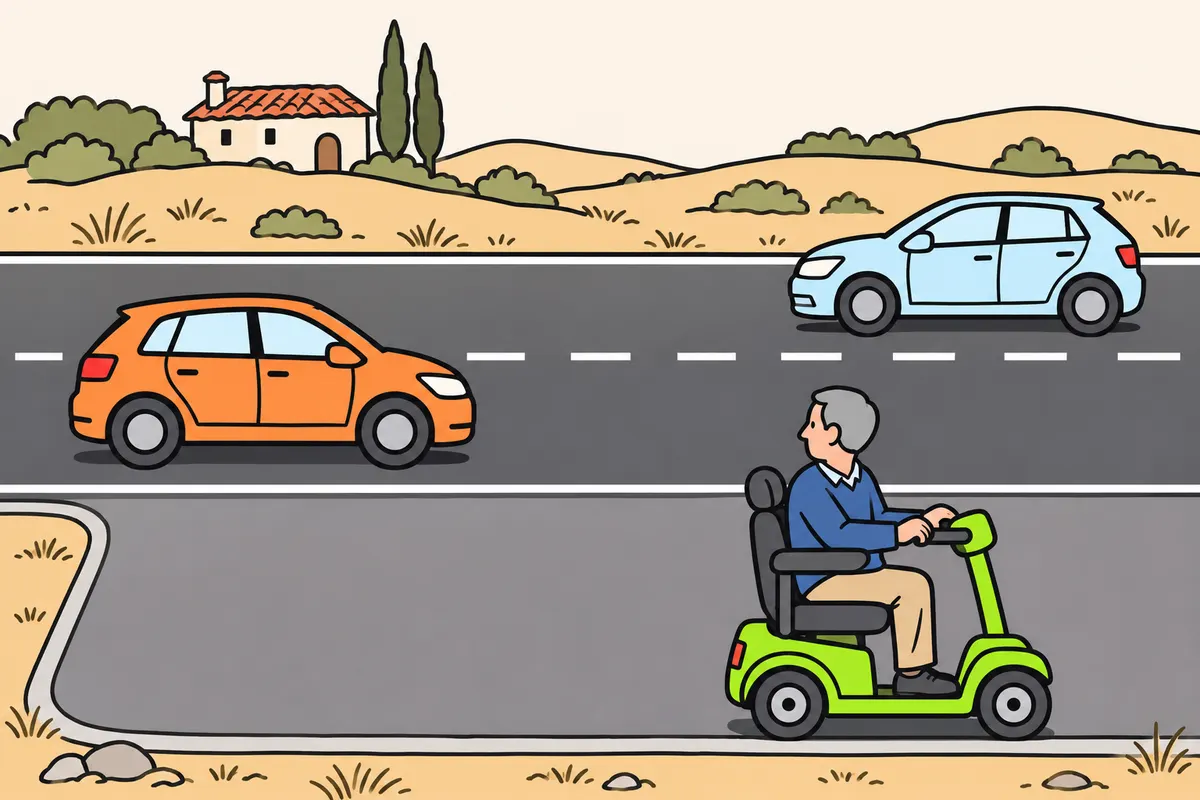
Turn round only where you can do so safely and without obstructing others.
| Place or situation | What you must do |
|---|---|
| You cannot check that it is safe | Do not turn round. |
| Level crossing, tunnel, underpass or signed tunnel section | Do not turn round. |
| Section where overtaking is prohibited | Do not turn round unless expressly allowed. |
Remember
- Choose a suitable place and signal in good time.
- Occupy the road for as little time as possible.
- If waiting blocks traffic behind, move right if you can.
- Wait there for a safe opportunity.
- Do not confuse turning left with turning to travel in the opposite direction.
Exam trap: Wrong: you may turn round where overtaking is prohibited. Right: you need express permission to turn round; other prohibitions still apply.
Read the full explanation
- Turning round means reversing your direction of travel to drive the opposite way along the road. You must choose a suitable place, signal in advance and check that you will not endanger or obstruct others. If you need to wait, you must not start by moving across the carriageway. [RGC, art. 78](https://www.boe.es/buscar/act.php?id=BOE-A-2003-23514#a78).
- You must block the road for as little time as possible. If waiting on the carriageway prevents traffic behind you from continuing, pull off to the right where possible and wait there for a safe opportunity. [RGC, art. 78](https://www.boe.es/buscar/act.php?id=BOE-A-2003-23514#a78).
- You must not turn round when you cannot check that the necessary conditions are met, at level crossings, in tunnels or underpasses, or on sections signed as tunnels. You must also not turn round on sections where overtaking is prohibited, unless turning round is expressly authorised. [RGC, art. 79](https://www.boe.es/buscar/act.php?id=BOE-A-2003-23514#a79).
- You must not confuse turning left with turning round. You must also not routinely use reversing to complete a poorly chosen turn in the road: reversing is permitted only in specific circumstances, which you must check separately. [RGC, art. 80](https://www.boe.es/buscar/act.php?id=BOE-A-2003-23514#a80).
18When reversing is permitted
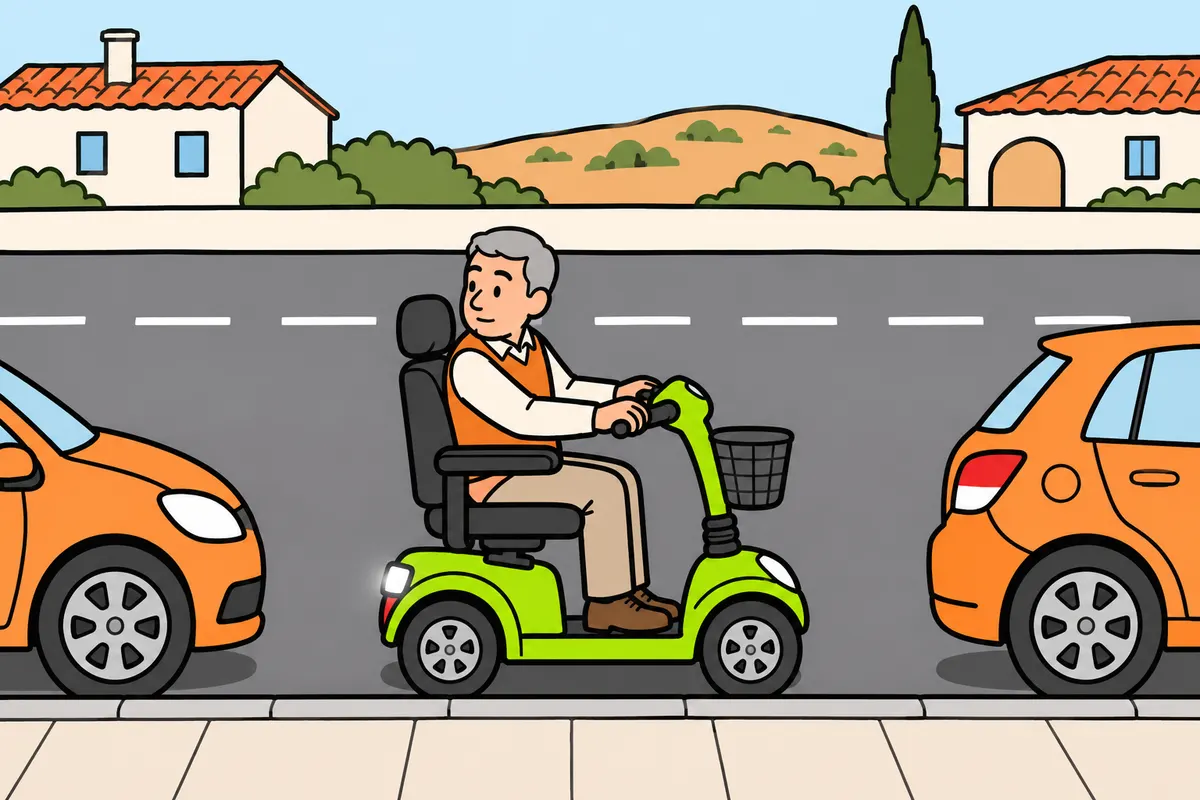
Reverse only in permitted cases and travel the shortest distance needed.
| Reason for reversing | Limit to obey |
|---|---|
| You cannot move forward or turn | Travel only as far as necessary. |
| Needed to complete a stop, parking or joining traffic | Travel only as far as necessary, no more than 15 metres, and do not enter a junction. |
Remember
- Do not reverse to recover a missed exit if you can continue forward.
- Reversing is prohibited on motorways and dual carriageway motorways.
- Your LCM cannot use those roads either.
Exam trap: Wrong: you may reverse into a junction when parking if you travel less than 15 metres. Right: when reversing to stop, park or join traffic, do not exceed 15 metres or enter a junction.
Read the full explanation
- As a general rule, you must not reverse. You may do so if you cannot move forwards, turn or turn round, and as a supplementary manoeuvre to another manoeuvre that requires it. In every case, you must limit the distance to the absolute minimum necessary. [RGC, art. 80](https://www.boe.es/buscar/act.php?id=BOE-A-2003-23514#a80).
- When reversing as part of a brief stop, parking or joining traffic, you must not reverse more than 15 metres or enter a road junction. [RGC, art. 80](https://www.boe.es/buscar/act.php?id=BOE-A-2003-23514#a80).
- If you cannot move forwards, turn or turn round, reversing falls under the exceptional circumstances in the first point. For example, on a dead-end road you must assess the space available to turn round and apply the precautions in «How to reverse your vehicle». [RGC, art. 80](https://www.boe.es/buscar/act.php?id=BOE-A-2003-23514#a80).
- You must not reverse to return to an exit you have passed if you can continue forwards. Reversing is prohibited on autopistas (motorways) and autovías (dual carriageway motorways), and you are also not allowed to drive your LCM vehicle on them. Choose a legal route to correct your course. [RGC, art. 80](https://www.boe.es/buscar/act.php?id=BOE-A-2003-23514#a80).
19How to reverse your vehicle
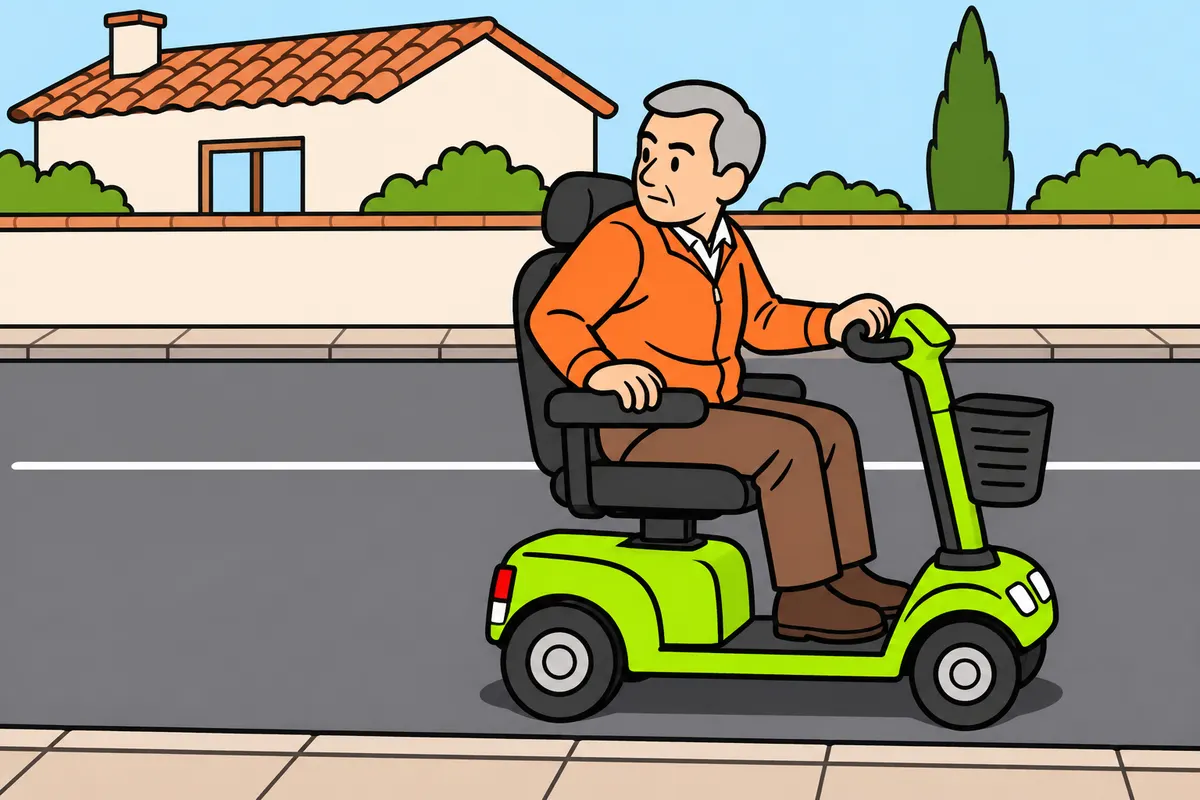
Before reversing, check the space, signal and move slowly.
Remember
- Look behind and to the sides.
- Check from outside or ask for help if needed.
- Signal with the reversing light or the prescribed arm signal.
- Control your adapted controls and avoid sudden acceleration.
- When turning, also watch the front ends of your vehicle.
- Stop quickly if warned or if people, animals, vehicles or danger appear.
Exam trap: Wrong: the reversing light confirms you can move. Right: check and watch the space throughout the manoeuvre.
Read the full explanation
- Before you start reversing, check the whole area behind you and to either side. You must make sure that visibility, space and time allow you to reverse safely; if necessary, check from outside or ask another person to guide you. [RGC, art. 81](https://www.boe.es/buscar/act.php?id=BOE-A-2003-23514#a81).
- How to warn others that you are reversing is explained in «How to signal each movement». Before reversing into a space, also check that whoever is waiting behind you leaves enough room for you to start moving safely. [RGC, art. 81](https://www.boe.es/buscar/act.php?id=BOE-A-2003-23514#a81).
- Reverse slowly and with the utmost care, keeping control of the steering and adapted controls. As practical advice, avoid sudden acceleration and check the front corners when you turn: they can swing sideways even while you are looking mainly behind you. [RGC, art. 81](https://www.boe.es/buscar/act.php?id=BOE-A-2003-23514#a81).
- You must stop promptly if you hear warnings, notice a vehicle, person or animal nearby, or safety requires it. Abandon the manoeuvre if necessary. Knowing the car park or having a visual aid does not replace watching your actual surroundings throughout the manoeuvre. [RGC, art. 81](https://www.boe.es/buscar/act.php?id=BOE-A-2003-23514#a81).
20Compulsory stops, brief stops and parking
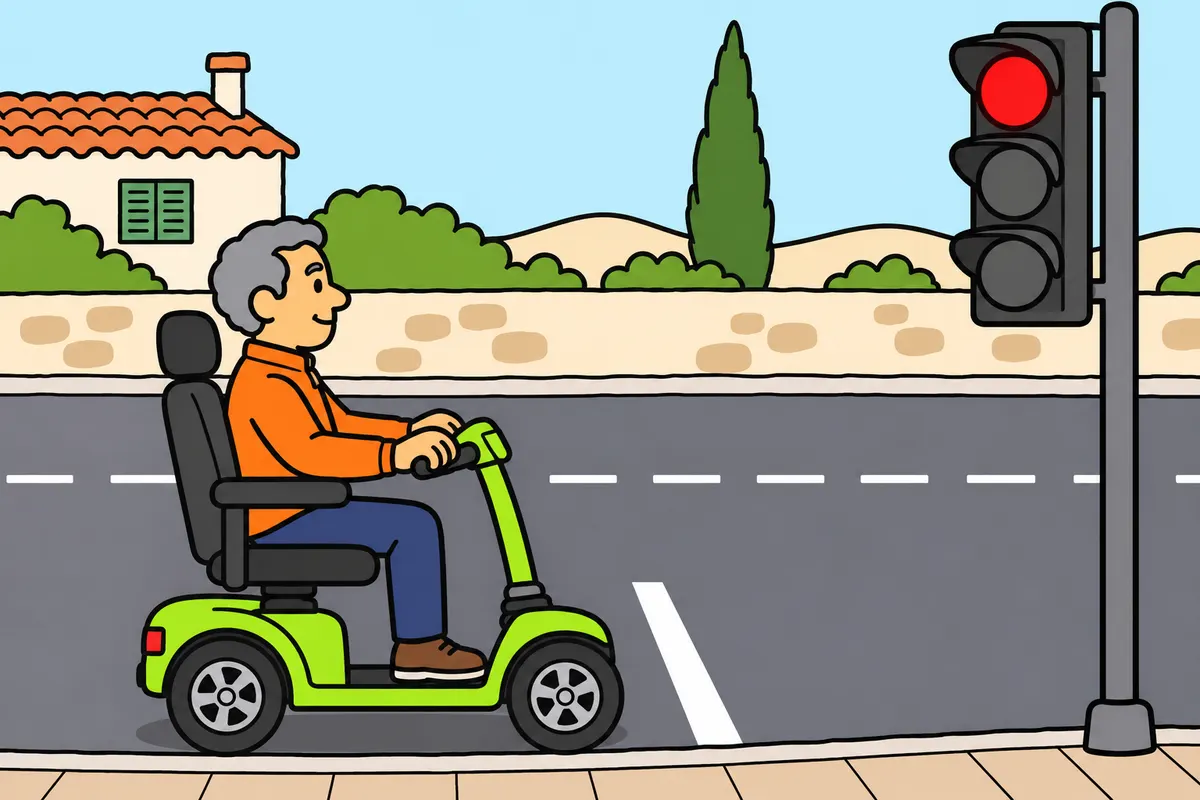
Distinguish compulsory stops, brief stops and parking by their cause and conditions.
| Type of stopping | How to recognise it |
|---|---|
| Compulsory stop | You stop because of an emergency, traffic or a rule. |
| Brief stop | You stop for less than two minutes and do not leave the vehicle. |
| Parking | The vehicle is stopped but it is neither a compulsory nor brief stop. |
Remember
- At traffic lights or in a queue, you make a compulsory stop.
- For a brief stop, you must not leave the vehicle.
- If you get out to enter a shop, it is not a brief stop.
- Choose a permitted, safe place for a voluntary stop or parking.
Exam trap: Wrong: staying inside for two minutes is still a brief stop. Right: a brief stop lasts less than two minutes and you must not leave the vehicle.
Read the full explanation
- You make a compulsory stop in response to an emergency, traffic conditions or a legal requirement; waiting at traffic lights or in a traffic queue is a compulsory stop, even if you remain stationary for quite some time. [Traffic Act, Annex I, 80-82](https://www.boe.es/buscar/act.php?id=BOE-A-2015-11722#ani).
- You make a brief stop when you remain stationary for less than two minutes without leaving the vehicle. Both conditions must be met. If you leave it to enter a shop or other premises, you cannot justify this as a brief stop simply because you expect to take less than that time. [Traffic Act, Annex I, 81](https://www.boe.es/buscar/act.php?id=BOE-A-2015-11722#ani).
- You park whenever remaining stationary does not qualify as a compulsory stop or a brief stop. Staying inside the vehicle, keeping the engine running or switching on the hazard warning lights does not in itself turn parking into a brief stop. Exactly two minutes is not less than two minutes. [Traffic Act, Annex I, 81-82](https://www.boe.es/buscar/act.php?id=BOE-A-2015-11722#ani).
- For a voluntary brief stop or parking, choose a permitted, safe place. How to signal the manoeuvre is explained in «How to signal each movement». [RGC, art. 94](https://www.boe.es/buscar/act.php?id=BOE-A-2003-23514#a94).
21Choosing a place and positioning your vehicle
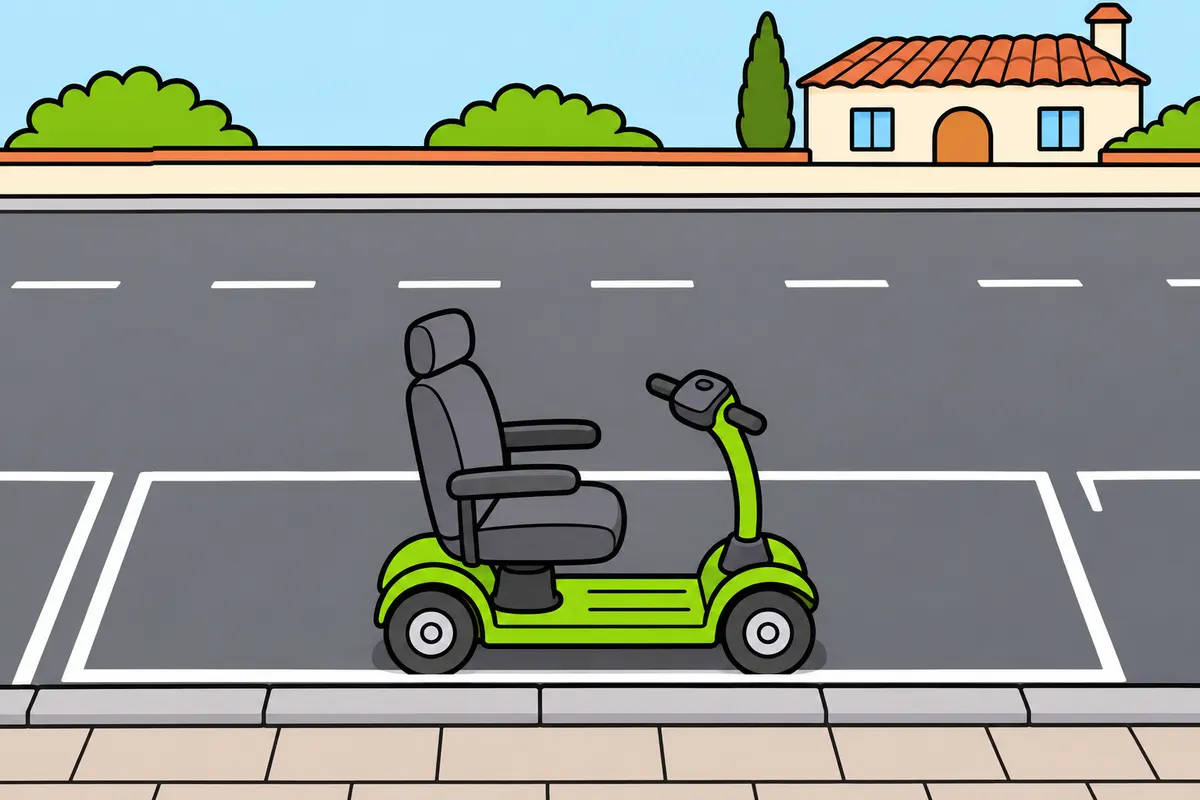
To stop or park, choose a permitted place and position your vehicle correctly.
| Type of road | Where to stop or park |
|---|---|
| Outside built-up areas | Off the carriageway on the right; keep the usable hard shoulder clear. |
| Built-up area, on carriageway or hard shoulder | As close as possible to the right edge. |
| One-way street in a built-up area | You may also stop or park close to the left edge. |
Remember
- Obey signs and local rules.
- Usually, park parallel to the edge.
- Use the space without taking up several bays.
- Leave room to get out and use your supports or adaptations.
- Do not create danger or obstruct traffic.
Exam trap: Wrong: you park on the usable hard shoulder on a road outside a built-up area. Right: park off the carriageway on the right and keep that hard shoulder clear.
Read the full explanation
- On interurban roads, you must stop or park off the carriageway, on its right-hand side, leaving the usable part of the arcén (hard shoulder) clear. [RGC, art. 90](https://www.boe.es/buscar/act.php?id=BOE-A-2003-23514#a90).
- On urban roads, if you have to stop or park on the carriageway or hard shoulder, position yourself as close as possible to the right-hand edge. On one-way roads, you may also do so on the left. You must obey the signs and municipal stopping and parking regulations. [RGC, art. 90](https://www.boe.es/buscar/act.php?id=BOE-A-2003-23514#a90); [RGC, art. 156](https://www.boe.es/buscar/act.php?id=BOE-A-2003-23514#a1-9).
- As a general rule, you must position your vehicle parallel to the edge of the carriageway; another position is permitted when the characteristics of the road or other circumstances make it advisable. Make proper use of the available space, without taking up several spaces or making it difficult to use adjacent ones. [RGC, art. 92](https://www.boe.es/buscar/act.php?id=BOE-A-2003-23514#a92).
- Before choosing a space, assess how much room you need to get out and use your support aids or adaptations safely. You must position your LCM vehicle without creating danger or obstructing traffic. [RGC, art. 91](https://www.boe.es/buscar/act.php?id=BOE-A-2003-23514#a91).
22Places where you must not stop
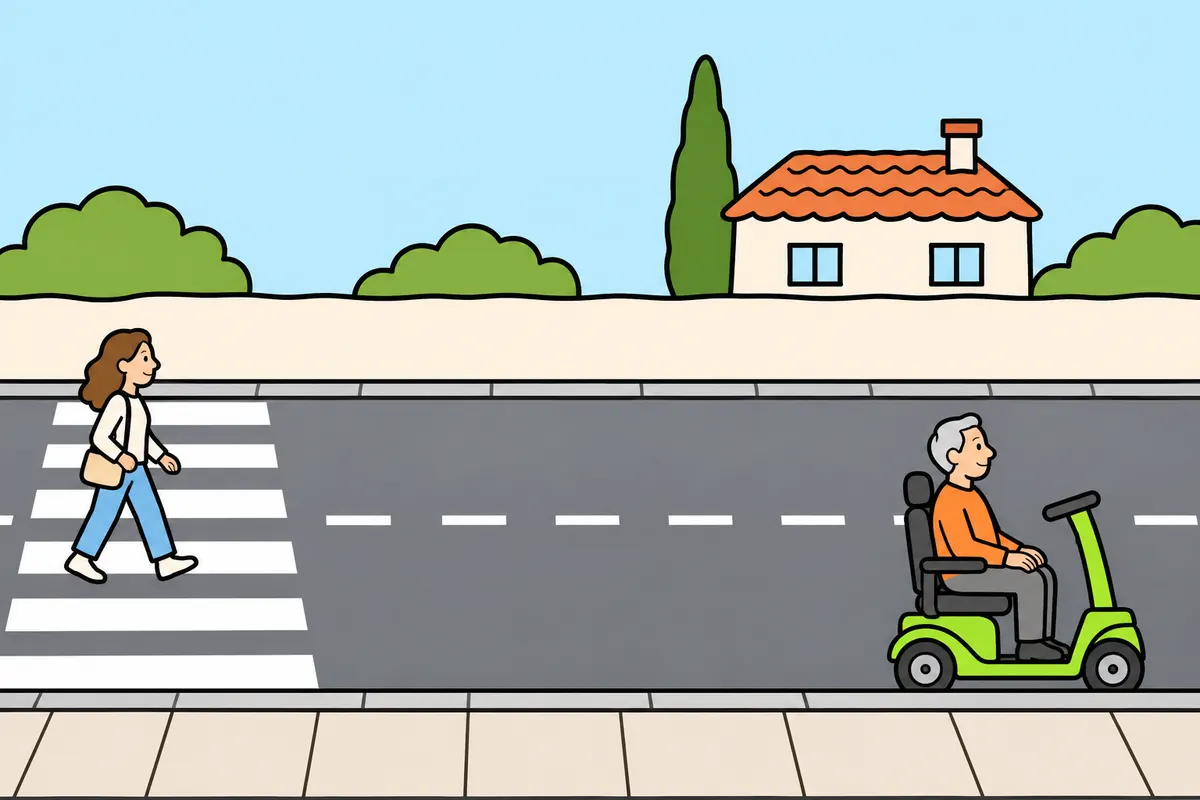
Do not stop where you block visibility, reserved spaces or create danger.
| Rule about junctions and nearby areas | Prohibition to remember |
|---|---|
| Traffic law | Do not stop at junctions or nearby. |
| Circulation regulations | Do not stop if you hinder turns or, outside built-up areas, visibility is poor and danger is created. |
Remember
- Do not stop on or near bends with poor visibility.
- Do not stop on or near brows with poor visibility.
- Keep tunnels, underpasses and signed tunnel sections clear.
- Do not stop at level, pedestrian or cycle crossings.
- Keep reserved lanes and stops clear; do not hide signs or obstruct trams.
- You need the relevant authorisation to use disability reserved areas.
Exam trap: Wrong: an LCM licence lets you use any disability parking bay. Right: you need the relevant authorisation.
Read the full explanation
- You must not stop on or near bends or crests with restricted visibility, or in tunnels, underpasses or stretches signed as tunnels. This prohibition protects approaching road users’ visibility and ability to react, even if your vehicle takes up little space. [RGC, art. 94](https://www.boe.es/buscar/act.php?id=BOE-A-2003-23514#a94).
- You must not stop on level crossings, pedestrian crossings or cycle crossings. Nor may you stop in lanes or areas reserved for particular users, lanes for urban public transport or bicycles, or areas exclusively reserved for public transport to stop and park. [RGC, art. 94](https://www.boe.es/buscar/act.php?id=BOE-A-2003-23514#a94).
- Under the Traffic Act, you must not stop at or near junctions. The Regulations specify the conditions for this prohibition: you must not stop there if you make it difficult for other vehicles to turn or, on interurban roads, if poor visibility creates danger. Pay attention to these conditions when an exam question refers to the Regulations. [Traffic Act, art. 40.1.d](https://www.boe.es/buscar/act.php?id=BOE-A-2015-11722#a40); [RGC, art. 94.1.d](https://www.boe.es/buscar/act.php?id=BOE-A-2003-23514#a94).
- You must not stop on tram rails or so close that you obstruct trams, or where you hide traffic signs or force other road users to manoeuvre. You may use areas reserved for people with disabilities only with the appropriate authorisation; driving an LCM vehicle is not enough. [RGC, art. 94](https://www.boe.es/buscar/act.php?id=BOE-A-2003-23514#a94).
23Specific parking prohibitions
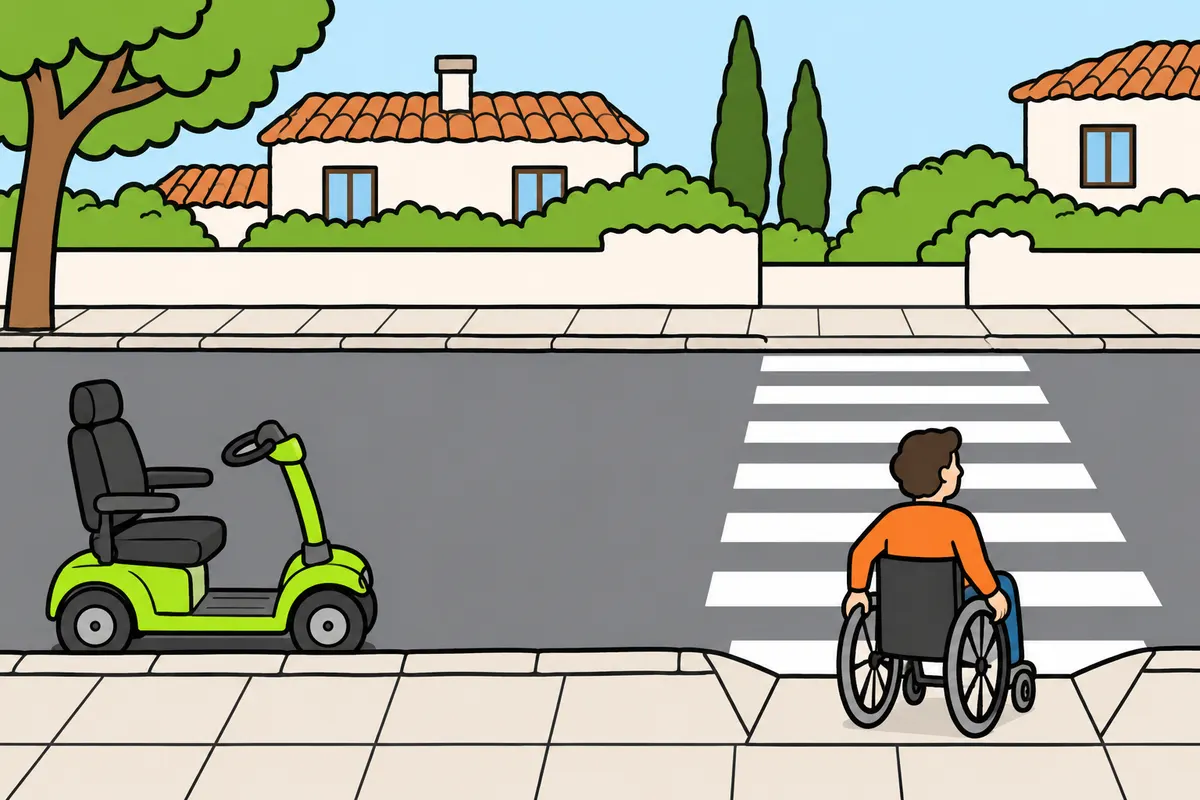
Do not park where prohibited or where you block passage.
Remember
- Where you may not stop, you may not park either.
- Do not park in a second row or before a properly marked access.
- Keep pavements, crossings, dropped kerbs and vehicle entrances clear.
- Do not occupy islands, medians or dividers.
- For loading and unloading, you need the required authorisation.
- In timed zones, obey the permit and time unless the law provides an exception.
Exam trap: Wrong: leaving 3 metres means you may park anywhere. Right: leave at least this much to the opposite edge or an uncrossable marking; also do not block passage even if you leave more.
Read the full explanation
- Where you must not stop, you must not park either. You must also not double-park, park in front of a correctly signed vado (vehicle access with a no-parking restriction), on pavements, promenades or pedestrian passageways, or in signed loading and unloading areas without the applicable authorisation. [RGC, art. 94](https://www.boe.es/buscar/act.php?id=BOE-A-2003-23514#a94).
- In time-limited parking areas, you must comply with the authorisation system and its maximum time limit, unless you are legally entitled to a right or exemption. You must check the local rules; do not assume that parking is free or unlimited simply because you drive a vehicle for people with reduced mobility. [RGC, art. 94](https://www.boe.es/buscar/act.php?id=BOE-A-2003-23514#a94).
- You create danger or an obstruction if you leave less than 3 metres between your vehicle and the opposite edge of the carriageway or a road marking that must not be crossed, or if you prevent others from passing even when the distance is greater. [RGC, art. 91](https://www.boe.es/buscar/act.php?id=BOE-A-2003-23514#a91).
- You must not prevent another correctly stopped or parked vehicle from leaving, block access points, dropped kerbs for pedestrians or permitted turns, or occupy traffic islands, central reservations or separators. Take particular care to avoid blocking an accessible route: you may prevent another person with reduced mobility from continuing their journey. [RGC, art. 91](https://www.boe.es/buscar/act.php?id=BOE-A-2003-23514#a91).
24Reserved spaces and the parking card
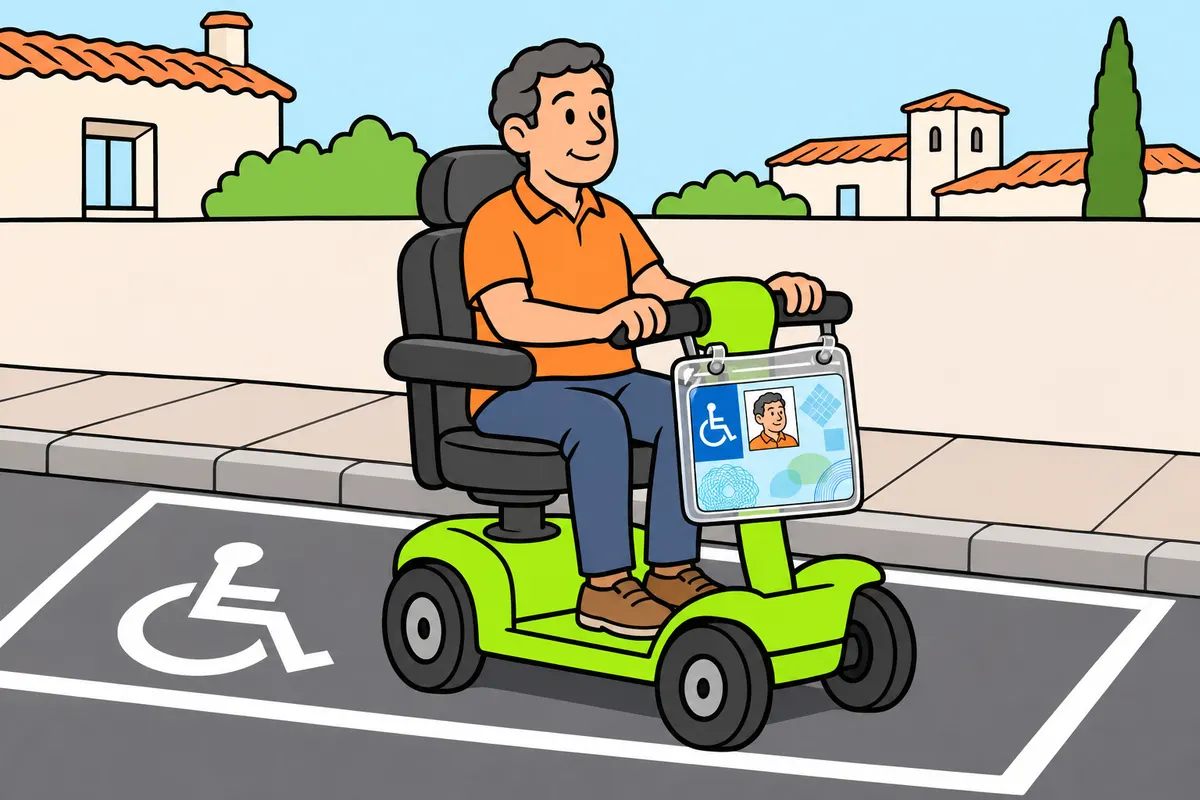
To use disability parking rights, you need the card and must meet its conditions.
| Situation with a card | What you must obey |
|---|---|
| Disability parking bay | Display the card and follow the bay conditions. |
| Timed area or loading and unloading | Use these rights only as the rules allow. |
| Stopping in certain places | Only as long as needed, without harming pedestrians or traffic; obey officers. |
| Pedestrian areas or places where stopping is banned | Do not park. |
| Accesses or emergency exits | Do not block them. |
| Safety zones or spaces that reduce lanes | Do not park. |
Remember
- Display the card clearly inside the vehicle.
- Use the personal card only when its holder drives or travels with you.
- Check the bay conditions and local rules.
- The card does not allow you to obstruct others or reduce access.
- Check local measures for safe entry and exit.
Exam trap: Wrong: your LCM licence replaces the parking card. Right: they are separate permissions; you need the card and must follow its conditions.
Read the full explanation
- To exercise disability parking rights, you must have the appropriate tarjeta de estacionamiento (parking card) and comply with its conditions; the LCM licence and the card are separate authorisations. Your individual card is personal and non-transferable, and you may use it only when you, as its holder, are driving or travelling in the vehicle. [RD 1056/2014, art. 6](https://www.boe.es/buscar/act.php?id=BOE-A-2014-13362#a6).
- To exercise parking rights under national law, you must display the card visibly inside the vehicle. These rights include using designated spaces for people with disabilities. You must also check the specific conditions for the space and the applicable regional or local rules. [RD 1056/2014, arts. 6 and 7](https://www.boe.es/buscar/act.php?id=BOE-A-2014-13362#a7).
- With the card, you may make certain uses of time-limited parking areas and loading and unloading areas under the conditions set out in the legislation; you may also stop in certain places for the time strictly necessary, without adversely affecting pedestrians or traffic and following officers’ instructions. [RD 1056/2014, art. 7](https://www.boe.es/buscar/act.php?id=BOE-A-2014-13362#a7).
- Even with a card, you must not park in pedestrian areas or on pedestrian crossings, in places where stopping is prohibited, where you obstruct vehicle access points or emergency exits, in areas cordoned off for public safety, or in spaces where you reduce the number or width of traffic lanes. You must find an authorised place that preserves accessibility for everyone. [RD 1056/2014, art. 7.2](https://www.boe.es/buscar/act.php?id=BOE-A-2014-13362#a7).
- Under municipal regulations, you may have specific arrangements that allow you, as a person with reduced mobility, to get into and out of vehicles safely, including access to areas with traffic restrictions or more time than normally allowed to complete the manoeuvre. You may use these measures under the conditions set by the municipality’s regulations. [RGC, art. 156.1.c](https://www.boe.es/buscar/act.php?id=BOE-A-2003-23514#a1-9).
25Securing your vehicle and getting out
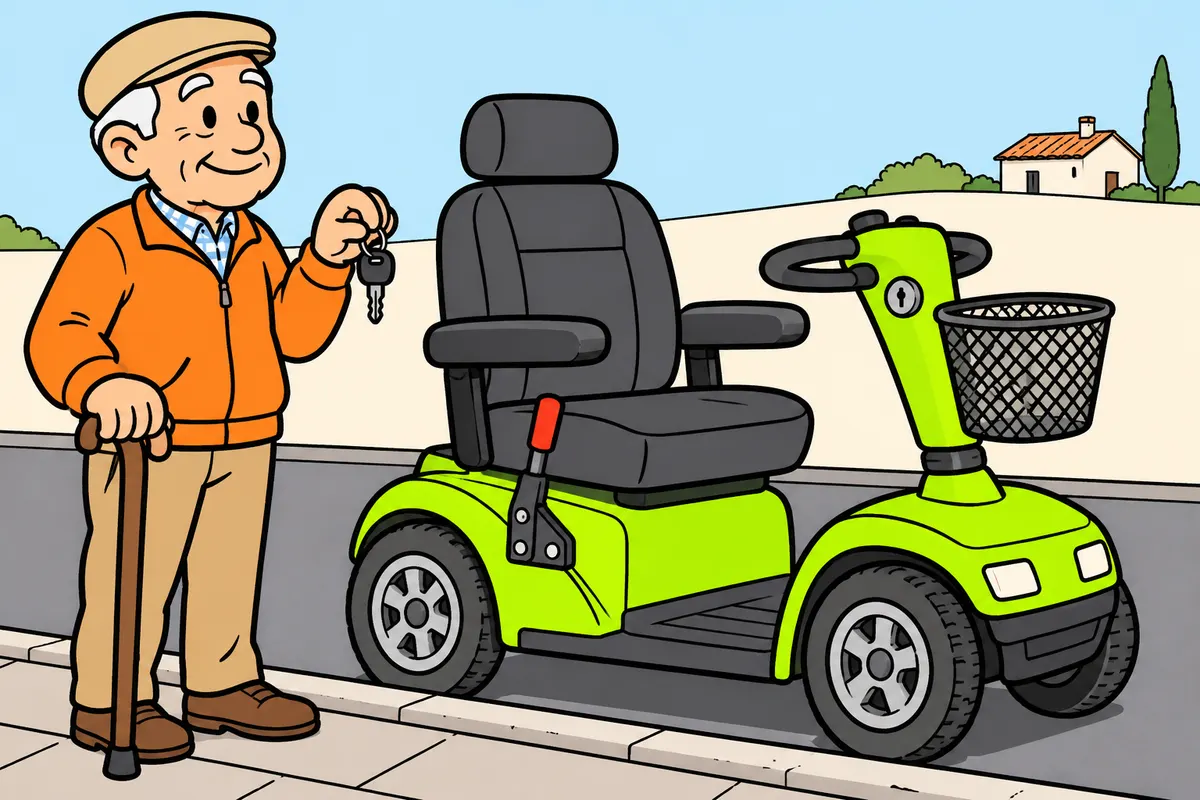
Before getting out, secure your vehicle and check that you do not endanger anyone.
Remember
- Make sure your vehicle cannot move by itself, especially on a slope.
- Apply the parking brake and switch off the drive.
- Follow the maker's instructions for parking position or gears.
- Stop others using your vehicle without permission.
- Open doors only when stationary and without danger or obstruction.
- Usually get in and out on the side nearest the road edge.
Exam trap: Wrong: you open the door without looking because you are parked. Right: check that you create no danger or obstruction, especially for cyclists.
Read the full explanation
- Before leaving your vehicle, you must make sure it cannot move accidentally, especially on a slope. Use the immobilisation devices provided for your model and check that they work; do not leave it ready to move forwards if the controls are activated unintentionally. [RGC, art. 91](https://www.boe.es/buscar/act.php?id=BOE-A-2003-23514#a91).
- As a practical guideline, apply the parking brake, switch off the propulsion system and prevent unauthorised use when you move away. Use the parking position or gear selection specified by the manufacturer for the particular systems fitted to your LCM vehicle. [RGC, art. 91](https://www.boe.es/buscar/act.php?id=BOE-A-2003-23514#a91).
- If your vehicle has doors, you must not open them until it is completely stationary or without checking that you do not create danger or an obstruction, especially for cyclists. As a general rule, get in and out on the side nearest the edge of the road, with the vehicle stationary. [RGC, art. 114](https://www.boe.es/buscar/act.php?id=BOE-A-2003-23514#a114).
- To rejoin traffic from a parking space, apply the rules for joining traffic in «Joining traffic from the roadside or an access». [RGC, art. 72](https://www.boe.es/buscar/act.php?id=BOE-A-2003-23514#a72).
26Immobilisation due to a breakdown or emergency
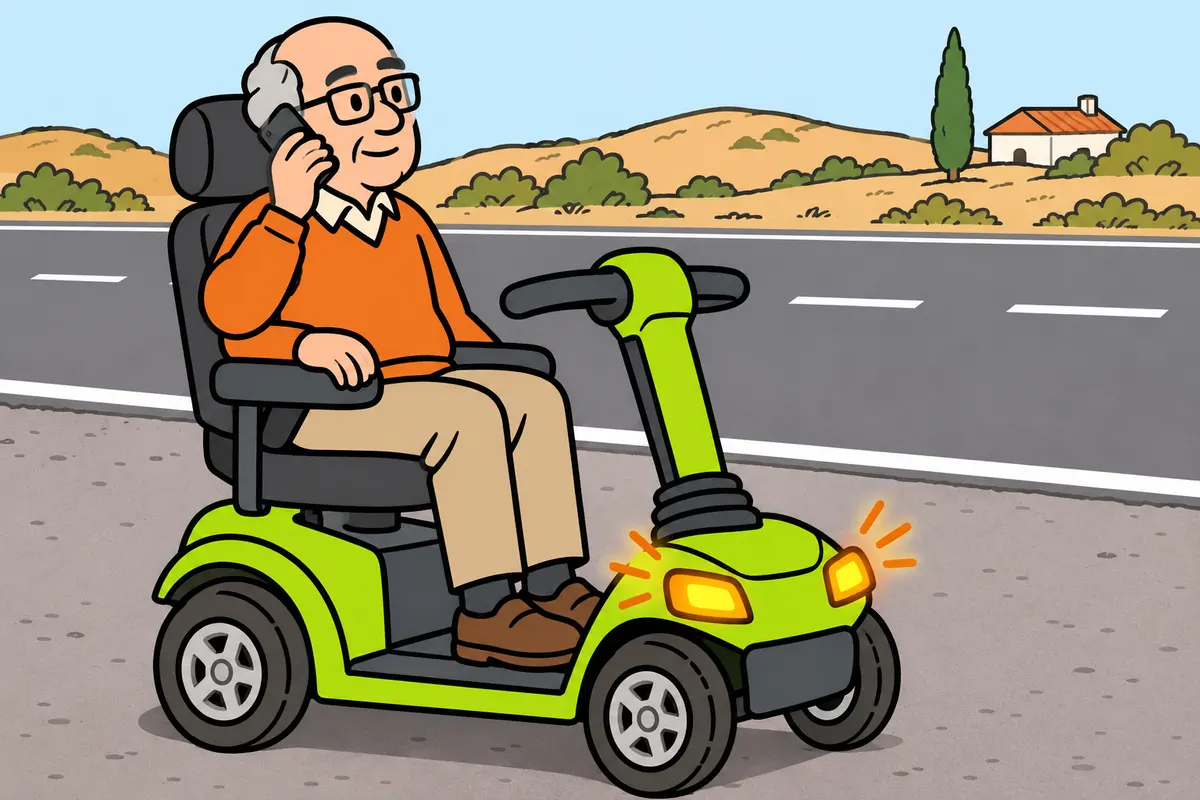
If a breakdown or crash blocks the road, warn others and try to clear it safely.
Remember
- If you can continue safely, do so to clear the road.
- With serious steering or brake failure, stop and call for help.
- Move the vehicle off the carriageway if you can.
- In very poor visibility, use hazard lights if fitted, and sidelights when required.
- Use your connected V-16, if carried, when immobilised on the road in danger.
- Do not put yourself in traffic to push, repair or warn others.
Exam trap: Wrong: your LCM need not carry a V-16, so you need not use it. Right: if you carry one and are immobilised on the road in a hazard, you must use it.
Read the full explanation
- If a breakdown or accident causes your vehicle or its load to obstruct the carriageway, you must warn others of the danger and arrange for its removal as soon as possible. Whenever feasible, move your vehicle off the carriageway and position it in accordance with the parking rules. [RGC, art. 130](https://www.boe.es/buscar/act.php?id=BOE-A-2003-23514#a130).
- If you can continue safely, you must do so to clear the road. A serious steering or brake fault is not resolved by continuing just because the journey is short: as a safety measure, immobilise your vehicle and request assistance. If you cannot move completely out of the way, find the place where you cause the least obstruction. [RGC, art. 130](https://www.boe.es/buscar/act.php?id=BOE-A-2003-23514#a130).
- If your vehicle is immobilised when visibility is significantly reduced, you must use the hazard warning lights if fitted and, where required, the position lights. These warnings indicate your presence and the danger; they do not replace removal of the obstruction or make the location a permitted place for voluntary parking. [RGC, art. 109](https://www.boe.es/buscar/act.php?id=BOE-A-2003-23514#a109).
- To warn others of the danger using the V-16, consult the conditions for its use and the requirements for carrying it in an LCM vehicle in «Accidents and breakdowns», under «Connected V-16: distinctions you must understand». [RGC, art. 130.4](https://www.boe.es/buscar/act.php?id=BOE-A-2003-23514#a130); [RGV, Annex XII](https://www.boe.es/buscar/act.php?id=BOE-A-1999-1826#anxii).
- As a practical precaution, organise assistance according to your mobility and your actual ability to reach a protected place. Do not expose yourself to danger by pushing, carrying out repairs or placing warning devices in the traffic flow. You study occupant protection and the full procedure for dealing with accidents in «Accidents and breakdowns». [RGC, art. 130](https://www.boe.es/buscar/act.php?id=BOE-A-2003-23514#a130).
27Closed-course test manoeuvres
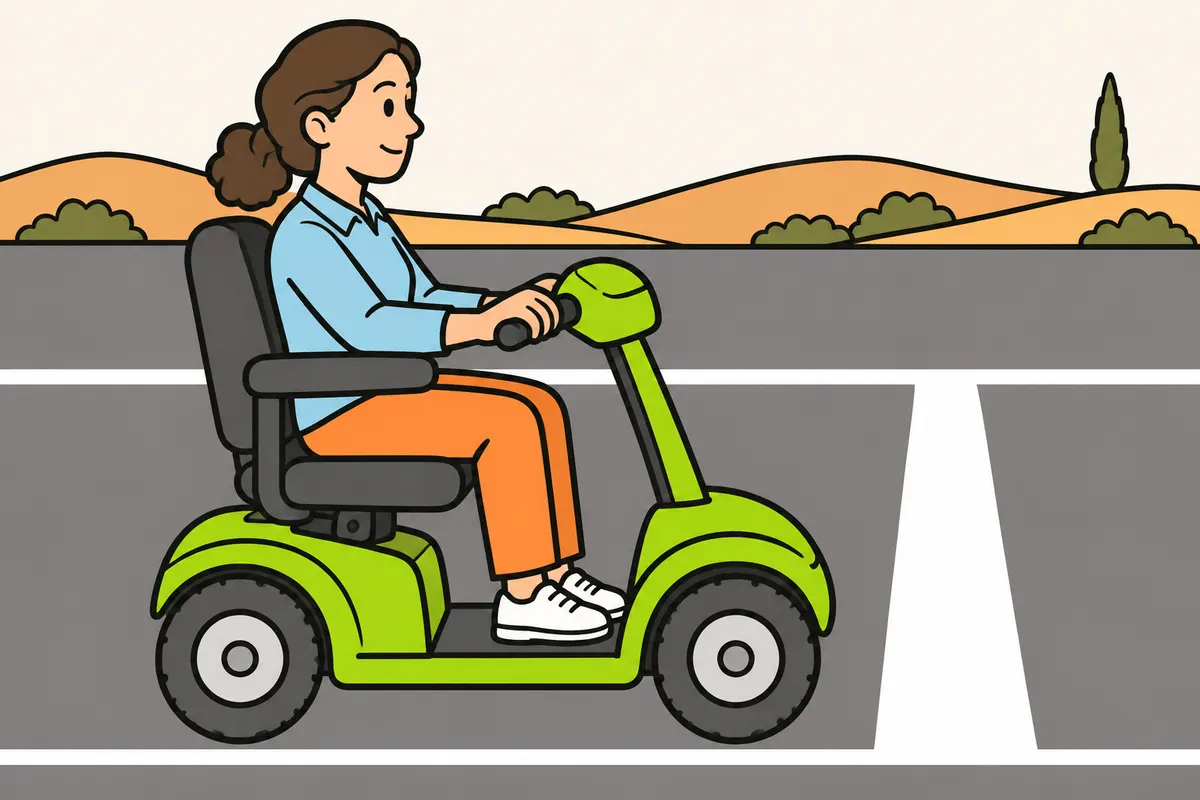
In the closed-course test, complete the zigzag between cones and acceleration with controlled braking.
| LCM test manoeuvre | Speed to reach |
|---|---|
| C): zigzag between cones | There is no minimum speed. |
| E): acceleration and controlled braking | You must reach at least 30 km/h. |
Remember
- Start the zigzag between cones from rest.
- Start to the left of the first cone and alternate turns.
- Do not run over, move or knock over any cone.
- Accelerate smoothly and keep your balance.
- With a manual gearbox, change into second gear.
- Brake within the space without crossing the mark or stalling.
Exam trap: Wrong: your LCM has no minimum speed in any exercise. Right: only the zigzag between cones has no minimum; in acceleration and controlled braking you must reach at least 30 km/h.
Read the full explanation
- To obtain your LCM licence, you must perform manoeuvres C), zigzag between cones, and E), acceleration and controlled braking. These are the closed-course exercises required for your vehicle. [RGCond, Annex V.B.3.9](https://www.boe.es/buscar/act.php?id=BOE-A-2009-9481#anv).
- In manoeuvre C), you start from rest and weave around five cones with alternating turns, passing to the left of the first cone, without running over, moving or knocking over any cone. For the LCM licence, you do not have to reach a minimum speed in this zigzag. [RGCond, Annex VI.C, manoeuvre C](https://www.boe.es/buscar/act.php?id=BOE-A-2009-9481#anvi).
- In manoeuvre E), you must accelerate progressively until you reach at least 30 km/h, changing into second gear if your vehicle has a manual gearbox. You must then brake accurately and stop within the marked space, without crossing the transverse stop line. Accelerate smoothly, maintain your balance and avoid stalling the engine when you stop. With an LCM licence, you have no exemption from the minimum speed requirement for this manoeuvre. [RGCond, Annex VI.C, manoeuvre E](https://www.boe.es/buscar/act.php?id=BOE-A-2009-9481#anvi).
Joining traffic safely
Make sure there is a suitable gap before joining traffic.
- Check your mirrors, surroundings and relevant blind spots.
- Assess the position, course and speed of road users already on the road.
- Signal your intention to join and give way; ask for help if you need it to check.
- Join gradually when you have enough room.
- Take up the appropriate road position for your vehicle and cancel your signal when you finish.
Overtaking and moving back in
Check the whole manoeuvre, including the limits that apply to LCM vehicles.
- Check that overtaking is permitted at that location and that nobody is overtaking you.
- Check the space, visibility, difference in speed and room to move back in.
- Apply the clearances in «Clearance when overtaking vulnerable users» and the limits on travelling alongside in «Deciding whether you can overtake».
- Signal and move out without causing danger, observing speed limits and maintaining clearance.
- If a risk arises, abandon the manoeuvre; if you complete it, signal your return and move back in gradually without cutting anyone up.
Reversing to park
Reverse only as far as essential and watch all your surroundings.
- Choose a permitted place with room to enter and leave.
- Check behind and to the sides, asking for help if necessary.
- Signal and reverse slowly: when reversing as part of parking, the maximum is 15 metres and you must not enter junctions.
- Stop immediately if you receive a warning, other road users come close or safety requires it.
- Position your vehicle correctly and use its devices to secure it against movement before leaving it.
Finished this module?
Mark it as read and you will see your progress on the theory list.