
Theory · AM Licence - Moped · Module 17 of 18
Defensive and efficient driving
You learn to observe, anticipate mistakes and leave space to drive your moped or light quadricycle safely. You learn to reduce consumption, emissions and noise, use the transmission and tyre pressures correctly, and interpret environmental badges and ZBE (low-emission zone) restrictions. In the exam, you distinguish legal obligations from economy advice that depends on each vehicle.
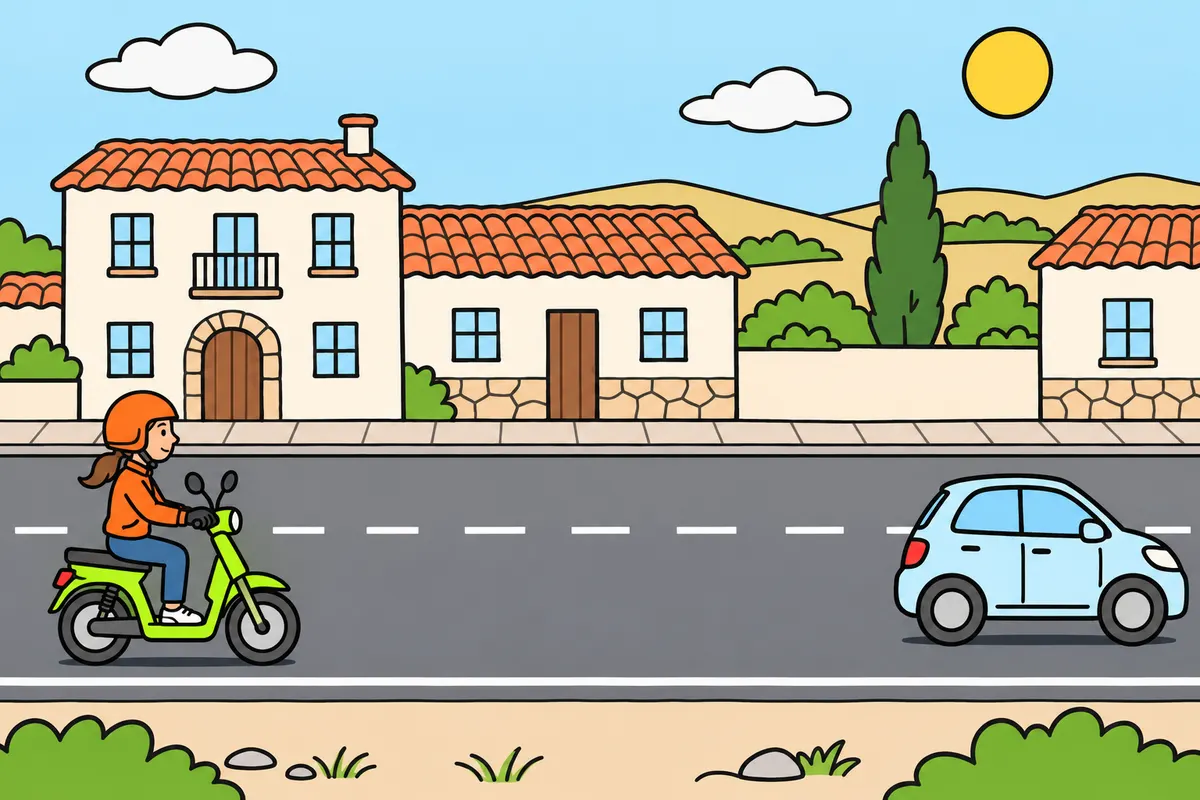
1Prevention combines vision, anticipation and space
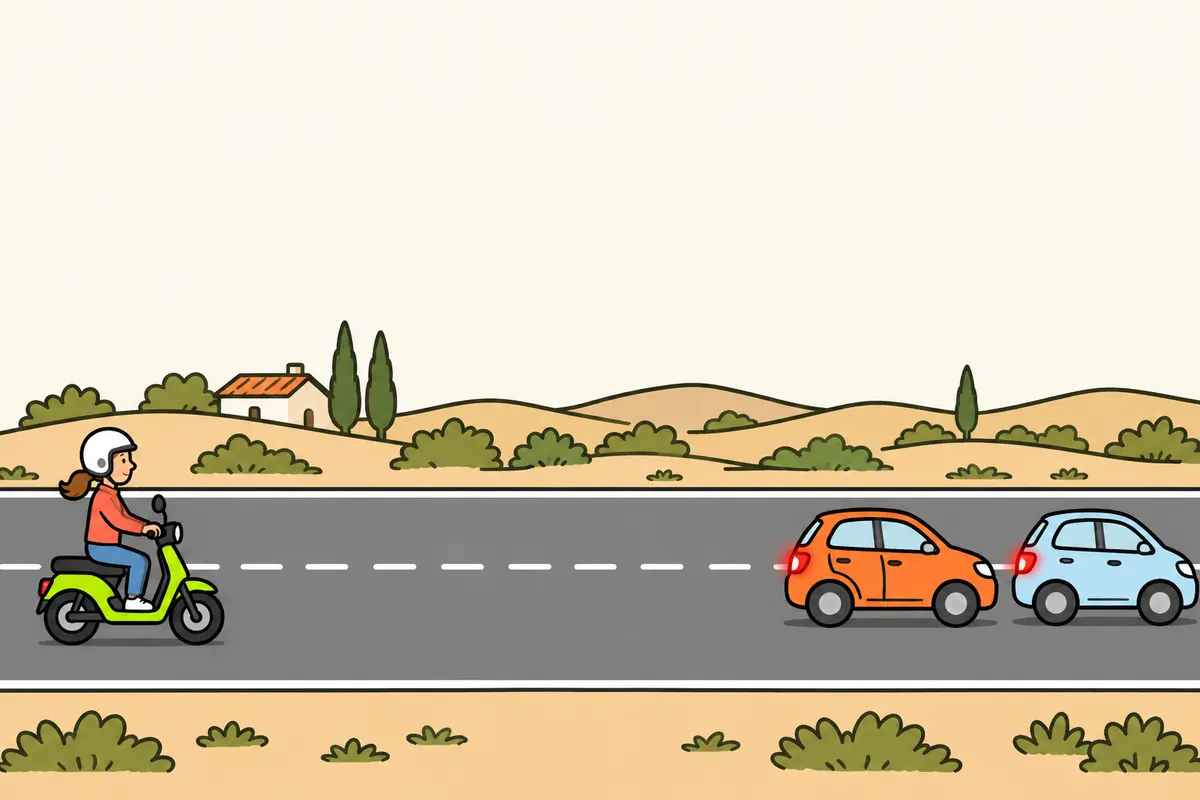
Observe, prepare your response and keep space to act safely.
Remember
- Watch your surroundings to detect changes.
- Prepare to respond before you reach a hazard.
- Keep space to act without sudden movements.
- Put safety first when trying to save energy.
Exam trap: Wrong: saving energy matters more than braking for danger. Right: you respond with enough force.
Read the full explanation
- You can drive more economically by using information from your surroundings to make decisions in good time. Observation lets you detect a change; anticipation lets you prepare your response; leaving space lets you carry it out smoothly. On your moped or light quadricycle, you must repeat this sequence of three actions throughout your journey.
- Safety determines how you apply economy measures: when a hazard appears, you need to respond with sufficient force. You can assess your driving by the energy you avoid wasting, without allowing arriving sooner, braking less often or staying in a high gear to become goals that influence a safe decision. For visibility, grip and stability risks, consult the Risk factors when riding a moped module.
2Plan a suitable route
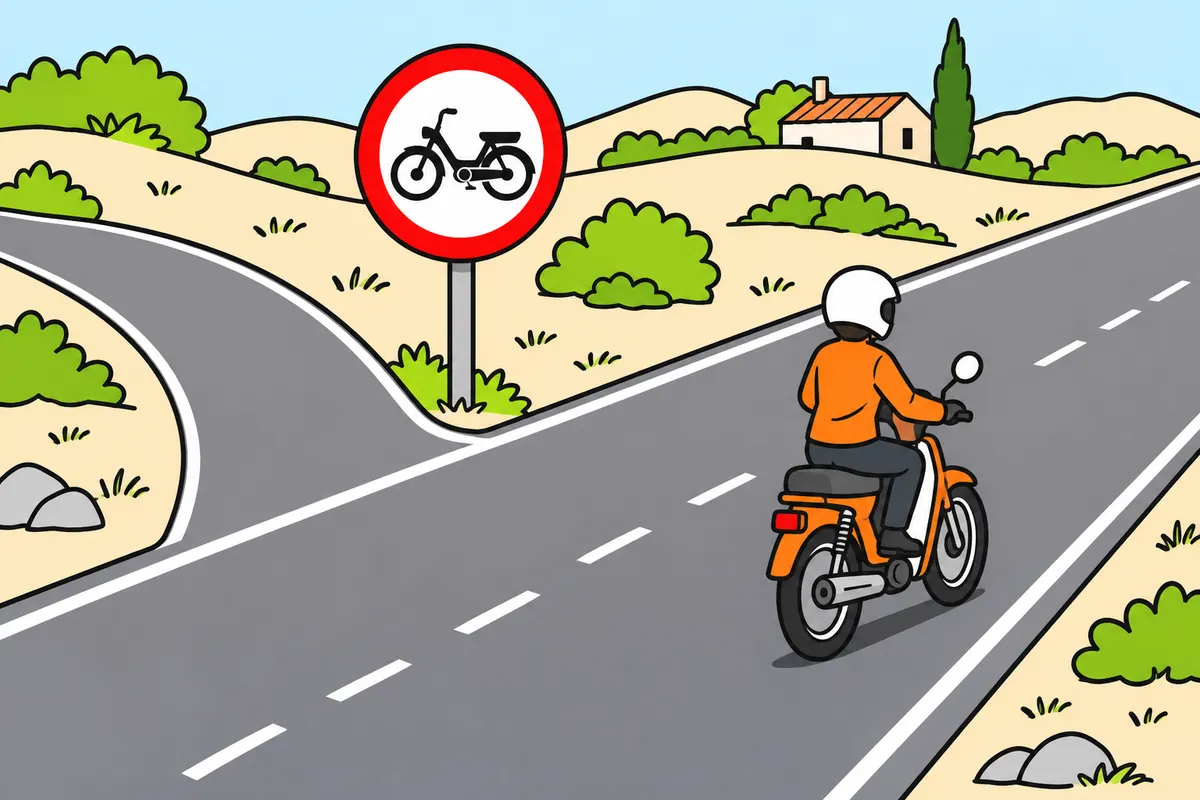
Choose a safe route that your vehicle is allowed to use before setting off.
Remember
- Consider traffic, weather, slopes and junctions before setting off.
- Never take your moped onto autopistas or autovías (dual carriageway motorways).
- Check road signs even when you use a navigation app.
- Check environmental restrictions for your route, return journey and parking.
- Leave enough time to avoid rushing.
- For short journeys, consider walking, cycling or public transport.
Exam trap: Wrong: you always choose the shortest route. Right: you check it is allowed and safe for your vehicle.
Read the full explanation
- Before setting off, choose a route suited to your vehicle, the expected traffic and the weather. Consider visibility, gradients, junctions and safe places to stop. The shortest route can be less suitable if it involves many difficult manoeuvres, queues or stretches where you struggle to maintain safety margins.
- You must check that your route is open to your moped: you are prohibited from using autopistas (motorways) and autovías (dual carriageway motorways). Set your navigation to avoid these roads and check road signs; an app can suggest a route unsuitable for your vehicle. [RGC, art. 38](https://www.boe.es/buscar/act.php?id=BOE-A-2003-23514#a38).
- Check environmental restrictions at your destination and on the streets you need to use. If there is a ZBE, also check your return journey and parking. A route can be physically open yet require authorisation your vehicle does not have; planning prevents you from reaching the entrance without a safe alternative.
- Organise your departure without imposing an arrival time that pushes you to speed. Where possible, avoid busy periods and combine errands to reduce unnecessary journeys. For a short trip, consider walking, cycling or public transport: efficiency also means choosing how to travel.
3Prepare your vehicle for observation and economy
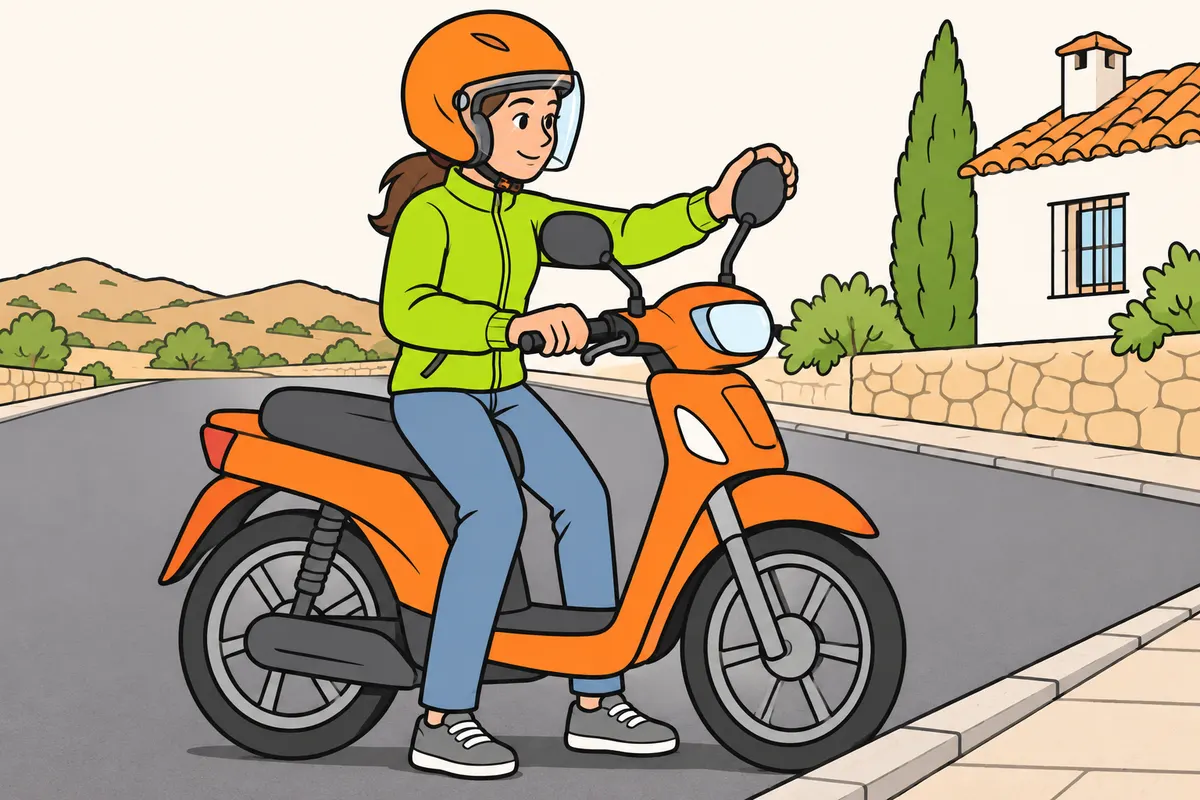
Check your vehicle and prepare to see clearly and use the controls easily.
Remember
- Check tyres, brakes, lights, controls and possible leaks before setting off.
- Resolve safety problems before driving.
- Adjust your mirrors while your vehicle is stationary.
- Clean your mirrors, helmet visor and windows, if fitted.
- Position luggage so you can see clearly and move freely.
- Check available fuel or battery charge; allow for slopes, loads and diversions.
Exam trap: Wrong: if the engine starts, everything is fine. Right: you check the other vehicle parts too.
Read the full explanation
- Before setting off, check tyres, brakes, lights, controls and possible leaks, following the manual. If you find a fault that compromises safety, resolve it before driving. A pre-journey check lets you spot problems between services; hearing the engine start does not prove that the whole vehicle is in good condition.
- Adjust your mirrors with the vehicle stationary and adopt a posture that lets you operate the controls and observe. Keep the surfaces you look through clean: your helmet visor, mirrors and, in an enclosed quadricycle, windows. Dirt can hide important details when you need to interpret events quickly.
- You must retain freedom of movement, constant attention and a clear field of vision. Position objects and luggage correctly so that they do not obstruct you. Do not try to improve aerodynamics by adopting a posture that prevents you from looking around or operating the controls. [RGC, art. 18](https://www.boe.es/buscar/act.php?id=BOE-A-2003-23514#a18).
- Know your available range before starting your journey, whether you use fuel or a battery. Allow for gradients, loads and possible diversions, without treating the gauge’s estimate as a guarantee. Having enough energy to arrive avoids an improvised stop in an unsuitable place or a pressured route change.
4Look ahead without losing sight of what is nearby
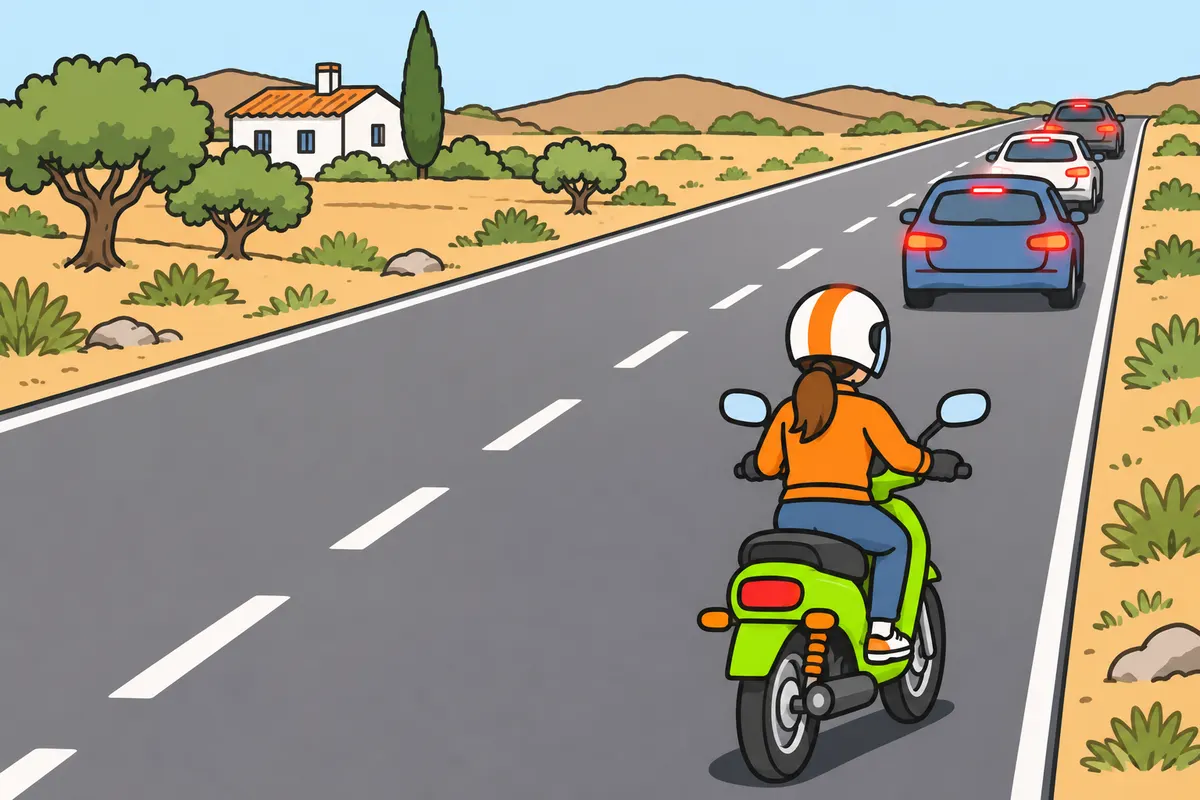
Look ahead and nearby, to the sides and in your mirrors.
Remember
- Watch brake lights and queues further ahead.
- Prepare to slow down before the vehicle immediately ahead brakes.
- Watch nearby entrances too.
- Check who is approaching from behind.
Exam trap: Wrong: you only need to watch the next traffic light. Right: you watch all your surroundings.
Read the full explanation
- Alternate your gaze between the road well ahead and the space nearby. Brake lights on several vehicles, a queue closing up or a visible traffic light help you recognise a slowdown before you reach the vehicle immediately ahead. You can then prepare to decelerate without waiting for that vehicle to brake.
- Keep checking to the sides and in your mirrors too. If you focus only on the next traffic light, you can miss information about a nearby entrance or someone approaching from behind. Looking well ahead is useful when you combine it with observation of surroundings that can affect your moped sooner.
5Your blind spots and those of others
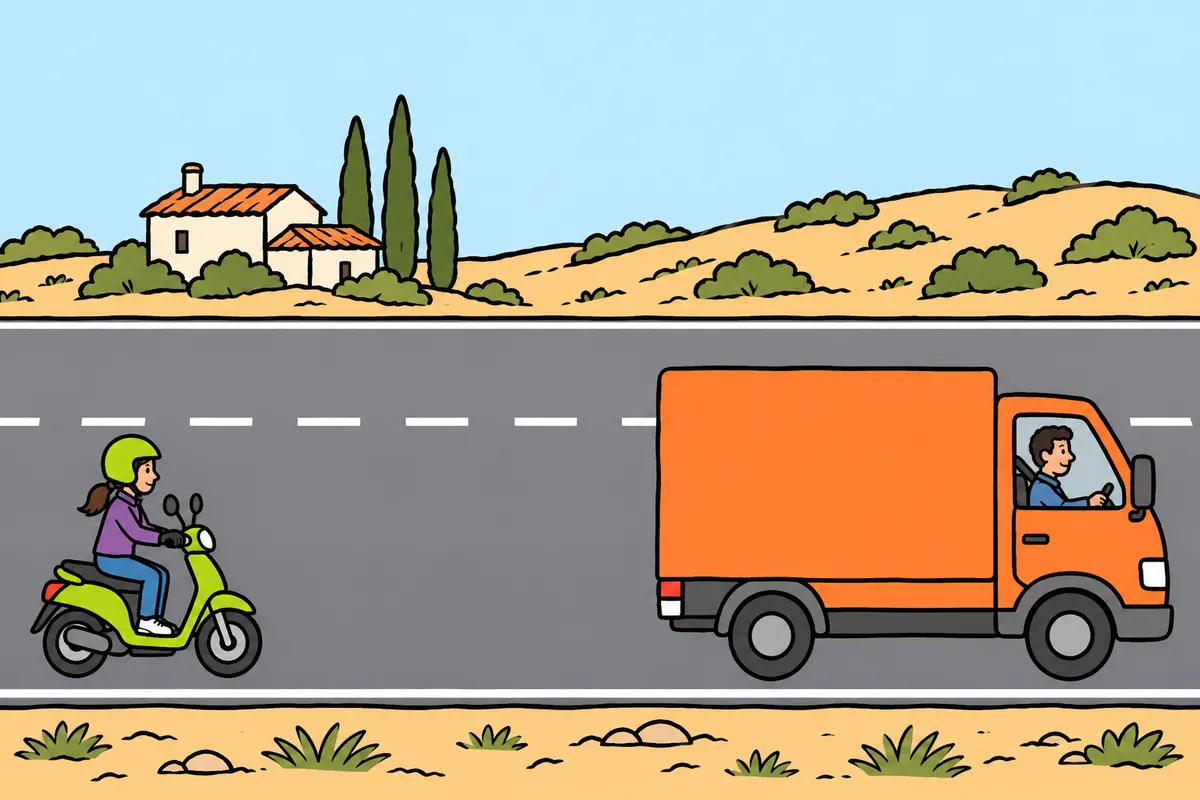
Stay visible and avoid gaps that could close.
Remember
- Check space and visibility before moving.
- Avoid getting trapped in a gap beside a large vehicle.
- Wait if you are unsure whether you can move forward.
- Slow down if another vehicle blocks your view ahead.
Exam trap: Wrong: any gap beside a large vehicle is safe. Right: you expect it could close when the vehicle turns.
Read the full explanation
- Before changing position to maintain your pace, check the space you need and your visibility. A gap alongside a large vehicle can close when it turns. You can avoid an acceleration by waiting for the situation to become clear, rather than moving forward until you are trapped between vehicles.
- Keep a visible position even if you have to slow down. If a vehicle restricts your view ahead, adapt your pace to the space you can see and avoid improvised movements to gain a view. To identify areas other drivers cannot see in their mirrors, consult the Risk factors when riding a moped module.
6Anticipate behaviour and areas of uncertainty
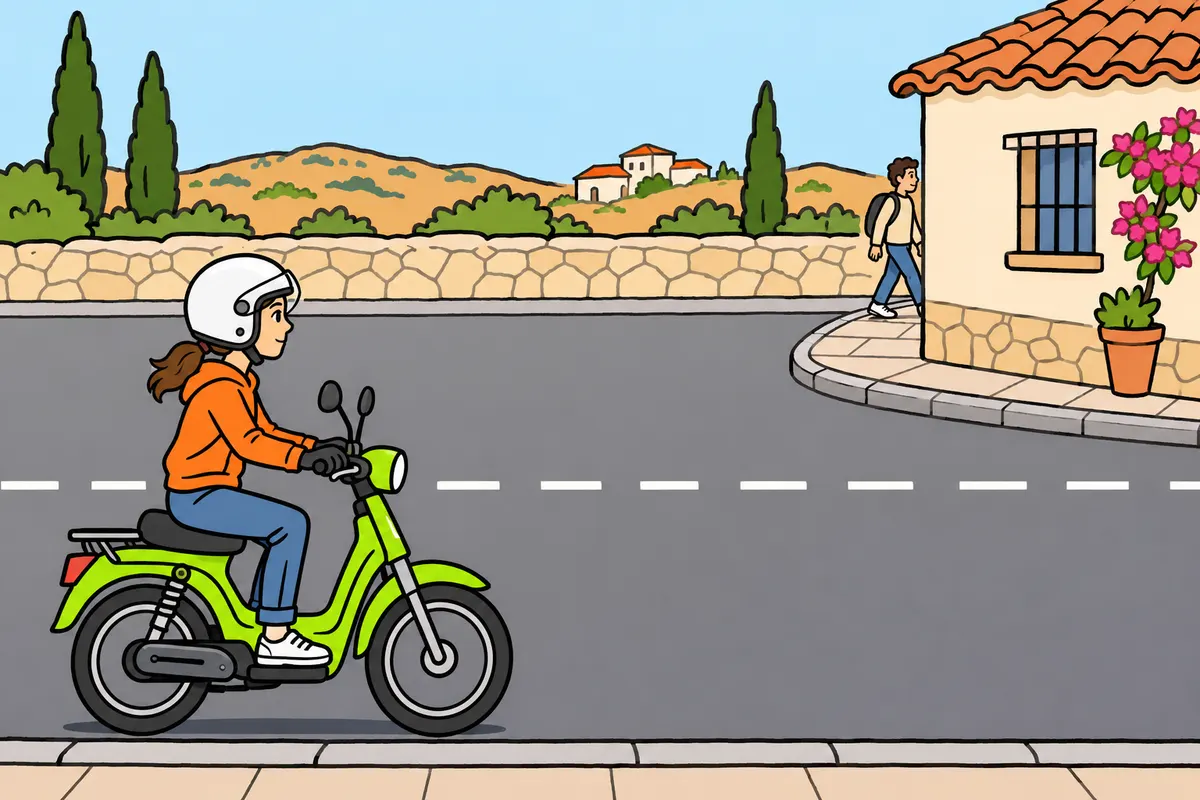
Slow down before areas where people or vehicles might appear.
Remember
- Identify hidden areas before reaching them.
- Prepare to slow down at hidden junctions or where pedestrians might appear.
- Watch anyone approaching the edge, even before they cross.
- Check the situation again as you approach.
- Accelerate when you have space and the situation is clear.
Exam trap: Wrong: you decide the road is clear and stop checking. Right: you keep watching because things change.
Read the full explanation
- At a concealed junction, an entrance or an area where pedestrians may appear, identify which parts of your surroundings remain unchecked. You can prepare to slow down before entering that area of uncertainty. A person near the edge or a vehicle edging out is a reason to reconsider your decision, even before they enter your path.
- Update your prediction as you approach: a gap can close and an obstacle can hide another person. Accelerate again when the situation is clear and you have usable space. Avoid turning a first impression of a clear road into a decision you maintain without looking again.
7Leave a margin ahead and behind
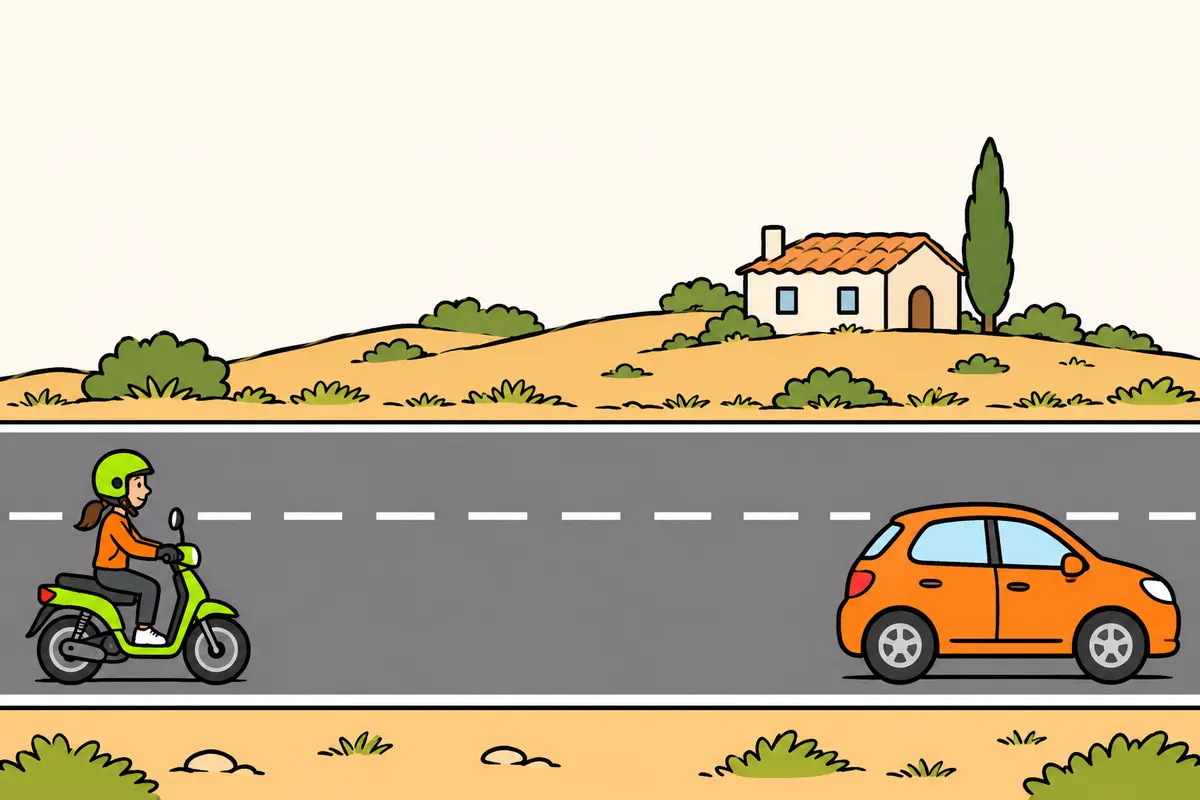
Leave enough space to stop if the vehicle ahead brakes suddenly.
Remember
- Use the gap to slow by easing off the accelerator when enough.
- Avoid repeated acceleration and braking.
- In a queue, move off gently when you can keep moving.
- Avoid accelerating to close every gap.
Exam trap: Wrong: you accelerate to close every gap in a queue. Right: you leave space and move forward gently.
Read the full explanation
- Leave space ahead to absorb small changes in traffic by easing off the accelerator, without repeated acceleration and braking. You must keep enough distance to stop if the vehicle ahead brakes suddenly. [RGC, art. 54.1](https://www.boe.es/buscar/act.php?id=BOE-A-2003-23514#a54). In a queue, move off progressively when you can advance without immediately stopping again; avoid accelerating to close every gap. To calculate and adapt your following distance, consult the Speed and safe following distances module, under Safe following distance.
8Steady and appropriate speed
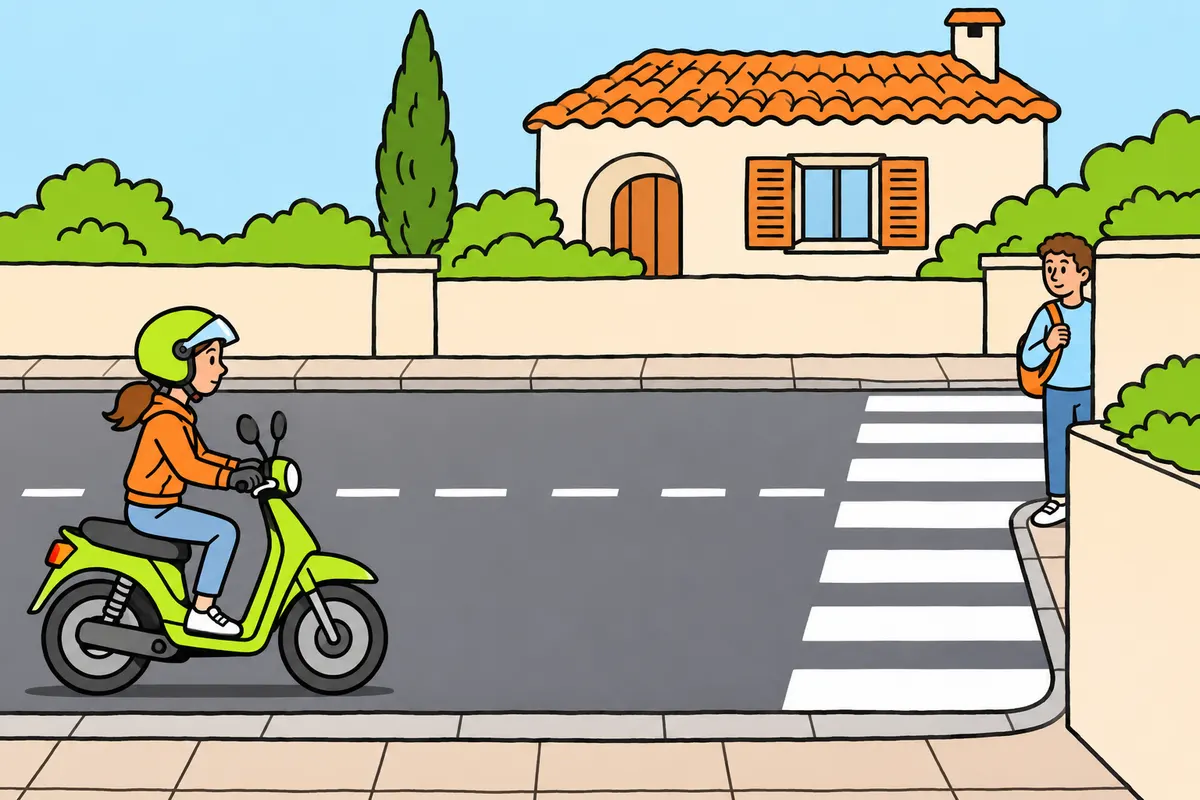
Adapt your speed to hazards and avoid unnecessary changes of pace.
| Road | General maximum: two- and three-wheeled mopeds and light quadricycles |
|---|---|
| Outside built-up areas | 45 km/h; obey lower limits |
| Urban: one lane in each direction | 30 km/h; check rules and signs |
Remember
- Obey limits and slow further when the situation requires.
- Consider visibility, traffic and people nearby.
- Keep a steady pace only when safe.
- Regain speed gently when the danger has passed.
- Obey lower limits and applicable signs.
Exam trap: Wrong: any speed below the limit is safe. Right: you slow further when visibility, traffic or hazards require it.
Read the full explanation
- You must choose your speed according to what you can see, anticipate and control, as well as obeying speed limits. If a concealed junction or pedestrian area requires a lower speed, adapt your pace even if the limit allows more. [RGC, art. 45](https://www.boe.es/buscar/act.php?id=BOE-A-2003-23514#a45).
- On roads outside built-up areas, the general maximum for two- and three-wheeled mopeds and light quadricycles is 45 km/h; you must also obey any applicable lower limits. [RGC, art. 48.1.e](https://www.boe.es/buscar/act.php?id=BOE-A-2003-23514#a48).
- On an urban road with one lane in each direction, the general limit is 30 km/h, subject to the applicable regulations and signs. You must anticipate this slower traffic, without accelerating between obstacles to regain a supposed cruising speed. Limits and exceptions are covered in the Speed and safe following distances module. [RGC, art. 50.1.b](https://www.boe.es/buscar/act.php?id=BOE-A-2003-23514#a50).
- Try to maintain a steady pace when traffic and safety allow. This means avoiding unnecessary fluctuations, rather than keeping exactly the same speed in every circumstance. You must slow down when there is uncertainty and pick up speed progressively when it clears; steadiness does not take priority over adapting to your surroundings.
9Smooth control and a reserve of grip
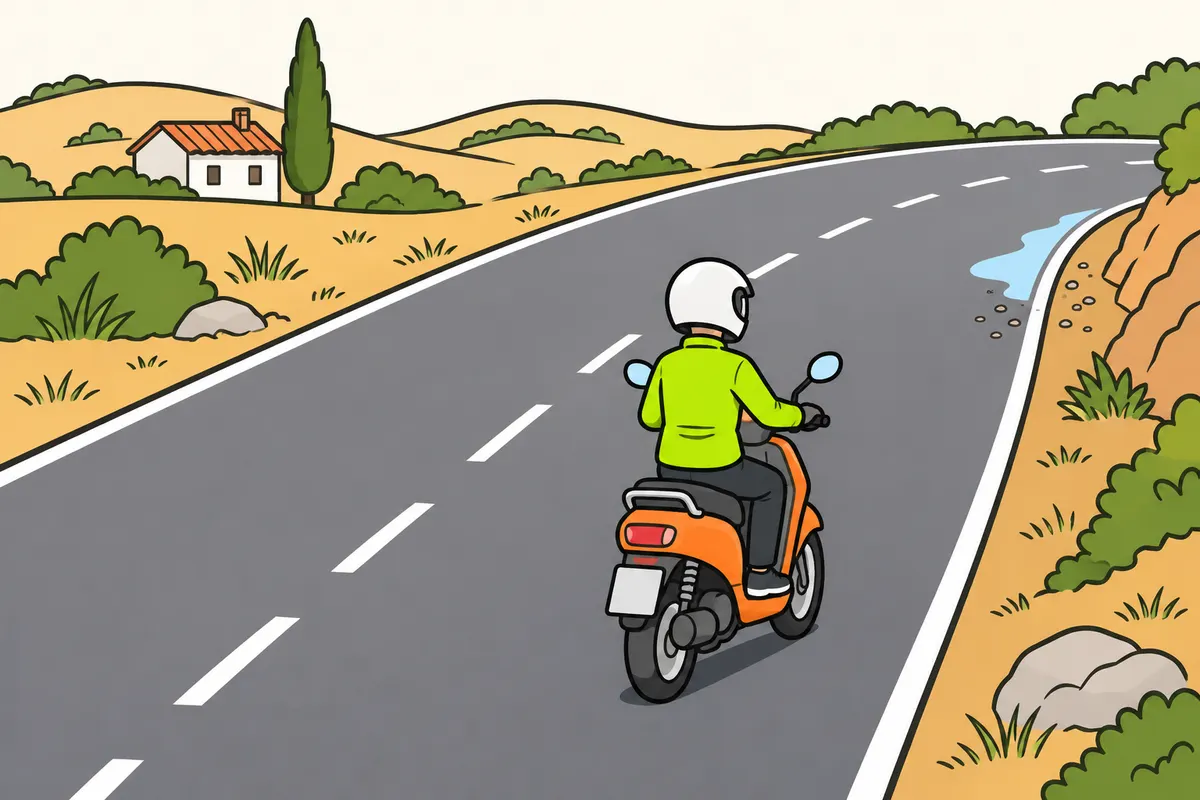
Prepare your speed and use smooth movements to keep grip.
Remember
- Slow down before bends and uneven road surfaces.
- Avoid sudden movements on wet markings, metal, gravel or grease.
- Brake progressively in normal situations, following your vehicle manual.
- In an emergency, brake as needed within the available grip.
- Expect a different response with wind, luggage or a passenger.
- Leave space at your sides to correct your course safely.
Exam trap: Wrong: you must keep your pace when wind appears. Right: you adapt speed and clearance to your vehicle’s response.
Read the full explanation
- Anticipate bends, uneven surfaces and changes in the road surface so you can adjust your speed before reaching them. On wet road markings, metal covers, gravel or grease, avoid sudden acceleration, braking or steering. Assess all your surroundings before changing course to avoid an uneven patch.
- On two wheels, progressive normal braking helps maintain stability and avoids unnecessary wear. Follow the instructions for your vehicle’s system and coordinate your use of the controls. In an emergency, you need a sufficient response within the available grip.
- Before a bend, assess visibility, its course and traffic so you do not need to make violent corrections within it. You must leave a margin for what you cannot yet see. Detailed braking and cornering techniques are covered in the Moped riding techniques module; here you must link prior observation with avoiding unnecessary changes in energy and direction.
- With wind, a load or a passenger, you must anticipate a different vehicle response. Do not try to maintain your pace at any cost. If a gust or leaving a sheltered area forces you to correct your course, an appropriate speed and lateral clearance help you do so without entering other users’ space.
10Start without unnecessary consumption
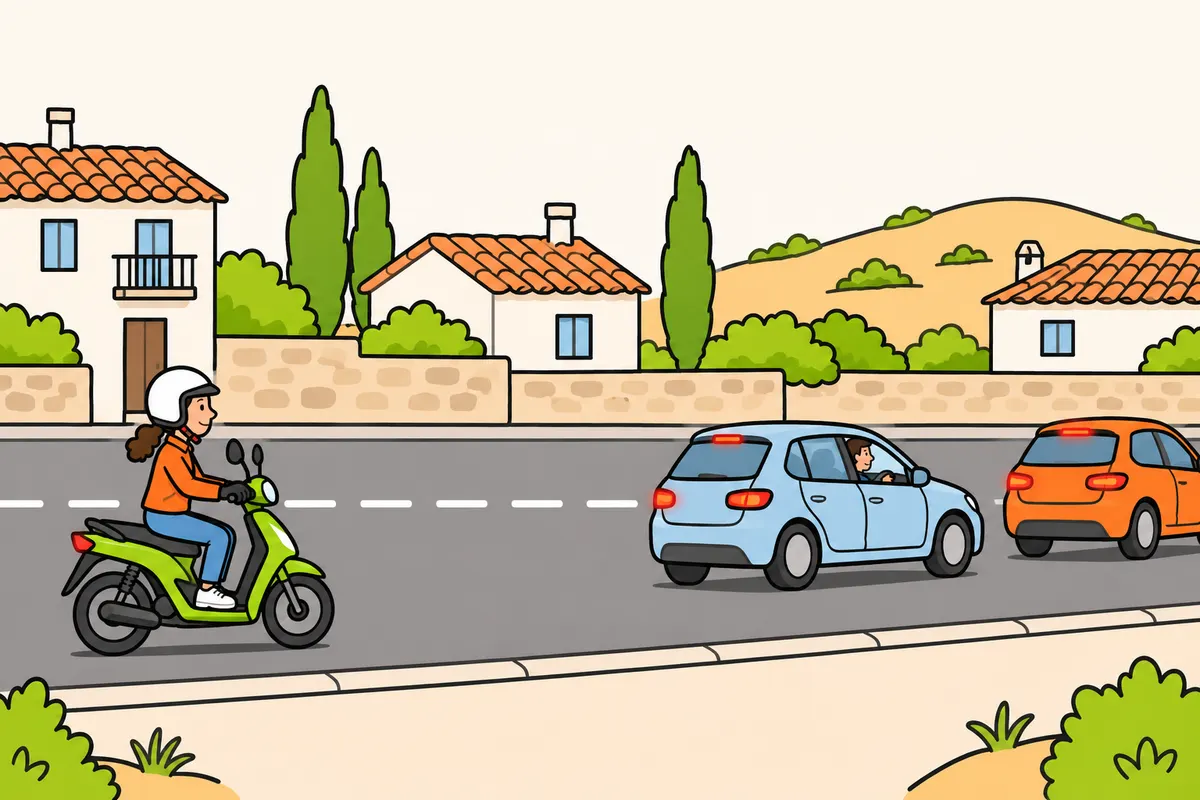
Start according to your manual and accelerate gently to avoid wasting fuel.
Remember
- Prepare your helmet and luggage before starting the engine.
- Avoid revving to warm up the engine.
- If the manufacturer allows it, start your journey gently.
- Avoid demanding maximum power while the engine is cold.
- Accelerate only when you have space to move forward.
- Never extend your route just to warm up the engine.
Exam trap: Wrong: you start every moped like a car. Right: you follow your manufacturer’s procedure.
Read the full explanation
- Start the engine according to the moped manual, with the vehicle stable and the controls ready. Avoid revving to warm it up. Different fuel and starting systems can require different actions; do not turn an instruction for a fuel-injected car into a universal procedure for every moped.
- If the manufacturer allows you to start your journey, do so gently and avoid demanding maximum performance while the engine is cold. Leaving it running stationary for a long time to warm up uses fuel and produces noise. Prepare your helmet and luggage before starting and limit stationary running to what the manufacturer’s procedure requires.
- When moving off from a stop, accelerate gradually, matching the space actually available. If you see the queue stopping again, do not accelerate to catch it and then brake again. Every increase in speed requires energy; anticipating the next change lets you avoid some of that consumption.
- On very short journeys that start with a cold engine, consumption per kilometre can increase. Where possible, combine several errands into a reasonable route or use another form of transport. Do not artificially extend the route to warm the engine: you must assess total consumption and the actual need for the journey.
11Choose gears and engine speed
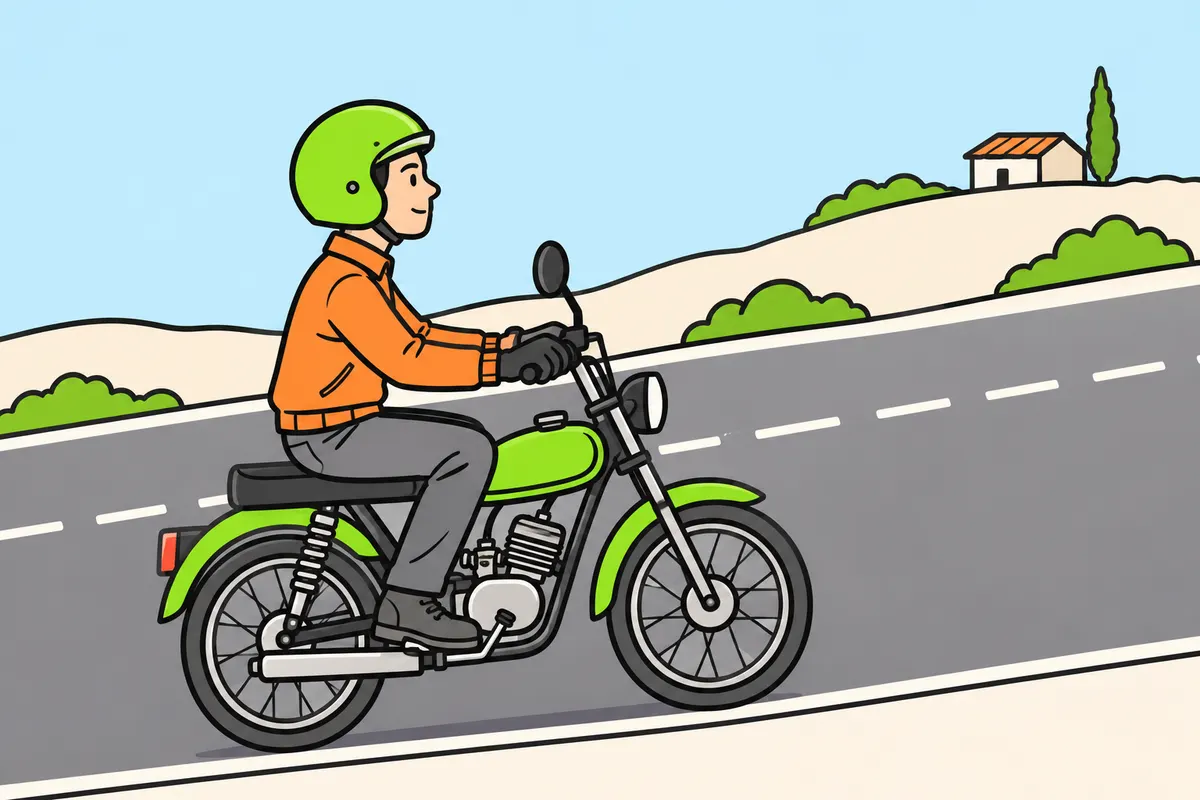
With manual gears, choose a gear that gives safe response without straining the engine.
| Instrument | What it tells you |
|---|---|
| Rev counter | Your engine speed |
| Speedometer | Your road speed |
Remember
- Use the highest gear that gives a normal, safe response.
- Change down if the engine judders or loses power.
- Prepare to use a lower gear uphill or with a load.
- Follow your manual to decide when to change gear.
- Do not copy recommended gear-changing revs for cars.
Exam trap: Wrong: you must always use the highest gear. Right: you choose according to gradient, traffic, vehicle and safety.
Read the full explanation
- If your moped has manual gears, use the appropriate gear to move off and change up when the engine and conditions allow. Avoid staying in a low gear with unnecessarily high engine revs. You must obtain sufficient response without hard acceleration or prolonged clutch use to compensate for an unsuitable gear.
- At the same road speed, a higher gear usually allows lower engine revs. You must choose the highest gear compatible with normal, safe response. If the engine judders, loses power or is under excessive strain, change down: forcing it to run at very low revs is not a correct economy technique.
- You do not need to memorise a universal gear-changing engine speed for all AM vehicles. Values depend on the design, transmission and manufacturer’s instructions. General figures for changing gear in petrol or diesel cars must not automatically be applied to a small moped engine.
- The rev counter shows engine speed and the speedometer shows road speed. You can travel slowly with high engine revs in a low gear. Changing gear alters the relationship between these values; use each instrument to check whether the engine is working properly and whether you are obeying the speed limit.
- On an uphill gradient or with a load, you may need a lower gear to maintain sufficient response. You must select it in good time, without waiting until the engine loses all pulling power. Advice to use high gears always depends on the gradient, traffic, vehicle and safety.
12Variators, automatic transmissions and electric propulsion
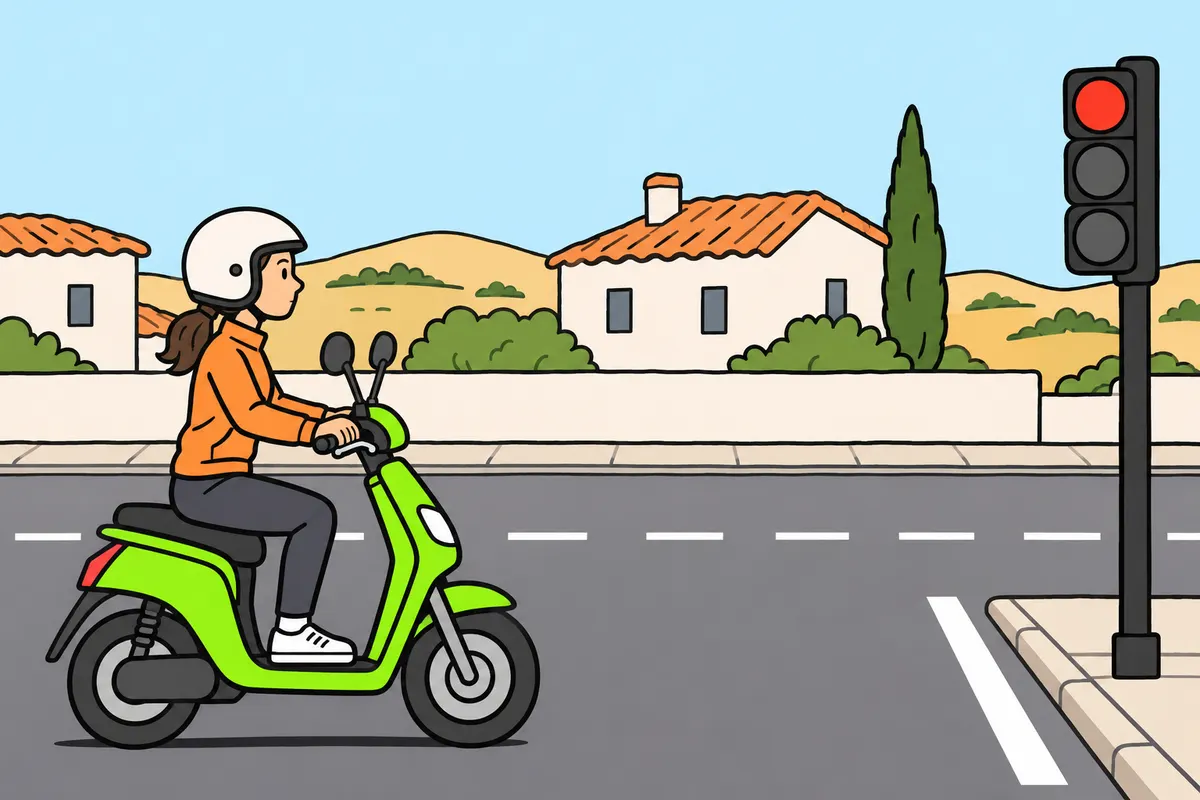
Adapt energy-saving methods to your vehicle’s transmission and propulsion.
| Vehicle or system | What you must do |
|---|---|
| Moped with an automatic variator | Use the accelerator gently; you do not select manual gears |
| Automatic light quadricycle | Use the selector according to the manual |
| Electric moped | Plan range and charging; know any energy recovery system |
Remember
- Use the accelerator gently.
- Know your automatic quadricycle’s selector before driving.
- Never switch between forward and reverse to save energy while moving.
- With your electric vehicle, check the range and plan charging.
- If your vehicle recovers energy when slowing, know the system’s limits.
- Leave space to brake.
Exam trap: Wrong: energy recovery replaces your brakes. Right: you use your brakes when needed.
Read the full explanation
- If your moped has an automatic variator, you do not select first, second or fifth as with a manual gearbox. The transmission adjusts its ratio within its intended operating range. To drive efficiently, apply the accelerator smoothly, anticipate stops and maintain the system as specified.
- In an automatic light quadricycle, you must know the selector positions and how to use them before driving. Do not change to a forward or reverse position to try to save energy while moving. Follow the manual and use the brakes and transmission according to their design.
- On an electric moped, you also save energy through anticipation, an appropriate speed, correct tyre pressures and carrying only the load you need. You must monitor the range and prepare charging according to the equipment instructions.
- If your vehicle recovers energy during deceleration, know its response and limits. Do not assume all electric vehicles provide the same retardation or that regeneration lets you do without the brakes. You must leave room for actual braking and adapt any economy mode to traffic without being distracted by the displays.
13Anticipate slowing down and stopping
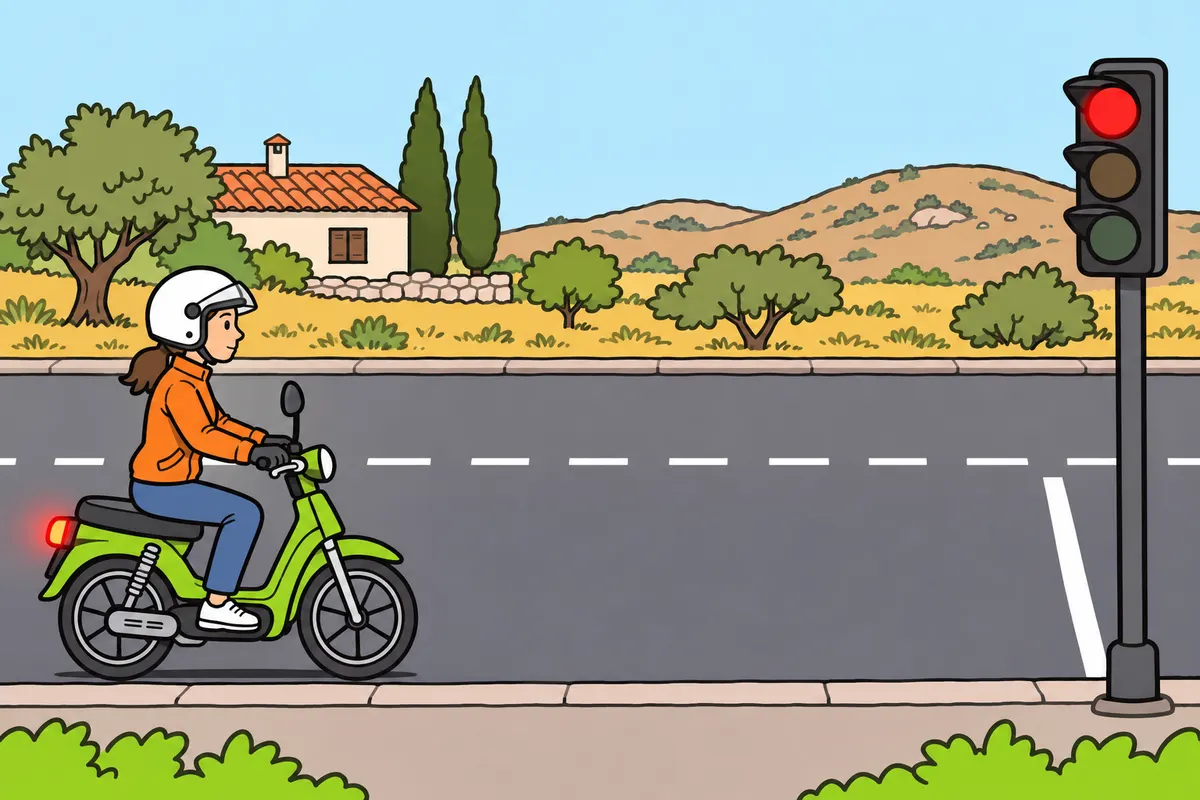
Slow down early and use your brakes as needed while keeping control of the transmission.
Remember
- Ease off the accelerator early and brake when needed.
- Never go downhill in neutral or with the clutch held in.
- Never switch off the engine while moving to save energy.
- Always switch off when stopping in tunnels or enclosed places, and when refuelling.
- In an automatic vehicle, learn how its transmission helps you slow down.
Exam trap: Wrong: releasing the accelerator guarantees zero fuel use on every moped. Right: fuel use depends on its fuel system.
Read the full explanation
- When you anticipate a slowdown, ease off the accelerator in good time and complete deceleration with the brakes as necessary. Maintain control of the transmission and an appropriate gear if you select it manually. Do not keep coasting to avoid using the brakes if this brings you to the obstacle or junction too fast.
- Do not descend a slope in neutral or with the clutch held in to try to save fuel. You lose the braking effect the transmission can provide and may place greater demands on the brakes. In an automatic vehicle, this braking effect depends on its design: you must know how it works, without trying to obtain it by switching off the engine or misusing the selector.
- You cannot say that every moped uses exactly zero fuel when you release the accelerator with a gear engaged. Behaviour depends on the fuel system and how it operates. You must slow down early because it helps you maintain control and avoid unnecessary acceleration, without turning a feature of some engines into a universal rule.
- Avoid unnecessary idling and always switch off the engine when you stop inside a tunnel or enclosed place and when refuelling; consult the full obligations in the Accidents, breakdowns and first aid module, under Fire or queuing traffic in a tunnel. [RGC, art. 115](https://www.boe.es/buscar/act.php?id=BOE-A-2003-23514#a115).
14Correct pressure and checking when cold
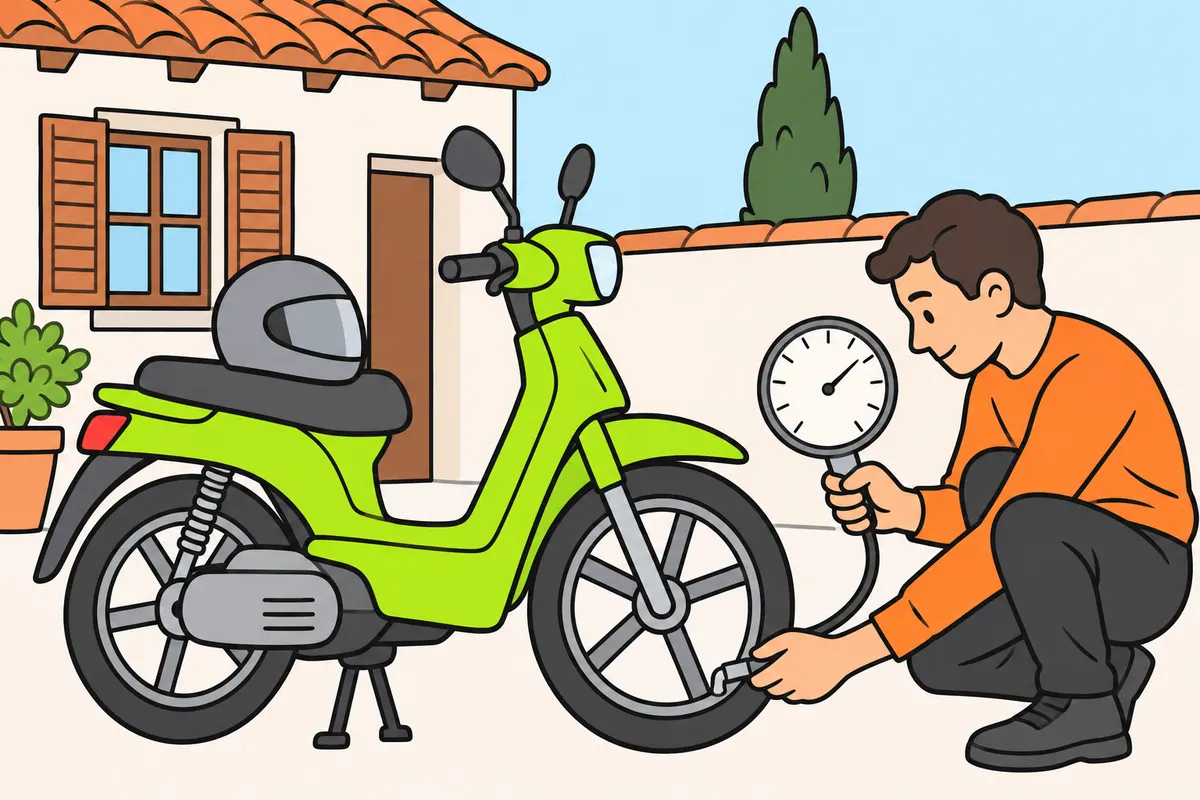
Measure cold tyre pressures and adjust them for your load as the manufacturer instructs.
Remember
- Use a pressure gauge with cold tyres.
- Check the specified pressure for each wheel.
- Check regularly and before important journeys, following your manual.
- Do not release air because pressure rises normally as tyres warm up.
- Check required adjustments when carrying a passenger or luggage.
- Check and resolve any possible leak.
Exam trap: Wrong: looking at or touching a tyre tells you its pressure. Right: you measure it with a pressure gauge.
Read the full explanation
- Check pressures with a gauge and cold tyres, before use warms them up. Use the manufacturer’s figures for each wheel and the expected load. There is no single pressure for every moped, and the front and rear pressures do not necessarily have to match.
- Tyre pressure normally rises as tyre temperature increases during a journey. Do not release air from a hot tyre to match the reading to the recommended cold value: it may be underinflated when it cools. If you suspect a leak or fault, check and resolve it; do not ignore the problem while waiting for a routine check.
- Check regularly and before an important journey, according to the manual. Looking at or touching a tyre does not tell you its pressure accurately. A single annual check is insufficient to detect losses between inspections; you must include pressure checks in regular use, even when journeys are short and urban.
- If you carry a passenger or luggage, check whether the manufacturer specifies different values for that load. Adjust to those instructions without adding air arbitrarily. Maintaining correct pressures supports safety and efficiency. [DGT, tyre care](https://revista.dgt.es/es/motor/noticias/2019/07JULIO/0701-Neumaticos.shtml).
15Rolling resistance, wear and false economies
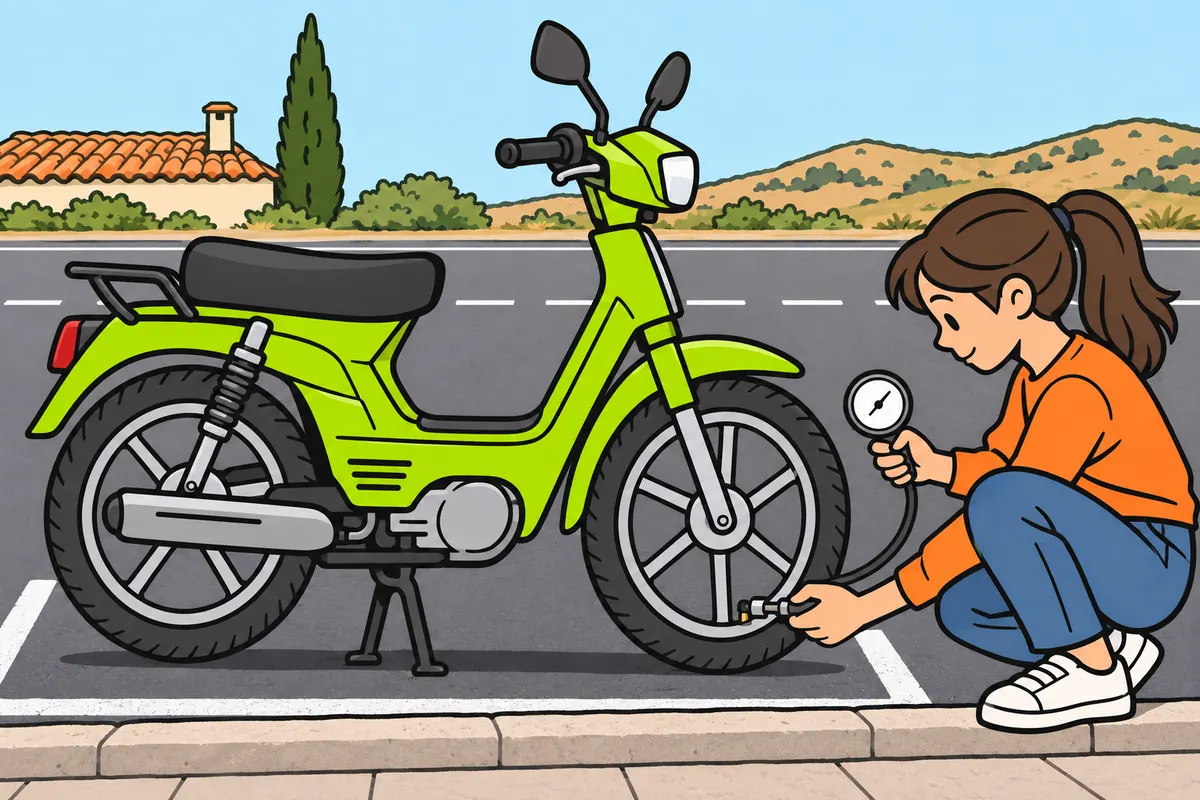
Keep correct tyre pressures to avoid extra energy use, wear and loss of grip.
| Tyre pressure | Possible effects |
|---|---|
| Too low | More energy use and heat; possible wear at the edges |
| Too high | Possible central wear; you may reduce grip |
Remember
- With low pressure, your tyre bends more and needs more energy.
- Never overinflate tyres to try to save energy.
- Never release air on your own initiative for wet roads.
- Measure pressure before drawing conclusions from wear.
- Resolve cuts, changes in shape and unusual wear.
Exam trap: Wrong: wear always tells you the tyre pressure. Right: you measure and check; wear can have other causes.
Read the full explanation
- With insufficient pressure, a tyre deforms more and rolling resistance increases: the engine needs more energy to maintain forward movement. It can also overheat and deteriorate. You must link increased consumption to this resistance, rather than assuming a softer tyre always makes rolling or braking easier.
- Low pressure can encourage wear on the tread shoulders, and excessive pressure in the centre. You must treat this as guidance because uneven wear has other causes. Do not diagnose or adjust solely from the pattern: measure, compare with the manufacturer’s figures and investigate faults.
- Do not overinflate to reduce consumption or release air on your own initiative for wet roads. You can impair grip, stability and wear. On two wheels, these changes are particularly important for balance; a supposed economy benefit does not compensate for losing the ability to steer or stop your moped.
- Keep the tyres in good condition too, and use tyres suitable for your vehicle. Tread helps disperse water but does not guarantee grip in every situation. If you detect cuts, deformation or abnormal wear, you must resolve the problem.
16Carry only what you need and distribute it well
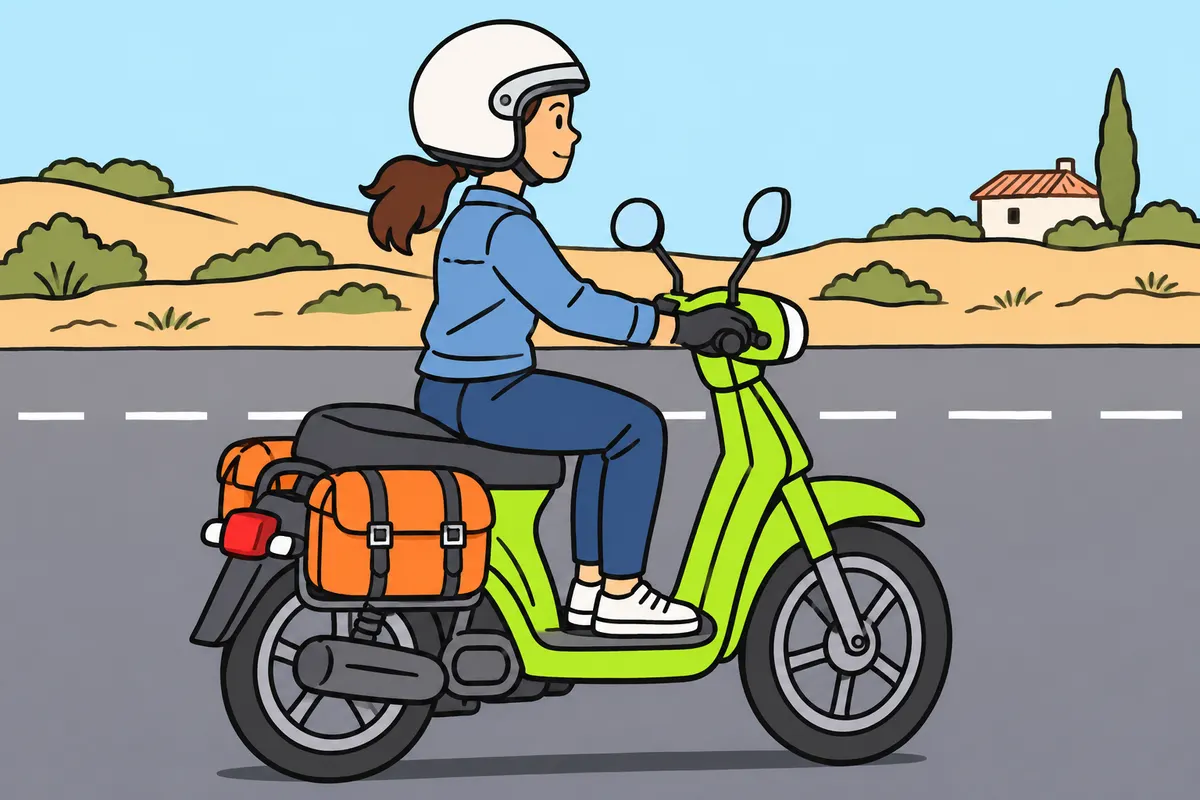
Carry only what you need and secure it without affecting your control.
Remember
- Remove objects you do not need.
- Spread and secure your luggage so it cannot move.
- Keep lights and controls clear.
- Avoid placing weight high up or unevenly.
- Use the carrying places provided by the manufacturer.
- With a passenger, leave more space and check required pressures and settings.
Exam trap: Wrong: a permitted, secure load cannot increase consumption. Right: carrying more weight can require more energy.
Read the full explanation
- Carrying more mass requires more energy to accelerate and can increase consumption even within authorised limits. You must remove unnecessary objects before setting off. Do not apply percentage increases per quantity of kilos from car advice to a moped: the effect depends on the vehicle and journey.
- Distribute and secure luggage so that it maintains stability and cannot move, obscure lights or interfere with the controls. You must prevent it from causing noise, dust or other avoidable nuisance. [RGC, art. 14](https://www.boe.es/buscar/act.php?id=BOE-A-2003-23514#a14).
- On a moped, avoid unnecessarily concentrating weight high up or unevenly, and use the locations provided by the manufacturer. A poorly positioned item can force you to make constant corrections and impair the response to wind. Do not compensate for unstable luggage with a posture that limits your movement.
- With a passenger, you must anticipate a change in response when accelerating and slowing down. Leave a greater margin and check the specified pressures and settings for this use. Authorised seats, ages and load dimensions are covered in the Passengers and loads on a moped module; here you must understand that removing unnecessary weight and distributing necessary weight well are different tasks.
17Aerodynamics, accessories and wind
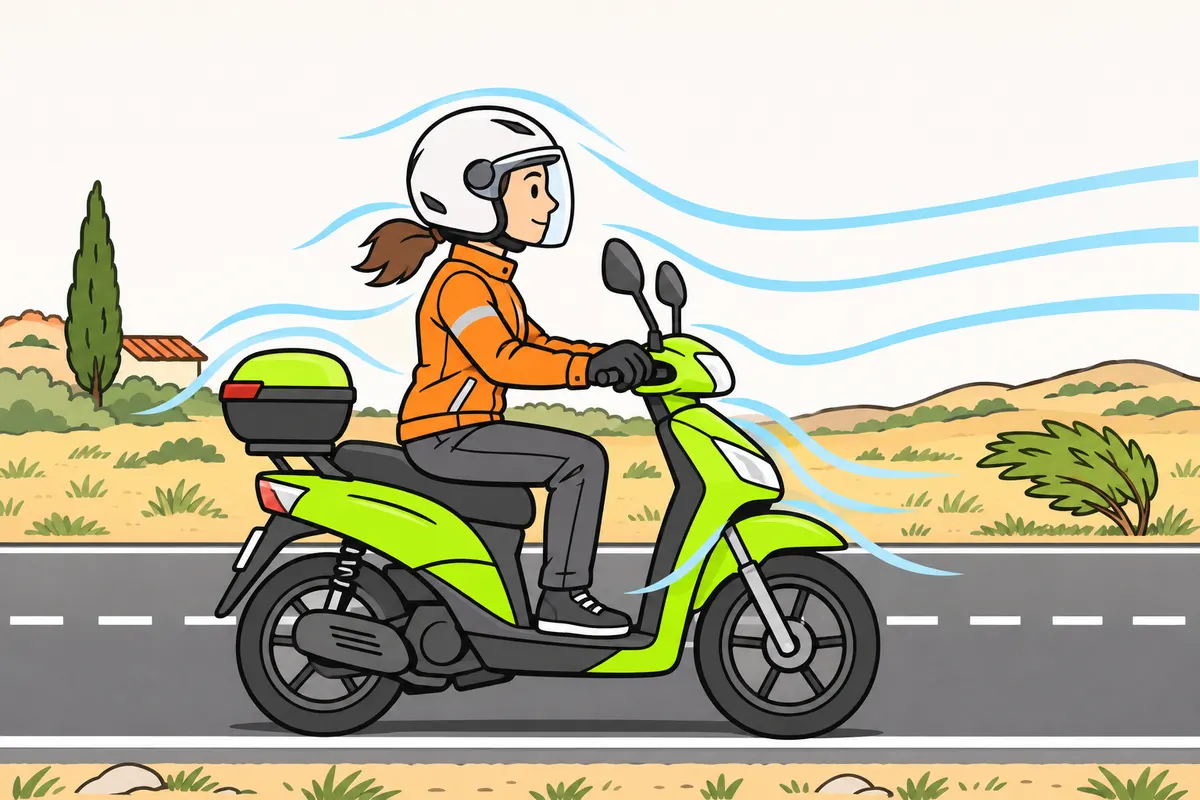
Reduce air resistance without losing protection, visibility or stability.
Remember
- Use suitable accessories and fit them correctly.
- Remove unnecessary carriers only if mountings and type approval remain correct.
- Keep protective equipment and items needed for driving.
- Keep a posture that lets you look around and use the controls.
- In a headwind, expect higher energy use or less range.
- In an enclosed quadricycle, keep enough ventilation and clear mist from windows.
Exam trap: Wrong: you crouch to save energy even when you lose visibility. Right: you keep a posture that allows observation and control.
Read the full explanation
- Air resists forward movement and requires energy to maintain speed. An accessory or item that increases the exposed area can increase this resistance and consumption. You must assess the need for top boxes, carriers and external luggage, using only suitable items correctly installed on your vehicle.
- Remove unnecessary carrying accessories when appropriate, without compromising mountings or type approval. Retain protective equipment and the items necessary for driving. On two wheels, maintain a posture that allows control and observation, rather than crouching until you lose sight of traffic.
- In a headwind, the energy needed to move forward at the same ground speed can increase. You must anticipate higher consumption or reduced range, without demanding more from the engine than is appropriate. Gusts and crosswinds add stability risks that you must assess before any economy calculation.
- In an enclosed quadricycle, opening the windows wide can alter aerodynamics. If it has climate control, using it also requires energy: use it sensibly, maintaining necessary ventilation and demisting. Do not assign a fixed consumption percentage to windows, a top box or air conditioning for every AM vehicle.
18Maintenance that avoids consumption and emissions
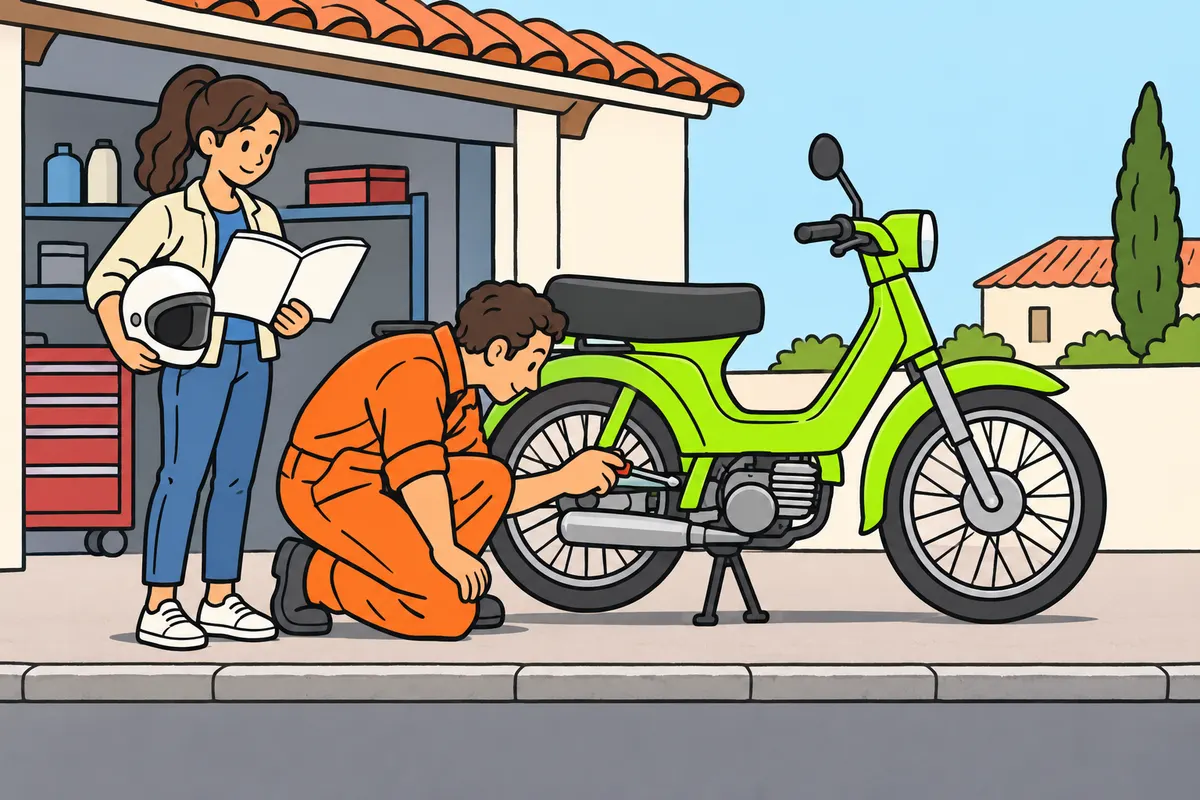
Follow the manufacturer’s maintenance instructions to avoid wasted fuel, emissions and faults.
Remember
- Maintain your engine, filters, spark plugs and transmission as appropriate for your vehicle.
- Have your warm engine checked if it revs unusually fast while stationary.
- Use the specified fuel and oil.
- If your engine needs a fuel-oil mixture, follow the manual’s exact proportions.
- Have unusual smoke, leaks, vibrations or persistently higher consumption checked.
- Complete required inspections even when you maintain your vehicle well.
Exam trap: Wrong: you add oil to petrol for any engine. Right: you follow your engine’s lubrication system and manual.
Read the full explanation
- Follow the specified maintenance for the engine, fuel system, ignition, lubrication and transmission. Attend to the air filter and spark plugs as appropriate, without assigning a universal interval to all models. Poor operation can increase consumption and emissions; postponing necessary servicing is not a reliable way to save money.
- If a warm engine idles abnormally fast, have it checked. It uses fuel without moving the vehicle and can indicate incorrect adjustment or operation. A temporary cold-start engine speed may be intended by the manufacturer. Have the service technician adjust the fuel system according to the manual.
- Use the specified fuel and lubricant. For an engine that requires premix oil or a separate lubrication system, follow its manual exactly; do not change proportions or add oil to petrol based on a general idea applied to all engines. Incorrect practice can impair operation, emissions and reliability.
- Have abnormal smoke, leaks, vibrations or persistent increases in consumption checked. A single noise does not identify the fault by itself, and the appearance of smoke does not establish a regulatory measurement. Maintaining your vehicle reduces problems but does not guarantee freedom from faults or replace required inspections.
19Understand consumption and environmental impact
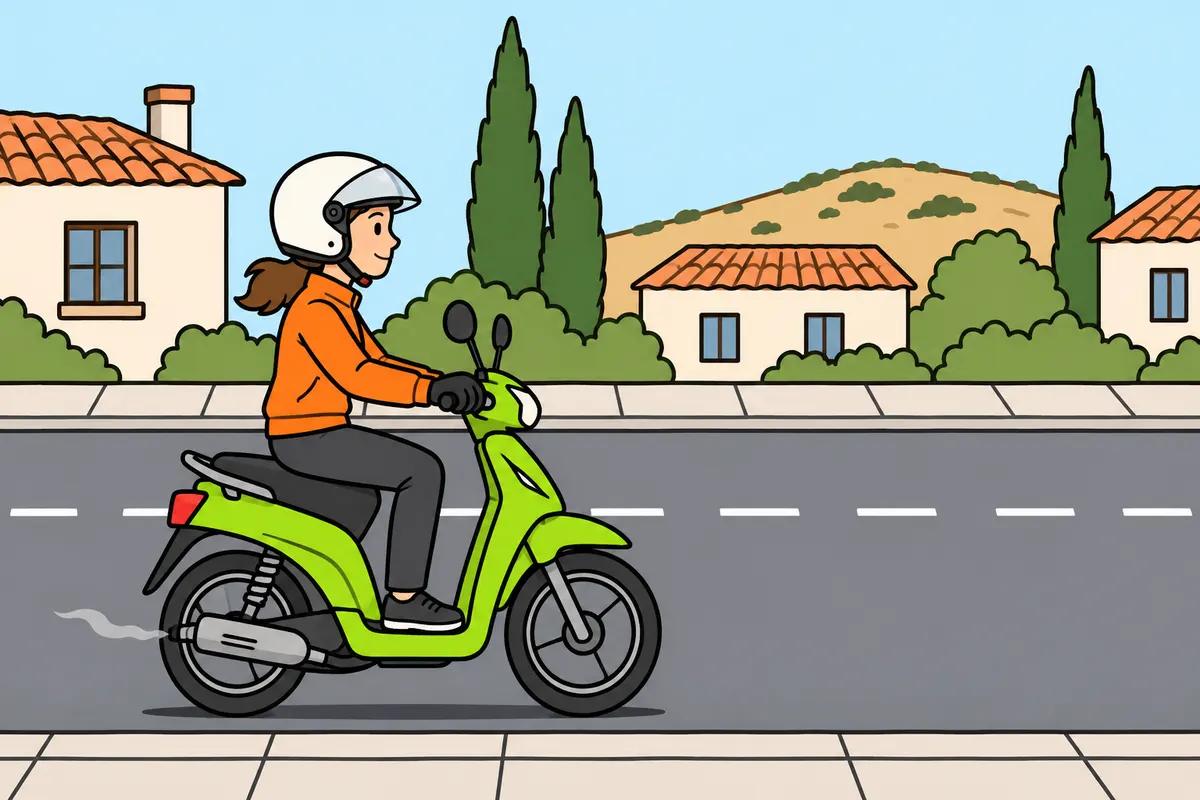
Compare consumption in similar conditions and keep systems that reduce emissions working.
| Measure | What it tells you |
|---|---|
| Total consumption | Energy you use over the whole journey |
| Consumption per distance | Energy you use over a set distance |
| Range | Estimated distance with your available energy |
Remember
- Consider traffic, gradients, load and engine temperature when comparing consumption.
- Do not assume every urban journey uses more energy than every open-road journey.
- Avoid wasting fuel to reduce emissions.
- Keep your catalytic converter and other pollution controls working, if fitted.
- With your electric vehicle, reduce energy use, noise and unnecessary journeys.
Exam trap: Wrong: your electric vehicle has no environmental impact. Right: it emits no combustion exhaust gases while driving, but still uses energy.
Read the full explanation
- Total consumption is the amount of energy you use over the whole journey; consumption per distance lets you compare journeys of different lengths. In a combustion vehicle, litres per 100 kilometres express fuel use per distance. In an electric vehicle, you may see kilowatt-hours per 100 kilometres. Range estimates how far you can travel with the available energy and depends on operating conditions.
- In towns, litres used per distance can increase because of stops, acceleration and idling. This does not mean every urban journey always consumes more than every journey on an open road. You must compare similar conditions and assess traffic, gradients, load and engine temperature, without attributing the result solely to travelling slowly.
- When you burn fossil fuel, you produce CO₂, associated with the greenhouse effect, as well as other engine emissions that affect air quality. Reducing unnecessary fuel use helps reduce these emissions. Consumption measures energy use; compliance with pollutant limits also requires an exhaust and emissions-control system in good condition.
- If your vehicle has a catalytic converter or other emissions-control components, keep them working and follow the manual if starting or fuel-system problems occur. Do not remove them to improve performance. In an electric vehicle, there are no combustion exhaust gases while driving, but you must still limit noise, energy consumption and unnecessary journeys.
20Smoke, waste and checks
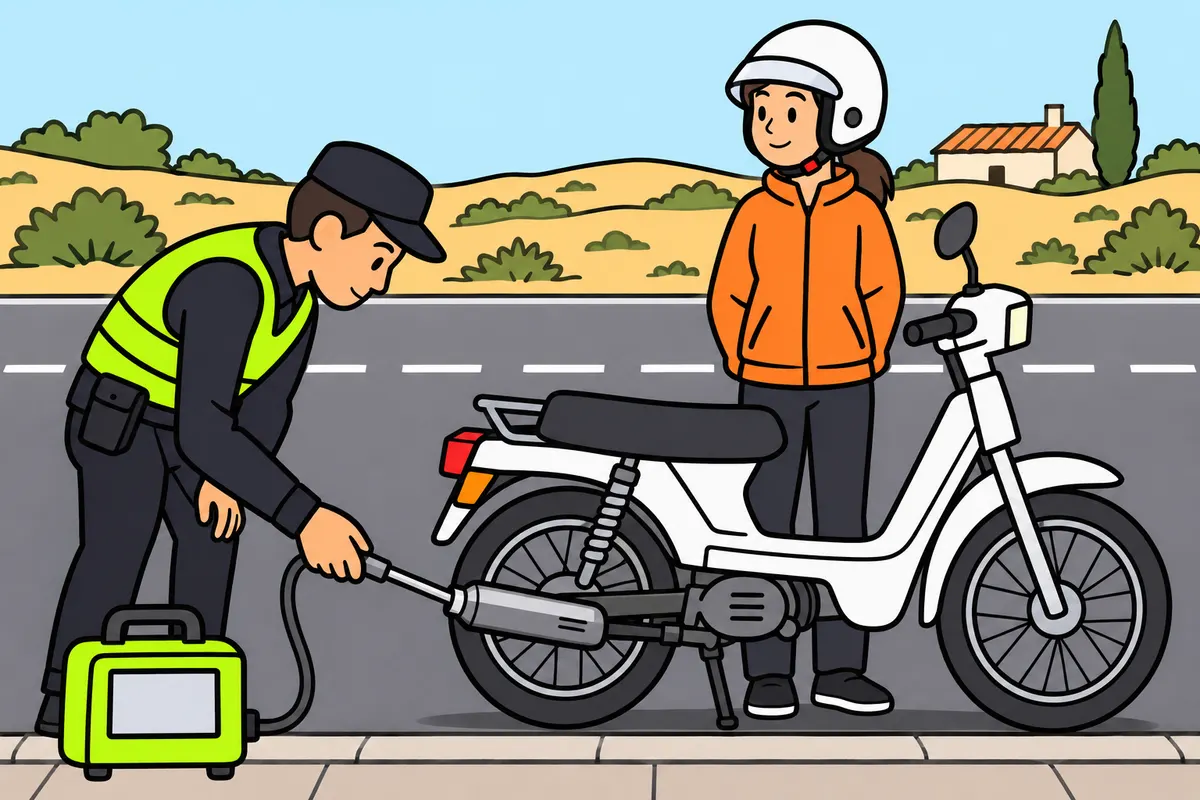
Obey emissions and noise limits, cooperate with checks and keep the road clean.
Remember
- Cooperate with gas, smoke and noise tests.
- Obey an officer’s order to immobilise your vehicle for exceeding those limits.
- Resolve leaks even if your vehicle still works.
- Collect waste without pouring it onto the ground or down drains.
- Use suitable facilities to wash and maintain your vehicle.
- Never discard objects or substances that could create danger or damage the road.
Exam trap: Wrong: low consumption lets you exceed emission limits. Right: you must obey them even if your vehicle runs normally.
Read the full explanation
- You must not drive while emitting gases, smoke or noise above regulatory limits. You must cooperate with tests checking these defects. The obligation also applies if the vehicle seems to run normally, uses little fuel or has an exhaust that was type-approved but has deteriorated. [RGC, art. 7](https://www.boe.es/buscar/act.php?id=BOE-A-2003-23514#a7).
- Officers can immobilise your vehicle if it exceeds the gas, smoke or noise levels permitted for its type. You must comply with their immobilisation order. This measure does not in itself mean losing your driving licence. [Ley de Tráfico (Traffic Act), art. 104.1.h](https://www.boe.es/buscar/act.php?id=BOE-A-2015-11722#a104).
- You must prevent fuel, oil or other liquids from dirtying the road and creating danger. If you detect a leak, resolve it; do not accept it as normal because the moped can still move. Use suitable facilities to wash and maintain the vehicle, and collect waste without pouring it onto the ground or down drains.
- Do not throw or deposit objects or materials that could obstruct traffic, make driving dangerous or damage the road. A discarded container or slippery liquid particularly affects people on two wheels. You must protect your surroundings as well as control engine emissions. [RGC, art. 4](https://www.boe.es/buscar/act.php?id=BOE-A-2003-23514#a4).
21Environmental badges for your AM vehicle
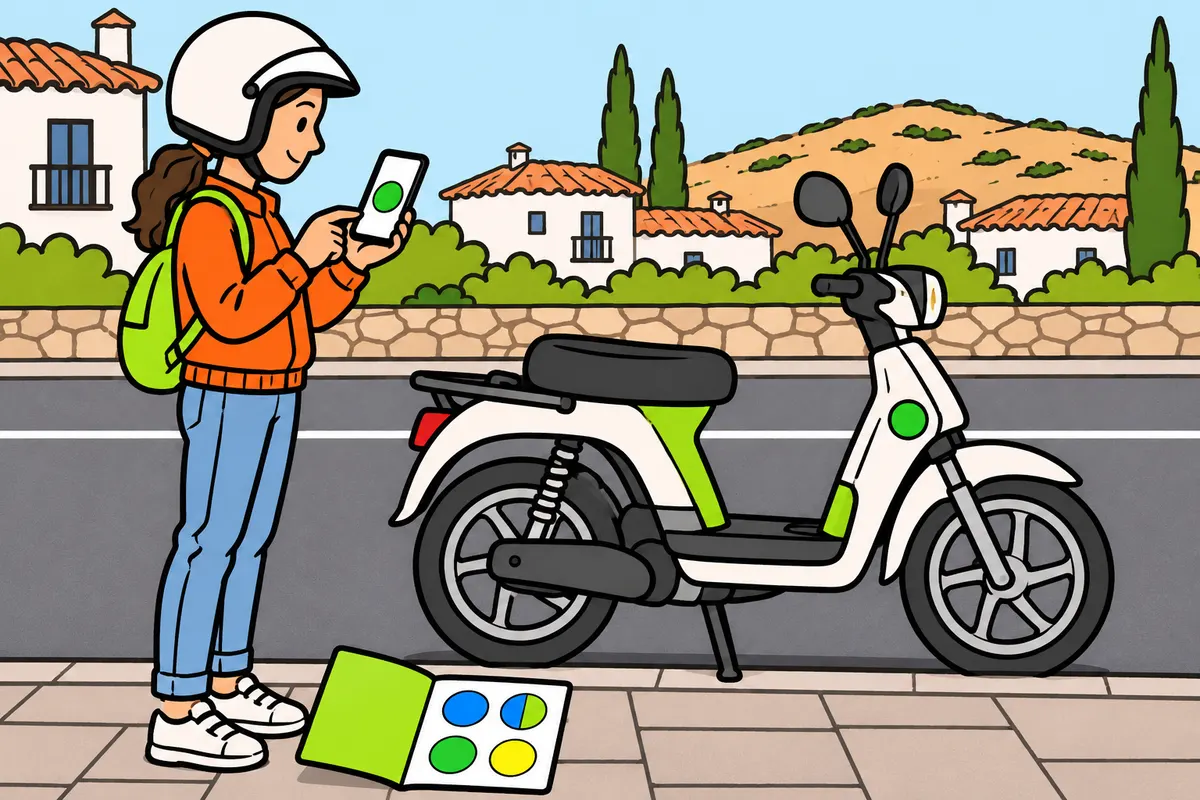
Check your vehicle’s environmental class in the Register, using criteria for your vehicle category.
| Badge and colour | Category L criteria in the Register |
|---|---|
| B: yellow | Euro 2 |
| C: green | Euro 3 or Euro 4; check Euro 5 mopeds by registration number |
| 0 emissions: blue | Battery-electric, range-extended electric, fuel-cell or hydrogen; plug-in hybrids: at least 40 km electric NEDC range |
| ECO: blue and green | Non-plug-in hybrids; plug-in hybrids: below 40 km electric NEDC range |
Remember
- Recognise V-25 as the badge showing your registered environmental class.
- Use category L criteria for your AM vehicle.
- Never apply car registration dates to your AM vehicle.
- Check by registration number; Euro 5 mopeds usually have C status.
- There is no sticker for category A.
- If registered details are wrong, ask the DGT how to correct them.
Exam trap: Wrong: your small engine gives you ECO status. Right: it depends on propulsion and registered details; buying another sticker does not change them.
Read the full explanation
- The four environmental badges are: 0 emisiones (zero emissions), with a blue background; ECO, blue and green; C, green; and B, yellow. The V-25 badge displays the classification recorded in the Registro de Vehículos (Vehicle Register). There is no sticker for category A. [RGV, Annex XI, V-25](https://www.boe.es/buscar/act.php?id=BOE-A-1999-1826#v2).
- For your category L vehicle, Annex II.E specifies B when it is recorded as Euro 2 and C when recorded as Euro 3 or Euro 4. [RGV, Annex II.E](https://www.boe.es/buscar/act.php?id=BOE-A-1999-1826#ie). In practice, Euro 5 mopeds are recorded as C; check by registration number. [DGT, badge lookup](https://www.dgt.es/nuestros-servicios/tu-vehiculo/tus-vehiculos/distintivo-ambiental/). Use category L criteria for your AM vehicle; indicative car registration dates relate to another category.
- In category L, you can find 0 emisiones on battery-electric, range-extended electric, fuel-cell and hydrogen vehicles, and on plug-in hybrids with a minimum electric range of 40 km on the NEDC cycle, according to the Register. The range required for a plug-in hybrid is the distance it covers using electricity, not the combined distance using battery and fuel. [RGV, Annex II.E](https://www.boe.es/buscar/act.php?id=BOE-A-1999-1826#ie).
- For category L, the ECO criterion includes non-plug-in hybrids and plug-in hybrids with an electric range below 40 km on the NEDC cycle. You must therefore refer to the registered propulsion type; a small engine capacity or smooth driving does not in itself confer ECO status. [RGV, Annex II.E](https://www.boe.es/buscar/act.php?id=BOE-A-1999-1826#ie).
- The environmental classification is a detail in the Vehicle Register; the sticker displays it. If you suspect the registered details are incorrect, ask the DGT how to clarify or correct them using the vehicle documentation. You must resolve the discrepancy through the relevant procedure: buying another sticker does not change the assigned classification.
22Check and display the sticker
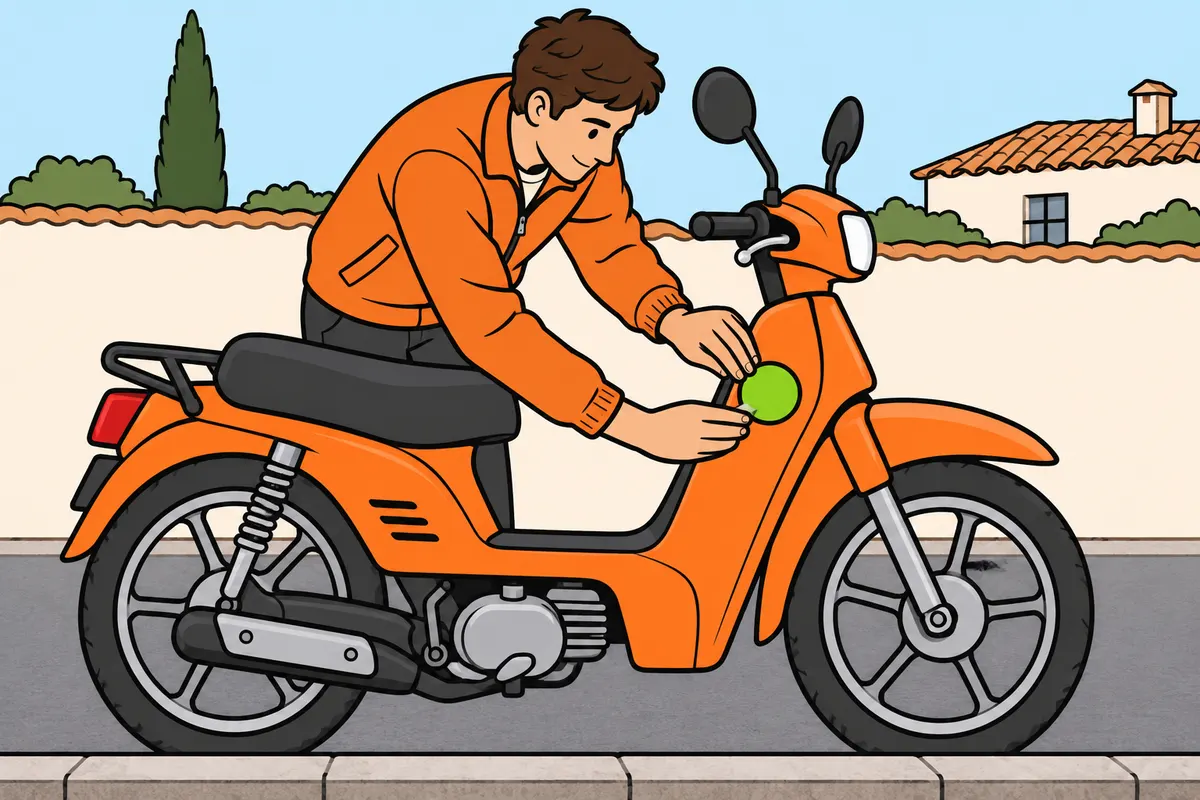
Check your badge by registration number and follow local rules for displaying it.
| Your vehicle | Where you put the sticker |
|---|---|
| With a front windscreen | Lower right-hand corner, on the inside |
| Without a windscreen | Somewhere clearly visible on your vehicle |
Remember
- Check your vehicle’s badge through the official DGT service.
- Check the rules where you drive.
- Keep the sticker visible and readable on your vehicle.
- Never put it on your helmet instead.
- Meet local permit requirements even when registration numbers are checked electronically.
Exam trap: Wrong: you never need to display it because display is generally voluntary. Right: you display it when the competent authority requires it.
Read the full explanation
- Check the badge by registration number using the official DGT service. The lookup is for the specific vehicle you intend to use, whether it is a combustion moped, a light quadricycle or an electric vehicle. Appearance, size and trade name do not replace registered details. [DGT, environmental badge](https://www.dgt.es/nuestros-servicios/tu-vehiculo/tus-vehiculos/distintivo-ambiental/).
- Obtaining and displaying the badge is generally voluntary, but the competent authority can require display through its regulations. You must check the rules where you drive. [RGV, Annex XI, V-25](https://www.boe.es/buscar/act.php?id=BOE-A-1999-1826#v2).
- If your vehicle has a front windscreen, place the badge in its lower right-hand corner on the inside. If it has no windscreen, place it somewhere clearly visible on the vehicle. You must keep it legible and must not put it on your helmet instead of on the moped. [RGV, Annex XI, V-25](https://www.boe.es/buscar/act.php?id=BOE-A-1999-1826#v2).
- Even if an authority checks registration numbers electronically, you must comply with the applicable entry and display requirements. The sticker helps identify a classification; it does not replace local permits, parking reservations or other restrictions. Before travelling to another municipality, check its official information instead of assuming it applies the same conditions as your own.
23ZBE and entry according to environmental criteria
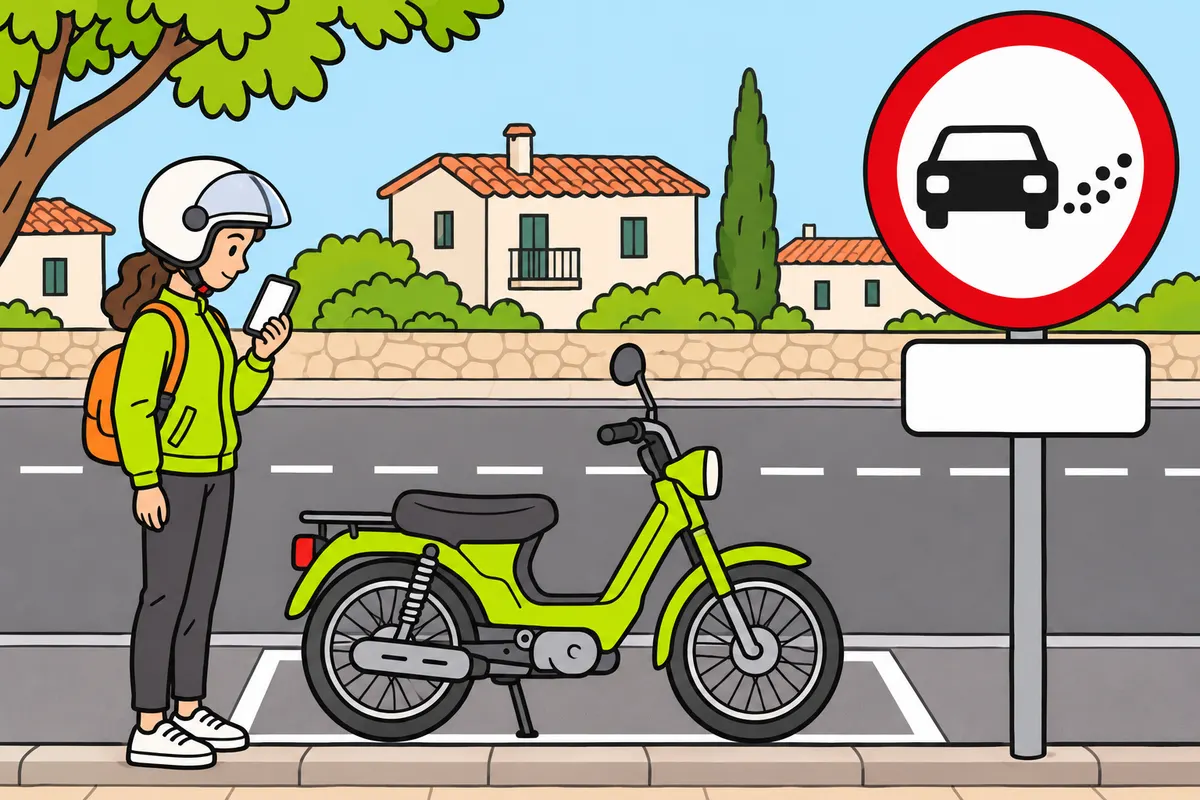
Check local rules before entering, driving or parking in a low-emission zone.
Remember
- Read R-120 with the panel or notice explaining the prohibition.
- Check whether restrictions affect your moped or quadricycle.
- Check current times, boundaries, conditions and exceptions.
- If an exception requires registration or a permit, arrange it beforehand.
- Check temporary pollution measures and other restrictions too.
- If you cannot enter, plan another route or use other transport.
Exam trap: Wrong: your sticker allows every ZBE entry, or the car picture excludes mopeds. Right: you check local rules and the instructions with R-120.
Read the full explanation
- A zona de bajas emisiones (low-emission zone) defines an area with measures to improve air quality and reduce traffic emissions. It can restrict entry, driving and parking according to environmental classification. You must check the local rules to know whether they affect your moped or quadricycle, within which boundary and under what conditions. [RD 1052/2022, art. 5.2](https://www.boe.es/buscar/act.php?id=BOE-A-2022-22689#a5).
- Sign R-120 indicates no entry for vehicles according to their environmental badge or other environmental criteria. You must interpret the sign together with the supplementary panel, notice and instructions defining its scope. Do not assume the picture of a car necessarily excludes mopeds from the restriction. [RD 465/2025, sign catalogue](https://www.boe.es/buscar/doc.php?id=BOE-A-2025-12199).
- There is no identical authorisation for all vehicles with B, C, ECO or 0 in every ZBE. You must check times, conditions and exceptions in current municipal information. If an exception requires registration or authorisation, meet those requirements; being a resident or displaying a sticker does not let you assume the exception applies automatically.
- Distinguish a ZBE from temporary measures during pollution episodes and other traffic restrictions. They can apply together on the same journey. If you cannot enter, find a permitted route and parking place beforehand or use another means of transport; do not stop dangerously at the entrance to check your phone.
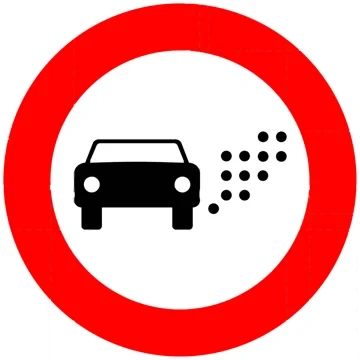 R-120
24Reduce noise and use the horn correctly
Avoid unnecessary noise and use your horn only when allowed.
| Situation | When you may use your horn without a shrill sound |
|---|---|
| Possible accident | To prevent it, including in built-up areas; also respond to the danger |
| Intention to overtake | To announce it outside built-up areas |
| Permitted exceptional urgent transport | To warn of your presence, meeting the conditions for that service |
Remember
- Avoid unnecessary revving; check your exhaust, mountings and luggage.
- Never use your combustion moped with an unsilenced exhaust or faulty silencer.
- Never replace the silencer’s function with resonator pipes.
- Use a type-approved replacement exhaust and complete modification approval when required.
- On your electric moped, slow down and leave space: others may not hear you.
- Never use your horn to greet, protest or hurry a queue.
Exam trap: Wrong: you can never sound your horn in built-up areas. Right: you may warn to prevent a possible accident; also act to avoid the collision.
Read the full explanation
- Avoid unnecessary revving, especially while stationary or waiting. You must maintain the exhaust, mountings and load to prevent avoidable vibration and knocking. Noise pollution depends on both vehicle condition and how you use it; driving in a quiet area does not justify making noise for fun.
- On a combustion moped, you must not drive with an unsilenced exhaust or an ineffective, incomplete, unsuitable or damaged silencer, on either urban or interurban roads. You must not replace its function with resonator pipes either. You must assess a component integrated into a type-approved system according to its requirements and operation, not just its name. [RGC, art. 7.2](https://www.boe.es/buscar/act.php?id=BOE-A-2003-23514#a7).
- You may use only non-shrill audible warnings to prevent a possible accident, announce your intention to overtake outside built-up areas, and warn of your presence when carrying out the exceptional urgent transport provided for in article 70. Avoid unjustified or excessive use, such as greeting, protesting or hurrying a queue. [RGC, art. 110.1 and 110.2](https://www.boe.es/buscar/act.php?id=BOE-A-2003-23514#a110); [RGC, art. 70](https://www.boe.es/buscar/act.php?id=BOE-A-2003-23514#a70).
- If you use the horn in response to danger in a built-up area, accompany the warning with whatever response you need to avoid a collision. You must assess whether the other person has noticed you and leave room to stop. For the conditions of exceptional urgent transport, consult the Right of way module, under An emergency in a private vehicle.
- On an electric moped, you must anticipate that other users may not hear you approaching from the engine sound. Slow down, observe and leave space instead of compensating with continuous horn use. You must take the same care around pedestrians and cyclists even if your vehicle produces less propulsion noise.
- At your moped’s ITV (vehicle roadworthiness test), noise is checked against the applicable limits; if you replace the exhaust, you must use one type-approved for your vehicle and complete the modification approval procedure where required. Consult the “The moped and its equipment” module, under Keep the approved characteristics. [RD 920/2017, Annex I, section 8.1](https://www.boe.es/buscar/act.php?id=BOE-A-2017-12841#ai); [RD 866/2010, arts. 7 and 8](https://www.boe.es/buscar/act.php?id=BOE-A-2010-11154#a7).
Observe, anticipate and leave a margin
Apply this sequence continuously throughout your journey.
- Scan your path, the sides and your mirrors without fixating on one point.
- Identify which users or obstacles could enter your space.
- Check visibility and the room available to stop or correct your course.
- Adapt your speed early and signal the relevant manoeuvres.
- Act progressively and observe again as the situation develops.
Check pressures without altering the cold reference value
Prepare your tyres for the actual journey load.
- Check the manufacturer’s pressure for each wheel and load.
- Measure with a gauge and cold tyres.
- Adjust to the specified values without overinflating to save energy.
- Check for leaks, damage and abnormal wear.
- If you measure after driving, do not release air to match the hot reading to the cold reference value.
Drive efficiently up to the next stop
Avoid adding energy that you immediately have to dissipate.
- Observe traffic lights, queues and obstacles before accelerating.
- Move off gently when there is space to advance.
- Use an appropriate gear and engine speed; with a variator, apply the accelerator progressively.
- Ease off early when you anticipate needing to brake.
- Complete deceleration with the brakes as necessary, maintaining control and grip.
Check whether you can enter a ZBE
Environmental classification helps you interpret the restriction.
- Check your registration number’s classification with the DGT.
- Check the boundary, conditions and times in official municipal information.
- Check whether your vehicle needs authorisation or registration for an exception.
- Read R-120 and its supplementary instructions before entering.
- Display the badge if required and choose a permitted alternative if you do not meet the entry conditions.
Finished this module?
Mark it as read and you will see your progress on the theory list.