
Theory · AM Licence - Moped · Module 16 of 18
Accidents, breakdowns and first aid
You learn how to make the scene of a moped accident or breakdown safe, call 112 and provide help without making injuries worse. You distinguish the V-16, visibility and assistance obligations that apply to AM, and answer questions about helmets, breathing, bleeding, burns and tunnels.
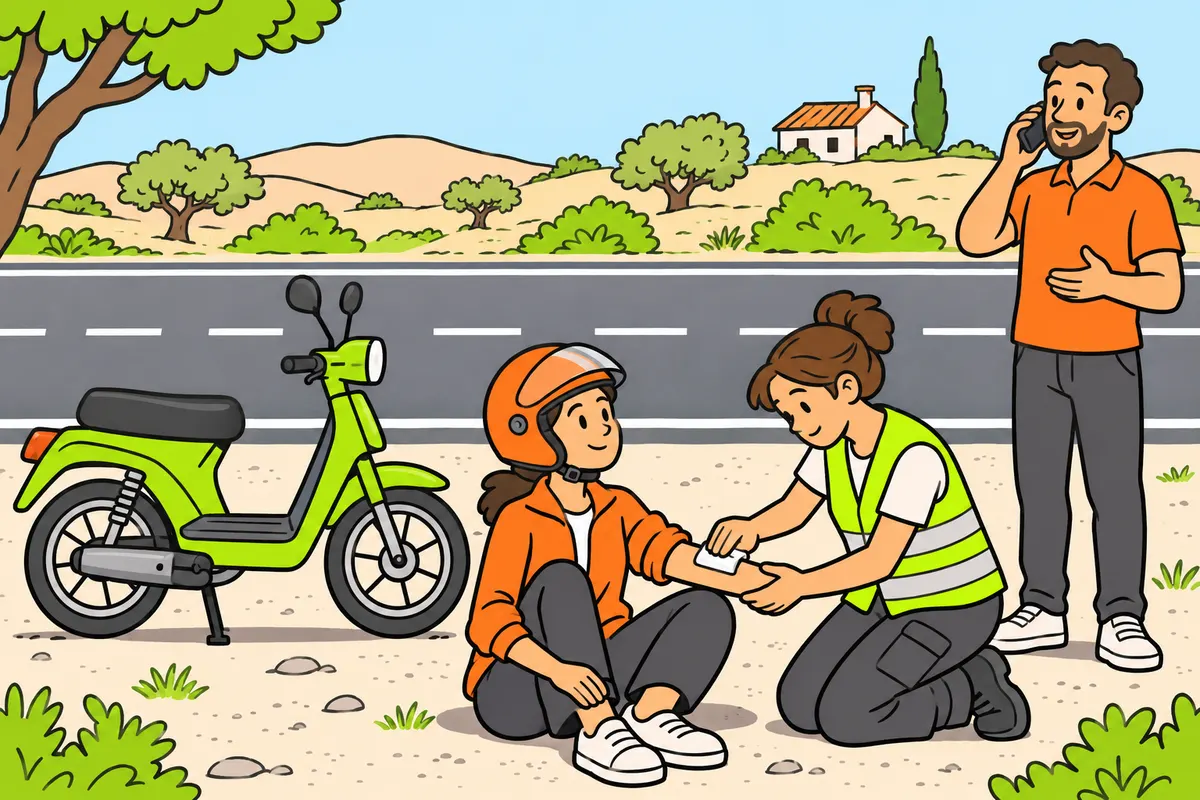
1PAS: the order of action
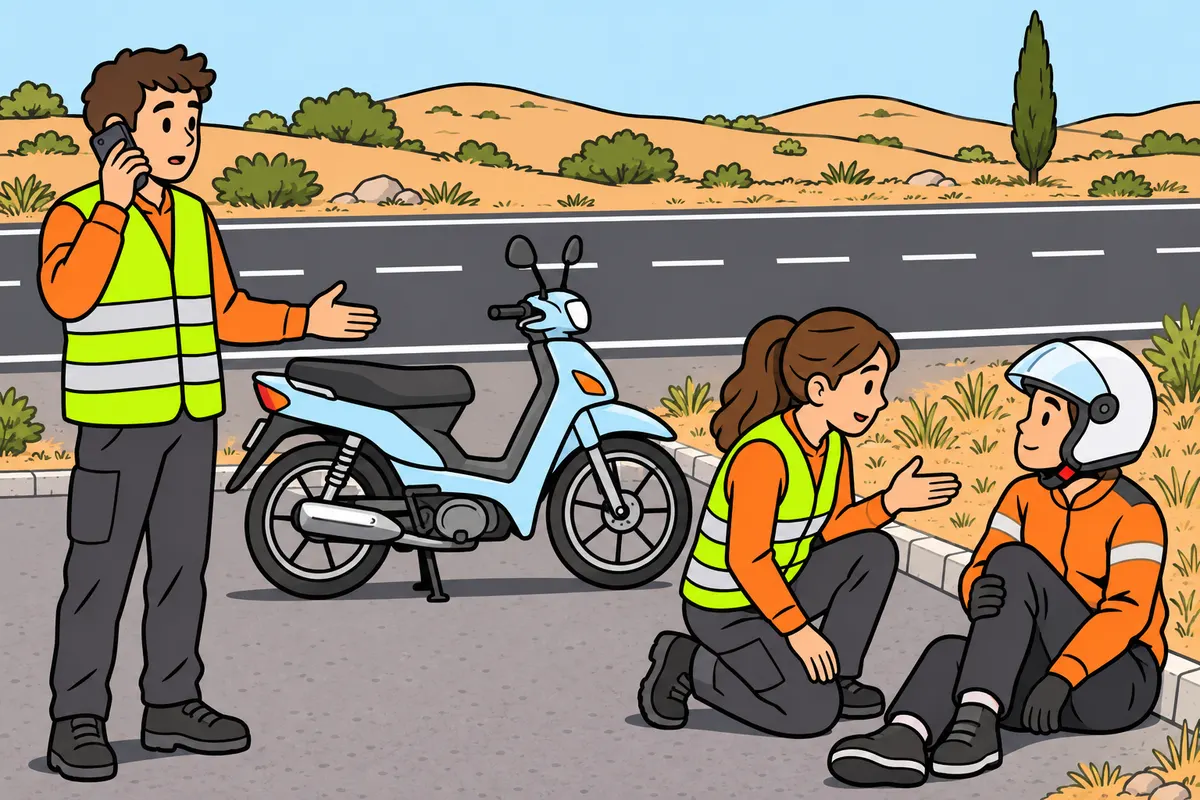
Protect yourself first, then call for help and assist.
Remember
- Check traffic, spills and fire before approaching.
- Stop where you cause no obstruction and can stay safe.
- Call 112 or ask a specific person to call.
- Check that they are making the call.
- Help within your knowledge and follow emergency instructions.
Exam trap: Wrong: You help before checking dangers. Right: First protect yourself and make the scene safe.
Read the full explanation
- At an accident, you must apply PAS: proteger (protect), avisar or alertar (alert), and socorrer (help). Start with your own safety and that of the scene; then call for help and assist the casualties within your knowledge. A quick overall assessment lets you explain what has happened and identify risks that prevent you from approaching. [DGT, first aid 2026](https://sede.dgt.gob.es/export/sites/dgt/.galleries/permisos-de-conducir/certificacion-aptitud-profesores-formacion-vial/2026/MANUAL-IX-Primeros-auxilios.pdf)
- Protecting means preventing another accident: observe the traffic, vehicle positions, spills and possible fires. On a moped, stopping abruptly beside someone who has fallen can expose both of you to danger. First find somewhere to stop without obstructing traffic and from which you can act safely.
- Alerting means obtaining appropriate assistance, normally through 112. You can ask a specific person to make the call while you take urgent action. Check that they understand the task; several witnesses with phones do not guarantee that someone is calling.
- Helping means providing useful assistance until professionals arrive. You do not need to diagnose injuries or improvise techniques. Follow the instructions from 112 and report changes in the casualty's condition; discussing responsibility or collecting belongings must not delay life-saving measures.
2Your duty to help
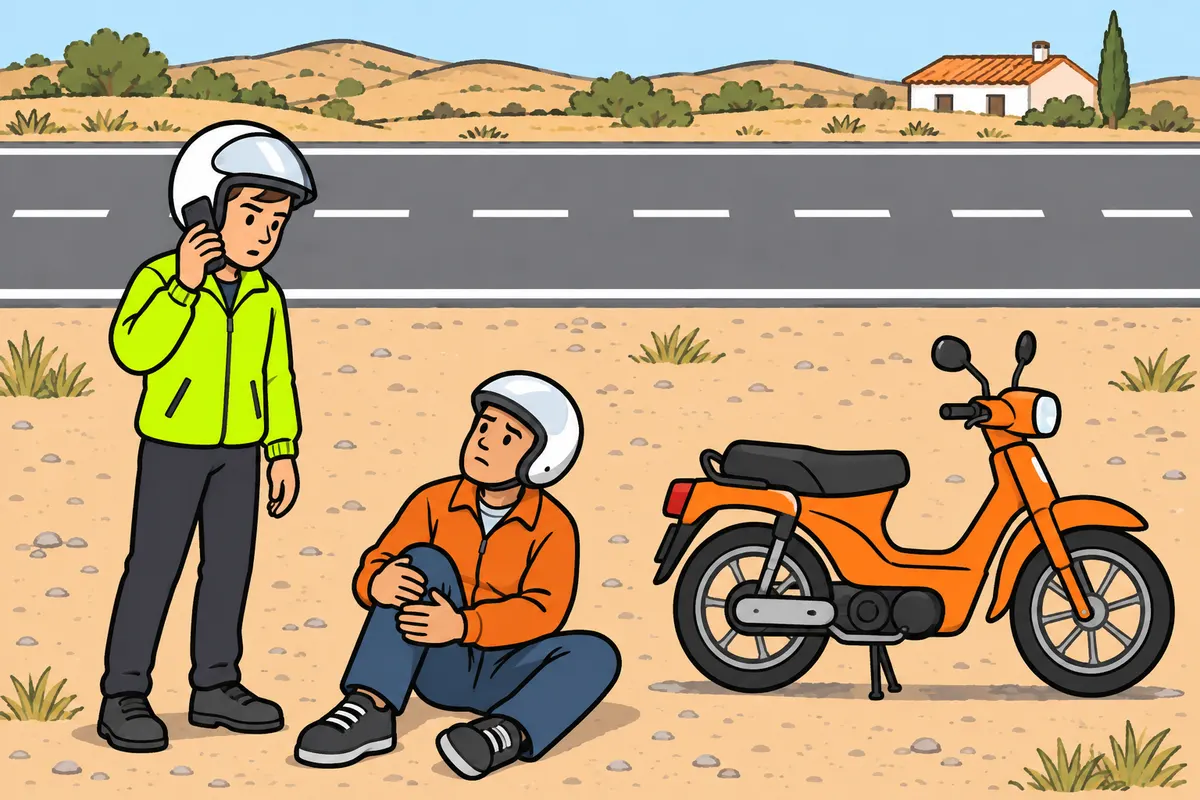
You must help or request help even if you did not cause the accident.
Remember
- If involved, stop safely and check what has happened.
- Call from a safe place if you cannot approach.
- As a witness, cooperate where possible and appropriate.
- You do not need first-aid knowledge to request help.
- Follow officers’ instructions.
Exam trap: Wrong: As a witness, you must always stop. Right: Cooperate unless your help is clearly unnecessary or the authorities or their officers are already present.
Read the full explanation
- If you are involved in, witness or become aware of an accident, you must provide or request help to care for the casualties. You must also cooperate to prevent further dangers and establish the facts. This obligation applies to you as a moped rider and to other road users. [Ley de Tráfico (Traffic Act), art. 51](https://www.boe.es/buscar/act.php?id=BOE-A-2015-11722#a51)
- If you are involved, you must stop without creating another danger and assess the consequences. If you have fallen, first check whether you can protect yourself without worsening an injury. Calling for help from a safe position is useful when you cannot approach another casualty. [RGC, art. 129](https://www.boe.es/buscar/act.php?id=BOE-A-2003-23514#a129)
- If you are only a witness, you must cooperate as far as possible and as appropriate. The regulations make exceptions where your help is clearly unnecessary or the authorities or their officers are already present. Do not stop out of curiosity or form a crowd that hinders assistance. [RGC, art. 129](https://www.boe.es/buscar/act.php?id=BOE-A-2003-23514#a129)
- Not knowing first aid does not justify ignoring an emergency. You can report the location, warn of dangers and help rescue teams gain access. If officers give you instructions, cooperate without entering a dangerous area or one reserved for the emergency response on your own initiative.
3Stopping your moped safely
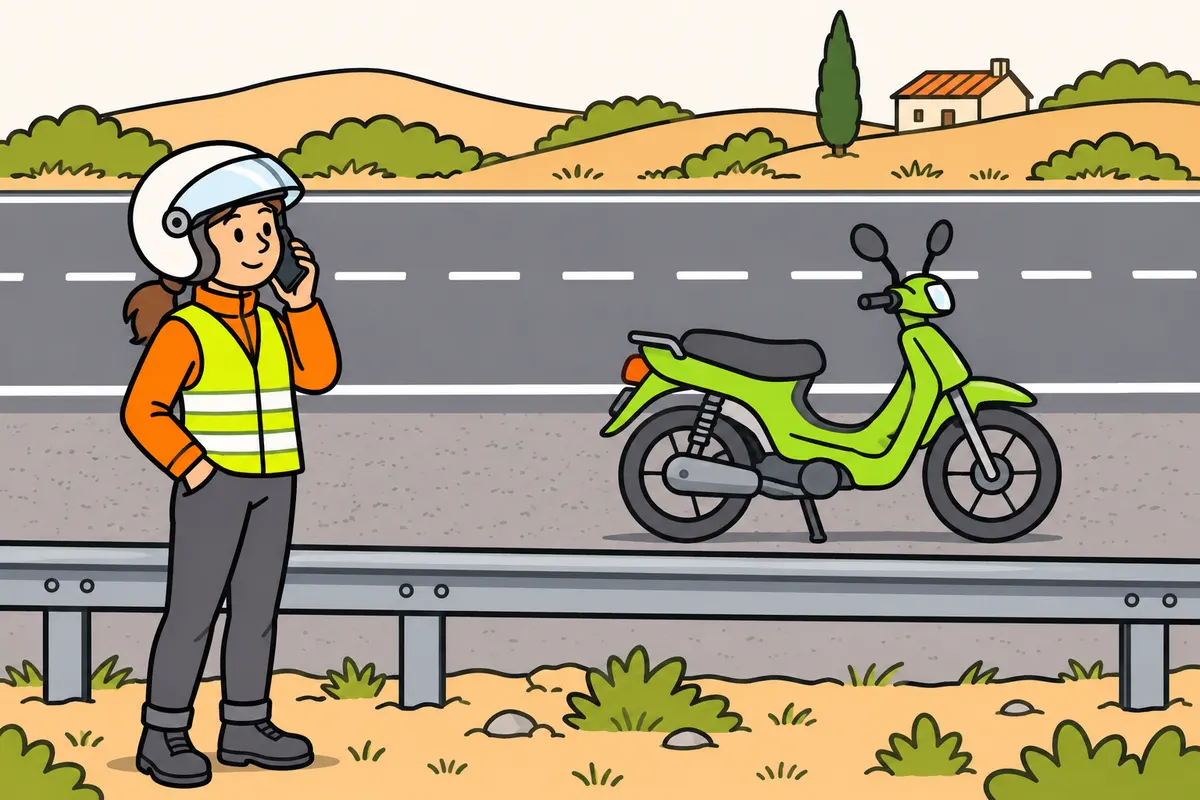
After a breakdown, stop safely or continue if you can do so without danger.
| Moped condition | What you must do |
|---|---|
| You can continue safely | Set off again and clear the danger. |
| You cannot continue safely | Stop where you obstruct least and request assistance. |
Remember
- Do not continue if brakes, steering or stability fail.
- If you can continue safely, set off immediately to clear the danger.
- If needing assistance, leave traffic lanes; seek an exit along the right-hand hard shoulder.
- Otherwise, stop on the right-hand hard shoulder or where you obstruct least.
- Warn traffic; remove your moped and load when possible without putting yourself in danger.
- Wait somewhere protected; do not repair your moped in a traffic lane.
Exam trap: Wrong: You continue to test whether your moped works. Right: Continue only when you are sure it is safe.
Read the full explanation
- If a fault compromises braking, steering or stability, find a safe place to stop and request assistance. Do not try to finish your journey by accelerating or assume that slowing down a little resolves the fault. A leak, noise or vibration requires you to assess safety before continuing.
- If your damaged or broken-down vehicle can continue safely, you must set off again immediately to clear the danger. If you need assistance, leave the traffic lanes as soon as possible and use the right-hand arcén (hard shoulder) to reach the first available exit; if you cannot, stop on the right-hand hard shoulder or wherever you cause the least obstruction. [RGC, art. 130](https://www.boe.es/buscar/act.php?id=BOE-A-2003-23514#a130)
- If your moped or its load obstructs the carriageway, warn other traffic and take the necessary steps to remove it as soon as possible. Move it off the carriageway and position it in accordance with parking rules when feasible. Do not risk being struck while trying to lift it as vehicles pass beside you. [RGC, art. 130](https://www.boe.es/buscar/act.php?id=BOE-A-2003-23514#a130)
- A breakdown does not make a traffic lane a suitable place for repairs. Tell the assistance service the vehicle type and problem, and wait in a protected place. Do not carry your passenger on a damaged moped to check whether it works; first you must be sure you can ride safely.
4Protecting people at the scene
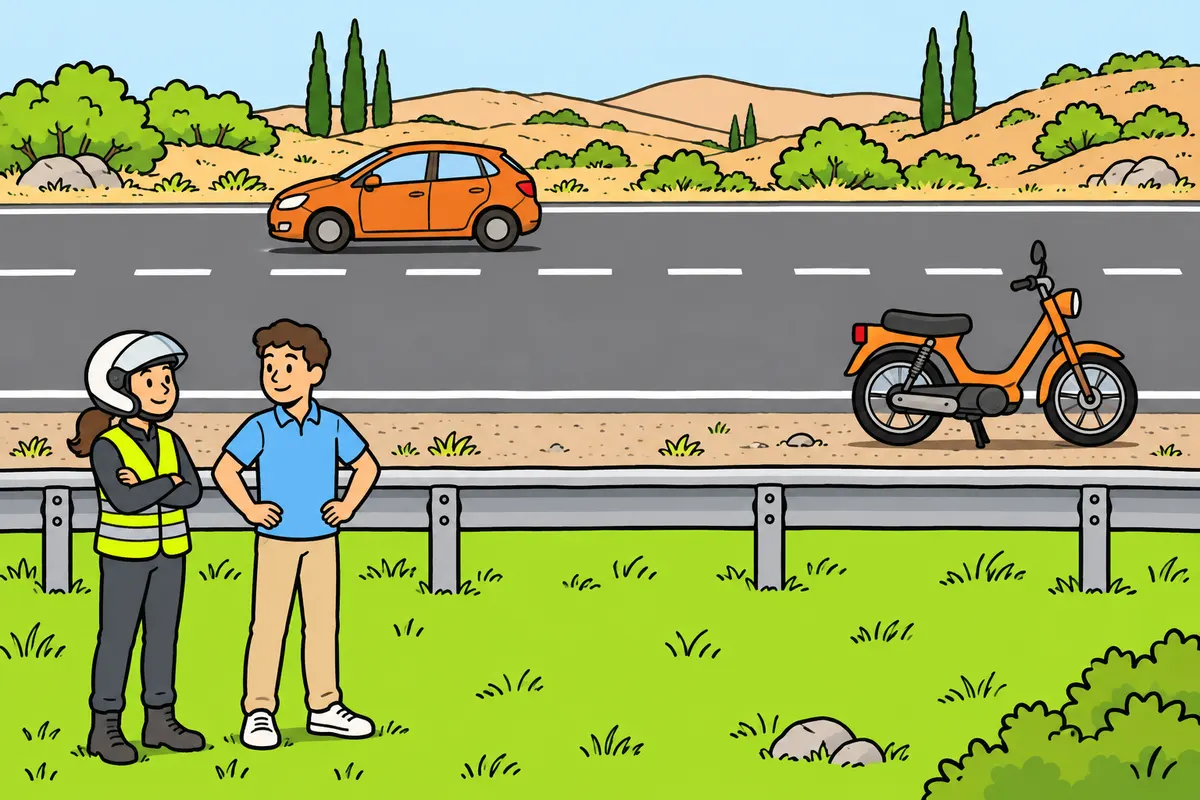
Find protection from traffic before approaching or waiting.
| Immobilised vehicle unable to continue | How you protect yourself |
|---|---|
| Light quadricycle: you can safely reach a place beyond the roadway | Leave on the side away from traffic; stay off lanes and hard shoulders. |
| Light quadricycle: you cannot get out safely | Stay inside with your seat belt fastened. |
| Open moped | Find protection from traffic without crossing recklessly. |
Remember
- Check that others can see you and stop.
- Move people away from traffic only if they can move without injury.
- Do not cross traffic recklessly to find shelter.
- Do not force injured people to walk; follow emergency instructions.
Exam trap: Wrong: You wait on an open moped as if inside a car. Right: Find real protection from traffic.
Read the full explanation
- Before approaching, check whether other drivers can see you and stop. A bend, a crest or darkness can hide the casualty and fallen moped. Do not assume that your clothing or the vehicle's size is enough for others to spot you in time.
- Move yourself and anyone who can move without injury to a safe place away from traffic. Do not stay beside the vehicle to watch over it if you risk being struck there. Also avoid standing where a collision could push it onto you.
- In a light quadricycle that is immobilised and cannot continue, you must get out if there is a safe place beyond the roadway, leaving on the side away from traffic and staying off traffic lanes and hard shoulders. If you cannot get out safely, remain inside with your seat belt fastened. [RGC, art. 130](https://www.boe.es/buscar/act.php?id=BOE-A-2003-23514#a130)
- Waiting inside with a seat belt cannot apply literally to an open two-wheeled moped. Find real protection from traffic without crossing it recklessly. If anyone is injured, do not force them to walk to that shelter without assessing their injuries and following emergency instructions.
5Lights to warn that you are immobilised
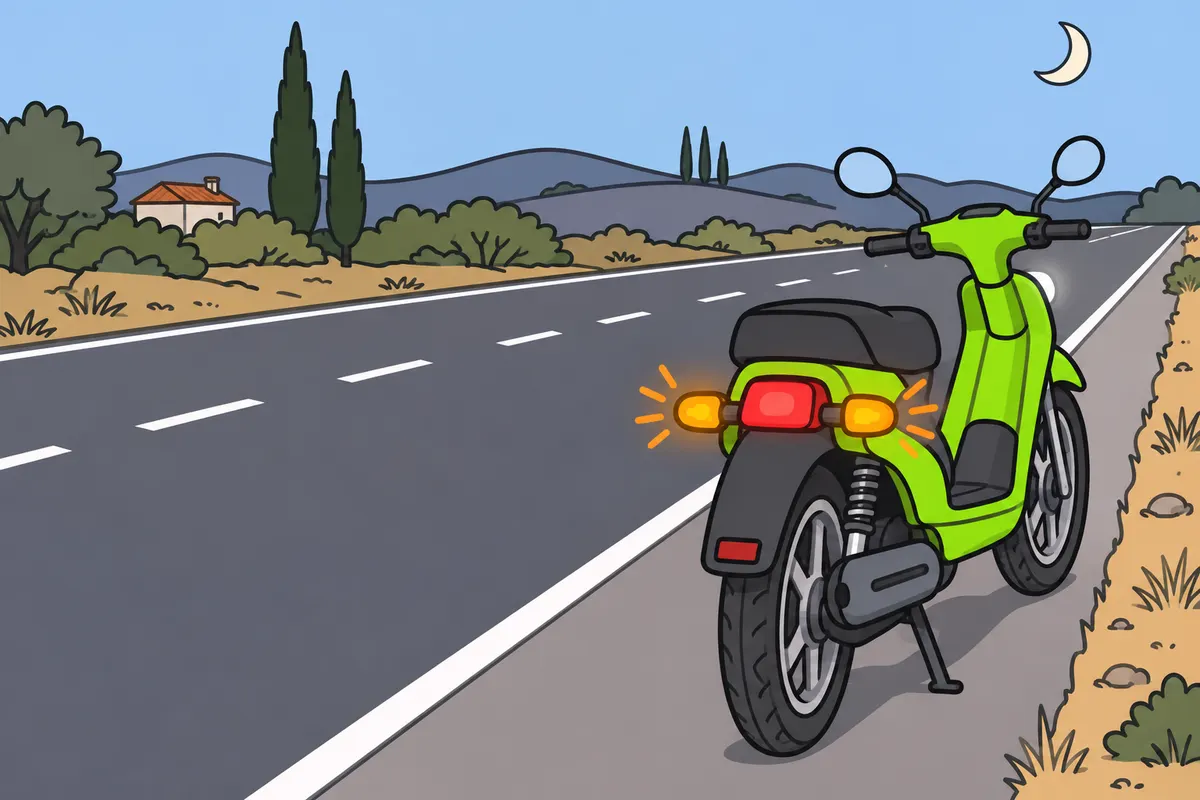
Use the lights available to make your stopped vehicle visible.
Remember
- Switch on hazard warning lights if your vehicle has them.
- When immobilised on the carriageway or hard shoulder, keep position lights on.
- Do this at night or in significantly reduced visibility.
- Keep end-outline lamps on where required.
- Do not dazzle others with main beam.
- Check lights without exposing yourself to traffic.
Exam trap: Wrong: Hazard warning lights replace position lights. Right: Keep position lights on when immobilised on the carriageway or hard shoulder at night or in significantly reduced visibility.
Read the full explanation
- If your vehicle has hazard warning lights, you must switch them on when immobilised by an accident or breakdown while the road is being cleared. These are the direction indicators flashing simultaneously. The obligation applies to a vehicle equipped with them; do not assume every moped has this control. [RGC, art. 130](https://www.boe.es/buscar/act.php?id=BOE-A-2003-23514#a130)
- At night, or in conditions that significantly reduce visibility, if you are immobilised on the carriageway or hard shoulder, you must keep the position lights and, where applicable, the end-outline marker lamps on. Hazard warning lights do not replace the lighting required to make the vehicle visible. [RGC, art. 105](https://www.boe.es/buscar/act.php?id=BOE-A-2003-23514#a105)
- You must not use main beam to dazzle anyone approaching a breakdown. Warning of danger requires them to be able to see the obstacle and act safely. Full details of moped lighting are covered in the “Moped lights and signals” module.
- Check which devices work after a fall without walking around the vehicle on the side exposed to traffic. If the battery, lamps or electrical system are damaged, inform 112 when there is danger. Do not improvise electrical repairs beside spilled fuel.
6V-16: what applies to the AM licence
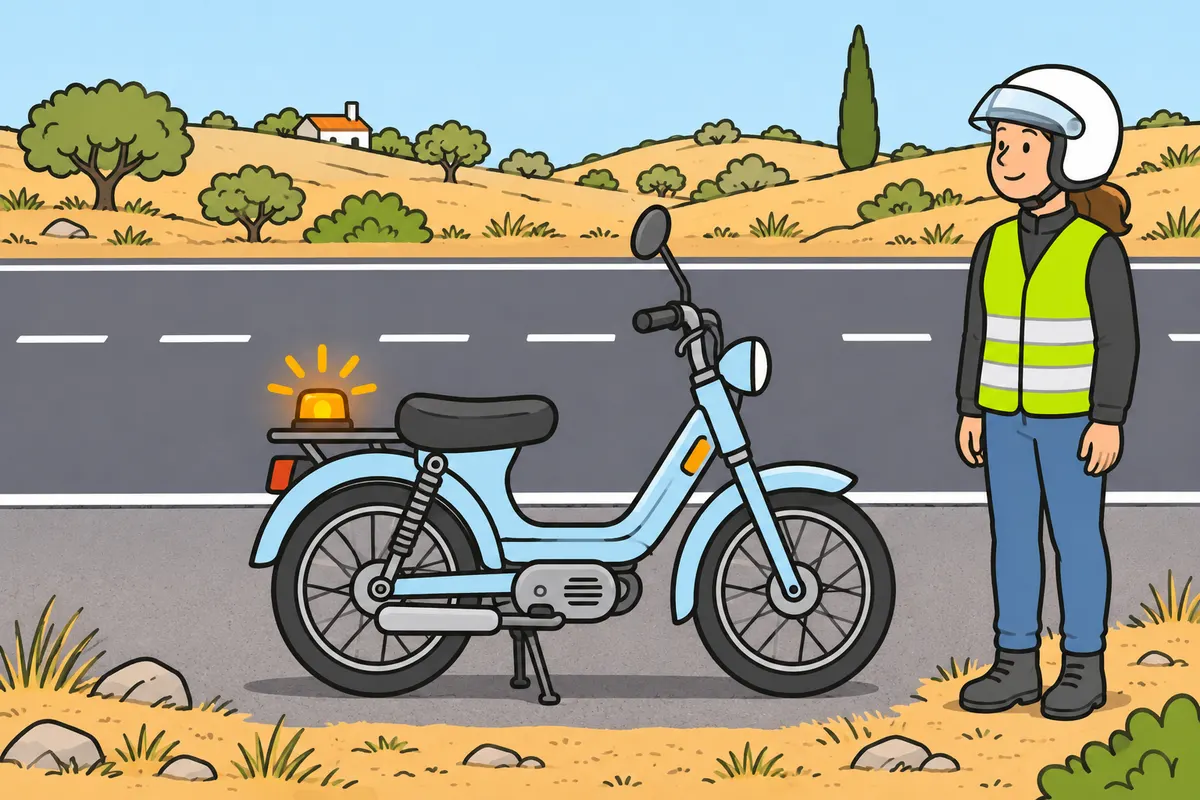
AM vehicles need not carry a beacon, but you must use it if carried.
| Vehicle | Must you carry a V-16? |
|---|---|
| Moped or light quadricycle | No compulsory equipment requirement. |
| Passenger car | Yes. |
Remember
- Choose a connected, certified V-16.
- Triangles and unconnected beacons are not prescribed warning devices.
- Check which vehicle the question describes.
- If you carry the beacon, you must use it.
Exam trap: Wrong: Your moped needs the same equipment as a passenger car. Right: Mopeds and light quadricycles need not carry a V-16.
Read the full explanation
- The prescribed advance warning device is the connected, certified V-16; warning triangles and unconnected beacons are not prescribed devices. [DGT, V-16](https://www.dgt.es/comunicacion/notas-de-prensa/20251125-dgt-recuerda-la-obligacion-de-disponer-de-la-baliza-v-16-para-senalizar-averias-y-accidentes-en-carretera/index.html)
- You are not required to carry a V-16 as equipment on your moped or light quadricycle. Annex XII.1 lists passenger cars, mixed-use vehicles and certain goods motor vehicles, expressly excluding three-wheeled vehicles and quadricycles; it does not include mopeds. [RGV, Annex XII.1](https://www.boe.es/buscar/act.php?id=BOE-A-1999-1826#anxii)
- Article 130.4 states that “every driver must use the prescribed hazard advance warning device” to warn that the vehicle is immobilised: if you carry a V-16, you must use it. [RGC, art. 130.4](https://www.boe.es/buscar/act.php?id=BOE-A-2003-23514#a130)
7Positioning and understanding the beacon
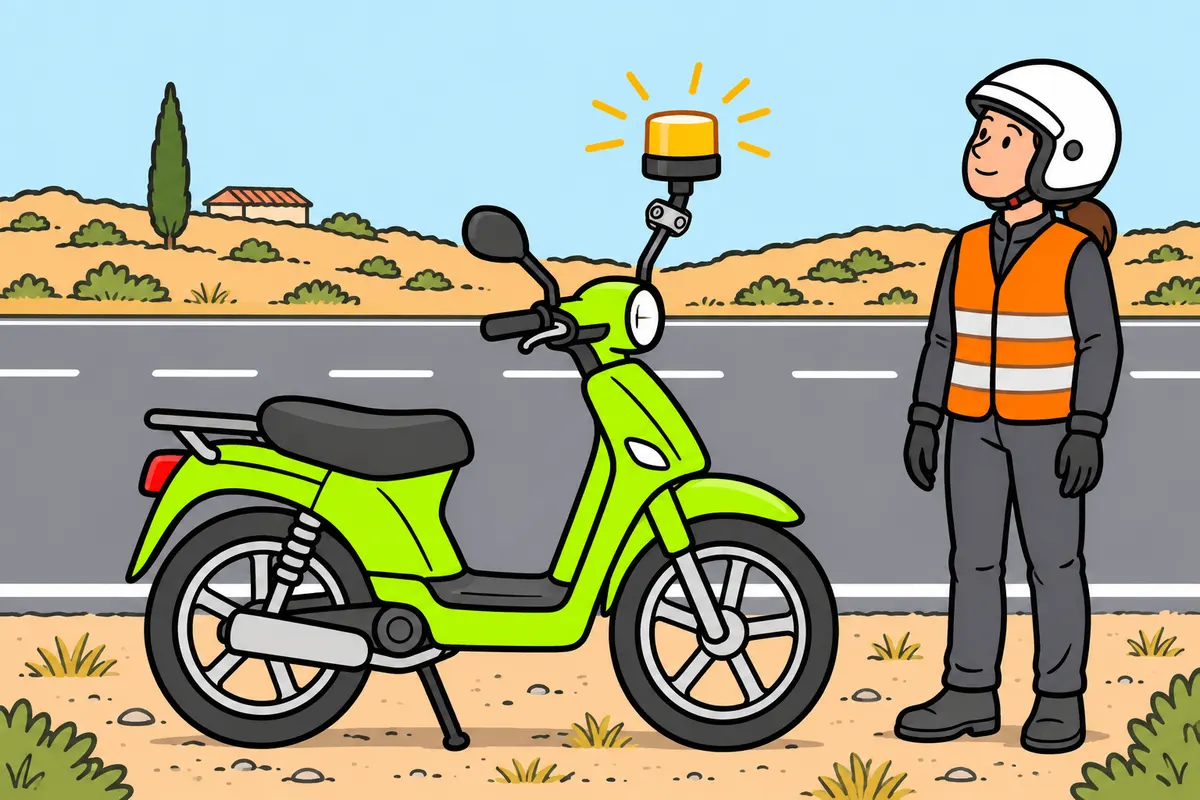
Place your beacon where others can see it and make any necessary calls yourself.
Remember
- Place the V-16 as high as possible without exposing yourself to traffic.
- Check that you can secure it to your moped.
- Check that the model is on the DGT certified list.
- Keep its power supply ready for use.
- The amber light warns of danger; it gives you no priority.
- Call 112 for casualties or emergencies; request mechanical assistance when appropriate.
Exam trap: Wrong: Activating the beacon alerts medical services. Right: Call 112 if there are casualties or an emergency.
Read the full explanation
- The V-16 signal emits amber light and is placed as high as possible on the immobilised vehicle to ensure maximum visibility. Its code belongs to the Reglamento General de Vehículos (General Vehicle Regulations). It is not an upright danger sign or a light that gives priority. [RGV, Annex XI, V-16](https://www.boe.es/buscar/act.php?id=BOE-A-1999-1826#v-16)
- If you choose to carry one on your moped, check for a support or fixing system compatible with the vehicle and the device instructions. Do not assume every surface is metal or that a magnetic base sticks to plastic. Position it without entering a traffic lane or exposing yourself to danger to gain height.
- Check the model against the DGT's official list of certified devices and keep its power supply ready for use. A similar-looking light or one advertised simply as an emergency light does not prove compliance with the connected V-16 requirements. [DGT, V-16 devices](https://www.dgt.es/muevete-con-seguridad/tecnologia-e-innovacion-en-carretera/Dispositivos-de-presenalizacion-V16)
- The beacon transmits the vehicle's location, but does not call 112 or request a recovery vehicle. You must make the appropriate call yourself depending on whether there are casualties, danger or only a need for mechanical assistance. Activating it does not mean medical services have been alerted or allow you to leave injured people behind. [DGT, V-16 function](https://www.dgt.es/comunicacion/notas-de-prensa/20251125-dgt-recuerda-la-obligacion-de-disponer-de-la-baliza-v-16-para-senalizar-averias-y-accidentes-en-carretera/index.html)
8Reflective vests and visibility after a breakdown
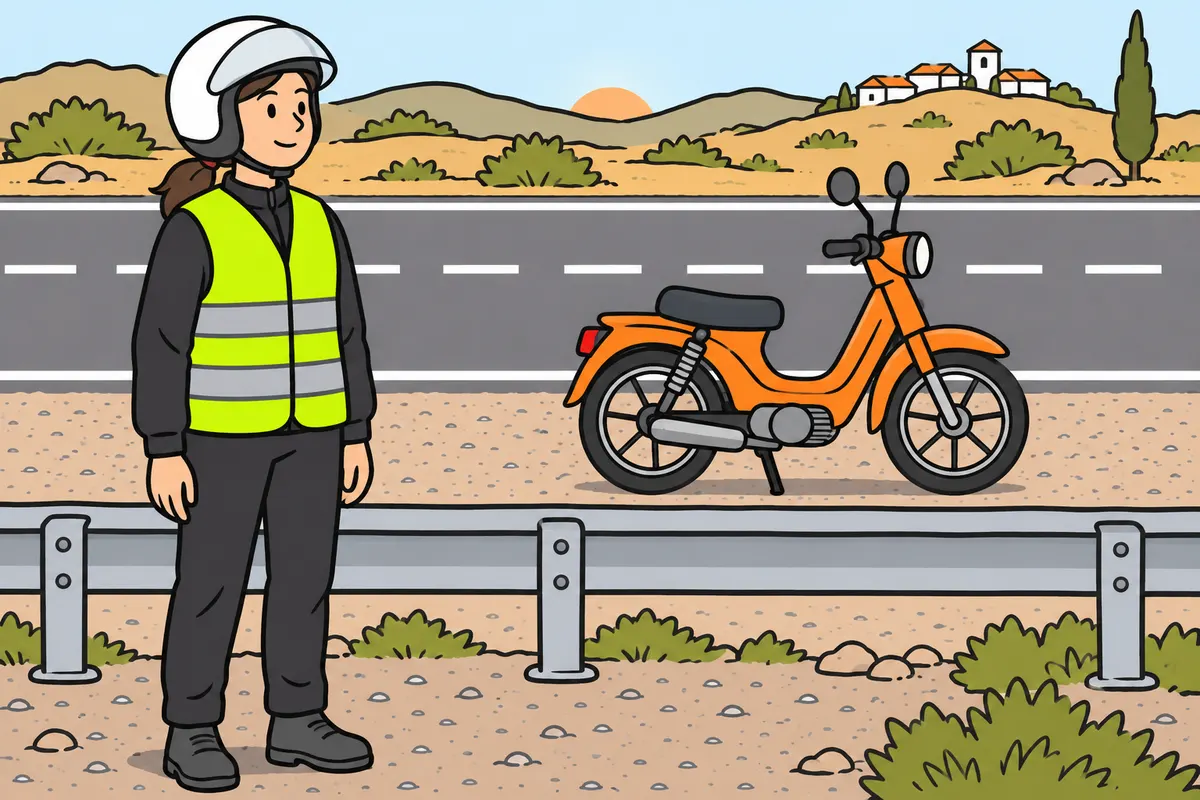
Distinguish compulsory vest use from the visibility protection you need when walking.
| Vehicle or use | Reflective vest rule |
|---|---|
| Private moped | Carrying or wearing a vest is recommended, rather than compulsory vehicle equipment. |
| Professional moped | Wear it while riding on any road. |
| Motorcycle | Carry one. Wear it when leaving your vehicle and entering an interurban carriageway or hard shoulder. |
Remember
- Carry an accessible vest; put it on before approaching traffic, if safe.
- Even with a vest, find somewhere protected.
- For professional moped riding, wear a high-visibility reflective vest on all roads.
- Walking on interurban carriageways or hard shoulders, carry a compliant luminous or reflective item.
- This is compulsory between sunset and sunrise, or in significantly reduced visibility.
- It must be visible from at least 150 metres; moped lights cannot replace it.
Exam trap: Wrong: You need a professional vest only after a breakdown. Right: Wear it throughout professional moped riding.
Read the full explanation
- You are advised to carry an accessible reflective vest to protect yourself after a breakdown. Put it on before exposing yourself to traffic if you can do so safely. Do not confuse it with permission to remain on the hard shoulder: being visible reduces danger, but you must find a protected place.
- The obligation to wear a vest when leaving your vehicle and entering the carriageway or hard shoulder of an interurban road includes motorcycle riders, but does not apply to a privately used moped. Motorcycles must carry one as equipment; mopeds have no such equipment requirement. [RGC, art. 118.4](https://www.boe.es/buscar/act.php?id=BOE-A-2003-23514#a118) [RGV, Annex XII.3](https://www.boe.es/buscar/act.php?id=BOE-A-1999-1826#anxii)
- If you ride a moped as part of your professional activity, you must wear a high-visibility reflective vest on all types of roads. This obligation applies during professional riding, not only after a breakdown. Choice of equipment and other protective items are covered in the “Protective equipment for moped riders” module. [RGC, art. 118](https://www.boe.es/buscar/act.php?id=BOE-A-2003-23514#a118)
- If you walk on the carriageway or hard shoulder of an interurban road between sunset and sunrise, or in significantly reduced visibility, you must carry or wear at least one luminous or reflective item complying with personal protective equipment regulations, visible from at least 150 metres to approaching road users. It does not necessarily have to be a vest or a green light. [RGC, art. 123](https://www.boe.es/buscar/act.php?id=BOE-A-2003-23514#a123)
- Your moped's lights do not replace the item you need as a pedestrian. Keeping on a helmet without suitable visibility features is also insufficient. If you must walk after a breakdown, choose a usable, safe pedestrian route; a breakdown does not oblige you to wait until dawn.
9Giving 112 useful information
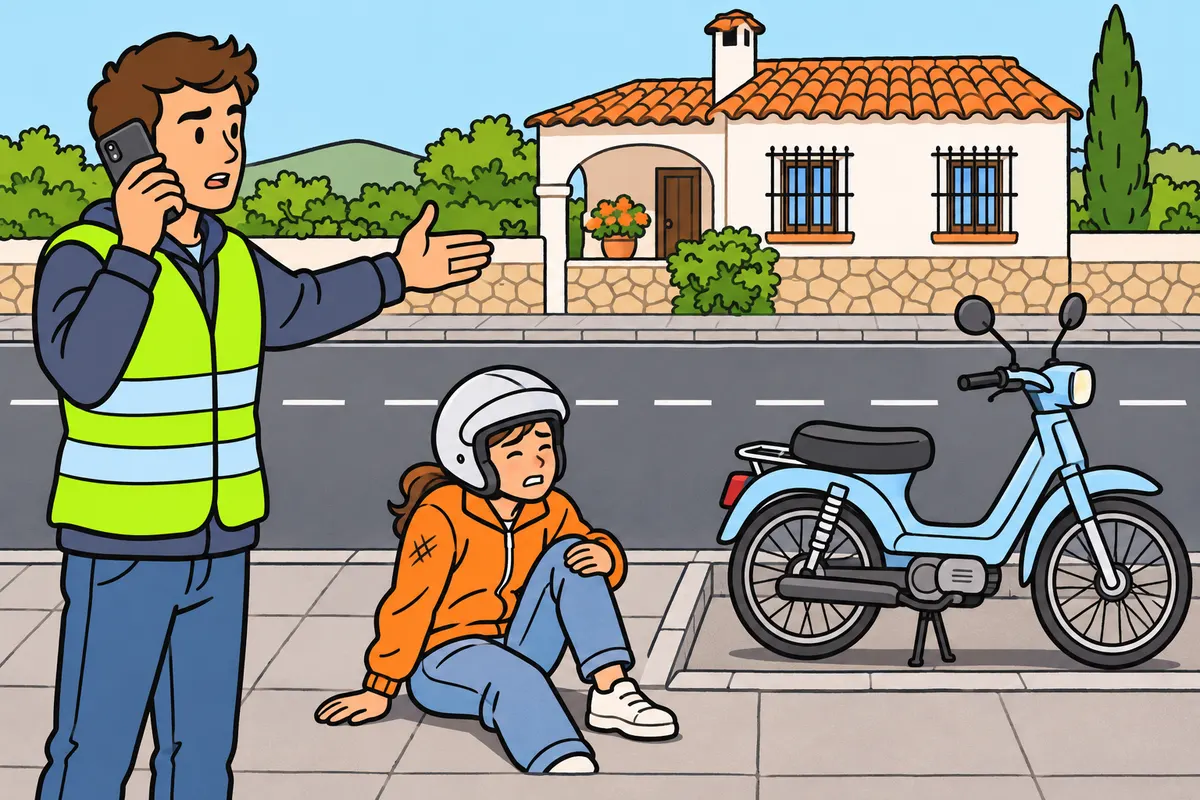
Tell emergency services where you are, what happened and what dangers you see.
Remember
- With casualties or an emergency, call 112 from a safe place.
- Give the road or street, direction and landmarks you know.
- Explain how many casualties you see and their condition.
- Report fire, smoke, spills and vehicles blocking the road.
- Answer questions and wait until told to end the call.
- For breakdowns without casualties or urgent danger, request mechanical assistance.
Exam trap: Wrong: You invent a diagnosis. Right: Describe what you see and admit what you do not know.
Read the full explanation
- When there are casualties or an emergency, call 112 from a safe place. If someone else can do so, ask them explicitly and confirm that they are making the call. For a breakdown with no casualties or danger requiring urgent intervention, request the appropriate mechanical assistance without confusing the two services. [DGT, first aid 2026](https://sede.dgt.gob.es/export/sites/dgt/.galleries/permisos-de-conducir/certificacion-aptitud-profesores-formacion-vial/2026/MANUAL-IX-Primeros-auxilios.pdf)
- First say where you are: the road, kilometre marker if you know it, direction of travel and recognisable landmarks. In a street, give the municipality, street name and number or a nearby junction. In a tunnel, identify the tunnel, direction and any emergency point you can recognise without moving into a dangerous area.
- Explain what has happened, how many vehicles and casualties you can see and their apparent condition. Report anyone who is unresponsive, struggling to breathe, bleeding heavily or trapped. Describe what you observe and acknowledge what you do not know; do not invent diagnoses or state that someone is dead based on their appearance.
- Add the risks: fire, smoke, spilled fuel, dangerous goods or vehicles blocking the road. Answer the questions and do not end the call until told to do so. If you can safely use speakerphone, it allows you to follow instructions while helping.
10Fire, fuel and batteries
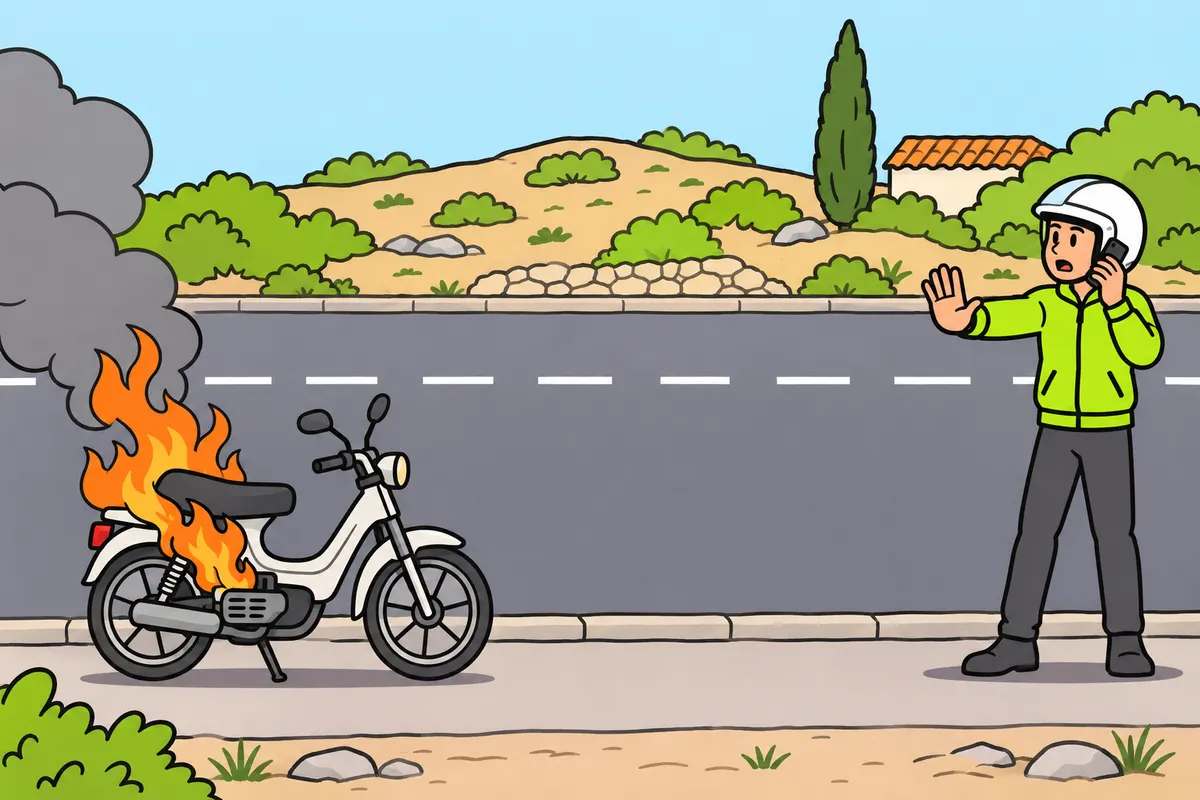
Move away from fire; avoid touching fuel, unknown substances or damaged batteries.
Remember
- If you suspect a petrol leak, do not smoke or start your moped.
- Move away from smoke; do not retrieve belongings from flames.
- Only fight early-stage fires with suitable equipment, knowledge and a safe escape route.
- Do not touch damaged, split, smoking or burning batteries, or damaged cables.
- Tell emergency services if the vehicle is electric.
- Report dangerous-goods panels only if you can read them without approaching.
Exam trap: Wrong: An electric moped cannot cause a fire. Right: Avoid its damaged batteries too.
Read the full explanation
- On a combustion-engined moped, a fall can spill petrol near the hot engine or exhaust. Do not smoke, bring flames near it or try to start it if you suspect a leak. Warn others from a safe position and report the risk to 112. [DGT, first aid 2026](https://sede.dgt.gob.es/export/sites/dgt/.galleries/permisos-de-conducir/certificacion-aptitud-profesores-formacion-vial/2026/MANUAL-IX-Primeros-auxilios.pdf)
- Do not risk your life trying to retrieve your moped, a backpack or a phone from flames. Move away from fire and smoke and help firefighters gain access. A seemingly small fire can grow; you should only attempt to extinguish it at an early stage if you have suitable equipment, know how to use it and retain a safe escape route.
- If your moped is electric, do not handle a battery that is damaged by impact, split open, smoking or burning, or damaged cables. Tell the emergency services it is an electric vehicle. The absence of petrol does not eliminate the risks of burns, fire or exposure to substances and fumes. [DGT, Basic Rescue Manual, Annex I](https://www.dgt.es/export/sites/web-DGT/.galleries/downloads/muevete-con-seguridad/accidente-trafico/manual_basico_rescate.pdf)
- If you encounter a dangerous-goods vehicle involved in an accident, avoid approaching the spill or inhaling vapours. From a safe place, tell 112 about any panels or numbers you can read without approaching. Do not try to contain unknown substances or identify them by touching or smelling them.
11Breaking down inside a tunnel
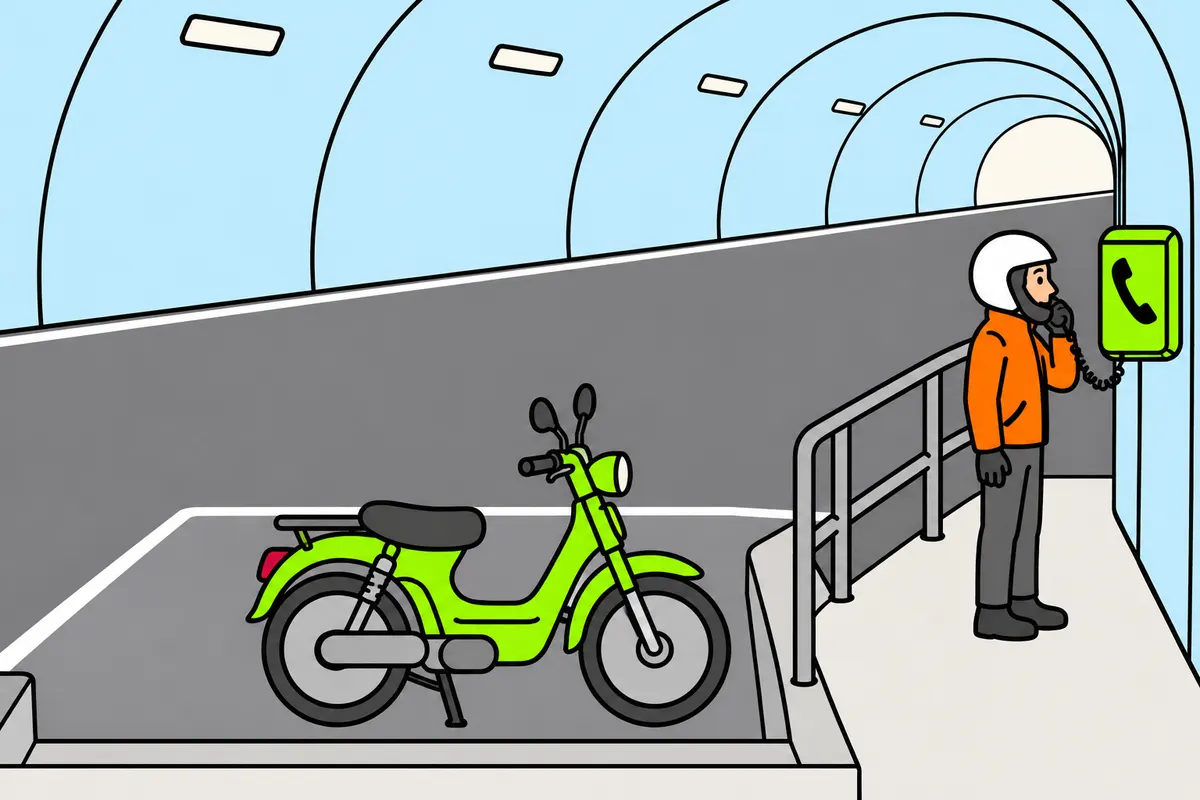
After a tunnel breakdown, find a safe way out and request help.
Remember
- If safe, continue to the tunnel exit; otherwise reach an emergency area.
- If immobilised, try the nearest emergency area ahead or the right-hand edge.
- Switch off the engine and keep position lights on.
- Use hazard lights if fitted; if carrying a beacon, use it without risking yourself.
- Request help using the nearest SOS telephone, if available.
- Head for the nearest refuge or exit, using traffic-free areas where available.
Exam trap: Wrong: You turn round inside the tunnel. Right: Follow evacuation routes and staff instructions.
Read the full explanation
- If your breakdown allows you to move safely, you must continue to the exit of the tunnel or underpass or, if you cannot, to an area reserved for emergencies. If you become immobilised, try to position yourself in the nearest emergency area in your direction of travel or as close as possible to the right-hand edge. [RGC, art. 97](https://www.boe.es/buscar/act.php?id=BOE-A-2003-23514#a97)
- When immobilised in this emergency, switch off the engine, turn on the hazard warning lights if fitted and keep the position lights on. Article 97 provides for placing and activating the advance warning light device: if you carry one, you must use it without exposing yourself to danger. [RGC, art. 97.3.c](https://www.boe.es/buscar/act.php?id=BOE-A-2003-23514#a97) [RGC, art. 130.4](https://www.boe.es/buscar/act.php?id=BOE-A-2003-23514#a130) [RGV, Annex XII.1](https://www.boe.es/buscar/act.php?id=BOE-A-1999-1826#anxii)
- Request help without delay using the nearest SOS emergency telephone, if available, and follow the instructions received. Occupants must quickly head for the nearest refuge or exit, staying off the carriageway where areas closed to traffic exist. Do not wait beside your moped in the middle of a lane. [RGC, art. 97](https://www.boe.es/buscar/act.php?id=BOE-A-2003-23514#a97)
- You can ride your moped through tunnels on roads where it is allowed: you must know these measures even though you do not use autopistas (motorways) or autovías (dual carriageway motorways). Do not turn round to find the tunnel entrance or enter technical rooms on your own initiative; follow evacuation routes and staff instructions.
12Fire or queuing traffic in a tunnel
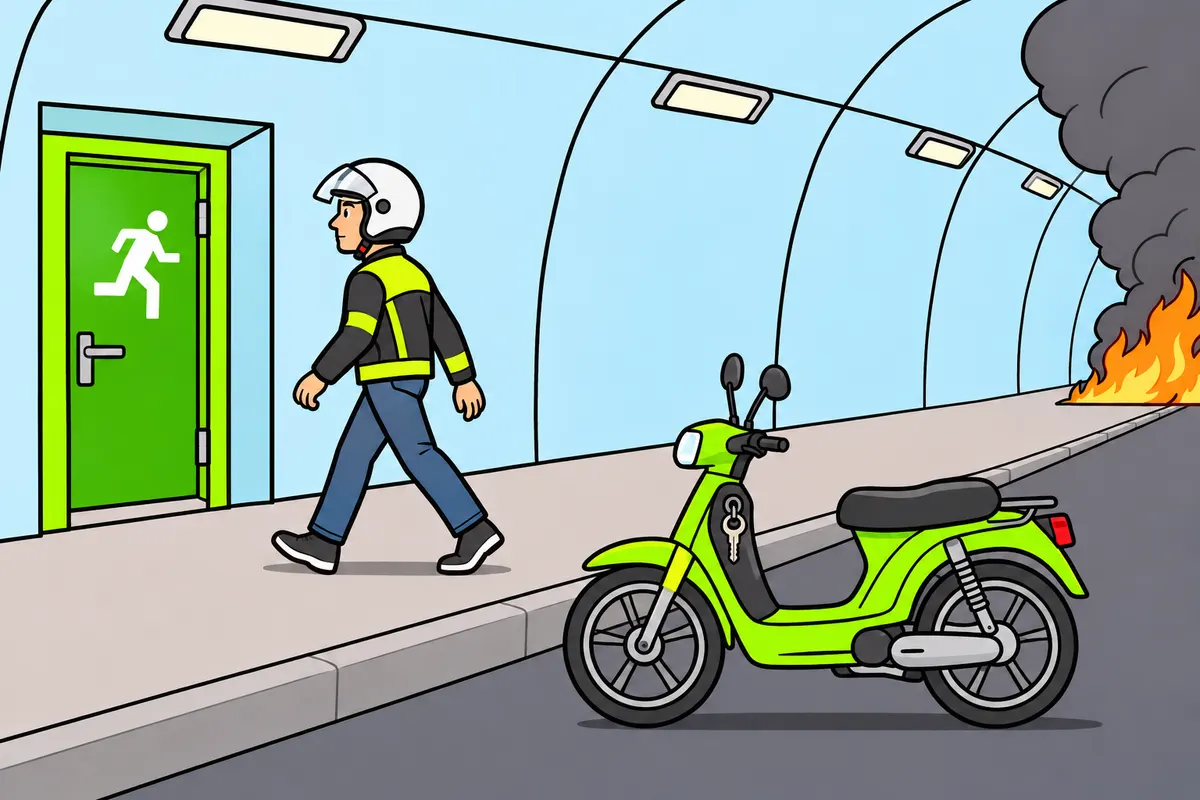
Switch off your engine when stopping in a tunnel; distinguish fire from traffic queues.
| Tunnel situation | What you must do |
|---|---|
| Fire | Switch off the engine, leave the key in and evacuate away from the fire. |
| Traffic queue only | Stay on or in your vehicle, switch off the engine, keep position lights on and use hazard warning lights temporarily. |
Remember
- In a fire, move right and switch off the engine.
- Leave for the nearest refuge or exit, away from the fire.
- Use areas closed to traffic where available.
- In a fire, leave the key in; leave light quadricycle doors open, if fitted.
- In a queue, leave as much distance ahead as possible.
- After more than two minutes, keep the engine off and position lights on.
Exam trap: Wrong: You wait two minutes before switching off. Right: Switch off the engine when you stop in the tunnel.
Read the full explanation
- If there is a fire, move your vehicle towards the right to leave room for emergency services and switch off the engine. You must leave it and head for the nearest refuge or exit away from the fire, using areas closed to vehicles where available. Protecting people takes priority over belongings. [RGC, art. 97](https://www.boe.es/buscar/act.php?id=BOE-A-2003-23514#a97)
- In this fire situation, the rule requires you to leave the key in the ignition and the doors open. Apply the latter measure to a light quadricycle with doors; an open moped has none. Do not lock the vehicle to protect it if that delays evacuation or hinders the response. [RGC, art. 97](https://www.boe.es/buscar/act.php?id=BOE-A-2003-23514#a97)
- If you stop solely because of traffic conditions, you must remain on or in your vehicle, switch off the engine, keep the position lights on and temporarily switch on the hazard warning lights to warn those approaching from behind. Stop as far as possible from the vehicle ahead. Do not confuse an ordinary traffic queue with an instruction to evacuate because of fire. [RGC, art. 97](https://www.boe.es/buscar/act.php?id=BOE-A-2003-23514#a97)
- If a compulsory stop in a tunnel or other enclosed place lasts more than two minutes, you must keep the engine off and the position lights on until you can continue; the general rule on switching off the engine is covered in “Defensive and efficient driving”, in “Anticipate slowing down and stopping”. [RGC, art. 115.2](https://www.boe.es/buscar/act.php?id=BOE-A-2003-23514#a115)
13Initial casualty assessment
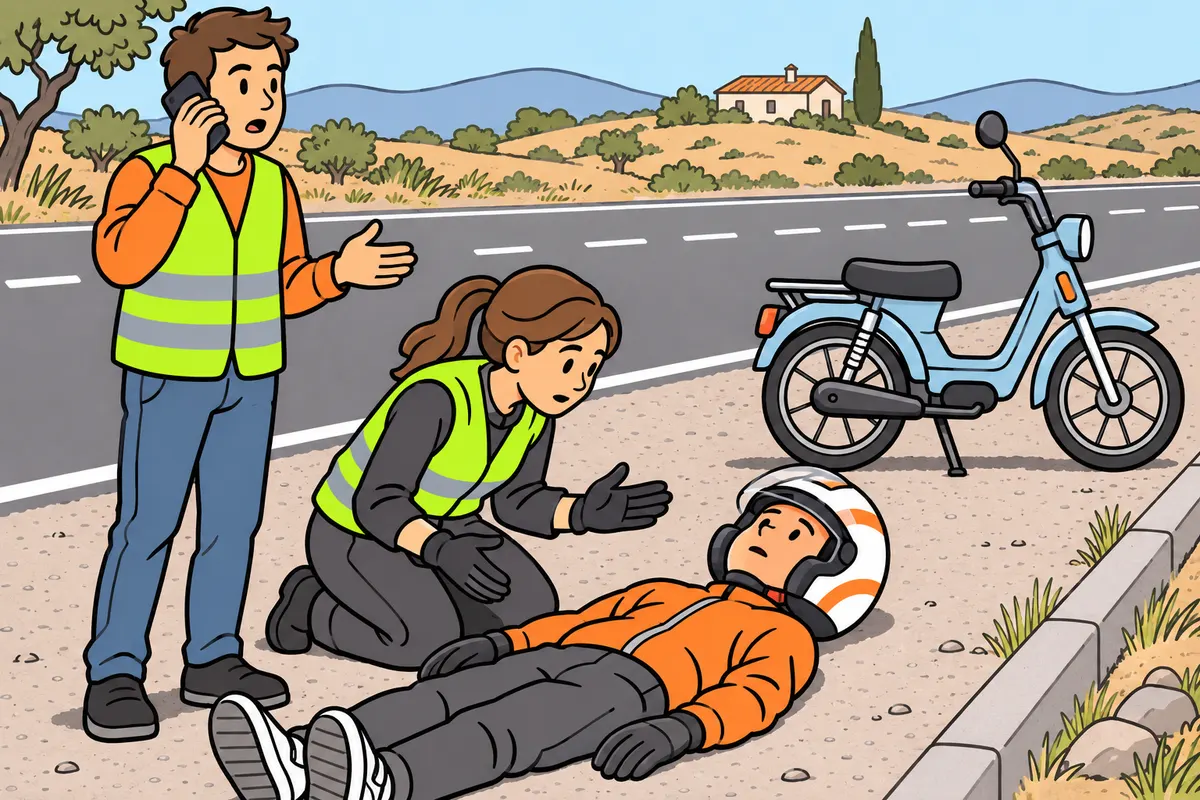
Check casualties’ responses and breathing before treating minor injuries.
Remember
- Approach only if the scene is safe.
- Use gloves if available; avoid direct contact with blood.
- Speak without shaking the casualty; check whether they breathe normally.
- If several people are injured, quickly check everyone’s condition.
- Deal with life-threatening dangers first and report them to 112.
- Keep monitoring them even if they say they are fine.
Exam trap: Wrong: You help whoever shouts loudest first. Right: Assess everyone; a silent person who is not breathing may need help sooner.
Read the full explanation
- Approach only when the scene is safe and avoid direct contact with blood: use protective gloves if available. Speak to the casualty and check for a response without shaking them. Identify yourself, say you are calling for help and observe whether they are breathing normally. [DGT, first aid 2026](https://sede.dgt.gob.es/export/sites/dgt/.galleries/permisos-de-conducir/certificacion-aptitud-profesores-formacion-vial/2026/MANUAL-IX-Primeros-auxilios.pdf)
- When several people are injured, make a quick overall assessment. Someone shouting or with a conspicuous wound does not necessarily need help before a silent person who is not breathing. Call 112 to report life-threatening situations and assign tasks to those able to help.
- A conscious person can also have serious injuries and deteriorate. Do not stop monitoring them because they answer or say they are fine. Watch their breathing, bleeding and responsiveness while waiting; report immediately if they lose consciousness, stop breathing normally or bleed more heavily.
- Focus your assessment on life-threatening conditions before treating minor injuries. No visible blood does not rule out internal injuries.
14Unconsciousness and breathing
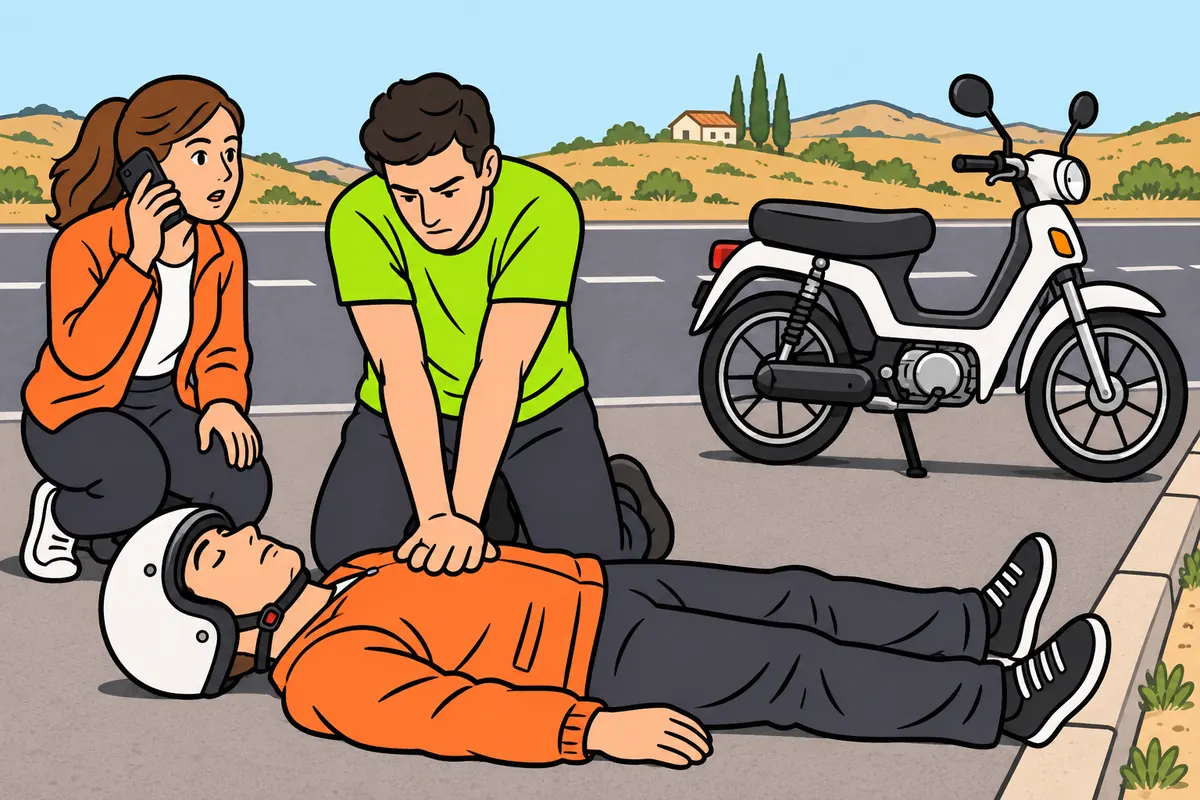
If someone is unresponsive and not breathing normally, start resuscitation with emergency guidance.
Remember
- If they do not respond, check breathing and call 112.
- Occasional gasps are not normal breathing.
- Follow instructions to keep the airway clear.
- Do not search their mouth with your fingers for objects you cannot see.
- Avoid sudden neck movements, but do not delay necessary resuscitation.
- If normal breathing returns, report this and keep monitoring them.
Exam trap: Wrong: You leave them still even when they cannot breathe. Right: Protecting their breathing takes priority.
Read the full explanation
- If the casualty does not respond, check whether they are breathing normally and call 112. Occasional or agonal gasps do not count as normal breathing; if they are unresponsive and not breathing normally, you must suspect cardiac arrest and start resuscitation under emergency guidance. Do not wait for the casualty to wake up. [DGT, first aid 2026](https://sede.dgt.gob.es/export/sites/dgt/.galleries/permisos-de-conducir/certificacion-aptitud-profesores-formacion-vial/2026/MANUAL-IX-Primeros-auxilios.pdf)
- The airway must allow air to pass. In an unconscious person it can become blocked, and vomit can cause suffocation. Follow 112's instructions to keep it open while avoiding sudden neck movements; do not put your fingers blindly into the mouth to search for objects you cannot see.
- With an accident casualty, you must suspect traumatic injuries and limit movement of the head, neck and torso. This precaution does not allow you to leave an airway obstruction untreated or delay necessary CPR. Breathing takes priority over the idea that an injured person must remain completely still in every circumstance.
- If normal breathing returns, report the change and continue monitoring until medical personnel take over: initial improvement can be followed by further deterioration.
15CPR and defibrillators: the basics
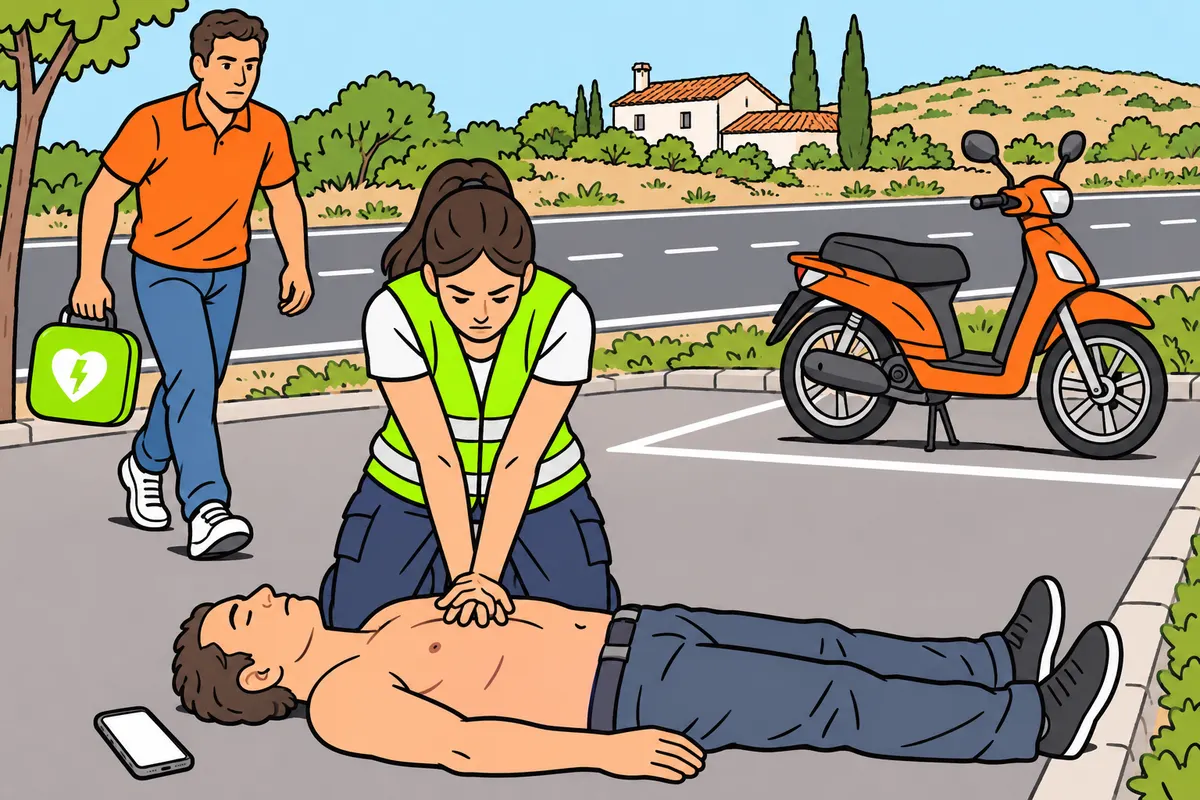
For an unresponsive adult not breathing normally, start chest compressions with emergency guidance.
Remember
- Ask 112 to guide you and press the centre of the chest.
- Let the chest rise between compressions and avoid interruptions.
- If trained and able, alternate 30 compressions with 2 breaths.
- If you do not know how or cannot give breaths, give continuous compressions.
- Ask someone else to fetch an available defibrillator; follow its instructions.
- Do not touch the casualty during defibrillator analysis or a shock.
Exam trap: Wrong: You do nothing because you cannot give rescue breaths. Right: Give continuous compressions and follow 112.
Read the full explanation
- For an adult who is unresponsive and not breathing normally, ask 112 to guide you and start compressions in the centre of the chest. The general guideline is 100 to 120 compressions per minute, allowing the chest to recoil between compressions and avoiding unnecessary interruptions. These are medical guidelines, not a time limit under traffic regulations. [DGT, first aid 2026](https://sede.dgt.gob.es/export/sites/dgt/.galleries/permisos-de-conducir/certificacion-aptitud-profesores-formacion-vial/2026/MANUAL-IX-Primeros-auxilios.pdf)
- If you know how to give rescue breaths, the basic adult sequence combines 30 compressions with 2 breaths. If you do not know how or cannot give them, perform continuous compressions and follow 112's instructions. Do not use lack of knowledge of mouth-to-mouth as a reason to take no action.
- If an external defibrillator is available, ask someone to bring it while resuscitation continues. Switch it on and follow its instructions; nobody must touch the casualty while it analyses or indicates a shock. Do not leave the person yourself if another witness can fetch it.
- Continue following emergency instructions until professionals arrive, the casualty shows recovery with normal breathing, you cannot continue or the scene becomes unsafe. If several people help, coordinate to minimise interruptions. Practical training helps you act correctly and is not replaced by memorising numbers.
16The recovery position and essential movements
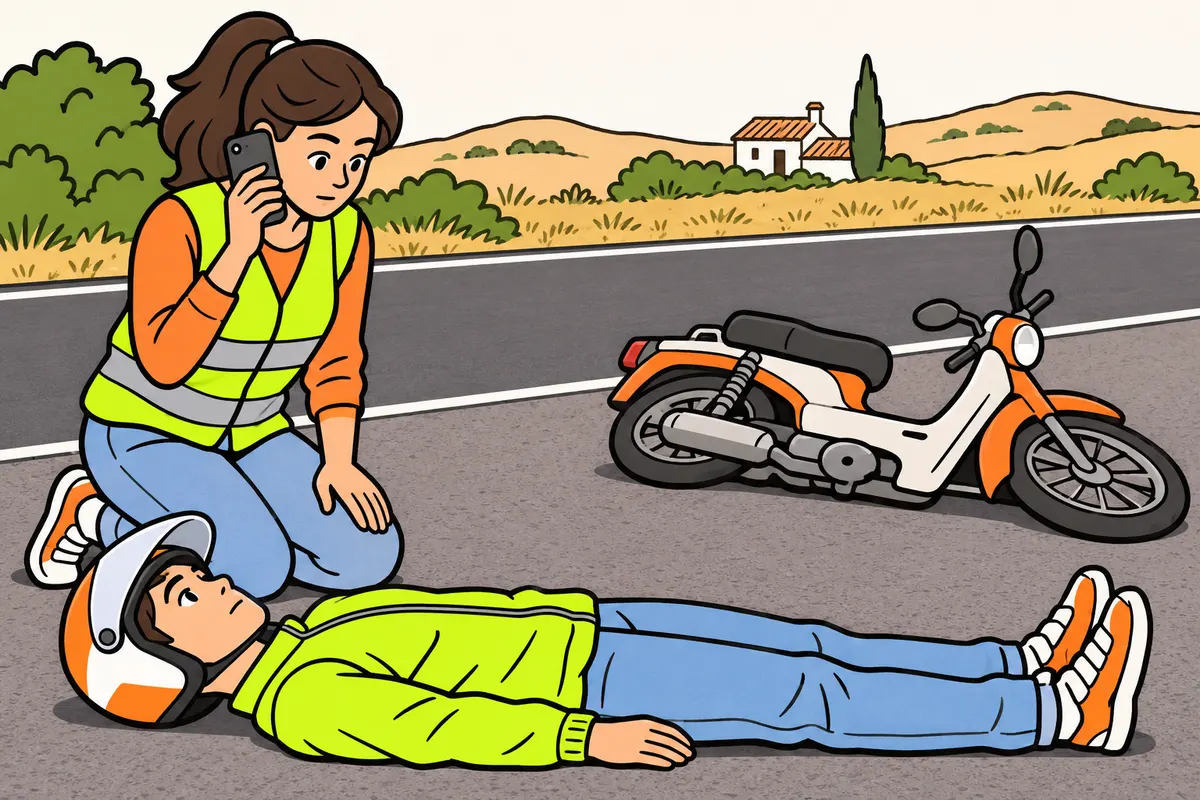
Move an injured person only when needed to protect them or save their life.
| Casualty condition | How you act |
|---|---|
| Reduced responses, normal breathing, no need for CPR and no impact injury | The recovery position helps keep the airway clear. |
| Possible spinal injury, normal breathing and clear airway | Avoid movement and follow emergency instructions. |
| Vomiting, breathing at risk or unavoidable immediate danger | Careful movement with help may be essential. |
Remember
- If breathing is normal and the airway clear, avoid unnecessary movement.
- Follow 112 if they vomit or their breathing is at risk.
- If you must move them, keep the head, neck and body aligned.
- Ask for help; do not pull them by a limb.
- Do not sit them up or make them walk to test their condition.
Exam trap: Wrong: You put every accident casualty on their side. Right: Check breathing, possible impact injuries and whether movement is necessary.
Read the full explanation
- The recovery position helps keep the airway open and allows vomit to drain. You use it for people with reduced responsiveness who breathe normally and do not need CPR, especially when there is no traumatic injury. You must not routinely place every casualty on their side. [DGT, first aid 2026](https://sede.dgt.gob.es/export/sites/dgt/.galleries/permisos-de-conducir/certificacion-aptitud-profesores-formacion-vial/2026/MANUAL-IX-Primeros-auxilios.pdf)
- A moped fall can cause spinal injury: if the person breathes normally and the airway remains clear, avoid unnecessary movement and follow 112's instructions. If they vomit or the airway is at risk, carefully changing their position with help may be essential to protect their breathing.
- You must only move an injured person for a justified need, such as an immediate danger you cannot remove or a life-saving action. If you must do so, try to keep the head, neck and torso aligned, without twisting the body or dragging it by a limb. Ask for guidance and assistance whenever possible.
- Do not sit a fallen rider up or make them walk to prove they are well. Do not put them on the moped seat to get them off the ground either. Removing the vehicle from the carriageway and moving the casualty's body are separate decisions with different risks.
17The injured rider’s helmet
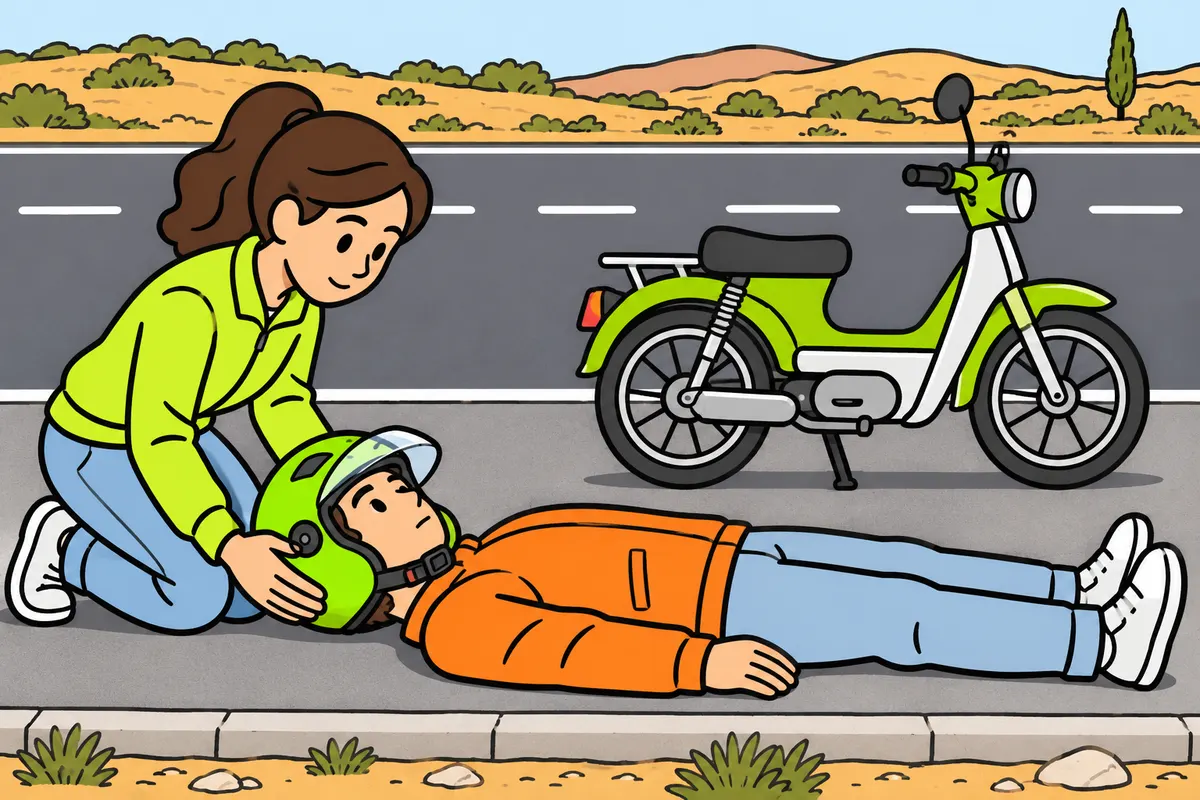
Leave the helmet on unless removal is essential to save the casualty’s life.
Remember
- If they respond and breathe normally, do not remove their helmet.
- Reassure them and monitor breathing without turning their head.
- Do not pull the strap or lift them by their helmet.
- If it prevents airway care or resuscitation, call 112 and report this difficulty.
- Follow their instructions; removal needs proper technique and coordination between helpers.
Exam trap: Wrong: You can never remove the helmet, even when it prevents life-saving care. Right: Follow 112 if removal is essential.
Read the full explanation
- As a general rule, you must leave an injured rider's or passenger's helmet on. Removing it without the proper technique can move the neck and worsen a cervical injury. If they respond and breathe normally, do not remove it for comfort, out of curiosity or to check for a head wound. [DGT, first aid 2026](https://sede.dgt.gob.es/export/sites/dgt/.galleries/permisos-de-conducir/certificacion-aptitud-profesores-formacion-vial/2026/MANUAL-IX-Primeros-auxilios.pdf)
- Support and reassure the casualty without turning their head, and monitor their breathing. If the helmet allows you to care for them and maintain the airway, wait for professionals. You must not pull the strap or use the helmet as a handhold to lift them off the ground either.
- The precaution of leaving the helmet on has an exception where removal is essential to manage the airway or cardiac arrest. Call 112 to report this difficulty and follow their instructions. The prohibition on routine removal must not be interpreted as withholding life-saving measures.
- Removal requires knowledge of a specific technique and coordination between two people: one stabilises the head and neck while the other carefully removes the helmet. Do not improvise by pulling sharply or abruptly extending the neck. Inspection or replacement of the helmet after a heavy impact is covered in the “Protective equipment for moped riders” module.
18External bleeding and direct pressure
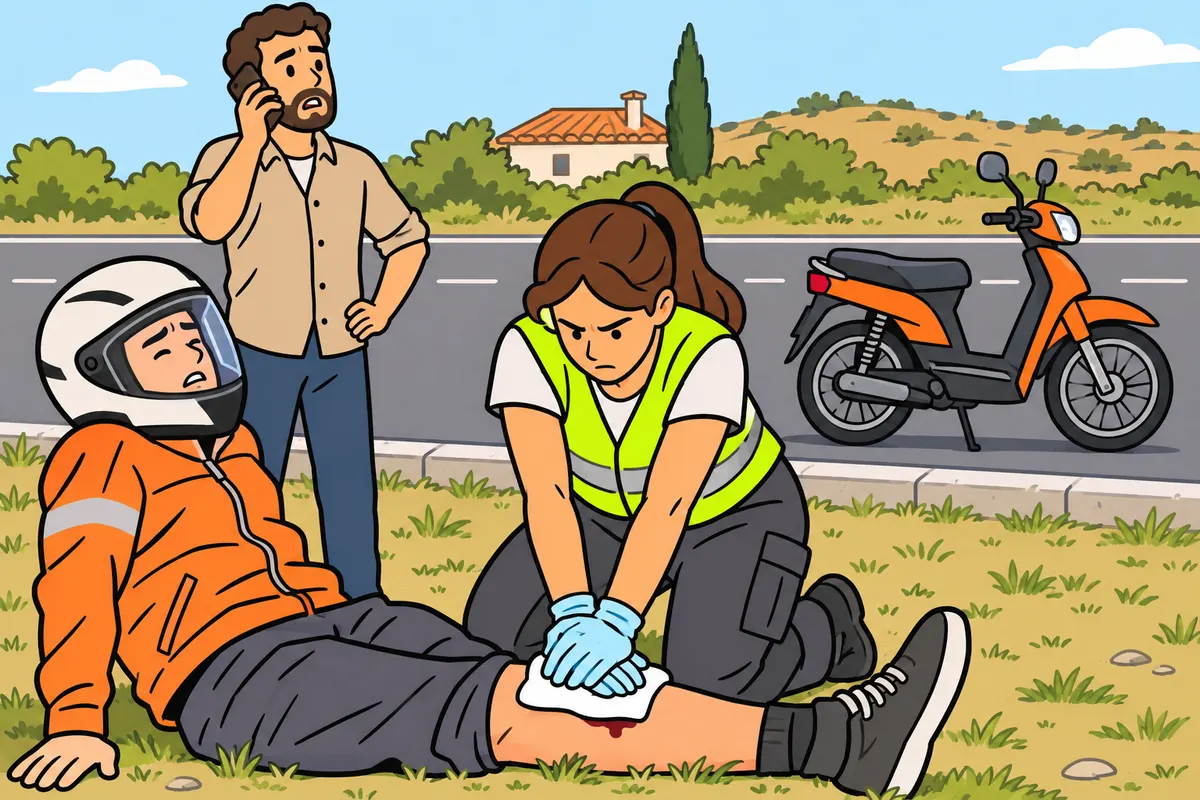
Press firmly on heavy bleeding without removing embedded objects.
Remember
- Protect your hands and use clean material to press firmly.
- If an embedded object prevents pressure, leave it in; follow emergency instructions.
- Keep pressing and request urgent help.
- If material becomes soaked, add more without releasing pressure.
- Do not keep lifting the dressing to look.
- After an impact, do not plug a bleeding nose or ear yourself.
Exam trap: Wrong: You only wrap a heavily bleeding leg. Right: Apply firm direct pressure unless an embedded object prevents this.
Read the full explanation
- For significant external bleeding, protect your hands and apply firm direct pressure to the wound with a dressing or clean material, provided no embedded object prevents this. For a heavily bleeding leg, covering or wrapping it without applying pressure is not an adequate response. [DGT, first aid 2026](https://sede.dgt.gob.es/export/sites/dgt/.galleries/permisos-de-conducir/certificacion-aptitud-profesores-formacion-vial/2026/MANUAL-IX-Primeros-auxilios.pdf)
- Maintain pressure and request urgent help; do not keep lifting the dressing to see whether bleeding has stopped. If it becomes soaked, you can add material on top without releasing pressure. Tell 112 if bleeding remains heavy and the person's condition worsens.
- Do not remove glass or other embedded objects. Apply pressure around them where appropriate and follow emergency instructions, trying not to move the object. You must not probe a deep wound or try to put tissue back in place either: immediate help aims to prevent further harm until medical care arrives.
- If blood comes from the nose or ear after an impact, do not plug these openings on your own initiative. There may be an internal injury, and the response is different from compressing a leg wound. Describe the bleeding and keep monitoring responsiveness and breathing.
19Tourniquets, internal bleeding and shock
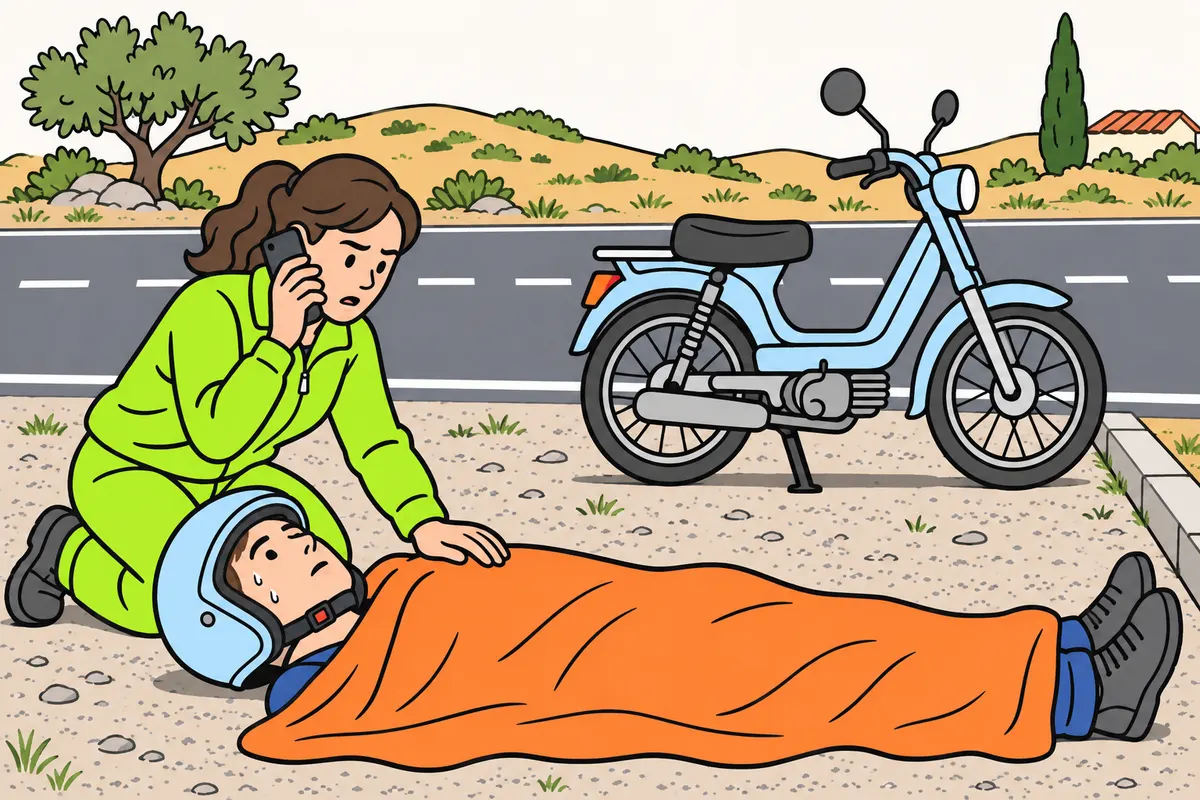
Request urgent help for severe bleeding, even when you cannot see a wound.
| Case | What you must do |
|---|---|
| Life-threatening limb bleeding uncontrolled by pressure | A suitable tourniquet may be needed; follow training and emergency instructions. |
| Possible internal bleeding | Request urgent help; an external bandage cannot stop it. |
Remember
- Life-threatening limb bleeding uncontrolled by direct pressure may need a tourniquet.
- Use it according to your training and emergency instructions.
- Do not loosen or remove it yourself.
- Report that you applied it and the time, if known.
- Paleness, cold sweats or weakness after an impact can suggest internal bleeding.
- Monitor breathing, maintain a suitable body temperature and avoid unnecessary movement.
Exam trap: Wrong: You always raise their legs for shock. Right: Adapt their position to injuries and breathing; avoid automatically raising legs if impact injuries are possible.
Read the full explanation
- For life-threatening bleeding from a limb that direct pressure does not control, a suitable tourniquet may be necessary. Use it according to your training and emergency instructions. You must not always apply one or claim that hand pressure alone resolves every case of bleeding. [DGT, first aid 2026](https://sede.dgt.gob.es/export/sites/dgt/.galleries/permisos-de-conducir/certificacion-aptitud-profesores-formacion-vial/2026/MANUAL-IX-Primeros-auxilios.pdf)
- Once you apply a tourniquet, you must not loosen or remove it on your own initiative. Tell medical personnel that you have applied it and the time, if known. Avoid substituting an improvised thin cord and report if bleeding continues.
- Internal bleeding can occur without a visibly bleeding wound. Paleness, cold sweats, weakness or worsening general condition after an impact are warning signs. You cannot stop internal bleeding with an external bandage: request urgent assistance and avoid unnecessary movement.
- If you see signs consistent with shock, monitor the casualty and maintain a suitable body temperature. Position them according to their injuries and breathing; avoid automatically raising their legs if traumatic injuries are possible.
20Fractures and suspected spinal cord injury
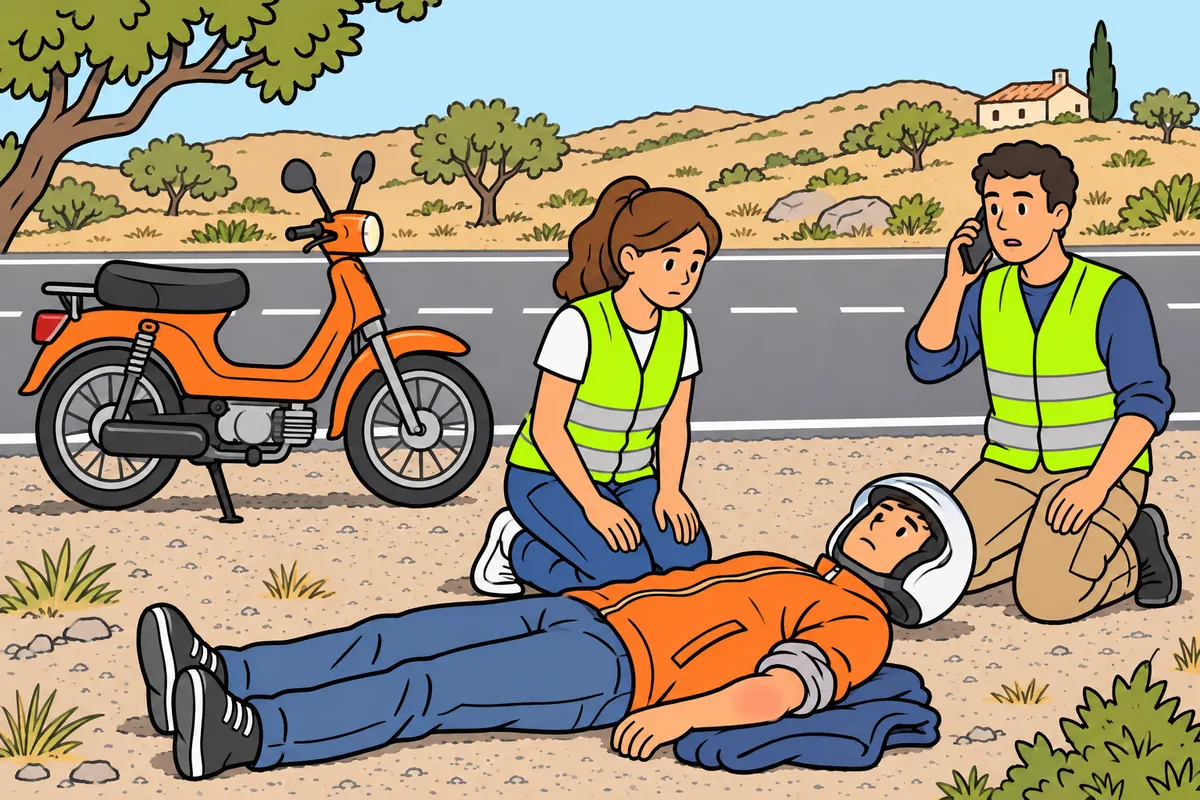
Do not straighten deformed limbs or perform tests to confirm a spinal injury.
Remember
- If you suspect a fracture, keep the limb still.
- Do not straighten limbs or put bones or joints back in place.
- If bone sticks out, protect the wound without pushing it in.
- If they cannot feel or move part of their body, suspect serious injury.
- Do not test with needles or ask them to stand.
- Being able to move does not rule out every spinal injury.
Exam trap: Wrong: Moving their legs rules out spinal injury. Right: Maintain precautions after a significant impact.
Read the full explanation
- Severe pain, swelling and deformity of an arm or leg suggest a fracture. On their own, they do not confirm spinal cord injury or external bleeding. Keep the limb at rest, report your observations and avoid forcing it to find out whether the bone is broken. [DGT, first aid 2026](https://sede.dgt.gob.es/export/sites/dgt/.galleries/permisos-de-conducir/certificacion-aptitud-profesores-formacion-vial/2026/MANUAL-IX-Primeros-auxilios.pdf)
- Do not try to straighten a deformed limb, put a joint back in place or reposition a protruding bone. Protect an open fracture without pushing the bone in; if there is bleeding, follow emergency instructions. Immobilisation must avoid increasing pain and movement.
- If a conscious casualty says they cannot feel or move part of their body, you must suspect a serious injury, including possible damage to the spine or spinal cord. Do not test with needles or ask them to stand up or move their legs to confirm it.
- Being able to move a limb does not rule out every spinal injury. Maintain precautions after a significant impact even if the casualty retains movement.
21Burns: cool and protect
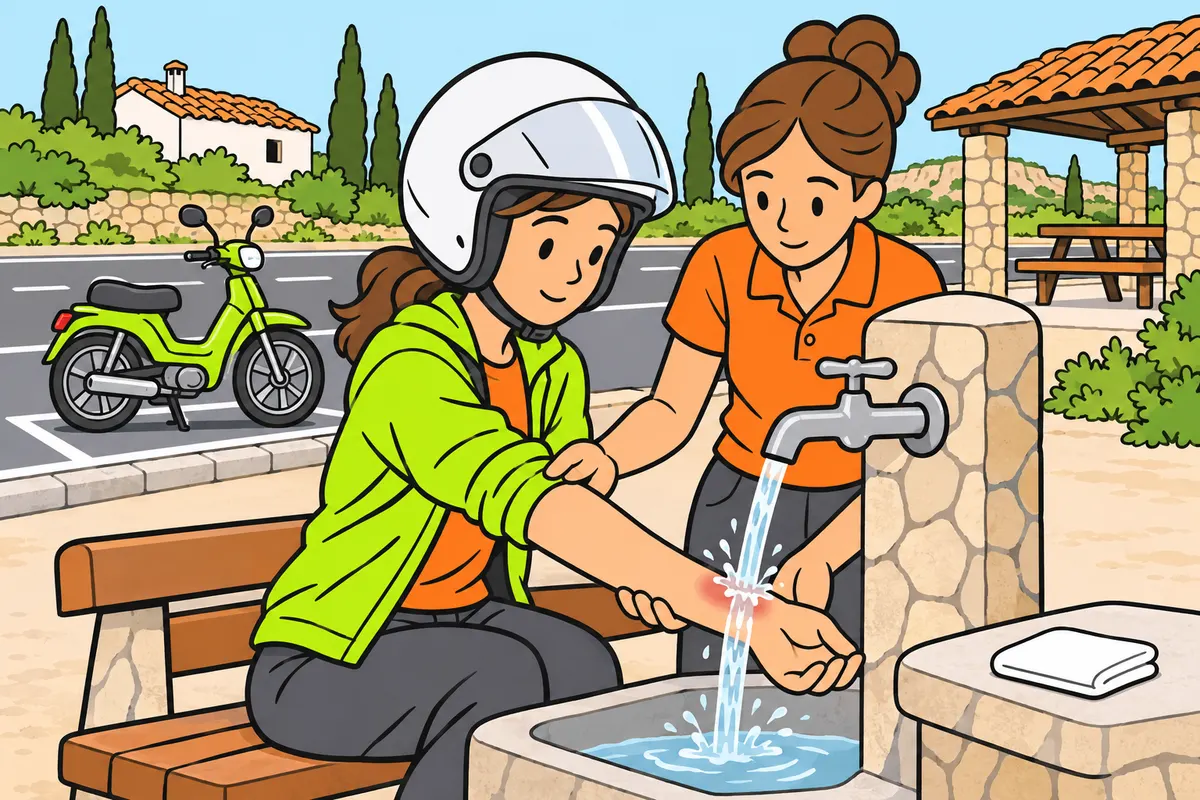
Cool the burn with cool water; protect it without pulling off stuck clothing.
Remember
- Stop heat exposure without putting yourself in danger.
- If clothing burns, prevent running and smother the flames safely.
- Cool under cool running water for 20–30 minutes, if possible and safe.
- Do not delay calling for help or treatment to complete this time.
- No ice, ointments or fats; do not burst blisters or remove stuck clothing.
- Cover loosely with clean, non-stick material; report smoke inhalation.
Exam trap: Wrong: You apply ice or pull off stuck clothing. Right: Use cool water and protect without pulling clothing off.
Read the full explanation
- A hot exhaust, fire or spill can cause burns. First stop the exposure without putting yourself in danger and check breathing and other serious injuries. If clothing is burning, prevent the person from running and try to smother the flames safely with a suitable blanket or garment. [DGT, first aid 2026](https://sede.dgt.gob.es/export/sites/dgt/.galleries/permisos-de-conducir/certificacion-aptitud-profesores-formacion-vial/2026/MANUAL-IX-Primeros-auxilios.pdf)
- Once the source is controlled, cool the burned area under cool running water, without ice or ice-cold water, for 20–30 minutes if possible and safe. Avoid cooling the rest of the body and do not delay calling for help or treatment to complete this time. This is a first-aid guideline, not a legal time limit. [INSST, NTP 524](https://www.insst.es/documentacion/colecciones-tecnicas/ntp-notas-tecnicas-de-prevencion/15-serie-ntp-numeros-506-a-540-ano-2000/ntp-524-primeros-auxilios-quemaduras)
- Do not pull off stuck clothing, burst blisters or apply ointments, fats or home remedies. You can remove nearby objects that are not stuck if doing so causes no injury. Then cover the area loosely with clean, non-stick material. [INSST, NTP 524](https://www.insst.es/documentacion/colecciones-tecnicas/ntp-notas-tecnicas-de-prevencion/15-serie-ntp-numeros-506-a-540-ano-2000/ntp-524-primeros-auxilios-quemaduras)
- Report immediately any facial burns, breathing difficulty or smoke inhalation. Breathing smoke can cause serious injury even if you see hardly any skin burns.
22Supporting casualties without worsening injuries
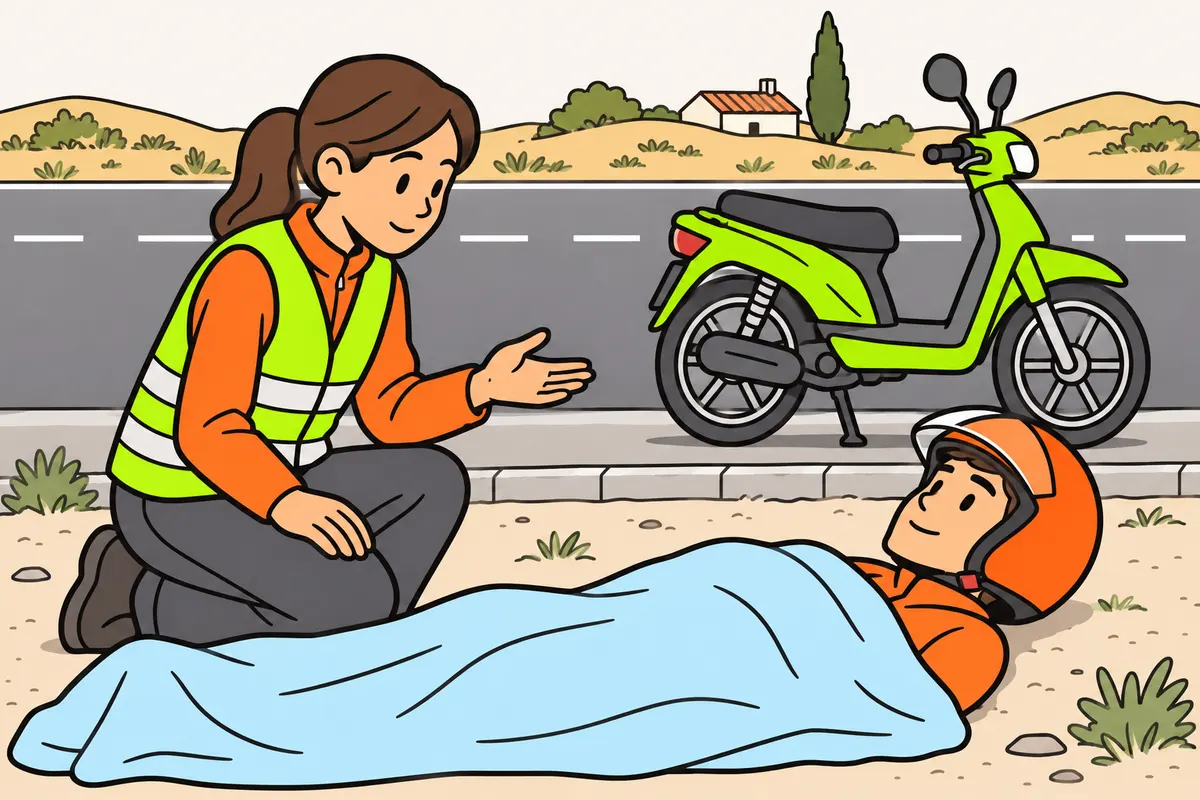
Reassure the casualty, prevent heat loss and leave transport to professionals.
Remember
- Speak slowly and explain that you have requested help.
- Cover them when necessary to keep them warm.
- Do not give food, water, alcohol or medicines on your own initiative.
- Give an unconscious person nothing by mouth.
- Avoid alarming comments and crowds.
- Do not use private transport just because help is taking time.
Exam trap: Wrong: You give water because they are thirsty. Right: Do not give drinks on your own initiative.
Read the full explanation
- Speak slowly, explain that help has been called and listen without forcing the casualty to describe the collision. Cover them with a blanket or clothing when necessary to prevent heat loss. Warmth and reassurance are useful even if they are conscious and do not appear seriously injured. [DGT, first aid 2026](https://sede.dgt.gob.es/export/sites/dgt/.galleries/permisos-de-conducir/certificacion-aptitud-profesores-formacion-vial/2026/MANUAL-IX-Primeros-auxilios.pdf)
- Do not give water, food, alcohol, sedatives or other medicines on your own initiative. Thirst or a product advertised as hypoallergenic does not justify giving it. Give an unconscious person nothing by mouth: they can choke or inhale it into their airway.
- Avoid alarming comments about their injuries, arguments with others involved and crowds. Do not promise that they have no injuries or that everything is resolved. You can help with simple, truthful information and by allowing them to breathe and receive care without people crowding around.
- Leave transport to specialist personnel and appropriate vehicles. A long wait does not in itself authorise you to put the casualty in a private vehicle.
23Remaining at the scene, identifying yourself and providing details
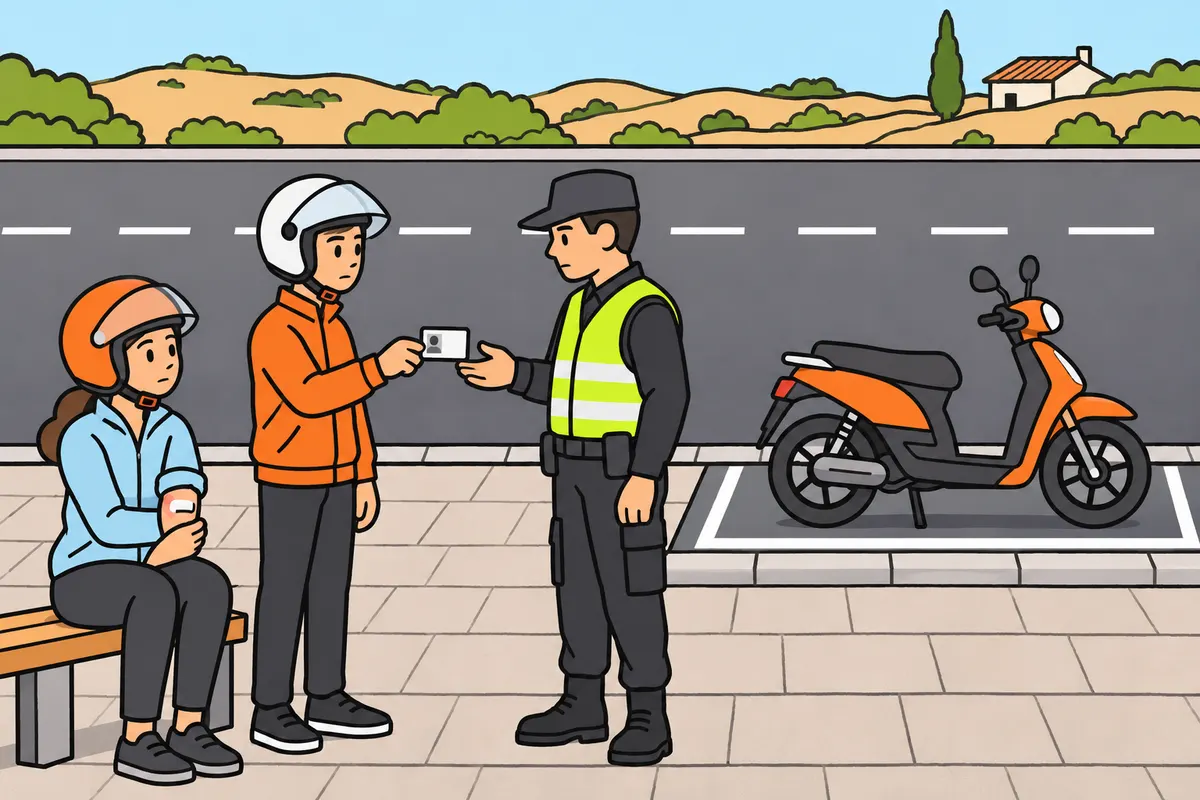
Meet your duties to report, remain and identify yourself after an accident.
Remember
- If anyone appears injured or dead, notify officers and remain or return.
- You may leave if authorised, to help casualties or to receive necessary treatment.
- Give your identity and vehicle details if others involved ask.
- For property damage with the affected person absent, promptly provide your name and address.
- Complete the accident report somewhere safe, off traffic lanes and hard shoulders.
- Preserve evidence if anyone appears dead, injuries are serious or authorities have been notified.
Exam trap: Wrong: You leave because injuries seem minor. Right: To avoid notifying officers or remaining, injuries must be clearly minor, safety restored and nobody involved requesting it.
Read the full explanation
- If anyone appears injured or dead, you must notify the authorities or their officers and remain at or return to the scene until they arrive. You can leave if authorised, if you must help the injured or if you need treatment yourself. You must not flee because you believe another driver caused the accident. [RGC, art. 129](https://www.boe.es/buscar/act.php?id=BOE-A-2003-23514#a129)
- You do not need to notify officers or remain when injuries are clearly minor, safety has been restored and nobody involved requests it. All these conditions must be met; deciding on your own that the impact was minor is insufficient. If in doubt about injuries or dangers, request help. [RGC, art. 129](https://www.boe.es/buscar/act.php?id=BOE-A-2003-23514#a129)
- You must give your identity and vehicle details to others involved if they ask. If there is only property damage and the affected person is absent, take steps to provide your name and address as soon as possible, directly or through officers. Leaving without any way to identify you is insufficient. [RGC, art. 129](https://www.boe.es/buscar/act.php?id=BOE-A-2003-23514#a129)
- You cannot complete the accident report on the roadway, which includes traffic lanes and hard shoulders: do so in a safe place off the road. Cooperate with officers and preserve evidence without exposing yourself to danger to photograph it. Where there are apparent fatalities, serious injuries or notification to the authorities, avoid disturbing traces except for the safety of casualties or traffic. [RGC, art. 130](https://www.boe.es/buscar/act.php?id=BOE-A-2003-23514#a130) [RGC, art. 129](https://www.boe.es/buscar/act.php?id=BOE-A-2003-23514#a129)
24Duty to assist and leaving the scene
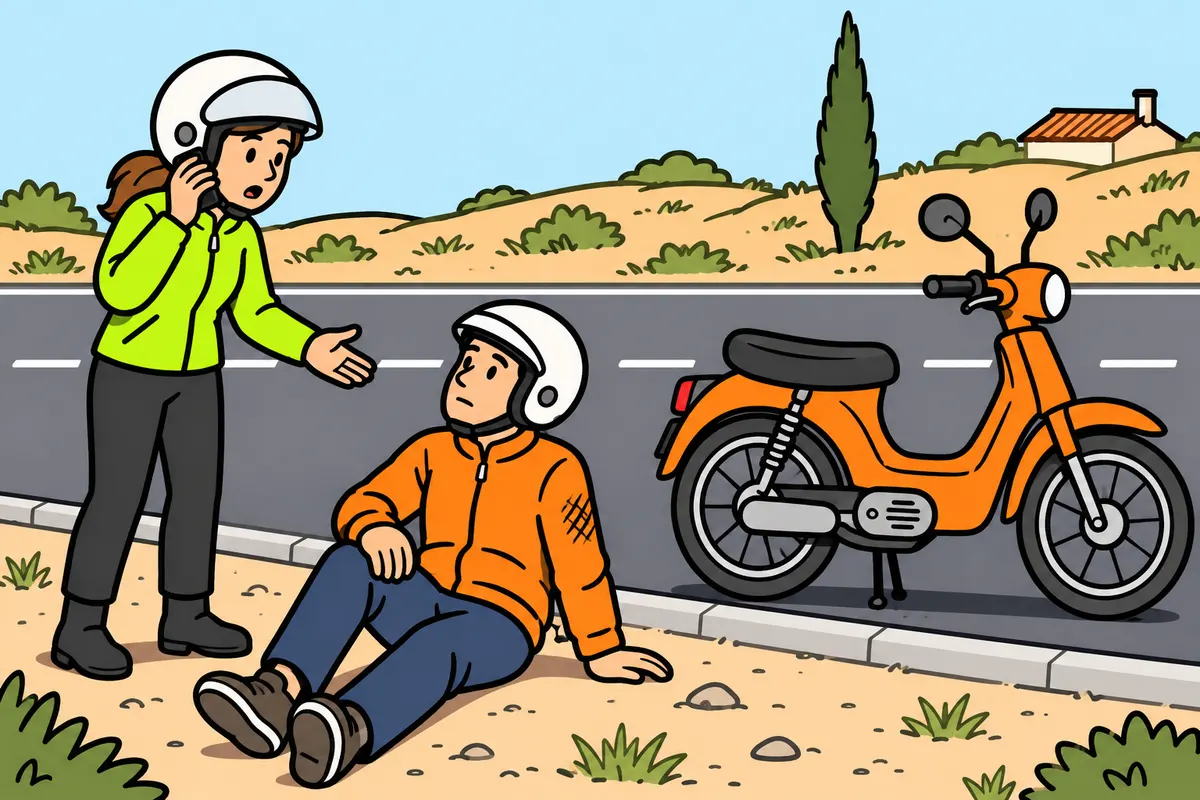
Help without risking lives; do not leave when you have a duty to remain.
Remember
- Help someone helpless in clear, serious danger if nobody is put at risk.
- If you cannot help directly, urgently request help from others.
- Do not attempt a reckless rescue; call from somewhere safe.
- As a witness, you may be unnecessary when officers are already handling the accident.
- After causing deaths or certain injuries, voluntarily leaving can be a criminal offence.
- Others helping does not automatically remove your duty to remain when involved.
Exam trap: Wrong: You leave after causing an accident because others are helping. Right: Voluntarily leaving after causing an accident involving deaths or certain injuries can be a specific criminal offence, subject to legal requirements.
Read the full explanation
- Failure to assist can constitute a criminal offence if you leave a helpless person in clear and serious danger without aid when you can help without risk to yourself or others. Article 195 provides for a fine calculated over three to twelve months for this offence; it is not a fixed administrative fine in euros. [Código Penal (Criminal Code), art. 195](https://www.boe.es/buscar/act.php?id=BOE-A-1995-25444#a195)
- If you are unable to provide assistance directly, you must urgently request help from others. A real risk from entering flames or a traffic area means you cannot be required to attempt a reckless rescue, but does not justify failing to make a call from a safe place. [Código Penal (Criminal Code), art. 195](https://www.boe.es/buscar/act.php?id=BOE-A-1995-25444#a195)
- Do not confuse that offence with all traffic obligations: being an unnecessary witness when officers are dealing with the accident does not automatically amount to failure to assist. You must consider helplessness, danger and the possibility of helping, as well as following officers' instructions.
- As a moped rider, you must also know that voluntarily leaving the scene after causing an accident involving deaths or certain injuries can constitute the specific offence of leaving the scene, subject to the requirements of article 382 bis. The presence of other people helping does not in itself remove your duty to remain as a person involved. [Código Penal, art. 382 bis](https://www.boe.es/buscar/act.php?id=BOE-A-1995-25444#a3-2)
Applying PAS after a moped fall
Organise help from a safe place.
- Stop without creating danger and assess traffic, fire, spills and the position of casualties.
- Protect the scene and anyone able to reach safety; switch on the appropriate lights. If you carry a V-16, you must use it ([RGC, art. 130.4](https://www.boe.es/buscar/act.php?id=BOE-A-2003-23514#a130)); it is not compulsory equipment for AM ([RGV, Annex XII.1](https://www.boe.es/buscar/act.php?id=BOE-A-1999-1826#anxii)).
- Call 112 or ask a specific person to call: give the location, casualties, apparent condition and risks.
- Check responsiveness and breathing and manage life-threatening conditions following 112’s instructions.
- Avoid movement and routine helmet removal, monitor changes and help the emergency services do their work.
Deciding how to help a casualty
Breathing and severe bleeding guide immediate assistance.
- Check that you can approach and speak to the casualty without shaking them.
- If they do not respond, check whether they breathe normally; agonal gasps are not normal breathing.
- If they are not breathing normally, call 112 and start CPR as instructed; ask someone to bring a defibrillator if available.
- If they breathe normally, protect the airway, limit movement because of possible traumatic injury and follow positioning instructions.
- For severe external bleeding with no embedded object, apply direct pressure; report if it is not controlled.
- Keep monitoring, cover them as needed for warmth and give nothing by mouth.
Dealing with a tunnel emergency
Distinguish a breakdown, a traffic queue and a fire.
- If the breakdown allows you to travel safely, continue to the exit or an emergency area.
- If immobilised by an emergency, move the vehicle towards the right or into a lay-by, switch off the engine and give warning using the available devices.
- Request help using the SOS emergency telephone if available and follow its instructions.
- Head for the nearest refuge or exit using areas closed to traffic; in a fire, evacuate away from the fire.
- If there is only a traffic queue, remain on or in your vehicle, switch off the engine, keep the position lights on and temporarily activate the hazard warning lights.
Finished this module?
Mark it as read and you will see your progress on the theory list.