
Theory · LCM Licence - Reduced Mobility Vehicle · Module 1 of 15
Definitions for driving with an LCM licence
You learn to distinguish the parts and types of roads, the vehicle you can drive with an LCM licence and the masses used to describe it. You also identify road users and distinguish compulsory stopping, brief stopping, parking, overtaking and junctions so that you can interpret exam questions accurately.
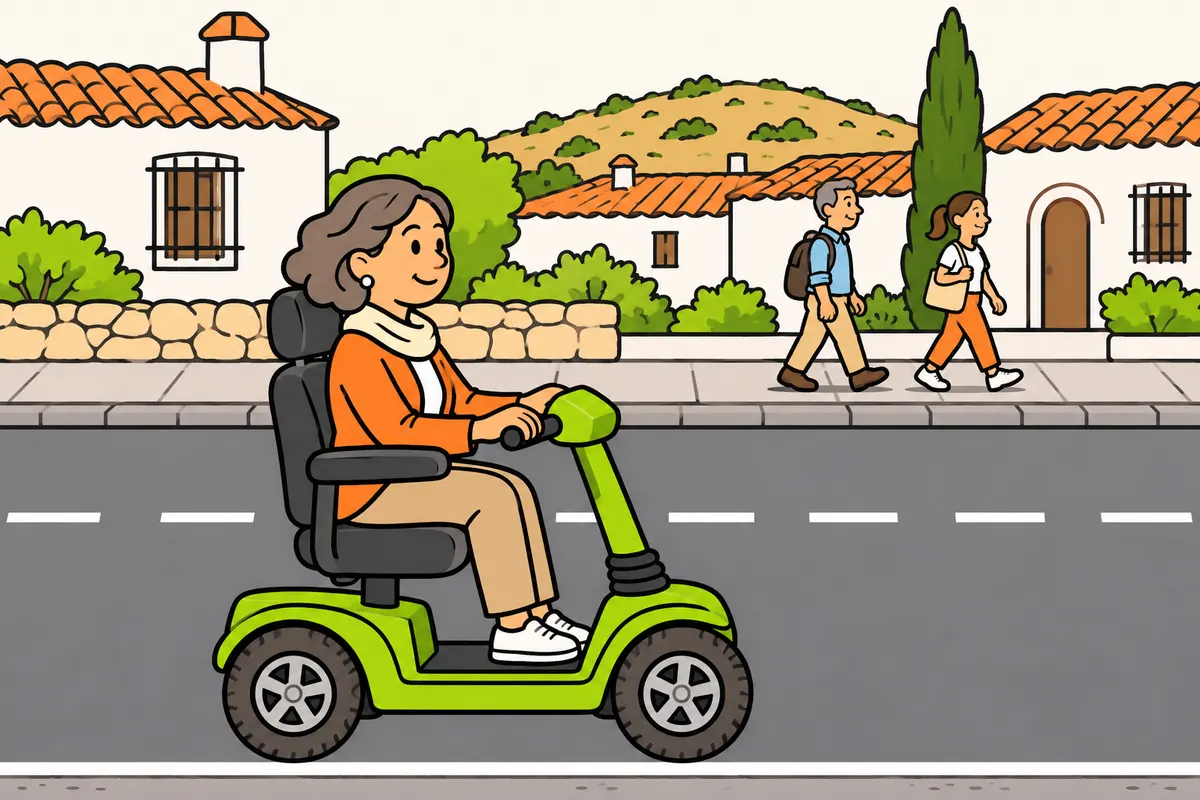
1Roads and highways
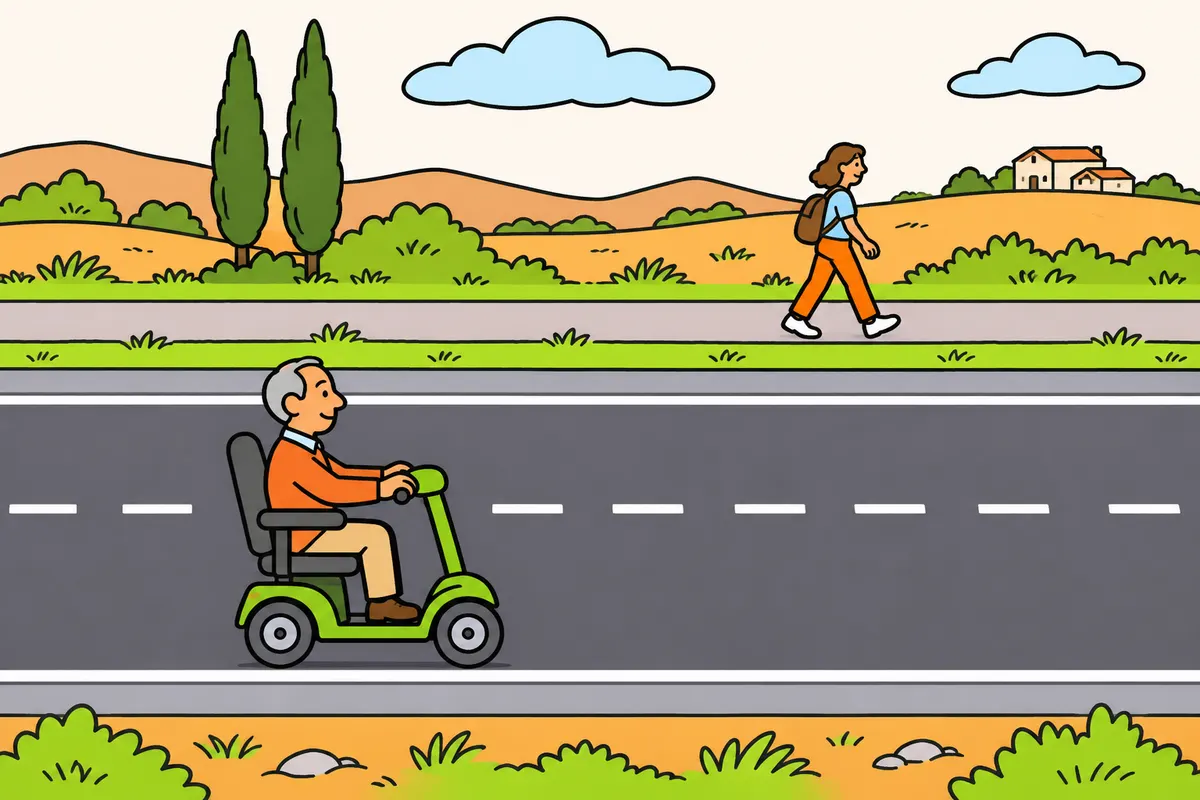
Recognise a highway by its public use, paved surface and location.
| Term | What you need to recognise |
|---|---|
| Road | Space containing different areas |
| Highway | Paved public road outside built-up areas, except for travesías |
Remember
- Identify the whole road before its parts.
- A highway is public and paved.
- It lies outside built-up areas, except for sections passing through them.
- An unpaved track is not a highway.
- Classify highways by their features and signs.
- Traffic law can also cover private land used by an unspecified group.
Exam trap: Wrong: the highway’s owner determines its type. Right: check its features and signs.
Read the full explanation
- When studying traffic, you can understand the road as the space comprising its various parts. The Traffic Act applies to public roads and land suitable for traffic, to those in common use and, in the absence of other rules, to private roads and land used by an unspecified group of users. [Traffic Act, art. 2](https://www.boe.es/buscar/act.php?id=BOE-A-2015-11722#a2).
- A highway is a paved public road outside a built-up area, apart from stretches of road through a town (travesías). You must retain both its public nature and its paved surface in this definition. An unpaved track does not become a highway because you can travel along it in your vehicle. [Traffic Act, Annex I](https://www.boe.es/buscar/act.php?id=BOE-A-2015-11722#ani).
- The type of road and its ownership are different facts: whether a highway belongs to the state, an autonomous community or a municipality does not, by itself, tell you whether it is an autopista (motorway), an autovía (dual carriageway motorway) or a conventional road. To classify it, you must consider its characteristics and signs, rather than the authority that maintains it. [Traffic Act, Annex I](https://www.boe.es/buscar/act.php?id=BOE-A-2015-11722#ani).
- To orient yourself in a diagram, first identify the whole road and then its different spaces. You may find a carriageway, arcenes (hard shoulders) and pedestrian areas within the same road environment. Reading a diagram this way helps you understand which specific area each exam question refers to. [Traffic Act, Annex I](https://www.boe.es/buscar/act.php?id=BOE-A-2015-11722#ani).
2Road platform and carriageway
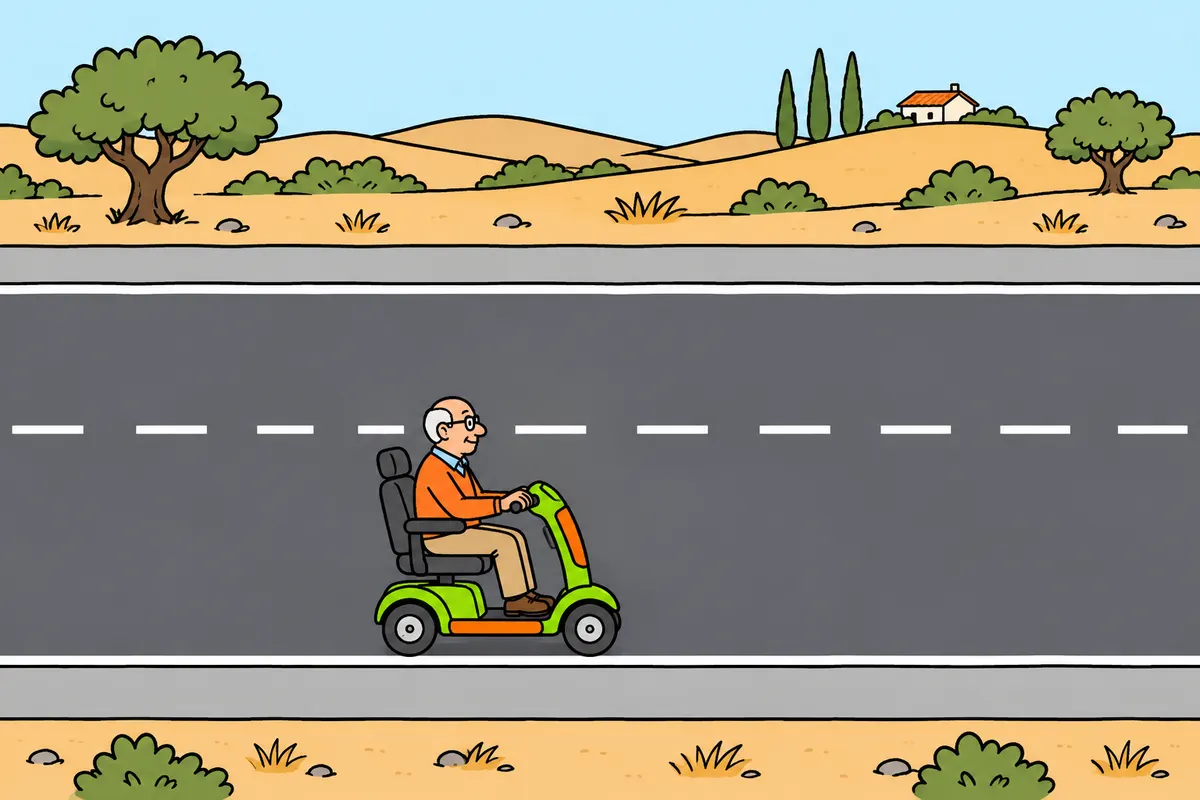
Distinguish the whole platform from the carriageway where vehicles travel.
| Term | What you need to recognise |
|---|---|
| Platform | Carriageway and hard shoulders |
| Carriageway | Part intended for vehicle traffic |
Remember
- The platform includes the carriageway and hard shoulders.
- The carriageway consists of lanes.
- Do not count each lane as a carriageway.
- The carriageway ends where the hard shoulder begins.
Exam trap: Wrong: the platform means only the carriageway. Right: it also includes the hard shoulders.
Read the full explanation
- The road platform comprises the carriageway and the hard shoulders. If a diagram shows a central strip for vehicles and two strips of hard shoulder at the sides, all three form part of the road platform. [Traffic Act, Annex I](https://www.boe.es/buscar/act.php?id=BOE-A-2015-11722#ani).
- The carriageway is the part of the highway intended for vehicle traffic and is made up of lanes. Its function differs from that of the adjoining hard shoulder: both may have similar surfaces, but they occupy legally distinct parts of the road platform. [Traffic Act, Annex I](https://www.boe.es/buscar/act.php?id=BOE-A-2015-11722#ani).
- A road may have separate carriageways for the two directions of travel. You must count the distinct surfaces without calling each lane a carriageway. A carriageway with several lanes is still one carriageway; the number of lanes does not, by itself, determine the number of carriageways. [Traffic Act, Annex I](https://www.boe.es/buscar/act.php?id=BOE-A-2015-11722#ani).
- When a question mentions the edge of the carriageway, you must locate it where this part ends and the adjoining space begins. Distinguishing between these spaces is particularly useful for your vehicle when you study the «Where you must drive» module. [Traffic Act, Annex I](https://www.boe.es/buscar/act.php?id=BOE-A-2015-11722#ani).
3Lane and direction of travel
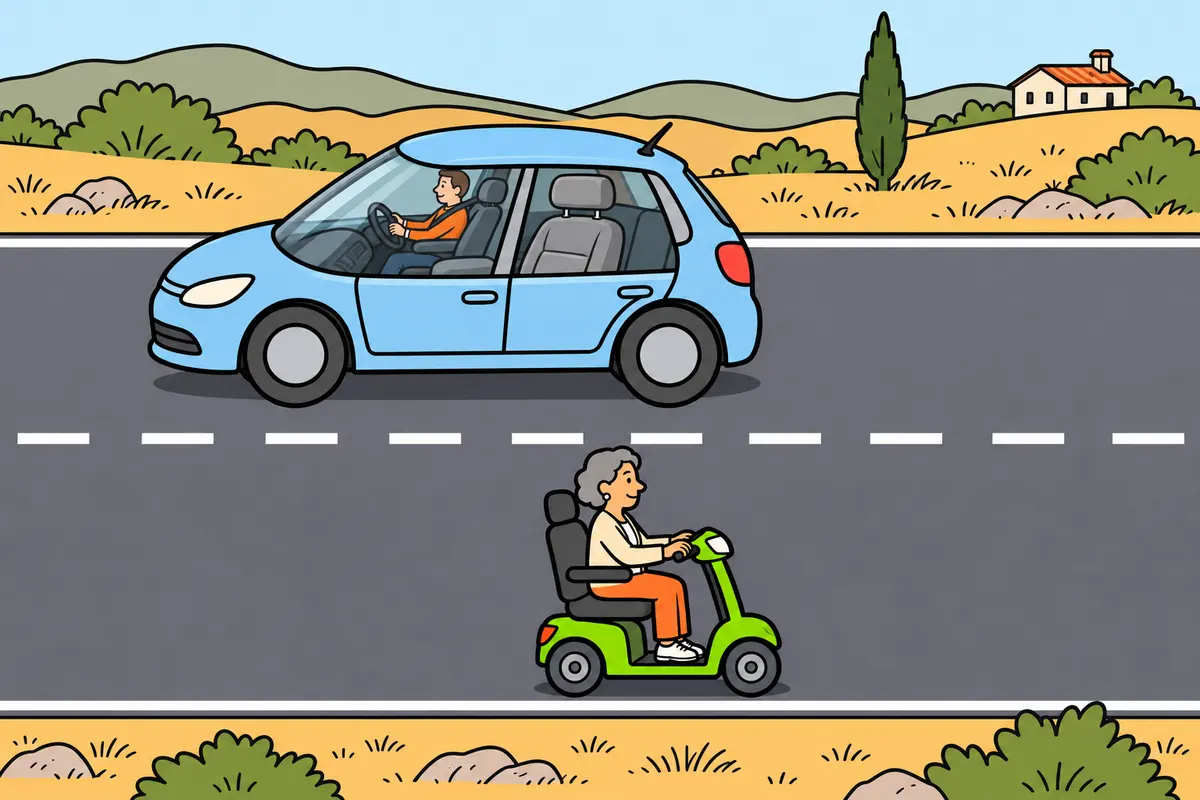
Distinguish a lane from the direction you travel in.
| Term | What you need to recognise |
|---|---|
| Lane | Strip within the carriageway |
| Direction of travel | Which way you travel |
Remember
- Lanes can exist without painted lines.
- Recognise strips wide enough for a line of automobiles other than motorcycles.
- Do not count the hard shoulder as a lane.
- Several lanes can carry traffic in the same direction.
- Do not count lanes using the width of your LCM vehicle.
Exam trap: Wrong: no painted lines means no lanes. Right: also check width and layout.
Read the full explanation
- A lane is a longitudinal strip into which the carriageway may be divided. Its width must allow a single line of automobiles other than motorcycles. You must use this general reference, even if your vehicle for people with reduced mobility is narrower than a passenger car. [Traffic Act, Annex I](https://www.boe.es/buscar/act.php?id=BOE-A-2015-11722#ani).
- A lane may be marked by longitudinal road markings or may have no markings. Where there are no painted markings, you need to recognise the width and layout of the carriageway, without imagining sufficient space for vehicles that do not fit. [Traffic Act, Annex I](https://www.boe.es/buscar/act.php?id=BOE-A-2015-11722#ani).
- You must distinguish between a lane and a direction of travel: a lane is a longitudinal space, while the direction indicates which way you are travelling. There may be several lanes in the same direction. You may encounter two lanes running in the same direction or a carriageway shared by both directions. [Traffic Act, Annex I](https://www.boe.es/buscar/act.php?id=BOE-A-2015-11722#ani).
- To count lanes in an illustration, look at the carriageway and the strips that allow lines of automobiles. The reference width is that needed for a single line of automobiles other than motorcycles. The definition does not depend on the particular width of the LCM vehicle. [Traffic Act, Annex I](https://www.boe.es/buscar/act.php?id=BOE-A-2015-11722#ani).
4Hard shoulder
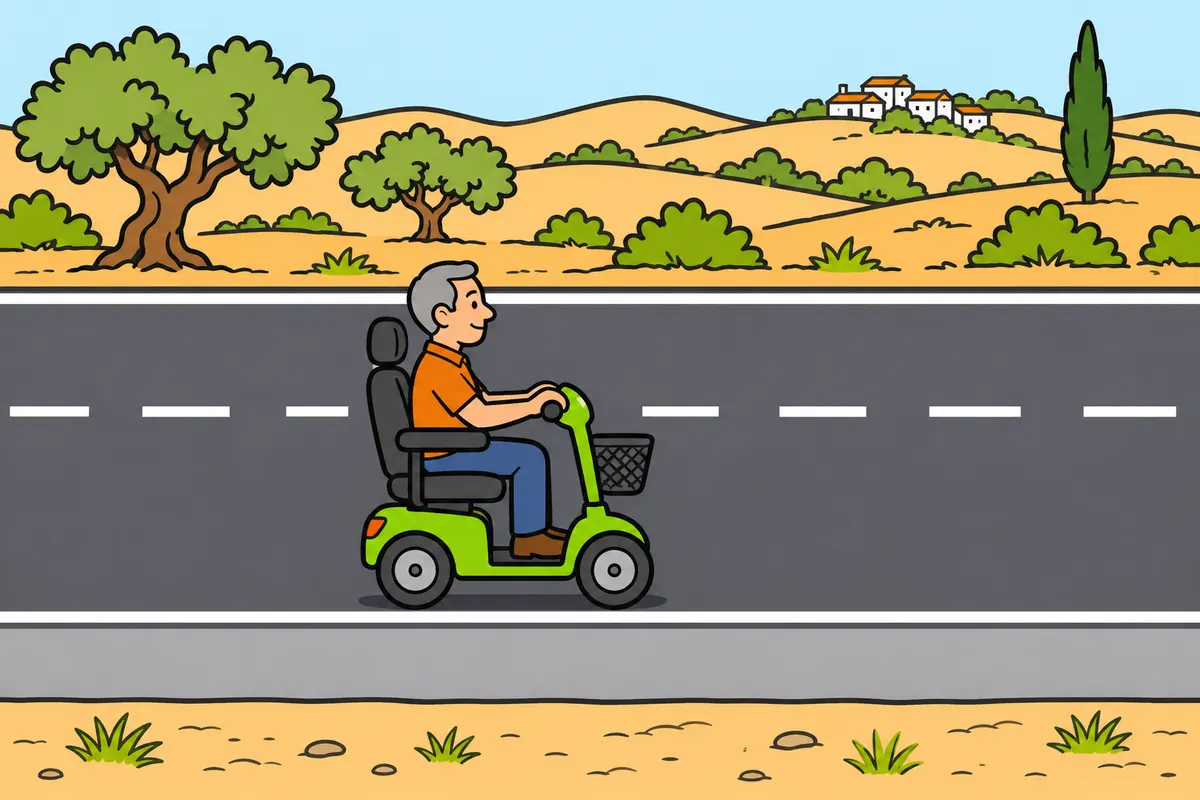
Recognise the hard shoulder as a surfaced strip beside the carriageway.
| Term | What you need to recognise |
|---|---|
| Hard shoulder | Surfaced strip beside the carriageway |
| Lane | Strip within the carriageway |
| Pavement | Space for pedestrians |
Remember
- The hard shoulder forms part of the platform.
- Automobiles use it only in exceptional circumstances.
- This does not ban every vehicle category from using it.
- Check separately whether your vehicle can fit and use it.
- Land beside a highway is not always a hard shoulder.
Exam trap: Wrong: the hard shoulder is another lane. Right: it lies beside, outside the carriageway.
Read the full explanation
- The arcén (hard shoulder) is a surfaced longitudinal strip alongside the carriageway. It is not intended for use by automobiles except in exceptional circumstances. You must remember the word automobiles: this general definition does not amount to prohibiting its use by all classes of vehicle. [Traffic Act, Annex I](https://www.boe.es/buscar/act.php?id=BOE-A-2015-11722#ani).
- You must distinguish a hard shoulder from a pavement and a lane. The hard shoulder belongs to the road platform, together with the carriageway; a pavement serves pedestrians, and a lane is a subdivision of the carriageway. The fact that all three are long strips does not make them equivalent. [Traffic Act, Annex I](https://www.boe.es/buscar/act.php?id=BOE-A-2015-11722#ani).
- The definition of a hard shoulder does not require it to be wide or always allow you to proceed along it in your vehicle. You must separate identifying the strip from assessing whether it is usable and wide enough. You study the specific conditions for its use in the «Where you must drive» module. [Traffic Act, Annex I](https://www.boe.es/buscar/act.php?id=BOE-A-2015-11722#ani).
- In a diagram, identify the hard shoulder by its position alongside the carriageway and its function, without confusing it with any land beside a highway. An earth verge outside the road platform does not become a hard shoulder because it is to the right of your path. [Traffic Act, Annex I](https://www.boe.es/buscar/act.php?id=BOE-A-2015-11722#ani).
5Pavement and pedestrian area
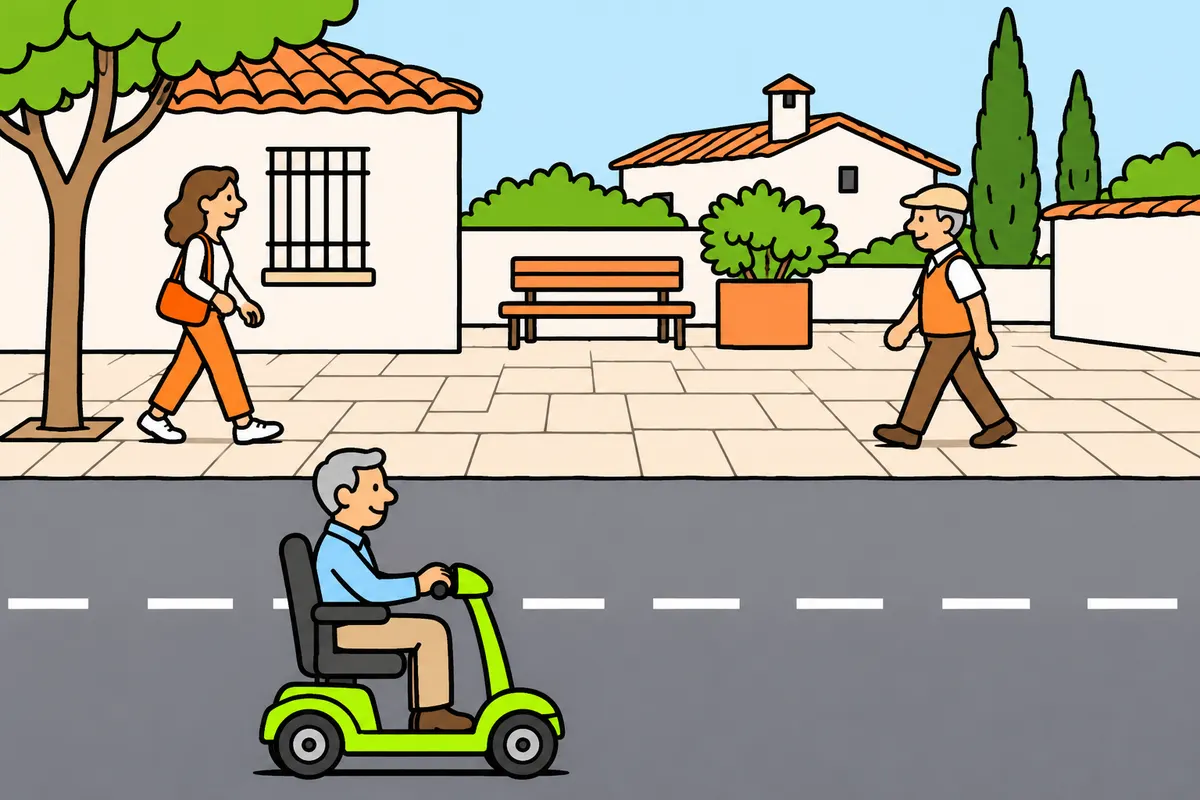
Recognise pedestrian spaces by their purpose, even without a raised kerb.
| Term | What you need to recognise |
|---|---|
| Pavement | Long strip intended for pedestrians |
| Pedestrian area | Space primarily for pedestrians to move and spend time |
| Pedestrian refuge | Protected pedestrian area within the carriageway |
Remember
- A pavement can be raised or level with the carriageway.
- Pedestrian areas also include squares and promenades.
- A pedestrian refuge protects pedestrians within the carriageway.
- Do not confuse a wheelchair with your LCM vehicle.
- Identifying a pedestrian area does not tell you whether you may enter.
Exam trap: Wrong: no raised kerb means no pavement. Right: a pavement can be level.
Read the full explanation
- The pavement is a longitudinal area intended for pedestrians and may or may not be raised. The absence of a difference in level does not automatically turn a pedestrian area into a carriageway or broaden the category of vehicle you drive. [Traffic Act, Annex I](https://www.boe.es/buscar/act.php?id=BOE-A-2015-11722#ani).
- The pedestrian area is reserved primarily for pedestrians to move through and spend time in. It includes spaces other than pavements: squares, promenades, boulevards, platforms and similar areas. [Traffic Act, Annex I](https://www.boe.es/buscar/act.php?id=BOE-A-2015-11722#ani).
- A pedestrian refuge is a pedestrian area situated in the carriageway and protected from vehicle traffic. Its location in the carriageway and its protection for pedestrians distinguish it from the hard shoulder. If you see an island where pedestrians wait, the concept you must consider is a pedestrian refuge. [Traffic Act, Annex I](https://www.boe.es/buscar/act.php?id=BOE-A-2015-11722#ani).
- You must separate your status as a person with reduced mobility from the legal classification of the means of transport you use. A wheelchair that meets the legal definition of a pedestrian and a vehicle in the category you drive with an LCM licence are distinct concepts; recognising a pedestrian area does not, by itself, establish the rules for access. [Traffic Act, Annex I](https://www.boe.es/buscar/act.php?id=BOE-A-2015-11722#ani).
6Shared spaces and school routes
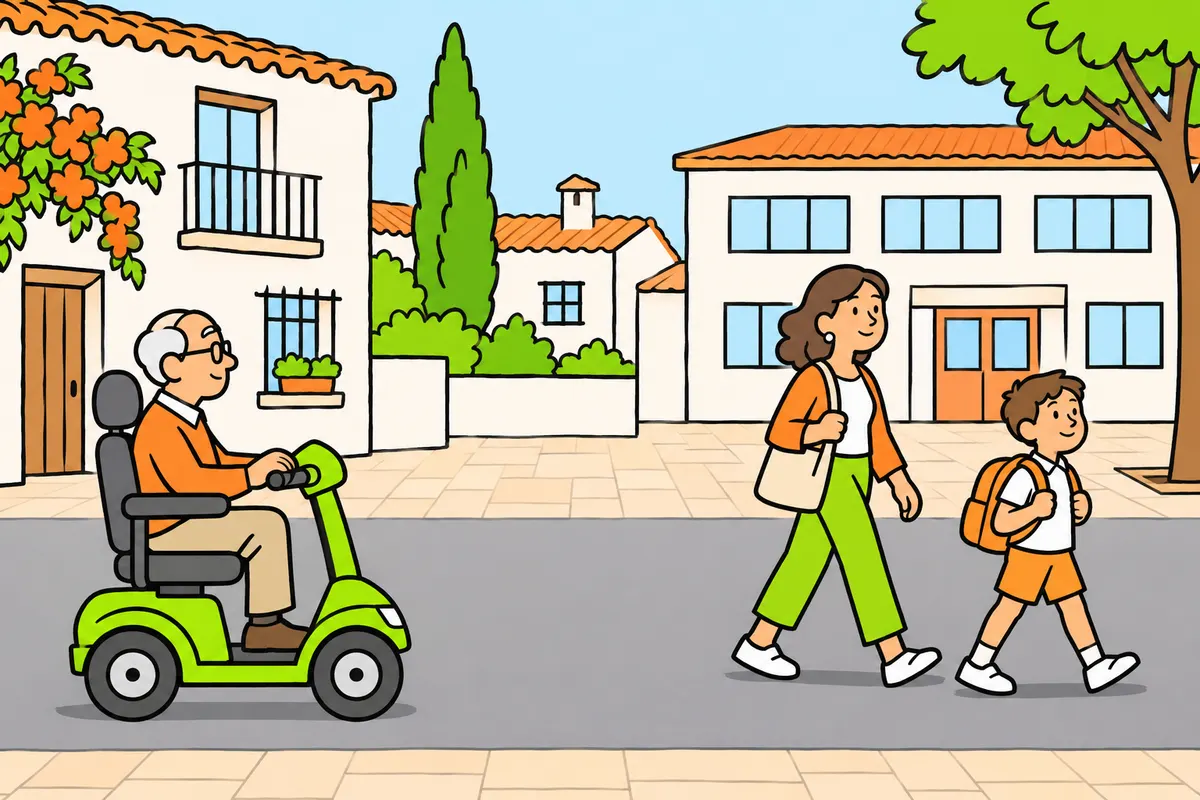
Adapt your driving to spaces designed for pedestrians and schoolchildren.
| Term | What you need to recognise |
|---|---|
| Shared level pavement and carriageway | Pedestrian priority anywhere on the carriageway |
| Residential priority area | Council regulation |
| Safe school route | Roads adapted for journeys to school |
Remember
- Where pavement and carriageway share one level, give way to pedestrians anywhere.
- In residential priority areas, check the council’s restrictions.
- The council may set speed limits.
- School routes may restrict motor vehicles.
Exam trap: Wrong: on a shared level surface, give way only at marked crossings. Right: give way to pedestrians anywhere on the carriageway.
Read the full explanation
- In an area where the carriageway and pavement share a single level surface, pedestrian movement is encouraged and signs are kept to a minimum. If you drive there, you must give way to pedestrians at any point on the carriageway. [Traffic Act, Annex I, concept 83](https://www.boe.es/buscar/act.php?id=BOE-A-2015-11722#ani).
- A residential priority zone or area is designated and regulated by the local council to promote sustainable use, through restrictions on access or movement by vehicles belonging to people who do not reside there, and other measures. You may encounter restrictions on access, driving or parking and speed limits set by the municipal authority. [Traffic Act, Annex I, concept 84](https://www.boe.es/buscar/act.php?id=BOE-A-2015-11722#ani). [RGC, art. 152.3](https://www.boe.es/buscar/act.php?id=BOE-A-2003-23514#a1-5).
- A safe school path or route comprises roads adapted to make it easier for children to reach school on foot, by public transport or by non-motorised means. You may encounter signs, specific speed limits and restrictions on motor vehicles. [Traffic Act, Annex I, concept 85](https://www.boe.es/buscar/act.php?id=BOE-A-2015-11722#ani).
7Cycle routes
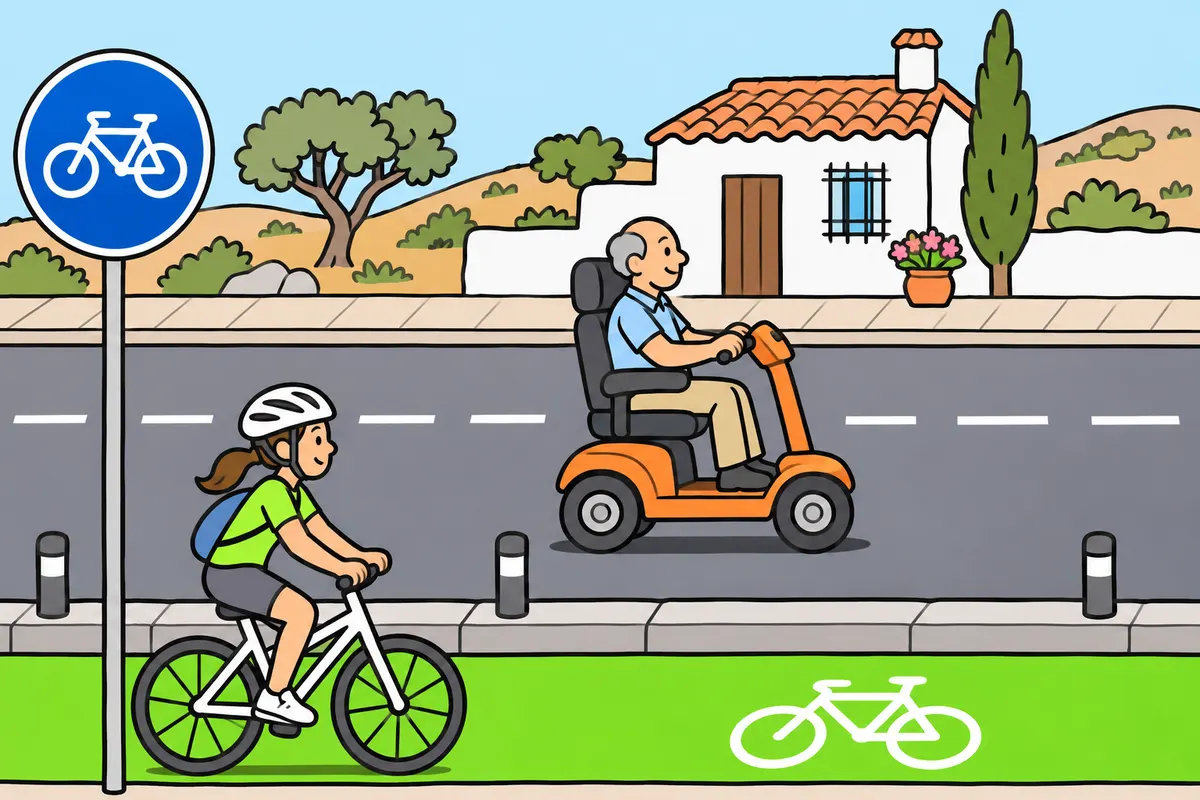
Use cycle routes with your LCM vehicle only with official permission and signs allowing access.
| Term | What you need to recognise |
|---|---|
| Cycle lane | Alongside the carriageway |
| Pavement cycle lane | On the pavement |
| Cycle track | Independent of highways and separate from motorised traffic |
| Shared pedestrian and cycle path | For pedestrians and cycles, separate from motorised traffic |
Remember
- Check that the responsible authority allows your vehicle to enter.
- Check that the signs also allow it.
- A pavement cycle lane does not automatically allow your LCM vehicle.
- Recognise protected cycle lanes by their physical barriers along the sides.
Exam trap: Wrong: LCM vehicles can use every cycle route. Right: you need permission from the responsible authority and signs allowing access.
Read the full explanation
- A cycle route is adapted and signposted so that cycles can travel safely. You may only use it with your LCM vehicle if the competent authority authorises other vehicles and the signs indicate this. [Traffic Act, Annex I, definition 74](https://www.boe.es/buscar/act.php?id=BOE-A-2015-11722#ani).
- A carril-bici (cycle lane) runs alongside the carriageway and may carry traffic in one or both directions. You can recognise a protected cycle lane by the barriers along its sides that physically separate it from the carriageway and the pavement. [Traffic Act, Annex I, definitions 75 and 76](https://www.boe.es/buscar/act.php?id=BOE-A-2015-11722#ani).
- An acera-bici (pavement cycle route) is a signposted cycle route on the pavement. You can identify it by its course through the pedestrian space, unlike a cycle lane, which runs alongside the carriageway. [Traffic Act, Annex I, definition 77](https://www.boe.es/buscar/act.php?id=BOE-A-2015-11722#ani).
- A pista-bici (separate cycle track) follows a route independent of roads and separate from motor traffic. You can distinguish it from a senda ciclable (shared pedestrian and cycle path), which is intended for pedestrians and cycles in open spaces, parks, gardens or woods and is also separate from motor traffic. [Traffic Act, Annex I, definitions 78 and 79](https://www.boe.es/buscar/act.php?id=BOE-A-2015-11722#ani).
8Built-up area
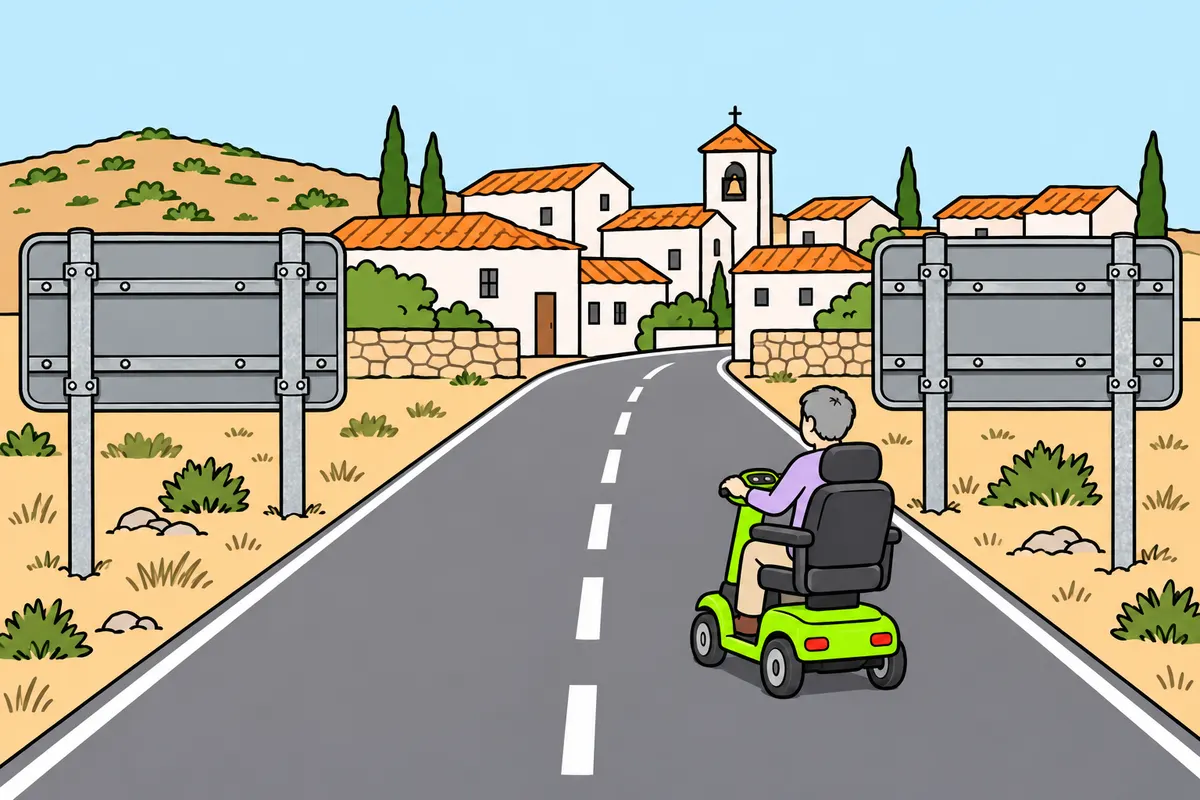
Recognise a built-up area by its buildings and entry and exit signs.
| Term | What you need to recognise |
|---|---|
| Built-up area | Space with buildings, bounded by signs |
| Municipal area | Municipal territory, including land outside built-up areas |
Remember
- Check the signs on access roads.
- Isolated houses do not establish a built-up area.
- You can be within a municipality but outside a built-up area.
- Buildings alone do not identify a travesía.
Exam trap: Wrong: the whole municipality is a built-up area. Right: check buildings and entry and exit signs.
Read the full explanation
- A poblado (built-up area) contains buildings and has entry and exit signs on its access roads. You must consider these elements of the definition together, rather than simply looking for houses near the road. The signs define the boundaries of the area covered by the term. [Traffic Act, Annex I](https://www.boe.es/buscar/act.php?id=BOE-A-2015-11722#ani).
- The municipal area is the territory of a municipality. You can be within a municipality’s territory while driving outside a built-up area. You do not answer an exam question about being inside or outside a built-up area by finding out which local council the land belongs to. [Traffic Act, Annex I](https://www.boe.es/buscar/act.php?id=BOE-A-2015-11722#ani).
- A built-up area and each road passing through it refer to different things. A built-up area is a space; urban road and travesía (the stretch of road through a town) are classifications of roads or stretches of road. This means that simply saying you are between buildings is not enough to determine whether the particular stretch is a travesía. [Traffic Act, Annex I](https://www.boe.es/buscar/act.php?id=BOE-A-2015-11722#ani).
- If a scenario mentions isolated buildings, a housing estate or facilities alongside a road, check the legal elements of a built-up area. The speed limits associated with each class of road are covered in «Speed and safe following distances». [Traffic Act, Annex I](https://www.boe.es/buscar/act.php?id=BOE-A-2015-11722#ani).
9Urban roads, interurban roads and travesías
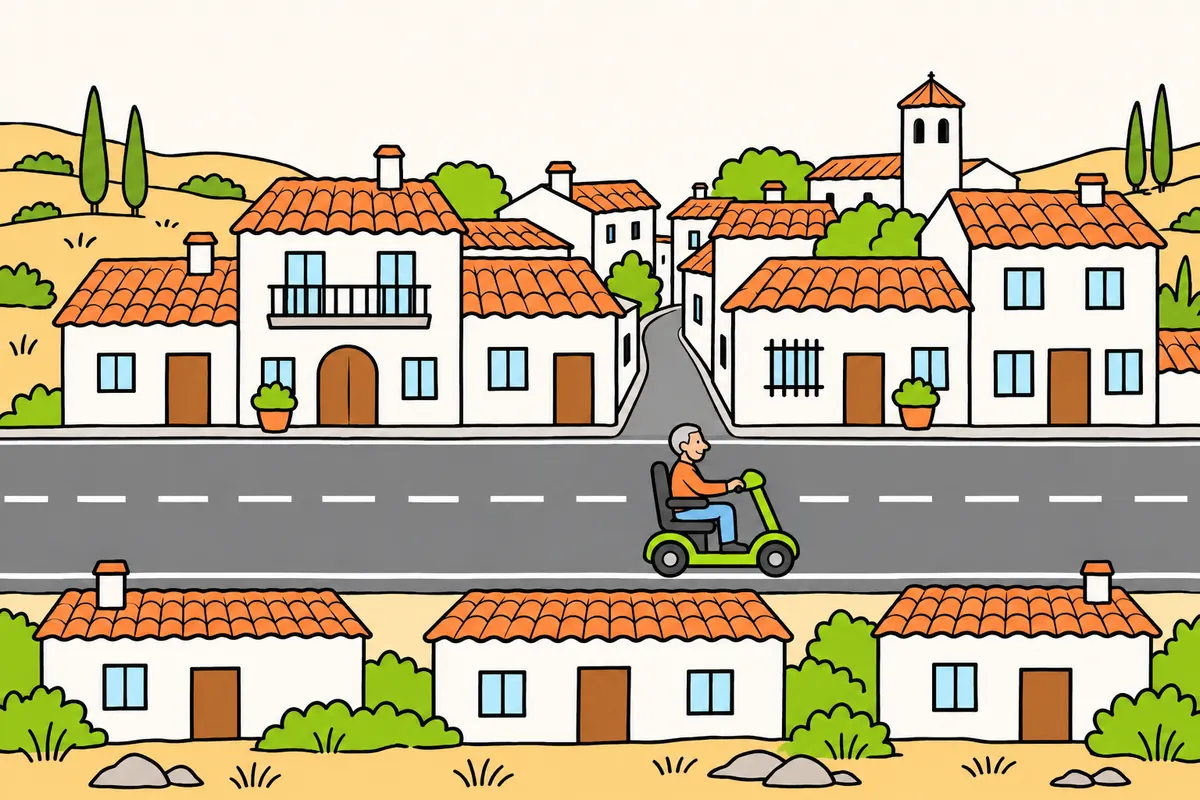
Classify roads by their location and whether they are sections of highway.
| Term | What you need to recognise |
|---|---|
| Interurban road | Public road outside a built-up area |
| Urban road | Public road inside a built-up area, excluding travesías |
| Travesía | Highway through a built-up area; excludes sections with access to alternative roads or bypasses |
Remember
- First check whether you are inside or outside a built-up area.
- Urban roads exclude travesías.
- A travesía must be a section of highway.
- Sections with access to an alternative road or bypass are excluded.
Exam trap: Wrong: every street crossing a village is a travesía. Right: it must be highway through a built-up area, excluding sections with access to an alternative road or bypass.
Read the full explanation
- An interurban road is a public road outside a built-up area. An urban road is a public road within a built-up area, excluding travesías. You must learn this exclusion: within a built-up area and urban road do not mean the same thing in the legal definitions. [Traffic Act, Annex I](https://www.boe.es/buscar/act.php?id=BOE-A-2015-11722#ani).
- A travesía is a stretch of road that passes through a built-up area. The law excludes stretches with access to an alternative road or bypass. You must retain this qualification when a question includes all the elements of the definition. [Traffic Act, Annex I](https://www.boe.es/buscar/act.php?id=BOE-A-2015-11722#ani).
- On a road passing through several built-up areas, you must identify each stretch within a built-up area separately and check whether there is an accessible alternative road. The classification applies to the specific stretch described in the question. [Traffic Act, Annex I](https://www.boe.es/buscar/act.php?id=BOE-A-2015-11722#ani).
- To work through a scenario, first establish whether you are inside or outside a built-up area, then whether the stretch is a travesía. This allows you to distinguish an urban street from a stretch of road through a town without automatically assuming that the same rules apply to both. [Traffic Act, Annex I](https://www.boe.es/buscar/act.php?id=BOE-A-2015-11722#ani).
10Autopista (motorway)
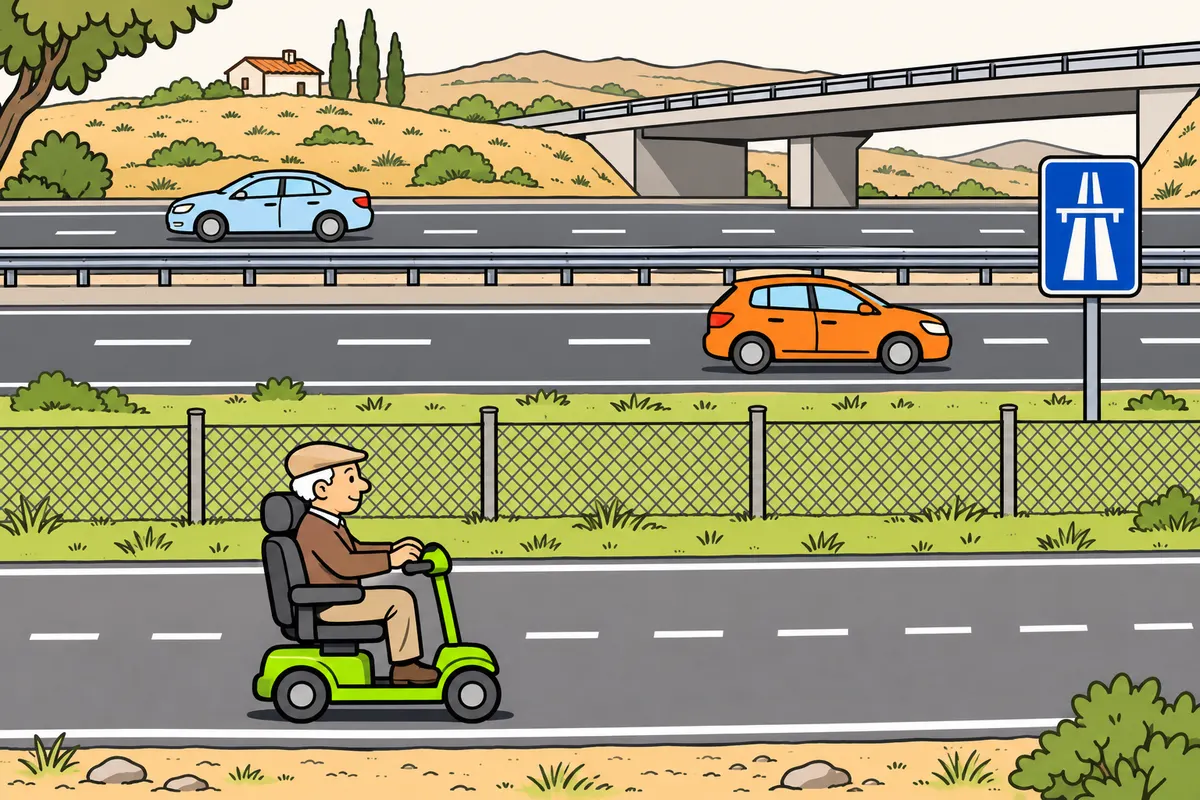
Recognise an autopista by all its features and its signs.
Remember
- It is designed, built and signposted exclusively for automobiles.
- Neighbouring properties have no direct access.
- It has no crossings at the same level with roads, paths or railways.
- Carriageways are separate by direction, with legal exceptions for specific places or temporary situations.
- The dividing strip excludes traffic; exceptionally, other means provide separation.
Exam trap: Wrong: several lanes make an autopista. Right: check all its features.
Read the full explanation
- An autopista is a road designed, built and signposted exclusively for use by automóviles (motor vehicles other than those excluded from this legal category). You can relate this restriction to the vehicle categories defined in «Vehicle, motor vehicle and automóvil». [Traffic Act, Annex I](https://www.boe.es/buscar/act.php?id=BOE-A-2015-11722#ani).
- Adjoining properties have no direct access to an autopista. This feature requires the absence of direct access, regardless of whether you see only a few entrances. Road access is not classified by how many entrances you see during a journey, but by the road’s legal characteristics. [Traffic Act, Annex I](https://www.boe.es/buscar/act.php?id=BOE-A-2015-11722#ani).
- An autopista does not cross other roads, paths, railways or tramways at the same level, nor do they cross it at the same level. You must understand at the same level as at the same height: a bridge over another road does not constitute a crossing of routes at the same level. [Traffic Act, Annex I](https://www.boe.es/buscar/act.php?id=BOE-A-2015-11722#ani).
- It has separate carriageways for each direction, divided by a strip not intended for traffic or, exceptionally, by other means, subject to the legal exceptions for specific locations or temporary situations. You must consider these features together; having several lanes alone does not make a road an autopista. [Traffic Act, Annex I](https://www.boe.es/buscar/act.php?id=BOE-A-2015-11722#ani).
11Autovía (dual carriageway motorway)
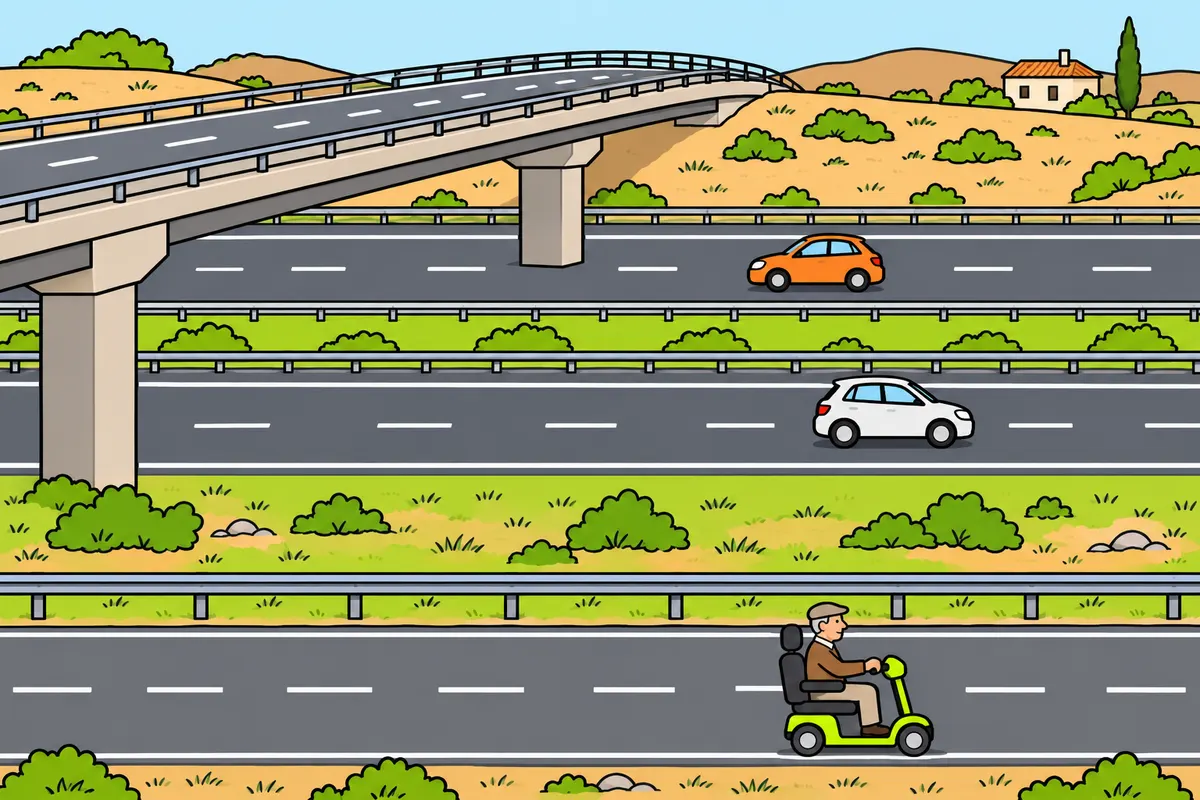
Recognise an autovía by its legal features and signs.
| Road and case | Access |
|---|---|
| Autovía: neighbouring properties | Limited access |
| Autopista: neighbouring properties | No direct access |
Remember
- Neighbouring properties have limited access.
- It has no crossings at the same level with roads, paths or railways.
- Carriageways are separate by direction, with legal exceptions for specific places or temporary situations.
- A line between directions does not create separate carriageways.
Exam trap: Wrong: autopistas and autovías have identical access rules. Right: neighbouring properties have no direct access to autopistas and limited access to autovías.
Read the full explanation
- An autovía must also be specifically designed, built and signposted as such. To recognise one, look at its signs, access points, crossings and separation of traffic directions. The category depends on the full set of characteristics laid down by law. [Traffic Act, Annex I](https://www.boe.es/buscar/act.php?id=BOE-A-2015-11722#ani).
- Adjoining properties have limited access to an autovía. You must retain this wording to distinguish it from the absence of access in the definition of an autopista. Limited access does not mean that any property can freely open an entrance onto the carriageway. [Traffic Act, Annex I](https://www.boe.es/buscar/act.php?id=BOE-A-2015-11722#ani).
- An autovía has no crossings at the same level with the other roads, paths, railway lines or tramways listed in the definition. An interchange with slip roads connects roads at different levels; at a junction, routes cross at the same height. [Traffic Act, Annex I](https://www.boe.es/buscar/act.php?id=BOE-A-2015-11722#ani).
- It has separate carriageways for each direction, subject to the exceptions for specific locations or temporary situations provided for in the definition. You must distinguish this separation from a simple line dividing traffic directions on a single carriageway; not every two-way road is an autovía. [Traffic Act, Annex I](https://www.boe.es/buscar/act.php?id=BOE-A-2015-11722#ani).
12Road reserved for automobiles and conventional road
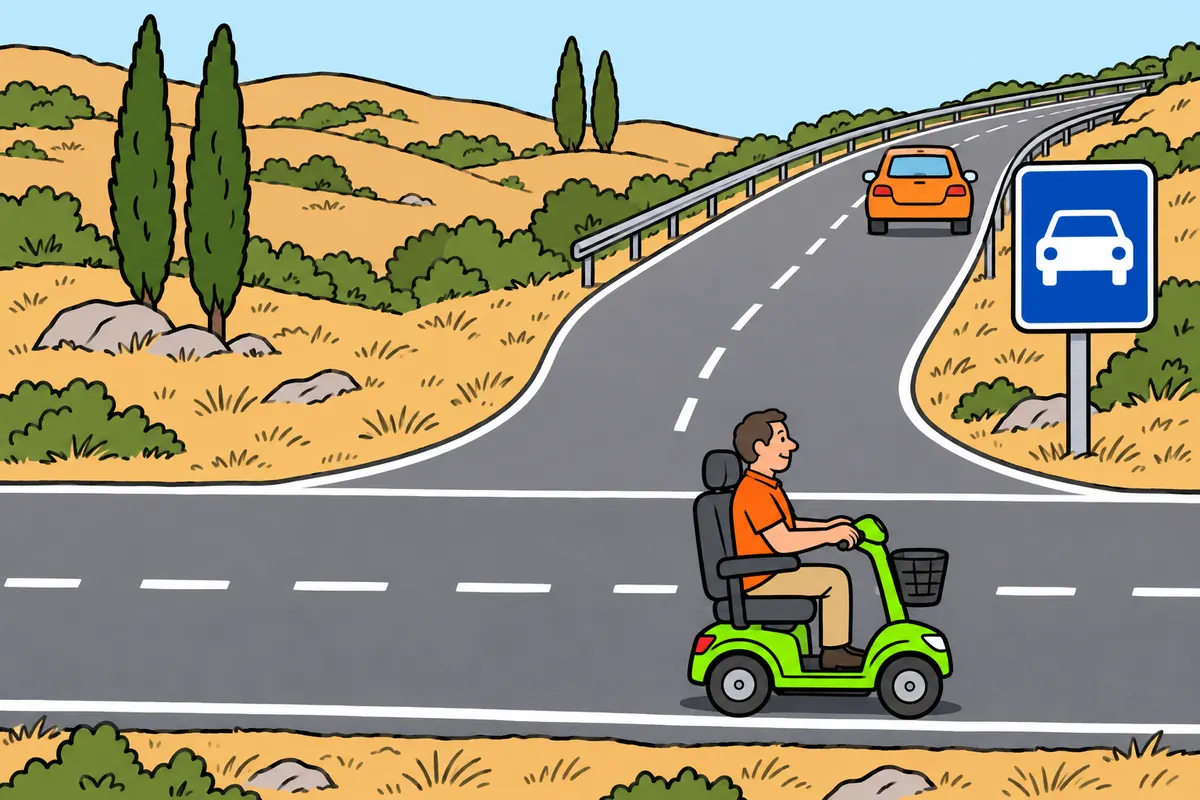
Do not confuse a road reserved for automobiles with a conventional road.
| Term | What you need to recognise |
|---|---|
| Road reserved for automobiles | Automobiles only; single carriageway; no access from neighbouring properties |
| Conventional road | Lacks the features of autopistas, autovías and roads reserved for automobiles |
Remember
- A road reserved for automobiles has a single carriageway.
- Neighbouring properties have no access.
- Your LCM vehicle is not an automobile.
- A carriageway can contain several lanes.
Exam trap: Wrong: every highway without separate carriageways is conventional. Right: it may be a road reserved for automobiles.
Read the full explanation
- A vía para automóviles (road reserved for automobiles) is reserved exclusively for these vehicles, has a single carriageway and completely restricted access to adjoining properties; its beginning and end must be signposted as a road reserved for automobiles. All these characteristics are required together: having a single carriageway does not mean that any vehicle can use it. [Traffic Act, Annex I](https://www.boe.es/buscar/act.php?id=BOE-A-2015-11722#ani).
- The definitions of the last two road types provide for separate carriageways for each direction; a road reserved for automobiles has one carriageway. The number of lanes within it is a separate matter. [Traffic Act, Annex I](https://www.boe.es/buscar/act.php?id=BOE-A-2015-11722#ani).
- A conventional road is one that does not have the characteristics of an autopista, an autovía or a road reserved for automobiles. You must include the third category when choosing this definition. It is not enough to say that a road is conventional because it lacks separate carriageways. [Traffic Act, Annex I](https://www.boe.es/buscar/act.php?id=BOE-A-2015-11722#ani).
- Your LCM vehicle is not an automóvil and does not qualify to use a road reserved exclusively for automobiles. Prohibitions and rules on road use are covered in «Where you must drive»; here you must be able to identify the class of road without confusing it with a conventional road. [Traffic Act, Annex I](https://www.boe.es/buscar/act.php?id=BOE-A-2015-11722#ani).
13Junction and crossing at the same level
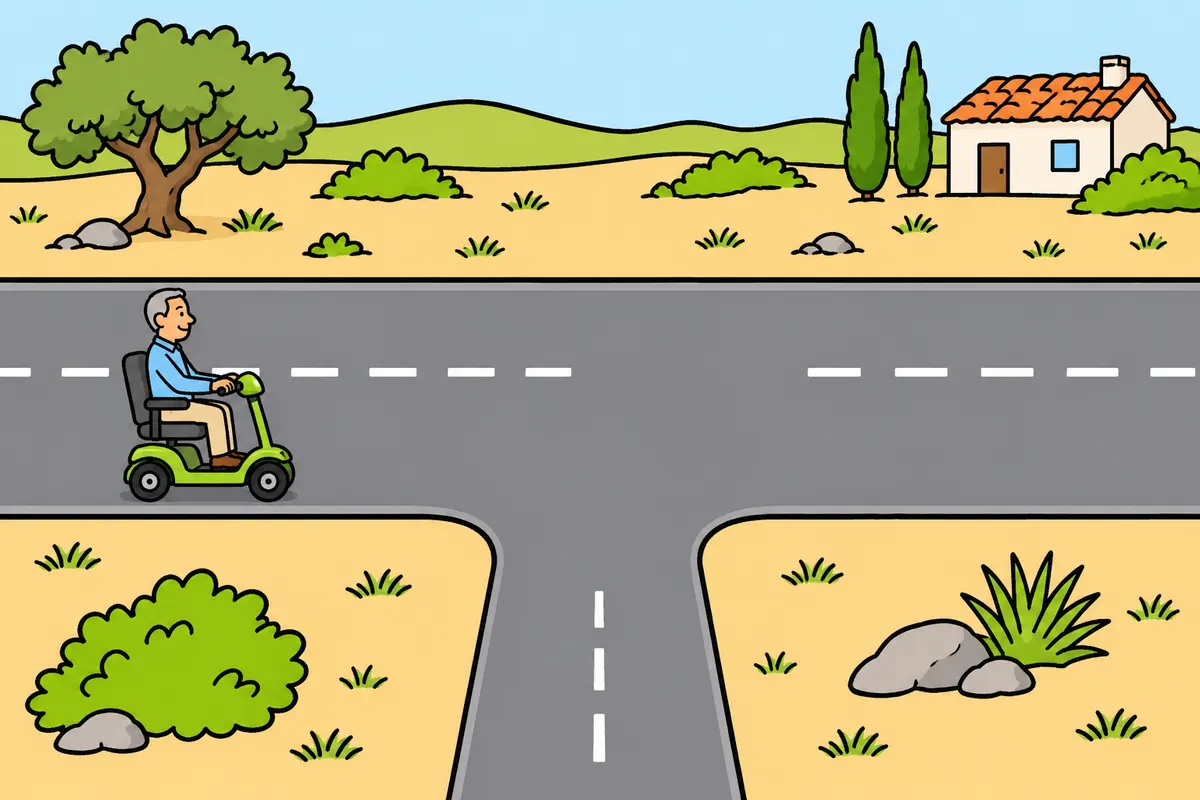
Distinguish crossings at the same height from roads passing over bridges.
| Term | What you need to recognise |
|---|---|
| Junction | All possible crossings of vehicle paths occur at the same level |
| Level crossing | Road and railway with separate track bed cross at the same height |
Remember
- A junction can exist even when no vehicles are present.
- A T-shaped meeting of streets can also be a junction.
- Do not confuse overlapping roads on a map with paths that actually meet.
Exam trap: Wrong: a bridge over another road forms a junction between them. Right: their paths do not meet at the same level.
Read the full explanation
- A junction is a point in the road network where all possible crossings of paths between vehicles using it take place at the same level. You must focus on whether paths can cross, rather than whether vehicles are passing at that moment. [Traffic Act, Annex I](https://www.boe.es/buscar/act.php?id=BOE-A-2015-11722#ani).
- A T-junction can be a junction just as a four-arm crossroads can. You must not require a complete cross in the diagram. The geometric shape alone does not replace the criterion that paths meet at the same level. [Traffic Act, Annex I](https://www.boe.es/buscar/act.php?id=BOE-A-2015-11722#ani).
- If one road passes over another on a bridge and their paths do not meet there, you must not treat that point as a junction at the same level between them. Overlapping lines on a plan or map can represent roads at different heights. [Traffic Act, Annex I](https://www.boe.es/buscar/act.php?id=BOE-A-2015-11722#ani).
- A level crossing is a crossing at the same height between a road and a railway line on its own separate formation. You can identify it by the separate railway formation and the matching heights. The rules on priority and approaching these places are covered in «Priority and right of way». [Traffic Act, Annex I](https://www.boe.es/buscar/act.php?id=BOE-A-2015-11722#ani).
14Roundabout
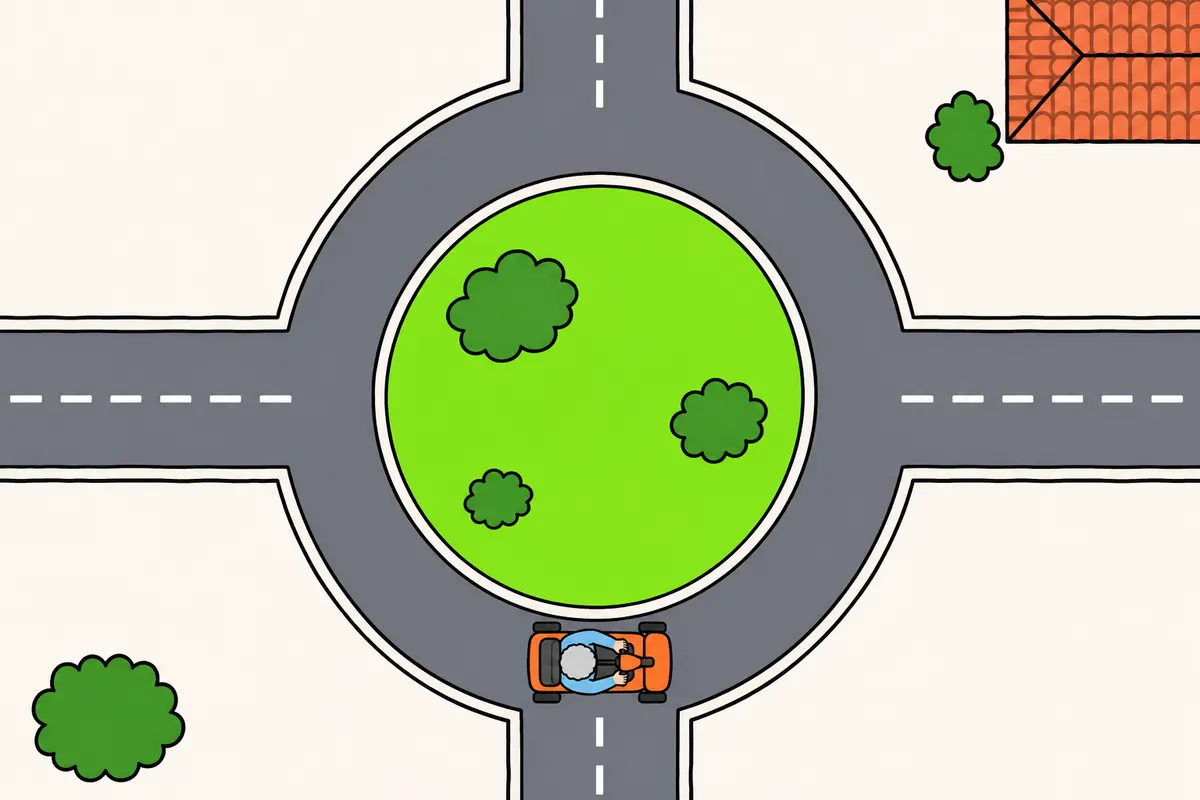
Recognise a roundabout by its traffic ring around a central island.
| Term | What you need to recognise |
|---|---|
| Roundabout | Roads connect through a ring around the island |
| Split roundabout | Road sections connect directly through the island |
Remember
- Check how the roads connect.
- A circular square is not always a roundabout.
- A split roundabout allows direct travel across the central island.
- The law does not treat split roundabouts as roundabouts in the strict sense.
- The definition alone does not decide priority or lane choice.
Exam trap: Wrong: every square with an island is a roundabout. Right: check the ring and any direct connection through the centre.
Read the full explanation
- A roundabout is a special type of junction. The roads meeting at it connect through a ring of traffic circulating around a central island. To identify one, look at the ring and how its approaches connect around the island. [Traffic Act, Annex I](https://www.boe.es/buscar/act.php?id=BOE-A-2015-11722#ani).
- You must not automatically classify a circular square as a roundabout because of its appearance. You must check how its roads connect and how traffic flows. Central decoration or the size of the square is not enough to meet the legal definition. [Traffic Act, Annex I](https://www.boe.es/buscar/act.php?id=BOE-A-2015-11722#ani).
- Split roundabouts allow two roads, generally opposite each other, to connect directly across the central island. The law does not consider them roundabouts in the strict sense. You can recognise them by the direct route across the centre, even if their outline is circular. [Traffic Act, Annex I](https://www.boe.es/buscar/act.php?id=BOE-A-2015-11722#ani).
- For the exam, you must distinguish identifying a roundabout from deciding who has priority or which lane to use. The definition describes the junction; it is not enough to resolve every manoeuvre. You study those decisions in «Priority and right of way» and «Manoeuvres with your LCM vehicle», with their respective conditions. [Traffic Act, Annex I](https://www.boe.es/buscar/act.php?id=BOE-A-2015-11722#ani).
15Vehicle, motor vehicle and automóvil
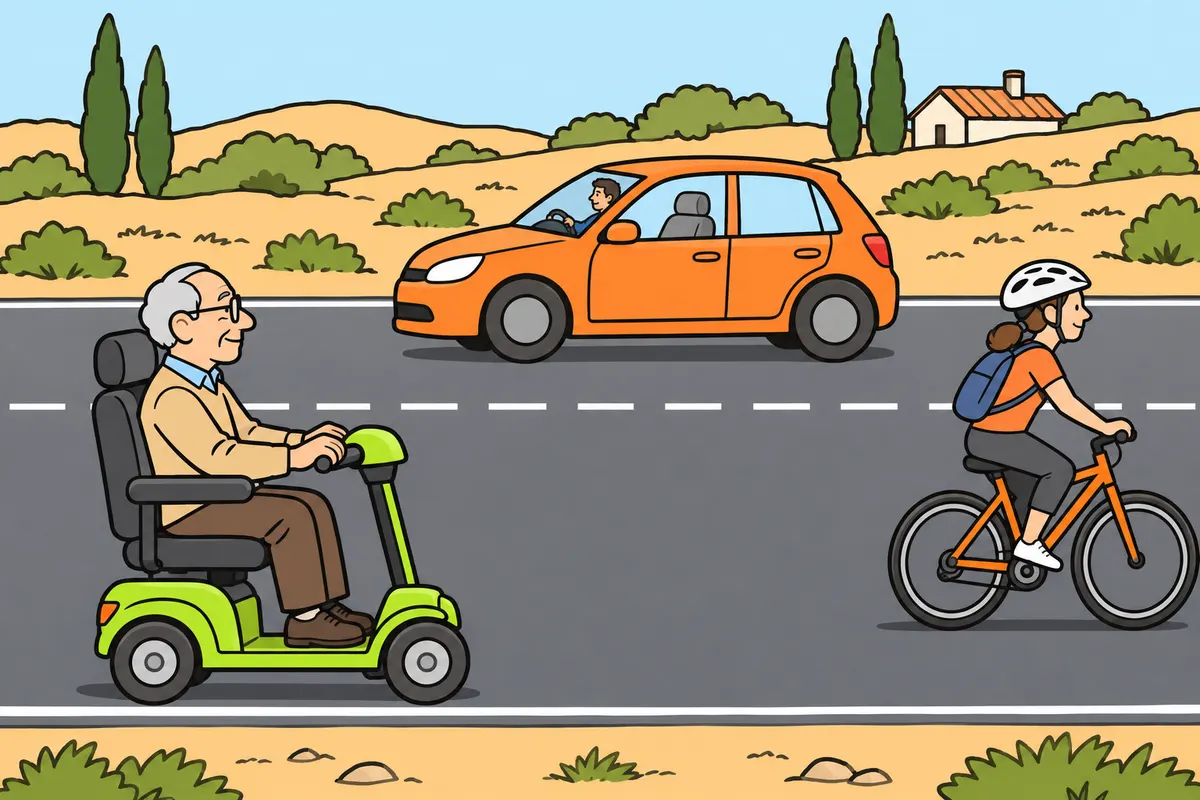
Do not classify your vehicle only by its motor or appearance.
| Term | What you need to recognise |
|---|---|
| Vehicle | General term, with or without a motor |
| Motor vehicle | Legal category with exclusions |
| Automóvil | Motor vehicle for transport or towing for transport; excludes special vehicles |
Remember
- A vehicle can have a motor or have none.
- Your LCM vehicle is legally excluded from the motor vehicle category.
- It is also excluded from the automóvil category.
- Mopeds and trams are also legally excluded from motor vehicles.
- VMPs and pedal-assisted cycles are excluded too.
Exam trap: Wrong: every vehicle with a motor is an automóvil. Right: legal categories have exclusions.
Read the full explanation
- A vehicle is the general term for a device suitable for travelling on roads or land subject to traffic legislation. You must include vehicles with and without engines or motors. A bicycle and your vehicle for people with reduced mobility are both vehicles, although they belong to different categories. [RGV, Annex II](https://www.boe.es/buscar/act.php?id=BOE-A-1999-1826#anii).
- Having an engine or motor and legally belonging to the motor vehicle category are different characteristics. The RGV (General Vehicle Regulations) expressly excludes mopeds, trams, vehicles for people with reduced mobility, pedal cycles with pedal assistance and personal mobility vehicles. [RGV, Annex II](https://www.boe.es/buscar/act.php?id=BOE-A-1999-1826#anii).
- An automóvil (motor vehicle normally intended to carry people or goods, or to tow vehicles for that purpose) is a motor vehicle normally intended to transport people, goods or both, or to tow other vehicles for that purpose. The definition excludes special vehicles. You must avoid using automóvil as a synonym for any device with wheels and an engine or motor. [RGV, Annex II](https://www.boe.es/buscar/act.php?id=BOE-A-1999-1826#anii).
- Your vehicle for people with reduced mobility is a vehicle with its own category and falls outside both the motor vehicle and automóvil categories. You must keep this classification even if it has enclosed bodywork, a steering wheel or an appearance similar to a small car. [RGV, Annex II](https://www.boe.es/buscar/act.php?id=BOE-A-1999-1826#anii).
16The vehicle you drive with an LCM licence
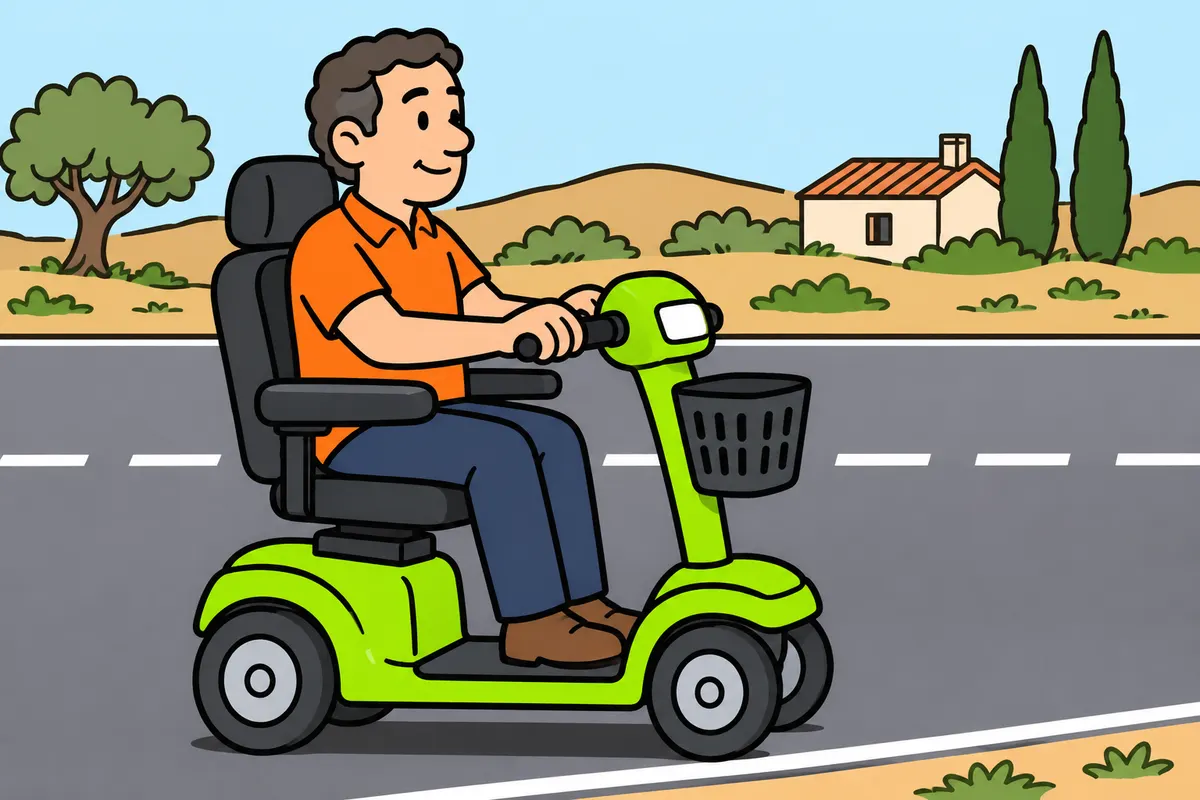
Check your LCM vehicle’s specific design, unladen mass and design speed.
Remember
- It must be built specifically for people with a physical impairment or disability.
- Adapting another vehicle is not enough.
- Maximum unladen mass is 350 kg, excluding your body.
- Its design speed cannot exceed 45 km/h on level ground.
- Its other technical features are treated as equivalent to three-wheeled mopeds.
- That equivalence does not allow you to drive every moped.
Exam trap: Wrong: you may always drive at 45 km/h. Right: this is the maximum design speed on level ground, not permission for every road.
Read the full explanation
- The design purpose defines this category: the vehicle is designed and built specifically for people with a physical dysfunction or disability. A vehicle that is merely adapted does not meet this element of the definition. The identity of its driver does not change its category either. [RGV, Annex II](https://www.boe.es/buscar/act.php?id=BOE-A-1999-1826#anii).
- The unladen mass must not exceed 350 kg. The limit applies to unladen mass, whose components are explained in «Unladen mass». Exactly 350 kg is within the limit; a higher figure does not meet this requirement of the definition. [RGV, Annex II](https://www.boe.es/buscar/act.php?id=BOE-A-1999-1826#anii).
- Its design speed must not exceed 45 km/h on level ground. This technical characteristic describes its performance as manufactured; the actual speed during a journey and a street’s speed limit are different matters. Driving another vehicle slowly does not turn it into a vehicle for people with reduced mobility. [RGV, Annex II](https://www.boe.es/buscar/act.php?id=BOE-A-1999-1826#anii).
- Its other technical characteristics are treated as equivalent to those of three-wheeled mopeds. This equivalence applies to the remaining technical characteristics, while the vehicle for people with reduced mobility retains its own category. [RGV, Annex II](https://www.boe.es/buscar/act.php?id=BOE-A-1999-1826#anii).
17Licence and authorised category
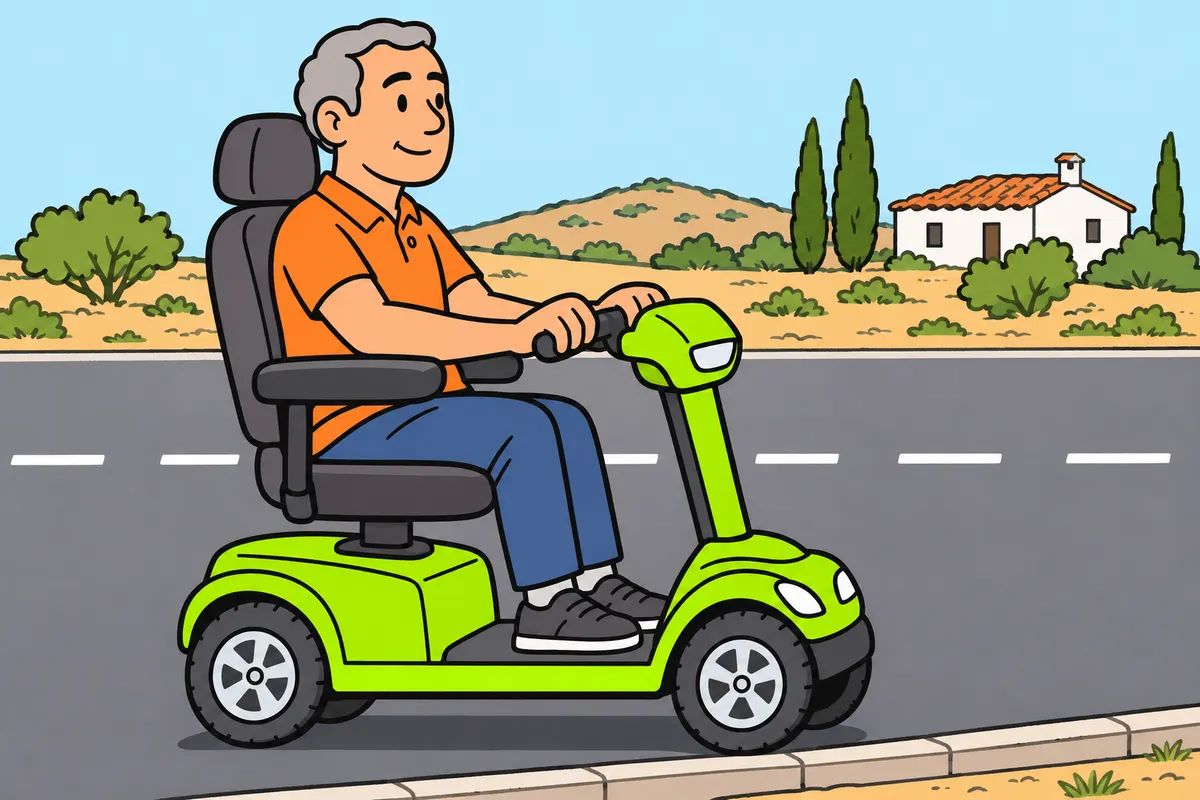
Distinguish your LCM licence from the vehicle category you may drive.
| Term | What you need to recognise |
|---|---|
| LCM | Licence authorising you to drive |
| Vehicle for people with reduced mobility | Specific vehicle category you may drive with LCM |
Remember
- You can obtain LCM from age 14.
- You cannot carry passengers until age 16.
- LCM does not cover every moped or an adapted passenger car.
- Check the specific vehicle category.
- For AM rules, see “Other licences and personal restrictions”.
Exam trap: Wrong: LCM lets you drive any adapted vehicle. Right: check it belongs to the authorised category.
Read the full explanation
- LCM refers to the licence, while vehicle for people with reduced mobility refers to the vehicle category. You must distinguish the document that entitles you to drive from what you can drive. You can obtain the licence from the age of 14, and it does not authorise you to carry passengers until you turn 16. [RGCond, art. 6](https://www.boe.es/buscar/act.php?id=BOE-A-2009-9481#a6).
- With an LCM licence, you cannot assume that you are authorised to drive an adapted passenger car, a lorry, a motorcycle, any moped or an agricultural tractor. You must check the vehicle’s specific category; neither its adaptations nor its small size extends the categories your licence authorises. [RGCond, art. 6](https://www.boe.es/buscar/act.php?id=BOE-A-2009-9481#a6).
- The relationship between the LCM licence and other driving licences is covered in «Driver and vehicle documentation», in the section «Age and scope of your entitlement». [RGCond, art. 6.1.a](https://www.boe.es/buscar/act.php?id=BOE-A-2009-9481#a6).
- For the entitlement provided by the AM licence, see «LCM licence, the test and obeying signs», in the section «Other licences and personal restrictions». [RGCond, art. 4](https://www.boe.es/buscar/act.php?id=BOE-A-2009-9481#a4).
18Adapted passenger cars and special vehicles
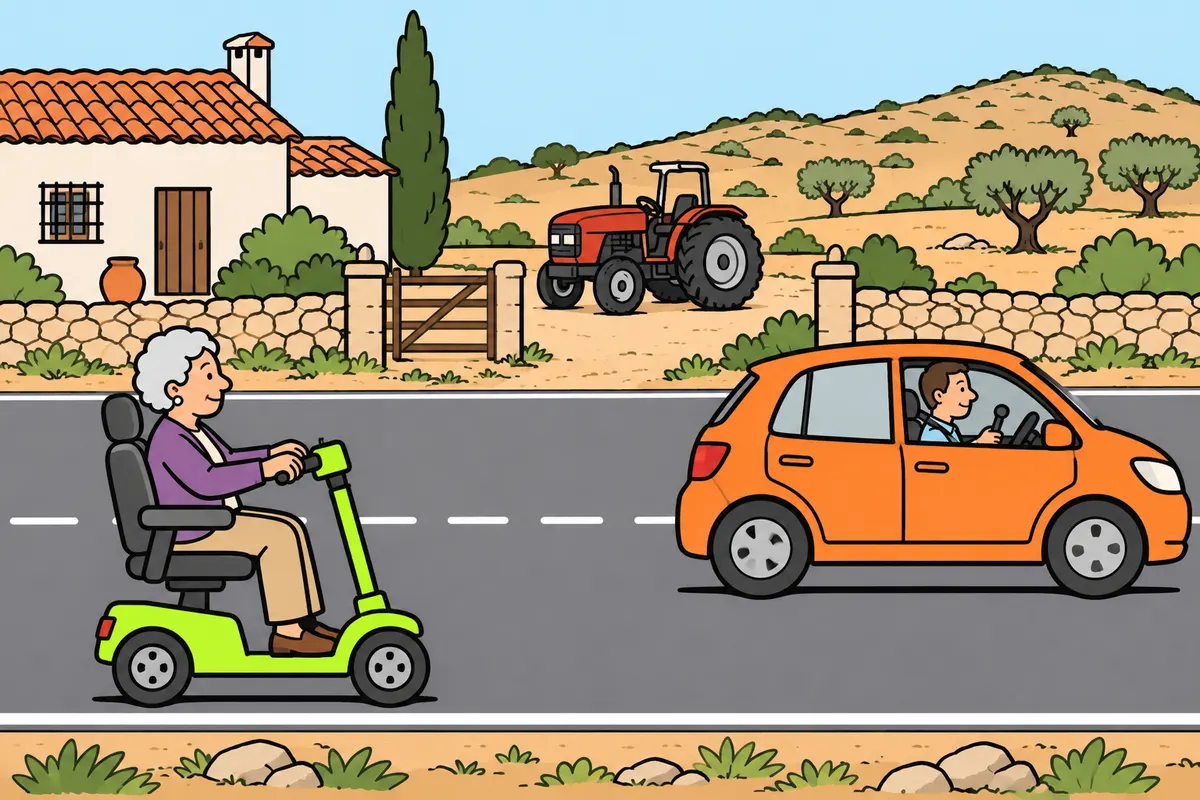
Adapting a passenger car or tractor does not bring it within your LCM licence.
| Term | What you need to recognise |
|---|---|
| Adapted passenger car | Remains a passenger car despite adapted controls |
| Agricultural tractor | Special vehicle |
| Motorcycle | Automóvil |
| LCM vehicle | Excluded from motor vehicles |
Remember
- Check the vehicle category even if its controls are adapted.
- A passenger car has at least four wheels.
- It can have up to nine seats, including yours.
- A special vehicle can move itself or be towed.
- Special vehicles include agricultural vehicles and their trailers.
- LVA and LCM cover different categories.
Exam trap: Wrong: LCM lets you drive an adapted passenger car. Right: adapting it does not itself change its category.
Read the full explanation
- A passenger car is an automóvil for carrying people, with at least four wheels and up to eight seats in addition to the driver’s seat. You must count a maximum of nine seats in total. If you adapt its controls for a disability, that alone does not turn it into the specific vehicle covered by the LCM licence. [Traffic Act, Annex I](https://www.boe.es/buscar/act.php?id=BOE-A-2015-11722#ani).
- A special vehicle is designed and built for particular works or services and can be self-propelled or towed. Because of its characteristics, it is exempt from a regulatory technical requirement or permanently exceeds the regulatory mass or dimension limits. The category also includes agricultural machinery and its trailers. You must distinguish this classification from the everyday expression special vehicle used to describe a vehicle with adaptations. [Traffic Act, Annex I](https://www.boe.es/buscar/act.php?id=BOE-A-2015-11722#ani).
- An agricultural tractor belongs to a category of special vehicle, rather than the category of vehicle for people with reduced mobility. LVA and LCM licences authorise different vehicle categories. Adapting a tractor to its operator does not turn it into a vehicle authorised by an LCM licence. [Traffic Act, Annex I](https://www.boe.es/buscar/act.php?id=BOE-A-2015-11722#ani).
- A motorcycle belongs to the automóvil category, while your vehicle is excluded from the motor vehicle category. You must maintain this distinction even if both are small. The number of wheels alone does not establish that you can drive a vehicle with the licence you are preparing for either. [Traffic Act, Annex I](https://www.boe.es/buscar/act.php?id=BOE-A-2015-11722#ani).
19Moped and small car
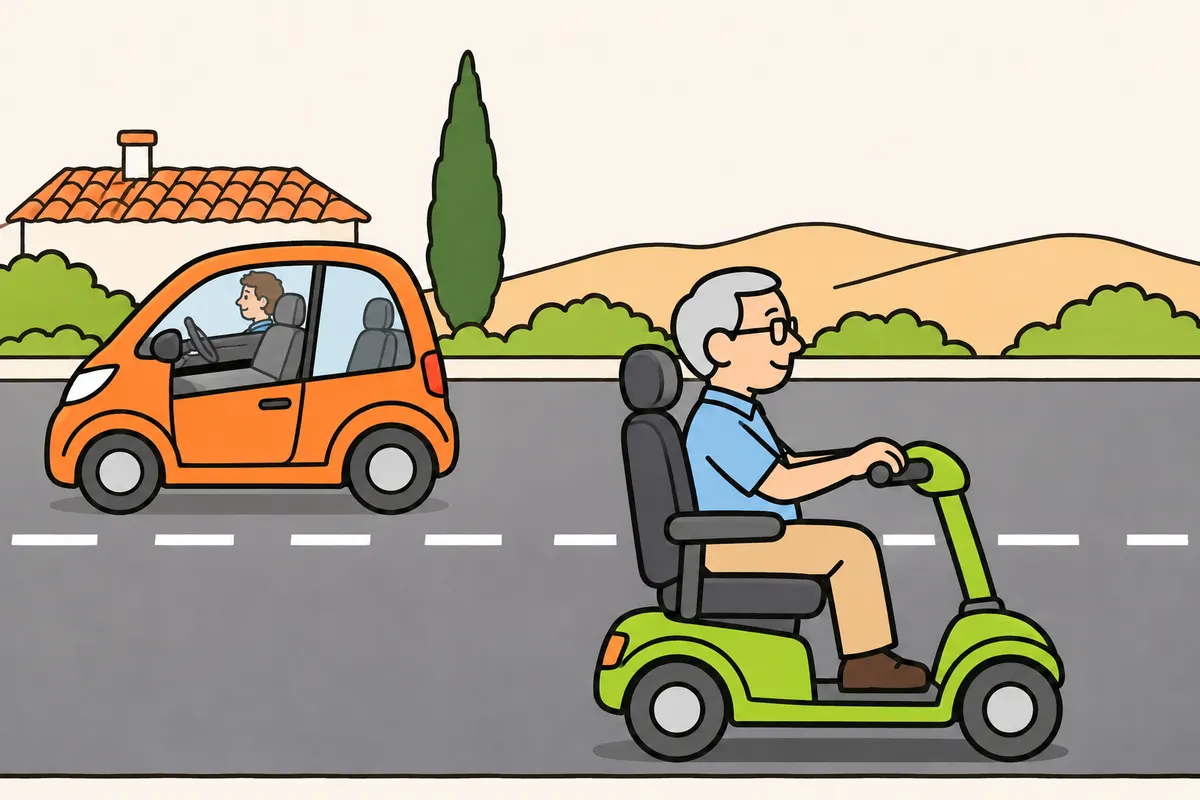
Check a small car’s category before choosing the licence you need.
| Term | What you need to recognise |
|---|---|
| Two-wheeled moped | Up to 45 km/h; internal combustion engine up to 50 cm³ |
| Three-wheeled moped | Up to 45 km/h; internal combustion engine up to 50 cm³ |
| Light quadricycle | Category L6e |
| Heavy quadricycle | Category L7e |
Remember
- Sharing a design speed does not make a moped an LCM vehicle.
- A three-wheeled moped has up to 50 cm³ with an internal combustion engine.
- Its design speed is up to 45 km/h.
- Look for specific construction, unladen mass and design speed.
- Do not choose your licence only by enclosed bodywork.
Exam trap: Wrong: LCM lets you drive any small car. Right: check its category.
Read the full explanation
- A two-wheeled moped has its own definition, distinct from that of an LCM vehicle. It has two wheels, a maximum design speed of 45 km/h and, if it has an internal combustion engine, an engine capacity of up to 50 cm³ under the RGV definition. Sharing a technical speed limit does not make the two categories equivalent. [RGV, Annex II](https://www.boe.es/buscar/act.php?id=BOE-A-1999-1826#anii).
- Three-wheeled mopeds are a different category from vehicles for people with reduced mobility. A three-wheeled moped has an engine capacity of up to 50 cm³ if it has an internal combustion engine and a maximum design speed of 45 km/h. You can recognise it by this combination of wheels, engine and performance. [RGV, Annex II](https://www.boe.es/buscar/act.php?id=BOE-A-1999-1826#anii).
- A light quadricycle is defined by category L6e of the European legislation to which the RGV refers. A heavy quadricycle belongs to another category, L7e. Neither designation automatically means a vehicle for people with reduced mobility or authorisation to drive it with an LCM licence. [RGV, Annex II](https://www.boe.es/buscar/act.php?id=BOE-A-1999-1826#anii).
- If a question shows a small enclosed car, identify the classification given in its specifications. It may belong to a different category, such as a quadricycle or passenger car. To recognise an LCM vehicle, you must look at its specific construction, unladen mass and design speed. [RGV, Annex II](https://www.boe.es/buscar/act.php?id=BOE-A-1999-1826#anii).
20Cycles, VMP and wheelchairs
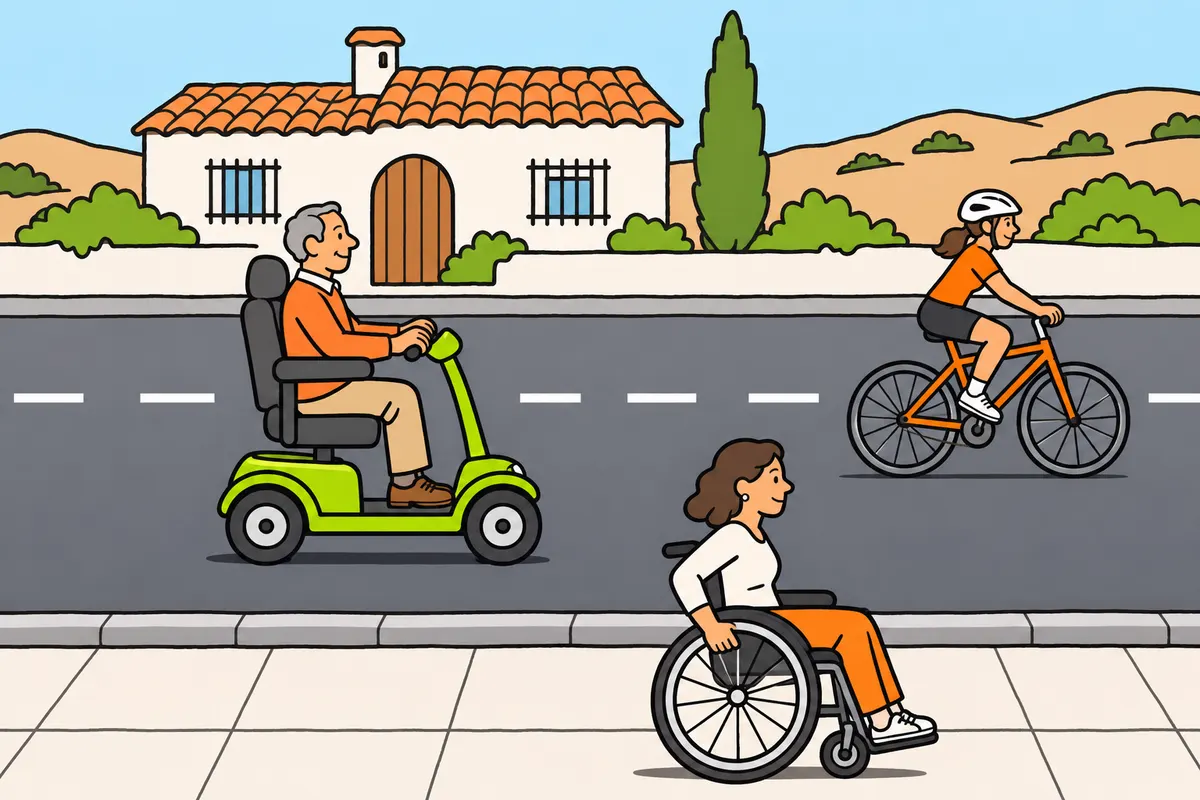
Distinguish pedalling, electric propulsion and wheelchair use.
| Term | What you need to recognise |
|---|---|
| Cycle | Muscular effort; at least two wheels |
| Pedal-assisted cycle | Auxiliary motor; you must pedal |
| VMP | Single place; electric only; maximum design speed between 6 and 25 km/h |
Remember
- You move a cycle using muscular effort.
- A bicycle is a cycle with two wheels.
- Pedal assistance gradually decreases and ends before you reach 25 km/h.
- It also ends if you stop pedalling.
- Vehicles for people with reduced mobility are excluded from VMPs.
- For wheelchair pedestrian status, see “When you are a pedestrian”.
Exam trap: Wrong: wheelchairs, VMPs and LCM vehicles are equivalent. Right: they are different; see “When you are a pedestrian” for the legal conditions.
Read the full explanation
- A cycle has at least two wheels and is propelled by the muscular effort of its occupants, particularly through pedals or hand cranks. A bicycle is a two-wheeled cycle. You must distinguish this propulsion system and category from your vehicle for people with reduced mobility. [RGV, Annex II](https://www.boe.es/buscar/act.php?id=BOE-A-1999-1826#anii). [Traffic Act, Annex I](https://www.boe.es/buscar/act.php?id=BOE-A-2015-11722#ani).
- A pedal-assisted cycle has an auxiliary electric motor with a maximum continuous rated power of 250 W. Assistance decreases progressively and cuts out before you reach 25 km/h or if you stop pedalling. Assistance supplements your pedalling; propulsion solely by a motor allows you to move without pedalling. [RGV, Annex II](https://www.boe.es/buscar/act.php?id=BOE-A-1999-1826#anii). [Traffic Act, Annex I](https://www.boe.es/buscar/act.php?id=BOE-A-2015-11722#ani).
- A VMP (personal mobility vehicle) has one or more wheels, one place for a rider and exclusively electric propulsion, with a maximum design speed between 6 and 25 km/h. Vehicles for people with reduced mobility are excluded from the definition of a VMP. [RGV, Annex II](https://www.boe.es/buscar/act.php?id=BOE-A-1999-1826#anii). [Traffic Act, Annex I](https://www.boe.es/buscar/act.php?id=BOE-A-2015-11722#ani).
- A wheelchair, a VMP and a vehicle for people with reduced mobility are different means of transport. To identify when you have pedestrian status while using a wheelchair, see «When you are a pedestrian» in this module; the classification depends on the specific legal circumstances. [Traffic Act, Annex I](https://www.boe.es/buscar/act.php?id=BOE-A-2015-11722#ani).
21Unladen mass
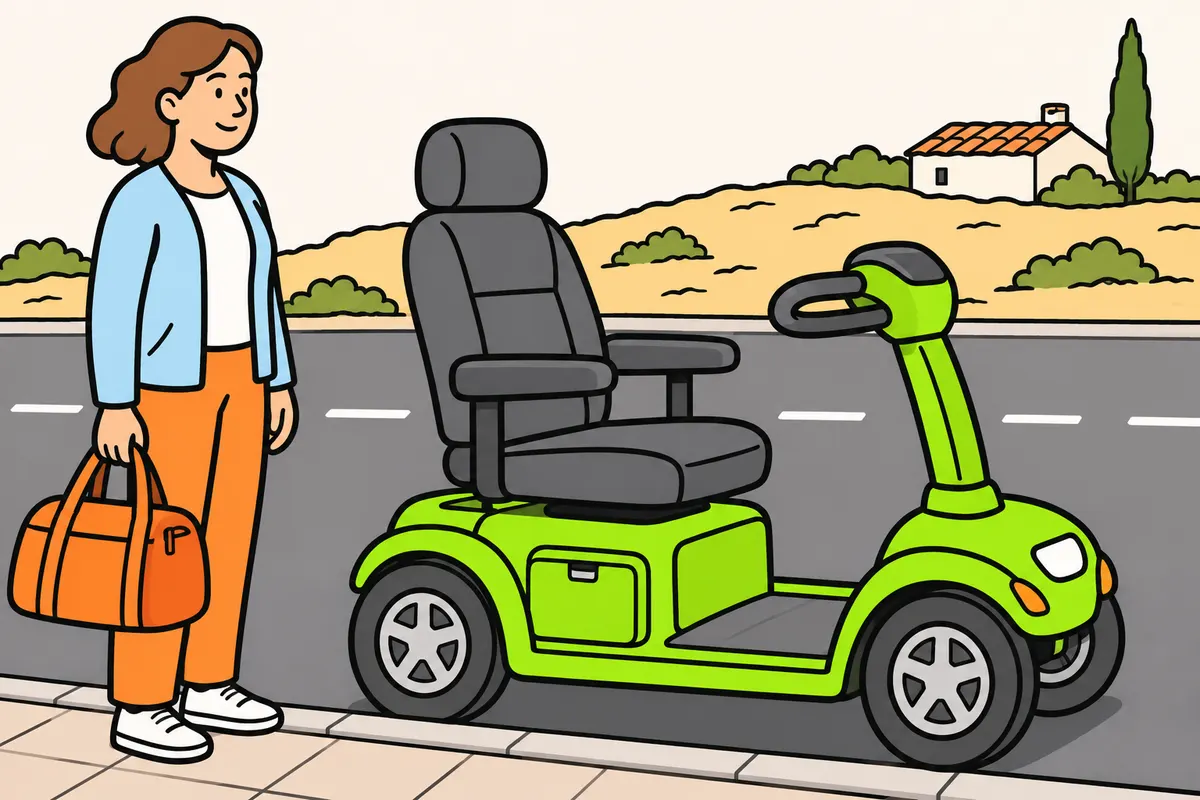
Calculate unladen mass without people or loads, but include the required equipment.
Remember
- Include authorised fixed equipment.
- Include prescribed water, fuel, lubricant, spare parts, tools and accessories.
- Do not add your body or passengers.
- A bag you carry is a load.
- For the LCM mass limit, use the vehicle’s unladen mass.
- A 300 kg vehicle remains 300 kg unladen if you weigh 70 kg.
Exam trap: Wrong: unladen mass excludes fluids or includes the driver. Right: include required supplies and equipment; exclude people and loads.
Read the full explanation
- Unladen mass is the mass of the vehicle with its authorised fixed equipment and without operating personnel, passengers or load. You must include the full statutory provision of water, fuel, lubricant, spare parts, tools and accessories. Unladen mass therefore does not mean a vehicle stripped of fluids or equipment. [RGV, Annex IX, 1](https://www.boe.es/buscar/act.php?id=BOE-A-1999-1826#anix). [Traffic Act, Annex I, definition 35](https://www.boe.es/buscar/act.php?id=BOE-A-2015-11722#ani).
- Your body is not part of the unladen mass. If a question adds together the vehicle, driver and luggage, you must recognise that it introduces elements outside this definition. The category’s unladen mass limit is given in «The vehicle you drive with an LCM licence». [RGV, Annex IX, 1](https://www.boe.es/buscar/act.php?id=BOE-A-1999-1826#anix).
- Authorised fixed equipment is included in the definition of unladen mass; a bag you carry is a load. You must distinguish the two concepts before calculating. You can classify an object by considering whether it is part of the authorised fixed equipment or you add it as a load for that journey. [RGV, Annex IX, 1](https://www.boe.es/buscar/act.php?id=BOE-A-1999-1826#anix).
- As a teaching example, if a vehicle has an unladen mass of 300 kg and you weigh 70 kg, its unladen mass is still 300 kg. Adding the two gives a different quantity, to which you still need to add the other items actually carried on the journey to determine the laden mass. [RGV, Annex IX, 1](https://www.boe.es/buscar/act.php?id=BOE-A-1999-1826#anix).
22Laden mass and MMA (maximum authorised mass)
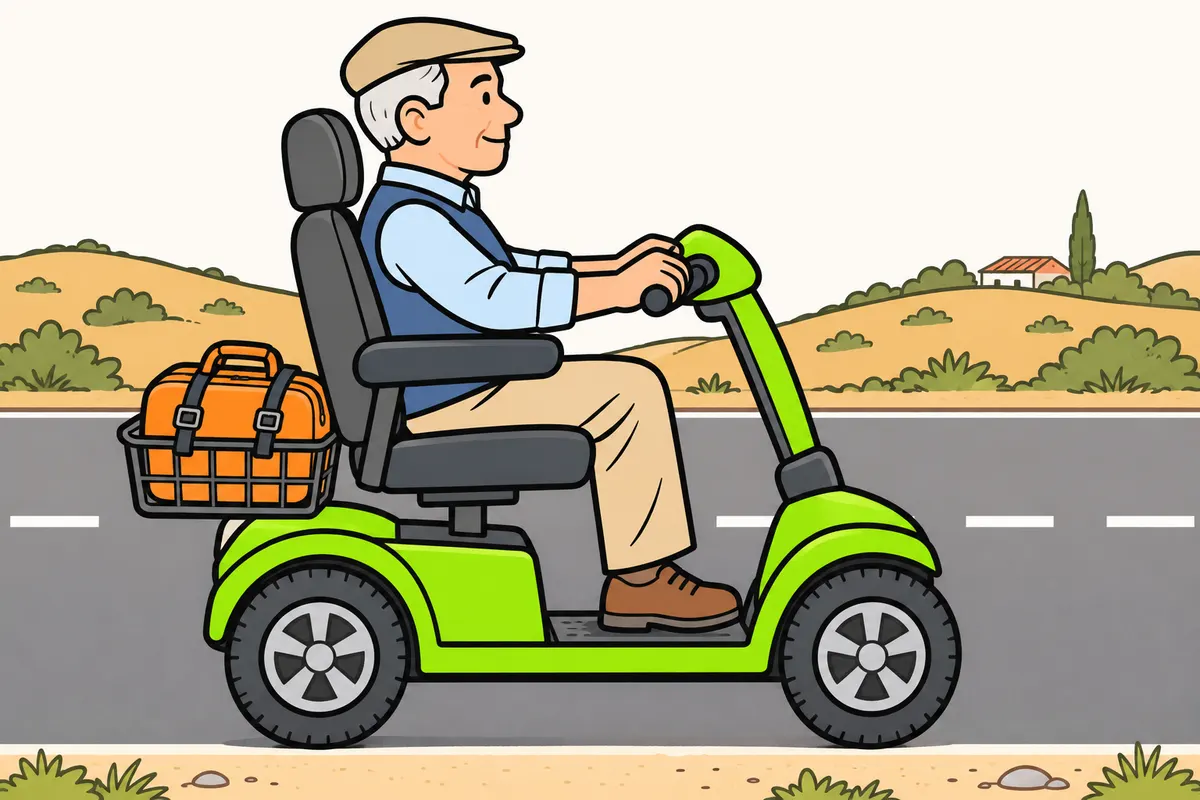
Distinguish your actual journey mass from the maximum authorised mass.
| Term | What you need to recognise |
|---|---|
| Laden mass | Actual mass of vehicle, people and load |
| MMA | Maximum authorised mass for using the laden vehicle on public roads |
Remember
- Laden mass changes when people get in or you add objects.
- MMA remains the limit even when you carry no load.
- Do not treat unladen mass as MMA.
- Compare actual laden mass with your vehicle’s MMA.
- Example: 300 kg unladen, driver 70 kg, objects 10 kg.
- The example gives 380 kg; it is not a general limit.
Exam trap: Wrong: 350 kg unladen mass means 350 kg MMA. Right: these are different measurements.
Read the full explanation
- Laden mass is the actual mass of the vehicle and everything it carries, including operating personnel and passengers. You must consider the actual circumstances of the journey. It can vary when you get in, get out or add objects, even though the vehicle’s unladen mass and authorised limit remain the same. [RGV, Annex IX, 1](https://www.boe.es/buscar/act.php?id=BOE-A-1999-1826#anix). [RGV, Annex II](https://www.boe.es/buscar/act.php?id=BOE-A-1999-1826#anii). [Traffic Act, Annex I, definition 36](https://www.boe.es/buscar/act.php?id=BOE-A-2015-11722#ani).
- MMA is the maximum mass at which the laden vehicle may be used on public roads. This figure expresses an authorised limit, whereas laden mass measures the actual situation. An empty vehicle retains its MMA, even though its actual mass is much lower at that moment. [RGV, Annex IX, 1](https://www.boe.es/buscar/act.php?id=BOE-A-1999-1826#anix). [RGV, Annex II](https://www.boe.es/buscar/act.php?id=BOE-A-1999-1826#anii). [Traffic Act, Annex I, definition 37](https://www.boe.es/buscar/act.php?id=BOE-A-2015-11722#ani).
- As a calculation example, with an unladen mass of 300 kg, a driver weighing 70 kg and 10 kg of objects, you obtain a laden mass of 380 kg. You must compare this with that vehicle’s actual MMA, without treating these teaching figures as general capacities for all LCM vehicles. [RGV, Annex IX, 1](https://www.boe.es/buscar/act.php?id=BOE-A-1999-1826#anix). [RGV, Annex II](https://www.boe.es/buscar/act.php?id=BOE-A-1999-1826#anii).
- To distinguish between questions, first identify whether you are asked for the mass without people and load, the actual mass for the journey or the maximum authorised mass for use on the road. [RGV, Annex IX, 1](https://www.boe.es/buscar/act.php?id=BOE-A-1999-1826#anix). [RGV, Annex II](https://www.boe.es/buscar/act.php?id=BOE-A-1999-1826#anii).
23MMTA and mass in running order
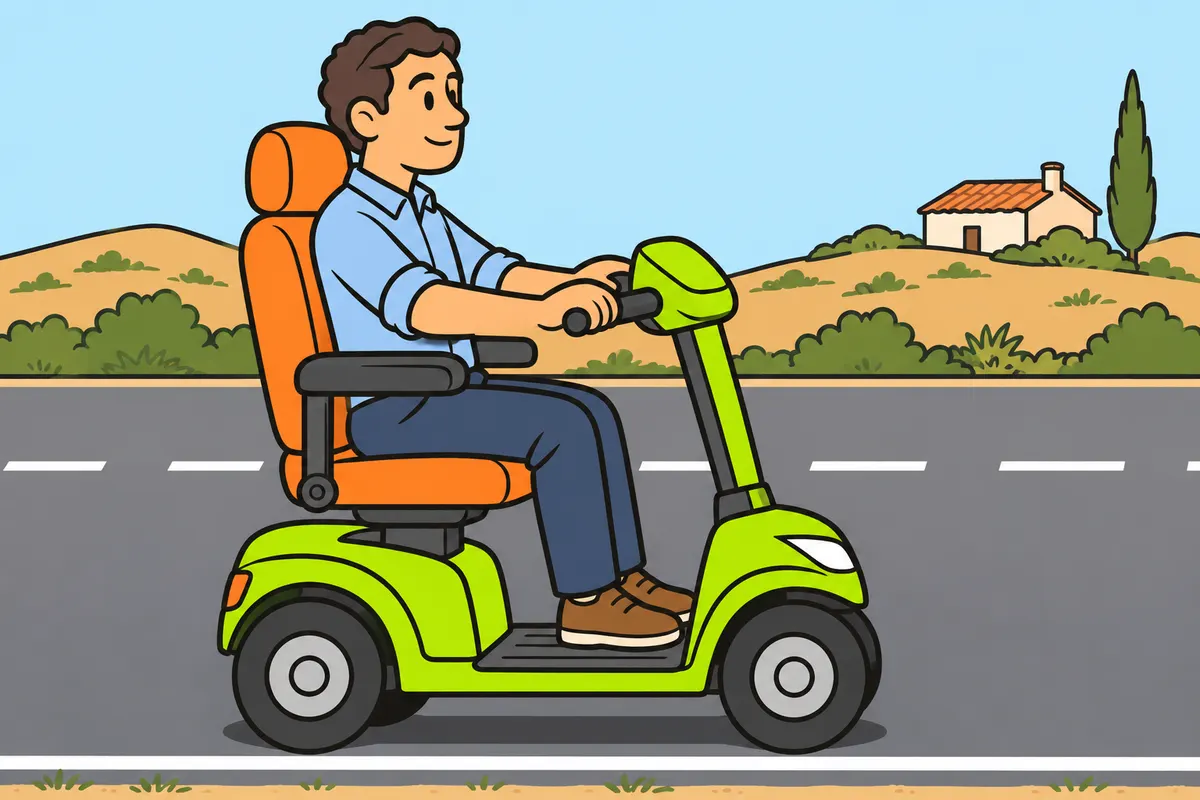
Distinguish technical and authorised limits, and check which mass definition applies.
| Term | What you need to recognise |
|---|---|
| MMTA | Manufacturer’s technical maximum |
| MMA | Maximum authorised mass for road use when laden |
| Mass in running order: general definition | Unladen mass plus standard driver mass |
Remember
- The manufacturer sets MMTA according to the vehicle’s construction.
- Do not replace a lower MMA with MMTA.
- The general running-order definition adds a standard driver mass of 75 kg.
- This is a standard figure, not your actual body mass.
- Category L has a specific European definition.
- The LCM category limit refers to unladen mass.
Exam trap: Wrong: the general formula applies to every moped or quadricycle. Right: check the specific definition for category L.
Read the full explanation
- The technically permissible maximum laden mass, MMTA, is the maximum based on the vehicle’s construction and specified by the manufacturer. MMA expresses the maximum authorised mass for using it laden on public roads, whereas MMTA relates to its technical design. Technical capacity and authorisation for road use are different concepts. [RGV, Annex IX, 1](https://www.boe.es/buscar/act.php?id=BOE-A-1999-1826#anix).
- The fact that the vehicle’s construction allows it to support a given mass does not itself change the authorised limit. In a question, the words technically permissible and authorised indicate which concept you must use. [RGV, Annex IX, 1](https://www.boe.es/buscar/act.php?id=BOE-A-1999-1826#anix).
- The general definition of mass in running order in Annex IX adds a standard driver mass of 75 kg to the unladen mass. This is a conventional reference you must use for this definition, whatever your actual body mass. [RGV, Annex IX, 1](https://www.boe.es/buscar/act.php?id=BOE-A-1999-1826#anix).
- The same annex refers to a specific European definition for category L vehicles. For a moped or quadricycle in that category, you must apply its specific definition. The classification of an LCM vehicle by mass is explained in «The vehicle you drive with an LCM licence». [RGV, Annex IX, 1](https://www.boe.es/buscar/act.php?id=BOE-A-1999-1826#anix).
24Driver and occupant
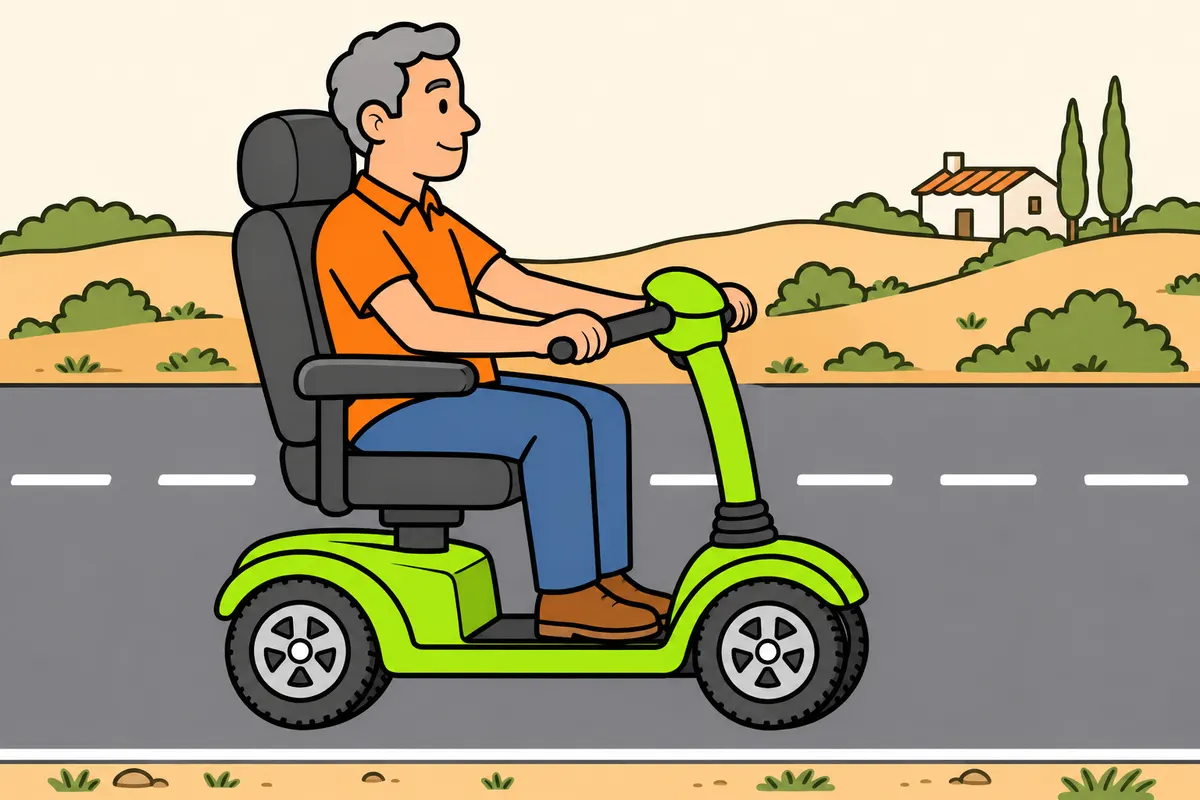
You are the driver when in control, subject to the legal exceptions.
| Term | What you need to recognise |
|---|---|
| Driver | Controls steering or is in charge, subject to legal exceptions |
| Passenger | Travels without taking control of steering |
Remember
- Owning the vehicle does not mean you are driving.
- A person in charge of animals is also a driver.
- During driving instruction, the person responsible for additional controls is legally the driver.
- A seat alone does not authorise you to carry passengers.
Exam trap: Wrong: during instruction, only the main controls matter. Right: the person responsible for the additional controls is considered the driver.
Read the full explanation
- You are the driver when you operate the steering or are in control of the vehicle, except where the law classifies you as a pedestrian. You can occupy the vehicle as a passenger without steering it. Being the owner or registered keeper does not determine who is driving at the specific moment described in a question. [Traffic Act, Annex I](https://www.boe.es/buscar/act.php?id=BOE-A-2015-11722#ani).
- The definition also includes the person in charge of animals. The concept of a driver covers functions beyond driving automobiles. For your test, the essential point is to recognise that when you are in control of an LCM vehicle, you act as its driver. [Traffic Act, Annex I](https://www.boe.es/buscar/act.php?id=BOE-A-2015-11722#ani).
- In vehicles used for driving instruction, the person in charge of the additional controls is considered the driver. In a question about learning in a dual-control vehicle, this role determines who is considered the driver, even if someone else operates the main control. [Traffic Act, Annex I](https://www.boe.es/buscar/act.php?id=BOE-A-2015-11722#ani).
- A passenger occupies the vehicle without thereby taking responsibility for steering it. You must distinguish the existence of a seat from the role of the driver and from authorisation to carry another person. The definition of the LCM category does not itself specify a universal number of seats. [Traffic Act, Annex I](https://www.boe.es/buscar/act.php?id=BOE-A-2015-11722#ani).
25Registered keeper and regular driver
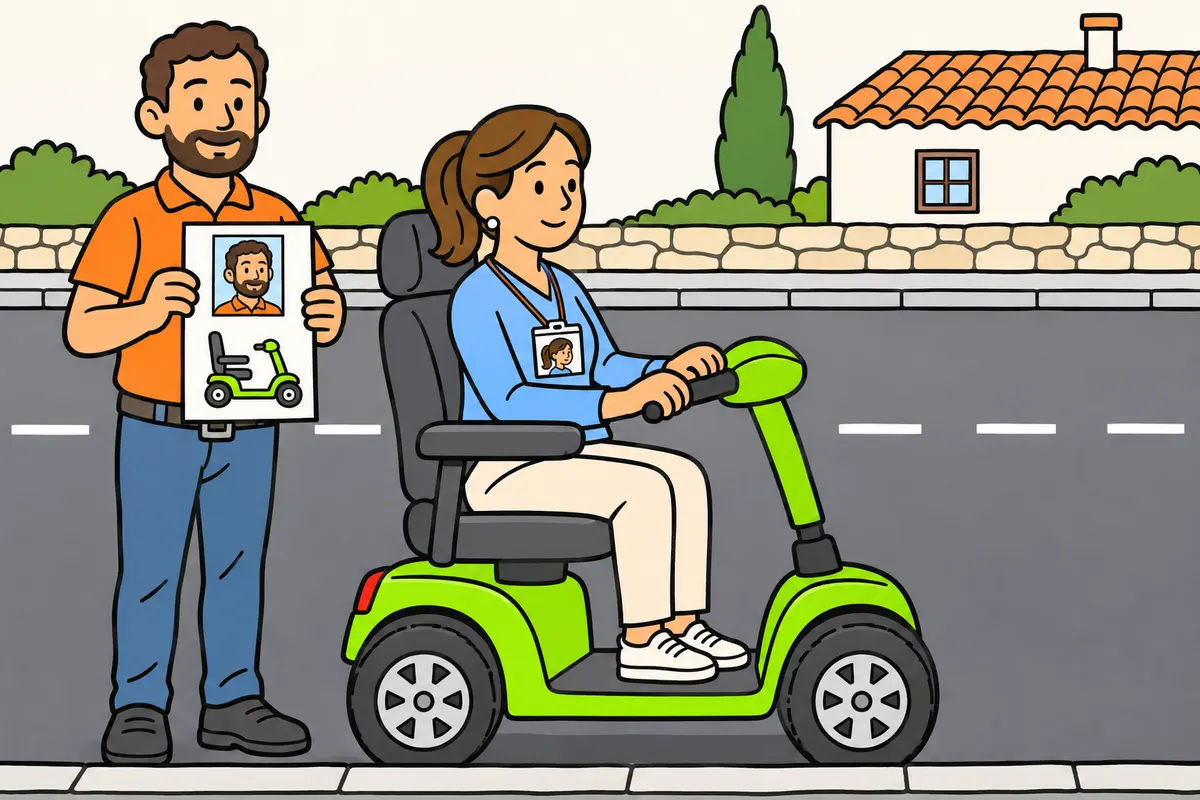
Distinguish whose name the vehicle is registered in from who uses it.
| Term | What you need to recognise |
|---|---|
| Registered keeper | Person named in the vehicle register |
| Regular driver | Usual or most frequent user, formally recorded |
| Current driver | Person in control in this situation |
Remember
- You are the registered keeper if the vehicle is registered in your name.
- The regular driver must consent to being recorded in the Vehicle Register.
- They need driving entitlement and entry in the Register of Drivers and Offenders.
- Registering as an individual without driving entitlement requires you to designate a regular driver.
- The keeper, regular driver and current driver can be different people.
Exam trap: Wrong: lending your vehicle automatically registers someone as its regular driver. Right: regular use, consent, notification and the legal requirements are necessary.
Read the full explanation
- You are the registered keeper if the vehicle is registered in your name in the relevant official register. You must distinguish this status from actually driving: you can drive someone else's vehicle, and someone else can drive yours if they have the necessary driving entitlement. [Ley de Tráfico (Traffic Act), Annex I](https://www.boe.es/buscar/act.php?id=BOE-A-2015-11722#ani).
- You are the regular driver if you normally use the vehicle, or use it most frequently, and your details are reported to the Registro de Vehículos (Vehicle Register) with your consent. You must hold the necessary driving licence and be registered in the Registro de Conductores e Infractores (Register of Drivers and Offenders). An informal loan of the vehicle is not enough to complete this designation. [Traffic Act, Annex I](https://www.boe.es/buscar/act.php?id=BOE-A-2015-11722#ani).
- If you register a vehicle as a private individual without holding administrative authorisation to drive, you must designate a regular driver. You can be the registered keeper even if you have no driving entitlement; this situation requires the designation described above. [Traffic Act, Annex I](https://www.boe.es/buscar/act.php?id=BOE-A-2015-11722#ani).
- To answer exam questions, identify three things: whose name the vehicle is registered in, who is recorded as the regular driver, and who is driving in the situation described. You must recognise that the answers can refer to different people. You must also distinguish frequent driving from the specific definition of a professional driver under the points system. [Traffic Act, Annex I](https://www.boe.es/buscar/act.php?id=BOE-A-2015-11722#ani).
26When you are a pedestrian
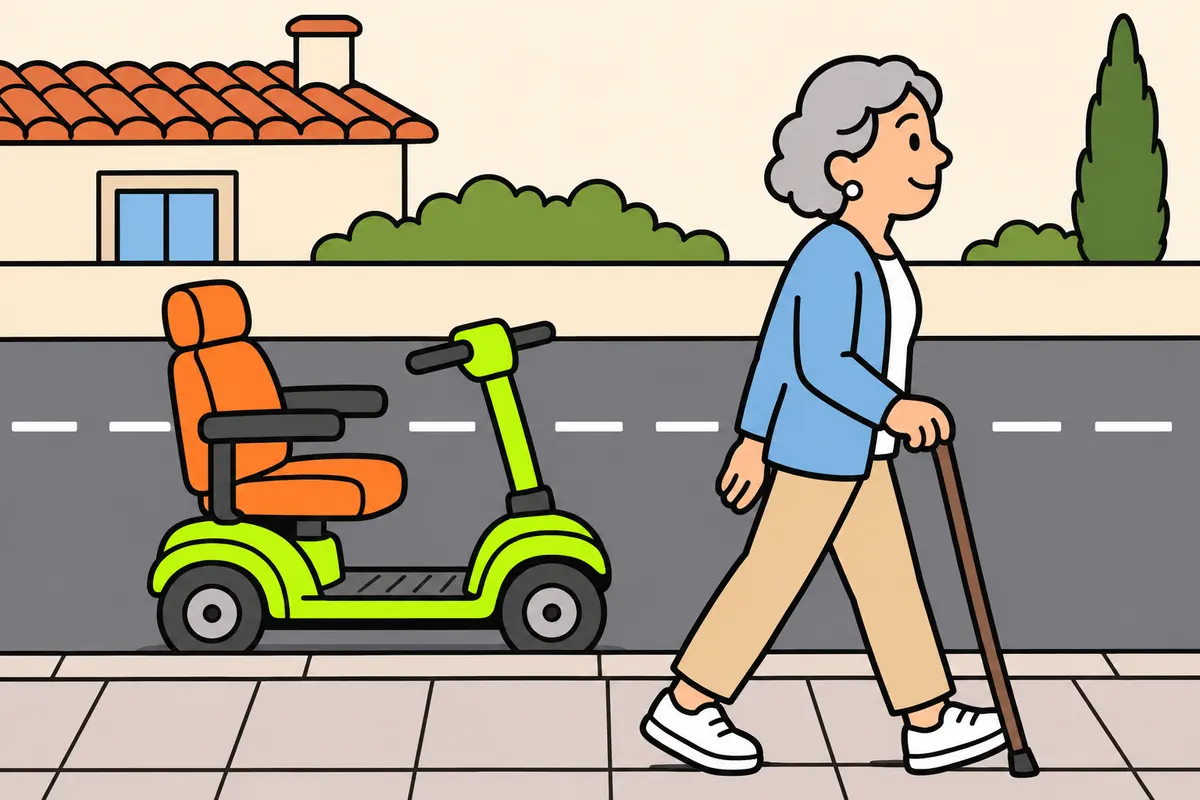
Your pedestrian status depends on how you travel and the legal exceptions.
| How you travel | Status |
|---|---|
| Wheeling a cycle or two-wheeled moped on foot | Pedestrian |
| With a disability, using a wheelchair at walking pace, with or without motor | Pedestrian |
| Driving an LCM vehicle, even slowly | Driver |
Remember
- You are a pedestrian when walking without being a driver.
- This includes pushing a pram or a carriage for someone with a disability.
- It also includes pushing or pulling another small vehicle without a motor.
- You are a pedestrian when wheeling a cycle or two-wheeled moped on foot.
- With a disability, you are a pedestrian using a wheelchair at walking pace.
- The wheelchair may have a motor; driving an LCM vehicle slowly remains driving.
Exam trap: Wrong: any slow vehicle makes you a pedestrian. Right: the wheelchair exception requires disability and travel at walking pace.
Read the full explanation
- You are a pedestrian when you travel on foot, without being a driver, on roads or land covered by the law. Your legal status depends on how you are travelling at that moment: you can drive your vehicle and then walk as a pedestrian. [Traffic Act, Annex I](https://www.boe.es/buscar/act.php?id=BOE-A-2015-11722#ani).
- You are also considered a pedestrian if you push or pull a pram or pushchair, a wheelchair for a person with a disability, or another small vehicle without a motor. You must pay attention to the situation described; having an object with wheels with you does not necessarily make you the driver of a vehicle. [Traffic Act, Annex I](https://www.boe.es/buscar/act.php?id=BOE-A-2015-11722#ani).
- If you wheel a cycle or a two-wheeled moped while walking, you are considered a pedestrian. You must remember that the moped must have two wheels and distinguish wheeling it by hand from riding it. [Traffic Act, Annex I](https://www.boe.es/buscar/act.php?id=BOE-A-2015-11722#ani).
- If you have a disability and travel in a wheelchair at walking pace, you are a pedestrian, even if the wheelchair has a motor. You must retain both the walking-pace condition and the type of mobility aid. This exception does not make you a pedestrian if you drive an LCM-category vehicle slowly. [Traffic Act, Annex I](https://www.boe.es/buscar/act.php?id=BOE-A-2015-11722#ani).
27Vulnerable road users
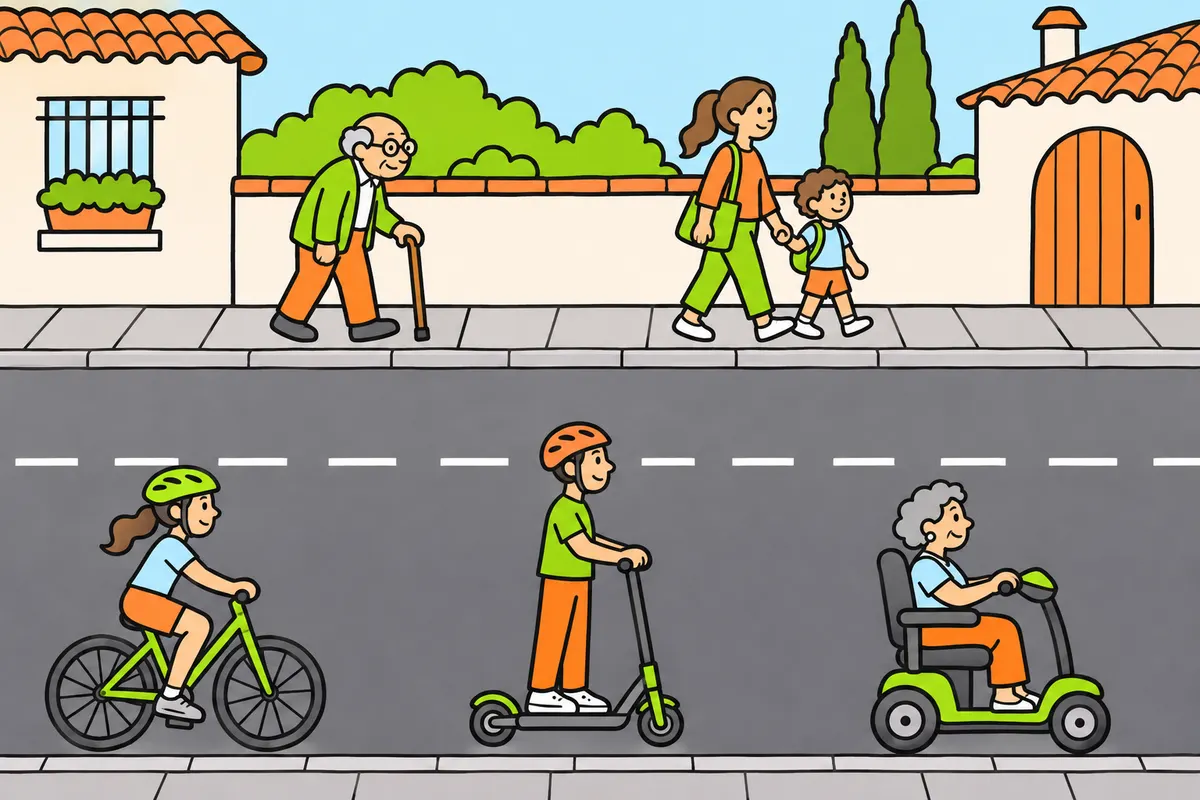
Recognise people at greater risk of injury or serious harm.
Remember
- Remember pedestrians, especially children and older people.
- Include pedestrians with disabilities or reduced mobility.
- Recognise cyclists and VMP riders too.
- Include motorcycle and moped riders and passengers.
Exam trap: Wrong: only pedestrians are vulnerable. Right: cyclists, VMP riders, and motorcycle and moped riders and passengers are also included.
Read the full explanation
- You can identify a vulnerable road user as someone who, because of their means of travel or the physical characteristics of their age group, faces a greater risk of injury or more serious injuries in an accident. [Traffic Act, Annex I, definition 86](https://www.boe.es/buscar/act.php?id=BOE-A-2015-11722#ani).
- The definition includes pedestrians, especially people with disabilities or reduced mobility, children and older people; cyclists; riders of VMP (personal mobility vehicles); and riders and passengers of motorcycles and mopeds. You must study the rules for sharing the road with them in «Sharing the road with vulnerable users». [Traffic Act, Annex I, definition 86](https://www.boe.es/buscar/act.php?id=BOE-A-2015-11722#ani).
28Compulsory stopping, brief stopping and parking
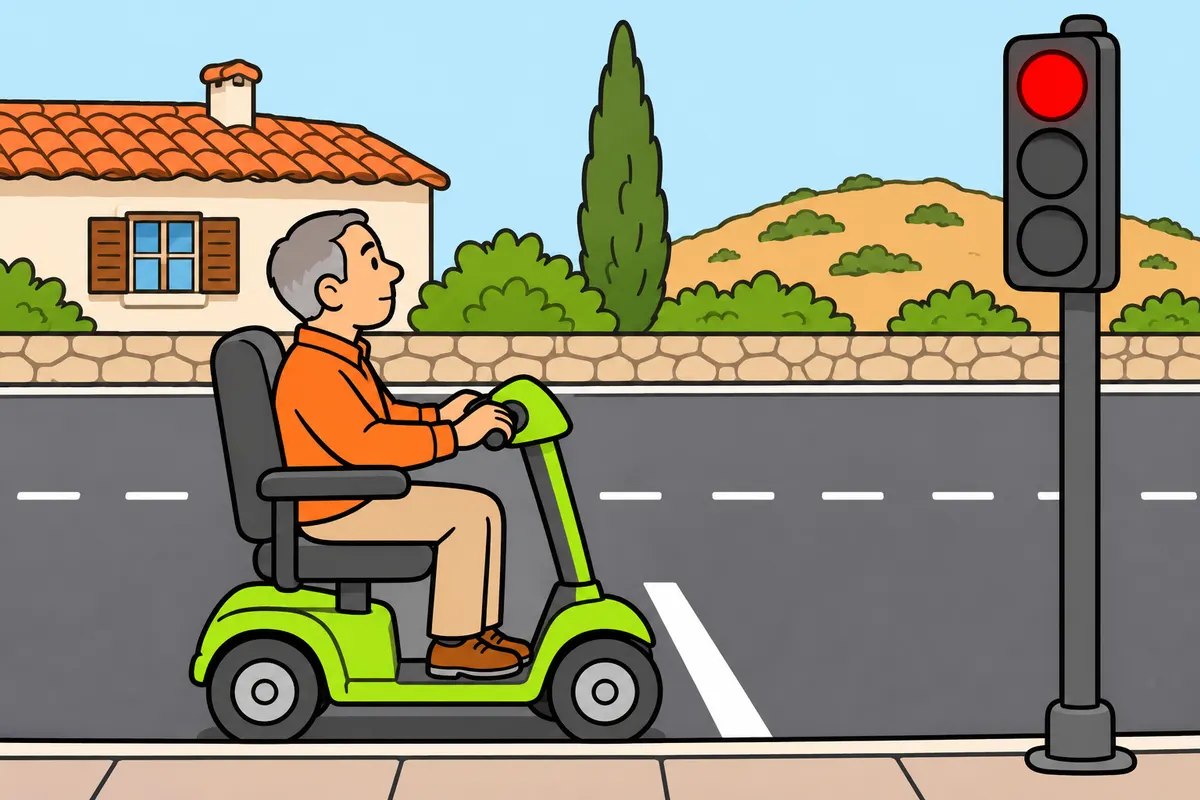
Classify stopping by its reason and, when voluntary, its conditions.
| Term | What you need to recognise |
|---|---|
| Compulsory stopping | Because of an emergency, traffic conditions or compliance with a rule |
| Brief stopping | Voluntary; less than two minutes, without leaving the vehicle |
| Parking | Meets neither compulsory stopping nor brief stopping conditions |
Remember
- A long traffic hold-up remains a compulsory stop.
- For a brief stop, stay inside for less than two minutes.
- At exactly two minutes, a voluntary stop is parking.
- Leaving the vehicle to enter a shop also fails the brief stop definition.
- Identifying a brief stop does not mean you may stop anywhere.
Exam trap: Wrong: a long traffic hold-up becomes parking. Right: it remains a compulsory stop because of traffic conditions.
Read the full explanation
- A compulsory stop means bringing your vehicle to a standstill because of an emergency, traffic conditions or the need to comply with a rule. You can identify a compulsory stop when you wait at a traffic light that prevents you from proceeding, when congestion forces you to stop or when a breakdown requires you to immobilise your vehicle. [Traffic Act, Annex I](https://www.boe.es/buscar/act.php?id=BOE-A-2015-11722#ani).
- A brief stop requires you to remain stationary for less than two minutes without leaving your vehicle. Both the duration and your remaining in the vehicle must apply together. For example, voluntarily waiting inside your vehicle for one minute to collect an item can fit this definition. [Traffic Act, Annex I](https://www.boe.es/buscar/act.php?id=BOE-A-2015-11722#ani).
- Parking means remaining stationary without meeting the conditions for either a compulsory stop or a brief stop. If you voluntarily remain stationary for exactly two minutes, you do not meet the requirement of less than two minutes. If you leave your vehicle to enter a shop, you also fail to meet the conditions for a brief stop, even if you take less time. [Traffic Act, Annex I](https://www.boe.es/buscar/act.php?id=BOE-A-2015-11722#ani).
- You must first classify the reason: a compulsory stop caused by traffic does not become parking because it lasts longer. Then, if you stop voluntarily, assess the duration and whether you leave the vehicle. Identifying a brief stop does not mean it is permitted everywhere; the prohibitions are covered in the «Manoeuvres with your LCM vehicle» module. [Traffic Act, Annex I](https://www.boe.es/buscar/act.php?id=BOE-A-2015-11722#ani).
29Overtaking and passing stationary vehicles or obstacles
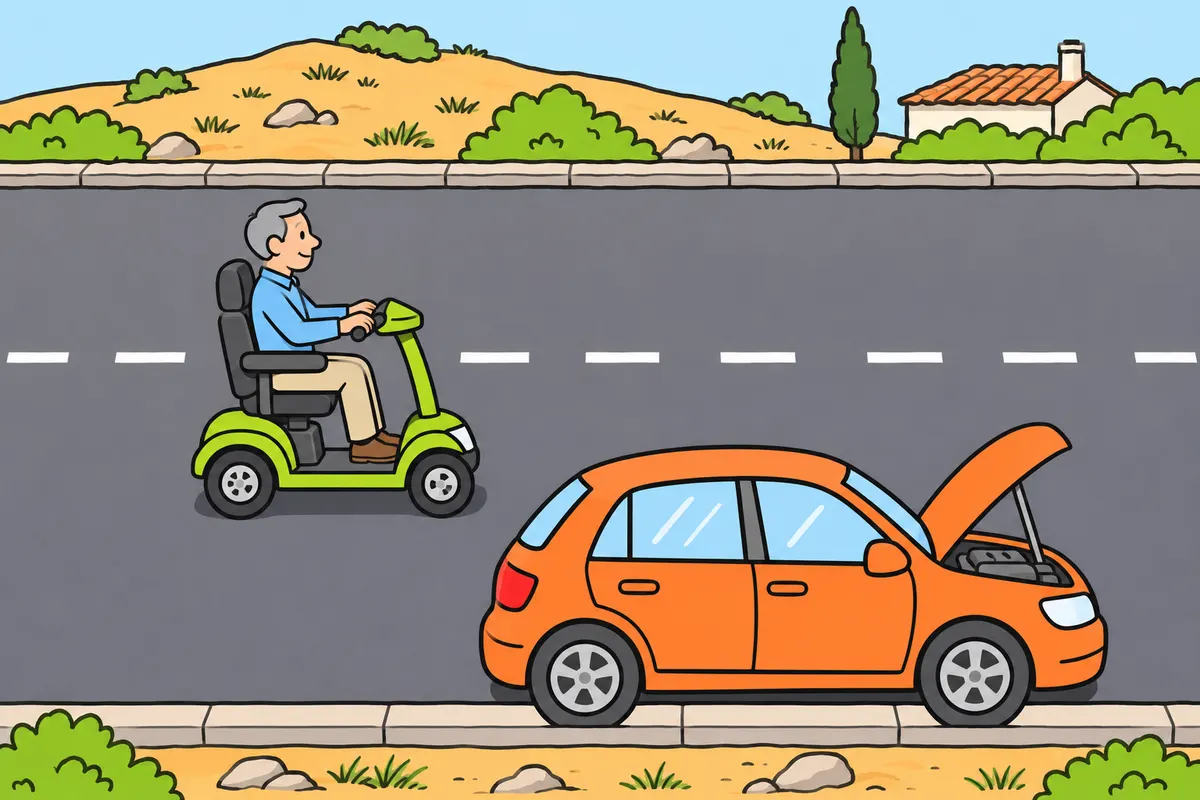
Distinguish overtaking a moving vehicle from passing a stationary vehicle or obstacle.
| Term | What you need to recognise |
|---|---|
| Overtaking | Passing a vehicle travelling ahead in your direction |
| Passing a stationary vehicle or obstacle | Going past an immobilised vehicle or obstacle |
Remember
- You can overtake without entering the opposite direction.
- You do not always need to move sideways.
- Dense traffic must fill the width; each lane’s speed depends on vehicles ahead.
- Then, moving faster in one lane than another is not overtaking.
- Exceptions also cover acceleration, deceleration and reserved lanes compared with normal lanes.
- These exceptions do not authorise you to enter lanes reserved for others.
Exam trap: Wrong: overtaking requires entering the opposite direction. Right: you can also overtake between lanes travelling in the same direction.
Read the full explanation
- You overtake when you pass a vehicle travelling ahead of you in the same direction. You can do this between lanes travelling in the same direction or by moving sideways, depending on the road layout. The definition refers to passing the vehicle travelling ahead. [RGC (General Traffic Regulations), art. 82](https://www.boe.es/buscar/act.php?id=BOE-A-2003-23514#a82).
- When you go past an immobilised vehicle or an obstacle, you are passing a stationary vehicle or obstacle. You must distinguish this from overtaking a moving vehicle; how you carry out the manoeuvre is covered in «Manoeuvres with your LCM vehicle». [RGC, art. 88](https://www.boe.es/buscar/act.php?id=BOE-A-2003-23514#a88). [RGC, art. 89](https://www.boe.es/buscar/act.php?id=BOE-A-2003-23514#a89).
- In dense traffic, when vehicles occupy the full width and their speed depends on the vehicle ahead in each lane, moving further ahead in one lane than in another does not count as overtaking. You must check that these circumstances apply; this does not mean that every instance of passing on the right falls outside the definition of overtaking. [RGC, art. 83.2](https://www.boe.es/buscar/act.php?id=BOE-A-2003-23514#a83).
- You are also not considered to be overtaking when you move faster in an acceleration lane, a deceleration lane or a part of the road reserved for certain vehicles than in the normal lanes, or vice versa. These exceptions classify movement between lanes; you must also respect the restrictions on which vehicles each lane is reserved for. [RGC, art. 83.3](https://www.boe.es/buscar/act.php?id=BOE-A-2003-23514#a83).
How to classify an immobilisation
Apply the definitions in Annex I of the Ley de Tráfico (Traffic Act): first consider the reason, then the conditions of a voluntary immobilisation.
- Check whether you stop because of an emergency, traffic conditions or compliance with a rule: this is a compulsory stop.
- If you stop voluntarily, check whether it lasts less than two minutes and you remain in the vehicle: this is a brief stop.
- If it is not a compulsory stop and does not meet both conditions for a brief stop, classify it as parking.
- Distinguish its classification from whether it is permitted at that location; see «Manoeuvres with your LCM vehicle», section «Compulsory stops, brief stops and parking».
Finished this module?
Mark it as read and you will see your progress on the theory list.