
Theory · LCM Licence - Reduced Mobility Vehicle · Module 2 of 15
LCM licence, the test and obeying signs
You learn what you can drive with an LCM licence, the ages and requirements for obtaining it and the tests you must pass. You prepare for test attempts, time limits and marking, and learn the basic rules for obeying signs and officers.
Sign library
All 620 signals of the official catalogue in force (Royal Decree 465/2025), each with its drawing and description, and a test to practise them.
1What you can drive with an LCM licence
An LCM licence lets you drive vehicles for people with reduced mobility.
Remember
- The vehicle category sets the licence you need.
- Size or adapted controls do not identify the category.
- An LCM licence does not cover mopeds, cars, lorries or agricultural vehicles.
- You need the right licence for an adapted car.
- You can get an LCM licence from 14.
- You cannot carry passengers until you are 16.
Exam trap: Wrong: an adapted car is covered by your LCM licence. Right: you need the licence for its vehicle category.
Read the full explanation
- With an LCM licence, you can drive vehicles for people with reduced mobility. The vehicle category determines the authorisation you need; its size or adapted controls alone are not enough to identify its category. [RGCond, art. 6](https://www.boe.es/buscar/act.php?id=BOE-A-2009-9481#a6)
- The LCM licence does not entitle you to drive any moped, passenger car, lorry or agricultural vehicle. You need the appropriate driving licence for an adapted passenger car. [RGCond, arts. 4 and 6](https://www.boe.es/buscar/act.php?id=BOE-A-2009-9481#a4)
- You can obtain an LCM licence from the age of 14. [RGCond, art. 6.1.a](https://www.boe.es/buscar/act.php?id=BOE-A-2009-9481#a6)
- Until you turn 16, the LCM licence does not authorise you to carry passengers. You study the vehicle's seating capacity and technical requirements in «Your vehicle: characteristics and maintenance». [RGCond, art. 6.1.a](https://www.boe.es/buscar/act.php?id=BOE-A-2009-9481#a6)
2Other licences and personal restrictions
A1 or B in force removes the need for an LCM; AM also covers these vehicles.
| Licence in force | Vehicles for people with reduced mobility |
|---|---|
| A1 or B | You may drive them without an LCM |
| AM | You may drive them |
| LVA alone | You may not drive them |
Remember
- A1 or B in force means no separate LCM is needed.
- A valid AM licence also lets you drive vehicles for people with reduced mobility.
- Follow the adaptations and limits on your authorisation.
- An LVA licence alone does not let you drive these vehicles.
Exam trap: Wrong: only A1 or B lets you drive these vehicles without an LCM. Right: AM also lets you drive them.
Read the full explanation
- With a valid AM, A1 or B licence, you can drive vehicles for people with reduced mobility; see «Driver and vehicle documentation» for the scope of these entitlements. [RGCond, art. 4](https://www.boe.es/buscar/act.php?id=BOE-A-2009-9481#a4)
- You must drive with the adaptations, restrictions and limitations stated on your authorisation. [RGCond, art. 3](https://www.boe.es/buscar/act.php?id=BOE-A-2009-9481#a3)
- The LVA licence authorises you to drive agricultural vehicles; on its own, it does not entitle you to drive a vehicle for people with reduced mobility. [RGCond, art. 6](https://www.boe.es/buscar/act.php?id=BOE-A-2009-9481#a6)
3Requirements for obtaining it
You must show you can drive safely and meet legal requirements.
Remember
- You must pass the health assessment and required tests.
- You must not have a court ban on driving.
- Your authorisation must not be suspended or withdrawn by the authorities.
- If you used all your points, the legal waiting period must pass.
- If you are foreign, show normal residence or a study stay in Spain.
- Prepare for tests with the adaptations and restrictions you need.
Exam trap: Wrong: reduced mobility alone meets the requirements. Right: meet every requirement; your licences from other European Union or European Economic Area countries are also checked.
Read the full explanation
- You must meet the required physical and psychological fitness standards and pass the tests applicable to the LCM licence. Having reduced mobility does not replace the assessment of your ability to drive safely or, on its own, show that you meet all the requirements. [RGCond, art. 7](https://www.boe.es/buscar/act.php?id=BOE-A-2009-9481#a7)
- You must not be disqualified by a court from driving motor vehicles and mopeds, or have your existing authorisation suspended or withdrawn by the administrative authorities. If your authorisation has lost its validity because you have used up all your points, the applicable statutory waiting period must have elapsed. [RGCond, art. 7](https://www.boe.es/buscar/act.php?id=BOE-A-2009-9481#a7)
- If you are a foreign national, you must provide evidence of normal residence or a stay for studies in Spain of at least six months, in accordance with article 7. The status of any licences issued by other European Union or European Economic Area states is also checked. [RGCond, art. 7](https://www.boe.es/buscar/act.php?id=BOE-A-2009-9481#a7)
- You can obtain a special authorisation if you meet the required fitness standards subject to the applicable restrictive conditions. You must prepare for training and tests under those conditions. [RGCond, art. 7](https://www.boe.es/buscar/act.php?id=BOE-A-2009-9481#a7)
4Age for the theory test and manoeuvres
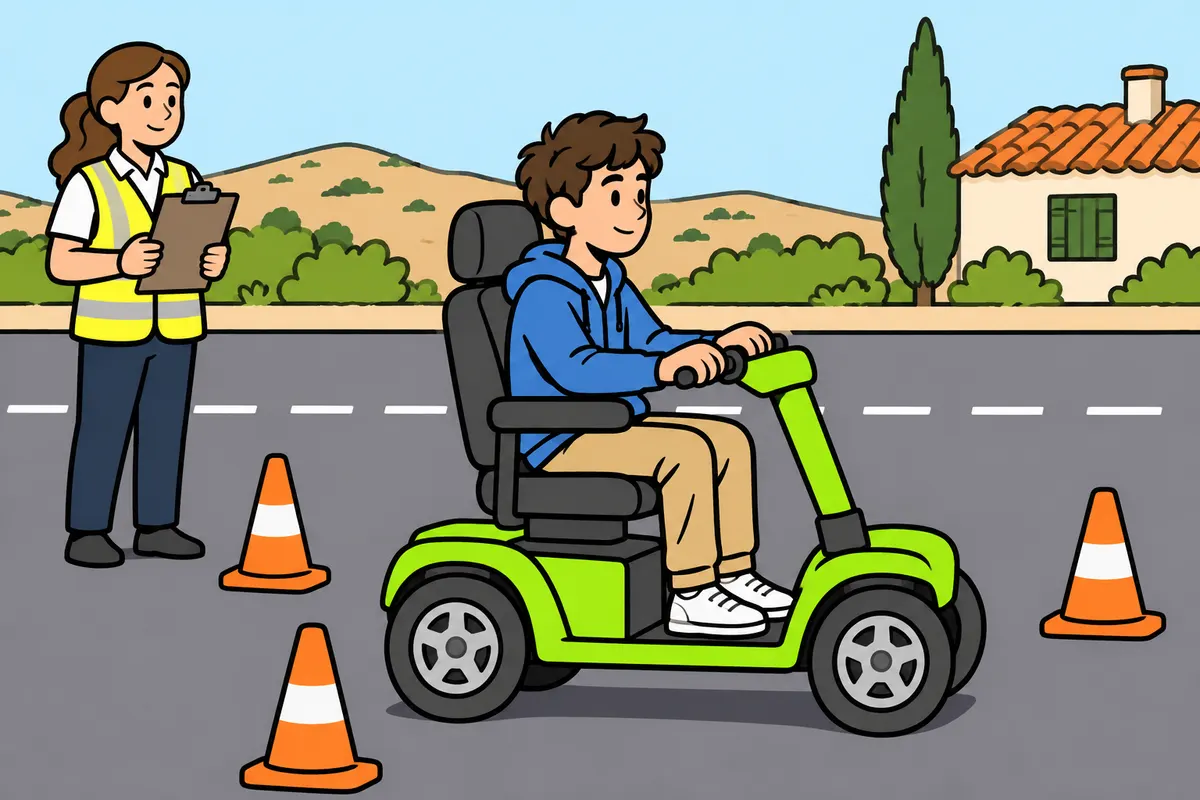
You can take theory early, but must reach the required age before manoeuvres.
| Your first test attempt | Required age |
|---|---|
| Theory | Up to three months before the minimum age |
| Manoeuvres | At least 14 |
Remember
- You can take your first theory test up to three months early.
- This does not lower the age to obtain an LCM licence.
- You must be 14 on the date of your first practical test.
Exam trap: Wrong: taking theory early lets you take manoeuvres before 14. Right: you must be at least 14 on the scheduled date.
Read the full explanation
- You can take your first knowledge test up to three months before you reach the required minimum age. This option to take the test before your birthday applies to the theory test: it does not lower the minimum age of 14 for obtaining an LCM licence. [RGCond, art. 51](https://www.boe.es/buscar/act.php?id=BOE-A-2009-9481#a51)
- You must be at least 14 on the scheduled date of your first skills and behaviour test. [RGCond, Annex VI.A.2](https://www.boe.es/buscar/act.php?id=BOE-A-2009-9481#anvi)
5The tests you must pass
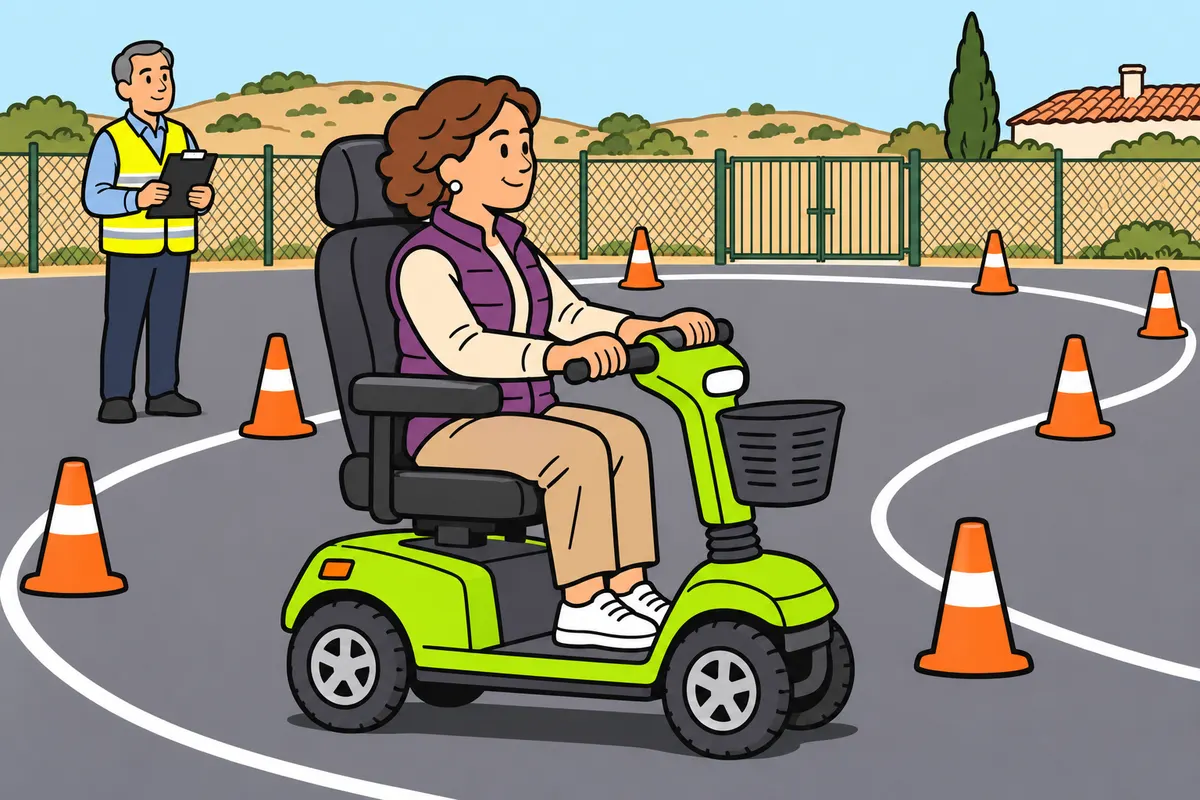
Pass specific theory and closed-course tests, and show physical and mental fitness.
| Test for your LCM licence | What you must do |
|---|---|
| Specific theory | Pass before the closed-course test |
| Closed course | Pass the manoeuvres |
Remember
- You take a specific knowledge test and a closed-course practical test.
- There is no extra common theory test like the category B test.
- Study rules and signs for your vehicle and any load.
- Pass theory before taking the closed-course test.
- An interview, attendance or mobility aid experience cannot replace a pass.
- You do not take a test on roads open to general traffic.
Exam trap: Wrong: passing theory completes your LCM tests. Right: you must also pass the closed-course test and show fitness.
Read the full explanation
- You must pass a specific knowledge test and a skills and behaviour test on a closed course, and provide evidence of physical and psychological fitness. The table in Annex V assigns these tests to the LCM licence; it does not require an additional common theory test like the one for a category B licence. [RGCond, Annex V.A and B](https://www.boe.es/buscar/act.php?id=BOE-A-2009-9481#anv)
- The specific theory test covers rules and signs, and the safety factors, equipment and components relating to you as the driver, your vehicle and, where applicable, your load. You must study the rules as they apply to the vehicle your licence authorises you to drive, rather than answer as though you are driving any type of motor vehicle. [RGCond, Annex V.A and B](https://www.boe.es/buscar/act.php?id=BOE-A-2009-9481#anv)
- You must pass each test before proceeding to the next: you must pass the knowledge test before taking the closed-course test. An interview, proof of class attendance or your experience of operating mobility aids does not replace the required test pass. [RGCond, art. 53](https://www.boe.es/buscar/act.php?id=BOE-A-2009-9481#a53)
- You do not have to take a driving test on roads open to general traffic to obtain an LCM licence. [RGCond, Annex V.A](https://www.boe.es/buscar/act.php?id=BOE-A-2009-9481#anv)
6The LCM closed-course test
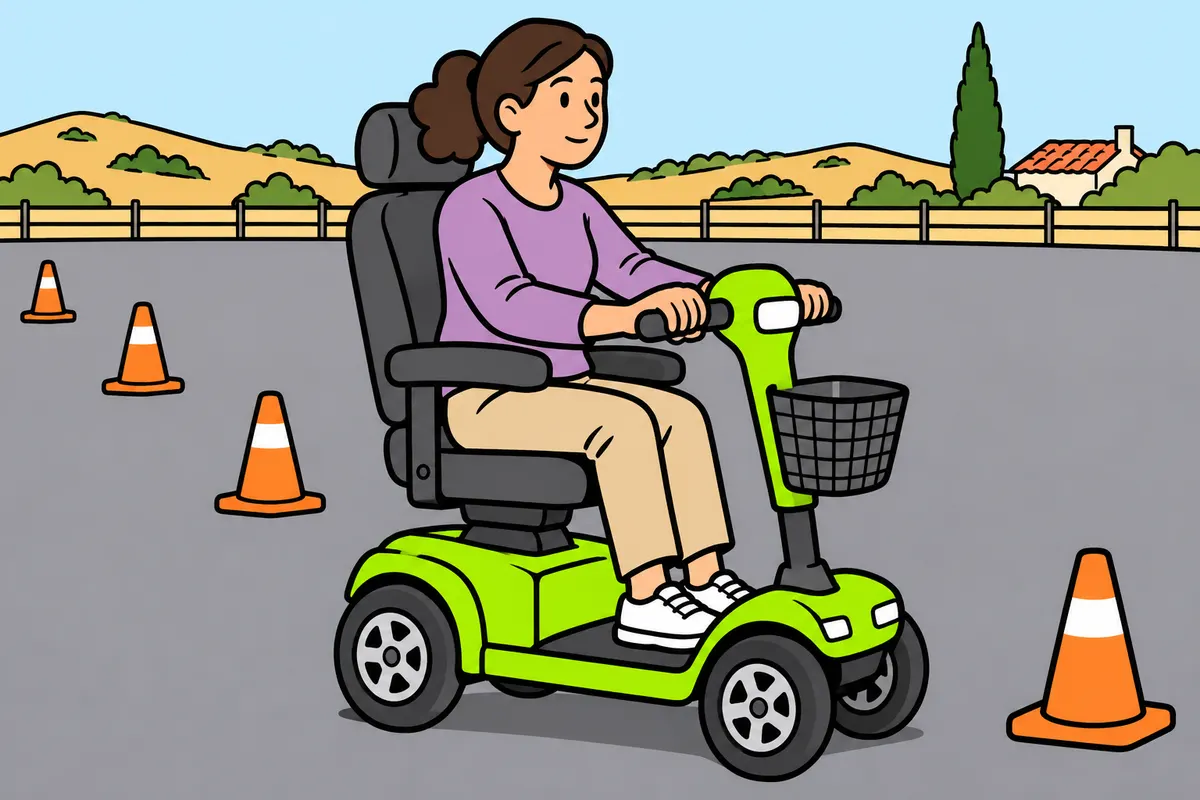
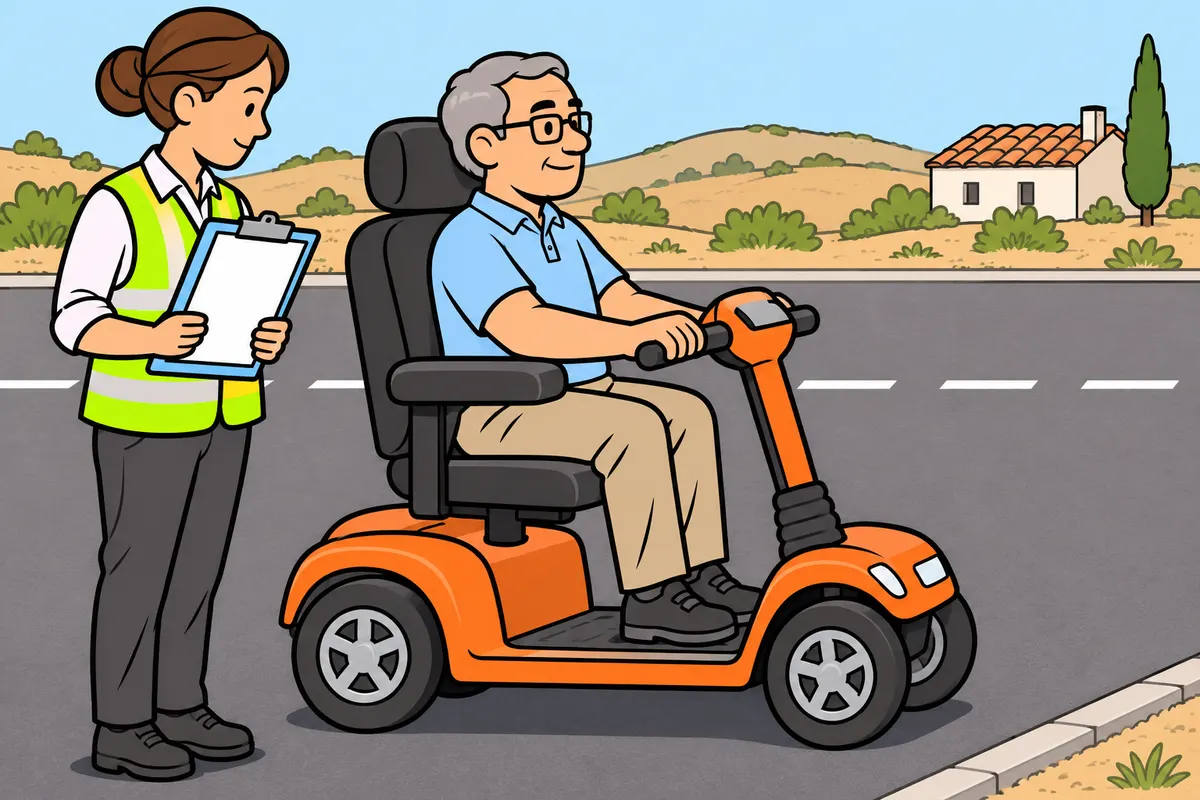
On the closed course, you must show you can control your vehicle.
| Faults in your LCM closed-course test | Result |
|---|---|
| One disqualifying fault | Fail |
| Two serious faults | Fail |
| One serious and two minor faults | Fail |
| Four minor faults | Fail |
Remember
- Perform manoeuvre C: zigzag between cones.
- Perform manoeuvre E: acceleration and controlled braking.
- See how to perform each manoeuvre in “Manoeuvres with your LCM vehicle”.
- Read its section “Closed-course test manoeuvres”.
- Prepare with the vehicle and adaptations that suit you.
- The duration depends on the manoeuvres and vehicle.
Exam trap: Wrong: you use road-driving test fault combinations on the closed course. Right: use the closed-course fault combinations.
Read the full explanation
- You must perform manoeuvre C, zigzag between cones, and manoeuvre E, acceleration and controlled braking; how to perform them and the minimum speed required for each are explained in «Manoeuvres with your LCM vehicle», in the section «Closed-course test manoeuvres». [RGCond, Annex V.B.3.9](https://www.boe.es/buscar/act.php?id=BOE-A-2009-9481#anv)
- You take the test on a specially adapted site or track closed to traffic. Its purpose is to check your skill in controlling the vehicle and operating its controls; knowing the theory test answers does not, on its own, demonstrate this practical ability. [RGCond, art. 58](https://www.boe.es/buscar/act.php?id=BOE-A-2009-9481#a58)
- You fail the closed-course test if you commit one disqualifying fault, two serious faults, one serious fault and two minor faults, or four minor faults. [RGCond, Annex VI.C.2 and C.3](https://www.boe.es/buscar/act.php?id=BOE-A-2009-9481#anvi)
- You must practise the manoeuvres with the vehicle and adaptations appropriate to your circumstances. The test duration depends on the characteristics and difficulty of the manoeuvres and on the vehicle; do not confuse this criterion with the time allowed per question in the theory test. [RGCond, Annex VI.C.2 and C.3](https://www.boe.es/buscar/act.php?id=BOE-A-2009-9481#anvi)
7Theory test questions and answers
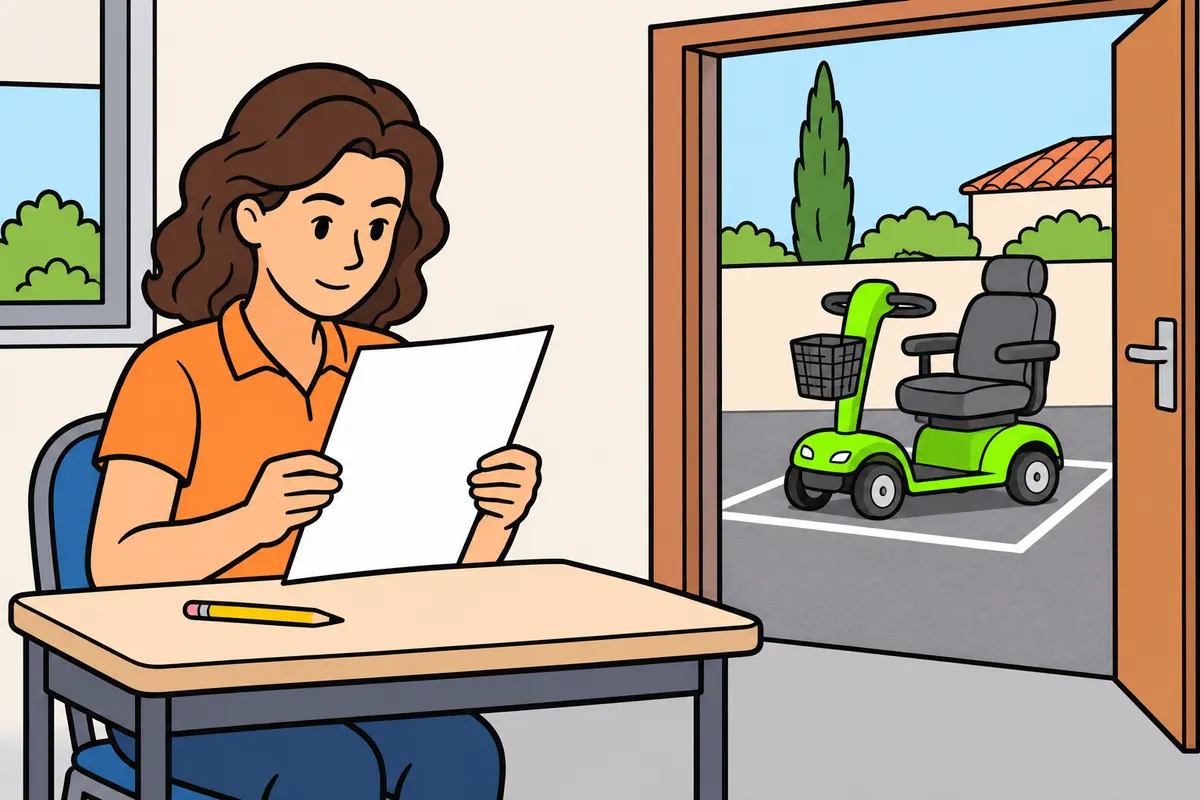
Follow official instructions; the course format describes only your mock tests.
| Format | What to remember |
|---|---|
| Course | Describes your mock tests |
| Annex | Application depends on a ministerial order |
| Official test | Follow its instructions |
Remember
- The course mock test uses 20 questions, up to 2 errors and 20 minutes.
- In the real test, follow the official instructions.
- The annex allows one to four correct answers per question.
- The number of questions and marking rules depend on a ministerial order.
Exam trap: Wrong: you must always choose four answers. Right: follow the instructions; the annex allows one to four, subject to a ministerial order.
Read the full explanation
- In this course, you practise with 20 questions, a maximum of 2 errors and 20 minutes. This is the course's practice format; in the test, follow the official instructions for your test sitting.
- Annex VI.B.1.d provides for between 16 and 30 questions to obtain a licence, subject to the eleventh transitional provision explained in this section. [RGCond, Annex VI.B.1.d](https://www.boe.es/buscar/act.php?id=BOE-A-2009-9481#anvi)
- Annex VI.B.1 provides for one to four correct answers per question. You must follow the questionnaire instructions when selecting your answers. [RGCond, Annex VI.B.1](https://www.boe.es/buscar/act.php?id=BOE-A-2009-9481#anvi)
- The eleventh transitional provision makes the application of the number of questions, the possible correct answers and the marking criteria dependent on a date set by an order of the Minister of the Interior. [RGCond, eleventh transitional provision](https://www.boe.es/buscar/act.php?id=BOE-A-2009-9481#dtundecima)
8Test duration and procedure
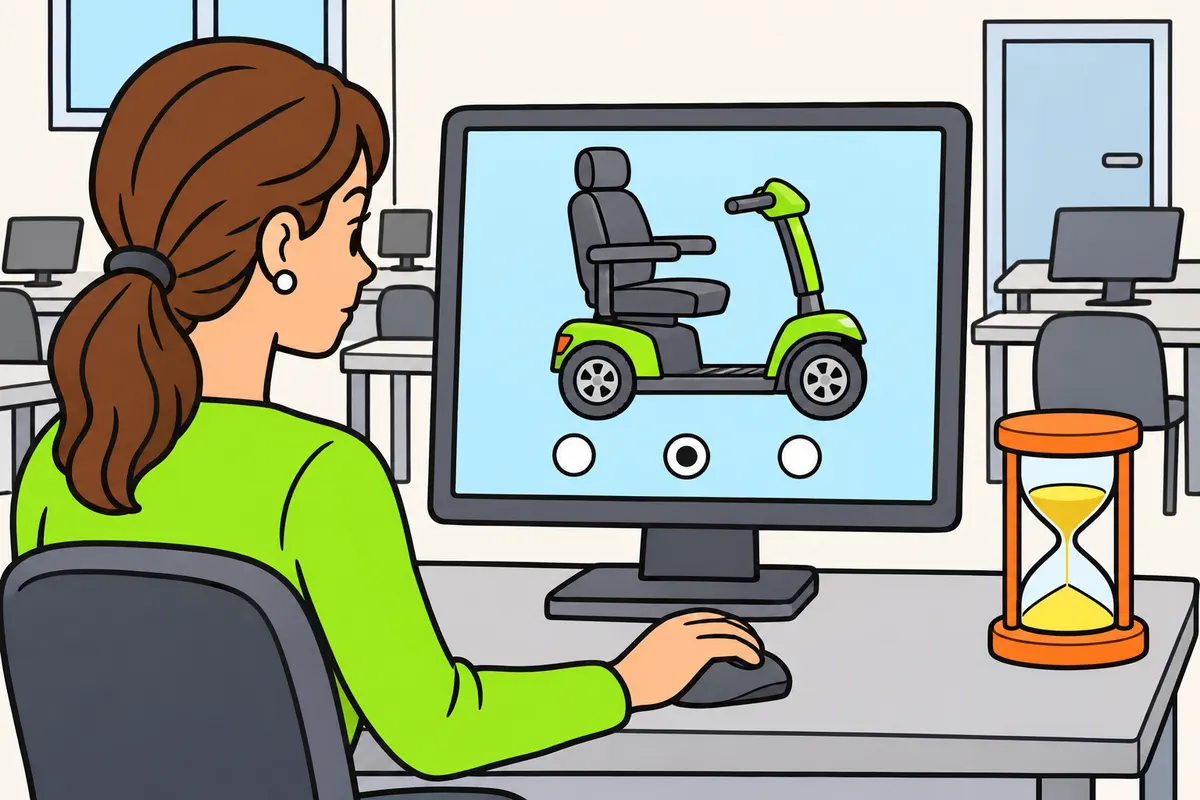
Read all the options and remember that you may receive extra test time.
Remember
- You normally take the test on a computer.
- Read the full situation and all options before answering.
- Look carefully for negatives and exceptions.
- You may get extra time for videos before questions.
- You may get extra time for duly justified special needs.
Exam trap: Wrong: every candidate always gets the same total time. Right: videos or duly justified special needs may extend it.
Read the full explanation
- You have one minute per question as the standard time allowed for the theory test under the regulations. [RGCond, Annex VI.B.2](https://www.boe.es/buscar/act.php?id=BOE-A-2009-9481#anvi)
- Your time allowance may be extended in proportion to the length of any videos shown before the questions. It may also be extended if you have duly justified special needs. [RGCond, Annex VI.B.2](https://www.boe.es/buscar/act.php?id=BOE-A-2009-9481#anvi)
- As a general rule, you take the test on a computer and must select the answers you consider correct from the options provided. As a study technique, get into the habit of reading the whole situation and all the options before answering, especially when there are negatives or exceptions. [RGCond, art. 52](https://www.boe.es/buscar/act.php?id=BOE-A-2009-9481#a52)
9Errors and calculating the result
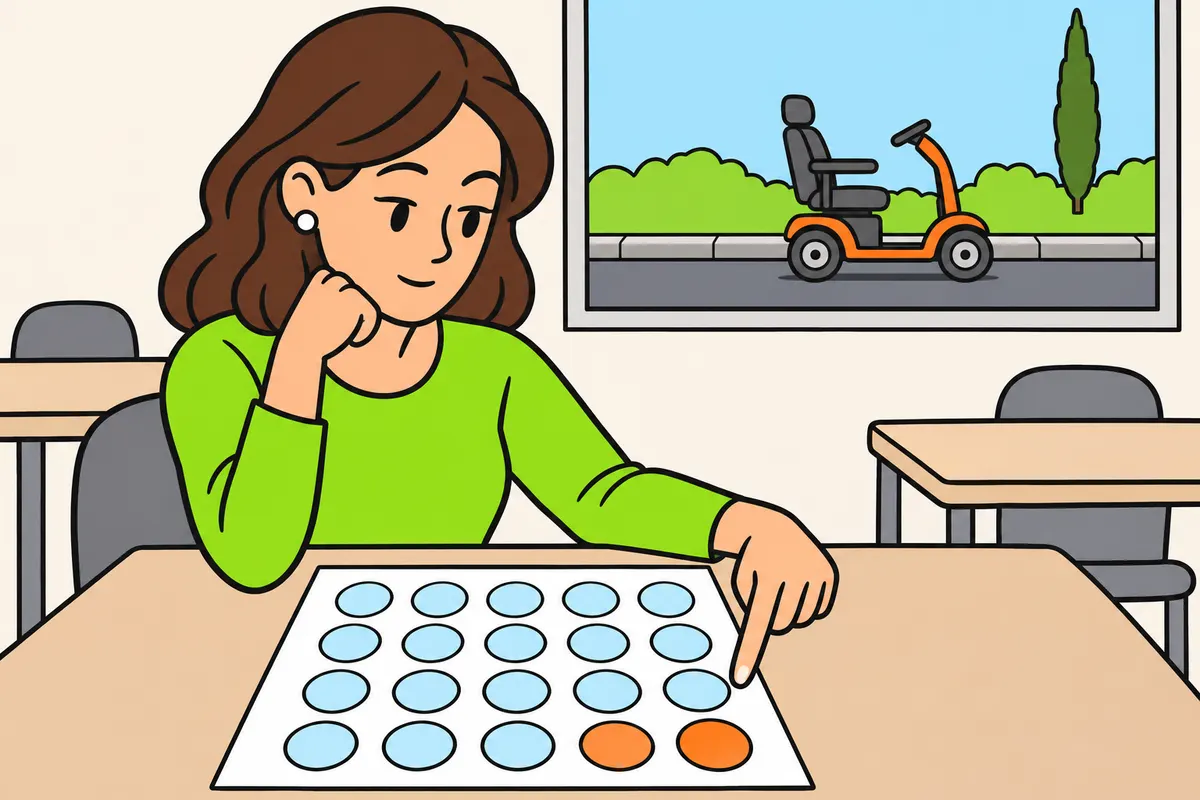
When calculating allowed errors, round decimals up to the next whole number.
Remember
- The annex rule depends on a ministerial order.
- With 16 questions, the calculation is 1.6, so round up to 2.
- In course mocks, 3 errors means you fail.
- Each test gives you a pass or fail.
- Review your errors even if you pass.
- After theory, you must still pass manoeuvres.
Exam trap: Wrong: round allowed errors down. Right: under the annex calculation, round up to the next whole number.
Read the full explanation
- Annex VI.B.3 states that, to pass, your errors must not exceed 10 % of the total number of questions. The application of this criterion is subject to the eleventh transitional provision, explained in «Theory test questions and answers». [RGCond, Annex VI.B.3](https://www.boe.es/buscar/act.php?id=BOE-A-2009-9481#anvi)
- If calculating the percentage gives a decimal number, the provision requires you to round up to the next whole number. With 16 questions, 10 % is 1.6 and the applicable result of that calculation is 2. [RGCond, Annex VI.B.3](https://www.boe.es/buscar/act.php?id=BOE-A-2009-9481#anvi)
- In the course's mock tests, you are allowed a maximum of 2 errors out of 20 questions: with 3 errors, you fail the mock test. This maximum matches the 10 % calculation provided for in the annex. [RGCond, Annex VI.B.3](https://www.boe.es/buscar/act.php?id=BOE-A-2009-9481#anvi)
- You receive a pass or fail result for each test. To organise your preparation, review the reason for each error, even if you stay within the maximum in a mock test: passing the theory test allows you to continue the process, but does not replace passing the manoeuvres test. [RGCond, art. 53](https://www.boe.es/buscar/act.php?id=BOE-A-2009-9481#a53)
10Application and test attempts
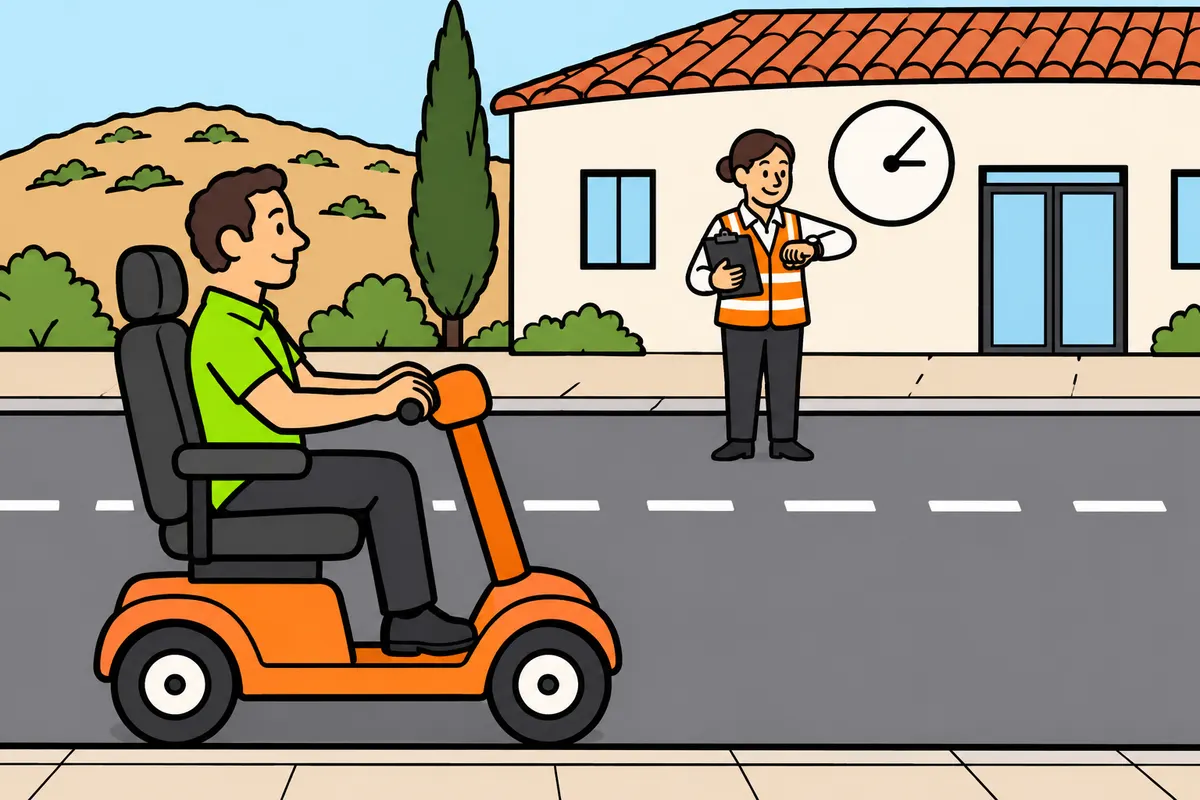
Attend your test appointments and follow the time limits for your application.
Remember
- Each application gives you two attempts.
- Do not leave over six months between attempts on the same application.
- Illness or duly justified exceptional circumstances can allow a longer gap.
- Missing your test loses that attempt unless exceptional circumstances are duly justified.
- You normally take theory and the closed-course test on different dates.
- In duly justified exceptional cases, the office may allow one date; pass theory first.
Exam trap: Wrong: missing a test never uses an attempt. Right: you lose it unless exceptional circumstances are duly justified.
Read the full explanation
- Each application for the licence entitles you to two test attempts. [RGCond, art. 51.2](https://www.boe.es/buscar/act.php?id=BOE-A-2009-9481#a51)
- You must not leave more than six months between test attempts under the same application, except in cases of illness or other duly justified exceptional circumstances. This period is different from the validity period of a test pass, which is calculated separately. [RGCond, art. 51](https://www.boe.es/buscar/act.php?id=BOE-A-2009-9481#a51)
- You must attend on the date set for your test. If you do not attend, you lose that attempt unless you have duly justified exceptional circumstances. [RGCond, art. 51](https://www.boe.es/buscar/act.php?id=BOE-A-2009-9481#a51)
- As a general rule, you take the theory test and the closed-course test on different dates. The Jefatura Provincial de Tráfico (Provincial Traffic Office) may authorise you to take them on the same date in duly justified exceptional circumstances; this exception does not change the order in which you must pass the tests. [RGCond, art. 51](https://www.boe.es/buscar/act.php?id=BOE-A-2009-9481#a51)
11Province and test centre
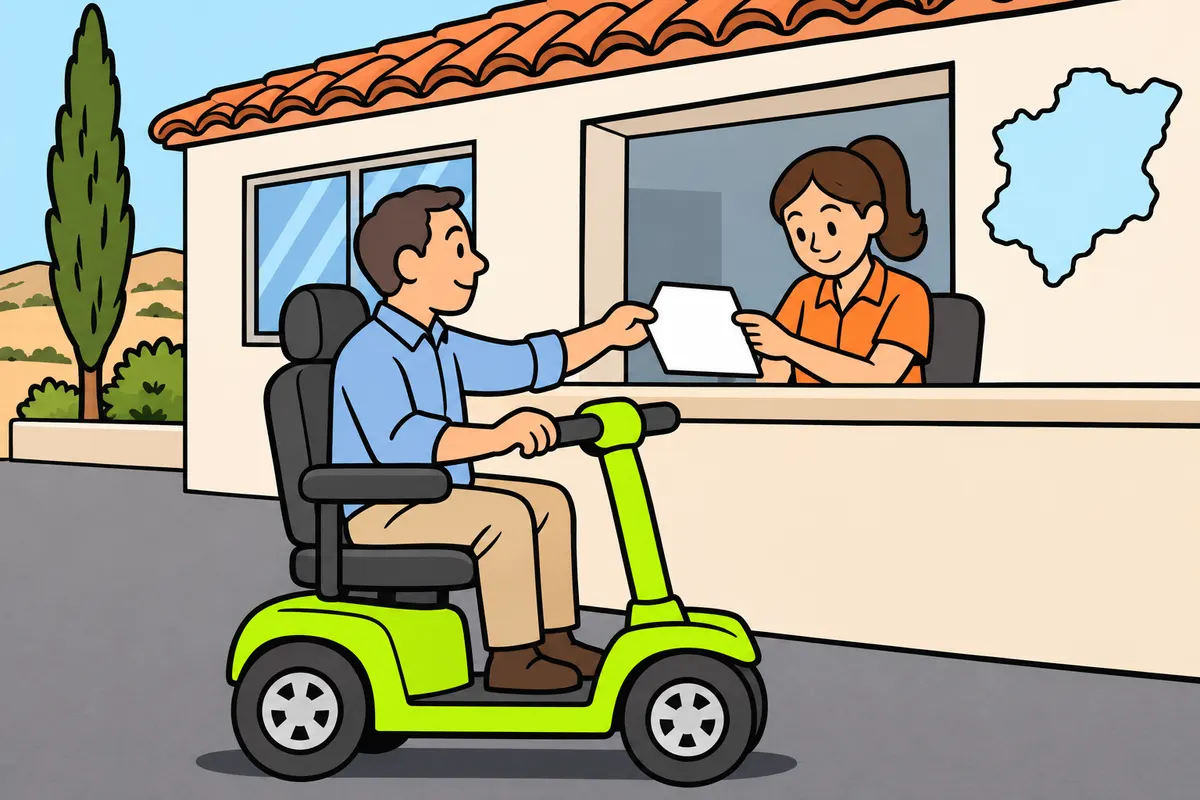
Take your tests in your application province, at the assigned centre.
Remember
- The Provincial Traffic Office chooses your test centre.
- You cannot freely change centres on test day.
- If a centre outside the provincial capital is unsuitable, you test in the capital.
- The office may instead choose another suitable centre in the same province.
Exam trap: Wrong: you can choose another centre on test day. Right: the Provincial Traffic Office assigns it within your application province.
Read the full explanation
- You must take the tests in the province to which you submitted your application. Within that province, the Jefatura Provincial determines the centre according to the circumstances and the service's capacity; you cannot freely change it on the day of the test. [RGCond, art. 50](https://www.boe.es/buscar/act.php?id=BOE-A-2009-9481#a50)
- If a centre outside the provincial capital does not meet the necessary conditions, you take the tests at the centre in the capital while the shortcomings are corrected. The Jefatura may arrange for you to take them at another suitable centre in the same province. [RGCond, Annex VI.A.1](https://www.boe.es/buscar/act.php?id=BOE-A-2009-9481#anvi)
12Waiting after failing
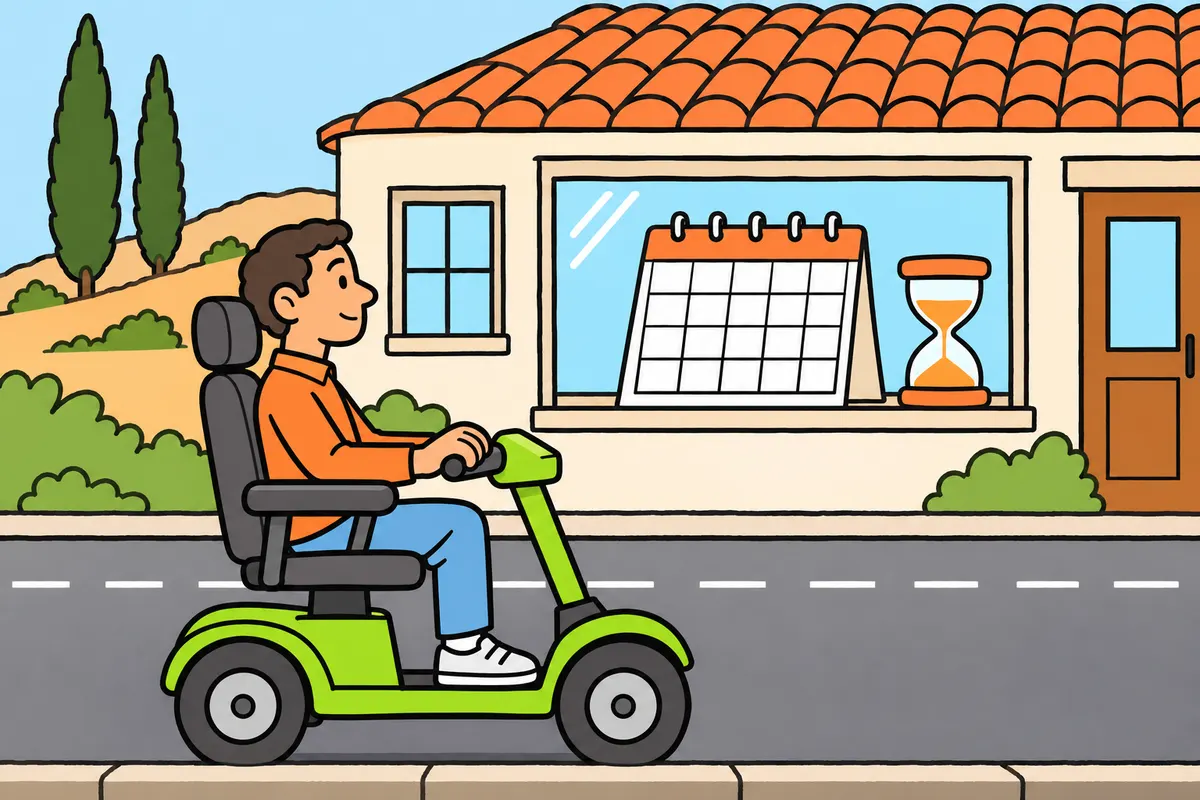
After repeated failures, you must wait the minimum period before another attempt.
| Attempts after failing | Minimum wait |
|---|---|
| Second to third | 10 days |
| Between later attempts | 15 days |
Remember
- Count from the date of your failed test.
- The Provincial Traffic Office sets your actual test date.
- The minimum wait does not guarantee an appointment that day.
- Only duly justified, recognised urgency can exceptionally shorten the wait.
Exam trap: Wrong: you can shorten the wait yourself. Right: it can be shortened only for duly justified, recognised urgency.
Read the full explanation
- If you fail a test on two attempts, Annex VI.A.2 requires you to wait at least 10 days between your second and third attempts. You must count from the date you took the test you failed, not from when you decided to start preparing again. [RGCond, Annex VI.A.2](https://www.boe.es/buscar/act.php?id=BOE-A-2009-9481#anvi)
- You must wait at least 15 days between subsequent attempts. [RGCond, Annex VI.A.2](https://www.boe.es/buscar/act.php?id=BOE-A-2009-9481#anvi)
- These minimum waiting periods may exceptionally be reduced if you have a duly justified case of recognised urgency. [RGCond, Annex VI.A.2](https://www.boe.es/buscar/act.php?id=BOE-A-2009-9481#anvi)
- The Jefatura Provincial de Tráfico sets your actual test date; the minimum waiting period does not guarantee you an appointment on that day. [RGCond, art. 51.1](https://www.boe.es/buscar/act.php?id=BOE-A-2009-9481#a51)
13Validity of a test pass
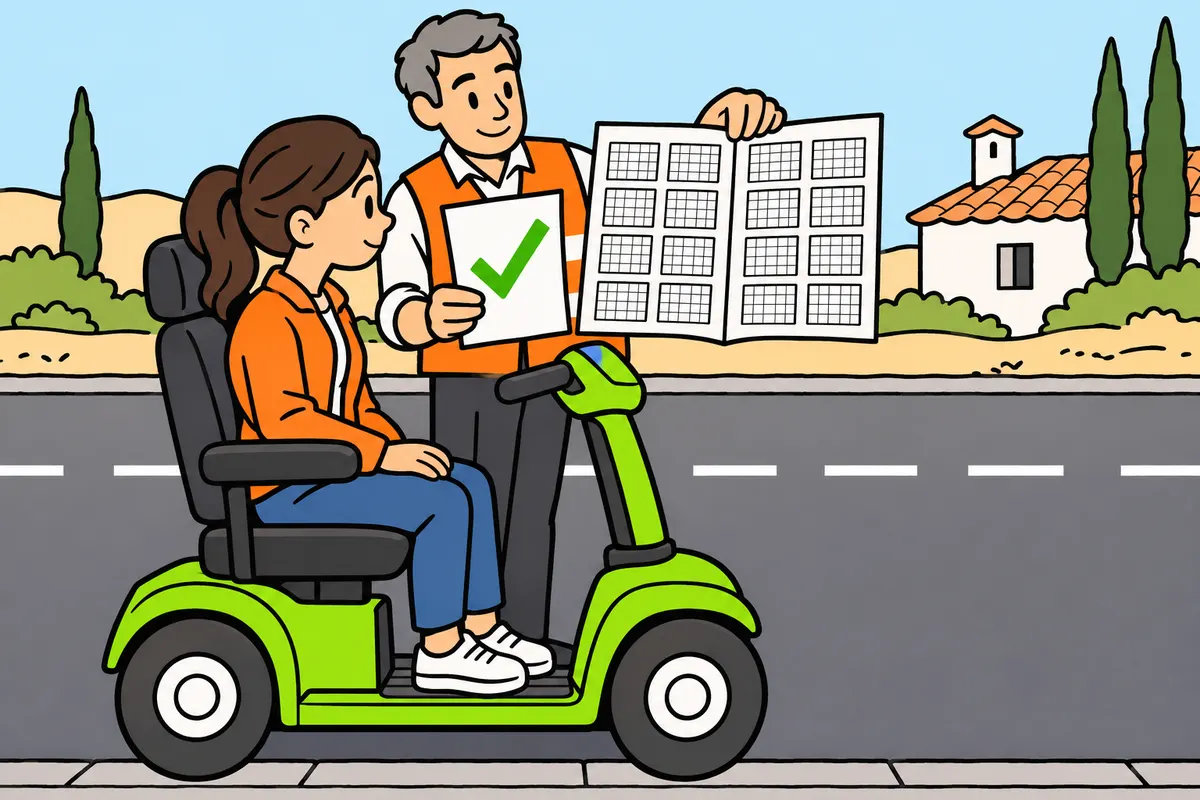
Your pass has a time limit; it restarts only if you pass the next test.
| Your next test result | Effect on the previous period |
|---|---|
| You pass within two years | The period starts again |
| You fail | The period does not restart |
Remember
- Count from the day after you pass.
- Keep a record of your result date.
- If you pass the next test within that period, the period starts again.
- If you fail the next test, the period does not restart.
Exam trap: Wrong: attending and failing renews your pass. Right: you must pass the next test within two years.
Read the full explanation
- When you are declared to have passed a test, your pass is valid for two years from the day after that declaration. You must keep a record of the result date so you know how long you can rely on that pass as you continue taking the tests. [RGCond, art. 53](https://www.boe.es/buscar/act.php?id=BOE-A-2009-9481#a53)
- If you pass the next test within those two years, the validity period starts again. [RGCond, art. 53](https://www.boe.es/buscar/act.php?id=BOE-A-2009-9481#a53)
- You study the validity and renewal of the licence issued to you in «Driver and vehicle documentation».
14Identifying yourself to the examiner
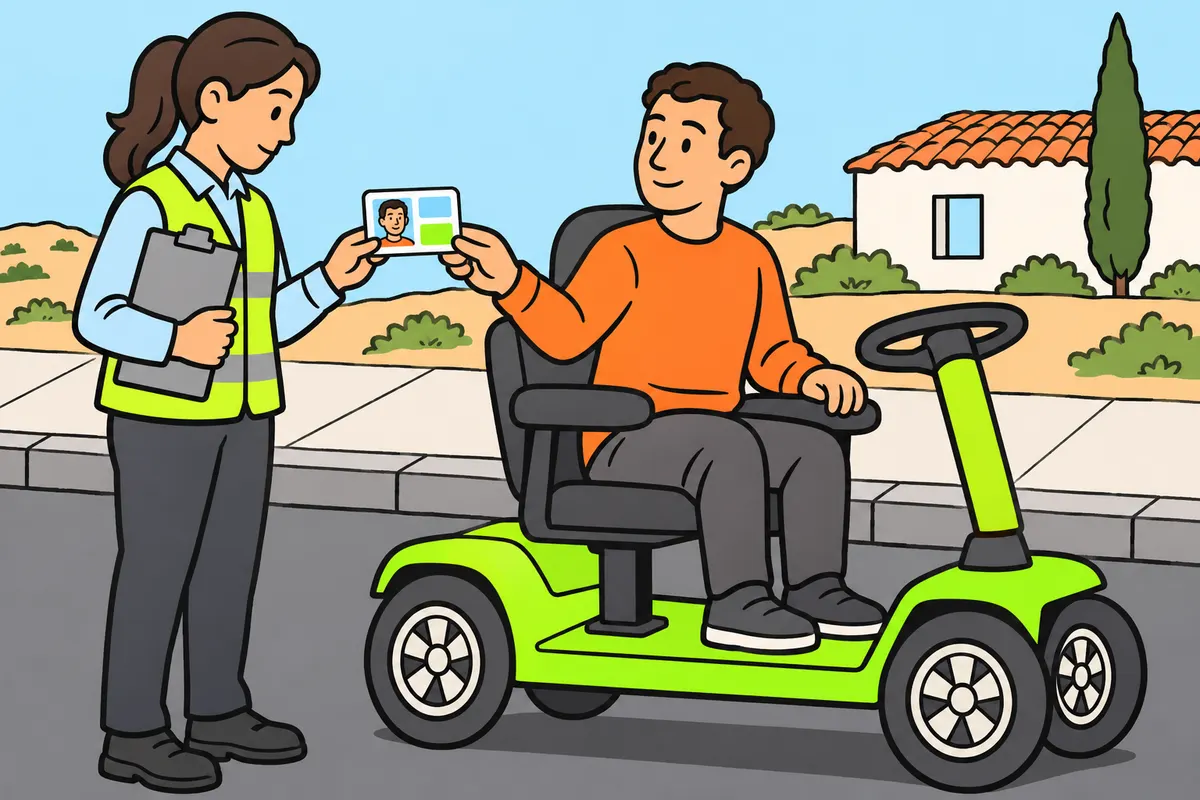
You must show the identification requested for your practical test.
Remember
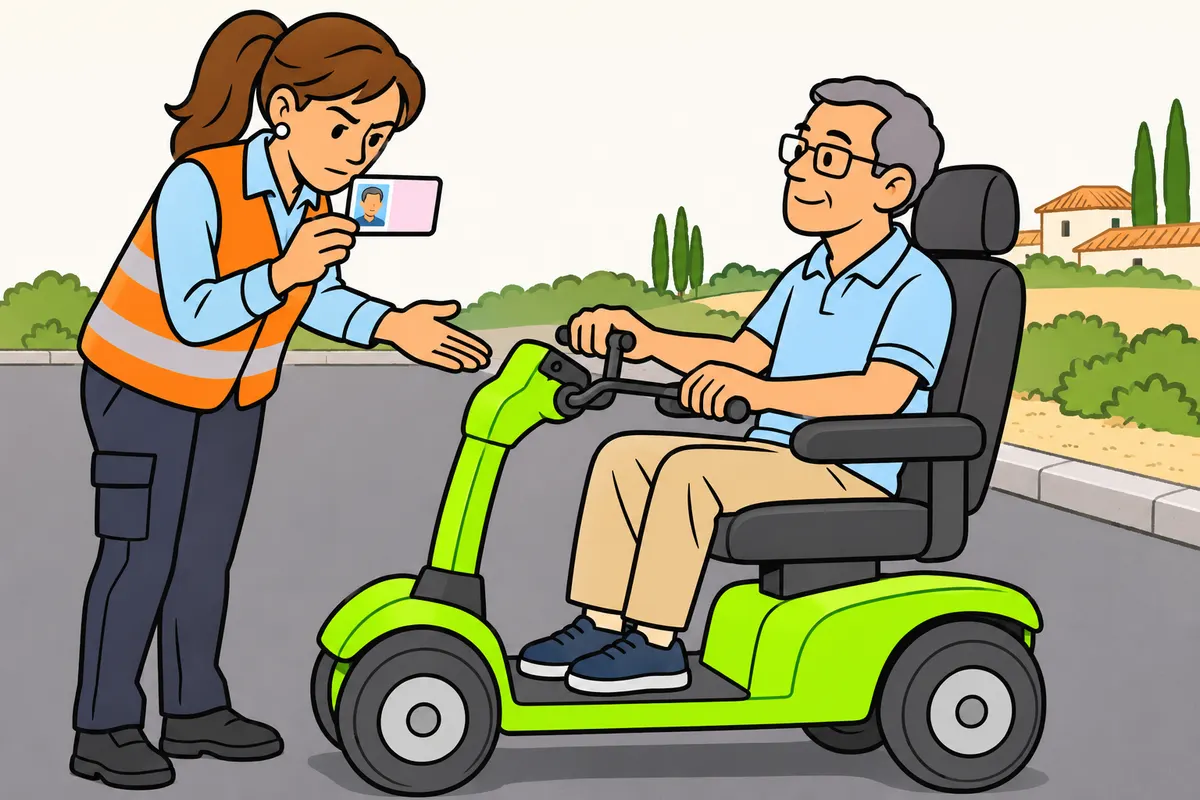
- Identify yourself when asked.
- As applicable, show your national identity card, passport, residence card or driving licence.
- A payment receipt or family record book photocopy does not identify you.
- Without the required identification, your practical test cannot start or must stop.
- You do not lose an attempt because of missing identification.
Exam trap: Wrong: lacking identification means you lose your attempt. Right: the practical test cannot start or must stop, but you do not lose it.
Read the full explanation
- For practical tests and related procedures, you must identify yourself when asked. As applicable, you may be required to present your DNI (Spanish national identity card), passport, residence card or driving licence; a payment receipt or a photocopy of the libro de familia (family record book) does not serve this purpose. [RGCond, Annex VI.A.3](https://www.boe.es/buscar/act.php?id=BOE-A-2009-9481#anvi)
- If you do not present the required identity documents, your practical test does not start and you do not lose a test attempt. If this situation arises during the test, it is interrupted with the same effect provided for in Article 57.2. [RGCond, art. 57](https://www.boe.es/buscar/act.php?id=BOE-A-2009-9481#a57)
15Vehicle and adaptation checks
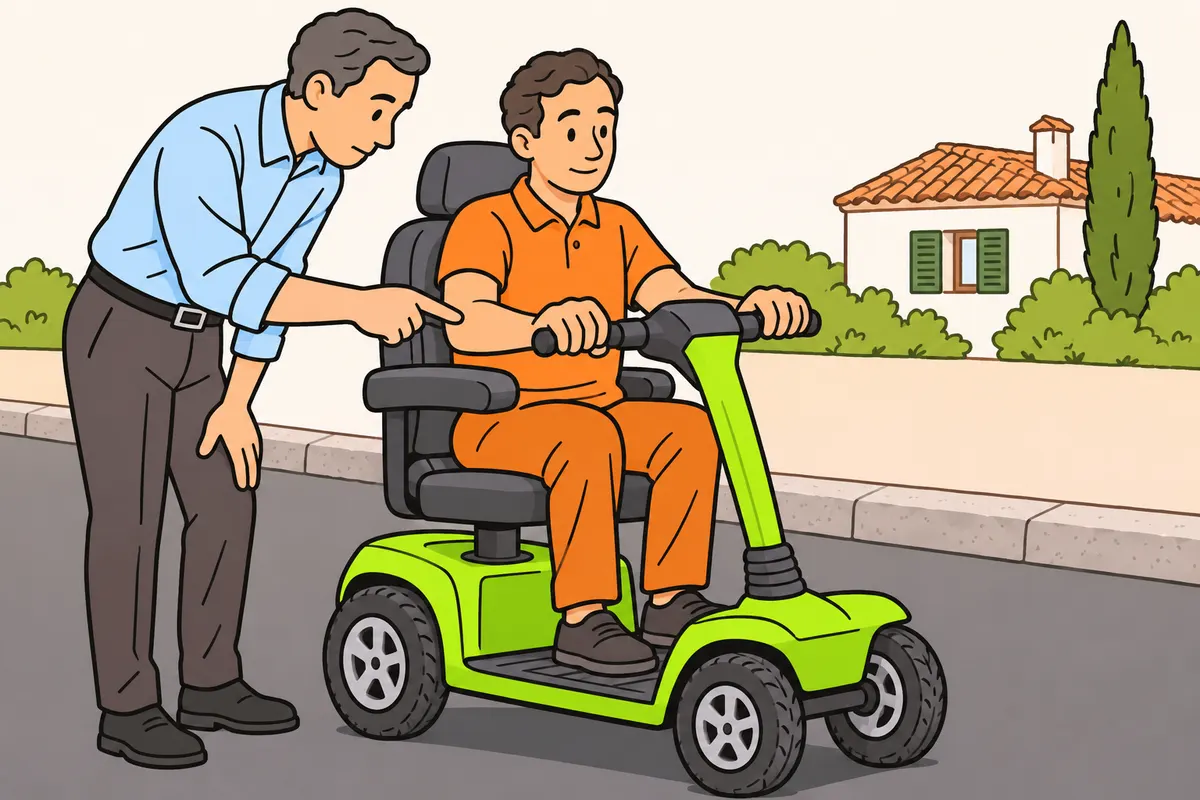
Bring a suitable vehicle and the adaptations and protective equipment required for your circumstances.
Remember
- Your vehicle may be checked before or during the test.
- Monitoring and communication systems may also be checked where applicable.
- Bring the corrective aids, prostheses or adaptations you need.
- If required items fail, your test cannot start or is interrupted.
- In the stated cases, you keep your attempt but do not get a pass.
- Wear the protective equipment required for your circumstances.
Exam trap: Wrong: every LCM test requires the same specific protective clothing as AM, A1 and A2. Right: wear the equipment required for your circumstances.
Read the full explanation
- Before or during the test, the examiner may check that your vehicle and, where applicable, its monitoring equipment and communication systems meet the requirements. The check is not limited to fuel and does not mean that the vehicle has to belong to the test centre. [RGCond, Annex VI.C.1](https://www.boe.es/buscar/act.php?id=BOE-A-2009-9481#anvi)
- The examiner may also check that you have the necessary corrective aids, prostheses or adaptations and that they are suitable. You must attend with the setup required for your circumstances: an adaptation that you cannot use correctly compromises the safe conduct of the test. [RGCond, Annex VI.C.1](https://www.boe.es/buscar/act.php?id=BOE-A-2009-9481#anvi)
- If the required items do not work properly or do not meet the requirements, your test does not start or is interrupted without you losing a test attempt in the circumstances covered by the regulations. [RGCond, Annex VI.C.1](https://www.boe.es/buscar/act.php?id=BOE-A-2009-9481#anvi)
- You must wear the appropriate protective equipment. The specific list of a helmet, gloves, clothing with protective inserts and boots in Annex VI.C.1 applies to AM, A1 and A2; you must not automatically assume that the same clothing is required for every LCM test. [RGCond, Annex VI.C.1](https://www.boe.es/buscar/act.php?id=BOE-A-2009-9481#anvi)
16Mobile phones, cheating and orderly conduct during tests
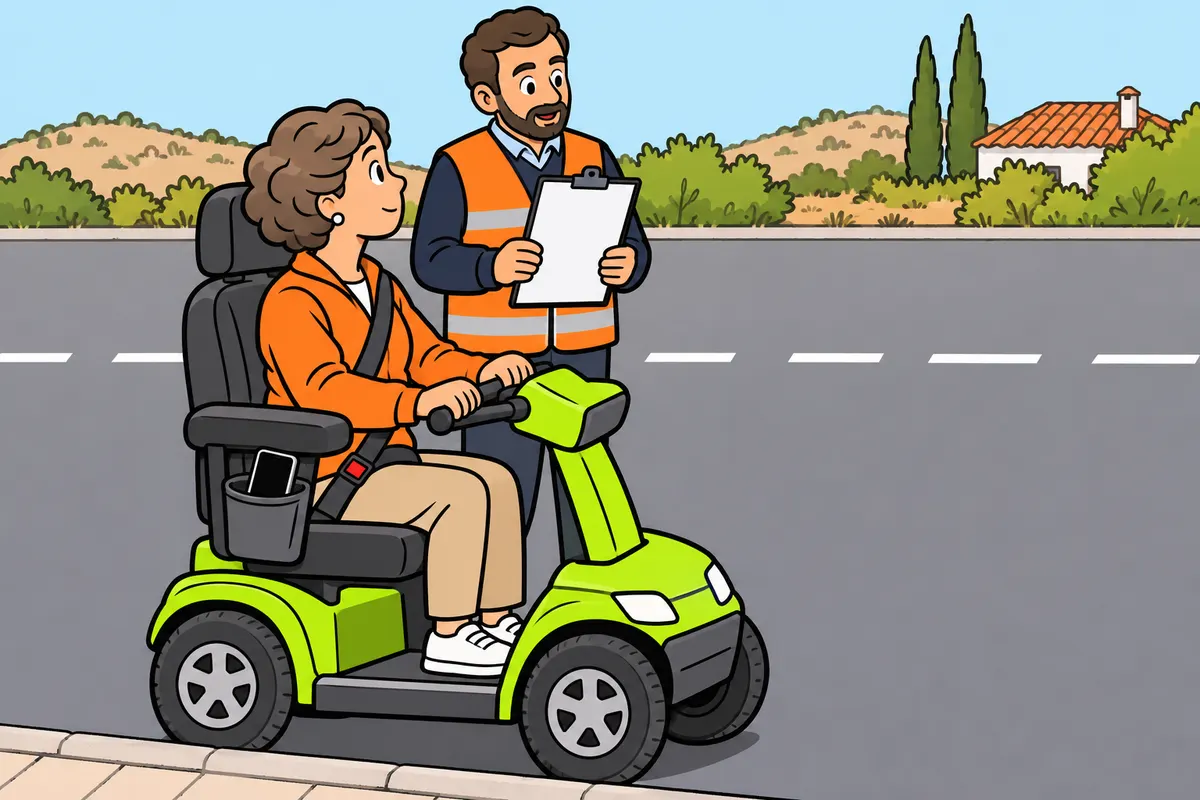
Follow device restrictions and avoid cheating during your tests.
| Who and what | Effect on your test |
|---|---|
| You: banned systems in theory | Excluded; lose attempt |
| You: cheating, attempted cheating or disrupting order | Test stopped; fail |
| Your instructor: breaches system ban | Test does not start or stops; you keep attempt |
Remember
- You cannot freely use phones or recording or communication systems.
- Exceptions for authorised systems do not allow your personal phone.
- Using unauthorised intercommunication is a very serious offence.
- Helping through these devices is also an offence.
- For six months, you cannot take tests to obtain or recover driving entitlements.
Exam trap: Wrong: every interruption makes you lose your attempt. Right: if your instructor breaks the system ban, the test does not start or stops without costing your attempt.
Read the full explanation
- During practical tests, you cannot freely use telephones or systems for intercommunication, data capture, recording, reception or transmission. You must follow the test instructions. [RGCond, Annex VI.A.4](https://www.boe.es/buscar/act.php?id=BOE-A-2009-9481#anvi)
- Annex VI.A.4 provides exceptions for the intercoms in paragraphs C.6 and C.7 and the systems used by the Jefatura Central de Tráfico (Central Traffic Authority) and its regional and local offices to conduct and process the tests. These exceptions do not authorise you to use your personal phone. [RGCond, Annex VI.A.4](https://www.boe.es/buscar/act.php?id=BOE-A-2009-9481#anvi)
- If you breach the ban on these systems during the knowledge test, you are excluded and lose that test attempt. If you cheat or attempt to cheat, or disrupt order, your test is interrupted and suspended and you are declared to have failed under Article 57.1. [RGCond, art. 57](https://www.boe.es/buscar/act.php?id=BOE-A-2009-9481#a57)
- If your instructor breaches the prohibition in Annex VI.A.4, your test does not start or is interrupted without you losing a test attempt. [RGCond, Annex VI.A.4](https://www.boe.es/buscar/act.php?id=BOE-A-2009-9481#anvi)
- If you use intercommunication devices that are not authorised by the regulations during the tests, you commit a very serious offence; collaborating or providing assistance through these devices is also an offence. The prescribed fine is 500 euros and, as a candidate, you cannot take tests to obtain or recover driving entitlements for six months. [Traffic Act, arts. 77.u and 80.1 and 80.4](https://www.boe.es/buscar/act.php?id=BOE-A-2015-11722#a80)
17Your duty to obey
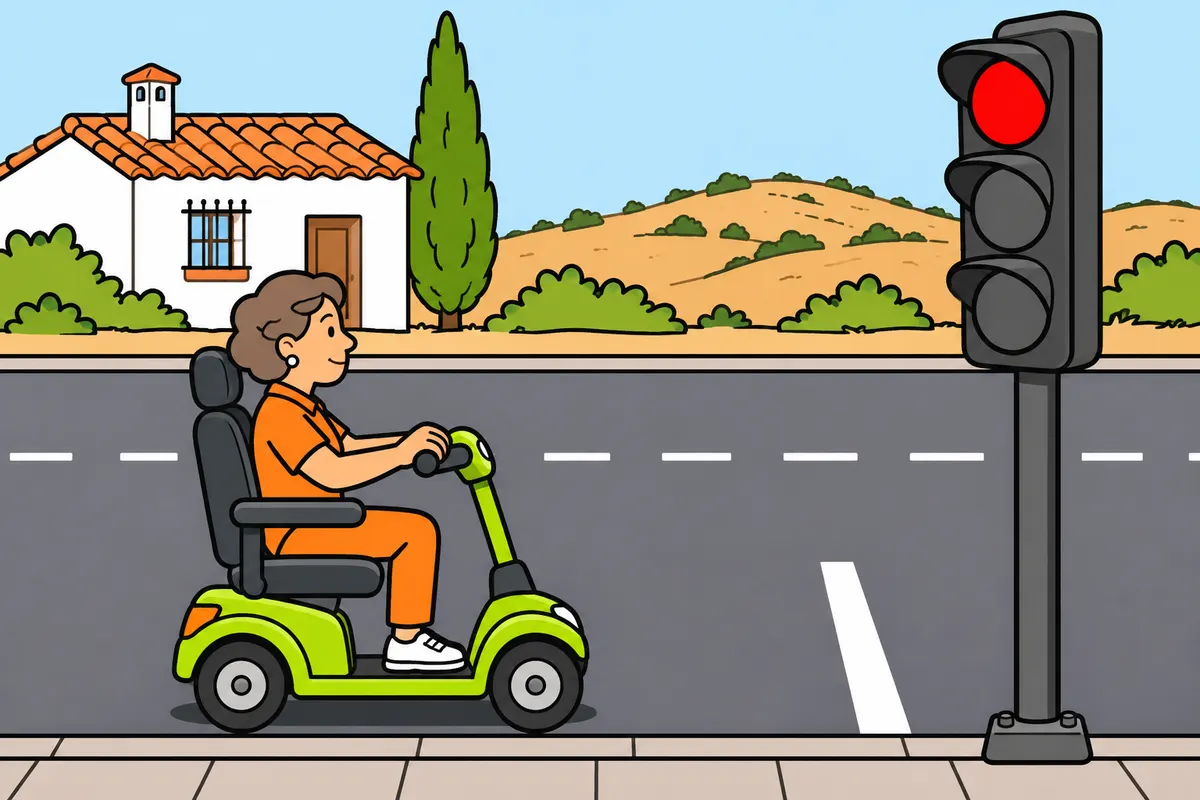
You must obey signs when driving with your LCM licence too.
Remember
- Follow the duties and bans shown by signs.
- Adapt your behaviour to other sign messages.
- If a sign tells you to stop, obey it before moving again.
- Obey signs that seem to conflict with general rules, unless special circumstances justify otherwise.
Exam trap: Wrong: you may continue without obeying a sign that tells you to stop. Right: obey it before moving again.
Read the full explanation
- You must comply with the obligations and prohibitions imposed by signs and adapt your behaviour to the messages conveyed by other signs. This duty also applies when you drive the vehicle authorised by your LCM licence. [RGC, art. 132.1](https://www.boe.es/buscar/act.php?id=BOE-A-2003-23514#a132)
- If a sign requires you to stop, you must comply with its instruction before moving off again. [RGC, art. 132.1](https://www.boe.es/buscar/act.php?id=BOE-A-2003-23514#a132)
- Unless special circumstances justify otherwise, you must obey signs even when they appear to contradict the general traffic rules. [RGC, art. 132.2](https://www.boe.es/buscar/act.php?id=BOE-A-2003-23514#a132)
18Conflicting orders and signs
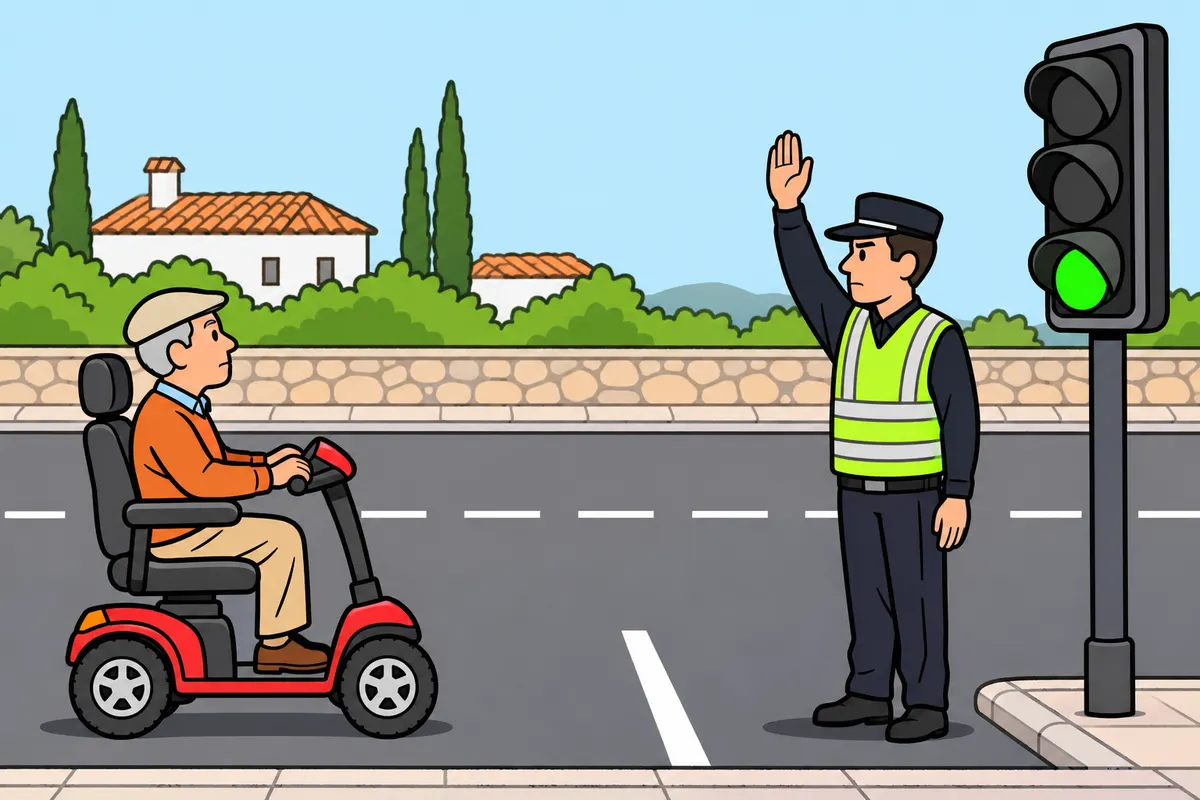
When instructions conflict, follow their order of priority.
| Priority | Instruction |
|---|---|
| First | Officers |
| Next | Temporary signs changing road use; delineation devices and marker signs |
| Then | Traffic lights |
| Then | Upright signs |
| Last | Road markings |
Remember
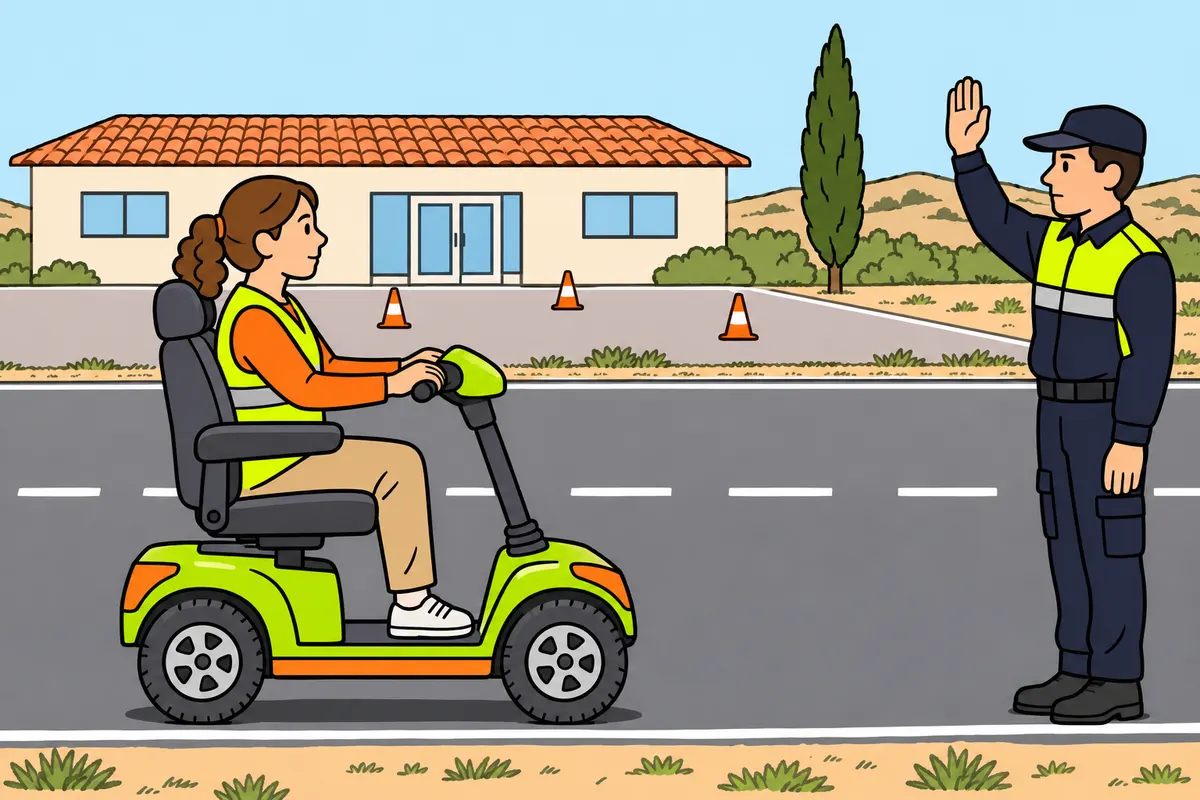
- Obey officers directing traffic immediately.
- Next come temporary signs changing road use, delineation devices and marker signs.
- Then come traffic lights, upright signs and road markings, in that order.
- If conflicting signs are the same type, follow the most restrictive one.
- Study signs in “Traffic signs and their hierarchy”.
- Study road user priority in “Priority and right of way”.
Exam trap: Wrong: a lower-ranking sign overrides an officer’s conflicting order. Right: obey the officer immediately; for signs of the same type, follow the most restrictive.
Read the full explanation
- You must immediately obey the orders and signals of officers directing traffic. [RGC, art. 141](https://www.boe.es/buscar/act.php?id=BOE-A-2003-23514#a141)
- When instructions conflict, you must follow this order of priority: officers; temporary signs and guiding devices that alter the normal use of the road, delineating devices and guiding signs; traffic lights; upright signs; road markings. [RGC, art. 133.1](https://www.boe.es/buscar/act.php?id=BOE-A-2003-23514#a133)
- If conflicting signs are of the same type, you must obey the most restrictive one. [RGC, art. 133.2](https://www.boe.es/buscar/act.php?id=BOE-A-2003-23514#a133)
- In «Traffic signs and their hierarchy», you study which sign applies to your movement, officers’ gestures and flags, guiding devices, STOP signs and traffic lights; in «Priority and right of way», you study how these apply to the order in which road users proceed.
From application to licence
Distinguish the personal requirements from the tests you must pass.
- Check the vehicle category, your age and the fitness requirements.
- Confirm the conditions and adaptations that apply to your case.
- Submit your application and check the province, centre and date of your test appointment.
- Pass the specific knowledge test; you must be at least 14 years old for your first practical test attempt.
- Pass manoeuvres C and E on a closed course while your theory test pass remains valid.
Which time limit applies
Match each time limit to the event that starts it.
- Application: two test attempts, with no more than six months between them. [RGCond, art. 51](https://www.boe.es/buscar/act.php?id=BOE-A-2009-9481#a51)
- If you fail two test attempts: at least 10 days until your third attempt and 15 between subsequent attempts, counted from the test you fail. [RGCond, annex VI.A.2](https://www.boe.es/buscar/act.php?id=BOE-A-2009-9481#anvi)
- When you pass: your pass is valid for two years from the following day, and the period restarts when you pass the next test. [RGCond, art. 53](https://www.boe.es/buscar/act.php?id=BOE-A-2009-9481#a53)
How to decide which instruction to obey
First identify the sign that applies to your intended path.
- Check whether an officer is present and follow their order.
- Identify the temporary signs, traffic guidance and barrier devices, and traffic lights that affect your movement.
- Compare the applicable upright signs and road markings, following the hierarchy and the rule that the most restrictive instruction applies among signs of the same type.
- At STOP, come to a complete stop at the required place; at Give Way, stop if you need to in order to give way.
- Follow compatible instructions and continue only when you can do so safely.
Check what you know
Real questions from the bank on this topic. Pick an answer to see the explanation.
Finished this module?
Mark it as read and you will see your progress on the theory list.