
Theory · LVA Licence - Agricultural Vehicle · Module 1 of 16
Road and agricultural vehicle definitions
You learn to distinguish road components and classes, agricultural vehicles and the categories outside the scope of LVA. You interpret masses, identify the driver and registered keeper, and distinguish types of immobilisation and overtaking situations so that you can answer accurately in the exam.
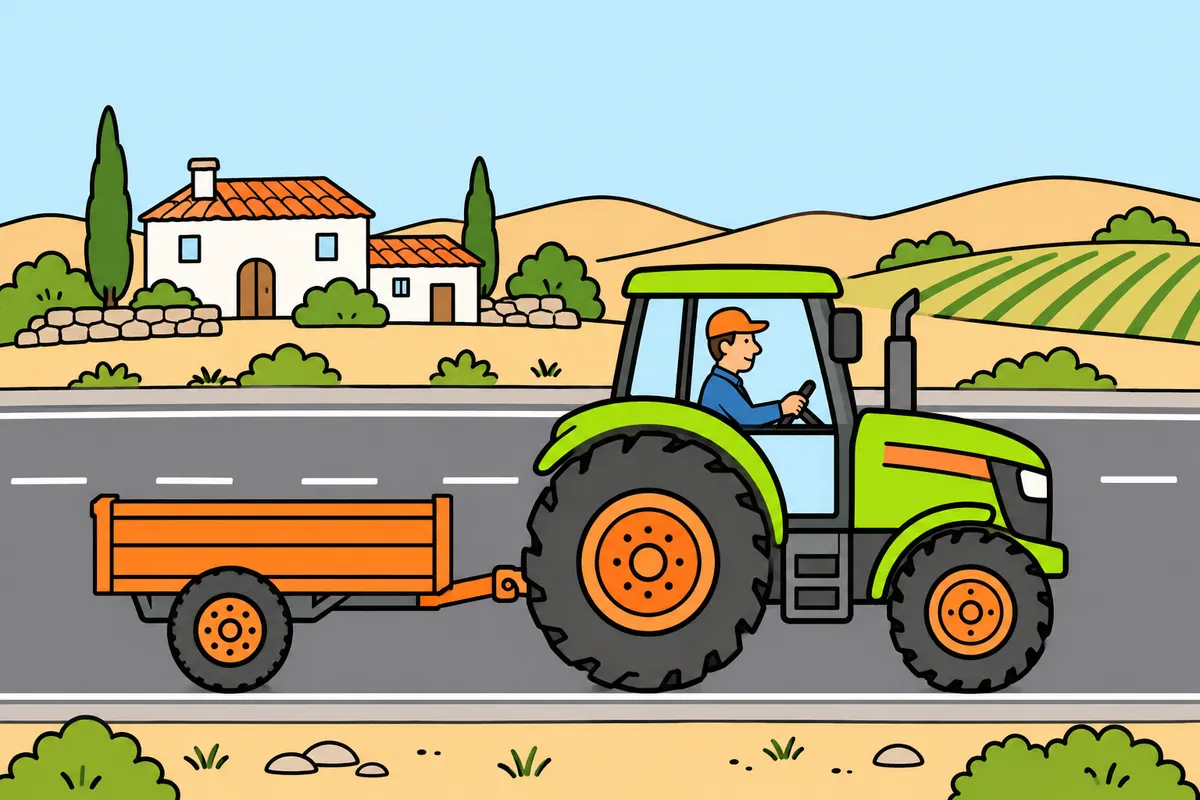
1Road and highway
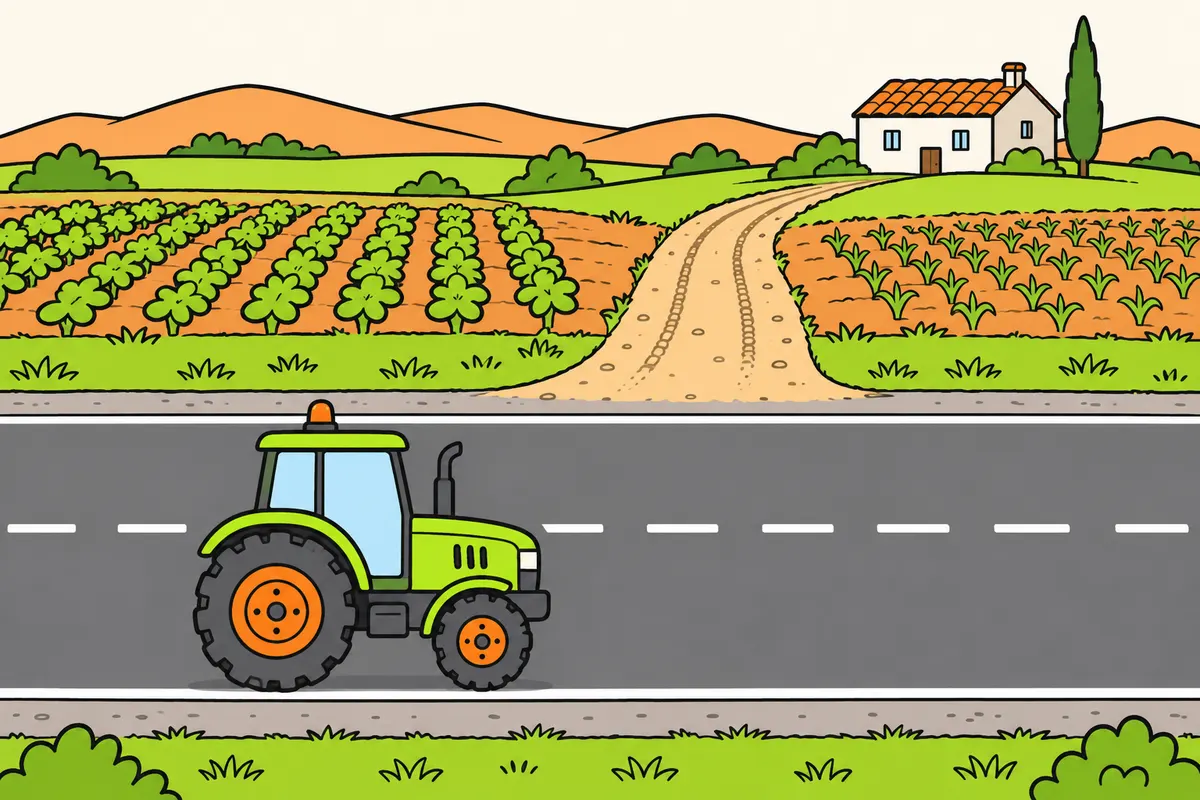
Distinguish highways from other roads by their surface and location.
| Road type | What to recognise |
|---|---|
| Highway | Paved public road outside a built-up area, except through roads |
| Interurban road | Public road outside a built-up area; paving is not required |
Remember
- A highway is paved, public and outside a built-up area, except through roads.
- An interurban road is public and outside a built-up area; paving is not required.
- Crops around a road do not define its type.
Exam trap: Wrong: every track is a highway. Right: a highway is public and paved, outside a built-up area except through roads.
Read the full explanation
- To interpret a question, you can understand vía (road) as the space used by traffic, including its different areas, rather than just the tarmac beneath your tractor's wheels. A carretera (highway) is a paved public road outside a built-up area, except for its stretches through towns. A dirt track connecting plots of land does not meet this definition of a highway simply because you can drive your agricultural tractor along it. [Traffic Act, Annex I, definition 65](https://www.boe.es/buscar/act.php?id=BOE-A-2015-11722#ani).
- When a question refers to an interurban road, you must identify a public road outside a built-up area. This definition is broader than that of a highway: paving is part of the definition of a highway, but not of an interurban road. You must distinguish the road's classification from the vehicle's classification. A highway running between fields does not become a road reserved for agricultural machinery, and the purpose of your journey does not in itself change the legal nature of the track. [Traffic Act, Annex I, definitions 65 and 72](https://www.boe.es/buscar/act.php?id=BOE-A-2015-11722#ani).
2Road platform and carriageway
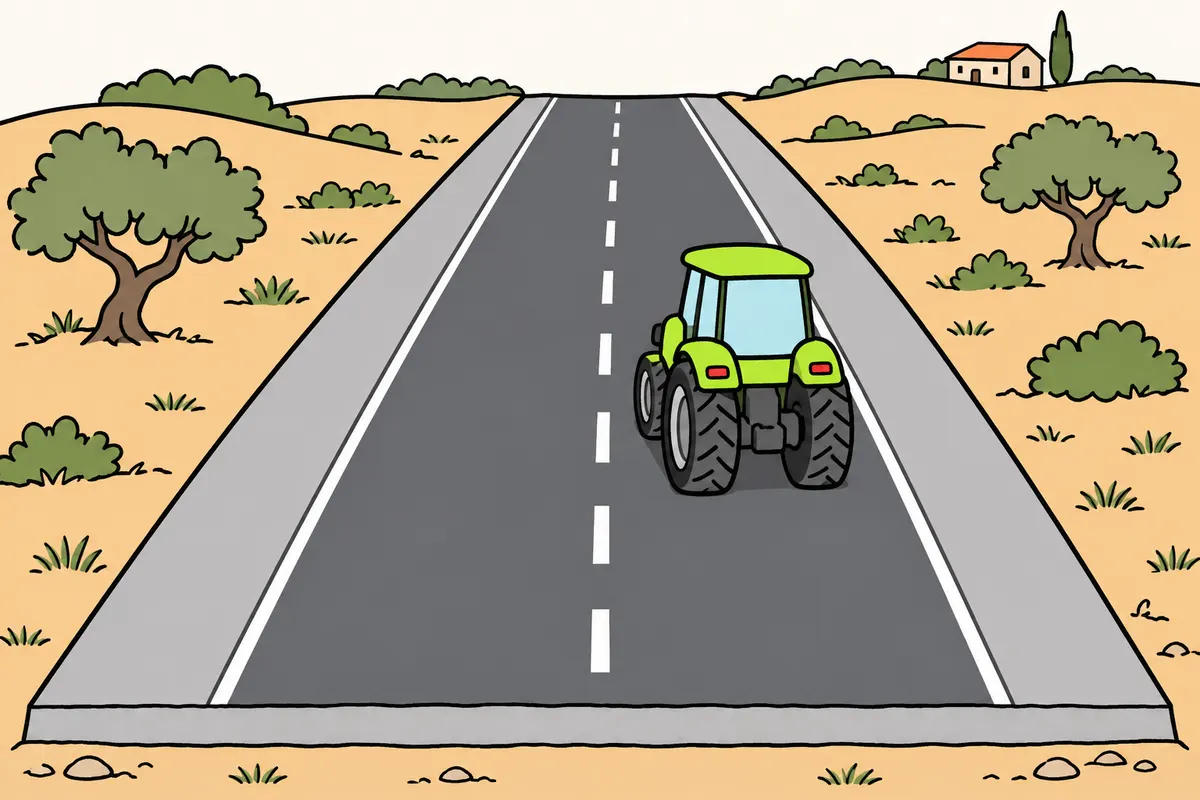
The road platform includes the carriageway and hard shoulders.
| Concept | What it includes |
|---|---|
| Road platform | Carriageway and hard shoulders |
| Carriageway | Lanes for traffic |
Remember
- Identify the carriageway by its lanes.
- Do not confuse the carriageway with a direction of travel.
- A centre line alone does not create separate carriageways.
Exam trap: Wrong: the platform and carriageway are the same. Right: the platform also includes the hard shoulders.
Read the full explanation
- The road platform is the area of the highway intended for use by vehicles, consisting of the carriageway and the arcenes (hard shoulders). If a diagram shows a central carriageway and hard shoulders at the sides, the road platform includes both parts; it is not just the space between the edge markings. The carriageway is the part of the highway used by vehicles for travelling and consists of lanes. You can find a road with a single carriageway for both directions or with separate carriageways for each direction: carriageway and direction do not mean the same thing. [Traffic Act, Annex I, definitions 54 and 55](https://www.boe.es/buscar/act.php?id=BOE-A-2015-11722#ani).
- If you see a physical separation between two traffic areas, you must assess whether they are separate carriageways. By contrast, a line separating lanes carrying traffic in opposite directions does not automatically turn each half of a conventional highway into a separate carriageway. To answer questions about your tractor's road position, first identify the carriageway, hard shoulder and road platform. Knowing which part is named prevents you from applying a rule for carriageway lanes to the hard shoulder; the specific rules on using these areas are covered in the module «Road use with agricultural vehicles». [Traffic Act, Annex I, definitions 54 and 55](https://www.boe.es/buscar/act.php?id=BOE-A-2015-11722#ani).
3Lanes and longitudinal markings
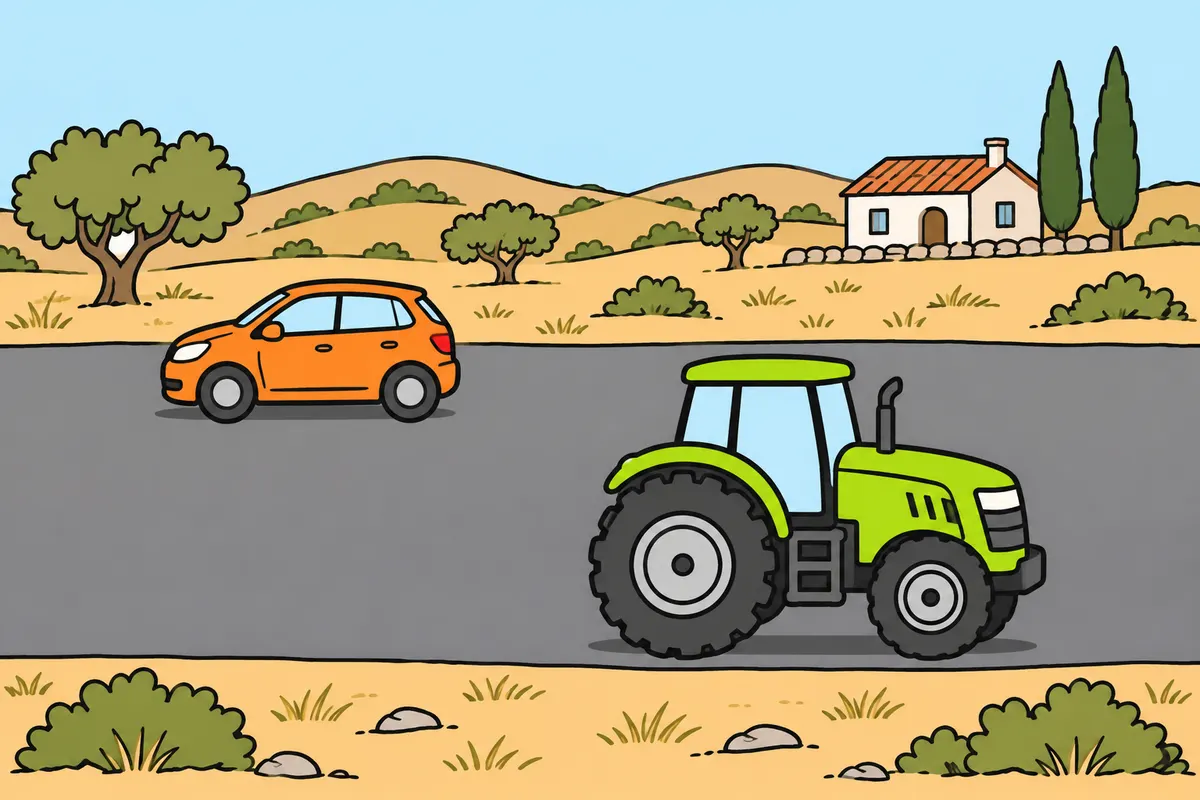
Lanes can exist even when no lines are painted.
Remember
- A lane is wide enough for one line of automobiles other than motorcycles.
- Check how lanes are organised and which directions use them.
Exam trap: Wrong: no paint means no lanes. Right: lanes can exist without painted lines.
Read the full explanation
- A lane is a longitudinal strip of the carriageway wide enough for a single line of automobiles other than motorcycles. Lanes can exist even without painted longitudinal markings. On a rural highway without a centre line, the absence of paint does not prove that the entire carriageway forms a single lane; you must consider its width and how the traffic space is organised. [Traffic Act, Annex I, definition 56](https://www.boe.es/buscar/act.php?id=BOE-A-2015-11722#ani).
- A lane does not necessarily represent a direction of travel. The same carriageway can have several lanes in one direction or lanes for different directions; when you read about two lanes, you must also check how the directions of travel are allocated. [Traffic Act, Annex I, definition 56](https://www.boe.es/buscar/act.php?id=BOE-A-2015-11722#ani).
4Hard shoulder and pedestrian areas
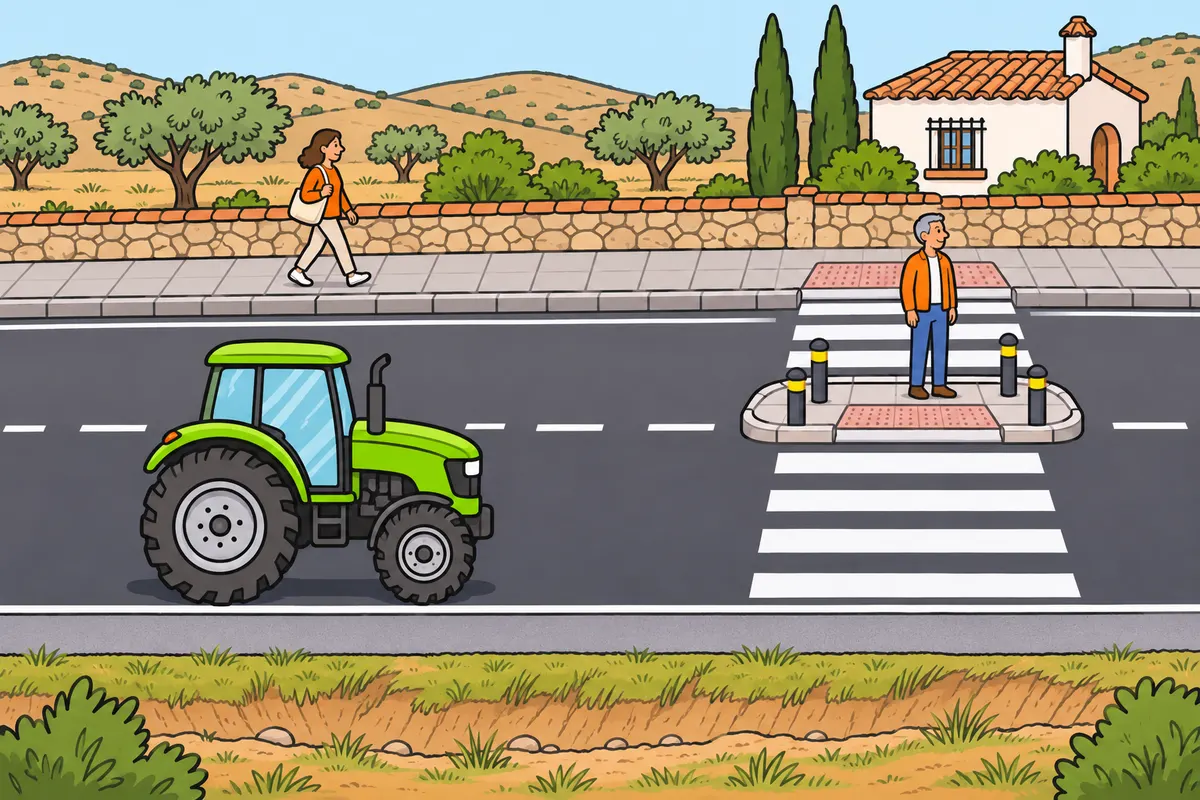
Distinguish the hard shoulder from areas intended for pedestrians.
| Area | What to recognise |
|---|---|
| Hard shoulder | Prepared strip beside the carriageway |
| Pavement | Pedestrian strip, raised or at road level |
| Pedestrian area | Space mainly reserved for pedestrians to move around and spend time |
| Pedestrian refuge | Pedestrian area within the carriageway, protected from traffic |
Remember
- Do not confuse the hard shoulder with a ditch or unprepared ground.
- A pavement may be raised or level with the road.
- A refuge is on the carriageway and protected from traffic.
- Your agricultural tractor is not an automobile.
- That alone does not tell you whether to use the hard shoulder.
Exam trap: Wrong: every pavement has a kerb. Right: a pavement may be level with the road.
Read the full explanation
- The hard shoulder is a longitudinal strip with a prepared surface alongside the carriageway. You must distinguish it from a ditch, unprepared ground or a pavement; being at the side of the highway does not give them all the same definition. The definition of the hard shoulder states that it is not intended for use by automobiles except in exceptional circumstances. An agricultural tractor is a special vehicle and falls outside the definition of an automobile; that statement alone does not determine which special vehicles must use the hard shoulder. [Traffic Act, Annex I, definitions 58, 60 and 61](https://www.boe.es/buscar/act.php?id=BOE-A-2015-11722#ani).
- A pavement is a longitudinal area intended for pedestrian traffic and can be raised or at the same level. You must avoid identifying it solely by a high kerb: its intended use by pedestrians forms part of its definition and does not depend on a visible step. A pedestrian area is the part of the street that is raised or otherwise delimited and reserved primarily for pedestrians to move around and spend time in. It includes pavements, squares, boulevards, promenades and pedestrian platforms: you can also find it in large spaces, as well as along the sides of the road. A pedestrian refuge is a pedestrian area within the carriageway, protected from vehicular traffic. When you see an island designed for a person to wait on, distinguish the refuge from the lane and the hard shoulder; these are not equivalent spaces for driving an agricultural vehicle. [Traffic Act, Annex I, definitions 58 to 61](https://www.boe.es/buscar/act.php?id=BOE-A-2015-11722#ani).
5Built-up areas and urban roads
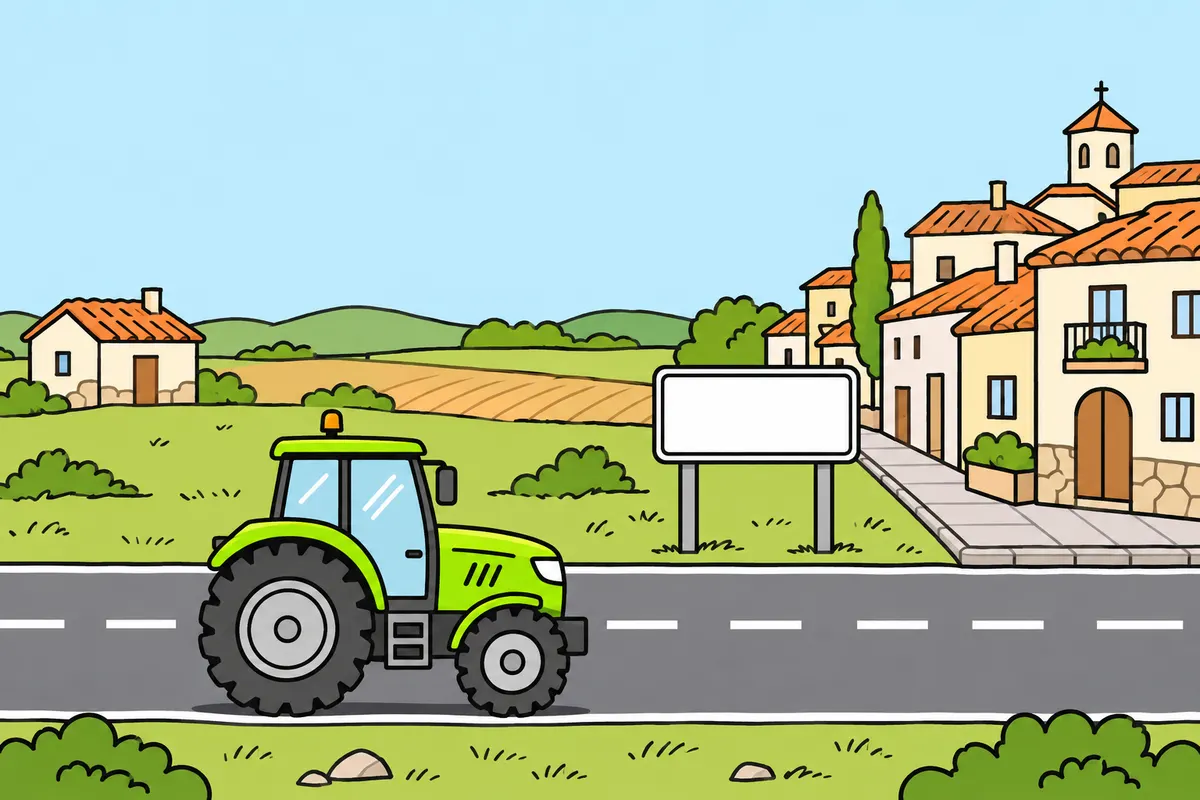
Entry and exit signs mark a built-up area.
| Public road | Location |
|---|---|
| Urban | Inside a built-up area, except through roads |
| Interurban | Outside a built-up area |
Remember
- An isolated house does not make a built-up area.
- Do not confuse the municipal boundary with the built-up area.
- An urban road is inside a built-up area, except through roads.
Exam trap: Wrong: every road in a built-up area is urban. Right: through roads are excluded from urban roads.
Read the full explanation
- A built-up area comprises a space containing buildings, with signs marking entry to and exit from the built-up area. You must use this legal boundary; finding an isolated house or an agricultural building beside the highway is not enough to classify the place as a built-up area. An urban road is a public road within a built-up area, excluding stretches of highway through a town. This exception matters when you compare a street with a stretch of highway running through a town: both are within the built-up area, but they do not necessarily have the same legal designation. [Traffic Act, Annex I, definitions 70, 72 and 73](https://www.boe.es/buscar/act.php?id=BOE-A-2015-11722#ani).
- In a question about a journey from your farm to the town, you must distinguish three reference points: the municipal boundary, the entrance to the built-up area and the type of road. These boundaries are not interchangeable; you study the speed limits for each situation in «Speed and distances for agricultural vehicles». [Traffic Act, Annex I, definitions 70, 72 and 73](https://www.boe.es/buscar/act.php?id=BOE-A-2015-11722#ani).
6Stretches of road through towns and bypasses
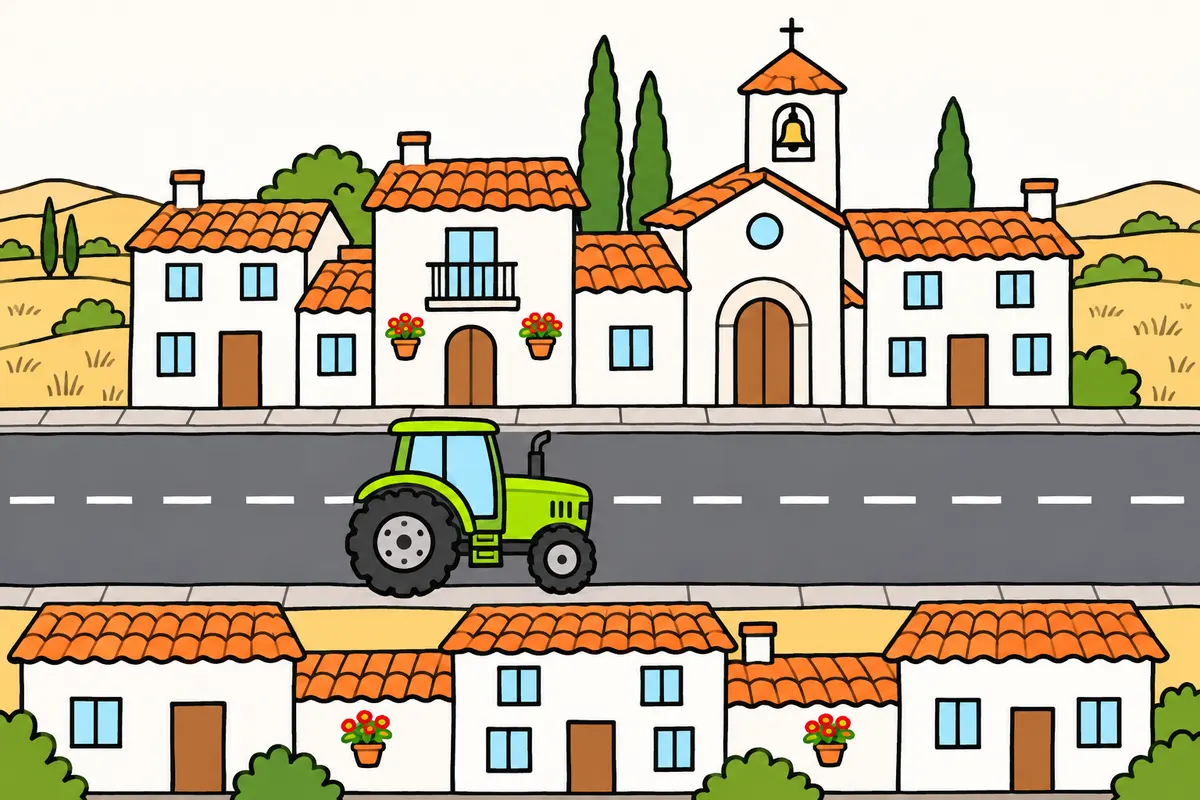
Identify a highway through a built-up area, then check for an accessible alternative road or bypass.
| Case | Classification |
|---|---|
| Highway through a built-up area with no accessible alternative road or bypass | Stretch of road through a town |
| Section with an accessible alternative road or bypass | Excluded from the definition of a stretch of road through a town |
Remember
- Look for a section of highway inside a built-up area.
- Exclude sections with access to an alternative road or bypass.
Exam trap: Wrong: every highway section in a built-up area is a stretch of road through a town. Right: exclude sections with access to an alternative road or bypass.
Read the full explanation
- A travesía is a stretch of road through a town: a section of highway running through a built-up area. The definition excludes sections with an accessible alternative road or bypass. [Traffic Act, Annex I, definitions 65 and 70 to 73](https://www.boe.es/buscar/act.php?id=BOE-A-2015-11722#ani).
- To distinguish a stretch of road through a town from a highway outside a built-up area, you must first locate the built-up area. To distinguish it from an urban road, you must assess its status as a section of highway and the exception concerning an alternative road or bypass; these are separate checks. [Traffic Act, Annex I, definitions 65 and 70 to 73](https://www.boe.es/buscar/act.php?id=BOE-A-2015-11722#ani).
7Autopista motorway
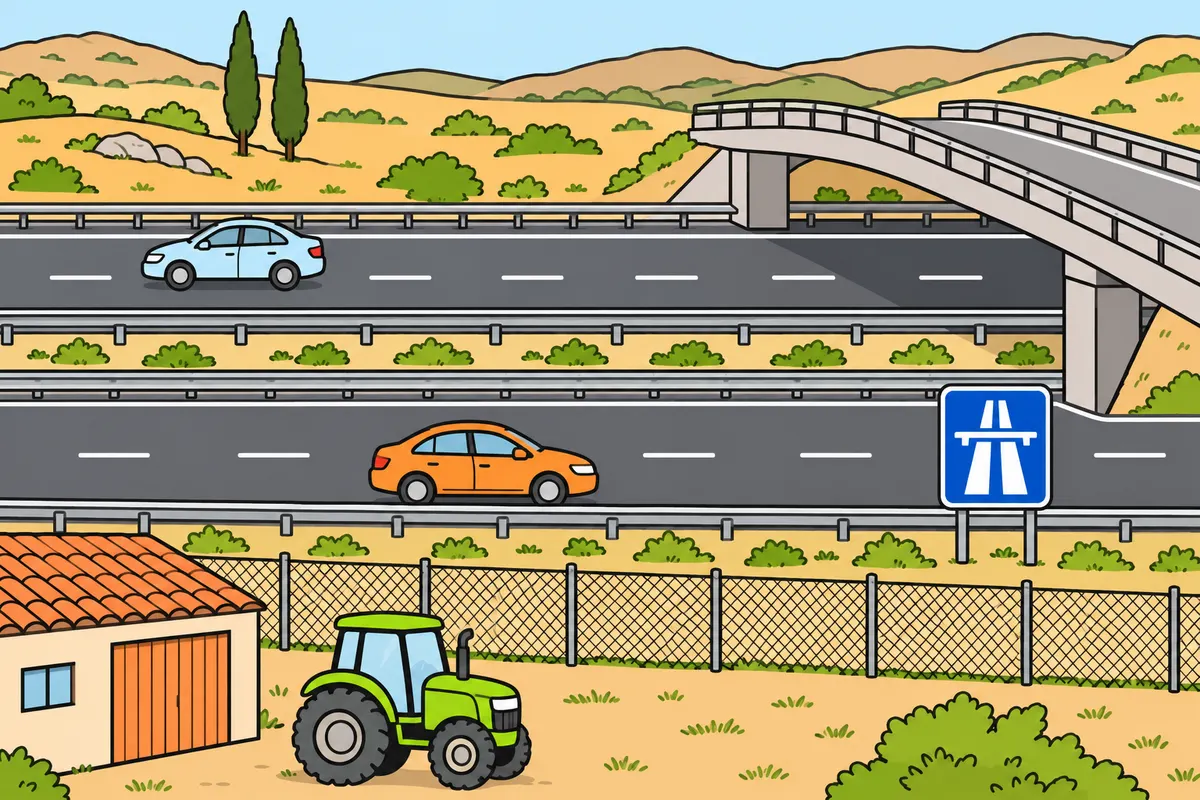
A motorway is defined by all its features, not just its lanes.
Remember
- It is designed, built and signed for automobiles only.
- Adjoining properties have no direct access.
- It has no at-grade crossings.
- It has separate carriageways by direction, except at particular locations or temporarily.
- Land without traffic normally separates them; exceptionally, other means do.
- Your agricultural tractor is special, not an automobile.
Exam trap: Wrong: several lanes alone identify a motorway. Right: check all the legal features.
Read the full explanation
- An autopista (motorway) is a road designed, built and signposted exclusively for use by automobiles. Its definition combines its intended use and its characteristics; seeing several lanes or a central reservation is not enough on its own to identify a road legally as an autopista. Adjoining properties have no access to the autopista. Direct access from a property is different from an interchange on the road itself: a farm beside an autopista does not gain a direct entrance to it simply because it is nearby. [Traffic Act, Annex I, definitions 13 and 66](https://www.boe.es/buscar/act.php?id=BOE-A-2015-11722#ani).
- An autopista has no crossings at the same level with other roads, paths, railways or tramways. Grade separation allows its route to cross another road without vehicles on the two routes meeting at the same point on the carriageway. It has separate carriageways for each direction, separated by land not intended for traffic or, exceptionally, by other means, subject to the statutory exceptions for particular locations or temporary situations. [Traffic Act, Annex I, definitions 13 and 66](https://www.boe.es/buscar/act.php?id=BOE-A-2015-11722#ani).
8Autovía and roads reserved for automobiles
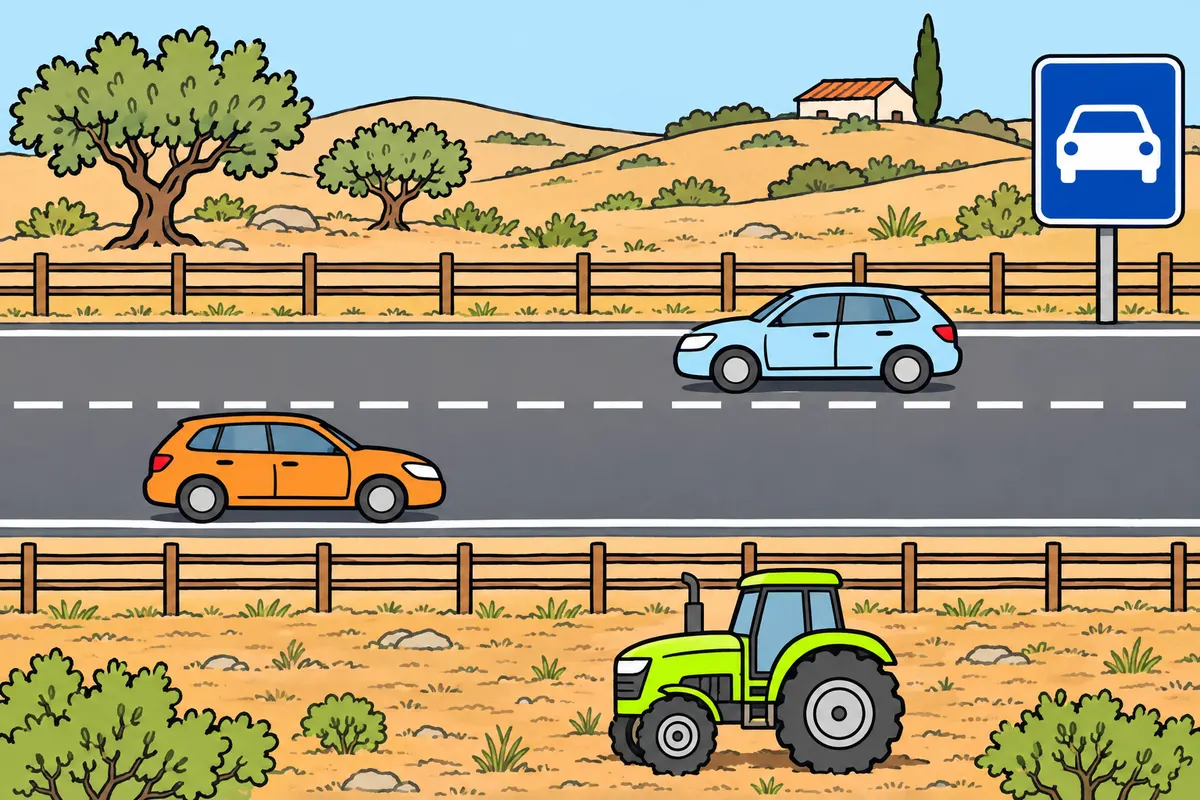
These road types differ in carriageways and access from adjoining properties.
| Road type | Feature |
|---|---|
| Autovía | Limited access from adjoining properties |
| Road reserved for automobiles | Automobiles only; one carriageway; no access from adjoining properties |
Remember
- Do not use tolls to distinguish an autopista from an autovía.
- An autovía is designed, built and signed as such.
- An autovía has separate carriageways and no at-grade crossings.
- A conventional road does not meet the definition of the other road types.
Exam trap: Wrong: one carriageway means one lane. Right: a road reserved for automobiles may have several lanes.
Read the full explanation
- An autovía (dual carriageway motorway) is also a road specifically designed, built and signposted as such, with separate carriageways for each direction and no crossings at the same level with other paths, roads, railways or tramways. Its carriageways are separated by a strip of land not used by traffic or by other means, except at particular locations or temporarily. On an autovía, access from adjoining properties is limited. [Traffic Act, Annex I, definitions 66 to 69](https://www.boe.es/buscar/act.php?id=BOE-A-2015-11722#ani).
- A road reserved for automobiles is exclusively for automobiles, has a single carriageway and has no access from adjoining properties. You must remember that it has a single carriageway: this does not mean a single lane, and you must not confuse it with an autovía with separate carriageways. A conventional road is one that does not meet the characteristics of an autopista, an autovía or a road reserved for automobiles. You must classify it according to that definition, without assuming that all conventional roads have the same number of lanes, width or layout; access restrictions are covered in «Road use with agricultural vehicles». [Traffic Act, Annex I, definitions 66 to 69](https://www.boe.es/buscar/act.php?id=BOE-A-2015-11722#ani).
9Junctions and level crossings
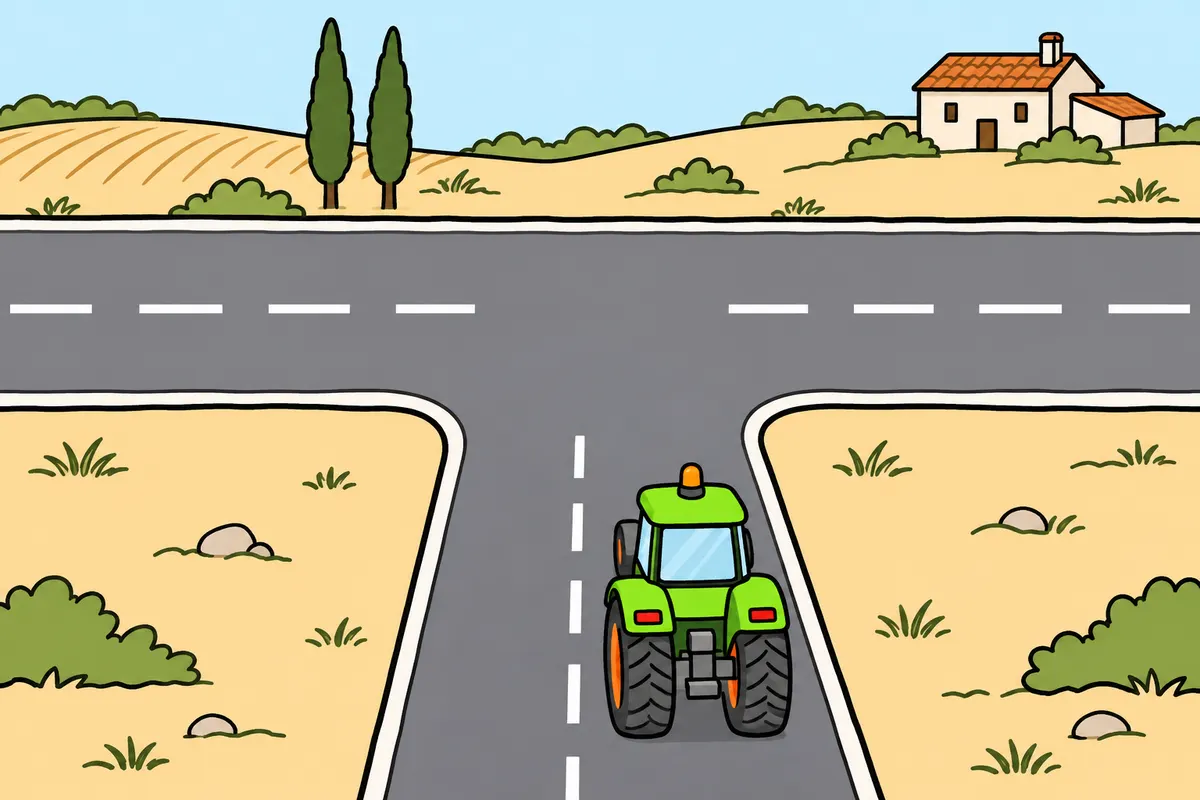
Check whether vehicle paths meet at the same level.
| Concept | What to recognise |
|---|---|
| Junction | All possible vehicle paths meet at the same level |
| Level crossing | Road and railway with separate platforms cross at the same height |
Remember
- A T-shaped meeting can be a junction.
- A bridge over another road does not by itself create a junction.
- A level crossing joins a road and railway at the same level.
Exam trap: Wrong: every crossing of road lines is a junction. Right: check whether vehicle paths meet at the same level.
Read the full explanation
- A junction is a node in the road network where all possible crossings of vehicle paths take place at the same level. You must think about the paths that can meet, rather than just a diagram of two roads forming a cross. You can recognise a junction at a T-shaped meeting of roads: four arms are not necessary. The determining factor is that the roads meet and the possible crossings of vehicle paths take place at the same level, regardless of whether your tractor continues straight ahead or turns. [Traffic Act, Annex I, definitions 62 and 64](https://www.boe.es/buscar/act.php?id=BOE-A-2015-11722#ani).
- A bridge carrying one road over another does not, simply because their routes cross, create a junction at the same level between them. The vehicle paths only meet if there is a connection between the roads. A level crossing is a crossing at the same level between a road and a railway line on its own trackbed. You must distinguish this concept from a junction between roads for vehicles and from a bridge over a railway; priority is covered in «Priority of passage». [Traffic Act, Annex I, definitions 62 and 64](https://www.boe.es/buscar/act.php?id=BOE-A-2015-11722#ani).
10Roundabouts
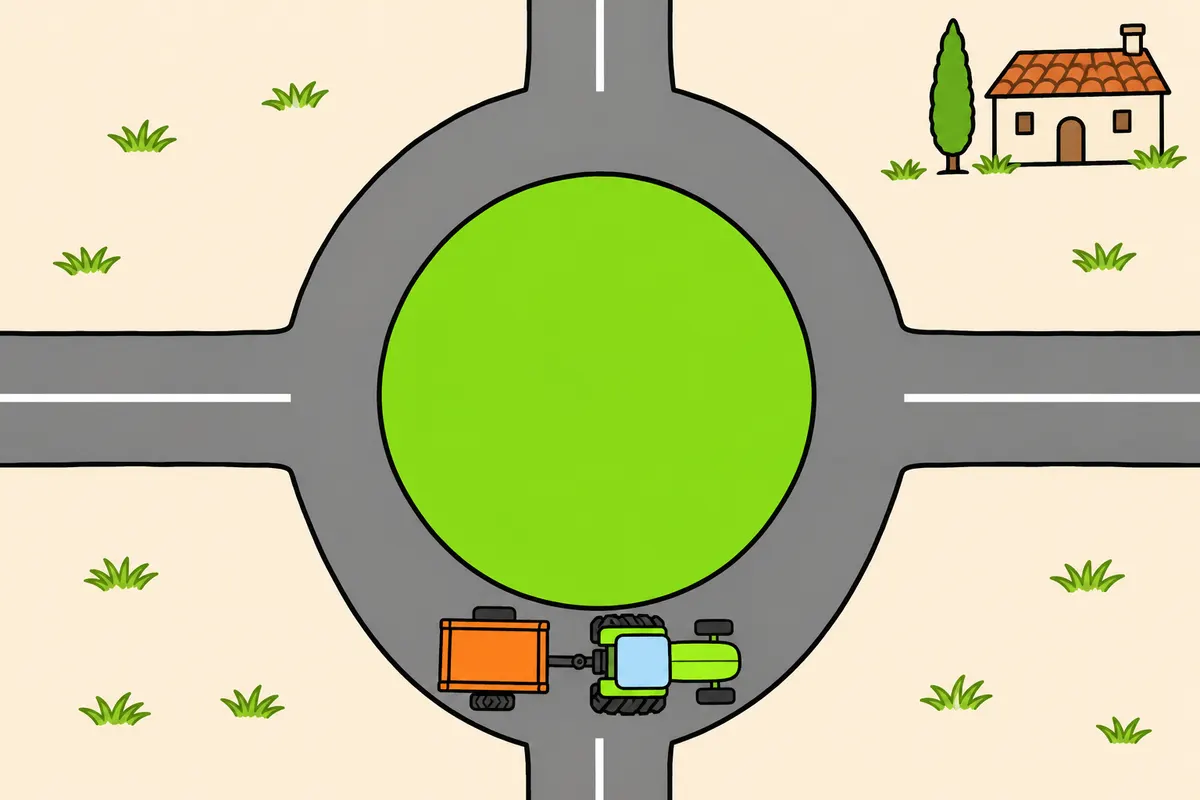
A roundabout has a ring around its central island.
| Type | Route |
|---|---|
| Roundabout | Road sections connect by a ring around the island |
| Split roundabout | Road sections join directly across the island |
Remember
- An island by itself does not make a roundabout.
- Follow the route around the ring.
Exam trap: Wrong: a split roundabout is a true roundabout. Right: it is not one when roads join directly through the island.
Read the full explanation
- A roundabout is a special junction where the joining road sections connect through a ring surrounding a central island. The ring and the circulating traffic characterise this junction; a simple island in the middle of a road is not enough. Split roundabouts are not true roundabouts when two road sections connect directly through the central island. In that case, some traffic passes through the centre instead of going around it; you must keep this distinction in mind if you are shown a diagram. [Traffic Act, Annex I, definition 63](https://www.boe.es/buscar/act.php?id=BOE-A-2015-11722#ani).
- To identify a roundabout in an image, you must follow the possible route between entrances and exits and check whether it runs around the ring described in the definition. With your tractor and trailer, you must distinguish between recognising a roundabout and carrying out a manoeuvre within it. This section gives you the name of the place; priority, lane use and leaving the roundabout belong to the modules «Priority of passage», «Road use with agricultural vehicles» and «Manoeuvres with agricultural vehicles». [Traffic Act, Annex I, definition 63](https://www.boe.es/buscar/act.php?id=BOE-A-2015-11722#ani).
11Vehicle, motor vehicle and automobile
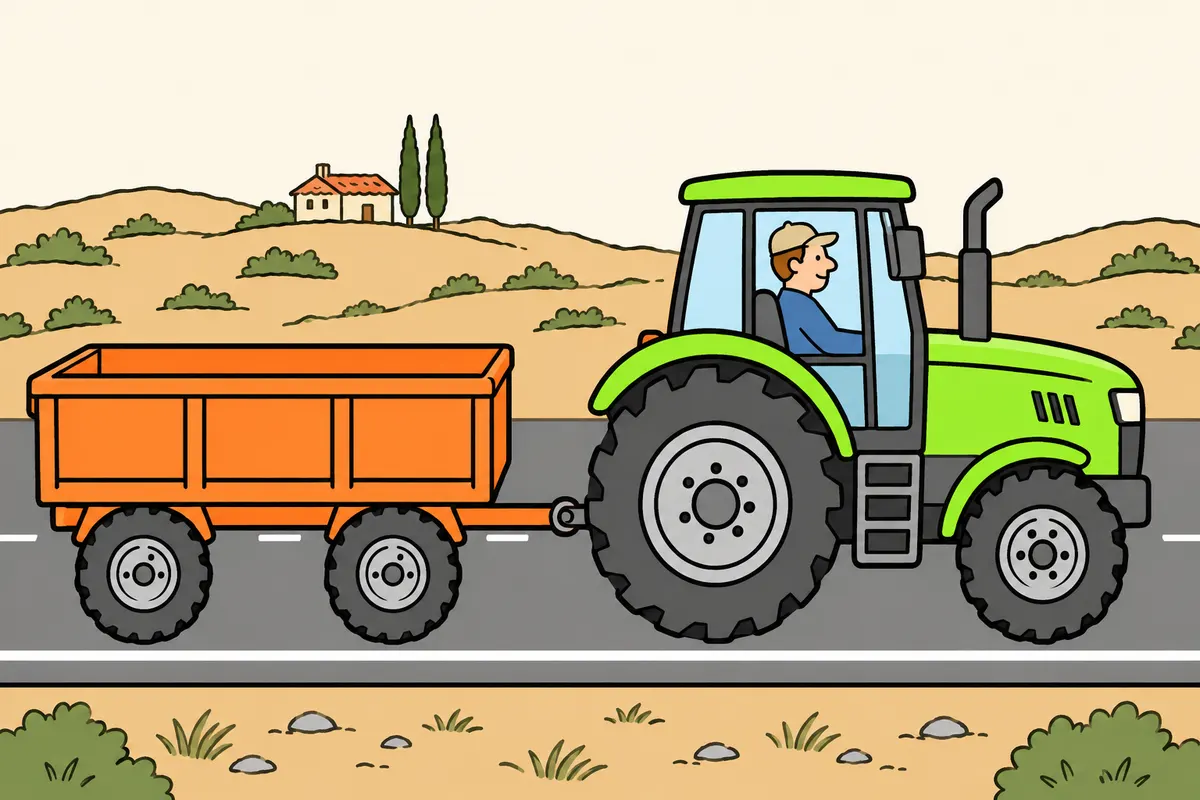
A tractor is a motor vehicle, but it is not an automobile.
| Agricultural vehicle | Classification |
|---|---|
| Self-propelled agricultural tractor | Motor vehicle and special vehicle; not an automobile |
| Agricultural trailer | Towed special vehicle; no own propulsion |
Remember
- A trailer is a vehicle even without an engine.
- Do not confuse special vehicles with vehicles that have an engine.
- Mopeds, trams and personal mobility vehicles are excluded from motor vehicles.
- Electrically assisted pedal cycles and vehicles for people with reduced mobility are also excluded.
Exam trap: Wrong: every vehicle with an engine is an automobile. Right: special vehicles are excluded from automobiles.
Read the full explanation
- A vehicle is a device capable of travelling on the roads and land to which traffic legislation applies. The category includes self-propelled devices and towed ones: an agricultural trailer is a vehicle even though it has no engine. A motor vehicle has an engine or motor to propel it, but you must take account of the legal exclusions. Under the Reglamento General de Vehículos (General Vehicle Regulations), mopeds, trams, vehicles for people with reduced mobility, electrically assisted pedal cycles and personal mobility vehicles are excluded from this definition. [RGV, Annex II, definitions of vehicle, motor vehicle and automobile](https://www.boe.es/buscar/act.php?id=BOE-A-1999-1826#anii).
- An automobile is a motor vehicle normally intended to transport people or goods, or to tow vehicles for that purpose. Special vehicles are excluded from the automobile category: you must maintain this distinction even though a tractor has an engine, a cab and towing capability. You can classify a self-propelled tractor as a motor vehicle because of its propulsion and as a special vehicle because of its agricultural purpose. [RGV, Annex II, definitions of vehicle, motor vehicle and automobile](https://www.boe.es/buscar/act.php?id=BOE-A-1999-1826#anii).
12Special vehicles and the scope of LVA
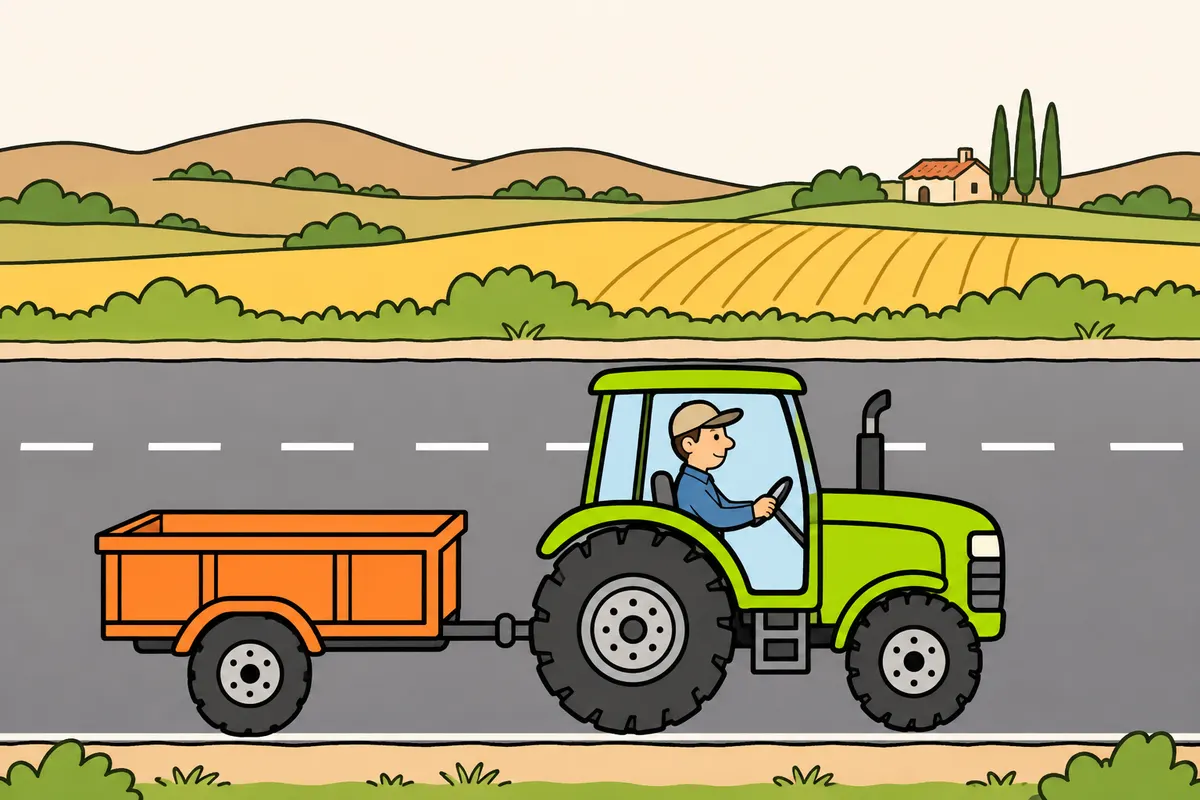
Distinguish a special vehicle from the licence needed to drive it.
| Special vehicle | Purpose |
|---|---|
| Works | Specified works |
| Services | Specified services |
| Agricultural | Agricultural work |
Remember
- A special vehicle can move by itself or be towed.
- The category includes agricultural machinery and its trailers.
- An agricultural tractor can be special with ordinary dimensions.
- Special status does not mean your licence authorises you to drive it.
Exam trap: Wrong: every special vehicle must be very large. Right: agricultural machinery is also special with ordinary dimensions.
Read the full explanation
- A special vehicle can be self-propelled or towed. The definition covers vehicles designed for specific works or services that are exempt from a regulatory technical requirement or permanently exceed the regulatory mass or dimension limits, as well as agricultural machinery and its trailers. This last inclusion allows an agricultural tractor of ordinary dimensions to be classified as a special vehicle; the category does not require every agricultural machine to be exceptionally large. [Traffic Act, Annex I, definition 25](https://www.boe.es/buscar/act.php?id=BOE-A-2015-11722#ani).
- Classification as a special vehicle identifies a technical category; your entitlement to drive it also depends on whether it is agricultural and on the conditions of your licence. You can encounter special vehicles for works, services or agriculture, with different purposes. The specific LVA entitlement and the cases requiring a category B licence are covered in «LVA licence, tests and obeying signs»; for the difference between design speed and driving speed, consult points 1.3 and 1.4 of that module. Here you use these categories to identify the vehicle described in the question. [Traffic Act, Annex I, definitions 25 to 34](https://www.boe.es/buscar/act.php?id=BOE-A-2015-11722#ani).
13Agricultural tractor and tractor unit
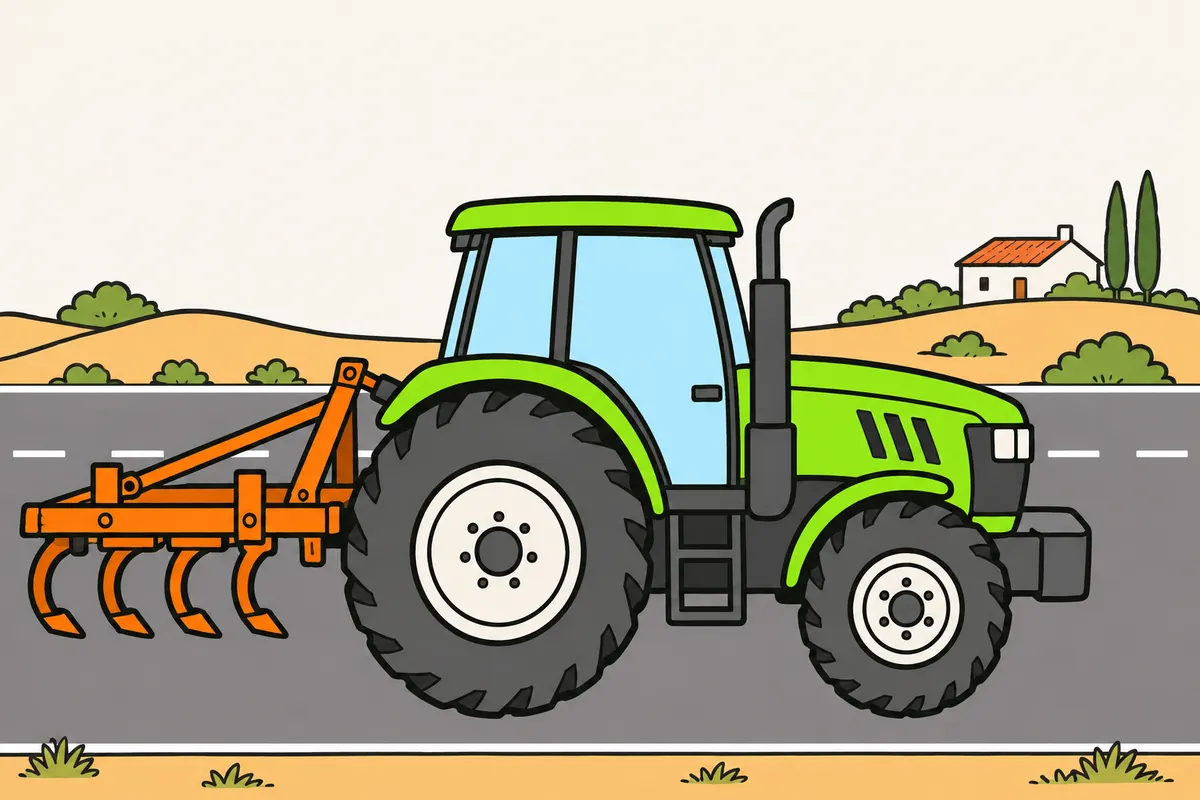
An agricultural tractor and a tractor unit are different vehicle types.
| Vehicle | Definition |
|---|---|
| Agricultural tractor | Self-propelled special vehicle; two or more axles; agricultural functions |
| Tractor unit | Automobile mainly designed to tow a semi-trailer |
Remember
- An agricultural tractor can tow, push, carry or power farm equipment.
- Do not identify it only by its wheels or appearance.
- Distinguish agricultural tractors from works and service tractors.
Exam trap: Wrong: LVA lets you drive a tractor unit. Right: a tractor unit is an automobile, not an agricultural tractor.
Read the full explanation
- An agricultural tractor is a self-propelled special vehicle with two or more axles, designed to tow, push, carry or power agricultural implements, machinery or trailers. It can work with an implement carried or powered by the tractor itself, as well as tow machinery: the definition covers these different forms of agricultural use. [Traffic Act, annex I, definition 28](https://www.boe.es/buscar/act.php?id=BOE-A-2015-11722#ani).
- A tractor unit is an automobile designed mainly to tow a semi-trailer. You must distinguish it from an agricultural tractor: sharing the function of towing does not put both vehicles in the same category or entitle you to drive a tractor unit with an LVA licence. A works tractor, which is self-propelled and has two or more axles, is designed to tow or push works tools, machines or vehicles, while a service tractor, also self-propelled with two or more axles, is designed to tow or push service vehicles, wagons or other equipment. You must distinguish them from an agricultural tractor by their legal design purpose, even if they look similar. [Traffic Act, annex I, definitions 23 and 26 to 28](https://www.boe.es/buscar/act.php?id=BOE-A-2015-11722#ani).
14Walking tractor
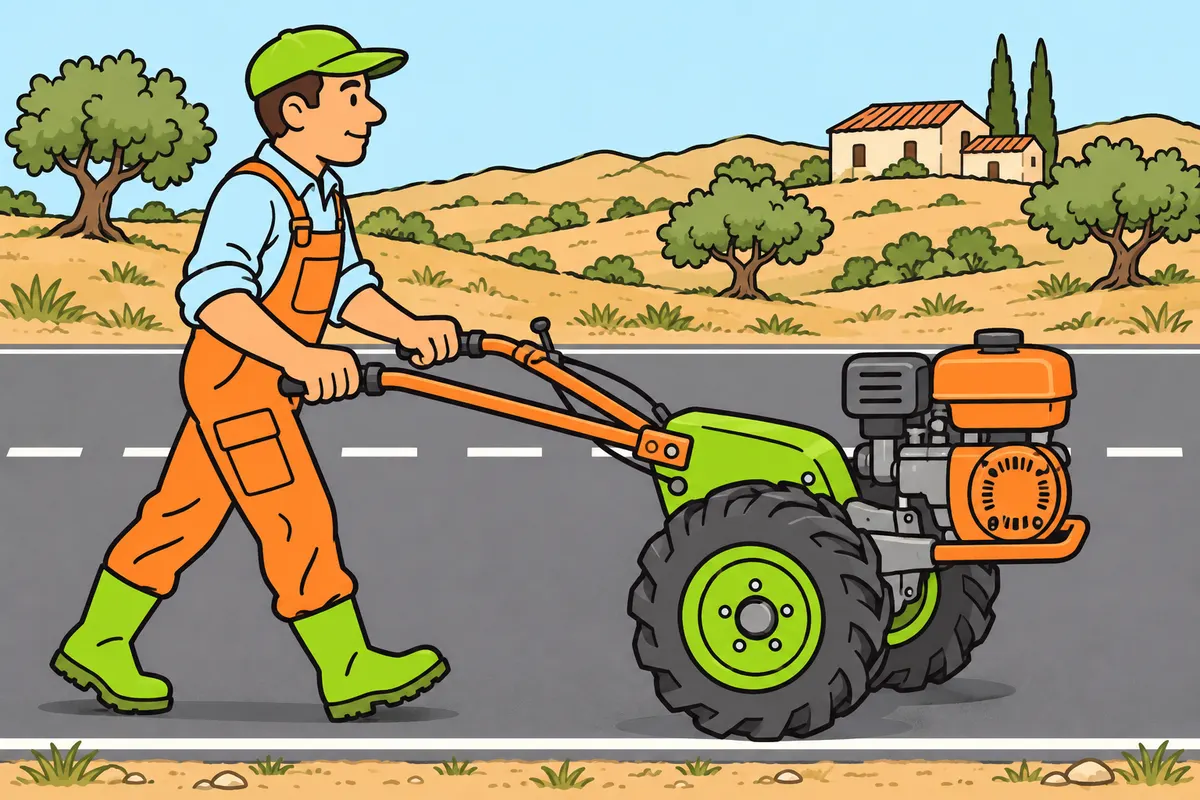
A walking tractor has one axle and is steered with handlebars.
Remember
- It is a self-propelled special vehicle with one axle.
- You can steer it while walking using its handlebars.
- Some setups allow you to steer it from a seat.
- If you control it while walking, you are its driver.
Exam trap: Wrong: every walking tractor is always driven on foot. Right: some have a seat on a trailer, agricultural machine, implement or auxiliary wheeled frame.
Read the full explanation
- A walking tractor is a self-propelled special vehicle with one axle that you can steer using handlebars while walking behind it. You must associate handlebars with the machine's control arms, without confusing this vehicle with a bicycle or a two-axle agricultural tractor. Certain walking tractors can also be steered from a seat fitted to a trailer, agricultural machine, implement or auxiliary wheeled frame. [Traffic Act, annex I, definitions 1, 4, 28 and 29](https://www.boe.es/buscar/act.php?id=BOE-A-2015-11722#ani).
- When you operate a walking tractor by its handlebars while walking, you must recognise that you are acting as the driver. Walking does not make you a pedestrian if you are in control of the vehicle; the exception for someone walking a cycle or moped does not automatically extend to a walking tractor. To distinguish a walking tractor from an agricultural tractor in a test, you must check the number of axles and the steering system described. Use in a vegetable plot can be a clue, but the crop where it is used does not replace its legally defined characteristics. [Traffic Act, annex I, definitions 1, 4, 28 and 29](https://www.boe.es/buscar/act.php?id=BOE-A-2015-11722#ani).
15Self-propelled machine, carrier and agricultural transporter
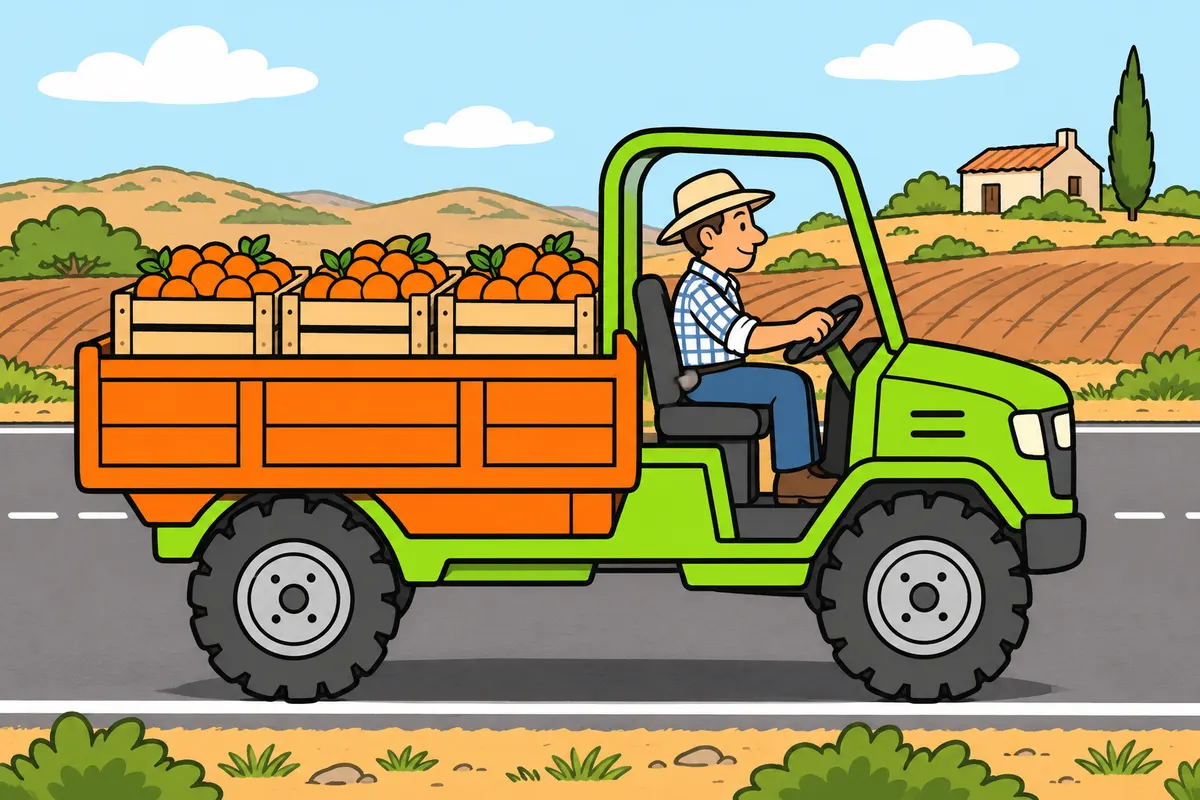
Classify agricultural machines by the work they were built to do.
| Agricultural vehicle | Purpose |
|---|---|
| Self-propelled agricultural machine | Does farm work using its own power |
| Carrier | Carries agricultural machines using its own power |
| Tractocarro | Carries agricultural produce in the field |
Remember
- These vehicle types have two or more axles.
- Do not call every tractor carrying a load an agricultural transporter.
- Use its designed purpose, not just today’s task.
Exam trap: Wrong: any loaded tractor is a tractocarro. Right: a tractocarro is built to carry farm produce in the field.
Read the full explanation
- A self-propelled agricultural machine is a self-propelled special vehicle with two or more axles, built to carry out agricultural work. You can think of a combine harvester as an example to help you learn: you must note that it performs the work and has its own propulsion. A carrier is also a self-propelled special vehicle and has two or more axles, but is designed to carry agricultural machines. You must distinguish carrying a machine from towing it: this specific function explains why the regulations give this vehicle its own name. [Traffic Act, annex I, definitions 30 to 32](https://www.boe.es/buscar/act.php?id=BOE-A-2015-11722#ani).
- An agricultural transporter has two or more axles and is specifically designed to transport agricultural produce in the fields. You must distinguish it from an agricultural tractor by the purpose highlighted in its definition, without treating any tractor that occasionally carries a load as an agricultural transporter. The three names describe different design functions: carrying out agricultural work, carrying a machine and transporting produce in the fields. You can use them to interpret a specification sheet or a scenario without deducing the category solely from the occasional task being performed that day. A self-propelled machine can perform its work without towing a transport trailer. [Traffic Act, annex I, definitions 30 to 32](https://www.boe.es/buscar/act.php?id=BOE-A-2015-11722#ani).
16Agricultural trailer and semi-trailer
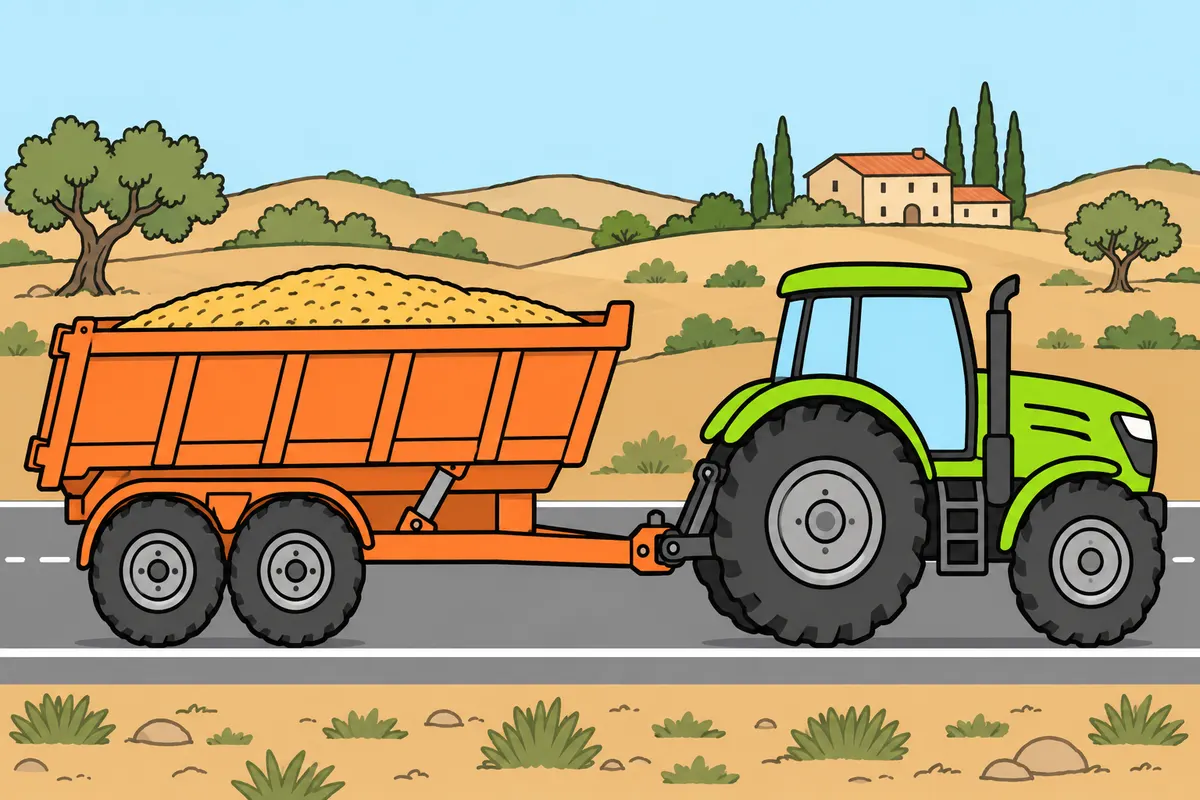
An agricultural trailer transports goods and has no engine of its own.
| Vehicle or general definition | What to recognise |
|---|---|
| Agricultural trailer | Special transport vehicle towed by another vehicle |
| Agricultural semi-trailer | Included in the agricultural trailer definition |
| Semi-trailer: general definition | No own propulsion; partly rests on an automobile, transferring substantial mass to it |
Remember
- It can be towed by a tractor, walking tractor, carrier or self-propelled machine.
- The definition includes agricultural semi-trailers.
- Do not classify agricultural trailers as light by their MMA.
Exam trap: Wrong: an agricultural trailer up to 750 kg MMA is a light trailer. Right: agricultural trailers are excluded from that classification.
Read the full explanation
- An agricultural trailer is a special transport vehicle designed to be towed by an agricultural tractor, walking tractor, carrier or self-propelled agricultural machine. Its function is transport and it depends on a towing vehicle; it has no propulsion of its own. The definition of agricultural trailer includes agricultural semi-trailers. This inclusion determines the group they belong to: their support configuration does not make them automobiles or exclude them from towed agricultural special vehicles. [Traffic Act, annex I, definitions 20 to 22 and 34](https://www.boe.es/buscar/act.php?id=BOE-A-2015-11722#ani).
- The general definition of semi-trailer in definition 22 describes a vehicle without its own propulsion designed to be coupled to an automobile, on which it partly rests and to which it transfers a substantial part of its mass. For the agricultural category, definition 34 expressly includes agricultural semi-trailers within agricultural trailers. The definition of light trailer uses an MMA (maximum authorised mass) of up to 750 kg, but expressly excludes agricultural trailers for this classification. In a scenario about your agricultural combination, the classification depends on the definition applicable to its units and their agricultural purpose, as well as the mass figure given in the question. [Traffic Act, annex I, definitions 20 to 22 and 34](https://www.boe.es/buscar/act.php?id=BOE-A-2015-11722#ani).
17Towed machine and implement
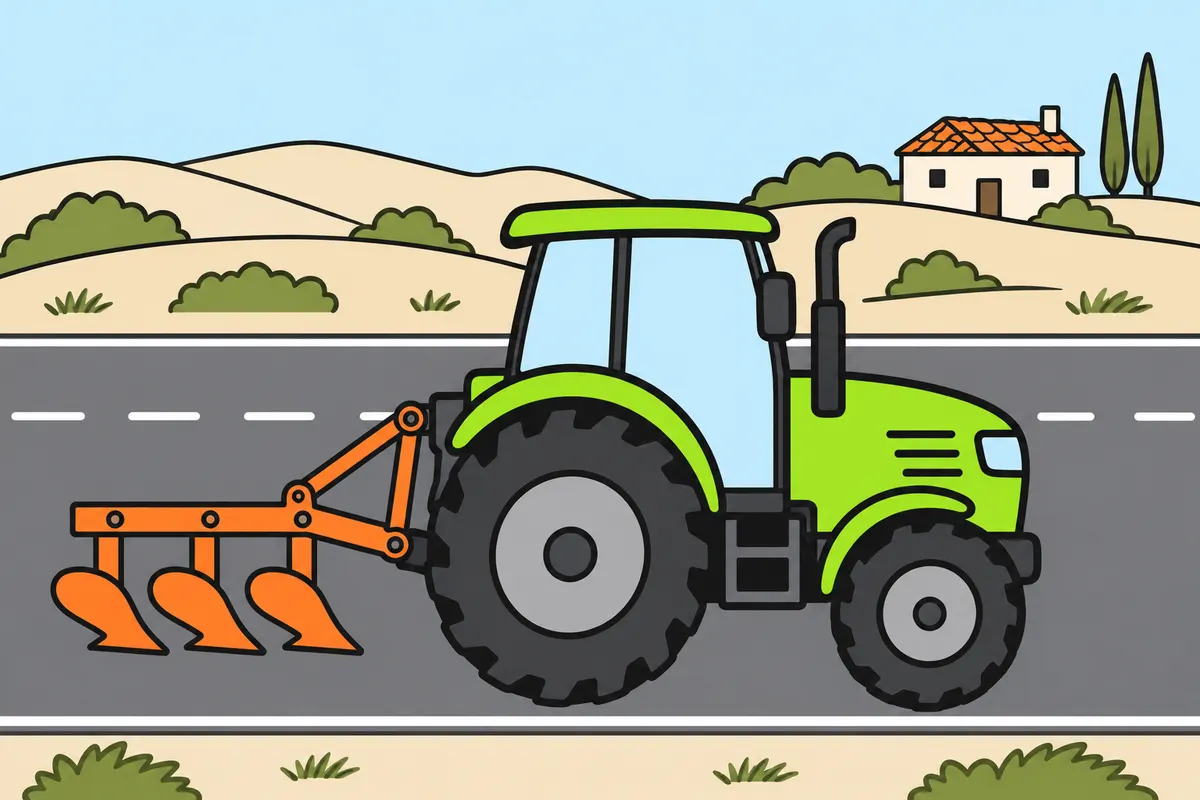
Distinguish a towed agricultural machine from implements and excluded machinery.
| Agricultural item | Definition |
|---|---|
| Towed agricultural machine | Does farm work; needs another vehicle to move and manoeuvre |
| Excluded implement | Unpowered tool for preparing or working the ground; not a vehicle |
| Other excluded towed agricultural machinery | Mass below 750 kg |
Remember
- A towed machine works and needs another agricultural vehicle to move and manoeuvre.
- It may be towed or pushed.
- The mass exclusion says less than 750 kg, not MMA.
- Exactly 750 kg does not meet the mass exclusion.
Exam trap: Wrong: the exclusion is up to 750 kg MMA. Right: it says less than 750 kg of mass.
Read the full explanation
- A towed agricultural machine is designed to carry out agricultural work and needs an agricultural tractor, walking tractor, carrier or self-propelled agricultural machine to tow or push it so that it can move and manoeuvre. Its working function distinguishes it from an agricultural transport trailer. The implements excluded from this definition are agricultural tools or instruments without an engine, intended for ground preparation or cultivation. They are also not considered vehicles for these purposes. [Traffic Act, annex I, definition 33](https://www.boe.es/buscar/act.php?id=BOE-A-2015-11722#ani).
- Other towed agricultural machinery with a mass of less than 750 kg is also excluded from the definition of towed agricultural machine. The legal wording says less than 750 kg: exactly 750 kg does not meet this exclusion based on mass. The exclusion refers to mass, whereas the classification of a non-agricultural light trailer uses MMA and an inclusive limit. In a test, the phrase ‘less than’ leaves the exact limit value outside the exclusion. [Traffic Act, annex I, definition 33](https://www.boe.es/buscar/act.php?id=BOE-A-2015-11722#ani).
18Combinations and vehicles outside LVA
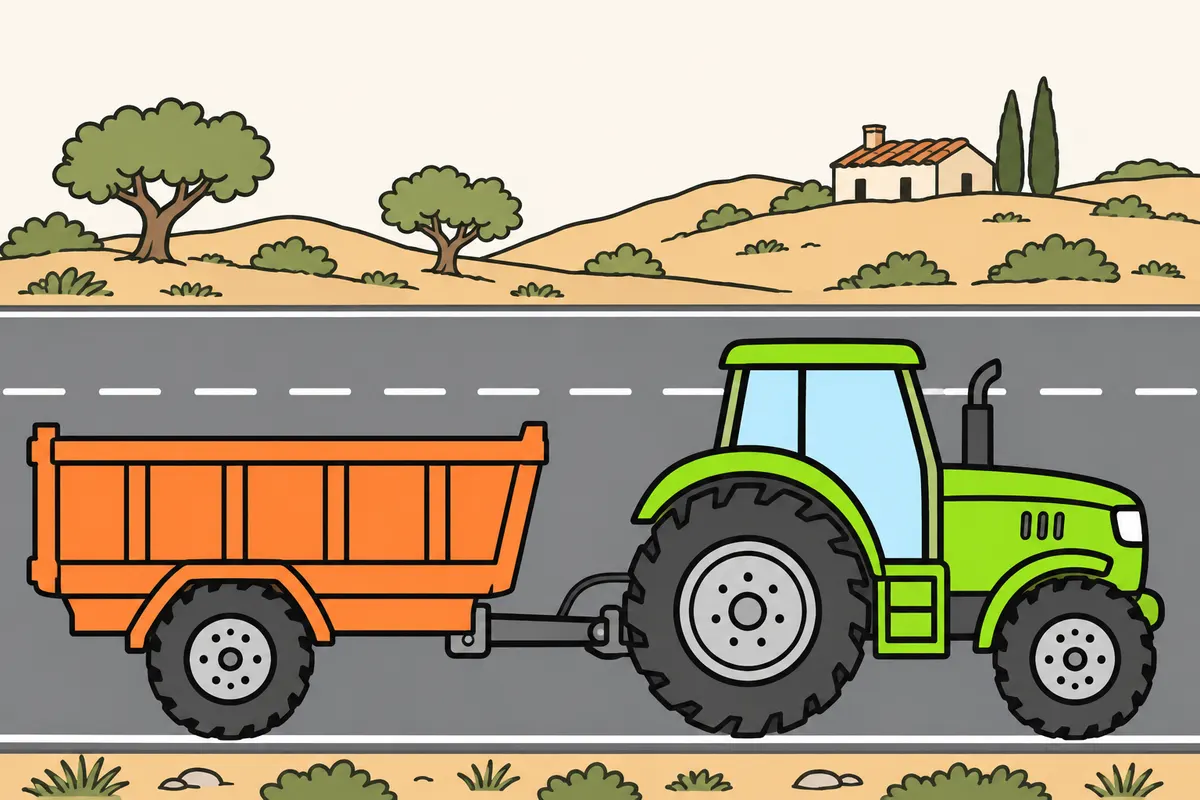
Identify every unit in a combination and distinguish agricultural vehicles from other types.
| Combination | How it is formed |
|---|---|
| Road train | Automobile: motor vehicle coupled to a trailer |
| Articulated vehicle | Automobile: motor vehicle coupled to a semi-trailer |
| Agricultural combination | Tractor coupled to its towed unit |
Remember
- Check the combination when you couple an agricultural trailer.
- Works and service vehicles are not agricultural vehicles.
- A van does not become agricultural because it carries farm produce.
Exam trap: Wrong: farm work makes a works tractor agricultural. Right: it keeps its works vehicle classification.
Read the full explanation
- In the general definitions, a combination of vehicles includes a road train and an articulated vehicle. A road train is an automobile consisting of a motor vehicle hitched to a trailer; an articulated vehicle is an automobile consisting of a motor vehicle coupled to a semi-trailer. These definitions expressly use the word automobile. Your tractor forms an agricultural combination when you drive it coupled to its towed unit; you must identify all its units, as well as the powered machine. [Traffic Act, annex I, definitions 24 to 34](https://www.boe.es/buscar/act.php?id=BOE-A-2015-11722#ani).
- Agricultural vehicles retain their classification according to their construction and purpose. A van carrying produce from a farm remains an automobile in its category; a works tractor retains its works purpose even when working beside a crop. The categories of passenger car, lorry, motorcycle, moped and tractor unit fall outside agricultural special vehicles; driving entitlements and the relationship with B are covered in ‘LVA licence, tests and obeying signs’. [Traffic Act, annex I, definitions 13, 23 and 25 to 34](https://www.boe.es/buscar/act.php?id=BOE-A-2015-11722#ani).
19Tare and laden mass
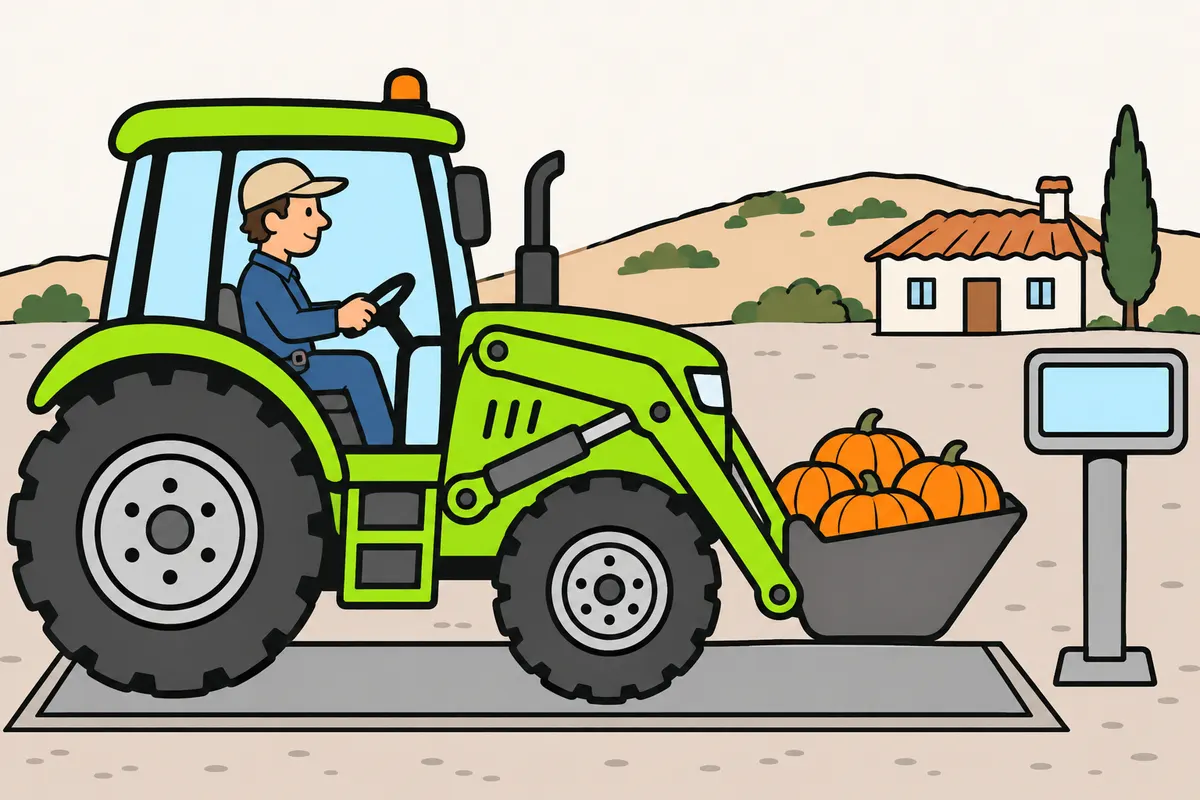
Distinguish tare from the actual mass of the vehicle and everything it carries.
| Mass | What it includes |
|---|---|
| Tare | Vehicle with equipment and supplies, without people or load |
| Laden mass | Actual mass of vehicle and contents, including people |
Remember
- Tare includes authorised fixed equipment and full supplies.
- It includes water, fuel, oil, spare parts, tools and necessary accessories.
- It excludes service staff, passengers and load.
- Compare actual mass with the authorised limits.
Exam trap: Wrong: tare means the vehicle has nothing in it. Right: tare includes the specified fluids and equipment.
Read the full explanation
- Tare is the mass of the vehicle with its authorised fixed equipment, without service personnel, passengers or a load, and with its full supplies of water, fuel, lubricant, spare parts, tools and necessary accessories. You must avoid simplifying this to a vehicle with nothing in it: the specified fluids and equipment do count. Laden mass is the actual mass of the vehicle and everything it carries, including people. You must relate it to what the vehicle actually weighs in a specific situation; it can vary when you load agricultural produce, unload or change the number of occupants. [RGV, Annex IX, points 1.1 and 1.3](https://www.boe.es/buscar/act.php?id=BOE-A-1999-1826#anix).
- A laden mass figure does not, in itself, authorise you to drive with that mass. If your tractor and its contents weigh a certain amount, you must compare this with the relevant limits; the actual figure and the maximum authorised figure answer different questions. In an exercise, you must read whether the question concerns the vehicle without people or a load, the vehicle as actually loaded, or its authorised limit. [RGV, Annex IX, points 1.1 and 1.3](https://www.boe.es/buscar/act.php?id=BOE-A-1999-1826#anix).
20Mass in running order
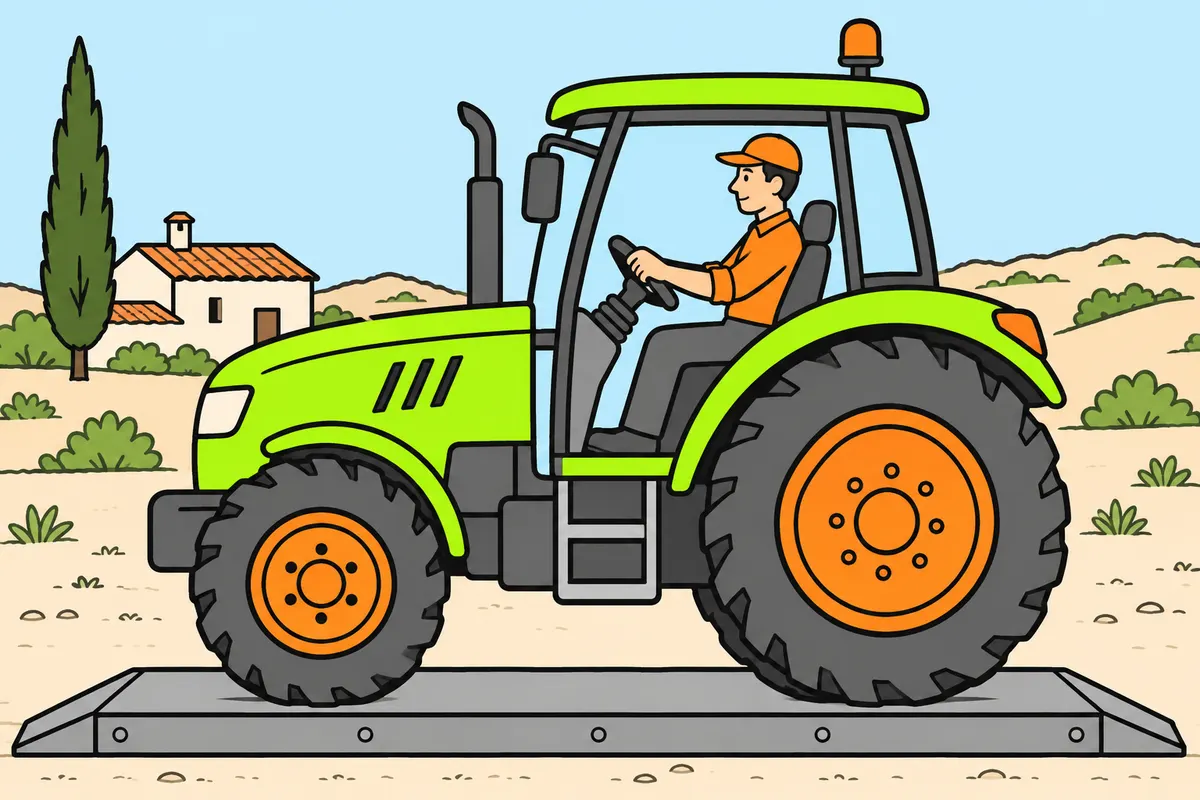
Mass in running order usually adds the standard driver mass to tare.
Remember
- Add 75 kg once.
- Use the standard driver mass, not the actual driver’s mass.
- This does not calculate the MMA or permitted load.
Exam trap: Wrong: mass in running order is the MMA. Right: the general rule adds 75 kg to tare.
Read the full explanation
- Under the general rule in Annex IX, you calculate mass in running order by adding the standard driver mass of 75 kg to the tare. When studying, you must distinguish this conventional value from the actual mass of the person driving on a particular day. If the tare in a learning example is 2,500 kg, the mass in running order under this rule is 2,575 kg. You must add the 75 kg once; this calculation does not give you the MMA (maximum authorised mass) or tell you how much cargo you can legally carry. [RGV, Annex IX, point 1.2](https://www.boe.es/buscar/act.php?id=BOE-A-1999-1826#anix).
- For a tractor, mass in running order provides a reference with its standard driver and supplies, whereas laden mass reflects the vehicle's actual condition during transport. For example, after you collect agricultural produce, the actual mass travelling on the road changes, although the mass in running order reference still describes the same conventional condition. [RGV, Annex IX, points 1.2 and 1.3](https://www.boe.es/buscar/act.php?id=BOE-A-1999-1826#anix).
21MMA and MMTA
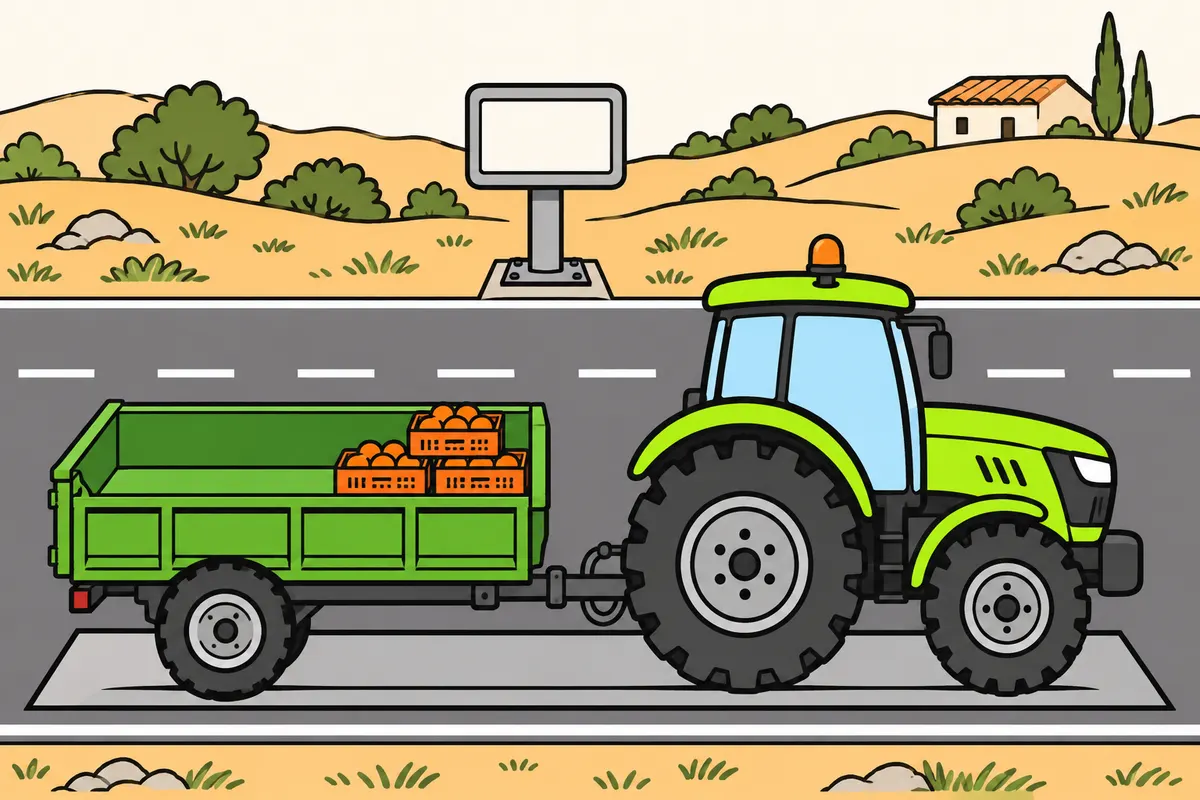
MMA is the authorised road limit; MMTA is the technical limit.
| Concept | Limit |
|---|---|
| MMA | Authorised maximum mass of the loaded vehicle on public roads |
| MMTA | Manufacturer’s maximum technical mass by construction |
Remember
- Do not use a higher technical limit to exceed the MMA.
- The MMA is not the amount of goods you can load.
- Read the technical sheet unit by unit.
- Separate each vehicle’s figures from the complete combination’s figures.
Exam trap: Wrong: a higher MMTA lets you load above the MMA. Right: you must respect the MMA.
Read the full explanation
- The maximum authorised mass, MMA, is the maximum mass at which you are allowed to use the laden vehicle on public roads. You must understand it as a limit for use, rather than the weight of the empty vehicle or the amount of cargo that fits in the load bed. The maximum technically permissible mass, MMTA, is based on the vehicle's construction and is specified by the manufacturer. The technical limit and the authorised limit for road use follow different criteria; having technical capacity does not mean you can use all of it under every set of administrative conditions. [RGV, Annex IX, points 1.6 and 1.7](https://www.boe.es/buscar/act.php?id=BOE-A-1999-1826#anix).
- In an example with an MMA of 5,000 kg and an MMTA of 5,500 kg, you must still identify 5,000 kg as the authorised limit. The 500 kg difference is neither spare load capacity you can use at your own discretion nor a margin you can add to the limit for road use. In an agricultural vehicle's documentation, you can find both authorised and technical values. You can read the technical data sheet by separating the values for each unit from those for the complete combination, and noting which vehicle each figure relates to before comparing it with a loading example. The loading conditions for the combination are covered in «Loads, implements and agricultural traffic». [RGV, Annex IX, points 1.6 and 1.7](https://www.boe.es/buscar/act.php?id=BOE-A-1999-1826#anix).
22Axle and combination masses
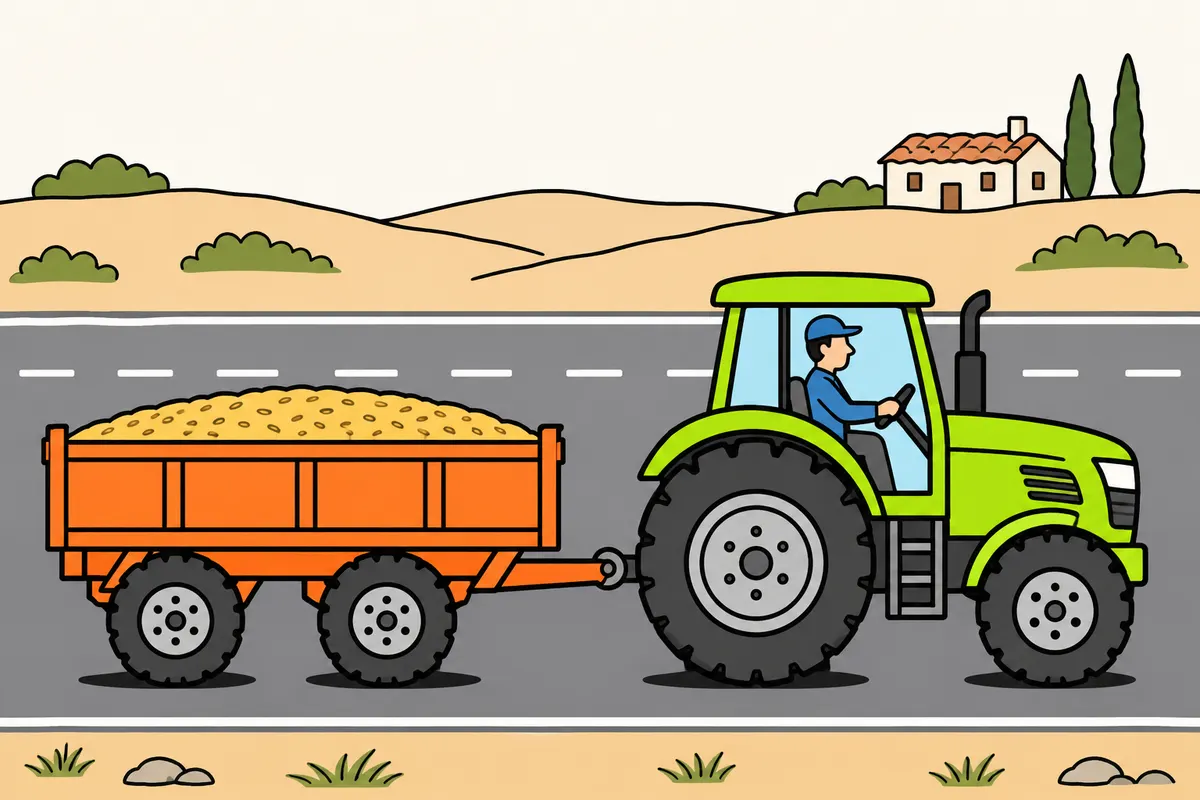
Check axle, combination and towable masses separately.
| Concept | What to recognise for the stated vehicle |
|---|---|
| Axle mass | Mass transmitted to the ground by that axle |
| Maximum authorised combination mass | Maximum use mass of the loaded motor vehicle and trailers or semi-trailers |
| Maximum authorised towable mass | Authorised limit of the unit you may tow |
| Maximum technically permissible combination mass | Maximum based on construction features and performance |
Remember
- Axle mass is transmitted to the ground by all wheels on that axle.
- An implement can change the mass shared between axles.
- Do not confuse the authorised axle limit with the technical limit.
- For semi-trailers and centre-axle trailers, subtract the actual vertical coupling load.
- Subtract it from maximum actual mass to find the mass on the axles.
Exam trap: Wrong: the combination limit is the tractor’s MMA. Right: it includes the loaded motor vehicle and its loaded trailers or semi-trailers.
Read the full explanation
- Axle mass is the mass transmitted to the ground by all the wheels attached to that axle. The tractor's total mass is distributed between its axles; adding an implement can alter that distribution even though you do not change the vehicle's classification. The maximum authorised axle mass limits what that axle or axle group can bear in road use. You must distinguish it from its maximum technically permissible mass, which is determined by construction, just as you distinguish MMA from MMTA for the whole vehicle. [RGV, Annex IX, points 1.4 and 1.8 to 1.13](https://www.boe.es/buscar/act.php?id=BOE-A-1999-1826#anix).
- The maximum authorised mass of the combination is the maximum mass for use on public roads of the laden motor vehicle together with its laden trailers or semi-trailers. You must not confuse it with the MMA of a single unit or the weight of the empty trailer. The maximum authorised towable mass is the maximum authorised mass of the trailer or semi-trailer you can couple, and the maximum at which it can be registered or put into service. For a semi-trailer or centre-axle trailer, you calculate it by subtracting the actual vertical load on the coupling from its maximum actual mass: it corresponds to the mass supported by its axles. The manufacturer sets the maximum technically permissible towable mass according to the construction. You must distinguish how much the tractor can tow from how much the tractor itself can weigh; its application to loading is covered in «Loads, implements and agricultural traffic». The maximum technically permissible mass of the combination is the mass assigned according to its construction characteristics and performance. [RGV, Annex IX, points 1.4 and 1.8 to 1.13](https://www.boe.es/buscar/act.php?id=BOE-A-1999-1826#anix).
23Driver and pedestrian
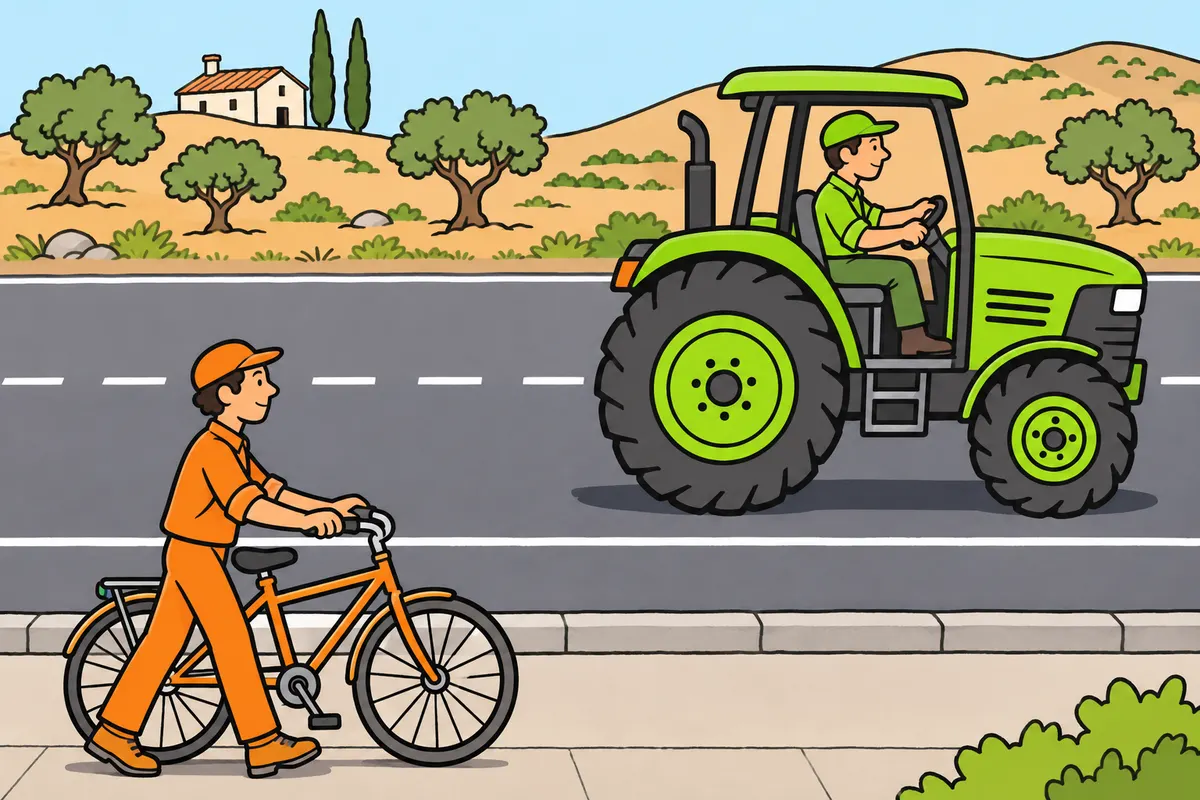
Check what you do and the legal exceptions to identify a driver or pedestrian.
| Situation | Legal status |
|---|---|
| Walking with a two-wheeled cycle or moped | Pedestrian |
| Pushing a child’s car or other small unpowered vehicle | Pedestrian |
| Disabled person using a wheelchair, powered or not, at walking pace | Pedestrian |
Remember
- You are a driver if you control a vehicle, except for pedestrian cases.
- You are also a driver if you are in charge of animals.
- During a lesson, the person using extra controls is the driver.
Exam trap: Wrong: walking a two-wheeled moped makes you a driver. Right: you are a pedestrian.
Read the full explanation
- You are a driver if you steer or are in control of a vehicle, subject to the exceptions in the definition of a pedestrian. You are also a driver if you are in charge of animals. Your status as a driver depends on the role you perform. In a vehicle used for driving instruction, you are legally considered the driver if you are in charge of the additional controls. In a definition question, this role of operating the additional controls lets you identify the driver of the vehicle used for instruction. [LT, Annex I, definitions 1 and 4](https://www.boe.es/buscar/act.php?id=BOE-A-2015-11722#ani).
- You are a pedestrian when you travel on foot without being a driver. You are also included if you walk a two-wheeled cycle or moped, or push or pull a pushchair, a vehicle for a person with a disability, or another small vehicle without a motor. If you have a disability and travel at walking pace in a wheelchair, you are a pedestrian, whether or not the wheelchair has a motor. You must pay attention to all the conditions in the definition and avoid classifying everyone as a driver solely because their means of transport has a motor. [LT, Annex I, definitions 1 and 4](https://www.boe.es/buscar/act.php?id=BOE-A-2015-11722#ani).
24Registered keeper and usual driver
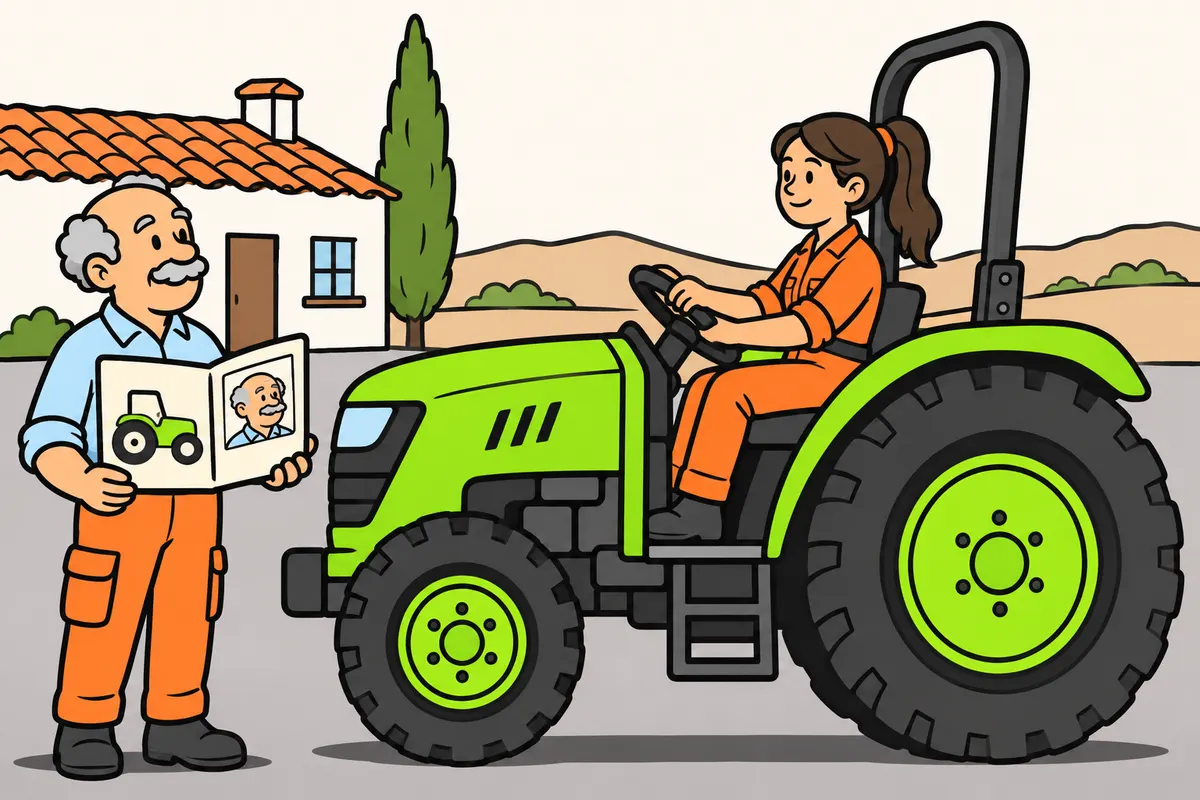
The registered keeper, usual driver and current driver can be different people.
| Person | What to recognise |
|---|---|
| Registered keeper | Person in whose name the vehicle is registered |
| Usual driver | Authorised person who uses it usually, with consent and notification to the register |
| Current driver | Person driving at that moment |
Remember
- You can drive a tractor registered to another person or company.
- A usual driver needs authorisation, regular use, consent and notification to the register.
- An individual keeper without driving authorisation must name a usual driver.
Exam trap: Wrong: using the tractor most often is enough to be its usual driver. Right: you need authorisation, regular use, consent and notification by the keeper or long-term lessee.
Read the full explanation
- You are the vehicle's registered keeper if it is entered in your name in the relevant official register. You can drive a tractor registered in another person's or a company's name; when you do so, you are the driver, and using it does not make you the registered keeper. You are the usual driver if you hold the necessary driving entitlement recorded in the Registro de Conductores e Infractores (Register of Drivers and Offenders) and use the vehicle regularly or most frequently, with your consent and the corresponding notification to the Registro de Vehículos (Vehicle Register) by the registered keeper or long-term lessee. [LT, Annex I, definitions 2 and 5](https://www.boe.es/buscar/act.php?id=BOE-A-2015-11722#ani).
- If you register a vehicle as a private individual without administrative authorisation to drive, you must designate a usual driver. You must not confuse being able to appear as the registered keeper with being allowed to drive it: registered keeper status and driving entitlement are different conditions. To work through an example involving a family farm, you must distinguish whose name the tractor is registered in, who is recorded as its usual driver and who drives it today. All three roles can belong to the same person or to different people; documentation requirements are studied in «Driver and agricultural vehicle documentation». [LT, Annex I, definitions 2 and 5](https://www.boe.es/buscar/act.php?id=BOE-A-2015-11722#ani).
25Compulsory stops, brief stops and parking
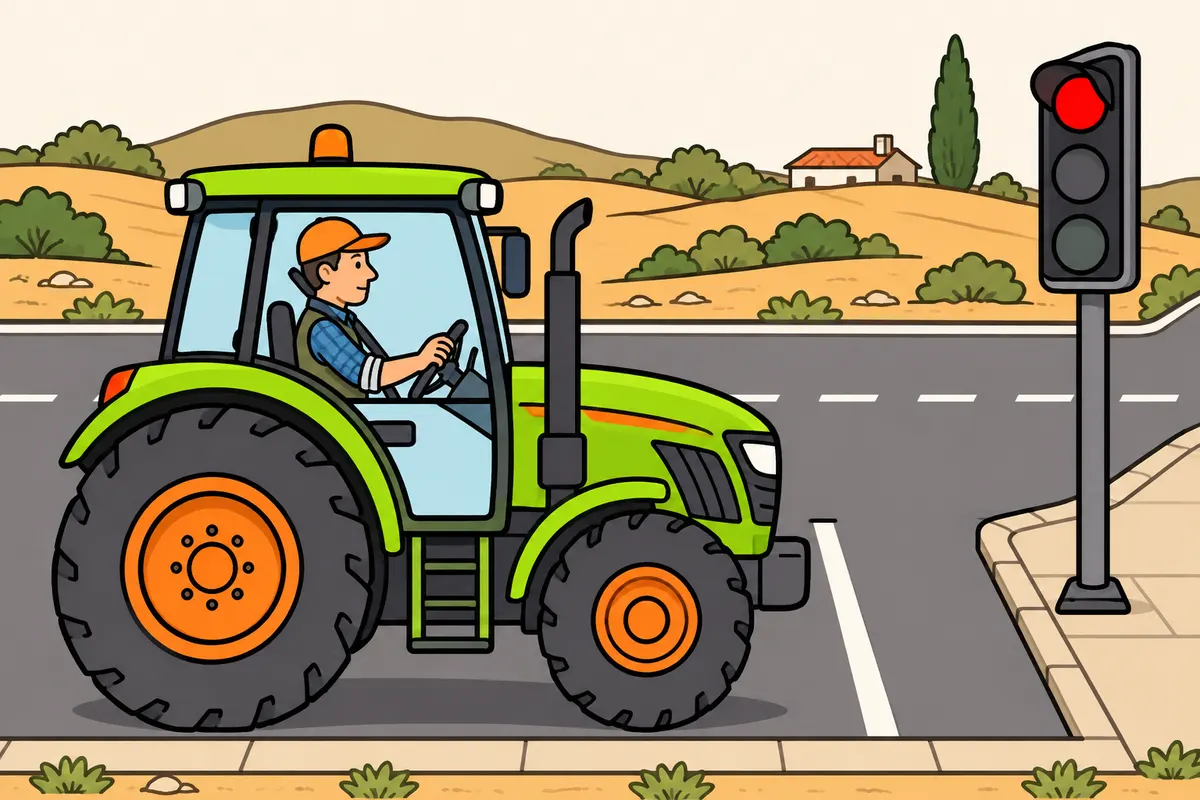
Classify an immobilisation by its cause, time and whether you leave the vehicle.
| Immobilisation | Conditions |
|---|---|
| Compulsory stop | Emergency, traffic needs or legal requirement |
| Brief stop | Under two minutes and you do not leave the vehicle |
| Parking | Immobilisation that is neither a compulsory stop nor a brief stop |
Remember
- A queue is a compulsory stop, however long it lasts.
- For a brief stop, you must stay in the vehicle.
- The engine running does not define a brief stop.
- Hazard lights do not change the classification.
Exam trap: Wrong: a voluntary stop of exactly two minutes is a brief stop. Right: it must be under two minutes and you must stay in the vehicle; a queue is a compulsory stop.
Read the full explanation
- A compulsory stop is an immobilisation caused by an emergency, traffic conditions or the need to comply with a regulatory obligation. If you stop at a red traffic light, in a traffic queue or because of a breakdown, you must identify the reason for the stop before considering how long it lasts. A brief stop requires an immobilisation of less than two minutes during which you must not leave the vehicle. You must meet both conditions at the same time: a duration below the limit and the driver remaining in the vehicle; keeping the engine running is not part of its definition. [LT, Annex I, definitions 80 to 82](https://www.boe.es/buscar/act.php?id=BOE-A-2015-11722#ani).
- Parking covers immobilisations that are neither compulsory stops nor brief stops. If you stop voluntarily for exactly two minutes, you do not meet the requirement for a brief stop to last less than two minutes; if the reason is a traffic queue, you must still classify it as a compulsory stop. If you voluntarily leave the tractor to go shopping, you cannot call this a brief stop simply because it lasts only a few seconds. You must first rule out a compulsory stop and then check both conditions for a brief stop; switching on the hazard warning lights does not in itself change the classification either. [LT, Annex I, definitions 80 to 82](https://www.boe.es/buscar/act.php?id=BOE-A-2015-11722#ani).
26Overtaking and passing
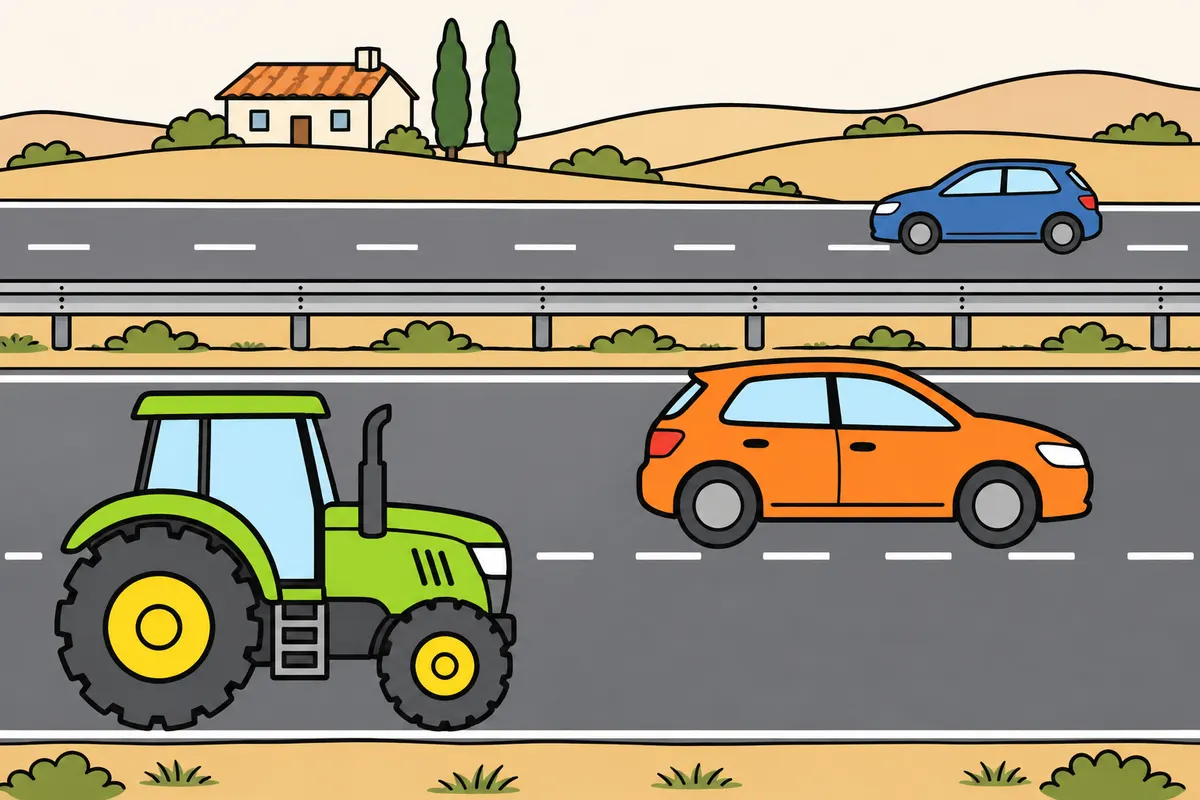
To identify overtaking, check whether the other vehicle moves and in which direction.
| Situation | What happens |
|---|---|
| Overtaking | You pass a vehicle travelling in the same direction, subject to exceptions |
| Passing | You pass an immobile obstruction |
| Meeting | You pass a vehicle coming towards you |
Remember
- You can overtake without entering the opposing direction.
- In dense traffic, check the conditions in each line.
- Traffic must fill the carriageway; each speed must depend on the vehicle ahead.
- Then a faster line is not overtaking.
- Faster travel in acceleration, deceleration or vehicle-only lanes does not count as overtaking.
- Compare these with normal lanes; the exception also works in reverse.
Exam trap: Wrong: a faster line is always overtaking. Right: it is not overtaking when dense traffic fills the full carriageway and each speed depends on the vehicle ahead in its lane.
Read the full explanation
- You overtake when you pass another vehicle travelling in the same direction as you. This does not necessarily require you to move into the path of oncoming traffic: you can overtake a vehicle travelling in another lane in the same direction without crossing a centre line. This situation differs from meeting an oncoming vehicle and from passing a stationary obstacle. The everyday use of the word overtaking does not replace identifying the traffic situation; the conditions for carrying out the manoeuvre are covered in «Manoeuvres with agricultural vehicles».
- When traffic is so dense that it occupies the full width and the speed of each vehicle depends on the vehicle ahead in its lane, one line of traffic moving faster than another is not considered overtaking. You must check that these conditions apply; a vehicle travelling slowly is not enough. Nor is it considered overtaking if you travel faster in acceleration lanes, deceleration lanes or sections reserved exclusively for certain vehicles than in the normal lanes, or vice versa. [RGC, art. 83](https://www.boe.es/buscar/act.php?id=BOE-A-2003-23514#a83).
27Cycling routes and vulnerable road users
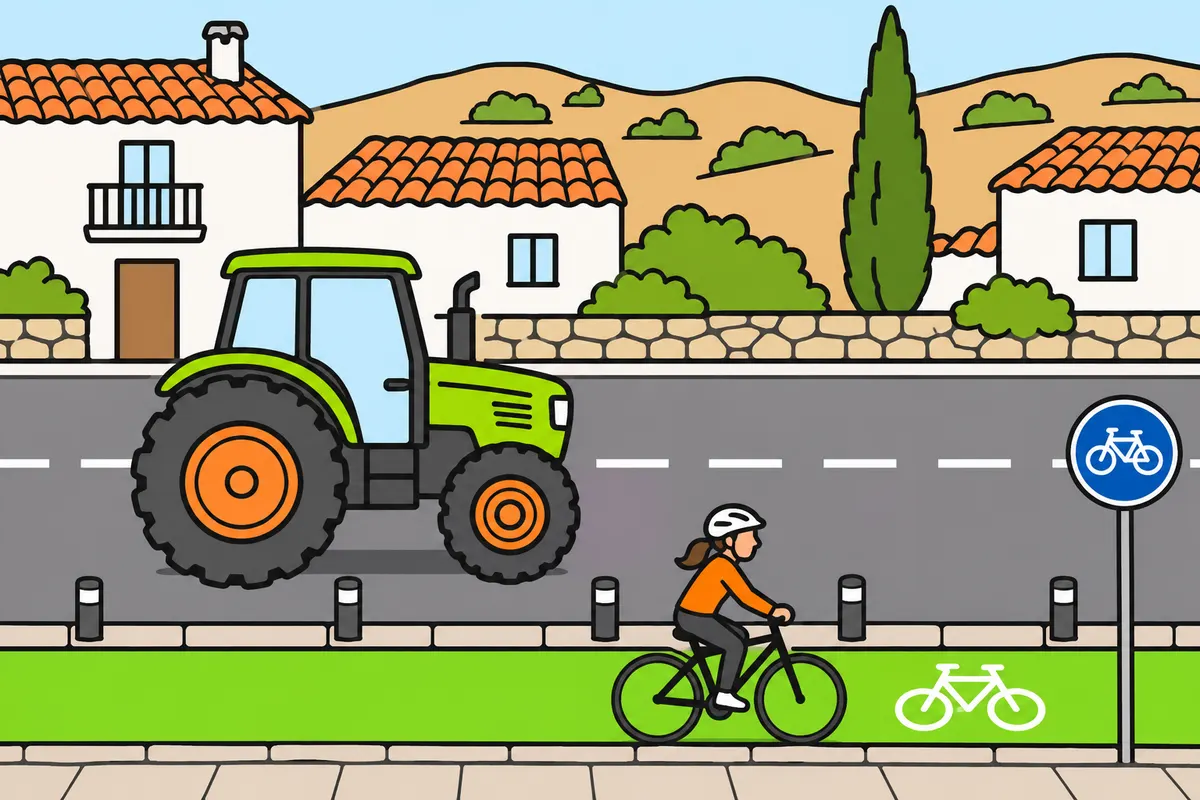
Respect cycle routes and identify people at greater risk of injury.
| Cycle route | Location or separation |
|---|---|
| Cycle lane | Beside the carriageway; one or two directions |
| Protected cycle lane | Physical separators from the rest of the carriageway and pavement |
| Cycle track | Cycle route marked on a pavement |
Remember
- Cycle routes are prepared for cycles and have road markings and signs.
- Other vehicles need authorisation from the competent authority.
- Signs must show that authorisation on cycle routes and lanes.
- Driving slowly does not let your tractor use these spaces.
- Vulnerable users include pedestrians, cyclists and personal mobility vehicle riders.
- Motorcycle and moped riders and passengers are also vulnerable.
Exam trap: Wrong: you may use a cycle lane to let traffic pass. Right: you need competent authority permission, shown by signs on cycle routes and lanes.
Read the full explanation
- A cycling route is specifically designed for cycles, with road markings and upright signs and sufficient width for safe passage. A cycle lane runs alongside the rest of the carriageway, in one or both directions; if physical barriers separate it from the rest of the carriageway and the pavement, it is a protected cycle lane. A pavement cycle route is a signed cycling route on a pavement. Other vehicles require authorisation from the competent authority to use these spaces; on cycling routes and cycle lanes, this must be indicated by signs. The slow speed of your tractor or the need to let traffic pass does not authorise you to occupy these spaces. You can study access restrictions in «Road use with agricultural vehicles». [LT, Annex I, definitions 74 to 77](https://www.boe.es/buscar/act.php?id=BOE-A-2015-11722#ani).
- Vulnerable road users, or those at greater risk of vulnerability, are those who, because of their means of travel or the physical characteristics of their age group, face a greater risk of injury or of more serious injuries in an accident. The definition includes pedestrians — with particular attention to people with disabilities, children, older people and people with reduced mobility — cyclists, riders of personal mobility vehicles, and riders and passengers of motorcycles and mopeds. You can encounter them when driving through a village or joining the road from a farm with a wide, slow tractor. Their vulnerability depends on their exposure to injury, not on whether they travel more slowly than you; protective manoeuvres are covered in «Manoeuvres with agricultural vehicles». [LT, Annex I, definition 86](https://www.boe.es/buscar/act.php?id=BOE-A-2015-11722#ani).
Classify an immobilisation
You must first consider the cause, then the conditions of a voluntary immobilisation.
- Check whether it is due to an emergency, traffic or a regulatory obligation: in these cases, it is a compulsory stop.
- If it is voluntary, check whether it lasts less than two minutes.
- Also check that you do not leave the vehicle: both conditions are necessary for it to be a brief stop.
- If it is not a compulsory stop and either condition for a brief stop is missing, classify it as parking.
Identify the vehicle in the scenario
You must distinguish agricultural classification from the scope of your licence.
- Identify the purpose for which it is built: agriculture, works, services or another purpose.
- Determine whether it is self-propelled, towed or an implement that is not classed as a vehicle.
- If units are coupled together, identify the trailer or semi-trailer and the type of combination.
- Check your driving entitlement in «LVA licence, tests and obeying signs».
Finished this module?
Mark it as read and you will see your progress on the theory list.