
Theory · LVA Licence - Agricultural Vehicle · Module 2 of 16
LVA licence, tests and obeying signs
You learn which vehicles you can drive with LVA, the entry requirements and the rules for tests, attempts and time limits. You also learn to identify the signs and signals that apply to you, resolve conflicts between them and obey officers’ instructions when driving your agricultural vehicle.
Sign library
All 620 signals of the official catalogue in force (Royal Decree 465/2025), each with its drawing and description, and a test to practise them.
1Which vehicles you can drive
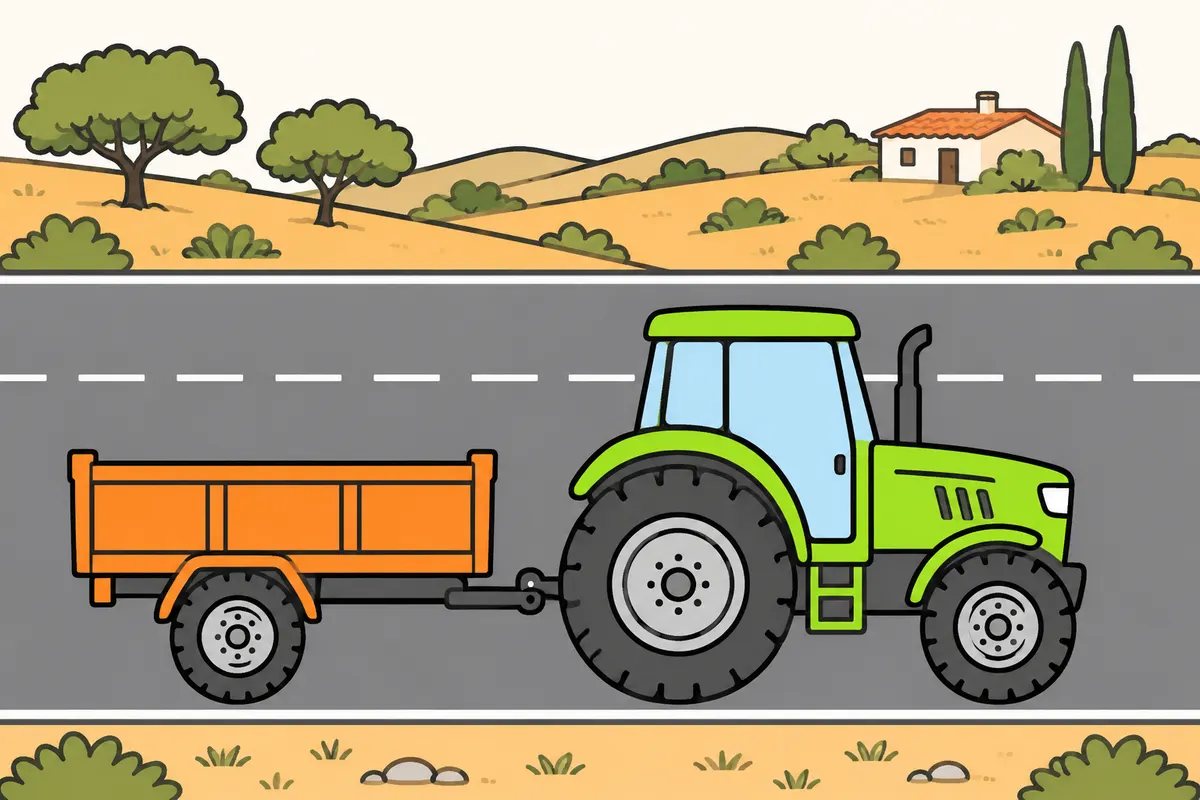
With LVA, your agricultural vehicle must meet ordinary limits and the 45 km/h design-speed limit.
Remember
- Check that your vehicle falls within LVA’s scope.
- Design speed does not change when you drive slowly.
- Do not confuse your licence with road speed limits.
- Mass and dimensions must stay within ordinary limits.
- Design speed must be no more than 45 km/h.
- Both conditions must apply at the same time.
Exam trap: Wrong: you can always drive at 45 km/h. Right: obey the vehicle and road speed limits.
Read the full explanation
- The LVA licence allows you to drive self-propelled special agricultural vehicles and vehicle combinations within its scope; their categories are explained in «Road and agricultural vehicle definitions». [RGCond, art. 6.1.b](https://www.boe.es/buscar/act.php?id=BOE-A-2009-9481#a6).
- With LVA, you may drive only self-propelled special agricultural vehicles and their combinations whose maximum authorised masses and dimensions are within the ordinary limits and whose maximum design speed does not exceed 45 km/h. You must meet both conditions at the same time. [RGCond, arts. 5.9 and 6.1.b](https://www.boe.es/buscar/act.php?id=BOE-A-2009-9481#a5).
- As a technical explanation, maximum design speed is the highest speed the vehicle can reach given its design and manufacturing characteristics. It is a vehicle specification, independent of the speed you choose to drive at: driving slowly does not change this specification when determining which driving entitlement you need.
- The entitlement your licence gives you and the speed permitted on the road are separate matters; road speed limits are covered in «Speed and distances for agricultural vehicles». [RGCond, art. 6.1.b](https://www.boe.es/buscar/act.php?id=BOE-A-2009-9481#a6).
2When you need a category B driving licence
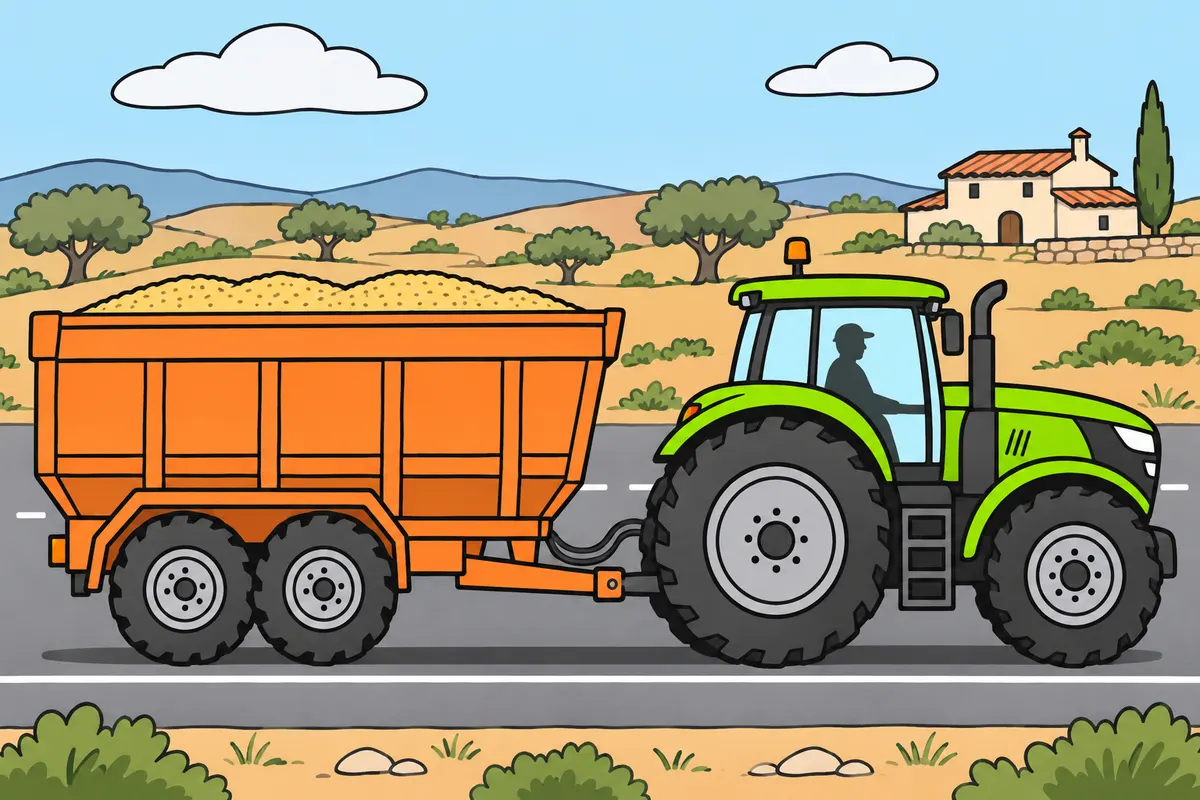
You need B if your agricultural vehicle exceeds any of the stated limits.
Remember
- Check maximum authorised mass and dimensions of your vehicle and combination.
- You need B above ordinary maximum authorised mass or dimension limits.
- You also need B if design speed exceeds 45 km/h.
- Do not judge by appearance or an empty trailer.
Exam trap: Wrong: you need B only when all limits are exceeded. Right: exceeding any limit is enough.
Read the full explanation
- Under Article 5.9, you must always hold a category B driving licence to drive a self-propelled special agricultural vehicle or its combination if its maximum authorised mass or dimensions exceed the ordinary limits, or if its maximum design speed exceeds 45 km/h. [RGCond, art. 5](https://www.boe.es/buscar/act.php?id=BOE-A-2009-9481#a5).
- To check whether you can drive with LVA alone, compare the authorised specifications of the vehicle and the combination with those limits. A tractor looking small or a trailer travelling empty does not prove that its maximum authorised masses and dimensions fall within the relevant scope. [RGCond, art. 5](https://www.boe.es/buscar/act.php?id=BOE-A-2009-9481#a5).
- The authorised specifications of the tractor and trailer allow you to determine whether your licence covers the combination; how to check their documents is explained in «Driver and agricultural vehicle documentation». [RGCond, art. 5.9](https://www.boe.es/buscar/act.php?id=BOE-A-2009-9481#a5).
3Age and the relationship between LVA and B
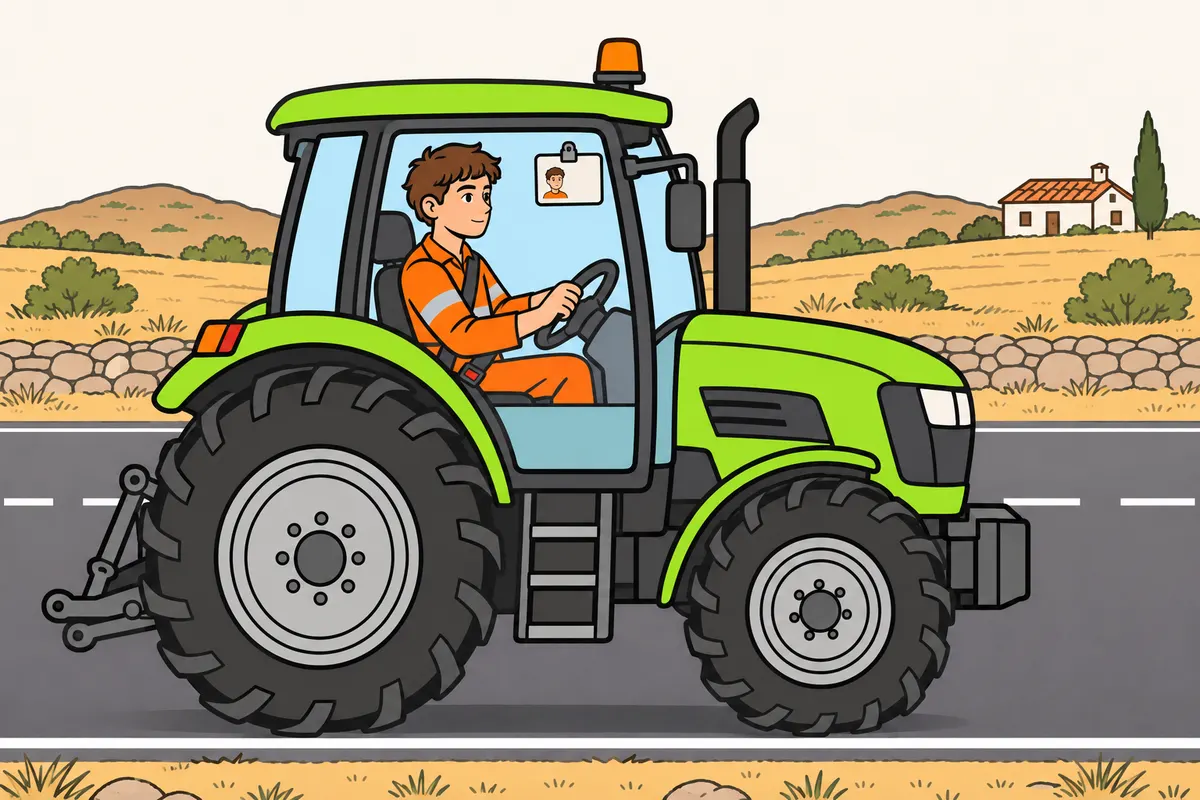
You can obtain LVA at 16; with a valid B licence, you do not need LVA.
| Your licence | Result |
|---|---|
| Current B licence | You do not need to obtain LVA |
| You hold LVA, then obtain B | Your LVA becomes invalid |
Remember
- You must reach the minimum age before obtaining LVA.
- With a current B licence, you do not need LVA as well.
- If you obtain B while holding LVA, your LVA licence becomes invalid.
Exam trap: Wrong: passing B at any time is enough. Right: your B licence must be valid and current.
Read the full explanation
- You can obtain LVA once you are 16 years old; you must also meet the personal requirements and pass the tests for this licence. [RGCond, art. 6.1.b](https://www.boe.es/buscar/act.php?id=BOE-A-2009-9481#a6).
- If you hold a valid category B driving licence, you do not also need to obtain LVA. Article 6.1.b expressly establishes this relationship; you do not need to hold two separate entitlements to drive agricultural vehicles within that scope. [RGCond, art. 6](https://www.boe.es/buscar/act.php?id=BOE-A-2009-9481#a6).
- If you obtain a category B driving licence while holding LVA, your LVA licence ceases to be valid and your driving entitlement comes from your category B licence. [RGCond, art. 6.1.b](https://www.boe.es/buscar/act.php?id=BOE-A-2009-9481#a6).
4Requirements for obtaining the licence
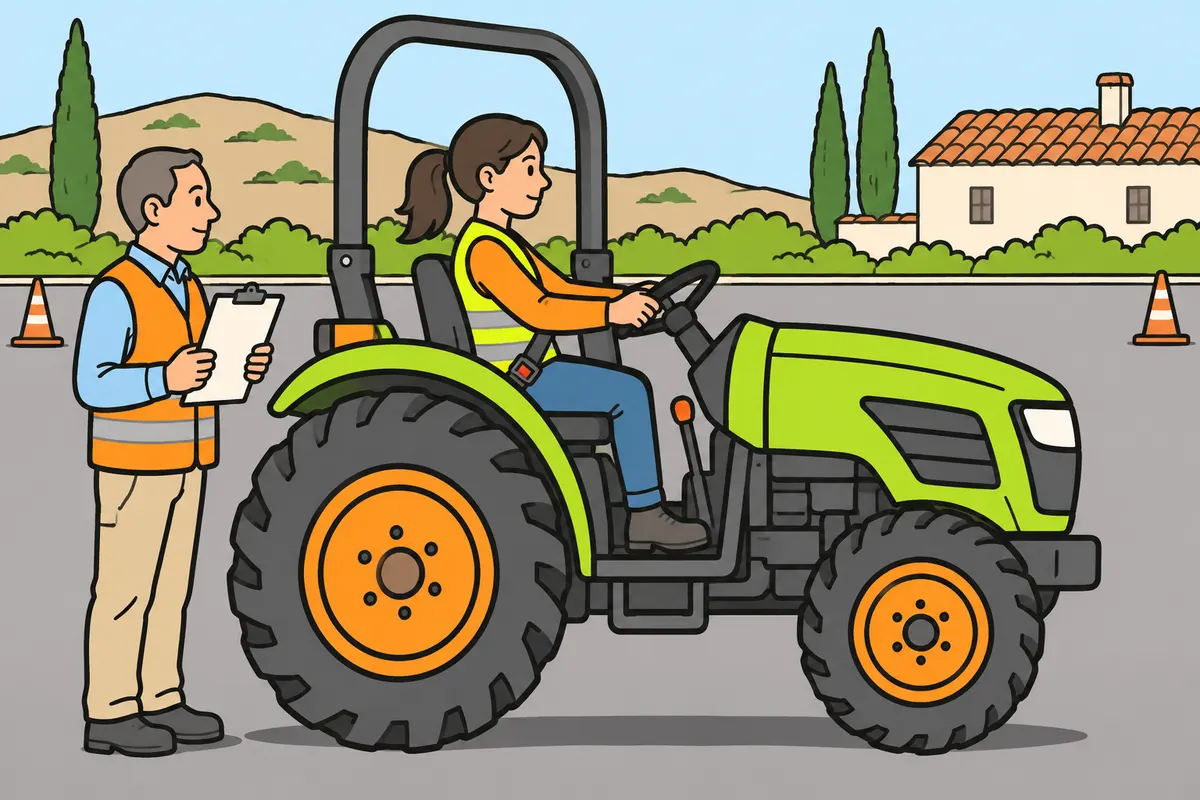
You must meet health, legal and test requirements to obtain LVA.
Remember
- You must meet physical and mental fitness requirements and pass the tests.
- You must have no court driving ban, administrative suspension or withdrawal preventing this.
- If you lost validity through points, you must wait the legal period.
- If foreign, prove normal residence or a study stay of at least six months.
- If you hold foreign licences, check their status when applying.
- You may obtain a special licence if you meet its fitness requirements and restrictions.
Exam trap: Wrong: your experience replaces the tests. Right: you must meet the requirements and pass.
Read the full explanation
- As well as meeting the age requirement, you must meet the required physical and mental fitness standards and be declared to have passed the relevant tests by the Jefatura Provincial de Tráfico (Provincial Traffic Office). Experience driving machinery does not allow you to replace the tests with a signed declaration or a certificate from whoever taught you. [RGCond, art. 7](https://www.boe.es/buscar/act.php?id=BOE-A-2009-9481#a7).
- You must not be disqualified by a court from driving motor vehicles and mopeds, nor may your existing driving entitlement be subject to administrative suspension or withdrawal. If your entitlement has ceased to be valid because you have lost all your points, the applicable statutory period must have elapsed; this is covered in detail in «The LVA points-based licence». [RGCond, art. 7](https://www.boe.es/buscar/act.php?id=BOE-A-2009-9481#a7).
- If you are a foreign national, you must provide proof of normal residence or a stay for study purposes in Spain of at least six months, under the terms of Article 7.1.a. Do not confuse this eligibility requirement with the six months governing the interval between test sittings within an application. [RGCond, art. 7](https://www.boe.es/buscar/act.php?id=BOE-A-2009-9481#a7).
- To obtain the licence, you must meet the requirement of not holding a driving licence issued in another European Union or European Economic Area state, and not having had a driving licence restricted, suspended or cancelled in another member state. If you hold a foreign driving entitlement, its status must be checked when your application is processed. [RGCond, art. 7.1.f](https://www.boe.es/buscar/act.php?id=BOE-A-2009-9481#a7).
- An illness or impairment that prevents you from obtaining an ordinary licence does not in itself mean that no driving entitlement is possible. The regulations allow special licences with the appropriate restrictive conditions if you meet the fitness requirements for them; you must undergo the relevant assessment. [RGCond, art. 7](https://www.boe.es/buscar/act.php?id=BOE-A-2009-9481#a7).
5Specific theory test and practical test on a closed circuit
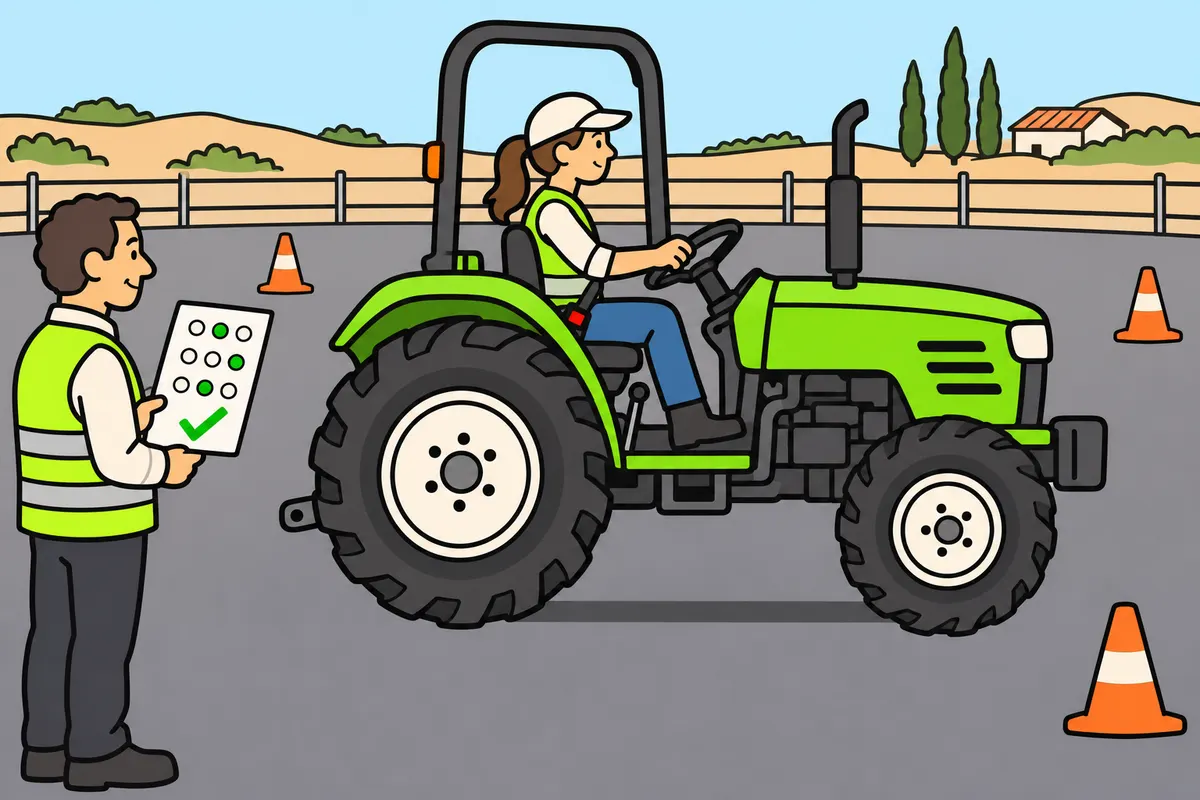
You must pass specific theory before taking the practical test on a test track.
| LVA test or manoeuvre | What you must know |
|---|---|
| Specific theory | Pass it before the closed-circuit practical test |
| Practical | Take it on a closed circuit |
| H: turn-about | Enter right, turn left and leave right in the opposite direction |
| H: movements | Use one reverse and one forward movement; do not mount or force the kerb or touch the cone |
| H: space | At least 15 m long and at least 95% of the vehicle’s turning-circle diameter wide |
| H: cone | On the longitudinal axis, 3 m from the entrance |
| K: loading or unloading | Start with your combination centred and perpendicular to the ramp or platform |
| K: starting distance | Leave at least 10 m from the rear of the load body |
| K: reversing approach | Finish with the load compartment centred, no more than 0.60 m away, without touching the facility |
| K: checks | You may get out once during the reversing approach |
| M: uncoupling | Immobilise the combination; secure the uncoupled trailer with the tractor alongside |
| M: coupling | Drive forwards to position yourself in front, at least 10 m away; reverse and couple |
| M: connections | Connect lighting, signalling and all other safety components |
| M: checks | You may get out once while reversing to couple and hitch up |
| M: non-automatic coupling | You may align the drawbar manually |
| Failing faults on the LVA closed circuit | One eliminating; two serious; one serious and two minor; or four minor |
| Eliminating fault | Insufficient control to complete the manoeuvre, or clear lack of skill |
| Serious fault | Notably inadequate use of the controls |
| Minor fault | Handling or execution error less serious than a serious fault |
Remember
- You do not need the common B theory test.
- You must also pass the practical test on a closed circuit.
- Tests are normally on different dates.
- Exceptionally, properly justified reasons may allow tests on the same date.
- Even then, you must pass theory first.
- In H, do not make more than one reverse movement.
Exam trap: Wrong: you can take the practical test after failing theory. Right: pass the knowledge test first.
Read the full explanation
- To obtain LVA, you must pass a specific knowledge test and a test of skills and behaviour on a closed circuit. You do not have to take an additional common theory test like the one for a category B driving licence; passing only the specific knowledge test is not enough either. [RGCond, Annex V.A](https://www.boe.es/buscar/act.php?id=BOE-A-2009-9481#anv).
- You must pass each test before progressing: you must pass the knowledge test before taking the practical test on a closed circuit. Having already practised with the tractor or having a planned date for the circuit test does not allow you to take it if you have failed the theory test. [RGCond, art. 53.1](https://www.boe.es/buscar/act.php?id=BOE-A-2009-9481#a53).
- You take the LVA practical test on a closed circuit. You must demonstrate skill in handling the tractor and its controls through the manoeuvres specified for this licence. [RGCond, art. 48 and Annex V.A](https://www.boe.es/buscar/act.php?id=BOE-A-2009-9481#anv).
- As a general rule, you take the theory test and the closed-circuit test on different dates. The Traffic Office may authorise both on the same date in duly justified exceptional cases, under Article 51.3; this does not remove the requirement to pass them in order. [RGCond, art. 51.3](https://www.boe.es/buscar/act.php?id=BOE-A-2009-9481#a51).
- The compulsory manoeuvres are H, turning around using forward and reverse gears in a limited space; K, parking safely for loading or unloading at a ramp, platform or similar facility; and M, coupling and uncoupling the trailer. The letters identify test exercises. [RGCond, Annex V.B.3.9](https://www.boe.es/buscar/act.php?id=BOE-A-2009-9481#anv).
- In H, you must enter a simulated dead-end street on the right, turn left and complete the turn with one reverse movement and one forward movement, leaving on the right in the opposite direction to your entry. You must not mount or force the kerb, make more than one reverse movement or touch the cone. [RGCond, Annex VI.C.4.H](https://www.boe.es/buscar/act.php?id=BOE-A-2009-9481#anvi).
- The space for H in the LVA test has a minimum length of 15 m and a minimum width equivalent to 95 % of the vehicle’s turning diameter. The cone separating the entrance and exit is on the longitudinal centreline, 3 m from the entrance. [RGCond, Annex VI.C.4.H](https://www.boe.es/buscar/act.php?id=BOE-A-2009-9481#anvi).
- In K, you must start with the combination centred and perpendicular to the ramp or platform, with at least 10 m between it and the rear of the load body. You reverse until the load compartment is centred and no more than 0.60 m away, without touching the facility. During the reversing approach, you may get out once to make the necessary checks. [RGCond, Annex VI.C.4.K](https://www.boe.es/buscar/act.php?id=BOE-A-2009-9481#anvi).
- In M, you must immobilise the combination, uncouple and unhitch the trailer and leave it secured, with the tractor alongside it. You then drive forwards to position yourself in front, at least 10 m away, and reverse to couple and hitch up, connecting the lighting, signalling and other safety components of the combination. While reversing to couple and hitch up, you may get out once to make the necessary checks; if the coupling is not automatic, you may align the drawbar manually. [RGCond, Annex VI.C.4.M](https://www.boe.es/buscar/act.php?id=BOE-A-2009-9481#anvi).
- On the closed circuit, you fail with one disqualifying fault, two serious faults, one serious fault and two minor faults, or four minor faults. These combinations apply to the circuit test: associate them with this particular test when studying how LVA is marked. [RGCond, Annex VI.C.3.1.º](https://www.boe.es/buscar/act.php?id=BOE-A-2009-9481#anvi).
- A disqualifying fault shows that your control is insufficient to perform the manoeuvre under the required conditions, or that you show a clear lack of skill. A serious fault shows markedly inappropriate use of the controls; a minor fault affects handling or execution but is less significant than a serious fault. [RGCond, Annex VI.C.3.1.º](https://www.boe.es/buscar/act.php?id=BOE-A-2009-9481#anvi).
6Your age on the date of each test
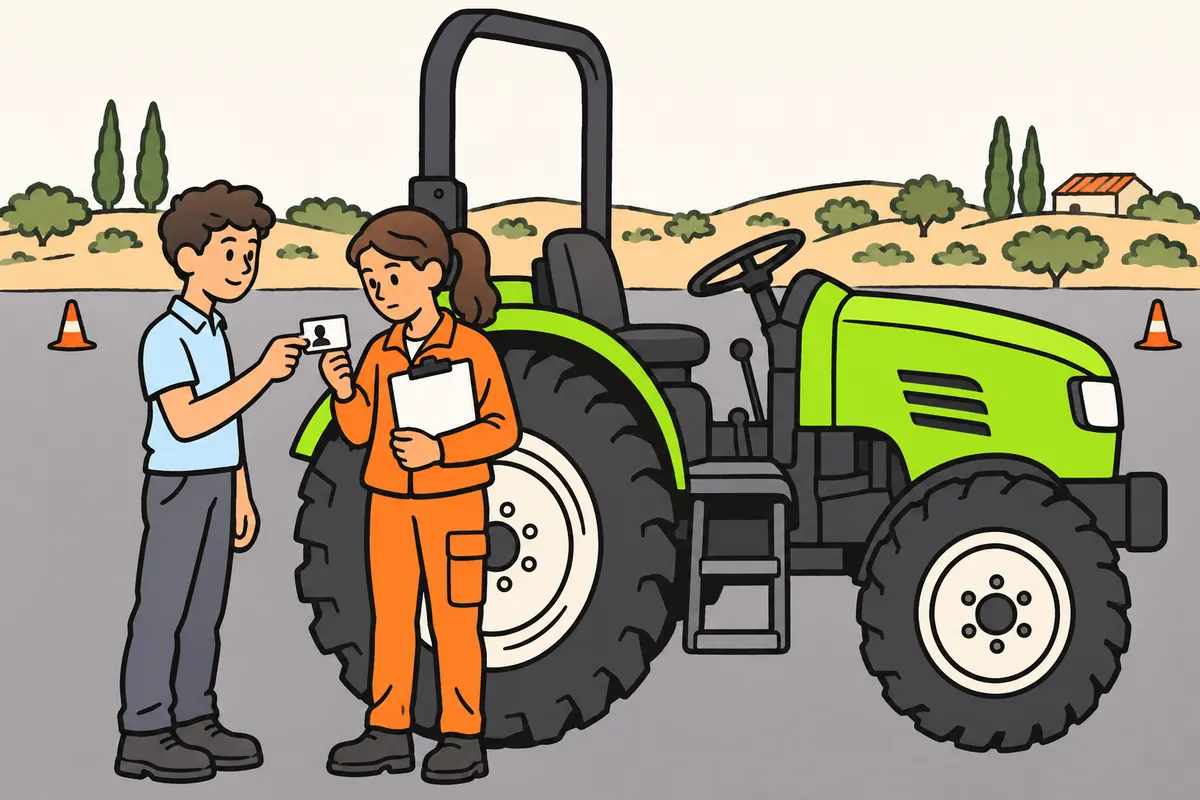
You can take theory early, but must be 16 for your first practical attempt.
| First LVA attempt | Age |
|---|---|
| Theory | Up to three months before minimum age |
| Practical | You must be 16 that day |
Remember
- You can take your first theory attempt up to three months before minimum age.
- You must be 16 on the day of your first practical attempt.
- Passing theory does not allow you to drive on public roads.
Exam trap: Wrong: you can also take the practical test early. Right: you must be 16 for your first practical attempt.
Read the full explanation
- You may attend your first knowledge test sitting up to three months before reaching the minimum age. This allows you to take the theory test earlier, but does not reduce the age of 16 required to obtain LVA. [RGCond, art. 51](https://www.boe.es/buscar/act.php?id=BOE-A-2009-9481#a51).
- On the date set for your first skills and behaviour test sitting, you must have reached the minimum age. For LVA, this means you must be 16 years old on that day: you cannot reach the required age after taking the practical test. [RGCond, Annex VI.A.2](https://www.boe.es/buscar/act.php?id=BOE-A-2009-9481#anvi).
- Passing the theory test early does not by itself entitle you to drive on public roads. You must complete the tests and obtain the relevant entitlement, as required by Article 1 of the Reglamento General de Conductores (General Driver Regulations). [RGCond, art. 1](https://www.boe.es/buscar/act.php?id=BOE-A-2009-9481#a1).
7Test province, centre and date
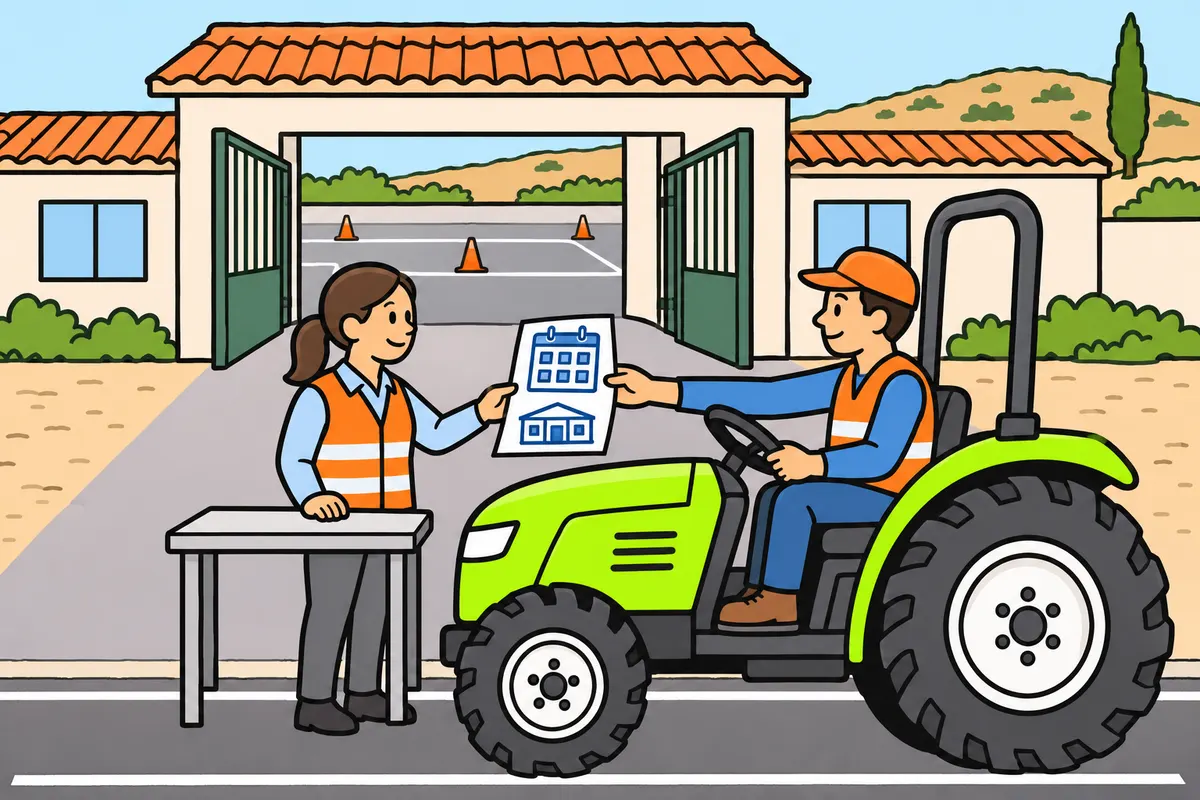
You must take tests where and when the Provincial Traffic Office tells you.
Remember
- You take tests in the province where you apply.
- The Traffic Office chooses the centre and sets the date at your request.
- If a centre does not meet requirements, the test location changes.
- Until corrected, use the capital’s centre or another provincial centre the Office designates.
- This change does not cancel your theory pass.
Exam trap: Wrong: you can choose any track and date. Right: follow the centre and date the Traffic Office sets.
Read the full explanation
- You must take the tests in the province to which you submit your application and at the test centre designated by the Jefatura Provincial de Tráfico (Provincial Traffic Office). The decision takes account of the circumstances and the service's capacity; submitting your application does not allow you to choose any available test track. [RGCond, art. 50](https://www.boe.es/buscar/act.php?id=BOE-A-2009-9481#a50).
- The Jefatura Provincial sets the dates at your request, under article 51.1. You must attend on the test date you are notified of: the statutory time limits do not automatically reserve a date or allow you to take the test whenever you decide. [RGCond, art. 51.1](https://www.boe.es/buscar/act.php?id=BOE-A-2009-9481#a51).
- Centres outside the provincial capital must meet the necessary standards of quality, safety and other conditions. If a centre does not meet those conditions, you take the tests at the centre in the provincial capital until the shortcomings are remedied, unless the Jefatura designates another suitable centre in the same province. [RGCond, Annex VI.A.1](https://www.boe.es/buscar/act.php?id=BOE-A-2009-9481#anvi).
- This provision in Annex VI.A.1 changes the location of the affected tests. It does not mean that you automatically pass, lose a theory test pass you already hold, or that all tests in the province are suspended for that reason. [RGCond, Annex VI.A.1](https://www.boe.es/buscar/act.php?id=BOE-A-2009-9481#anvi).
8Two attempts and a maximum of six months
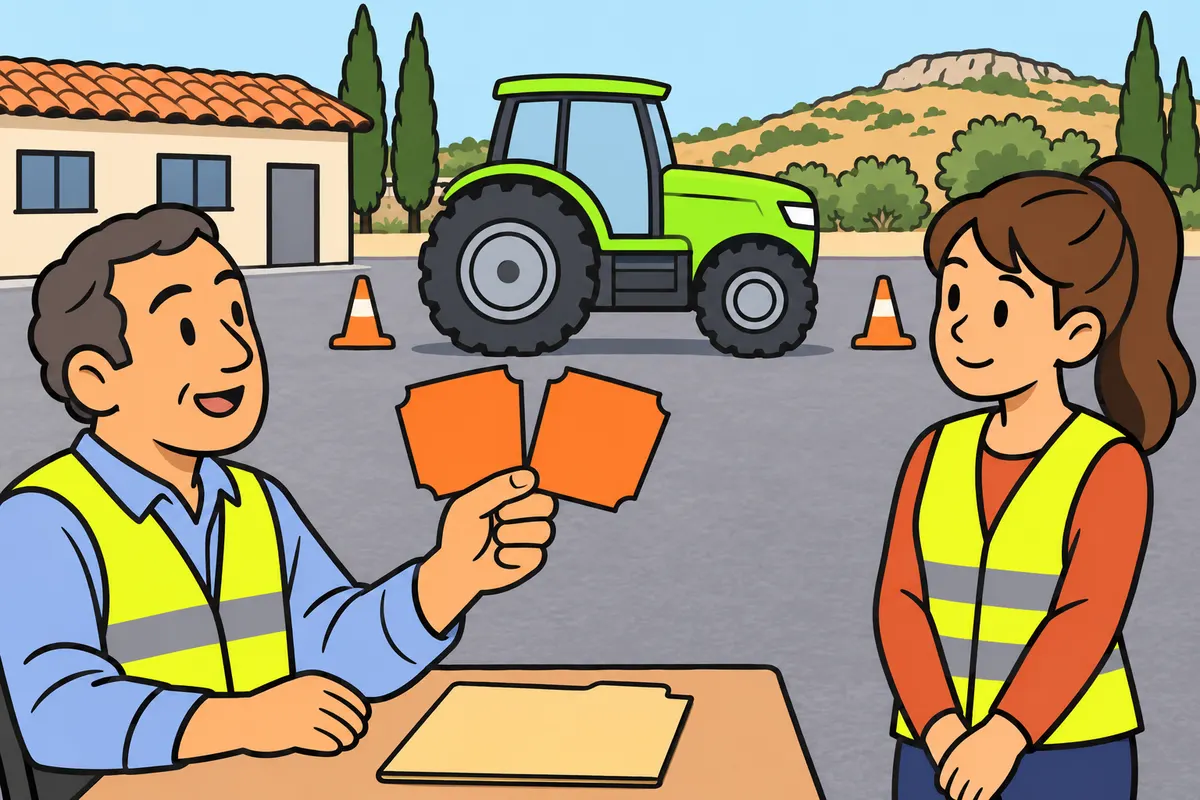
Your application allows two attempts, normally no more than six months apart.
Remember
- You do not have unlimited attempts under the same application.
- Attempts under the same application must be no more than six months apart.
- Illness and other properly justified exceptional cases are exceptions.
- If absent, you lose your attempt unless an exceptional case is properly justified.
- Do not confuse this gap with the validity of your theory pass.
Exam trap: Wrong: absence always preserves your attempt. Right: you lose it unless an exceptional case is properly justified.
Read the full explanation
- Each application for a driving licence or LVA licence entitles you to two test attempts. You must distinguish a test attempt from each stage of the process: the rule does not give you unlimited attempts until you pass both the theory test and the test on a closed course. [RGCond, art. 51](https://www.boe.es/buscar/act.php?id=BOE-A-2009-9481#a51).
- No more than six months may elapse between test attempts under the same application. Exceptions apply for illness and other duly justified exceptional circumstances; simply deciding to postpone the test indefinitely without reporting or justifying your circumstances is not enough. [RGCond, art. 51](https://www.boe.es/buscar/act.php?id=BOE-A-2009-9481#a51).
- If you do not attend a test on the scheduled date, you lose that attempt, except in duly justified exceptional circumstances. [RGCond, art. 51](https://www.boe.es/buscar/act.php?id=BOE-A-2009-9481#a51).
9Waiting after failed attempts
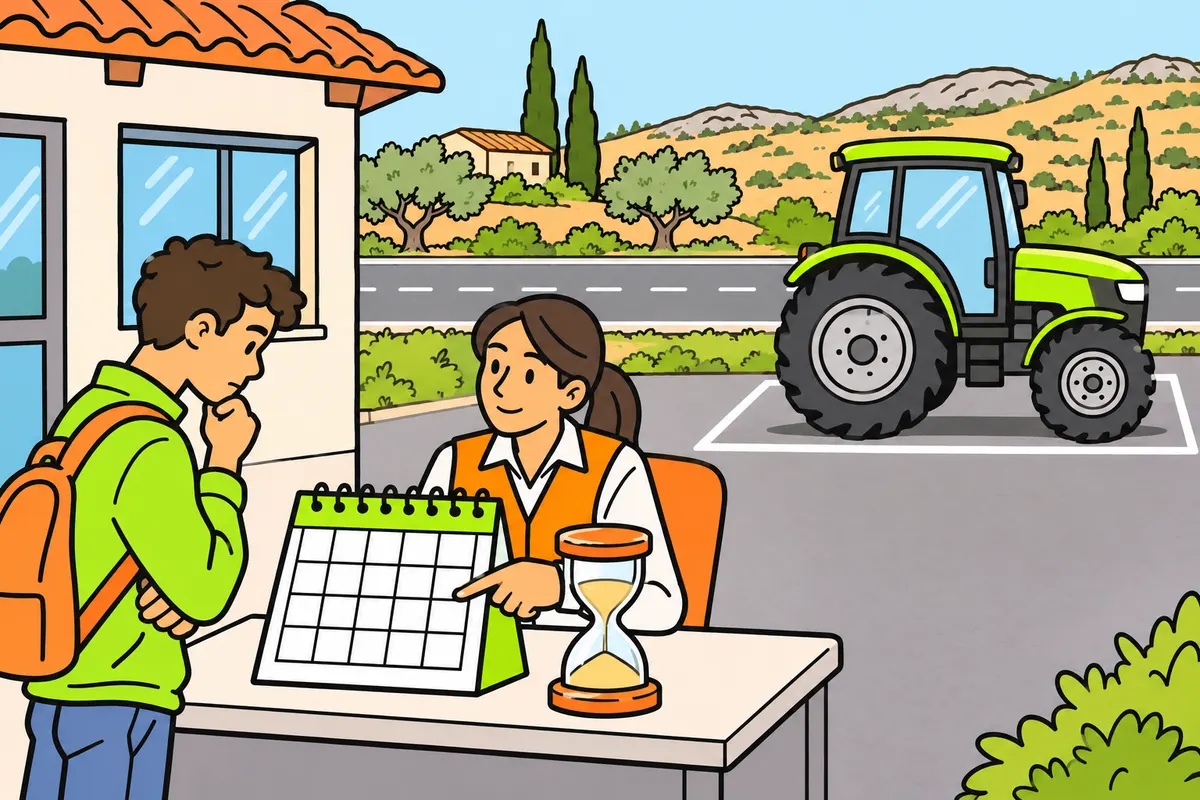
After failing the same test, you must follow the relevant minimum waiting periods.
| Attempts at the same test | Minimum wait after failing |
|---|---|
| Second to third | 10 days |
| Later successive attempts | 15 days |
Remember
- After failing the same test twice, you wait at least 10 days.
- Between later attempts, you wait at least 15 days.
- Count from the day you took the failed test.
- Exceptionally, periods may be reduced for properly justified, recognised urgency.
- You must attend on the date set by the Traffic Office.
Exam trap: Wrong: you always wait only 10 days. Right: wait at least 10 days between the second and third attempts, and 15 days between later attempts, unless exceptionally reduced for properly justified, recognised urgency.
Read the full explanation
- If you fail the test concerned on two attempts, Annex VI.A.2 requires a minimum of 10 days between the second and third attempts. You count attempts at that same test. [RGCond, Annex VI.A.2](https://www.boe.es/buscar/act.php?id=BOE-A-2009-9481#anvi).
- For subsequent attempts, the minimum interval specified in the Annex is 15 days. Do not swap the two figures or apply the minimum of 10 days to all subsequent attempts without distinguishing which attempt it is. [RGCond, Annex VI.A.2](https://www.boe.es/buscar/act.php?id=BOE-A-2009-9481#anvi).
- You count these minimum intervals from the date you take the test you fail. They may exceptionally be reduced in cases of recognised, duly justified urgency; simply being in a hurry to obtain your licence for an agricultural season does not in itself entitle you to that reduction. [RGCond, Annex VI.A.2](https://www.boe.es/buscar/act.php?id=BOE-A-2009-9481#anvi).
- A minimum interval does not guarantee that the centre has an appointment available exactly when it ends. You must respect the date set by the Jefatura and deal with the relevant application procedures: memorising 10 and 15 days helps you answer questions about the Annex, but does not allow you to attend without a scheduled test. [RGCond, Annex VI.A.2](https://www.boe.es/buscar/act.php?id=BOE-A-2009-9481#anvi).
10Knowledge test format
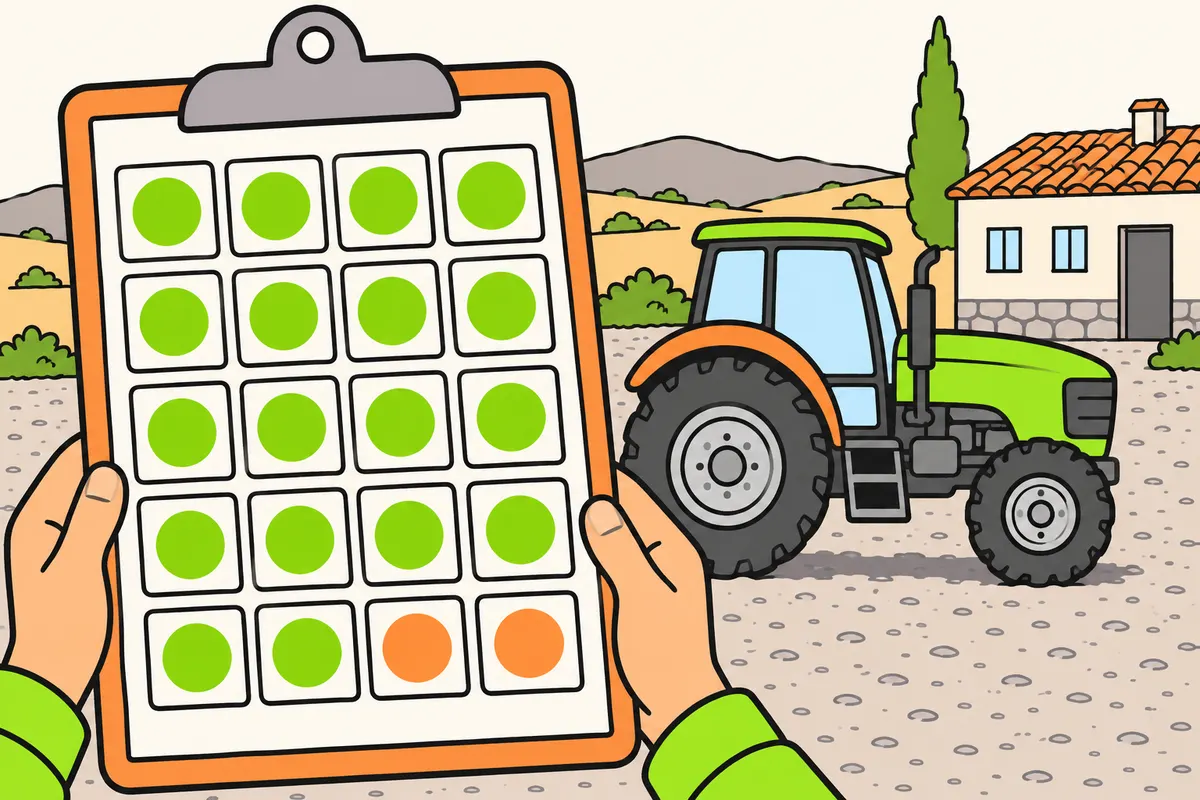
You pass the knowledge test if you stay within the maximum number of errors.
Remember
- You answer 20 questions.
- In the DGT format published in 2020, you pass with at most 2 errors.
Exam trap: Wrong: you pass with three errors. Right: the maximum is 2 errors.
Read the full explanation
- According to the format published by the DGT (2020), you answer 20 multiple-choice questions in the LVA test and may make a maximum of 2 errors. [DGT, LVA format, 4 May 2020](https://revista.dgt.es/es/formacion-educacion/noticias/2020/0504-Estudia-licencia-tractor-desde-casa.shtml).
11Test time and adjustments
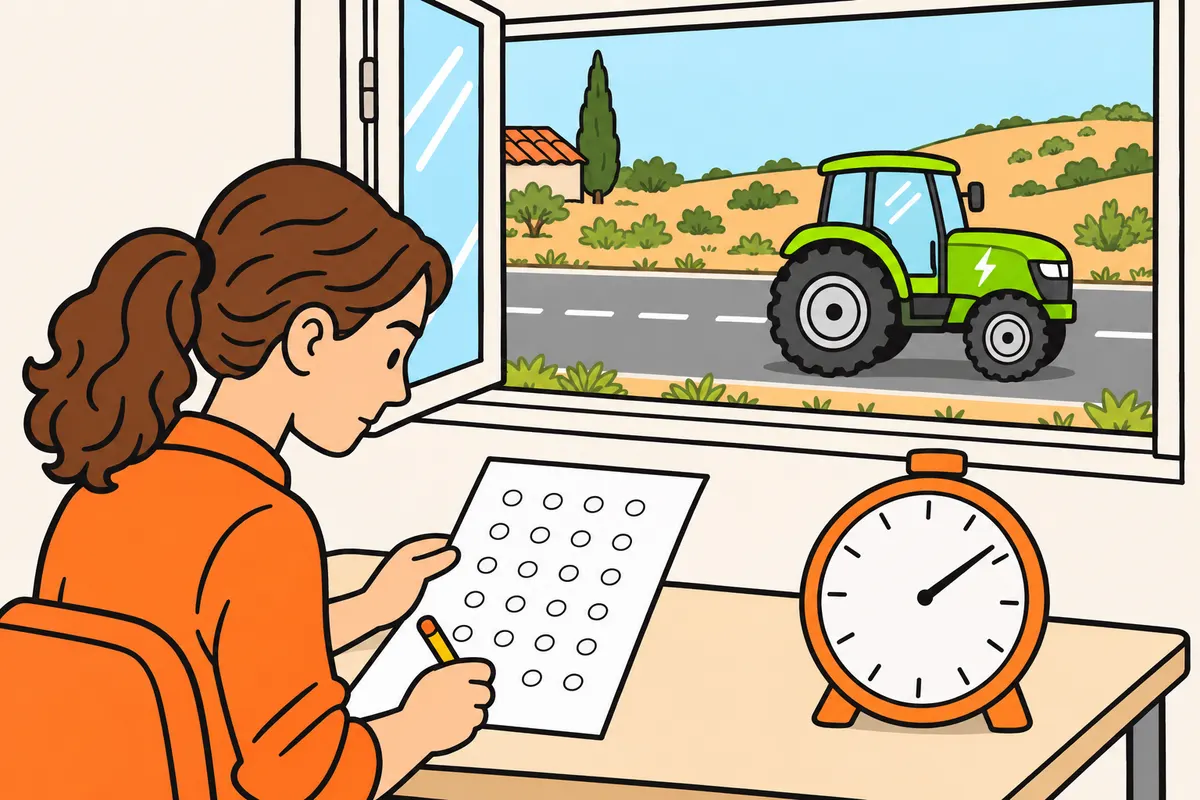
You have a base test time, with extensions allowed for specified, justified reasons.
Remember
- For 20 questions, the base time is 20 minutes.
- If videos are included, time may increase in proportion to their length.
- You can request extra time for properly justified special needs.
- You cannot decide for yourself to extend the time during the test.
- Read each whole question before answering.
Exam trap: Wrong: every test must include video. Right: the rules allow videos but do not always require them.
Read the full explanation
- Your standard statutory time allowance for the knowledge test is one minute per question. For a paper with 20 questions, the standard allowance is 20 minutes: you must link that duration to the number of questions, without applying the duration of a test for another category. [RGCond, Annex VI.B.1 and B.2](https://www.boe.es/buscar/act.php?id=BOE-A-2009-9481#anvi).
- The rules allow questions to be preceded by videos of traffic situations, with the time allowance extended in proportion to their duration. This provision does not mean that every LVA test must include a video or that you can add extra time yourself. [RGCond, Annex VI.B.1 and B.2](https://www.boe.es/buscar/act.php?id=BOE-A-2009-9481#anvi).
- You may also receive extra time for duly justified special needs. If you need this adjustment, you must request and justify it during the application process; you cannot decide for yourself to extend the time during the test. [RGCond, Annex VI.B.1 and B.2](https://www.boe.es/buscar/act.php?id=BOE-A-2009-9481#anvi).
- As part of your preparation, practise reading the whole question and identifying whether it asks about the licence, the vehicle or a sign. In an LVA test, confusing design speed with driving speed can lead you to choose the wrong answer even if you remember the figure correctly.
12Pass results and their validity
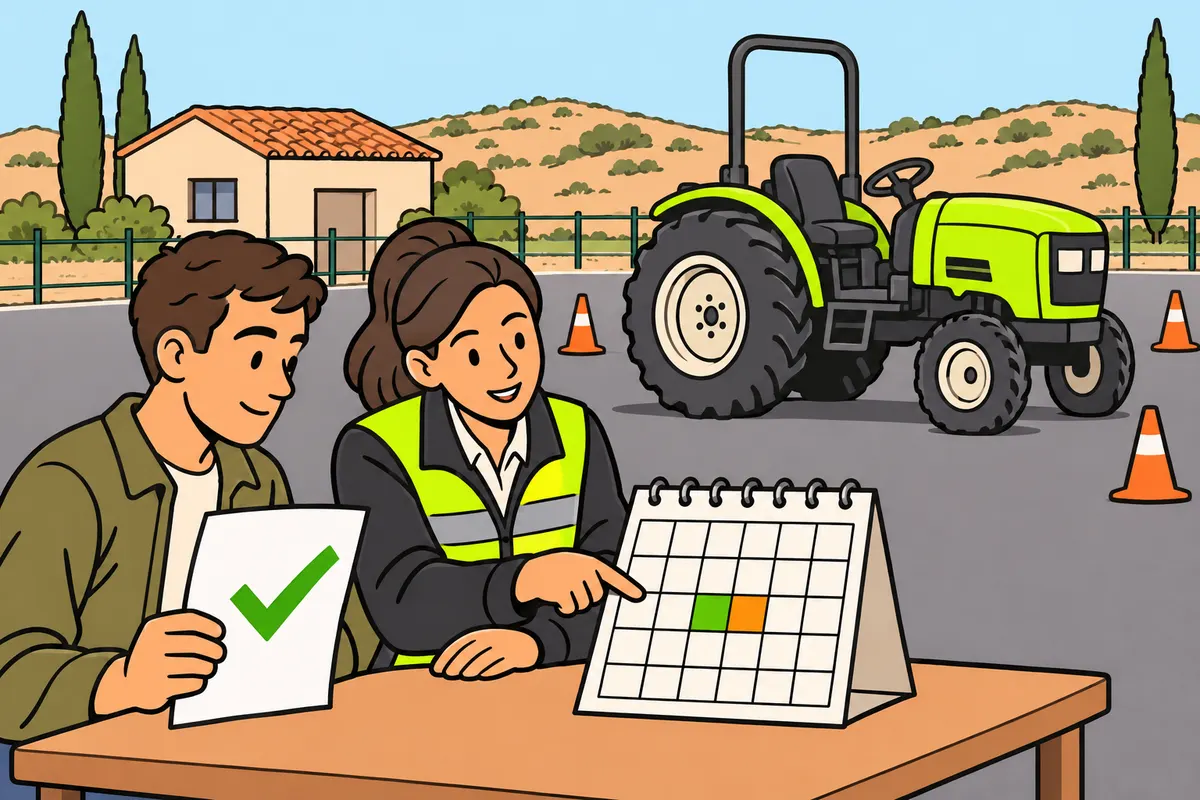
Your pass stays valid for two years while you complete the tests.
Remember
- The period starts the day after you are declared to have passed.
- If you pass the next test within this period, validity starts again.
- Arrange your practical test while your theory pass remains valid.
- Passing theory neither replaces the practical nor lets you drive as an LVA holder.
Exam trap: Wrong: the two years are your licence’s duration. Right: they are the validity of your test pass.
Read the full explanation
- You receive a pass or fail result for each test. Your pass remains valid for two years, counted from the day after you are declared to have passed; identify the start of this period correctly if you are asked about it. [RGCond, art. 53](https://www.boe.es/buscar/act.php?id=BOE-A-2009-9481#a53).
- If you pass the next test within that period, the validity period starts again. For LVA, you must arrange your practical test while your knowledge test pass remains valid, as well as meeting the requirements and attending the scheduled tests under your application. [RGCond, art. 53](https://www.boe.es/buscar/act.php?id=BOE-A-2009-9481#a53).
- The two years refer to the validity of your test pass while you complete the process. They do not mean that the agricultural licence you obtain lasts only two years, nor do they replace the general maximum of six months between test attempts under the same application. [RGCond, art. 53](https://www.boe.es/buscar/act.php?id=BOE-A-2009-9481#a53).
13Identification for the practical test
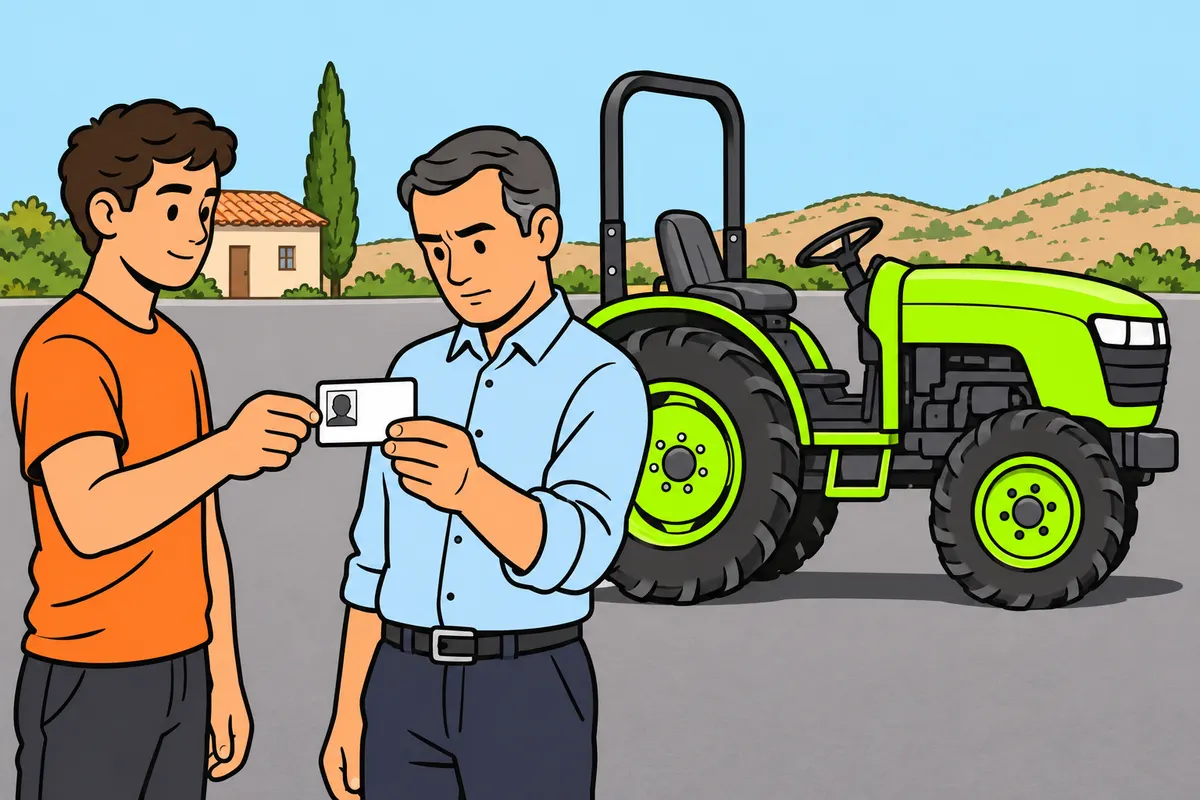
You must prove your identity when asked during the practical test.
Remember
- Bring your DNI, passport, residence card or driving licence, as appropriate.
- You may be asked to prove your identity during the test procedures.
- A payment receipt does not replace your identity document.
- Missing required ID stops the practical test starting; you keep your attempt.
- Your instructor must also show their instructor authorisation.
Exam trap: Wrong: missing the required identity document uses up an attempt. Right: the practical test cannot start, and you do not lose the attempt.
Read the full explanation
- During the practical test and related procedures, officials may ask you at any time for your DNI (Spanish national identity card), passport, residence card or driving licence, as appropriate. They may also require the school's management or teaching staff to produce their authorisation to practise as identification. [RGCond, Annex VI.A.3](https://www.boe.es/buscar/act.php?id=BOE-A-2009-9481#anvi).
- If you do not have the required identification, the examiner does not allow the test to start, without you losing a test attempt. Bring a document that proves your identity; proof of payment of the fee and enrolment at the school serve different purposes. [RGCond, Annex VI.A.3](https://www.boe.es/buscar/act.php?id=BOE-A-2009-9481#anvi).
14Vehicle, equipment and protection on the test track
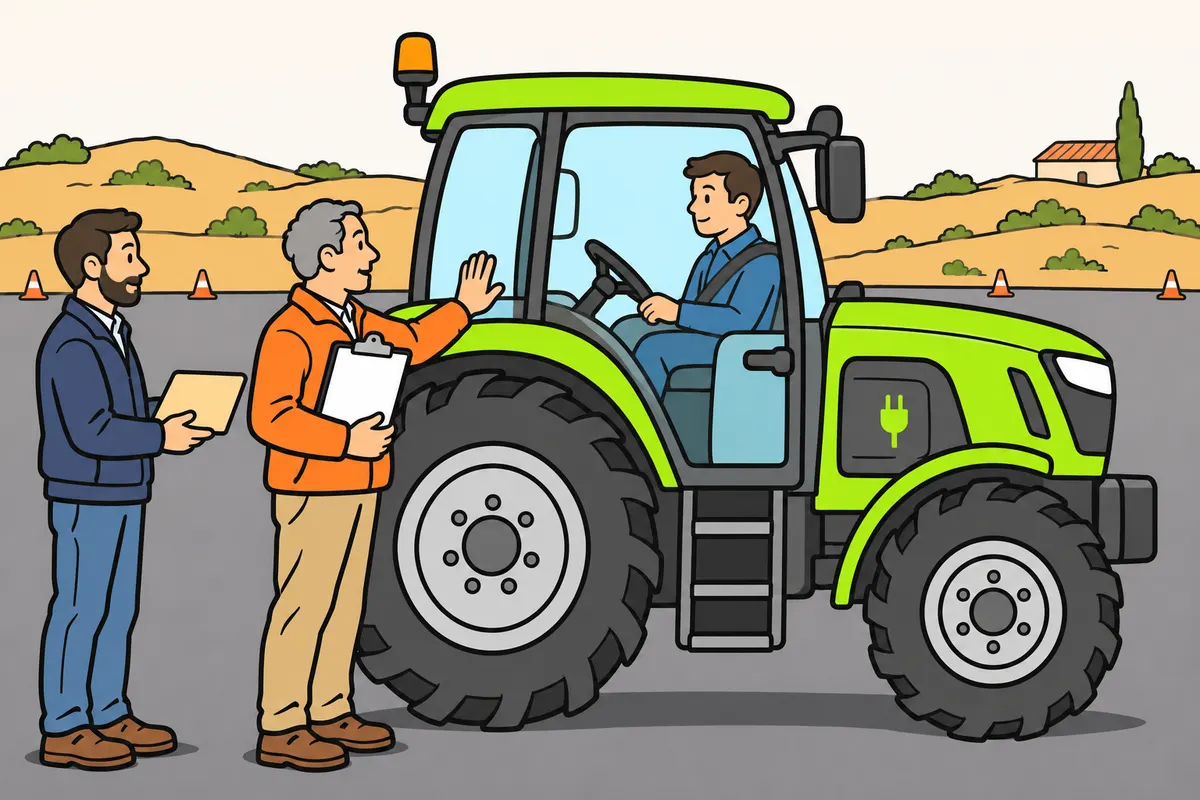
Your vehicle and required equipment must meet the test requirements.
| LVA test vehicle | Requirement |
|---|---|
| Wheeled agricultural tractor | Unladen mass over 1,000 kg and at least 3 m long |
| Agricultural trailer | At least 2 m wide and 4 m long, excluding the drawbar |
| Agricultural trailer | Maximum authorised mass over 750 kg |
| Agricultural trailer axles | Fixed central axles are allowed |
Remember
- The examiner may check the vehicle and equipment before or during the test.
- Driving school staff must provide the vehicle documents.
- Use any protection, corrective aids or adaptations required for you.
- Do not assume you need motorcycle test clothing.
- Faulty or unsuitable equipment stops the test without using an attempt.
- A fixed central-axle trailer is allowed for the LVA test.
Exam trap: Wrong: a breakdown means you pass. Right: the test cannot start or is stopped, without losing an attempt.
Read the full explanation
- Before the test starts or during it, the examiner may check that the vehicle and, where applicable, the monitoring devices and communication systems meet the requirements. [RGCond, Annex VI.C.1](https://www.boe.es/buscar/act.php?id=BOE-A-2009-9481#anvi).
- For these checks, the examiner may request the vehicle documents, which the school's management or teaching staff must provide. The combination used must be suitable for the test: it is not enough for just any tractor to start and be able to move around the track. [RGCond, Annex VI.C.1](https://www.boe.es/buscar/act.php?id=BOE-A-2009-9481#anvi).
- The examiner may check the relevant protective equipment, as well as any necessary corrective aids, prostheses or adaptations and their suitability. You must use whatever is required in your case; this rule does not automatically make the specific clothing for a motorcycle test compulsory for LVA. [RGCond, Annex VI.C.1](https://www.boe.es/buscar/act.php?id=BOE-A-2009-9481#anvi).
- If the vehicle or equipment does not work properly or does not meet the requirements, the examiner prevents the test from starting or interrupts it, without you losing a test attempt. A breakdown does not entitle you to a pass or require the test to continue in unsuitable conditions. [RGCond, Annex VI.C.1](https://www.boe.es/buscar/act.php?id=BOE-A-2009-9481#anvi).
- The LVA test vehicle is a combination with a wheeled agricultural tractor: the tractor's unladen mass must exceed 1,000 kg and its length must be at least 3 m. These requirements apply to the vehicle used in the test, in addition to the general conditions it must meet to be presented for the test. [RGCond, Annex VII.B.17](https://www.boe.es/buscar/act.php?id=BOE-A-2009-9481#anvii).
- The agricultural trailer used in the test must be at least 2 m wide and 4 m long, excluding the drawbar, and have an MMA (maximum authorised mass) of more than 750 kg. For LVA, trailers with fixed centre axles are permitted as an exception to the general condition in Annex VII.A.7. [RGCond, Annex VII.B.17 and 18](https://www.boe.es/buscar/act.php?id=BOE-A-2009-9481#anvii).
15Phones and transmission of information
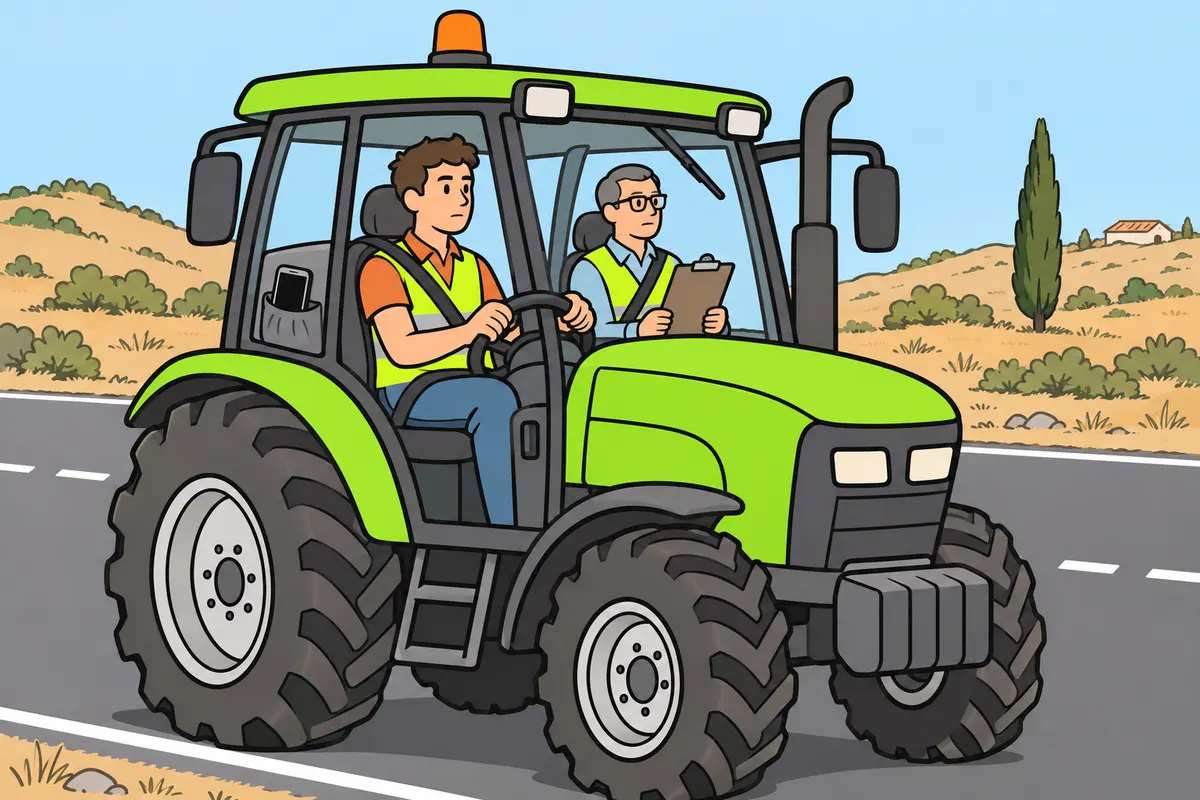
You must follow the device ban and recognise the official exceptions.
| Who breaks the rule and when | What happens to you |
|---|---|
| You, during theory | You are excluded and lose an attempt |
| Your instructor, during practical | The test cannot start or is stopped; you do not lose an attempt |
Remember
- Do not use phones or banned equipment during the tests.
- Regulation intercoms and official test systems are exceptions.
- A banned theory-test system means exclusion and loss of an attempt.
- If your instructor breaks the rule, testing stops; you keep your attempt.
Exam trap: Wrong: using a banned system in theory only brings a warning. Right: you are excluded and lose an attempt.
Read the full explanation
- During the tests, phones, intercommunication systems and equipment for capturing, recording, receiving or transmitting information are prohibited, except for the regulation intercoms in sections C.6 and C.7 and the official systems used by Tráfico (the traffic authority) for the tests and their results. [RGCond, Annex VI.A.4](https://www.boe.es/buscar/act.php?id=BOE-A-2009-9481#anvi).
- If you use a prohibited device in the knowledge test, you are excluded and lose a test attempt. If your instructor breaches this rule during the practical test, the examiner prevents the test from starting or interrupts it, without you losing a test attempt. [RGCond, Annex VI.A.4](https://www.boe.es/buscar/act.php?id=BOE-A-2009-9481#anvi).
16General duty to obey signs and signals
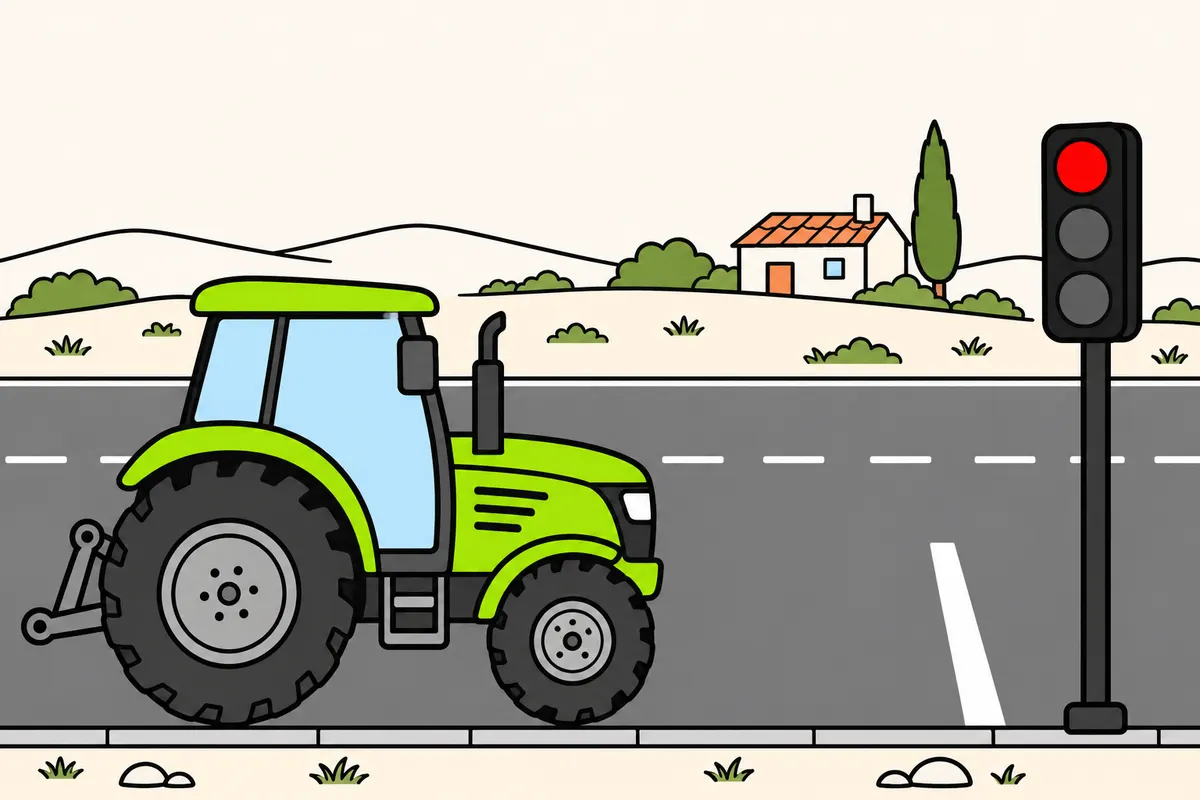
You must obey signs and signals that apply when driving your agricultural vehicle.
Remember
- Follow the duties and bans shown by signs and signals.
- Adapt your driving to the message of other regulation signs and signals.
- If told to stop, do not continue until you have followed the instruction.
- Unless special circumstances justify otherwise, obey signs even when they contradict general rules.
Exam trap: Wrong: you can ignore signs on a short journey. Right: obey those that apply to you.
Read the full explanation
- When driving your agricultural vehicle, you must obey signs and signals that impose obligations or prohibitions and adapt your behaviour to the message of all other prescribed signs and signals. You cannot ignore them because your journey is short, you know the route or you see no other vehicles nearby. [RGC, art. 132](https://www.boe.es/buscar/act.php?id=BOE-A-2003-23514#a132).
- If a sign or signal requires you to stop, you must comply with its instruction before moving off again: wait or give way as required by the instruction you receive. [RGC, art. 132](https://www.boe.es/buscar/act.php?id=BOE-A-2003-23514#a132).
- Unless special circumstances justify otherwise, you must obey the sign or signal even if it appears to contradict a general rule of behaviour. In a test, first check whether an order, sign or signal governs the situation before applying a general traffic rule. [RGC, art. 132](https://www.boe.es/buscar/act.php?id=BOE-A-2003-23514#a132).
17Hierarchy for resolving conflicts
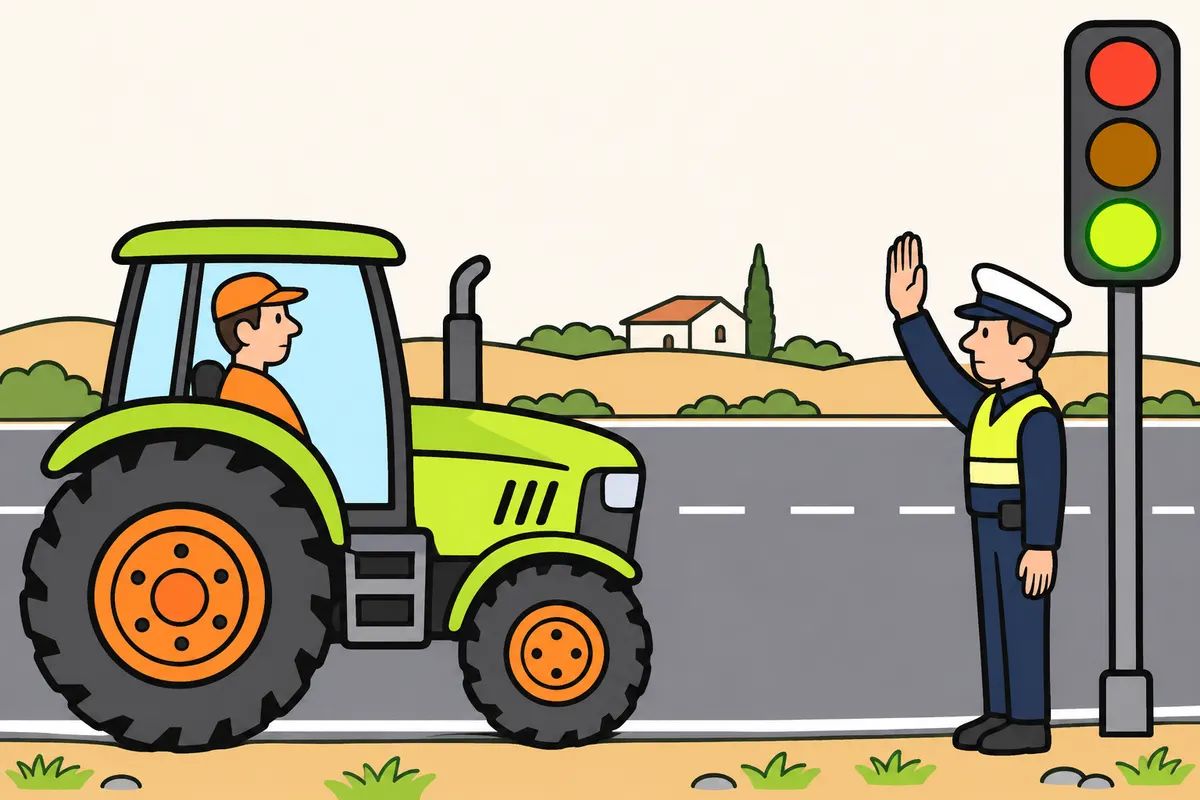
When signs conflict, you must follow their order of priority and its exceptions.
| Priority, from top to bottom | Sign or signal |
|---|---|
| First | Officers carrying out their duties |
| Next | Temporary signs, delimiting devices and delineation |
| Next | Traffic lights |
| Next | Upright signs |
| Last | Road markings |
Remember
- Obey the officer even if the traffic light allows you through.
- Between signs of the same type, follow the most restrictive.
- With flashing amber and R-2, you must stop.
- A downward green arrow allows lane use; you must still obey circular red lights.
- With a green arrow on a circular black background, proceed cautiously as shown.
- Give way to traffic in the lane you join without endangering anyone.
Exam trap: Wrong: a higher-priority signal cancels all others. Right: also obey compatible instructions; a green lane arrow does not cancel a circular red light.
Read the full explanation
- First in the order of precedence are the signals and orders of authorised officers responsible for traffic supervision while carrying out their duties. If they tell you to stop the tractor, you must obey even if a traffic light allows you to proceed. [RGC, art. 133](https://www.boe.es/buscar/act.php?id=BOE-A-2003-23514#a133).
- Next come temporary signs and delineation that change the normal use of the road, delineating devices and delineation signs. These are followed by traffic lights, upright signs and, finally, road markings. [RGC, art. 133](https://www.boe.es/buscar/act.php?id=BOE-A-2003-23514#a133).
- If signs or signals of different types conflict, you follow the one that takes precedence in that order. If they are of the same type, the most restrictive takes precedence; you do not decide based on which is closer, which is larger or which allows you to finish your route sooner. [RGC, art. 133](https://www.boe.es/buscar/act.php?id=BOE-A-2003-23514#a133).
- The hierarchy resolves actual conflicts; it does not remove all other obligations. You must continue to follow compatible instructions and safety rules; a signal allowing you to proceed does not in itself authorise you to ignore a prohibition on another action. [RGC, art. 133](https://www.boe.es/buscar/act.php?id=BOE-A-2003-23514#a133).
- Some instructions require you to combine signs and signals: a flashing amber traffic light requires you to take extra care and give way where appropriate, but does not exempt you from obeying another sign that requires you to stop. Therefore, with a flashing amber light and R-2, you must stop as required by the STOP sign. [RGC, art. 143 and Annex I.4.2.d](https://www.boe.es/buscar/act.php?id=BOE-A-2003-23514#A4).
- A downward-pointing green arrow on a lane-control signal allows you to use that lane; it does not remove your obligation to stop at a circular red light or obey signs or markings requiring you to stop or give way. This is an express exception to the order of precedence, which you must distinguish from a circular green light. [RGC, art. 143 and Annex I.4.3.b](https://www.boe.es/buscar/act.php?id=BOE-A-2003-23514#A4).
- An illuminated green arrow on a circular black background allows you to proceed in the direction indicated, but you must do so with care, allowing vehicles in the lane you are joining to pass and without endangering anyone crossing. The permission given by this arrow does not mean you can turn your tractor and force others to give way. [RGC, art. 143 and Annex I.4.2.g](https://www.boe.es/buscar/act.php?id=BOE-A-2003-23514#A4).
 R-2
18Which signs and signals apply to you
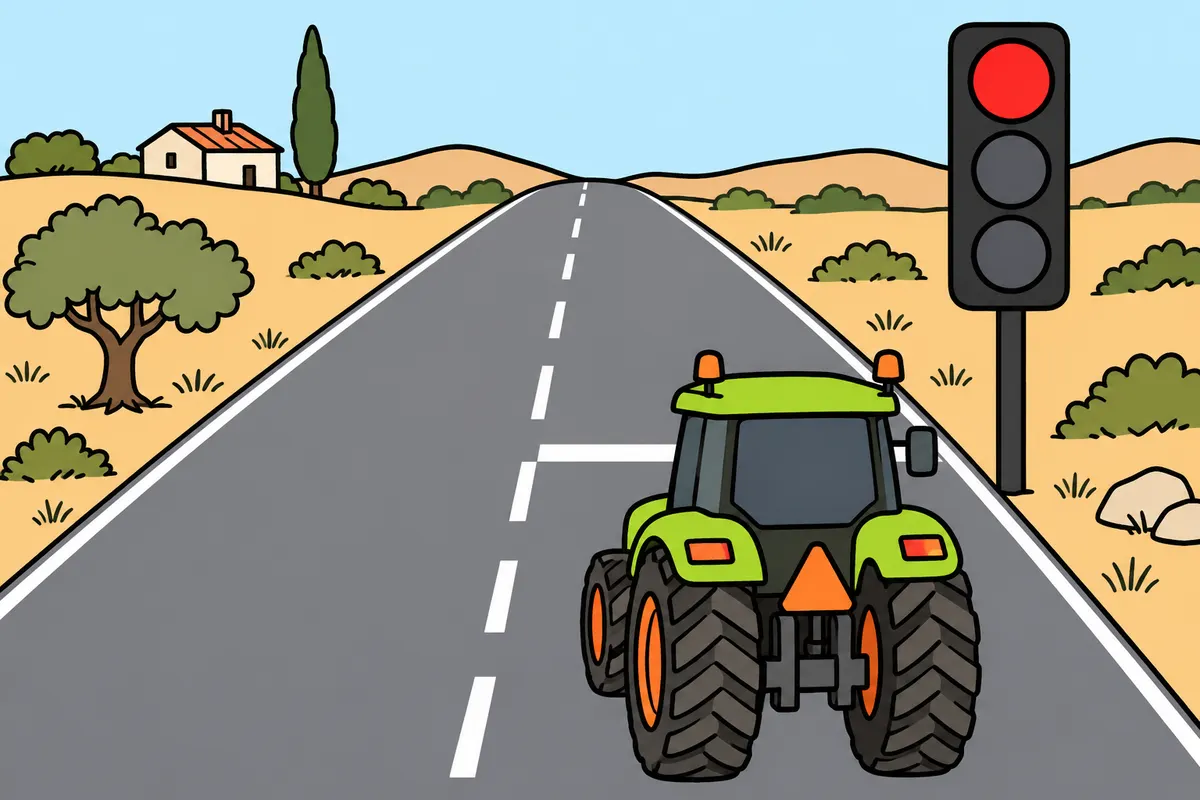
Your direction and the position of signs determine which you must obey.
| Sign or traffic light positions | Your movement | What you must follow |
|---|---|---|
| None on right, above carriageway or above your lane | Straight ahead or left | Those immediately to your left |
| Different instructions on right and left | Straight ahead or left | Only those immediately to your left |
Remember
- Follow signs immediately right, above the carriageway or above your lane.
- If absent there, follow left-side signs when going straight or turning left.
- If side signs differ, follow left signs when going straight or left.
- Read supplementary plates: they may limit users or times.
- Road markings may limit a sign to particular lanes.
Exam trap: Wrong: you choose the sign that suits you. Right: follow the sign for your movement and its position.
Read the full explanation
- You must obey traffic lights and upright signs immediately to your right, above the carriageway or above your lane. If there are none in these positions and you are going straight ahead or turning left, you follow those immediately to your left. [RGC, art. 132](https://www.boe.es/buscar/act.php?id=BOE-A-2003-23514#a132).
- If signs or traffic lights on the right and left give different instructions, you obey only those immediately to your left when going straight ahead or turning left. [RGC, art. 132](https://www.boe.es/buscar/act.php?id=BOE-A-2003-23514#a132).
- As a general rule, a sign applies across the full width of the carriageway that the road users it addresses are authorised to use, although markings may limit its application to one or more lanes. This rule on scope is in article 135, and you must read it together with the sign's position. [RGC, art. 135](https://www.boe.es/buscar/act.php?id=BOE-A-2003-23514#a135).
- Supplementary plates may clarify the meaning or limit the scope to particular users or periods under the terms of article 137. You must read the complete sign: a supplementary inscription may be decisive in determining whether the restriction applies to your agricultural vehicle. [RGC, art. 137](https://www.boe.es/buscar/act.php?id=BOE-A-2003-23514#a137).
19Officer with an arm raised or horizontal
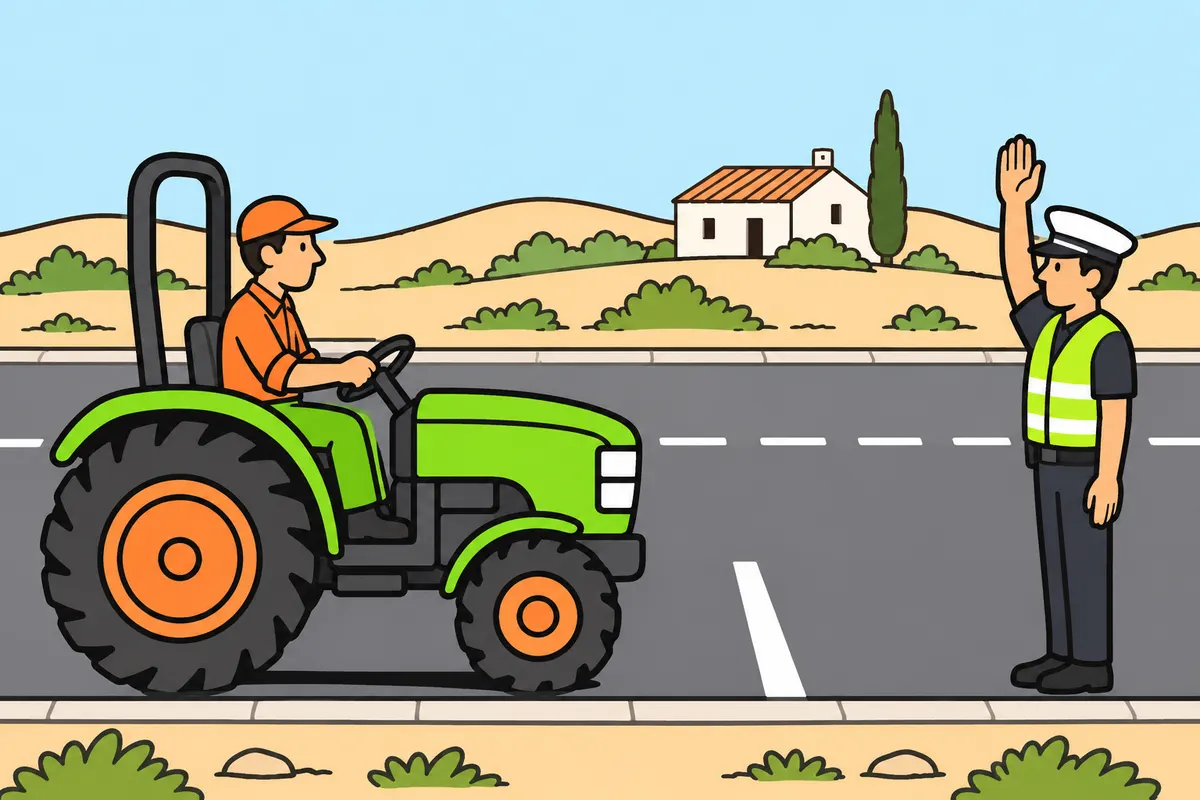
You must recognise who must stop for each of the officer’s arm positions.
| Officer’s gesture | Who must stop |
|---|---|
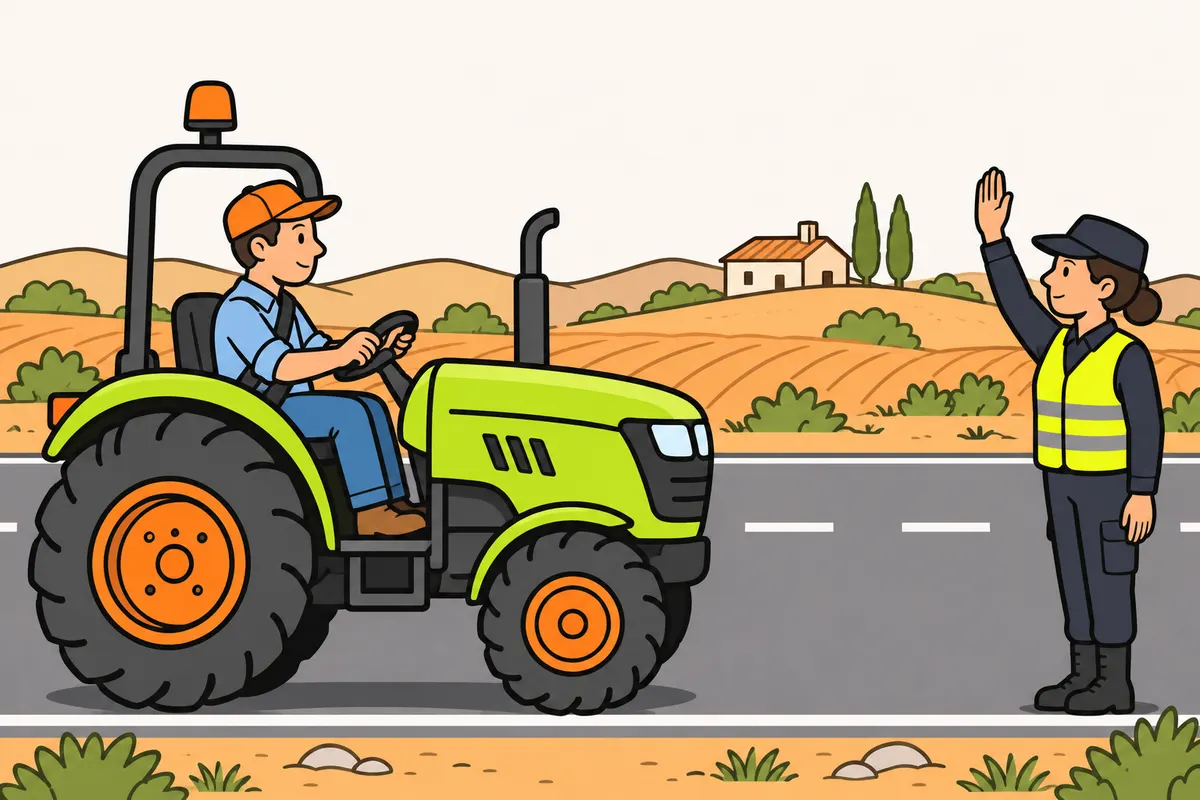
| Arm raised vertically | You, if approaching, unless unsafe; no stop inside if already in the junction |
| Arm or arms horizontal | You, if approaching across the line of the arms |
Remember
- For a raised arm, stop when approaching, unless you cannot stop safely enough.
- If already inside the junction, this gesture does not require you to stop inside.
- Stop at the nearest stop line; without one, immediately before the officer.
- At junctions, stop before entering; the officer may direct you elsewhere.
- For horizontal arms, stop if your direction crosses the line of the arms.
- After arms lower, the order continues unless the officer changes position or signals again.
Exam trap: Wrong: you move off when horizontal arms are lowered. Right: the order continues unless the officer changes position or gives another signal.
Read the full explanation
- If you approach an officer with an arm raised vertically, you must stop unless you cannot do so safely enough. If the officer gives this signal at a junction and you have already entered it, this gesture alone does not require you to stop inside it. [RGC, art. 141 and Annex I.1.1](https://www.boe.es/buscar/act.php?id=BOE-A-2003-23514#A1).
- You must stop at the nearest stop line or, if there is none, immediately before the officer. At a junction, you must stop before entering it; the officer may then indicate another specific place for you to stop. [RGC, art. 141 and Annex I.1.1](https://www.boe.es/buscar/act.php?id=BOE-A-2003-23514#A1).
- If an officer extends one or both arms horizontally, you must stop if you approach from a direction that crosses the line indicated by the arms, whichever way you are travelling. Imagine the line of the arm and check whether your path crosses it. [RGC, art. 141 and Annex I.1.1](https://www.boe.es/buscar/act.php?id=BOE-A-2003-23514#A1).
- The horizontal signal remains in force even if the officer lowers their arms, as long as they do not change their position or give another signal. [RGC, art. 141 and Annex I.1.1](https://www.boe.es/buscar/act.php?id=BOE-A-2003-23514#A1).
20Light, whistle and instruction to slow down
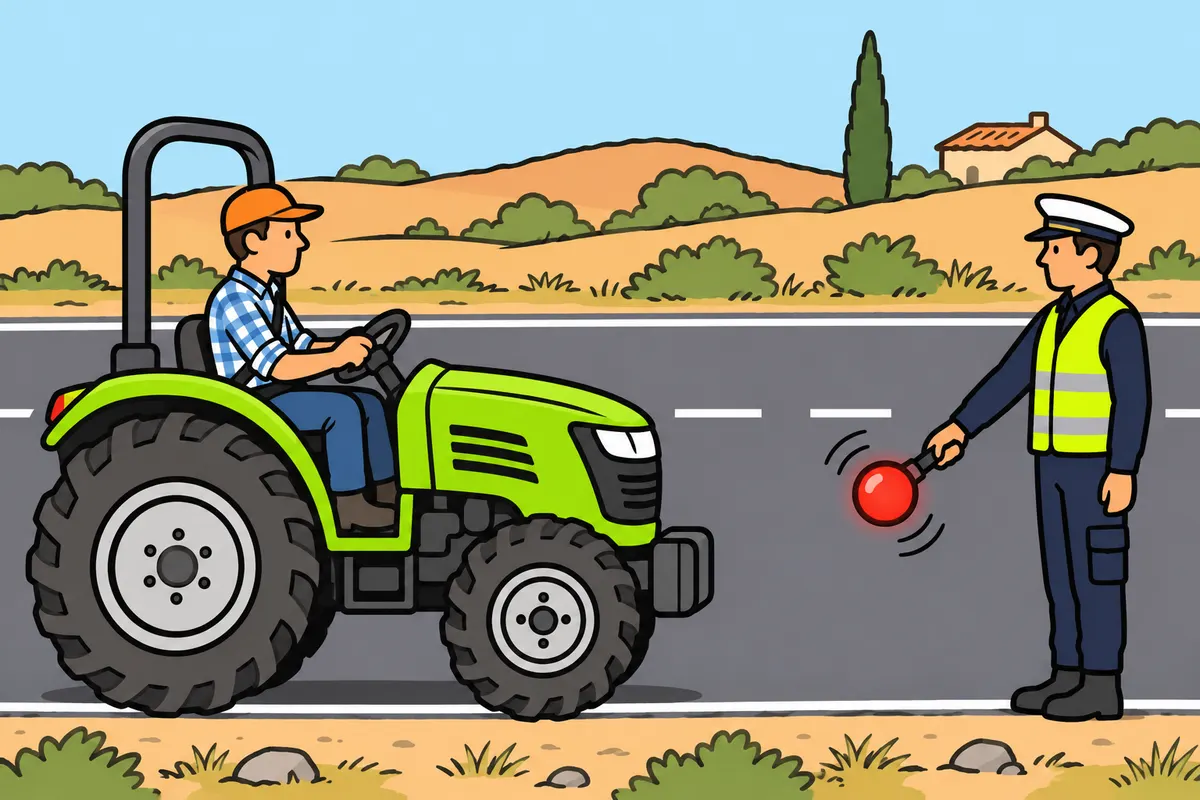
You must distinguish instructions to stop, slow down and move off again.
| Officer’s signal | Your response |
|---|---|
| Red or amber light swung towards you | Stop |
| Arm moving up and down | Slow down if approaching at right angles from that arm’s side |
| Short, frequent whistle blasts | Stop |
| Long whistle blast | Move off again |
Remember
- Stop if the officer swings a red or amber light towards you.
- For an arm moving vertically, slow when approaching at right angles from its side.
- Stop for short, frequent whistle blasts.
- Move off again for a long whistle blast.
- Also obey other clear instructions from the officer.
Exam trap: Wrong: a swung amber light lets you proceed cautiously. Right: if the officer directs it towards you, stop.
Read the full explanation
- If an officer waves a red or yellow light towards you, you must stop. [RGC, art. 141 and Annex I.1.1](https://www.boe.es/buscar/act.php?id=BOE-A-2003-23514#A1).
- If an officer extends an arm and moves it repeatedly up and down, you must slow down if you approach from the side of that arm and at right angles to it. [RGC, art. 141 and Annex I.1.1](https://www.boe.es/buscar/act.php?id=BOE-A-2003-23514#A1).
- A series of short, frequent whistle blasts orders you to stop your vehicle. One long blast orders you to move off again: associate each sound with the correct action, without confusing their meanings because you are in a hurry or machinery is noisy. [RGC, art. 141 and Annex I.1.1](https://www.boe.es/buscar/act.php?id=BOE-A-2003-23514#A1).
- Officers may use other clear instructions when circumstances require them. You must obey their orders immediately and keep observing; the list of usual gestures does not allow you to disobey an unambiguous instruction because it does not match the illustration you have studied. [RGC, art. 141 and Annex I.1.1](https://www.boe.es/buscar/act.php?id=BOE-A-2003-23514#A1).
21Instructions from police vehicles
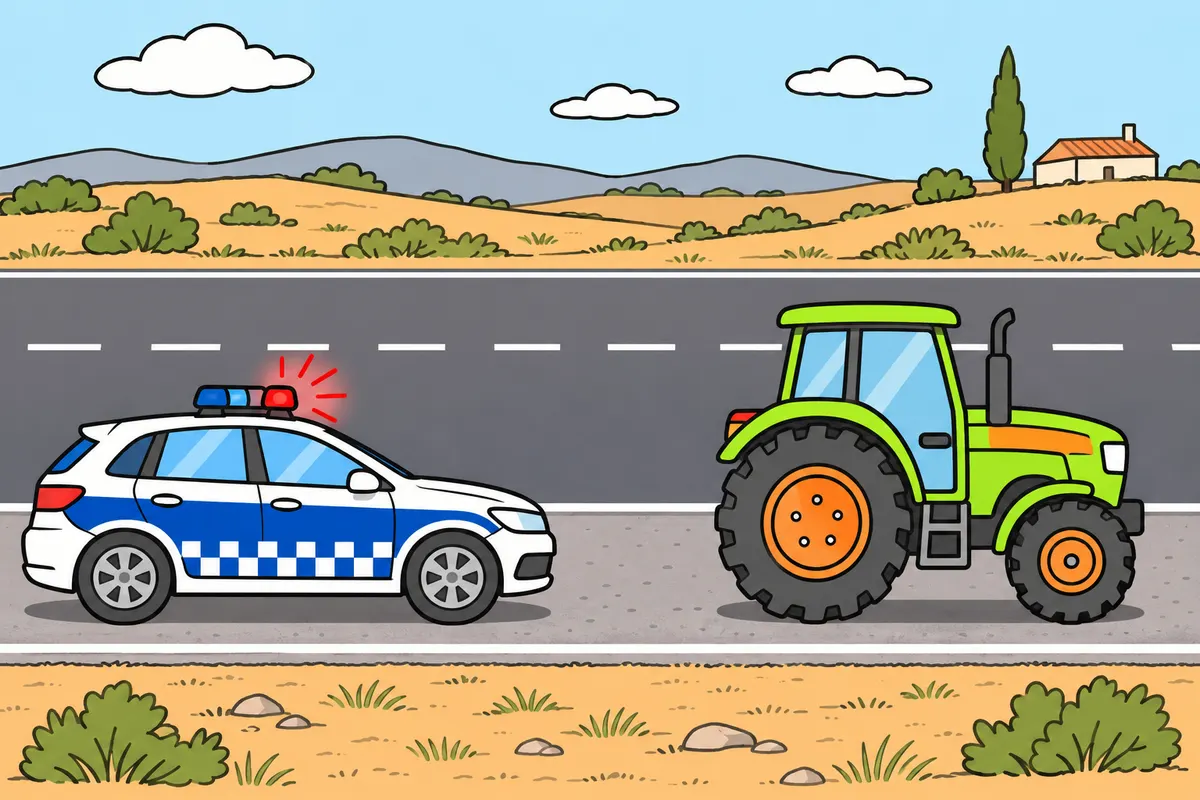
You must obey police instructions from vehicles and distinguish the meanings of their flags.
| Flag from a vehicle | Meaning |
|---|---|
| Red | Temporary closure from its passage, except users accompanied or escorted by officers |
| Green | Reopening from the passage of the vehicle carrying it |
| Yellow | Take extra care or expect a nearby hazard |
Remember
- A still arm angled downwards towards you means you must stop on the right.
- Red closes the road from its passage, except users accompanied or escorted by officers.
- A green flag opens the road from the passage of the vehicle carrying it.
- A yellow flag means take extra care or expect a nearby hazard.
Exam trap: Wrong: a yellow flag reopens the road. Right: it requires extra attention or warns of a nearby hazard.
Read the full explanation
- If an officer in a vehicle holds an arm extended diagonally downwards and keeps it still, you must stop on the right-hand side if the signal is directed at you. The arm remains still in this stop signal. [RGC, art. 141.3 and Annex I.1.2](https://www.boe.es/buscar/act.php?id=BOE-A-2003-23514#A1).
- The police instruction given by a forward-facing flashing red light is covered in «Signs and their hierarchy», in the section «Orders from police vehicles». [RGC, art. 141.3 and Annex I.1.2](https://www.boe.es/buscar/act.php?id=BOE-A-2003-23514#A1).
- A red flag indicates that the carriageway is temporarily closed from the moment the vehicle carrying it passes, except for those whom the officers accompany or escort. A green flag indicates that it is open from the moment the vehicle carrying it passes. [RGC, art. 141.3 and Annex I.1.2](https://www.boe.es/buscar/act.php?id=BOE-A-2003-23514#A1).
- A yellow flag requires you to pay extra attention or warns you of a nearby hazard. Authorised auxiliary personnel may also use it during the activities provided for in the regulations: on its own, it means neither full closure like the red flag nor reopening like the green flag. [RGC, art. 141.3 and Annex I.1.2](https://www.boe.es/buscar/act.php?id=BOE-A-2003-23514#A1).
22Roadworks and other people controlling traffic
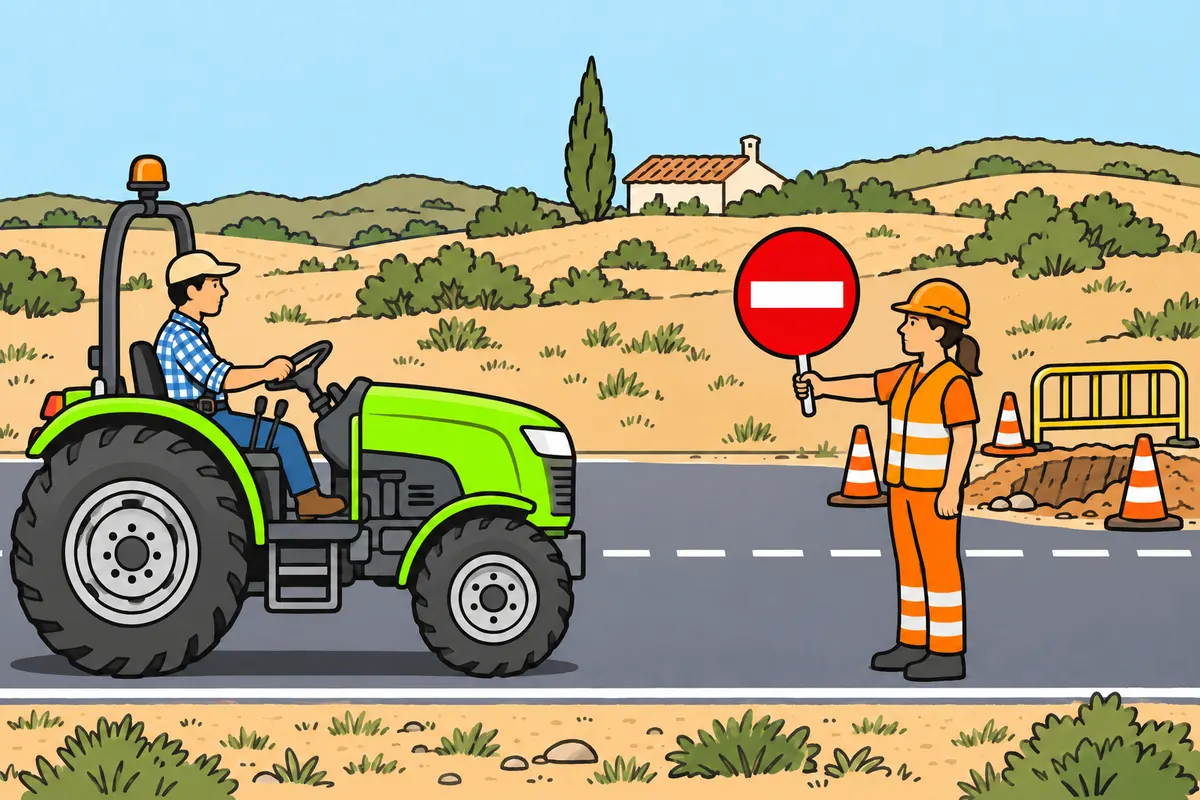
You must follow authorised people and temporary signs controlling traffic.
| Staff | Specified role |
|---|---|
| Roadworks staff | Control traffic |
| Military Police | Control traffic without traffic officers or assist them, under specified conditions |
| School crossing patrols | Ask you to stop using hand-held signs |
| Authorised civil protection or organisers’ staff | Prevent access during authorised activities |
Remember
- Follow instructions from staff controlling traffic at roadworks.
- In specified cases, roadworks staff and special transport escorts may use hand-held signs.
- Military Police may control traffic without traffic officers or assist them, under specified conditions.
- School crossing patrols may ask you to stop using the specified hand-held signs.
- During authorised activities, authorised staff may prevent you entering the affected area.
- Follow temporary restrictions until signs or their causes determine that they end.
Exam trap: Wrong: anyone in bright clothing can act as an officer. Right: check the context and their authorisation.
Read the full explanation
- You must follow the instructions of personnel controlling traffic at roadworks. In the circumstances specified in the regulations, roadworks personnel and personnel escorting special transport may use signs from the official catalogue mounted on handheld paddles. [RGC, arts. 139.3, 141.4 and 142](https://www.boe.es/buscar/act.php?id=BOE-A-2003-23514#a141).
- The Policía Militar (Military Police) may control traffic in the absence of traffic officers or assist them under the conditions specified in the regulations. School crossing patrols may ask you to stop using the prescribed paddles; you must recognise that the regulations assign specific functions to people other than the usual traffic officers. [RGC, arts. 139.3, 141.4 and 142](https://www.boe.es/buscar/act.php?id=BOE-A-2003-23514#a141).
- During authorised activities, the responsible authority may authorise Protección Civil (Civil Protection) personnel or the organisers' staff to prevent access to the affected area or route. Wearing conspicuous clothing does not give anyone all the powers of a traffic officer: you must take account of the context and their authorisation. [RGC, arts. 139.3, 141.4 and 142](https://www.boe.es/buscar/act.php?id=BOE-A-2003-23514#a141).
- Temporary traffic signs adapt traffic movements to traffic conditions, and their instructions may be compulsory. The changes they introduce end when the signs indicate this or when the circumstances that prompted them cease. [RGC, arts. 139.3, 141.4 and 142](https://www.boe.es/buscar/act.php?id=BOE-A-2003-23514#a141).
23Giving way and stopping at R-1 and R-2
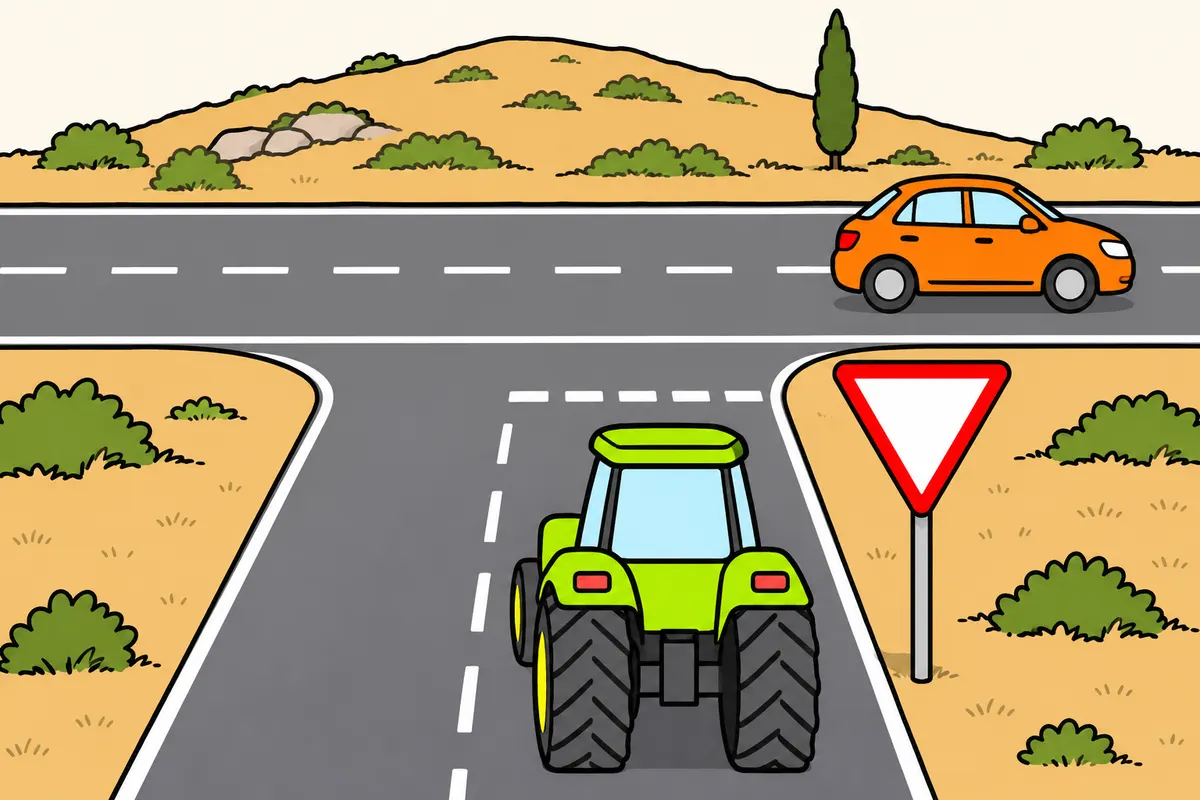
You must give way at both signs, but STOP always requires a complete stop.
| Sign | What you must do | Shape |
|---|---|---|
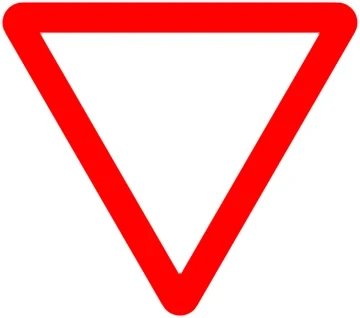
| R-1: give way | Give way; stop if necessary | Triangle pointing downwards |
| R-2: STOP | Stop completely even if nobody is coming | Red octagon with STOP |
Remember
- Recognise R-1: a red-bordered triangle pointing downwards.
- Recognise R-2: a red octagon with “STOP” in white.
- At R-1, stop if you need to give way.
- At R-2, stop completely even if nobody is coming.
- If instructions conflict, obey officers’ orders and traffic lights.
- See “Priority of passage” for stopping again at M-4.1 because visibility is poor.
Exam trap: Wrong: at STOP you may roll through slowly if nobody comes. Right: at R-2 you must stop completely.
Read the full explanation
- You can recognise R-1, «Give way», by its triangular shape with the point facing downwards and its red border. [RGC, Annex I.5](https://www.boe.es/buscar/act.php?id=BOE-A-2003-23514#A5).
- You can recognise R-2, «Compulsory stop or STOP», by its red octagonal shape with the word «STOP» in white. [RGC, Annex I.5](https://www.boe.es/buscar/act.php?id=BOE-A-2003-23514#A5).
- Both are upright priority signs: if there is a conflict, officers' instructions and traffic lights take precedence over them according to the hierarchy in the section «Hierarchy for resolving conflicts». [RGC, art. 133](https://www.boe.es/buscar/act.php?id=BOE-A-2003-23514#a133).
- How you apply these signs and make a second stop because of insufficient visibility at the M-4.1 marking is covered in «Priority of passage», in the section «Give way and STOP». [RGC, art. 56.5](https://www.boe.es/buscar/act.php?id=BOE-A-2003-23514#a56); [RGC, Annex I.5](https://www.boe.es/buscar/act.php?id=BOE-A-2003-23514#A5).
 R-1
24Following instructions without creating danger
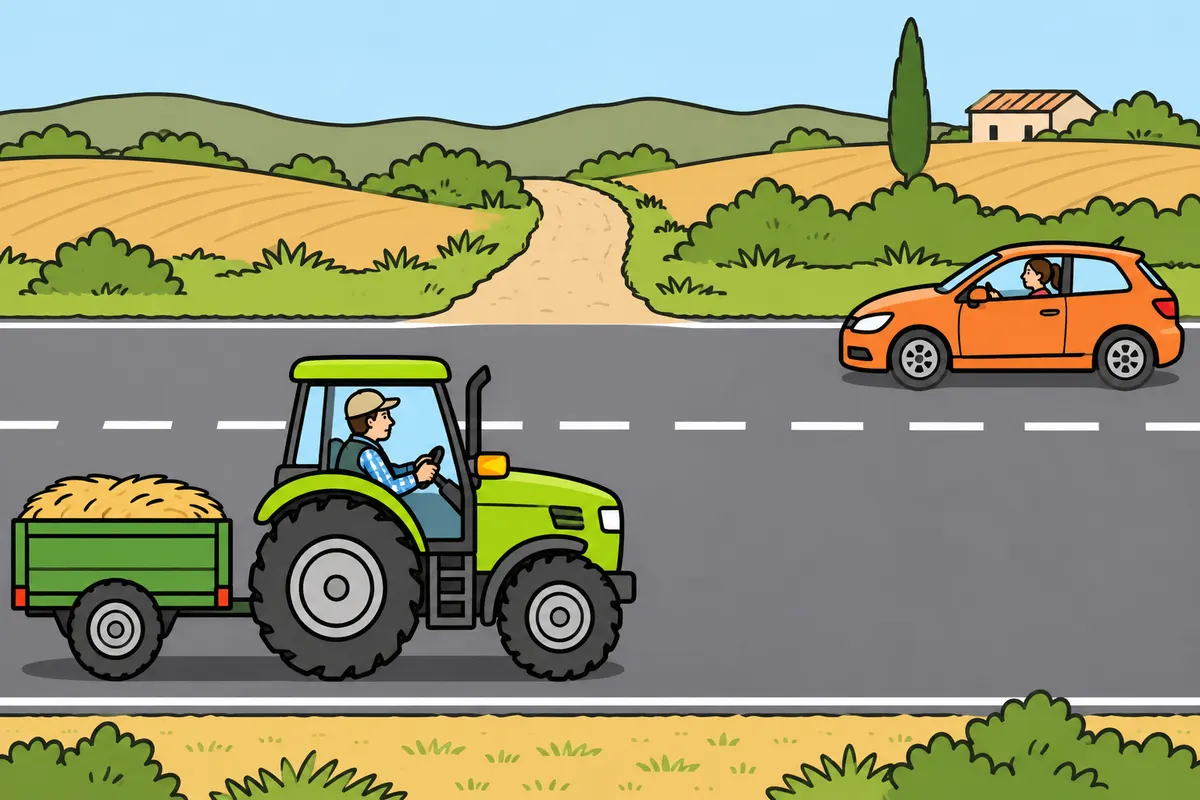
You must follow instructions and signs while always driving safely.
| Permitted horn use | Condition |
|---|---|
| Avoid an accident | You may use the horn |
| Warn that you intend to overtake | Only outside built-up areas |
| Announce your presence during an exceptional urgent service | Only in the permitted circumstances |
Remember
- Control your tractor and allow space for the whole combination.
- Obey limits and adapt your speed to all conditions.
- You must be able to stop within what you can see.
- Before turning, signal and check that you can turn safely.
- If you cannot turn safely, do not turn.
Exam trap: Wrong: signalling lets you turn without checking. Right: signal and check that you can turn safely.
Read the full explanation
- You must drive with care and caution to avoid harm and danger. Even when obeying a sign or signal, you must keep control of your agricultural vehicle and anticipate the space your combination needs: permission to proceed does not justify a dangerous action. [RGC, arts. 3, 45, 74 and 110](https://www.boe.es/buscar/act.php?id=BOE-A-2003-23514#a3).
- You must obey speed limits and adapt your speed to your condition, the road, your vehicle, the load, the weather and traffic, so that you can stop within the distance you can see. This duty applies even when the road surface is dry and there are no other vehicles; the figures are covered in «Speed and distances for agricultural vehicles». [RGC, arts. 3, 45, 74 and 110](https://www.boe.es/buscar/act.php?id=BOE-A-2003-23514#a3).
- Before turning, you must signal and check that you can turn safely; preparation, positioning and carrying out the turn are covered in «Manoeuvres with agricultural vehicles». [RGC, art. 74](https://www.boe.es/buscar/act.php?id=BOE-A-2003-23514#a74).
- You may use the horn to avoid an accident, to warn outside built-up areas that you intend to overtake, or to announce your presence when exceptionally providing an urgent service; the conditions are covered in «Manoeuvres with agricultural vehicles». [RGC, art. 110](https://www.boe.es/buscar/act.php?id=BOE-A-2003-23514#a110).
Organise your LVA tests
Distinguish age requirements, test attempts and the validity of a pass.
- Check the requirements and whether the vehicle you want to drive falls within the licence scope.
- Prepare for the specific theory test: according to the format published by the DGT (2020), 20 questions and a maximum of 2 errors; the statutory basic time allowance is one minute per question.
- Follow the date and centre set by the Jefatura (provincial traffic office); you can take the theory test up to three months before reaching the minimum age.
- After passing the theory test, take the practical test on the test track once you are 16 and within the two-year validity period of your pass.
- Distinguish the six months between attempts from the minimum intervals of 10 and 15 days in the annex where applicable.
Decide which instruction you must follow
Identify who the instruction applies to before using the hierarchy.
- Check your lane, your intended movement and where the signs and signals are placed.
- Check whether an officer is directing your passage and obey their instruction immediately.
- If instructions conflict, apply this order: officers, temporary signs and delineation devices, traffic lights, upright signs and road markings.
- Between signs or signals of the same type, apply the most restrictive.
- Comply with all other compatible obligations and proceed cautiously.
Stop when an officer orders you to
Interpret the gesture and wait for a signal allowing you to continue.
- Identify whether the stop gesture applies to your path.
- For a vertically raised arm, apply the exceptions where you cannot stop safely or have already entered the junction.
- Stop at the nearest line or at the appropriate place or the place indicated by the officer.
- If the instruction uses a horizontal arm, remember that lowering the arm alone does not cancel it.
- Resume when the signal permits it and you can do so safely.
Check what you know
Real questions from the bank on this topic. Pick an answer to see the explanation.
Finished this module?
Mark it as read and you will see your progress on the theory list.