
Theory · C+E Licence - Articulated Truck · Module 2 of 13
Driver and vehicle combination documentation
You learn to check your C+E licence and the documents, insurance and ITV (vehicle roadworthiness test) for each vehicle in the combination. You distinguish between age requirements, validity periods and administrative deadlines to answer exam questions and avoid driving without a valid entitlement or inspection.
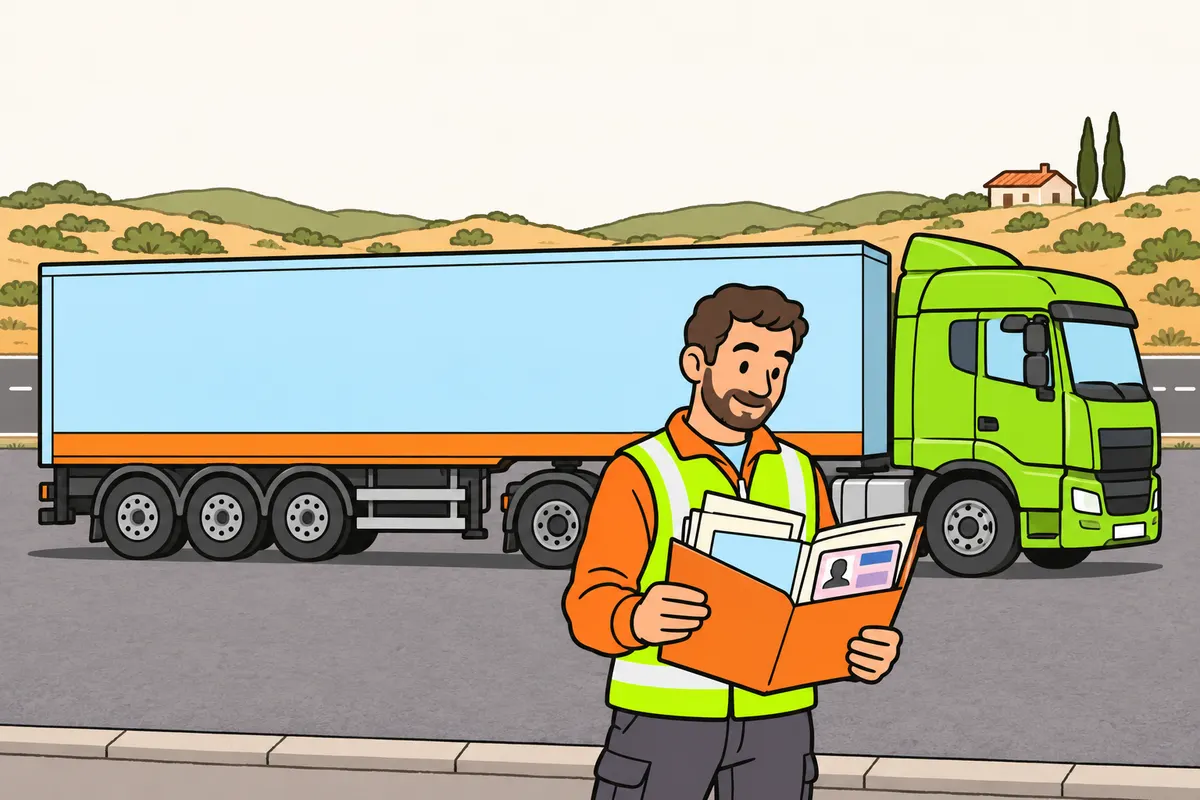
1Three independent checks
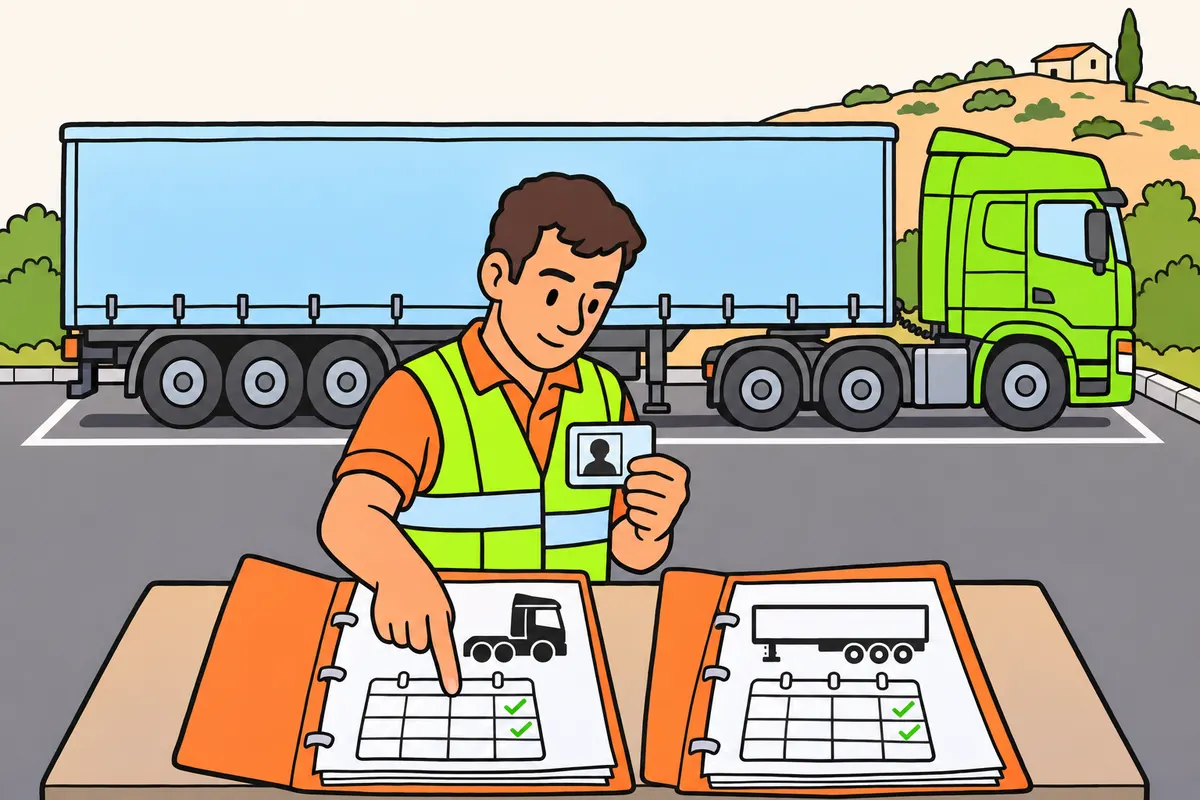
Check your licence and the valid documents for each vehicle.
| Document | What it shows |
|---|---|
| Driving licence | What you may drive |
| Registration certificate | Which vehicle is authorised |
| ITV card | Vehicle technical details |
Remember
- Check the documents for the tractor unit and semi-trailer.
- Check that each document matches the vehicle you use.
- Check dates and whether insurance and ITV are actually valid.
- Show the documents when officers ask.
Exam trap: Wrong: having the ITV card proves the inspection is current. Right: check the actual expiry date too.
Read the full explanation
- You must distinguish your personal entitlement from the authorisations for the vehicles: your driving licence shows what you may drive; the permiso de circulación (vehicle registration certificate) identifies the authorised vehicle, and the tarjeta ITV (technical inspection card) records its technical documentation. ITV is the vehicle roadworthiness test. You must meet the requirements for all of them to use the combination. [RGCond, art. 1; RGV, art. 26](https://www.boe.es/buscar/act.php?id=BOE-A-1999-1826)
- For a standard articulated vehicle, you must check both the tractor unit and the semi-trailer. Each unit retains its own documentary identity even when coupled together and belonging to the same company. Documents for another unit in the fleet do not establish the documentation of the vehicle you use that day. [RGV, arts. 25 and 26](https://www.boe.es/buscar/act.php?id=BOE-A-1999-1826)
- Carrying a document and meeting the requirement it certifies are different matters: having the tarjeta ITV does not prove that the inspection is current, and keeping an insurance policy does not in itself guarantee that the insurance remains in force. [RGV, art. 10; LRCSCVM, art. 2](https://www.boe.es/buscar/act.php?id=BOE-A-2004-18911)
- When officers ask you for the documentation, you must produce it. Organising it before departure allows you to detect registration number errors, cards belonging to another trailer or expired inspections. This administrative check complements the safety inspection of the combination covered in «Maintenance and inspection of the vehicle combination». [RGV, art. 26](https://www.boe.es/buscar/act.php?id=BOE-A-1999-1826)
2Who issues the C+E licence
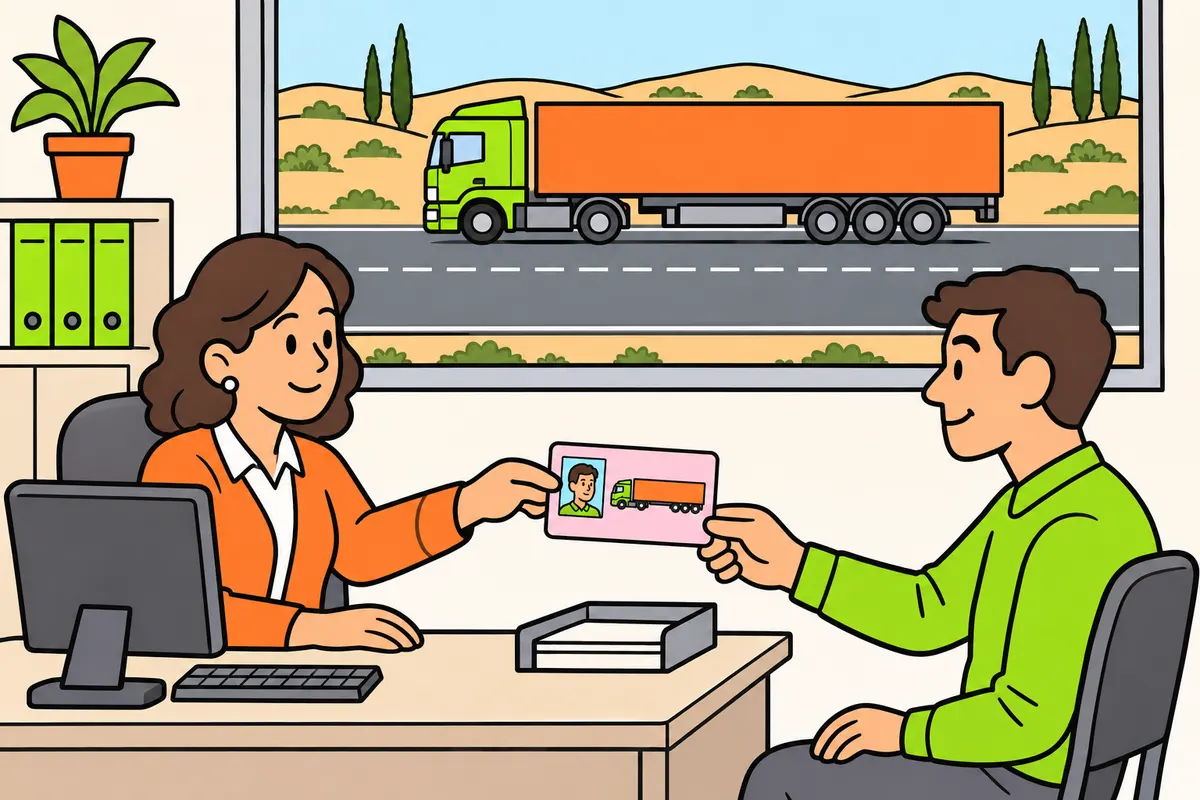
You must obtain your C+E licence from a provincial traffic office.
| Organisation | What it does |
|---|---|
| Provincial traffic office | Issues your licence |
| Driving school | Trains you |
| Medical centre | Checks your fitness |
Remember
- You need the correct authorisation before driving.
- You must meet age and health requirements and pass the required tests.
- Check the categories and conditions on your licence.
- Your experience cannot replace a licence.
Exam trap: Wrong: enrolling at a driving school lets you drive. Right: you need the licence to be granted.
Read the full explanation
- Your C+E is a driving licence, not an agricultural vehicle licence or the lorry’s permiso de circulación. You need prior administrative authorisation, and it must match the class of vehicle or combination you drive. [RGCond, arts. 1 and 4](https://www.boe.es/buscar/act.php?id=BOE-A-2009-9481)
- Jefaturas Provinciales de Tráfico (provincial traffic offices) issue civilian driving licences and the administrative authorisations that temporarily replace them. Your driving school trains you and the medical centre certifies your physical and mental fitness, but neither is the authority that grants your licence. [RGCond, art. 2](https://www.boe.es/buscar/act.php?id=BOE-A-2009-9481)
- You must obtain authorisation by meeting the age and physical and mental fitness requirements and passing the required tests. Submitting an application, enrolling at a driving school or receiving a favourable medical certificate does not amount to being granted a licence. For details of the tests, see the «C+E licence: requirements, tests and validity» module. [RGCond, art. 7](https://www.boe.es/buscar/act.php?id=BOE-A-2009-9481)
- All the licence categories you hold must appear on a single document. You must check the categories shown and their conditions, rather than assume that the card entitles you to drive any heavy vehicle or any combination with a trailer. [RGCond, art. 4.1](https://www.boe.es/buscar/act.php?id=BOE-A-2009-9481)
3Age and C+E entitlement
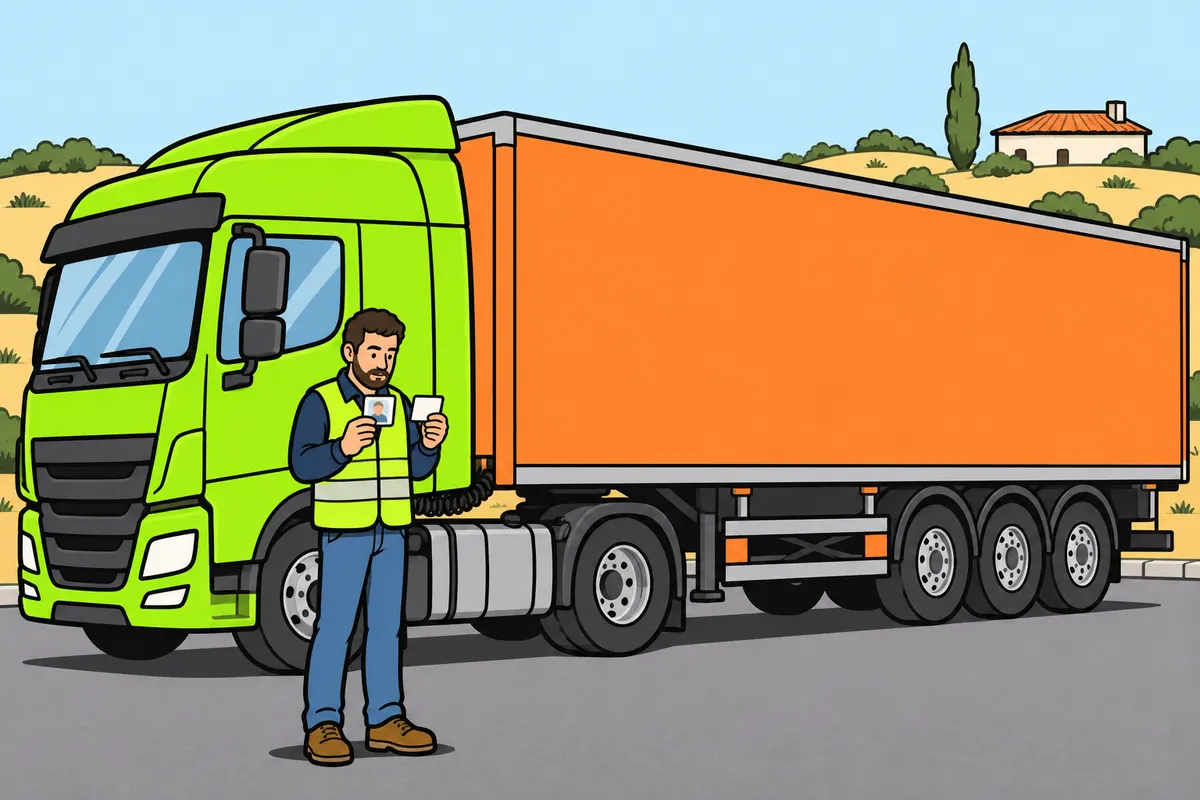
To obtain C+E, you need a valid C licence and must meet the age requirement.
| Combination with a category C lorry | Licence you need |
|---|---|
| Trailer with MMA up to 750 kg | C |
| Trailer or semi-trailer with MMA over 750 kg | C+E |
Remember
- From 18, you need CAP through the standard initial qualification route.
- To obtain C+E, you need a valid C licence.
- MMA means maximum authorised mass; travelling empty does not change it.
- For a light trailer, carry its ITV card.
- Check the lorry's ITV card records a compatible coupling on the reverse.
Exam trap: Wrong: any CAP lets you obtain C+E from 18. Right: you need standard initial CAP and a valid C licence.
Read the full explanation
- The general minimum age for C+E is 21 years. You may obtain it from 18 years if you hold the CAP (certificate of professional competence) obtained through the standard initial qualification route. [RGCond, art. 4.2](https://www.boe.es/buscar/act.php?id=BOE-A-2009-9481)
- To obtain C+E, you must hold a valid C licence. Reaching the required age does not grant you the category or allow you to dispense with the prerequisite licence. CAP and C+E certify different requirements: holding one does not automatically replace the other. [RGCond, art. 5.1](https://www.boe.es/buscar/act.php?id=BOE-A-2009-9481)
- Your C+E allows you to drive combinations consisting of a towing vehicle covered by category C and a trailer or semi-trailer with an MMA (maximum authorised mass) exceeding 750 kg. You must consider the maximum authorised mass of the towed vehicle; travelling empty does not turn a non-light semi-trailer into a light trailer. [RGCond, art. 4.2](https://www.boe.es/buscar/act.php?id=BOE-A-2009-9481)
- If the lorry tows a trailer with an MMA not exceeding 750 kg, you may drive that combination with category C. You must carry the trailer’s tarjeta ITV; the reverse of the lorry’s tarjeta ITV must state that it has a coupling system installed that is compatible with the trailer’s. [RGCond, art. 4.2](https://www.boe.es/buscar/act.php?id=BOE-A-2009-9481). [RGV, art. 26.1.c](https://www.boe.es/buscar/act.php?id=BOE-A-1999-1826#a26)
4How to read your licence
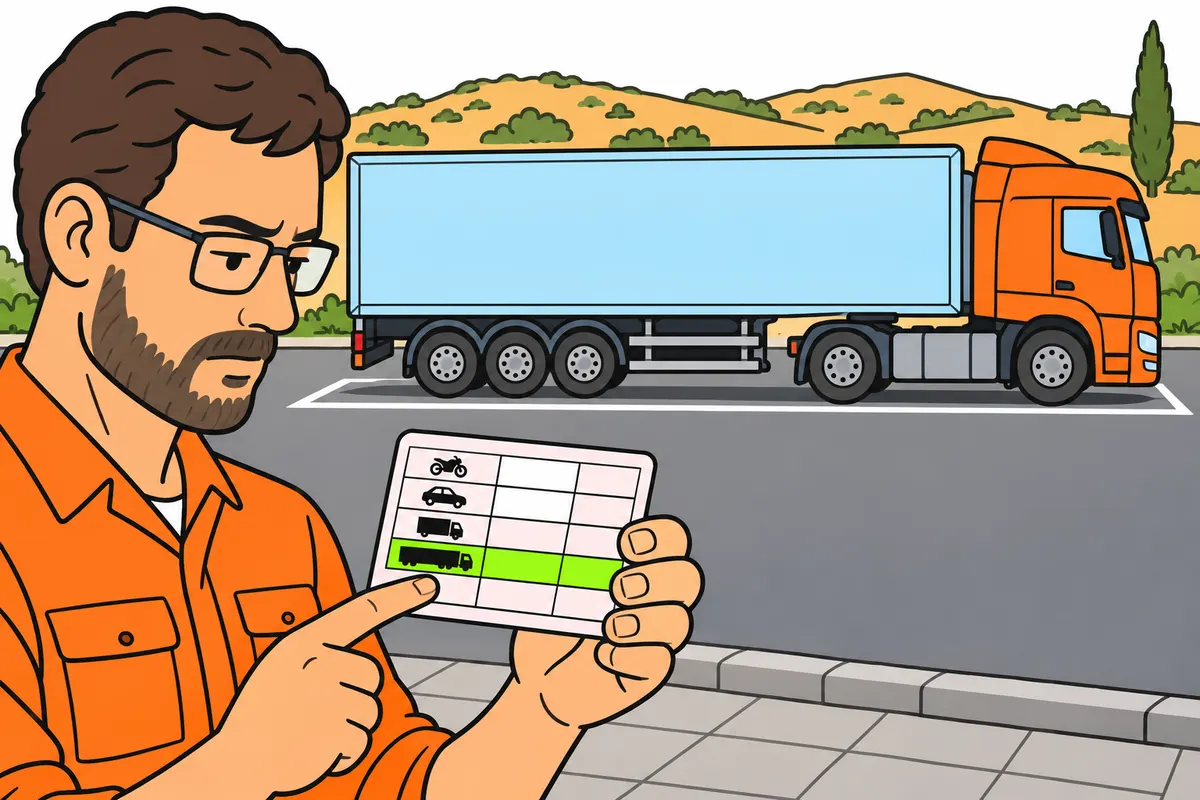
Check your C+E category, its expiry date and its restrictions.
Remember
- Find the C+E row on the back of your licence.
- Check its expiry date, even if your other categories remain valid.
- Follow your restrictions even in another company's vehicle.
- Check each code's meaning and which category it affects.
Exam trap: Wrong: you can drive because another category remains valid. Right: you need valid C+E for the articulated vehicle.
Read the full explanation
- On the card, you must locate your identity details, the issuing authority and the relevant dates. On the reverse, you can check the categories, the date each was first issued, its expiry date and coded restrictions. [RGCond, art. 9 and Annex I](https://www.boe.es/buscar/act.php?id=BOE-A-2009-9481)
- You must specifically check the C+E row to drive the articulated vehicle. When planning a route, check the entitlement required for the complete combination and any restrictions that may affect you. [RGCond, art. 12 and Annex I](https://www.boe.es/buscar/act.php?id=BOE-A-2009-9481)
- The entries on your licence may restrict the persons, vehicles or driving conditions. You must comply with them even when you drive a replacement lorry or one belonging to another company. [RGCond, art. 3](https://www.boe.es/buscar/act.php?id=BOE-A-2009-9481)
- Medical or administrative codes express conditions attached to the licence categories. A number in the remarks field does not in itself extend your entitlement to all combinations. To interpret its scope, check its meaning and the category or categories to which it applies. [RGCond, Annex I](https://www.boe.es/buscar/act.php?id=BOE-A-2009-9481)
5Standard C+E validity
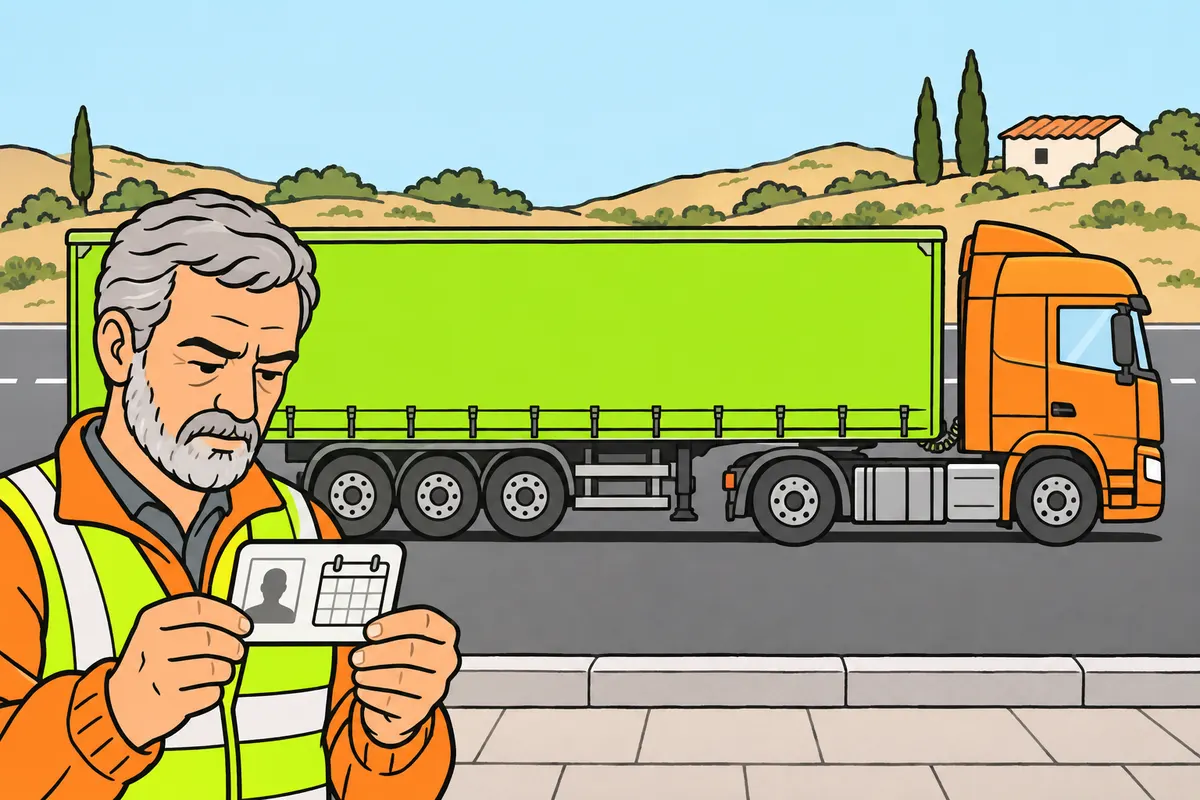
Renew your C+E according to your age and its actual expiry date.
| Your age: C+E, C and C1+E licences | Normal validity |
|---|---|
| Under 65 years | 5 years |
| From 65 years | 3 years |
Remember
- From age 65, the normal validity period changes.
- Your health may mean a shorter validity period.
- Always check your licence's actual expiry date.
- You cannot drive if you have lost all your penalty points.
- You must still meet requirements and obey any measure preventing you from driving.
Exam trap: Wrong: you apply category B renewal periods to C+E. Right: use 5 or 3 years according to age, unless medically shortened.
Read the full explanation
- Your C+E licence normally remains valid for 5 years while you are under 65, and for 3 years from that age. [RGCond, art. 12.1](https://www.boe.es/buscar/act.php?id=BOE-A-2009-9481)
- This schedule also applies to C and C1+E, among other heavy vehicle categories. If you obtain C+E at 50 years of age, the standard period is 5 years, provided there is no reduction on medical grounds. [RGCond, art. 12](https://www.boe.es/buscar/act.php?id=BOE-A-2009-9481)
- Your validity period may be shorter than the standard period if you have an illness or impairment liable to worsen that justifies the reduction. You must follow the specific expiry date of your entitlement, even if you know the general periods applicable to C+E by heart. [RGCond, art. 12.3](https://www.boe.es/buscar/act.php?id=BOE-A-2009-9481)
- Your licence’s validity also depends on continuing to meet the requirements for obtaining it and retaining at least some of your points. A future date printed on the card does not entitle you to drive if your licence has lost its validity or another measure prevents you from driving. [RGCond, art. 12.5 and 12.6](https://www.boe.es/buscar/act.php?id=BOE-A-2009-9481)
6When and how to renew
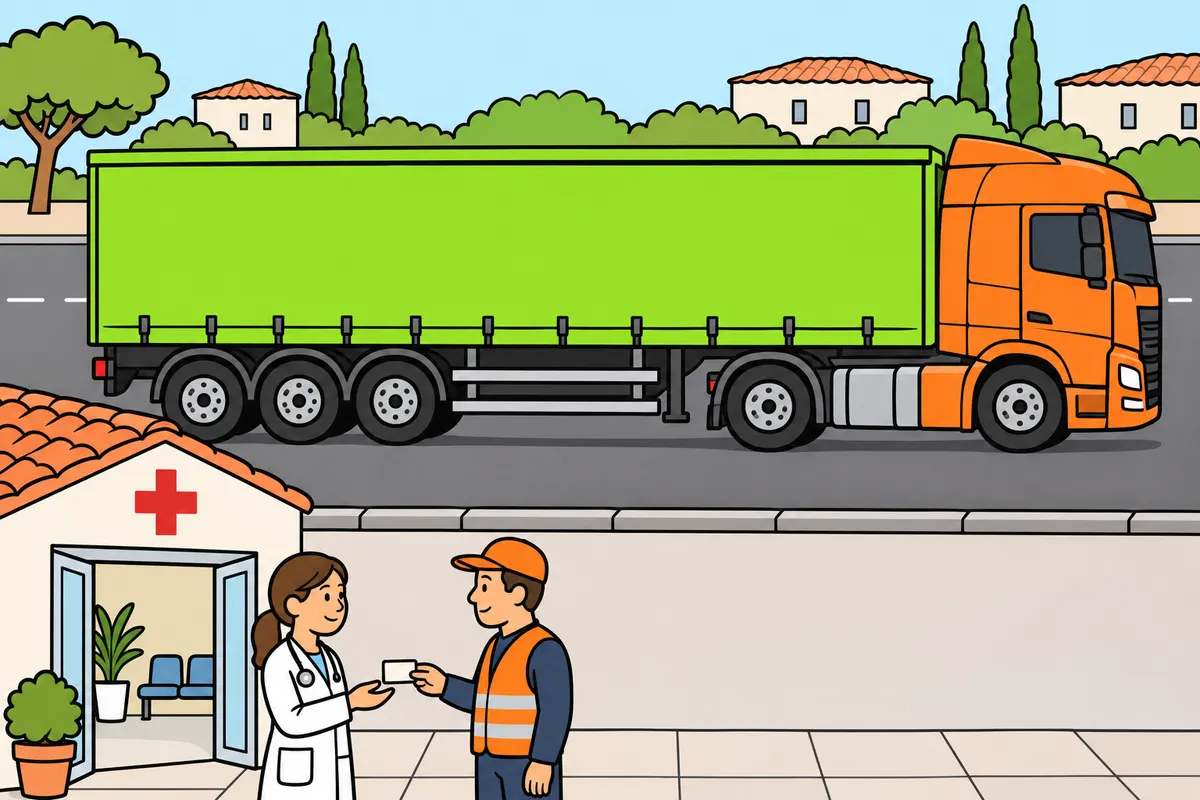
You can renew early, but an appointment does not let you drive with an expired licence.
Remember
- You can renew from 3 months before expiry.
- Within that window, you keep the remaining validity period.
- You must pass the medical assessment and complete the renewal procedure.
- You can renew an expired licence without retaking tests just because it expired.
- Do not drive under an expired category.
- Renewing group 2 also renews your group 1 categories for their own periods.
Exam trap: Wrong: your appointment extends your licence. Right: you cannot drive under an expired category.
Read the full explanation
- You may apply for standard renewal from 3 months before expiry. If you complete the process within that period, the new period runs from the licence’s expiry date, so applying early within that window does not shorten your remaining validity. [RGCond, art. 13.1](https://www.boe.es/buscar/act.php?id=BOE-A-2009-9481)
- To renew, you must prove that you retain the required physical and mental fitness. You may renew through an authorised Centro de Reconocimiento de Conductores (driver assessment centre) that handles the procedure, or through the DGT by providing the report and required documentation. [RGCond, art. 13; DGT, renewal](https://sede-org.dgt.gob.es/es/permisos-de-conducir/obtencion-y-gestion-de-permisos/renovacion-de-permiso-proximo-a-caducar/)
- You may apply to renew an expired licence, and expiry alone does not require you to retake the tests for obtaining it. However, you cannot drive under that category while it is expired. Having an appointment or booking a medical assessment does not extend your entitlement. [RGCond, arts. 12.4 and 13.3](https://www.boe.es/buscar/act.php?id=BOE-A-2009-9481)
- Renewing a group 2 category also renews any group 1 entitlements you hold, for their respective periods. You must not infer from this that all categories on your card necessarily have the same expiry date or the same standard validity period. [RGCond, art. 13.1](https://www.boe.es/buscar/act.php?id=BOE-A-2009-9481)
7Medical assessment and fitness to drive
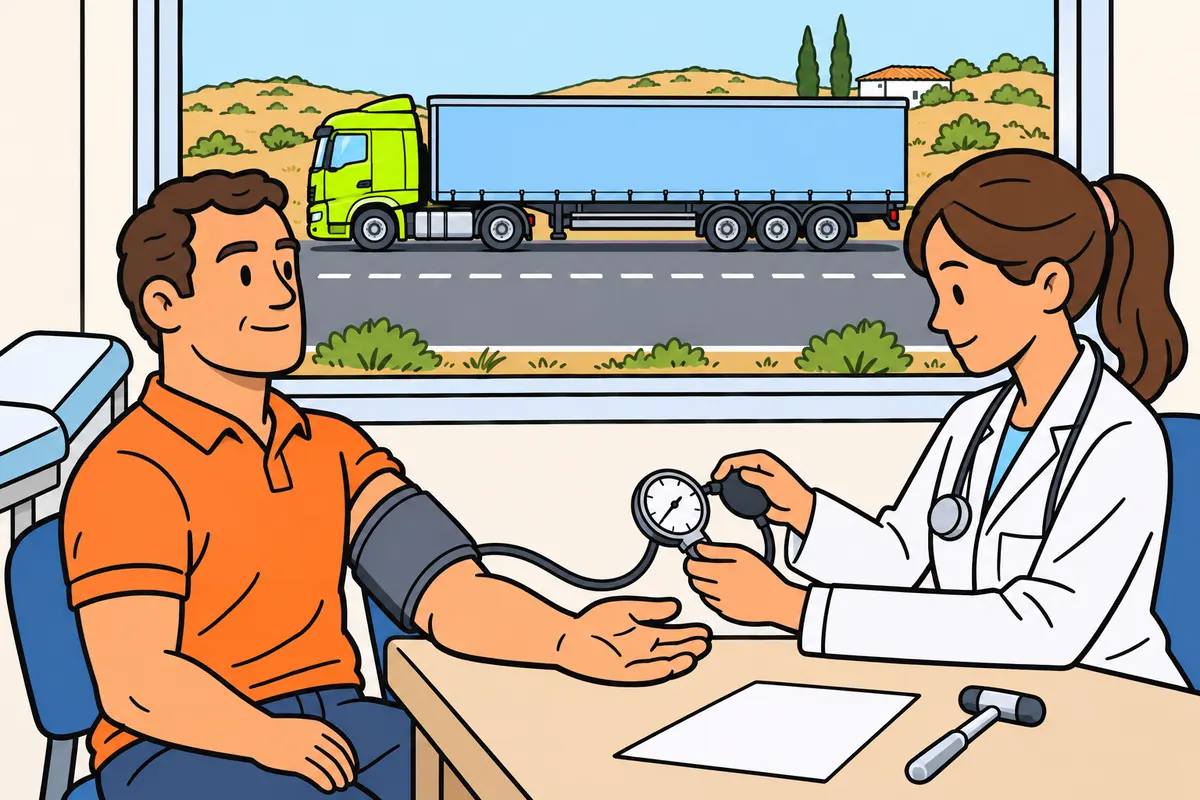
To obtain or renew C+E, you must pass the medical assessment for your category.
Remember
- For C+E, you need group 2 fitness.
- Visit an authorised driver medical assessment centre.
- Tell the centre about your illnesses and treatments.
- Follow the required vehicle adaptations and restrictions on your licence.
- Seek a fitness check if an illness affects your driving.
Exam trap: Wrong: your workplace health check replaces the driving assessment. Right: you need the authorised assessment for your category.
Read the full explanation
- To obtain or renew C+E, you must meet the group 2 physical and mental fitness requirements. Being fit to drive a car is not enough: the regulations distinguish between groups and set specific criteria. The assessment must evaluate your fitness for the heavy vehicle category you apply for. [RGCond, arts. 44 and 45 and Annex IV](https://www.boe.es/buscar/act.php?id=BOE-A-2009-9481)
- You must undergo the assessment at an authorised Centro de Reconocimiento de Conductores (driver medical assessment centre). Its checks cover the relevant abilities and medical conditions specified in the regulations; they are not a lorry inspection or your employer’s occupational health assessment. Disclose the medical history and treatments that need to be assessed. [RGCond, art. 44 and Annex IV](https://www.boe.es/buscar/act.php?id=BOE-A-2009-9481)
- A favourable result may be subject to restrictions, adaptations or a shorter validity period. You must comply with the decision and the entries on your licence; you cannot decide for yourself that an adaptation is unnecessary because the vehicle has automatic transmission or driving aids. [RGCond, arts. 3 and 7.2 and Annex IV](https://www.boe.es/buscar/act.php?id=BOE-A-2009-9481)
- If you develop an illness or impairment that compromises the driving requirements, you must assess your fitness and arrange the appropriate checks or changes. The expiry date does not guarantee that you retain all your abilities. Check the effects of the illness and its treatment before driving. [RGCond, art. 12.6 and Annex IV](https://www.boe.es/buscar/act.php?id=BOE-A-2009-9481)
8Common restrictions and codes
Follow every code on your licence and check which category it affects.
| Your licence code | What you must know |
|---|---|
| 01.01 | You must wear glasses |
| 01.02 | You must wear contact lenses |
| 01.06 | You can wear glasses or contact lenses |
| 78 | Automatic transmission only |
| 95 | CAP with the stated date |
| 96 | Certain category B combinations |
Remember
- Use the exact type of eyesight correction required by your licence.
- With code 78, you can only drive automatic vehicles in the affected category.
- Use vehicles with all your required adaptations.
- A medical note does not remove a licence restriction.
- Do not confuse CAP with your C+E licence.
Exam trap: Wrong: with 01.01, you can choose contact lenses. Right: you must wear glasses when driving.
Read the full explanation
- If your licence shows 01.01, you must drive wearing glasses; 01.02 refers to contact lenses, and 01.06 allows glasses or contact lenses. You must comply with the specific subcode: you cannot choose to interchange the different forms of eyesight correction yourself. [RGCond, Annex I.B](https://www.boe.es/buscar/act.php?id=BOE-A-2009-9481)
- Code 78 restricts you to driving vehicles with automatic transmission. You must check whether it appears on your driving entitlement and which category it affects. [RGCond, Annex I.B](https://www.boe.es/buscar/act.php?id=BOE-A-2009-9481)
- Adaptations may affect the clutch, braking, accelerator or steering, among other systems. If you have a condition of this kind, you must drive a vehicle that meets it. A medical note you carry does not remove a restriction that remains on your licence. [RGCond, art. 3 and Annex I.B](https://www.boe.es/buscar/act.php?id=BOE-A-2009-9481)
- Code 95 identifies CAP (Certificate of Professional Competence) professional qualification with the date indicated; 96 refers to certain category B combinations. You must distinguish them from category C+E and its medical codes: 95 does not in itself grant a heavy vehicle licence, and 96 does not replace it. [RGCond, Annex I.B](https://www.boe.es/buscar/act.php?id=BOE-A-2009-9481)
9Documents you must carry
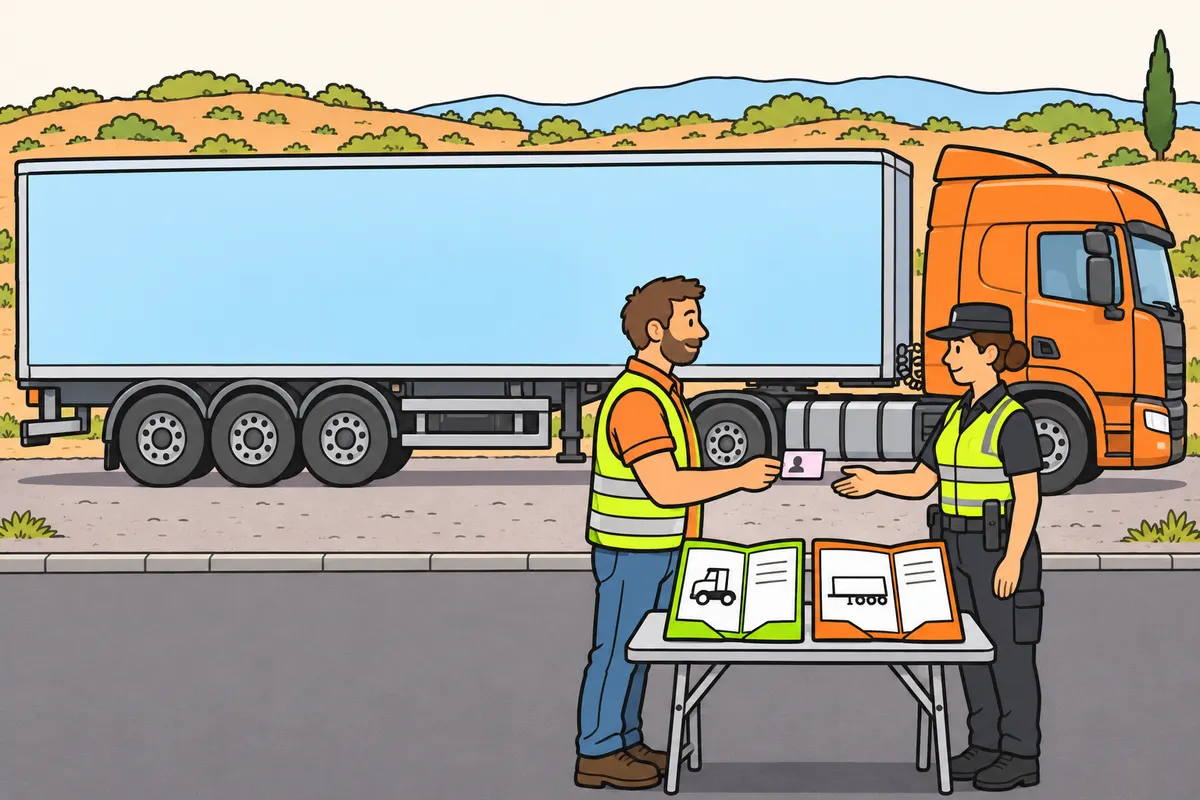
Carry your driving licence and the documents for each unit in your combination.
| Your combination | Vehicle documents you must carry |
|---|---|
| Lorry and non-light trailer | Documents for both lorry and trailer |
| Articulated vehicle | Documents for both tractor unit and semi-trailer |
Remember
- Carry your driving licence and show it to traffic officers when asked.
- Carry each unit's registration certificate and ITV card.
- You can carry original vehicle documents or duly certified photocopies.
- Keep your latest ITV report.
- If your transport requires CAP, carry valid proof in an accepted document.
Exam trap: Wrong: C+E replaces CAP. Right: if your work requires CAP and no exemption applies, you need valid proof.
Read the full explanation
- You must carry your driving licence and show it when officers request it. For the vehicles in the combination, you must carry the permiso de circulación (vehicle registration certificate) and the technical inspection card for each unit. [RGCond, art. 3; RGV, art. 26](https://www.boe.es/buscar/act.php?id=BOE-A-1999-1826)
- For a lorry with a non-light trailer, you need the documents for both the lorry and the trailer. For an articulated vehicle, you need those for the tractor unit and the semi-trailer. [RGV, arts. 25 and 26](https://www.boe.es/buscar/act.php?id=BOE-A-1999-1826)
- You may carry the original vehicle documents or duly certified photocopies. An ordinary photocopy does not meet this requirement. Check that the copies correspond to the lorry and trailer or semi-trailer you use. [RGV, art. 26.2](https://www.boe.es/buscar/act.php?id=BOE-A-1999-1826#a26)
- Traffic enforcement officers may request the report from the latest ITV (vehicle roadworthiness test). You must keep it with the documents to prove the result and its conditions. Do not confuse the report with the technical inspection card or the visible sticker issued following a favourable inspection. [RD 920/2017, art. 10.3](https://www.boe.es/buscar/act.php?id=BOE-A-2017-12841)
- To drive a C+E professionally in a transport activity subject to CAP, you must hold a valid qualification and carry the driver qualification card or an accepted document proving its validity, such as an EU driving licence bearing code 95 in the recognised cases. The exemptions in article 2 apply. [RD 284/2021, arts. 1 and 2](https://www.boe.es/buscar/act.php?id=BOE-A-2021-6624#a1). [RD 284/2021, art. 20.3-5](https://www.boe.es/buscar/act.php?id=BOE-A-2021-6624#a2-2)
10Digital documents and proof of insurance
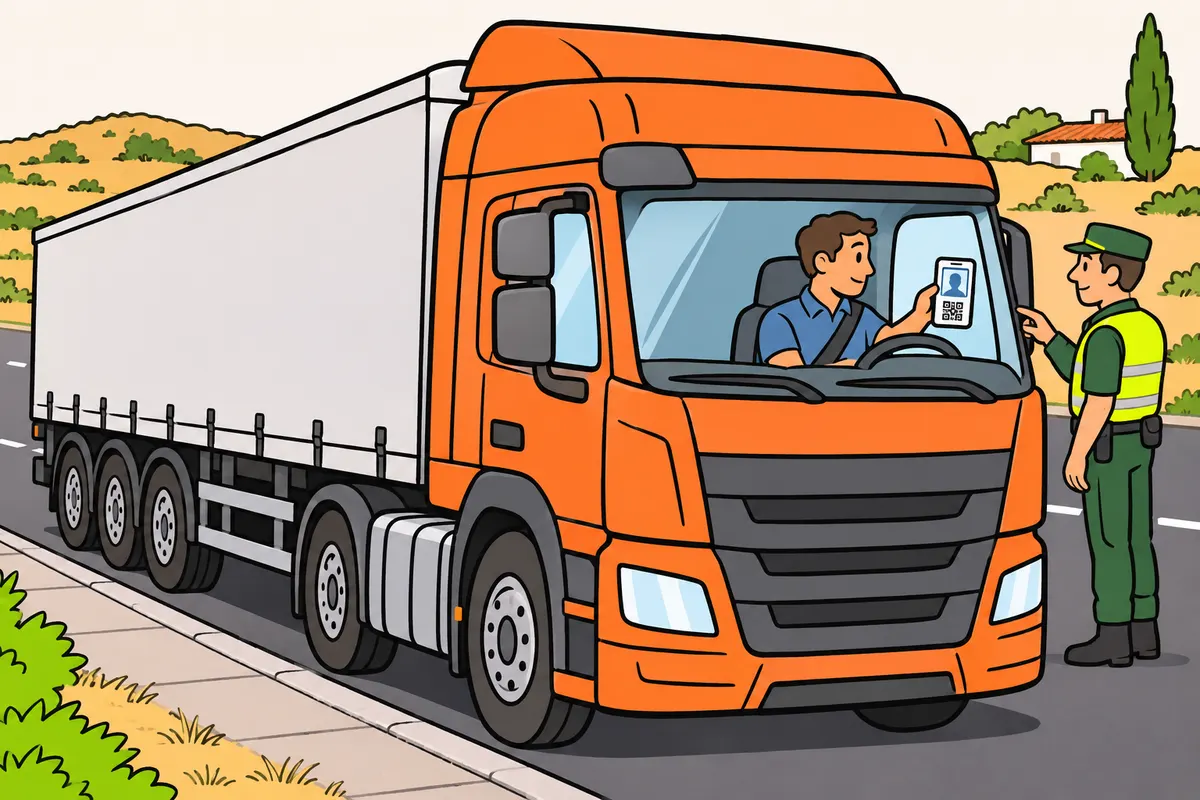
In Spain, you can use official miDGT documents, but you must keep insurance valid.
| Where you drive | Documents you should prepare |
|---|---|
| Spain | You can use official miDGT licences and registration certificates |
| Outside Spain | Carry physical documents and check your destination's requirements |
Remember
- Use the official driving licence and registration certificate in miDGT.
- A photo of a document is not the same as miDGT.
- You do not have to carry the insurance policy or payment receipt.
- Check valid insurance for each unit that requires it.
- You can keep insurer details to make arrangements easier.
Exam trap: Wrong: no receipt requirement means you can drive uninsured. Right: you must keep compulsory insurance valid.
Read the full explanation
- In Spain, the driving licence and permiso de circulación available in miDGT have the same legal validity as the physical documents. You must use the official documents available in the app, without assuming that a photograph saved on your phone has the same validity. [DGT, documents in miDGT](https://www.dgt.es/export/sites/web-DGT/.galleries/Images/notas-de-prensa/2020/ya-se-puede-llevar-el-permiso-de-conducir-en-el-movil/NP-APP-MI-DGT.pdf)
- For a journey outside Spain, you must carry the physical documents and check the destination’s requirements. The equivalence declared by DGT for miDGT applies to driving within Spain. [DGT, scope of miDGT](https://www.dgt.es/export/sites/web-DGT/.galleries/Images/notas-de-prensa/2020/ya-se-puede-llevar-el-permiso-de-conducir-en-el-movil/NP-APP-MI-DGT.pdf)
- You are not required to carry the insurance policy or the receipt for the latest payment in the vehicle. Officers can check insurance cover electronically. This exemption from carrying documents does not exempt you from taking out and maintaining valid compulsory insurance for each unit subject to it. [DGT, documentation; LRCSCVM, art. 2](https://revista.dgt.es/es/reportajes/2019/04ABRIL/0417-Documentacion.shtml)
- As practical preparation, you can keep the insurer, policy and assistance contact details for each unit. They help you identify the correct insurance if you use a different semi-trailer. You must verify that cover is actually in place and not rely solely on finding a receipt inside the cab. [LRCSCVM, art. 2](https://www.boe.es/buscar/act.php?id=BOE-A-2004-18911)
11Vehicle registration certificate for each unit
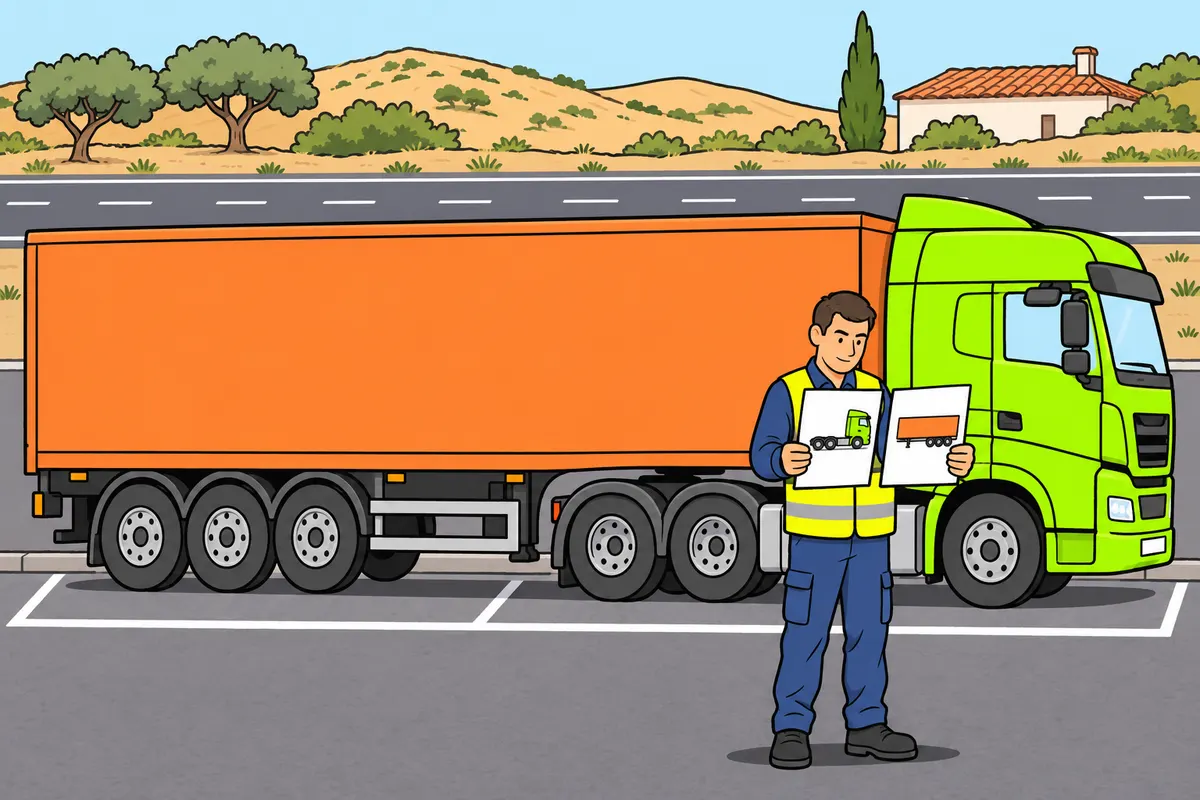
Check the separate registration certificate for each unit that needs one.
Remember
- Your motor vehicle needs registration and authorisation for road use.
- Your towed vehicle also needs registration and authorisation if its MMA exceeds 750 kg.
- Check that registration number, vehicle and registered keeper match the unit.
- A temporary traffic office authorisation can replace the registration certificate.
- Do not drive a deregistered vehicle.
Exam trap: Wrong: the tractor unit’s certificate covers the semi-trailer. Right: a semi-trailer over 750 kg MMA needs its own authorisation.
Read the full explanation
- To put a motor vehicle and a trailer or semi-trailer with an MMA (maximum authorised mass) exceeding 750 kg into service on the road, you must register them and have their authorisation to circulate. Your semi-trailer does not use the tractor unit’s certificate as though they were a single registered vehicle. [RGV, arts. 25 and 26](https://www.boe.es/buscar/act.php?id=BOE-A-1999-1826)
- The permiso de circulación identifies the registration number, the vehicle and its registered keeper, along with the other details in the prescribed format. You must check it against the unit you are using. [RGV, art. 29 and Annex XIII](https://www.boe.es/buscar/act.php?id=BOE-A-1999-1826)
- The Jefatura de Tráfico (traffic office) may issue a provisional authorisation that replaces the permiso de circulación with the effects prescribed by the regulations. You must check that the document really is a replacement authorisation; a purchase invoice or an application to transfer ownership does not in itself fulfil this function. [RGV, art. 26.1.a](https://www.boe.es/buscar/act.php?id=BOE-A-1999-1826)
- If a vehicle is deregistered, its permiso de circulación ceases to be valid. Physically retaining the document does not authorise you to use the vehicle on public roads. Before including a unit in your journey, you must ensure that its administrative status allows it to circulate. [RGV, art. 34](https://www.boe.es/buscar/act.php?id=BOE-A-1999-1826)
12ITV card and technical details
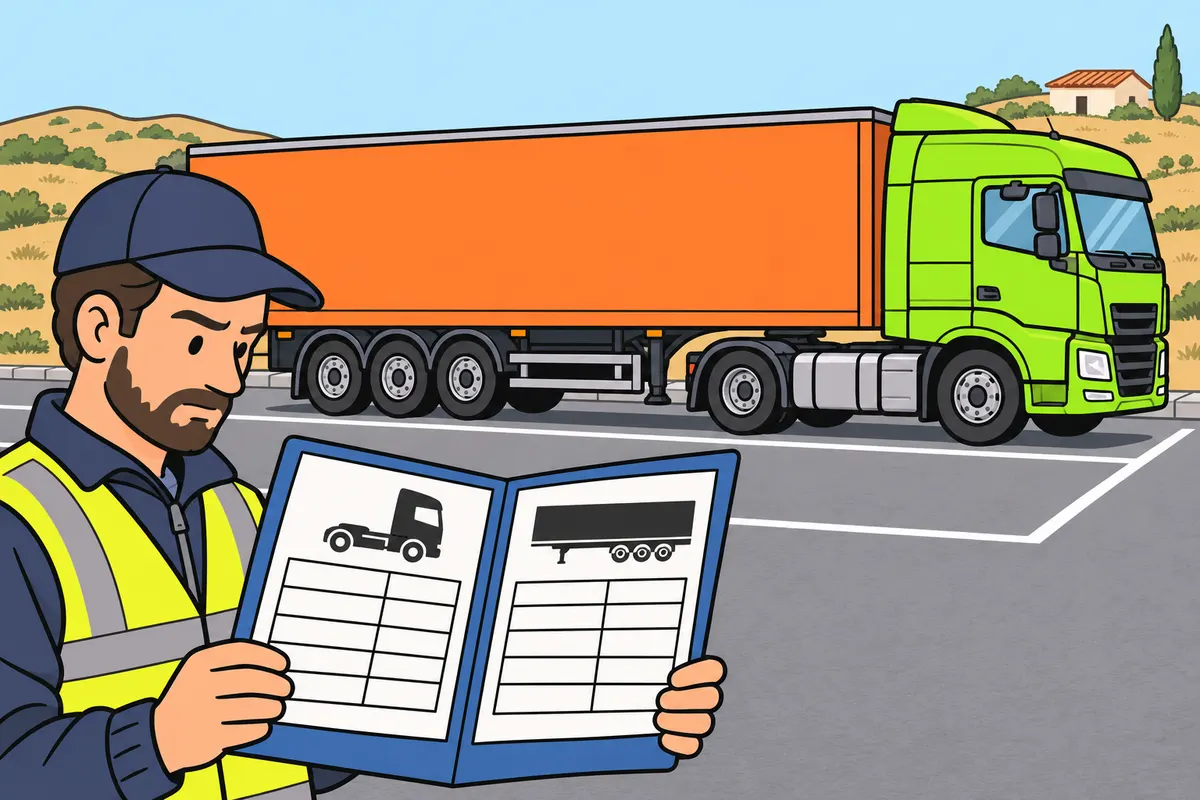
Check each vehicle's technical details and have modifications legally approved.
Remember
- Check each unit's identity and authorised masses.
- Check that their technical conditions allow you to couple them.
- Your C+E licence does not replace these technical checks.
- Distinguish an official electronic card printout from an informal copy of its details.
- Have modifications legally approved and update documents when required.
Exam trap: Wrong: having an ITV card proves a valid inspection. Right: also check that all required inspections are valid.
Read the full explanation
- You must use the ITV card to identify the technical characteristics of the lorry and the towed vehicle. It contains relevant details for identifying your vehicle and the technical conditions that apply to it. [RGV, arts. 10 and 26](https://www.boe.es/buscar/act.php?id=BOE-A-1999-1826)
- Check the vehicle’s identity and authorised masses in the documents. When choosing a coupling, it is not enough for your C+E licence to authorise that class of combination: you must also comply with the units’ technical conditions. Mass calculations are covered in “Maximum dimensions and masses”. [RGCond, art. 4; RGV, art. 25](https://www.boe.es/buscar/act.php?id=BOE-A-1999-1826)
- The ITV card may exist in electronic form, with a printed copy. The printed copy of the eITV is an official document; an informal transcription prepared by the company does not have that status. If you need a replacement, the procedure depends on the format of the technical inspection card. [DGT, electronic technical inspection card](https://sede.dgt.gob.es/es/vehiculos/duplicado-y-renovacion-de-documentacion/duplicado-de-la-ficha-tecnica/)
- The coupling and modifications must be legally approved under the applicable rules. If you change vehicle characteristics that affect its documents, you must complete the necessary inspections and updates. A private mechanical inspection does not replace the administrative approval of a modification. [RGV, art. 7; RD 920/2017, art. 5](https://www.boe.es/buscar/act.php?id=BOE-A-1999-1826)
13ITV for the lorry and towed vehicle
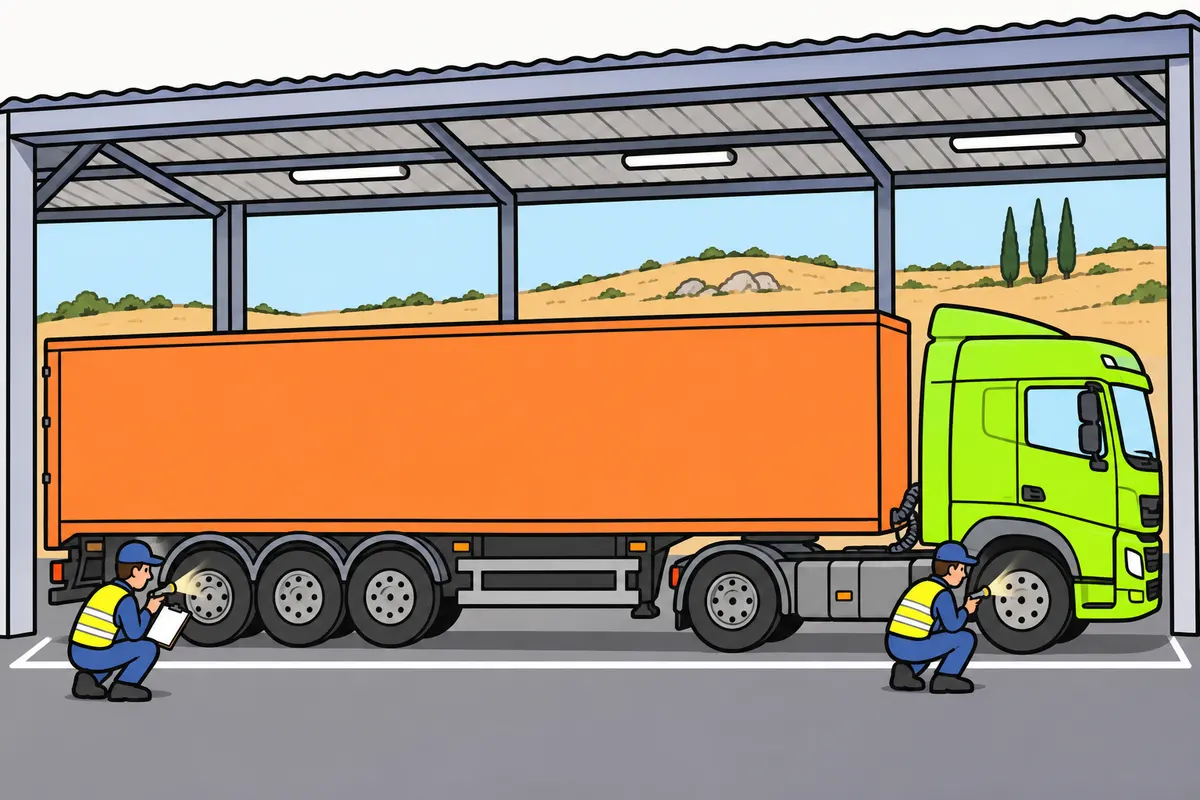
Calculate each unit’s age and ITV inspection frequency separately.
| Vehicles under normal ITV rules | Up to 10 years | Over 10 years |
|---|---|---|
| N2 or N3 goods lorry or tractor unit over 3.5 tonnes | Annual | Every 6 months |
| O2 trailers (not caravans), O3 trailers and O4 trailers | Annual | Every 6 months |
Remember
- Calculate age from the first registration or recorded entry into service.
- Buying a used vehicle does not restart its age.
- Check the tractor unit and towed vehicle separately.
- Do not apply a car's initial inspection exemption to your lorry.
- Six-monthly means every 6 months.
Exam trap: Wrong: you use the tractor unit's age for the whole combination. Right: calculate each unit's age separately.
Read the full explanation
- For your ordinary category N2 or N3 goods lorry or tractor unit with a maximum mass exceeding 3.5 tonnes, the periodic ITV (vehicle roadworthiness test) is annual up to 10 years of age and every 6 months when more than 10 years old. You have no initial exemption period as you do with a private passenger car. [RD 920/2017, art. 6.1](https://www.boe.es/buscar/act.php?id=BOE-A-2017-12841)
- For O2 trailers (except caravans), O3 trailers and O4 trailers, the standard inspection schedule is annual up to 10 years of age and every 6 months when more than 10 years old. You must have them inspected even though they have no engine. [RD 920/2017, art. 6.1](https://www.boe.es/buscar/act.php?id=BOE-A-2017-12841)
- You calculate the age from the first registration or entry into service recorded in the Registro de Vehículos (Vehicle Register). You must calculate it separately for each unit. Buying the combination second-hand or changing its registered keeper does not restart the age calculation for ITV purposes. [RD 920/2017, art. 6.1](https://www.boe.es/buscar/act.php?id=BOE-A-2017-12841)
- If you use a 4-year-old tractor unit with a 12-year-old semi-trailer, you must keep track of an annual inspection for the former and an inspection every 6 months for the latter, under the standard arrangements described. Six-monthly means every 6 months; you must not confuse it with biennial, which means every 2 years. [RD 920/2017, art. 6.1](https://www.boe.es/buscar/act.php?id=BOE-A-2017-12841)
14ITV expiry and early inspection
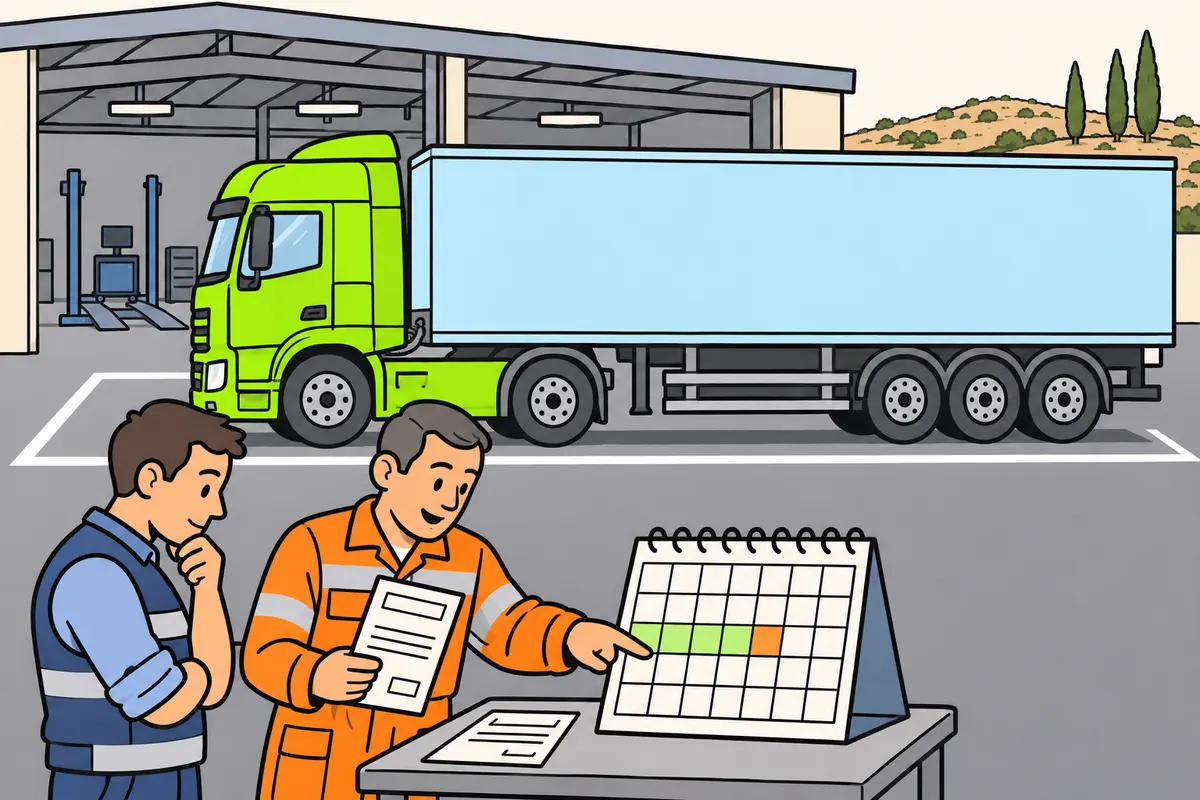
Pass your ITV on time; within the early inspection window, you keep the remaining validity.
Remember
- Check each vehicle's next ITV date.
- Pass within 30 calendar days before expiry to keep that expiry as your reference.
- Otherwise, calculate the new period from the date you pass.
- An appointment does not extend an expired ITV.
- If your ITV has expired, arrange lawful transport for the vehicle.
Exam trap: Wrong: you can drive for 30 days after expiry. Right: the window is before expiry and requires a favourable result.
Read the full explanation
- You must present each vehicle for inspection within its deadline. You must check the next ITV due date in its records and documentation, without working it out solely from its age. You may have units with different expiry dates even though they are subject to the same annual or six-monthly frequency. [RD 920/2017, arts. 4 and 6](https://www.boe.es/buscar/act.php?id=BOE-A-2017-12841)
- If you pass the ITV in the 30 calendar days before expiry, you calculate the new validity period from the previous expiry date. You can use this window to organise fleet inspections without losing the remaining days of validity of the previous inspection. [RD 920/2017, art. 6.5](https://www.boe.es/buscar/act.php?id=BOE-A-2017-12841)
- Outside that situation, you calculate the validity period by adding the applicable inspection interval to the date of the favourable inspection. You use the date of the favourable inspection and the previous expiry date to determine which calculation applies. The 30-day window is before expiry: it does not authorise you to drive after expiry. [RD 920/2017, art. 6.5](https://www.boe.es/buscar/act.php?id=BOE-A-2017-12841)
- An appointment at the testing station does not amount to a valid ITV or give you an extension to continue delivering goods. You must arrange for the vehicle to be moved legally if its inspection has expired. [RGV, art. 10; RD 920/2017, art. 4](https://www.boe.es/buscar/act.php?id=BOE-A-1999-1826)
15Favourable result and minor defects
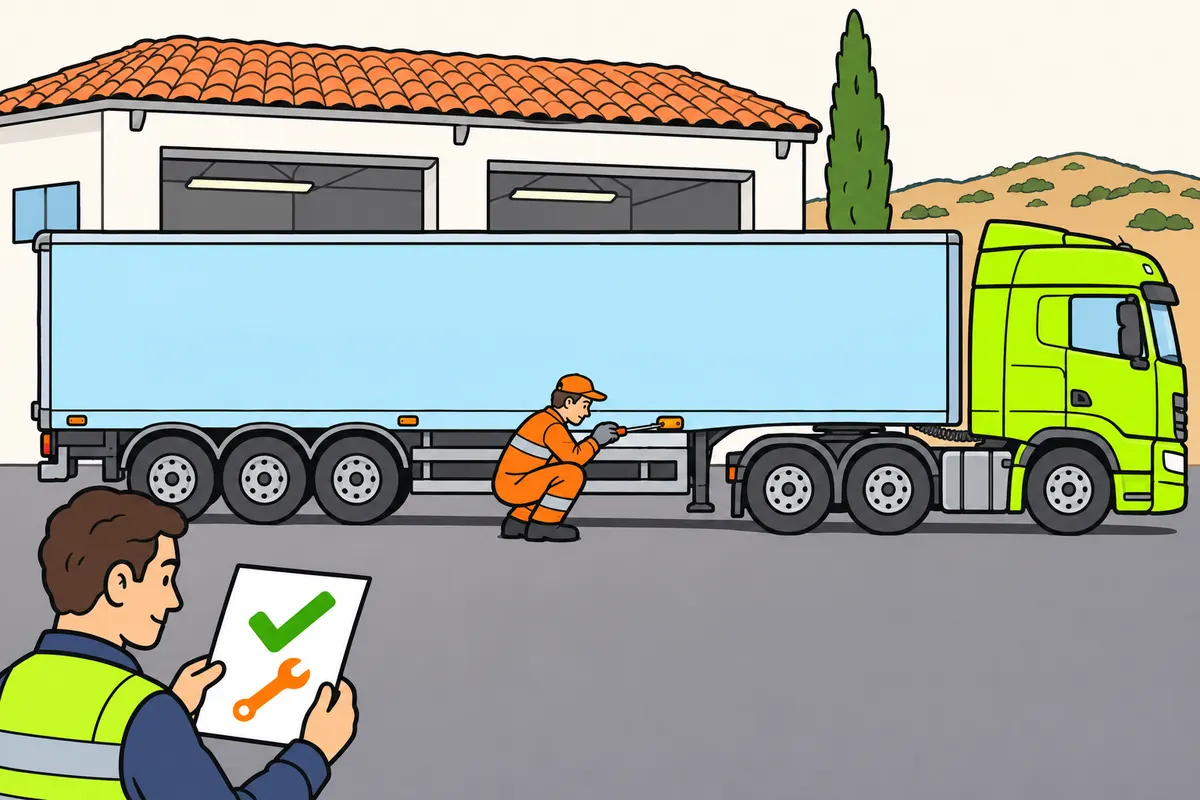
You must repair minor defects even when your ITV result is favourable.
Remember
- You can pass with no defects or only minor defects.
- Read the report and repair minor defects within 2 months at most.
- Minor defects alone do not require another inspection to check repairs.
- You must return if an unfavourable or negative result also requires it.
- Keep each unit's report.
- Repair faults that appear between inspections.
Exam trap: Wrong: a favourable result lets you ignore minor defects. Right: repair them within a maximum of 2 months.
Read the full explanation
- You receive a favourable inspection result when no defects or only minor defects are found. You must read the report to find out whether any repairs are outstanding: a favourable result with minor defects does not mean that every component is free from deficiencies. [RD 920/2017, art. 9.4](https://www.boe.es/buscar/act.php?id=BOE-A-2017-12841)
- You must repair minor defects within a maximum of 2 months. On their own, they do not require another inspection to check the repair, unless you must return with the vehicle because of an unfavourable or negative result. [RD 920/2017, art. 11.1](https://www.boe.es/buscar/act.php?id=BOE-A-2017-12841)
- The result and inspection details are documented, and the report serves as the roadworthiness inspection certificate. You must retain the information for each unit: a favourable result for the tractor unit does not certify the inspection of the coupled semi-trailer. [RD 920/2017, art. 10](https://www.boe.es/buscar/act.php?id=BOE-A-2017-12841)
- You must keep the vehicle compliant with the regulations between inspections. A subsequent fault may require repair even if the ITV remains valid for months. [RGV, art. 10](https://www.boe.es/buscar/act.php?id=BOE-A-1999-1826)
16Unfavourable and negative ITV results
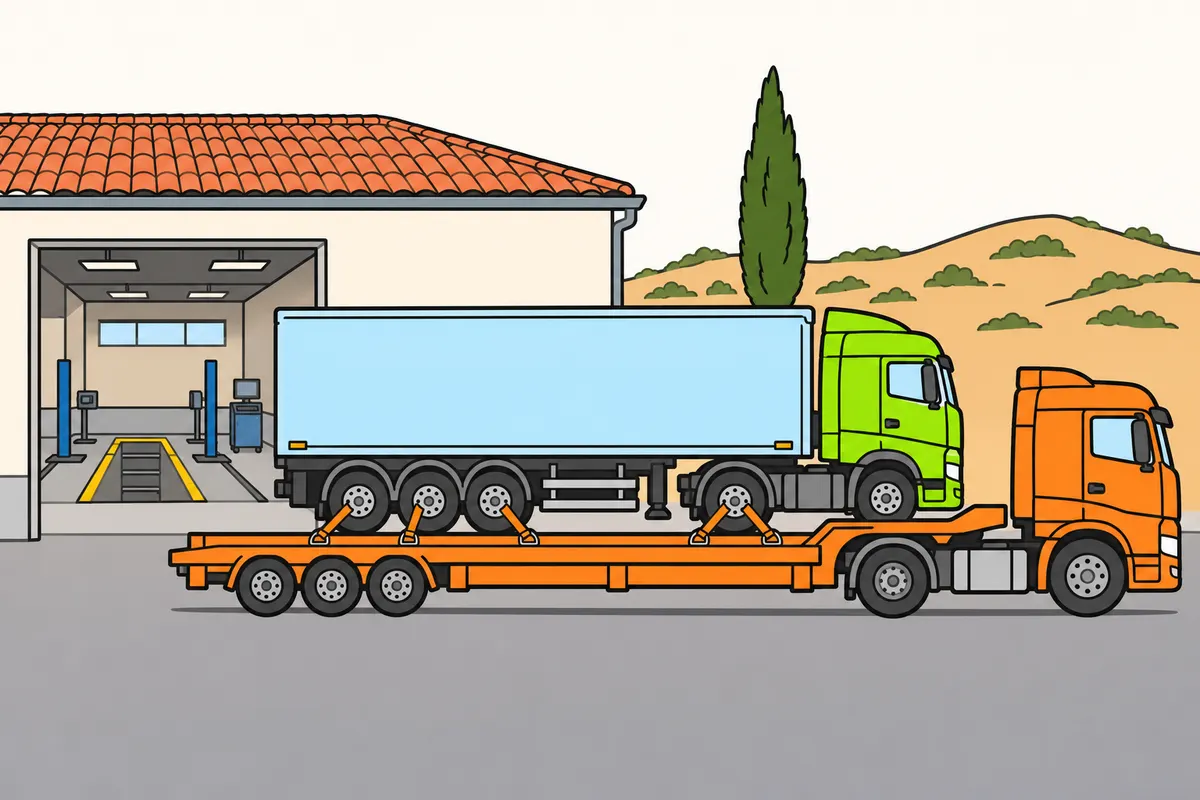
Distinguish unfavourable from negative ITV results to decide how you can move your vehicle.
| ITV result | Defect | What you can do |
|---|---|---|
| Unfavourable | Serious | Only permitted journeys to workshops, to regularise status or return to ITV |
| Negative | Very serious | Use external transport to move your vehicle from the station |
Remember
- With an unfavourable ITV, you cannot continue delivering goods.
- Only permitted journeys to workshops, to regularise status or return to ITV are allowed.
- With a negative ITV, use external transport to move your vehicle from the station.
- Repair and return by your specific deadline, within 2 months at most.
- That maximum starts at your first unfavourable or negative inspection, as applicable.
Exam trap: Wrong: with a negative ITV, you can drive to a workshop. Right: move your vehicle from the station using external transport.
Read the full explanation
- If a major defect is found, you receive an unfavourable result. You cannot use the vehicle for normal road travel: you may move it to a workshop or, where applicable, to regularise its status and return to an ITV testing station. [RD 920/2017, arts. 9 and 11.2](https://www.boe.es/buscar/act.php?id=BOE-A-2017-12841)
- With an unfavourable result, you must rectify the defects and present the vehicle for another inspection within no more than 2 months of the first unfavourable result. You must comply with the specific deadline set; that maximum period does not make the vehicle fit for road use for two months. [RD 920/2017, art. 11.2](https://www.boe.es/buscar/act.php?id=BOE-A-2017-12841)
- If a dangerous defect is found, you receive a negative inspection result. You must have the vehicle moved from the testing station to its destination by means other than the vehicle itself, for example by a suitable vehicle transport service. [RD 920/2017, arts. 9 and 11.3](https://www.boe.es/buscar/act.php?id=BOE-A-2017-12841)
- After a negative result, you must rectify the defects and present the vehicle for inspection within no more than 2 months of the first negative result. [RD 920/2017, art. 11](https://www.boe.es/buscar/act.php?id=BOE-A-2017-12841)
17ITV sticker for each vehicle
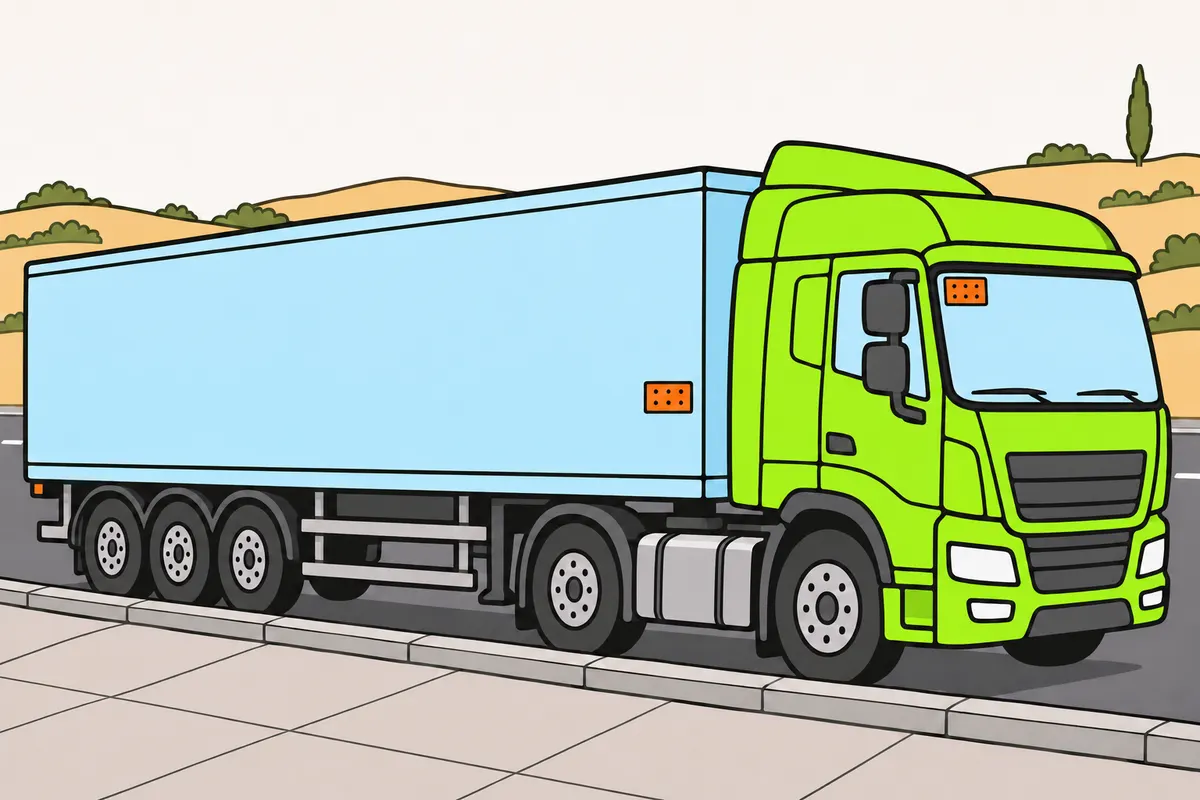
Place each vehicle's ITV sticker in its required position.
| Inspected vehicle | Where you must place its V-19 |
|---|---|
| Lorry or tractor unit with a windscreen | Inside the windscreen, in its top right-hand corner |
| Vehicle without a windscreen, such as an ordinary towed vehicle | Somewhere clearly visible |
Remember
- Check each unit's V-19 sticker.
- The sticker shows a favourable ITV result and the next inspection due.
- It does not replace the registration certificate, ITV card or report.
- When changing trailers, check the trailer's ITV and documents.
Exam trap: Wrong: the tractor unit's sticker proves the semi-trailer's ITV. Right: check the sticker for each unit.
Read the full explanation
- The V-19 sticker indicates that the vehicle has passed its periodic roadworthiness inspection and when the next one is due. You must associate it with the inspected vehicle, not with the haulage company or the driver. It does not replace the permiso de circulación (vehicle registration certificate), the ITV card or the inspection report. [RGV, Annex XI, V-19](https://www.boe.es/buscar/act.php?id=BOE-A-1999-1826)
- If your lorry or tractor unit has a windscreen, you must place the sticker on the inside of its upper right-hand corner. [RGV, Annex XI, V-19.2](https://www.boe.es/buscar/act.php?id=BOE-A-1999-1826)
- On a vehicle without a windscreen, such as an ordinary trailer or semi-trailer, you must place the sticker in a clearly visible location. The tractor unit’s sticker alone does not certify the semi-trailer’s inspection. You must check the sticker for each unit. [RGV, Annex XI, V-19.2](https://www.boe.es/buscar/act.php?id=BOE-A-1999-1826)
- When changing trailers, you must check the trailer’s inspection and documentation as well as those of the towing vehicle. A physically well-coupled combination may have an inspection coming due on one of its units. You must check the documents alongside the coupling checks covered in «Safe coupling and uncoupling». [RGV, arts. 10 and 26](https://www.boe.es/buscar/act.php?id=BOE-A-1999-1826)
18Compulsory insurance for the combination
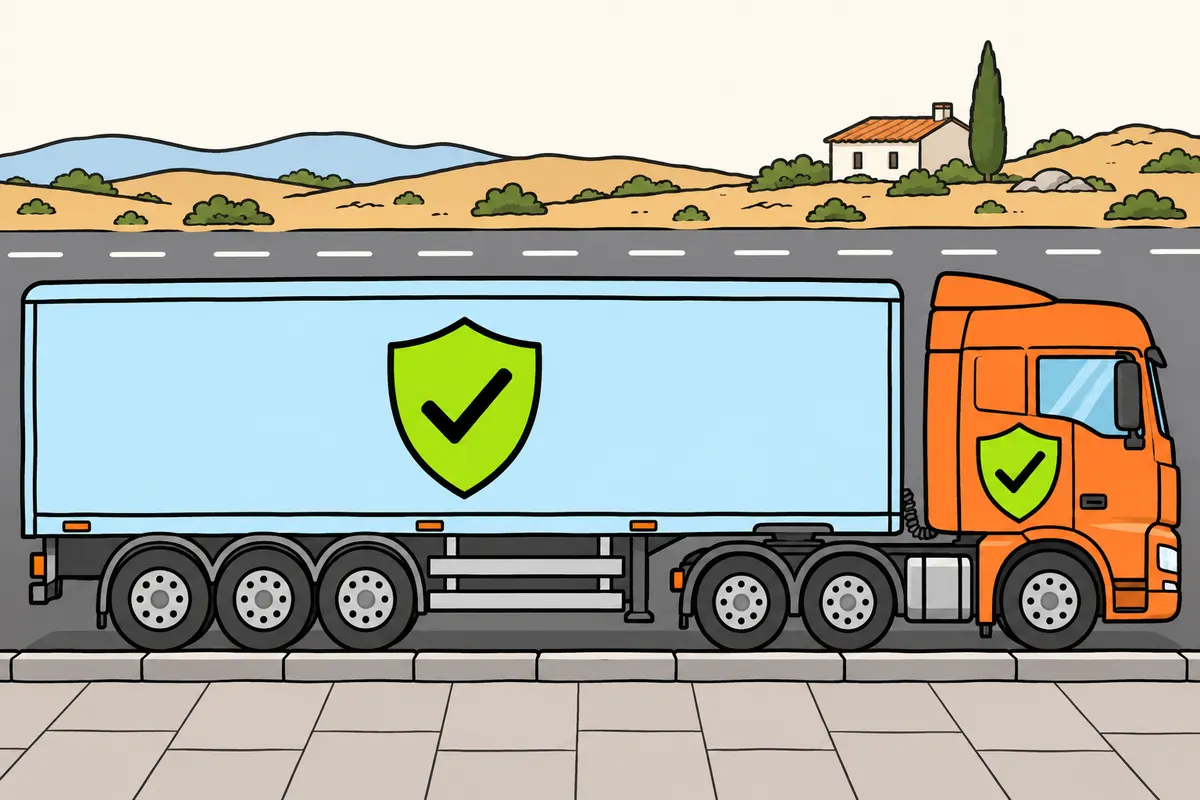
Check insurance for your tractor unit and each towed vehicle that requires it.
| Trailers and semi-trailers | Separate compulsory insurance |
|---|---|
| MMA up to 750 kg | Exempt |
| MMA over 750 kg | Check this insurance as well as the tractor unit's |
Remember
- Check that your lorry or tractor unit has valid insurance.
- As owner, maintain compulsory insurance for vehicles normally based in Spain that require it.
- For your towed vehicle, use its MMA, even when empty.
- Uncoupling a semi-trailer does not remove its insurance obligation.
Exam trap: Wrong: the tractor unit's insurance is always enough. Right: a towed vehicle over 750 kg MMA also needs compulsory insurance.
Read the full explanation
- As the owner of each vehicle subject to the requirement and normally based in Spain, you must take out and maintain valid third-party liability insurance for it. The owner, the policyholder and the driver may be different people: you can drive a lorry insured by its company without owning it. [LRCSCVM, art. 2](https://www.boe.es/buscar/act.php?id=BOE-A-2004-18911)
- Your lorry or tractor unit must be insured, as must a trailer or semi-trailer with an MMA (maximum authorised mass) exceeding 750 kg. The tractor unit’s compulsory insurance does not replace the insurance requirement for the towed vehicle. You must check both insurance policies when adding another unit to the combination. [LRCSCVM, arts. 1 bis and 2](https://www.boe.es/buscar/act.php?id=BOE-A-2004-18911)
- Trailers and semi-trailers with an MMA not exceeding 750 kg are exempt from having their own compulsory insurance. You apply the exemption on the basis of MMA, not the load carried on the journey. [LRCSCVM, art. 2](https://www.boe.es/buscar/act.php?id=BOE-A-2004-18911)
- For the purposes of this law, trailers and semi-trailers intended for use with the legally defined vehicles are covered both when coupled and when uncoupled. You must maintain insurance for a heavy semi-trailer even when it is detached from the tractor unit. [LRCSCVM, art. 1 bis.1.b](https://www.boe.es/buscar/act.php?id=BOE-A-2004-18911)
19Damage covered by insurance
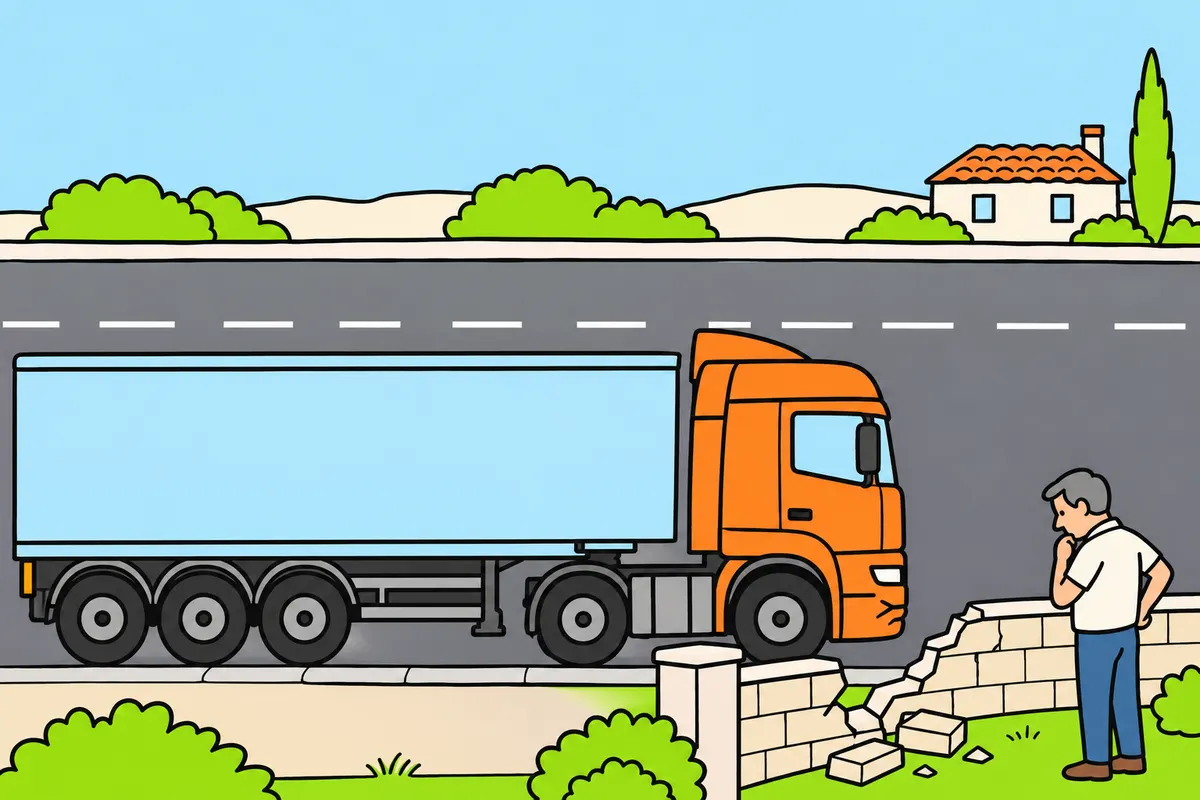
Distinguish damage to others from your own losses excluded by compulsory insurance.
| Injury or damage | What you should know about compulsory insurance |
|---|---|
| Injury and property damage to others | Covers your legal liability within its scope |
| Injury or death of the driver causing the accident | Not covered by that driver's own vehicle insurance |
| Insured vehicle and items carried | Their damage is excluded |
| Property of the policyholder, insured person, owner or driver | Damage to this property is excluded |
| Property of their spouses or relatives up to the third degree, by blood or marriage | Damage to this property is excluded |
Remember
- Compulsory insurance covers your legal liability for damage to others within its scope.
- If you cause the accident, it does not cover your own injuries as driver.
- It does not cover damage to your insured vehicle or its goods.
- For your own losses, check optional cover or specific insurance.
- Some property damage is also excluded depending on who owns the property.
Exam trap: Wrong: compulsory insurance pays for your injuries if you cause the accident. Right: it excludes injuries to the driver of the vehicle causing it.
Read the full explanation
- Compulsory insurance covers the civil liability legally enforceable for personal injury and property damage caused to third parties within its scope. If you injure another road user or damage someone else's installation with your articulated lorry, you must distinguish that harm from damage to your own lorry. [LRCSCVM, arts. 1 and 2](https://www.boe.es/buscar/act.php?id=BOE-A-2004-18911)
- Injury to or death of the driver is excluded from the compulsory cover for their own vehicle. If you cause the accident, that cover does not in itself provide personal insurance for your injuries. [LRCSCVM, art. 5.1](https://www.boe.es/buscar/act.php?id=BOE-A-2004-18911)
- Compulsory insurance does not cover damage to the insured vehicle or the items carried in it. If your lorry or its goods are damaged, you must check the optional cover or specific insurance policies you have taken out. Third-party civil liability insurance and goods insurance cover different risks. [LRCSCVM, art. 5.2](https://www.boe.es/buscar/act.php?id=BOE-A-2004-18911)
- Property damage to items belonging to the policyholder, insured person, owner or driver, or to their spouse or relatives up to the third degree by blood or marriage, is also excluded. You must check who owns the damaged property, even if the item is outside the vehicle. [LRCSCVM, art. 5.2](https://www.boe.es/buscar/act.php?id=BOE-A-2004-18911)
20Victims, exclusions and notifying the insurer
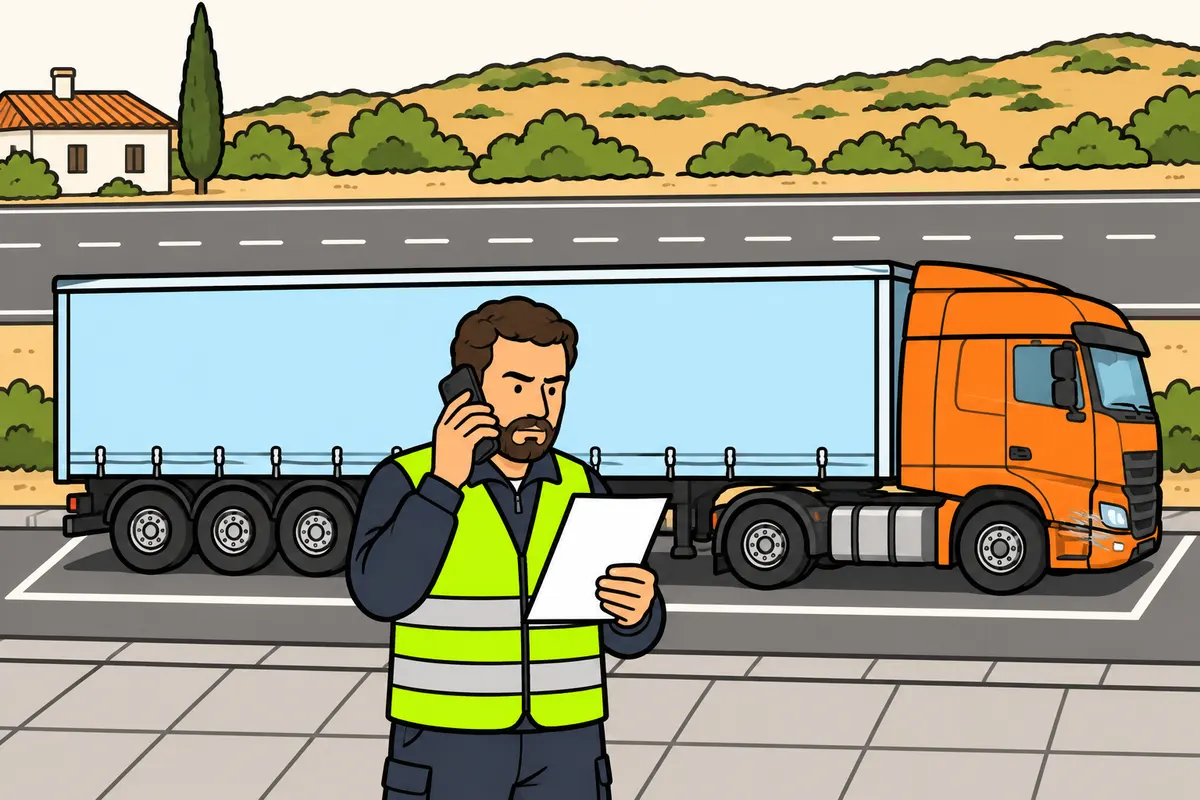
Report accidents on time and distinguish victim protection from later claims against those responsible.
Remember
- As policyholder, insured person or beneficiary, report the accident once you know about it.
- You have at most 7 days, unless your policy allows longer.
- Reporting the facts does not mean admitting responsibility.
- Do not assume every careless act leaves a victim without compensation.
- Where legally allowed, the insurer can pay, then claim money from those responsible.
- For stolen or uninsured vehicles, the Insurance Compensation Consortium may help victims.
Exam trap: Wrong: every offence by a victim removes their compensation. Right: consider responsibility and the rules for the type of damage.
Read the full explanation
- The victim's contribution to the harm may affect compensation under the conditions set by law. The law distinguishes between personal injury and property damage and includes rules on the victim's contribution to the harm. [LRCSCVM, art. 1](https://www.boe.es/buscar/act.php?id=BOE-A-2004-18911)
- The fact that the driver has failed to fulfil their obligations does not mean the insurer can invoke any contractual exclusion against the injured party. You must distinguish compensation for the victim from the right of recovery: in the cases provided for by law, the insurer may pay and then recover the amounts paid from the person responsible. [LRCSCVM, arts. 6 and 10](https://www.boe.es/buscar/act.php?id=BOE-A-2004-18911)
- Damage caused by a stolen vehicle is subject to the exclusion and protection arrangements provided for by law, with possible involvement of the Consorcio de Compensación de Seguros (Insurance Compensation Consortium). You must not assume that victims always receive no compensation because the vehicle responsible is stolen or uninsured. [LRCSCVM, arts. 5.3 and 11](https://www.boe.es/buscar/act.php?id=BOE-A-2004-18911)
- If you are the policyholder, insured person or beneficiary, you must notify the insurer of the incident within a maximum of 7 days of becoming aware of it, unless the policy allows a longer period. Reporting the facts does not amount to admitting liability; it lets the insurer know about the accident and arrange the relevant cover. [Law 50/1980, art. 16](https://www.boe.es/buscar/act.php?id=BOE-A-1980-22501)
21Consequences of having no insurance
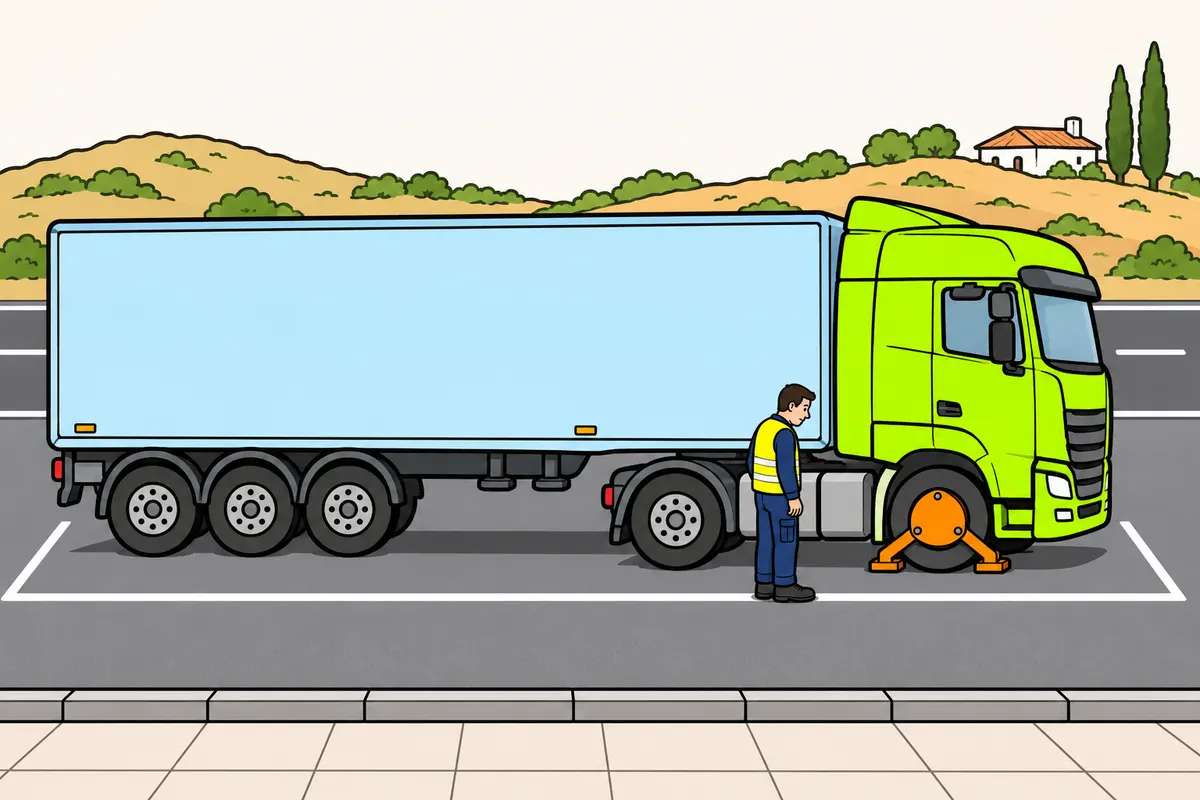
You cannot drive a vehicle that needs compulsory insurance but has none.
Remember
- Check insurance before setting off.
- Your ITV and licence do not replace compulsory insurance.
- Authorities can impound or seal the vehicle, at the owner's expense.
- The fine depends on circumstances; there is no single fixed amount.
- As non-driving owner, you share liability for damage unless you prove theft.
Exam trap: Wrong: forgetting the receipt means having no insurance. Right: carrying it is optional, but required insurance cover is compulsory.
Read the full explanation
- If a vehicle is required to be insured and has no insurance, it is prohibited from being driven anywhere in Spain. You must check that it is insured before using it. [LRCSCVM, art. 3.1.a](https://www.boe.es/buscar/act.php?id=BOE-A-2004-18911)
- Lack of insurance may result in the vehicle being impounded or sealed, either at public premises or at home, at the owner's expense, until insurance is taken out. You must not treat this offence as merely forgetting a receipt: having no cover has different consequences from not carrying documents that you are not required to carry. [LRCSCVM, art. 3.1.b](https://www.boe.es/buscar/act.php?id=BOE-A-2004-18911)
- The fine for failing to meet the obligation to insure is between 601 and 3,005 euros. The amount takes account of factors including whether the vehicle is being driven, its category and use, the harm caused, how long it has been uninsured and repeated offences. [LRCSCVM, art. 3.1.c](https://www.boe.es/buscar/act.php?id=BOE-A-2004-18911)
- The owner of an uninsured vehicle who is not driving it shares civil liability with the driver for the damage caused, unless they prove that the vehicle has been stolen from them. Driving someone else's vehicle does not remove your liability for causing damage or the consequences of failing to insure it. [LRCSCVM, art. 1.3](https://www.boe.es/buscar/act.php?id=BOE-A-2004-18911)
22Changes of details, ownership and duplicate documents
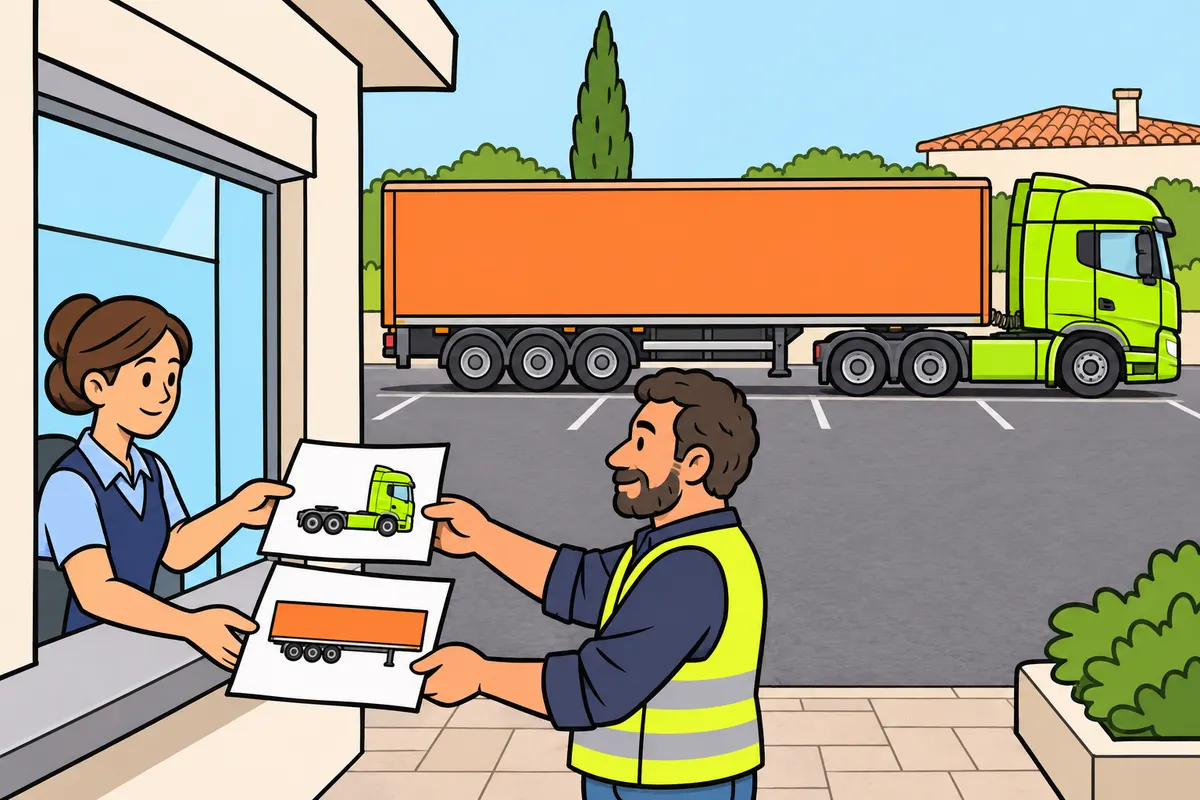
Distinguish deadlines for changes, sales and purchases, and request duplicate documents when needed.
| Procedure you must complete | Deadline from change or purchase |
|---|---|
| Report changed licence details or vehicle registration details | 15 days |
| Notify a sale between people who are not vehicle dealers | 10 days from transfer |
| Apply for registration in your name when buying between such people | 30 days from purchase |
Remember
- Report changes to your licence details or address within 15 days.
- As registered keeper, report changed vehicle registration details within 15 days too.
- If you buy a lorry and trailer, complete procedures for both units.
- Request a duplicate for loss, theft or damage; it does not renew validity.
- After replacement, return a recovered original driving licence; destroy a recovered registration certificate.
- For replacement ITV cards, use ITV stations for paper cards; DGT for electronic cards.
Exam trap: Wrong: a duplicate licence renews its validity. Right: a duplicate keeps the previous expiry date.
Read the full explanation
- If the details on your driving licence or your address change, you must notify Tráfico (the traffic authority) within 15 days of the change. As the registered keeper of the lorry or towed vehicle, you also have 15 days to report changes to its registered details; if these affect the contents of the permiso de circulación (vehicle registration certificate), a new one is issued. [RGCond, art. 10](https://www.boe.es/buscar/act.php?id=BOE-A-2009-9481). [RGV, art. 30.2](https://www.boe.es/buscar/act.php?id=BOE-A-1999-1826#a30)
- If you sell a unit in a transaction between people who are not vehicle dealers, you must notify the transfer within 10 days; if you buy it, you must apply for the permiso de circulación in your name within 30 days of purchase. If you buy a lorry and trailer, complete the procedure for both units. [RGV, art. 32.1 and 32.3](https://www.boe.es/buscar/act.php?id=BOE-A-1999-1826#a32)
- If you lose your driving licence, it is stolen or it deteriorates, apply for a duplicate; this procedure does not renew its validity. If you recover the original after obtaining a duplicate because of theft or loss, you must return it to the Jefatura (traffic office) that issued it. If you recover a permiso de circulación replaced by a duplicate, you must destroy the original. [RGCond, art. 11](https://www.boe.es/buscar/act.php?id=BOE-A-2009-9481). [RGV, art. 30.1](https://www.boe.es/buscar/act.php?id=BOE-A-1999-1826#a30)
- If either unit's tarjeta ITV (vehicle roadworthiness test card) is missing, apply for a replacement: at an ITV station for the official paper technical data sheet and through the DGT for the eITV (electronic ITV card). The replacement retains the document's information and does not replace the required inspections. [DGT, duplicate technical data sheet](https://sede.dgt.gob.es/es/vehiculos/duplicado-y-renovacion-de-documentacion/duplicado-de-la-ficha-tecnica/)
23Responsibility for documentation
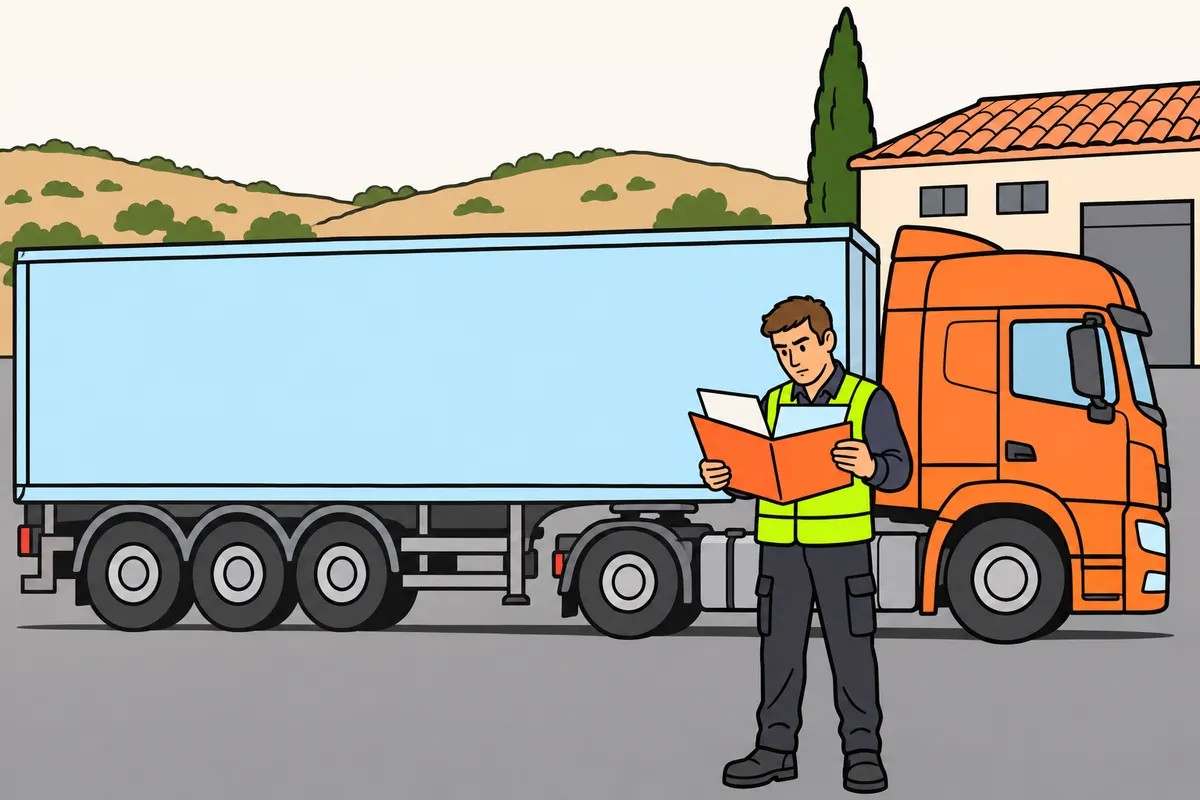
Carry required documents and distinguish your responsibility from the registered keeper’s.
| Your role | Responsibility you must distinguish |
|---|---|
| Driver | Carry and show documents; answer for your driving offences |
| Registered keeper | Documentation, ITV and maintenance where defects affect safety |
| Long-term lessee listed in the Vehicle Register | You take over that responsibility from the registered keeper |
Remember
- Carry required documents and show them when asked.
- Check the trailer's document folder when changing units.
- Distinguish document offences from offences you commit while driving.
Exam trap: Wrong: the owner keeping documents in the office is enough. Right: carry and show the required documents for the vehicle you use.
Read the full explanation
- As the driver, you must carry and produce the required documents for the vehicle you use. In a fleet, checking the trailer's document folder is especially important when you change units. [RGV, art. 26](https://www.boe.es/buscar/act.php?id=BOE-A-1999-1826)
- The registered keeper is responsible for offences relating to the vehicle's documentation, periodic inspections and maintenance when defects affect safety. You must distinguish this administrative responsibility from offences you personally commit while driving and from civil liability for damage caused in an accident. [LTSV, art. 82.1.f](https://www.boe.es/buscar/act.php?id=BOE-A-2015-11722)
- If you are listed in the Registro de Vehículos (Vehicle Register) as the long-term lessee, you bear responsibility for those offences instead of the registered keeper. Being only the usual driver or the insurance policyholder does not in itself give you the registered status of long-term lessee. [LTSV, art. 82.1.f](https://www.boe.es/buscar/act.php?id=BOE-A-2015-11722)
Checking documents before setting off
Check the driver and each unit of the combination.
- Check that your C+E licence is valid and that you comply with its restrictions.
- If the transport operation is subject to CAP (Certificate of Professional Competence) requirements, carry proof that your CAP is valid.
- Identify the tractor unit or lorry and the trailer or semi-trailer using their documents.
- Prepare the permisos de circulación (vehicle registration certificates), ITV cards and inspection reports.
- Check the ITV expiry date and result for each unit.
- Check that each unit required to have insurance has valid cover and that you can produce the required documents.
Renewing your C+E licence
Act before expiry and distinguish between renewal and obtaining a duplicate.
- Find your C+E expiry date and any individual limitations.
- Apply for renewal within the preceding 3 months if you use the standard procedure.
- Undergo the group 2 medical assessment at an authorised centre.
- Complete the application and keep the temporary replacement authorisation you receive, together with its conditions.
- Check the categories, dates and codes on the document you receive.
Acting on the ITV result
The report determines whether you may drive and how you must rectify defects.
- Read the result and defects in the report for the inspected unit.
- If the result is favourable with minor defects, repair them within a maximum of 2 months.
- If the result is unfavourable, limit journeys to the authorised cases and return for inspection within the specified period, which must not exceed 2 months.
- If the result is negative, arrange transport from the inspection station without using the vehicle’s own power and present it for inspection again after repairs, within the maximum of 2 months.
- Keep the report and check the new expiry date when the inspection result is favourable.
Finished this module?
Mark it as read and you will see your progress on the theory list.