
Theory · AM Licence - Moped · Module 6 of 18
Protective equipment for moped riders
You learn what protection you must wear when riding or travelling on a moped and how to choose, fit and maintain each item. You distinguish the requirements for helmets, gloves and footwear from recommendations on clothing, boots, visibility and airbags, including exemptions and the equipment for the AM practical test.
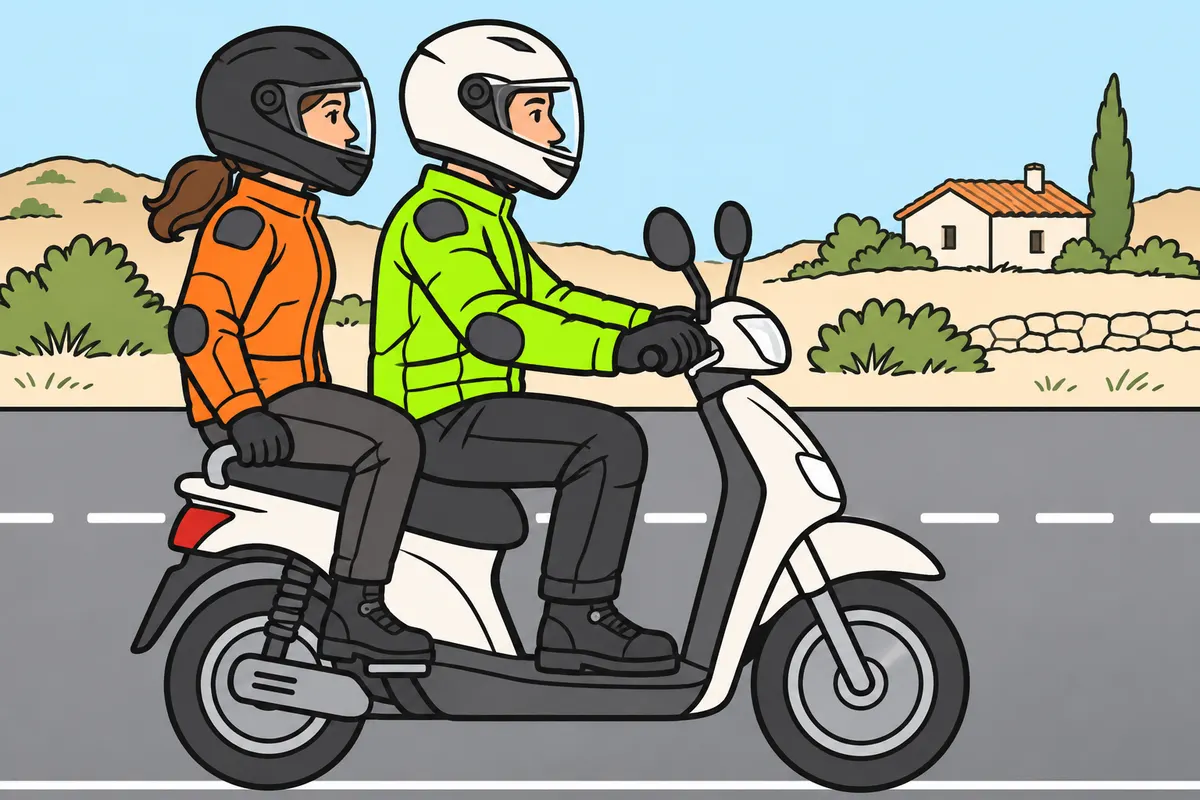
1Your equipment reduces injuries
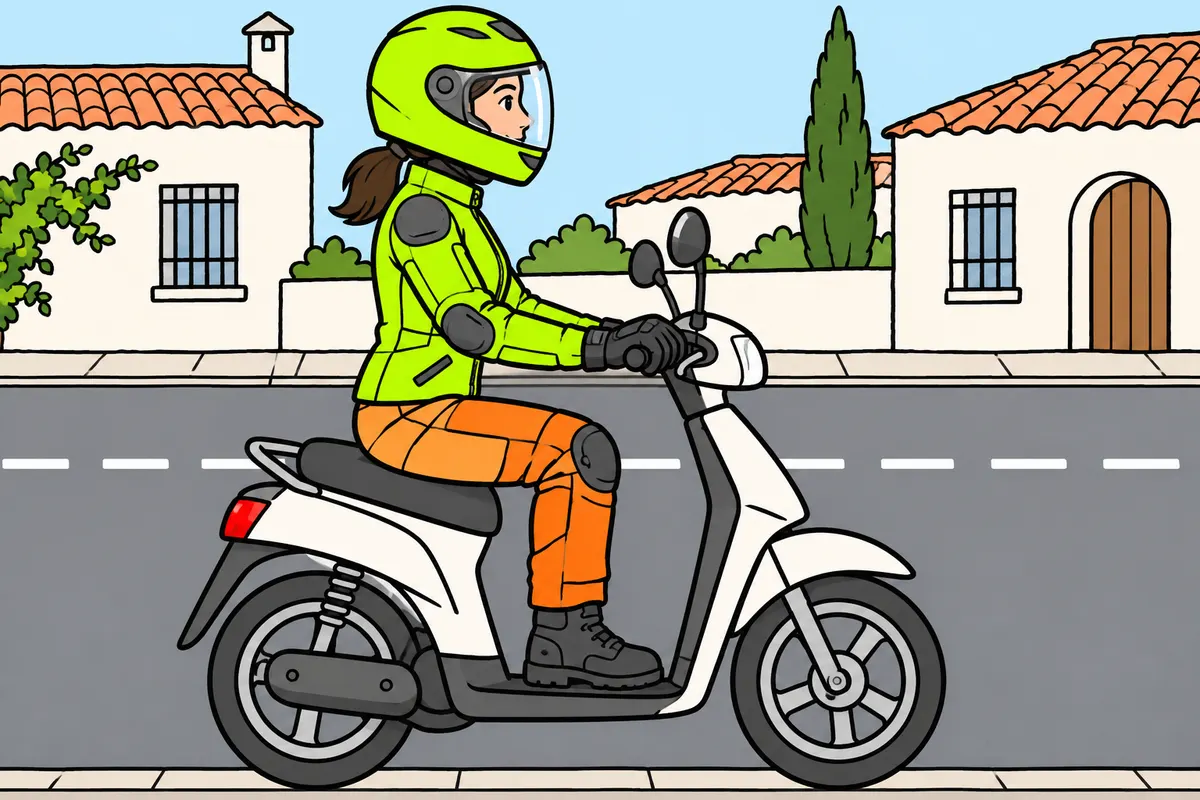
Your equipment reduces injuries in a fall, but you must still ride carefully.
| Safety type | Purpose | Examples |
|---|---|---|
| Passive | Reduces injuries in accidents | Helmets and protectors |
| Active | Helps prevent accidents | Brakes and tyres |
Remember
- Protect yourself even on short journeys.
- Choose clothes that let you look around, move and use the controls.
- Know which equipment is compulsory and which is recommended.
- Keep riding carefully, however much protection you wear.
Exam trap: Wrong: protection lets you take more risks. Right: you must still ride carefully.
Read the full explanation
- On a two-wheeled moped, your body is exposed. You must prepare your protection even for journeys along familiar streets: a fall can bring you into contact with the road surface, another vehicle or an obstacle, even on a short journey.
- You must recognise helmets and impact protectors as passive safety equipment: they aim to reduce harm when an accident occurs. Brakes and tyres help prevent accidents and are active safety features. Visible clothing also helps others notice you.
- Your equipment must protect you without making the vehicle difficult to control. You must remain free to look to either side, hold the handlebars and operate the controls; clothing that catches, obstructs your vision or prevents you from moving your fingers is unsuitable for riding.
- The compulsory minimum is the starting point for your protection. You can add specialist clothing, protectors and an airbag: each item covers different areas and risks. Specialist clothing and protectors are recommended to reduce injuries during ordinary riding.
- You must ride carefully whatever equipment you wear. A helmet, boots or an airbag cannot guarantee protection against all injuries and do not allow you to take greater risks to offset the protection they provide. Your body remains exposed to impacts and sliding.
2Compulsory helmet, gloves and footwear
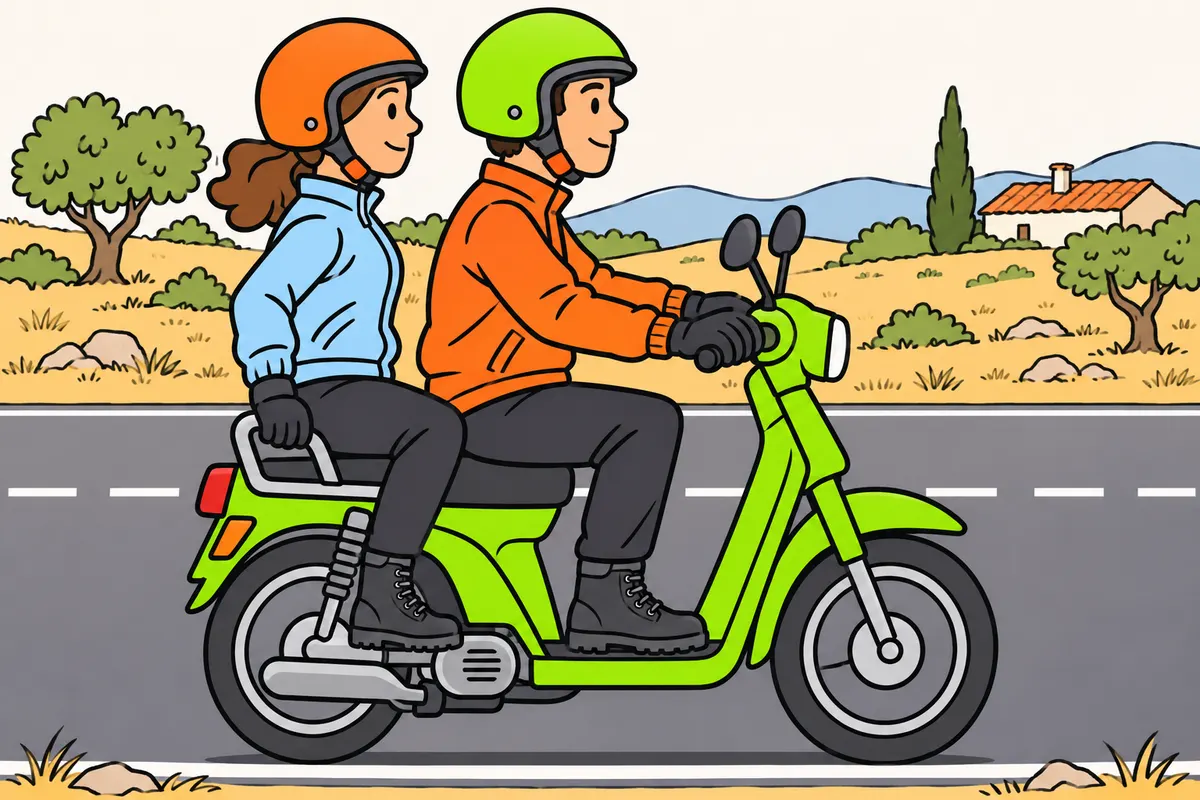
Prepare the compulsory equipment for yourself and your passenger, according to road and vehicle.
| Rider and passenger equipment | Two- or three-wheeled mopeds and light quadricycles without the documented exemption |
|---|---|
| Fastened helmet | Compulsory on every road |
| Protective gloves | Compulsory on interurban roads |
| Closed footwear covering your whole foot | Compulsory on every road |
Remember
- Wear a fastened, UNECE R22 type-approved helmet.
- Check the documented exemption and temporary acceptance of certified helmets.
- Gloves are recommended in town too.
- Heat and short journeys do not remove your duties.
- Missing required gloves or footwear can mean a fine without losing points.
- Without a compulsory helmet for either occupant, officers can immobilise your moped.
Exam trap: Wrong: you can wear sandals in town. Right: without the documented exemption, wear closed footwear covering your whole foot.
Read the full explanation
- As the rider or passenger of a moped (two- or three-wheeled, or a light quadricycle), you must wear a fastened UNECE R22 type-approved helmet on all roads, protective gloves on interurban roads and closed footwear covering the whole foot on all roads. The documented exemption is explained in “Protective structure and seat belt”, and certified helmets in the next section. [RGC, art. 118.1.a-c](https://www.boe.es/buscar/act.php?id=BOE-A-2003-23514#a118)
- For the documented exemption from compulsory equipment, see “Protective structure and seat belt”. [RGC, art. 118.1](https://www.boe.es/buscar/act.php?id=BOE-A-2003-23514#a118)
- In town, you are advised to wear gloves even though they are not compulsory in ordinary urban riding. Your hands are exposed to contact with the road surface and also need protection on everyday journeys between home, school or work.
- Heat, journey length and your experience do not create exceptions to the required equipment. Prepare what you need for the whole route: a journey combining streets and roads outside town requires you to consider both types of road, including for your passenger. [RGC, art. 118.1](https://www.boe.es/buscar/act.php?id=BOE-A-2003-23514#a118)
- If you fail to wear closed footwear on any road or gloves on interurban roads when required, you can receive a fine without losing points. If you ride without the compulsory helmet or use it incorrectly, you lose 4 points in addition to the fine. [DGT, Instruction SANC 2026/25](https://www.dgt.es/export/sites/web-DGT/.galleries/downloads/muevete-con-seguridad/normas-de-trafico/S-sanciones/2026/Instruccion-SANC-2026_25_sobre-utilizacion-de-calzado-cerrado-y-guantes.pdf); [Ley de Tráfico (Traffic Act), Annex II.15](https://www.boe.es/buscar/act.php?id=BOE-A-2015-11722#anii)
- If you or your passenger travel without the compulsory helmet, officers can immobilise your moped; the full rules are explained in “Moped manoeuvres”. [Ley de Tráfico (Traffic Act), art. 104.1.c](https://www.boe.es/buscar/act.php?id=BOE-A-2015-11722#a104)
3Certified helmets and the transitional period
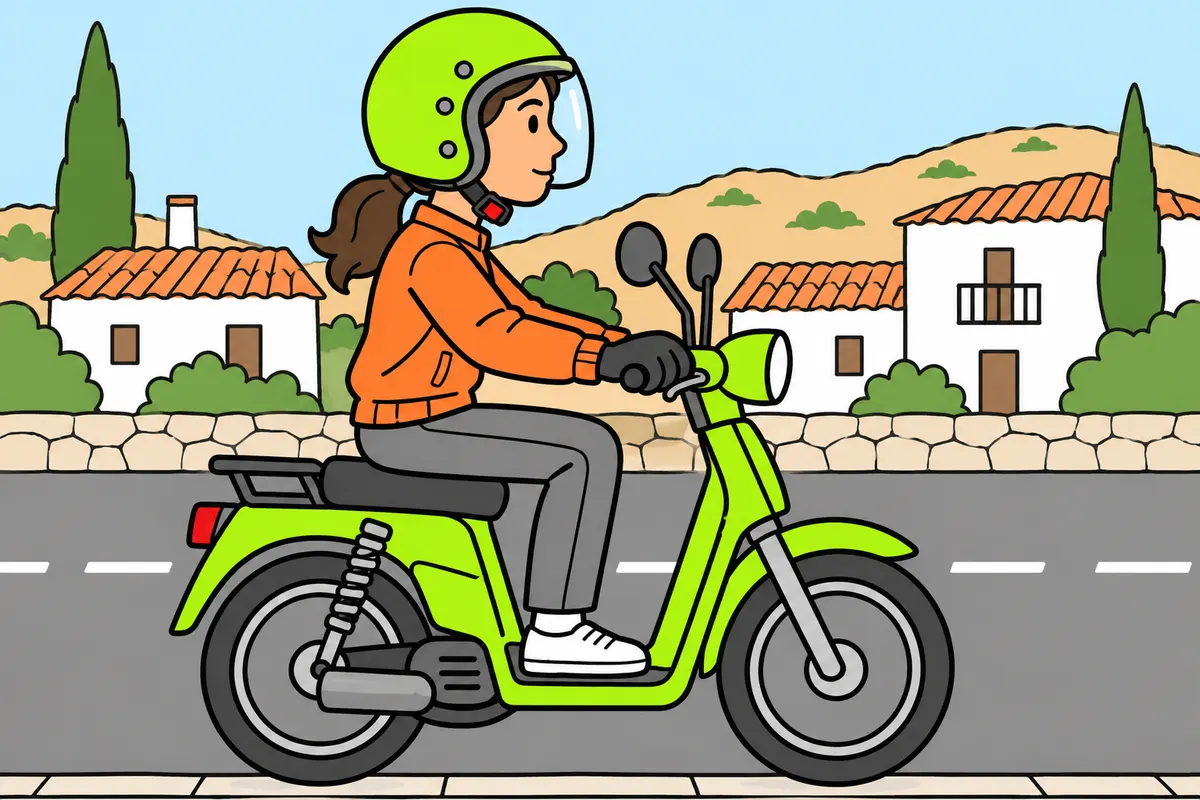
On a moped, you can temporarily use a certified helmet, correctly positioned and fastened.
| Vehicle for rider or passenger | Certified helmet during the transition, where a helmet is required |
|---|---|
| Two- or three-wheeled moped | You can use a certified helmet |
| Light quadricycle | You can use a certified helmet |
| Motorcycle or heavy quadricycle | You cannot use this transition |
Remember
- This includes two- and three-wheeled mopeds and light quadricycles.
- You can use a certified helmet for one year from 1 October 2026.
- You can choose a UNECE R22 type-approved helmet straight away.
- Keep your helmet correctly positioned and fastened.
Exam trap: Wrong: an AM licence allows certified helmets on any vehicle. Right: only on mopeds (two- or three-wheeled mopeds and light quadricycles), for one year from 1 October 2026.
Read the full explanation
- As a moped rider or passenger, you can use a certified helmet for one year from 1 October 2026. [RD 518/2026, first transitional provision and third final provision](https://www.boe.es/buscar/doc.php?id=BOE-A-2026-13889)
- The transition covers every moped: two- or three-wheeled mopeds and light quadricycles. It does not cover motorcycles or heavy quadricycles. You can use it on any road where you must wear a helmet. [RD 518/2026, first transitional provision](https://www.boe.es/buscar/doc.php?id=BOE-A-2026-13889); [Ley de Tráfico (Traffic Act), Annex I.9.c](https://www.boe.es/buscar/act.php?id=BOE-A-2015-11722#ani); [RGV, Annex II.A](https://www.boe.es/buscar/act.php?id=BOE-A-1999-1826#anii)
- The transition concerns helmet certification, while keeping the requirements for wearing and fastening it. When buying a helmet for your moped, you can choose a UNECE R22 type-approved model directly and use the size, condition and retention checks explained below. [RGC, art. 118.1.a](https://www.boe.es/buscar/act.php?id=BOE-A-2003-23514#a118)
4Choosing a type-approved helmet
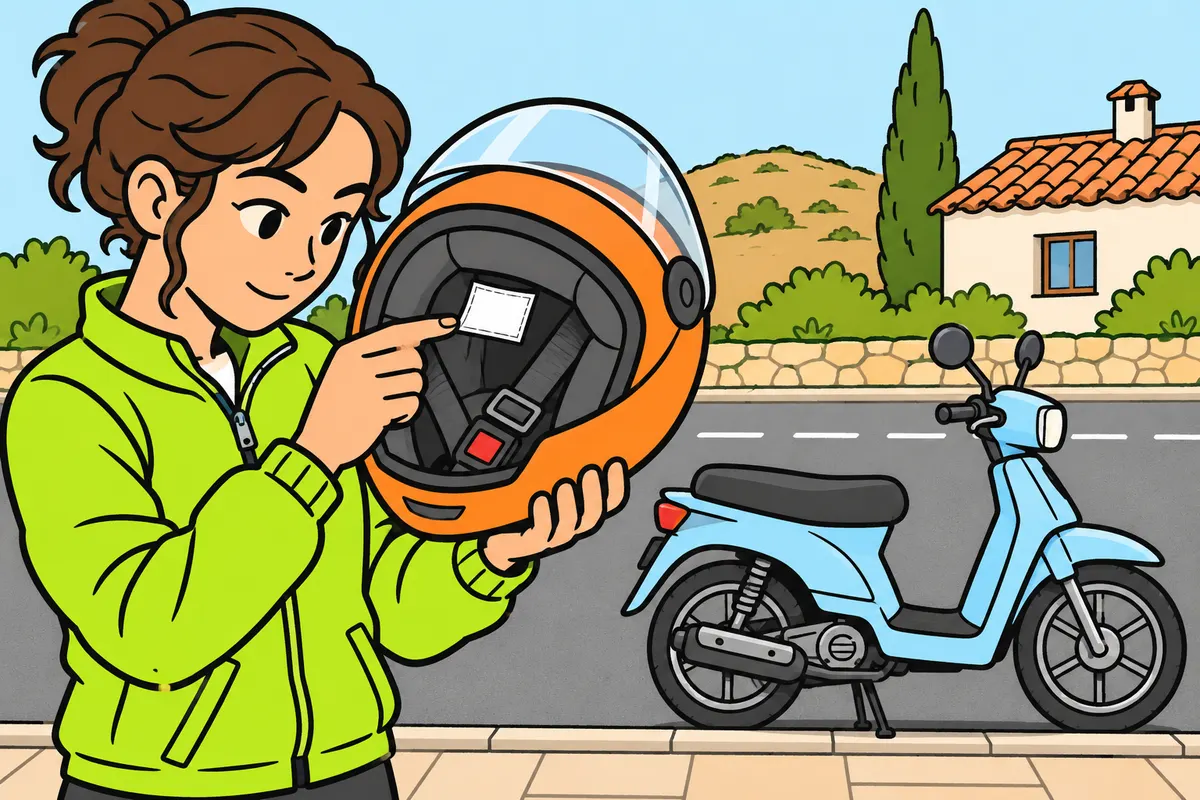
Check your helmet’s type approval and choose suitable protection for your head.
| Helmet type | Protection to consider |
|---|---|
| Full-face | Covers your face and jaw too |
| Open-face | Leaves your face and jaw exposed |
| Flip-front | Check approved positions and chin bar locking |
Remember
- Check its identification and UNECE R22 type approval.
- Do not rely only on price, brand or appearance.
- A full-face helmet covers your face and jaw too.
- For a flip-front helmet, check approved positions and that the chin bar locks.
- Check the outside, inside, strap and fastening.
Exam trap: Wrong: you must always wear a full-face helmet. Right: check type approval and correct use; a full-face helmet is recommended.
Read the full explanation
- Before buying a helmet, you must check its identification and type approval for the intended use. Price, a well-known brand or a robust appearance cannot replace checking the documentation. The regulatory reference required by article 118 is UNECE Regulation R22. [RGC, art. 118.1.a](https://www.boe.es/buscar/act.php?id=BOE-A-2003-23514#a118)
- On the type-approval label, you can recognise the letter E accompanied by the number of the country granting approval. The number 9 identifies Spain in this marking; it does not indicate the size, age of the helmet or a safety score. [DGT, choosing a helmet](https://www.dgt.es/export/sites/web-DGT/.galleries/downloads/conoce_la_dgt/que-hacemos/educacion-vial/jovenes/ESO_educacion_vial/ALUMNOS-U4-EL-CICLOMOTORISTA-USO-CASCO.pdf)
- You are advised to choose a full-face helmet: it also covers your face and jaw. An open-face helmet leaves this area exposed; if you use a flip-front helmet, check the approved positions for use and check that the chin bar is locked. [DGT, choosing a helmet](https://www.dgt.es/export/sites/web-DGT/.galleries/downloads/conoce_la_dgt/que-hacemos/educacion-vial/jovenes/ESO_educacion_vial/ALUMNOS-U4-EL-CICLOMOTORISTA-USO-CASCO.pdf)
- Article 118 requires type approval and correct use, without imposing a general requirement for a full-face helmet. You can find legally acceptable open-face helmets; when choosing one, assess coverage of the different parts of your head alongside fit and retention. [RGC, art. 118.1.a](https://www.boe.es/buscar/act.php?id=BOE-A-2003-23514#a118)
- The outer shell spreads the impact and the energy-absorbing liner reduces the energy transmitted to your head. Comfort padding helps the fit; the strap and fastening keep the helmet secured. You must check the whole helmet as well as its external appearance.
5Size, positioning and fastening
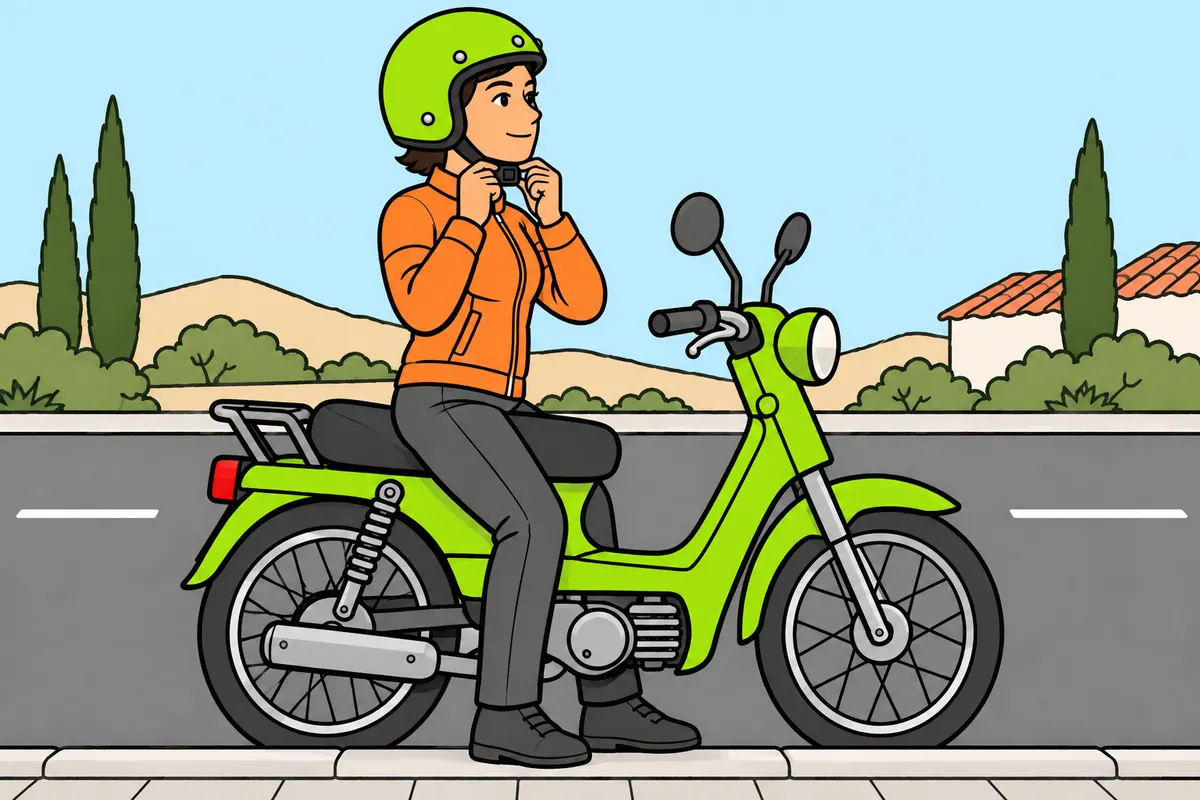
Adjust and fasten your helmet so it stays secure without blocking your view.
Remember
- Try your helmet with your glasses, if you wear them.
- Choose a snug fit without looseness or pain.
- Protect your forehead without covering your eyes.
- Fasten and adjust the strap before setting off.
- Check that you cannot remove your fastened helmet.
- Adjust your helmet while your moped is stationary.
Exam trap: Wrong: resting a helmet on your head is enough. Right: position, adjust and fasten it correctly.
Read the full explanation
- You must try on a helmet before buying it, with your glasses if you wear them. It must fit evenly, without looseness or pain, allow sideways vision and move with your skin when you gently move it with your hands. [DGT, helmet size](https://www.dgt.es/muevete-con-seguridad/viaja-seguro/en-moto/)
- You must wear the helmet in its normal position, without tilting it backwards or letting it drop over your eyes. Your forehead must be protected and the opening must allow you to see. Wearing it over a bulky hood can alter the fit you checked when choosing it.
- Before setting off, you must fasten and adjust the strap following the fastening instructions. Leaving it fastened but very loose can allow dangerous movement; resting a helmet on your head does not meet the requirement to wear it correctly fastened. [RGC, art. 118.1.a](https://www.boe.es/buscar/act.php?id=BOE-A-2003-23514#a118)
- You must check that you cannot remove the helmet with the fastening closed. Check size and retention if it moves; make adjustments with the moped stationary and resolve any fastening fault before riding.
- You must check that your clothing collar allows you to turn your head and does not push the helmet. Avoid loose scarves and layers that alter its fit; use the ventilation provided by the manufacturer to release heat and moisture.
6Replacing and caring for your helmet
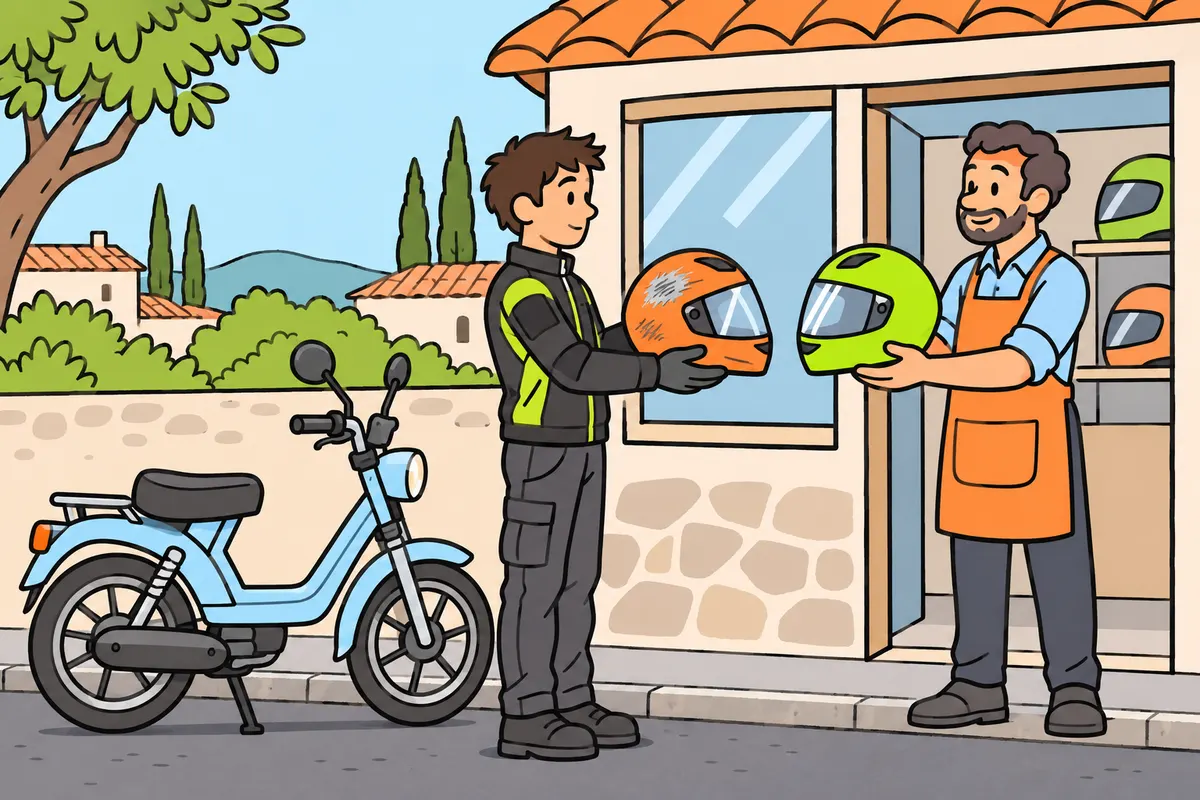
Replace your helmet after a significant impact, even if it looks undamaged.
Remember
- If you are unsure about a blow, get advice before using it again.
- Avoid used helmets if you do not know their history.
- Follow the manufacturer’s service life instructions.
- Check the outside, inside, strap and fastening.
- Clean and store it according to its instructions.
- Do not drill your helmet or repair cracks yourself.
Exam trap: Wrong: you can reuse your helmet after a significant impact if you see no cracks. Right: you must replace it.
Read the full explanation
- You must replace a helmet that has suffered a significant impact, especially in an accident, even if it looks intact externally. Energy-absorbing components can be damaged without any visible crack. [DGT, helmet replacement](https://www.dgt.es/export/sites/web-DGT/.galleries/downloads/conoce_la_dgt/que-hacemos/educacion-vial/adultos/no-formal/airbag.pdf)
- If you drop the helmet or it receives a blow whose severity is uncertain, you must follow the instructions and consult the manufacturer or a specialist before using it again. You cannot check its safety by hitting it again, pressing it hard or dismantling its energy-absorbing components.
- You must avoid buying a used helmet whose history you do not know. Cleaning the outside cannot tell you whether it has been in an accident or how it has been stored. For your protection, you need to know both its condition and its suitability for your head. [DGT, second-hand helmets](https://www.dgt.es/export/sites/web-DGT/.galleries/downloads/conoce_la_dgt/que-hacemos/educacion-vial/adultos/no-formal/airbag.pdf)
- For replacement due to ageing, you must consult the product service life and instructions. Article 118 does not set a universal expiry after the same number of years for all helmets; you must not turn a recommendation for one model into a general legal deadline. [RGC, art. 118](https://www.boe.es/buscar/act.php?id=BOE-A-2003-23514#a118)
- You must check the shell, interior, strap and fastening for wear or looseness. Clean and store the helmet according to its instructions, protected from falls, heat and unapproved products. Do not drill the shell or repair cracks yourself; use compatible accessories approved by the manufacturer.
7Visor and protective goggles
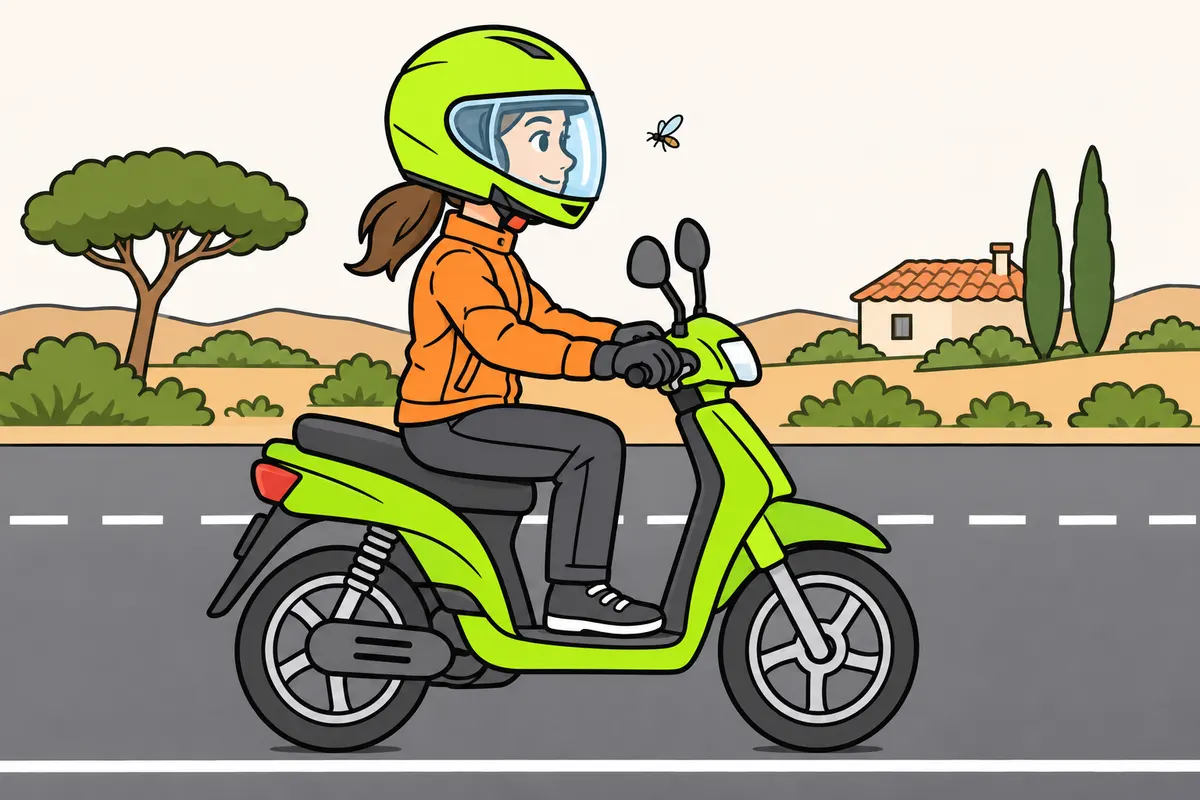
Protect your eyes and keep your visor clean so you can see clearly.
Remember
- Choose a visor or protective goggles compatible with your helmet.
- Keep wearing your prescription glasses if you need them.
- Replace your visor if scratches make seeing difficult.
- Check coverage: sunglasses can leave gaps.
Exam trap: Wrong: a clear visor corrects your eyesight. Right: keep using the eyesight correction you need.
Read the full explanation
- You are advised to protect your eyes from wind, insects and small particles with a suitable visor or protective goggles compatible with your helmet. Choose goggles that stay in place without pressing on your face, and retain any vision correction you need: a clear visor allows you to see through it but does not correct your eyesight.
- You must keep the visor clean and replace it if scratches make it difficult to see, especially with lights facing you. Ordinary sunglasses can leave gaps for air and particles; choose protection for its coverage and compatibility, keeping the entire viewing opening clear.
8Seeing in sunshine, rain and misting
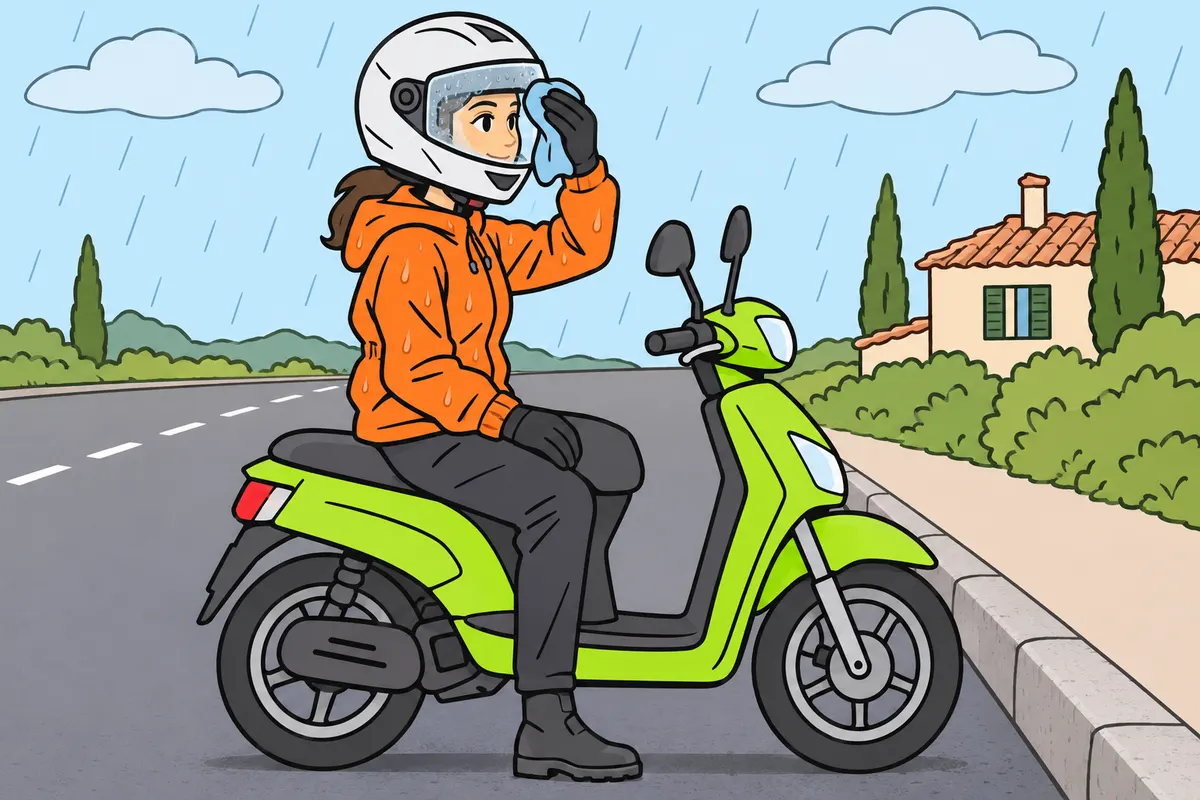
Match your eye protection to the light, and stop if you cannot see.
| Situation | What you should do |
|---|---|
| Sunshine | Choose protection suited to the light |
| Night, tunnels or low light | Avoid excessively dark protection |
| Rain or misting | Use approved ventilation and anti-mist systems |
Remember
- In low light, avoid excessively dark visors or glasses.
- Follow the manufacturer’s restrictions on use.
- Use approved ventilation and anti-mist systems.
- If rain or misting blocks your view, stop somewhere safe.
Exam trap: Wrong: wear dark glasses against glare at night. Right: you need enough light to see.
Read the full explanation
- In sunshine, you can use eye protection compatible with your helmet and suitable for the light level. In low light, at night or in tunnels, choose a visor or glasses that allow you to see traffic and obstacles; excessively dark ones reduce the available light. Also observe the manufacturer’s restrictions on use.
- In rain and when misting occurs, use the ventilation and anti-mist systems approved for your helmet. If water outside or misting inside prevents you from seeing, stop somewhere safe to resolve it. You must maintain the field of vision you need while riding. [RGC, art. 18.1](https://www.boe.es/buscar/act.php?id=BOE-A-2003-23514#a18)
9Gloves: protection and requirements
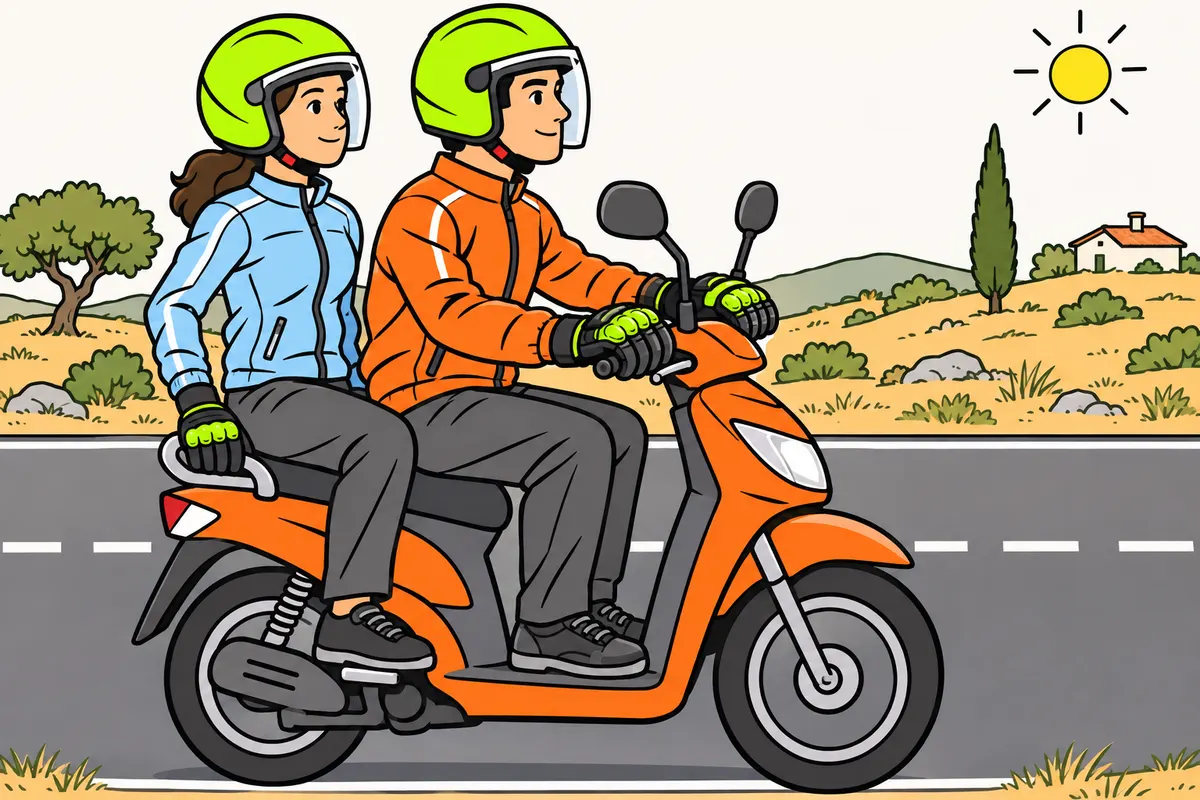
Choose protective gloves that fit well and stay secured.
Remember
- Check identification, instructions and size.
- Do not confuse warmth with protection against the ground.
- Gloves covering your wrists are recommended.
- Until the Interior order on glove technical specifications enters into force:
- When required, wear “gloves with the same characteristics as those currently used”.
- The technical transition does not suspend your duty to wear gloves when required.
Exam trap: Wrong: you can skip required gloves during the technical transition. Right: you must keep wearing them.
Read the full explanation
- You must choose gloves designed to protect your hands, with a good fit and secure fastening. In a fall, you may instinctively put your hands out; you need protection against contact with the ground as well as warmth. The appearance of a thin dress glove provides no guarantee of protection for riding.
- Until the order issued by the Minister of the Interior on the technical specifications for gloves enters into force, the second transitional provision states: “You must use protective gloves with the same characteristics as those currently used.” You must use protective gloves in accordance with these arrangements for as long as they remain in force. [RD 518/2026, second transitional provision.a](https://www.boe.es/buscar/doc.php?id=BOE-A-2026-13889)
- When buying them, you must check their identification as motorcycle protective equipment, instructions and size. You are advised to choose gloves that also cover your wrists and stay secured in a fall.
10Gloves that allow control
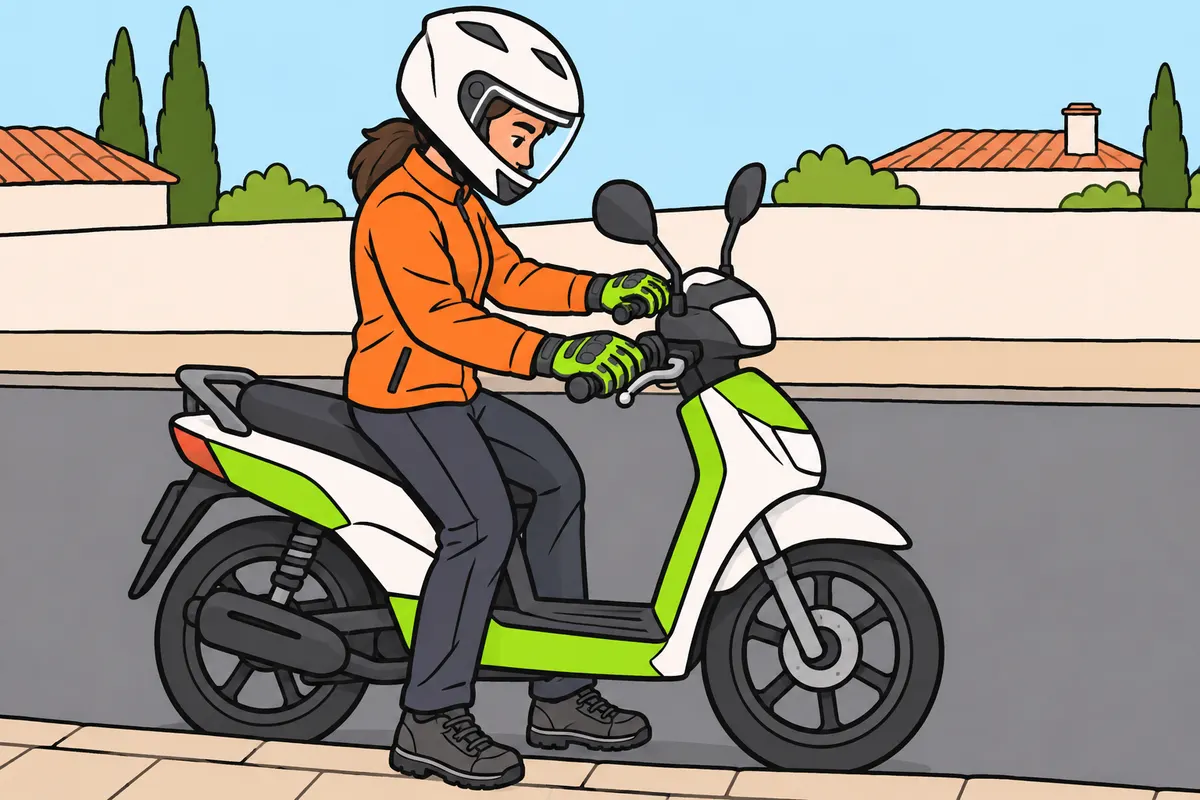
Your gloves must protect you and let you use the controls precisely.
Remember
- Try them with your hands on the grips.
- Check that you can close your fingers and operate the levers.
- Adjust fastenings without squeezing your hands.
- Avoid extra fingertip material, palm folds and excessive stiffness.
- Check palms, seams and fastenings after a fall or wear.
- Replace damaged gloves.
Exam trap: Wrong: you can keep wearing a glove with holes. Right: replace it because it leaves your skin exposed.
Read the full explanation
- You must try the gloves with your hands on the grips: you need to close your fingers and operate the levers precisely. Adjust the fastenings so they stay secured without squeezing; excess material at the fingertips, folds in the palm or excessive stiffness can make control difficult. Check both hands with your equipment on.
- You must check palms, seams and fastenings when they wear or after a fall. A hole leaves skin exposed and a broken fastening compromises retention. Follow the cleaning and care instructions to maintain their protective ability during use; replace damaged gloves.
11Jacket and body protectors
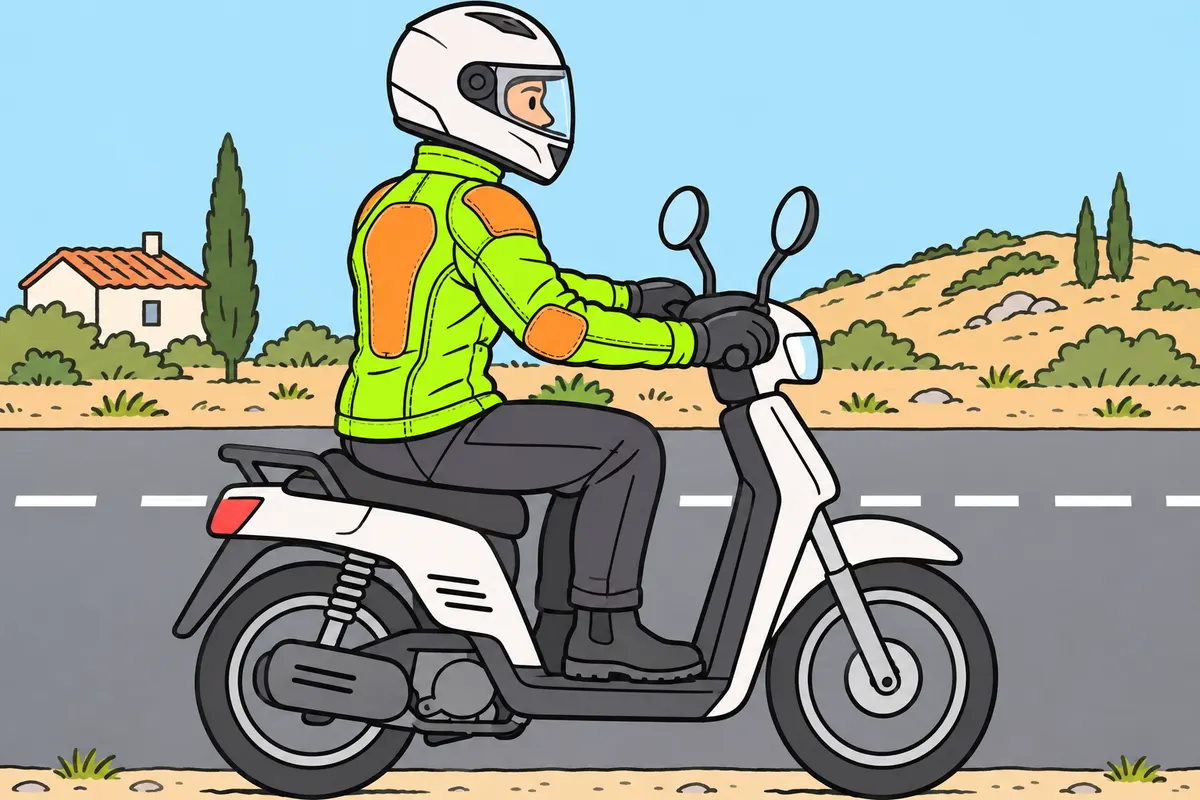
Choose a motorcycle jacket that protects your body without restricting your movement.
| Jacket part | Protection to look for |
|---|---|
| Fabric and seams | Resistance to sliding along the ground |
| Protectors | Protection against impacts |
Remember
- A motorcycle jacket is recommended when you ride.
- You have no general duty to wear one for ordinary riding.
- Check your shoulder, elbow and back protectors.
- Check that they stay in place when you sit or move your arms.
- Fasten your jacket and adjust its cuffs.
- Distinguish ordinary riding from your AM practical test.
Exam trap: Wrong: an everyday jacket protects you because it keeps you warm. Right: check its resistance to rubbing against the ground and its protectors.
Read the full explanation
- You are advised to wear a specialist motorcycle jacket that resists abrasion and has suitable protectors. You must understand their functions: the fabric and seams withstand sliding, while protectors help against impacts in the areas they cover.
- You must check that protectors stay over their intended areas when you sit down and move your arms. An excessively loose jacket can allow them to move. An excessively tight one can restrict you when turning the handlebars or looking over your shoulder.
- When choosing your equipment, pay attention to your shoulders, elbows and back. Check the product information to see whether the item covering each area is an impact protector suitable for the intended use.
- You must fasten the jacket correctly and adjust its cuffs. An open jacket can move in the wind and leave parts of your body exposed. The warmth provided by ordinary clothing does not show that its materials or seams are designed to slide along the road surface.
- For ordinary riding, article 118.1 does not impose a general requirement for a motorcycle jacket. You are strongly advised to wear one for its protection against abrasion and impacts. For the AM practical test, the specific equipment explained at the end is required. [RGC, art. 118.1](https://www.boe.es/buscar/act.php?id=BOE-A-2003-23514#a118)
12Trousers and leg protection
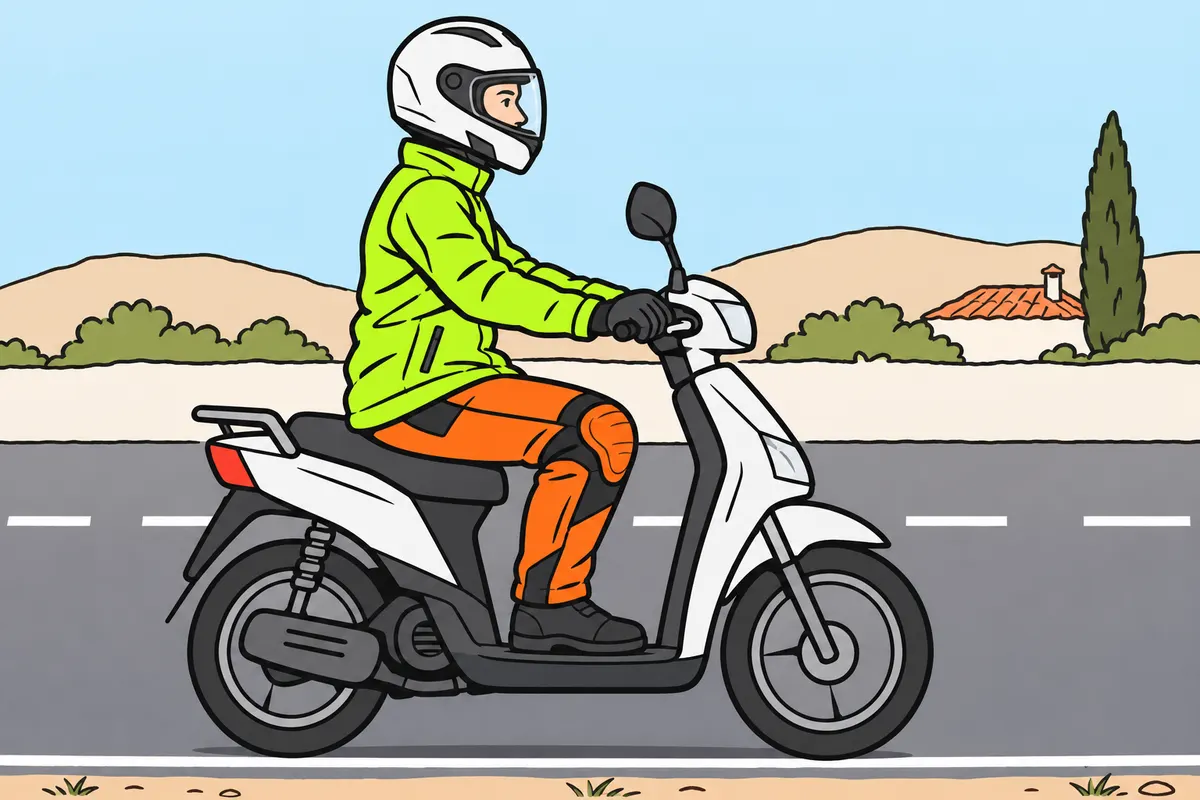
Protect your legs with motorcycle trousers and correctly positioned knee protectors.
Remember
- Choose fabric that resists rubbing against the ground.
- Check knee protectors while seated with your legs bent.
- You must be able to move your legs and use the controls.
- Avoid exposed skin between your trousers and jacket.
- Check that your trouser legs cannot catch.
- In rain, keep protective equipment underneath your waterproofs.
Exam trap: Wrong: waterproof overtrousers replace your protection against falls. Right: keep suitable protective equipment underneath.
Read the full explanation
- You are advised to wear abrasion-resistant motorcycle trousers with protectors, especially at the knees. In a fall, your legs can strike and slide along the road surface even if you wear a good jacket. Check the position of the knee protectors while seated on the moped: they must stay over the joint when you bend your leg. Shorts leave your skin exposed and ordinary trousers may offer insufficient resistance.
- With the trousers on, you must be able to bend your legs, put your feet down and use the controls. Adjust the waist and check the overlap with your jacket to keep your skin covered when you lean forwards; the trouser legs must remain free from snagging. Warmth and waterproofing serve different purposes from protection in a fall: if you add waterproof overtrousers, keep suitable protective equipment underneath.
13Closed footwear and boots
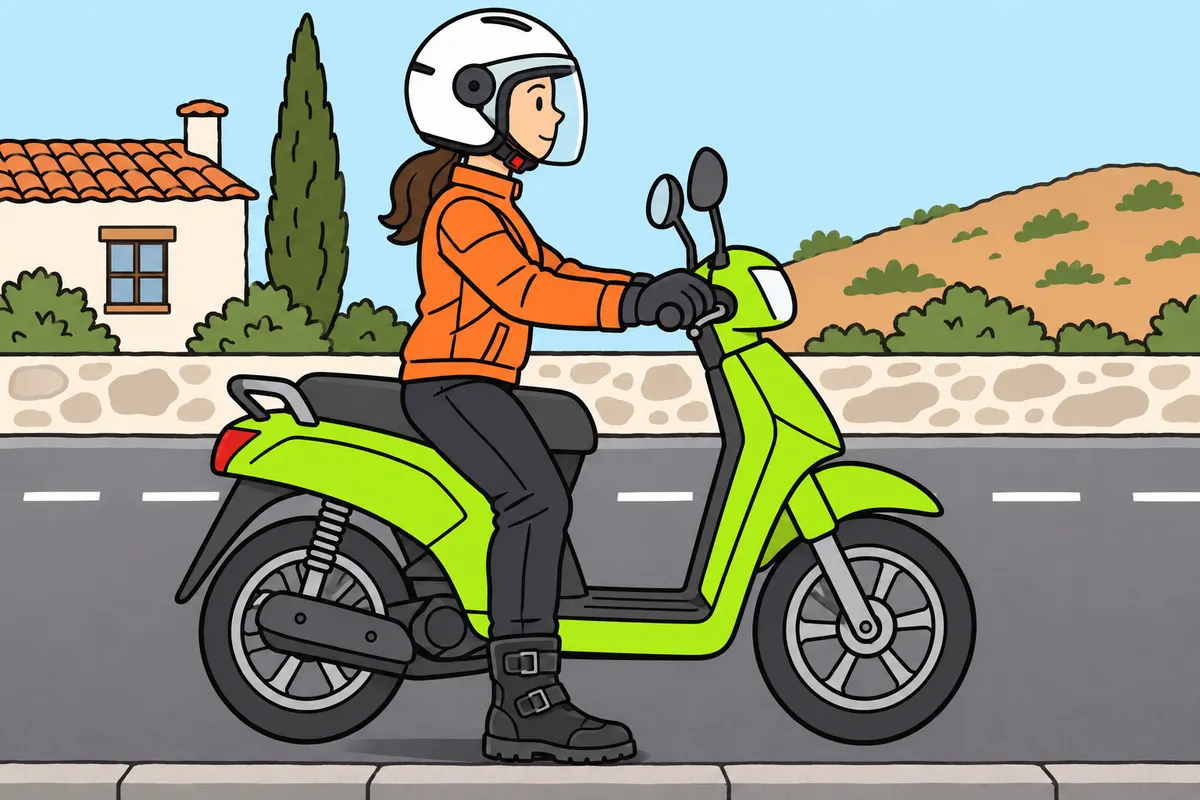
Motorcycle boots that protect your feet and ankles are recommended for you.
| Footwear | What you need to know |
|---|---|
| Closed trainer | Covers your foot; does not equal a protective boot |
| Motorcycle boot | Recommended to protect your foot and ankle |
Remember
- Choose soles with grip that let you use the controls.
- Secure your laces and other loose ends.
- In cold or rain, choose suitable boots without losing movement.
- Check seams, fastenings, soles and protectors after a fall.
- Check the product’s stated protective features.
Exam trap: Wrong: any tall boot protects you for riding. Right: check that it suits riding risks.
Read the full explanation
- To protect your feet and ankles, you can choose specialist motorcycle boots. Their ankle coverage and support provide greater protection than closed trainers. Look for a sole with grip and a shape that allows you to put your feet down and operate the controls precisely, while retaining the mobility you need to ride.
- Before setting off, secure laces and other loose ends to prevent them from catching on the vehicle. In cold or rainy weather, you can choose waterproof, insulated boots that allow you to control the vehicle. Check protectors, seams, fastenings and soles after a fall; consult the product specifications, because the appearance of a tall boot alone does not establish that it provides protection for moped riding.
14Dressing for the weather
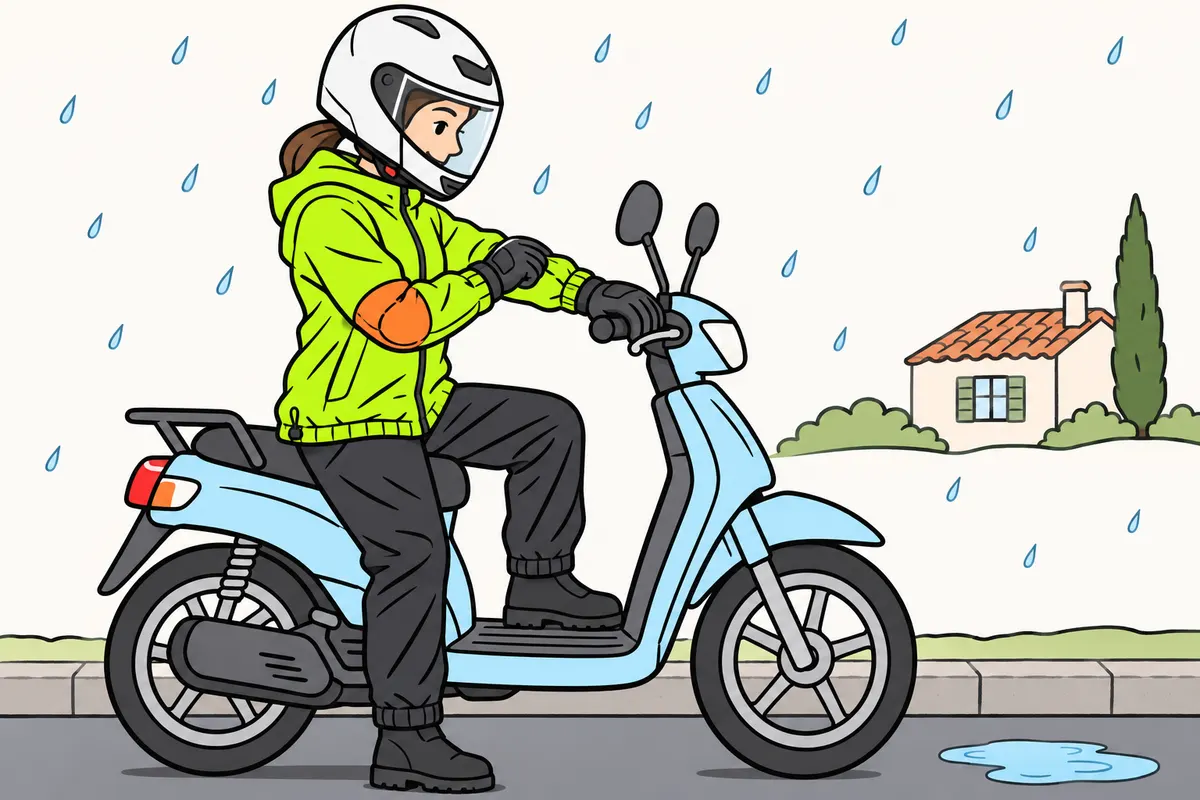
Adapt your clothing to the weather while keeping protection, movement and vision.
| Weather | How you can adapt your equipment |
|---|---|
| Heat | Ventilated protection |
| Cold and wind | Insulation |
| Rain | Waterproofs compatible with your protection |
Remember
- Combine layers without moving your protectors out of place.
- Try everything while seated on your moped.
- Check that you can look around and brake.
- Secure cuffs, hems and fastenings so they cannot catch.
Exam trap: Wrong: you can add layers even if they make braking difficult. Right: you must keep movement and vision.
Read the full explanation
- You can adapt your equipment to the weather with ventilated protective clothing for heat and insulation against cold and wind. Gloves and boots must also allow heat to escape or retain it according to the conditions. Combine layers without displacing protectors or reducing movement of your hands, arms and legs.
- In rain, you can add waterproofs compatible with your protection, securing cuffs, hems and fastenings. Check the complete outfit while seated on the moped: the collar must let you look around, the sleeves must allow braking and the trouser legs must remain free from snagging. You must retain freedom of movement and vision. [RGC, art. 18.1](https://www.boe.es/buscar/act.php?id=BOE-A-2003-23514#a18)
15Airbags for riders
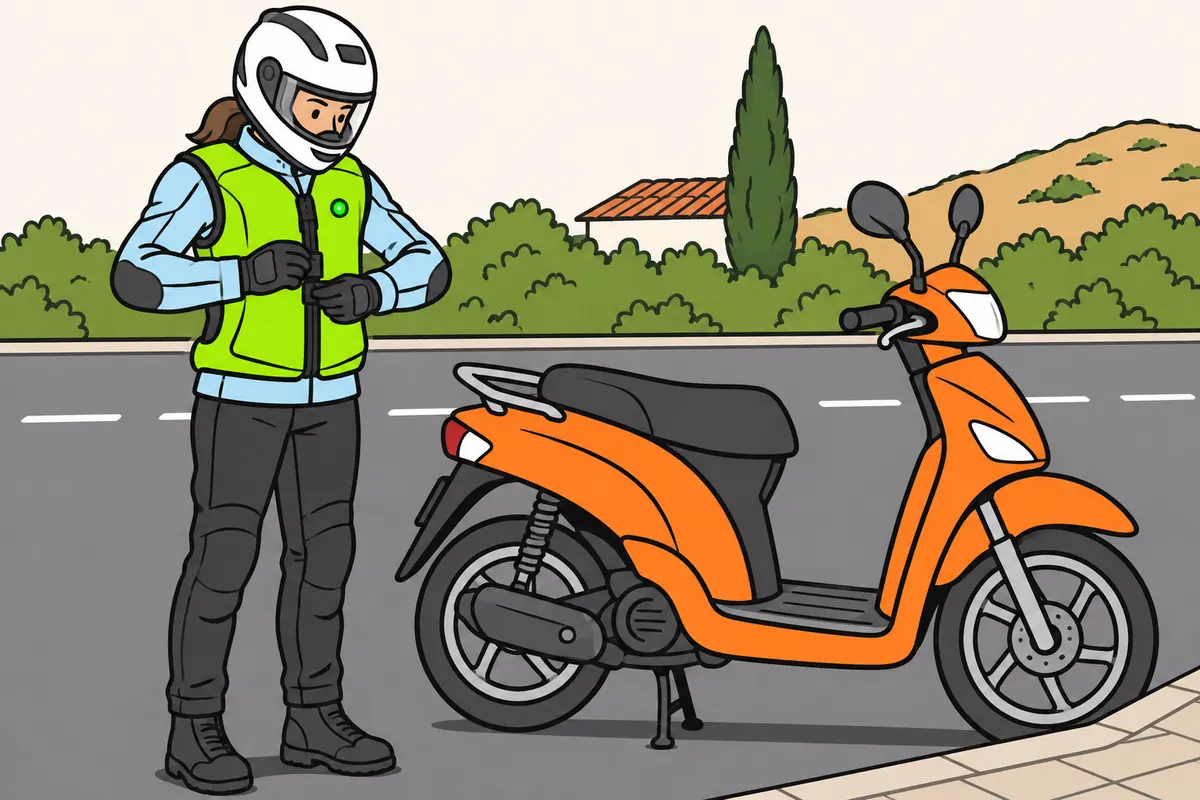
You can add an airbag to cushion impacts while keeping your protective equipment.
| Airbag system | Activation |
|---|---|
| Mechanical | Tether |
| Electronic | Sensors |
Remember
- An airbag is recommended, without a general requirement for moped riding.
- Keep your compulsory equipment and clothing that resists rubbing against the ground.
- Check which areas it covers and compatibility with your other clothing.
- Follow preparation instructions and leave space for it to inflate.
- After activation, follow the inspection procedure.
Exam trap: Wrong: an airbag lets you skip compulsory equipment. Right: keep that equipment and use the airbag as extra protection.
Read the full explanation
- You can supplement your equipment with an airbag vest or jacket to cushion impacts in the areas it covers when inflated. This protection is recommended, with no general requirement to use it when riding a moped; keep your compulsory equipment and abrasion-resistant clothing. Check the model’s coverage and compatibility with your other garments. [RGC, art. 118.1](https://www.boe.es/buscar/act.php?id=BOE-A-2003-23514#a118)
- Mechanical airbags activate through a tether, while electronic airbags use sensors. Before riding, follow the fitting, attachment or power supply instructions for your model, leaving the space needed for deployment. Also check what inspection is required after activation. [DGT, airbags for riders](https://sede.dgt.gob.es/export/sites/dgt/.galleries/movilidad/comunicacion_accidentes_trafico_ARENA/Manual_Contenidos-22102024.pdf)
16Colours and high-visibility features
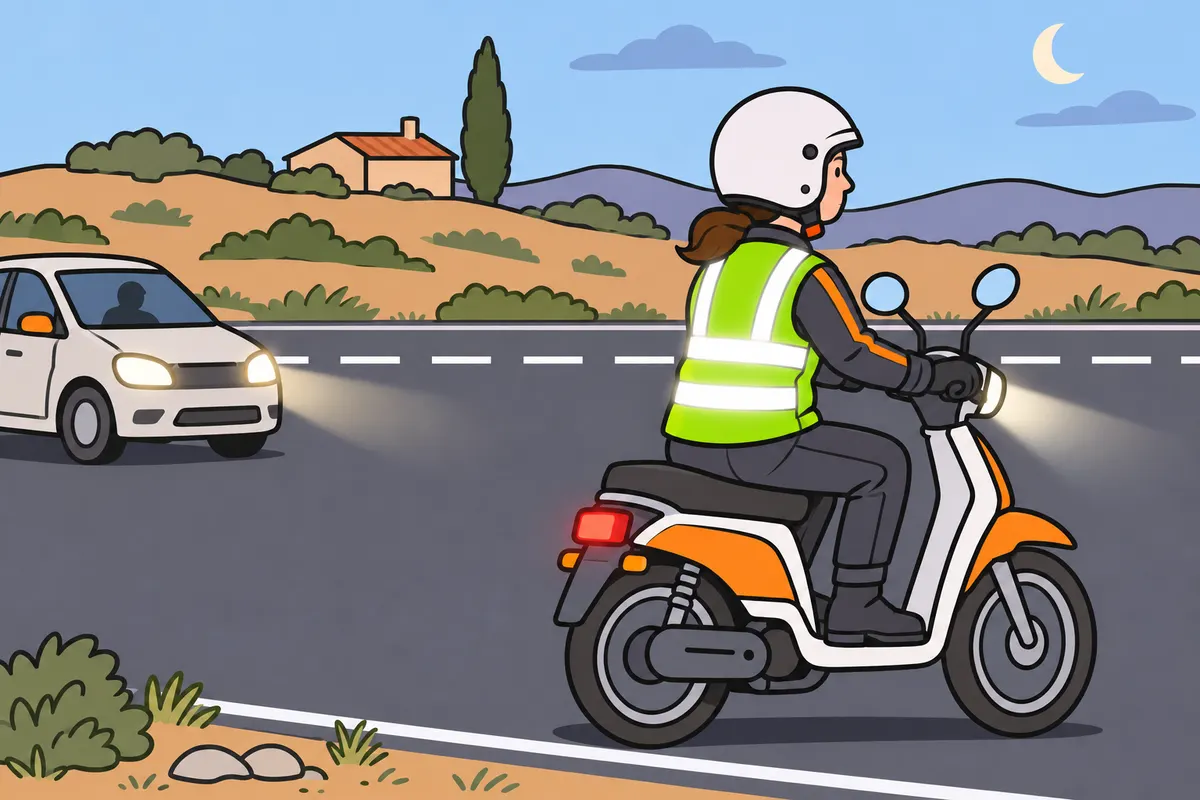
Choose visible colours and features to help others notice you.
| Feature | How it helps you |
|---|---|
| Fluorescent | Stands out in ambient light |
| Reflective | Returns some received light towards its source |
| Airbag vest | Cushions impacts when inflated |
Remember
- Choose a light-coloured, shiny or brightly coloured helmet.
- A dark colour does not make your helmet stronger.
- At night, pay special attention to reflective features.
- Do not let your backpack cover visible areas.
- These features do not replace your lights or give you priority.
- Do not confuse a reflective vest with an airbag.
Exam trap: Wrong: any reflective vest works as an airbag. Right: check its functions; visibility and cushioning through inflation are different.
Read the full explanation
- You can favour a light-coloured, shiny or brightly coloured helmet that contrasts with your surroundings. This choice helps others notice you but does not determine helmet strength. Assess colour for its visibility and type approval for the protection requirements it certifies.
- You can increase your visibility with brightly coloured clothing and fluorescent or reflective features. Their functions differ: fluorescence stands out in ambient light, while retroreflective material returns some of the light it receives towards its source, for example headlights.
- At night, you must give particular consideration to reflective features in visible areas. You must also check that a backpack or other clothing does not cover the surface intended to make you visible.
- You must understand that these features improve detection without guaranteeing it. They do not replace the moped’s lights or give you priority. The choice and use of lights are covered in the “Moped lights and signals” module; here you must remember the contribution of your personal equipment.
- You can distinguish a reflective vest from an airbag vest. The first improves your visibility and the second cushions impacts by inflating; a product can combine functions, but you must not attribute them to any vest based on its name or appearance.
17Vests: professional use and walking
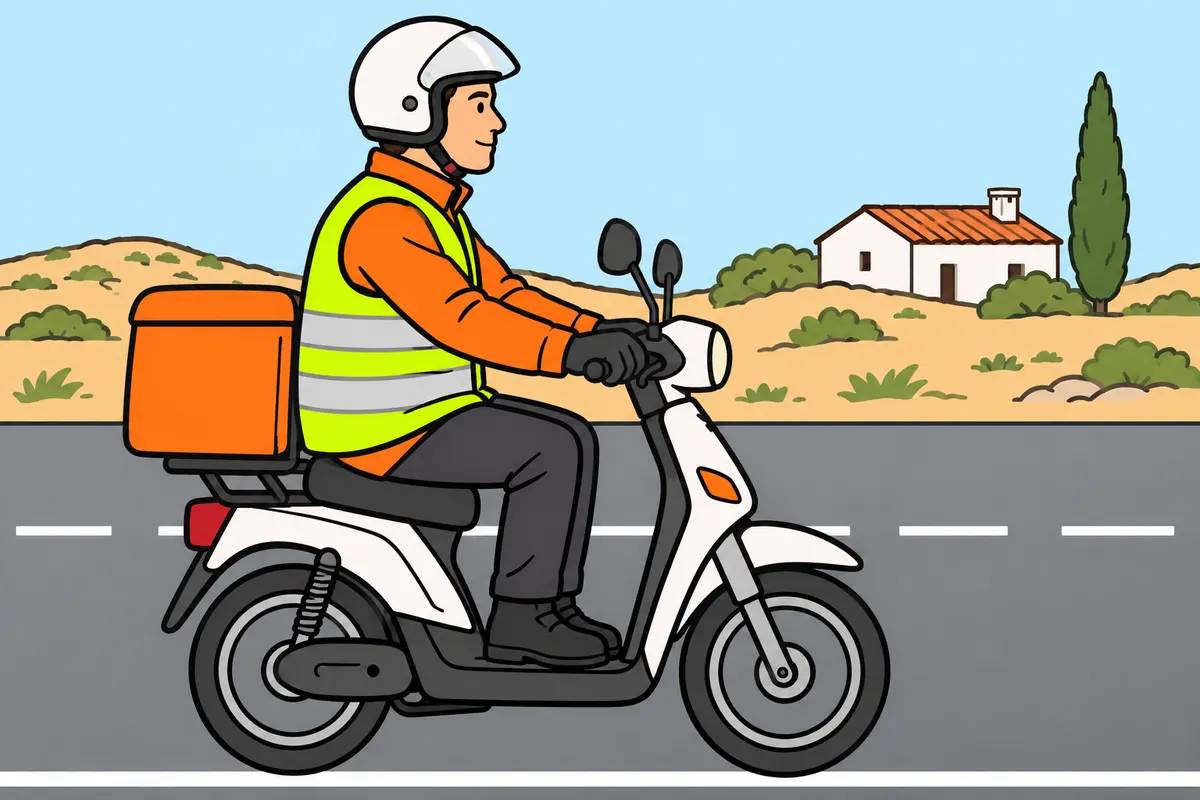
Distinguish your visibility duties when working, riding privately and walking.
| Your activity and vehicle | Requirement |
|---|---|
| Professional activity on a moped or light quadricycle | Compliant reflective vest on every road |
| Private moped riding | No general vest requirement |
| Walking on an interurban carriageway or hard shoulder, between sunset and sunrise, or when weather or environmental conditions significantly reduce visibility | Compliant luminous or reflective item visible from at least 150 metres |
Remember
- For professional riding, wear a high-visibility reflective vest meeting personal protective equipment requirements.
- When required, carry or wear a luminous or reflective item meeting those requirements.
- The item does not have to be a vest.
- Leaving your moped’s lights on is not enough.
Exam trap: Wrong: all motorcycle equipment duties apply to your privately used moped. Right: check your vehicle category and activity.
Read the full explanation
- If you ride a moped or light quadricycle as part of your professional activity, you must wear a high-visibility reflective vest meeting personal protective equipment requirements on all types of road. [RGC, art. 118.4](https://www.boe.es/buscar/act.php?id=BOE-A-2003-23514#a118)
- For private use, you can improve visibility with suitable clothing without a general requirement to wear a vest while riding a moped. The professional requirement depends on your activity; you must also assess separately the conditions in which you walk. [RGC, art. 118.4](https://www.boe.es/buscar/act.php?id=BOE-A-2003-23514#a118)
- You must not automatically apply the specific requirement to carry a vest as part of motorcycle equipment to a privately used moped. These are different categories. You must apply the relevant provision to your vehicle and activity. [RGV, Annex XII; RGC, art. 118.4](https://www.boe.es/buscar/act.php?id=BOE-A-1999-1826#anxii)
- If you walk on the carriageway or arcén (hard shoulder) of an interurban road between sunset and sunrise, or when weather or environmental conditions significantly reduce visibility, you must carry or wear at least one luminous or reflective item meeting personal protective equipment requirements and visible from at least 150 metres. [RGC, art. 123.1](https://www.boe.es/buscar/act.php?id=BOE-A-2003-23514#a123)
- In this walking situation, you must consider the required visibility of the item you carry or wear. It is not enough for the moped to have its lights on some distance away. A suitable vest can serve this purpose, but the article does not require the item to take the form of a vest. [RGC, art. 123.1](https://www.boe.es/buscar/act.php?id=BOE-A-2003-23514#a123)
18Equipping your passenger too
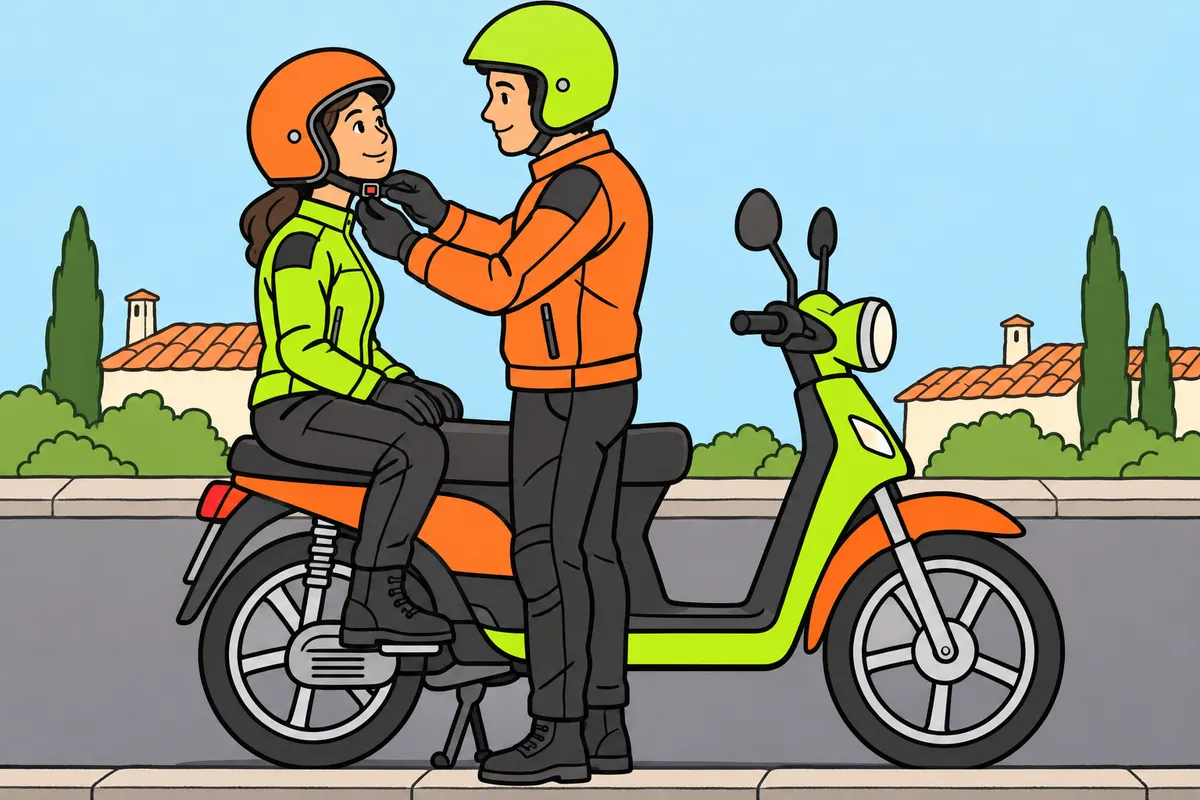
Prepare and check your passenger’s protection before setting off.
Remember
- Check their equipment even if they only travel with you occasionally.
- Give them a helmet in their size and in good condition.
- Check that they position and adjust it correctly.
- Recommend a protective jacket, trousers and boots, even in good weather.
- If they use an airbag, check that its instructions cover passengers.
- Check that their clothing and laces do not interfere with the vehicle.
Exam trap: Wrong: any spare helmet suits your passenger. Right: check its size, condition, position and fastening.
Read the full explanation
- You must prepare your passenger’s equipment with the same care as your own. Before leaving, check with them which garments they need and how to wear them; their protection depends on being able to use them correctly throughout the journey, even if they only travel with you occasionally.
- You must provide a helmet in their size and in good condition. Handing over any spare helmet is not enough: it may be too large or have a poorly adjusted fastening. The passenger protection requirement means checking correct use as well as having the equipment.
- You must recommend a protective jacket, trousers and boots, including in good weather. If you use a passenger airbag, check that its instructions cover this use and how to prepare it. Travelling behind you does not prevent contact with the ground in a fall.
- To carry your passenger, you must meet the age, vehicle authorisation, seating and posture requirements explained in the “Passengers and loads on a moped” module; prepare their protection before starting the journey.
- Before setting off, you must check that their clothing, laces and accessories are secured and do not interfere with the vehicle. There is no fixed regulatory distance between the two helmets that replaces correct passenger positioning or individual adjustment of their protection.
19Protective structure and seat belt
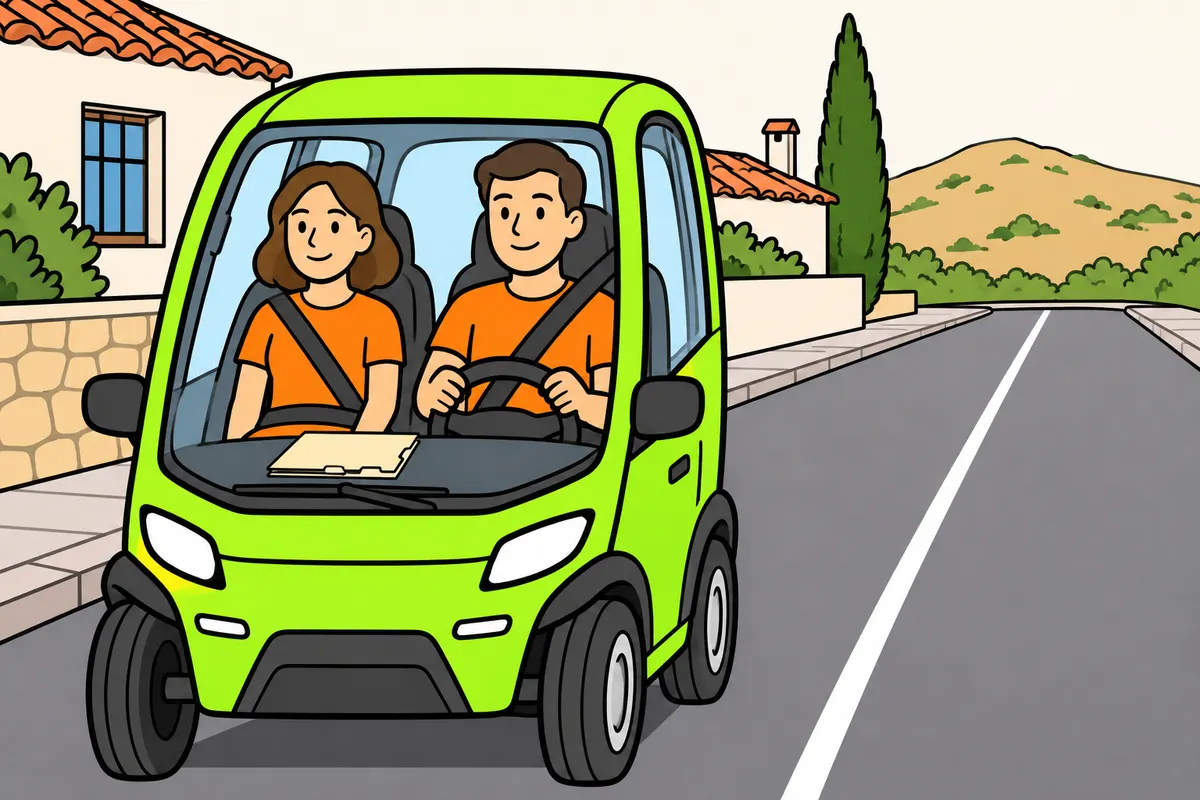
Your equipment exemption requires a protective structure, seat belts and confirmation in technical documents.
| Vehicle conditions | What you must do |
|---|---|
| Protective structure and seat belts, recorded in the technical documents | You can use the exemption; wear your seat belt on every road |
| Only a roof or cover is visible | You cannot assume the exemption applies |
Remember
- The exemption covers the required helmet, gloves and closed footwear.
- You need a protective structure and seat belts.
- This must appear on its ITV card or the moped’s certificate of characteristics.
- Then you and your passenger must wear seat belts on every road.
- A roof or single bar does not prove your exemption.
Exam trap: Wrong: a roof lets you ride without a helmet. Right: you need a protective structure, seat belts and confirmation on the ITV card or the moped’s certificate of characteristics.
Read the full explanation
- You can be exempt from the helmet, gloves and closed footwear requirements of article 118.1 if the vehicle has a protective structure and seat belts and this is recorded on the ITV (vehicle roadworthiness test) card or the moped’s certificate of characteristics. All these conditions must be met. [RGC, art. 118.1](https://www.boe.es/buscar/act.php?id=BOE-A-2003-23514#a118)
- In this situation, you and your passenger must use the seat belt on all types of road. In a light quadricycle meeting the documented conditions, you must also fasten it when travelling along an urban street or covering a short distance. [RGC, art. 118.1](https://www.boe.es/buscar/act.php?id=BOE-A-2003-23514#a118)
- The entry in the technical documentation identifies a protective structure valid for the exemption. A rain cover, roof or single bar does not establish this condition; consult the relevant ITV card or certificate of characteristics before deciding which protection to use. [RGC, art. 118.1](https://www.boe.es/buscar/act.php?id=BOE-A-2003-23514#a118)
20Equipment for the AM practical test
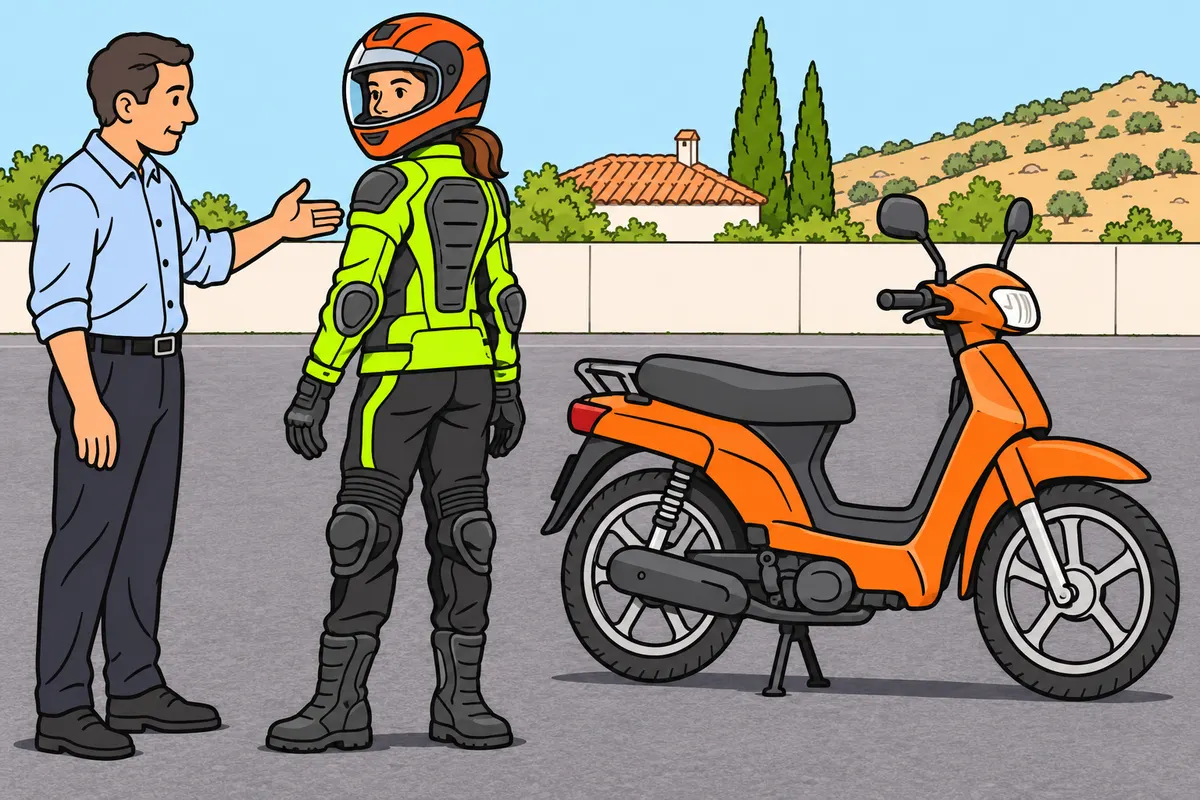
For your AM practical test, check the equipment required for your test and vehicle.
Remember
- When motorcycle equipment is required, wear a type-approved helmet and gloves.
- Wear a jacket and trousers made for motorcycle riding, with protectors.
- Your jacket must protect your back, shoulders and elbows.
- Your trousers must protect your knees.
- Wear leather or similar synthetic boots that sufficiently protect your ankles.
- Check all your equipment with your driving school.
Exam trap: Wrong: ordinary clothes and trainers suffice for a test requiring motorcycle equipment. Right: wear the specific equipment; unsuitable equipment prevents or stops your test without using up an attempt for that reason.
Read the full explanation
- For an AM practical test requiring motorcycle equipment, you must have a type-approved helmet and gloves. The examiner can check your equipment before the test starts or during it. The equipment depends on the test and the vehicle presented. [RGCond, Annex VI.C.1](https://www.boe.es/buscar/act.php?id=BOE-A-2009-9481#anvi)
- To take the test, you must wear a jacket and trousers designed and manufactured for motorcycle riding, with their protectors. The jacket must protect at least your back, shoulders and elbows; the trousers must protect your knees. An ordinary jacket does not comply simply because it has long sleeves. [RGCond, Annex VI.C.1](https://www.boe.es/buscar/act.php?id=BOE-A-2009-9481#anvi)
- For the practical test, you must wear boots made of leather or similar synthetic material that sufficiently protect your ankles; footwear covering only your feet is insufficient. [RGCond, Annex VI.C.1](https://www.boe.es/buscar/act.php?id=BOE-A-2009-9481#anvi)
- You must check with your driving school that your equipment is suitable for the test vehicle and complete. If it does not meet the requirements, the examiner determines that the test does not start or is stopped, without using up a test attempt for this reason. [RGCond, Annex VI.C.1](https://www.boe.es/buscar/act.php?id=BOE-A-2009-9481#anvi)
Choosing and fitting your helmet
Check type approval, size, vision and retention before use.
- Check the helmet label and documentation for moped use; favour a UNECE R22 type-approved full-face helmet.
- Try it on with any vision correction you need and check for even contact, no looseness and sideways vision.
- Place it in its normal position and fasten and adjust the strap according to the instructions.
- Carefully check that it does not rotate freely and that you cannot remove it while fastened.
- Prepare the visor and ventilation; if the fit or fastening fails, resolve it before riding.
Checking equipment before setting off
Carry out the check for yourself and your passenger.
- Identify whether you ride with motorcycle equipment or in a vehicle with a structure and seat belts meeting the documented exemption.
- On a moped or light quadricycle without an exemption, check your helmet is fastened, your footwear is closed and you have gloves for any interurban section.
- Adjust your jacket, trousers, protectors and boots; secure laces and loose ends.
- If you use an airbag, prepare it and check its status following that model’s instructions.
- Check vision, mobility and access to the controls; also check your passenger’s equipment and fastenings.
Deciding what to do with a helmet after an impact
External appearance does not rule out internal damage.
- Identify whether it has suffered a significant impact or whether you do not know the severity of the blow.
- Replace the helmet after a significant impact even if you see no cracks.
- If the severity of a blow is uncertain, consult the manufacturer or a specialist and follow their instructions before reusing it.
- Do not try to restore its safety with glue, paint or modifications to the interior.
- Check the size and fastening of the replacement helmet before riding again.
Check what you know
Real questions from the bank on this topic. Pick an answer to see the explanation.
Finished this module?
Mark it as read and you will see your progress on the theory list.