
Theory · C1 Licence - Light Truck · Module 5 of 18
The Driver’s Condition
You learn to apply the alcohol limits for lorries and the requirements for alcohol and drug testing, and to distinguish fines, penalty points and criminal offences. You recognise how rest, health, medicines, emotions and distractions affect you so you can answer C1 licence questions and decide when you must stop driving.
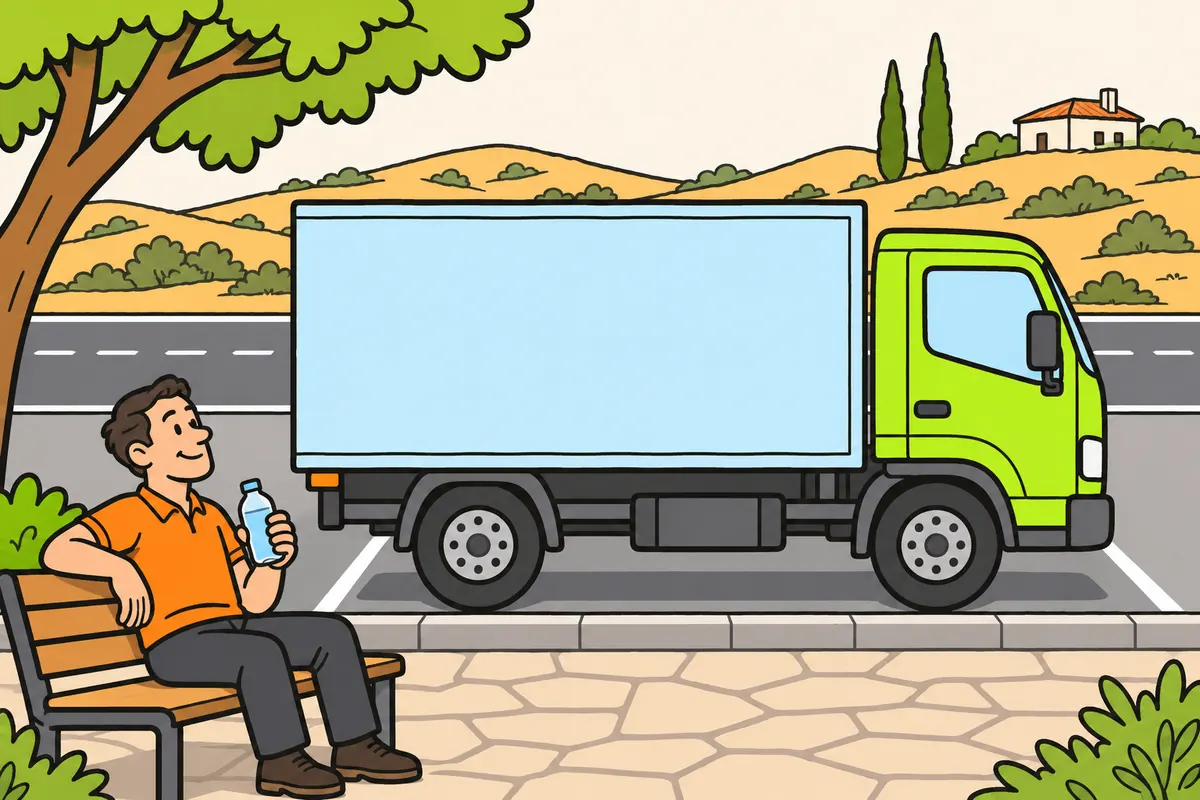
1Fitness to drive the lorry
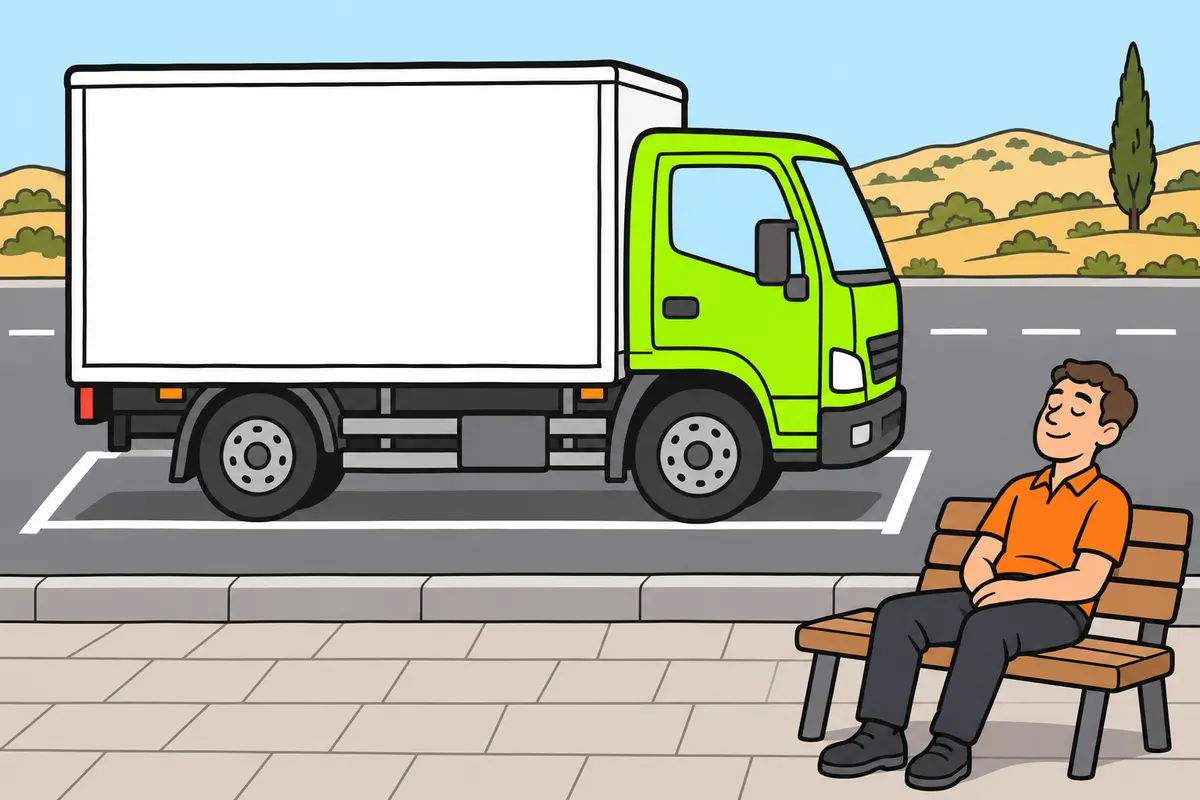
You must be able to control your lorry throughout the journey.
| Your case as the lorry driver | Seat belt use |
|---|---|
| Driving on urban or interurban roads, including deliveries | You must wear it properly fastened |
| Carrying out a reversing or parking manoeuvre | You are exempt during that manoeuvre |
| Holding an exemption certificate for serious medical reasons or disability | You are exempt; show the certificate if an officer requests it |
| Your exemption certificate comes from another EU Member State’s competent authority | You must also carry its official translation |
Remember
- Before setting off, check your rest, health and mood.
- Do not drive if you cannot drive safely.
- Adjust your seat and secure objects properly.
- Keep your movements and view clear.
- Watch the sides and areas close to your cab too.
- Wear your belt properly fastened, also on deliveries with nearby stops.
Exam trap: Wrong: deliveries with frequent nearby stops exempt you from wearing a seat belt. Right: you must wear it unless one of the stated exemptions applies.
Read the full explanation
- You must be fit to control the light delivery lorry throughout the journey. Before setting off, assess your rest, health, medication, substance use and emotional state: professional skill does not compensate for impaired attention. If you cannot drive safely, do not set off, or stop driving. [RGC, art. 17](https://www.boe.es/buscar/act.php?id=BOE-A-2003-23514#a17).
- You must maintain freedom of movement, adequate vision and constant attention. Adjust your seat so that you can reach the steering wheel and pedals without stretching or bending your legs too much; an uncomfortable posture encourages fatigue. Position objects in the cab so that they do not interfere with you or fall towards the controls. [RGC, art. 18](https://www.boe.es/buscar/act.php?id=BOE-A-2003-23514#a18).
- When driving, you perceive information, interpret it, make a decision and carry out a response. You can look in a mirror without understanding what is happening if your mind is occupied by a worry; having your eyes open does not guarantee effective observation. In the lorry, you need to maintain this sequence while also monitoring the sides and the areas close to the cab. [DGT, Manual VII](https://sede.dgt.gob.es/.galleries/permisos-de-conducir/certificacion-aptitud-profesores-formacion-vial/2024/Manual-VII-Psicologia-2024.pdf).
- Human factors play a major role in road crashes: decisions, errors, distractions and substance use can contribute to a crash. Several factors can be involved in the same accident. Do not automatically attribute every accident to a single cause or confuse every dangerous behaviour with a distraction. [DGT, Manual VII](https://sede.dgt.gob.es/.galleries/permisos-de-conducir/certificacion-aptitud-profesores-formacion-vial/2024/Manual-VII-Psicologia-2024.pdf).
- You must wear your approved seat belt properly fastened in the lorry, on both urban and interurban roads, including delivery work involving repeated loading and unloading over short distances: delivery work does not exempt you. As the driver of this lorry, you are exempt when carrying out a reversing or parking manoeuvre, or if you hold an exemption certificate on grounds of serious medical reasons or disability. You must produce the certificate if an officer requests it; if it is issued by the competent authority of another European Union Member State, it must be accompanied by its official translation. [RGC, art. 117.1](https://www.boe.es/buscar/act.php?id=BOE-A-2003-23514#a117). [RGC, art. 119.1-2](https://www.boe.es/buscar/act.php?id=BOE-A-2003-23514#a119).
- If you do not wear a seat belt when it is compulsory, or you wear it incorrectly, you lose 4 points. [LTSV, Annex II, item 15](https://www.boe.es/buscar/act.php?id=BOE-A-2015-11722#anii).
2Perception and reaction time
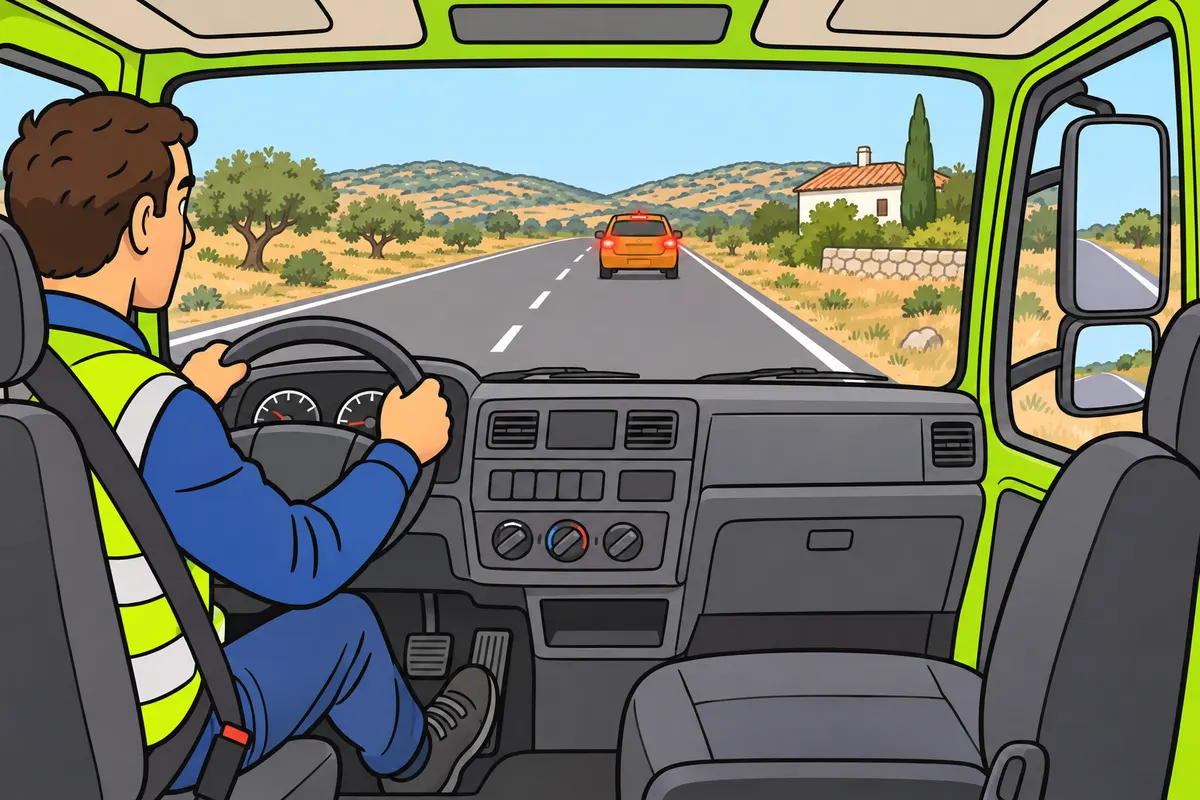
Your reaction time ends when you start responding to danger.
| Stage | What affects it |
|---|---|
| Your reaction | Your attention and condition |
| Braking | Road surface, tyres and shock absorbers |
Remember
- Tiredness, sleepiness or alcohol can delay your response.
- Some medicines and illnesses also delay your response.
- The faster you drive, the further you travel while reacting.
- Look ahead, behind and to the sides.
Exam trap: Wrong: your reaction ends when your lorry stops. Right: it ends when you start responding.
Read the full explanation
- Reaction time is the interval from when you perceive a stimulus until you begin to respond. It does not include the entire braking process or end when the lorry comes to a stop. Do not memorise one second as a fixed value for everyone: it depends on your condition, your attention and the complexity of what is happening. [DGT, Manual VII](https://sede.dgt.gob.es/.galleries/permisos-de-conducir/certificacion-aptitud-profesores-formacion-vial/2024/Manual-VII-Psicologia-2024.pdf).
- Fatigue, drowsiness, alcohol, drugs and certain medicines can delay your response. Illness, intense emotion, an excessive meal or uncomfortable heat in the cab can also do so. If you notice late that the vehicle ahead is braking, the lorry continues moving during that delay. [DGT, Manual VII](https://sede.dgt.gob.es/.galleries/permisos-de-conducir/certificacion-aptitud-profesores-formacion-vial/2024/Manual-VII-Psicologia-2024.pdf).
- Your reaction time and the mechanical conditions affecting braking play a part in different stages of stopping. The road surface, tyres and shock absorbers particularly affect the response of the vehicle and its braking; they do not by themselves explain how long you take to notice a hazard. The distance you travel during your reaction time increases with speed. [DGT, Manual VII](https://sede.dgt.gob.es/.galleries/permisos-de-conducir/certificacion-aptitud-profesores-formacion-vial/2024/Manual-VII-Psicologia-2024.pdf).
- You must look ahead, to the sides and behind, and divide your attention according to the risks. Alcohol, tiredness or poor eyesight make it harder to judge distances and movements; driving very fast also reduces your useful field of vision. The height of the cab does not protect you from misinterpreting a vehicle joining the road or moving sideways. [DGT, Manual VII](https://sede.dgt.gob.es/.galleries/permisos-de-conducir/certificacion-aptitud-profesores-formacion-vial/2024/Manual-VII-Psicologia-2024.pdf).
3Alcohol: units and the lorry limit
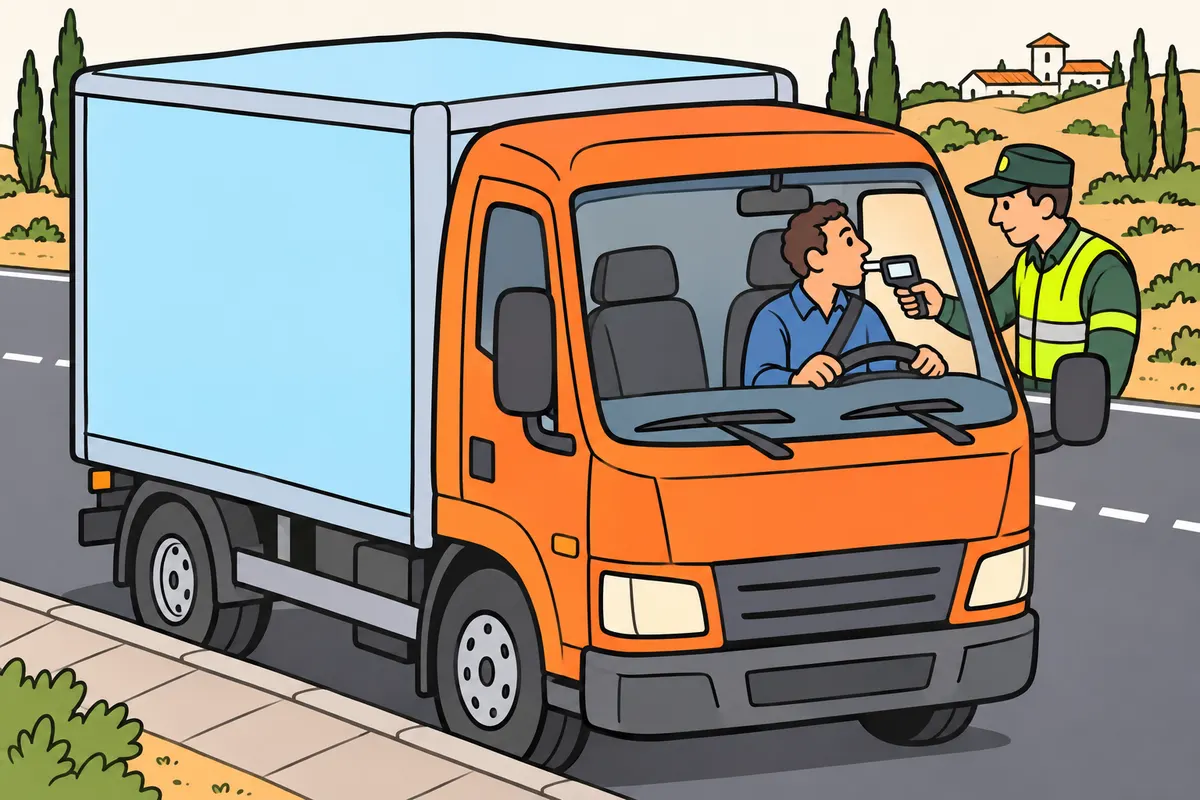
You must follow the lower alcohol limits in your goods lorry.
| Vehicle and driver | Blood maximum | Breath maximum |
|---|---|---|
| Goods vehicle with MMA above 3,500 kg | 0.3 g/l | 0.15 mg/l |
| General rule: adults outside lower-limit categories | 0.5 g/l | 0.25 mg/l |
Remember
- MMA means your vehicle’s maximum authorised mass.
- Apply your lorry’s limit even when driving empty.
- Your experience does not allow a higher alcohol level.
- The safest choice is no alcohol before driving.
- Being within the limit does not guarantee safe driving.
- Do not confuse blood grams with breath milligrams.
Exam trap: Wrong: you can use the general limit when your lorry is empty. Right: its MMA counts.
Read the full explanation
- Blood alcohol concentration is expressed in grams per litre, g/l. The concentration in exhaled breath is expressed in milligrams per litre, mg/l. Each result relates to the sample analysed; these concentrations do not express the total amount of alcohol in your body, and their units are not interchangeable. One litre equals 1,000 cm³: 0.3 g per 1,000 cm³ of blood expresses the same limit as 0.3 g/l; you must not convert it to 0.3 mg/l of breath. [RGC, art. 20](https://www.boe.es/buscar/act.php?id=BOE-A-2003-23514#a20).
- If you drive a goods vehicle with an MMA (maximum authorised mass) of more than 3,500 kg, you must not exceed 0.3 g/l in blood or 0.15 mg/l in exhaled breath. The reference is the maximum authorised mass, not the weight of the load that day. This also applies when you drive that lorry empty. [RGC, art. 20](https://www.boe.es/buscar/act.php?id=BOE-A-2003-23514#a20).
- The lower alcohol limit for the lorry depends on its intended use for carrying goods and its MMA; it applies to both professional and private transport. How long you have held your licence and whether you are paid for the journey do not change that limit. When making deliveries in a lorry with an MMA of 7,500 kg, you must apply it even if you carry only a few parcels or return without a load. [RGC, art. 20](https://www.boe.es/buscar/act.php?id=BOE-A-2003-23514#a20).
- The general rule for adult drivers outside the cases subject to lower limits sets maximum concentrations of 0.5 g/l in blood or 0.25 mg/l in breath. These values apply, for example, when you drive a private passenger car as an adult who has completed the novice period. Staying within a legal maximum does not prove that your abilities remain unimpaired. [RGC, art. 20](https://www.boe.es/buscar/act.php?id=BOE-A-2003-23514#a20).
- The preventive option is to consume no alcohol if you intend to drive: aim for a concentration of 0.0. Risk can increase with amounts that do not exceed the administrative limit; euphoria or feeling normal does not allow you to measure it. Do not calculate a number of drinks supposedly compatible with driving the lorry. [DGT, alcohol consumption](https://www.dgt.es/muevete-con-seguridad/evita-conductas-de-riesgo/consumo-de-alcohol/).
4Lower limits and novice drivers
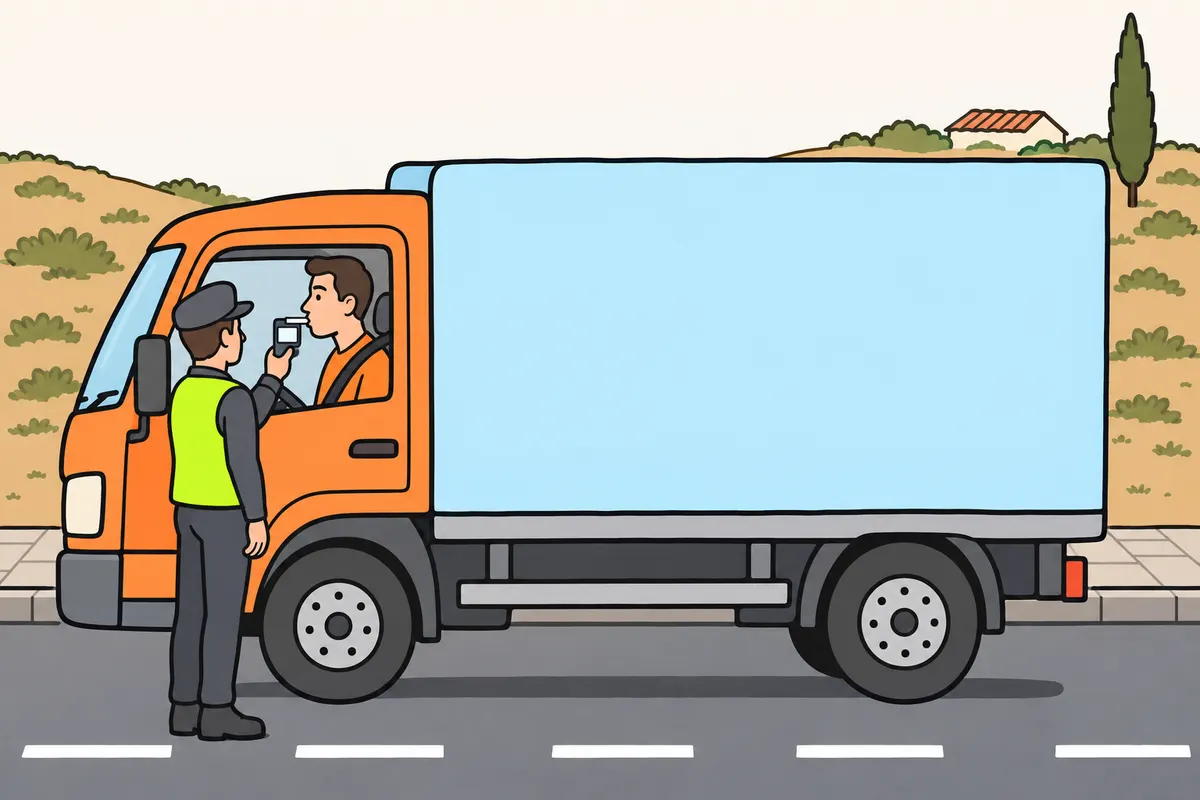
Your vehicle, service, licence history and age determine your alcohol limit.
| Your case | Alcohol rule |
|---|---|
| First two years after obtaining the licence allowing you to drive | Lower maxima |
| Under 18, any vehicle | 0 g/l blood and 0 mg/l breath |
| Passenger vehicle with more than nine seats | Lower maxima |
| Public service, school transport and transport of minors | Lower maxima |
| Dangerous goods, emergency services and special transport | Lower maxima |
Remember
- Count from the licence that allows you to drive.
- Getting C1 does not restart this period if you have held B long enough.
- Time holding a limited licence counts only for vehicles it allows you to drive.
- For passenger vehicles, count seats, even when empty.
Exam trap: Wrong: getting C1 always restarts your novice period. Right: it does not if you have held B for at least two years.
Read the full explanation
- The same lower maximum concentrations as for the lorry apply when you drive vehicles intended for passenger transport with more than nine seats, public service vehicles, vehicles for school transport and the transport of minors, dangerous goods vehicles, emergency service vehicles and special transport vehicles. Each of these uses or services is a case in which the lower limit applies. [RGC, art. 20](https://www.boe.es/buscar/act.php?id=BOE-A-2003-23514#a20).
- For vehicles intended for passenger transport with more than nine seats, the capacity of the vehicle counts, rather than how many people are travelling in it. To identify whether a service falls within these cases, consider the transport for which the vehicle is intended: a light vehicle can also be subject to the lower limit because it carries schoolchildren or dangerous goods. [RGC, art. 20](https://www.boe.es/buscar/act.php?id=BOE-A-2003-23514#a20).
- For the two years after you obtain the driving permit or licence that entitles you to drive, you must not exceed 0.3 g/l in blood or 0.15 mg/l in exhaled breath. For this calculation, the length of time you have held a licencia de conducción (driving licence for certain vehicle categories) only counts when you drive vehicles for which that licence is sufficient. If you obtain C1 and you have held your B licence for at least two years, obtaining C1 does not start another novice period; when you drive the lorry, the lower limit for that vehicle still applies. [RGC, art. 20](https://www.boe.es/buscar/act.php?id=BOE-A-2003-23514#a20).
- If you are under 18, your limit when driving any vehicle is 0 g/l in blood and 0 mg/l in exhaled breath. This legal obligation also covers bicycles and personal mobility vehicles. It is a rule linked to your age as a driver, distinct from the limits for adults and from the preventive advice to avoid all alcohol consumption if you intend to drive. [LTSV, art. 14.1](https://www.boe.es/buscar/act.php?id=BOE-A-2015-11722#a14).
5How blood alcohol concentration varies
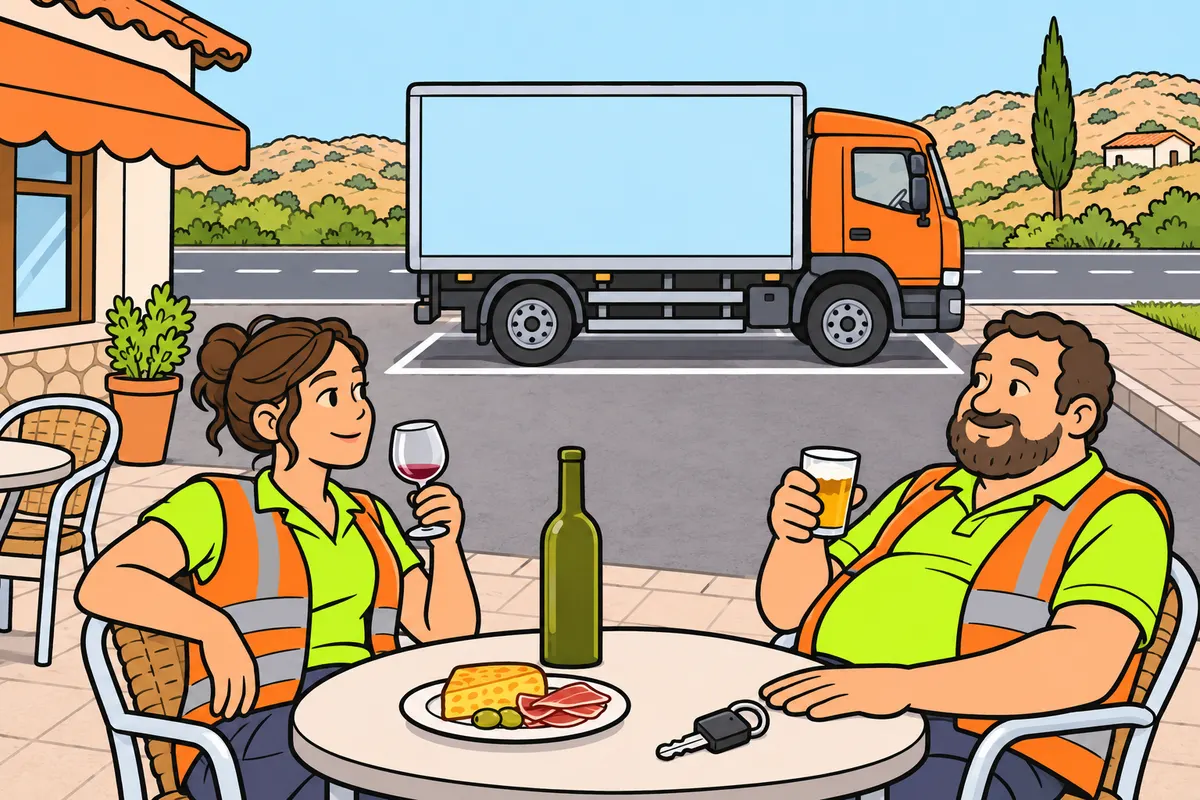
Your alcohol level depends on what you drink and your personal circumstances.
| Circumstance | What can change |
|---|---|
| Woman compared with man, with similar weight and alcohol intake | May reach a higher alcohol level |
| Illness, fatigue or medicines | You may suffer stronger effects without a higher alcohol level |
Remember
- Drinking quickly can raise your alcohol level.
- Beer and wine also affect your driving.
- Food slows absorption but does not remove alcohol.
- Your alcohol level can keep rising after you stop drinking.
- Do not use elapsed time to decide you can drive.
Exam trap: Wrong: the same drinks always produce the same alcohol level. Right: your body and circumstances matter.
Read the full explanation
- Your blood alcohol concentration depends on the amount of pure alcohol you consume, which varies with the strength and volume of the drink, and on how quickly you drink. A beer or a glass of wine contains alcohol and can affect your driving; the name of the drink does not establish that it is safe. Drinking quickly makes it easier for alcohol to be absorbed before enough time has elapsed to eliminate it. [DGT, alcohol consumption](https://www.dgt.es/muevete-con-seguridad/evita-conductas-de-riesgo/consumo-de-alcohol/).
- Your weight, body composition, sex and individual circumstances affect the concentration you reach. With similar weight and consumption, if you are a woman you may reach a higher concentration than a man because of differences in how alcohol is distributed in the body. You cannot predict another person’s concentration or your own simply by comparing drinks. [DGT, alcohol consumption](https://www.dgt.es/muevete-con-seguridad/evita-conductas-de-riesgo/consumo-de-alcohol/).
- Eating can slow absorption, but it does not eliminate the alcohol that enters your blood. Age, illness, fatigue and combining alcohol with medicines can increase your vulnerability. Your measured concentration and the impairment of your abilities are different aspects: you can experience stronger effects without reaching a higher alcohol concentration. [DGT, alcohol consumption](https://www.dgt.es/muevete-con-seguridad/evita-conductas-de-riesgo/consumo-de-alcohol/).
- The DGT gives an approximate time of between 30 and 90 minutes after consumption for peak blood alcohol concentration. Your concentration can continue to rise after you finish drinking; do not treat that interval as a clock telling you when you can drive. Absorption and elimination vary according to the person and the circumstances. [DGT, alcohol consumption](https://www.dgt.es/muevete-con-seguridad/evita-conductas-de-riesgo/consumo-de-alcohol/).
6Effects and elimination of alcohol
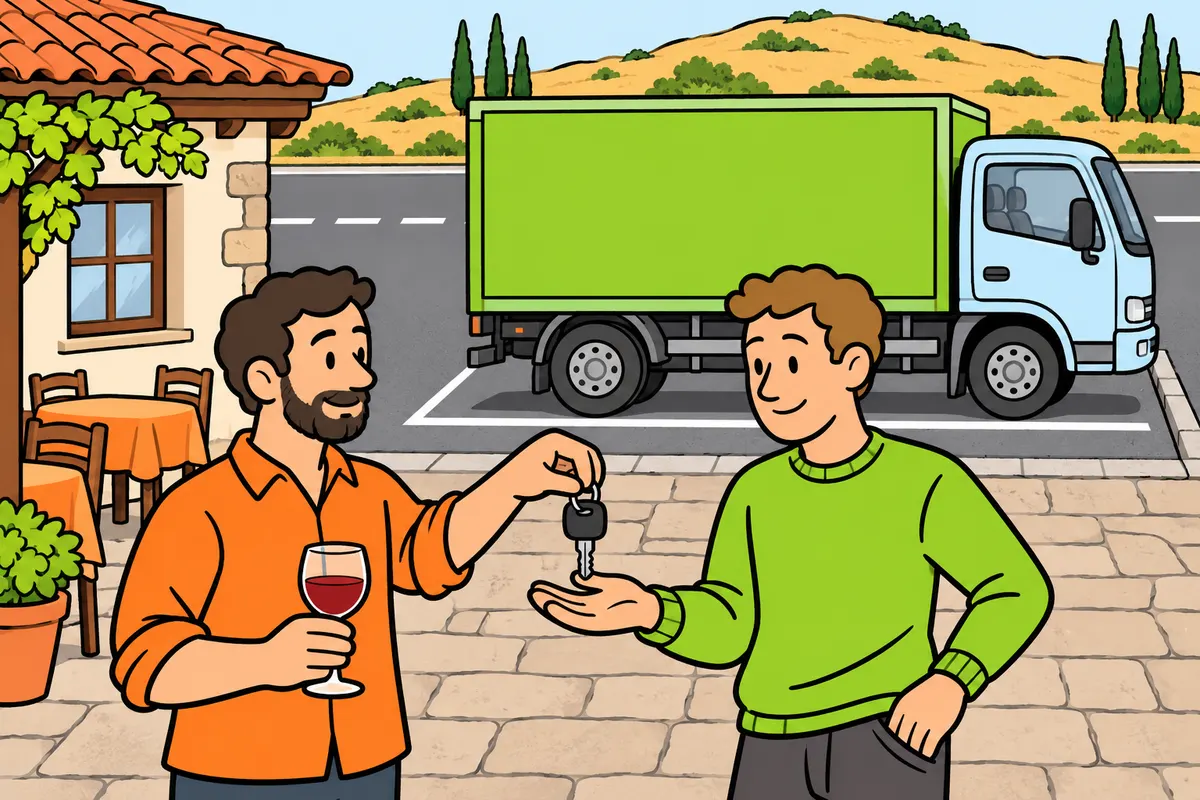
Alcohol worsens your driving, and your body needs time to remove it.
Remember
- You may feel confident while driving worse.
- You may see less clearly and respond later.
- Coffee, showers and exercise do not neutralise alcohol.
- Feeling alert does not prove you can drive.
- Find safe alternative transport if alcohol or its effects may remain.
- Do not mix drugs to try to counteract alcohol.
Exam trap: Wrong: a short sleep removes alcohol. Right: resting does not prove your body has removed it.
Read the full explanation
- Alcohol can reduce your inhibitions and cause euphoria and overconfidence, so that you accept risks you avoid when sober. You may judge your own ability less accurately precisely when it is impaired. You do not necessarily show aggression or a visible loss of balance after small amounts; the absence of obvious signs does not guarantee that you are fit to drive. [DGT, alcohol consumption](https://www.dgt.es/muevete-con-seguridad/evita-conductas-de-riesgo/consumo-de-alcohol/).
- You may judge distances less accurately, have reduced peripheral vision and detect signs or movements later. Your attention, coordination and precision also deteriorate, and your reaction time increases; alcohol can make you sleepy. In the lorry, a late correction can compromise your course and endanger other road users. [DGT, alcohol consumption](https://www.dgt.es/muevete-con-seguridad/evita-conductas-de-riesgo/consumo-de-alcohol/).
- Eliminating alcohol takes time, and there is no remedy that reliably speeds it up so that you can drive. Coffee, water, food, chewing gum, exercise, showers or stimulants do not neutralise absorbed alcohol. Sleeping for half an hour or feeling alert does not prove that you have regained your fitness to drive either. [DGT, alcohol consumption](https://www.dgt.es/muevete-con-seguridad/evita-conductas-de-riesgo/consumo-de-alcohol/).
- You must plan a safe alternative when you drink and avoid driving after a celebration or at the start of your next shift if you may still have alcohol in your body or residual effects. Do not mix alcohol with other drugs to try to counteract it. Getting the rest you need and eliminating alcohol are separate issues: resolving one does not prove that you have resolved the other. [DGT, alcohol consumption](https://www.dgt.es/muevete-con-seguridad/evita-conductas-de-riesgo/consumo-de-alcohol/).
7When you must undergo testing
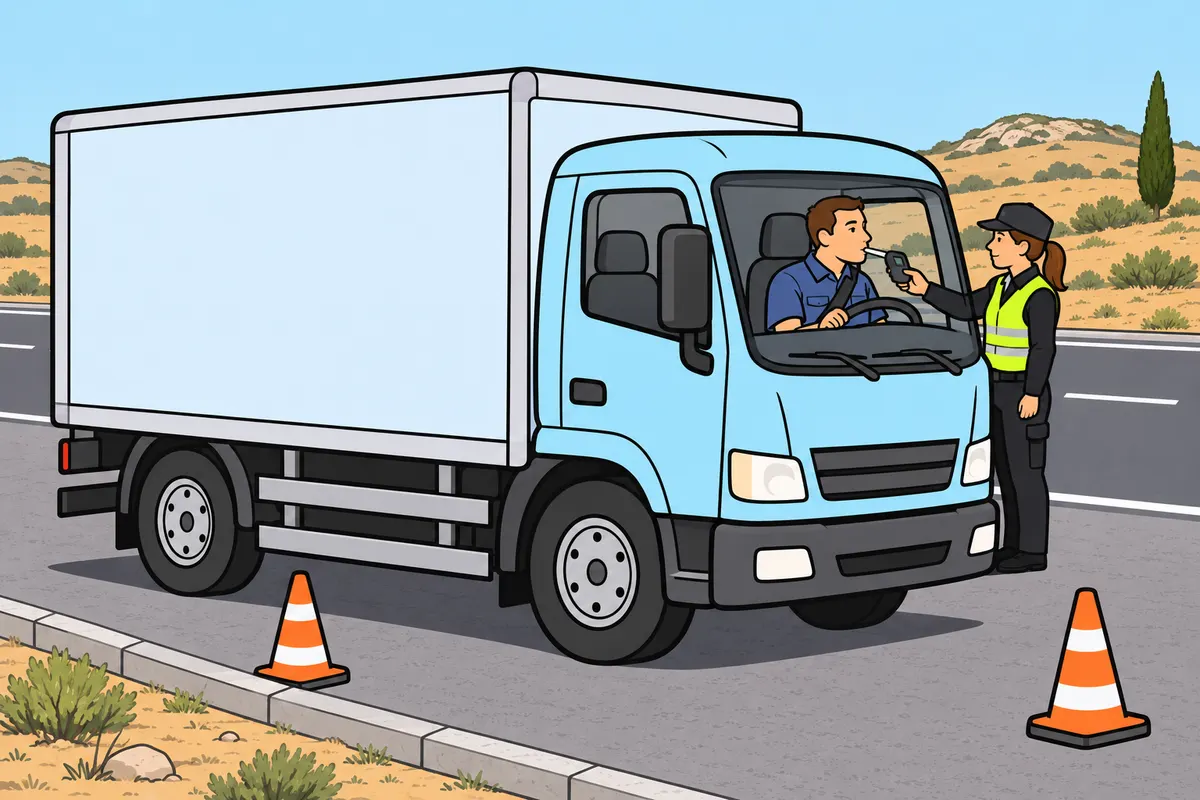
You must cooperate with alcohol and drug tests that officers lawfully require.
| Your situation | When you must undergo tests |
|---|---|
| You are driving | Preventive checks, signs of alcohol impairment, a reported offence or possible responsibility in an accident |
| You use the road without driving, such as walking | If involved in an accident or committing an offence defined by law |
Remember
- Being a professional driver does not exempt you from tests.
- Follow the officers’ instructions.
- Explain any genuine medical reason preventing the standard test.
- A justified inability means other checks, not refusing all testing.
Exam trap: Wrong: you can only be tested after an accident. Right: as a driver, you must also cooperate at preventive checks.
Read the full explanation
- You must undergo the alcohol and drug tests lawfully required by traffic enforcement officers. You may be tested at preventive checks even if you have committed no offence and show no symptoms. Being a professional driver does not exempt you. [LTSV, art. 14](https://www.boe.es/buscar/act.php?id=BOE-A-2015-11722#a14).
- The RGC provides for testing if you are involved in an accident as a potentially responsible driver, show signs of being under the influence of alcohol, are reported for an offence or are required to take a test under a preventive programme. You cannot choose to cooperate only when an accident has occurred. Follow the instructions so that the tests are carried out correctly. [RGC, art. 21](https://www.boe.es/buscar/act.php?id=BOE-A-2003-23514#a21).
- As another road user, you must also undergo testing if you are involved in an accident or have committed an offence defined by law. This can include you as a pedestrian; driving a vehicle is not the only situation covered by law. Do not assume that preventive checks on drivers apply without qualification to every pedestrian outside these situations. [LTSV, art. 14](https://www.boe.es/buscar/act.php?id=BOE-A-2015-11722#a14).
- If an injury, illness or another justified reason prevents the standard test, the appropriate examination or analyses must be ordered in accordance with the procedure and medical judgement. Tell the officers if you are genuinely unable to take the test; this does not mean you are free to refuse all checks. [LTSV, art. 14](https://www.boe.es/buscar/act.php?id=BOE-A-2015-11722#a14).
8Breathalyser and second measurement
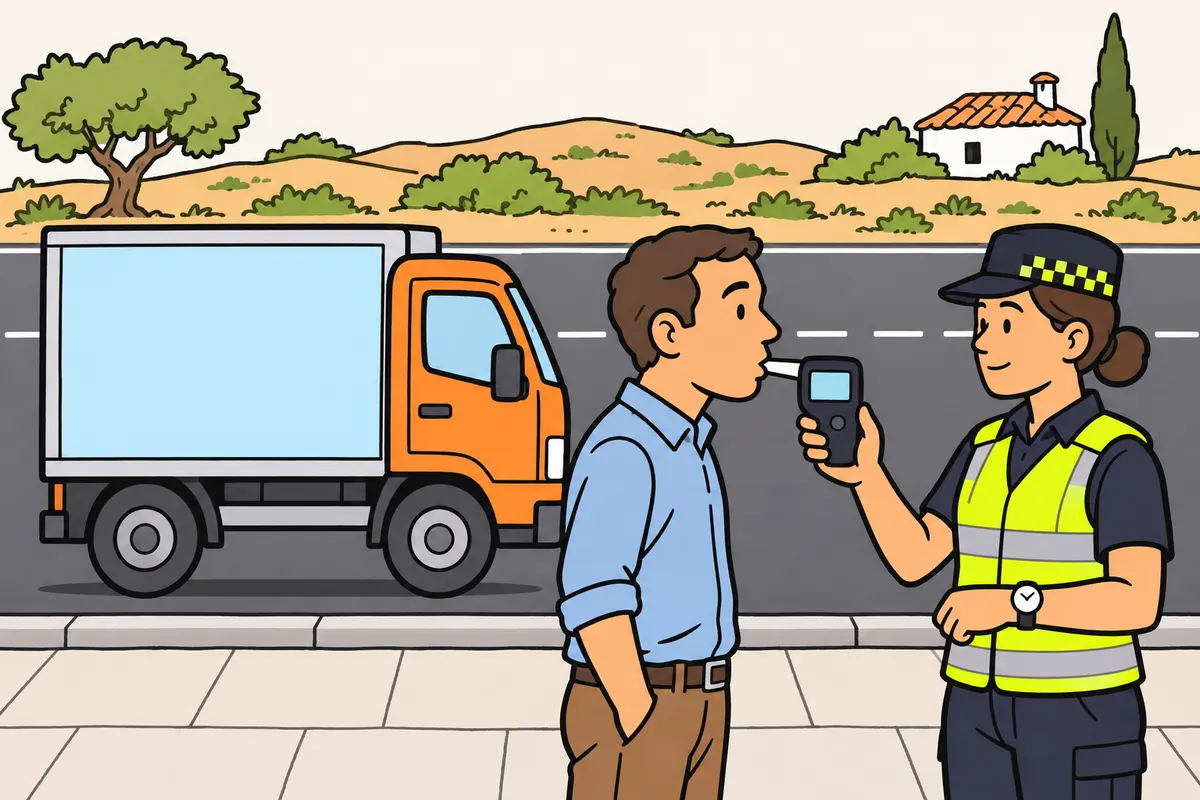
A breathalyser measures alcohol in the air you breathe out.
Remember
- Cooperate by following the officers’ instructions.
- Repeat the test if above your limit or showing clear signs of alcohol impairment.
- You, companions or witnesses present can check the waiting time.
- You can ask for your observations to be recorded.
- Disagreeing with results does not allow you to refuse compulsory tests.
Exam trap: Wrong: the wait removes alcohol so you can continue driving. Right: it is only the minimum time between measurements.
Read the full explanation
- The standard alcohol check uses an approved device to test your exhaled breath. The breathalyser measures the concentration in that air; it does not take a blood sample. You must cooperate as instructed by the officers and distinguish this measurement from a medical test. [RGC, art. 22](https://www.boe.es/buscar/act.php?id=BOE-A-2003-23514#a22).
- If you exceed the applicable limit or show clear symptoms of being under the influence of alcohol even without reaching it, you undergo a second breath test after being informed. In your lorry, the relevant lower maximum applies, rather than the general limit for a private car. [RGC, art. 23](https://www.boe.es/buscar/act.php?id=BOE-A-2003-23514#a23).
- At least 10 minutes must elapse between the first and second tests. You have the right to check this interval yourself or through companions or witnesses present. Do not confuse this minimum with enough time to eliminate alcohol or with a wait that allows you to continue driving. [RGC, art. 23](https://www.boe.es/buscar/act.php?id=BOE-A-2003-23514#a23).
- You may make representations or observations yourself or through a companion or legal representative, if you have one, so that they are included in the official record. You must be informed of your rights during the procedure. Disagreeing with the result does not remove your duty to undergo the tests lawfully required. [RGC, art. 23](https://www.boe.es/buscar/act.php?id=BOE-A-2003-23514#a23).
9Drugs: testing and medical confirmation
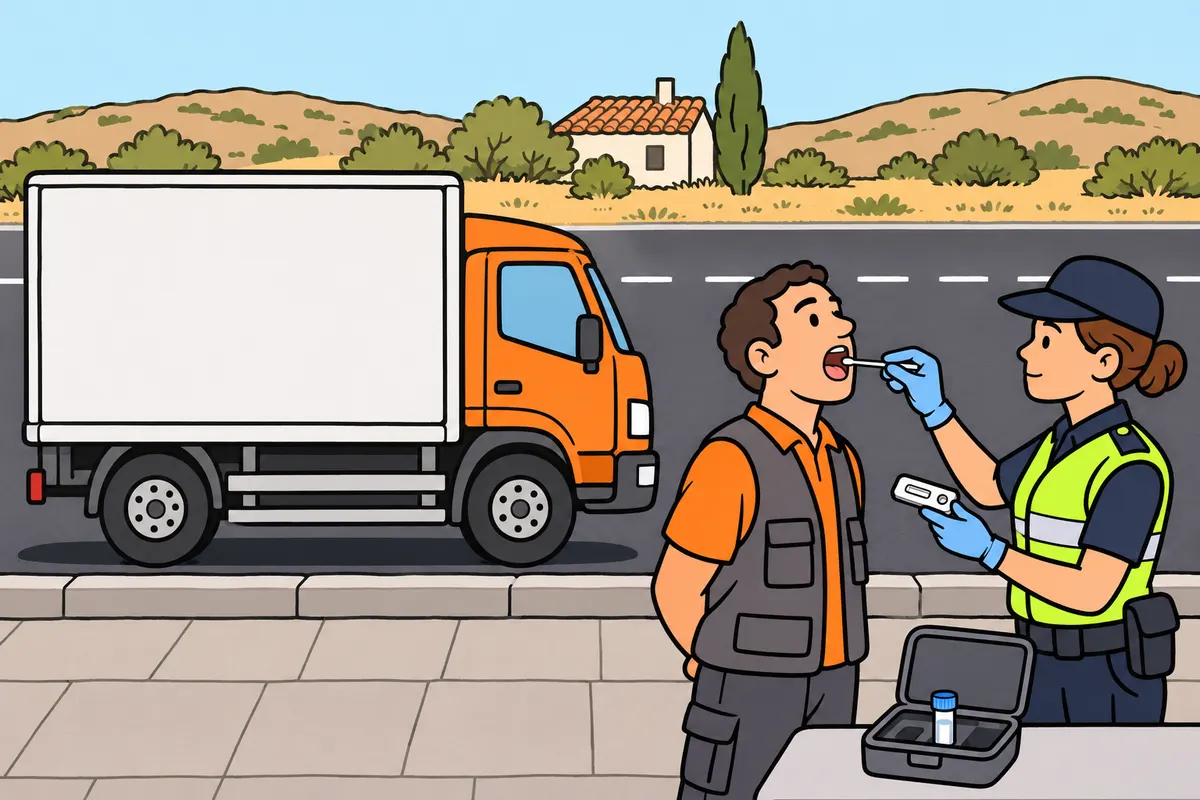
You can request medical confirmation while still cooperating with compulsory tests.
| Confirmatory alcohol test you request | Analysis cost |
|---|---|
| Before analysis | You pay a deposit |
| Negative result | Your deposit is refunded |
| Positive result | You pay for the analysis |
Remember
- Drug testing starts with saliva screening, followed by laboratory confirmation.
- You can request confirmation for alcohol or drugs, preferably through blood analysis.
- Another method may be used for justified exceptional reasons.
- Medical confirmation differs from repeating a breath test.
- For justified medical reasons, healthcare staff decide which checks are appropriate.
Exam trap: Wrong: requesting confirmation allows you to refuse tests. Right: you must keep cooperating.
Read the full explanation
- The drug test comprises a saliva check using an approved device followed by analysis of a sufficient saliva sample. The device provides the initial detection and the laboratory analyses the sample to confirm the result. Measuring alcohol with a breathalyser does not replace this: they are different checks. [LTSV, art. 14](https://www.boe.es/buscar/act.php?id=BOE-A-2015-11722#a14).
- You may request confirmation of alcohol or drug test results, preferably through a blood test, except where justified exceptional circumstances prevent this. This medical confirmation is different from the second breath alcohol measurement. Requesting it does not remove your obligation to cooperate with the tests lawfully required. [LTSV, art. 14](https://www.boe.es/buscar/act.php?id=BOE-A-2015-11722#a14).
- If you request confirmation of your alcohol test result, the officers arrange your transfer to a nearby healthcare centre in accordance with the procedure. The RGC provides for a deposit covering the cost of the analysis and its refund if the confirmatory result is negative. If it is positive, you bear the cost. [RGC, art. 23](https://www.boe.es/buscar/act.php?id=BOE-A-2003-23514#a23).
- When justified medical reasons prevent the standard tests, medical professionals assess which checks are appropriate. Healthcare staff report the results to the competent authorities; this is not a private consultation you can use to prevent the check. Keep the distinction between cooperation, observations and confirmation clear. [LTSV, art. 14](https://www.boe.es/buscar/act.php?id=BOE-A-2015-11722#a14).
10Refusal and immobilisation
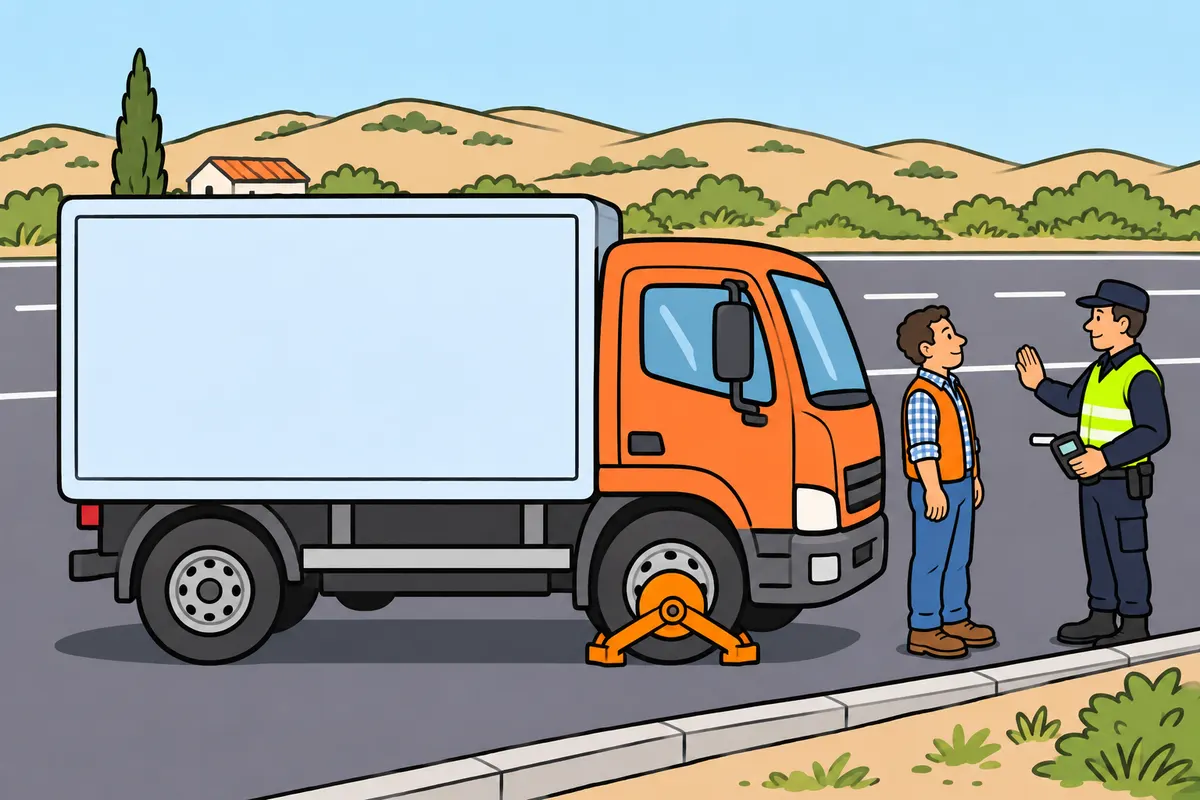
Refusing compulsory tests can be a criminal offence, and officers can immobilise your lorry.
| Consequence | What it means for you |
|---|---|
| Criminal refusal | Prison and a driving ban |
| Refusal that is not a criminal offence | A fine and points as a driver |
| Immobilisation | You cannot continue until authorised |
| Immobilisation costs, unless the vehicle was stolen or used against the holder’s will, duly justified | The offending driver pays |
| If the offending driver does not pay | The usual driver or lessee pays; if there is neither, the holder pays |
| Before immobilisation is lifted | You must pay the costs, even if you appeal |
| Until payment is proved | Officers may keep the vehicle registration certificate |
Remember
- Refusing lawfully required tests when driving your lorry is a criminal offence.
- Officers can immobilise your lorry after a positive result or refusal.
- Paying the fine does not allow you to continue.
- For alcohol, another suitably licensed, fit driver may take over if officers accept them.
- A court decision may prevent this replacement.
- Wait for permission after the cause ends or officers accept a replacement.
Exam trap: Wrong: refusal is only criminal if you caused an accident. Right: refusing lawfully required tests when driving your lorry is enough.
Read the full explanation
- Refusing the tests lawfully required while you are driving the lorry is a criminal offence. Article 383 provides for imprisonment of 6 months to 1 year and disqualification from driving for more than 1 and up to 4 years. You do not need to have caused an accident or show obvious signs of drunkenness for refusal to have consequences. [Código Penal (Criminal Code), art. 383](https://www.boe.es/buscar/act.php?id=BOE-A-1995-25444#a383).
- If you refuse compulsory alcohol or drug tests and your conduct does not constitute a criminal offence, you commit a very serious administrative offence punishable by a fine of 1,000 euros and the loss of 6 points as a driver. [LTSV, art. 77 d](https://www.boe.es/buscar/act.php?id=BOE-A-2015-11722#a77). [LTSV, art. 80.2 a](https://www.boe.es/buscar/act.php?id=BOE-A-2015-11722#a80). [LTSV, Annex II, item 3](https://www.boe.es/buscar/act.php?id=BOE-A-2015-11722#anii).
- Officers may immobilise your vehicle both for a positive result and for refusing to undergo testing. Immobilisation prevents you from continuing to create a risk and is separate from a fine, loss of points or conviction. Paying a penalty alone is not enough to resume your journey. [LTSV, art. 104](https://www.boe.es/buscar/act.php?id=BOE-A-2015-11722#a104).
- In an alcohol case, another appropriately licensed driver who gives the officers sufficient assurance may take over, unless a court decision prevents this. That driver must hold the appropriate licence for the lorry and be fit to drive. A companion knowing how to drive it or holding a B licence is not enough. [RGC, art. 25](https://www.boe.es/buscar/act.php?id=BOE-A-2003-23514#a25).
- Immobilisation is lifted when its cause no longer applies or when a replacement driver can take over with the required safeguards. You must wait for authorisation to continue; you cannot decide for yourself that enough time has elapsed. Except where theft or other use against the owner’s wishes is duly substantiated, the costs of an immobilisation are paid by the offending driver (failing that the usual driver or renter, then the owner) and must be paid before the immobilisation is lifted, without prejudice to appeal; officers may withhold the permiso de circulación (vehicle registration certificate) until payment is shown. [RGC, art. 25](https://www.boe.es/buscar/act.php?id=BOE-A-2003-23514#a25). [LTSV, art. 104.6](https://www.boe.es/buscar/act.php?id=BOE-A-2015-11722#a104).
11Fines, penalty points and criminal liability
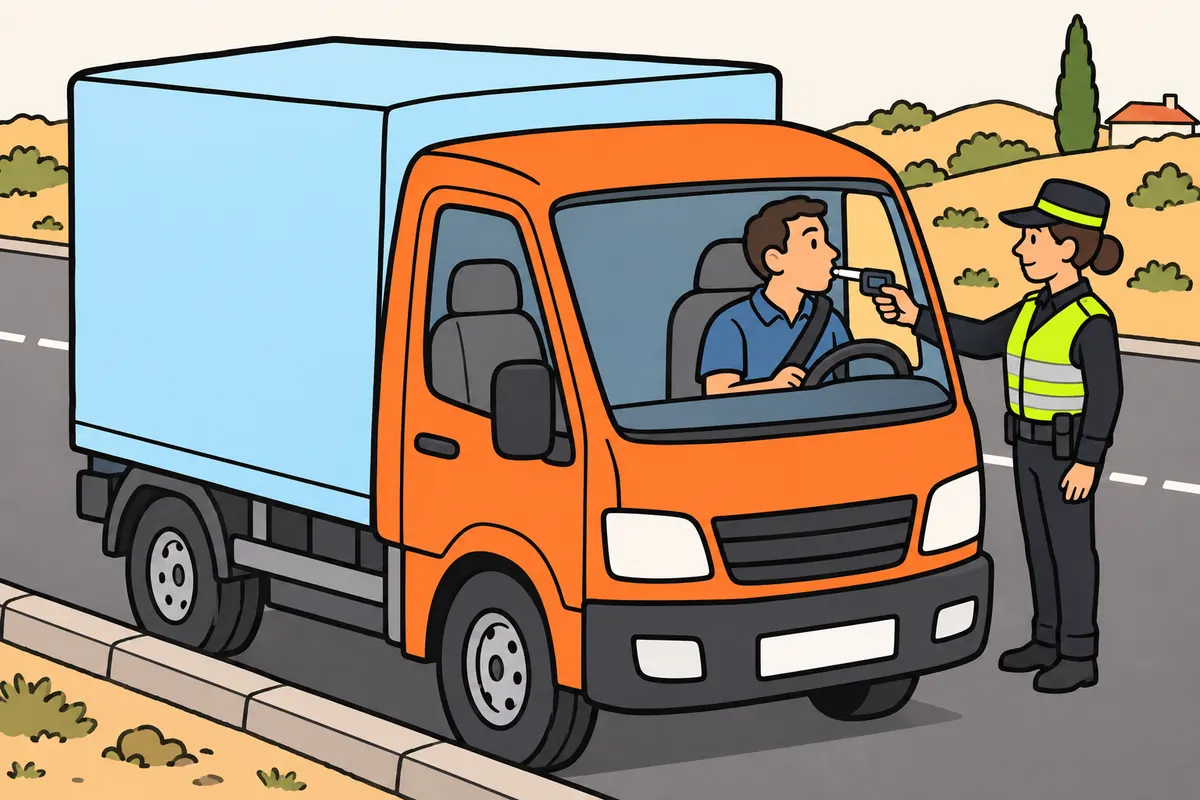
You must distinguish fines and penalty points from criminal penalties.
| Driver with lower limit: administrative offence without a criminal offence | Points you lose |
|---|---|
| Above 0.15 up to and including 0.30 mg/l breath | 4 points |
| Above 0.30 mg/l breath | 6 points |
| Unlawful presence of drugs | 6 points |
Remember
- Without a criminal offence, exceeding twice your alcohol limit means a higher fine.
- A penalty for exceeding it in the immediately preceding year also increases your fine.
- Driving under the influence can be criminal even below the criminal threshold.
- The criminal threshold does not replace your lorry’s permitted limit.
- The alternative penalties are prison, a fine or community service.
- You also always receive a temporary driving ban.
Exam trap: Wrong: exactly 0.30 mg/l means losing 6 points with the lower limit. Right: it means losing 4 points.
Read the full explanation
- Driving above the statutory alcohol limit or with drugs unlawfully present in your system is a very serious administrative offence when it does not constitute a criminal offence. The alcohol fine is 500 euros, or 1,000 if you exceed twice your permitted limit or have been penalised for exceeding it in the immediately preceding year. For drugs, the fine is 1,000 euros. [LTSV, art. 77](https://www.boe.es/buscar/act.php?id=BOE-A-2015-11722#a77). [LTSV, art. 80](https://www.boe.es/buscar/act.php?id=BOE-A-2015-11722#a80).
- For your lorry with its lower limit, exceeding 0.15 up to and including 0.30 mg/l of breath means losing 4 points; exceeding 0.30 mg/l means losing 6 points. The unlawful presence of drugs means losing 6 points. Distinguish these bands from the criminal threshold and remember that the repeat offence described changes the fine even without exceeding twice the limit. [LTSV, Annex II](https://www.boe.es/buscar/act.php?id=BOE-A-2015-11722#anii).
- Driving under the influence of alcohol or drugs can be a criminal offence even if you do not reach a specific alcohol concentration. In all cases, driving a motor vehicle with more than 0.60 mg/l of breath or more than 1.2 g/l of blood falls under article 379.2. The criminal threshold does not replace the 0.15 mg/l maximum for your lorry. [Código Penal (Criminal Code), art. 379](https://www.boe.es/buscar/act.php?id=BOE-A-1995-25444#a379).
- Article 379 provides for imprisonment of 3 to 6 months, or a fine calculated over 6 to 12 months, or 31 to 90 days of community service. Disqualification from driving for more than 1 and up to 4 years is always added. Do not interpret the first three penalties as necessarily cumulative or assume that an accident is required for a criminal offence to exist. [Código Penal (Criminal Code), art. 379](https://www.boe.es/buscar/act.php?id=BOE-A-1995-25444#a379).
12Drugs and driving ability
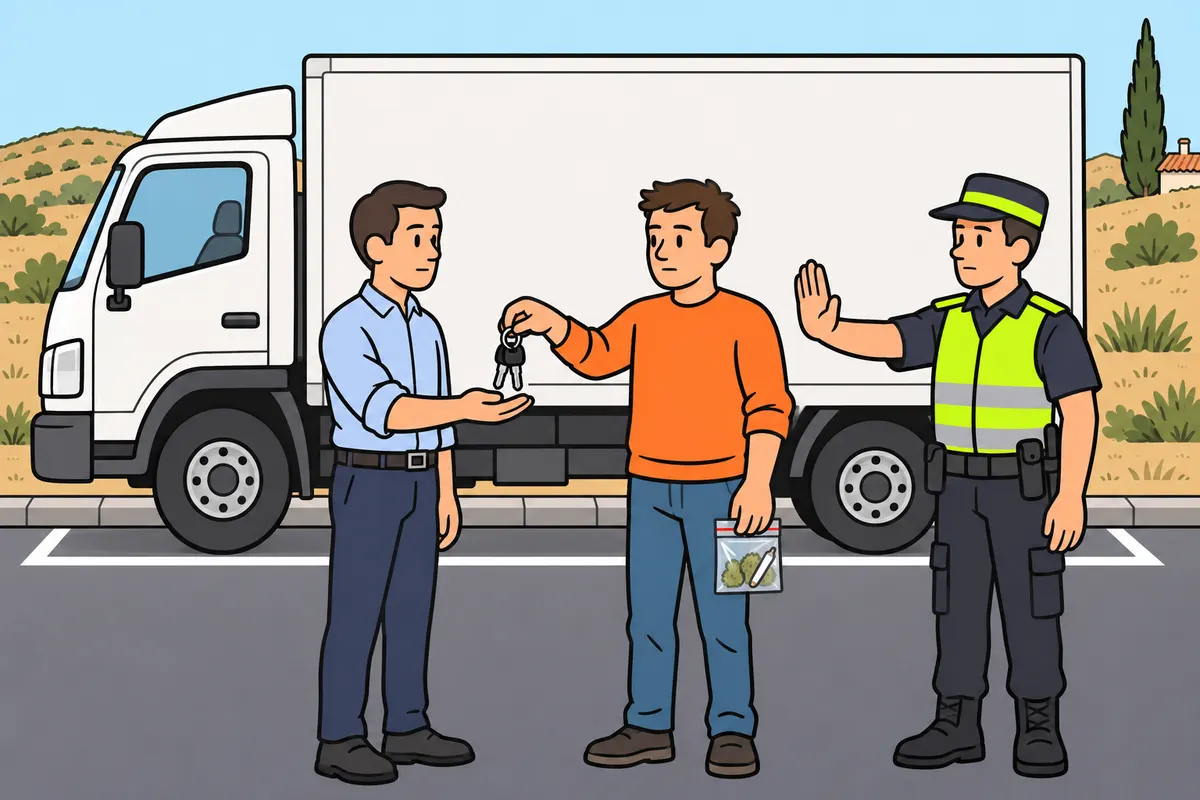
Drugs can make you unfit to drive even when you feel active or confident.
| Substance | How it can affect you |
|---|---|
| Cannabis | Less attention and slower responses |
| Cocaine | Impulsiveness and overconfidence |
| Amphetamines | Hide tiredness without removing it |
| Ecstasy | Changes perception and concentration |
| LSD | Can cause hallucinations |
| Heroin | Reduces your ability to respond |
Remember
- You must not drive with drugs present, except under the stated medical exception.
- The exception requires prescribed therapeutic use and keeping your attention, caution and care.
- Do not use stimulants to extend your shift.
- Mixing drugs can strengthen their effects or make them unpredictable.
- The approximate LSD duration does not guarantee you can drive afterwards.
Exam trap: Wrong: a prescription always allows you to drive. Right: prescribed therapeutic use also requires you to retain the necessary abilities.
Read the full explanation
- You must not drive with drugs present in your system. The exception covers substances used under medical prescription for therapeutic purposes, provided you retain the required diligence, caution and attention. A prescription does not authorise you to drive if the treatment makes you unfit to do so. [LTSV, art. 14](https://www.boe.es/buscar/act.php?id=BOE-A-2015-11722#a14).
- You must distinguish the administrative offence of having drugs present in your system from the criminal offence of driving under their influence. A positive result does not automatically mean a criminal conviction, but you do not need to mix drugs with alcohol to create danger or incur liability. There is no permitted recreational dose equivalent to the alcohol limit. [LTSV, art. 14](https://www.boe.es/buscar/act.php?id=BOE-A-2015-11722#a14). [Código Penal (Criminal Code), art. 379](https://www.boe.es/buscar/act.php?id=BOE-A-1995-25444#a379).
- Cannabis can impair your perception and attention, slow your responses and cause drowsiness and a false sense of security. Cocaine can increase your impulsiveness, competitiveness and aggression, and make you overestimate your abilities. Do not confuse feeling stimulated with having better control of the lorry or correctly perceiving what is happening. [DGT, Manual II](https://sede.dgt.gob.es/.galleries/permisos-de-conducir/certificacion-aptitud-profesores-formacion-vial/2024/Manual-II-Cuestiones-de-Seguridad-Vial-2024.pdf).
- Amphetamines can mask your feelings of fatigue and sleepiness without removing your need for rest. You may overestimate your abilities, make inappropriate movements and then experience an intense need to sleep. Ecstasy can also alter your perception, concentration and behaviour; you must not use stimulants to extend your shift. [DGT, Manual II](https://sede.dgt.gob.es/.galleries/permisos-de-conducir/certificacion-aptitud-profesores-formacion-vial/2024/Manual-II-Cuestiones-de-Seguridad-Vial-2024.pdf).
- LSD can cause hallucinations, distorted perception, anxiety, panic and emotional changes; its effects can recur unexpectedly. The DGT describes impairment lasting up to around 10-12 hours: this is guidance on effects, not an elimination or detection period, nor a guarantee that you can drive once it ends. [DGT, Manual VII, drugs and driving](https://sede.dgt.gob.es/.galleries/permisos-de-conducir/certificacion-aptitud-profesores-formacion-vial/2024/Manual-VII-Psicologia-2024.pdf).
- Depressant substances, including heroin, can reduce your ability to respond and alter your vision and behaviour; withdrawal can also be dangerous. Mixing substances can intensify their effects or make them unpredictable. Do not try to counteract one drug by taking another. [DGT, Manual II](https://sede.dgt.gob.es/.galleries/permisos-de-conducir/certificacion-aptitud-profesores-formacion-vial/2024/Manual-II-Cuestiones-de-Seguridad-Vial-2024.pdf).
13Medicines: checks you need to make
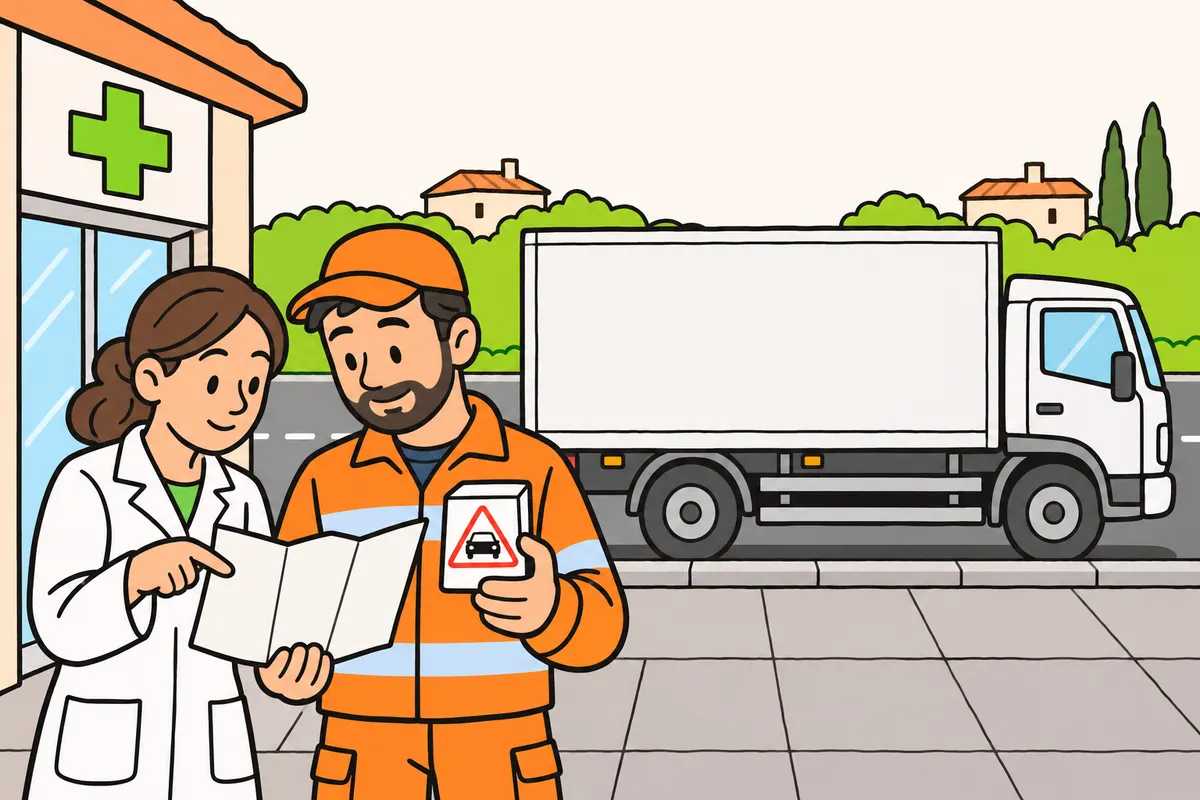
You must check how each medicine affects you before driving.
Remember
- Read the leaflet’s advice about driving and using machines.
- Ask your doctor or pharmacist and explain that you drive a lorry.
- Take extra care when starting treatment, changing doses or combining medicines.
- If sleepy, dizzy or seeing blurred images, do not drive and seek advice.
- Do not change or stop treatment yourself.
- Avoid mixing alcohol and medicines.
Exam trap: Wrong: the triangle on the packaging always bans driving. Right: it tells you to read the leaflet’s warnings.
Read the full explanation
- Before taking a medicine, read the section of the patient information leaflet on driving and using machines. Consult your doctor or pharmacist and explain that you drive a lorry: your treatment must be assessed in relation to your actual tasks and working hours. Do not self-medicate or assume that a product available without a prescription has no effects. [DGT, medicines and driving](https://www.dgt.es/export/sites/web-DGT/.galleries/downloads/muevete-con-seguridad/evita-conductas-riesgo/Medicamentos_conduccion_PoblacionGeneral.pdf).
- The pictogram on the packaging showing a car inside a red triangle directs you to the patient information leaflet; it does not in itself impose a universal ban on driving. You must check the specific warnings and how the product affects you. [DGT, medicines and driving](https://www.dgt.es/export/sites/web-DGT/.galleries/downloads/muevete-con-seguridad/evita-conductas-riesgo/Medicamentos_conduccion_PoblacionGeneral.pdf).
- Take extra care when starting treatment, changing doses or combining medicines. Drowsiness, dizziness, weakness, blurred vision or slower responses are reasons to avoid driving and seek advice. A medicine that someone else tolerates well may affect you differently because of your health, age, tiredness or use of other substances. [DGT, medicines and driving](https://www.dgt.es/export/sites/web-DGT/.galleries/downloads/muevete-con-seguridad/evita-conductas-riesgo/Medicamentos_conduccion_PoblacionGeneral.pdf).
- You must follow the prescribed treatment regimen and must not stop or change treatment on your own initiative so that you can work. Keeping an illness under control can allow you to drive more safely, whereas stopping treatment can make it worse. Avoid alcohol when taking medication and ask about interactions, even with small amounts. [DGT, medicines and driving](https://www.dgt.es/export/sites/web-DGT/.galleries/downloads/muevete-con-seguridad/evita-conductas-riesgo/Medicamentos_conduccion_PoblacionGeneral.pdf).
14Treatments that require caution
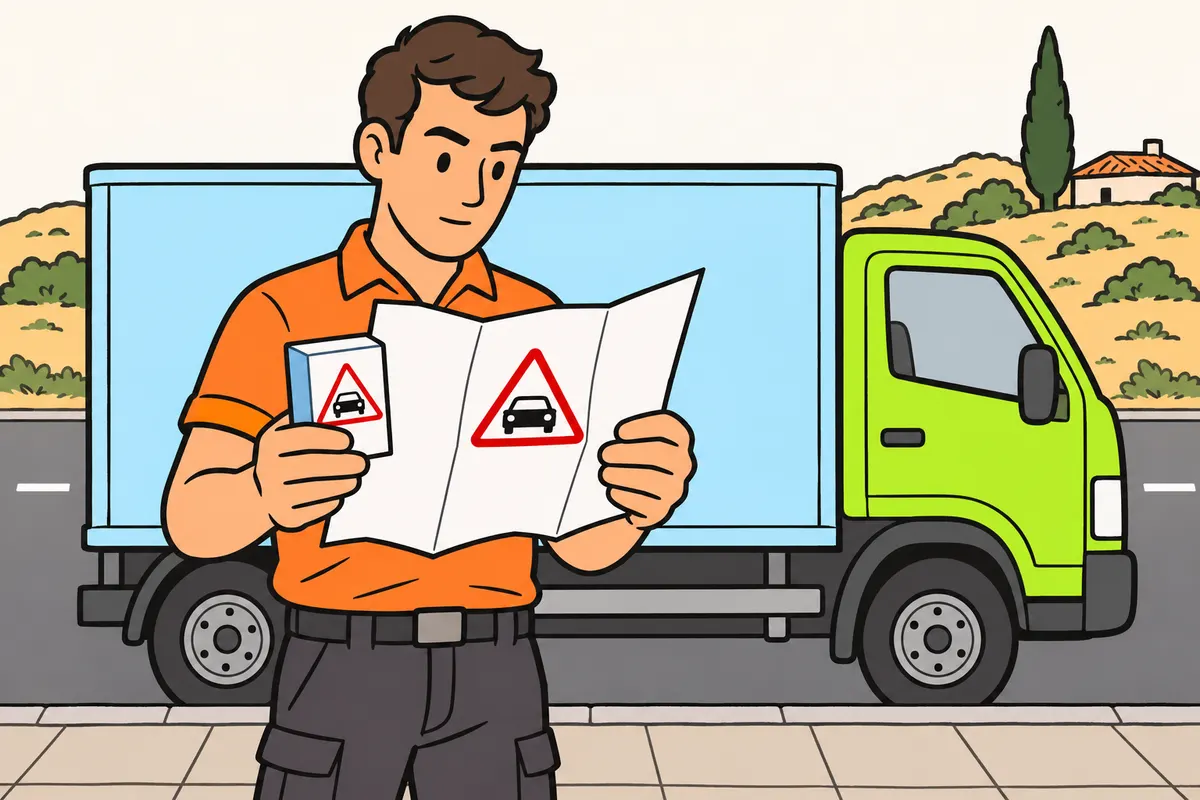
Treatments can affect your attention even after you have slept.
| Treatment | What you should watch for |
|---|---|
| Anti-anxiety medicines, sedatives and sleeping tablets | Sleepiness and slow responses |
| Some antidepressants and other psychiatric medicines | Dizziness, confusion and changes to vision |
| Antihistamines for allergies | Sleepiness and loss of attention |
| Medicines for pain, coughs, colds or muscles | Effects depend on their ingredients |
Remember
- Check the warnings for your specific medicine.
- Waking up does not prove a sleeping tablet has stopped affecting you.
- Do not assume all treatments have the same effects.
- Natural products can also affect your driving.
Exam trap: Wrong: a less sedating medicine never makes you sleepy. Right: you must check how it affects you.
Read the full explanation
- Anti-anxiety medicines, sedatives and hypnotics can make you sleepy and slow your responses. A sleeping tablet taken at night can still affect you at the start of your next shift; waking up does not guarantee that its effects have worn off. You must check the dosage instructions and restrictions for the specific medicine. [DGT, medicines and driving](https://www.dgt.es/export/sites/web-DGT/.galleries/downloads/muevete-con-seguridad/evita-conductas-riesgo/Medicamentos_conduccion_PoblacionGeneral.pdf).
- Some antidepressants and other psychiatric medicines can cause dizziness, confusion, changes in vision or drowsiness. The condition being treated can itself also make driving difficult. Do not assume that all treatments have the same effects or that receiving treatment means permanent unfitness to drive. [DGT, medicines and driving](https://www.dgt.es/export/sites/web-DGT/.galleries/downloads/muevete-con-seguridad/evita-conductas-riesgo/Medicamentos_conduccion_PoblacionGeneral.pdf).
- Antihistamines used to treat allergies can cause drowsiness and reduced attention. Less sedating antihistamines can reduce this problem, but do not guarantee freedom from drowsiness in everyone. You must consider both sneezing and watery eyes and the possible effects of treatment. [DGT, medicines and driving](https://www.dgt.es/export/sites/web-DGT/.galleries/downloads/muevete-con-seguridad/evita-conductas-riesgo/Medicamentos_conduccion_PoblacionGeneral.pdf).
- Painkillers, cough medicines, cold and flu remedies and muscle relaxants can also affect driving, depending on their ingredients. Treating pain, a cough or an ordinary cold does not make them harmless when operating machinery. You must also check warnings and interactions for herbal preparations and products described as natural. [DGT, medicines and driving](https://www.dgt.es/export/sites/web-DGT/.galleries/downloads/muevete-con-seguridad/evita-conductas-riesgo/Medicamentos_conduccion_PoblacionGeneral.pdf).
15Fatigue: causes of tiredness
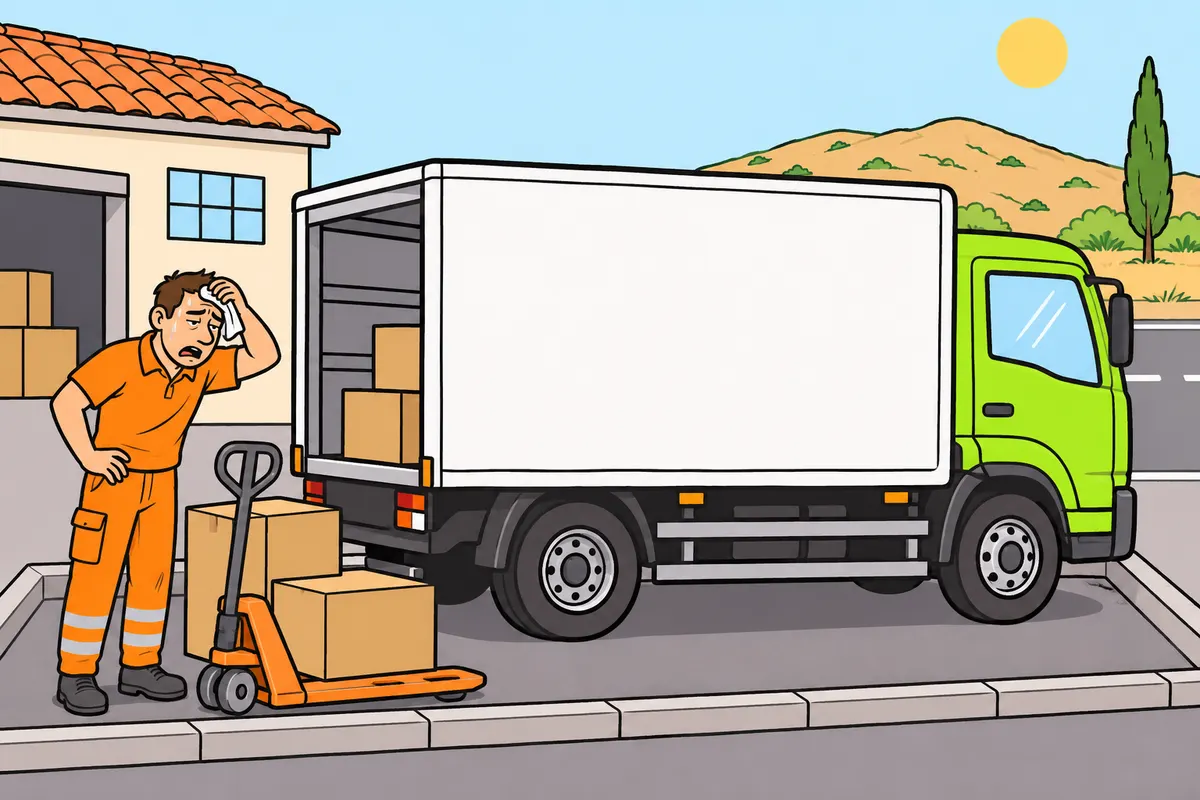
Work, roads and cab conditions can make you tired.
Remember
- Loading and unloading can tire you before driving.
- A short, difficult journey can exhaust your attention.
- Monotony and light traffic do not remove tiredness.
- Adjust your seat, controls and ventilation.
- High speed can increase your tension and tiredness.
- Your experience does not remove your physical and mental limits.
Exam trap: Wrong: a familiar, empty route prevents fatigue. Right: it can also reduce your alertness.
Read the full explanation
- You can experience physical fatigue, mental fatigue or both. Driving for many hours without recovery increases the effort required and reduces your attention; previous work and worries also contribute. Starting a journey after demanding loading or unloading work can make you tired sooner, even if you have hardly driven. [DGT, Manual II](https://sede.dgt.gob.es/.galleries/permisos-de-conducir/certificacion-aptitud-profesores-formacion-vial/2024/Manual-II-Cuestiones-de-Seguridad-Vial-2024.pdf).
- Heavy traffic, an unfamiliar road, an uneven road surface and adverse weather require more observation and control. Rain, fog, snow or night driving can tire you sooner. Do not judge the difficulty solely by the distance: a short but demanding journey can also exhaust your attention. [DGT, Manual II](https://sede.dgt.gob.es/.galleries/permisos-de-conducir/certificacion-aptitud-profesores-formacion-vial/2024/Manual-II-Cuestiones-de-Seguridad-Vial-2024.pdf).
- The monotony of long straights, autopistas (motorways) and autovías (dual carriageways) can reduce your vigilance. Light traffic does not remove the risk of tiredness or sleepiness, and a familiar route can encourage overconfidence. Do not invent manoeuvres or increase your speed to keep yourself entertained. [DGT, Manual II](https://sede.dgt.gob.es/.galleries/permisos-de-conducir/certificacion-aptitud-profesores-formacion-vial/2024/Manual-II-Cuestiones-de-Seguridad-Vial-2024.pdf).
- Excessive heat, noise, vibration, poor ventilation, an uncomfortable seat or poorly adjusted controls contribute to fatigue. A vehicle with defects that require constant corrective action also demands more effort. Keep conditions in the cab comfortable without relying on climate control as a substitute for rest. [DGT, Manual II](https://sede.dgt.gob.es/.galleries/permisos-de-conducir/certificacion-aptitud-profesores-formacion-vial/2024/Manual-II-Cuestiones-de-Seguridad-Vial-2024.pdf).
- Maintaining a high speed for a long time requires more attention and can increase tension, irritability and tiredness. Alcohol, illness, lack of sleep and limited experience make the situation worse. Your professional experience helps you plan, but does not remove your physical and mental limits. [DGT, Manual II](https://sede.dgt.gob.es/.galleries/permisos-de-conducir/certificacion-aptitud-profesores-formacion-vial/2024/Manual-II-Cuestiones-de-Seguridad-Vial-2024.pdf).
16Fatigue: warning signs
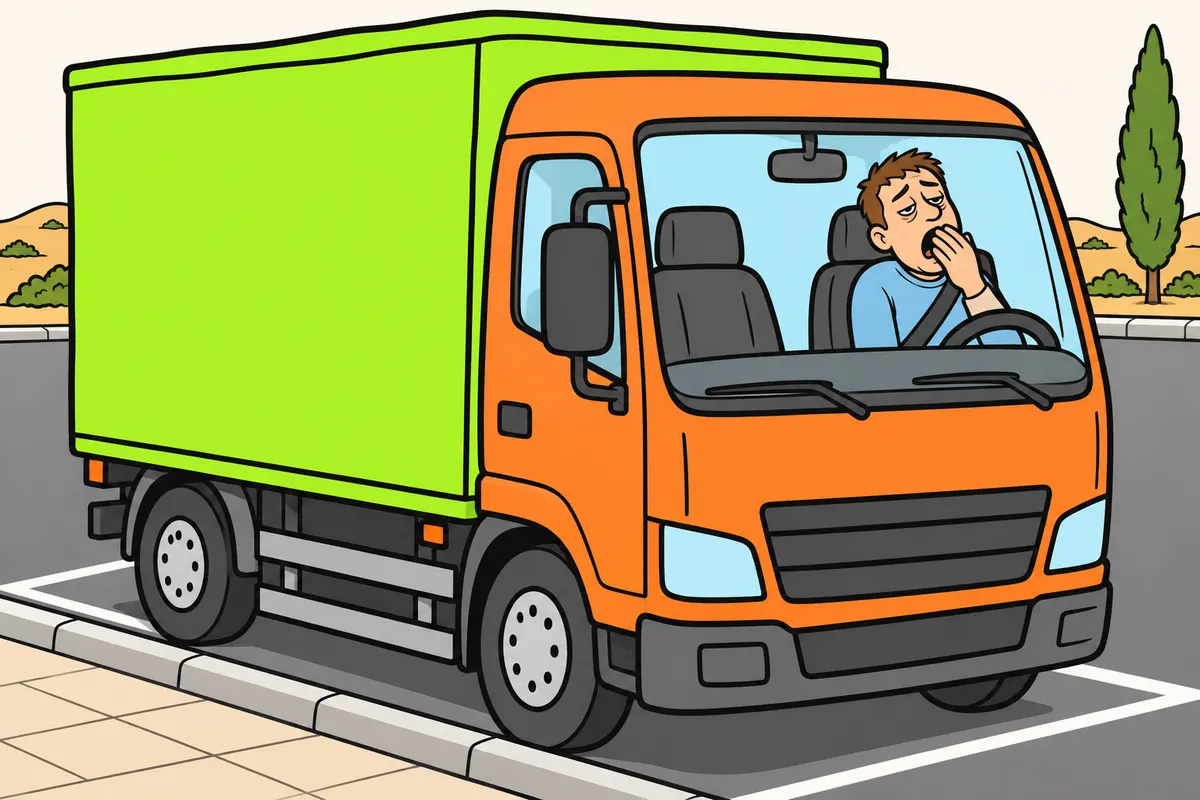
You must stop safely when you notice signs of fatigue.
Remember
- Watch for heavy eyes, frequent blinking or blurred vision.
- Neck or back pain can warn you of tiredness.
- You may decide later and steer less accurately.
- Anger and impatience can also signal fatigue.
- Find a permitted, safe place to rest.
- Continue only when you have regained your abilities.
Exam trap: Wrong: you need every symptom before stopping. Right: a single symptom deserves attention.
Read the full explanation
- Heavy eyes, frequent or prolonged blinking, blurred vision and difficulty focusing can warn you of fatigue. You may notice that you check your mirrors less often or take longer to recognise a situation. Do not wait until your eyes close before you stop driving. [DGT, Manual II](https://sede.dgt.gob.es/.galleries/permisos-de-conducir/certificacion-aptitud-profesores-formacion-vial/2024/Manual-II-Cuestiones-de-Seguridad-Vial-2024.pdf).
- Stiffness, neck or back pain, numb arms, cramps and a constant need to change position can warn you of fatigue. You may also yawn or experience discomfort in your head. Even a single symptom deserves attention; you do not need to experience the whole list before deciding to stop. [DGT, Manual II](https://sede.dgt.gob.es/.galleries/permisos-de-conducir/certificacion-aptitud-profesores-formacion-vial/2024/Manual-II-Cuestiones-de-Seguridad-Vial-2024.pdf).
- Fatigue makes your movements less precise and can lead to late or inappropriate steering corrections. You may take longer to decide, lose concentration and make mistakes you normally avoid. Keeping the lorry within its lane does not prove that you still have a safety margin to deal with something unexpected. [DGT, Manual II](https://sede.dgt.gob.es/.galleries/permisos-de-conducir/certificacion-aptitud-profesores-formacion-vial/2024/Manual-II-Cuestiones-de-Seguridad-Vial-2024.pdf).
- Irritability, nervousness and impatience can also be signs of fatigue. If you find yourself reacting angrily to normal traffic situations, assess your condition. Find a safe place where you are allowed to stop and rest, and continue only when you have recovered your abilities. [DGT, Manual II](https://sede.dgt.gob.es/.galleries/permisos-de-conducir/certificacion-aptitud-profesores-formacion-vial/2024/Manual-II-Cuestiones-de-Seguridad-Vial-2024.pdf).
17Sleep and rest patterns
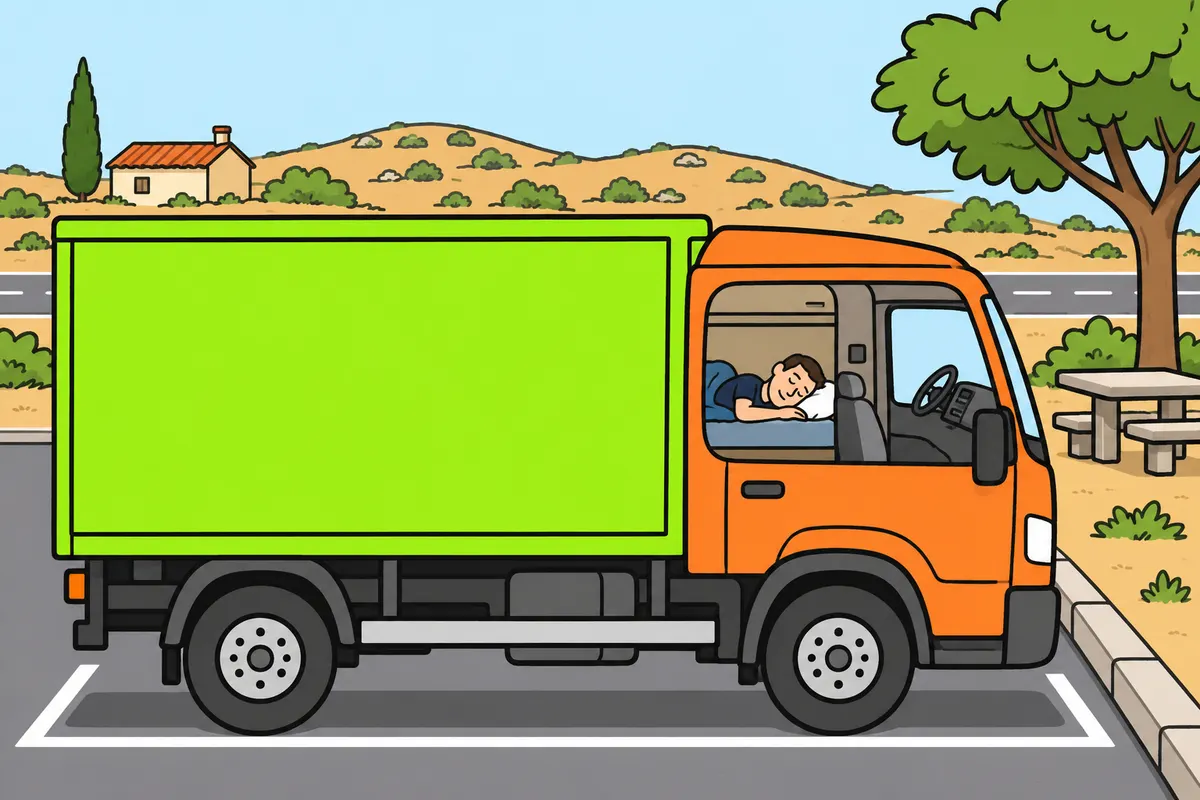
If you are sleepy, you must stop and sleep.
Remember
- Both sleep length and sleep quality matter.
- Repeatedly sleeping too little builds up a lack of sleep.
- You can feel sleepy during the day too.
- The early morning hours and early afternoon can make you sleepier.
- Seek advice for heavy snoring, breathing pauses during sleep or frequent daytime sleepiness.
Exam trap: Wrong: sleeping the recommended hours guarantees fitness to drive. Right: you must also assess how you feel.
Read the full explanation
- Drowsiness is the tendency to fall asleep and can impair you before you fall fully asleep. You may mistake it for simple boredom or think you can control it through willpower. If you struggle to stay awake, you need to stop and sleep, rather than put more effort into driving. [DGT, Manual II](https://sede.dgt.gob.es/.galleries/permisos-de-conducir/certificacion-aptitud-profesores-formacion-vial/2024/Manual-II-Cuestiones-de-Seguridad-Vial-2024.pdf).
- Both the quantity and quality of your sleep matter: spending many hours in bed does not guarantee restorative sleep. Repeatedly sleeping less than you need builds up a sleep debt. Changing shifts, insomnia and interrupted rest can make you drowsy at work. [DGT, Manual II](https://sede.dgt.gob.es/.galleries/permisos-de-conducir/certificacion-aptitud-profesores-formacion-vial/2024/Manual-II-Cuestiones-de-Seguridad-Vial-2024.pdf).
- The DGT generally recommends sleeping between 7 and 9 hours a day, with individual differences. This is a preventive guideline, not an automatic guarantee of fitness to drive or the statutory rest period for professional transport. You must assess how you feel as well as how long you sleep. [DGT, fatigue at the wheel](https://revista.dgt.es/es/noticias/nacional/2017/07JULIO/Influencia-de-la-somnolencia-en-los-accidentes.shtml).
- You can feel sleepy at any time, particularly in the early hours of the morning and the early afternoon, even if you have not eaten. Monotony, a large meal, heat, alcohol and certain medicines can contribute to sleepiness. Do not assume that working a daytime shift removes the problem. [DGT, Manual II](https://sede.dgt.gob.es/.galleries/permisos-de-conducir/certificacion-aptitud-profesores-formacion-vial/2024/Manual-II-Cuestiones-de-Seguridad-Vial-2024.pdf).
- If you snore heavily, have pauses in your breathing during sleep or frequently feel drowsy during the day, consult your doctor. Sleep apnoea can break up your sleep without you being aware of these awakenings. Do not try to manage a persistent disorder simply by drinking coffee or adding increasingly short breaks. [DGT, Manual II](https://sede.dgt.gob.es/.galleries/permisos-de-conducir/certificacion-aptitud-profesores-formacion-vial/2024/Manual-II-Cuestiones-de-Seguridad-Vial-2024.pdf).
18Microsleeps and driving on autopilot
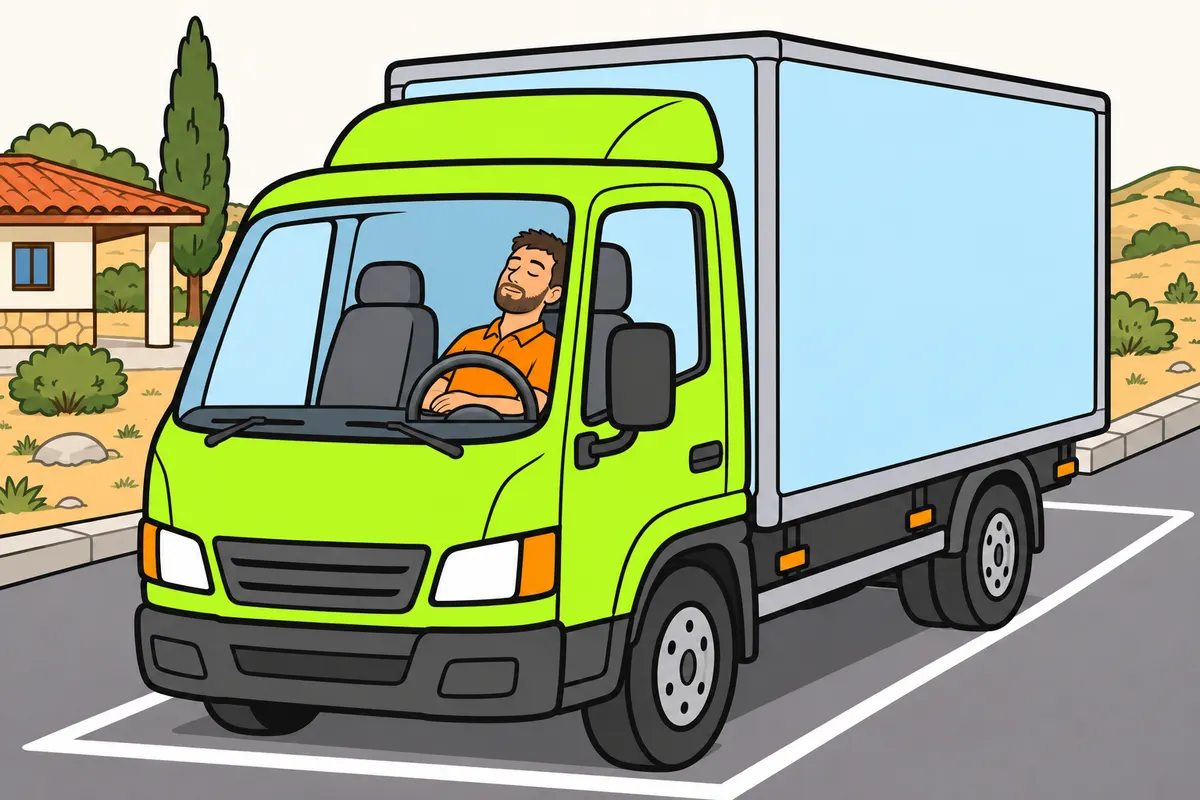
Microsleeps can make you lose control without noticing.
Remember
- A microsleep is a brief sleep you cannot control.
- Repeated yawning and your head dropping are warning signs.
- Not remembering the road you just travelled shows reduced attention.
- Knowing the route does not make up for lost attention.
- Stop your journey safely and sleep as much as you need.
Exam trap: Wrong: you can hold on until your next delivery. Right: when you notice sleepiness, stop safely.
Read the full explanation
- A microsleep is a brief, involuntary episode of sleep that can last a few seconds without you noticing. During that time, you do not have proper control of the situation. In a lorry, even a brief loss of vigilance is enough for you to stray into another lane or fail to notice a traffic queue. [DGT, Manual II](https://sede.dgt.gob.es/.galleries/permisos-de-conducir/certificacion-aptitud-profesores-formacion-vial/2024/Manual-II-Cuestiones-de-Seguridad-Vial-2024.pdf).
- Repeated yawning, being unable to keep your eyes open or letting your head drop are warnings of sleepiness. So are thoughts unrelated to traffic, blurred vision and easily losing track of what is happening. Do not wait for a microsleep before looking for somewhere to stop. [DGT, Manual II](https://sede.dgt.gob.es/.galleries/permisos-de-conducir/certificacion-aptitud-profesores-formacion-vial/2024/Manual-II-Cuestiones-de-Seguridad-Vial-2024.pdf).
- Not remembering the last few kilometres, going past an exit or sign without noticing it and getting too close to the vehicle ahead indicate reduced attention. You may make automatic movements and believe you are driving normally. Familiarity with the lorry and the route does not compensate for this loss of vigilance. [DGT, Manual II](https://sede.dgt.gob.es/.galleries/permisos-de-conducir/certificacion-aptitud-profesores-formacion-vial/2024/Manual-II-Cuestiones-de-Seguridad-Vial-2024.pdf).
- Sleepiness slows your decisions and reduces the precision and coordination of your manoeuvres. You may confuse actions or react late to hazards. If you notice these signs, stop your journey safely and get the sleep you need; simply promising yourself to reach the next delivery is not enough. [DGT, Manual II](https://sede.dgt.gob.es/.galleries/permisos-de-conducir/certificacion-aptitud-profesores-formacion-vial/2024/Manual-II-Cuestiones-de-Seguridad-Vial-2024.pdf).
19Resting and deciding whether you can continue
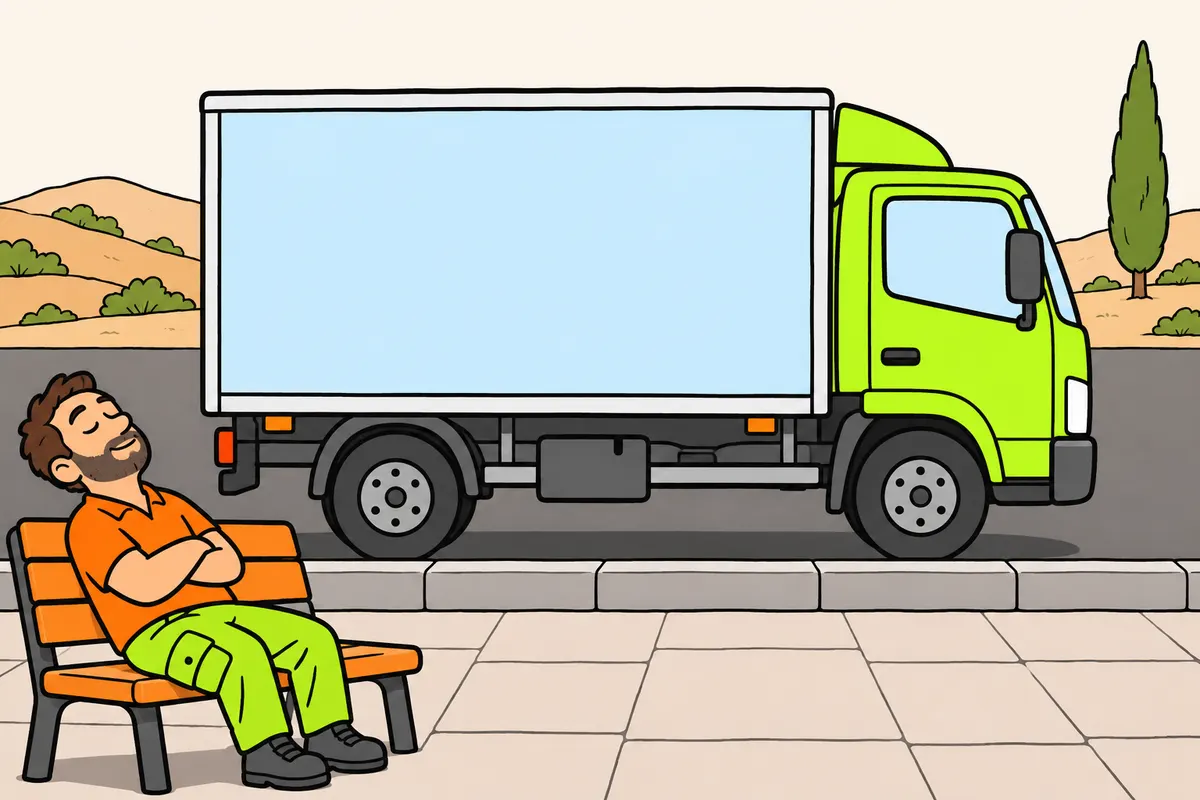
You must rest before tiredness or sleepiness prevents safe driving.
| Your situation | What you must do |
|---|---|
| Tired or sleepy before your planned break | Stop sooner in a permitted, safe place |
| Sleepy | Sleep; music, air and coffee do not replace rest |
| Detector gives no warning | Still assess your symptoms |
Remember
- Plan breaks by time or distance, whichever comes first.
- Stop sooner if your condition or circumstances require it.
- These recommendations do not replace legal rest requirements for professional drivers.
- If sleepy, a break without sleep may be insufficient.
- A short nap does not guarantee that your abilities have returned.
- Continue only when fit and after meeting your legal rest requirements.
Exam trap: Wrong: you can wait for the detector despite feeling sleepy. Right: respond to your symptoms and stop safely.
Read the full explanation
- As a preventive measure, plan breaks every 2 hours or every 200 km, whichever comes first, and more frequently if conditions or your state of health require it. The DGT recommends breaks of 20 or 30 minutes. This is preventive advice: it does not replace the legal driving, break and rest times for professional transport. [DGT, Manual II, topic 7](https://sede.dgt.gob.es/.galleries/permisos-de-conducir/certificacion-aptitud-profesores-formacion-vial/2024/Manual-II-Cuestiones-de-Seguridad-Vial-2024.pdf).
- Do not wait until you reach a recommended preventive interval or the legal limit if symptoms appear. Find a permitted, safe area suitable for the size of your lorry, and stop without creating another hazard. Pressure to meet a delivery deadline does not make tiredness an acceptable condition for continuing. [DGT, Manual II](https://sede.dgt.gob.es/.galleries/permisos-de-conducir/certificacion-aptitud-profesores-formacion-vial/2024/Manual-II-Cuestiones-de-Seguridad-Vial-2024.pdf).
- If you feel sleepy, you need to sleep; a break without sleep may be insufficient. The DGT advises you to stop and sleep for about 20-30 minutes in a suitable place, but this nap does not guarantee that your abilities recover or replace a full rest. Resume driving only if you are fit to do so and have also met your applicable rest obligations. [DGT, Manual II, topic 7](https://sede.dgt.gob.es/.galleries/permisos-de-conducir/certificacion-aptitud-profesores-formacion-vial/2024/Manual-II-Cuestiones-de-Seguridad-Vial-2024.pdf).
- Do not replace rest with loud music, open windows, water on your face or stimulant drinks. Coffee can temporarily mask sleepiness, which can then return strongly. Ventilation helps you feel comfortable, but does not remove your need for sleep. [DGT, Manual II](https://sede.dgt.gob.es/.galleries/permisos-de-conducir/certificacion-aptitud-profesores-formacion-vial/2024/Manual-II-Cuestiones-de-Seguridad-Vial-2024.pdf).
- If your lorry has a fatigue or distraction detector, heed its warnings and know its limitations. Do not wait for an alert when you notice symptoms or interpret the absence of a warning as proof that you are fit to drive. Time calculations and records are covered in «Driving, breaks and rest periods». [DGT, Manual II](https://sede.dgt.gob.es/.galleries/permisos-de-conducir/certificacion-aptitud-profesores-formacion-vial/2024/Manual-II-Cuestiones-de-Seguridad-Vial-2024.pdf).
20Illness and Group 2 fitness to drive
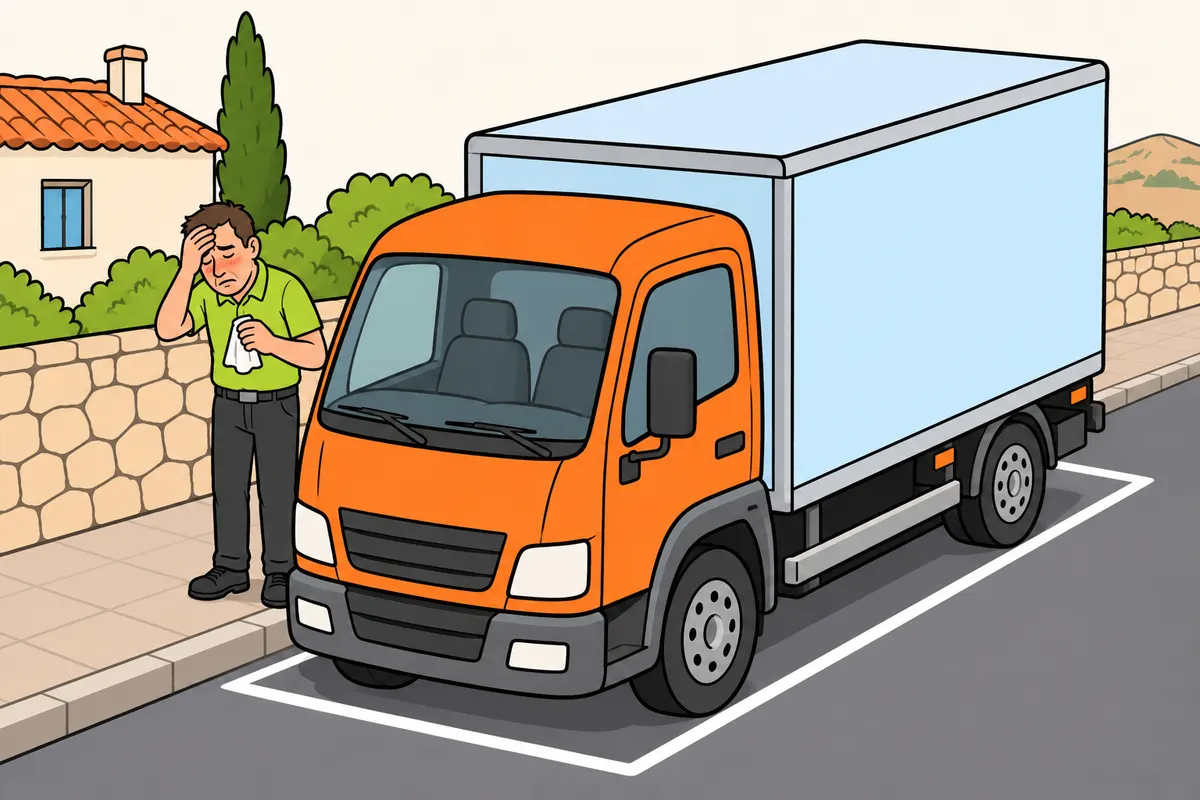
You must meet the medical requirements for your lorry licence group.
| Group 2 requirement | Conditions |
|---|---|
| Hearing | Combined loss in both ears must not exceed 35 %, with or without hearing aids |
| Diagnosed obstructive sleep apnoea: apnoea-hypopnoea index at least 15 with moderate or severe daytime sleepiness | Obtaining or renewing requires a favourable sleep-unit report confirming treatment compliance and satisfactory control |
| Licence validity for this apnoea case | Maximum 1 year |
Remember
- Do not drive if your symptoms prevent safe driving.
- Seek advice about how your illness and treatment affect driving.
- With a long-term illness, know the warning signs and what to do.
- Your C1 licence belongs to group 2.
- Do not automatically apply category B exceptions to your lorry.
Exam trap: Wrong: extra mirrors can make up for any hearing loss. Right: you must meet group 2 hearing requirements.
Read the full explanation
- You must seek advice on how your illness and treatment affect your driving, for both acute and chronic conditions. Fever, pain, dizziness or weakness can prevent you from concentrating and operating the controls. If symptoms compromise safety, do not drive even if the journey is short or follows a straightforward road. [DGT, illness and driving](https://revista.dgt.es/es/salud-vial/2022/0629-Salud-Vial-enfermedades-afectan-conduccion.shtml).
- If you have a chronic illness, you must know the warning symptoms, your treatment regimen and what to do in a crisis. Do not assume that every diagnosis prevents you from driving or that feeling well removes the medical requirements. Neurological, cardiovascular, metabolic or mental disorders require the appropriate assessment. [DGT, illness and driving](https://revista.dgt.es/es/salud-vial/2022/0629-Salud-Vial-enfermedades-afectan-conduccion.shtml).
- For physical and mental fitness to drive, C1 belongs to Group 2 and you must meet that group’s criteria. Do not automatically apply the adaptation options or exceptions for a B licence to your lorry. The assessment by the driver medical examination centre and the required reports determine the applicable conditions. [RGCond, art. 45](https://www.boe.es/buscar/act.php?id=BOE-A-2009-9481#a45).
- For hearing acuity, Group 2 does not allow hearing impairment with more than 35 % combined hearing loss in both ears, with or without a hearing aid, calculated using pure-tone audiometry. This is not a rule about one ear alone, and you cannot replace this requirement by fitting more mirrors under the Group 1 conditions. [RGCond, Annex IV, section 2.1](https://www.boe.es/buscar/act.php?id=BOE-A-2009-9481#aniv).
- For obstructive sleep apnoea, Annex IV covers a diagnosed syndrome with an apnoea-hypopnoea index of 15 or above associated with moderate or severe daytime sleepiness. For Group 2, it allows you to obtain or renew a licence with a favourable report from a Unidad de Sueño (sleep unit) confirming adherence to treatment and satisfactory control, with a maximum validity of 1 year in this case. [RGCond, Annex IV, section 7.2](https://www.boe.es/buscar/act.php?id=BOE-A-2009-9481#aniv).
21Allergies, age and personal limitations
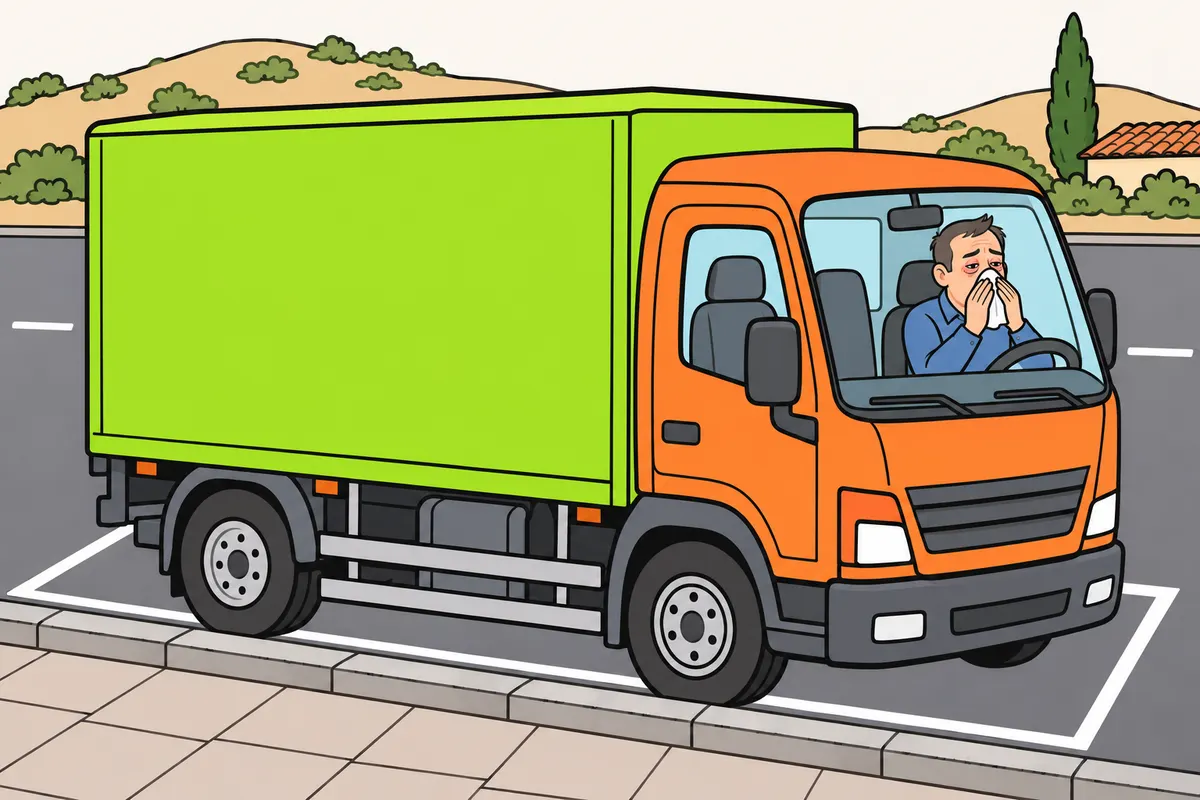
You must assess your abilities and follow your licence restrictions.
Remember
- Allergies can make seeing and paying attention harder.
- Keep your cab and its filters clean.
- Seek advice about lasting changes in vision, hearing or movement.
- There is no general maximum driving age.
- You must keep the required abilities and a valid licence.
- Use vision correction if your licence requires it.
Exam trap: Wrong: your experience makes up for any decline. Right: you must retain the required abilities and follow your restrictions.
Read the full explanation
- A respiratory allergy can cause repeated sneezing, itching, watery eyes and eye irritation that make it difficult to see and concentrate. Keep the cab and filters clean in accordance with their maintenance requirements, avoid exposure to the trigger and seek advice about treatment. Do not continue if your symptoms or medication prevent you from paying attention to traffic. [DGT, Manual II](https://sede.dgt.gob.es/.galleries/permisos-de-conducir/certificacion-aptitud-profesores-formacion-vial/2024/Manual-II-Cuestiones-de-Seguridad-Vial-2024.pdf).
- As you age, your vision, hearing, mobility or processing speed may decline, and your sensitivity to certain medicines may increase. You must adapt your planning and seek advice about persistent changes in your abilities. Do not assume that all older people have the same limitations or that a driver is safe simply because they are young. [DGT, Manual II](https://sede.dgt.gob.es/.galleries/permisos-de-conducir/certificacion-aptitud-profesores-formacion-vial/2024/Manual-II-Cuestiones-de-Seguridad-Vial-2024.pdf).
- There is no general maximum age for continuing to drive: you must retain the required abilities and hold a valid licence. Experience can help you anticipate hazards, but does not cancel out sensory deterioration or illness. Renewal and the general validity periods for the C1 licence are covered in «C1 lorry licences and types of transport». [DGT, older drivers](https://www.dgt.es/nuestros-servicios/permisos-de-conducir/permiso-de-conducir-para-mayores-de-65-anos/).
- If your driving entitlement requires corrective lenses or other restrictions compatible with C1, you must comply with them. You cannot choose medical conditions for convenience, and another driver’s conditions may differ. Tell healthcare staff honestly about your symptoms: hiding them makes it harder to prevent a risk that also affects those who share the road with you. [RGCond, Annex IV](https://www.boe.es/buscar/act.php?id=BOE-A-2009-9481#aniv).
22Emotions, stress and aggression
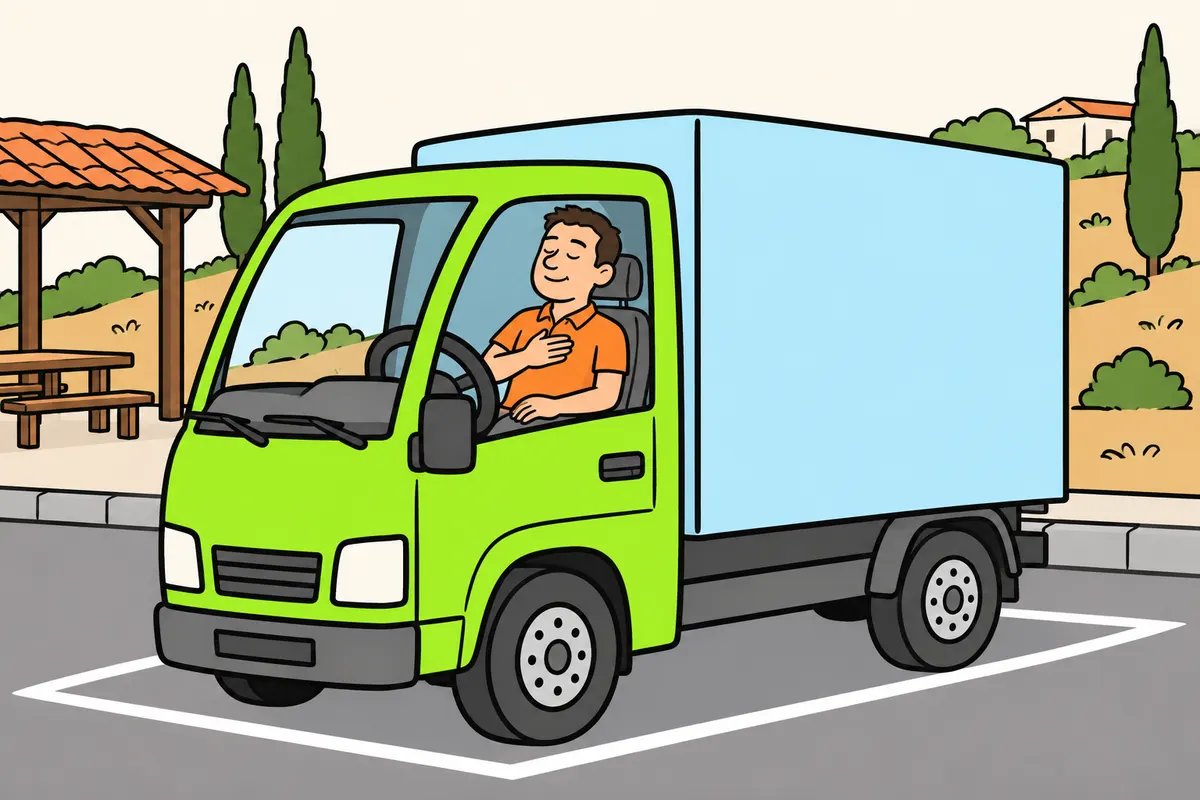
You must drive calmly and attentively, without letting emotions control your actions.
Remember
- Check whether you can concentrate after an argument or intense worry.
- Allow extra time in your plans to reduce pressure.
- Do not race or block others when provoked.
- Overexcitement can also make you accept risks.
- If very upset, stop in a permitted place.
- Seek advice if anxiety, depression or stress persists.
Exam trap: Wrong: running late justifies harsh driving. Right: you must maintain your precautions.
Read the full explanation
- Anger, fear, intense worry or sadness can capture your attention and affect your decisions and reactions. Personal news or an argument with a customer can continue to occupy your mind during your journey. Before setting off or continuing, assess whether you can really concentrate on driving. [DGT, Manual VII](https://sede.dgt.gob.es/.galleries/permisos-de-conducir/certificacion-aptitud-profesores-formacion-vial/2024/Manual-VII-Psicologia-2024.pdf).
- Stress can encourage impatience, hostility, impulsiveness and hasty decisions; if it persists, it can also cause exhaustion and greater fatigue. Pressure to reach a logistics hub does not justify taking fewer precautions. Allow extra time when planning and avoid trying to make up delays through abrupt manoeuvres or inappropriate speed. [DGT, Manual VII](https://sede.dgt.gob.es/.galleries/permisos-de-conducir/certificacion-aptitud-profesores-formacion-vial/2024/Manual-VII-Psicologia-2024.pdf).
- Do not respond to provocation by competing with, chasing or blocking another road user. Behave predictably and leave space to deal with other people’s mistakes. Aggression adds risk in a heavy vehicle and does not replace anticipation or necessarily make your journey more efficient. [DGT, Manual VII](https://sede.dgt.gob.es/.galleries/permisos-de-conducir/certificacion-aptitud-profesores-formacion-vial/2024/Manual-VII-Psicologia-2024.pdf).
- Euphoria and overconfidence can also make you underestimate danger. If you have little experience, resist pressure from passengers to show off; experience does not make you immune either. Do not treat traffic as a test of personal skill. [DGT, Manual VII](https://sede.dgt.gob.es/.galleries/permisos-de-conducir/certificacion-aptitud-profesores-formacion-vial/2024/Manual-VII-Psicologia-2024.pdf).
- If you are very upset, find a permitted place to stop and regain your composure. If you have depression, anxiety or persistent stress, seek advice and follow your treatment; avoid using alcohol or other drugs as a remedy. Do not drive during a crisis that prevents you from paying attention and making decisions safely. [DGT, Manual VII](https://sede.dgt.gob.es/.galleries/permisos-de-conducir/certificacion-aptitud-profesores-formacion-vial/2024/Manual-VII-Psicologia-2024.pdf).
23Distractions inside and outside the cab
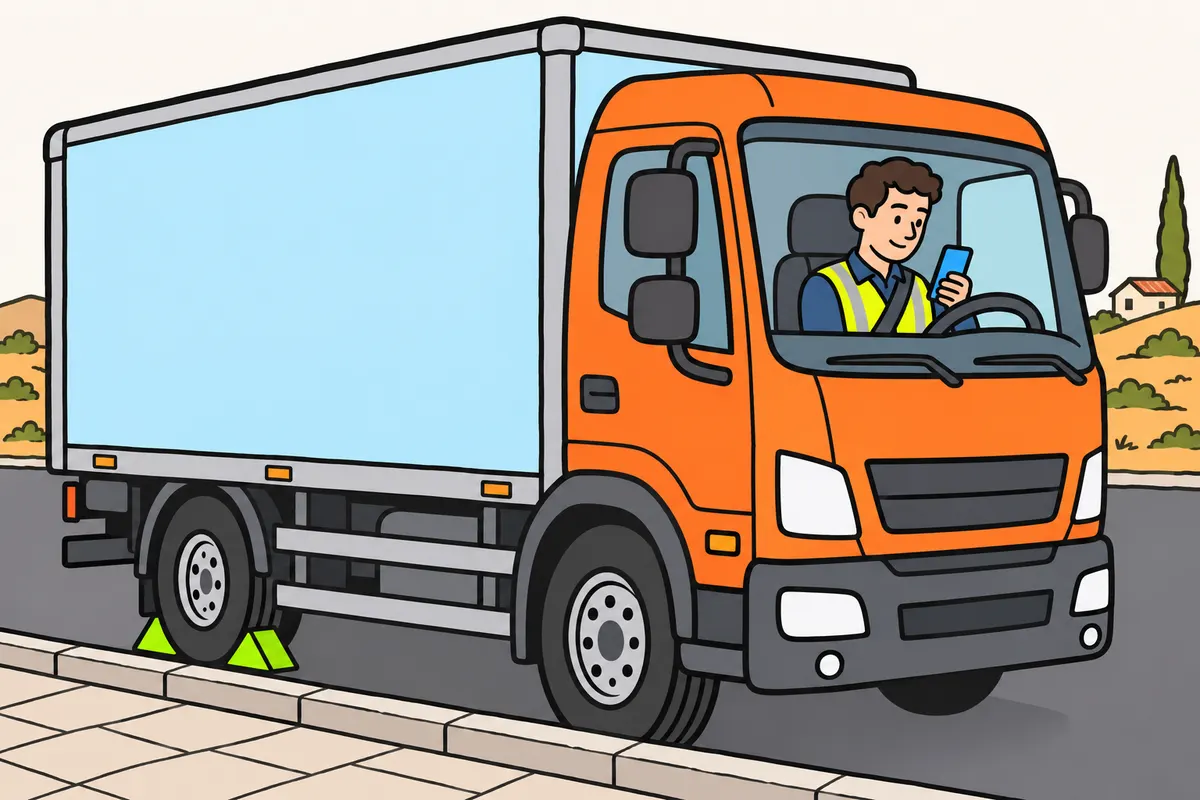
You can be distracted even while looking at the road.
| Distraction | What it takes away from driving |
|---|---|
| Visual | Your eyes |
| Manual | Your hands |
| Mental | Your thoughts |
| Reading a message | Your eyes, hands and thoughts |
Remember
- Prepare objects and documents before setting off.
- Save tasks needing close attention for when you are parked.
- Do not pick up dropped objects while driving.
- Ask to end a conversation that distracts you.
- Stop safely if you need to deal with something in the cab.
- Do not become overconfident because you know the route.
Exam trap: Wrong: looking ahead guarantees attention. Right: your thoughts can also distract you from traffic.
Read the full explanation
- A distraction can take your eyes off the road, your hands off the controls or your mind off driving. Reading a message combines all three effects. You can also become distracted by thinking about a problem even if you keep looking ahead and keep your hands on the steering wheel. [DGT, Manual VII](https://sede.dgt.gob.es/.galleries/permisos-de-conducir/certificacion-aptitud-profesores-formacion-vial/2024/Manual-VII-Psicologia-2024.pdf).
- Finding a radio station, lighting a cigarette, picking up a dropped object, eating, drinking or checking delivery documents can divert your attention from traffic. Prepare what you need before setting off and leave tasks that demand your attention until you are parked. Do not try to deal with an object rolling around on the floor while driving. [DGT, Manual VII](https://sede.dgt.gob.es/.galleries/permisos-de-conducir/certificacion-aptitud-profesores-formacion-vial/2024/Manual-VII-Psicologia-2024.pdf).
- Intense conversations, passengers or an insect in the cab can distract you. Ask for whatever is interfering to stop, and stop safely if you need to intervene. Mirrors are for observing traffic: using them to adjust your appearance diverts attention you need to monitor the sides of your lorry. [DGT, Manual VII](https://sede.dgt.gob.es/.galleries/permisos-de-conducir/certificacion-aptitud-profesores-formacion-vial/2024/Manual-VII-Psicologia-2024.pdf).
- Outside the cab, advertising, an eye-catching event, signs that are difficult to locate or surroundings with many stimuli can make it difficult to select relevant information. The monotony of a motorway and familiarity with the route can also reduce your vigilance. You must guard against both overload and a false sense of security. [DGT, Manual VII](https://sede.dgt.gob.es/.galleries/permisos-de-conducir/certificacion-aptitud-profesores-formacion-vial/2024/Manual-VII-Psicologia-2024.pdf).
- Distraction, alcohol and inappropriate speed are among the main contributing factors in fatal collisions according to the DGT. Several can be involved in the same collision; do not interpret them as sole causes. [DGT, 2024 annual report, contributing factors](https://www.dgt.es/export/sites/web-DGT/.galleries/downloads/dgt-en-cifras/publicaciones/Principales_Cifras_Siniestralidad/INF_ANUAL_2024_v4_FINAL.pdf).
24Phone use and work communications
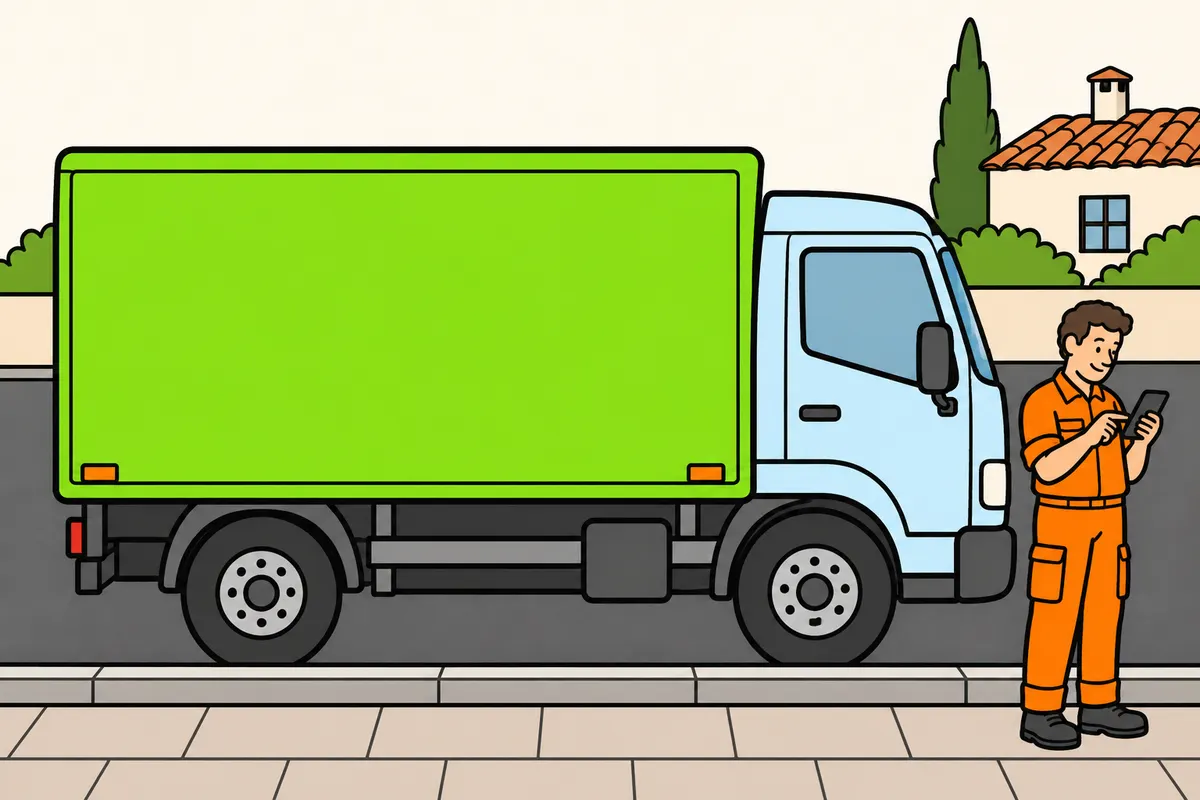
You must park before operating your phone, including for work.
| Use while driving in ordinary goods transport | Rule |
|---|---|
| Phone held in your hand | Prohibited: 200 euros and 6 points |
| Manual use of a phone in a holder or a satnav | Prohibited: serious-offence fine and 3 points |
| Hands-free without hands, headphones or earpieces | Allowed, but you must maintain attention |
Remember
- Waiting at a red light or in a queue still counts as driving.
- A holder does not allow you to operate your phone while driving.
- Hands-free calls require no use of hands, headphones or earpieces.
- You cannot use an earpiece in just one ear either.
- A hands-free conversation can still distract you.
- Configure alerts before setting off.
Exam trap: Wrong: you can briefly answer your company with your phone in your hand. Right: first park in a permitted, safe place.
Read the full explanation
- You must not use a mobile phone or other communication systems while driving, except through a hands-free system without using your hands or earphones. Work communications, such as replying to your company or confirming a delivery, are subject to the same prohibition. [RGC, art. 18.2, RD 518/2026](https://www.boe.es/buscar/act.php?id=BOE-A-2003-23514#a18).
- Being stationary at traffic lights, a STOP sign or in a traffic queue is part of driving and is not equivalent to parking. You must not operate your mobile phone because you are driving very slowly, using it for only a few seconds or keeping it in a holder. If you need to operate it, first park in a permitted, safe place. [LTSV, art. 13](https://www.boe.es/buscar/act.php?id=BOE-A-2015-11722#a13). [LTSV, Annex I, 80-82](https://www.boe.es/buscar/act.php?id=BOE-A-2015-11722#ani).
- You must also maintain your attention during hands-free communication. The prohibition covers every type of earphone, including one worn in only one ear. Ordinary goods transport does not put you among the exceptions for officers on duty or drivers of Armed Forces vehicles travelling in convoy. [RGC, art. 18.2, RD 518/2026](https://www.boe.es/buscar/act.php?id=BOE-A-2003-23514#a18).
- A hands-free system leaves your hands available, but the conversation can absorb your thoughts and make you overlook signs, distances or braking. Avoid conversations while driving and postpone them if they demand attention or upset you. [DGT, distractions and mobile phones](https://www.dgt.es/export/sites/web-DGT/.galleries/Images/notas-de-prensa/Las-distracciones-al-volante/NP-Campana-DGT-distracciones-septiembre-2021.pdf).
- In its September 2021 press release, the DGT describes a fourfold increase in collision risk when using a mobile phone. You must understand this as an estimate published in that source, rather than a constant that is identical for every use. Configure alerts before setting off, as even a sound can distract you. [DGT, distractions and mobile phones](https://www.dgt.es/export/sites/web-DGT/.galleries/Images/notas-de-prensa/Las-distracciones-al-volante/NP-Campana-DGT-distracciones-septiembre-2021.pdf).
- Using a mobile phone while holding it in your hand is a serious offence, with a fine of 200 euros and a deduction of 6 points. Manual use of a satnav and the other cases in item 20 of Annex II, such as manually using a mobile phone in a holder, carry a deduction of 3 points and the fine for a serious offence. Do not interpret the difference in points as permission. [LTSV, art. 76](https://www.boe.es/buscar/act.php?id=BOE-A-2015-11722#a76). [LTSV, art. 80](https://www.boe.es/buscar/act.php?id=BOE-A-2015-11722#a80). [LTSV, Annex II](https://www.boe.es/buscar/act.php?id=BOE-A-2015-11722#anii).
25Satnavs, screens and personal preparation
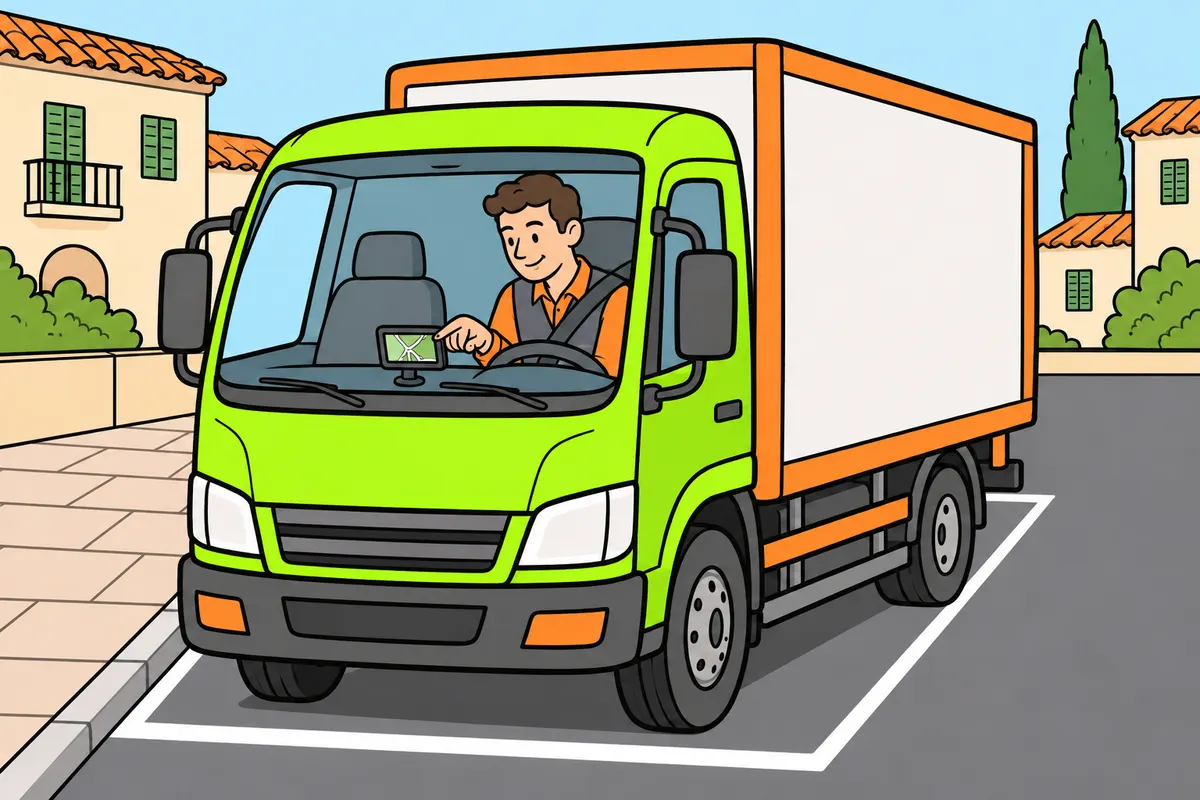
Prepare your route and equipment before setting off so you can stay attentive.
Remember
- Programme your satnav before driving.
- If you go wrong, drive safely and let it recalculate.
- Secure equipment without blocking your view or controls.
- Park before reading instructions on your delivery screen.
- Use breaks to eat and drink.
- Choose comfortable clothes and secure footwear with clean, dry soles.
Exam trap: Wrong: you must always follow the GPS. Right: obey actual road signs and restrictions.
Read the full explanation
- Programme your route before you start driving and, where appropriate, enter the lorry’s details. A suggested route does not override the rules or the actual restrictions on the road. If you take a wrong turn, continue driving safely and let the system recalculate; do not enter a destination manually while driving. [LTSV, art. 13](https://www.boe.es/buscar/act.php?id=BOE-A-2015-11722#a13).
- Secure the equipment so that it cannot move, restrict your view or interfere with controls and safety equipment. Check directions without taking your attention away from the road, and use voice instructions when they help. GPS devices and necessary manoeuvring camera monitors are subject to specific provisions; they do not authorise you to watch videos or browse the internet while moving. Park to read delivery instructions on the screen of your delivery device. [RGC, art. 18](https://www.boe.es/buscar/act.php?id=BOE-A-2003-23514#a18).
- Eat a balanced diet, avoid very large meals and stay hydrated. Hunger, dehydration or indigestion after a heavy meal can affect your wellbeing and attention. Use breaks to eat and drink without operating the lorry at the same time; do not confuse this advice with a fixed legal waiting period after eating. [DGT, Manual II](https://sede.dgt.gob.es/.galleries/permisos-de-conducir/certificacion-aptitud-profesores-formacion-vial/2024/Manual-II-Cuestiones-de-Seguridad-Vial-2024.pdf).
- Choose clothing that allows you to move your arms and legs, and securely fitting footwear with clean, dry soles that let you feel the pedals. Bulky coats or footwear that comes loose can make control more difficult. You must maintain sufficient freedom of movement, visibility and attention; this does not depend solely on what an item of clothing is called. [RGC, art. 18](https://www.boe.es/buscar/act.php?id=BOE-A-2003-23514#a18).
- Smoking involves finding, lighting and extinguishing a cigarette, occupying one hand and being exposed to smoke that can irritate your eyes. Avoid this distraction and deal with smoking when you are safely parked. You must assess the behaviour in terms of how it interferes with control and attention, as well as the other rules applicable to your workplace. [RGC, art. 18](https://www.boe.es/buscar/act.php?id=BOE-A-2003-23514#a18).
Act when you feel sleepy or fatigued
Base your decision on your symptoms and safety, as well as complying with mandatory rest periods.
- Recognise heavy eyelids, yawning, lapses in attention or imprecise movements.
- Find a safe place where stopping is permitted and your lorry fits, and stop.
- Rest and sleep if you feel drowsy; do not replace sleep with stimulants.
- Check your condition and continue only if you have recovered your abilities and met your rest obligations.
Take the alcohol test
Distinguish the second measurement, a confirmatory medical test and authorisation to continue.
- Follow the officer’s instructions and take the breathalyser test.
- If a second measurement is required, check that at least 10 minutes elapse.
- Make any relevant observations and request a confirmatory medical test if you wish.
- If your lorry is immobilised, wait until the measure is lifted or another qualified driver is authorised to take over.
Prepare your treatment and communications
Before driving, deal with anything that could affect your attention.
- Read the medicine’s warnings and seek advice, explaining that you drive a lorry.
- Check that you have no symptoms or side effects that compromise your driving.
- Plan your route and configure your phone alerts while your vehicle is parked.
- If you need to operate devices or deal with a personal problem during your journey, find somewhere safe to park before doing so.
Finished this module?
Mark it as read and you will see your progress on the theory list.