
Theory · B+E Licence - Car with Trailer · Module 5 of 13
Trailer braking
You learn which brakes your trailer needs, how the overrun system works and the roles of the breakaway cable, secondary coupling and ABS. You can answer questions on limits, braking the combination, aids against sway, jackknifing and long descents.
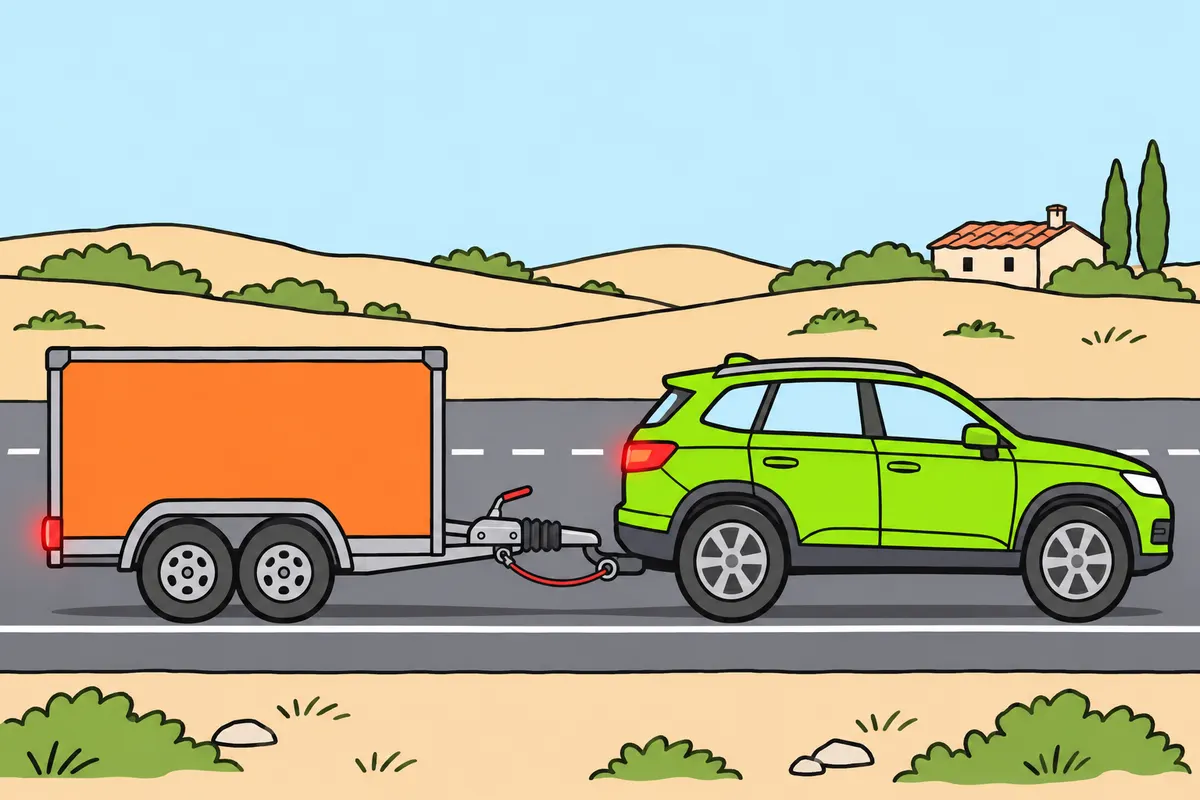
1Braking a B+E combination
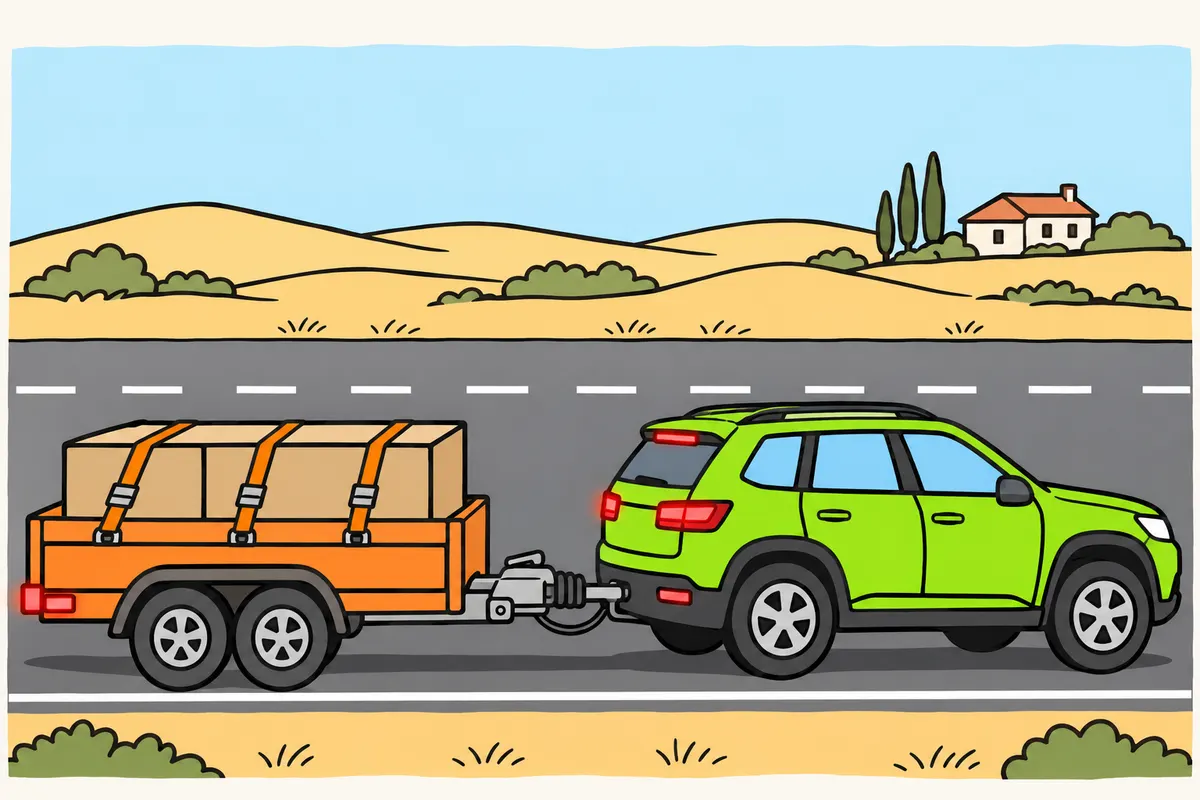
When braking, you must control the car and trailer together.
Remember
- Allow for the trailer pushing when you brake.
- Consider your actual load and tyre grip.
- Respect the car’s technical limits, even with the correct licence.
- Distinguish maximum authorised mass from the load you carry today.
Exam trap: Wrong: B+E lets you tow any 3,500 kg trailer. Right: respect the car’s technical limits too.
Read the full explanation
- When you tow a trailer, you must control the deceleration of two vehicles connected by an articulated coupling. The towing vehicle slows down, but the trailer tends to keep moving forwards and can push it. When preparing to brake, you must consider the whole combination, its load and the available grip.
- B+E covers a towing vehicle authorised by a category B licence and a trailer or semi-trailer with an MMA (maximum authorised mass) of no more than 3,500 kg. This licence limit does not guarantee that your car can tow any trailer of that mass: you must also comply with its technical and braking conditions. [RGCond, art. 4.2](https://www.boe.es/buscar/act.php?id=BOE-A-2009-9481#a4)
- You must distinguish between the maximum authorised mass, which determines the category requirements, and the mass you actually carry. To assess how the combination brakes with its current load, you must consider its actual load as well as its authorised limits.
2Service, secondary and parking brakes
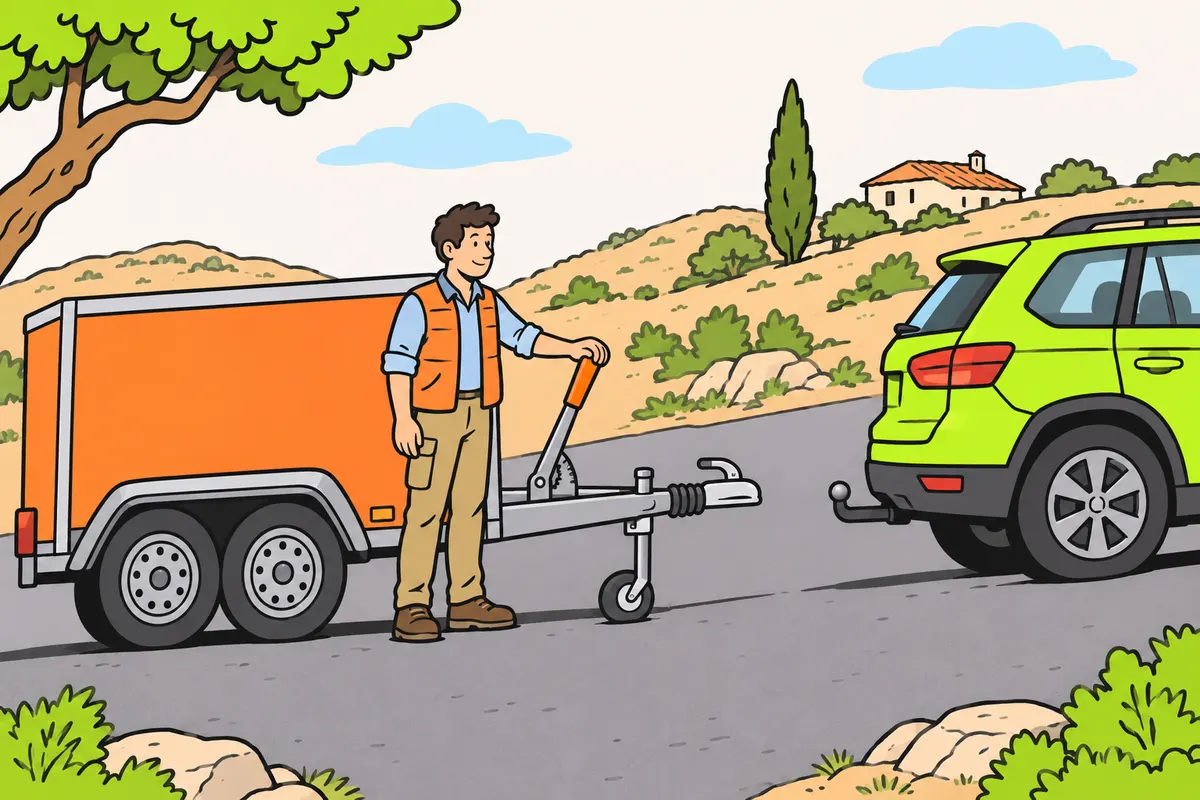
You must know what each braking function does.
| Function | When it works |
|---|---|
| Service | When you brake while driving |
| Secondary | If the service brake fails |
| Parking | To keep the vehicle still |
| Automatic breakaway braking | If the trailer separates |
| ABS | To prevent wheel locking |
Remember
- Use the service brake to slow down and stop.
- A secondary brake does not always need a separate pedal.
- O2 trailers do not require a separate secondary braking function.
- The trailer’s parking brake must work when it is uncoupled.
Exam trap: Wrong: ABS and breakaway braking can replace each other. Right: they respond to different problems.
Read the full explanation
- You use the service brake to control your speed and stop while driving. You must be able to vary its braking force: you need both gentle slowing and heavy braking. On a trailer fitted with a service brake, its wheel brakes help decelerate the combination. [RGV, art. 12.8 and Annex VIII](https://www.boe.es/buscar/act.php?id=BOE-A-1999-1826#a12)
- Secondary braking allows you to stop the vehicle if the service brake fails; you must also be able to vary its braking force. A safety function does not necessarily require a separate pedal. The RGV table does not require O2 trailers to have a separate secondary braking function of the kind specified for motor vehicles. [RGV, Annex VIII, sections 1 and 2](https://www.boe.es/buscar/act.php?id=BOE-A-1999-1826#anviii)
- The parking brake keeps the vehicle stationary on a slope, even without a driver, by mechanically holding its working components in place. On the trailer, it must also work when the trailer is detached from the towing vehicle. [RGV, Annex VIII, section 1.2.3](https://www.boe.es/buscar/act.php?id=BOE-A-1999-1826#anviii) [UN Regulation No. 13, section 5.2.2.10](https://www.boe.es/buscar/doc.php?id=DOUE-L-2026-80539)
- Automatic breakaway braking responds to the loss of the connection between the vehicles; ABS controls wheel locking during braking. These are different functions: the first acts when the combination separates, and the second acts during braking of the wheels it controls. [RGV, Annex VIII, sections 1.5 and 2](https://www.boe.es/buscar/act.php?id=BOE-A-1999-1826#anviii)
3Light trailers without brakes
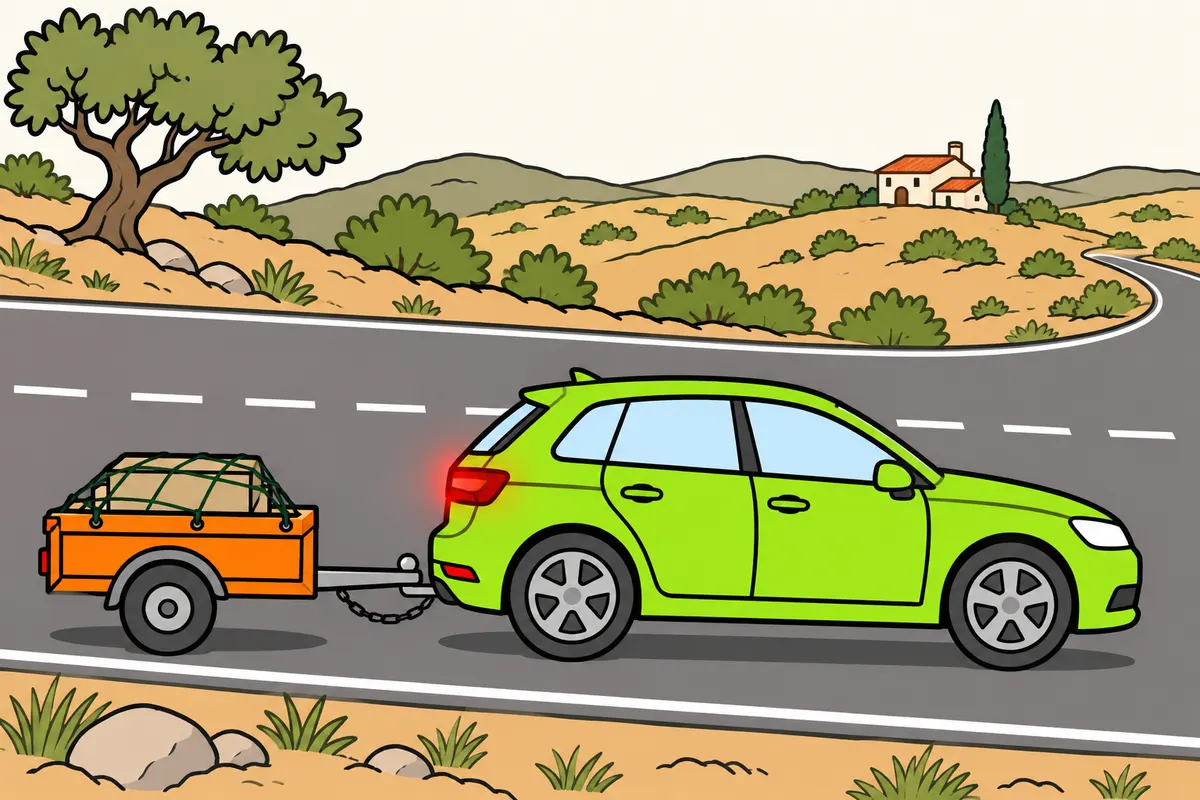
Before towing an unbraked trailer, check the car’s limits and the coupling’s strength.
Remember
- A light trailer may have brakes, although its category allows it without them.
- Calculate half the towing vehicle’s tare mass plus 75 kg.
- Never exceed 750 kg without brakes.
- Respect the technical towing capacity and coupling strength too.
- Always apply the lowest limit.
- Allow for pushing, especially downhill or before bends.
Exam trap: Wrong: any car can tow 750 kg without brakes. Right: respect the tare mass calculation and technical limits too.
Read the full explanation
- A category O1 trailer, with a maximum mass of up to 750 kg, may have no service brake. This is an option allowed for its category, not a requirement to drive without brakes. You may encounter braked light trailers; you must identify the actual equipment on the trailer you tow. [UN Regulation No. 13, section 5.2.2.1](https://www.boe.es/buscar/doc.php?id=DOUE-L-2026-80539)
- To tow an unbraked trailer, the RGV sets a limit of half the towing vehicle’s tare mass plus 75 kg, never exceeding 750 kg. You must also comply with the technically permissible towable mass and the strength of the coupling; apply whichever limit restricts your combination. [RGV, Annex IX, sections 4.1.1 and 4.1.2.1](https://www.boe.es/buscar/act.php?id=BOE-A-1999-1826#anix)
- Check the towing vehicle’s documents for its permitted unbraked towable mass. If this is lower, the general maximum for the category does not increase that technical capacity. [RGV, Annex IX, section 4.1](https://www.boe.es/buscar/act.php?id=BOE-A-1999-1826#anix)
- If the trailer has no brakes of its own, its deceleration depends on the force transmitted through the coupling to the towing vehicle and on that vehicle’s braking. You must anticipate this pushing force, particularly when driving downhill or approaching a bend. A retaining chain does not add brakes to its wheels.
4Brakes required on a B+E trailer
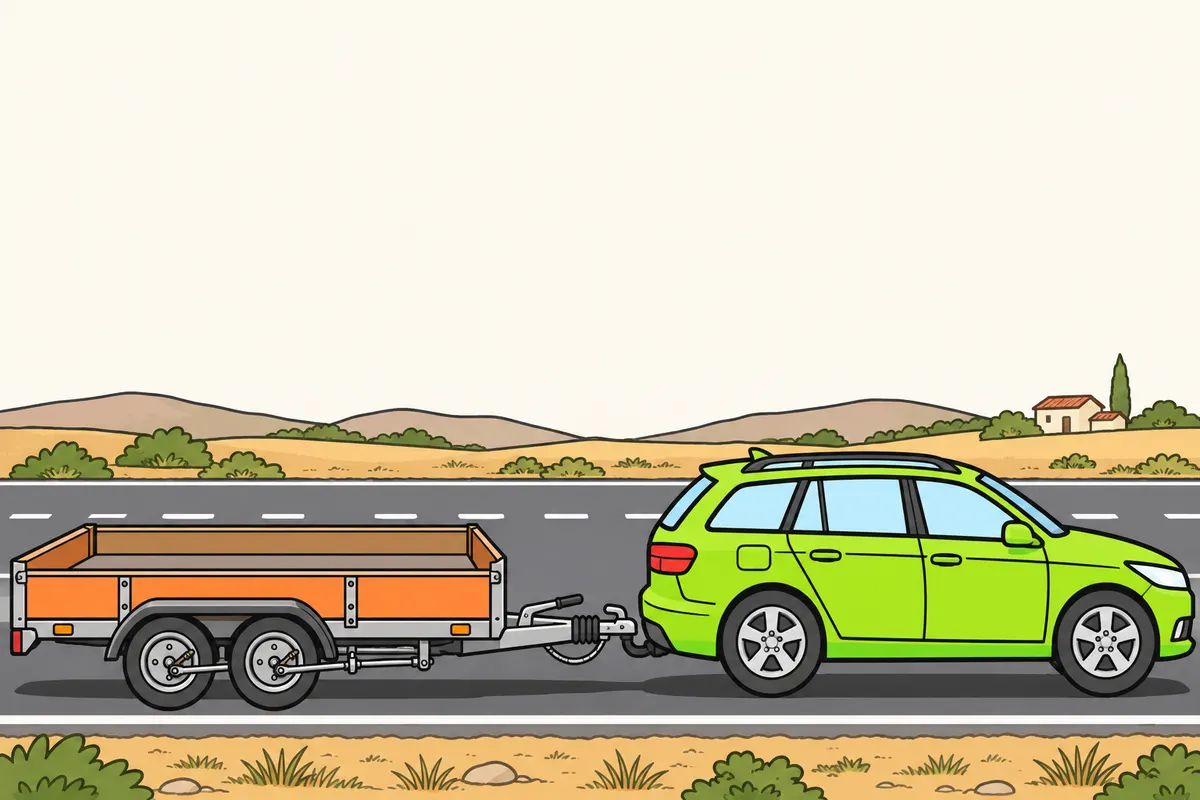
You need service and parking brakes on an O2 trailer, even when empty.
| Towing vehicle: trailer with overrun braking only | Towable mass limit |
|---|---|
| Not classified as off-road | Towing vehicle’s maximum authorised mass; maximum 3,500 kg; respect lower technical limits |
| Classified as off-road | 1.5 times its maximum authorised mass; maximum 3,500 kg; respect lower technical limits |
Remember
- Check the brakes even when your trailer is empty.
- Not every O2 trailer uses overrun braking.
- Overrun braking is allowed only on centre-axle trailers.
- Respect lower technical limits and the 3,500 kg ceiling.
- With continuous braking, these limits apply to M and N1 towing vehicles.
Exam trap: Wrong: an empty O2 trailer can travel without brakes. Right: its category requires service and parking brakes.
Read the full explanation
- For category O2, covering masses above 750 kg and up to 3,500 kg, you must have service and parking brakes. A trailer in this category is not exempt when you tow it empty. [RGV, Annex VIII, section 2](https://www.boe.es/buscar/act.php?id=BOE-A-1999-1826#anviii)
- An O2 service braking system may be continuous, semi-continuous or overrun-operated; UN Regulation No. 13 also allows electrical systems that comply with its Annex 14. For overrun braking, that regulation specifies that it is permitted only on centre-axle trailers. You must not assume that all O2 trailers use a single mechanism. [UN Regulation No. 13, section 5.2.2.2](https://www.boe.es/buscar/doc.php?id=DOUE-L-2026-80539)
- If you tow a trailer with overrun braking only, the towable mass is limited by the towing vehicle’s MMA; for a towing vehicle classified as an off-road vehicle, the provision allows 1.5 times that MMA. In both cases the ceiling is 3,500 kg, and you must comply with any lower technical limits. [RGV, Annex IX, sections 4.1.1 and 4.1.2.2](https://www.boe.es/buscar/act.php?id=BOE-A-1999-1826#anix)
- With continuous braking, the RGV refers to these same limits for category M and N1 towing vehicles. Having a different system does not allow you to increase the authorised towable mass yourself. Before comparing capacities, identify the towing vehicle’s category and the conditions in its documents. [RGV, Annex IX, section 4.1.2.3](https://www.boe.es/buscar/act.php?id=BOE-A-1999-1826#anix)
5How overrun braking works
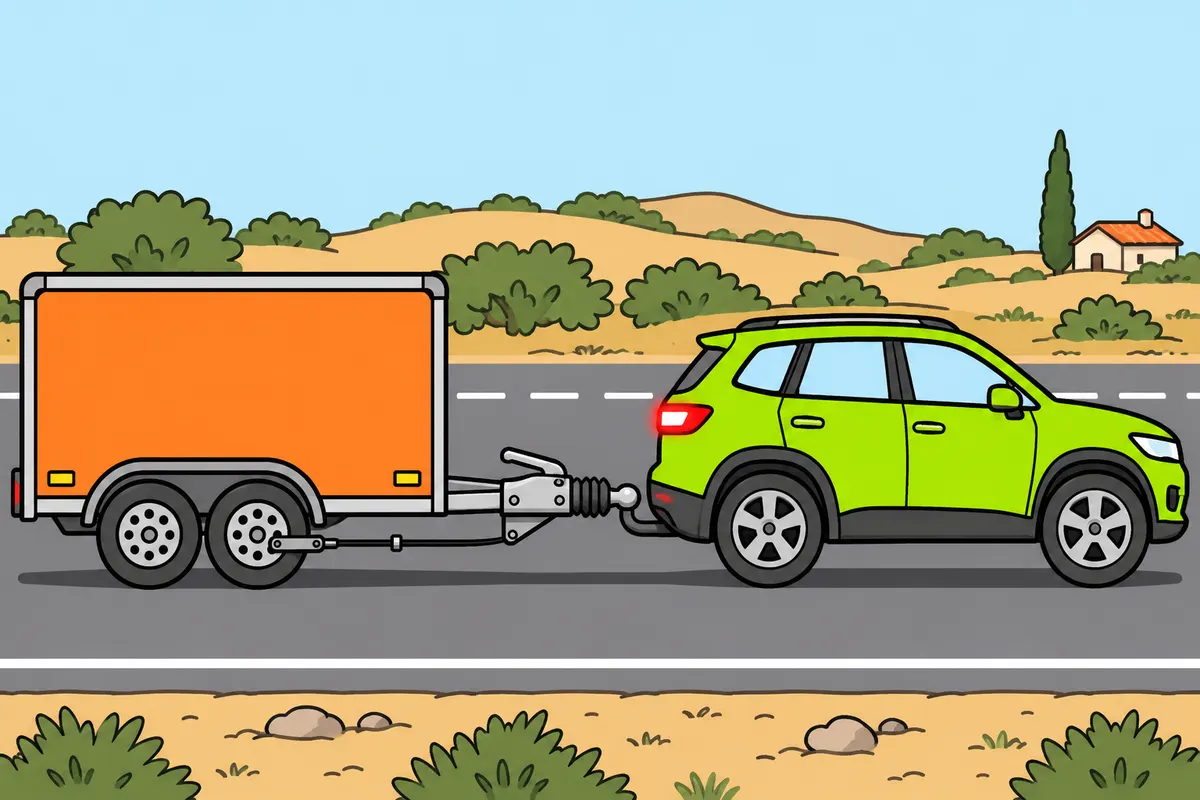
When you brake the car, the trailer’s pushing force activates its overrun brake.
Remember
- As you slow down, the trailer compresses the coupling mechanism.
- This force reaches its wheel brakes.
- The mechanism must move freely and be correctly adjusted.
- When the pushing stops, the brakes must be able to release.
- You need no separate lever for each normal brake application.
- Brake early and check how the combination responds.
Exam trap: Wrong: the lighting plug activates mechanical overrun braking. Right: compression of the coupling mechanism activates it.
Read the full explanation
- Overrun braking uses the trailer’s movement towards the towing vehicle. When the car decelerates, the trailer tends to keep moving and compresses the coupling’s control device. This force applies the trailer brakes through the transmission provided in its design. [RGV, Annex VIII, section 1.6](https://www.boe.es/buscar/act.php?id=BOE-A-1999-1826#anviii)
- You can identify a sliding coupling head, a transmission and wheel brakes within the mechanism. The transmission may use rods, cables and hydraulic components, depending on the approved design. You must not assume that the lighting plug alone transmits the braking force of a mechanical overrun system. [UN Regulation No. 13, Annex 12, sections 2 and 3](https://www.boe.es/buscar/doc.php?id=DOUE-L-2026-80539)
- Compression of the device decreases when the pushing force that activates it disappears, and the system must allow the brakes to release. To work correctly, it needs unobstructed travel and a correctly adjusted transmission. A seized component can prevent braking when required or leave the brakes partly applied. [UN Regulation No. 13, Annex 12, sections 3 and 4](https://www.boe.es/buscar/doc.php?id=DOUE-L-2026-80539)
- You do not need to operate a separate lever during each normal braking action with an overrun-braked trailer. You must brake the towing vehicle in good time and monitor the combination’s response. The mechanism uses the relative pushing force between the vehicles; it does not itself interpret the danger you see ahead.
6Progressive application, adjustment and reversing
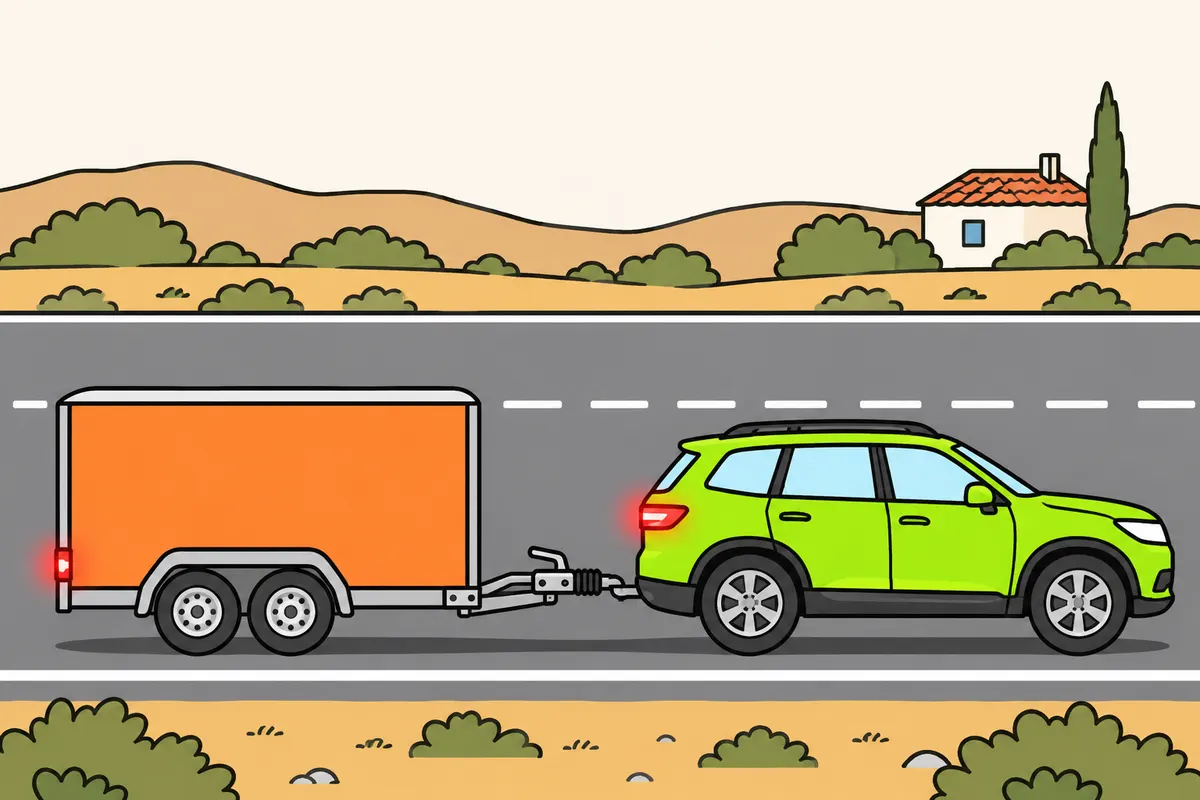
Brake progressively and leave system adjustments to competent people.
Remember
- Arrange inspection for damage, irregular movement or strong, repeated knocks when braking.
- The mechanism’s damping does not replace ABS or a stabiliser.
- The overrun brake allows reversing through an automatic device.
- This device resets when you move forwards.
- When reversing, follow the manual; do not improvise locks to disable the brakes.
- Do not adjust cables or rods simply to remove slack.
Exam trap: Wrong: lock the drawbar yourself to reverse. Right: follow the manual and do not disable the brakes.
Read the full explanation
- You must aim for progressive deceleration so that the combination responds without knocks or jerks. A heavy, repeated knock in the drawbar when braking requires inspection: do not accept it as an inevitable feature of all overrun-braked trailers. There may be an adjustment, damping or wear problem.
- The overrun device includes components that control its movement, but you must not confuse this damping with a sway stabiliser or ABS. Each component has a different function. Torn bellows, a damaged transmission or irregular movement are reasons to check the system before your journey.
- For reversing, systems governed by Annex 12 of UN Regulation No. 13 must allow you to reverse through devices that operate and reset automatically. Follow the equipment manual and do not improvise locking devices on the drawbar to disable its brakes. A modification can also compromise forward travel. [UN Regulation No. 13, Annex 12, sections 3.4 and 3.5](https://www.boe.es/buscar/doc.php?id=DOUE-L-2026-80539)
- You must not adjust cables or rods solely to remove a feeling of free play. Adjustment must maintain balanced application and release of the wheel brakes. Leave this work to competent personnel and follow the manufacturer’s intervals and procedures; there is no universal adjustment for all trailers.
7Continuous and semi-continuous braking
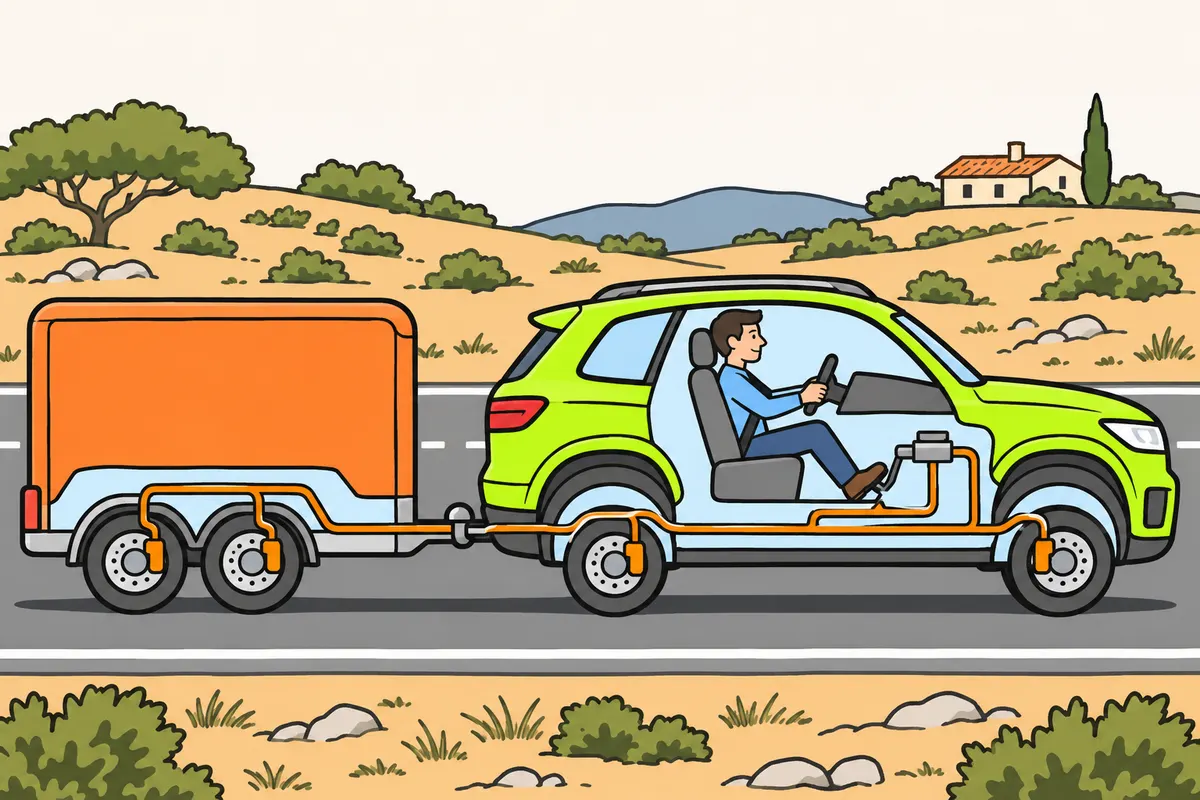
Distinguish continuous and semi-continuous braking by their energy sources.
| System | Control you use | Energy source |
|---|---|---|
| Continuous | Single | Shared by both vehicles |
| Semi-continuous | Single | Two independent sources |
Remember
- You use a single control in both systems.
- Continuous does not mean you must brake all the time.
- On two-line pneumatic systems, the red line normally supplies air.
- On these systems, the yellow line normally carries the braking command.
- These colours are usual practice, not a legal requirement in the cited rules.
Exam trap: Wrong: a shared pedal proves braking is continuous. Right: check the energy sources too.
Read the full explanation
- With continuous braking, you must identify a single control, which you apply progressively from your seat, and a single energy source for braking the vehicles in the combination. The system coordinates their braking simultaneously or with the technically specified delay. ‘Continuous’ describes the system, not permanent braking. [RGV, annex VIII, section 1.3](https://www.boe.es/buscar/act.php?id=BOE-A-1999-1826#anviii)
- With semi-continuous braking, you also use a single control, but the energy comes from two independent sources. A shared pedal alone is not enough to establish that the braking is continuous. [RGV, annex VIII, section 1.4](https://www.boe.es/buscar/act.php?id=BOE-A-1999-1826#anviii)
- On two-line pneumatic systems, which are uncommon on O2 trailers, the red connection normally supplies air and the yellow connection controls braking. This is the usual industry colour code, not a legal requirement of the braking provisions cited. The first supplies energy and the second transmits the braking command; the connection procedure is covered in ‘Safe coupling and uncoupling’. [PARCISA, identifying pneumatic connections](https://www.parcisa.com/files/portalmenus/20/documentos/20200210ManualInstruccionesTodo05.pdf)
8Automatic breakaway braking
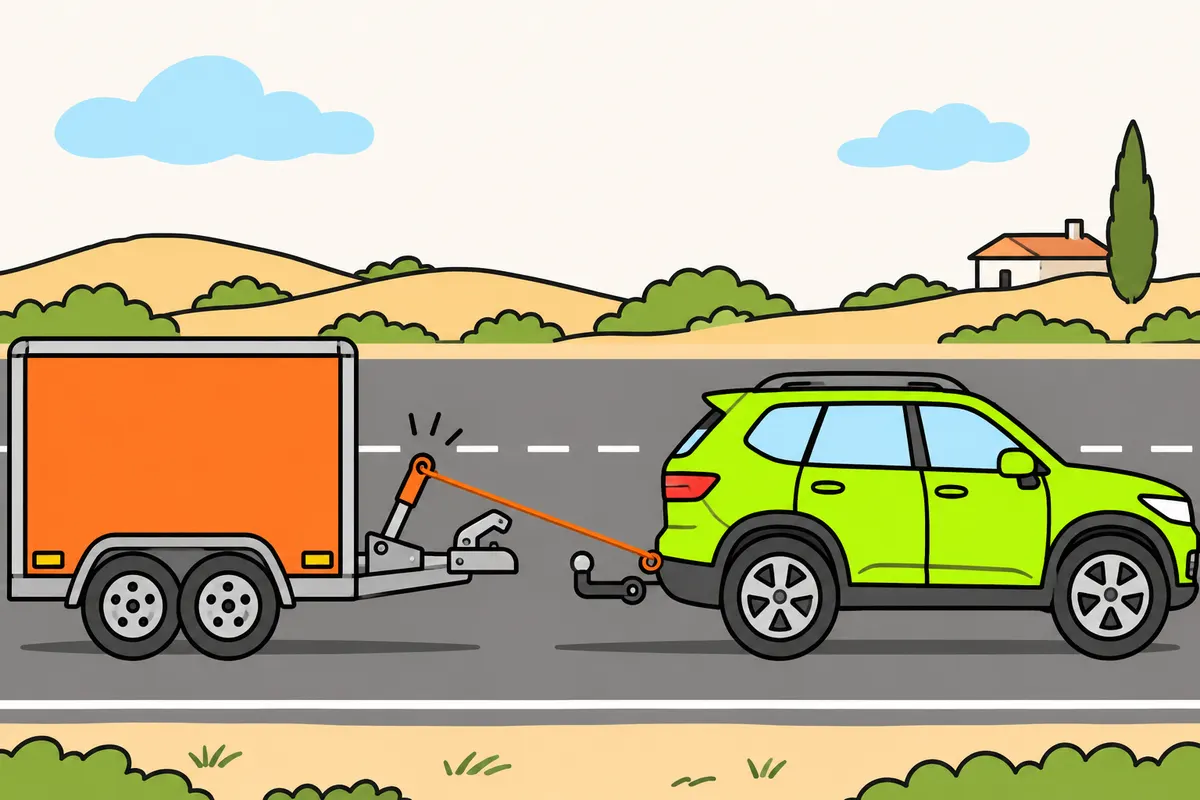
Connect the breakaway cable correctly so it applies the brake if your trailer separates.
| O2 trailer mass | Protection if it separates |
|---|---|
| Over 1,500 kg | Automatic braking |
| Up to and including 1,500 kg | Secondary coupling if breakaway braking is absent; keep the type-approved system |
Remember
- Attach the cable as the manufacturer instructs.
- Do not let it drag or apply the brake during normal turns.
- Allow both vehicles to turn without snagging the cable.
- Do not improvise knots, splices or attachment points.
- Keep the installed, type-approved system.
Exam trap: Wrong: remove the cable because your trailer does not exceed 1,500 kg. Right: keep the installed, type-approved system your trailer needs.
Read the full explanation
- If the trailer accidentally separates, automatic braking aims to stop it without cancelling the braking effectiveness of the vehicles that remain connected. Coupling failure is one of the events that can trigger it. This is not the same as normal service brake operation using the pedal or the overrun mechanism. [RGV, annex VIII, section 1.5](https://www.boe.es/buscar/act.php?id=BOE-A-1999-1826#anviii)
- On a trailer with overrun brakes and a breakaway cable, the cable pulls the designated mechanism when the vehicles separate and applies the trailer brake. You must attach it to the point and in the manner specified by the manufacturer. Keeping it coiled up without an effective connection prevents it from performing this function.
- Position the cable so that it neither drags nor is so tight that it applies the brake during a normal turn. Check that it cannot catch on other components and that its routing allows the intended articulation. You must not improvise knots, splices or anchor points whose strength and operation you do not know.
- The RGV specifies automatic braking for O2 trailers over 1,500 kg; for those of a lower or equal mass, it provides for a secondary coupling under the terms of its note. You must always retain the installed, type-approved system: the general exception does not authorise you to remove the breakaway cable from equipment that needs it. [RGV, annex VIII, section 2, note 4](https://www.boe.es/buscar/act.php?id=BOE-A-1999-1826#anviii)
9Breakaway cable and secondary coupling
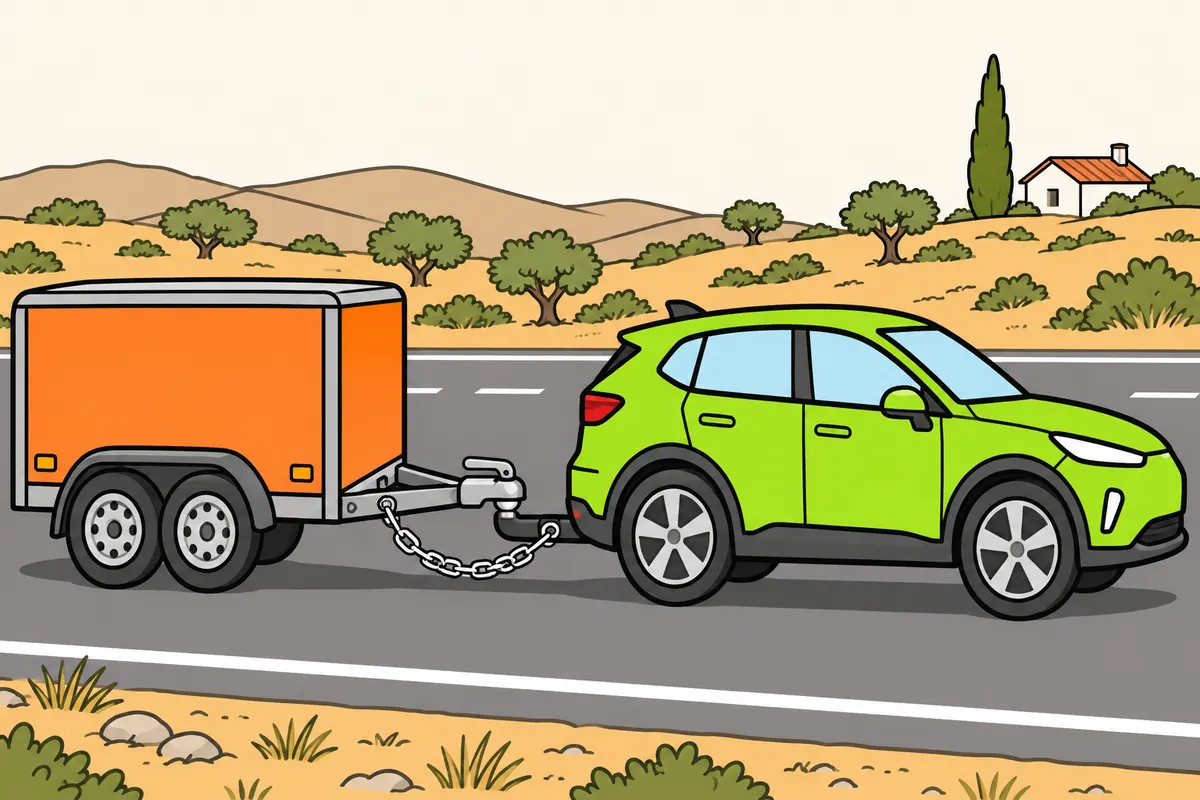
Distinguish the cable that applies a brake from the extra coupling that retains your trailer.
| Device | Function |
|---|---|
| Breakaway cable | Applies the brake if the vehicles separate |
| Secondary coupling | Retains the trailer and keeps the drawbar off the ground |
Remember
- Up to 1,500 kg inclusive, fit a secondary coupling if breakaway braking is absent.
- With an unbraked O1 trailer, you also need a secondary coupling.
- Check that it prevents the drawbar from touching the ground.
- It must retain some steering control of the trailer.
- This threshold does not set the limit for travelling without a service brake.
Exam trap: Wrong: the retaining chain brakes the wheels. Right: it provides an extra connection; it does not replace the brake-operating cable.
Read the full explanation
- The breakaway cable applies a brake; a retaining chain or cable provides an auxiliary connection between the vehicles. Their flexible appearance does not mean you can treat them as equivalent or interchange them without checking the design of the combination.
- For trailers with an MMA (maximum authorised mass) of 1,500 kg or less that have no system to ensure braking if the coupling breaks, you must have a secondary coupling. It must prevent the drawbar from touching the ground and retain some residual ability to guide the trailer. [RGV, art. 13.4](https://www.boe.es/buscar/act.php?id=BOE-A-1999-1826#a13)
- If you tow an O1 trailer without brakes, you must also have a secondary coupling, such as a chain or cable, to prevent the drawbar from touching the ground if the main coupling fails. This device retains the trailer but does not brake its wheels. [RGV, annex VIII, section 2, note 3](https://www.boe.es/buscar/act.php?id=BOE-A-1999-1826#anviii)
- When identifying the combination's protection, check three things: the trailer's mass, whether it has automatic braking, and the function of the device fitted. The 1,500 kg threshold relates to this protection against separation; it is not the general limit for towing a trailer without a service brake. [RGV, art. 13.4 and annex VIII](https://www.boe.es/buscar/act.php?id=BOE-A-1999-1826#a13)
10The trailer parking brake
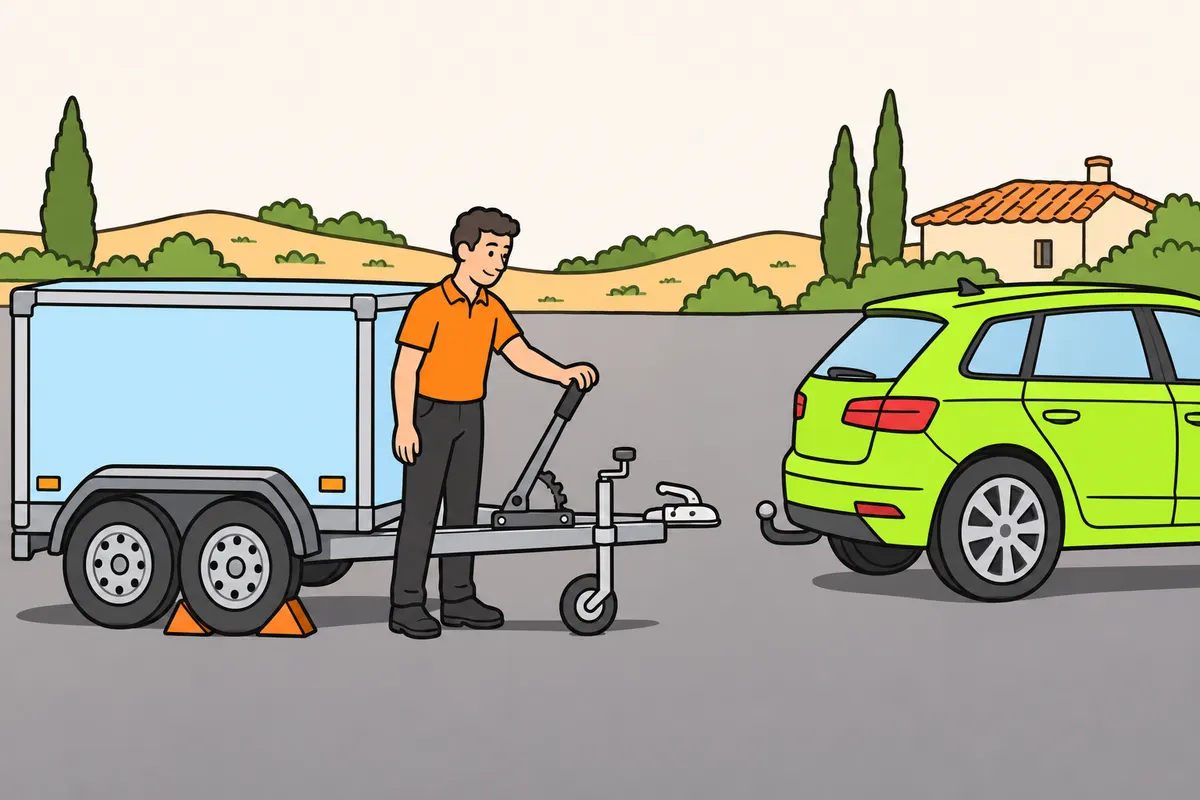
Secure your trailer against movement before uncoupling it.
Remember
- Use the trailer’s own parking brake control.
- Check the parking brake control from the ground, as instructed.
- Check that the trailer really stays still.
- Do not use the breakaway cable as your usual parking control.
- Do not rely on drawbar compression to keep it still.
- Correct any failure to hold before relying on the brake.
Exam trap: Wrong: uncouple first and secure the trailer afterwards. Right: secure it before releasing the coupling.
Read the full explanation
- On equipment subject to UN Regulation No. 13, you must be able to operate the trailer's parking brake control from the ground. This allows you to secure a trailer that is not connected to the car without getting into the car to operate its controls. Check its operation according to the equipment instructions. [UN Regulation No. 13, section 5.2.2.10](https://www.boe.es/buscar/doc.php?id=DOUE-L-2026-80539)
- Before uncoupling, apply the measures provided to prevent the trailer from moving. With the trailer detached, the towing vehicle's brake acts only on the towing vehicle itself. The sequence for securing and separating the vehicles is covered in ‘Safe coupling and uncoupling’, in the sections on uncoupling. [UN Regulation No. 13, section 5.2.2.10](https://www.boe.es/buscar/doc.php?id=DOUE-L-2026-80539)
- You must not use the breakaway cable as a routine parking brake control or leave the trailer relying on compression of the drawbar. Apply its own control and check that it is secured against movement, following the manual. A support stabilises or supports the trailer, but does not automatically replace the brake.
- If the lever has abnormal travel or the trailer is not held in place, you must correct the problem before relying on it. Visible movement of the control does not prove that braking force reaches the wheels. You must assess actual operation as well as the presence of the components.
11What trailer ABS does
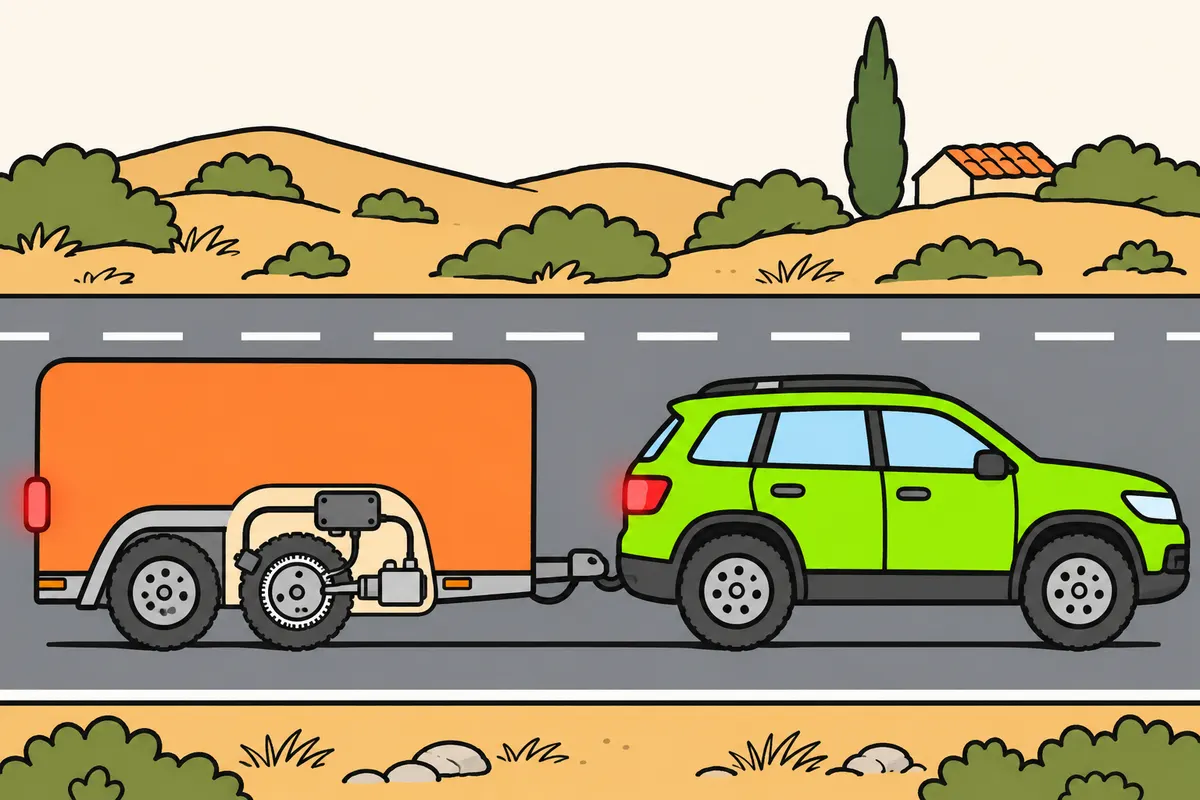
Your car’s ABS cannot prevent wheel locking on a trailer without ABS.
| Trailer category | General ABS requirement |
|---|---|
| O2 | No general requirement from this category; check type approval |
| O3 and O4 | ABS required |
Remember
- ABS regulates braking only at the wheels it controls.
- Your trailer needs its own equipment to regulate its wheels.
- Your car’s ESP (electronic stability programme) does not give the trailer ABS.
- Do not assume every B+E trailer must have ABS.
- Keep a suitable speed and enough safety margin.
- ABS cannot prevent every skid, jackknife or rollover.
Exam trap: Wrong: the car’s ABS protects any trailer. Right: an overrun-braked trailer without ABS can lock its wheels.
Read the full explanation
- ABS regulates braking to prevent the wheels it controls from locking. It needs to monitor their rotation and modulate brake application. On a trailer fitted with ABS, this regulation helps its wheels retain their ability to provide lateral guidance during heavy braking. [UN Regulation No. 13, annex 13](https://www.boe.es/buscar/doc.php?id=DOUE-L-2026-80539)
- The car's ABS regulates its own wheels: if you tow a trailer with overrun brakes but no ABS, the trailer's wheels can lock even though the towing vehicle retains steering capability. The car's ESP (electronic stability programme) can help stabilise the combination by acting on the towing vehicle, but it does not provide anti-lock regulation for the trailer's wheels. You must anticipate that the trailer may lose lateral guidance during heavy braking. [UN Regulation No. 13, annex 13](https://www.boe.es/buscar/doc.php?id=DOUE-L-2026-80539)
- The requirement to fit ABS depends on the trailer's category and type approval; UN Regulation No. 13 requires ABS on O3 and O4 trailers, while its specific provision does not impose this general requirement on O2 trailers. [UN Regulation No. 13, section 5.2.2.13](https://www.boe.es/buscar/doc.php?id=DOUE-L-2026-80539)
- ABS helps prevent wheel lock, but it does not create grip or, on its own, prevent every skid, jackknife or rollover. You must maintain an appropriate speed and safety margin. Stability control can intervene differently to influence the vehicle's path; you must not attribute every function of electronic driving aids to ABS.
12ABS: emergencies and warnings
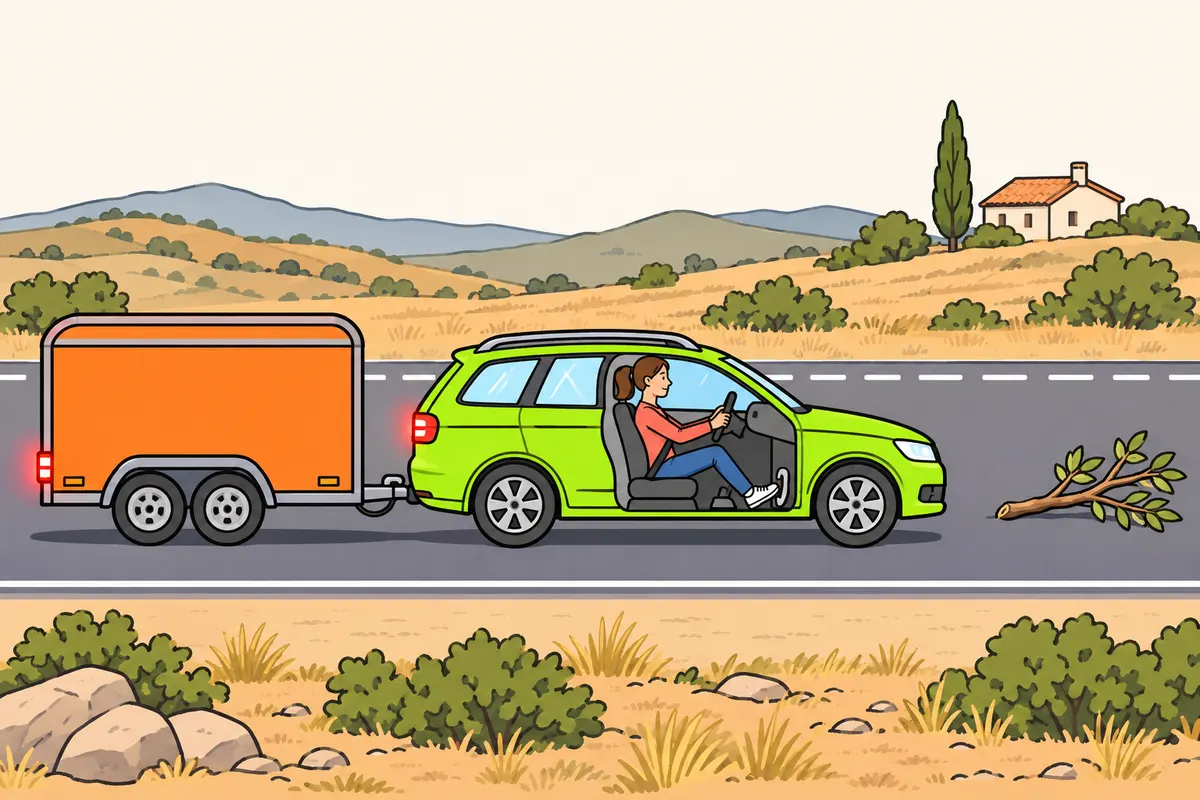
In an emergency with working ABS, press firmly and keep the pressure.
Remember
- Keep pressing even if you feel vibrations.
- With a manual gearbox, press the clutch too during this braking.
- Keep control of your steering without swerving.
- If a fault warning stays on, consult the manual and arrange inspection.
- Do not assume the warning always means the same thing.
- Do not disconnect the power to hide a warning.
Exam trap: Wrong: pump the pedal if it vibrates during emergency braking with working ABS. Right: maintain firm pressure.
Read the full explanation
- If you need to brake in an emergency with ABS working, you must press the pedal firmly and maintain pressure, even if you feel vibrations. You must not pump it to imitate the system's regulation. If you have a manual gearbox, the DGT instructs you to press the clutch pedal as well during this braking manoeuvre. [DGT, emergency braking](https://revista.dgt.es/es/educacion-formacion/conducir-mejor/2023/0315-Frenadas.shtml)
- You must continue to control the steering and monitor the available space. Being able to steer the vehicle while ABS is operating does not mean you can swerve without considering the trailer. Your manoeuvre must take account of its path and the risk of it losing stability or encroaching on another area.
- If the trailer's ABS warning continues to indicate a fault, consult the manual and arrange an inspection. Basic braking may remain available while anti-lock regulation is lost; you must not treat either possibility as a universal diagnosis. A braking warning requires you to identify which function is affected.
- Technical checks include warnings, wheel sensors, connections and ABS and EBS components. You must not extinguish a warning light by disconnecting its power supply or consider the system repaired because the warning disappears. You must resolve the cause and verify its operation. [RD 920/2017, annex I, sections 1.6 and 1.7](https://www.boe.es/buscar/act.php?id=BOE-A-2017-12841)
13Reaction, braking and stopping distances
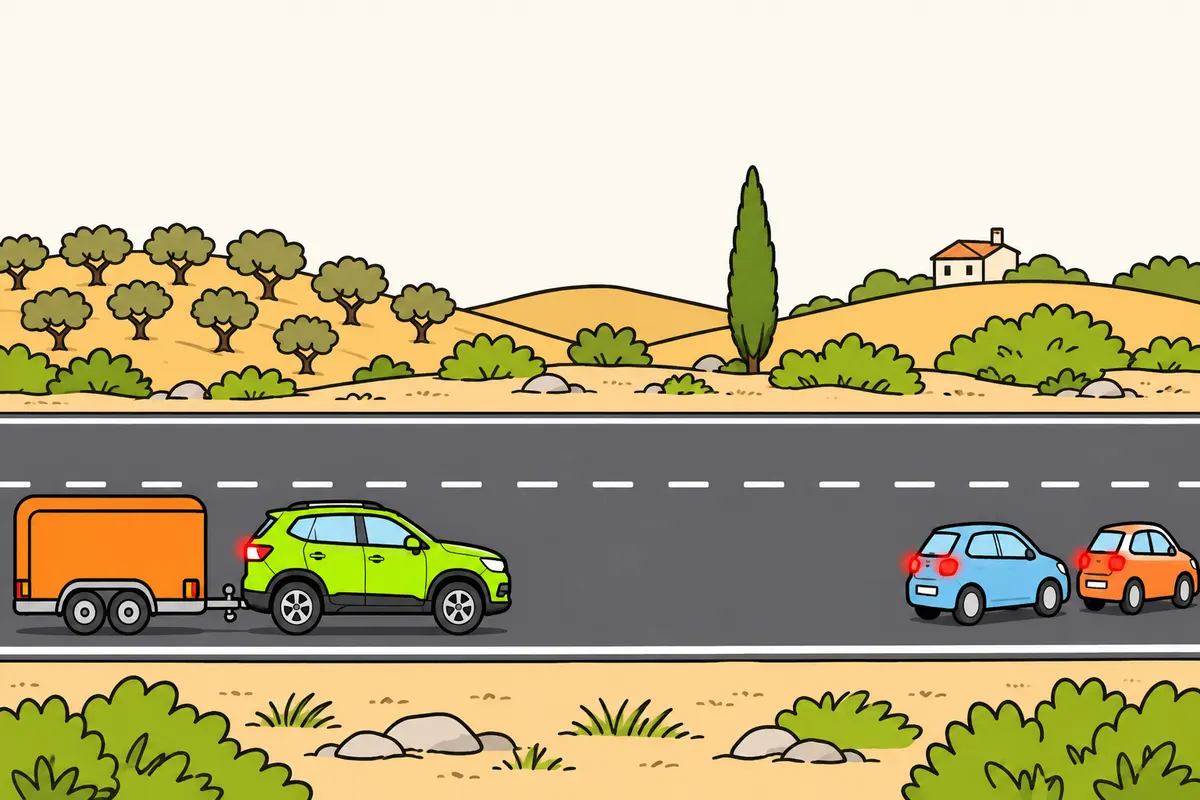
You need space both to react and to brake before you stop.
| Distance | What it covers |
|---|---|
| Reaction | From noticing danger until you start braking |
| Braking | From starting to brake until you stop |
| Stopping | Reaction distance plus braking distance |
Remember
- Look far ahead to spot danger in time.
- Anticipate queues, bends and descents.
- You may need more stopping space with a trailer.
- Do not use a fixed increase for every combination.
- Adapt your speed so you can stop within the space you see.
Exam trap: Wrong: a trailer always increases braking distance by a fixed percentage. Right: assess actual load, speed, brakes and grip.
Read the full explanation
- Your reaction distance is the distance you travel from the moment you realise you need to act until you start braking. Your braking distance is the distance you travel while slowing down with the brakes until you stop. To calculate your stopping distance, you must add these two distances together.
- If you take longer to recognise a hazard, you use up part of your safety margin before applying the brakes. A trailer with effective brakes does not recover that lost distance. You must look well ahead and anticipate traffic queues, bends and descents so that you start slowing down while you still have a safety margin.
- With a trailer, you may need more space to stop than with the towing vehicle alone. The response depends on the actual mass, load distribution, speed, brakes and grip. You must not memorise a percentage increase as a guarantee that applies to every combination and surface.
- You must adjust your speed so that you can stop within the distance you can see and for foreseeable obstacles. Keeping within a maximum speed limit does not guarantee this if visibility decreases or braking performance worsens. You must consider the actual conditions of your combination, load and road. [RGC, art. 45](https://www.boe.es/buscar/act.php?id=BOE-A-2003-23514#a45)
14Mass, speed and grip
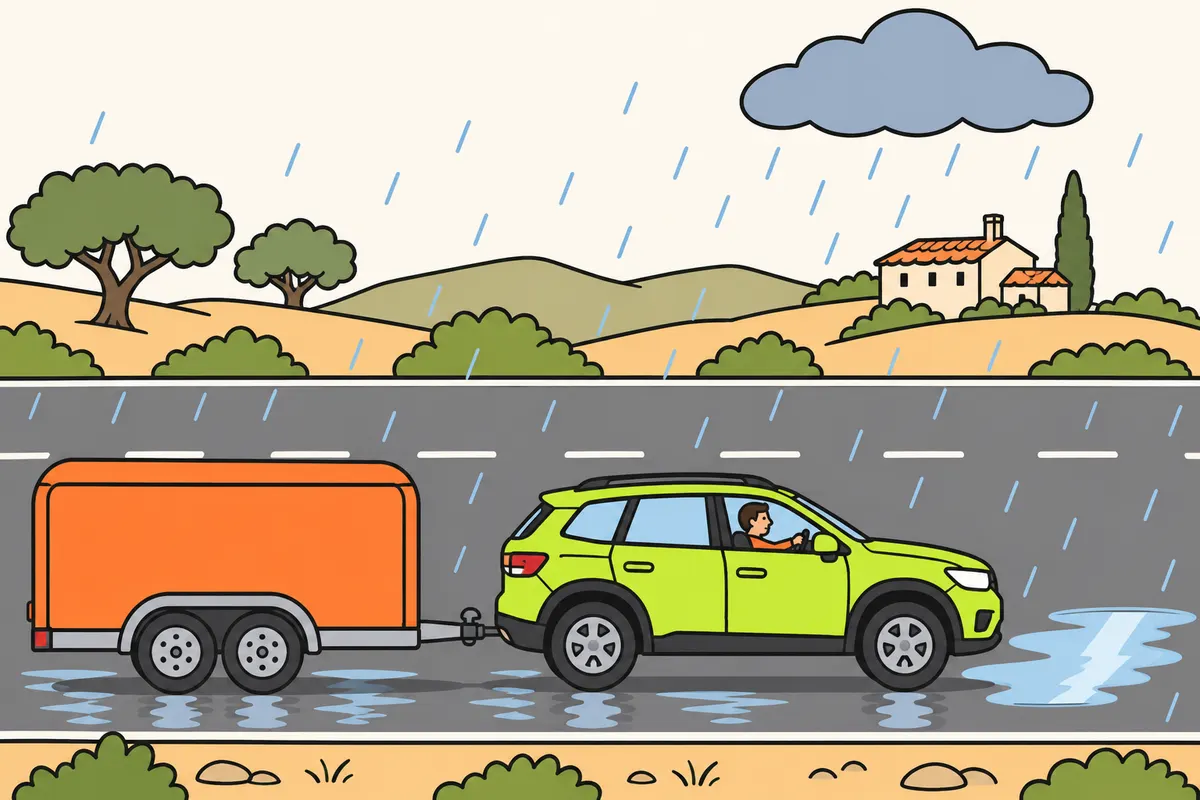
Adapt your speed to your load and tyre grip.
Remember
- More load can mean more work and heat for your brakes.
- Reduce your speed early.
- Leave more margin in rain or on slippery surfaces.
- Keep your tyres and their pressures correct.
- Avoid sudden movements on ice or wet road markings.
- Powerful brakes cannot make up for poor grip.
Exam trap: Wrong: adding weight automatically improves braking. Right: it can increase brake effort and heat.
Read the full explanation
- The more energy your combination carries, the more work its means of deceleration must do to stop it. Increasing the load may place greater thermal demands on the brakes. You must not assume that adding weight automatically improves braking because the wheels press harder on the road surface.
- Speed has a decisive effect on the space you need and on brake heating. You must reduce it in good time, without relying on regaining your entire safety margin through very hard braking at the last moment.
- Rain and slippery surfaces reduce the grip available. You must also take account of worn or damaged tyres and incorrect tyre pressures as factors that impair contact with the road and stability. You cannot compensate for them solely with more powerful brakes: braking force must be transmitted to the ground through the wheels.
- On wet road markings, icy patches or surfaces where grip changes, you must avoid sudden inputs and adjust your speed before reaching them. A locked wheel or one without ground contact has a reduced ability to guide the trailer. You must consider both your ability to brake and your ability to keep the trailer on its intended path. [RGC, art. 45](https://www.boe.es/buscar/act.php?id=BOE-A-2003-23514#a45)
15Safety margin and normal braking
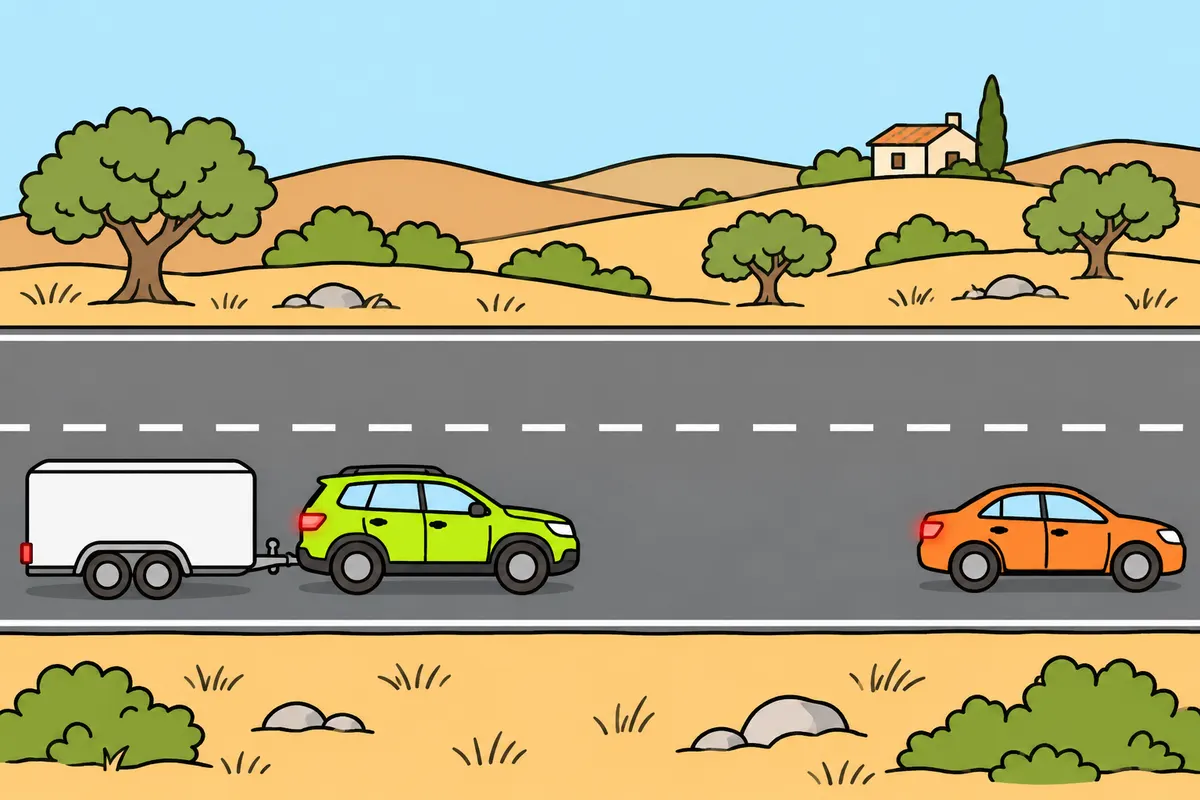
Leave a safety margin and slow down early, especially before bends.
Remember
- Leave enough space to stop if the vehicle ahead brakes suddenly.
- Consider the brakes of the whole combination.
- Except in imminent danger, check risks and warn before slowing down considerably.
- For normal braking, ease off the accelerator and brake progressively.
- Aim to slow before the bend, with both vehicles straight.
- In an emergency, brake as firmly as necessary.
Exam trap: Wrong: you must never brake hard with a trailer. Right: distinguish normal braking from the braking an emergency needs.
Read the full explanation
- You must leave enough space to stop without a collision if the vehicle ahead brakes suddenly. When choosing this gap, you must take particular account of your speed, grip and braking conditions. When towing a trailer, you cannot calculate this margin solely on the basis of your car's performance. [RGC, art. 54.1](https://www.boe.es/buscar/act.php?id=BOE-A-2003-23514#a54)
- Before significantly reducing your speed, except in imminent danger, you must check that you do not put other drivers at risk and give warning as required by the rules. You must avoid a sudden reduction that creates a risk of a collision behind you. Anticipating also helps your trailer respond more stably. [RGC, art. 53](https://www.boe.es/buscar/act.php?id=BOE-A-2003-23514#a53)
- During normal braking, ease off the accelerator and apply the brakes as firmly as necessary, trying to keep your combination aligned. In an emergency, you must brake as necessary to avoid the collision, using the ABS technique explained in the section on ABS.
- Before a bend, try to complete the main reduction in speed with your combination travelling straight. While turning, the wheels also need grip to follow the intended path. You must avoid approaching too fast and demanding both heavy braking and a sharp turn from your towing vehicle and trailer at the same time.
16Why jackknifing occurs
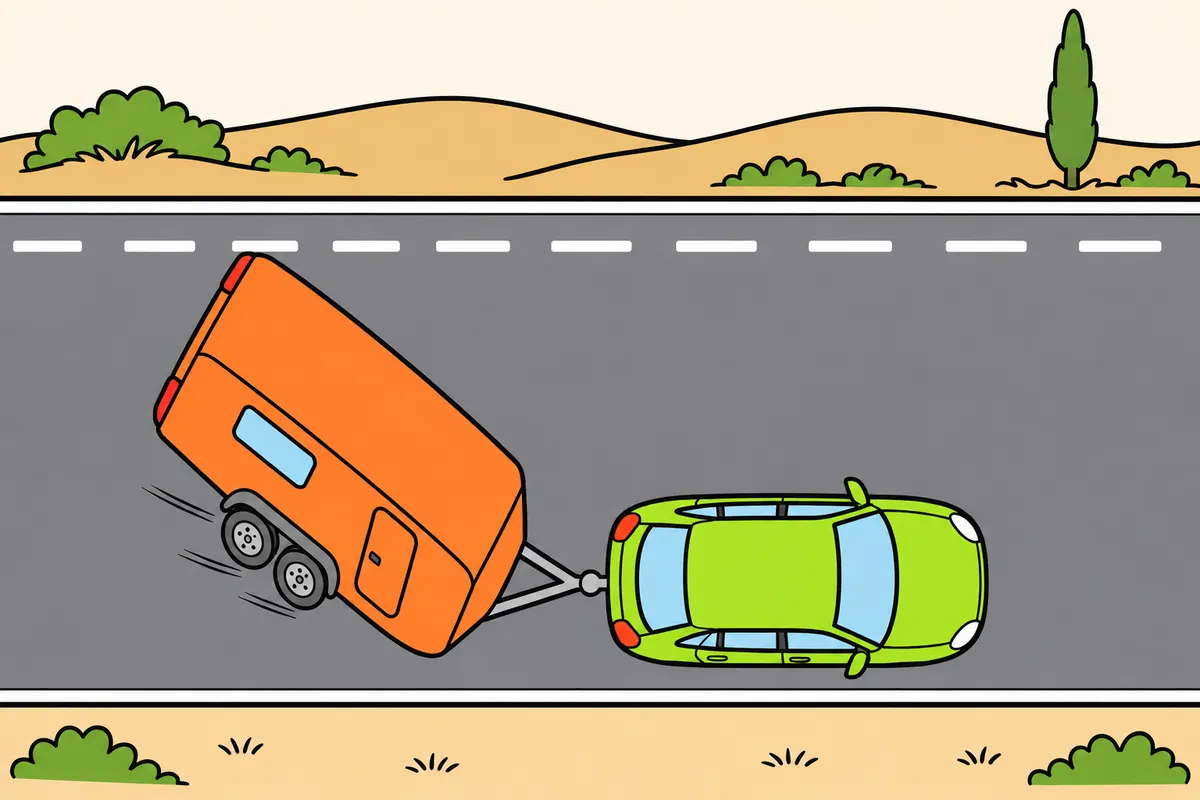
Help prevent jackknifing by keeping your combination stable and its braking balanced.
| Loss of stability | What happens |
|---|---|
| Jackknifing | The angle between the vehicles closes dangerously |
| Sway | The trailer swings repeatedly from side to side |
Remember
- Jackknifing dangerously closes the angle between your car and trailer.
- It can happen if the trailer pushes too hard or its wheels lock.
- Your car can also lose control at the rear.
- Take extra care on bends, descents and slippery roads.
- Distribute your load carefully, even with a small trailer.
Exam trap: Wrong: jackknifing always means the car brakes too hard. Right: trailer pushing and locked trailer wheels also contribute.
Read the full explanation
- Jackknifing is a dangerous closing of the angle between your towing vehicle and trailer due to a loss of stability. Your trailer may move sideways and push your towing vehicle, or your towing vehicle may lose directional control at the rear. The articulation angle closes without you being able to control the intended path.
- Unbalanced braking between the vehicles contributes to the problem. If your trailer brakes insufficiently, it continues pushing; if its wheels lock, it loses its ability to maintain lateral direction. You must consider both situations, rather than attributing every jackknife solely to excessive braking by your car.
- A bend, a descent or a slippery surface can worsen the consequences of this imbalance. You must bear in mind your load and its distribution: if they affect wheel loading and stability, your combination may respond less effectively. Towing a small trailer does not eliminate the possibility of a dangerous closing of the angle.
- You must not confuse jackknifing with sway: sway involves repeated sideways oscillations, whereas jackknifing is characterised by the angle between the vehicles closing. You must prevent both through appropriate speed and smooth use of the controls, but you must not interpret every movement at the articulation as a loss of control.
17Aids against trailer sway
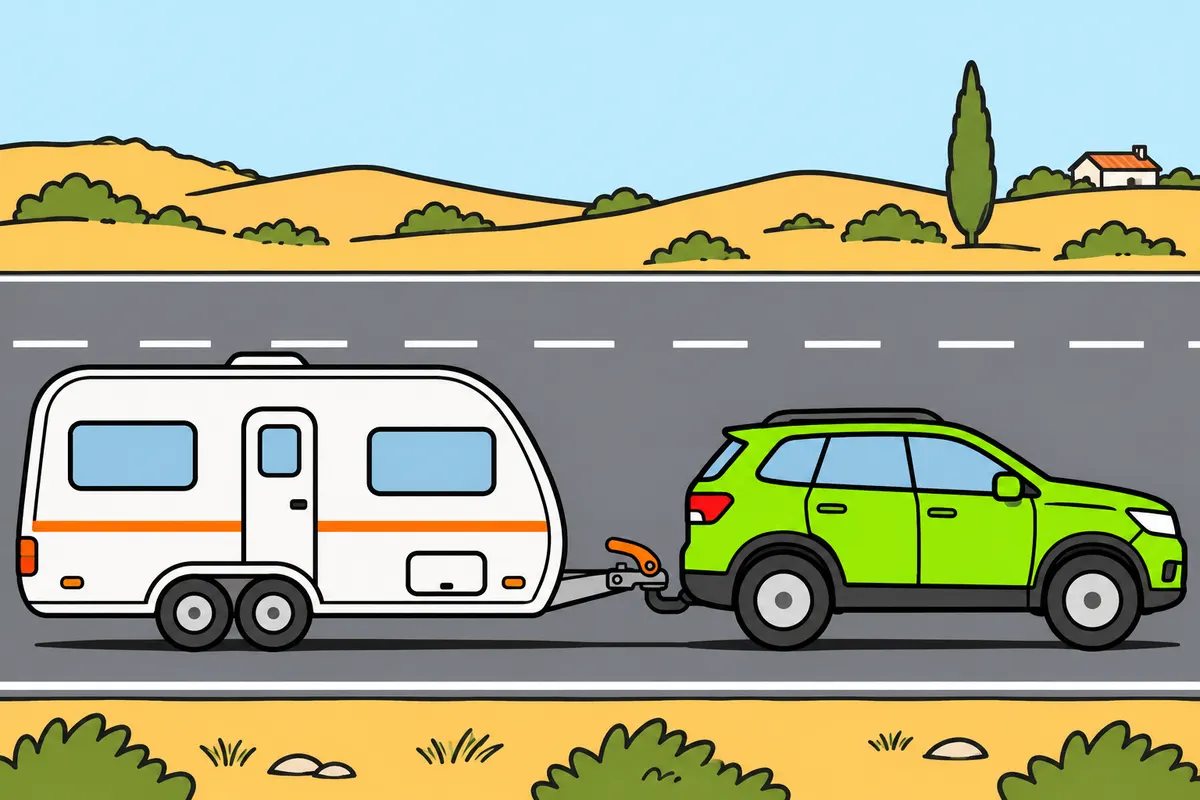
Sway aids can help you, but you must still drive appropriately.
| Aid | How it works |
|---|---|
| TSP, if fitted to your car | Detects sway and applies the car’s brakes |
| AKS friction stabiliser at the coupling | Damps sway through pads pressing against the towball |
Remember
- Check whether your car’s ESP includes a specific trailer function.
- Keep a suitable speed and distribute your load well.
- Keep your tyres and brakes in good condition.
- Do not rely on always regaining control after grip is lost.
Exam trap: Wrong: TSP or AKS prevents every sway. Right: these aids have limits; maintain suitable speed, loading and equipment.
Read the full explanation
- If your car has a trailer stability programme, such as TSP, this function integrated into the ESP (electronic stability programme) detects oscillations and applies your towing vehicle's brakes to help stabilise your combination. You must consult the equipment's operating conditions: having ESP does not guarantee that it includes this specific function. [DGT, trailer stability control](https://www.dgt.es/comunicacion/noticias/conducir-con-el-viento-en-contra)
- An AKS-type friction stabiliser in the coupling head damps oscillations through friction linings that press against the towball. You may find it on caravans and other B+E trailers; its mechanical action differs from that of the overrun brake and the electronic intervention of TSP. [AL-KO, how the AKS stabiliser works](https://www.alko-tech.com/es_es/productos/estabilizador-aks-3004_pdt_254)
- With these aids, you must maintain an appropriate speed, keep your load well distributed and keep your tyres and brakes in good condition. They reduce the risk of sway, but do not guarantee that you can regain control of a combination that exceeds the grip available. [DGT, trailer stability control](https://www.dgt.es/comunicacion/noticias/conducir-con-el-viento-en-contra)
18Preventing jackknifing and swaying
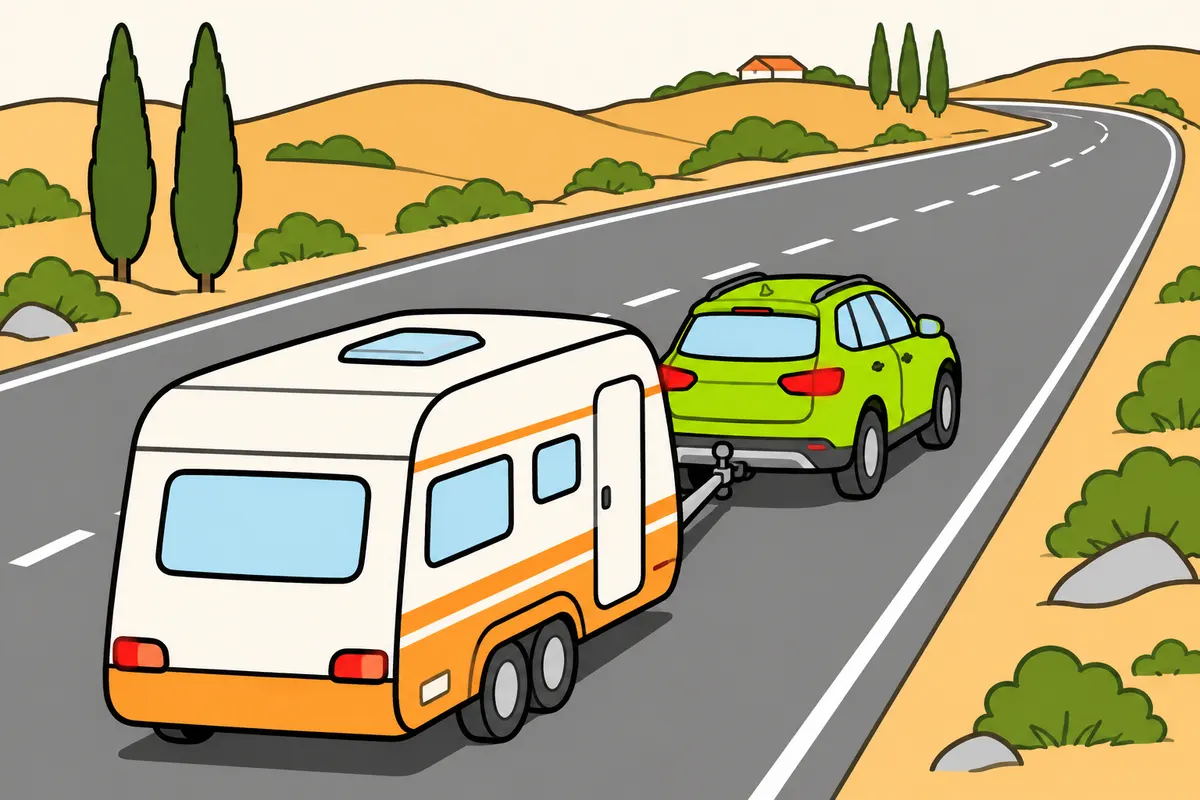
Prevent swaying and avoid sudden responses when no obstacle requires emergency braking.
Remember
- Have jerking or unequal wheel braking checked.
- Secure your load and maintain your tyres.
- Slow before bends and slopes; aim to brake with both vehicles aligned.
- If swaying starts without an obstacle requiring emergency braking, hold the steering steady.
- In that situation, ease off progressively; avoid harsh braking and violent steering corrections.
- When you can stop safely, check the causes before continuing.
Exam trap: Wrong: accelerate to pull a swaying combination straight. Right: without an obstacle requiring emergency braking, hold the steering steady and ease off the accelerator progressively.
Read the full explanation
- You must maintain balanced braking through correctly adjusted brakes, suitable tyres and a properly positioned and secured load. If the wheels on one side brake differently or your trailer jerks, arrange an inspection. Adjustment is covered in «Maintenance and checks for your vehicle combination», in the section «Trailer brakes and parking»; load distribution is explained in «Safe loading of your vehicle combination».
- Adjust your speed before bends and gradients, increase your safety margin when grip decreases and avoid sudden steering movements. Try to brake with both vehicles aligned to reduce the risk of your trailer swinging sideways. The DGT highlights this precaution when descending with a trailer. [DGT, driving with a trailer: gradients](https://www.dgt.es/comunicacion/noticias/202406278-conducir-seguro-con-remolque/)
- If your trailer starts swaying and there is no obstacle requiring emergency braking, hold the steering wheel firmly and ease off the accelerator progressively. Avoid harsh braking and violent corrections, and do not accelerate to try to pull your combination straight. When you can stop safely, investigate the causes before continuing. [DGT, driving with a trailer: stability](https://www.dgt.es/comunicacion/noticias/202406278-conducir-seguro-con-remolque/)
- You must not apply a universal formula of accelerating, pulling on the handbrake or braking only your trailer whenever stability is lost. Your response depends on which wheels lose grip, your equipment and the space available. Your preventive priority is to avoid reaching that situation; in real danger, you must act to avoid the collision.
19Preparing for a long descent
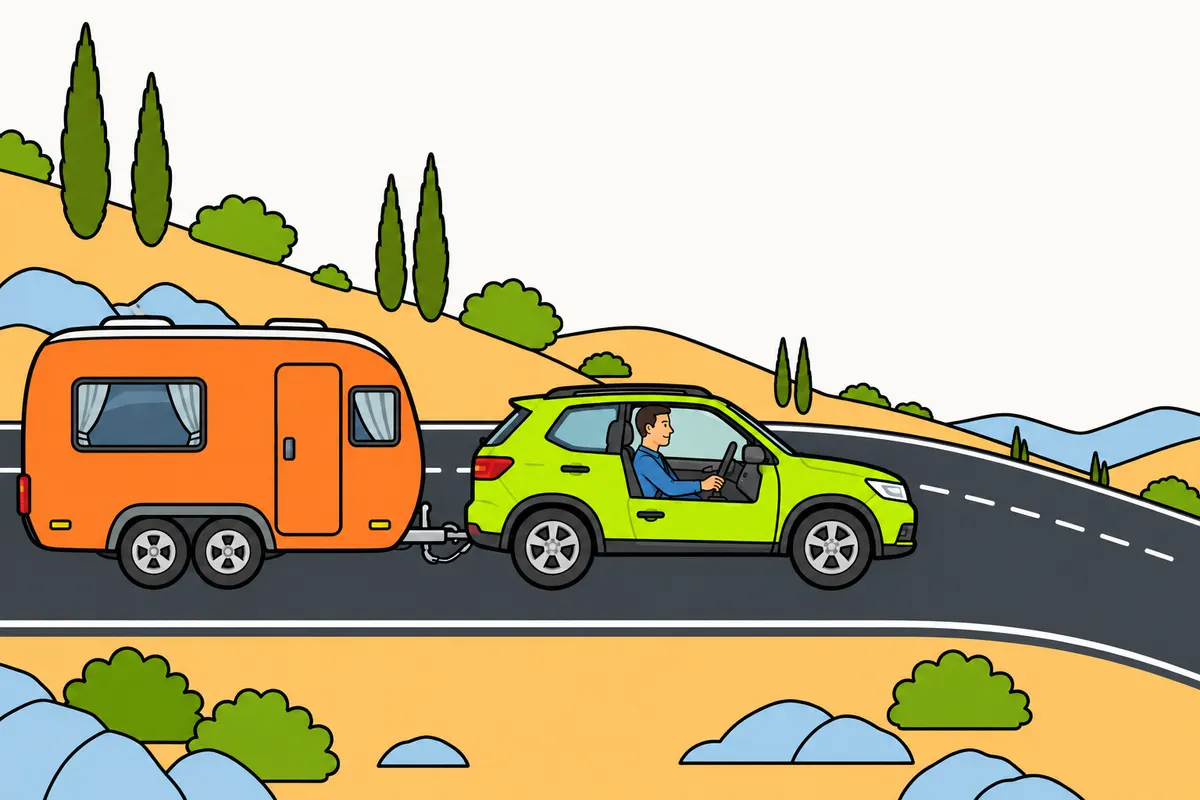
Before a long descent, slow down and prepare to use engine braking.
Remember
- Select a suitable gear before you gain too much speed.
- With an automatic gearbox, follow the manual for towing downhill.
- No single gear suits every slope and load.
- Do not descend in neutral or with the clutch pressed.
- The trailer’s pushing force can keep its overrun brake applied.
- Its brakes may keep working even when you barely press the pedal.
Exam trap: Wrong: engine braking guarantees the trailer’s brakes can rest. Right: pushing can keep its overrun brake applied.
Read the full explanation
- Before starting a long descent, you must reduce your speed and select a gear that allows you to use engine braking. You must do this while you still have time to make decisions. If you wait until the combination builds up considerable speed, you have to demand more from the brakes to regain control.
- Engine braking helps slow the towing vehicle through its transmission. With an overrun-braked trailer, the trailer's push against the towing vehicle can continue to activate its brake as you descend. Even if you barely press the pedal, you must not assume that the trailer brakes are resting.
- If you have an automatic gearbox or a vehicle with engine braking modes, you must use the options specified in its manual for descending while towing. No single gear suits every gradient and load. You must choose one that allows you to control your speed without exceeding the engine's operating limits.
- You must not descend in neutral or hold the clutch pedal down to let the combination coast. You lose the braking effect of the transmission and rely more heavily on the service brake. You must maintain a speed suited to the gradient, grip and condition of the braking equipment.
20Overheating and loss of effectiveness
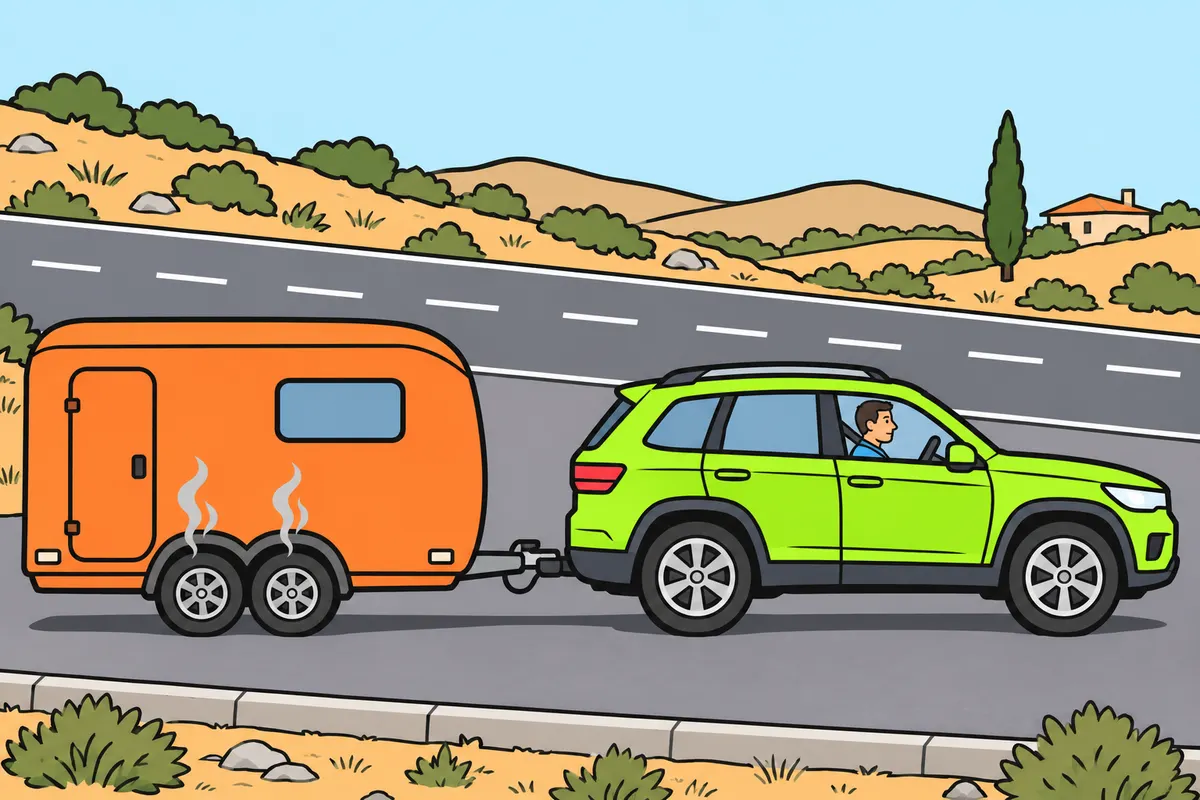
Avoid overheating your brakes and stop safely if they lose effectiveness.
Remember
- Do not keep the brakes lightly applied throughout the descent.
- Combine suitable speed, engine braking and braking as needed.
- Do not deliberately alternate acceleration and harsh braking.
- With smoke, strong smells or abnormal response, stop safely as soon as you can.
- Arrange inspection and do not continue with a dangerous fault.
- Do not touch hot discs or drums or cool them yourself with water.
Exam trap: Wrong: waiting a fixed time guarantees brake recovery. Right: follow assistance and manufacturer instructions; correct any dangerous fault.
Read the full explanation
- Excessive use of the service brake during a descent can overheat it and reduce its effectiveness, a phenomenon known as brake fade. You may need greater effort to achieve less deceleration. You must avoid keeping the brake lightly applied throughout the descent and use a suitable combination of speed, engine braking and braking as needed. [DGT, using brakes on gradients](https://revista.dgt.es/es/educacion-formacion/conducir-mejor/2023/0315-Frenadas.shtml)
- You must use the brake when needed to maintain control, without turning the descent into a deliberate series of accelerations and harsh braking. To assess the heat load on the brakes, you must consider both how long you brake and how hard you need to brake to hold the combination back. If a descent requires frequent braking, you need to take particular care in choosing your speed before starting it.
- If you notice a strong smell, smoke, reduced braking effectiveness or an abnormal response, seek to stop safely as soon as possible. You must have the equipment checked and must not continue driving with a defect that compromises safety.
- You must not check for overheating by touching discs or drums, or cool the components with water on your own initiative. Keep away from hot components and follow the instructions of the breakdown assistance service and the manufacturer. There is no universal waiting time that guarantees a brake fault has been resolved.
21Functional checks before setting off
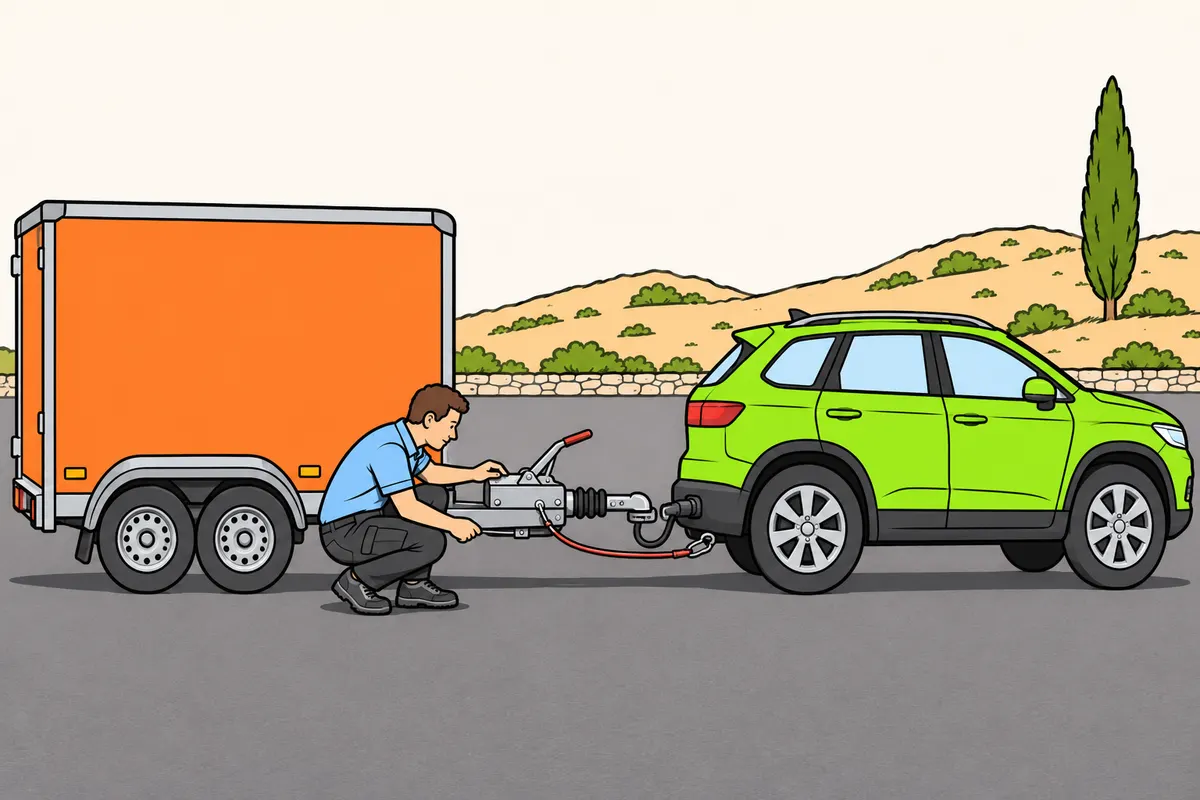
Before setting off, check that both vehicles brake and that the brakes release.
Remember
- Check brakes, connections and the appropriate breakaway or retaining device.
- Follow the manufacturer’s functional check in a suitable place without endangering anyone.
- Check for knocks, pulling to one side or abnormal dragging.
- Release the parking brake before moving off.
- Do not accelerate to overcome a wheel that stays braked.
- For major brake or steering faults, stop safely and resolve the cause.
Exam trap: Wrong: good low-speed braking lets you ignore damage or warnings. Right: check these too and resolve major faults before continuing.
Read the full explanation
- You must check the braking systems of both vehicles, the appropriate breakaway or secondary retaining device and the necessary connections. Preparation for the B+E practical test includes the trailer brake and connections. [RGCond, annex V.B.3.7.b](https://www.boe.es/buscar/act.php?id=BOE-A-2009-9481#anv)
- Once the combination is ready, carry out the functional check specified by the manufacturer in a suitable space without putting anyone at risk. You must check for a consistent response, with no pulling to one side, jolts or abnormal dragging. Satisfactory braking at low speed does not allow you to ignore visible damage or warnings.
- You must also check that the brakes release when they should and that the parking brake is not left applied when you set off. If a wheel remains braked, it can overheat and affect how the combination responds. You must not overcome this resistance by accelerating to continue your journey.
- If you encounter a serious braking or steering fault, you must stop safely and resolve the cause before continuing. The fact that the car still has working brakes does not automatically compensate for a trailer brake failure. You must be able to control and stop the whole combination, including in an emergency.
Check the brakes before driving
Follow the equipment manual and check the whole combination.
- Identify the trailer’s system and check that its masses are compatible with the towing vehicle and its towing capacity.
- With the trailer secured against movement, inspect the control, accessible transmission components and the appropriate breakaway or retaining device.
- Check the brake connections and the warnings relevant to the equipment fitted.
- Check that the parking brake releases and carry out the specified functional test in a safe area.
- If you notice knocks, pulling to one side, brake drag or abnormal warnings, immobilise the combination and correct the fault before setting off.
Reduce speed while maintaining stability
Procedure for planned normal braking.
- Look well ahead and identify the bend, traffic queue or gradient in advance.
- Check the traffic and leave enough space to stop the combination.
- Ease off the accelerator and apply the brake progressively, aiming to keep the towing vehicle and trailer aligned.
- Complete the main reduction in speed before turning and monitor the trailer’s response.
- If an emergency arises, apply the necessary braking; with working ABS, maintain firm pressure without pumping the pedal.
Drive down a long slope
Reduce heat build-up while keeping your speed under control.
- Moderate your speed and select a suitable gear before starting the descent.
- Keep the transmission engaged and use the available braking assistance as instructed in the manual.
- Brake when necessary, preferably with the combination aligned, and avoid resting your foot continuously on the brake pedal.
- Monitor the trailer’s response: the overrun system can keep its brakes applied.
- If braking effectiveness decreases, or you notice a strong smell or smoke, find a safe place to stop and arrange an inspection before continuing.
Finished this module?
Mark it as read and you will see your progress on the theory list.