
Theory · C1+E Licence - Light Truck with Trailer · Module 5 of 13
Braking the trailer and the vehicle combination
You learn to recognise the braking systems on your light lorry and trailer, distinguish the limits of unbraked, overrun-braked and coordinated braking systems, and check the connections and safeguards against separation. You can answer C1+E questions on ABS, stopping distance, jackknifing and long descents, linking each device to its function and to the stability of the combination.
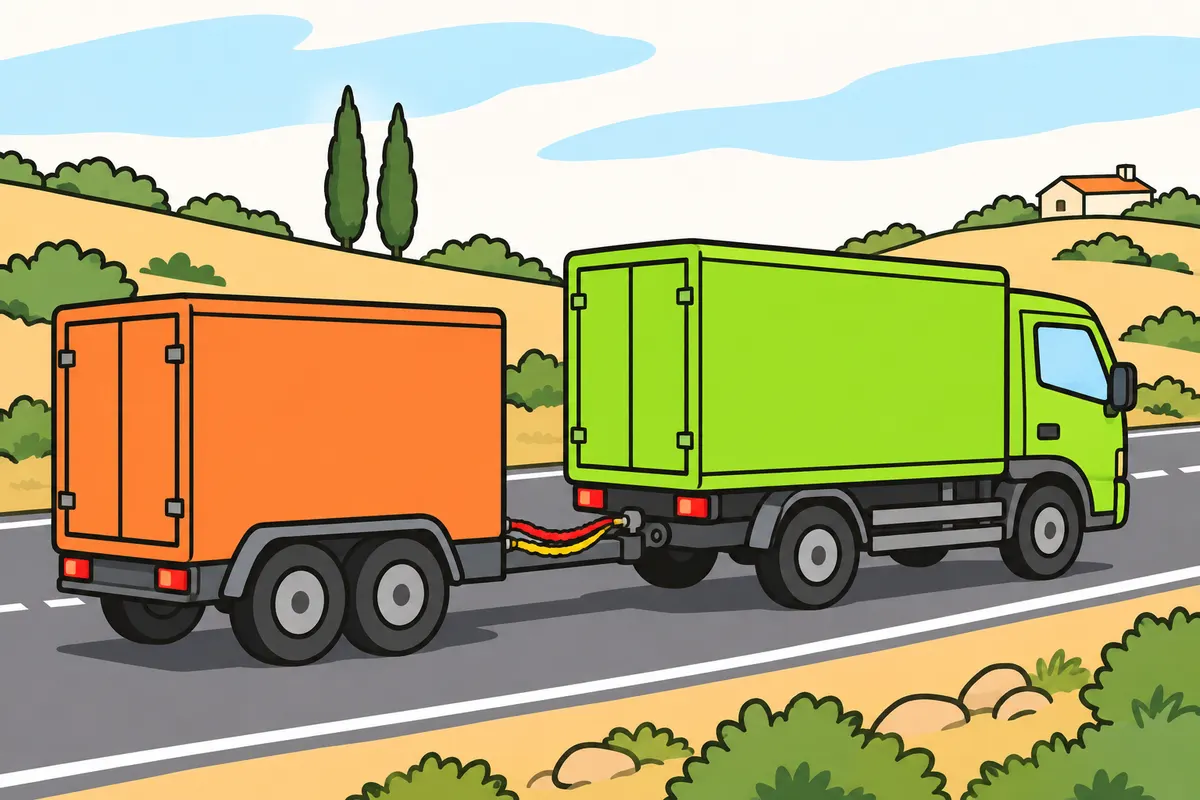
1Braking means controlling the whole combination
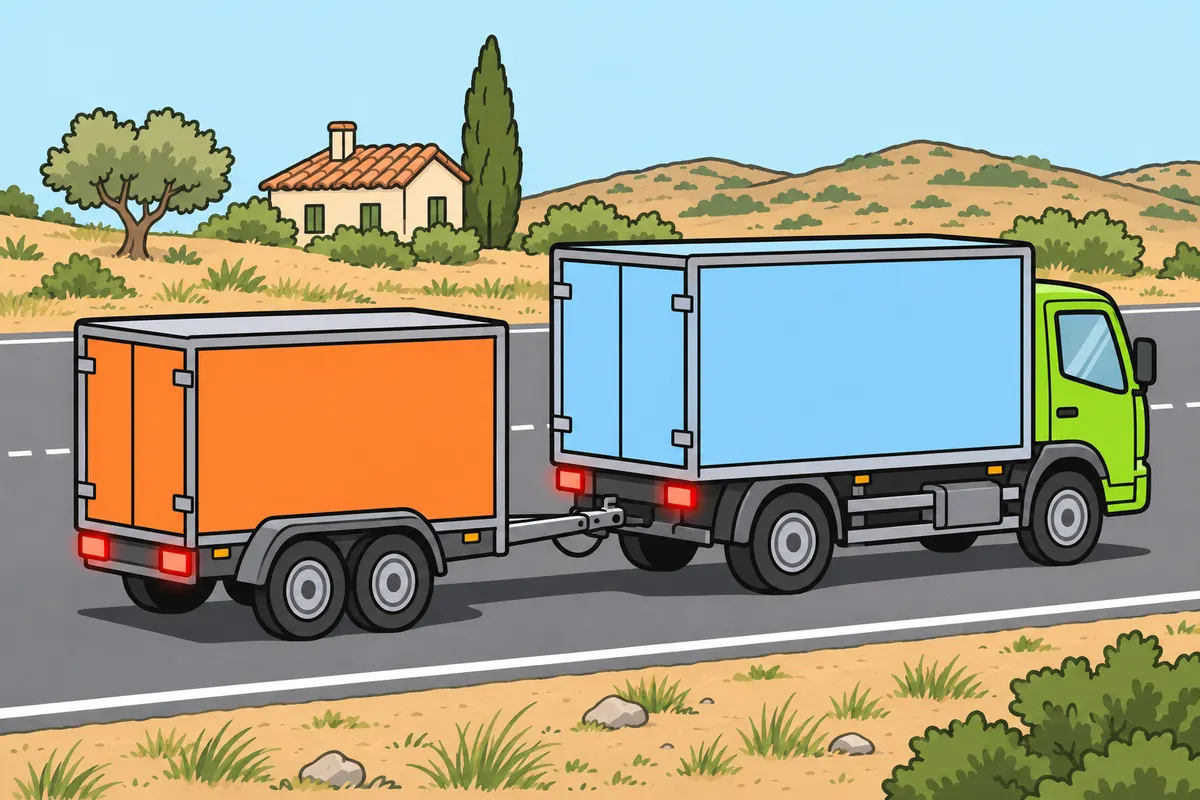
When braking, you must control your lorry and trailer together.
Remember
- Adapt your driving to the load and road conditions.
- Check how your trailer brakes too.
- A faulty connection can affect braking.
- Your licence does not determine the braking system.
- With a category B towing vehicle, C1+E covers trailers over 3,500 kg MMA.
- Respect the maximum combination MMA of 12,000 kg.
Exam trap: Wrong: good lorry brakes are enough. Right: you must control the trailer too.
Read the full explanation
- When you brake your light lorry with a trailer or semi-trailer, you must slow down two vehicles articulated together. Your aim is to stop them while keeping them on course: if the towed vehicle swings across, you can lose control even though the brakes are applying considerable force.
- You must understand the braking system as a chain of components: you give the command through a control, a transmission carries it to the brakes, and these produce the force that slows the rotation of the wheels. A faulty connection can affect the result just as much as a fault in the brake itself. [RGV, Annex VIII, section 1.1](https://www.boe.es/buscar/act.php?id=BOE-A-1999-1826#anviii).
- Each device has its own function within the combination. Coordination between the control, the transmission and the trailer brakes provides the requested deceleration without compromising your course.
- You must adapt your driving to the combination you are actually driving, its load and the road conditions. Having driven another lorry with a different response does not prove that this one stops within the same distance. Check how the towed vehicle behaves, as well as what you feel from the cab.
- In your C1+E combination, the C1 towing vehicle has an MMA (maximum authorised mass) over 3,500 kg and no more than 7,500 kg, and the combination's MMA must not exceed 12,000 kg. Within these limits, you can encounter different braking systems; the licence alone does not determine which system the trailer has. It also covers a category B towing vehicle with a trailer whose MMA exceeds 3,500 kg, within the same maximum for the combination. [RGCond, art. 4.2](https://www.boe.es/buscar/act.php?id=BOE-A-2009-9481#a4).
2Service, secondary and parking brakes
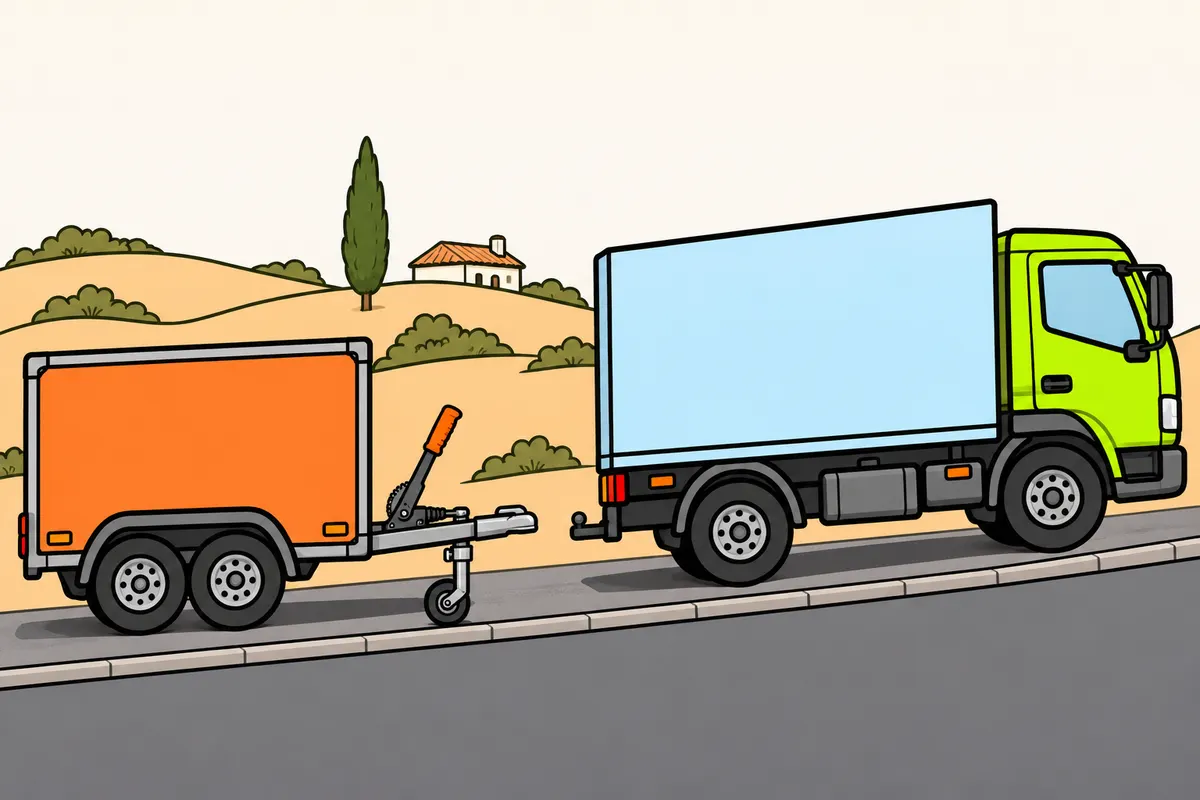
You must know what each braking function does.
| Function | What you use it for |
|---|---|
| Service | Control movement and stop safely |
| Secondary | Stop if the service brake fails |
| Parking | Keep the vehicle still, even on slopes without a driver |
Remember
- Adjust service braking force to your needs.
- You must also be able to adjust secondary braking force.
- Secure your trailer before separating it from the lorry.
- Do not confuse different braking functions with completely independent circuits.
- For O2 trailers, you need service and parking brakes.
- If their MMA exceeds 1,500 kg, you need automatic braking on uncoupling.
Exam trap: Wrong: holding the pedal replaces parking braking. Right: apply the parking brake before leaving your seat.
Read the full explanation
- With the service brake, you must be able to control the vehicle's movement and stop safely, both laden and unladen and on uphill or downhill gradients. You must be able to vary its braking force: you normally use the amount needed for the situation rather than applying its full capacity at once. [RGV, Annex VIII, section 1.2.1](https://www.boe.es/buscar/act.php?id=BOE-A-1999-1826#anviii).
- Secondary braking allows you to stop the vehicle within a reasonable distance if the service brake fails, and you must also be able to vary its braking force. How this function is provided and how you control it depend on the vehicle's installation. [RGV, Annex VIII, section 1.2.2](https://www.boe.es/buscar/act.php?id=BOE-A-1999-1826#anviii).
- The parking brake must keep the vehicle stationary on a gradient even without a driver, with its working parts held in place mechanically. Keeping the pedal pressed does not replace this function when you leave the driving seat. Check that the trailer is independently secured against movement before separating it from the towing vehicle. [RGV, Annex VIII, section 1.2.3](https://www.boe.es/buscar/act.php?id=BOE-A-1999-1826#anviii).
- In a pneumatic system, you can find functions that share components and energy reserves. You must therefore not assume that there are necessarily as many completely independent circuits as there are braking functions named in a question. Study the function being asked about and consult the manual to identify its controls and warnings.
- If you tow an O2 trailer, it must have service and parking brakes. Automatic braking on uncoupling is compulsory when its MMA exceeds 1,500 kg; for masses of 1,500 kg or less, the alternative protection is explained in «Secondary chain and breakaway cable». [RGV, Annex VIII, section 2 and note 4](https://www.boe.es/buscar/act.php?id=BOE-A-1999-1826#anviii); [RGV, art. 13.4](https://www.boe.es/buscar/act.php?id=BOE-A-1999-1826#a13).
3The limit for an unbraked trailer
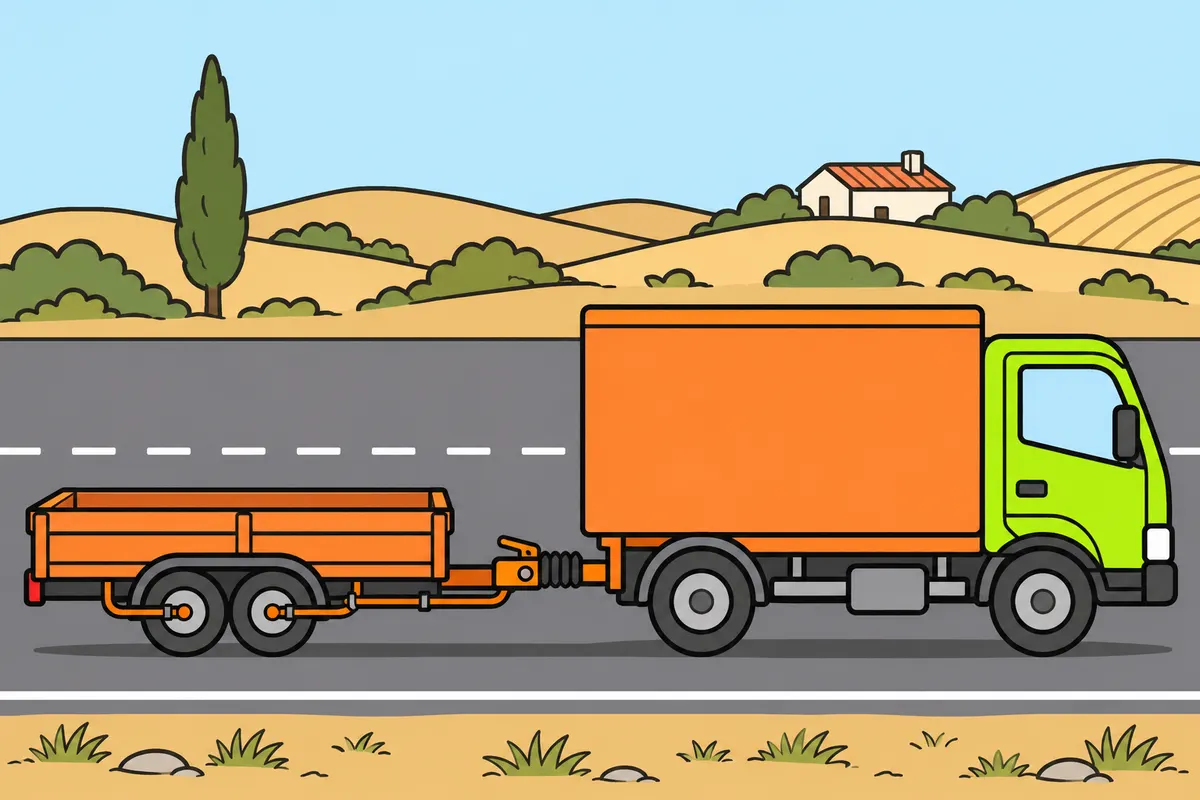
Without trailer brakes, you must respect the mass limit and any lower technical limit.
Remember
- Your towing vehicle’s mass in running order is its unladen mass plus 75 kg.
- Halve that running-order mass to find your unbraked towing limit.
- Never exceed 750 kg or any lower technical or coupling limit.
- Your licence and lorry power do not increase this limit.
- If your O1 trailer has brakes, they must meet O2 requirements.
- Even empty, requirements depend on MMA and the fitted system; never disable fitted brakes.
Exam trap: Wrong: a powerful lorry lets you tow over 750 kg unbraked. Right: respect this maximum and any lower technical limit.
Read the full explanation
- Without brakes, the towable mass must not exceed half the towing vehicle's mass in running order (its unladen mass plus 75 kg), with a maximum of 750 kg, or the technically permissible towable mass based on the vehicle's construction and the strength of the coupling. You must apply the lowest limit. [RGV, Annex IX, sections 4.1.1 and 4.1.2.1](https://www.boe.es/buscar/act.php?id=BOE-A-1999-1826#anix).
- Find the towable mass for an unbraked trailer in the towing vehicle's documents. The braked towing figure applies to a different configuration and may be different. When preparing the combination, match the technical figure to the system fitted to the trailer; neither the lorry's power nor your licence entitlement changes that capacity. [RGV, Annex IX, section 4.1.1](https://www.boe.es/buscar/act.php?id=BOE-A-1999-1826#anix).
- Category O1 trailers may have no service brake; if one is fitted, its installation must meet the requirements for O2. A trailer being light does not mean that its brakes may be faulty or that you may disable the brakes fitted to it. [UN Regulation No. 13, section 5.2.2.1](https://www.boe.es/buscar/doc.php?id=DOUE-L-2026-80539).
- For C1+E, you must focus on towed vehicles with an MMA over 750 kg: the provision allowing a light trailer to have no service brake does not extend to them. The MMA and the system fitted determine the braking requirements, even when you travel with an empty trailer. Agricultural exceptions do not apply to your ordinary goods trailer.
4How the overrun brake works
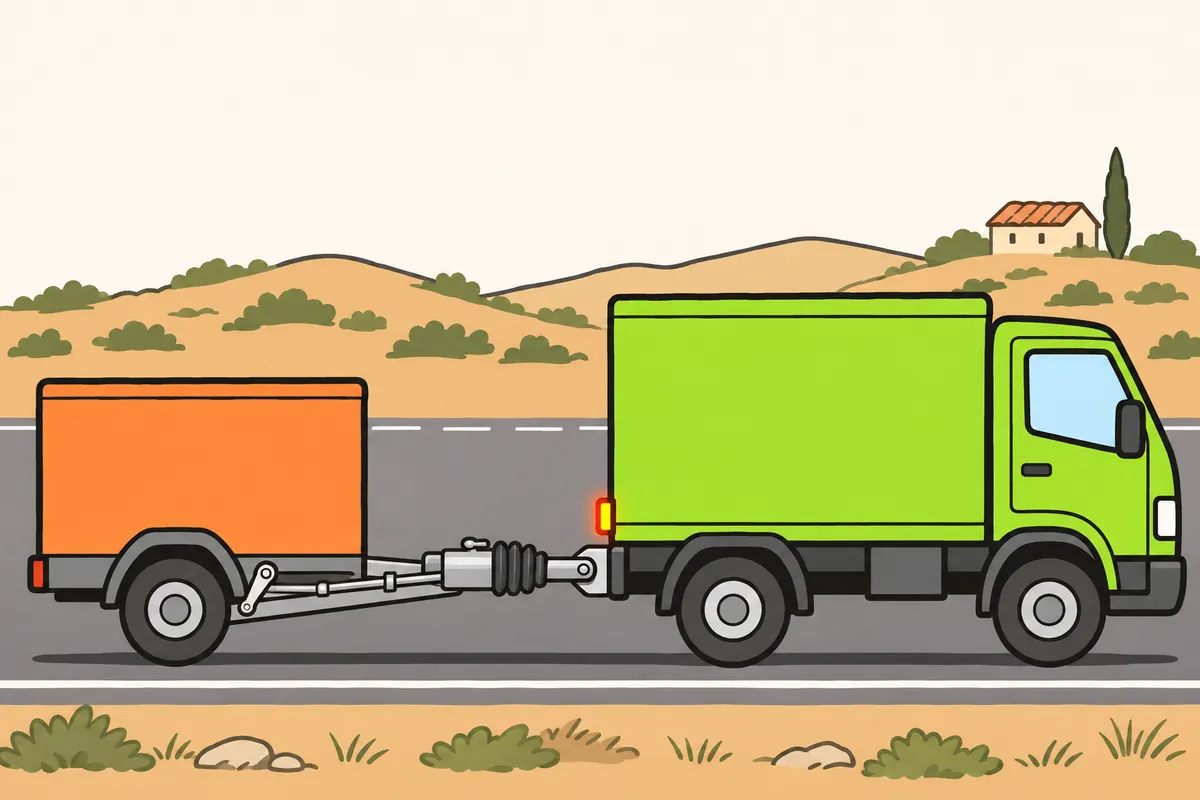
With overrun braking, your trailer pushes towards the towing vehicle and applies its brakes.
| Towing vehicle with overrun-braked trailer only | Towable mass limit |
|---|---|
| General | No more than towing vehicle MMA or 3,500 kg |
| Off-road | No more than 1.5 times towing vehicle MMA or 3,500 kg |
Remember
- When you slow down, your trailer compresses the coupling mechanism.
- Braking decreases when the pushing stops.
- Check your trailer’s category and type.
- For O2, type approval may allow overrun, continuous or semi-continuous service brakes.
- For O3 and O4, you need continuous or semi-continuous service brakes.
Exam trap: Wrong: overrun braking alone is enough for an O3 trailer. Right: it is insufficient for that category.
Read the full explanation
- The overrun brake uses the trailer's movement towards the towing vehicle when the latter slows down. The pushing force compresses the device in the coupling and transmits the actuation to the trailer brakes. You must associate it with this relative movement, rather than with a pneumatic command sent by the pedal. [RGV, Annex VIII, section 1.6](https://www.boe.es/buscar/act.php?id=BOE-A-1999-1826#anviii).
- When the pushing force stops and the towing vehicle pulls the combination again, actuation of the mechanism decreases. The response depends on the relative movement between the two vehicles: the travel of the coupling head and the adjustment of the transmission must allow the brakes to apply and release correctly.
- With overrun braking alone, the towable mass must not exceed either the towing vehicle's MMA or 3,500 kg. The exception for an off-road towing vehicle raises the ratio to 1.5 times its MMA, while retaining the 3,500 kg ceiling; do not apply it to any lorry merely because of its appearance. [RGV, Annex IX, section 4.1.2.2](https://www.boe.es/buscar/act.php?id=BOE-A-1999-1826#anix).
- An O2 trailer may have overrun, continuous or semi-continuous service braking, depending on its type approval; overrun braking is not permitted on O3 or O4 trailers, which require continuous or semi-continuous braking. [UN Regulation No. 13, sections 5.2.2.2 and 5.2.2.3](https://www.boe.es/buscar/doc.php?id=DOUE-L-2026-80539); [RGV, art. 12.8.2](https://www.boe.es/buscar/act.php?id=BOE-A-1999-1826#a12).
5Practical limits of the overrun system
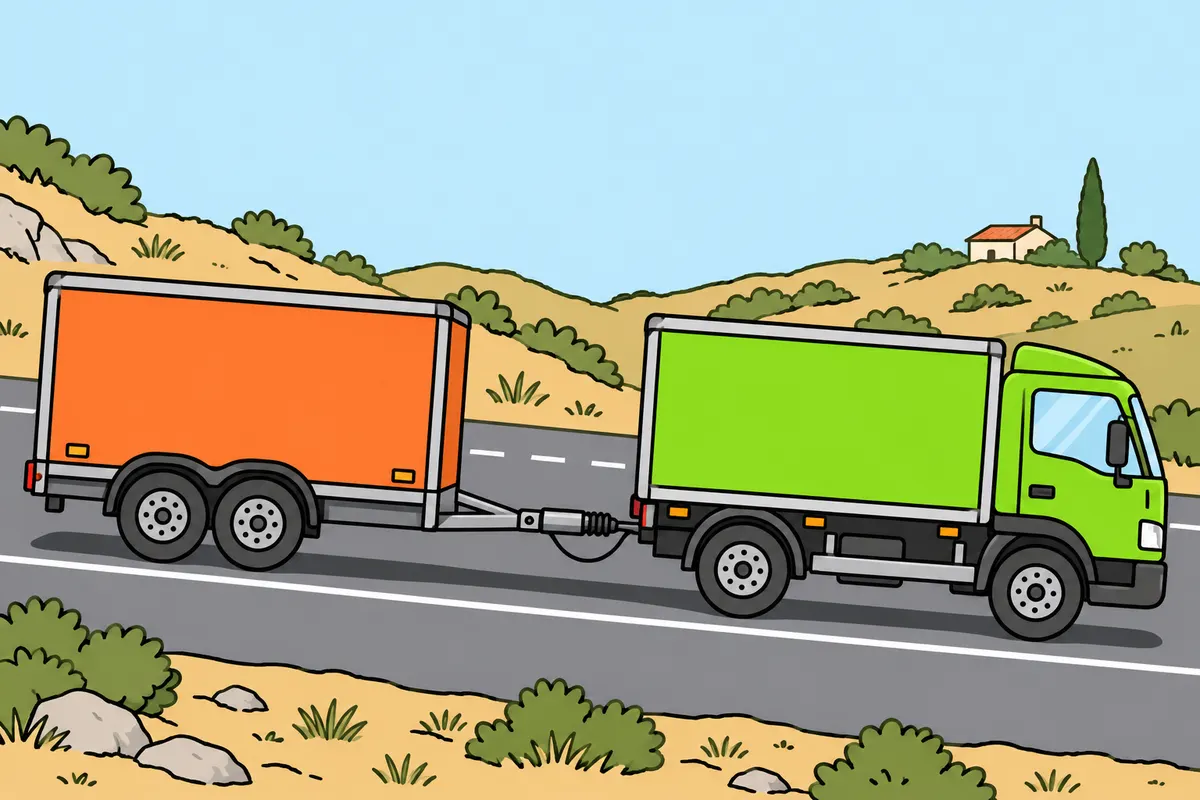
You must keep the overrun brake mechanism free to move and correctly adjusted.
| Device | When it acts |
|---|---|
| Overrun brake | When the trailer pushes towards the towing vehicle |
| Breakaway device, if fitted | When the coupling separates |
Remember
- Fix sticking parts and poor adjustment before driving.
- Follow the manufacturer’s instructions when reversing.
- Do not improvise locks that disable the brake.
- Start long descents slowly and use your towing vehicle’s braking assistance.
- Watch for overheating brakes.
Exam trap: Wrong: lock the mechanism to make reversing easier. Right: use the reversing operation provided by the manufacturer.
Read the full explanation
- If you tow a trailer with overrun braking, check that the mechanism can move and transmit force correctly. A sticking coupling head or an incorrectly adjusted transmission can cause the trailer to brake late or unevenly, or leave its brakes applied. You must correct these faults before driving.
- When you reverse, the trailer can also compress the device. Use the reversing arrangement provided by the manufacturer and follow its instructions; do not improvise locks to disable the brake. A solution that makes a manoeuvre easier but leaves the trailer without braking while driving compromises safety.
- On a sustained descent, the pushing force on the coupling can continue and increase the work done by the trailer brakes. You must enter the descent slowly, use the towing vehicle's engine braking appropriately and monitor the combination's behaviour. Do not confuse the system's mechanical simplicity with unlimited resistance to heat.
- You must distinguish normal overrun actuation from any breakaway device fitted to the trailer. The former responds to the vehicles moving closer together while driving; the latter must cause braking when the coupling separates. The fact that both use mechanical components does not make them the same function.
6Continuous and semi-continuous braking
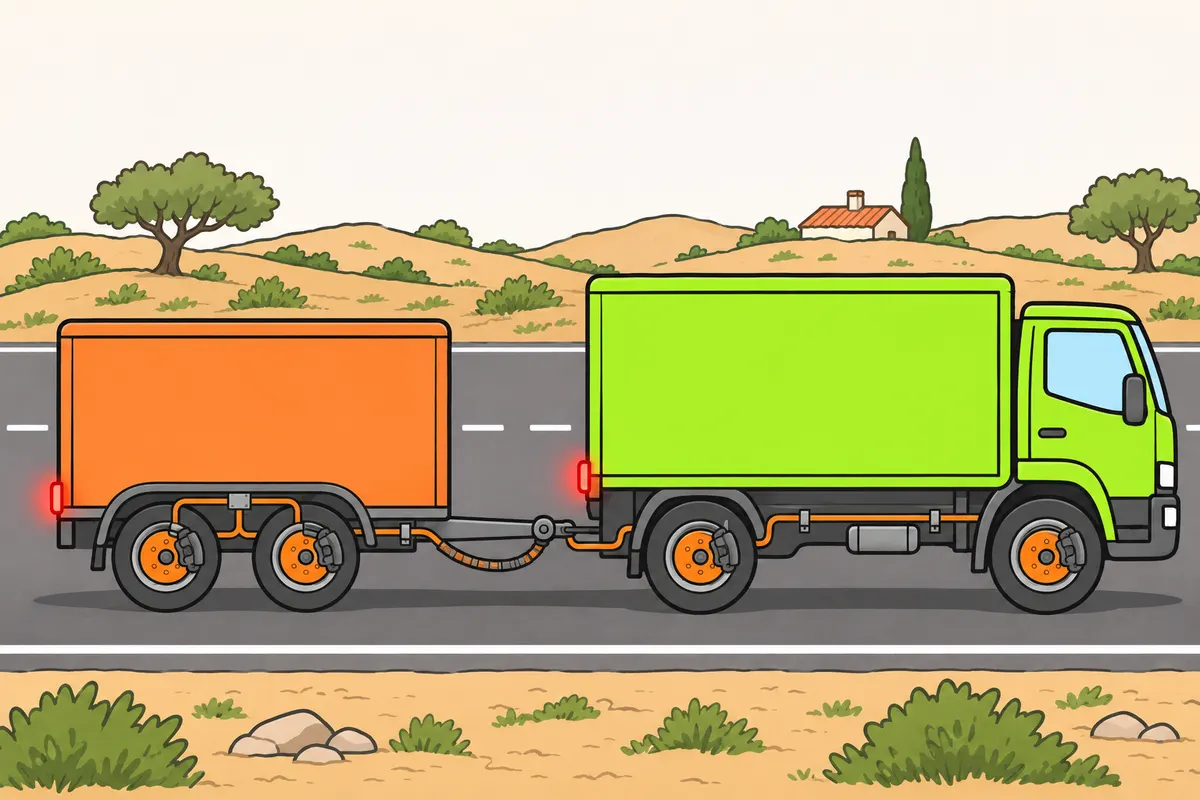
With continuous or semi-continuous braking, you control both vehicles through a single control.
| System | Control you use | Energy sources |
|---|---|---|
| Continuous | Single | Shared |
| Semi-continuous | Single | Two independent sources |
Remember
- Both systems let you adjust braking force from your seat.
- O3 and O4 trailers need continuous or semi-continuous service braking for type approval.
- With an N2 C1 towing vehicle and continuous braking, respect the maximum ratio.
- Respect technical, coupling and licence limits too.
- For M or N1, continuous braking limits towable mass to its MMA.
- Off-road: 1.5 times MMA, capped at 3,500 kg; also respect vehicle documents.
Exam trap: Wrong: continuous braking means always pressing the pedal. Right: it means coordinated braking with a shared energy source.
Read the full explanation
- With continuous braking, you use a single control progressively from the driving seat, and the combination's braking energy comes from a common source. The installation coordinates the braking of its vehicles, simultaneously or with the appropriate time delay, whatever their relative position. [RGV, Annex VIII, section 1.3](https://www.boe.es/buscar/act.php?id=BOE-A-1999-1826#anviii).
- With semi-continuous braking, you use a single control and obtain coordinated braking with two independent energy sources. The difference from continuous braking lies in the energy sources. [RGV, Annex VIII, section 1.4](https://www.boe.es/buscar/act.php?id=BOE-A-1999-1826#anviii).
- O3 and O4 trailers must have continuous or semi-continuous service braking in accordance with type-approval requirements. The system must act on the towed vehicle and coordinate both parts of the combination; overrun braking is not permitted in these categories. [UN Regulation No. 13, section 5.2.2.3](https://www.boe.es/buscar/doc.php?id=DOUE-L-2026-80539).
- For a C1 goods lorry in category N2, the maximum ratio under Annex IX when towing a trailer with continuous braking is 1.5 times the towing vehicle's MMA. You must also comply with the technical towable mass, the coupling limits and the 12,000 kg maximum for the combination authorised by C1+E; the braking ratio does not extend your licence entitlement. [RGV, Annex IX, sections 4.1.1 and 4.1.2.3](https://www.boe.es/buscar/act.php?id=BOE-A-1999-1826#anix); [RGCond, art. 4.2](https://www.boe.es/buscar/act.php?id=BOE-A-2009-9481#a4).
- For towing vehicles in categories M and N1 with a continuously braked trailer, Annex IX applies the ratio specified for overrun braking: the towable mass is limited to the towing vehicle's MMA, or 1.5 times its MMA if it is an off-road vehicle. Therefore, although C1+E includes a category B towing vehicle with a trailer whose MMA exceeds 3,500 kg, the mass you tow with an M or N1 towing vehicle must not exceed 3,500 kg or the towable mass stated in its documents. You must comply with both your licence entitlement and the vehicle's towing capacity at the same time. [RGV, Annex IX, sections 4.1.1, 4.1.2.2 and 4.1.2.3](https://www.boe.es/buscar/act.php?id=BOE-A-1999-1826#anix); [RGCond, art. 4.2](https://www.boe.es/buscar/act.php?id=BOE-A-2009-9481#a4).
7Compressed air transmits energy
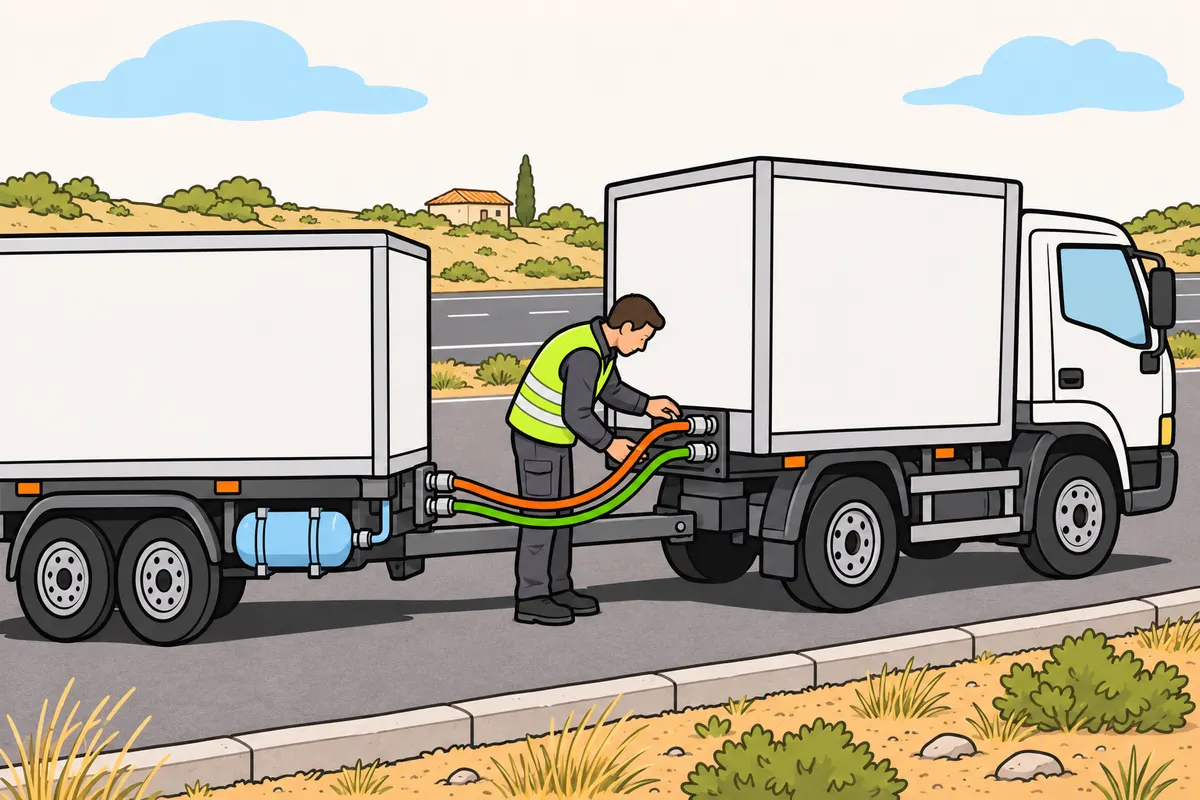
With air brakes, you need stored air and a system that responds correctly.
Remember
- Before moving off, check the operating pressure specified by the manufacturer.
- Check the system warnings.
- Do not assume every vehicle needs the same pressure.
- Do not compensate for a leak by revving the engine.
- If a fault compromises braking, stop, secure your combination and arrange repairs.
- Identify your system: some combinations do not have air brakes.
Exam trap: Wrong: pressure guarantees that all brakes work. Right: check the control and trailer response too.
Read the full explanation
- If your combination has air brakes, the compressor produces compressed air, which is stored in reservoirs. The valves use this energy to apply the brakes when you request deceleration. The air reserve and the braking command serve different functions: having pressure does not in itself prove that the control system and all the trailer brakes respond correctly. [DGT, Manual VIII, air braking system](https://sede.dgt.gob.es/.galleries/permisos-de-conducir/certificacion-aptitud-profesores-formacion-vial/2023/Manual-VIII-Mecanica-2023.pdf).
- Before moving off, you must have the operating pressure specified by the manufacturer and check the system warnings. Do not memorise a universal pressure in bar for all combinations: the ranges and thresholds depend on the installation and its instruments.
- Compressed air makes it easier to apply large forces without requiring equivalent muscular effort on the pedal. This does not guarantee grip or prevent discs and drums from heating up. You must still anticipate braking, even if you find that slowing down requires little pedal effort.
- Air leaks reduce the available reserve. Do not try to compensate for a leak by driving with the engine revving, or assume that the towing vehicle's pressure alone confirms the trailer's condition. Check the connections and, if the fault compromises braking, immobilise the combination and request repairs.
- You must not assume that every C1+E combination has an air braking system: a light lorry can tow a trailer with an overrun brake within the permitted limits. The checks depend on the system fitted: checking a mechanical cable and checking an air line are different tasks. The equipment manual and documentation allow you to identify the system without making assumptions based on the vehicle's size.
8Red supplies and yellow controls
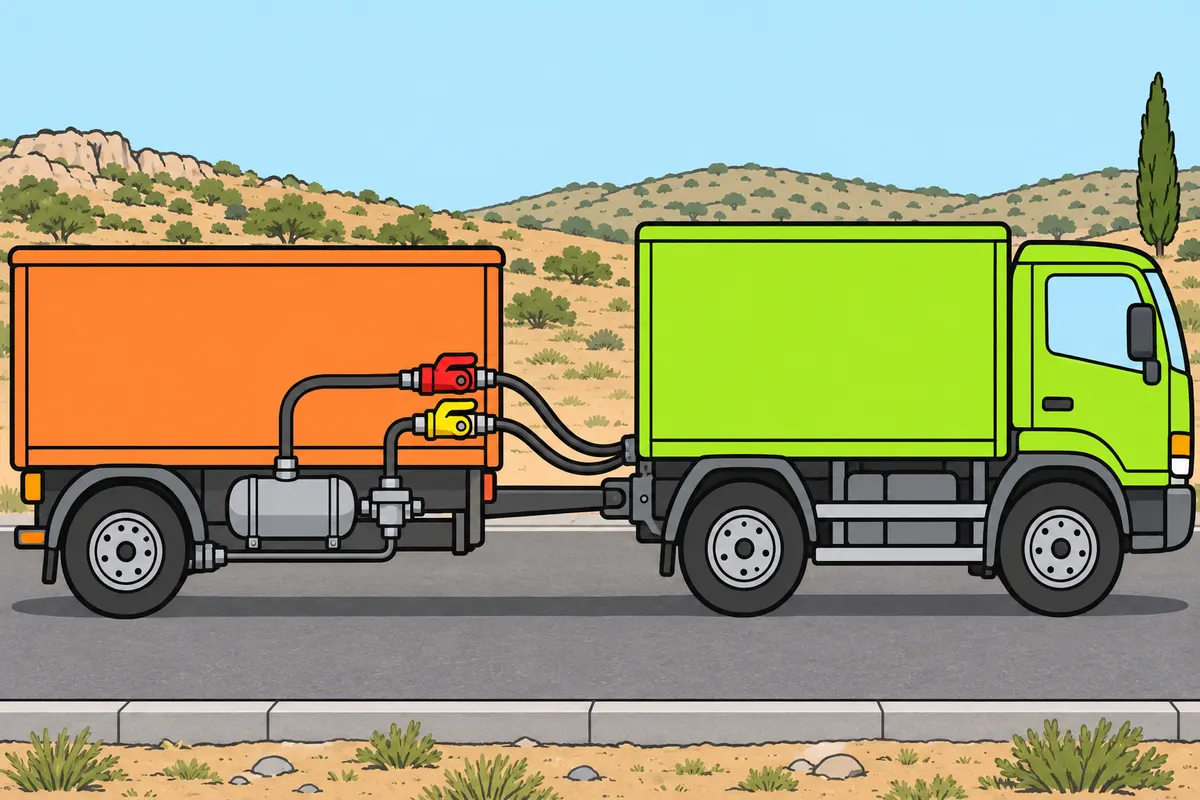
With conventional air connections, you identify red as supply and yellow as control.
| Conventional two-line air connection | Function |
|---|---|
| Red | Supplies trailer reservoirs; also called the emergency line |
| Yellow | Transmits the service braking demand |
Remember
- Identify the function by the coupling head colour.
- The whole hose need not have that colour.
- Check the electrical connection too if you have electronic braking management.
Exam trap: Wrong: working lights guarantee ABS and EBS work. Right: check their connections and warnings.
Read the full explanation
- In a conventional two-line air braking system, you must identify the red coupling head as the supply connection and the yellow one as the brake control connection. The colour identifies the connection's function; the hose does not need to be that colour along its entire length for you to recognise it. These are vehicle components, unrelated to traffic sign codes. [BOE, Order of 26 June 1986, annex on vehicle combination compatibility](https://www.boe.es/boe/dias/1986/07/11/pdfs/A25151-25174.pdf).
- The red supply line, also called the emergency line, charges the trailer's reservoirs. It maintains the supply on which the towed vehicle's available air reserve depends. [BOE, Order of 26 June 1986, annex on vehicle combination compatibility](https://www.boe.es/boe/dias/1986/07/11/pdfs/A25151-25174.pdf).
- The yellow line transmits the pneumatic service braking demand. The trailer's system uses its valves and stored air to produce the requested braking force. You must not imagine that all the air for each actuator has to travel from the cab along the yellow line every time you brake.
- If your combination has electronic braking management, also check its electrical connection and warnings; its components are explained in «Chambers, valves and electronic management». A working lighting connection does not prove that the trailer's ABS or EBS works.
9Chambers, valves and electronic management
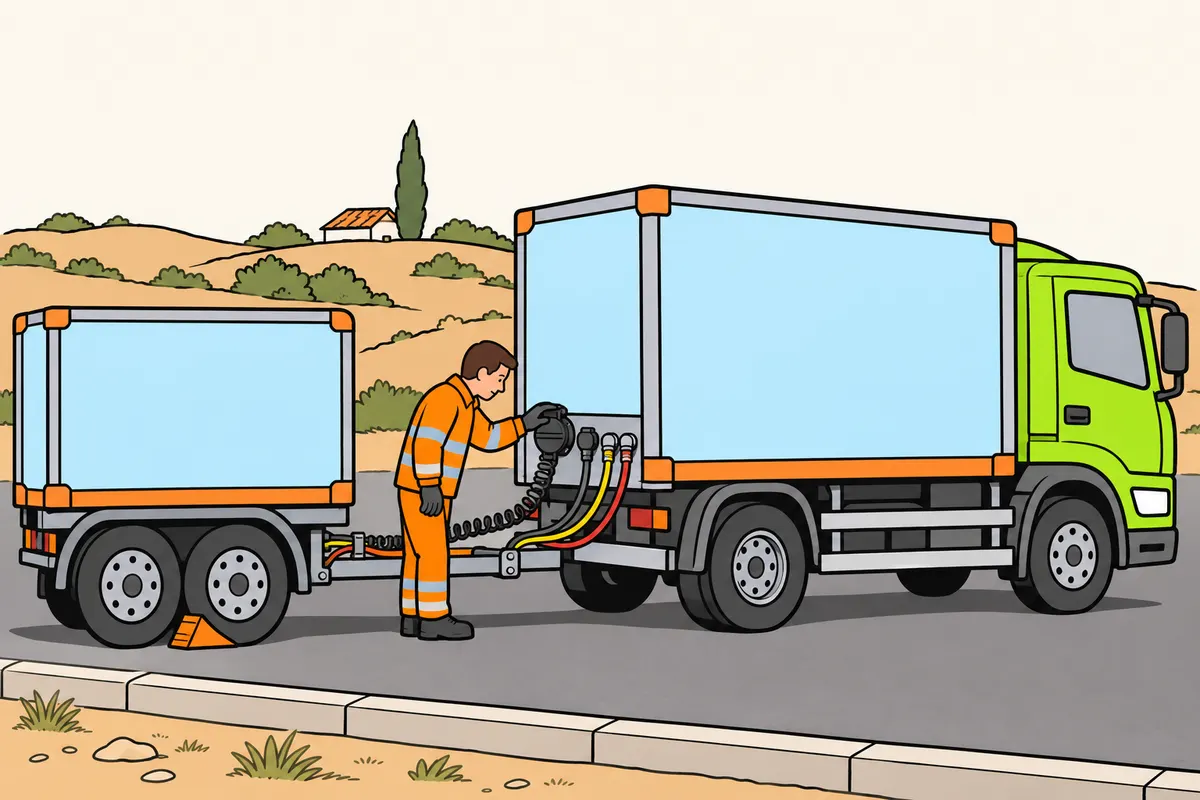
You must recognise the brake controls and connections fitted to your vehicle.
| Semi-trailer with combined two-button valve | Use |
|---|---|
| Red | Pull to apply the spring parking brakes |
| Black | Release automatic braking when uncoupled, using stored air for manoeuvring |
Remember
- With spring brake chambers, the spring applies the brake; air releases it.
- Before releasing trailer brakes, secure your trailer against unintended movement.
- Keep the ALB regulator adjusted: it adapts braking to the load.
- EBS manages braking electronically and includes ABS.
- Connect ISO 7638 and secure its lock.
- Follow your vehicle’s instructions: designs differ.
Exam trap: Wrong: the black button replaces parking braking. Right: it releases braking for manoeuvring; secure your trailer first.
Read the full explanation
- If your towing vehicle or trailer has spring brake chambers, the spring applies the parking brake and air keeps the spring compressed to release it. [United Nations Regulation No. 13, annex 8, section 1.1](https://www.boe.es/buscar/doc.php?id=DOUE-L-2026-80539); [DGT, Manual VIII, air brakes](https://sede.dgt.gob.es/.galleries/permisos-de-conducir/certificacion-aptitud-profesores-formacion-vial/2023/Manual-VIII-Mecanica-2023.pdf).
- On a semi-trailer with a combined two-button valve, the red button controls the parking brake: pulling it applies the spring brakes. You must follow the vehicle's own instructions to identify and operate it, because other designs exist. [ProVia/WABCO, park and release valve](https://provia-auto.com/product-category/conventional-brake-control/park-release-emergency-valve/).
- The black button on this valve allows you to release the uncoupled trailer's automatic braking to manoeuvre using the available air reserve; it does not replace the red parking brake control. Before using the release or shunt function, you must secure the trailer against unintended movement. [ProVia/WABCO, park and release valve](https://provia-auto.com/product-category/conventional-brake-control/park-release-emergency-valve/); [United Nations Regulation No. 13, sections 5.2.2.10 and 5.2.2.11](https://www.boe.es/buscar/doc.php?id=DOUE-L-2026-80539).
- The load-sensing brake valve, or ALB valve, adjusts braking pressure to the load carried by the axles. This limits excessive braking demand on lightly loaded wheels. You must maintain its adjustment; in electronic systems, this regulation may be integrated into the EBS. [United Nations Regulation No. 13, annex 10, section 7](https://www.boe.es/buscar/doc.php?id=DOUE-L-2026-80539); [DGT, Manual VIII, braking regulation](https://sede.dgt.gob.es/.galleries/permisos-de-conducir/certificacion-aptitud-profesores-formacion-vial/2023/Manual-VIII-Mecanica-2023.pdf).
- EBS electronically manages braking demand and its pneumatic modulation, including load adaptation and the ABS function. If your trailer has it, you must check its power supply and warnings following the manufacturer's instructions. [ZF/WABCO, electronic braking system for trailers](https://www.zf.com/products/en/cv/americas/campaigns/intelligent_trailer_braking_platform_from_zf.html).
- The ISO 7638 connector supplies power to the braking equipment; with electrical control, it also transmits data between the towing vehicle and trailer. You must connect it and secure its locking mechanism: the lighting plug does not replace it. [United Nations Regulation No. 13, section 5.1.3.6](https://www.boe.es/buscar/doc.php?id=DOUE-L-2026-80539).
10Connections that retain their function
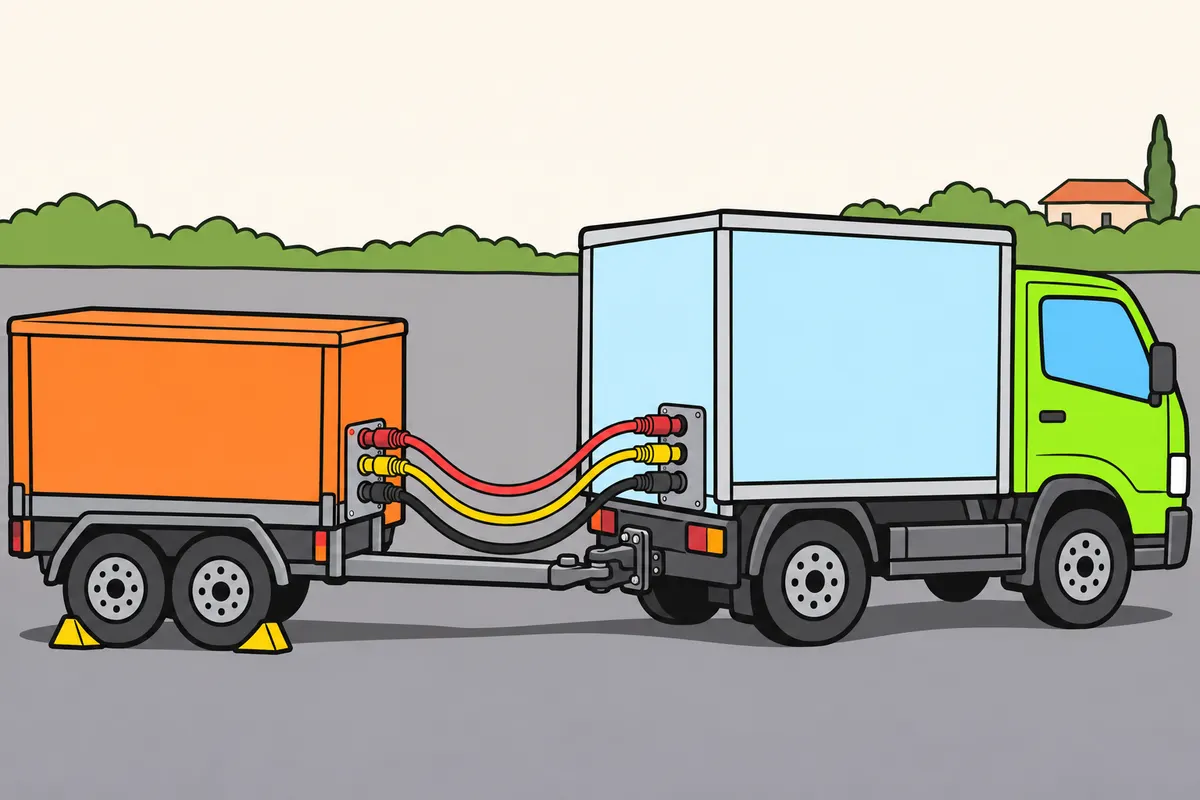
You must check that connections still work when your combination turns.
Remember
- Check that your connections are compatible.
- Keep hoses clear of tension, dragging, rubbing, trapping and hot parts.
- With your vehicle secured, check locks, seals, pipes and abnormal leaks.
- Check indicators and braking response as the manufacturer instructs.
- Test in a safe area at low speed.
- Keep your trailer secured when connecting or disconnecting.
Exam trap: Wrong: a connection that works in a straight line is enough. Right: it must allow turning without disconnecting or damage.
Read the full explanation
- You must check that the mechanical, electrical and pneumatic connections between the towing and towed vehicles are compatible. The Reglamento General de Vehículos (General Vehicle Regulations) requires this compatibility: simply being able to bring two coupling heads together physically or hold them together with a temporary fix is not enough. [RGV, art. 13](https://www.boe.es/buscar/act.php?id=BOE-A-1999-1826#a13).
- Inspect the hoses with the combination ready for the road: they must allow articulation without stretching until they come loose or hanging where they can chafe, become trapped or touch hot parts. A connection that is correct in a straight line can fail when you turn if you route it incorrectly.
- With the vehicle secured, check that the coupling heads are locked, that seals and pipes are in good condition and that there are no abnormal leaks. Then check the indicators and braking response using the manufacturer's specified check, in a safe area and at low speed.
- You study the complete connection and disconnection sequence in «Safe coupling and uncoupling». Supplying or releasing a system can change the state of the brakes: you must keep the towed vehicle secured and follow the manufacturer's specific sequence.
11Automatic braking on separation
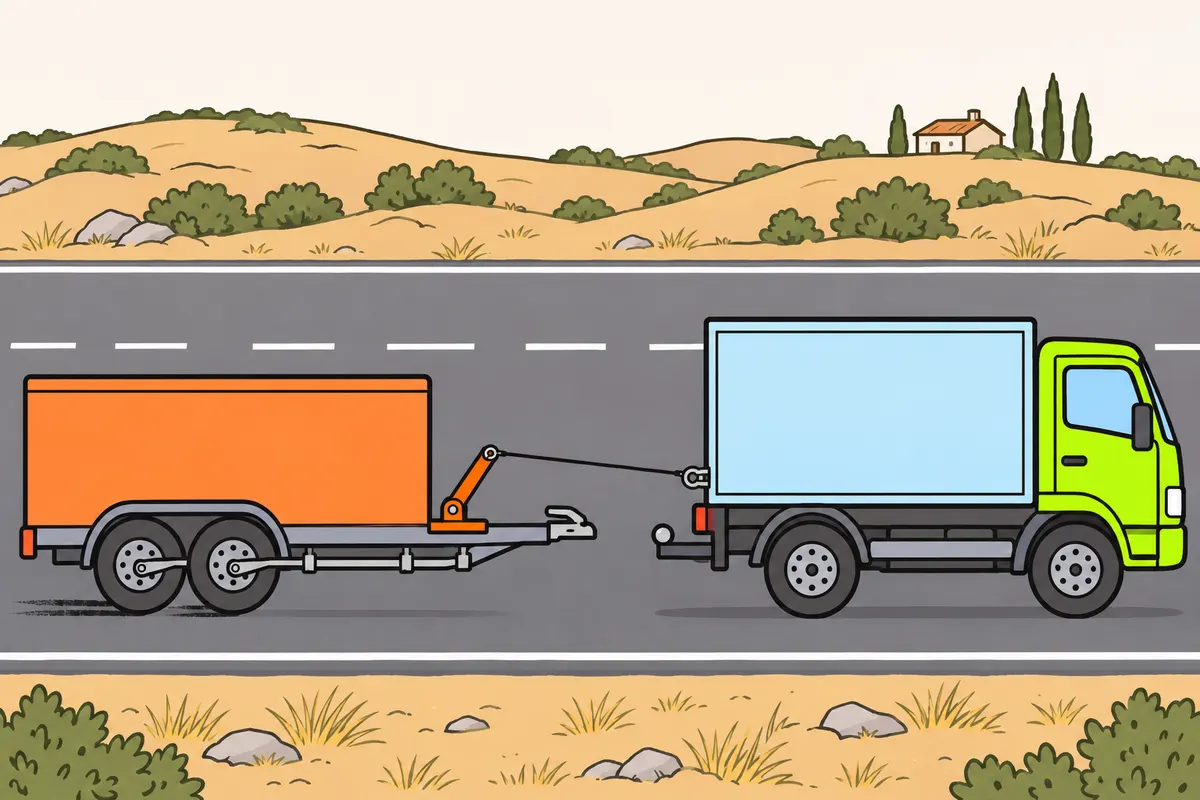
If your combination separates, the automatic device must brake your trailer.
| Separation protection system | Action |
|---|---|
| Mechanical breakaway cable | Pulls the brake mechanism when the coupling separates |
| Air braking | Supply loss associated with separation activates the automatic device |
Remember
- Do not confuse this protection with ABS.
- Attach your breakaway cable as instructed.
- Leave enough cable travel for your combination to turn.
- The cable cannot correct an improperly locked main coupling.
- Repair any fault in this protection.
Exam trap: Wrong: losing the air supply always releases trailer brakes. Right: it can activate automatic braking, depending on the design.
Read the full explanation
- The trailer's automatic braking must operate if the parts of the combination separate, including if the coupling breaks, without cancelling the braking effectiveness of the rest of the combination. You must not confuse it with ABS or autonomous braking to avoid a collision: it responds to separation. [RGV, annex VIII, section 1.5](https://www.boe.es/buscar/act.php?id=BOE-A-1999-1826#anviii). [RGV, art. 12.8.3](https://www.boe.es/buscar/act.php?id=BOE-A-1999-1826#a12).
- On a trailer with a mechanical breakaway device, the correctly attached cable pulls the intended mechanism if the coupling separates. You must fit it according to the instructions, with enough freedom of movement for articulation and without an improvised attachment that prevents it from operating. Its presence does not make up for a faulty main coupling lock.
- In an air braking system, a loss of supply associated with separation activates the intended automatic device. You must not conclude that losing air always leaves the trailer completely free to move: depending on the design, safety functions use the trailer's air reserve or spring energy.
- UN Regulation No. 13 requires automatic stopping if the coupling separates. You must keep the devices operational and repair any fault: automatic braking provides protection in an emergency, not permission to drive with hoses or couplings in poor condition. [UN Regulation No. 13, section 5.2.2.9](https://www.boe.es/buscar/doc.php?id=DOUE-L-2026-80539).
12Secondary chain and breakaway cable
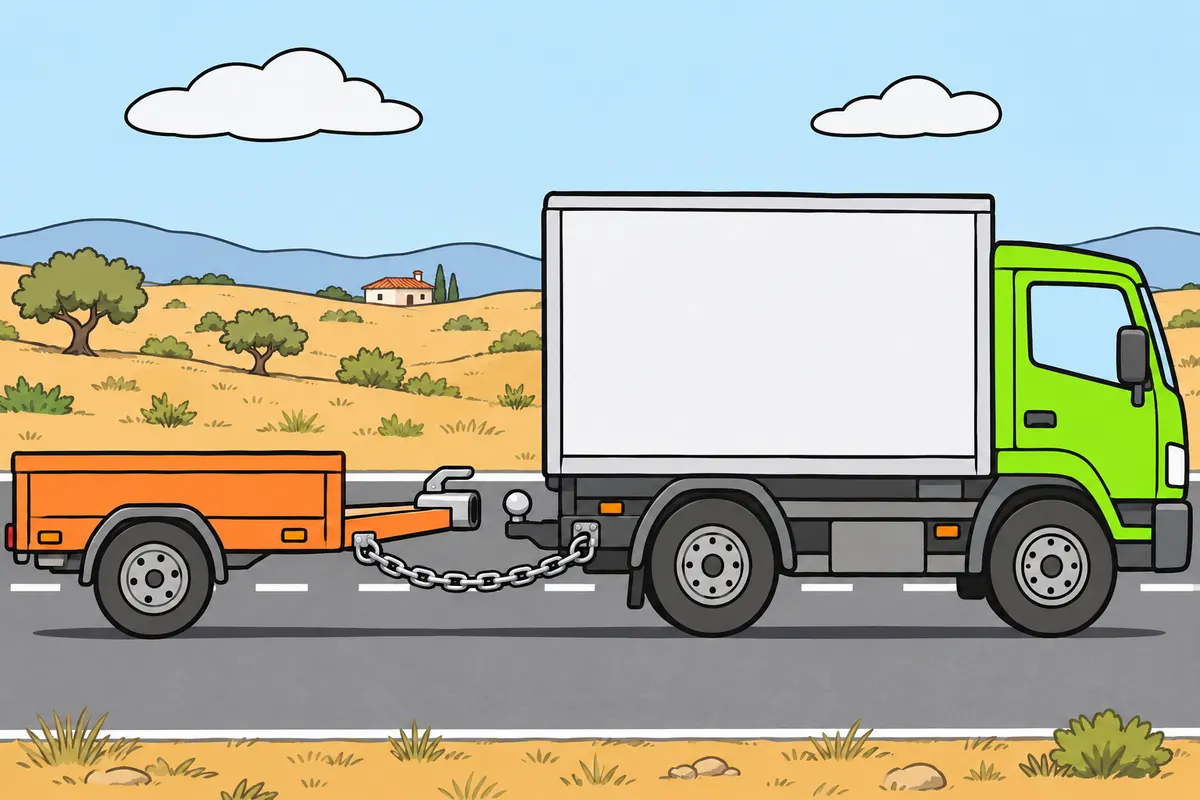
You must distinguish a secondary coupling from a cable that applies breakaway braking.
| Device | Function you must recognise |
|---|---|
| Secondary chain | Retains the trailer if the main coupling fails |
| Breakaway cable | Applies the brake when the coupling separates |
Remember
- Up to 1,500 kg MMA, without coupling-breakage braking, you need a secondary coupling.
- It keeps the drawbar off the ground and preserves some steering.
- Keep movement paths clear: avoid tension and rubbing when turning.
- Calculate the unbraked towable mass limit separately.
Exam trap: Wrong: a secondary coupling allows unbraked towing up to 1,500 kg. Right: this threshold concerns coupling protection, not the unbraked towing limit.
Read the full explanation
- If a trailer with an MMA (maximum authorised mass) of no more than 1,500 kg has no system that ensures braking if the coupling breaks, it must have a secondary coupling. Its purpose is to prevent the drawbar from touching the ground and retain some residual steering control if the main coupling fails. [RGV, art. 13.4](https://www.boe.es/buscar/act.php?id=BOE-A-1999-1826#a13).
- You must distinguish between mechanical retention and brake activation. A secondary chain can keep the trailer attached, whereas the breakaway cable on a braked system activates a mechanism. The fact that both look like a cable or chain does not mean you can interchange them without considering their function.
- The threshold for a secondary coupling governs protection against breakage of the main connection; the unbraked towing capacity is calculated separately, as explained in «The limit for an unbraked trailer». [RGV, art. 13.4 and annex IX, section 4.1.2.1](https://www.boe.es/buscar/act.php?id=BOE-A-1999-1826#a13).
- When checking protection against separation, check which part retains the drawbar and which activates the brake. You must keep their paths of movement clear so that normal articulation does not pull them taut or leave them exposed to chafing. The installation of these devices is covered in «Safety devices for the vehicle combination».
13ABS on the trailer too
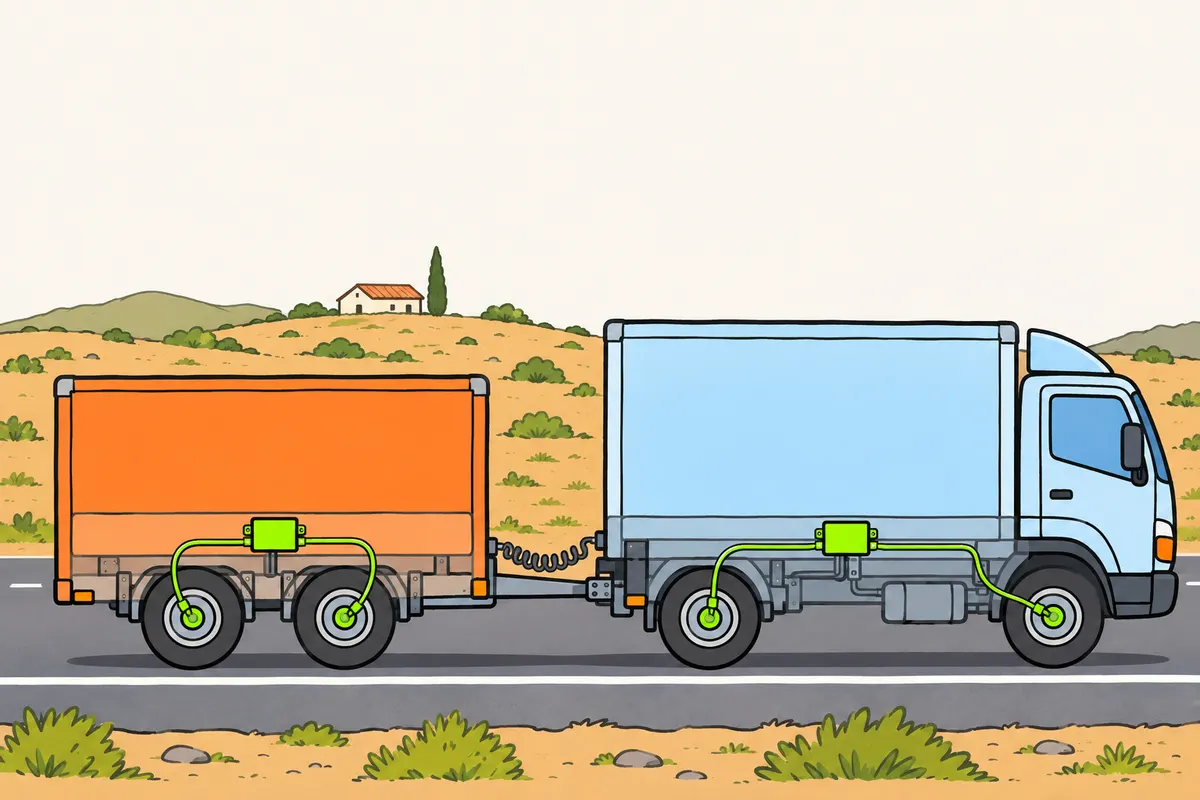
You must check your trailer’s ABS, even if your lorry has ABS too.
| Trailer category | MMA |
|---|---|
| O1 | Up to 750 kg |
| O2 | Above 750 kg and up to 3,500 kg |
| O3 | Above 3,500 kg and up to 10,000 kg |
| O4 | Above 10,000 kg |
Remember
- ABS adjusts braking to prevent wheels staying locked.
- It does not add road grip.
- Check your trailer ABS power supply and warnings.
- O3 and O4 trailers need ABS for type approval.
- For your particular trailer, check its type approval, age and documentation.
- Do not disable fitted ABS.
Exam trap: Wrong: lorry ABS protects trailer wheels. Right: ABS only controls wheels connected to its sensors and modulators.
Read the full explanation
- Trailer categories are O1, up to 750 kg; O2, over 750 kg and up to 3,500 kg; O3, over 3,500 kg and up to 10,000 kg; and O4, over 10,000 kg. For C1+E, you must pay particular attention to O2 and O3 and to the maximum authorised mass of your combination. Do not confuse these technical trailer categories with driving licence categories. [DGT, Manual III, categories and braking](https://sede-pro.dgt.gob.es/.galleries/permisos-de-conducir/certificacion-aptitud-profesores-formacion-vial/2019/Manual-III-Reglamentacion-de-Vehiculos-Pesados-2019.pdf).
- ABS automatically regulates wheel slip during braking to prevent the wheels from locking. You must understand that it regulates the braking force of the brakes it controls; it does not add grip to the road surface or remove the need to choose a speed that allows you to stop the combination. [DGT, safety systems, ABS](https://www.dgt.es/export/sites/web-DGT/.galleries/downloads/conoce_la_dgt/que-hacemos/conocimiento-e-investigacion/Efectividad-Sistemas-de-Seguridad-Vehiculos.pdf).
- For O3 trailer type approval, UN Regulation No. 13 requires an anti-lock braking system complying with its Annex 13; it also requires ABS for O4. You must not assume that O3 is exempt because it does not exceed 10,000 kg. The position for a registered trailer depends on the regulations applicable to its approval. [UN Regulation No. 13, paragraph 5.2.2.13](https://www.boe.es/buscar/doc.php?id=DOUE-L-2026-80539).
- Your light lorry's ABS does not provide anti-lock control for trailer wheels that lack it. You must check the towed vehicle's system, its power supply and its warnings; its control acts only on the wheels connected to its own sensors and modulators. This distinction matters whether you tow an O2 or an O3 trailer.
- For a particular vehicle, you must consider its type approval, age and documentation; do not infer a universal requirement to modify every existing vehicle from a type-approval requirement. Nor should you interpret an empty cell in a general table as permission to disable the ABS fitted.
14Emergency braking with ABS
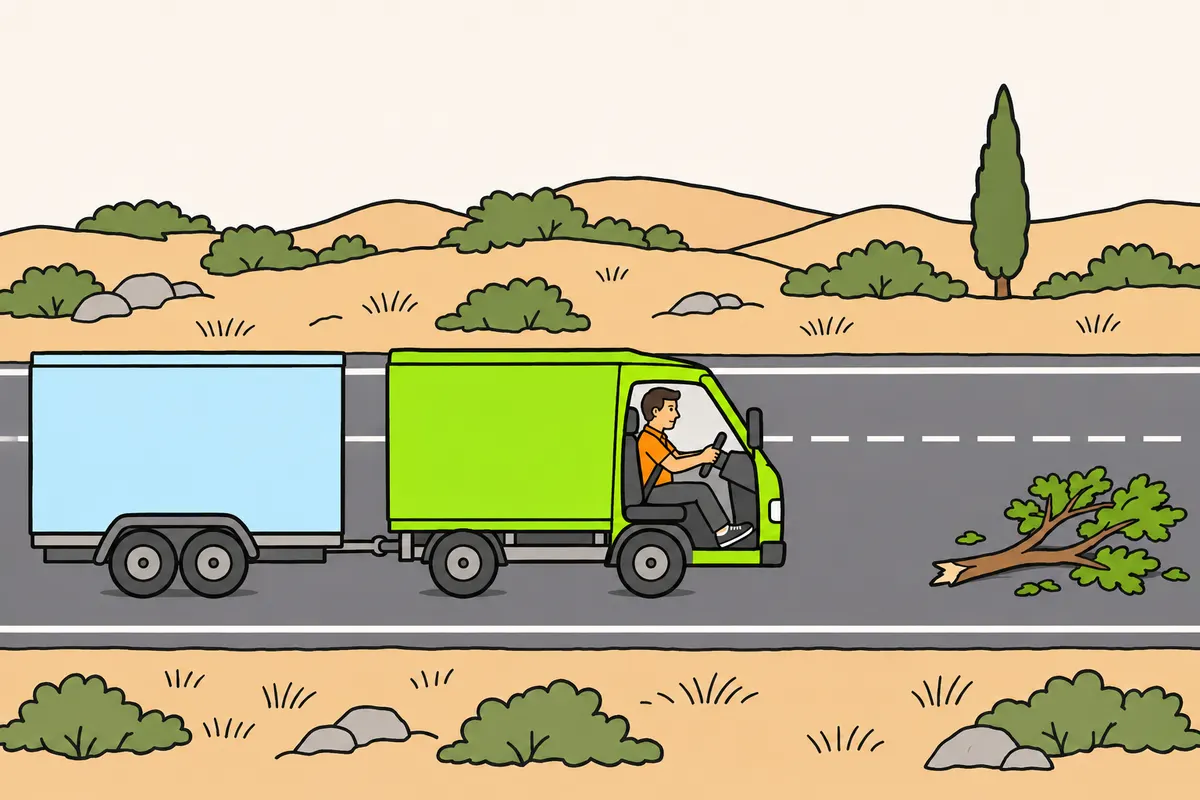
In an emergency with working ABS, you press firmly and maintain the necessary pressure.
Remember
- Do not pump the pedal.
- Do not release it because of normal ABS vibrations.
- Keep your steering controlled.
- Allow for the space your trailer needs if you must swerve.
- Avoid excessive steering that could destabilise your combination.
- Keep enough space to stop both vehicles.
Exam trap: Wrong: ABS always stops you sooner. Right: it does not guarantee a shorter distance on every surface.
Read the full explanation
- When braking in an emergency with ABS working, you must press the brake pedal firmly and maintain the necessary pressure, without pumping it or releasing it because of the system's normal vibrations. [DGT, ‘Brakes: how to use them correctly’](https://revista.dgt.es/es/educacion-formacion/conducir-mejor/2023/0315-Frenadas.shtml).
- When a collision is imminent, you must use the available braking capacity while keeping your steering controlled so that the towed vehicle remains stable. General guidance on applying the controls progressively is covered in ‘Driving techniques for vehicle combinations’.
- ABS helps you retain steering ability within the available grip. When taking evasive action, you must allow for the space the trailer occupies: excessive steering can destabilise it even if the towing vehicle's wheels continue to roll.
- ABS does not guarantee a shorter distance on every surface; you must maintain the margin needed to stop both vehicles. [DGT, safety systems, ABS](https://www.dgt.es/export/sites/web-DGT/.galleries/downloads/conoce_la_dgt/que-hacemos/conocimiento-e-investigacion/Efectividad-Sistemas-de-Seguridad-Vehiculos.pdf).
15ABS warnings and braking faults
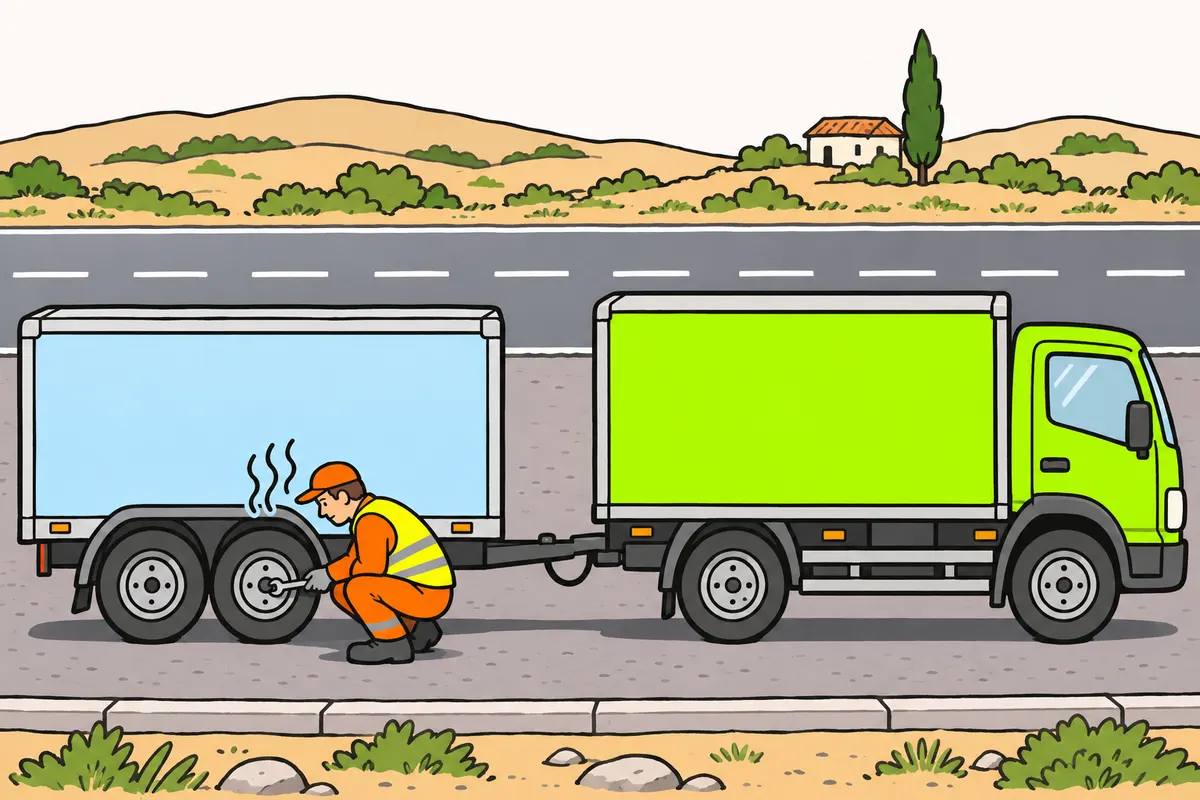
When you see a braking warning, identify the fault and act according to its seriousness.
| Fault | What you must distinguish |
|---|---|
| ABS fault | You may lose anti-lock control while keeping service braking |
| Insufficient pressure | Affects the energy available for braking |
Remember
- Interpret the ABS warning using its normal sequence and your manual.
- Check braking on both vehicles.
- Brake lights do not prove that the brakes work correctly.
- If braking weakens or pulls severely to one side, stop somewhere safe.
- Do the same if a leak compromises safety.
- Repair the cause before driving again.
Exam trap: Wrong: every ABS warning means all brakes have failed. Right: identify the fault; service braking may still work.
Read the full explanation
- The trailer's ABS warning lamp has its own self-test sequence. If it stays on outside this sequence, you must interpret the warning according to the manual and check the installation. [UN Regulation No. 13, Annex 13, paragraph 4](https://www.boe.es/buscar/doc.php?id=DOUE-L-2026-80539).
- An ABS fault can disable anti-lock control while leaving service braking available. An insufficient-pressure warning concerns the energy available: you must identify the specific fault before deciding how to act.
- If braking becomes less effective, the vehicle pulls sharply to one side or a leak compromises safety, you must stop in a safe place and repair the cause before resuming your journey.
- A towing vehicle that brakes normally can be pushed by a faulty trailer. You must assess the pressure, braking balance and response of both vehicles; the brake lights only provide the light signal.
- Abnormal noises, vibrations and rubbing can indicate uneven braking or a brake that stays applied and generates heat. Diagnosis is covered in ‘Maintenance and inspection of the vehicle combination’, in the checks on brakes and dashboard warnings.
16Braking distance and stopping distance
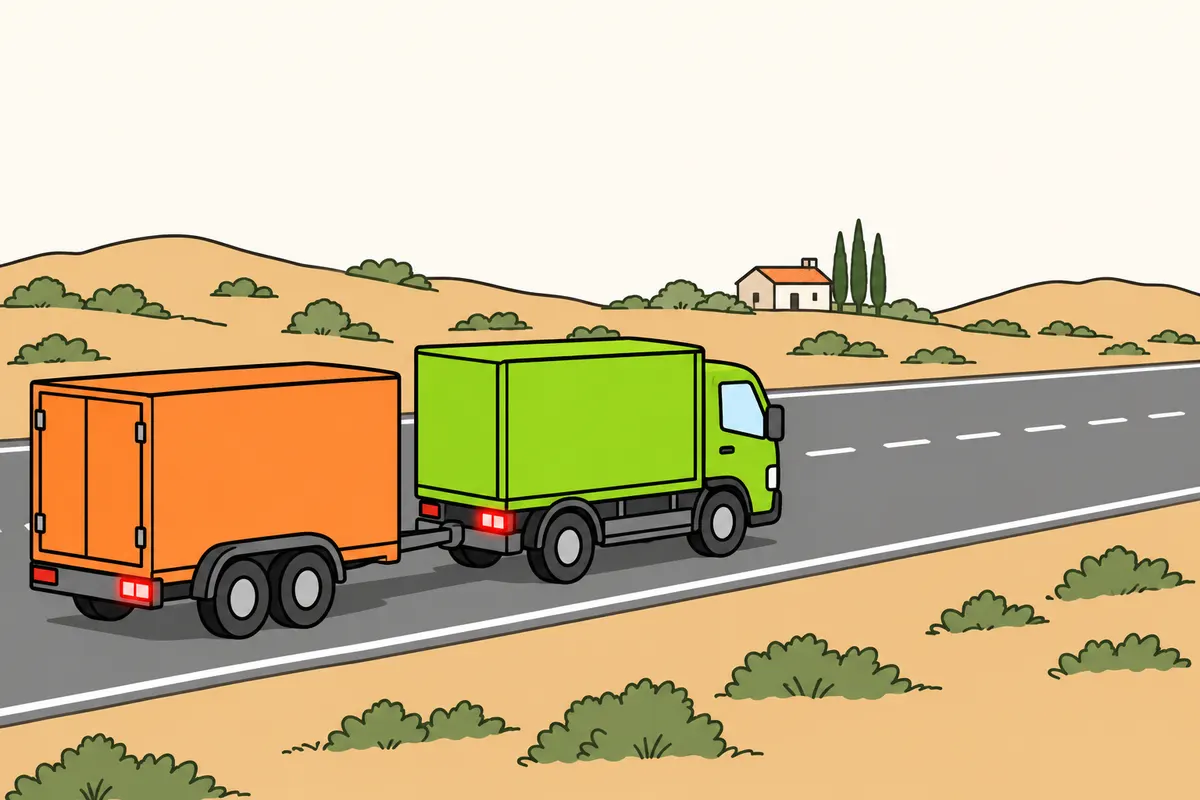
When judging stopping performance, you must consider how both vehicles respond.
Remember
- Study reaction, braking and stopping in “Speed and distances for the vehicle combination”.
- Check whether your trailer pushes or brakes unevenly.
- These problems affect your combination’s stopping performance and stability.
Exam trap: Wrong: judging the lorry brakes is enough. Right: consider your trailer’s response too.
Read the full explanation
- Study reaction, braking and stopping distances in ‘Speed and distances for the vehicle combination’. For your C1+E, you must consider how the brakes on both vehicles respond: a trailer that pushes or brakes unevenly changes the combination's stopping behaviour and stability. [RGC, art. 45](https://www.boe.es/buscar/act.php?id=BOE-A-2003-23514#a45).
17Mass, load and grip
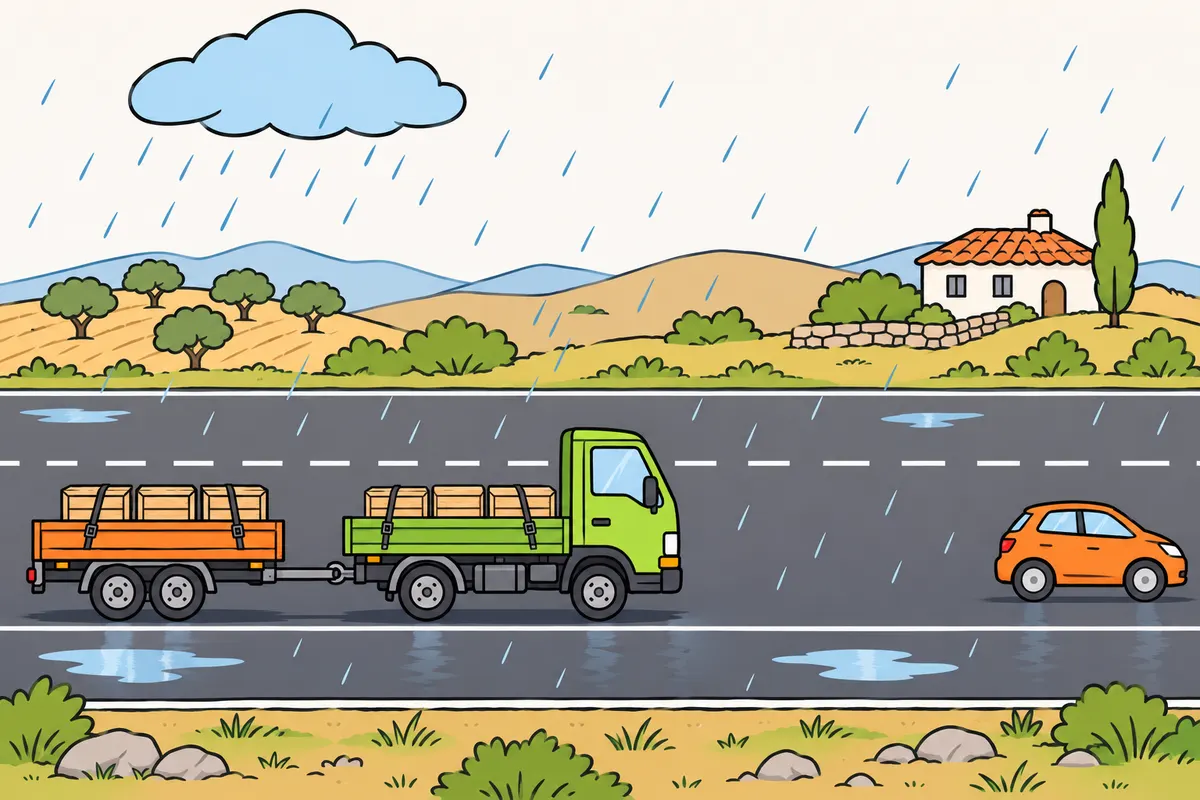
You must adapt braking to the mass, load and road grip.
Remember
- With more mass, you must remove more energy for the same speed reduction.
- Do not calculate a fixed distance increase from added mass.
- Distribute and secure your goods properly.
- Do not assume an empty trailer always has better grip.
- On slippery roads, slow down earlier and leave more space.
- Check your trailer tyres, shock absorbers and brakes too.
Exam trap: Wrong: empty always means more stable braking. Right: excessive braking can make you lose grip, especially on slippery roads.
Read the full explanation
- With greater mass, you must dissipate more energy for the same reduction in speed. You must not translate this into a universal proportional increase in metres, because the loads on the wheels and the effective braking capacity also change. Overloading the combination reduces the margin within which it is designed to operate.
- A poorly distributed load can leave some axles lightly loaded and others overloaded. When you brake, a lightly loaded axle can reach the limit of grip sooner; a shifting load also alters the balance. You must drive with the goods distributed and secured: the details are covered in ‘Safe, well-distributed loads’.
- With an empty trailer, excessive braking demand can cause loss of grip, especially on a slippery road surface. Load-dependent regulation is explained in ‘Chambers, valves and electronic management’; you must keep it working and adapt your driving to the road surface.
- In rain, snow, ice or dirt, or when grip differs under each side of the combination, you must slow down early and increase your margin. Poorly maintained tyres, shock absorbers or brakes can worsen the response. Check those on the trailer too: a towing vehicle in good condition does not compensate for the trailer's lack of grip.
18Preparing for normal braking
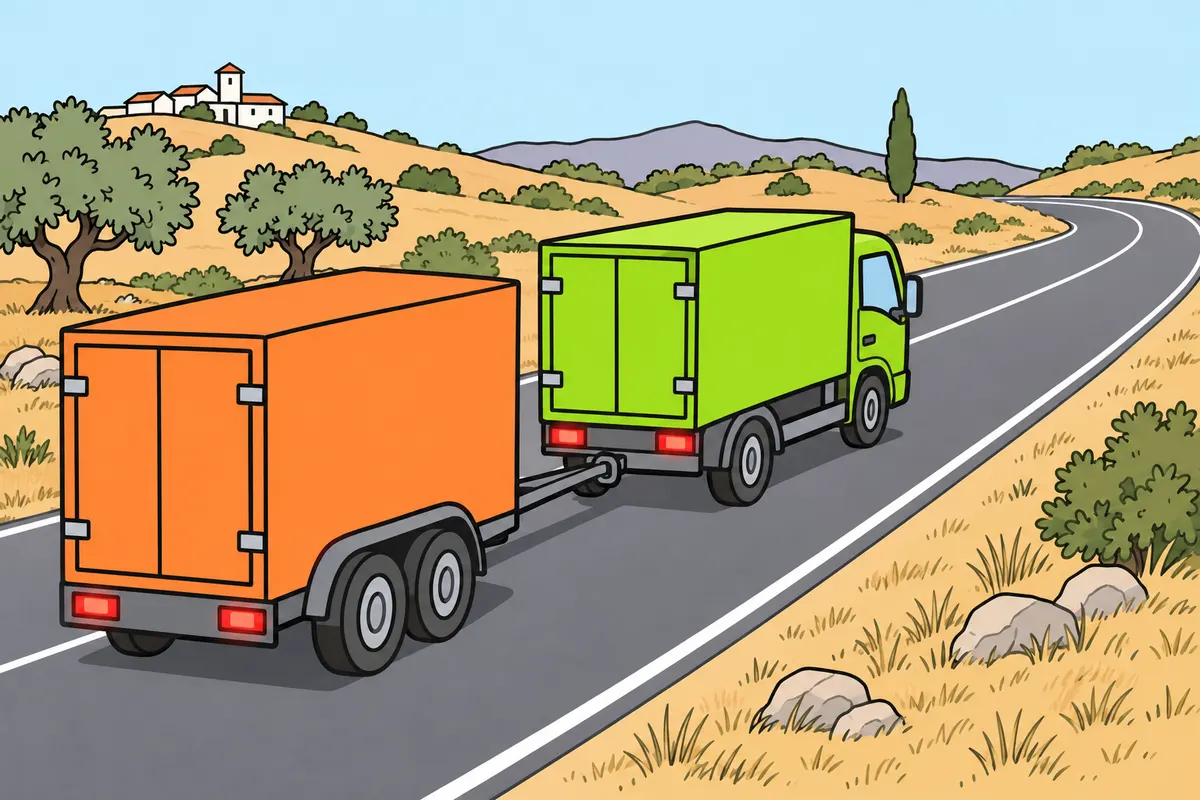
For normal braking, you must plan ahead and increase braking force gradually.
Remember
- Apply the service brake gradually.
- Check that your trailer does not push or pull sideways.
- Reach a suitable speed before entering a bend.
- In an emergency on a bend, avoid violent steering corrections.
Exam trap: Wrong: wait until the bend to brake hard. Right: slow down before entering; heavy braking while steering reduces available grip.
Read the full explanation
- When braking normally, you must anticipate the reduction in speed and apply the service brake progressively, checking that the trailer decelerates with the towing vehicle without pushing or pulling to one side. Anticipation and smooth control are covered in ‘Driving techniques for vehicle combinations’.
- You must reach the appropriate speed before entering a bend: heavy demands on braking and steering reduce the combination's grip margin. In an emergency within the bend, use the control available without making a violent steering correction. [DGT, ‘Brakes: how to use them correctly’](https://revista.dgt.es/es/educacion-formacion/conducir-mejor/2023/0315-Frenadas.shtml).
- Consult ‘Speed and distances for the vehicle combination’ for the distance between vehicles and how to warn others of a considerable reduction in speed. [RGC, arts. 53 and 54](https://www.boe.es/buscar/act.php?id=BOE-A-2003-23514#a53).
19What jackknifing is
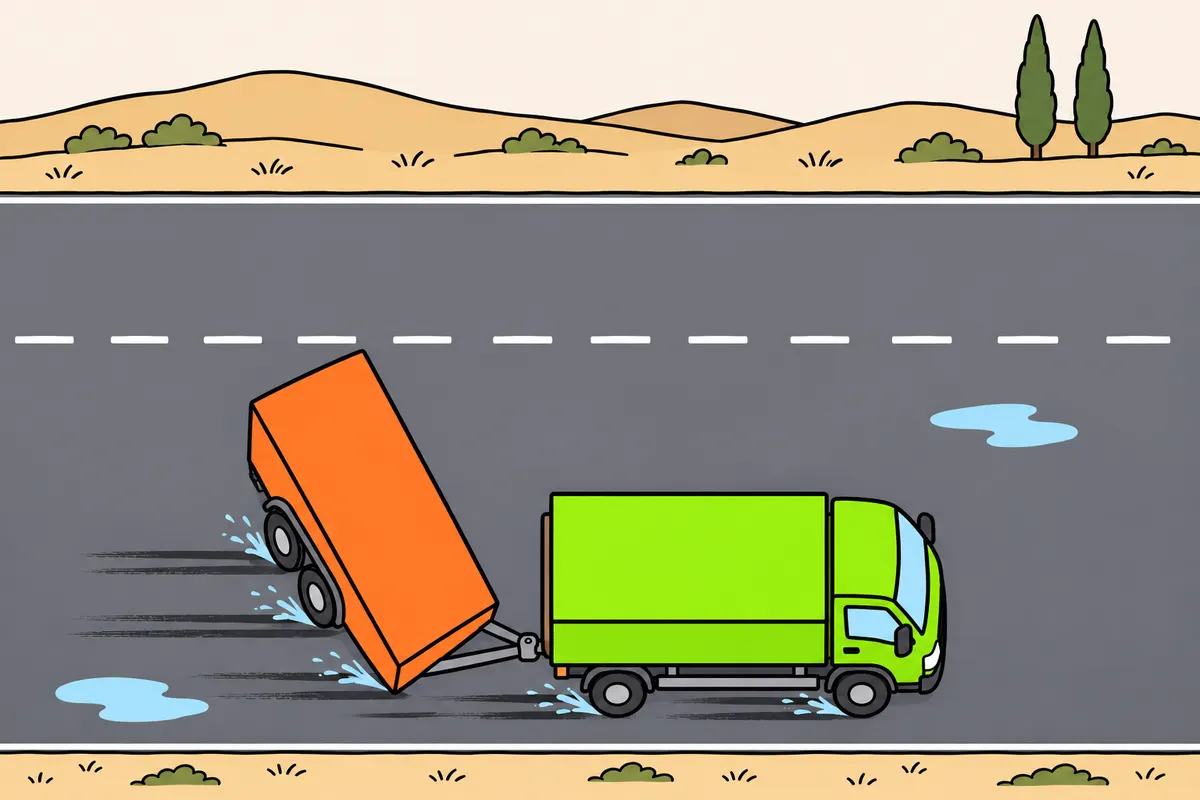
You must recognise jackknifing as a serious loss of alignment between lorry and trailer.
Remember
- Do not confuse jackknifing with controlled turning at the coupling.
- It can happen with your light lorry and trailer too.
- Your trailer can push the towing vehicle or skid sideways.
- Avoid unsuitable speed, harsh braking and poorly arranged loads.
- Keep braking balanced between both vehicles.
Exam trap: Wrong: ABS means you can never jackknife. Right: ABS reduces locking risks but does not remove other causes.
Read the full explanation
- Jackknifing is a sharp folding movement between the towing and towed vehicles caused by a loss of alignment and stability. It can affect both an articulated vehicle and a C1 lorry with a trailer; you must distinguish it from the controlled articulation when turning.
- Loss of grip at the towing vehicle's rear axle allows the thrust from the towed vehicle to close the angle between them. The trailer can also skid, with its rear moving sideways; the action you take to recover depends on which wheels lose grip.
- Harsh braking, slippery road surfaces, inappropriate speed and unfavourable loading increase the risk of jackknifing. A trailer with insufficient braking pushes the towing vehicle; with its wheels locked, it loses lateral directional control. You must maintain the braking balance between the two units.
- ABS reduces the risk associated with wheel locking, but excessive speed on bends, lack of grip and faults can cause jackknifing even when the system is working.
20How to prevent jackknifing
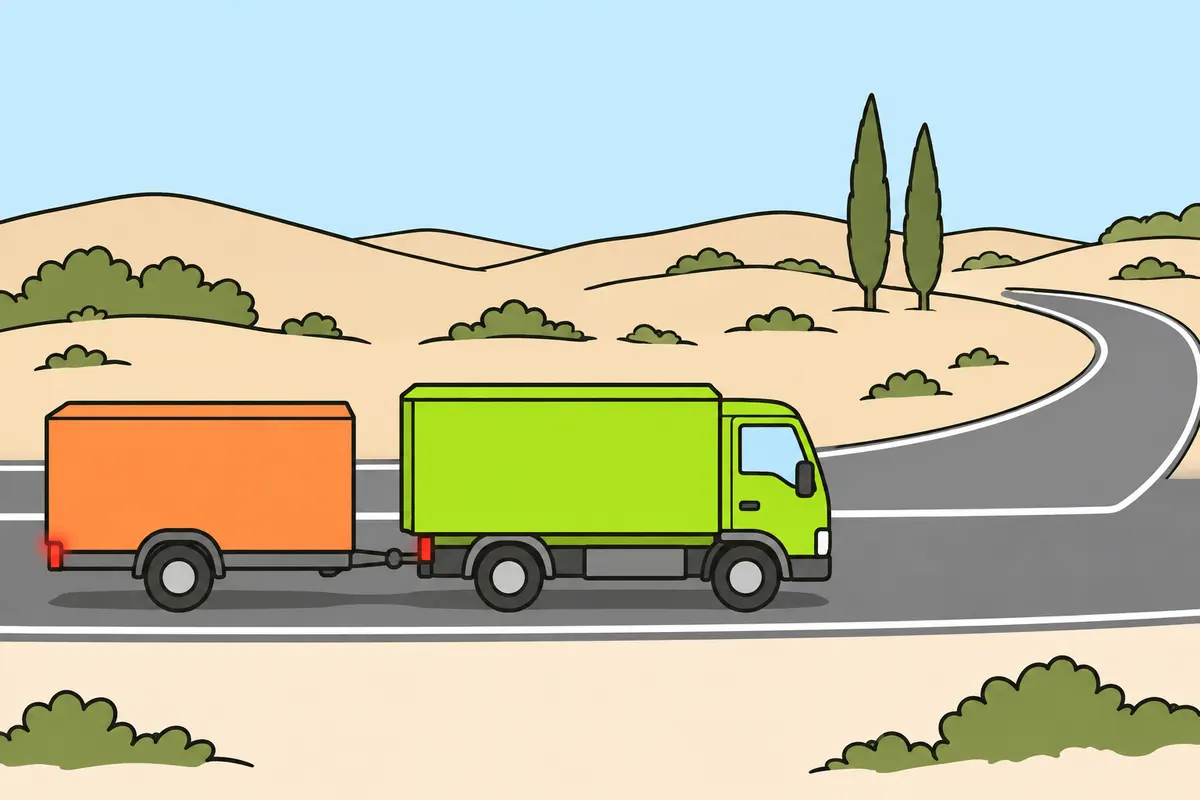
To prevent jackknifing, you must plan ahead and keep braking coordinated.
Remember
- Slow down before bends and descents.
- Avoid combining heavy braking with tight turns.
- Repair incorrect connections or brakes that stay applied.
- If alignment is lost, avoid sudden steering and violent downshifts.
- Adapt your actions to the skidding wheels and available driving aids.
- Follow your practical training and vehicle instructions.
Exam trap: Wrong: accelerating or using an independent brake always corrects jackknifing. Right: either can worsen it; your actions depend on the situation.
Read the full explanation
- To prevent jackknifing, you must slow down before bends and descents and avoid combining heavy braking with a sharp turn. Anticipation and adapting your use of the controls to the road surface are covered in «Driving techniques for vehicle combinations».
- You must keep the braking of the towing and towed vehicles coordinated. An incorrect connection, a seized brake or insufficient trailer deceleration upsets the balance and requires repair; you must pay attention to any change in the combination's response.
- If the vehicles become misaligned, you must avoid sudden steering movements, abrupt downshifts and sudden demands for auxiliary braking. Your action depends on which wheels are skidding and which aids are available: follow your practical training and the vehicle's instructions.
- Accelerating or applying an independent brake can make jackknifing worse once it starts. Emergency braking with ABS is not a universal recovery technique either: you must maintain a controlled path using the means appropriate to the situation.
21Long descents: prepare your speed
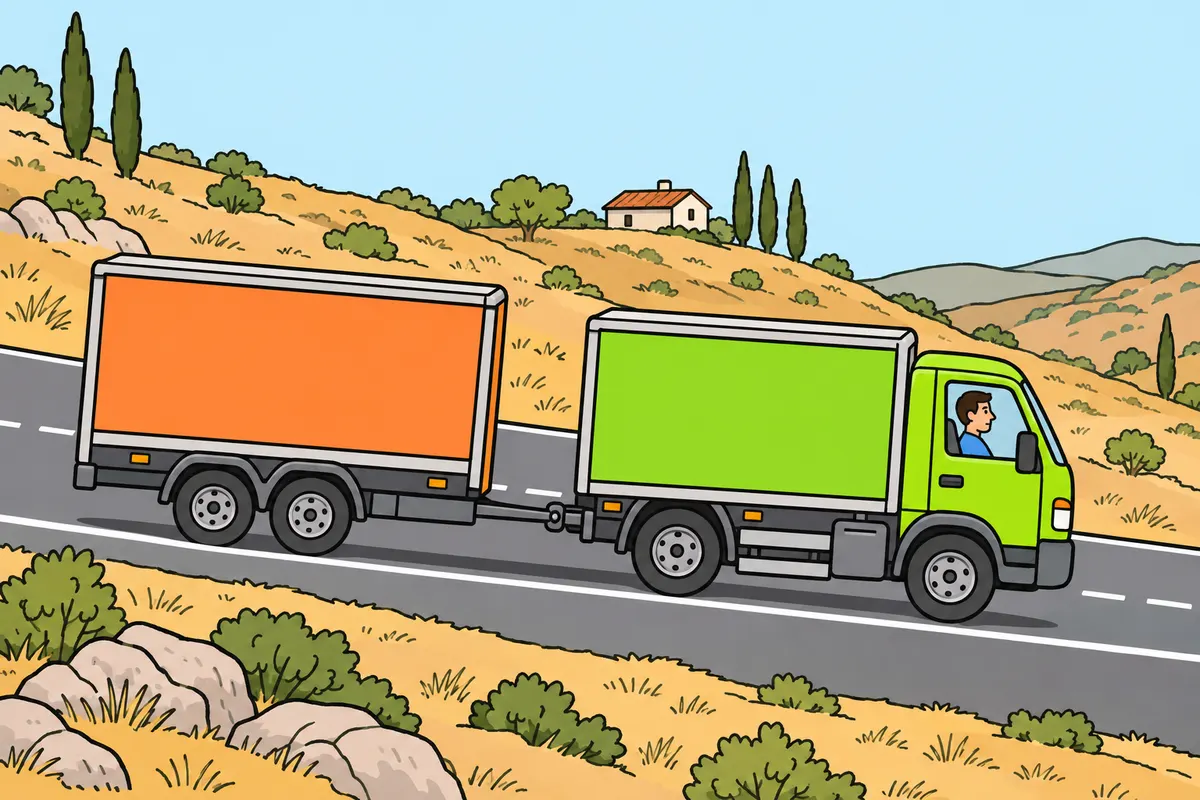
Before a long descent, you must prepare your speed and gear.
Remember
- Choose according to mass, gradient and available braking assistance.
- Keep the transmission engaged to use engine braking.
- With an automated gearbox, follow the mode specified by the manufacturer.
- Combine braking assistance with the service brake when needed.
- Monitor your speed throughout the descent.
- If braking assistance is insufficient, slow down steadily to a sustainable speed.
Exam trap: Wrong: descend in neutral or rely only on continuous pedal pressure. Right: keep the transmission engaged and combine braking assistance with necessary service braking.
Read the full explanation
- Before a long descent, you must choose your speed and gear according to the combination's mass, the gradient and the auxiliary braking available. Preparing for descents is covered in «Driving techniques for vehicle combinations».
- You must keep the transmission engaged to make use of engine braking; with automated gearboxes, use the mode specified by the manufacturer and stay within the permitted engine speed range. The trailer continues to push during the descent.
- Combine the available auxiliary braking with the service brake when necessary to maintain a braking reserve in both units. Relying solely on light, continuous brake pressure encourages overheating. [DGT, «Brakes: how to use them correctly»](https://revista.dgt.es/es/educacion-formacion/conducir-mejor/2023/0315-Frenadas.shtml).
- You must monitor your speed throughout the descent. If auxiliary braking is insufficient, slow down in a controlled way to a speed your combination can maintain and adjust the system according to its instructions.
22Retarders and the service brake
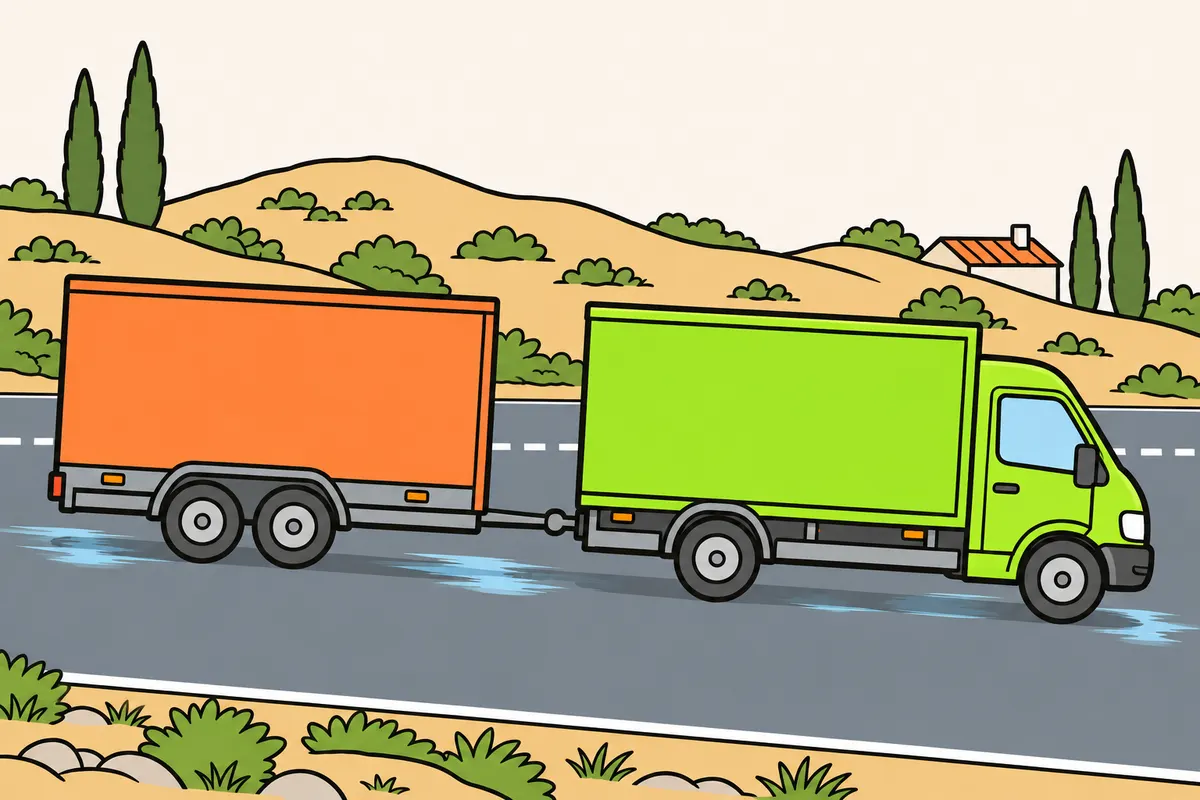
You use available braking assistance to reduce the work of friction brakes.
| Function | What you use it for |
|---|---|
| Engine braking and retarders | Reduce continuous work by friction brakes |
| Trailer parking brake | Keep the detached trailer still |
Remember
- Know your lorry’s driving aids and their temperature and engine-speed limits.
- Apply braking assistance gradually.
- Braking through the transmission acts on your towing vehicle’s driven wheels.
- On slippery roads, excessive braking assistance can make those wheels lose grip.
- Your trailer can keep pushing.
- Before leaving your trailer detached, secure it using the equipment provided.
Exam trap: Wrong: a retarder replaces parking braking. Right: secure your detached trailer with its parking device.
Read the full explanation
- Engine braking and transmission retarders reduce the continuous workload on the friction brakes. Their progressive use and limitations are covered in «Driving techniques for vehicle combinations».
- Your C1 lorry may have an exhaust brake or an electric or hydrodynamic retarder, depending on its equipment. You must know which aids are fitted and their temperature and operating speed limits before planning the auxiliary braking needed for the trailer.
- Braking transmitted through the drivetrain acts on the towing vehicle's driven wheels. On a slippery surface, excessive demand can make them lose grip while the trailer continues to push; you must apply it progressively and follow the manufacturer's limitations.
- The retarder controls movement, but immobilising a detached trailer requires its parking device. You must secure the towed unit using the controls and equipment provided before leaving the driving seat.
23Overheating and loss of effectiveness
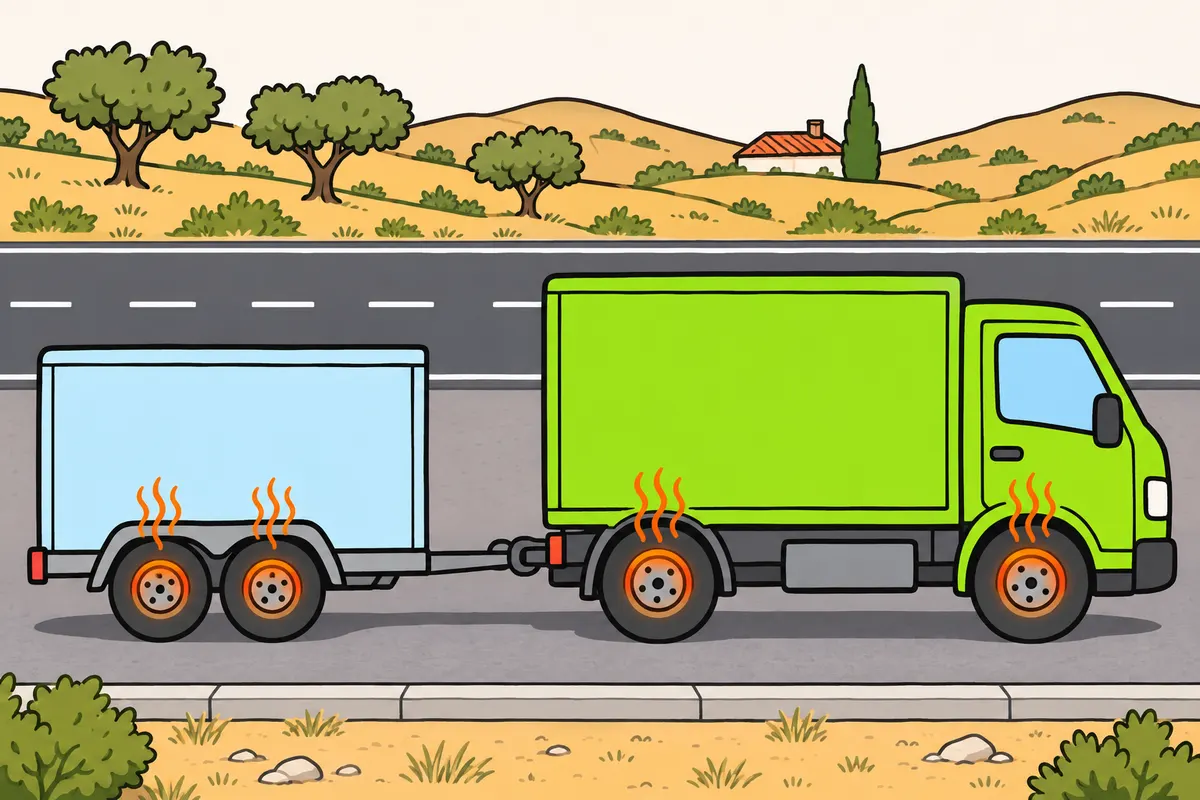
If your brakes overheat, you can lose braking power.
Remember
- Compressed air does not prevent overheating.
- If you notice abnormal smells or temperature warnings, find somewhere safe to stop.
- Inspect and allow cooling as instructed.
- Do not pour water on overheated parts or handle them.
- With severe braking loss downhill, use effective braking assistance and seek an escape lane.
- Enter straight, hold the steering firmly, keep the engine running and avoid wheel lock.
Exam trap: Wrong: brakes only heat up when you press the pedal. Right: a brake that stays applied can overheat too.
Read the full explanation
- Sustained heating of the friction brakes can cause a loss of effectiveness, or brake fade, in both the towing vehicle and the trailer. Pneumatic actuation does not prevent this heating. [DGT, Manual II: Road Safety Issues, 2023 edition](https://sede.dgt.gob.es/export/sites/dgt/.galleries/permisos-de-conducir/certificacion-aptitud-profesores-formacion-vial/2023/Manual-II-Cuestiones-de-Seguridad-Vial-2023.pdf).
- If you need more braking to keep your speed under control, notice an unusual smell or see temperature warnings, you must find a safe place to stop, check and allow the brakes to cool according to the instructions. Reduced trailer braking effectiveness increases the strain on the towing vehicle.
- A brake that remains applied can overheat without you pressing the pedal. You must allow it to cool without pouring water on it or handling overheated components; fault checks are covered in «Maintenance and inspection of the vehicle combination».
- If you suffer a severe loss of braking on a descent, you must maintain control, use the effective means of auxiliary braking and look for an accessible escape area, entering it with the combination aligned and holding the steering wheel firmly. Keep the engine running and avoid causing the wheels to lock. [DGT, Manual II: Road Safety Issues, 2024 edition](https://sede.dgt.gob.es/export/sites/dgt/.galleries/permisos-de-conducir/certificacion-aptitud-profesores-formacion-vial/2024/Manual-II-Cuestiones-de-Seguridad-Vial-2024.pdf).
Check that the towed vehicle can brake
Check connections, reserves and response before driving.
- Keep the combination immobilised and check that its systems are compatible.
- Identify the system: the mechanism and breakaway device if it has overrun brakes; the red supply line, yellow control line and electrical braking connection if it has that pneumatic installation.
- Check the mechanism and transmission, or the locks, seals and hose routing, as appropriate; there must be no seizure, leaks or risk of disconnection as the combination articulates.
- With a pneumatic system, wait until the specified operating pressure is reached; check the warnings and the availability of the systems fitted to your trailer.
- Carry out the braking check specified by the manufacturer in a safe place; correct any fault before driving.
Brake in an emergency with working ABS
Use the available braking capacity and maintain a controlled course.
- Look towards a safe course and assess the space available for the whole combination.
- Apply the brake firmly when you need to stop in an emergency.
- Maintain the necessary pressure and let ABS modulate the braking; do not pump the pedal.
- Steer in a controlled way, without a sudden steering movement that compromises the stability of the towed vehicle.
- Once stopped, secure the combination and assess the situation before continuing.
Control a long descent
Prepare auxiliary braking and preserve braking capacity.
- Slow down before starting the descent, taking account of mass, grip and road layout.
- Select a gear or descent mode suitable for the vehicle.
- Apply the available auxiliary braking progressively, following the manufacturer’s instructions.
- Use the service brake when necessary and monitor your speed to keep it under control.
- If braking effectiveness decreases or abnormal heating occurs, find a safe place to stop; if braking is insufficient, use effective means of slowing down and an accessible escape lane.
Finished this module?
Mark it as read and you will see your progress on the theory list.