
Theory · D1+E Licence - Minibus with Trailer · Module 5 of 13
Trailer and combination braking
You learn how your minibus trailer brakes, which limits depend on the system fitted, and how to check its connections and safety devices. You can answer D1+E questions on overrun braking, air brakes, ABS and jackknifing, and prepare for descents without compromising braking effectiveness or passenger safety.
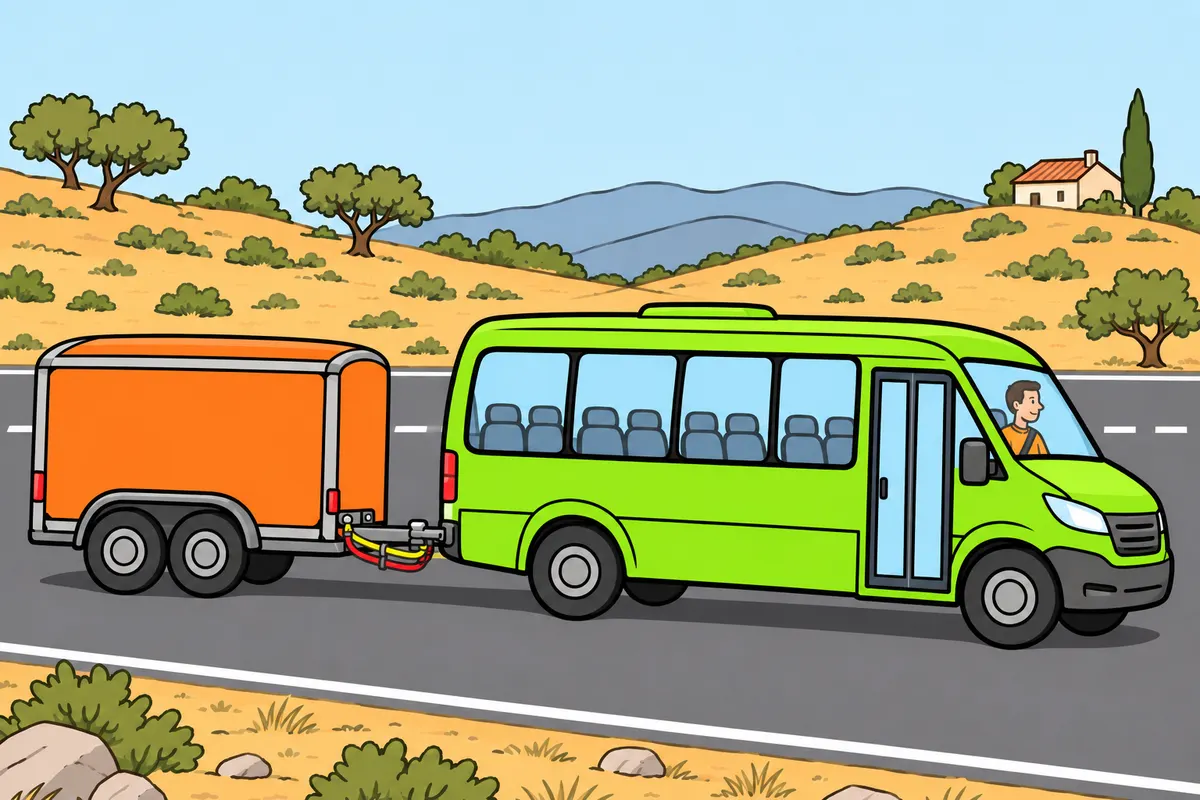
1Braking means controlling the whole combination
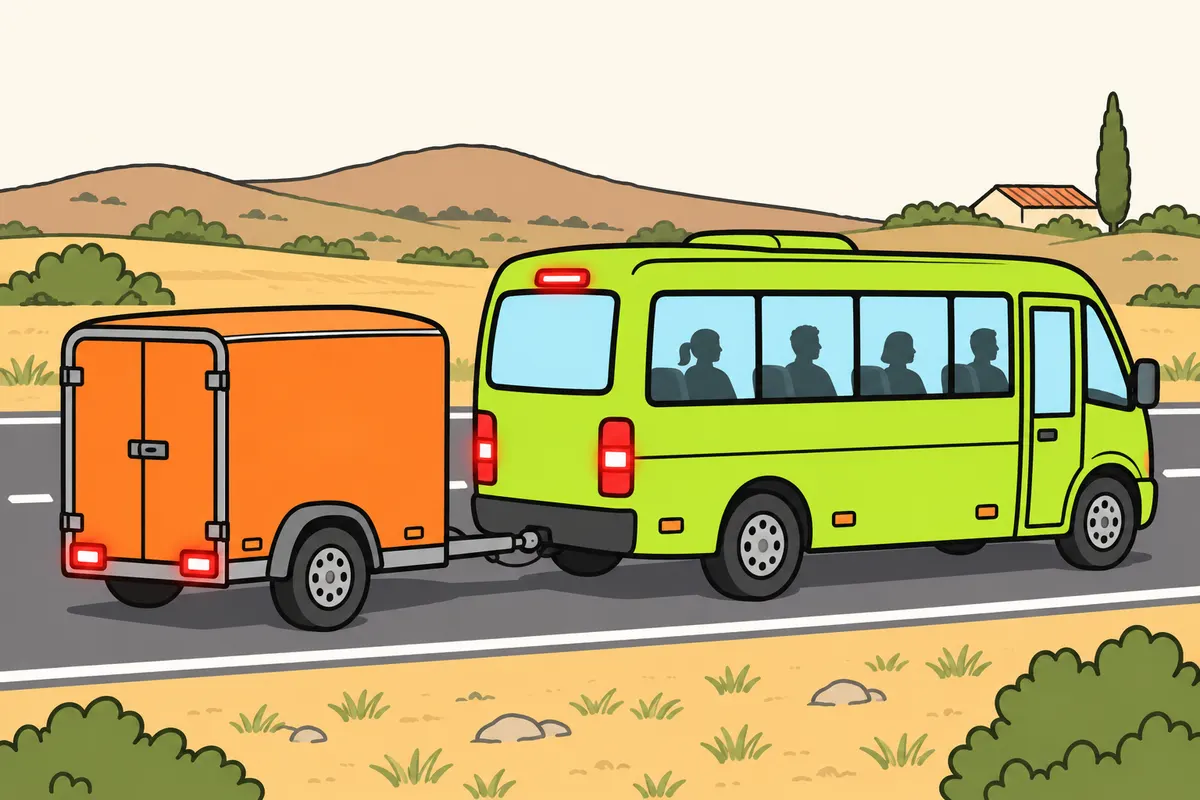
When you brake, keep control of both your minibus and trailer.
| Braking system component | Purpose |
|---|---|
| Control | Receives your braking command |
| Transmission | Carries your command to the brakes |
| Brakes | Slow wheel rotation |
| ABS | Adjusts braking to prevent wheel lock |
Remember
- Brake smoothly to protect your passengers.
- Check the brake connections too.
- Adapt your driving to the load and road conditions.
Exam trap: Wrong: braking hard is enough. Right: stop the whole combination while keeping it on course.
Read the full explanation
- When you brake your minibus and trailer, you must slow down two vehicles joined by a coupling. Your aim is to stop them while keeping them on their intended path: if the trailer swings across, you can lose control even when the brakes are working hard. Passengers in the minibus also feel the effects of every jolt or sudden change in deceleration.
- The brake works as a chain of components: you give the command through a control, a transmission carries it to the brakes, and the brakes produce the force that slows the rotation of the wheels. A faulty connection can affect the result as much as a fault in the brake itself. [RGV, Annex VIII, section 1.1](https://www.boe.es/buscar/act.php?id=BOE-A-1999-1826#anviii).
- ABS is an anti-lock control system that can be integrated into the braking system of the minibus or trailer. When interpreting a fault, relate the affected component to its function: faulty electronic control and an interrupted transmission can have different consequences for braking ability. [RGV, Annex VIII, section 1.1](https://www.boe.es/buscar/act.php?id=BOE-A-1999-1826#anviii).
- Adapt your driving to the response of the minibus and trailer you are driving, their load and the road conditions. Experience with another combination does not guarantee the same stopping distance. Checking the trailer brake matters on short journeys as well as on the open road and on dry surfaces.
2Service, secondary and parking brakes
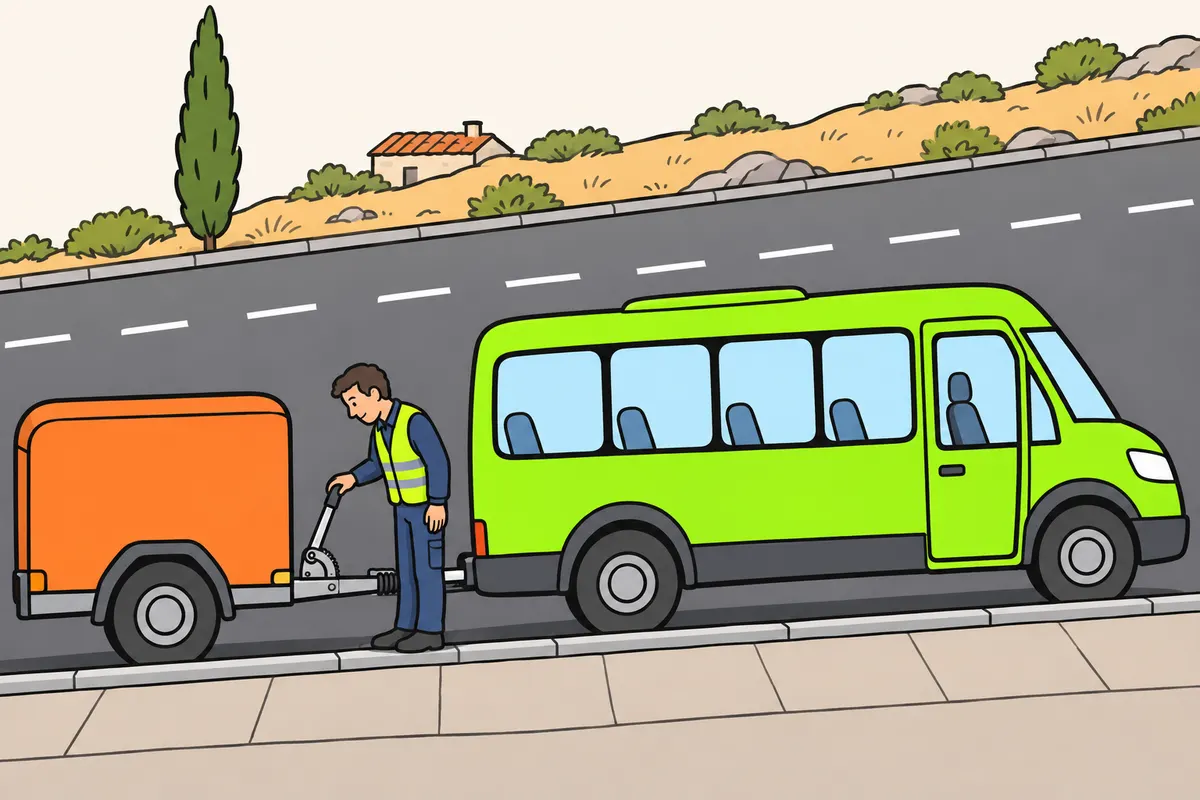
You must know what each braking function does.
| Function | When you use it |
|---|---|
| Service | To control and stop the vehicle |
| Secondary | To stop if service braking fails |
| Parking | To stay still, even on slopes without a driver |
Remember
- You can vary the force of service and secondary braking.
- Secure your trailer before separating it from the minibus.
- Check the manual to identify your controls.
Exam trap: Wrong: secondary braking always uses a particular lever. Right: its controls depend on the system.
Read the full explanation
- With the service brake, you must be able to control the vehicle's movement and stop it safely, whether laden or unladen and whether travelling uphill or downhill. You must be able to vary its braking force: you normally use the amount needed for the situation rather than its full capacity all at once. [RGV, Annex VIII, section 1.2.1](https://www.boe.es/buscar/act.php?id=BOE-A-1999-1826#anviii).
- Secondary braking allows you to stop the vehicle within a reasonable distance when the service brake fails, and you must also be able to vary its braking force. You must not simply equate it with a particular lever, because the way this function is provided depends on the vehicle's braking installation. [RGV, Annex VIII, section 1.2.2](https://www.boe.es/buscar/act.php?id=BOE-A-1999-1826#anviii).
- The parking brake must keep the vehicle stationary on a slope even without a driver, with its working parts held in place mechanically. Keeping the pedal pressed does not replace this function when you leave the driving seat. Before separating the trailer from the towing vehicle, check that the trailer is secured against movement independently. [RGV, Annex VIII, section 1.2.3](https://www.boe.es/buscar/act.php?id=BOE-A-1999-1826#anviii).
- In an air braking system, different functions can share components and energy reserves. The number of functions does not necessarily match the number of independent circuits. Use the minibus and trailer manuals to identify which controls act on each vehicle and which reserve they use.
3The limit for an unbraked trailer
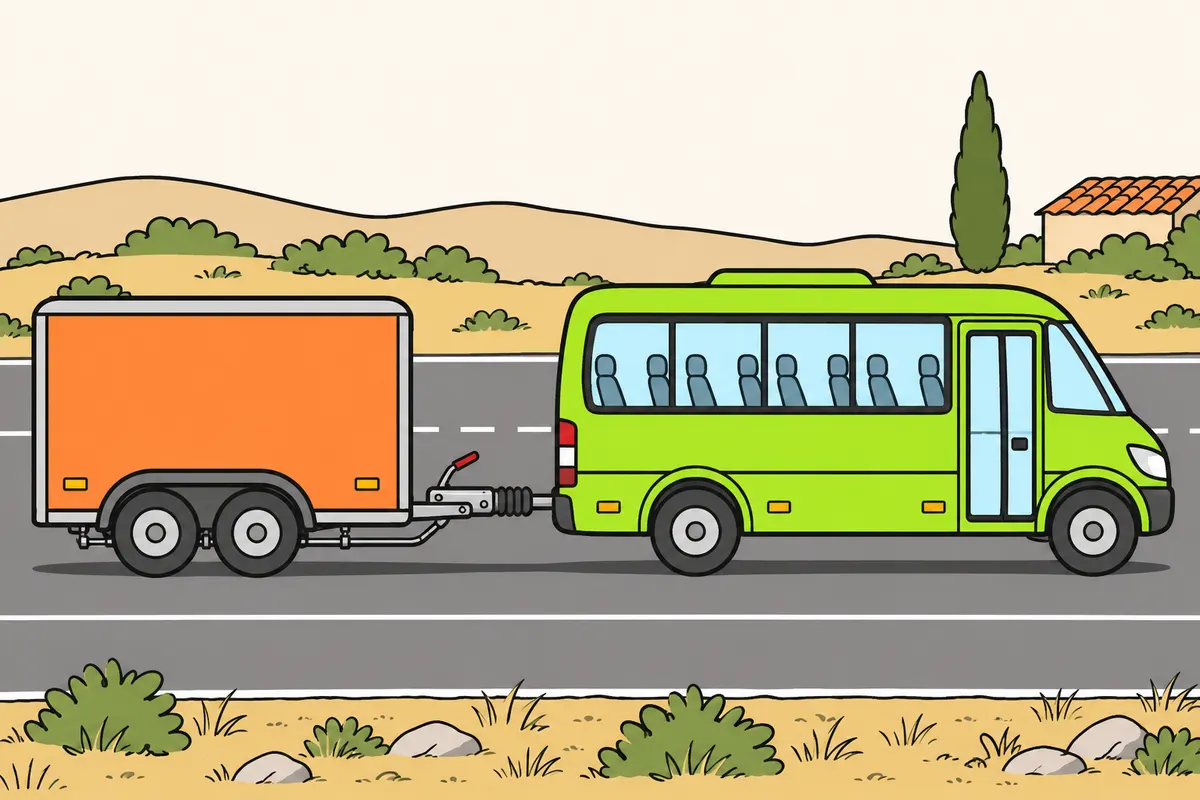
Without trailer brakes, respect both mass limits and your minibus’s technical towing capacity.
| Trailer category | Service brake |
|---|---|
| O1 | May have none |
| O1 with a brake | Must meet O2 requirements |
Remember
- Do not exceed 750 kg without brakes.
- Also respect half your towing vehicle’s unladen mass plus 75 kg.
- Check the documents: they may set a lower limit.
- Unladen mass means the vehicle without passengers or load.
- Your D1+E trailer needs a service brake, even when empty.
Exam trap: Wrong: unloading your trailer lets you disable its brakes. Right: unloading does not change its MMA.
Read the full explanation
- For your minibus, the maximum unbraked towing mass cannot exceed 750 kg, even if the towing vehicle has a high mass or powerful brakes. You must also respect the technical towing capacity and the strength of the coupling: the documentation may specify a lower limit. [RGV, Annex IX, sections 4.1.1 and 4.1.2.1](https://www.boe.es/buscar/act.php?id=BOE-A-1999-1826#anix).
- The unbraked limit also depends on the towing vehicle's tara (unladen mass): half the towing vehicle's unladen mass, increased by 75 kg, without exceeding the stated ceiling. Unladen mass is not the mass of the minibus full of passengers; carrying more people does not increase this towing capacity. [RGV, Annex IX, section 4.1.2.1](https://www.boe.es/buscar/act.php?id=BOE-A-1999-1826#anix).
- Category O1 trailers may have no service brake; if one is fitted, its installation must meet the requirements for O2. A trailer being light does not mean that its brakes may be faulty or that you may disable those fitted to it. [UN Regulation No. 13, section 5.2.2.1](https://www.boe.es/buscar/doc.php?id=DOUE-L-2026-80539).
- A trailer requiring D1+E has an MMA (maximum authorised mass) exceeding 750 kg, so it needs a service brake. Unloading it does not make it a light trailer or allow you to disable its brakes. The licence entitles you to drive this class of combination, but the technical ability to tow that trailer also depends on the minibus and its equipment. [RGCond, art. 4](https://www.boe.es/buscar/act.php?id=BOE-A-2009-9481#a4); [RGV, Annex VIII, section 2](https://www.boe.es/buscar/act.php?id=BOE-A-1999-1826#anviii).
4How the overrun brake works
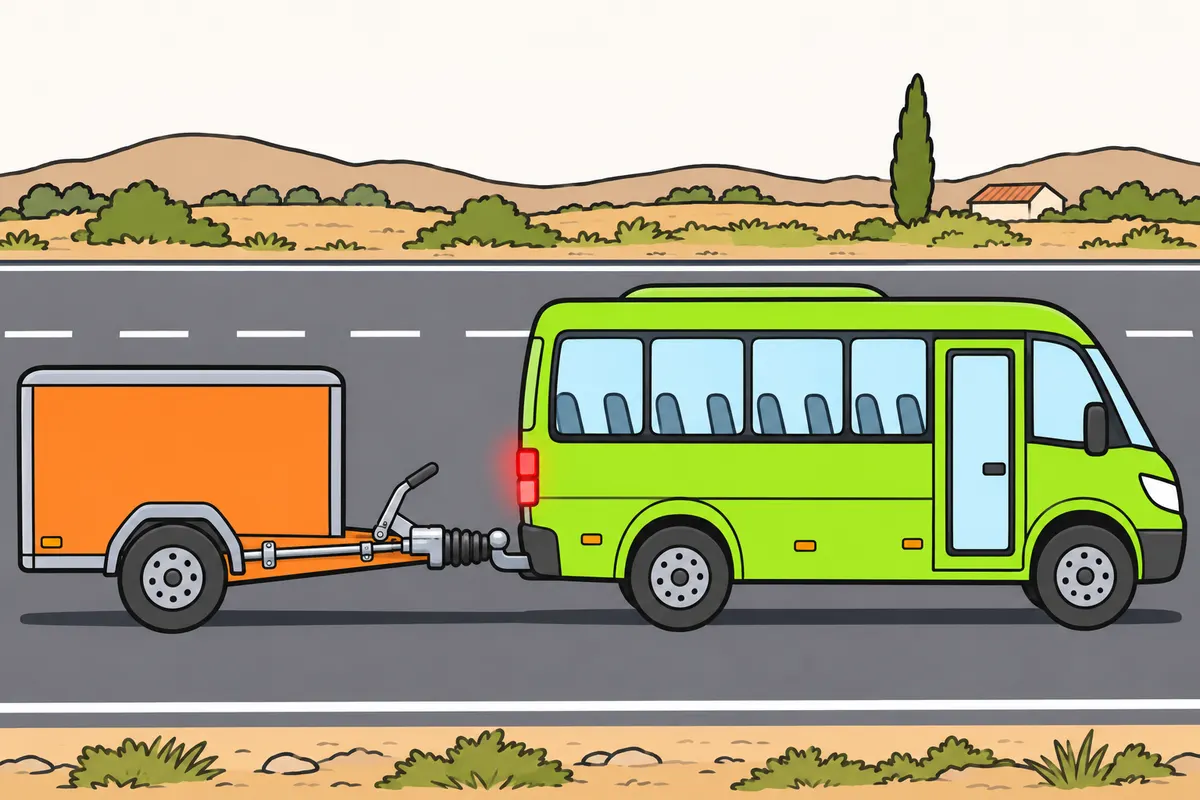
When you slow down, your trailer pushes against the coupling and applies its overrun brake.
| Towing vehicle with overrun-only trailer | Maximum towing mass |
|---|---|
| Without off-road exception | No more than its MMA or 3,500 kg |
| Off-road vehicle | No more than 1.5 times its MMA or 3,500 kg |
Remember
- Your trailer moves towards you and compresses the coupling mechanism.
- It does not need to separate for overrun braking to work.
- For O2, overrun braking is permitted on centre-axle trailers.
Exam trap: Wrong: every minibus qualifies for the off-road exception. Right: only an off-road towing vehicle qualifies.
Read the full explanation
- The overrun brake uses the trailer's movement towards the towing vehicle as the latter slows down. The pushing force compresses the coupling device and transmits the actuation to the trailer brakes. You must associate it with this relative movement, rather than with an air signal sent by the pedal. [RGV, Annex VIII, section 1.6](https://www.boe.es/buscar/act.php?id=BOE-A-1999-1826#anviii).
- When the pushing force ceases and the towing vehicle starts pulling the combination again, the mechanism reduces the braking demand. Movement of the coupling head transmits force through rods, cables or the circuit specified by the manufacturer. Its travel and return must remain unobstructed so that the trailer brakes and rolls freely again correctly.
- With an overrun brake alone, the towing mass cannot exceed either the towing vehicle's MMA or 3,500 kg. The exception for an off-road towing vehicle increases the ratio to 1.5 times its MMA, while retaining the 3,500 kg ceiling; do not apply it to a minibus because of its appearance. [RGV, Annex IX, section 4.1.2.2](https://www.boe.es/buscar/act.php?id=BOE-A-1999-1826#anix).
- Under the type-approval requirements of UN Regulation No. 13, overrun systems for O2 are permitted on centre-axle trailers. You may find one on a luggage trailer suitable for your minibus; you must not assume that every drawbar trailer uses overrun braking, as other forms of actuation also exist. [UN Regulation No. 13, section 5.2.2.2](https://www.boe.es/buscar/doc.php?id=DOUE-L-2026-80539).
5Practical limits of the overrun system
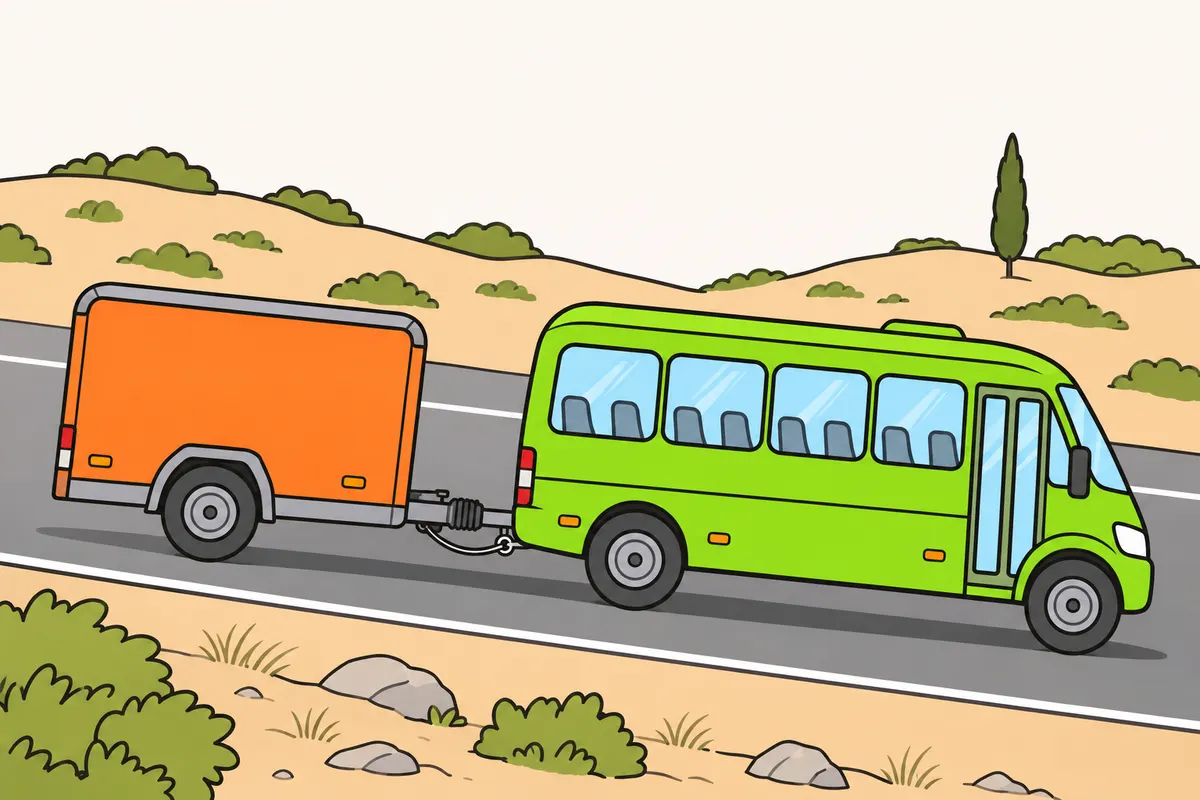
With overrun brakes, check the mechanism and prevent overheating.
| Brake operation | What activates it |
|---|---|
| Overrun | Trailer moving towards the towing vehicle |
| Breakaway | Coupling separation |
Remember
- Correct jams and poor adjustment before driving.
- Follow the manufacturer’s instructions when reversing.
- Do not improvise locks that disable the brake.
- Start long descents slowly and use your towing vehicle’s engine braking.
Exam trap: Wrong: overrun and breakaway braking are the same. Right: overrun responds to movement towards you; breakaway responds to separation.
Read the full explanation
- If you tow a trailer with overrun braking, check that the mechanism can move and transmit force correctly. A sticking coupling head or an incorrectly adjusted transmission can cause the trailer to brake late or unevenly, or leave its brakes applied. You must correct these faults before driving.
- When reversing, the trailer can also compress the device. Use the reversing function provided by the manufacturer and follow its instructions; do not improvise locks to disable the brake. A solution that makes a manoeuvre easier but leaves the trailer without braking while driving compromises safety.
- On a prolonged descent, the pushing force on the coupling can continue and increase the workload of the trailer brakes. You must begin the descent slowly, make proper use of the towing vehicle's retarding effect and monitor the combination's behaviour. Do not confuse the system's mechanical simplicity with unlimited resistance to heat.
- Normal overrun actuation and the trailer's breakaway device perform different functions. The first responds to the vehicles moving towards each other while driving; the second must apply the brakes if the coupling separates. The fact that both use mechanical components does not make them the same function.
6Continuous and semi-continuous braking
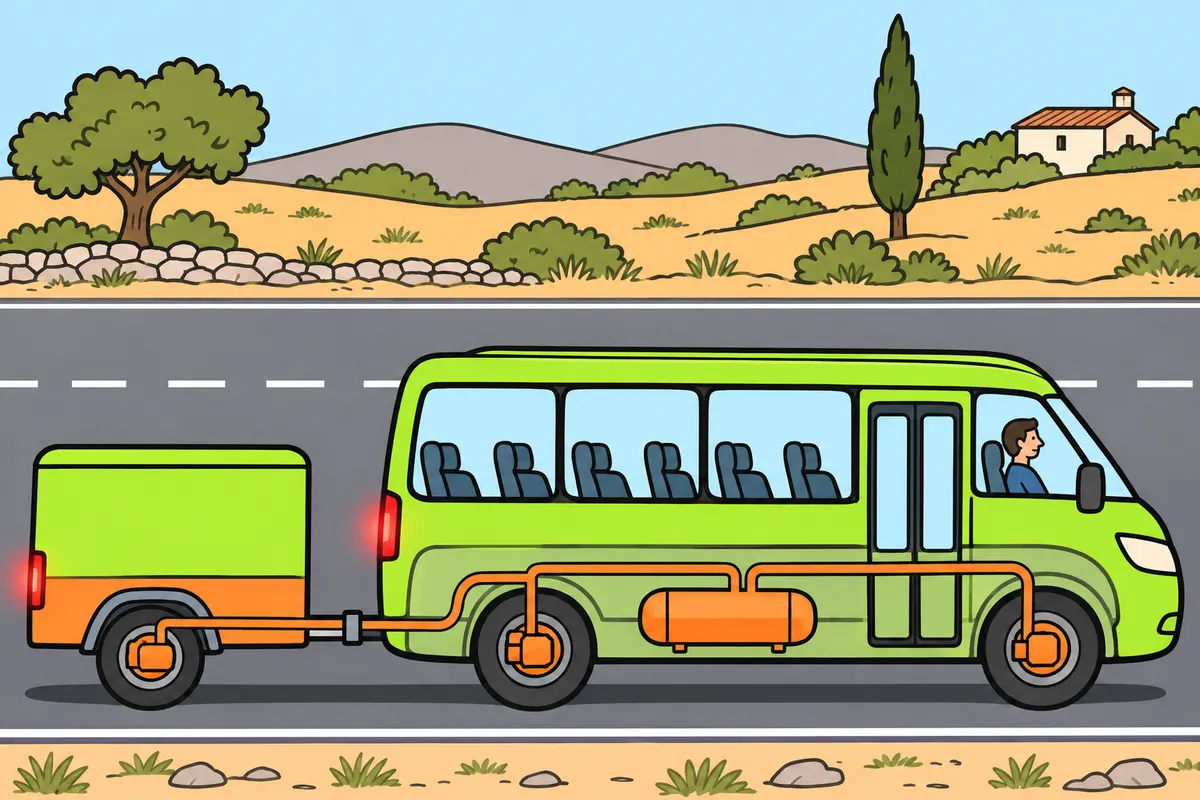
You distinguish continuous and semi-continuous braking by their energy sources.
| System | Energy supply |
|---|---|
| Continuous | A common source for the combination |
| Semi-continuous | Two independent sources |
Remember
- Both systems give you coordinated braking through a single control.
- With continuous braking, your minibus cannot tow above its MMA or 3,500 kg.
- Respect any lower limit on your technical data sheet.
- Only off-road towing vehicles allow 1.5 times their MMA, still within 3,500 kg.
- O3 and O4 type approval requires continuous or semi-continuous braking.
Exam trap: Wrong: continuous braking lets you use lorry towing limits for your minibus. Right: respect category M limits.
Read the full explanation
- With continuous braking, you progressively operate a single control from the driving seat, and the combination's braking energy comes from a common source. The installation coordinates braking on both vehicles, simultaneously or with the appropriate time delay, whatever their relative position. [RGV, Annex VIII, section 1.3](https://www.boe.es/buscar/act.php?id=BOE-A-1999-1826#anviii).
- With semi-continuous braking, you also use a single control and obtain coordinated braking, but two independent energy sources are involved. The difference from continuous braking lies in the source of the energy; the number of pedals or pipes alone does not identify the type of system. [RGV, Annex VIII, section 1.4](https://www.boe.es/buscar/act.php?id=BOE-A-1999-1826#anviii).
- The type-approval requirements for O3 and O4 require continuous or semi-continuous service braking. This explains how heavier trailers operate, but does not authorise you to couple them to your minibus: the towing mass limits for passenger vehicles apply first. [UN Regulation No. 13, section 5.2.2.3](https://www.boe.es/buscar/doc.php?id=DOUE-L-2026-80539).
- For a category M towing vehicle, such as your minibus, the maximum towing mass with continuous braking follows the limit specified for overrun braking: the towing vehicle's MMA and, in all cases, 3,500 kg; the special ratio of 1.5 times applies to an off-road vehicle and retains that ceiling. The ficha técnica (vehicle technical data sheet) may impose a lower towing limit. Do not apply the rule for N2 and N3 lorries to a passenger vehicle. [RGV, Annex IX, sections 4.1.1, 4.1.2.2 and 4.1.2.3](https://www.boe.es/buscar/act.php?id=BOE-A-1999-1826#anix).
7Compressed air transmits energy
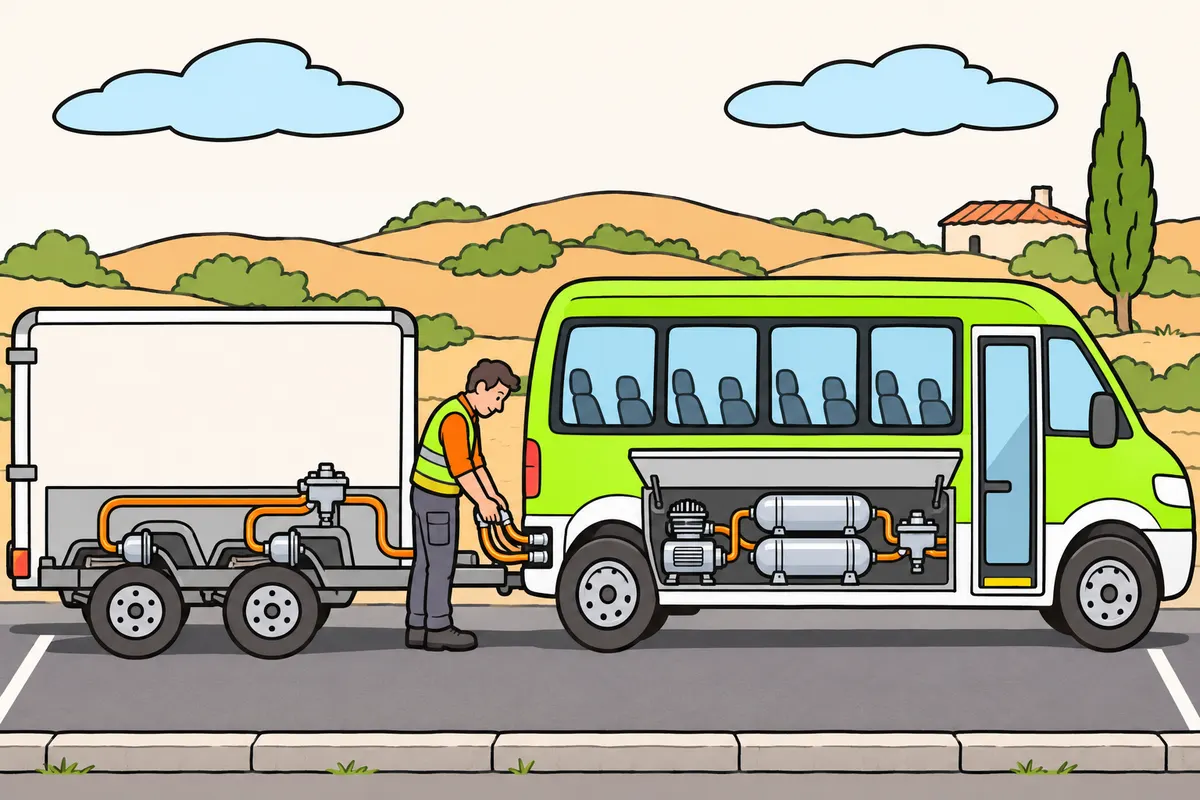
With air brakes, you need enough pressure and connections without leaks.
Remember
- Check the manufacturer’s required pressure before moving off.
- Check warnings for both your towing vehicle and trailer.
- There is no universal pressure for every combination.
- If a leak compromises braking, stop and arrange repairs.
Exam trap: Wrong: revving the engine fixes an air leak. Right: check and repair the leak.
Read the full explanation
- If your combination has air brakes, the compressor produces compressed air and the reservoirs store the energy used by the wheel actuators. A valve regulates its application when it receives the braking command. First identify the system fitted: holding a D1+E licence does not mean that every trailer you tow has this system. [DGT, Manual VIII, topic 10, air braking system](https://sede-org.dgt.gob.es/export/sites/dgt/.galleries/permisos-de-conducir/certificacion-aptitud-profesores-formacion-vial/2025/Manual-VIII-Mecanica-2025.pdf).
- Before moving off, you must have the operating pressure specified by the manufacturer and check the system warnings. Do not memorise a universal pressure in bars for all combinations: the ranges and thresholds depend on the system and its instruments.
- Compressed air makes it easier to apply large forces without requiring equivalent muscular effort on the pedal. This does not guarantee grip or prevent discs and drums from heating up. You must still anticipate braking even if you find that the pedal requires little effort to reduce speed.
- Air leaks reduce the available reserve. Do not try to compensate for a leak by driving with the engine revving, or assume that the towing vehicle's pressure alone confirms the condition of the trailer. Check the connections and, if the fault compromises braking, stop, secure the combination and arrange repairs.
8Red supplies and yellow controls
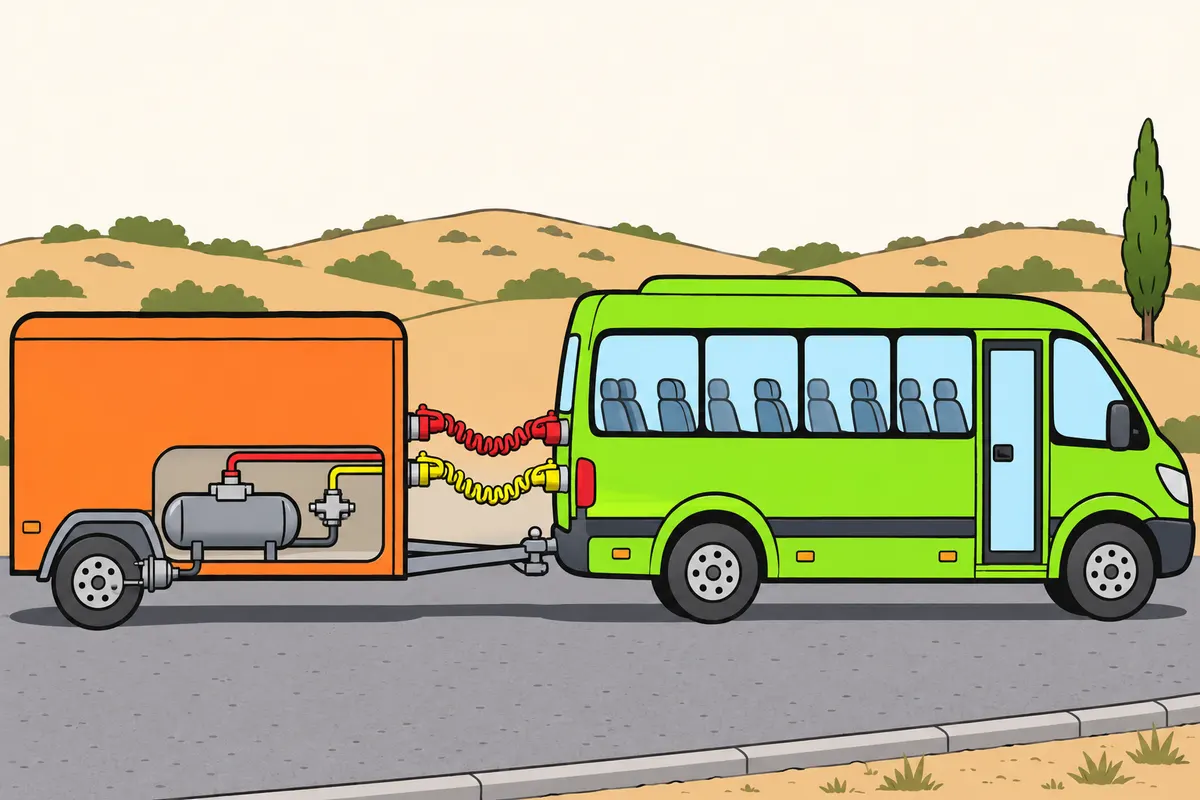
With the usual air connections, red supplies air and yellow sends the braking command.
| Usual trailer air line | Purpose |
|---|---|
| Red | Supply or feed; also called emergency |
| Yellow | Control or service |
Remember
- The red line fills your trailer’s air reservoirs.
- The yellow line sends the service braking request.
- If you have electronic brake control, check its connection too.
Exam trap: Wrong: yellow fills the reservoirs. Right: red fills them.
Read the full explanation
- With the usual two-line air connection, you must identify red as the feed or supply line and yellow as the control or service line. The manufacturer codes the coupling heads to prevent them from being interchanged. These are brake connections, not traffic sign codes. [MAN, trailer connections](https://www.man.eu/content/dam/man/countries/doc/spain/campagnas/Catlogo-Accesorios-Orginales-MAN-2023.pdf/_jcr_content/renditions/original./Catlogo-Accesorios-Orginales-MAN-2023.pdf).
- The red feed or supply line, also called the emergency line, charges the trailer's reservoirs. These store the air its system needs; the supply must be available before you move off. The term emergency relates to the safety response to a loss of supply. [MAN, trailer connections](https://www.man.eu/content/dam/man/countries/doc/spain/campagnas/Catlogo-Accesorios-Orginales-MAN-2023.pdf/_jcr_content/renditions/original./Catlogo-Accesorios-Orginales-MAN-2023.pdf).
- The yellow line communicates the pneumatic service braking demand. The trailer's valves use this signal to meter air from its reservoirs to the actuators. Control and energy supply perform different functions, even though both use compressed air.
- If your trailer has electronic braking management, also check the connection described in «EBS and the ISO 7638 connector».
9Connections that retain their function
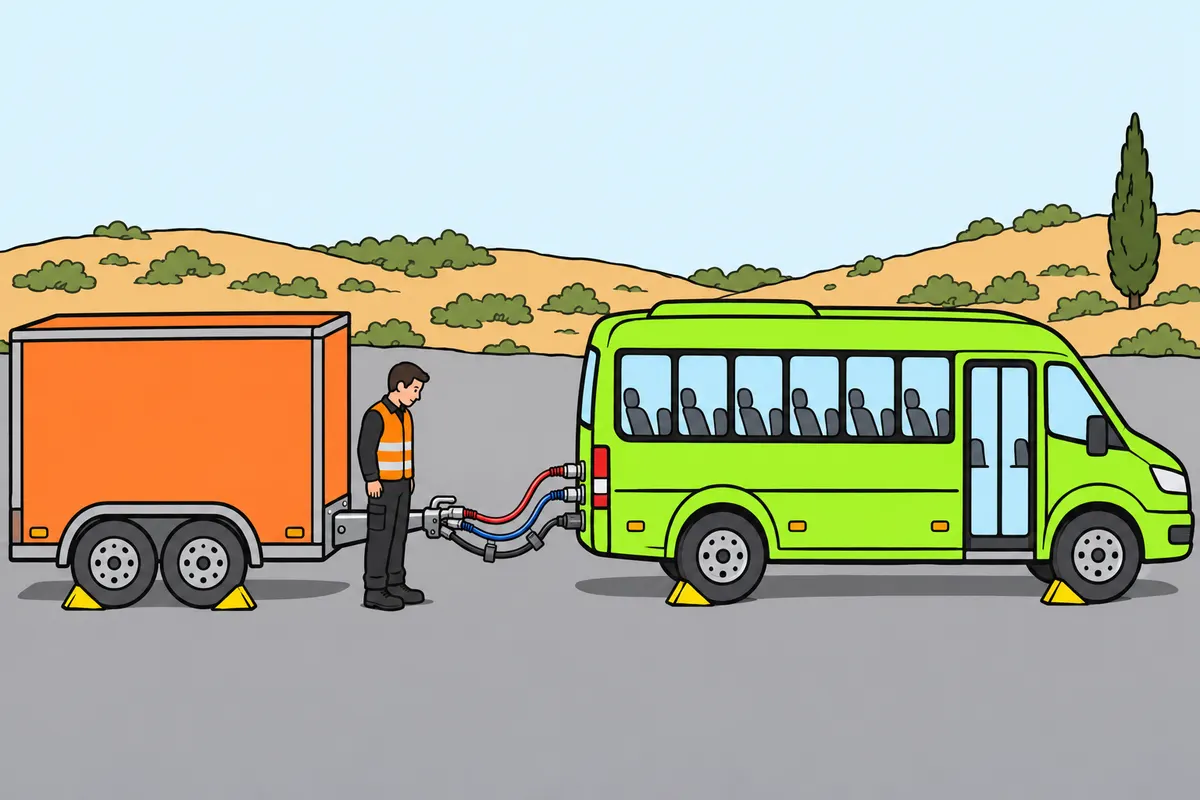
Check that your connections fit correctly, lock securely and allow turns.
Remember
- Secure your vehicle before checking locks, seals and pipes.
- Keep hoses from stretching, hanging loose, rubbing or touching hot parts.
- Check warnings and brake response in a safe area.
- Test at low speed, following the manufacturer’s instructions.
- Keep your trailer secured when connecting or disconnecting.
Exam trap: Wrong: disconnecting pipes is your normal parking method. Right: use the specified device and follow the correct sequence.
Read the full explanation
- The mechanical, electrical and air connections of the minibus and trailer must be compatible. You must use the couplings intended for the system, with locks and seals in good condition, capable of maintaining the connection and correctly transmitting the control signal or energy while driving. [RGV (General Vehicle Regulations), art. 13](https://www.boe.es/buscar/act.php?id=BOE-A-1999-1826#a13).
- Inspect the hoses with the combination ready to drive: they must allow articulation without stretching until they disconnect or hanging where they can chafe, become pinched or touch hot parts. A connection that is correct in a straight line can fail when you turn if you have routed it incorrectly.
- With the vehicle secured, check that the coupling heads are locked, that the seals and pipes are in good condition and that there are no abnormal leaks. Then check the indicators and braking response using the manufacturer's specified check, in a safe area and at low speed.
- You study the full connection and disconnection sequence in «Coupling and uncoupling the trailer». Here you must remember its consequence for braking: supplying or releasing a system can change the state of the brakes. Keep the towed vehicle secured and follow the specific sequence; do not use pipe disconnection as a routine parking method.
10Spring brake chambers and independent parking brakes
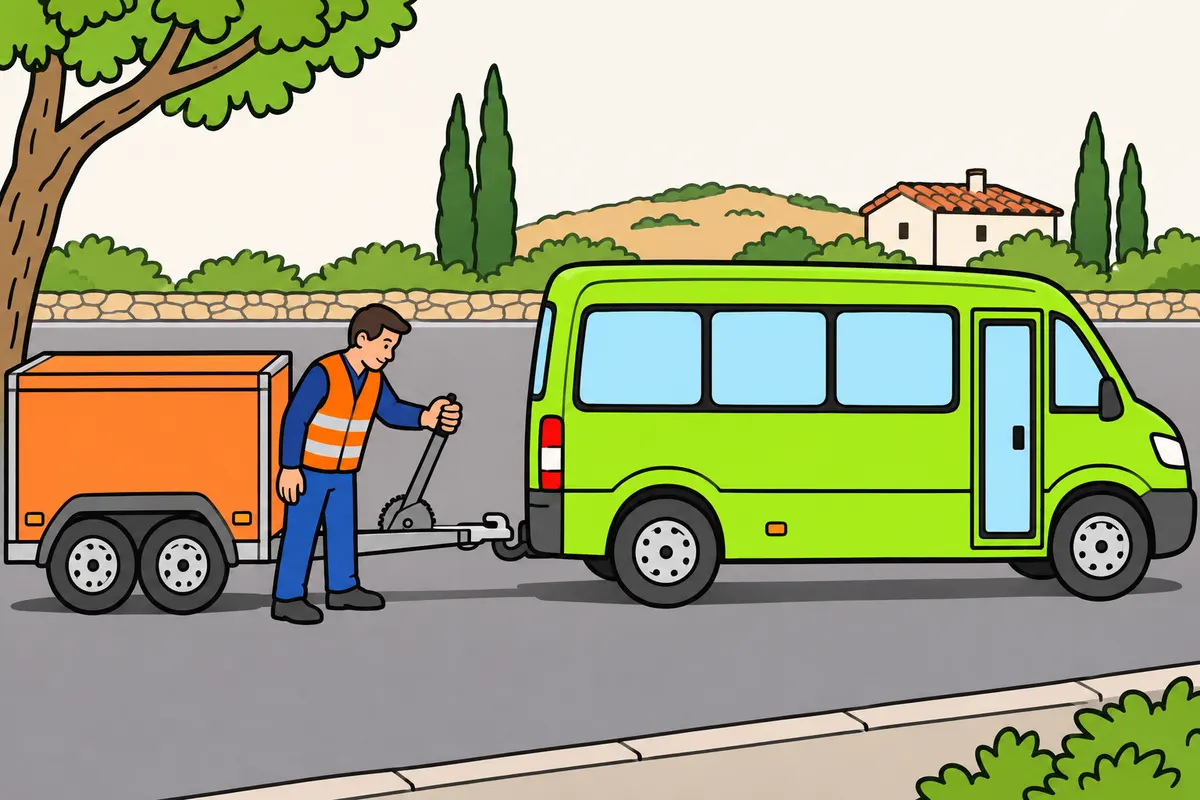
With spring brake chambers, air releases your parking brake and the spring applies it.
| Function on the air systems described | What air does |
|---|---|
| Service brake | Pressure applies the brake |
| Spring parking brake | Compresses the spring and releases the brake |
Remember
- Check which system your combination has.
- Your trailer needs its own parking brake, working separately and operable from ground level.
- Apply your trailer’s parking brake before uncoupling.
Exam trap: Wrong: automatic braking replaces your parking brake. Right: apply the trailer’s own parking brake.
Read the full explanation
- If your minibus has spring brake chambers, air keeps the spring compressed to release the parking brake; when you exhaust the air from that chamber, the spring force applies the brake. You can also find this principle in an air-braked trailer. It works differently from the service brake, which uses air pressure to brake. [DGT, Manual VIII, topic 10](https://sede-org.dgt.gob.es/export/sites/dgt/.galleries/permisos-de-conducir/certificacion-aptitud-profesores-formacion-vial/2025/Manual-VIII-Mecanica-2025.pdf); [United Nations Regulation No. 13, annex 8, paragraph 1.1](https://www.boe.es/buscar/doc.php?id=DOUE-L-2026-80539).
- Your luggage trailer must have its own parking brake, which remains effective when separated from the minibus and can be operated from ground level. Depending on its system, you may find a mechanical control or a valve controlling spring brake chambers. Apply the designated device before uncoupling; automatic braking following a loss of supply serves a different purpose. [RGV, annex VIII, paragraph 2](https://www.boe.es/buscar/act.php?id=BOE-A-1999-1826#anviii); [United Nations Regulation No. 13, paragraph 5.2.2.10](https://www.boe.es/buscar/doc.php?id=DOUE-L-2026-80539).
11Parking and release valves
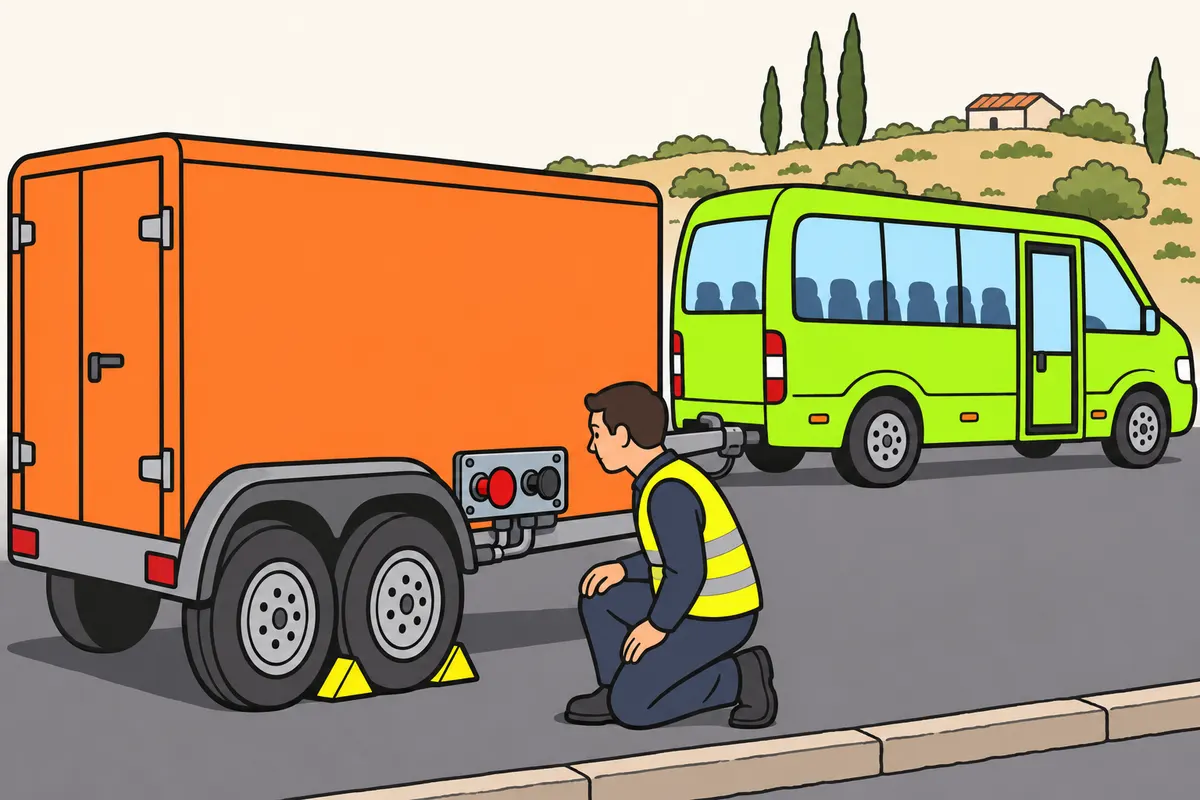
If your trailer has these knobs, distinguish parking control from brake release.
| Knob on equipment such as TrCM | Purpose |
|---|---|
| Red | Pull to park; push to release if system conditions allow |
| Black | Releases automatic braking for manoeuvring |
Remember
- Identify your controls using the plate and manual.
- Secure your trailer before using the black knob.
- With supply disconnected, the release valve uses stored air.
- To move it this way, release the parking brake too.
- Restore braking afterwards, following the equipment instructions.
Exam trap: Wrong: the red knob is the supply connection. Right: on equipment such as TrCM, it controls parking.
Read the full explanation
- On trailer and semi-trailer air brake equipment such as TrCM, the red knob controls spring-applied parking braking: you pull it to apply the brake and push it to release the brake if the system conditions are met. If your luggage trailer has this equipment, identify its controls using the plate and the manufacturer's manual. [Haldex, TrCM, parking and release valves](https://www.haldex.com/globalassets/europe/61.-documents/air-brake/006700115_es.pdf).
- The black knob operates the release or shunt valve. With the supply disconnected, it allows you to release the automatic braking to move the trailer using its air reserve; the parking brake must also be released. You must secure the trailer before operating it and follow the equipment instructions to restore braking when you finish the manoeuvre. [Haldex, TrCM, operating states](https://www.haldex.com/globalassets/europe/61.-documents/air-brake/006700115_es.pdf); [United Nations Regulation No. 13, paragraph 5.2.2.11](https://www.boe.es/buscar/doc.php?id=DOUE-L-2026-80539).
- The colours of these knobs identify local controls: red for parking and black for release perform different functions from the red supply and yellow service connections. You may find other designs; consult the identification on the equipment fitted.
12ALB load-sensing valve: braking according to load
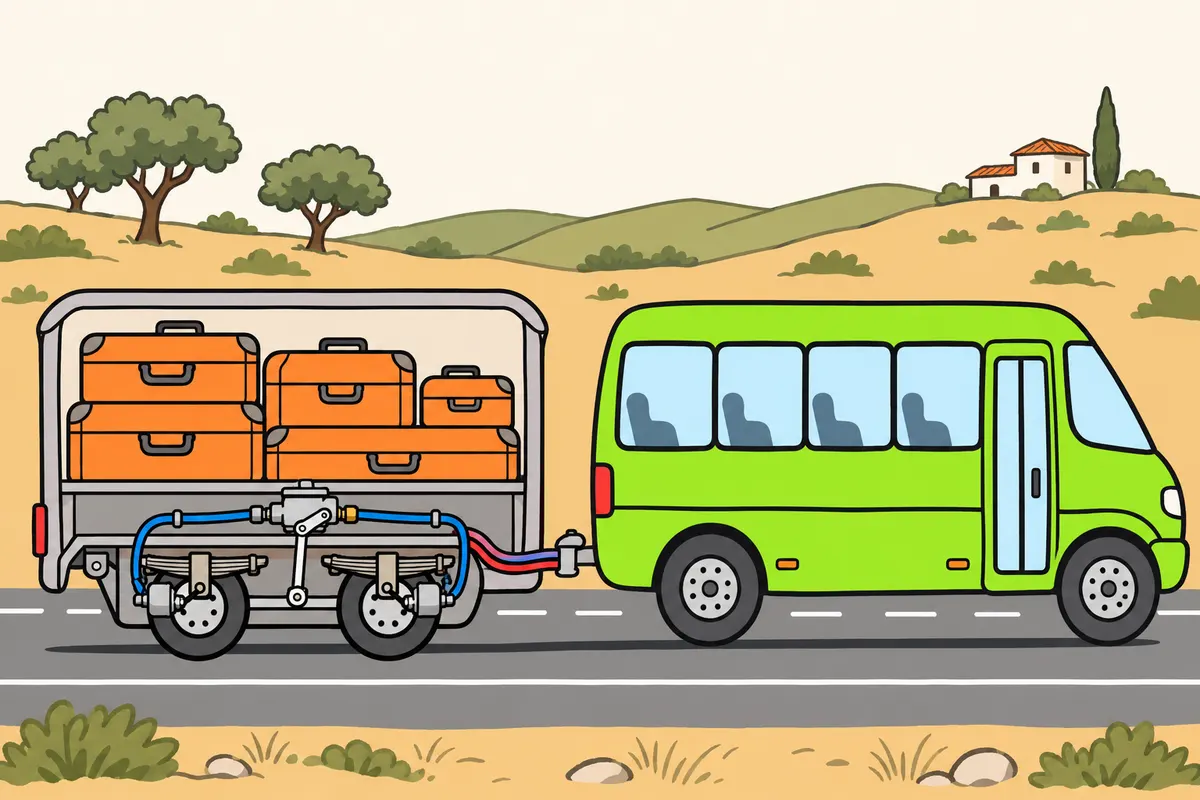
With ALB, your trailer’s braking force adjusts to its load.
| System | What it adjusts |
|---|---|
| ALB | Braking according to load |
| ABS | Wheel slip |
Remember
- Check that the load-sensing valve and its connections are intact.
- Leave adjustment to technical maintenance.
- Incorrect adjustment can cause wheel lock or weak braking.
Exam trap: Wrong: ALB and ABS are the same. Right: they adjust different things.
Read the full explanation
- The ALB valve, or load-sensing brake valve, adjusts the pressure sent to the brakes according to the load carried. This gives you less braking force with an empty trailer and more when you carry luggage. The information may come from the suspension; the pneumatic model uses its pressure. [Haldex, ALB valve, applications and operation](https://www.haldex.com/globalassets/europe/61.-documents/air-brake/000700032_es.pdf); [DGT, Manual VIII, topic 10](https://sede-org.dgt.gob.es/export/sites/dgt/.galleries/permisos-de-conducir/certificacion-aptitud-profesores-formacion-vial/2025/Manual-VIII-Mecanica-2025.pdf).
- Check that the valve and its connections are intact; adjustment is a technical maintenance task. If it delivers braking force that is unsuitable for the load, you may experience premature wheel locking or insufficient braking. ALB adapts braking to the load and ABS regulates wheel slip: these are different functions. [Haldex, ALB, maintenance and testing](https://www.haldex.com/globalassets/europe/61.-documents/air-brake/000700032_es.pdf).
13EBS and the ISO 7638 connector
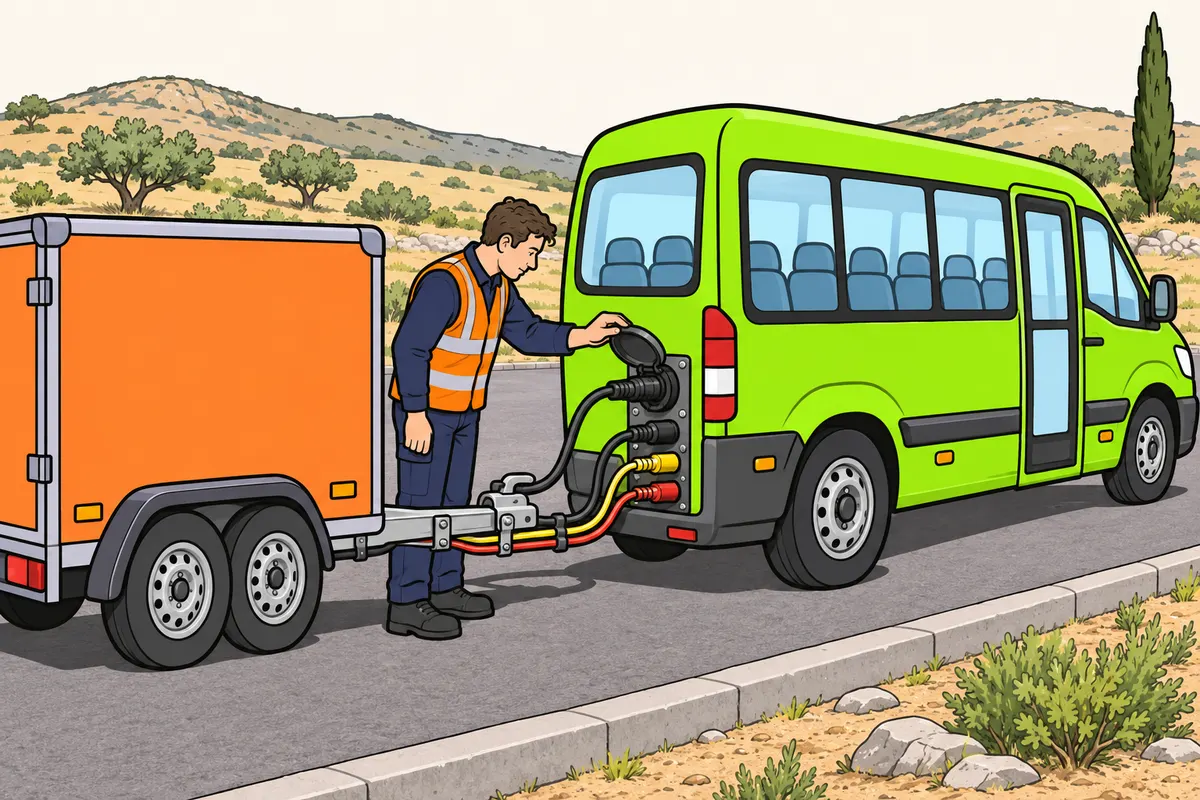
If you have EBS, check its dedicated electrical connection and warnings.
Remember
- EBS controls your braking electronically.
- In an electro-pneumatic system, air supplies the energy to brake.
- Connect ISO 7638 and check its lock and condition.
- Your lighting plug and air hoses cannot replace this connection.
- If a warning appears, check the fault.
Exam trap: Wrong: backup air braking preserves every electronic function. Right: you may lose some electronic functions.
Read the full explanation
- EBS is the electronically controlled braking system: it processes your braking demand and controls brake application. In an electropneumatic installation, air supplies the energy to apply the brakes; the electronics manage control and can integrate functions such as ABS and load-dependent regulation. If your combination has EBS, check its warnings as instructed in the manual. [DGT, Manual VIII, topic 10](https://sede-org.dgt.gob.es/export/sites/dgt/.galleries/permisos-de-conducir/certificacion-aptitud-profesores-formacion-vial/2025/Manual-VIII-Mecanica-2025.pdf); [United Nations Regulation No. 13, sections 5.1.3 and 5.2.2.15](https://www.boe.es/buscar/doc.php?id=DOUE-L-2026-80539).
- The dedicated ISO 7638 connector supplies electrical power to the trailer's braking equipment and, in an installation designed for electrical control, enables communication between the vehicles. You must connect it and check that it is locked and in good condition: the lighting plug and air hoses do not replace this connection. If a warning appears, investigate the fault; having backup air braking does not guarantee that all electronic functions remain available. [United Nations Regulation No. 13, sections 5.1.3 and 5.2.2.17](https://www.boe.es/buscar/doc.php?id=DOUE-L-2026-80539).
14Automatic braking on separation
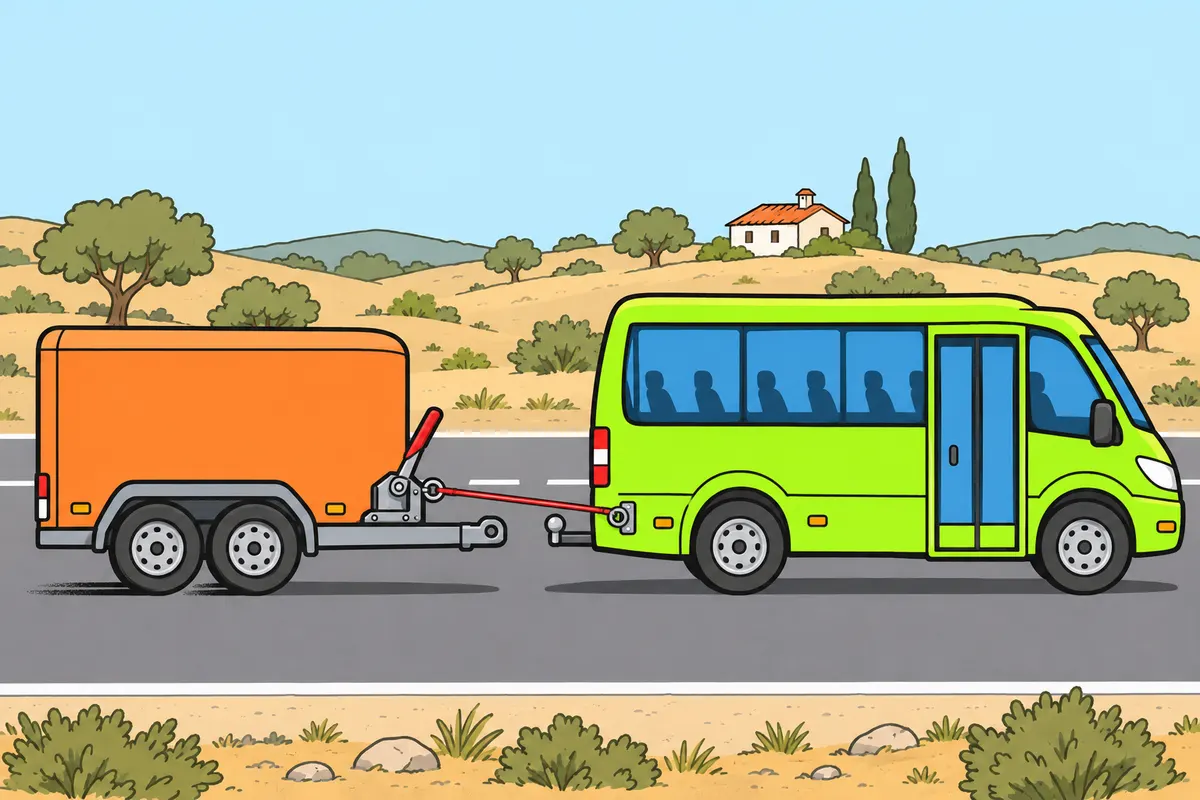
Keep the device that brakes your trailer on separation working.
Remember
- Attach your breakaway cable according to the instructions.
- Leave enough movement for turns.
- Your cable cannot correct a faulty main coupling lock.
- With air brakes, losing supply can activate automatic braking.
Exam trap: Wrong: losing air always leaves your trailer free. Right: losing supply on separation activates automatic braking.
Read the full explanation
- The trailer's automatic braking must operate if the parts of the combination separate, including if the coupling breaks, without rendering the braking of the remaining vehicles ineffective. You must not confuse this with ABS or autonomous braking to avoid a collision: it responds to separation. [RGV (General Vehicle Regulations), Annex VIII, section 1.5](https://www.boe.es/buscar/act.php?id=BOE-A-1999-1826#anviii). [RGV, art. 12.8.3](https://www.boe.es/buscar/act.php?id=BOE-A-1999-1826#a12).
- On a trailer with a mechanical breakaway device, the correctly attached cable pulls the designated mechanism when the coupling separates. You must fit it according to the instructions, with enough movement to allow articulation and without an improvised attachment that prevents it from operating. Its presence does not compensate for a faulty main coupling lock.
- In an air braking system, a loss of supply associated with separation activates the designated automatic device. You must not assume that losing air always leaves the trailer completely free to roll: depending on the design, safety functions use the trailer's air reserve or spring energy.
- The protection against separation must match the luggage trailer's type approval and mass. You must keep the fitted device and its attachment points in working order; the conditions for its application and the secondary coupling alternative are detailed in «Secondary chain and breakaway cable». [RGV, art. 13.4](https://www.boe.es/buscar/act.php?id=BOE-A-1999-1826#a13).
15Secondary chain and breakaway cable
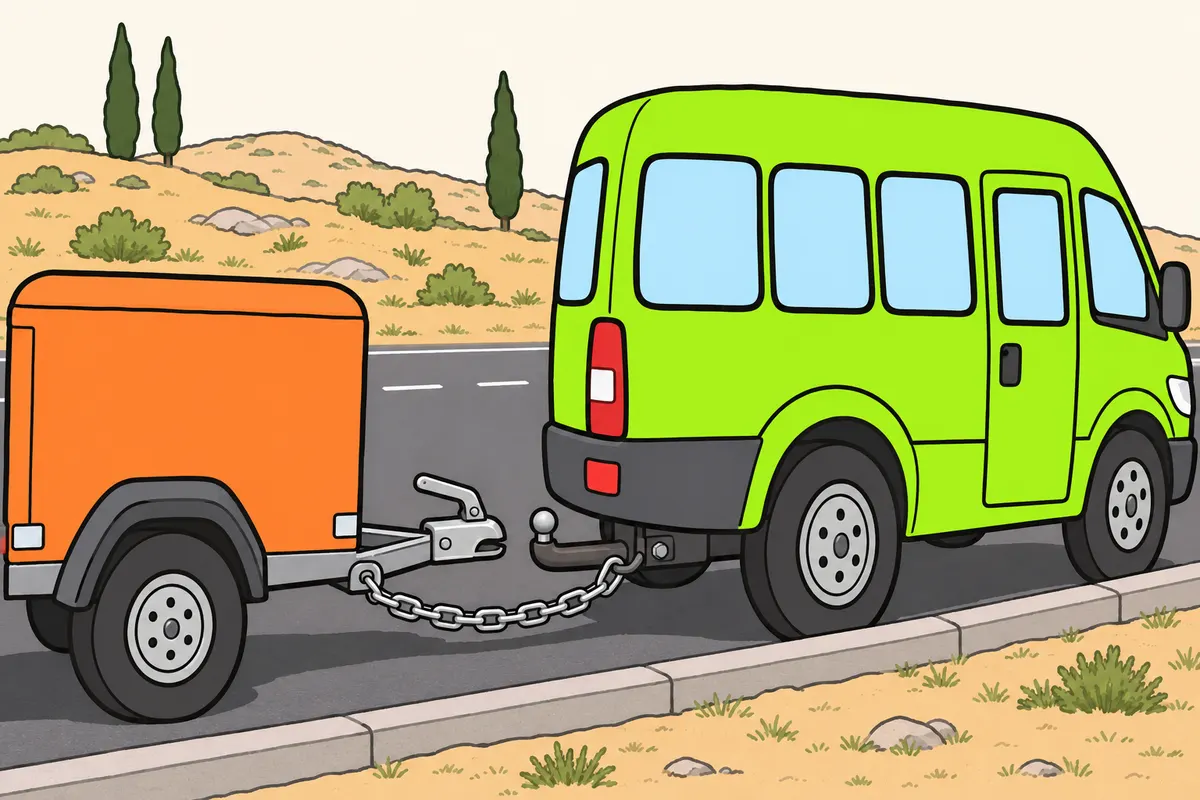
Distinguish a chain that holds your trailer from a cable that applies its brake.
| Trailer protection | Purpose |
|---|---|
| Secondary chain | Retains the connection and drawbar |
| Breakaway cable | Applies the braking mechanism |
Remember
- Up to 1,500 kg MMA, you need secondary coupling if breakaway braking is absent.
- This coupling keeps the drawbar off the ground and preserves some steering.
- Above 1,500 kg, you need automatic braking.
- The service brake requirement is separate from this protection.
Exam trap: Wrong: a chain lets you tow unbraked up to 1,500 kg. Right: that threshold concerns a different protection.
Read the full explanation
- If your trailer has an MMA (maximum authorised mass) of no more than 1,500 kg and has no system that ensures braking if the coupling breaks, it must have a secondary coupling. Its purpose is to prevent the drawbar from touching the ground and retain some residual steering if the main coupling fails. [RGV, art. 13.4](https://www.boe.es/buscar/act.php?id=BOE-A-1999-1826#a13).
- The secondary coupling mechanically retains the trailer; the breakaway cable pulls the mechanism that applies its brakes on separation. Attach each component to the point specified by the manufacturer, with enough freedom for the combination to articulate during turns.
- The threshold for this protection concerns the trailer's behaviour if the coupling breaks. The requirement for a service brake depends on its category and is independent of the safety arrangement used at the coupling. [RGCond (General Driver Regulations), art. 4](https://www.boe.es/buscar/act.php?id=BOE-A-2009-9481#a4) [RGV, Annex VIII, section 2](https://www.boe.es/buscar/act.php?id=BOE-A-1999-1826#anviii).
- For trailers over 1,500 kg, the table in Annex VIII requires automatic braking. If you tow a luggage trailer of that mass, an arbitrary chain does not replace this function; check the device specified for its braking system. Its installation is covered in detail in “Safety devices on the combination”. [RGV, Annex VIII, section 2](https://www.boe.es/buscar/act.php?id=BOE-A-1999-1826#anviii).
16ABS on the trailer too
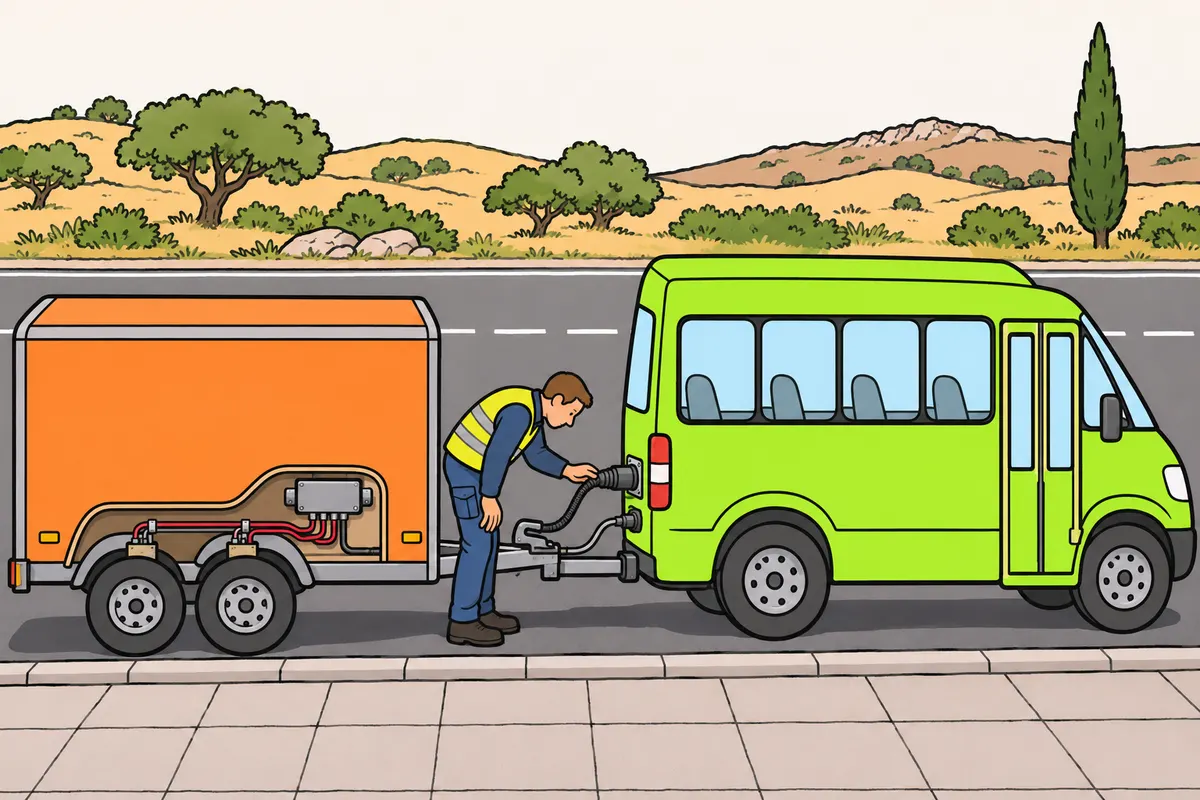
Your minibus’s ABS cannot protect the wheels of a trailer without ABS.
| Trailer category | Maximum mass | ABS for type approval |
|---|---|---|
| O1 | Up to 750 kg | Check the particular vehicle |
| O2 | Over 750 kg, up to 3,500 kg | Not required by this category alone |
| O3 | Over 3,500 kg, up to 10,000 kg | Required |
| O4 | Over 10,000 kg | Required |
Remember
- If your trailer has ABS, check its power supply and warnings.
- Do not disable fitted ABS.
- Check your vehicle’s type approval, age and documents.
- Do not assume every existing trailer must have ABS added.
Exam trap: Wrong: every O2 needs ABS because it exceeds 750 kg. Right: that mass alone does not make ABS compulsory.
Read the full explanation
- To identify the technical categories, remember their maximum masses: O1 up to 750 kg; O2 over 750 kg and up to 3,500 kg; O3 over 3,500 kg and up to 10,000 kg; O4 over 10,000 kg. You must include the exact boundary value in the lower category: exactly 10,000 kg falls within O3. [DGT, Heavy Vehicle Manual, categories](https://sede.dgt.gob.es/.galleries/permisos-de-conducir/certificacion-aptitud-profesores-formacion-vial/2019/Manual-III-Reglamentacion-de-Vehiculos-Pesados-2019.pdf).
- ABS automatically regulates wheel slip during braking to prevent the wheels from locking. You must understand that it regulates the force of the brakes it controls; it does not add grip to the road surface or remove the need to choose a speed that allows you to stop the combination. [DGT, Mechanics Manual, ABS](https://sede-org.dgt.gob.es/export/sites/dgt/.galleries/permisos-de-conducir/certificacion-aptitud-profesores-formacion-vial/2025/Manual-VIII-Mecanica-2025.pdf).
- Type approval requires ABS on O3 and O4 trailers, but an O2 trailer is not subject to that requirement simply because it exceeds 750 kg or is towed by a minibus with ABS. Identify the equipment actually fitted and keep the installed system in working order. [UN Regulation No. 13, section 5.2.2.13](https://www.boe.es/buscar/doc.php?id=DOUE-L-2026-80539).
- The minibus's ABS regulates its own wheels: it does not provide anti-lock braking for a trailer without that equipment. If your trailer has ABS, also check its power supply and the relevant warnings. A connected lighting socket does not in itself prove that the braking system's power supply is correct.
- For a particular vehicle, you must take account of its type approval, age and documentation; do not infer a universal obligation to retrofit every vehicle from a type-approval requirement. Nor must you interpret an empty cell in a general table as permission to disable the ABS fitted.
17Emergency braking with ABS
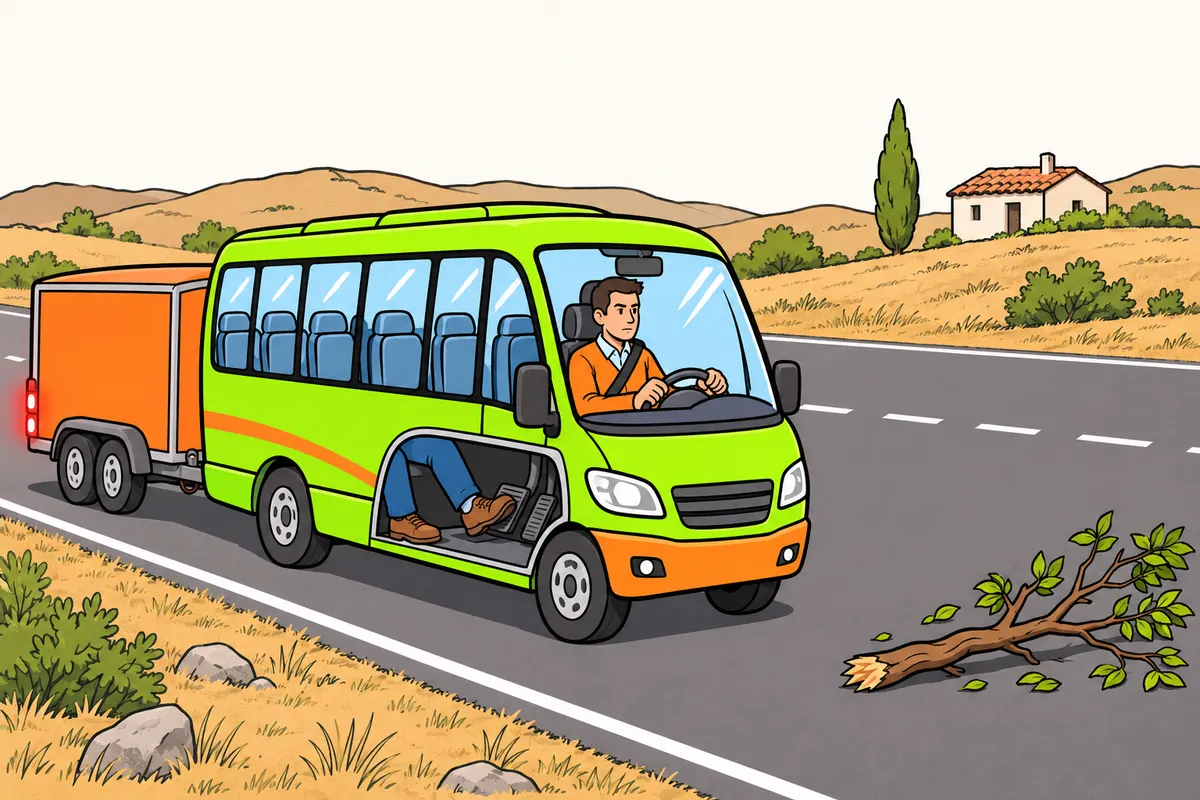
In an emergency with working ABS, press firmly and maintain the necessary brake pressure.
Remember
- Do not pump your brake pedal.
- Do not release your brake because of normal ABS vibration.
- Look towards a safe path for your whole combination.
- Steer with control and avoid sudden steering movements.
- ABS does not give your tyres extra grip.
Exam trap: Wrong: ABS always stops you in fewer metres. Right: it prevents wheel lock and helps you keep control.
Read the full explanation
- If you need to make an emergency stop with working ABS, press the brake firmly and maintain the necessary pressure, without pumping the pedal or releasing it because of the system's normal vibrations. [DGT, using the brakes, emergency braking](https://revista.dgt.es/es/educacion-formacion/conducir-mejor/2023/0315-Frenadas.shtml).
- The trailer follows its own path during braking: you must assess the space needed by the whole combination before steering towards an escape route. A sudden steering movement can destabilise it even if the minibus's wheels retain their ability to steer. The available grip limits both turning and deceleration at the same time.
- ABS helps you retain control and prevents the wheels it regulates from locking, but it does not guarantee a shorter distance on every surface. If your trailer has no anti-lock braking, its wheels can lock even when the minibus's ABS operates. [DGT, Mechanics Manual, ABS](https://sede-org.dgt.gob.es/export/sites/dgt/.galleries/permisos-de-conducir/certificacion-aptitud-profesores-formacion-vial/2025/Manual-VIII-Mecanica-2025.pdf).
18ABS warnings and braking faults
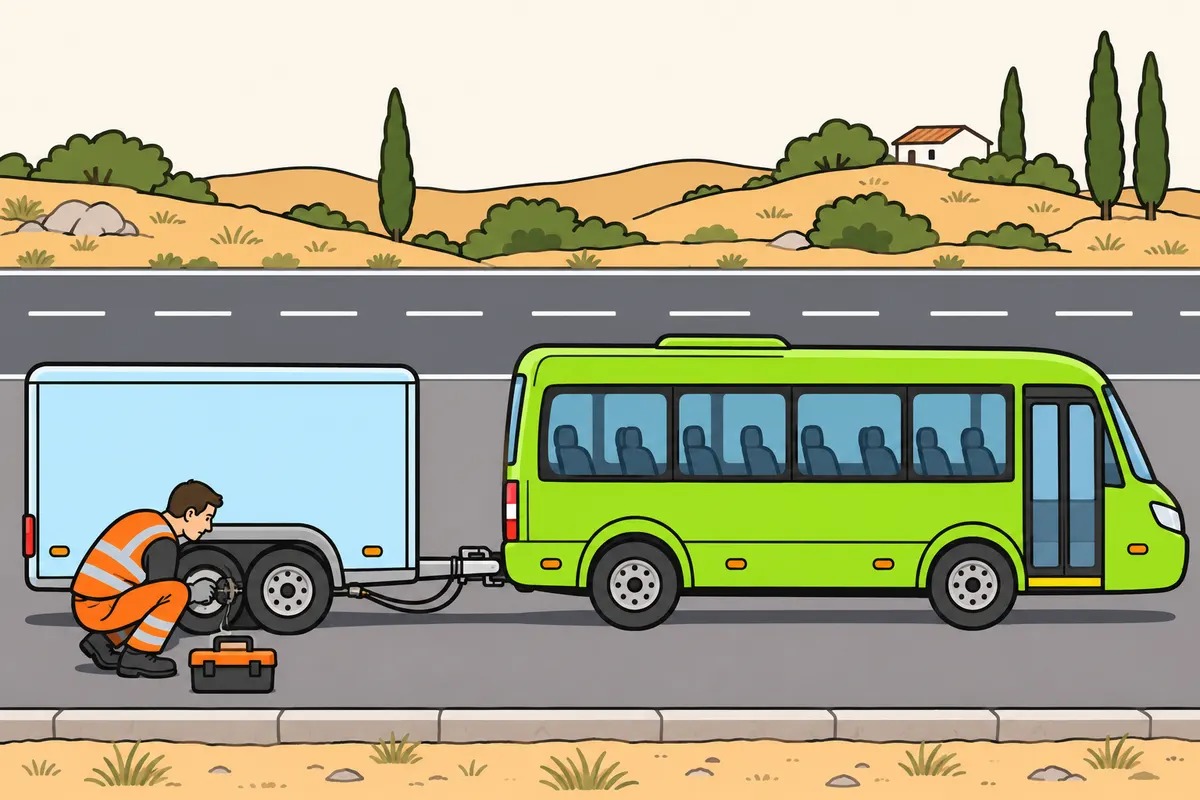
Identify each warning and stop if the fault compromises safety.
Remember
- A warning light during initial checks may not mean a lasting fault.
- If it stays on afterwards, check its meaning and the system.
- An ABS fault may remove anti-lock control without removing all braking.
- If the fault compromises safety, stop somewhere safe.
- Repair the cause before continuing.
- Always include your trailer when assessing the fault.
Exam trap: Wrong: every pressure warning means an electronic fault. Right: identify the specific message.
Read the full explanation
- The trailer's ABS warning lamp has its own self-diagnostic sequence. If it stays on outside that sequence, you must consult the manufacturer's explanation and check the installation; the minibus's warning does not replace the trailer's.
- An ABS fault can disable anti-lock regulation while leaving service braking available. An insufficient-pressure warning indicates a different problem: you must interpret the specific message and its effect on the trailer. Warnings are covered in «Maintaining the minibus and its trailer».
- If your trailer pushes the minibus because it brakes insufficiently, the minibus may seem normal while bearing an additional load. If you experience weak braking, severe pulling to one side or air leaks that compromise safety, you must stop in a safe place and repair the cause before continuing the transport operation.
19Braking distance and stopping distance
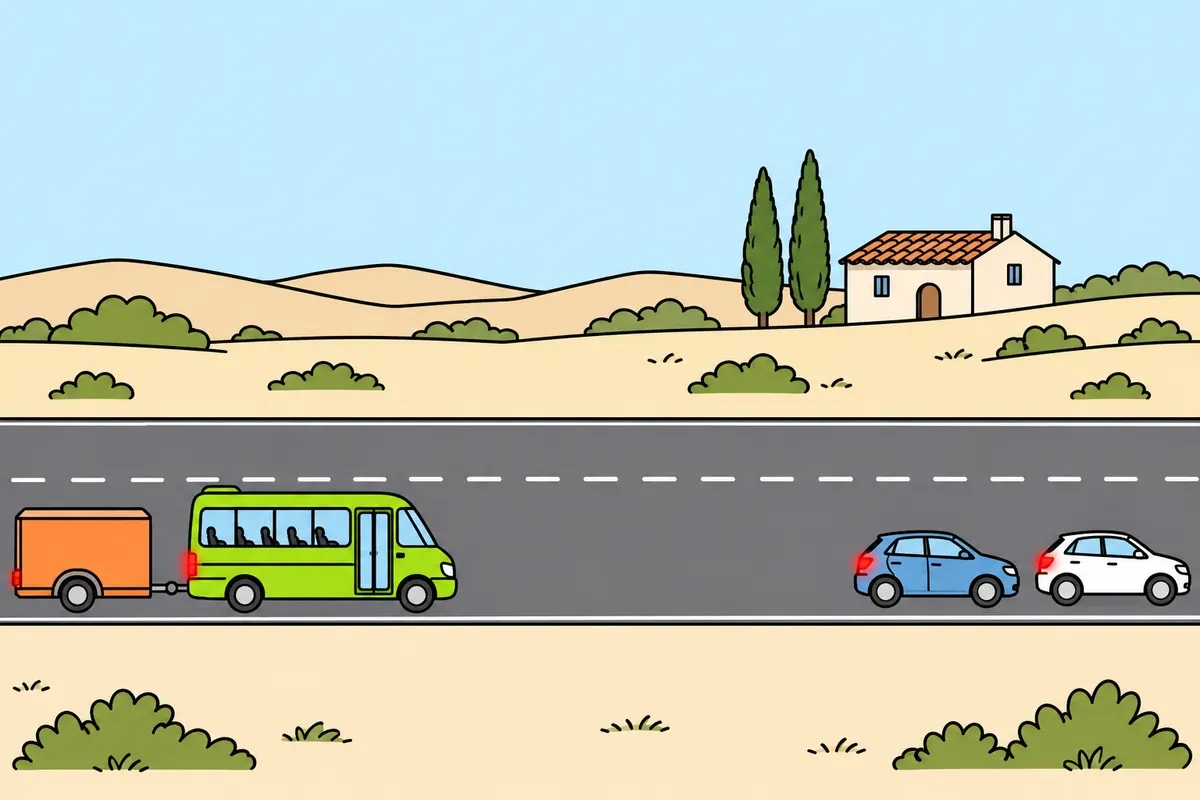
Anticipate braking according to the condition and response of your whole combination.
Remember
- Allow for mass, load distribution and road grip.
- Consider the condition of your brakes.
- Anticipate even with ABS and good tyres.
Exam trap: Wrong: larger wheels guarantee a shorter stop. Right: wheel size does not prove a shorter stopping distance.
Read the full explanation
- In a heavy combination, system response, mass, load distribution, grip and brake condition all play a part. You must anticipate traffic queues even if the towing vehicle has ABS and good tyres. Wheel size does not show that your minibus stops sooner than another vehicle.
- Reaction, braking and stopping distances, adapting your speed and safety margins are covered in «Speed and distances with a minibus and trailer». [RGC, art. 45](https://www.boe.es/buscar/act.php?id=BOE-A-2003-23514#a45).
20Mass, load and grip
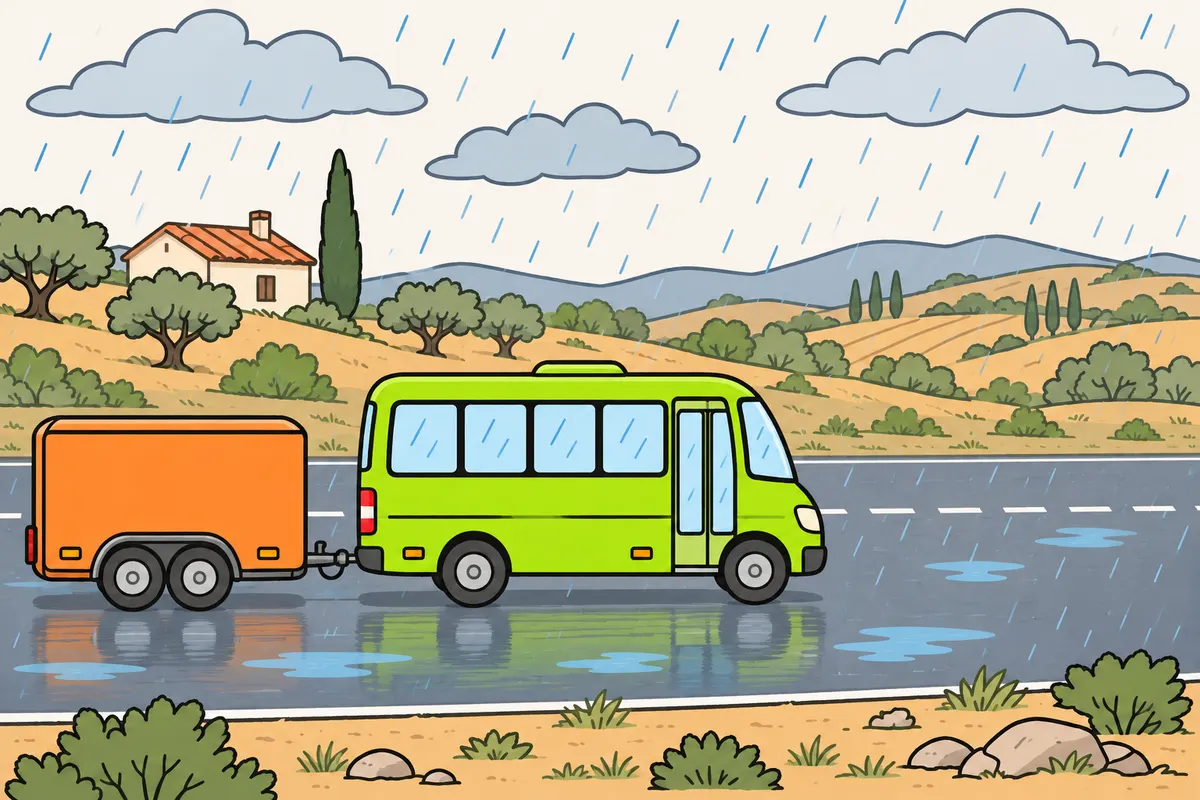
Adapt your braking to mass, load and available grip.
Remember
- Distribute and secure your luggage properly.
- Do not overload your combination.
- Your empty trailer can also lose grip if you brake too hard.
- On slippery surfaces, slow down earlier and leave more space.
- Check your trailer’s tyres, shock absorbers and brakes too.
Exam trap: Wrong: your empty trailer always brakes more stably. Right: excessive braking can make it lose grip.
Read the full explanation
- With greater mass, you must dissipate more energy for the same reduction in speed. You must not convert this into a universal ratio of distances in metres, because wheel loads and effective braking capacity also vary. Overloading the combination reduces the margin allowed for in its design.
- A poorly distributed load can leave some axles lightly loaded and others overloaded. When you brake, an axle carrying little load can reach its grip limit sooner; a shifting load also changes the balance. Distribute and secure the luggage in the trailer as explained in «Safe loads and luggage».
- With an empty trailer, excessive braking demand can cause its wheels to lose grip. Load-dependent regulation is explained in «ALB load-sensing valve: braking according to load»: keep the fitted system operational and adapt your braking to the road surface.
- In rain, snow, ice, dirt or with different levels of grip under each side of the combination, you must slow down in advance and increase your safety margin. Poorly maintained tyres, shock absorbers or brakes can impair the response. Check those on the trailer too: the good condition of the towing vehicle does not compensate for the trailer's lack of grip.
21Preparing well for normal braking
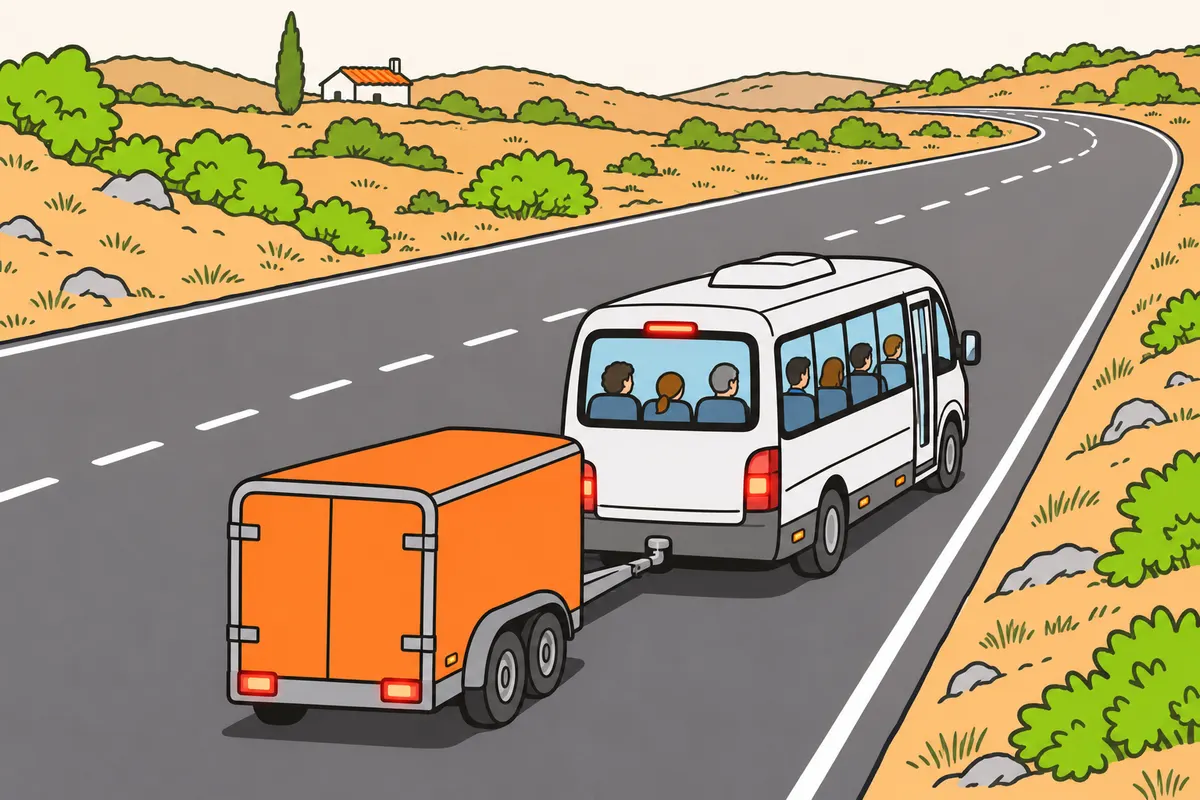
To brake smoothly, look ahead and slow down early.
Remember
- Apply your brake progressively when the situation allows.
- Reach a suitable speed before entering a bend.
- If an emergency requires braking in a bend, avoid sudden steering movements.
Exam trap: Wrong: hard braking and sharp turning have no consequences. Right: combining them increases skidding risk.
Read the full explanation
- You must anticipate the need to slow down and apply the brakes progressively when the situation allows: this limits jolts felt by passengers and keeps the trailer stable. The D1+E assessment includes passenger comfort and the absence of harsh braking. [RGCond, Annex VI, C.7.4.b](https://www.boe.es/buscar/act.php?id=BOE-A-2009-9481#anvi).
- You must slow down before a bend to limit the lateral forces on the trailer during braking. In an emergency on a bend, brake while maintaining controlled steering. [DGT, braking on bends](https://revista.dgt.es/es/educacion-formacion/conducir-mejor/2023/0315-Frenadas.shtml).
- Separation and warnings when reducing speed considerably are covered in «Speed and distances with a minibus and trailer». [RGC, arts. 53 and 54](https://www.boe.es/buscar/act.php?id=BOE-A-2003-23514#a53).
22What jackknifing is
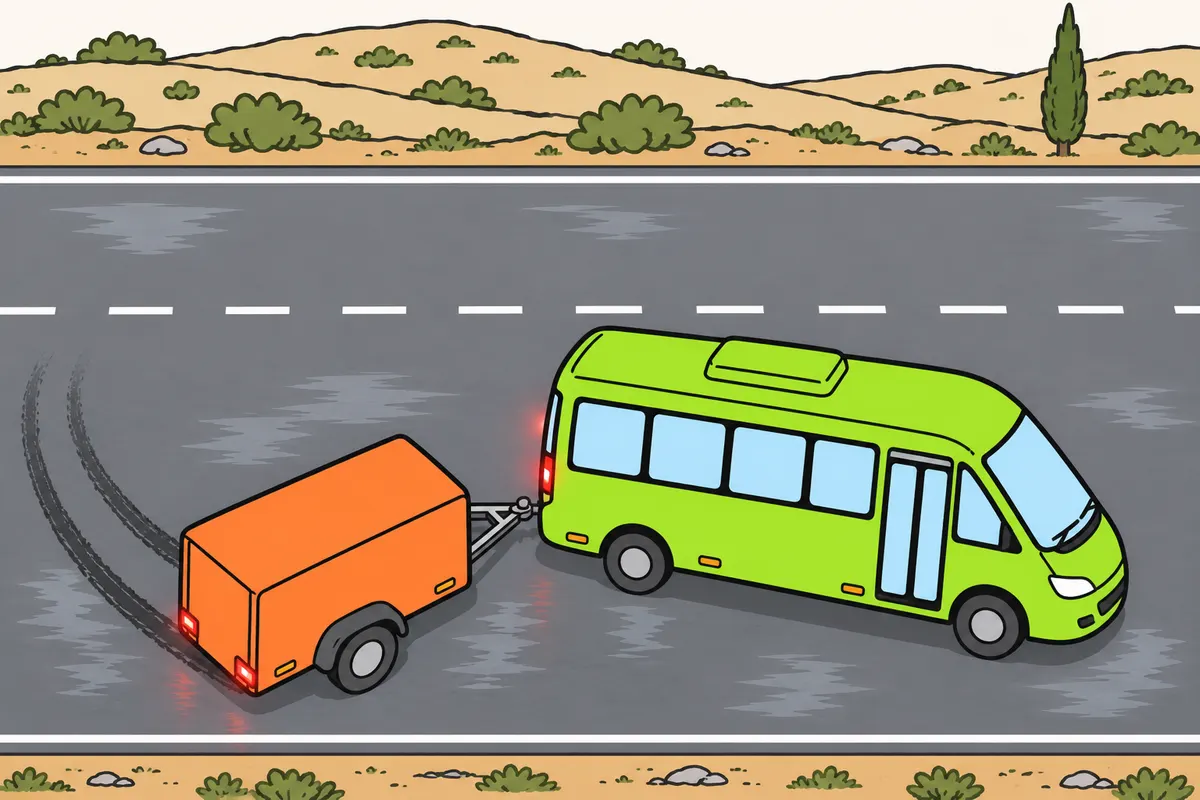
Your combination can jackknife when your minibus and trailer lose alignment and stability.
Remember
- Do not confuse normal turning with jackknifing.
- Your trailer may push your towing vehicle or skid sideways.
- Unsuitable speed and slippery surfaces increase your risk.
- Braking harder does not guarantee greater stability.
Exam trap: Wrong: ABS prevents every jackknife. Right: it helps prevent wheel lock but cannot remove every cause.
Read the full explanation
- Jackknifing is a sharp closing of the angle between the minibus and trailer due to loss of alignment and stability. The units can end up across the road and take up space to the sides, putting passengers at risk. Normal articulation during a turn allows the combination to keep following its path.
- If the minibus's rear axle loses lateral grip, the trailer's pushing force can worsen the misalignment. If the trailer's wheels lock, it can skid sideways. You must consider which unit loses grip, because the causes and the combination's response differ.
- Harsh braking, a slippery road surface, inappropriate speed and a poorly distributed load increase the likelihood of jackknifing. ABS reduces the risk associated with wheel locking, but excessive speed on a bend or a fault can destabilise the combination even with this assistance working.
23How to prevent jackknifing
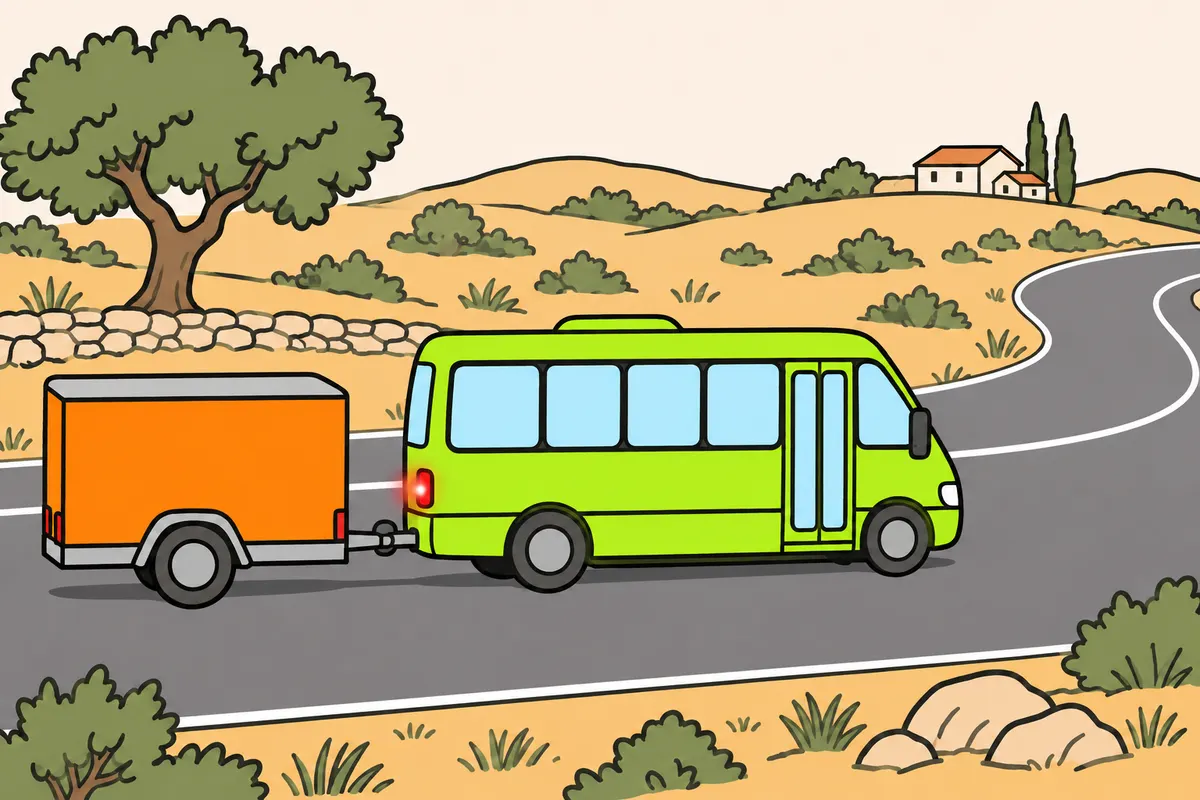
To prevent jackknifing, anticipate hazards and keep your combination’s braking coordinated.
Remember
- Keep your distance and slow before bends, descents and slippery areas.
- Avoid combining heavy braking with a sharp turn.
- Repair faults that unbalance your braking.
- If misalignment starts, avoid sudden steering and violent downshifts.
- Follow your practical training and the vehicle’s instructions.
Exam trap: Wrong: accelerating or applying the trailer brake always straightens a jackknife. Right: your response depends on which wheels lose grip and the available aids.
Read the full explanation
- To prevent jackknifing, you must maintain a braking margin and slow down before bends, descents or slippery sections. Progressive driving is covered in «Driving techniques for a minibus with a trailer».
- The braking of the minibus and trailer must remain coordinated. An incorrect connection, a seized brake or insufficient deceleration of the towed vehicle upsets this balance. You must repair the cause to restore the intended response of both units.
- At the first signs of misalignment, avoid sudden steering movements, violent downshifts and abrupt demands for retardation. The response depends on which wheels lose grip and the assistance systems fitted: you must follow your practical training and the vehicle's instructions. Accelerating or applying the trailer brake alone can worsen the skid.
24Long descents: prepare your speed
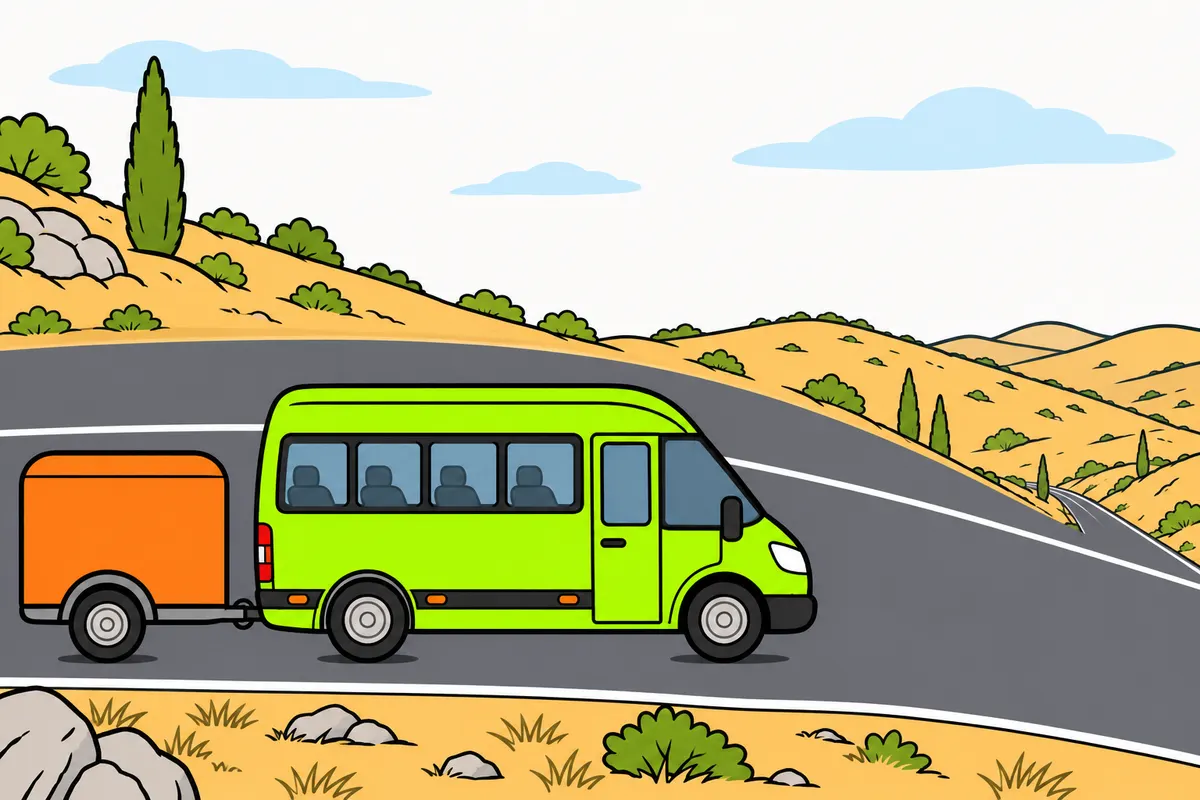
Before a long descent, choose a suitable speed and gear.
Remember
- Consider mass, gradient and grip.
- Do not descend in neutral or with your clutch held down.
- Use available engine braking and retarders as the manufacturer instructs.
- Use your service brake when needed.
- Monitor your speed throughout the descent.
- If engine braking or retarders cannot control speed, slow down under control.
Exam trap: Wrong: light pedal pressure throughout the descent is enough. Right: combine available engine braking and retarders with service braking when needed.
Read the full explanation
- Before a long descent, you must choose your speed, gear and retardation according to the combination's mass, the gradient and the available grip. The trailer's sustained pushing force requires you to keep braking capacity in reserve throughout the descent.
- You must keep the transmission engaged to use engine braking, without descending in neutral or with the clutch pedal pressed. With automated gearboxes, use the intended mode and respect the permitted engine speed range. Preparing for descents is covered in «Driving techniques for a minibus with a trailer».
- Combine the available retardation with the service brake when necessary and monitor your speed throughout the slope. Relying solely on continuous light pressure on the pedal builds up heat in the brakes of both units. If your speed increases, reduce it in a controlled way until you regain a sustainable pace. [DGT, brakes on slopes](https://revista.dgt.es/es/educacion-formacion/conducir-mejor/2023/0315-Frenadas.shtml).
25Retarders and the service brake
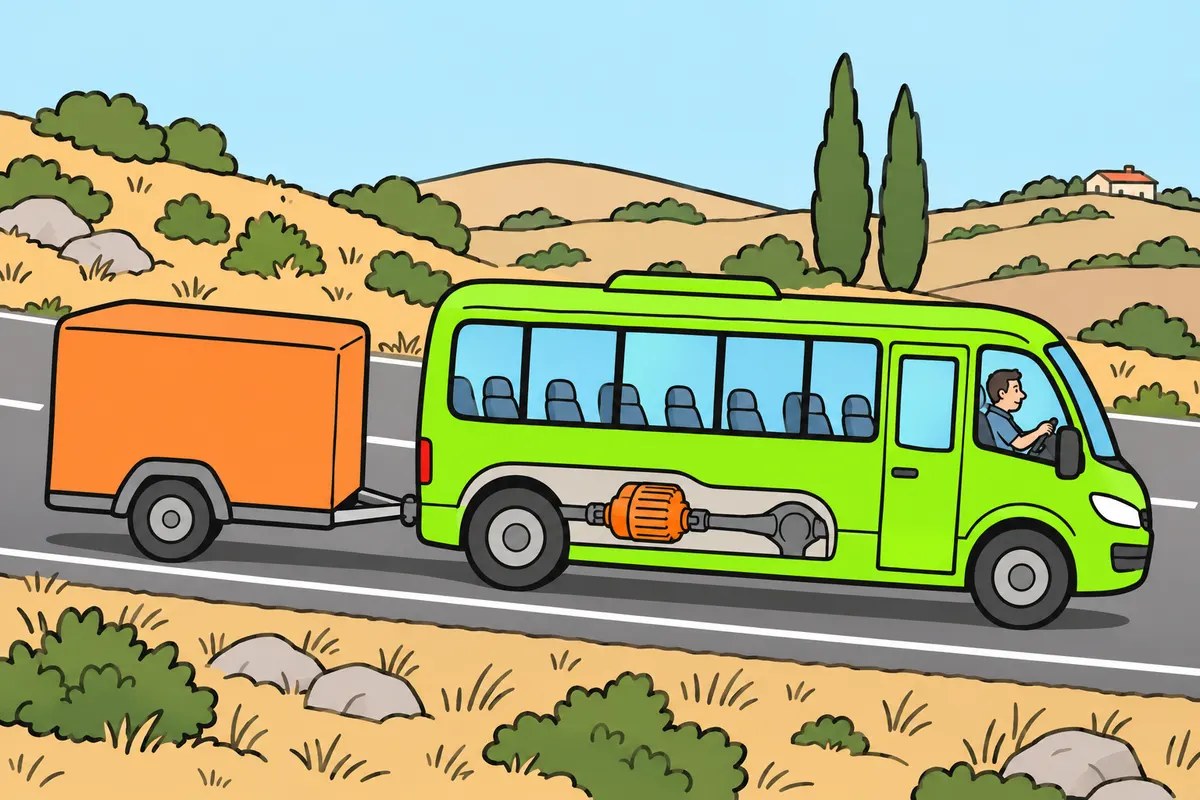
Retarders help you reduce continuous work by your wheel brakes.
| Braking method | Purpose |
|---|---|
| Wheel brakes | Brake through friction |
| Engine braking and transmission retarders | Slow you through other mechanisms |
Remember
- Use their settings and limits according to the manufacturer.
- Monitor temperature or engine speed where required.
- On slippery surfaces, apply engine braking and retarders carefully and progressively.
- Excessive engine braking or retarder force can make your driven wheels lose grip.
Exam trap: Wrong: your retarder replaces parking brakes. Right: use the specified devices to secure your combination.
Read the full explanation
- Engine braking and retarders provide a slowing effect that reduces the workload on the friction brakes. You may find an exhaust brake, a hydrodynamic retarder or an electric retarder. Their control settings, temperature limits and engine speed limits depend on the equipment; you must follow its instructions. [DGT, Mechanics Manual, auxiliary braking systems](https://sede-org.dgt.gob.es/export/sites/dgt/.galleries/permisos-de-conducir/certificacion-aptitud-profesores-formacion-vial/2025/Manual-VIII-Mecanica-2025.pdf).
- The slowing effect applied through the transmission acts on the drive wheels of the minibus. On a slippery surface, excessive braking demand can cause them to lose grip while the trailer continues pushing, with a risk of the combination moving out of alignment. You must apply it progressively and within the manufacturer’s limits.
- The retarder helps you control movement; to stop each vehicle or secure it against movement, you must use its service and parking brakes. Progressive use of engine braking and retarders is covered in «Driving techniques for a minibus with a trailer».
26Overheating and loss of effectiveness
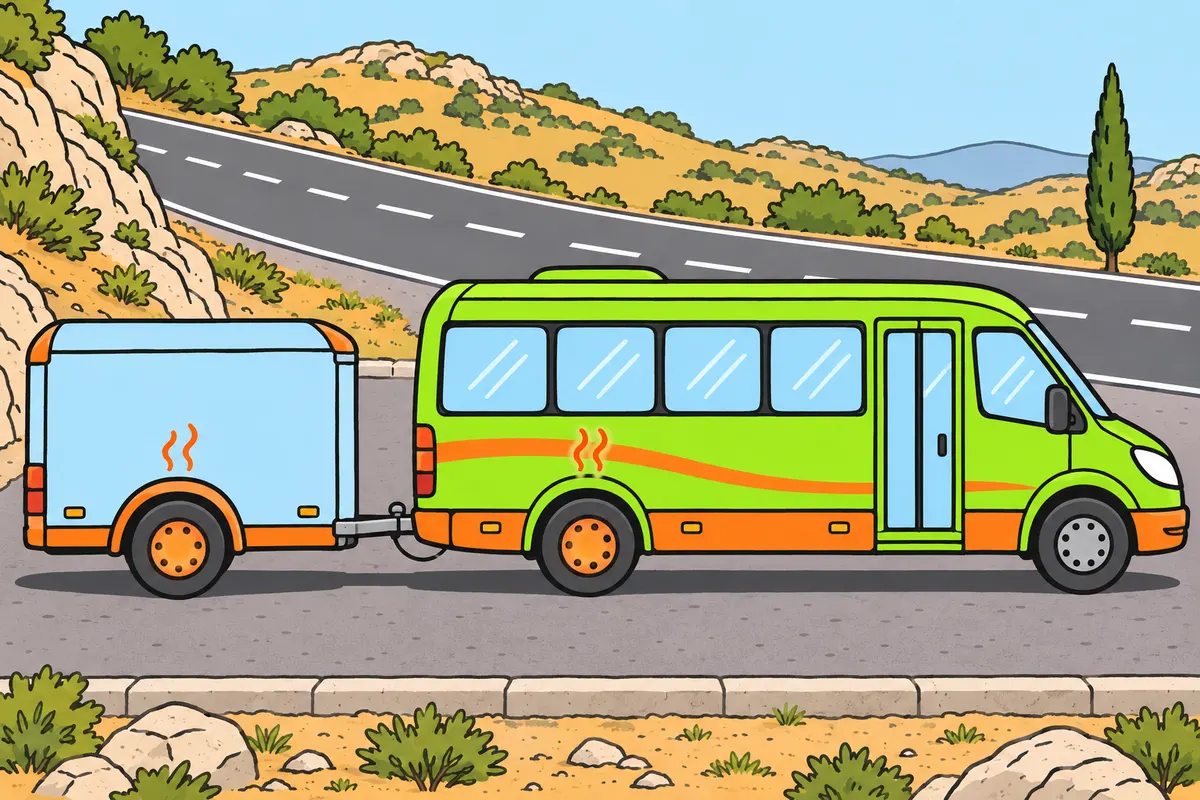
Overheated brakes can lose effectiveness even when you have air assistance.
Remember
- If you notice unusual smells or heat warnings, find somewhere safe to stop.
- Allow cooling and checks according to the instructions.
- Do not pour water on very hot discs or drums.
- If braking fails seriously downhill, use the braking methods that still work.
- Look for an escape lane if one exists and you can reach it.
- Do not switch off your engine or cause sudden wheel lock.
Exam trap: Wrong: compressed air prevents overheating. Right: sustained brake use can cause loss of effectiveness.
Read the full explanation
- Sustained use of the friction brakes can cause heat to build up faster than it dissipates, leading to a loss of braking effectiveness, or brake fade. This also affects the trailer: if its braking becomes less effective, it pushes harder against the minibus. Air assistance does not prevent overheating. [DGT, Mechanics Manual, brake fade](https://sede-org.dgt.gob.es/export/sites/dgt/.galleries/permisos-de-conducir/certificacion-aptitud-profesores-formacion-vial/2025/Manual-VIII-Mecanica-2025.pdf).
- If you notice an unusual smell, temperature warnings or an increasing need to brake, you must find a safe place to stop and let the brakes cool down according to the instructions. A seized trailer brake can overheat even when you do not press the pedal. Avoid pouring water on hot parts or handling them; their inspection is covered in «Maintaining the minibus and its trailer».
- If you suffer a severe loss of braking on a descent, maintain control, use any engine braking or retarder that remains effective and look for an accessible escape lane. Enter it with the combination aligned, holding the steering wheel firmly, with the engine running and avoiding sudden locking of the combination’s wheels. [DGT, braking techniques for heavy vehicles](https://www.dgt.es/export/sites/web-DGT/.galleries/downloads/nuestros_servicios/permisos-de-conducir/recupera-puntos/2014-0841_INCOVIA_manual_formador.pdf).
Check that the towed vehicle can brake
Check connections, reserves and response together before driving.
- Keep the combination immobilised and check that its systems are compatible.
- Identify the red supply connection, yellow control connection and electrical braking connection where fitted.
- Check locks, seals and hose routing, ensuring there are no leaks or risks of tension as the combination articulates.
- Wait until the prescribed pressure conditions are met and check the warnings on the towing vehicle and trailer.
- Carry out the braking check specified by the manufacturer in a safe place; correct any fault before driving.
Brake for a hazard with ABS working
Use the available braking capacity and keep your path under control.
- Look towards a safe path and assess the space available for the whole combination.
- Apply the brake firmly when you need to make an emergency stop.
- Maintain the necessary pressure and let ABS modulate braking; do not pump the pedal.
- Steer in a controlled manner, without a sudden steering movement that compromises the stability of the towed vehicle.
- Once stopped, secure the combination and assess the situation before continuing.
Control a long descent
Prepare your retardation and keep braking capacity in reserve.
- Slow down before starting the descent, taking account of mass, grip and road layout.
- Select a gear or descent mode suitable for the vehicle.
- Use the available retardation progressively, following the manufacturer’s instructions.
- Use the service brake when necessary and check that your speed remains under control.
- If braking effectiveness decreases or abnormal heating occurs, find a safe place to stop; if braking is insufficient, use effective means and an accessible escape lane.
Finished this module?
Mark it as read and you will see your progress on the theory list.