
Theory · A2 Licence - Motorcycle · Module 9 of 18
Using the road on your motorcycle
You choose the correct carriageway and lane for your motorcycle, recognise reserved lanes and distinguish when you must or may use the arcén (hard shoulder). You answer questions about traffic directions, special lanes, road markings and tunnels by considering the conditions and exceptions that often determine the exam answer.
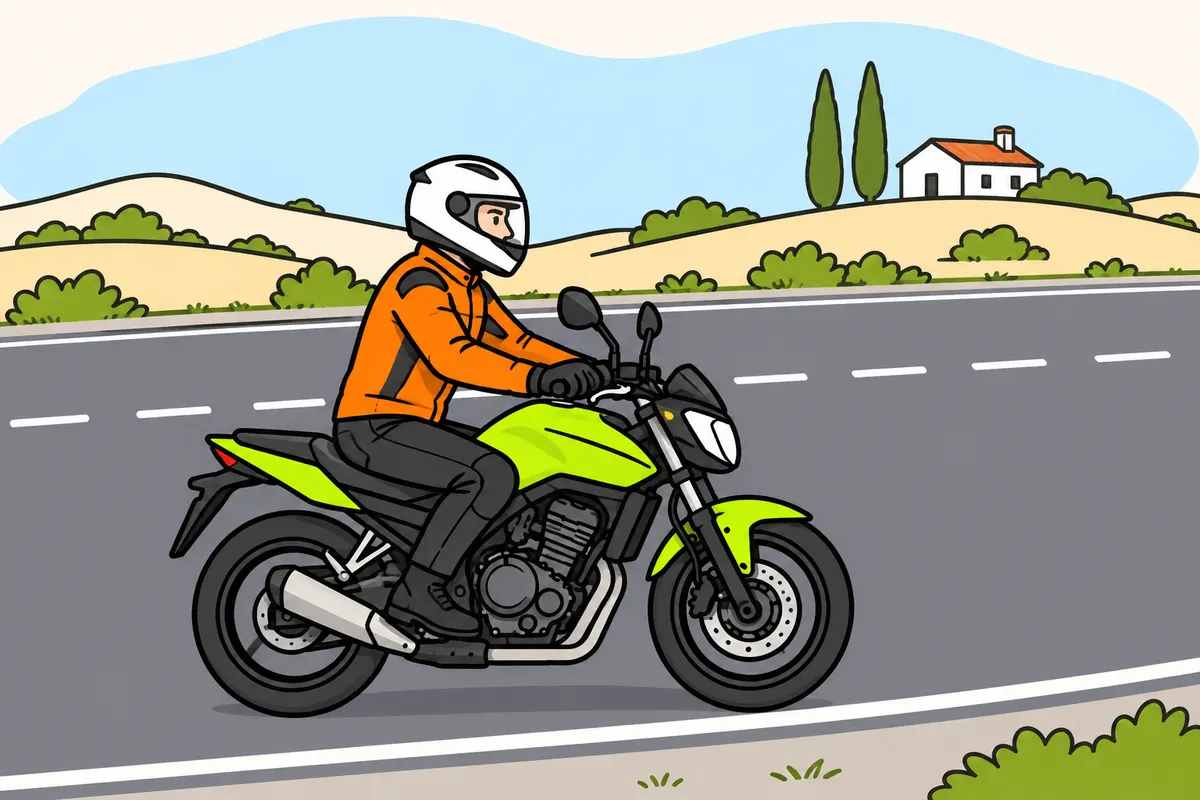
1Ride your motorcycle on the carriageway
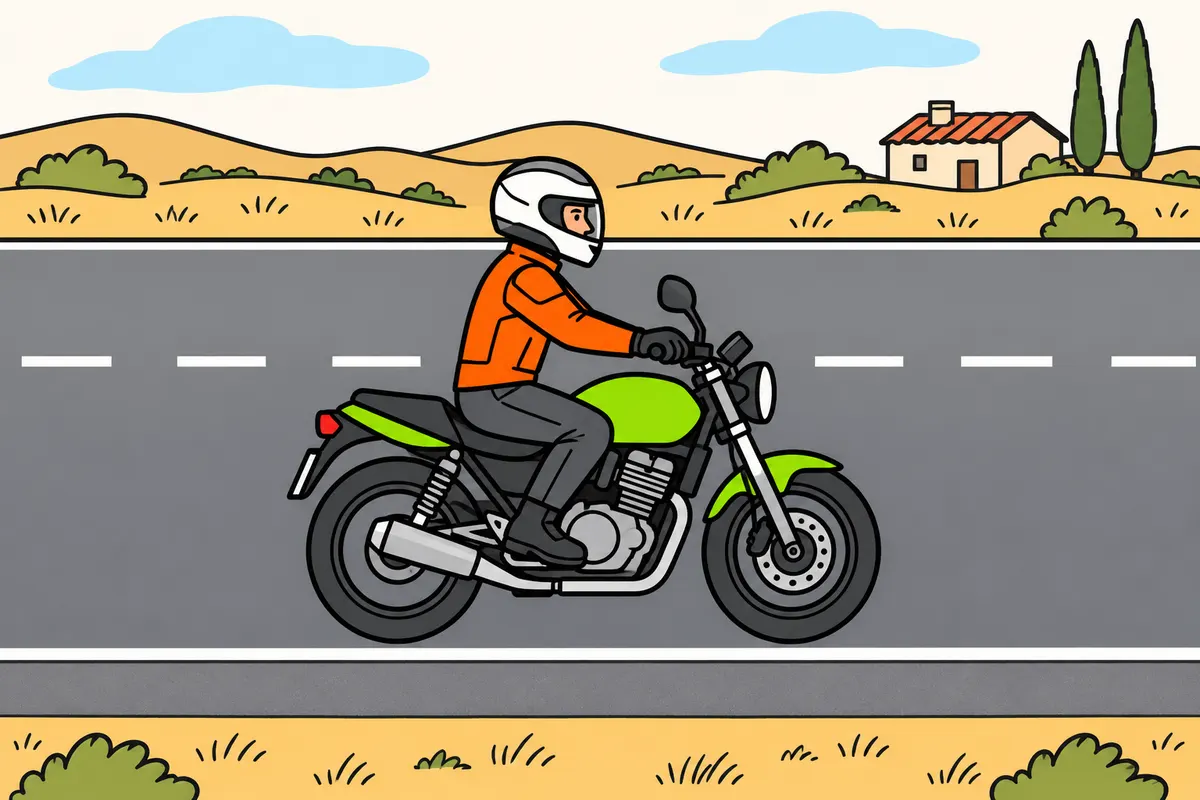
Ride your motorcycle on the carriageway and keep right.
Remember
- Use the hard shoulder only when legally allowed.
- Keep near the right edge, leaving enough room to pass oncoming vehicles safely.
- On blind bends and crests, keep the opposite side completely clear.
- Follow the legal exceptions for passing obstacles.
Exam trap: Wrong: your light motorcycle must use the hard shoulder. Right: normally, use the carriageway.
Read the full explanation
- You must ride your motorcycle on the carriageway, except where using the arcén (hard shoulder) is legally permitted, as explained in this module. Articles 30.1 and 31.1 cover all automobiles; the 3,500 kg threshold refers to special vehicles. [RGC, art. 30.1](https://www.boe.es/buscar/act.php?id=BOE-A-2003-23514#a30) [RGC, art. 31.1](https://www.boe.es/buscar/act.php?id=BOE-A-2003-23514#a31)
- You must ride on the right, as close as possible to the edge of the carriageway, keeping enough lateral clearance to pass oncoming traffic safely. On a narrow road, your position must allow you to pass another vehicle without encroaching on its path. [RGC, art. 29](https://www.boe.es/buscar/act.php?id=BOE-A-2003-23514#a29)
- On bends and crests with restricted visibility, you must leave the half of the carriageway intended for oncoming traffic completely clear, even if there is no centre line, except in the exceptional cases of passing provided for in article 88, explained in «Motorcycle manoeuvres». [RGC, art. 29](https://www.boe.es/buscar/act.php?id=BOE-A-2003-23514#a29)
2Two-way traffic with two lanes
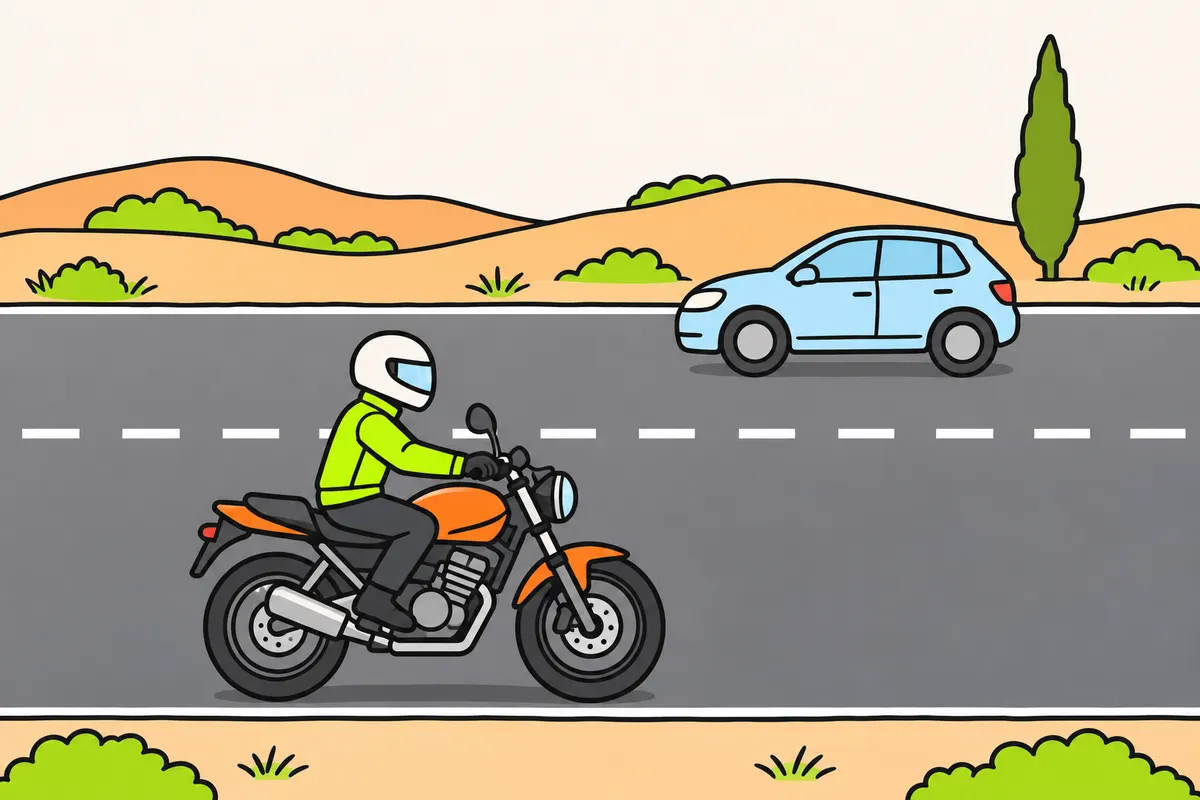
On a two-way carriageway, use the lane on your right.
Remember
- Keep right even without painted lines.
- Cross the centre only for a permitted manoeuvre.
- Follow the markings and safety rules.
Exam trap: Wrong: without lines, you can choose either lane. Right: use the lane on your right.
Read the full explanation
- On a two-way carriageway with two lanes, you must use the lane on your right. This arrangement applies whether or not markings separate the lanes. [RGC, art. 30](https://www.boe.es/buscar/act.php?id=BOE-A-2003-23514#a30)
- To cross the centre line during a permitted manoeuvre, you must meet the conditions explained in «Motorcycle manoeuvres» and follow the meaning of the markings explained in «Longitudinal lines and carriageway edges», within this module. [RGC, art. 30](https://www.boe.es/buscar/act.php?id=BOE-A-2003-23514#a30) [RGC, annex I, catalogue of RD 465/2025](https://www.boe.es/buscar/doc.php?id=BOE-A-2025-12199)
3Three lanes shared between two directions
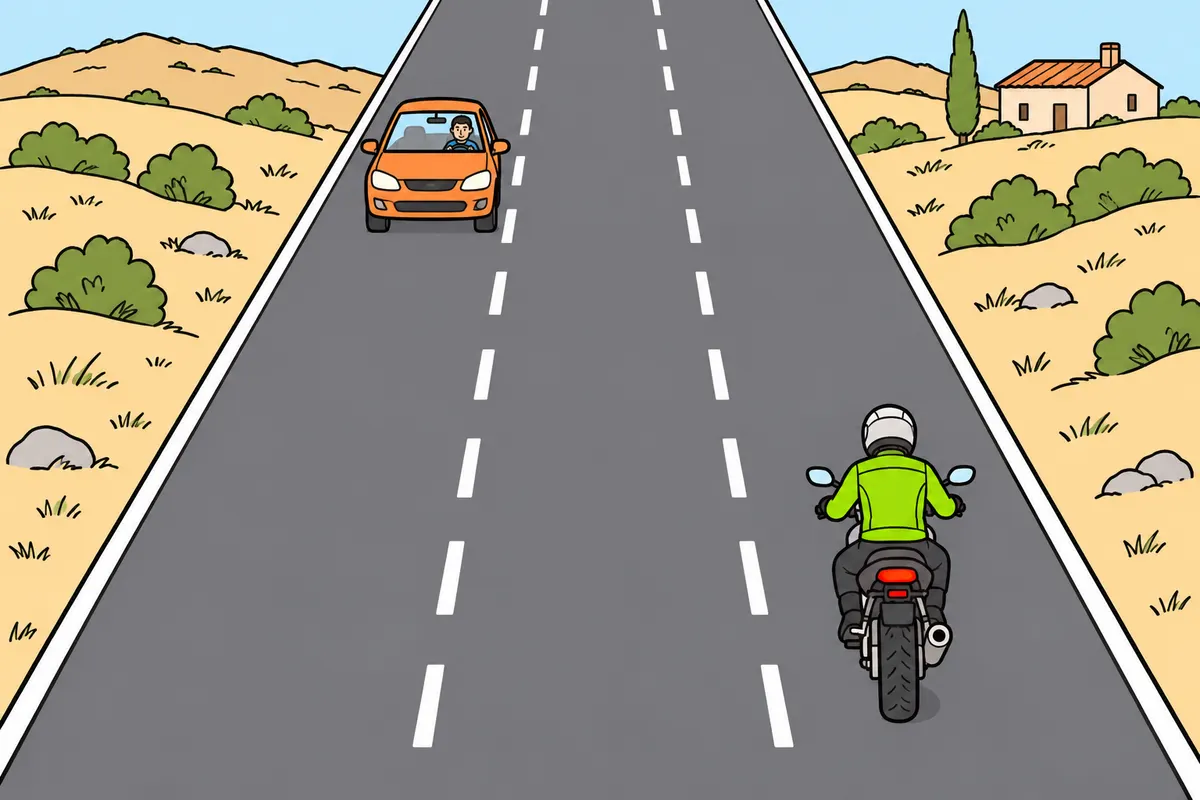
Normally use the right lane; use the shared central lane only for permitted manoeuvres.
| Lane: three shared lanes with broken lines | Your motorcycle's use |
|---|---|
| Right | Normal riding |
| Central | Necessary overtaking and permitted left turns |
| Furthest left | Forbidden |
Remember
- This rule needs two-way traffic and three lanes separated by broken lines.
- Check signs, visibility and whether the central lane is clear.
- Do not enter the central lane when traffic approaches from ahead.
- If signs assign directions differently, follow them.
Exam trap: Wrong: you can always ride in the central lane. Right: use it only for necessary overtaking or permitted left turns, with clear visibility, no approaching traffic and signs allowing it.
Read the full explanation
- When a two-way carriageway has three lanes separated by broken longitudinal markings, you must normally use the lane on your right. [RGC, art. 30](https://www.boe.es/buscar/act.php?id=BOE-A-2003-23514#a30)
- You may use the centre lane for necessary overtaking and to turn left, following the rules for those manoeuvres. You must check that it is available and check the signs: the existence of the lane does not mean you may enter it if a vehicle is approaching from the opposite direction or visibility is insufficient. [RGC, art. 30](https://www.boe.es/buscar/act.php?id=BOE-A-2003-23514#a30)
- You must not use the lane furthest to your left in this arrangement. [RGC, art. 30](https://www.boe.es/buscar/act.php?id=BOE-A-2003-23514#a30)
- This arrangement differs from a road with two lanes assigned to one direction and one to the opposite direction. The shared centre lane rule refers to the specific arrangement of three lanes separated by broken lines; if signs, lines or delineation devices allocate the directions differently, you must follow that allocation. [RGC, art. 30](https://www.boe.es/buscar/act.php?id=BOE-A-2003-23514#a30) [RGC, art. 37](https://www.boe.es/buscar/act.php?id=BOE-A-2003-23514#a37)
4Several lanes outside built-up areas
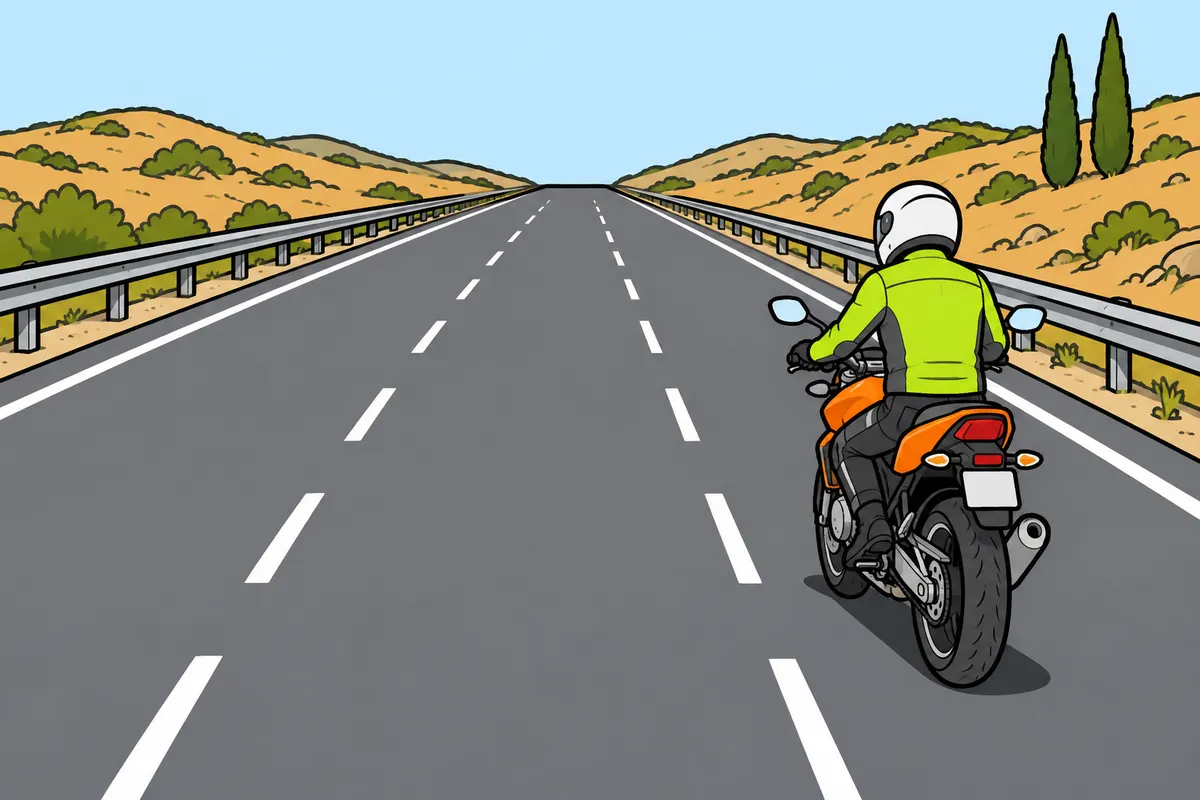
Outside built-up areas, normally use the right-hand lane in your direction.
Remember
- Use other lanes when traffic or road conditions make this sensible.
- Do not obstruct anyone following you.
- You can use the left lane on your motorcycle when appropriate.
- Do not count reserved lanes or manoeuvre lanes as ordinary traffic lanes.
- Obey lane reservations, closures and signs.
Exam trap: Wrong: other lanes are only for overtaking. Right: use them when traffic or road conditions make this sensible, without obstructing anyone following.
Read the full explanation
- Outside built-up areas, if there are several lanes in your direction, you must normally use the furthest right lane. You may use the other lanes in the same direction when traffic or road conditions warrant it, provided you do not obstruct anyone following you. They are not reserved exclusively for overtaking. [RGC, art. 31](https://www.boe.es/buscar/act.php?id=BOE-A-2003-23514#a31)
- You may use the left-hand lane on your motorcycle when appropriate under the general rule. On carriageways with three or more lanes in each direction, the restriction to the right-hand lane and the lane immediately next to it applies to lorries and vans over 3,500 kg, certain special vehicles and vehicle combinations over seven metres long; it does not apply to your ordinary motorcycle. [RGC, art. 31](https://www.boe.es/buscar/act.php?id=BOE-A-2003-23514#a31)
- When counting lanes for these purposes, exclude those reserved for particular vehicles or certain manoeuvres. An adjacent bus lane does not give you freedom to choose as if all the lanes were general traffic lanes in your direction; you must distinguish ordinary lanes from those with a specific use. [RGC, art. 34](https://www.boe.es/buscar/act.php?id=BOE-A-2003-23514#a34)
- You must obey signs requiring you to use a lane according to speed or vehicle type. The general permission to use other lanes does not override a reservation or closure. [RGC, art. 35](https://www.boe.es/buscar/act.php?id=BOE-A-2003-23514#a35) [RGC, annex I, catalogue of RD 465/2025](https://www.boe.es/buscar/doc.php?id=BOE-A-2025-12199)
5Choosing a lane in built-up areas
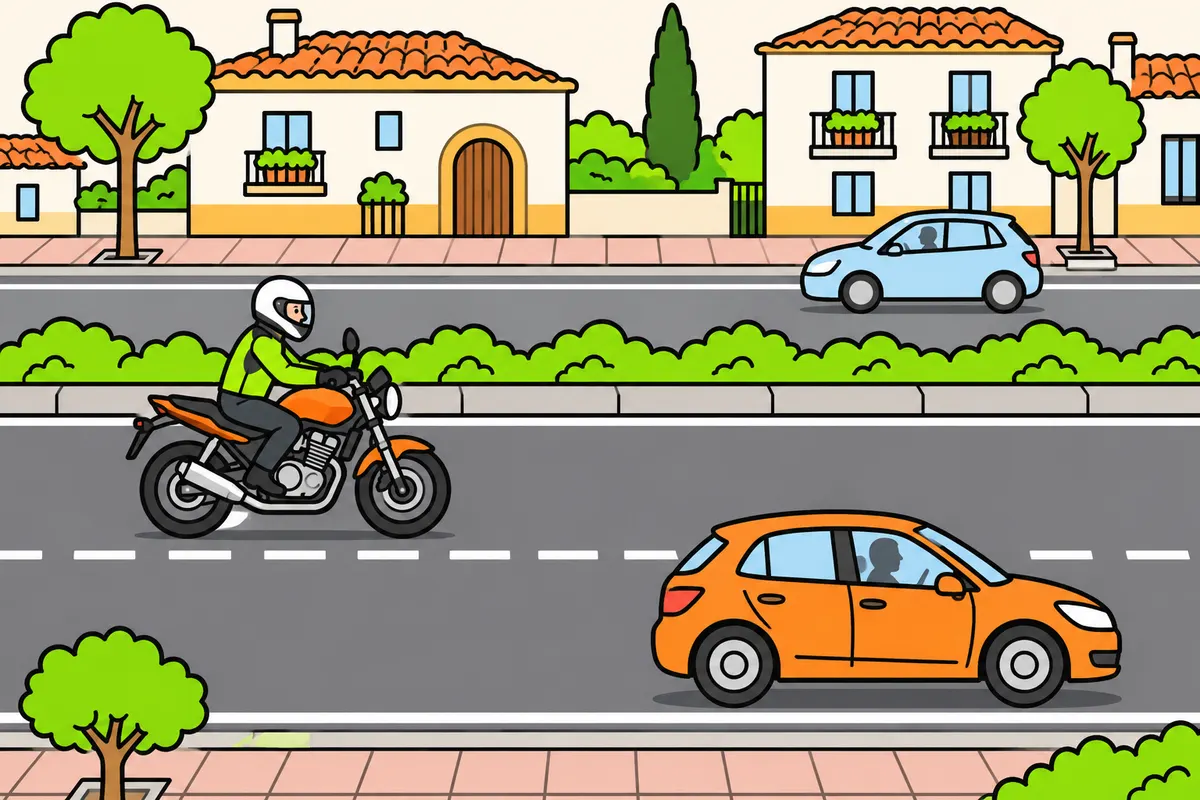
In built-up areas, you can choose a lane for your destination when conditions allow.
Remember
- You need at least two lanes in your direction, separated by markings.
- Choose without obstructing others, and respect reserved lanes.
- Change only to prepare a turn, overtake, stop or park.
- Change safely and give way to traffic already in the lane you enter.
- Do not ride on the pavement to avoid a queue.
Exam trap: Wrong: you can choose by destination on an urban autopista. Right: this lane choice rule excludes autopistas and autovías, even in built-up areas.
Read the full explanation
- In built-up areas, you may choose the lane best suited to your destination if there are at least two lanes in your direction and they are defined by longitudinal markings. You must do so without obstructing other vehicles. This allows you to plan your route through town, but does not authorise you to use a lane reserved for another road user. [RGC, art. 33](https://www.boe.es/buscar/act.php?id=BOE-A-2003-23514#a33) [RGC, art. 35](https://www.boe.es/buscar/act.php?id=BOE-A-2003-23514#a35)
- Once you choose a lane, you must not leave it except to prepare for a turn, overtake, stop or park. Moving sideways remains a manoeuvre and requires you to meet the safety conditions and respect the priority of traffic in the lane you are entering. [RGC, art. 33](https://www.boe.es/buscar/act.php?id=BOE-A-2003-23514#a33) [RGC, annex I, catalogue of RD 465/2025](https://www.boe.es/buscar/doc.php?id=BOE-A-2025-12199)
- You must not apply this urban lane choice rule on autopistas (motorways) or autovías (dual carriageways with motorway characteristics), even within built-up areas. Article 33 expressly excludes them. Identify the type of road, rather than simply the presence of buildings: passing homes does not make all lanes equally available for you to choose according to your destination. [RGC, art. 33](https://www.boe.es/buscar/act.php?id=BOE-A-2003-23514#a33)
- You must not ride your motorcycle on a pavement to avoid a traffic queue or reach a waiting area. Pavements are reserved for pedestrians to move around and spend time; municipal permission to park does not amount to permission to ride on them. See the stopping and parking rules in «Motorcycle manoeuvres». [RGC, art. 152](https://www.boe.es/buscar/act.php?id=BOE-A-2003-23514#a1-5)
6Separate carriageways, traffic islands and roundabouts
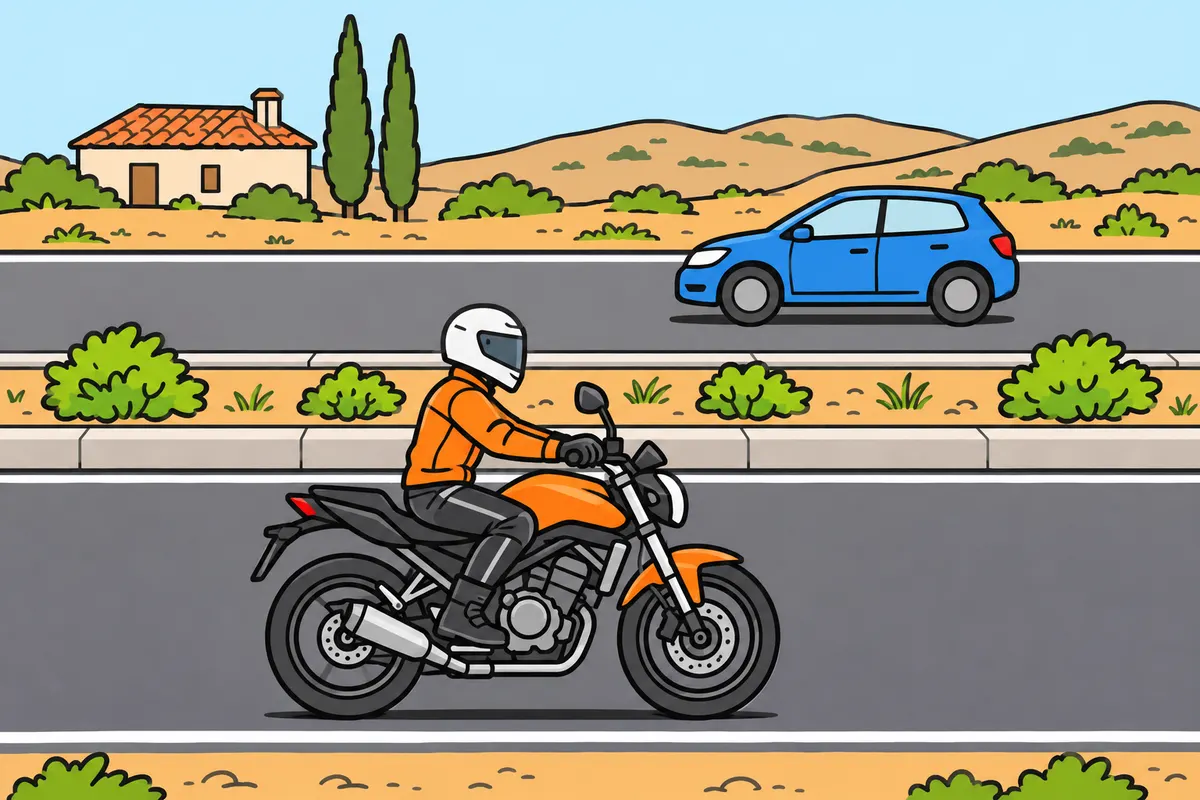
Follow the signed direction and pass each divider on the permitted side.
| Traffic island location | Where you can pass |
|---|---|
| General rule | On its right |
| One-way road or one-way part | Either side, following signs |
Remember
- With separate carriageways, use the one on your right.
- Do not cross the central reservation yourself.
- With three carriageways, check signs for the central carriageway's direction.
- At roundabouts, keep the centre on your left.
- Do not ride against traffic, even where authorised bicycles can.
- Move right for those bicycles; without space, traffic in the established direction has priority.
Exam trap: Wrong: the cycling exception lets your motorcycle travel against traffic. Right: it covers bicycles only, with signed municipal permission on single-lane urban roads limited to 30 km/h or less.
Read the full explanation
- If a road has two carriageways separated lengthways by a central reservation or another device, you must use the one on the right in your direction of travel. The physical separation is not an area where you may ride or a place where you may cross to the other carriageway on your own initiative. [RGC, art. 44](https://www.boe.es/buscar/act.php?id=BOE-A-2003-23514#a44)
- If there are three carriageways, the outer ones are for one-way traffic and the central one may carry traffic in one or both directions, permanently or temporarily. You must check the signs; you cannot work out the direction of traffic on the central carriageway simply by seeing vehicles on an outer carriageway. [RGC, art. 44](https://www.boe.es/buscar/act.php?id=BOE-A-2003-23514#a44)
- When you approach a traffic island, refuge or guiding device, you must pass along the part of the carriageway to its right in your direction of travel. If it is on a one-way road or within the part allocated to a single direction, you may pass on either side, obeying the other signs. [RGC, art. 43](https://www.boe.es/buscar/act.php?id=BOE-A-2003-23514#a43)
- In squares, roundabouts and where roads meet, you must keep the centre on your left. At a conventional roundabout, this means going around it in the prescribed direction, without cutting across the centre or riding the wrong way to reach an exit sooner. Lane choice and lane changes remain subject to their rules. [RGC, art. 43](https://www.boe.es/buscar/act.php?id=BOE-A-2003-23514#a43)
- On a single-lane urban road with a speed limit of 30 km/h or less, the municipal authority may authorise and signpost two-way cycling. This exception does not allow you to ride your motorcycle against the direction of traffic. When you meet authorised road users, you must move over to your right to allow safe passing; if this is not possible, vehicles travelling in the designated direction for the road have priority. [RGC, art. 153.6](https://www.boe.es/buscar/act.php?id=BOE-A-2003-23514#a1-6)
7Reserved lanes and bus lanes
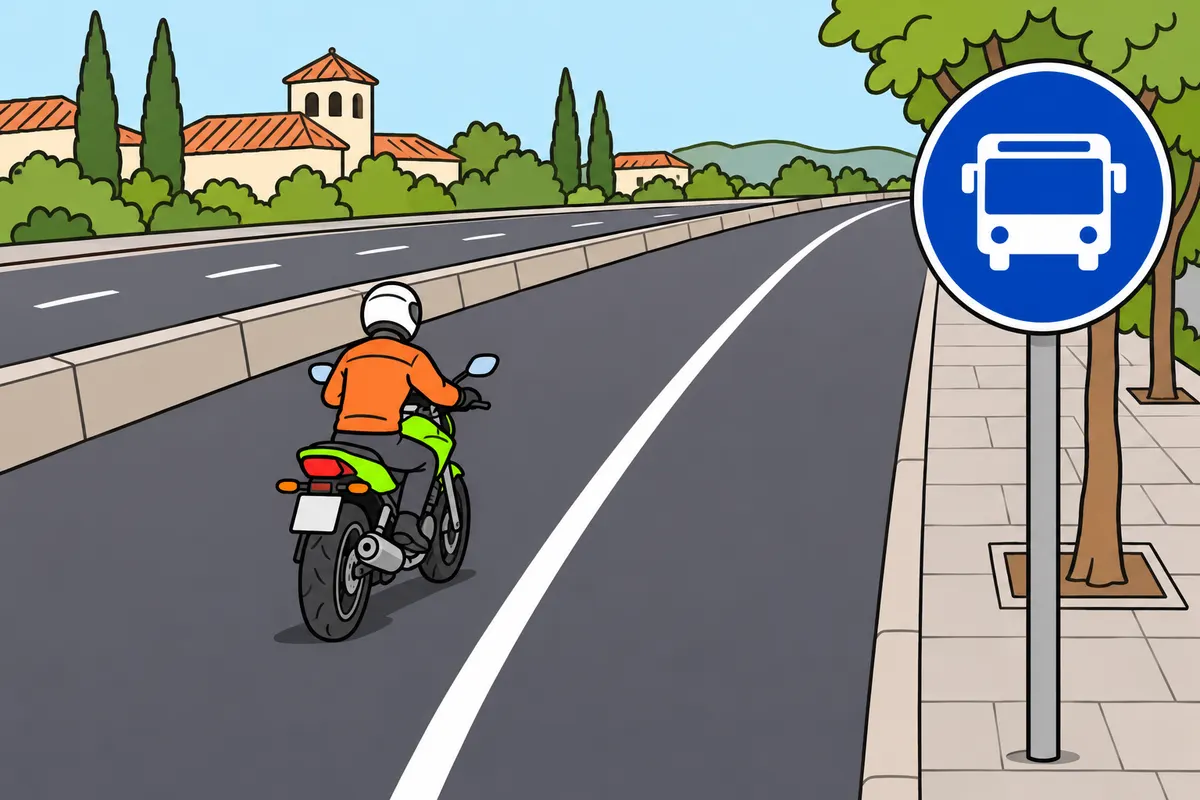
Enter a reserved lane only if it allows your motorcycle and you meet its conditions.
| Reserved lane dividing line | Changing lanes on your motorcycle |
|---|---|
| Solid M-2.4 | You cannot change between this lane and adjacent lanes |
| Broken M-1.6 or M-1.7 | You may cross for certain authorised manoeuvres |
Remember
- Check allowed vehicles, times and conditions.
- A cycle lane does not allow your motorcycle because it has two wheels.
- You can use the specified public transport lane on the A-8065.
- This permission covers the left-hand carriageway from San Juan de Aznalfarache to Sevilla.
Exam trap: Wrong: a broken line lets you ride along the bus lane. Right: it may allow crossing for authorised manoeuvres; it does not give unrestricted access.
Read the full explanation
- You must check which classes of vehicle are permitted before entering a reserved lane. Riding an A2 motorcycle does not give you general access to all bus or bus-taxi lanes. You may use them only if the applicable rules admit your vehicle, at the specified times and under the specified conditions. [RGC, art. 35](https://www.boe.es/buscar/act.php?id=BOE-A-2003-23514#a35)
- A continuous line separating a specialised lane, M-2.4, prohibits you from changing lanes between that lane and adjacent lanes. If the separating line is broken, M-1.6 or M-1.7, it may allow you to carry out certain authorised manoeuvres by crossing the reserved lane. This does not mean you may ride freely along it to avoid a queue. [RGC, Annex I, catalogue under RD 465/2025](https://www.boe.es/buscar/doc.php?id=BOE-A-2025-12199)
- A cycle lane is reserved for different users from a motorcycle lane: cycle symbols identify its intended users and do not include your motorcycle simply because it also has two wheels; see the symbols for reserved use in «Signs and their order of priority». [RGC, art. 35](https://www.boe.es/buscar/act.php?id=BOE-A-2003-23514#a35) [RGC, Annex I, catalogue under RD 465/2025](https://www.boe.es/buscar/doc.php?id=BOE-A-2025-12199)
- You may ride your motorcycle in the lane reserved for public passenger transport on the A-8065, on the left-hand carriageway from San Juan de Aznalfarache to Sevilla. Section C.2 also admits mopeds and motor tricycles with less than 600 millimetres between the wheels on the same axle. [DGT Resolution 2026, section C.2](https://www.boe.es/buscar/act.php?id=BOE-A-2026-1255)
8VAO lanes on your motorcycle
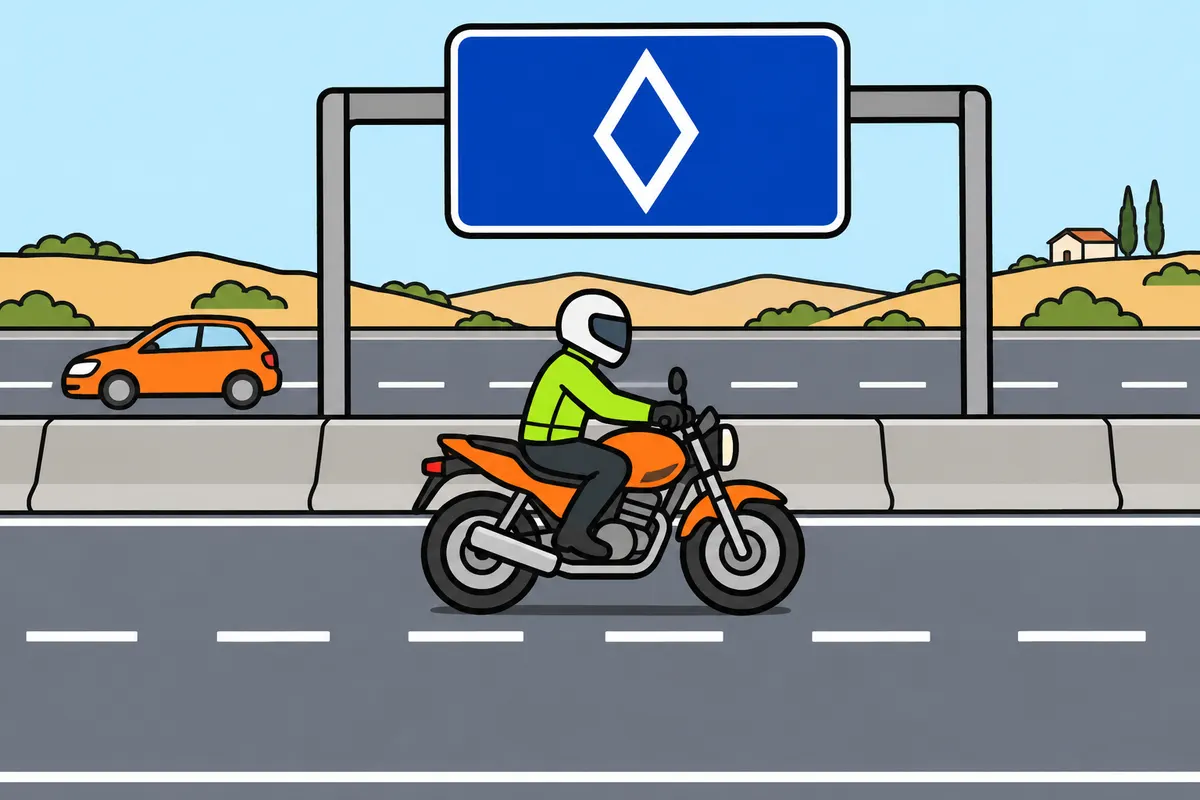
You can use VAO lanes on your motorcycle under each section's access conditions.
| Vehicle in VAO lanes | Access |
|---|---|
| Motorcycle | Allowed under the section's conditions |
| Motor tricycle in DGT 2026 C.1 lanes | Without a passenger if wheels on the same axle are less than 600 mm apart |
| Moped, bicycle or vehicle towing a trailer | Normally forbidden |
Remember
- Check the section, direction, times and conditions.
- In the DGT's 2026 C.1 lanes, you can enter without a passenger.
- Check the conditions set by other authorities for their lanes.
- Some vehicles have specific permission.
Exam trap: Wrong: every VAO lane requires a motorcycle passenger. Right: in the DGT's 2026 C.1 lanes, you can ride without a passenger; check other lanes' conditions.
Read the full explanation
- Motorcycles are among the vehicle classes permitted to use VAO (high-occupancy vehicle) lanes, together with passenger cars and adaptable mixed-use vehicles. You must check the section of road, direction, operating times and access conditions. [RGC, art. 35](https://www.boe.es/buscar/act.php?id=BOE-A-2003-23514#a35)
- In the lanes covered by section C.1 of the 2026 DGT resolution, you may enter on your motorcycle without a passenger, as an exception to the general minimum of two occupants; for motor tricycles, this exception requires less than 600 mm between the wheels on the same axle. [DGT Resolution 2026, section C.1](https://www.boe.es/buscar/act.php?id=BOE-A-2026-1255)
- For a VAO lane under another authority, you must check the access conditions that authority has set. The Regulations allow conditions to be set for each section of road, and a reservation may be permanent or temporary. Before entering, you must follow its rules and access instructions. [RGC, art. 35](https://www.boe.es/buscar/act.php?id=BOE-A-2003-23514#a35)
- Mopeds, bicycles and vehicle combinations, including passenger cars towing trailers, are not normally permitted to use these lanes. There are also specific authorisations for certain buses, vehicles for people with reduced mobility, and emergency or maintenance services. [RGC, art. 35](https://www.boe.es/buscar/act.php?id=BOE-A-2003-23514#a35)
9Normal users of the hard shoulder
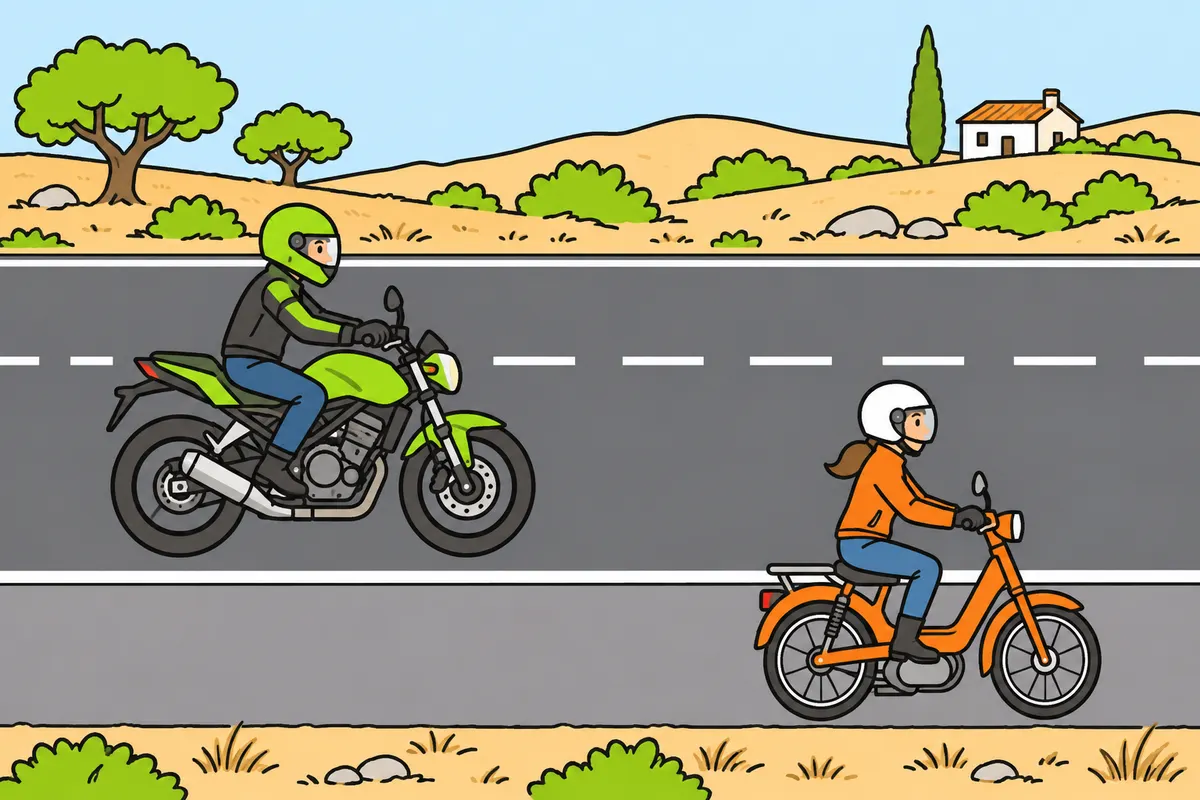
Your motorcycle is not normally required to use the hard shoulder.
| Specified users | Hard shoulder use |
|---|---|
| Cycles, mopeds, animal-drawn vehicles and vehicles for people with reduced mobility | Use a usable, wide enough shoulder when no dedicated route exists |
| Cycle support vehicles and special vehicles up to 3,500 kg maximum authorised mass | Use a usable, wide enough shoulder when no dedicated route exists |
| Bicycles on long descents with bends | May use the necessary right-hand carriageway if safe; on autovías, use the shoulder |
| Your motorcycle | Not an ordinary hard shoulder user |
Remember
- Without a dedicated route, listed vehicles must use a suitable right-hand hard shoulder.
- Otherwise, they must use only the necessary part of the carriageway.
- These users cannot travel side by side, except bicycles under the cycling rules.
- Cyclists must ride single file at night or when visibility is poor.
- They must also ride single file if they obstruct traffic.
Exam trap: Wrong: the overtaking limits also apply to bicycles. Right: bicycles are exempt; other listed users must not remain alongside for over 15 seconds or 200 metres when overtaking.
Read the full explanation
- The normal users of the right-hand arcén (hard shoulder), when they have no dedicated road or part of the road, are cycles, mopeds, animal-drawn vehicles, vehicles for people with reduced mobility, vehicles accompanying cyclists and special vehicles with an MMA (maximum authorised mass) not exceeding 3,500 kg. Your motorcycle does not belong to this list simply because it is light. [RGC, art. 36](https://www.boe.es/buscar/act.php?id=BOE-A-2003-23514#a36)
- These users must use the hard shoulder if it is passable and wide enough for their vehicle. When it is not, they must occupy only as much of the carriageway as necessary. You may therefore legitimately encounter a moped or a slow agricultural vehicle on the right-hand part of the carriageway when the hard shoulder cannot be used. [RGC, art. 36](https://www.boe.es/buscar/act.php?id=BOE-A-2003-23514#a36)
- On long descents with bends, cyclists may use as much of the right-hand part of the carriageway as necessary if safety permits. On an autovía (dual carriageway with motorway characteristics), they must remain on the hard shoulder. [RGC, art. 36](https://www.boe.es/buscar/act.php?id=BOE-A-2003-23514#a36)
- The users listed must not travel alongside one another, except for bicycles riding two abreast as permitted by the rules. Cyclists must ride in single file where visibility is lacking, if they impede traffic flow, at night or when visibility is significantly reduced. Except for bicycles, these users must not overtake another vehicle if travelling alongside it takes more than 15 seconds or 200 metres. [RGC, art. 36](https://www.boe.es/buscar/act.php?id=BOE-A-2003-23514#a36)
10Using the hard shoulder after a breakdown or in an emergency
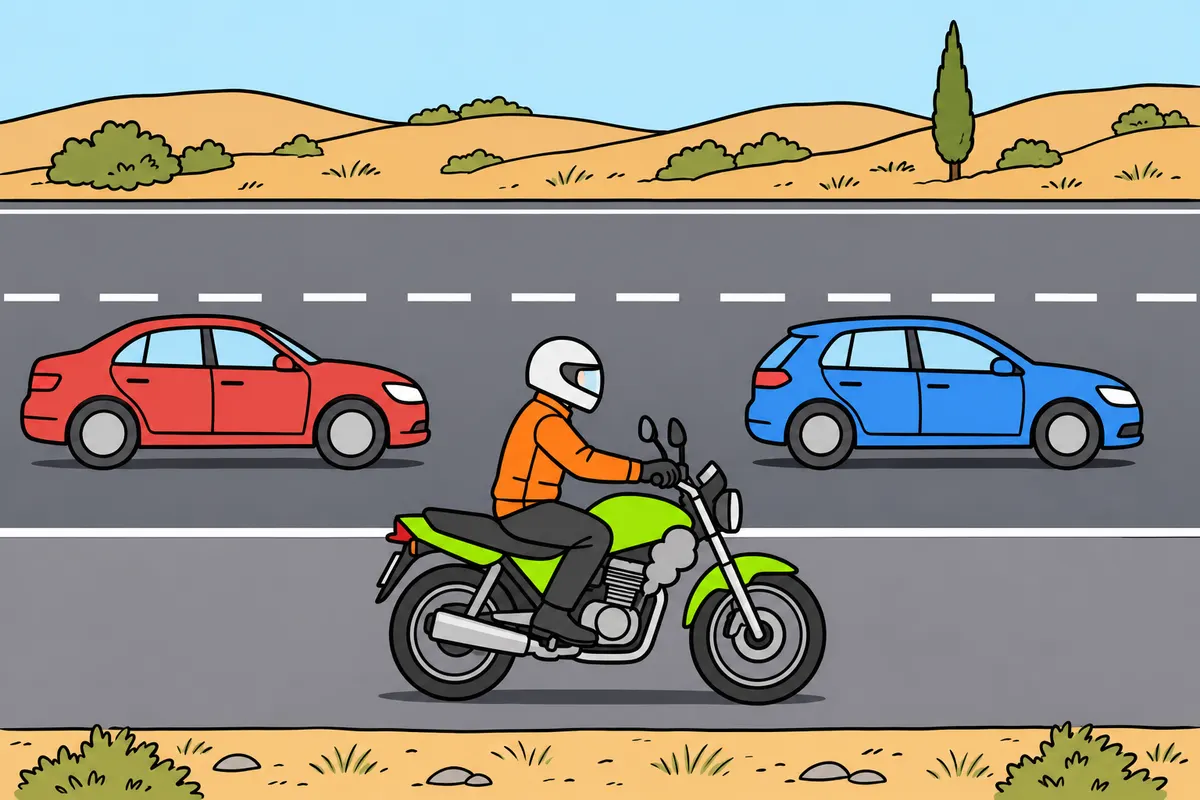
An emergency can require you to use the hard shoulder to move your motorcycle safely.
Remember
- Emergency, abnormally slow travel and serious traffic disruption require a suitable right-hand hard shoulder.
- If it is unusable or too narrow, use only the necessary carriageway.
- On autopistas or autovías, take the first exit if you can continue safely.
- If you cannot continue safely, stop and request help.
- After breakdown or accident, leave traffic lanes if you can continue and need help.
- Use the right-hand shoulder towards the first exit; otherwise, stop with minimum obstruction.
Exam trap: Wrong: any breakdown allows continued shoulder travel. Right: the slow-travel rule requires an emergency, maximum authorised mass no greater than 3,500 kg and serious traffic disruption; the shoulder must be usable and wide enough.
Read the full explanation
- If an emergency forces you to ride your motorcycle, whose MMA does not exceed 3,500 kg, abnormally slowly and seriously disrupts traffic, you must use the right-hand hard shoulder if it is passable and wide enough. If it does not meet these conditions, you must use only as much of the carriageway as necessary. [RGC, art. 36](https://www.boe.es/buscar/act.php?id=BOE-A-2003-23514#a36)
- On an autopista (motorway) or autovía, if an emergency forces you to travel at an abnormally low speed, you must leave the road at the first exit. If a breakdown prevents you from continuing safely, you must stop and request assistance; the obligation to leave does not require you to keep riding a motorcycle you cannot control. [RGC, art. 38](https://www.boe.es/buscar/act.php?id=BOE-A-2003-23514#a38) [RGC, art. 130](https://www.boe.es/buscar/act.php?id=BOE-A-2003-23514#a130)
- If you can continue safely after a breakdown or accident and need assistance, you must leave the traffic lanes as soon as possible and head for the first exit along the right-hand hard shoulder. If this is not possible, you must stop on that hard shoulder or wherever you cause the least obstruction. Here, use of the hard shoulder has the specific purpose of leaving the traffic lanes and obtaining assistance. [RGC, art. 130](https://www.boe.es/buscar/act.php?id=BOE-A-2003-23514#a130)
11Hard shoulder authorised for use when traffic is stationary
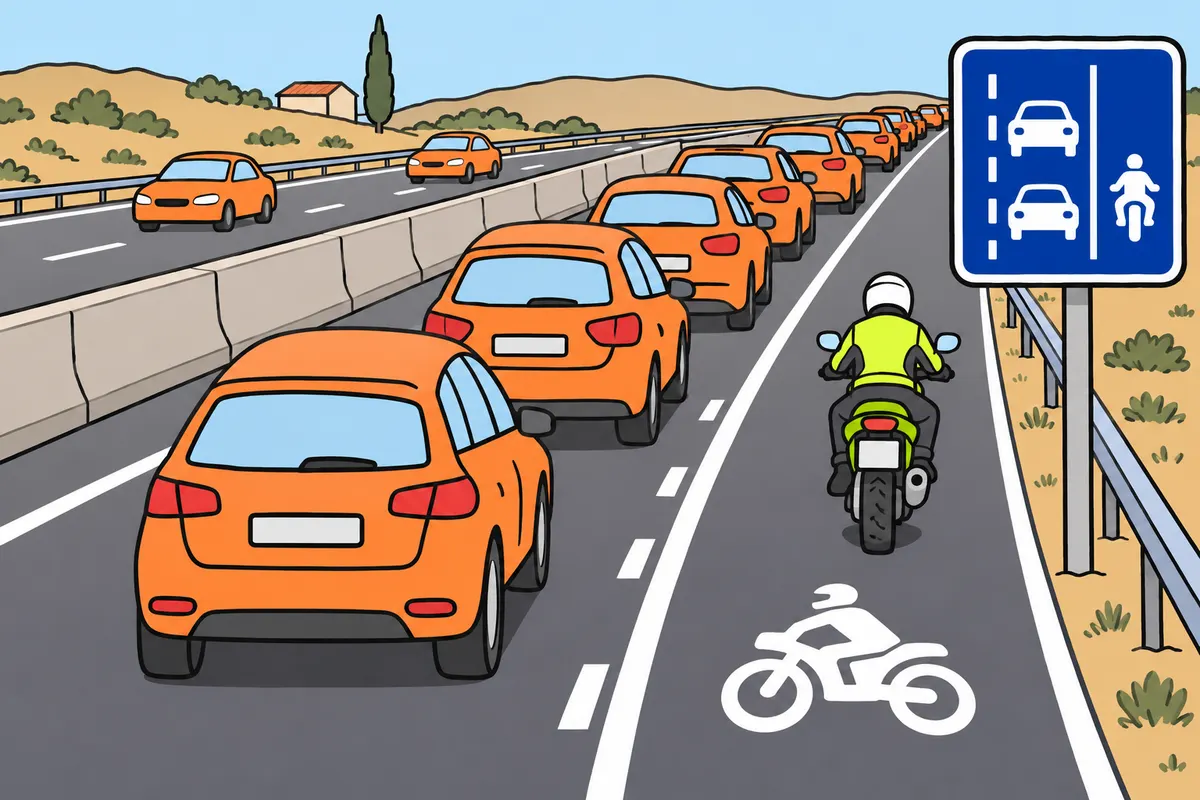
Use the shoulder during congestion only on authorised sections when traffic lanes are stationary.
| Case | Authorisation and permitted vehicles |
|---|---|
| Shoulder use during congestion | Your motorcycle: prior authorisation, fixed signs, markings and stationary traffic lanes |
| Dynamic hard shoulder D.3.3 | Passenger cars and two- or three-wheeled motorcycles when variable message signs open it |
Remember
- You need a section authorised by the authorities beforehand.
- It must have fixed upright signs and road markings.
- Traffic in the lanes must be stationary because of congestion.
- Ride single file, at no more than 30 km/h, with extreme care.
- Protect required shoulder users; leave the shoulder if necessary.
Exam trap: Wrong: any queue lets you use any shoulder. Right: you need prior authorisation, fixed signs, markings and stationary traffic lanes; ride single file at no more than 30 km/h, without endangering shoulder users.
Read the full explanation
- As an exceptional measure, you may use the right-hand hard shoulder on your motorcycle only on sections previously authorised by agreement between the competent authorities. These must be indicated by fixed upright signs and road markings. [RGC, art. 36](https://www.boe.es/buscar/act.php?id=BOE-A-2003-23514#a36)
- Traffic in the lanes must be stationary because of congestion. [RGC, art. 36](https://www.boe.es/buscar/act.php?id=BOE-A-2003-23514#a36)
- You must ride at no more than 30 km/h, in single file and with extreme caution. [RGC, art. 36](https://www.boe.es/buscar/act.php?id=BOE-A-2003-23514#a36)
- You must make sure you do not endanger those required to use the hard shoulder, and leave it if necessary. If cyclists or mopeds are using it, you must adapt your riding without forcing them to move aside. [RGC, art. 36](https://www.boe.es/buscar/act.php?id=BOE-A-2003-23514#a36)
- The dynamic hard shoulder covered by section D.3.3 admits passenger cars and two- or three-wheeled motorcycles when variable message signs open it for use; this is the temporary opening of an additional lane, distinct from the congestion situation described in the preceding points. [DGT Resolution 2026, section D.3.3](https://www.boe.es/buscar/act.php?id=BOE-A-2026-1255) [RGC, art. 36.3](https://www.boe.es/buscar/act.php?id=BOE-A-2003-23514#a36)
12Access to autopistas and autovías
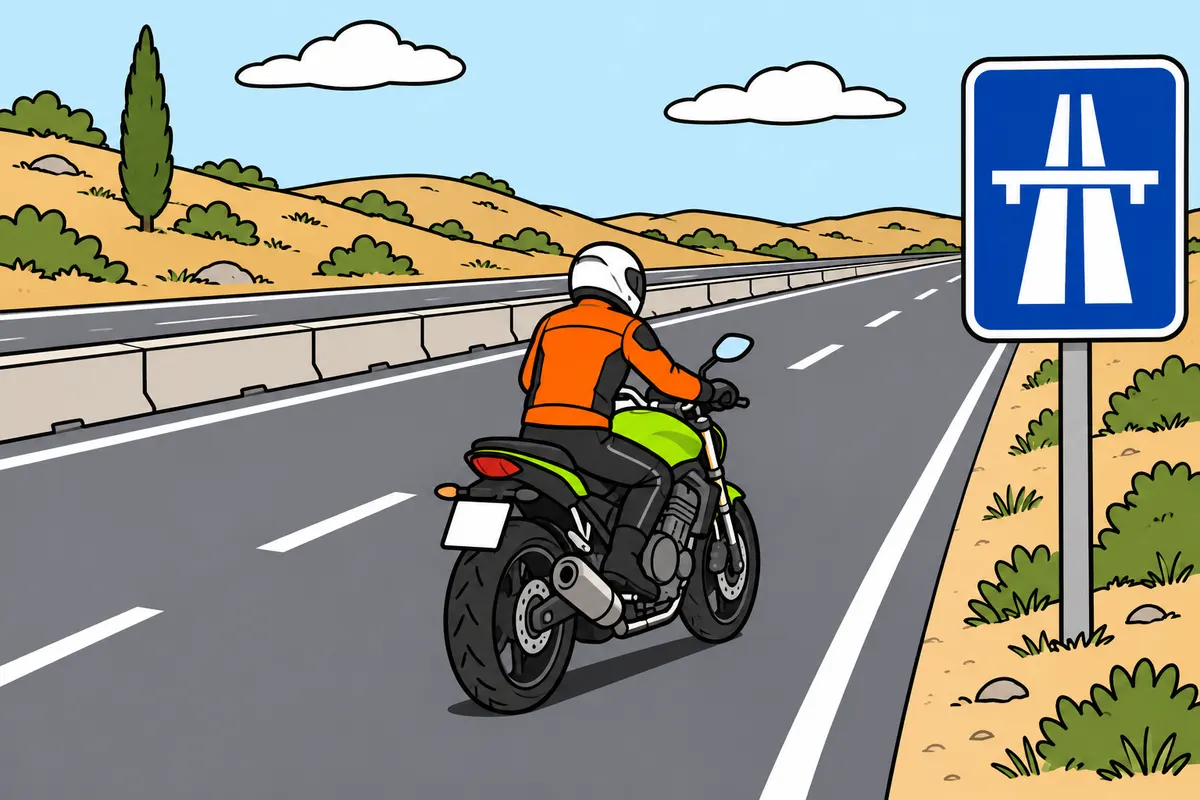
You can enter autopistas and autovías on your motorcycle unless a restriction applies.
| Vehicle | Autopista access | Autovía access |
|---|---|---|
| Your motorcycle | Allowed unless restricted | Allowed unless restricted |
| Moped, animal-drawn vehicle, reduced-mobility vehicle or personal mobility vehicle | Forbidden | Forbidden |
| Bicycle | Forbidden | Shoulder only: riders over 14 years, unless signs prohibit access |
| Special vehicle within mass and size limits | Must exceed 60 km/h on level ground and meet annex III conditions | Same conditions |
| Special vehicle exceeding mass or size limits | Only if its supplementary circulation authorisation permits | Only if its supplementary circulation authorisation permits |
Remember
- Use authorised lanes and follow their conditions.
- Check closures, restrictions and compulsory routes.
- Check special vehicles' capabilities and any required authorisation.
Exam trap: Wrong: the cycling exception allows autopista access. Right: it allows only the autovía shoulder for riders over 14 years, unless signs prohibit access for safety.
Read the full explanation
- You may ride your A2 motorcycle on autopistas and autovías when no restriction affecting you applies. You must use the authorised lanes and comply with their conditions. [RGC, art. 31](https://www.boe.es/buscar/act.php?id=BOE-A-2003-23514#a31) [RGC, art. 38](https://www.boe.es/buscar/act.php?id=BOE-A-2003-23514#a38)
- Mopeds, animal-drawn vehicles and vehicles for people with reduced mobility must not use autopistas or autovías. Personal mobility vehicles are also prohibited from entering. [RGC, art. 38](https://www.boe.es/buscar/act.php?id=BOE-A-2003-23514#a38)
- Bicycles are prohibited on autopistas. On autovías, there is an exception for riders over 14 years of age: they may ride on the hard shoulder unless signs prohibit this for safety reasons. A safety prohibition must be accompanied by a panel indicating the alternative route. [RGC, art. 38](https://www.boe.es/buscar/act.php?id=BOE-A-2003-23514#a38)
- Special vehicles that do not exceed the statutory masses or dimensions may enter if their characteristics allow them to exceed 60 km/h on level ground and they meet the conditions in Annex III of the RGC. You may encounter these vehicles on the road even though their usual purpose is agricultural or construction work. [RGC, art. 38](https://www.boe.es/buscar/act.php?id=BOE-A-2003-23514#a38)
- Special vehicles that exceed the statutory masses or dimensions may exceptionally enter when their supplementary road-use authorisation permits it. That authorisation determines access to the road; the licence held by the driver is a separate matter, explained in «Essential definitions for riding a motorcycle». [RGC, art. 38](https://www.boe.es/buscar/act.php?id=BOE-A-2003-23514#a38)
- You must comply with closures, compulsory routes and access restrictions imposed by the authority for safety, traffic flow or environmental reasons. Being legally entitled to ride the motorcycle does not authorise you to enter every road in all circumstances. Check the signs and the authorised route before entering. [RGC, art. 37](https://www.boe.es/buscar/act.php?id=BOE-A-2003-23514#a37)
13Emergency corridors and riding in snow
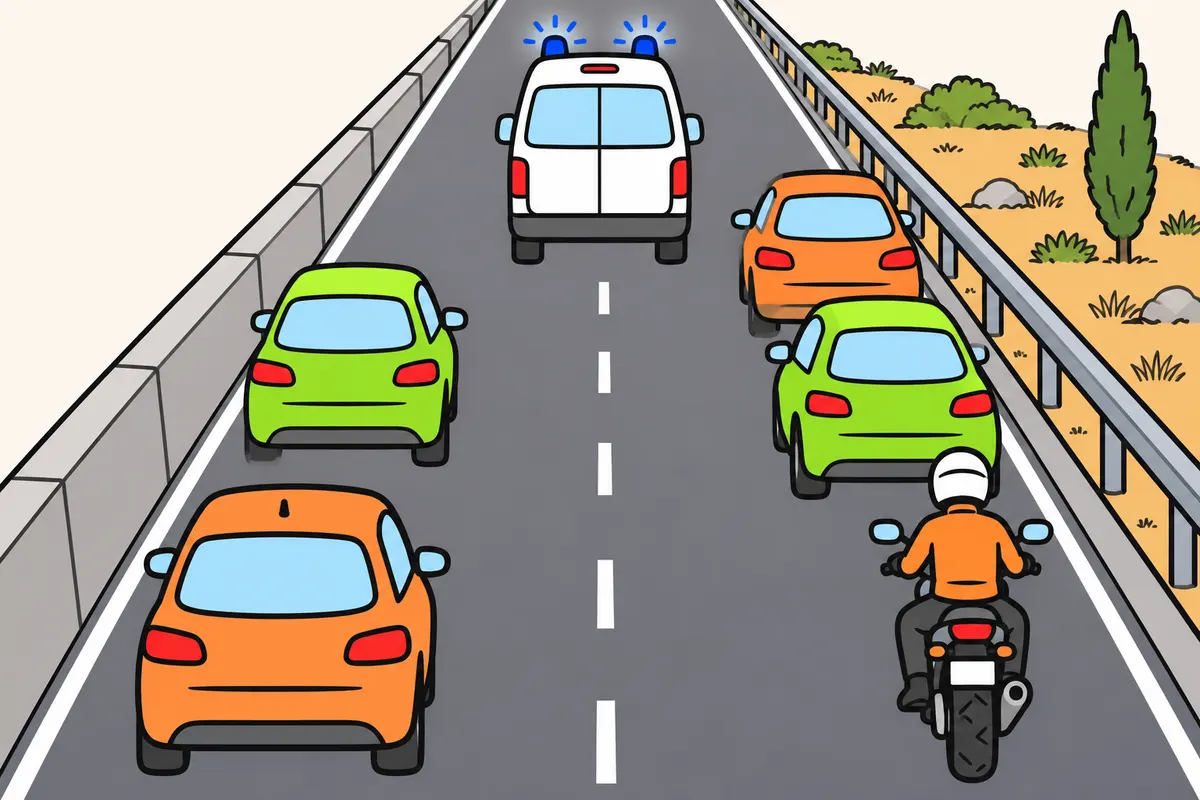
Leave space for emergency vehicles and use the permitted lanes in snow.
| Situation on an autopista or autovía | What you must do on your motorcycle |
|---|---|
| Emergency: two lanes in your direction | Leave space between them |
| Emergency: three or more lanes in your direction | Leave space between the leftmost lane and its neighbour |
| You are in the left lane | Move as far left as possible |
| You are in another lane | Move right |
| Snow makes movement difficult | Use the right lane; with three or more, you may also use its neighbour |
Remember
- In autopista or autovía queues, make space when priority vehicles approach.
- Do this when traffic is stationary or moving at walking pace.
- Do not use this space to overtake the queue.
- Do not overtake when snow makes traffic movement difficult.
Exam trap: Wrong: you can ride through the emergency corridor on your motorcycle. Right: keep it clear for priority vehicles.
Read the full explanation
- In a traffic queue on an autopista (motorway) or autovía (dual carriageway with motorway characteristics), when vehicles move at walking pace or are stationary, you must move to the side to leave space for approaching priority vehicles. This space is called an emergency corridor. On your motorcycle, you must also help create it and respect its purpose. [RGC, art. 32](https://www.boe.es/buscar/act.php?id=BOE-A-2003-23514#a32)
- If there are two lanes in the same direction, you must help create the space in the centre, between them. You must not use it to overtake the queue: your duty is to let priority vehicles through, not to open a general lane for anyone who can fit between the rows of traffic. [RGC, art. 32](https://www.boe.es/buscar/act.php?id=BOE-A-2003-23514#a32)
- If there are three or more lanes in each direction, you must leave this space between the leftmost lane and the lane next to it. If you are in the leftmost lane, you must move as far left as possible; if you are in any other lane, you must move to the right. [RGC, art. 32](https://www.boe.es/buscar/act.php?id=BOE-A-2003-23514#a32)
- If snow makes travelling on an autopista or autovía difficult, you must not overtake and you must use the right-hand lane. Where there are three or more lanes in each direction, you may also use the adjacent lane, leaving the remaining lanes on the left clear for emergency vehicles and snowploughs. These arrangements also apply to your motorcycle. [RGC, art. 32](https://www.boe.es/buscar/act.php?id=BOE-A-2003-23514#a32)
14Reversible lanes
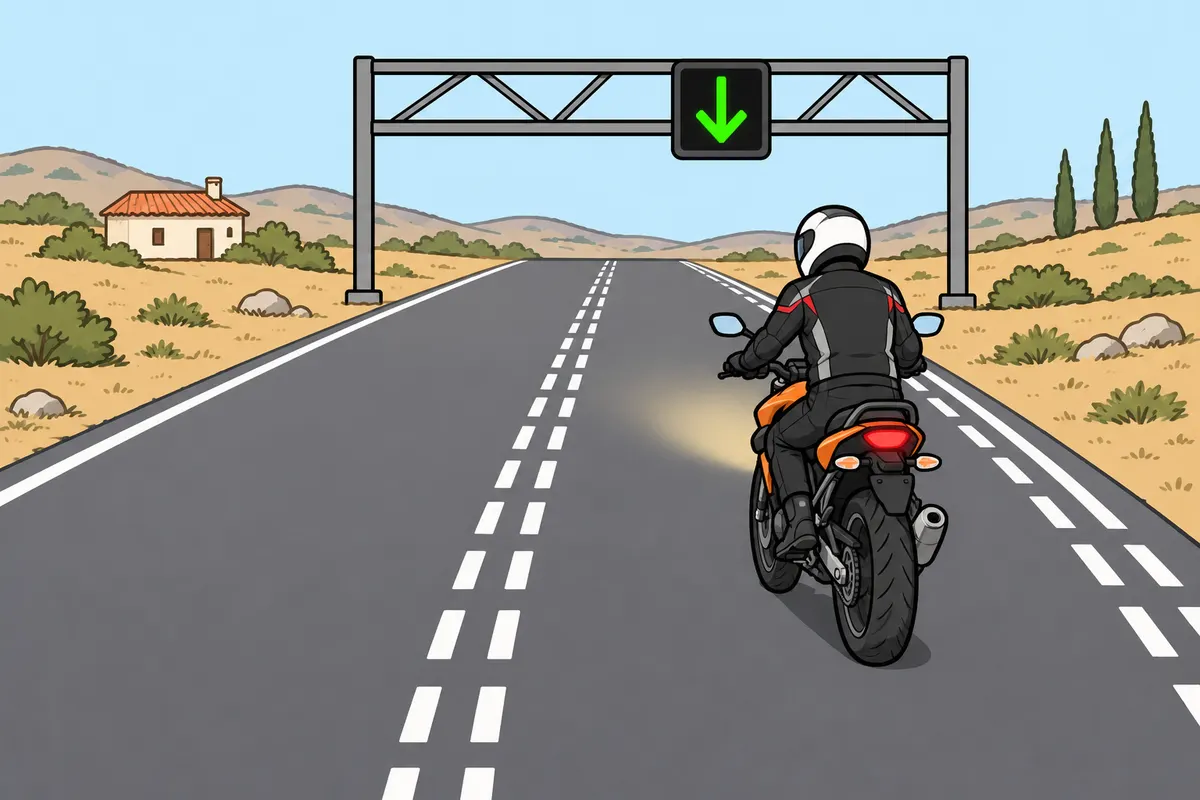
Check the permitted direction before entering a reversible lane.
Remember
- Look for double broken lines on both sides.
- Obey lane signals and other instructions.
- Keep your dipped-beam headlights on.
- Follow the road's speed limits and the section's signs.
Exam trap: Wrong: reversible lanes require speeds between 60 and 80 km/h. Right: follow the road's speed limits and the section's signs.
Read the full explanation
- You can recognise a reversible lane by the double broken longitudinal lines marking both sides, M-1.4 and M-1.5. Its direction of travel can be set one way or the other using lane control signals or other means. You must check the permitted direction before entering, even if you know how that road is normally used. [RGC, art. 40](https://www.boe.es/buscar/act.php?id=BOE-A-2003-23514#a40) [RGC, Annex I, catalogue of RD 465/2025](https://www.boe.es/buscar/doc.php?id=BOE-A-2025-12199)
- In a reversible lane, you must have at least your dipped beam on, both day and night. [RGC, art. 40.1](https://www.boe.es/buscar/act.php?id=BOE-A-2003-23514#a40)
- In a reversible lane, you must follow the speed limits for the road and the signs on that stretch; the 60 to 80 km/h range applies to the lanes covered by articles 41 and 42, not to reversible lanes. [RGC, art. 40](https://www.boe.es/buscar/act.php?id=BOE-A-2003-23514#a40) [RGC, art. 41](https://www.boe.es/buscar/act.php?id=BOE-A-2003-23514#a41) [RGC, art. 42](https://www.boe.es/buscar/act.php?id=BOE-A-2003-23514#a42)
15Signals that open or close lanes
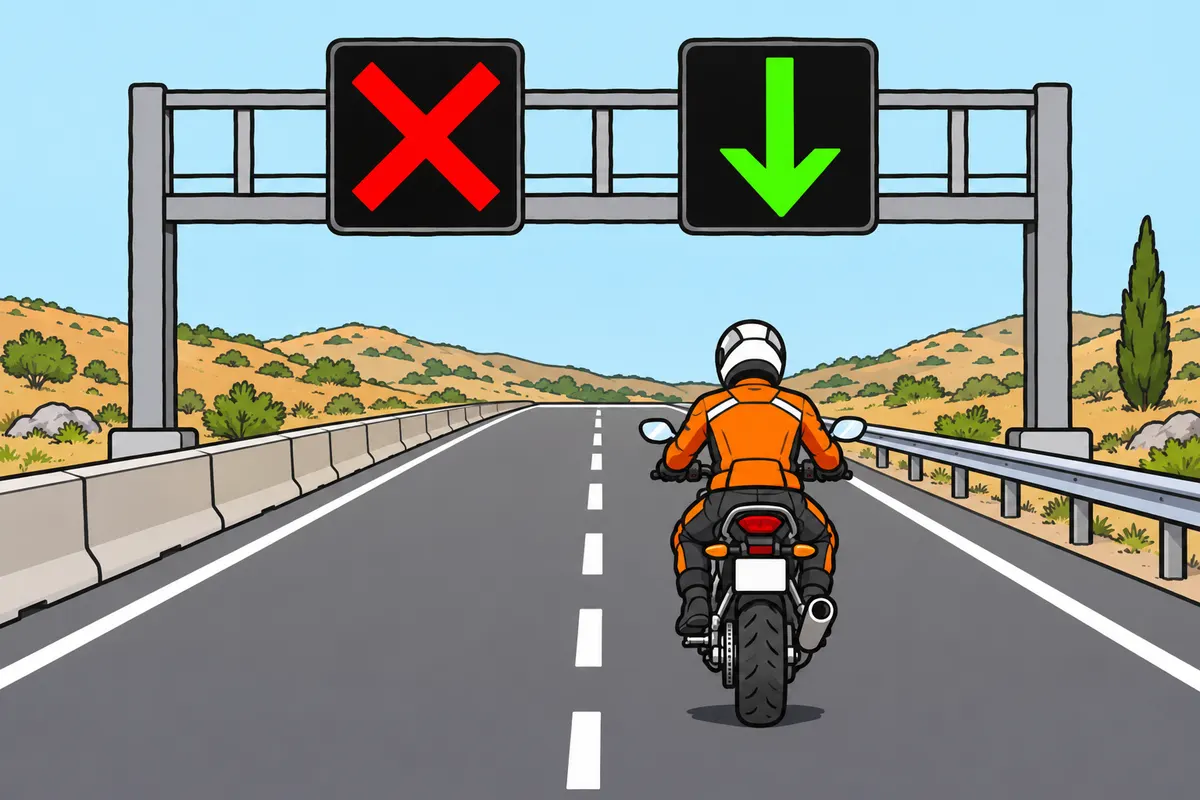
Lane signals tell you whether you can use a lane or must leave it.
| Lane signal | What you must do |
|---|---|
| Red cross | Do not enter; if already inside, leave as soon as you safely can |
| Downward green arrow | You may use the lane, obeying other signs and priority rules |
| White or yellow diagonal arrow | Prepare to move into the indicated lane: closure is approaching |
Remember
- Check the lane signal before entering.
- When changing lanes, give way to traffic already in the lane you enter.
Exam trap: Wrong: a green lane arrow overrides a circular red light. Right: obey that light, stop or give-way signs and priority rules too.
Read the full explanation
- A red cross on a lane control signal means you must not use the indicated lane. If you are already in it, you must leave it as soon as possible, doing so safely. [RGC, Annex I, catalogue of RD 465/2025](https://www.boe.es/buscar/doc.php?id=BOE-A-2025-12199)
- A green downward arrow allows you to use the corresponding lane. You must still obey a circular red light, a stop or give way sign, and the general priority rules. [RGC, Annex I, catalogue of RD 465/2025](https://www.boe.es/buscar/doc.php?id=BOE-A-2025-12199)
- A steady or flashing white or yellow diagonal downward arrow warns you that the lane is about to close and that you need to move to the lane it points towards. You must prepare to do so without waiting until the last moment or forcing your way into a gap. The closure warning does not give you priority over anyone already in the lane you are moving into. [RGC, Annex I, catalogue of RD 465/2025](https://www.boe.es/buscar/doc.php?id=BOE-A-2025-12199)
16Lanes running against the normal traffic direction
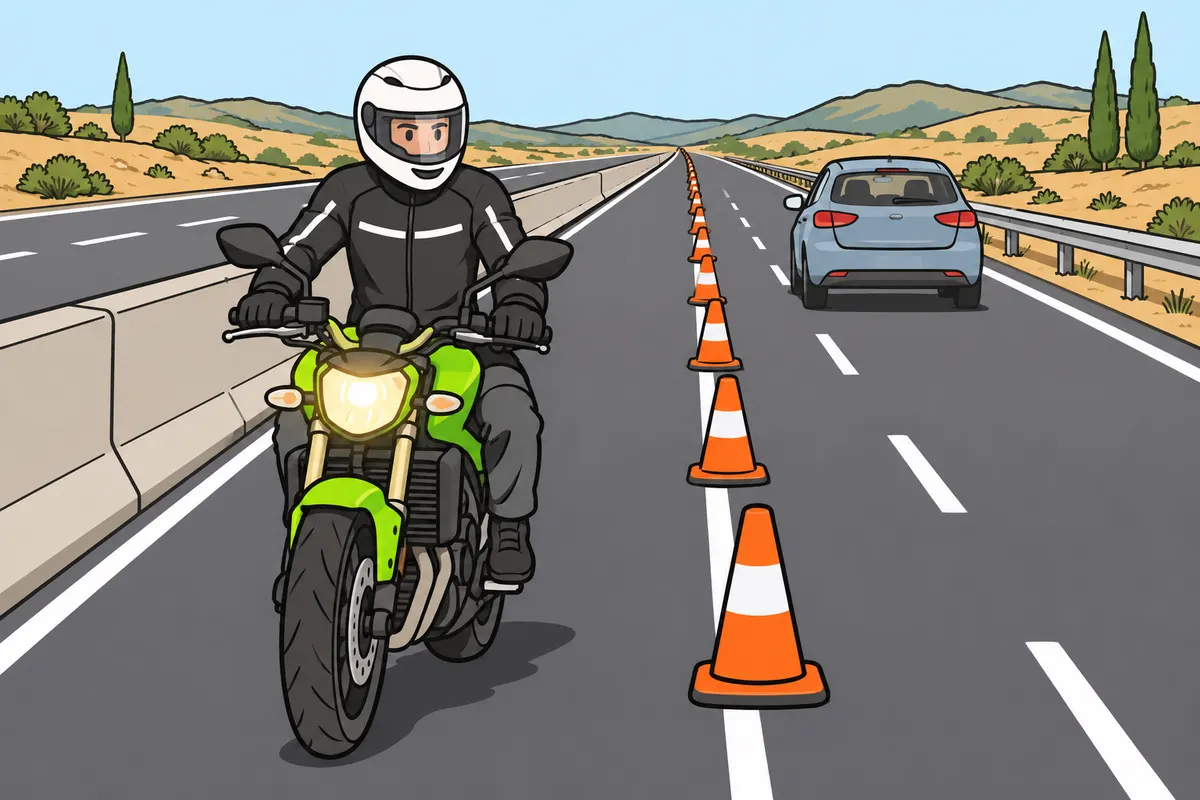
In a lane against normal traffic, follow access, lighting and speed rules.
| Case | Permitted vehicles or speed |
|---|---|
| Opened to improve traffic flow | Motorcycles and passenger cars without trailers |
| Opened for roadworks | Vehicles authorised on that road, unless expressly prohibited |
| Lane running against normal traffic | Between 60 and 80 km/h, unless lower limits apply |
| Normal direction: only one lane remains | Between 60 and 80 km/h, unless lower limits apply |
| Normal direction: several lanes remain | Ordinary applicable speed limits |
Remember
- You can enter on your motorcycle without a trailer when open and authorised.
- Keep dipped beam on by day and night.
- Obey lower limits and slow further when safety requires.
- Do not enter adjacent traffic lanes, even to overtake.
- In the adjacent lane running normally, you must also use dipped beam.
Exam trap: Wrong: lorries can never enter. Right: for roadworks, vehicles authorised on that road may enter unless expressly prohibited, following the stated traffic conditions.
Read the full explanation
- The authorities may open a lane running against the normal traffic direction to improve traffic flow on a road with several lanes in each direction. When this is the reason, you may use it on a motorcycle or in a passenger car, but not in any other vehicle, including a passenger car towing a trailer. You may enter on your A2 motorcycle without a trailer when the lane is open and its use is authorised. [RGC, art. 41](https://www.boe.es/buscar/act.php?id=BOE-A-2003-23514#a41)
- You must ride with at least your dipped beam on, both day and night, at a speed between 60 and 80 km/h, unless lower limits are set or signposted. You must also slow down whenever the actual conditions require it. [RGC, art. 41](https://www.boe.es/buscar/act.php?id=BOE-A-2003-23514#a41) [RGC, art. 45](https://www.boe.es/buscar/act.php?id=BOE-A-2003-23514#a45)
- You must not move sideways into the lanes running in the normal direction, even to overtake. You must stay within the marked route and avoid disturbing cones or other delineation devices. [RGC, art. 41](https://www.boe.es/buscar/act.php?id=BOE-A-2003-23514#a41)
- If you use the adjacent lane running in the normal direction, you must not enter the lane opened for traffic in the opposite direction either, and you must have your dipped beam on. If only one lane remains for your direction, the 60 to 80 km/h range or any lower limits also apply. If several lanes remain, you must follow the normal applicable speed limits. [RGC, art. 41](https://www.boe.es/buscar/act.php?id=BOE-A-2003-23514#a41)
- If the lane is opened because of roadworks, you may use it in any type of vehicle authorised to travel on that road, unless expressly prohibited, subject to the stated traffic conditions. You must not automatically exclude buses or lorries by applying the restriction used when the purpose is to improve traffic flow: the reason for opening the lane determines which vehicles are allowed. [RGC, art. 41](https://www.boe.es/buscar/act.php?id=BOE-A-2003-23514#a41)
17Temporary additional lanes
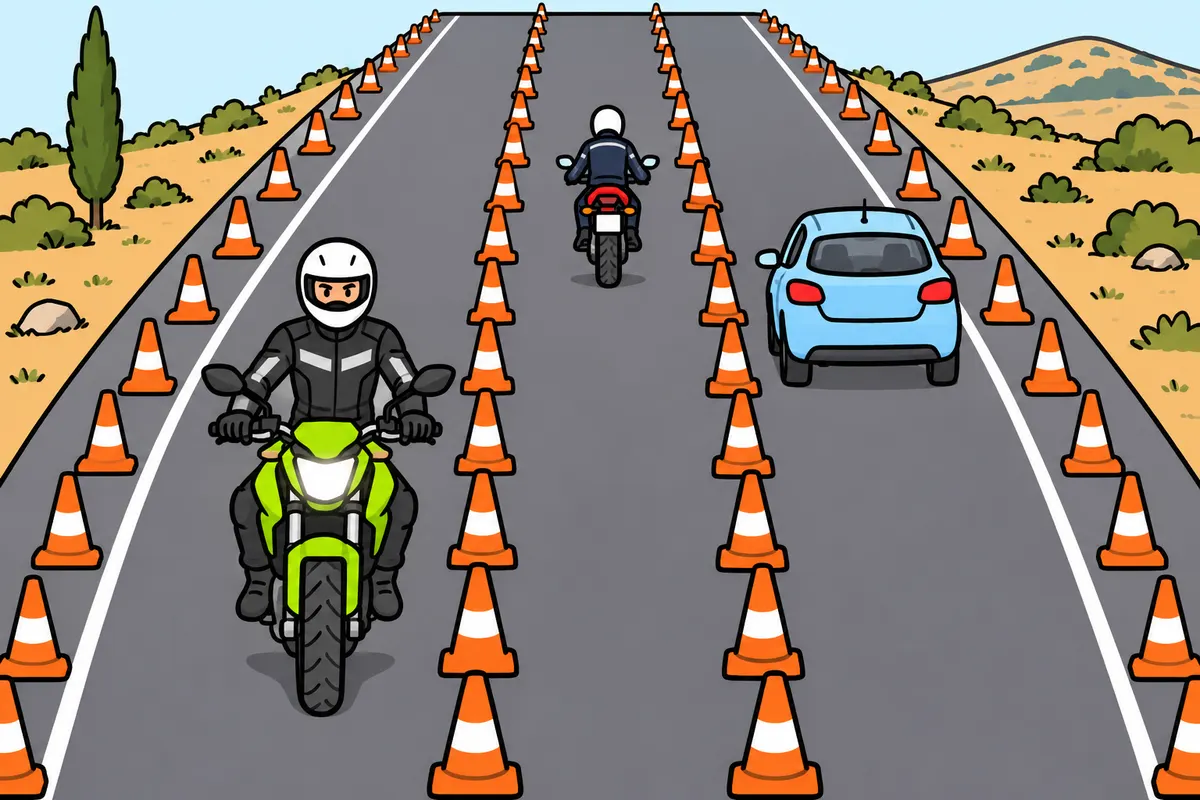
Follow the temporary layout when an additional lane uses the hard shoulders.
Remember
- Authorities may open this layout if there is room to use both shoulders.
- Ride in the space assigned by temporary signs and traffic markers.
- Keep dipped beam on day and night, including on shoulders opened to traffic.
- Obey any lower limits set or signposted.
- Do not enter adjacent traffic to overtake.
Exam trap: Wrong: only the central lane requires dipped beam and special speeds. Right: shoulders opened to traffic also require dipped beam and speeds between 60 and 80 km/h, or lower limits set or signposted.
Read the full explanation
- On a two-way carriageway with arcenes (hard shoulders), the authorities may create an additional lane when the road platform is wide enough. Both hard shoulders are used and the traffic areas are shifted to provide two lanes in one direction and one in the other. You must follow the delineation devices and temporary signs. [RGC, art. 42](https://www.boe.es/buscar/act.php?id=BOE-A-2003-23514#a42)
- You must ride in the area assigned to you, even if it does not match the layout of the normal lanes. Use of a hard shoulder as part of this arrangement is officially authorised. You must not confuse this with deciding for yourself to use the hard shoulder to overtake or ease a traffic queue. [RGC, art. 42](https://www.boe.es/buscar/act.php?id=BOE-A-2003-23514#a42)
- Both in the additional lane and on the hard shoulders opened to traffic, you must keep at least your dipped beam on, both day and night. You must observe a maximum speed of 80 km/h and a minimum of 60 km/h, or lower limits if these are set or signposted. This rule does not apply only to those using the newly created central lane. [RGC, art. 42](https://www.boe.es/buscar/act.php?id=BOE-A-2003-23514#a42)
- You must respect the temporary separation and the applicable rules for a lane running against the normal traffic direction, including the prohibition on entering the adjacent traffic stream to overtake. You must follow the signs indicating which space each traffic stream uses. [RGC, art. 42](https://www.boe.es/buscar/act.php?id=BOE-A-2003-23514#a42)
18Entry, exit and weaving lanes
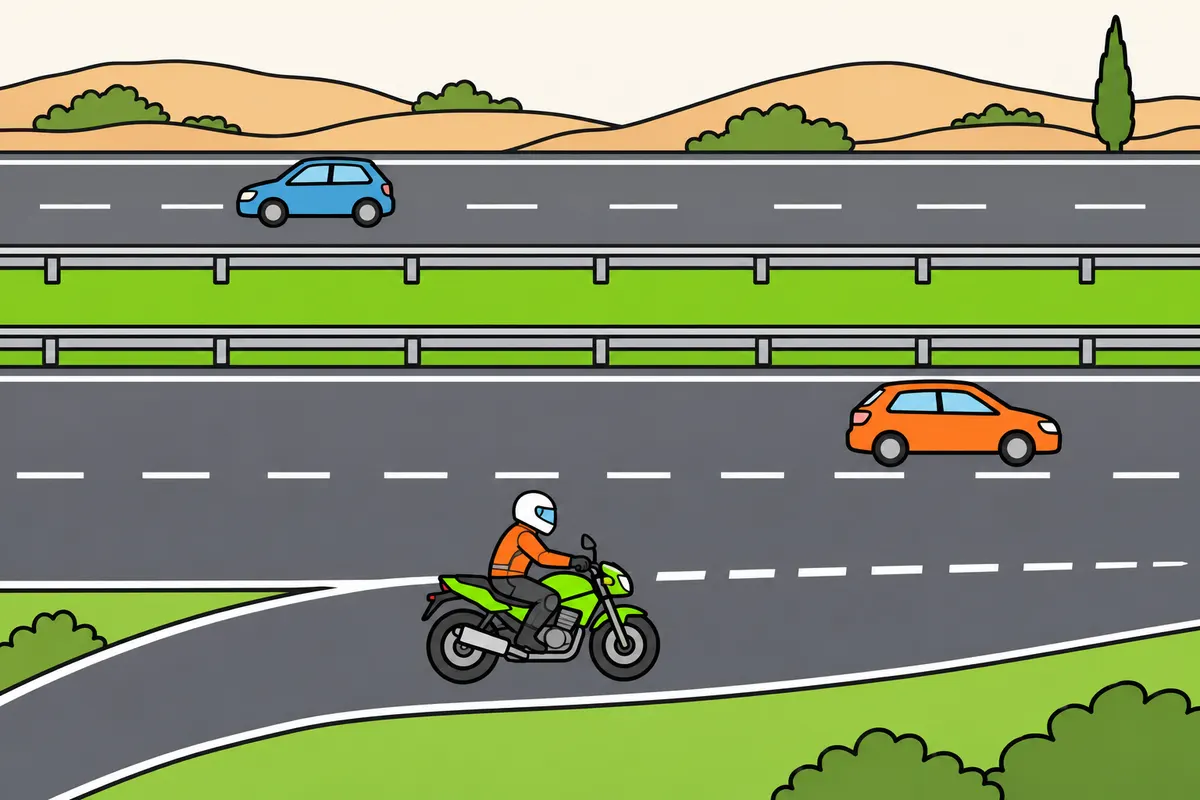
Use entry and exit lanes for their purpose and follow the markings.
| Lane | How you use it |
|---|---|
| Acceleration | Join the road |
| Deceleration | Leave the road |
| Weaving | Join and leave: paths may cross |
Remember
- When joining, give way to traffic on the road you enter.
- When leaving, use the deceleration lane if provided.
- Do not cross solid lines.
- In weaving lanes, expect other vehicles to cross your path.
Exam trap: Wrong: you can continue your normal journey in the acceleration lane. Right: it is for joining the road.
Read the full explanation
- You must associate an acceleration lane with joining traffic and a deceleration lane with leaving the road. Their purpose does not make them additional lanes for continuing your normal route or authorise you to cross their solid lines. The dividing markings show where you may make a permitted lane change. [RGC, art. 72](https://www.boe.es/buscar/act.php?id=BOE-A-2003-23514#a72) [RGC, art. 77](https://www.boe.es/buscar/act.php?id=BOE-A-2003-23514#a77) [RGC, Annex I, catalogue of RD 465/2025](https://www.boe.es/buscar/doc.php?id=BOE-A-2025-12199)
- When joining from an acceleration lane, you must respect the traffic on the road you are entering; see «Motorcycle manoeuvres» for how to do this. [RGC, art. 72](https://www.boe.es/buscar/act.php?id=BOE-A-2003-23514#a72)
- To leave the road, you must use the deceleration lane where one is provided; see «Motorcycle manoeuvres» for how to prepare for and carry out the exit. [RGC, art. 77](https://www.boe.es/buscar/act.php?id=BOE-A-2003-23514#a77)
- In a weaving lane, you encounter both joining and leaving movements, so you may meet vehicles whose paths need to cross to continue along different routes. You must follow its markings when changing lanes, as explained in «Reserved lanes and bus lanes» and «Longitudinal lines and carriageway edges» in this module. [RGC, Annex I, catalogue of RD 465/2025](https://www.boe.es/buscar/doc.php?id=BOE-A-2025-12199)
19Longitudinal lines and carriageway edges
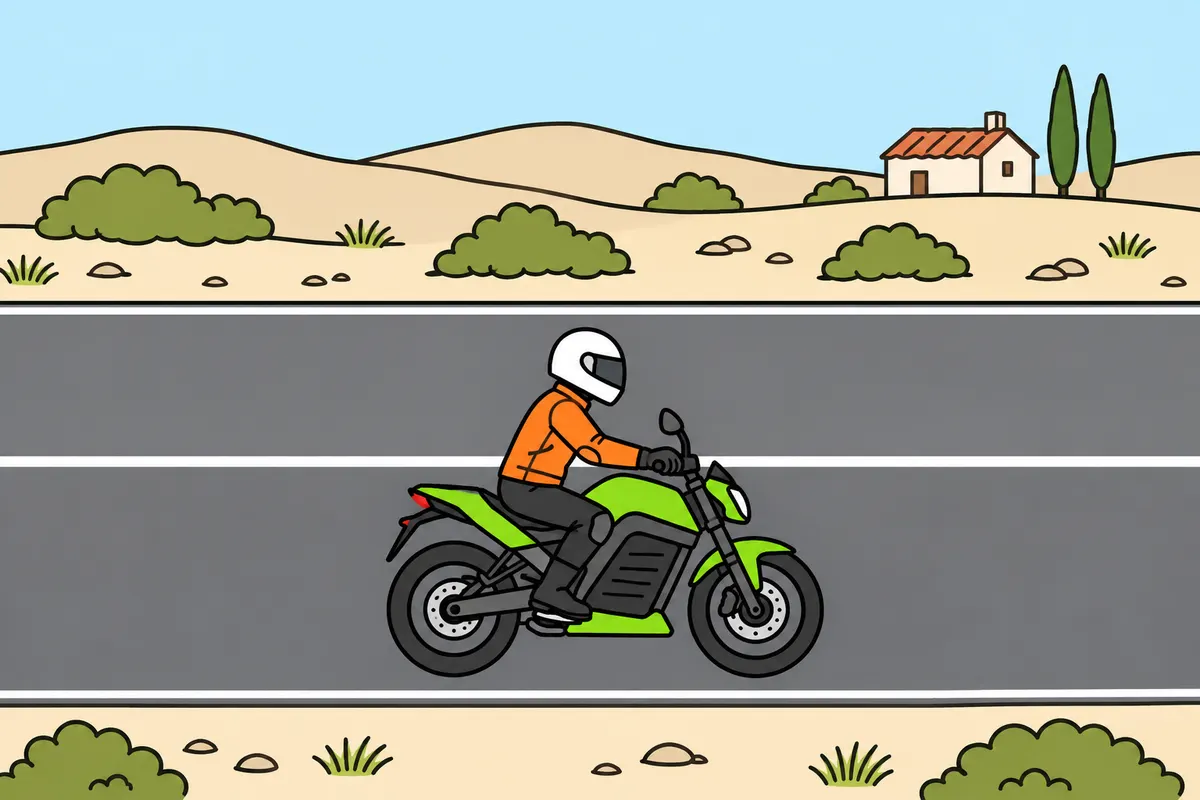
Check what each line means before crossing it or changing your path.
| Line type | What you must remember |
|---|---|
| Broken line along the road | You may cross for a permitted manoeuvre |
| Solid line along the road | Do not cross or ride on it, except where legally allowed |
| Carriageway edge line | Does not change hard shoulder rules |
| Solid line across the road | Do not cross when required to stop |
| Broken line across the road | Reference for giving way; stopping is not always required |
Remember
- Do not ride along lines, except where the lane-width and safety exception allows.
- Double solid lines mean the same as a single solid line.
- With solid and broken lines together, follow the line on your side.
- Between directions, after overtaking from the broken side, cross back to finish or abandon.
- Warning lines announce a solid line or another danger.
- A direction-dividing guidance line does not guarantee enough visibility for overtaking.
Exam trap: Wrong: a broken edge line allows unrestricted shoulder use. Right: edge lines do not change the legal conditions for using the shoulder.
Read the full explanation
- A broken longitudinal line, M-1.1 to M-1.3, separates lanes, and you may cross it for a permitted manoeuvre. You must not ride astride it, except where the catalogue allows this because of lane width and safety. On your motorcycle, you must keep your path within the space you may use, without following the painted line between two rows of traffic. [RGC, Annex I, catalogue of RD 465/2025](https://www.boe.es/buscar/doc.php?id=BOE-A-2025-12199)
- A continuous longitudinal line, M-2.1 to M-2.3, prohibits you from crossing it or riding on it and, if it separates opposing directions of traffic, from riding to its left, except in the exceptional cases provided for by the regulations. Two parallel continuous lines have the same meaning as one. [RGC, Annex I, catalogue of RD 465/2025](https://www.boe.es/buscar/doc.php?id=BOE-A-2025-12199)
- Where a continuous line runs alongside a broken line, M-3.1 to M-3.3, you must follow the line on your side. If they separate opposing directions of traffic and you begin overtaking from the broken-line side, you may cross the continuous line to return to your lane when you complete or abandon the manoeuvre. [RGC, Annex I, catalogue of RD 465/2025](https://www.boe.es/buscar/doc.php?id=BOE-A-2025-12199)
- Carriageway edge lines, M-2.5 to M-2.7, do not change the permitted uses of the arcén (hard shoulder), whether they are continuous or broken. A broken edge line does not turn the hard shoulder into a motorcycle lane; nor does a continuous edge line in itself prevent you from using it when a legally permitted reason applies. [RGC, Annex I, catalogue of RD 465/2025](https://www.boe.es/buscar/doc.php?id=BOE-A-2025-12199)
- Advance warning broken lines M-1.9 and M-1.10 warn of a continuous line or another hazardous situation ahead. You must plan any adjustment to your path in advance and avoid starting to use the opposite side of the road if you cannot finish doing so safely. Line M-1.13, which separates opposing directions of traffic, provides guidance and does not in itself indicate how much visibility you have for overtaking. [RGC, Annex I, catalogue of RD 465/2025](https://www.boe.es/buscar/doc.php?id=BOE-A-2025-12199)
- Transverse lines mark where you must stop or give way: continuous transverse line M-4.1 marks the point you must not cross when a sign or another obligation requires you to stop. Broken transverse line M-4.2 marks where you must give way; it does not in itself require you to stop in every case. [RGC, Annex I, catalogue of RD 465/2025](https://www.boe.es/buscar/doc.php?id=BOE-A-2025-12199)
20Arrows, hatched areas and motorcycle reservations
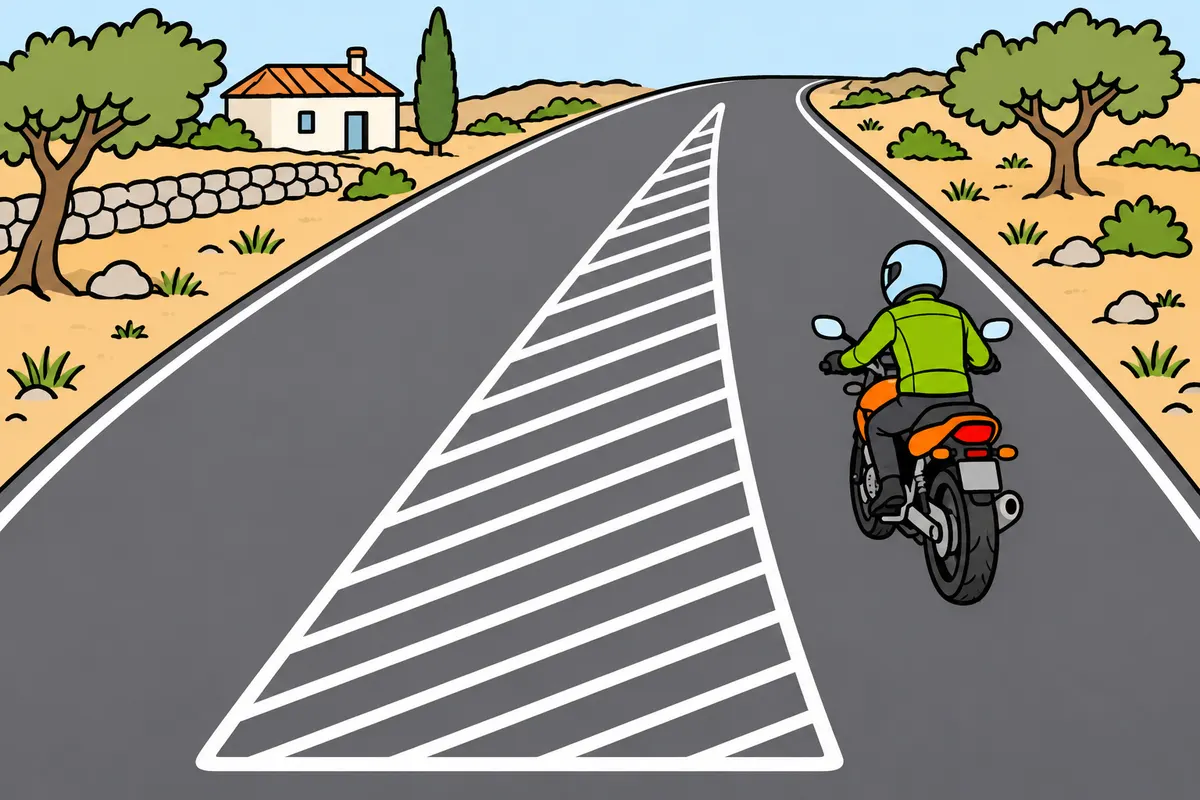
Follow arrows and check whether reserved areas allow your motorcycle.
| Marking | What you must do |
|---|---|
| Lane selection arrow | Follow permitted or compulsory movements |
| Arrow allowing straight ahead | You may change lanes without changing direction if lines allow |
| End-of-lane arrow | Leave as indicated, giving way to traffic in the lane you enter |
| Return arrow | Do not start overtaking; finish any overtake already started promptly and safely |
| New roadworks markings | Yellow; white markings may remain if still applicable |
Remember
- Read arrows together with lines and other signs.
- Normally, do not enter hatched areas enclosed by solid lines.
- At red lights, check which vehicles an advanced motorcycle waiting area allows.
- Do not enter a cycles-only waiting area on your motorcycle.
- Motorcyclist guidance markings recommend parts of the lane you should avoid.
- At roadworks, follow current markings and the markers showing your route.
Exam trap: Wrong: any coloured design lets you enter a reserved area. Right: urban traffic-calming designs do not grant access.
Read the full explanation
- You must follow the movements permitted or required by lane selection arrows M-5.1, M-5.2 and M-5.6. If they include straight ahead, you may change lanes while continuing in the same direction when the longitudinal markings allow it. You must read the arrow together with the lines marking the lane boundaries and the other signs. [RGC, Annex I, catalogue of RD 465/2025](https://www.boe.es/buscar/doc.php?id=BOE-A-2025-12199)
- End-of-lane arrow M-5.4 tells you that you must leave the lane in the direction shown, respecting the priority of traffic in the lane you enter. Return arrow M-5.5 warns of a continuous line ahead that prevents you from continuing to its left: you must refrain from starting to overtake or, if you have already started, complete the manoeuvre as soon as you can safely. [RGC, Annex I, catalogue of RD 465/2025](https://www.boe.es/buscar/doc.php?id=BOE-A-2025-12199)
- You must normally keep your motorcycle out of an area of diagonal hatching enclosed by a continuous line, M-7.1 or M-7.2. The catalogue exception for users who must travel on the hard shoulder does not authorise you to use the area routinely. [RGC, Annex I, catalogue of RD 465/2025](https://www.boe.es/buscar/doc.php?id=BOE-A-2025-12199)
- At an avanza-motos (advanced motorcycle waiting area), you must check the pictograms showing which vehicles are allowed. When the traffic light is red, this is a reserved waiting area before a junction or signal-controlled pedestrian crossing, bounded by two continuous transverse lines M-4.1 four metres apart. If it is reserved for cycles, you may not use it on your motorcycle simply because both have two wheels; you must respect the reservation shown. [RGC, Annex I, catalogue of RD 465/2025](https://www.boe.es/buscar/doc.php?id=BOE-A-2025-12199)
- Motorcyclist guidance markings M-8.4 warn you of particularly hazardous bends and the part of the lane you are advised to avoid riding over. They help you choose your path within your lane. They recommend an area to avoid, while you must also comply with the other markings and signs on that stretch. [RGC, Annex I, catalogue of RD 465/2025](https://www.boe.es/buscar/doc.php?id=BOE-A-2025-12199)
- At roadworks, new road markings are yellow; white markings may remain if they still apply. You must follow the current route through the roadworks and its delineation devices. Coloured designs used in urban areas to calm traffic are not in themselves road markings and do not grant access to a reserved area. [RGC, Annex I, catalogue of RD 465/2025](https://www.boe.es/buscar/doc.php?id=BOE-A-2025-12199)
21Entering and travelling through tunnels
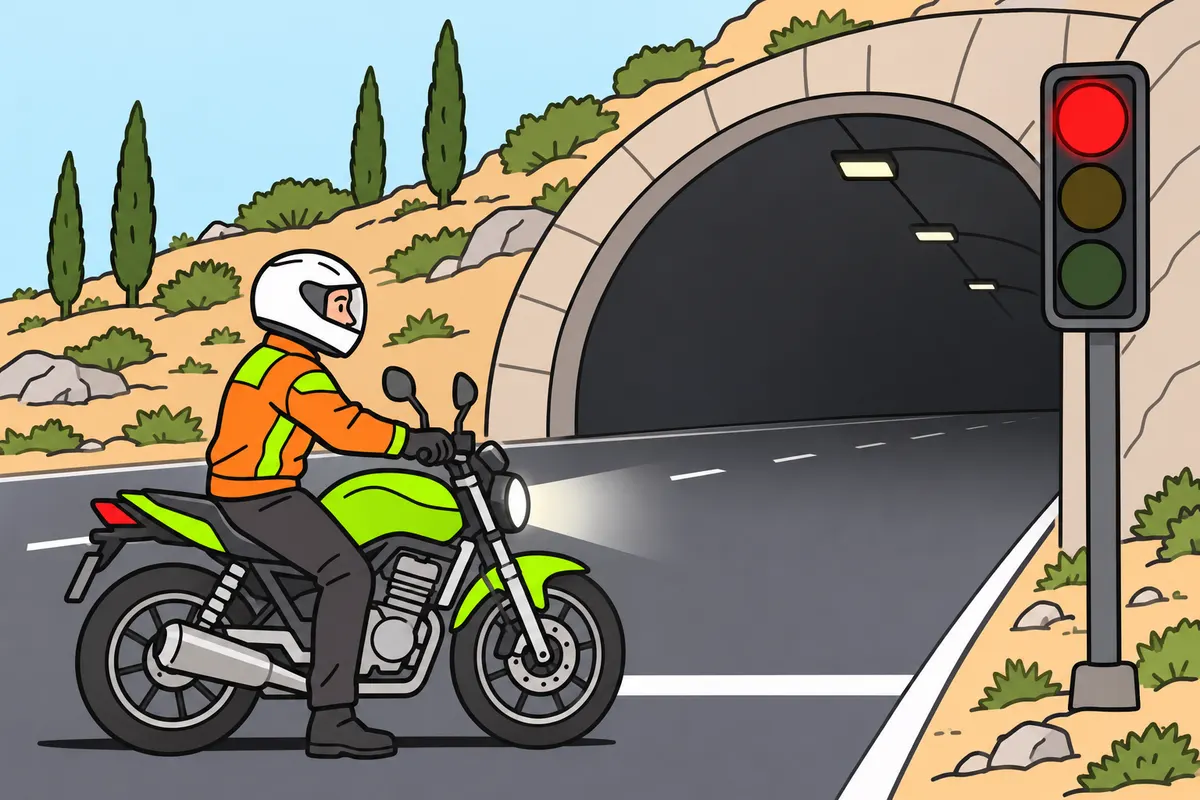
Enter tunnels only when signs allow, and use the appropriate lights.
Remember
- Do not enter if the entrance traffic light prohibits it.
- Wait even if the carriageway looks empty.
- Use the appropriate lights; see “Motorcycle lights and signals”.
- Inside, obey traffic lights, message signs and loudspeaker instructions.
- Tunnels are signposted whatever their length.
Exam trap: Wrong: short underpasses do not require you to follow their rules. Right: their traffic and lighting rules still apply.
Read the full explanation
- You must obey the signs and signals controlling access to a tunnel or underpass. If a traffic light at the entrance prohibits passage, you may not enter on your motorcycle even if you can see that the carriageway is empty. You must stop at the appropriate place and wait until entry is permitted; the exception in article 96 concerns emergency, assistance and maintenance service teams. [RGC, art. 96](https://www.boe.es/buscar/act.php?id=BOE-A-2003-23514#a96)
- In tunnels and underpasses, you must use the appropriate lights; see «Motorcycle lights and signals». [RGC, art. 98](https://www.boe.es/buscar/act.php?id=BOE-A-2003-23514#a98)
- You must obey traffic lights, variable message signs and instructions given over loudspeakers or by other means throughout the tunnel. These instructions control traffic through the tunnel when an incident occurs; you must adjust your path to what they indicate and to the actual traffic conditions. [RGC, art. 95](https://www.boe.es/buscar/act.php?id=BOE-A-2003-23514#a95) [RGC, Annex I, catalogue of RD 465/2025](https://www.boe.es/buscar/doc.php?id=BOE-A-2025-12199)
- You encounter signs for tunnels of any length and for underpasses longer than 200 metres. This threshold does not mean you may ignore the traffic or lighting rules in a short underpass: your obligations when passing through it do not depend solely on whether it exceeds that length. [RGC, art. 95](https://www.boe.es/buscar/act.php?id=BOE-A-2003-23514#a95) [RGC, art. 98](https://www.boe.es/buscar/act.php?id=BOE-A-2003-23514#a98)
22Lanes and following distances in tunnels
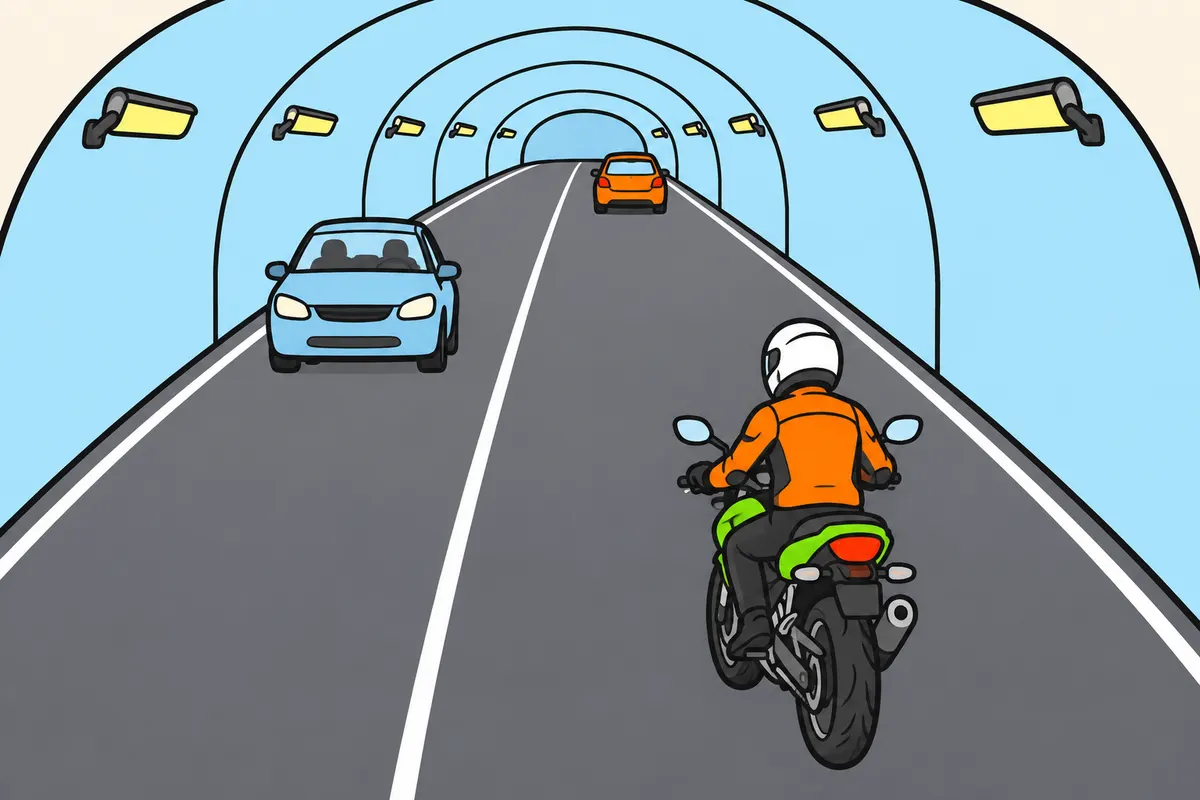
Keep your distance in tunnels and never overtake by entering the opposite side.
| Vehicle not intending to overtake | Minimum gap in tunnels or underpasses |
|---|---|
| Your motorcycle | 100 metres or four seconds |
| Vehicle with maximum authorised mass over 3,500 kg | 150 metres or six seconds |
Remember
- Overtake only with several lanes in your direction, without entering the opposite side.
- If you do not intend to overtake, keep the minimum gap.
- Increase the gap when conditions require.
- Do not stop or park voluntarily.
- Do not make a U-turn or reverse.
- If you take the wrong route, continue until you can correct it legally.
Exam trap: Wrong: your motorcycle always needs 150 metres. Right: when not intending to overtake, keep at least 100 metres or four seconds; increase the gap when necessary.
Read the full explanation
- In a two-way tunnel or underpass, you must not overtake if you need to enter the opposite side of the road to do so. You may only overtake if there is more than one lane in your direction and you carry out the manoeuvre without entering the opposite side. [RGC, art. 95](https://www.boe.es/buscar/act.php?id=BOE-A-2003-23514#a95)
- If you do not intend to overtake, you must keep at least 100 metres or a minimum time gap of four seconds behind the vehicle ahead. This is the requirement that applies to your motorcycle; you must increase the gap when conditions require it. [RGC, art. 95](https://www.boe.es/buscar/act.php?id=BOE-A-2003-23514#a95)
- The 150 metres or six seconds apply to you if your vehicle has an MMA (maximum authorised mass) exceeding 3,500 kg. The mass that determines this difference is the vehicle’s maximum authorised mass, rather than the load you carry that day. [RGC, art. 95](https://www.boe.es/buscar/act.php?id=BOE-A-2003-23514#a95)
- You may not stop or park voluntarily in the tunnel, make a U-turn or reverse. If you take the wrong exit or route, you must continue along the authorised route until you can correct your mistake legally. If traffic or an emergency forces you to stop, different rules apply from those for a voluntary stop. [RGC, art. 95](https://www.boe.es/buscar/act.php?id=BOE-A-2003-23514#a95) [RGC, art. 97](https://www.boe.es/buscar/act.php?id=BOE-A-2003-23514#a97)
23Stopping inside a tunnel
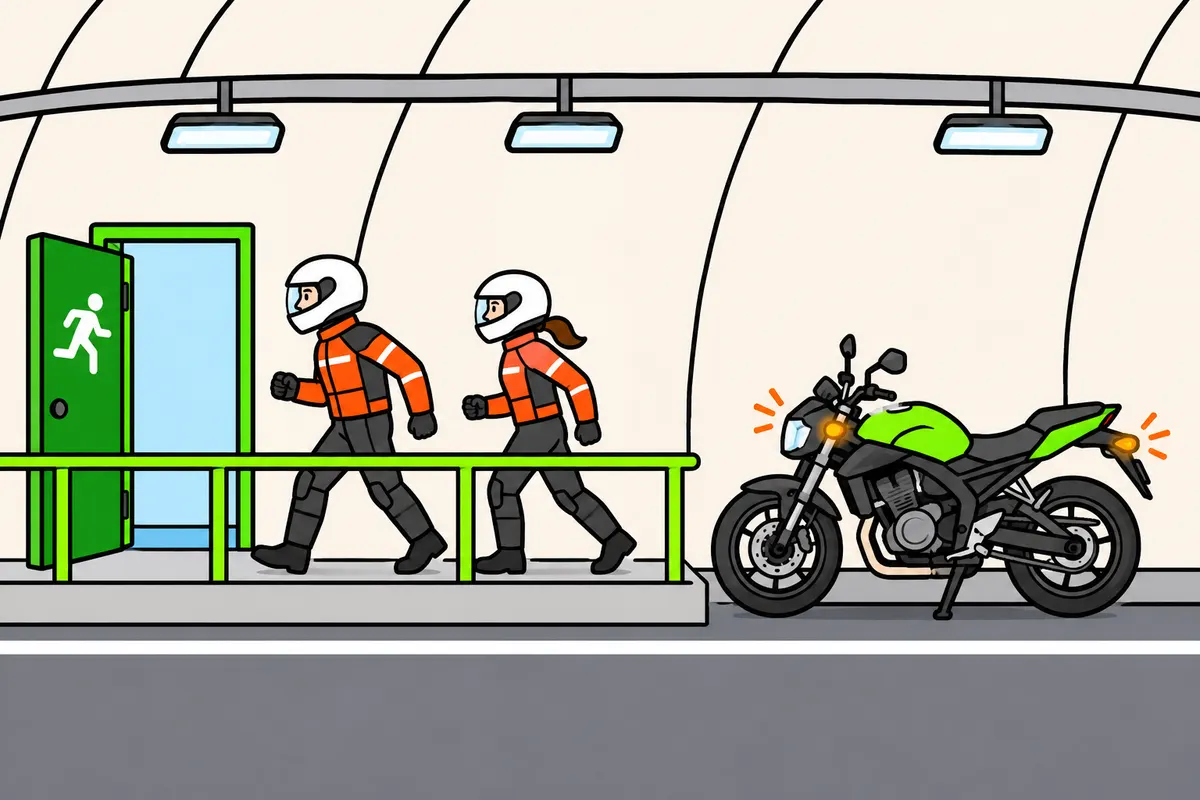
In tunnels, act according to whether a breakdown, fire or traffic stops you.
| Reason for stopping in a tunnel | What you must do |
|---|---|
| Breakdown leaves you immobilised | Request help and leave towards the nearest refuge or exit, using traffic-free areas where available |
| Fire | Move far right, switch off the engine, leave the key and evacuate away from the fire |
| Traffic | Stay with your motorcycle and passenger; stop as far behind the vehicle ahead as possible |
Remember
- After breakdown, reach the exit if possible; otherwise, reach an emergency area.
- If immobilised, use the nearest emergency area ahead; otherwise, keep far right.
- Switch off the engine, use hazard lights and keep position lights on.
- You must use your connected V-16 if carried; motorcycles need not carry one.
- Request help immediately from the nearest SOS telephone, if available.
- After breakdown, follow instructions; quickly take your passenger towards the nearest refuge or exit.
Exam trap: Wrong: you must evacuate because of a simple queue. Right: if traffic stops you, stay with your passenger beside the motorcycle; switch off the engine, keep position lights on and use hazard lights temporarily.
Read the full explanation
- If you have a breakdown in a tunnel or underpass but can continue, you must reach the exit or, if that is not possible, an area reserved for emergencies. If your motorcycle becomes immobilised, you must switch off the engine, switch on the hazard warning lights and keep the position lights on. If you can, place your motorcycle in the nearest emergency area in your direction of travel or, failing that, as close as possible to the right-hand edge of the carriageway. [RGC, art. 97.3.a-b and f](https://www.boe.es/buscar/act.php?id=BOE-A-2003-23514#a97)
- Next, if you carry a connected V-16 beacon, you must position it and activate it to warn that your motorcycle is immobilised. You are not required to carry this beacon as part of your motorcycle’s compulsory equipment; see «Accidents, breakdowns and assistance» for its specifications. [RGC, art. 97.3.c](https://www.boe.es/buscar/act.php?id=BOE-A-2003-23514#a97) [RGV, Annex XII](https://www.boe.es/buscar/act.php?id=BOE-A-1999-1826#anxii)
- You must request assistance without delay from the nearest SOS post, if there is one, and follow its instructions. Then you and your passenger must leave the motorcycle and quickly head for the nearest refuge or exit, using areas closed to traffic where available. [RGC, art. 97.3.d-e](https://www.boe.es/buscar/act.php?id=BOE-A-2003-23514#a97)
- If there is a fire, you must move your motorcycle as far to the right as possible, switch off the engine and leave the key in the ignition to help the emergency services get through; when evacuating, you must move away in the opposite direction to the fire. [RGC, art. 97.3](https://www.boe.es/buscar/act.php?id=BOE-A-2003-23514#a97)
- If traffic forces you to stop, you and your passenger must remain with the motorcycle: switch off the engine, keep the position lights on, switch on the hazard warning lights temporarily and stop as far as possible from the vehicle ahead. [RGC, art. 97.3, final paragraph](https://www.boe.es/buscar/act.php?id=BOE-A-2003-23514#a97)
Choosing your place on the road
Check the space you are authorised to use before choosing your position.
- Identify the carriageways and permitted direction from the signs and separators.
- Check whether you are in a built-up area and whether the road is an autopista (motorway) or autovía (dual carriageway).
- Rule out lanes that are closed or reserved for other types of vehicle.
- Follow the normal rule of keeping right, or choose a lane according to your destination where permitted in urban areas.
- Keep your path within the authorised space and prepare for changes without causing an obstruction.
Checking hard shoulder use during congestion
You must meet all the conditions of this exception for motorcycles.
- Check that the stretch is authorised for use by fixed upright signs and road markings.
- Confirm that traffic in the lanes is stationary because of congestion.
- Use only the right-hand hard shoulder and ride in single file.
- Observe the maximum of 30 km/h and slow down further if necessary.
- Protect users who must use the hard shoulder and leave it if necessary.
Entering a special lane
Distinguish how the lane is authorised for use so that you apply its rules.
- Identify whether it is a reversible lane, a lane running against the normal traffic direction or a temporary additional lane.
- Check the direction open to traffic and the vehicles allowed; for a lane running against the normal direction, distinguish between use to improve traffic flow and use during roadworks.
- Use dipped beam by day and at night.
- In a lane running against the normal direction or a temporary additional lane, observe 60 to 80 km/h unless lower limits apply; for a reversible lane, check the rules for the road.
- Observe the restrictions on lane use and the delineation devices, without entering the adjacent traffic stream to overtake.
Travelling through a tunnel safely
Plan your entry, journey through the tunnel and any stop.
- Check that the signs at the entrance allow you to enter.
- Keep the required lights on and observe traffic lights, signs and warnings.
- If you do not intend to overtake, keep at least 100 m or four seconds behind the vehicle ahead.
- In a two-way tunnel, overtake only if there are several lanes in your direction and you do not enter the opposite direction.
- If traffic brings you to a stop, stay with your motorcycle and follow the stopping measures; in an emergency, follow the sequence in «Stopping inside a tunnel».
Finished this module?
Mark it as read and you will see your progress on the theory list.