
Theory · C1 Licence - Light Truck · Module 9 of 18
Lights and signalling on your light lorry
You learn to choose the lights on your light lorry according to the road, visibility and vehicle situation, avoiding dazzling others and signalling manoeuvres and immobilisation. You master the thresholds for side-marker lamps and end-outline marker lamps, the connected V-16 and the plates and markings applicable to vehicles covered by the C1 licence.
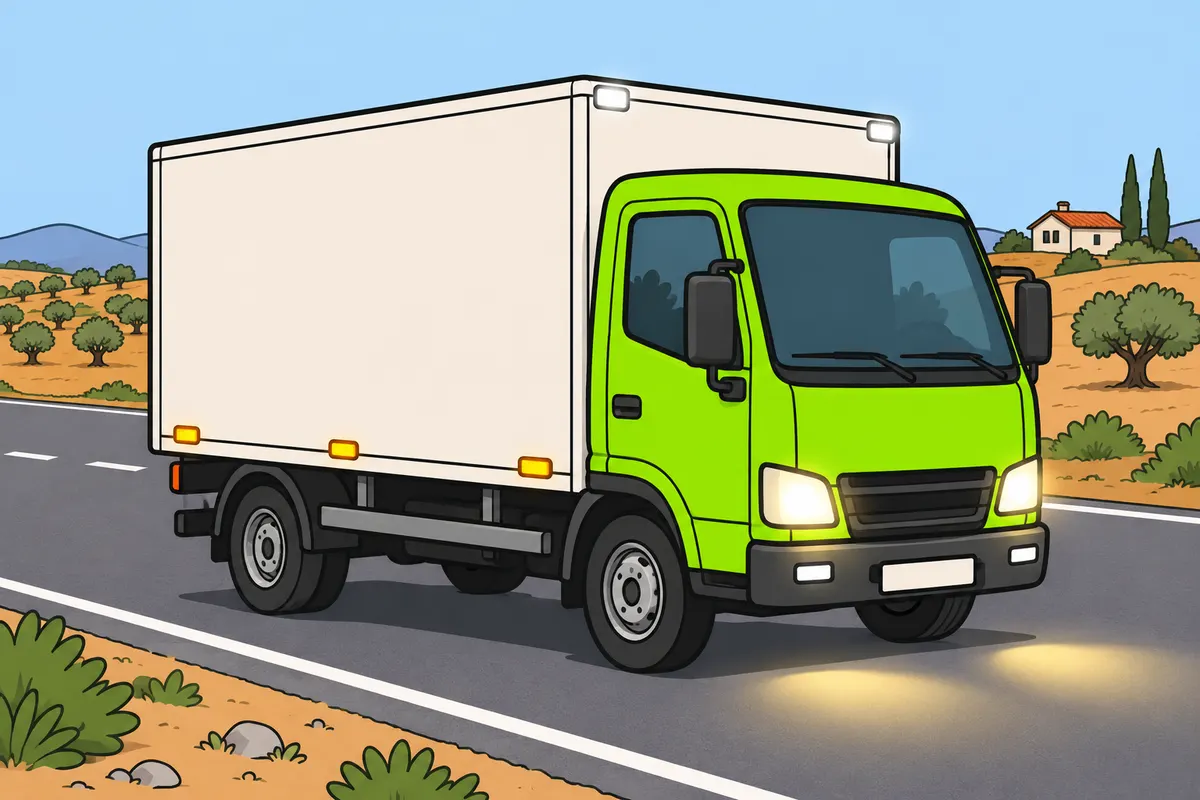
1Seeing, being seen and warning others
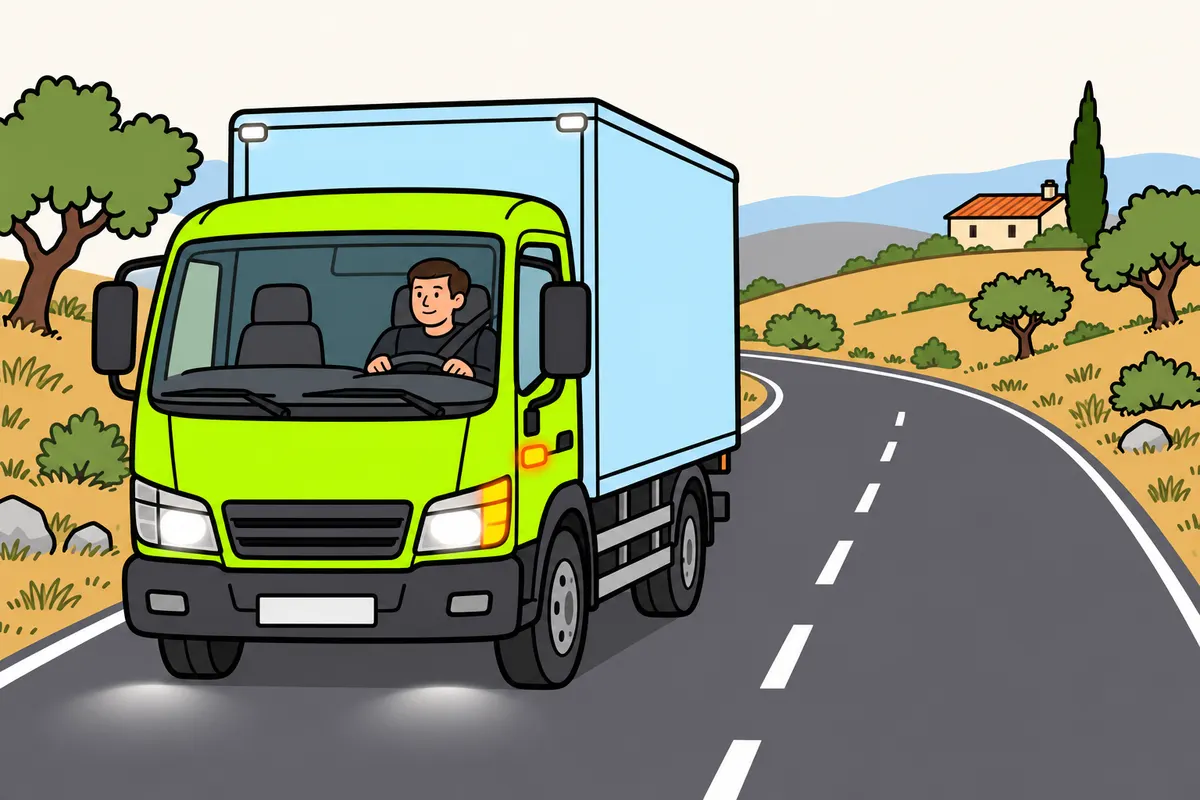
Use your lights to see, show your lorry and warn others.
| Your lorry’s lights | What they do |
|---|---|
| Dipped beam and main beam | Light the carriageway |
| Position lights and end-outline marker lamps | Show presence and size |
| Indicators | Announce your movements |
Remember
- Carry the required equipment even when you travel empty.
- Keep the lights required by your lorry’s type approval.
- Check your light trailer’s lights and reflectors too.
- Have rear fog lights and rear number plate lighting.
Exam trap: Wrong: You can remove any light described as optional. Right: Keep those required for your particular lorry.
Read the full explanation
- Lighting and signalling serve three purposes: illuminating the carriageway, showing your lorry's presence and dimensions, and communicating your manoeuvres or a hazard. Dipped beam and main beam let you see; position lights and end-outline marker lamps let others identify your vehicle; indicators signal the direction in which you intend to move. [RGV, Annex X](https://www.boe.es/buscar/act.php?id=BOE-A-1999-1826#anx).
- Your lorry must have dipped beam, main beam, reversing lamps, indicators with a hazard warning function, brake lights, front and rear position lights, rear fog lamps and rear number plate lighting. You must add the side marker lamps and end-outline marker lamps required for its dimensions; the equipment list applies whether you travel laden or unladen. [RGV, art. 16](https://www.boe.es/buscar/act.php?id=BOE-A-1999-1826#a16).
- You must retain the devices required by your vehicle's specific type approval. The general table in the regulations refers to vehicle categories and their technical regulations: you must not use a general indication that equipment is optional to remove an item your lorry must have. [RGV, art. 15](https://www.boe.es/buscar/act.php?id=BOE-A-1999-1826#a15). [RGV, Annex X](https://www.boe.es/buscar/act.php?id=BOE-A-1999-1826#anx).
- If you tow a light trailer, you must also check its equipment: indicators with a hazard warning function, brake lights, rear position lights, rear fog lamps, number plate lighting and reflectors. It must have front position lights if it is more than 1.60 m wide, end-outline marker lamps if it is more than 2.10 m wide, and side marker lamps if it is more than 6 m long. [RGV, art. 16.5](https://www.boe.es/buscar/act.php?id=BOE-A-1999-1826#a16).
2When you must switch on your lights
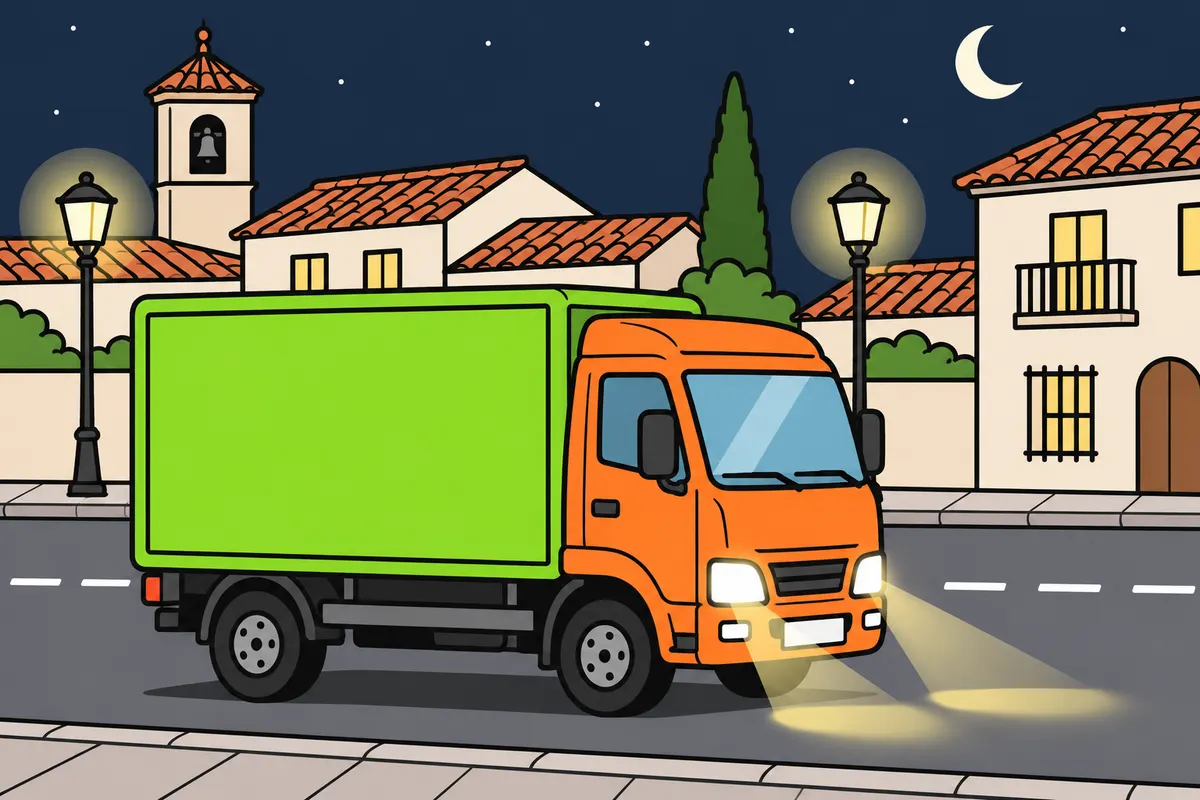
Switch on your lights at night and whenever conditions require them.
Remember
- Switch on your lights from sunset to sunrise.
- Also use them by day in tunnels, underpasses and stretches marked as tunnels.
- Use them when weather, smoke or dust greatly reduces visibility.
- Treat lighting as insufficient if either distance test fails.
Exam trap: Wrong: Streetlights let you drive at night without lights. Right: Use the required lighting.
Read the full explanation
- You must use the appropriate lighting from sunset to sunrise. This requirement applies both within and outside built-up areas; street lighting determines which driving lights you need to use, but does not allow you to drive at night without lights. [RGC, art. 98](https://www.boe.es/buscar/act.php?id=BOE-A-2003-23514#a98).
- You must also switch on your lights during the day in tunnels, underpasses and stretches covered by a tunnel sign. Daylight visible at the other end does not remove this requirement, nor does artificial lighting installed inside the tunnel or underpass replace your lights. [RGC, art. 98](https://www.boe.es/buscar/act.php?id=BOE-A-2003-23514#a98).
- If fog, heavy rain, snowfall or clouds of smoke or dust significantly reduce visibility, you must use the required lighting even at midday. Assess the actual visibility: you do not need to wait until nightfall to make your lorry's load body visible. [RGC, art. 106](https://www.boe.es/buscar/act.php?id=BOE-A-2003-23514#a106).
- You must regard a road as insufficiently lit if, with normal eyesight, at any point you cannot read a number plate at 10 m or distinguish a dark vehicle at 50 m. Either circumstance is sufficient; these are lighting criteria, not distances for switching from main beam to dipped beam. [RGC, art. 100](https://www.boe.es/buscar/act.php?id=BOE-A-2003-23514#a100).
3Position lights: presence and width
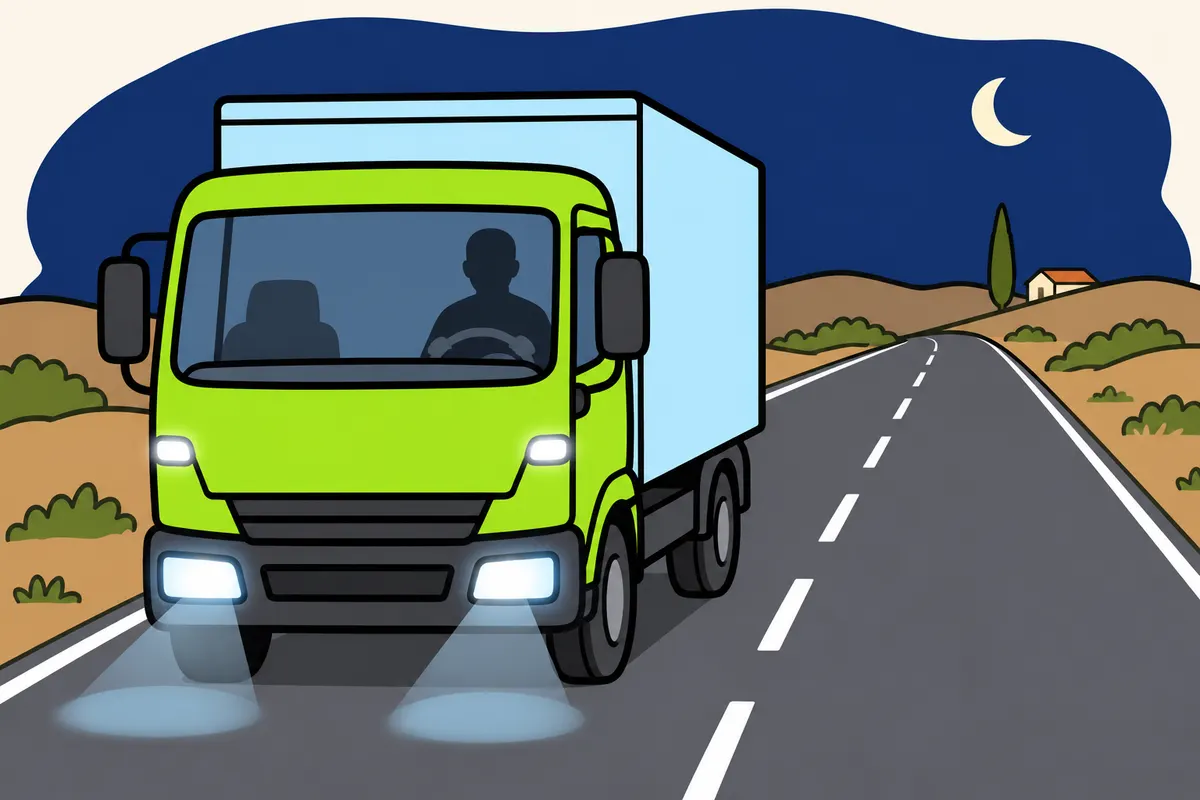
Use position lights to show your lorry’s presence and width.
| Your lorry’s position lights | Colour |
|---|---|
| Front | White |
| Rear | Red |
Remember
- Keep position lights on at night, in tunnels, underpasses and tunnel-marked stretches.
- Also switch them on when visibility is greatly reduced.
- When driving, add dipped beam or main beam as required.
- In reduced visibility, you may use front fog lights with position lights when permitted.
Exam trap: Wrong: You can drive at night with only position lights. Right: Add the required lighting.
Read the full explanation
- Your lorry must have two white front position lights and two red rear position lights, located towards the outer edges in accordance with the installation requirements. They let you show its presence and width. [RGV, Annex X](https://www.boe.es/buscar/act.php?id=BOE-A-1999-1826#anx).
- You must keep the position lights on and, if the width exceeds 2.10 m, the end-outline marker lamps when driving at night, in tunnels, underpasses and stretches marked with a tunnel sign, or when visibility is significantly reduced. [RGC, art. 99](https://www.boe.es/buscar/act.php?id=BOE-A-2003-23514#a99).
- You must use position lights together with the appropriate dipped beam or main beam; in the special visibility conditions specified in article 106, you may use front fog lamps together with position lights. [RGC, art. 101](https://www.boe.es/buscar/act.php?id=BOE-A-2003-23514#a101). [RGC, art. 106](https://www.boe.es/buscar/act.php?id=BOE-A-2003-23514#a106).
- Your rear position lights switch on automatically with the lighting specified in the regulations; the circuit must retain this connection even if the lamps share a housing with other functions. The technical exception for brief light signals allows you to flash your lights without simultaneously switching on all the associated lighting. [RGV, art. 15](https://www.boe.es/buscar/act.php?id=BOE-A-1999-1826#a15).
4Side marker lamps: the 6 m threshold
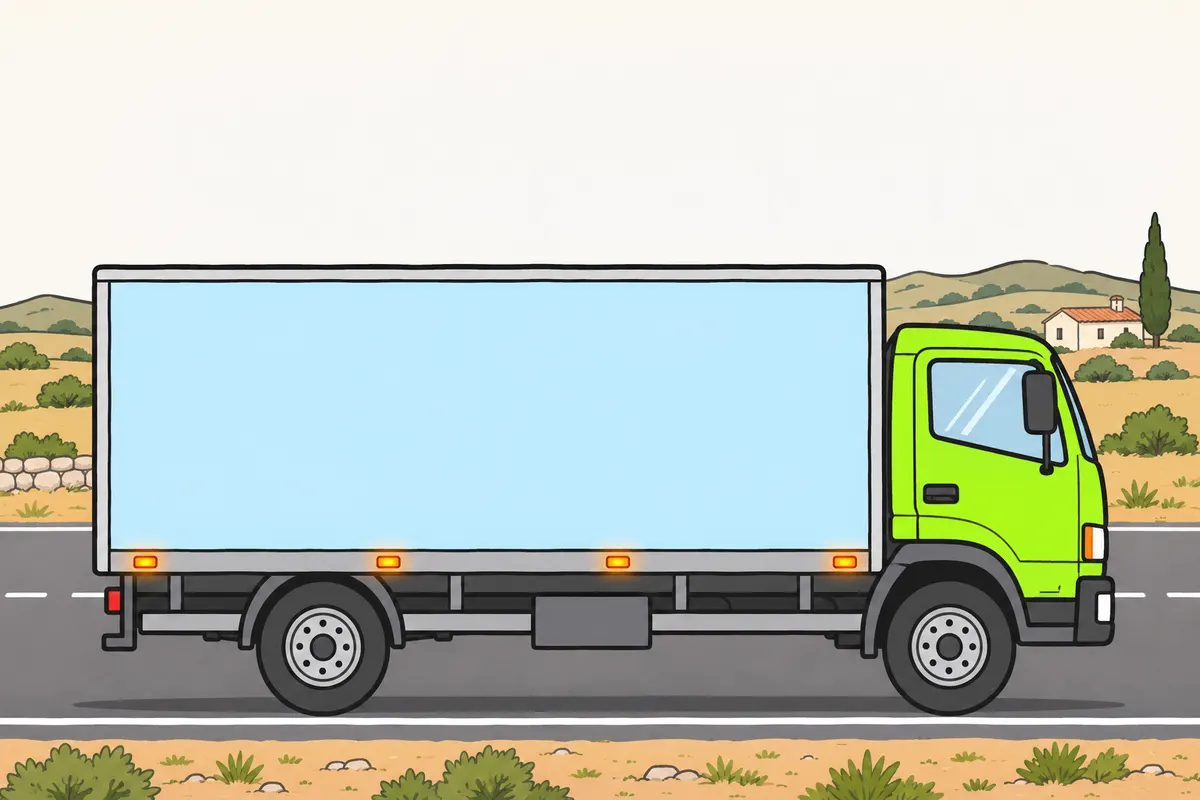
Check whether your lorry’s length requires side marker lamps.
| Your complete lorry’s length | Side marker lamps; chassis-cabs excepted |
|---|---|
| Up to 6 m | May be optional |
| Over 6 m | Required |
Remember
- If your complete lorry exceeds 6 m, it must have side marker lamps.
- Remember the exception for chassis-cabs.
- Recognise amber as the usual colour.
- Red is allowed near the rear if the device meets the regulatory exception.
- Check the required installation; do not assume two lamps are enough.
Exam trap: Wrong: Exactly 6 m makes them compulsory. Right: You must exceed 6 m, with an exception for chassis-cabs.
Read the full explanation
- If your complete lorry is more than 6 m long, it must have side marker lamps. The specified exception applies to chassis-cabs. At exactly 6 m you do not exceed the threshold; for motor vehicles up to that length, fitting them may be optional. [RGV, art. 16](https://www.boe.es/buscar/act.php?id=BOE-A-1999-1826#a16). [RGV, art. 17](https://www.boe.es/buscar/act.php?id=BOE-A-1999-1826#a17).
- Your side marker lamps emit amber light and are distributed along the side. The general table specifies a minimum of two and a maximum depending on the length, with installation appropriate to the category; you must not assume that any long lorry is correctly equipped with just two light sources. [RGV, Annex X](https://www.boe.es/buscar/act.php?id=BOE-A-1999-1826#anx).
- You may find a red side lamp under the regulatory exception for grouping, combining or incorporating it with certain rear devices. You must learn amber as the general rule without treating every red device near the rear as incorrect if it meets that exception. [RGV, Annex X](https://www.boe.es/buscar/act.php?id=BOE-A-1999-1826#anx).
5End-outline marker lamps: the 2.10 m threshold
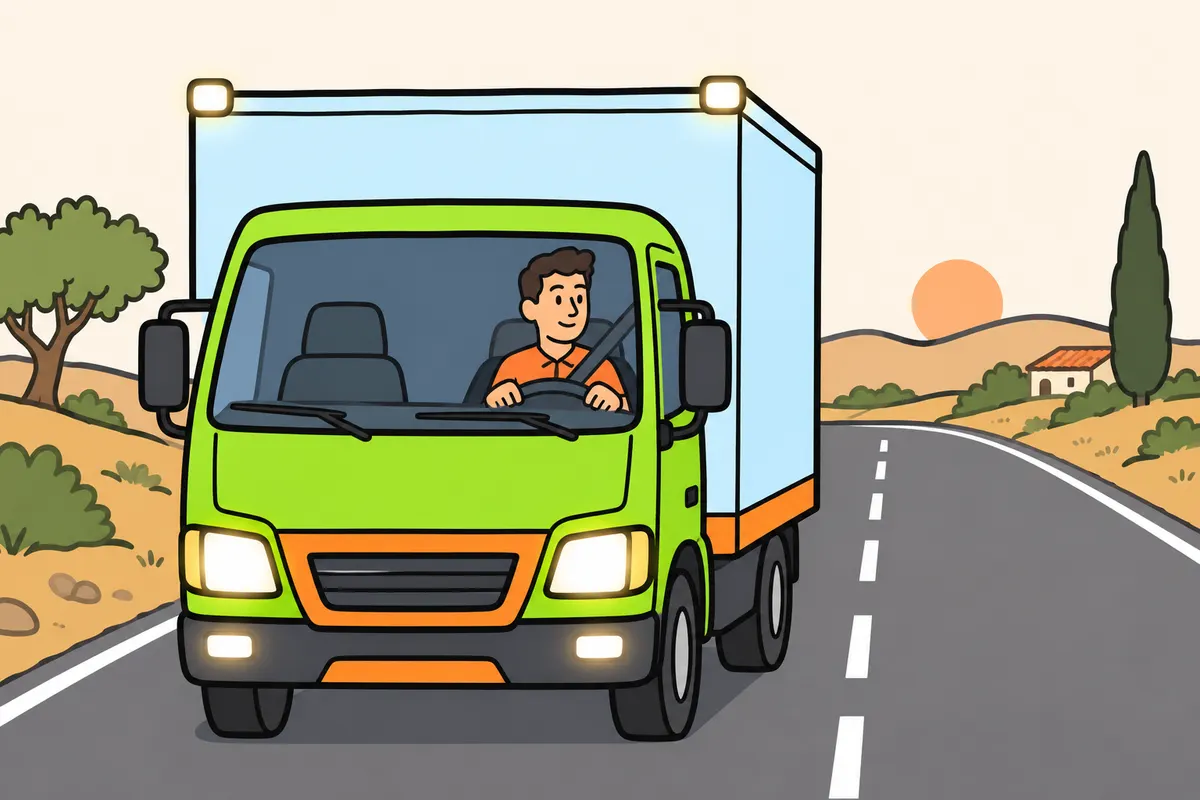
Check your lorry’s width to find out whether it needs end-outline marker lamps.
| Your lorry’s width | End-outline lamps; rear lamps optional on chassis-cabs |
|---|---|
| From 1.80 to 2.10 m | Optional |
| Over 2.10 m | Required |
Remember
- Recognise their white lights at the front and red lights at the rear.
- Look for them high up, near the outer edges.
- When required, switch them on with position lights in the specified situations.
- On chassis-cabs, rear end-outline marker lamps are optional.
- Do not use these lights to judge whether you fit under a bridge.
Exam trap: Wrong: Exactly 2.10 m requires end-outline marker lamps. Right: The width requirement starts above 2.10 m; rear lamps are optional on chassis-cabs.
Read the full explanation
- If your lorry is more than 2.10 m wide, it must have end-outline marker lamps: two lamps visible from the front and two from the rear. They emit white light at the front and red light at the rear; their location close to the outer edges and as high as possible helps others judge its bulk. [RGV, Annex X](https://www.boe.es/buscar/act.php?id=BOE-A-1999-1826#anx).
- If your vehicle's width is between 1.80 and 2.10 m, end-outline marker lamps are optional. On chassis-cabs, rear end-outline marker lamps are optional. [RGV, art. 17](https://www.boe.es/buscar/act.php?id=BOE-A-1999-1826#a17). [RGV, Annex X](https://www.boe.es/buscar/act.php?id=BOE-A-1999-1826#anx).
- Your end-outline marker lamps indicate the overall width and supplement the position lights; their presence does not tell you the exact height of your lorry or guarantee that you can drive under a bridge. [RGV, Annex X](https://www.boe.es/buscar/act.php?id=BOE-A-1999-1826#anx).
6Dipped beam: lighting the road ahead
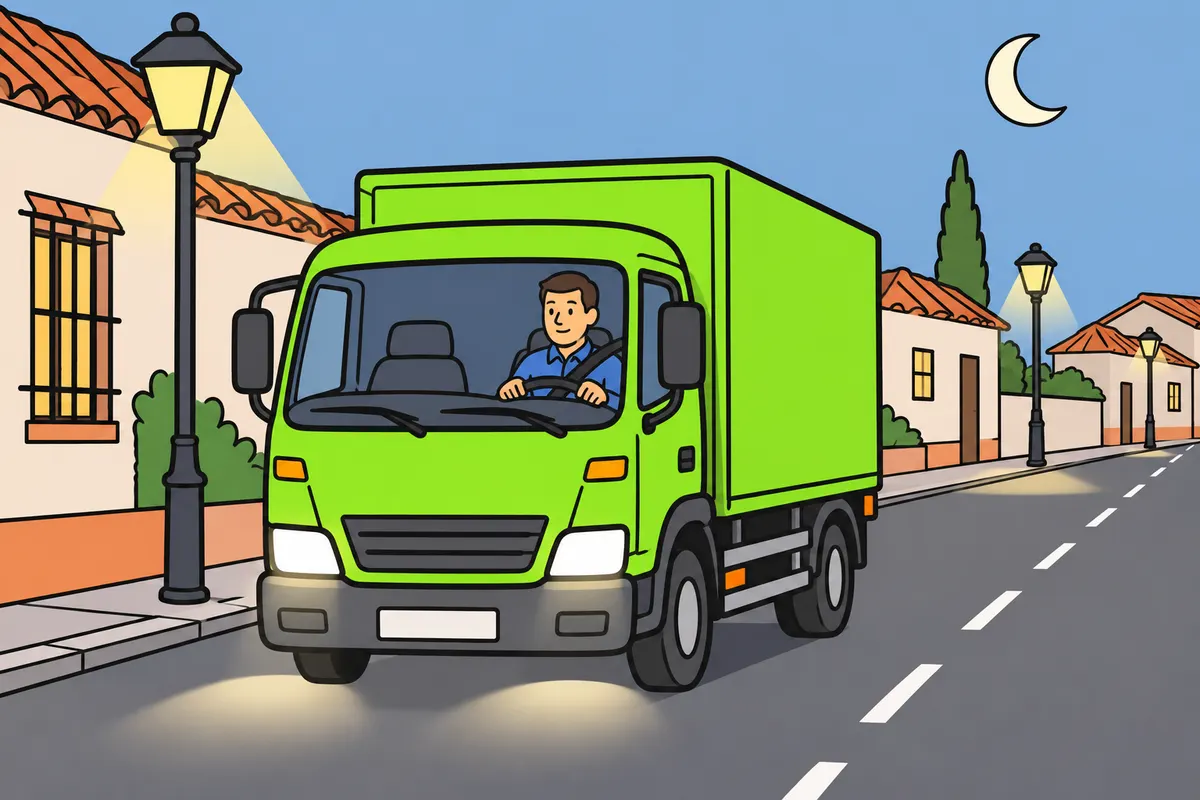
Use dipped beam to light the road nearby without dazzling others.
Remember
- Have two white dipped-beam headlamps at the front.
- At night, use dipped beam in built-up areas, even with poor lighting.
- Outside built-up areas, use it at night on sufficiently lit roads.
- On dark interurban roads, use dipped beam if dazzling others or lacking main beam.
- There, at 40 km/h or less without main beam, you must use dipped beam.
Exam trap: Wrong: A dark travesía allows normal use of main beam. Right: At night, use dipped beam in built-up areas.
Read the full explanation
- Your lorry must have two white dipped-beam headlamps at the front. You must use them to illuminate the road immediately ahead without dazzling others; the name dipped beam does not mean you can do without them because street lights illuminate the road well. [RGV, Annex X](https://www.boe.es/buscar/act.php?id=BOE-A-1999-1826#anx). [RGC, art. 101](https://www.boe.es/buscar/act.php?id=BOE-A-2003-23514#a101).
- At night you must use dipped beam on urban roads and sufficiently lit interurban roads. Within built-up areas you must also use it when lighting is insufficient: darkness on a stretch of road through a town does not authorise you to use main beam as your normal driving lighting there. [RGC, art. 101](https://www.boe.es/buscar/act.php?id=BOE-A-2003-23514#a101).
- You must use dipped beam on an insufficiently lit interurban road at night when you have no main beam, you could dazzle others, or you drive at 40 km/h or less without using main beam. These conditions also apply at any time of day in insufficiently lit tunnels, underpasses and stretches covered by a tunnel sign. [RGC, art. 101.2](https://www.boe.es/buscar/act.php?id=BOE-A-2003-23514#a101).
7Main beam: range and limits
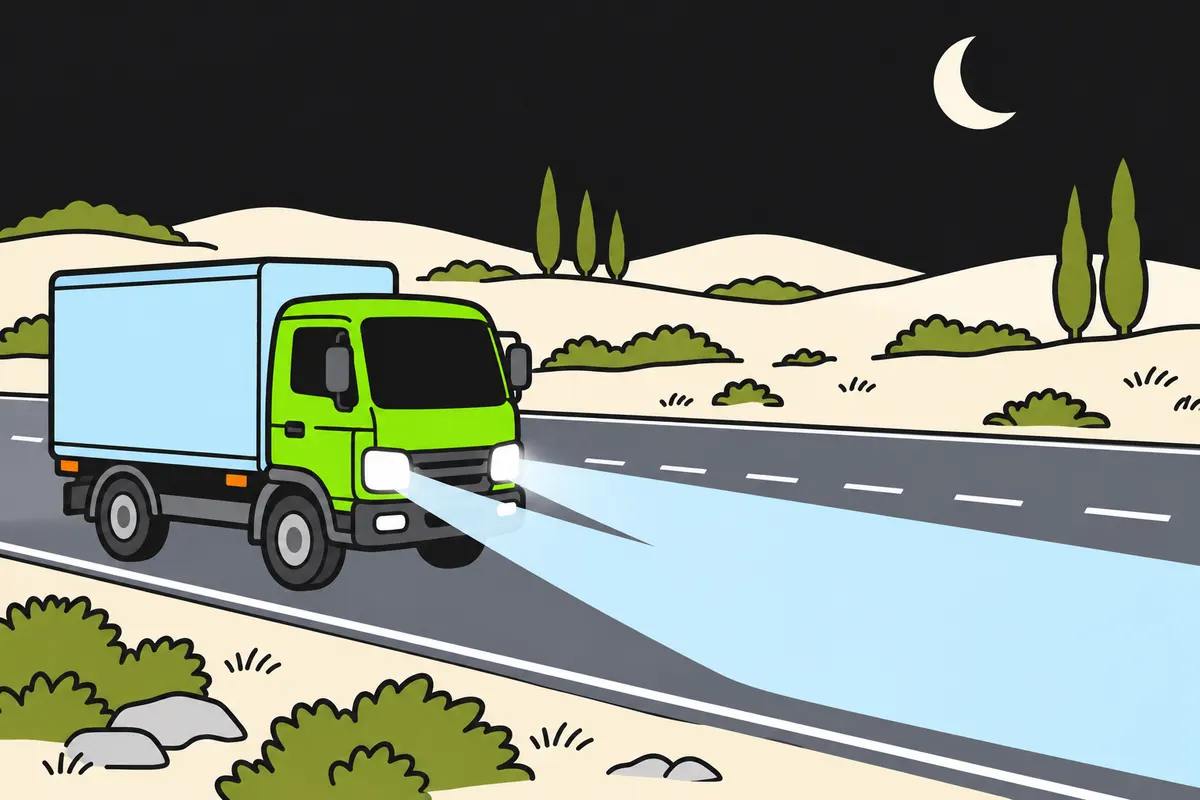
Use main beam only when conditions allow it, without dazzling others.
Remember
- Use main beam at night outside built-up areas, with insufficient lighting, above 40 km/h.
- Do this only without dazzling others and when dipped beam is not required.
- You may combine it with dipped beam when permitted.
- Keep position lights and any other required lights on.
- Do not keep main beam on when your lorry is stopped or parked.
- Only flash for permitted warnings, without dazzling others.
Exam trap: Wrong: Exceeding 40 km/h always requires main beam. Right: Only at night, outside built-up areas, with insufficient lighting, when dipped beam is not required, without dazzling others.
Read the full explanation
- Your lorry must have white main-beam headlights, with an even number of lights in accordance with its category and type approval. Their purpose is to illuminate further ahead; you must avoid adding extra lamps yourself unless they meet the authorised installation conditions. [RGV, art. 15](https://www.boe.es/buscar/act.php?id=BOE-A-1999-1826#a15). [RGV, Annex X](https://www.boe.es/buscar/act.php?id=BOE-A-1999-1826#anx).
- You must use main beam at night, outside built-up areas, on insufficiently lit roads, when you drive at more than 40 km/h and you are not required to use dipped beam, particularly to avoid dazzling others. All these conditions must be met: exceeding 40 km/h does not in itself require you to use main beam everywhere. [RGC, art. 100](https://www.boe.es/buscar/act.php?id=BOE-A-2003-23514#a100).
- You may use main beam without dipped beam or together with it when its use is permitted. Using it on its own means without adding dipped beam; you must keep the position lights and any other required lighting on. [RGC, art. 100](https://www.boe.es/buscar/act.php?id=BOE-A-2003-23514#a100). [RGV, art. 15](https://www.boe.es/buscar/act.php?id=BOE-A-1999-1826#a15).
- You must not keep main beam on when your vehicle is stopped or parked. You must also not alternate between main and dipped beam for purposes other than permitted warnings; the prescribed brief flashes have their own conditions, and you must always avoid dazzling others when using them. [RGC, art. 100](https://www.boe.es/buscar/act.php?id=BOE-A-2003-23514#a100). [RGC, art. 109](https://www.boe.es/buscar/act.php?id=BOE-A-2003-23514#a109).
8Avoiding and dealing with dazzle
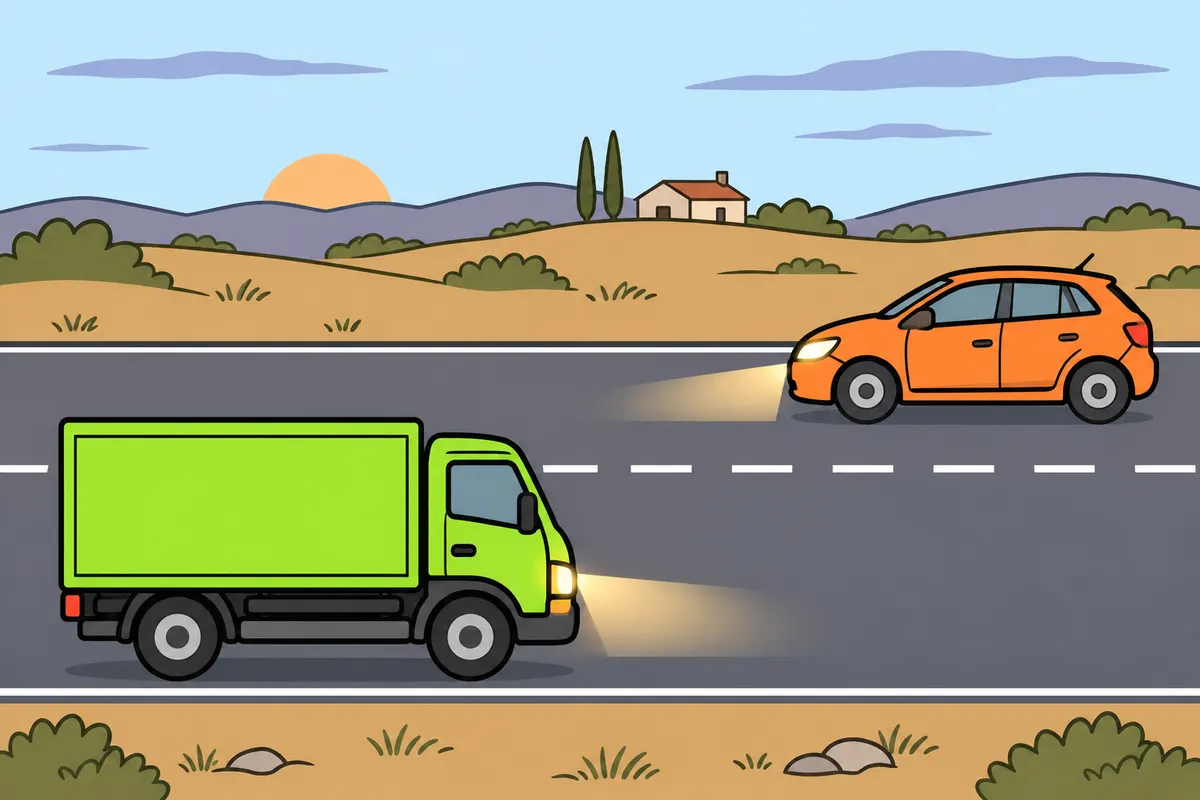
Switch to dipped beam as soon as you could dazzle someone.
Remember
- Dip your headlights even if the other driver keeps main beam on.
- Avoid dazzling oncoming users, people through mirrors and users of other routes.
- Wait until you have passed the oncoming vehicle before restoring main beam.
- If dazzled, slow down; stop if necessary.
Exam trap: Wrong: Wait for the other driver to dip their headlights. Right: Dip yours as soon as you could dazzle someone.
Read the full explanation
- You must switch from main beam to dipped beam as soon as you recognise a risk of dazzling others. You must also do so if the other driver keeps their main beam on: your obligation does not depend on them acting correctly. This provision does not specify a universal switching distance for every encounter. [RGC, art. 102](https://www.boe.es/buscar/act.php?id=BOE-A-2003-23514#a102).
- You must avoid dazzling oncoming drivers and drivers ahead who receive your light through their mirrors. The rule also protects users of other transport routes; you must assess the effect of the beam even if they are not in your lane. [RGC, art. 102](https://www.boe.es/buscar/act.php?id=BOE-A-2003-23514#a102).
- When you meet an oncoming vehicle, you must not switch back to main beam until you have gone past it. [RGC, art. 102](https://www.boe.es/buscar/act.php?id=BOE-A-2003-23514#a102).
- If you are dazzled, you must reduce your speed as much as necessary, even coming to a complete stop to avoid hitting vehicles or pedestrians. [RGC, art. 102](https://www.boe.es/buscar/act.php?id=BOE-A-2003-23514#a102).
9Tunnels and underpasses
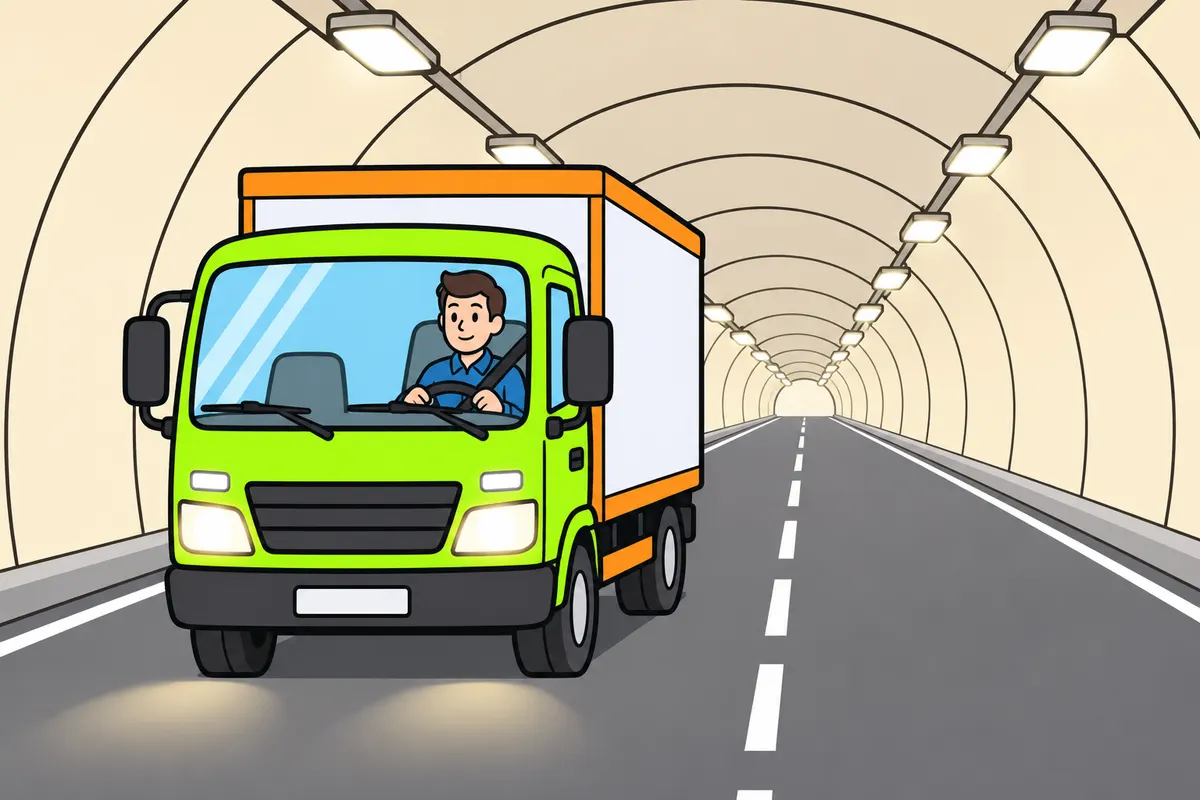
In tunnels, you must use lights at any time of day.
| Tunnel conditions | Your lorry’s lights when driving |
|---|---|
| Sufficiently lit | Position lights, dipped beam, number plate lighting and end-outline lamps when required |
| Dark, in a built-up area | Dipped beam and position lights |
| Dark, outside a built-up area | Main beam above 40 km/h if dipped beam is not required, without dazzling others; keep position lights on |
Remember
- With sufficient lighting, use position lights, dipped beam and rear number plate lighting.
- Add end-outline marker lamps when required.
- In a dark tunnel within a built-up area, use dipped beam.
- Keep position lights on if you stop for traffic, a breakdown or an emergency.
Exam trap: Wrong: Every tunnel requires main beam. Right: In dark tunnels outside built-up areas, use main beam above 40 km/h, without dazzling others and when dipped beam is not required.
Read the full explanation
- In a sufficiently lit tunnel or underpass, you must keep your position lights and dipped beam on at any time of day, together with the rear number plate light and end-outline marker lamps where required. [RGC, art. 99](https://www.boe.es/buscar/act.php?id=BOE-A-2003-23514#a99). [RGC, art. 101](https://www.boe.es/buscar/act.php?id=BOE-A-2003-23514#a101). [RGC, art. 103](https://www.boe.es/buscar/act.php?id=BOE-A-2003-23514#a103).
- In an insufficiently lit tunnel, you must apply the conditions for main and dipped beam: outside built-up areas, at more than 40 km/h, you must use main beam if it does not dazzle others and dipped beam is not required. In built-up areas, you must use dipped beam. [RGC, art. 100](https://www.boe.es/buscar/act.php?id=BOE-A-2003-23514#a100). [RGC, art. 101](https://www.boe.es/buscar/act.php?id=BOE-A-2003-23514#a101).
- If you stop because of traffic conditions or an emergency in a tunnel or underpass, you must keep the position lights on; the other measures are covered in “Accidents, breakdowns and first aid”, in the section [“Breakdowns, fires and traffic queues in tunnels”](accidentes#averia-incendio-y-retencion-en-tuneles). [RGC, art. 97.3](https://www.boe.es/buscar/act.php?id=BOE-A-2003-23514#a97).
10Daytime: dipped beam and daytime running lights
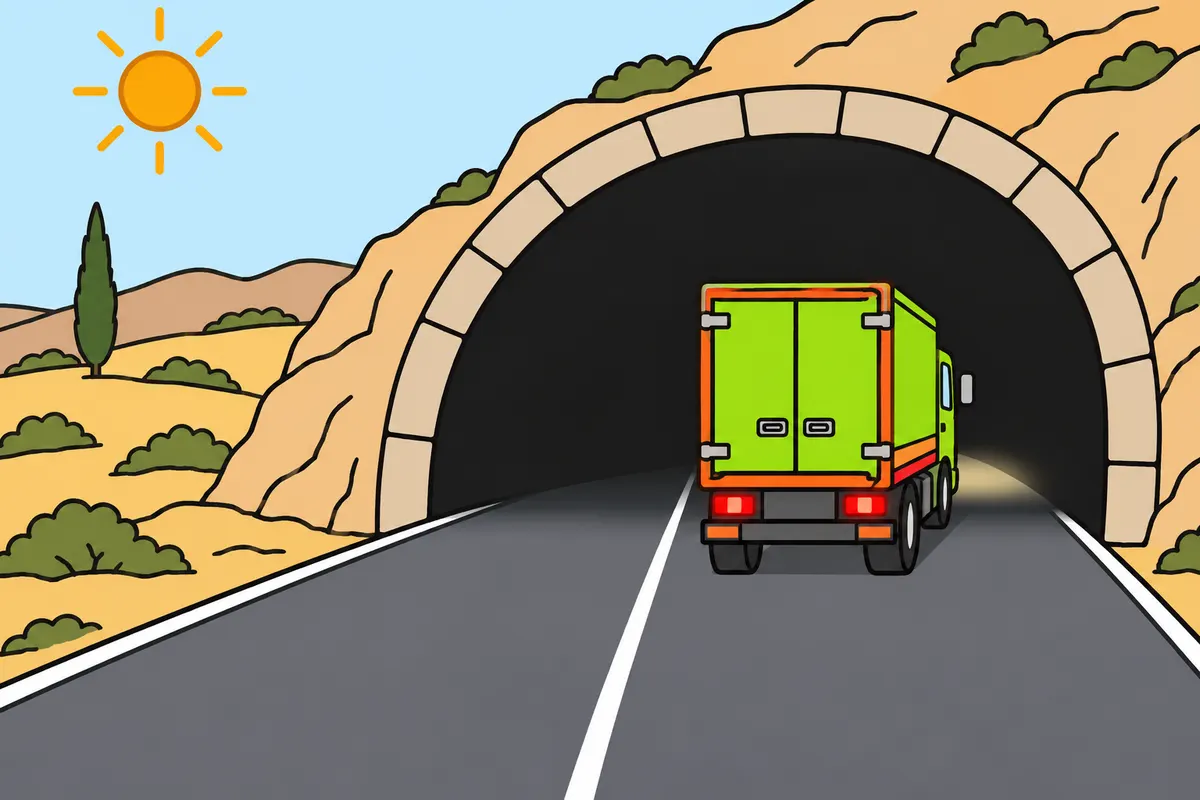
Check when you need dipped beam by day; daytime running lights cannot replace it.
| Your lorry’s lights | What to remember |
|---|---|
| Daytime running lights | Make you visible from the front during the day |
| Dipped beam | Use it whenever the situation requires it |
Remember
- Driving a lorry alone does not require dipped beam throughout every clear day.
- Use at least dipped beam in reversible, additional and opposite-direction lanes.
- This may also be required in adjoining lanes carrying traffic in the normal direction.
- Check whether your lorry is allowed to enter that lane.
- Front daytime running lights do not guarantee that your rear lights are on.
- Check lights in tunnels and poor visibility, even with automatic controls.
Exam trap: Wrong: Daytime running lights replace compulsory dipped beam. Right: Select the lighting required for each situation.
Read the full explanation
- Driving a goods lorry of more than 3,500 kg does not place you under a general obligation to use dipped beam throughout a clear day. You must switch it on in the specific situations involving tunnels, special lanes and visibility set out in the regulations. [RGC, art. 98](https://www.boe.es/buscar/act.php?id=BOE-A-2003-23514#a98). [RGC, art. 104](https://www.boe.es/buscar/act.php?id=BOE-A-2003-23514#a104). [RGC, art. 106](https://www.boe.es/buscar/act.php?id=BOE-A-2003-23514#a106).
- You must use at least dipped beam, by day and by night, in reversible lanes, temporary additional lanes and lanes opened to traffic running against the usual direction; also in the adjacent lanes in the normal direction affected by article 41 and in the situations covered by article 42. Daytime running lights do not replace this compulsory lighting. [RGC, arts. 41, 42 and 104](https://www.boe.es/buscar/act.php?id=BOE-A-2003-23514#a104).
- Authorisation for your lorry to use these lanes is covered in “Manoeuvres with your lorry”, in the section [“Reserved lanes, reversible lanes and lanes running against the usual direction”](maniobras#carriles-reservados-reversibles-y-de-sentido-contrario-al-habitual). [RGC, art. 41](https://www.boe.es/buscar/act.php?id=BOE-A-2003-23514#a41).
- Daytime running lights are two white front lights intended to make your vehicle visible during the day. Their installation and automatic activation depend on the applicable type-approval regulations; you must not assume that all lorries have the same equipment regardless of their age. [UN Regulation 48](https://www.boe.es/buscar/doc.php?id=DOUE-L-2021-81325).
- You must not rely solely on seeing light at the front or an illuminated instrument panel: daytime running lights do not guarantee that the rear lights are on. When you enter a tunnel or visibility is significantly reduced, check that you have selected the prescribed lighting, even if you have an automatic lighting control. [UN Regulation 48](https://www.boe.es/buscar/doc.php?id=DOUE-L-2021-81325). [RGC, art. 98](https://www.boe.es/buscar/act.php?id=BOE-A-2003-23514#a98). [RGC, art. 106](https://www.boe.es/buscar/act.php?id=BOE-A-2003-23514#a106).
11Front fog lamps: permitted use
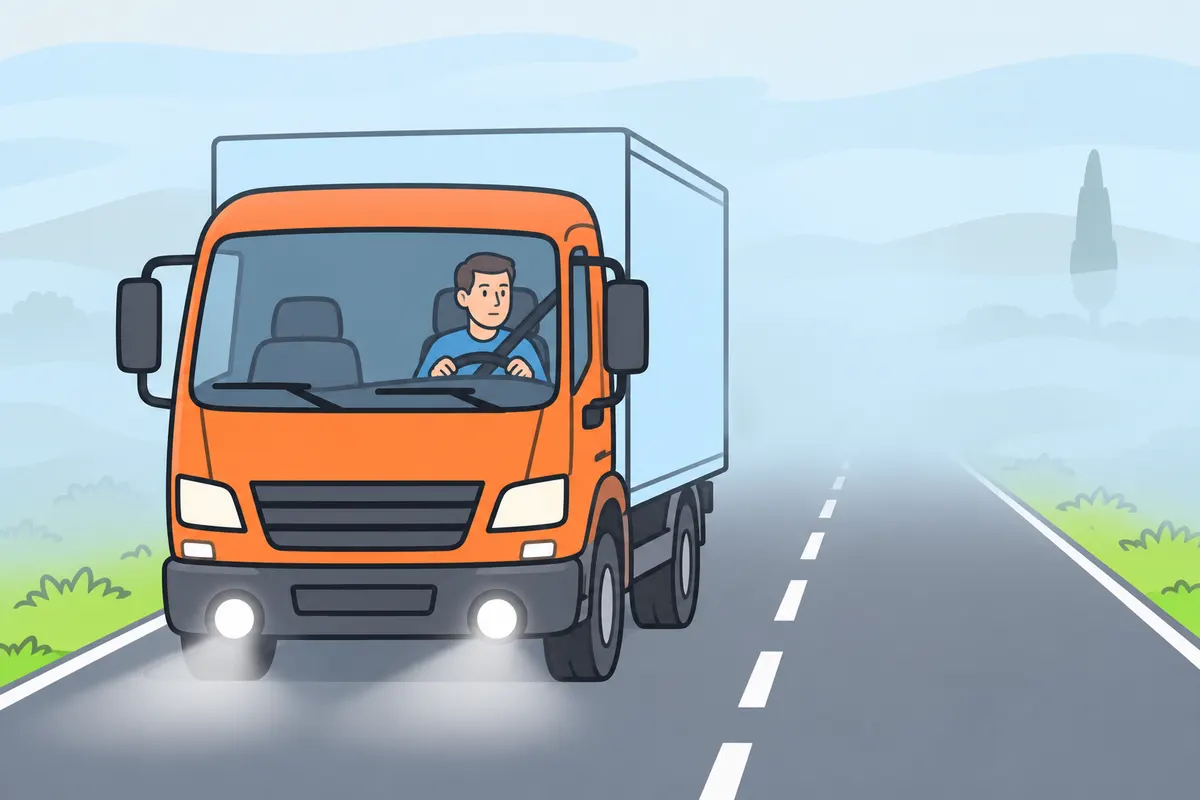
You may use front fog lights in poor visibility or on certain signposted bends.
| Situation | Your lorry’s front fog lights |
|---|---|
| Significantly reduced visibility | You may use them with position lights |
| Signposted closely spaced bends; carriageway up to 6.50 m wide | You may use them with position lights |
Remember
- You may fit white or selective-yellow front fog lights.
- Use them when fog, heavy rain, snow, smoke or dust greatly reduces visibility.
- Always keep position lights on when using them.
- You may combine them with dipped beam or main beam when appropriate.
- Also permitted: signposted closely spaced bends, on carriageways no wider than 6.50 m.
- In fog, consider whether reflected main beam makes your view worse.
Exam trap: Wrong: You may use them on any bend. Right: Without reduced visibility, you need a carriageway up to 6.50 m wide and a signposted series of closely spaced bends.
Read the full explanation
- You may equip your lorry with two white or selective-yellow front fog lamps; fitting them is optional. Their purpose is to improve road illumination in adverse conditions. [RGV, art. 17](https://www.boe.es/buscar/act.php?id=BOE-A-1999-1826#a17). [RGV, Annex X](https://www.boe.es/buscar/act.php?id=BOE-A-1999-1826#anx).
- You may use them when fog, heavy rain, snowfall, smoke, dust or similar circumstances significantly reduce visibility. [RGC, art. 106](https://www.boe.es/buscar/act.php?id=BOE-A-2003-23514#a106).
- In these situations, you must use front fog lamps, dipped beam or main beam according to the applicable conditions. You may use front fog lamps without dipped beam or together with it, and even with main beam where appropriate; you must keep the position lights on. [RGC, art. 106](https://www.boe.es/buscar/act.php?id=BOE-A-2003-23514#a106). [RGV, art. 15](https://www.boe.es/buscar/act.php?id=BOE-A-1999-1826#a15).
- You may also use them on narrow stretches with many bends when the carriageway is 6.50 m wide or less and signs indicate a series of closely spaced bends. Both the width and signage conditions must be met: a single bend or narrowness alone is not enough. [RGC, art. 106](https://www.boe.es/buscar/act.php?id=BOE-A-2003-23514#a106).
- In fog, as practical advice, you must consider that main beam can reflect back and impair your vision. You may choose dipped beam and front fog lamps where appropriate. The legal option to combine lights does not mean that the brightest combination always gives you the best view. [RGC, art. 106](https://www.boe.es/buscar/act.php?id=BOE-A-2003-23514#a106).
12Rear fog lamps: severe conditions only
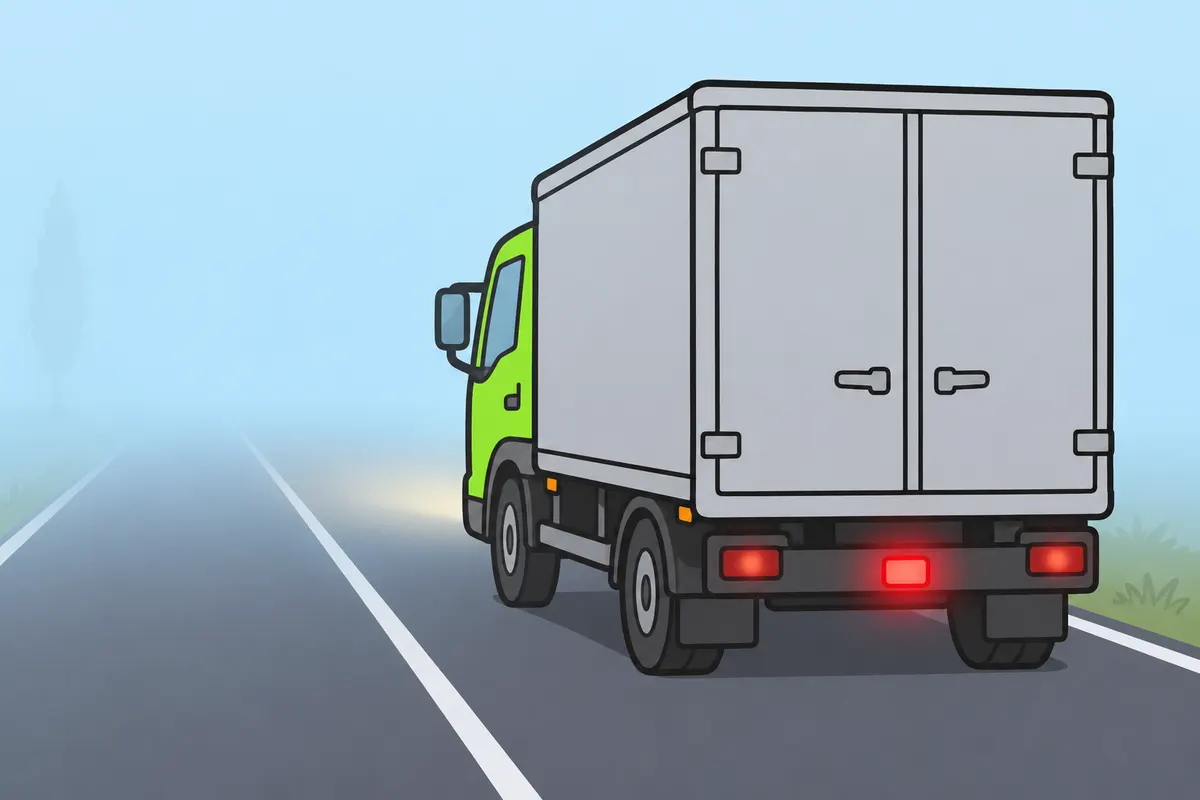
Switch on rear fog lights only when visibility is especially poor.
Remember
- Your lorry must have red rear fog lights.
- Use them in thick fog, very heavy rain or heavy snowfall.
- Also use them in dense clouds of dust or smoke.
- Keep main beam, dipped beam or front fog lights on so they work.
- Switch them off when those conditions end.
Exam trap: Wrong: Narrow bends allow rear fog lights. Right: You need especially poor visibility.
Read the full explanation
- Your lorry must have one or two red rear fog lamps. If you have one, the general table provides for it to be on the left or in the centre; if you have two, they are towards the outer edges. Their purpose is to make your vehicle more visible to those approaching from behind. [RGV, Annex X](https://www.boe.es/buscar/act.php?id=BOE-A-1999-1826#anx).
- You must only switch them on in particularly adverse conditions: thick fog, very heavy rain, heavy snowfall or dense clouds of dust or smoke. [RGC, art. 106](https://www.boe.es/buscar/act.php?id=BOE-A-2003-23514#a106).
- For your rear fog lamps to work, main beam, dipped beam or front fog lamps must also be on. Their electrical connection and the circumstances authorising their use are separate requirements that you must meet. [RGV, art. 15](https://www.boe.es/buscar/act.php?id=BOE-A-1999-1826#a15). [RGC, art. 106](https://www.boe.es/buscar/act.php?id=BOE-A-2003-23514#a106).
- You must switch them off when the particularly adverse conditions end, to avoid disturbing those following you. A narrow, winding stretch that permits front fog lamps does not in itself authorise rear fog lamps; you must consider each device separately in exam questions. [RGC, art. 106](https://www.boe.es/buscar/act.php?id=BOE-A-2003-23514#a106).
13Indicators: signalling a manoeuvre
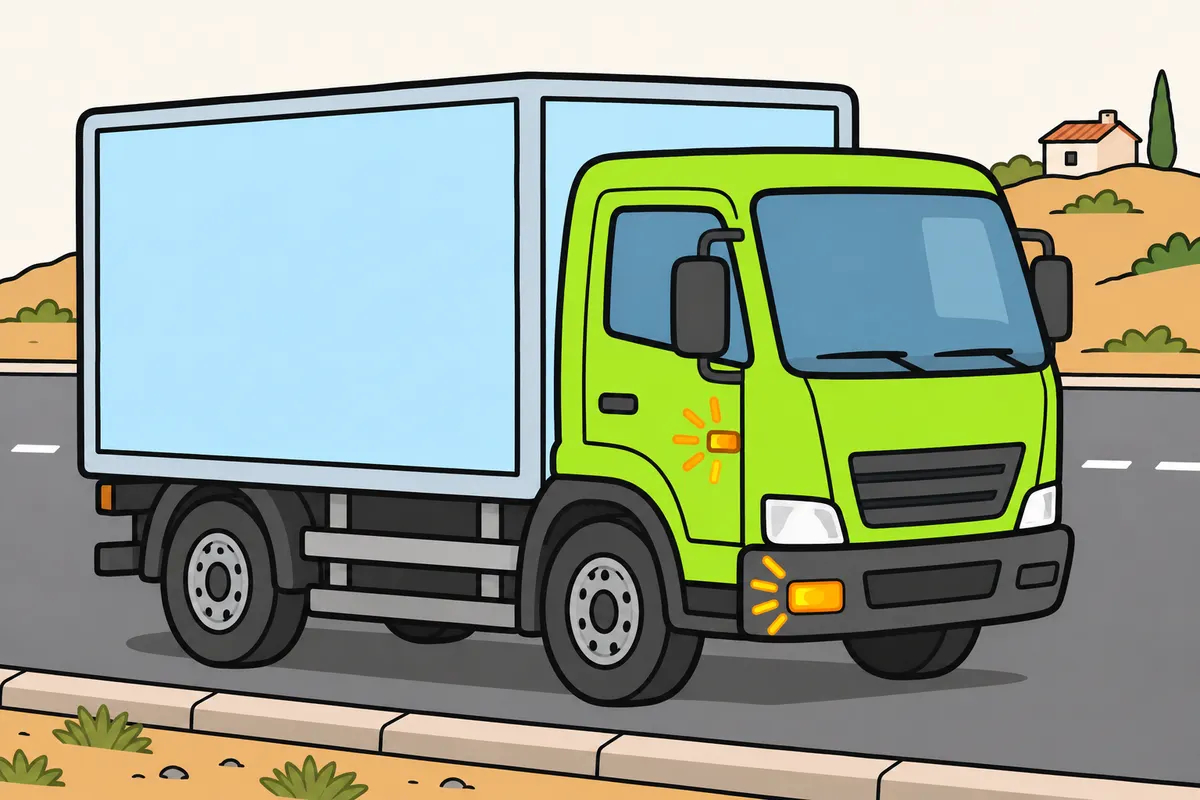
Use the indicator on the side towards which you intend to move.
Remember
- Check that the load and body do not hide your side indicators.
- Signal on the side towards which you will move.
- Check that your manoeuvre is safe before making it.
- If an indicator flashes faster than usual, check for a failed bulb.
Exam trap: Wrong: Your indicator authorises your manoeuvre. Right: You must check that you can do it safely.
Read the full explanation
- Your lorry must have an even number of amber direction indicators greater than two, fitted at the front, rear and sides according to its category. You must check that the load body or load does not obscure the side repeaters: they are important for people alongside the vehicle. [RGV, annex X](https://www.boe.es/buscar/act.php?id=BOE-A-1999-1826#anx).
- You must signal your manoeuvres using the indicators on the appropriate side; how early to signal, how long to keep signalling and alternative arm signals are explained in [“Light signals, arm signals and the horn”](maniobras#advertencias-luminosas-brazo-y-claxon) in “Manoeuvres with your lorry”. [RGC, art. 109](https://www.boe.es/buscar/act.php?id=BOE-A-2003-23514#a109).
- To carry out the manoeuvre you signal, you must apply the safety checks in [“Observe, signal and manoeuvre”](maniobras#observar-senalizar-y-maniobrar), in “Manoeuvres with your lorry”. [RGC, art. 74](https://www.boe.es/buscar/act.php?id=BOE-A-2003-23514#a74).
- If the indicator warning light flashes faster than usual, you must check whether a lamp has stopped working. A noticeable change in frequency can warn you of a fault. [UN Regulation 48](https://www.boe.es/buscar/doc.php?id=DOUE-L-2021-81325).
14Braking and reversing
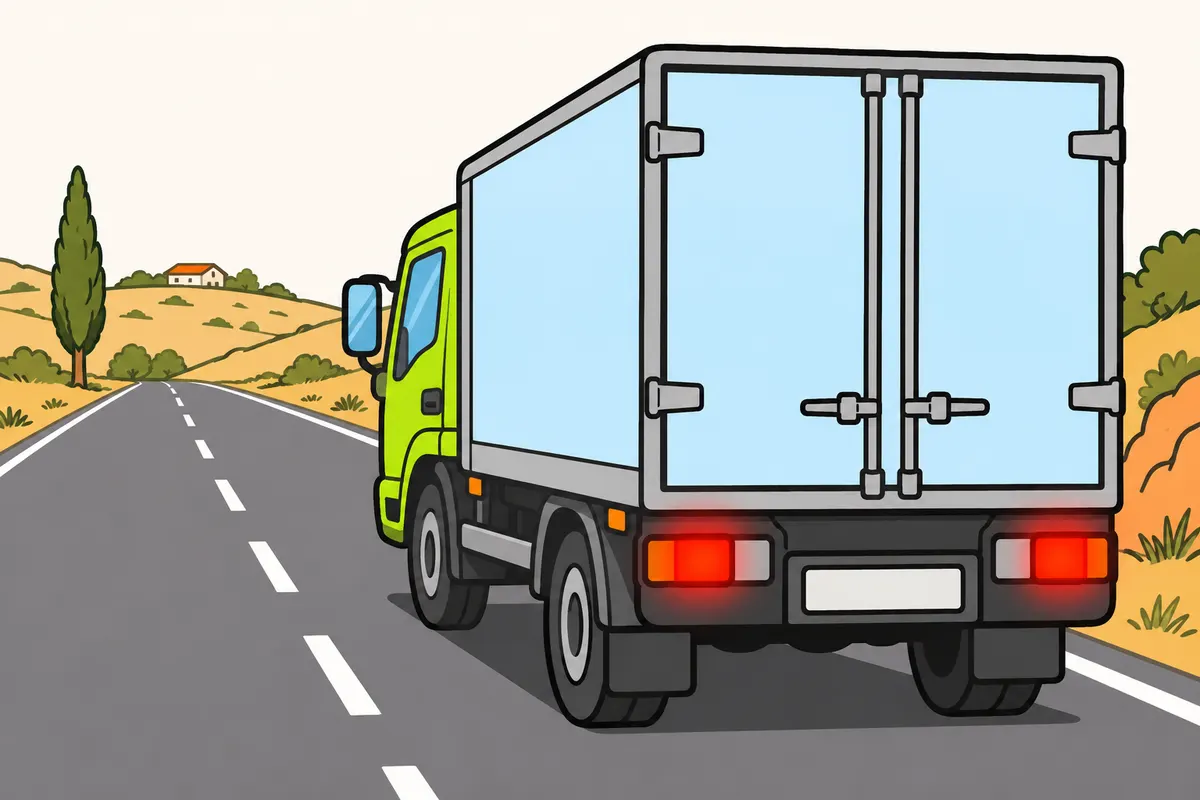
Recognise the lights that announce braking and reversing.
| Your lorry’s lights | Colour and purpose |
|---|---|
| Brake lights | Red at the rear: announce braking |
| Third brake light | Red, higher up: announces braking |
| Reversing lights | White at the rear: light the area and announce reversing |
Remember
- Warn others when slowing down sharply or intending to stop.
- Distinguish the third brake light from end-outline marker lamps, which show width.
- Keep the third brake light if your particular lorry requires it.
- Also warn others when you intend to reverse.
- Do not assume your reversing light guarantees clear space.
Exam trap: Wrong: A reversing light confirms you can reverse. Right: It announces your intention; you must check the space.
Read the full explanation
- The brake lights are red, are fitted at the rear and show that you are applying the service brake. The general table for lorries specifies two at the outer edges. [RGV, annex X](https://www.boe.es/buscar/act.php?id=BOE-A-1999-1826#anx).
- You must warn others when you slow down considerably or intend to bring your lorry to a standstill; warnings using the brake and arm signals are explained in [“Light signals, arm signals and the horn”](maniobras#advertencias-luminosas-brazo-y-claxon) in “Manoeuvres with your lorry”. [RGC, art. 109](https://www.boe.es/buscar/act.php?id=BOE-A-2003-23514#a109).
- You may find a third, high-mounted red brake light. The RGV lists it as optional in the general list for lorries, subject to the specific type approval. This light signals braking; the high-mounted end-outline marker lamps show the vehicle’s width. [RGV, art. 17](https://www.boe.es/buscar/act.php?id=BOE-A-1999-1826#a17). [RGV, annex X](https://www.boe.es/buscar/act.php?id=BOE-A-1999-1826#anx).
- Your lorry must have a white reversing light; the general table specifies one or two according to the category regulations. It illuminates the area behind you and signals that you are reversing or are about to reverse; you must not take it coming on as a guarantee that the area is clear. [RGV, art. 16](https://www.boe.es/buscar/act.php?id=BOE-A-1999-1826#a16). [RGV, annex X](https://www.boe.es/buscar/act.php?id=BOE-A-1999-1826#anx).
- You must signal that you are reversing; use of the reversing light and the alternative arm signal are explained in [“Light signals, arm signals and the horn”](maniobras#advertencias-luminosas-brazo-y-claxon) in “Manoeuvres with your lorry”. [RGC, art. 109](https://www.boe.es/buscar/act.php?id=BOE-A-2003-23514#a109).
15Hazard warning lights: warning of a temporary danger
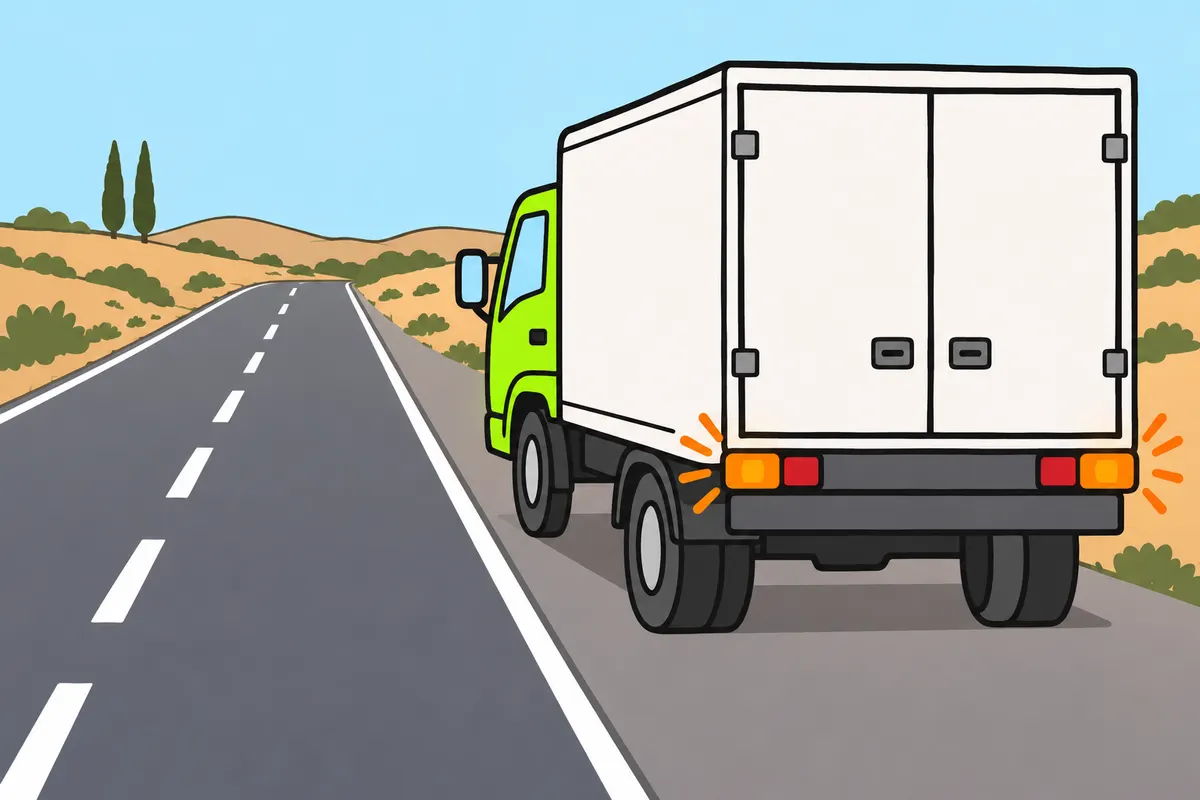
Use hazard warning lights to warn of a temporary danger.
Remember
- Switching them on makes all your indicators flash together.
- Use them if you cannot reach minimum speed and risk a rear-end collision.
- After breakdowns or accidents, add the required warning device while clearing the road.
- Also keep position lights and end-outline marker lamps on when required.
Exam trap: Wrong: Hazard lights replace position lights and end-outline marker lamps. Right: Keep those lights on too when required.
Read the full explanation
- When you switch on the hazard warning lights, you operate all your lorry’s direction indicators simultaneously. This amber warning alerts others to a temporary danger. [RGV, annex X](https://www.boe.es/buscar/act.php?id=BOE-A-1999-1826#anx).
- If you cannot reach the required minimum speed and there is a risk of a rear-end collision, you must use your hazard warning lights while driving. [RGC, art. 49](https://www.boe.es/buscar/act.php?id=BOE-A-2003-23514#a49).
- In the event of a breakdown or accident, while the road is being cleared, you must use the regulatory hazard warning device together with the hazard warning lights and, where appropriate, the position lights and end-outline marker lamps. [RGC, art. 130](https://www.boe.es/buscar/act.php?id=BOE-A-2003-23514#a130).
16Lights on an immobilised lorry
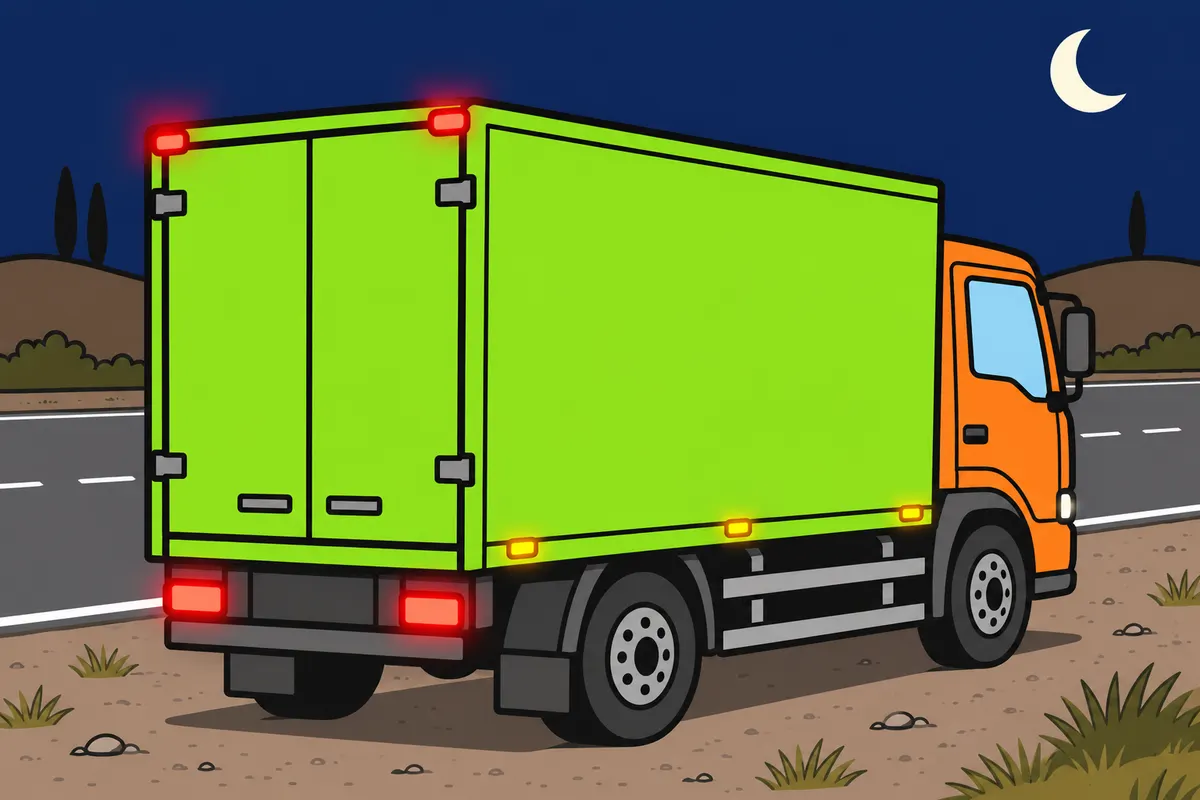
If immobilised at night or in poor visibility, keep the necessary lights on.
| Where you park your lorry | What you may do |
|---|---|
| Poorly lit travesía (road through a town), at night, parallel to the kerb | Replace position lights with parking lights if your lorry may have them, or position lights on the side facing the carriageway |
| Urban road other than a travesía | Switch off position lights if street lighting makes you visible from a sufficient distance |
Remember
- On carriageway or shoulder: position lights on at night or in significantly reduced visibility.
- Add end-outline marker lamps when required, whatever the cause.
- On poorly lit travesías, at night, keep position lights on if stopping or parking.
- This applies on the carriageway or hard shoulder.
Exam trap: Wrong: You can replace position lights with parking lights on any road. Right: Only on a poorly lit travesía at night, parked parallel to the kerb, if your lorry may have them.
Read the full explanation
- On the carriageway or arcén (hard shoulder), at night or when visibility is significantly reduced, keep the position lights and, where required, the end-outline marker lamps on while your lorry is immobilised, whatever the cause. [RGC, art. 105.1](https://www.boe.es/buscar/act.php?id=BOE-A-2003-23514#a105).
- On poorly lit stretches of road through towns, at night, keep the position lights on if you stop or park on the carriageway or hard shoulder. If you park parallel to the kerb, you may replace them with parking lights, where your lorry is permitted to have them, or with the two position lights on the side facing the carriageway. [RGC, art. 105.2](https://www.boe.es/buscar/act.php?id=BOE-A-2003-23514#a105).
- On an urban road other than a stretch of road through a town, you may park without keeping the position lights on if the lighting allows other road users to distinguish your lorry from a sufficient distance. [RGC, art. 105](https://www.boe.es/buscar/act.php?id=BOE-A-2003-23514#a105).
17Parking lights: equipment limited by dimensions
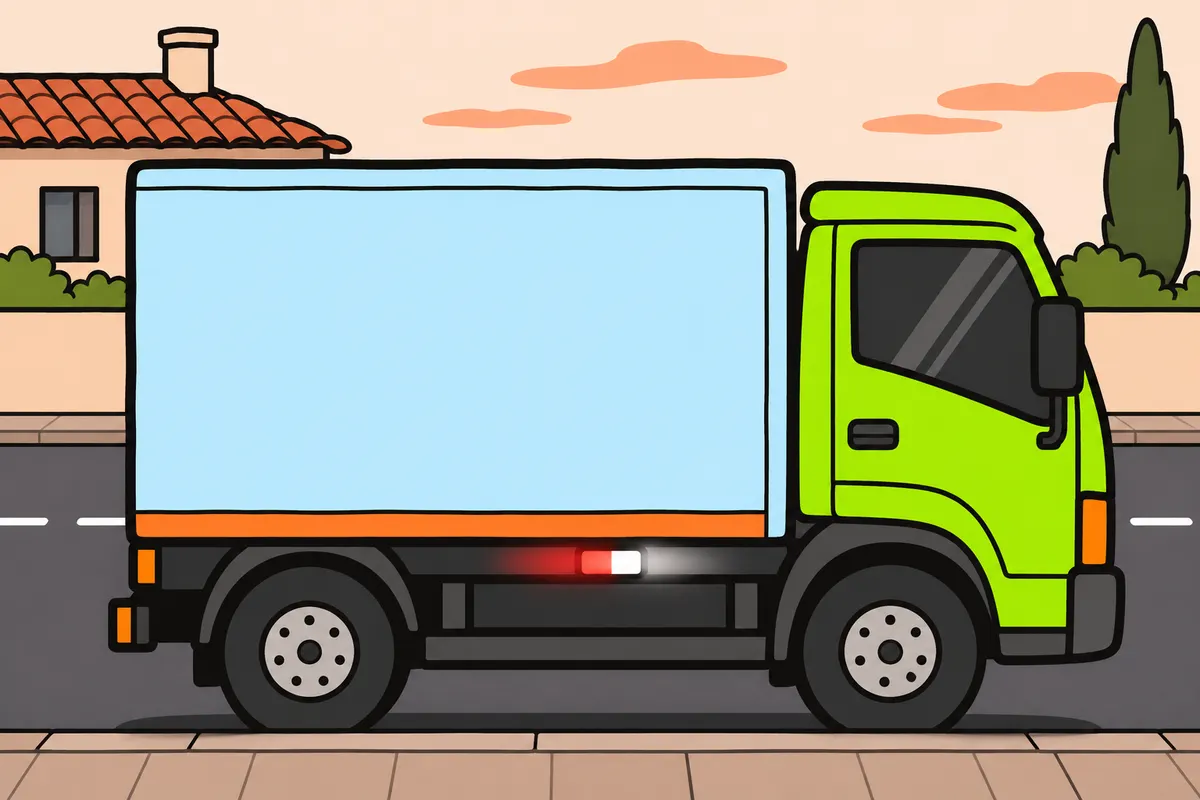
You may fit parking lights only if your vehicle meets both size limits.
Remember
- Check your vehicle’s length and width.
- You may fit them if you exceed neither limit.
- A 7 m lorry cannot have them.
Exam trap: Wrong: A narrow 7 m lorry may have parking lights. Right: Meet both limits: up to 6 m long and up to 2 m wide.
Read the full explanation
- You may fit parking lights only to vehicles no more than 6 m long and no more than 2 m wide; a lorry that is 7 m long cannot have them. [RGV, art. 17](https://www.boe.es/buscar/act.php?id=BOE-A-1999-1826#a17). [RGV, annex X](https://www.boe.es/buscar/act.php?id=BOE-A-1999-1826#anx).
18Connected V-16: warning of an immobilised vehicle
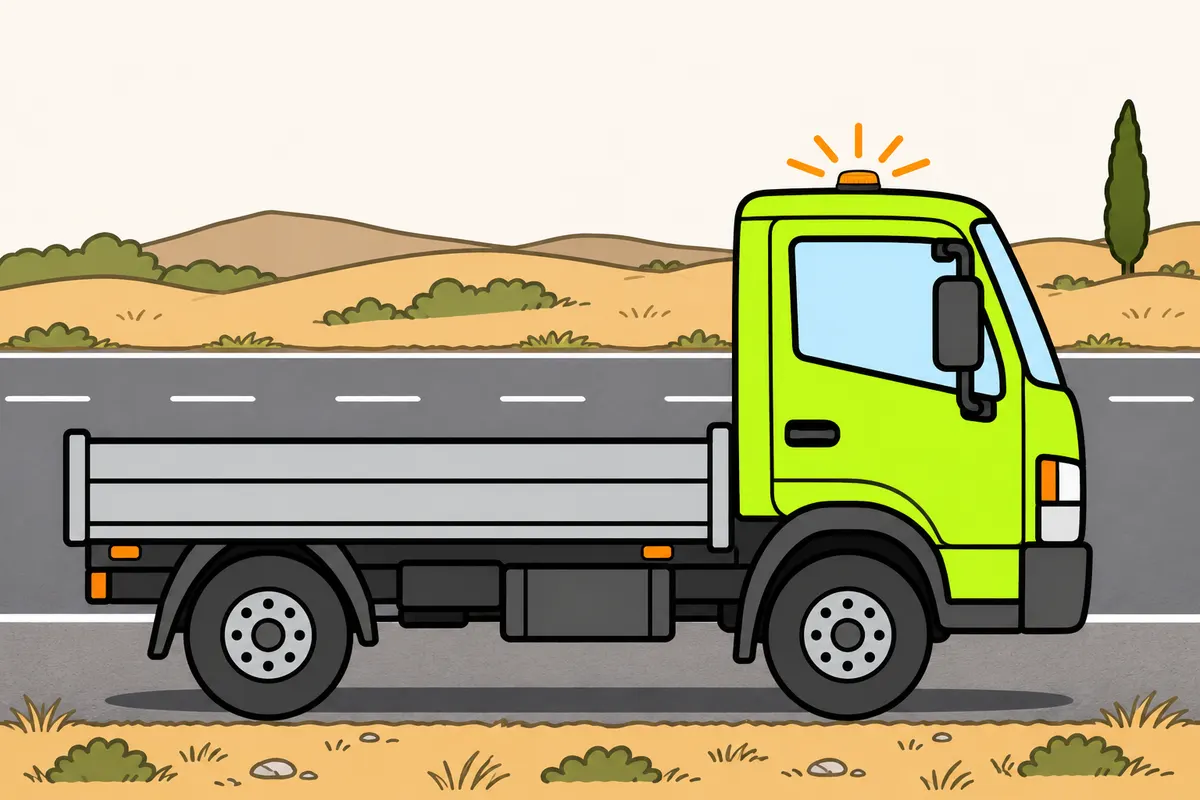
Use your certified connected V-16 when immobilised on the road and creating a hazard.
Remember
- In Spain, carry a certified connected V-16 if your lorry is registered there.
- Check how to place the beacon safely if your cab is high.
- Check the model on the official list of certified devices.
- Keep your beacon ready to use.
- It transmits your location, but does not replace your call for help.
Exam trap: Wrong: Triangles or an unconnected beacon are enough. Right: When immobilised on the road and creating a hazard, use the certified connected V-16; your Spanish-registered lorry must carry it.
Read the full explanation
- You must carry in your lorry the connected and certified V-16 light-emitting device required by current regulations. In Spain, for your lorry registered in Spain, triangles and a beacon without connectivity do not fulfil the regulatory function of warning of an immobilised vehicle. [RGV, annex XI, V-16](https://www.boe.es/buscar/act.php?id=BOE-A-1999-1826#v-16). [RGV, annex XII](https://www.boe.es/buscar/act.php?id=BOE-A-1999-1826#anxii).
- The V-16 emits a flashing amber light with 360 degrees of horizontal coverage. The specification requires it to maintain the regulatory intensity for at least 30 minutes; you must not confuse it with the V-2 on a vehicle working on the road or with hazard warning lights. [RGV, annex XI, V-16](https://www.boe.es/buscar/act.php?id=BOE-A-1999-1826#v-16).
- To place the V-16 on a high cab, you must follow the measures in “Accidents, breakdowns and first aid”, in the section [“Place the beacon without putting yourself at risk”](accidentes#coloca-la-baliza-sin-exponerte). [RGV, annex XI, V-16](https://www.boe.es/buscar/act.php?id=BOE-A-1999-1826#v-16).
- You must check the model against the official list of certified devices and keep it ready for use. [RGV, annex XI, V-16](https://www.boe.es/buscar/act.php?id=BOE-A-1999-1826#v-16). [DGT, V-16](https://www.dgt.es/muevete-con-seguridad/tecnologia-e-innovacion-en-carretera/Dispositivos-de-presenalizacion-V16/).
- It transmits your location, but does not replace your call for help. [RGV, annex XI, V-16](https://www.boe.es/buscar/act.php?id=BOE-A-1999-1826#v-16). [DGT, V-16](https://www.dgt.es/muevete-con-seguridad/tecnologia-e-innovacion-en-carretera/Dispositivos-de-presenalizacion-V16/).
- For use of your high-visibility vest when getting out of your lorry, see [“Put on your high-visibility vest before getting out”](accidentes#ponte-el-chaleco-antes-de-bajar) in “Accidents, breakdowns and first aid”. [RGC, art. 118.4](https://www.boe.es/buscar/act.php?id=BOE-A-2003-23514#a118).
19Retroreflectors: reflecting without emitting light
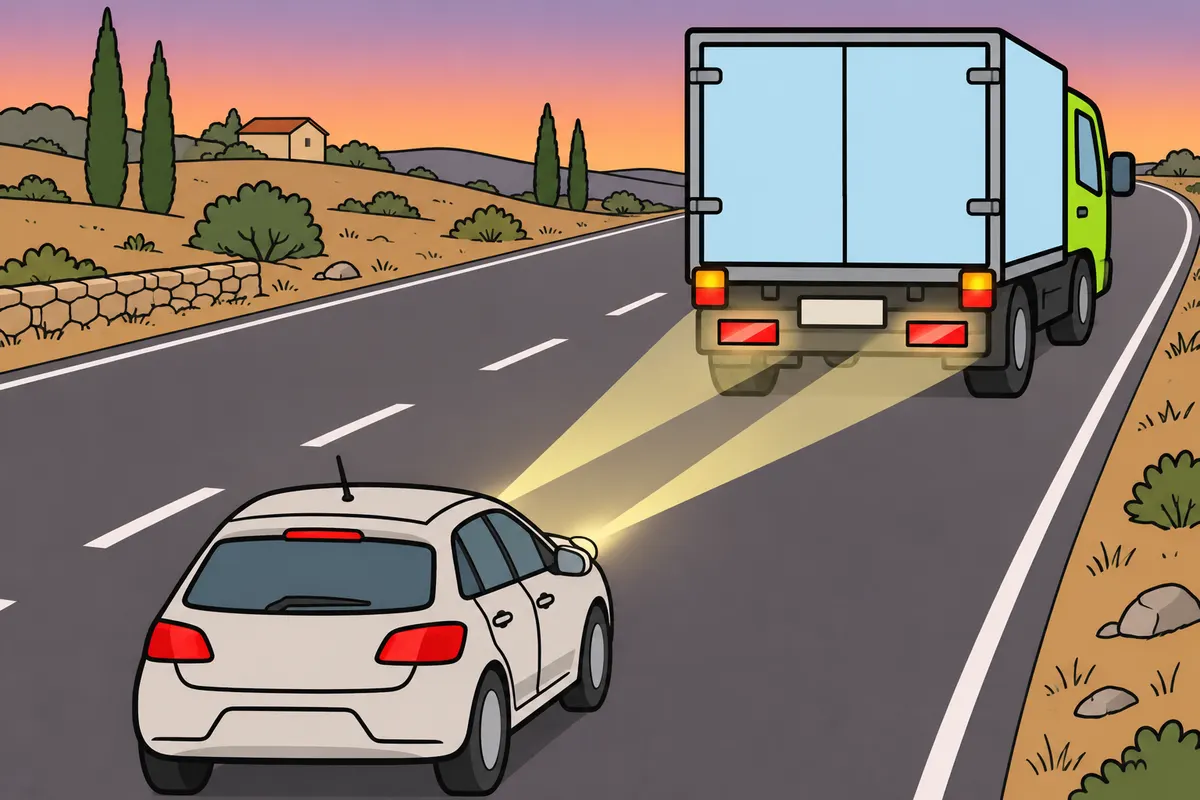
Recognise reflectors as devices that reflect light without producing their own.
| Vehicle and position | Reflectors |
|---|---|
| Your lorry: rear | Red, non-triangular, compulsory |
| Your lorry: front | White, non-triangular, optional |
| Your lorry: sides | Amber; red exception near the rear depending on installation |
| Trailer or semi-trailer: rear | Red triangles |
Remember
- Do not replace compulsory lights with reflectors.
- If your lorry exceeds 6 m, it must have side reflectors.
- This requirement also applies to chassis-cabs.
- Do not confuse reflectors with number plates or reflective panels.
- Check side reflectors and side marker lamps separately.
Exam trap: Wrong: Chassis-cabs are exempt from side reflectors. Right: Above 6 m, they must have them; the exception concerns side marker lamps.
Read the full explanation
- A retroreflector reflects light from an external source, such as the headlights of an approaching vehicle, and produces no light of its own. Its effectiveness does not replace the requirement to switch on your lights; even with visible reflectors, you may still be driving your lorry in breach of the rules if the required lights are switched off. [RGV, Annex X](https://www.boe.es/buscar/act.php?id=BOE-A-1999-1826#anx). [RGC, art. 99](https://www.boe.es/buscar/act.php?id=BOE-A-2003-23514#a99).
- Your lorry must have two red, non-triangular rear retroreflectors. White, non-triangular front retroreflectors are optional in the general table. You must associate a red triangle at the rear with a trailer or semi-trailer, rather than with a rigid lorry simply because it carries goods. [RGV, art. 16](https://www.boe.es/buscar/act.php?id=BOE-A-1999-1826#a16). [RGV, art. 17](https://www.boe.es/buscar/act.php?id=BOE-A-1999-1826#a17). [RGV, Annex X](https://www.boe.es/buscar/act.php?id=BOE-A-1999-1826#anx).
- If your lorry is over 6 m long, it must have non-triangular side retroreflectors; the exception for chassis-cabs applies to side marker lamps, not to these retroreflectors. Their standard colour is amber, with a regulatory exception for a rear side retroreflector grouped with certain red devices. You must check both the reflectors and the side lights: having one does not replace the other. [RGV, art. 16](https://www.boe.es/buscar/act.php?id=BOE-A-1999-1826#a16). [RGV, Annex X](https://www.boe.es/buscar/act.php?id=BOE-A-1999-1826#anx).
- You must not classify retroreflective number plates or the retroreflective panels and signs required for your vehicle category or service, including ADR signs, as retroreflectors. Although all of them reflect light back, the regulations distinguish these categories, and you must answer according to the device you are asked about. [RGV, Annex X](https://www.boe.es/buscar/act.php?id=BOE-A-1999-1826#anx).
20V-6: recognising a long vehicle
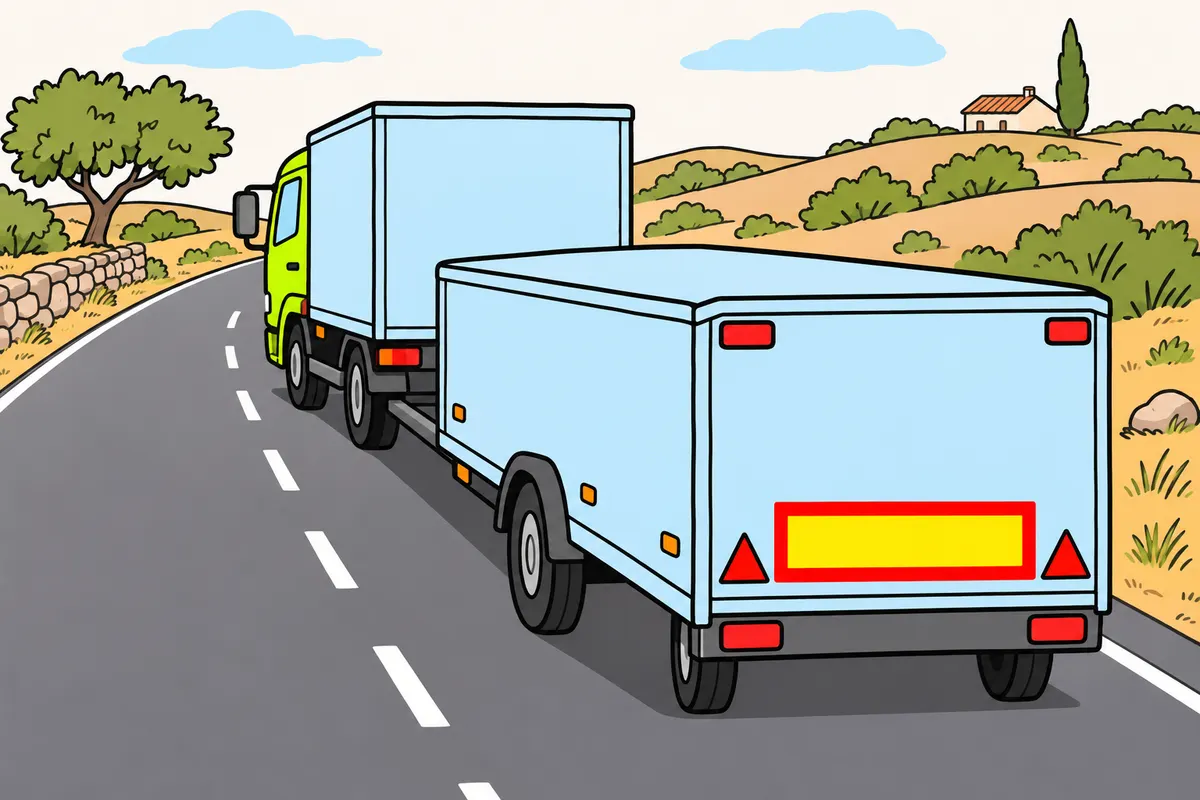
Display V-6 if your vehicle or combination’s total length exceeds the limit.
Remember
- Count the whole combination’s length if you tow a trailer.
- Recognise the rear reflective yellow plate with a fluorescent red border.
- Centre it; you may use two similar plates, placed symmetrically near the edges.
- Do not confuse this plate with dangerous goods signs or lights.
Exam trap: Wrong: Exactly 12 m requires V-6. Right: You must exceed 12 m in total length, including the trailer.
Read the full explanation
- You must display the V-6 sign when your vehicle or vehicle combination is more than 12 m long. Exactly 12 m does not exceed this threshold. When towing a trailer, you must consider the total length of the combination, without confusing it with the length of the load body or of the lorry alone. [RGV, Annex XI, V-6](https://www.boe.es/buscar/act.php?id=BOE-A-1999-1826#v-6).
- The V-6 is a reflective yellow plate with a fluorescent red border, fitted at the rear. Its purpose is to warn of the length; it does not indicate mass, is not an ADR panel and does not replace any required end-outline marker lamps, side lights or conspicuity markings. [RGV, Annex XI, V-6](https://www.boe.es/buscar/act.php?id=BOE-A-1999-1826#v-6).
- You must fit the rear plate centrally in relation to the vehicle’s centreline. Where fitting makes it appropriate, you may replace it with two plates with similar characteristics, placed symmetrically and as close as possible to the edges. In both cases, you must position them between 500 and 1,500 mm above the ground. [RGV, Annex XI, V-6](https://www.boe.es/buscar/act.php?id=BOE-A-1999-1826#v-6).
21V-23: lorry conspicuity markings
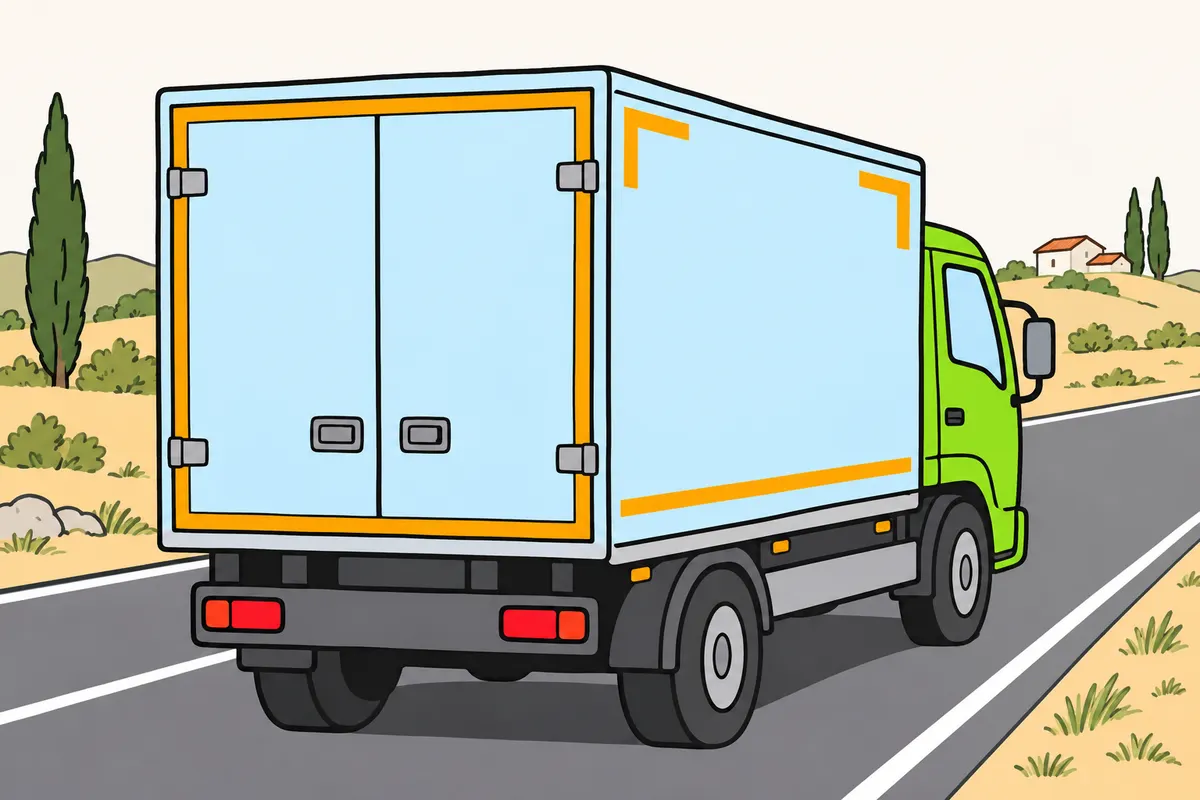
Do not assume your light lorry needs V-23 just because of its size.
| N2 lorries over 7.5 t subject to compulsory marking, registered from 10 July 2011; excluding chassis-cabs, incomplete vehicles and tractor units for semi-trailers | Required marking |
|---|---|
| Width over 2.10 m | Full rear contour; if shape or structure prevents this, line marking meeting technical requirements |
| Length over 6 m | Partial side contour; if shape or structure prevents this, line marking meeting technical requirements |
Remember
- Recognise V-23 as approved reflective strips; they do not produce light.
- You may fit it voluntarily on your light lorry, meeting the technical requirements.
- Do not replace it with decorative tape.
- Check separately which side marker and end-outline lamps your lorry’s size requires.
- Do not fit this visibility marking to a category O1 light trailer.
Exam trap: Wrong: Exceeding 6 m requires V-23 on your 7,500 kg lorry. Right: That mass does not exceed 7.5 t; dimensions alone do not create the requirement.
Read the full explanation
- The V-23 consists of approved retroreflective strips that allow you to recognise the vehicle’s outline, length and width from the rear or the side. They emit no light of their own, and you must distinguish them from position lights, ordinary retroreflectors and the V-6 plate. [RGV, Annex XI, V-23](https://www.boe.es/buscar/act.php?id=BOE-A-1999-1826#v-23).
- Your C1 lorry, with an MMA (maximum authorised mass) over 3,500 kg and no more than 7,500 kg, falls outside the technical marking requirement for N2 lorries with a maximum mass over 7.5 t. Exactly 7,500 kg does not exceed this limit. [UN Regulation 48, section 6.21.1.2](https://www.boe.es/buscar/doc.php?id=DOUE-L-2021-81325).
- You may find V-23 markings fitted voluntarily to your light lorry if they meet the technical requirements. Voluntary installation also requires approved markings and fitting in accordance with the regulations: you must not replace them with decorative tape or mistake any reflective sticker for this marking. [UN Regulation 48, section 6.21.1.3](https://www.boe.es/buscar/doc.php?id=DOUE-L-2021-81325). [RGV, Annex XI, V-23](https://www.boe.es/buscar/act.php?id=BOE-A-1999-1826#v-23).
- If you compare your vehicle with a lorry subject to compulsory marking, you must distinguish between full rear contour marking when the width exceeds 2.10 m and partial side contour marking when the length exceeds 6 m. Chassis-cabs, incomplete vehicles and tractor units for semi-trailers are exempt; where the shape or structure prevents contour marking, line marking is permitted under the specified technical conditions. [UN Regulation 48, section 6.21.1.2](https://www.boe.es/buscar/doc.php?id=DOUE-L-2021-81325). On vehicles subject to this requirement, V-23 is compulsory if they are registered on or after 10 July 2011. [Order PRE/52/2010, sole final provision.b](https://www.boe.es/buscar/doc.php?id=BOE-A-2010-1011).
- You must not apply the marking rules for heavy trailers to a light trailer: the conspicuity marking covered by section 6.21 is prohibited on category O1 vehicles. You must keep the lights, retroreflectors and plates required for that trailer; a different device does not replace them. [UN Regulation 48, section 6.21.1.1](https://www.boe.es/buscar/doc.php?id=DOUE-L-2021-81325). [RGV, art. 16.5](https://www.boe.es/buscar/act.php?id=BOE-A-1999-1826#a16).
22Panels and lights for projecting loads
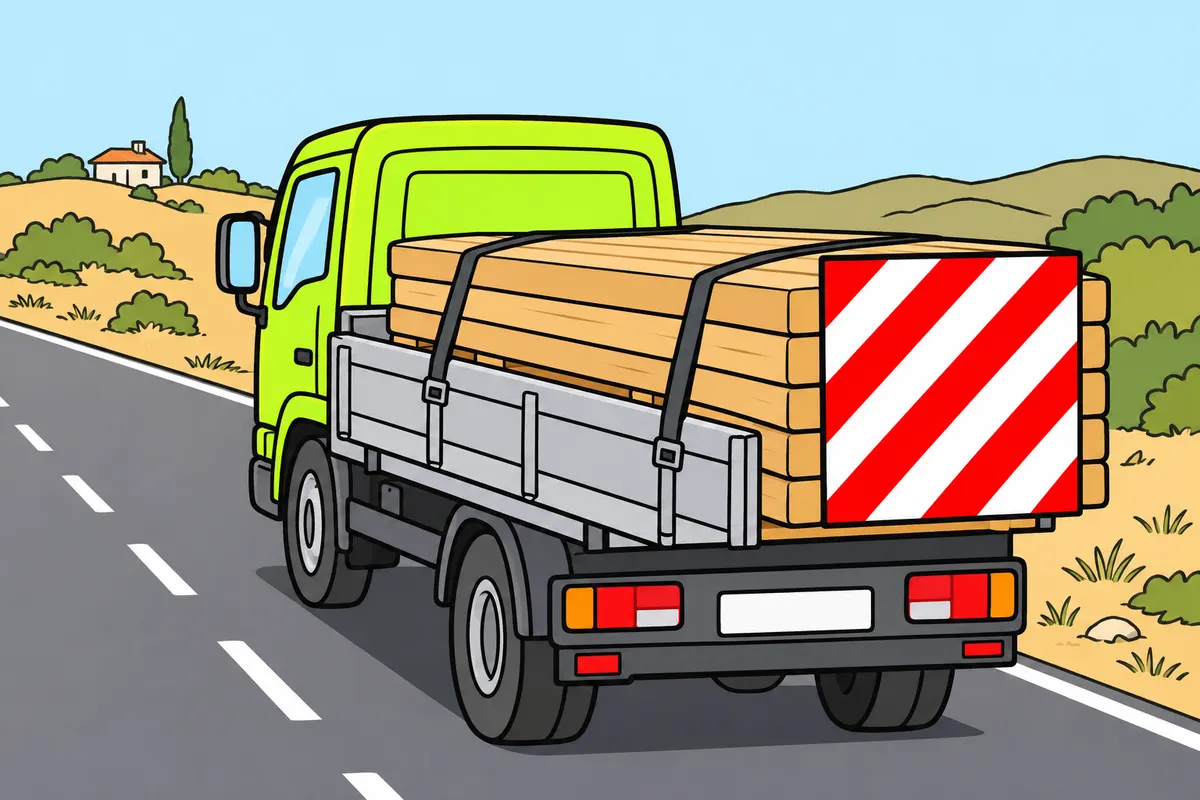
Mark your load without hiding lights, number plates or compulsory signs.
| Sign | What to recognise |
|---|---|
| V-20 | Panel for a projecting load |
| V-11 | Orange plates for dangerous goods when required |
Remember
- Use the panels and lights required for projecting loads.
- Adjust your load before driving if it hides lights or number plates.
- Recognise V-11 as orange plates for dangerous goods when required.
- If numbered, identify the hazard above and the substance below.
Exam trap: Wrong: Adding V-20 lets you hide your lorry’s lights. Right: Keep them visible, even by day; V-20 does not replace required night lights for projecting loads.
Read the full explanation
- You must mark projecting loads with the appropriate panels and devices; in “Load securing and safety”, consult [“Protection and the V-20 panel”](carga-segura#proteccion-y-panel-v-20) and [“Lighting projecting loads”](carga-segura#alumbrado-de-los-salientes). [RGC, art. 15](https://www.boe.es/buscar/act.php?id=BOE-A-2003-23514#a15).
- The V-11 uses orange panels to identify the carriage of dangerous goods subject to this requirement. If the panels carry numbers, those at the top identify the hazard and those at the bottom identify the substance. You study the circumstances, exemptions, labels and ADR details in “Dangerous goods: ADR basics”, and the limits on projecting loads in “Load securing and safety”. [RGV, Annex XI, V-11](https://www.boe.es/buscar/act.php?id=BOE-A-1999-1826#v-11).
- You must position the load without obscuring lights, signalling devices, number plates or compulsory markings. If it covers them, you must reposition it before driving: adding a V-20 panel or a light at the end does not allow you to obscure the lorry’s own lights, even during the day. [RGC, art. 14](https://www.boe.es/buscar/act.php?id=BOE-A-2003-23514#a14).
23Signs for special services and circumstances
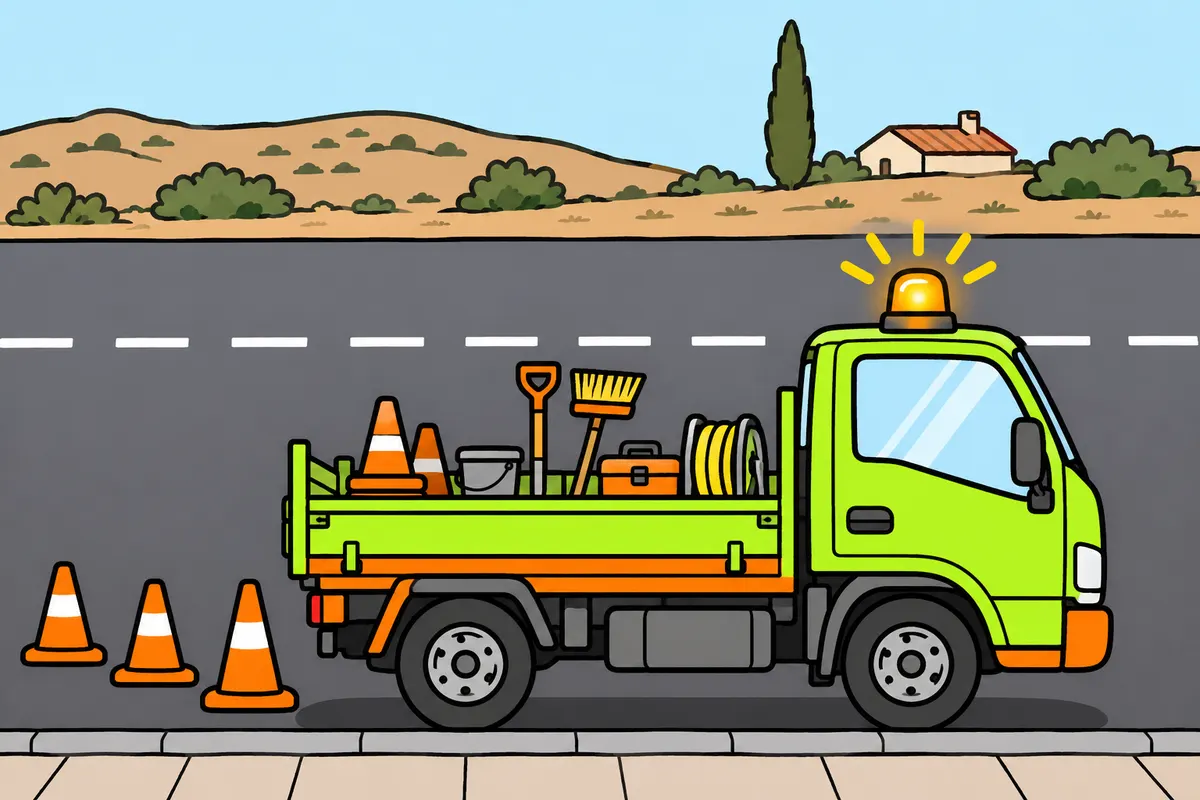
Recognise special signs according to your lorry’s service and situation.
| Sign for your vehicle or service | Meaning |
|---|---|
| V-2 | Vehicle obstructing the road; amber |
| V-1 | Specified priority services; blue |
| V-4 | Maximum speed shown on the plate |
| V-5 | Vehicle unable to exceed 40 km/h by design |
| V-14 | Learning to drive |
| V-24 | Roadside assistance on public roads |
| V-19 | Satisfactory periodic inspection and next due date |
| V-13 | New driver when required |
Remember
- Use V-2 for work and services subject to that requirement.
- If V-2 fails, use dipped beam and hazard warning lights.
- Place V-19 inside your windscreen, in the top right-hand corner.
- Display V-13 for one year from your first licence; suspensions interrupt this period.
- C1 does not restart this period after an effective year with another licence.
- If you must display V-13, place it visibly at the rear, on the left.
Exam trap: Wrong: Amber V-2 gives you priority. Right: It warns of an obstructing vehicle; blue V-1 is the signal for specified priority services.
Read the full explanation
- If you use your lorry for work on the road under the conditions set out in the regulations, you must use V-2, an amber light indicating a vehicle that is an obstruction. This covers vehicles habitually carrying out these tasks while stopped, parked or travelling at no more than 40 km/h; it also covers special transport operations and escort vehicles under their applicable conditions. [RGV, Annex XI, V-2](https://www.boe.es/buscar/act.php?id=BOE-A-1999-1826#v-2).
- The V-2 must be visible from all directions at 100 m and fitted without impairing your visibility. If it fails, you must use dipped beam together with the hazard warning lights. The amber light does not give you priority; V-1 is the blue signal used by the specified priority services. [RGV, Annex XI, V-2](https://www.boe.es/buscar/act.php?id=BOE-A-1999-1826#v-2). [RGV, Annex XI, V-1](https://www.boe.es/buscar/act.php?id=BOE-A-1999-1826#v-1).
- The V-4 speed restriction sign communicates the maximum speed shown on the plate and is required in the circumstances set out in the regulations, such as for vehicles with special authorisation; the V-5 slow vehicle sign identifies vehicles whose construction prevents them from exceeding 40 km/h. [RGV, Annex XI, V-4](https://www.boe.es/buscar/act.php?id=BOE-A-1999-1826#v-4). [RGV, Annex XI, V-5](https://www.boe.es/buscar/act.php?id=BOE-A-1999-1826#v-5).
- The V-14 identifies a learner vehicle; V-24 identifies a roadside assistance service on public roads; V-19 certifies a favourable periodic inspection result and shows when the next inspection is due. If your vehicle has a windscreen, you must place V-19 inside its top right-hand corner. You study ITV (vehicle roadworthiness test) intervals in “Professional transport documentation”, in the section [“Lorry ITV frequency”](documentacion-transporte#periodicidad-itv-del-camion). [RGV, Annex XI, V-14](https://www.boe.es/buscar/act.php?id=BOE-A-1999-1826#v-14). [RGV, Annex XI, V-24](https://www.boe.es/buscar/act.php?id=BOE-A-1999-1826#v-24). [RGV, Annex XI, V-19](https://www.boe.es/buscar/act.php?id=BOE-A-1999-1826#v-19).
- You must display the V-13 sign for one year after obtaining your first driving licence; periods when its validity is suspended or you are deprived of the right to drive interrupt this calculation. Obtaining C1 does not start another period if you have effectively held a Spanish or foreign licence of any category for at least one year. When you are required to display it, you must place it visibly at the rear on the left. [RGV, Annex XI, V-13](https://www.boe.es/buscar/act.php?id=BOE-A-1999-1826#v-13).
24Number plates and their lighting
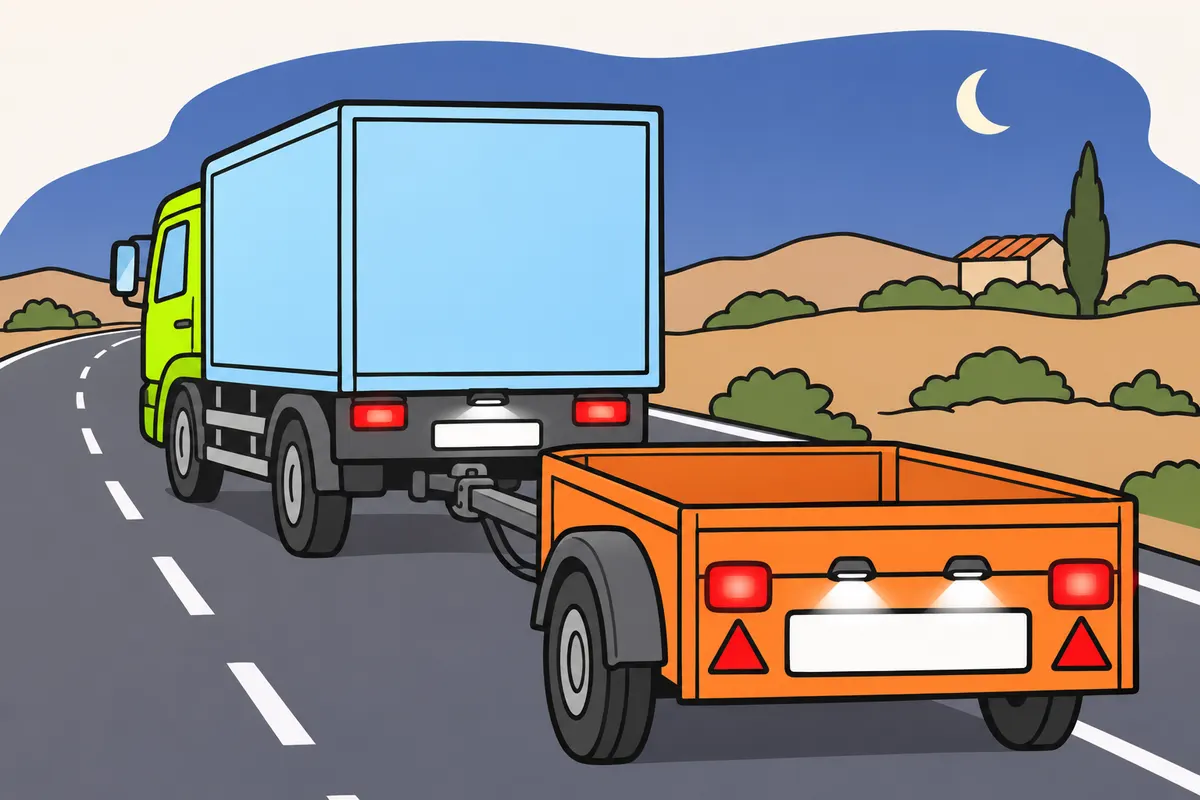
Keep your number plates visible and light the rear plate when required.
| Vehicle | Number plates you must display |
|---|---|
| Your lorry | One at the front and one at the rear |
| Light trailer with MMA (maximum authorised mass) up to 750 kg | Towing lorry’s number plate at the rear |
Remember
- Have a number plate at the front and rear of your lorry.
- Do not hide them with loads, accessories or dirt.
- Light the rear plate at night, in tunnels, underpasses and greatly reduced visibility.
- On your light trailer, display your lorry’s number plate at the rear.
- Also check your trailer’s rear number plate light.
Exam trap: Wrong: Repeating the lorry’s number plate means the trailer needs no lights. Right: Its signalling lights and number plate light must work.
Read the full explanation
- Your lorry must have two number plates, one at the front and one at the rear, fitted in accordance with the regulations. You must keep them visible and legible: the number plate must not be obscured by the load, accessories or dirt. The plates identify the vehicle and do not replace any of its lighting devices. [RGV, art. 49 and Annex XVIII](https://www.boe.es/buscar/act.php?id=BOE-A-1999-1826#anxviii).
- You must illuminate the rear number plate when driving at night, through tunnels or underpasses, and in significantly reduced visibility. The device emits white light towards the plate; you must not confuse it with a white lamp shining backwards to indicate reversing. [RGC, art. 103](https://www.boe.es/buscar/act.php?id=BOE-A-2003-23514#a103). [RGV, Annex X](https://www.boe.es/buscar/act.php?id=BOE-A-1999-1826#anx).
- If you tow a light trailer with an MMA no greater than 750 kg, you must display a plate bearing the towing lorry’s registration number at the rear, fitted in accordance with the regulations. The trailer’s signalling lights must work even though its identification repeats the towing vehicle’s registration number. [RGV, art. 25 and Annex XVIII](https://www.boe.es/buscar/act.php?id=BOE-A-1999-1826#anxviii). [RGV, art. 16.5](https://www.boe.es/buscar/act.php?id=BOE-A-1999-1826#a16).
- The trailer must have its own rear number plate lighting: you must check that it illuminates its plate and is not obscured when you hitch up or load the trailer. [RGV, art. 16.5](https://www.boe.es/buscar/act.php?id=BOE-A-1999-1826#a16).
25Brief light signals and system condition
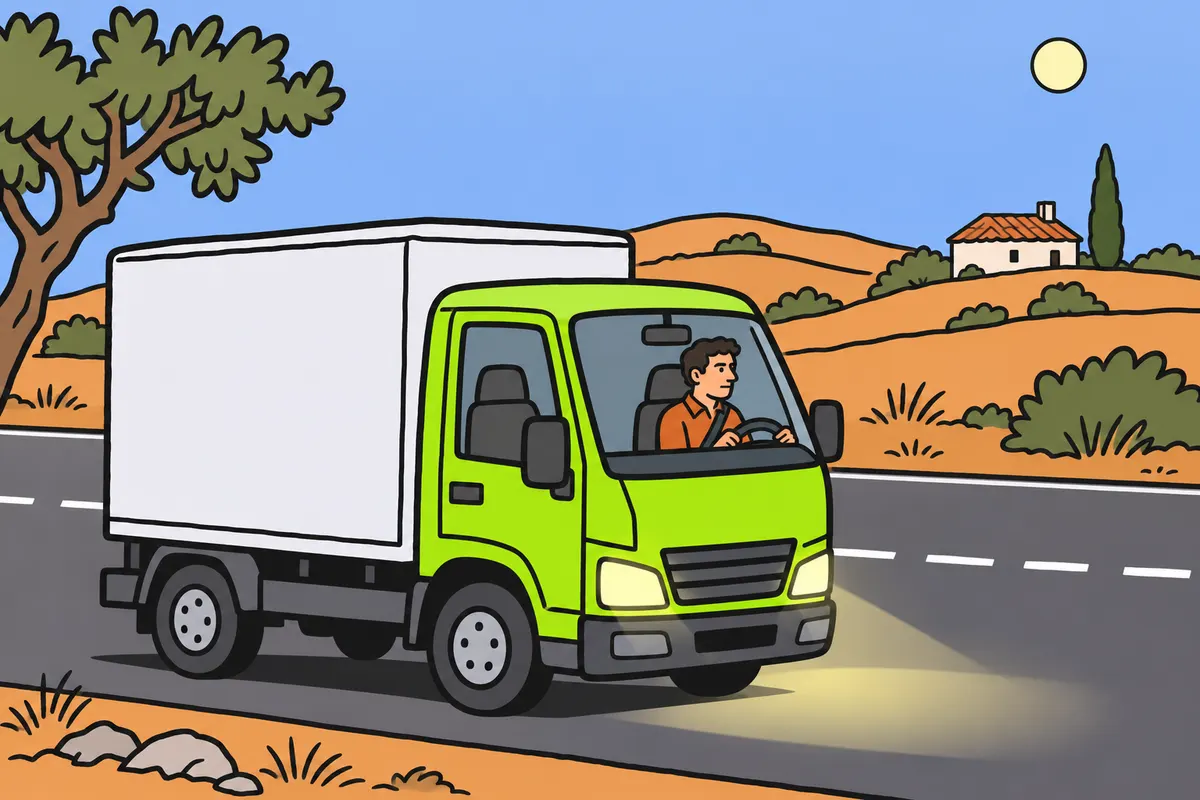
Keep your lights clean, correctly aimed and adjusted for your load.
Remember
- With irreparably faulty lights, slow down to stop within the area they light.
- Adjust your headlights for the load, following the manufacturer’s instructions.
- Only give light warnings when permitted, without dazzling others.
- Do not fit unauthorised lights, paint or reflectors.
- Avoid interior light reflections that make it harder to see outside.
- Keep your headlights clean and correctly aimed.
Exam trap: Wrong: A work light replaces driving lights. Right: It lights a task; you must use the required driving lights.
Read the full explanation
- You may use brief light signals under the conditions set out in [“Light signals, arm signals and the horn”](maniobras#advertencias-luminosas-brazo-y-claxon) in “Manoeuvres with your lorry”, which explains their purposes and how to use them without dazzling others. [RGC, art. 109](https://www.boe.es/buscar/act.php?id=BOE-A-2003-23514#a109).
- If your lighting develops a fault during a journey that cannot be repaired on the road and you have to drive with reduced light intensity, you must reduce your speed so that you can stop within the illuminated area. [RGC, art. 107](https://www.boe.es/buscar/act.php?id=BOE-A-2003-23514#a107).
- You must keep your headlamps clean and correctly aligned. As a practical check, a beam aimed too low limits the distance you can see, while one aimed too high may dazzle others; you must adjust the system to suit the load and follow the manufacturer’s procedure. [RGV, art. 15](https://www.boe.es/buscar/act.php?id=BOE-A-1999-1826#a15).
- You must not apply unauthorised paint or fit unauthorised lights or reflectors. Paired devices serving the same purpose must match in colour and intensity and be positioned symmetrically; you must preserve the type approval of the complete assembly even when you add accessories. A work lamp illuminates a task and does not replace the lighting required for driving. [RGV, art. 15](https://www.boe.es/buscar/act.php?id=BOE-A-1999-1826#a15). [RGV, Annex X](https://www.boe.es/buscar/act.php?id=BOE-A-1999-1826#anx).
- You may have interior cab lighting, but you must use it without dazzling or unduly disturbing other road users. As a practical precaution, avoid reflections in the windows that make it difficult to see outside at night; interior lighting does not replace any of the lights used for driving. [RGV, art. 17 and Annex X](https://www.boe.es/buscar/act.php?id=BOE-A-1999-1826#anx).
Choosing lights while driving
Assess the road conditions before selecting your headlights.
- Identify night-time, a tunnel or significantly reduced visibility; also check whether the lane requires dipped beam during the day.
- Switch on the position lights, rear number plate lighting and end-outline marker lamps where applicable.
- Select dipped beam in built-up areas or where lighting is sufficient; outside built-up areas with insufficient lighting, apply the main-beam rule at more than 40 km/h.
- Check whether you could dazzle others ahead or through their mirrors, and switch to dipped beam as soon as this is possible.
- Assess front and rear fog lights separately: rear fog lights require particularly adverse conditions.
Signalling a lorry breakdown
Combine advance warning with the required lighting.
- Stop the lorry in the safest possible place and switch on the hazard warning lights.
- Keep the position lights and end-outline marker lamps on when required because of darkness or reduced visibility.
- To activate and place the V-16, follow “Place the beacon without putting yourself at risk” in “Accidents, breakdowns and first aid”.
- Request the help you need: the beacon’s connection does not replace notifying the emergency services.
Checking lights and markings according to dimensions
Each device has its own criteria.
- Check the lorry’s length: if it exceeds 6 m, check side-marker lamps and side reflectors, including their exceptions.
- Check the width: if it exceeds 2.10 m, check the end-outline marker lamps.
- Check the overall length of the vehicle or combination: if it exceeds 12 m, check V-6.
- For V-23, distinguish optional marking on a C1 lorry from the requirement for larger lorries based on mass and category; do not confuse its thresholds with those for lights.
- If the load projects beyond the vehicle, check V-20 and any additional lights and reflectors required.
Finished this module?
Mark it as read and you will see your progress on the theory list.