
Theory · C1 Licence - Light Truck · Module 8 of 18
Manoeuvres with your lorry
You learn to join traffic, change lanes, overtake, turn and reverse in a C1 light lorry, respecting priority and the space the whole vehicle needs. You practise the differences between a traffic or emergency stop, a brief voluntary stop and parking, the prohibitions, and the measures for securing and signalling an immobilised vehicle, with the facts you need to answer exam questions.
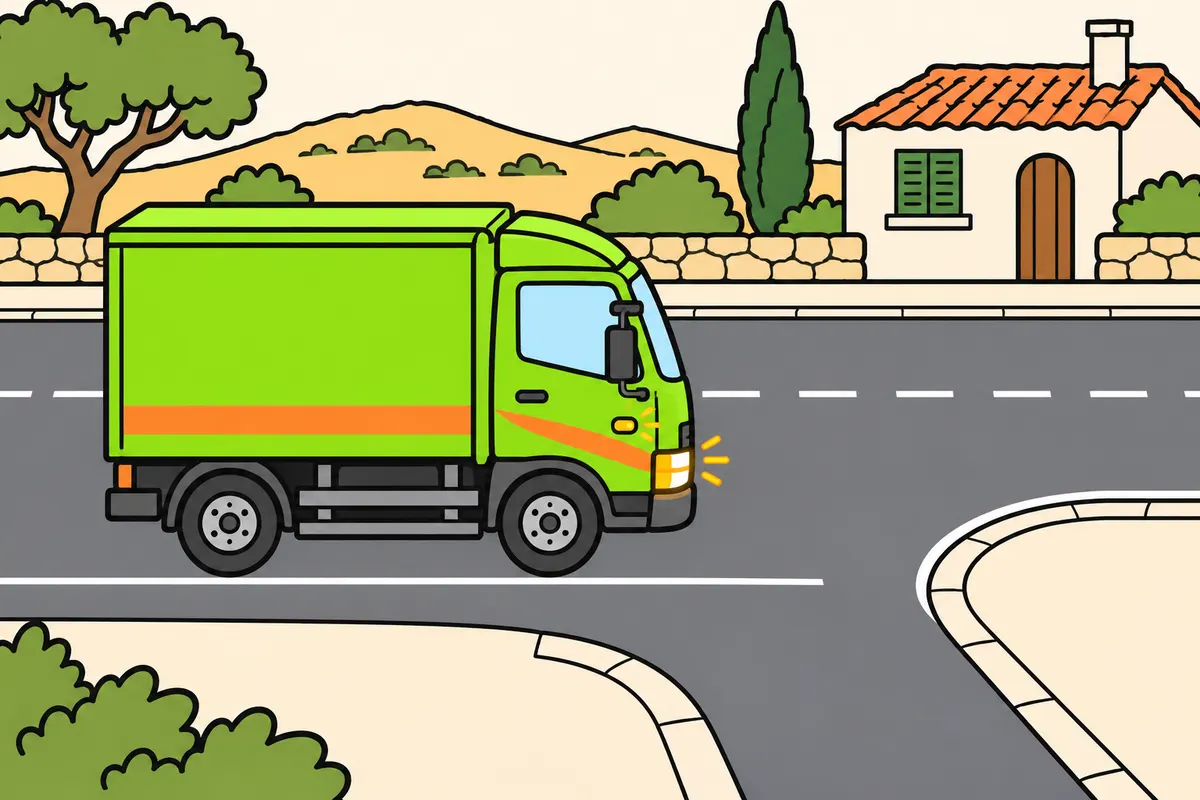
1Observe, signal and manoeuvre
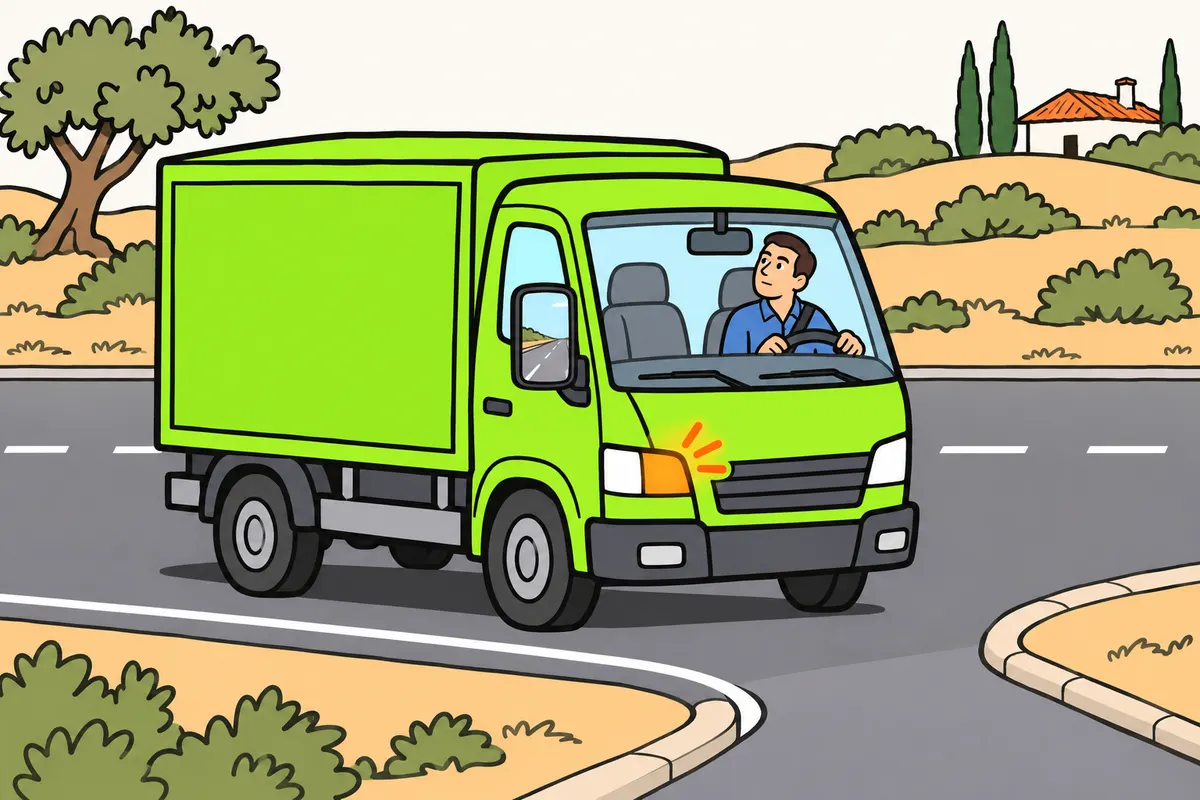
Before moving, look, signal and check that you can move safely.
Remember
- Look ahead, behind and to both sides.
- Use mirrors and direct checks.
- Ask for help if you cannot check before joining traffic or reversing.
- Give enough warning before moving or slowing greatly.
Exam trap: Wrong: mirrors show you everything. Right: also check areas you cannot see in them.
Read the full explanation
- Before you join traffic, change lanes, overtake, turn, reverse or pull over to stop, follow the mirror, signal, manoeuvre sequence. This learning aid helps you organise your checks: observation lets you decide whether you can act, signalling communicates your intention, and manoeuvring requires you to maintain safety until you finish. [RGC, art. 108](https://www.boe.es/buscar/act.php?id=BOE-A-2003-23514#a108).
- Check what is happening ahead, behind and to either side, combining direct observation, mirrors and any available aids. In a light lorry, an area you cannot see in a mirror may contain a person or another vehicle; if you need help to check before joining traffic or reversing, ask another person to help. [RGC, art. 72](https://www.boe.es/buscar/act.php?id=BOE-A-2003-23514#a72) and [art. 81](https://www.boe.es/buscar/act.php?id=BOE-A-2003-23514#a81).
- You must signal lateral movements, reversing and your intention to bring the vehicle to a standstill or slow down considerably in good time. [RGC, art. 109.1](https://www.boe.es/buscar/act.php?id=BOE-A-2003-23514#a109).
2Light signals, arm signals and the horn
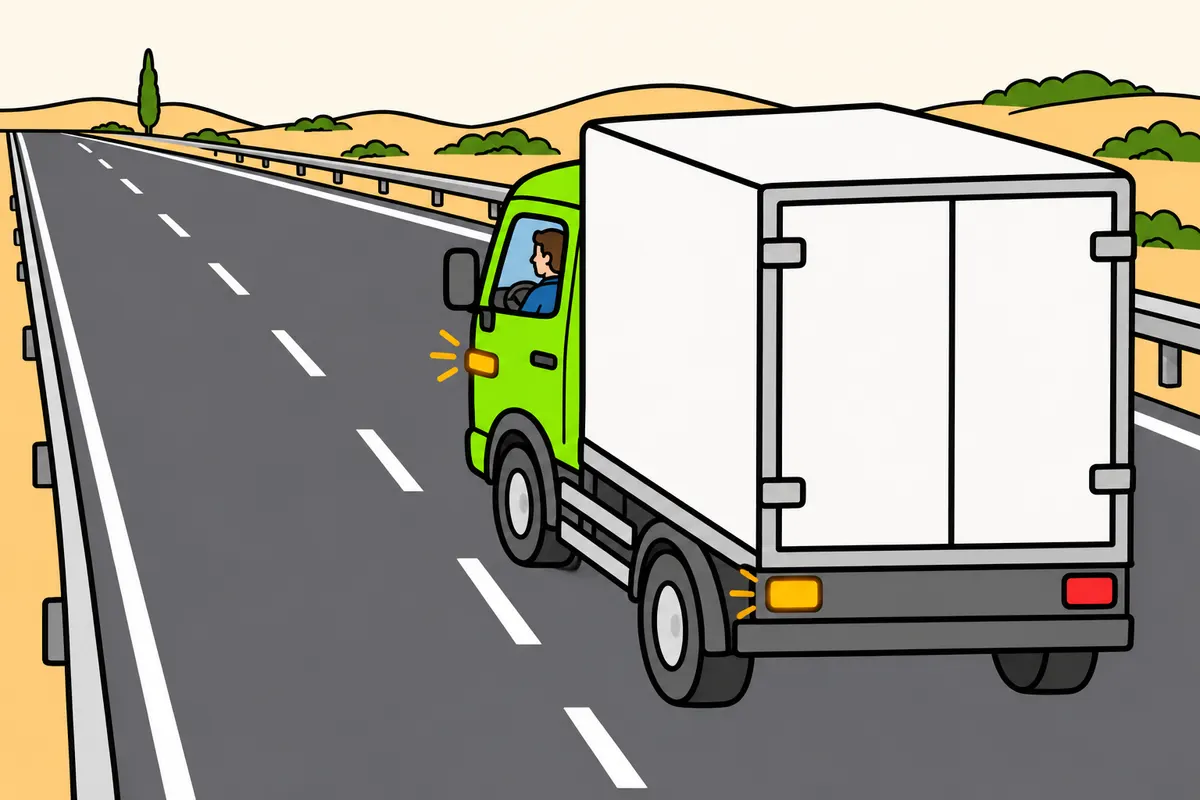
Use lights, arm signals and the horn only as the rules allow.
| Warning | How to use it |
|---|---|
| Lights | Use them normally |
| Arm | If lights are unavailable; use a legal, visible signal |
| Horn | No harsh sound or unjustified or excessive use |
Remember
- Signal towards your chosen side; cancel once you are on your new course.
- If lights are unavailable, use a legal, visible arm signal.
- To stop beside the edge, indicate that side.
- You may use the horn to prevent an accident.
- Outside built-up areas, you may use it to announce an overtake.
Exam trap: Wrong: any gesture overrides your indicator. Right: only a legal arm signal, visible to others and conflicting with that light, overrides it.
Read the full explanation
- To move sideways, use the indicator on the side towards which you are moving and switch it off as soon as you are on your new course. [RGC, art. 109.2](https://www.boe.es/buscar/act.php?id=BOE-A-2003-23514#a109).
- You must normally use the vehicle's lights or, if these are unavailable, your arm. A correctly given arm signal that other road users can see overrides a conflicting light signal; a gesture hidden by the lorry's cab or load body does not serve this purpose. [RGC, art. 108](https://www.boe.es/buscar/act.php?id=BOE-A-2003-23514#a108).
- For arm signals indicating a lateral movement, see “Lights and signalling on your light lorry”, section “Indicators: signalling a manoeuvre”. [RGC, art. 109](https://www.boe.es/buscar/act.php?id=BOE-A-2003-23514#a109).
- To signal reversing or a considerable reduction in speed using lights or your arm, follow “Lights and signalling on your light lorry”, section “Braking and reversing”. [RGC, art. 109](https://www.boe.es/buscar/act.php?id=BOE-A-2003-23514#a109).
- If you intend to stop or park beside the edge of the road, also use the indicator on that side; for hazard warning lights when immobilised on an autopista (motorway), an autovía (dual carriageway) or in significantly reduced visibility, see “Lights and signalling on your light lorry”, section “Hazard warning lights: warning of a temporary danger”. [RGC, art. 109](https://www.boe.es/buscar/act.php?id=BOE-A-2003-23514#a109).
- You may use the horn with a non-shrill sound to prevent a possible accident, especially on narrow roads with many bends; unnecessary or excessive use is prohibited. [RGC, art. 110.1](https://www.boe.es/buscar/act.php?id=BOE-A-2003-23514#a110).
- Outside built-up areas, you may use the horn to signal your intention to overtake. You may also warn others of your presence if, in particularly serious circumstances and with no other means available, you exceptionally use the lorry for an urgent service of the kind covered by article 70: sound the horn intermittently and use the hazard warning lights, if fitted, or a handkerchief or a similar method, while complying with traffic rules. [RGC, arts. 70 and 110.2](https://www.boe.es/buscar/act.php?id=BOE-A-2003-23514#a70).
- To replace an audible warning with flashes of your lights, follow “Lights and signalling on your light lorry”, section “Brief light signals and system condition”. [RGC, art. 109.3](https://www.boe.es/buscar/act.php?id=BOE-A-2003-23514#a109).
3Join traffic from the roadside or an access road
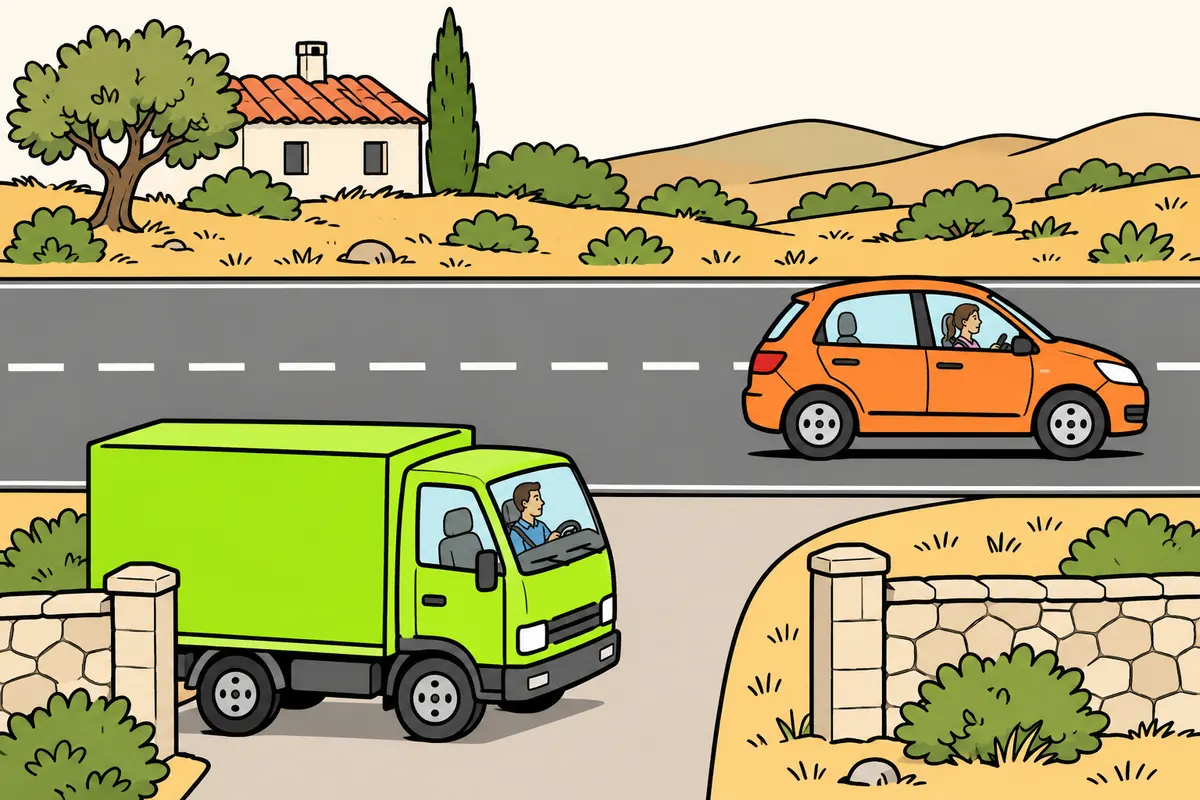
When joining, signal and give way to road users already on the road.
Remember
- Check their position, direction and speed.
- Do not edge your lorry out and force others to swerve.
- Signal before moving, even when the exit looks almost straight.
- From an exclusively private track, drive slowly enough to stop immediately.
- Give way to traffic from either direction.
Exam trap: Wrong: your indicator gives you priority to join. Right: signal and give way to traffic already on the road.
Read the full explanation
- You join traffic when you leave a parking space, resume driving from the edge of the road or enter from an adjoining property, a service area or an access road. You must first check the position, course and speed of road users already on the road and give way to them. [RGC, art. 72](https://www.boe.es/buscar/act.php?id=BOE-A-2003-23514#a72).
- You must make sure you can enter safely, following another person's directions when necessary. With a forward-positioned cab or a load body that restricts your view, you must not edge the lorry out in a way that forces others into another lane to avoid you. [RGC, art. 72](https://www.boe.es/buscar/act.php?id=BOE-A-2003-23514#a72).
- Give a visual signal before you start to join traffic. You must signal even when the exit appears almost straight; you must communicate that you are entering the traffic stream and must not rely on the lorry's size to make your intention obvious. [RGC, art. 72](https://www.boe.es/buscar/act.php?id=BOE-A-2003-23514#a72).
- If you enter a road open to public use from an exclusively private road, you must move at a speed that allows you to stop immediately. Give way to vehicles travelling on it in either direction and also check that you do not endanger other road users. [RGC, art. 72](https://www.boe.es/buscar/act.php?id=BOE-A-2003-23514#a72).
4Use the acceleration lane
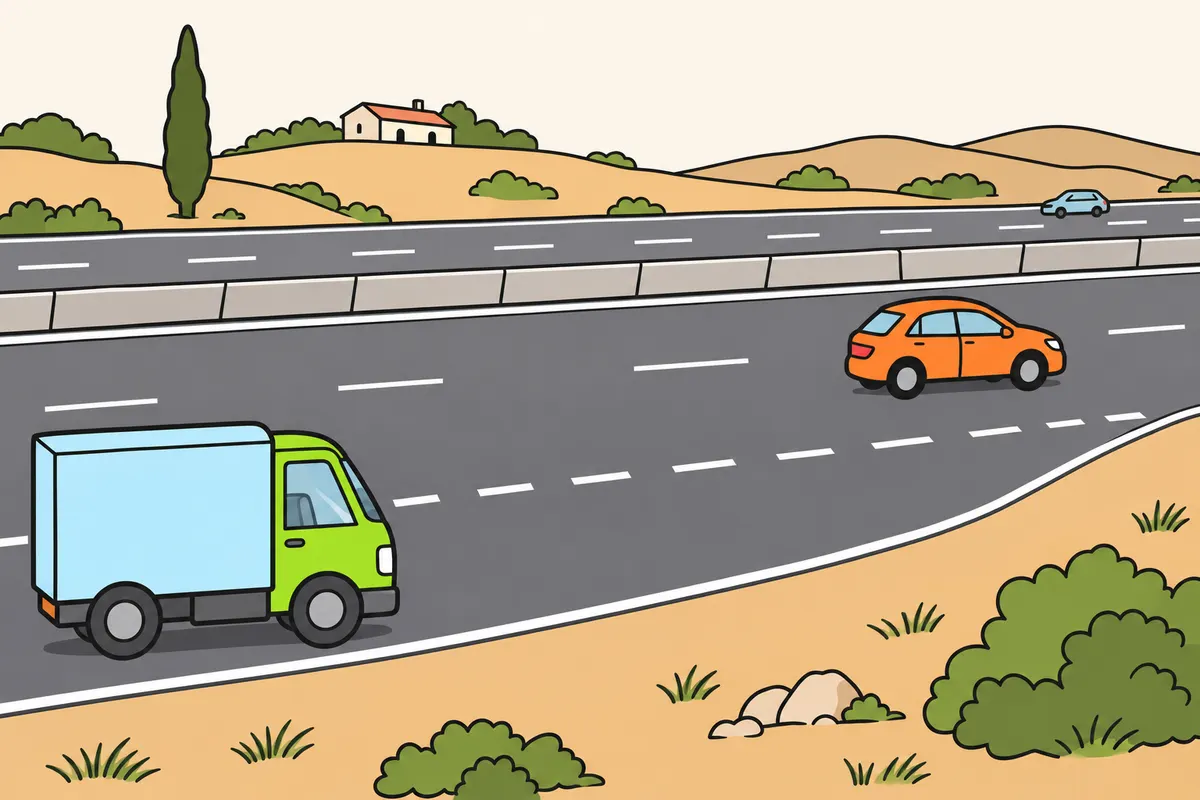
Check at the start, then accelerate to join safely at the lane’s end.
Remember
- If you need to stop to give way, stop at the start.
- Match your speed to the available gap and obey speed limits.
- If already on the road, help others join without creating danger.
- In built-up areas, help public transport pull out from marked stops.
- Stop to help them pull out only when necessary.
Exam trap: Wrong: the acceleration lane gives you priority. Right: give way to traffic on the main road.
Read the full explanation
- From the start of the acceleration lane, you must check whether you can join safely, assessing the position, course and speed of vehicles on the carriageway. If you need to stop to give way, do so at this early stage; keeping enough lane length available is particularly important given the lorry's acceleration capability. [RGC, art. 72](https://www.boe.es/buscar/act.php?id=BOE-A-2003-23514#a72).
- You must then accelerate to a suitable speed to join at the end of the lane. Time your entry to suit the available gap and the applicable limits; the acceleration lane does not give you priority over traffic on the main road. [RGC, art. 72](https://www.boe.es/buscar/act.php?id=BOE-A-2003-23514#a72).
- If you are already on the road, help another vehicle to join wherever possible. You may adjust your speed or change lanes where permitted and safe, respecting the priority of anyone already in that lane. Helping does not mean braking sharply or making a dangerous lateral movement. [RGC, art. 73](https://www.boe.es/buscar/act.php?id=BOE-A-2003-23514#a73).
- Within built-up areas, you must help public passenger transport vehicles pull away from their marked stops: move sideways if you can or slow down, stopping if necessary. The bus driver must signal before pulling away and take the necessary precautions to prevent accidents. [RGC, art. 73](https://www.boe.es/buscar/act.php?id=BOE-A-2003-23514#a73).
5Change lanes in your lorry
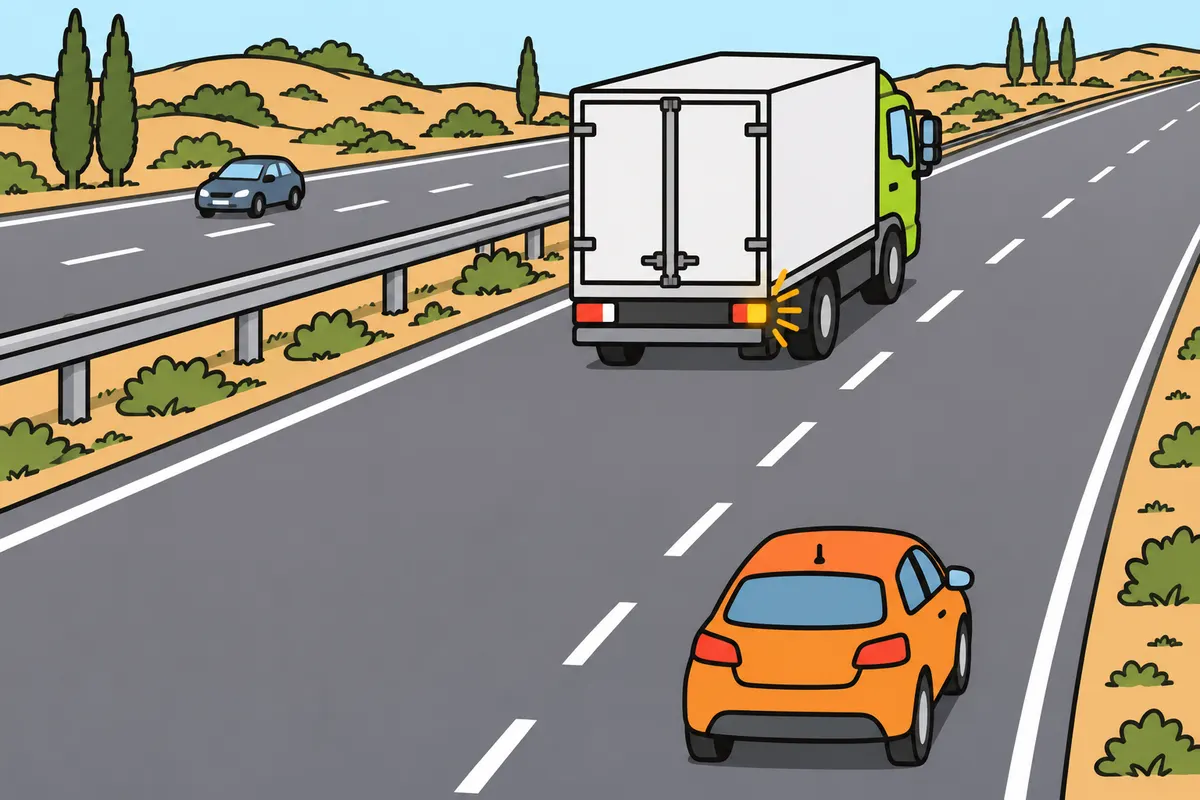
Check that your whole lorry can enter the lane without obstructing others.
| Situation | Lanes for your lorry over 3,500 kg MMA |
|---|---|
| Outside built-up areas: two lanes each way | Normally the right lane; use the left if suitable and without obstructing |
| Outside built-up areas: three or more lanes each way | Right lane and adjacent lane; use the adjacent lane if suitable, without obstructing |
| Built-up area: several marked lanes each way | Choose the lane for your destination without obstructing; except motorways and dual carriageways |
| Motorway or dual carriageway: walking-pace or stopped queue; priority vehicle approaching; two lanes | Leave the gap between both lanes |
| Motorway or dual carriageway: walking-pace or stopped queue; priority vehicle approaching; three or more lanes | Leave the gap between the left lane and the lane next to it |
Remember
- Keep to your lane, signal, move across gradually and check every lane you cross.
- Outside built-up areas, normally use the right-hand lane.
- Use the carriageway; use the hard shoulder only in permitted exceptional cases.
- Motorway or dual carriageway queues: at walking pace or stopped, let priority vehicles through.
- In the left lane, move left; in all other lanes, move right.
- For an urgent priority vehicle, move right or stop if needed.
Exam trap: Wrong: clearing the cab is enough. Right: check that the rear also leaves enough space.
Read the full explanation
- Before changing lanes, check the space ahead and behind in the lane you intend to enter and respect the priority of traffic already in it. Your check must account for the whole lorry: the fact that the cab is ahead does not mean the rear is clear of the vehicle you have overtaken. [RGC, art. 74](https://www.boe.es/buscar/act.php?id=BOE-A-2003-23514#a74).
- Change lanes gradually, continuing to observe throughout the movement. If you need to cross several lanes, check each new space you intend to occupy; a single signal does not give you permission to cross them without checking the situation again. [RGC, art. 109](https://www.boe.es/buscar/act.php?id=BOE-A-2003-23514#a109).
- Outside built-up areas, you must normally drive in the furthest right lane. With two lanes in your direction, you may use the left lane when traffic or road conditions make it advisable and without obstructing vehicles behind you. With three or more, your C1 lorry with an MMA (maximum authorised mass) over 3,500 kg may use only the right lane and the lane immediately next to it, under the same conditions. [RGC, art. 31.1-2](https://www.boe.es/buscar/act.php?id=BOE-A-2003-23514#a31).
- Within built-up areas, where at least two lanes in your direction are marked by longitudinal road markings, you may use the lane best suited to your destination without causing an obstruction. This rule does not apply to autopistas and autovías; you must leave your chosen lane only to prepare to turn, overtake, stop or park. [RGC, art. 33](https://www.boe.es/buscar/act.php?id=BOE-A-2003-23514#a33).
- On an autopista or autovía, if congestion forces you to drive at walking pace or stop, you must move aside to make room when an emergency vehicle with priority approaches. With two lanes, the gap runs between them; with three or more, it runs between the left lane and the lane next to it. If you are in the left lane, move left; in the other lanes, move right. [RGC, art. 32.1](https://www.boe.es/buscar/act.php?id=BOE-A-2003-23514#a32).
- As soon as you notice the special signals of an approaching emergency vehicle with priority, you must help it through as the circumstances require: normally move to your right or stop if necessary; in the congestion described in the previous point, form the emergency corridor as explained there. [RGC, art. 69](https://www.boe.es/buscar/act.php?id=BOE-A-2003-23514#a69) and [art. 32](https://www.boe.es/buscar/act.php?id=BOE-A-2003-23514#a32).
- With your lorry of over 3,500 kg MMA, you must drive on the carriageway except in an emergency; the exceptional use of the arcén (hard shoulder) to give way is explained in “Your duties when you are being overtaken”. [RGC, art. 31.1](https://www.boe.es/buscar/act.php?id=BOE-A-2003-23514#a31).
6Overtake on the permitted side
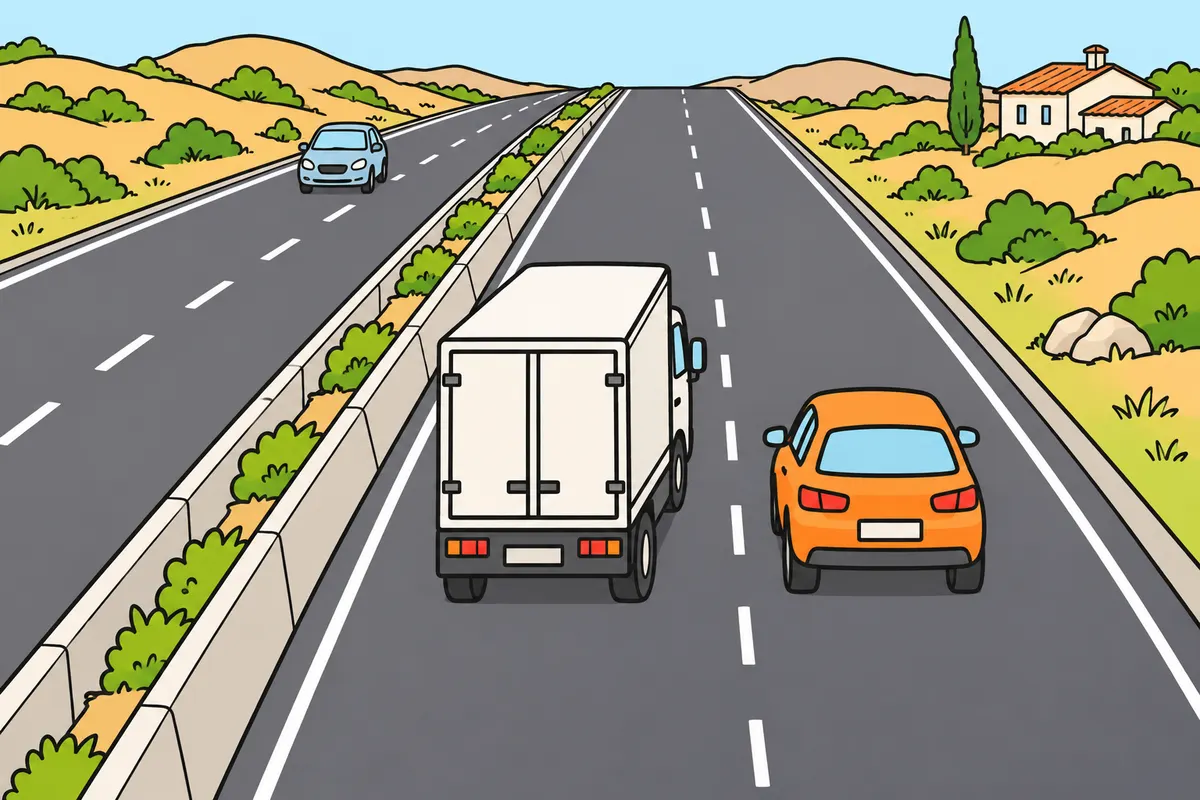
Overtake on the left unless a safe, legal exception applies.
| Case | Passing on the right |
|---|---|
| Vehicle clearly signals a left turn or stop | You must pass on the right if there is room, taking great care |
| Tram in the centre of a two-way road | You may pass on the right if safe |
| Built-up area: at least two marked lanes in your direction | You may pass on the right without causing danger |
Remember
- A slow left-lane vehicle does not let you pass on the right.
- Keep to the lanes allowed for your lorry.
- With several lanes your way, keep overtaking only without unduly obstructing drivers behind.
Exam trap: Wrong: several lanes always allow overtaking on the right. Right: you need a legal exception and safe conditions.
Read the full explanation
- As a general rule, you must overtake on the left. The fact that another vehicle is travelling slowly in the left lane of a road does not, by itself, allow you to overtake it on the right; a legal exception must apply and the manoeuvre must be safe. [RGC, art. 82](https://www.boe.es/buscar/act.php?id=BOE-A-2003-23514#a82).
- If the vehicle ahead clearly signals that it intends to turn left or stop on that side, you must overtake it on the right when there is enough space and you can do so with the utmost care. [RGC, art. 82](https://www.boe.es/buscar/act.php?id=BOE-A-2003-23514#a82).
- On a two-way road, you may overtake a tram travelling along the centre on its right. You may also overtake on the right within built-up areas where at least two lanes in your direction are marked by longitudinal road markings and you check that you cause no danger. [RGC, art. 82](https://www.boe.es/buscar/act.php?id=BOE-A-2003-23514#a82).
- With two or more lanes in your direction, you may remain in the overtaking lane if you intend to overtake another vehicle and you do not unduly impede faster traffic approaching from behind. You must also comply with the lane restrictions applicable to your lorry and return to the right when required. [RGC, art. 83](https://www.boe.es/buscar/act.php?id=BOE-A-2003-23514#a83).
7Passing that does not count as overtaking
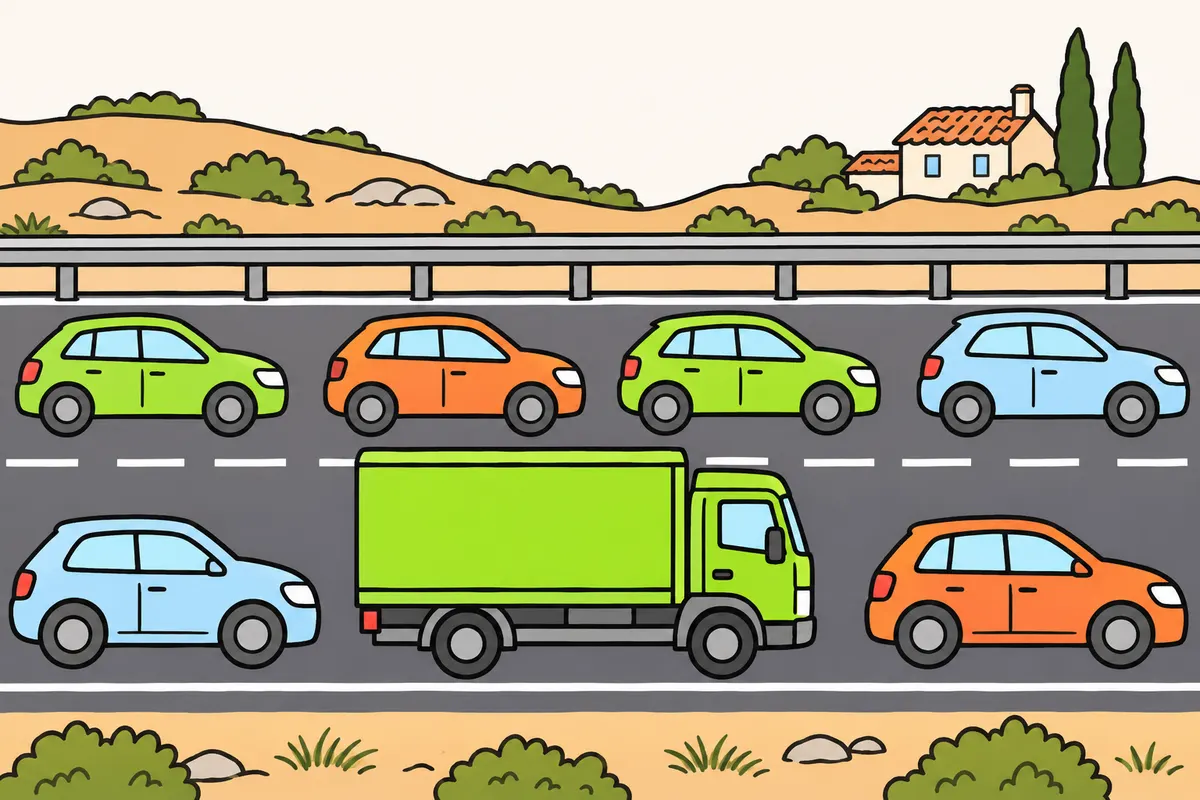
Some passing between lanes is not overtaking, but lane rules still apply.
| Case | What to remember |
|---|---|
| Dense queues fill the road and follow the vehicle ahead | Uneven progress is not overtaking |
| Acceleration or deceleration lanes beside normal lanes | Uneven progress is not overtaking |
| Reserved lanes beside normal lanes | Uneven progress is not overtaking |
| Cyclists in the same group | Their changes of position are not overtaking |
Remember
- Do not change lanes in dense traffic to gain places.
- Only change lanes to prepare a turn, leave or take another direction.
- Do not enter a reserved lane you are not allowed to use.
Exam trap: Wrong: you may use any reserved lane to move ahead. Right: enter only if you are authorised.
Read the full explanation
- If traffic density fills the entire width of the carriageway and each queue moves according to the vehicle ahead, one lane moving faster than another does not count as overtaking. In this situation, you must not keep changing lanes to gain places; you may only change lanes to prepare for a turn, leave the carriageway or take a particular direction. [RGC, art. 83](https://www.boe.es/buscar/act.php?id=BOE-A-2003-23514#a83).
- Vehicles in an acceleration or deceleration lane moving faster than those in the normal lanes, or vice versa, does not count as overtaking either. You must still comply with the rules on joining traffic, leaving the road and priority when moving between them. [RGC, art. 83](https://www.boe.es/buscar/act.php?id=BOE-A-2003-23514#a83).
- The same principle applies between lanes or parts of the road reserved exclusively for certain vehicles and the normal lanes. You must not use a reserved area intended for other vehicles to move ahead in your lorry: the fact that this does not count as overtaking does not authorise you to enter it. [RGC, art. 83](https://www.boe.es/buscar/act.php?id=BOE-A-2003-23514#a83).
- Changes of position between cyclists in the same group do not count as overtaking either. [RGC, art. 84.5](https://www.boe.es/buscar/act.php?id=BOE-A-2003-23514#a84).
8Prepare to overtake safely
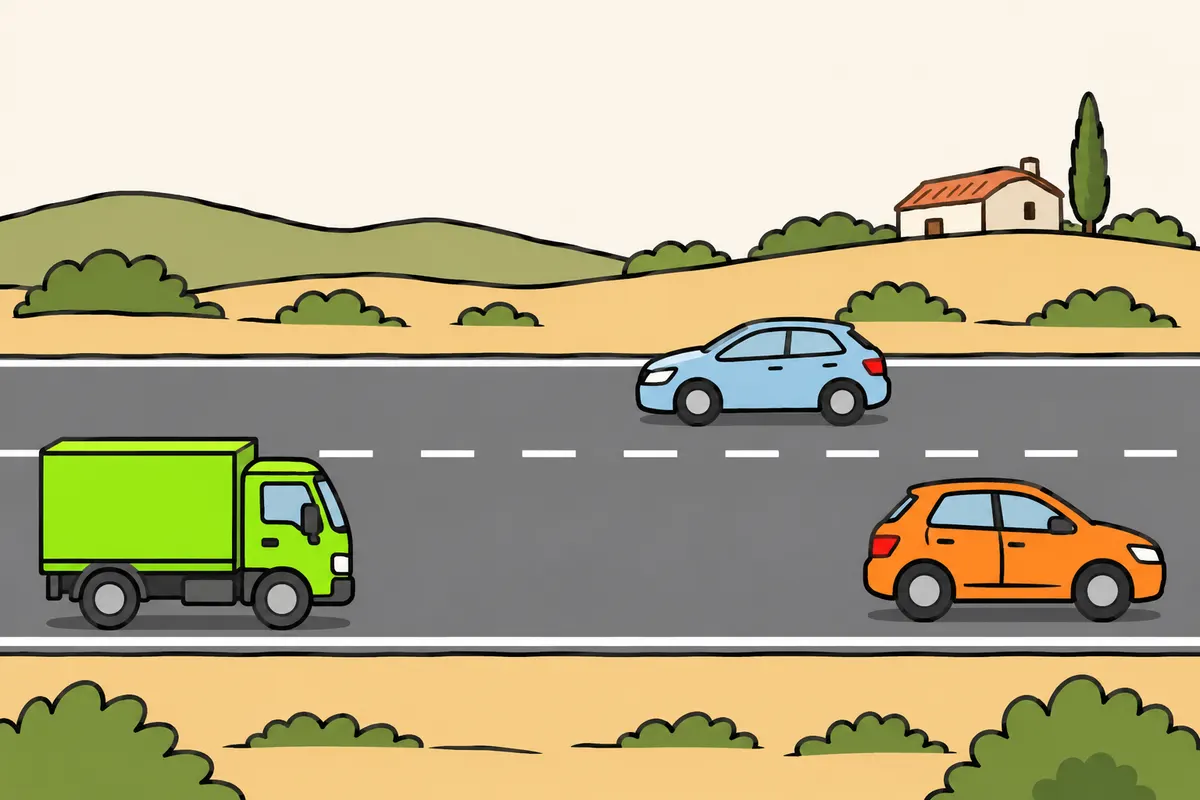
Before overtaking, check your view, clear space and room to return.
Remember
- Check that nobody behind has started to overtake you.
- Give priority to the driver ahead signalling towards the side you want to use.
- Keep enough distance to stop if the vehicle ahead brakes.
- Do not pass an overtaking vehicle if you need to enter the oncoming lane.
- Remember that your lorry can hide pedestrians and signs.
- Do not rely on the overtaken driver braking to let you return.
Exam trap: Wrong: a broken line guarantees safe overtaking. Right: check space and visibility to finish or abandon the manoeuvre.
Read the full explanation
- Before pulling out, check that the lane you choose has enough clear space and that you do not endanger or obstruct oncoming traffic. Assess your speed and that of every road user affected; a broken line does not guarantee that you have enough distance or visibility to complete the manoeuvre. [RGC, art. 84](https://www.boe.es/buscar/act.php?id=BOE-A-2003-23514#a84).
- As you approach the vehicle you want to overtake, keep a gap that allows you to stop if it brakes suddenly; the distance requirements are explained in “Speed and safe following distances”, in the section “Following distance to avoid collisions”. [RGC, art. 54](https://www.boe.es/buscar/act.php?id=BOE-A-2003-23514#a54).
- Give priority to the driver ahead in your lane if they have signalled that they intend to move towards the side you intend to use. If a reasonable time elapses without them exercising that priority, you may start overtaking when it is legal and safe, first warning them with a permitted light or horn signal; there is no fixed waiting time in seconds for this situation. [RGC, art. 84](https://www.boe.es/buscar/act.php?id=BOE-A-2003-23514#a84).
- Check that no driver following you in the same lane has started overtaking your lorry. You must also have enough space to return at the end; do not start on the assumption that the driver you overtake brakes to let you back in. [RGC, art. 84](https://www.boe.es/buscar/act.php?id=BOE-A-2003-23514#a84).
- Do not overtake several vehicles unless you are certain you can return to the right without obstructing or endangering the vehicles you overtake if an oncoming vehicle appears. You must not overtake a vehicle that is already overtaking if this requires you to enter the opposite side of the road. [RGC, art. 84](https://www.boe.es/buscar/act.php?id=BOE-A-2003-23514#a84).
- On a two-way carriageway with three lanes separated by broken lines, you may only use the centre lane to overtake if no oncoming vehicle is using it to overtake. You must keep out of the lane furthest to your left; also check that you have enough space to return to the right-hand lane. [RGC, art. 84](https://www.boe.es/buscar/act.php?id=BOE-A-2003-23514#a84).
- Your lorry's cab, body and load can hide a pedestrian waiting or crossing, prevent them from seeing approaching vehicles and block following drivers' view of the road, a junction or its signs. Before stopping beside a crossing or starting a manoeuvre, also assess what your presence prevents others from seeing: keep their sight lines clear, anticipate someone appearing from behind the lorry and adapt your manoeuvre to the space you can see. [RGCond, annex V.B.2.4.º.g](https://www.boe.es/buscar/act.php?id=BOE-A-2009-9481#anv) and [RGC, art. 3](https://www.boe.es/buscar/act.php?id=BOE-A-2003-23514#a3).
9Overtake, abandon the manoeuvre and return
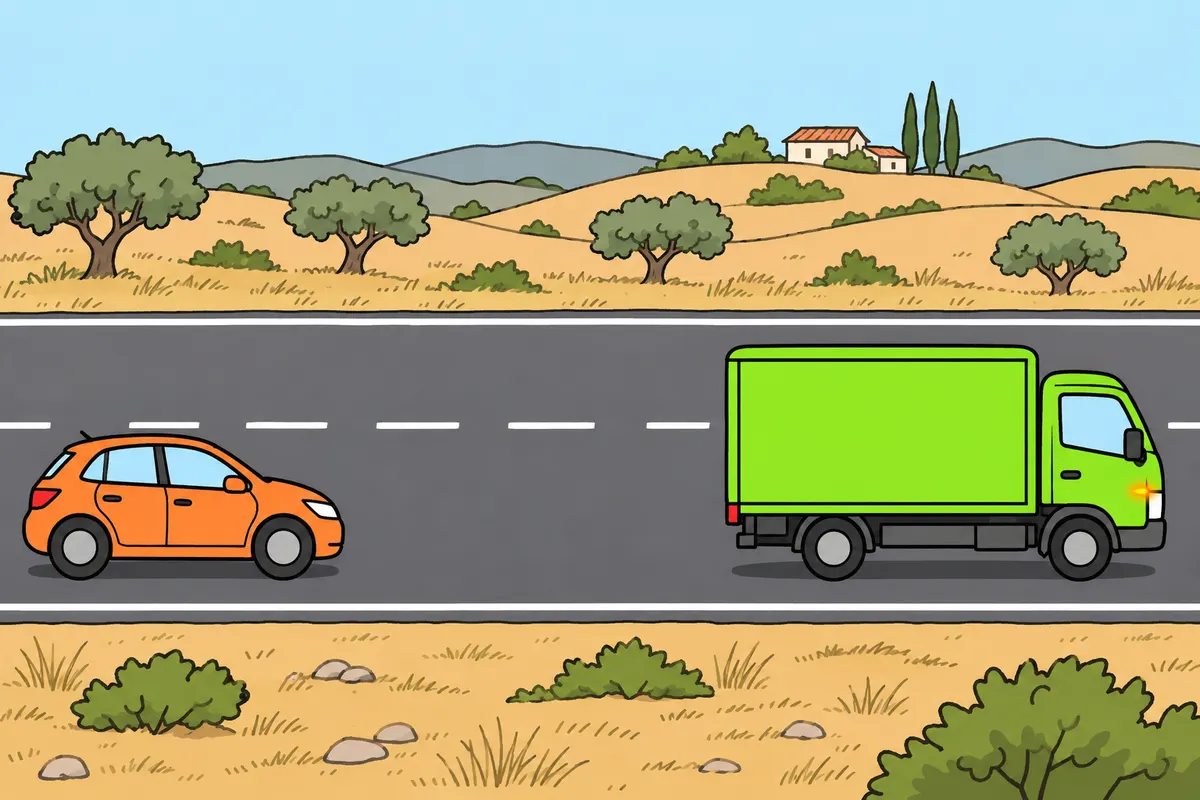
Obey speed limits when overtaking and leave room for your whole lorry to return.
Remember
- Travel noticeably faster than the vehicle you pass.
- Keep enough space at your side.
- If you cannot finish safely, slow down promptly and warn drivers behind.
- Return to your lane without forcing oncoming traffic aside.
- Return gradually, signalling, without forcing others to change course or speed.
Exam trap: Wrong: you may exceed your lorry's limit to overtake. Right: always obey that limit and any lower limit.
Read the full explanation
- To overtake, you must travel at a significantly higher speed than the vehicle you overtake and leave sufficient lateral clearance. In your lorry, you must assess the time needed to move its entire length past the other vehicle; a minimal speed difference can prevent you from completing the manoeuvre within the visible distance. [RGC, art. 85](https://www.boe.es/buscar/act.php?id=BOE-A-2003-23514#a85).
- Throughout the overtaking manoeuvre, you must comply with your lorry's speed limit and any lower applicable limit; the limits for each road type are covered in “Speed and safe following distances”, in the sections “Autopistas (motorways) and autovías (dual carriageways): 90 km/h” and “Conventional roads: 80 km/h”. [RGC, art. 48](https://www.boe.es/buscar/act.php?id=BOE-A-2003-23514#a48).
- If circumstances arise that make it difficult to finish safely, slow down promptly, return to your lane and warn those following you. You must abandon the manoeuvre if the safety margin is insufficient, without forcing oncoming traffic to move aside or trying to solve the problem by accelerating above the limit. [RGC, art. 85](https://www.boe.es/buscar/act.php?id=BOE-A-2003-23514#a85).
- Return as soon as you can, gradually, signalling and without forcing other road users to change course or speed. Leave enough space before moving the rear of your lorry in front of the vehicle you have overtaken, and cancel your signal once you have taken up your new course. [RGC, art. 85](https://www.boe.es/buscar/act.php?id=BOE-A-2003-23514#a85).
10Protect cyclists and other vulnerable road users
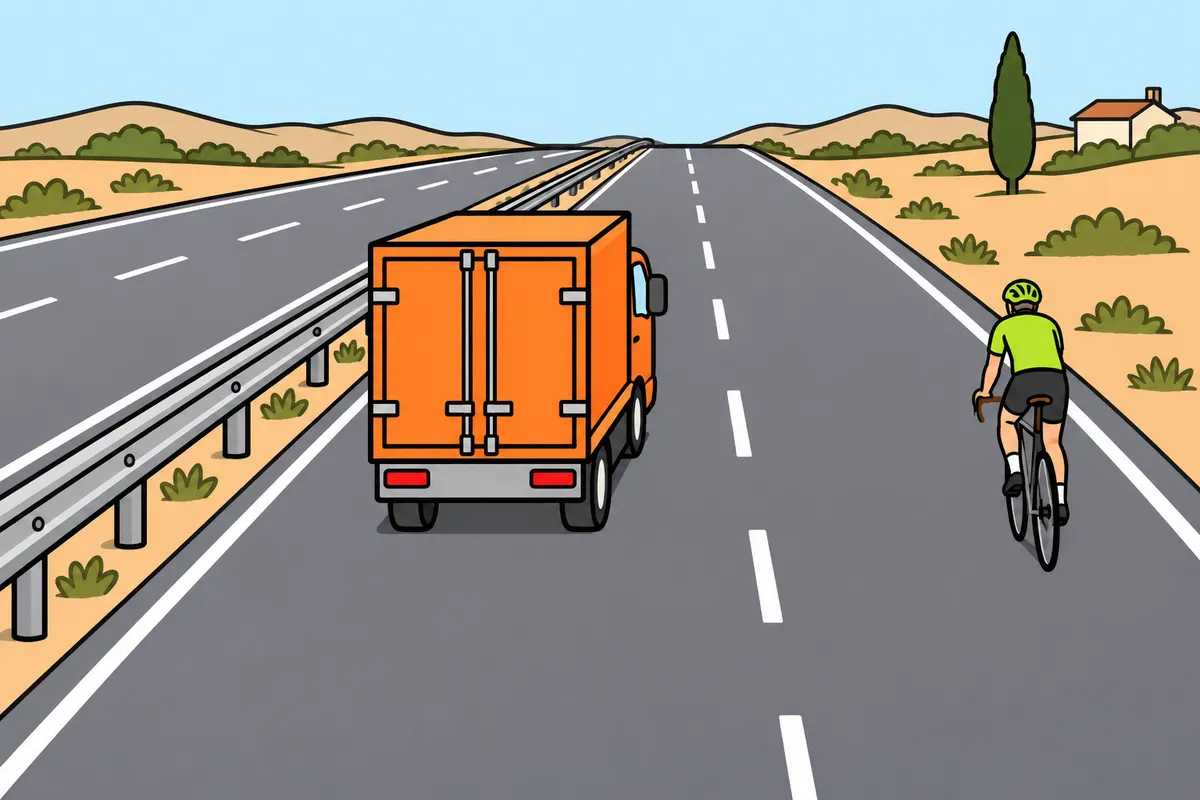
Leave vulnerable road users enough space and slow down when required.
| Road users you pass | Protection required |
|---|---|
| Pedestrians, animals and animal-drawn vehicles | Keep the required space, use of lane and speed reduction |
| Cyclists, mopeds and personal mobility vehicles | Keep the required space, use of lane and speed reduction |
Remember
- Leave at least 1.5 metres, including in built-up areas.
- Use part or all of the adjacent or oncoming lane, as appropriate.
- With several lanes each way, change lanes completely.
- Do not endanger oncoming road users, including those on the hard shoulder.
- Outside built-up areas, travel at least 20 km/h below the road limit.
- Treat a cycling group as one unit; wait if you cannot pass safely.
Exam trap: Wrong: subtract 20 km/h from your actual speed. Right: outside built-up areas, travel at least 20 km/h below the road limit before and during overtaking; obey any lower lorry limit.
Read the full explanation
- When overtaking pedestrians, animals, animal-drawn vehicles, mopeds, personal mobility vehicles, cyclists or groups of cyclists, you must take extra care. Use part or all of the adjacent lane or the oncoming lane, as appropriate, and leave at least 1.5 metres of lateral clearance. [RGC, art. 85](https://www.boe.es/buscar/act.php?id=BOE-A-2003-23514#a85).
- Where the carriageway has more than one lane in each direction, you must change lanes completely to overtake these road users. Check that the lane change is possible and permitted before approaching the road user you intend to overtake. [RGC, art. 85](https://www.boe.es/buscar/act.php?id=BOE-A-2003-23514#a85).
- You must not endanger or obstruct oncoming road users, even if they are on the arcén (hard shoulder). If a cyclist is alongside you on your right and another approaches from the opposite direction, wait until you can maintain the required clearances and protect both cyclists at the same time. [RGC, art. 85](https://www.boe.es/buscar/act.php?id=BOE-A-2003-23514#a85).
- Outside built-up areas, you must also travel at least 20 km/h below the road's speed limit before starting and throughout the overtaking manoeuvre when overtaking these road users. Also comply with any lower limit that applies to your lorry; this reduction is not an amount you subtract from your actual speed without taking the road's speed limit into account. [RGC, art. 85](https://www.boe.es/buscar/act.php?id=BOE-A-2003-23514#a85).
- If cyclists ride in a group, you must treat them as a single moving unit. Allow enough space to get past the group safely and avoid moving between its members in a way that compromises their stability or course; if you cannot complete the manoeuvre with a safety margin, wait. [RGC, art. 85](https://www.boe.es/buscar/act.php?id=BOE-A-2003-23514#a85).
- On urban roads, take extra care when overtaking a cyclist riding ahead of you in the same lane; the following distance is explained in “Speed and safe following distances”, in the section “Following distance to avoid collisions”. [RGC, art. 153.4](https://www.boe.es/buscar/act.php?id=BOE-A-2003-23514#a1-6).
11Places where you cannot overtake
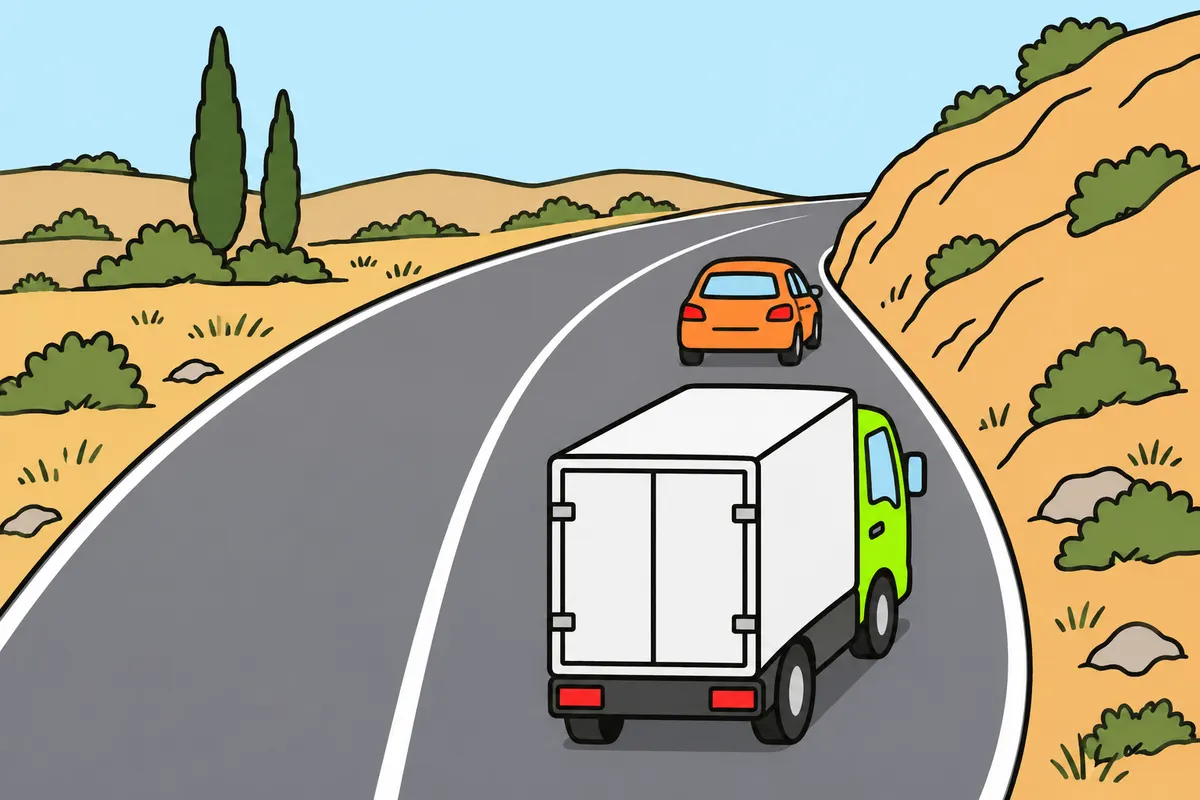
Do not overtake where prohibited or where you cannot see enough to finish safely.
| Place or case | Rule |
|---|---|
| Bend or crest with poor visibility | Prohibited; exception if directions are clearly separated and you do not enter oncoming lane |
| Junctions and nearby areas | Prohibited except roundabouts, a lawful right-side pass, signposted priority or two-wheeled vehicles; all other conditions still apply |
| Tunnel, underpass or signed tunnel section | With one lane in your direction, prohibited; with several, do not enter oncoming lane and obey other bans |
Remember
- Do not continue overtaking behind a vehicle that blocks your view.
- Do not overtake at or near marked pedestrian crossings or level crossings.
- Do not overtake at or near junctions with cycle routes either.
- On motorways and dual carriageways, do not overtake when snow makes driving difficult.
Exam trap: Wrong: you may overtake a motorcycle in a tunnel with one lane your way. Right: overtaking is prohibited there.
Read the full explanation
- You must not overtake on bends or crests with restricted visibility, or anywhere you cannot see far enough to complete or abandon the manoeuvre safely. The exception requires the two directions to be clearly separated and the manoeuvre to be possible without entering the area for oncoming traffic. [RGC, art. 87](https://www.boe.es/buscar/act.php?id=BOE-A-2003-23514#a87).
- You must not continue overtaking behind another vehicle carrying out the same manoeuvre if its size blocks your view of the road ahead. You must check the available space for yourself; the fact that the first lorry has pulled out does not prove that you can do so too. [RGC, art. 87](https://www.boe.es/buscar/act.php?id=BOE-A-2003-23514#a87).
- You must not overtake at or near marked pedestrian crossings, junctions with cycle routes or level crossings. [RGC, art. 87.1](https://www.boe.es/buscar/act.php?id=BOE-A-2003-23514#a87).
- You must not overtake at or near junctions, except at roundabouts; when you must overtake on the right under article 82.2; if your carriageway has explicitly signed priority at the junction; or if you are overtaking two-wheeled vehicles. Each exception retains all the other requirements on safety, which side to use and signalling. [RGC, art. 87](https://www.boe.es/buscar/act.php?id=BOE-A-2003-23514#a87).
- In tunnels, underpasses and stretches covered by the tunnel sign, you must not overtake if there is only one lane in your direction, even when overtaking a motorcycle. If you have several lanes in your direction, you must check the other prohibitions and carry out the manoeuvre without entering the opposite direction. [RGC, art. 87](https://www.boe.es/buscar/act.php?id=BOE-A-2003-23514#a87).
- On autopistas and autovías, you must not overtake when snow on the carriageway makes driving difficult. You must use the rightmost lane, although you may use the adjacent lane if there are three or more lanes in each direction, and leave the remaining lanes on the left clear for emergencies and snowploughs. [RGC, art. 32](https://www.boe.es/buscar/act.php?id=BOE-A-2003-23514#a32).
12Signposted restrictions for lorries
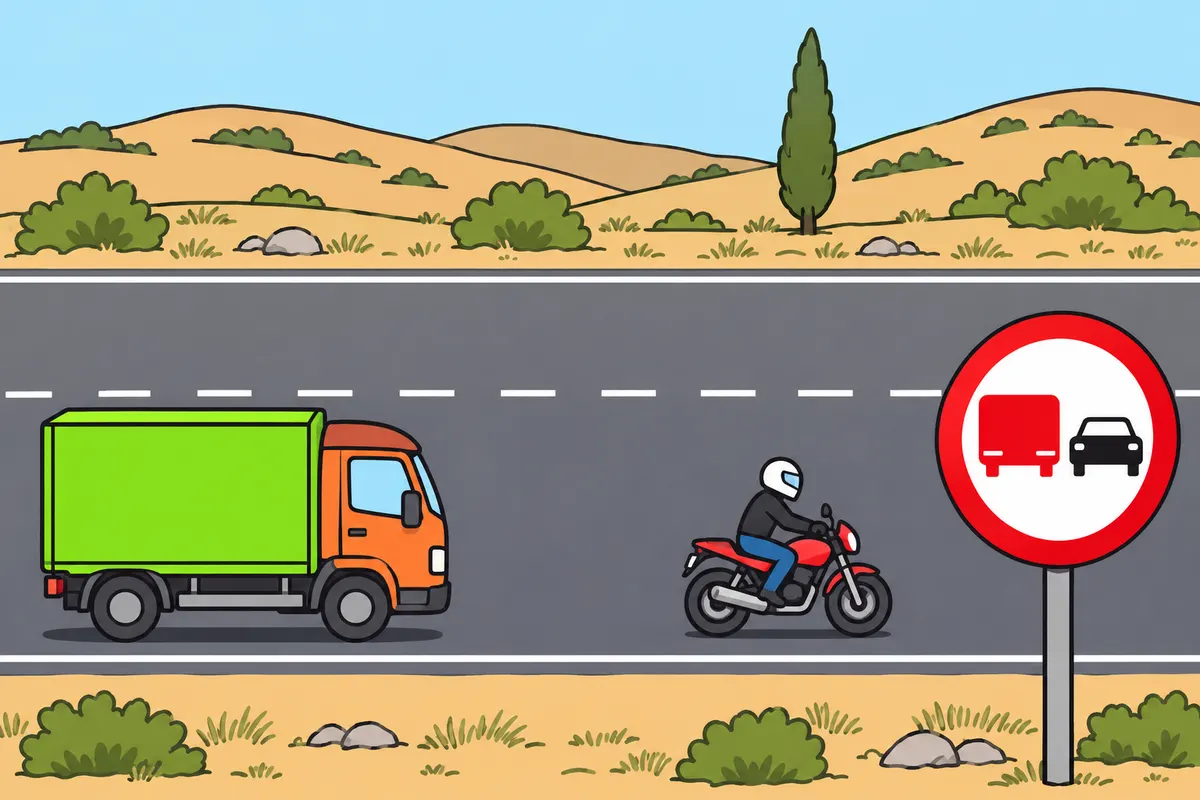
Obey signs and check which restrictions apply to your lorry and trailer.
| Sign or restriction | How it affects your lorry |
|---|---|
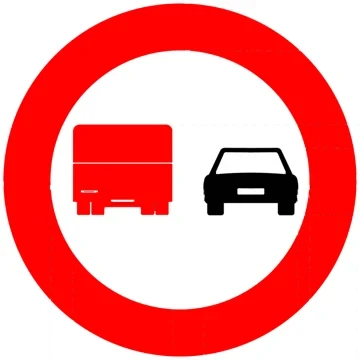
| R-306 | Over 3,500 kg MMA: do not overtake motor vehicles on the carriageway |
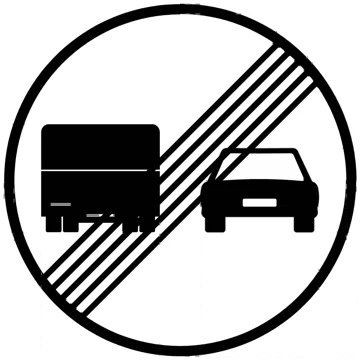
| R-503 | End of the lorry overtaking ban |
| DGT calendar for 2026 | Vehicles or combinations over 7,500 kg; check exemptions |
| DGT mass-based overtaking ban | Over 7,500 kg on signed sections, days and times |
| Dangerous goods requiring orange plates, even at or below 7,500 kg | Follow dangerous-goods restrictions and applicable exemptions |
| Dangerous goods with orange plates and vehicle or combination over 7,500 kg | Also follow general goods restrictions and applicable exemptions |
Remember
- R-306 also bans you from overtaking motorcycles.
- Obey it even if you stay out of the oncoming lane.
- At a return arrow, do not start overtaking.
- If already overtaking, finish safely as soon as possible.
- Check restrictions and exemptions for your route.
- With a trailer, also check the maximum mass of the combination.
Exam trap: Wrong: R-503 allows every overtake. Right: it ends that ban, but you must obey other restrictions.
Read the full explanation
- Sign R-306, No overtaking by lorries, prohibits you from overtaking motor vehicles travelling on the carriageway, including motorcycles, if your lorry has an MMA (maximum authorised mass) over 3,500 kg. You must also obey it if you can overtake entirely within your side of the road without entering the opposite direction. [RD 465/2025, sign catalogue](https://www.boe.es/buscar/doc.php?id=BOE-A-2025-12199).
- Sign R-503 indicates the end of the overtaking prohibition for lorries. When you reach it, you must still check visibility, markings, lanes and other prohibitions; the end of a specific restriction does not make every overtaking manoeuvre safe. [RD 465/2025, sign catalogue](https://www.boe.es/buscar/doc.php?id=BOE-A-2025-12199).
- The return arrow warns you of a continuous line ahead which prohibits driving to its left. You must refrain from starting to overtake or, if you have already started, finish as soon as you safely can; do not interpret it as an invitation to accelerate to reach the continuous line. Other markings and how to identify them are covered in “Signs and their hierarchy for C1”. [RD 465/2025, road marking catalogue](https://www.boe.es/buscar/doc.php?id=BOE-A-2025-12199).
- Before choosing your route, check the traffic restrictions by date, time, road section and direction, and their exemptions, published by the DGT or the competent regional authority. They may affect lorries with an MMA over 3,500 kg for road safety or traffic flow reasons. [RGC, art. 39](https://www.boe.es/buscar/act.php?id=BOE-A-2003-23514#a39).
- On roads monitored by the DGT, the general goods transport restriction calendar for 2026 applies to vehicles or combinations exceeding 7,500 kg in MMA or maximum combination mass. The DGT may also prohibit overtaking by vehicles over 7,500 kg on certain sections, days and at certain times, using fixed or variable signs. Your C1 vehicle without a trailer, up to 7,500 kg, is outside both restrictions because of this mass threshold; with a trailer, you must check the maximum combination mass for the calendar. If you carry dangerous goods requiring orange plates, the restrictions in annex V (1.º and 2.º A) apply even if you do not exceed 7,500 kg; if the vehicle or combination exceeds that threshold, those in annex II also apply, with the applicable exemptions. You remain subject to restrictions imposed by signs, vehicle characteristics, special authorisation or special vehicle status where applicable; ADR routes are explained in “Dangerous goods: ADR basics”, in the section “Routes and traffic restrictions”. [DGT Resolution of 14 January 2026, as currently amended, B.1, B.2.1, B.2.3 and D.3.1 and annexes II, III and V](https://www.boe.es/buscar/act.php?id=BOE-A-2026-1255).
 R-306
 R-503
13Passing immobilised vehicles and obstacles
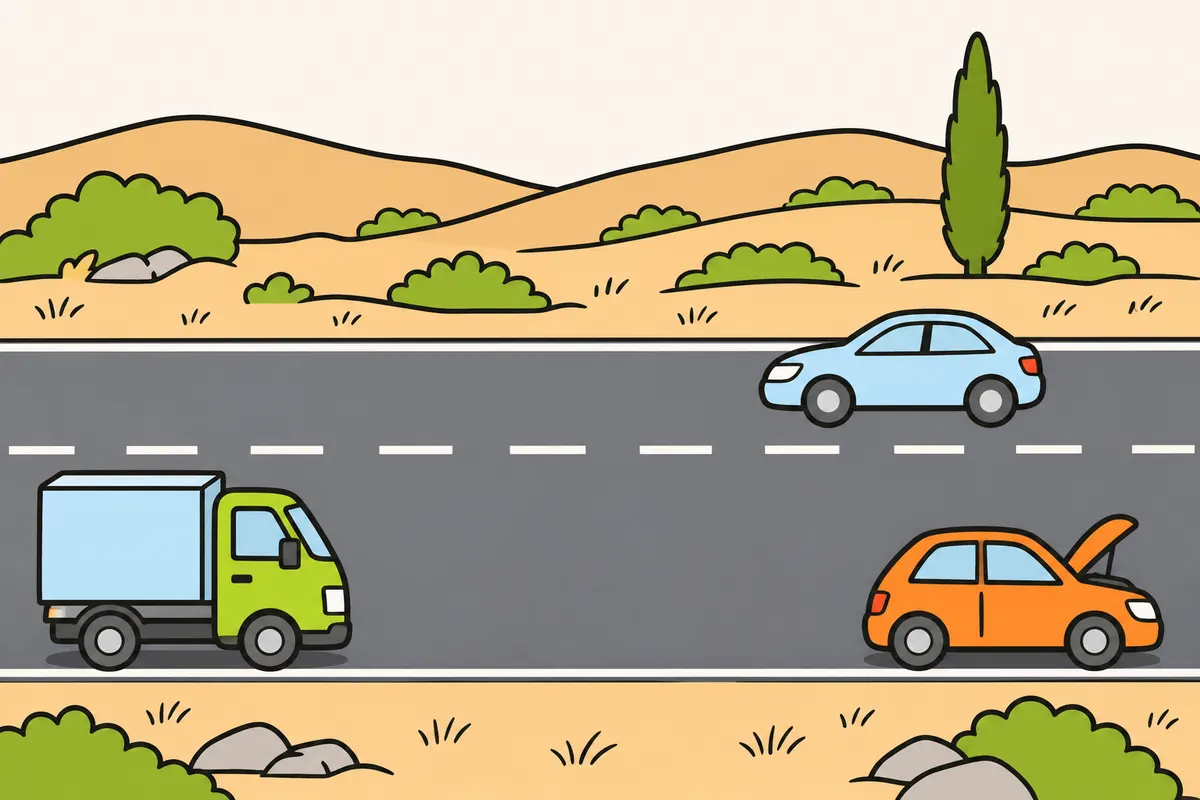
Pass immobilised vehicles and obstacles only when you can do so safely.
| Case | What you may do safely |
|---|---|
| Immobilised vehicle occupies your lane, not stopped by traffic | Pass it even where overtaking is banned, including by using the oncoming lane |
| Cycles, mopeds, personal mobility vehicles, pedestrians, animals, animal-drawn vehicles and special agricultural vehicles with their combinations | Exceptionally pass, even across a solid line, if their speed makes it safe |
| Obstacle requiring you to enter the oncoming lane | Pass only after checking there is no danger |
Remember
- For breakdowns, accidents or emergency, assistance, installation, infrastructure maintenance or traffic control services:
- When these vehicles occupy your lane, leave at least 1.5 m.
- Slow down by at least 20 km/h below the road limit.
- Also obey any lower limit that applies.
- If you need the oncoming lane, wait until you can use it safely.
Exam trap: Wrong: you may bypass a queue using the oncoming lane. Right: the exception excludes vehicles stopped because of traffic.
Read the full explanation
- If you encounter a vehicle immobilised by a breakdown or accident, or for emergency, assistance, installation and infrastructure maintenance or traffic control services, occupying all or part of your lane, you must leave at least 1.5 metres of lateral clearance when passing it. You must also reduce your speed to at least 20 km/h below the road’s speed limit. [RGC, art. 88.1](https://www.boe.es/buscar/act.php?id=BOE-A-2003-23514#a88).
- To maintain this clearance, you may need to use the lane for oncoming traffic, but you must wait if you cannot do so safely. Maintain the safety clearance throughout the manoeuvre and comply with any lower limit that applies. [RGC, art. 88.1-2](https://www.boe.es/buscar/act.php?id=BOE-A-2003-23514#a88).
- On a stretch where overtaking is prohibited, you may pass an immobilised vehicle occupying your lane, even using the lane for oncoming traffic, after checking that it is safe. This exception does not apply if the vehicle is stopped because of traffic conditions: you cannot use the opposite lane to jump a queue or get past traffic waiting at a traffic light. [RGC, art. 88.2](https://www.boe.es/buscar/act.php?id=BOE-A-2003-23514#a88).
- On a stretch where overtaking is prohibited, and after checking that you can do so safely, you may overtake bicycles and other cycles, mopeds, personal mobility vehicles, pedestrians, animals, animal-drawn vehicles, and special agricultural vehicles and their combinations when their speed allows you to do so without risk. This exception allows you to cross a continuous line when necessary and safe to pass them; it does not authorise you to overtake any slow vehicle or dispense with sufficient visibility. [RGC, art. 88.2](https://www.boe.es/buscar/act.php?id=BOE-A-2003-23514#a88).
- If an obstacle forces you to use the lane for oncoming traffic, you may pass it after checking that there is no danger, including in the exceptional circumstances set out in article 88. Take the same care when the obstacle is on a stretch where overtaking is permitted; permission to overtake on the road does not replace observation. [RGC, art. 89](https://www.boe.es/buscar/act.php?id=BOE-A-2003-23514#a89).
14Your duties when you are being overtaken
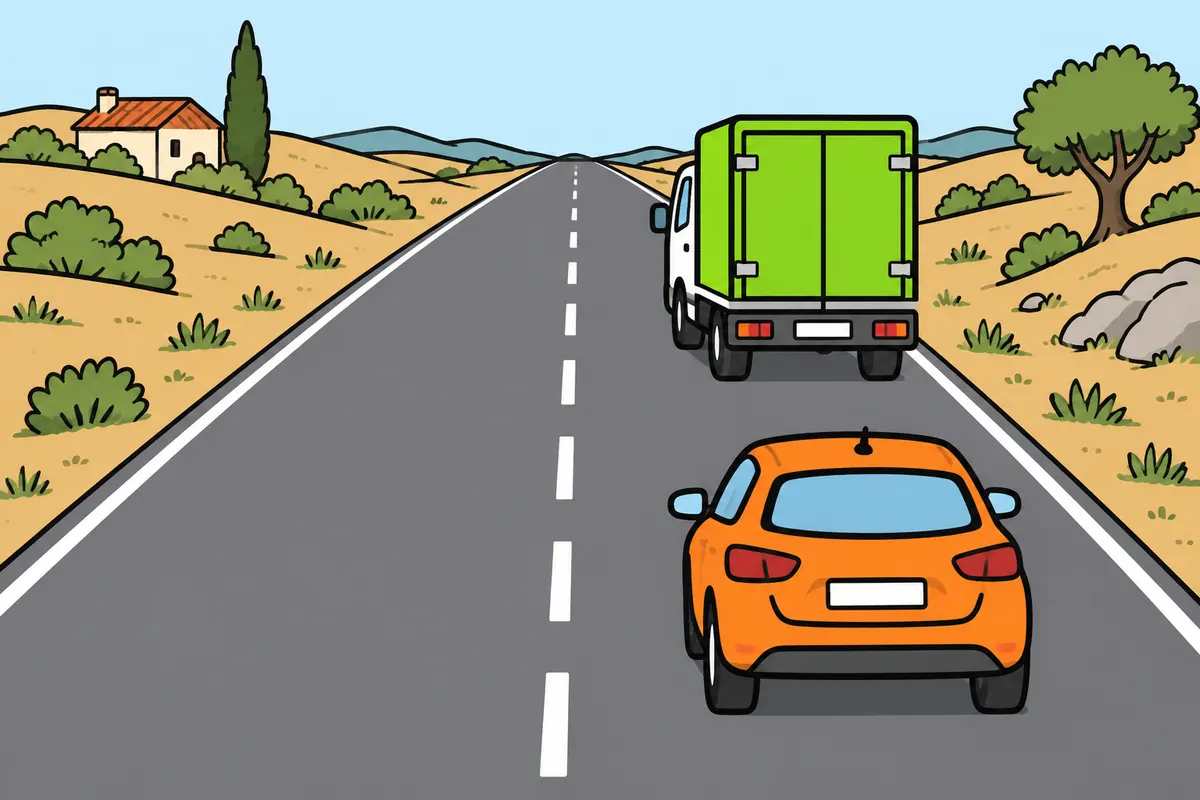
When others overtake you, help them pass without accelerating or creating danger.
Remember
- Move close to the right edge, including in built-up areas.
- If you signalled a lawful left turn or stop, move towards that side.
- Do not speed up or obstruct the overtake.
- Slow down if danger appears while you are being overtaken.
- If passing you safely is difficult, slow down or use a usable hard shoulder.
- If you cannot move fully aside, signal only when it is safe to pass.
Exam trap: Wrong: you must always brake when someone overtakes you. Right: help according to the risk; if they abandon the pass, do not slow down when that would endanger traffic.
Read the full explanation
- When you notice that another driver intends to overtake you, you must keep close to the right-hand edge of the carriageway, including in built-up areas. If you have signalled a left turn or a stop on the left in the circumstances allowed by the regulations, you must keep close to that side without interfering with oncoming traffic. [RGC, art. 86](https://www.boe.es/buscar/act.php?id=BOE-A-2003-23514#a86).
- You must not accelerate or carry out manoeuvres that prevent or hinder overtaking. You do not always have to brake simply because you are being overtaken, but you must slow down if, once the manoeuvre has begun, a situation arises that endangers any road user. [RGC, art. 86](https://www.boe.es/buscar/act.php?id=BOE-A-2003-23514#a86).
- If the overtaking driver clearly shows that they are abandoning the manoeuvre by slowing down, you are not required to slow down yourself if doing so endangers traffic. You must help them return to their lane, judging whether they are trying to return ahead of or behind your lorry. [RGC, art. 86](https://www.boe.es/buscar/act.php?id=BOE-A-2003-23514#a86).
- As the driver of a heavy vehicle, you must slow down or move onto the arcén (hard shoulder) as soon as possible, if it is usable, when oncoming traffic, insufficient width, the road profile or the condition of the carriageway prevents others from overtaking you easily and safely. Giving way in this manner is an exceptional use of the hard shoulder; you normally drive on the carriageway. [RGC, art. 86.3](https://www.boe.es/buscar/act.php?id=BOE-A-2003-23514#a86).
- As the driver of a heavy lorry covered by article 86.3, if you cannot keep fully to the right but others can overtake you safely, you must indicate this to the approaching driver. Extend your arm horizontally and move it repeatedly from back to front with the back of your hand facing backwards, or use your right indicator if you do not consider an arm signal appropriate; this signal does not replace the overtaking driver’s checks. [RGC, art. 86.1 and 3](https://www.boe.es/buscar/act.php?id=BOE-A-2003-23514#a86).
- When you are not signalling an intention to overtake, leave enough space for the driver behind to overtake you safely; the lorry’s minimum gap of 50 metres and its exceptions are covered in “Speed and safe following distances”, in the sections “The lorry’s 50-metre gap” and “Exceptions to the additional gap”. [RGC, art. 54](https://www.boe.es/buscar/act.php?id=BOE-A-2003-23514#a54).
15Turning right or left
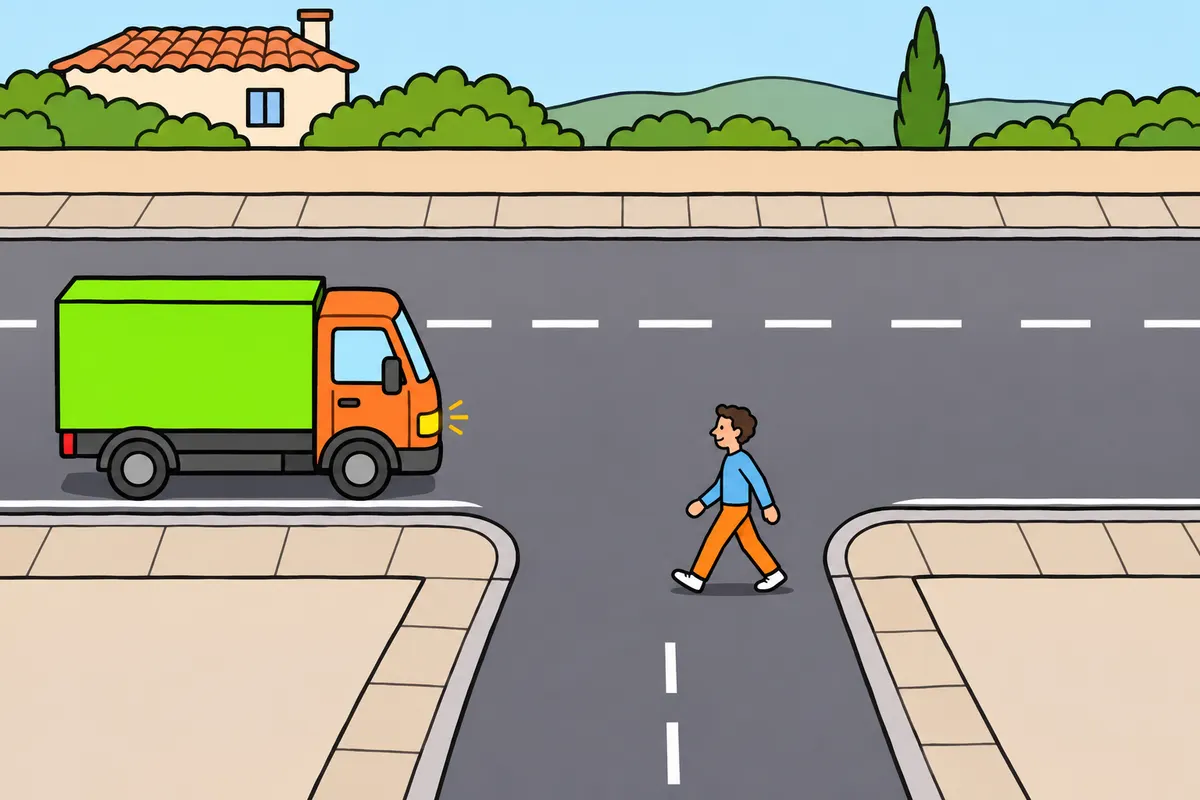
Before turning, signal, position yourself correctly and give way to people crossing.
| Turn, unless signs show otherwise | Where to position |
|---|---|
| Right | Close to the right edge |
| Left on a one-way road | Close to the left edge |
| Left on a two-way road | Near the division between directions, without entering the oncoming lane |
| Left on a two-way road with three lanes divided by broken lines | Use the middle lane |
Remember
- Check the speed and distance of oncoming traffic.
- Do not turn left without enough visibility.
- Keep the junction centre on your left, unless another route is indicated.
- When entering another road, give way to pedestrians and animals crossing it.
- Also respect nearby cyclists' priority when turning.
Exam trap: Wrong: you only give way to pedestrians at crossings. Right: when turning into another road, give way to pedestrians crossing it even without a crossing.
Read the full explanation
- When changing direction, you turn to use another road, enter another carriageway or leave the one you are on. Before doing so, you must signal and check that the speed and distance of oncoming traffic allow you to turn safely; if you intend to turn left and do not have sufficient visibility, you must not turn. [RGC, art. 74](https://www.boe.es/buscar/act.php?id=BOE-A-2003-23514#a74).
- Unless the road layout or signs indicate otherwise, you must move as close as possible to the right-hand edge to turn right. To turn left on a one-way carriageway, you must move close to the left-hand edge, taking up this position in good time. [RGC, art. 75](https://www.boe.es/buscar/act.php?id=BOE-A-2003-23514#a75).
- To turn left on a two-way carriageway, position yourself next to the line separating the two directions, or the centre of the carriageway if there is no marking, without entering the oncoming side before making the turn. If a two-way carriageway has three lanes separated by broken lines, you must position yourself in the centre lane. [RGC, art. 75](https://www.boe.es/buscar/act.php?id=BOE-A-2003-23514#a75).
- When turning left, keep the centre of the junction on your left, unless the layout or signs direct you along a different route. Complete the manoeuvre using the least space and time consistent with safety, without cutting across the path of traffic on the road you are entering. [RGC, art. 75](https://www.boe.es/buscar/act.php?id=BOE-A-2003-23514#a75).
- When turning into another road, you must give way to pedestrians or animals crossing it, even if there is no crossing. You must also respect cyclists’ priority when a cyclist is near you as you turn right or left; do not block their path with the side of your lorry. [RGC, arts. 64-66](https://www.boe.es/buscar/act.php?id=BOE-A-2003-23514#a64).
16Lorry dimensions, roundabouts and exits
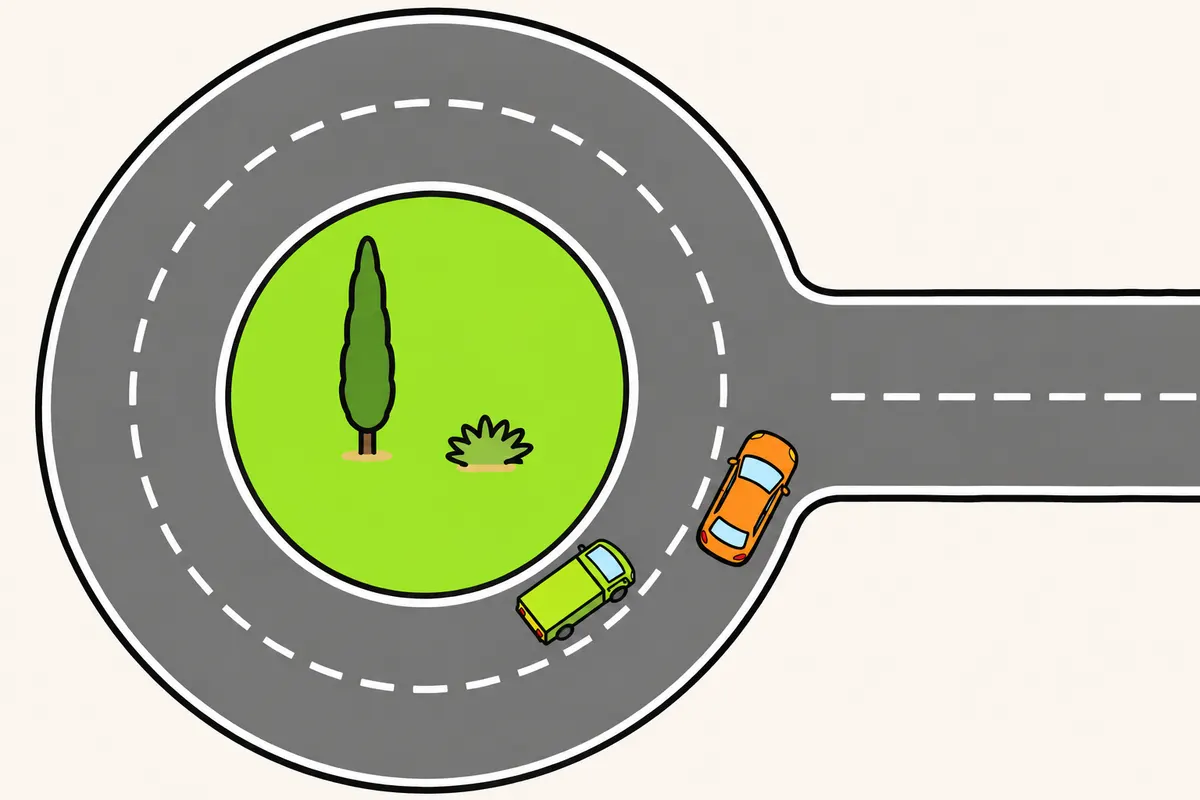
Plan turns and exits allowing enough space for your whole lorry.
Remember
- Check that your whole path fits without endangering anyone.
- Watch the inside of your lorry and its rear during the turn.
- At roundabouts, give way to anyone in the lane you want to enter.
- If you cannot exit without cutting across someone, continue until you can.
- Move towards the lane nearest your exit in good time.
- Enter the deceleration lane as soon as possible, if there is one.
Exam trap: Wrong: your lorry's size gives you priority to swing out. Right: change the normal position only for a justified need, taking precautions to avoid all danger.
Read the full explanation
- If your lorry’s dimensions or other justified circumstances prevent you from strictly following the normal positioning rules for a turn, you must take the precautions needed to avoid all danger. This exception requires a real need; it does not give you priority over nearby vehicles or allow you to swing out without looking. [RGC, art. 76](https://www.boe.es/buscar/act.php?id=BOE-A-2003-23514#a76).
- Before a tight turn, check that your lorry’s entire swept path fits within the available space and that no road users are in the area you are about to occupy. As practical guidance, watch the inside flank and the rear during the manoeuvre; the detailed technique for managing the swept path of the axles is covered in “Lorry driving techniques”. [RGC, art. 76](https://www.boe.es/buscar/act.php?id=BOE-A-2003-23514#a76).
- On a roundabout, you must respect the priority of traffic in the lane you intend to enter. Prepare for your exit by positioning yourself safely in good time; if you cannot move into the exit lane without cutting off another vehicle, continue until you find a safe opportunity. [RGC, art. 74](https://www.boe.es/buscar/act.php?id=BOE-A-2003-23514#a74).
- To leave an autopista (motorway), autovía (dual carriageway) or another road, use the lane nearest the exit in good time and enter the deceleration lane as soon as possible, if there is one. Signal any necessary lane changes and adapt the manoeuvre to the space available and your lorry’s handling. [RGC, art. 77](https://www.boe.es/buscar/act.php?id=BOE-A-2003-23514#a77).
17Choosing where to make a U-turn
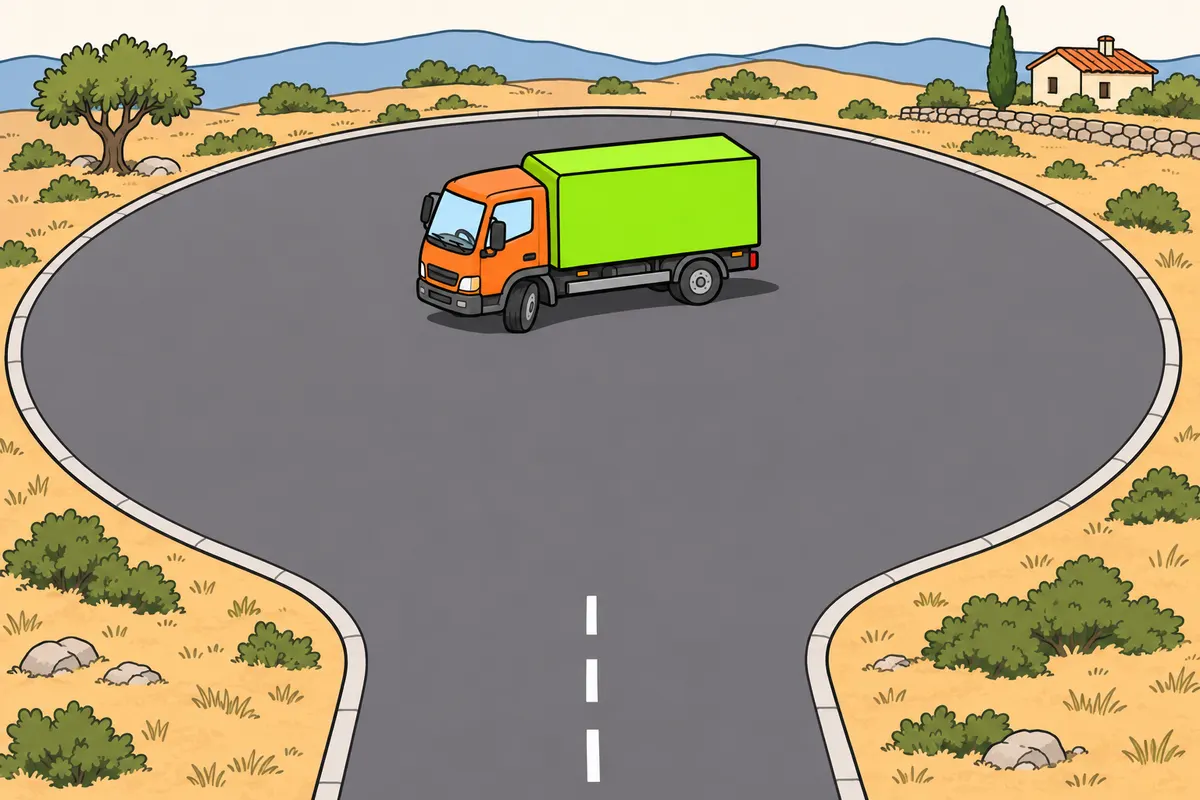
Make a U-turn only where permitted, without endangering or obstructing others.
| Place | What to do |
|---|---|
| Level crossing, tunnel, underpass or signed tunnel section | Do not make a U-turn |
| Motorway or dual carriageway | Use only places provided and their route |
| Place where safety cannot be checked | Do not make a U-turn |
| One-way road | Do not end up travelling against the set direction |
Remember
- Signal in good time and check that your whole lorry fits.
- Occupy the road for the shortest time compatible with safety.
- Do not reverse to complete a U-turn on a road outside built-up areas.
- If waiting blocks drivers behind, pull off to the right if possible.
Exam trap: Wrong: you may make a U-turn where overtaking is banned. Right: you need express permission to make the U-turn and safe conditions.
Read the full explanation
- Making a U-turn means turning round to continue along the same road in the opposite direction. You must choose a suitable place, signal in good time and make sure you do not endanger or obstruct other road users; otherwise, wait for a suitable opportunity. [RGC, art. 78](https://www.boe.es/buscar/act.php?id=BOE-A-2003-23514#a78).
- You must block the road for the shortest time consistent with safety. First check the space your entire light lorry needs to complete the U-turn; a width sufficient for a car may not allow you to complete your manoeuvre. Do not reverse as part of a U-turn on an interurban road: choose a place where you can make it legally. [RGC, art. 78](https://www.boe.es/buscar/act.php?id=BOE-A-2003-23514#a78) and [art. 80](https://www.boe.es/buscar/act.php?id=BOE-A-2003-23514#a80).
- If waiting on the carriageway prevents traffic behind you from continuing, you must pull off to the right, if possible, until you can make the turn. [RGC, art. 78](https://www.boe.es/buscar/act.php?id=BOE-A-2003-23514#a78).
- You must not make a U-turn where you cannot check that conditions are safe, at level crossings, in tunnels or underpasses, or on stretches signed as tunnels. On autopistas and autovías, you may only turn round at designated places, following the route provided. [RGC, art. 79](https://www.boe.es/buscar/act.php?id=BOE-A-2003-23514#a79).
- U-turns are also prohibited where overtaking is prohibited, unless U-turns are expressly authorised. Specific authorisation does not remove your duty to check that it is safe; on a one-way road, you must not end up driving against the designated direction either. [RGC, art. 79](https://www.boe.es/buscar/act.php?id=BOE-A-2003-23514#a79).
18When you may reverse
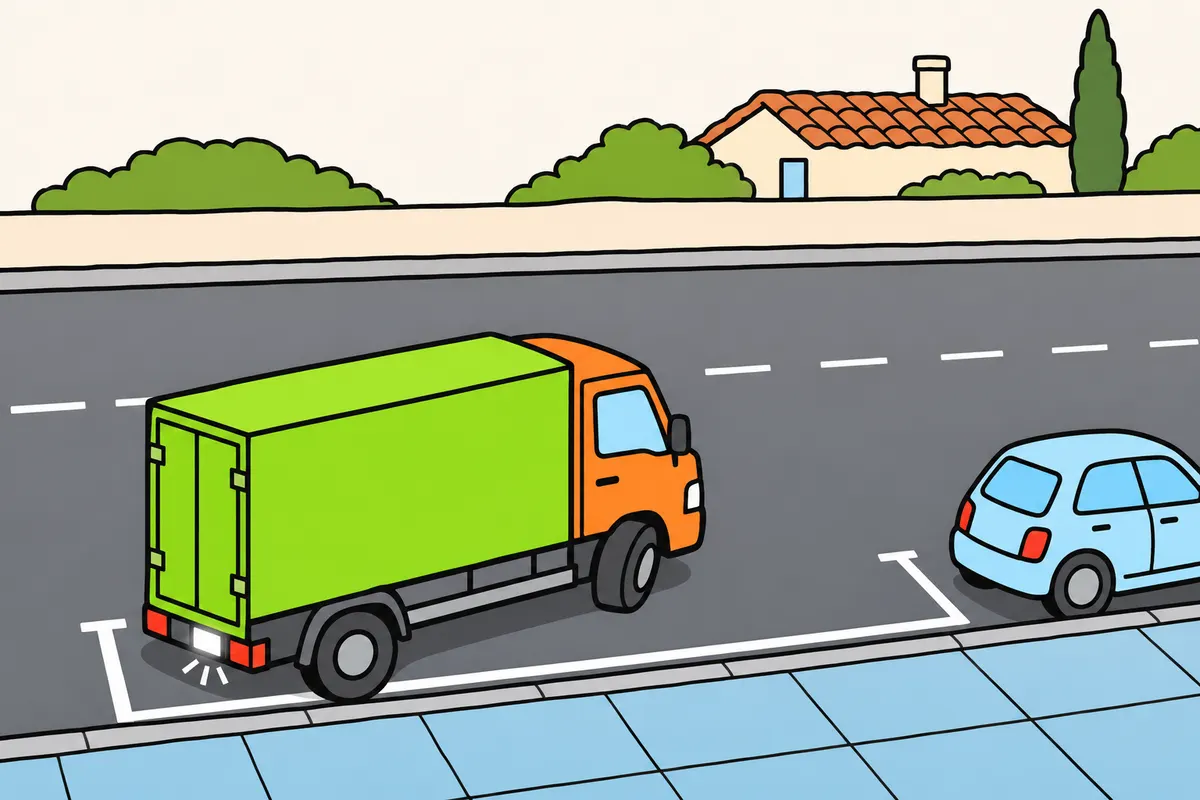
Reverse only in permitted cases and only as far as necessary.
| Reason for reversing | Limit |
|---|---|
| Cannot move forward or change direction or turn around | Only as far as strictly necessary |
| Completing a stop, parking or joining manoeuvre | Only as far as necessary, up to 15 metres, without entering a junction |
| Motorway or dual carriageway | Prohibited |
Remember
- You may reverse if you cannot move forwards, change direction or turn around.
- You may also reverse to complete another manoeuvre that requires it.
- To complete stopping, parking or joining: maximum 15 metres, without entering junctions.
- Never reverse on motorways or dual carriageways.
Exam trap: Wrong: the 15-metre limit always allows reversing. Right: that maximum applies to completing stopping, parking or joining, without entering junctions.
Read the full explanation
- As a general rule, you must not drive backwards. You may do so if you cannot move forwards, turn or make a U-turn, or as part of another manoeuvre that requires it, always covering only the minimum distance necessary. [RGC, art. 80](https://www.boe.es/buscar/act.php?id=BOE-A-2003-23514#a80).
- When reversing forms part of stopping, parking or joining traffic, the maximum distance is 15 metres and you must keep clear of road junctions. [RGC, art. 80.2](https://www.boe.es/buscar/act.php?id=BOE-A-2003-23514#a80).
- Reversing is prohibited on autopistas and autovías. You must not reverse to reach an exit, retrieve an object or correct a mistake when joining; you must find a permitted alternative route. [RGC, art. 80](https://www.boe.es/buscar/act.php?id=BOE-A-2003-23514#a80).
19Reverse safely
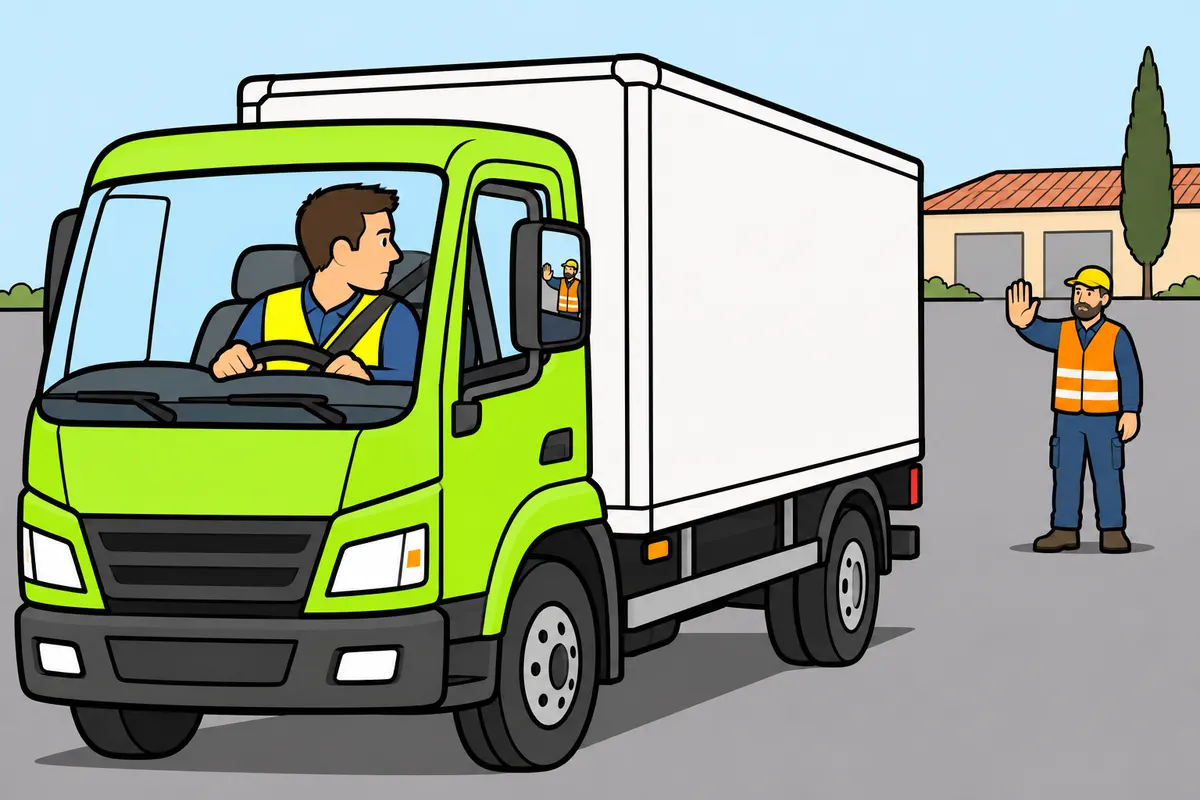
Before and during reversing, check around you and stop if danger appears.
Remember
- Check visibility, space and time before reversing.
- Check outside or ask for help if you cannot see the area.
- Signal and reverse slowly, taking great care.
- Watch behind and the space the sides will occupy.
- Stop promptly if warned or if people, animals or vehicles come close.
- If you lose sight of your guide and cannot check it is safe, stop.
Exam trap: Wrong: your guide takes over your responsibility. Right: you must check that their directions allow you to move safely.
Read the full explanation
- Before reversing, you must check that you have the visibility, space and time needed to avoid danger. You may need to get out of the lorry or follow another person’s directions; a camera or your memory of seeing the area clear does not replace an effective check. [RGC, art. 81](https://www.boe.es/buscar/act.php?id=BOE-A-2003-23514#a81).
- Give warning of the manoeuvre and carry it out slowly, with the utmost care. Check your immediate surroundings and the areas that the sides will sweep through as you steer, as well as the space behind you; do not assume that a pedestrian will hear the engine and move out of the way. [RGC, art. 81](https://www.boe.es/buscar/act.php?id=BOE-A-2003-23514#a81).
- You must stop as quickly as possible if you hear warnings, notice a person, animal or another vehicle nearby, or safety requires it. Abandon the manoeuvre if necessary; if you lose sight of the person guiding you and cannot check that reversing remains safe, stop and check again. [RGC, art. 81](https://www.boe.es/buscar/act.php?id=BOE-A-2003-23514#a81).
- Having someone help you does not remove your responsibility to carry out the manoeuvre safely. Before following their directions, you must be able to understand them and check that the proposed movement is safe; if in doubt, bring the lorry to a standstill and check your surroundings. [RGC, art. 81](https://www.boe.es/buscar/act.php?id=BOE-A-2003-23514#a81).
20Distinguish between enforced stops, brief stops and parking
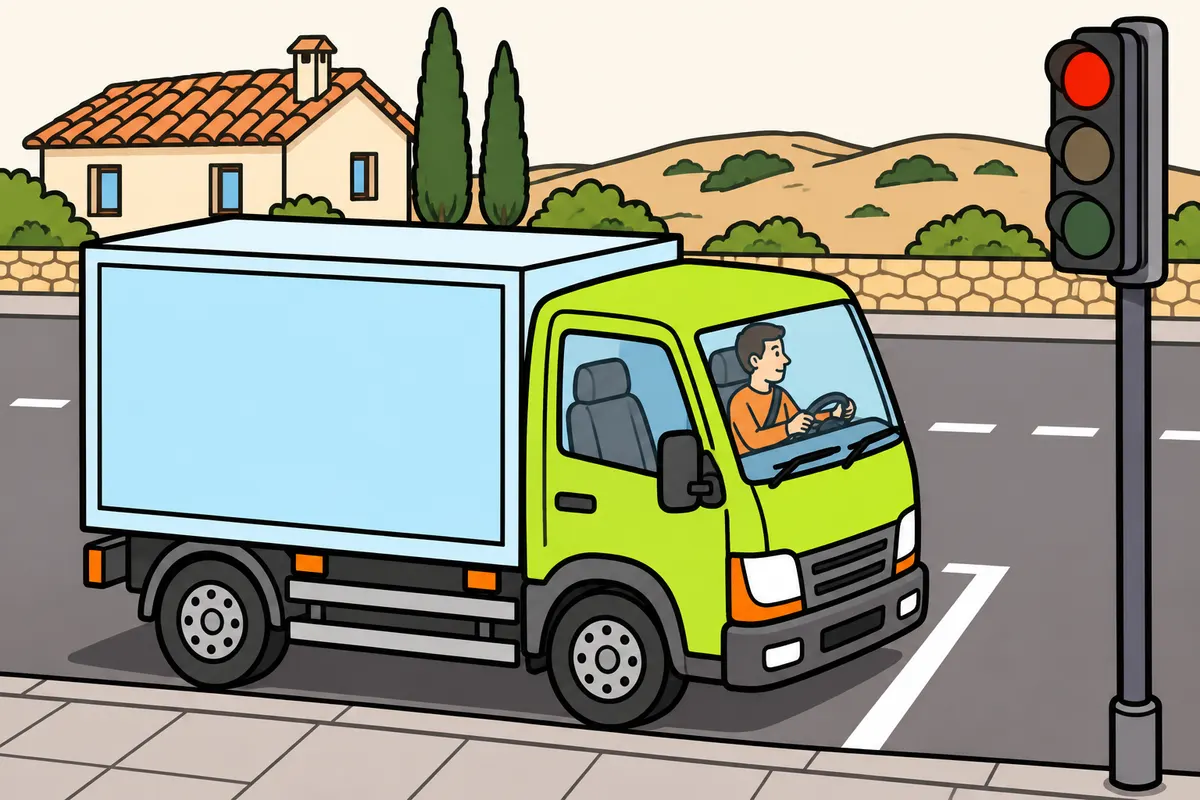
Know why you stop, how long you stay and whether you leave the vehicle.
| Type | How to distinguish it |
|---|---|
| Enforced stop | You stop because of an emergency, traffic or a legal requirement |
| Brief stop | Voluntary, less than two minutes, without leaving the vehicle |
| Parking | Your stop is neither an enforced stop nor a brief stop |
Remember
- A voluntary brief stop requires less than two minutes and staying in your vehicle.
- You can be parked while remaining at the wheel.
- At lights or in queues, an enforced stop remains so despite several minutes.
- Always check that the place is permitted and you cause no danger.
Exam trap: Wrong: staying inside makes every stop a brief stop. Right: a voluntary brief stop must also last less than two minutes.
Read the full explanation
- An enforced stop is when you bring your vehicle to a standstill because of an emergency, traffic conditions or a legal requirement. Waiting at a red traffic light, in a traffic jam or in response to an order to stop does not become parking because it lasts several minutes. [Traffic Act, Annex I](https://www.boe.es/buscar/act.php?id=BOE-A-2015-11722#ani). Moving off when the traffic light turns green is a continuation of normal driving; if you also change lanes, you must comply with the rules for that manoeuvre.
- For a voluntary stop to count as a brief stop, it must last less than two minutes and you must not leave the vehicle. You must meet both conditions: if you leave to deliver a parcel, the fact that the delivery is quick is not enough for it to count as a brief stop. [Traffic Act, Annex I](https://www.boe.es/buscar/act.php?id=BOE-A-2015-11722#ani).
- Parking means bringing your vehicle to a standstill in circumstances that are neither an enforced stop nor a brief stop. You can be parked while remaining at the wheel; exactly two minutes does not meet the time requirement for a brief stop either, as it must last less than that. [Traffic Act, Annex I](https://www.boe.es/buscar/act.php?id=BOE-A-2015-11722#ani).
- The classification alone does not determine whether you are allowed to use the location. You must check signs, the available space and that you cause no danger or obstruction: neither a quick delivery nor your hazard warning lights authorise you to stop the lorry in a prohibited place. [RGC, art. 91](https://www.boe.es/buscar/act.php?id=BOE-A-2003-23514#a91).
21Position your vehicle when stopping or parking
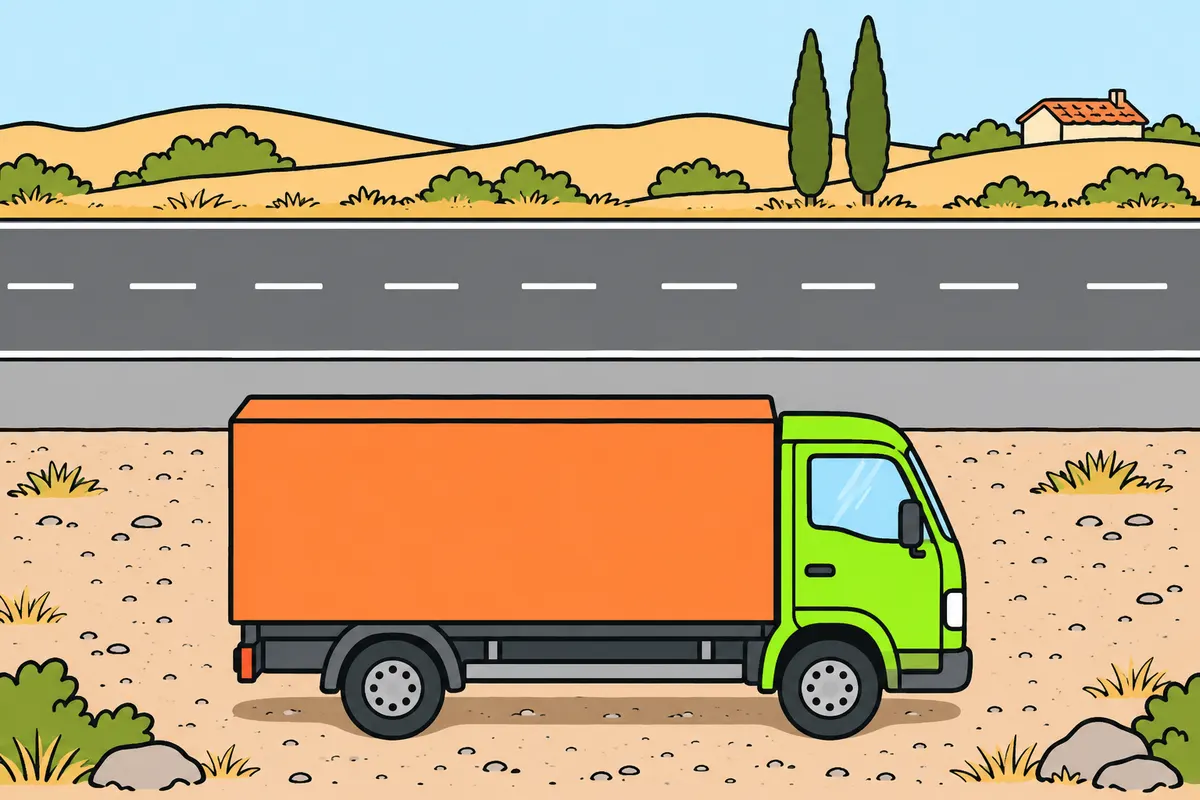
When stopping or parking, position your whole vehicle correctly and get out safely.
| Place or vehicle | How to position it |
|---|---|
| Road outside a built-up area | Off the carriageway, on the right, leaving the usable hard shoulder clear |
| Road in a built-up area | By the right edge; on a one-way road, the left edge is also allowed |
| Motor caravan or living vehicle | No parts outside its outline or waste; supported only on tyres, with safety chocks allowed |
Remember
- Park parallel to the edge, unless another arrangement is appropriate.
- Use the space well without blocking spaces or entrances.
- Open doors only when your lorry is completely still.
- Check that you do not harm anyone, especially cyclists.
- Normally, enter and leave on the side nearest the edge.
Exam trap: Wrong: outside built-up areas, moving the cab aside is enough. Right: keep the whole vehicle off the carriageway and the usable hard shoulder clear.
Read the full explanation
- On an interurban road, you must stop or park off the carriageway, on the right, leaving the usable part of the arcén (hard shoulder) clear. Moving the cab out of the way is not enough if the load body still occupies that area; a voluntary stop requires you to position the vehicle as the rules prescribe. [RGC, art. 90](https://www.boe.es/buscar/act.php?id=BOE-A-2003-23514#a90).
- On urban roads, if you need to position your vehicle on the carriageway or hard shoulder, keep as close as possible to the right-hand edge. On one-way roads, you may also use the left-hand side; you must comply with the signs and municipal rules applicable to that location and to your lorry. [RGC, art. 90](https://www.boe.es/buscar/act.php?id=BOE-A-2003-23514#a90).
- The general rule is to position your vehicle parallel to the edge of the carriageway, allowing the best use of the remaining space. You may use another arrangement when the road’s characteristics or other circumstances make it advisable; if parking bays are marked out, check that the lorry fits without making other spaces or access points unusable. [RGC, art. 92](https://www.boe.es/buscar/act.php?id=BOE-A-2003-23514#a92).
- Only open the doors and get out once the vehicle has come to a complete standstill, checking that you cause no danger or obstruction, particularly to cyclists. As a general rule, you must enter and leave on the side nearest the edge of the road; in an emergency, the specific safe exit procedure applies. [RGC, art. 114](https://www.boe.es/buscar/act.php?id=BOE-A-2003-23514#a114).
- If you drive a motorhome or another vehicle equipped as living accommodation, you must park without extending any fittings beyond its outline as seen from above, with the vehicle supported only by its tyres — you may use safety chocks or wedges — and without discharging liquids from the living area. [RGC, art. 92.4](https://www.boe.es/buscar/act.php?id=BOE-A-2003-23514#a92). This rule also applies to motorhomes over 3,500 kg and up to 7,500 kg MMA (maximum authorised mass) covered by C1. [RGCond, art. 4](https://www.boe.es/buscar/act.php?id=BOE-A-2009-9481#a4).
22Avoid danger and obstruction
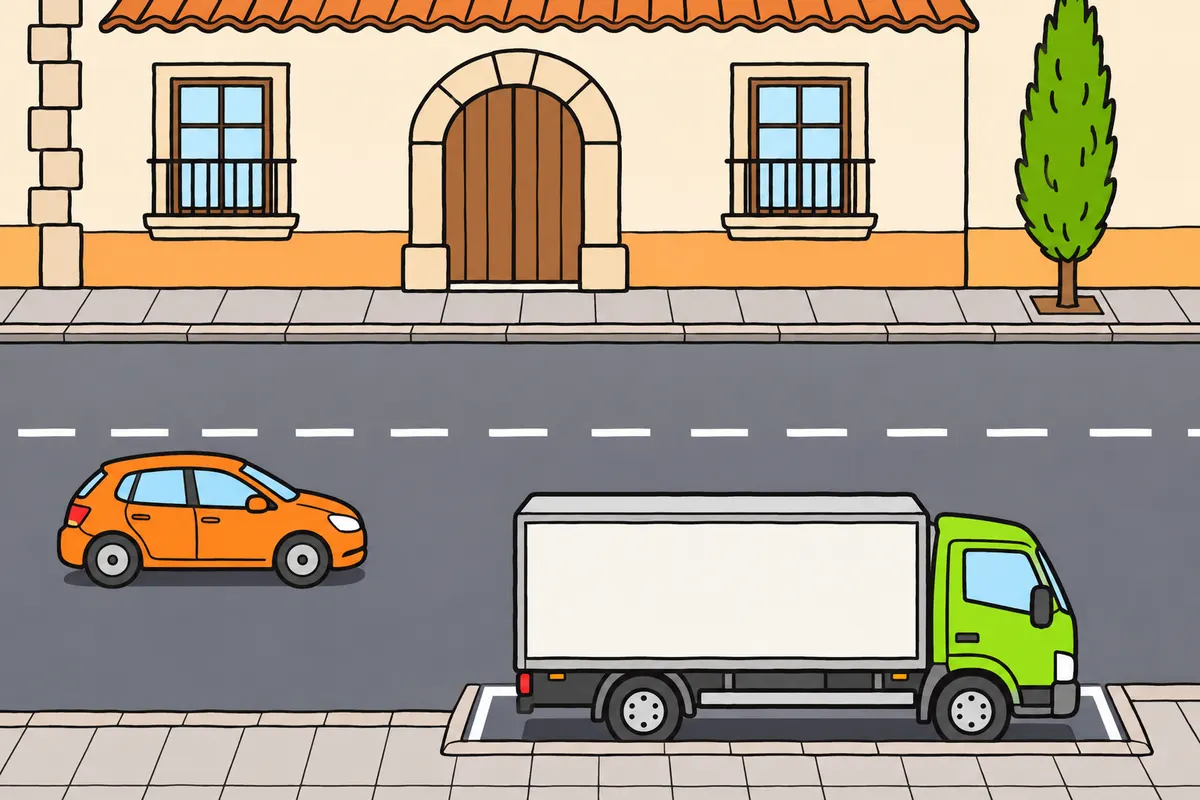
Do not stop or park where you create danger or block passage or access.
| Situation | What to remember |
|---|---|
| Less than 3 metres to opposite edge or a line you cannot cross | Dangerous or seriously obstructive |
| Loading bay during its operating hours | Parking is especially obstructive |
| Marked and bounded public transport stops; emergency or security reserves | Parking is especially obstructive |
| Double parking without a driver, or in the middle of the road | Parking is especially obstructive |
Remember
- Do not block vehicles correctly stopped or parked.
- Keep access clear for people, animals and signed vehicle entrances.
- Keep dropped kerbs and permitted turns clear.
- Do not stop on traffic islands or dividers.
- Check which signs your lorry hides.
Exam trap: Wrong: leaving 3 metres always permits parking. Right: parking remains prohibited if you prevent actual passage or create danger.
Read the full explanation
- You cause danger or serious obstruction if you leave less than 3 metres between your lorry and the opposite edge or a longitudinal marking that you must not cross. You also do so if you prevent other vehicles from actually getting through, even when the gap reaches that figure; do not treat 3 metres as permission in every situation. [RGC, art. 91](https://www.boe.es/buscar/act.php?id=BOE-A-2003-23514#a91).
- You must not prevent a correctly stopped or parked vehicle from rejoining traffic. You must also not block normal access to or exit from a property for people or animals, or for vehicles using a correctly signed vado (vehicle access across the pavement); check the manoeuvring space you leave, not just the gap directly in front. [RGC, art. 91](https://www.boe.es/buscar/act.php?id=BOE-A-2003-23514#a91).
- You must keep dropped-kerb crossings for people with disabilities and permitted turns usable. Do not position your lorry on central reservations, traffic separators, islands or other features that channel traffic, even if they look like an empty area beside the carriageway. [RGC, art. 91](https://www.boe.es/buscar/act.php?id=BOE-A-2003-23514#a91).
- You also cause particularly serious obstruction if you park in reserved loading and unloading areas during their operating hours, at signed and marked public transport stops, in spaces reserved for emergency or security services, in specifically signed prohibited spaces on a road designated for priority attention, or in the middle of the carriageway. Double parking with no driver present is expressly included among these cases. [RGC, art. 91](https://www.boe.es/buscar/act.php?id=BOE-A-2003-23514#a91).
- You must assess any other danger or serious obstruction to pedestrians, vehicles or animals, even if the situation is not described with a specific distance. Your lorry’s width and length make it particularly important to check which signs you obscure and which paths you block. [RGC, art. 91](https://www.boe.es/buscar/act.php?id=BOE-A-2003-23514#a91).
23Prohibited places and reserved parking
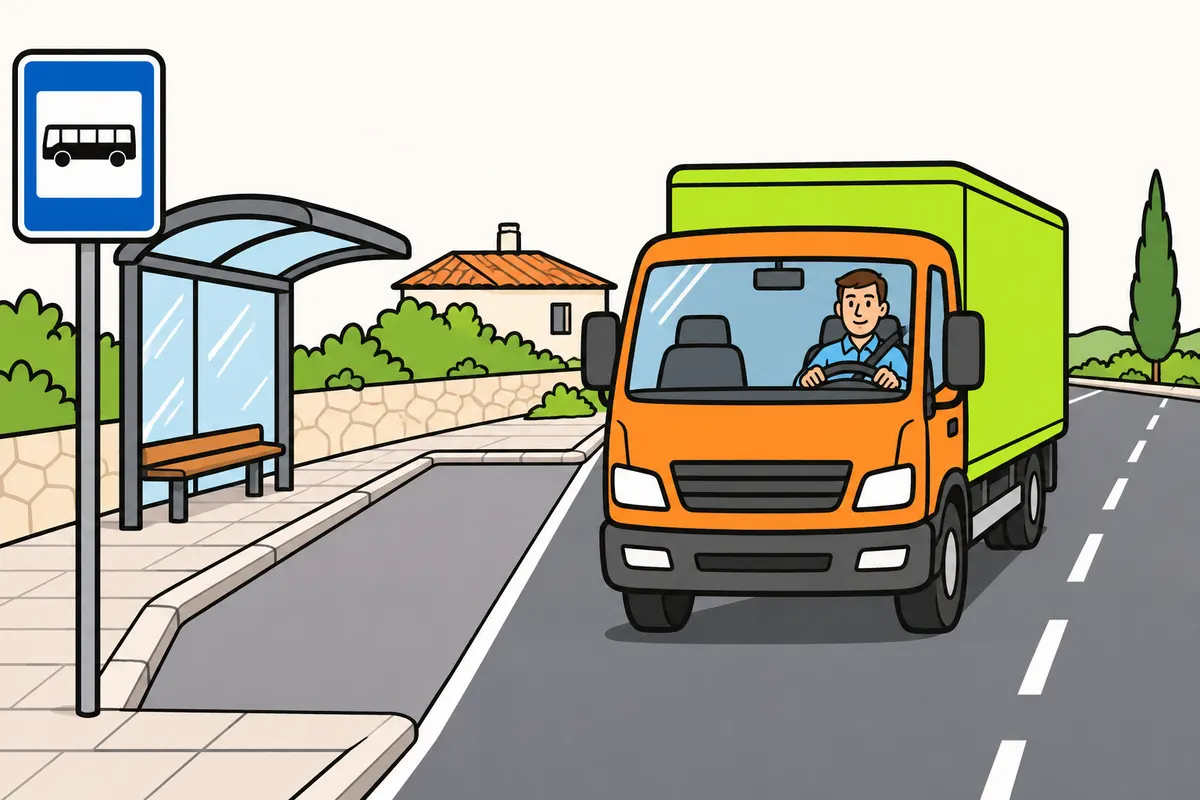
Check prohibitions and reserved spaces before stopping or parking.
| Case | Rule |
|---|---|
| Brief stop prohibited | Parking is also prohibited |
| Double parking, signed vehicle entrance, pavement or pedestrian area | Parking is prohibited |
| Reserved disabled space | You need permission to park |
| R-308c | No parking on that side from 9 a.m. on day 1 until 9 a.m. on day 16 |
| R-308c coverage, unless otherwise indicated | From the sign to the next junction in your direction |
Remember
- Do not stop at junctions or nearby, nor around poorly visible bends or crests.
- Keep tunnels, underpasses and pedestrian, cycle and railway crossings clear.
- On motorways and dual carriageways, stop voluntarily only in designated areas.
- Do not use bus or taxi reserves for deliveries.
- Follow loading bay conditions and limited-parking rules.
Exam trap: Wrong: R-308c also bans every brief stop. Right: it bans parking; a brief stop must still follow all other rules.
Read the full explanation
- You must not stop or park on or near bends and crests with restricted visibility, in tunnels, underpasses or stretches covered by a tunnel sign, at level crossings, or on pedestrian or cycle crossings. You must also not stop or park at or near junctions; you must particularly avoid obstructing turns and, outside built-up areas, creating danger through lack of visibility. [Traffic Act, art. 40](https://www.boe.es/buscar/act.php?id=BOE-A-2015-11722#a40) and [RGC, art. 94](https://www.boe.es/buscar/act.php?id=BOE-A-2003-23514#a94).
- You must not stop in lanes or areas reserved exclusively for particular users or services, or in areas reserved for stopping and parking by urban public transport. Do not use a bus stop or taxi rank to deliver goods with your lorry. [RGC, art. 94](https://www.boe.es/buscar/act.php?id=BOE-A-2003-23514#a94).
- You must not stop on tram rails or so close that you obstruct trams, or where you obscure signs or force others to manoeuvre. [RGC, art. 94](https://www.boe.es/buscar/act.php?id=BOE-A-2003-23514#a94).
- On autopistas (motorways) and autovías (dual carriageways), you may only make a voluntary stop or park in designated areas. [RGC, art. 94](https://www.boe.es/buscar/act.php?id=BOE-A-2003-23514#a94).
- Where stopping is prohibited, parking is also prohibited. In addition, you must not double park, park in front of correctly signed vehicle accesses, on pavements or pedestrian areas, in spaces reserved for people with disabilities without authorisation, or in breach of the authorisation and time requirements for time-limited parking. [RGC, art. 94](https://www.boe.es/buscar/act.php?id=BOE-A-2003-23514#a94).
- Sign R-308c prohibits parking on the side where it stands from 9 o’clock on day 1 until 9 o’clock on day 16. Unless otherwise indicated, the prohibition starts at the sign and extends to the nearest junction in your direction of travel; on its own, it does not prohibit a brief stop that complies with the other rules. [RD 465/2025, sign catalogue](https://www.boe.es/buscar/doc.php?id=BOE-A-2025-12199).
- A loading and unloading area is not a general lorry park: you must respect its reserved purpose and conditions of use. A parking prohibition does not necessarily prohibit a genuine brief stop, but the stop must still be legal and safe; loading and unloading procedures are covered in “Load securing and safety”. [RGC, art. 94](https://www.boe.es/buscar/act.php?id=BOE-A-2003-23514#a94).
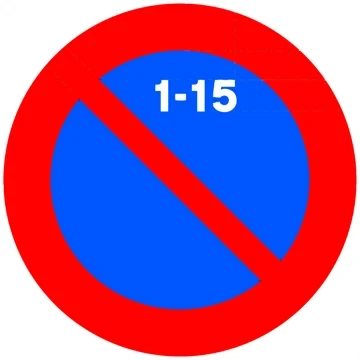 R-308c
24Secure your lorry on a slope
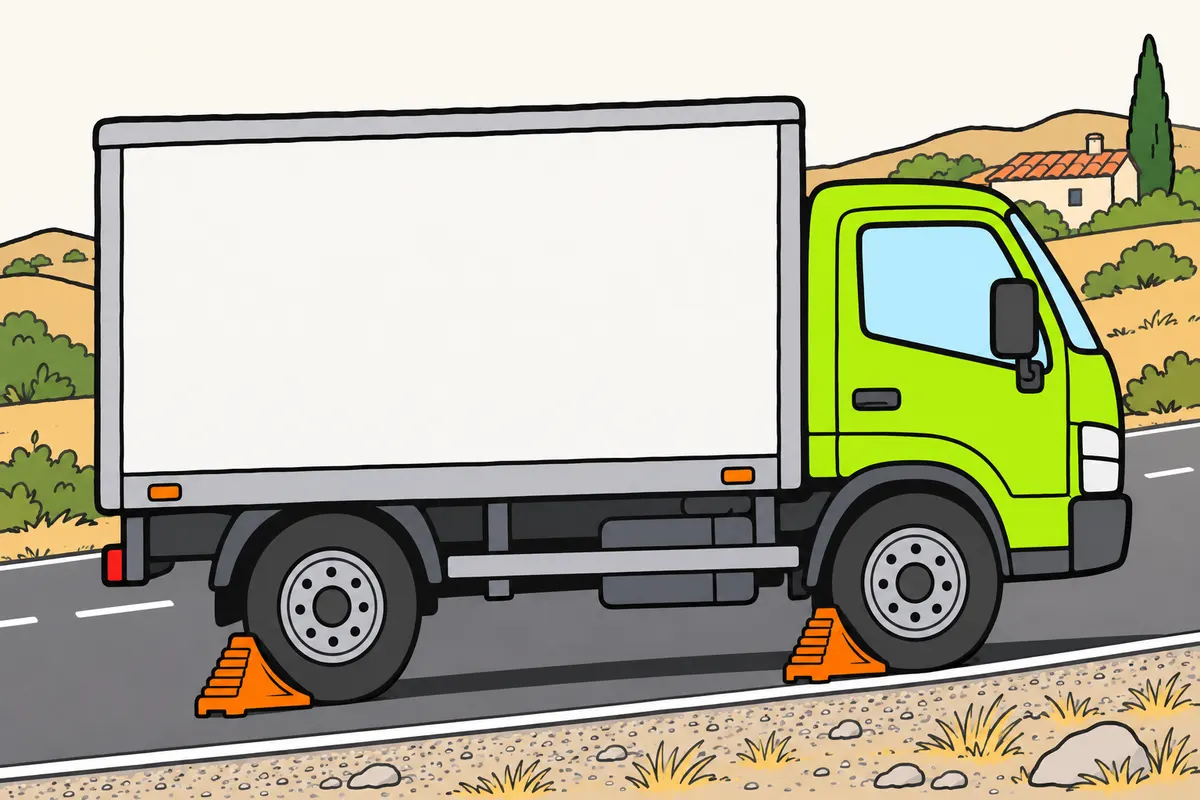
On slopes, secure your lorry with the brake, suitable gear and extra support when required.
| Slope | Your lorry over 3,500 kg MMA: manual gear and wheels when using kerb support |
|---|---|
| Uphill | First gear; wheels towards road centre |
| Downhill | Reverse gear; wheels outwards |
| Parking position available | Use it when suitable |
Remember
- When leaving your seat, stop the engine, switch off ignition and apply the brake.
- Prevent unauthorised use if you move away.
- On a noticeable slope, add chocks or support a steered wheel against a kerb.
- If you cannot use the kerb, use suitable chocks.
- Never use stones or branches as chocks.
- Remove chocks from the road before moving off.
Exam trap: Wrong: chocks alone are enough on a noticeable slope. Right: for your lorry over 3,500 kg MMA, add chocks or proper kerb support to the brake and suitable gear or parking position.
Read the full explanation
- If you need to leave the driving seat, stop the engine, switch off the ignition and apply the parking brake; if you walk away, take precautions to prevent unauthorised use. [RGC, art. 92.3](https://www.boe.es/buscar/act.php?id=BOE-A-2003-23514#a92).
- With a manual gearbox, leave first gear engaged when facing uphill and reverse when facing downhill, or select the parking position if appropriate for the type of gearbox. [RGC, art. 92.3](https://www.boe.es/buscar/act.php?id=BOE-A-2003-23514#a92).
- On a significant slope, because your lorry exceeds 3,500 kg MMA, you must also secure it with chocks specifically designed for that purpose or by resting a steered wheel against the kerb: turn the wheels towards the centre of the carriageway uphill and outwards downhill. If you cannot use the kerb, use suitable chocks. [RGC, art. 92.3](https://www.boe.es/buscar/act.php?id=BOE-A-2003-23514#a92).
- You must not use stones, branches or other objects not specifically designed for the purpose as chocks. Remove the chocks from the road when you move off; the rule does not specify a percentage for the term “significant slope”. [RGC, art. 92.3.d](https://www.boe.es/buscar/act.php?id=BOE-A-2003-23514#a92).
25Immobilisation due to a breakdown or emergency
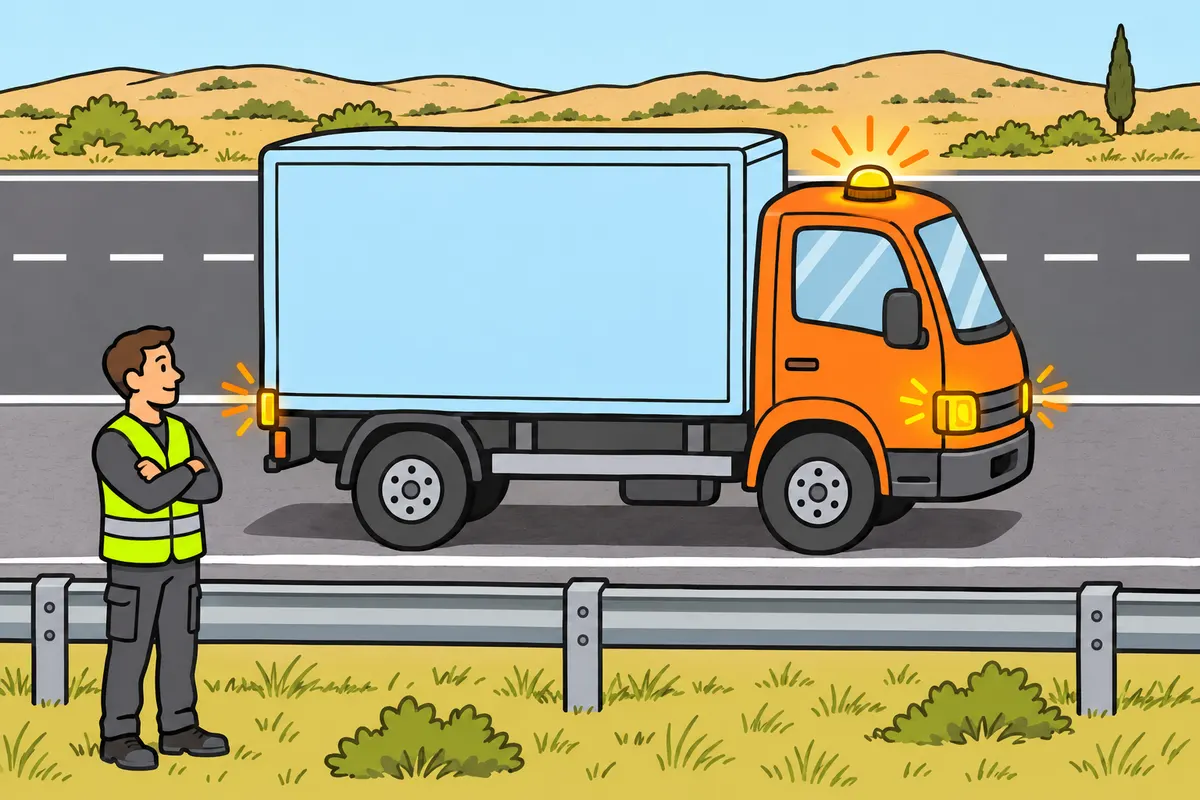
In an emergency, clear the road if possible and warn others without entering danger.
| Situation | What to do |
|---|---|
| Lorry immobilised on the road | Use a connected, certified V-16 |
| You cannot continue and there is a safe place beyond the carriageway and hard shoulders | Exit away from traffic; do not walk or remain in lanes or on hard shoulders |
| Cannot get out safely | Stay in the cab with your seat belt fastened |
Remember
- If you can continue safely, resume driving and clear the lanes.
- Need help? Use the right hard shoulder towards the first exit if possible.
- Otherwise stop where you cause least obstruction and arrange removal.
- Use the lights required for the place and visibility.
- In a tunnel or enclosed place, always stop the engine, even if you stay.
Exam trap: Wrong: you may warn others about your immobilised lorry without the beacon. Right: you must use the connected, certified V-16.
Read the full explanation
- If you can continue safely after a breakdown or accident, resume driving and clear the lanes as soon as possible. If you need assistance, head for the first available exit along the right-hand arcén (hard shoulder) where possible; if you cannot, immobilise your vehicle on the right-hand hard shoulder or wherever you cause the least obstruction, and arrange for its removal. [RGC, art. 130](https://www.boe.es/buscar/act.php?id=BOE-A-2003-23514#a130).
- To warn others of your immobilised lorry, apply the requirement and procedure in “Accidents, breakdowns and first aid”, sections “Connected and certified V-16” and “Place the beacon without putting yourself at risk”. [RGC, art. 130.4](https://www.boe.es/buscar/act.php?id=BOE-A-2003-23514#a130).
- You must keep on the lights required for the immobilisation and the visibility at the location; the conditions for position lights, end-outline marker lamps and parking lights are covered in “Lights and signalling on your light lorry”, sections “Lights on an immobilised lorry” and “Parking lights: equipment limited by dimensions”. [RGC, art. 105](https://www.boe.es/buscar/act.php?id=BOE-A-2003-23514#a105).
- You must carry the emergency equipment required for your C1 lorry, as detailed in “Accidents, breakdowns and first aid”, section “Emergency equipment and fire extinguishers according to MMA (maximum authorised mass)”. [RGV, Annex XII.1.a-b and 2](https://www.boe.es/buscar/act.php?id=BOE-A-1999-1826#anxii).
- If you cannot resume driving, get out on the side away from traffic when there is a safe place beyond the carriageway and hard shoulders, without walking or remaining in lanes or on hard shoulders; if you cannot get out safely, stay in the cab with your seat belt fastened. High-visibility vest use is covered in “Accidents, breakdowns and first aid”, section “Put on your high-visibility vest before getting out”. [RGC, art. 118.4](https://www.boe.es/buscar/act.php?id=BOE-A-2003-23514#a118) and [art. 130.3](https://www.boe.es/buscar/act.php?id=BOE-A-2003-23514#a130).
- If you are stopped in a tunnel or enclosed place, you must switch off the engine even if you remain at the wheel; what to do in a traffic queue is covered in “Speed and safe following distances”, section “Speed and traffic queues inside tunnels”, and what to do in an emergency in “Accidents, breakdowns and first aid”, section “Breakdowns, fires and traffic queues in tunnels”. [RGC, art. 115](https://www.boe.es/buscar/act.php?id=BOE-A-2003-23514#a115).
- Immobilisation ordered by officers and its administrative grounds are covered in “Professional transport documentation”; here you apply the rules for positioning your vehicle safely and warning others of its presence.
26Narrow sections and steep gradients
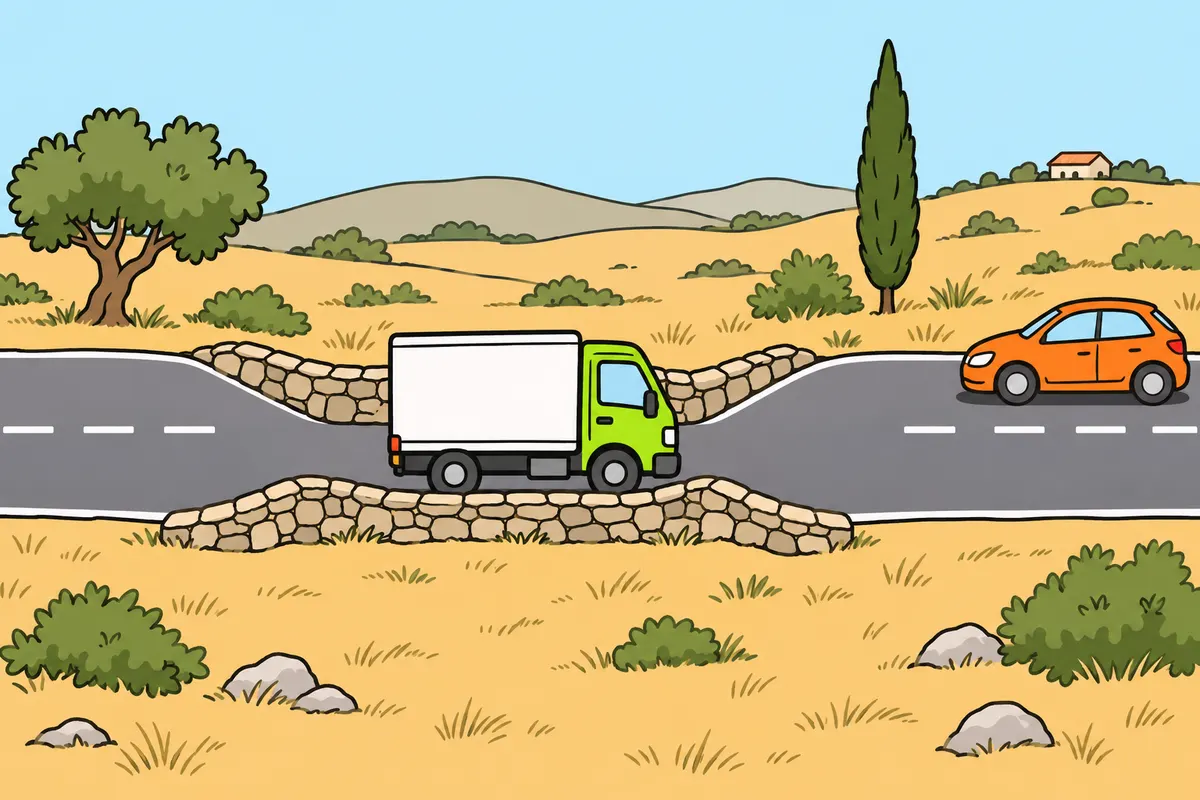
At narrow passages, obey signs and apply the correct priority rule.
| Case | Priority rule |
|---|---|
| Entry order unclear and a vehicle must reverse | Priority, highest to lowest: special vehicles and transports exceeding limits; combinations except cars with trailers up to 750 kg MMA; animal-drawn vehicles; those cars and motor caravans; collective passenger transport; lorries, tractor units and vans; cars and car-derived vans; special vehicles within limits, quadricycles and light quadricycles; three-wheeled vehicles, motorcycles with sidecars and three-wheeled mopeds; motorcycles, two-wheeled mopeds and bicycles |
| Same type or no listed type | Vehicle that must reverse further; if equal, greater width, length or MMA |
| Narrow section with a gradient of at least 7 % | Uphill vehicle, unless it can reach a designated lay-by first |
| Narrow bridge with give-way or oncoming-priority sign at your entrance | You must reverse if you meet another vehicle |
Remember
- Without signs, the vehicle that entered first has priority.
- If unclear, use the manoeuvring difficulty order.
- With a rigid lorry, give way to vehicle groups above yours.
- With a trailer, use the vehicle combinations group.
- At roadworks, wait behind those who arrived earlier in your direction.
- Follow staff directions and the marked route.
Exam trap: Wrong: a lorry always has priority over a car. Right: on a narrow stretch with a gradient of at least 7 %, give way to the uphill car unless it can reach a designated lay-by first.
Read the full explanation
- When a narrow section prevents two vehicles from getting past each other or makes this very difficult, obey the controls governing use of the section; without specific signs, the vehicle that enters first has priority. If you are unsure which vehicle entered first, apply the order based on difficulty of manoeuvring in the next point. [RGC, art. 60.1](https://www.boe.es/buscar/act.php?id=BOE-A-2003-23514#a60).
- If one vehicle must reverse, the order of priority, from highest to lowest, is: a) special vehicles and special transport operations exceeding the statutory mass or dimension limits; b) vehicle combinations, except those in group d); c) animal-drawn vehicles; d) cars towing trailers with an MMA of up to 750 kg and motor caravans; e) collective passenger transport vehicles; f) lorries, tractor units and vans; g) cars and car-derived vans; h) special vehicles within the statutory mass and dimension limits, quadricycles and light quadricycles; i) three-wheeled vehicles, motorcycles with sidecars and three-wheeled mopeds; j) motorcycles, two-wheeled mopeds and bicycles. Apply this order while obeying instructions from officers, roadworks personnel or authorised escort personnel. [RGC, art. 62.1](https://www.boe.es/buscar/act.php?id=BOE-A-2003-23514#a62).
- With your rigid C1 lorry, you belong to group f): when you meet another vehicle and this order applies, you must give way to the earlier groups and have priority over the later groups. If you tow a trailer, you must assess the combination as such, within group b). [RGC, art. 62.1](https://www.boe.es/buscar/act.php?id=BOE-A-2003-23514#a62).
- Between vehicles of the same type, or in cases not included in the list, the vehicle that would have to reverse further has priority; if the distances are equal, priority goes to the vehicle with the greater width, length or MMA. [RGC, art. 62.1](https://www.boe.es/buscar/act.php?id=BOE-A-2003-23514#a62).
- On a narrow section with a gradient of at least 7 %, the vehicle travelling uphill has priority unless it can reach a designated lay-by first. If you are unsure about the gradient or the distance to the lay-by, apply the order in article 62; when driving your lorry downhill, you may have to give way to a car travelling uphill. [RGC, art. 63.1](https://www.boe.es/buscar/act.php?id=BOE-A-2003-23514#a63).
- On bridges and other road structures without enough room for two vehicles at once, follow the signs. If you meet another vehicle after entering from the end with a priority-to-oncoming-traffic or give-way sign, you must reverse; without signs, the order in article 62 applies. [RGC, art. 61.1-2](https://www.boe.es/buscar/act.php?id=BOE-A-2003-23514#a61).
- When approaching roadworks, wait behind any vehicle that arrived earlier travelling in your direction, keeping as far to the right as possible, and proceed behind it. You must use the marked route and obey the personnel controlling traffic. [RGC, art. 60.2-5](https://www.boe.es/buscar/act.php?id=BOE-A-2003-23514#a60).
27Reserved lanes, reversible lanes and lanes running against the usual direction
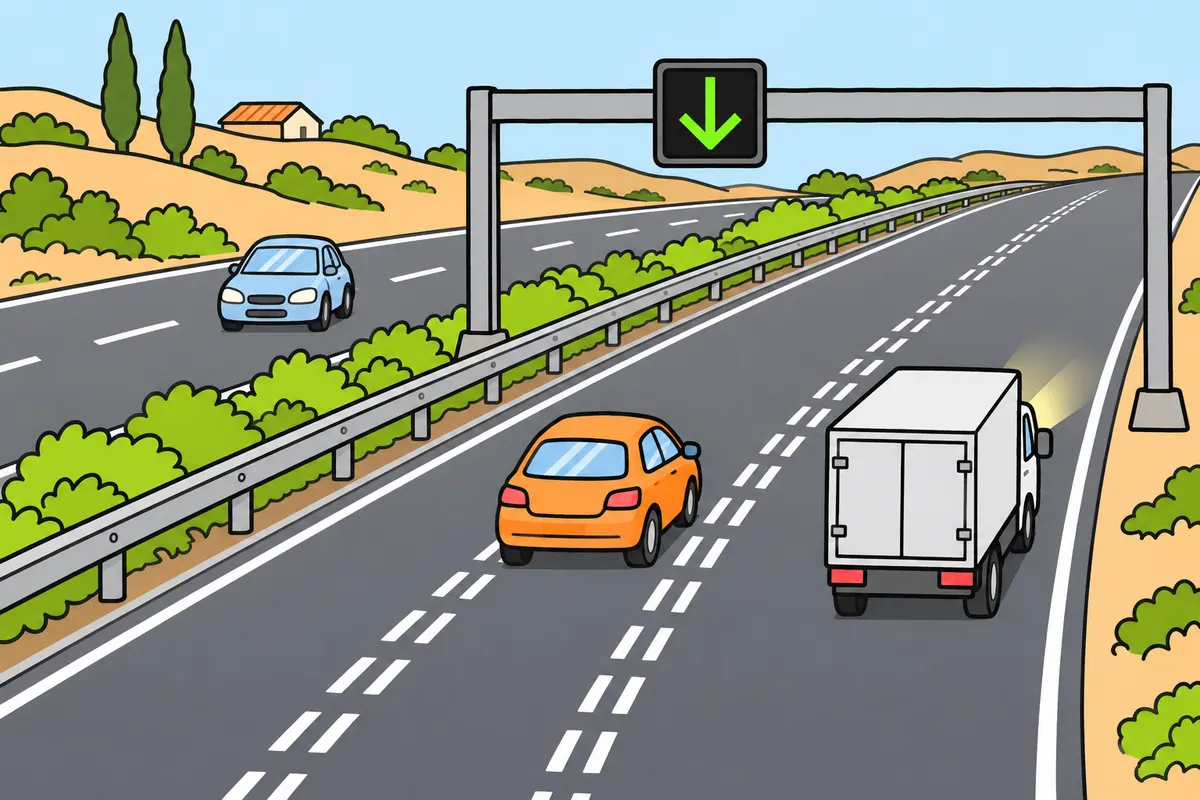
Use each special lane only when your lorry is allowed to enter.
| Lane | Access and duties for your lorry |
|---|---|
| High-occupancy lane: normal access | You cannot enter just because you carry passengers |
| High-occupancy lane: exceptional authorisation for safety or traffic flow | Enter only if it includes your lorry; obey marked entrances and exits |
| Reversible lane | Use when open for your direction and no restriction excludes you; dipped headlights always |
Remember
- Passengers do not let your lorry use a high-occupancy vehicle lane.
- Enter only if an exceptional authorisation includes your lorry.
- Obey signs, lights and speed limits in special lanes.
- In a reversible lane, use dipped headlights day and night.
Exam trap: Wrong: carrying passengers lets your lorry use a high-occupancy vehicle lane. Right: enter only if an exceptional authorisation from the traffic authority includes you.
Read the full explanation
- Use reserved lanes and lanes governed by a signposted speed in accordance with their signs. You are not authorised to use a VAO (high-occupancy vehicle) lane in your C1 lorry simply because you carry passengers: ordinary access is limited to motorcycles, cars and adaptable mixed-use vehicles, subject to the occupancy requirements set for the section. [RGC, art. 35.1-2](https://www.boe.es/buscar/act.php?id=BOE-A-2003-23514#a35).
- In unusual circumstances, the traffic authority may exceptionally allow, recommend or order other vehicles to use the VAO lane for safety or traffic flow. You may enter with your lorry only when that authorisation includes you; observe the signposted entrances and exits. [RGC, art. 35.2](https://www.boe.es/buscar/act.php?id=BOE-A-2003-23514#a35).
- A reversible lane is marked on both sides by double broken lines and allows traffic in either direction according to lane control signals or other controls. You may use it with your lorry when it is open in your direction and no restriction applies to you; you must keep at least your dipped beam headlights on by day and by night. [RGC, art. 40](https://www.boe.es/buscar/act.php?id=BOE-A-2003-23514#a40).
- To drive in lanes opened in the opposite direction to normal or in a temporary additional lane, consult the conditions for access, lighting, separation and speed in “Speed and safe following distances”, section “Lanes with special limits”. [RGC, art. 41](https://www.boe.es/buscar/act.php?id=BOE-A-2003-23514#a41) and [art. 42](https://www.boe.es/buscar/act.php?id=BOE-A-2003-23514#a42).
Joining traffic using an acceleration lane
Check the gap from the outset and adapt your entry to the lorry’s acceleration capability.
- Observe the position, course and speed of vehicles on the carriageway from the outset.
- Give way; if you need to stop, do so at this initial stage.
- Accelerate to a suitable speed for joining traffic, respecting the limits.
- Signal, check the space again and join without forcing others to brake or change course.
- Complete the manoeuvre and cancel the indicator once you are on your new course.
Completing or abandoning an overtaking manoeuvre
Assess the whole manoeuvre, including whether you can return to your lane.
- Check prohibitions, lanes the lorry is allowed to use, visibility and space to return.
- Keep your distance and check that the vehicle ahead does not have priority to move to that side and that nobody has started overtaking you.
- Signal and check the lane you intend to enter again.
- Overtake while respecting speed limits, lateral clearance and any special speed reductions that apply.
- If a risk arises, slow down promptly and return safely, signalling your intention.
- If you complete the manoeuvre, return gradually without cutting in front of the vehicle you have overtaken, and cancel the indicator once you are on your course.
When reversing is permitted
First check that reversing is permitted, then check that it is safe.
- Identify the exception that allows you to reverse and keep the distance to the minimum necessary.
- If reversing forms part of stopping, parking or joining traffic, do not exceed 15 metres or enter a junction; do not reverse on an autopista (motorway) or autovía (dual carriageway).
- Check all your surroundings, getting out or asking another person to help if necessary.
- Warn others of the manoeuvre and reverse slowly, observing continuously.
- Stop promptly if you receive a warning, if people, animals or vehicles are nearby, or if you have any doubt about safety.
Leaving a manual lorry on a significant slope
Use the brake, a gear and additional securing measures together before leaving the driving seat.
- Choose a permitted place and position the lorry without causing danger or obstruction.
- Switch off the engine, switch off the ignition and apply the parking brake.
- Leave first gear engaged facing uphill or reverse gear facing downhill.
- Use suitable wheel chocks or rest a steered wheel against the kerb as prescribed: turned towards the centre of the road facing uphill and outwards facing downhill.
- Prevent unauthorised use if you walk away, and check that it is safe before opening the door.
- Before moving off again, remove the chocks from the road, observe, signal and give way as you join traffic.
Finished this module?
Mark it as read and you will see your progress on the theory list.