
Theory · D1 Licence - Minibus · Module 15 of 18
Minibus mechanics
You learn how your minibus's engine, fuel supply, lubrication, cooling, starting system, transmission, suspension and steering work. You relate their components to basic fault symptoms; checks are covered in «Minibus maintenance and checks» and braking systems in «Minibus brakes and retarders».
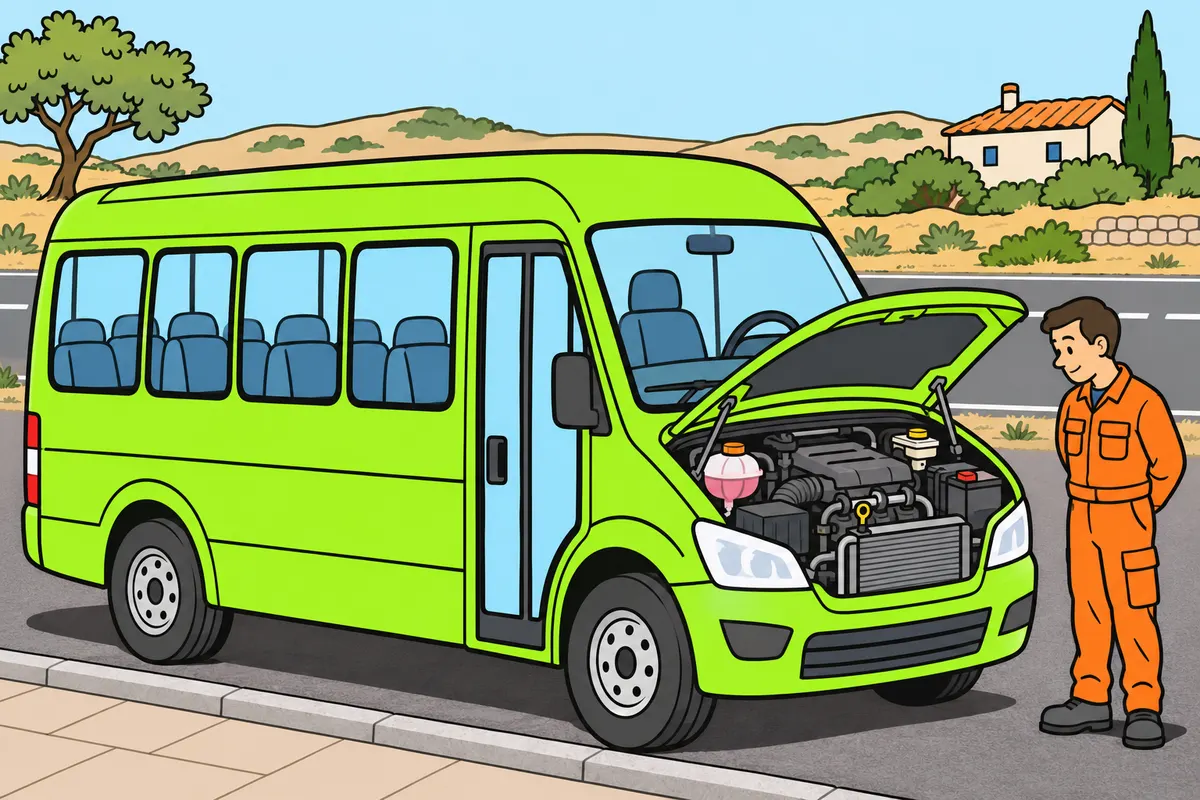
1The systems you study for D1
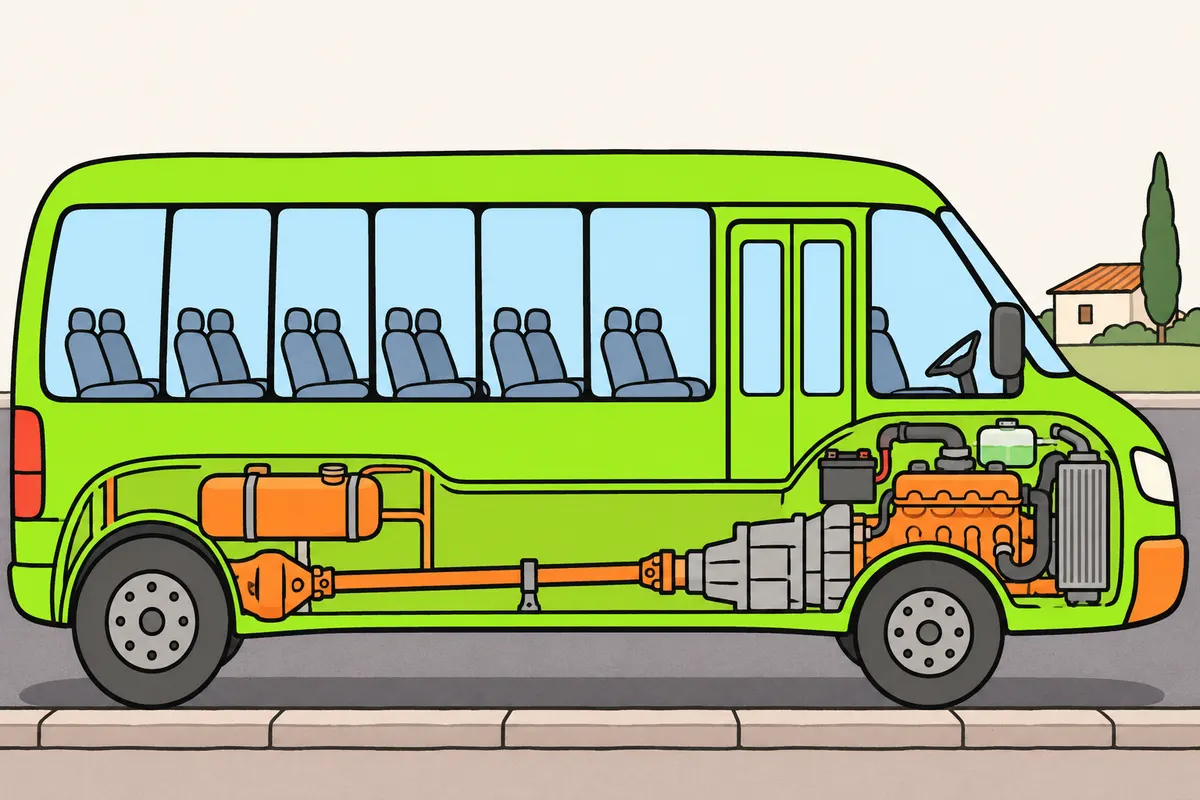
Identify your minibus’s systems to understand how it works.
Remember
- Check whether your minibus is diesel, electric or hybrid.
- Study the engine, fluids, fuel supply and electrics.
- Learn how starting and transmission work too.
- Find inspections and minor repairs in “Minibus maintenance and checks”.
Exam trap: Wrong: all minibuses have the same components. Right: identify how your vehicle works.
Read the full explanation
- The D1-specific syllabus covers engine operation, fluids, fuel supply, electrical systems, starting and transmission. Here you study their principles; inspections and minor repairs are covered in «Minibus maintenance and checks». [RGCond, annex V.B.2.5.º a), referring to 4.º l)-p)](https://www.boe.es/buscar/act.php?id=BOE-A-2009-9481#anv).
- Your minibus may use a diesel engine, electric propulsion or a hybrid system. Your vehicle's configuration determines which components it has and how you must interpret its warnings.
2Combustion, valve timing and the flywheel
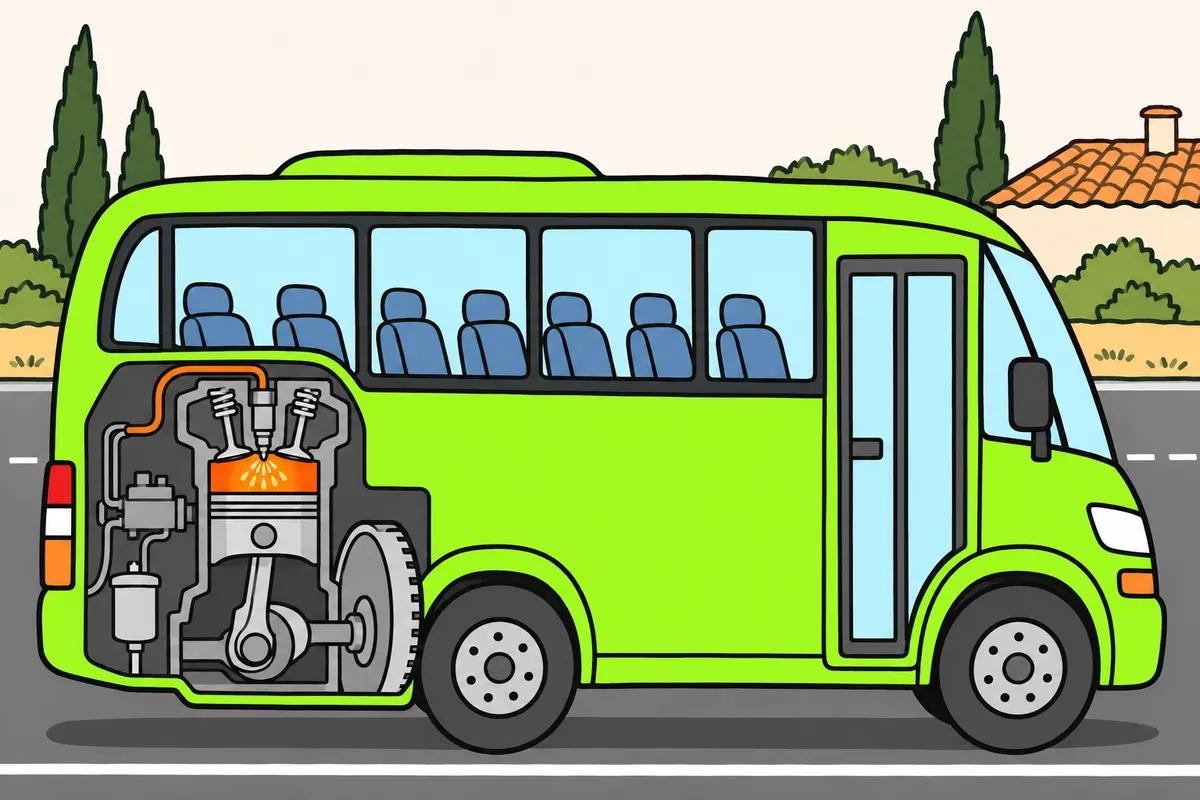
In a diesel, fuel ignites when it mixes with very hot compressed air.
Remember
- Remember the order: intake, compression, combustion and expansion, exhaust.
- In a diesel, you need no spark in each cycle.
- With direct injection, locate the mixture inside the cylinder.
- Link valve timing to opening and closing the valves.
- Remember: the connecting rod transfers piston movement to the crankshaft.
- Identify the flywheel: it stores rotational energy and smooths speed changes.
Exam trap: Wrong: the flywheel always keeps engine speed constant. Right: it smooths speed changes.
Read the full explanation
- In a conventional compression-ignition diesel engine, the piston compresses air and greatly increases its temperature. You inject the fuel when this air is compressed and very hot: it mixes with the air and ignites spontaneously under the appropriate operating conditions. The four-stroke cycle consists of intake, compression, combustion and expansion, and exhaust; it is completed in two revolutions of the crankshaft. [DGT, Manual VIII, topic 2](https://sede.dgt.gob.es/.galleries/permisos-de-conducir/certificacion-aptitud-profesores-formacion-vial/2023/Manual-VIII-Mecanica-2023.pdf).
- In a diesel engine, you do not need a spark from a spark plug to ignite the mixture in each cycle.
- With direct injection, fuel is injected and mixes with the air inside the cylinder, in the combustion chamber. The mixture does not form in the injection pump or beside the valve in the intake manifold. Both diesel and petrol engines can use direct injection; injection timing depends on the design.
- The valve timing system controls the opening and closing of the valves to let gases in and out. The piston moves inside the cylinder and turns the crankshaft through the connecting rod; the cylinder head closes the top of the cylinders. When you study an engine diagram, relate these parts to the movement they produce.
- The flywheel, located at one end of the crankshaft, stores rotational energy to keep it turning between the engine's power impulses and carry the pistons through their dead centres. It smooths out variations in speed; its purpose is not to increase or reduce engine speed on its own or to keep it exactly constant in all circumstances.
3Diesel fuel supply: pumps and injectors
Distinguish pumps that carry diesel from injectors that deliver it into the engine.
| Part in systems with separate pumps | Job |
|---|---|
| Feed pump | Carries diesel from the tank towards injection at low pressure |
| High-pressure pump | Prepares fuel at the required pressure |
| Injectors | Deliver fuel into the cylinders |
Remember
- Use the fuel specified for your minibus.
- Remember: dirt and water damage the injection system.
- Do not loosen high-pressure pipes to look for leaks.
- With the accelerator, you request more or less turning force.
- Identify your system: they do not all have the same separate parts.
Exam trap: Wrong: every governor belongs to the injection pump. Right: this arrangement applies to a conventional mechanical injection pump.
Read the full explanation
- In a system with separate fuel feed and injection pumps, the feed pump carries diesel fuel from the tank towards the injection system through the low-pressure circuit and its filters. The piston does not draw fuel directly from the tank.
- The high-pressure pump brings the fuel to the required pressure; the injectors deliver it into the cylinders. Fuel metering and pressure generation depend on the system: do not confuse these functions or assume that every configuration has the same separate components.
- In a conventional mechanical injection pump, the governor is part of the injection pump. It adjusts the fuel supply to limit maximum engine speed and maintain idling; it is not part of the exhaust or cooling system. This arrangement does not automatically apply to electronic injection.
- You must use the fuel specified for your minibus. Dirt and water in diesel fuel damage the injection system; the filters and water separator protect the circuit. Do not loosen high-pressure pipes to look for a leak.
- The accelerator requests more or less torque through the fuel supply system or electronic engine management.
4Air intake, turbocharger and intercooler
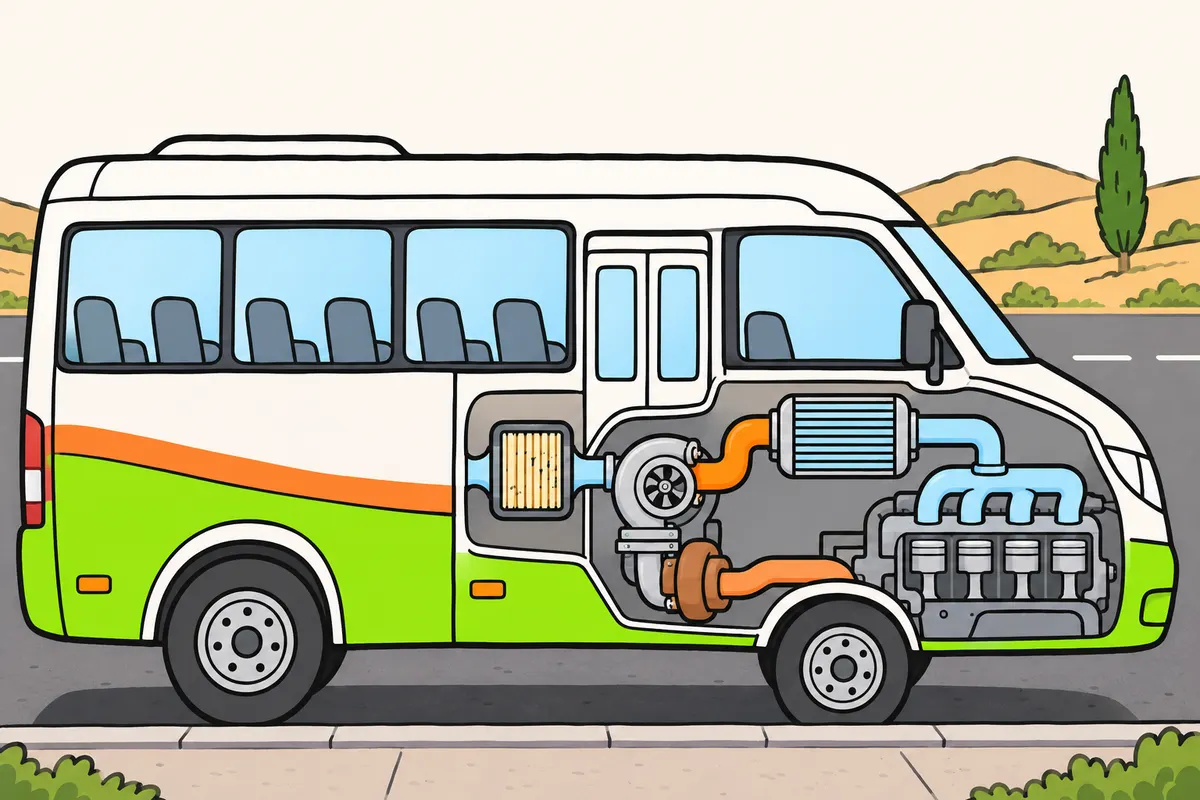
Follow the air’s route to understand how it reaches the engine clean and cooled.
Remember
- With a turbo and intercooler, follow: filter, compressor, intercooler, cylinders.
- Remember: the filter traps particles, protecting the compressor and engine.
- If the filter blocks, less air reaches the engine for combustion.
- Identify the intercooler: it cools air heated by compression in the turbo.
- Remember: a conventional turbo uses engine oil for lubrication and heat removal.
Exam trap: Wrong: the intercooler cools oil. Right: it cools compressed air before it enters the engine.
Read the full explanation
- The air filter traps particles before they reach the engine. A blockage restricts the air available for combustion.
- In an engine with a turbocharger and intercooler, follow this path: air filter, turbocharger compressor, intercooler and intake into the cylinders. The filter comes before the compressor to protect it and the engine from particles.
- The intercooler cools the air heated by compression in the turbocharger before it enters the engine; this improves cylinder filling. It does not heat the air or lubricate the turbocharger. Not every forced-induction system necessarily uses a turbocharger.
- A conventional turbocharger is lubricated with engine oil, which also helps carry away its heat.
5Lubrication: sump, pump and filter
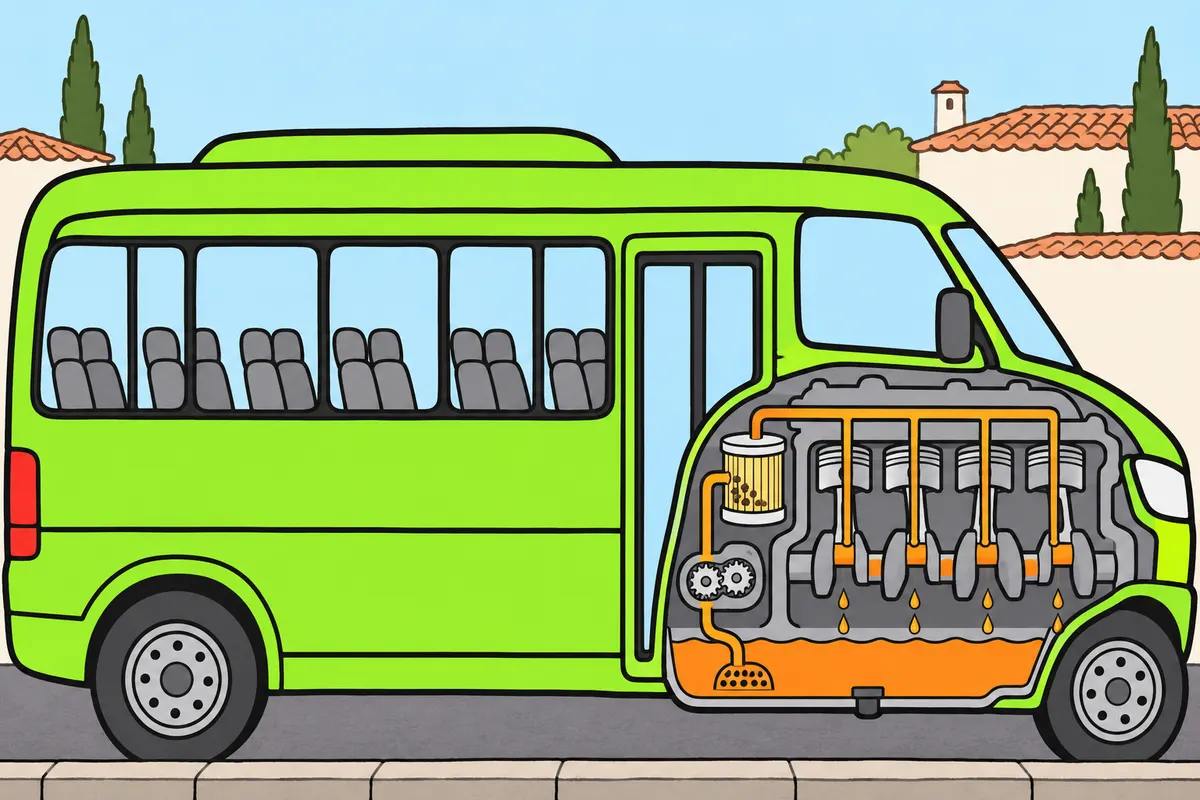
Distinguish where oil collects, what pumps it and what cleans it.
| Oil circuit part | Job |
|---|---|
| Wet sump | Collects oil returning from the parts |
| Pump | Forces oil towards the parts |
| Filter | Removes debris and wear particles |
Remember
- In a four-stroke wet-sump engine, locate the oil in the sump.
- Look for the drain plug near the bottom of the sump.
- Distinguish the oil circuit from the cooling circuit.
- If fitted, a bypass valve can temporarily let oil through without filtering.
Exam trap: Wrong: the filter reduces oil viscosity. Right: it separates solid impurities.
Read the full explanation
- In a four-stroke engine with a wet sump, the sump closes and protects the bottom of the engine block and collects the oil returning after lubricating the components. The drain plug is in its lower part. Do not confuse it with the rocker cover, cylinder head gasket, filler cap or dipstick.
- The oil filter removes solid impurities, such as debris and wear particles, to protect the components. Its purpose is not to reduce the oil's viscosity or increase its adhesion. If a bypass valve is fitted, it may temporarily allow unfiltered oil through to maintain the supply; do not assume that all the oil always passes through the filter material.
- The pump forces oil towards the lubrication points; the passages distribute it and the return flow takes it back to the sump. You must distinguish this circuit from the cooling circuit.
6Viscosity and choosing a lubricant
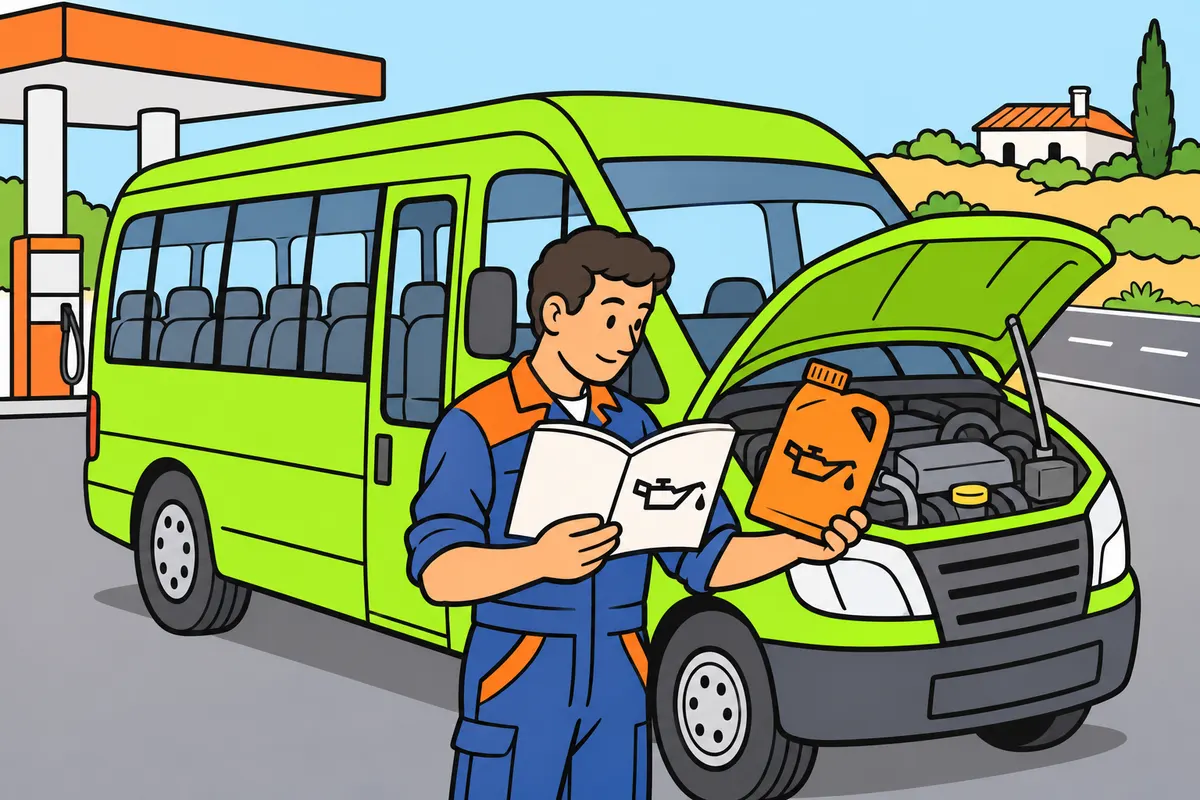
Choose oil by the manufacturer’s requirements as well as its viscosity.
| Oil | Type | What you must distinguish |
|---|---|---|
| SAE 20W-40 | Multigrade | 20W: low temperature; 40: high temperature |
| SAE 20 and SAE 60 | Monograde | Their numbers indicate viscosity grades |
Remember
- Understand viscosity as oil’s resistance to flow.
- Remember: oil normally loses viscosity as it heats up.
- Do not confuse oil quantity with sufficient pressure.
- Check the required grade, performance standards and approvals.
- Do not choose oil by its colour.
- If you have a particulate filter, also check lubricant compatibility.
Exam trap: Wrong: SAE numbers show temperatures or service life. Right: they show viscosity grades.
Read the full explanation
- Quantity, pressure, temperature and viscosity are different properties of oil. Viscosity expresses its resistance to flow: it normally decreases as the oil heats up. The lubricating film reduces friction and wear, helps carry away heat and helps clean and protect the components; having enough oil does not in itself guarantee that it reaches all of them under pressure.
- SAE 20W-40 is multigrade: 20W indicates its low-temperature viscosity performance and 40 its high-temperature grade. W stands for winter. SAE 20 and SAE 60 are monograde oils; their numbers do not indicate temperature degrees or how many kilometres they last. A multigrade oil does not thicken simply because summer arrives.
- You must select both the viscosity grade and the performance specifications and approvals required by the minibus manufacturer. Two containers with the same SAE grade may meet different needs; you cannot choose by the oil's colour either. If your vehicle has a particulate filter, you must also ensure that the lubricant is compatible with the exhaust gas treatment system.
7Oil pressure: instruments and warning light
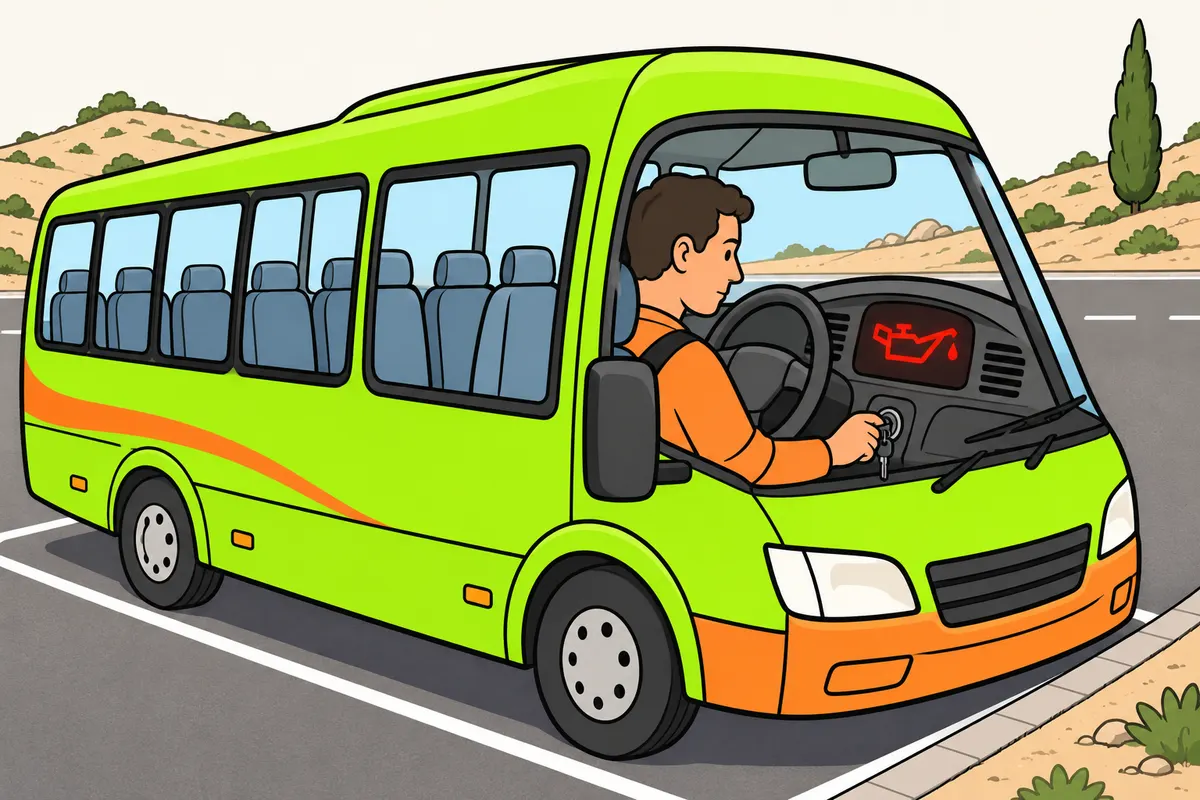
If the pressure warning stays on with the engine running, stop safely and switch off.
| Instrument | What it shows |
|---|---|
| Pressure gauge | Oil pressure value |
| Pressure switch | Can activate a low-pressure warning |
| Thermometer | Temperature |
Remember
- Stop safely before switching off the engine.
- Do not rule out a fault because the oil level is correct.
- Do not identify the cause from the warning or pressure reading alone.
- Remember: very hot oil can contribute to low pressure.
Exam trap: Wrong: a correct level lets you ignore the pressure warning. Right: if it stays on with the engine running, stop safely and switch off.
Read the full explanation
- The pressure gauge shows you the oil pressure reading. The oil pressure switch is a pressure-sensitive switch that can activate a low-pressure warning light; it does not provide the same reading. The thermometer measures temperature. Not all vehicles have a pressure gauge.
- If the oil pressure warning light stays on while the engine is running, stop safely and switch off the engine: lubrication pressure may be insufficient. A correct oil level does not rule out a fault; interpreting the other warnings is covered in «Minibus maintenance and checks».
- Insufficient pressure can be due to a low oil level, unsuitable oil or a faulty pump or oil passage. Very hot oil loses viscosity and can also contribute to a drop in pressure; you cannot identify the cause from the warning light or pressure gauge alone.
8Engine cooling
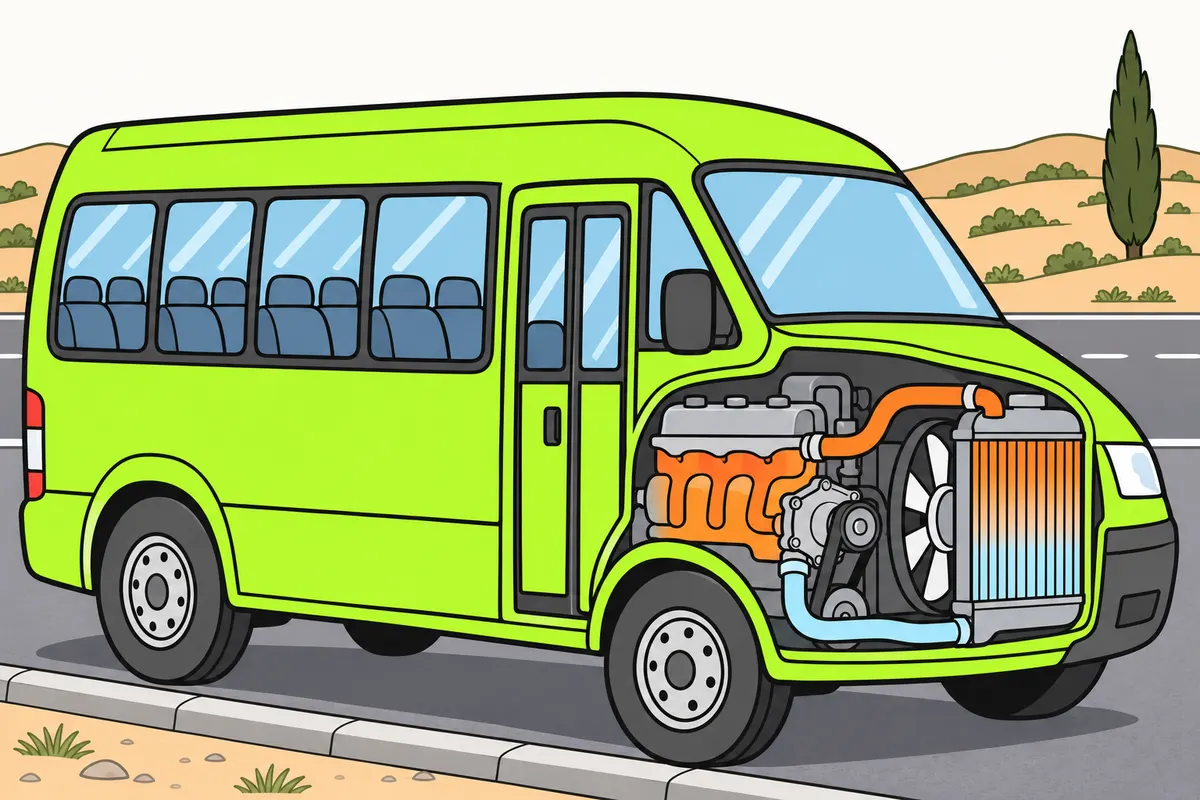
Coolant collects heat from the engine and carries it to the radiator.
Remember
- Identify the pump: it circulates fluid between the engine and radiator.
- Remember: the thermostat controls flow to the radiator according to temperature.
- Use the specified coolant and mixture ratio.
- Do not mix incompatible products or choose by colour.
- If a belt drives the pump, a broken belt can cause overheating.
- Remember: leaks, thermostat faults or fan faults can also cause overheating.
Exam trap: Wrong: a closed circuit needs no fan or antifreeze. Right: it still needs them and can leak.
Read the full explanation
- The coolant pump forces the liquid to circulate between the engine's water jackets and the radiator. Its main purpose is not to reduce pressure losses or compensate for excess pressure.
- The coolant absorbs heat from the engine and the radiator releases it to the surroundings to cool the liquid. The thermostat regulates flow to the radiator according to temperature: it is not a reservoir where you check the level.
- A closed, sealed circuit reduces fluid loss, but does not remove the need for a fan or antifreeze protection. Nor does it mean that the system can never lose fluid or develop leaks.
- Choose coolant according to the specified requirements, composition and concentration, and the protection it provides against expected temperatures, including those below zero. Colour does not guarantee compatibility; do not mix incompatible products or alter the prescribed ratio.
- If a belt drives the coolant pump, a broken belt can stop the liquid circulating and cause overheating. Leaks, an insufficient coolant level or thermostat or fan faults can also cause overheating.
9Transmission: clutch, gearbox, final drive and differential
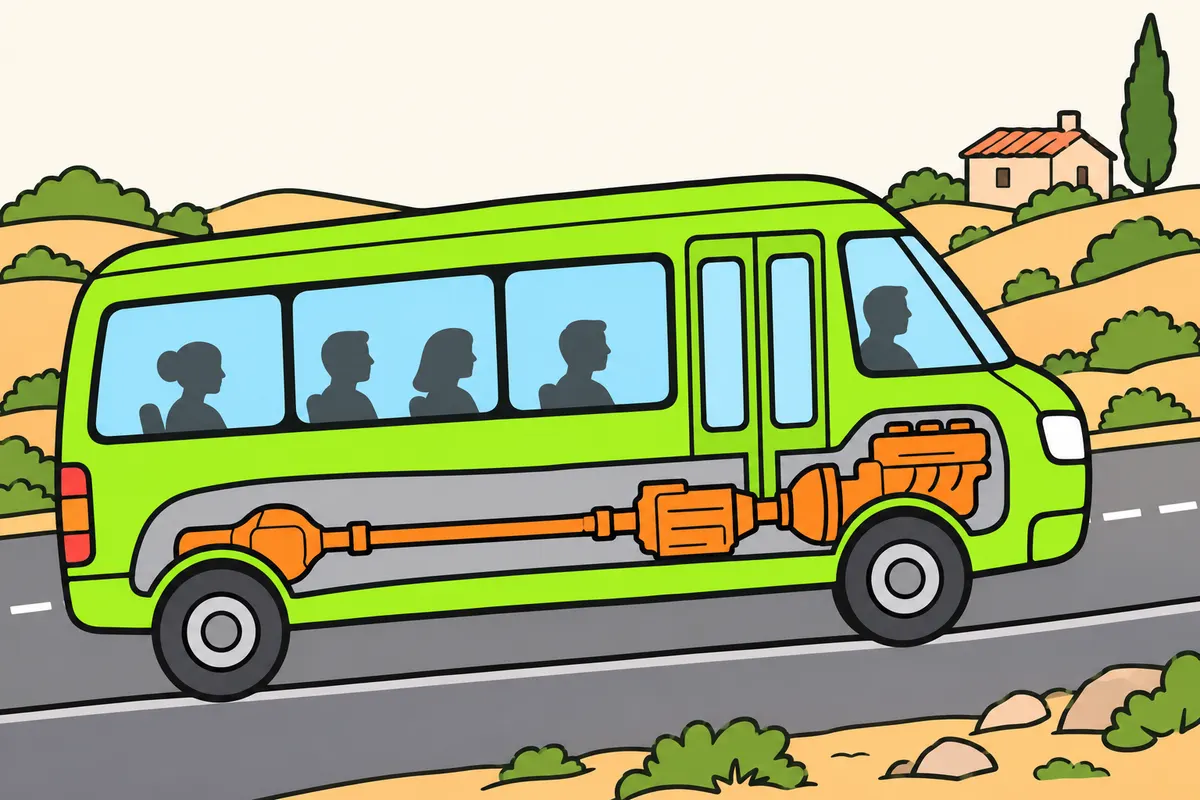
Recognise how engine power reaches the wheels and what each part does.
| Transmission part or system | What you must distinguish |
|---|---|
| Clutch | Progressively connects or interrupts engine torque to the gearbox |
| Gearbox | Lets you select different ratios |
| Conventional bevel final drive | Reduces rotational speed and increases torque with a fixed ratio |
| Differential | Lets wheels turn at different speeds in a bend |
| Automatic with torque converter | Distinguish its converter from the clutch in an automated gearbox |
| Automated gearbox | Operates a clutch automatically |
| Electric minibus | May have no conventional clutch or gearbox |
| Hydraulic clutch control | Transmits force through fluid |
| Chain and belt | Chain runs on sprockets; belt runs on pulleys |
| Timing belt or chain | Synchronises crankshaft and camshaft |
| Auxiliary belt | Drives parts such as the alternator |
Remember
- For conventional mechanical transmission, follow: engine, clutch, gearbox, propeller shaft, final drive, half-shafts.
- Do not rest your foot continuously on the clutch pedal.
- Do not hold the minibus on a hill by slipping the clutch.
- If engine speed drops uphill when laden, select a suitable lower gear.
- Do not coast downhill in neutral or secure the vehicle using only the gearbox.
- Use the specified lubricant for each gearbox and final drive.
Exam trap: Wrong: universal joints provide the fixed reduction. Right: they allow angle changes; in a conventional transmission with a propeller shaft and bevel final drive, the bevel final drive provides that reduction.
Read the full explanation
- In a conventional mechanical transmission, recognise the path from the engine through the clutch, gearbox, propeller shaft, final drive and half-shafts to the driven wheels. The layout depends on the engine's position and which axles receive torque; an electric minibus may have neither a clutch nor a conventional gearbox.
- The clutch progressively connects or interrupts the transmission of torque from the engine to the gearbox. When you disengage the clutch using the pedal, you break that connection; when you release it progressively, you restore it. You must not rest your foot continuously on the pedal or hold the minibus stationary on a slope by slipping the clutch: you turn energy into heat and accelerate wear.
- A low gear multiplies torque at the wheels more, at the cost of a lower road speed for the same engine speed. If engine speed drops as your laden minibus climbs a hill, select a suitable lower gear without straining the engine. Tractive force must overcome resistance to motion; on level ground, weight does not act directly as a horizontal force.
- An automatic gearbox with a torque converter and an automated gearbox that operates a clutch automatically use different mechanisms. They do not all have a clutch pedal or use the same oil. Use the selector positions and procedures in the manual; do not select neutral on a descent or rely solely on the gearbox to secure the vehicle.
- The gearbox allows you to select different ratios. In a conventional transmission with a propeller shaft and bevel final drive, the drive pinion and crown wheel provide a further, fixed reduction: they reduce rotational speed and increase torque; in this layout, they also change the direction of rotation.
- The differential allows the wheels to turn at different speeds when you take a bend. Its differential pinions and side gears do not form another selectable gearbox. The universal joints in the propeller shaft transmit rotation as the angle changes; they do not provide that fixed reduction.
- The gearbox and final drive need the lubricant specified for each assembly. Valvulina is a common Spanish term for gear oils; their viscosity and additives must be compatible with the mechanisms they lubricate.
- The hydraulic clutch control transmits force through fluid from the master cylinder to the slave cylinder, which operates the clutch release mechanism. Reservoir checks are covered in «Minibus maintenance and checks».
- A chain transmits motion between sprockets and requires you to check wear, lubrication and tension according to its design; a belt transmits motion between pulleys and requires you to check its condition and tension. You must not assume that your minibus has a chain or belt final drive: propeller shafts and gears are common. Do not confuse a timing chain with the transmission to the wheels either.
- The timing belt or chain synchronises the crankshaft and camshaft. The auxiliary drive belt drives the components provided for in the design, such as the alternator; you must identify its function in your engine's diagram.
10Steering and power assistance
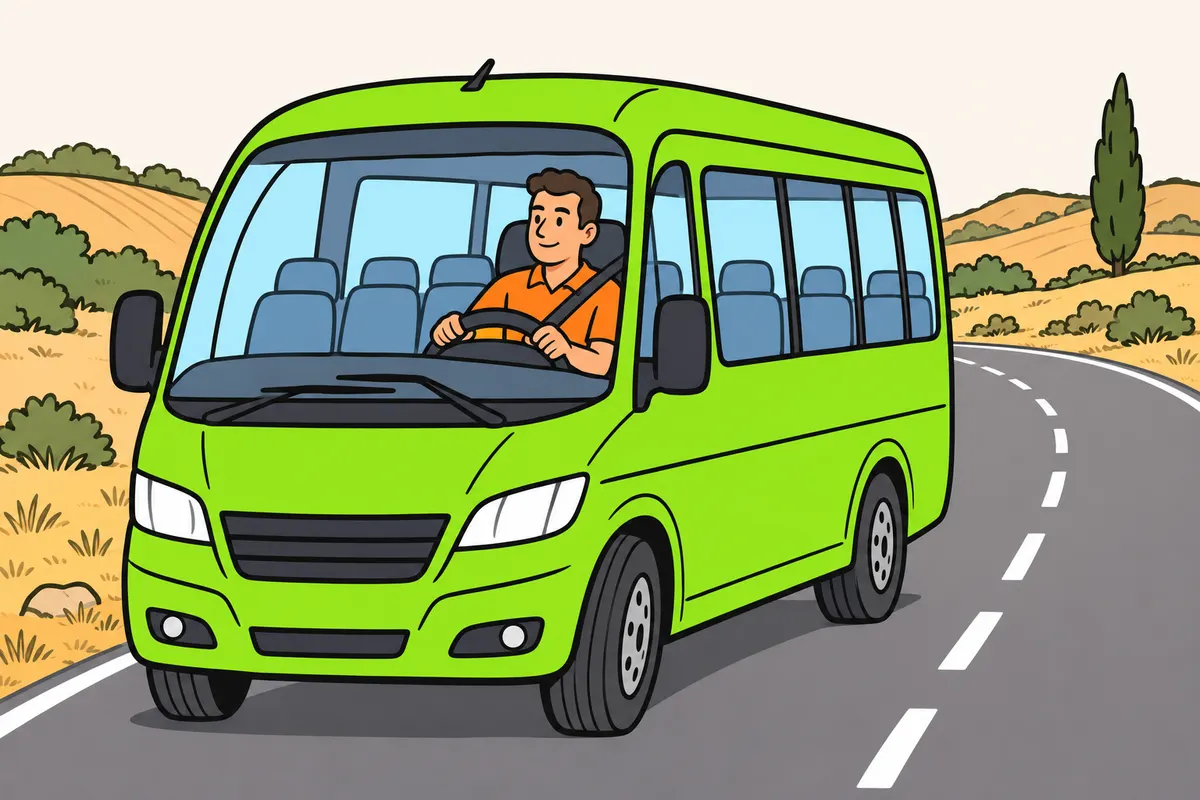
Power assistance helps you turn the steering wheel with less effort.
| Power assistance | How it helps |
|---|---|
| Hydraulic | Uses a pump and pressurised fluid |
| Electric | Uses an electric motor |
Remember
- Use the steering wheel to direct the steered wheels.
- If assistance fails, you may need much more effort to steer.
- Pay attention to play, stiffness and vibration.
- Find steering checks in “Minibus maintenance and checks”.
Exam trap: Wrong: all power steering needs a hydraulic reservoir. Right: electric assistance may have none.
Read the full explanation
- The steering system transmits your steering wheel movements to the steered wheels through its mechanism and joints.
- Hydraulic power steering uses a pump and pressurised fluid to reduce the effort you need to turn the steering wheel. A leak or pump failure can reduce the assistance.
- Electric power steering uses an electric motor and may have no hydraulic reservoir. If the assistance fails, the effort needed to steer can increase greatly.
- Play, stiffness and vibration can be related to joints, power assistance, wheel alignment or tyres; checking them is covered in «Minibus maintenance and checks».
11Battery, alternator and electrical protection
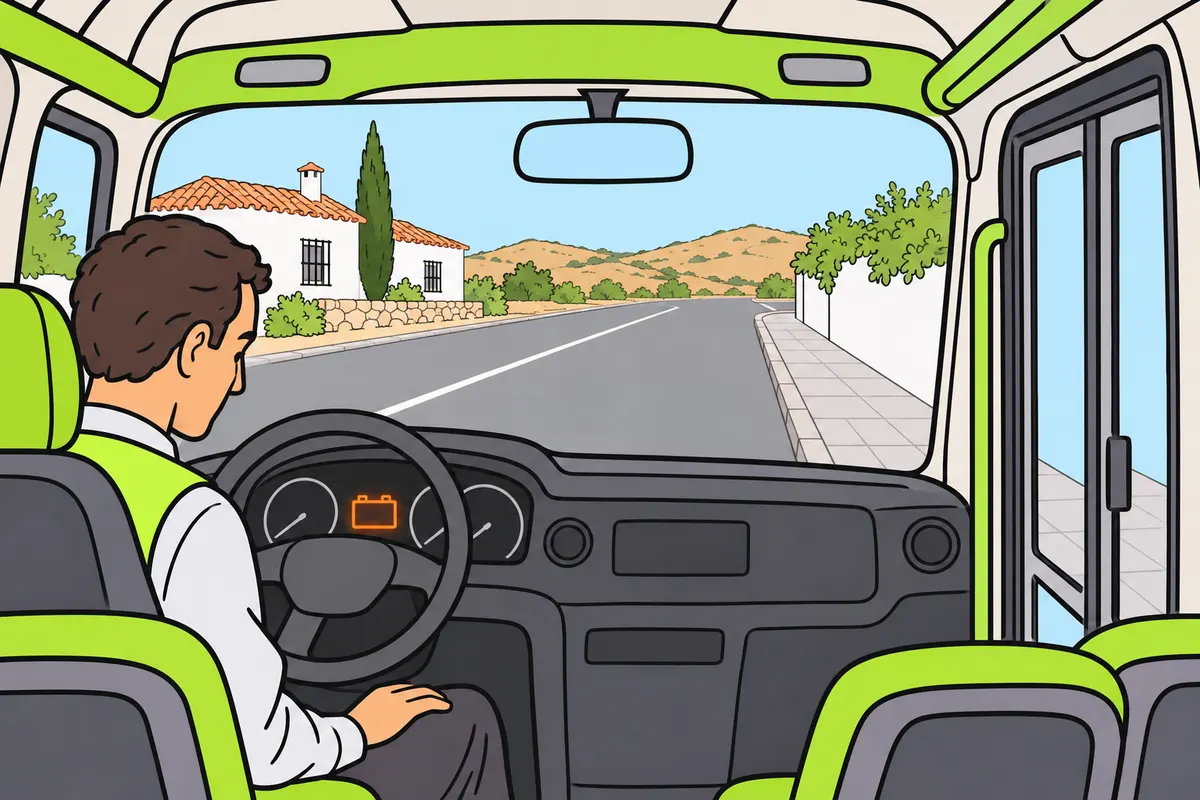
Distinguish energy stored in the battery from electricity generated by the alternator.
| Component | Job |
|---|---|
| Battery | Stores energy for starting and powering equipment |
| Alternator | Converts mechanical energy into electricity |
| Regulator | Controls charging voltage |
| Fuse | Protects a circuit from excessive current |
Remember
- If the charging warning stays on after starting, there may be a fault.
- Do not treat an unlit warning as proof that everything works correctly.
- If the manual allows fuse replacement, use the specified type and rating.
- Do not bypass a fuse or fit one with a higher current rating.
- If it blows again, find the fault.
- In hybrids and electric vehicles, do not handle high-voltage cables or components.
Exam trap: Wrong: disconnecting the auxiliary battery removes all high voltage. Right: in hybrids and electric vehicles, it does not guarantee that their equipment is de-energised.
Read the full explanation
- The battery stores electrical energy to power the starter motor and equipment when the generator does not meet demand. The alternator converts mechanical energy from the engine into electricity; the regulator controls the charging voltage.
- A charging warning light that stays on after you start the engine or comes on while you drive can indicate a fault in the alternator, regulator or electrical system. When it goes out, this normally indicates that no fault is being signalled, but it does not certify the condition of every component.
- Fuses protect circuits against excessive current. If the manual allows you to replace one, use the specified type and rating; if a fuse blows again, you need to find the fault. Bypassing it or fitting one with a higher current rating can leave the wiring unprotected.
- In a hybrid or electric minibus, you must distinguish the auxiliary battery that powers the vehicle's electrical services from the traction battery. Disconnecting the auxiliary battery does not guarantee that high-voltage equipment is de-energised; do not handle its cables or components.
- Battery connections, jump-starting and maintaining terminals and electrolyte are covered in «Minibus maintenance and checks».
12Diesel starting system
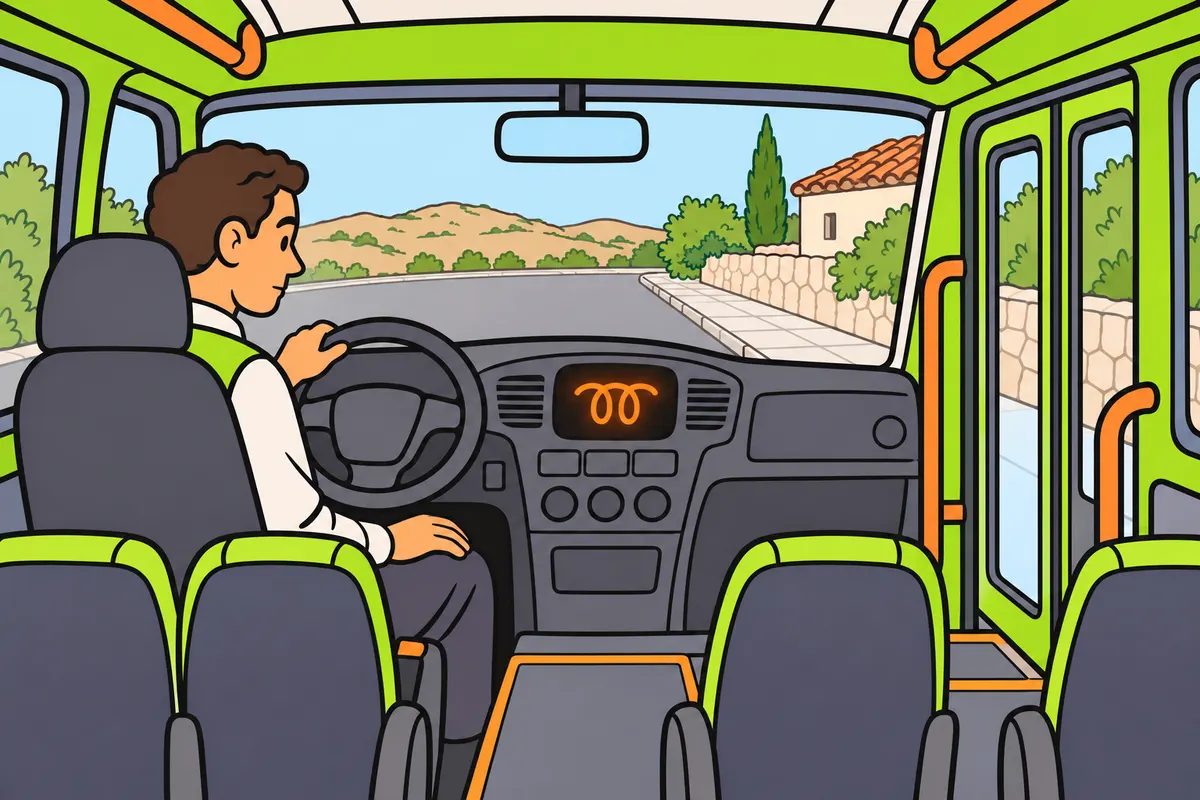
To start a diesel engine, you use battery energy and the starter motor.
Remember
- When you operate the control, the battery supplies the starter motor.
- For conventional starting, the solenoid engages the pinion and closes the circuit.
- Remember: glow plugs help a diesel engine start from cold.
- Follow the preheating indicator and the manufacturer’s procedure.
- Follow the specified lengths of starting attempts and pauses.
- Release the control when the engine starts.
Exam trap: Wrong: a click without rotation proves the starter motor is faulty. Right: a discharged battery or faulty connections can also cause this.
Read the full explanation
- When you turn the key or press the button, the battery powers the starter motor, which converts electrical energy into rotation to turn the combustion engine.
- In a conventional starting system, the solenoid moves the pinion into engagement with the flywheel ring gear and closes the high-current circuit. The control relay allows this circuit to be controlled. Once starting is complete, the pinion disengages. [DGT, Manual VIII, starting system](https://sede.dgt.gob.es/.galleries/permisos-de-conducir/certificacion-aptitud-profesores-formacion-vial/2023/Manual-VIII-Mecanica-2023.pdf).
- Glow plugs supply heat to help you start a diesel engine from cold. You must follow the preheating indicator and the manufacturer's procedure.
- If you hear a click but the engine does not turn, the solenoid may be operating without enough current reaching the starter motor. The battery may be discharged, connections may be faulty or the starter itself may have a fault; the click alone does not identify the cause.
- Avoid operating the starter for prolonged periods: it can overheat and discharge the battery. Follow the manufacturer's specified attempt durations and pauses, and release the control as soon as the engine starts.
13Suspension and stability
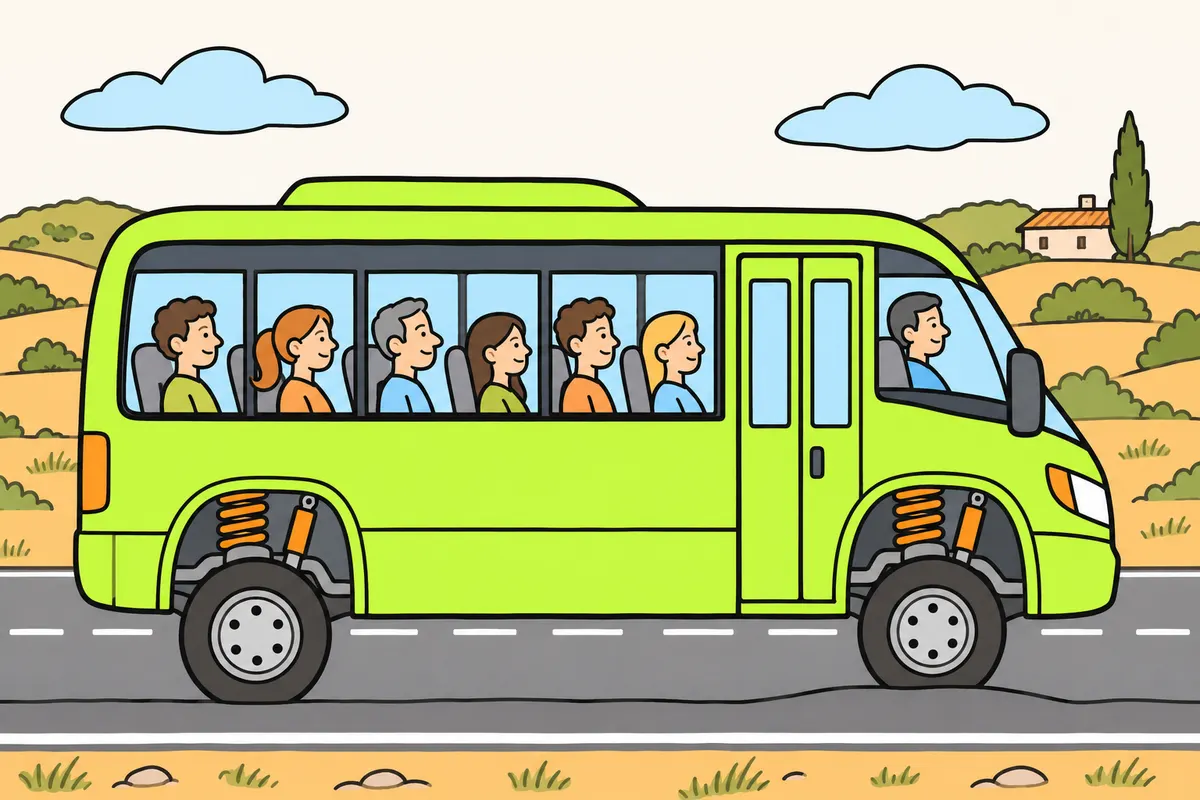
Suspension helps keep wheels touching the road and reduces jolts.
| Suspension part | Job |
|---|---|
| Spring elements | Support the load and flex over bumps |
| Shock absorbers | Damp the springs’ movement |
| Air bellows | Support the body with air and height control |
Remember
- Remember: its condition affects steering, braking and comfort.
- Do not assume soft suspension guarantees better braking.
- With worn shock absorbers, you may experience bouncing and body roll.
- If kneeling is fitted, use it to help passengers board.
- Do not go underneath when supported only by air suspension or a jack.
Exam trap: Wrong: a shock absorber’s only job is supporting weight. Right: it damps oscillations; spring elements support the load.
Read the full explanation
- The suspension connects the wheels and axles to the bodywork while allowing them to move relative to each other. It has two functions: keeping the wheels in contact with the road surface and limiting the jolts transmitted to the structure and passengers. Its condition affects grip, steering and braking, as well as comfort.
- The springs and other elastic components support the load and deform in response to uneven surfaces; the shock absorbers damp their oscillations. You must not assume that a shock absorber's sole function is to support the weight or believe that soft suspension guarantees better braking. A worn shock absorber can allow bouncing, body roll and loss of effective contact with the ground.
- Air suspension uses air bellows and height control to support the bodywork. The kneeling function, where fitted, adjusts the height to make it easier for passengers to board and alight.
- Do not go underneath the minibus when it is supported solely by its air suspension or a jack: it can lower unexpectedly. Checks for leaks, secure mountings and height are covered in «Minibus maintenance and checks».
14Exhaust and emissions treatment
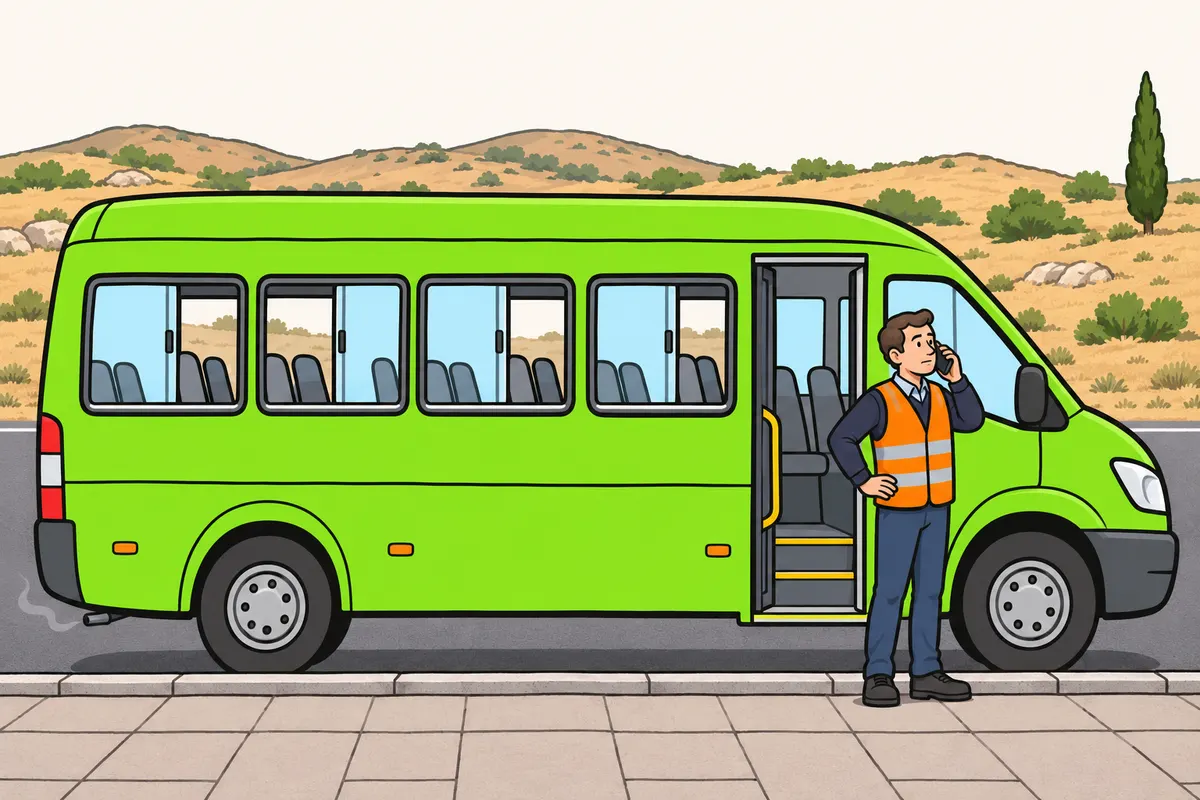
Distinguish noise control from exhaust gas treatment.
| Exhaust part | Job |
|---|---|
| Silencer | Reduces noise |
| Particulate filter, if fitted | Traps soot |
| SCR system, if fitted | Reduces nitrogen oxides |
Remember
- Do not drive with an unsilenced exhaust or a damaged silencer.
- If you smell exhaust inside, stop safely, ventilate and arrange an inspection.
- With diesel, do not identify a specific fault from black smoke alone.
- Put AdBlue in its own tank; do not mix it with diesel.
- Follow AdBlue and regeneration warnings according to the manual.
- Do not disable these systems or regenerate while stationary where heat could cause damage.
Exam trap: Wrong: you correct diesel black smoke by injecting more fuel. Right: there may be too little air or too much fuel for the available air.
Read the full explanation
- The silencer reduces exhaust noise. A broken, ineffective silencer increases noise pollution. You must not drive the minibus with an unsilenced exhaust or with an incomplete, unsuitable or deteriorated silencer. Exhaust gases are treated by other components, whose functions differ from noise reduction. [RGC, art. 7.2](https://www.boe.es/buscar/act.php?id=BOE-A-2003-23514#a7).
- In a diesel engine, black smoke can indicate incomplete combustion producing soot because there is too little air or too much fuel for the available air. Causes include a blocked air filter and incorrect fuel metering. It does not necessarily mean there is too much air or that only oil is burning, and you do not correct it by assuming you need to inject more fuel. Colour alone does not identify a specific fault.
- A leak-free exhaust system carries gases outside along the intended route. A leak can allow dangerous gases into the passenger compartment; if you smell exhaust fumes inside, stop safely, ventilate and arrange an inspection. An electric traction motor does not need a combustion exhaust, although a hybrid can have an internal combustion engine.
- In minibuses with a particulate filter and SCR catalytic reduction, you must distinguish between trapping soot and reducing nitrogen oxides. AdBlue goes in its own tank and must not be mixed with diesel fuel; follow its warnings and regeneration warnings in accordance with the manual. Do not disable these systems or carry out stationary regeneration where heat from the exhaust can cause damage.
15Switching off the engine and refuelling
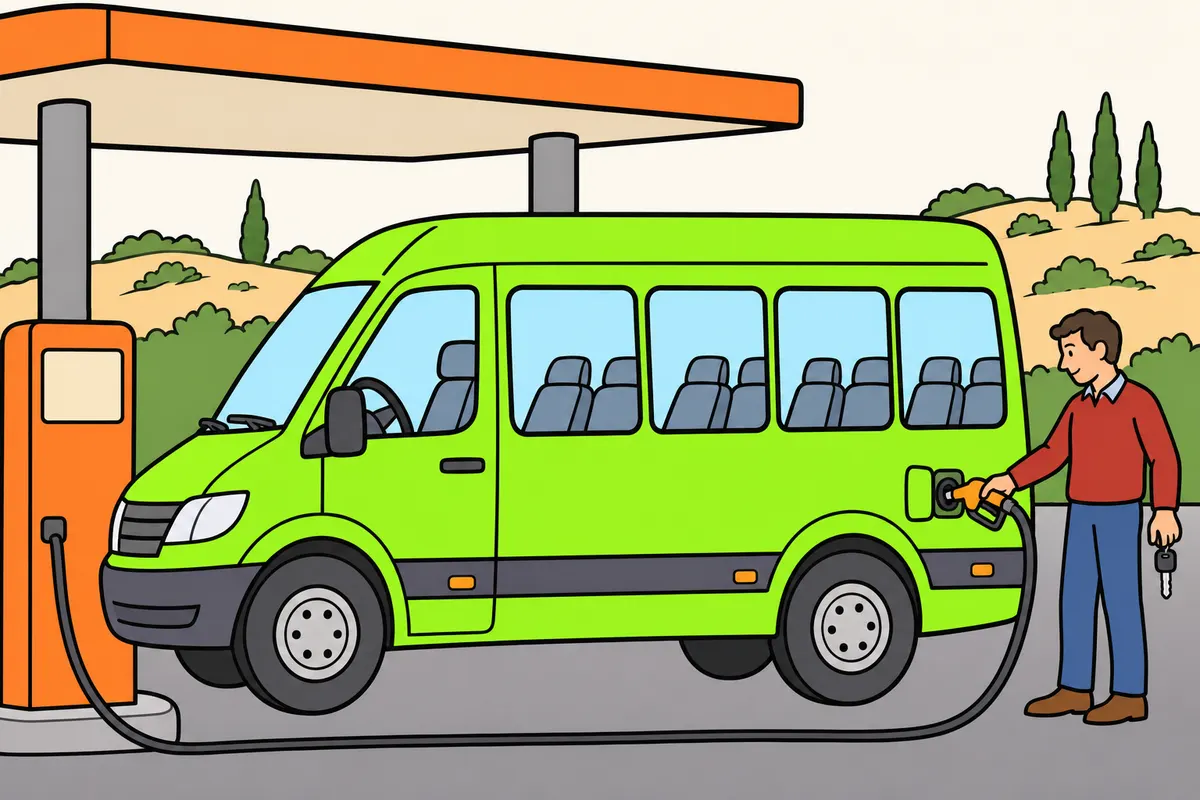
Switch off when stopped in tunnels or enclosed places, and before refuelling.
Remember
- Stopped in tunnels or enclosed places, switch off even while staying at the wheel.
- If this forced stop exceeds two minutes, keep the engine off until moving again.
- In that case, keep the position lights on.
- To refuel, the engine must be off.
- Staff may not serve you fuel with lights, radio or phone on.
- Without an attendant, switch them off yourself.
Exam trap: Wrong: in a tunnel, you wait two minutes to switch off. Right: always switch off when stopped, even if you stay at the wheel; if a forced stop inside a tunnel or enclosed place exceeds two minutes, keep the engine off until moving again and keep the position lights on.
Read the full explanation
- You must always switch off the engine whenever the minibus is stopped inside a tunnel or enclosed place, even if you remain at the wheel. [RGC, art. 115.1](https://www.boe.es/buscar/act.php?id=BOE-A-2003-23514#a115).
- If a forced stop inside a tunnel or enclosed place lasts more than two minutes, you must keep the engine switched off until you move off again and keep the position lights on. [RGC, art. 115.2](https://www.boe.es/buscar/act.php?id=BOE-A-2003-23514#a115).
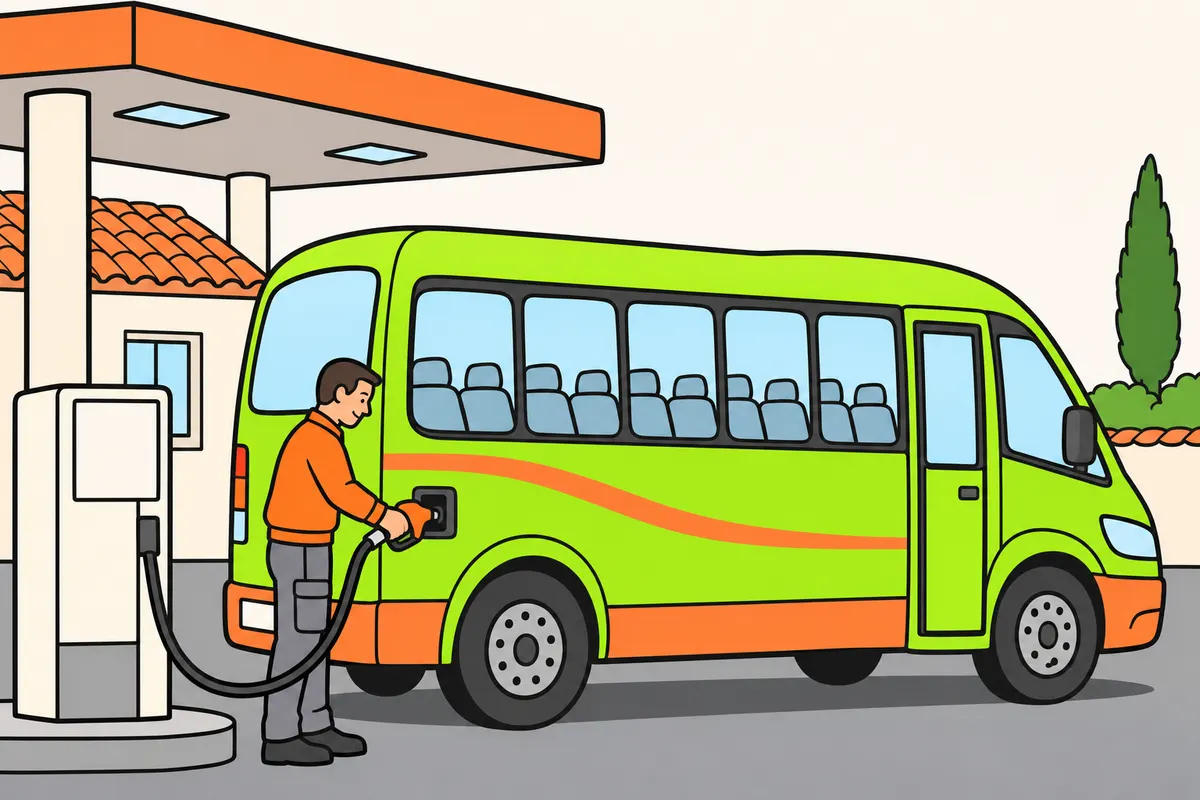
- You must switch off the engine to refuel. You cannot be served fuel with the lights, radio or mobile phone switched on; if you refuel without an attendant, you must switch them off yourself. [RGC, art. 115.3 and 4](https://www.boe.es/buscar/act.php?id=BOE-A-2003-23514#a115).
16Continue in the brakes and maintenance modules
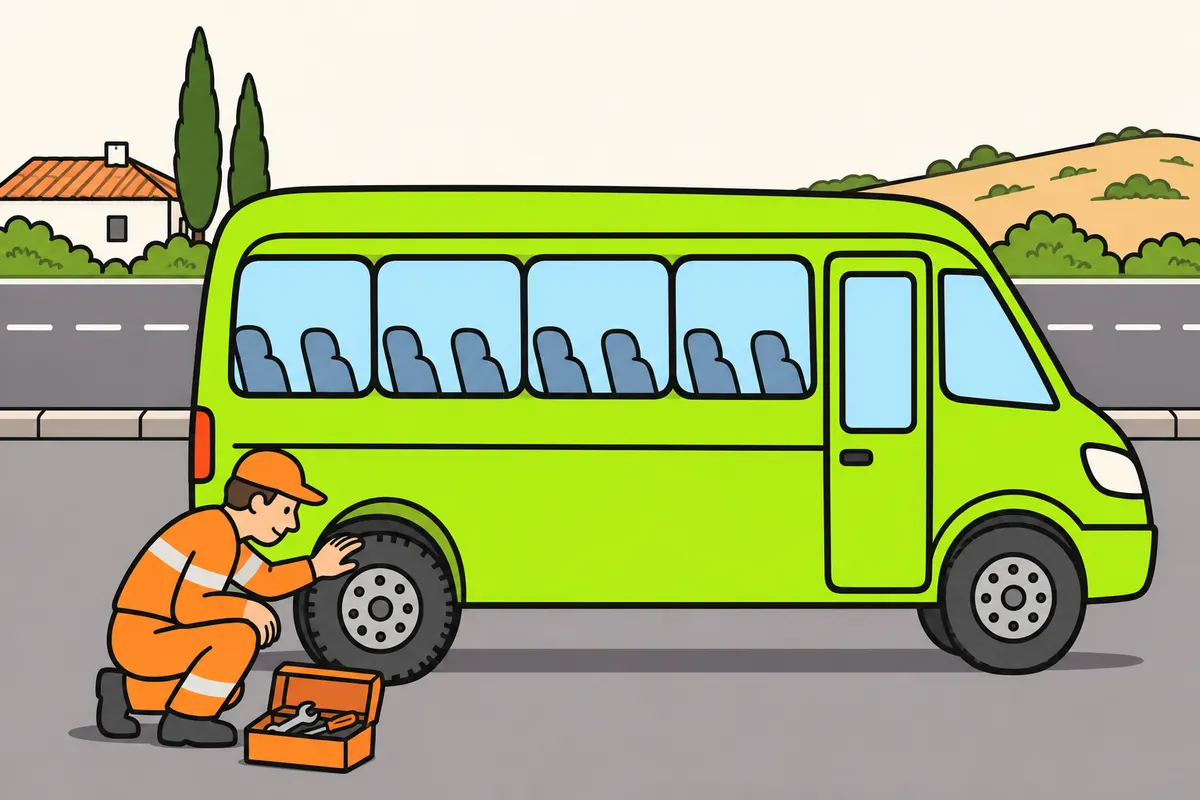
Continue with brakes and maintenance to complete your knowledge of your minibus.
| Module | What you study |
|---|---|
| Minibus brakes and retarders | Brakes, electronic aids and retarders |
| Minibus maintenance and checks | Tyres and checks of fluids, lights and wipers |
Remember
- Study brakes and electronic braking aids in “Minibus brakes and retarders”.
- Find how retarders work there too.
- Study tyres and their checks in “Minibus maintenance and checks”.
- Find fluid, light and windscreen wiper checks there too.
Exam trap: Wrong: you look for tyre checks in “Minibus brakes and retarders”. Right: study them in “Minibus maintenance and checks”.
Read the full explanation
- The operation of the brakes, ABS, EBS, ASR, stability control and retarders is covered in «Minibus brakes and retarders».
- Tyre pressure, wear, markings, regrooving and winter equipment, together with checks of fluids, lights and windscreen wipers, are covered in «Minibus maintenance and checks».
From diesel fuel to wheel movement
Relate fuel supply, combustion and transmission.
- The fuel feed pump moves diesel fuel towards the injection circuit.
- High pressure allows the injectors to introduce fuel into the cylinders.
- Combustion drives the pistons; the connecting rods transmit the movement to the crankshaft.
- The clutch and gearbox transmit and adapt rotation; the final drive and drive shafts carry it to the driven wheels.
How the engine starts turning
Follow the energy flow and gear engagement in a conventional starting system.
- You operate the starter control according to the preheating procedure.
- The solenoid engages the pinion with the ring gear and closes the power circuit.
- The battery powers the starter motor, which turns the combustion engine.
- When the engine starts, you release the control and the pinion disengages.
Check what you know
Real questions from the bank on this topic. Pick an answer to see the explanation.
Finished this module?
Mark it as read and you will see your progress on the theory list.